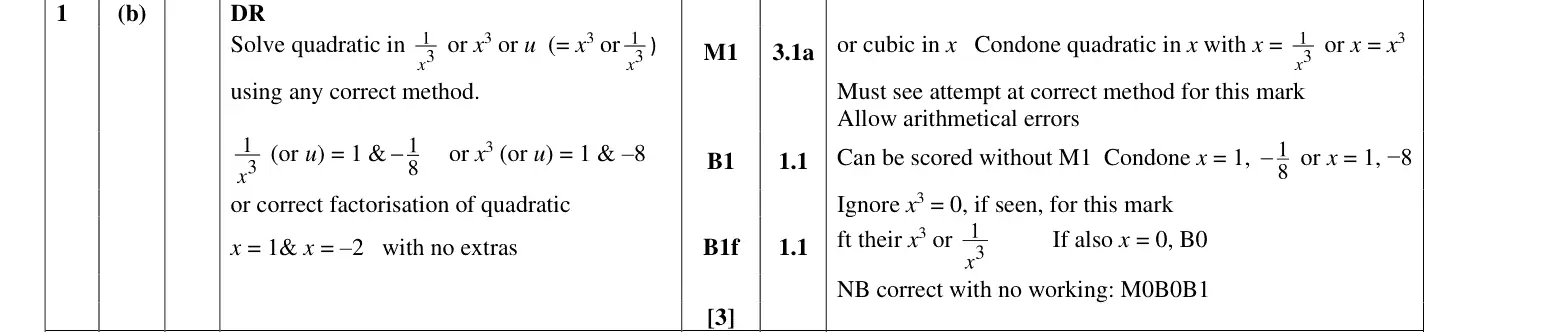
This question was generally well answered by the majority of candidates, with very few numerical or algebraic errors seen. However, a significant minority of candidates were not awarded full marks due to not meeting the detailed reasoning requirement. Typical errors in responses were: - not showing any working to solve their quadratic (either in 𝑦3 or another variable, e.g. 𝑢= 𝑦3) – which scored B0 and tended to lead to 3/4 or - omitting both pairs of solutions (for 𝑢 or 𝑦3) – scoring A0A1 and/or labelling solutions other than the final pair with 𝑦=… - scoring A1A0. A minority of candidates mistakenly stated that -8 had no cube root. The above points are good practice that candidates should always be encouraged to include in their working, but under the detailed reasoning instruction there is a stronger requirement to show ‘sufficient detail’ and therefore candidates should be aware that they may not score full marks (even for correct answers) without this. The final point on notation is important to all questions of this type (and across this paper). Candidates are of course permitted to use any variable of their choice to represent 𝑦3 but using 𝑦= 𝑦3 is not mathematically correct and leads to a misleading set of answers (suggesting that there are 3-4 solutions instead of 2).
Key points and common errors
quadratic in y³: (y³ + 8)(y³ − 1) = 0
y = −2 or 1
working to solve the quadratic must be shown
some thought −8 has no cube root
June 2025 · AS Paper 1 · Q88 marksEasy
Mark scheme for this part
Examiner's comment
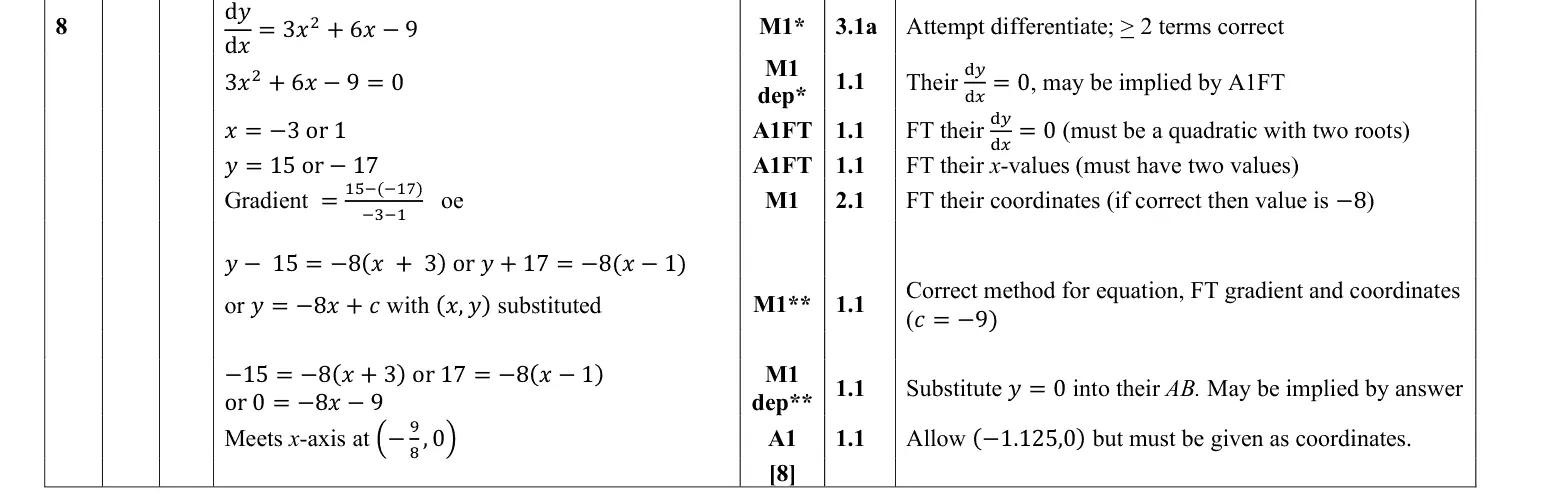
This question was generally very well answered. Almost all candidates were able to differentiate, set =0 and solve to obtain two values of x for M1M1A1. Some candidates made a numerical error in finding the corresponding values of y, but were still able to go on obtaining the subsequent method marks. Most candidates identified the need to find the gradient, equation and then set 𝑦= 0 although some instead solved for 𝑥= 0, etc. A few candidates stopped after the first four marks. Notice that (in contrast with Question 1 (b) as there is no DR instruction here, candidates were not required to show the working to solve their quadratic d𝑦 d𝑥= 0 but it remains best practice to do so. The question asked for the ‘coordinates of the point’ so 𝑥= − 8 was not sufficient as a final answer. This was a common omission and led to candidates receiving 7/8. This candidate has made a good start, scoring M1M1A1 for their differentiation and correct values of x for the turning points. They then make an error in finding one of the corresponding values of y (A0) but go on to work correctly with their values, scoring M1M1M1. The final answer is incorrect (A0) so this response scored 6/8.
Key points and common errors
dy/dx = 3x² + 6x − 9 = 0: A(−3, 15), B(1, −17)
gradient −8
y = −8x − 9 meets the x-axis at (−9/8, 0)
give coordinates, not just x
June 2025 · AS Paper 2 · Q8(b)5 marksEasy
Show the start of this question
Mark scheme for this part
Examiner's comment
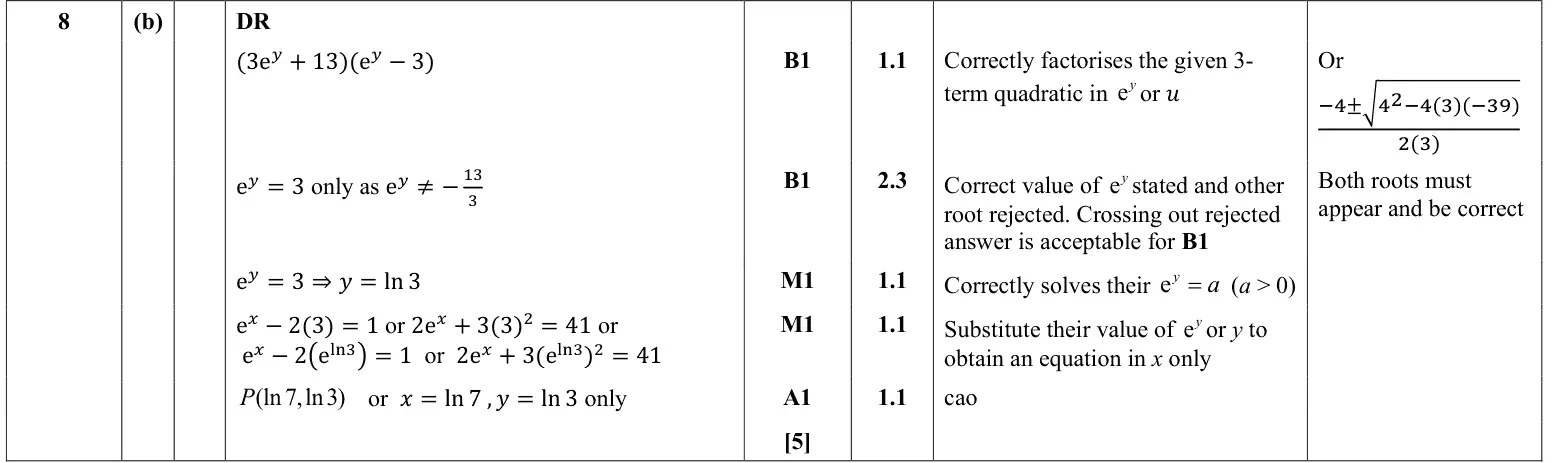
This was the third DR question. The given equation was widely recognised as a quadratic and well solved (see note below). The negative root was often rejected with a good reason provided. We expected exact answers to be seen for full marks. Those who did not use a quadratic tended to write things like ln(3e2y) + ln(4ey) = ln(39) and not make any further progress.
Key points and common errors
quadratic in eʸ: (3eʸ + 13)(eʸ − 3) = 0
reject eʸ = −13/3 with reason
y = ln 3, eˣ = 7 so P(ln 7, ln 3) exact
logging term by term fails
June 2025 · Paper 1 · Q4(c)3 marksEasy
Show the start of this question
Mark scheme for this part
Examiner's comment
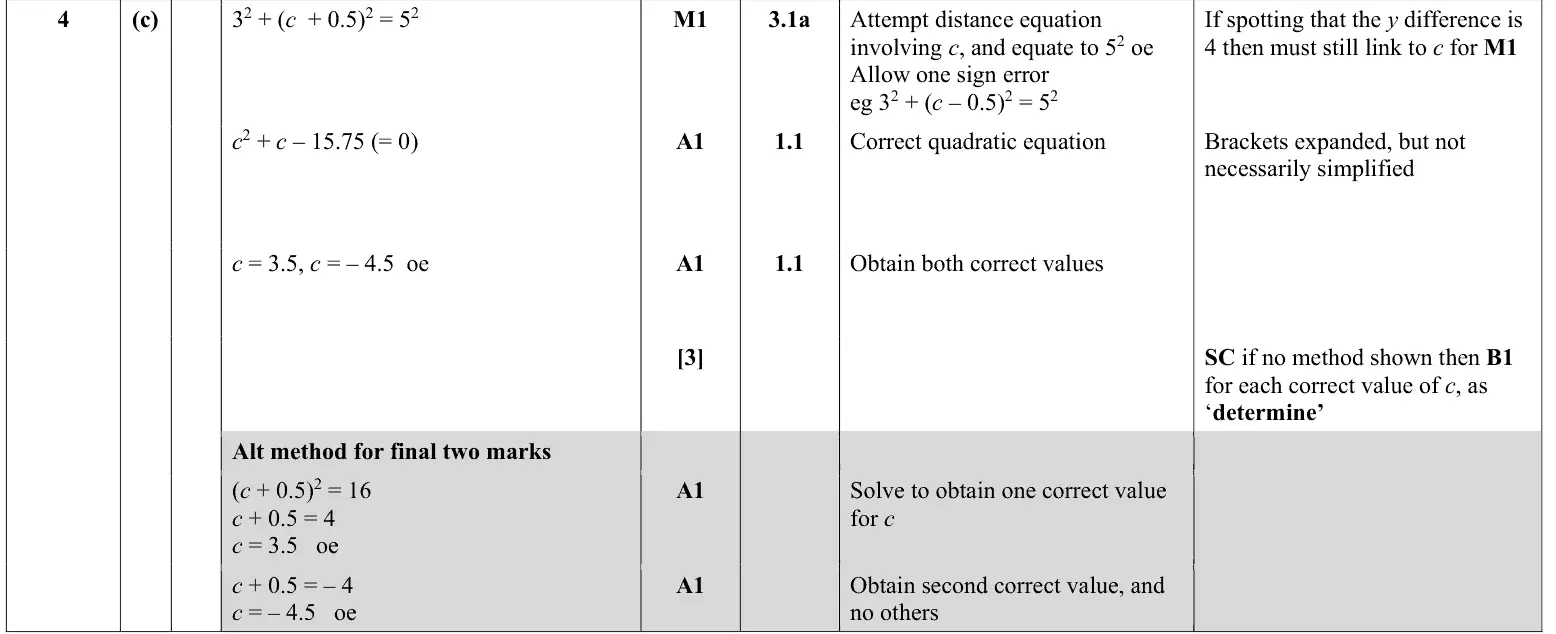
Most candidates were able to set up and solve a quadratic equation to obtain the two correct values for c, although more informal methods involving a y difference of 4 were also seen. Some candidates were clearly attempting the correct distance equation but made a sign error when considering c – (– 0.5).
Key points and common errors
3² + (c + 0.5)² = 5²
c = 3.5 or −4.5
sign error with c − (−0.5)
June 2025 · Paper 2 · Q2(c)4 marksEasy
Show the start of this question
Mark scheme for this part
Examiner's comment
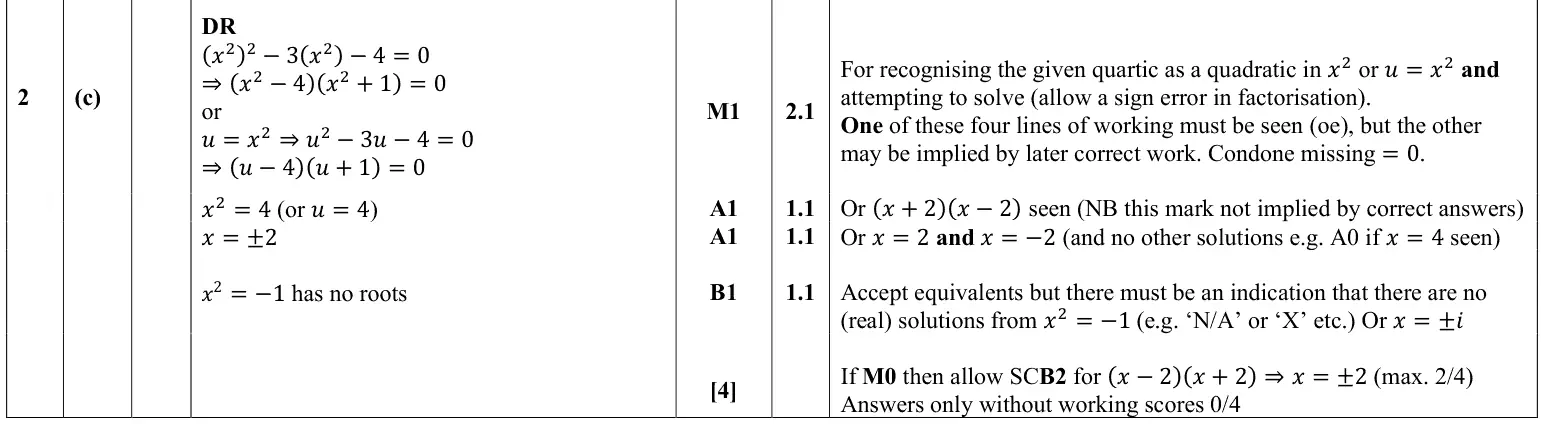
Most candidates scored at least 3 marks in this part. Most correctly identified the form of the given equation as an ‘embedded’ quadratic and either made an appropriate substitution (e.g. 𝑢= 𝑥2) or solved directly as a quadratic in 𝑥2. As this question was DR, candidates needed to show their method in full, including the ‘intermediate’ values before the final answers. A small number of candidates used the invalid notation 𝑥= 𝑥2 which, although sometimes recovered, typically led to candidates writing down an apparent additional solution 𝑥= 4 which meant that they could not score full marks. Candidates should be reminded to show every step of their working when the question includes the DR instruction.
Key points and common errors
quadratic in x² (or u = x²)
x² = 4 gives x = ±2
must state x² = −1 has no real roots
invalid notation x = x² led to extra x = 4
June 2025 · Paper 2 · Q6(b)3 marksMedium
Show the start of this question
Mark scheme for this part
Examiner's comment
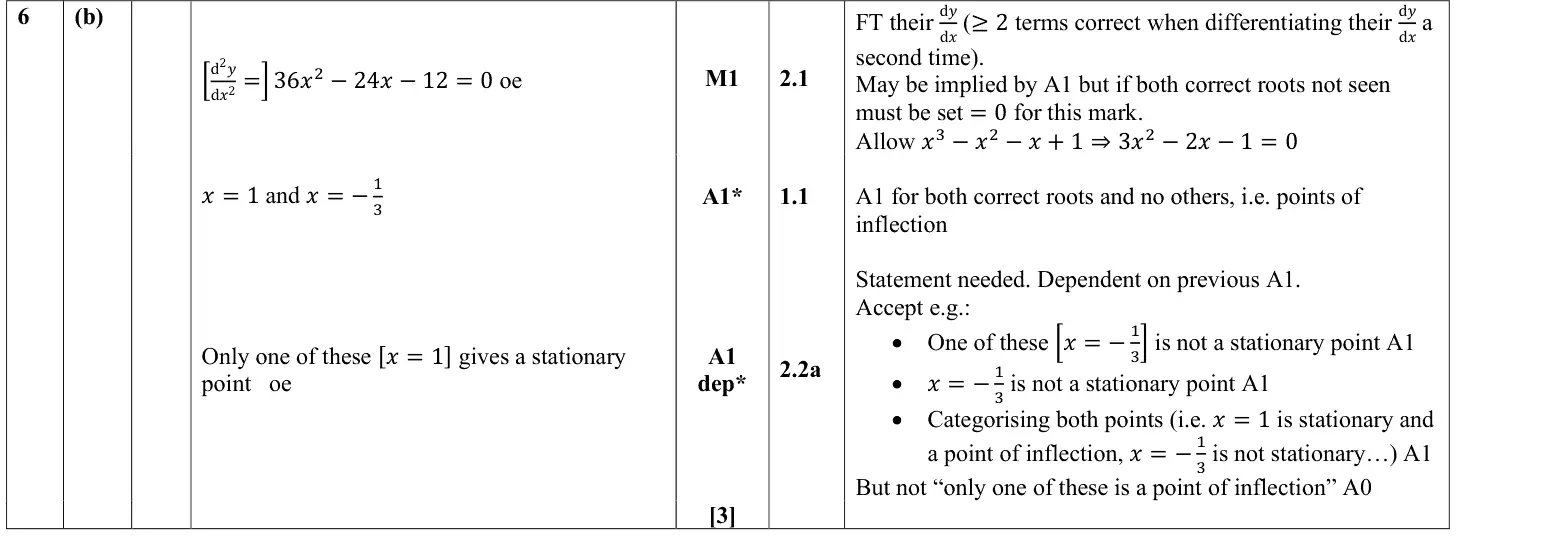
Around half of candidates scored all 3 marks here, for differentiating again and solving d𝑥2 = 0 to find the x-coordinates of the two points of inflection. The final mark was for using these values, compared to the points found in (a)(ii) to deduce that there is one point of inflection that is not a stationary point. The question made a specific request, but some candidates misinterpreted this and instead substituted in their values from part (a)(ii) – without setting =0 – in an attempt to classify the stationary points. This was not sufficient in this context as it does not show the required fact.
Key points and common errors
d²y/dx² = 36x² − 24x − 12 = 0 gives x = 1 and x = −1/3
only x = −1/3 is not a stationary point
substituting the stationary x-values without setting = 0 is not enough
June 2024 · AS Paper 1 · Q67 marksMedium
Mark scheme for this part
Examiner's comment
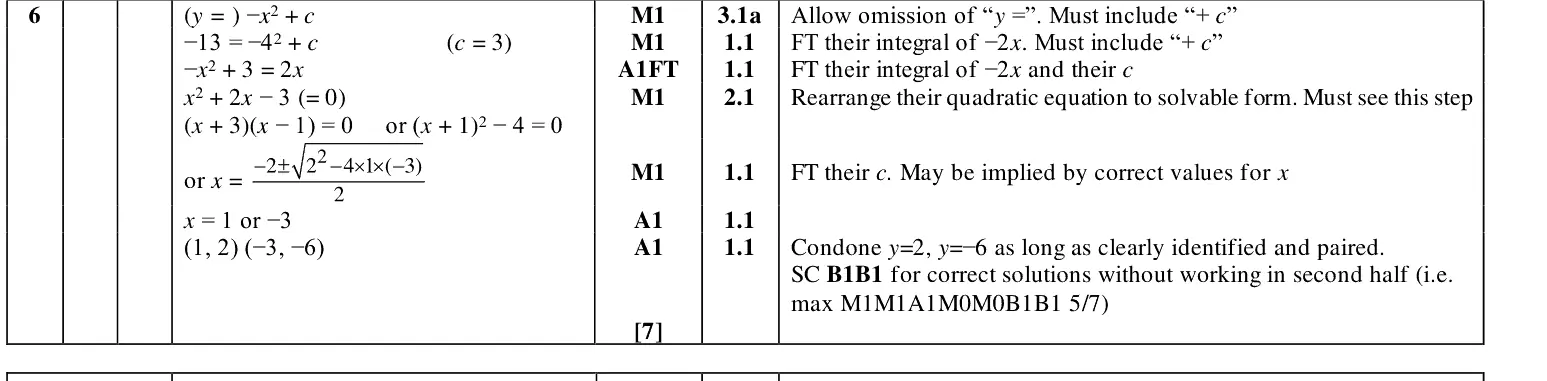
Most candidates made a good attempt at this question, although relatively few received all 7 marks. The majority of candidates were able to score 2 or 3 of the first 3 marks from integrating (although a few omitted the constant and therefore received 0 as they could not progress). As this question was ‘Determine’ candidates were required to show working for forming and solving their quadratic. A Special Case was included here for candidates who provided answers unsupported by working in the second part, but this should not be assumed for future exam series. Errors in deducing c were common, but candidates who obtained the correct equation were mostly able to correctly deduce that they needed to set this = 2x and solve the resulting quadratic for x. Some candidates obtained y = 12 or y = −12 instead of y = −6 where x = −3.
Key points and common errors
y = −x² + c
c = 3 from (4, −13)
−x² + 3 = 2x so (x + 3)(x − 1) = 0
(1, 2) and (−3, −6)
omitting + c blocks progress
show working for the quadratic
June 2024 · AS Paper 1 · Q7(b)4 marksHard
Show the start of this question
Mark scheme for this part
Examiner's comment
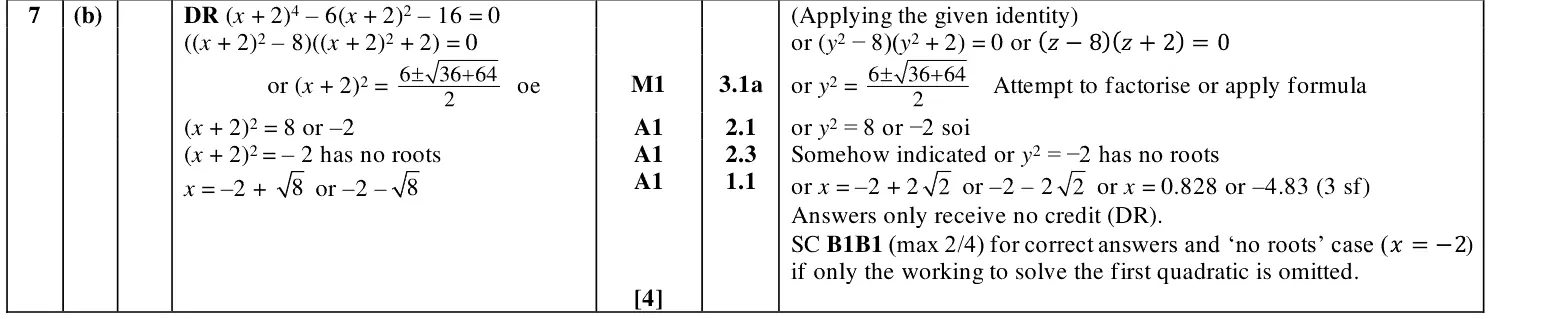
Many candidates did not appear to know how to approach this question, despite the LHS of the equation being in identical form to the identity given in part (a). Some attempted long division without applying the given identity, which was not fruitful. Candidates should be reminded that the instruction ‘Hence’ means that the result from the previous part must be used (and, as in this case, it is helpful to do so). A number of candidates (not noting the Detailed Reasoning instruction) gave the solutions without working (from their calculator) or ‘retro-fitted’ incorrect working to try and justify these. Neither could be credited. As a reminder, the Detailed Reasoning instruction means that all steps in the working must be shown, and that calculators may be used to check or verify results only. Candidates who attempted an analytical method were generally successful, with relatively few errors seen – a few candidates did not provide state that the (𝑥𝑥+ 2)2 = −2 case leads to no solutions, and a few made an error generating false extra sufficient justification of the quadratic form (and were marked under the Special Case), others did not solutions.
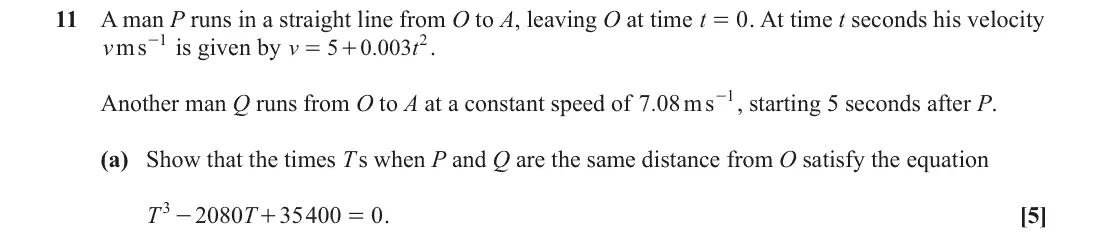
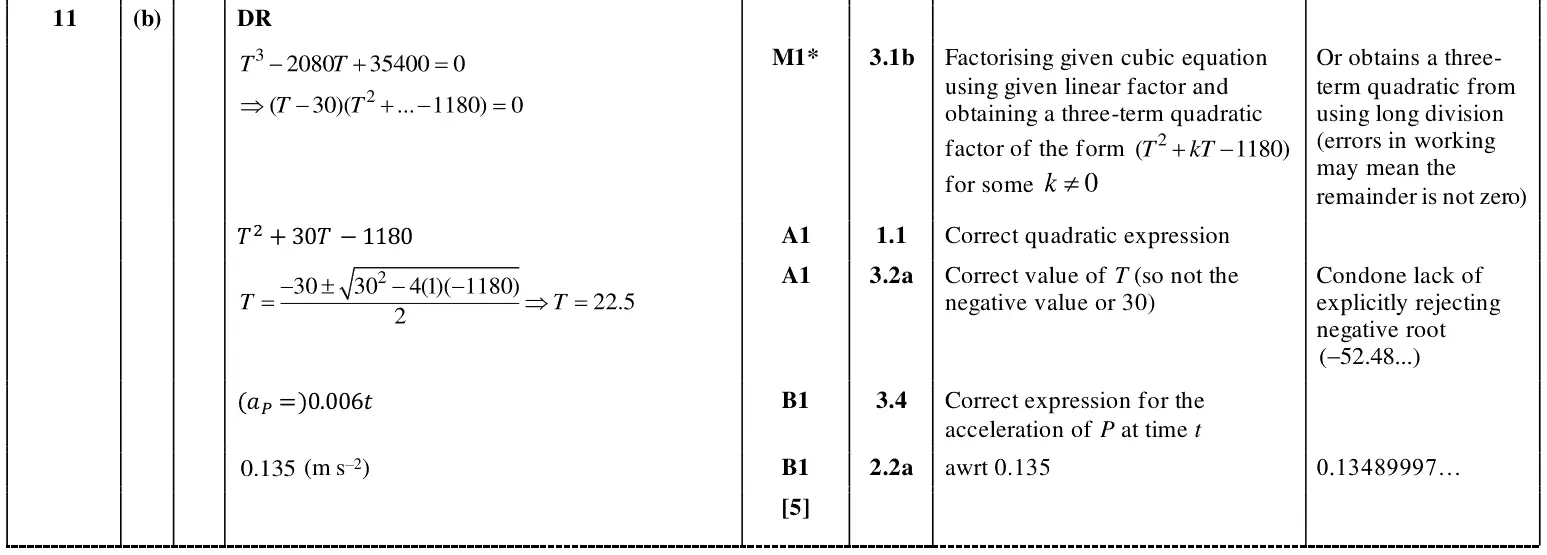
This part requested detailed reasoning, so we expected to see the method clearly presented; in very many cases this did not happen. As soon as candidates see this instruction they should think carefully about how they are going to use the calculator (see Exemplar 3 below and its commentary). To gain the M mark (and so potentially the next 2 marks also), we wanted to see clear evidence of factorising or long division. For the A mark allocated to T = 22.5, we wanted to see how this value had been obtained, for example evidence of the quadratic formula. Many candidates just gained the last 2 marks, as seen in cubic given in (a). This is not sufficient following a ‘show detailed reasoning’ request and earned M0. Note that the last B mark could still be given in such cases.
Key points and common errors
factorise using T = 30: T² + 30T − 1180 = 0
formula gives T = 22.5 (reject negative)
a = 0.006t so 0.135 m s⁻²
DR so factorising and formula must be shown
June 2024 · Paper 1 · Q3(b)(i)1 markMedium
Mark scheme for this part
Examiner's comment
(From the general report) Question 3 (b) (i), (ii) and (iii) Most candidates used the correct type of arrows, although a single stemmed arrow was condoned. (iii) was the most commonly correct answer and (i) the least commonly correct answer of the three.
Key points and common errors
x² = 3x ⇐ x = 3 (x = 0 is also a solution)
least often correct of the three
June 2024 · Paper 1 · Q8(c)(i)3 marksEasy
Mark scheme for this part
Examiner's comment
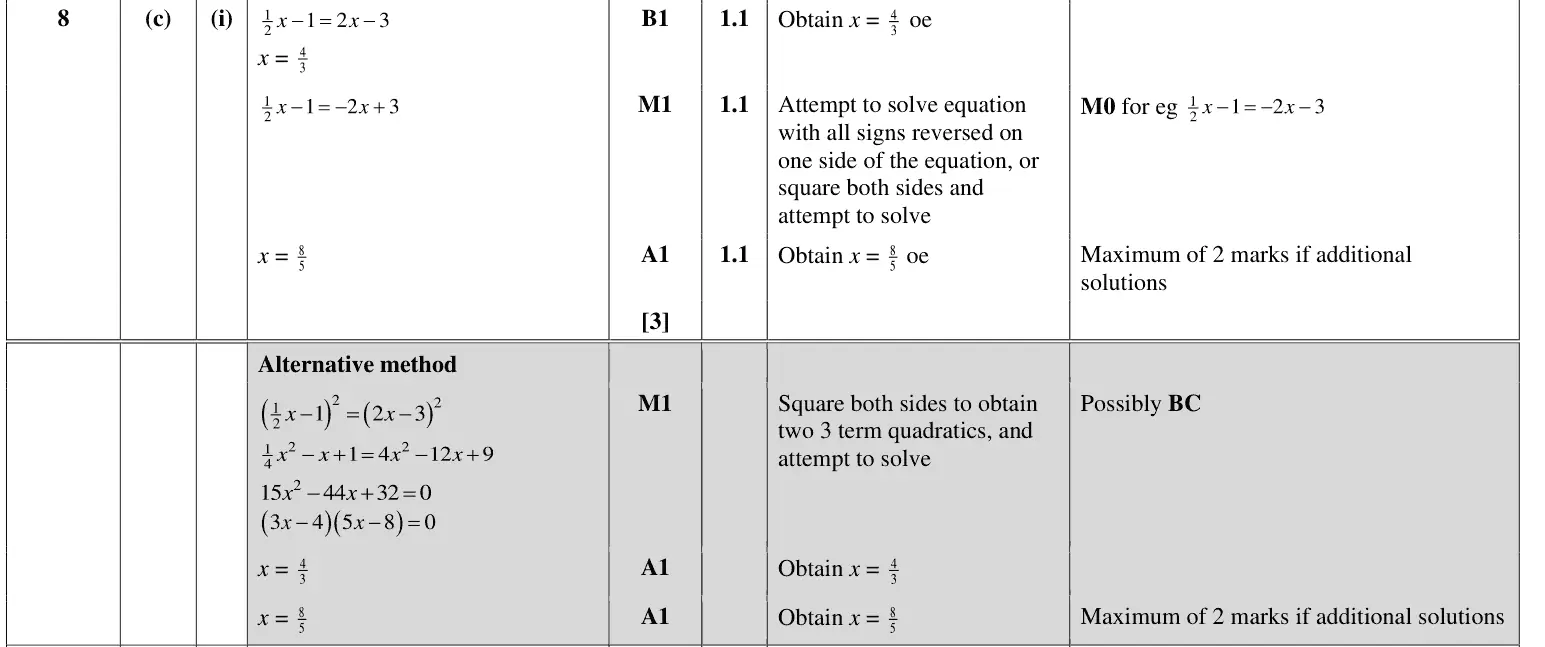
Candidates who squared both sides and solved the quadratic usually obtained full marks unless they had made a slip in their algebra. Those solving the two linear equations were also successful in general, although a minority got into difficulty changing the signs to find the second solution, with some changing one sign on each side and others changing all signs on both sides, rather than all signs on one side only.
Key points and common errors
½x − 1 = ±(2x − 3) or square both sides
x = 4/3, 8/5
reverse all signs on one side only
June 2024 · Paper 1 · Q108 marksEasy
Mark scheme for this part
Examiner's comment
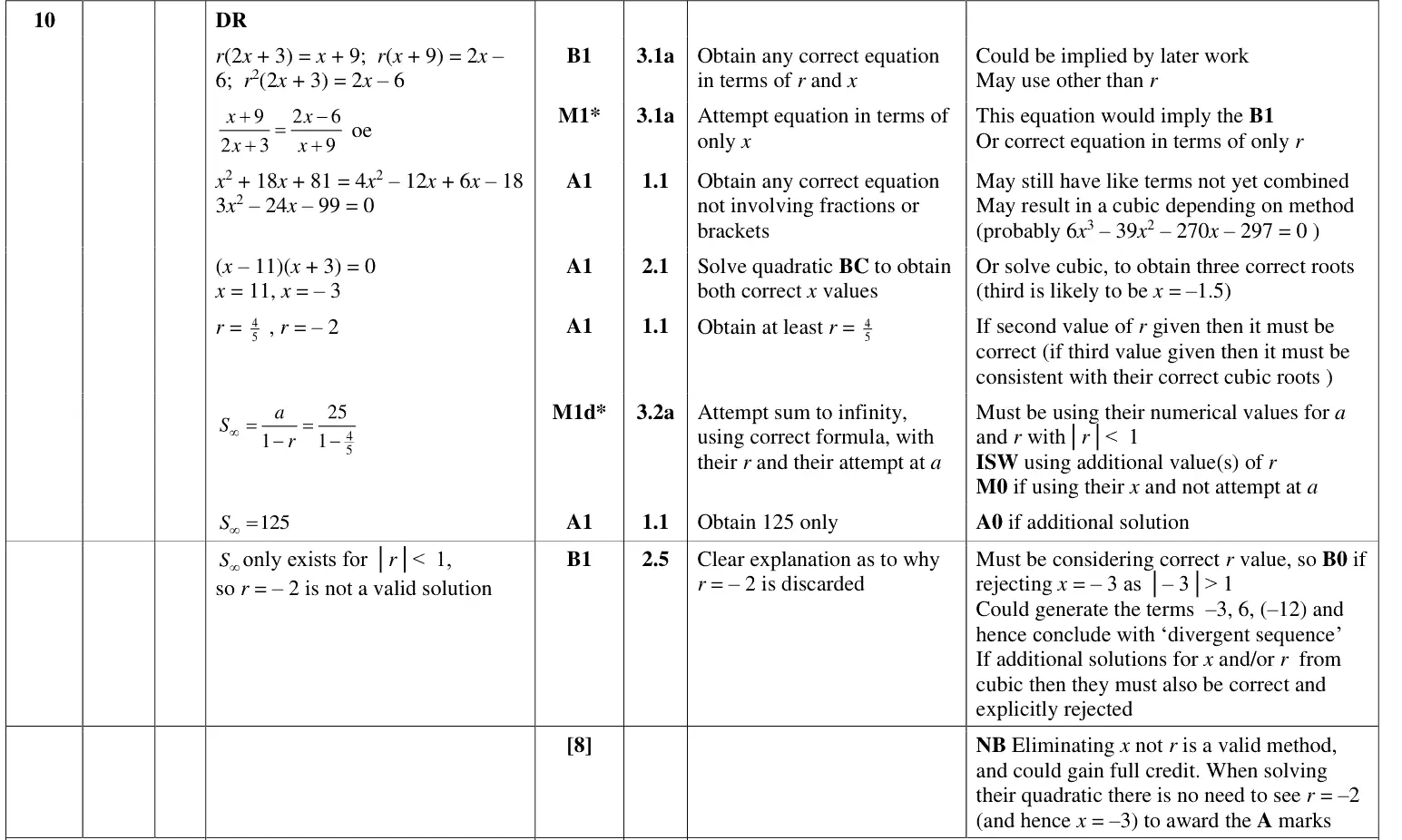
This question was well answered with many candidates scoring 7 or 8 marks. Almost all candidates obtained a correct expression for r, and most went on to form a correct equation in x. Most also solved their equation in x, either a quadratic or a cubic, to find the correct values of x. Despite this being a ‘detailed reasoning’ question, some candidates went straight from the quadratic equation to stating the roots. On this occasion this was condoned, but candidates would be well advised to make sure that sufficient detail is always provided in these types of questions. The majority then went on to find at least one value for r. However, many discarded the solution r = –2 without clear reasoning and in a few cases attempted to incorrectly calculate a second sum to infinity for this incorrect r value. Those candidates that didn’t score well, often tried to use their algebraic expression for r in the formula for the sum to infinity but were then unable to progress from this.
Key points and common errors
(x + 9)/(2x + 3) = (2x − 6)/(x + 9)
3x² − 24x − 99 = 0
x = 11 (r = 4/5) or x = −3 (r = −2)
reject r = −2 since the modulus of r must be < 1
S∞ = 25/(1 − 4/5) = 125
June 2024 · Paper 1 · Q12(a)5 marksHard
Mark scheme for this part
Examiner's comment
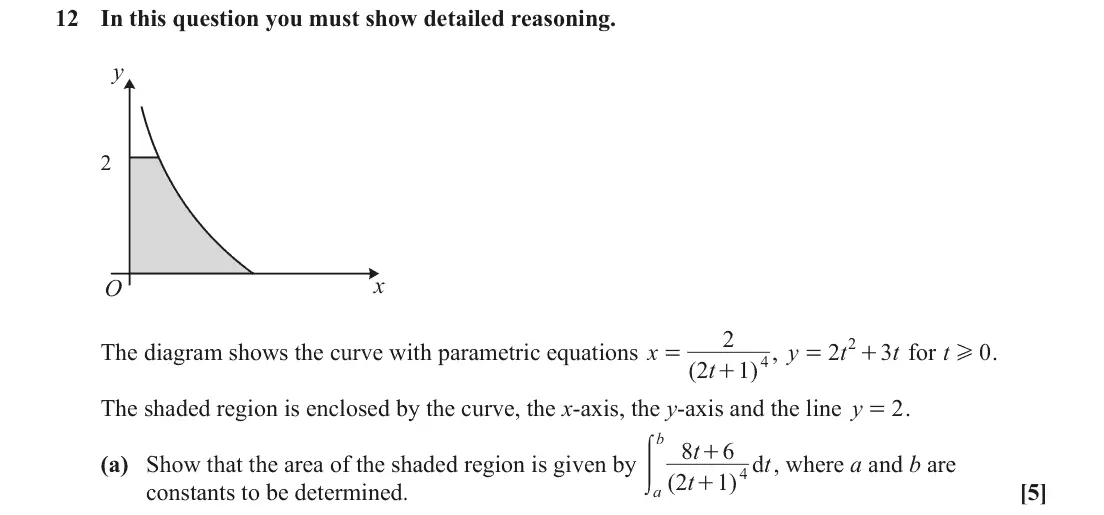
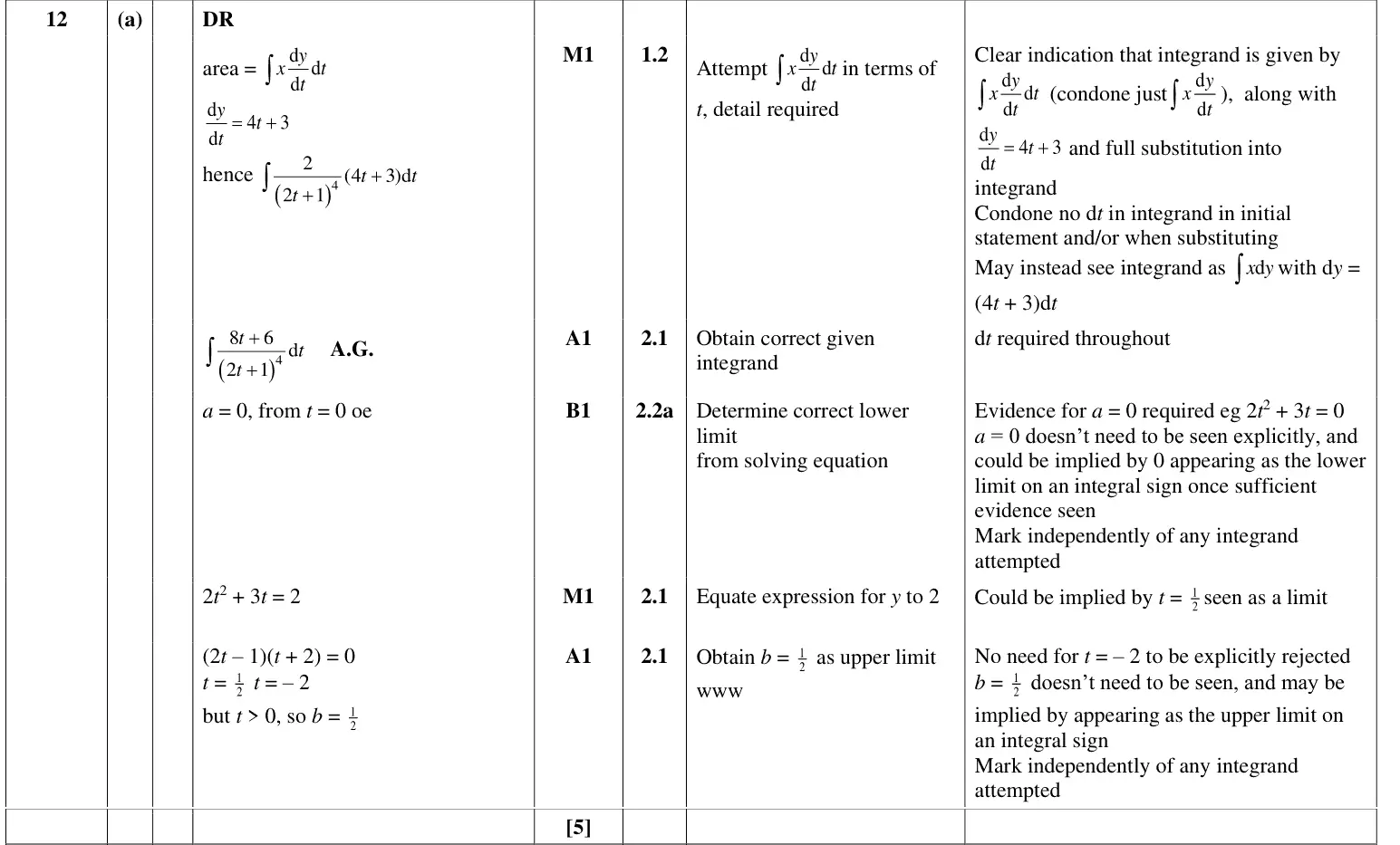
This question was challenging for most candidates to gain all the marks. Most candidates were able to achieve the method mark for equating the y equation to 2 to find the upper limit. These candidates often also equated y to 0 and solved both equations for t to find the correct limits, although the incorrect values from these equations were often chosen. Many candidates did not know how to find the area between a parametric curve and the y-axis and often set about forming the ∫𝑦 𝑑𝑡 𝑑𝑡, with little success in obtaining the given answer. Some candidates were able to work out how to arrive at the given expression inside the integral, but their reasoning was insufficient for the requirements of the question.
Key points and common errors
area to the y-axis = ∫x (dy/dt) dt with dy/dt = 4t + 3
a = 0 from y = 0
2t² + 3t = 2 gives b = ½ (t ≥ 0)
many used ∫y dx/dt dt
June 2024 · Paper 2 · Q6(b)(ii)2 marksEasy
Show the start of this question
Mark scheme for this part
Examiner's comment
This part was also well answered, with almost all candidates deducing the first root of 𝑥= −√2 2 . Many candidates went on (e.g. using the quadratic formula) to find the other two solutions correctly. Some candidates made sign errors (e.g. applying +/- to the wrong term). In some cases, candidates’ writing meant that their solutions were ambiguous: for instance writing or implying ± √2+√6 (when in fact the +/- should apply to the √6 only. Candidates should be reminded to make sure (especially in a DR question) that their responses are clearly written using correct, unambiguous notation.
Key points and common errors
x = −√2/2 from the linear factor
quadratic formula for (√2 ± √6)/4
June 2024 · Paper 2 · Q148 marksHard
Mark scheme for this part
Examiner's comment
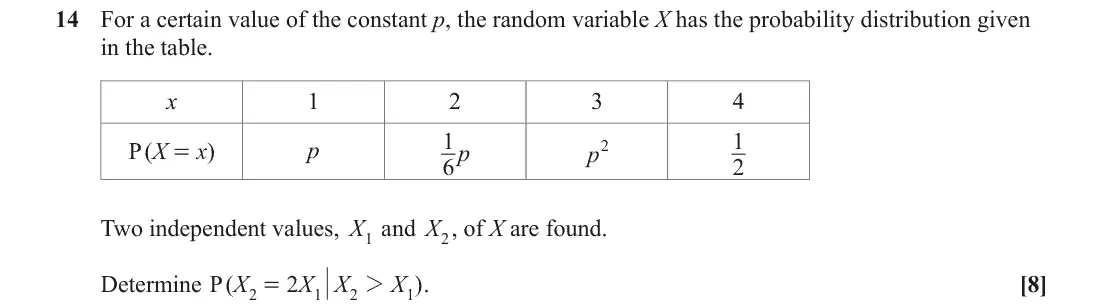
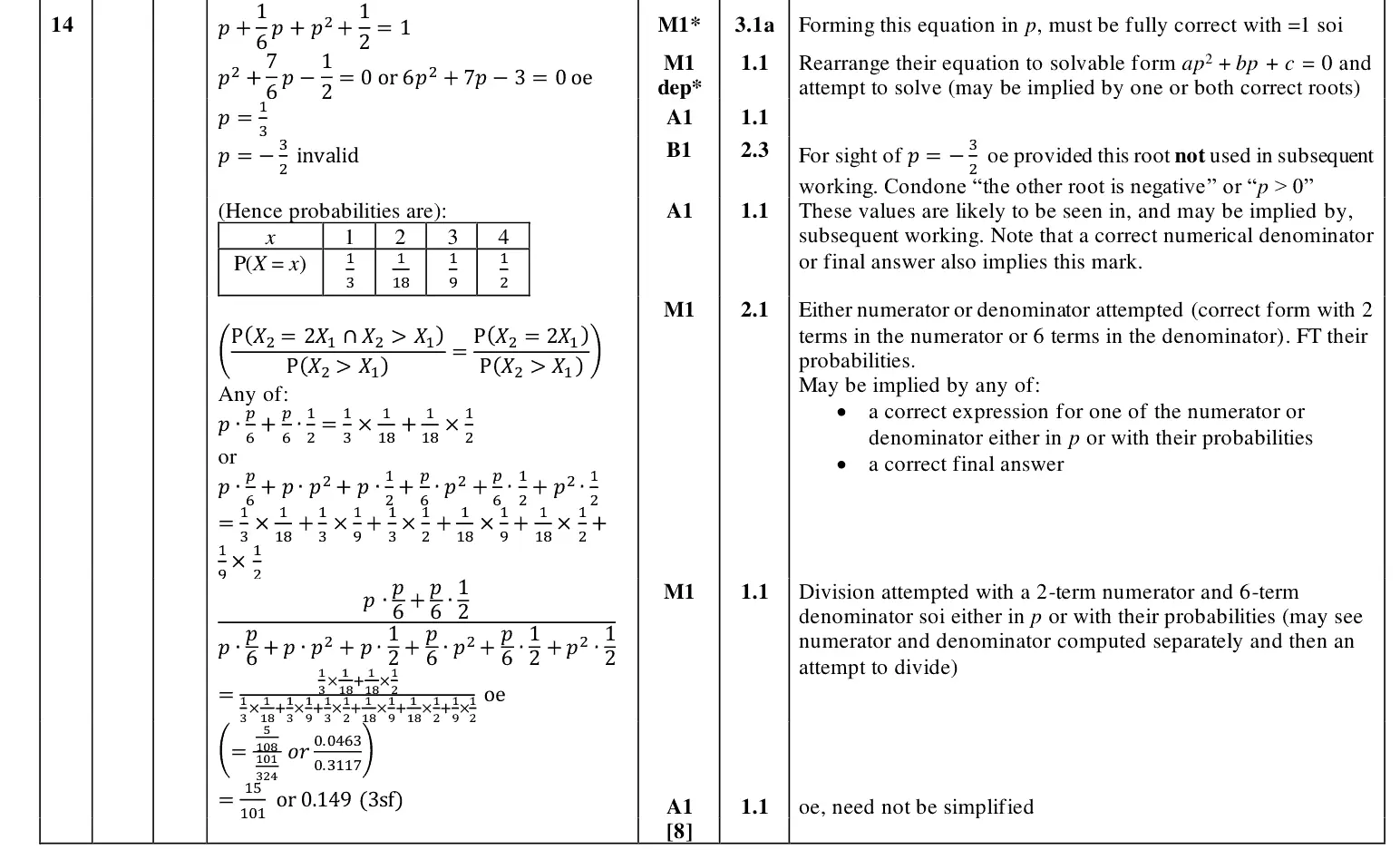
Most candidates obtained a number of marks in this question, although very few attained all 8. The majority of candidates approached the question in the order described in the mark scheme, first forming and solving a quadratic in p. This was almost always done correctly. Some candidates did not note or otherwise consider the − 2 root and could not be given the B1. (This root did not need to be found, but candidates did need to explicitly consider it, for instance by stating ‘the other root is negative’). Most candidates then went on to correctly find the conditional probability, but numerical errors were common - meaning that many candidates gained one or both method marks but not the final A1. Many candidates did not write down their probabilities once they had found a value for p (this mark could be implied, but only from correct responses or these values seen in working). A few candidates appeared not to have noticed the significance of the values in terms of p and started with a conditional probability formula in terms of p. This could gain M1M1 but nothing further unless they proceeded to work with the quadratic to find a value of p. This candidate has provided an excellent response to Question 14. They lose a single mark (B0) for not showing (or otherwise excluding) the other, negative, root of the quadratic. Their response is otherwise correct and therefore scores 7/8.
Key points and common errors
probabilities sum to 1 gives p = 1/3 (reject −3/2)
list outcomes with X₂ = 2X₁ and X₂ > X₁
15/101
June 2024 · Paper 3 · Q4(b)(i)4 marksMedium
Show the start of this question
Mark scheme for this part
Examiner's comment
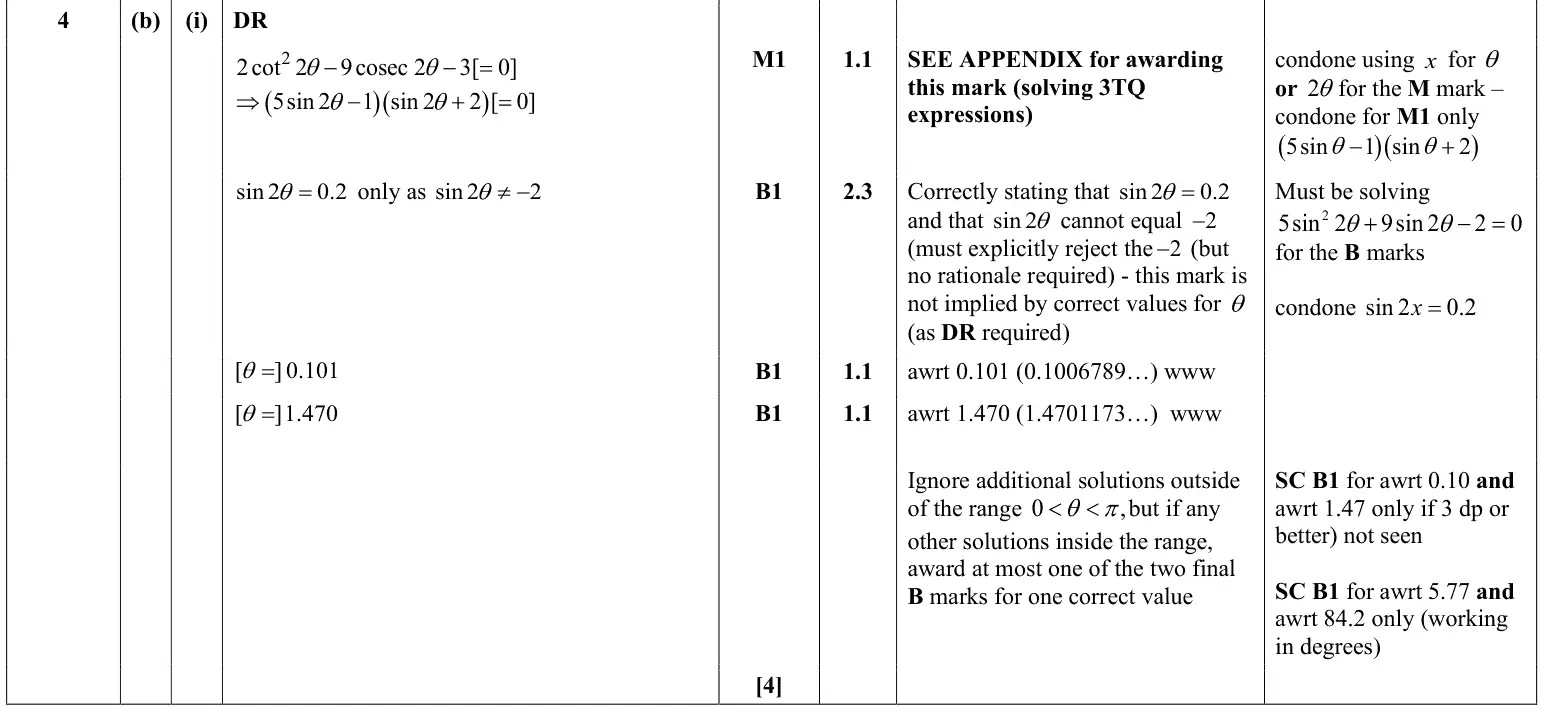
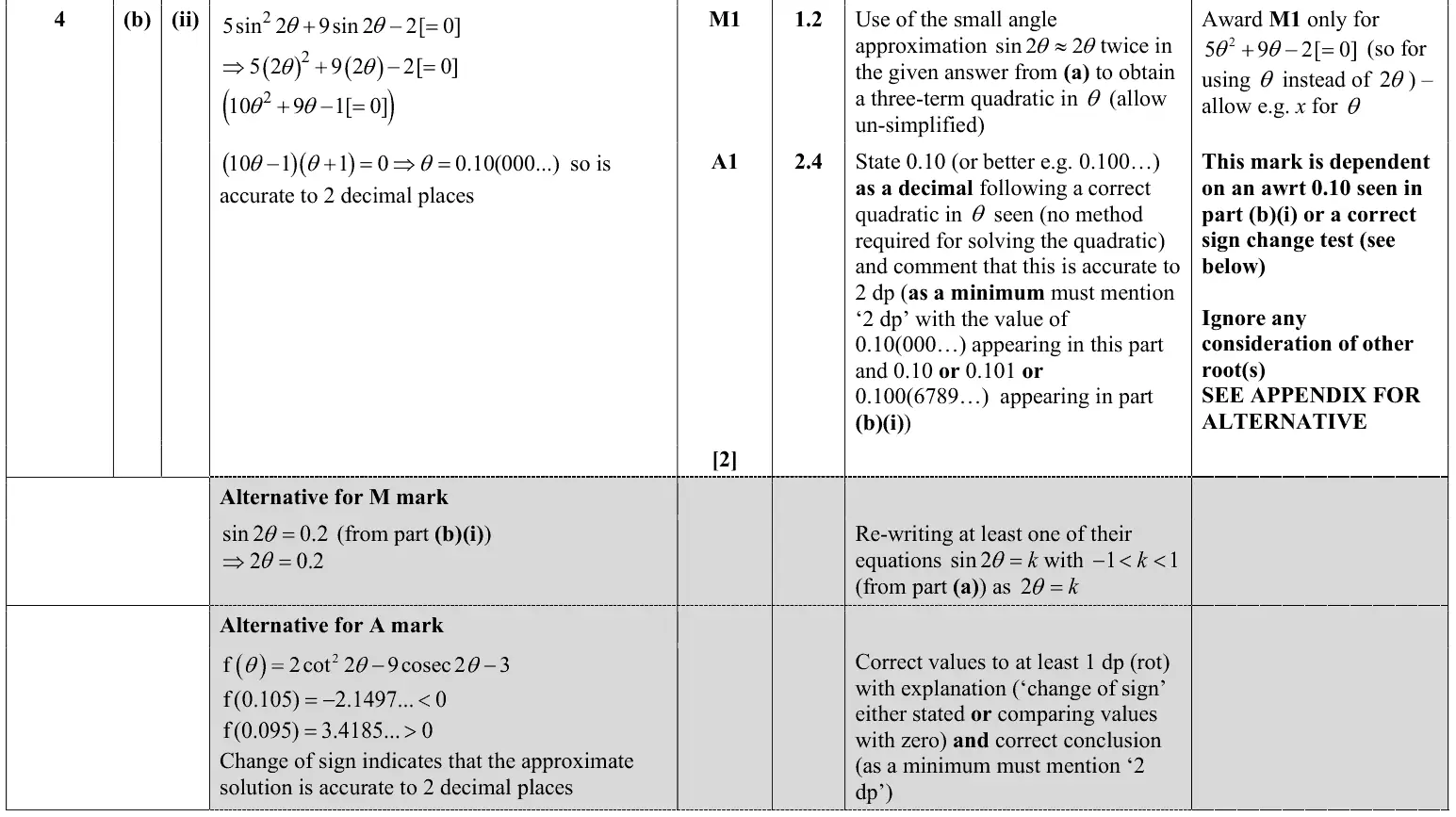
There were two main issues that candidates faced when answering this part. The first was that a good number did not appreciate that as this question required ‘detailed reasoning’. They either showed no method for solving the quadratic in sin2𝜃 or they gave no indication for why sin 2𝜃 could not equal −2. The other issue was that many candidates did not read the question carefully and instead solved the (simpler) equation of 2cot2𝜃−9cosec 𝜃−3 = 0 and so scored only the first method mark. Of those that did solve the correct equation most gave the first root (0.101) correct to the required 3 decimal places but did not give the second to the same degree of accuracy (with many just stating the answer as 1.47).
This part differentiated well with only the most successful recognising the need to apply the approximation sin 2𝜃≈2𝜃, and then solve the resulting equation 5(2𝜃)2 + 9(2𝜃) −2 = 0. Of those that did, not all realised the need to compare the smallest positive solution of this equation (which was 0.1000…) to the corresponding answer from the previous part (0.101) and conclude that both these values were the same to 2 decimal places.
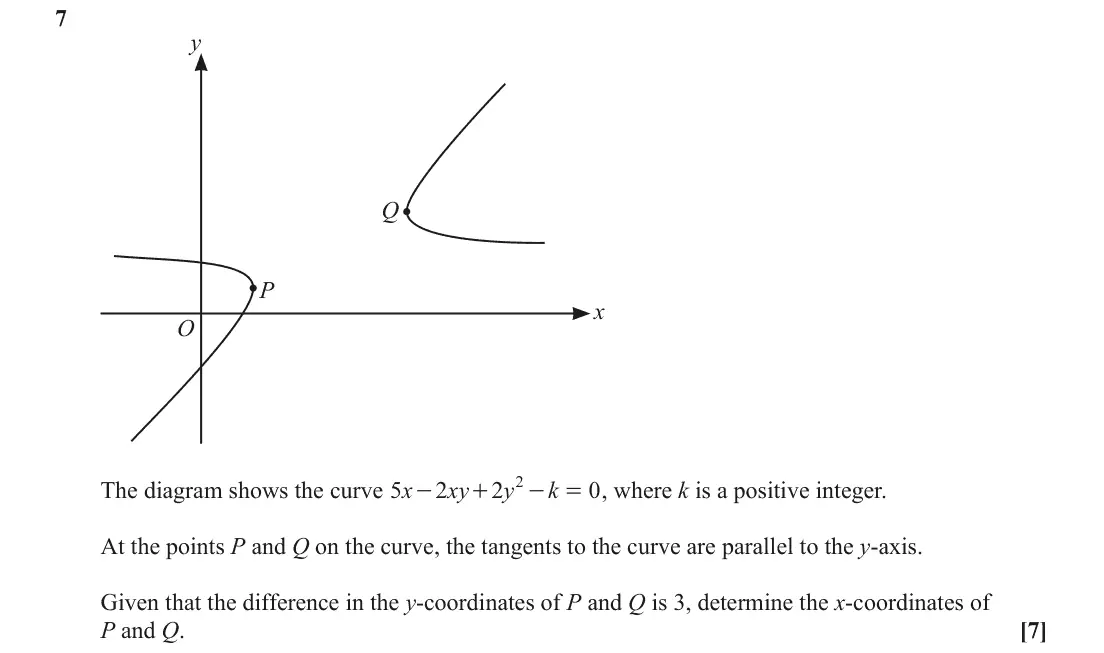
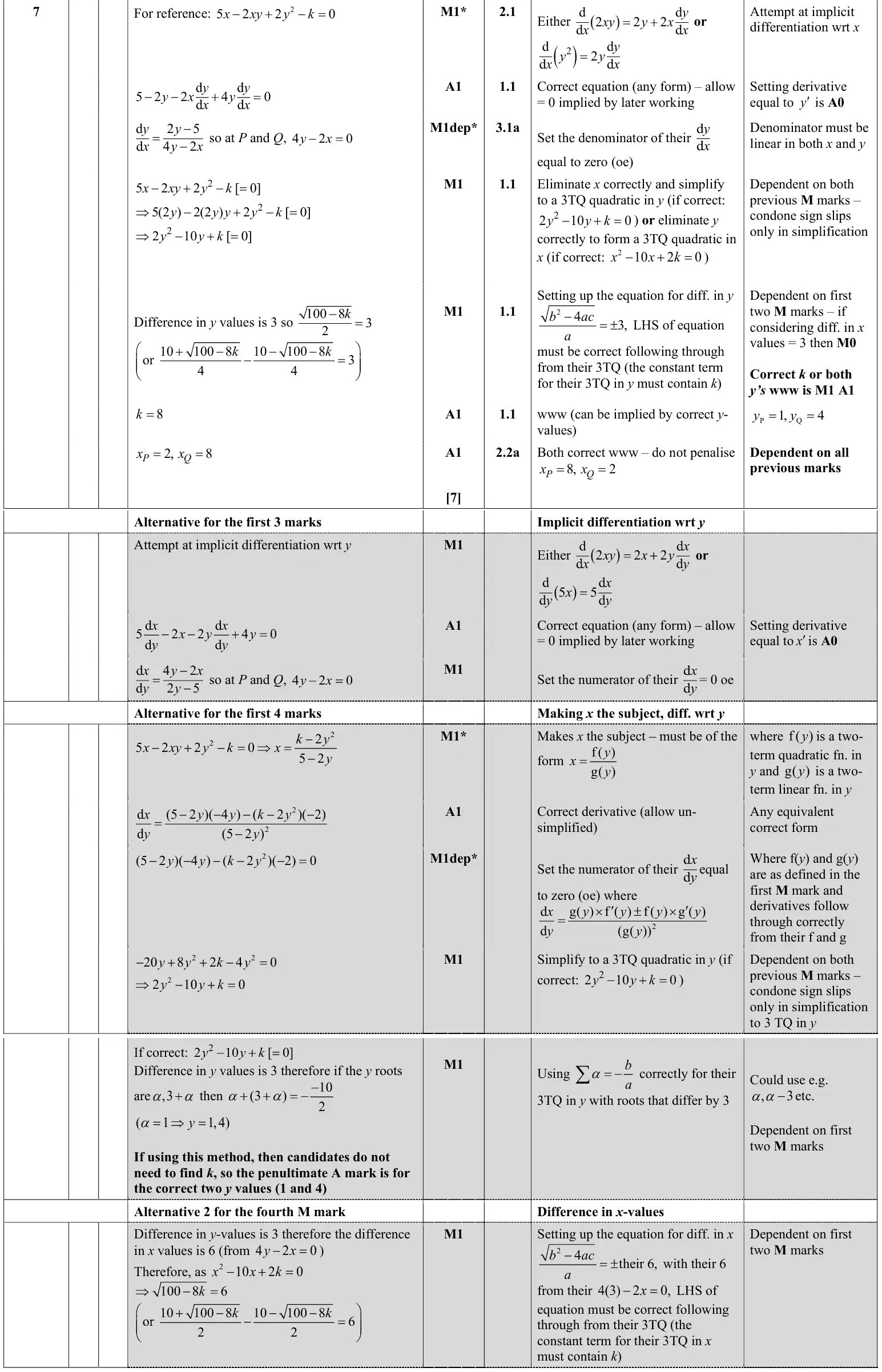
The vast majority of candidates made a good start to this unstructured problem and used implicit differentiation to correctly differentiate the given expression with respect to either 𝑥 or 𝑦. When errors occurred with this differentiation it was usually sign errors when differentiating −2𝑥𝑦 (using the product rule). Most candidates then found an expression for d𝑥 and were then almost equally split between either correctly setting the denominator equal to zero or incorrectly setting the numerator equal to zero. From there it was noted that while many candidates either obtained a correct quadratic equation in either 𝑦 (e.g. 2𝑦2 −10𝑦+ 𝑘= 0) or 𝑥 (e.g. 𝑥2 −10𝑥+ 2𝑘= 0) very few could use the given condition that the difference in the 𝑦-coordinates was 3 (or equivalently the difference in 𝑥-coordinates was 6) to find the correct 𝑥-coordinates of 𝑃 and 𝑄. This candidate scored 4 out of the 7 marks available for correctly differentiating implicitly and obtaining the correct relationship that 4𝑦−2𝑥= 0. They then went on to obtain a correct quadratic equation in 𝑥 but then did not make any further progress. This was relatively common as many candidates did not then realise how they could use the fact that the difference in the 𝑦 values was 3 to find the required 𝑥 coordinates. Section B Overview One general point with regard to the answering of certain mechanics questions should be made in this overview. This is that unless told otherwise the value that candidates should use for the acceleration due to gravity, g, is 9.8 and not 10 or 9.81 (and this value is stated explicitly on the front cover of the examination paper).
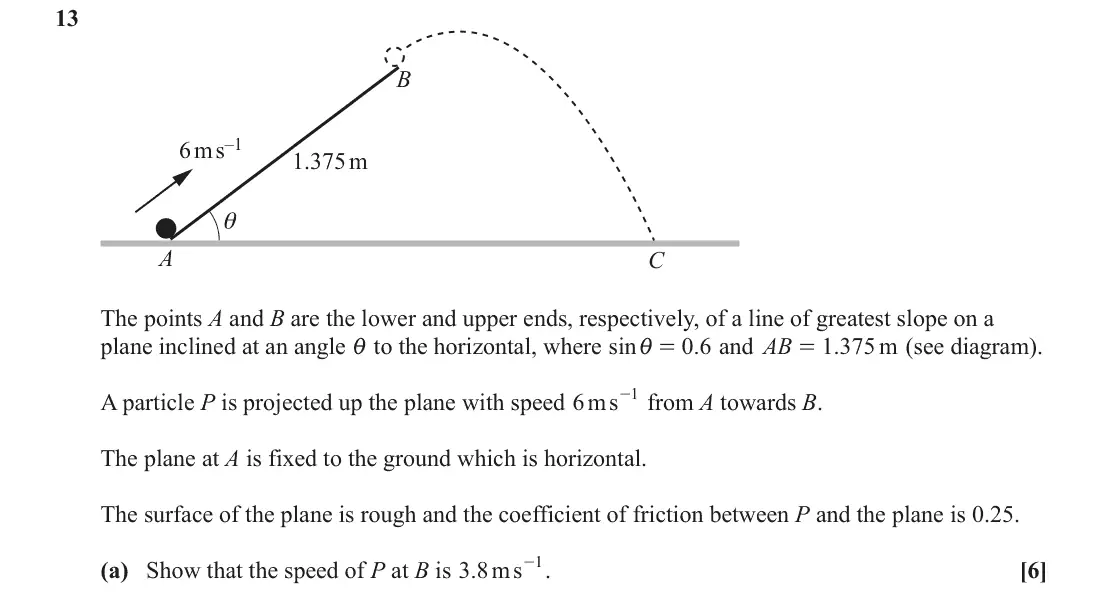
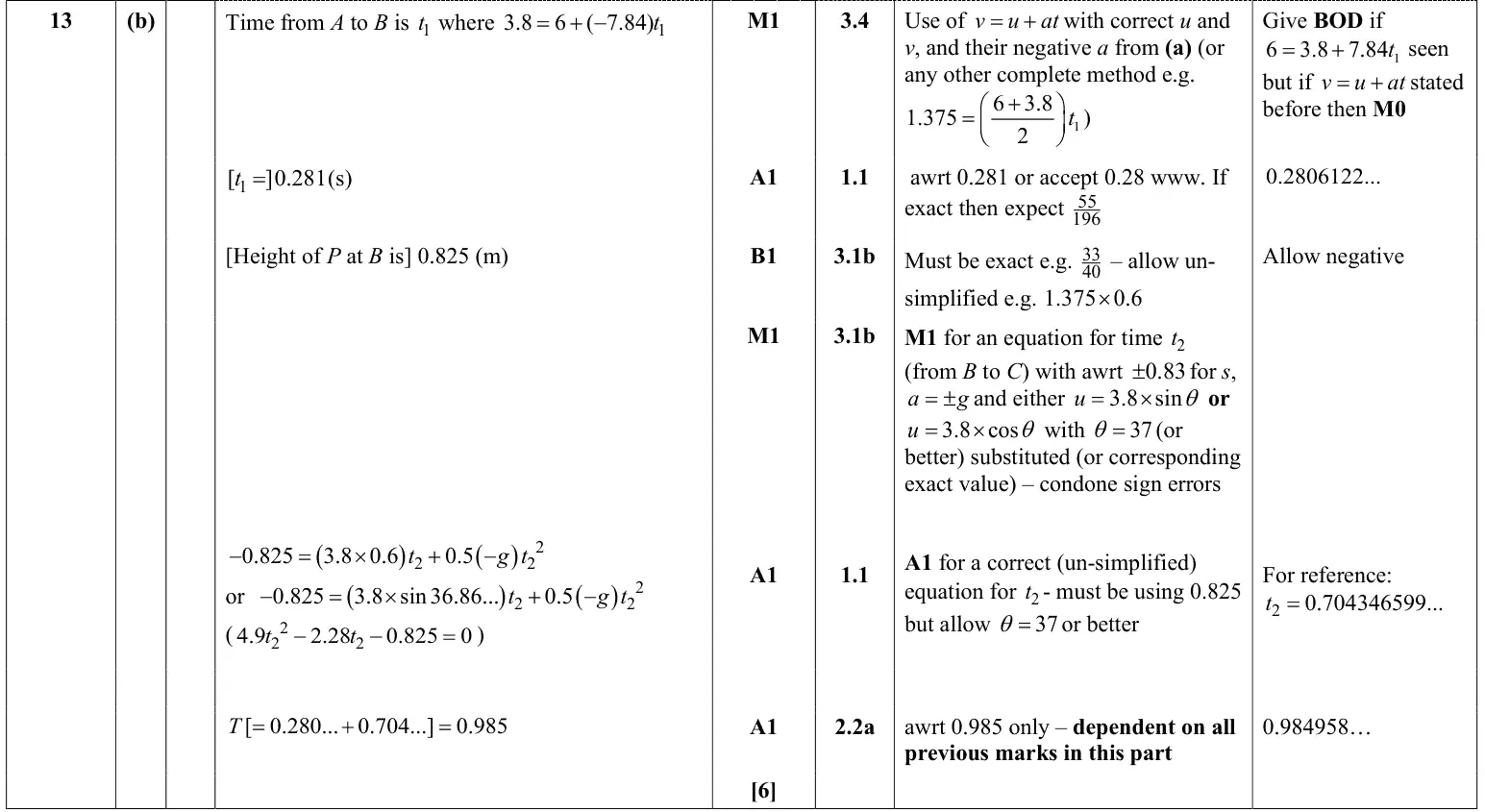
It was pleasing to note that many candidates correctly worked out the time of flight from 𝐵 to 𝐶 using the given value of 3.8 and managed to correctly set up the equation −0.825 = (3.8 × 0.6)𝑡+ 2 × −𝑔× 𝑡2 although occasionally sign errors appeared in this equation (as did the lack of a component with the 3.8 at the point where the particle became a projectile). It was clear that many candidates did not read the question carefully and gave the value of 𝑇 as the time of flight only from 𝐵 to 𝐶 instead of the correct time of flight from 𝐴 to 𝐶 (and so therefore scored only 3 of the 6 marks available in this final part).
Key points and common errors
A to B: 3.8 = 6 − 7.84t₁, t₁ = 0.281
B is 0.825 m high
−0.825 = (3.8 × 0.6)t₂ − 4.9t₂², t₂ = 0.704
T = 0.985 s
include the time on the slope
June 2023 · AS Paper 1 · Q6(a)3 marksMedium
Mark scheme for this part
Examiner's comment
Some candidates did not identify this as a quadratic in x3 and so either struggled to solve it or provided solutions only by calculator (SC marks for this were in the mark scheme). The command word ‘Determine’ requires working to be shown. Of those who did realise, some obtained values for x3, and then went on to state that these were values for x (often because they had stated ‘let x = x3’ as part of their working) and hence did not cube root in order to get values of x. Others recognised their values were for x3, but thought that negative values could not be cube rooted. Nevertheless, most candidates obtained all 3 marks.
Key points and common errors
quadratic in x³: x³ = −1 or 1/8 so x = −1, ½
calculator-only answers lose marks
errors not cube rooting
June 2023 · AS Paper 1 · Q6(b)4 marksMedium
Show the start of this question
Mark scheme for this part
Examiner's comment
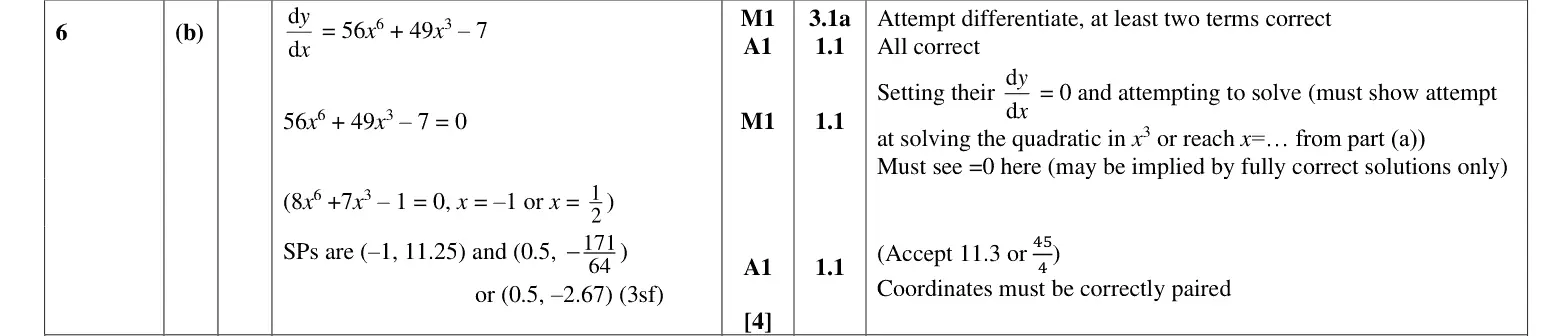
Most candidates successfully differentiated the given expression. However, many did not show the process of setting this = 0 and solving (e.g. dividing through by a factor of 7 to obtain the equation from (a)). Again the command word ‘Determine’ means that working is required; some candidates appeared to simply assume that the answers would be the x-values from part (a). While most candidates were able to correctly calculate the corresponding y-values, some candidates missed this instruction and so were unable to access the final A mark.
Key points and common errors
dy/dx = 56x⁶ + 49x³ − 7 = 0 is 7 × the equation in (a)
points (−1, 11.25) and (½, −171/64)
must show setting = 0 and find y-values
June 2023 · AS Paper 2 · Q4(b)3 marksHard
Show the start of this question
Mark scheme for this part
Examiner's comment
This part of the question proved more challenging. Many candidates obtained the two term coefficient of x2 in the correct way, but this was then set equal to k or 0 rather than 3 × their constant term from (a). Note that those having k rather than k2 in the x2 term in (a) could not get a three term quadratic in k. The request for an exact value for k was well adhered to.
Key points and common errors
x² coefficient of (3 − 4x)(…) is 80k² − 256k
set equal to 3 × 64 = 192: 5k² − 16k − 12 = 0
k = (8 + 2√31)/5 exact, positive root only
equating to k or 0 is wrong
June 2023 · AS Paper 2 · Q87 marksMedium
Mark scheme for this part
Examiner's comment
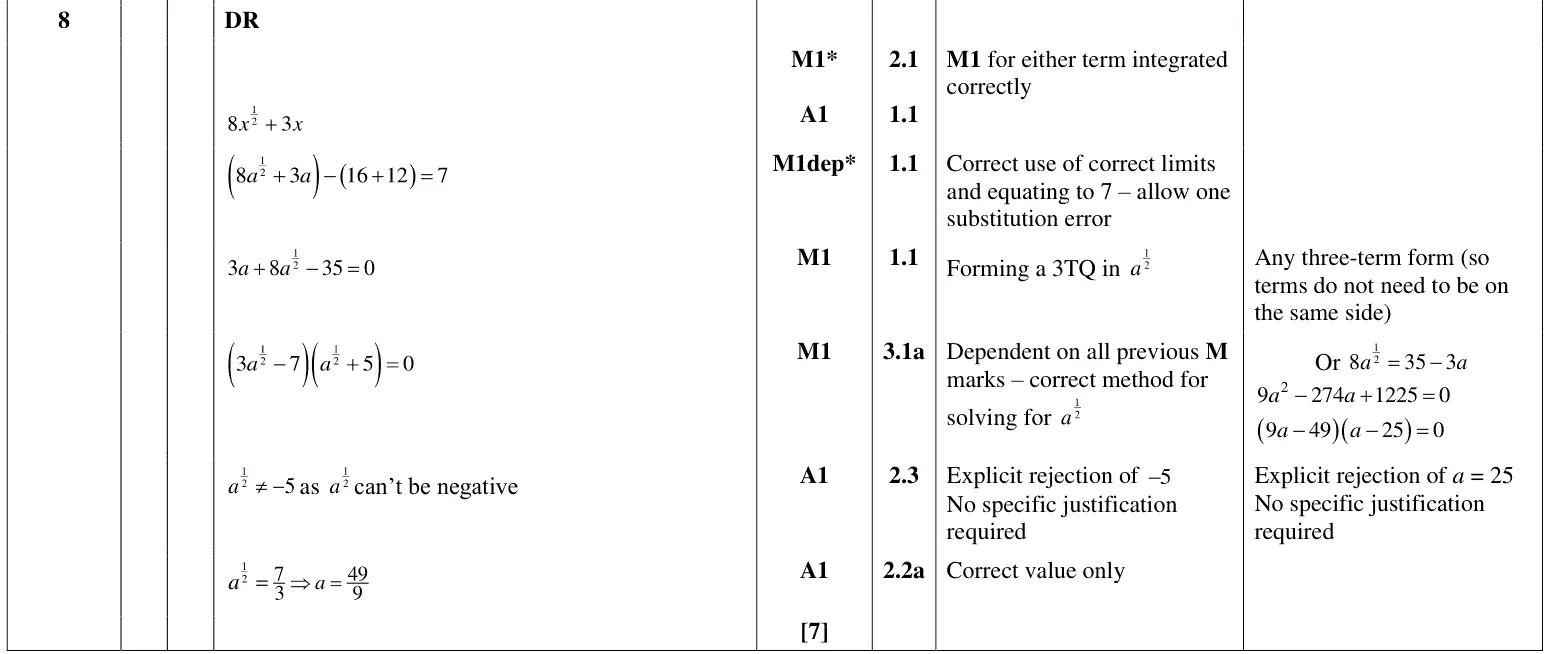
The majority of responses gained the first method mark, but there was some careless work with powers when dealing with 4x-½. Some candidates used 4x-1 or 4x½, which was costly. After integration, 2x½ + 3x spoiled some efforts. A few embarked on the question without integrating at all. The use of limits was generally good, with only the occasional candidate having the wrong order or adding terms. The majority of candidates that reached the ‘hidden’ quadratic did identify it, but as this is a DR question, we did want to see how this quadratic was solved; those who did it by calculator without showing working lost the last method mark (the ‘Assessment for learning’ comment above for Question 2 is relevant again here). We expected the final answer to be exact.
Key points and common errors
integrate to 8x^½ + 3x
(8a^½ + 3a) − 28 = 7
quadratic in a^½: (3a^½ − 7)(a^½ + 5) = 0
reject a^½ = −5 explicitly
a = 49/9
errors with 4x^(−½)
June 2023 · AS Paper 2 · Q10(b)2 marksEasy
Show the start of this question
Mark scheme for this part
Examiner's comment
Those who were successful with (a) usually scored full marks here.
Key points and common errors
2t² − 9t + 9 = 0: t₁ = 1.5, t₂ = 3
June 2023 · Paper 1 · Q2(b)4 marksEasy
Mark scheme for this part
Examiner's comment
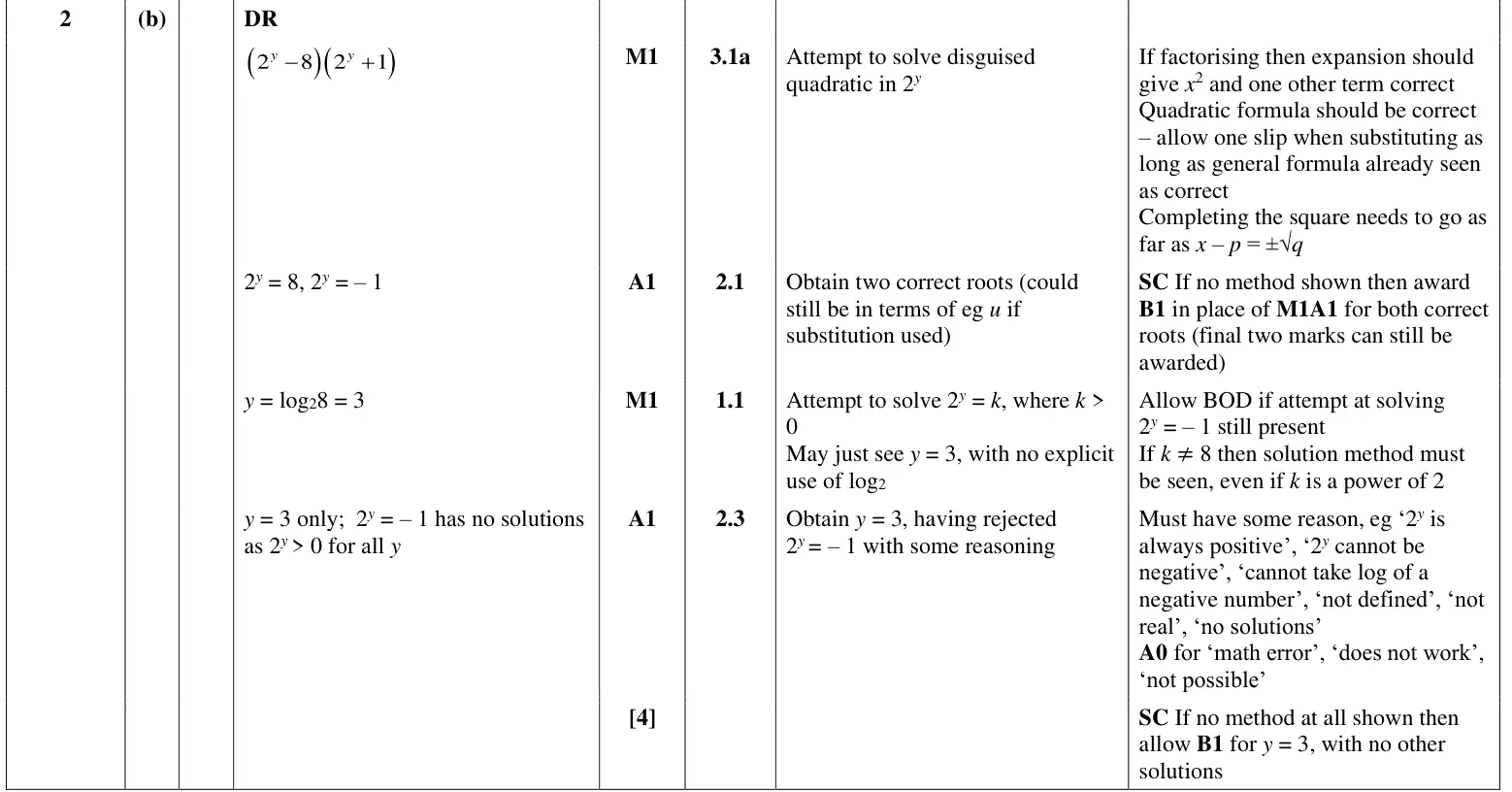
Most candidates could identify this as a disguised quadratic and make a good attempt to solve it, either directly or by using a substitution. As it is a ‘detailed reasoning’ question candidates were expected to show explicit detail of their solution method, and the majority did indeed do so. In addition to obtaining the correct root of y = 3 candidates also had to explain why 2y = −1 would yield no further roots. This was generally done well, although some candidates need to take more care with their use of mathematical language; saying that logs cannot be negative is not the same as saying that the log of a negative number cannot be taken. A common misconception was the belief that the equation was actually a disguised cubic, from the misapplication of the order of operations.
Key points and common errors
disguised quadratic (2ʸ − 8)(2ʸ + 1) = 0
y = 3 only
reject 2ʸ = −1 as 2ʸ > 0 (not 'logs cannot be negative')
June 2023 · Paper 1 · Q4(b)3 marksEasy
Show the start of this question
Mark scheme for this part
Examiner's comment
Most candidates were able to make a good attempt at this question, setting up an expression for the length of BC, equating it to the length of AB and solving the resulting quadratic to obtain at least p = 7. Some candidates stopped at this point without appreciating that the position vector of C had been requested. The most common error was to use the distance OC rather than BC. Some candidates simply observed from the information given that C must be 7i + 7j; this did gain some credit but the question uses the command word ‘determine’ so their answer had to be justified to gain full credit.
Key points and common errors
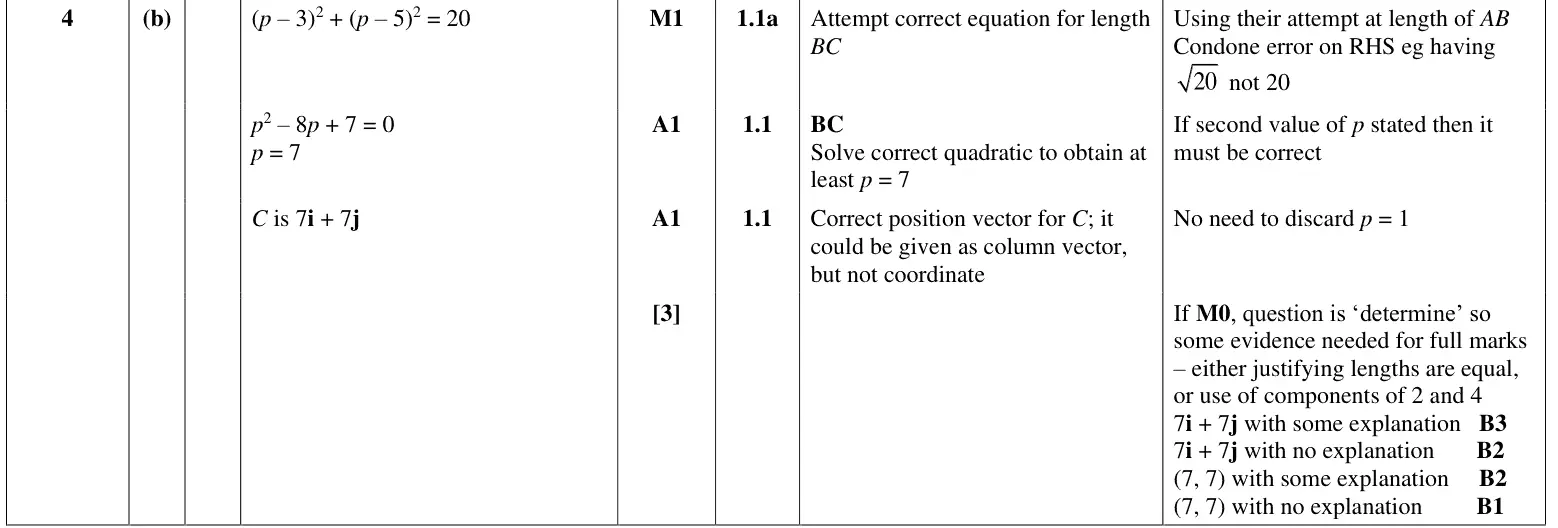
(p − 3)² + (p − 5)² = 20 gives p = 7 (p > 1)
C is 7i + 7j
common error using OC not BC
'determine' needs justification
June 2023 · Paper 1 · Q8(c)4 marksEasy
Show the start of this question
Mark scheme for this part
Examiner's comment
This part of the question was also very well answered. Most candidates were able to gain at least 2 marks for attempting three relevant terms from the product of their expansion with their attempt at (1 + ax)2. While detailed methods were more common, the wording of the question did allow candidates to solve the resulting equation on their calculator, but it was only a minority that did so.
Key points and common errors
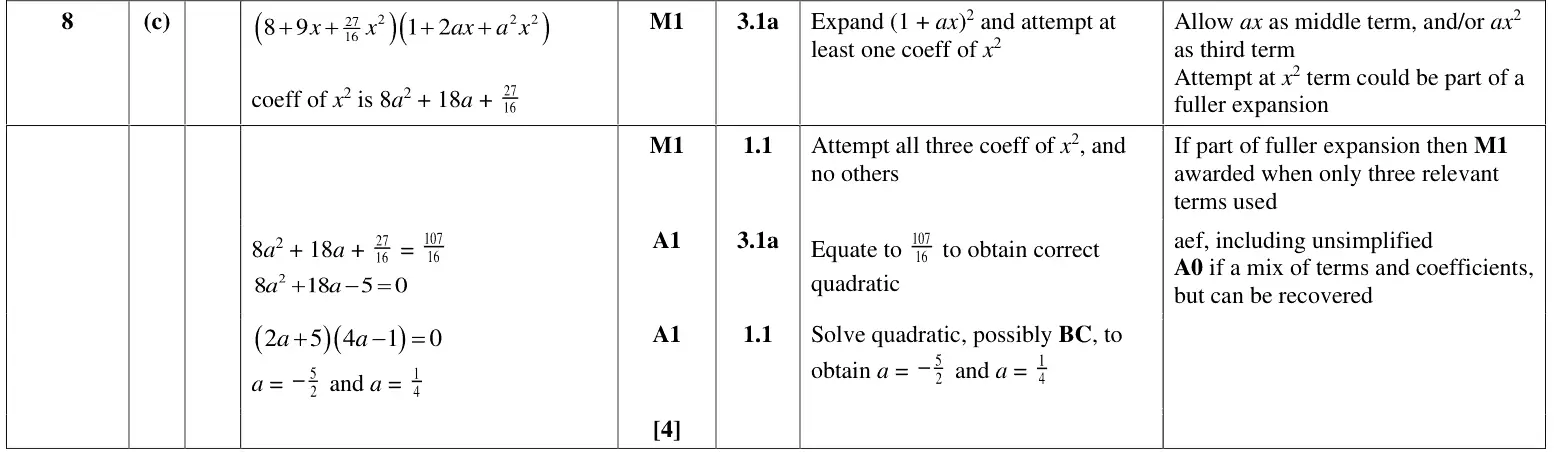
coefficient of x² is 8a² + 18a + 27/16 = 107/16
a = −5/2 or 1/4
June 2023 · Paper 2 · Q2(b)4 marksHard
Show the start of this question
Mark scheme for this part
Examiner's comment
Many candidates appeared to struggle with this question, and a variety of unfruitful methods were seen. The command word is ‘Determine’ so some working is required. Many candidates misunderstood the ‘triangle’ to which they were applying Pythagoras and so obtained a ‘not useful’ equation. Candidates were permitted to ‘imply’ the B mark for BP or PB but (in a determine question) it would of course be preferable if this was explicitly stated first. Algebraic errors were quite commonly seen in the equation derived from Pythagoras, although many of those who completed this correctly went on disregard the additional solution k = 0, which is good practice. In general those candidates using the scalar product method (from Further Maths) obtained the correct answer and full credit. A few candidates recognised that a simpler equation could be obtained by working with the angle AOB (which is the same as BOP), and either using OA.BP or the right-angled triangle to obtain the required answer.
Key points and common errors
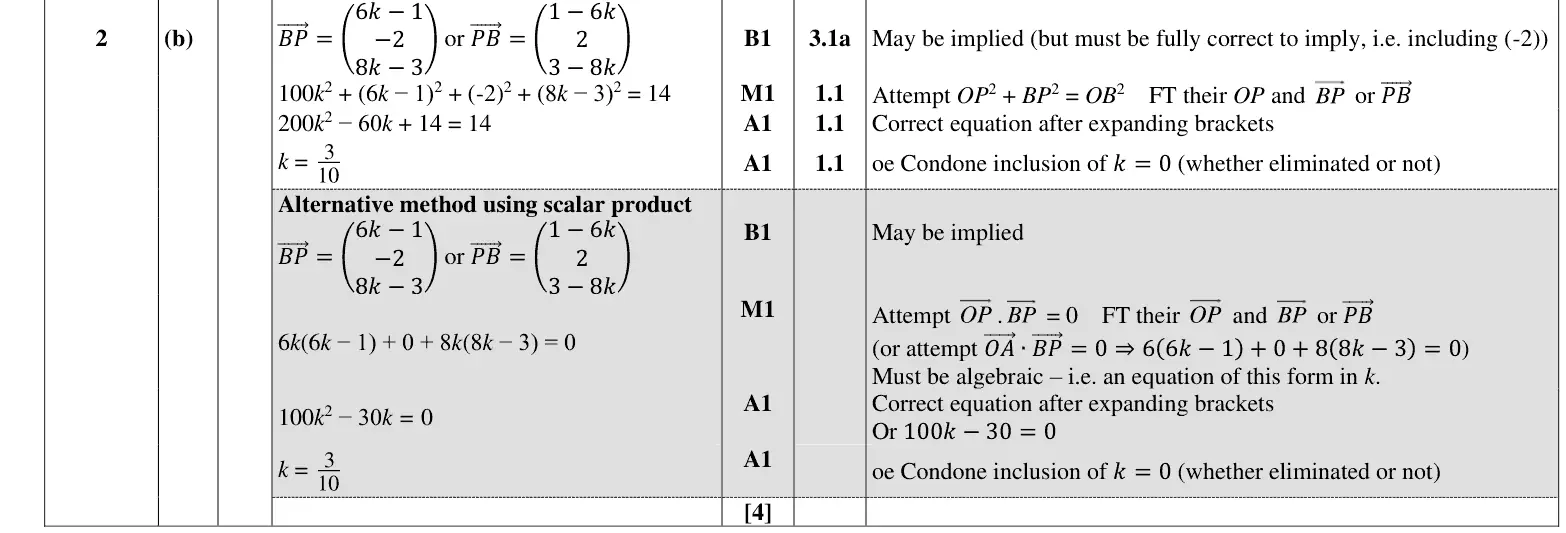
BP = (6k − 1, −2, 8k − 3)
OP² + BP² = OB² (or OP·BP = 0) gives 200k² − 60k = 0 so k = 3/10
Pythagoras on the wrong triangle
June 2023 · Paper 2 · Q4(a)6 marksEasy
Mark scheme for this part
Examiner's comment
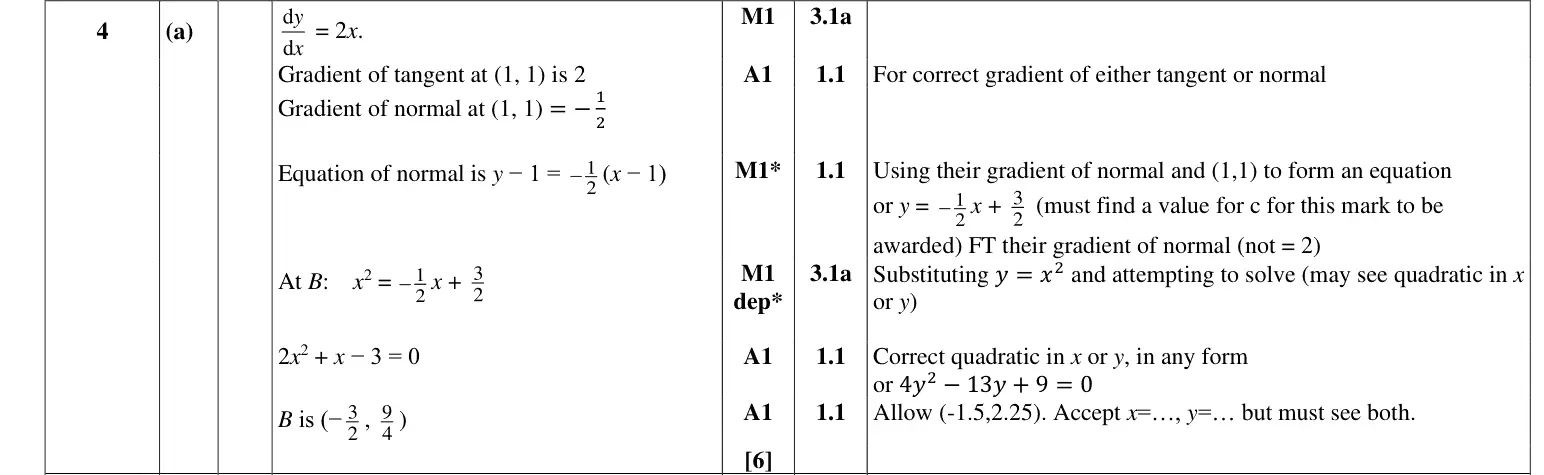
This question was very well answered, with the majority of candidates reaching the required answer. However, again some candidates did not heed the ‘Determine’ instruction and gave minimal working, or an answer only (BC) without working. Where the command word is ‘Determine’ working is required to support the answer, even if it can be done on a calculator. Many candidates found the equation of the normal correctly but then did not show any working for how this led to the coordinates of B, which meant the final 3 marks could not be given – even for a correct answer. This candidate’s response shows all of the required working to justify their (correct) answer. They have shown how the equation of the normal is obtained and then correctly substituted to solve for the coordinates required.
Key points and common errors
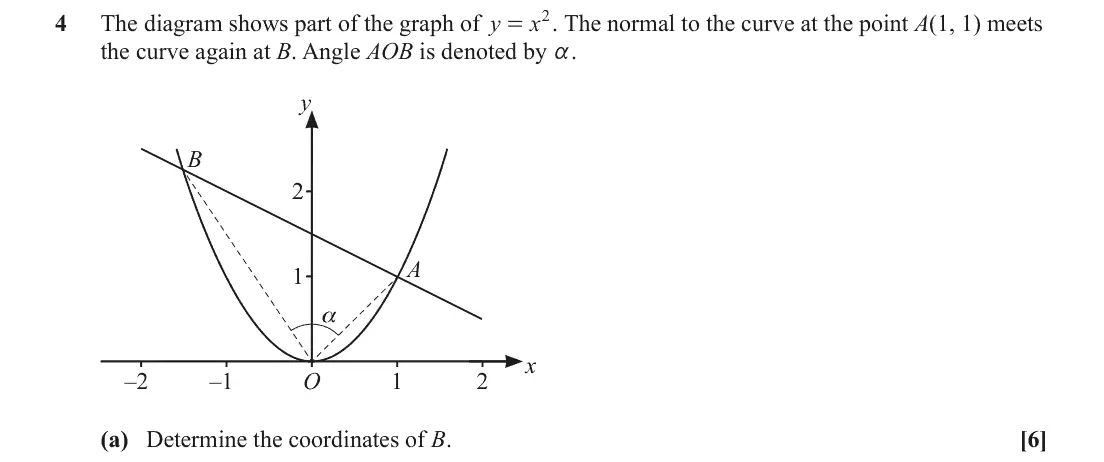
gradient 2 at A so normal gradient −1/2
y = −x/2 + 3/2
solve x² = −x/2 + 3/2 to get B(−3/2, 9/4)
working needed for Determine
June 2023 · Paper 2 · Q6(a)7 marksHard
Mark scheme for this part
Examiner's comment
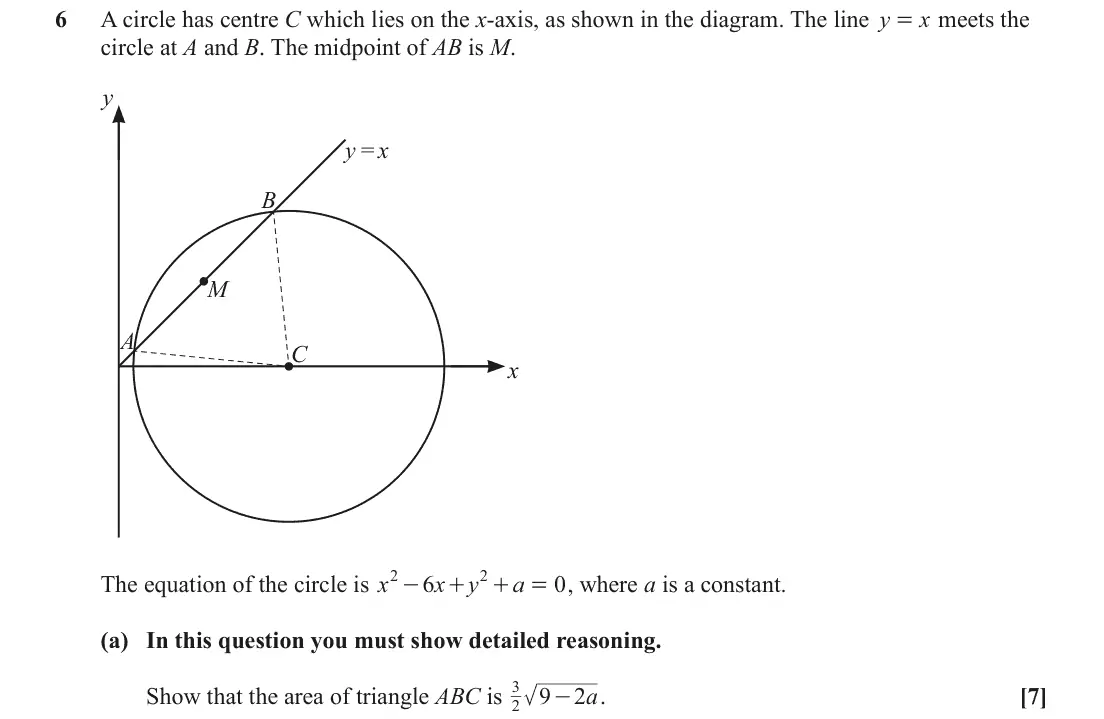
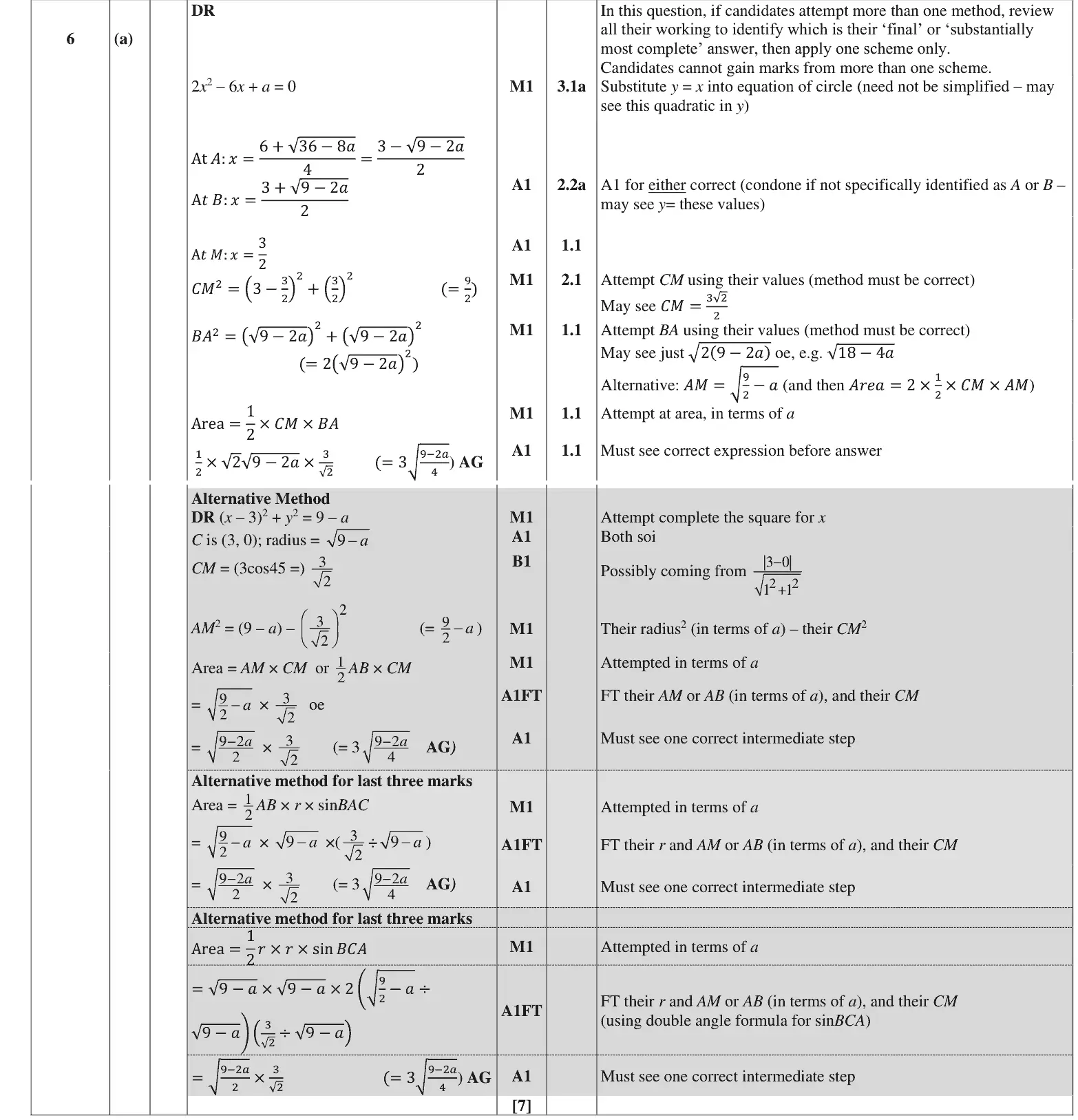
Many candidates appeared to find this question very challenging. A good number of candidates were able to obtain the first 1-2 marks by either attempting to complete the square or substitute in y = x and solve for one or both coordinates of the points of intersection A and B. Many candidates started with the alternative method (attempting to complete the square) and then reverted to the main method. Those candidates who proceeded beyond that first stage generally went on to successfully reach (or almost reach) the given answer - deducing the coordinates of M and finding two of the required lengths to allow them to form an expression for the area of the triangle. Many of these correctly handled the length of AB and were able to write down a correct expression for the required area. There was (despite the Detailed reasoning instruction) some evidence of candidates attempting to reverse-engineer the given result from ‘similar-looking’ terms in their expressions. A small number of candidates provided elegant alternative solutions, such as finding the area of triangle OBC and subtracting OAC, or (more commonly) finding CM and either AM or BM, then using 2x the area of triangle ACM or BCM.
Key points and common errors
substitute y = x: 2x² − 6x + a = 0
M has x = 3/2
CM = 3/√2 and AB from the roots
area = ½ × AB × CM = (3/2)√(9 − 2a)
June 2023 · Paper 2 · Q6(b)(i)1 markEasy
Show the start of this question
Mark scheme for this part
Examiner's comment
This was generally well answered by the majority of candidates.
Key points and common errors
area zero when 9 − 2a = 0 so a = 9/2
June 2023 · Paper 3 · Q7(a)3 marksHard
Mark scheme for this part
Examiner's comment
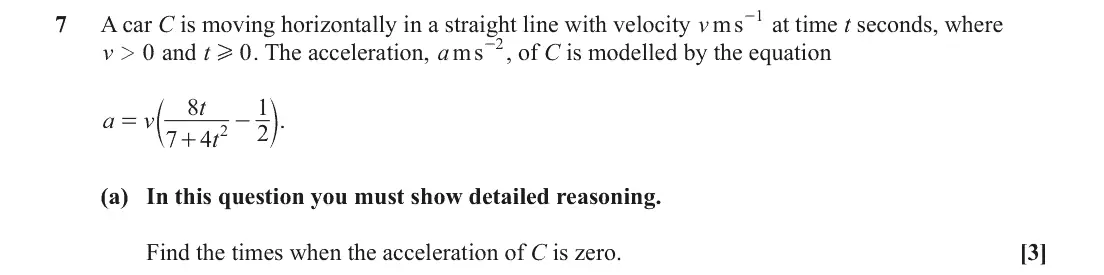
Almost all candidates correctly set the expression for the acceleration equal to zero and obtained a correct three-term quadratic equation in t. However, very few showed a correct method for solving this quadratic even though the question clearly said that ‘detailed reasoning’ must be shown. Therefore, it was common for candidates to only score 2 marks in this part. Note, as this is a detailed reasoning (DR) question, the solution of the quadratic equation should demonstrate that a fully correct method has been applied (which does not rely on solving directly from a calculator). The candidate’s factorised expression does not immediately follow on from their previous line of working and so only 2 marks could be awarded for this attempt.
Key points and common errors
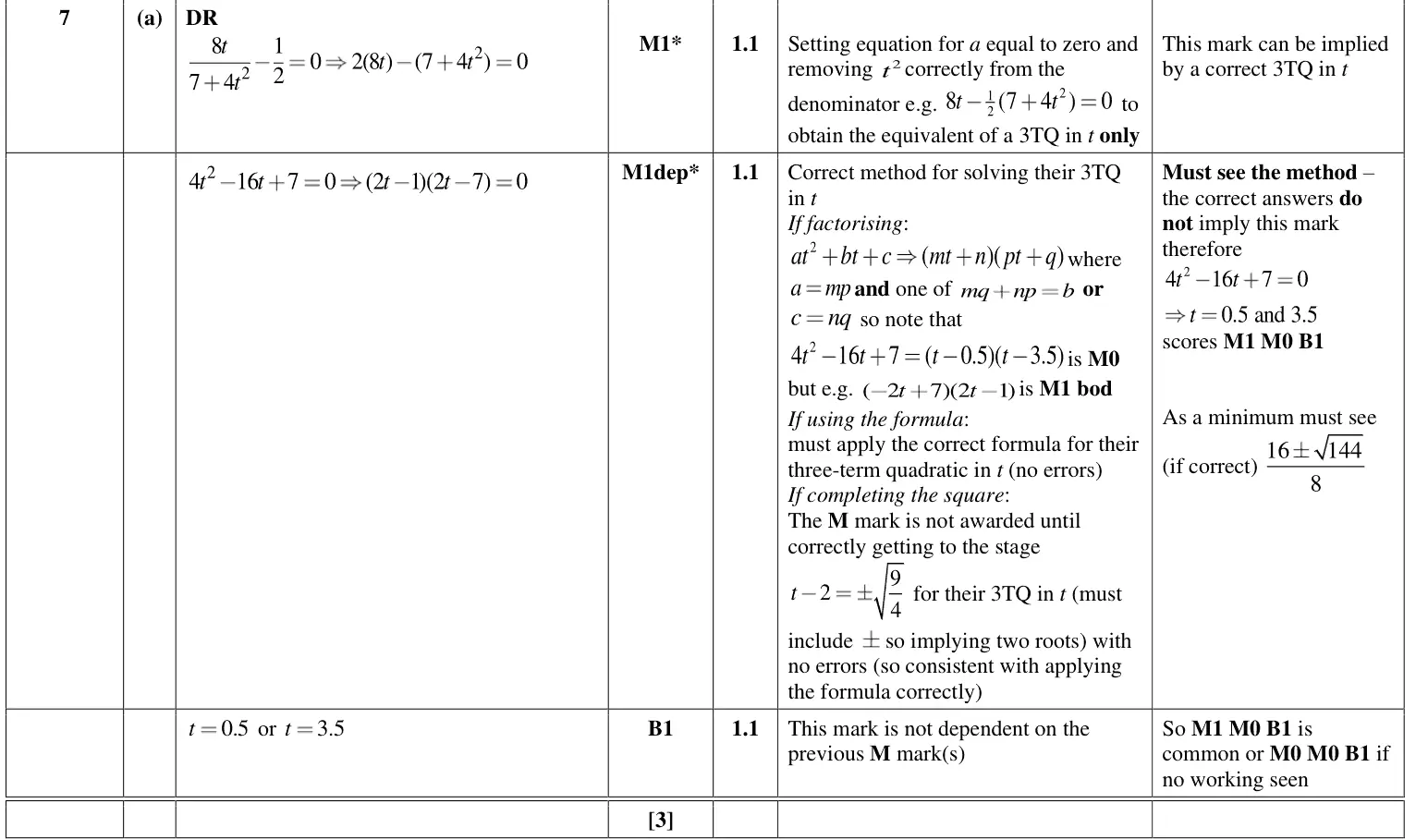
8t − ½(7 + 4t²) = 0 gives 4t² − 16t + 7 = 0
factorise (2t − 1)(2t − 7) or use the formula with working shown
t = 0.5 and 3.5
calculator-only solutions lose the method mark
June 2023 · Paper 3 · Q12(b)3 marksEasy
Show the start of this question
Mark scheme for this part
Examiner's comment
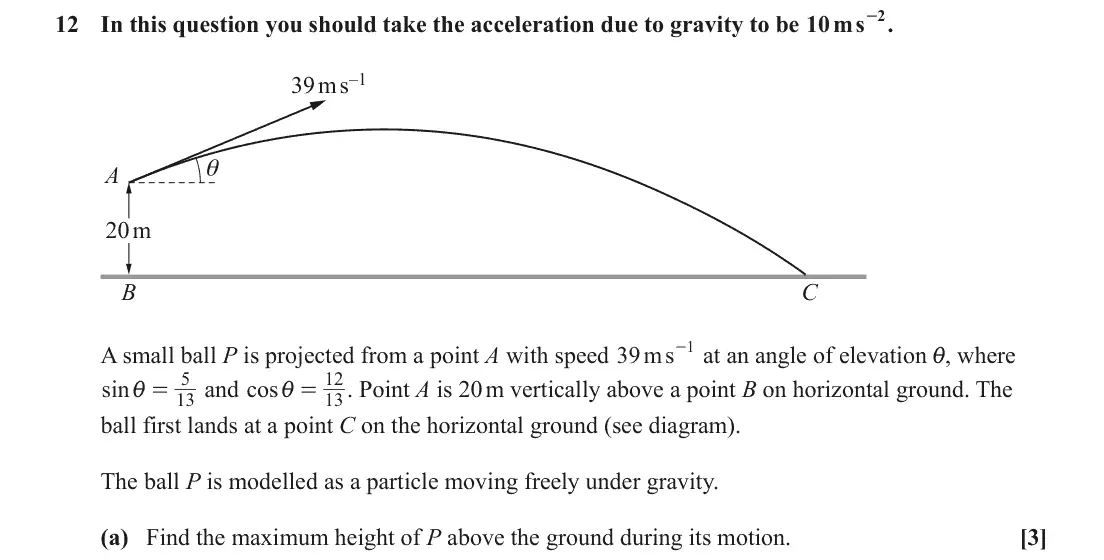
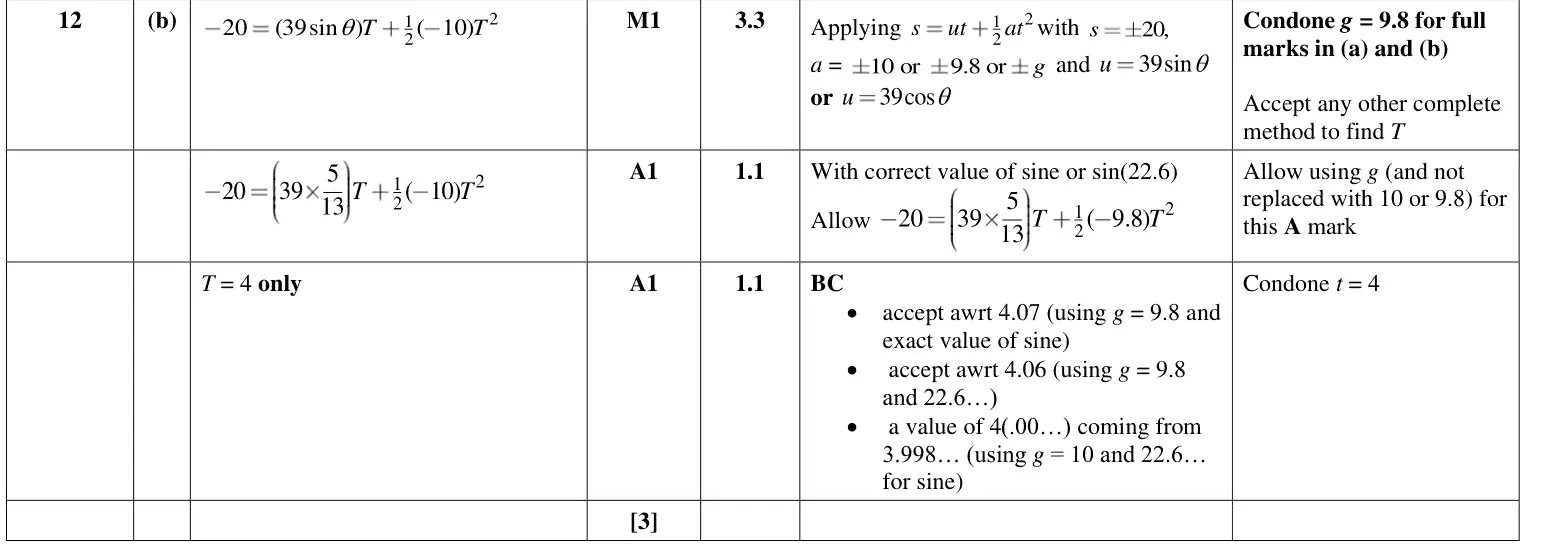
Similarly to part (a) this part was answered extremely well with most candidates correctly applying 𝑠𝑠= 𝑢𝑢𝑡𝑡+ 2 𝑎𝑎𝑡𝑡2 with 𝑠𝑠= −20, 𝑎𝑎= −10 and 𝑢𝑢= 39sin𝜃𝜃 and then correctly using their calculator to find the required value of 𝑇𝑇= 4. The errors mentioned in part (a) were commonly seen in this part too.
Key points and common errors
−20 = 15T − 5T² gives T = 4 only
June 2022 · AS Paper 1 · Q4(b)5 marksMedium
Mark scheme for this part
Examiner's comment
Many candidates used a correct method, gaining two method marks, but some made arithmetical or algebraic slips and so lost the two accuracy marks. Many candidates lost a mark because they omitted the working for the solution of the relevant quadratic equation. Others lost a mark because they did not indicate why they were rejecting the solution sin x = −3. Some candidates correctly used the identity + = sin x cos x 1 but appeared not to recognise that the resulting equation was a quadratic equation in sin x. Two examples of the subsequent incorrect work were as follows: 5sin x + 2sin2 x = 3 sin2 x = 3 7 and 5sinx − 1 = 2 − 2sin2x 4 = 2 − 2sin x. A few candidates attempted a solution without the use of the identity sin2 x + cos2 x = 1. These candidates did not make any progress.
Key points and common errors
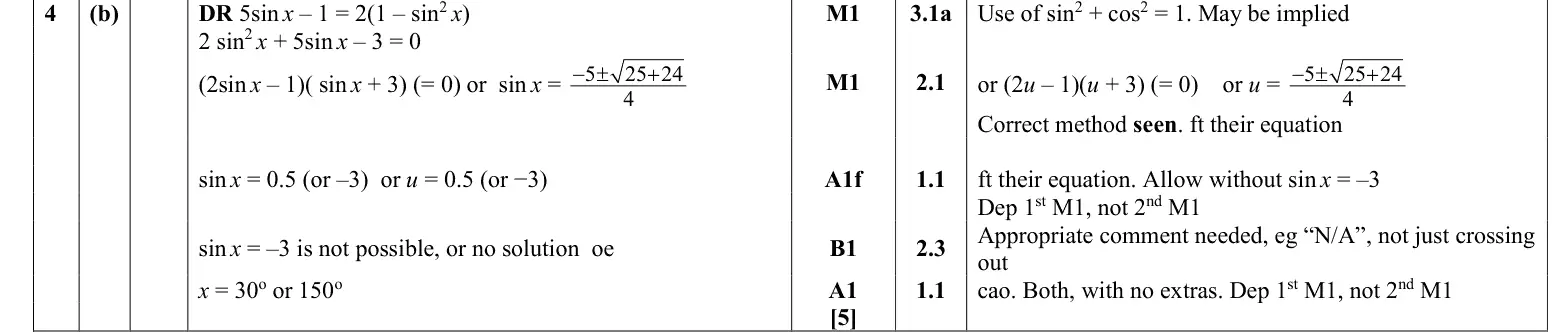
use cos²x = 1 − sin²x: 2sin²x + 5sin x − 3 = 0
(2sin x − 1)(sin x + 3) = 0
reject sin x = −3 with a reason
x = 30°, 150°
working for the quadratic must be shown
June 2022 · AS Paper 2 · Q24 marksMedium
Mark scheme for this part
Examiner's comment
This question starts with the instruction ‘In this question you must show detailed reasoning’. This should be a warning to candidates to show sufficient evidence and detail in their solution. In this question candidates were therefore expected to show the method for solving the quadratic equation, not simply the roots stated from calculator work. The method using the ‘disguised quadratic’ was more popular, with the correct values of x appearing quite often. Some candidates, however, did not provide values for x by squaring their quadratic solutions, instead taking the square root of them. In the alternative method, (3x + 1)2 = 9x2 + 1 was not uncommon, likewise forgetting to square the 4 on the right-hand side of the given equation. The guidance in the mark scheme shows what we expected from candidates after their attempt to square before we allowed credit. This exemplar illustrates well the point raised under ‘Assessment for learning’. The quadratic equation here has seemingly been solved by calculator, (BC) and this is not sufficient in this question. Only the first 2 marks were given. Note the introduction of +/- in the final answers.
Key points and common errors
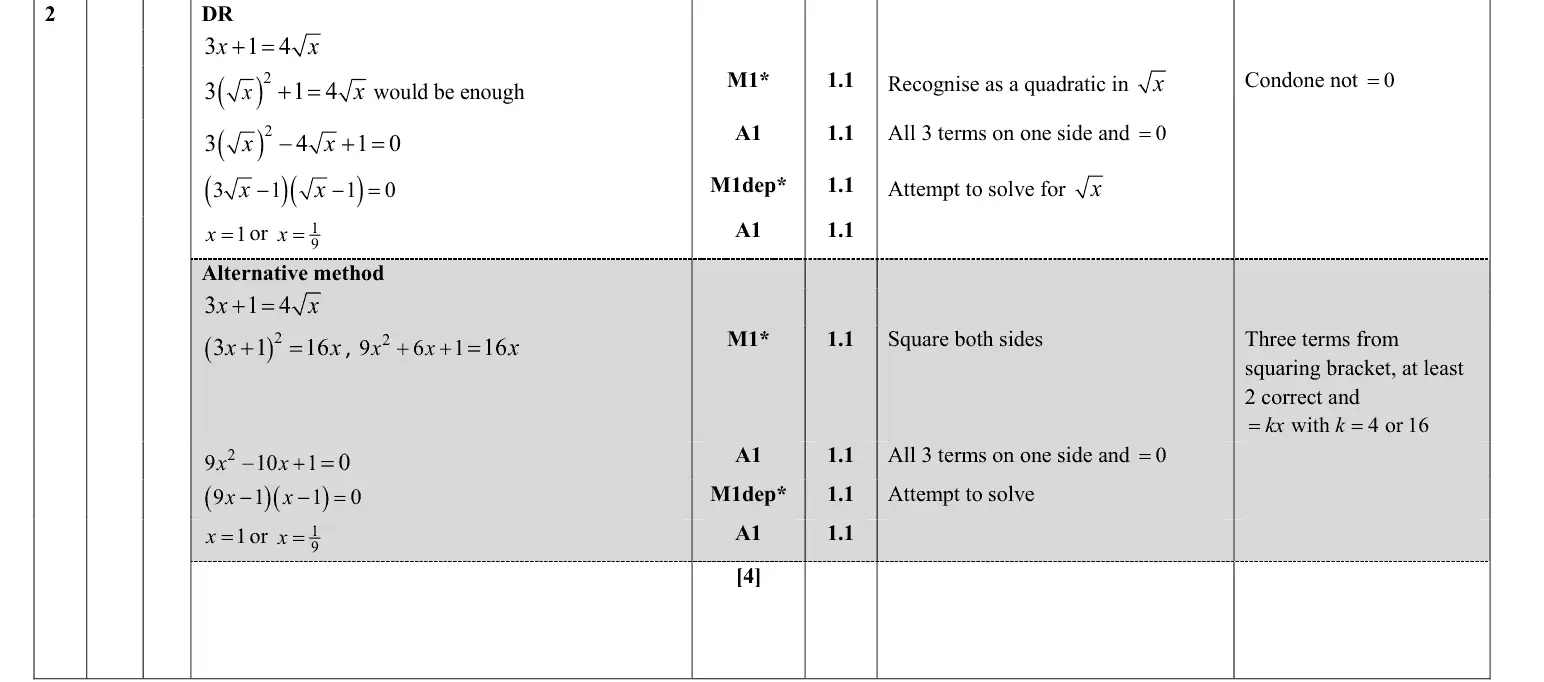
quadratic in √x: (3√x − 1)(√x − 1) = 0 so x = 1 or 1/9 (square, not square root)
or square both sides: 9x² − 10x + 1 = 0
method of solving must be shown
(3x + 1)² errors
June 2022 · AS Paper 2 · Q6(c)4 marksMedium
Show the start of this question
Mark scheme for this part
Examiner's comment
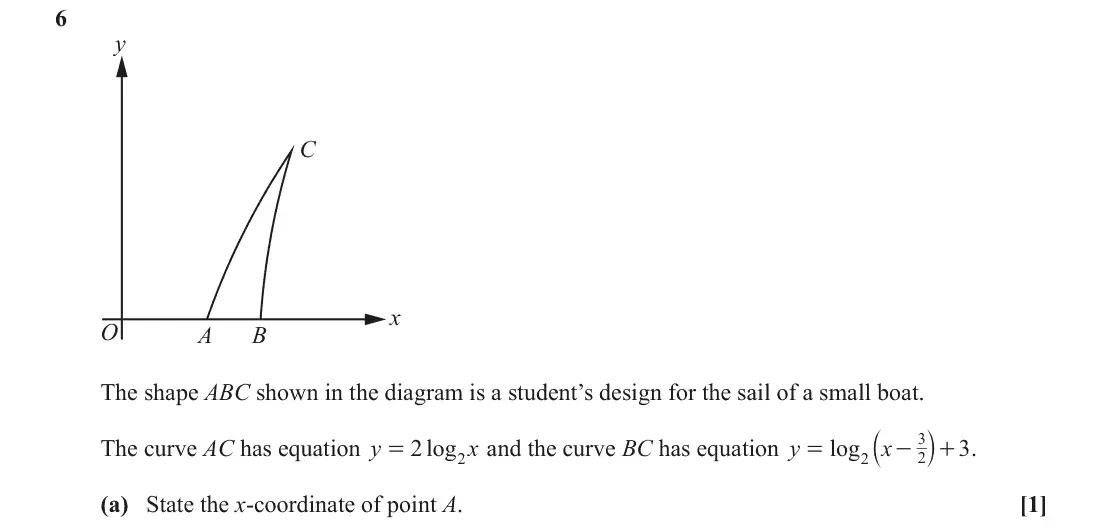
This proved more challenging than part (b), especially so when 2log2x was not recognised as log2x2 at 3 the start. The problem noted with log x − in part (b) inevitably reappeared. Again, however, there 2 were quite a few good solutions seen if the logarithm laws were understood. We expected x = 2 to be chosen as the required answer.
Key points and common errors
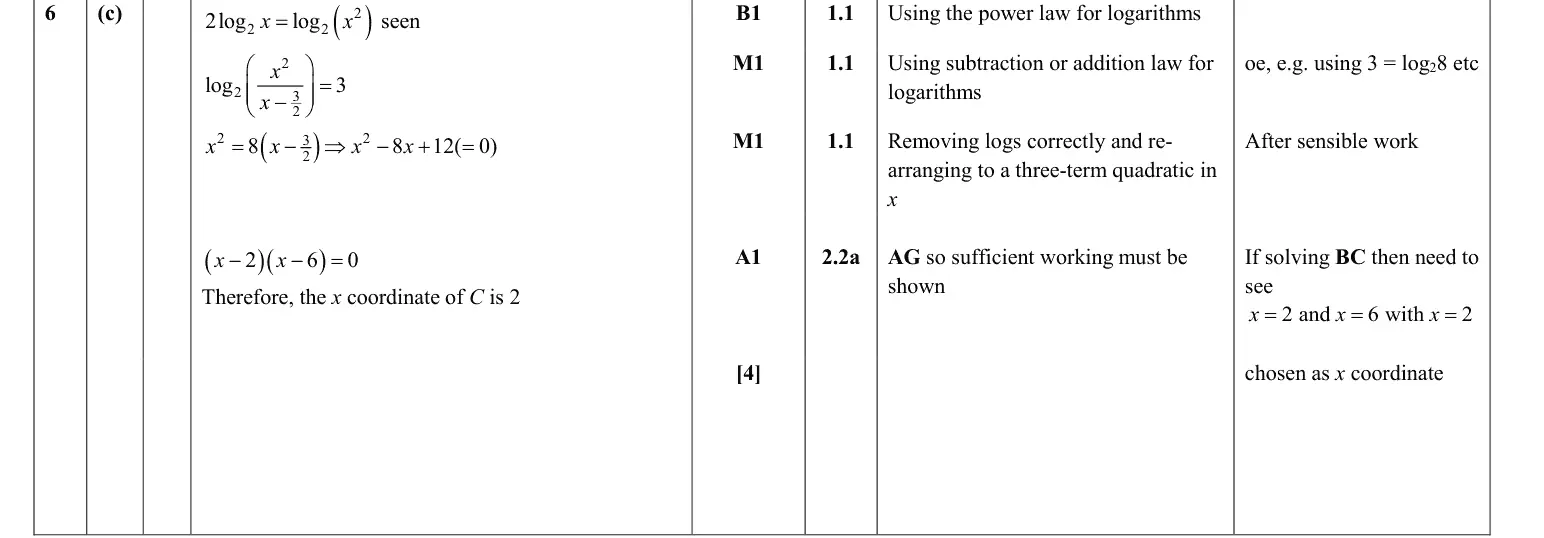
2 log₂ x = log₂ x²
log₂(x²/(x − 3/2)) = 3
x² − 8x + 12 = 0, x = 2 or 6, choose 2
harder when 2 log₂ x not recognised as log₂ x²
June 2022 · AS Paper 2 · Q11(b)5 marksMedium
Show the start of this question
Mark scheme for this part
Examiner's comment
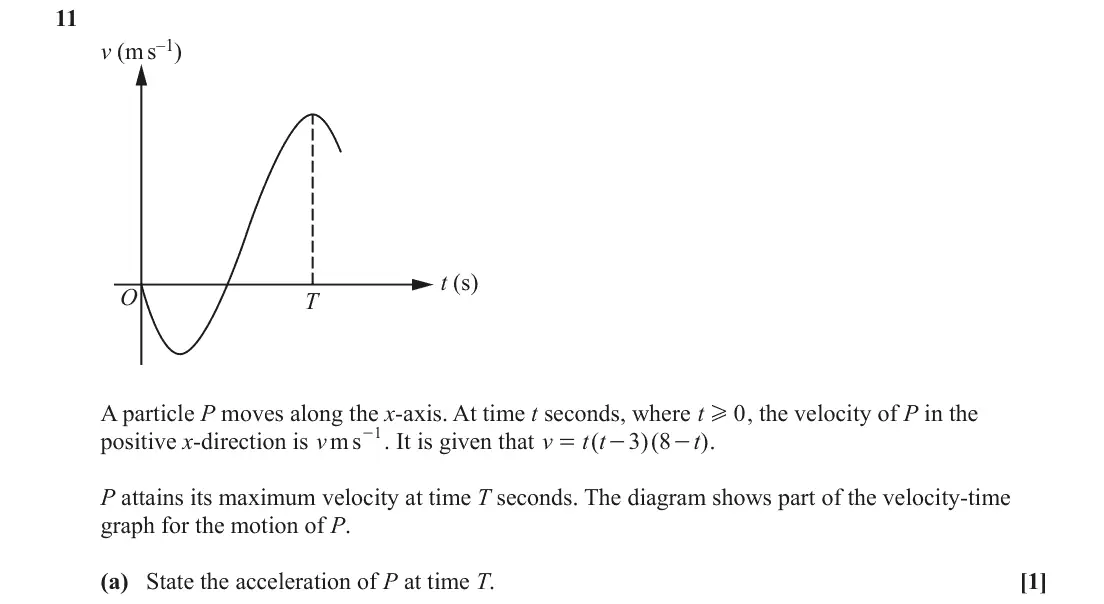
Candidates generally knew how to answer this question. It is another detailed reasoning (DR) question so, as in Question 2, we wanted to see how the quadratic equation had been solved. Many did not provide this evidence so 3/5 was a common mark. We also expected to see a valid reason for the rejection of T = 4/3.
Key points and common errors
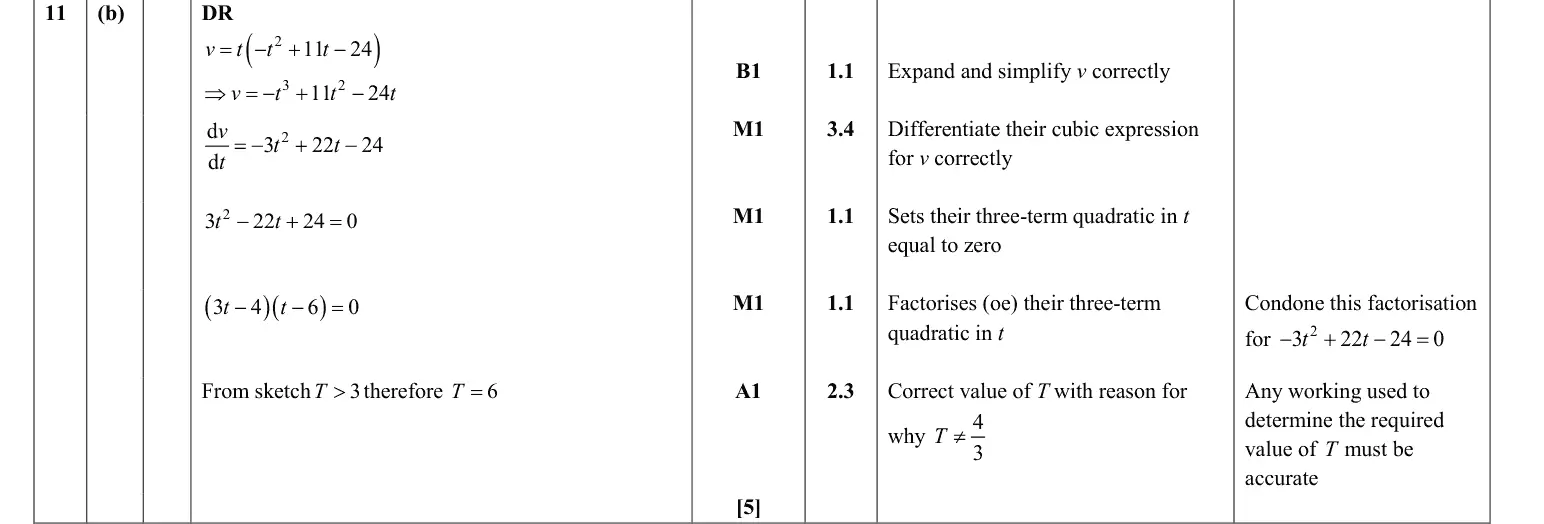
v = −t³ + 11t² − 24t
dv/dt = −3t² + 22t − 24 = 0
(3t − 4)(t − 6) = 0
T = 6 since T > 3 from the graph, rejecting 4/3 with a reason
solving must be shown
June 2022 · Paper 1 · Q3(a)4 marksEasy
Mark scheme for this part
Examiner's comment
The vast majority of candidates gained full credit on the question by correctly finding the two points of intersection, showing sufficient reasoning. Candidates who did not show detail of solving the quadratic equation could still gain a maximum of 3 marks. Some candidates made assumptions about the points of intersection, based on the sketch provided in part (b), usually assuming that the points were also the stationary points on the two curves. This method had to be fully justified for any credit to be awarded.
Key points and common errors
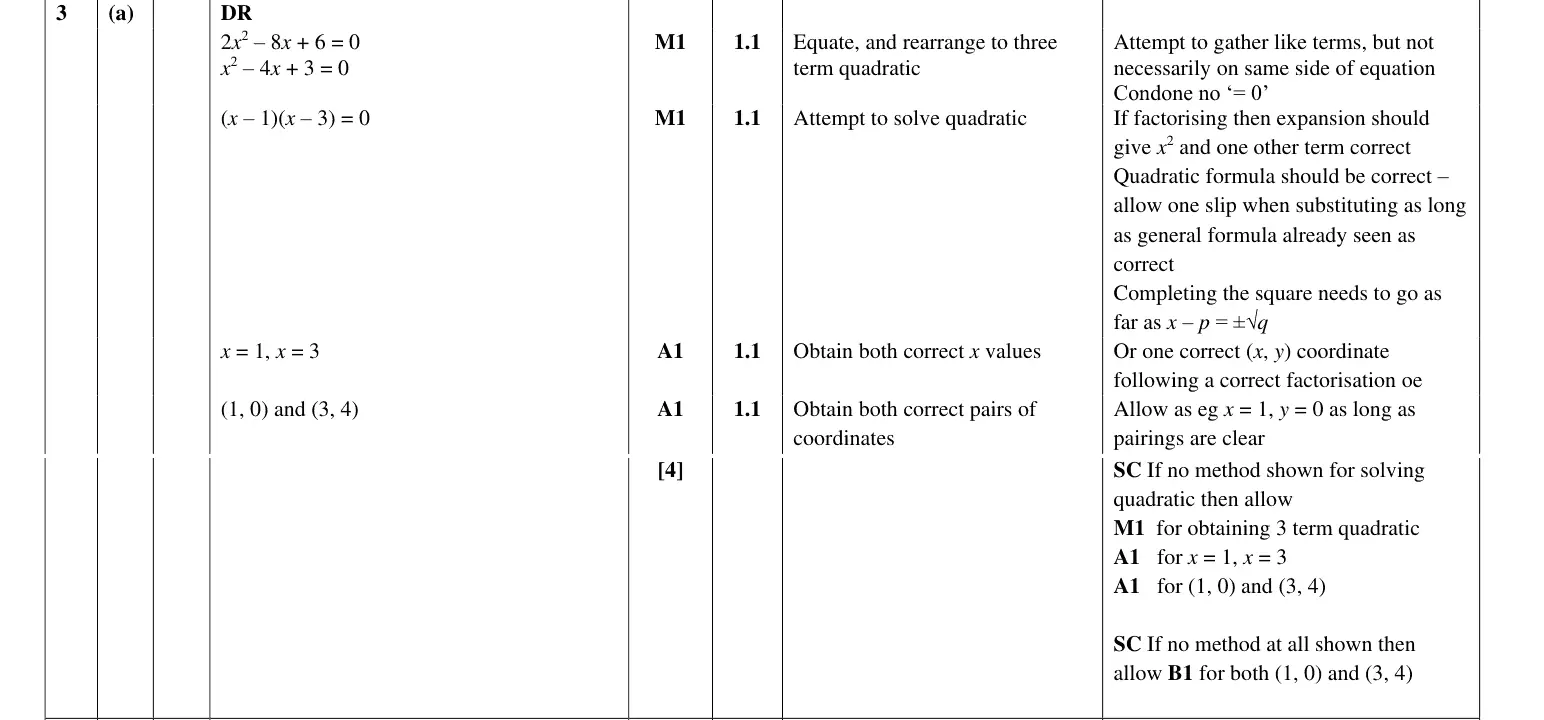
2x² − 8x + 6 = 0 so (x − 1)(x − 3) = 0
points (1, 0) and (3, 4)
show how the quadratic is solved
do not assume intersections from the sketch
June 2022 · Paper 1 · Q4(c)3 marksHard
Show the start of this question
Mark scheme for this part
Examiner's comment
This final part of the question proved to be challenging, with a number of candidates not appreciating the link with work already done and struggling to make progress. A number did try to relate tanθ to their minimum point, with a common error being to attempt tan-1 of both the x and the y value. Despite the structure of the question making the two requests clear, quite a few candidates only attempted the angle and not the minimum value of the given function.
Key points and common errors
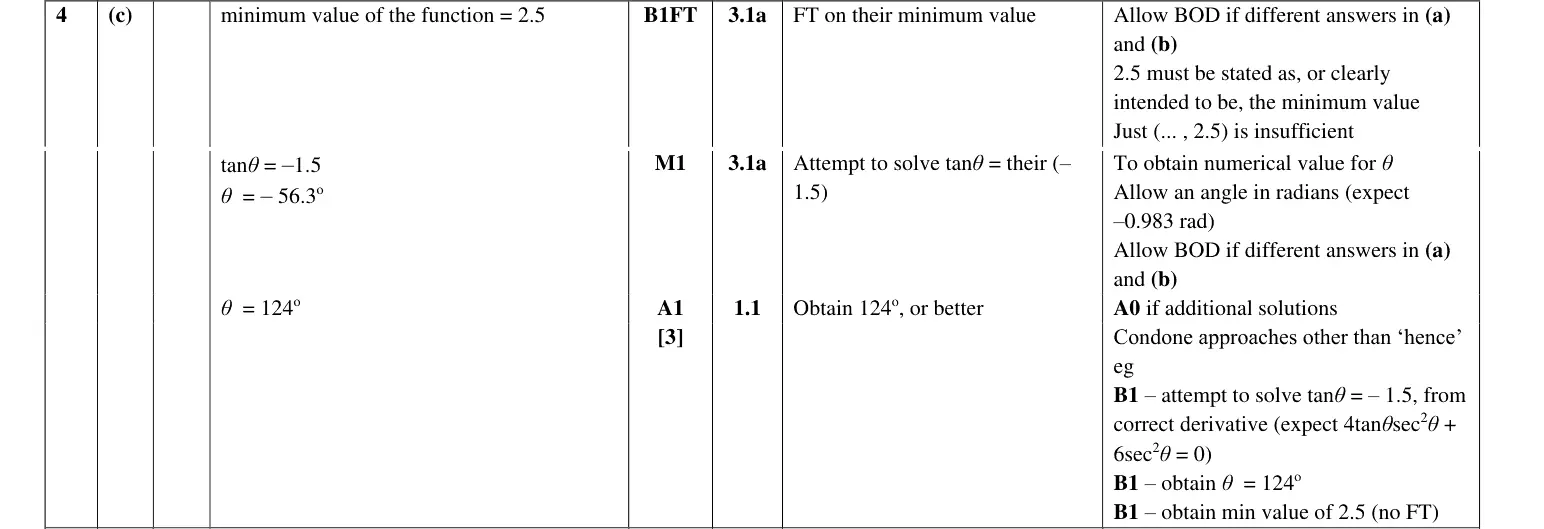
quadratic in tanθ: minimum 2.5 when tanθ = −1.5
smallest positive θ = 124° (not −56.3°)
error taking tan⁻¹ of both coordinates
both answers needed
June 2022 · Paper 1 · Q5(b)4 marksEasy
Mark scheme for this part
Examiner's comment
This question was very well answered, with many candidates gaining full credit. The most common approach was to first combine log terms and then remove the logs, and this was usually successful. Some candidates first introduced indices, base 2, on both sides but the subsequent simplification of the right-hand side proved to be problematic for some. Despite this being a ‘detailed reasoning’ question, some candidates went straight from the quadratic equation to stating the root. On this occasion this was condoned, but candidates would be well advised to make sure that sufficient detail is always provided in these types of questions.
Key points and common errors
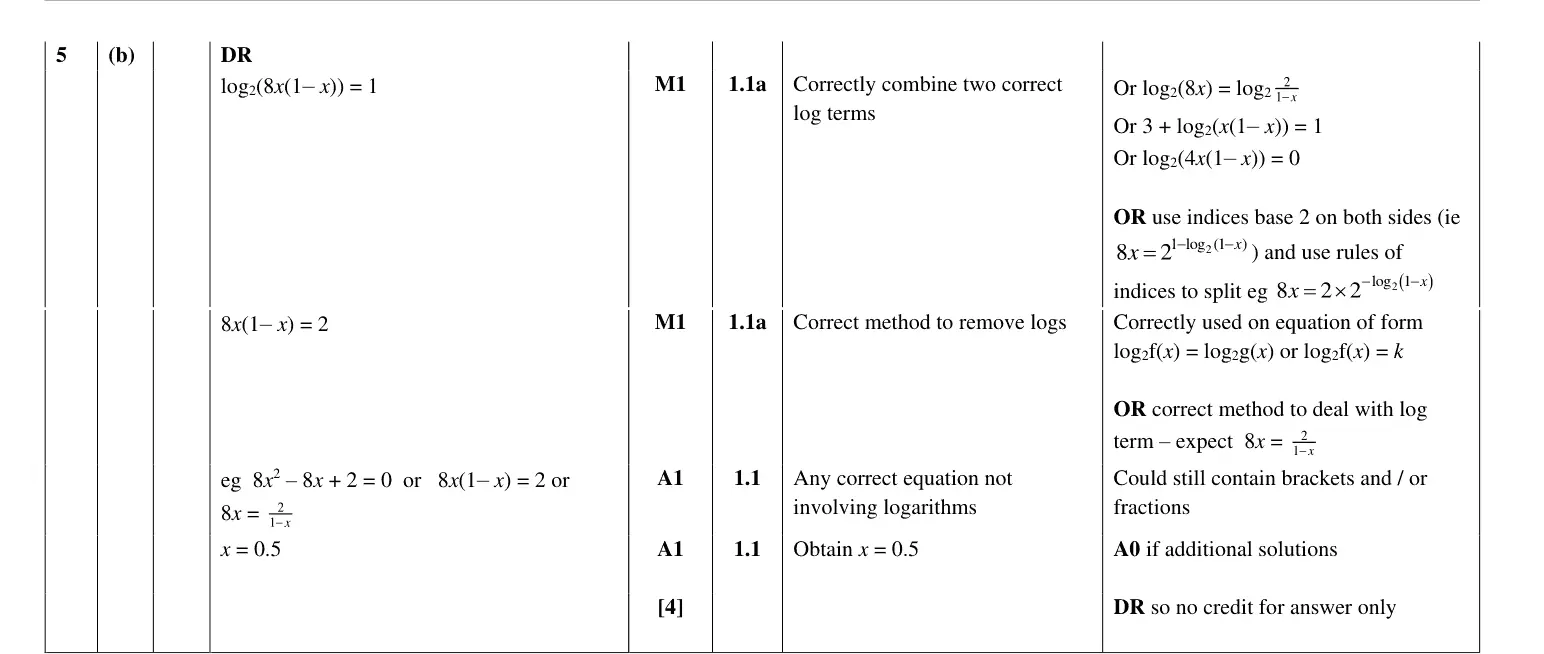
combine: log₂(8x(1 − x)) = 1 so 8x(1 − x) = 2
8x² − 8x + 2 = 0 gives x = 0.5 (repeated)
show the solving
June 2022 · Paper 1 · Q78 marksHard
Mark scheme for this part
Examiner's comment
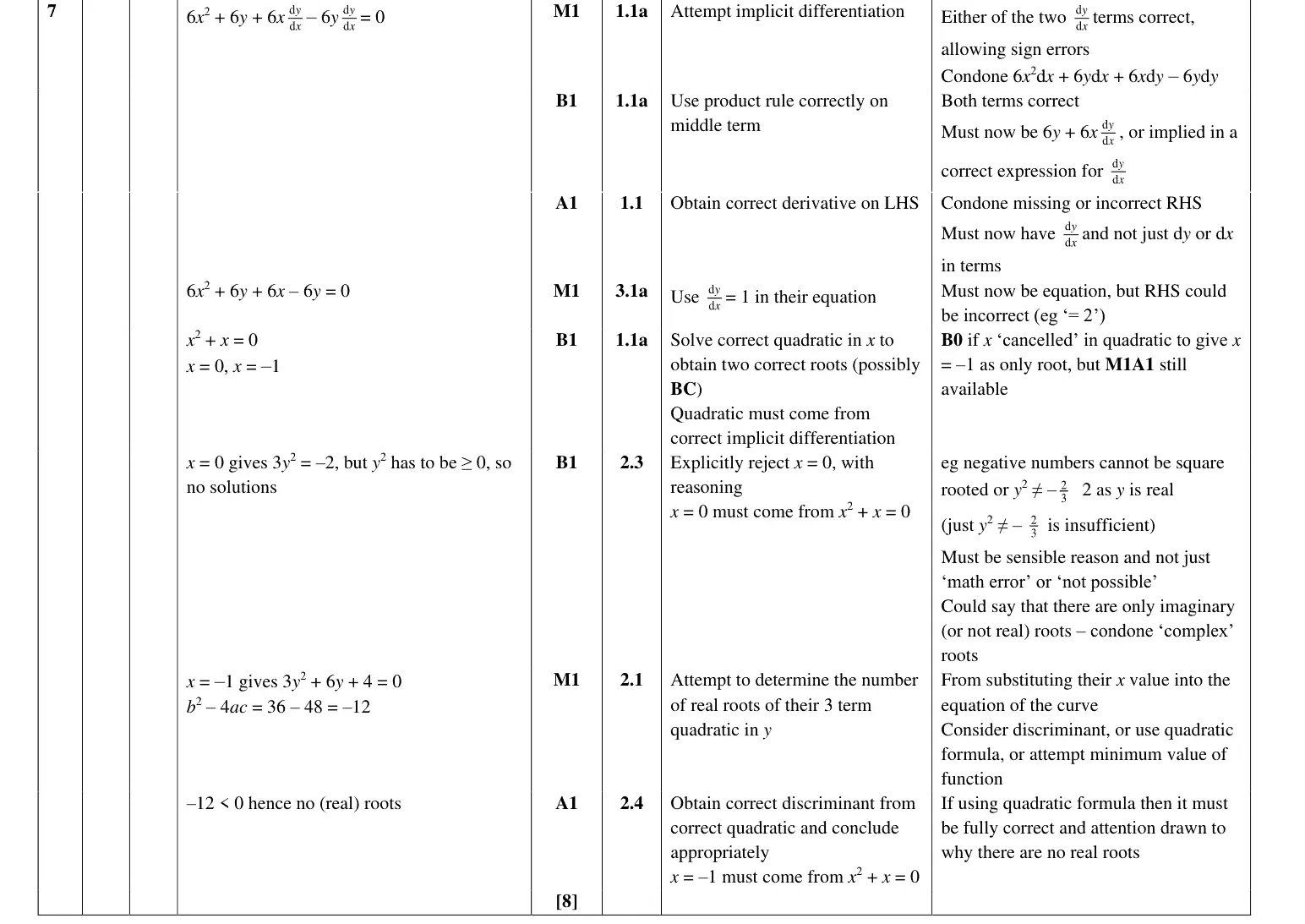
Most candidates could make progress on this question by recognising that it was an implicit equation and making a good attempt to differentiate it. The derivative was usually correct, but the modal mark on this question was 3 marks as many candidates were unsure as to how to then proceed. While a number did set the derivative equal to 1, a common error was to substitute y = x into their derivative. The correct quadratic of x2 + x = 0 was often seen, but there was often some uncertainty as to how to solve this and only the more able candidates were able to obtain both correct roots. Some candidates found just one of the roots by inspection and others, having obtained x2 = – x, observed that a square cannot be negative hence this equation has no roots at all. To gain full credit, examiners expected to see sufficient detail as to why neither root would yield solutions when substituted back into the original equation. While the substitution was seen, the explanations were often lacking in detail. Just stating that 3y2 = – 2 was impossible was not enough and, when considering x = – 1, it was not sufficient to just say that the ensuing quadratic had no roots; this needed to be demonstrated, most typically through considering the discriminant. compelling reasons whenever a solution is discarded. A good solution to Question 7, with clear reasons given as to why neither root will give a valid solution.
Key points and common errors
implicit differentiation with product rule on 6xy
set dy/dx = 1 (not y = x) to get x² + x = 0
x = 0 gives y² = −2/3 impossible
x = −1 gives 3y² + 6y + 4 = 0 with discriminant −12 < 0
June 2022 · Paper 2 · Q1(b)3 marksMedium
Mark scheme for this part
Examiner's comment
Most candidates formed a quadratic equation, either in x3 or in 3 . Some then used a substitution, while x others solved the equation as it was. Most were successful. A few candidates stated that x3 = −8 gave no solution. Many candidates lost a mark because they did not show a method for obtaining the roots of the quadratic equation. Some multiplied the equation by x9 throughout, and eventually obtained an extra (incorrect) answer of x = 0. A minority of candidates could not solve the quadratic equation, giving working such as 6 8 7 8 7 7 x 1 0 1 0 − −= ⇒ − −= ⇒ 8 1 −= ⇒ 7 = 7x3 ⇒ x = 1, or 6 5 6 5 3 x x x x x 8 − 7x3 = x9 ⇒ 8 = x9 − 7x3 ⇒ 8 = x3(x3 − 7) ⇒ x3 = 7 ⇒ x = 3 7 .
Key points and common errors
quadratic in 1/x³ (or x³): roots 1 and −1/8 (x³ = 1, −8)
x = 1 and x = −2
method for the quadratic must be shown
x³ = −8 does have a solution
June 2022 · Paper 2 · Q2(b)3 marksHard
Show the start of this question
Mark scheme for this part
Examiner's comment
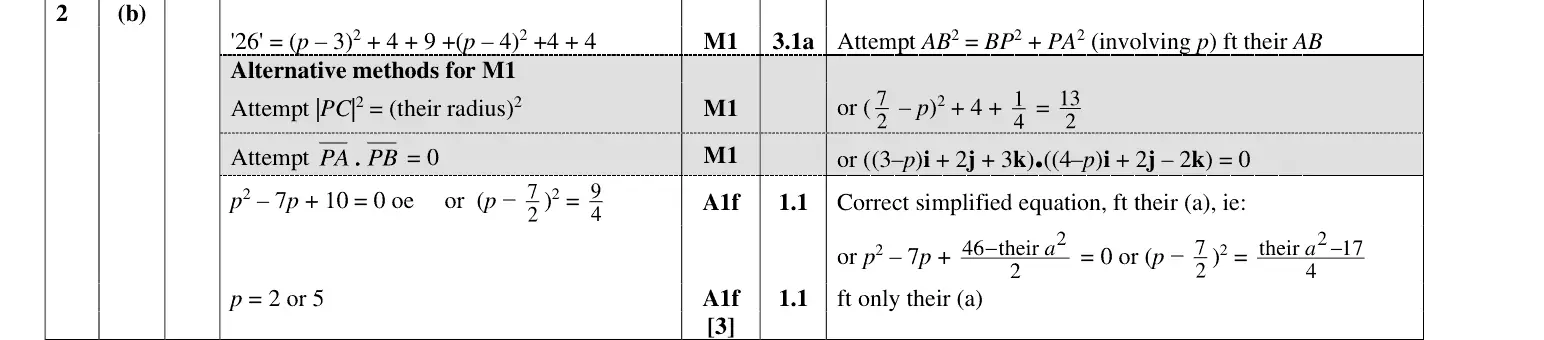
Perhaps the quickest way to approach this question is to use Pythagoras’ theorem. However, very few candidates used this approach. Many attempted to find the position vector of the centre, C, of the circle and then used |PC|2 = radius2. These candidates generally scored the first mark, but lost the other marks by making arithmetical slips. Some omitted the j component. Some omitted to halve the diameter. A common, more serious, error was |OP|2 = radius2.
Key points and common errors
angle in a semicircle: AB² = AP² + BP², or PC² = r² with C the midpoint
p² − 7p + 10 = 0
p = 2 or 5
errors: forgetting to halve the diameter, using OP
June 2022 · Paper 3 · Q4(a)4 marksHard
Mark scheme for this part
Examiner's comment
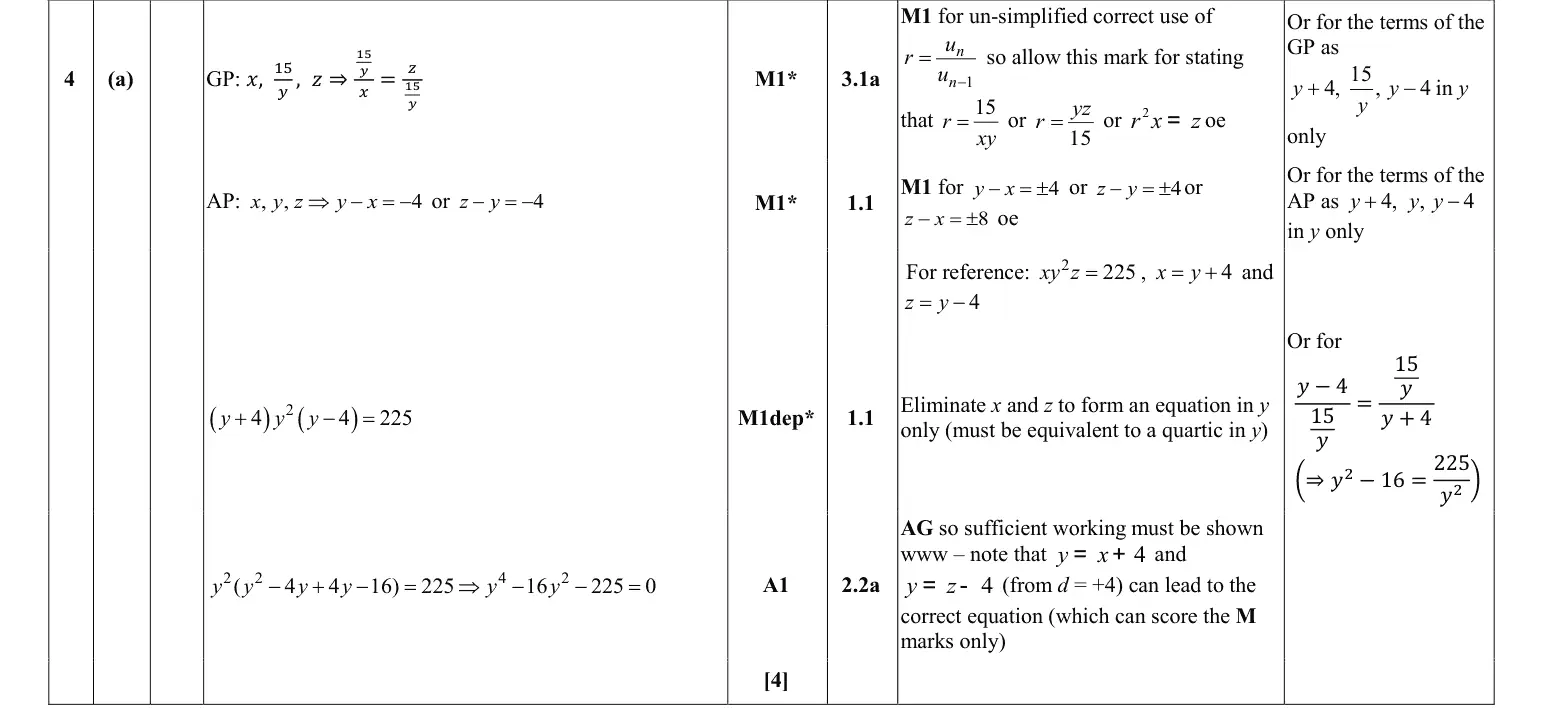
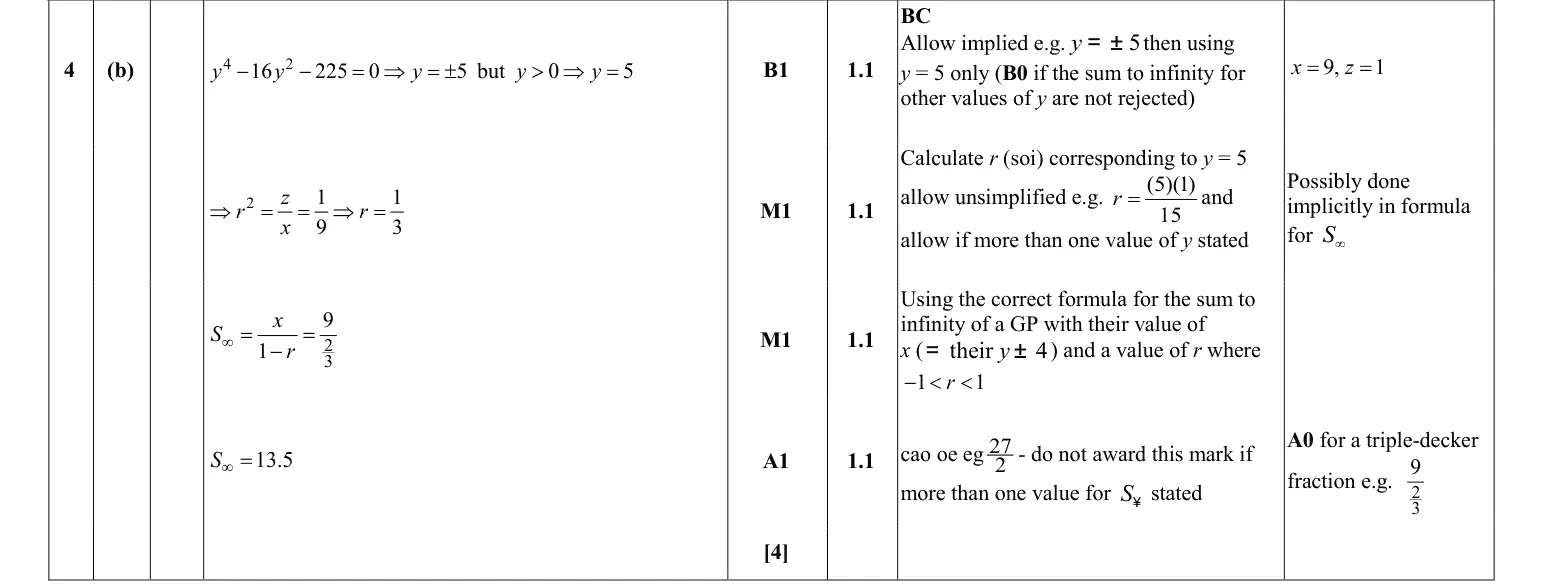
Candidates found this first part very demanding with many struggling to make any meaningful progress. The most successful responses were those that recognised that the information regarding the GP 15 zy = therefore xy z = 225, implied that and that the information regarding the AP implied that yx 15 Those that did usually went on to derive the required quartic equation in .y = + = − x y 4 and z y 4.
Key points and common errors
GP: 15/(xy) = yz/15 so xy²z = 225
AP: x = y + 4, z = y − 4
(y + 4)y²(y − 4) = 225 gives y⁴ − 16y² − 225 = 0
June 2022 · Paper 3 · Q4(b)4 marksMedium
Show the start of this question
Mark scheme for this part
Examiner's comment
Even though this question said ‘hence’ many candidates did not use their calculators to solve the given quartic equation from part (a). Of those that did many simply stated that y = even though the 5 question explicitly stated that y was a positive integer (with many candidates only realising that y − 5 much later in the question when this led to a value for the common ratio that was greater than 1). Of those candidates who successfully found a common ratio for the infinite geometric progression most correctly applied the correct formula for the corresponding sum to infinity.
Key points and common errors
y² = 25, y = 5 (positive integer)
x = 9, z = 1, r = 1/3
S∞ = 9/(1 − 1/3) = 27/2
June 2022 · Paper 3 · Q7(b)5 marksHard
Show the start of this question
Mark scheme for this part
Examiner's comment
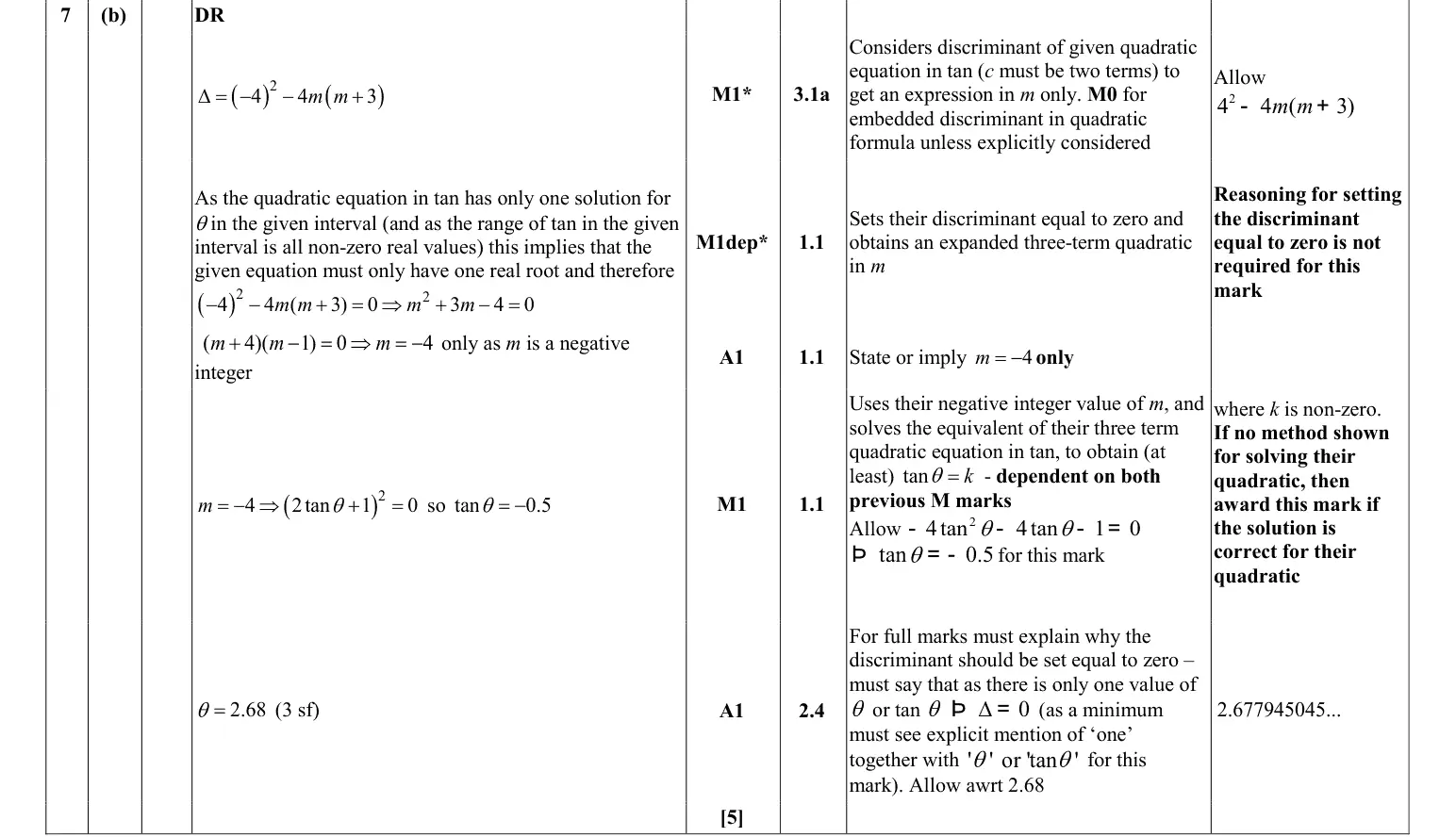
While it was pleasing that most candidates realised that the equation derived in part (a) was a quadratic equation in tanand hence they should consider the discriminant (of this equation) it was then disappointing how many candidates simplified the equation( ) ( ) − − + = 4 4 m m 3 0 to 16 − 4 m + 12 m = 0. Of those that did obtain the correct quadratic in m and hence found the corresponding value of as 2.68 (correct to 3 significant figures) many did not give suitable ‘detailed reasoning’ and therefore very few explained why the discriminant should be set equal to zero in the first place. This response scored 4 (of the 5) marks. Although the candidate has correctly found the value of they have not given the required ‘detailed reasoning’ of why they considered the discriminant of the quadratic equation in tan equal to zero and so did not score the final accuracy mark.
Key points and common errors
one solution in (0, π) so discriminant 16 − 4m(m + 3) = 0
m² + 3m − 4 = 0, m = −4
(2tan θ + 1)² = 0, θ = 2.68
must explain why Δ = 0
Autumn 2021 · AS Paper 1 · Q4(b)5 marksMedium
Show the start of this question
Mark scheme for this part
Key points and common errors
parallel to y-axis so x-component 6r − s = 0, s = 6r
magnitude (9r)² = 9 gives r = ±1/3
pairs r = 1/3, s = 2 and r = −1/3, s = −2 correctly paired
Autumn 2021 · AS Paper 2 · Q5(b)6 marksMedium
Show the start of this question
Mark scheme for this part
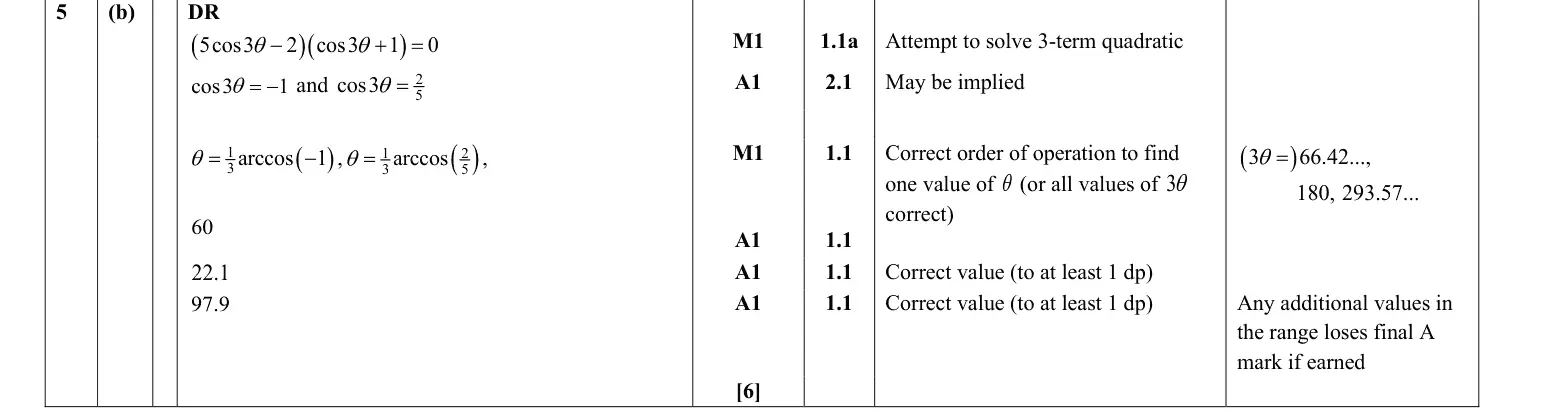
Key points and common errors
(5cos3θ − 2)(cos3θ + 1) = 0
cos3θ = −1 or 2/5
3θ = 66.42°, 180°, 293.57°
θ = 22.1°, 60°, 97.9°
divide by 3 after finding 3θ
Autumn 2021 · AS Paper 2 · Q11(a)3 marksMedium
Mark scheme for this part
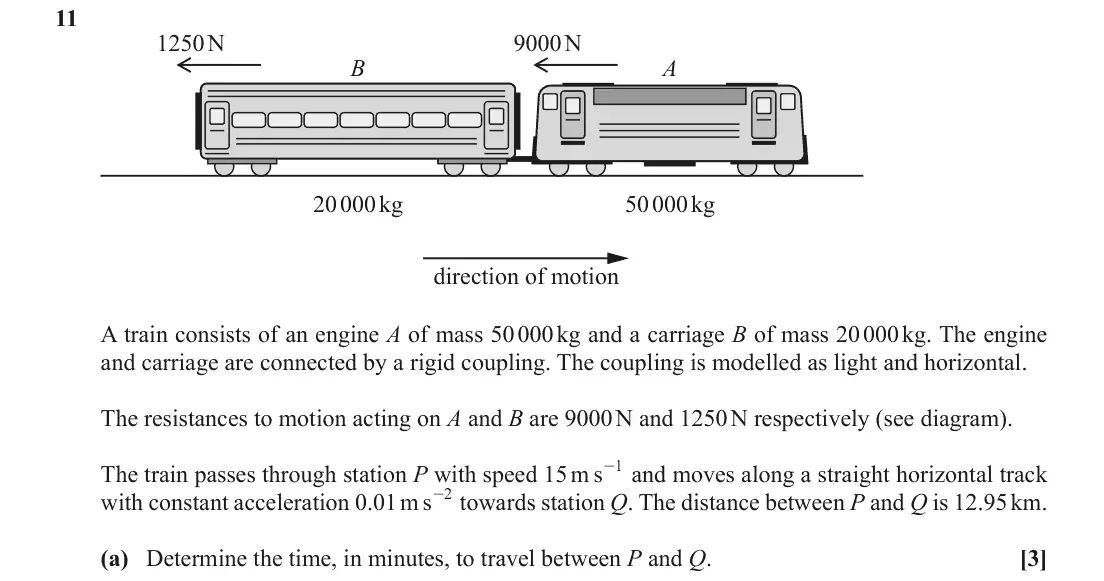
Key points and common errors
12 950 = 15t + 0.005t²
t = 700 s = 11.7 minutes
convert km and minutes
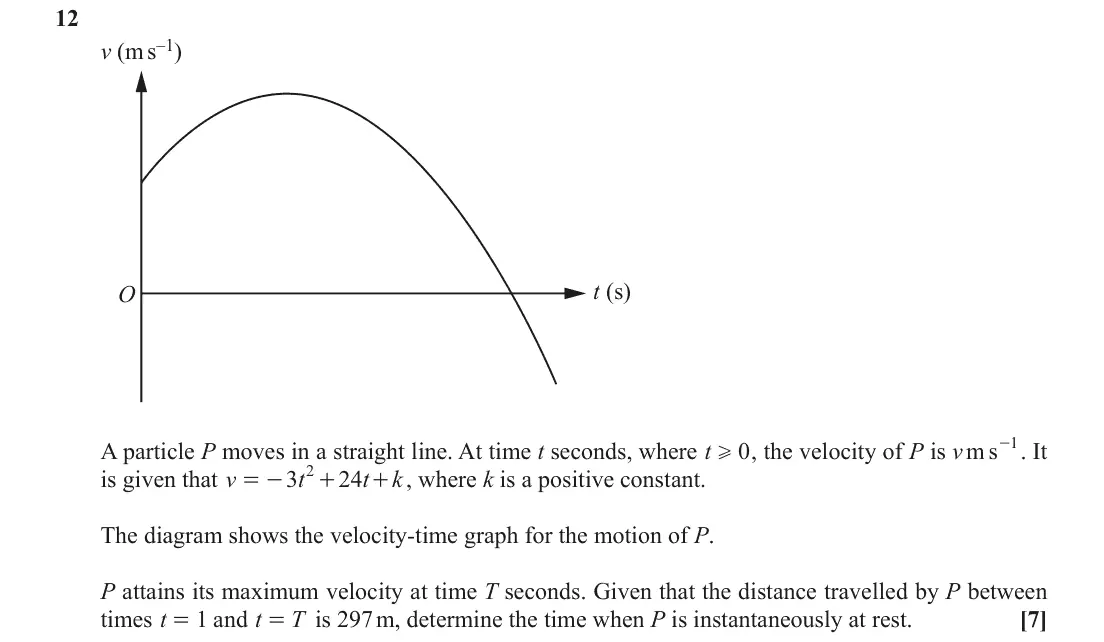
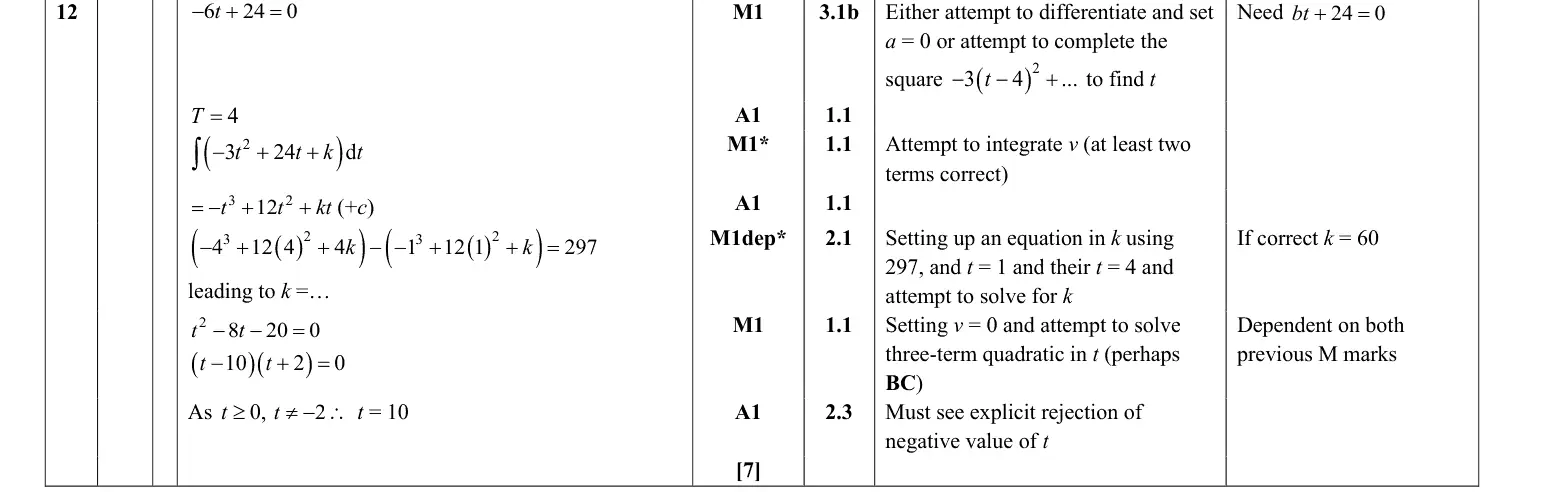
Autumn 2021 · AS Paper 2 · Q127 marksMedium
Mark scheme for this part
Key points and common errors
maximum velocity when a = −6t + 24 = 0, T = 4
s = −t³ + 12t² + kt
distance from t = 1 to 4 equals 297 gives k = 60
v = 0: t² − 8t − 20 = 0, t = 10 (reject −2 explicitly)
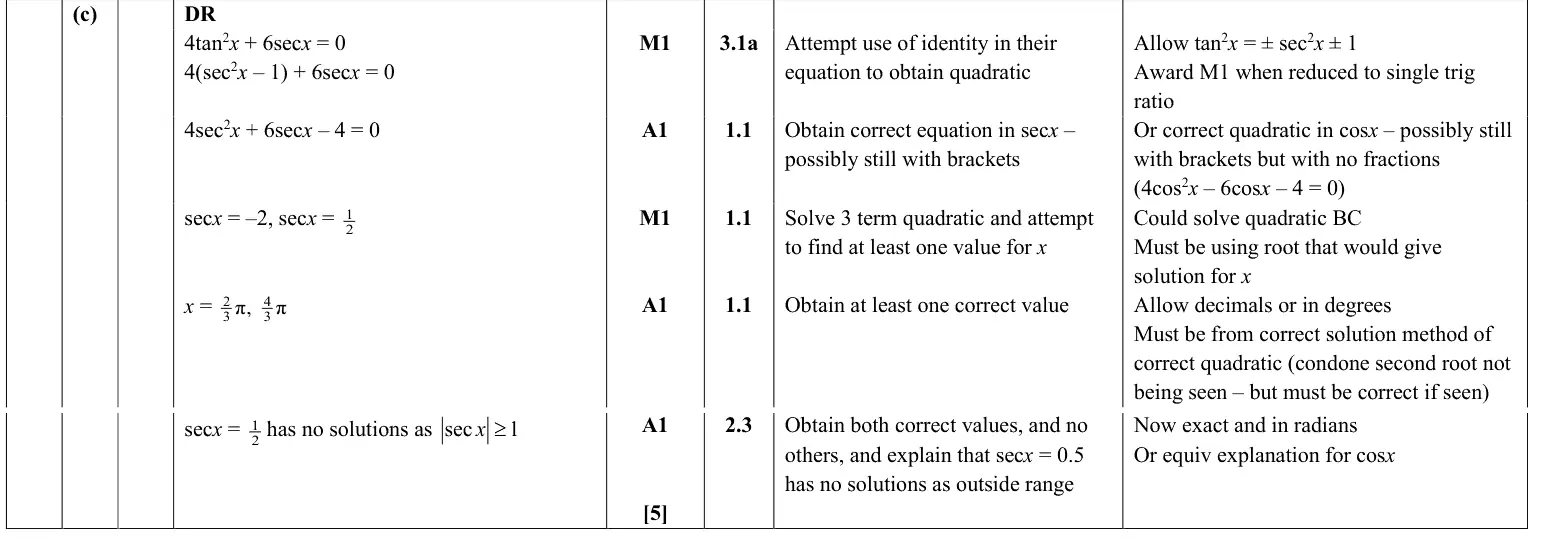
Autumn 2021 · Paper 1 · Q8(c)5 marksMedium
Show the start of this question
Mark scheme for this part
Examiner's comment
(From the general report) In the final part of Question 4 one root of the cubic polynomial could not be further pursued to find a value for y, and a similar situation occurred in Question 8(c).
Key points and common errors
4tan²x + 6sec x = 0
use tan² = sec² − 1 to get 4sec²x + 6sec x − 4 = 0
sec x = −2 gives x = 2π/3, 4π/3
must explain sec x = ½ has no solution as abs(sec x) ≥ 1
Autumn 2021 · Paper 1 · Q9(b)2 marksHard
Show the start of this question
Mark scheme for this part
Examiner's comment
(From the general report) Question 9, covering aspects of parametric equations, proved challenging for a significant proportion of candidates. Question 9 highlighted confusion about when to use x = 0 or y = 0 when investigating the path of a particle defined parametrically.
Key points and common errors
crossing y-axis means x = 0 (confusion with y = 0 common)
(eᵗ − 1)(eᵗ − 3) = 0
t = 0 and t = ln 3
ln 1 must be simplified
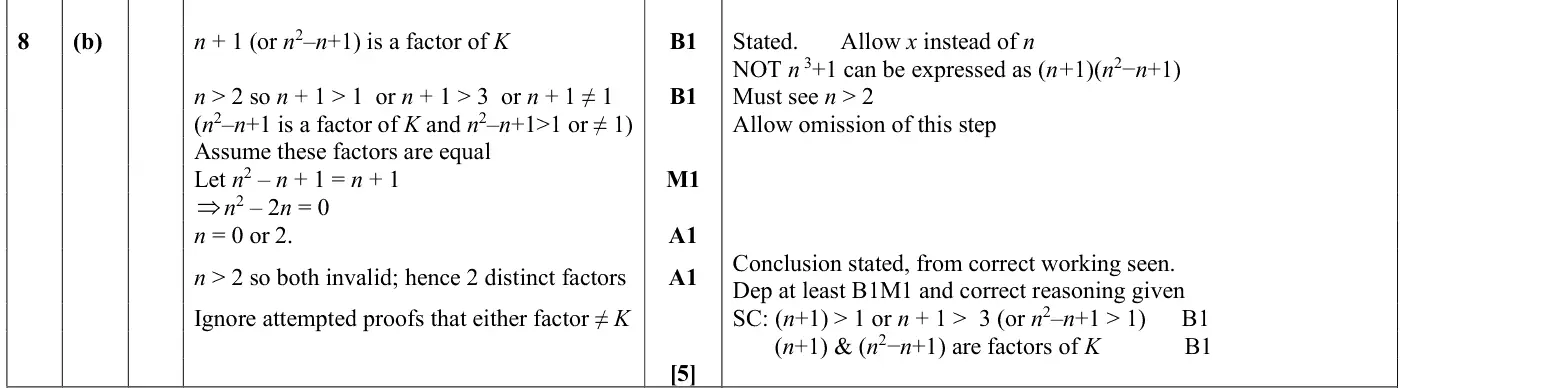
Autumn 2021 · Paper 2 · Q8(b)5 marksHard
Show the start of this question
Mark scheme for this part
Examiner's comment
(From the general report) Question 8(b): Many candidates missed the point of this question – namely that part (a) provides two factors of K. Question 8(b): Many candidates misinterpreted the question.
Key points and common errors
n + 1 and n² − n + 1 are factors of K, both > 1 since n > 2
equal only if n² − 2n = 0, n = 0 or 2, so distinct
many missed that part (a) gives the factors
Autumn 2021 · Paper 3 · Q35 marksMedium
Mark scheme for this part
Examiner's comment
While most candidates could successfully set up and solve the required equations to find the value of d a number did not explain correctly why the value obtained implied that the sequence was increasing.
Key points and common errors
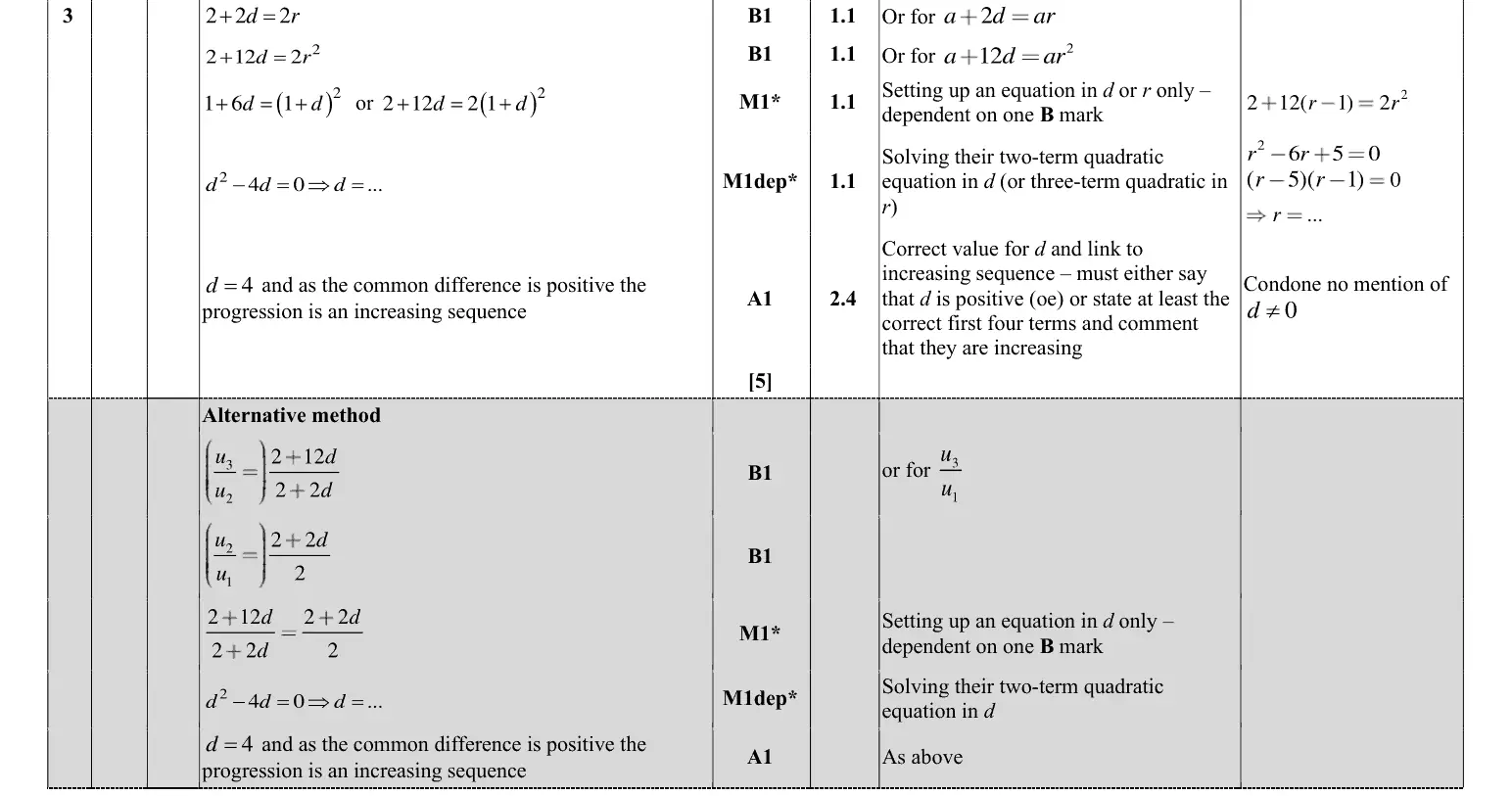
2 + 2d = 2r and 2 + 12d = 2r² give d² − 4d = 0
d ≠ 0 so d = 4
must explain that positive common difference means increasing
Autumn 2021 · Paper 3 · Q4(c)2 marksMedium
Show the start of this question
Mark scheme for this part
Key points and common errors
root is negative so x(1 − x) = −6
x² − x − 6 = 0
x = −2 only
Autumn 2020 · AS Paper 1 · Q6(b)4 marksMedium
Mark scheme for this part
Key points and common errors
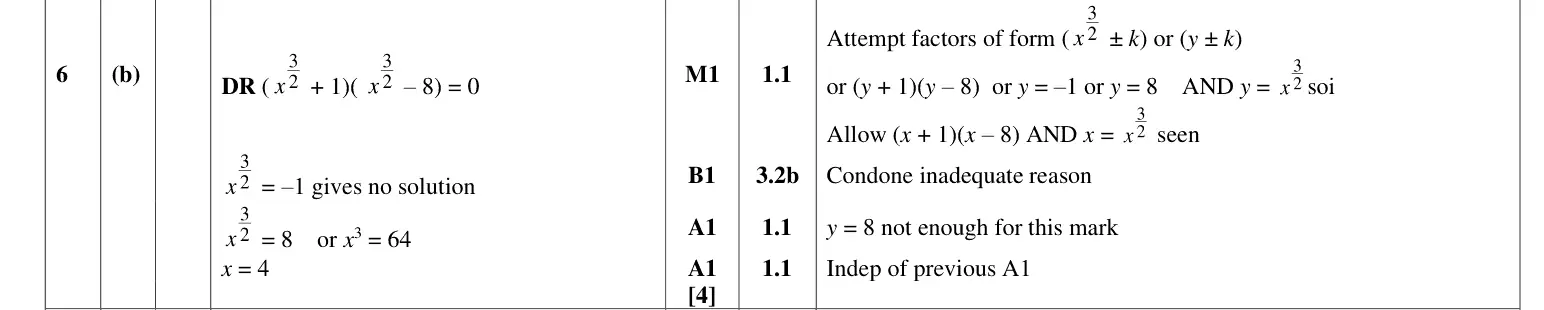
quadratic in x^(3/2): (x^(3/2) + 1)(x^(3/2) − 8) = 0
x^(3/2) = −1 has no solution
x³ = 64, x = 4
Autumn 2020 · AS Paper 1 · Q75 marksMedium
Mark scheme for this part
Examiner's comment
Many candidates answered this question well. However, others attempted to substitute from one equation into the other by simply setting the two left-hand-sides equal to each other. This did not achieve the desired result of obtaining an equation in one letter only.
Key points and common errors
substitute x = 4 − 2y into the curve: y² + 2y − 15 = 0
y = 3 or −5
points (−2, 3) and (14, −5) paired
equating the two left-hand sides is invalid
Autumn 2020 · AS Paper 2 · Q4(c)(i)2 marksHard
Show the start of this question
Mark scheme for this part
Examiner's comment
(Comment on Question 04 as a whole) Part (a) - Long division was seen here, ignoring the request for the factor theorem. This gained no credit because of the instruction ‘Use the factor theorem’. Note that only the statement f(½) = 0 so k = -37 was not enough working because of DR and AG. Part (b) - DR so evidence for the factorisation was required. Candidates that just quoted their answer, possibly obtained from the polynomial solve function on the calculator scored M0. Part (c) - Only candidates who did well on this paper seemed to understand what was required. NR was not uncommon.
Key points and common errors
equation is f(e⁻ᵗ) = 0 so e⁻ᵗ = ½, 5/3, 4
t = −ln(½), −ln(5/3), −ln 4
Autumn 2020 · AS Paper 2 · Q11(a)6 marksHard
Mark scheme for this part
Examiner's comment
(Comment on Question 11 as a whole) Part (a) - s = 16t used – the need for t – 1.5 was generally not understood. This then led to t = 0 and t = 8 from a two term quadratic and thus gained only M1 A1. Candidates did not seem to realise that t = 0 could not be one of the required times given the problem. t + 1.5 was seen in some working. Part (c) - Most candidates made no useful progress with this part. Common misconceptions Key teaching and learning points – comments on improving performance The following, some of which have been mentioned in previous reports, remain pertinent. 1. Candidates should understand the implication of the ‘In this question you must show detailed reasoning’ instruction. Generally, this means examiners will expect to see how results have been obtained. So, for example, in Question 6 on this paper the method for solving the simultaneous equations was expected and those just doing it on the calculator earned M0 for this skill. 2. BC – a result achieved ‘by calculator’ – can encourage candidates to show little, if any, evidence of how their answer has been produced. To be fair, where this appears on the mark scheme (in Question 10) candidates generally adopted the ‘old-fashioned’ algebraic route but no doubt this will change over time. Inevitably examiners will find it difficult to know where an incorrect answer, presented alone, has come from and it may be hard to credit. It may be wise to encourage candidates to provide some evidence of what they are doing, especially in cases where more than one mark is available. 3. The front cover instructions state ‘Give non-exact numerical answers correct to 3 significant figures unless a different degree of accuracy is specified in the question.’ This should be stressed – some final answers were correct to 2 significant figures only. This may result in a loss of accuracy marks. 4. A question may require units in an answer to gain full credit. It is best to make candidates aware of this and urge them to always include units in answers where relevant. 5. The front cover instruction state ‘When a numerical value is needed use g = 9.8 unless a different value is specified in the question’. This now seems to be well recognised. Guidance on using this paper as a mock This paper covers the following topics : Cosine rule, ½absinC with area of a segment, curve sketching and interpretation of the algebraic solution of an equation graphically, finding the normal to a curve, the factor theorem and factorisation, quadratic functions and graphical transformations, properties of the circle and the circle equation, a maximisation problem with rationalising and algebraic manipulation, use of the laws of logarithms, forces in vector notation in equilibrium, Newton’s second law, variable acceleration and suvat equation use. The Pure section introduces the calculus and various other ideas which require a secure grasp of basic algebra and in the Mechanics section students need a sound understanding of kinematics with both uniform and non-uniform acceleration and Newton’s laws.
Key points and common errors
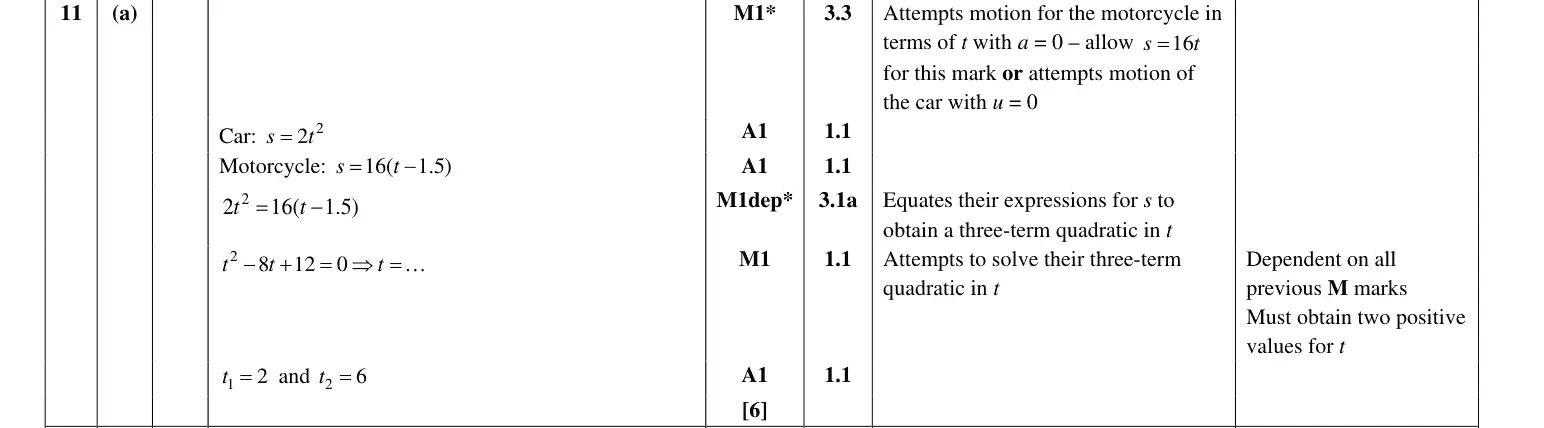
car s = 2t², motorcycle s = 16(t − 1.5)
t² − 8t + 12 = 0 so t = 2, 6
using 16t gives t = 0 and 8
Autumn 2020 · Paper 2 · Q45 marksMedium
Mark scheme for this part
Key points and common errors
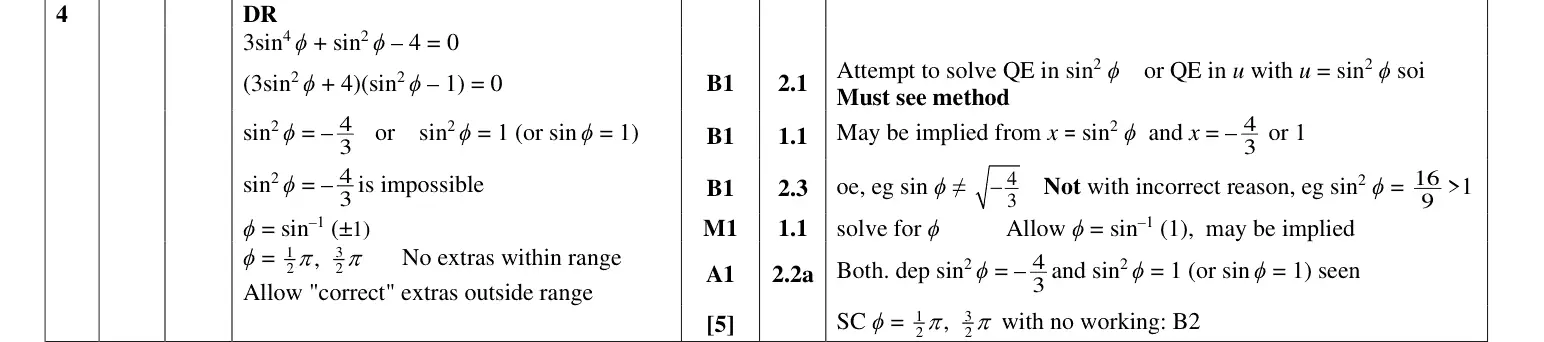
quadratic in sin²φ: (3sin²φ + 4)(sin²φ − 1) = 0
sin²φ = −4/3 must be rejected with a reason
φ = π/2, 3π/2
common error taking only sin φ = 1
Autumn 2020 · Paper 3 · Q6(b)8 marksMedium
Show the start of this question
Mark scheme for this part
Examiner's comment
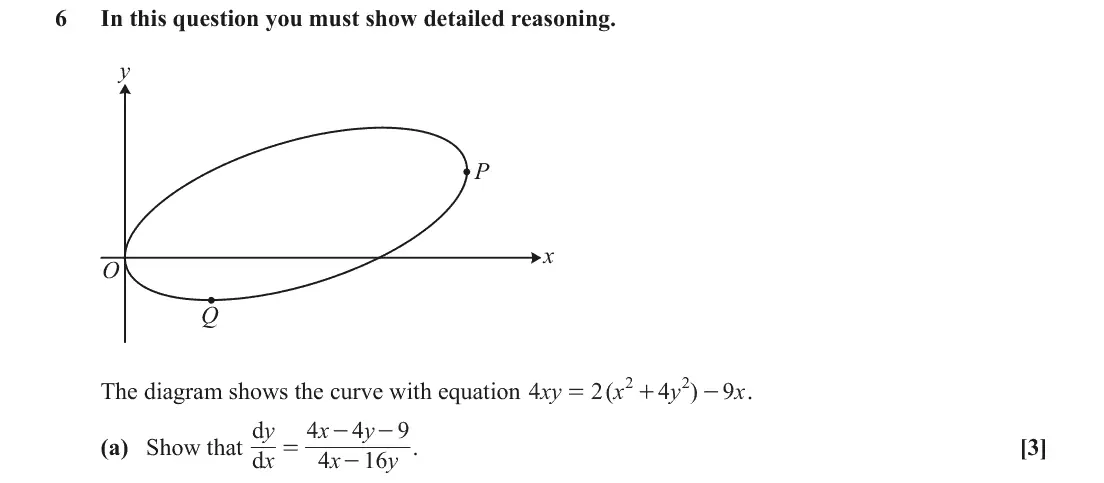
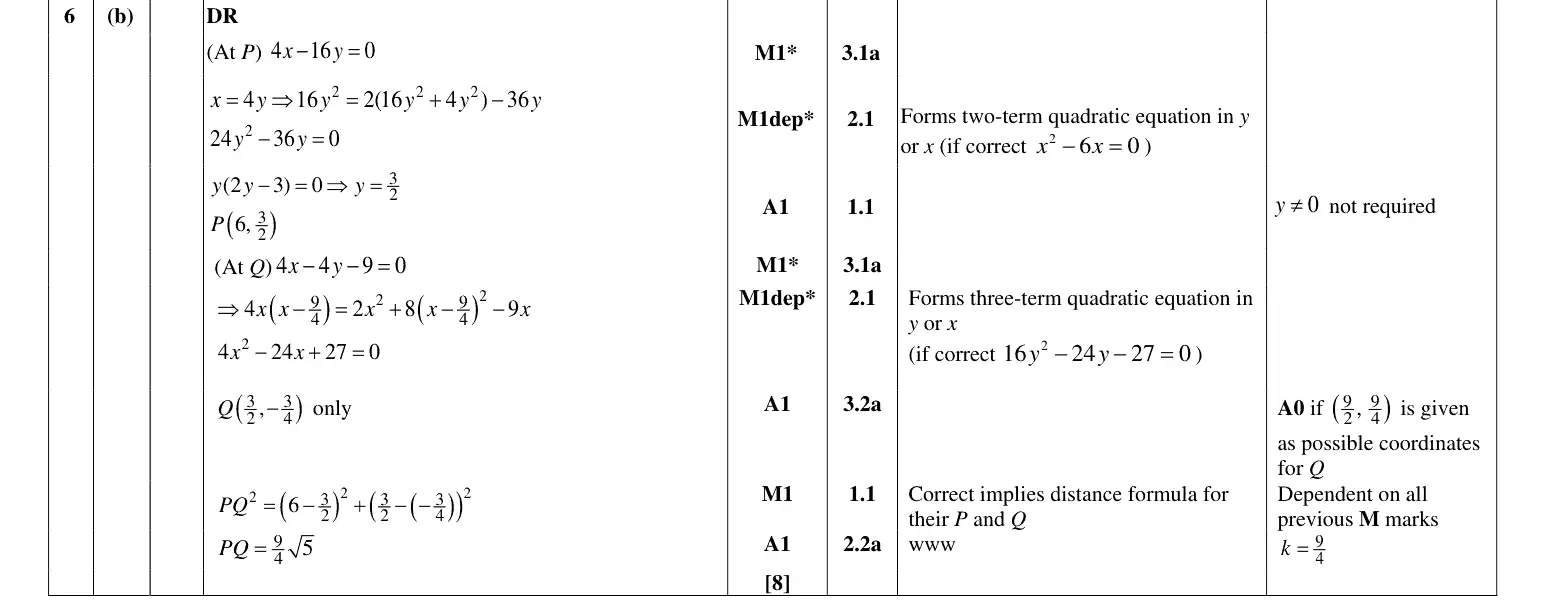
(Comment on Question 06 as a whole) This was the only ‘In this question you must show detailed reasoning’ on this paper. Examiners will be very focused on the individual steps of the calculation on these questions, signified by the ‘DR’ notation in the mark scheme. Part (a) was generally well answered, candidates appeared to be well prepared for this type of question. A common error was to start the mathematical argument with d y x = followed by the correct set of d differentiated terms with equals sign. Some candidates dropped marks due to careless algebra manipulation. In part (b), those candidates that recognised the correct gradients of the tangents at P and Q generally went on to use their values for the coordinates to find PQ and score many of the 5 method marks. However poor algebra manipulation cost accuracy marks. A number of candidates solved the quadratic equation generated to find Q, but then chose the coordinates 9 9 , . Candidates should use all information given in the question, including any sketched 2 4 d y curves. In this case, candidates were expected to recognise that the two results for x = 0 were valid, d but that the diagram indicated which horizontal tangent was to be used. Note that those candidates that used 9 9 , to find their PQ with no wrong working would have scored 6 out 8. There was not an explicit 2 4 mark given for discounting the unwanted quadratic solutions on this question, however it is good practice and may be penalised in other ‘DR’ questions.
Key points and common errors
P: denominator 0 so x = 4y, gives P(6, 3/2)
Q: numerator 0 gives Q(3/2, −3/4) (reject (9/2, 9/4) using the diagram)
PQ = (9/4)√5
June 2019 · AS Paper 1 · Q3(b)5 marksMedium
Show the start of this question
Mark scheme for this part
Examiner's comment
Most candidates recognised the significance of the word "hence" and used their response to the previous part. Most were successful. Many lost a mark, however, because they simply ignored the root sin θ = –3, without comment, or just placed a cross beside this response. Because of the "detailed reasoning" instruction, some explanation was required such as " sin θ only takes values between –1 and 1" or "sin θ = –3 is impossible". A few gave an incorrect explanation such as that sin θ = –3 is invalid because it is negative. A few candidates gave extra solutions such as 210o or 270o or 180o.
Key points and common errors
sin θ = 1 or 1/2 gives θ = 90°, 30°, 150°
must state sin θ = −3 has no solution with a reason
June 2019 · AS Paper 1 · Q7(c)6 marksHard
Mark scheme for this part
Examiner's comment
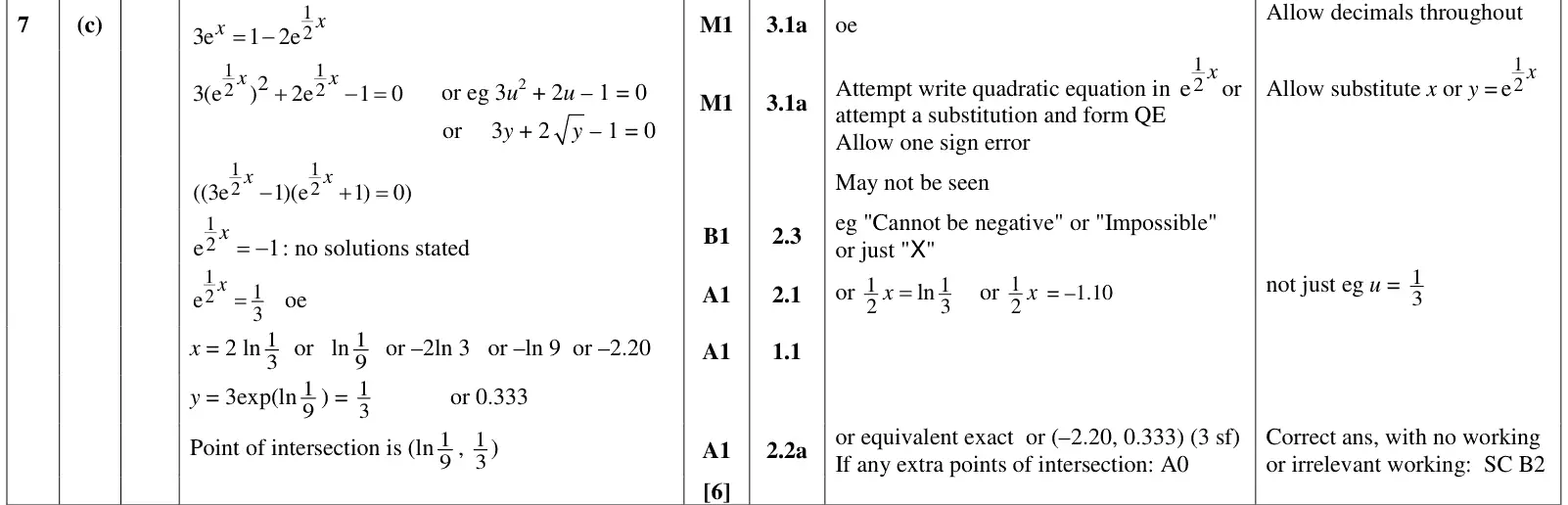
Erratum notice 1 2e x , but then proceeded to attempt to The majority of candidates wrote a correct equation, 3ex = 1 – 2 take the logarithms of both sides. Their attempts were invariably incorrect. A few candidates wrote a correct first equation but then attempted to combine the exponential terms, obtaining equations such as 3 5e x = 1. 2 Some candidates recognised the "hidden" quadratic equation. Of these candidates, some did not 1 x 2e x – 1 = 0 and generally succeeded. However, many 1 2 2 substitute, but obtained the equation 3 (e ) + 2 e x , often made errors such as obtaining 2u2 + 3u – 1 = 0 or 1 who substituted, for example u = 2 (3u)2 + 2u – 1 = 0. 1 e x = 1 The correct method leads to 2 3 or –1. To gain full marks candidates had to indicate in some way 1 e x = –1 has no solutions. that the equation 2 Some candidates used a graphical calculator either from the start or after abandoning the incorrect logarithm method. In some cases, correct responses were seen, but preceded by incorrect working. Because the command word in this question is "Determine" rather than "Find", answers obtained in this way, without working equivalent to that shown in the mark scheme, were not given full credit. They scored 2 marks (out of 6 marks), if correct to 3 significant figures The best solutions worked with exact values, expressed in terms of e. Working in terms of decimals was accepted, but the final response needed to be correct to 3 significant figures. It is worth noting that similar questions in the future might explicitly require candidates to work with exact values and in such questions, working and/or responses in terms of rounded decimals would be penalised.
Key points and common errors
3eˣ = 1 − 2e^(x/2) is a quadratic in e^(x/2): (3u − 1)(u + 1) = 0
reject e^(x/2) = −1
x = ln(1/9), y = 1/3
taking logs of both sides fails
June 2019 · AS Paper 2 · Q5(b)3 marksMedium
Mark scheme for this part
Examiner's comment
Many candidates made progress here, successfully setting up the required quadratic in k . Although ( ) k − 2 = 4 provides a neat solution, more often than not the correct answers followed from k − 4 k = 0 . Some expanded the brackets incorrectly and a few candidates thought AD = a + d .
Key points and common errors
(1 − 4)² + (2 − k)² = 13 gives k = 0 or 4
errors expanding
AD is d − a, not a + d
June 2019 · AS Paper 2 · Q6(b)5 marksHard
Show the start of this question
Mark scheme for this part
Examiner's comment
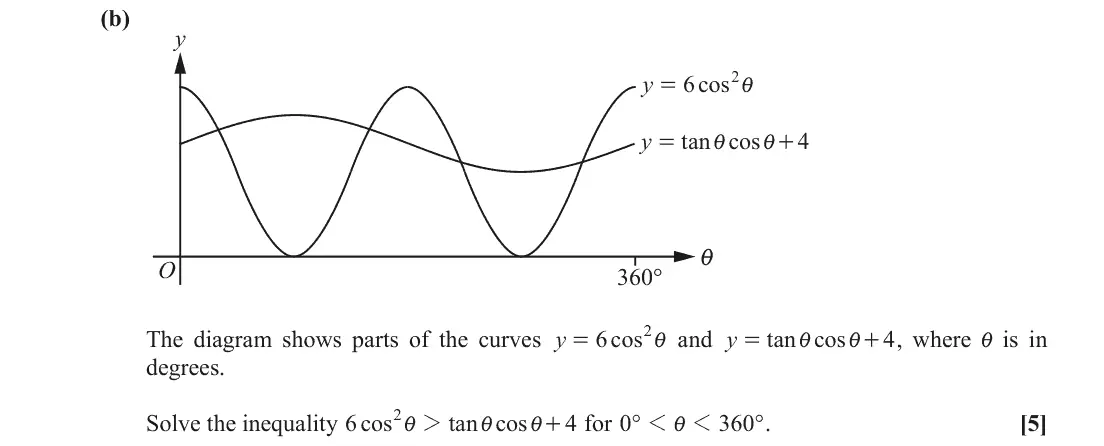
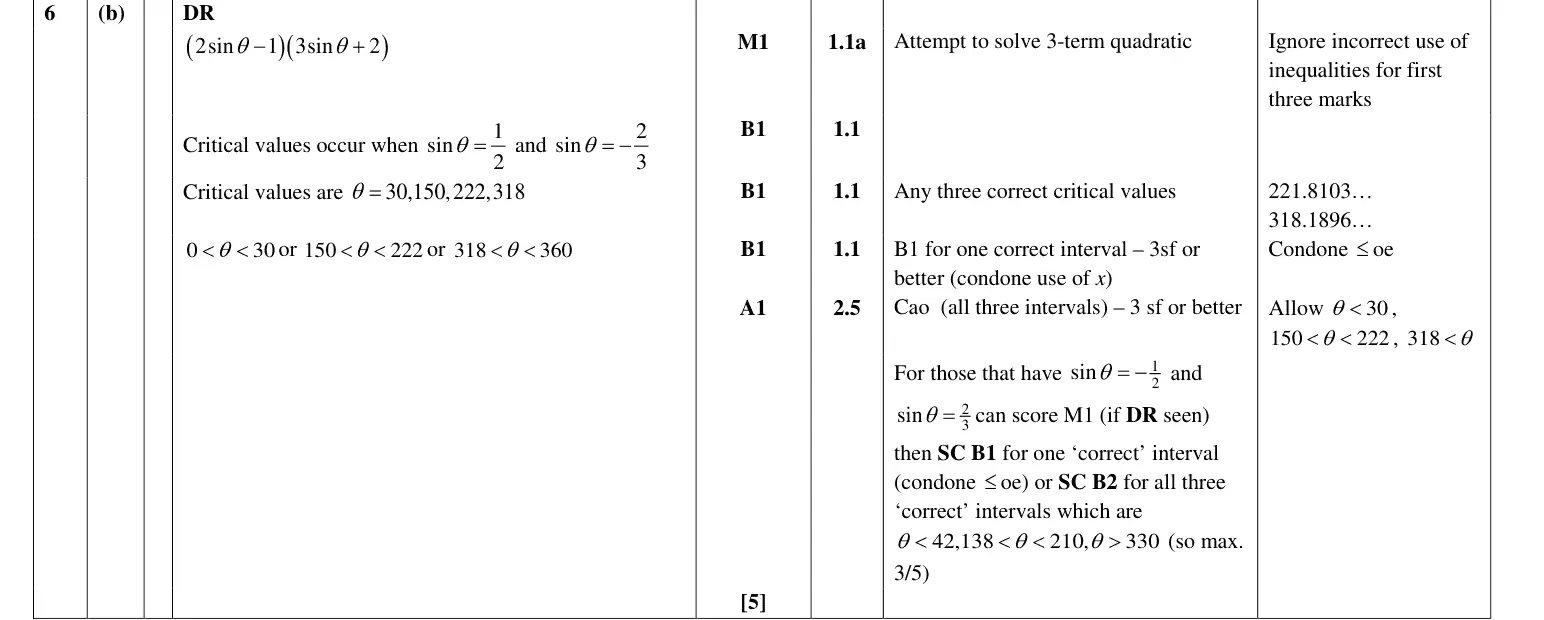
A fully correct solution was rare. Many candidates recognised the quadratic but just found values for θ and made no effort to relate them to the given graph and form inequalities. Because this is a detailed reasoning question we expected to see how the quadratic was solved and penalised those who just produced the two roots from their calculator. Often use of inequality signs was slack and recognising which quadrants angles need to be in was sometimes confused. Notice that the ‘detailed reasoning’ does not restrict the use of the quadratic solve function, in this exemplar the candidate has ‘Let sin θ = X ’ with 6 X + X − 2 = 0 and the substitution of the roots back in terms of θ to provide the required reasoning for this part of their answer. This candidate avoided any potential inequality pitfalls when identifying the required three regions by utilising the initial graph provided in the question. As in many cases, the subsequent marks are not achieved due to confusions with the inequalities.
Key points and common errors
(2sinθ − 1)(3sinθ + 2) = 0
critical values 30°, 150°, 221.8°, 318.2°
use the graph: 0 < θ < 30, 150 < θ < 222, 318 < θ < 360
many gave only the critical values
June 2019 · AS Paper 2 · Q78 marksHard
Mark scheme for this part
Examiner's comment
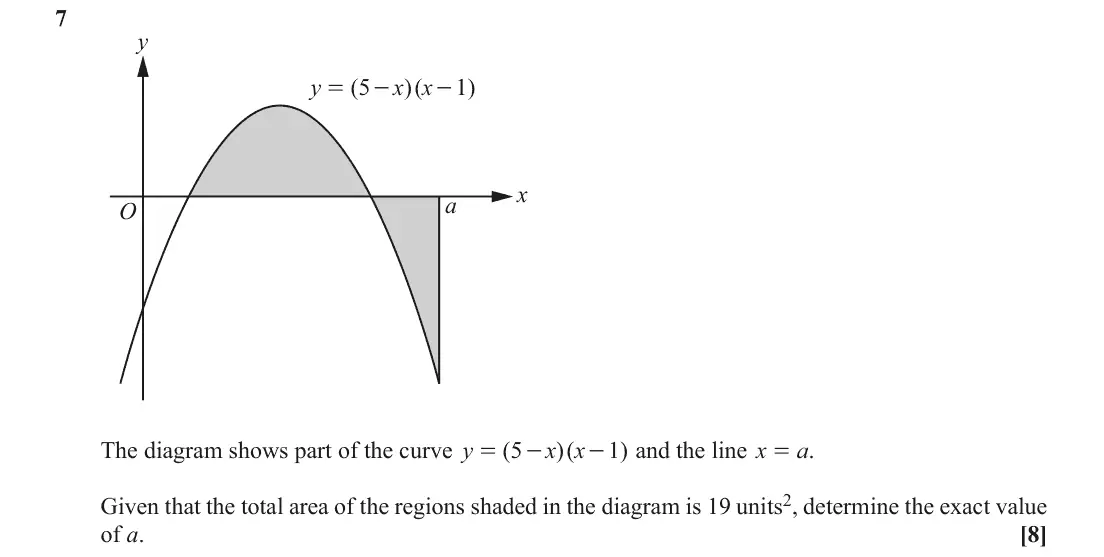
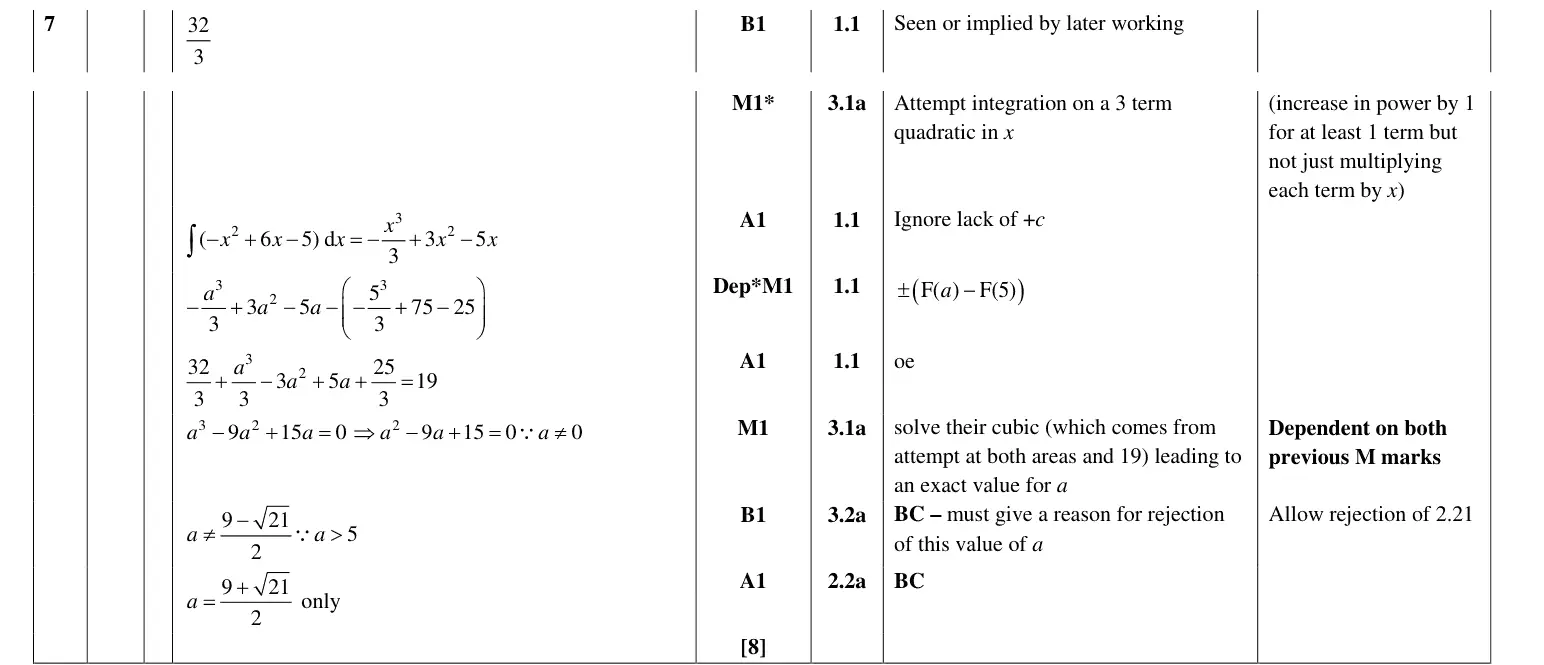
For a fully successful attempt, candidates needed to demonstrate an understanding that areas were both above and below the x-axis, with the sign consequences, and algebraic accuracy was vital. Although the integral between 1 and 5 could be done on the calculator, many did not do this and evaluated it incorrectly, often because ( 5 )( 1 ) was expanded incorrectly. Then the integral between 5 and a − x x − needed to be carefully done before putting everything together with the correct signs. Many cubics were wrong, so getting an exact solution proved impossible. Some obtained the correct cubic fortuitously from wrong working (which was penalised) but if all was fine by this stage we then wanted a clear explanation for the rejection of the negative root and an exact answer as requested.
Key points and common errors
area 1 to 5 is 32/3
region 5 to a is below the axis so take its magnitude
cubic a³ − 9a² + 15a = 0 gives a = (9 + √21)/2, reject (9 − √21)/2 since a > 5
expansion errors in (5 − x)(x − 1)
June 2019 · Paper 1 · Q14 marksEasy
Mark scheme for this part
Examiner's comment
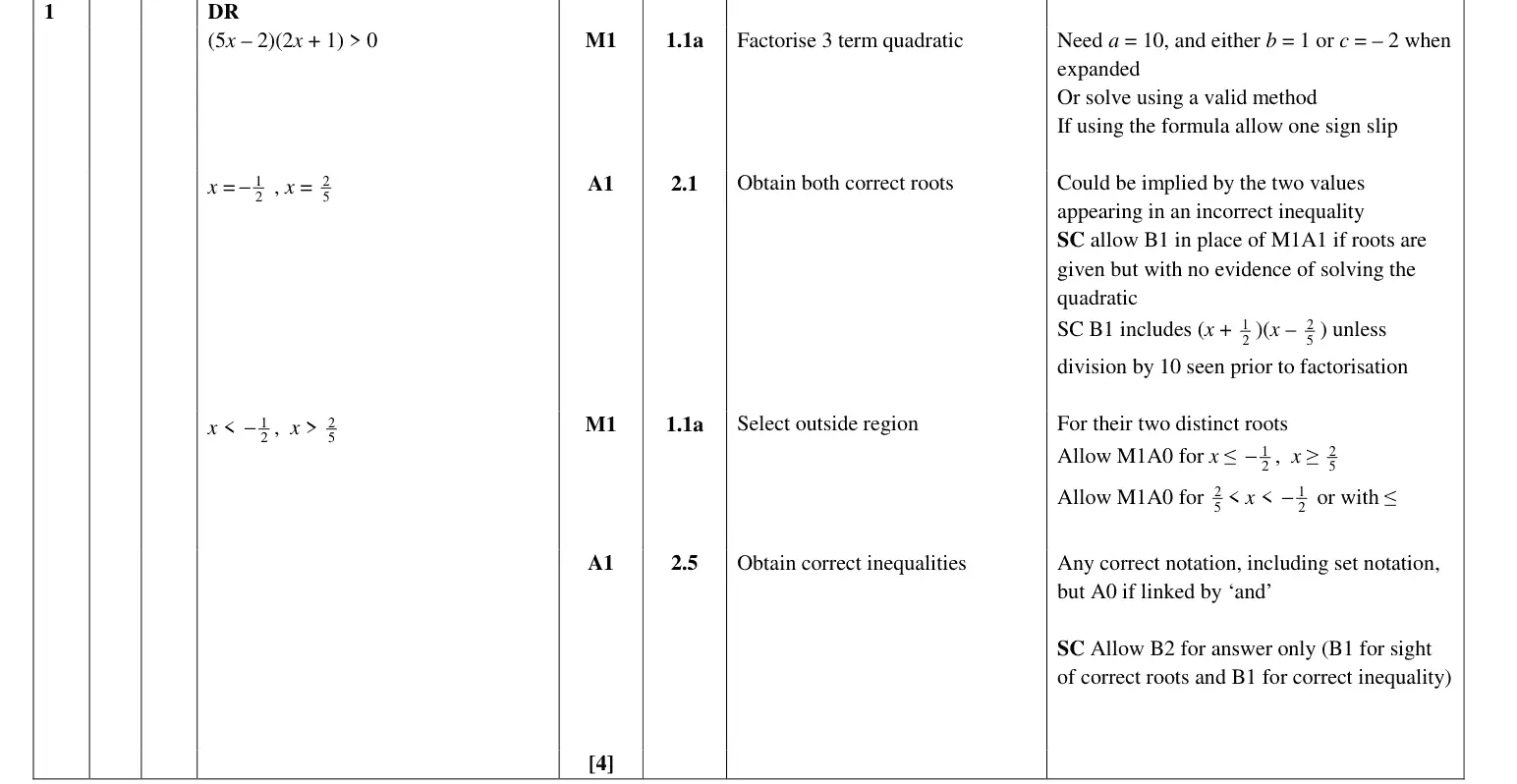
This question was generally answered well, with many fully correct solutions seen. Candidates generally paid heed to the ‘detailed reasoning’ instruction, showing how they had solved their quadratic. Some candidates used their calculator to produce the roots and then either quoted them or attempted to work backwards and deduce what the factors might have been. Most candidates were then able to identify the correct region for the inequality, with the majority giving their answer as inequalities whereas some showed good mastery of set notation. A few spoiled an otherwise correct solution by using ‘and’ to link their inequalities and others attempted to write it as a single inequality.
Key points and common errors
(5x − 2)(2x + 1) > 0 with working shown
x < −1/2 or x > 2/5
joining the two inequalities with 'and' loses the last mark
set notation accepted
June 2019 · Paper 1 · Q3(c)3 marksMedium
Show the start of this question
Mark scheme for this part
Examiner's comment
Most candidates were able to gain two marks for setting up and solving the relevant equation, but only a minority of the candidates gained the final mark for discarding x = –1, noting that it was outside the domain.
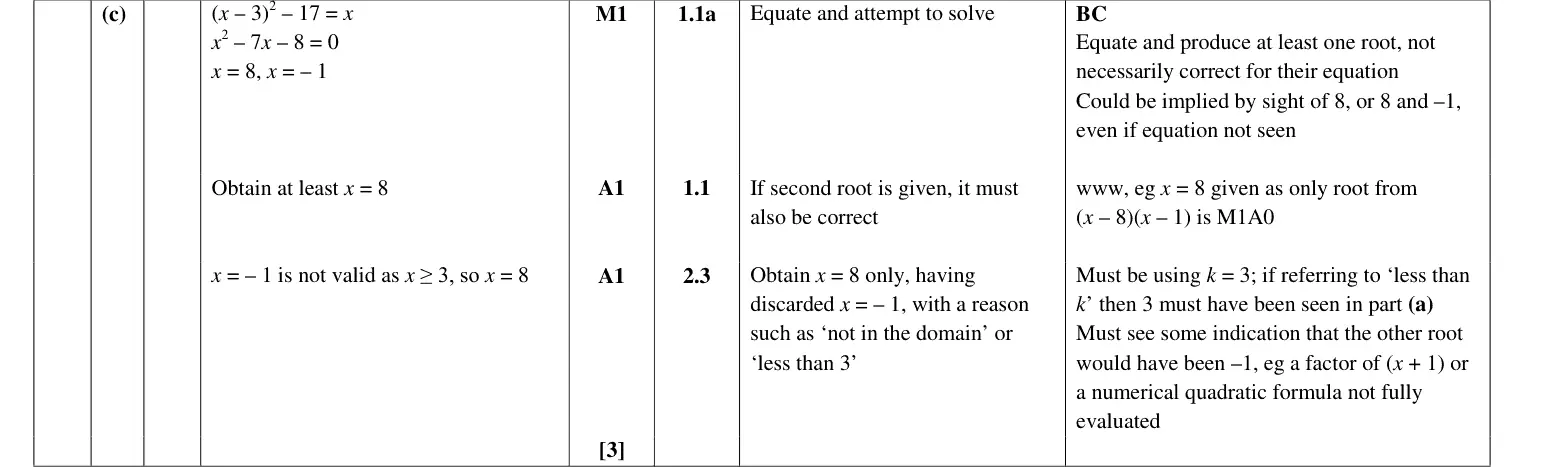
Key points and common errors
x² − 7x − 8 = 0 gives x = 8 or −1
reject −1 as outside the domain x ≥ 3
only a minority did
June 2019 · Paper 1 · Q4(b)4 marksEasy
Show the start of this question
Mark scheme for this part
Examiner's comment
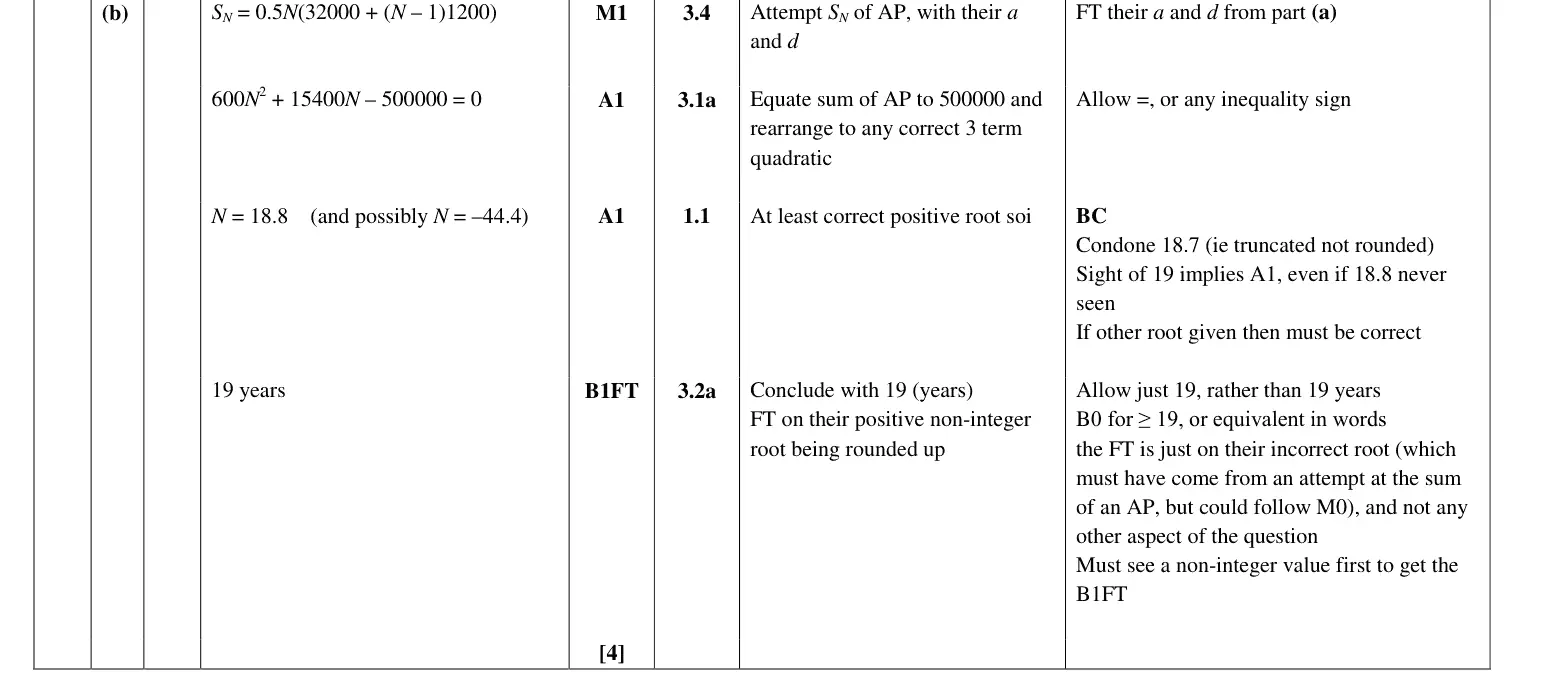
Most candidates could attempt the sum of the arithmetic progression, equate it to 500,000 and attempt to solve. There was an expectation that candidates would use their calculators to solve the resulting quadratic. While some did so, they were in the minority and errors in handling the ‘unfriendly’ numbers were seen. Candidates then had to appreciate that an integer solution was required, and most gained full marks by doing so. Rather than attempting the sum, the most common error was to instead use the nth term formula and the answer that Sam would have to work for 405 years did not seem to result in candidates reconsidering their solution.
Key points and common errors
S_N = ½N(32000 + 1200(N − 1)) > 500000
N = 18.8 so 19 years
use the calculator for the quadratic
using the nth term instead of the sum
June 2019 · Paper 2 · Q75 marksMedium
Mark scheme for this part
Examiner's comment
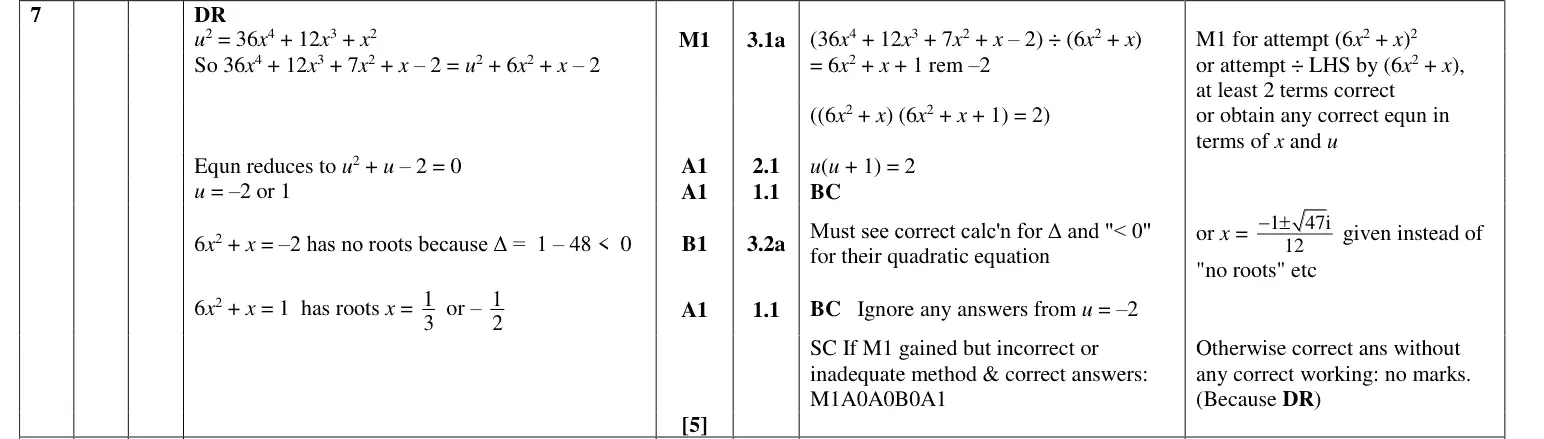
Candidates who started by finding u were generally successful. Many other candidates started by dividing the left hand side of the given equation by 6x + . Those who handled the remainder correctly x generally went on to be successful. Many, however, after dividing and finding a remainder of 2, said that ( )( ) 2 36 x + 12 x + 7 x + x − 2 = 6 x + x 6 x + x + 1 − , which is incorrect. 6 x + x Some candidates arrived correctly at the two equations 6 x + x − 1 = 0 and 6 x + x + 2 = 0 . However, because this question contains the instruction "In this question you must show detailed reasoning", candidates needed to show (not just state) that the second equation has no real roots. Many candidates lost a mark by failing to do this. This question did prove to be challenging for many candidates, with a range of attempts involving a great deal of algebraic manipulation, in terms of x and u. Some used their calculator to find the roots directly, and then used these in a "fudged" attempt to provide some justification. Whilst the use of calculators to check work should be encouraged, this question required the explicit use of the substitution to be seen in order to gain credit.
Key points and common errors
equation becomes u² + u − 2 = 0, u = 1 or −2
6x² + x = −2 has no real roots (discriminant < 0 must be shown)
x = 1/3 or −1/2
wrong handling of the remainder after division
June 2019 · Paper 3 · Q5(b)5 marksMedium
Show the start of this question
Mark scheme for this part
Examiner's comment
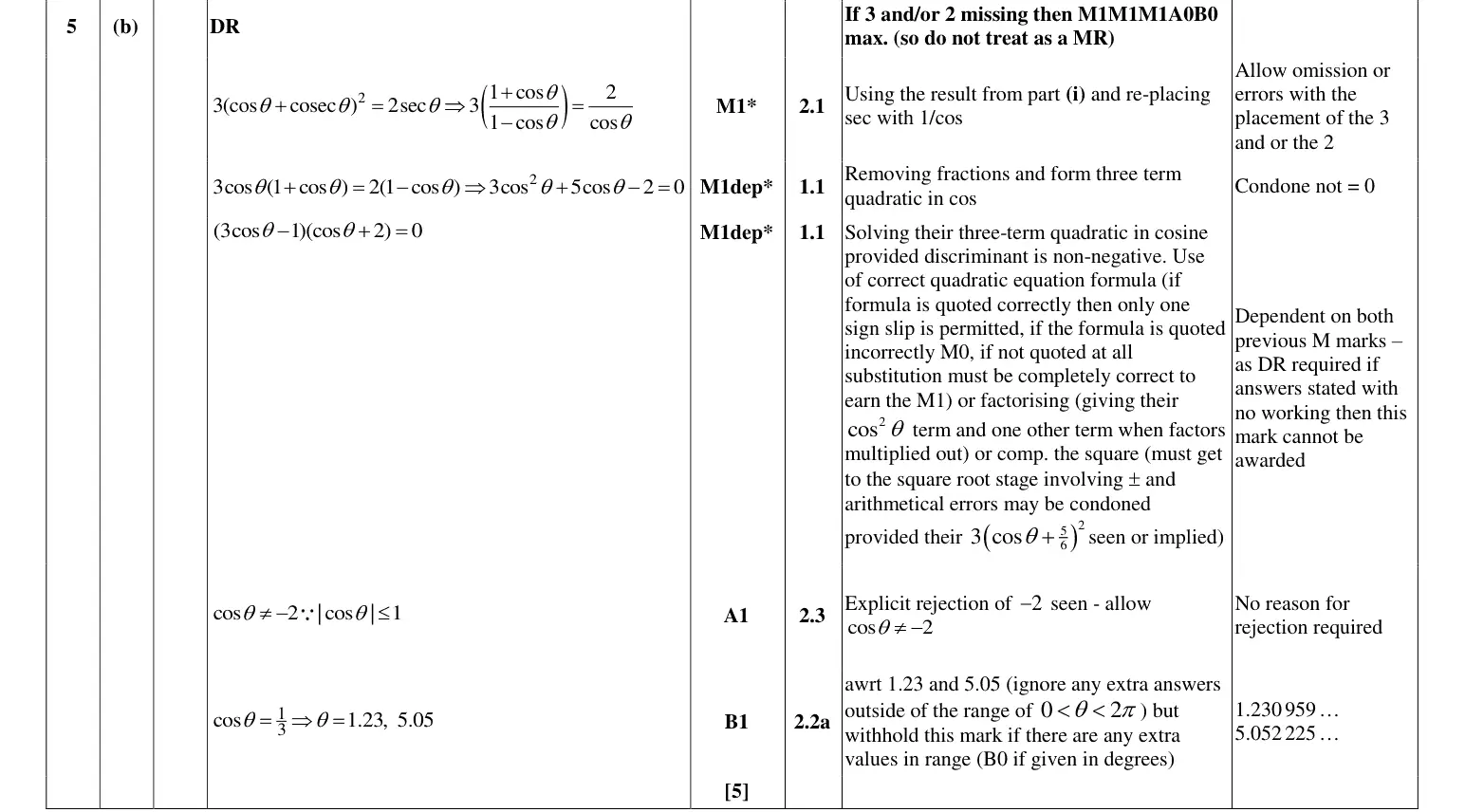
It was pleasing to note that most candidates used the result in part (a) to write down the required equation 1 + cos θ 2 3 1 = . It was, however, disappointing that many candidates either misplaced the 2 or the − cos θ cos θ 1 + cos θ 3 + 3cos θ 3 or believed that 3 1 = . Most candidates removed the fractions and obtained a − cos θ 3 − 3cos θ three-term quadratic in cosine, although mistakes with signs when collecting together the like terms was common. As this question explicitly asked candidates to ‘show detailed reasoning’ it was extremely disappointing that many went directly from the correct equation 3cos θ + 5 cos θ − 2 = 0 to cos θ = − 2 1 and cos θ = without any evidence of a correct analytical method. Examiners expected to see some 3 indication of the rejection of cos θ = −and although most candidates correctly stated 2 θ = 1 23 . some forgot about the other value in the interval (which was 5.05). quadratic equation in cosine so scored the first two marks. There is then a clear substitution method shown for how the ‘disguised quadratic’ has be evaluated. There is a mark for explicitly rejecting the -2 root. The sketch is not specifically needed, but hopefully has helped the candidate avoid a careless mistake in determining all the answers within the required range. factorised the quadratic directly in terms of cosθ . Again a nice sketch has be utilised to help identify the second solution. This response scored three of the five marks. The candidate obtained the correct quadratic equation in cosine so scored the first two marks. However, the candidate did not show detailed reasoning in how they have used the quadratic formula to obtain the values of 1 3 and 2 −; the third method mark and therefore the next accuracy mark could not be awarded. ( )( ) −± 5 5 − 4 3 − 2 Either showing the line cos θ = , or using substitution in the form 2 × 3 Let x = cos θ ∴ 3 x + 5 x − 2 = 0 ( )( ) −± 5 5 − 4 3 − 2 x = etc would have supported the detailed reasoning. 2 × 3 This candidate has been awarded the final B mark for the correct answers of 1.23 and 5.05. This response scored all three of the method marks, but the initial error with multiplying the fraction by 3 meant that the accuracy marks were lost. In general, candidates that opted for the use of the quadratic formula rather than factorisation seemed to make mistakes in the initial algebraic manipulation.
Key points and common errors
3(1 + cos θ)/(1 − cos θ) = 2/cos θ gives 3cos²θ + 5cos θ − 2 = 0
reject cos θ = −2
θ = 1.23, 5.05
misplacing the 3 or 2
sign errors
June 2018 · AS Paper 2 · Q55 marksMedium
Mark scheme for this part
Examiner's comment
The instruction requesting detailed reasoning did not prove to be an issue in this question. The two methods outlined in the mark scheme were both seen fairly often, with perhaps the ‘substitution’ route more popular. This required accurate algebraic work for complete success, but sign errors in the working were quite common and some petered out at the ‘b2 – 4ac’ stage. In the ‘gradient’ approach, candidates who worked from y = x2/4 – 10 or y = -x/5 + k to the correct value were not given full credit.
Key points and common errors
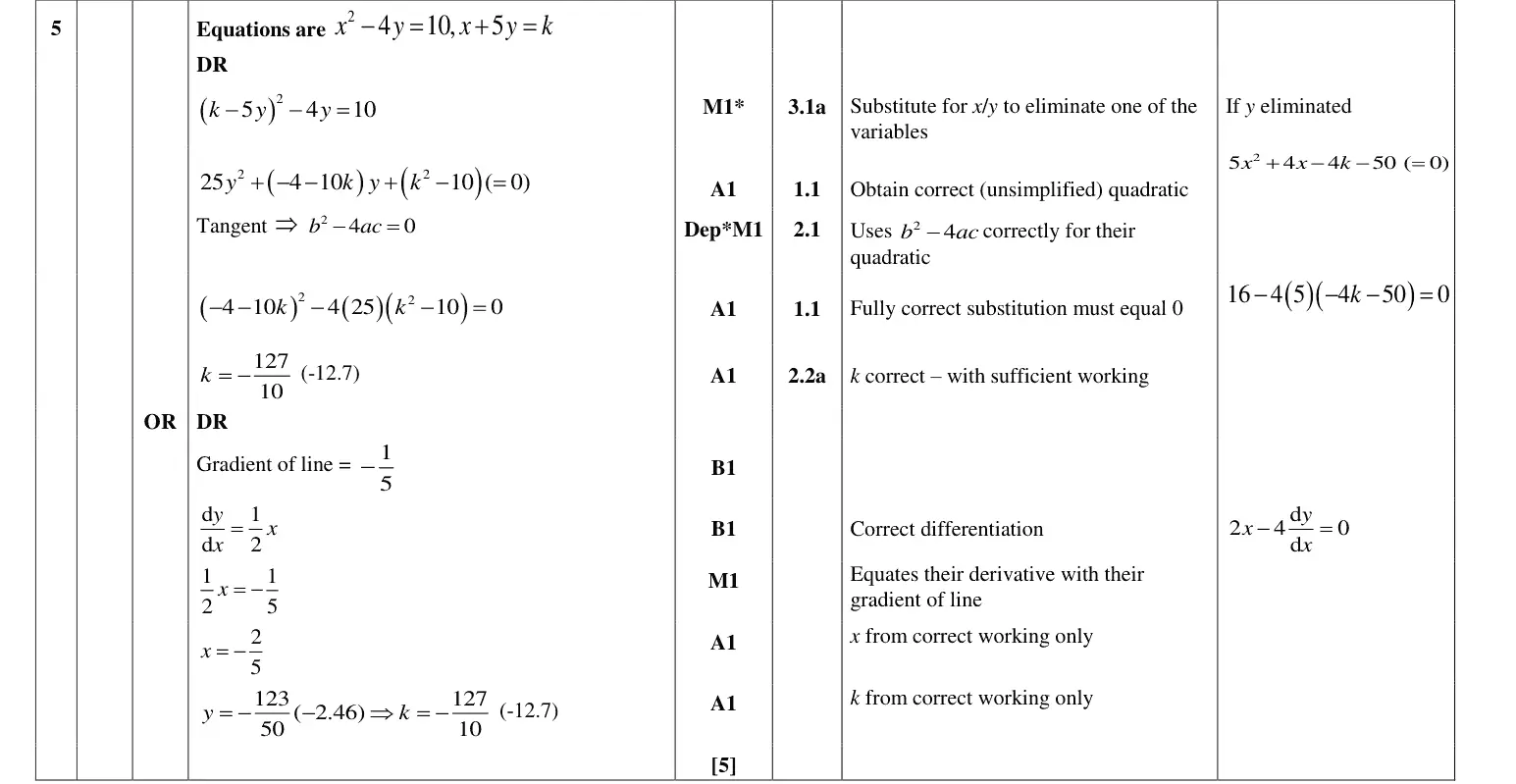
substitute x = k − 5y: 25y² − (10k + 4)y + k² − 10 = 0
tangent so b² − 4ac = 0
k = −12.7
or gradient method: x/2 = −1/5
sign errors common
June 2018 · AS Paper 2 · Q7(ii)5 marksMedium
Show the start of this question
Mark scheme for this part
Examiner's comment
This part starts with the word ‘Hence’ and what we expect from this is clear in the Specification Document. Most did start by solving a quadratic, not always producing two angles in the end. To gain full credit the two angles had to be given correct to 1 decimal place as requested. 144.8ᵒ was not uncommon. Some did not grasp the significance of 2θ and left the answer as 70.5ᵒ.
Key points and common errors
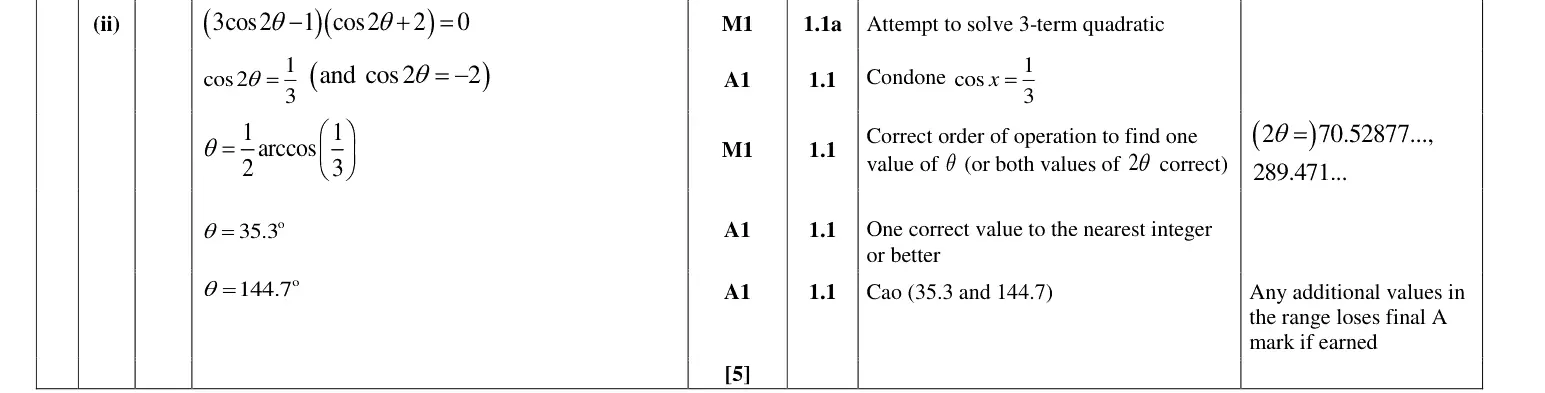
(3cos2θ − 1)(cos2θ + 2) = 0 so cos2θ = 1/3 only
2θ = 70.5° or 289.5° so θ = 35.3°, 144.7°
leaving 70.5° as the answer
June 2018 · AS Paper 2 · Q89 marksMedium
Mark scheme for this part
Examiner's comment
There were some encouraging attempts at this question, with the integration done accurately. Sign errors sometimes lead to the wrong quadratic, but many realised there was a ‘hidden’ quadratic. This question asked for detailed reasoning so we expected to see some working to show how the quadratic solutions were obtained, either factors or some working with the formula or completing the square. A few candidates found F(8) – F(a) when integrating from 8 to a and some integrated from a to 8 from the start. Those who obtained a = 27 from their calculator with no justification/detailed reasoning scored zero, although if they checked by showing the integral from 8 to 27 was equal to 45, then the first three marks were possible. There was a significant minority of candidates that attempted to differentiate rather than integrate to find the area under the curve. Section B
Key points and common errors
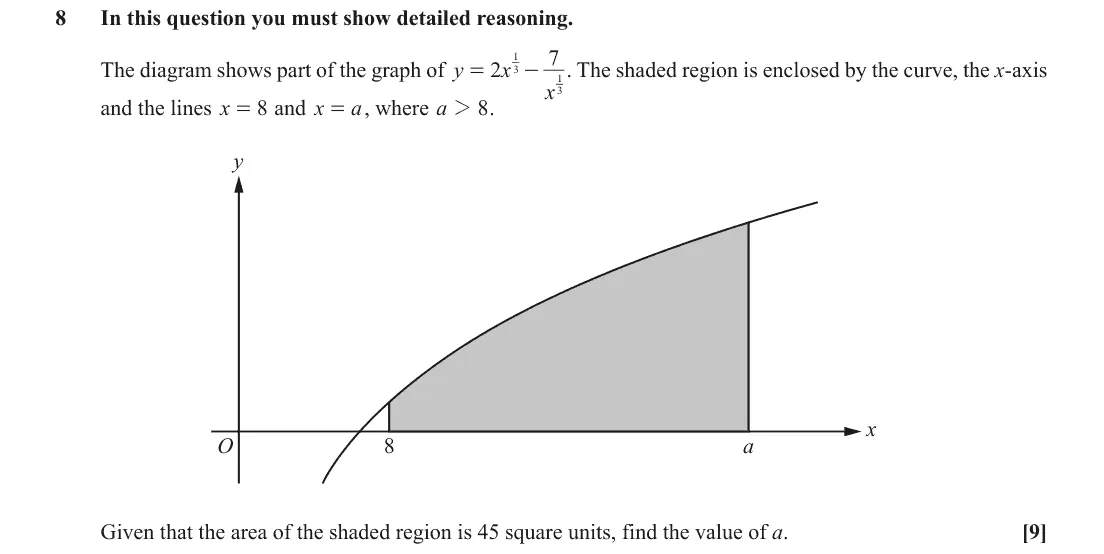
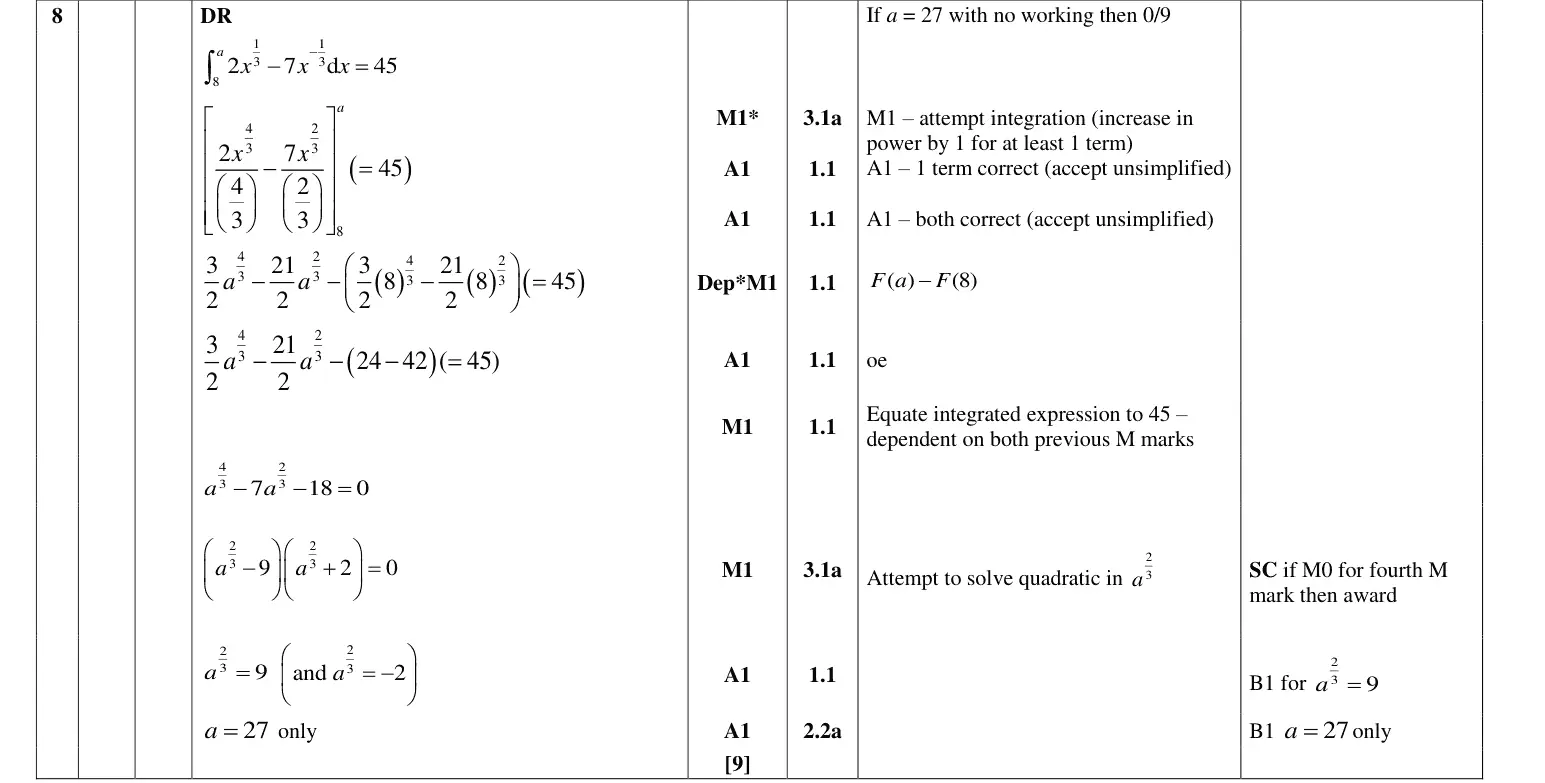
integrate to (3/2)x^(4/3) − (21/2)x^(2/3)
F(a) − F(8) = 45 gives a^(4/3) − 7a^(2/3) − 18 = 0, a quadratic in a^(2/3)
a^(2/3) = 9 so a = 27 only
calculator answer with no working scores 0
June 2018 · Paper 1 · Q34 marksEasy
Mark scheme for this part
Examiner's comment
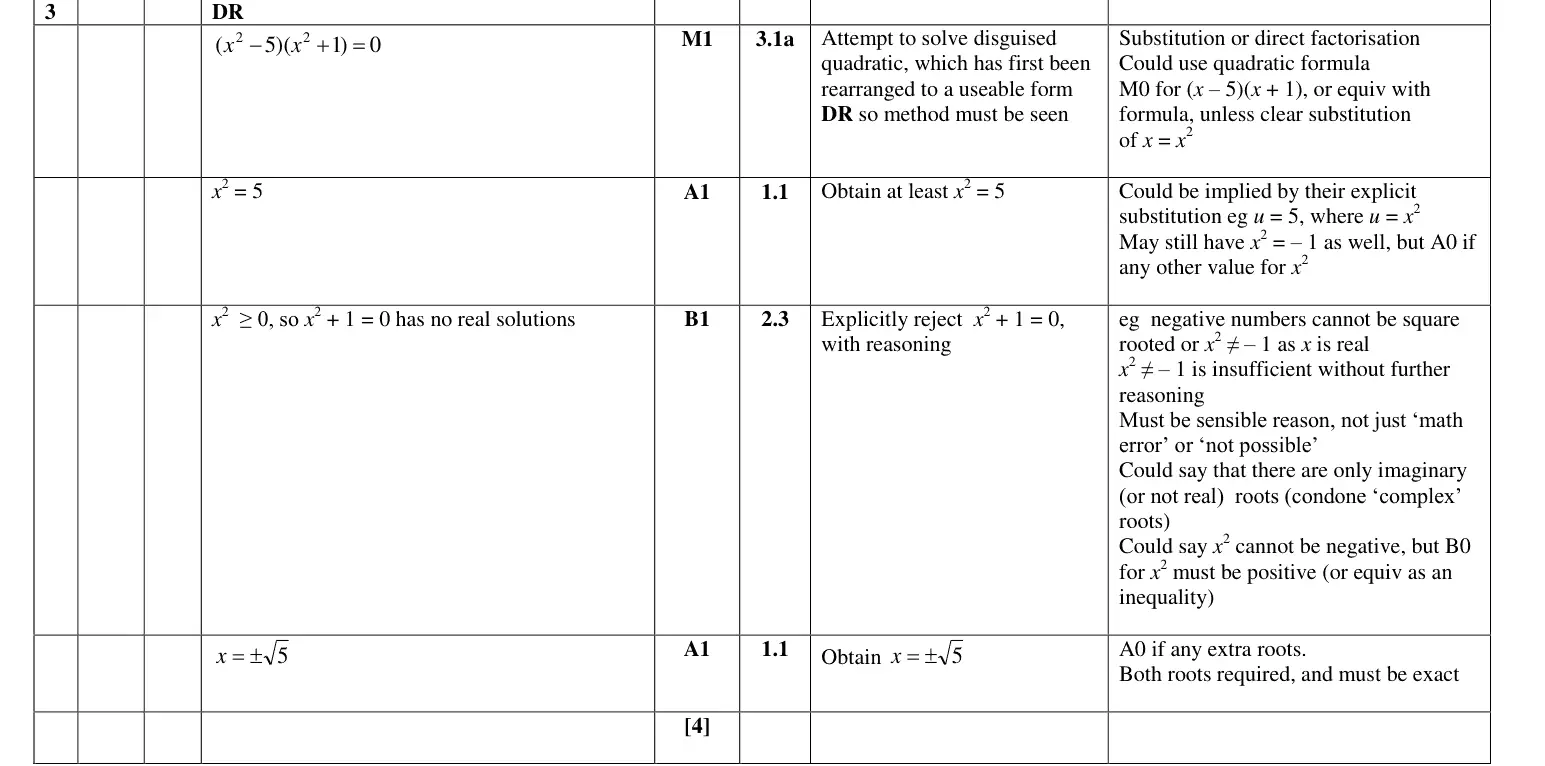
Most candidates were able to provide sufficient detail to be convincing in this ‘detailed reasoning’ question. It was expected that candidates would show clearly how they solved the disguised quadratic; this was usually by factorising (with or without a substitution) but some used the formula instead. There also had to be a clear reason given as to why x2 = –1 had no roots. Some candidates referred to the roots being imaginary (content from Further Maths) whereas others explained that square numbers had to be greater than or equal to zero; just stating that − could not be done was not sufficient. 1 This response gives a clear justification for why x2 = – 1 does not lead to any real solutions, thus gaining full credit for this solution.
Key points and common errors
(x² − 5)(x² + 1) = 0
x = ±√5
must give a reason x² + 1 = 0 has no real roots (x² ≥ 0)
June 2018 · Paper 1 · Q9(ii)4 marksEasy
Mark scheme for this part
Examiner's comment
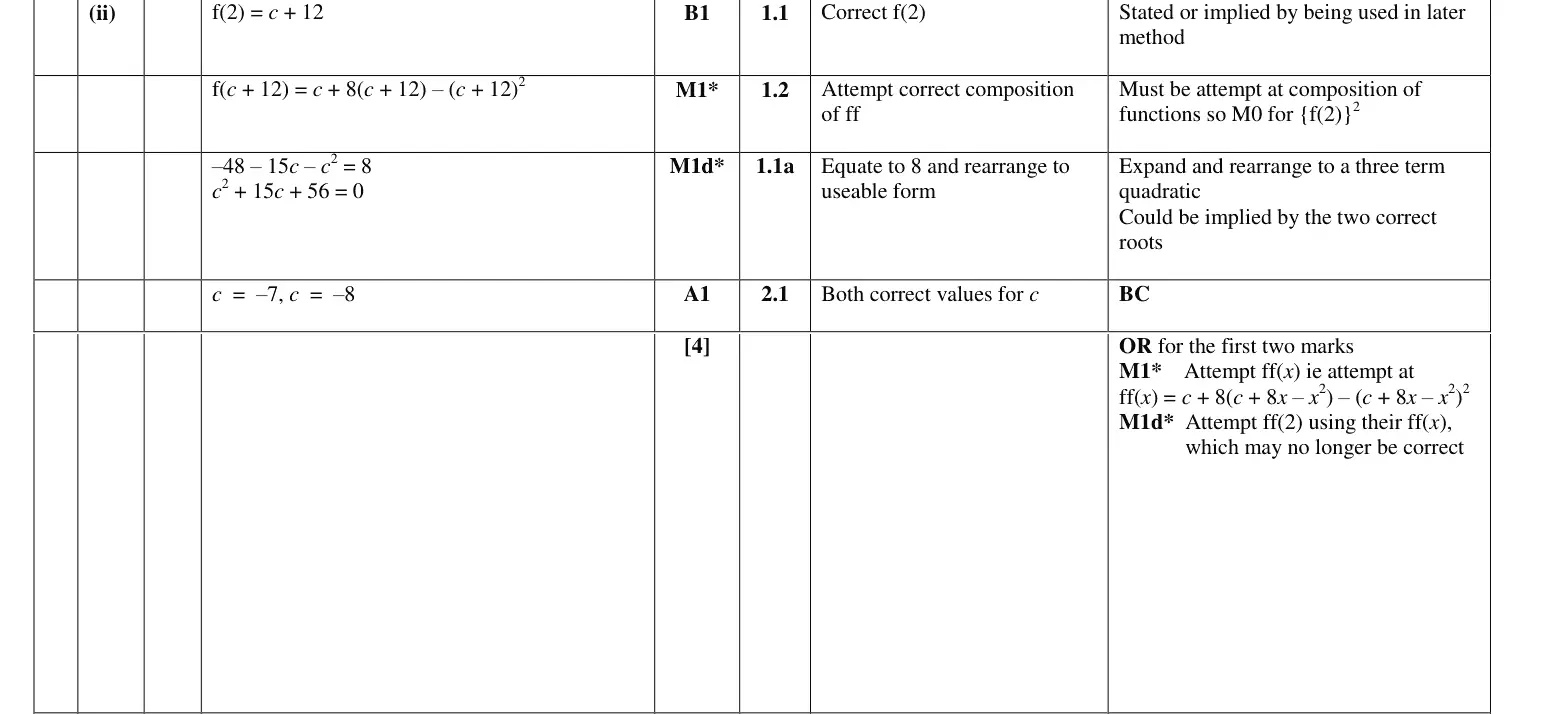
All candidates understood the meaning of ff(2) and were able to attempt the correct process for the composition of functions. The more successful method was to first find f(2), simplify this to c + 12 and then attempt f(c + 12). Candidates who attempted to find ff(x) before substituting x = 2 were more likely to make mistakes when simplifying their algebraic expression. It was expected that candidates would use their calculators to solve the quadratic equation, but the vast majority instead showed full detail of the method used.
Key points and common errors
f(2) = c + 12 then f(c + 12) = 8
c² + 15c + 56 = 0
c = −7, −8
June 2018 · Paper 2 · Q77 marksMedium
Mark scheme for this part
Examiner's comment
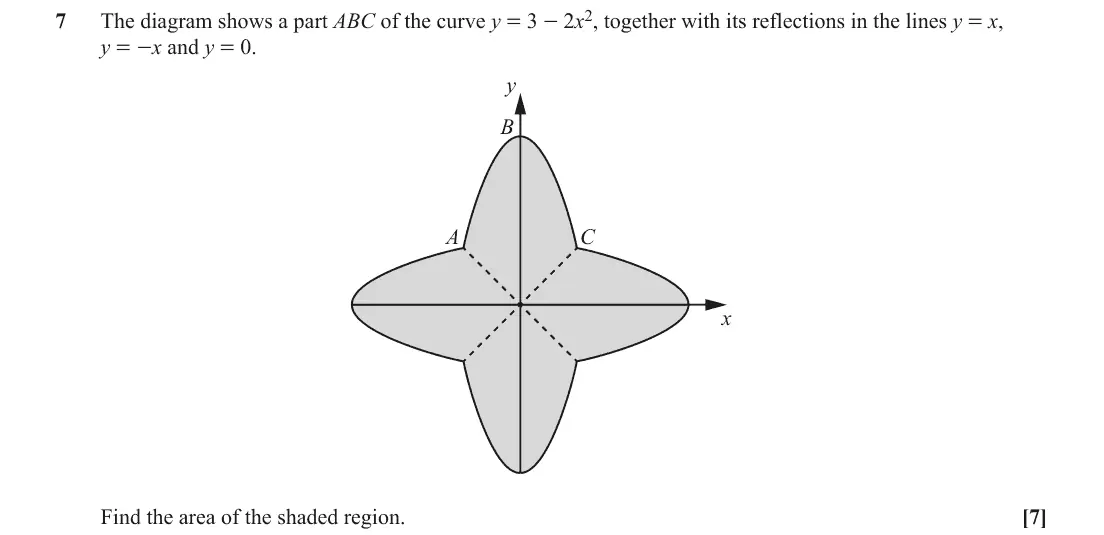
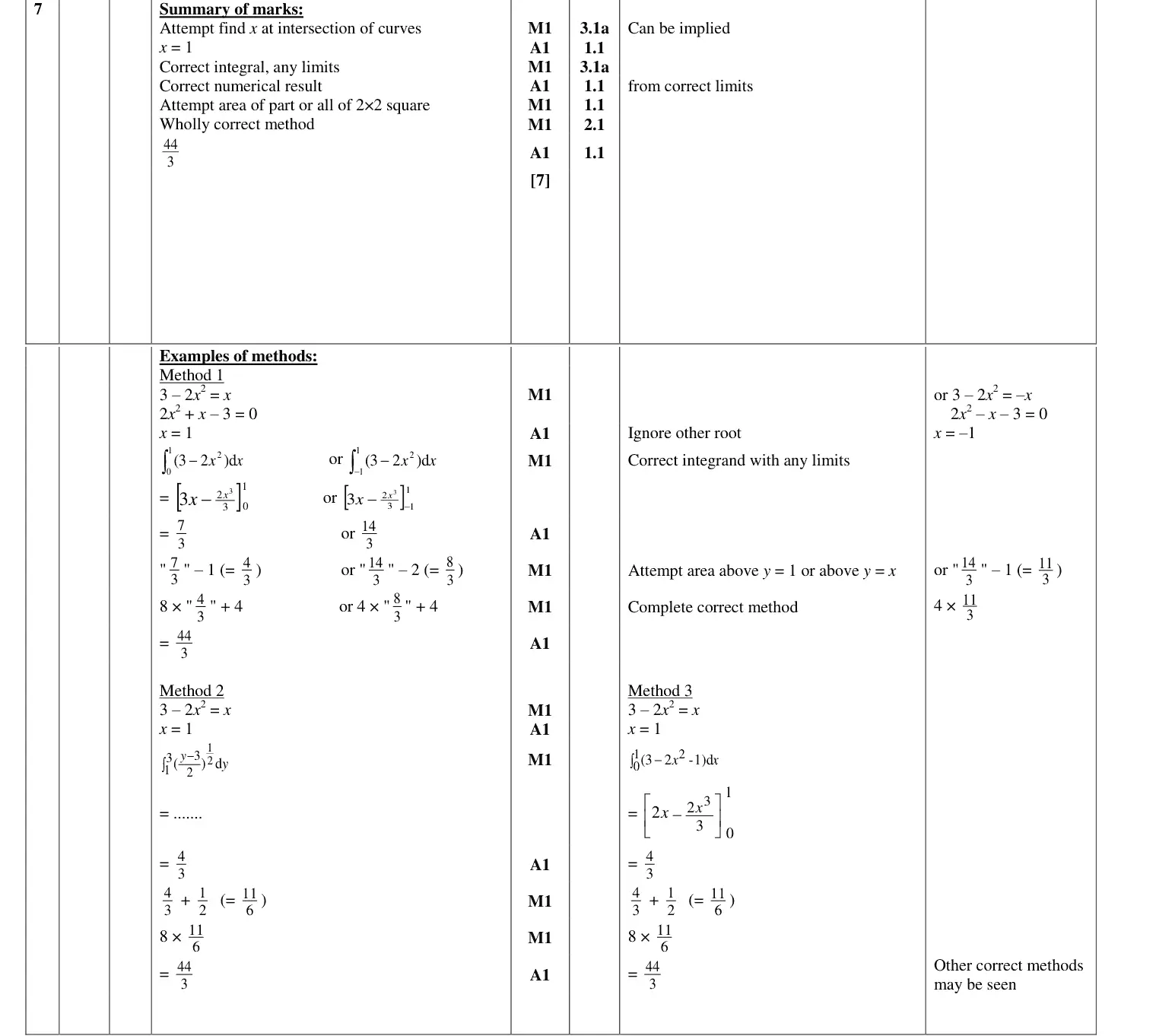
A large variety of correct methods were seen. Some were unnecessarily long. Examples of correct, although long, methods were these: 1. Find the inverse function in order to find the equation of the reflection of the given curve in y = x. Then solve this with the given function in order to find the point of intersection, C. xd . y 2. Rearrange the given function to make x the subject and then find ∫ Some candidates found the points where the given curve cuts the x-axis and hence integrated with incorrect limits. Many made mistakes in trying either to add or subtract all or part of the area of the middle square. 1 2 4 × ( 3 − 2 x − )1 d x + 4 ∫ Perhaps the neatest method was − 1 .
Key points and common errors
intersection 3 − 2x² = x gives x = 1
∫₀¹(3 − 2x² − 1)dx = 4/3
use symmetry: 8 × 11/6 = 44/3
wrong limits from the x-axis roots
errors adding or subtracting the central square
June 2018 · Paper 3 · Q23 marksEasy
Mark scheme for this part
Examiner's comment
This question was answered extremely well with nearly all candidates correctly solving this equation involving the modulus function. Of the two main methods for solving this type of equation the first, which involved re-writing as ( ) ( ) 2 x − 1 = x + 3 was far more successful than those candidates who decided to re-write as two linear equation as many made sign errors even though most started from the correct two equations ( ) ( ) 2 x − 1 = ± x + 3 .
Key points and common errors
square both sides: 3x² − 10x − 8 = 0 so x = 4 or −2/3
squaring is more reliable than two linear equations (2x − 1) = ±(x + 3)
June 2018 · Paper 3 · Q36 marksMedium
Mark scheme for this part
Examiner's comment
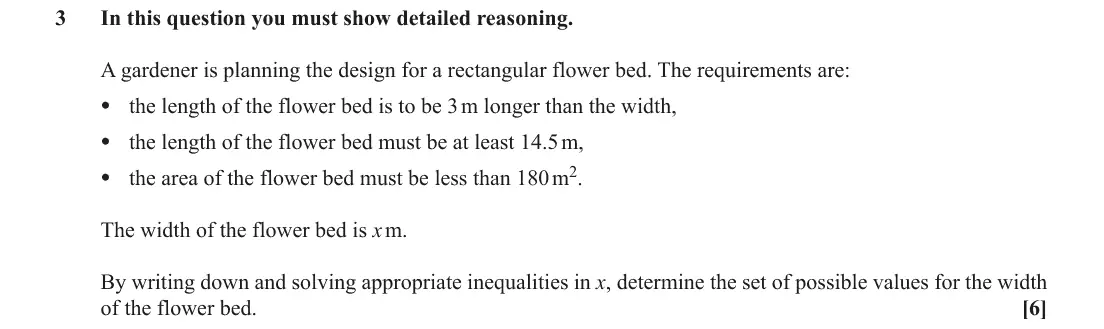
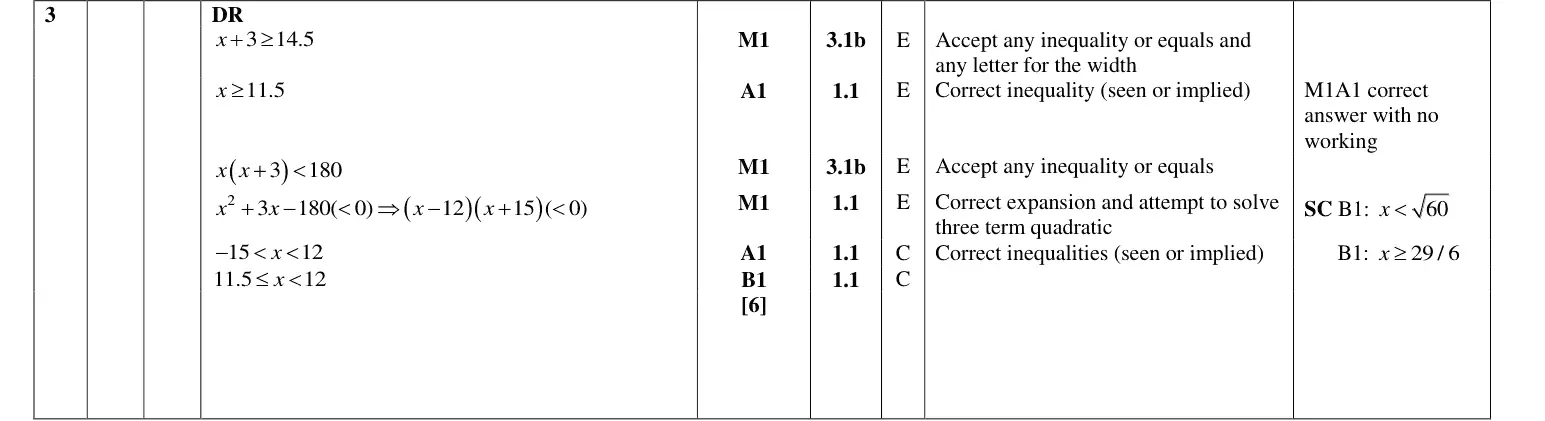
As this was a detailed reasoning question it was expected that candidates would do just that and show sufficient reasoning so that examiners could see that a complete analytical method had been employed. So it was therefore not possible to award full marks to those candidates who wrote statements such as ( ) x x + 3 < 180 ⇒− 15 < x < 12 .While many candidates correctly found that 11 5 . ≤ x < 12 a small 29 proportion of candidates stated that ≤ x < 60 . This incorrect answer came from misreading the 6 question and considering the length of the flower bed to be three times longer than its width (and not just 3 m longer than the width).
Key points and common errors
x + 3 ≥ 14.5 gives x ≥ 11.5
x(x + 3) < 180 gives (x − 12)(x + 15) < 0 so −15 < x < 12
combine: 11.5 ≤ x < 12
full method needed for DR
June 2018 · Paper 3 · Q4(ii)6 marksMedium
Show the start of this question
Mark scheme for this part
Examiner's comment
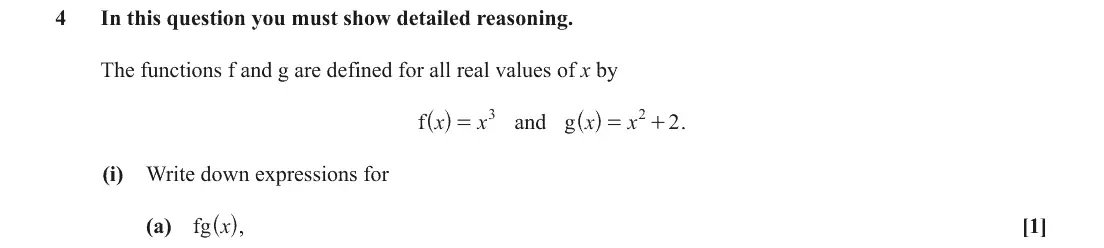
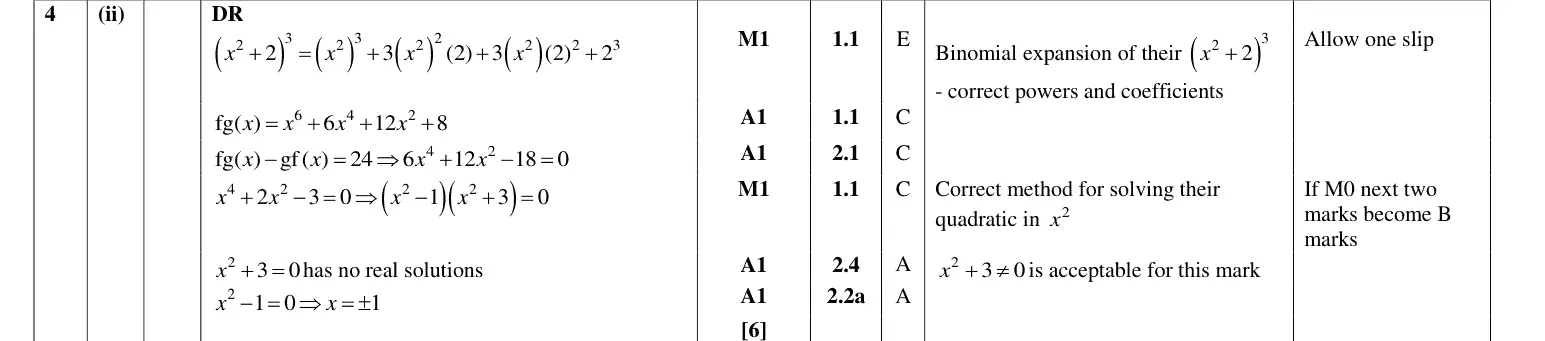
There were a significant number of candidates that did not employ correct bracketing and mistakenly wrote( ) rather than( ) ( ) ( ) x + 2 − x + 2 = 24 x + 2 − x + 2 = 24 ⇒ x + 2 − x − 2 = 24 . The majority of candidates went for expanding ( ) x + 2 by writing out the bracket three times rather than using the binomial expansion of ( a + b ) . While the majority rearranged their quartic into the form ( ) + 6 x 12 x − 18 = 0 there were a number of candidates did not show sufficient working in solving this quartic, even though the full question required detailed reasoning. Finally, it is expected at this level that as part of the detailed reasoning candidates should justify why x + 3 = 0 did not provide any solutions.
Key points and common errors
expand (x² + 2)³ = x⁶ + 6x⁴ + 12x² + 8
brackets needed when subtracting gf(x)
6x⁴ + 12x² − 18 = 0
(x² − 1)(x² + 3) = 0
reject x² = −3 explicitly
x = ±1
June 2018 · Paper 3 · Q6(ii)5 marksMedium
Show the start of this question
Mark scheme for this part
Examiner's comment
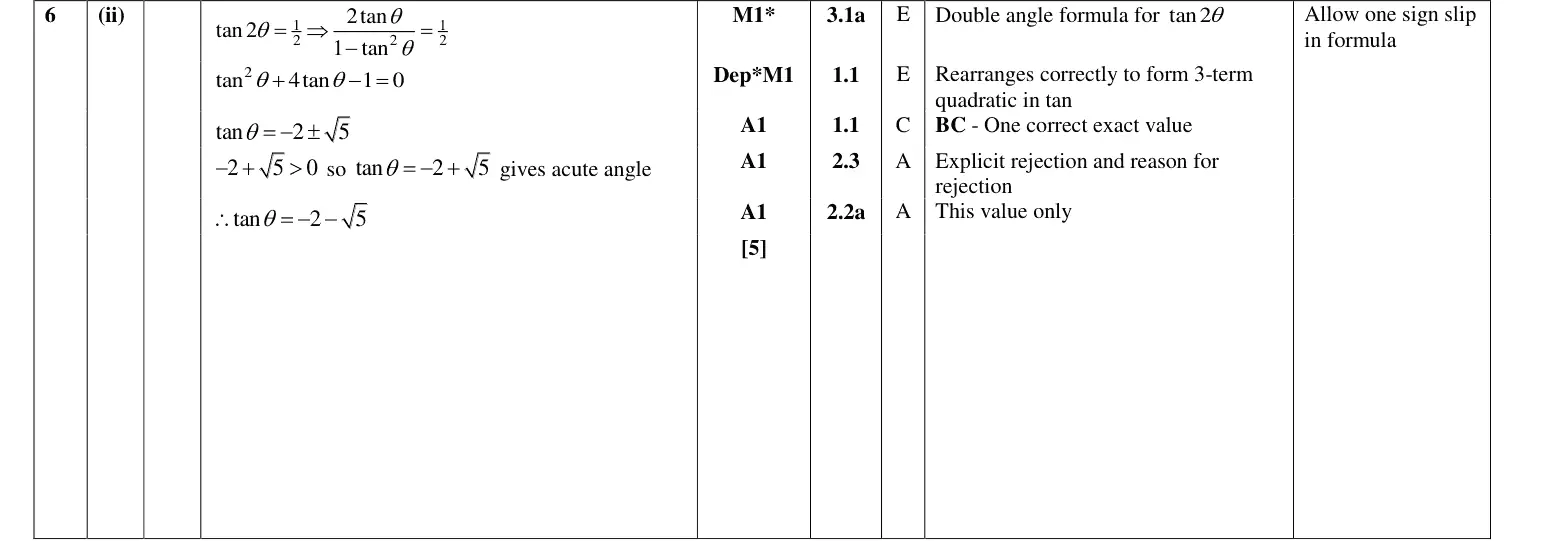
Many candidates did not read the question carefully and began their response by writing − 1 1 2 θ = tan ⇒ θ = ... even though the question specifically asked for the exact value of tan . Of θ 2 tan2 many derived the correct three- θ those candidates that used the correct double-angle formula for term quadratic in tan with most correctly stating that tan θ = −± 2 5.However, a significant proportion ended their response here and did not go on to determine the exact value of tan given that θ is an θ obtuse angle. A full solution needed the explicit realisation that since −+ 2 5 > 0 , tan θ = −+ 2 5 tan θ = −− 2 5. would not give an obtuse angle and therefore the only valid solution was
Key points and common errors
2t/(1 − t²) = ½ gives t² + 4t − 1 = 0
t = −2 ± √5
reject −2 + √5 (θ acute)
tan θ = −2 − √5
must not use inverse tan on a calculator
Find an A-level maths tutor
Stuck on this? Book a trial session with an A-level maths tutor.