45 question parts, 121 marks, each rated Easy, Medium or Hard from the wording of the examiners' report
Notes, worked examples and practice for this topic are being written by our tutors. The past-paper questions below are ready now: work each one on paper, then open the mark scheme and the examiner's comment.
Tap a question to zoom it. Mark scheme and examiner's comment open under each question.
June 2025 · AS Paper 1 · Q5(a)2 marksEasy
Mark scheme for this part
Examiner's comment
Most candidates scored 2/2 marks here. Common errors included writing 2𝑥7 instead of (2𝑥)7 or giving the wrong combination. Candidates should be reminded that the Binomial series is given in the formula table on page 2 of the Question Paper. This is a good example of a question where correct use of a calculator provides an efficient route to the answer.
Key points and common errors
⁹C₇ × 2⁷ × 3² = 41472
errors 2x⁷ for (2x)⁷ or wrong combination
June 2025 · AS Paper 1 · Q5(b)(i)1 markEasy
Mark scheme for this part
Examiner's comment
This question was generally well answered. Most candidates appeared to identify the link to the symmetry of the Binomial expansion, but some candidates did not note the word ‘consecutive’ and gave another pair. Common errors included 9 and 10, or 11 and 12. No calculation was required. Note that strictly the question said, ‘state the powers of x’ so the answer should have been ’10 and 11’. Many candidates gave instead 𝑥10 and 𝑥11 or similar, which the scheme allowed on this occasion.
Key points and common errors
symmetry of ²¹Cᵣ: powers 10 and 11 (consecutive)
errors 9 and 10, 11 and 12
June 2025 · AS Paper 1 · Q5(b)(ii)2 marksMedium
Show the start of this question
Mark scheme for this part
Examiner's comment
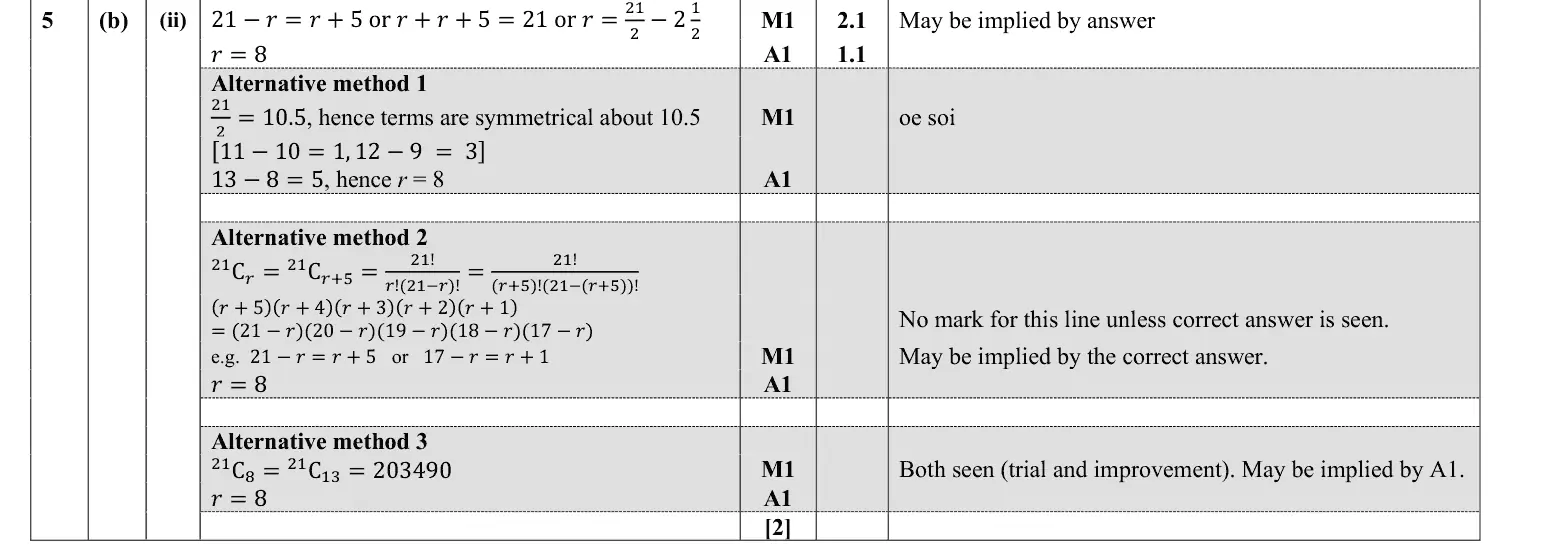
Many candidates obtained the correct answer 𝑟= 8, often using a calculator (and, presumably, some trial and improvement) to find two values with equal coefficients. The question command was ‘Find’ so no working was required for full marks, but for those candidates who didn’t reach the correct answer, creditable working was rarely seen. Candidates should be encouraged to write down what they know, and interpret the question – for instance, here, translating the information in the question by substituting into two Binomial coefficients, equated, would have been sufficient for the M mark.
Key points and common errors
²¹Cᵣ = ²¹Cᵣ₊₅ so r + (r + 5) = 21, r = 8
show the equated coefficients
June 2025 · Paper 1 · Q8(a)4 marksEasy
Mark scheme for this part
Examiner's comment
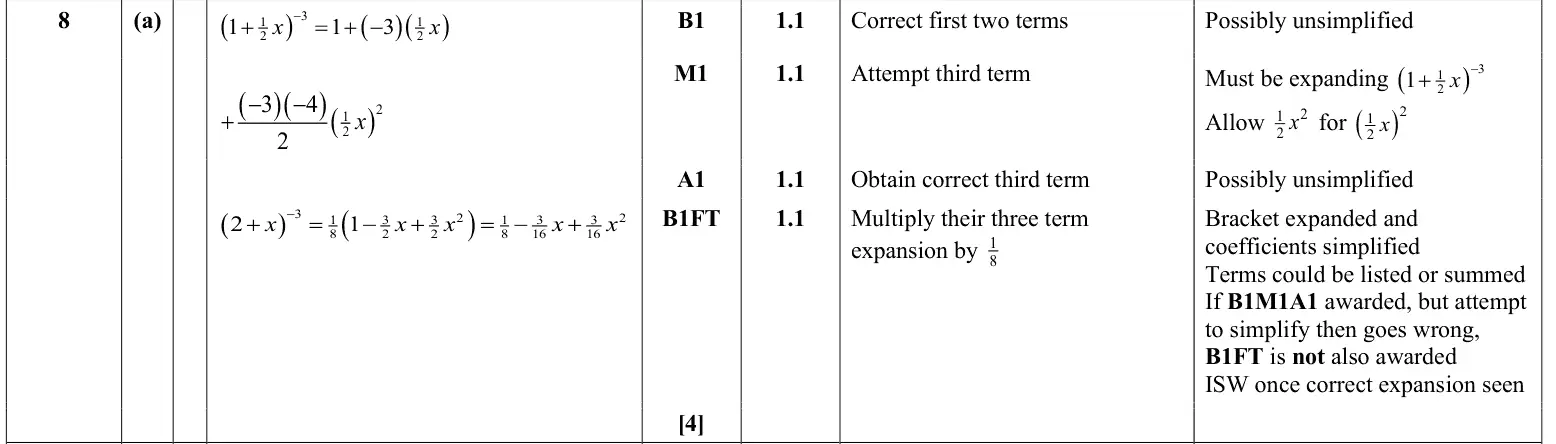
Most candidates were able to make a good attempt at this routine question, with many gaining full credit. The most successful solutions made effective use of brackets so as to avoid sign errors and make sure that the index was applied to the 0.5 when attempting the third term. The most common error was not correctly dealing with the required multiplier of 2-3, some candidates did have the correct value but then forgot to then apply it when attempting the final answer whereas others omitted the index and simply multiplied by 2 instead. Some candidates attempted to use Maclaurin’s expansion from first principles. This approach could gain full credit, but attempts rarely did so as the relevant formula is not given at the start of this paper. Candidates who are also studying Further Mathematics should always attempt to use the method most fitting to the paper being taken.
Key points and common errors
take out 2⁻³ = 1/8: 1/8 − (3/16)x + (3/16)x²
forgetting or mishandling the 2⁻³ factor
sign errors
June 2025 · Paper 1 · Q8(b)4 marksMedium
Show the start of this question
Mark scheme for this part
Examiner's comment
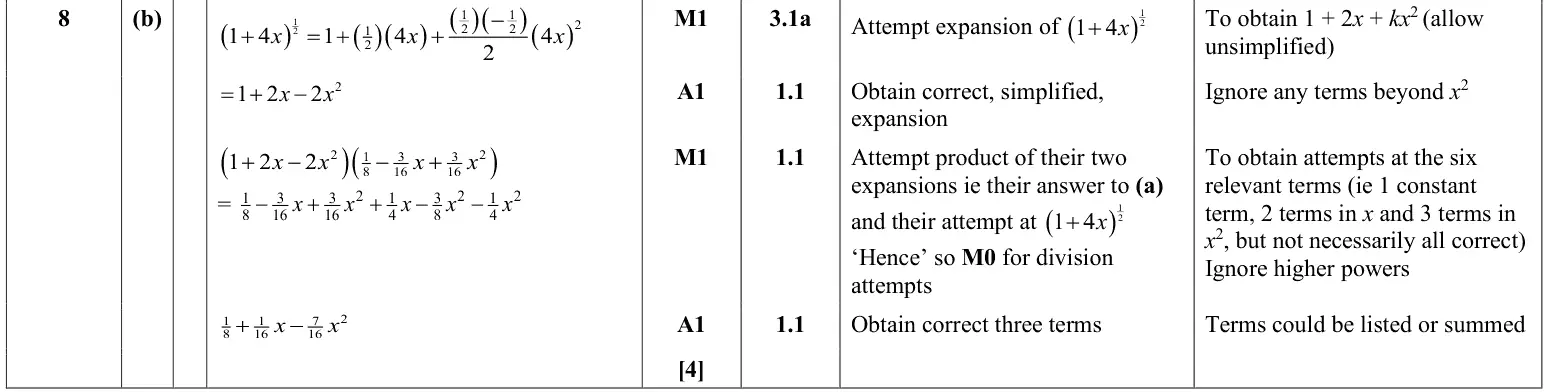
Most candidates appreciated the need to first find the expansion of (1 + 4x)0.5 and obtained a correct expression. The command word ‘hence’ should indicate to candidates that they needed to use their result from the previous part of the question and most attempted to do so thus gaining at least 3 of the 4 marks available. Candidates generally showed sufficient detail when finding the product of their two expressions, which allowed the method mark to be given even if an error had previously occurred. The candidate gains the method mark for attempting to expand (1 + 4x)0.5 but not using brackets results in the coefficient of the quadratic term being incorrect. The expansion from part (a) is also incorrect but, when attempting the product of their two expansions, the candidate shows sufficient detail to allow the second method mark to also be awarded. Had the penultimate line not been shown the method mark would not have been awarded, as an incorrect final answer cannot imply a correct method.
Key points and common errors
(1 + 4x)^½ = 1 + 2x − 2x²
multiply by part (a): 1/8 + x/16 − 7x²/16
June 2025 · Paper 1 · Q8(c)2 marksHard
Show the start of this question
Mark scheme for this part
Examiner's comment
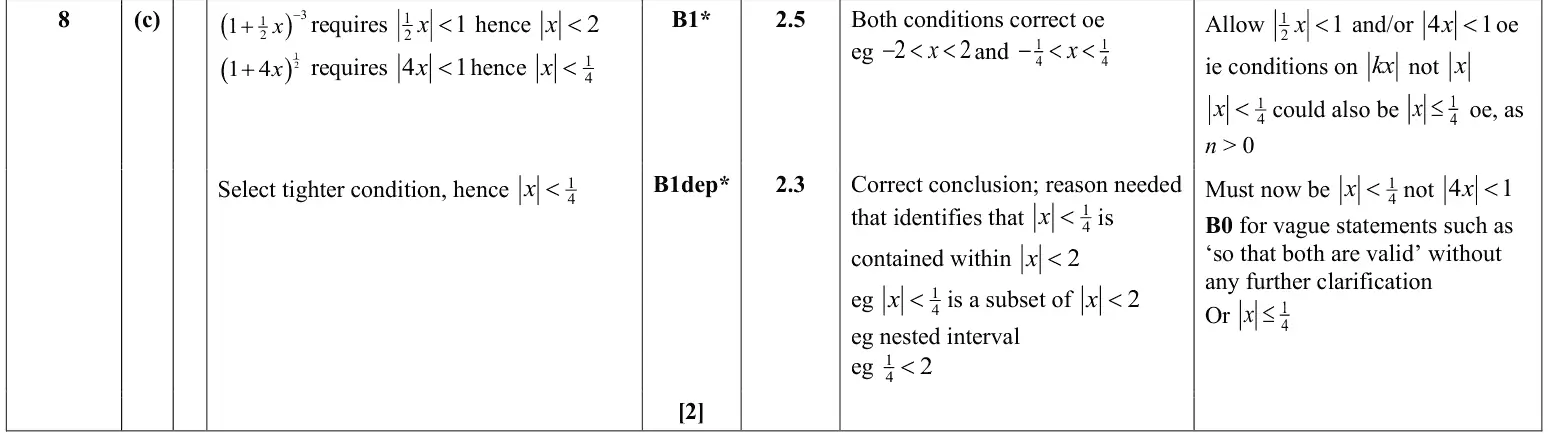
This final part of the question was less well answered, with fully correct solutions being in the minority. To gain the first mark candidates had to state the conditions for each of the two expansions to be valid, yet many were unable to do so despite conditions on ax being condoned for this mark. Candidates should be aware that this is listed in the formulae at the start of the paper, and appreciate how to use it. To gain the second mark, candidates were expected to identify the correct range of values as well as giving a convincing reason for their choice. Some candidates were able to explain about the need to use the tighter condition (sometimes referring to a subset or a nested interval), but other explanations lacked clarity or no explanation at all was given for their choice.
Key points and common errors
(2 + x)⁻³ valid for mod x < 2, (1 + 4x)^½ for mod x < ¼
both must hold so the tighter condition mod x < ¼, with reason
June 2024 · AS Paper 1 · Q4(a)1 markEasy
Mark scheme for this part
Examiner's comment
Most candidates answered this correctly, although quite a few misinterpreted the question and attempted to give the coefficient rather than the term in b5 (giving either 792 or 792a7). Some candidates selected the wrong term, or an incorrect term – for instance writing a8b5 or a8b6. The coefficient 924 was often seen.
Key points and common errors
¹²C₅a⁷b⁵ = 792a⁷b⁵
the term, not just the coefficient
June 2024 · AS Paper 1 · Q4(b)(i)1 markMedium
Show the start of this question
Mark scheme for this part
Examiner's comment
Around half of candidates answered this question correctly, noting that answers in words were condoned even if slightly imprecise (e.g. ‘they add up to 1’). However, many candidates misinterpreted the question as referring to probabilities - for instance stating that ‘they must be independent’ (it’s worth noting that this question fell in Section A – Pure Maths, not Section B – Statistics, and mentioned a variable with a binomial distribution but not probabilities).
Key points and common errors
a + b = 1
answers about independence miss the point
June 2024 · AS Paper 1 · Q4(b)(ii)2 marksHard
Show the start of this question
Mark scheme for this part
Examiner's comment
Relatively few candidates achieved both marks here. Quite a few candidates obtained the first B1 for B(12,…) but only a small number of candidates correctly identified the probability.
Key points and common errors
X ~ B(12, b): n = 12 and p = b (or 1 − a)
B(12, a) scores B1B0
June 2024 · Paper 2 · Q8(b)(ii)2 marksHard
Show the start of this question
Mark scheme for this part
Examiner's comment
Few candidates gave a fully correct response here. Candidates were required to explain the connection by stating that this is for the case when n=15 (more candidates scored this B1 mark) and then specifying that P(X=r) is a term of the expansion (B1). Ideally it should have been observed that this was the r±1th term, but responses that did not specify this were condoned. Many candidates appeared to recognise the connection but gave vague explanations such as ‘it is the expansion’ or ‘it is one of the probabilities’ - the key idea here was to demonstrate the connection between the Binomial probability and the terms in the Binomial expansion.
Key points and common errors
n = 15 and P(X = r) is a term of the expansion (not 'the coefficient')
June 2024 · Paper 3 · Q3(a)4 marksEasy
Mark scheme for this part
Examiner's comment
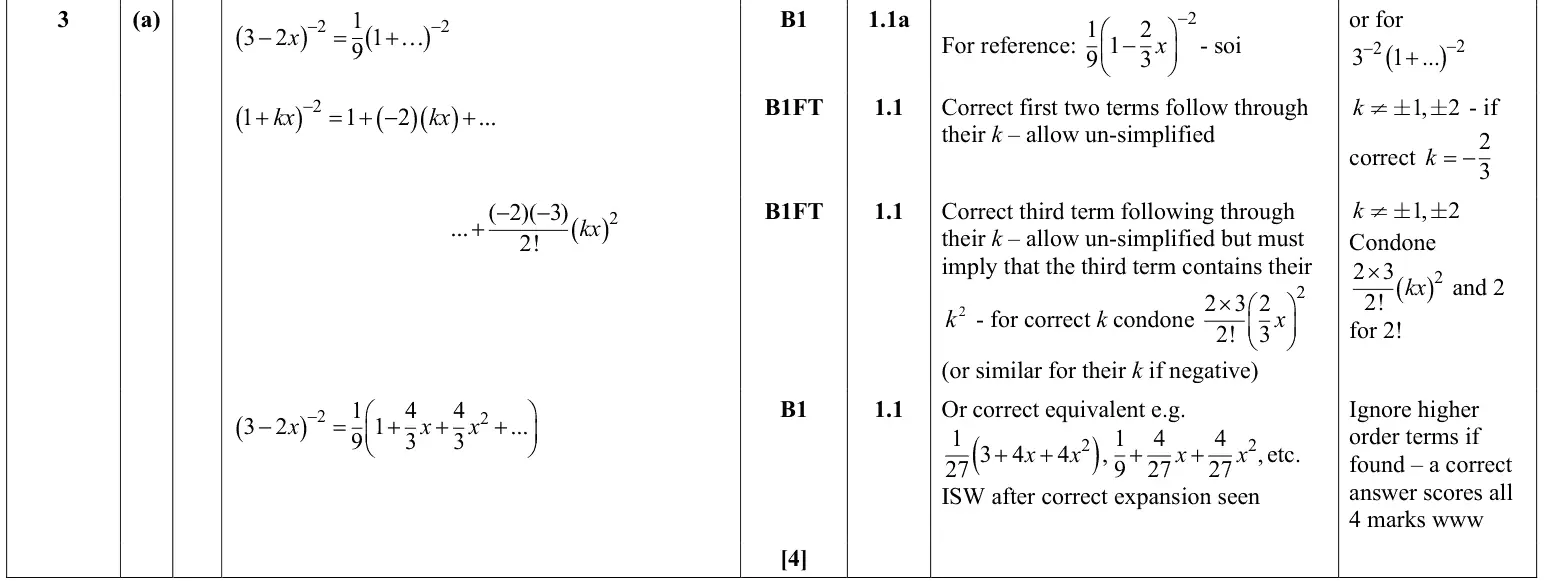
This part was answered well with almost all candidates knowing the correct method for binomially expanding expressions of the form (1 + 𝑥)𝑛 where 𝑛∉𝕫+. The most common errors were not taking out the correct factor of 9 or sign errors when evaluating either (−2) (− 3 𝑥) or . (− 3 𝑥)
Key points and common errors
(3 − 2x)⁻² = (1/9)(1 − ⅔x)⁻²
1/9 + 4x/27 + 4x²/27
errors: factor of 9, signs in (−⅔x) terms
June 2024 · Paper 3 · Q3(b)1 markMedium
Show the start of this question
Mark scheme for this part
Examiner's comment
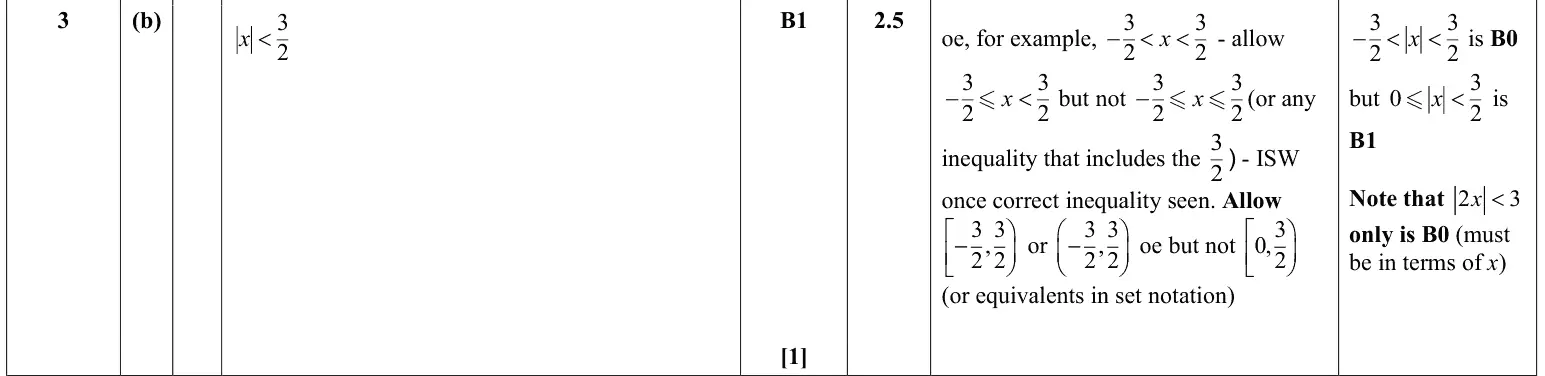
The most common incorrect answers seen in this part were either |𝑥| < 1 or |𝑥| < 3.
Key points and common errors
modulus of x < 3/2 (−3/2 < x < 3/2)
common wrong answers: modulus of x < 1 or < 3
June 2024 · Paper 3 · Q3(c)2 marksEasy
Show the start of this question
Mark scheme for this part
Examiner's comment
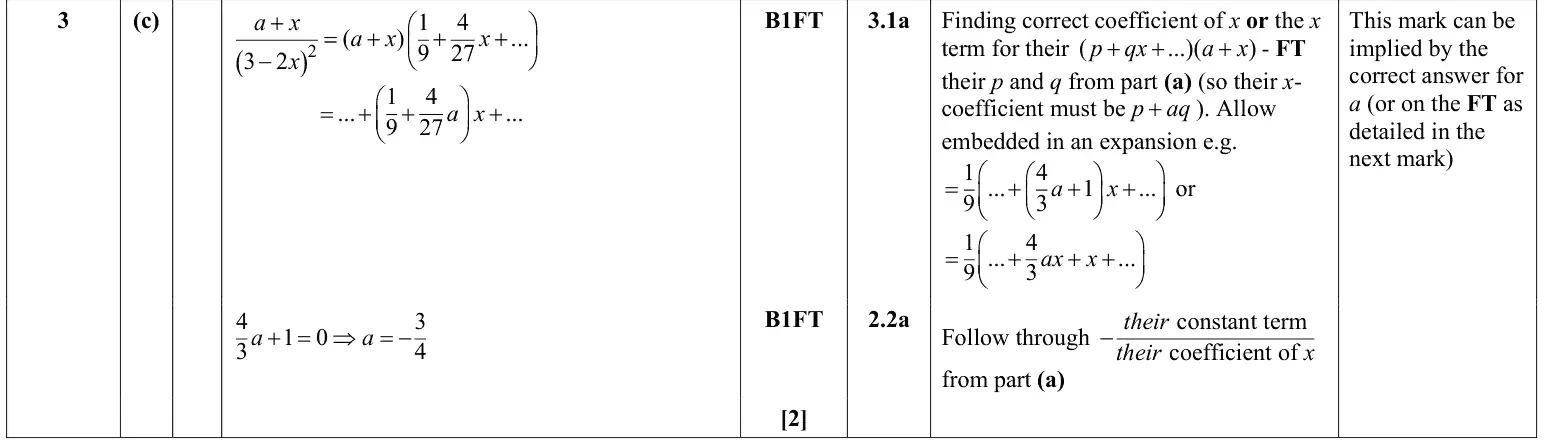
This part was generally answered well with many candidates recognising the need to use the expansion from part (a), multiplying this by (𝑎+ 𝑥) and then setting the coefficient of 𝑥 equal to zero.
Key points and common errors
(a + x)(1/9 + 4x/27 + …): coefficient of x is 4a/27 + 1/9 = 0 so a = −3/4
June 2023 · Paper 1 · Q8(a)4 marksEasy
Mark scheme for this part
Examiner's comment
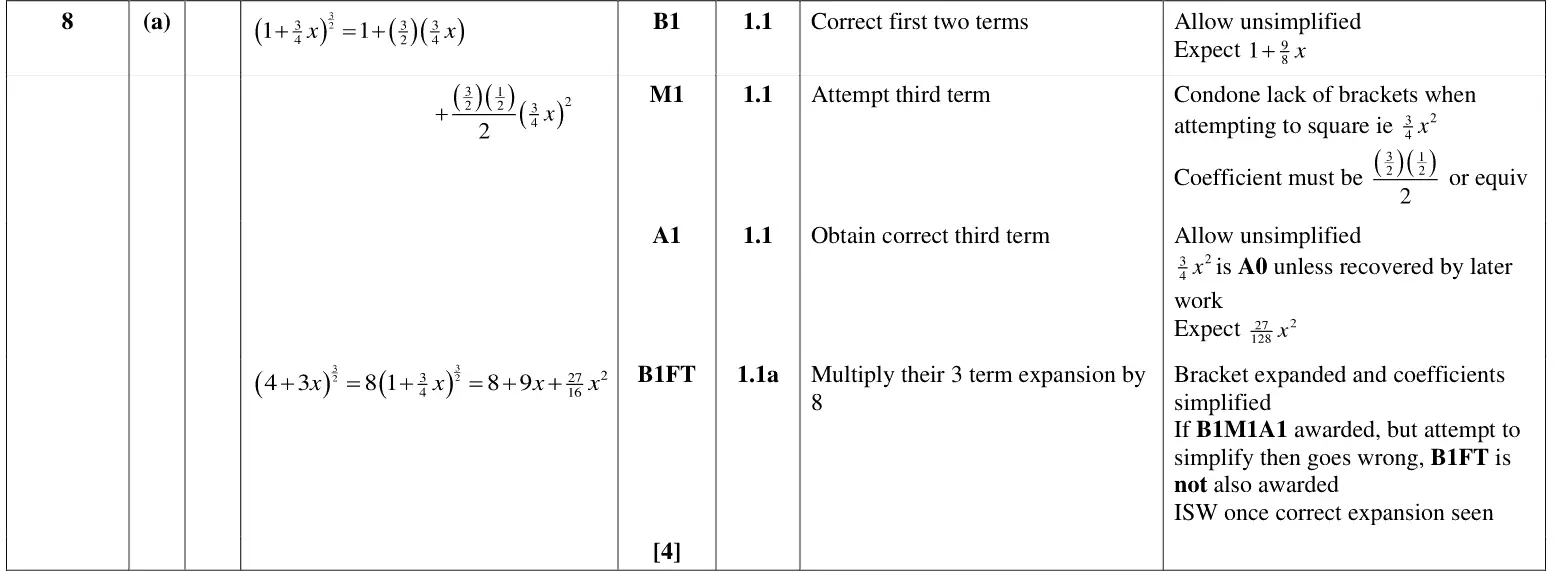
This question was very well answered, with the majority of candidates gaining full credit. The most successful responses saw candidates make effective use of brackets in the third term. The most common error was multiplying through by 4 rather than 8. Some candidates did attempt to use Newton’s method; it was unclear whether they had been taught this method or whether they were selecting the incorrect formula, but it was rarely done correctly.
Key points and common errors
take out 4^(3/2) = 8: 8(1 + 3x/4)^(3/2)
8 + 9x + 27x²/16
common error multiplying by 4 not 8
June 2023 · Paper 1 · Q8(b)1 markHard
Show the start of this question
Mark scheme for this part
Examiner's comment
This was a routine question, with the condition given in the list of formulae at the start of the exam paper, yet barely half of the candidates were able to gain the mark. Common errors included not rearranging to a condition on x, losing the modulus sign when rearranging, starting with │3x│< 1 and even starting with │4 + 3x│< 1. Both the standard condition given in the list of formulae and the mathematically correct inequality (as n > 0) were accepted.
Key points and common errors
modulus of x less than 4/3
must be a condition on x
errors: modulus 3x < 1 or modulus (4 + 3x) < 1, losing the modulus sign
June 2023 · Paper 1 · Q8(c)4 marksEasy
Show the start of this question
Mark scheme for this part
Examiner's comment
This part of the question was also very well answered. Most candidates were able to gain at least 2 marks for attempting three relevant terms from the product of their expansion with their attempt at (1 + ax)2. While detailed methods were more common, the wording of the question did allow candidates to solve the resulting equation on their calculator, but it was only a minority that did so.
Key points and common errors
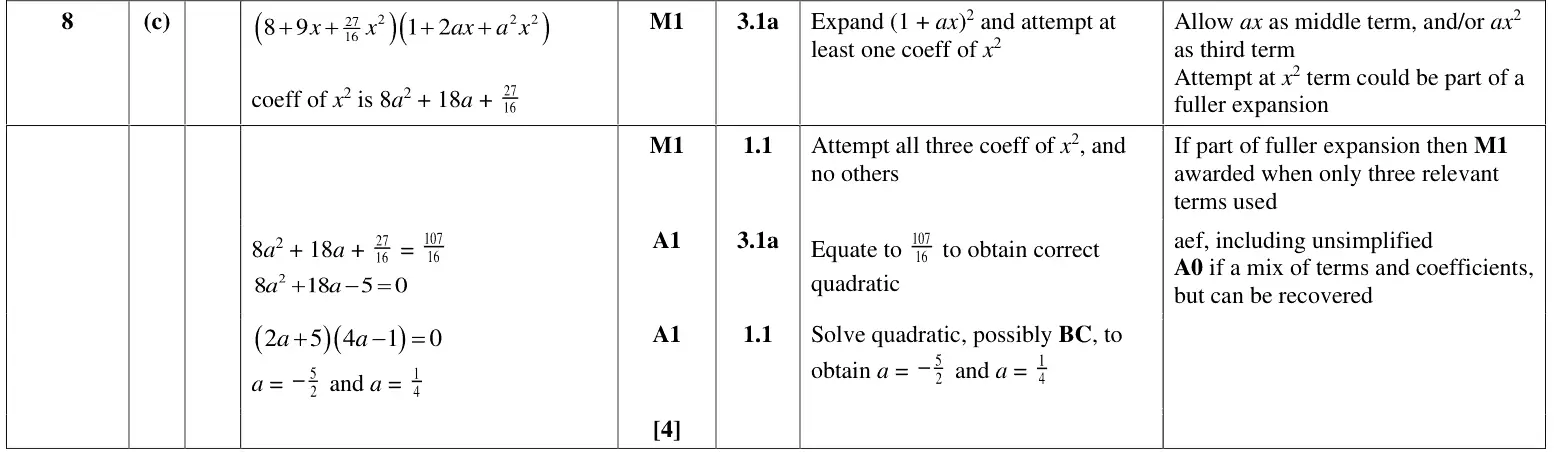
coefficient of x² is 8a² + 18a + 27/16 = 107/16
a = −5/2 or 1/4
June 2023 · AS Paper 2 · Q4(a)3 marksEasy
Mark scheme for this part
Examiner's comment
This question was answered well. The binomial series is included on the formulae sheet and this was no doubt of benefit to candidates, with many having at least two correct terms. The question said, ‘Find and simplify…’, so examiners expected to see the terms simplified and answers such as 240/9k2x2 scored A0 (this term was the one that candidates most often struggled to simplify, with 80k2x2, 80kx2 and 80/3kx2 seen). Occasionally the three terms were given in descending powers of x.
Key points and common errors
64 + 64kx + (80/3)k²x²
terms must be simplified
using kx instead of kx/3
June 2023 · AS Paper 2 · Q4(b)3 marksHard
Show the start of this question
Mark scheme for this part
Examiner's comment
This part of the question proved more challenging. Many candidates obtained the two term coefficient of x2 in the correct way, but this was then set equal to k or 0 rather than 3 × their constant term from (a). Note that those having k rather than k2 in the x2 term in (a) could not get a three term quadratic in k. The request for an exact value for k was well adhered to.
Key points and common errors
x² coefficient of (3 − 4x)(…) is 80k² − 256k
set equal to 3 × 64 = 192: 5k² − 16k − 12 = 0
k = (8 + 2√31)/5 exact, positive root only
equating to k or 0 is wrong
June 2023 · Paper 2 · Q9(b)(i)1 markMedium
Show the start of this question
Mark scheme for this part
Examiner's comment
Many candidates were able to give this expression for the standard Binomial probability correctly (often with follow-through using their values from part (a)). Some candidates omitted the combination term or gave the general expression without values substituted in, which was not enough for the mark.
Key points and common errors
²⁰Cₓ (1/3)ˣ (2/3)^(20 − x)
values must be substituted
coefficient often omitted
June 2022 · AS Paper 1 · Q12 marksMedium
Mark scheme for this part
Examiner's comment
Some candidates lost the minus sign. Many candidates wrote out all the terms. Others wrote just the terms up to x3. Many candidates wrote the correct term, −720x3 but then gave, as their answer, just the coefficient −720. Some did not cube the 2. A few seemed unfamiliar with the binomial expansion and attempted to find (3 − 2x)5 by repeated multiplication of brackets.
Key points and common errors
⁵C₃ × 3² × (−2x)³ = −720x³
give the term not just the coefficient
lost minus sign
not cubing the 2
June 2022 · Paper 1 · Q6(a)4 marksEasy
Mark scheme for this part
Examiner's comment
This proved to be another question that was very well answered, with fully correct solutions being very common. The more successful approach was to simply to use the binomial expansion of (a + b)n, as provided in the list of formulae at the start of the paper. A surprising number of candidates instead decided to first reduce it to the form (1 + x)n, which could then cause problems with the factor being taken out often seen as just 3 and not 35. Candidates should consider what strategy is most appropriate for the question posed.
Key points and common errors
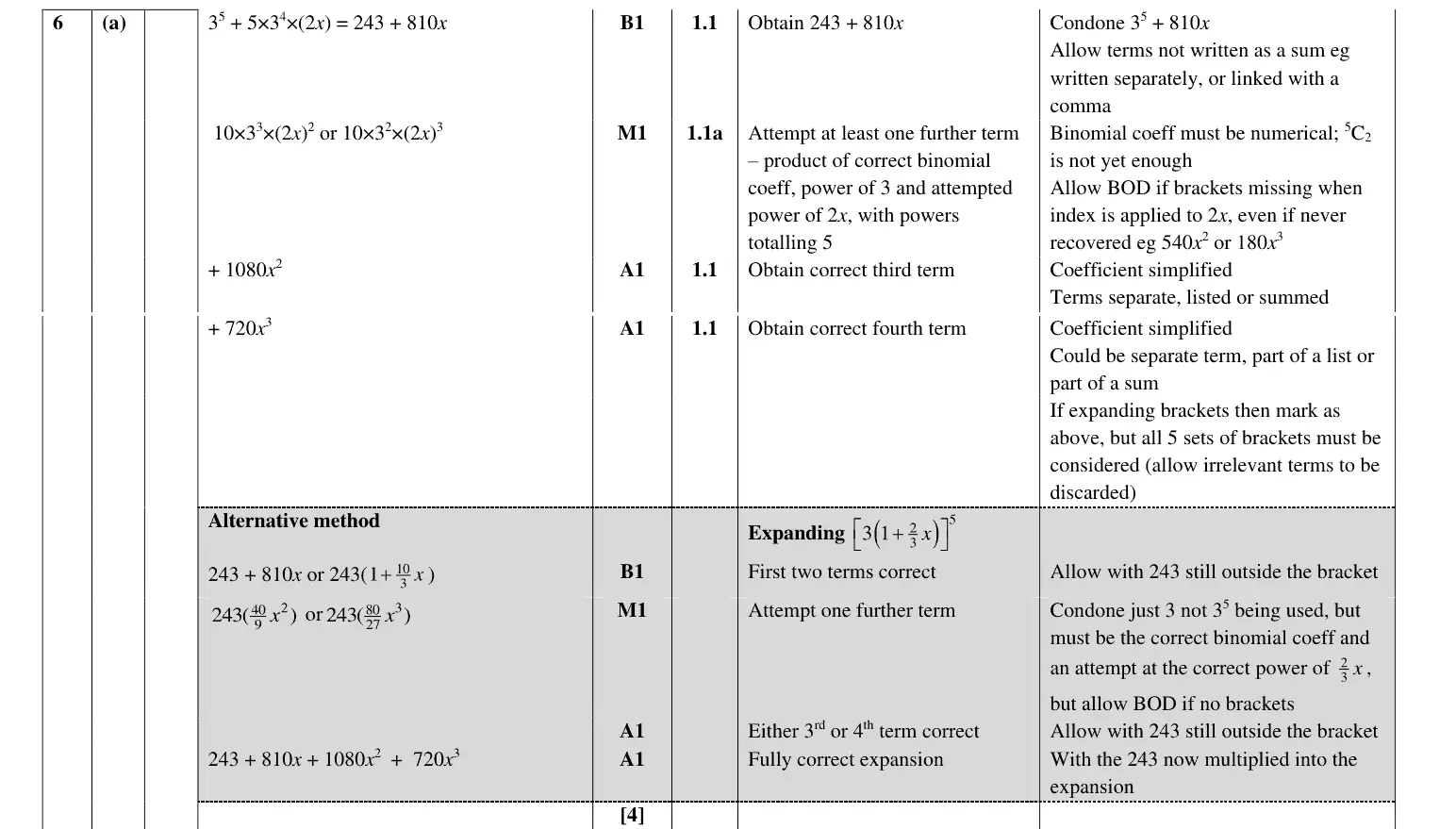
243 + 810x + 1080x² + 720x³ using the (a + b)ⁿ formula
taking out 3 instead of 3⁵
June 2022 · Paper 1 · Q6(b)4 marksHard
Show the start of this question
Mark scheme for this part
Examiner's comment
This second part of the question proved to be much more challenging. Some candidates, guided by the word ‘hence’, did attempt to link the two parts of the question with the most common error being to use x = 2y + 4y2; this could still gain 2 of the 4 marks available. Other sensible attempts included splitting the three terms into two groups and attempting to use another binomial expansion, or attempting a combinatorics method having identified how y3 terms could be created. Attempts involving the manual expansion of all 5 brackets were rarely complete or successful.
Key points and common errors
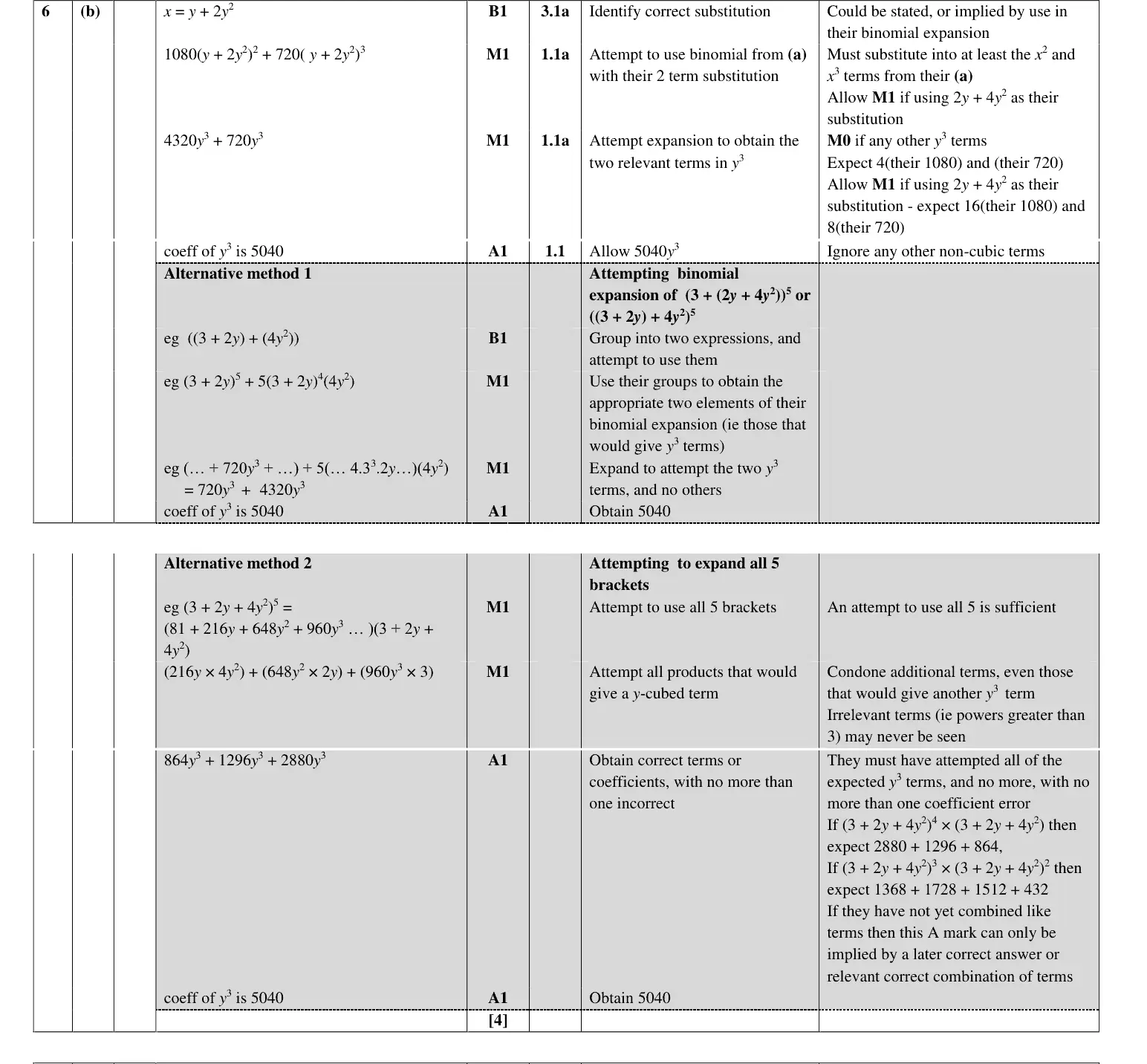
substitute x = y + 2y² into the x² and x³ terms: 4320y³ + 720y³ = 5040
common error x = 2y + 4y²
expanding all five brackets rarely works
June 2022 · AS Paper 1 · Q9(a)(ii)1 markMedium
Show the start of this question
Mark scheme for this part
Examiner's comment
This question was intended to test candidates’ understanding of the relationship between the binomial distribution (in statistics) and the binomial expansion (in pure maths). Many candidates answered correctly, but some answers suggested a lack of understanding of this relationship. Examples of incorrect answers were: P(X = x) = 150 (150 − x ) x 0.92 0.08 , (1 − 0.08)150, (150 + 12)0.08, (1 − 0.92)1, x (1 − 0.08)150, 150 ×0.08 = 12, (a + b)0.08.
Key points and common errors
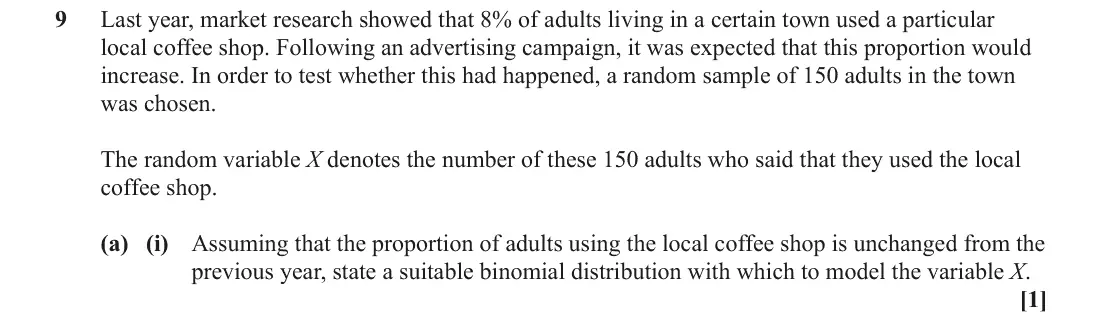
(0.92 + 0.08)¹⁵⁰
not the general term
Autumn 2021 · Paper 1 · Q6(a)4 marksEasy
Mark scheme for this part
Examiner's comment
(From the general report) Question 6(a) was a routine question, and many candidates were able to provide clear and correct solutions.
Key points and common errors
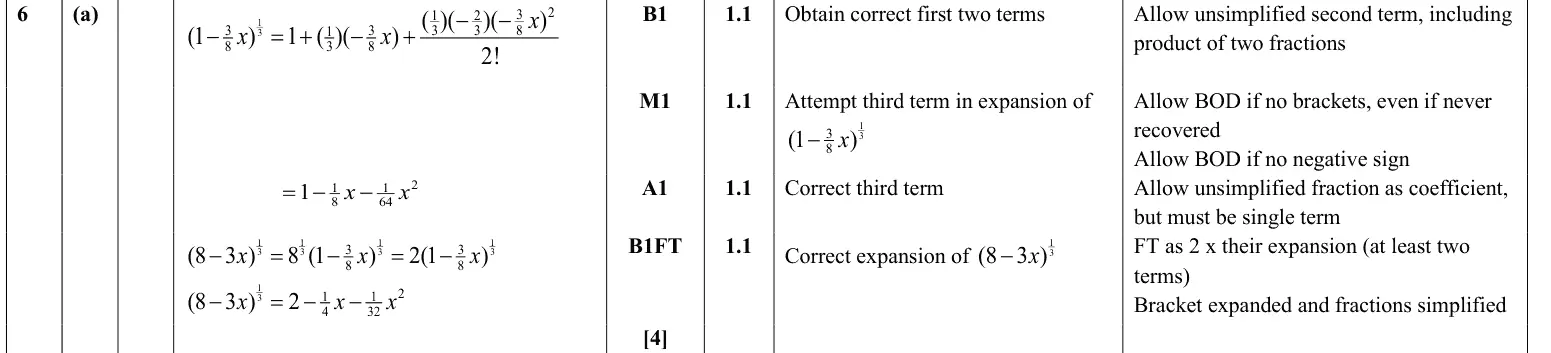
take out 8^(1/3) = 2: 2(1 − 3x/8)^(1/3)
2 − x/4 − x²/32
bracket the −3x/8 term
Autumn 2021 · Paper 1 · Q6(b)1 markMedium
Show the start of this question
Mark scheme for this part
Key points and common errors
abs(x) < 8/3, strict inequality
abs(3x) < 8 is not a condition on x in final form
Autumn 2021 · Paper 1 · Q6(c)4 marksMedium
Show the start of this question
Mark scheme for this part
Key points and common errors
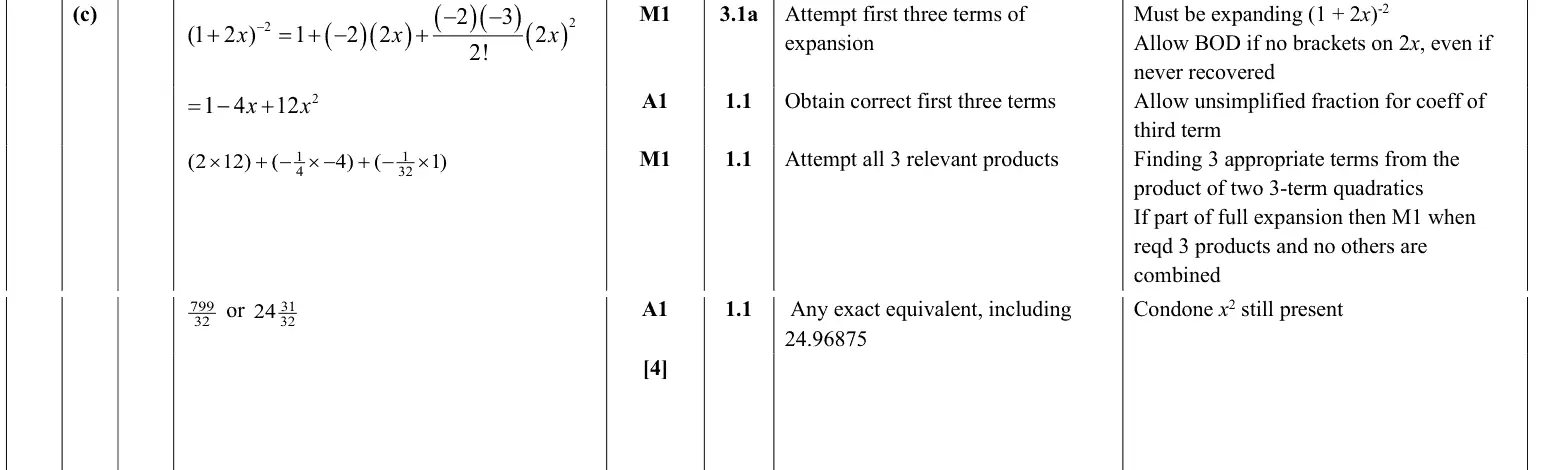
(1 + 2x)⁻² = 1 − 4x + 12x²
combine the three relevant products
799/32
Autumn 2021 · AS Paper 1 · Q12(a)1 markMedium
Mark scheme for this part
Key points and common errors
n = 50, a = 5/6, b = 1/6 (or the other way round)
Autumn 2021 · Paper 2 · Q14(d)5 marksMedium
Show the start of this question
Mark scheme for this part
Key points and common errors
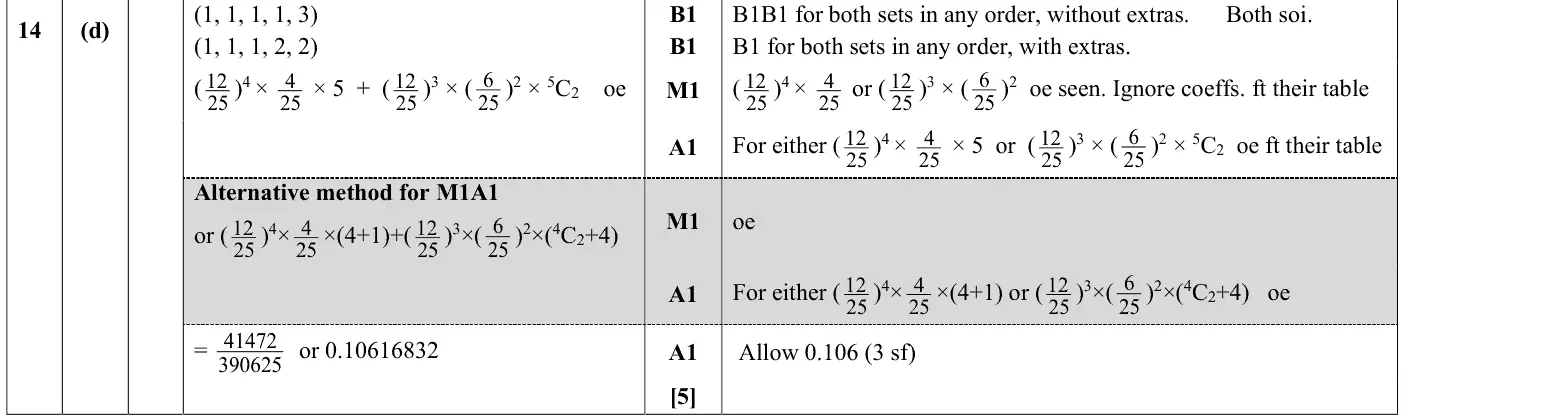
sets {1,1,1,1,3} (5 orders) and {1,1,1,2,2} (⁵C₂ orders)
(12/25)⁴(4/25) × 5 + (12/25)³(6/25)² × 10 = 0.106
Autumn 2021 · Paper 3 · Q2(b)4 marksHard
Show the start of this question
Mark scheme for this part
Examiner's comment
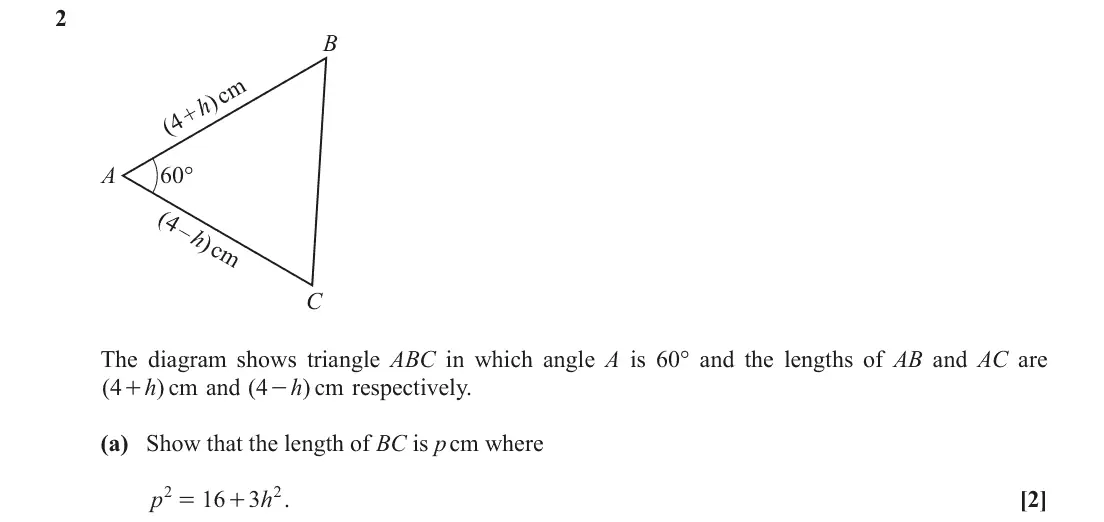
Candidates struggled to see the link between part (a), in which most candidates were successful in applying the cosine rule to derive the given result of p 16 3 h , and the demand in (b) to find a three- term approximation for p in powers of .h Most candidates did not realise that a binomial expansion was required and instead tried to use, quite surprisingly, small-angle approximations (even though the expression for p did not contain any trigonometric terms).
Key points and common errors
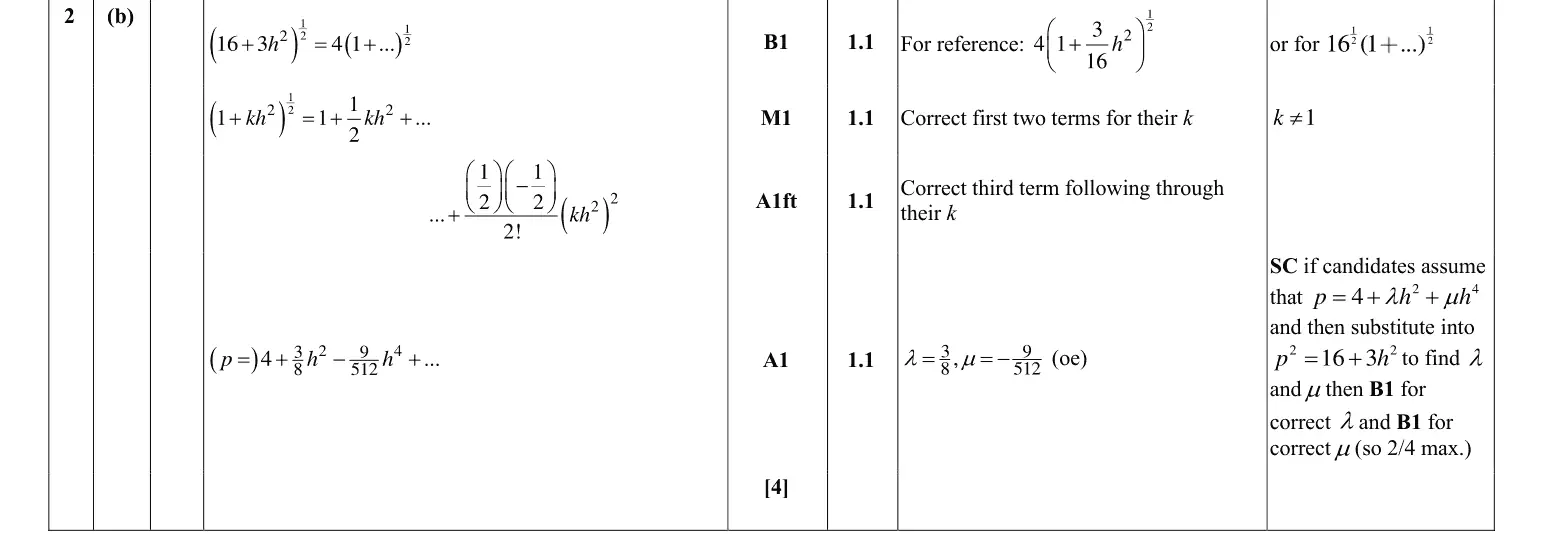
p = (16 + 3h²)^½ = 4(1 + 3h²/16)^½
binomial expansion gives λ = 3/8, μ = −9/512
many wrongly tried small-angle approximations
Autumn 2020 · AS Paper 1 · Q4(a)1 markMedium
Mark scheme for this part
Key points and common errors
1 + 4x + 6x² + 4x³ + x⁴
Autumn 2020 · AS Paper 1 · Q4(b)4 marksHard
Show the start of this question
Mark scheme for this part
Examiner's comment
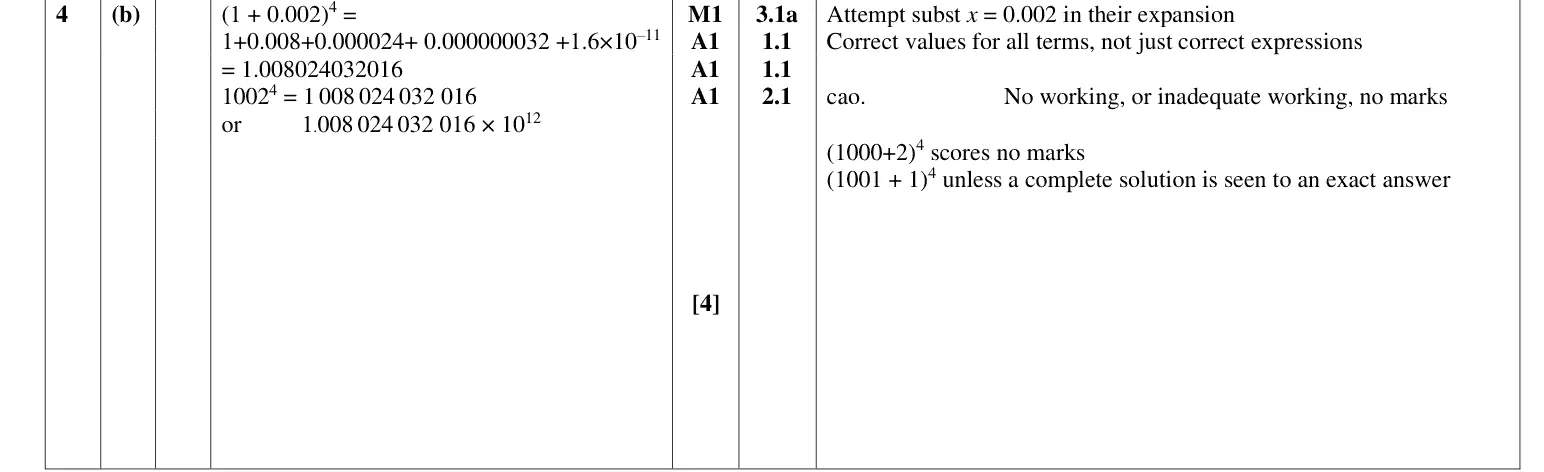
Almost no candidates realised the need to use (1 + 0.002)4. Most tried to use (1 + 1001)4.
Key points and common errors
1002⁴ = 10¹²(1 + 0.002)⁴
x = 0.002
1 008 024 032 016 exact
(1 + 1001)⁴ or (1000 + 2)⁴ do not use the expansion
Autumn 2020 · Paper 2 · Q3(a)(i)2 marksMedium
Mark scheme for this part
Key points and common errors
(1 − x)⁻² = 1 + 2x + 3x² + 4x³
sign errors with (−x)
Autumn 2020 · Paper 2 · Q3(a)(ii)1 markMedium
Show the start of this question
Mark scheme for this part
Key points and common errors
spot the pattern: (n + 1)xⁿ
Autumn 2020 · Paper 2 · Q3(c)3 marksHard
Show the start of this question
Mark scheme for this part
Examiner's comment
This is a good example of the use of "Hence or otherwise". Those candidates who took the hint and used their answers to parts (a) and (b), obtained the required result quickly. Unfortunately, the majority of candidates opted for the "otherwise" route and, in almost all cases, did not obtain any marks. 4 sin θ = − Many candidates correctly obtained sin θ = or 1 , but then deduced that sinθ = , omitting 1 3 4 the case where sinθ = −. Some also gave no comment about rejecting 1 sin θ = − , but merely crossed 3 it out.
Key points and common errors
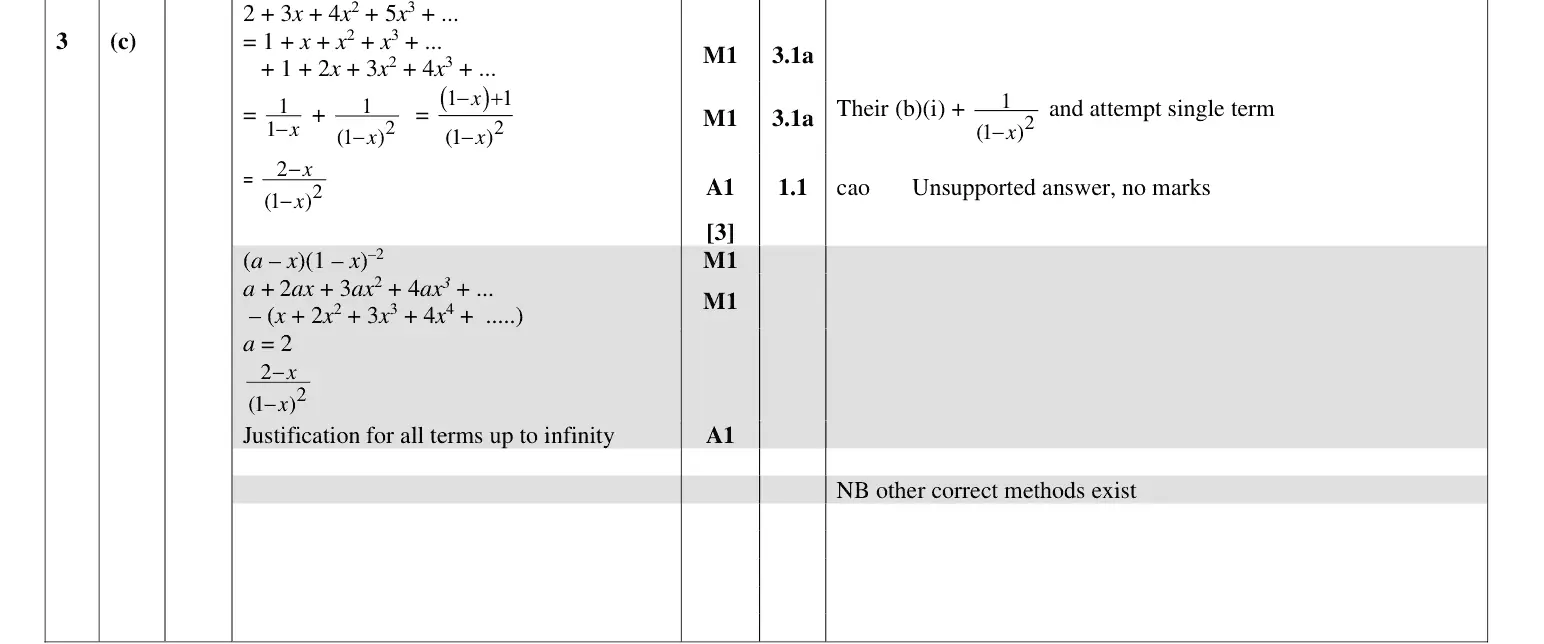
split the series as (1 + x + x² + …) + (1 + 2x + 3x² + …) = 1/(1 − x) + 1/(1 − x)²
answer (2 − x)/(1 − x)²
the majority tried 'otherwise' and scored nothing
unsupported answer no marks
June 2019 · Paper 1 · Q66 marksMedium
Mark scheme for this part
Examiner's comment
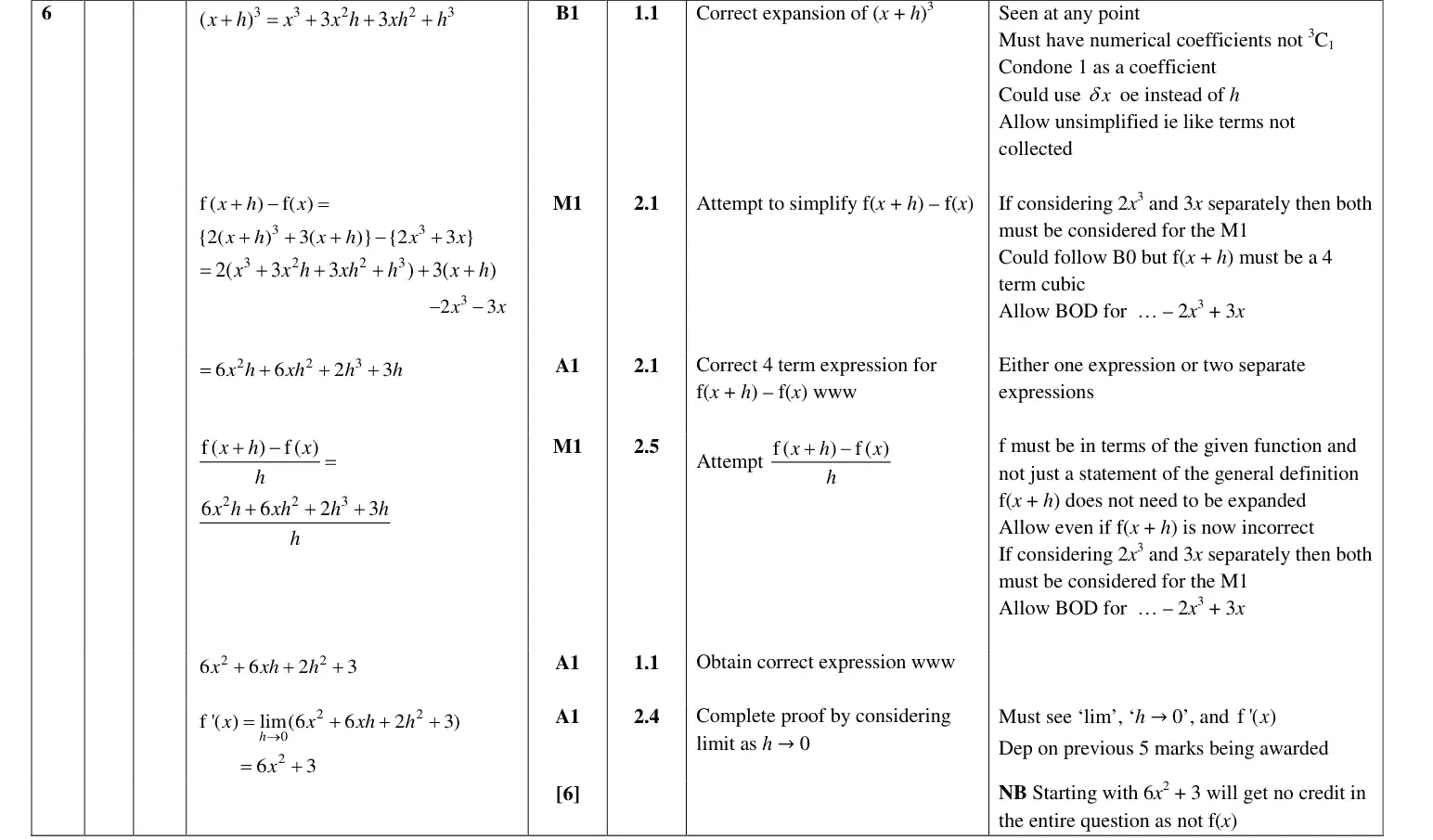
Most candidates seemed familiar with the process of differentiation from first principles, quoting the formula from the question paper and attempting to apply it to the given function. The best candidates made effective use of brackets and used a new line for each step of their solution rather than attempt to do too much in one go. The expansion of (x + h)3 was usually correct, although many candidates elected to expand three brackets rather than apply the binomial expansion. When the expansion was multiplied by 2, it was quite common to see some incorrect coefficients, especially in the solutions of those who had expanded three brackets and not then collected like terms. The other common error was due to not using brackets when introducing –(2x2 + 3x) in the numerator, resulting in the 3x being of the incorrect sign. Some candidates appeared not to notice and cancelled +3x with another +3x, whereas others did realise that there was an error and attempted to correct it, but this was not always applied to every line of working. Candidates who had a correct simplified expression were usually able to complete the proof by explicitly considering the limit as h tended to 0. Each step in this proof is clearly detailed, and only one step is made on each line which makes the proof convincing and easy to follow. The candidate uses correct notation throughout, including explicit consideration of the limit as h tends to 0. The candidate gains the first mark for setting up the correct expressions and gains a second mark for the correct binomial expansion. On the third line it seems that the cancelling by h has occurred before the numerator has been simplified so no further credit is given. This is an example of trying to do too much in one go.
Key points and common errors
(x + h)³ = x³ + 3x²h + 3xh² + h³
f(x + h) − f(x) = 6x²h + 6xh² + 2h³ + 3h
divide by h and use lim h → 0 with correct notation
coefficients slip when multiplying by 2
June 2019 · Paper 2 · Q2(a)1 markEasy
Mark scheme for this part
Examiner's comment
Most candidates answered this correctly, although a few omitted the "–" sign.
Key points and common errors
⁸C₅ 3³ (−2)⁵ = −48384
minus sign omitted
June 2019 · Paper 2 · Q2(b)(i)3 marksMedium
Mark scheme for this part
Examiner's comment
3 3 3 Many answered correctly. Some made an error with the "3" and gave 1 + x − x + x . Others 2 8 16 omitted the "3" altogether.
Key points and common errors
1 + (3/2)x − (9/8)x² + (27/16)x³
errors with or omission of the 3
June 2019 · Paper 2 · Q2(b)(ii)1 markMedium
Show the start of this question
Mark scheme for this part
Examiner's comment
1 1 Again, many answered this correctly. Some incorrect answers were 3 x < , 1 x < , x > − , x < and 1 3 3 1 x < . 3
Key points and common errors
mod x < 1/3
mod x < 3 and similar wrong ranges
June 2019 · Paper 2 · Q2(b)(iii)3 marksHard
Show the start of this question
Mark scheme for this part
Examiner's comment
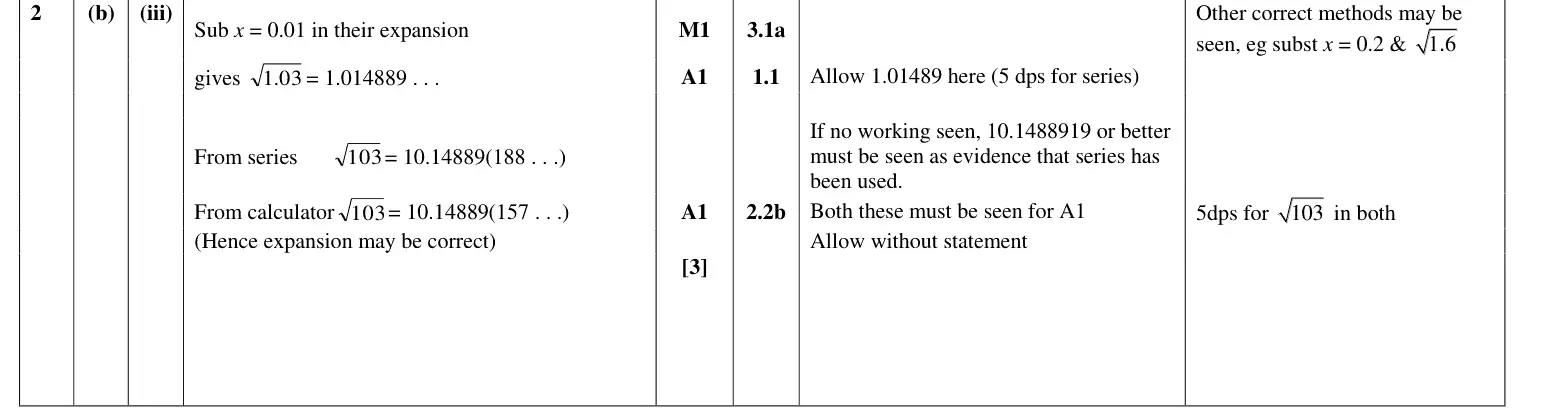
This part was challenging for most candidates, with candidates not spotting the link to the previous work. Some used their series successfully, but lost a mark by not showing explicitly their substitution of x = 0 01 . into the series. The majority attempted 1 + 3 x = 103 , giving x = 34 and then substituted x = 34 into their expansion, apparently not recognising that this is invalid. A few candidates managed to answer correctly with other substitutions.
Key points and common errors
√103 = 10√1.03 so x = 0.01
compare 10.14889 from series with calculator
substituting x = 34 is outside the valid range
substitution must be shown
June 2019 · AS Paper 2 · Q4(a)3 marksEasy
Mark scheme for this part
Examiner's comment
The expansion method was done well in general, although a few used ( 5x rather than ( ) ) − 5x . 5 A few unnecessarily tried to rewrite as 2 1 − with mixed success. 2x
This part was found to be much more challenging. We wanted to see evidence of the expansion of ( ) 1 + ax and the multiplication to give two relevant terms in x , then connected to the given 48, but this requirement was not always recognised.
Key points and common errors
(1 + 2ax + …)(32 − 400x + …): x coefficient 64a − 400 = 48 so a = 7
show the two contributing terms
June 2018 · Paper 1 · Q8(i)4 marksEasy
Mark scheme for this part
Examiner's comment
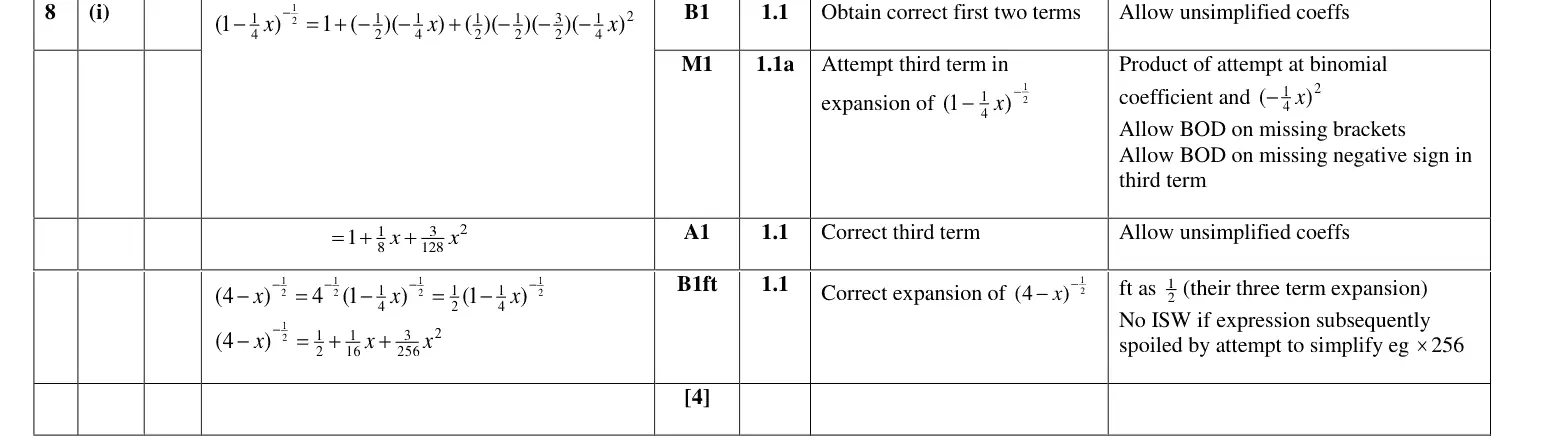
This question was well answered with many fully correct solutions seen. The most successful solutions made effective use of brackets to ensure that the relevant indices were applied to the entire term including the coefficient of x. Showing clear working allowed partial credit to be credited for attempting a valid method should the final answer not be correct.
Key points and common errors
(4 − x)^(−½) = ½(1 − ¼x)^(−½)
½ + x/16 + 3x²/256
brackets round −¼x
June 2018 · Paper 1 · Q8(ii)3 marksEasy
Show the start of this question
Mark scheme for this part
Examiner's comment
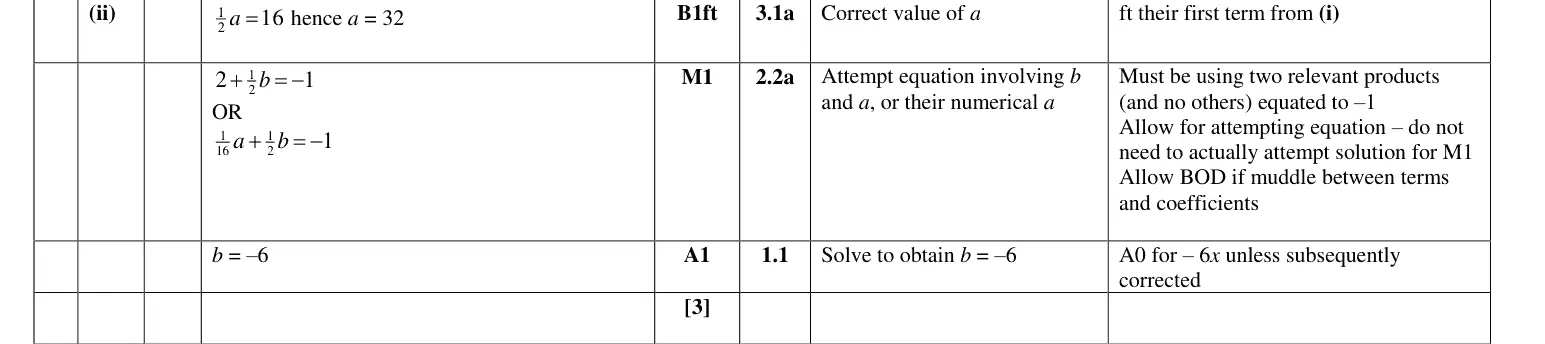
This part of the question was also very well answered. Most candidates appreciated the connection with the previous part of the question, and equated coefficients to find the values of a and b. An alternative method was to cross-multiply and then square both sides before equating coefficients, and this was usually equally successful.
Key points and common errors
multiply (a + bx) by the expansion
½a = 16 so a = 32
2 + ½b = −1 so b = −6
June 2018 · Paper 2 · Q13(ii)3 marksHard
Show the start of this question
Mark scheme for this part
Examiner's comment
Some candidates appeared not to understand the definition of Tr and Tr+ 1. Many candidates omitted the relevant powers of 0.85 in their expressions for Tr and Tr + 1. Some wrote the correct expressions for both Tr and Tr+ 1, but were unable to find any common factors to cancel. Many attempted to expand the given binomial expression, but did not include a general term. Some candidates "fudged" the answers giving, for example, Tr = 0.85(r + 1) and Tr + 1 = 0.15(50 – r) etc.
Key points and common errors
Tᵣ = ⁵⁰Cᵣ 0.15ʳ 0.85^(50−r)
cancel factorials to (r + 1)/(50 − r) × 0.85/0.15
many omitted the powers of 0.85
June 2018 · Paper 3 · Q4(ii)6 marksMedium
Show the start of this question
Mark scheme for this part
Examiner's comment
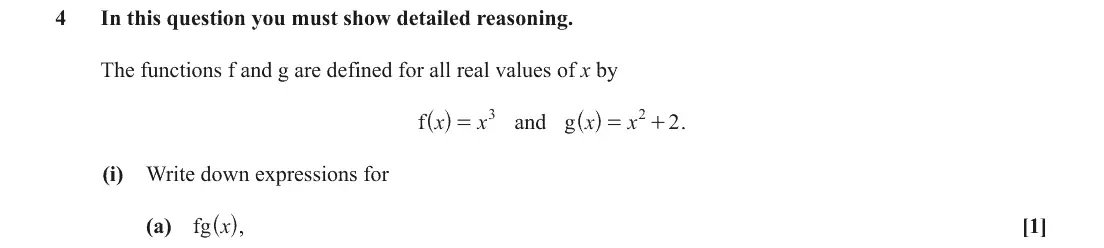
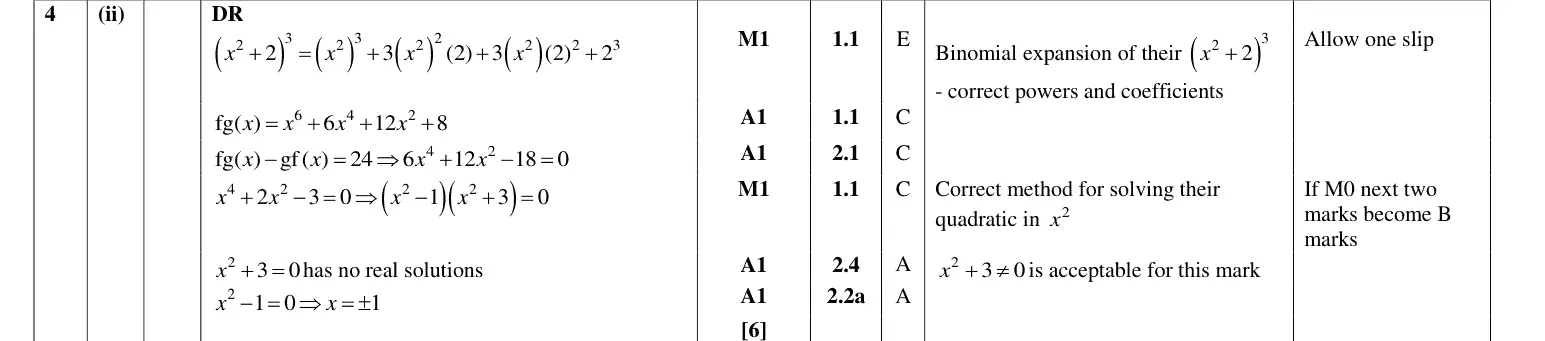
There were a significant number of candidates that did not employ correct bracketing and mistakenly wrote( ) rather than( ) ( ) ( ) x + 2 − x + 2 = 24 x + 2 − x + 2 = 24 ⇒ x + 2 − x − 2 = 24 . The majority of candidates went for expanding ( ) x + 2 by writing out the bracket three times rather than using the binomial expansion of ( a + b ) . While the majority rearranged their quartic into the form ( ) + 6 x 12 x − 18 = 0 there were a number of candidates did not show sufficient working in solving this quartic, even though the full question required detailed reasoning. Finally, it is expected at this level that as part of the detailed reasoning candidates should justify why x + 3 = 0 did not provide any solutions.
Key points and common errors
expand (x² + 2)³ = x⁶ + 6x⁴ + 12x² + 8
brackets needed when subtracting gf(x)
6x⁴ + 12x² − 18 = 0
(x² − 1)(x² + 3) = 0
reject x² = −3 explicitly
x = ±1
Find an A-level maths tutor
Stuck on this? Book a trial session with an A-level maths tutor.