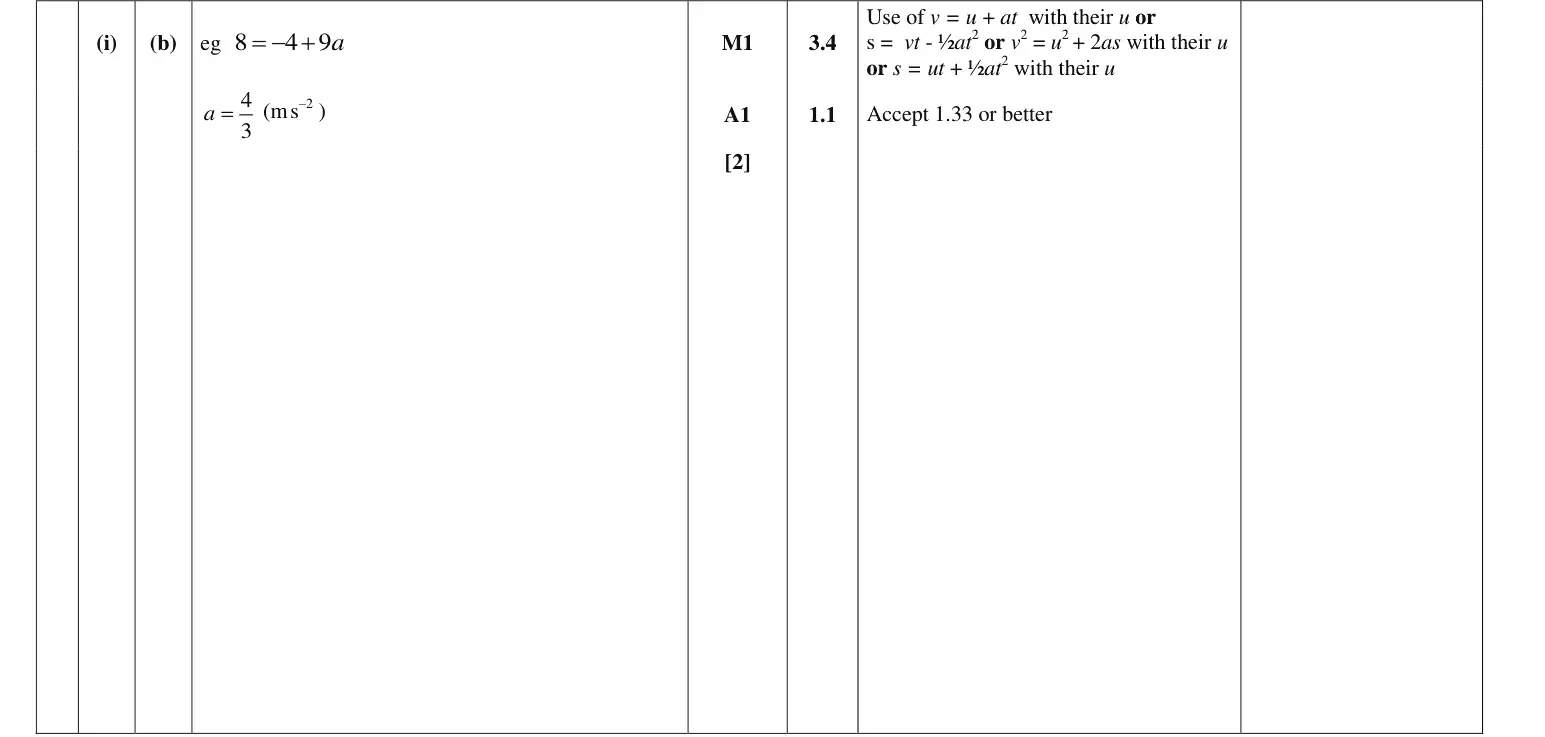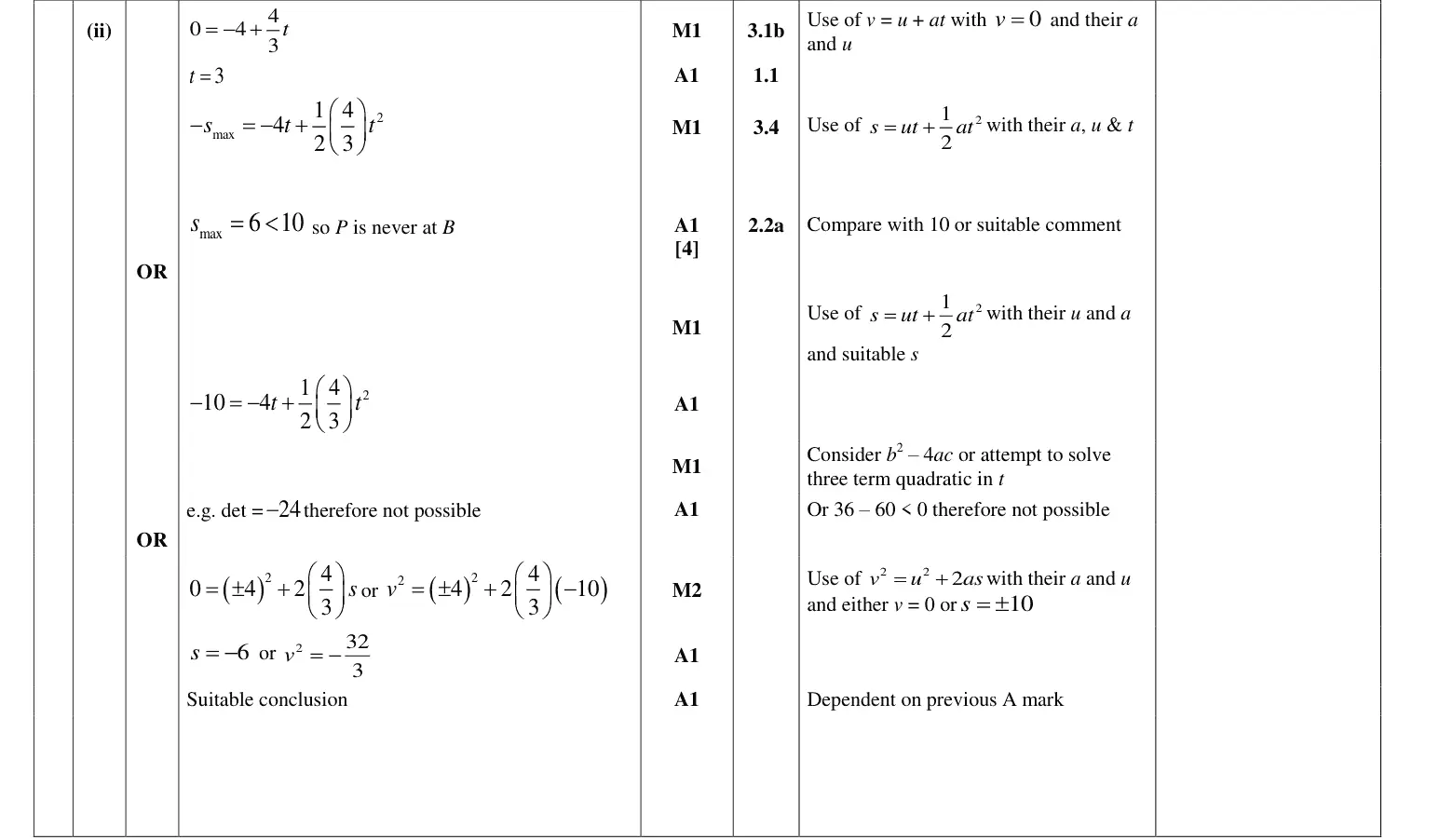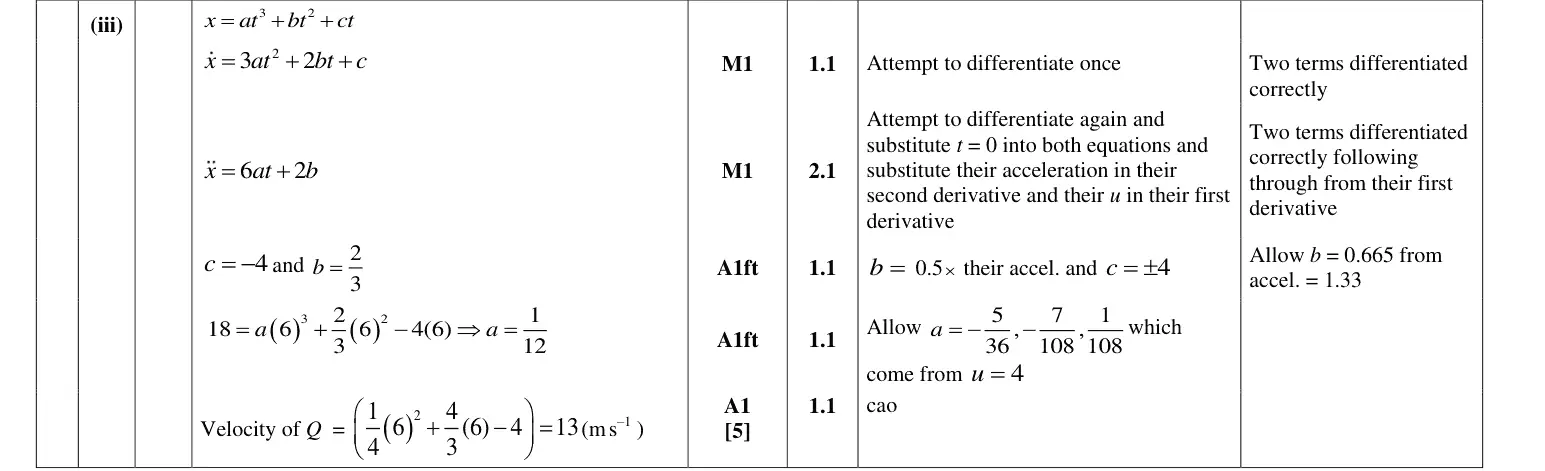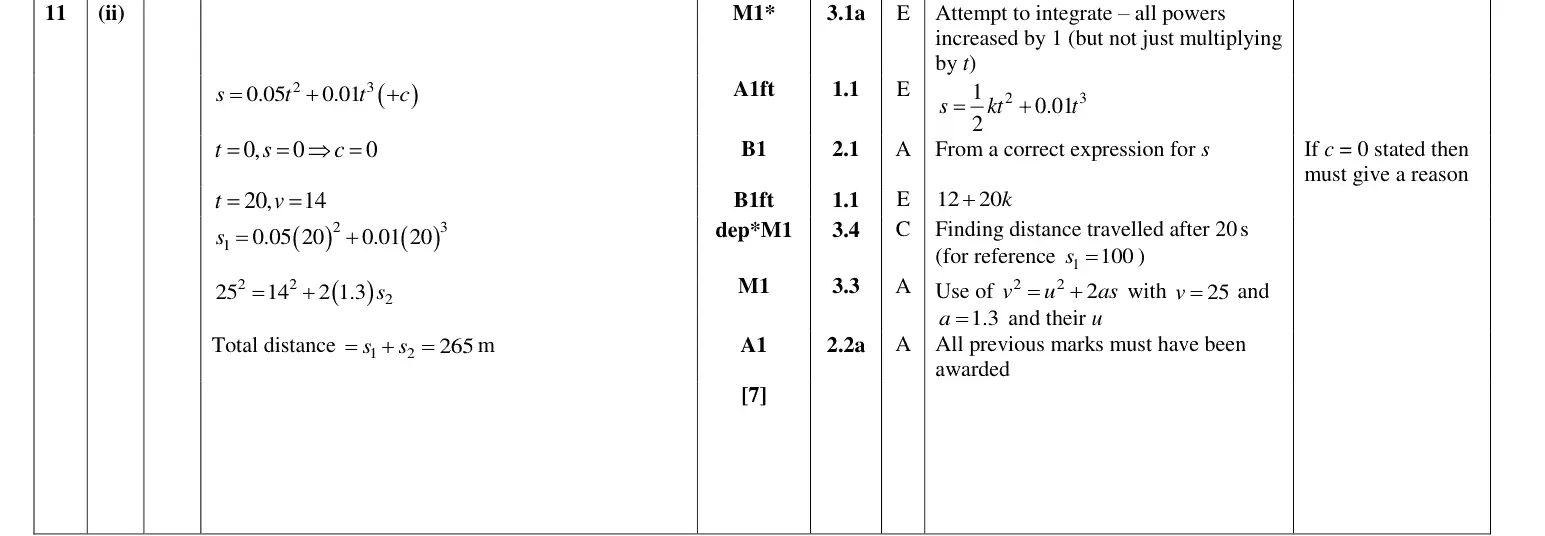
Mark scheme for this part

Examiner's comment
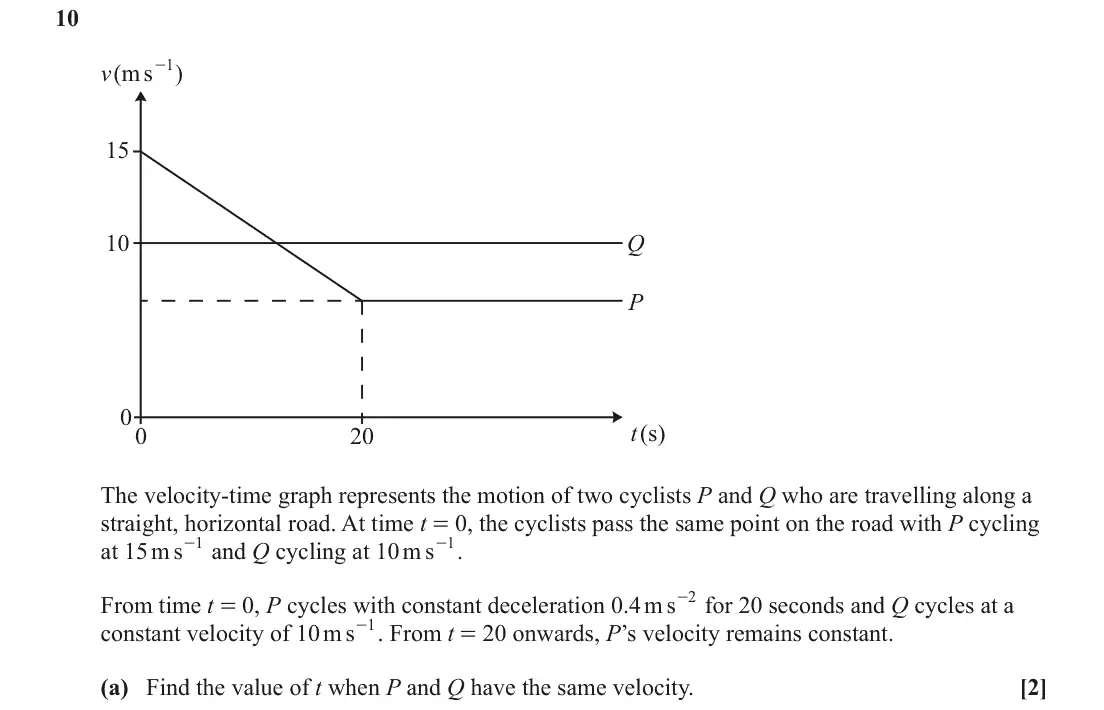
This was also well done with many correct solutions.
Key points and common errors
- v_P = 15 − 0.4t = 10 gives t = 12.5
Notes, worked examples and practice for this topic are being written by our tutors. The past-paper questions below are ready now: work each one on paper, then open the mark scheme and the examiner's comment.
Print this topic as a pack questions first, then the mark schemes
This was also well done with many correct solutions.

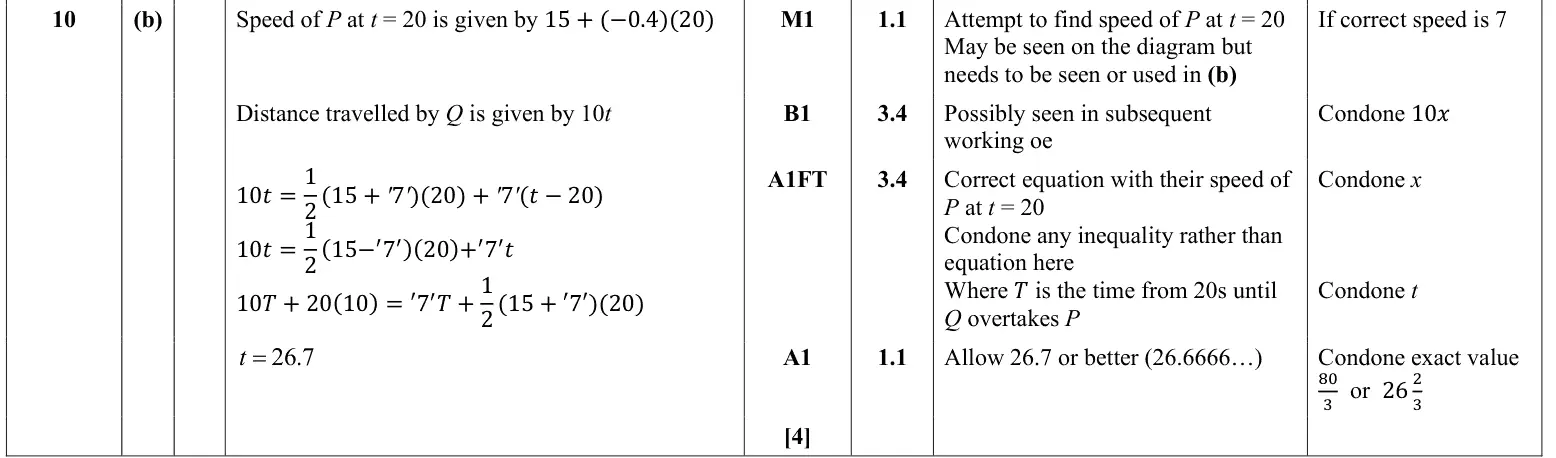
The setting up of the equation required clear thinking and this proved to be more of a challenge to candidates. 10t = 220 + 7t was not uncommon. Many considered the time from 20s and added 20s to this at the end. Those who did not take the change in P’s behaviour into account solved 10t = 15t - ½(0.4)t2..
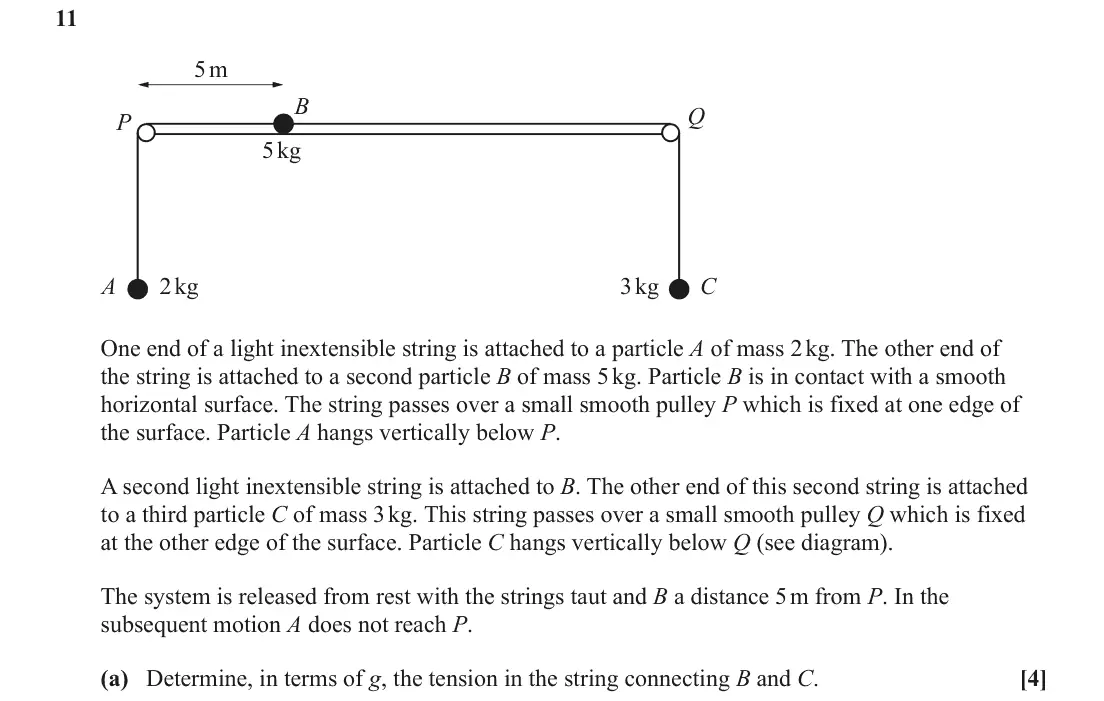

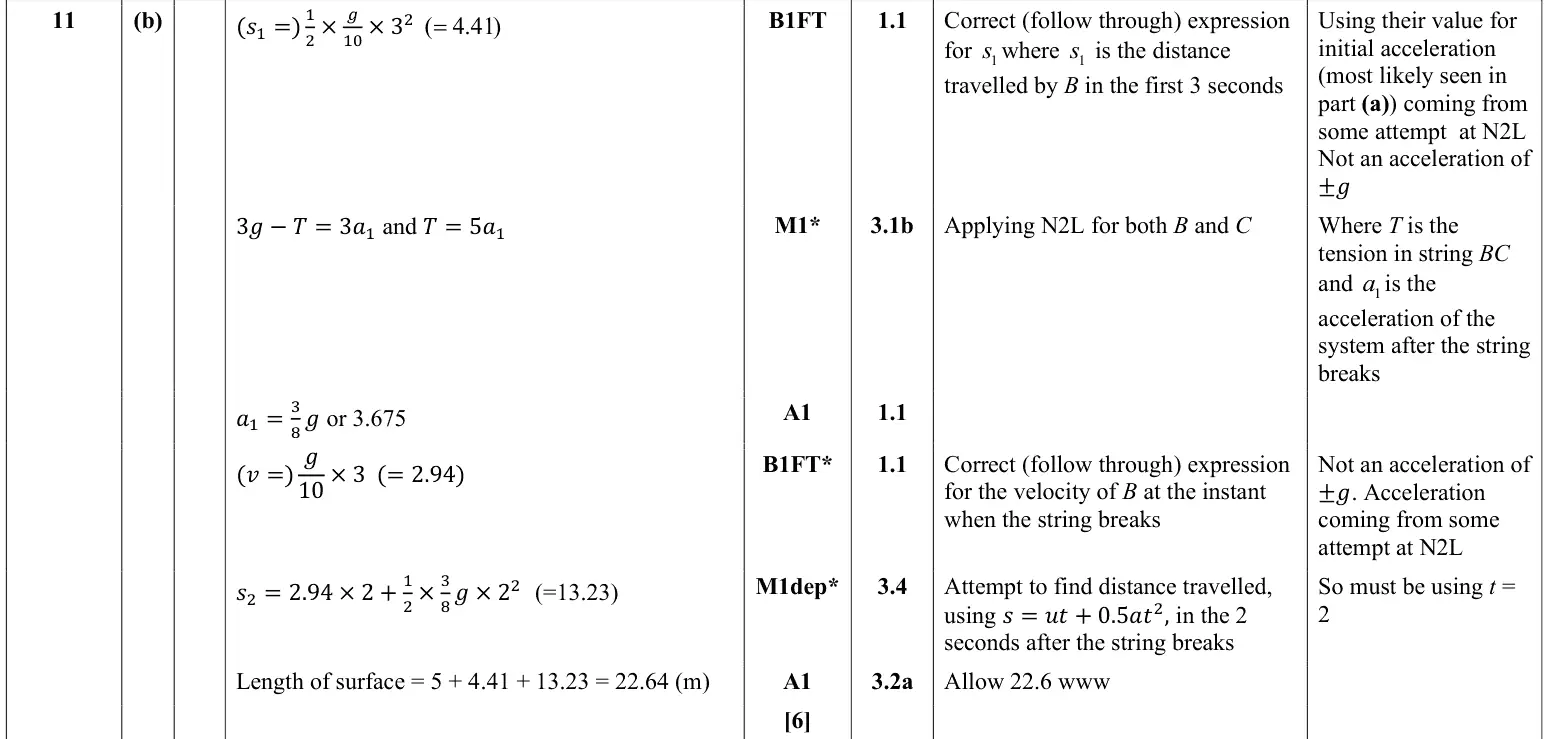
This question proved difficult for many candidates. There were some good solutions to this part seen, but full marks depended on a correctly obtained acceleration in (a). A few ignored the 5m when giving their final answer. Many candidates did not apply Newton’s Second Law to the situation after the string broke, using their previous acceleration, or g, or 0, so gaining at most the 2 B marks. In this solution, which follows from a fully correct part (a), the acceleration g/10 is correctly found although this had already been done in (a) actually so there was no need to repeat the calculation. It is used correctly for the 2 B marks to be given. Then T = 5a, one of the correct equations needed, is used with the tension found in part (a) and the equation 3g – T = 3a never appears. So M0 and no further marks were awarded.


This part was answered better than part (a) although it many candidates did not spot the significance that the expression for the acceleration of P was independent of t and spent time using a calculus approach when it was much simpler and quicker to apply the constant acceleration formula v = u + at.
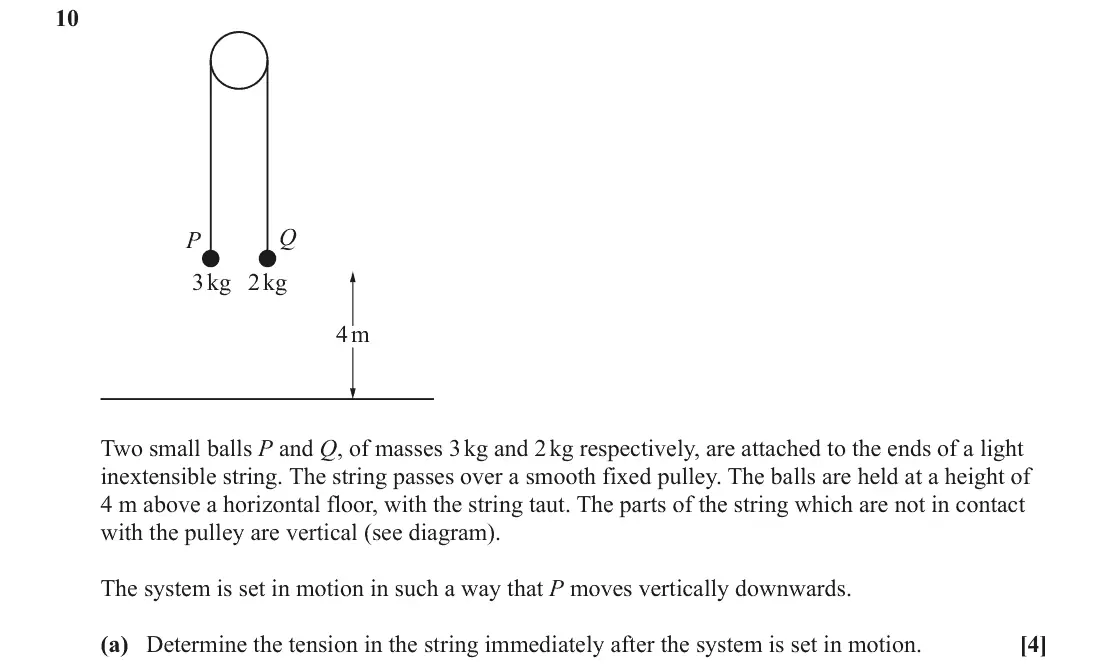

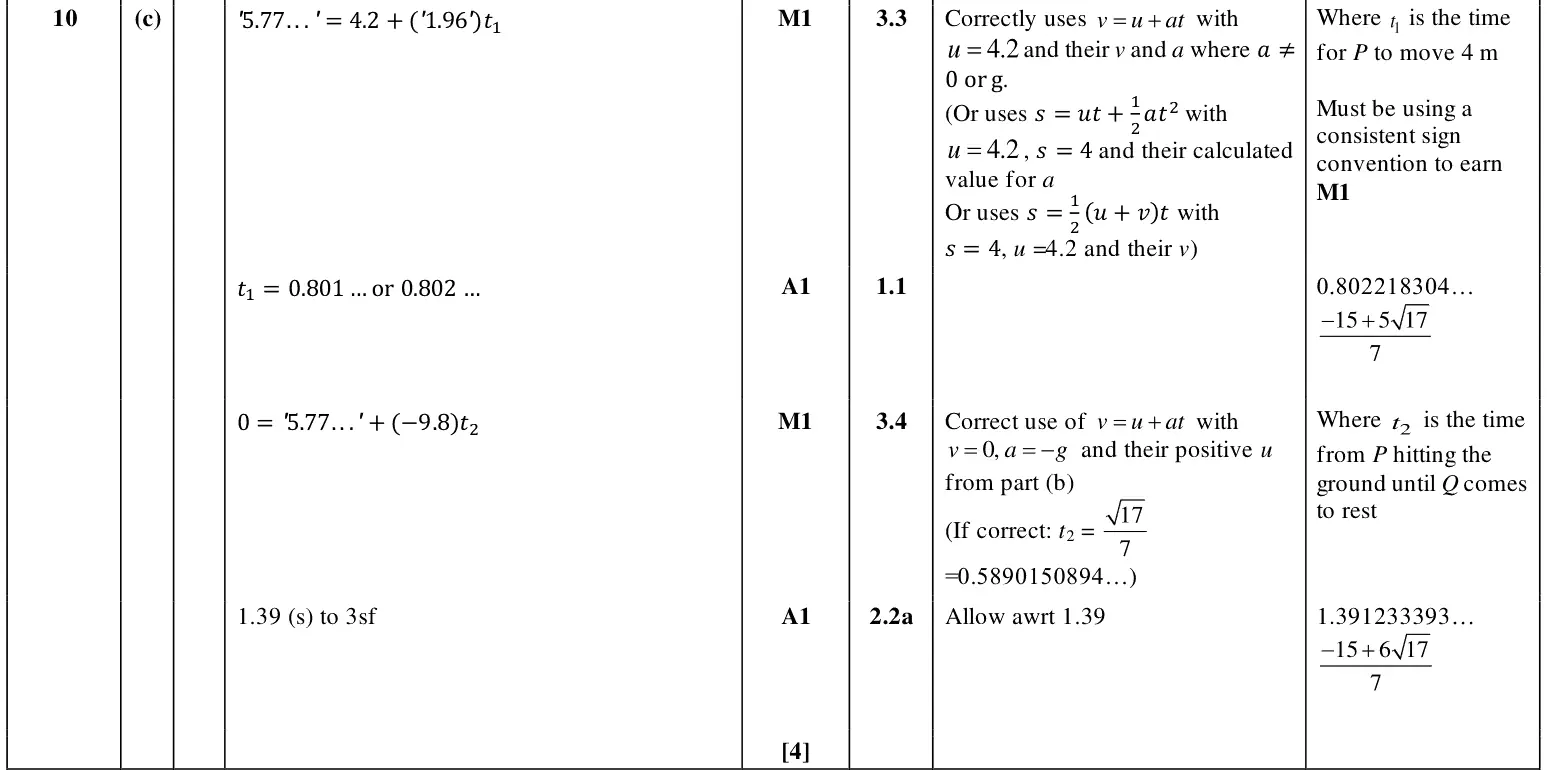
The use of v2 = u2 + 2as was widespread. Substituting a = 9.8 was the most common mistake. A few forgot to take the square root.

Attempts at this part were less successful. To calculate t1, using s = ut + ½at 2 was prevalent, but a = 9.8 again appeared. Giving t1 = 0.8 or 0.80 resulted in A0, unless anything more accurate was seen. Some found t1 and gave it as their final answer. Some candidates recalculated v using u = 0 and used this new value in their working for t1 and t2, rather than the value found in (b). Occasionally s = ut + ½at 2 was attempted with s = 8.

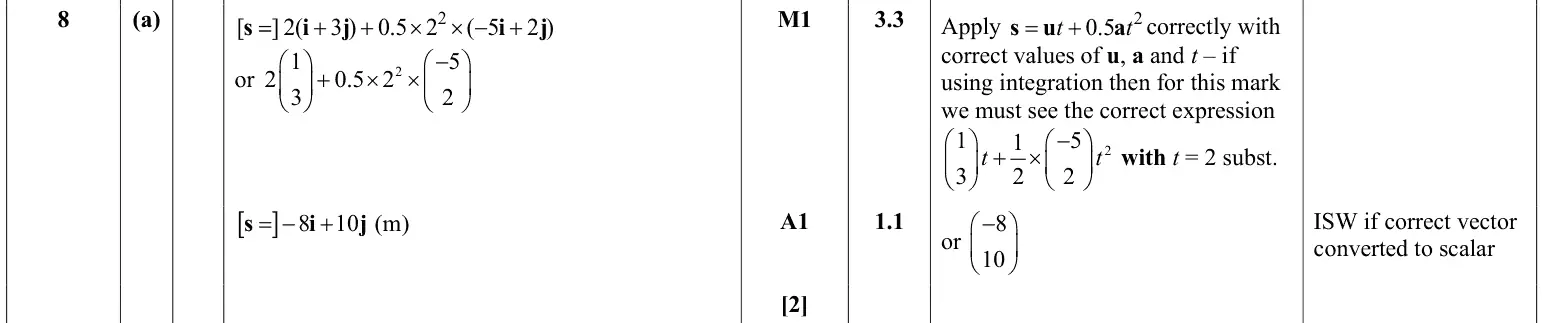
2 𝐚𝑡2 to find the This part was answered extremely well with most candidates correctly applying 𝐬= 𝐮𝑡+ required displacement of 𝑃 at time 𝑡= 2. Those that used integration were less successful as they tended to make arithmetic (or algebraic) slips or did not substitute 𝑡= 2 correctly.

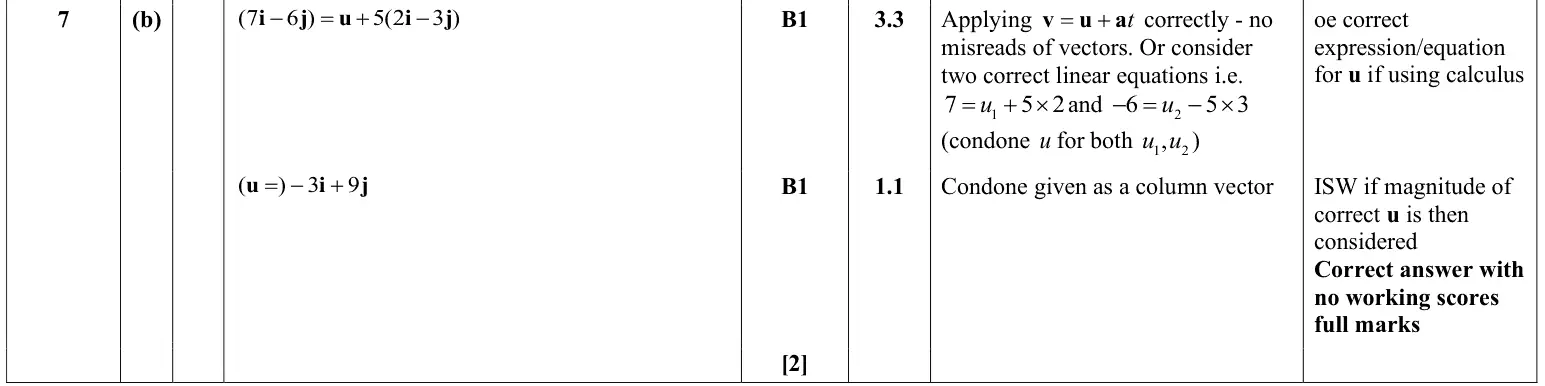
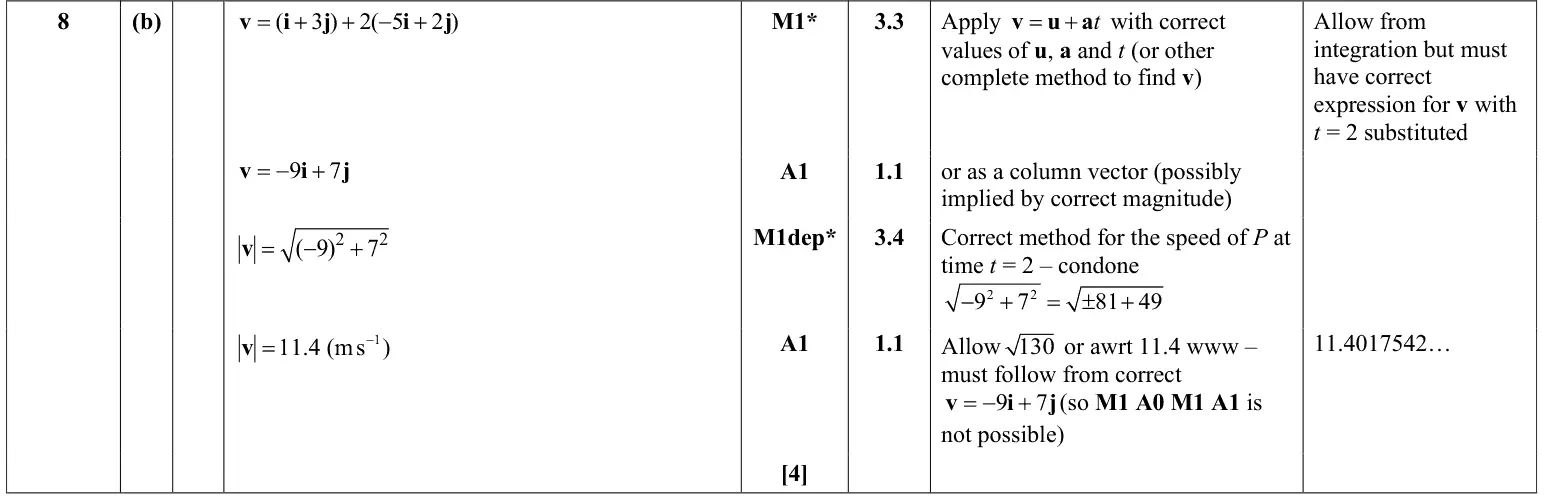
Most candidates correctly applied 𝐯= 𝐮+ 𝐚𝑡 to obtain the velocity vector for 𝑃 as −9𝐢+ 7𝐣. Many candidates left their answer as a vector and did not find the corresponding speed as directed. In this case the number of marks available should have been a strong indication of the amount of work required. Furthermore, a number of candidates attempted to use a vector form of 𝑣2 = 𝑢2 + 2𝑎𝑠 but most did not apply |𝐯|2 = |𝐮|2 + 2𝐚∙𝐬 correctly (not realising that each term of this equation was a scalar).
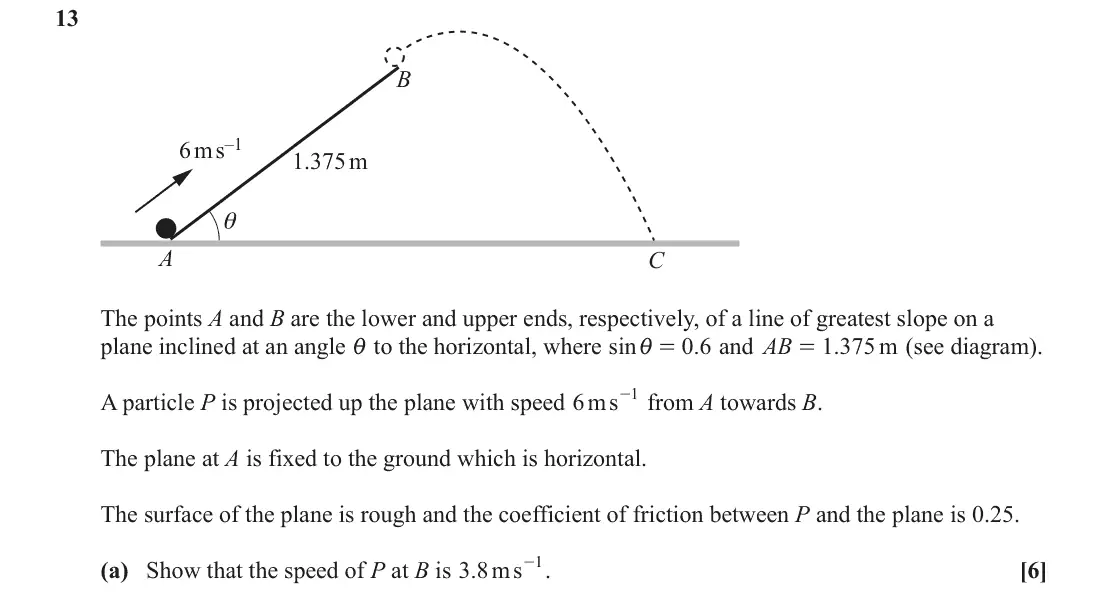
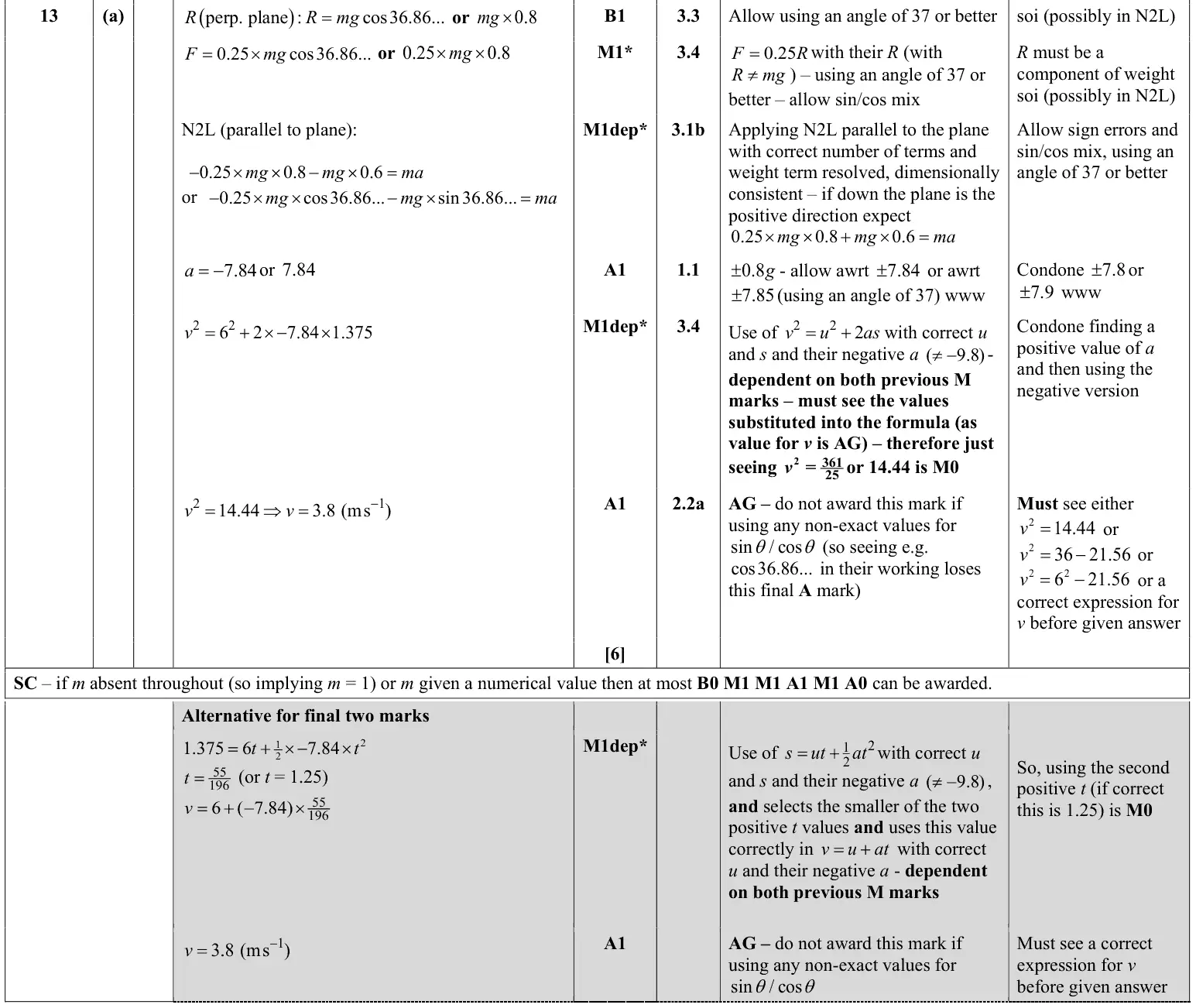
The responses to this part were mixed. Many candidates did not make any significant progress towards the given answer as they seemed to believe that the entire question could be solved by only applying the equations of constant acceleration. Very few candidates applied Newton’s second law parallel to the plane correctly (with the correct number of relevant terms) to find the acceleration of 𝑃 as it moved up the plane from 𝐴 to 𝐵. While some did correctly state that 𝑎= −0.25𝑔cos 𝜃−𝑔sin𝜃 many gave no indication of where the value of −7.84 for the acceleration came from; as this is a ‘show that’ question candidates were expected to substitute the given values of sin𝜃= 0.6 and therefore cos𝜃= 0.8 into this equation to make it clear that they hadn’t simply worked backwards to find the acceleration from the given final speed. Some candidates calculated 𝜃 as 36.8… and so therefore did not show that the speed of 𝑃 at 𝐵 was the exact (given) value of 3.8. This candidate made very good progress in showing that the speed of 𝑃 at 𝐵 was 3.8. The only issue was one of accuracy in that the candidate used an approximate value for the angle (in this case using 36.87) which leads to an inaccurate value of −7.8400113 … for the acceleration and therefore they could not score the final accuracy mark (and so instead scored 5 of the 6 marks available).

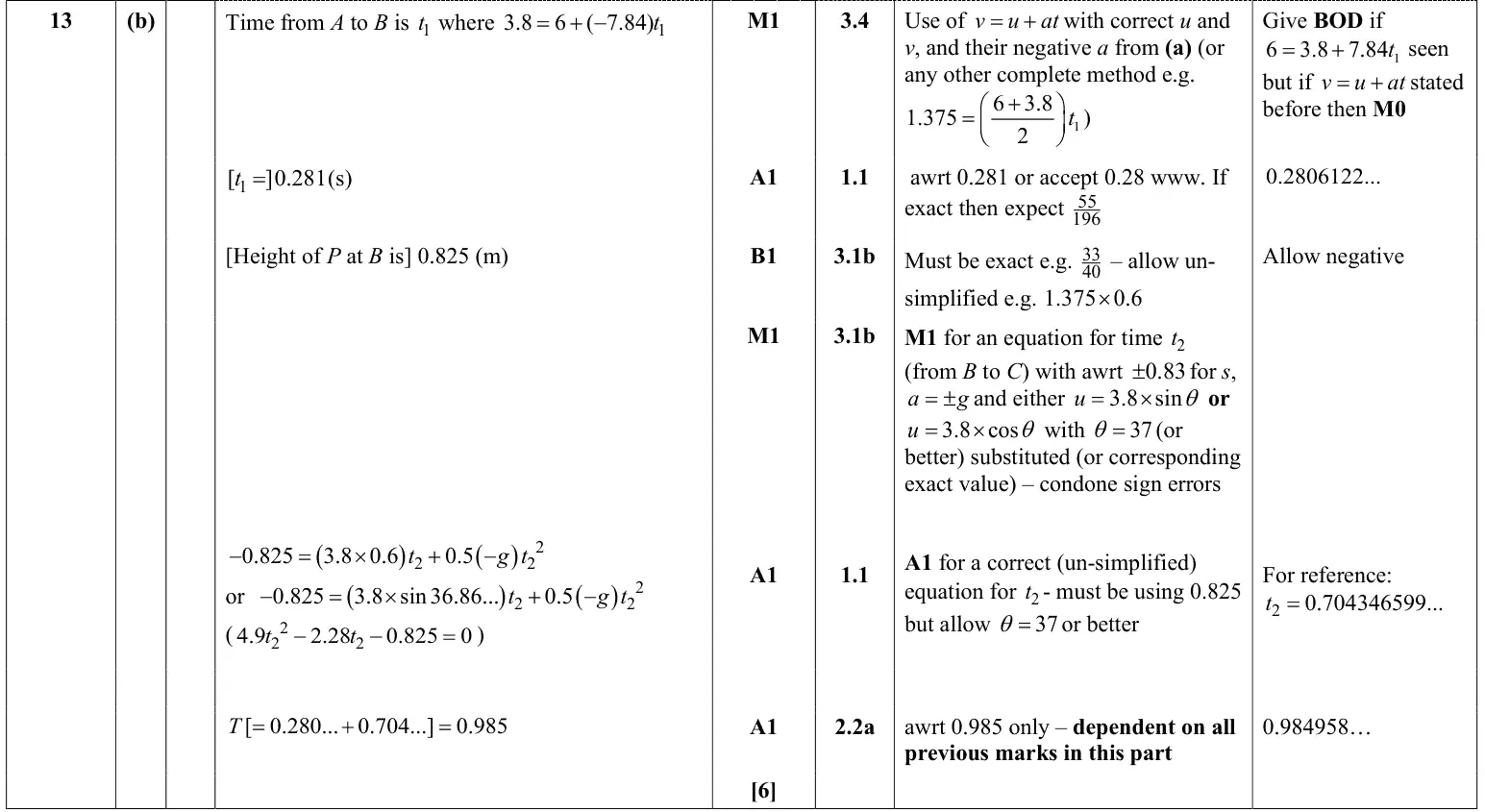
It was pleasing to note that many candidates correctly worked out the time of flight from 𝐵 to 𝐶 using the given value of 3.8 and managed to correctly set up the equation −0.825 = (3.8 × 0.6)𝑡+ 2 × −𝑔× 𝑡2 although occasionally sign errors appeared in this equation (as did the lack of a component with the 3.8 at the point where the particle became a projectile). It was clear that many candidates did not read the question carefully and gave the value of 𝑇 as the time of flight only from 𝐵 to 𝐶 instead of the correct time of flight from 𝐴 to 𝐶 (and so therefore scored only 3 of the 6 marks available in this final part).
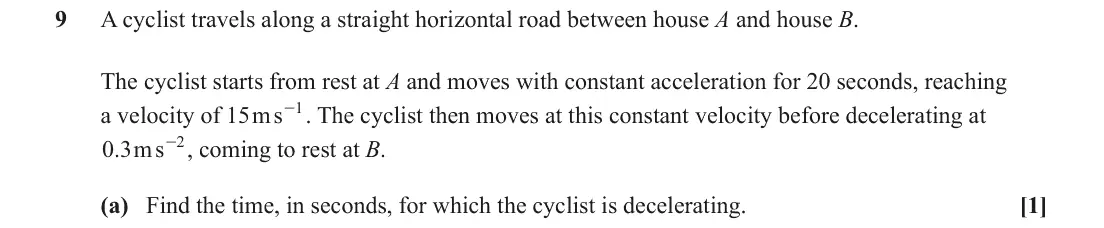
The vast majority of responses were correct.


There were quite a lot of correct responses presented, with many showing 1950 – 150 – 375 = 1425 and 1425 then 15 = 95s (i.e., not starting with an equation in T). Some candidates thought the first and last 1950 distances were 15 × 20 and 15 × 50, while others thought T = 15 . Those who worked with a time that wasn’t that specifically requested (e.g. the time up to the end of the constant velocity) did not always conclude by giving what we requested.
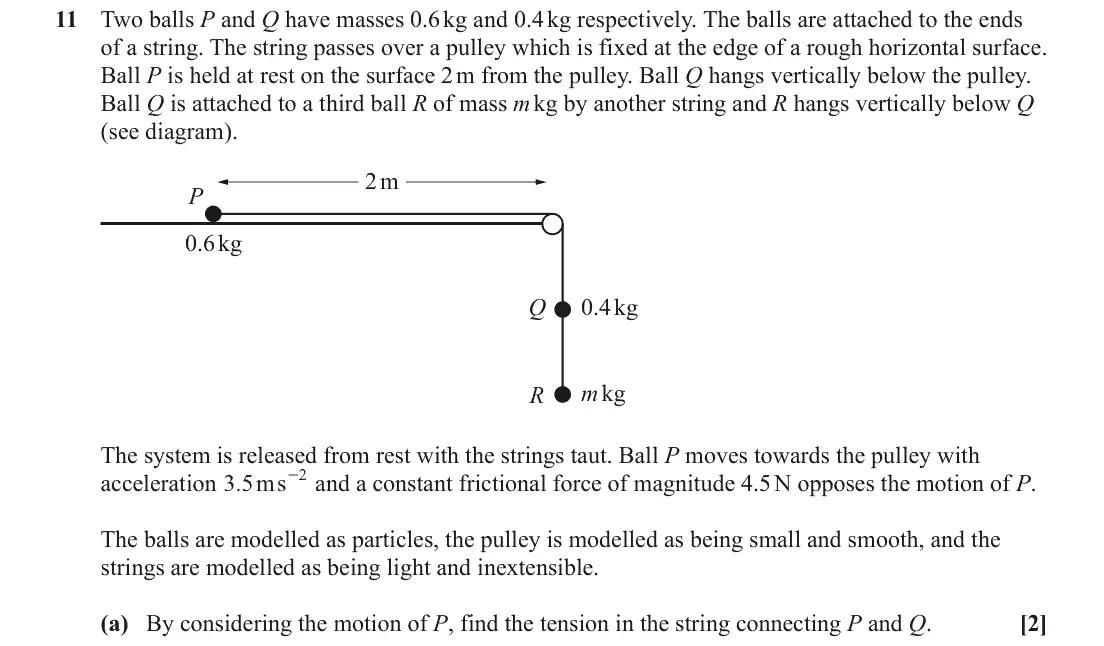


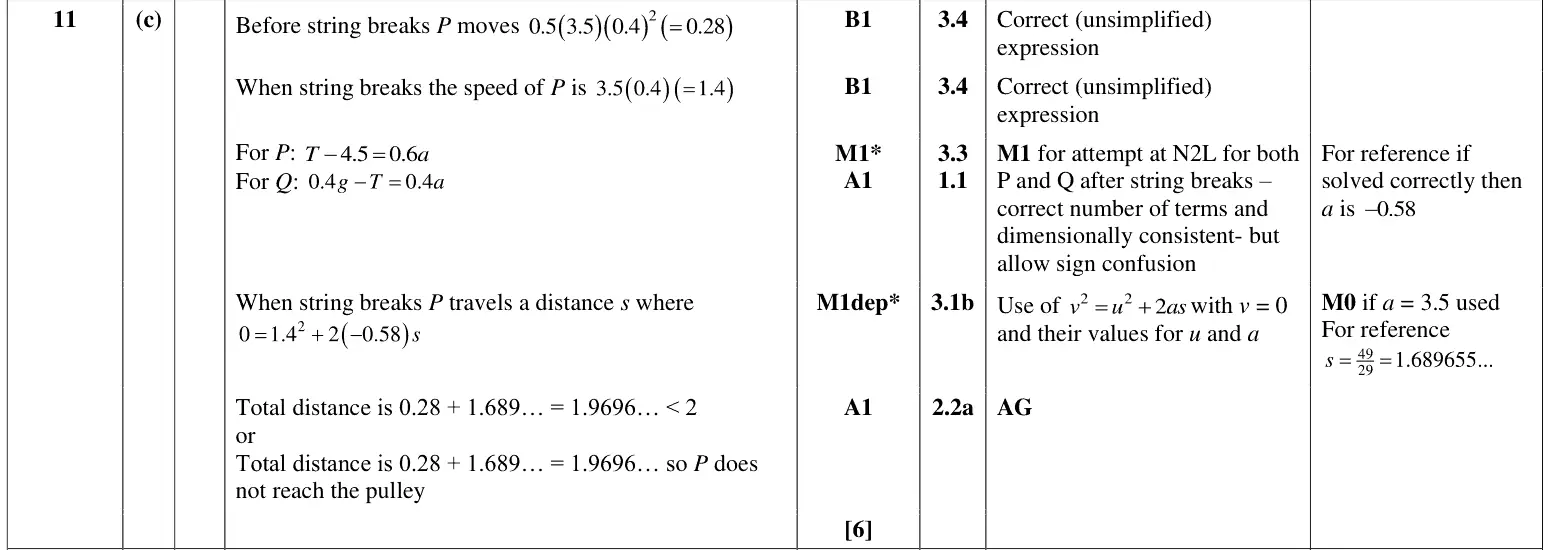
Many candidates earned the first 2 B marks for the motion until the string breaks, but what happened after this was often confused. Some just thought P only moved 0.28 m and compared this with 2 or used a = g in the subsequent motion. Others who attempted one or two Newton II equations used T = 0 or maybe 6.6. Use of the correct deceleration was uncommon. This shows a candidate who realises that there is a change of acceleration but uses Newton II with T = 0.

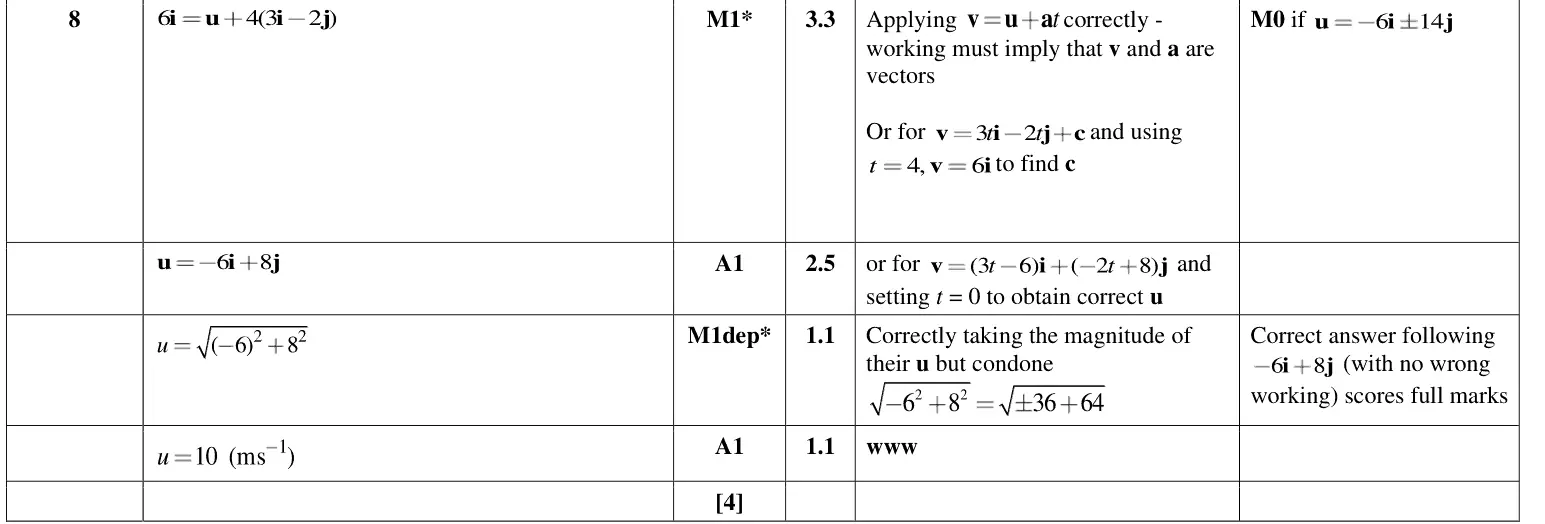
Most candidates correctly applied 𝐯𝐯= 𝐮𝐮+ 𝐚𝐚𝑡𝑡 to obtain the initial velocity vector for P as −6𝐢𝐢+ 8𝐣𝐣. Sadly, many candidates left their answer as a vector and did not find the corresponding speed as directed. In this case the number of marks available should have been a strong indication of the amount of work required.
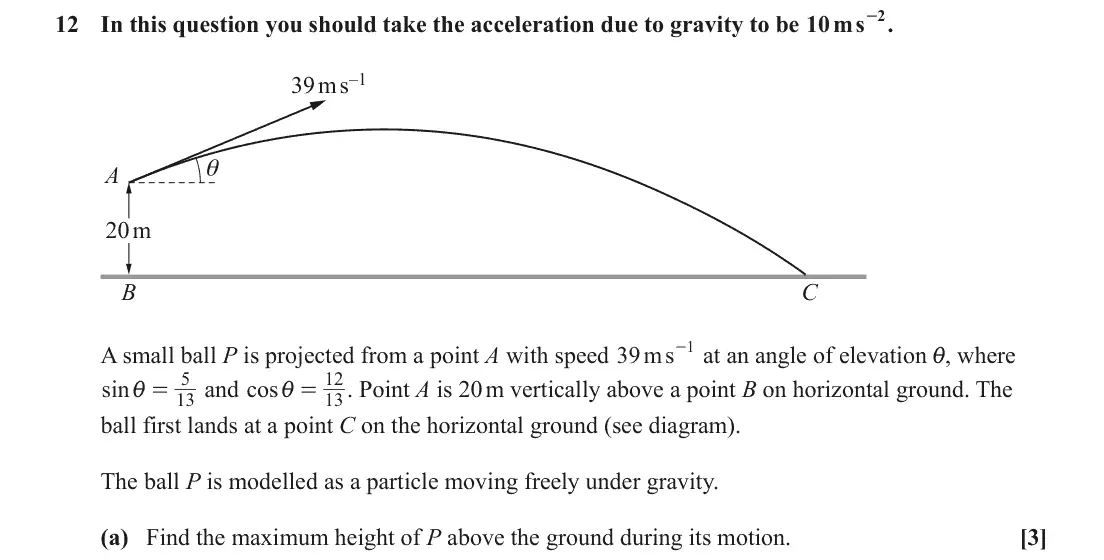
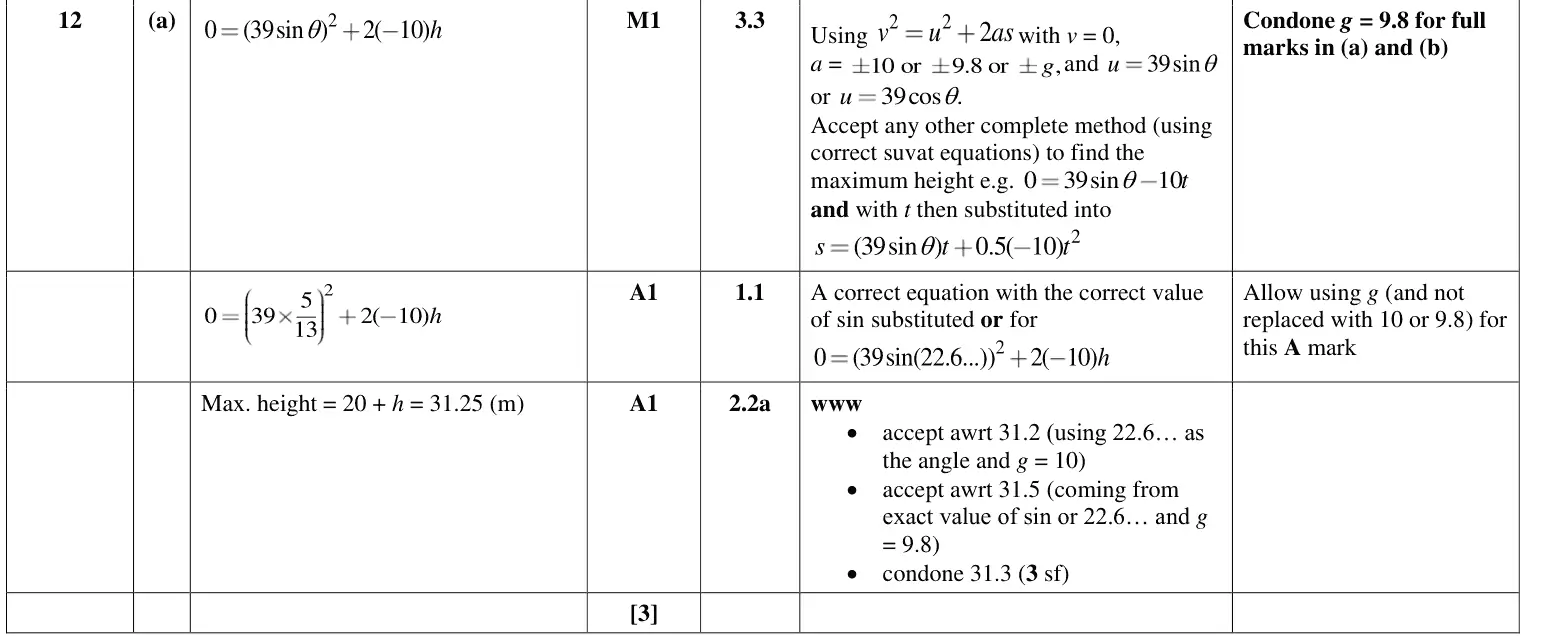
𝑣𝑣2 = 𝑢𝑢2 + 2𝑎𝑎𝑎𝑎 with 𝑣𝑣= 0, 𝑎𝑎= −10 and 𝑢𝑢= 39sin𝜃𝜃. The most common errors were using 𝑢𝑢= 39 or This part was answered extremely well with most candidates taking the direct route of applying 39cos𝜃𝜃, using 9.8 for g, or only working out the vertical distance from A to the max. height (and so forgetting to add the distance of 20 from A to B).

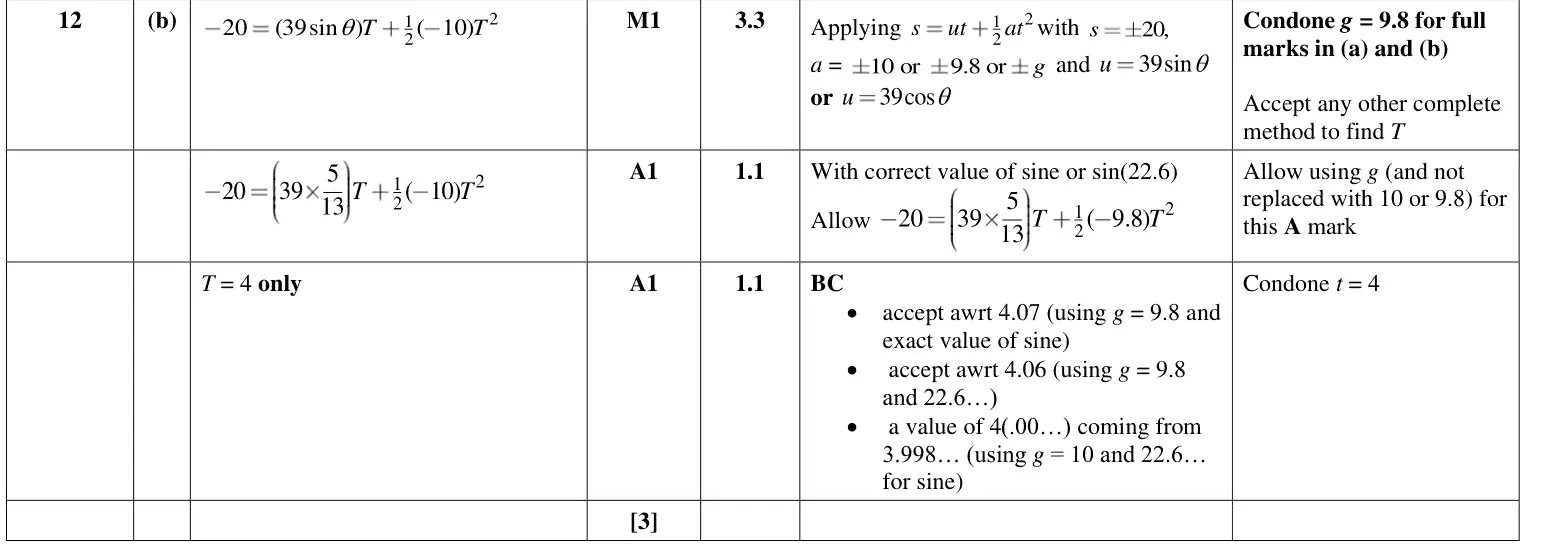
Similarly to part (a) this part was answered extremely well with most candidates correctly applying 𝑠𝑠= 𝑢𝑢𝑡𝑡+ 2 𝑎𝑎𝑡𝑡2 with 𝑠𝑠= −20, 𝑎𝑎= −10 and 𝑢𝑢= 39sin𝜃𝜃 and then correctly using their calculator to find the required value of 𝑇𝑇= 4. The errors mentioned in part (a) were commonly seen in this part too.
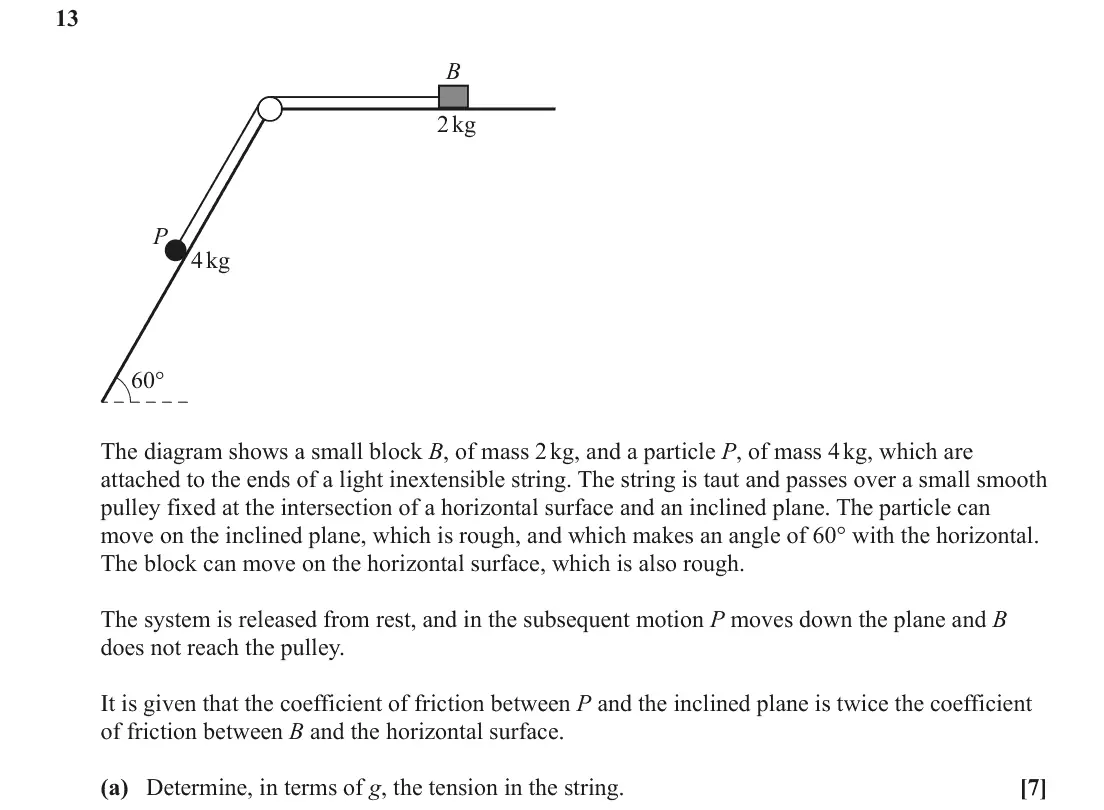

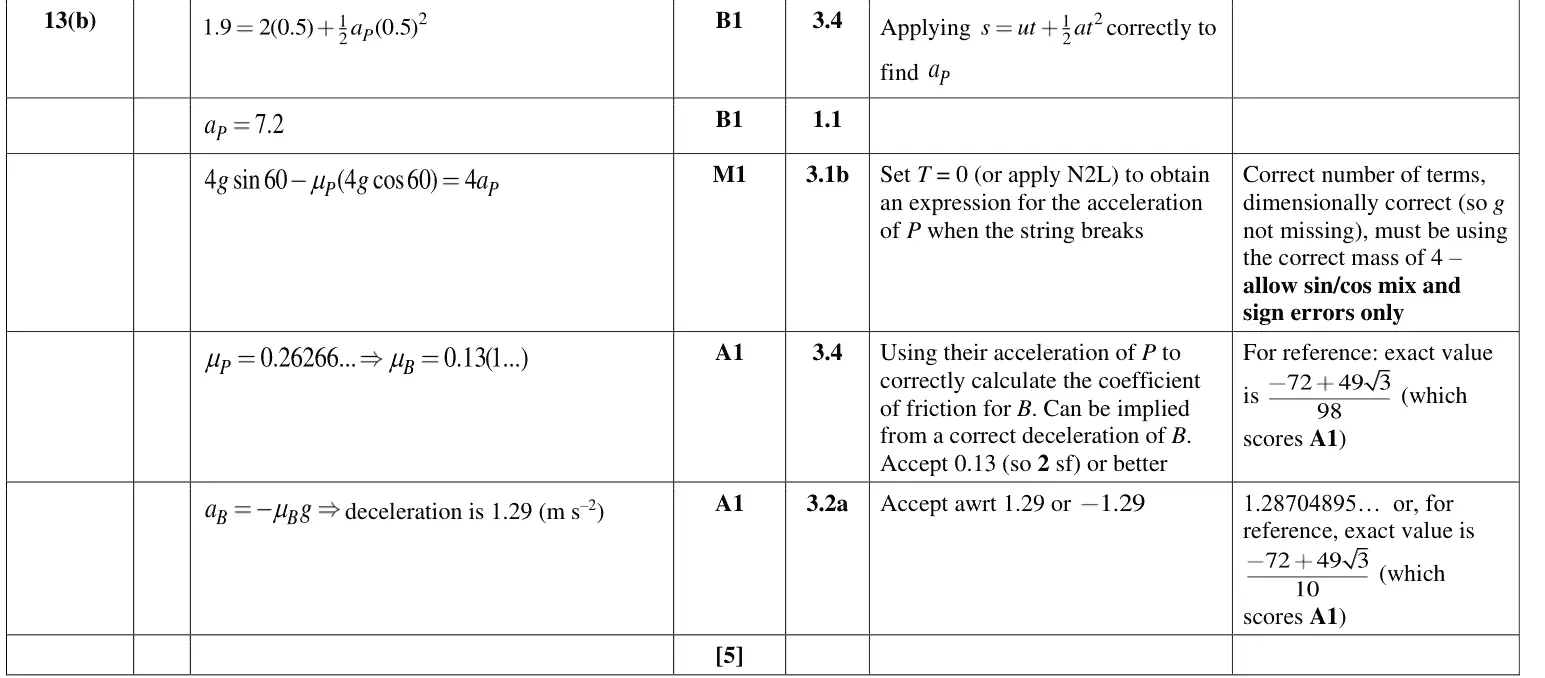
This part proved challenging for the majority of candidates, with most only getting as far as calculating the acceleration of P as it moved down the plane. Only the highest scoring candidates set T = 0 in their attempt at Newton’s second law for P (from part (a)) to obtain the coefficient of friction for P. Those that did this were usually successful in obtaining the correct coefficient of friction for B and hence its deceleration.

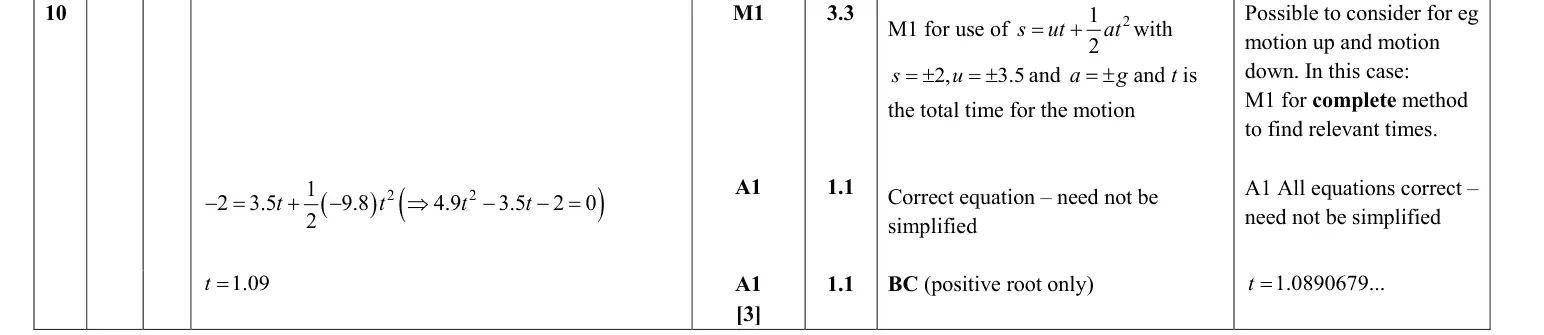
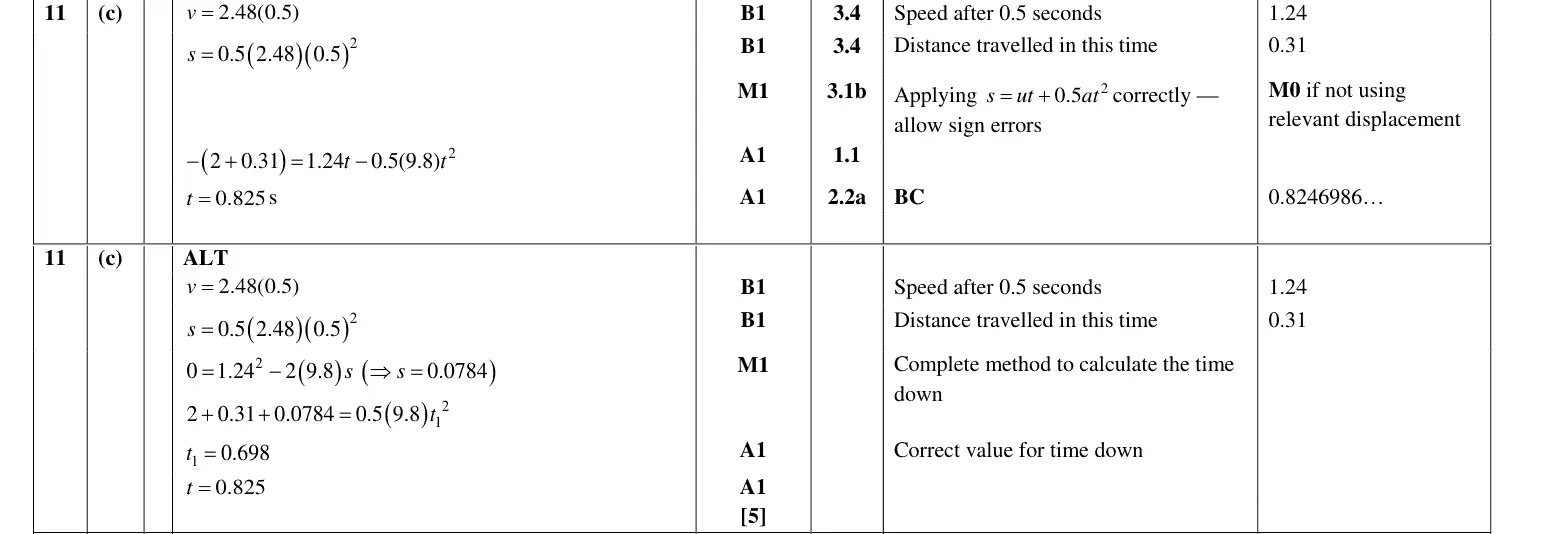
The ‘direct’ method written out on the scheme was obviously quicker than considering the motion in various parts but seemed to be less popular. Those who tried to apply it often did not appreciate that the initial velocity was not in the same direction as the displacement and acceleration. Note the quadratic here could be done by calculator (BC). Those who did it by considering the motion up and the motion down, for example, often got full marks but a complete method for what we requested was needed to gain any credit. If a relevant time was omitted, no marks were given.
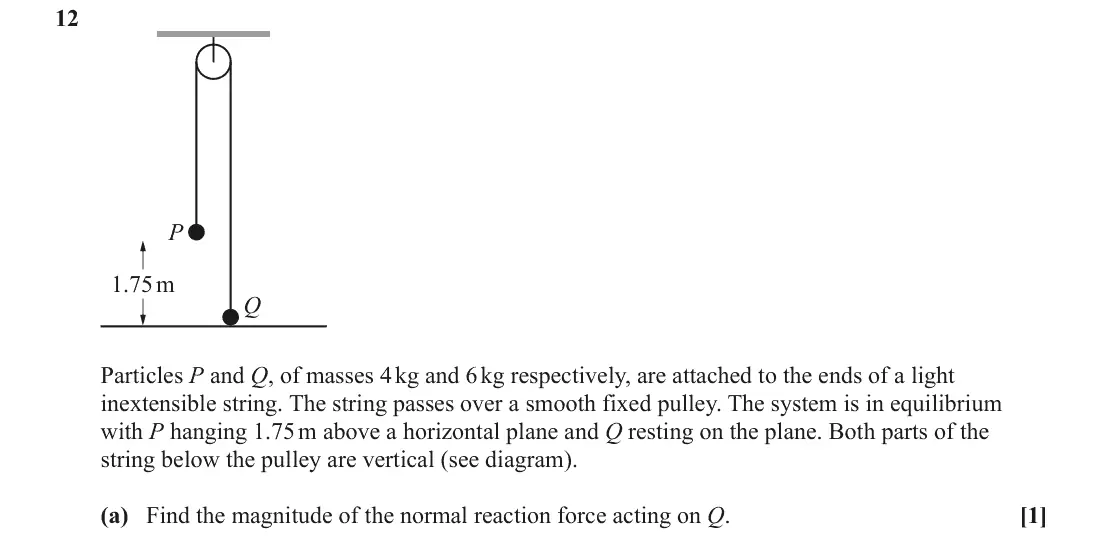


Many struggled with this question. The most common error was not understanding that the acceleration of Q changed when P hit the floor. 9.8 or their answer to part (b) was used in both stages of the motion. Finding the velocity of Q at the instant when P hits the floor was critical to solving this problem. A few good efforts lost the final mark by giving the answer as 2 x (0.25) + 1.75. This exemplar illustrates the above comment about acceleration. This candidate uses the acceleration found in part (b) of 1.4ms-2 in both stages of the motion.
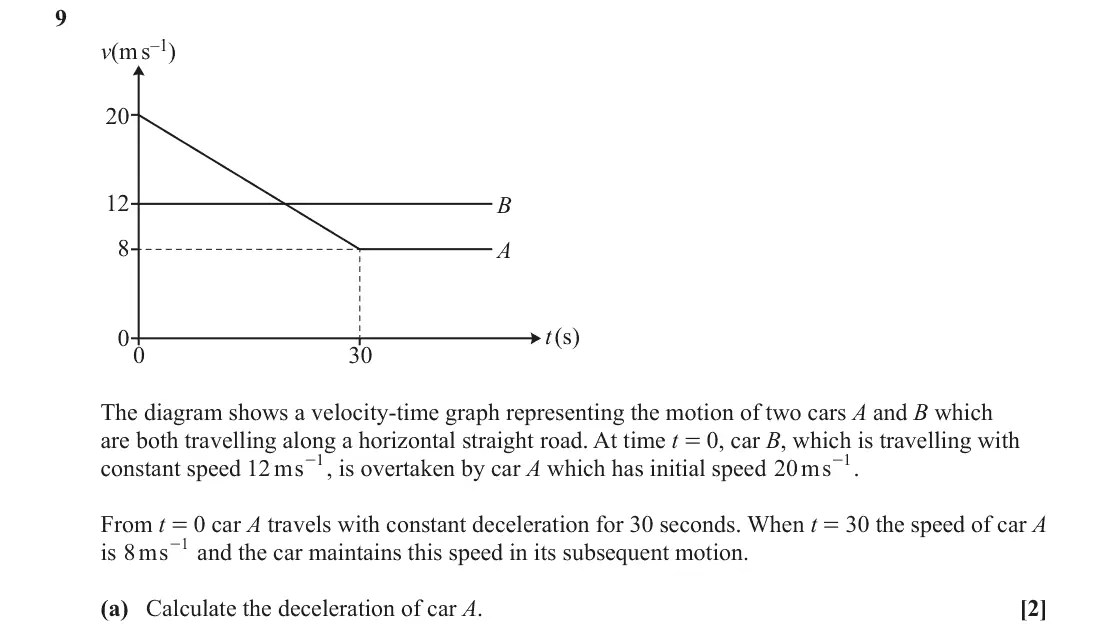
This was probably the best answered question of the whole paper. Strictly speaking the deceleration of car A was 0.4, however, examiners accepted either this or the corresponding negative value.

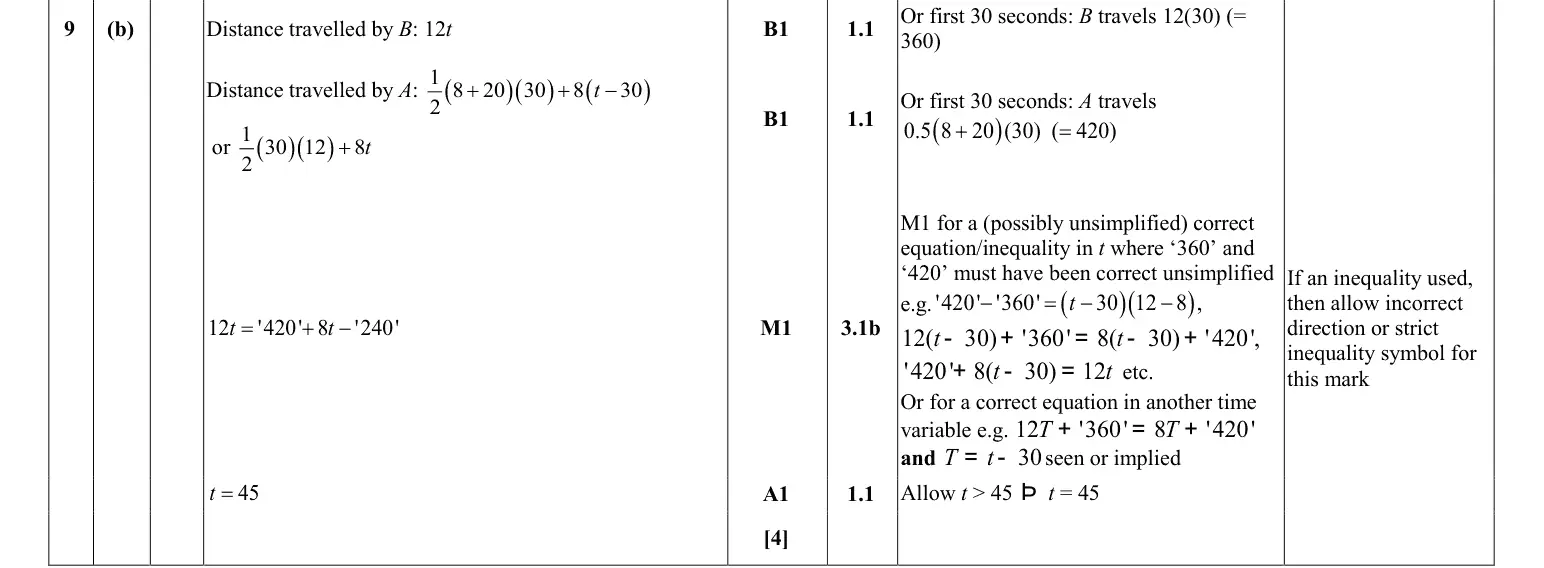
In comparison, candidates found the second part of this question much more demanding than expected. Many candidates attempted to apply an equation of constant acceleration for A’s entire journey even though the acceleration of A changed after 30 seconds. Although there were many correct ways of answering this part the most common way was to first work out the distance that each car travelled in the first 30 seconds (for B this was 360 m and for A this was 420 m) and then solved 12T + 360 = 8T + 420 and then add the 30 to T, therefore giving the correct value of t as 45.



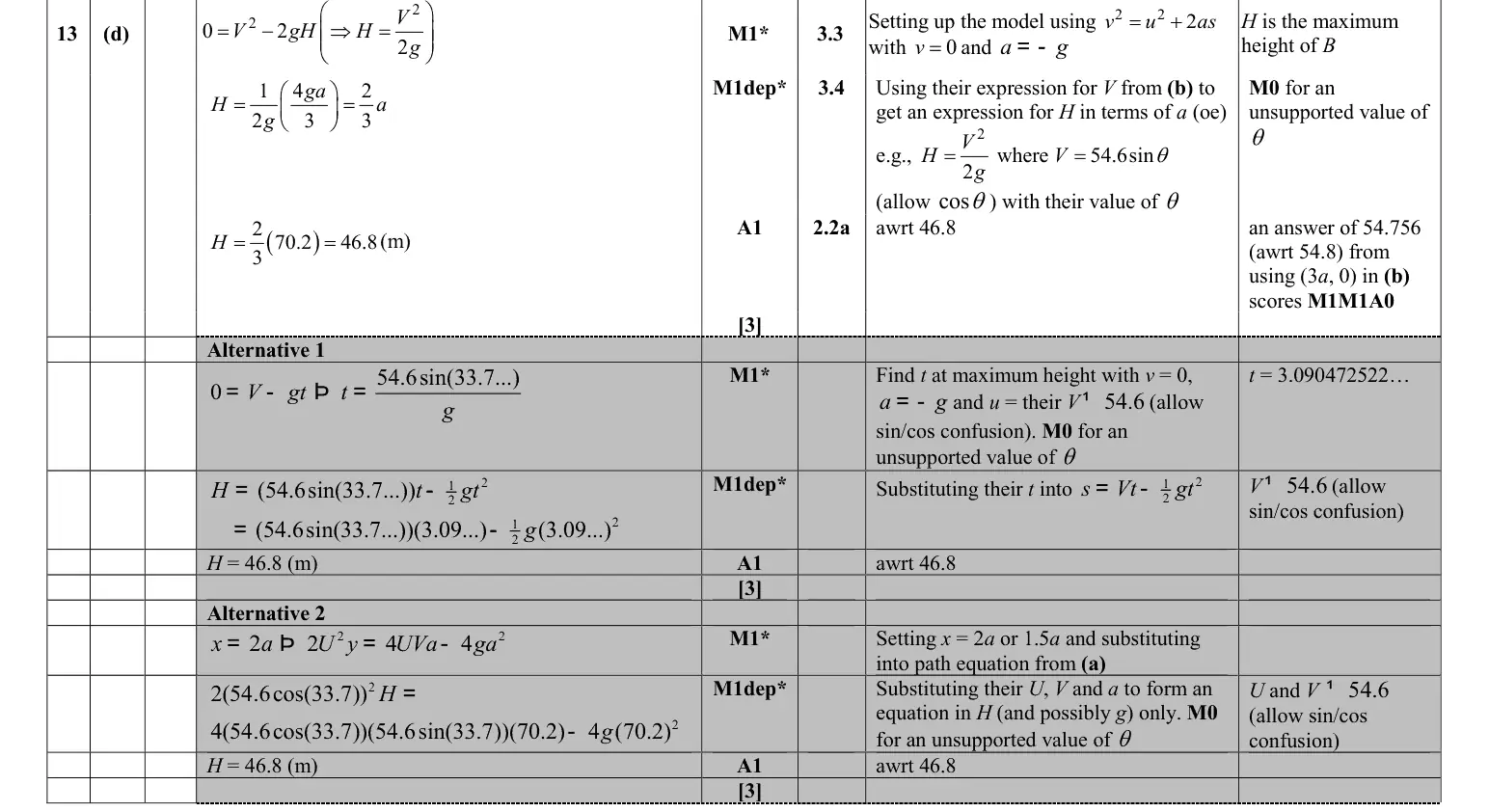
v = 0 Of those that attempted this question the most common method was to use v = u + 2 as with and a = − g . From here candidates were evenly split between those that used an expression for V from (b) 4 ga V = 54.6sin with being the angle found in (b). (which if correct was V = ) or those that used 3



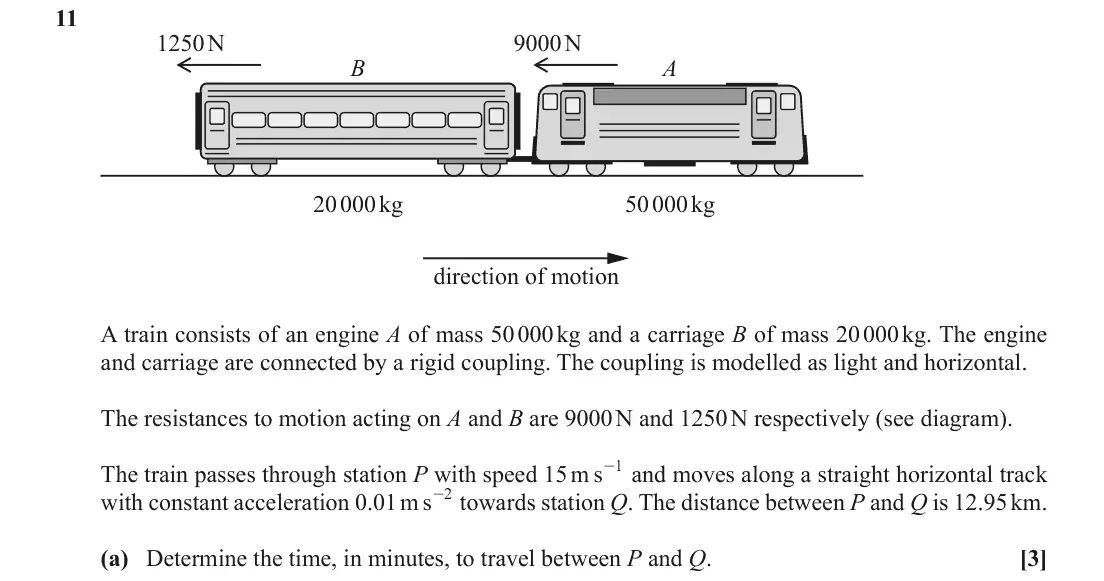

(From the general report) Question 9 states constant acceleration so ‘suvat’ can be used, whereas Question 13 has a variable force term so calculus must be used.

(From the general report) Question 9 states constant acceleration so ‘suvat’ can be used, whereas Question 13 has a variable force term so calculus must be used.

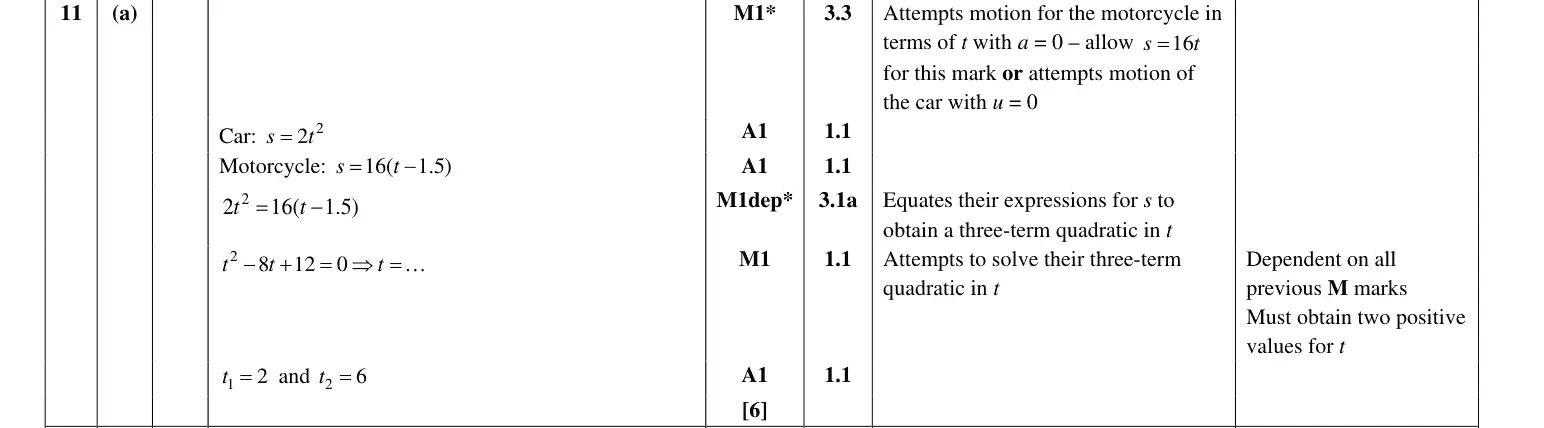
(Comment on Question 11 as a whole) Part (a) - s = 16t used – the need for t – 1.5 was generally not understood. This then led to t = 0 and t = 8 from a two term quadratic and thus gained only M1 A1. Candidates did not seem to realise that t = 0 could not be one of the required times given the problem. t + 1.5 was seen in some working. Part (c) - Most candidates made no useful progress with this part. Common misconceptions Key teaching and learning points – comments on improving performance The following, some of which have been mentioned in previous reports, remain pertinent. 1. Candidates should understand the implication of the ‘In this question you must show detailed reasoning’ instruction. Generally, this means examiners will expect to see how results have been obtained. So, for example, in Question 6 on this paper the method for solving the simultaneous equations was expected and those just doing it on the calculator earned M0 for this skill. 2. BC – a result achieved ‘by calculator’ – can encourage candidates to show little, if any, evidence of how their answer has been produced. To be fair, where this appears on the mark scheme (in Question 10) candidates generally adopted the ‘old-fashioned’ algebraic route but no doubt this will change over time. Inevitably examiners will find it difficult to know where an incorrect answer, presented alone, has come from and it may be hard to credit. It may be wise to encourage candidates to provide some evidence of what they are doing, especially in cases where more than one mark is available. 3. The front cover instructions state ‘Give non-exact numerical answers correct to 3 significant figures unless a different degree of accuracy is specified in the question.’ This should be stressed – some final answers were correct to 2 significant figures only. This may result in a loss of accuracy marks. 4. A question may require units in an answer to gain full credit. It is best to make candidates aware of this and urge them to always include units in answers where relevant. 5. The front cover instruction state ‘When a numerical value is needed use g = 9.8 unless a different value is specified in the question’. This now seems to be well recognised. Guidance on using this paper as a mock This paper covers the following topics : Cosine rule, ½absinC with area of a segment, curve sketching and interpretation of the algebraic solution of an equation graphically, finding the normal to a curve, the factor theorem and factorisation, quadratic functions and graphical transformations, properties of the circle and the circle equation, a maximisation problem with rationalising and algebraic manipulation, use of the laws of logarithms, forces in vector notation in equilibrium, Newton’s second law, variable acceleration and suvat equation use. The Pure section introduces the calculus and various other ideas which require a secure grasp of basic algebra and in the Mechanics section students need a sound understanding of kinematics with both uniform and non-uniform acceleration and Newton’s laws.

(Comment on Question 11 as a whole) Part (a) - s = 16t used – the need for t – 1.5 was generally not understood. This then led to t = 0 and t = 8 from a two term quadratic and thus gained only M1 A1. Candidates did not seem to realise that t = 0 could not be one of the required times given the problem. t + 1.5 was seen in some working. Part (c) - Most candidates made no useful progress with this part. Common misconceptions Key teaching and learning points – comments on improving performance The following, some of which have been mentioned in previous reports, remain pertinent. 1. Candidates should understand the implication of the ‘In this question you must show detailed reasoning’ instruction. Generally, this means examiners will expect to see how results have been obtained. So, for example, in Question 6 on this paper the method for solving the simultaneous equations was expected and those just doing it on the calculator earned M0 for this skill. 2. BC – a result achieved ‘by calculator’ – can encourage candidates to show little, if any, evidence of how their answer has been produced. To be fair, where this appears on the mark scheme (in Question 10) candidates generally adopted the ‘old-fashioned’ algebraic route but no doubt this will change over time. Inevitably examiners will find it difficult to know where an incorrect answer, presented alone, has come from and it may be hard to credit. It may be wise to encourage candidates to provide some evidence of what they are doing, especially in cases where more than one mark is available. 3. The front cover instructions state ‘Give non-exact numerical answers correct to 3 significant figures unless a different degree of accuracy is specified in the question.’ This should be stressed – some final answers were correct to 2 significant figures only. This may result in a loss of accuracy marks. 4. A question may require units in an answer to gain full credit. It is best to make candidates aware of this and urge them to always include units in answers where relevant. 5. The front cover instruction state ‘When a numerical value is needed use g = 9.8 unless a different value is specified in the question’. This now seems to be well recognised. Guidance on using this paper as a mock This paper covers the following topics : Cosine rule, ½absinC with area of a segment, curve sketching and interpretation of the algebraic solution of an equation graphically, finding the normal to a curve, the factor theorem and factorisation, quadratic functions and graphical transformations, properties of the circle and the circle equation, a maximisation problem with rationalising and algebraic manipulation, use of the laws of logarithms, forces in vector notation in equilibrium, Newton’s second law, variable acceleration and suvat equation use. The Pure section introduces the calculus and various other ideas which require a secure grasp of basic algebra and in the Mechanics section students need a sound understanding of kinematics with both uniform and non-uniform acceleration and Newton’s laws.

(Comment on Question 11 as a whole) Part (a) - s = 16t used – the need for t – 1.5 was generally not understood. This then led to t = 0 and t = 8 from a two term quadratic and thus gained only M1 A1. Candidates did not seem to realise that t = 0 could not be one of the required times given the problem. t + 1.5 was seen in some working. Part (c) - Most candidates made no useful progress with this part. Common misconceptions Key teaching and learning points – comments on improving performance The following, some of which have been mentioned in previous reports, remain pertinent. 1. Candidates should understand the implication of the ‘In this question you must show detailed reasoning’ instruction. Generally, this means examiners will expect to see how results have been obtained. So, for example, in Question 6 on this paper the method for solving the simultaneous equations was expected and those just doing it on the calculator earned M0 for this skill. 2. BC – a result achieved ‘by calculator’ – can encourage candidates to show little, if any, evidence of how their answer has been produced. To be fair, where this appears on the mark scheme (in Question 10) candidates generally adopted the ‘old-fashioned’ algebraic route but no doubt this will change over time. Inevitably examiners will find it difficult to know where an incorrect answer, presented alone, has come from and it may be hard to credit. It may be wise to encourage candidates to provide some evidence of what they are doing, especially in cases where more than one mark is available. 3. The front cover instructions state ‘Give non-exact numerical answers correct to 3 significant figures unless a different degree of accuracy is specified in the question.’ This should be stressed – some final answers were correct to 2 significant figures only. This may result in a loss of accuracy marks. 4. A question may require units in an answer to gain full credit. It is best to make candidates aware of this and urge them to always include units in answers where relevant. 5. The front cover instruction state ‘When a numerical value is needed use g = 9.8 unless a different value is specified in the question’. This now seems to be well recognised. Guidance on using this paper as a mock This paper covers the following topics : Cosine rule, ½absinC with area of a segment, curve sketching and interpretation of the algebraic solution of an equation graphically, finding the normal to a curve, the factor theorem and factorisation, quadratic functions and graphical transformations, properties of the circle and the circle equation, a maximisation problem with rationalising and algebraic manipulation, use of the laws of logarithms, forces in vector notation in equilibrium, Newton’s second law, variable acceleration and suvat equation use. The Pure section introduces the calculus and various other ideas which require a secure grasp of basic algebra and in the Mechanics section students need a sound understanding of kinematics with both uniform and non-uniform acceleration and Newton’s laws.

(Comment on Question 07 as a whole) This was perhaps the best answered question on the paper. Unfortunately, marks were dropped in both parts where candidates gave an answer for velocity when speed was requested or for distance when displacement was requested. A significant number of candidates attempted this question using calculus; while valid, the responses were more likely to include arithmetic errors.

(Comment on Question 07 as a whole) This was perhaps the best answered question on the paper. Unfortunately, marks were dropped in both parts where candidates gave an answer for velocity when speed was requested or for distance when displacement was requested. A significant number of candidates attempted this question using calculus; while valid, the responses were more likely to include arithmetic errors.
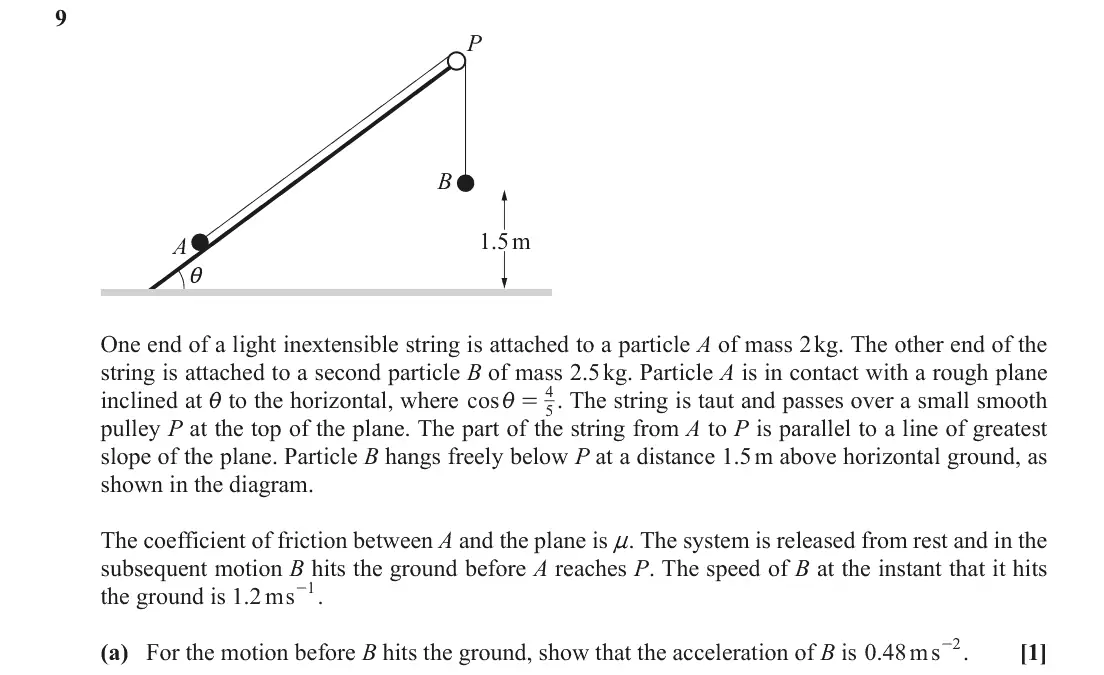
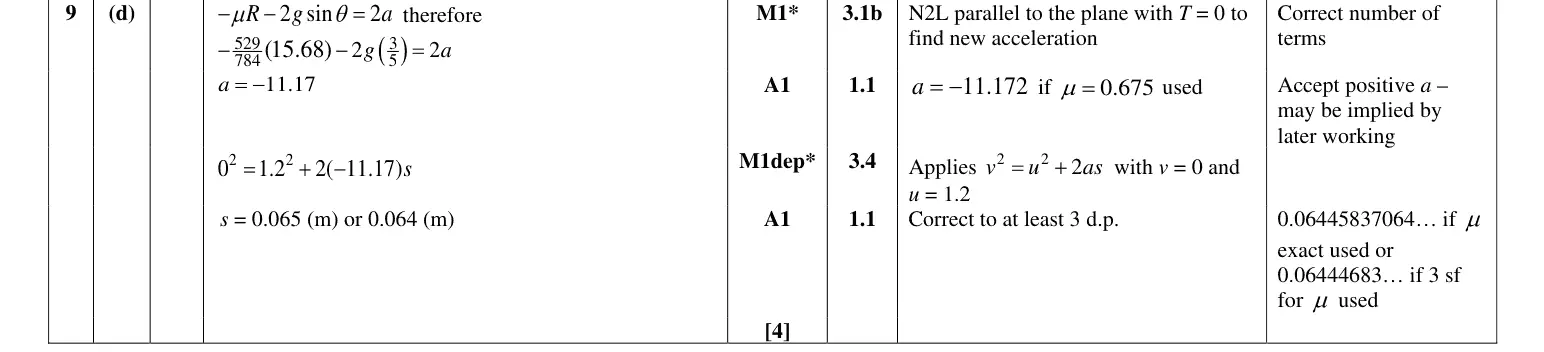
(Comment on Question 09 as a whole) 4 In this question the angle θ was defined as cosθ = . Candidates should resist the temptation to 5 calculate the decimal approximation for θ and instead use their knowledge of Pythagoras Triples to state the exact values for sinθ (and tanθ if required). The exact values have been chosen to make the arithmetic easier. Similarly, some questions will use the values of θ that candidates are expected to know the exact values for, and these should be used rather than the decimal approximation. If the examiner wants the decimal approximations to be used, then the angle θ will simply be defined as a numerical value. Most candidates showed sufficient working using for part (a). There was evidence that most candidates understood how to obtain the given answer in part (b), but some responses did not fully justify their working. A few students used mass rather than weight and did not include g in their equations. Part (c) was attempted by all candidates but one or more of the following mistakes were made: ● Assumed a = 0 . ● Used rather than using components. R = 2g ● Sine/Cosine confusion when stating the components of any force. 4 3 ● Rounding errors with calculated values of θ rather than using cosθ = and sinθ = . 5 5 ● Incorrect directions used leading to sign errors. ● Under-specifying the final answer given to less than 3 sf. Although a fairly standard question, part (d) is traditionally expected to be a challenge for most candidates. For this reason, it was pleasing to see the number of fully correct answers. Common mistakes included: ● Tension was still applied. ● Incorrect acceleration; either the same a = 0 48 . , or a > 0 , or even a = 9 8. . ● Distance = speed × time used rather than ‘suvat’.



(Comment on Question 09 as a whole) 4 In this question the angle θ was defined as cosθ = . Candidates should resist the temptation to 5 calculate the decimal approximation for θ and instead use their knowledge of Pythagoras Triples to state the exact values for sinθ (and tanθ if required). The exact values have been chosen to make the arithmetic easier. Similarly, some questions will use the values of θ that candidates are expected to know the exact values for, and these should be used rather than the decimal approximation. If the examiner wants the decimal approximations to be used, then the angle θ will simply be defined as a numerical value. Most candidates showed sufficient working using for part (a). There was evidence that most candidates understood how to obtain the given answer in part (b), but some responses did not fully justify their working. A few students used mass rather than weight and did not include g in their equations. Part (c) was attempted by all candidates but one or more of the following mistakes were made: ● Assumed a = 0 . ● Used rather than using components. R = 2g ● Sine/Cosine confusion when stating the components of any force. 4 3 ● Rounding errors with calculated values of θ rather than using cosθ = and sinθ = . 5 5 ● Incorrect directions used leading to sign errors. ● Under-specifying the final answer given to less than 3 sf. Although a fairly standard question, part (d) is traditionally expected to be a challenge for most candidates. For this reason, it was pleasing to see the number of fully correct answers. Common mistakes included: ● Tension was still applied. ● Incorrect acceleration; either the same a = 0 48 . , or a > 0 , or even a = 9 8. . ● Distance = speed × time used rather than ‘suvat’.
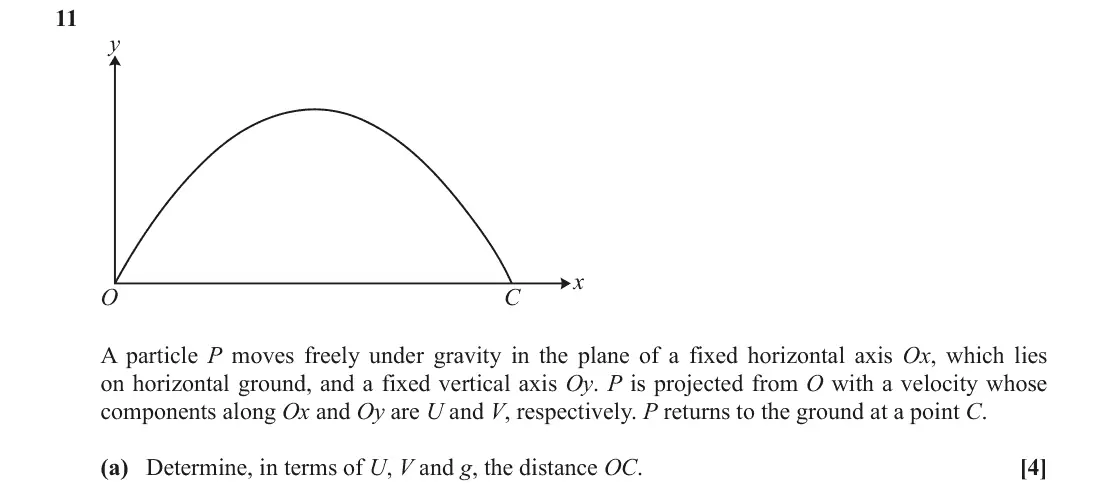
(Comment on Question 11 as a whole) Some candidates struggled with the algebraic format of this question. Those that set out their ‘suvat’ equations clearly distinguishing horizontal and vertical components were more success. Of those candidates that made a good attempt at part (a), a few dropped marks by only calculating the horizontal distance travelled to get to the maximum height – a valid method but which was only 1 2OC . Some otherwise excellent attempts to part (b) had answers in terms of an introduced variable T (or similar); this could only be given full marks if T was explicitly defined as part of the solution. Part (c) and part (d) proved the most challenging, with only the most able candidates making any meaningful progress. Both parts required careful notation to avoid confusing terms. For example, in Vertical component of velocity part (d) some candidates recognised tan θ = but the working Horizontal component of velocity suggested they used values at O rather than A. Guidance on using this paper as a mock This paper has a good range of questions on Pure and Mechanics and while overall there was a nice gradient on demand, it should be noted that Question 2 proved more challenging for this cohort than was expected with respect to its position on the paper. Section A Pure Section B Mechanics Mensuration in non-right angle triangles. Constant acceleration problem using vectors. Curve transformations. Investigate linear motion of particle with variable acceleration. Inverse and compound functions. Particles connected by pulley system involving rough slope. Investigating ln curves using calculus and Moments problem involving rod held in numerical methods. equilibrium. Investigating gradients and enclosed areas of Investigating flight of a projectile over level curves defined parametrically. ground. Investigating curves using implicit differentiation.
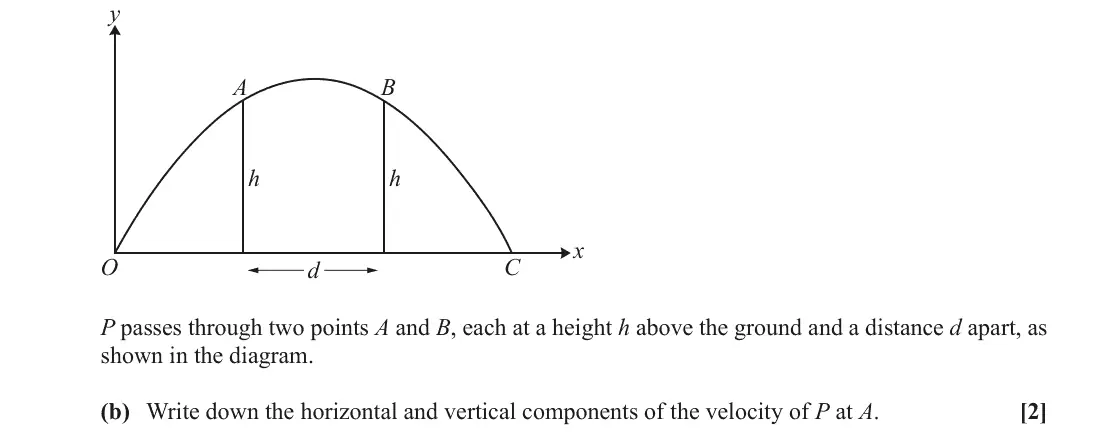
(Comment on Question 11 as a whole) Some candidates struggled with the algebraic format of this question. Those that set out their ‘suvat’ equations clearly distinguishing horizontal and vertical components were more success. Of those candidates that made a good attempt at part (a), a few dropped marks by only calculating the horizontal distance travelled to get to the maximum height – a valid method but which was only 1 2OC . Some otherwise excellent attempts to part (b) had answers in terms of an introduced variable T (or similar); this could only be given full marks if T was explicitly defined as part of the solution. Part (c) and part (d) proved the most challenging, with only the most able candidates making any meaningful progress. Both parts required careful notation to avoid confusing terms. For example, in Vertical component of velocity part (d) some candidates recognised tan θ = but the working Horizontal component of velocity suggested they used values at O rather than A. Guidance on using this paper as a mock This paper has a good range of questions on Pure and Mechanics and while overall there was a nice gradient on demand, it should be noted that Question 2 proved more challenging for this cohort than was expected with respect to its position on the paper. Section A Pure Section B Mechanics Mensuration in non-right angle triangles. Constant acceleration problem using vectors. Curve transformations. Investigate linear motion of particle with variable acceleration. Inverse and compound functions. Particles connected by pulley system involving rough slope. Investigating ln curves using calculus and Moments problem involving rod held in numerical methods. equilibrium. Investigating gradients and enclosed areas of Investigating flight of a projectile over level curves defined parametrically. ground. Investigating curves using implicit differentiation.
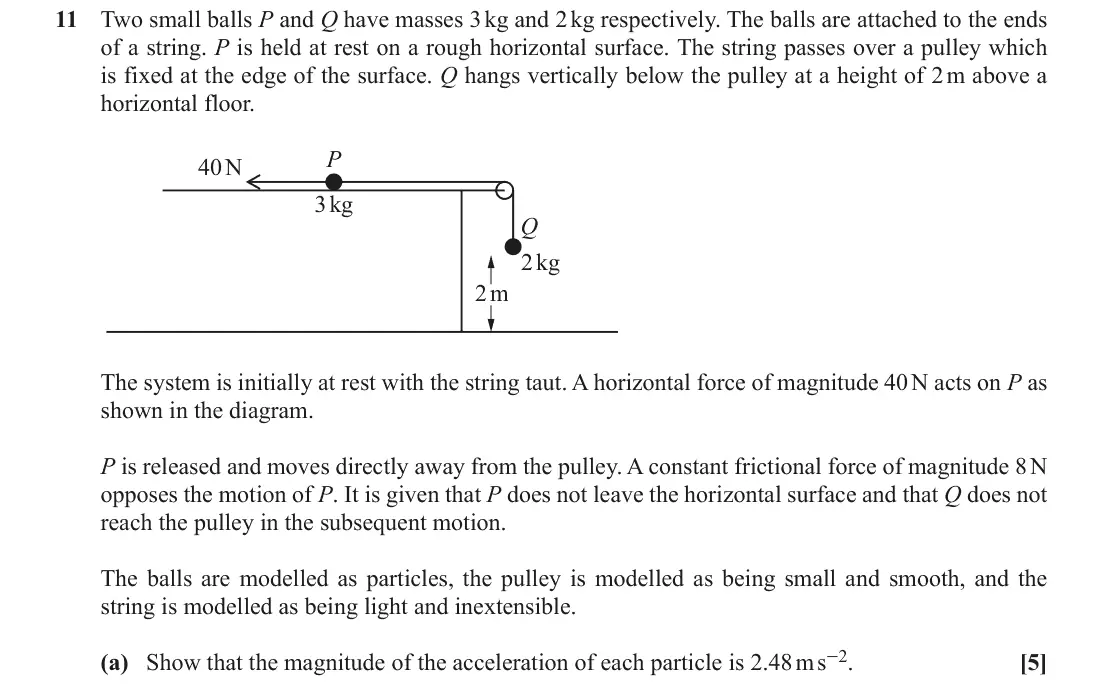

This part proved challenging. Those trying to follow the main approach on the Mark Scheme who realised they had to find the extra distance travelled until the string broke, and the velocity at this instant, then often did not take account of the signs needed for a correct equation from s = ut + ½at2.Some used s = 1.69 and/or u = 0, both of which scored M0. Those who tried to break the motion into ‘up’ and ‘down’ often used 2.31as the distance down, failing to calculate the extra distance needed to reach the highest point. This approach was generally not very successful.

This was also spoiled by the use of u =0, s = 1.69 or even s = 2.


Candidates were evenly split between those who correctly used with and s = ut + at s = 0 ,a = − g t = 2 4 . , and those who used v = u + at with v = 0 ,a = − g and t = 1 2 . . Where errors occurred it was usually in mixing up these two methods, for example, some candidates applied v = u + at with v = 0 ,a = − g and t = 2 4 . .
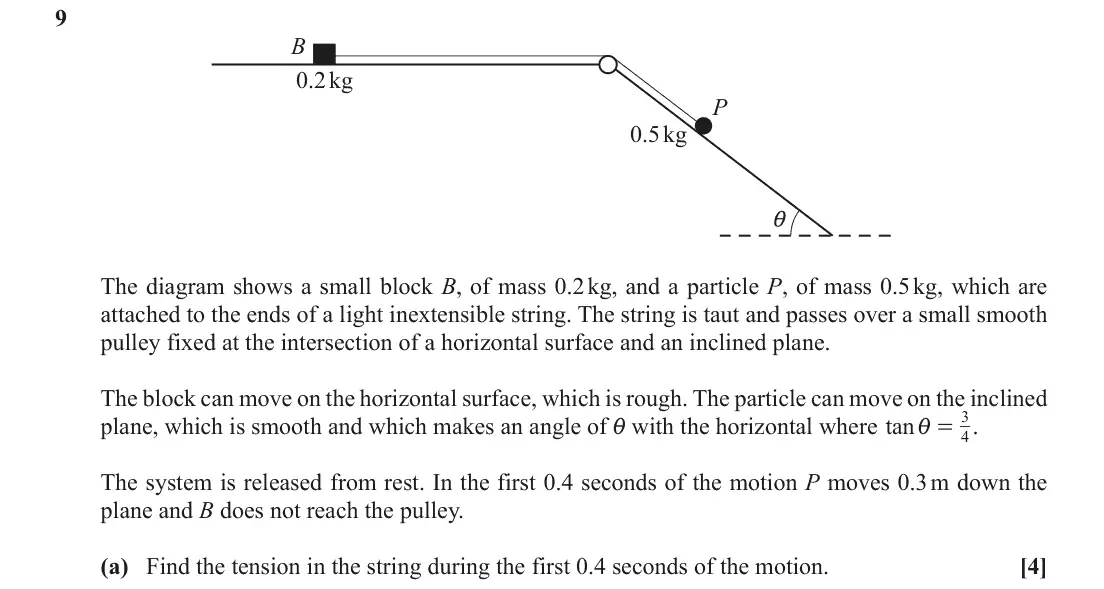
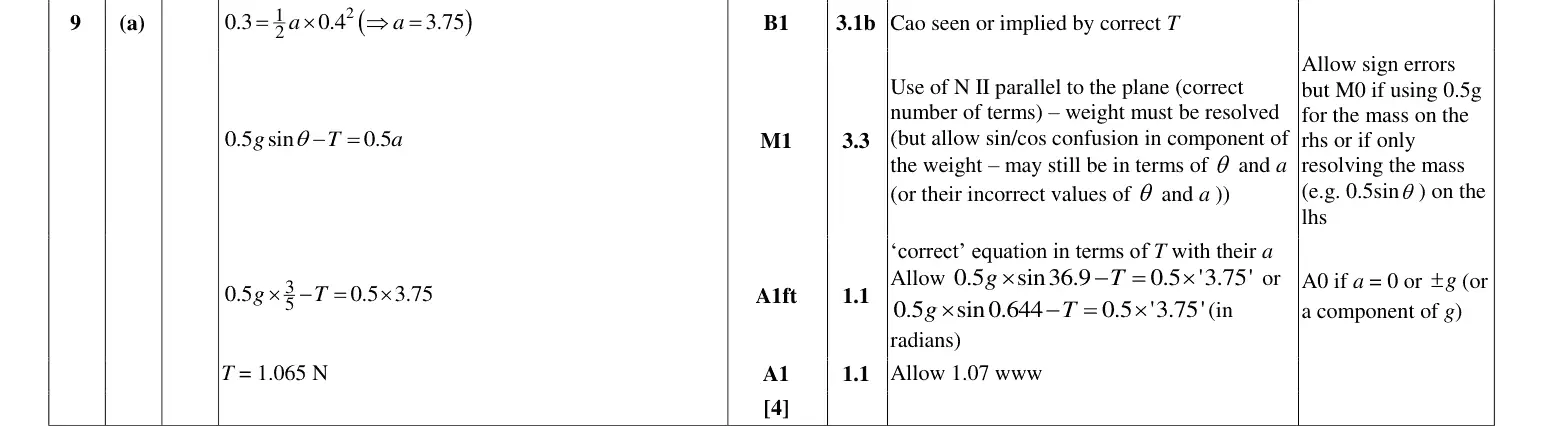
Examiners noted that it was rather surprising that while many candidates could correctly apply Newton’s second law for particle P and obtain a correct equation of the form 0 5gsin . θ − T = 0 5 . a , a significant proportion failed to calculate the acceleration correctly as 3.75 with many believing that the acceleration was 0.75 (which came from incorrectly dividing 0.3 by 0.4). It was pleasing though to note that many candidates used the correct exact value of sinθ = instead of needing to work out θ as 36.869…
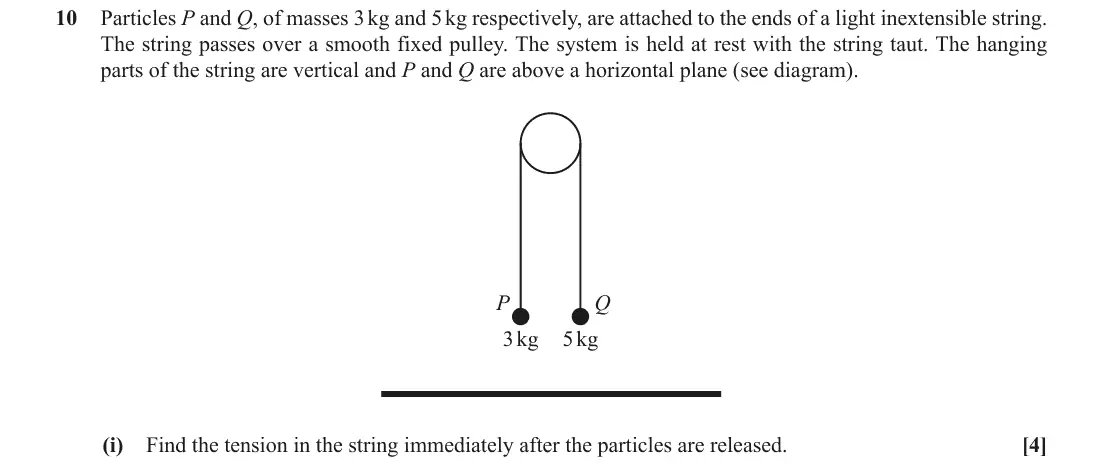

We expected to see an acceleration other than g or 0 used for the descent of Q. Some candidates used v = 0 for this phase rather than u = 0, presumably because ‘Q strikes the plane and is immediately brought to rest’. Those who now looked at the next phase of the motion sometimes did not realise that it was motion under gravity. Some good attempts omitted to double 0.625.
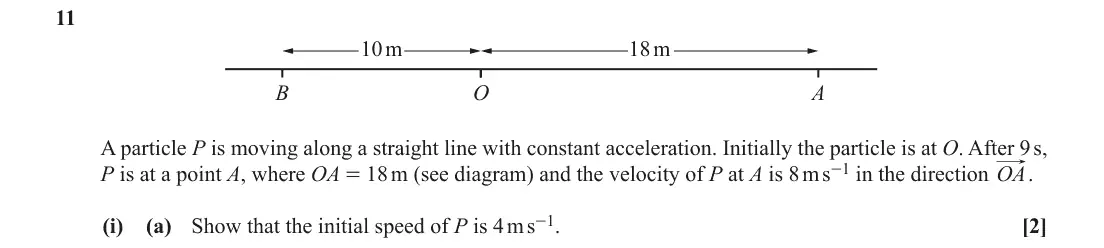
(Comment on Question 11(i) as a whole) To gain full credit in this part examiners expected to see u = -4 in the working as well as 4 appearing. Whilst s = ½(u + v)t was widely used, sign fudging was seen. Explanations clearly distinguishing between velocity and speed were unusual. Once again the necessary methods were widely used, with v = u + at the equation used most. This was often done with u = 4, candidates not realising the importance of the minus sign. Those who used the equation s = vt - ½at2 avoided this consideration here.

(Comment on Question 11(i) as a whole) To gain full credit in this part examiners expected to see u = -4 in the working as well as 4 appearing. Whilst s = ½(u + v)t was widely used, sign fudging was seen. Explanations clearly distinguishing between velocity and speed were unusual. Once again the necessary methods were widely used, with v = u + at the equation used most. This was often done with u = 4, candidates not realising the importance of the minus sign. Those who used the equation s = vt - ½at2 avoided this consideration here.

This part proved to be a challenge and, although there are various ways of solving the problem, candidates did not always make their intentions easy to follow. Were they considering the motion from O or B? Some even appeared to be considering A. Those trying s = ut + ½at2 once again had sign difficulties, with u = 4 and/or s = 10 used quite widely.
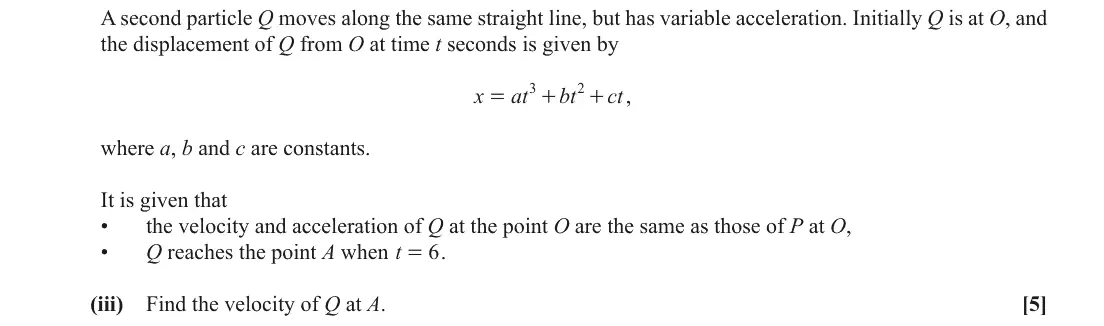
Few fully correct solutions were seen to this part. Many just earned one mark for differentiating the given displacement equation, seemingly not understanding that t = 0 needed to be used in the work to find b and c (not t = 6) and then t = 6 needed to obtain a. A number of candidates attempted to solve this part using the constant acceleration formulae.
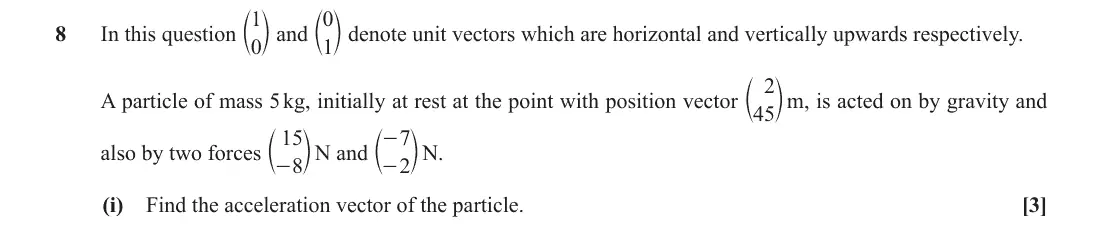

The majority of candidates correctly applied the vector form of s = u t + a t in an attempt to find the 2 position vector of the particle after 10 seconds, and it was generally only the errors mentioned in part (i) that stopped candidates from scoring full marks in this part.


This part was answered extremely well with many candidates correctly finding the total distance that car had travelled when its speed had reached 25 ms-1. Many correctly realised that they had to use integration to find an expression for the displacement in terms of t which they could then use to find the distance travelled by the car in the first 20 seconds. However, many ignored the constant of integration that would arise from the corresponding indefinite integral; even though this constant was zero it is mathematically incorrect to simply ignore it (and for full marks candidates either had to consider this displacement expressed as a definite integral or explain why the constant was zero). Most candidates then used the SUVAT equations to work out the remaining distance travelled when the speed increased from 14 to 25 and correctly calculated the total distance as 265 m.
Stuck on this? Book a trial session with an A-level maths tutor.