41 question parts, 136 marks, each rated Easy, Medium or Hard from the wording of the examiners' report
Notes, worked examples and practice for this topic are being written by our tutors. The past-paper questions below are ready now: work each one on paper, then open the mark scheme and the examiner's comment.
Tap a question to zoom it. Mark scheme and examiner's comment open under each question.
June 2025 · AS Paper 1 · Q3(b)3 marksMedium
Show the start of this question
Mark scheme for this part
Examiner's comment
Most candidates correctly substituted their completed square form from (a) in place of the two terms in x. However, many candidates then went on to attempt to complete the square in y, often giving (𝑦−4)2 from not noticing that there was no linear term in y and so this wasn’t correct. Most candidates with a correctly substituted form stated the centre and radius correctly, although a few gave the radius as 25 or ±5.
Key points and common errors
(x − 3)² + y² = 25: centre (3, 0), radius 5
error completing the square in y as (y − 4)²
radius not 25 or ±5
June 2025 · Paper 2 · Q58 marksEasy
Mark scheme for this part
Examiner's comment
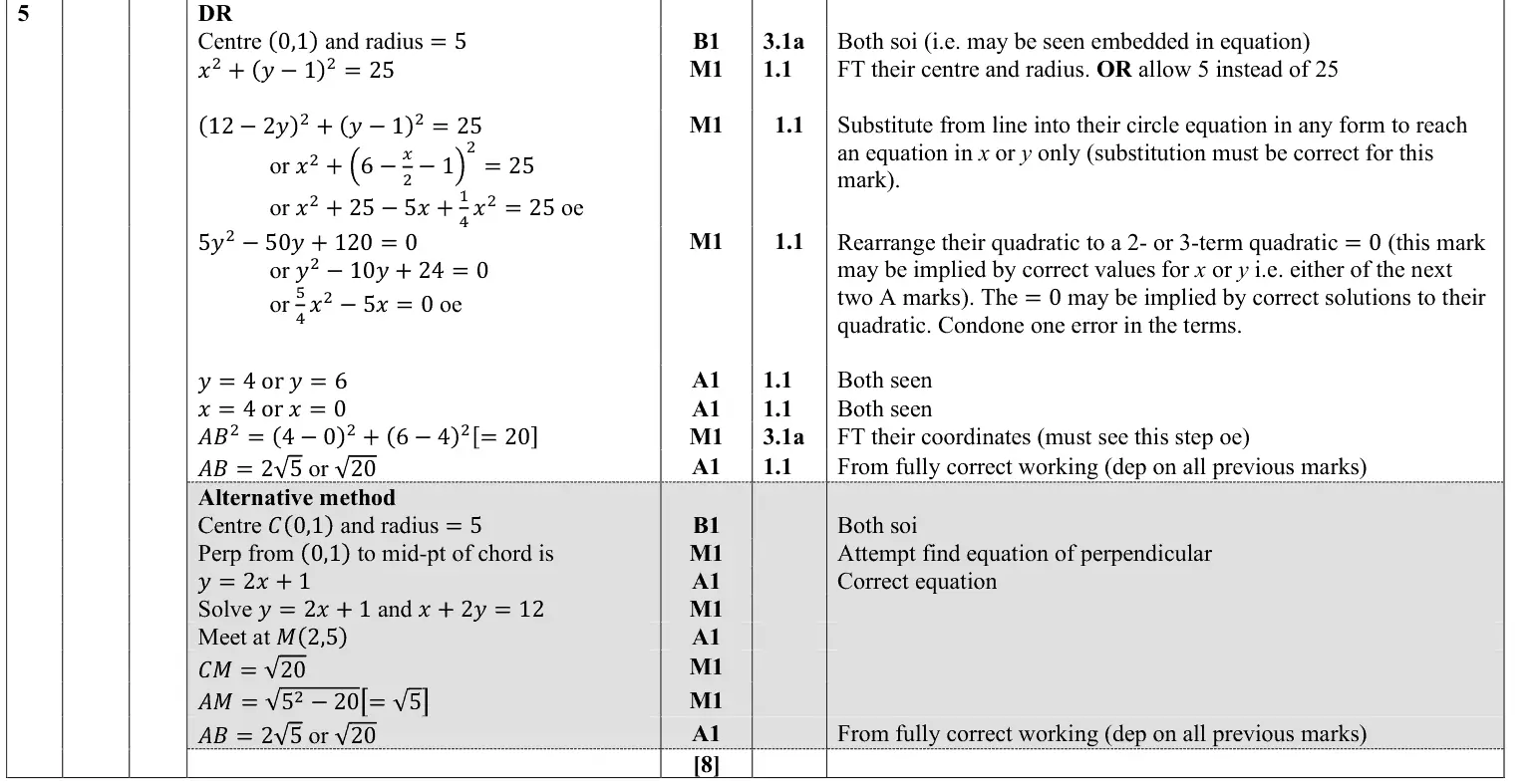
This problem-solving question was well answered by most candidates, with many fully correct responses seen. Candidates first needed to deduce the centre and radius of the circle from the given information to score B1 (which was generally done well, although some candidates wrote down 10 and misinterpreted this as the radius rather than the diameter). The next step was to write down a cartesian equation for the circle for M1 (the most common error here was forgetting to square the radius), and solve this simultaneously with the line equation by substitution for x or y. Most candidates proceeded well to obtain a quadratic in x or y and solve this to find the coordinates of the two points of intersection, although quite a few incorrectly factorised the quadratic. Most candidates who obtained two points correctly used coordinate geometry to calculate the distance between them. Most candidates heeded the DR instruction and showed an appropriate amount of working in this question. The alternative method shown in the scheme was only occasionally seen. This candidate has identified the correct parameters for the circle and setup the equation correctly, substituting appropriately to reduce to a 3-term quadratic in y only (scoring B1M1M1M1). However, they obtain a quadratic with a sign error (the scheme allowed ‘one error in the terms’ for the method mark) so do not find the correct coordinates of the points of intersection (A0A0). They go on to compute the distance between these (M1) but do not obtain the correct final answer because of their earlier error (A0). This is a good example of a candidate who has shown their method in full (as required by DR) and scores the majority of the marks in this question despite making an error.
Key points and common errors
centre (0, 1), radius 5 (not 10)
substitute line into x² + (y − 1)² = 25
A(4, 4) and B(0, 6)
AB = 2√5
errors forgetting to square radius, factorising
June 2024 · AS Paper 1 · Q85 marksMedium
Mark scheme for this part
Examiner's comment
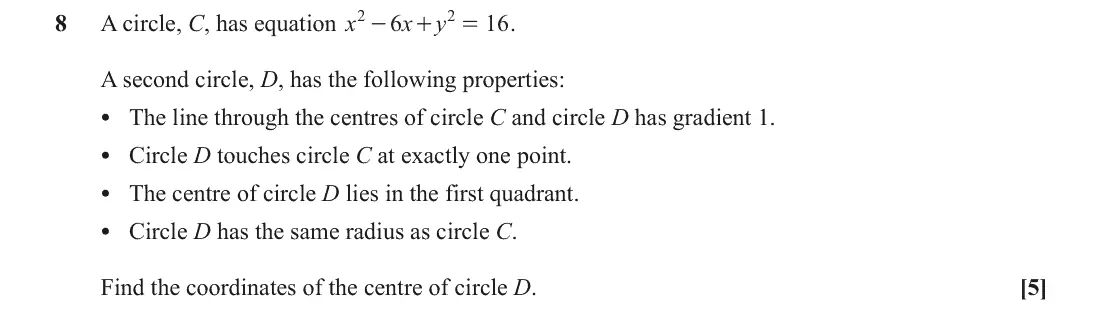
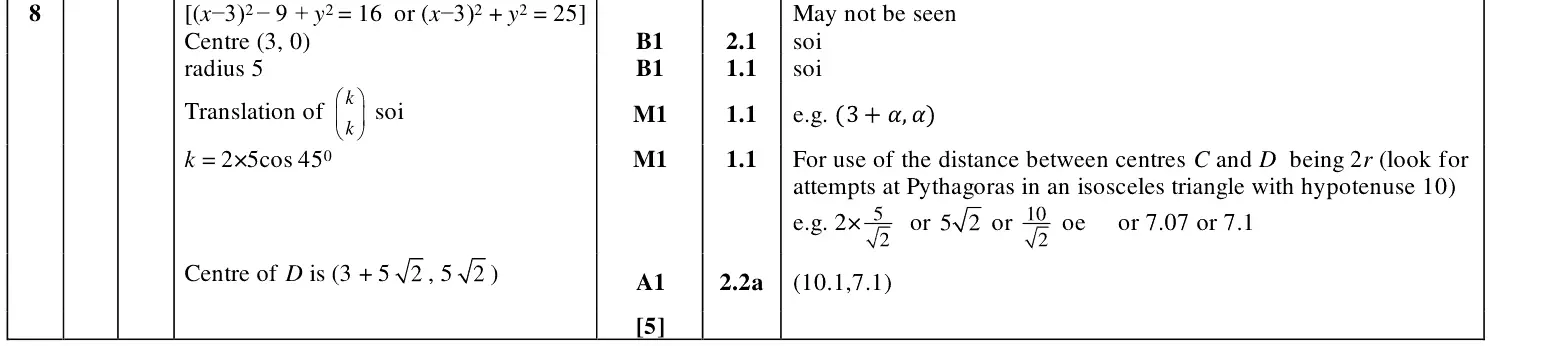
Most candidates successfully completed the square to correctly obtain the centre and radius of circle C (although a number did not do so in full and assumed that the radius was 4). Many candidates correctly interpreted the ‘gradient 1’ statement and deduced an equation of the line between the two centres, although often did not progress this into the deduction about the difference in the coordinates of the centre of D being 3. Fewer candidates used the other information to deduce that the distance between the two centres was 2r (=10), but those who did were then able to apply Pythagoras, or trigonometry, to compute the x- and y- change.
Key points and common errors
complete the square: centre (3, 0), radius 5 (not 4)
centres lie on a line of gradient 1 and are 2r = 10 apart
translation (k, k) with k = 5√2
centre D (3 + 5√2, 5√2)
June 2024 · Paper 3 · Q6(b)(i)2 marksHard
Show the start of this question
Mark scheme for this part
Examiner's comment
Most candidates left this part blank or made very little progress (especially if arcsin or arccos had been used in the previous part). Of those who had used sin2𝑡+ cos2𝑡= 1 in part (a), many did not recognise the condition that for 𝐶 to be a circle that 𝑘2 = 16 and hence that the radius was 4.
Key points and common errors
circle requires k² = 16
radius 4 (positive only)
June 2024 · Paper 3 · Q6(b)(ii)2 marksHard
Show the start of this question
Mark scheme for this part
Examiner's comment
This was similar to the previous part, in that very few candidates attempted this part and of those who did very few got the correct (two) answers. Of those that did make some progress, many gave a single answer in terms of 𝑘 (most notably (4𝑘, 2)).
Key points and common errors
k = ±4 gives centres (16, 2) and (−16, 2)
a single answer (4k, 2) is incomplete
June 2023 · AS Paper 1 · Q87 marksHard
Mark scheme for this part
Examiner's comment
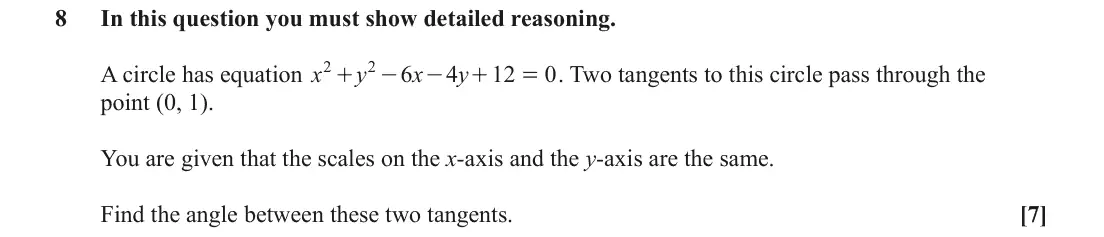
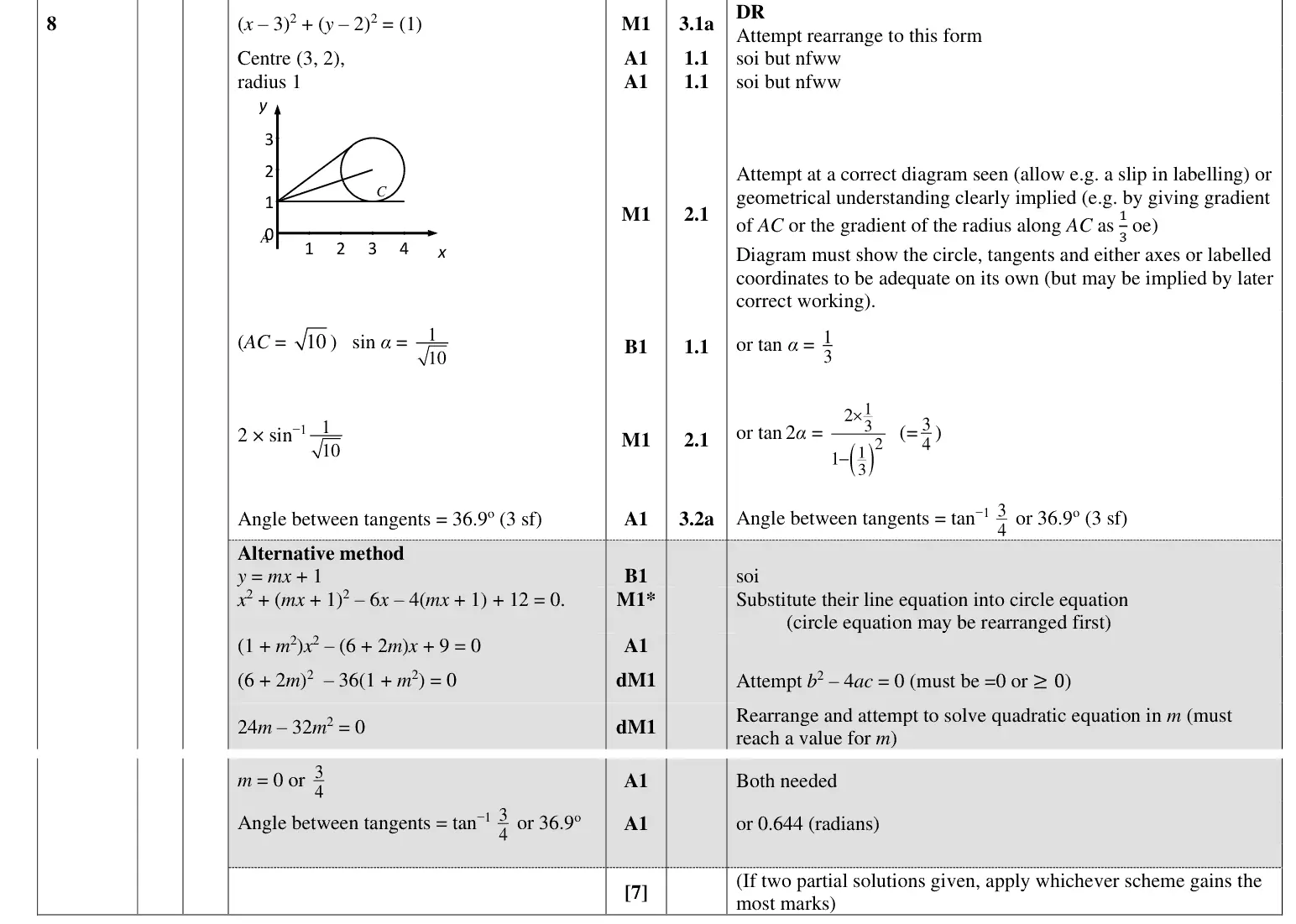
The scheme’s first method (finding the centre of the circle and applying coordinate geometry) was most common. Many candidates made a good attempt at completing the square in x and y to find the centre and radius of the circle (although there were quite a few errors, e.g. concluding that the centre was (-3, - 2) or (2, 3)). Many of these candidates then did not draw a correct diagram, often assuming that (0, 1) was on the circle and looking for a tangent through this point. Around half of candidates were able to show sufficient geometric understanding to achieve the middle M mark, but very few then went on to provide a complete solution using trigonometry to calculate the required angle. Fewer candidates attempted the alternative algebraic method, of using y = mx + 1 as the equation of the line through (0, 1) and attempting to find the values of m that resulted in this being a tangent to the circle. Those who did however were generally more successful, substituting in correctly and recognising the need to use the determinant. This is an example of an excellent response to this question. The erroneous gradient of 5 was ignored because the candidate then restarts their attempt in the final 3 lines. This candidate has drawn an adequate diagram (albeit not fully labelled) and then gone on to show correct geometrical understanding with their final triangle, which has allowed them to compute the required angle.
Key points and common errors
complete the square: centre (3, 2), radius 1
diagram
sin α = 1/√10
angle 2α = 36.9° (or tan⁻¹(3/4))
alt: discriminant of line and circle gives m = 0 or 3/4
many assumed (0, 1) was on the circle
very few completed
June 2023 · Paper 2 · Q6(a)7 marksHard
Mark scheme for this part
Examiner's comment
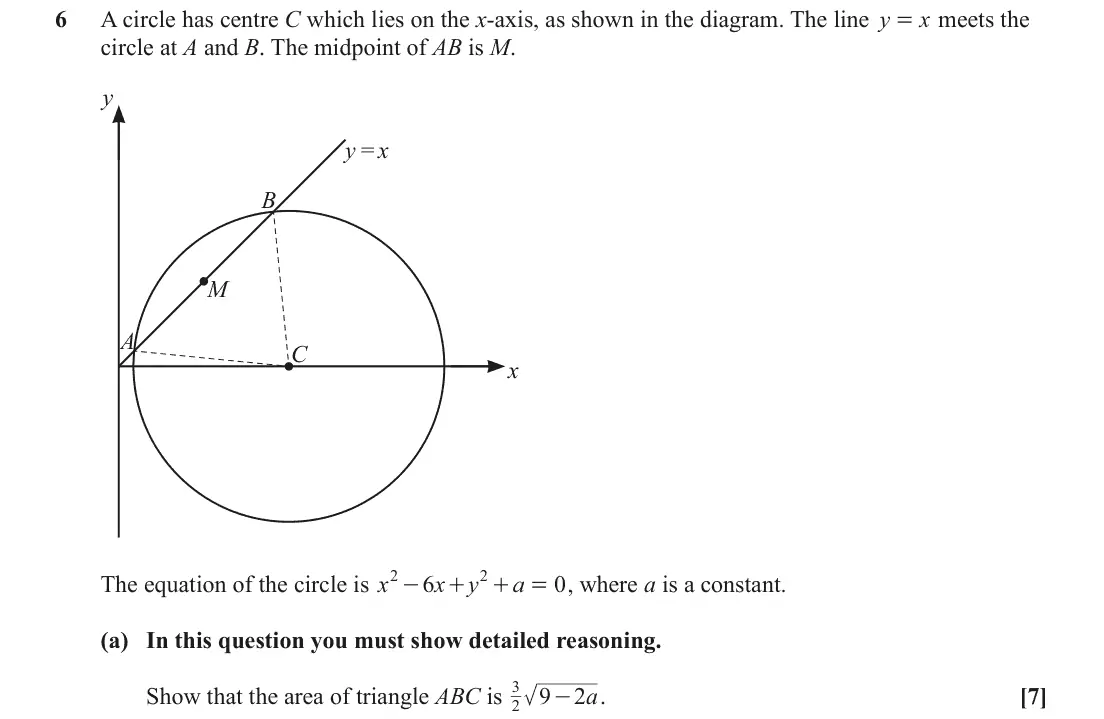
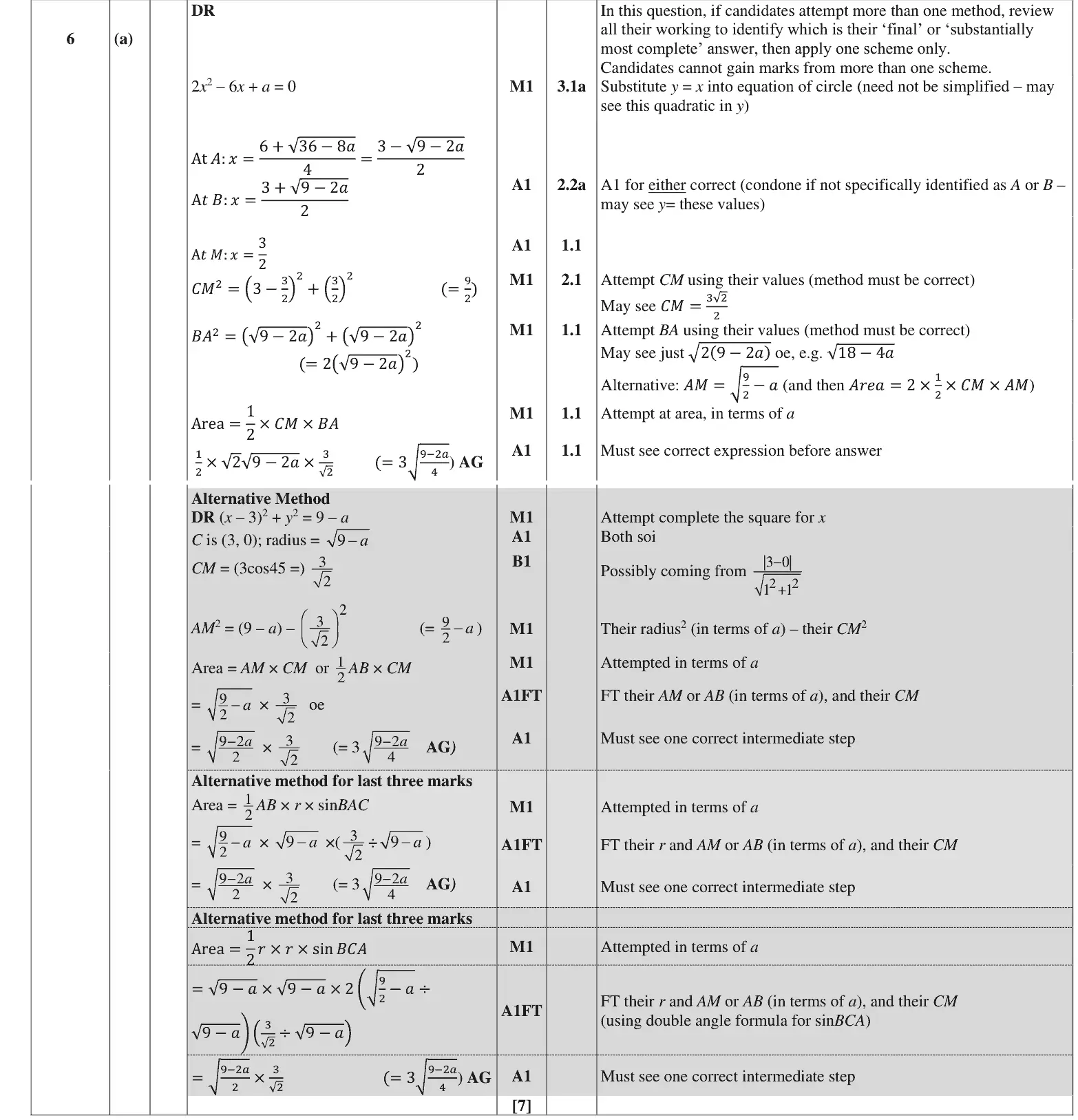
Many candidates appeared to find this question very challenging. A good number of candidates were able to obtain the first 1-2 marks by either attempting to complete the square or substitute in y = x and solve for one or both coordinates of the points of intersection A and B. Many candidates started with the alternative method (attempting to complete the square) and then reverted to the main method. Those candidates who proceeded beyond that first stage generally went on to successfully reach (or almost reach) the given answer - deducing the coordinates of M and finding two of the required lengths to allow them to form an expression for the area of the triangle. Many of these correctly handled the length of AB and were able to write down a correct expression for the required area. There was (despite the Detailed reasoning instruction) some evidence of candidates attempting to reverse-engineer the given result from ‘similar-looking’ terms in their expressions. A small number of candidates provided elegant alternative solutions, such as finding the area of triangle OBC and subtracting OAC, or (more commonly) finding CM and either AM or BM, then using 2x the area of triangle ACM or BCM.
Key points and common errors
substitute y = x: 2x² − 6x + a = 0
M has x = 3/2
CM = 3/√2 and AB from the roots
area = ½ × AB × CM = (3/2)√(9 − 2a)
June 2023 · Paper 2 · Q6(b)(ii)1 markHard
Show the start of this question
Mark scheme for this part
Examiner's comment
This (and part (c) below) was much less well answered. Many candidates attempted to compute either the area or radius (which was not required, and not sufficient). Relatively few candidates provided the required geometric explanation, with many making deductions like ‘there are no solutions’ or ‘area is invalid’, which were not acceptable. A few candidates stated that A and B are coincident, without explaining that therefore y = x is a tangent to the circle, which was acceptable.
Key points and common errors
y = x is a tangent to the circle (A and B coincide)
'no solutions' or 'invalid' gains nothing
June 2023 · Paper 2 · Q6(c)1 markHard
Show the start of this question
Mark scheme for this part
Examiner's comment
As in part (b) (ii), many candidates gave an insufficient (or non-geometric) explanation. Lots of candidates simply stated that this case is ‘impossible’ or ‘invalid’ without explaining that this is because the line does not meet the circle.
Key points and common errors
a = 5 makes 9 − 2a negative: the line y = x does not meet the circle
'impossible' alone gains nothing
June 2023 · AS Paper 2 · Q6(e)2 marksEasy
Show the start of this question
Mark scheme for this part
Examiner's comment
The form of the equation of a circle seemed well known. A subtraction sign was seen on the left-hand side in a few cases, as well as AB rather than AB2 on the right-hand side.
Key points and common errors
(x + 3)² + (y − 1)² = 65
sign errors in the centre
AB instead of AB²
June 2023 · AS Paper 2 · Q6(f)1 markMedium
Show the start of this question
Mark scheme for this part
Examiner's comment
Most responses that earned this mark solved their correct equations from (d) and (e) simultaneously, producing rather a lot of working. Very few candidates used the more efficient method involving similar triangles.
Key points and common errors
second intersection (1, 8): reflect B in A or solve simultaneously
similar triangles more efficient
June 2023 · Paper 3 · Q4(a)2 marksMedium
Mark scheme for this part
Examiner's comment
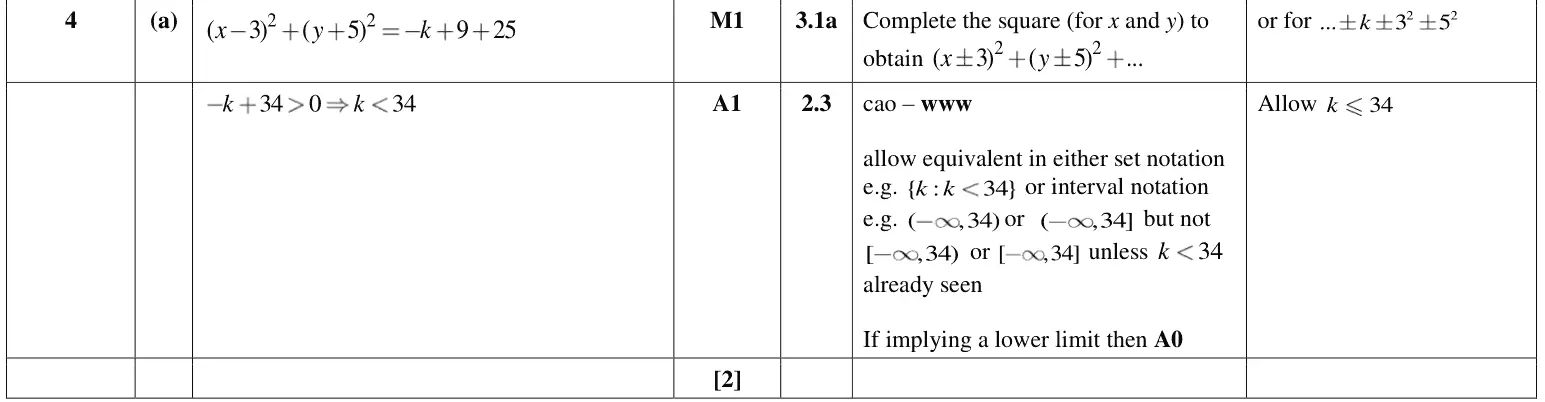
Although most candidates scored the first mark in this part for re-writing the equation as (𝑥𝑥−3)2 −9 + (𝑦𝑦+ 5)2 −25 + 𝑘𝑘= 0 not all then realised that (𝑥𝑥−3)2 + (𝑦𝑦+ 5)2 = 34 −𝑘𝑘 and (and hence 𝑘𝑘< 34). therefore, for the equation to represent a circle, the right-hand side of this equation had to be positive
Key points and common errors
complete the square: (x − 3)² + (y + 5)² = 34 − k
radius² must be positive so k < 34
no lower limit
June 2023 · Paper 3 · Q4(b)5 marksMedium
Show the start of this question
Mark scheme for this part
Examiner's comment
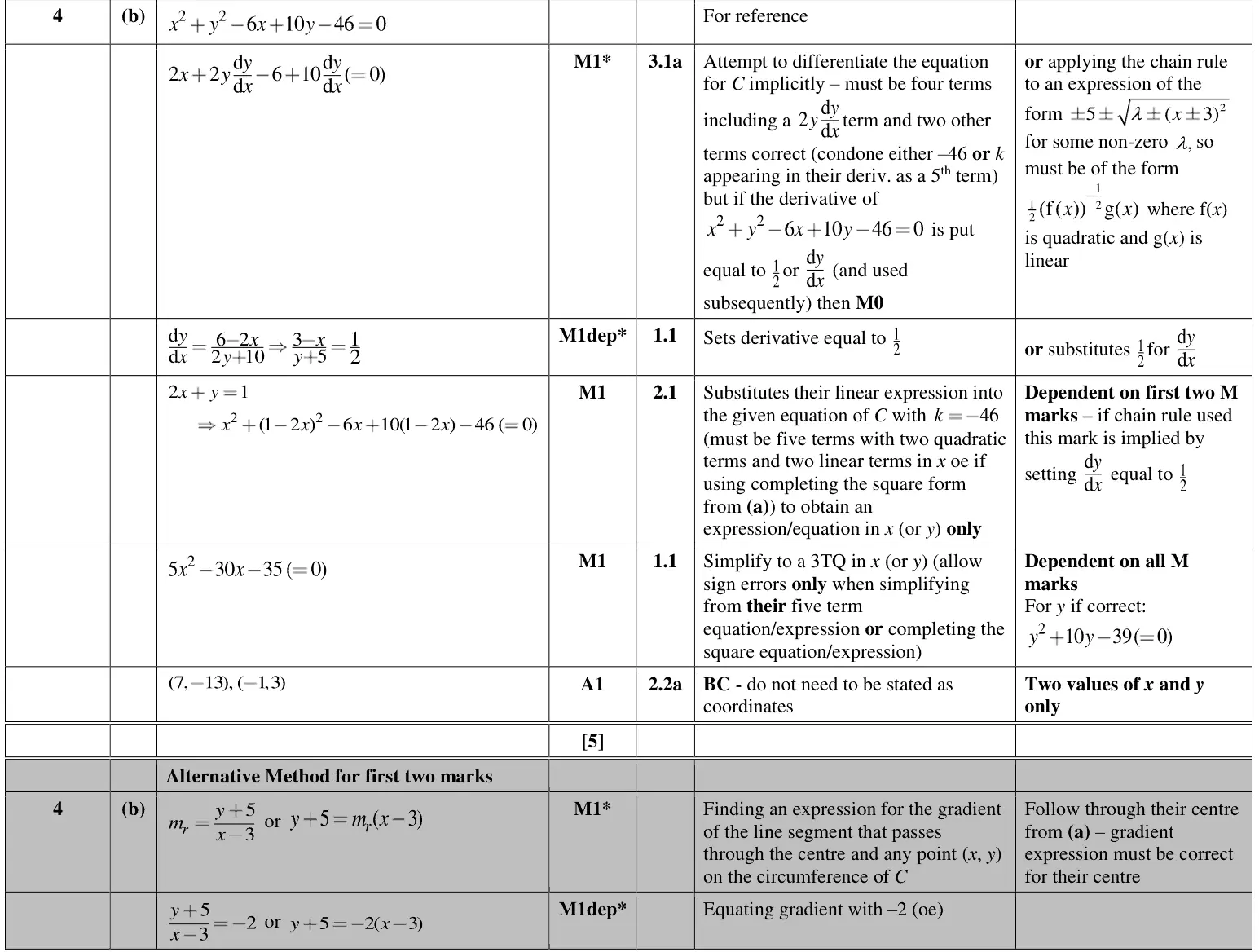
2 to obtain the linear equation 2𝑥𝑥+ 𝑦𝑦= 1. While some candidates, after deriving this The most common approach in this part was to differentiate the given equation for the circle implicitly d𝑥𝑥 equal to and set equation, made no further progress most correctly substituted this equation into the equation for C and solved the resulting three-term quadratic in x. While many obtained the correct x-coordinates as 7 and – 1 not all correctly obtained the corresponding y-coordinates. Candidates are reminded that when solving a pair of simultaneous equations with one linear and one quadratic equation, it is strongly advisable to find the second set of coordinates by substituting into the linear and not the quadratic equation.
Key points and common errors
implicit differentiation, set dy/dx = 1/2 to get 2x + y = 1
substitute into the circle: 5x² − 30x − 35 = 0
points (7, −13) and (−1, 3)
pair y-values with x correctly
June 2022 · AS Paper 1 · Q7(a)5 marksMedium
Mark scheme for this part
Examiner's comment
Many candidates began this question by rearranging the equation into the form (x − a)2 + (y − b)2 = r2. This was unnecessary, although full marks could still be scored using this form. Some candidates attempted some sort of algebraic solution that did not involve substituting mx for y in the second equation. They were not able to make any progress. Many candidates, however, did make the substitution, but some did not know how to proceed from there. A good number of candidates did attempt to form the discriminant, although some candidates’ discriminant was in terms of both x and m, which is incorrect. Those candidates who formed the discriminant in terms of m only were generally successful, although some made minor errors in the algebra. A few candidates found the correct critical values of m but lost the final mark by giving an incorrect final answer such as [ −1 2 < m < 2] or [m < −1 2 and m > 2].
Key points and common errors
substitute y = mx: (1 + m²)x² − (6 + 2m)x + 5 = 0
discriminant ≥ 0 gives −16m² + 24m + 16 ≥ 0
−1/2 ≤ m ≤ 2
discriminant must be in m only
June 2022 · AS Paper 1 · Q7(b)3 marksMedium
Show the start of this question
Mark scheme for this part
Examiner's comment
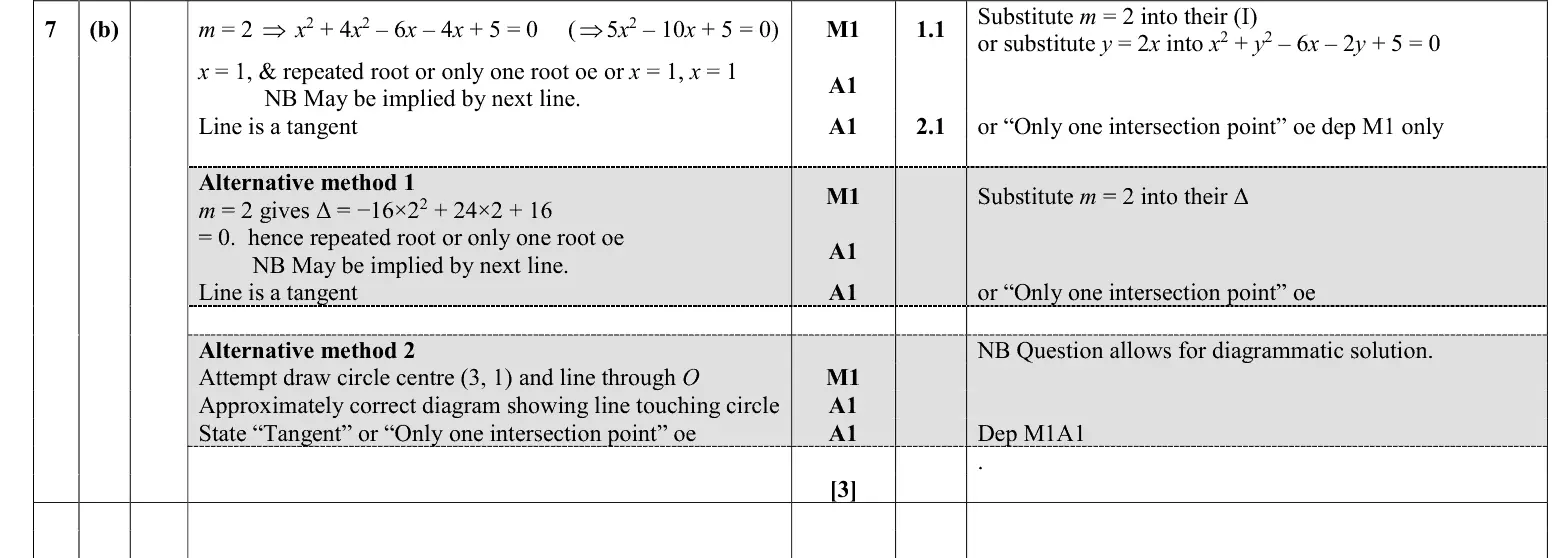
Many candidates did not appreciate what a “geometrical interpretation” involves. Some just solved the equations in the case where m = 2, and gave the solution x = 1, without commenting on the fact that this was a repeated solution. Some attempted to draw a sketch of a circle and a line. Although their circle was roughly correct in many cases, the line was often incorrect, not even passing through the origin. Many candidates used a different approach, substituting m = 2 into their expression for the discriminant. If their expression was correct, this led to a value of 0, and most drew the correct conclusion that the line was a tangent to the circle.
Key points and common errors
m = 2 gives 5x² − 10x + 5 = 0, repeated root x = 1 (discriminant 0) so the line is a tangent to the circle
just solving for x is not an interpretation
June 2022 · Paper 2 · Q2(b)3 marksHard
Show the start of this question
Mark scheme for this part
Examiner's comment
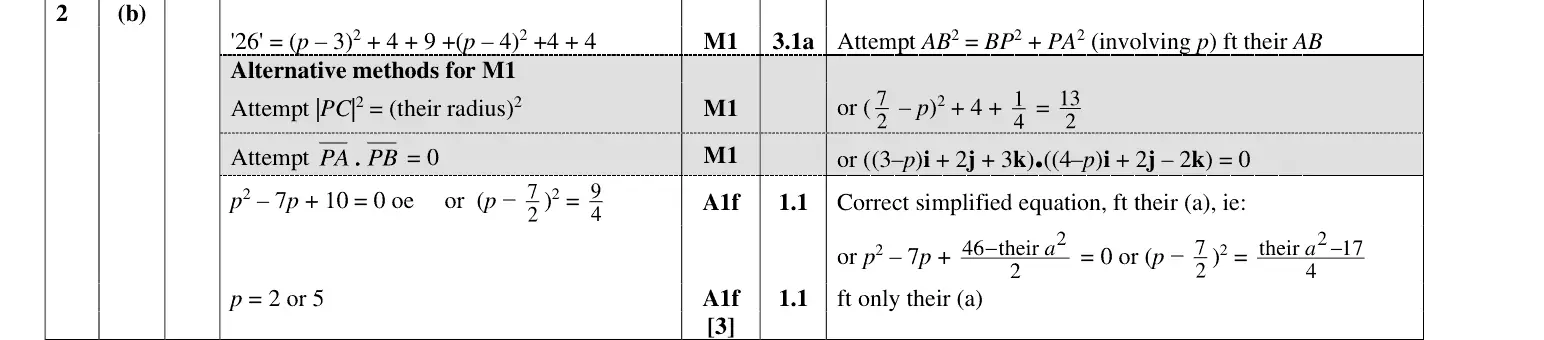
Perhaps the quickest way to approach this question is to use Pythagoras’ theorem. However, very few candidates used this approach. Many attempted to find the position vector of the centre, C, of the circle and then used |PC|2 = radius2. These candidates generally scored the first mark, but lost the other marks by making arithmetical slips. Some omitted the j component. Some omitted to halve the diameter. A common, more serious, error was |OP|2 = radius2.
Key points and common errors
angle in a semicircle: AB² = AP² + BP², or PC² = r² with C the midpoint
p² − 7p + 10 = 0
p = 2 or 5
errors: forgetting to halve the diameter, using OP
June 2022 · AS Paper 2 · Q43 marksMedium
Mark scheme for this part
Examiner's comment
Generally, this was well attempted, with most candidates making some attempt to complete the square and gaining the first mark. Subsequently some struggled to set up an equation relating k and the radius correctly with confusion about whether to use 5 or 52. The method mark for the equation –k + 13 = 52 was dependent on the mark for attempting to complete the square. Sign errors were prevalent in this question.
Key points and common errors
(x − 3)² + (y + 2)² = 13 − k = 25 so k = −12
confusion over 5 or 5²
sign errors prevalent
June 2022 · Paper 3 · Q34 marksMedium
Mark scheme for this part
Examiner's comment
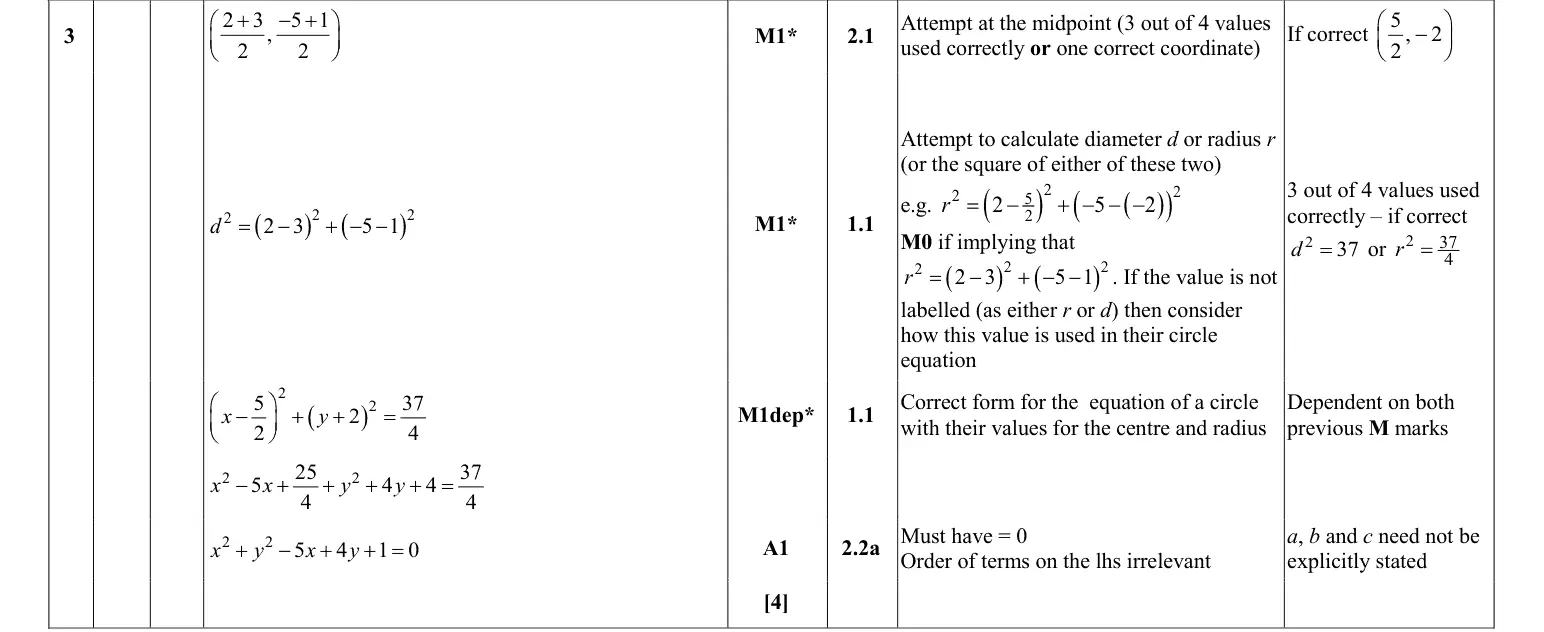
Almost all candidates attempted to find the equation of the required circle by first finding the corresponding centre and radius. However, many candidates clearly thought that the distance between the two given points was the radius and not the diameter and, although less common, several x − x y − y , . candidates thought that the centre of the circle was given by the formula Even when 2 2 5 37 ( ) − + + = candidates correctly had the circle in the form x y 2 , many struggled to simplify to the 2 4 required form.
Key points and common errors
centre is the midpoint (5/2, −2)
PQ is the diameter, r² = 37/4
x² + y² − 5x + 4y + 1 = 0
errors: using PQ as the radius
Autumn 2021 · Paper 2 · Q5(b)5 marksHard
Show the start of this question
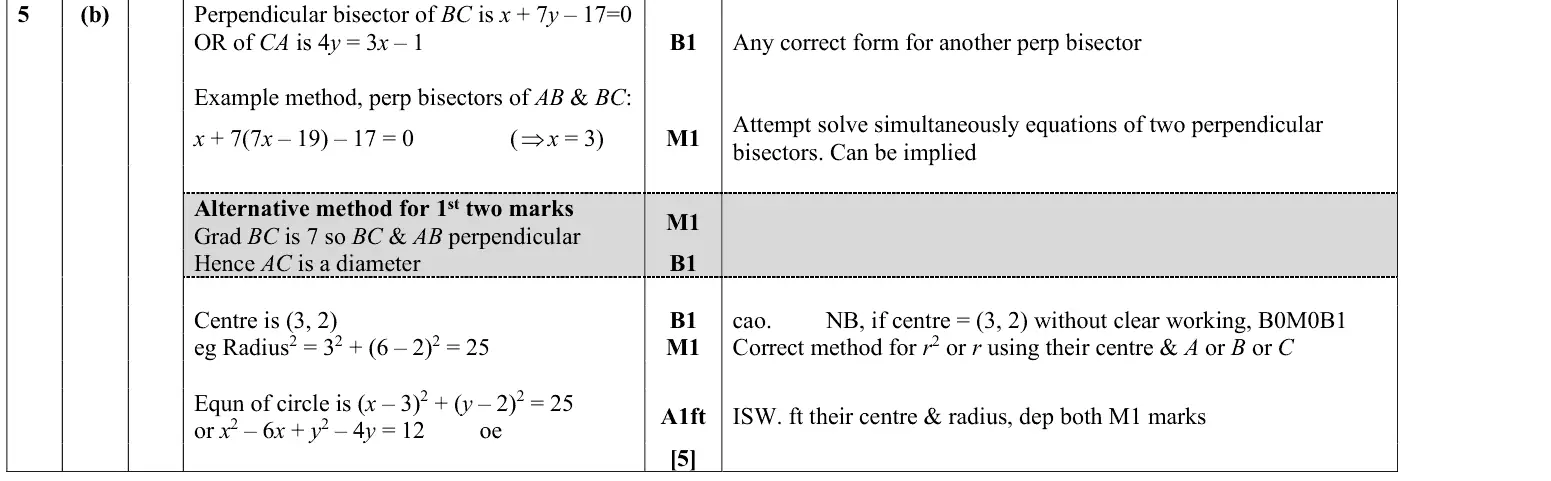
Mark scheme for this part
Examiner's comment
(From the general report) Question 5: Most candidates coped well with part (a), but many made no headway with part (b).
Key points and common errors
centre is the intersection of two perpendicular bisectors (or AC is a diameter since AB ⟂ BC)
centre (3, 2), r² = 25
(x − 3)² + (y − 2)² = 25
many made no headway
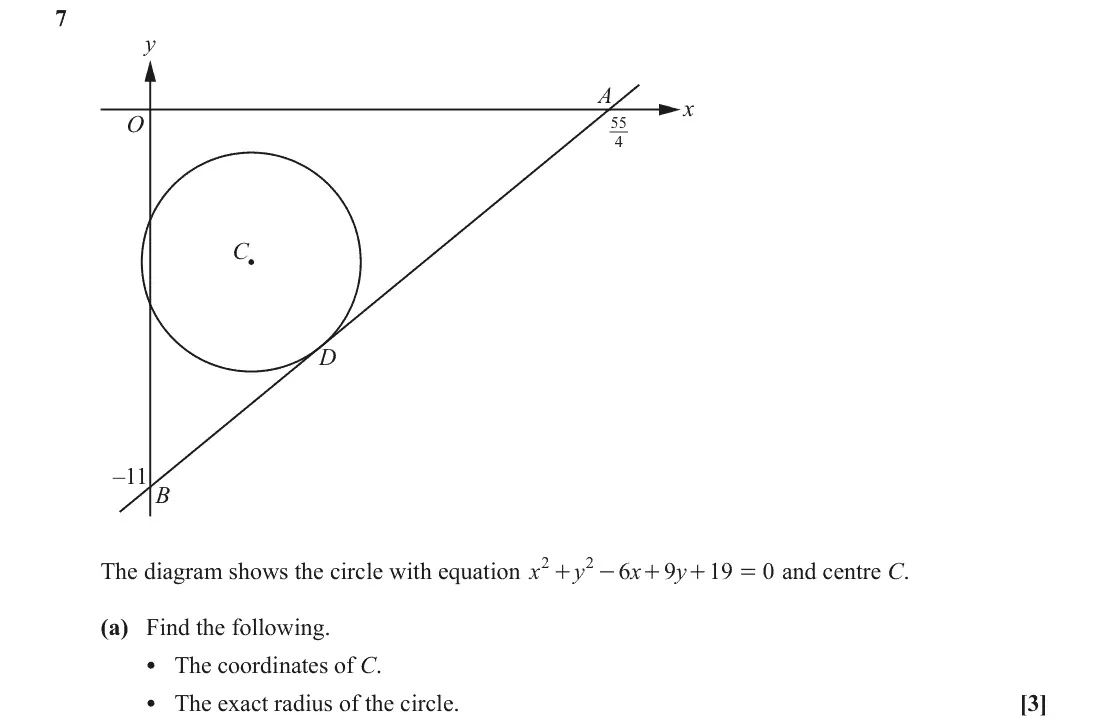
Autumn 2021 · AS Paper 2 · Q7(a)3 marksMedium
Mark scheme for this part
Key points and common errors
complete the square: C(3, −9/2), radius √41/2
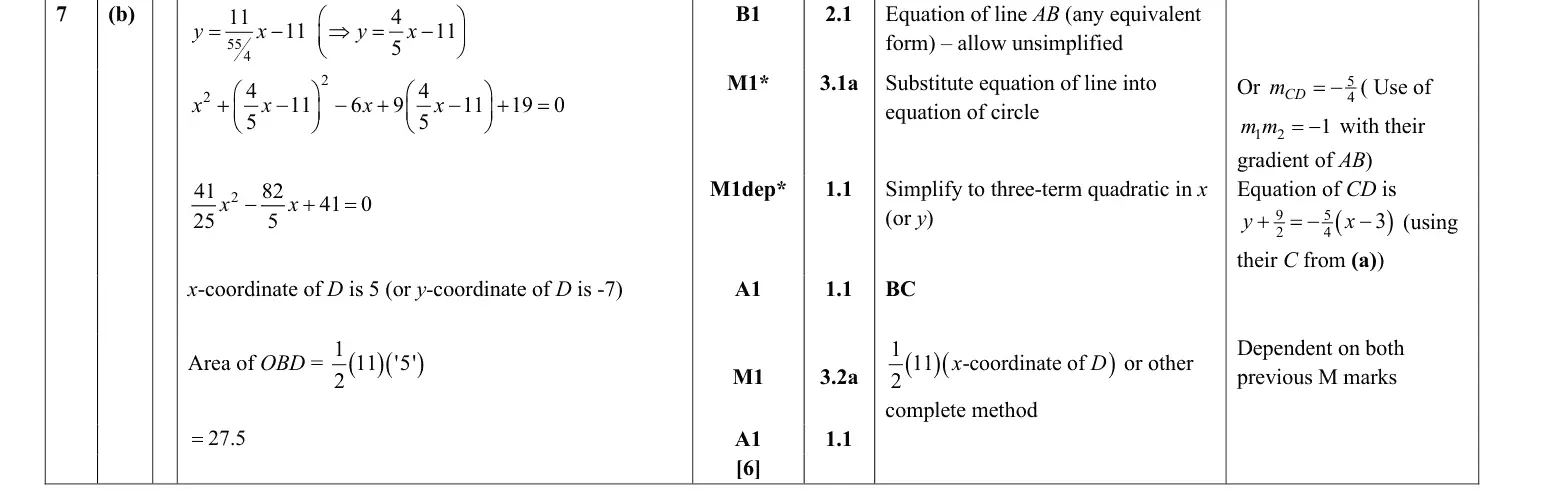
Autumn 2021 · AS Paper 2 · Q7(b)6 marksMedium
Show the start of this question
Mark scheme for this part
Key points and common errors
line AB: y = (4/5)x − 11
substitute into the circle to get a repeated root x = 5 (or use CD perpendicular to AB)
area OBD = ½ × 11 × 5 = 27.5
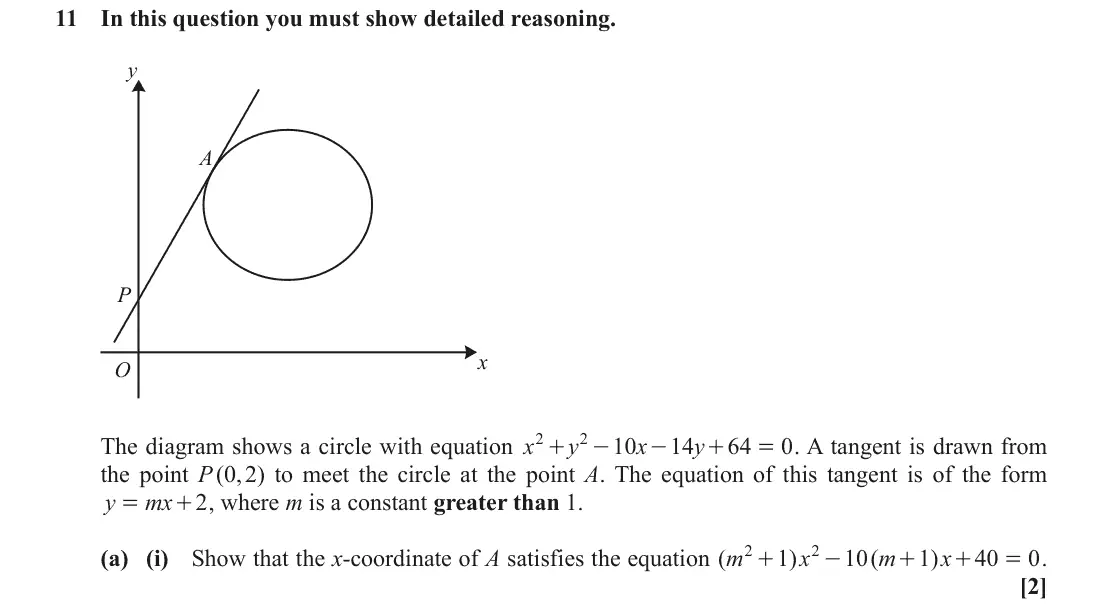
Autumn 2020 · Paper 1 · Q11(a)(i)2 marksEasy
Mark scheme for this part
Examiner's comment
(Comment on Question 11 as a whole) Question 11 was the only ‘In this question you must show detailed reasoning’ question on the paper, and candidates were expected to show a detailed and complete analytical method. Part (a)(i) was generally very well answered, but the remainder of the question proved challenging. Part (ii) is a good example of where candidates have to link different topic areas – they are considering a quadratic equation and the fact that the line is tangential should indicate that the required strategy is to equate the discriminant to 0. Candidates struggled with the non-standard aspect of part (b), although some were able to gain some credit for working out relevant lengths and a relevant trigonometric ratio. Of the few that were so far successful, they were expected to continue to work in exact values to justify the request in the question, which not all candidates appreciated.
Key points and common errors
substitute y = mx + 2 into the circle
expand and tidy to the given quadratic including '= 0'
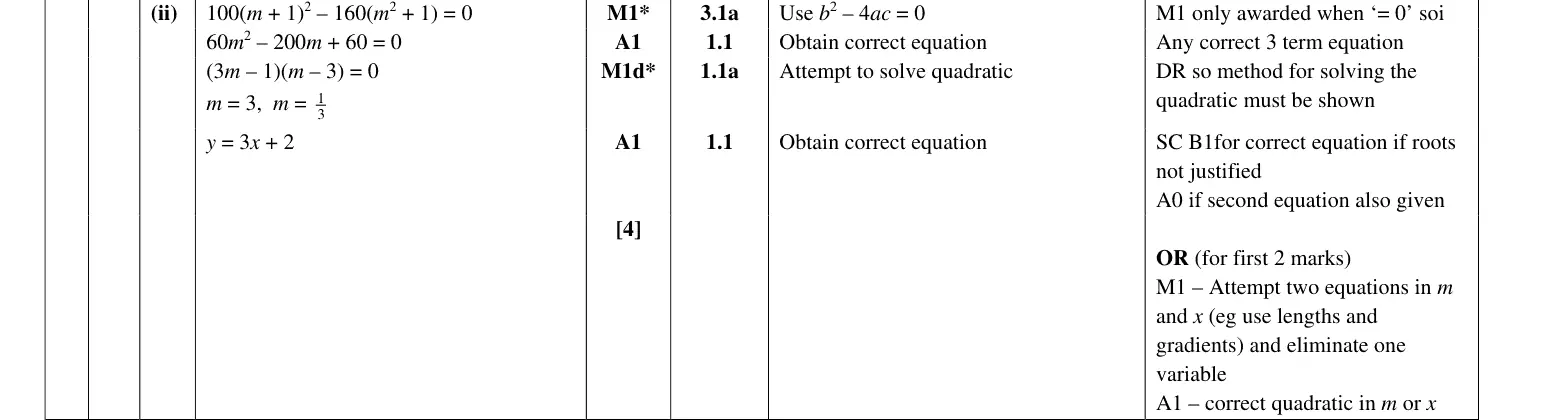
Autumn 2020 · Paper 1 · Q11(a)(ii)4 marksHard
Show the start of this question
Mark scheme for this part
Examiner's comment
(Comment on Question 11 as a whole) Question 11 was the only ‘In this question you must show detailed reasoning’ question on the paper, and candidates were expected to show a detailed and complete analytical method. Part (a)(i) was generally very well answered, but the remainder of the question proved challenging. Part (ii) is a good example of where candidates have to link different topic areas – they are considering a quadratic equation and the fact that the line is tangential should indicate that the required strategy is to equate the discriminant to 0. Candidates struggled with the non-standard aspect of part (b), although some were able to gain some credit for working out relevant lengths and a relevant trigonometric ratio. Of the few that were so far successful, they were expected to continue to work in exact values to justify the request in the question, which not all candidates appreciated.
Key points and common errors
tangent so discriminant = 0: 60m² − 200m + 60 = 0
m = 3 or ⅓
m > 1 so y = 3x + 2
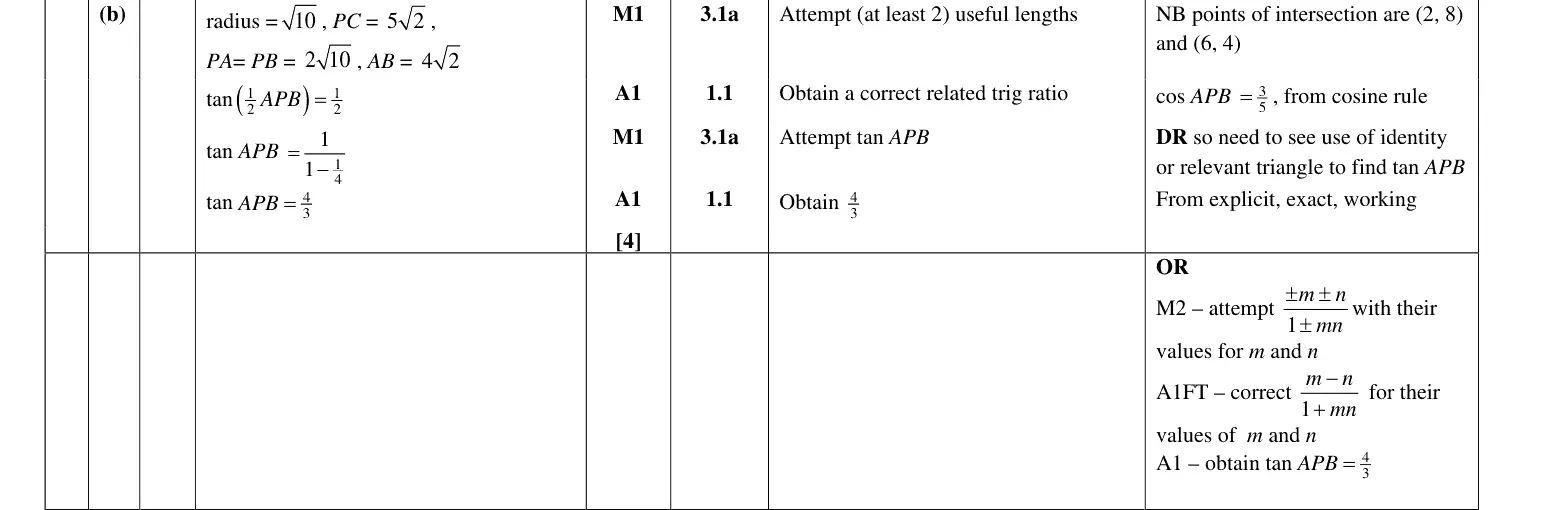
Autumn 2020 · Paper 1 · Q11(b)4 marksHard
Show the start of this question
Mark scheme for this part
Examiner's comment
(Comment on Question 11 as a whole) Question 11 was the only ‘In this question you must show detailed reasoning’ question on the paper, and candidates were expected to show a detailed and complete analytical method. Part (a)(i) was generally very well answered, but the remainder of the question proved challenging. Part (ii) is a good example of where candidates have to link different topic areas – they are considering a quadratic equation and the fact that the line is tangential should indicate that the required strategy is to equate the discriminant to 0. Candidates struggled with the non-standard aspect of part (b), although some were able to gain some credit for working out relevant lengths and a relevant trigonometric ratio. Of the few that were so far successful, they were expected to continue to work in exact values to justify the request in the question, which not all candidates appreciated.
Key points and common errors
other tangent has n = ⅓
tan APB = (m − n)/(1 + mn) = 4/3, or use centre (5, 7), radius √10 and half-angle with tan = ½
exact working needed
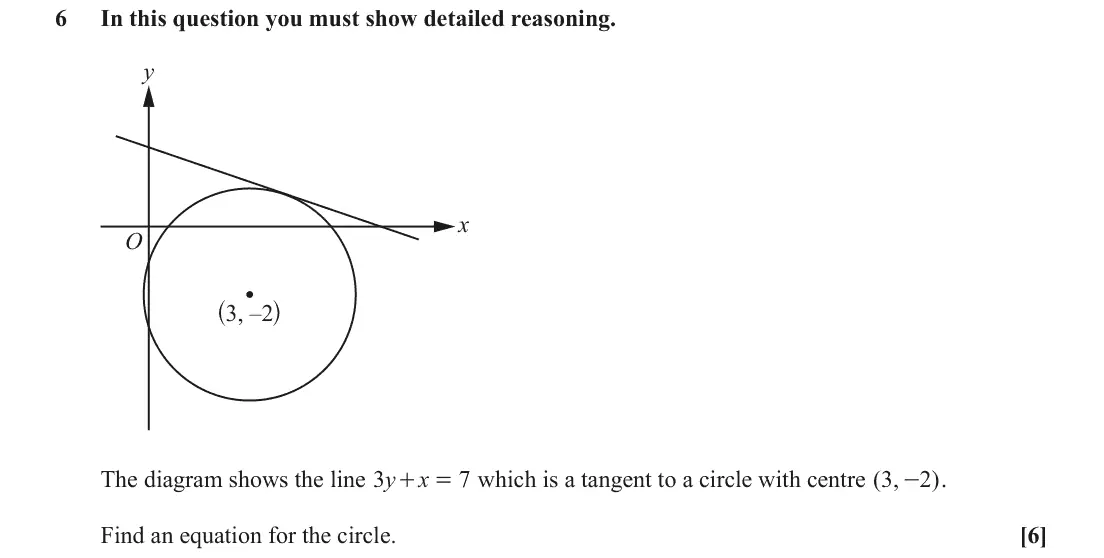
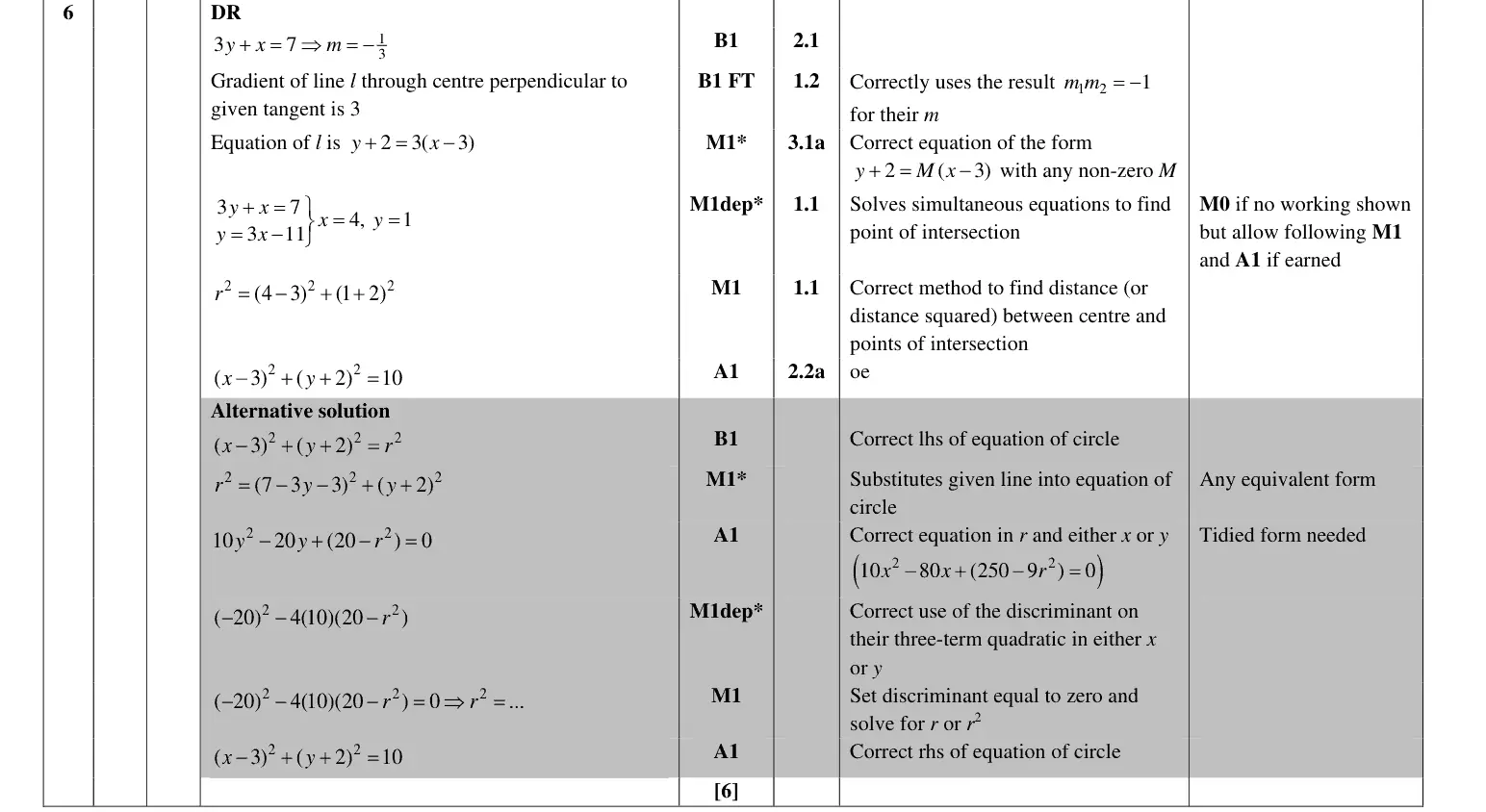
Autumn 2020 · AS Paper 2 · Q66 marksMedium
Mark scheme for this part
Examiner's comment
(From the general report) Note that ‘find’ was used in Question 3 and Question 6 with the instruction to show detailed reasoning, which now means evidence is vital. So, for example, in Question 6 on this paper the method for solving the simultaneous equations was expected and those just doing it on the calculator earned M0 for this skill. 2.
Key points and common errors
tangent gradient −1/3 so radius line y + 2 = 3(x − 3)
intersection (4, 1) found algebraically (calculator alone M0)
r² = 10
(x − 3)² + (y + 2)² = 10
Autumn 2020 · Paper 2 · Q7(c)(i)1 markMedium
Show the start of this question
Mark scheme for this part
Examiner's comment
(From the general report) Common misconceptions Misconception In answering Question 7 (about vectors) some candidates appeared not to appreciate the different significances of a, a and A.
Key points and common errors
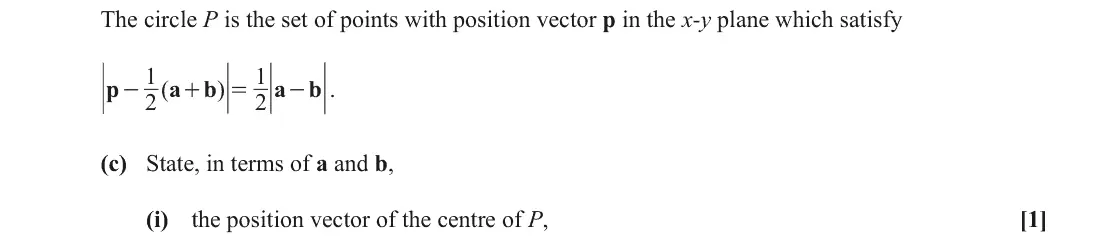
centre ½(a + b)
Autumn 2020 · Paper 2 · Q7(c)(ii)1 markMedium
Show the start of this question
Mark scheme for this part
Examiner's comment
(From the general report) Common misconceptions Misconception In answering Question 7 (about vectors) some candidates appeared not to appreciate the different significances of a, a and A.
Key points and common errors
radius ½ × magnitude of (a − b)
Autumn 2020 · Paper 2 · Q7(d)4 marksMedium
Show the start of this question
Mark scheme for this part
Examiner's comment
(From the general report) Common misconceptions Misconception In answering Question 7 (about vectors) some candidates appeared not to appreciate the different significances of a, a and A.
Key points and common errors
centre (3, 2), r² = 10
(x − 3)² + (y − 2)² = 10
June 2019 · AS Paper 1 · Q24 marksHard
Mark scheme for this part
Examiner's comment
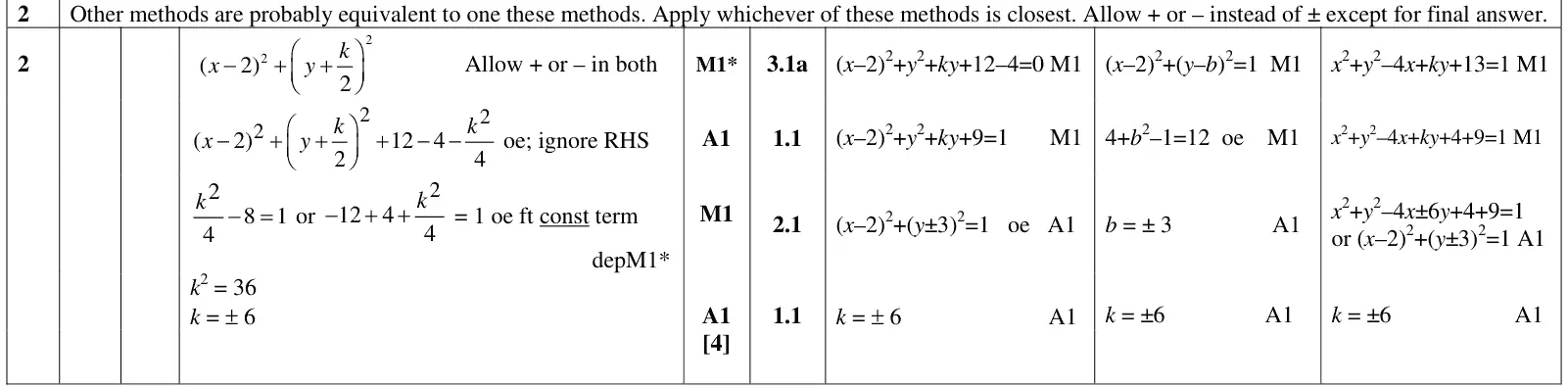
Some very good responses were seen. In many cases candidates' responses suggested that, although they knew the correct form for the equation of a circle, they were unable to adapt that knowledge to a k )2. Others non-standard question based on this form. Many candidates used (y + k)2 instead of (y + 2 replaced the "0" on the right hand side by "1" (which is the radius). Many completed the square correctly for both x and y, but equated their constant term to 1 instead of –1. Sign errors were common. Other 2 2 2 k or − k k k common errors while completing the square were to write −4 or + instead of − . A few 2 4 4 candidates attempted to alter the form of the equation to include 1 (which is r2) on the right hand side, but instead of replacing 12 on the left hand side by 13 they replaced it by 11. Some candidates began with something like (x – 2)2 + (y - b)2 = 1 and attempted to equate coefficients with the given form of the equation. Some were successful, while others expanded incorrectly, writing k instead of 2k, or omitting a term such as –4, in the expanded form.
errors (y + k)², using 1 on the RHS before completing the square
June 2019 · AS Paper 1 · Q6(b)4 marksMedium
Show the start of this question
Mark scheme for this part
Examiner's comment
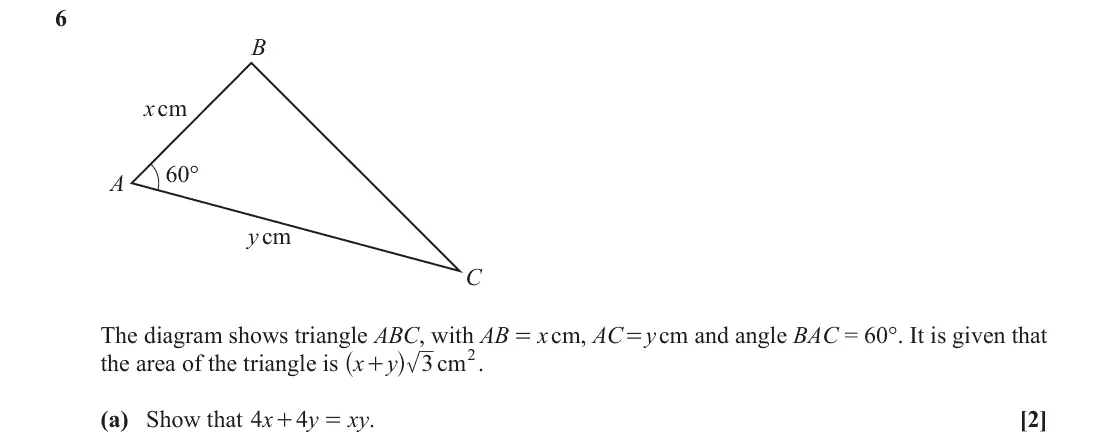
Many candidates recognised that angle ABC = 900 and some of these went on to obtain a correct y x trigonometrical equation involving x and y. (Some gave it in the form = rather than the o o sin 30 sin 90 simpler cos 600 = x y ). Many then went on to use the result from part (a) and obtained the correct 3 responses. Others started again, substituting y = 2x into 1 2 xy 2 = (x + y)√3. Some of these candidates made subsequent algebraic or arithmetical errors. Candidates who used the result proved in part (a) were more often successful. The command word ‘Determine’ was used in this question; indicating that justification should be given for any results found. A trial and improvement approach gained only one mark if the correct responses were seen. There were also many candidates who attempted wholly incorrect methods using, for example πr2.
Key points and common errors
angle in a semicircle: ABC = 90°, so cos60° = x/y, y = 2x
substitute into 4x + 4y = xy
x = 6, y = 12
June 2019 · Paper 2 · Q3(a)(i)2 marksMedium
Mark scheme for this part
Examiner's comment
Many candidates found the standard cartesian form of the equation, although a few made sign errors. Some began with ( ) ( ) x − a + y − b = r and attempted to find the values of a, b and r. Some found a and b correctly, but not r. x − 3 y + 4 Other candidates gave clumsy, but correct, alternative forms such as cos = sin 2 2 x − 3 x − 3 or y = −+ 4 2sin cos or y = −+ 4 2 1 − . 2 2 Some candidates gave answers that were correct equations in themselves, but involved a mixture of x , ( ) y and θ , for example y = x − 3 tan θ − 4 or x − 3 − 2cos θ = y + 4 − 2sin θ Some candidates started by finding x + y , which unfortunately leads nowhere. Disappointingly, many of these candidates also squared incorrectly, such as ( 3 + 2cos θ ) = 9 + 4cos θ A significant number of candidates did not recognise that the key to this problem is the identity sin θ + cos θ = 1 . Some candidates (perhaps a reflex triggered by anything involving parametric equations) found d y x by dividing d y by d x . d dθ dθ
Key points and common errors
use cos²θ + sin²θ = 1: (x − 3)² + (y + 4)² = 4
sign errors
answers mixing x, y and θ
June 2019 · Paper 2 · Q3(a)(ii)1 markEasy
Show the start of this question
Mark scheme for this part
Examiner's comment
Most candidates who answered part (a)(i) correctly also answered this part correctly. Those whose answer to answers to (a)(i) were incorrect, but in the standard form, usually answered this part correctly following through their answer to (a)(i). Candidates whose answers to (a)(i) were in terms of x y and θ sometimes also answered this part in terms of x y and θ.
Key points and common errors
centre (3, −4), radius 2
ft from (a)(i)
June 2019 · Paper 3 · Q2(a)(i)2 marksEasy
Mark scheme for this part
Examiner's comment
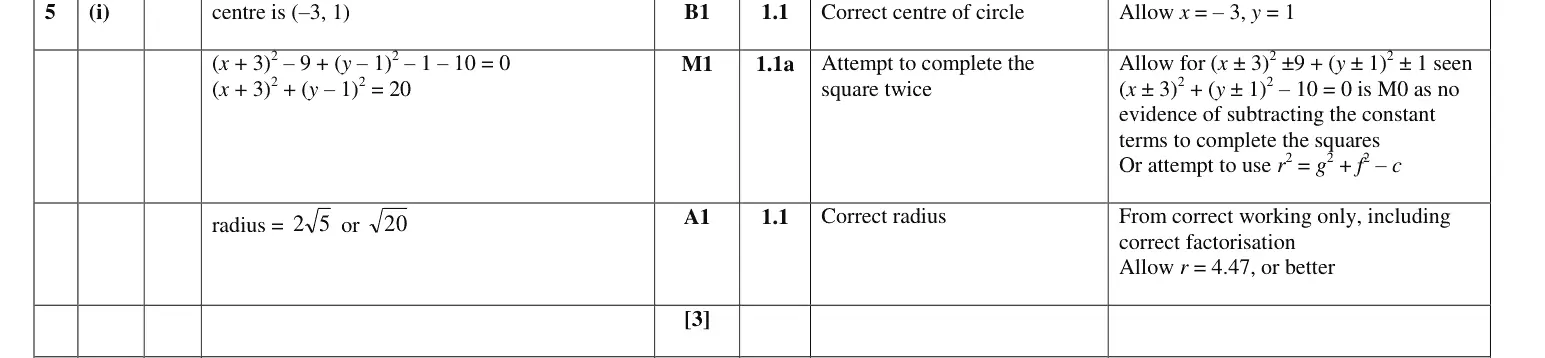
This proved to be a good question for nearly all candidates with the vast majority correctly completing the square (twice) to find the coordinates of the centre of the circle. When errors occurred, these were nearly always down to sign errors inside the two brackets.
Nearly all candidates stated the radius of the circle correctly in either part (i) or part (ii) of (a).
Key points and common errors
r = 3 (not ±3)
June 2019 · Paper 3 · Q2(b)5 marksMedium
Show the start of this question
Mark scheme for this part
Examiner's comment
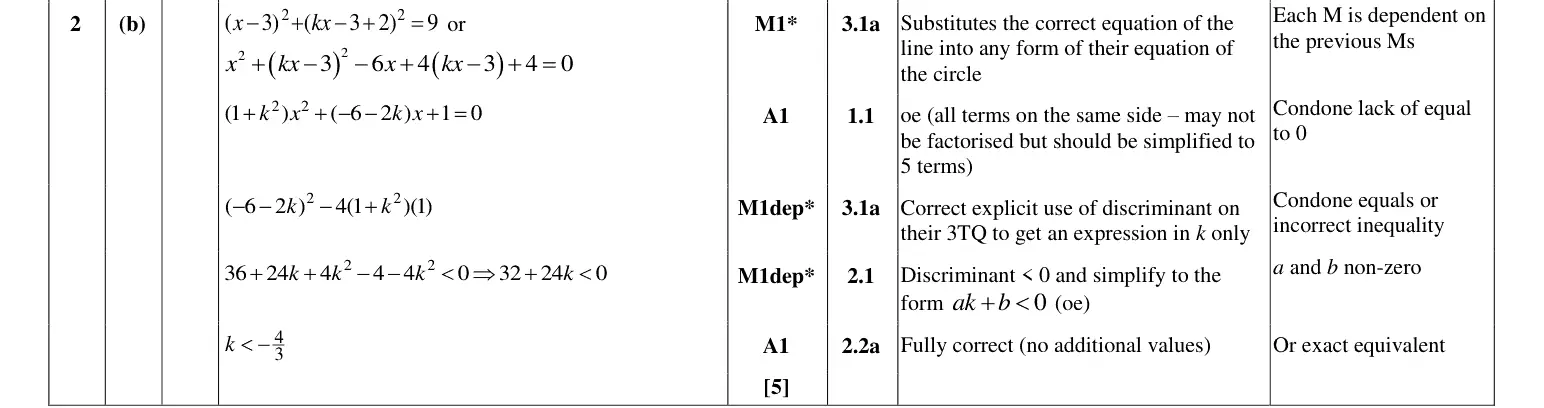
Although examiners did note that some candidates left this part blank, many candidates did start this problem correctly by eliminating y and obtaining( ) ( ) 1 + k x + −− 6 2 k x + 1 = 0 , but then many did not realise that if the line and circle did not intersect (or touch) then the discriminant of this quadratic in x would be negative. Of those that did realise this fact it was only arithmetical or algebraic errors that meant that the candidates could not determine that < − k .
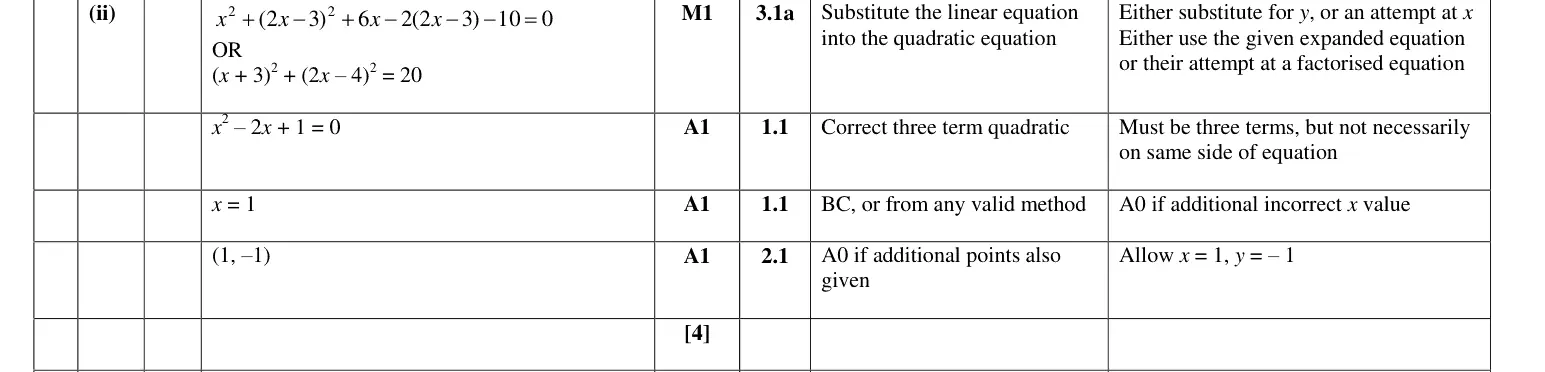
Solutions to this question were nearly always correct, with most candidates choosing to write the equation in factorised form. There were a few sign errors when stating the centre of the circle, and also a few errors when subtracting the constant term when completing the square each time.
All candidates attempted to solve the equations simultaneously, either using the expanded equation of the circle or the factorised equation. As this question did not specify ‘detailed reasoning’, it was expected that candidates would solve the ensuing quadratic on their calculator but instead most still showed the factorisation.
Key points and common errors
substitute y = 2x − 3: x² − 2x + 1 = 0
single point (1, −1)
June 2018 · Paper 1 · Q5(iii)1 markMedium
Show the start of this question
Mark scheme for this part
Examiner's comment
Part (ii) shows one point of intersection so it was expected that candidates would put this information into context and conclude that the line was a tangent to the circle. If an error had happened in part (ii) resulting in other than one point of intersection then candidates could still get this mark for a correct deduction from their answer.
Key points and common errors
one point of intersection so the line is a tangent to the circle at (1, −1)
June 2018 · AS Paper 1 · Q86 marksMedium
Mark scheme for this part
Examiner's comment
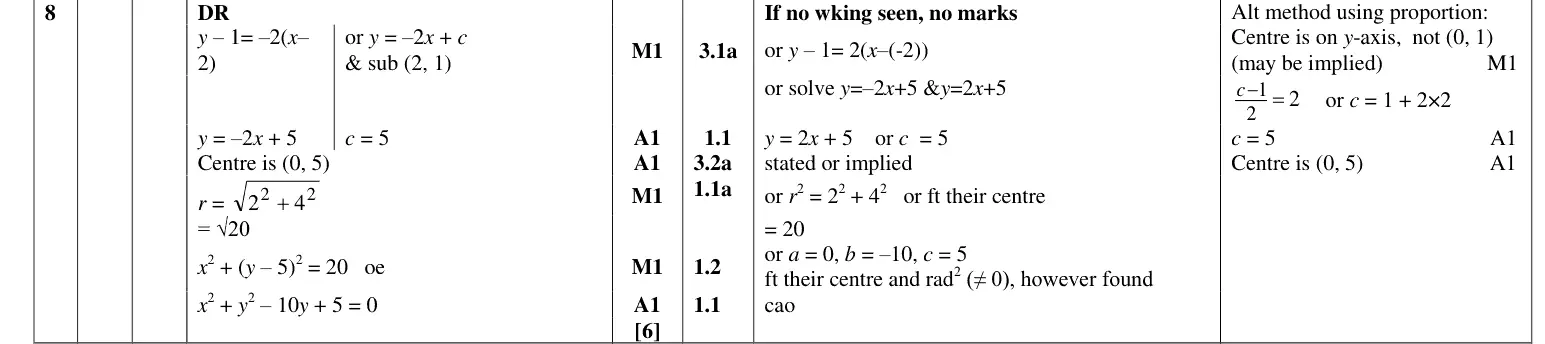
A clear initial sketch proved to be extremely useful for the majority of candidates that successfully answered this question. Some failed to consider one or both normals and therefore were unable to make any significant progress. Some found the centre incorrectly, for example by finding the midpoint of the line joining (2, 1) and (–2, 1). Others treated (0, 0) as the centre of the circle. However, despite many false starts, many used their incorrect centre and radius in the equation of a circle, and gained at least one mark. However, some candidates found a centre (p, q) and radius r, and then wrote x2 + y2 + px + qy + r. A great many candidates started from the equation x2 + y2 + ax + by + c = 0, given in the question, and attempted to find a, b and c by substituting coordinates and various other devices. Not surprisingly, these generally failed to gain any marks. (Although one candidate did actually succeed by this method, taking several pages to do so, and gained full credit.)
Key points and common errors
normals y = −2x + 5 and y = 2x + 5 meet at centre (0, 5)
r² = 20
x² + y² − 10y + 5 = 0
midpoint of the points or origin used as centre
June 2018 · Paper 3 · Q1(i)2 marksEasy
Mark scheme for this part
Examiner's comment
This proved to be a good start for nearly all candidates with the vast majority correctly completing the square (twice) to find the coordinates of the centre of the circle. When errors occurred these were nearly always down to sign errors inside the two brackets.