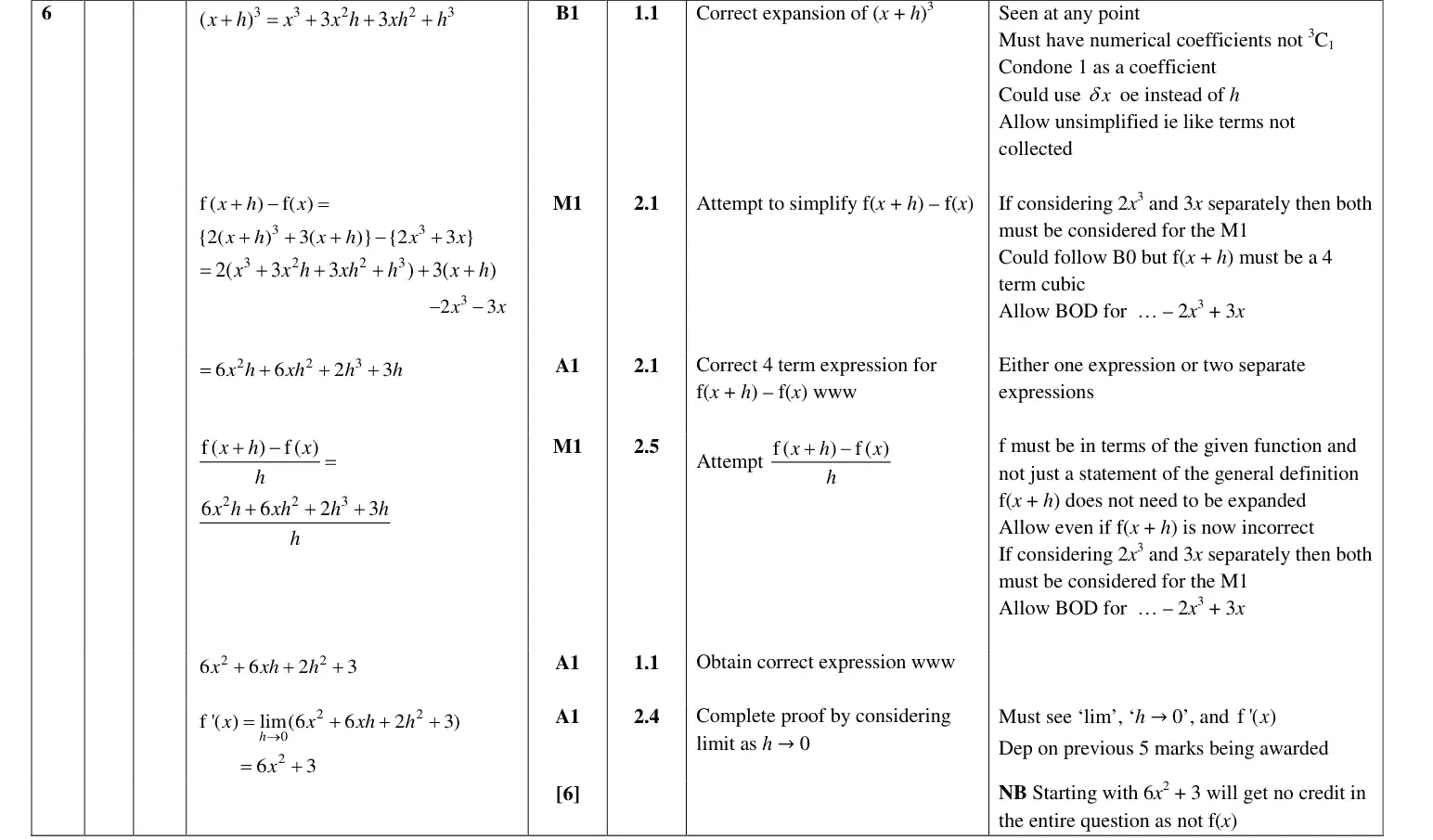
Derivatives of tan kx, sec x, cot x and cosec x and the first-principles limit are given; the rest must be learned.
Since 2018
137 question parts, 472 marks, each rated Easy, Medium or Hard from the wording of the examiners' report
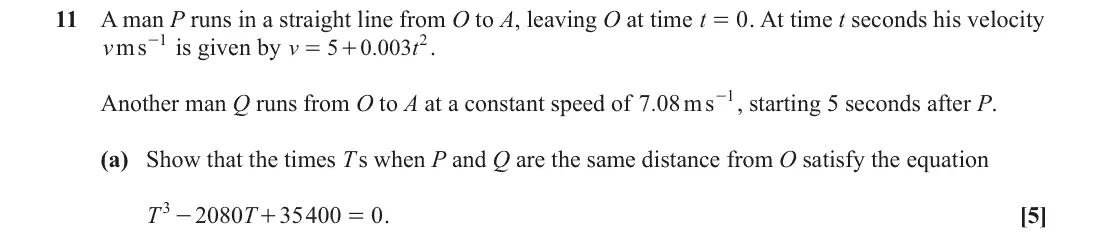
Notes, worked examples and practice for this topic are being written by our tutors. The past-paper questions below are ready now: work each one on paper, then open the mark scheme and the examiner's comment.
Tap a question to zoom it. Mark scheme and examiner's comment open under each question.
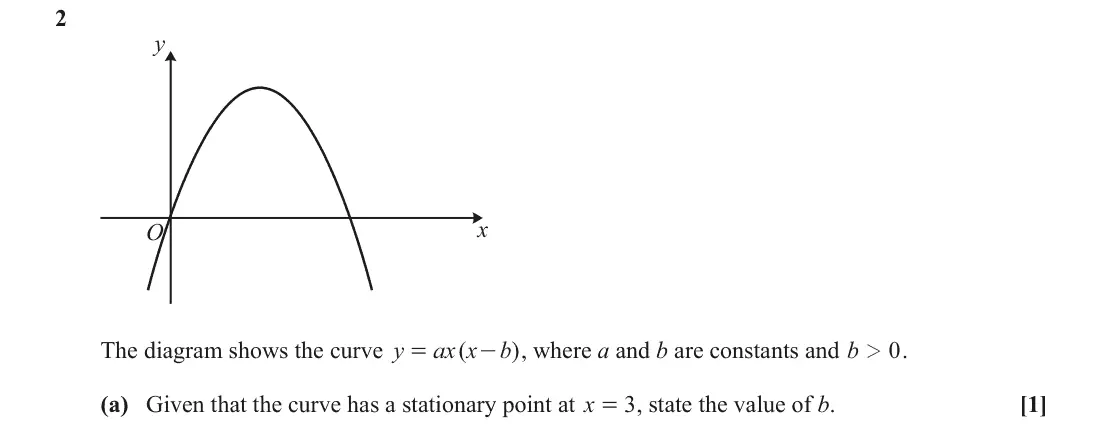
June 2025 · Paper 1 · Q2(b)1 markEasy
Show the start of this question
Mark scheme for this part
Examiner's comment
By contrast, in this part of the question many candidates were able to state a correct deduction about the value of a, but some did still consider the second derivative before correctly concluding.
Key points and common errors
a < 0 (not a ≤ 0)
June 2025 · Paper 1 · Q2(d)1 markEasy
Show the start of this question
Mark scheme for this part
Examiner's comment
Most candidates were familiar with the term ‘increasing’ function, and could state a correct inequality. The use of incorrect set notation was condoned, as long as the intention was clear.
Key points and common errors
x < 3 (or x ≤ 3)
incorrect set notation condoned
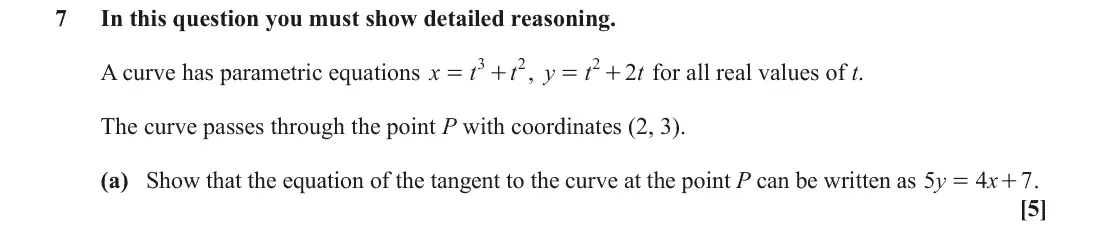
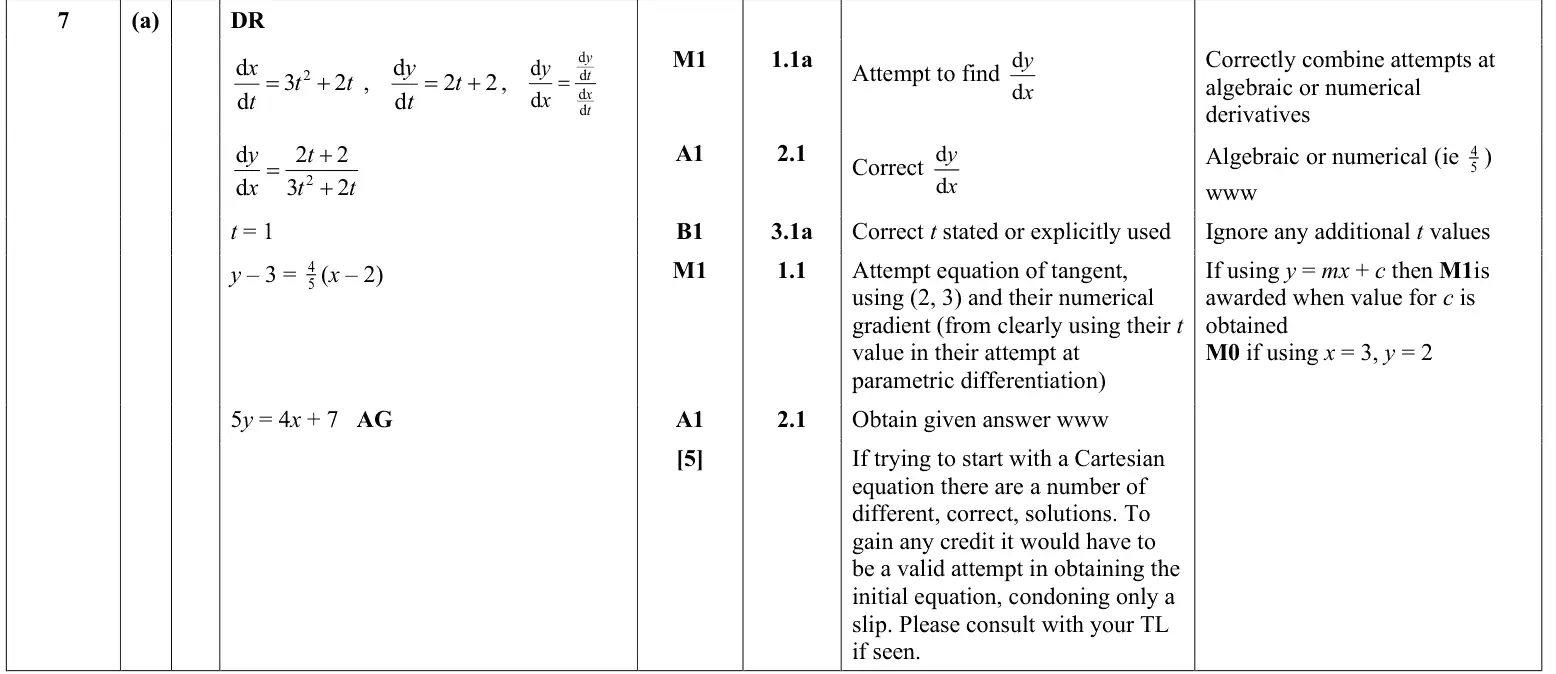
June 2025 · Paper 1 · Q7(a)5 marksEasy
Mark scheme for this part
Examiner's comment
This part of the question was very well answered, with the majority of candidates gaining full credit. They were able to accurately use parametric differentiation to find an expression for the derivative. Candidates were then able to find the correct t-value using a variety of different approaches, and most also justified why any other t-values found were not valid. In ‘show that’ questions it is important that candidates show sufficient method so as to be convincing, especially when the answer is given. Most candidates did show explicit method of using the correct t-value in the correct derivative to obtain the correct gradient However some candidates attempted to work backwards from the given answer and they generally struggled to a provide any evidence that could gain credit. When attempting the equation of a tangent, candidates should be using a numerical gradient which did not always happen.
Key points and common errors
dy/dx = (2t + 2)/(3t² + 2t)
t = 1 at P, gradient 4/5
5y = 4x + 7
justify the t value
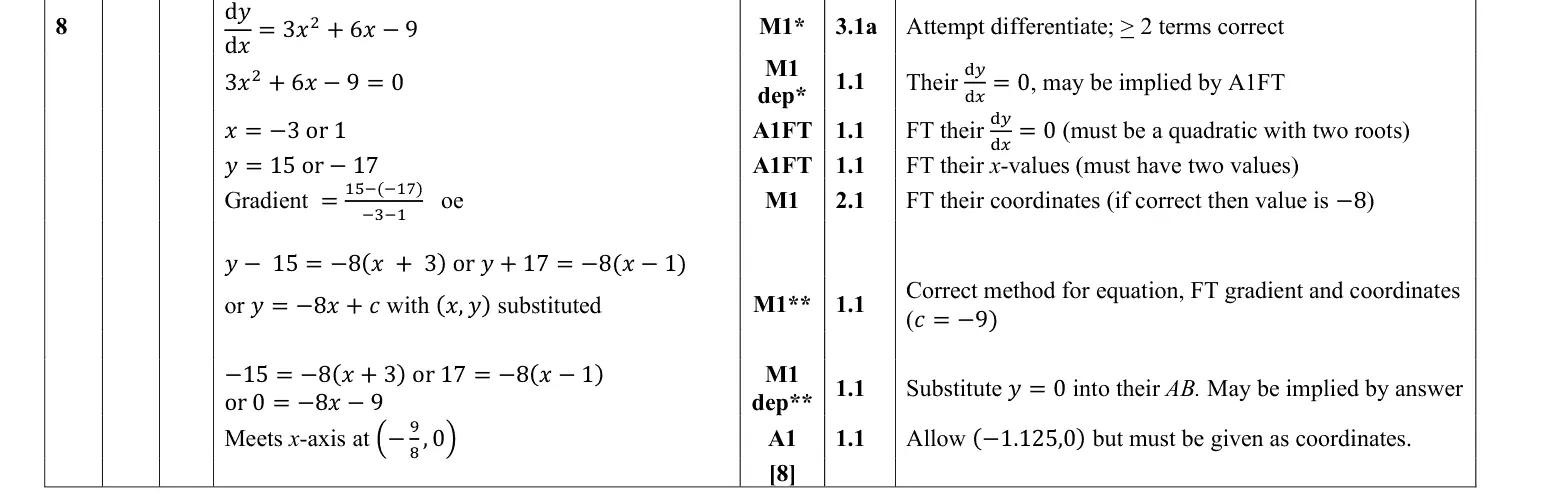
June 2025 · AS Paper 1 · Q88 marksEasy
Mark scheme for this part
Examiner's comment
This question was generally very well answered. Almost all candidates were able to differentiate, set =0 and solve to obtain two values of x for M1M1A1. Some candidates made a numerical error in finding the corresponding values of y, but were still able to go on obtaining the subsequent method marks. Most candidates identified the need to find the gradient, equation and then set 𝑦= 0 although some instead solved for 𝑥= 0, etc. A few candidates stopped after the first four marks. Notice that (in contrast with Question 1 (b) as there is no DR instruction here, candidates were not required to show the working to solve their quadratic d𝑦 d𝑥= 0 but it remains best practice to do so. The question asked for the ‘coordinates of the point’ so 𝑥= − 8 was not sufficient as a final answer. This was a common omission and led to candidates receiving 7/8. This candidate has made a good start, scoring M1M1A1 for their differentiation and correct values of x for the turning points. They then make an error in finding one of the corresponding values of y (A0) but go on to work correctly with their values, scoring M1M1M1. The final answer is incorrect (A0) so this response scored 6/8.
Key points and common errors
dy/dx = 3x² + 6x − 9 = 0: A(−3, 15), B(1, −17)
gradient −8
y = −8x − 9 meets the x-axis at (−9/8, 0)
give coordinates, not just x
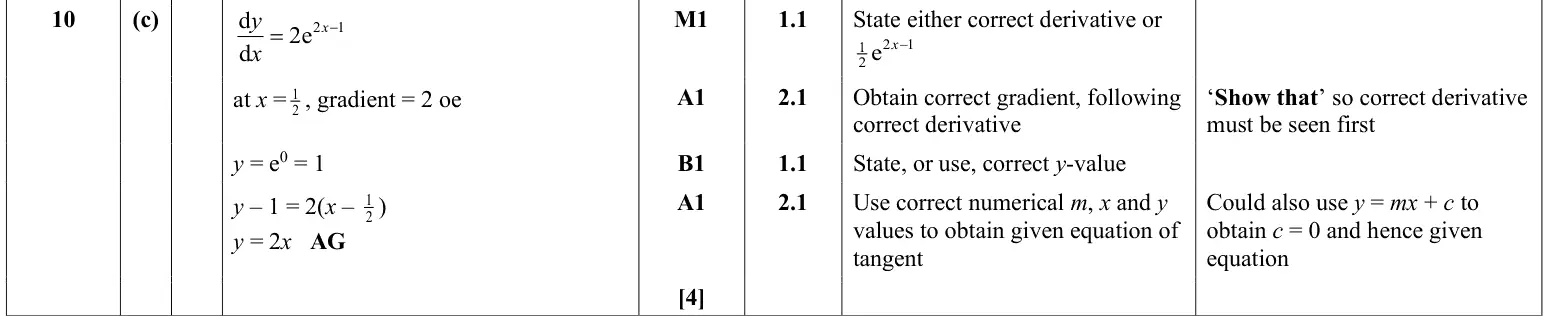
June 2025 · Paper 1 · Q10(c)4 marksEasy
Mark scheme for this part
Examiner's comment
Nearly all of the candidates were able to find the correct y-value, but some then simply stated that y = 2x based on the now known (x, y) value with no further consideration of the question posed. However the majority of candidates could then correctly state the derivative of the given equation, and most then evaluated this at x = 0.5 and proceeded to find the given equation convincingly. As with previous questions involving the equation of a straight line some candidates still attempted to use an algebraic gradient when attempting the tangent, so equations such as y = (2e2x – 1)x + 0, resulting in y = 2x, were penalised even if the gradient had previously been shown to be 2. When attempting the equation of a straight line (e.g. a tangent or normal) candidates should be using a numerical (as opposed to variable) value for the gradient.
Key points and common errors
dy/dx = 2e^(2x − 1), gradient 2 at x = ½, point (½, 1)
tangent y = 2x
algebraic gradient used in line equation
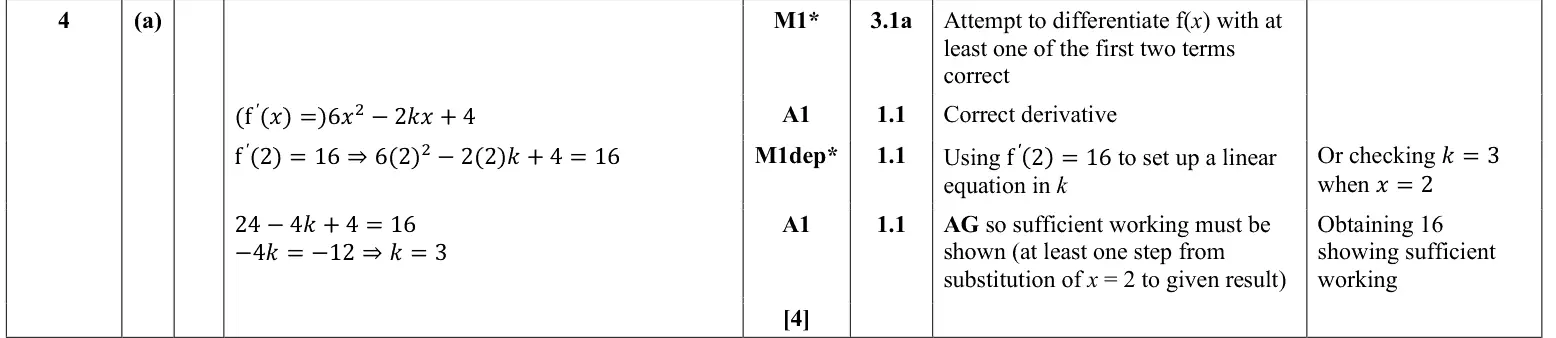
June 2025 · AS Paper 2 · Q4(a)4 marksEasy
Mark scheme for this part
Examiner's comment
This question was very well done with many fully correct solutions seen. Once again it was a ‘Show that….’ question but it was rare not to see sufficient working. A common error in less successful responses was to use f(2) =16.
Key points and common errors
f′(x) = 6x² − 2kx + 4
f′(2) = 28 − 4k = 16 so k = 3
using f(2) = 16 is a common error
June 2025 · Paper 2 · Q6(a)(i)2 marksEasy
Mark scheme for this part
Examiner's comment
Almost all candidates answered this part correctly. A few candidates, perhaps misreading the question, went on to start to solve d𝑥= 0 which was not required in this part.
Key points and common errors
dy/dx = 12x³ − 12x² − 12x + 12
June 2025 · Paper 2 · Q6(a)(ii)2 marksEasy
Show the start of this question
Mark scheme for this part
Examiner's comment
As in part (i), most candidates answered this part correctly. The question asked candidates to ‘find’ so the scheme did not require candidates to show working – which typically involved using the factor theorem to deduce one or both of the roots. Some candidates solved by inspection (or using their calculator) – this was also acceptable in this context. Some candidates went on to find the corresponding y-values, which were not needed here.
Key points and common errors
set dy/dx = 0
factor theorem or calculator gives x = 1 and x = −1 only
y-values not needed
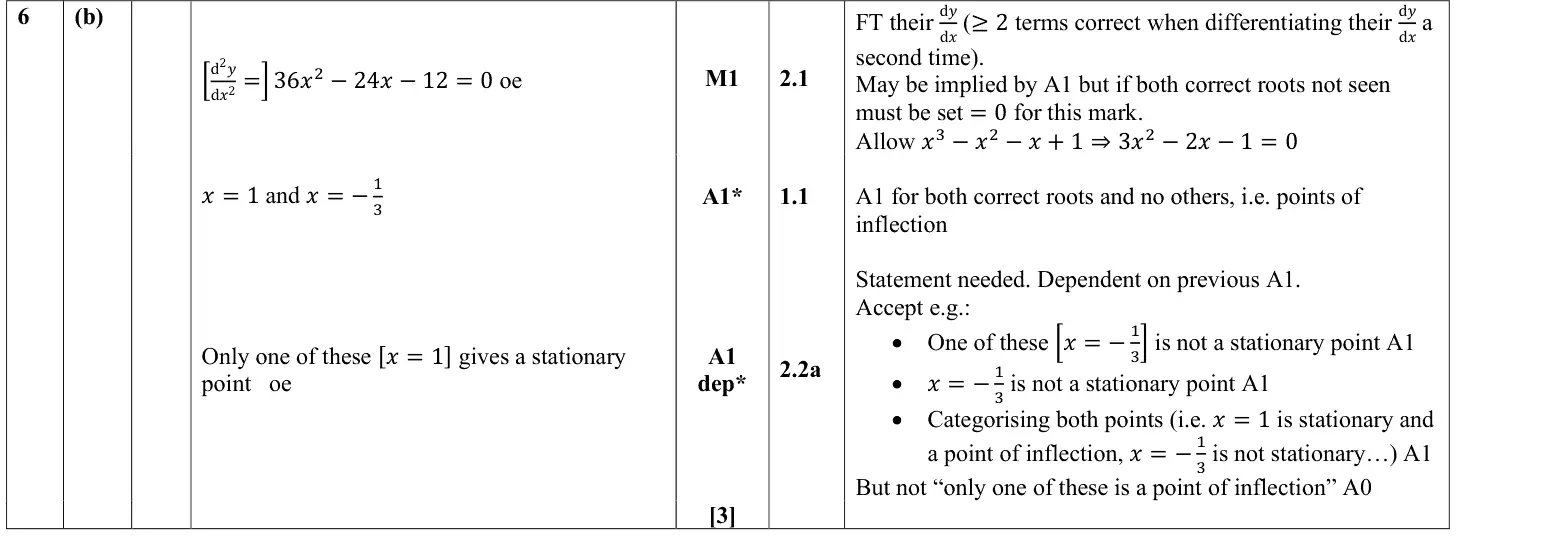
June 2025 · Paper 2 · Q6(b)3 marksMedium
Show the start of this question
Mark scheme for this part
Examiner's comment
Around half of candidates scored all 3 marks here, for differentiating again and solving d𝑥2 = 0 to find the x-coordinates of the two points of inflection. The final mark was for using these values, compared to the points found in (a)(ii) to deduce that there is one point of inflection that is not a stationary point. The question made a specific request, but some candidates misinterpreted this and instead substituted in their values from part (a)(ii) – without setting =0 – in an attempt to classify the stationary points. This was not sufficient in this context as it does not show the required fact.
Key points and common errors
d²y/dx² = 36x² − 24x − 12 = 0 gives x = 1 and x = −1/3
only x = −1/3 is not a stationary point
substituting the stationary x-values without setting = 0 is not enough
June 2025 · AS Paper 2 · Q9(a)2 marksEasy
Mark scheme for this part
Examiner's comment
This was very well done with many candidates getting the correct acceleration.
Key points and common errors
a = dv/dt = 0.1t − 0.4 = 0.2 m s⁻² at t = 6
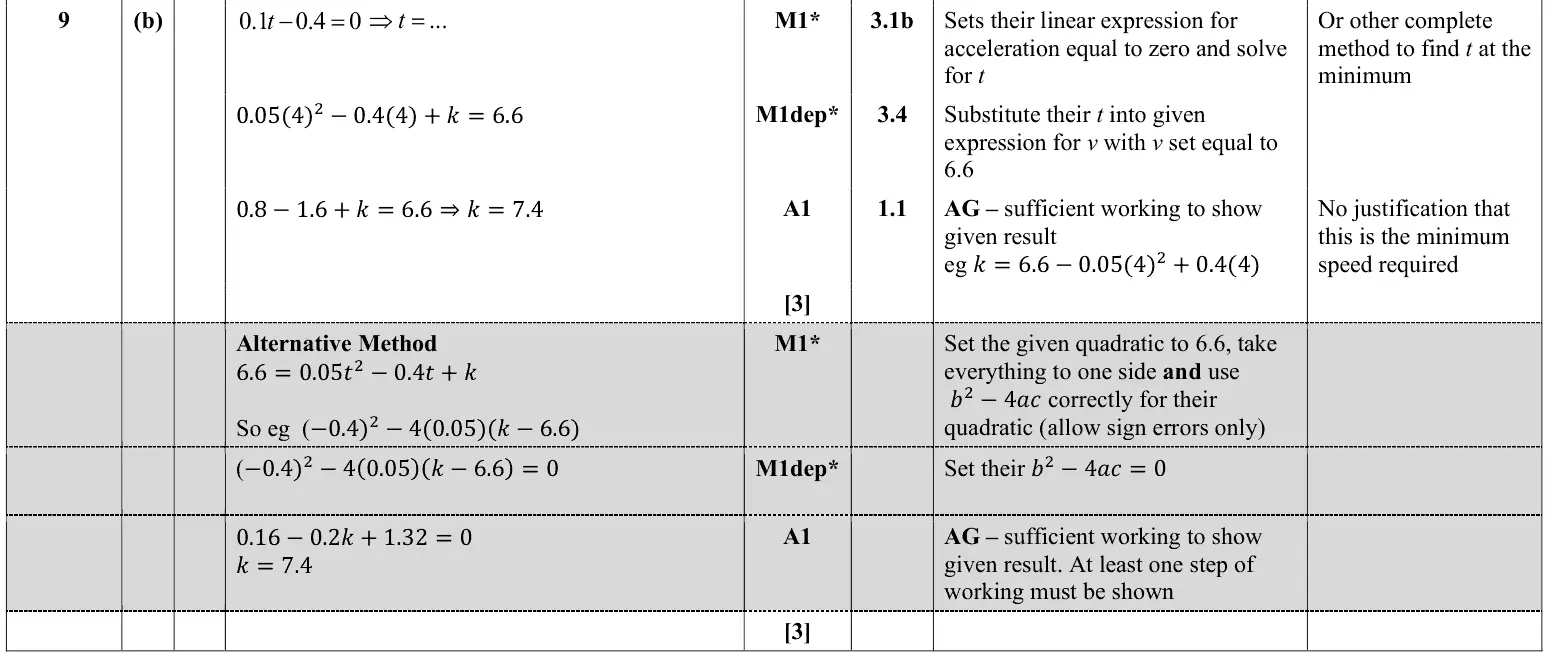
June 2025 · AS Paper 2 · Q9(b)3 marksMedium
Mark scheme for this part
Examiner's comment
Usually t = 4 was found from the acceleration, but some completed the square. If this stage was successful, full marks generally followed provided sufficient working was shown – this was needed as the question gave the answer. A few solved the quadratic with 6.6 and the given k = 7.4 to get t = 4, but unless the significance of t = 4 was discussed (and it normally was not) no marks were given. Substitution of t = 6 into v in an attempt to find k was seen. The alternative method was seen less frequently but when seen, was largely successful.
Key points and common errors
minimum velocity when a = 0 so t = 4
0.05(16) − 1.6 + k = 6.6 gives k = 7.4
must show why t = 4
June 2025 · Paper 3 · Q1(c)1 markHard
Show the start of this question
Mark scheme for this part
Examiner's comment
Many candidates struggled to realise that the equation of the normal to the curve at its minimum point was equivalent to asking for the equation of the line of symmetry. Many candidates unsuccessfully attempted to use the result 𝑦−𝑦1 = − f′(𝑥1) (𝑥−𝑥1) to find this equation (even though the command was to ‘state’ and there only being 1 mark available). The most common incorrect answer seen by examiners was 𝑦= 5 (which was the equation of the tangent to the curve at its minimum point).
Key points and common errors
the normal at the minimum point is vertical: x = 2 (the line of symmetry)
must be an equation
the formula y − y₁ = −(x − x₁)/f′(x₁) fails here
June 2025 · Paper 3 · Q5(e)2 marksHard
Show the start of this question
Mark scheme for this part
Examiner's comment
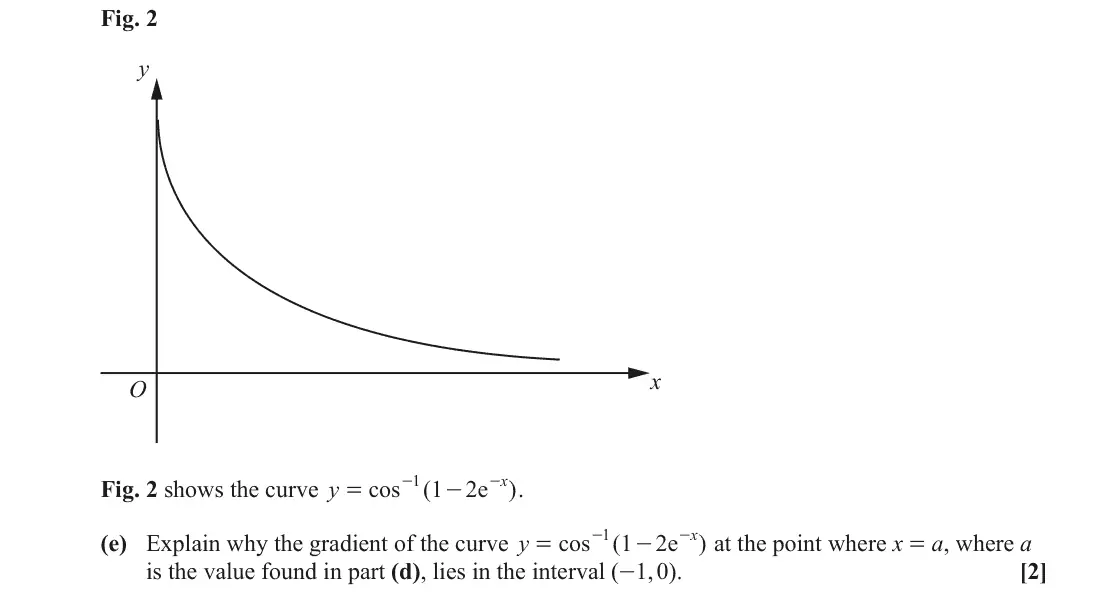
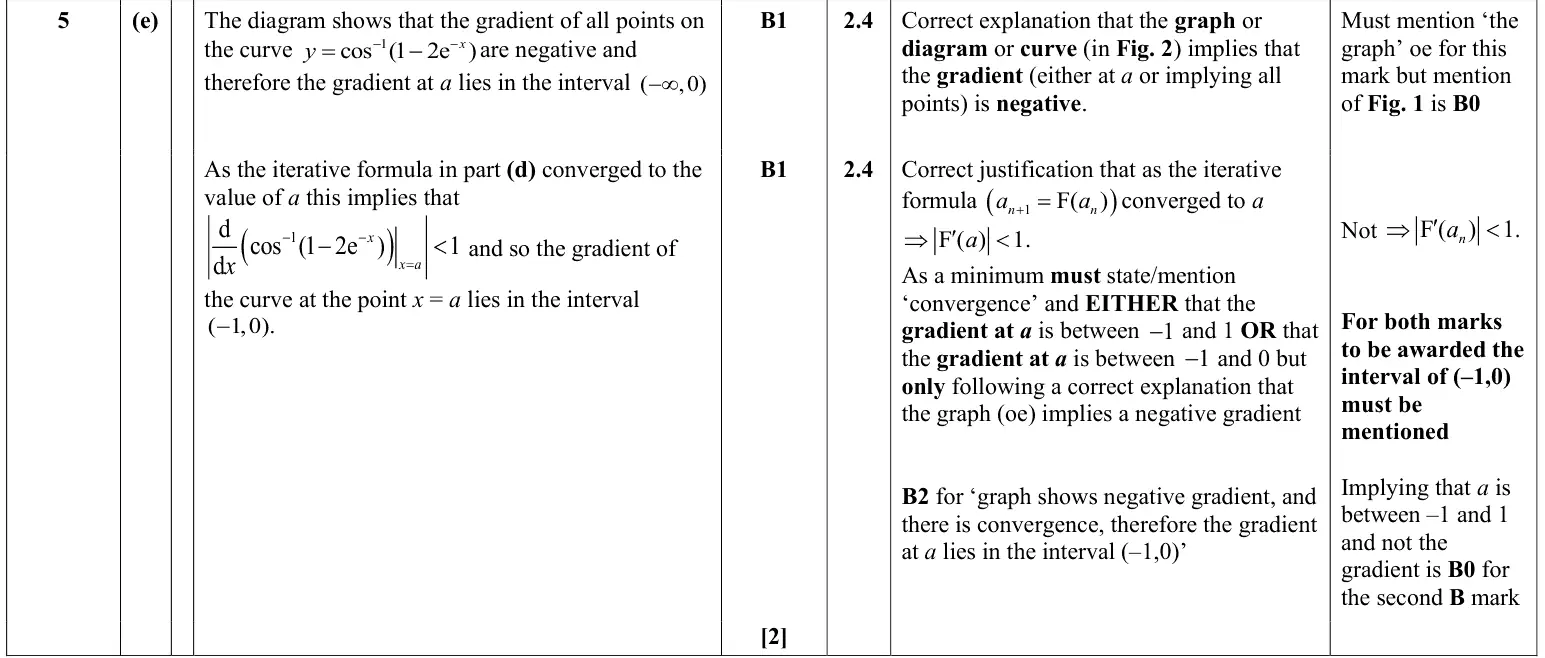
Candidates struggled with this part with very few able to give a correct explanation of why the gradient would lie in the given interval. Candidates needed to articulated that the given figure indicated that the curve had a negative gradient for all values of 𝑥 and as the iterative formula converged to the value of a in part (d) this implied that | d𝑥(cos−1(1 −2e−𝑥))| 𝑥=𝑎< 1 and so the gradient at the point 𝑥= 𝑎 would be in the interval (−1,0).
Key points and common errors
Fig. 2 shows the gradient is negative everywhere
the iteration converged so the modulus of g′(a) is less than 1
together the gradient lies in (−1, 0)
June 2025 · Paper 3 · Q6(c)(ii)1 markHard
Show the start of this question
Mark scheme for this part
Examiner's comment
Although this part was better answered than part (i), most candidates seemed to be unaware of this limit either from previous work on differentiating sine and cosine from first principles, the small angle approximation for sine or from the sandwich inequality in the previous part.
Key points and common errors
cos θ → 1 so the limit is 1 (sandwich)
June 2025 · Paper 3 · Q6(d)4 marksMedium
Show the start of this question
Mark scheme for this part
Examiner's comment
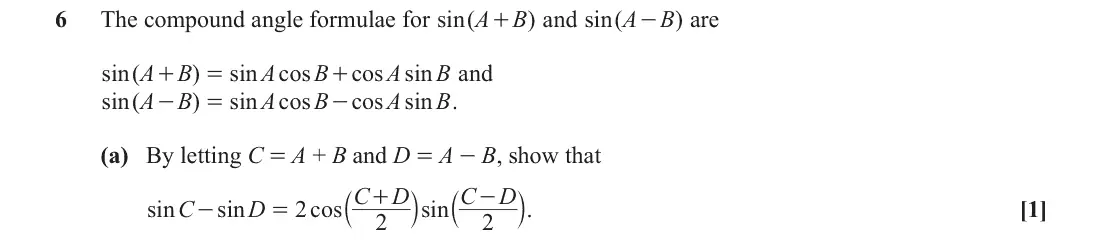
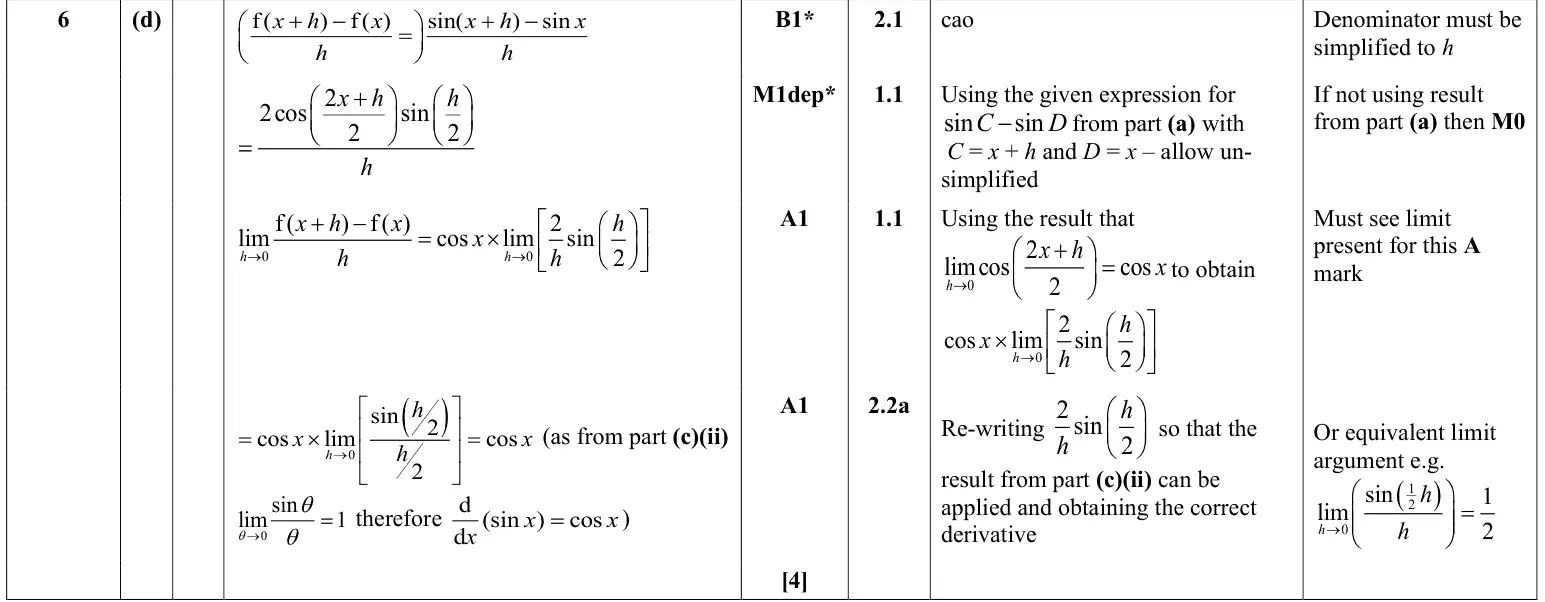
Although many candidates scored the first mark in this part for correctly considering many did not read the question carefully and instead used the standard approach of expanding the numerator using the compound angle formula instead of using the result from part (a). Of those that did use part (a) most were successful in correctly showing from first principles that the derivative of sin𝑥 was cos 𝑥.
Key points and common errors
(sin(x + h) − sin x)/h = 2cos((2x + h)/2) sin(h/2)/h using part (a)
limit gives cos x × 1
using the compound angle expansion instead gains little
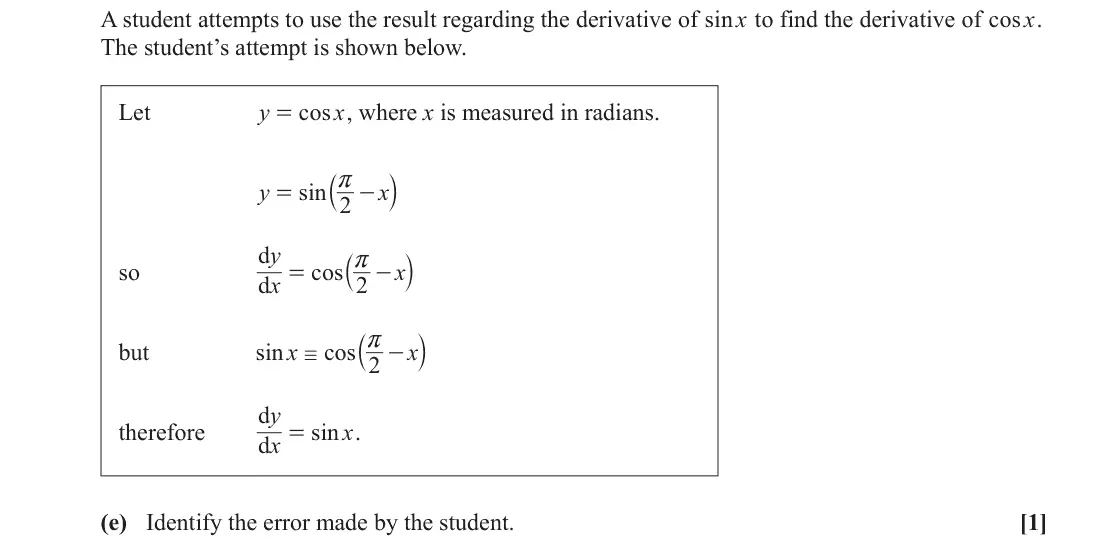
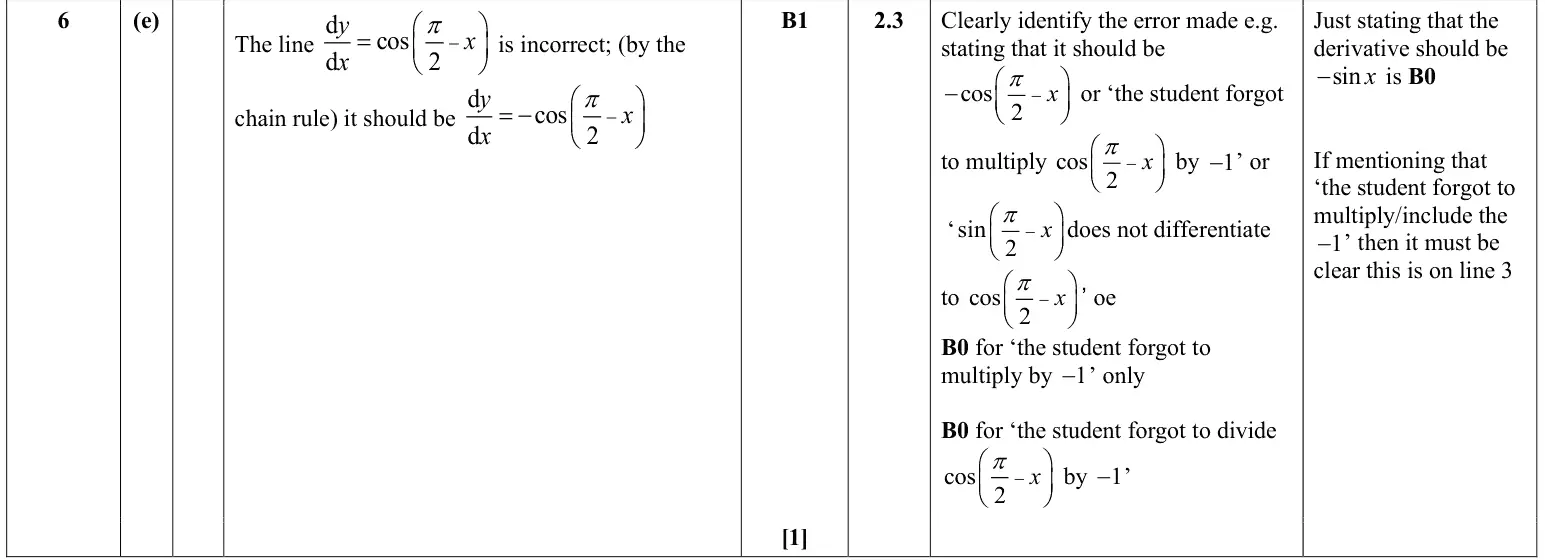
June 2025 · Paper 3 · Q6(e)1 markEasy
Mark scheme for this part
Examiner's comment
It was pleasing that most candidates in this part could identify the error and most explained too what the correct line of working should have been.
Key points and common errors
the derivative of sin(π/2 − x) is −cos(π/2 − x) by the chain rule
the student omitted the factor −1 on line 3
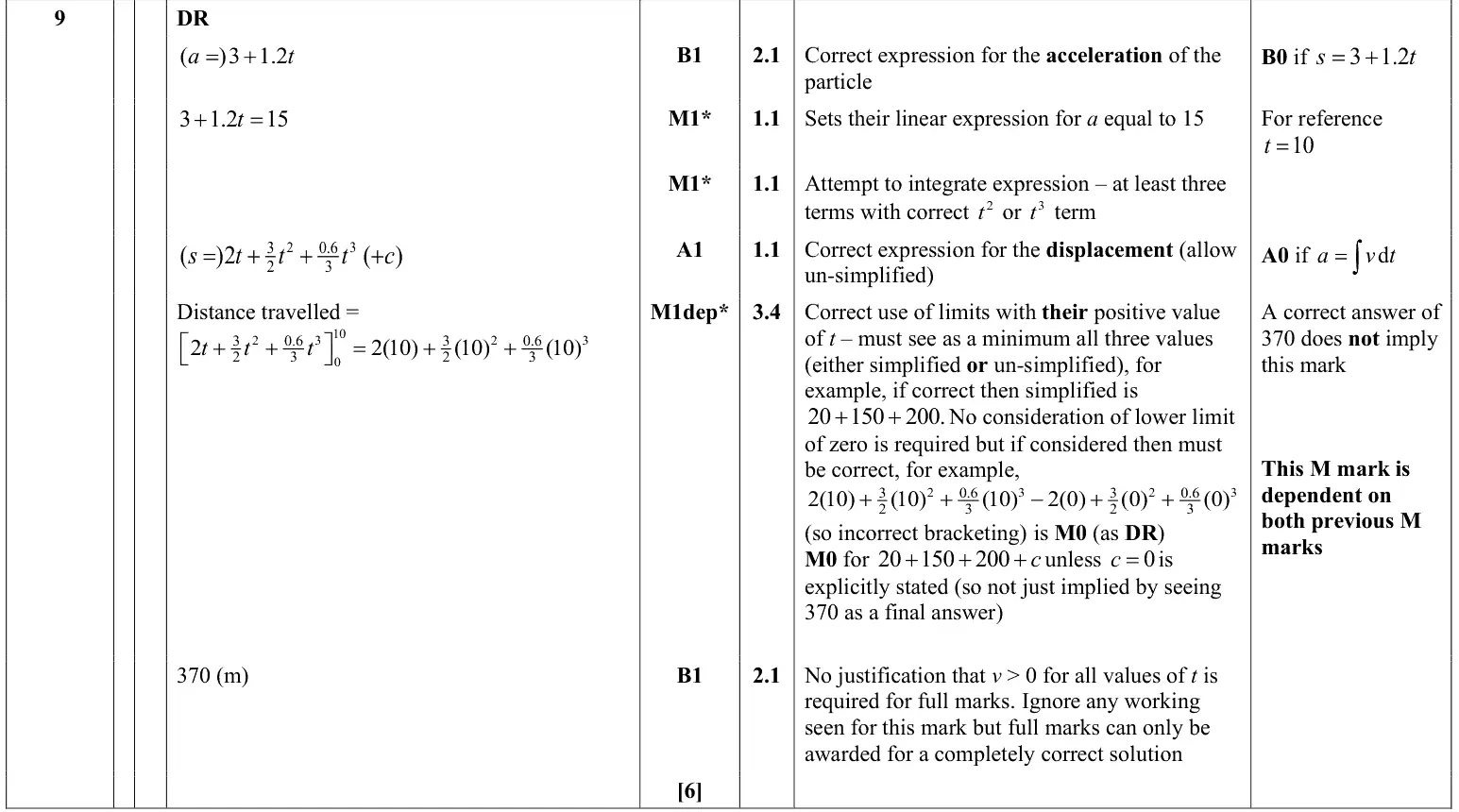
June 2025 · Paper 3 · Q96 marksEasy
Mark scheme for this part
Examiner's comment
This was probably the best answered question in the mechanics section with many candidates scoring all 6 marks. As this part required DR many did not gain a mark for not showing the explicit substituting of 𝑡= 10 into their integrated expression to find the required distance travelled. The most common errors seen by examiners were those candidates who implied that 𝑠= d𝑡 and/or 𝑎= ∫𝑣 d𝑡, and some incorrectly used the equations of constant acceleration even though the acceleration was variable. required detailed reasoning. The candidate has given no explicit indication of where the answer of 370 came from (as they have not shown the limits of 0 and 10 being applied to the cubic expression) and so 1 of the 6 marks could not be awarded.
Key points and common errors
a = 3 + 1.2t = 15 gives t = 10
s = 2t + 1.5t² + 0.2t³
substitute t = 10 explicitly: 370 m
DR needs the substitution shown
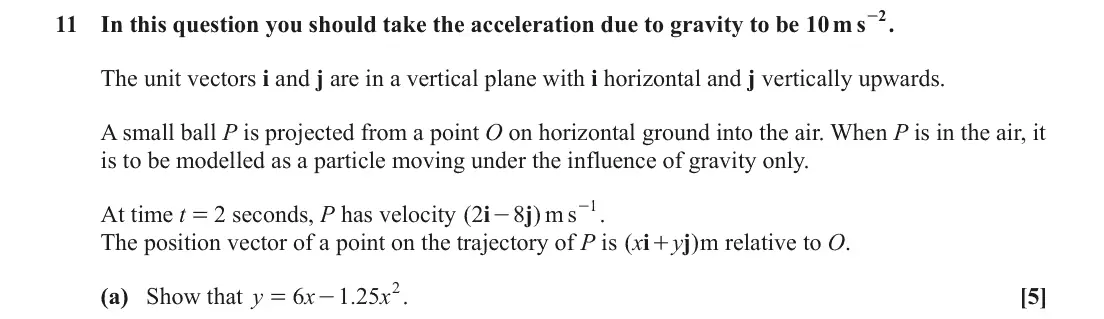
June 2025 · Paper 3 · Q11(b)3 marksMedium
Show the start of this question
Mark scheme for this part
Examiner's comment
It was surprising how many candidates did not use the given result from part (a) and instead went back to the suvat equations to find the maximum height of P above the ground during its motion. Of those that did use the equation from part (a), those that used calculus rather than completing the square were far more successful.
Key points and common errors
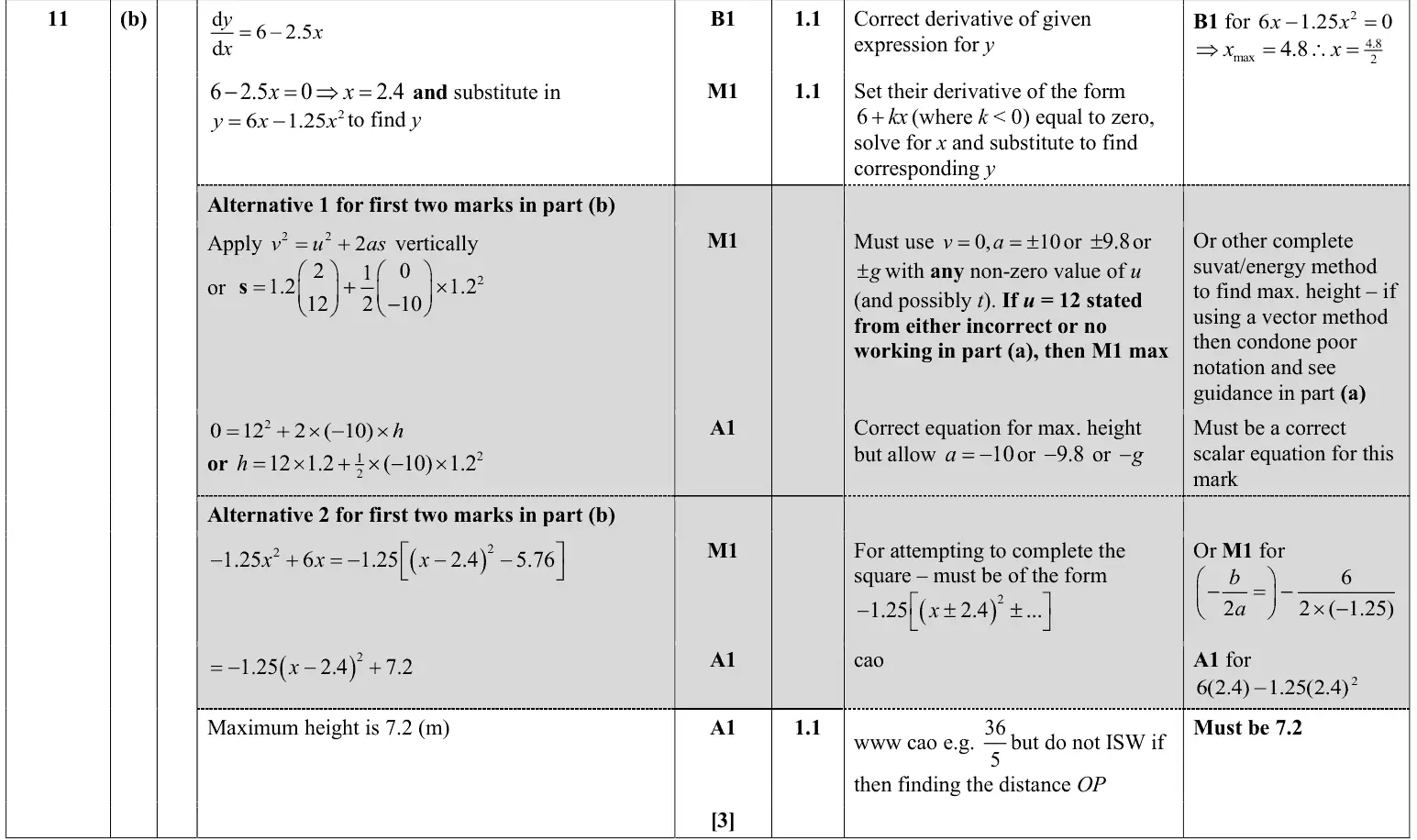
dy/dx = 6 − 2.5x = 0 at x = 2.4
max height 7.2 m
use the given equation rather than restarting
June 2025 · Paper 3 · Q11(c)5 marksMedium
Show the start of this question
Mark scheme for this part
Examiner's comment
The responses to this part were mixed with many candidates believing that both the speed and direction of motion could be found by considering the vertical and horizontal displacement of P when 𝑥= 2.5. Of those that did use the velocity components many did not give sufficient detail when it came to the direction of motion; an angle alone was not sufficient as it needed to be clear if the angle was below or above the horizontal (or equivalently to the upward or downward vertical).
Key points and common errors
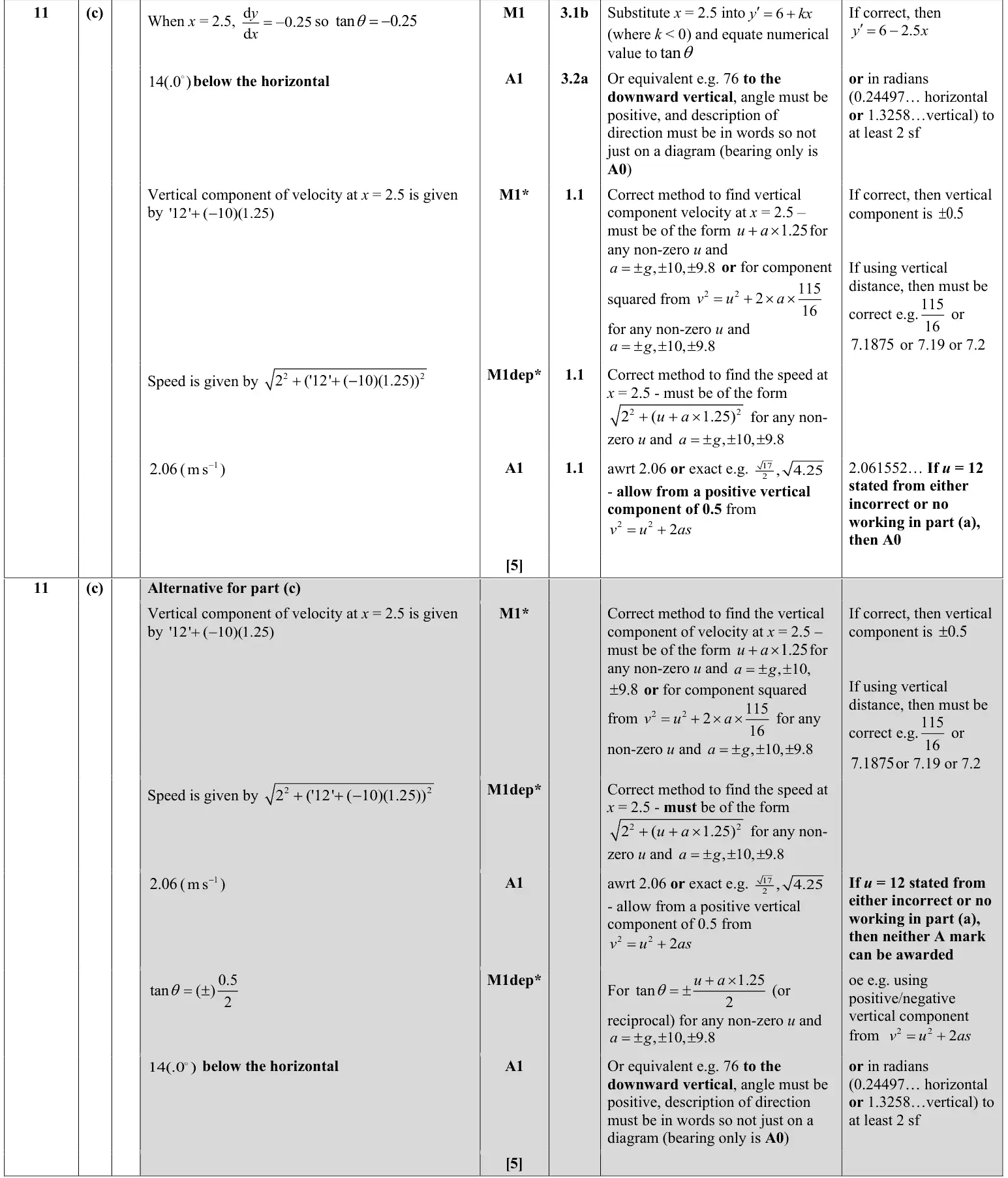
gradient at x = 2.5 is −0.25 so direction 14° below the horizontal
vertical velocity 12 − 10 × 1.25 = −0.5
speed √4.25 = 2.06 m/s
displacement gives neither
direction needs 'below the horizontal'
June 2024 · Paper 1 · Q1(c)2 marksMedium
Show the start of this question
Mark scheme for this part
Examiner's comment
Many candidates were able to identify that the tops of the trapezia lie both above and below the curve, leading to both over and underestimates. Many were also able to discuss the convex and concave nature of the curve in the given interval, sometimes confusing the order but this was condoned for the mark. Others correctly referred to there being a point of inflection in the interval. Some candidates incorrectly referred to the ‘curve’ being increasing and decreasing, rather than the ‘gradient’. A common error for those not gaining the marks was to state that it was ‘difficult to tell if the curve was convex or concave in the interval’.
Key points and common errors
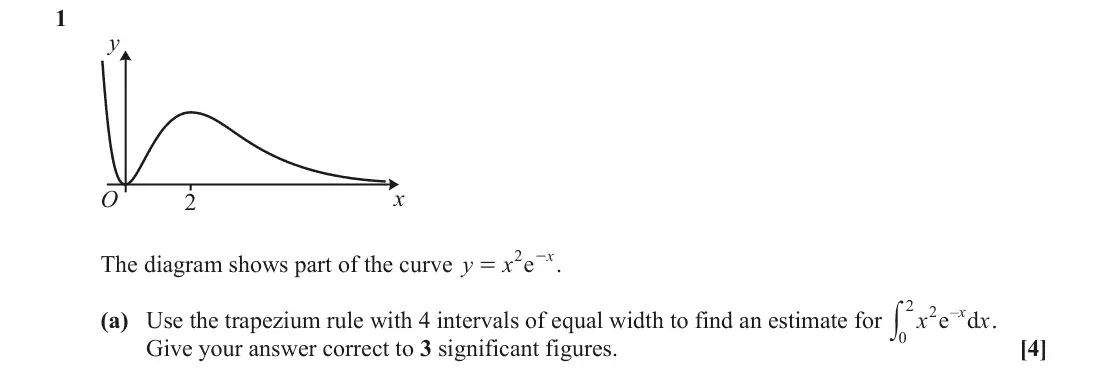
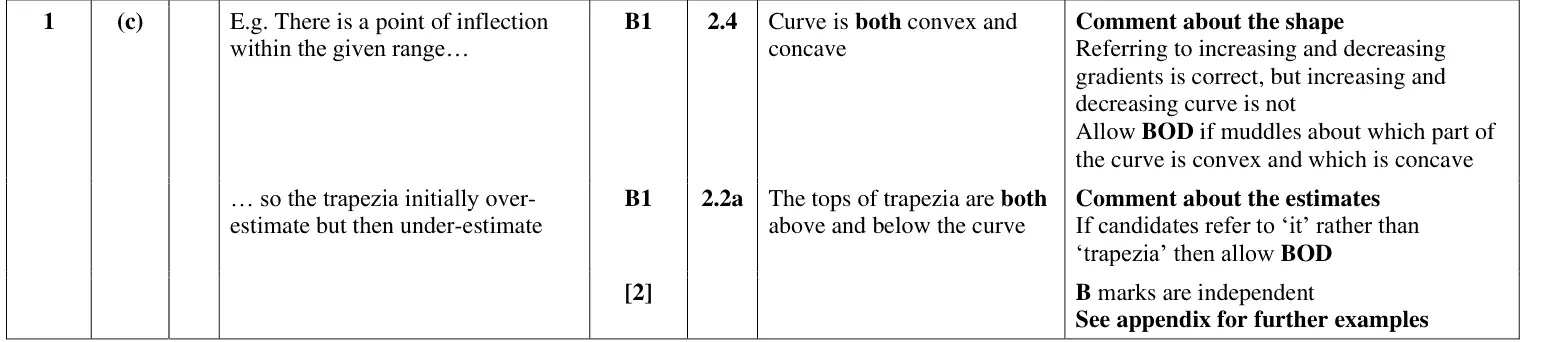
point of inflection in the range: curve both convex and concave, so tops of trapezia lie above and below the curve
'the curve is increasing/decreasing' is not correct
June 2024 · Paper 1 · Q58 marksEasy
Mark scheme for this part
Examiner's comment
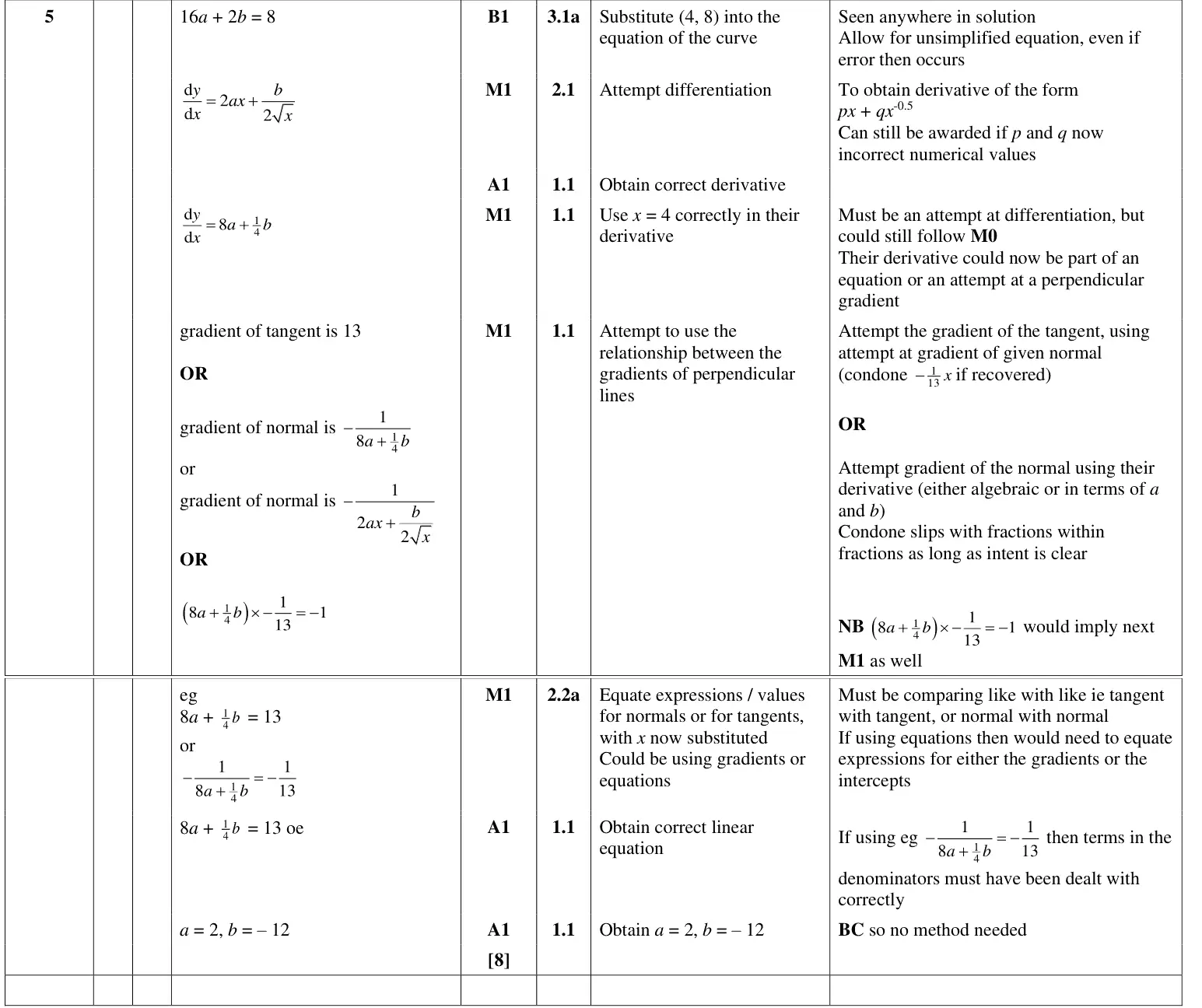
This longer unstructured question was generally well attempted. Quite a few neat, elegant and completely correct solutions were seen. Some unnecessary work was also seen, with quite a few candidates obtaining the equation of the tangent with some trying to solve that with the given equation. Only a very small number of candidates did not realise differentiation was involved. When the differentiation was attempted, it was invariably correct with the fractional powers well handled. Those candidates who substituted x = 4 into their algebraic expression for the gradient of the tangent, were more likely to score full marks compared to those who went on to form an algebraic expression for the gradient of the normal. Most candidates were able to find the numerical value for the gradient of the tangent from the equation of the normal, although not everyone was able to use this information to produce a correct equation in a and b only. A few candidates confused the gradients of the tangent and normal. Some candidates often omitted substituting (4,8) into the equation of the curve, failing to produce a second independent equations in a and b. Solving these two equations simultaneously could be completed by using a calculator for the final mark. This is a good solution to Question 5 with efficient and clear working.
Key points and common errors
(4, 8) on curve: 16a + 2b = 8
dy/dx = 2ax + b/(2√x) = 8a + b/4 at x = 4
normal gradient −1/13 so tangent gradient 13
a = 2, b = −12
finding the tangent equation is unnecessary
June 2024 · AS Paper 1 · Q5(a)5 marksMedium
Mark scheme for this part
Examiner's comment
This question was again ‘Determine’, requiring candidates to show their working in full – answers obtained without this (e.g. from a calculator) could not be credited. Most candidates who showed working were able to differentiate the given equation correctly and set this equal to zero, going on to find the coordinates of the stationary point. Some candidates who had the correct solutions for x did not find the correct y value as required for the final A1.
Key points and common errors
dy/dx = 8x − x⁻² = 0
x = ½, y = 3
'Determine' so working required
y-value sometimes wrong
June 2024 · AS Paper 1 · Q5(b)2 marksHard
Show the start of this question
Mark scheme for this part
Examiner's comment
This ‘Determine’ question was generally not well answered. Most candidates who had made progress in part (a) were also able to gain the method mark for attempting to find the second differential. However, they could only be given the accuracy mark if this – and their subsequent method to deduce the nature d𝑥𝑥2 = 0 and attempted to solvethis new of the stationary point – was fully correct, including specific consideration of the sign of the second derivative. A number of candidates confused the method and set equation.
Key points and common errors
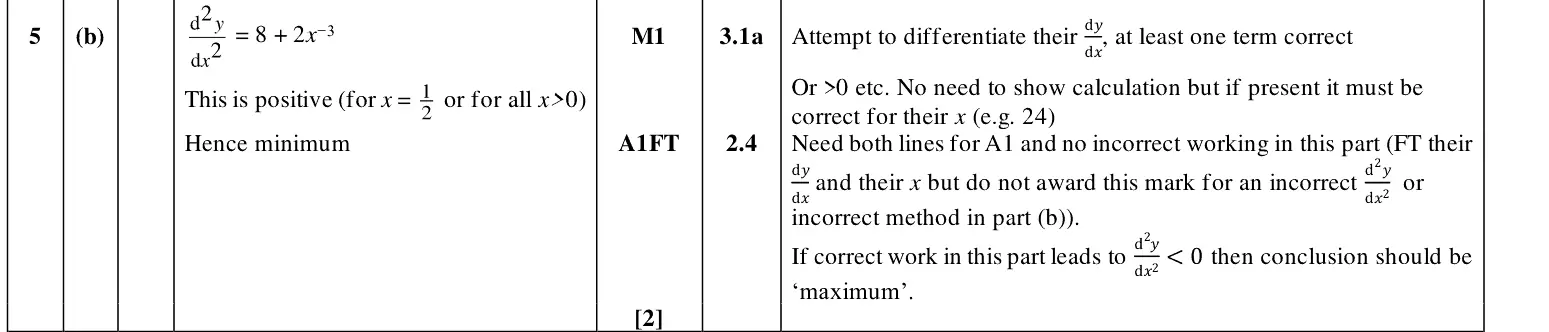
d²y/dx² = 8 + 2x⁻³ > 0 at x = ½ so minimum
sign must be considered explicitly
setting d²y/dx² = 0 is wrong
June 2024 · AS Paper 1 · Q5(c)2 marksMedium
Show the start of this question
Mark scheme for this part
Examiner's comment
Most candidates who had scored in part (a) deduced this correctly (albeit with minimal working, but as the command word here was ‘Find’ this was acceptable). Those who hadn’t scored in (a) rarely made a creditable attempt.
Key points and common errors
dy/dx ≥ 0: 8x − x⁻² ≥ 0 gives x ≥ ½
June 2024 · Paper 1 · Q11(b)4 marksMedium
Show the start of this question
Mark scheme for this part
Examiner's comment
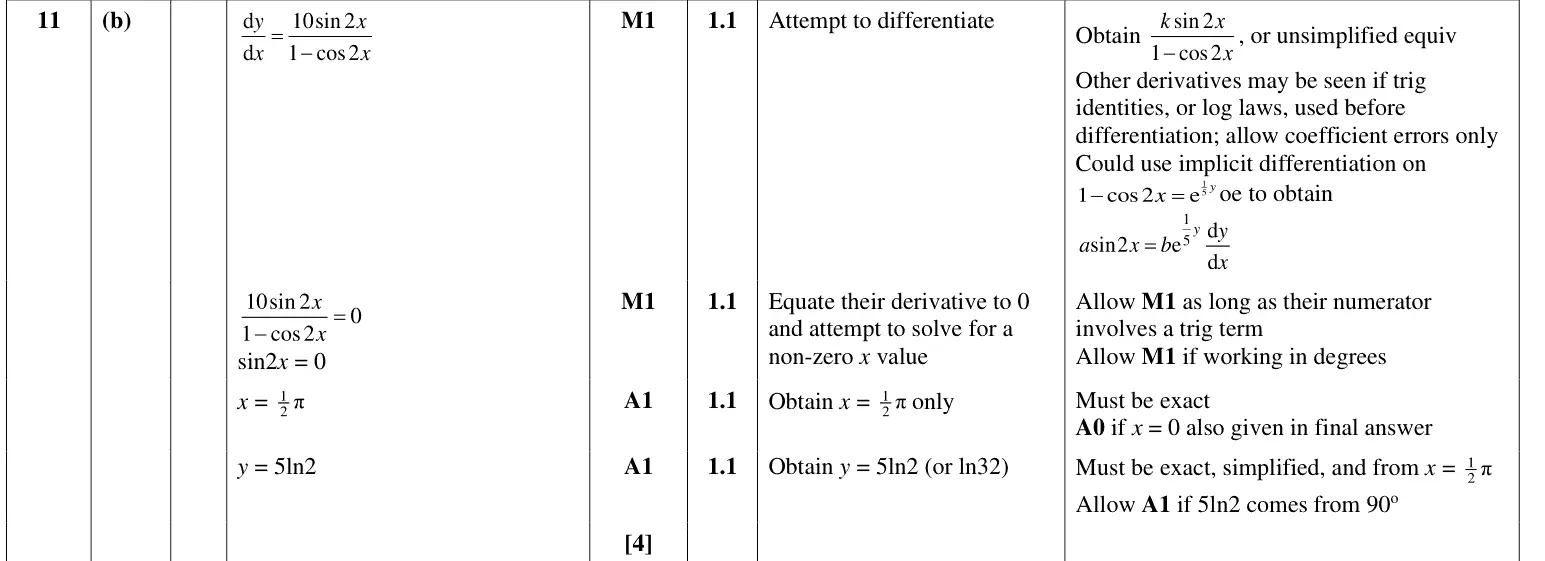
The differentiation of the logarithmic function was reasonably well done with the correct derivative often seen. Many did not produce a non-zero value for x when seeking the required stationary point. The most common incorrect answers given were 𝑥= 0 and 𝑥= 𝜋. The correct y-value often came from an incorrect x value and so was not given credit.
Key points and common errors
dy/dx = 10sin2x/(1 − cos2x)
sin2x = 0, smallest positive x = π/2
y = 5ln2
x = 0 or π common errors
June 2024 · Paper 1 · Q11(c)(ii)1 markHard
Show the start of this question
Mark scheme for this part
Examiner's comment
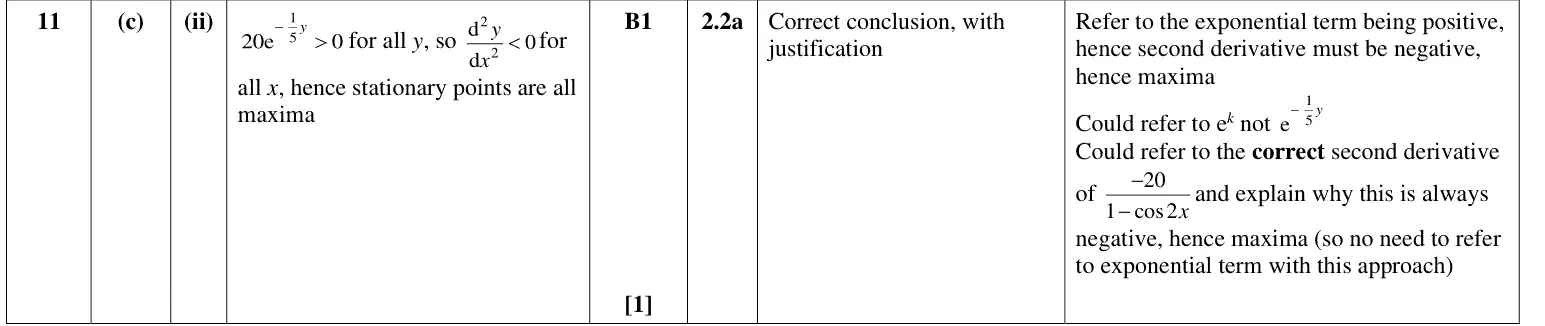
This was not well answered and was often left blank. Quite a few candidates who deduced that the stationary points must all be maxima did not give sufficient reasoning.
Key points and common errors
20e^(−y/5) > 0 so d²y/dx² < 0 for all x: every stationary point is a maximum
reason required
June 2024 · Paper 2 · Q1(a)2 marksEasy
Mark scheme for this part
Examiner's comment
Almost all candidates answered this correctly, scoring both marks. Occasionally candidates made an error in reducing the power -2 to -1 or attempted to integrate instead.
Key points and common errors
rewrite 2/x² as 2x⁻²
errors reducing the power −2
some integrated instead
June 2024 · Paper 2 · Q1(b)2 marksEasy
Mark scheme for this part
Examiner's comment
A majority of candidates answered this correctly, scoring both marks. A very small number did not differentiate the ‘9’ term, scoring B1 only.
Key points and common errors
write √x as x^½
the constant −9 differentiates to 0
June 2024 · Paper 2 · Q4(b)3 marksEasy
Show the start of this question
Mark scheme for this part
Examiner's comment
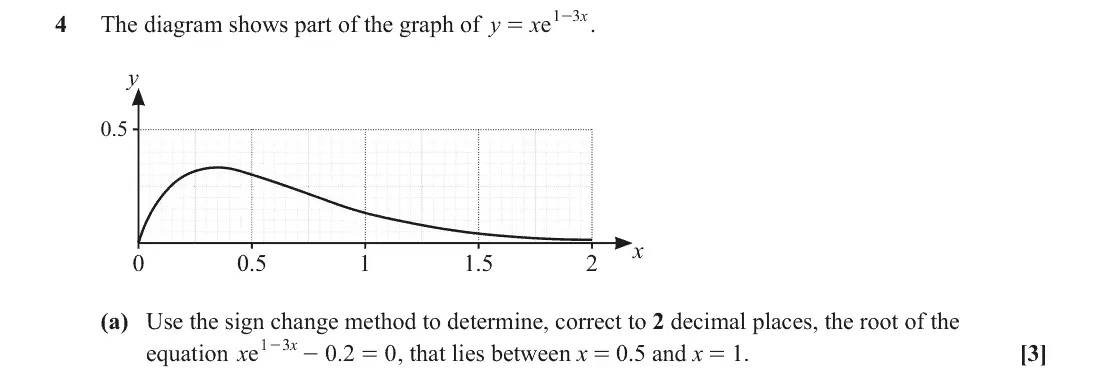
This question was well answered. Most candidates made an acceptable attempt at differentiating the given expression and noticed that they needed to use the product rule to do so (those who didn’t scored M0). Of those who differentiated correctly, most were able to go on to solve =0 and reach the required response for A1. Relatively few candidates explicitly considered (and excluded) further roots from 𝑒1−3𝑥= 0 but the B1 mark could be implied by only giving a single value for x from the other factor. Some candidates attempted to find a further root (or incorrectly deduced x=0) which meant they scored B0. Other candidates attempted the second derivative and mistakenly set this equal to zero.
Key points and common errors
product rule needed
e^(1−3x) is never 0 so x = 1/3
June 2024 · AS Paper 2 · Q5(a)4 marksMedium
Mark scheme for this part
Examiner's comment
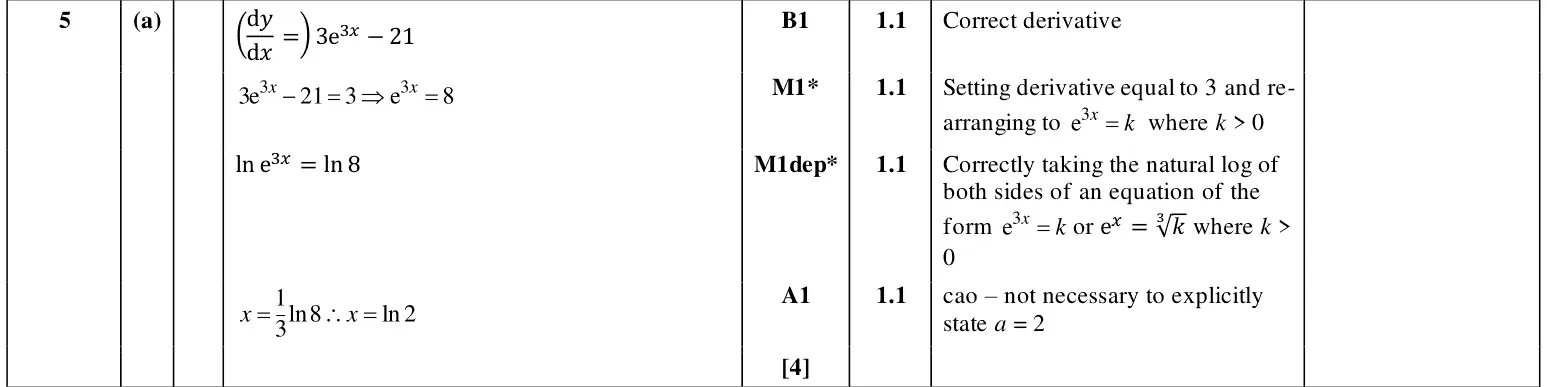
A lot of good responses lost the final mark because the answer was left as 3ln8, ignoring the instruction to give the answer in the form lna. Those who differentiated e3x to 3xe3x, 3xe3x - 1, e2x or similar were 1 given no marks. A small number set their differential equal to − 3. Understanding of the log laws still needs strengthening. Some did not attempt differentiation, but started with things like lny = lne3x − ln21x − ln8.
Key points and common errors
dy/dx = 3e^(3x) − 21 = 3 gives e^(3x) = 8
x = ⅓ln 8 = ln 2 (must be in the form ln a)
June 2024 · AS Paper 2 · Q5(b)3 marksHard
Show the start of this question
Mark scheme for this part
Examiner's comment
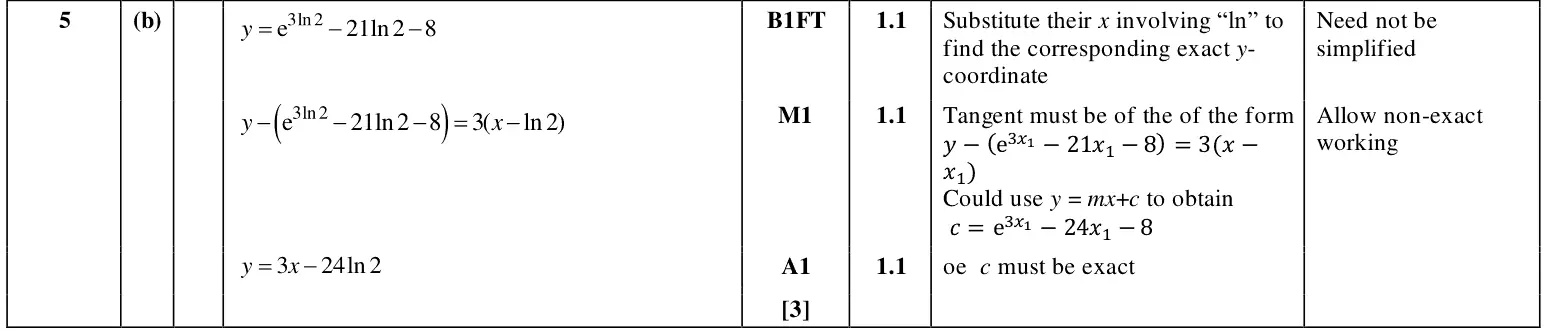
This part was not well done. Those who did not find an x in (a) made no progress. Those who had an x often responded with a decimal, ignoring the request for an exact c (particularly those who had 1 responded with 3ln8 in the previous part).
Key points and common errors
y = e^(3ln2) − 21ln2 − 8 = −21ln2
y = 3x − 24ln2
c must be exact
June 2024 · AS Paper 2 · Q67 marksMedium
Mark scheme for this part
Examiner's comment
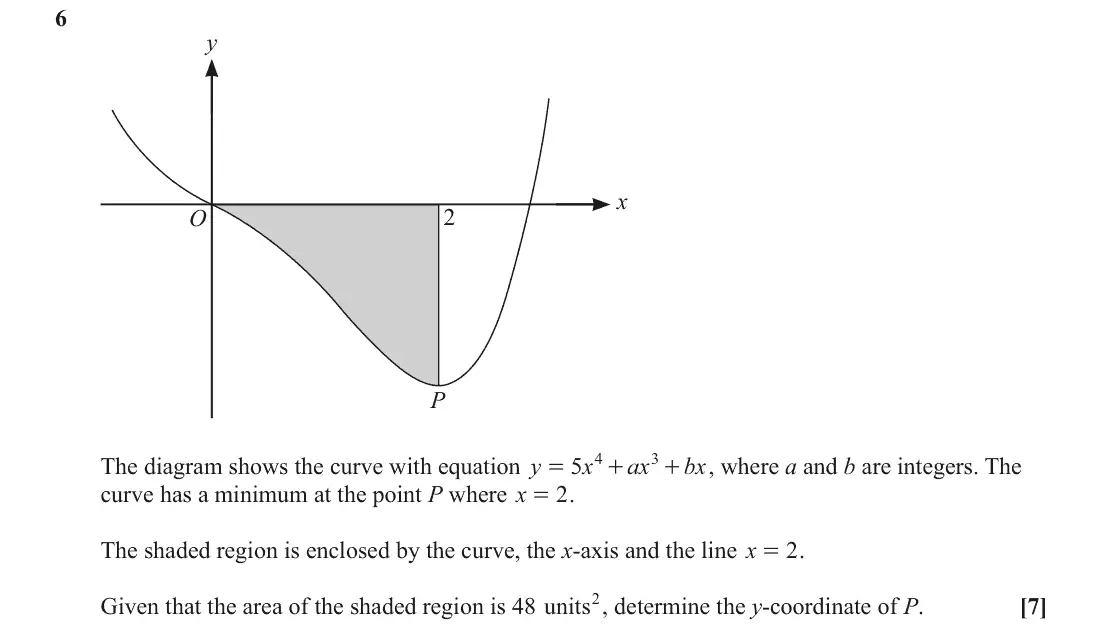
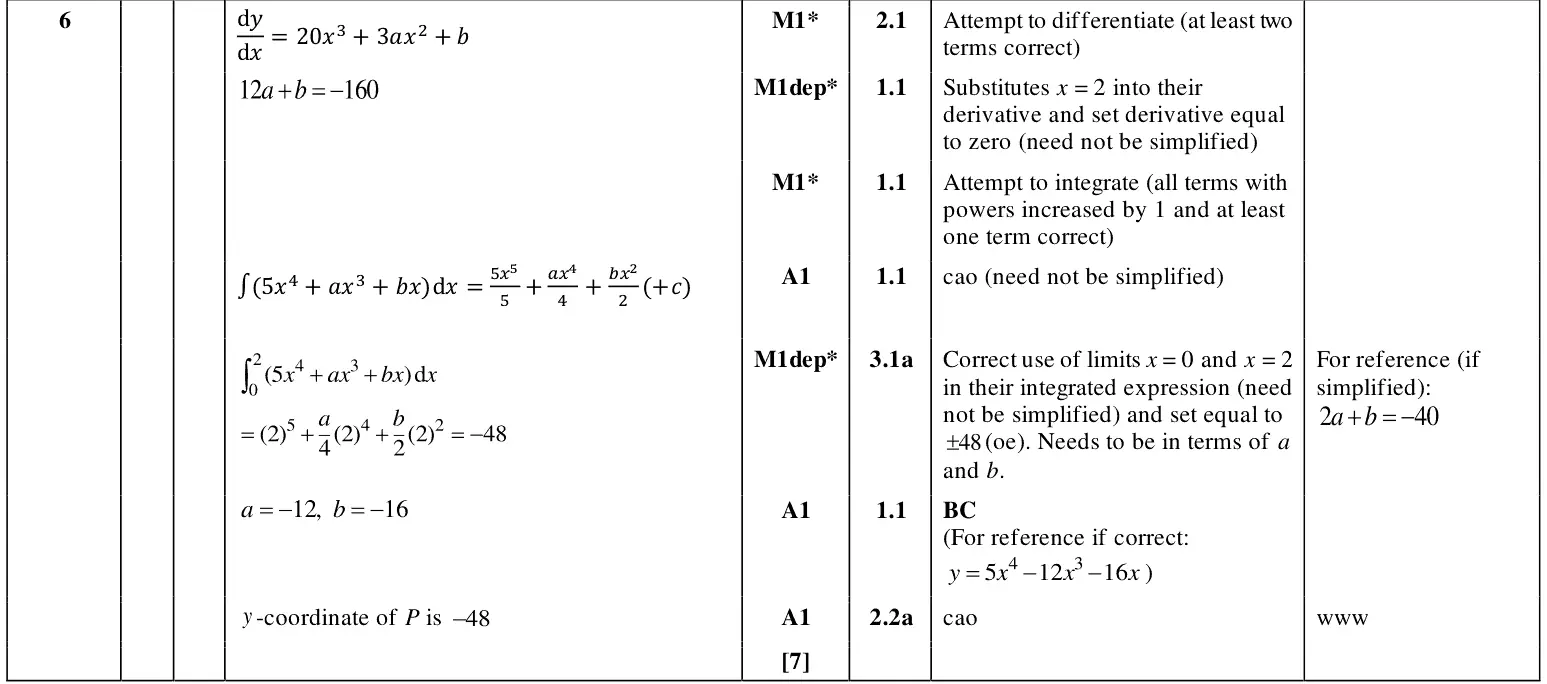
Those who recognised the need to differentiate and integrate generally did it well. A lot of candidates dropped 2 marks because they used 48 rather than -48 in their working. Quite a few unnecessarily found the second derivative; some then ignored it, but others substituted x = 2, set it to zero and obtained a value for a. The poorer efforts generally either didn’t differentiate or didn’t integrate, but most efforts gained at least 2 marks.
Key points and common errors
dy/dx = 0 at x = 2 gives 12a + b = −160
area below the axis so integral from 0 to 2 equals −48, giving 2a + b = −40
a = −12, b = −16
y-coordinate of P is −48
using +48 is the common error
June 2024 · AS Paper 2 · Q11(b)5 marksHard
Show the start of this question
Mark scheme for this part
Examiner's comment
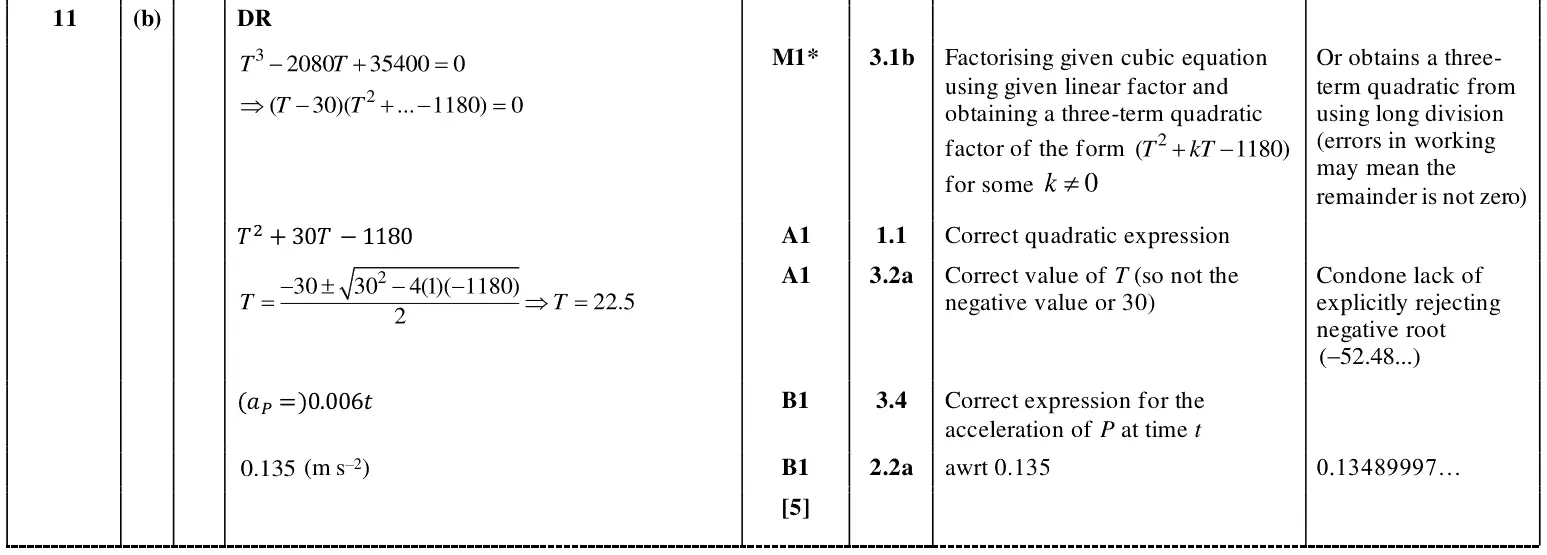
This part requested detailed reasoning, so we expected to see the method clearly presented; in very many cases this did not happen. As soon as candidates see this instruction they should think carefully about how they are going to use the calculator (see Exemplar 3 below and its commentary). To gain the M mark (and so potentially the next 2 marks also), we wanted to see clear evidence of factorising or long division. For the A mark allocated to T = 22.5, we wanted to see how this value had been obtained, for example evidence of the quadratic formula. Many candidates just gained the last 2 marks, as seen in cubic given in (a). This is not sufficient following a ‘show detailed reasoning’ request and earned M0. Note that the last B mark could still be given in such cases.
Key points and common errors
factorise using T = 30: T² + 30T − 1180 = 0
formula gives T = 22.5 (reject negative)
a = 0.006t so 0.135 m s⁻²
DR so factorising and formula must be shown
June 2024 · Paper 3 · Q5(a)(i)5 marksEasy
Mark scheme for this part
Examiner's comment
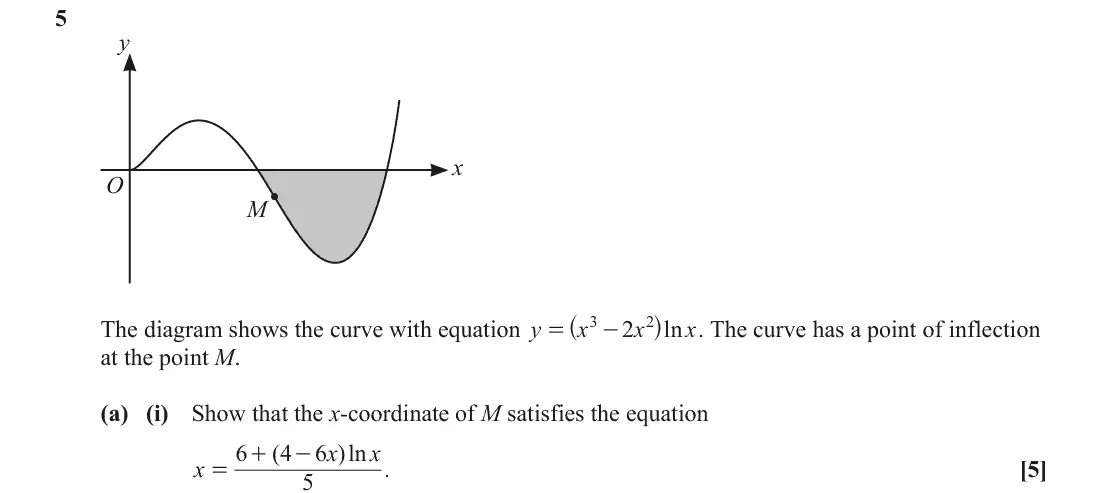
While a small minority of candidates incorrectly believed that the point of inflection was when the first derivative was equal to zero, most candidates correctly set the second derivative equal to zero in their attempt to show that the 𝑥-coordinate of 𝑀 satisfied the given equation.
Key points and common errors
product rule for dy/dx and d²y/dx²
set d²y/dx² = 0 (not dy/dx)
rearrange to the given equation
June 2024 · Paper 3 · Q12(b)1 markHard
Show the start of this question
Mark scheme for this part
Examiner's comment
The most common incorrect answer in this part was 6 with the correct value of 1.5 rarely seen. Of those that did correctly attempt this part many used calculus techniques instead of considering their graph from part (a).
Key points and common errors
acceleration zero at the minimum of the quadratic: t = 1.5 only
6 a common wrong answer
June 2023 · AS Paper 1 · Q3(a)3 marksMedium
Mark scheme for this part
Examiner's comment
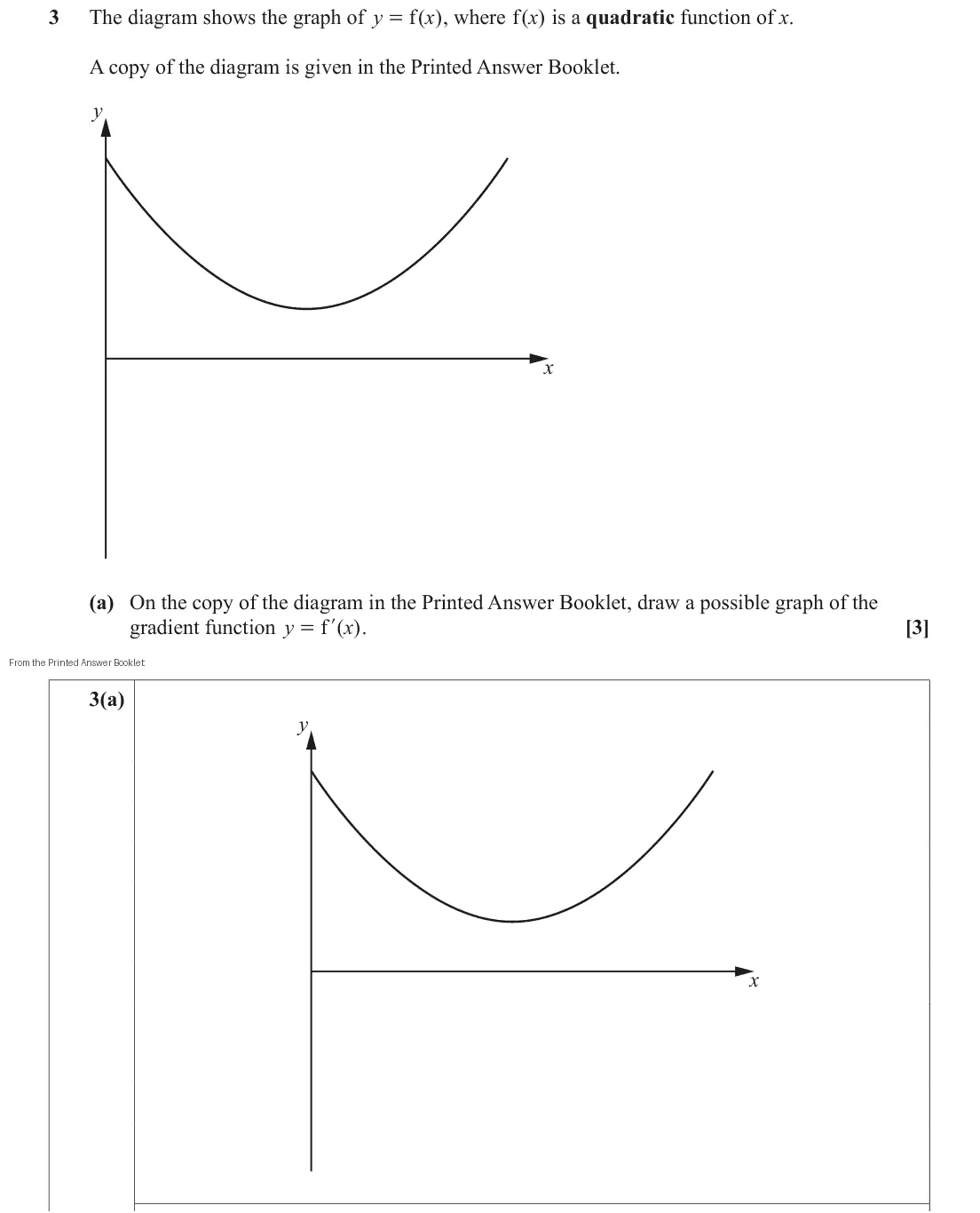
This question was reasonably well answered, with many candidates achieving at least 1 or 2 marks. Some candidates gave a non-straight line or a ‘modulus-like’ graph that showed some (but not fully correct) qualitative understanding of differentiation (or perhaps that they had not noted the instruction in the question that the given function was quadratic). A common incorrect response was a straight line with positive gradient, but starting from the positive y-axis (showing that candidates did not appreciate the need for the gradient to be negative in the first half of the graph). Centres should encourage candidates to carefully check their responses to questions like this. Straight lines that did not extend to the y-axis could not achieve full marks. Some candidates drew a line that was a tangent to the given curve. Many recognised that the gradient at the minimum would be zero and thus had their graph cutting, or touching, the x-axis vertically below the minimum.
Key points and common errors
straight line with positive gradient, negative y-intercept, crossing the x-axis below the minimum
common error starting on the positive y-axis
June 2023 · Paper 1 · Q3(a)4 marksEasy
Mark scheme for this part
Examiner's comment
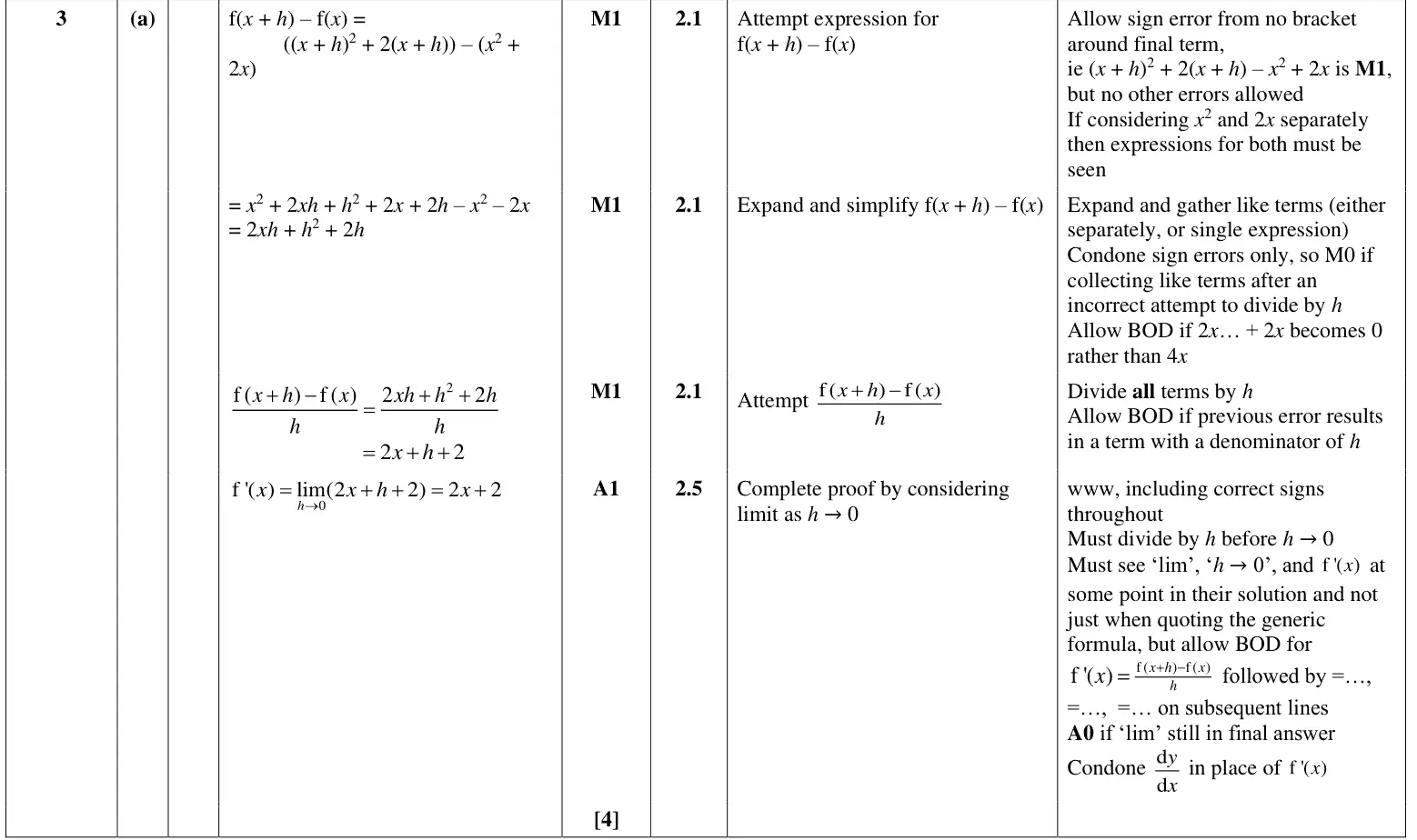
Most candidates were apparently familiar with differentiation from first principles and could produce a convincing proof to justify the given derivative. When producing a proof, candidates should avoid rolling a number of steps together as it can result in a solution that is not entirely convincing. In this proof, candidates should first simplify the numerator by expanding the bracket and gathering like terms, and then divide by h, rather than doing both steps in one go. Some, otherwise correct, solutions were spoiled by a lack of correct notation, including f’(x) and lim h → 0, despite these being given in the formula at the start of the paper. A common error was not making correct use of brackets, resulting in a sign error when considering – f(x). Some candidates clearly noticed this and attempted to fudge the simplifying of terms, but best practice would be to check each and every line of the proof carefully, amending as necessary. A sign error occurs on the third line of working. The candidate has realised on the next line that + 4x is incorrect, so deletes this term but doesn’t correct the sign error on the previous line thus losing the A mark.
Key points and common errors
expand and simplify f(x + h) − f(x) before dividing by h
must show lim h→0 and f′(x) notation
June 2023 · AS Paper 1 · Q3(b)1 markMedium
Show the start of this question
Mark scheme for this part
Examiner's comment
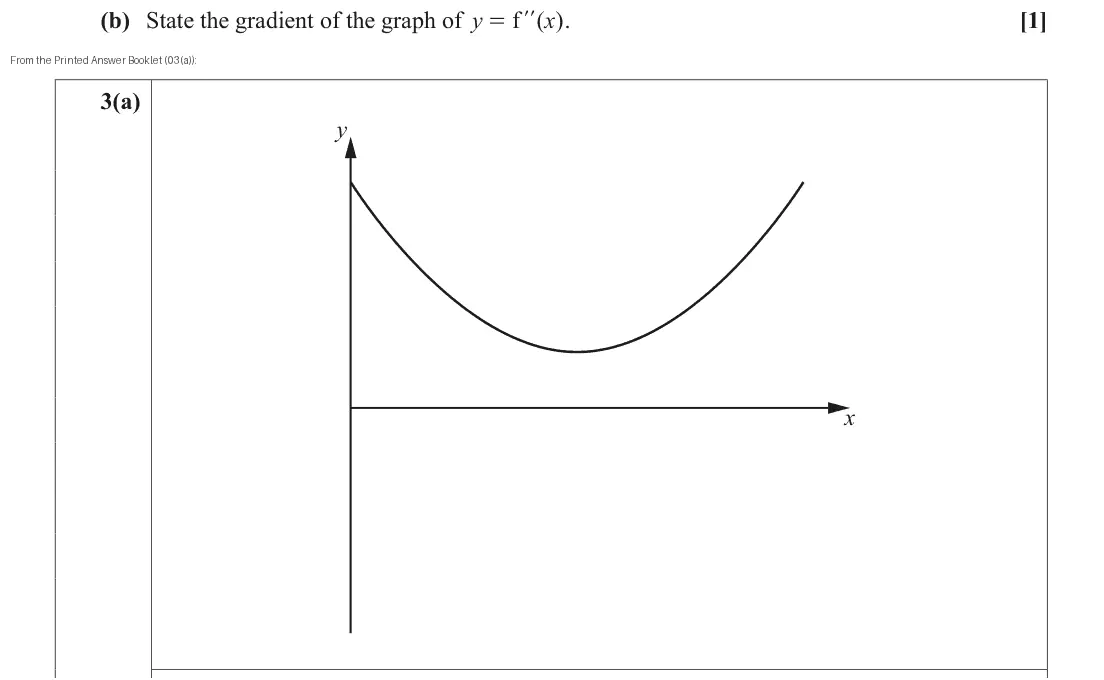
Many candidates interpreted this correctly, although ‘2’ was a common incorrect response (from f’’(x) = 2, but not recognising that the gradient of this horizontal straight line is 0). This question did not require part (a), although correct responses often followed a ‘reasonably correct’ interpretation in part (a).
Key points and common errors
f″(x) is constant so its graph has gradient 0
common wrong answer 2
June 2023 · AS Paper 1 · Q4(b)2 marksMedium
Show the start of this question
Mark scheme for this part
Examiner's comment
Most candidates recognised the need to differentiate and the majority of these got the correct derivative. Common errors included -3e2x, 3xe3x or getting y = e6 and then gradient = 6e5. Some candidates seemed unsure about the degree of accuracy required (with many giving their response to 2dp or similar); as per the rubric on the front cover, 3sf is the default unless otherwise stated.
Key points and common errors
dy/dx = 3e³ˣ
at x = 2 gradient 3e⁶ = 1210
errors 3xe³ˣ, −3e²ˣ
June 2023 · Paper 1 · Q6(a)4 marksEasy
Mark scheme for this part
Examiner's comment
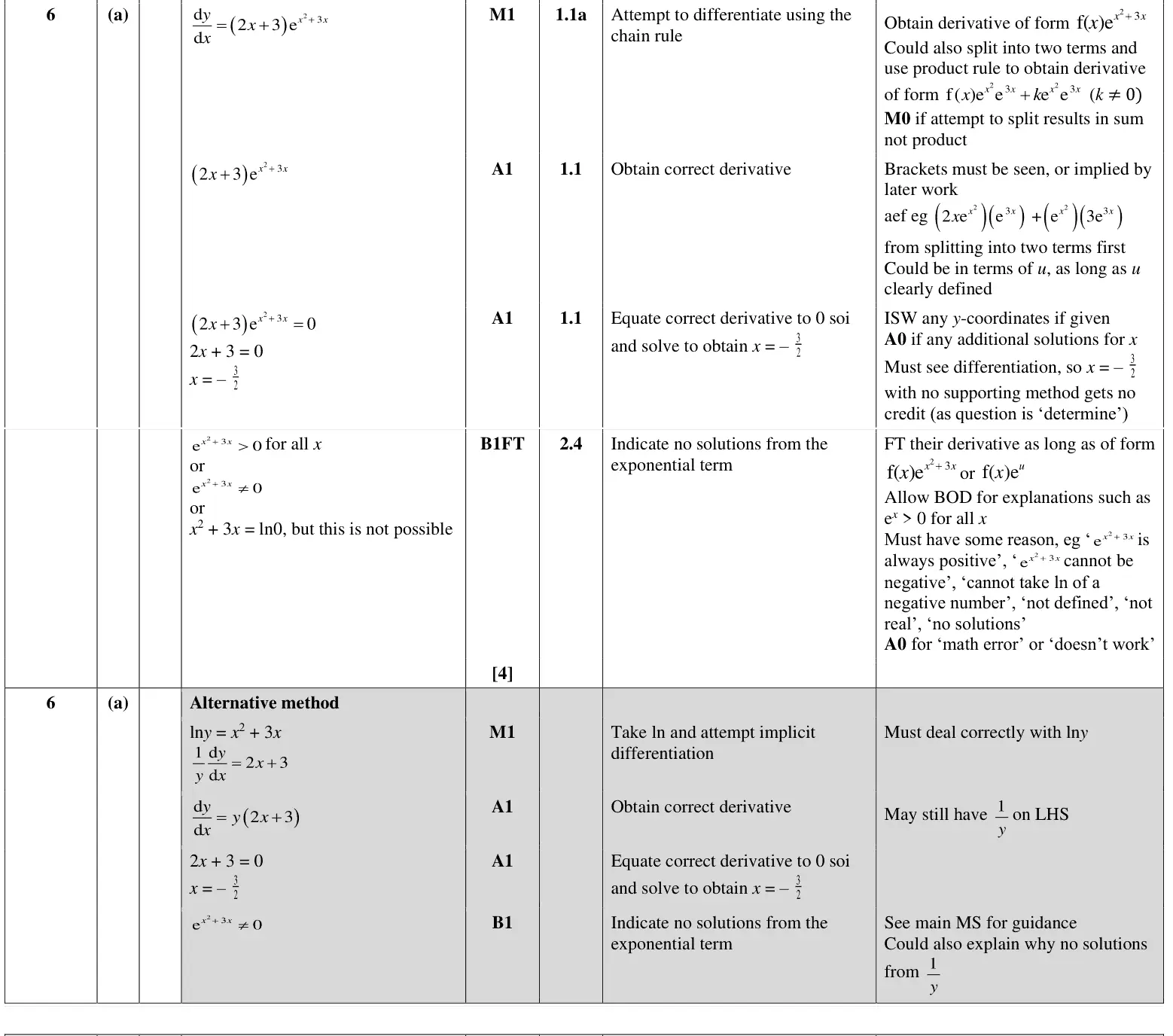
This part of the question was generally well answered, with candidates providing detailed and convincing solutions. Most were able to differentiate the given function using the chain rule, whereas a few first introduced logs and then used implicit differentiation. Candidates then had to equate the derivative to 0, solve to find x = −1.5 and explain why the exponential term would not give any solutions when equated to 0.
Key points and common errors
chain rule (2x + 3)e^(x² + 3x)
x = −3/2
must state e^(x² + 3x) ≠ 0
June 2023 · AS Paper 1 · Q6(b)4 marksMedium
Show the start of this question
Mark scheme for this part
Examiner's comment
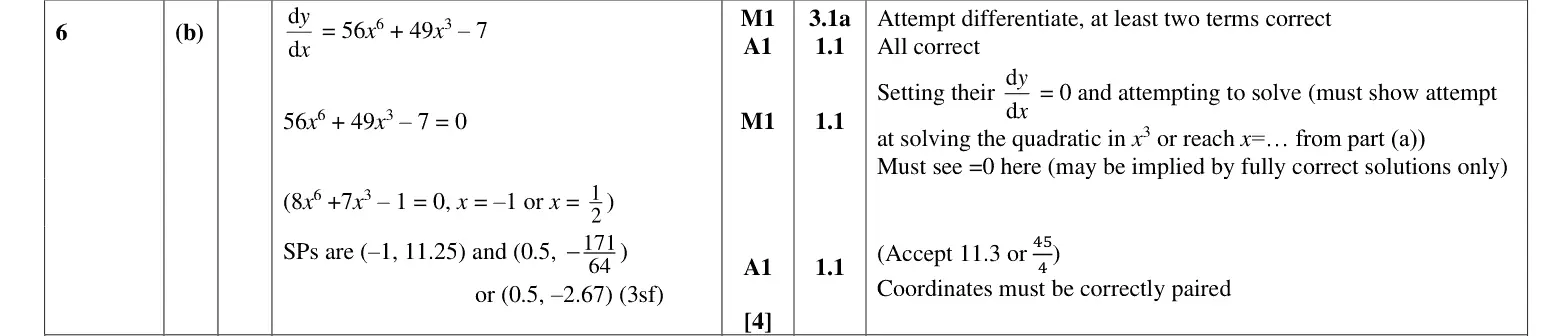
Most candidates successfully differentiated the given expression. However, many did not show the process of setting this = 0 and solving (e.g. dividing through by a factor of 7 to obtain the equation from (a)). Again the command word ‘Determine’ means that working is required; some candidates appeared to simply assume that the answers would be the x-values from part (a). While most candidates were able to correctly calculate the corresponding y-values, some candidates missed this instruction and so were unable to access the final A mark.
Key points and common errors
dy/dx = 56x⁶ + 49x³ − 7 = 0 is 7 × the equation in (a)
points (−1, 11.25) and (½, −171/64)
must show setting = 0 and find y-values
June 2023 · Paper 1 · Q6(b)5 marksHard
Mark scheme for this part
Examiner's comment
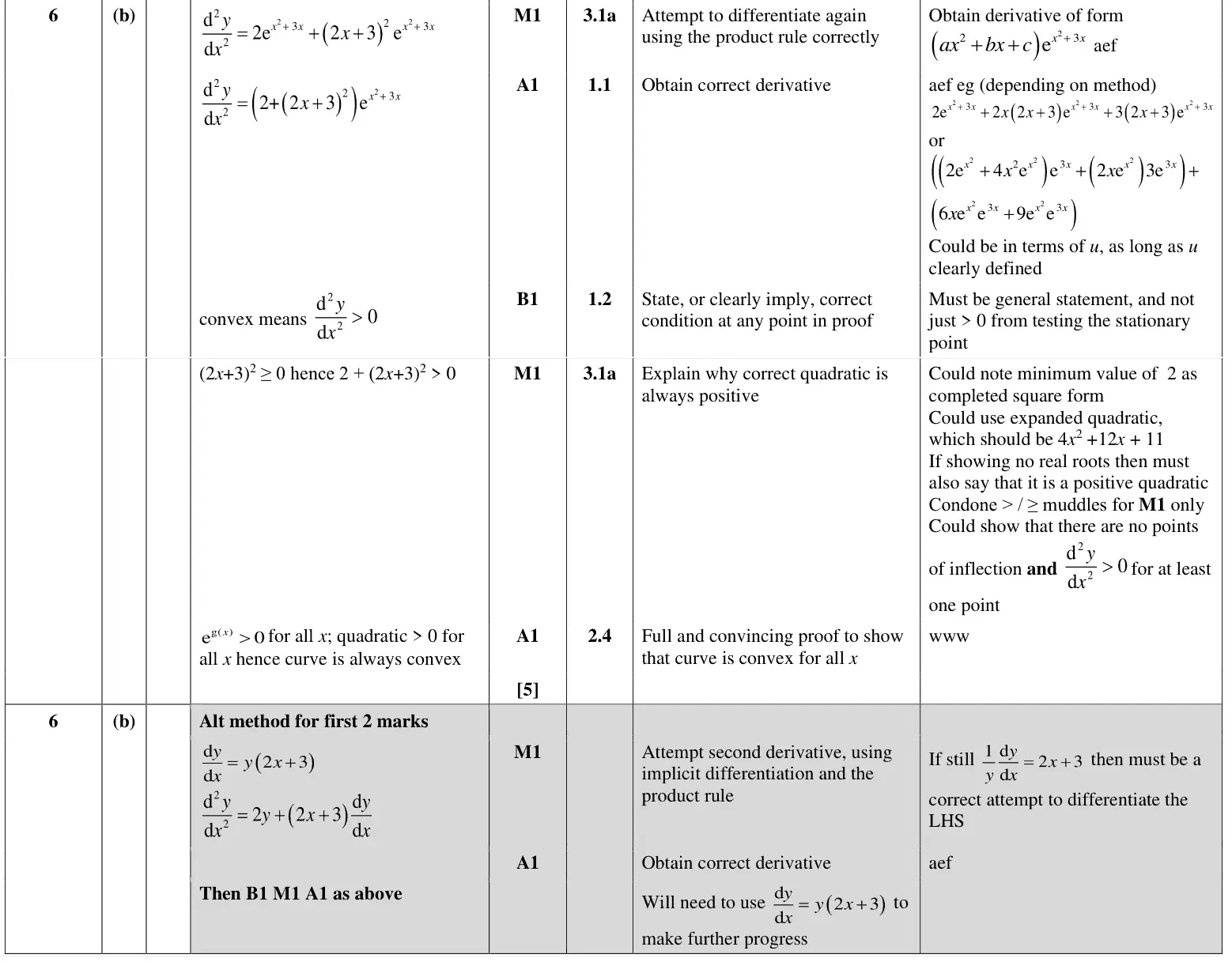
Most candidates were aware that the second derivative was required, and could make some attempt to find this, but the differentiation proved too challenging for many. Some candidates started the entire question by first splitting the given equation into the product of two exponential terms. When using this approach, the first derivative was usually correct but the second derivative rarely so. Most candidates gained a mark for identifying that the second derivative was always positive for a convex curve, and could attempt to show this. However, only the most able candidates were able to provide a convincing justification for this. To gain full credit candidates had to make mathematically correct statements throughout, so vague statements regarding ‘squares always positive’ could not be credited for the final mark. At the start of the solution the candidate gained a mark for stating the condition for the curve to be convex. They also gained 2 marks for a correct second derivative, with method clearly shown. They then attempted to show that this is always positive, but there was an error with the inequality sign; it should be (2x + 3)2 ≥0. They were still given the method mark for their attempt, but not the accuracy mark.
Key points and common errors
product rule: (2 + (2x + 3)²)e^(x² + 3x)
f″ > 0 for all x means convex
argue each factor positive
June 2023 · AS Paper 1 · Q6(c)4 marksMedium
Show the start of this question
Mark scheme for this part
Examiner's comment
Most candidates obtained a reasonable second derivative (FT was allowed here from their first derivative in part (b)). Note that the question asked candidates to ‘use the value’ of the second derivative, so we needed to see an explicit statement that this was < or > 0 at each point before concluding whether each point was a local minimum or maximum. If values were given, they needed to be correct. FT was allowed from candidates’ second derivative and/or their values of x. Some candidates misinterpreted the question and differentiated the equation from part (a) (8x6 + … ), which if done correctly was awarded M1A0M1A0.
Key points and common errors
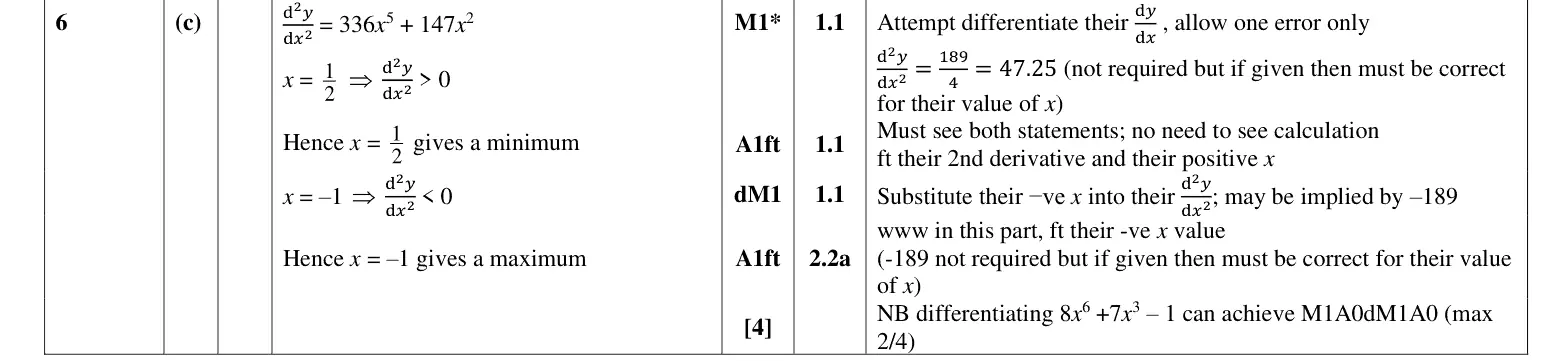
d²y/dx² = 336x⁵ + 147x²
positive at x = ½ (minimum), negative at x = −1 (maximum)
must state the sign explicitly
June 2023 · Paper 1 · Q9(a)1 markMedium
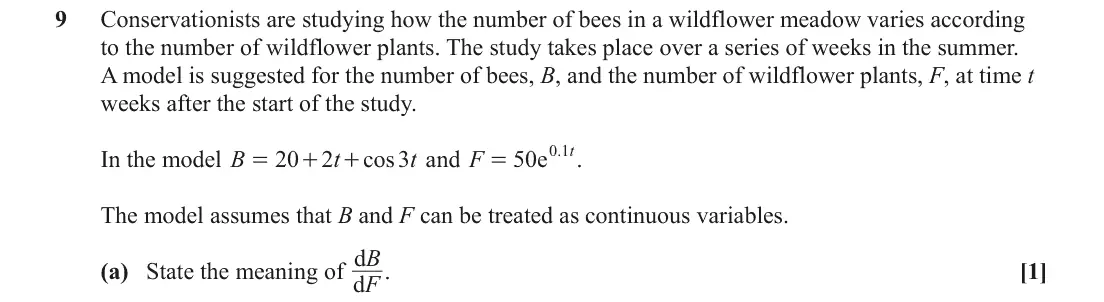
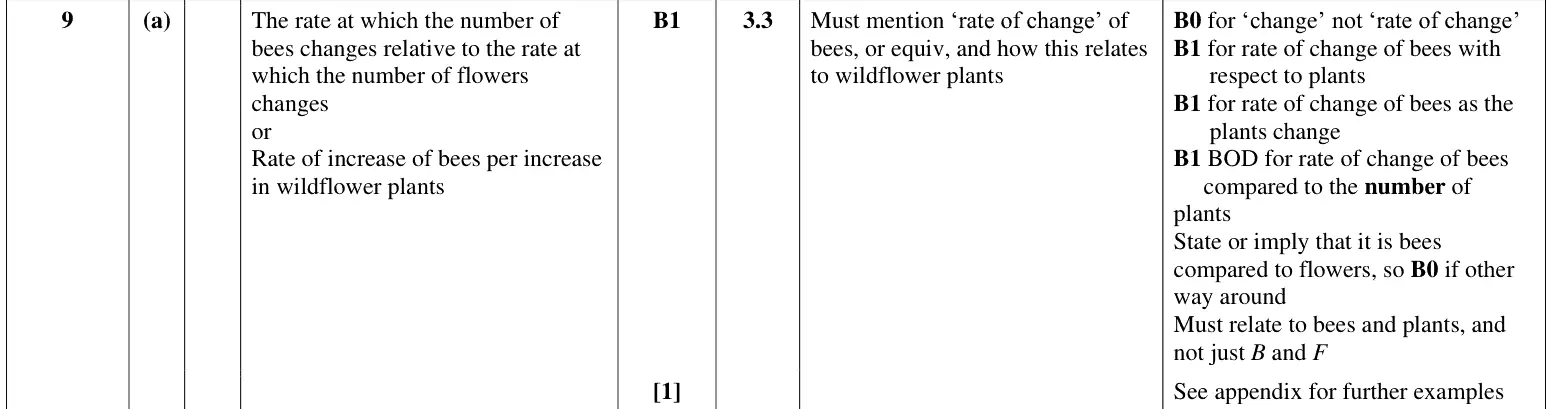
Mark scheme for this part
Examiner's comment
To gain this mark, candidates had to give an answer in the context of the question and many were able to do so. The most common errors were to say that it was the ‘change’ not ‘rate of change’, and to not indicate the dependency.
Key points and common errors
rate of change of number of bees with respect to number of wildflower plants
'change' alone gets nothing
June 2023 · Paper 1 · Q9(b)4 marksEasy
Show the start of this question
Mark scheme for this part
Examiner's comment
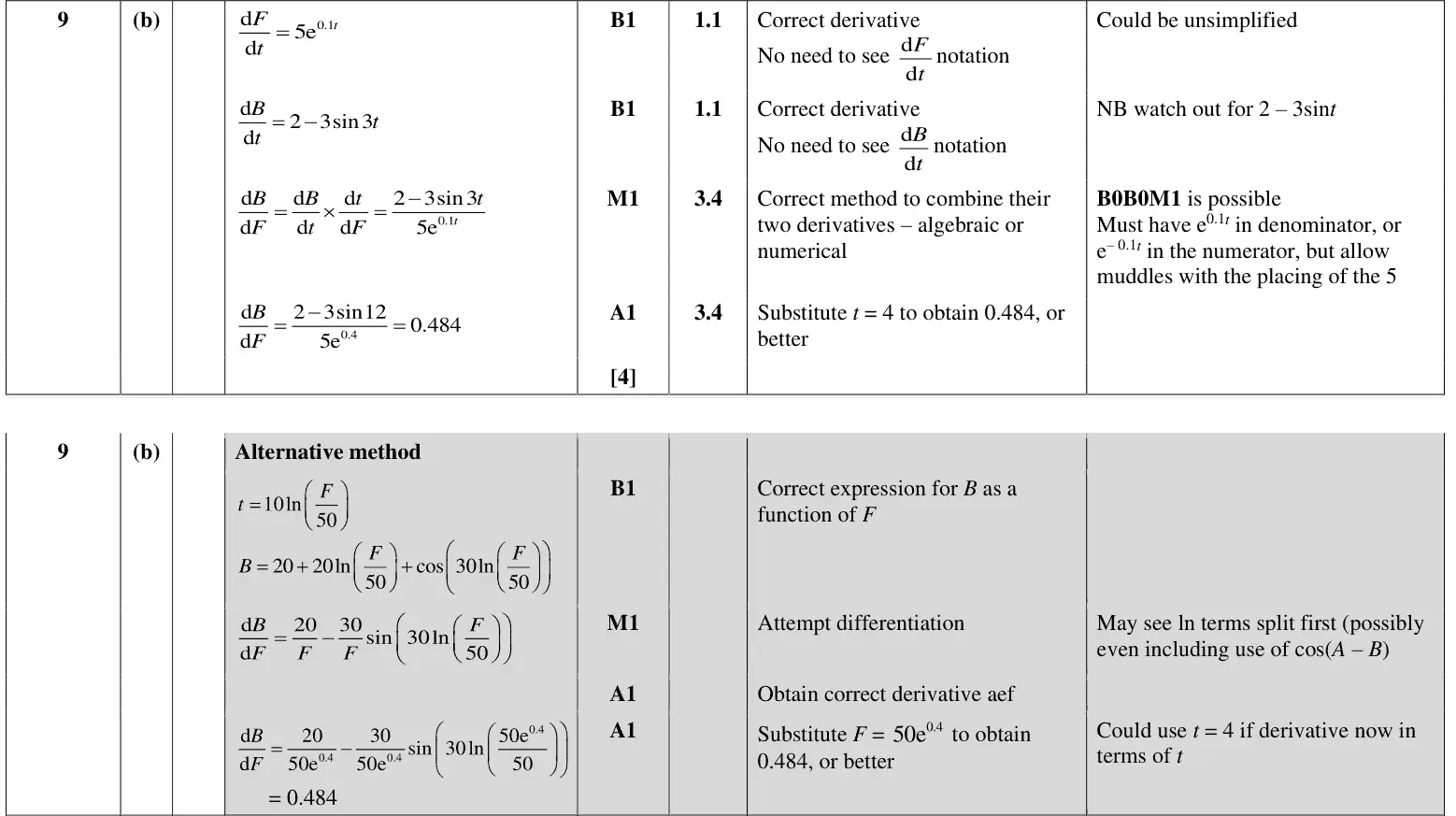
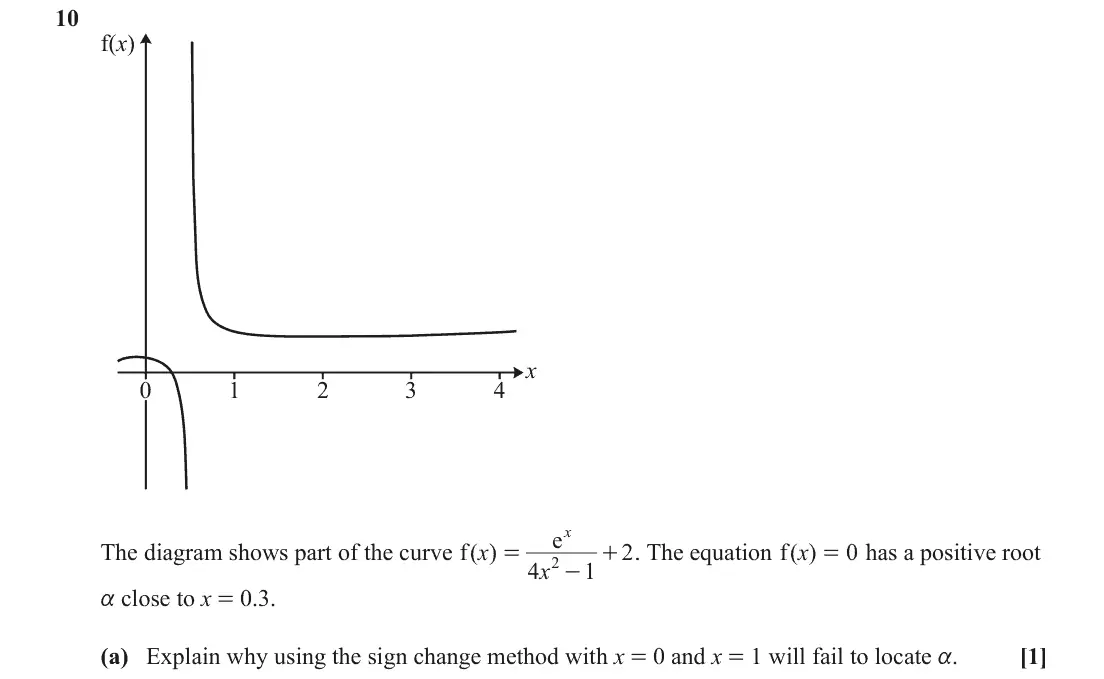
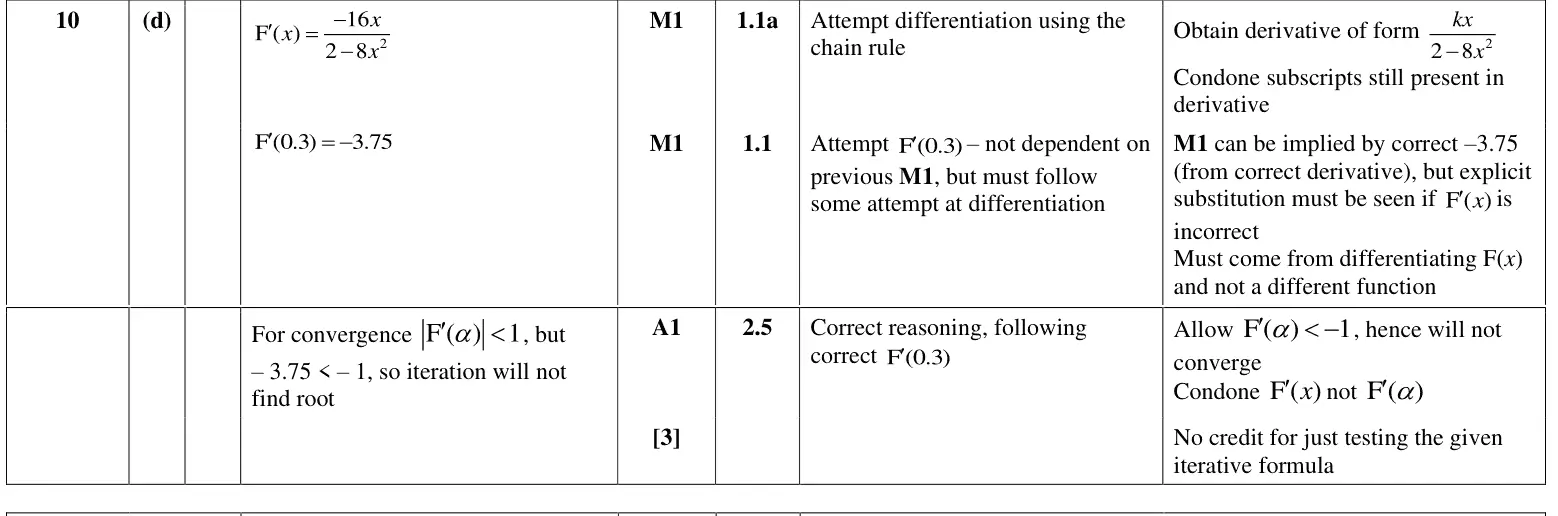
This part of the question was very well answered, with the majority of candidates able to state the two correct derivatives and then correctly combine them. However, the modal mark was 3 as it was only the more astute candidates that appreciated that radians should be used with calculus involving trigonometric functions.
The required method was indicated in the question, and candidates were able to gain the first mark for a reasonable attempt to differentiate F(x). Most candidates did attempt to do this, but the derivatives were not always of the correct form. The second mark was for substituting x = 0.3. While a correct response can imply a correct method, that is not the case for an incorrect response; if the derivative was incorrect then candidates had to show explicit substitution for this mark to be credited. The final mark was for explaining why the value of F’(0.3) indicated divergence not convergence; some excellent explanations were seen but others thought that the fact that it was negative was the reason without also considering the magnitude. As the initial method was given in the question it was perhaps surprising that some candidates didn’t even attempt differentiation, with simply using the iterative formula being the most common error.
Key points and common errors
F′(x) = −16x/(2 − 8x²)
F′(0.3) = −3.75
modulus of F′ > 1 so the iteration diverges
June 2023 · Paper 2 · Q4(a)6 marksEasy
Mark scheme for this part
Examiner's comment
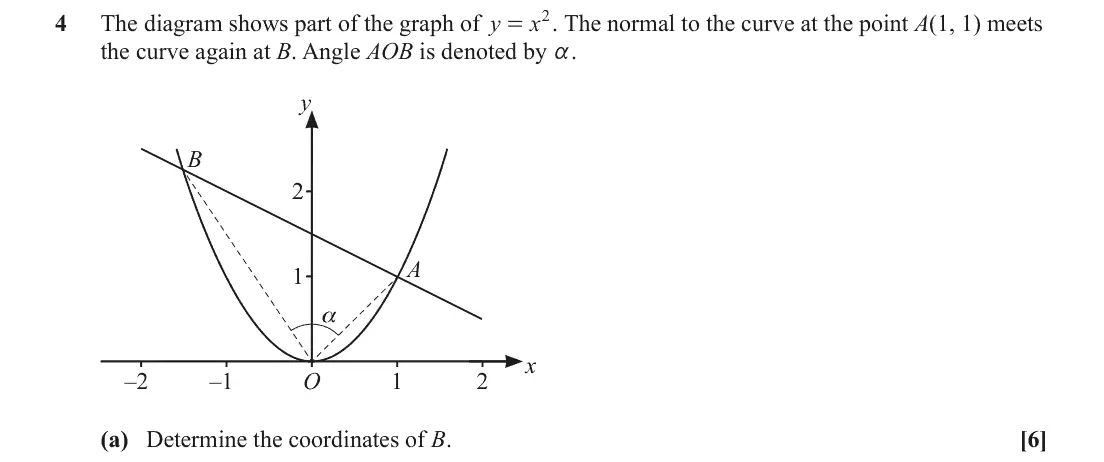
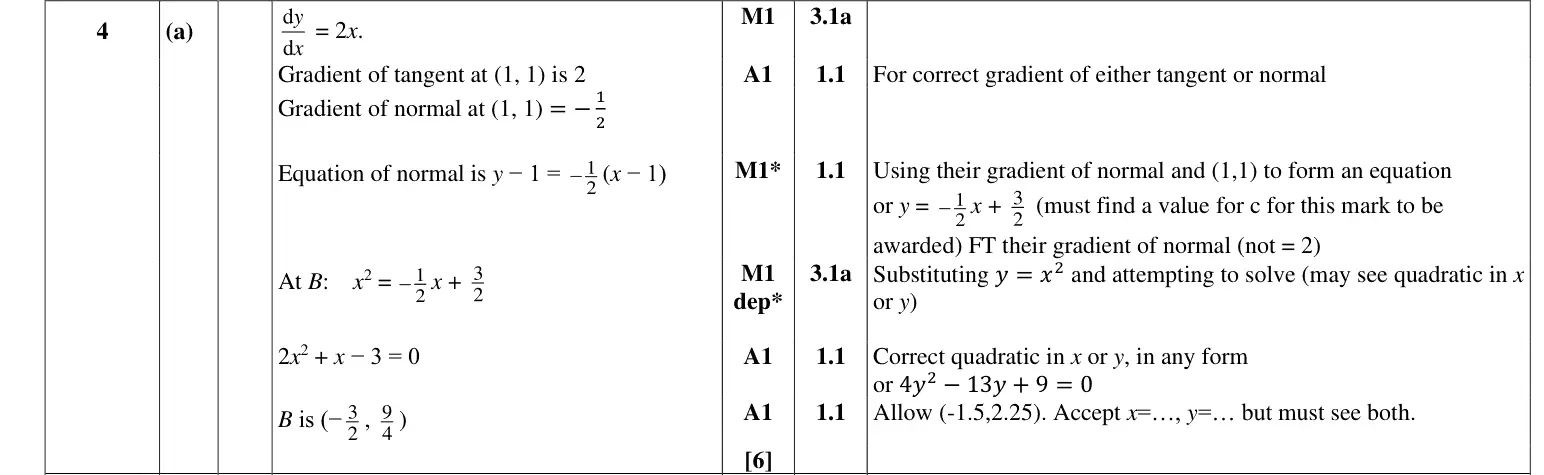
This question was very well answered, with the majority of candidates reaching the required answer. However, again some candidates did not heed the ‘Determine’ instruction and gave minimal working, or an answer only (BC) without working. Where the command word is ‘Determine’ working is required to support the answer, even if it can be done on a calculator. Many candidates found the equation of the normal correctly but then did not show any working for how this led to the coordinates of B, which meant the final 3 marks could not be given – even for a correct answer. This candidate’s response shows all of the required working to justify their (correct) answer. They have shown how the equation of the normal is obtained and then correctly substituted to solve for the coordinates required.
Key points and common errors
gradient 2 at A so normal gradient −1/2
y = −x/2 + 3/2
solve x² = −x/2 + 3/2 to get B(−3/2, 9/4)
working needed for Determine
June 2023 · Paper 2 · Q5(a)(i)4 marksEasy
Mark scheme for this part
Examiner's comment
This question was generally well answered. Some candidates appeared uncertain how to differentiate the given expression, either making errors in differentiation or attempting to (unnecessarily) apply the product rule. Most candidates were able to set their derivative = 0 and obtain an expression from which values could be deduced. The entirety of Question 5 is Detailed reasoning which means that sufficient working is required to support all answers, throughout. There were fewer cases of ‘answers without working’ in this question - perhaps because most candidates tended to write down the expression and manipulate it directly. Although the differentiated expression resolves straightforwardly to tan 𝑥= √3, some candidates did not spot this and so chose to square in order to combine the terms. This was acceptable (as long as done correctly, some candidates wrote x – y = 0 followed by x2 − y2 = 0 which is not a correct step of working or squared the entire expression while omitting the ‘cross term’ which could lead to the correct solutions, from incorrect working), but candidates then obtained additional solutions which they needed to test and eliminate - many did not do so (or eliminated the wrong solutions) and lost the final A mark as a result. A small number of candidates used 𝑅cos(𝑥+ 𝛼) to combine the two terms first, which makes the differentiation more straightforward.
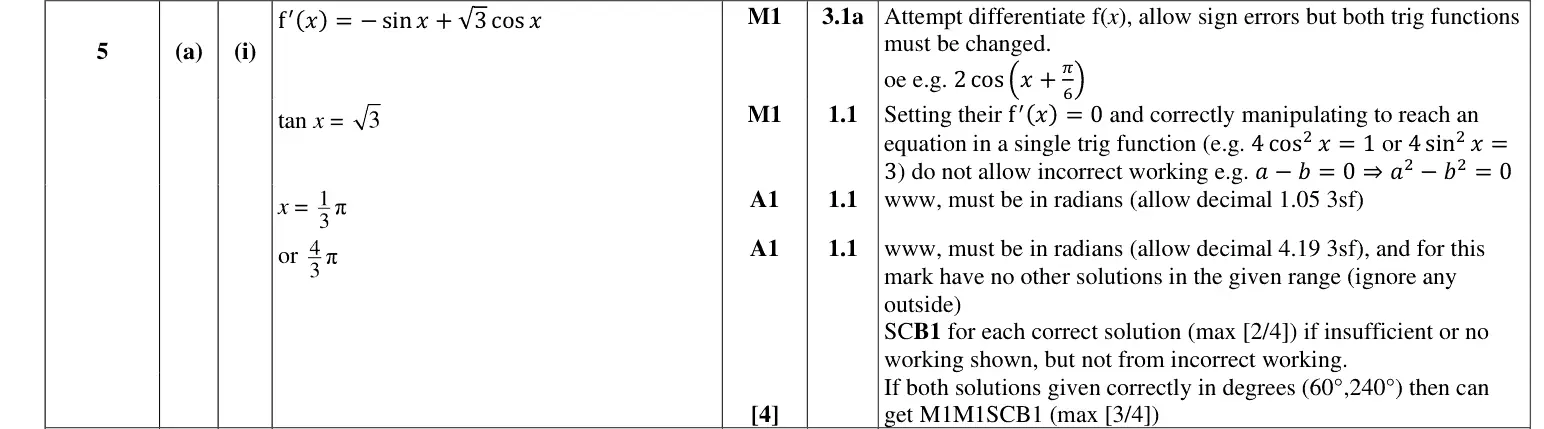
Key points and common errors
f′(x) = −sin x + √3 cos x
tan x = √3
x = π/3, 4π/3 in radians
product rule not needed
squaring introduces extra roots
June 2023 · Paper 2 · Q5(a)(ii)3 marksEasy
Show the start of this question
Mark scheme for this part
Examiner's comment
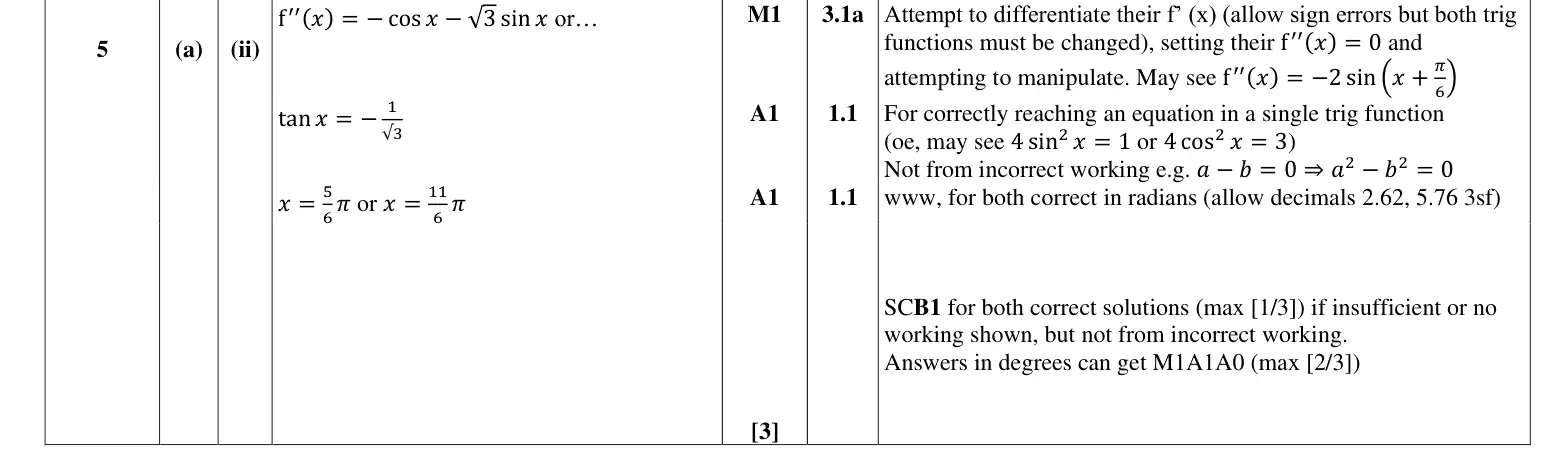
This was very similarly answered to part (a) (i), with most candidates reaching at least one of the required answers. Again, some squared their equation and then did not eliminate additional solutions within the range.
Key points and common errors
f″(x) = −cos x − √3 sin x
tan x = −1/√3
x = 5π/6, 11π/6
June 2023 · Paper 2 · Q5(b)2 marksHard
Show the start of this question
Mark scheme for this part
Examiner's comment
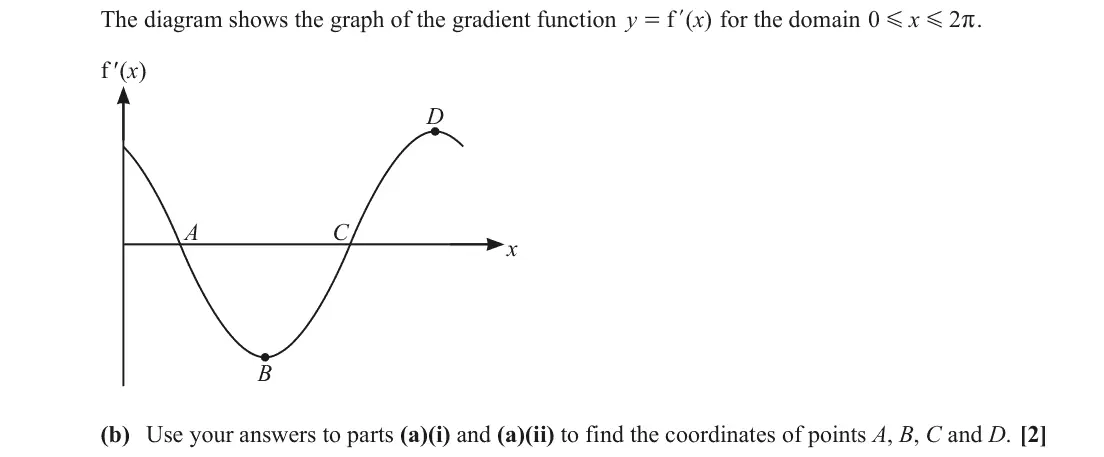
Relatively few candidates gave a fully correct set of answers to this question. Many candidates were able to correctly match their x-values from part (a) to the four points, but then didn’t go on to compute the corresponding y-values (receiving B1 under the SC if all four matched correctly). A number of candidates also assumed, incorrectly, that the y-values were +/-1.
Key points and common errors
A(π/3, 0), C(4π/3, 0), B(5π/6, −2), D(11π/6, 2)
many matched x-values but did not compute y-values
y = ±1 is wrong
June 2023 · Paper 2 · Q5(c)(i)1 markHard
Show the start of this question
Mark scheme for this part
Examiner's comment
This question proved challenging for many candidates. Some were able to state the correct generic fact (f’(x) > 0) but without reference to the graph this was not sufficient for the ‘Explain’ required. Some candidates misinterpreted the setup and referred to f’’(x) or where the gradient of this graph was positive or negative, or concave up/down. Some candidates referred to the points A and C although this was not required. Candidates should make sure that they provide an explanation that is specific to the request in the question, not just stating a generic fact. A few candidates also mis-stated what to look for, e.g. ‘where the graph is above the y-axis’, or wrongly assumed that the graph was of f(x).
Key points and common errors
where the graph of f′(x) is above the x-axis
must refer to the graph, not just f′(x) > 0
June 2023 · Paper 2 · Q5(c)(ii)2 marksHard
Show the start of this question
Mark scheme for this part
Examiner's comment
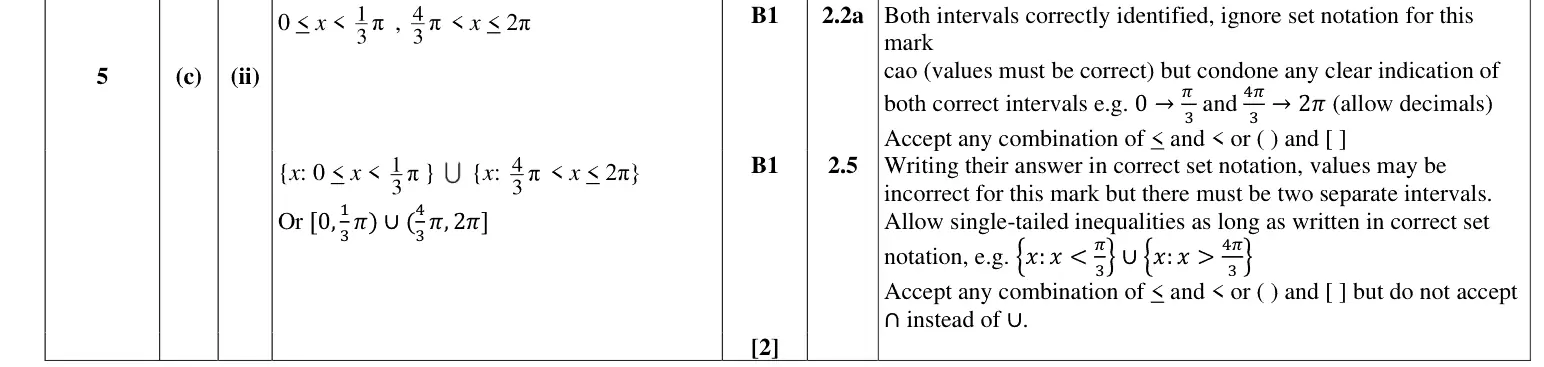
There were 2 marks available here. The first was for identifying the correct range of x-values (regardless of set notation used). Very few candidates managed to do this correctly, even having obtained the correct values in part (a) and ‘matched’ them in part (b) – with many omitting the outer limits of both ranges. The second mark (which was available independently of the first) was for giving their range in correct set notation, represented as the Union of two sets. More candidates obtained this mark than the first, but many made errors such as ∩ instead of ∪, or omitting ‘x:’ from one or both sets, or otherwise incorrect set notation.
Key points and common errors
{x : 0 ≤ x < π/3} ∪ {x : 4π/3 < x ≤ 2π}
outer limits often omitted
∩ instead of ∪
June 2023 · AS Paper 2 · Q7(a)4 marksEasy
Mark scheme for this part
Examiner's comment
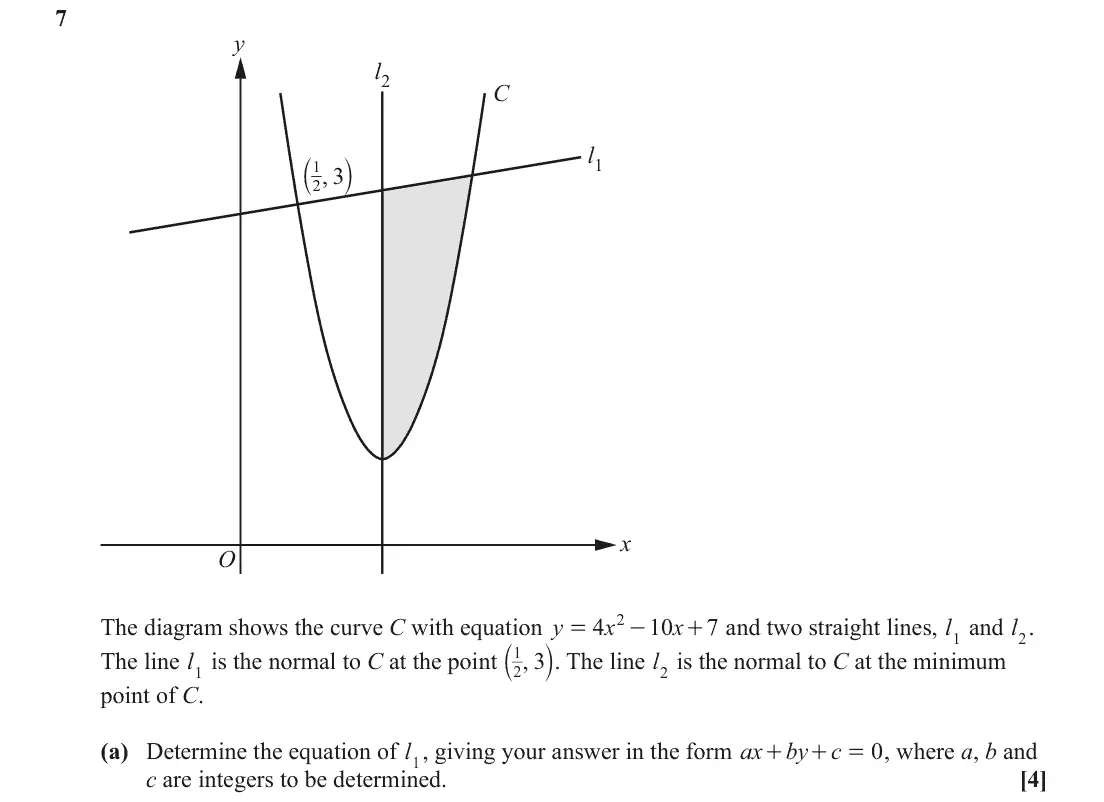
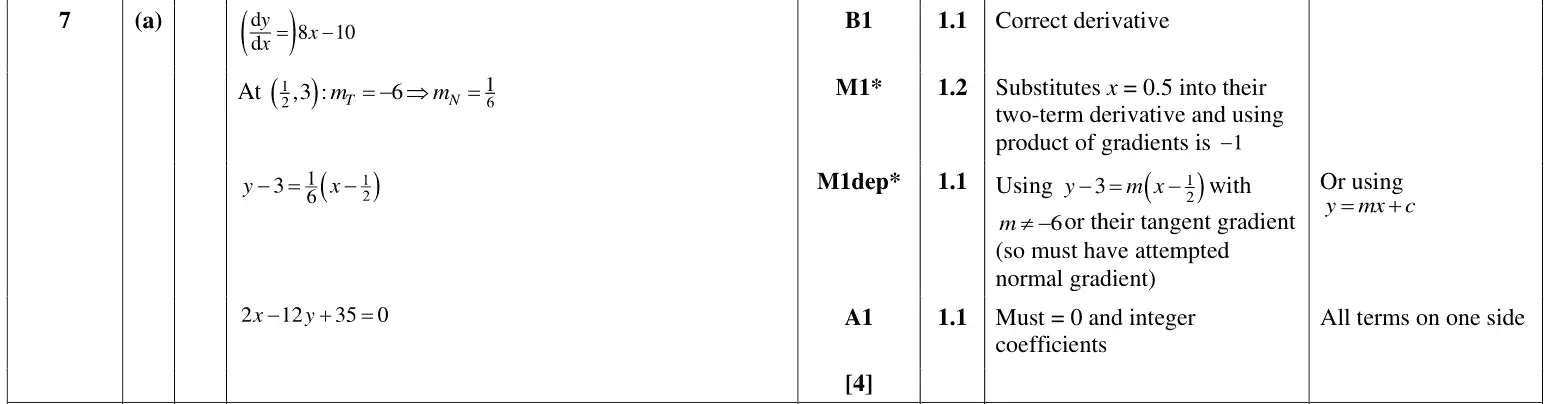
The majority of candidates obtained the correct derivative (i.e. 8x – 10) and those who used it correctly with the given point mainly scored full marks. As was the case elsewhere, a few lost the final mark by not giving their answer in the requested form (e.g. x – 6y + 17.5 = 0, from candidates either not spotting or misunderstanding the request for integers). A significant number of responses took the gradient of l1 to 10 be 8 straight from the derivative, or 8 (from setting their derivative to 0) and then finding the negative reciprocal. Using y = mx + c to find the normal was popular.
Key points and common errors
dy/dx = 8x − 10 = −6 at x = ½
normal gradient 1/6
2x − 12y + 35 = 0 with integer coefficients
June 2023 · AS Paper 2 · Q7(b)3 marksHard
Show the start of this question
Mark scheme for this part
Examiner's comment
This part proved challenging. x ≥ 1.25 appeared most often, sometimes as the only inequality given. Candidates felt more comfortable obtaining an inequality from their normal when it had been written ‘y =….’. Some used strict inequalities. Less successful responses had inequalities involving the labels l1, l2 and C.
Key points and common errors
l₂ is x = 1.25 (min point)
x ≥ 1.25, y ≥ 4x² − 10x + 7, 2x − 12y + 35 ≥ 0
non-strict inequalities for boundaries
labels l₁ etc. not acceptable
June 2023 · Paper 3 · Q3(a)(i)2 marksEasy
Mark scheme for this part
Examiner's comment
This part was answered extremely well with almost all candidates obtaining the correct answer of 𝑝𝑝= 1. The most common (rare) error in this part was a slip when differentiating 𝑥𝑥3.
Key points and common errors
f′(x) = 3x² + p
f′(2) = 13 gives p = 1
June 2023 · Paper 3 · Q7(d)1 markHard
Show the start of this question
Mark scheme for this part
Examiner's comment
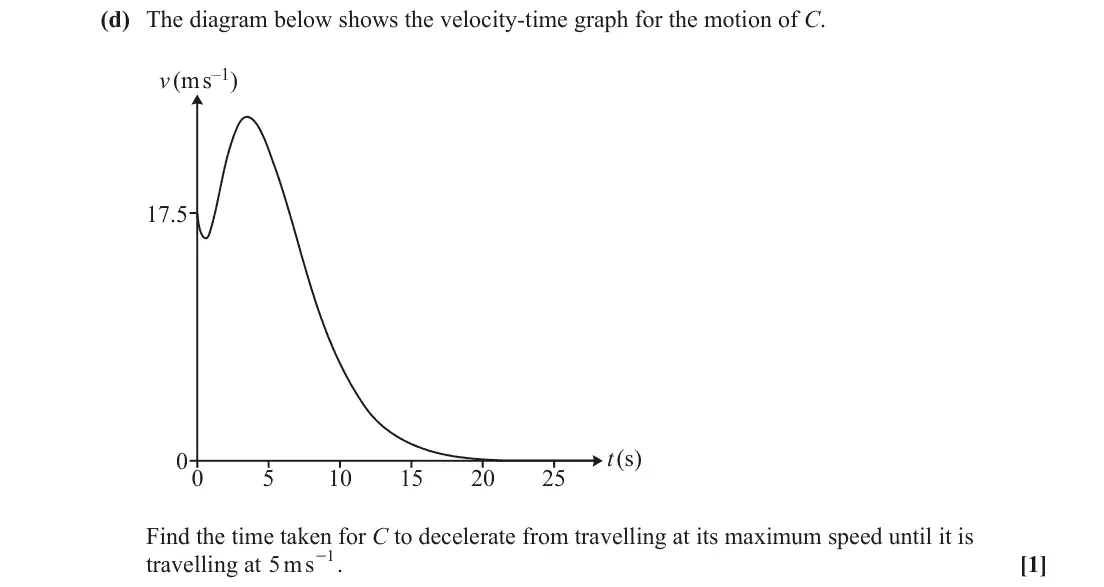
Very few candidates used the given velocity-time graph correctly, together with the answers from parts (a) and (c) to obtain the correct answer of 7.51 in this part.
Key points and common errors
maximum speed at t = 3.5 from (a)
speed 5 at T = 11.01 from (c)
11.01 − 3.5 = 7.51 s
June 2023 · Paper 3 · Q12(d)6 marksMedium
Show the start of this question
Mark scheme for this part
Examiner's comment
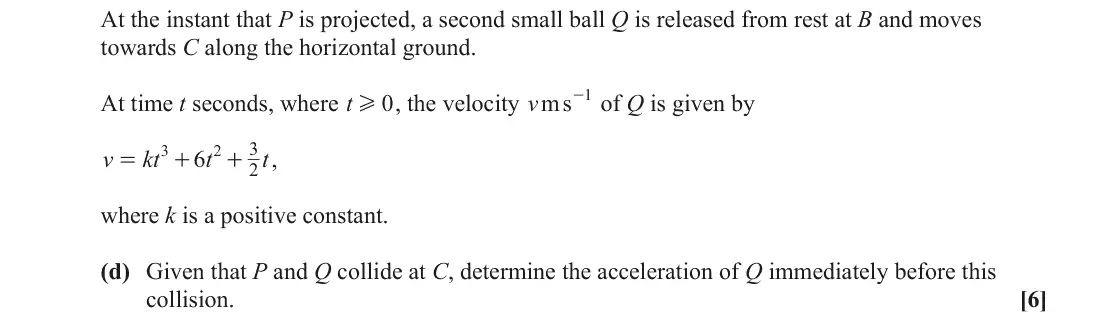
The responses to this part were mixed with some candidates making little progress apart from differentiating the given expression for v to obtain an expression for a in terms of t. Those candidates who realised that they had to use the value of T found in part (b) to find the horizontal distance BC and then integrate to set up an equation to find the value of k were usually successful. Although not penalised in the first two parts of the question, using an incorrect value of g meant that neither of the 2 accuracy marks (for finding k and then the required acceleration) could be awarded in this part. It was surprising how many candidates used equations for constant acceleration in this part to model the motion of Q.
Key points and common errors
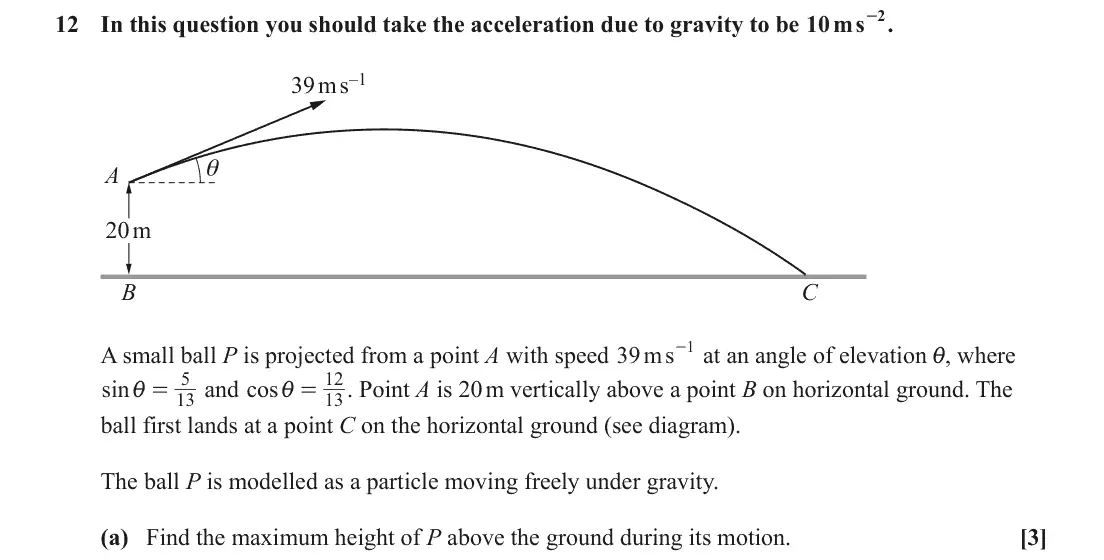
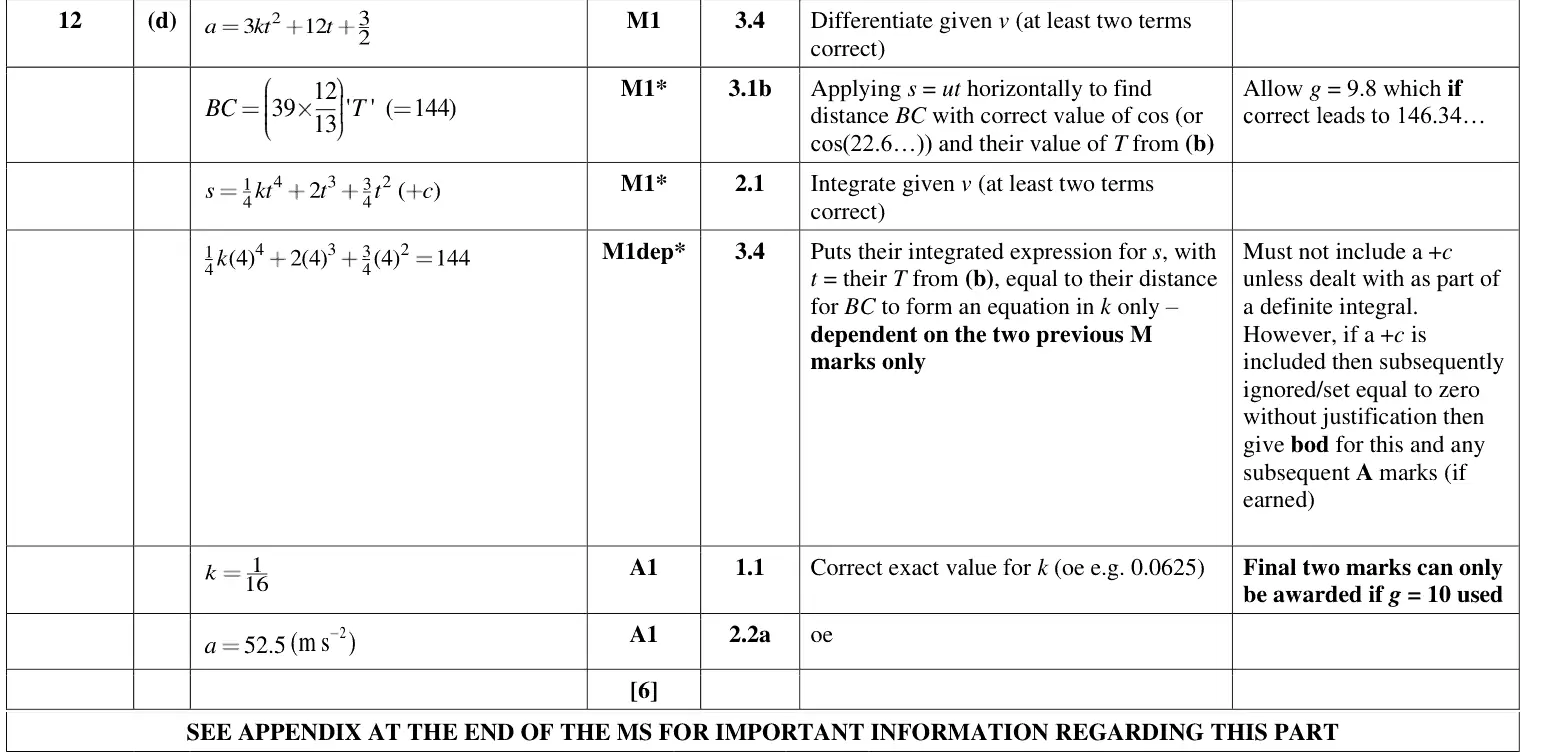
BC = 39 × 12/13 × 4 = 144
integrate v: ¼kt⁴ + 2t³ + ¾t² = 144 at t = 4 gives k = 1/16
a = 3kt² + 12t + 3/2 = 52.5 m s⁻²
final marks need g = 10
June 2022 · Paper 1 · Q1(b)1 markEasy
Show the start of this question
Mark scheme for this part
Examiner's comment
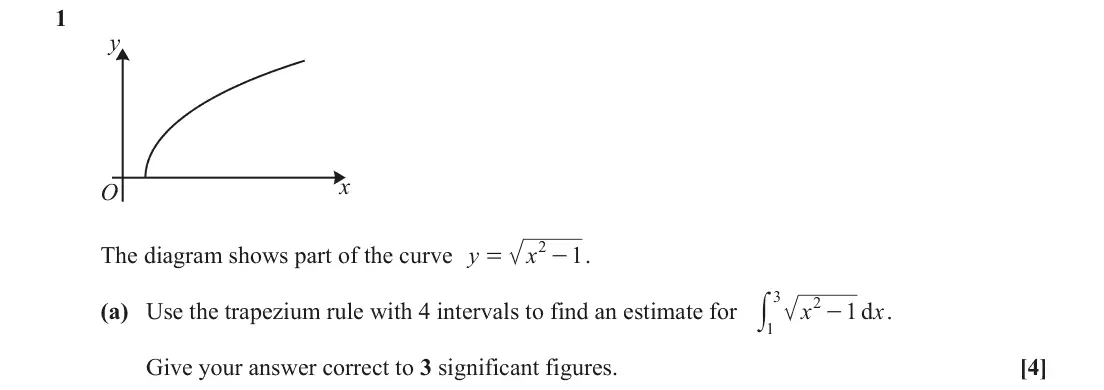
Most candidates could identify that it was an underestimate, giving a convincing explanation as to why this was the case. The most common solutions were to state that the curve was concave, or to explain why the trapezia did not cover the entire area; the latter approach was often supported with a sketch graph. Some candidates seemed unsure as to which specification area was being tested, and referred to upper and lower bounds from using rectangles.
Key points and common errors
under-estimate: the curve is concave so the tops of the trapezia lie below it
no references to rectangle bounds
June 2022 · Paper 1 · Q8(b)(ii)3 marksMedium
Show the start of this question
Mark scheme for this part
Examiner's comment
Most candidates appreciated that ‘rate’ indicated the need to differentiate, and were able to do so correctly and then substitute t = 15. The final mark proved to be more elusive, as both a positive value and units were required in the final answer.
Key points and common errors
dm/dt = −8.8e^(−0.055t) = −3.86 at t = 15
rate of decay 3.86 grams per minute, positive and with units
June 2022 · Paper 1 · Q12(a)4 marksEasy
Mark scheme for this part
Examiner's comment
The majority of candidates gained full marks on this part of the question, and it was only a small minority that made no progress. The first 2 marks could be gained by finding a correct expression for the gradient, either in terms of t or p. Most candidates could then attempt the equation of the tangent, but a number struggled to use the same parameter consistently. With a given answer, there is an expectation that method is clearly shown, and most candidates did so.
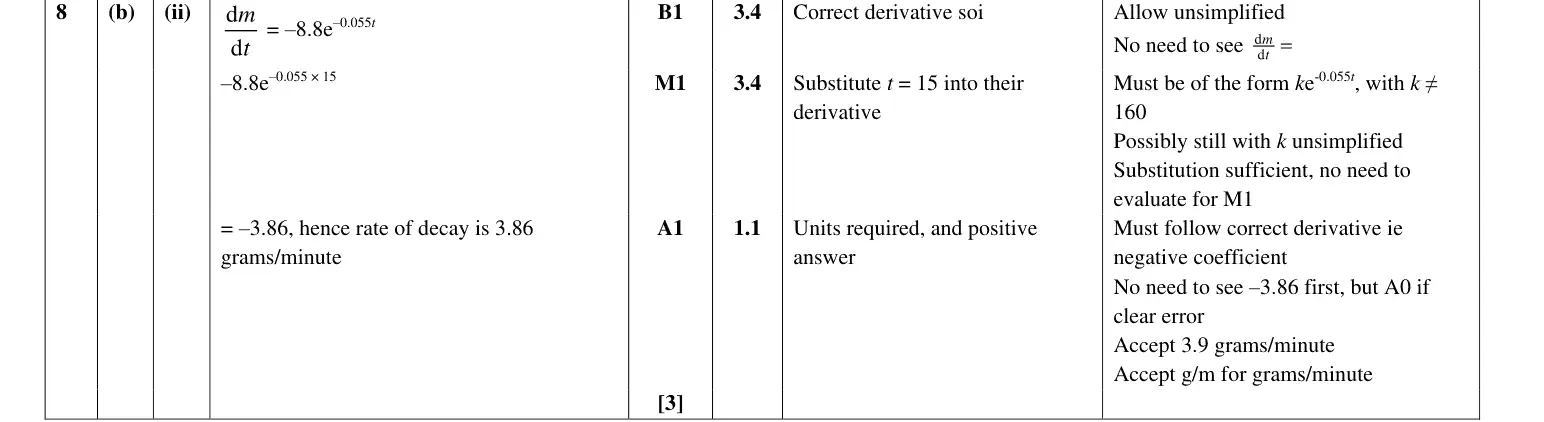
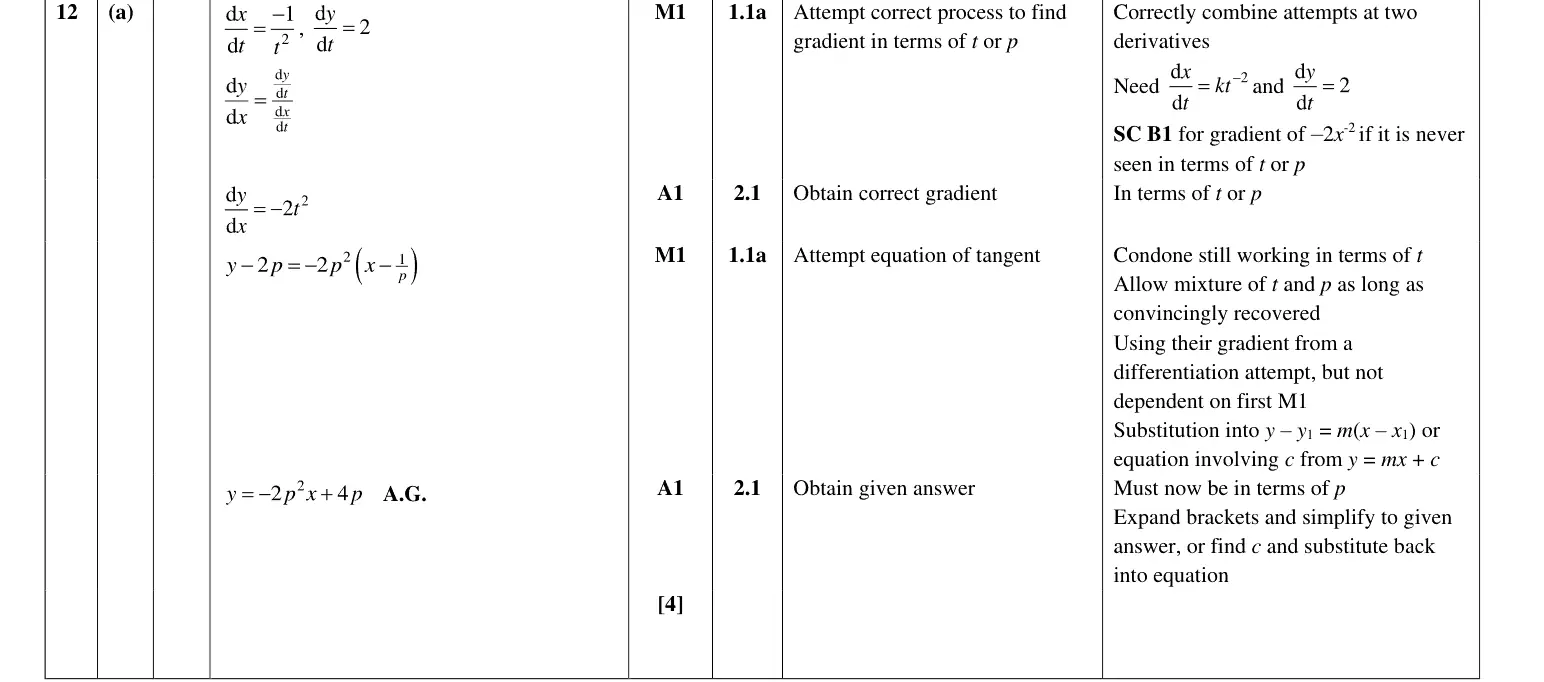
Key points and common errors
dy/dx = (dy/dt)/(dx/dt) = −2t²
tangent at P: y − 2p = −2p²(x − 1/p) gives y = −2p²x + 4p
use one parameter consistently
June 2022 · Paper 1 · Q12(b)8 marksHard
Show the start of this question
Mark scheme for this part
Examiner's comment
This proved to be a suitable challenging end to the paper, and fully correct solutions were in the minority. A number of candidates made no attempt at all at this part of the question, although it was unclear whether they were lacking inspiration or had run out of time. Of the remainder, most were able to make a reasonable attempt at finding the coordinates of A and B, though a number struggled with the algebraic manipulation required. Some candidates did not realise that it was the ratio of lengths that was required, and made no progress on the final 3 marks. When attempting the ratio, some candidates simplified both surds to a common factor, others attempted a division or demonstrated the veracity of the given answer, all with convincing use of algebra.
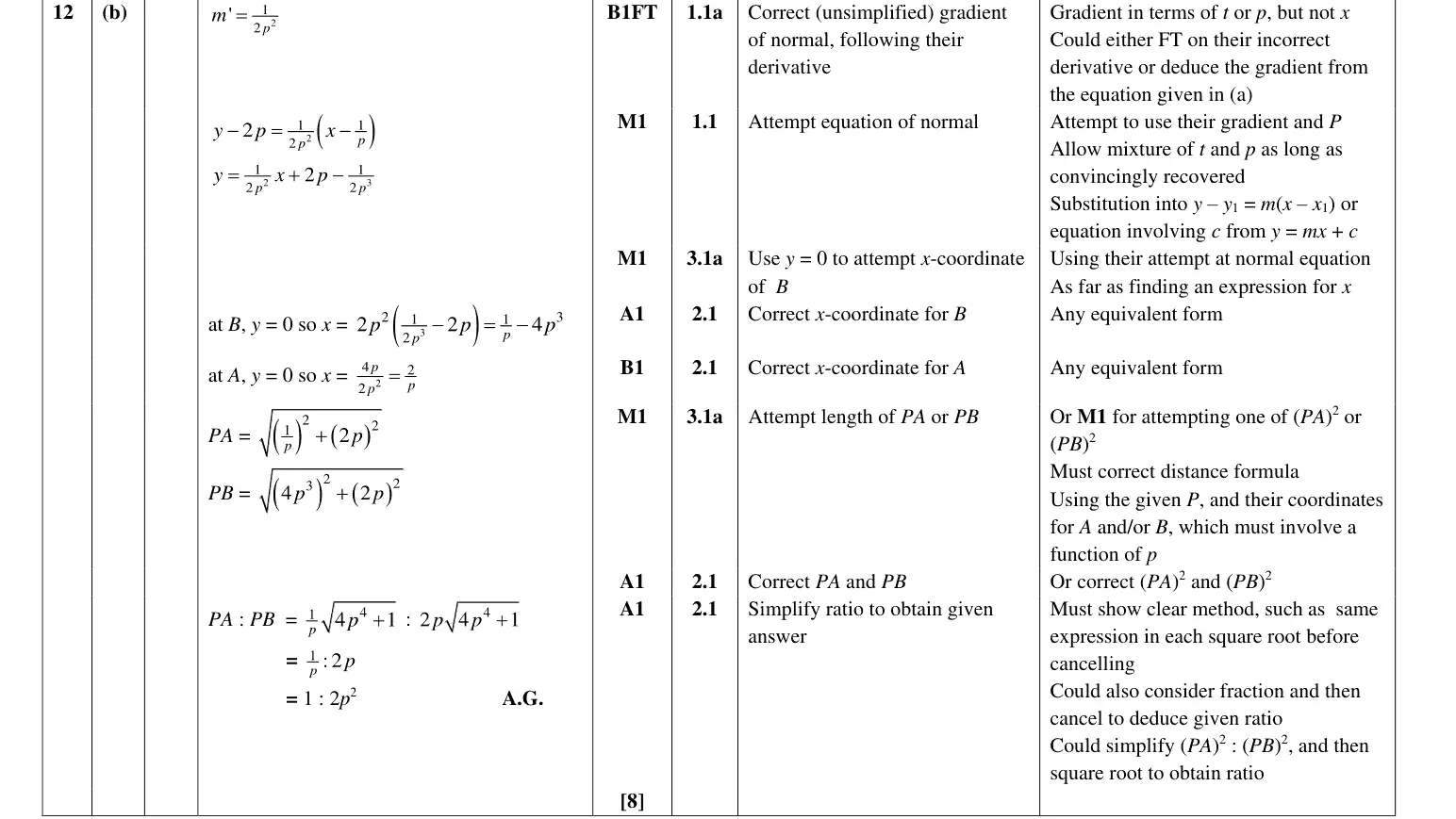
Key points and common errors
normal gradient 1/(2p²)
A at x = 2/p, B at x = 1/p − 4p³
PA = (1/p)√(4p⁴ + 1), PB = 2p√(4p⁴ + 1) so PA:PB = 1:2p²
ratio of lengths, not coordinates
June 2022 · Paper 2 · Q5(a)2 marksEasy
Mark scheme for this part
Examiner's comment
Almost all candidates differentiated and equated d y x to 0. A few made errors in the differentiation. Many d obtained the correct equation, 3x2 − 6x + 4 = 0. Because this is a “detailed reasoning” question, it was essential to show working to demonstrate that this equation has no real roots in order to gain the second mark. Most did so successfully using either the discriminant or completing the square. However, some candidates just stated that there were no real solutions, without justification. A few gave an incorrect justification such as “this equation won’t factorise so there are no solutions”. More seriously, a few candidates used the coefficients from the cubic expression for y to obtain a bogus “discriminant” and showed that it was negative.
Key points and common errors
dy/dx = 3x² − 6x + 4 = 0
discriminant −12 < 0 or 3(x − 1)² + 1 > 0 so no real roots
justification required
June 2022 · AS Paper 2 · Q5(a)(i)3 marksMedium
Mark scheme for this part
Examiner's comment
k y = was quite well understood, and k then accurately found. Less successful attempts started by x 1 = quoting y or even y = mx + c. A few thought they had to find the equation of the tangent when x asked for the gradient function. This request was overlooked.
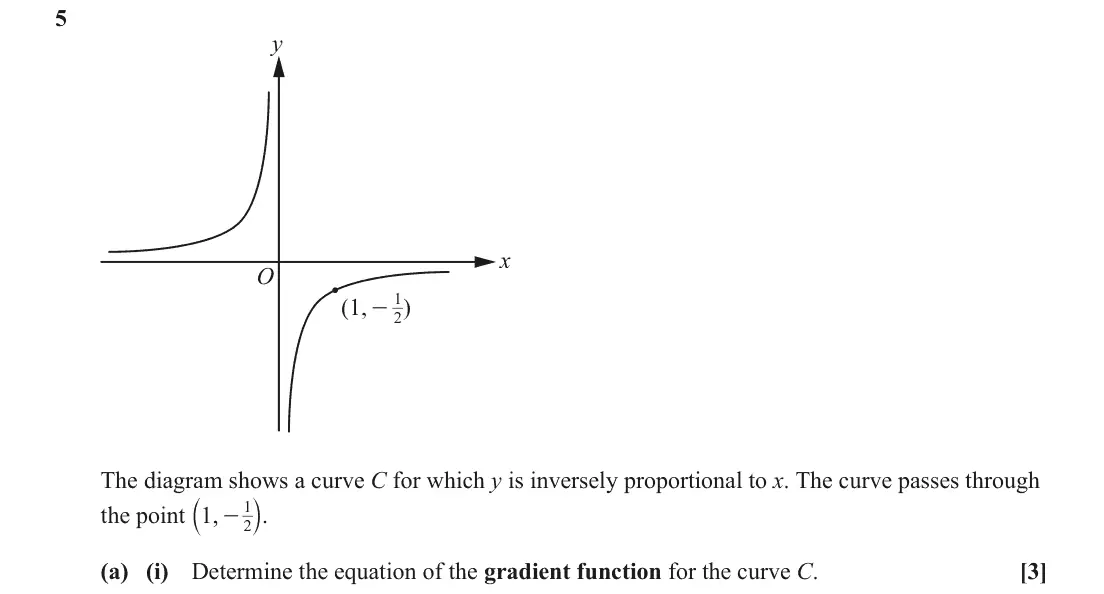
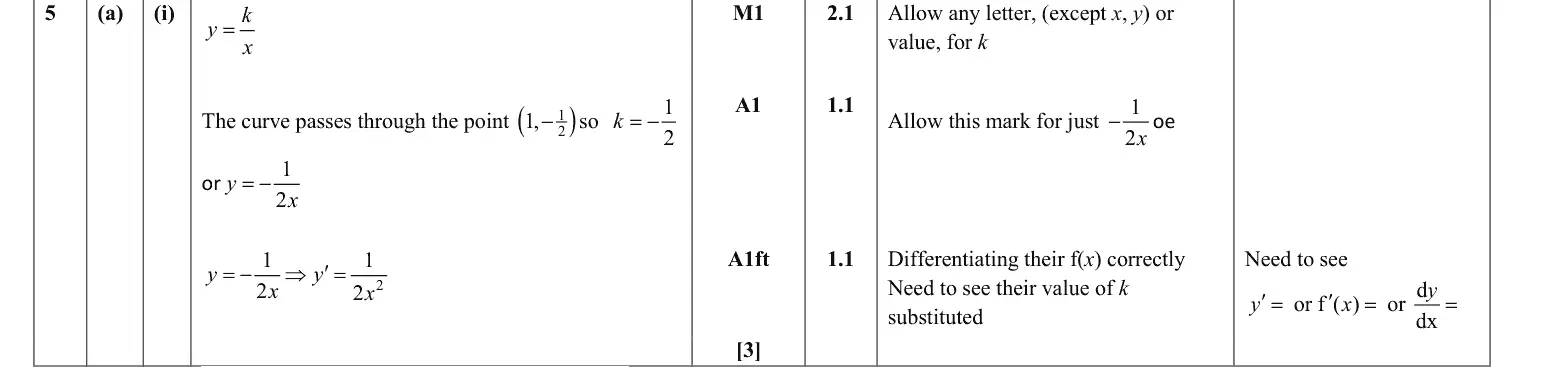
Key points and common errors
y = k/x through (1, −½) gives y = −1/(2x)
gradient function y′ = 1/(2x²)
some found a tangent instead
June 2022 · AS Paper 2 · Q5(a)(ii)1 markMedium
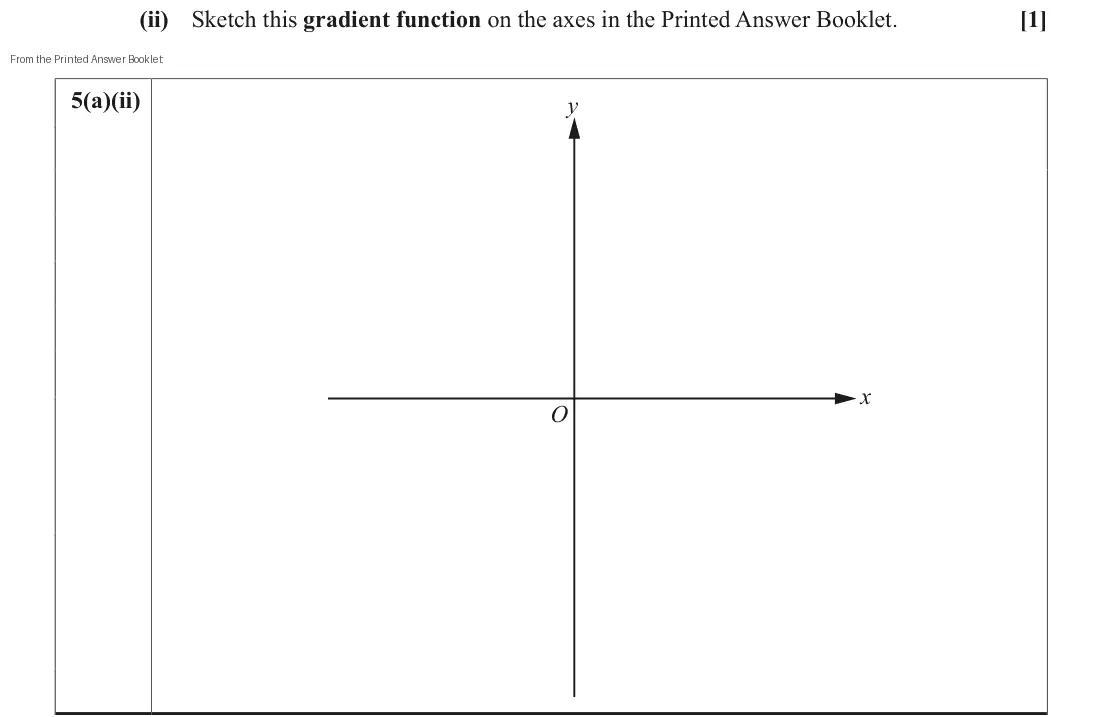
Show the start of this question
Mark scheme for this part
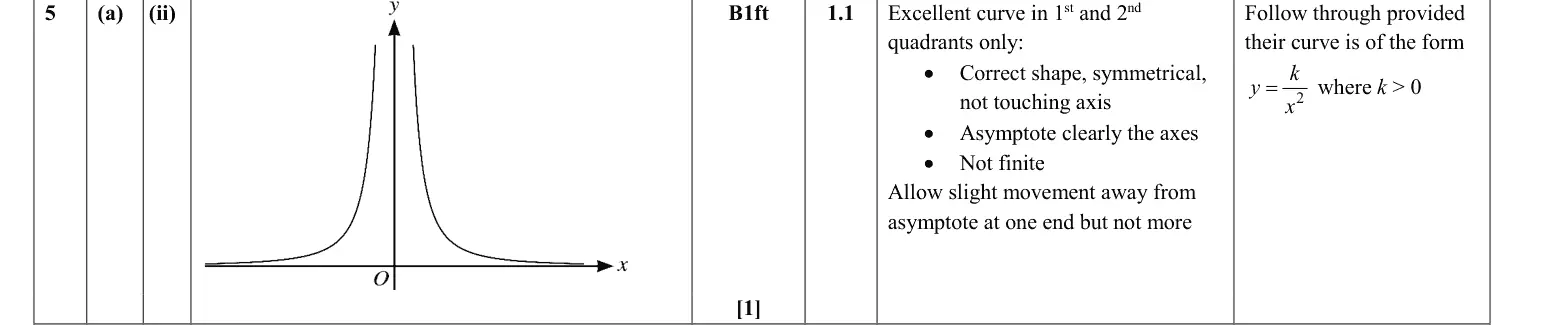
Examiner's comment
For those who plotted the correct type of graph, the requirements for a good graph mentioned in the mark scheme are worth noting. It is important to consider symmetry and draw asymptotes carefully.
Key points and common errors
y = 1/(2x²): symmetrical curve in the 1st and 2nd quadrants, asymptotic to both axes
June 2022 · AS Paper 2 · Q5(b)1 markMedium
Show the start of this question
Mark scheme for this part
Examiner's comment
k There were too many vague answers here. We only gave credit for graphs of the form y = and x wanted candidates to simply focus on the graph not intersecting with the x-axis.
Key points and common errors
the gradient-function graph never meets the x-axis
vague answers not credited
June 2022 · Paper 2 · Q5(b)2 marksEasy
Show the start of this question
Mark scheme for this part
Examiner's comment
2 d y Most candidates found , equated it to 0, and correctly obtained x = 1. In order to gain the second 2 d x mark, it was necessary to comment that this meant there was an inflection here, or that there was only one root. This was enough to answer the question, although some candidates felt they needed to go 2 further and show that x = 1 gives an inflection, by considering the sign of d y d y x or either side. This 2 d d x 2 was unnecessary, since the two conditions d y d y x ≠ 0 and = 0 have both been shown to be satisfied. 2 d d x Some candidates found the y-coordinate at x = 1, which was also unnecessary.
Key points and common errors
d²y/dx² = 6x − 6 = 0 has one root x = 1
with dy/dx ≠ 0 this gives exactly one inflection
June 2022 · AS Paper 2 · Q8(a)4 marksEasy
Mark scheme for this part
Examiner's comment
This was generally well answered, with many realising what was required to do differentiation from first principles. Examiners checked the algebra carefully and there were quite a few common errors. For example, − ( ax + bx ) becoming –ax2 + bx, h2 appearing rather than ah2 and spurious division by h. Often the ‘correct’ result appeared. This exemplar illustrates the point that the correct result often appeared, but the preceding algebra is not accurate. This solution scored M1 only.
Key points and common errors
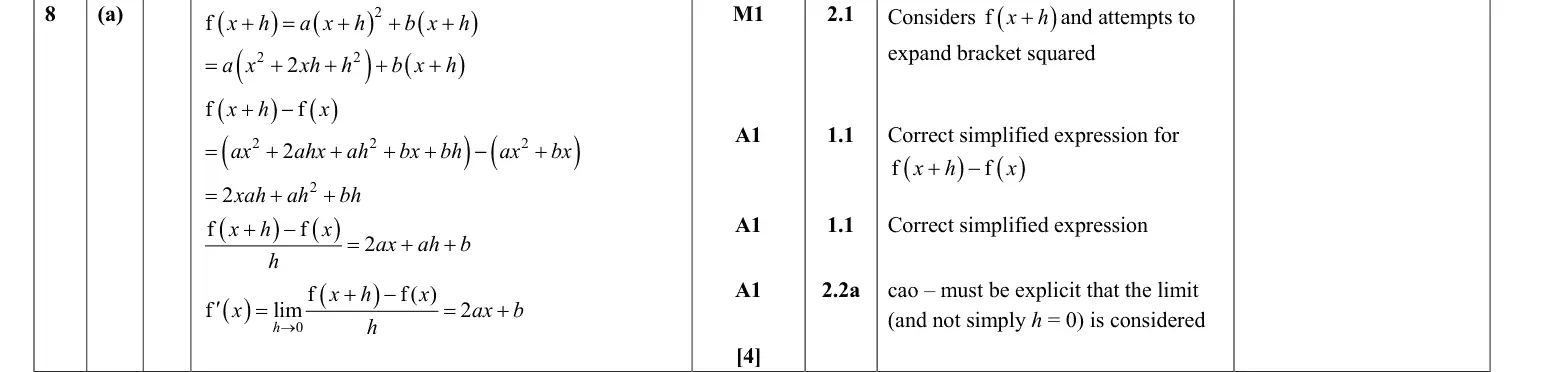
f(x + h) − f(x) = 2axh + ah² + bh
divide by h
limit as h → 0 gives 2ax + b
limit notation needed
algebra errors often hidden by a correct final result
June 2022 · AS Paper 2 · Q8(b)7 marksMedium
Show the start of this question
Mark scheme for this part
Examiner's comment
Many candidates earned the first 3 method marks here, most integrating correctly, a few making a sign error when evaluating the limits. Less successful was recognising where the second equation in a and b came from, and hence not finding their values. Those who managed this often produced a complete solution, but not all provided the correct method to find k. Some thought y = 2ax +b was the equation of the tangent. Only a few started this question by differentiating y = ax2 + bx rather than integrating it.
Key points and common errors
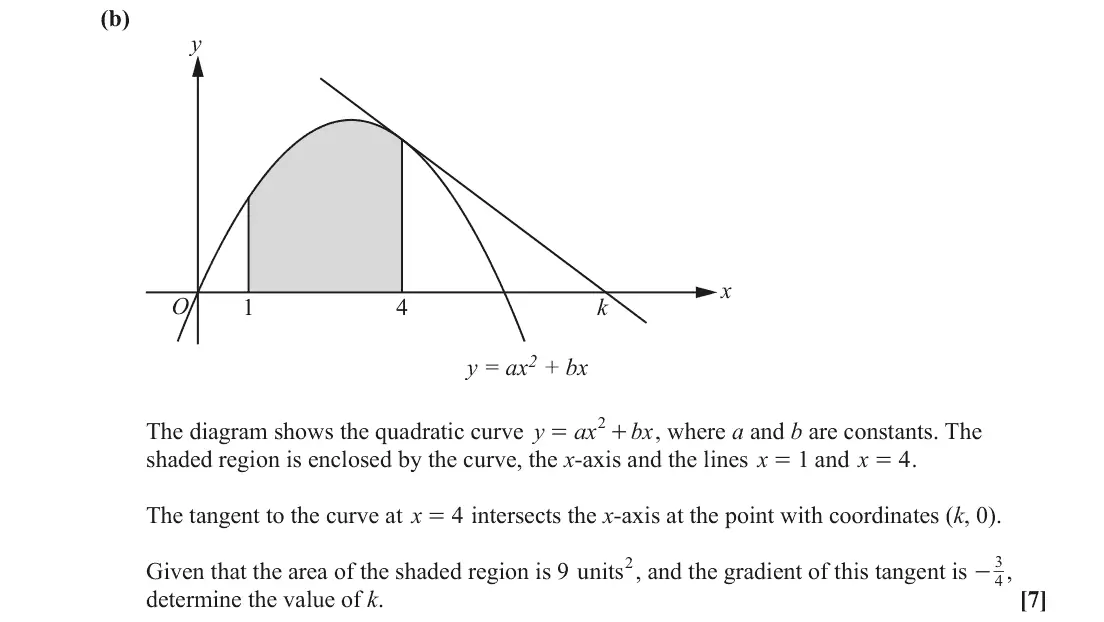
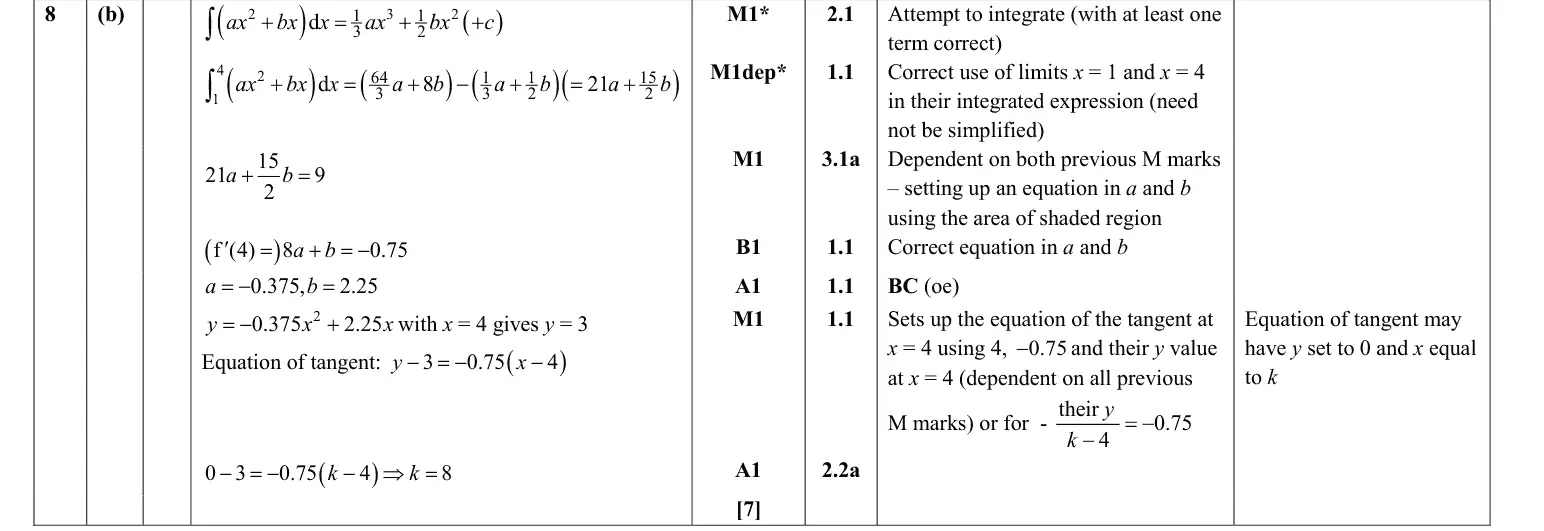
∫₁⁴ (ax² + bx) dx = 21a + 7.5b = 9
f′(4) = 8a + b = −0.75
a = −0.375, b = 2.25
tangent at (4, 3): y − 3 = −0.75(x − 4) gives k = 8
second equation often missed
June 2022 · AS Paper 2 · Q11(b)5 marksMedium
Show the start of this question
Mark scheme for this part
Examiner's comment
Candidates generally knew how to answer this question. It is another detailed reasoning (DR) question so, as in Question 2, we wanted to see how the quadratic equation had been solved. Many did not provide this evidence so 3/5 was a common mark. We also expected to see a valid reason for the rejection of T = 4/3.
Key points and common errors
v = −t³ + 11t² − 24t
dv/dt = −3t² + 22t − 24 = 0
(3t − 4)(t − 6) = 0
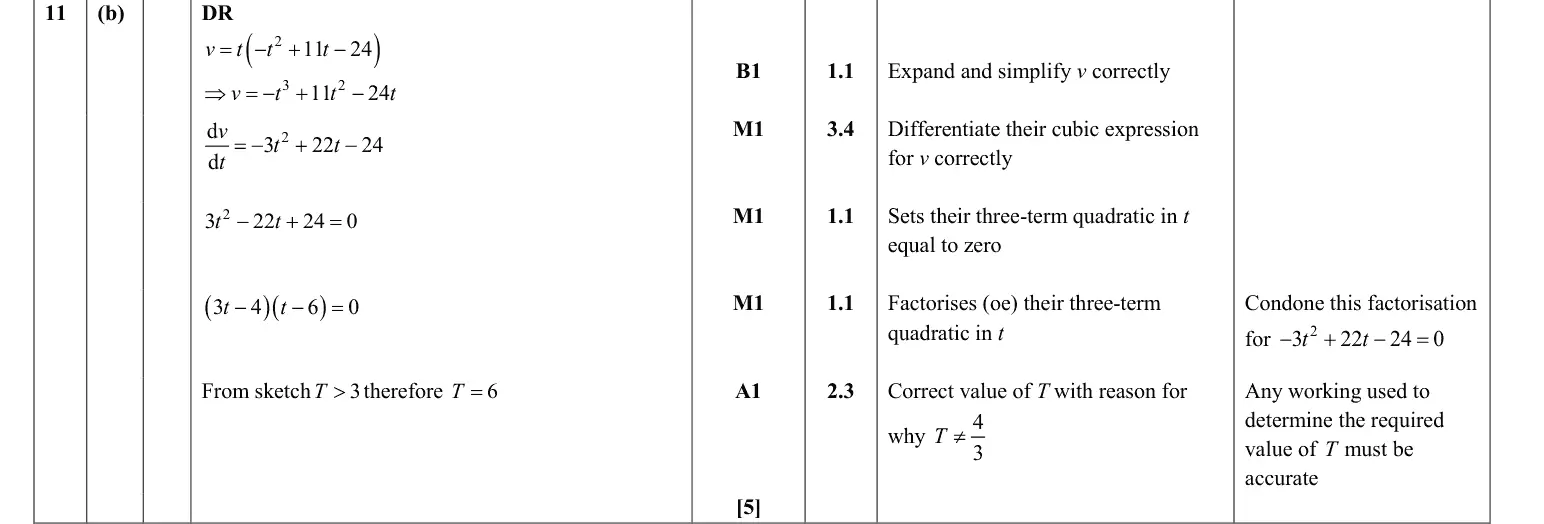
T = 6 since T > 3 from the graph, rejecting 4/3 with a reason
solving must be shown
June 2022 · Paper 3 · Q5(a)5 marksMedium
Mark scheme for this part
Examiner's comment
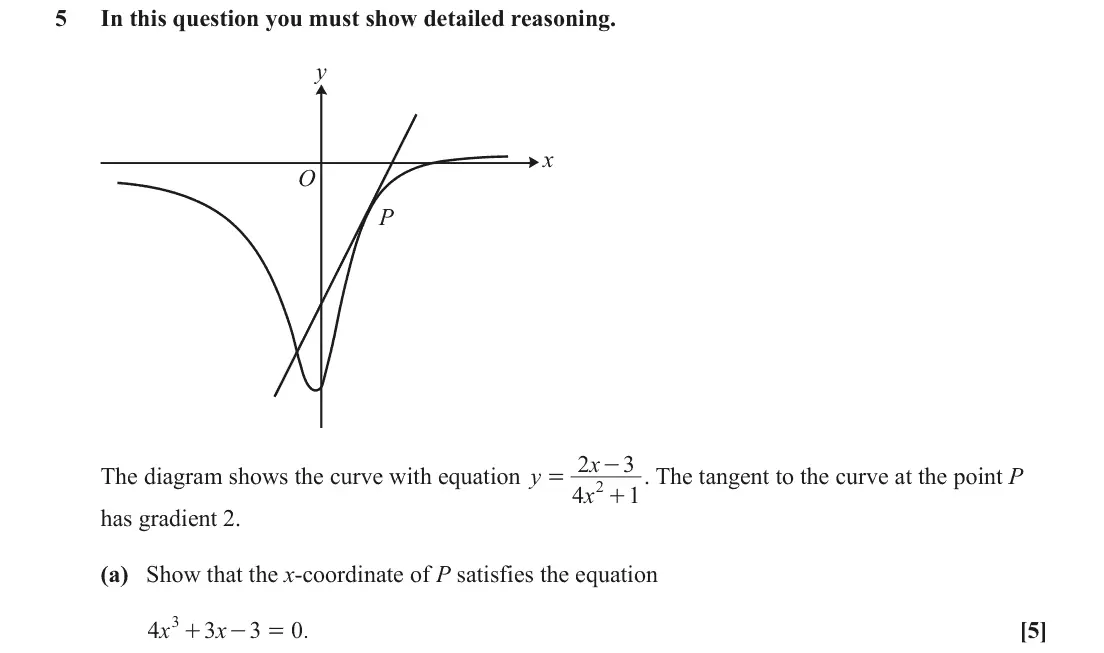
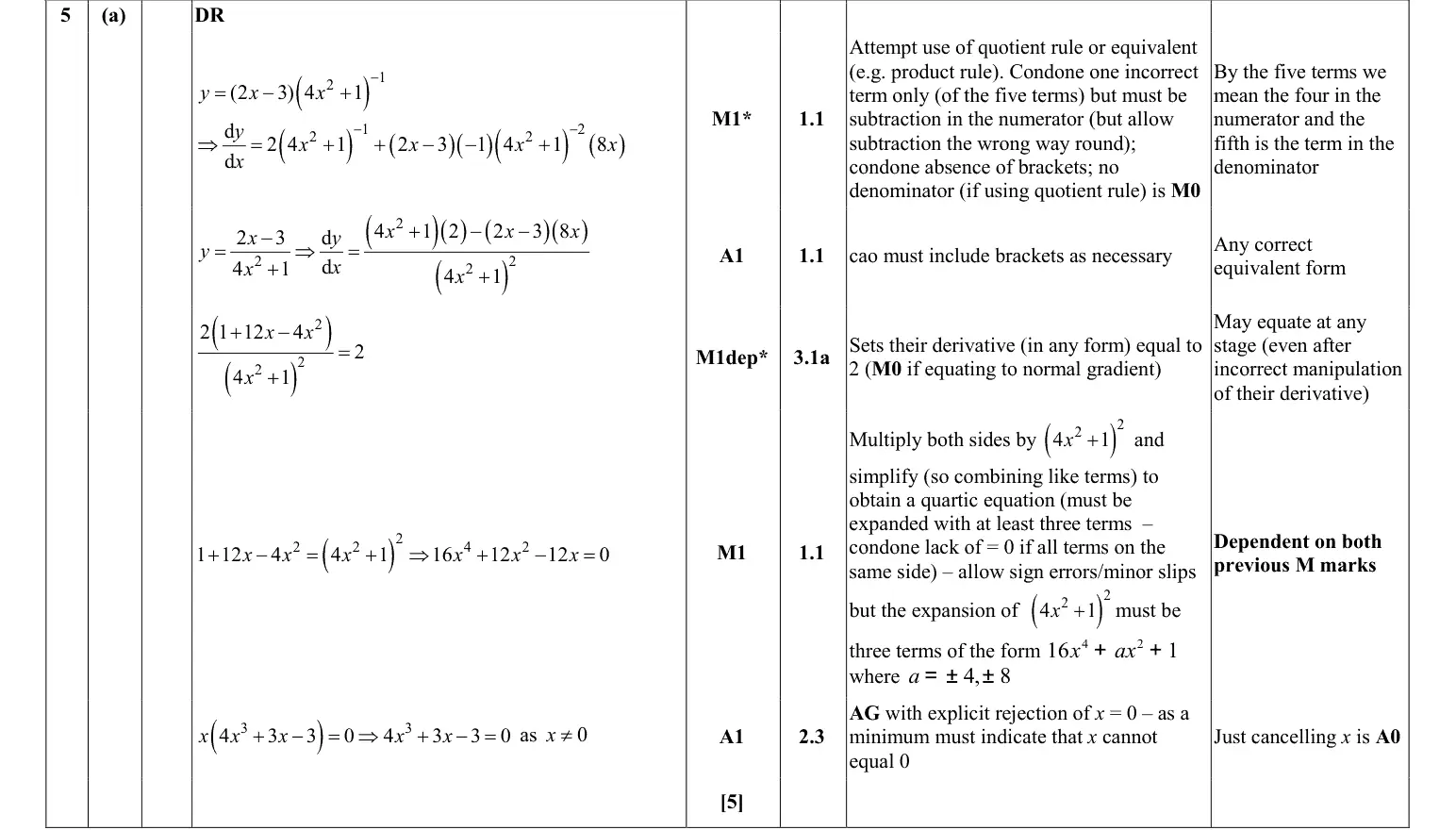
It was very pleasing that most candidates correctly applied the quotient rule to the given equation and put the resulting derivative equal to 2 (although examiners did note that on occasion the derivative was set equal to zero). Most candidates then removed the fraction(s) and bracket(s) successfully and derived the equation 16 x + 12 x − 12 x = 0 (or a multiple of this). However, the question required ‘detailed reasoning’, and it was evident that a large number of candidates simply cancelled anx from each term of their equation believing that this was sufficient to show the required result. Only the most successful responses made any reference to the given diagram which showed that the x-coordinate of point P could not be equal to zero. This response scored 4 (of the 5) marks. This was a very common response seen by examiners. The candidate has correctly applied the quotient rule and set the derivative equal to 2. They have then removed the fraction, expanded and simplified to a correct quartic equation in x ( ) + − = 4 x 3 x 3 x 0 . However, no justification is given by the candidate for why it is acceptable to cancel the x’s when simplifying the quartic equation to the required cubic equation which is why they did not achieve full marks.
Key points and common errors
quotient rule
set dy/dx = 2 (not 0)
16x⁴ + 12x² − 12x = 0
must explicitly reject x = 0 before dividing by x
June 2022 · Paper 3 · Q5(c)2 marksHard
Show the start of this question
Mark scheme for this part
Examiner's comment
This was probably the least well answered question on the whole paper with most candidates scoring zero marks (with many just showing that the given iteration did not converge for a number of different starting values). Only the most able realised what was required in this part. Of those that did calculate ( ) ( ) F x x + = F x , where very few could correctly articulate that as the x-coordinate of P lies in the ( ) −for all values of where F 1 interval (0.5, 1) and (0.5,1), then this implies that the given iteration cannot converge to the x-coordinate of P whatever starting value is used.
Key points and common errors
h′(x) = −4x², so h′(α) < −1 for α in (0.5, 1)
hence cannot converge
trying starting values gains nothing
June 2022 · Paper 3 · Q12(b)1 markEasy
Show the start of this question
Mark scheme for this part
Examiner's comment
This question was almost always answered correctly by differentiating the expression given in the stem to part (a). Only occasionally did examiners report cases of candidates using either constant acceleration formulae or integration.
Key points and common errors
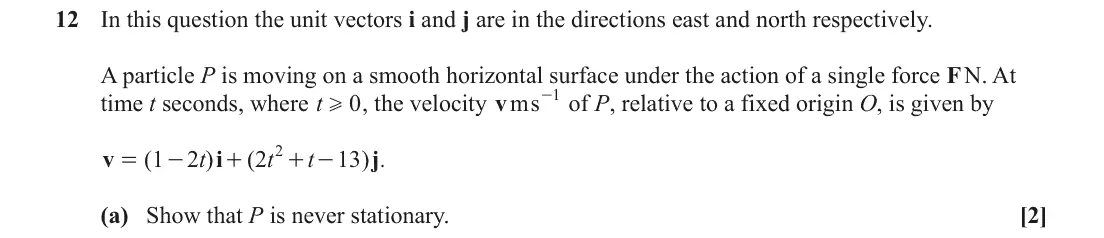
a = −2i + (4t + 1)j
Autumn 2021 · AS Paper 1 · Q24 marksMedium
Mark scheme for this part
Key points and common errors
write 5000/t as 5000t⁻¹
dn/dt = −5000t⁻²
at t = 5 the rate of change is −200
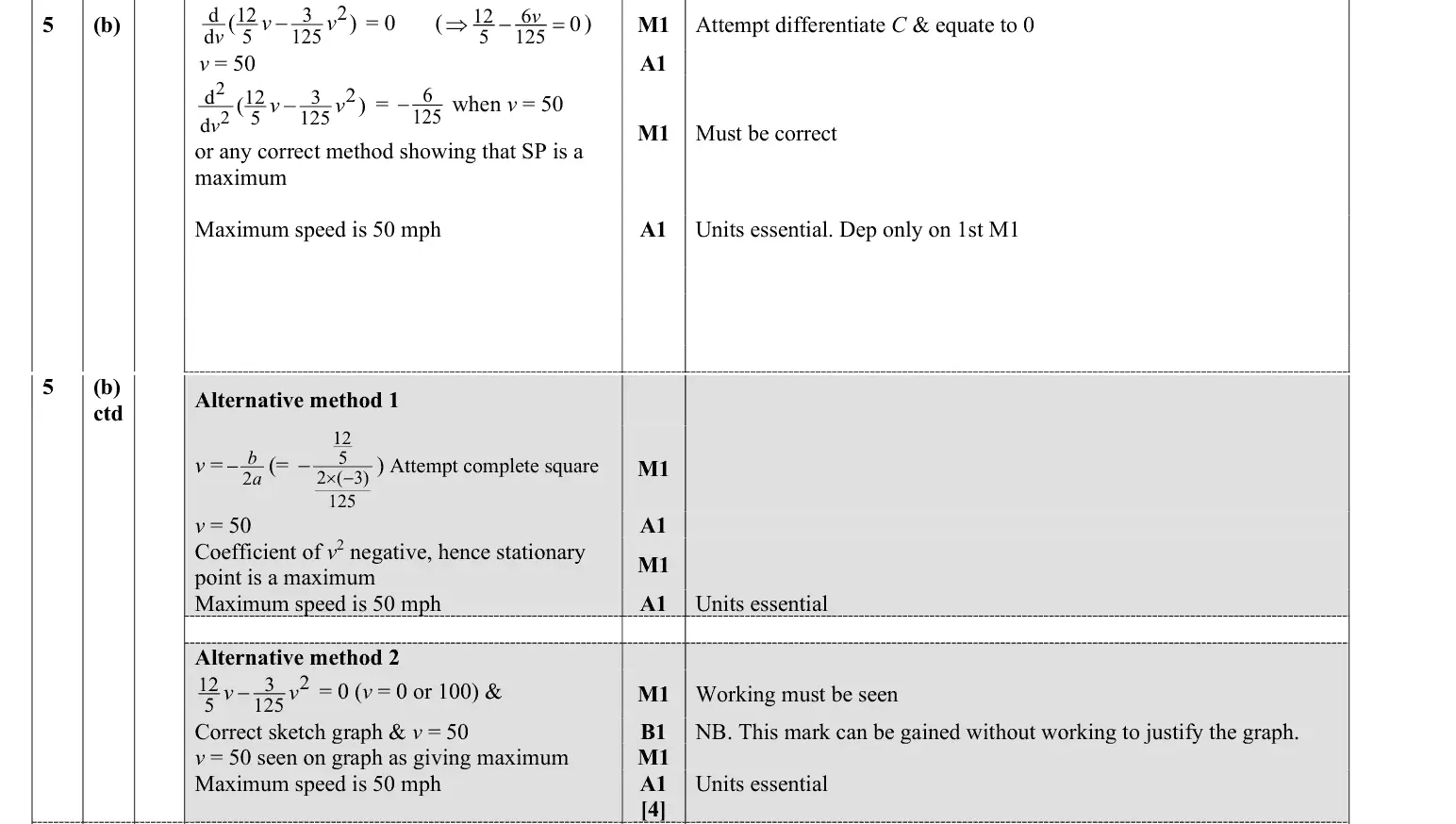
Autumn 2021 · AS Paper 1 · Q5(b)4 marksMedium
Show the start of this question
Mark scheme for this part
Key points and common errors
dC/dv = 12/5 − 6v/125 = 0 gives v = 50
show maximum (second derivative −6/125 or negative v² coefficient)
answer 50 mph with units
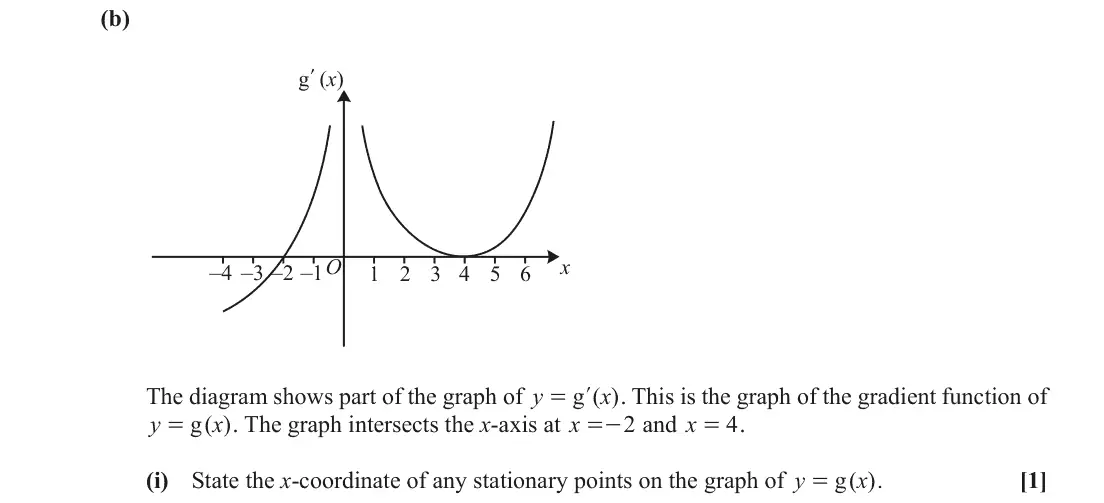
Autumn 2021 · Paper 1 · Q5(b)(i)1 markMedium
Mark scheme for this part
Examiner's comment
(From the general report) The graph in Question 5(b) was clearly identified as a gradient function graph, yet several candidates did not interpret it as such. On Question 5(b) the common misconception was that the graph showed a function rather than a gradient function.
Key points and common errors
graph is g′(x) not g(x): stationary points where g′(x) = 0, x = −2 and x = 4
common misconception treating it as the function itself
Autumn 2021 · Paper 1 · Q5(b)(ii)1 markMedium
Show the start of this question
Mark scheme for this part
Examiner's comment
(From the general report) The graph in Question 5(b) was clearly identified as a gradient function graph, yet several candidates did not interpret it as such. On Question 5(b) the common misconception was that the graph showed a function rather than a gradient function.
Key points and common errors
decreasing where g′(x) < 0: x < −2
Autumn 2021 · Paper 1 · Q5(b)(iii)1 markMedium
Show the start of this question
Mark scheme for this part
Examiner's comment
(From the general report) The graph in Question 5(b) was clearly identified as a gradient function graph, yet several candidates did not interpret it as such. On Question 5(b) the common misconception was that the graph showed a function rather than a gradient function.
Key points and common errors
g′ has a turning point (touches axis) at x = 4 so stationary point of inflection there
x = −2 is not one
Autumn 2021 · Paper 1 · Q7(a)2 marksMedium
Mark scheme for this part
Examiner's comment
(From the general report) The first part of Question 7 was a ‘show that’ question and candidates were expected to provide sufficient detail to be convincing, including expressing the derivative equated to 0 before dealing with the fractional term.
Key points and common errors
product rule: 2x ln x + (x² − 2)/x
must equate to 0 before clearing the fraction
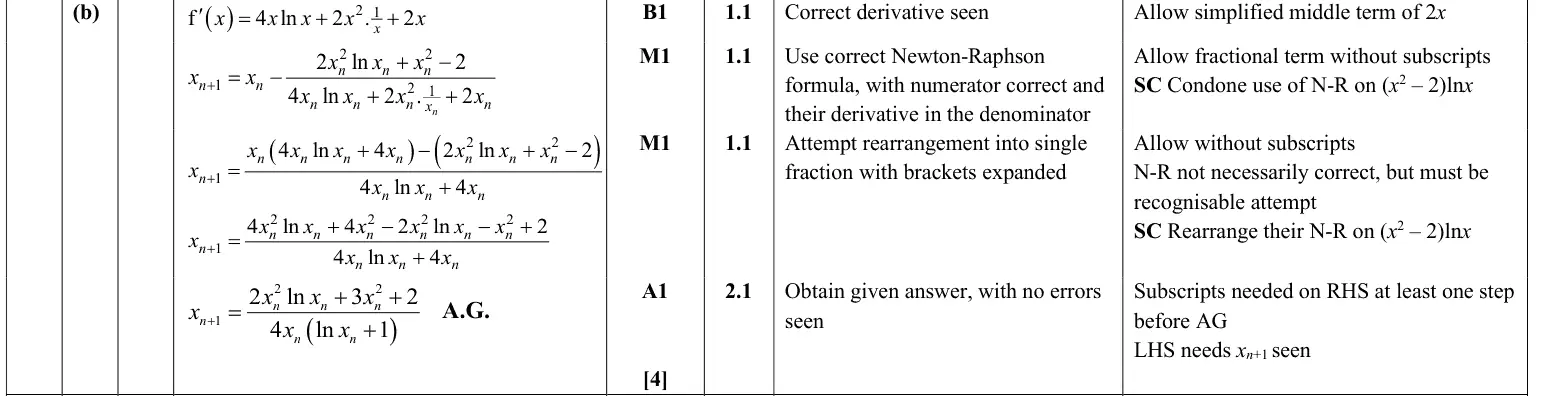
Autumn 2021 · Paper 1 · Q7(b)4 marksMedium
Show the start of this question
Mark scheme for this part
Examiner's comment
(From the general report) The first part of Question 7 was a ‘show that’ question and candidates were expected to provide sufficient detail to be convincing, including expressing the derivative equated to 0 before dealing with the fractional term.
Key points and common errors
f′(x) = 4x ln x + 4x
substitute into Newton-Raphson and rearrange to a single fraction
subscripts needed
Autumn 2021 · Paper 1 · Q7(d)2 marksMedium
Show the start of this question
Mark scheme for this part
Examiner's comment
(From the general report) The first part of Question 7 was a ‘show that’ question and candidates were expected to provide sufficient detail to be convincing, including expressing the derivative equated to 0 before dealing with the fractional term.
Key points and common errors
continue iterating to converge
(1.206, −0.102) to 3 d.p.
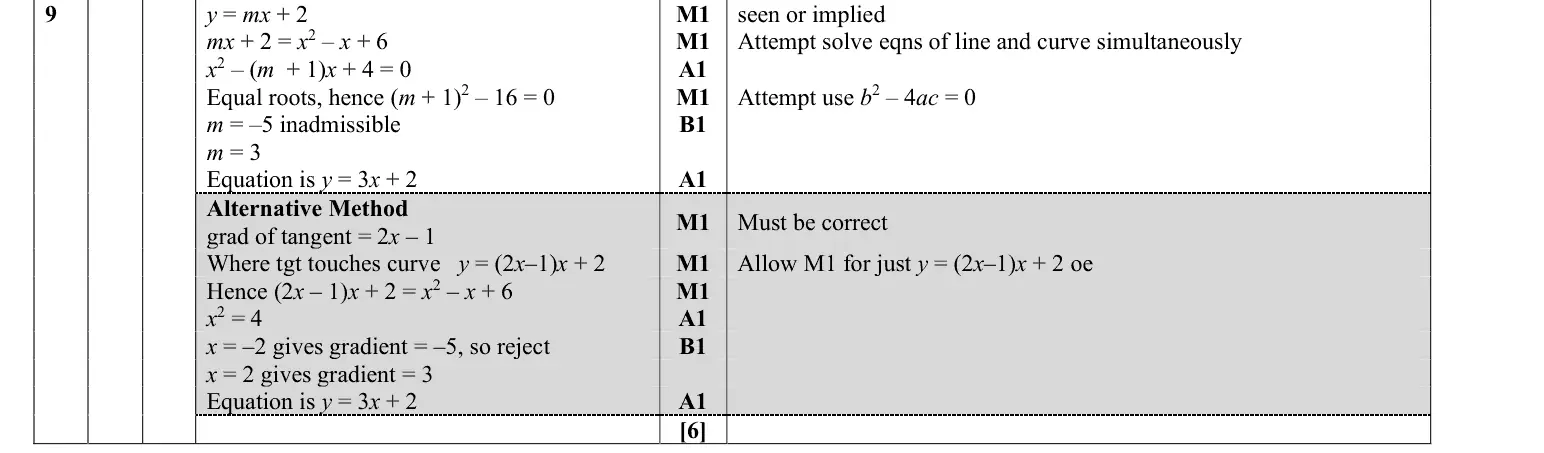
Autumn 2021 · AS Paper 1 · Q96 marksMedium
Mark scheme for this part
Key points and common errors
y = mx + 2
x² − (m + 1)x + 4 = 0
equal roots so (m + 1)² − 16 = 0
m = 3 (reject −5)
y = 3x + 2
alt: tangent gradient 2x − 1 gives x² = 4
Autumn 2021 · Paper 1 · Q9(c)4 marksHard
Show the start of this question
Mark scheme for this part
Examiner's comment
(From the general report) Question 9, covering aspects of parametric equations, proved challenging for a significant proportion of candidates. Question 9 highlighted confusion about when to use x = 0 or y = 0 when investigating the path of a particle defined parametrically.
Key points and common errors
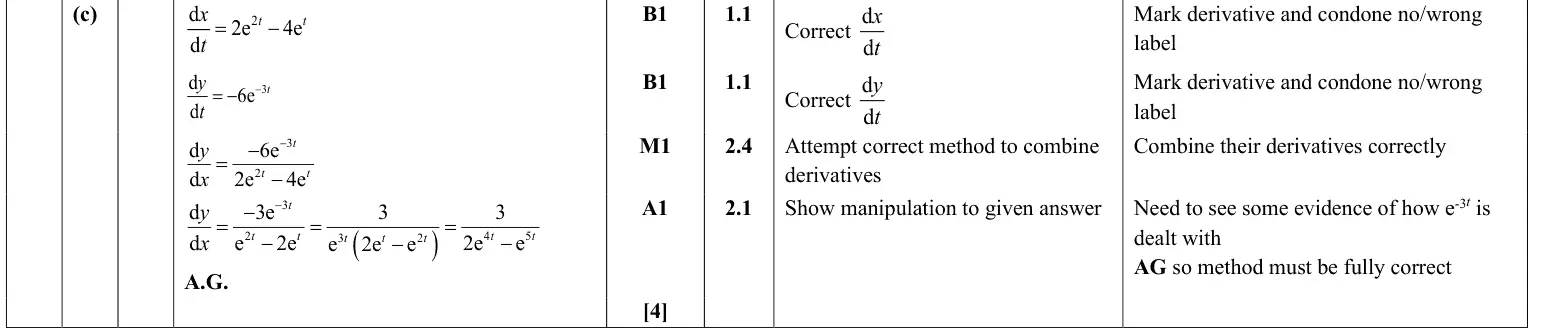
dx/dt = 2e^(2t) − 4eᵗ, dy/dt = −6e^(−3t)
divide
show how e^(−3t) is dealt with to reach the given form
Autumn 2021 · Paper 1 · Q11(b)7 marksMedium
Show the start of this question
Mark scheme for this part
Examiner's comment
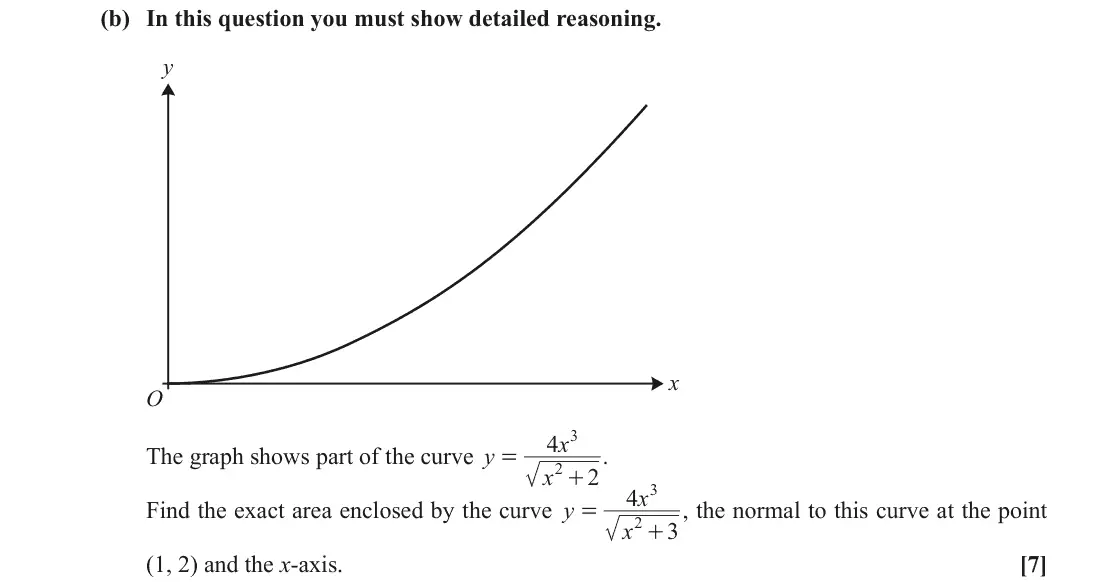
(From the general report) Teachers should make sure that they use an amended version of the question paper, correcting the 4 x description of the graph in Question 11(b) as “part of the curve y = ” to match the information in x + 3 the rest of the question.
Key points and common errors
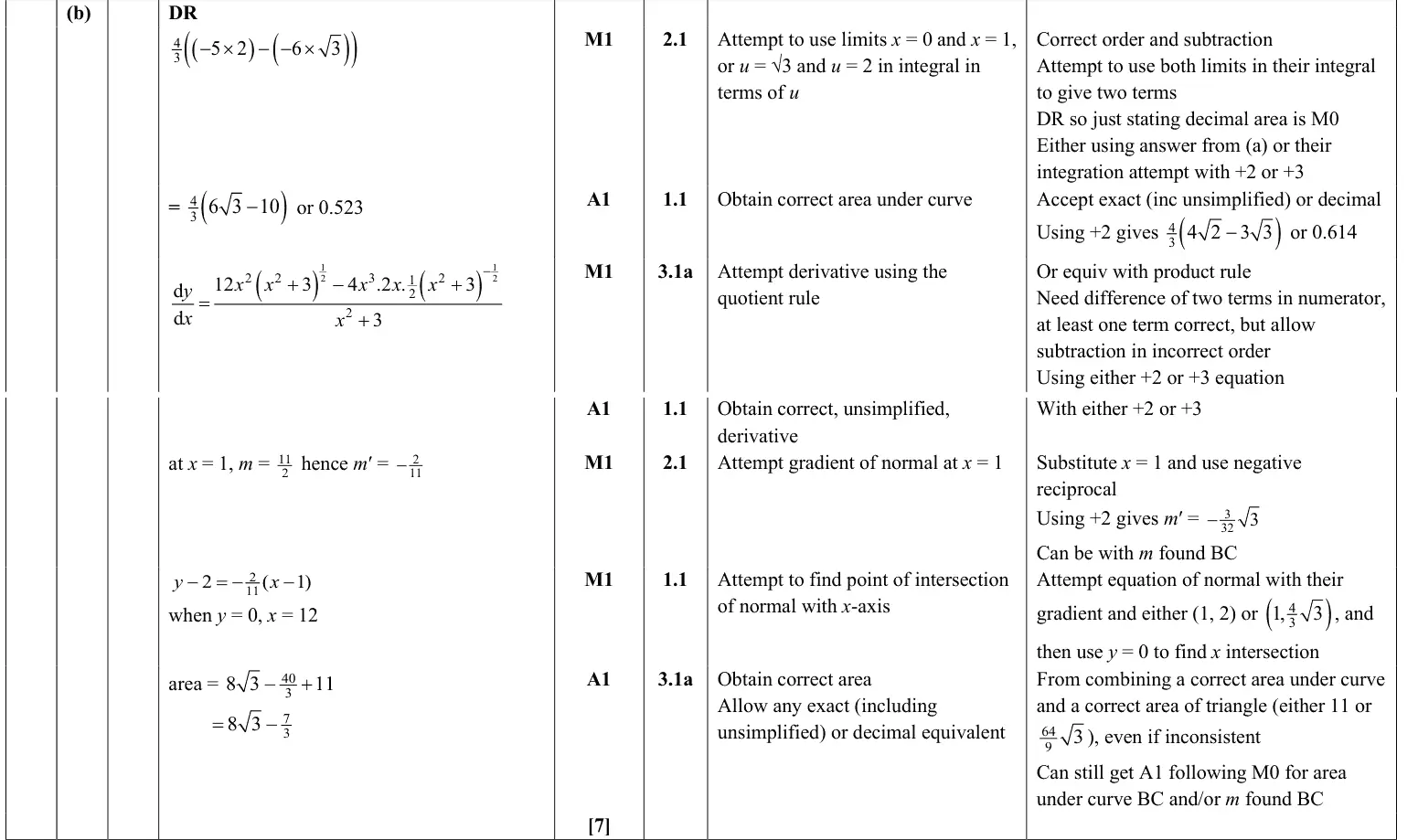
paper misprint: graph label should read √(x² + 3)
area under curve (4/3)(6√3 − 10)
quotient rule gives gradient 11/2 at x = 1 so normal gradient −2/11
normal meets x-axis at x = 12, triangle area 11
total 8√3 − 7/3
Autumn 2021 · Paper 2 · Q1(a)2 marksMedium
Mark scheme for this part
Key points and common errors
−4e^(−4x)
B1 for e^(−4x) seen in the answer, not in the denominator
Autumn 2021 · AS Paper 2 · Q45 marksMedium
Mark scheme for this part
Key points and common errors
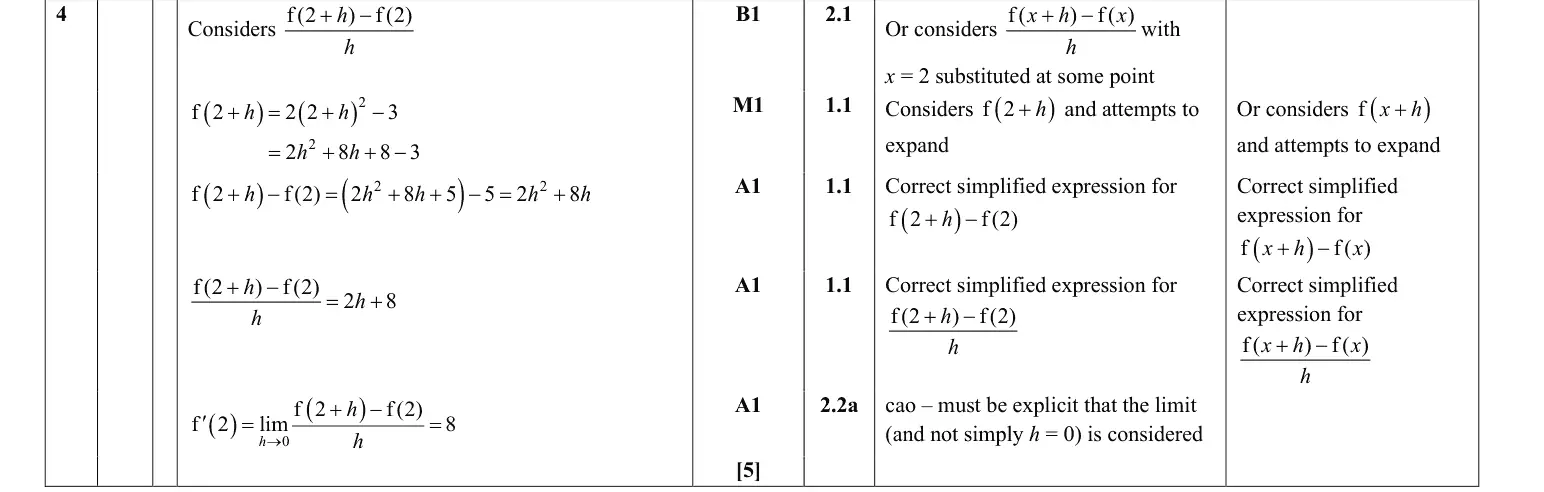
(f(2 + h) − f(2))/h = 2h + 8
f′(2) = limit as h → 0 = 8
the limit must be shown explicitly, not just h = 0
Autumn 2021 · AS Paper 2 · Q6(a)1 markMedium
Mark scheme for this part
Key points and common errors
d²y/dx² = 3x² + 2 > 0 for all x so the stationary point is a minimum
Autumn 2021 · AS Paper 2 · Q6(b)5 marksMedium
Show the start of this question
Mark scheme for this part
Key points and common errors
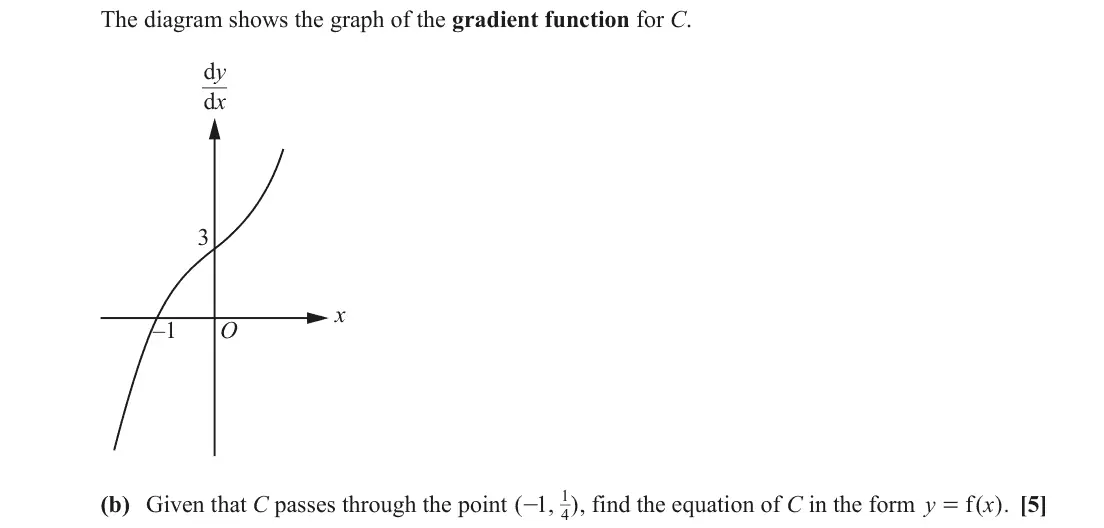
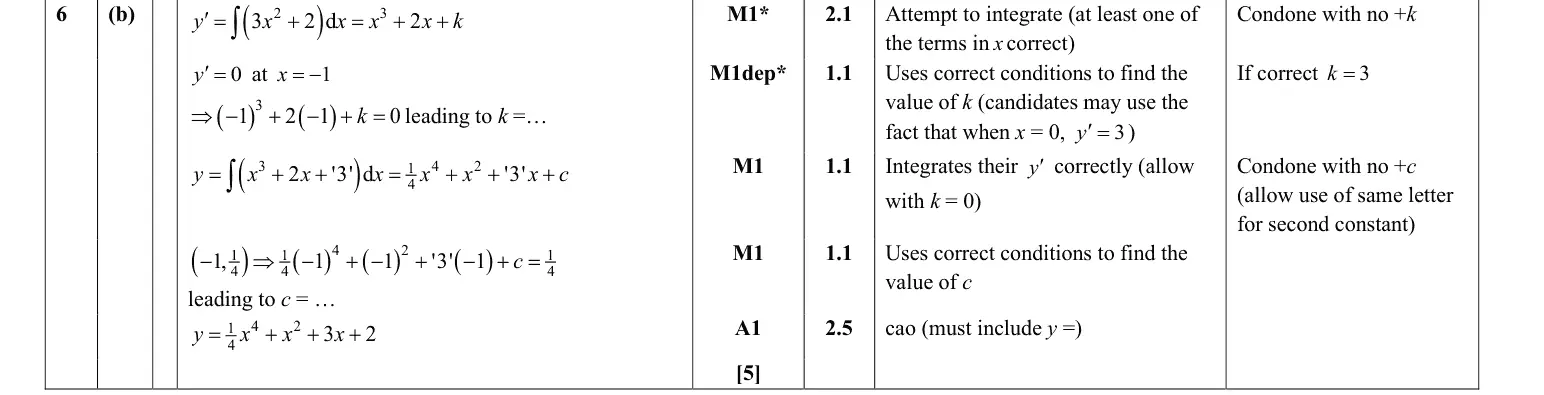
integrate: dy/dx = x³ + 2x + k
graph gives dy/dx = 0 at x = −1 (or 3 at x = 0) so k = 3
integrate again and use (−1, ¼): y = ¼x⁴ + x² + 3x + 2
include 'y ='
Autumn 2021 · Paper 2 · Q74 marksMedium
Mark scheme for this part
Examiner's comment
(From the general report) Question 7: Most candidates knew how to start and gained at least 2 marks. However, it is worth noting that the total number of questions requiring verbal rather than numerical answers is a little more than in the corresponding papers in 2019 and 2020. (But note that this precedent may or may not be followed in future papers.) When using this paper as a mock, it is important to make use of the published mark scheme, particularly for Questions 7, 8(b) and 13.
Key points and common errors
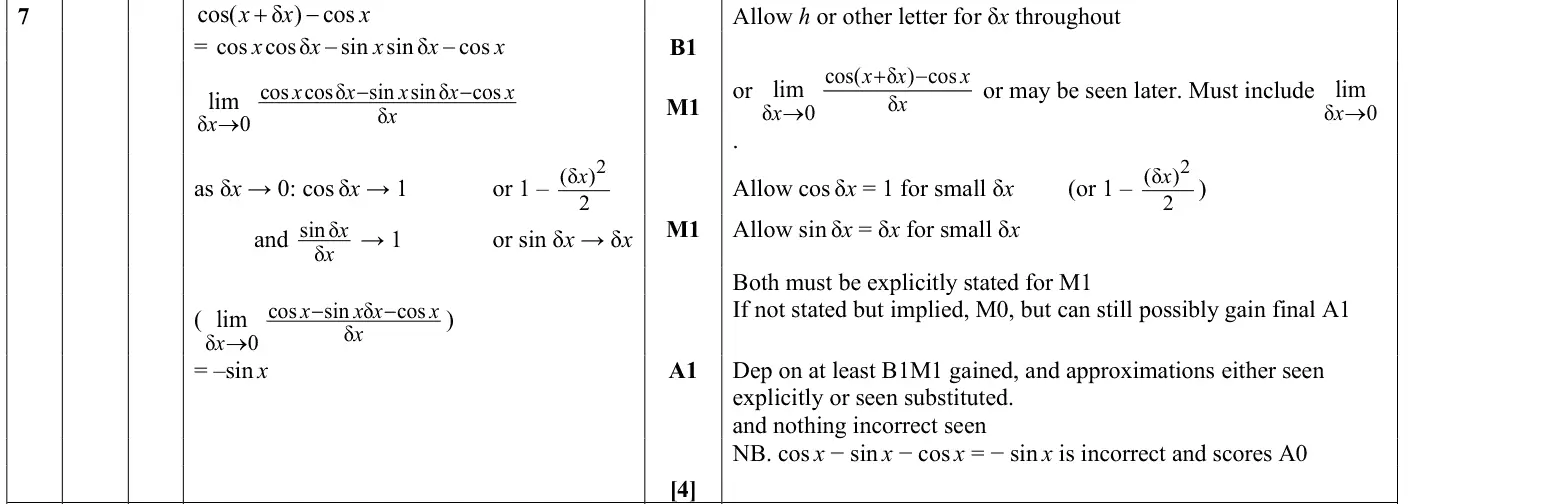
expand cos(x + δx)
lim δx→0 must be written
cos δx → 1 and sin δx/δx → 1 stated explicitly
−sin x
Autumn 2021 · AS Paper 2 · Q8(a)5 marksMedium
Mark scheme for this part
Key points and common errors
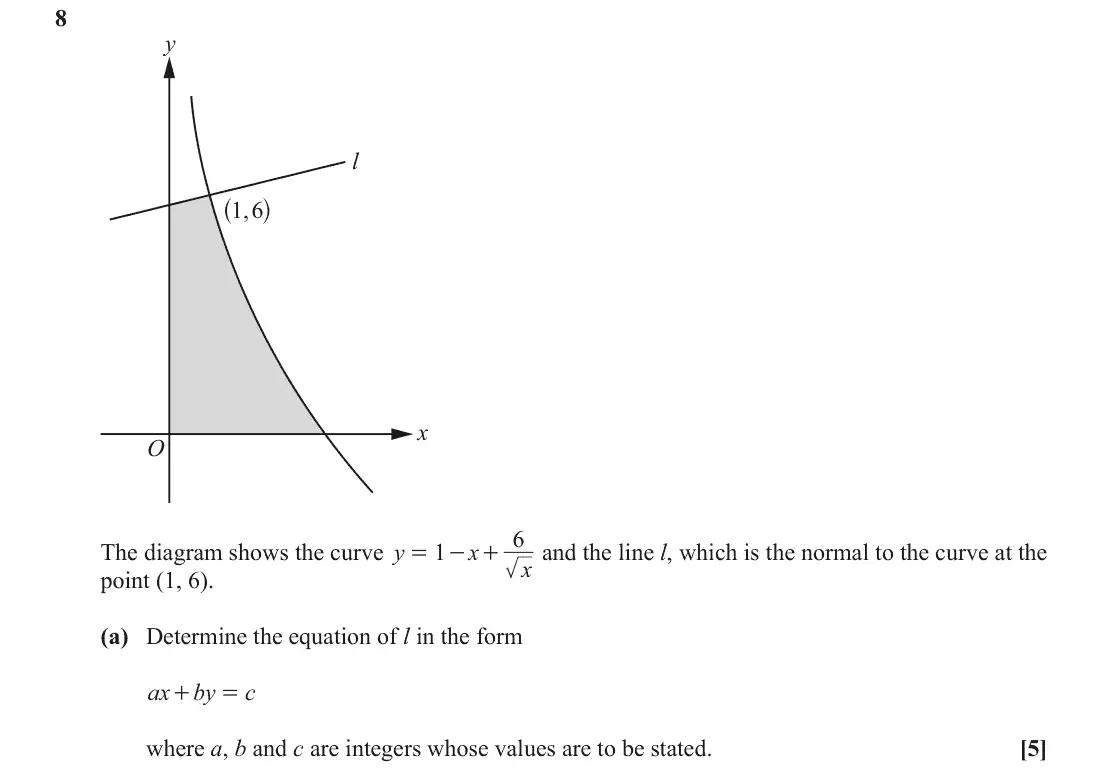
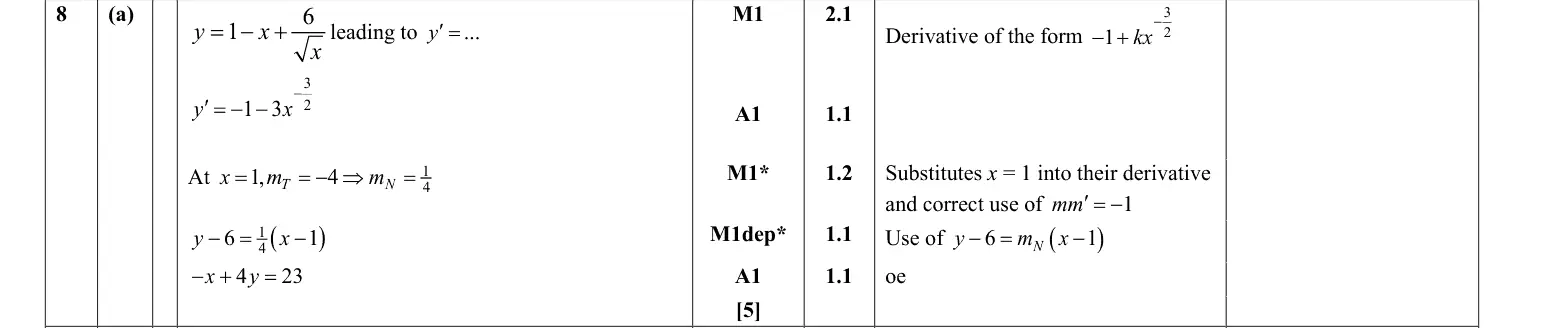
y′ = −1 − 3x^(−3/2)
tangent gradient −4 at x = 1 so normal gradient ¼
−x + 4y = 23 with integers
Autumn 2021 · AS Paper 2 · Q127 marksMedium
Mark scheme for this part
Key points and common errors
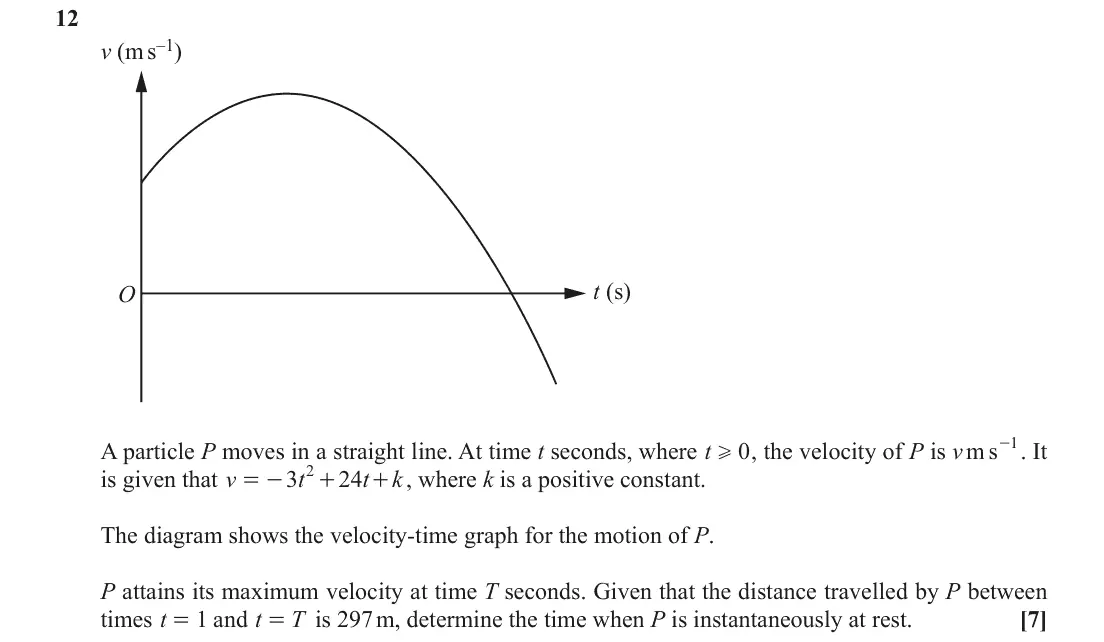
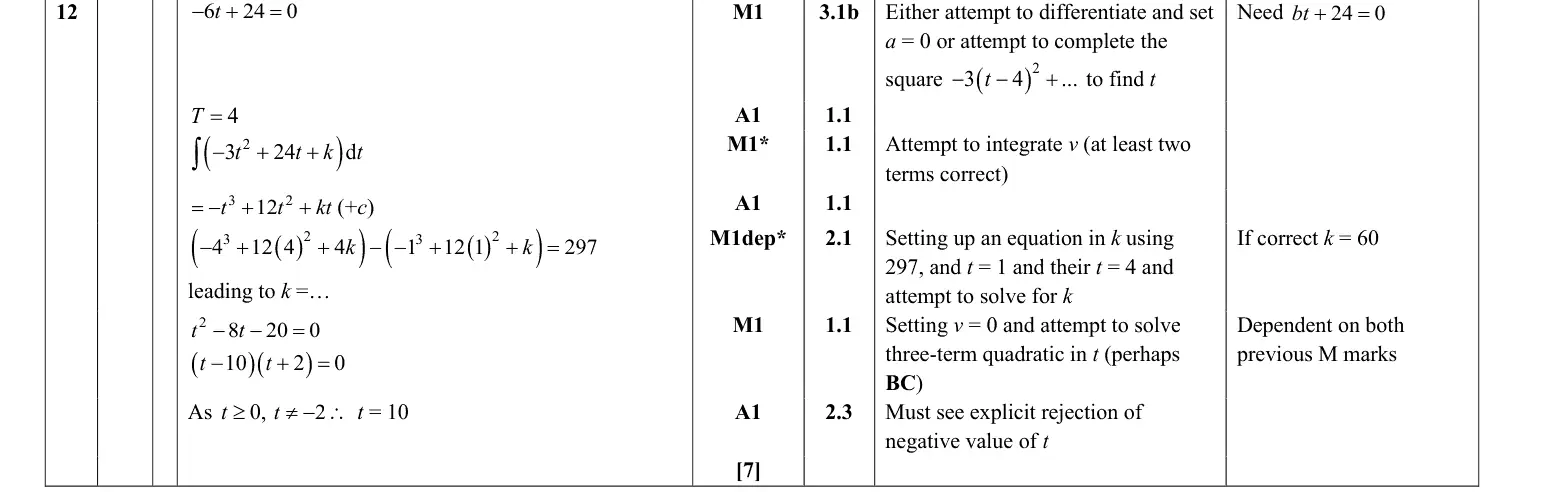
maximum velocity when a = −6t + 24 = 0, T = 4
s = −t³ + 12t² + kt
distance from t = 1 to 4 equals 297 gives k = 60
v = 0: t² − 8t − 20 = 0, t = 10 (reject −2 explicitly)
Autumn 2021 · Paper 3 · Q7(a)2 marksMedium
Mark scheme for this part
Key points and common errors
dy/dx = 3(y − 2)/(x − 3)
Autumn 2021 · Paper 3 · Q8(a)5 marksMedium
Mark scheme for this part
Key points and common errors
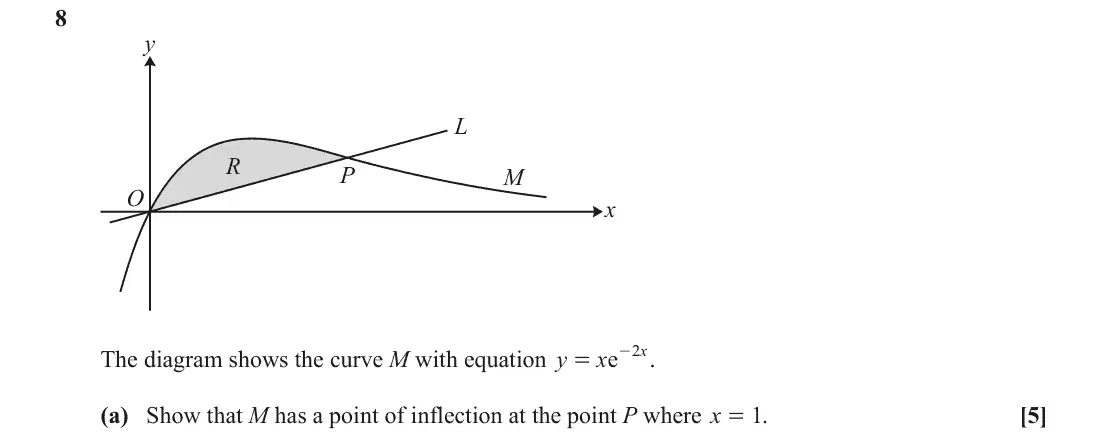
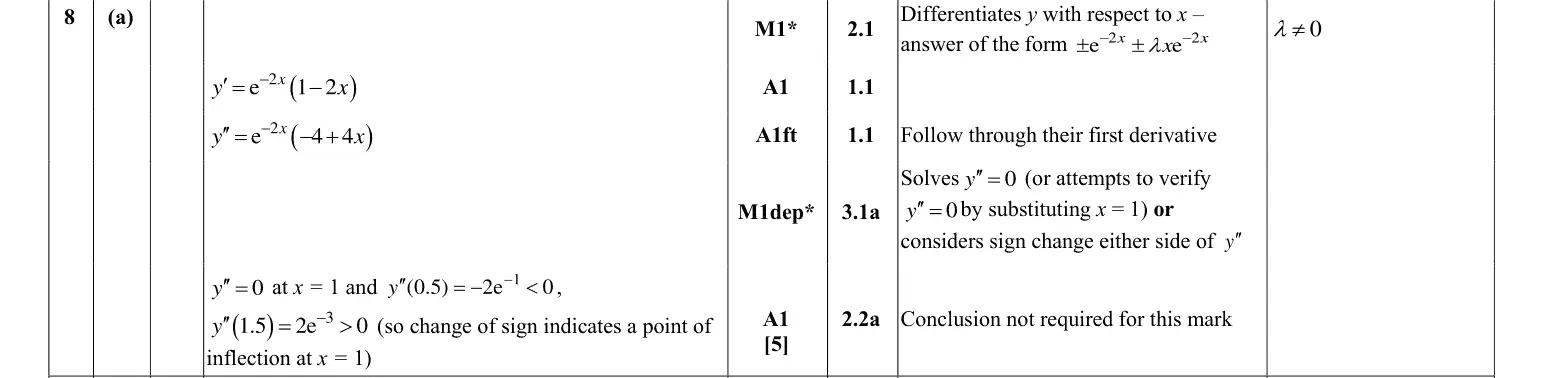
y′ = e^(−2x)(1 − 2x)
y″ = e^(−2x)(4x − 4) = 0 at x = 1
sign change of y″ either side confirms inflection
Autumn 2020 · AS Paper 1 · Q1(a)3 marksMedium
Mark scheme for this part
Key points and common errors
write 5/x² as 5x⁻²
3x² − 3 − 10x⁻³
Autumn 2020 · Paper 1 · Q3(b)6 marksMedium
Show the start of this question
Mark scheme for this part
Examiner's comment
(Comment on Question 03 as a whole) The first part of Question 3 required candidates to show the derivation of the given equation. On questions such as this, where the request is to ‘show that’ a given answer is correct, it is important that sufficient detail is given to provide a convincing solution. Examiners expected to see an equation for the volume, an expression for the total surface area and then clear substitution and manipulation to arrive at the given answer. In the second part of the question, a surprisingly common error was to find the radius but then omit to find the minimum surface area. Candidates should review a question to make sure that it is fully answered before moving on; other strategies such as highlighting or underlining key words and phrases within a question may also be helpful.
Key points and common errors
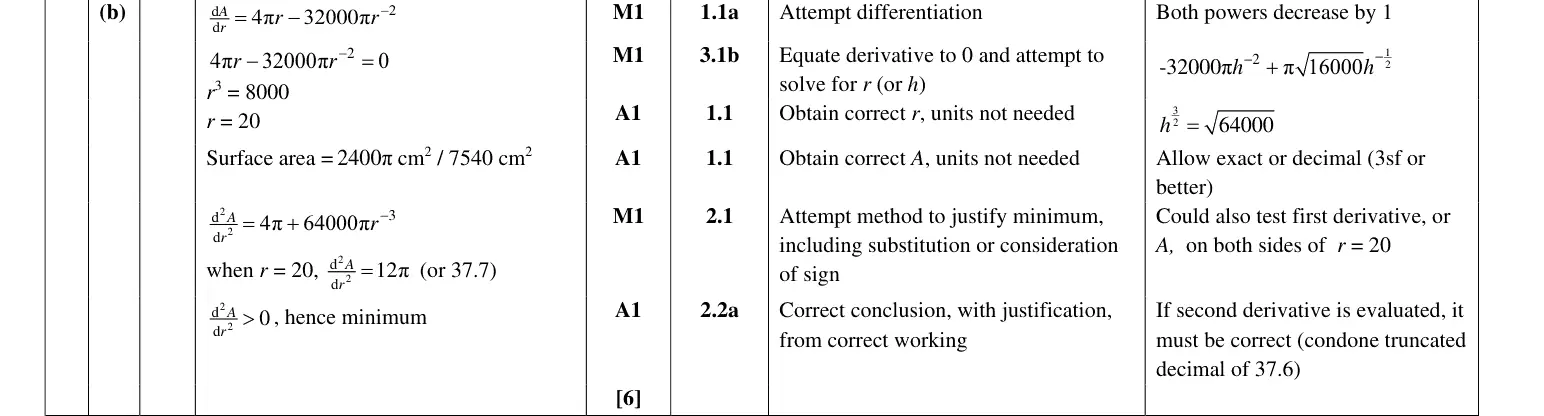
dA/dr = 4πr − 32000πr⁻² = 0 gives r = 20
A = 2400π cm²
second derivative 12π > 0 so minimum
common error: finding r but not the minimum area
Autumn 2020 · Paper 1 · Q8(a)3 marksMedium
Mark scheme for this part
Examiner's comment
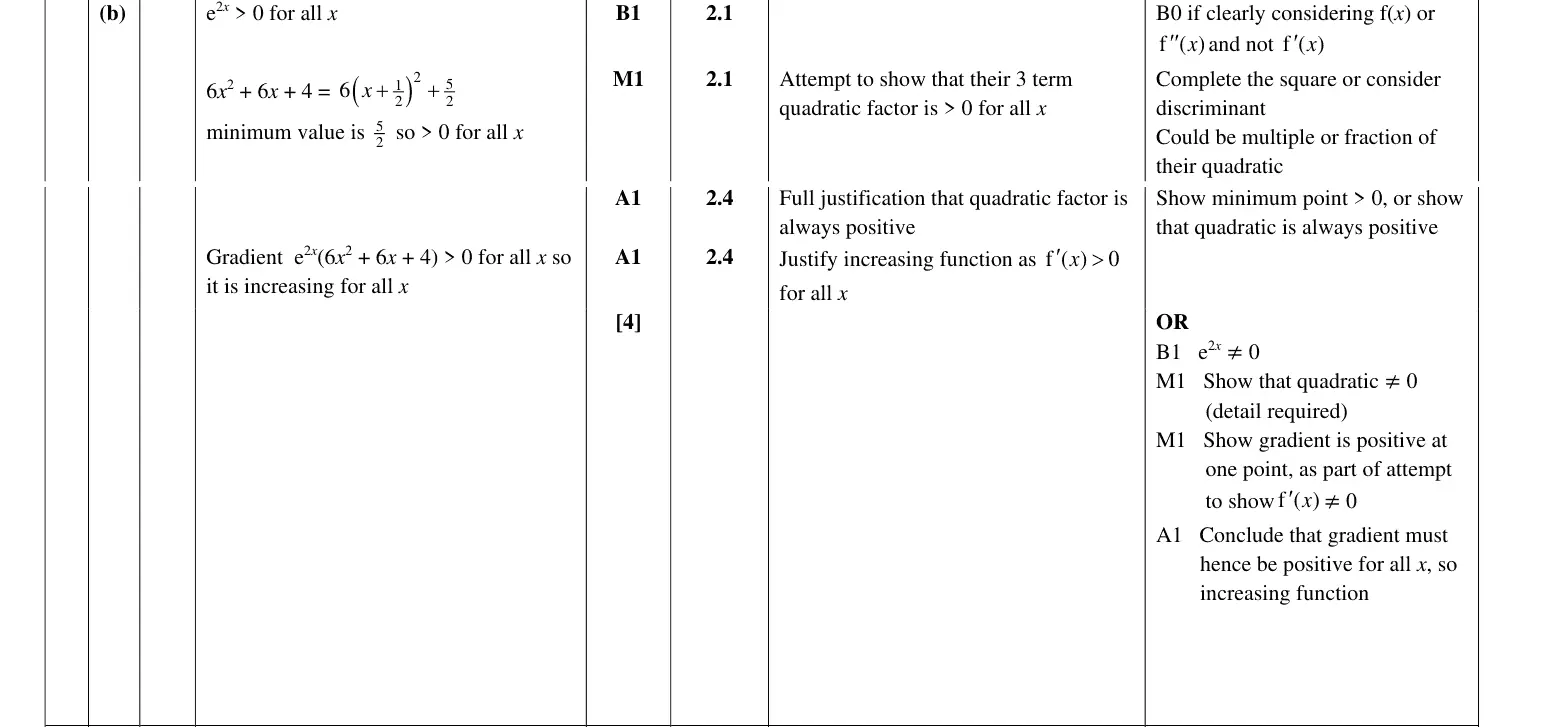
(Comment on Question 08 as a whole) The second part of Question 8 proved to be challenging; some candidates did not seem familiar with the definition of an increasing function and were unsure how to proceed whereas others stated that the first derivative needed to be positive, but then continued by considering the second derivative instead. Of the minority who attempted the correct method, many gave vague statements such as ‘the quadratic is always positive’ but with no evidence to support this. In a ‘show that’ question, sufficient detail must be provided so as to be convincing. Equally, statements must be fully correct so stating that e x is never negative lacks the required precision.
(Comment on Question 08 as a whole) The second part of Question 8 proved to be challenging; some candidates did not seem familiar with the definition of an increasing function and were unsure how to proceed whereas others stated that the first derivative needed to be positive, but then continued by considering the second derivative instead. Of the minority who attempted the correct method, many gave vague statements such as ‘the quadratic is always positive’ but with no evidence to support this. In a ‘show that’ question, sufficient detail must be provided so as to be convincing. Equally, statements must be fully correct so stating that e x is never negative lacks the required precision.
vague 'quadratic always positive' or using f″ scores little
Autumn 2020 · Paper 2 · Q1(a)(i)2 marksMedium
Mark scheme for this part
Key points and common errors
chain rule: 7 × 2 × (2x + 3)⁶ = 14(2x + 3)⁶
missing the factor 2
Autumn 2020 · Paper 2 · Q1(a)(ii)3 marksMedium
Mark scheme for this part
Key points and common errors
product rule: 3x² ln x + x²
sign errors in the rule
Autumn 2020 · AS Paper 2 · Q37 marksMedium
Mark scheme for this part
Examiner's comment
(From the general report) Note that ‘find’ was used in Question 3 and Question 6 with the instruction to show detailed reasoning, which now means evidence is vital.
Key points and common errors
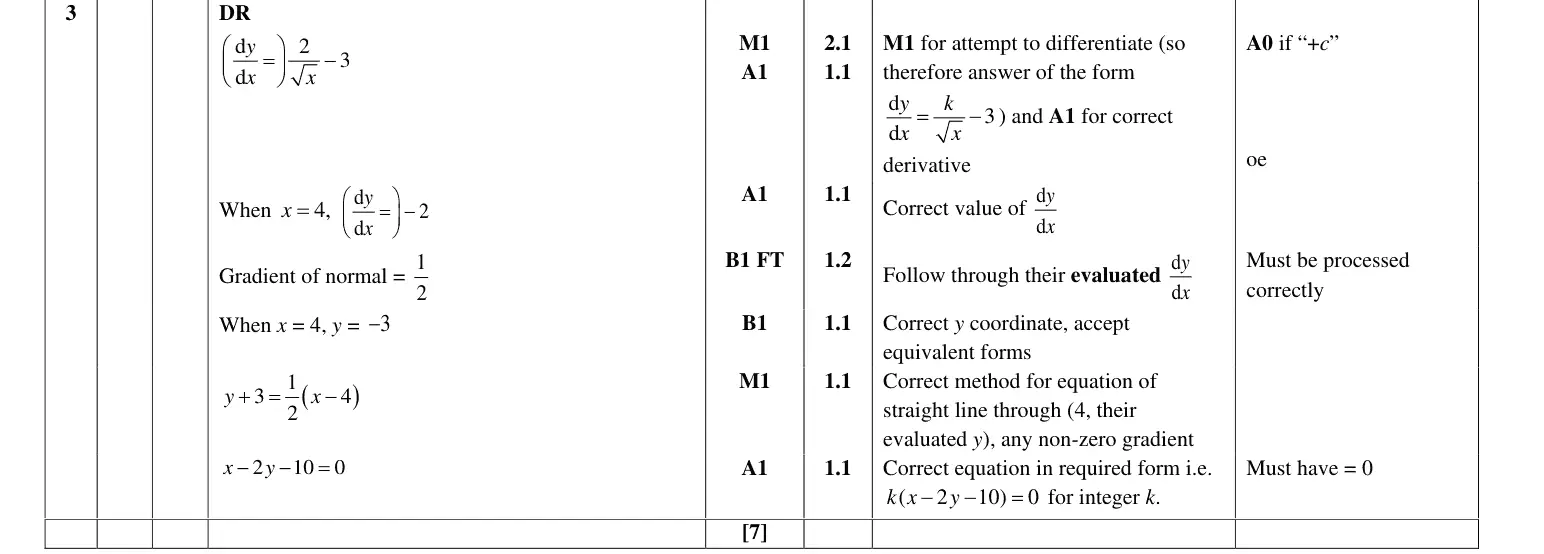
dy/dx = 2/√x − 3 = −2 at x = 4
normal gradient ½ through (4, −3)
x − 2y − 10 = 0 with integer coefficients
Autumn 2020 · AS Paper 2 · Q7(b)4 marksHard
Show the start of this question
Mark scheme for this part
Examiner's comment
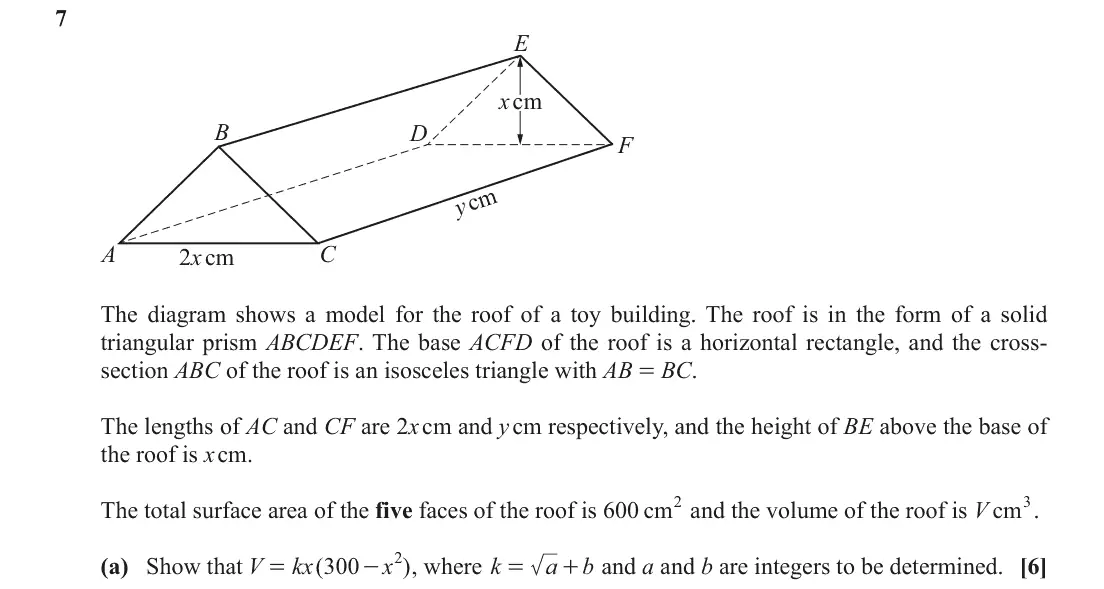
(Comment on Question 07 as a whole) Part (a) - V = 2x2y was seen and often the required result for the surface area was incorrect, although many candidates managed to find at least 3 correct faces and gain M1. Replacing y in V and the subsequent rationalising was rarely seen. Part (b) - M1 A1 earned, with k often used, but few completed. Full credit could have been gained here even if no k had been obtained earlier. Second derivatives appeared sometimes. Part (c) and (d) were commonly not attempted.
Key points and common errors
dV/dx = k(300 − 3x²) = 0 gives x = 10
full credit possible without k
Autumn 2020 · AS Paper 2 · Q7(c)1 markHard
Show the start of this question
Mark scheme for this part
Examiner's comment
(Comment on Question 07 as a whole) Part (a) - V = 2x2y was seen and often the required result for the surface area was incorrect, although many candidates managed to find at least 3 correct faces and gain M1. Replacing y in V and the subsequent rationalising was rarely seen. Part (b) - M1 A1 earned, with k often used, but few completed. Full credit could have been gained here even if no k had been obtained earlier. Second derivatives appeared sometimes. Part (c) and (d) were commonly not attempted.
Key points and common errors
V = 828 cm³
Autumn 2020 · AS Paper 2 · Q10(a)2 marksMedium
Mark scheme for this part
Examiner's comment
(Comment on Question 10 as a whole) Part (c) - Most just considered t = 0 to t = 4 without realising the importance of t = 3, even though (b) was almost always correct.
Key points and common errors
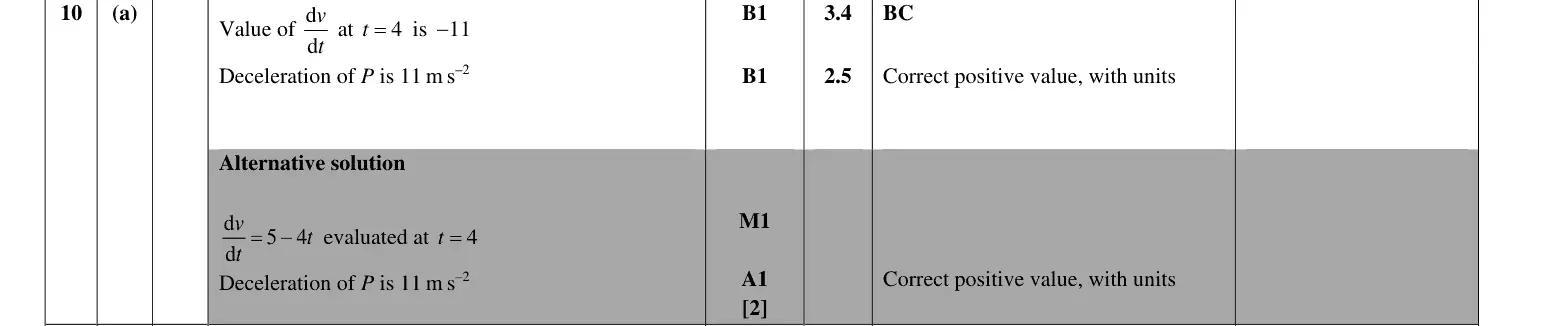
dv/dt = 5 − 4t = −11 at t = 4
deceleration 11 m/s² as a positive value
Autumn 2020 · AS Paper 2 · Q11(c)3 marksHard
Show the start of this question
Mark scheme for this part
Examiner's comment
(Comment on Question 11 as a whole) Part (a) - s = 16t used – the need for t – 1.5 was generally not understood. This then led to t = 0 and t = 8 from a two term quadratic and thus gained only M1 A1. Candidates did not seem to realise that t = 0 could not be one of the required times given the problem. t + 1.5 was seen in some working. Part (c) - Most candidates made no useful progress with this part. Common misconceptions Key teaching and learning points – comments on improving performance The following, some of which have been mentioned in previous reports, remain pertinent. 1. Candidates should understand the implication of the ‘In this question you must show detailed reasoning’ instruction. Generally, this means examiners will expect to see how results have been obtained. So, for example, in Question 6 on this paper the method for solving the simultaneous equations was expected and those just doing it on the calculator earned M0 for this skill. 2. BC – a result achieved ‘by calculator’ – can encourage candidates to show little, if any, evidence of how their answer has been produced. To be fair, where this appears on the mark scheme (in Question 10) candidates generally adopted the ‘old-fashioned’ algebraic route but no doubt this will change over time. Inevitably examiners will find it difficult to know where an incorrect answer, presented alone, has come from and it may be hard to credit. It may be wise to encourage candidates to provide some evidence of what they are doing, especially in cases where more than one mark is available. 3. The front cover instructions state ‘Give non-exact numerical answers correct to 3 significant figures unless a different degree of accuracy is specified in the question.’ This should be stressed – some final answers were correct to 2 significant figures only. This may result in a loss of accuracy marks. 4. A question may require units in an answer to gain full credit. It is best to make candidates aware of this and urge them to always include units in answers where relevant. 5. The front cover instruction state ‘When a numerical value is needed use g = 9.8 unless a different value is specified in the question’. This now seems to be well recognised. Guidance on using this paper as a mock This paper covers the following topics : Cosine rule, ½absinC with area of a segment, curve sketching and interpretation of the algebraic solution of an equation graphically, finding the normal to a curve, the factor theorem and factorisation, quadratic functions and graphical transformations, properties of the circle and the circle equation, a maximisation problem with rationalising and algebraic manipulation, use of the laws of logarithms, forces in vector notation in equilibrium, Newton’s second law, variable acceleration and suvat equation use. The Pure section introduces the calculus and various other ideas which require a secure grasp of basic algebra and in the Mechanics section students need a sound understanding of kinematics with both uniform and non-uniform acceleration and Newton’s laws.
Key points and common errors
gap 16(t − 1.5) − 2t² maximum at t = 4 (midpoint)
8 m
little useful progress made
Autumn 2020 · Paper 3 · Q4(a)5 marksMedium
Mark scheme for this part
Examiner's comment
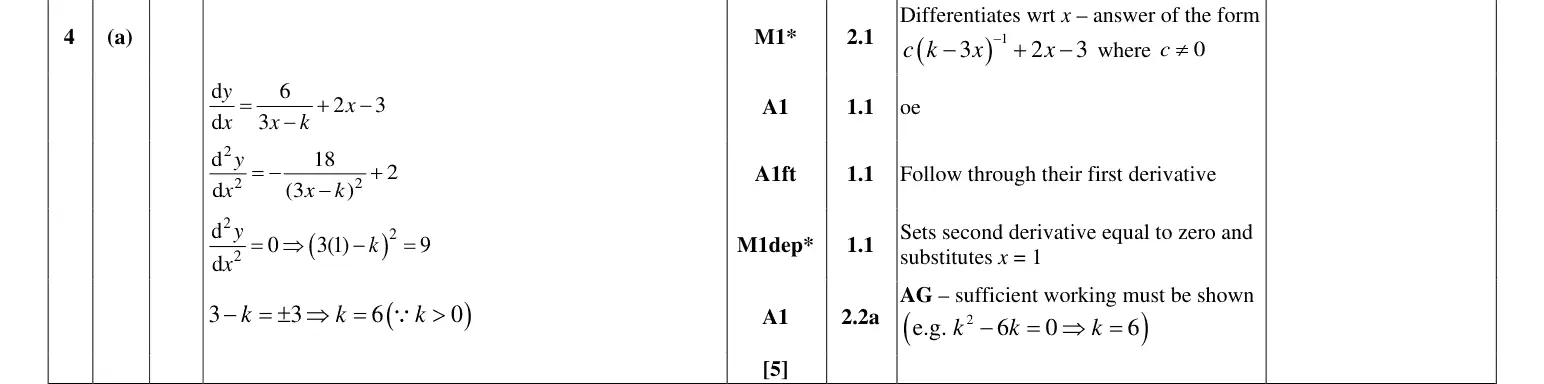
(Comment on Question 04 as a whole) In part (a) it was seen that a significant number of candidates only showed that the curve had a turning d y d y point at x = using 1 x = 0 rather than that the curve had a point of inflection at x = using 1 = 0 . d d x d y Some candidates substituted the values of x = and 1 k = 6 to ‘verify’ that = 0 and did not provide d x sufficient evidence to ‘show that k = 6 ’. Where questions ask for candidates to solve a problem to ‘show that’ a given answer is correct then it is good practice that the working leads to that answer and does not make use of the answer as part of the working. In part (b) the examiners were looking for actual numerical values with an explanation that the change of sign indicates that the x-intercept is between those values. Some candidates simply provided a generic explanation of what a change in sign would represent, but no numerical confirmation in the context of this question, which was not sufficient for the request ‘Show by calculation …’. Part (c) was generally done well, although some candidates dropped marks when imprecise notation resulted in subsequent substitution errors. In order to demonstrate that the Newton – Raphson method has indeed been used, it is good practice to write out the iteration formulae, taking care with the x and x + notation. Candidates that gave their results to the iterations to an accuracy greater than the specified 6 dp were not penalised, but the final accuracy mark required the answer to be quoted to the specified 5 dp. Part (d) was generally answered well by those that had successfully completed part (c). Most verified their 5 dp answer by checking for the sign change 0 000005 ± . , although a few investigated smaller interval bounds. Those candidates that did not gain credit either investigated 0 00001 ± . or did not explain how their calculations verified the result.
Key points and common errors
dy/dx = 6/(3x − k) + 2x − 3
d²y/dx² = −18/(3x − k)² + 2 = 0 at x = 1 gives k = 6 (k > 0)
many used dy/dx = 0 (turning point) instead of the second derivative
verifying with k = 6 is not enough
Autumn 2020 · Paper 3 · Q5(a)4 marksMedium
Mark scheme for this part
Examiner's comment
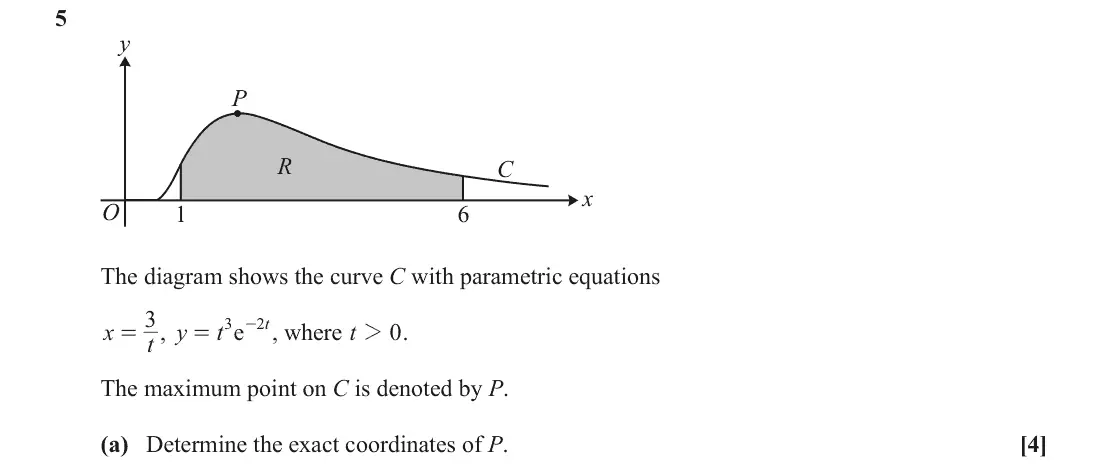
(Comment on Question 05 as a whole) Unless explicitly requested, candidates should avoid converting parametric equations into the cartesian form due to the complexity. d y In part (a) candidates only needed to determine where t = 0 . Unfortunately, some candidates made d errors in the denominator when finding d y x , and while this may not impact the numerical answer d obtained, there is a standard principle that answers obtained with wrong working will not gain full credit. The other issue with this question was that the ‘exact coordinates of P ’ was needed, those candidates that provided a decimal approximation would not gain full credit (unless the exact value had been seen as part of the working). The first issue with part (b) was that the limits were given on the diagram as x = and 1 , but the x = 6 integration was to be done with respect to t ; a number of candidates did not spot this. This was a ‘Show that’ question so the initial method mark was to find d x t and to show a clear attempt to use this in d d d x ∫ y t . The final accuracy mark was to rearrange into the given form. d t Part (c) involved using the formula given in part (b) to ‘Hence’ determine the area. Generally, this was done well, with candidates correctly giving their answer in ‘exact’ form in terms of e .
Key points and common errors
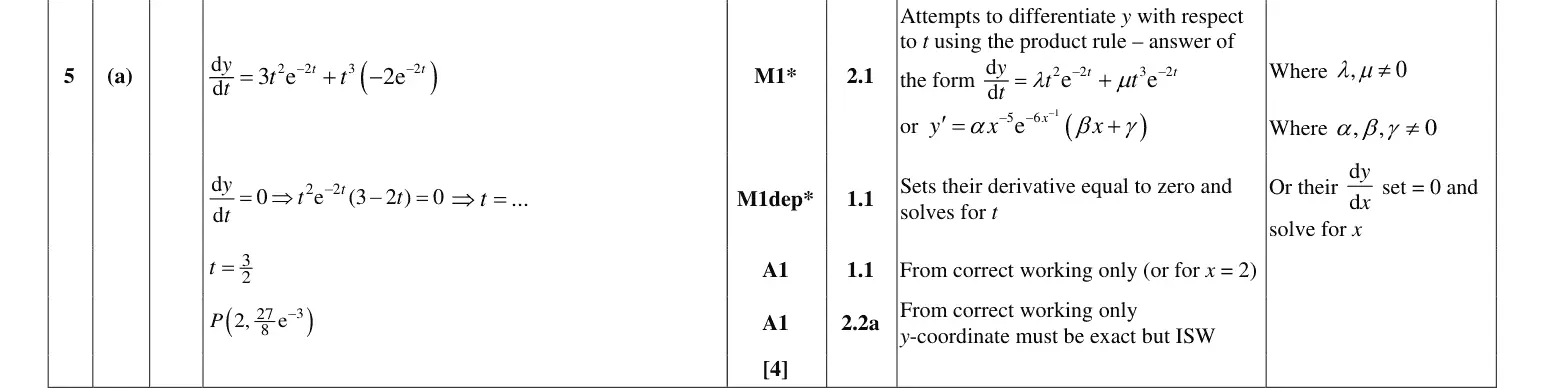
dy/dt = 3t²e⁻²ᵗ − 2t³e⁻²ᵗ = 0 so t = 3/2
P(2, (27/8)e⁻³) exact
no need to convert to cartesian
Autumn 2020 · Paper 3 · Q8(b)4 marksEasy
Show the start of this question
Mark scheme for this part
Examiner's comment
(Comment on Question 08 as a whole) This question was also completed well, although a significant number attempted to use the ‘suvat’ equations. Part (a) was answered correctly on almost 100% of the scripts. Part (b) was also answered well. Unfortunately, some candidates ignored the negative sign needed for deceleration, which meant only 3 out of the 4 marks were available. Part (c) was a ‘Find’ question, so an answer obtained directly from the calculator was expected, although some candidates did show a fully integrated expression first. Some candidates dropped marks when they used the incorrect limits and some attempted to use ‘suvat’, even if they had used calculus in the earlier parts.
Key points and common errors
dv/dt = 2at + b = −0.12 at t = 5
v(18) = 2.96
a = −0.02, b = 0.08
deceleration needs the minus sign
suvat is invalid
June 2019 · AS Paper 1 · Q1(a)3 marksEasy
Mark scheme for this part
Examiner's comment
Many candidates answered this question correctly. A few gave 3 + 15x–2 or 3 – 15x–4. The most common difficulty was handling the negative index.
Key points and common errors
write 5/x³ as 5x⁻³
f′(x) = 3 + 15x⁻⁴
errors with the negative index (15x⁻², −15x⁻⁴)
June 2019 · AS Paper 1 · Q1(b)2 marksEasy
Show the start of this question
Mark scheme for this part
Examiner's comment
This question was also answered well by many candidates. As in part (a) the most common difficulty was handling the negative index.
Key points and common errors
f″(x) = −60x⁻⁵
constant differentiates to 0
June 2019 · AS Paper 1 · Q4(a)4 marksEasy
Mark scheme for this part
Examiner's comment
Many correct responses were seen. Some candidates made arithmetical errors in finding the values of y. A few candidates did not differentiate but attempted to solve x3 – 6x2 + 9x = 0. This can lead to finding one turning point, but not the other. In this case it was fortuitous for them that the minimum was identifiable in the form of a repeated root.
Key points and common errors
dy/dx = 3x² − 12x + 9 = 0
x = 1 or 3
(1, 4) and (3, 0) paired
June 2019 · Paper 1 · Q5(b)4 marksEasy
Show the start of this question
Mark scheme for this part
Examiner's comment
This part of the question was also very well answered, with the majority of the candidates gaining full credit. The most successful candidates found a numerical value for the gradient of the tangent and from this found the gradient, and hence the equation, of the normal. Attempts to find the negative reciprocal algebraically tended to be less successful, and some candidates even used this algebraic expression in their equation of the normal.
Key points and common errors
dy/dx = 9 at (1, 2), normal gradient −1/9
x + 9y = 19
use a numerical gradient, not an algebraic one
June 2019 · Paper 1 · Q66 marksMedium
Mark scheme for this part
Examiner's comment
Most candidates seemed familiar with the process of differentiation from first principles, quoting the formula from the question paper and attempting to apply it to the given function. The best candidates made effective use of brackets and used a new line for each step of their solution rather than attempt to do too much in one go. The expansion of (x + h)3 was usually correct, although many candidates elected to expand three brackets rather than apply the binomial expansion. When the expansion was multiplied by 2, it was quite common to see some incorrect coefficients, especially in the solutions of those who had expanded three brackets and not then collected like terms. The other common error was due to not using brackets when introducing –(2x2 + 3x) in the numerator, resulting in the 3x being of the incorrect sign. Some candidates appeared not to notice and cancelled +3x with another +3x, whereas others did realise that there was an error and attempted to correct it, but this was not always applied to every line of working. Candidates who had a correct simplified expression were usually able to complete the proof by explicitly considering the limit as h tended to 0. Each step in this proof is clearly detailed, and only one step is made on each line which makes the proof convincing and easy to follow. The candidate uses correct notation throughout, including explicit consideration of the limit as h tends to 0. The candidate gains the first mark for setting up the correct expressions and gains a second mark for the correct binomial expansion. On the third line it seems that the cancelling by h has occurred before the numerator has been simplified so no further credit is given. This is an example of trying to do too much in one go.
Key points and common errors
(x + h)³ = x³ + 3x²h + 3xh² + h³
f(x + h) − f(x) = 6x²h + 6xh² + 2h³ + 3h
divide by h and use lim h → 0 with correct notation
coefficients slip when multiplying by 2
June 2019 · AS Paper 1 · Q7(b)4 marksMedium
Show the start of this question
Mark scheme for this part
Examiner's comment
Many candidates correctly used their response to part (b) to find the gradient of the curve at x = 2. But then a large minority found the negative reciprocal and used this as the gradient of the tangent. Most candidates used one of the two usual methods for the equation a straight line. Some used the form y = mx + c, although a few found c = 0 without stating explicitly the equation of the tangent. This was not regarded as an adequate response to the instruction "Show that . . .” Others found the equation correctly and stated (rather than showed) that the line passed through O. These were allowed the final mark because the equation concerned was so simple. However, in similar questions in the future, the corresponding mark might be withheld if no explanation is given. 2 into their d y Some candidates, having differentiated correctly in part (a), substituted k = 1 x , but did not d substitute x = 2. In some cases, they went on to try to find the equation of the tangent, with their gradient 1 x 1 2 e 2 still given as a function of x; thus: y – e = (x – 2). Other candidates appeared not to recognise that their response to part (a) could be used in part (b), and they started from scratch. A common error was to find the gradient, not of the tangent, but of the line joining the origin to the point where x = e. The relevant marks were not gained despite the fact that these are, fortuitously, the same line.
Key points and common errors
gradient at x = 2 is e/2 (not the normal)
y − e = (e/2)(x − 2) gives y = ex/2, which passes through (0, 0)
June 2019 · Paper 1 · Q10(b)2 marksHard
Show the start of this question
Mark scheme for this part
Examiner's comment
To gain the first mark, candidates simply had to find the value of F’(1.2), yet the majority did not follow this instruction. A further few found the derivative but did not substitute 1.2. Of those who did carry out the evaluation correctly, some did not understand the relevance of this value with references to tangents and Newton-Raphson being the most common error. Others clearly had an inkling that the gradient related to the convergence of the iterative formula but their explanation was insufficiently specific to gain the mark, most typically just stating that it was less than 1. The most able candidates were able to give a suitably detailed explanation, referring to the modulus of the gradient being less than 1, and some even illustrated this with a staircase diagram.
Key points and common errors
F′(1.2) = cos1.2 = 0.362 must be evaluated
condition is modulus of F′ less than 1 (−1 < F′ < 1)
confusion with tangents or Newton-Raphson
June 2019 · Paper 1 · Q12(a)3 marksMedium
Mark scheme for this part
Examiner's comment
The derivative of ax is a new specification item, and candidates were expected to use this in the chain rule to show the given answer. Some were able to provide a convincing justification using this method, and others either introduced logarithms and used implicit differentiation or rewrote the function in the form ef(x). These different approaches tended to be equally successful. Some candidates were unable to devise an appropriate strategy and others seemed to be working back from the given answer in an attempt to justify it. This candidate gains full credit for making clear use of the derivative of au in the chain rule. This candidate cannot recall the required derivative so instead writes it in the form ef(x) which they are able to differentiate. Each step is clear in showing this given answer. Another candidate who cannot recall the required derivative so takes logarithms on both sides and differentiates implicitly. This is a good example of a candidate being able to recall and apply a relevant part of the specification.
Key points and common errors
chain rule with d(aᵘ)/du = aᵘ ln a, or take logs, or write as e^(3x² ln a)
working back from the answer gains nothing
June 2019 · Paper 1 · Q12(b)4 marksMedium
Show the start of this question
Mark scheme for this part
Examiner's comment
A number of candidates were able to make a good attempt at this question, producing fully correct solutions. The most common approach was to find a general equation for the tangent and then substitute in the given points, sometimes to give an equation that could be then solved and other times to set up two simultaneous equations. The less common, but more efficient, method was to use the two given points to find an expression for the gradient that was then equated to the derivative. Some candidates did not read the question carefully and used the wrong point when finding the gradient of the tangent, and others attempted to use both points in the derivative. A common misconception was to use the derivative in terms of x as the gradient rather than appreciating that a straight line must have a constant gradient.
Key points and common errors
gradient 6a³ln a at x = 1
tangent through (½, 0) gives a³ = 3a³ln a so a = e^(1/3)
using the wrong point for the gradient
June 2019 · Paper 1 · Q12(c)5 marksHard
Show the start of this question
Mark scheme for this part
Examiner's comment
This proved to be a challenging finish to the paper and only the most able candidates were able to make much progress. The majority continued to work with the function in terms of a, with only a few using the numerical value for a from part (b); either approach could gain full credit. Candidates appreciated the need to use the product rule, but one part of the product was often seen as lna rather than splitting it into two functions of x. Some did then attempt a further split but an all too common error was for lna to differentiate to a-1 rather than 0. Candidates were then expected to consider the sign of each component of each term to show that the second derivative was always positive and hence the curve always convex. Many candidates were clearly familiar with the definition of a convex curve and could make some attempt at a relevant method, but statements were not always suitably specific; it was common to see ‘x2 is always positive’ and candidates should be precise with their reasoning.
Key points and common errors
product rule: d²y/dx² = a^(3x²)(6ln a)(1 + 6x²ln a)
each factor positive for a > 1 so convex for all x
ln a wrongly differentiated to 1/a
June 2019 · Paper 2 · Q1(a)(ii)2 marksMedium
Mark scheme for this part
Examiner's comment
Many correct answers were seen. Some candidates omitted one or both pairs of brackets in their answer. Most knew that the derivative of tan x is sec x , although a few resorted to the quotient rule ( ) sin x − 3 x ( ) ( ) applied to . A few candidates gave sec 2 x − 3 . Some candidates used the tan A − B ( ) cos x − 3 x formula. Some then stopped, while others attempted to differentiate the result, usually making errors.
Key points and common errors
(2x − 3)sec²(x² − 3x)
brackets omitted
sec²(2x − 3) seen
June 2019 · AS Paper 2 · Q2(c)1 markHard
Show the start of this question
Mark scheme for this part
Examiner's comment
‘State’ again, with the same implication as in 2(c). This part was the least successful. A significant number of candidates found the tangent y = − 17 rather than the requested normal x = 2 .
Key points and common errors
normal at the minimum is vertical: x = 2
common error the tangent y = −17
June 2019 · Paper 2 · Q3(b)6 marksMedium
Mark scheme for this part
Examiner's comment
Most candidates recognised that the starting point was to find the gradient of the curve at the relevant point. Most of these successfully found d x by dividing d y y t by d x t . A few made errors while substituting d d d π t = , such as omitting the "–" sign. Many candidates carried out the next two steps (finding the 6 equation of the line and substituting y = 0) correctly. However, arithmetical errors were legion. It is worth noting that some candidates combined these steps into one, not giving explicitly the equation of the line before substituting y = 0. This is not incorrect and was not penalised, but it possibly led to more errors than would otherwise have occurred. It also certainly made the marking more difficult, and sometimes marks could not be awarded because candidates' working was not clear enough. Some candidates found the gradient of the normal and used this as the gradient of the tangent. π Some candidates retained "t " in their working until a late stage, only substituting t = at the end. This 6 led to working being more complex and confusing than necessary, and sometime led to errors along the way. A few candidates found the point where the curve cuts the x-axis, instead of where the line cuts the x- axis.
Key points and common errors
dy/dx = (dy/dt)/(dx/dt) = −½cot t
at t = π/6 gradient −√3/2
tangent through (2√3, 1)
cuts x-axis at 8√3/3
arithmetic errors common
June 2019 · Paper 2 · Q4(a)1 markHard
Mark scheme for this part
Examiner's comment
Some candidates were unable to distinguish between P and the rate of growth of P. A few gave an answer for Model A, but not Model B. Some gave an incomplete answer for Model A, such as "The rate of growth increases and then becomes constant." Others tried to give a single answer that covered both models, such as "Growth overall decreases to zero" or "The rate of growth is greater under Model B than Model A." A good succinct answer is as follows: A: The rate of growth starts at zero, then increases and then decreases to zero. B: The rate of growth is initially high and decreases to zero. An acceptable succinct answer is as follows: A: The rate of growth increases and then decreases. B: The rate of growth decreases.
Key points and common errors
distinguish P from rate of growth of P
A: rate increases then decreases
B: rate decreases throughout
both models needed
June 2019 · Paper 2 · Q5(b)5 marksMedium
Show the start of this question
Mark scheme for this part
Examiner's comment
Most attempted to differentiate V, with varying levels of success. Some made arithmetical errors. Others ( ) 0.5 ( ) π π d V 2 6 5 had = 16 r − r × 32 r − 6 r or 32 r − 6 r . Some differentiated correctly, but then d r 6 6 (incorrectly) set 16 r − r = 0 , as well as (correctly) setting 32 r − 6 r = 0 . The ‘Detailed reasoning’ instruction indicates that the solution must lead to a conclusion by showing a detailed and complete analytical method; this meant that candidates were expected to give a reason for 2 rejecting one or both of r = 0 and r = − . Similarly, a ‘Trial and Improvement’ method to identify 4 3 r = 1 52 . , seen by a few candidates, was not considered an adequate method for full credit.
Key points and common errors
differentiate √(16r² − r⁶) by chain rule
32r − 6r⁵ = 0 gives r⁴ = 16/3
must reject r = 0 and negative r
V = 5.20
trial and improvement not enough
June 2019 · AS Paper 2 · Q10(a)5 marksMedium
Mark scheme for this part
Examiner's comment
Many candidates managed to gain some credit on this question. r = 18 was often spotted and v = 9 at t = 5 well applied. Some then stated v = 9 at t = 10 also, and floundered. Pleasingly, those who realised they needed the acceleration generally differentiated and were accurate.
Key points and common errors
v = 18 at t = 0 gives r = 18
v = 9 and dv/dt = 0 at t = 5 give 25p + 5q = −9 and 10p + q = 0
p = 9/25, q = −18/5
v = 9 at t = 10 is not new information
June 2019 · Paper 3 · Q4(a)3 marksMedium
Mark scheme for this part
Examiner's comment
While most candidates differentiated y correctly (using the product rule) and obtained 3sin2 x + 6 cos2 x x = 0 many candidates did not show enough working to convince examiners that they had derived and not simply stated the given result. For example, sin 2 x + 2 cos 2 x x = 0 ⇒ tan 2 x + 2 x = 0 scored A0. sin2 x But sin2 x + 2 cos2 x x = 0 ⇒ + 2 x = 0 ⇒ tan2 x + 2 x = 0 scored A1. cos2 x
Key points and common errors
product rule: 3sin2x + 6xcos2x = 0
divide by cos 2x explicitly to reach tan2x + 2x = 0
insufficient working
June 2019 · Paper 3 · Q4(b)4 marksHard
Show the start of this question
Mark scheme for this part
Examiner's comment
It was extremely disappointing that so many candidates did not realise that this part was asking candidates to apply the Newton-Raphson method to find a solution to the equation given in (a) with many thinking (by their choice of ( ) f x ) that instead it was asking them to solve 3 sin2 0 Of those x x = . / ( x ) candidates that correctly realised that ( ) f tan2 2 and hence f 2sec 2 2 most went on x = x + x = x + to correctly apply the Newton-Raphson formula with a suitable starting value and obtained the x-coordinate of P as 1.0144.
Key points and common errors
f(x) = tan2x + 2x, f′(x) = 2sec²2x + 2
suitable x₀ near 1
x = 1.0144
many wrongly used f(x) = 3x sin2x
June 2019 · Paper 3 · Q4(d)(iii)1 markMedium
Show the start of this question
Mark scheme for this part
Examiner's comment
It was pleasing to note that many candidates realised that as the curve changed from being convex to concave it was not possible to tell from the diagram alone whether the trapezium rule would give an under- or over-estimate for the area of the region. Although a number of candidates gave spurious reasons such as there was no scaling on the x-axis or that the diagram was not sufficiently large enough to tell.
Key points and common errors
curve changes from convex to concave so some trapezia are above and some below the curve
June 2019 · Paper 3 · Q10(a)6 marksMedium
Mark scheme for this part
Examiner's comment
( ) Nearly all candidates correctly differentiated v and obtained a = 2 pt − 3 i + 8 j Unfortunately many . candidates then made careless slips in applying F = m a to obtain an equation in p only with the most common errors being forgetting the mass completely or only multiplying the i component by the value of m. Candidates are one again reminded to read the question carefully as while many had a correct equation in p e.g. ( p − 3 ) + 64 = 100 many solved and gave the positive root even though the question specifically said that p was negative. This response scored the first five marks. An almost perfect response let down by the fact that the candidate did not read the question carefully enough and assumed that the value of p could not be negative.
Key points and common errors
a = (2pt − 3)i + 8j
F = 2a with magnitude 20 at t = 0.5
(p − 3)² + 64 = 100
p = −3 only since p < 0
forgetting mass
June 2018 · AS Paper 1 · Q4(i)(a)2 marksEasy
Mark scheme for this part
Examiner's comment
(Comment on Question 04(i) as a whole) Almost all candidates answered this question correctly. A significant minority of candidates appeared not to understand what is meant by "increasing". Some did not appreciate that they could use their answer to part (i), and started from scratch. Some of these found the minimum point, but could not proceed from this to the answer. Some common incorrect answers were x < –1.5, x < –1.5 and x > 1.5. A few found the second derivative, but did not know how to proceed.
Key points and common errors
2x + 3
June 2018 · AS Paper 1 · Q4(i)(b)2 marksEasy
Show the start of this question
Mark scheme for this part
Examiner's comment
(Comment on Question 04(i) as a whole) Almost all candidates answered this question correctly. A significant minority of candidates appeared not to understand what is meant by "increasing". Some did not appreciate that they could use their answer to part (i), and started from scratch. Some of these found the minimum point, but could not proceed from this to the answer. Some common incorrect answers were x < –1.5, x < –1.5 and x > 1.5. A few found the second derivative, but did not know how to proceed.
Key points and common errors
2x + 3 > 0 so x > −3/2
meaning of increasing not understood by a significant minority
June 2018 · Paper 1 · Q10(i)4 marksMedium
Mark scheme for this part
Examiner's comment
Most candidates gained at least 3 marks for obtaining a correct expression for the derivative, but the subsequent simplification proved to be more challenging. Candidates who worked with fractions tended to be more successful than those who worked with negative indices. The most common error was ‘cancelling’ just a single term in the numerator and denominator.
Key points and common errors
dx/dt = 1 − 2t⁻², dy/dt = 1 + 2t⁻²
dy/dx = (t² + 2)/(t² − 2)
common error cancelling single terms
June 2018 · Paper 1 · Q10(ii)2 marksMedium
Show the start of this question
Mark scheme for this part
Examiner's comment
Whilst most candidates were able to attempt the correct method, many did not give sufficient detail of their reasoning. Rather than just equating the derivative to 0 examiners expected to see some justification for this, such as a statement that the gradient is 0 at a stationary point. Candidates were then expected to explain why the equation t 2 + 2 = 0 had no real roots before concluding that this meant there were no stationary points.
Key points and common errors
stationary point needs dy/dx = 0 so t² + 2 = 0
no real solutions since t² ≥ 0
justification required
June 2018 · Paper 1 · Q11(ii)8 marksMedium
Show the start of this question
Mark scheme for this part
Examiner's comment
The vast majority of candidates were able to make some progress on this question, and a number of fully correct solutions were seen. Candidates appreciated the need to find an expression for the mass of the second substance, and were able to make a good attempt at finding the two parameters. As the substance was decaying, some candidates used an initial structure of M = Ae-kt, but sign errors were relatively common when substituting back for k. A few candidates simply equated the two expressions for the mass, but most realised that it was the derivatives that should be equated and made a reasonable attempt to do so. Solving the ensuing equation was found to be challenging. Some attempted to rearrange first whereas others introduced logarithms straightaway. Sign errors were common, especially in solutions where candidates were working exactly as the coefficient of 0.1ln0.8 is not obviously negative. Some candidates spoilt an otherwise correct solution by not working to a sufficient degree of accuracy throughout their solution resulting in an incorrect final answer.
Key points and common errors
M₂ = 400e^(kt) with k = 0.1 ln 0.8
differentiate both
equate rates (not masses)
t = 18.75 minutes
June 2018 · Paper 1 · Q1210 marksMedium
Mark scheme for this part
Examiner's comment
This was a question requiring detailed reasoning, so candidates were expected to show sufficient evidence of method throughout which not seen on all scripts. Candidates were generally successful when using the quotient rule to find the gradient of the curve. They were then expected to show evidence of finding the gradient at the given point; whilst some showed clear detail, others just stated the gradient with no justification. There were a variety of methods seen when finding the area of the triangle; the most common was to find the y intercept from the equation of the normal whereas others used integration. Some candidates identified that the 128π in the given answer must be the area of the triangle and attempted to fudge their answer to obtain this, in some cases deleting correct work and replacing it with a solution that was now worth less credit. Most candidates were able to correctly integrate the equation of the curve, some by inspection and others by using a substitution of their choosing. The limits were usually used correctly, but not all candidates provided sufficient evidence of use of logarithms before the appearance of ln 9 4 . This response gained full credit for a correct solution with sufficient justification seen throughout. The derivative is correct, and there is clear evidence of substitution to find the gradient at x = 1 4 π . Had the gradient of – 4 just been stated, but with no evidence, then this would have been penalised. The equation of the normal is used to find the intercept on the y-axis, and this is used to find the area of the triangle. The integration is also correct and limits are used correctly. There is then clear evidence of at least one log law being used to obtain the correct area under the curve. The two areas are then summed to justify the given answer.
Key points and common errors
quotient rule
gradient −4 at x = ¼π shown explicitly, normal gradient ¼
triangle area π²/128
∫4cos2x/(3 − sin2x) = −2ln(3 − sin2x)
area under curve ln(9/4)
handle the triangle below the axis convincingly
June 2018 · AS Paper 2 · Q3(i)1 markMedium
Mark scheme for this part
Examiner's comment
The most common error was to give P ⇔ Q. P → Q was condoned.
Key points and common errors
P ⇒ Q: differentiating gives Q but Q does not fix the constant
common error P ⇔ Q
June 2018 · Paper 2 · Q6(iii)4 marksEasy
Show the start of this question
Mark scheme for this part
Examiner's comment
This question was well answered. A few candidates did not find the y-coordinate. Some made mistakes in the differentiation.
Key points and common errors
quotient rule: (1 − ln x)/x² = 0 so x = e
coordinates (e, 1/e)
some omitted the y-coordinate
June 2018 · Paper 2 · Q6(iv)5 marksMedium
Show the start of this question
Mark scheme for this part
Examiner's comment
Most candidates attempted a correct method. Some made mistakes in the differentiation. Others made 2 d y 2 d x numerical errors when substituting x = e into . Some considered the gradient on either side of the turning point, generally correctly. In both this part and part (iii), candidates who used "e" throughout, rather than its approximate decimal value, produced neater and more efficient solutions.
Key points and common errors
d²y/dx² = (2ln x − 3)/x³ = −1/e³ < 0 so maximum
working with e rather than decimals is neater
gradient either side also accepted
June 2018 · AS Paper 2 · Q11(iii)5 marksHard
Show the start of this question
Mark scheme for this part
Examiner's comment
Few fully correct solutions were seen to this part. Many just earned one mark for differentiating the given displacement equation, seemingly not understanding that t = 0 needed to be used in the work to find b and c (not t = 6) and then t = 6 needed to obtain a. A number of candidates attempted to solve this part using the constant acceleration formulae.
Key points and common errors
differentiate twice
at t = 0 velocity −4 and acceleration 4/3 give c = −4, b = 2/3
x = 18 at t = 6 gives a = 1/12
velocity at A is 13 m/s
constant acceleration formulae do not apply
June 2018 · Paper 3 · Q11(i)3 marksEasy
Mark scheme for this part
Examiner's comment
Nearly all candidates correctly differentiated the expression for v and correctly obtained the value of k as 0.1.
Key points and common errors
a = k + 0.06t
k + 1.2 = 1.3 so k = 0.1
Find an A-level maths tutor
Stuck on this? Book a trial session with an A-level maths tutor.