27 question parts, 133 marks, each rated Easy, Medium or Hard from the wording of the examiners' report
Notes, worked examples and practice for this topic are being written by our tutors. The past-paper questions below are ready now: work each one on paper, then open the mark scheme and the examiner's comment.
Tap a question to zoom it. Mark scheme and examiner's comment open under each question.
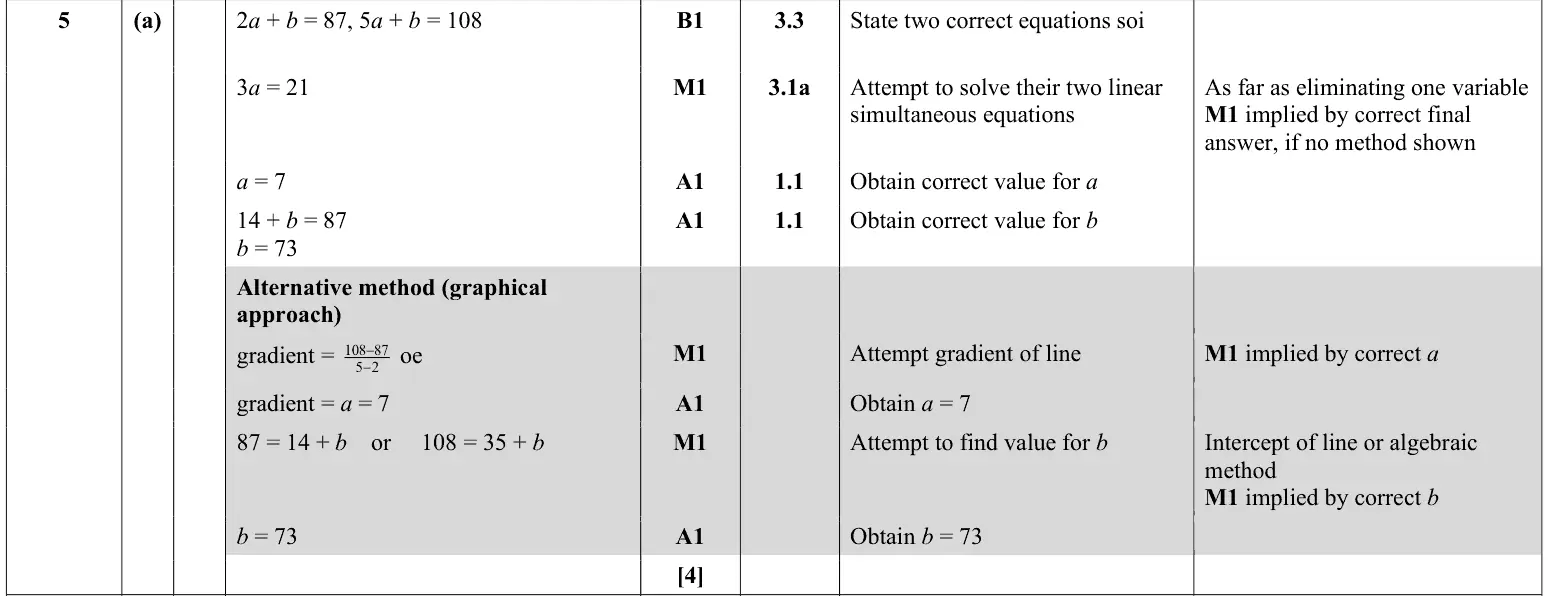
June 2025 · Paper 1 · Q5(a)4 marksEasy
Mark scheme for this part
Examiner's comment
This question was exceptionally well answered, with candidates being able to accurately set up and solve two simultaneous equations based on the given model.
Key points and common errors
2a + b = 87, 5a + b = 108
a = 7, b = 73
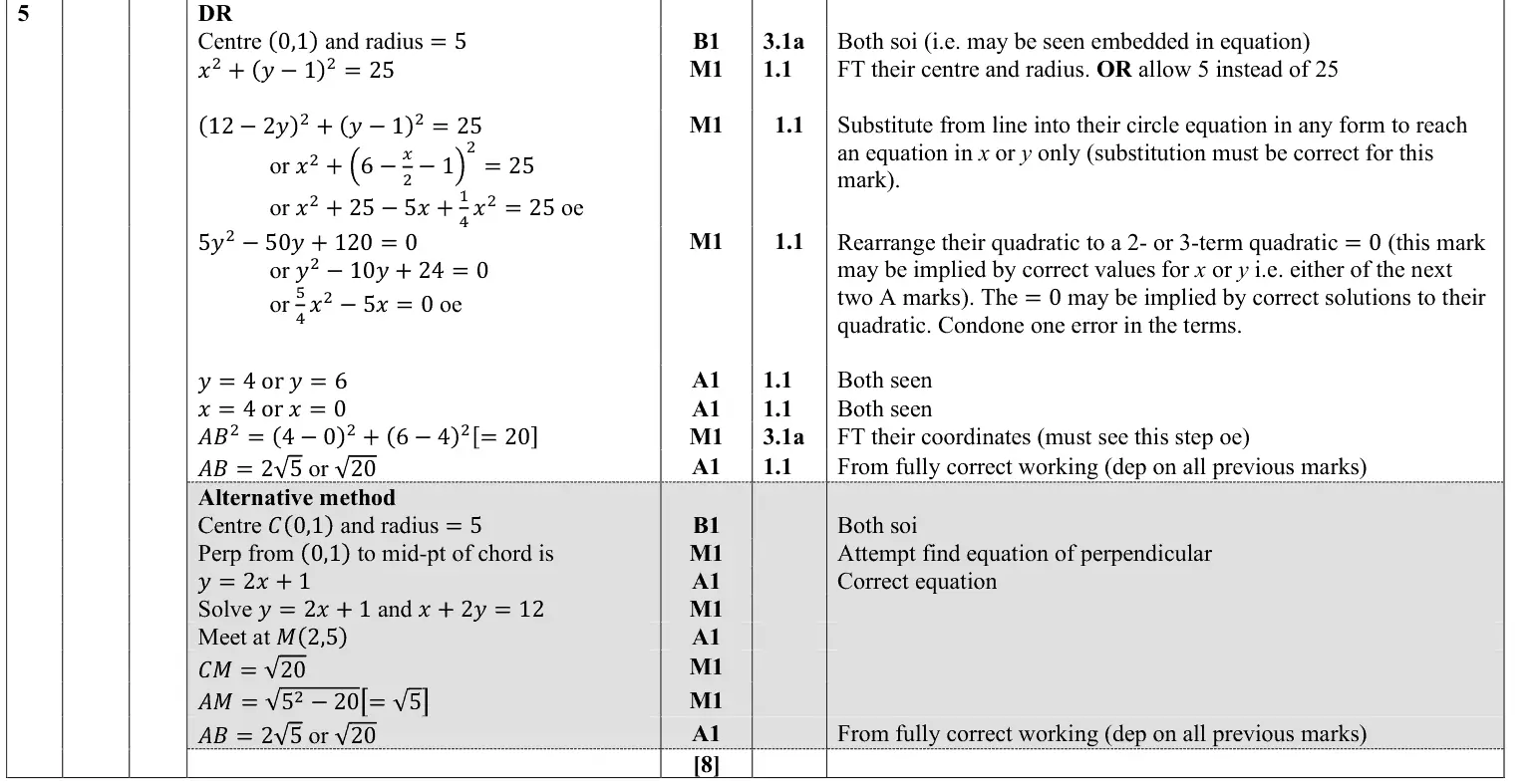
June 2025 · Paper 2 · Q58 marksEasy
Mark scheme for this part
Examiner's comment
This problem-solving question was well answered by most candidates, with many fully correct responses seen. Candidates first needed to deduce the centre and radius of the circle from the given information to score B1 (which was generally done well, although some candidates wrote down 10 and misinterpreted this as the radius rather than the diameter). The next step was to write down a cartesian equation for the circle for M1 (the most common error here was forgetting to square the radius), and solve this simultaneously with the line equation by substitution for x or y. Most candidates proceeded well to obtain a quadratic in x or y and solve this to find the coordinates of the two points of intersection, although quite a few incorrectly factorised the quadratic. Most candidates who obtained two points correctly used coordinate geometry to calculate the distance between them. Most candidates heeded the DR instruction and showed an appropriate amount of working in this question. The alternative method shown in the scheme was only occasionally seen. This candidate has identified the correct parameters for the circle and setup the equation correctly, substituting appropriately to reduce to a 3-term quadratic in y only (scoring B1M1M1M1). However, they obtain a quadratic with a sign error (the scheme allowed ‘one error in the terms’ for the method mark) so do not find the correct coordinates of the points of intersection (A0A0). They go on to compute the distance between these (M1) but do not obtain the correct final answer because of their earlier error (A0). This is a good example of a candidate who has shown their method in full (as required by DR) and scores the majority of the marks in this question despite making an error.
Key points and common errors
centre (0, 1), radius 5 (not 10)
substitute line into x² + (y − 1)² = 25
A(4, 4) and B(0, 6)
AB = 2√5
errors forgetting to square radius, factorising
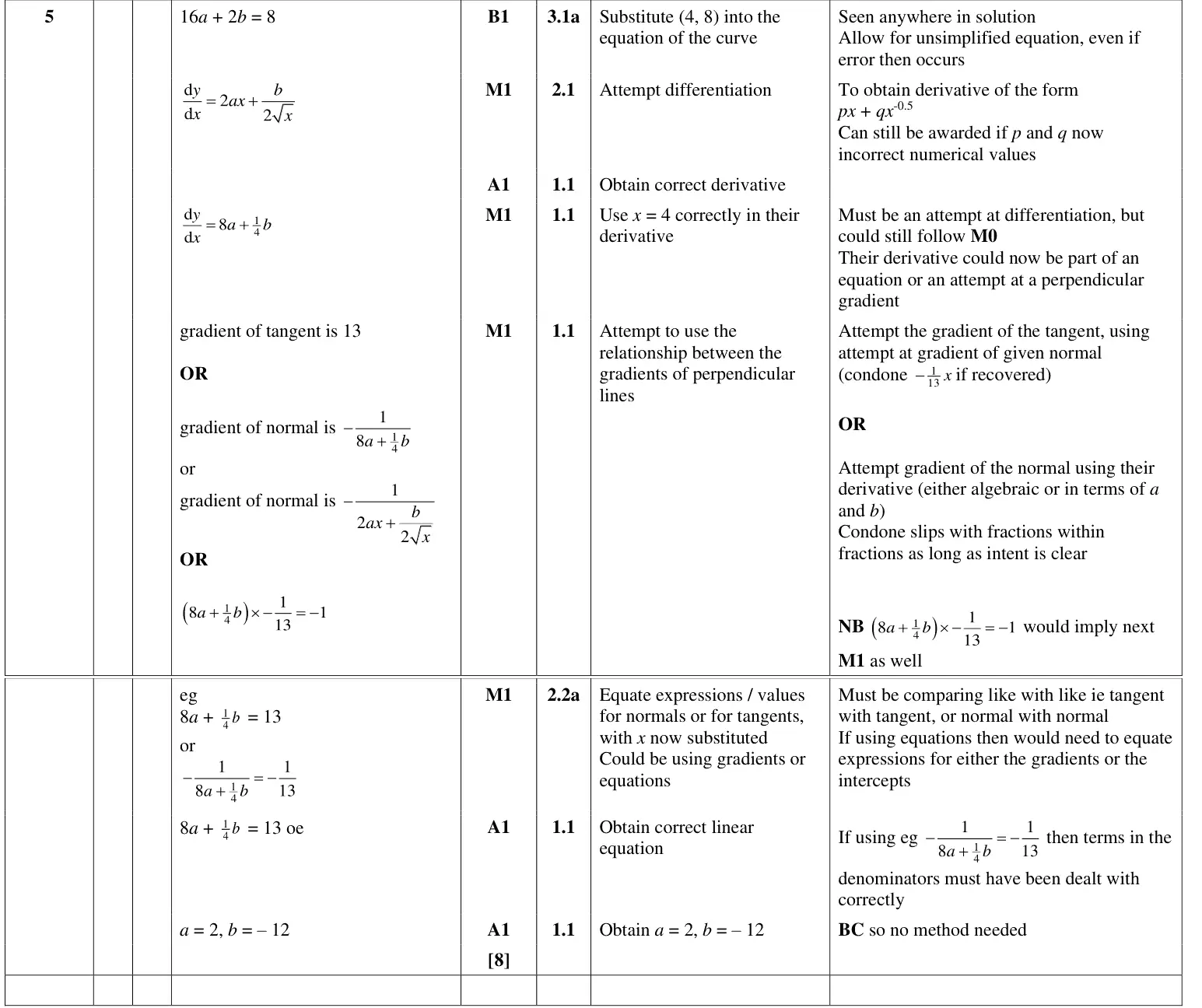
June 2025 · AS Paper 2 · Q8(a)1 markMedium
Mark scheme for this part
Examiner's comment
This was a ‘Show that’ question so we expected fully accurate working.
This longer unstructured question was generally well attempted. Quite a few neat, elegant and completely correct solutions were seen. Some unnecessary work was also seen, with quite a few candidates obtaining the equation of the tangent with some trying to solve that with the given equation. Only a very small number of candidates did not realise differentiation was involved. When the differentiation was attempted, it was invariably correct with the fractional powers well handled. Those candidates who substituted x = 4 into their algebraic expression for the gradient of the tangent, were more likely to score full marks compared to those who went on to form an algebraic expression for the gradient of the normal. Most candidates were able to find the numerical value for the gradient of the tangent from the equation of the normal, although not everyone was able to use this information to produce a correct equation in a and b only. A few candidates confused the gradients of the tangent and normal. Some candidates often omitted substituting (4,8) into the equation of the curve, failing to produce a second independent equations in a and b. Solving these two equations simultaneously could be completed by using a calculator for the final mark. This is a good solution to Question 5 with efficient and clear working.
Key points and common errors
(4, 8) on curve: 16a + 2b = 8
dy/dx = 2ax + b/(2√x) = 8a + b/4 at x = 4
normal gradient −1/13 so tangent gradient 13
a = 2, b = −12
finding the tangent equation is unnecessary
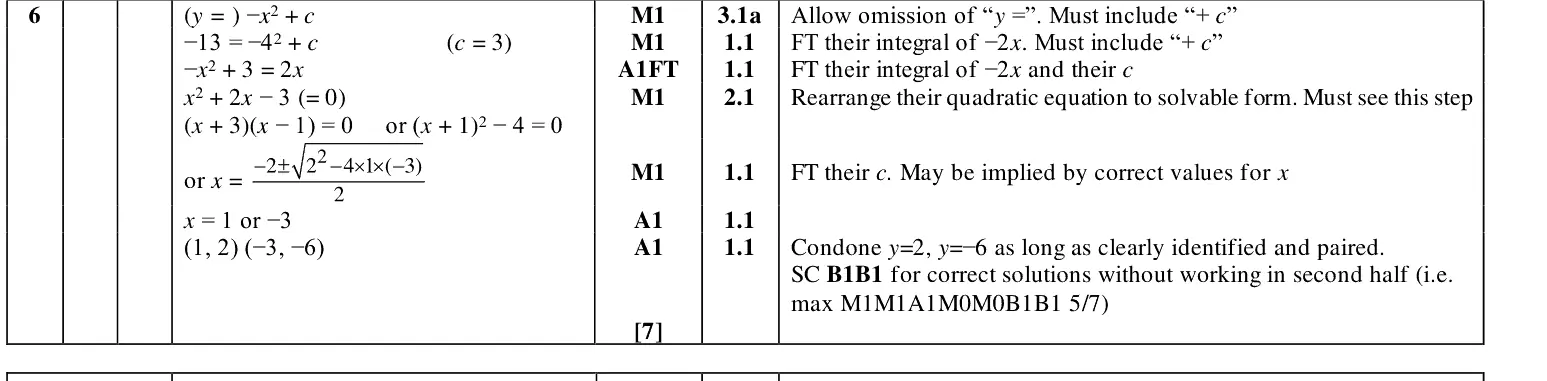
June 2024 · AS Paper 1 · Q67 marksMedium
Mark scheme for this part
Examiner's comment
Most candidates made a good attempt at this question, although relatively few received all 7 marks. The majority of candidates were able to score 2 or 3 of the first 3 marks from integrating (although a few omitted the constant and therefore received 0 as they could not progress). As this question was ‘Determine’ candidates were required to show working for forming and solving their quadratic. A Special Case was included here for candidates who provided answers unsupported by working in the second part, but this should not be assumed for future exam series. Errors in deducing c were common, but candidates who obtained the correct equation were mostly able to correctly deduce that they needed to set this = 2x and solve the resulting quadratic for x. Some candidates obtained y = 12 or y = −12 instead of y = −6 where x = −3.
Key points and common errors
y = −x² + c
c = 3 from (4, −13)
−x² + 3 = 2x so (x + 3)(x − 1) = 0
(1, 2) and (−3, −6)
omitting + c blocks progress
show working for the quadratic
June 2024 · AS Paper 2 · Q67 marksMedium
Mark scheme for this part
Examiner's comment
Those who recognised the need to differentiate and integrate generally did it well. A lot of candidates dropped 2 marks because they used 48 rather than -48 in their working. Quite a few unnecessarily found the second derivative; some then ignored it, but others substituted x = 2, set it to zero and obtained a value for a. The poorer efforts generally either didn’t differentiate or didn’t integrate, but most efforts gained at least 2 marks.
Key points and common errors
dy/dx = 0 at x = 2 gives 12a + b = −160
area below the axis so integral from 0 to 2 equals −48, giving 2a + b = −40
a = −12, b = −16
y-coordinate of P is −48
using +48 is the common error
June 2023 · Paper 2 · Q4(a)6 marksEasy
Mark scheme for this part
Examiner's comment
This question was very well answered, with the majority of candidates reaching the required answer. However, again some candidates did not heed the ‘Determine’ instruction and gave minimal working, or an answer only (BC) without working. Where the command word is ‘Determine’ working is required to support the answer, even if it can be done on a calculator. Many candidates found the equation of the normal correctly but then did not show any working for how this led to the coordinates of B, which meant the final 3 marks could not be given – even for a correct answer. This candidate’s response shows all of the required working to justify their (correct) answer. They have shown how the equation of the normal is obtained and then correctly substituted to solve for the coordinates required.
Key points and common errors
gradient 2 at A so normal gradient −1/2
y = −x/2 + 3/2
solve x² = −x/2 + 3/2 to get B(−3/2, 9/4)
working needed for Determine
June 2023 · AS Paper 2 · Q6(f)1 markMedium
Show the start of this question
Mark scheme for this part
Examiner's comment
Most responses that earned this mark solved their correct equations from (d) and (e) simultaneously, producing rather a lot of working. Very few candidates used the more efficient method involving similar triangles.
Key points and common errors
second intersection (1, 8): reflect B in A or solve simultaneously
similar triangles more efficient
June 2023 · Paper 3 · Q4(b)5 marksMedium
Show the start of this question
Mark scheme for this part
Examiner's comment
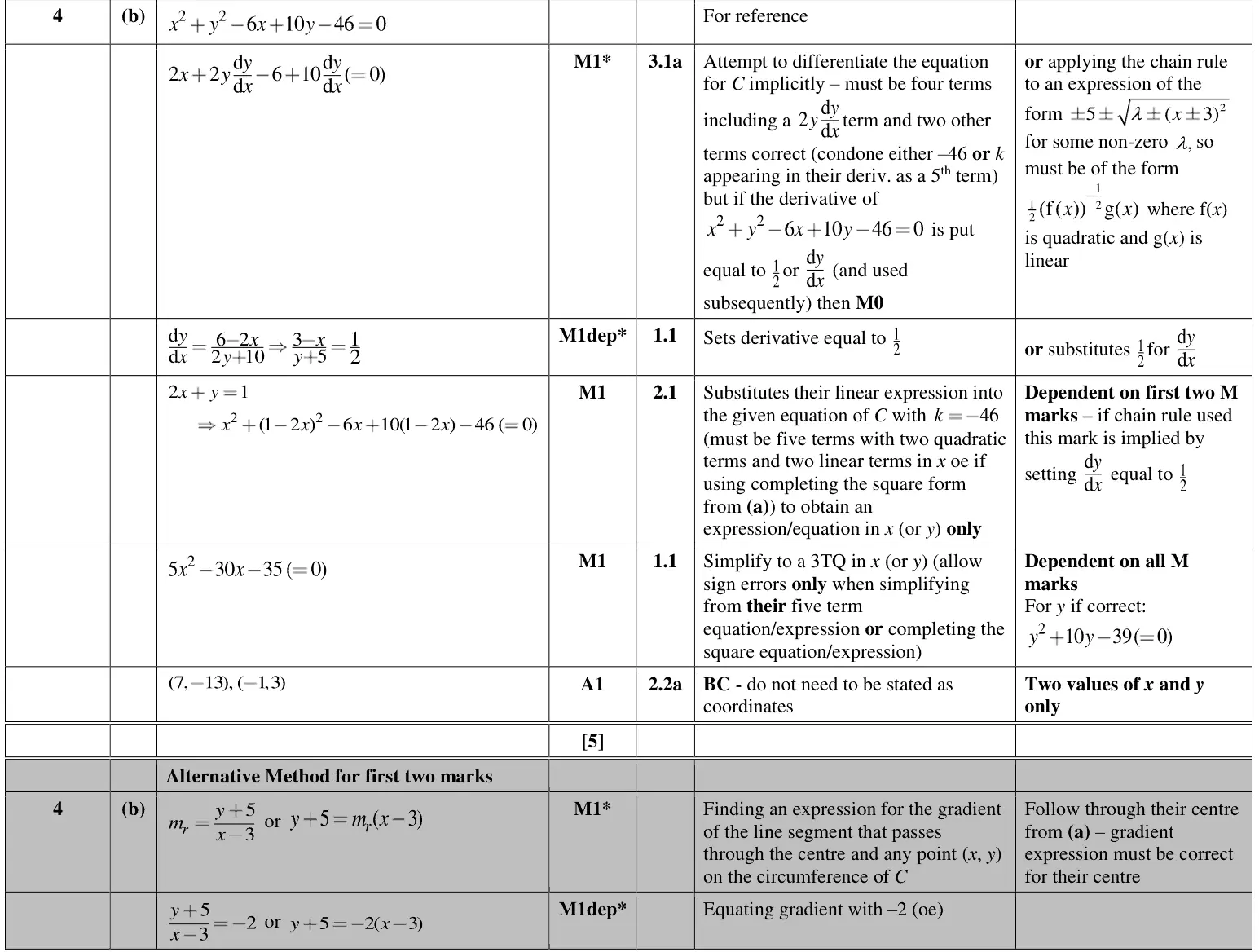
2 to obtain the linear equation 2𝑥𝑥+ 𝑦𝑦= 1. While some candidates, after deriving this The most common approach in this part was to differentiate the given equation for the circle implicitly d𝑥𝑥 equal to and set equation, made no further progress most correctly substituted this equation into the equation for C and solved the resulting three-term quadratic in x. While many obtained the correct x-coordinates as 7 and – 1 not all correctly obtained the corresponding y-coordinates. Candidates are reminded that when solving a pair of simultaneous equations with one linear and one quadratic equation, it is strongly advisable to find the second set of coordinates by substituting into the linear and not the quadratic equation.
Key points and common errors
implicit differentiation, set dy/dx = 1/2 to get 2x + y = 1
substitute into the circle: 5x² − 30x − 35 = 0
points (7, −13) and (−1, 3)
pair y-values with x correctly
June 2022 · Paper 1 · Q3(a)4 marksEasy
Mark scheme for this part
Examiner's comment
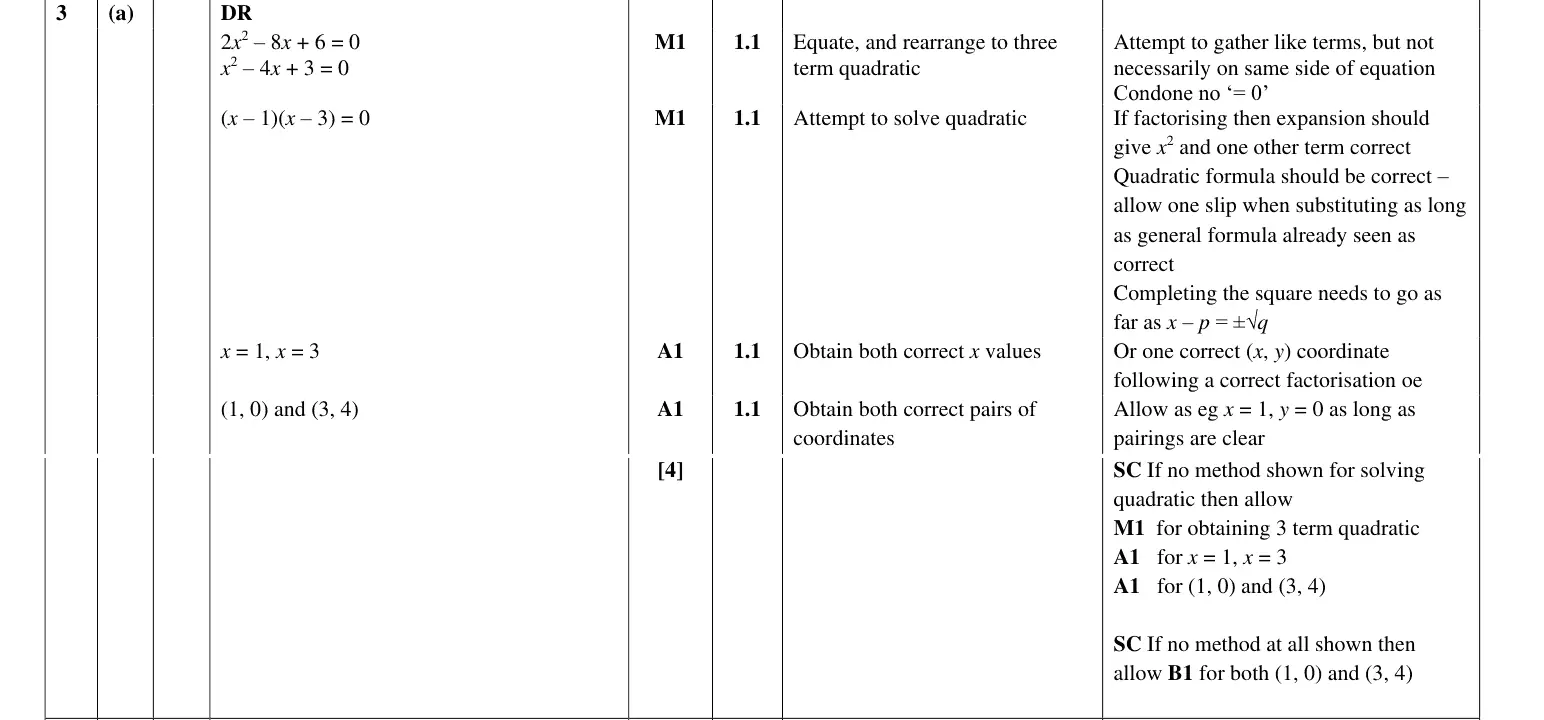
The vast majority of candidates gained full credit on the question by correctly finding the two points of intersection, showing sufficient reasoning. Candidates who did not show detail of solving the quadratic equation could still gain a maximum of 3 marks. Some candidates made assumptions about the points of intersection, based on the sketch provided in part (b), usually assuming that the points were also the stationary points on the two curves. This method had to be fully justified for any credit to be awarded.
Key points and common errors
2x² − 8x + 6 = 0 so (x − 1)(x − 3) = 0
points (1, 0) and (3, 4)
show how the quadratic is solved
do not assume intersections from the sketch
June 2022 · AS Paper 1 · Q7(a)5 marksMedium
Mark scheme for this part
Examiner's comment
Many candidates began this question by rearranging the equation into the form (x − a)2 + (y − b)2 = r2. This was unnecessary, although full marks could still be scored using this form. Some candidates attempted some sort of algebraic solution that did not involve substituting mx for y in the second equation. They were not able to make any progress. Many candidates, however, did make the substitution, but some did not know how to proceed from there. A good number of candidates did attempt to form the discriminant, although some candidates’ discriminant was in terms of both x and m, which is incorrect. Those candidates who formed the discriminant in terms of m only were generally successful, although some made minor errors in the algebra. A few candidates found the correct critical values of m but lost the final mark by giving an incorrect final answer such as [ −1 2 < m < 2] or [m < −1 2 and m > 2].
Key points and common errors
substitute y = mx: (1 + m²)x² − (6 + 2m)x + 5 = 0
discriminant ≥ 0 gives −16m² + 24m + 16 ≥ 0
−1/2 ≤ m ≤ 2
discriminant must be in m only
June 2022 · AS Paper 2 · Q8(b)7 marksMedium
Show the start of this question
Mark scheme for this part
Examiner's comment
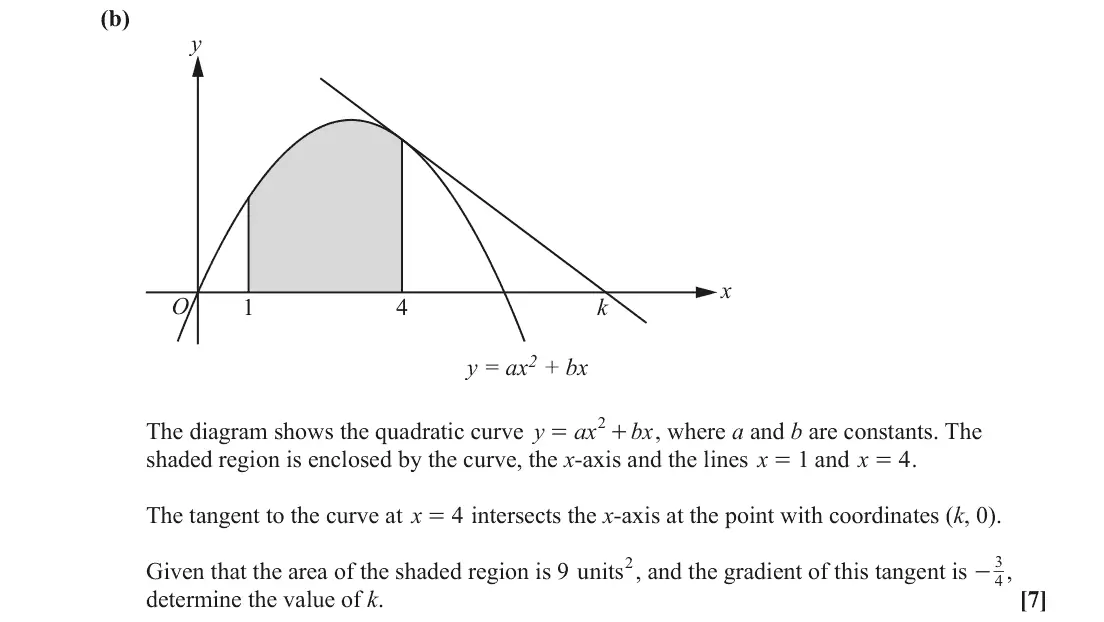
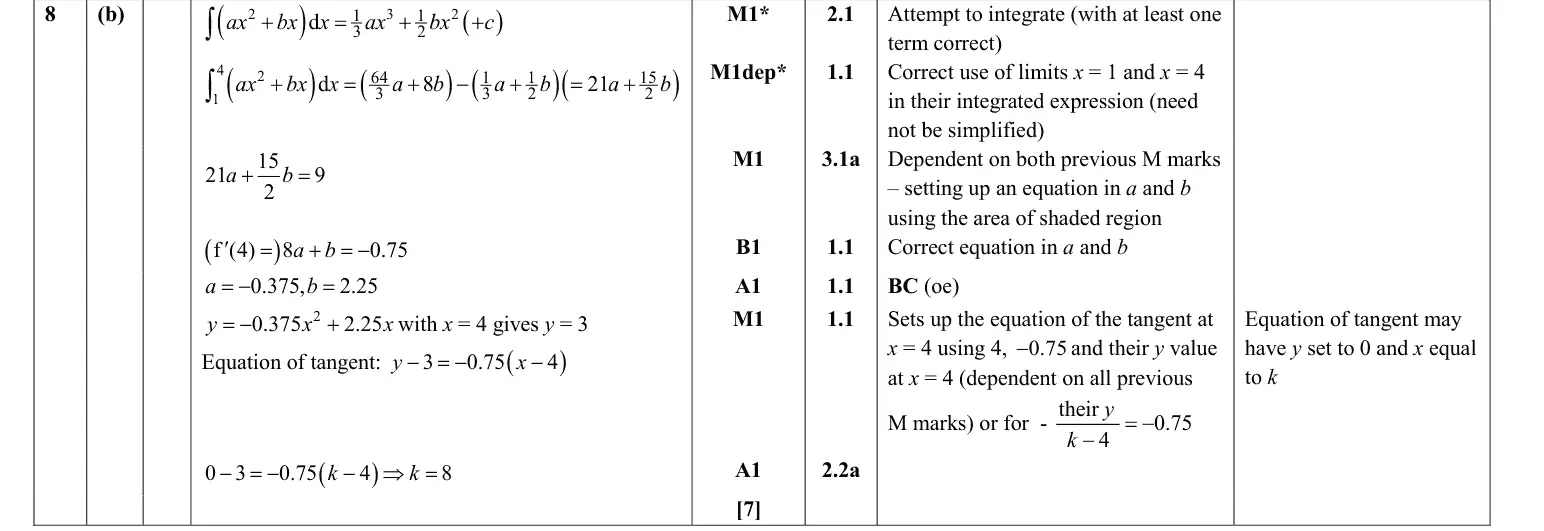
Many candidates earned the first 3 method marks here, most integrating correctly, a few making a sign error when evaluating the limits. Less successful was recognising where the second equation in a and b came from, and hence not finding their values. Those who managed this often produced a complete solution, but not all provided the correct method to find k. Some thought y = 2ax +b was the equation of the tangent. Only a few started this question by differentiating y = ax2 + bx rather than integrating it.
Key points and common errors
∫₁⁴ (ax² + bx) dx = 21a + 7.5b = 9
f′(4) = 8a + b = −0.75
a = −0.375, b = 2.25
tangent at (4, 3): y − 3 = −0.75(x − 4) gives k = 8
second equation often missed
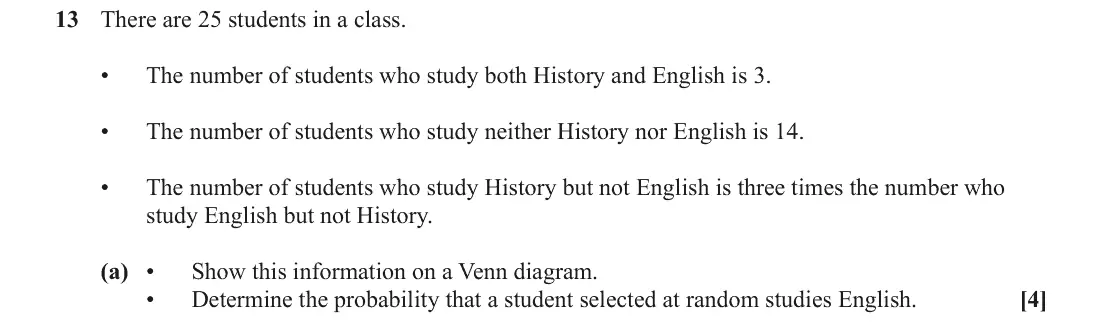
June 2022 · Paper 2 · Q13(a)4 marksEasy
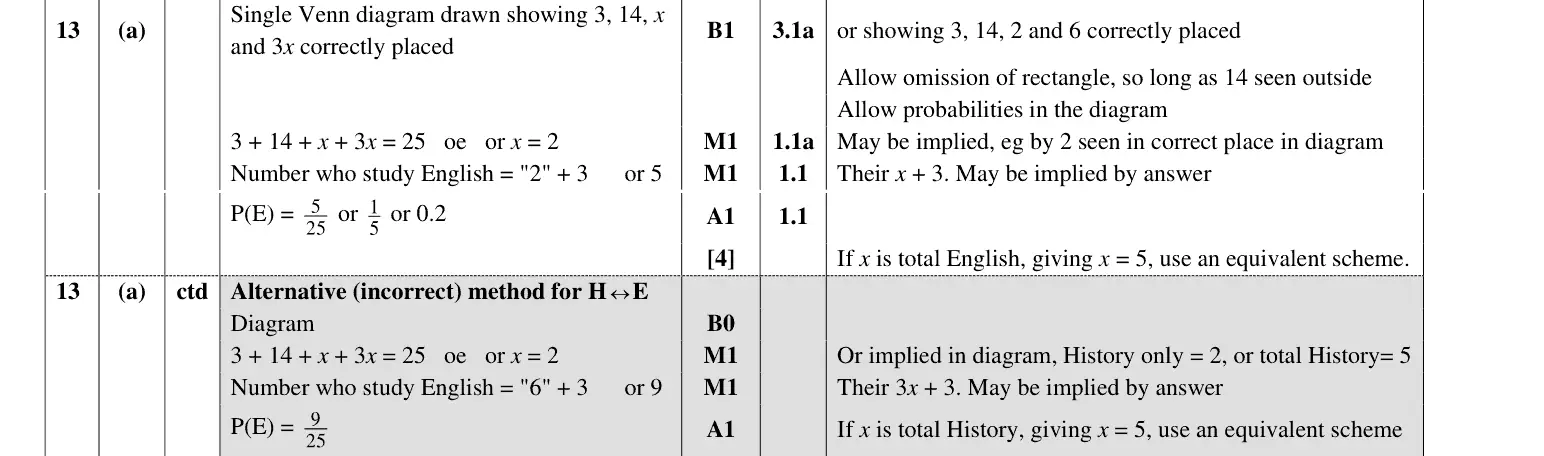
Mark scheme for this part
Examiner's comment
This question was very well answered by almost all candidates. A few placed History and English the wrong way round in their Venn diagram. A few others gave a correct Venn diagram, but found P(the student studies only English), i.e. 2 25 instead of 5 25 . Some gave a correct Venn diagram but omitted to find the probability.
Key points and common errors
Venn: 3 both, 14 neither, x English only, 3x History only
x = 2
P(English) = 5/25
History and English swapped is a common error
Autumn 2021 · Paper 1 · Q2(b)2 marksMedium
Show the start of this question
Mark scheme for this part
Examiner's comment
(From the general report) Question 2 was a real-life application of linear equations with candidates expected to set up two equations in the first part of the question, and then solve them in the second part.
Key points and common errors
equate the two linear expressions
m = 2300 minutes
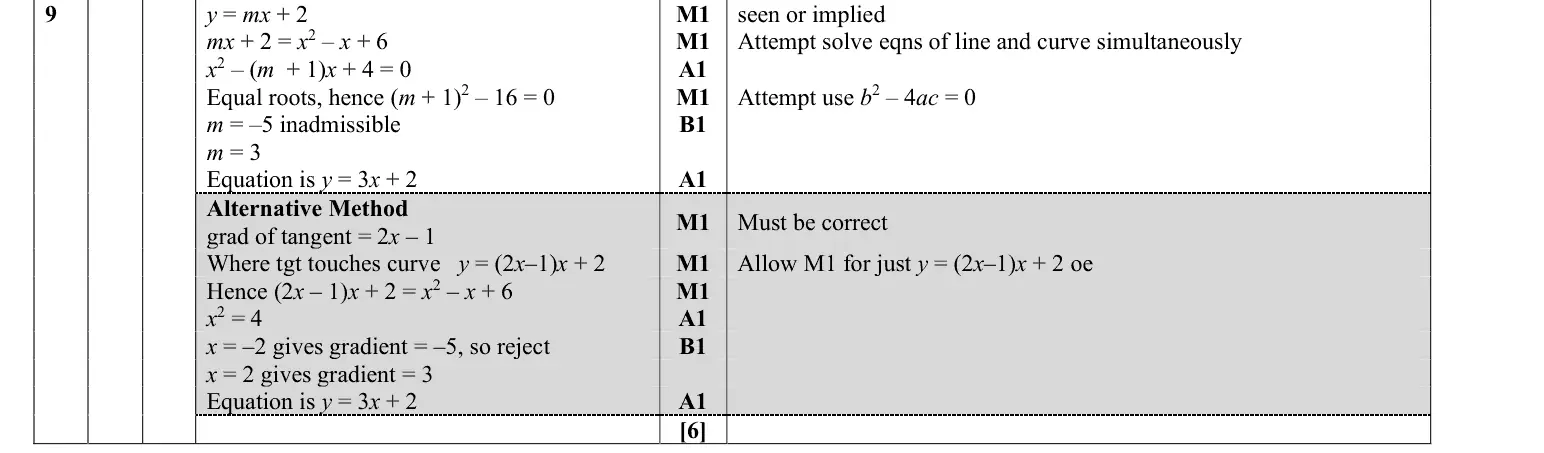
Autumn 2021 · AS Paper 1 · Q96 marksMedium
Mark scheme for this part
Key points and common errors
y = mx + 2
x² − (m + 1)x + 4 = 0
equal roots so (m + 1)² − 16 = 0
m = 3 (reject −5)
y = 3x + 2
alt: tangent gradient 2x − 1 gives x² = 4
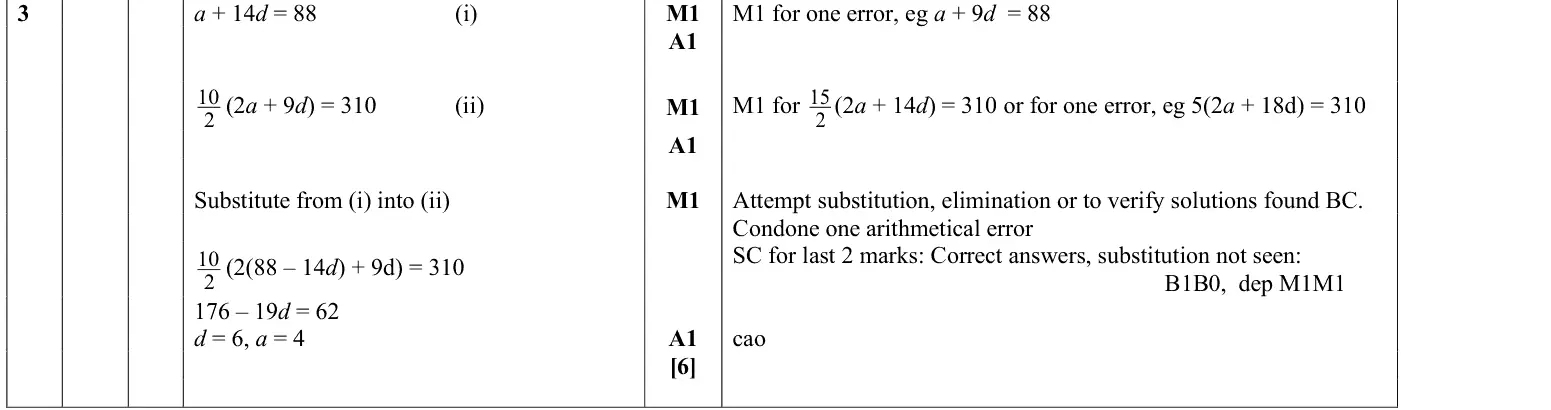
Autumn 2021 · Paper 2 · Q36 marksMedium
Mark scheme for this part
Examiner's comment
(From the general report) Comments on responses by question type Question 3: Some candidates treated 88 as the last term of the 10 terms whose sum is 310. For example, in Question 3, some candidates obtained the correct two linear equations, and then used the relevant calculator function to write down the answers, without showing a substitution or elimination method.
Key points and common errors
a + 14d = 88 and 5(2a + 9d) = 310
solve by substitution or elimination: d = 6, a = 4
error: treating 88 as the last of the 10 terms
calculator answers without method lose marks
Autumn 2021 · AS Paper 2 · Q3(a)3 marksMedium
Mark scheme for this part
Key points and common errors
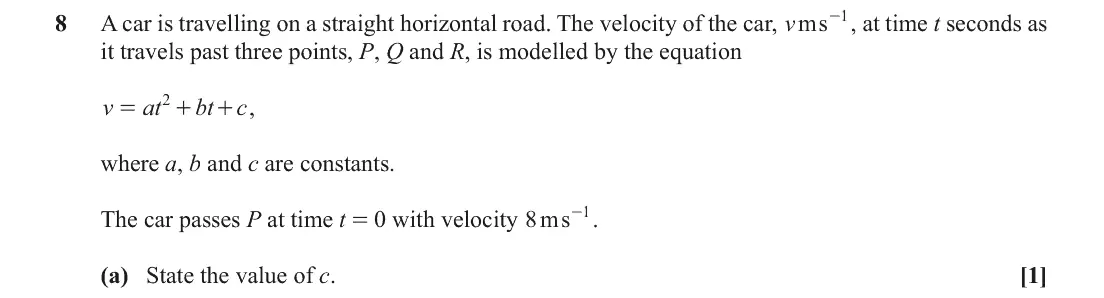
V = at + b with (6, 2375) and (12, 2825): gradient 75, V = 75t + 1925
Autumn 2021 · Paper 2 · Q5(b)5 marksHard
Show the start of this question
Mark scheme for this part
Examiner's comment
(From the general report) Question 5: Most candidates coped well with part (a), but many made no headway with part (b).
Key points and common errors
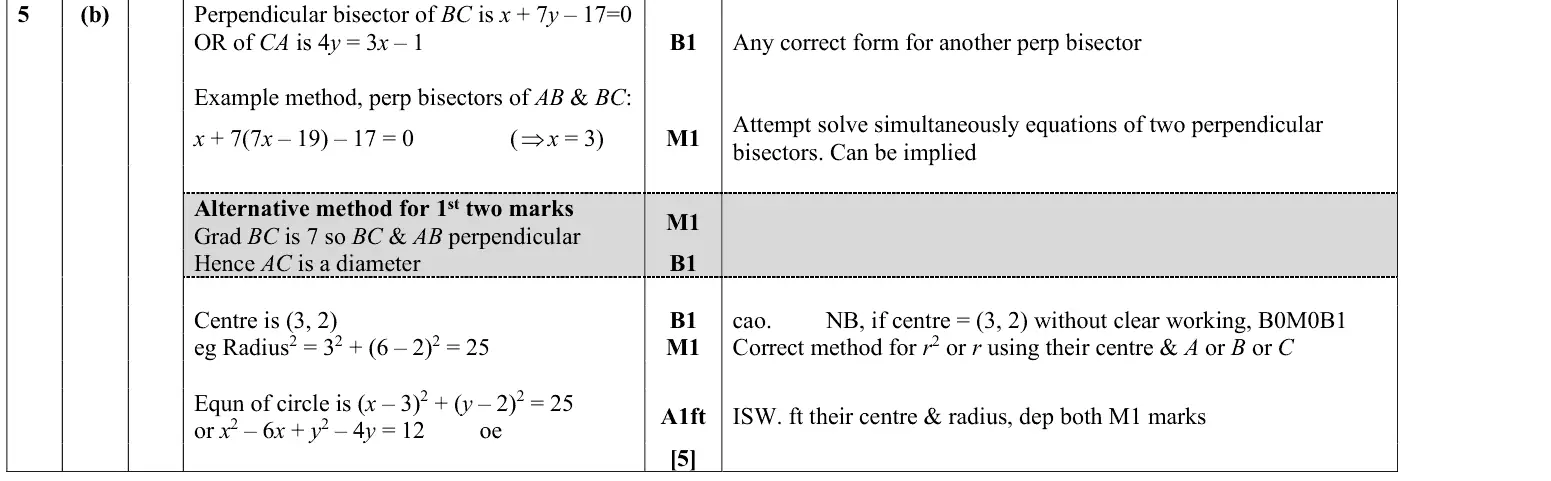
centre is the intersection of two perpendicular bisectors (or AC is a diameter since AB ⟂ BC)
centre (3, 2), r² = 25
(x − 3)² + (y − 2)² = 25
many made no headway
Autumn 2021 · AS Paper 2 · Q7(b)6 marksMedium
Show the start of this question
Mark scheme for this part
Key points and common errors
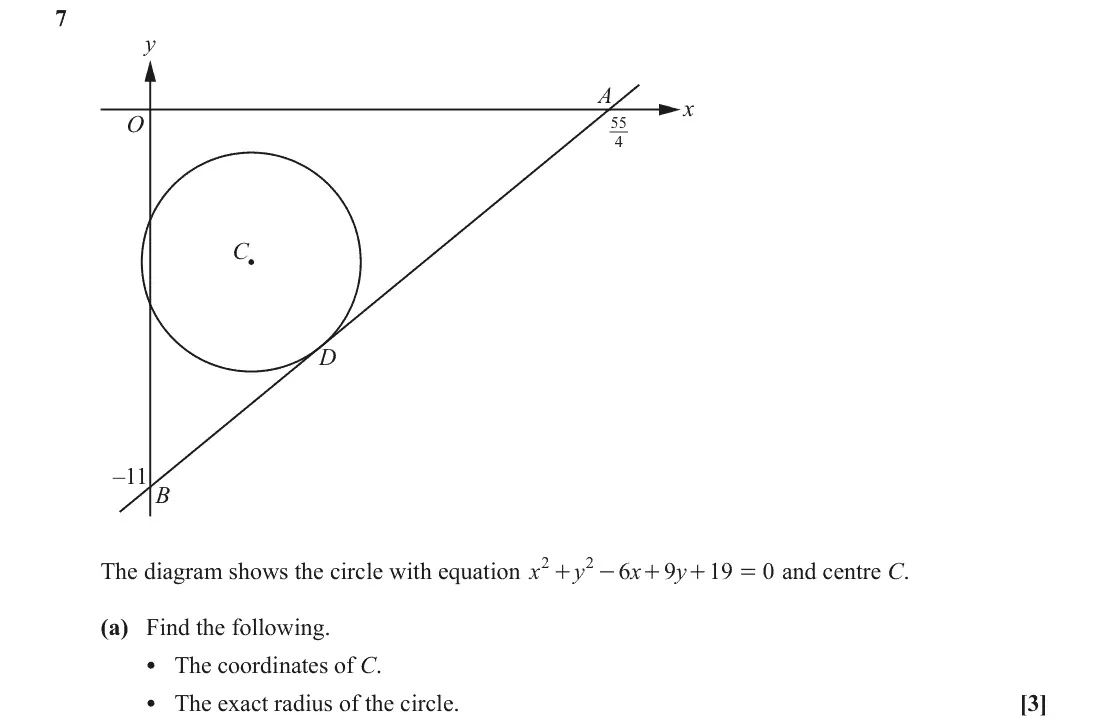
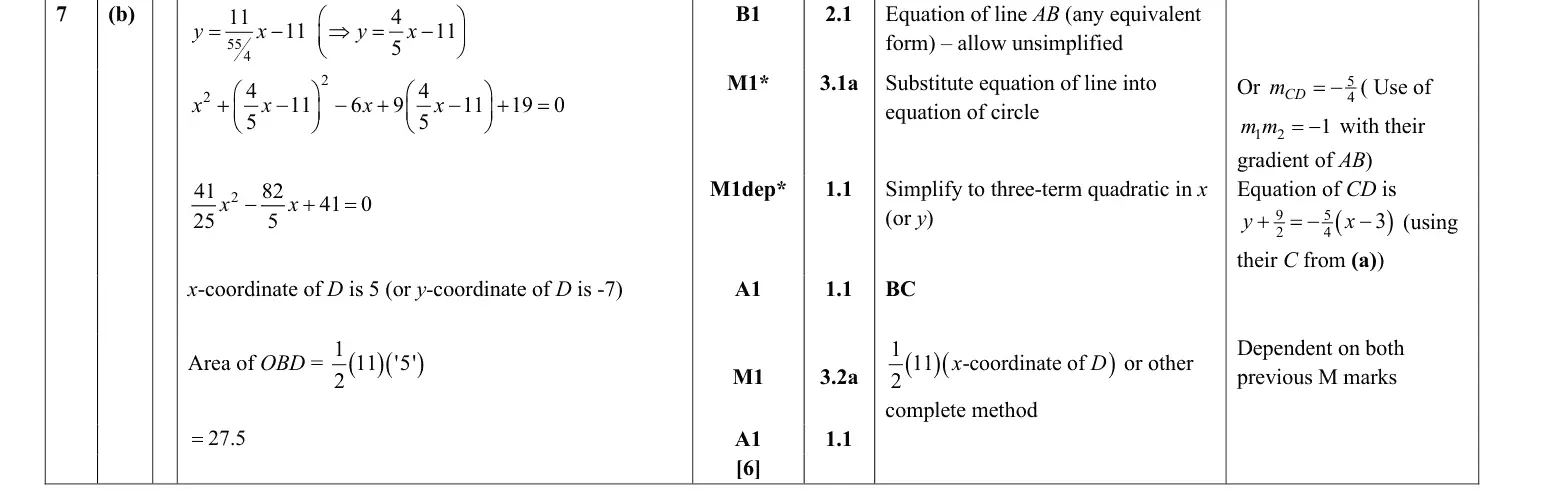
line AB: y = (4/5)x − 11
substitute into the circle to get a repeated root x = 5 (or use CD perpendicular to AB)
area OBD = ½ × 11 × 5 = 27.5
Autumn 2020 · AS Paper 1 · Q75 marksMedium
Mark scheme for this part
Examiner's comment
Many candidates answered this question well. However, others attempted to substitute from one equation into the other by simply setting the two left-hand-sides equal to each other. This did not achieve the desired result of obtaining an equation in one letter only.
Key points and common errors
substitute x = 4 − 2y into the curve: y² + 2y − 15 = 0
y = 3 or −5
points (−2, 3) and (14, −5) paired
equating the two left-hand sides is invalid
Autumn 2020 · Paper 1 · Q11(a)(i)2 marksEasy
Mark scheme for this part
Examiner's comment
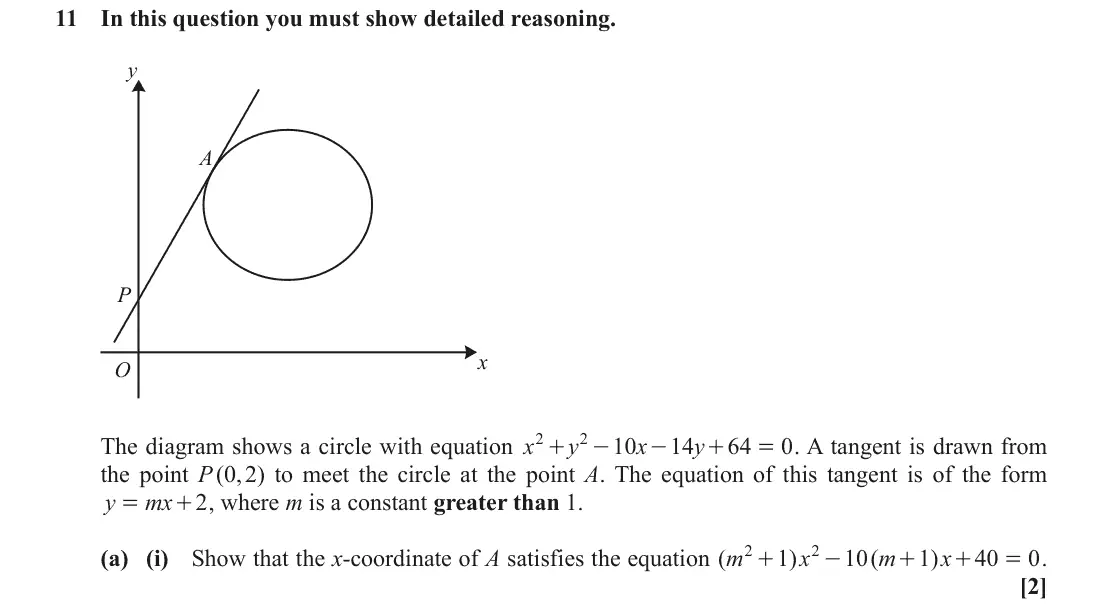
(Comment on Question 11 as a whole) Question 11 was the only ‘In this question you must show detailed reasoning’ question on the paper, and candidates were expected to show a detailed and complete analytical method. Part (a)(i) was generally very well answered, but the remainder of the question proved challenging. Part (ii) is a good example of where candidates have to link different topic areas – they are considering a quadratic equation and the fact that the line is tangential should indicate that the required strategy is to equate the discriminant to 0. Candidates struggled with the non-standard aspect of part (b), although some were able to gain some credit for working out relevant lengths and a relevant trigonometric ratio. Of the few that were so far successful, they were expected to continue to work in exact values to justify the request in the question, which not all candidates appreciated.
Key points and common errors
substitute y = mx + 2 into the circle
expand and tidy to the given quadratic including '= 0'
Autumn 2020 · AS Paper 2 · Q66 marksMedium
Mark scheme for this part
Examiner's comment
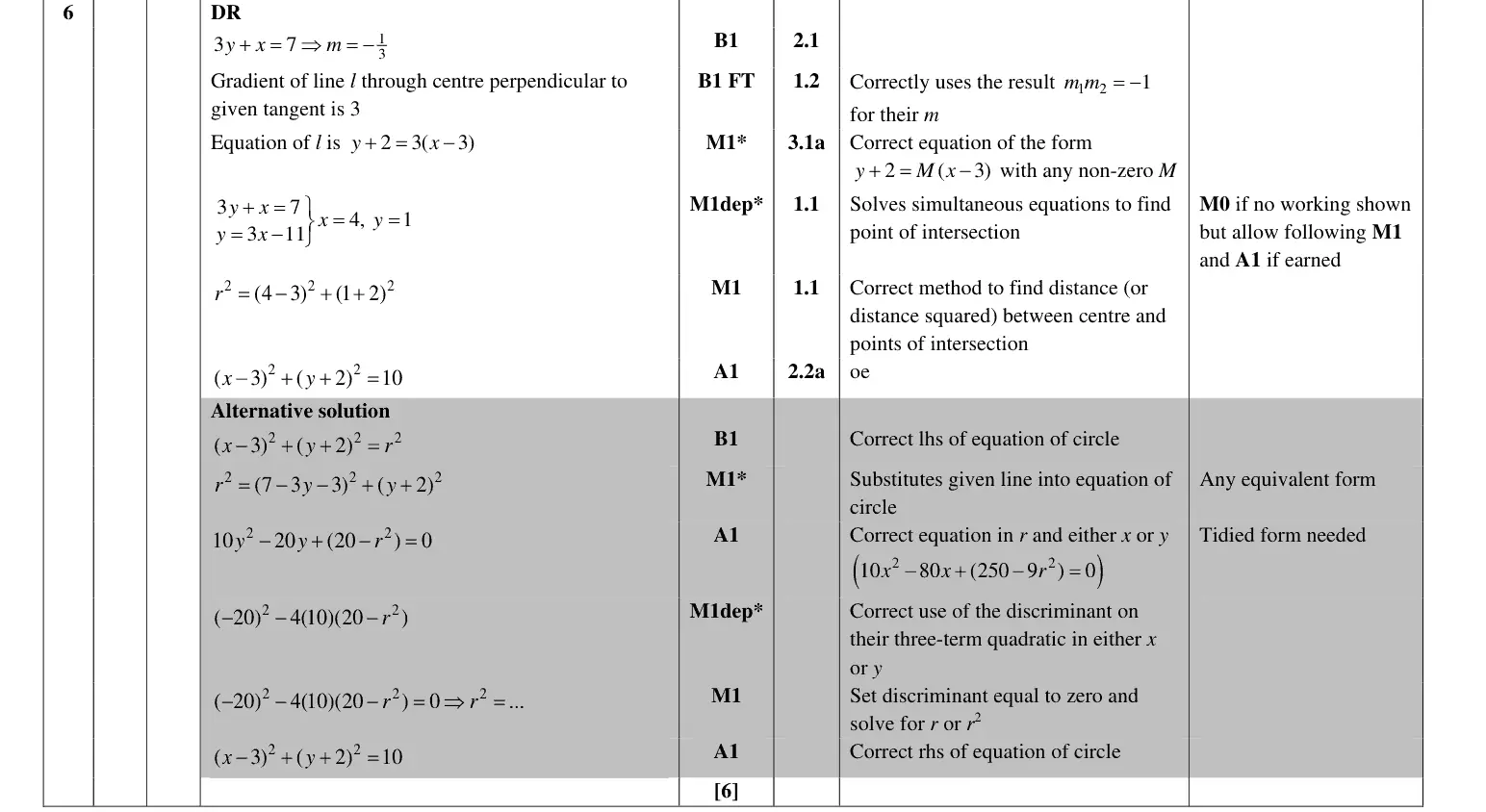
(From the general report) Note that ‘find’ was used in Question 3 and Question 6 with the instruction to show detailed reasoning, which now means evidence is vital. So, for example, in Question 6 on this paper the method for solving the simultaneous equations was expected and those just doing it on the calculator earned M0 for this skill. 2.
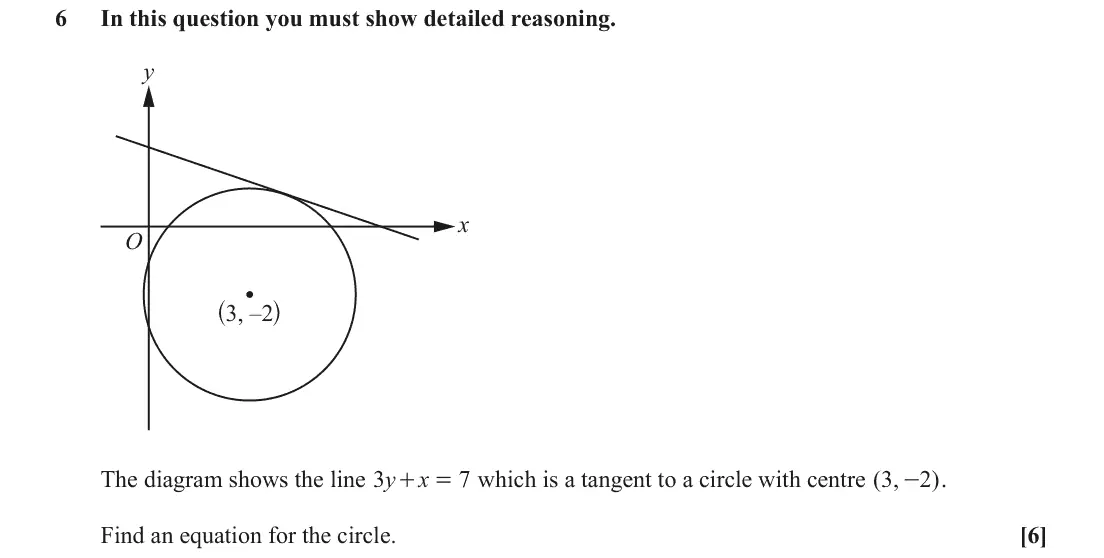
Key points and common errors
tangent gradient −1/3 so radius line y + 2 = 3(x − 3)
intersection (4, 1) found algebraically (calculator alone M0)
r² = 10
(x − 3)² + (y + 2)² = 10
Autumn 2020 · Paper 3 · Q6(b)8 marksMedium
Show the start of this question
Mark scheme for this part
Examiner's comment
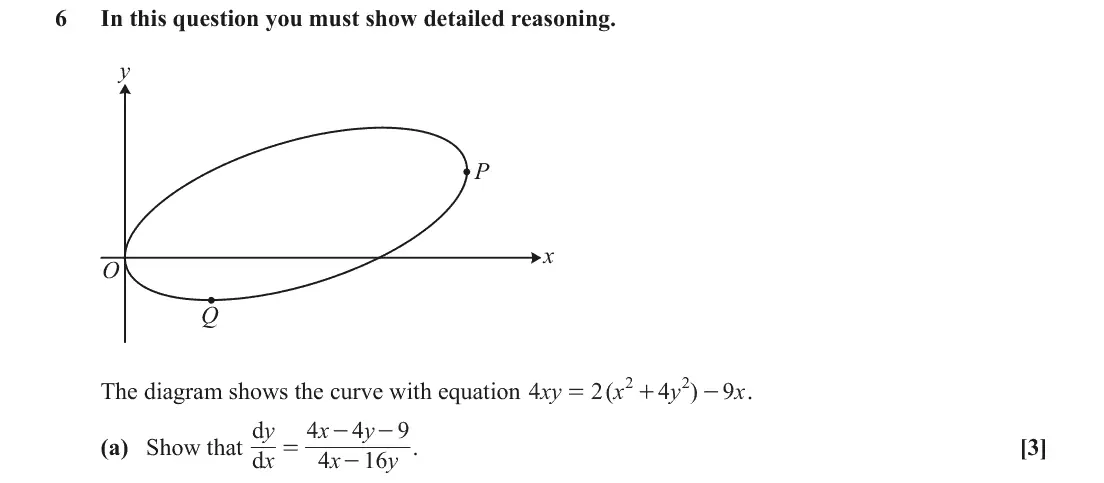
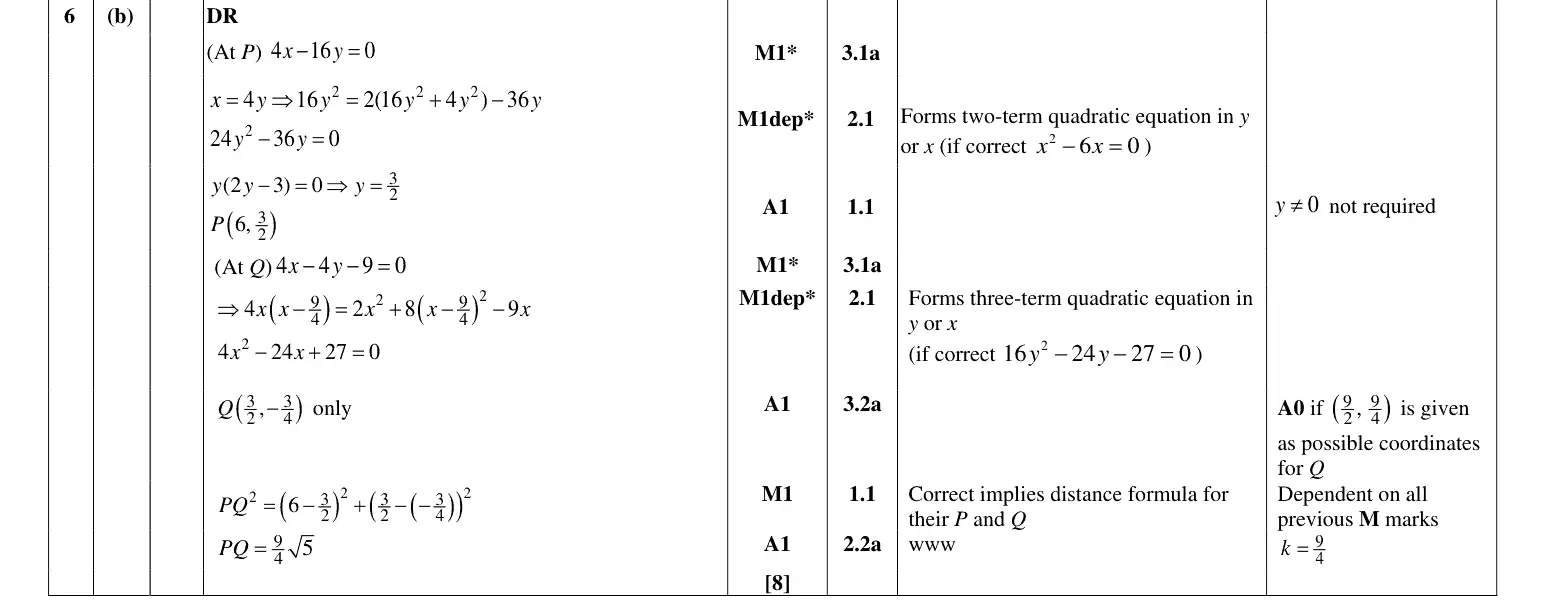
(Comment on Question 06 as a whole) This was the only ‘In this question you must show detailed reasoning’ on this paper. Examiners will be very focused on the individual steps of the calculation on these questions, signified by the ‘DR’ notation in the mark scheme. Part (a) was generally well answered, candidates appeared to be well prepared for this type of question. A common error was to start the mathematical argument with d y x = followed by the correct set of d differentiated terms with equals sign. Some candidates dropped marks due to careless algebra manipulation. In part (b), those candidates that recognised the correct gradients of the tangents at P and Q generally went on to use their values for the coordinates to find PQ and score many of the 5 method marks. However poor algebra manipulation cost accuracy marks. A number of candidates solved the quadratic equation generated to find Q, but then chose the coordinates 9 9 , . Candidates should use all information given in the question, including any sketched 2 4 d y curves. In this case, candidates were expected to recognise that the two results for x = 0 were valid, d but that the diagram indicated which horizontal tangent was to be used. Note that those candidates that used 9 9 , to find their PQ with no wrong working would have scored 6 out 8. There was not an explicit 2 4 mark given for discounting the unwanted quadratic solutions on this question, however it is good practice and may be penalised in other ‘DR’ questions.
Key points and common errors
P: denominator 0 so x = 4y, gives P(6, 3/2)
Q: numerator 0 gives Q(3/2, −3/4) (reject (9/2, 9/4) using the diagram)
PQ = (9/4)√5
Autumn 2020 · Paper 3 · Q8(b)4 marksEasy
Show the start of this question
Mark scheme for this part
Examiner's comment
(Comment on Question 08 as a whole) This question was also completed well, although a significant number attempted to use the ‘suvat’ equations. Part (a) was answered correctly on almost 100% of the scripts. Part (b) was also answered well. Unfortunately, some candidates ignored the negative sign needed for deceleration, which meant only 3 out of the 4 marks were available. Part (c) was a ‘Find’ question, so an answer obtained directly from the calculator was expected, although some candidates did show a fully integrated expression first. Some candidates dropped marks when they used the incorrect limits and some attempted to use ‘suvat’, even if they had used calculus in the earlier parts.
Key points and common errors
dv/dt = 2at + b = −0.12 at t = 5
v(18) = 2.96
a = −0.02, b = 0.08
deceleration needs the minus sign
suvat is invalid
June 2019 · AS Paper 1 · Q6(b)4 marksMedium
Show the start of this question
Mark scheme for this part
Examiner's comment
Many candidates recognised that angle ABC = 900 and some of these went on to obtain a correct y x trigonometrical equation involving x and y. (Some gave it in the form = rather than the o o sin 30 sin 90 simpler cos 600 = x y ). Many then went on to use the result from part (a) and obtained the correct 3 responses. Others started again, substituting y = 2x into 1 2 xy 2 = (x + y)√3. Some of these candidates made subsequent algebraic or arithmetical errors. Candidates who used the result proved in part (a) were more often successful. The command word ‘Determine’ was used in this question; indicating that justification should be given for any results found. A trial and improvement approach gained only one mark if the correct responses were seen. There were also many candidates who attempted wholly incorrect methods using, for example πr2.
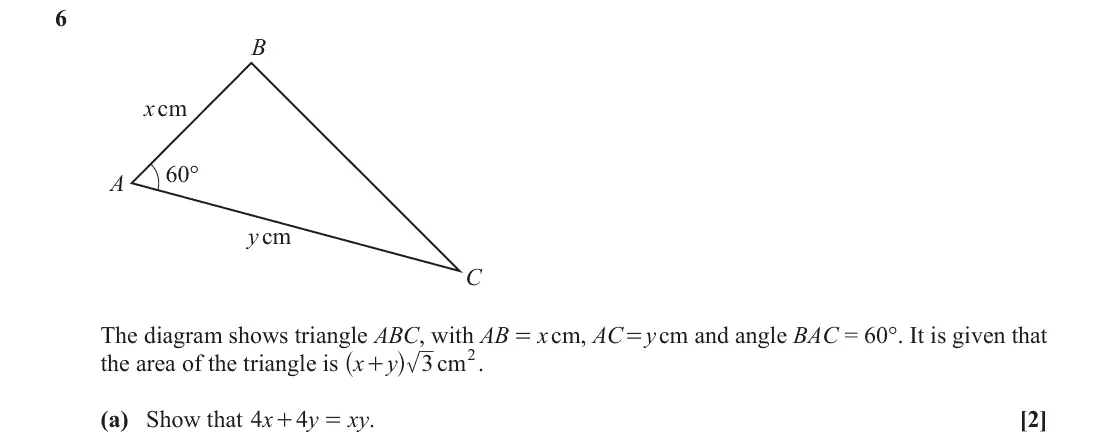
Key points and common errors
angle in a semicircle: ABC = 90°, so cos60° = x/y, y = 2x
substitute into 4x + 4y = xy
x = 6, y = 12
June 2018 · Paper 1 · Q5(ii)4 marksMedium
Show the start of this question
Mark scheme for this part
Examiner's comment
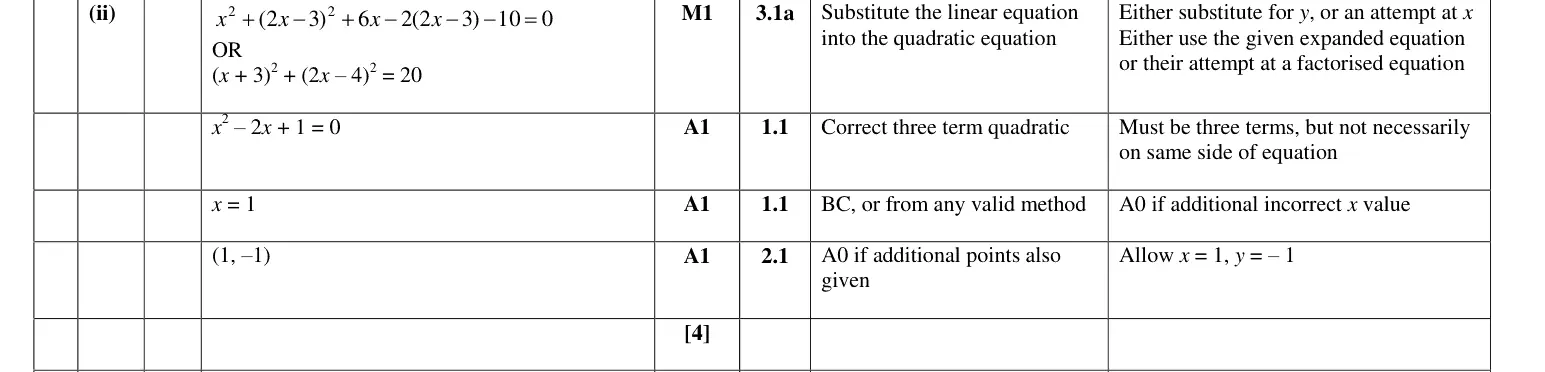
All candidates attempted to solve the equations simultaneously, either using the expanded equation of the circle or the factorised equation. As this question did not specify ‘detailed reasoning’, it was expected that candidates would solve the ensuing quadratic on their calculator but instead most still showed the factorisation.
Key points and common errors
substitute y = 2x − 3: x² − 2x + 1 = 0
single point (1, −1)
June 2018 · AS Paper 2 · Q55 marksMedium
Mark scheme for this part
Examiner's comment
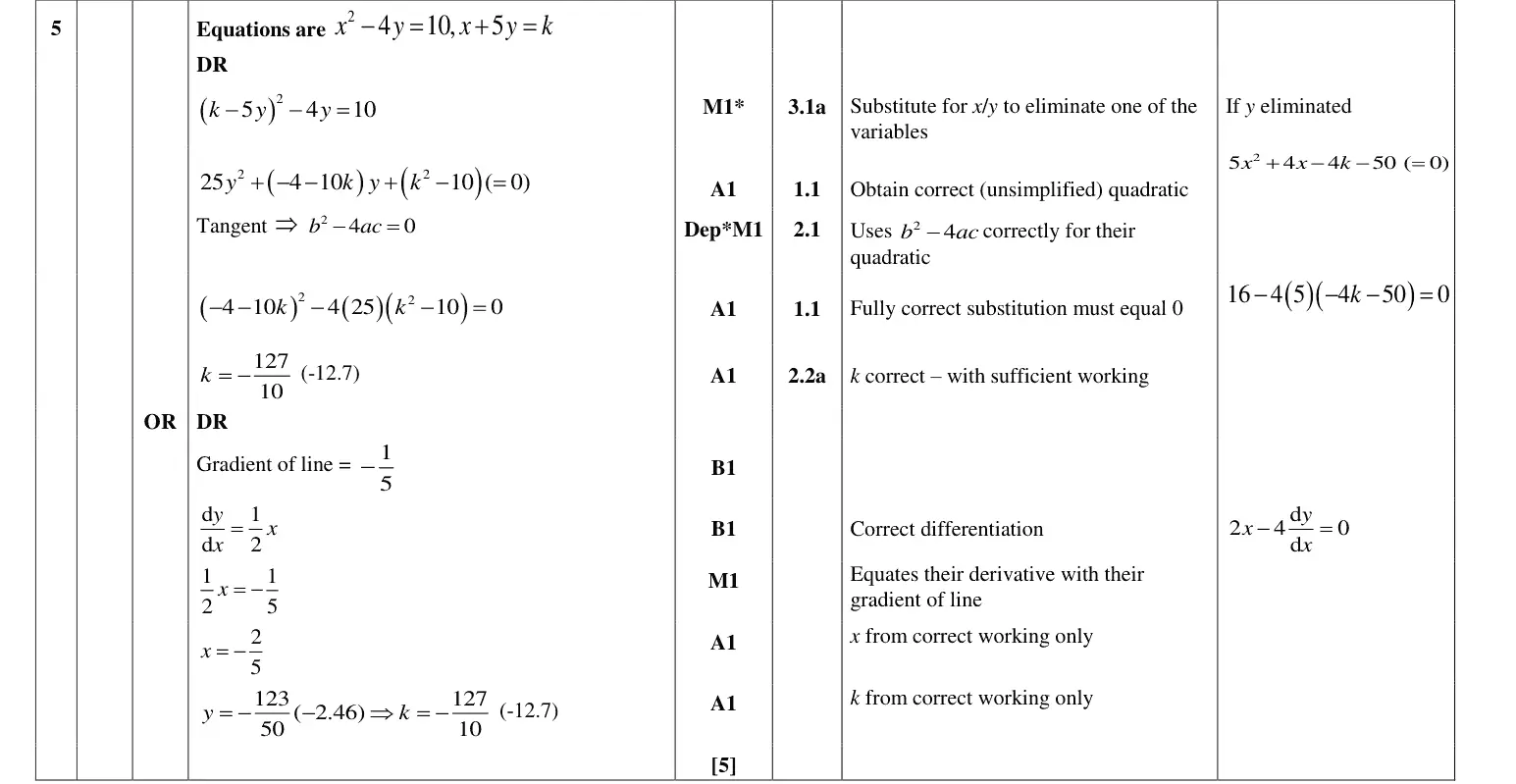
The instruction requesting detailed reasoning did not prove to be an issue in this question. The two methods outlined in the mark scheme were both seen fairly often, with perhaps the ‘substitution’ route more popular. This required accurate algebraic work for complete success, but sign errors in the working were quite common and some petered out at the ‘b2 – 4ac’ stage. In the ‘gradient’ approach, candidates who worked from y = x2/4 – 10 or y = -x/5 + k to the correct value were not given full credit.
Key points and common errors
substitute x = k − 5y: 25y² − (10k + 4)y + k² − 10 = 0
tangent so b² − 4ac = 0
k = −12.7
or gradient method: x/2 = −1/5
sign errors common
Find an A-level maths tutor
Stuck on this? Book a trial session with an A-level maths tutor.