Functions, composite and inverse functions, modulus Pure
Papers
Paper 1, Paper 2, Paper 3
Level
A level only
Spec
1.02l, 1.02s, 1.02t, 1.02u, 1.02v, 1.02z
Since 2018
55 question parts, 127 marks, each rated Easy, Medium or Hard from the wording of the examiners' report
Notes, worked examples and practice for this topic are being written by our tutors. The past-paper questions below are ready now: work each one on paper, then open the mark scheme and the examiner's comment.
Tap a question to zoom it. Mark scheme and examiner's comment open under each question.
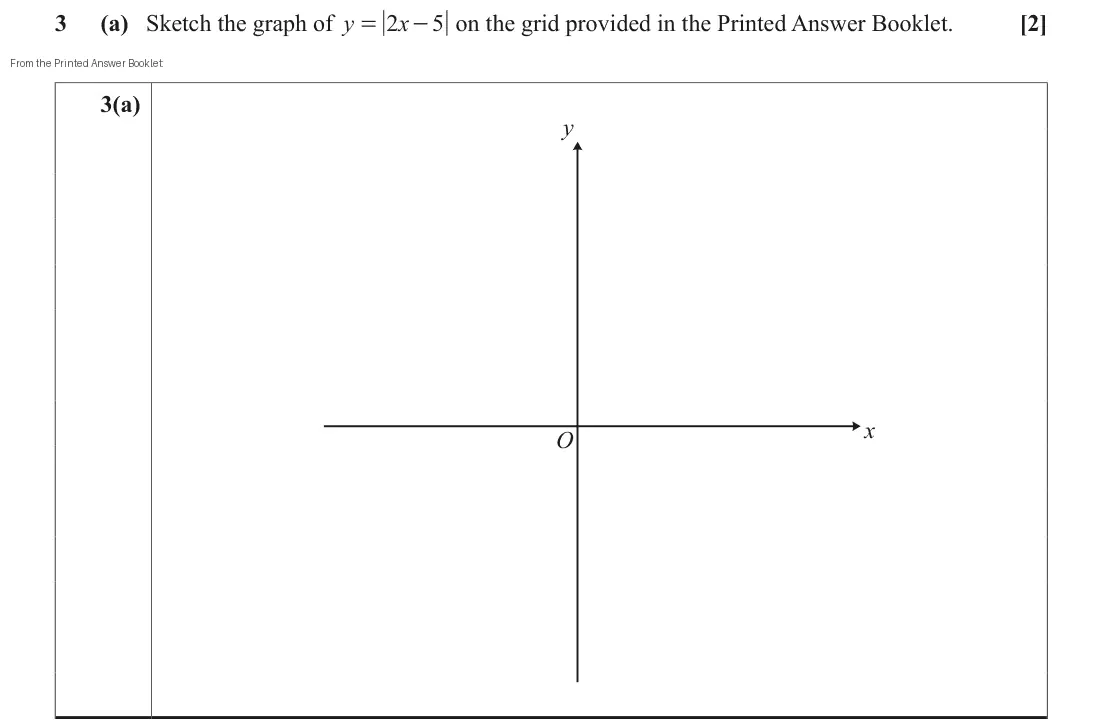
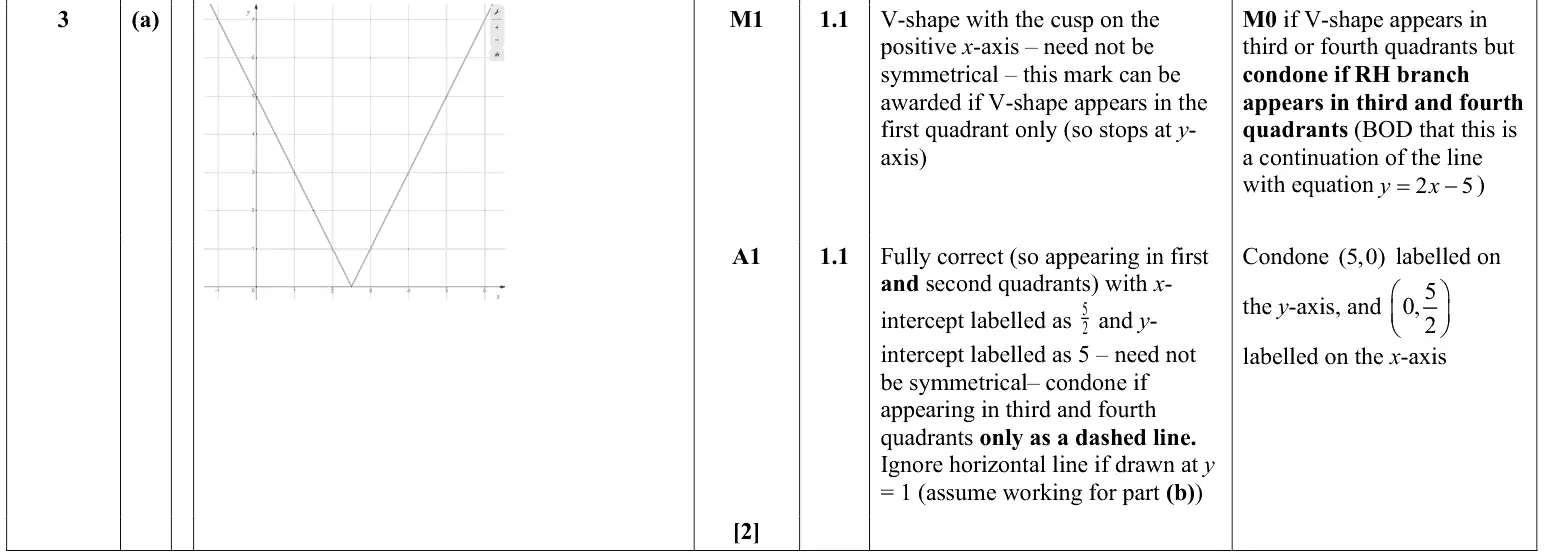
June 2025 · Paper 3 · Q3(a)2 marksEasy
Mark scheme for this part
Examiner's comment
Most candidates drew the correct V-shape with the cusp on the positive x-axis. The most common errors included: the cusp appearing on the negative x-axis, the graph not extending into the second quadrant (so stopping on the positive y-axis) or not labelling either or both of the x- and y-intercepts.
Key points and common errors
V-shape with vertex at (5/2, 0) on the positive x-axis and y-intercept 5
must extend into the second quadrant
intercepts labelled
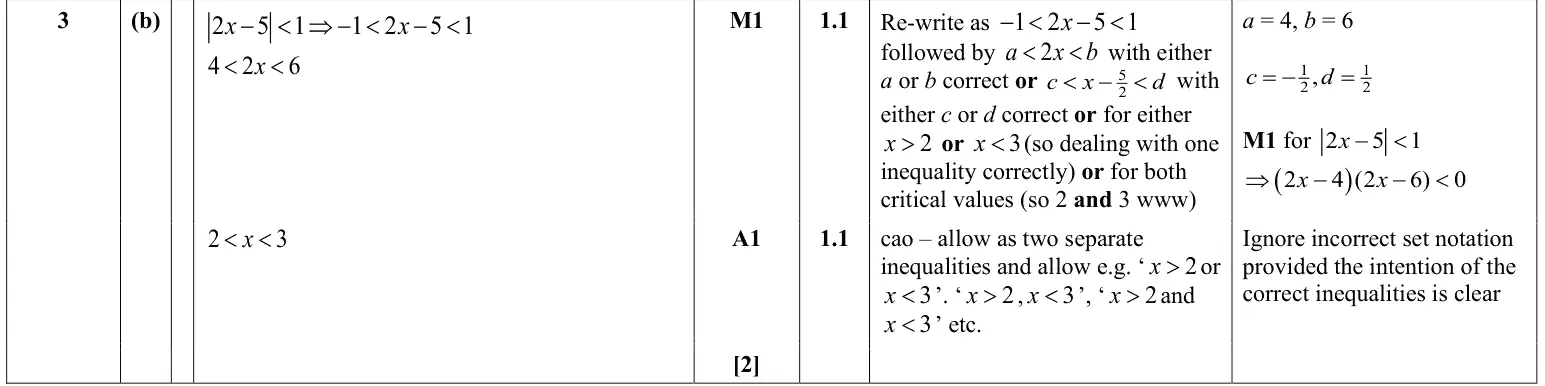
June 2025 · Paper 3 · Q3(b)2 marksEasy
Show the start of this question
Mark scheme for this part
Examiner's comment
The part was answered extremely well although there were a significant minority of candidates that struggled with manipulating negative terms in an inequality with their solution of 5 −2𝑥< 1 incorrectly stated as x < 2 or obtaining an inequality with a negative numerical value.
Key points and common errors
−1 < 2x − 5 < 1 so 2 < x < 3
errors with negative terms in inequalities
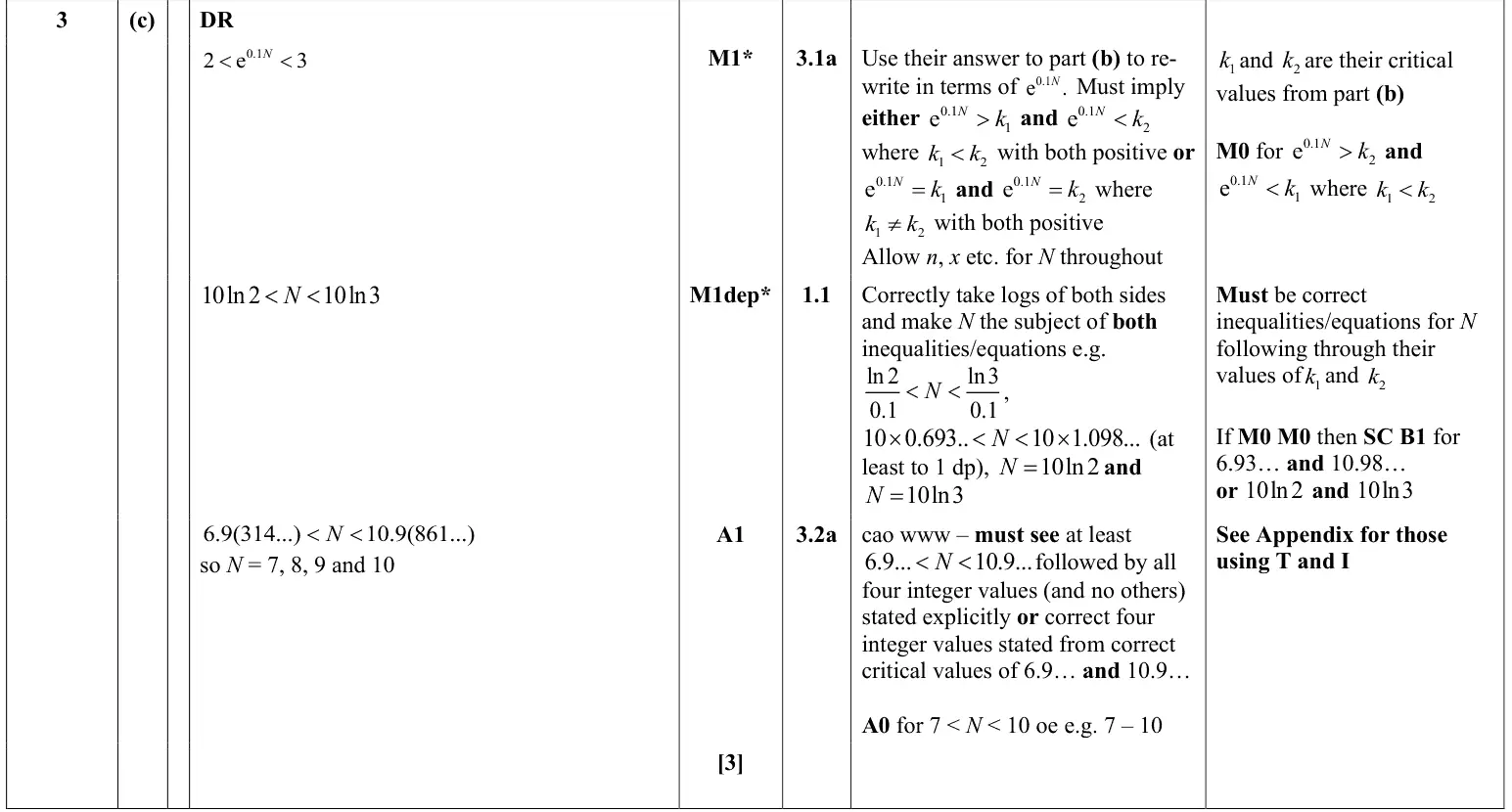
June 2025 · Paper 3 · Q3(c)3 marksMedium
Show the start of this question
Mark scheme for this part
Examiner's comment
Although most candidates realised that importance of their answer to part (b) and started by stating that 2 < e01.𝑁< 3, many re-started in this part or did not see the significance of the previous part. While many candidates correctly stated that 10ln2 < 𝑁< 10ln3 many did not read the question carefully and either left this as their final answer or gave an answer in a form that did not make it explicitly clear what positive integers satisfied the given inequality (e.g. an answer of 7 ≤𝑁≤10 was far too common). Finally, as this question required detailed reasoning (DR) many went straight from 10ln2 < 𝑁< 10ln3 to N = 7, 8, 9 and 10 without first showing the critical values of 6.93… and 10.98….
Key points and common errors
replace x by e^(0.1N): 2 < e^(0.1N) < 3
10 ln 2 < N < 10 ln 3 i.e. 6.93 < N < 10.99
integers N = 7, 8, 9, 10
many stopped at the log inequality
June 2025 · Paper 3 · Q4(a)5 marksMedium
Mark scheme for this part
Examiner's comment
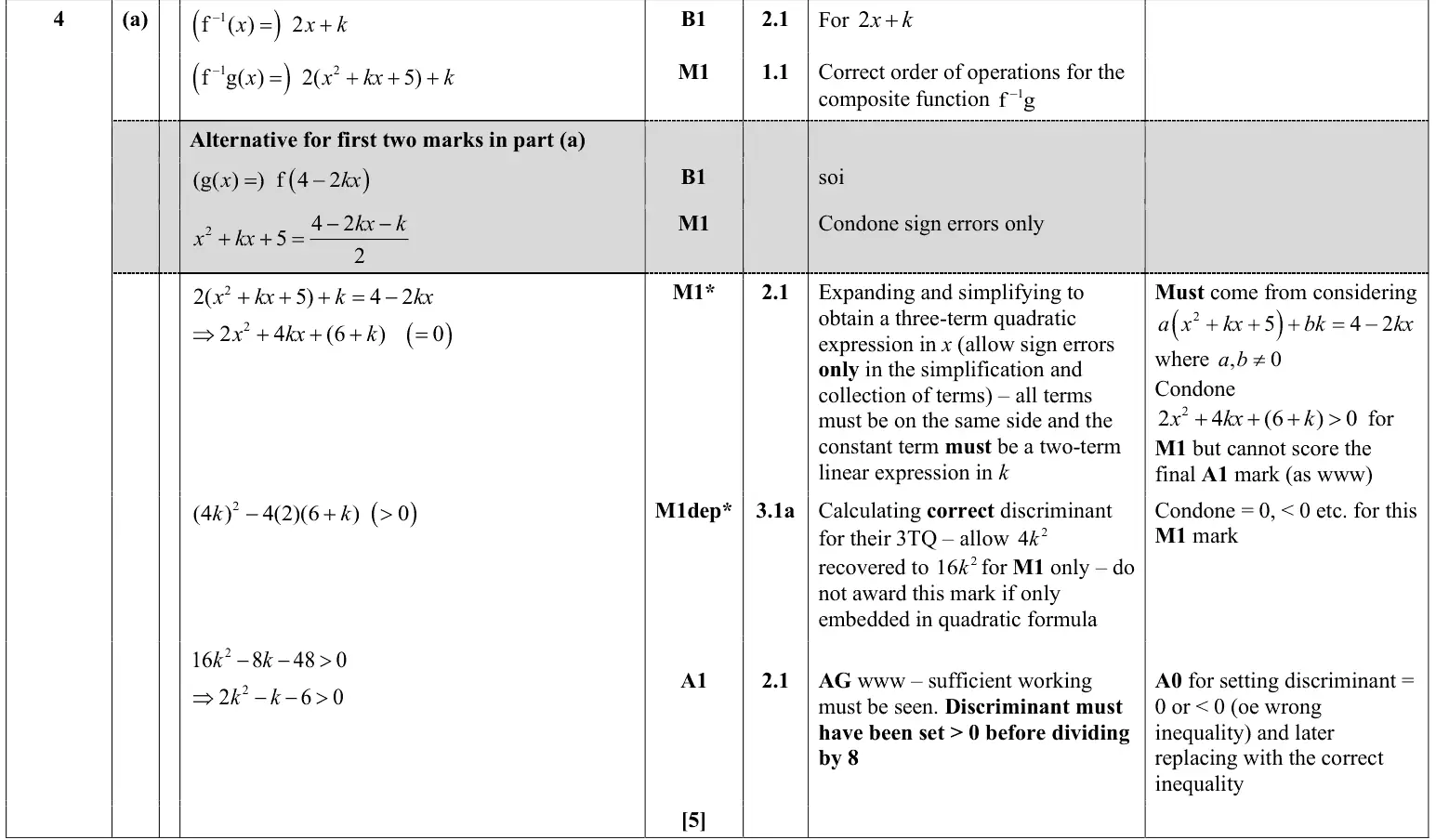
Most candidates correctly found the inverse of f and applied the correct order of operations to obtain f −1g(𝑥) = 2𝑥2 + 2𝑘𝑥+ 10 + 𝑘 although some candidates incorrectly found fg(𝑥) and then attempted to find the inverse of this, or simply equated fg(𝑥) to 4 −2𝑘𝑥. A significant number of candidates incorrectly considered the equation f −1g(𝑥) = 0. Of those that did consider f −1g(𝑥) = 4 −2𝑘𝑥 most obtained the correct three-term quadratic in 𝑥 and were successful in deriving the given inequality by considering the discriminant > 0. As this was a given answer any incorrect working seen (or setting the discriminant > 0 after dividing by 8) meant that the final accuracy mark could not be awarded.
Key points and common errors
f⁻¹(x) = 2x + k
f⁻¹g(x) = 2(x² + kx + 5) + k
set equal to 4 − 2kx and collect: 2x² + 4kx + 6 + k = 0
discriminant > 0 gives 2k² − k − 6 > 0
fg or f⁻¹g = 0 are common errors
June 2024 · Paper 1 · Q8(a)1 markEasy
Mark scheme for this part
Examiner's comment
This question was generally well answered.
Key points and common errors
x < 0 (not x ≤ 0)
interval notation (−∞, 0) allowed
June 2024 · Paper 1 · Q8(b)(i)1 markMedium
Mark scheme for this part
Examiner's comment
There were many different answers given to this question; 17 was the most frequently seen incorrect response.
Key points and common errors
n = −9 gives 19
17 a common wrong answer
June 2024 · Paper 1 · Q8(b)(ii)1 markMedium
Show the start of this question
Mark scheme for this part
Examiner's comment
Some candidates seemed to forget by this stage that only integer values for n were allowed, so used 0.5 to get an answer of 0. Values of –17 and –19 were also commonly seen.
Key points and common errors
n is an integer: n = 0 or 1 gives 1
0 from n = ½ is not allowed
June 2024 · Paper 1 · Q8(c)(i)3 marksEasy
Mark scheme for this part
Examiner's comment
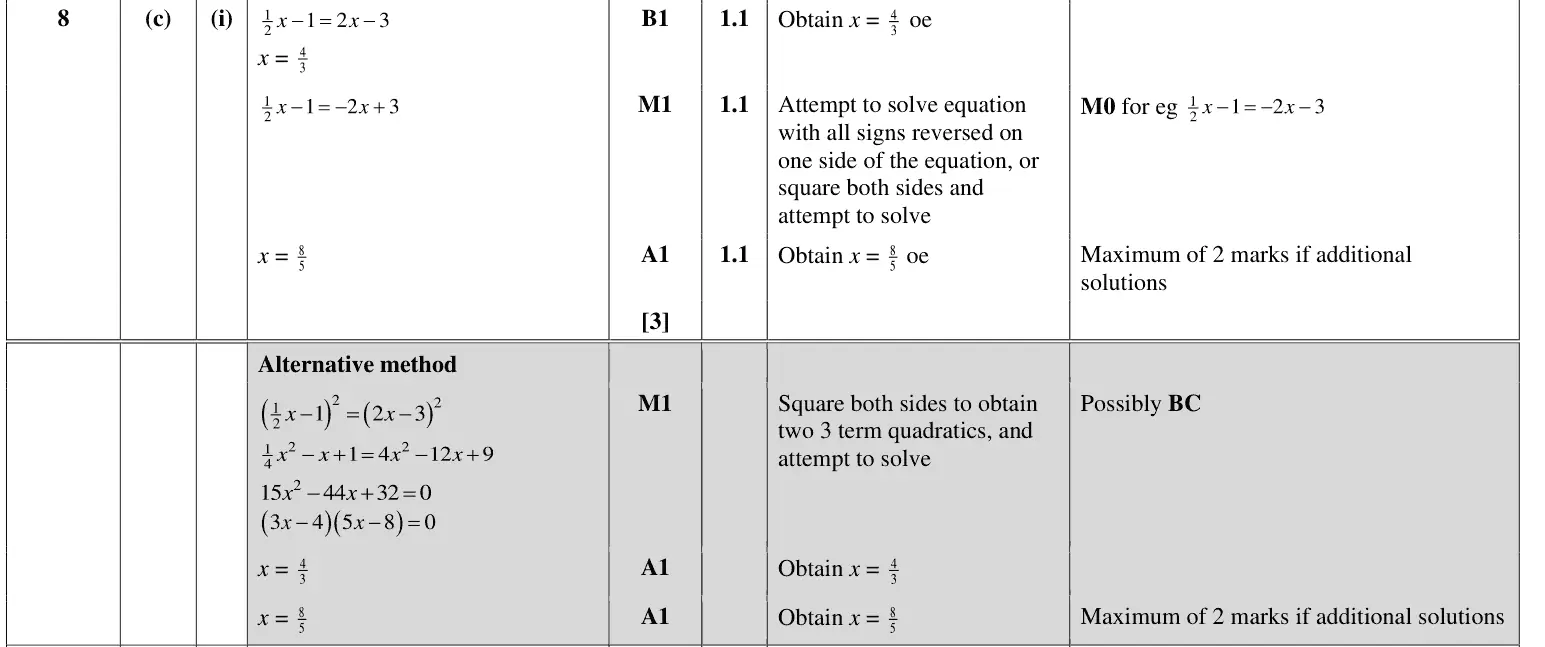
Candidates who squared both sides and solved the quadratic usually obtained full marks unless they had made a slip in their algebra. Those solving the two linear equations were also successful in general, although a minority got into difficulty changing the signs to find the second solution, with some changing one sign on each side and others changing all signs on both sides, rather than all signs on one side only.
Key points and common errors
½x − 1 = ±(2x − 3) or square both sides
x = 4/3, 8/5
reverse all signs on one side only
June 2024 · Paper 1 · Q8(c)(ii)1 markHard
Show the start of this question
Mark scheme for this part
Examiner's comment
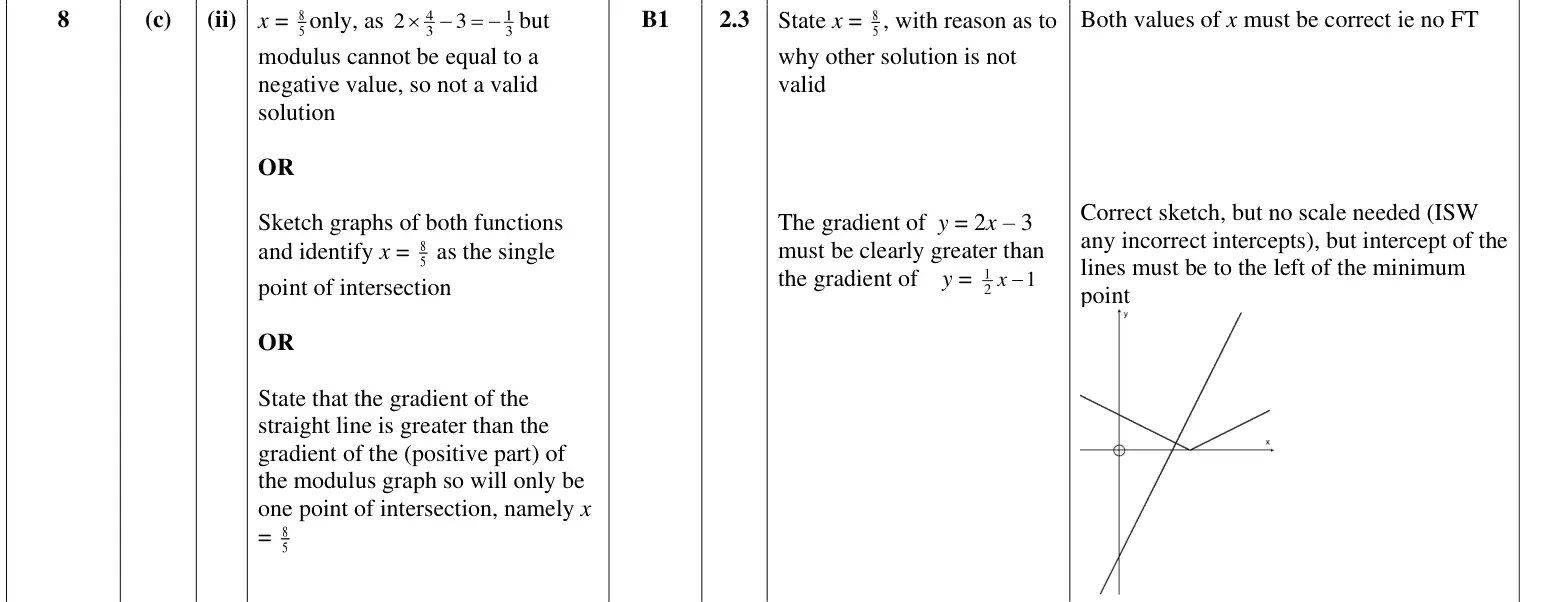
Few candidates successfully answered this question. Those who correctly identified x = 8/5 as the only valid solution were often not able to explain in enough detail why. A common response was to say that the graphs only intersect at one point, without going into detail to justify the statement. Some had sketched graphs in the previous part which would have completed their argument but did not think to use these here. Some referred to the modulus being positive but did not do the simple calculations to show why x = 4/3 did not work. Successful candidates often compared their solutions with the range of values for which y = 2x – 3 was positive.
Key points and common errors
x = 8/5 only: at x = 4/3, 2x − 3 = −⅓ but a modulus cannot be negative
or sketch/gradient argument
'the graphs meet once' without justification gains nothing
June 2024 · Paper 1 · Q9(c)1 markHard
Show the start of this question
Mark scheme for this part
Examiner's comment
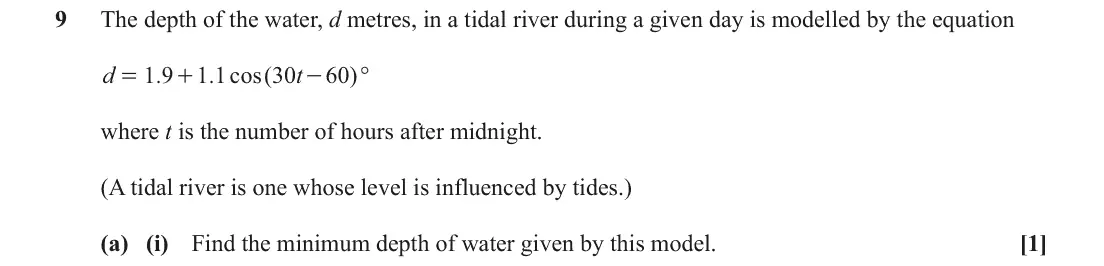
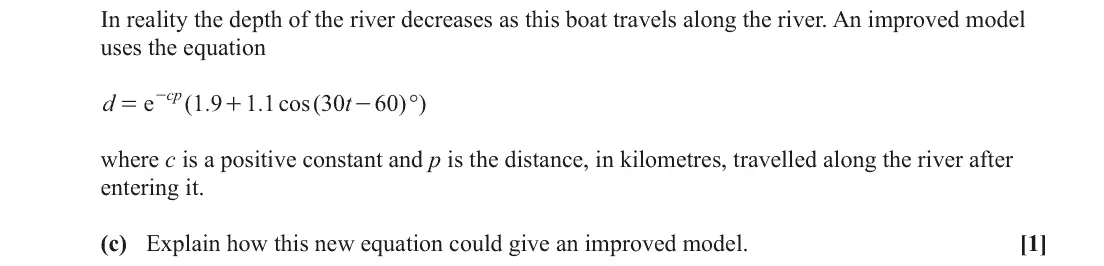
While many candidates correctly identified that 𝑒−𝑐𝑝 would reduce the depth equation as the boat travelled along the river, very few correctly linked this to a reduction in the difference between maximum and minimum depths.
Key points and common errors
as p increases e^(−cp) decreases, so depths and the difference between max and min depths decrease (damping)
restating 'river gets shallower' gains nothing
June 2023 · Paper 1 · Q5(a)(i)3 marksMedium
Mark scheme for this part
Examiner's comment
It was less usual for partial credit to be given in this question; solutions tended to be either fully correct or very limited progress was made. The most successful method was to use a sketch diagram and consider the vertical translation to obtain c = 1. The gradient and intercept of the straight line graph could then be considered to obtain values for a and b. In the less successful responses, candidates tended to try to employ routine methods such as substituting values and then squaring to deal with the modulus, rather than trying to develop a more flexible approach. This candidate has made effective use of a sketch graph, and has considered the graph of y = ax – b to find values for a and b.
Key points and common errors
sketch: vertical translation gives c = 1
vertex x = b/a = 3 and intercept give a = 2, b = 6
squaring both sides is unhelpful
June 2023 · Paper 1 · Q5(a)(ii)1 markMedium
Show the start of this question
Mark scheme for this part
Examiner's comment
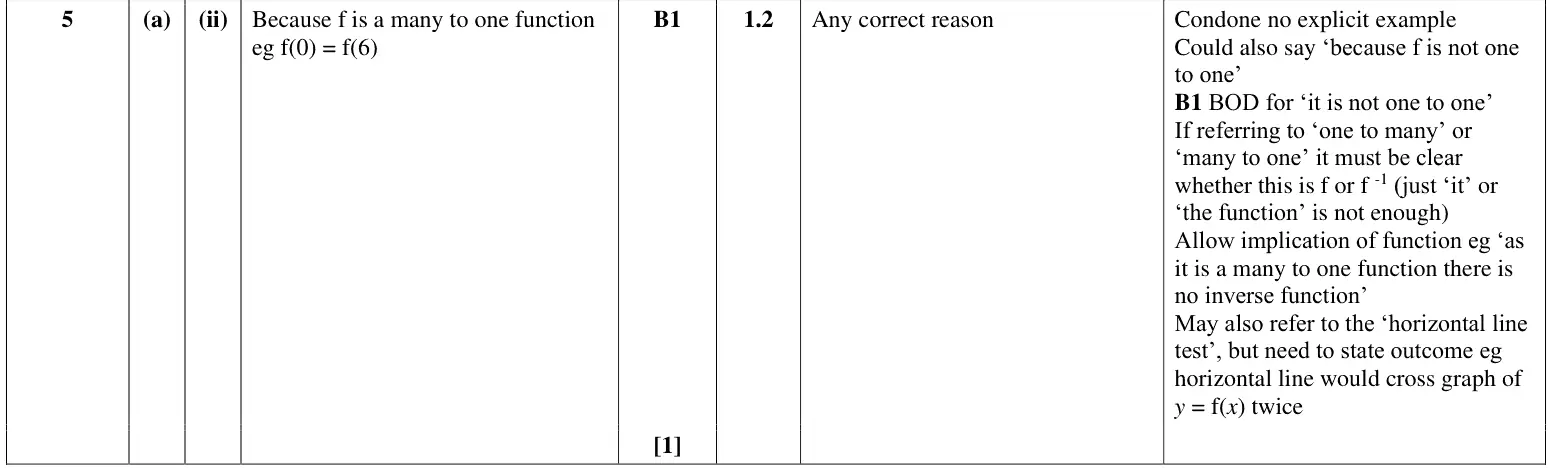
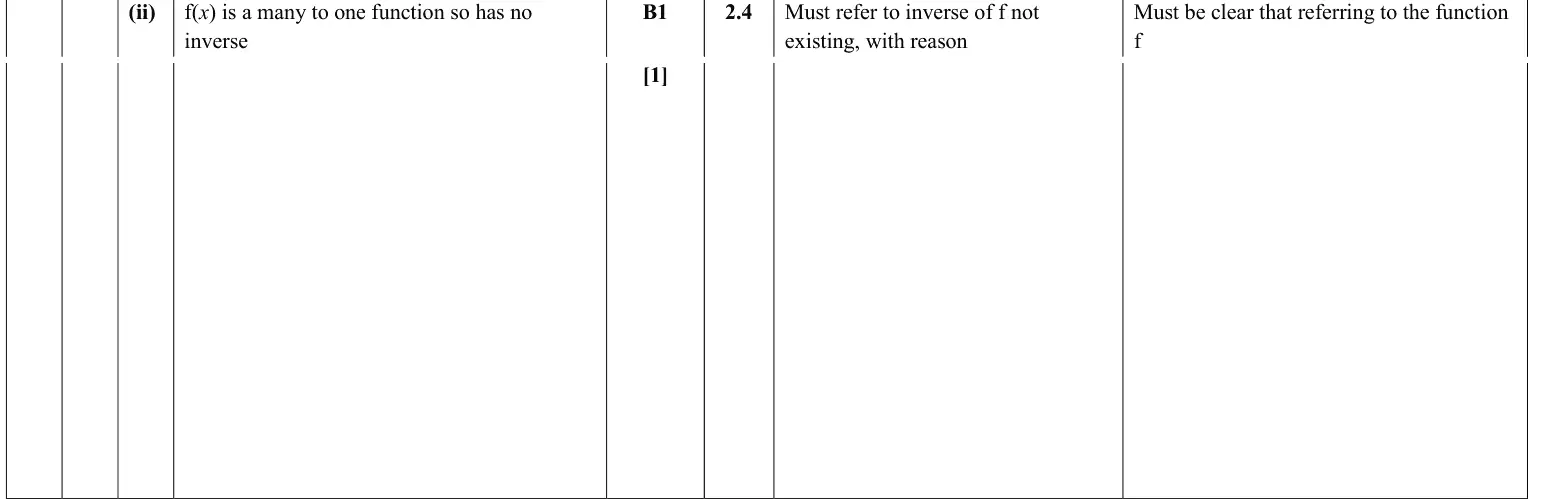
The most convincing explanations referred to f being a many to one solution, sometimes even giving specific coordinates to support this statement. The most common error was a lack of precision in the explanation, simply referring to ‘it’ without explicitly referencing whether this was the function or the inverse function.
Key points and common errors
f is many-to-one (e.g. f(0) = f(6))
must say f not just 'it'
June 2023 · Paper 1 · Q5(b)(i)3 marksMedium
Show the start of this question
Mark scheme for this part
Examiner's comment
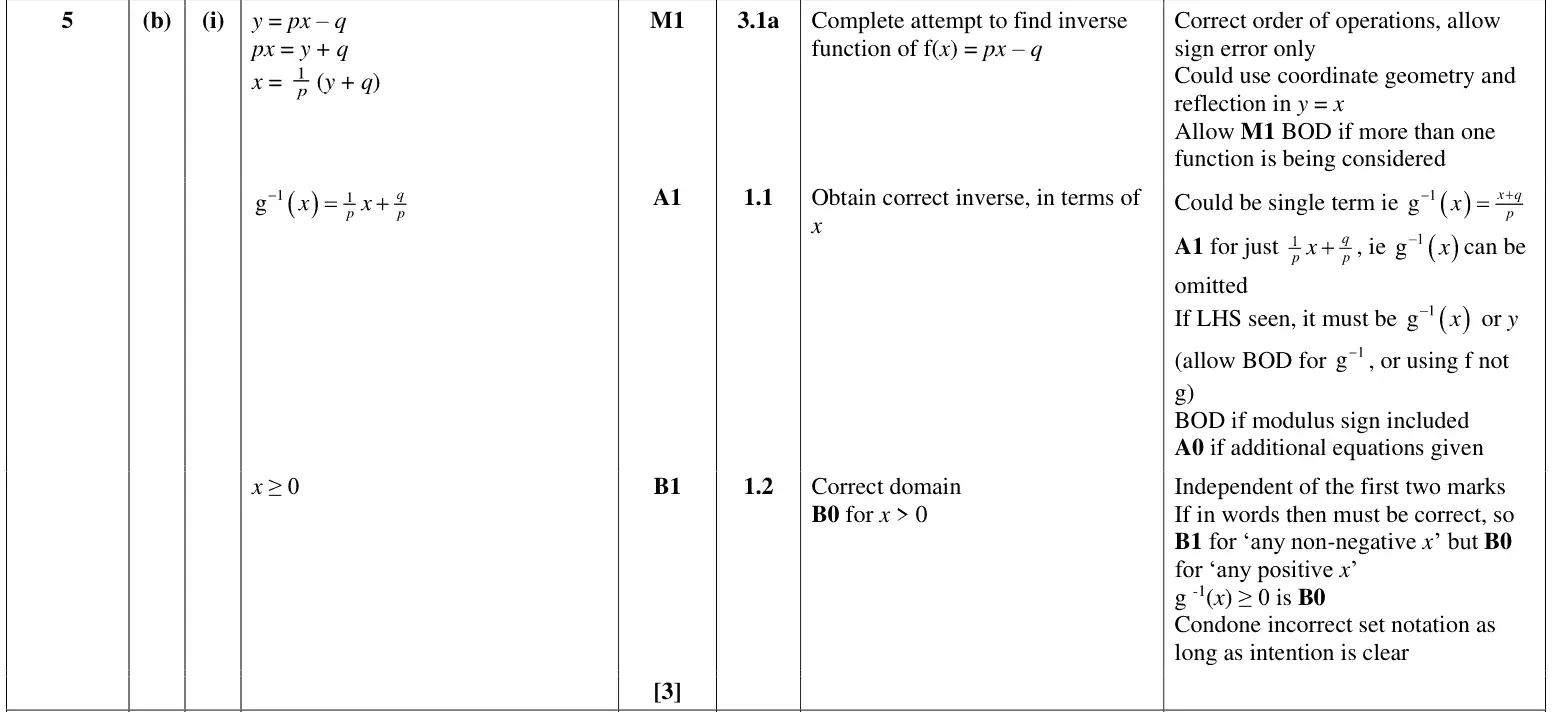
In the more successful responses, candidates identified that the relevant part of the graph was y = px – q, and it was then a routine process to find the inverse function that matched this. Some candidates ignored the domain and considered both parts of the given function, despite the previous part of the question having identified that the inverse of an entire modulus function would not be def ined. Once again some candidates went straight into attempting to square both sides, or even just one side, of the equation as this seemed to be their standard method when working with a modulus function. Candidates also found identifying the domain to be a challenge; most seemed familiar with the range of a function being the domain of the inverse function but were then unsure how to proceed. A few candidates did identify the condition of ≥ 0, but were unsure as to what, if anything, should go on the left hand side of the inequality.
Key points and common errors
for x ≥ q/p, g(x) = px − q
g⁻¹(x) = (x + q)/p with domain x ≥ 0
domain x > 0 is wrong
June 2023 · Paper 1 · Q5(b)(ii)1 markHard
Show the start of this question
Mark scheme for this part
Examiner's comment
There were very few correct solutions seen to this part of the question. These tended to come from considering the relationship between a function, its inverse and the line y = x. Candidates employing a more algebraic approach could sometimes identify the key value of p = 1, but then struggled to identify the required inequality.
Key points and common errors
g and g⁻¹ meet on y = x
no solutions when 0 < p ≤ 1
p < 1 alone is wrong
June 2022 · Paper 2 · Q6(a)4 marksMedium
Mark scheme for this part
Examiner's comment
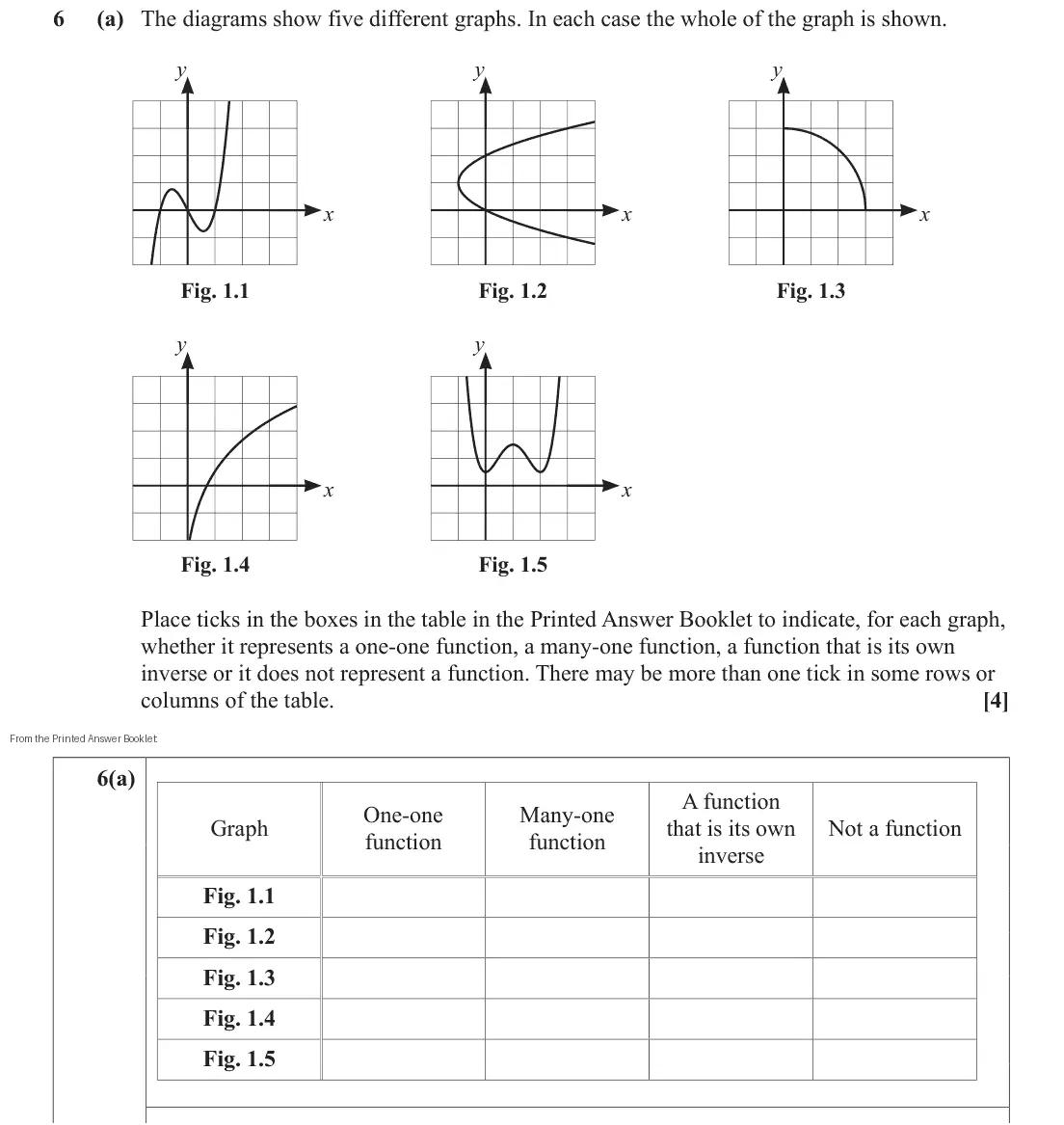
Responses to this question were mixed. The responses for diagrams 1.4 and 1.5 were usually correct. Perhaps the most difficult aspect of the question was identifying the curve that represented a self-inverse function.
Key points and common errors
Fig 1.1 many-one
1.2 not a function
1.3 one-one and self-inverse
1.4 one-one
1.5 many-one
the self-inverse curve was hardest
June 2022 · Paper 2 · Q6(b)2 marksMedium
Mark scheme for this part
Examiner's comment
Many candidates identified the range correctly, although not all could express it correctly in set notation. Some common answers that gained only 1 mark were these y > 1 2 , {x: x > 1 2 }, {f(x): f(x) > 1 2 }, {x: f(x) > 1 2 }, ( 1 2 , ∞). Some unnecessary “ ∞”s were seen (though not penalised), e.g. {y: 1 2 < y < ∞}. Some common wrong answers involved f(x) < 1 2 or f(x) > 2.
Key points and common errors
f(x) ≥ 1/2
{y : y ≥ 1/2}
{x : x ≥ 1/2} or f(x) > 2 lose marks
June 2022 · Paper 3 · Q13 marksEasy
Mark scheme for this part
Examiner's comment
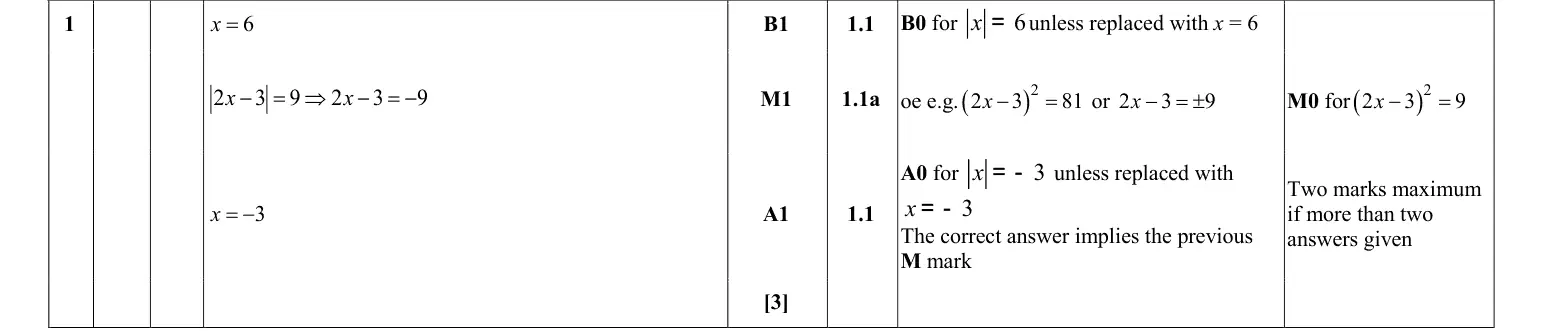
This question was answered extremely well with nearly all candidates correctly solving 2 x − 3 = ±9 , although some candidates only solved for one of these two possible cases. The two most common errors seen by examiners were those candidates who re-wrote the equation as either 2 x + 3 = 9 or ( ) 2 x − 3 = 9.
Key points and common errors
2x − 3 = ±9
x = 6 or x = −3
errors: squaring only one side, rewriting as 2x + 3 = 9
June 2022 · Paper 3 · Q2(b)2 marksEasy
Show the start of this question
Mark scheme for this part
Examiner's comment
x − 8, While a few candidates either differentiated or found the reciprocal of most knew the correct process of finding the inverse of the given function. The most common error was from those candidates who left their response in terms of y.
Key points and common errors
y + 8 = x³ so f⁻¹(x) = ∛(x + 8)
must be in terms of x
June 2022 · Paper 3 · Q2(c)1 markEasy
Show the start of this question
Mark scheme for this part
Examiner's comment
Most candidates scored the mark for stating that one graph was a reflection of the other graph in the line y = x. The most common errors were those who gave a non-geometrically reason (for example, simply stating that one was the inverse of the other) or did not state the line of reflection.
Key points and common errors
reflection in the line y = x
both 'reflection' and 'y = x' needed
Autumn 2021 · Paper 1 · Q2(a)2 marksMedium
Mark scheme for this part
Examiner's comment
(From the general report) Question 2 was a real-life application of linear equations with candidates expected to set up two equations in the first part of the question, and then solve them in the second part.
Key points and common errors
A: 4000 + 4m pence (or 40 + 0.04m pounds)
B: 6(m − 100)
keep units consistent
using m = 0 at 100 minutes is an error
Autumn 2021 · Paper 1 · Q5(a)(iii)1 markMedium
Show the start of this question
Mark scheme for this part
Key points and common errors
inverse reflects in y = x: (6, 2)
Autumn 2021 · Paper 1 · Q8(a)(i)1 markMedium
Mark scheme for this part
Examiner's comment
(From the general report) In Question 8(a) candidates who did a quick sketch graph of the functions were more successful in identifying the required ranges.
Key points and common errors
range of 2tan x is all reals
must refer to f(x) or y, not x
a quick sketch helps
Autumn 2021 · Paper 1 · Q8(a)(ii)1 markMedium
Show the start of this question
Mark scheme for this part
Examiner's comment
(From the general report) In Question 8(a) candidates who did a quick sketch graph of the functions were more successful in identifying the required ranges.
Key points and common errors
g(x) ≤ −1 or g(x) ≥ 1
sketch of sec x helps
Autumn 2021 · Paper 1 · Q8(b)(i)2 marksMedium
Show the start of this question
Mark scheme for this part
Key points and common errors
sec 0.6 = 1.2116 then 2tan(1.2116) = 5.3269
at least one interim value needed
radians
Autumn 2021 · Paper 1 · Q8(b)(ii)1 markMedium
Show the start of this question
Mark scheme for this part
Key points and common errors
f is many-one on 0 ≤ x ≤ 2π so f⁻¹ does not exist
Autumn 2021 · Paper 2 · Q4(f)1 markMedium
Show the start of this question
Mark scheme for this part
Examiner's comment
(From the general report) Question 4(f): Some candidates appeared not to understand how to address some aspects of Assessment Objective AO3 (please see section ‘3b.
Key points and common errors
damp the oscillation: P = 5000 − 1000e^(−kt)cos(30t)° (k > 0) or divide the amplitude by t
AO3 refinement
Autumn 2021 · Paper 3 · Q4(a)2 marksMedium
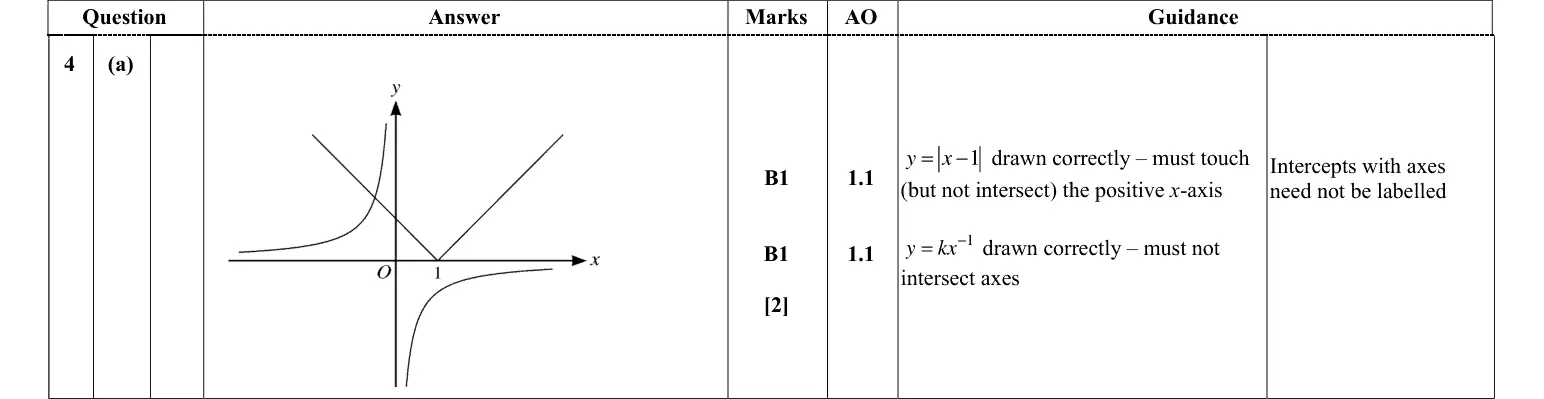
Mark scheme for this part
Key points and common errors
y = abs(x − 1) touches the positive x-axis at 1
y = k/x with k < 0 lies in quadrants 2 and 4 and does not meet the axes
Autumn 2021 · Paper 3 · Q4(b)1 markMedium
Show the start of this question
Mark scheme for this part
Examiner's comment
k y x 1 For the one mark available here it was not sufficient to simply say that because and y x x x 1 k had only one point of intersection that therefore the equation had only one real root. Candidates had to make a link between the two graphs and the corresponding equation.
Key points and common errors
the graphs meet once and x·abs(x − 1) = k is equivalent to abs(x − 1) = k/x
must link the intersection to the equation, not just state one intersection
Autumn 2021 · Paper 3 · Q4(c)2 marksMedium
Show the start of this question
Mark scheme for this part
Key points and common errors
root is negative so x(1 − x) = −6
x² − x − 6 = 0
x = −2 only
Autumn 2020 · Paper 1 · Q3(a)4 marksMedium
Mark scheme for this part
Examiner's comment
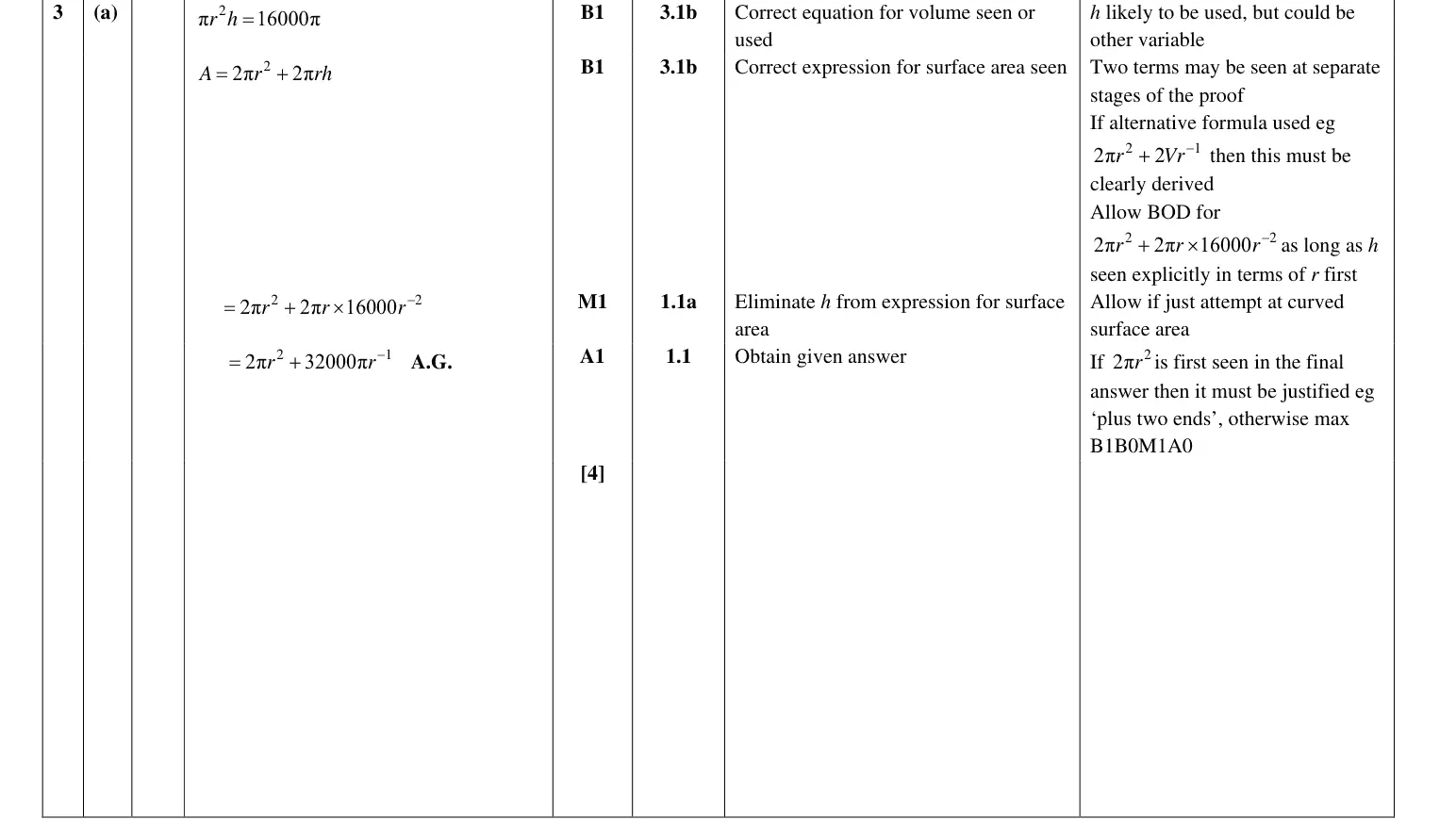
(Comment on Question 03 as a whole) The first part of Question 3 required candidates to show the derivation of the given equation. On questions such as this, where the request is to ‘show that’ a given answer is correct, it is important that sufficient detail is given to provide a convincing solution. Examiners expected to see an equation for the volume, an expression for the total surface area and then clear substitution and manipulation to arrive at the given answer. In the second part of the question, a surprisingly common error was to find the radius but then omit to find the minimum surface area. Candidates should review a question to make sure that it is fully answered before moving on; other strategies such as highlighting or underlining key words and phrases within a question may also be helpful.
Key points and common errors
πr²h = 16000π
A = 2πr² + 2πrh
eliminate h
the 2πr² for the two ends must be justified
Autumn 2020 · Paper 1 · Q9(a)2 marksMedium
Mark scheme for this part
Examiner's comment
(Comment on Question 09 as a whole) The most successful candidates in Question 9(b)(i) were those who considered a graphical approach (which the diagram was included to help with) as opposed to those who embarked on the more standard techniques for a question involving moduli.
Key points and common errors
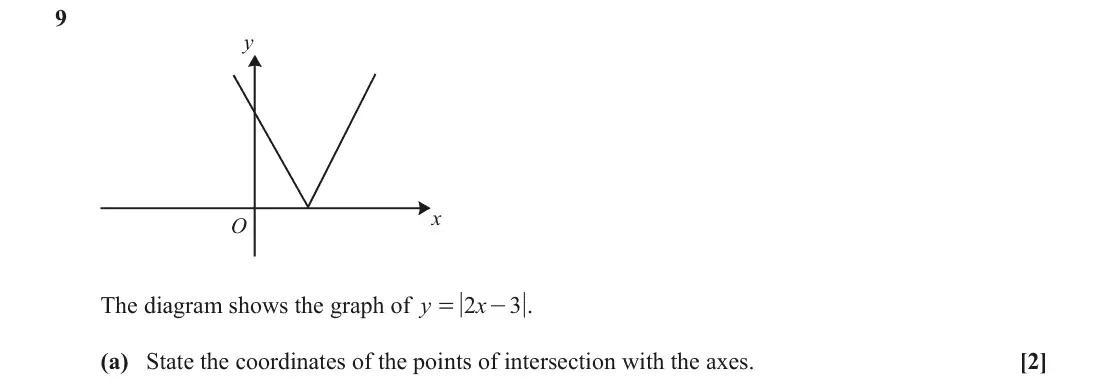
(1.5, 0) and (0, 3)
Autumn 2020 · Paper 1 · Q9(b)(i)4 marksMedium
Show the start of this question
Mark scheme for this part
Examiner's comment
(Comment on Question 09 as a whole) The most successful candidates in Question 9(b)(i) were those who considered a graphical approach (which the diagram was included to help with) as opposed to those who embarked on the more standard techniques for a question involving moduli.
Key points and common errors
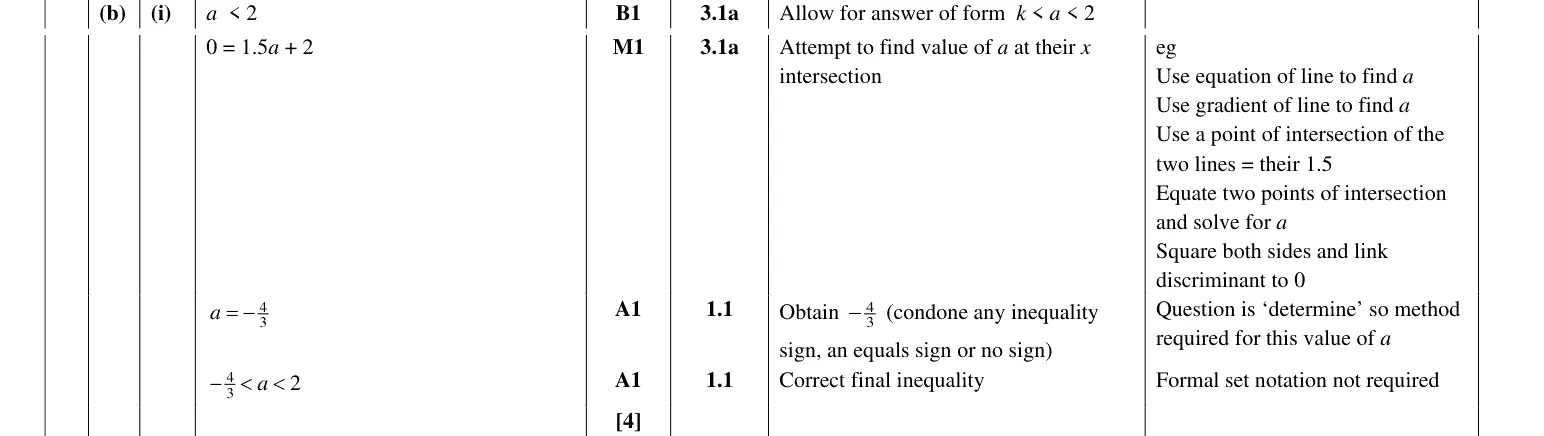
graphical approach best: line through (0, 2)
a < 2 (parallel to right arm)
through vertex (1.5, 0) gives a = −4/3
−4/3 < a < 2
Autumn 2020 · Paper 1 · Q9(b)(ii)3 marksMedium
Show the start of this question
Mark scheme for this part
Examiner's comment
(Comment on Question 09 as a whole) The most successful candidates in Question 9(b)(i) were those who considered a graphical approach (which the diagram was included to help with) as opposed to those who embarked on the more standard techniques for a question involving moduli.
Key points and common errors
2x − 3 = ax + 2 gives x = 5/(2 − a)
3 − 2x = ax + 2 gives x = 1/(2 + a)
Autumn 2020 · Paper 2 · Q8(a)7 marksHard
Mark scheme for this part
Examiner's comment
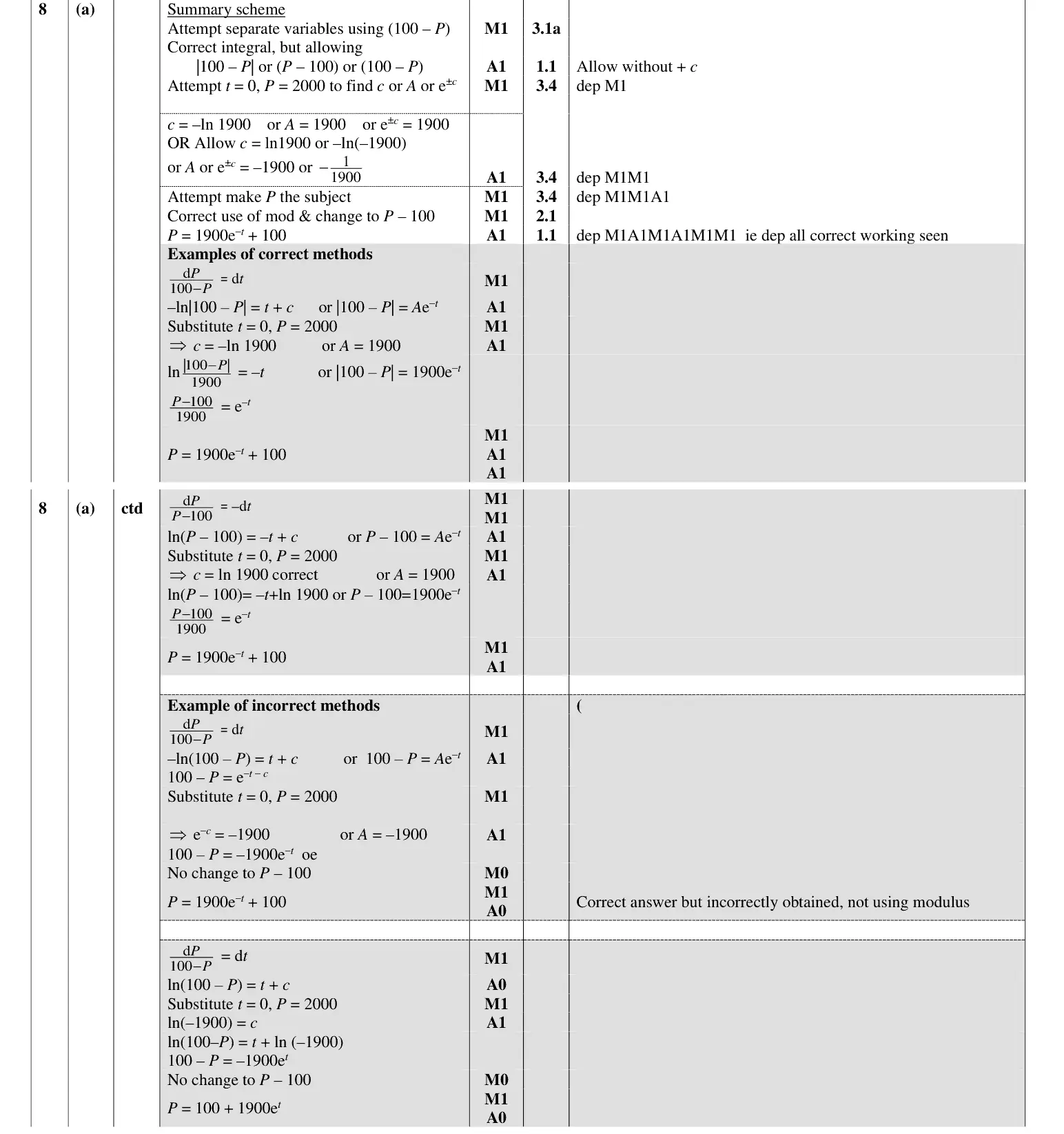
(Comment on Question 08 as a whole) This differential equation was difficult in that a correct solution depended on the correct use of the modulus sign when integrating . The majority of candidates either did not include the modulus sign or included it but then just ignored it. These candidates then obtained an impossible value for the ec = − constant of integration, such as ln ( 1900 ) or . Some noticed this and just dropped the c = − 1900 negative sign, while others ploughed on, seemly unaware of that this was a problem. Candidates who made errors such as these could, nevertheless, score 5 marks out of 7 if they made no other errors. A few candidates made no attempt to separate the variables and "integrated" to obtain equations such as . P = 100 t − Pt Section B: Statistics
Key points and common errors
separate variables: −ln(mod(100 − P)) = t + c
the modulus matters since P > 100: P = 1900e⁻ᵗ + 100
majority omitted or ignored the modulus giving impossible c = −ln 1900
Autumn 2020 · Paper 3 · Q3(a)3 marksMedium
Mark scheme for this part
Examiner's comment
(Comment on Question 03 as a whole) There were some excellent responses to this question, although some candidates dropped marks for errors in the notation used. Those candidates that used completing the square in part (a) were generally more successful than those that used calculus. A significant number did not gain the final accuracy mark due to incorrectly stating 9 9 rather than correctly stating the range of the function ( ) x ≥− f x ≥− . 2 2 Some candidates appeared to misunderstand the concept of range, finding the roots by factorising to ( ) 2 x x + 3 to then incorrectly conclude that 3 x ≥ In part (b) there were unfortunately a number of vague answers provided starting ‘It is …’. Examiners cannot be expected to know what the ‘it’ is that the candidate is talking about; answers need to be explicit, either in words or as part of an annotated diagram. ( ) Most candidates started part (c) successfully and found the expression for g a . Some candidates introduced errors, or just wasted some exam time, producing an initial algebraic form for the composite f g x rather than substituting their numerical answer to ( ( ) ) into ( ) function g − 2 f x . Part (d) included the request to give their final answer in set notation. The ‘Determine’ request meant that the method mark was for clear and accurate algebraic manipulation into the standard three term quadratic. There is an assumption that candidates would solve quadratic equations by inspection or by using the solve function on their calculator, the command word just signals that the mathematical argument must be evident. The majority of candidates scored these initial 2 marks, but a significant number struggled with giving their result in correct set notation format.
Key points and common errors
complete the square: 2(x + 3/2)² − 9/2 so f(x) ≥ −9/2
error writing x ≥ −9/2 instead of f(x)
Autumn 2020 · Paper 3 · Q3(b)1 markMedium
Show the start of this question
Mark scheme for this part
Examiner's comment
(Comment on Question 03 as a whole) There were some excellent responses to this question, although some candidates dropped marks for errors in the notation used. Those candidates that used completing the square in part (a) were generally more successful than those that used calculus. A significant number did not gain the final accuracy mark due to incorrectly stating 9 9 rather than correctly stating the range of the function ( ) x ≥− f x ≥− . 2 2 Some candidates appeared to misunderstand the concept of range, finding the roots by factorising to ( ) 2 x x + 3 to then incorrectly conclude that 3 x ≥ In part (b) there were unfortunately a number of vague answers provided starting ‘It is …’. Examiners cannot be expected to know what the ‘it’ is that the candidate is talking about; answers need to be explicit, either in words or as part of an annotated diagram. ( ) Most candidates started part (c) successfully and found the expression for g a . Some candidates introduced errors, or just wasted some exam time, producing an initial algebraic form for the composite f g x rather than substituting their numerical answer to ( ( ) ) into ( ) function g − 2 f x . Part (d) included the request to give their final answer in set notation. The ‘Determine’ request meant that the method mark was for clear and accurate algebraic manipulation into the standard three term quadratic. There is an assumption that candidates would solve quadratic equations by inspection or by using the solve function on their calculator, the command word just signals that the mathematical argument must be evident. The majority of candidates scored these initial 2 marks, but a significant number struggled with giving their result in correct set notation format.
Key points and common errors
f is not one-one (many-one)
vague answers starting 'It is…' not credited
Autumn 2020 · Paper 3 · Q3(c)4 marksMedium
Show the start of this question
Mark scheme for this part
Examiner's comment
(Comment on Question 03 as a whole) There were some excellent responses to this question, although some candidates dropped marks for errors in the notation used. Those candidates that used completing the square in part (a) were generally more successful than those that used calculus. A significant number did not gain the final accuracy mark due to incorrectly stating 9 9 rather than correctly stating the range of the function ( ) x ≥− f x ≥− . 2 2 Some candidates appeared to misunderstand the concept of range, finding the roots by factorising to ( ) 2 x x + 3 to then incorrectly conclude that 3 x ≥ In part (b) there were unfortunately a number of vague answers provided starting ‘It is …’. Examiners cannot be expected to know what the ‘it’ is that the candidate is talking about; answers need to be explicit, either in words or as part of an annotated diagram. ( ) Most candidates started part (c) successfully and found the expression for g a . Some candidates introduced errors, or just wasted some exam time, producing an initial algebraic form for the composite f g x rather than substituting their numerical answer to ( ( ) ) into ( ) function g − 2 f x . Part (d) included the request to give their final answer in set notation. The ‘Determine’ request meant that the method mark was for clear and accurate algebraic manipulation into the standard three term quadratic. There is an assumption that candidates would solve quadratic equations by inspection or by using the solve function on their calculator, the command word just signals that the mathematical argument must be evident. The majority of candidates scored these initial 2 marks, but a significant number struggled with giving their result in correct set notation format.
Key points and common errors
g⁻¹(a) = (a − 2)/3
fg(−2) = f(−4) = 8
a = 26
substitute numbers rather than forming fg(x)
June 2019 · Paper 1 · Q3(a)1 markHard
Mark scheme for this part
Examiner's comment
The more able candidates appreciated that the domain had to be restricted as f(x) had to be a one to one function, and were able to write down the value of k with ease. However, many candidates seemed unsure as to how to proceed, with the most common error being to solve f(x) = 0.
Key points and common errors
f⁻¹ exists only if f is one-one: domain starts at the vertex, k = 3
common error solving f(x) = 0
June 2019 · Paper 1 · Q3(b)2 marksHard
Show the start of this question
Mark scheme for this part
Examiner's comment
The most efficient method was to first find f(5); those candidates who first attempted at algebraic expression for ff(x) were rarely successful. Having found that f(5) = –13, candidates were expected to observe that this was outside the domain and hence ff(5) was undefined, and more astute candidates did indeed give this solution. However the subtlety of the question, combined with a number of incorrect solutions to part (a), meant that this was missed by many who simply gave their final answer as 239. This approach was condoned as a special case when marking.
Key points and common errors
f(5) = −13 is outside the domain so ff(5) is not defined
239 given by many (special case)
June 2019 · Paper 1 · Q3(c)3 marksMedium
Show the start of this question
Mark scheme for this part
Examiner's comment
Most candidates were able to gain two marks for setting up and solving the relevant equation, but only a minority of the candidates gained the final mark for discarding x = –1, noting that it was outside the domain.
Key points and common errors
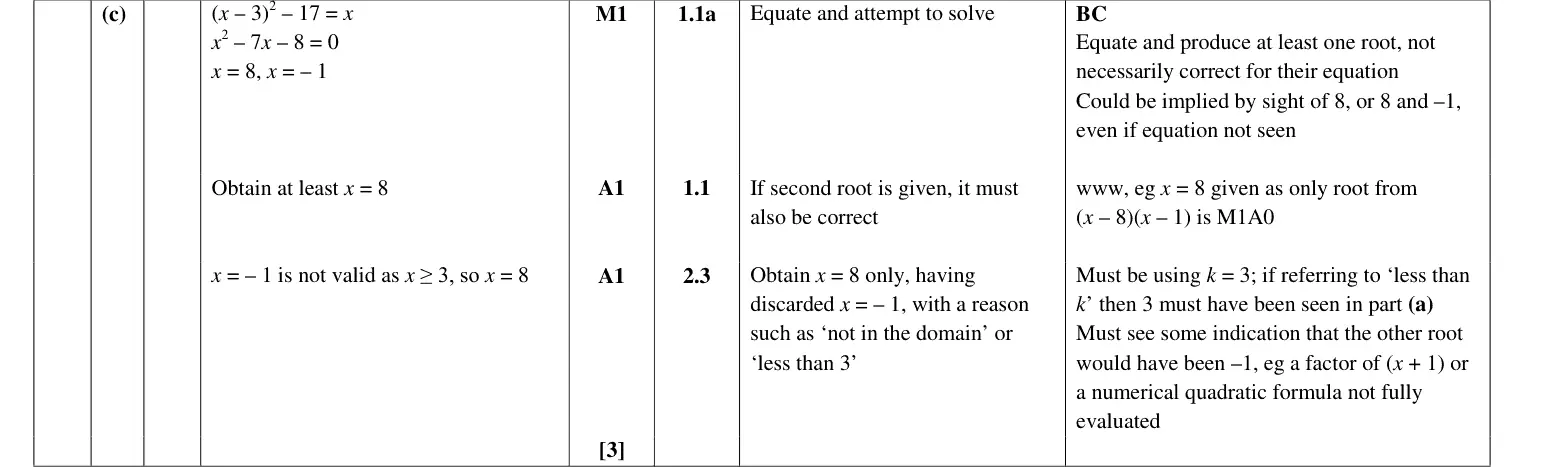
x² − 7x − 8 = 0 gives x = 8 or −1
reject −1 as outside the domain x ≥ 3
only a minority did
June 2019 · Paper 1 · Q3(d)1 markMedium
Show the start of this question
Mark scheme for this part
Examiner's comment
Some candidates were able to give clear and concise explanations about the two functions being reflections in y = x and thus intersecting on this line; but a number of explanations lacked precision.
Key points and common errors
f and f⁻¹ are reflections in y = x so they meet on y = x
explanations often lacked precision
June 2019 · Paper 2 · Q5(a)4 marksMedium
Mark scheme for this part
Examiner's comment
Many candidates gave convincing answers, showing sufficient steps to gain the marks. A particularly neat method, that was seen, involved finding h in terms of l and r, noting that lr = 4, and substituting both these into the formula for V. 2 16 4 However, a great deal of incorrect algebra was seen, for example − r = − r and 2 r r 2 16 2 4 r − r = 16 − r . Some candidates gave incorrect working and then "fudged" their working in 2 r order obtain the given answer. Many candidates did not appear to be aware of the fact that the key was to express everything in terms of r.
Key points and common errors
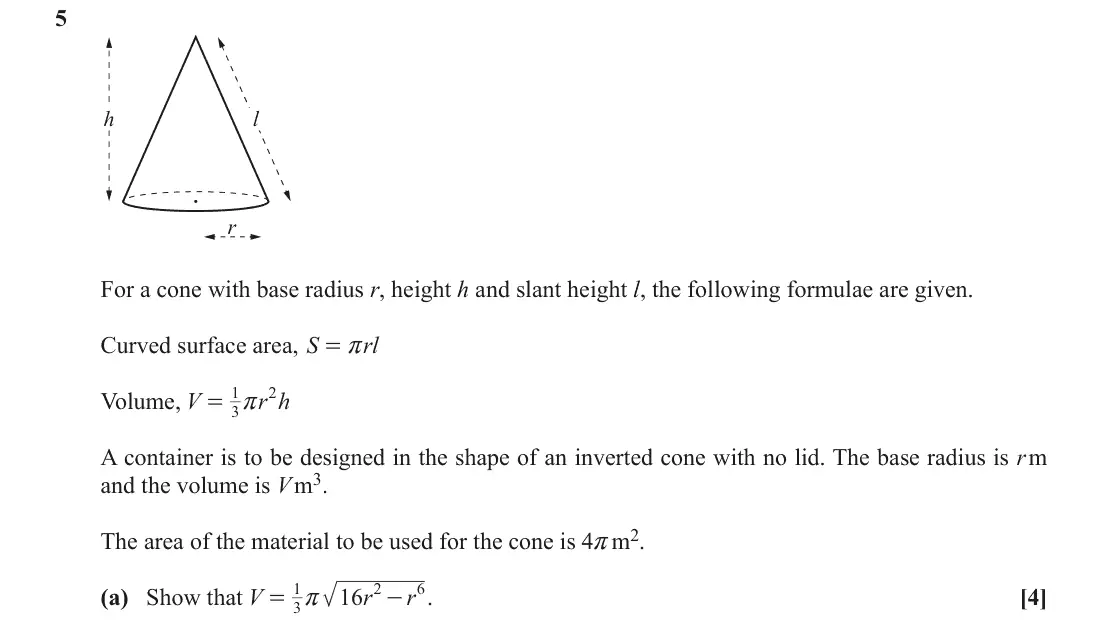
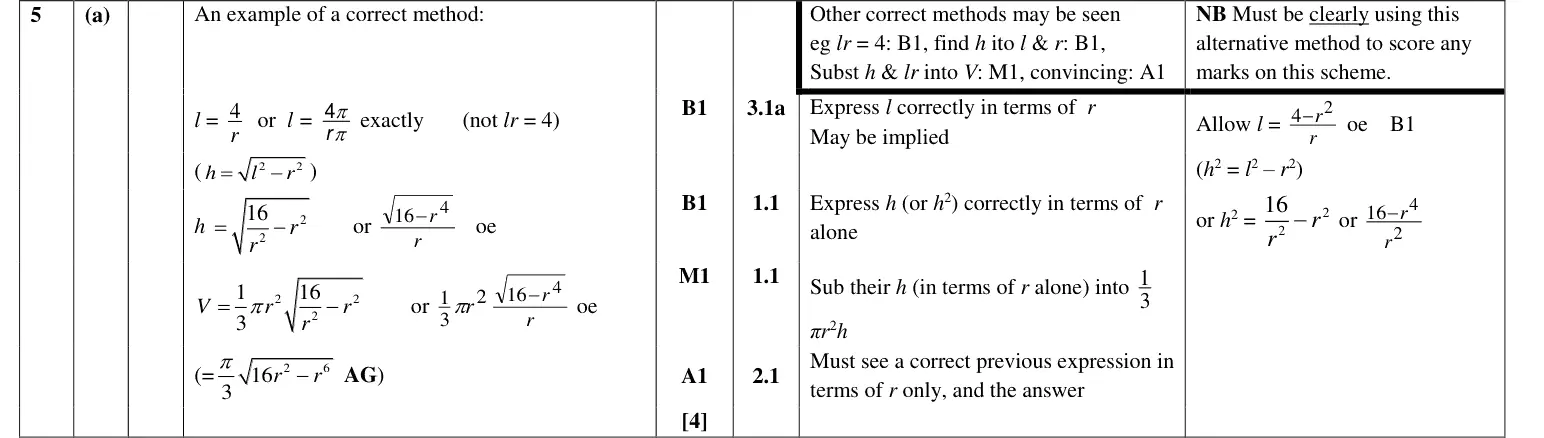
πrl = 4π gives l = 4/r
h² = l² − r²
substitute into V = ⅓πr²h
express everything in r
incorrect algebra and fudging to the given answer
June 2019 · Paper 2 · Q5(b)5 marksMedium
Show the start of this question
Mark scheme for this part
Examiner's comment
Most attempted to differentiate V, with varying levels of success. Some made arithmetical errors. Others ( ) 0.5 ( ) π π d V 2 6 5 had = 16 r − r × 32 r − 6 r or 32 r − 6 r . Some differentiated correctly, but then d r 6 6 (incorrectly) set 16 r − r = 0 , as well as (correctly) setting 32 r − 6 r = 0 . The ‘Detailed reasoning’ instruction indicates that the solution must lead to a conclusion by showing a detailed and complete analytical method; this meant that candidates were expected to give a reason for 2 rejecting one or both of r = 0 and r = − . Similarly, a ‘Trial and Improvement’ method to identify 4 3 r = 1 52 . , seen by a few candidates, was not considered an adequate method for full credit.
Key points and common errors
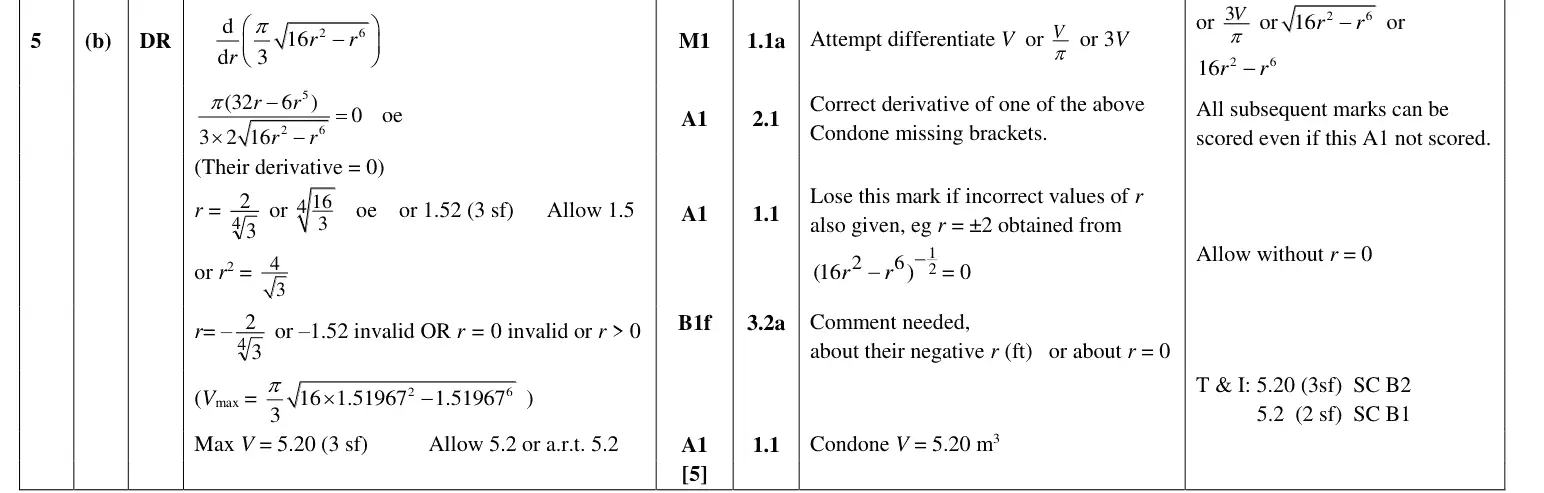
differentiate √(16r² − r⁶) by chain rule
32r − 6r⁵ = 0 gives r⁴ = 16/3
must reject r = 0 and negative r
V = 5.20
trial and improvement not enough
June 2019 · Paper 3 · Q3(a)4 marksEasy
Mark scheme for this part
Examiner's comment
This question was answered extremely well with nearly all candidates correctly solving this inequality involving the modulus function. Of the two main methods for solving this type of inequality the first, which involved re-writing as ( ) ( ) x − 2 ≤ 2 x − 6 was far more successful than those candidates who decided to re-write as two linear equations/inequalities (one of which should have had signs of x and 2x the same and the other with signs different) as many made sign errors even though most started from the correct two equations/inequalities. Although most candidates obtain the correct two critical values, and so therefore obtained the first three values, the only answers accepted by examiners for consistency were: x ≥ 4 or x ≤ { } { } x : x ≥ 4 ∪ x : x ≤ ( [ ) −∞ , ∪ 4 , ∞
Key points and common errors
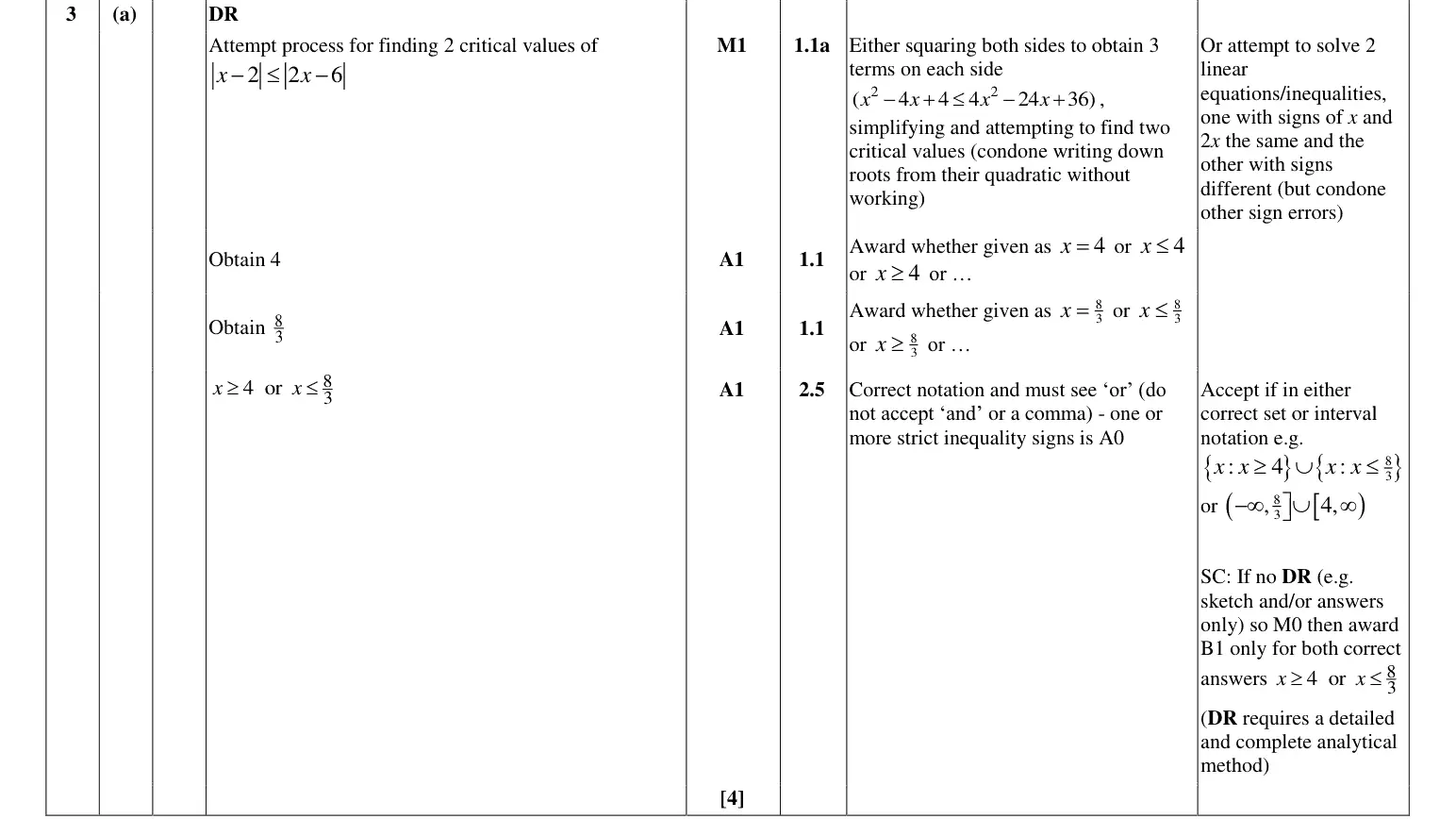
square both sides: critical values 8/3 and 4
x ≤ 8/3 or x ≥ 4 with 'or', not 'and'
sign errors with the two linear cases
June 2019 · Paper 3 · Q3(b)3 marksHard
Show the start of this question
Mark scheme for this part
Examiner's comment
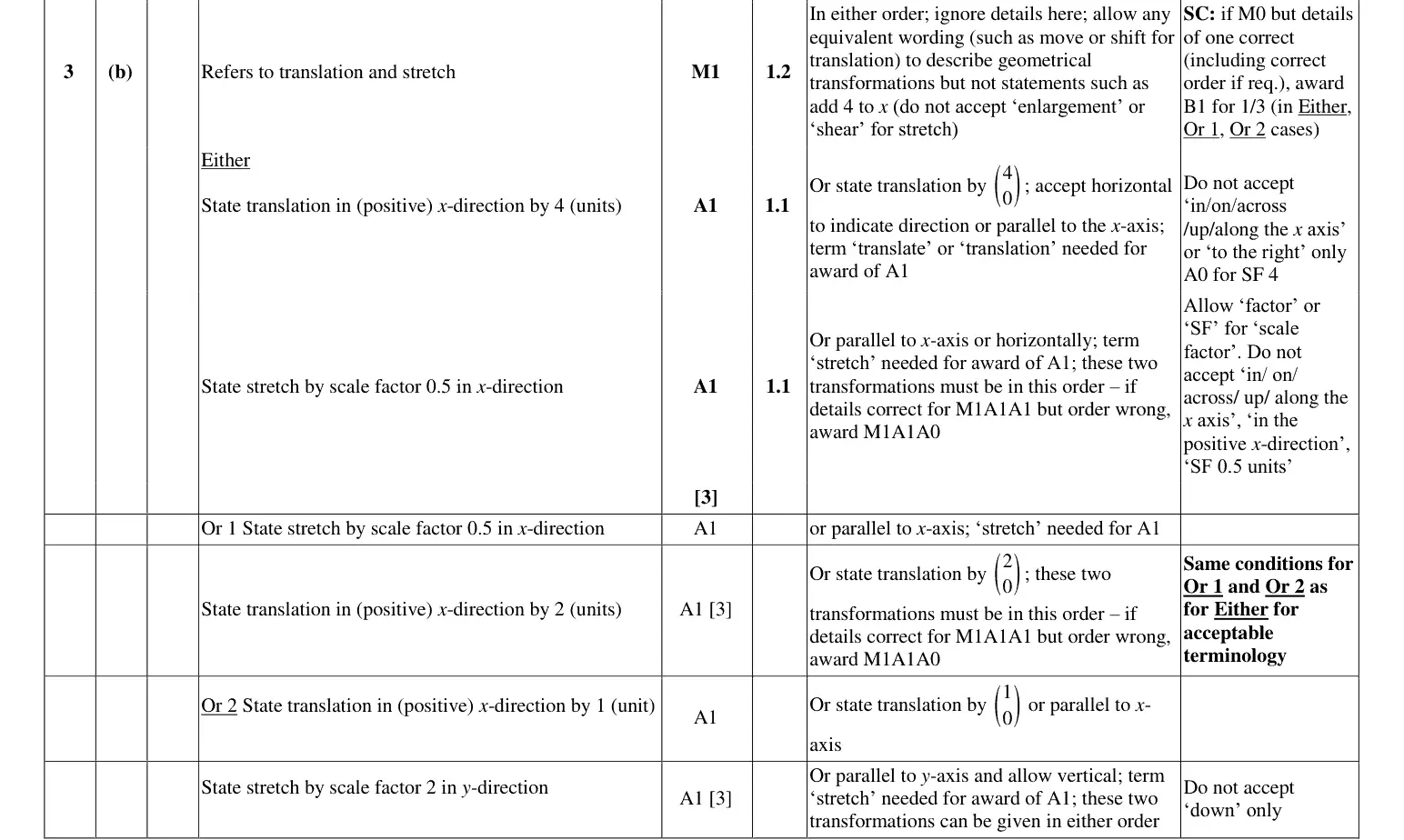
While it was clear that most candidates appreciated that the most common way of transforming the first graph to the other was by the application of a translation and a stretch the mathematical precision of language and understanding of the required order of transformations was not done well.
Key points and common errors
translation 4 in positive x-direction then stretch parallel to x-axis sf ½ (or equivalent orders)
precise language and correct order needed
June 2018 · Paper 1 · Q9(i)3 marksEasy
Mark scheme for this part
Examiner's comment
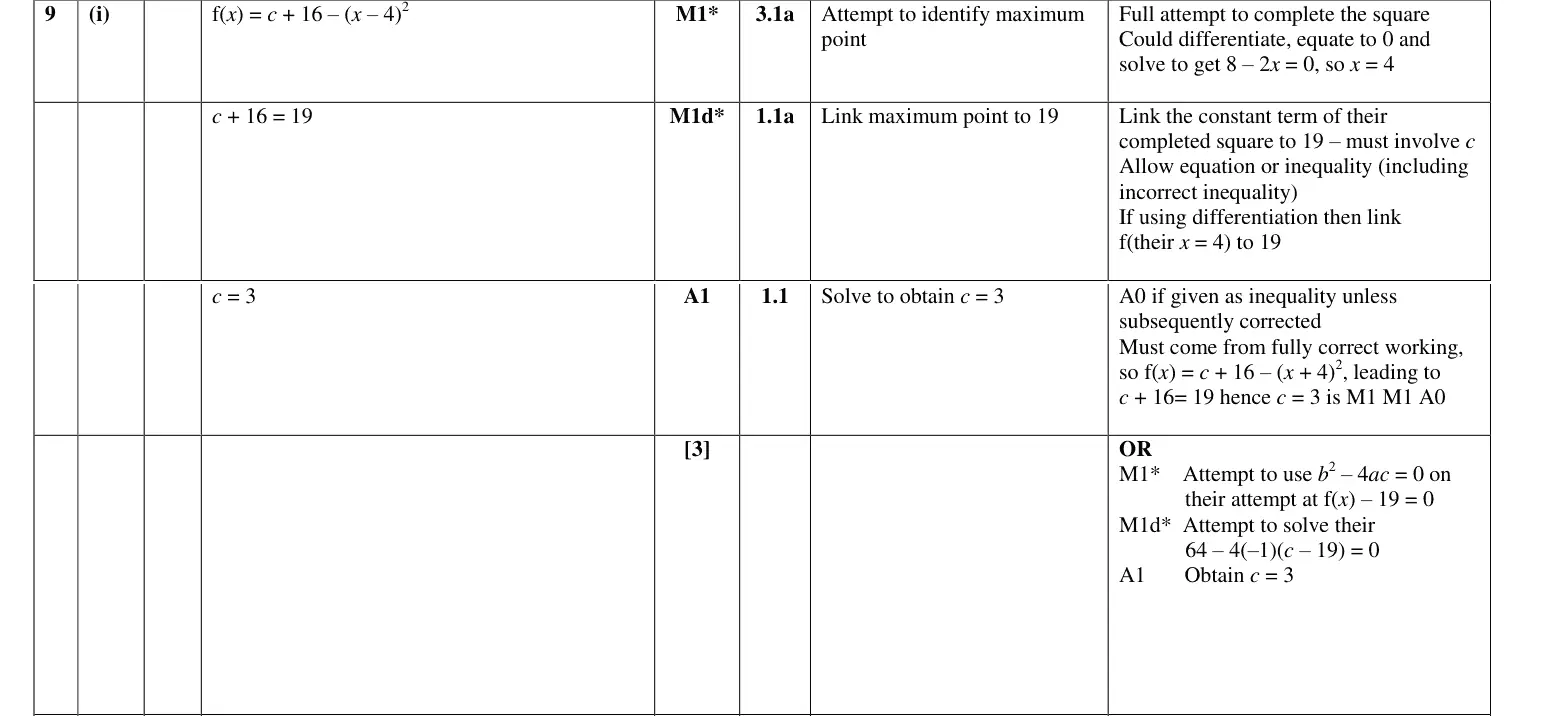
Many fully correct solutions to this question were seen, with candidates employing a variety of different methods. The most common approaches were to write f(x) in completed square form and equate the maximum value to 19, or to use differentiation to identify the maximum point. Some candidates attempted rearranged to obtain f(x) – 19 ≤ 0 and attempted to use the discriminant, but only the most able identified that the condition for repeated roots should then be used.
Key points and common errors
complete the square c + 16 − (x − 4)²
maximum c + 16 = 19 so c = 3
or discriminant of f(x) − 19 = 0
June 2018 · Paper 1 · Q9(ii)4 marksEasy
Mark scheme for this part
Examiner's comment
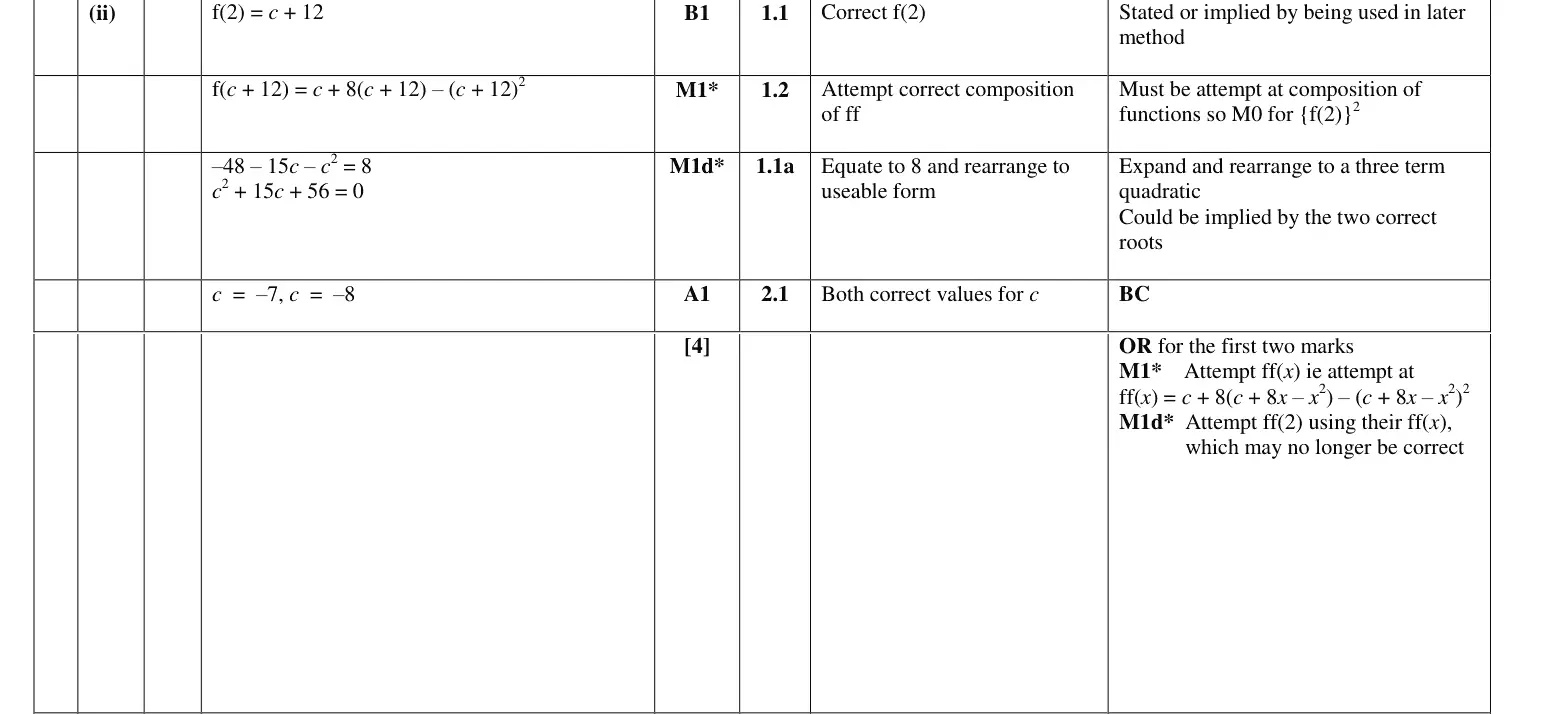
All candidates understood the meaning of ff(2) and were able to attempt the correct process for the composition of functions. The more successful method was to first find f(2), simplify this to c + 12 and then attempt f(c + 12). Candidates who attempted to find ff(x) before substituting x = 2 were more likely to make mistakes when simplifying their algebraic expression. It was expected that candidates would use their calculators to solve the quadratic equation, but the vast majority instead showed full detail of the method used.
Key points and common errors
f(2) = c + 12 then f(c + 12) = 8
c² + 15c + 56 = 0
c = −7, −8
June 2018 · Paper 2 · Q3(i)1 markEasy
Mark scheme for this part
Examiner's comment
Almost all candidates answered this correctly.
Key points and common errors
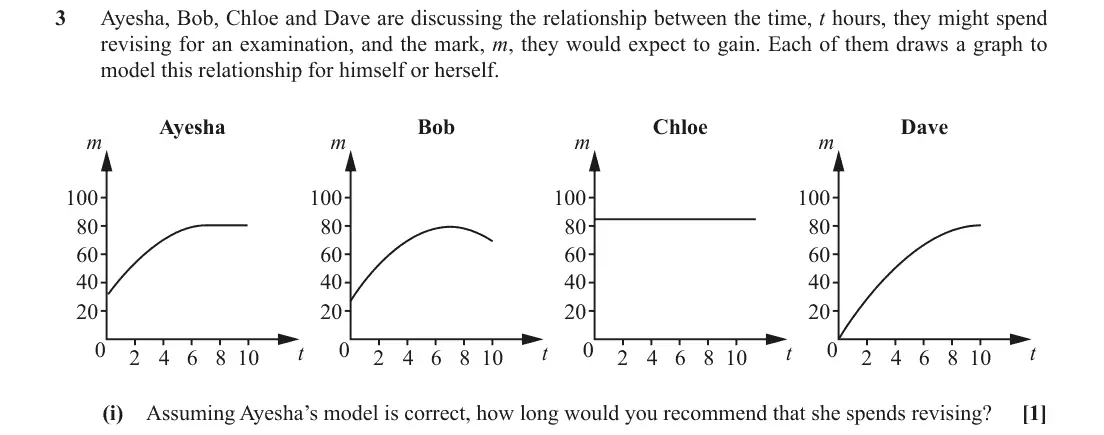
about 7 hours (6 to 8) where Ayesha's graph levels off
June 2018 · Paper 2 · Q3(ii)1 markEasy
Show the start of this question
Mark scheme for this part
Examiner's comment
Most candidates gave a good answer. A few candidates gave an answer appropriate for part (iii) rather than (ii).
Key points and common errors
Dave's graph gives m = 0 when t = 0, i.e. no marks without revision
June 2018 · Paper 2 · Q3(iii)1 markEasy
Show the start of this question
Mark scheme for this part
Examiner's comment
Most candidates gave a good answer. A few merely described the shape rather than suggesting a reason.
Key points and common errors
too much revision causes tiredness or stress so the mark falls
must give a reason, not just describe the shape
June 2018 · Paper 2 · Q3(iv)1 markEasy
Show the start of this question
Mark scheme for this part
Examiner's comment
Most candidates gave a good answer.
Key points and common errors
horizontal line: revision makes no difference to her mark
June 2018 · Paper 3 · Q23 marksEasy
Mark scheme for this part
Examiner's comment
This question was answered extremely well with nearly all candidates correctly solving this equation involving the modulus function. Of the two main methods for solving this type of equation the first, which involved re-writing as ( ) ( ) 2 x − 1 = x + 3 was far more successful than those candidates who decided to re-write as two linear equation as many made sign errors even though most started from the correct two equations ( ) ( ) 2 x − 1 = ± x + 3 .
Key points and common errors
square both sides: 3x² − 10x − 8 = 0 so x = 4 or −2/3
squaring is more reliable than two linear equations (2x − 1) = ±(x + 3)
June 2018 · Paper 3 · Q4(i)(a)1 markEasy
Mark scheme for this part
Examiner's comment
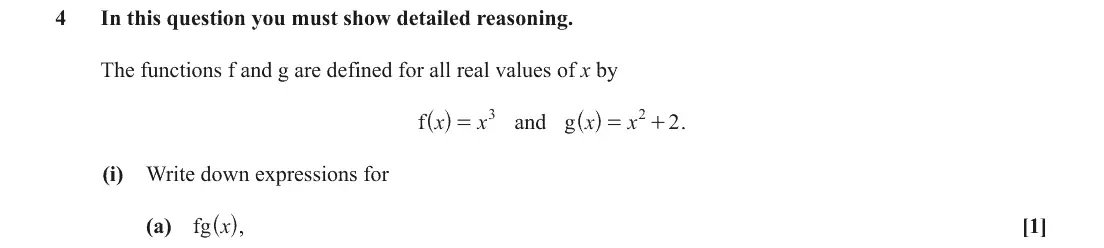
(Comment on Question 04(i) as a whole) Nearly all candidates correctly found the composite function fg(x) as ( ) x + 2 although a number did expand the bracket in this part. Candidates are reminded that the number of marks available for a question or part-question are the best indicators to the amount of working and detail that is required. Once again this was nearly always done correctly with the most common errors being those minority of candidates who stated that ( ) x was equal to either x or x .
Key points and common errors
fg(x) = (x² + 2)³
expansion not needed for 1 mark
June 2018 · Paper 3 · Q4(i)(b)1 markEasy
Mark scheme for this part
Examiner's comment
(Comment on Question 04(i) as a whole) Nearly all candidates correctly found the composite function fg(x) as ( ) x + 2 although a number did expand the bracket in this part. Candidates are reminded that the number of marks available for a question or part-question are the best indicators to the amount of working and detail that is required. Once again this was nearly always done correctly with the most common errors being those minority of candidates who stated that ( ) x was equal to either x or x .
Key points and common errors
gf(x) = (x³)² + 2 = x⁶ + 2
June 2018 · Paper 3 · Q4(ii)6 marksMedium
Show the start of this question
Mark scheme for this part
Examiner's comment
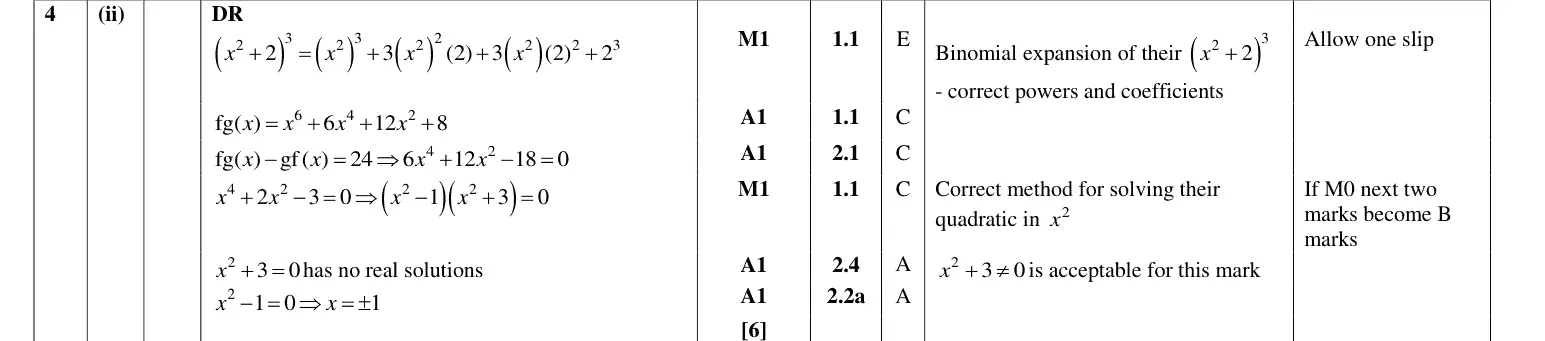
There were a significant number of candidates that did not employ correct bracketing and mistakenly wrote( ) rather than( ) ( ) ( ) x + 2 − x + 2 = 24 x + 2 − x + 2 = 24 ⇒ x + 2 − x − 2 = 24 . The majority of candidates went for expanding ( ) x + 2 by writing out the bracket three times rather than using the binomial expansion of ( a + b ) . While the majority rearranged their quartic into the form ( ) + 6 x 12 x − 18 = 0 there were a number of candidates did not show sufficient working in solving this quartic, even though the full question required detailed reasoning. Finally, it is expected at this level that as part of the detailed reasoning candidates should justify why x + 3 = 0 did not provide any solutions.
Key points and common errors
expand (x² + 2)³ = x⁶ + 6x⁴ + 12x² + 8
brackets needed when subtracting gf(x)
6x⁴ + 12x² − 18 = 0
(x² − 1)(x² + 3) = 0
reject x² = −3 explicitly
x = ±1
Find an A-level maths tutor
Stuck on this? Book a trial session with an A-level maths tutor.