17 question parts, 59 marks, each rated Easy, Medium or Hard from the wording of the examiners' report
Notes, worked examples and practice for this topic are being written by our tutors. The past-paper questions below are ready now: work each one on paper, then open the mark scheme and the examiner's comment.
Tap a question to zoom it. Mark scheme and examiner's comment open under each question.
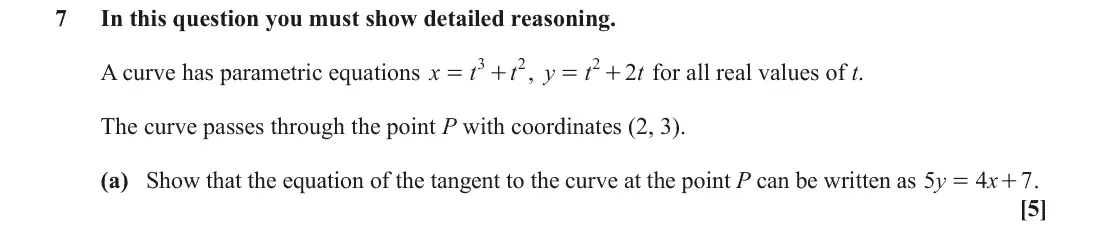
June 2025 · Paper 1 · Q7(a)5 marksEasy
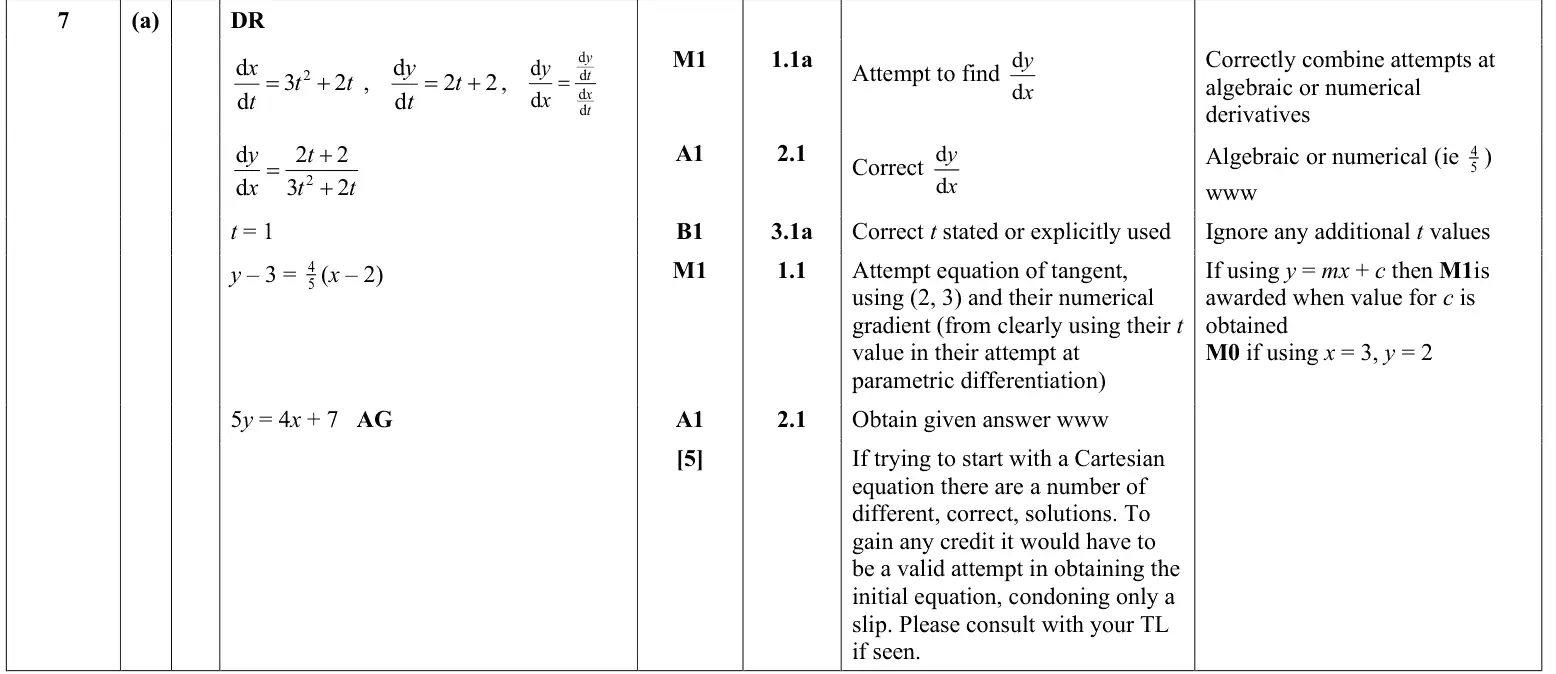
Mark scheme for this part
Examiner's comment
This part of the question was very well answered, with the majority of candidates gaining full credit. They were able to accurately use parametric differentiation to find an expression for the derivative. Candidates were then able to find the correct t-value using a variety of different approaches, and most also justified why any other t-values found were not valid. In ‘show that’ questions it is important that candidates show sufficient method so as to be convincing, especially when the answer is given. Most candidates did show explicit method of using the correct t-value in the correct derivative to obtain the correct gradient However some candidates attempted to work backwards from the given answer and they generally struggled to a provide any evidence that could gain credit. When attempting the equation of a tangent, candidates should be using a numerical gradient which did not always happen.
Key points and common errors
dy/dx = (2t + 2)/(3t² + 2t)
t = 1 at P, gradient 4/5
5y = 4x + 7
justify the t value
June 2025 · Paper 1 · Q7(b)4 marksMedium
Show the start of this question
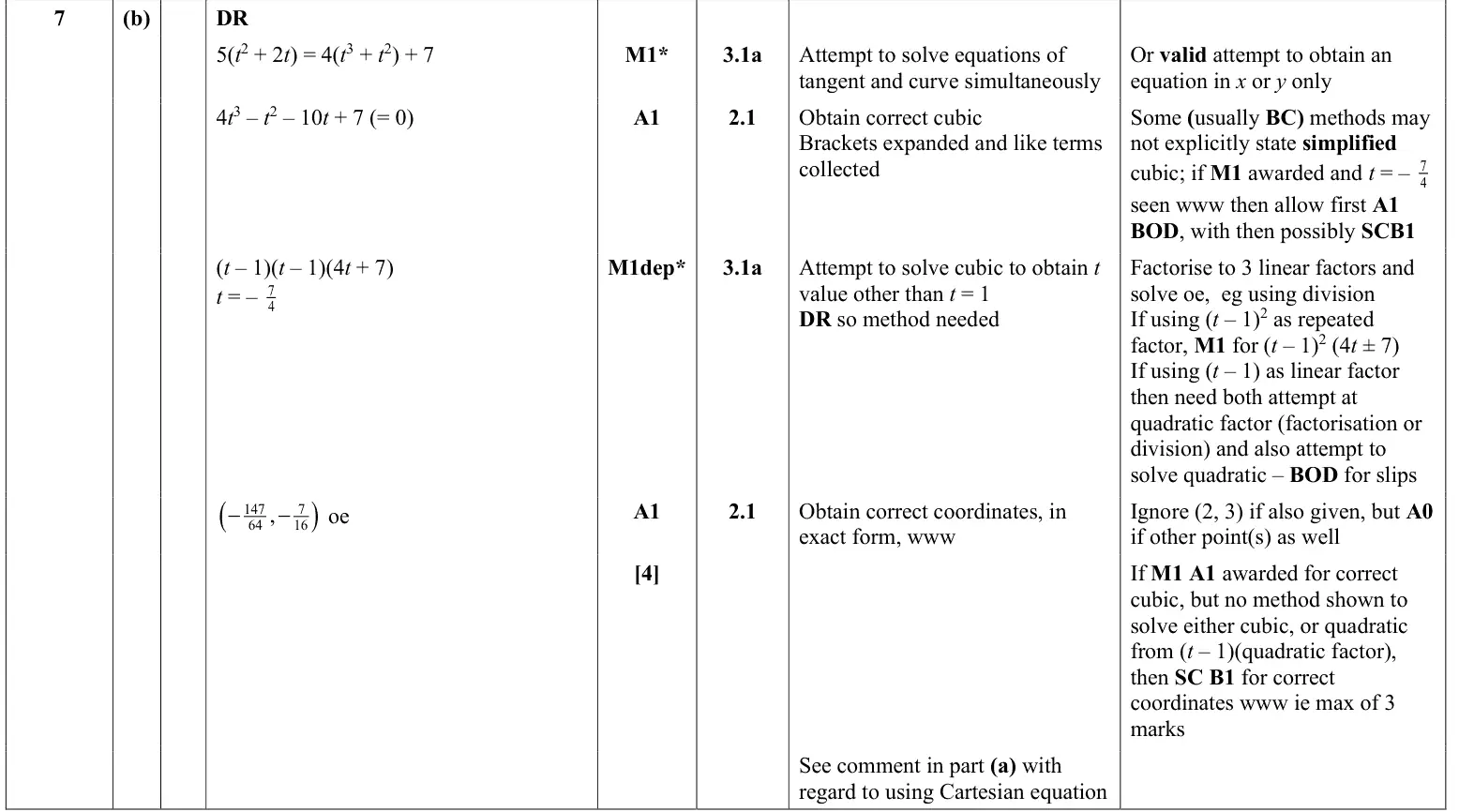
Mark scheme for this part
Examiner's comment
It was expected that candidates would attempt to solve the equations of the tangent and the curve simultaneously to obtain an equation in t only, and many were able to do so. It was then expected that candidates would recognise that the tangent should have a repeated root at t = 1, and use this to solve the cubic equation to find the other t-value. Candidates should appreciate that method needs to be shown, as the command word used was ‘determine’ along with a ‘detailed reasoning’ instruction for the entire question. Many candidates were indeed able to show a convincing method, through repeated division by (t – 1), inspection or an equivalent method, all of which tended to be effective. A number of candidates seemingly solved the cubic equation on their calculator instead. Some candidates simply stated the t-values whereas others did try to work backwards to produce the required factors but this was rarely successful due to the calculator not identifying a repeated root. Having found the other t-value, through whatever method used, candidates were then usually able to give the correct coordinates in an exact form although a few did instead give a rounded decimal value. A surprisingly common error was to equate the gradient of the curve, in terms of t, to the gradient of the tangent i.e. attempting to find other points on the curve that would have tangents parallel to the one already found. A minority of candidates attempted to first find a Cartesian equation for the curve, either in this part of the question or continuing with an equation attempted in part (a). This was rarely successful, and candidates should consider the most effective and efficient method when attempting a question. While some previous questions on parametric equations may have requested the Cartesian equation, this is usually the final part of the question as opposed to the starting point.
Key points and common errors
substitute parametric x, y into tangent: 4t³ − t² − 10t + 7 = 0
(t − 1) is a repeated factor
t = −7/4 gives (−147/64, −7/16)
method must be shown
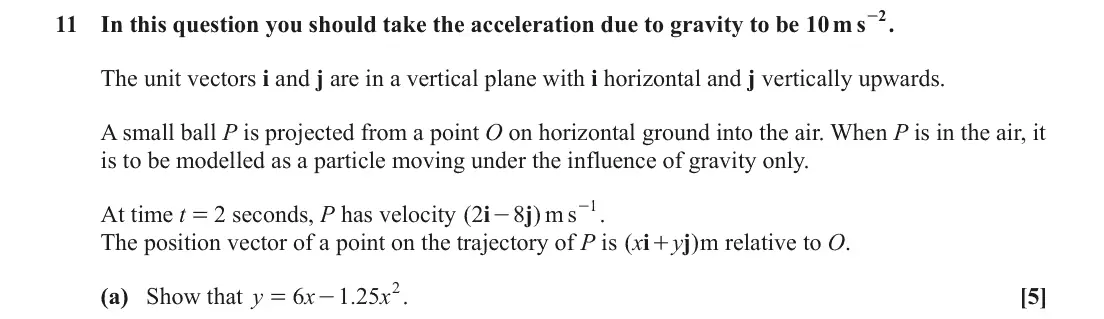
June 2025 · Paper 3 · Q11(a)5 marksHard
Mark scheme for this part
Examiner's comment
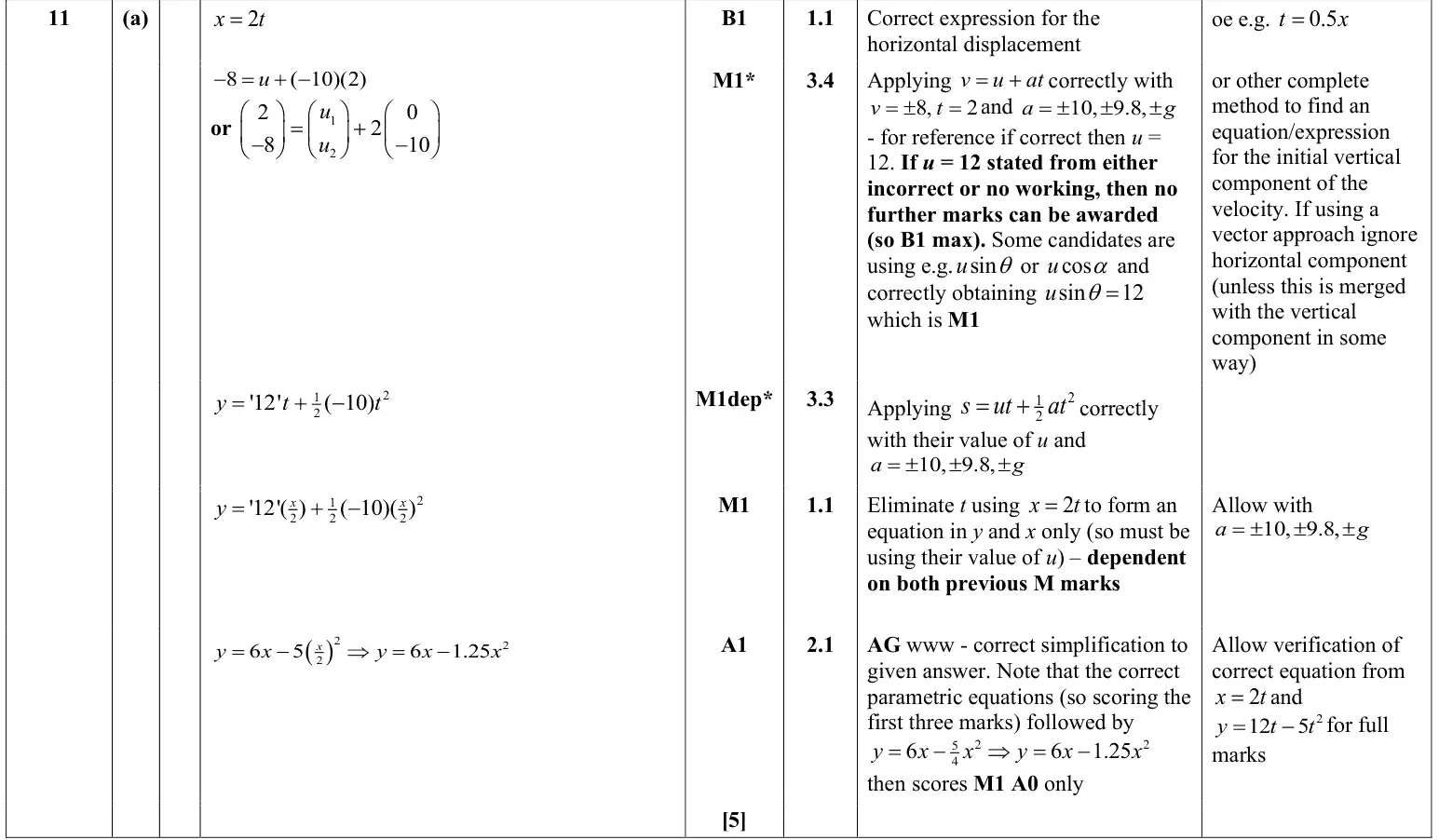
Candidates found this part very demanding with many making little progress beyond stating that 𝑥= 2𝑡. Of those that realised that the initial vertical component of velocity could be found by applying 𝑣= 𝑢+ 𝑎𝑡 with 𝑣= −8, 𝑎= −10 and 𝑡= 2, most were successful in obtaining the given cartesian equation by applying 𝑠= 𝑢𝑡+ 2 𝑎𝑡2 vertically and then eliminating 𝑡. Even though the question made it very clear that in this question candidates should use 𝑔= 10, many still used a value of 9.8. It must also be noted that examiners found some candidates’ work extremely hard to follow (throughout the entirety of this question) due to poor notation when it came to dealing with vector and scalar quantities with statements such as 2𝐢−8𝐣= 𝑢+ 2(−10) being sadly all too common.
Key points and common errors
x = 2t
v = u + at vertically: −8 = u − 20 so u = 12
y = 12t − 5t²
eliminate t to get y = 6x − 1.25x²
June 2024 · Paper 1 · Q12(a)5 marksHard
Mark scheme for this part
Examiner's comment
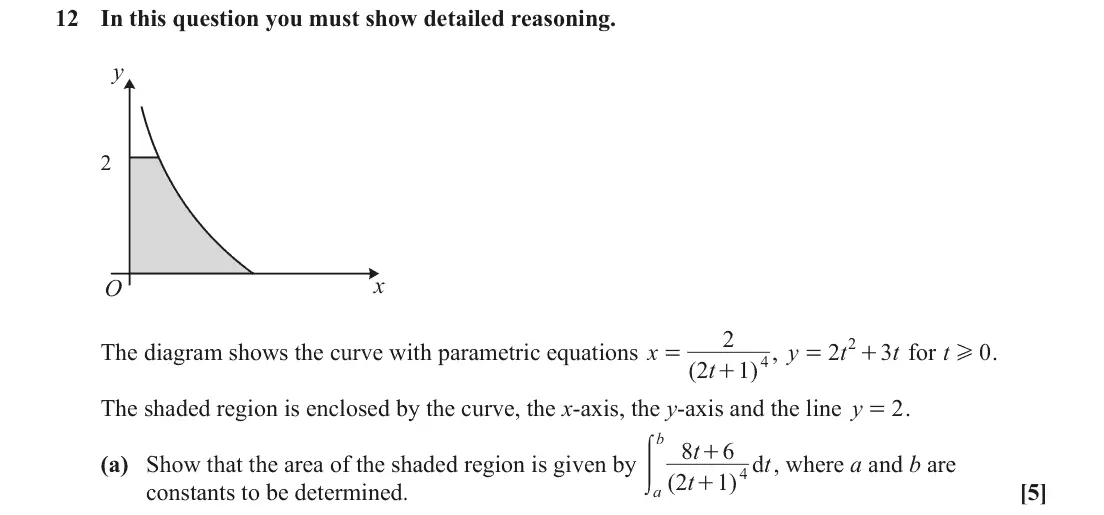
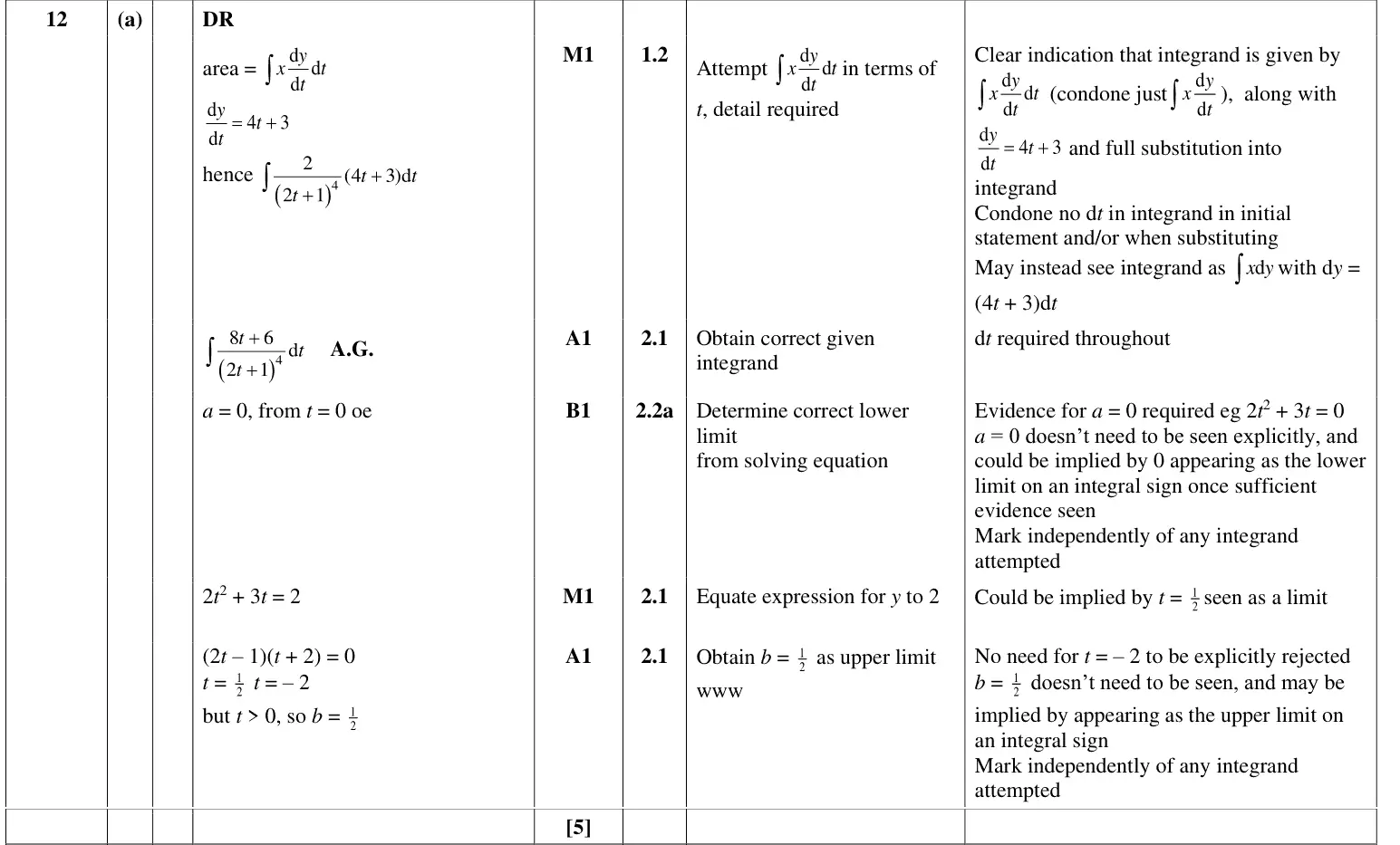
This question was challenging for most candidates to gain all the marks. Most candidates were able to achieve the method mark for equating the y equation to 2 to find the upper limit. These candidates often also equated y to 0 and solved both equations for t to find the correct limits, although the incorrect values from these equations were often chosen. Many candidates did not know how to find the area between a parametric curve and the y-axis and often set about forming the ∫𝑦 𝑑𝑡 𝑑𝑡, with little success in obtaining the given answer. Some candidates were able to work out how to arrive at the given expression inside the integral, but their reasoning was insufficient for the requirements of the question.
Key points and common errors
area to the y-axis = ∫x (dy/dt) dt with dy/dt = 4t + 3
a = 0 from y = 0
2t² + 3t = 2 gives b = ½ (t ≥ 0)
many used ∫y dx/dt dt
June 2024 · Paper 3 · Q6(a)2 marksHard
Mark scheme for this part
Examiner's comment
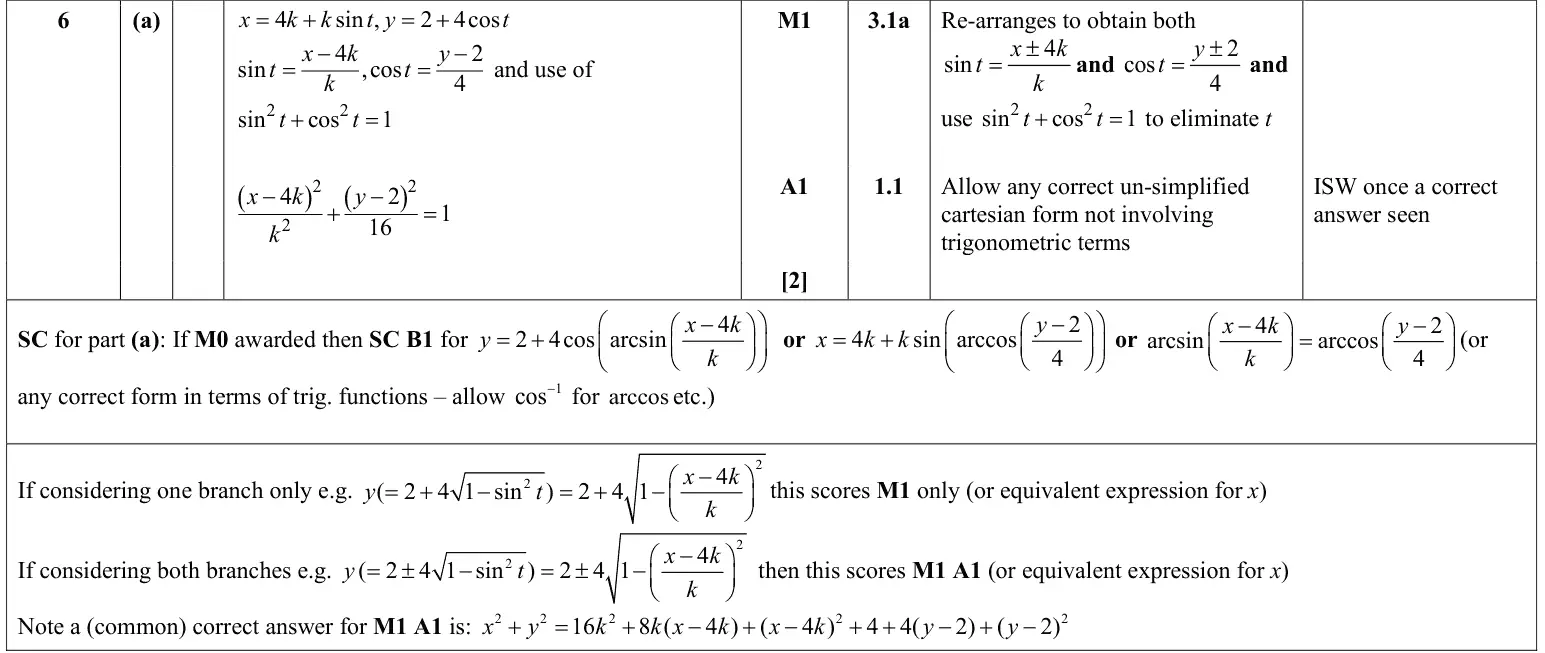
Question 6 was the least well-answered question on the paper (most likely due to the unfamiliarity of applying parametric equations in such a context). It was rare to see candidates adopting the correct method of applying sin2𝑡+ cos2𝑡= 1 to obtain the cartesian equation = 1. Most + candidates, who did obtain a cartesian equation, usually included one of arcsin or arccos, e.g. 𝑦= 2 + 4 cos (arcsin( 𝑘)) which gained some credit but could not score full marks as these forms did not fully define the curve 𝐶.
Key points and common errors
sin t = (x − 4k)/k, cos t = (y − 2)/4 and sin²t + cos²t = 1: (x − 4k)²/k² + (y − 2)²/16 = 1
arcsin/arccos forms only SC
least well answered question
June 2024 · Paper 3 · Q6(b)(i)2 marksHard
Show the start of this question
Mark scheme for this part
Examiner's comment
Most candidates left this part blank or made very little progress (especially if arcsin or arccos had been used in the previous part). Of those who had used sin2𝑡+ cos2𝑡= 1 in part (a), many did not recognise the condition that for 𝐶 to be a circle that 𝑘2 = 16 and hence that the radius was 4.
Key points and common errors
circle requires k² = 16
radius 4 (positive only)
June 2024 · Paper 3 · Q6(b)(ii)2 marksHard
Show the start of this question
Mark scheme for this part
Examiner's comment
This was similar to the previous part, in that very few candidates attempted this part and of those who did very few got the correct (two) answers. Of those that did make some progress, many gave a single answer in terms of 𝑘 (most notably (4𝑘, 2)).
Key points and common errors
k = ±4 gives centres (16, 2) and (−16, 2)
a single answer (4k, 2) is incomplete
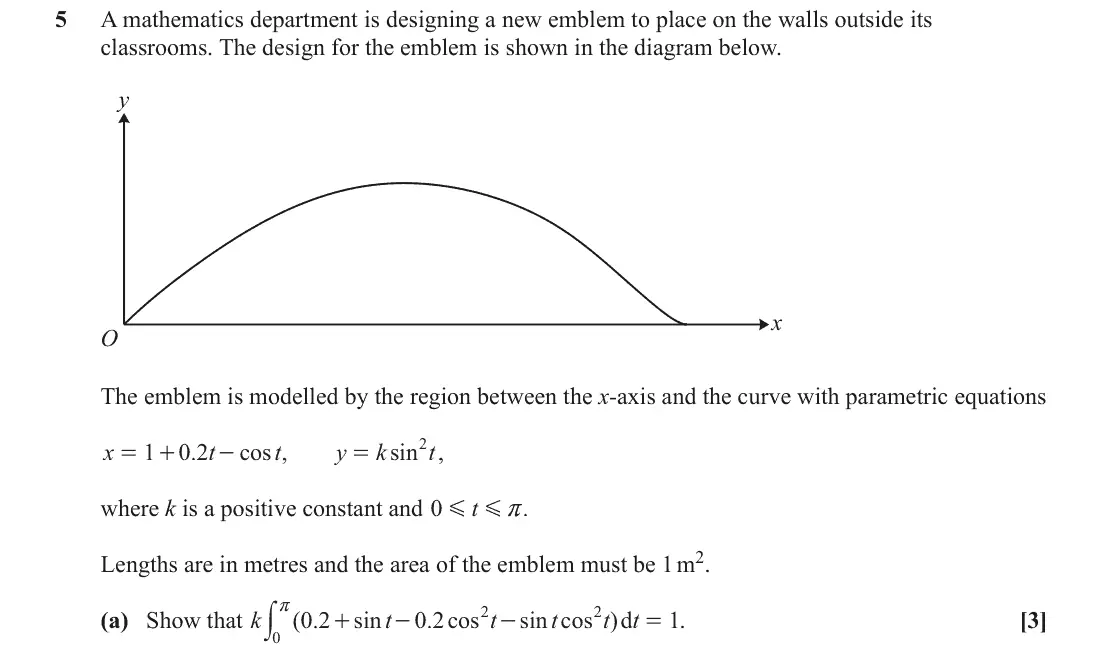
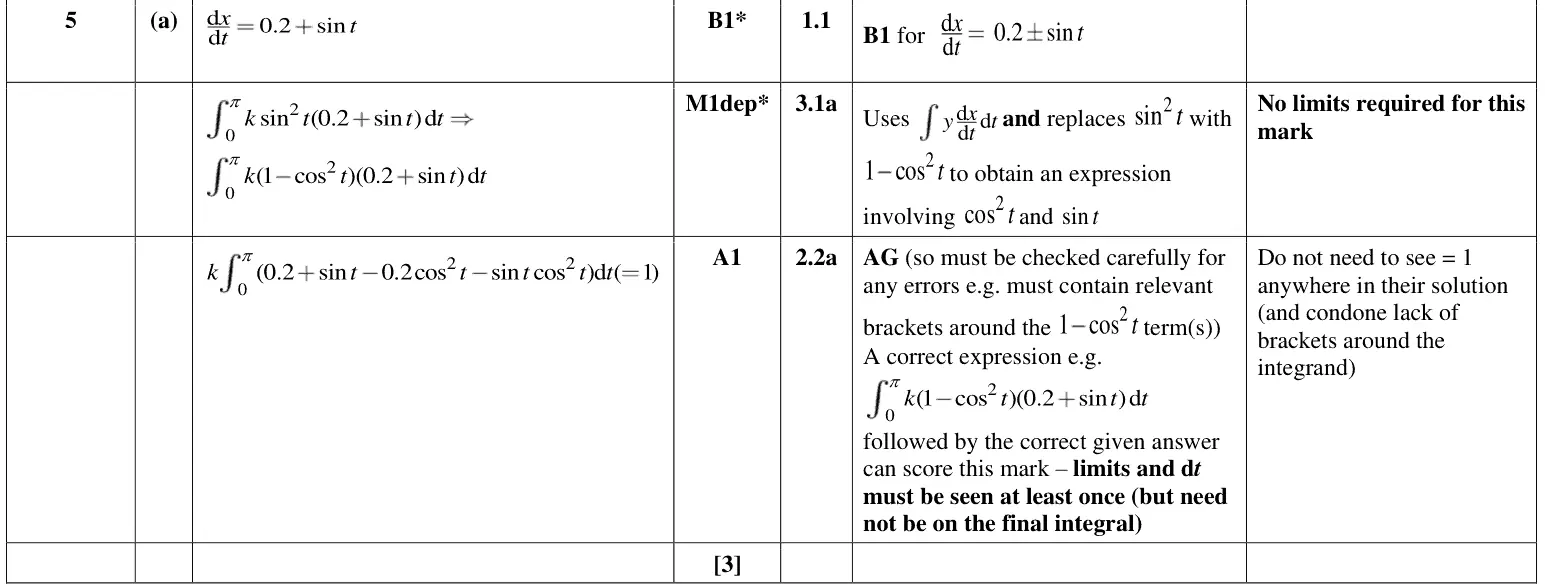
June 2023 · Paper 3 · Q5(a)3 marksHard
Mark scheme for this part
Examiner's comment
Candidates struggled with both parts of this question with examiners noting that many candidates gave the impression that they were unsure what either part of this question required of them. Some d𝑡𝑡 but only the most able could apply ∫𝑦𝑦 d𝑡𝑡d𝑡𝑡 correctly and derive the given result. candidates in part (a) made a correct start by finding the correct expression for
Key points and common errors
area = ∫ y (dx/dt) dt with dx/dt = 0.2 + sin t and limits 0 to π
replace sin²t by 1 − cos²t
reach the given integral with limits and dt
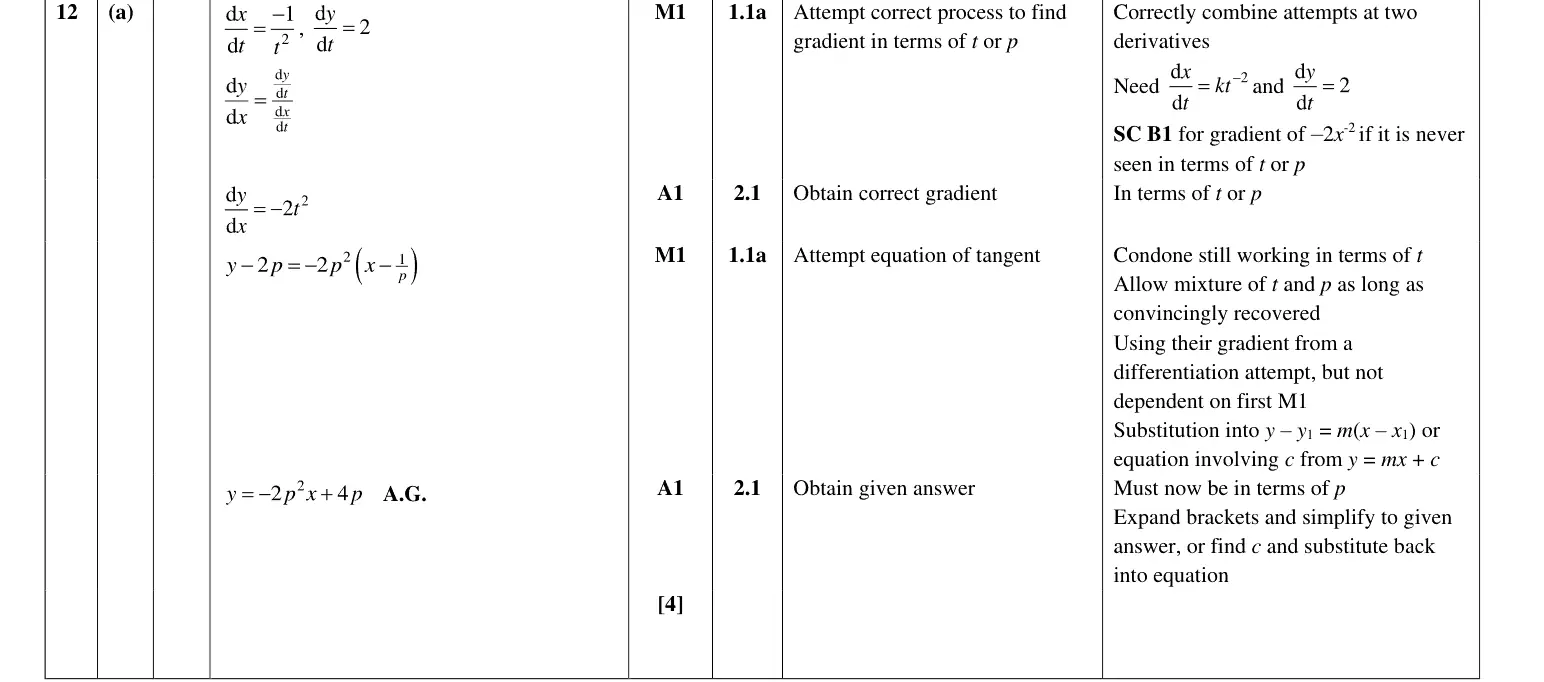
June 2022 · Paper 1 · Q12(a)4 marksEasy
Mark scheme for this part
Examiner's comment
The majority of candidates gained full marks on this part of the question, and it was only a small minority that made no progress. The first 2 marks could be gained by finding a correct expression for the gradient, either in terms of t or p. Most candidates could then attempt the equation of the tangent, but a number struggled to use the same parameter consistently. With a given answer, there is an expectation that method is clearly shown, and most candidates did so.
Key points and common errors
dy/dx = (dy/dt)/(dx/dt) = −2t²
tangent at P: y − 2p = −2p²(x − 1/p) gives y = −2p²x + 4p
use one parameter consistently
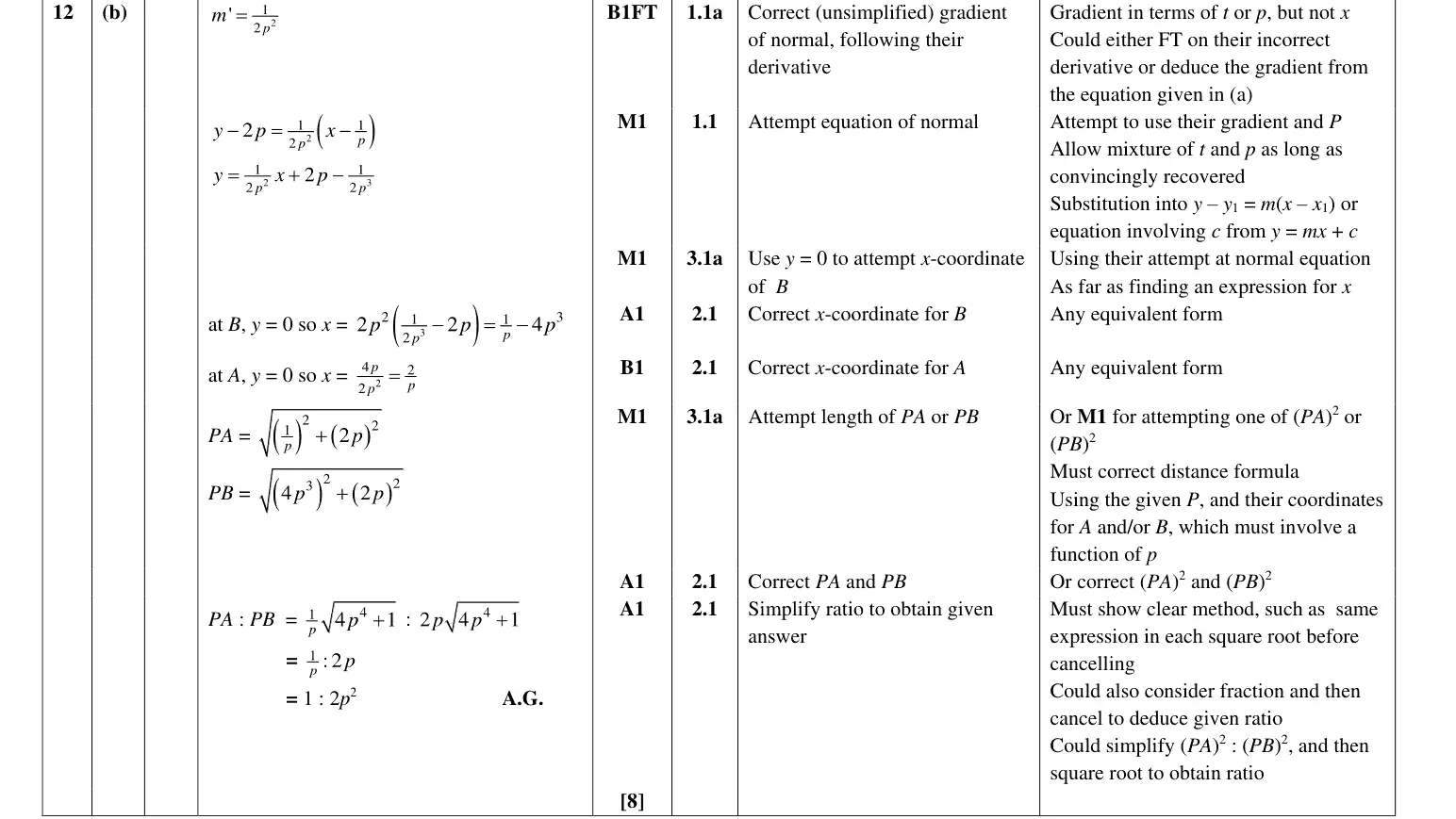
June 2022 · Paper 1 · Q12(b)8 marksHard
Show the start of this question
Mark scheme for this part
Examiner's comment
This proved to be a suitable challenging end to the paper, and fully correct solutions were in the minority. A number of candidates made no attempt at all at this part of the question, although it was unclear whether they were lacking inspiration or had run out of time. Of the remainder, most were able to make a reasonable attempt at finding the coordinates of A and B, though a number struggled with the algebraic manipulation required. Some candidates did not realise that it was the ratio of lengths that was required, and made no progress on the final 3 marks. When attempting the ratio, some candidates simplified both surds to a common factor, others attempted a division or demonstrated the veracity of the given answer, all with convincing use of algebra.
Key points and common errors
normal gradient 1/(2p²)
A at x = 2/p, B at x = 1/p − 4p³
PA = (1/p)√(4p⁴ + 1), PB = 2p√(4p⁴ + 1) so PA:PB = 1:2p²
ratio of lengths, not coordinates
Autumn 2021 · Paper 1 · Q9(a)1 markHard
Mark scheme for this part
Examiner's comment
(From the general report) Question 9, covering aspects of parametric equations, proved challenging for a significant proportion of candidates. Question 9 highlighted confusion about when to use x = 0 or y = 0 when investigating the path of a particle defined parametrically.
Key points and common errors
y = 2e^(−3t) > 0 for all t so y is never 0
must refer to y
Autumn 2021 · Paper 1 · Q9(b)2 marksHard
Show the start of this question
Mark scheme for this part
Examiner's comment
(From the general report) Question 9, covering aspects of parametric equations, proved challenging for a significant proportion of candidates. Question 9 highlighted confusion about when to use x = 0 or y = 0 when investigating the path of a particle defined parametrically.
Key points and common errors
crossing y-axis means x = 0 (confusion with y = 0 common)
(eᵗ − 1)(eᵗ − 3) = 0
t = 0 and t = ln 3
ln 1 must be simplified
Autumn 2021 · Paper 1 · Q9(d)3 marksHard
Show the start of this question
Mark scheme for this part
Examiner's comment
(From the general report) Question 9, covering aspects of parametric equations, proved challenging for a significant proportion of candidates. Question 9 highlighted confusion about when to use x = 0 or y = 0 when investigating the path of a particle defined parametrically.
Key points and common errors
parallel to y-axis when denominator 2e^(4t) − e^(5t) = 0
t = ln 2
(−1, ¼)
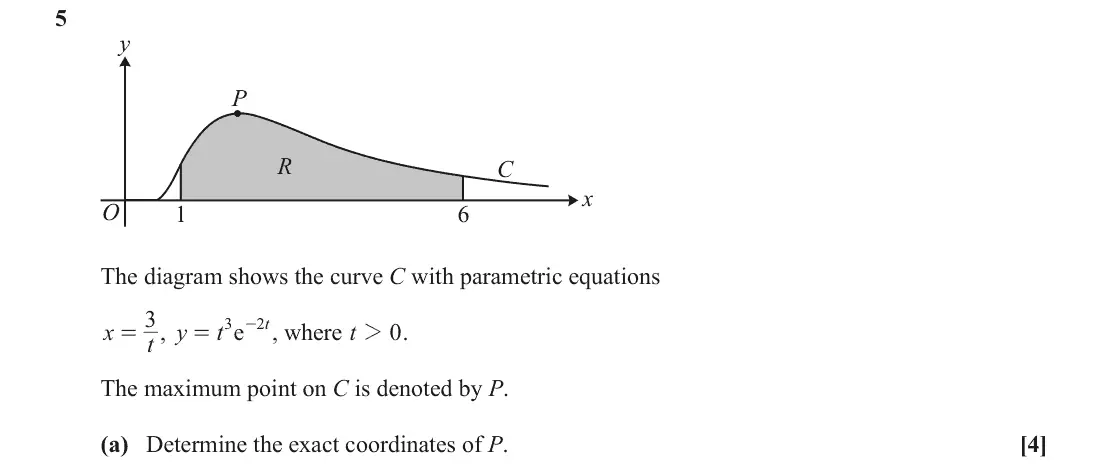
Autumn 2020 · Paper 3 · Q5(a)4 marksMedium
Mark scheme for this part
Examiner's comment
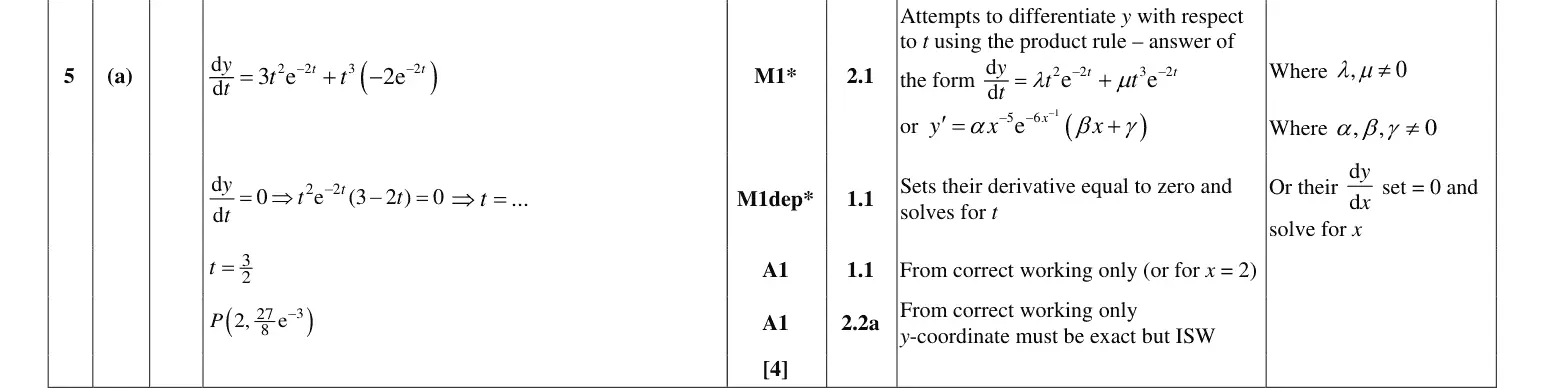
(Comment on Question 05 as a whole) Unless explicitly requested, candidates should avoid converting parametric equations into the cartesian form due to the complexity. d y In part (a) candidates only needed to determine where t = 0 . Unfortunately, some candidates made d errors in the denominator when finding d y x , and while this may not impact the numerical answer d obtained, there is a standard principle that answers obtained with wrong working will not gain full credit. The other issue with this question was that the ‘exact coordinates of P ’ was needed, those candidates that provided a decimal approximation would not gain full credit (unless the exact value had been seen as part of the working). The first issue with part (b) was that the limits were given on the diagram as x = and 1 , but the x = 6 integration was to be done with respect to t ; a number of candidates did not spot this. This was a ‘Show that’ question so the initial method mark was to find d x t and to show a clear attempt to use this in d d d x ∫ y t . The final accuracy mark was to rearrange into the given form. d t Part (c) involved using the formula given in part (b) to ‘Hence’ determine the area. Generally, this was done well, with candidates correctly giving their answer in ‘exact’ form in terms of e .
Key points and common errors
dy/dt = 3t²e⁻²ᵗ − 2t³e⁻²ᵗ = 0 so t = 3/2
P(2, (27/8)e⁻³) exact
no need to convert to cartesian
Autumn 2020 · Paper 3 · Q5(b)3 marksMedium
Show the start of this question
Mark scheme for this part
Examiner's comment
(Comment on Question 05 as a whole) Unless explicitly requested, candidates should avoid converting parametric equations into the cartesian form due to the complexity. d y In part (a) candidates only needed to determine where t = 0 . Unfortunately, some candidates made d errors in the denominator when finding d y x , and while this may not impact the numerical answer d obtained, there is a standard principle that answers obtained with wrong working will not gain full credit. The other issue with this question was that the ‘exact coordinates of P ’ was needed, those candidates that provided a decimal approximation would not gain full credit (unless the exact value had been seen as part of the working). The first issue with part (b) was that the limits were given on the diagram as x = and 1 , but the x = 6 integration was to be done with respect to t ; a number of candidates did not spot this. This was a ‘Show that’ question so the initial method mark was to find d x t and to show a clear attempt to use this in d d d x ∫ y t . The final accuracy mark was to rearrange into the given form. d t Part (c) involved using the formula given in part (b) to ‘Hence’ determine the area. Generally, this was done well, with candidates correctly giving their answer in ‘exact’ form in terms of e .
Key points and common errors
area = ∫ y (dx/dt) dt with dx/dt = −3/t²
x = 1 ↔ t = 3, x = 6 ↔ t = 0.5
swap limits to remove the minus sign
many kept x-limits
June 2019 · Paper 2 · Q3(a)(i)2 marksMedium
Mark scheme for this part
Examiner's comment
Many candidates found the standard cartesian form of the equation, although a few made sign errors. Some began with ( ) ( ) x − a + y − b = r and attempted to find the values of a, b and r. Some found a and b correctly, but not r. x − 3 y + 4 Other candidates gave clumsy, but correct, alternative forms such as cos = sin 2 2 x − 3 x − 3 or y = −+ 4 2sin cos or y = −+ 4 2 1 − . 2 2 Some candidates gave answers that were correct equations in themselves, but involved a mixture of x , ( ) y and θ , for example y = x − 3 tan θ − 4 or x − 3 − 2cos θ = y + 4 − 2sin θ Some candidates started by finding x + y , which unfortunately leads nowhere. Disappointingly, many of these candidates also squared incorrectly, such as ( 3 + 2cos θ ) = 9 + 4cos θ A significant number of candidates did not recognise that the key to this problem is the identity sin θ + cos θ = 1 . Some candidates (perhaps a reflex triggered by anything involving parametric equations) found d y x by dividing d y by d x . d dθ dθ
Key points and common errors
use cos²θ + sin²θ = 1: (x − 3)² + (y + 4)² = 4
sign errors
answers mixing x, y and θ
June 2018 · Paper 1 · Q10(iii)4 marksMedium
Mark scheme for this part
Examiner's comment
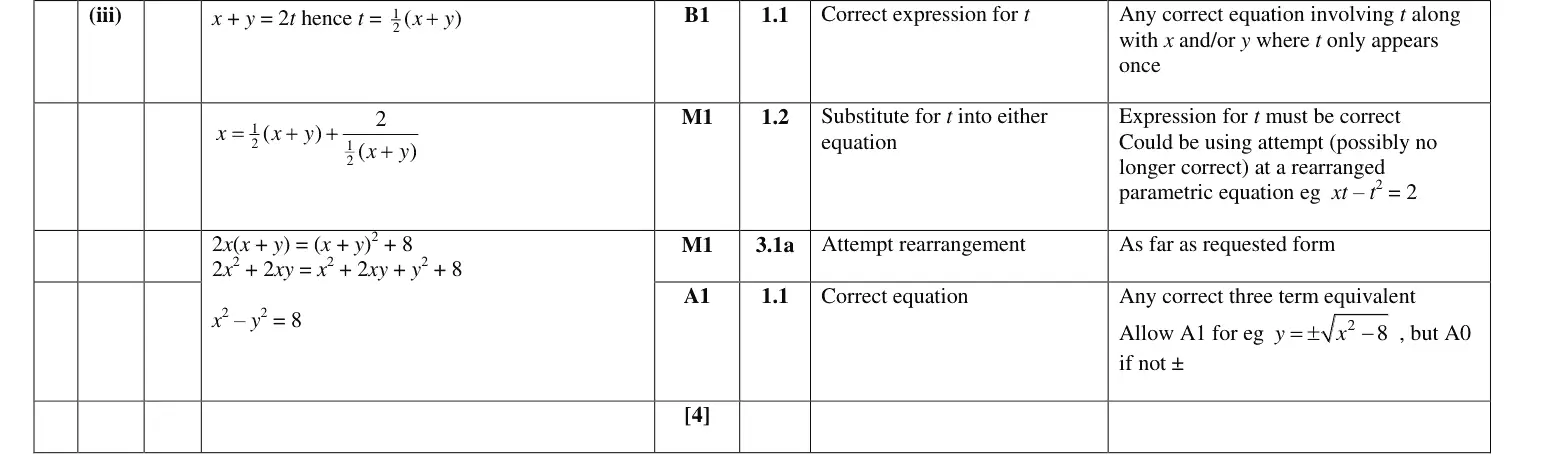
Many candidates were able to use the hint given in the question to produce x + y = 2t but a number were then unsure how to make any further progress. Others appreciated that they could now use this equation to eliminate t from one of the given parametric equations, but errors when rearranging to the requested from were common, demonstrating a lack of confidence when dealing with algebraic fractions. A minority of candidates ignored the hint given in the question, and attempted to use an alternative method such as rearranging to t 2 – xt + 2 = 0, solving for t and substituting into the other equation. Whilst some progress was usually made, these attempts were rarely fully correct. The most elegant solution, provided by a few candidates, was to consider both x + y and x – y to produce two equations from which 2t could then be easily eliminated.
Key points and common errors
x + y = 2t
substitute t = ½(x + y)
x² − y² = 8
errors with algebraic fractions
Find an A-level maths tutor
Stuck on this? Book a trial session with an A-level maths tutor.