42 question parts, 101 marks, each rated Easy, Medium or Hard from the wording of the examiners' report
Notes, worked examples and practice for this topic are being written by our tutors. The past-paper questions below are ready now: work each one on paper, then open the mark scheme and the examiner's comment.
Tap a question to zoom it. Mark scheme and examiner's comment open under each question.
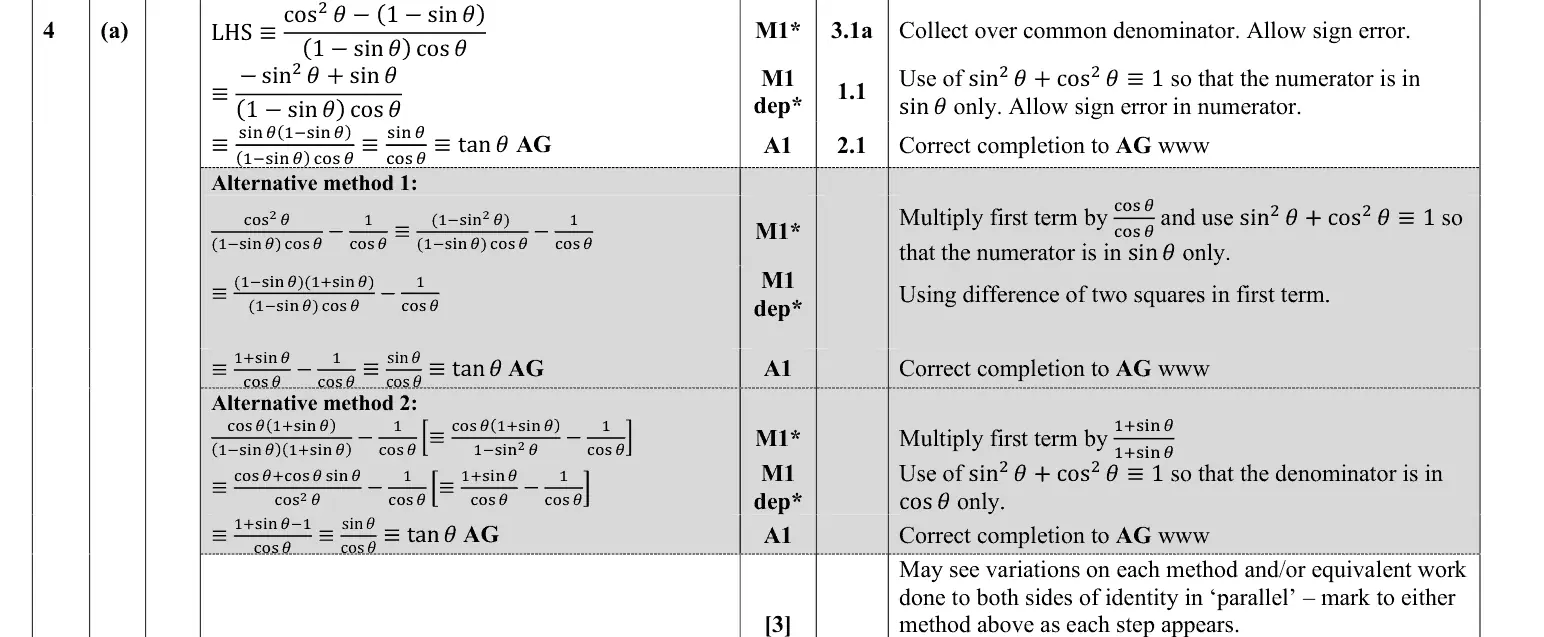
June 2025 · AS Paper 1 · Q4(a)3 marksMedium
Mark scheme for this part
Examiner's comment
A minority of candidates made no progress with this question, offering either ‘circular’ working or misquoting identities (e.g. suggesting that sin 𝜃+ cos 𝜃= 1). Of those who did make progress, most used the main method in the scheme (combining the two terms over a common denominator) and this was generally successful. The two alternative methods were seen less often, although both provide neat routes to the answer. As is often the case, this proof required candidates to use both of the trigonometric identities on this specification. It might be helpful to remind candidates that these two identities are available to them, and that a good starting point is often looking for opportunities to use them. Some candidates attempted to combine the two fraction terms without first finding a common denominator, scoring M0M0. Candidates who attempted to ‘work backwards’ from the RHS of the given identity rarely obtained a creditable proof. This is of course an acceptable method (as is working on both sides of the identity in ‘parallel’) but candidates should be reminded to demonstrate every step of their working so that their proof is sufficiently rigorous. As is typical on these questions, an error in the working leading to the answer resulted in A0 for the final mark. This is a good response of a candidate who (after some crossed-out working on the left-hand side) obtains full marks for a correct and complete proof. All of the required working is seen, and each step is clear in the candidate’s working. This received 3/3 marks.
Key points and common errors
common denominator (1 − sin θ)cos θ
cos²θ = 1 − sin²θ gives sin θ(1 − sin θ) in the numerator
tan θ
misquoted identities or combining fractions without a common denominator
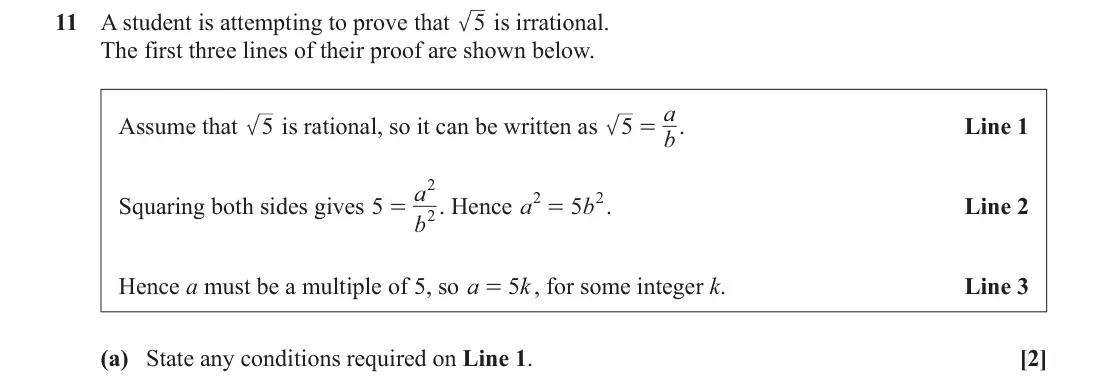
June 2025 · Paper 1 · Q11(a)2 marksMedium
Mark scheme for this part
Examiner's comment
Candidates were usually able to identify the condition that a and b had no common factors (or were coprime or HCF was 1). Stating that a/b could not ‘be further simplified’ was accepted but stating that ‘a/b had no common factors’ was not. The second mark proved to be more challenging; the expected condition was that a and b were positive integers but ‘both integers with b ≠ 0’ was also accepted; while ‘integers’ (or even ‘’whole numbers’) was often seen the exclusion on b was not.
Key points and common errors
a and b positive integers (or integers with b ≠ 0) with no common factors
'integers' alone not enough
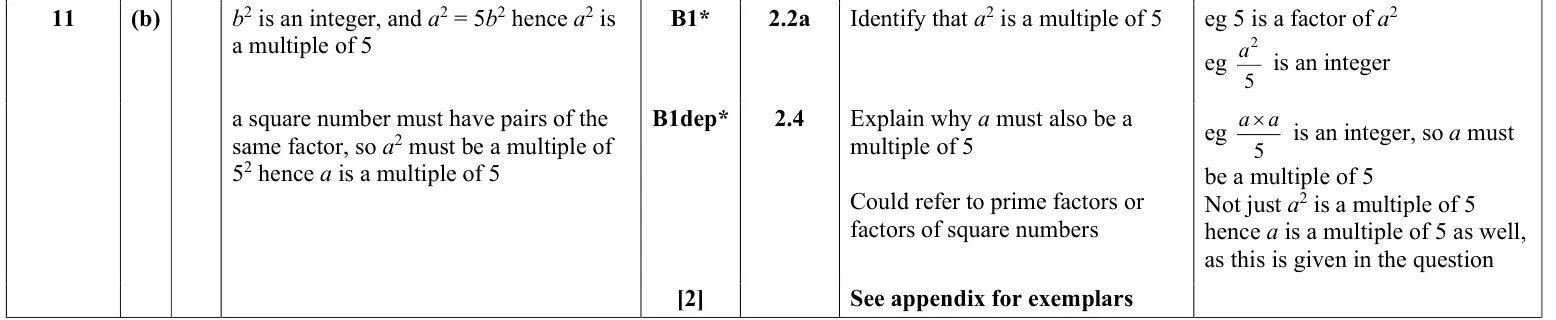
June 2025 · Paper 1 · Q11(b)2 marksHard
Show the start of this question
Mark scheme for this part
Examiner's comment
Many candidates were able to gain 1 mark for identifying, with a reason, that a2 was a multiple of 5. However, only a small proportion of candidates were able to explain why this meant that a was also a multiple of 5. See the appendix notes for Question 11 (b) for the B1dep*. The most common error was for candidates to go straight to a conclusion about a without first considering a2, some of these explanations were convincing but the majority were not. A number of candidates referred to odd and even numbers, suggested that they were well versed in the proof of √2 being irrational but were not sure how to apply this to other questions, nor explaining their reasoning for each step.
Key points and common errors
a² = 5b² so a² is a multiple of 5
5 prime so a is a multiple of 5
jumping straight to a
odd/even arguments from √2
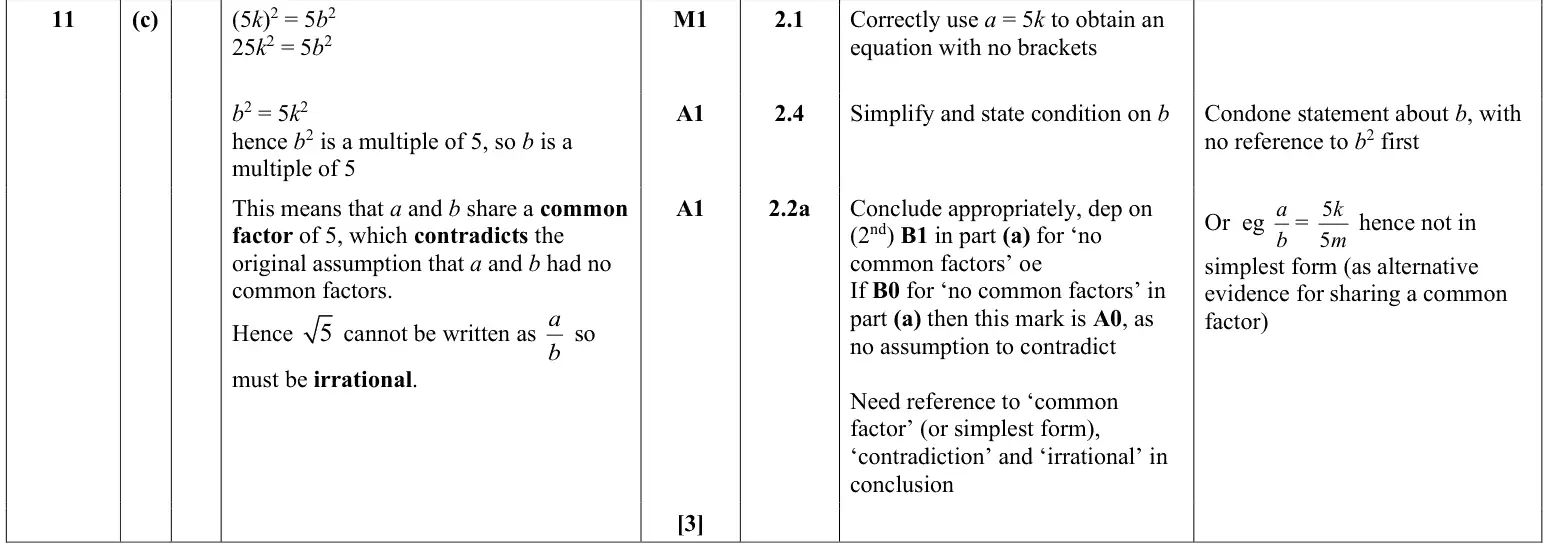
June 2025 · Paper 1 · Q11(c)3 marksMedium
Show the start of this question
Mark scheme for this part
Examiner's comment
While some candidates decided to ignore the statement in Line 3 most did attempt to use the hint provided, although not making effective use of brackets did result in a few cases of an incorrect 5k2 = 5b2 being seen. Once the first mark had been gained, candidates usually also gained the second mark for stating that b must be a multiple of 5. The final mark in this part of the question required candidates to reference the common factors, the contradiction (which also required B1 for no common factors in part (a) to have been given) and the conclusion that √5 was hence irrational. Many candidates were able to provide a complete and convincing proof, but more struggled to do so despite this being a standard specification item.
Key points and common errors
(5k)² = 5b² gives b² = 5k² so b multiple of 5
common factor contradicts assumption
conclude irrational
bracket errors 5k²
June 2025 · Paper 3 · Q6(c)(i)1 markHard
Show the start of this question
Mark scheme for this part
Examiner's comment
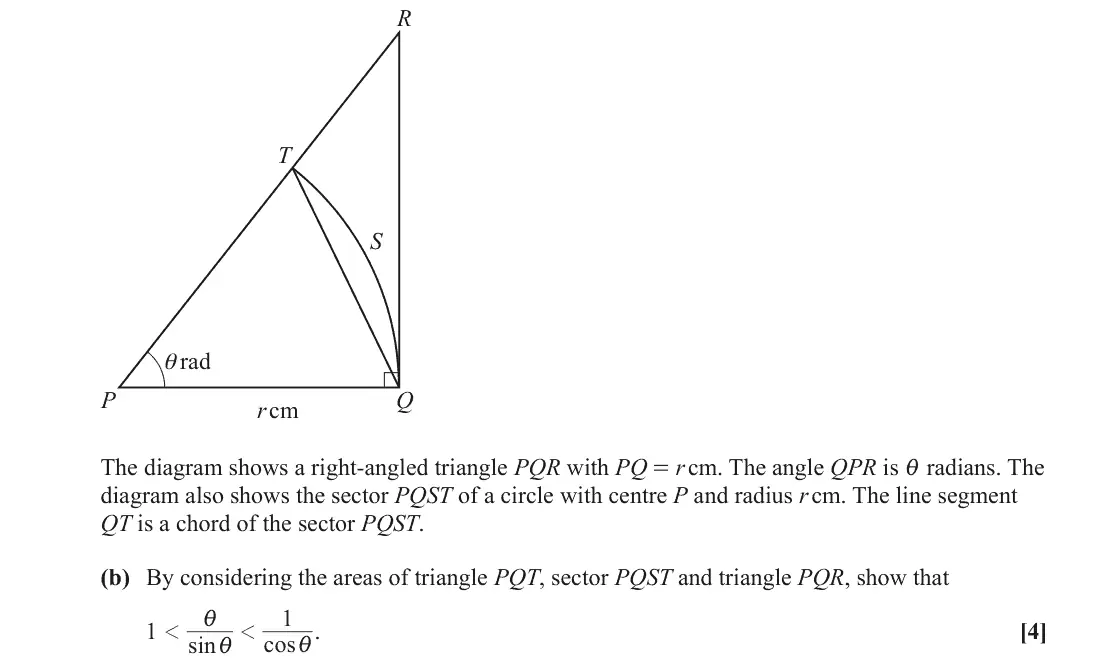
Very few candidates scored the mark in this part with many simply stating that the similar inequality interval was 1 < < cos 𝜃.
Key points and common errors
take reciprocals: cos θ < sin θ/θ < 1 (inequalities reverse)
June 2024 · Paper 1 · Q3(a)1 markHard
Mark scheme for this part
Examiner's comment
Most candidates managed to show a correct product but did not state that the answer was even or not odd. They wrongly assumed it was sufficient to simply show the product. A small number of candidates believed that 1 is a prime number and some found a sum rather than a product of primes. Question 3 (b) (i), (ii) and (iii) Most candidates used the correct type of arrows, although a single stemmed arrow was condoned. (iii) was the most commonly correct answer and (i) the least commonly correct answer of the three. A few candidates left blank answer spaces.
Key points and common errors
2 × 3 = 6, which is even, so a counterexample
must state it is not odd
1 is not prime
June 2024 · Paper 1 · Q3(b)(i)1 markMedium
Mark scheme for this part
Examiner's comment
(From the general report) Question 3 (b) (i), (ii) and (iii) Most candidates used the correct type of arrows, although a single stemmed arrow was condoned. (iii) was the most commonly correct answer and (i) the least commonly correct answer of the three.
Key points and common errors
x² = 3x ⇐ x = 3 (x = 0 is also a solution)
least often correct of the three
June 2024 · Paper 1 · Q3(b)(ii)1 markMedium
Show the start of this question
Mark scheme for this part
Examiner's comment
(From the general report) Question 3 (b) (i), (ii) and (iii) Most candidates used the correct type of arrows, although a single stemmed arrow was condoned. (iii) was the most commonly correct answer and (i) the least commonly correct answer of the three.
Key points and common errors
x > 4 ⇔ x³ > 64
June 2024 · Paper 1 · Q3(b)(iii)1 markEasy
Show the start of this question
Mark scheme for this part
Examiner's comment
(From the general report) Question 3 (b) (i), (ii) and (iii) Most candidates used the correct type of arrows, although a single stemmed arrow was condoned. (iii) was the most commonly correct answer and (i) the least commonly correct answer of the three.
Key points and common errors
x° = 45° ⇒ tan x° = 1 (225° also gives 1)
most often correct
June 2024 · Paper 1 · Q3(c)4 marksHard
Mark scheme for this part
Examiner's comment
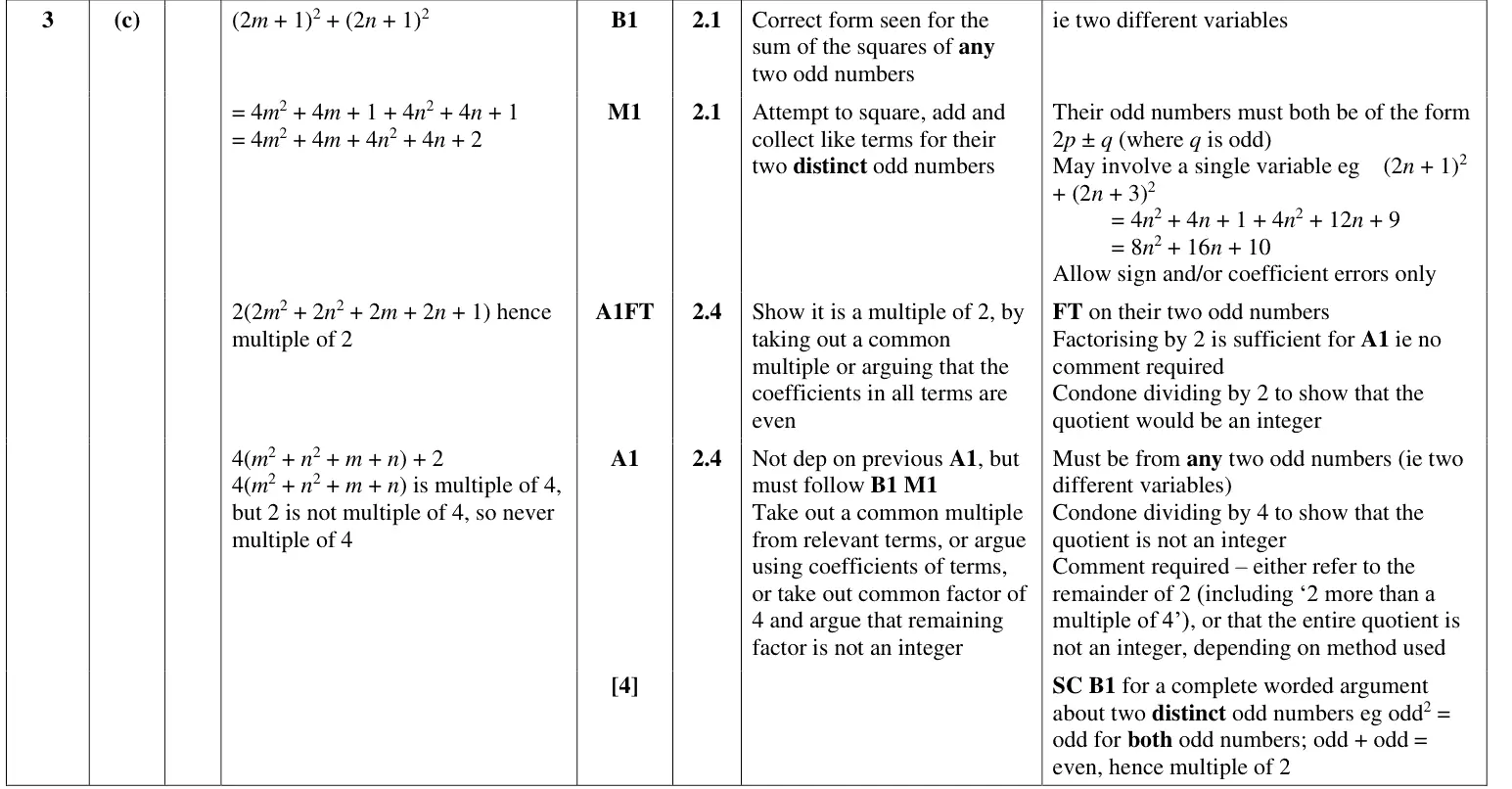
Many candidates either did not notice or did not realise the significance of ‘any’ being in bold and gave examples of two consecutive, or otherwise related, odd numbers thus limiting themselves to a maximum of 2 marks. Some used the same expression for both odd numbers, which scored no marks. From those that did use different variables, many lost the last accuracy mark because they thought it was enough to factorise the 4 out and say they have shown it is not a multiple of 4 without explaining why. Examiners expected to see some comment about there being a remainder of 2 when 4 was factorised out. Alternatively, that the value left after factorisation or division was not an integer.
Key points and common errors
'any': two different variables (2m + 1)² + (2n + 1)²
= 2(…) so a multiple of 2
= 4(m² + n² + m + n) + 2 so remainder 2, never a multiple of 4
consecutive odd numbers max 2 marks
comment needed
June 2024 · Paper 2 · Q7(b)2 marksHard
Show the start of this question
Mark scheme for this part
Examiner's comment
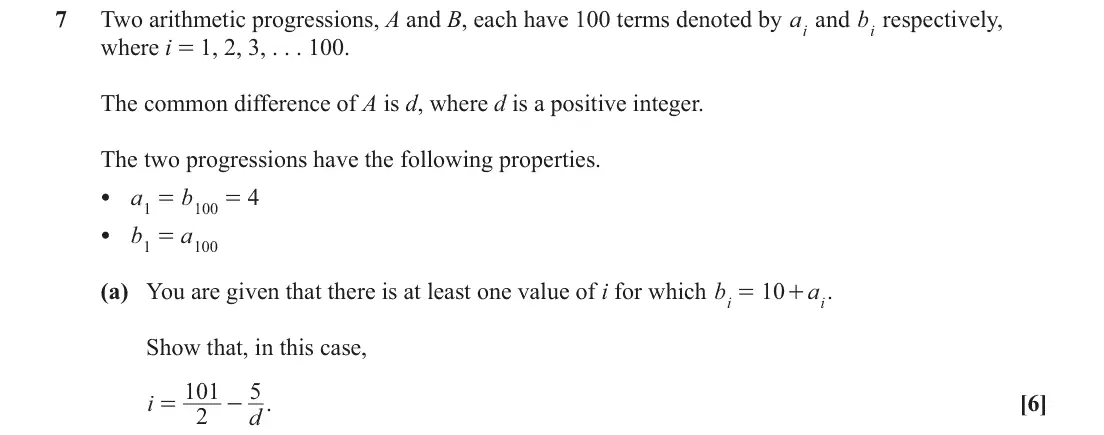
Very few candidates achieved either mark here, despite it relying only on the given answer to part (a). Some candidates identified that i needed to be an integer and this restricted the values for d, but very few gave both values correctly. This question had a very high omit rate, even though it did not depend on part (a).
Key points and common errors
i must be an integer between 1 and 100, so d = 2 or 10
June 2023 · AS Paper 1 · Q1(a)3 marksEasy
Mark scheme for this part
Examiner's comment
This question was generally well answered by most candidates. Some candidates showed a lack of rigour by writing down the given identity and manipulating one or both sides. This was permitted as long as it was clear what they were doing (e.g. multiplying both sides by cos(x) needed to be clearly shown). Some candidates wrote the given identity followed by the Pythagorean identity with no intermediate working, which could not be credited. In ‘Show that’ and proof questions, students should be encouraged to start with one side and manipulate to reach the other, and indicate clearly when they have reached a conclusion. More candidates used the alternative method in the mark scheme than attempted to combine terms on the LHS over a common denominator. Some candidates’ notation was unclear, for example sin x2 instead of sin2 x. Another common error was using sin + cos = 1 (which is missing the squares).
Key points and common errors
write tan x = sin x/cos x, common denominator, sin²x + cos²x = 1
jumping from the identity to the answer with no intermediate working gains nothing
June 2023 · AS Paper 1 · Q7(a)(ii)3 marksHard
Show the start of this question
Mark scheme for this part
Examiner's comment
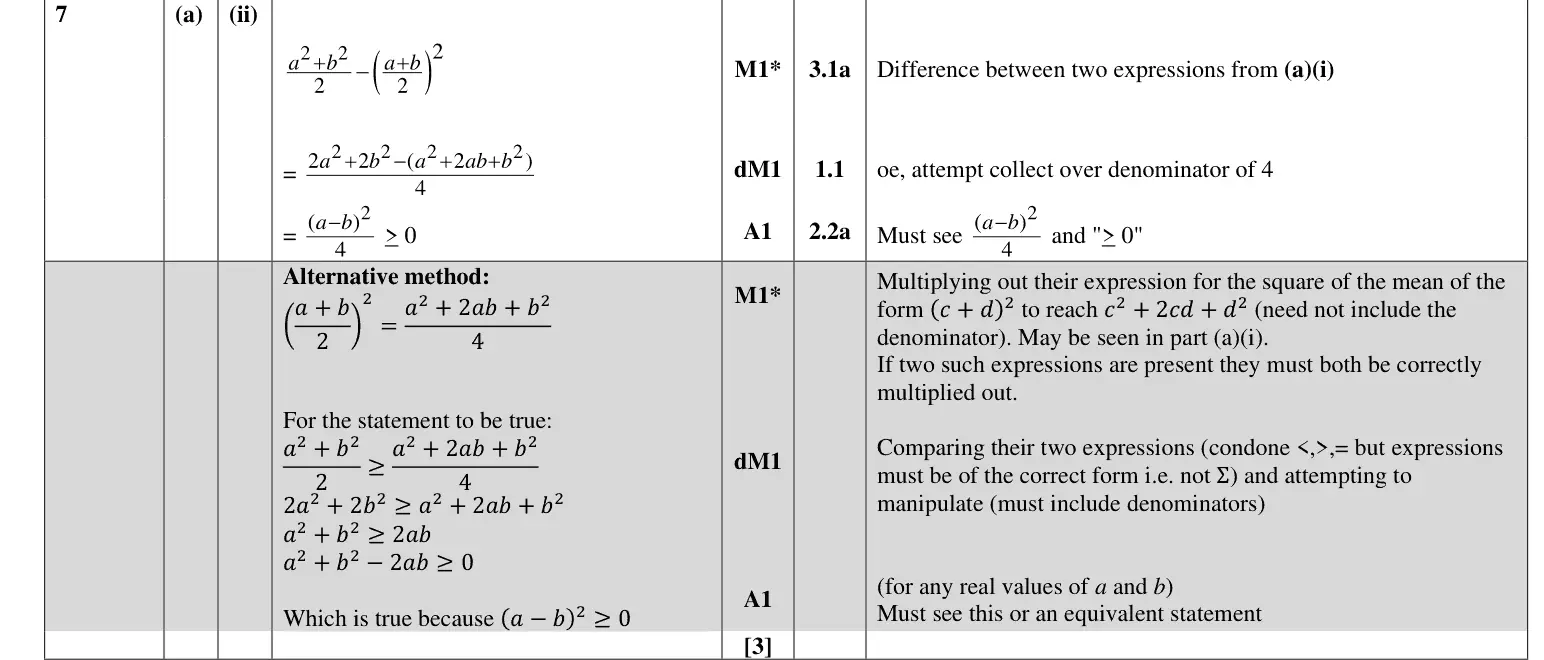
Very few candidates provided a fully correct solution to this part. The alternative method in the scheme was much more common than the ‘difference’ method. However, many candidates made errors when multiplying out the (‘squared’) brackets. A good number of candidates (who multiplied out correctly) reached a valid inequality, but very few spotted the need to factorise to (a - b)2 to prove that this was true by showing it > 0. Candidates should be encouraged to approach ‘Prove’ or ‘Show that’ questions (even those for relatively few marks) with appropriate rigour, for instance noting that they are writing an inequality that they seek to prove, rather than assuming that the given result is true. Many candidates used specific values to demonstrate the result, which gained no marks.
Key points and common errors
difference = (a − b)²/4 ≥ 0
very few factorised to (a − b)²
errors expanding brackets
June 2023 · AS Paper 1 · Q7(b)1 markHard
Show the start of this question
Mark scheme for this part
Examiner's comment
Very few candidates answered this part correctly, mainly because of failing to complete part 7 (a) (ii) (even though it could be answered independently). Some candidates identified a connection between the ⩾ 0. variance and the given statement, but did not connect this to the conclusion that the variance is always
Key points and common errors
variance = mean of squares − square of mean so variance ≥ 0
very few answered correctly
June 2023 · Paper 2 · Q7(a)2 marksMedium
Mark scheme for this part
Examiner's comment
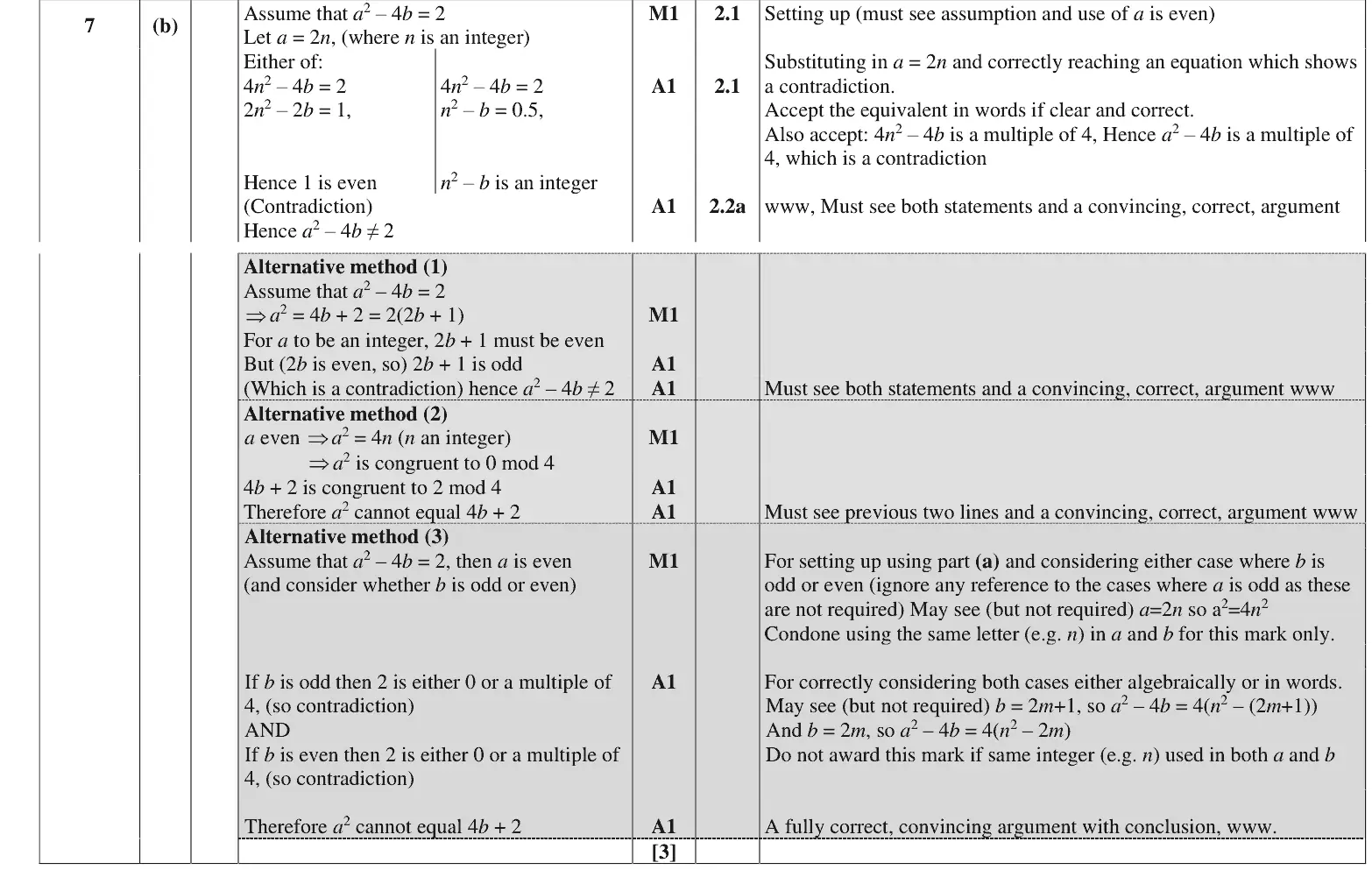
A range of methods were acceptable for both parts of this question, as proof by contradiction was not specified, although this was most commonly seen. For this first part, candidates were able to make the required deduction fairly straightforwardly by rearranging the equation and explaining that the sum of two even numbers (4b + 2) must always be even, therefore a2 is even, therefore so is a. However, many candidates attempted to prove the reverse implication by starting with ‘a is even’ (which was not acceptable). Some candidates attempted the alternative method by contradiction but this was generally less successful. Candidates should be reminded that, although this is a ‘Statistics’ paper, the level of rigour required in proof questions remains consistent across the specification. In particular, it is important that candidates set up a contradiction correctly, stating a clear assumption and reaching a clear conclusion. Some candidates provided much more algebraic working than was required in this part, although it was acceptable to simply state that the sum of two even numbers must be even (or to show this with 2(2b+2)).
Key points and common errors
a² = 4b + 2 = 2(2b + 1) is even so a is even
starting from 'a is even' proves the converse and gains nothing
June 2023 · Paper 2 · Q7(b)3 marksMedium
Show the start of this question
Mark scheme for this part
Examiner's comment
Many candidates did not realise that they could (although they were not required to) use the result from (a) to simplify the work in (b). Those who did were generally able to make good progress by writing a = 2m, substituting in and manipulating to reach an equation from which a contradiction can be shown. Many candidates attempted to consider different cases for a and b each being odd/even (although only 2 of those cases needed to be considered following part (a)). In doing so, many used the same letter, e.g. writing a = 2n, b = 2n + 1 (which does not generalise so could be awarded the method mark but neither accuracy mark). Some candidates spent time and working considering the cases where a is odd, although these were not relevant (because of part (a)) and therefore not credited. In both parts of this question, many candidates did correct work but did not state a conclusion.
Key points and common errors
assume a² − 4b = 2, use a = 2n: 2n² − 2b = 1, contradiction
using the same letter for a and b does not generalise
June 2022 · Paper 1 · Q2(a)1 markEasy
Mark scheme for this part
Examiner's comment
Most candidates could identify a correct counterexample, appreciating that this would occur when at least one of the numbers was negative. Examiners expected to see some evidence of the contradiction, but this was not always the case, with some candidates finishing with, for example, 1 > 4 but not then making any further comment.
Key points and common errors
counter-example with a negative value, e.g. 1 > −2 but 1 < 4
the contradiction must be stated
June 2022 · Paper 1 · Q2(b)(i)1 markMedium
Mark scheme for this part
Examiner's comment
The best solutions either identified an additional possible value for x, such as 1500, or explained that sin was a many to one function. Some candidates lacked precision in their answer; comments such as ‘other values are possible’ were not fully convincing. Incorrect statements, such as sin-10.5 = 30o and 150o were penalised.
Key points and common errors
sin150° = 0.5 as well (sine is many-to-one) so ⇐ fails
vague 'other values are possible' is not enough
June 2022 · Paper 1 · Q2(b)(ii)1 markEasy
Show the start of this question
Mark scheme for this part
Examiner's comment
Most candidates were able to identify the required connective and provide a corrected version of the statement. Some candidates instead attempted to include additional values on the right-hand side, but this had to be a fully correct general solution in order to gain credit, and others limited the domain in their solution.
Key points and common errors
sin x° = 0.5 ⇐ x° = 30°
a general solution is accepted only if fully correct
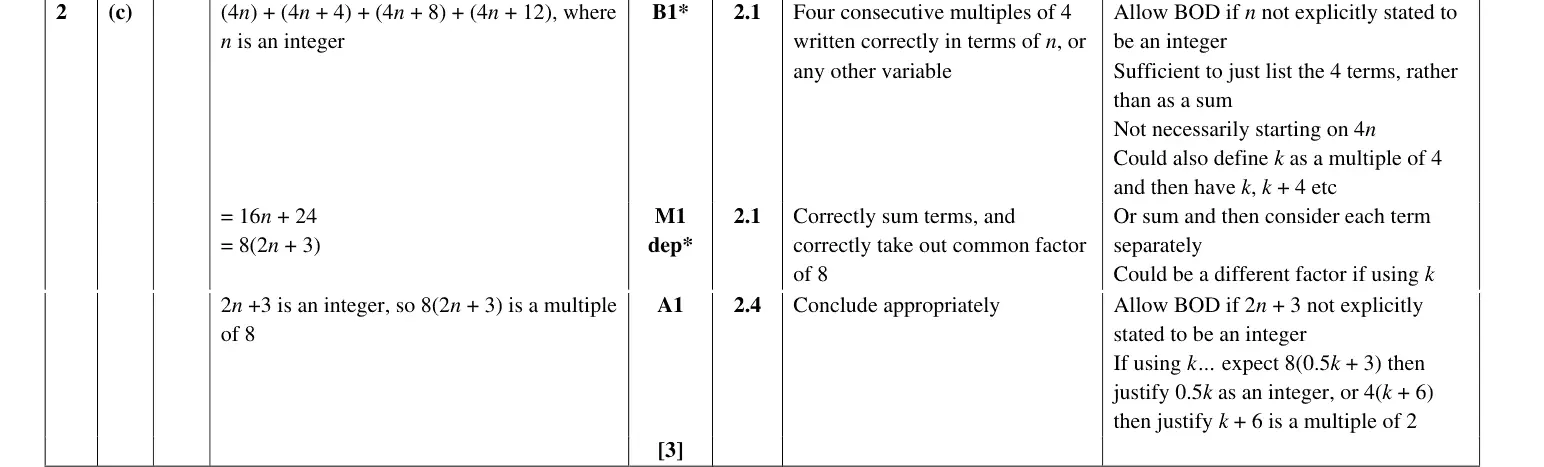
June 2022 · Paper 1 · Q2(c)3 marksMedium
Mark scheme for this part
Examiner's comment
Most candidates were able to gain a mark for writing expressions for four consecutive multiples of 4, with the most common error being 4n, 4n + 1, etc. While a few then attempted the product, the majority did attempt to sum the terms and take out a common factor of 8, but this was not always done correctly. Some candidates then spoiled an otherwise correct solution by omitting to provide a conclusion as to why this showed that the sum would always be a multiple of 8.
This question was not done well. Many candidates did not understand what an irrational number was, thinking that recurring decimals were irrational (⅓ + ⅔ = 1 was the most common example cited) or assuming that any square root was irrational (things like 4½ + 9½ = 5 appeared). Fully correct solutions were very rare.
Key points and common errors
choose two irrationals summing to a rational, e.g. (π + 4) + (−π + 4) = 8, and comment that it is rational
many thought recurring decimals or all square roots are irrational
fully correct very rare
June 2022 · Paper 2 · Q7(a)4 marksMedium
Mark scheme for this part
Examiner's comment
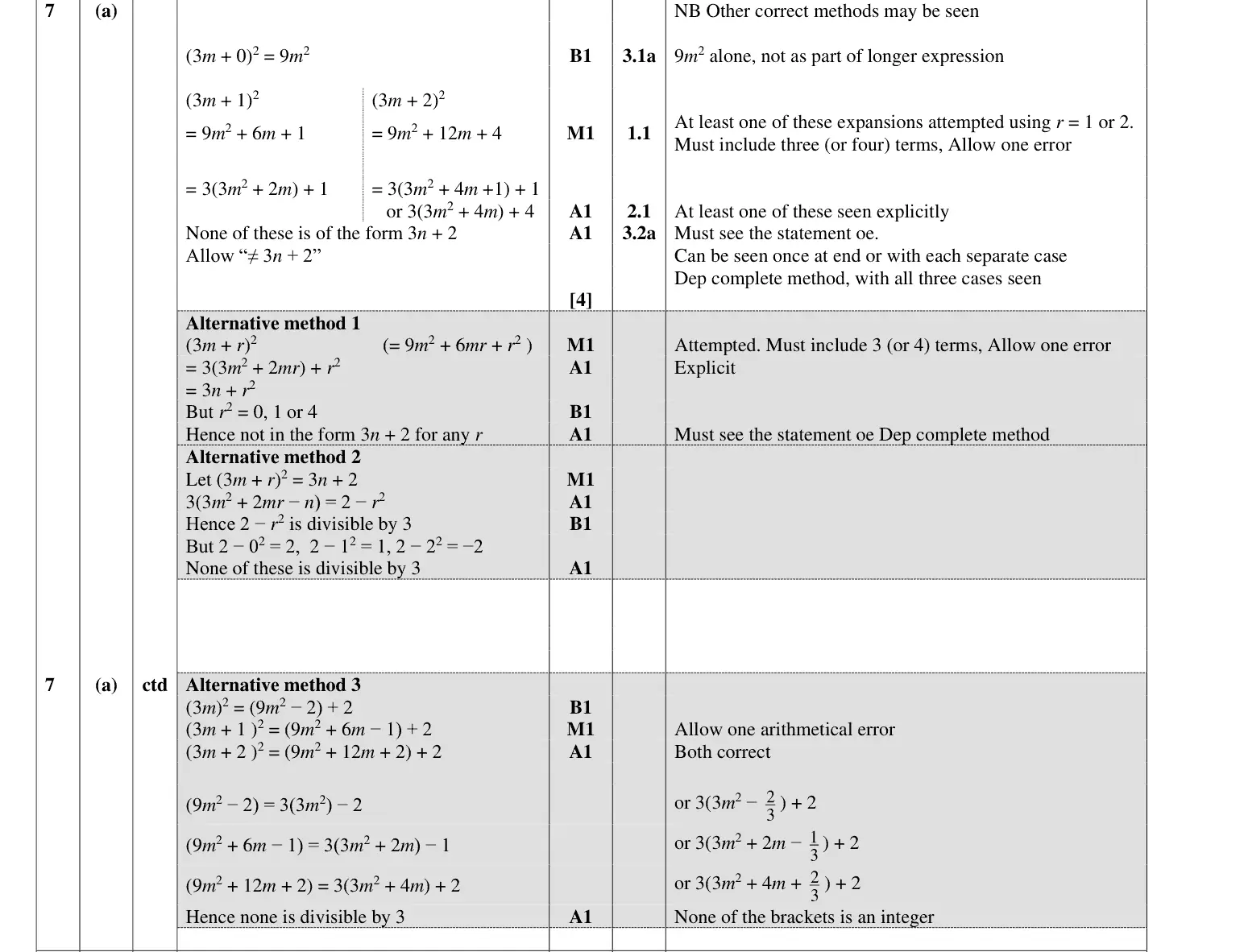
The concept of proof seemed to be better understood than in the past, with many candidates giving a fully correct response. There are many different correct approaches to this question, all of which were accepted. Four such approaches are given in the published mark scheme, although this list is not exhaustive. A few candidates used what is, perhaps, the most elegant method which involved writing (3m + r)2 in the form 3(3m2 + 2mr) + r2, and then noting that r2 = 0, 1 or 4 and so cannot be 2. Some candidates showed numerical examples of three consecutive integers whose squares cannot be expressed in the form 3n + 2. Some claimed (incorrectly) that this proved the desired result “by counter example”. Perhaps the most common approach was to square 3m, 3m + 1 and 3m + 2. This alone would gain 2 marks. But many candidates did not gain the remaining marks because they proceeded simply to state, without justification, that none of these expansions could be expressed in the form 3n + 2. To gain the last 2 marks, the expansions of (3m + 1)2 and (3m + 2)2 had to be written in the forms 3(3m2 + 2m) + 1 and 3(9m2 + 4m + 1) + 1 or similar. Some candidates began by considering odd and even integers separately. Although this approach has been fruitful for answering some questions in previous years, it was not helpful in this case.
Key points and common errors
proof by exhaustion: (3m)², (3m + 1)², (3m + 2)² are 3k, 3k + 1, 3k + 1
or r² = 0, 1, 4
numerical examples are not a proof
June 2022 · Paper 2 · Q7(b)4 marksHard
Show the start of this question
Mark scheme for this part
Examiner's comment
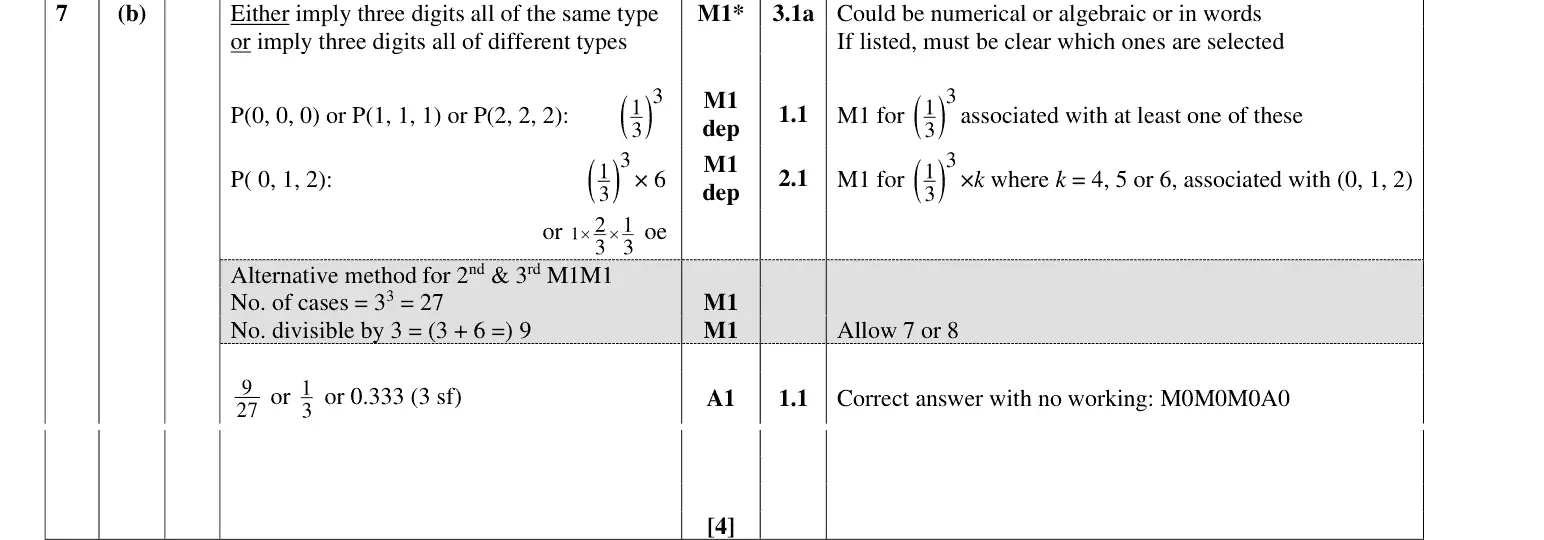
This rather unusual question puzzled many candidates. However, many made a reasonable attempt at it, using native wit rather than learned techniques. Those who used an algebraic approach, with 3m, 3m + 1 and 3m + 2 made some progress in recognising the different cases (three integers being either all of the same type or of three different types). But they usually did not obtain the correct number of combinations that are possible. Those who actually listed the possibilities were more likely to be successful. However, even this method was not always pursued successfully. In some cases, some of the possibilities were omitted. One particular example was as follows. The possible combinations of values of r are these: 000, 111, 222, 012, 112, 221, 110, 001, 220, 002. Four of these 10 combinations have a total that is divisible by 3, hence P(total is divisible by 3) = 4 10 . Another incorrect approach was this: P(an integer is divisible by 3) = 33 99 , hence P(the total is divisible by 3) = ( ) 3 33 = 1 27 . 99 An interesting incorrect method that leads to the correct answer was as follows. For the sum to be divisible by 3, all three integers must be of the form 3m OR all three must be either of the form 3m + 1 or 3m + 2. Hence P(sum is divisible by 3) = [P(r = 0)]3 + [1 − P(r = 0)]3 = ( ) 3 + ( ) 3 1 2 = 1 27 + 8 27 = 1 3 . 3 3
Key points and common errors
33 of each type r = 0, 1, 2 so each has probability 1/3
all same type 3 × (1/3)³ or all different 6 × (1/3)³
9/27 = 1/3
Autumn 2021 · AS Paper 1 · Q8(a)1 markMedium
Mark scheme for this part
Key points and common errors
counter-example p = 3: 2³ = 8 < 9 = 3²
Autumn 2021 · AS Paper 1 · Q8(b)4 marksMedium
Mark scheme for this part
Key points and common errors
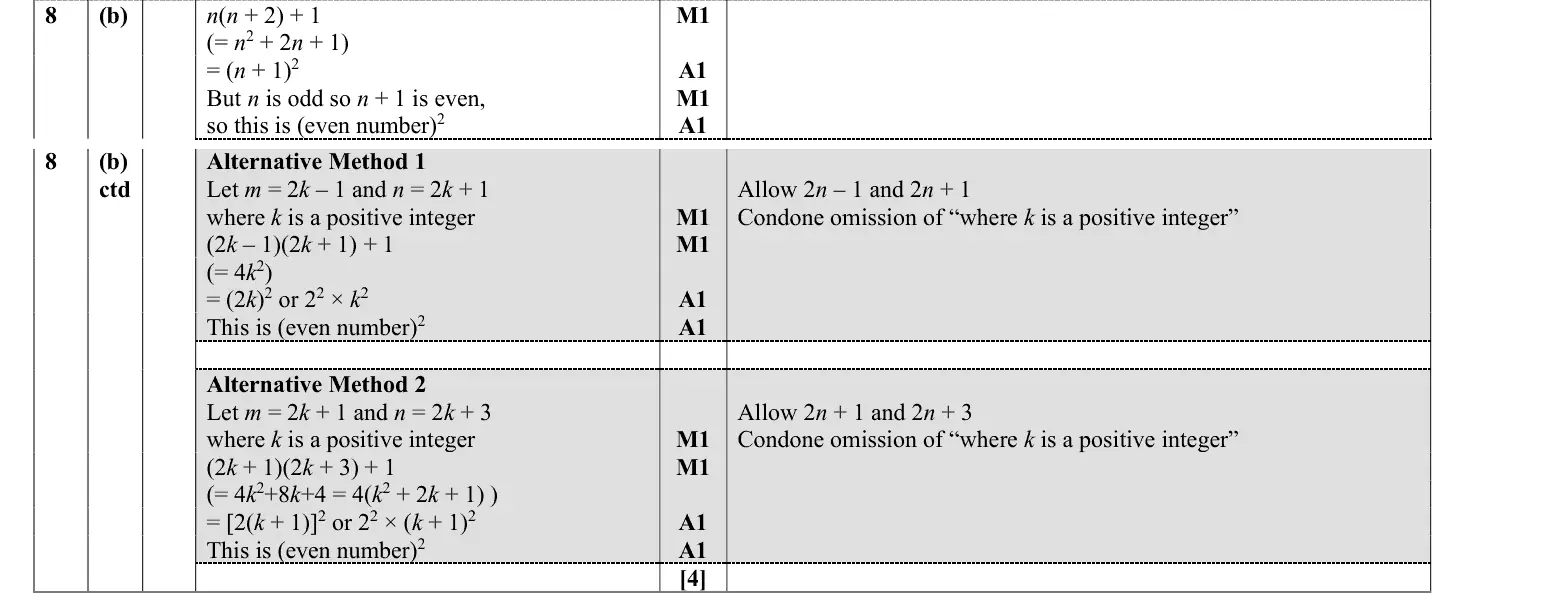
n(n + 2) + 1 = (n + 1)² and n + 1 is even
or m = 2k − 1, n = 2k + 1 gives (2k)²
conclusion needed
Autumn 2021 · Paper 2 · Q8(b)5 marksHard
Show the start of this question
Mark scheme for this part
Examiner's comment
(From the general report) Question 8(b): Many candidates missed the point of this question – namely that part (a) provides two factors of K. Question 8(b): Many candidates misinterpreted the question.
Key points and common errors
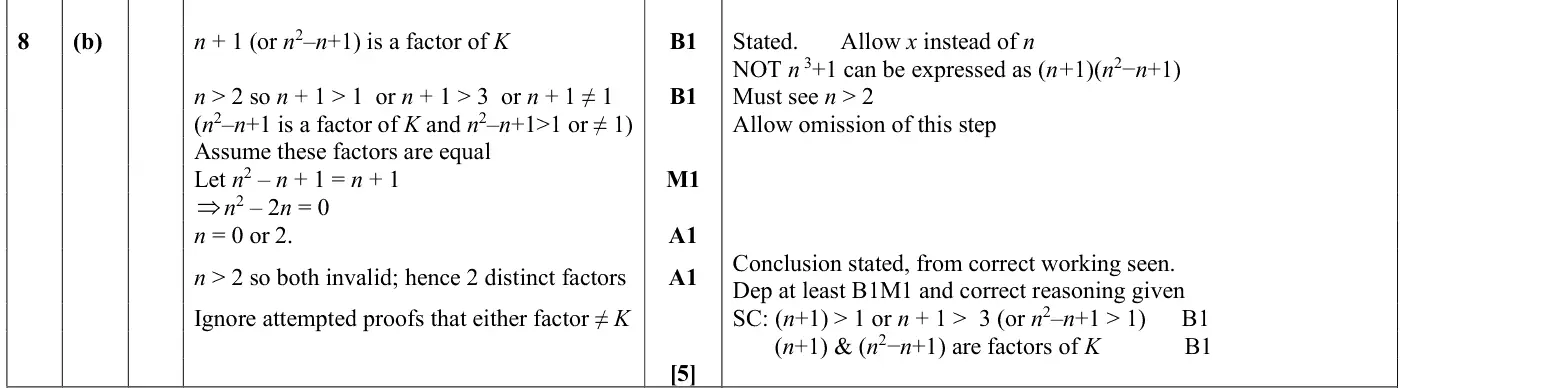
n + 1 and n² − n + 1 are factors of K, both > 1 since n > 2
equal only if n² − 2n = 0, n = 0 or 2, so distinct
many missed that part (a) gives the factors
Autumn 2020 · AS Paper 1 · Q3(b)3 marksHard
Mark scheme for this part
Examiner's comment
There was a great deal of incorrect ‘cancelling’ by simply crossing out a pair of terms, one in the numerator and one in the denominator.
Key points and common errors
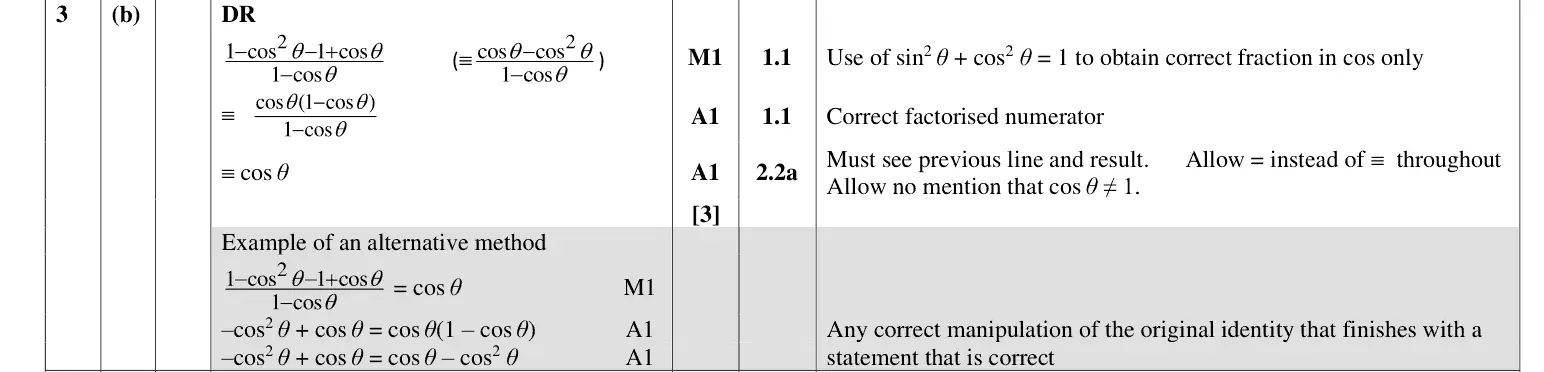
sin²θ = 1 − cos²θ
numerator cos θ − cos²θ = cos θ(1 − cos θ)
cancel with the denominator
crossing out terms is not cancelling
Autumn 2020 · Paper 1 · Q43 marksMedium
Mark scheme for this part
Examiner's comment
Question 4 was intended to be a very straightforward question on proof by contradiction. Some concise and elegant solutions were seen, but many others indicated a lack of familiarity with the required structure.
The method of proof by counter example was clearly well understood by most candidates. A few attempted to use an algebraic method, not recognising that such a method cannot deal with whether a number is prime or not. Some candidates gave a correct counter example, such as 92 + 4 = 85, but then only stated that 85 is not prime. The question begins with the word "Prove", and because it is a question about proof, it was necessary to show that 85 is not prime, rather than just stating this as a fact.
Key points and common errors
counter-example m = 9: 81 + 4 = 85 = 5 × 17
must show 85 is not prime, not just state it
June 2019 · AS Paper 1 · Q5(b)4 marksMedium
Mark scheme for this part
Examiner's comment
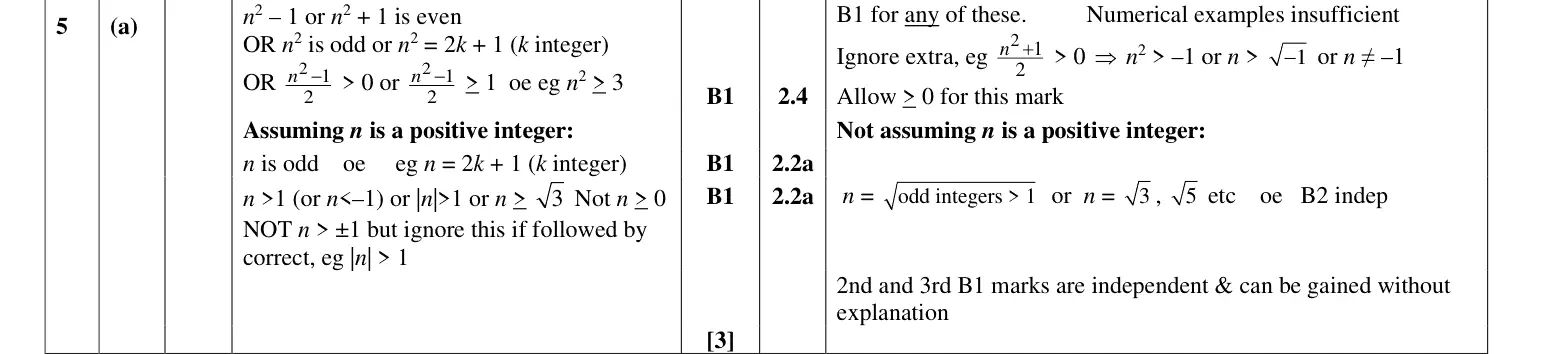
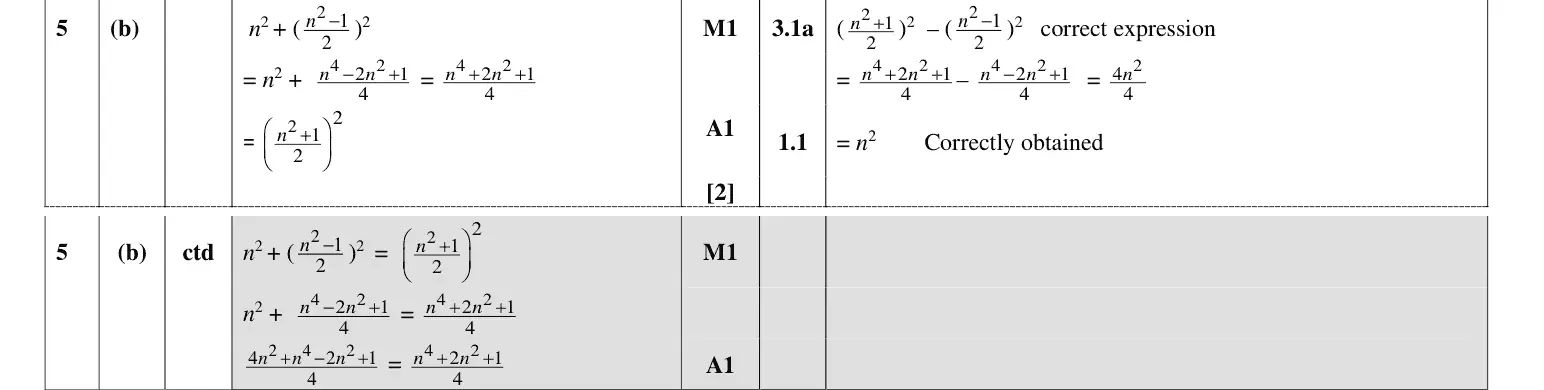
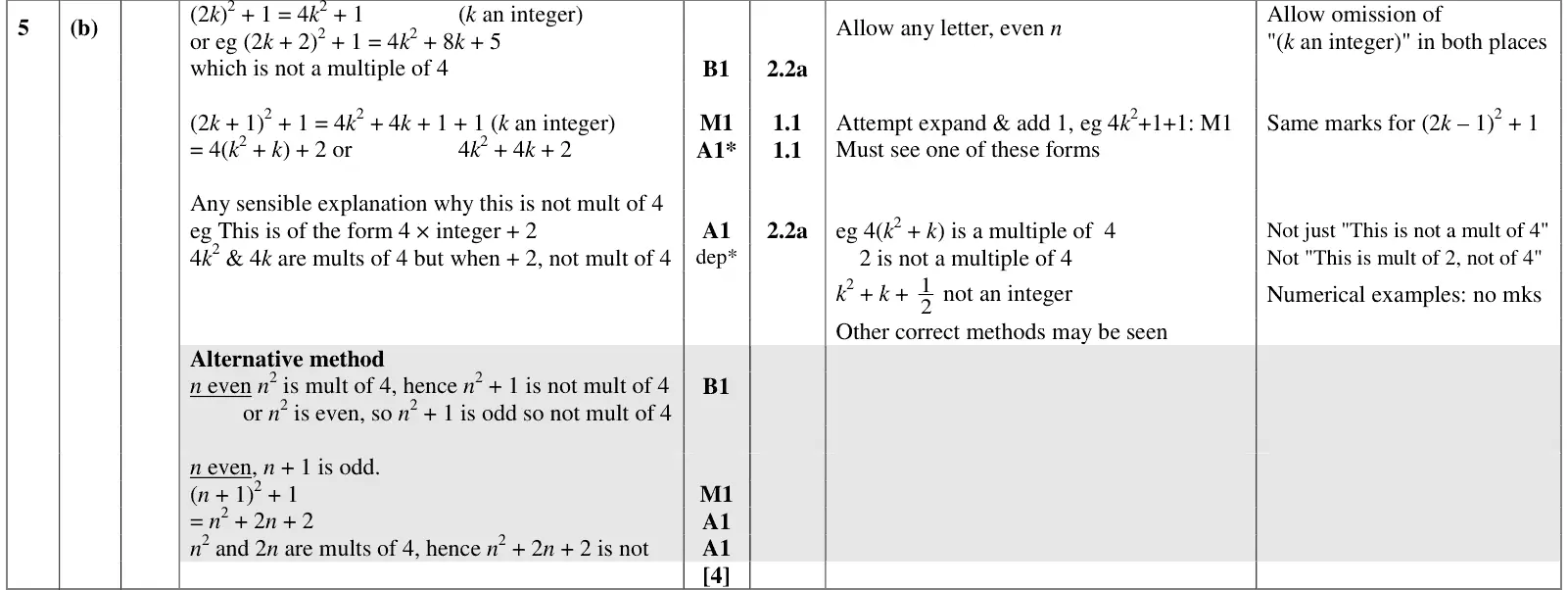
Candidates generally used one of two methods. 1. Let n = 2r and 2r + 1. Candidates who used this method often succeeded. However, many lost the last mark by giving an inadequate explanation as to why 4r2 + 4r + 2 is not divisible by 4, or by simply stating 2 4 r + 4 r + 2 = r2 + r + 1 this without explanation. Some gave as their explanation that 2 . Unless there was 4 further explanation, this did not quite gain the final mark. A few candidates made things unnecessarily complicated by letting n = 2r + 1 and 2r + 2 2. Let n be even, so n2 is even and therefore n2 + 1 is odd and cannot be a multiple of 4. Many candidates gave this explanation. But when considering (n + 1)2 + 1, not many candidates could explain why n2 + 2n + 2 is not a multiple of 4. Some candidates only considered numerical examples. In a question requiring proof, this method is unacceptable except in the case of proof by counter example (and possibly in a simple case of proof by exhaustion).
Key points and common errors
n = 2k: 4k² + 1
n = 2k + 1: 4(k² + k) + 2
explain why neither is a multiple of 4
numerical examples gain nothing
June 2019 · Paper 2 · Q64 marksHard
Mark scheme for this part
Examiner's comment
k − and Not many candidates answered this successfully, although many at least began by writing 2 1 thereby gained a mark. Some gained another mark by factorising this expression correctly, but very few went on to show that neither factor was equal to 1. Many candidates misinterpreted the question to mean: "Prove that the following statement is not true: n is an even number greater than 2 ⇒2n – 1 is prime." They then disproved this statement by assuming it to be true and quoting a numerical example that contradicted it and claimed to have answered the question using Proof by Contradiction. Some candidates calculated 22 – 1, 24 – 1, 26 – 1, 28 – 1 etc., up to about 220 – 1 and noted that in each case the result is not prime, and incorrectly assumed that the result has been proved by "Proof by exhaustion". A few candidates (who presumably were studying Further Maths) gave a proof by induction, proving that, for n even and greater than 2, 2n – 1 is divisible by 3.
Key points and common errors
n = 2k: 2²ᵏ − 1 = (2ᵏ − 1)(2ᵏ + 1)
must show both factors > 1
many disproved the converse with an example instead
June 2018 · Paper 1 · Q44 marksMedium
Mark scheme for this part
Examiner's comment
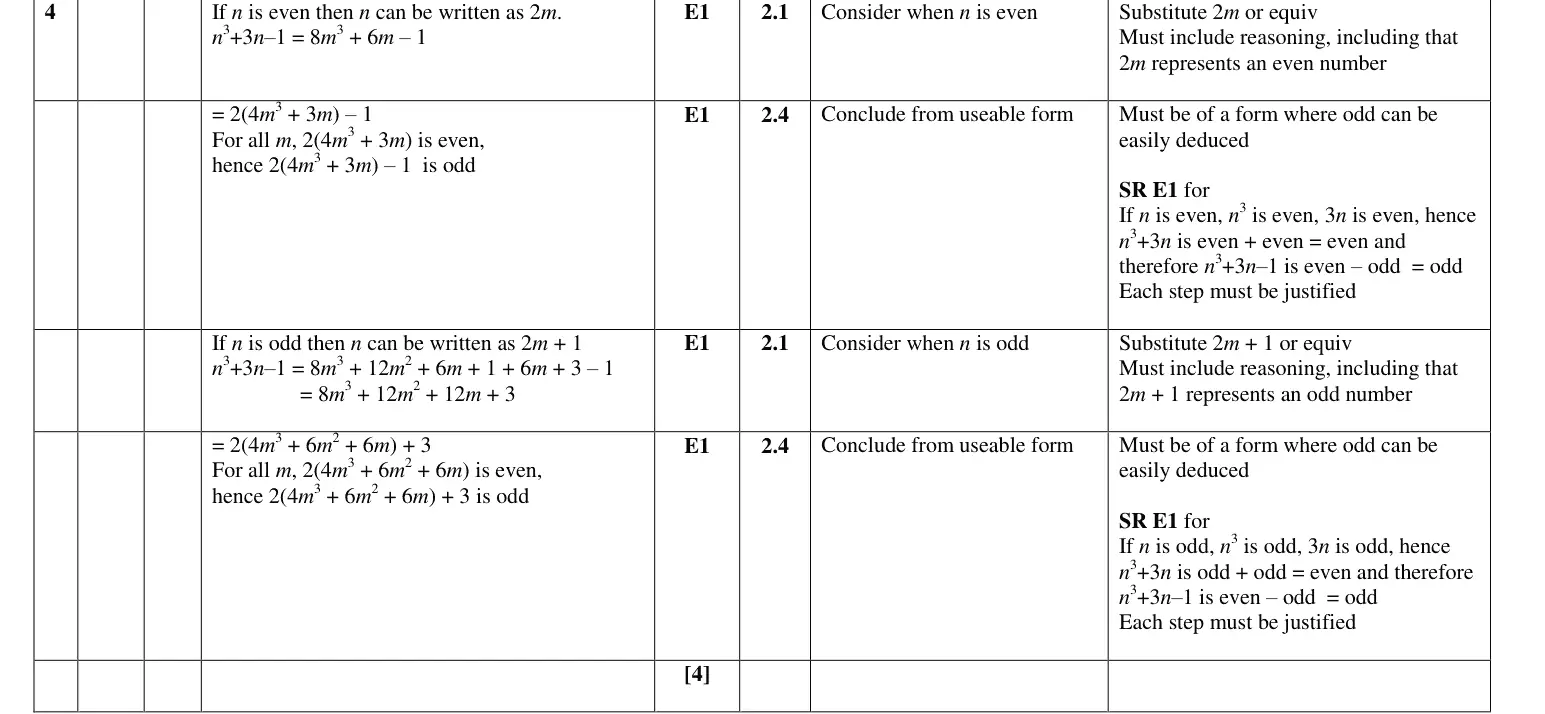
Candidates were expected to provide an algebraic proof, considering both odd and even n and justifying their method. Many candidates made it clear which case was being considered, whereas others introduced 2k and 2k + 1, but with no explanation of what these terms represented. The algebraic manipulation was usually correct and candidates then wrote the expressions in a useable form. Some candidates then simply stated that the expression must be odd, but did not justify this statement. A number of candidates provided a worded argument based on the use of odd and even numbers. As long as each step was explained then partial credit was given, but full credit in this question was only available for convincing use of algebra. This candidate states that they are using 2p to represent an even number; simply using 2p with no justification would not have gained the first mark. Having substituted and rearranged they then clearly explain that their expression is of the form 2k – 1, which represents an odd number. An alternative explanation would be to say that for all p, 2(4p3 + 3p) is even as it has a factor of 2 hence 2(4p3 + 3p) – 1 is odd. Simply concluding ‘odd’ but with no justification would not have gained the second mark. This candidate’s proof of why the expression is odd when n is odd is equally convincing, so this response gained full credit.
Key points and common errors
proof by exhaustion: n = 2m and n = 2m + 1, stating what they represent
write as 2(…) − 1 and 2(…) + 3 and justify odd
June 2018 · AS Paper 1 · Q55 marksMedium
Mark scheme for this part
Examiner's comment
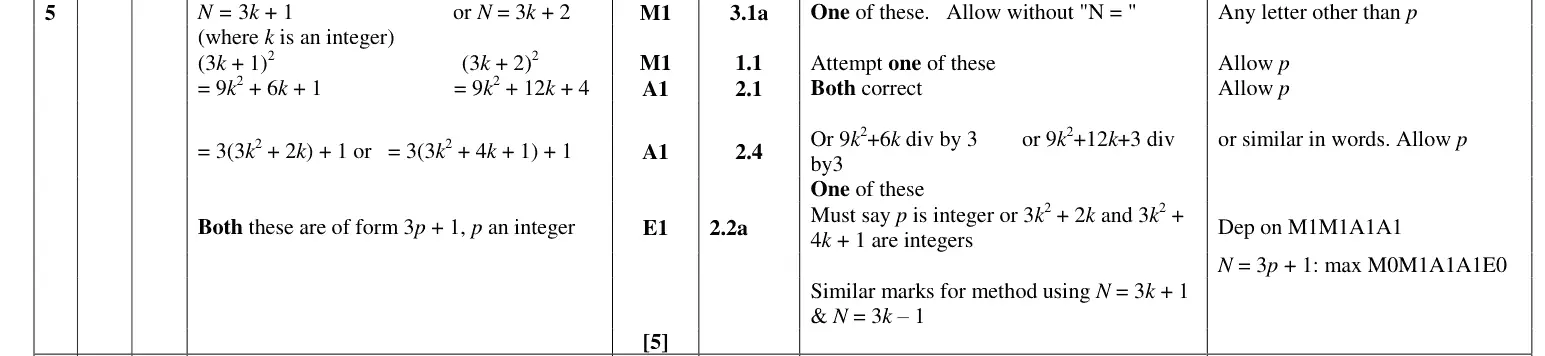
This question tests "proof by exhaustion" as included in paragraph 1.01a of the specification. This method of proof involves either considering all possible values or all possible categories of values. This question tests the latter. It was not well answered on the whole. Many candidates started with, for example, N = 3k + 1 and gave a partly correct argument based on this (although most omitted to say "where k is an integer"). Then many of these omitted to consider either N = 3k + 2 or N = 3k – 1 as well. Some candidates started with N = 3p + 1 and gave an otherwise correct argument, ignoring the use of "p" in the question. Some candidates tried to work from N2 = 3p + 1. These all failed. Some verified the result in a few numerical cases. These scored no marks.
Key points and common errors
proof by exhaustion: N = 3k + 1 or 3k + 2
squares 3(3k² + 2k) + 1 and 3(3k² + 4k + 1) + 1
both cases and a conclusion needed
June 2018 · AS Paper 1 · Q7(ii)4 marksMedium
Show the start of this question
Mark scheme for this part
Examiner's comment
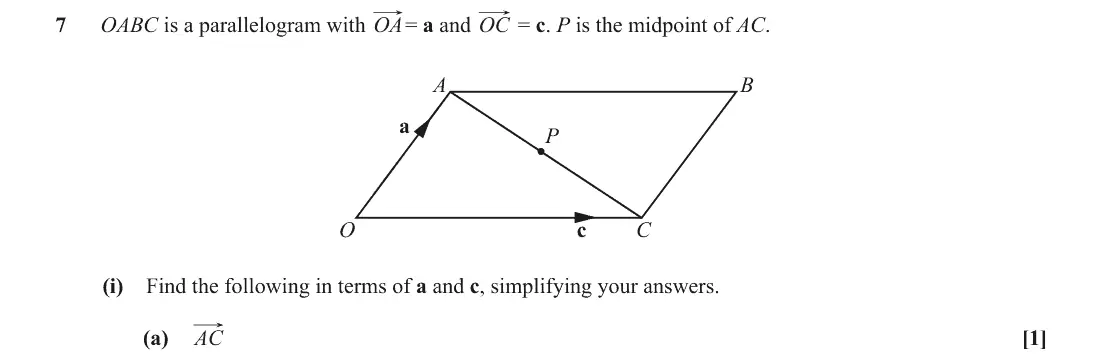
This question proved challenging for a significant majority of candidates. Many assumed the result by 1 (c + a), instead of deriving this result. Some candidates considered starting with, for example, PB = 2 the modulus of some vectors. Some candidates seemed unaware of the meaning of the word "bisect”, in some cases confusing it with "perpendicular". Thus many wrote that a + c is perpendicular to a – c, and that this somehow proves that the diagonals bisect one another. Perhaps the majority of candidates did not know how to start answering this question at all. An example of a candidate's solution that suggested they had no understanding of proof by vectors was as follows: "BO = AC. As they are the same length it means they would both meet in the centre, hence meaning they bisect one another."
Key points and common errors
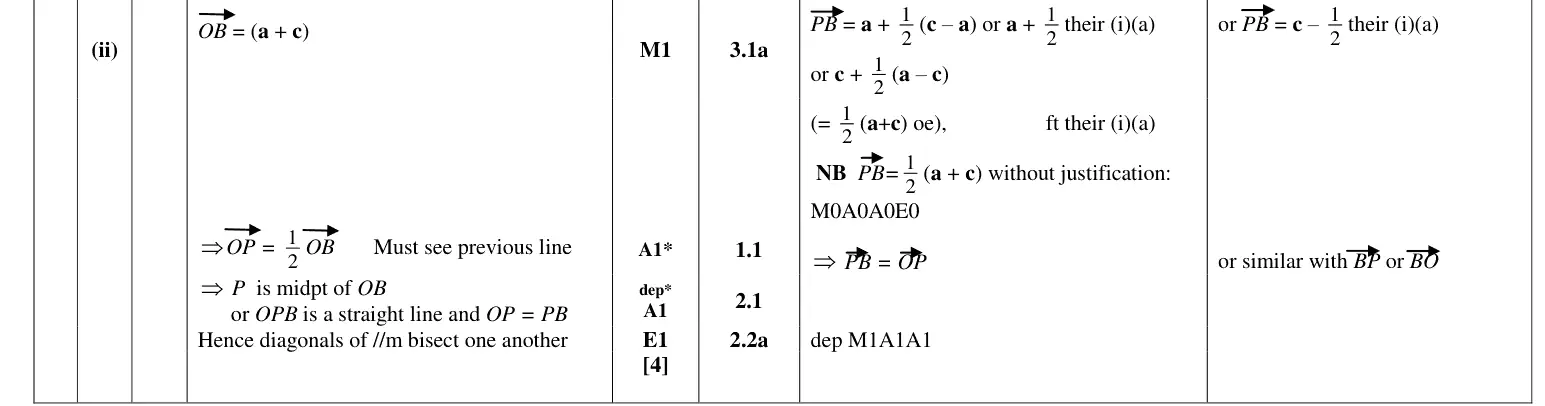
OB = a + c so OP = ½OB
P is the midpoint of both diagonals
PB = ½(a + c) needs justification
June 2018 · AS Paper 2 · Q3(i)1 markMedium
Mark scheme for this part
Examiner's comment
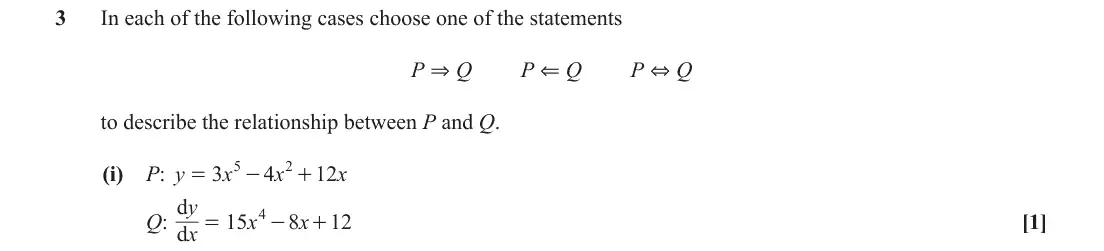
The most common error was to give P ⇔ Q. P → Q was condoned.
Key points and common errors
P ⇒ Q: differentiating gives Q but Q does not fix the constant
common error P ⇔ Q
June 2018 · AS Paper 2 · Q3(ii)1 markMedium
Mark scheme for this part
Examiner's comment
The most common error was P ⇒ Q. P ↔ Q was condoned.
Key points and common errors
P ⇔ Q: x = 2 is the only real fifth root of 32
common error P ⇒ Q
June 2018 · AS Paper 2 · Q3(iii)1 markHard
Mark scheme for this part
Examiner's comment
The most common error was P ⇔ Q. P⇐ Q was also seen, perhaps because candidates thought each statement would be used once in this question. Note this was not the case and is not inevitable. P → Q was condoned. This part was found to be the most difficult.
Key points and common errors
P ⇒ Q: ln y < 0 means 0 < y < 1, but y < 1 includes y ≤ 0 where ln y is undefined
common error P ⇔ Q
June 2018 · Paper 2 · Q5(i)1 markEasy
Mark scheme for this part
Examiner's comment
Almost all candidates answered this correctly
Key points and common errors
counter-example e.g. 1 + 3 = 4 or 4 + 5 = 9
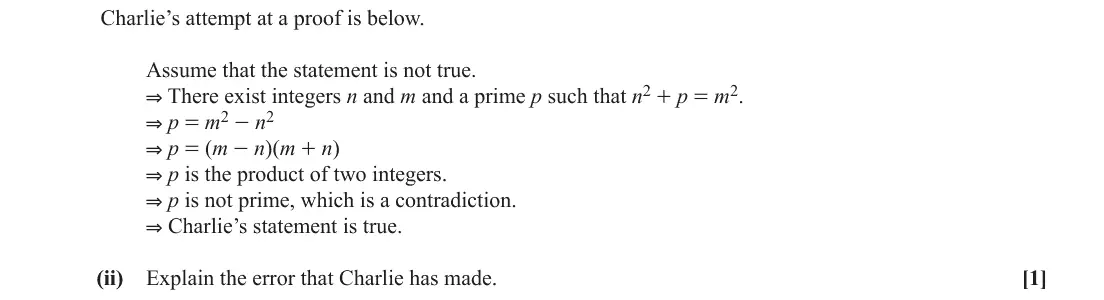
June 2018 · Paper 2 · Q5(ii)1 markMedium
Show the start of this question
Mark scheme for this part
Examiner's comment
Many candidates identified the error correctly although a large variety of incorrect suggestions were seen, such as "He has proved something that is false is correct, but that doesn't prove his point correct.", "He assumes that the statement is not true.", "p could be 0", "m + n could be zero.", "He hasn't chosen m and n to be integers.", "p is not the product of two integers, p = m2 – n2 .", "He has not stated that m and n are square numbers.".
Key points and common errors
if m − n = 1 then (m − n)(m + n) can be prime
one factor could be 1
June 2018 · Paper 2 · Q5(iii)4 marksHard
Show the start of this question
Mark scheme for this part
Examiner's comment
Some candidates recognised that the starting point was m – n = 1. Most of these proceeded to obtain the correct answer (although a few squared 427 instead of 426). Many candidates, however, did not appreciate the link with part (ii) and attempted trial and improvement, without success.
Key points and common errors
use the link to (ii): m − n = 1 and m + n = 853 so n = 426, S = 181476
trial and improvement rarely succeeded
some squared 427
Find an A-level maths tutor
Stuck on this? Book a trial session with an A-level maths tutor.