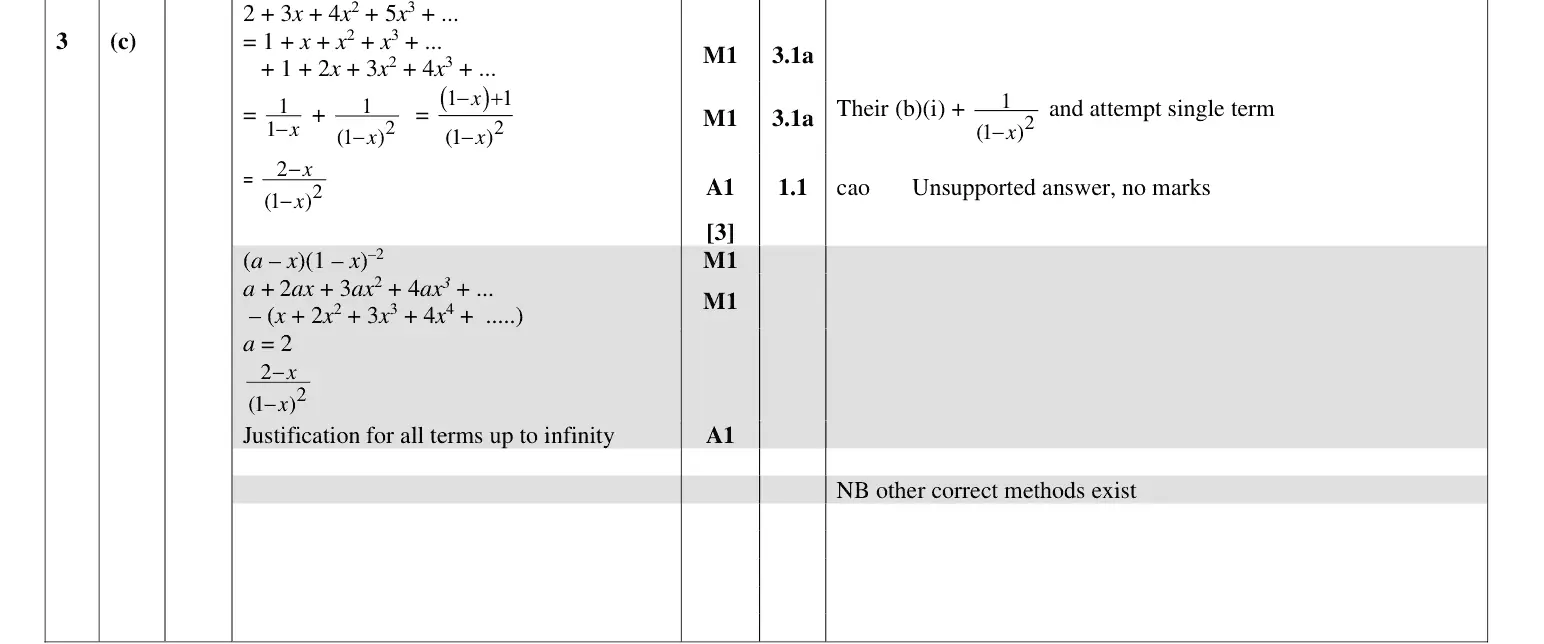
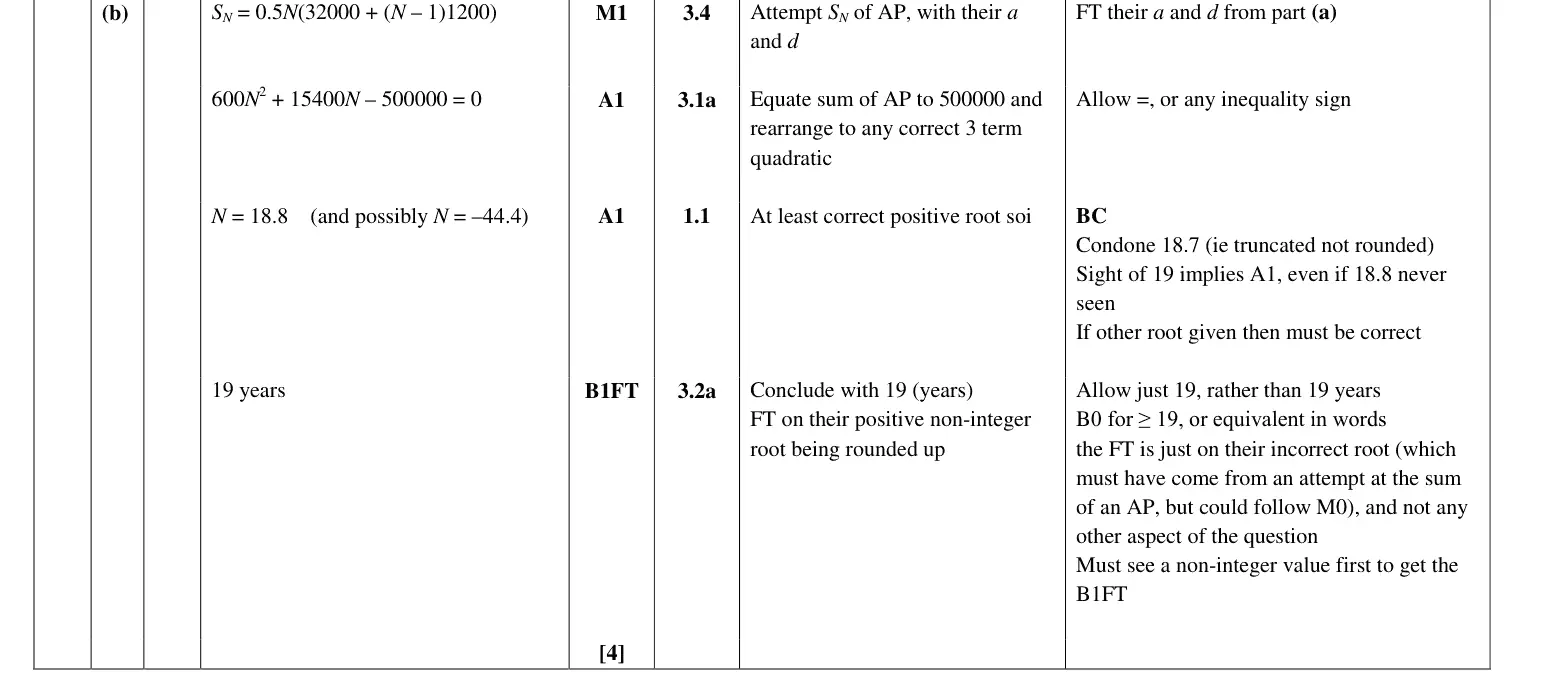
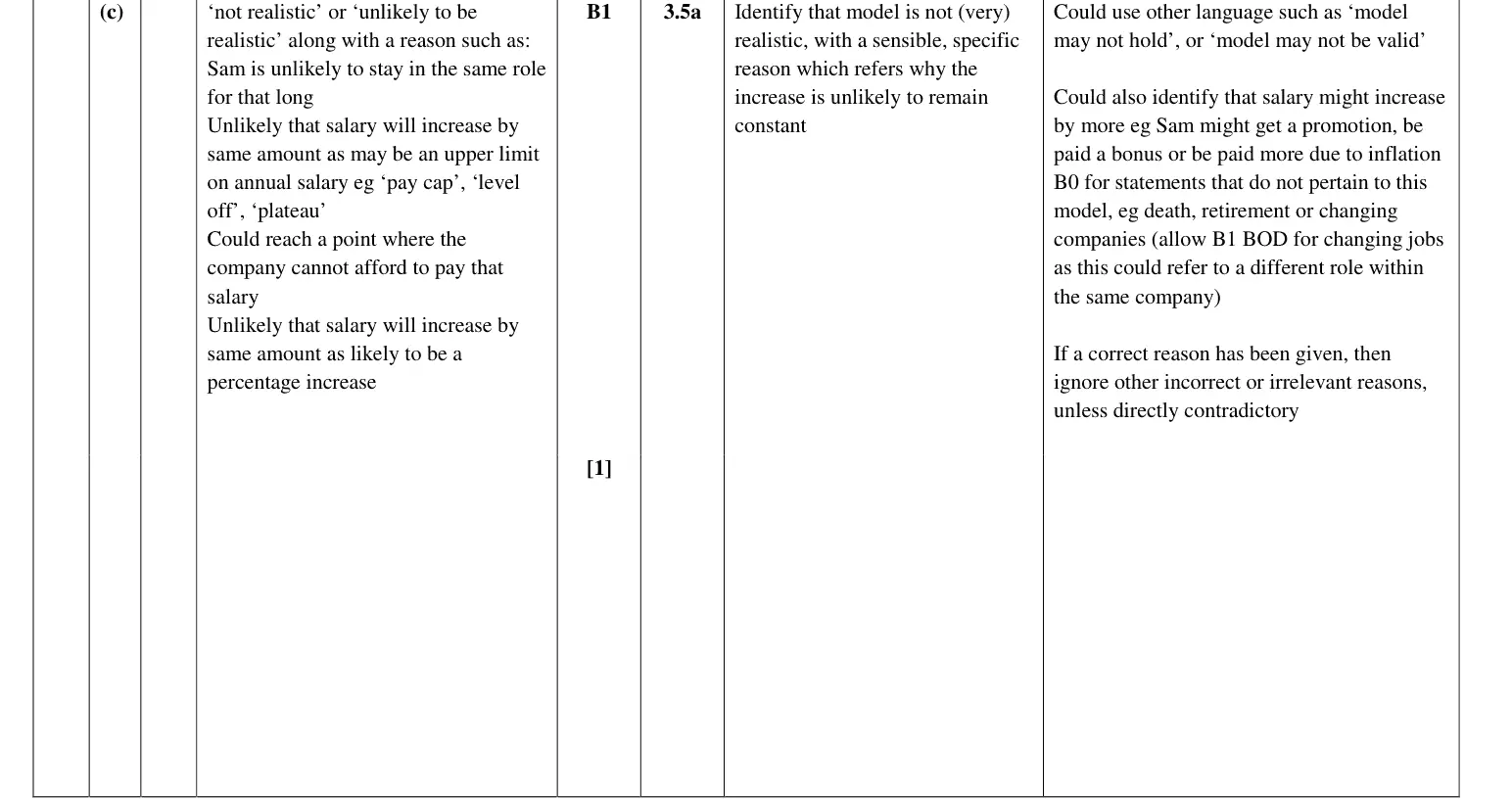
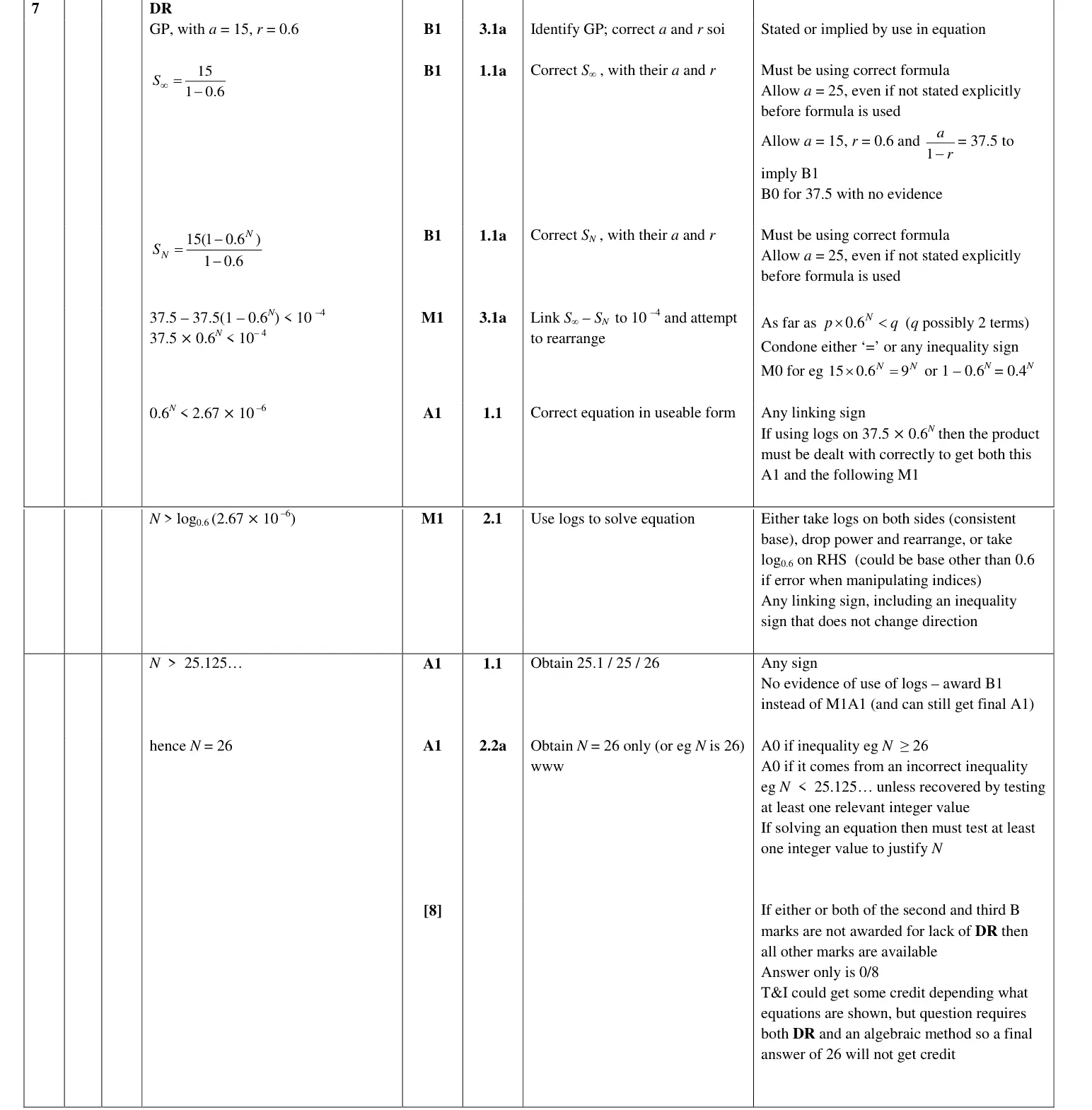
Mark scheme for this part

Examiner's comment
This question was very well answered, with very few candidates not gaining both of the marks available.
Key points and common errors
- u₂ = 4, u₃ = 11, u₄ = 116
Notes, worked examples and practice for this topic are being written by our tutors. The past-paper questions below are ready now: work each one on paper, then open the mark scheme and the examiner's comment.
Print this topic as a pack questions first, then the mark schemes
This question was very well answered, with very few candidates not gaining both of the marks available.

Most candidates could identify that it was an increasing (or diverging) sequence, but it was quite common to see an additional, incorrect, statement such as ‘geometric’ which was penalised.

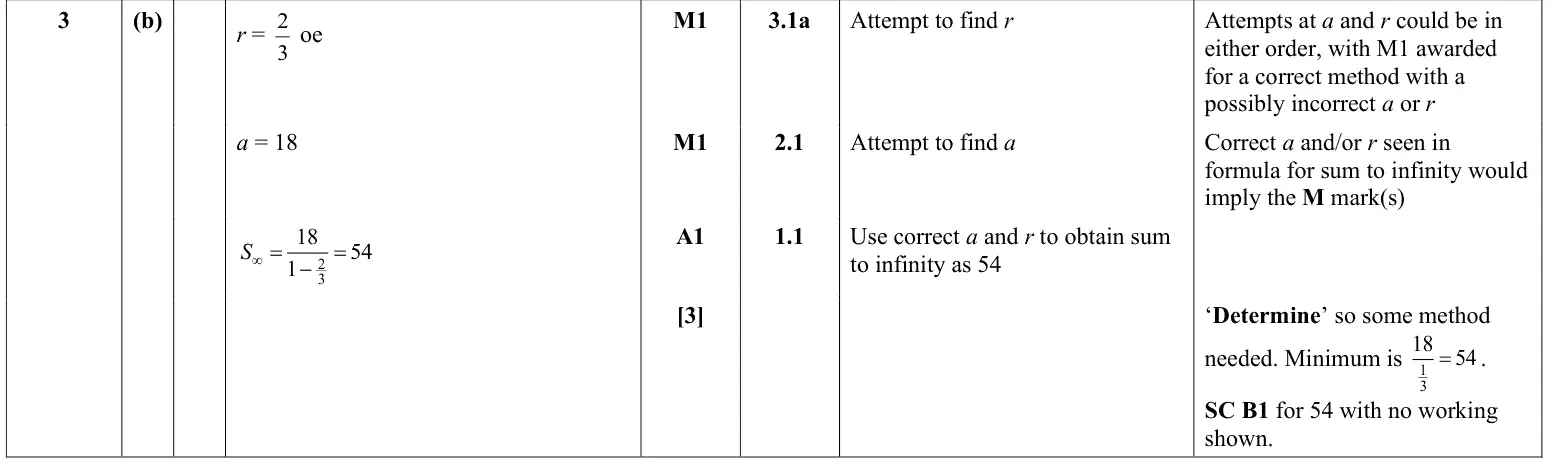
This question was also very well answered, with mostly fully correct solutions seen. The most common error was to correctly find the common ratio, but then use 12 as the first term when attempting the sum to infinity.

Most candidates answered this part well, demonstrating understanding of the two sequences described in the question to deduce the given fact. Some candidates did not score the mark because they did not approach this as a ‘proof’ – although the result is straightforward to deduce, candidates still needed to demonstrate their understanding of the setup before writing down the expression given in the question. When an answer is given, candidates should be reminded to make sure that they provide a logical argument that shows how that answer is reached.

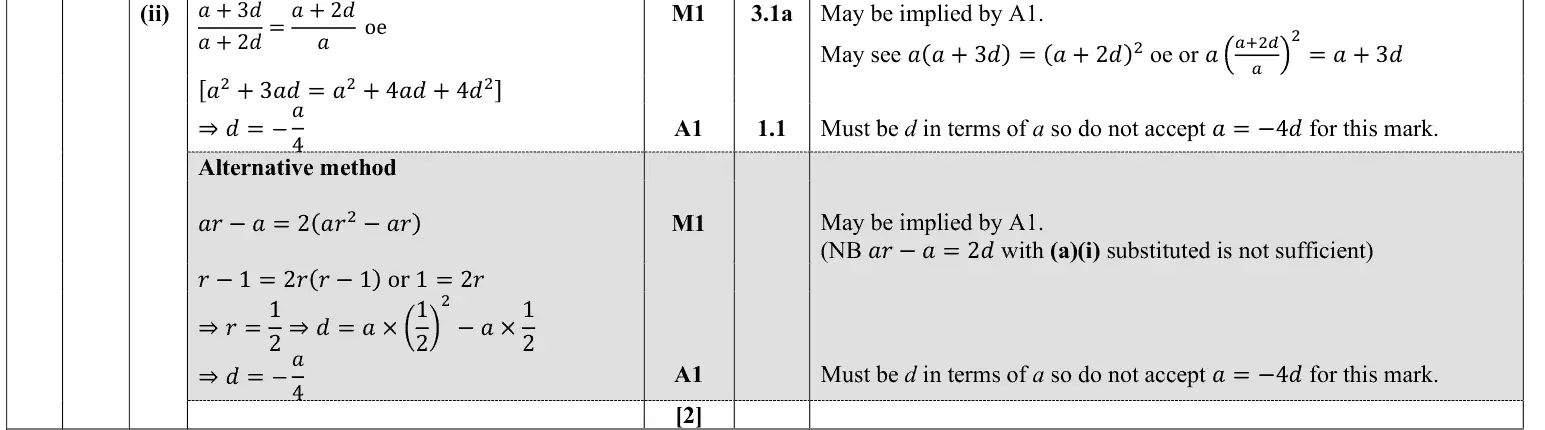
This part was much less well answered than (a) (i), with some candidates appearing unsure about how to translate the given information into a mathematical expression. As shown on the scheme, several different approaches were possible – with the key requirement being to write down an equation in a and d only. Most candidates identified that this meant using the expression for r from part (a) (i) to eliminate r but were often unable to make further progress. A common incorrect answer was 𝑑= −𝑎. The question specifically requested ‘d in terms of a’ which meant that 𝑎= −4𝑑 was not sufficient for the final mark.

Relatively few candidates scored both marks in this part. Some candidates identified (as shown in the main method on the scheme) that they could find the value of r by combining their answers to (a) (i) and (a) (ii), but many others attempted more complex working – often resulting in a quadratic in r. It was possible to solve this and deduce the required answer, but candidates rarely did so successfully. Some candidates (following incorrect or incomplete working in (a) (ii)) started this part by improving on their answer to (a) (ii) but did not appear to recognise that they had done so. Here, and in part (a) (ii), some candidates kept returning to the trivial equation used in part (a) (i) i.e. 𝑎𝑟= 𝑎+ 2𝑑 without recognising that they needed to use further information from the question to deduce another equation.

Most candidates achieved full marks.

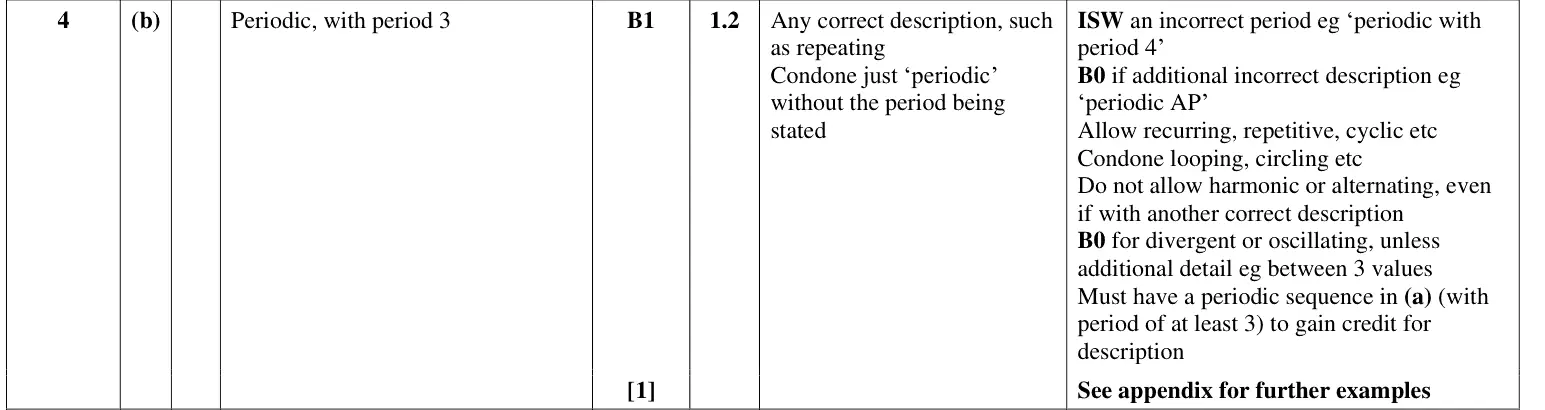
Many candidates gave a correct description, although some thought that the period was 4 instead of 3. Most candidates used an appropriate term, such as periodic, cyclic or repeating.

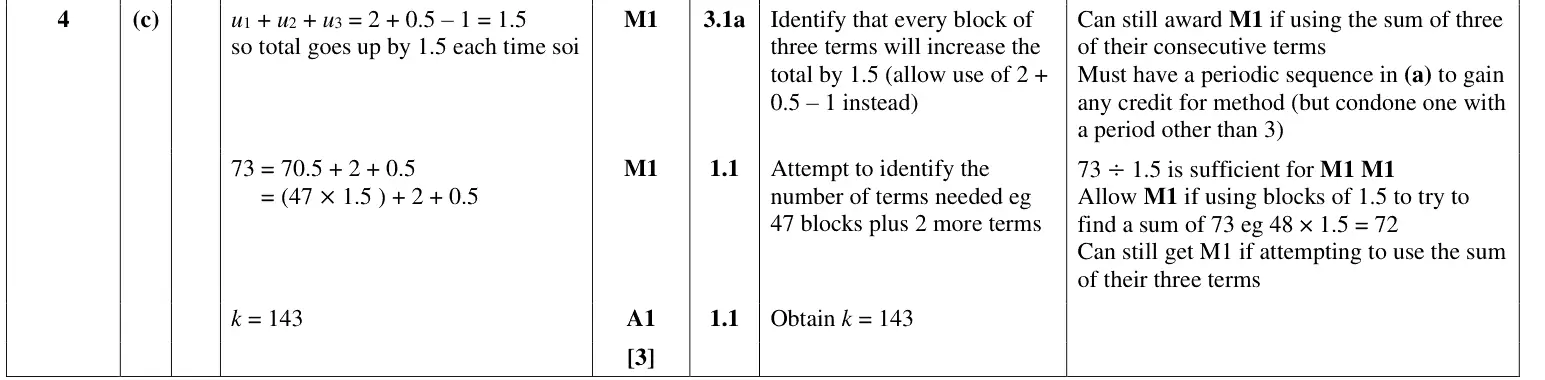
Some candidates tried to use the formula for the sum of an arithmetic sequence or the sum of a geometric sequence, neither of which were appropriate here. Many candidates realised that the sum of each block of three terms totalled 1.5 and then divided 73 (or a value near 73) by 1.5 to deduce that there were about 48 whole blocks and a bit over or under. Several then multiplied by 3, the number of items in each block, to get k = 146, but only some candidates dealt with the excess appropriately to get to k = 143.

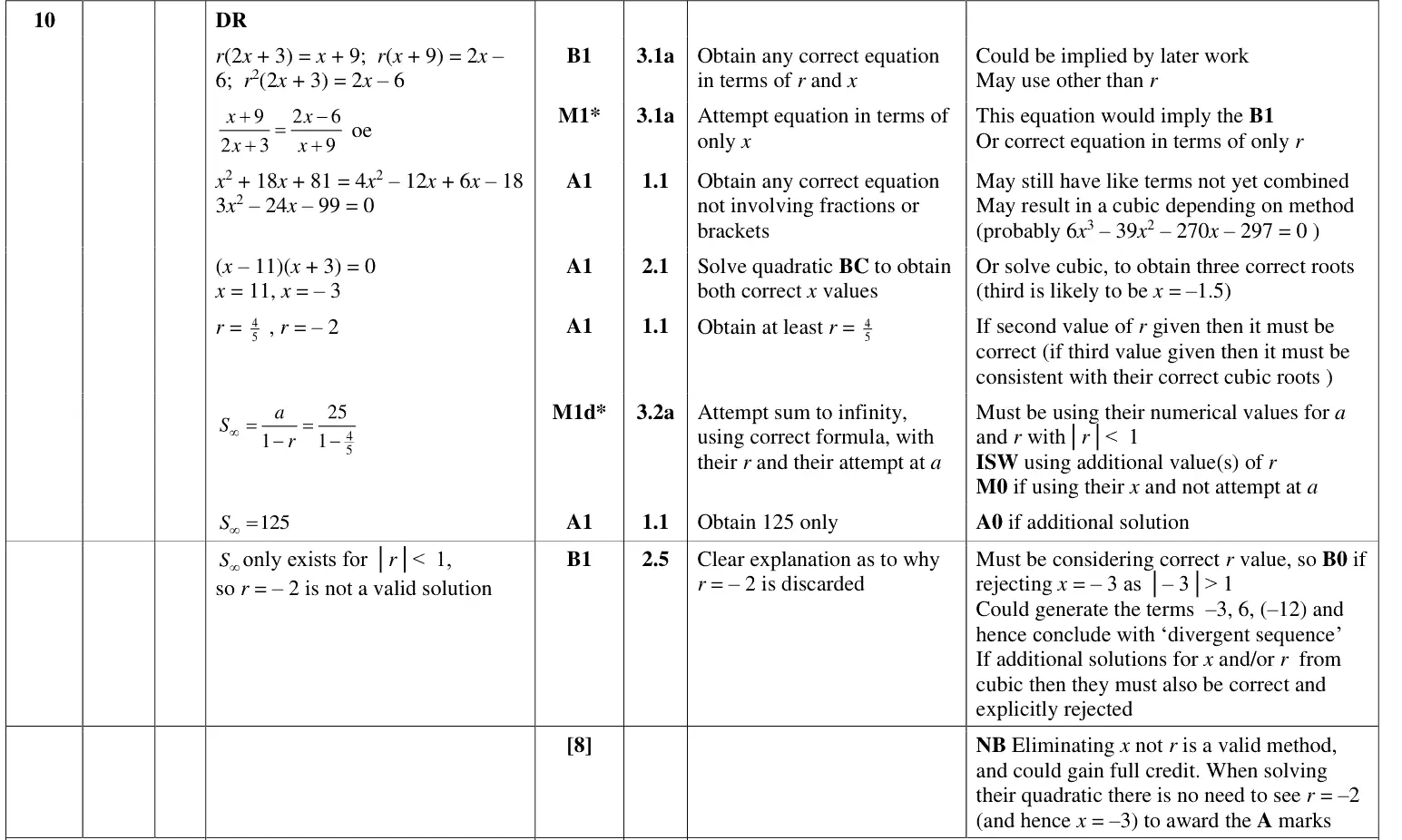
This question was well answered with many candidates scoring 7 or 8 marks. Almost all candidates obtained a correct expression for r, and most went on to form a correct equation in x. Most also solved their equation in x, either a quadratic or a cubic, to find the correct values of x. Despite this being a ‘detailed reasoning’ question, some candidates went straight from the quadratic equation to stating the roots. On this occasion this was condoned, but candidates would be well advised to make sure that sufficient detail is always provided in these types of questions. The majority then went on to find at least one value for r. However, many discarded the solution r = –2 without clear reasoning and in a few cases attempted to incorrectly calculate a second sum to infinity for this incorrect r value. Those candidates that didn’t score well, often tried to use their algebraic expression for r in the formula for the sum to infinity but were then unable to progress from this.
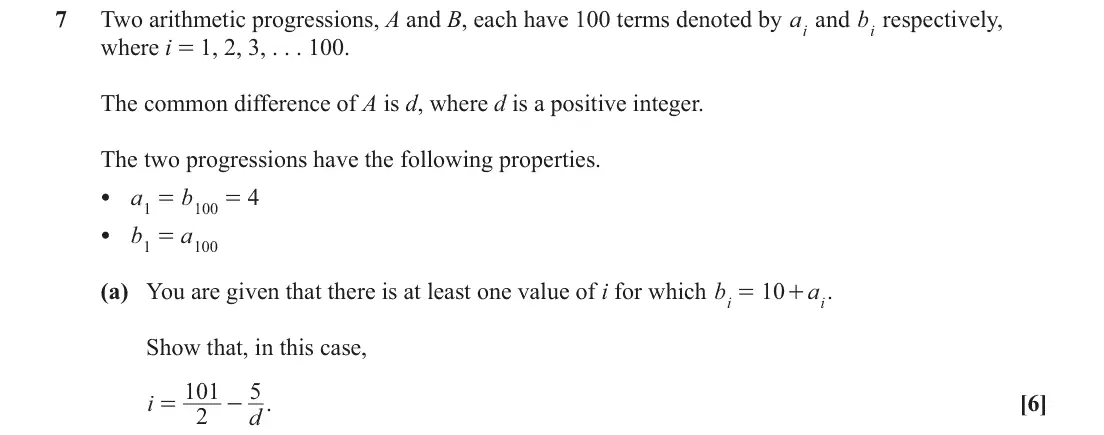
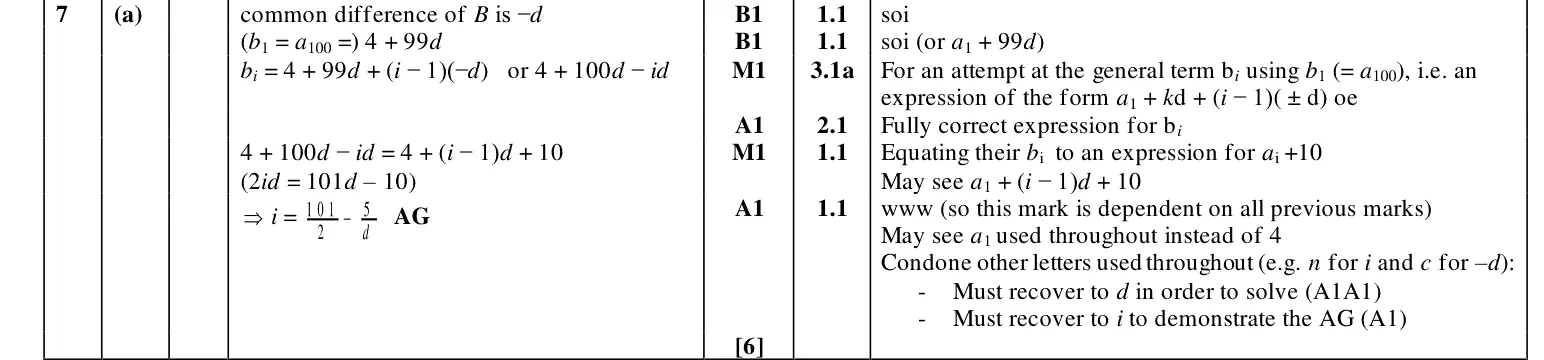
Although few candidates scored all 6 marks in this part, most candidates were able to interpret part of the information in the question to deduce the expression for 𝑏1 = 4 + 99𝑑 (B1). Fewer candidates identified that the common difference of B is –d, either assigning another letter or attempting to use d (and only a few of those deduced later that this needs to be –d). This meant that, while many of these candidates were able to set up the required equation (M1M1) they could not score either accuracy mark. Many candidates attempted to ‘fudge’ the given response and a few misinterpreted the 2 term as implying that they needed to use the summation formula. Some candidates demonstrated excellent understanding by making clear use of the given set up (for instance using reverse indexing).

Very few candidates achieved either mark here, despite it relying only on the given answer to part (a). Some candidates identified that i needed to be an integer and this restricted the values for d, but very few gave both values correctly. This question had a very high omit rate, even though it did not depend on part (a).
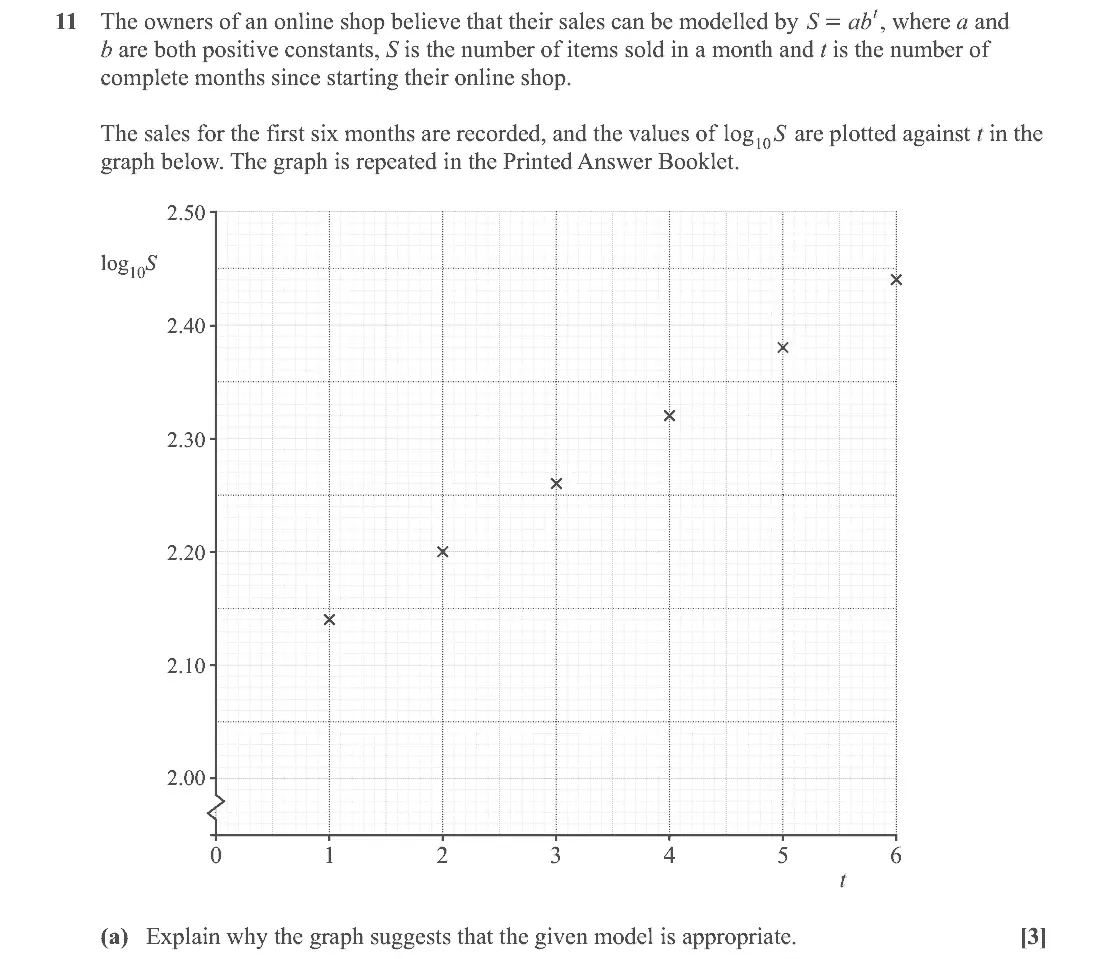

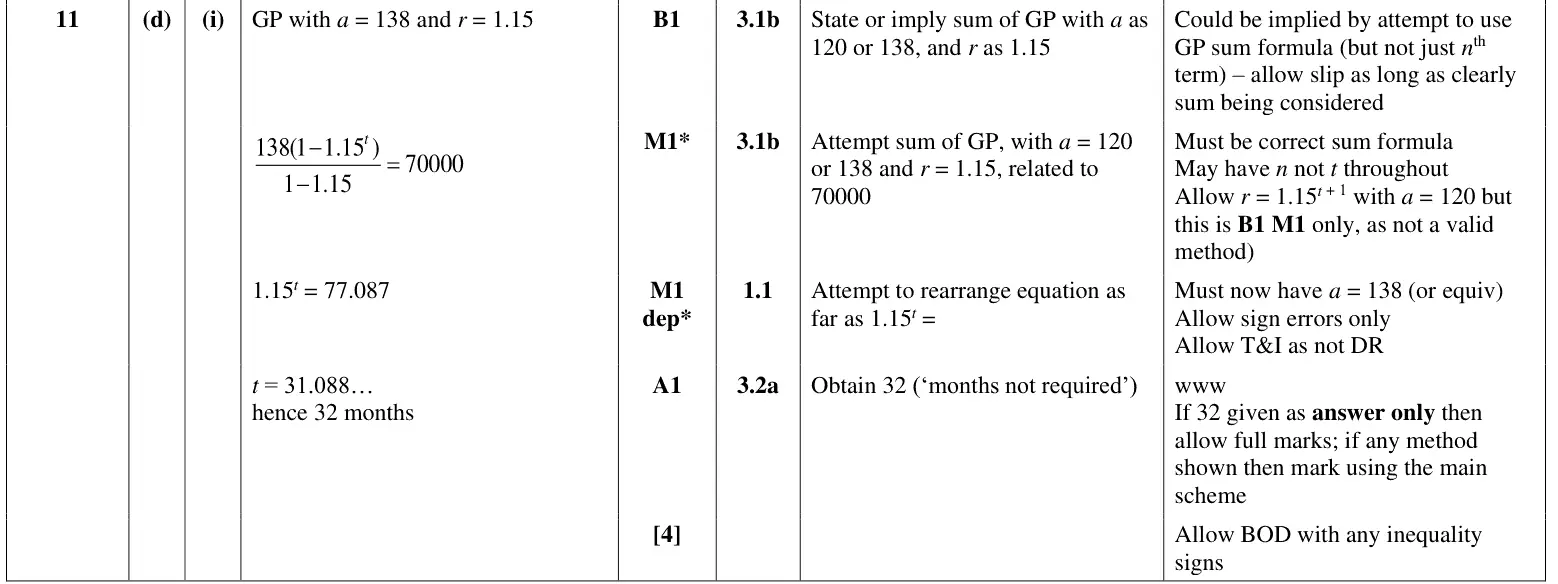
The two equally common approaches were to either equate the monthly sales to 70000 or to consider total sales, using the sum of a GP but with an initial value of 120. Only the higher scoring candidates realised that the first value in the GP should be 138, and these candidates invariably solved the equation correctly to gain full marks.

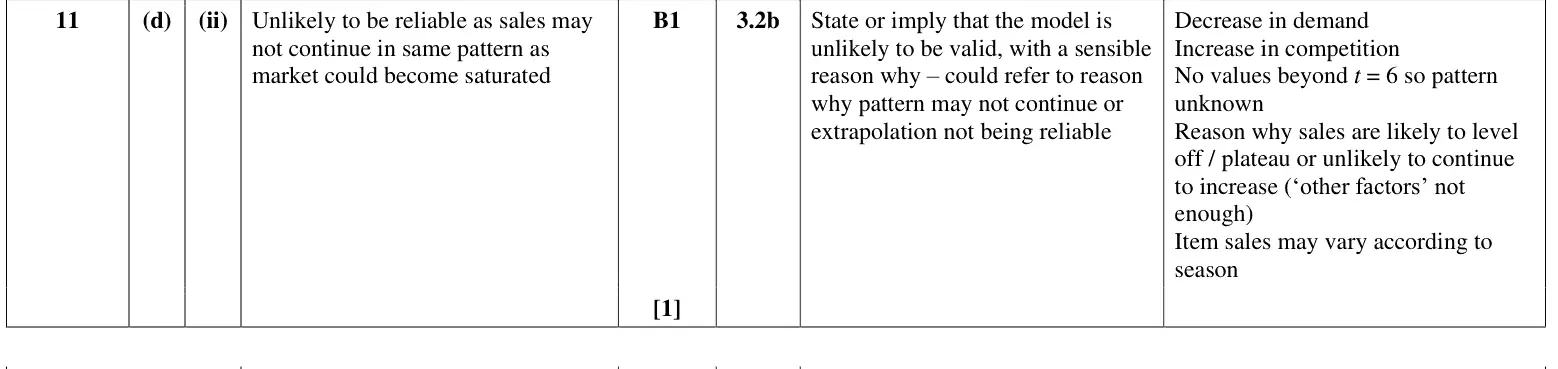
To gain this mark candidates had to both comment that the prediction was unlikely to be reliable, and also to give a reason why this may be the case. It had to be a specific comment, such as a competitor entering the market; no credit was given to generalities that simply said that sales may change but with no further detail. Vague comments did result in only a minority of candidates actually being given this mark.
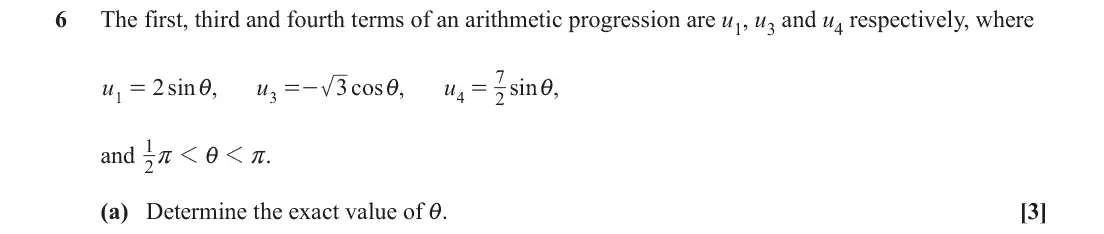
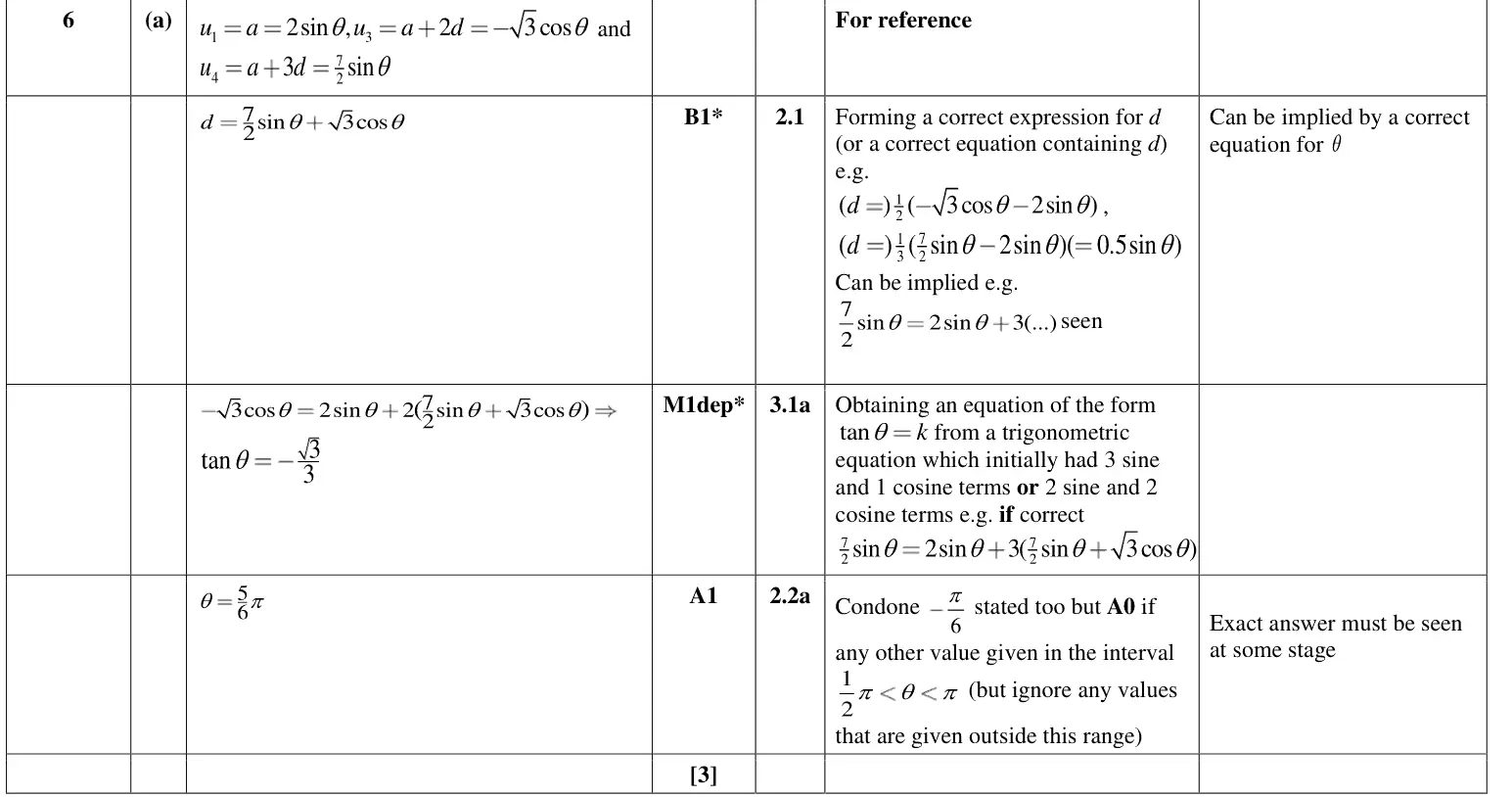
and cosine using the fact that 2(𝑢𝑢4 −𝑢𝑢3) = 𝑢𝑢3 −𝑢𝑢1. Most solved this equation correctly using tan and This part was answered particularly well with most candidates correctly setting up an equation in sine obtained the correct value of 𝜃𝜃. The most common error was to misread the question as giving the first three terms of an AP and not the first, third and fourth terms.

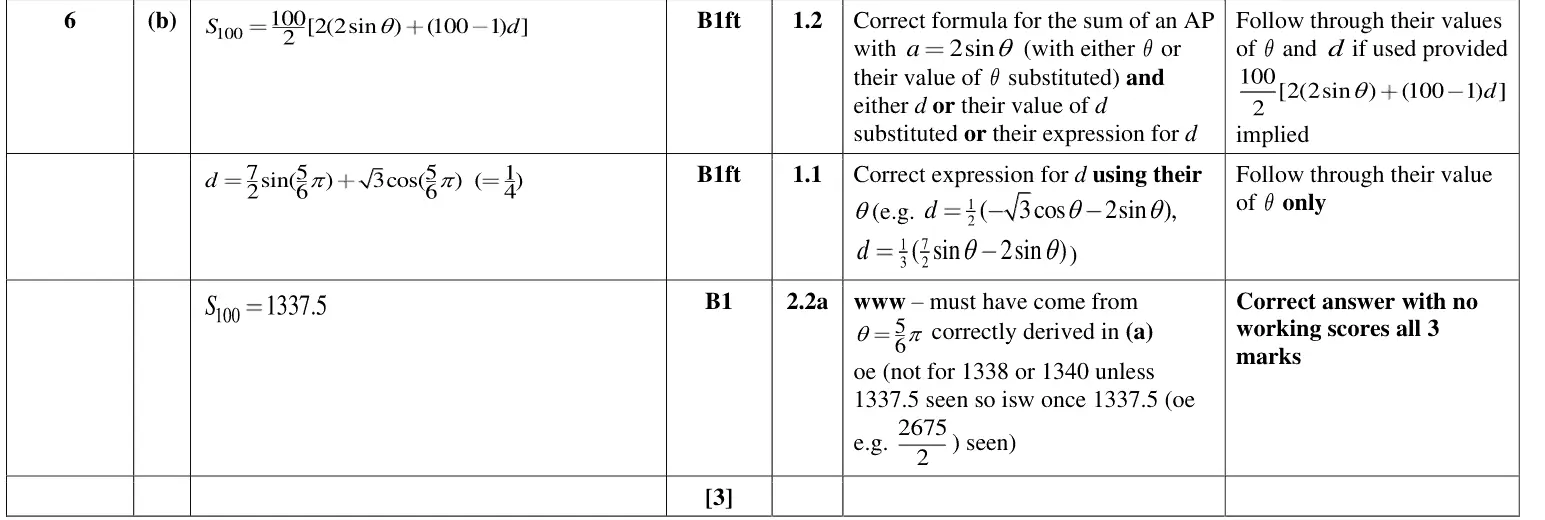
Most candidates used their value of 𝜃𝜃 to obtain a value for the common difference and then applied the correct formula for the sum of the first hundred terms of an AP. Occasionally candidates used the formula for the sum of a GP or incorrectly subtracted the first term from what would have been a correct answer.

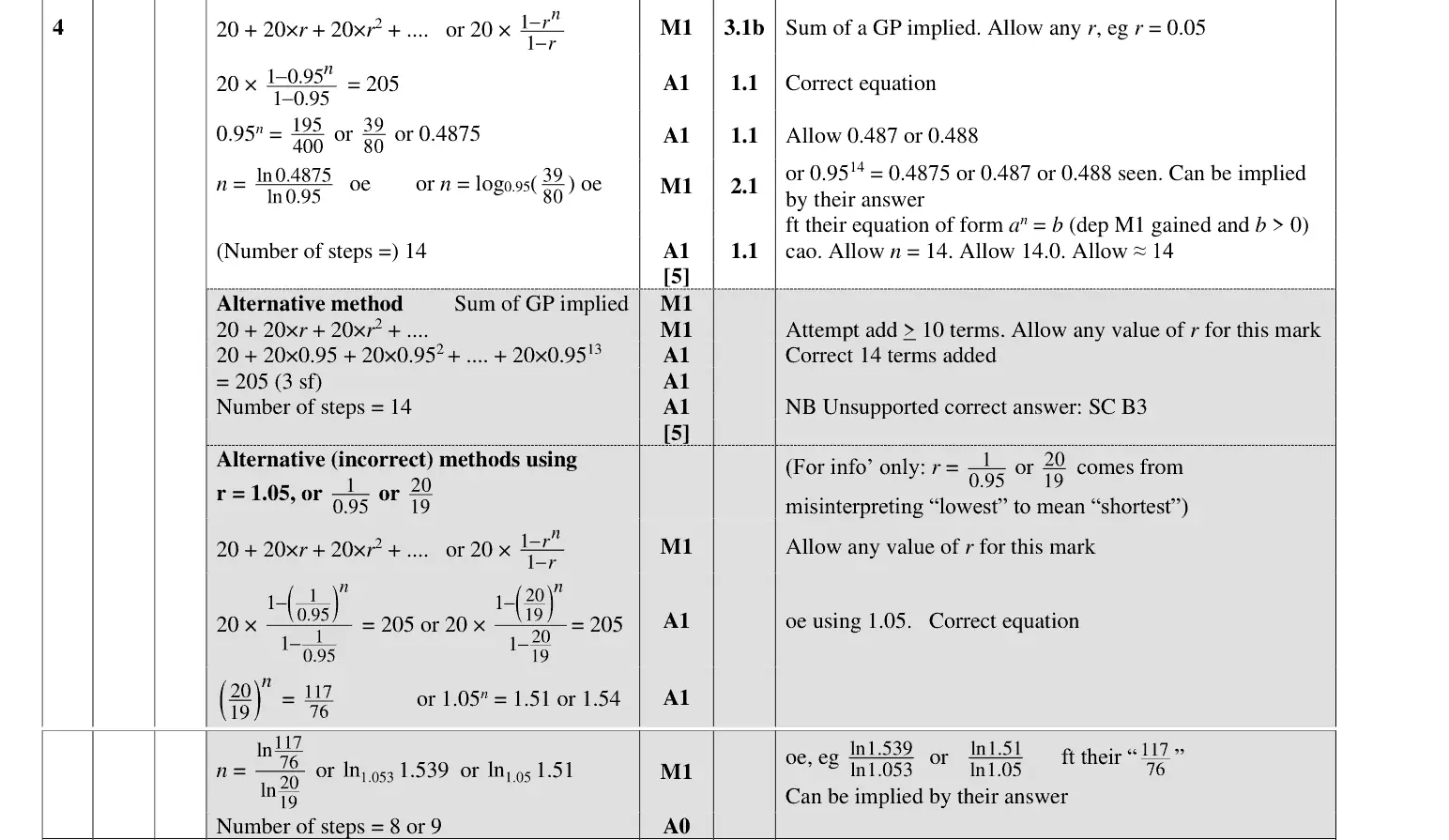
Almost all candidates recognised the need to consider the sum of a geometric progression. (Although a few used either the formula for the nth term of a GP or the formula for the sum of n terms of an AP.) In most cases, there was some good algebraic manipulation, including the use of logs to solve an equation such as 0.95n = 39 80 . There were two common errors. Firstly some candidates used r = 1.05 (representing 1 increasing, rather than decreasing, heights). Others used r = 0.95 (resulting from a misreading of the word “lowest” in the question to mean “shortest”). Candidates who made either of these errors, but whose working was otherwise correct, scored 4 marks out of 5. A more serious error was to use r = 0.05. Candidates who made this error could only score one mark for recognising a geometric progression.

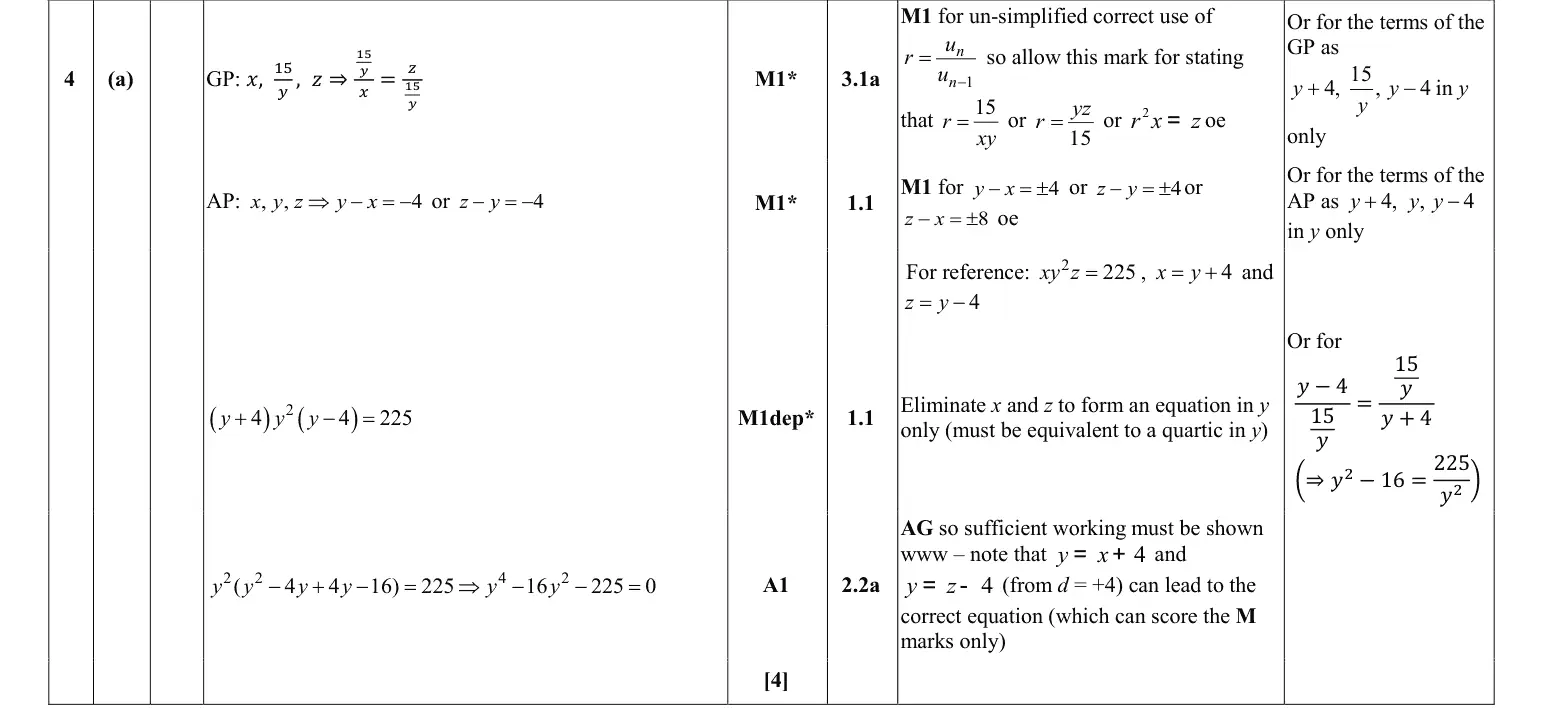
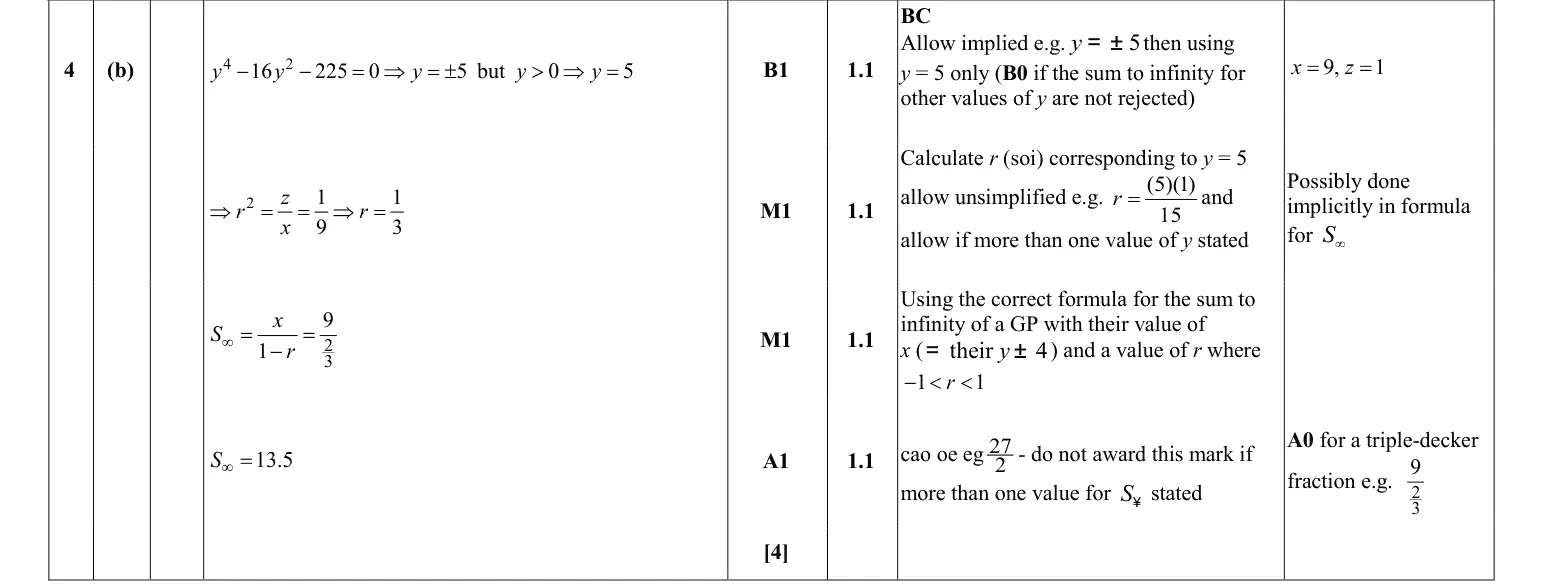
Candidates found this first part very demanding with many struggling to make any meaningful progress. The most successful responses were those that recognised that the information regarding the GP 15 zy = therefore xy z = 225, implied that and that the information regarding the AP implied that yx 15 Those that did usually went on to derive the required quartic equation in .y = + = − x y 4 and z y 4.

Even though this question said ‘hence’ many candidates did not use their calculators to solve the given quartic equation from part (a). Of those that did many simply stated that y = even though the 5 question explicitly stated that y was a positive integer (with many candidates only realising that y − 5 much later in the question when this led to a value for the common ratio that was greater than 1). Of those candidates who successfully found a common ratio for the infinite geometric progression most correctly applied the correct formula for the corresponding sum to infinity.

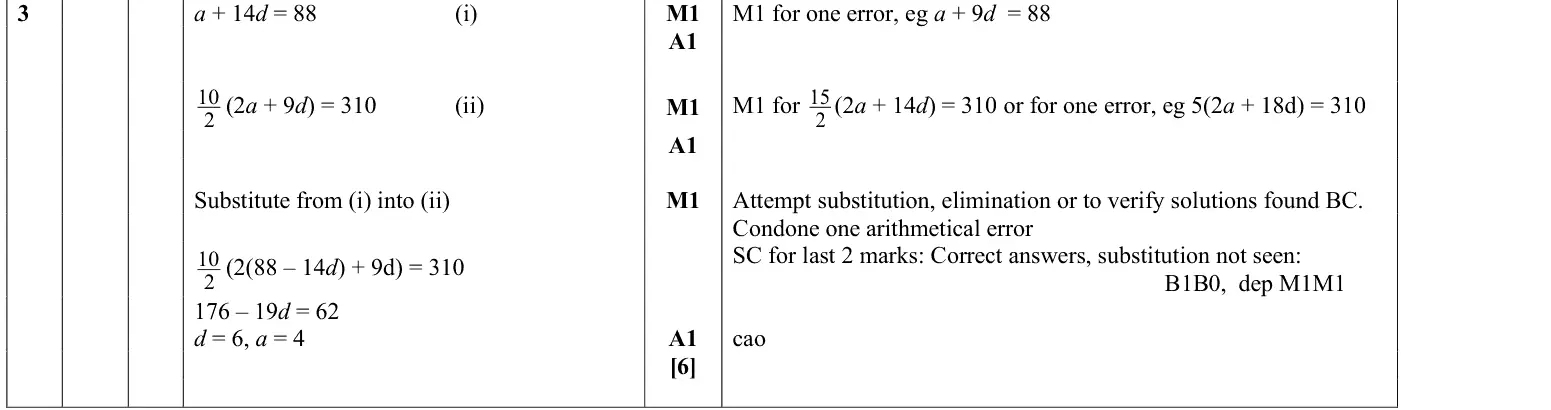
(From the general report) Comments on responses by question type Question 3: Some candidates treated 88 as the last term of the 10 terms whose sum is 310. For example, in Question 3, some candidates obtained the correct two linear equations, and then used the relevant calculator function to write down the answers, without showing a substitution or elimination method.

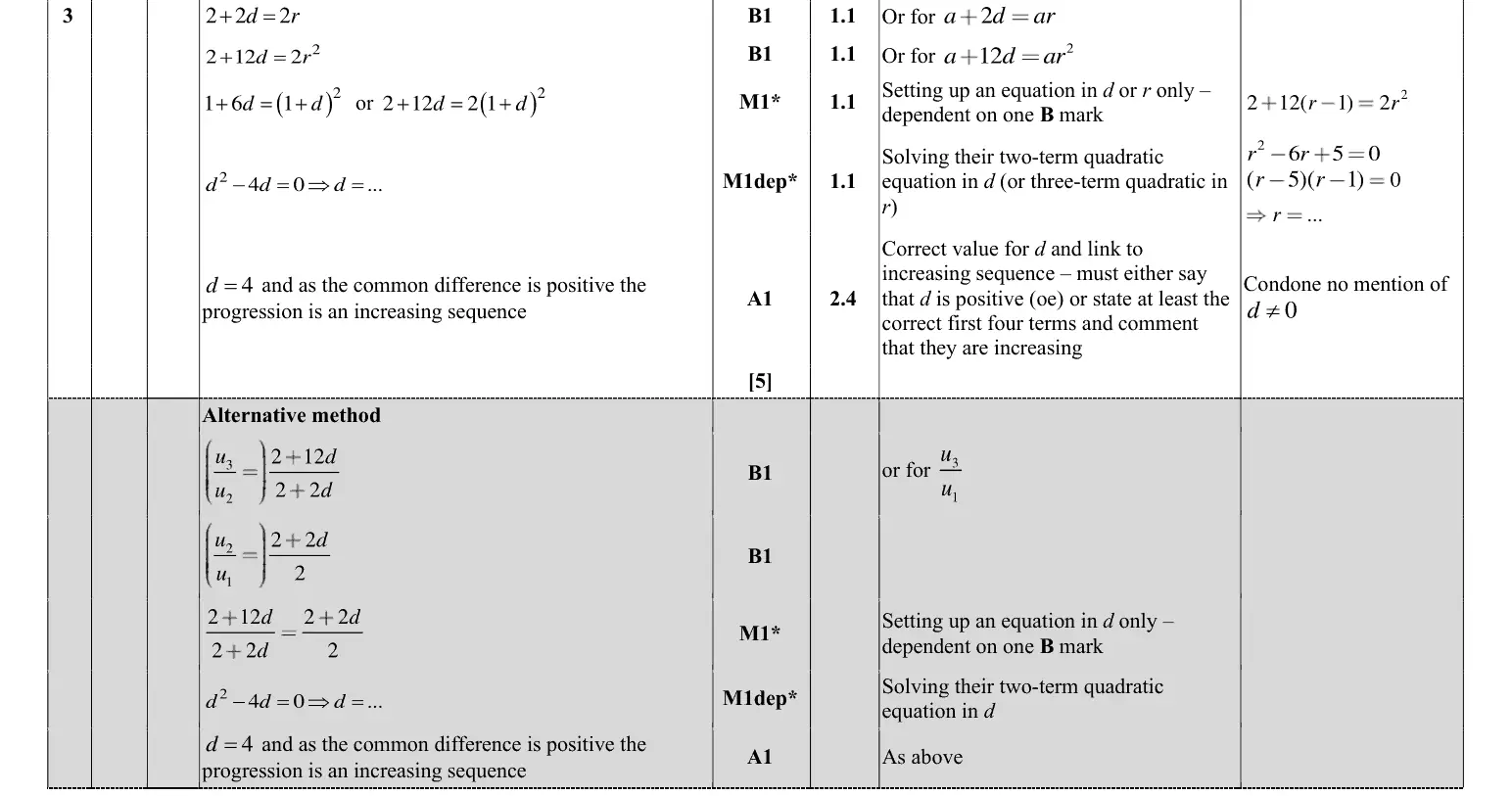
While most candidates could successfully set up and solve the required equations to find the value of d a number did not explain correctly why the value obtained implied that the sequence was increasing.

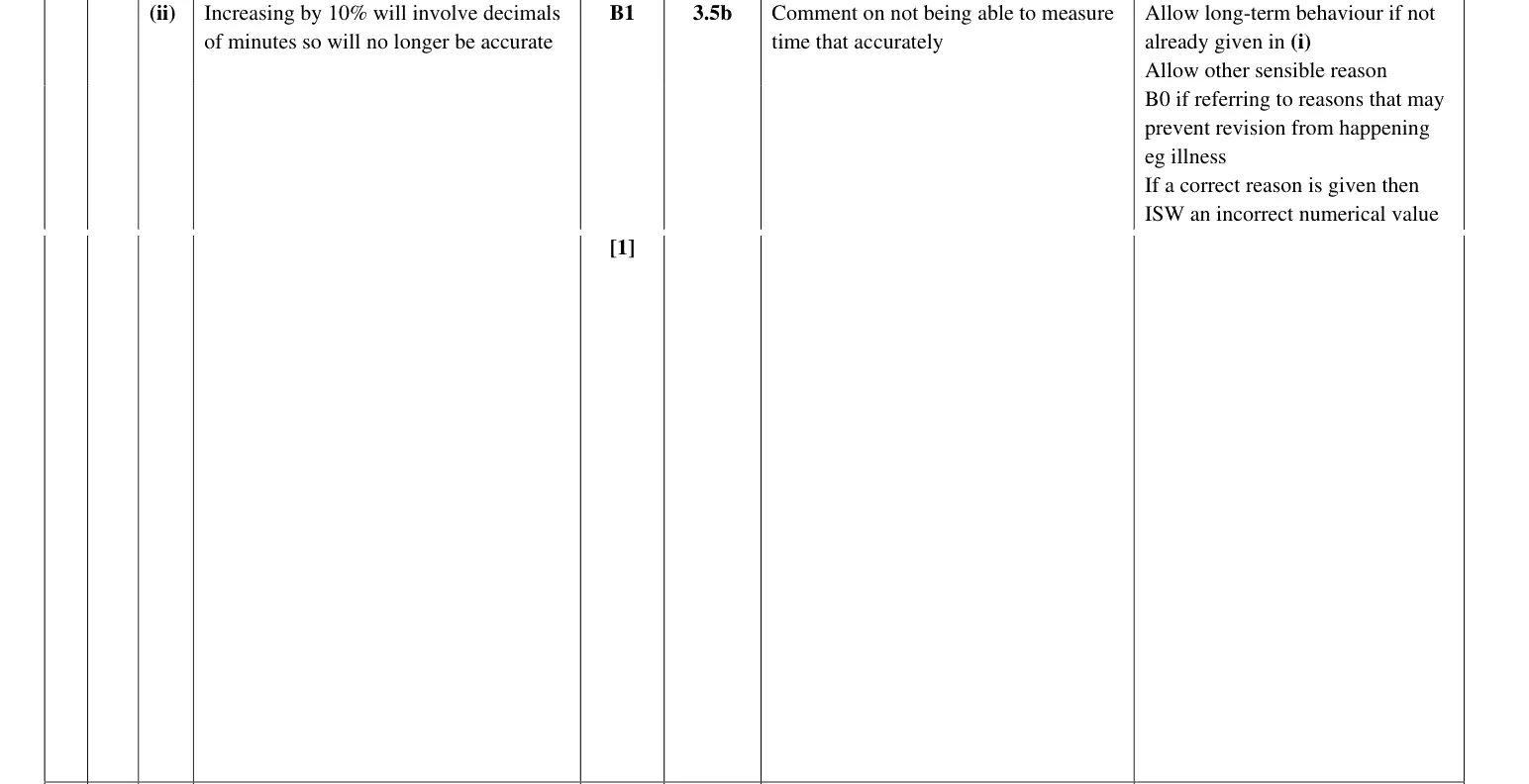
(Comment on Question 07 as a whole) The final part of Question 7 was another example of where candidates were expected to give clearly explained and sensible answers. Many could identify that there will eventually not be enough hours in the day, but finding a reason on a different theme for their second answer proved more problematical.

(Comment on Question 07 as a whole) The final part of Question 7 was another example of where candidates were expected to give clearly explained and sensible answers. Many could identify that there will eventually not be enough hours in the day, but finding a reason on a different theme for their second answer proved more problematical.

(Comment on Question 07 as a whole) The final part of Question 7 was another example of where candidates were expected to give clearly explained and sensible answers. Many could identify that there will eventually not be enough hours in the day, but finding a reason on a different theme for their second answer proved more problematical.

(Comment on Question 07 as a whole) The final part of Question 7 was another example of where candidates were expected to give clearly explained and sensible answers. Many could identify that there will eventually not be enough hours in the day, but finding a reason on a different theme for their second answer proved more problematical.



This is a good example of the use of "Hence or otherwise". Those candidates who took the hint and used their answers to parts (a) and (b), obtained the required result quickly. Unfortunately, the majority of candidates opted for the "otherwise" route and, in almost all cases, did not obtain any marks. 4 sin θ = − Many candidates correctly obtained sin θ = or 1 , but then deduced that sinθ = , omitting 1 3 4 the case where sinθ = −. Some also gave no comment about rejecting 1 sin θ = − , but merely crossed 3 it out.
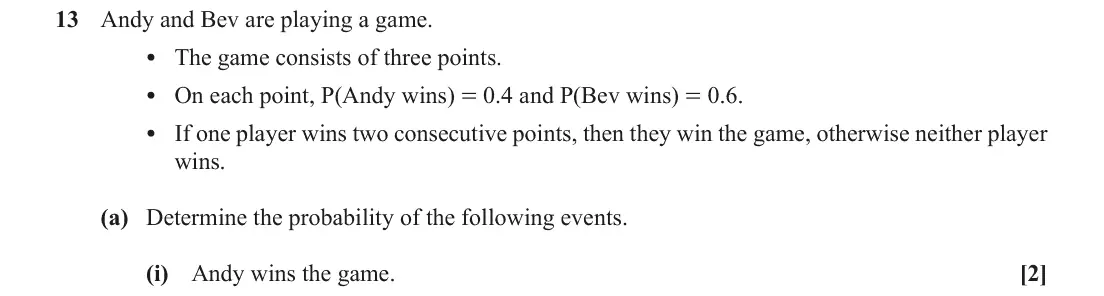


(From the general report) In answering Question 13(b), most candidates did not recognise that an infinite series was involved.

The majority of candidates could identify that this was an arithmetic progression, find the common difference and attempt the tenth term. As this was a question posed in a real-life context it was expected that solution should reflect this; a number of candidates did not include units in their answer thus not gaining full credit.

Most candidates could attempt the sum of the arithmetic progression, equate it to 500,000 and attempt to solve. There was an expectation that candidates would use their calculators to solve the resulting quadratic. While some did so, they were in the minority and errors in handling the ‘unfriendly’ numbers were seen. Candidates then had to appreciate that an integer solution was required, and most gained full marks by doing so. Rather than attempting the sum, the most common error was to instead use the nth term formula and the answer that Sam would have to work for 405 years did not seem to result in candidates reconsidering their solution.

When commenting on a model, candidates are first expected to state whether or not the model is realistic and then use evidence to support their answer. A variety of solutions were seen, including those which referred to inflation, getting a promotion (or taking on a different role within the company) or there being a pay cap on annual salary within the company. However, too many solutions were too vague and simply referred to Sam being paid too much money without giving any kind of reason or example as to why this was unrealistic. Explanations that referred to death, retirement or moving to a different company were also not accepted. The candidate identifies that this model may be unrealistic in the long term and gives a number of specific examples as to why this may be the case. This candidate also identifies that the model may be unrealistic as the salary is unlikely to increase at a constant rate every year but does not support this with an example or specific reason, so did not gain the mark.

Most candidates were able to gain some credit on this question, but fully correct solutions were in a minority. The most effective method was to start by writing out the first few terms of the sequence, to allow the first term and common ratio to be identified. These values could then be substituted into the relevant formulae, and the inequality rearranged to useable form. Candidates were generally able to make a good attempt at this, but sign errors were relatively common. In this ‘detailed reasoning’ question, there was an expectation that the use of logarithms to solve the inequality would be explicit and this was nearly always the case. Candidates then had to conclude by stating the correct integer value of N, a step that some omitted and concluded with a decimal answer. The final answer had to be fully justified by correct use of inequalities throughout (which was often not the case with log0.6 involved), or by testing at least one relevant integer value. The most common misconception was to assume that the first term of the sequence was 25, with no check of n = 1.

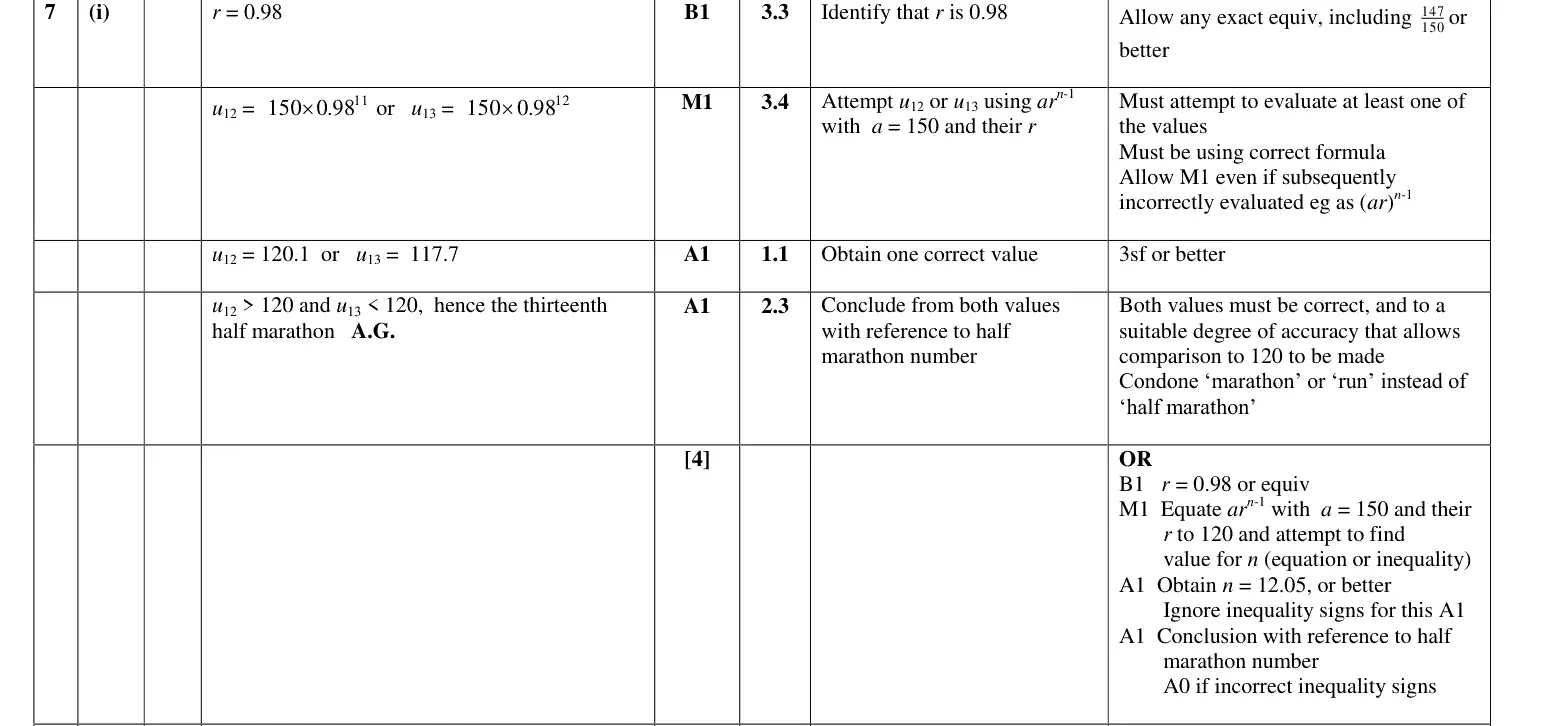
Having been told that the training programme was being modelled by a geometric progression, candidates were able to identify the first term and common ratio and use these in the nth term formula. Some candidates demonstrated that the time on the thirteenth half marathon was indeed less than 120 minutes, but to answer the question fully they also had to show that the time on the twelfth half marathon was more than 120 minutes. Other candidates set up an inequality and solved this for n, but the signs were not always correct throughout. As this is a modelling question the answer was expected to be in context namely referring to the thirteenth half marathon, although just ‘marathon’ or ‘run’ were also condoned.

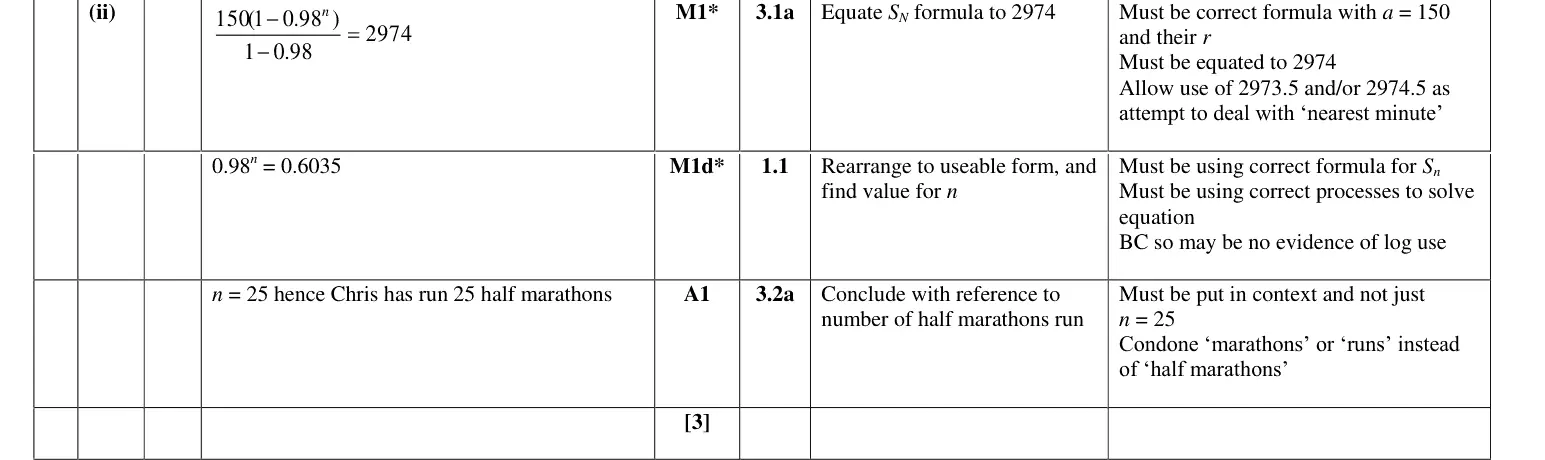
Candidates could correctly equate the expression for the sum of n terms to 2974, and most were able to solve this equation. Most candidates showed a clear mathematical justification even though there was no specific command in the question requiring this level of detail for full credit. Once again, the final answer was expected to be given in context.

Candidates were required to consider the limitations of the model, focusing both on the variations between each run and the long term implications. For the first limitation, some candidates were able to give a clear explanation along with an example, often mentioning injury or weather conditions, whereas others explanations were too vague to be given credit. Candidates would be well advised in such questions to give specific examples to support their answer. For the second mark there had to be some consideration that Chris would eventually reach a point where no further improvements would be possible. Once again, there were some eloquently phrased explanations, sometimes giving a specific example. Candidates should ensure that their handwriting is legible, and their phrasing clear, in order to convey their intent to an examiner. This response gains one mark for identifying that external factors could affect Chris’ performance and gives three examples. Any one of these factors would have been sufficient to gain the mark, but a specific example was required. The second mark is credited for identifying that eventually the model would predict very small times, which is not realistic. This response identifies that times could fluctuate but does not give a specific example so the first mark is not credited. The candidate states that the model assumes that Chris gets faster but does not comment on how realistic this is so the second mark is not credited either. In fact the final part of the sentence suggests that this is actually supporting the idea of fluctuating times, but it is still not specific.

Some candidates recognised the need for an infinite series, but most could not cope with the fact that the first term is unknown. Many candidates thought that Y cannot be 0, hence P(Y = 0) = 0 and hence P(Y = 1) = 0.5 × 0 = 0
Stuck on this? Book a trial session with an A-level maths tutor.