Probability, including conditional probability Statistics
Papers
Paper 2, AS Paper 1
Level
AS and A level
Spec
2.03a, 2.03b, 2.03c, 2.03d, 2.03e
Formulae sheet
P(A ∪ B) and P(A ∩ B) = P(A) P(B | A) are given.
Since 2018
46 question parts, 134 marks, each rated Easy, Medium or Hard from the wording of the examiners' report
Notes, worked examples and practice for this topic are being written by our tutors. The past-paper questions below are ready now: work each one on paper, then open the mark scheme and the examiner's comment.
Tap a question to zoom it. Mark scheme and examiner's comment open under each question.
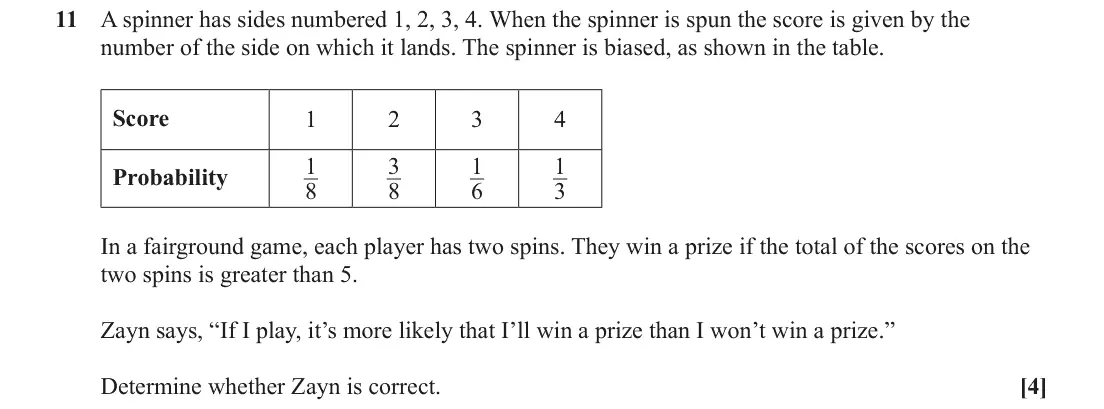
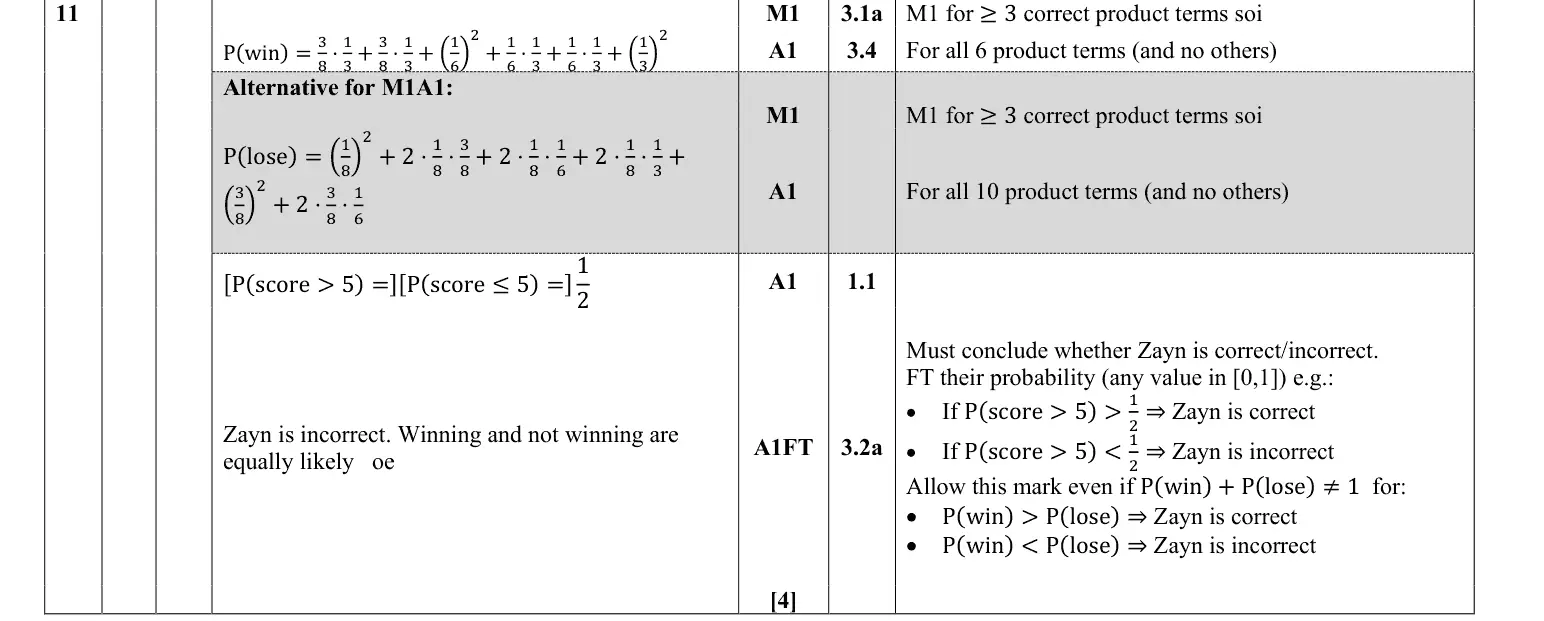
June 2025 · AS Paper 1 · Q114 marksHard
Mark scheme for this part
Examiner's comment
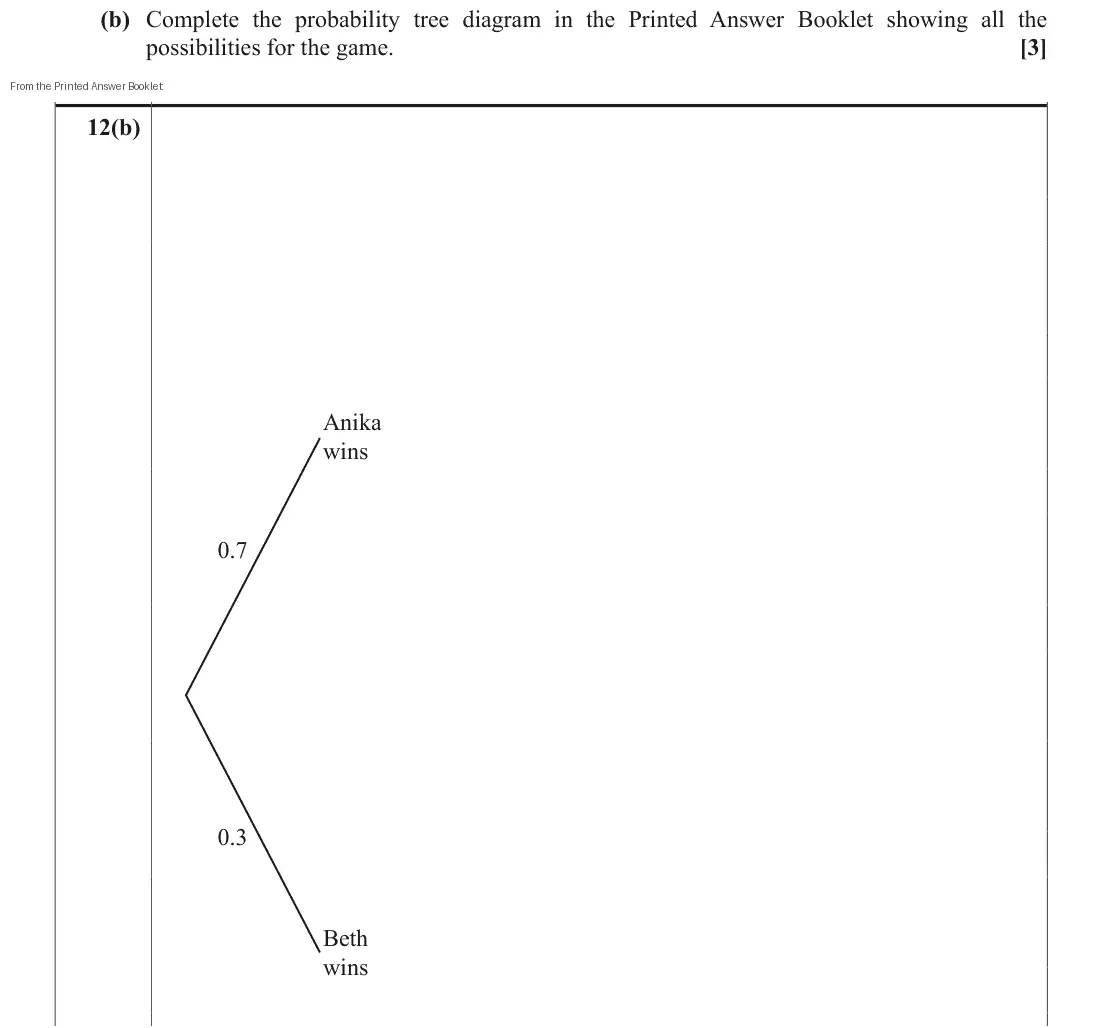
Some candidates scored full marks on this probability question. In order to determine whether Zayn’s statement is correct, candidates needed to calculate the probability of a ‘win’ (i.e. score greater than 5) or ‘lose’ and then make an appropriate conclusion. Most candidates recognised the need to combine the probabilities for two spins, and some drew a tree diagram to represent these. Provided candidates had three or more correct products (for either ‘win’ or ‘lose’) then they could score M1, but they needed all 6 (or 10 for ‘lose’) to be correct for the first A mark, which very few candidates achieved. Candidates could score the final A mark as FT provided that they gave a conclusion (following three or more correct products) that was correct for their values. Candidates who denoted the sample space with a grid tended to have more success in identifying the correct pairs of probabilities. Candidates should be encouraged to make full use of the answer space available and to use systematic methods to make sure they have the right number of terms in their summation. Most candidates gave an appropriate conclusion, but (as in Question 10(a) ) candidates needed to clearly and unambiguously state whether they were saying that Zayn is correct or incorrect.
Key points and common errors
list all pairs with total > 5 (6 products) or ≤ 5 (10 products)
P(win) = ½, so winning and not winning are equally likely and Zayn is incorrect
a sample-space grid helps
very few got all products
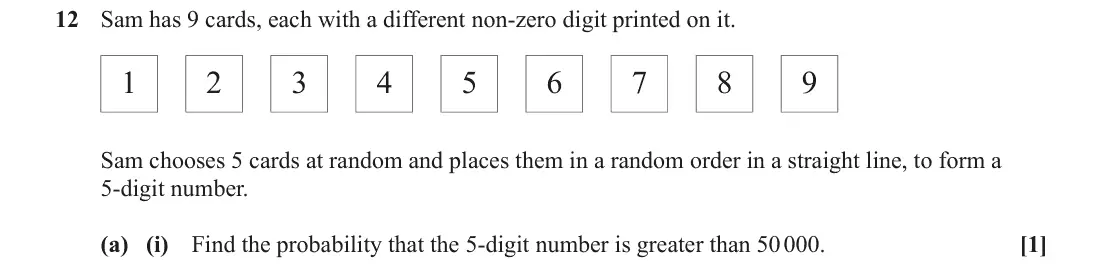
June 2025 · Paper 2 · Q12(a)(i)1 markEasy
Mark scheme for this part
Examiner's comment
Almost all candidates gave the correct answer in this part.
Key points and common errors
first digit 5–9: 5/9
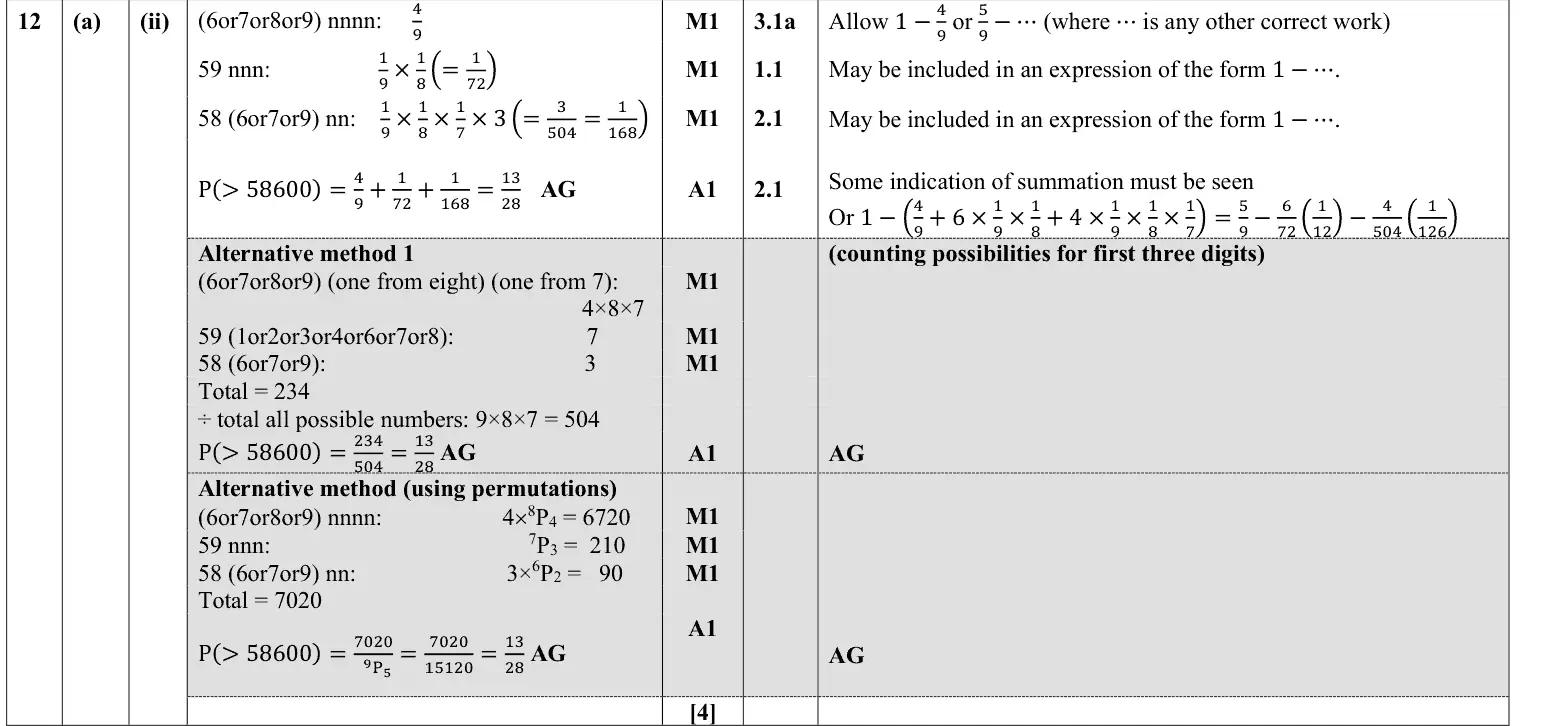
June 2025 · Paper 2 · Q12(a)(ii)4 marksHard
Show the start of this question
Mark scheme for this part
Examiner's comment
Many candidates made a good start to this part, scoring at least one of the three available method marks, but relatively few provided a fully complete justification of the given result. As this was a ‘show that’ question, candidates needed to provide a clear and convincing argument. Some candidates correctly deduced part of the required probability (e.g. 9 ) from their answer to part (a) (i), and then ‘produced’ the difference between that and 28 without any justification, claiming the given result. This was not sufficient to gain full marks. Candidates needed to provide working (typically by demonstrating probabilities based on a logical breakdown of the combinations) that justified their answer in order to score full marks. Similarly, candidates who just wrote down 15120 could not score full marks unless they first demonstrated how the numerator was derived.
Key points and common errors
cases 6/7/8/9 first (4/9), 59 (1/72), 58 then 6/7/9 (1/168)
sum to 13/28
claiming the given result from the difference without working gains little
June 2025 · Paper 2 · Q12(b)2 marksHard
Show the start of this question
Mark scheme for this part
Examiner's comment
Fewer than half of candidates obtained the correct answer in this part (even considering that full follow- through was permitted from candidates’ answers to part (a) (i)). There was no follow-through from part (a) (ii) –although some candidates mistakenly used their incorrect attempt at the result instead of the given value 28. Some candidates did not use the correct formula for conditional probability, and some of these obtained the correct value but from wrong working (perhaps as a result of calculator input or changing the formula later) and so could not gain full marks here.
Most candidates obtained the correct answer here. Quite a few candidates correctly used the given distribution to obtain 0.322 but then either left this as the final answer, or multiplied by 2 (rather than squaring), scoring M1A0.
Key points and common errors
P(0.3 < X < 0.4) = 0.322
square it for two stones: 0.104
error multiplying by 2
June 2025 · Paper 2 · Q154 marksEasy
Mark scheme for this part
Examiner's comment
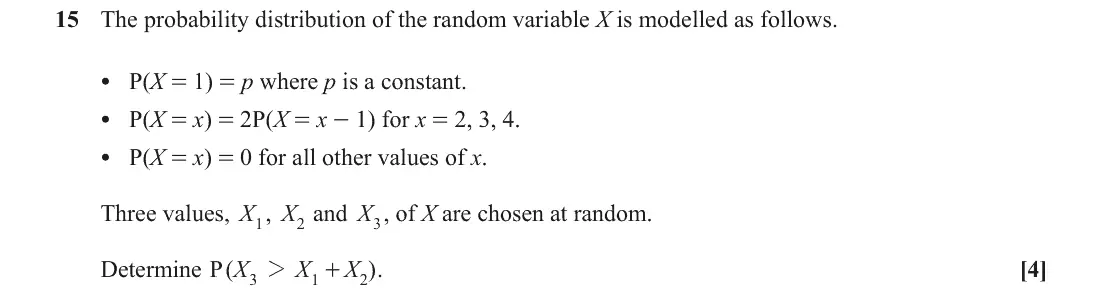
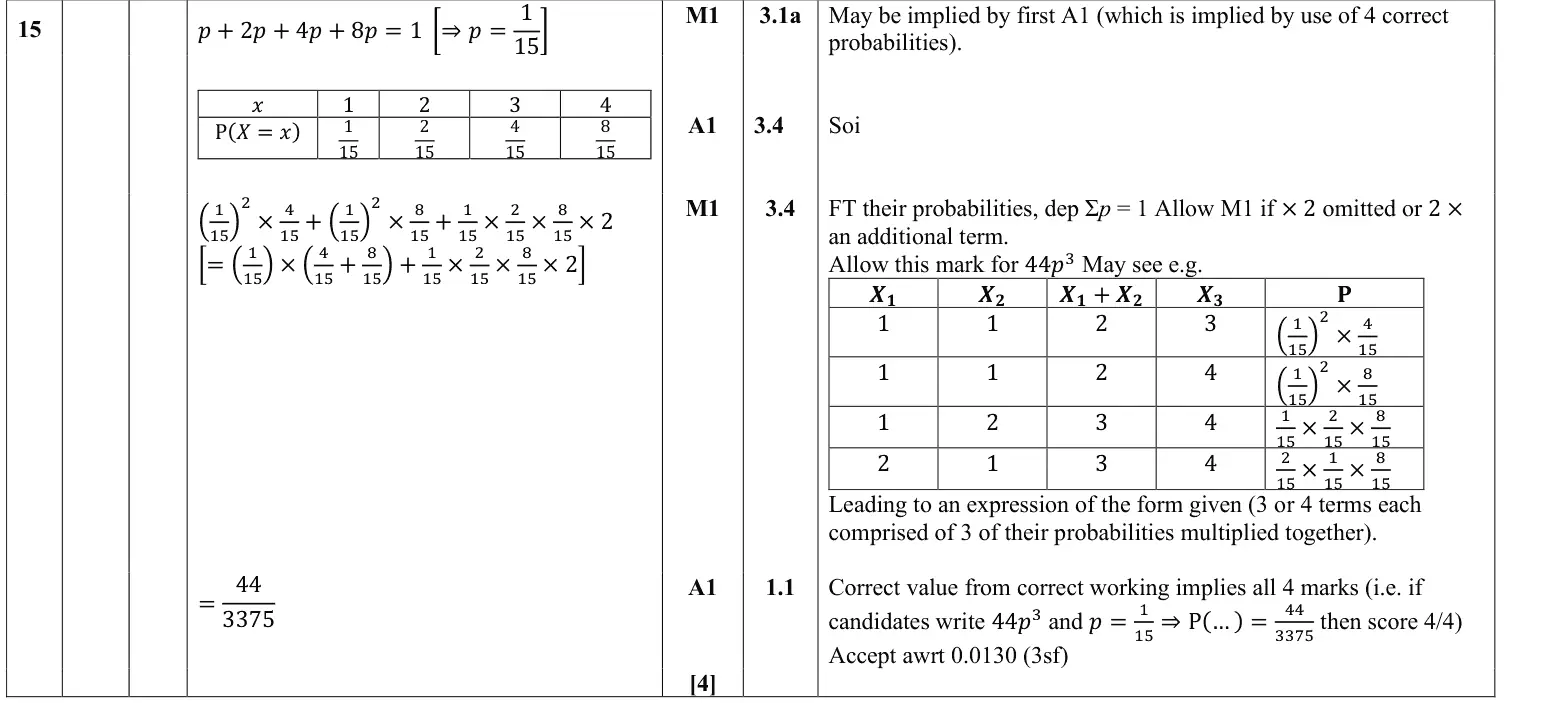
This final question was well answered, with many candidates scoring at least 2 marks. Candidates needed to interpret the information given in the question to deduce four probabilities for M1A1 and then combine these appropriately to find the required answer. Most candidates were able to find 𝑝= 15 correctly and often made an acceptable attempt at combining their probabilities (3-4 terms of 3 probabilities each), but not all candidates had the right combination to obtain the correct answer. A minority of candidates chose to work in terms of p throughout (but fewer than on the equivalent question in 2024). Some candidates misinterpreted the given information and used 6p instead of 8p. Candidates did not need to itemise all 4 probabilities as shown in the scheme, but this approach is encouraged – candidates who ‘deduced as they went along’ sometimes made errors or did not include all 4 probabilities which meant that this mark could not be implied. This candidate has given a fully correct solution. Notice that they have itemised their probabilities before proceeding to combine them – this step was not explicitly required (so these probabilities could be ‘implied’ if seen used later) but it is good practice and ensures that the working is clear (so that, for instance, a later error doesn’t remove the opportunity to ‘imply’ that first A mark), 4/4.
Key points and common errors
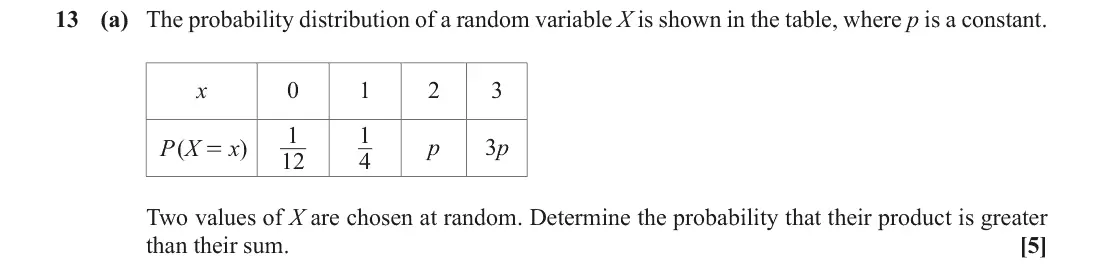
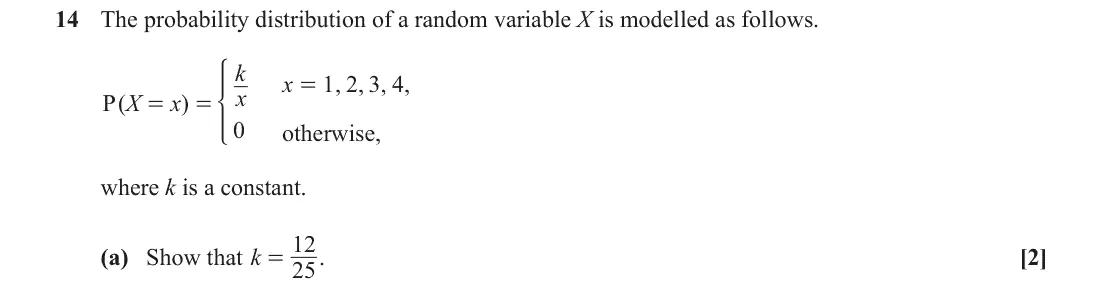
p + 2p + 4p + 8p = 1 so p = 1/15
list outcomes with X₃ > X₁ + X₂ (1,1,3), (1,1,4), (1,2,4), (2,1,4)
44/3375
some used 6p instead of 8p
June 2024 · AS Paper 1 · Q10(a)1 markEasy
Mark scheme for this part
Examiner's comment
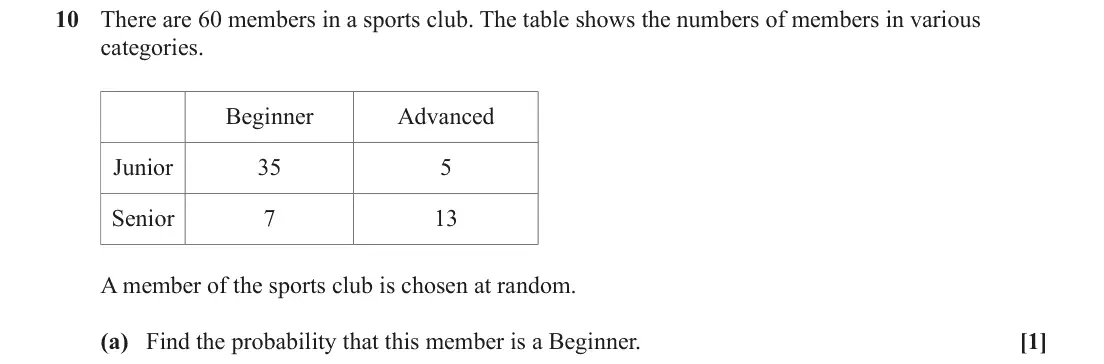
Almost all candidates answered this correctly. An occasional incorrect answer was 35/60, and a few candidates simplified incorrectly; the ignore subsequent working (isw) means this was not penalised.
Key points and common errors
42/60 = 0.7
June 2024 · AS Paper 1 · Q10(b)1 markEasy
Show the start of this question
Mark scheme for this part
Examiner's comment
Most candidates answered this correctly, with a few attempting 35/60 or similar numerical errors, such as dividing by 42 (the total number of beginners) rather than 40 (the total number of Juniors).
Key points and common errors
35/40 = 7/8
divide by the 40 juniors, not 42 beginners or 60
June 2024 · AS Paper 1 · Q10(c)2 marksMedium
Show the start of this question
Mark scheme for this part
Examiner's comment
This was less well answered, with quite a few candidates mistakenly giving the ‘with replacement’ cases route using intersections (i.e. ቀ 40 × 60ቁ× ቀ 59 × 39ቁ× 2). Other common errors included giving the (M0) or forgetting to double their answer (M1A0). A few candidates found the probabilities via the indirect denominators as 60 and 60 or 40 and 39.
Key points and common errors
without replacement: 2 × (35/60)(5/59) = 35/354 = 0.0989
errors: with replacement, forgetting × 2
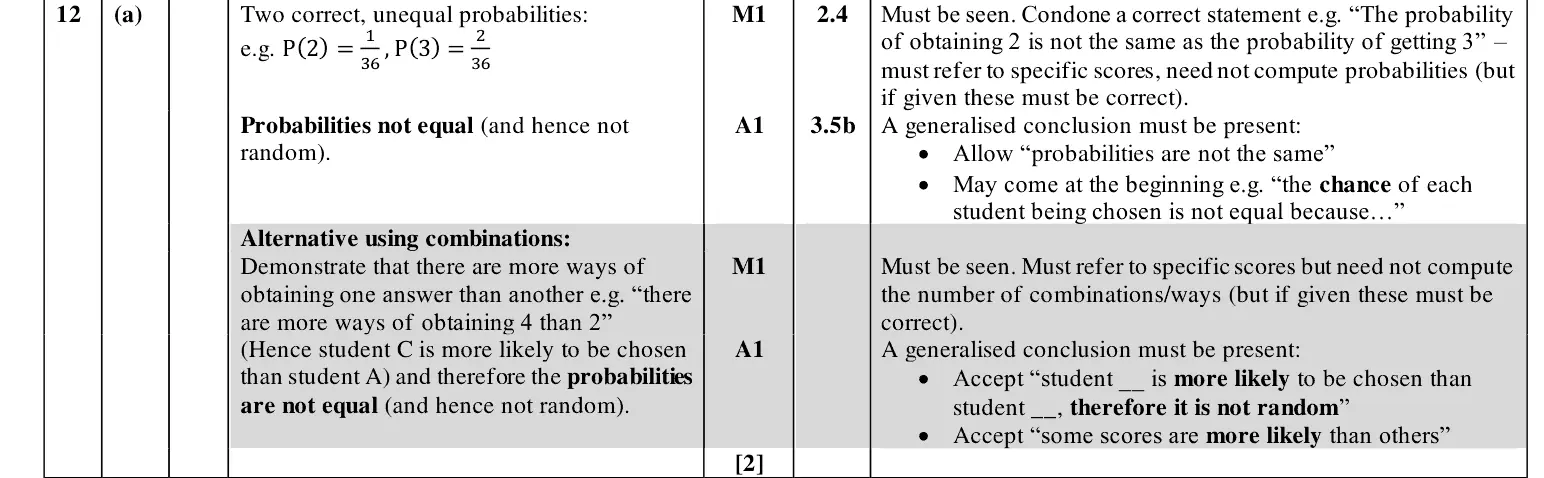
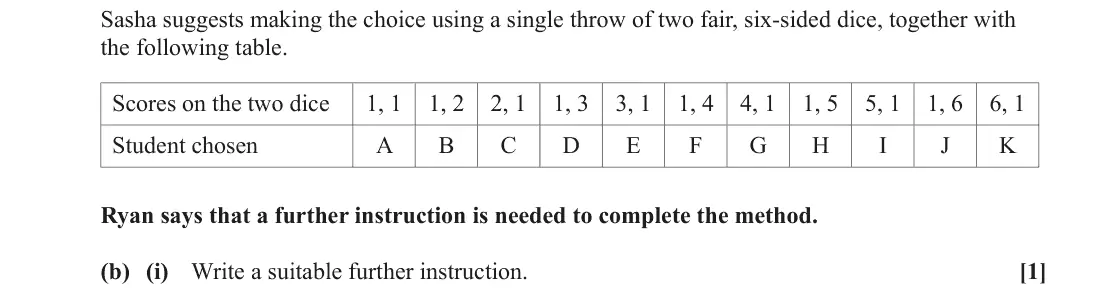
June 2024 · Paper 2 · Q12(a)2 marksHard
Mark scheme for this part
Examiner's comment
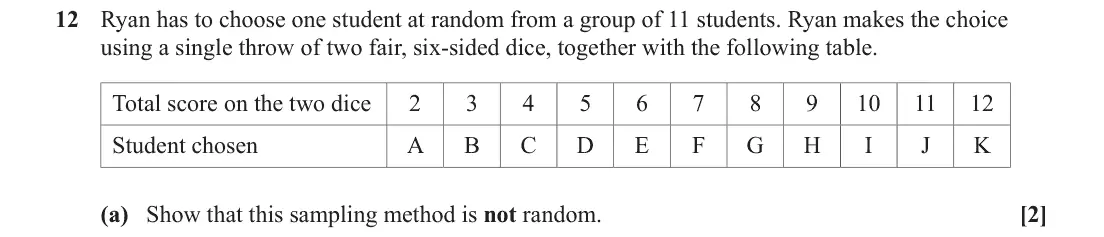
Only a minority of candidates scored both marks on this question, as the responses only stated generic facts or cited the definition of random (equal probabilities). The command ‘Show that’ indicates that some rigorous working was required; and that a general explanation alone is unlikely to be sufficient. In this case, candidates needed to demonstrate (either using probabilities or combinations) that some scores are more likely to occur than others, and clearly state this conclusion to prove the given statement. Many did not correctly compute the probabilities for one or more outcomes from two dice, and therefore lost both marks. Some candidates made reference to the ‘sample’ of 11 students or other generic factors which were not relevant.
Key points and common errors
show two totals have unequal probabilities (e.g. P(2) = 1/36, P(3) = 2/36)
generic definitions of random gain nothing
June 2024 · Paper 2 · Q12(b)(ii)1 markEasy
Show the start of this question
Mark scheme for this part
Examiner's comment
The majority of candidates provided an acceptable response here.
Key points and common errors
1/11
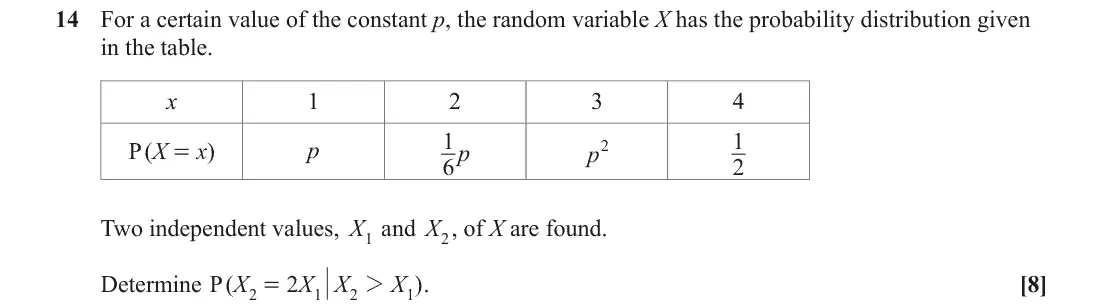
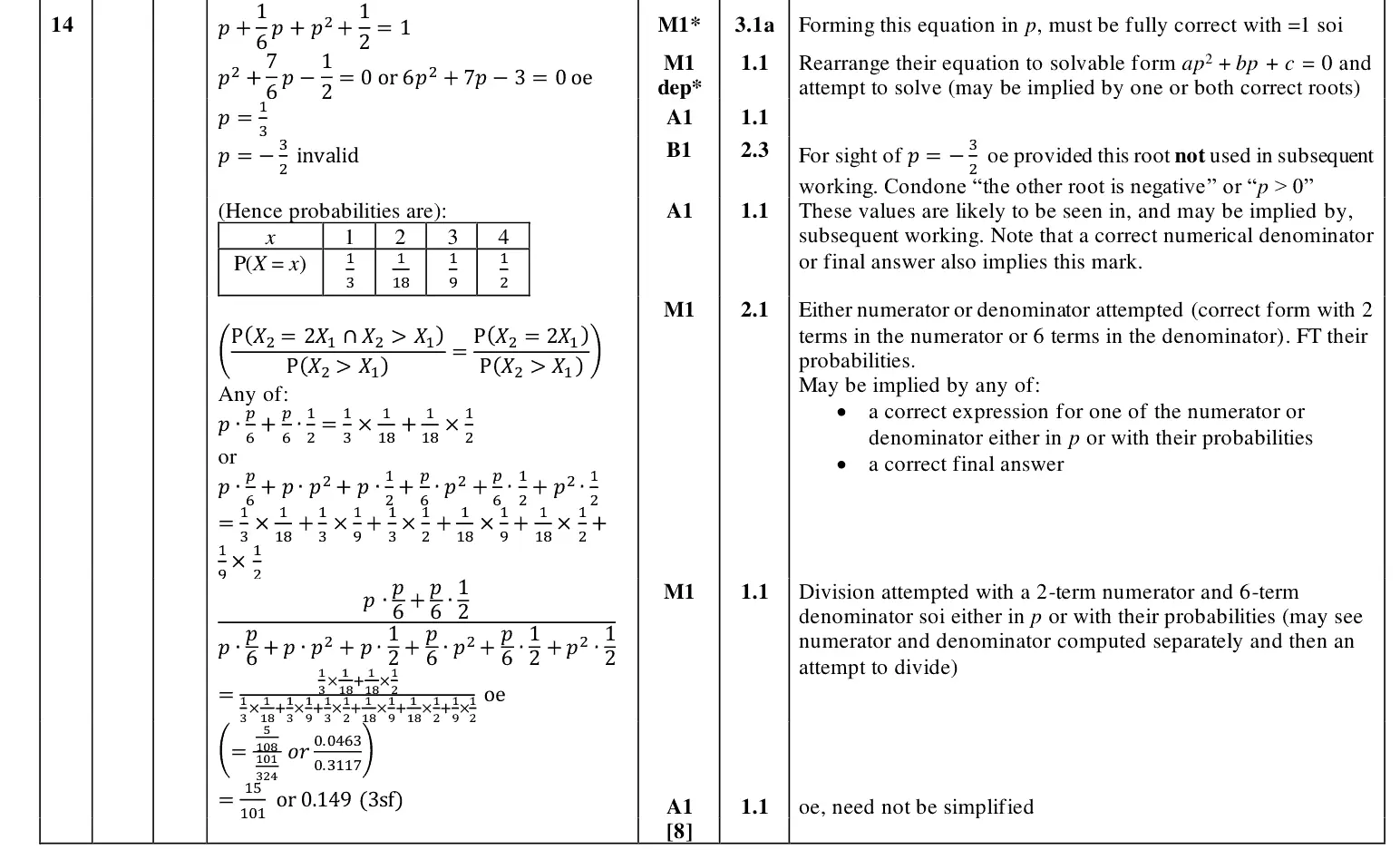
June 2024 · Paper 2 · Q148 marksHard
Mark scheme for this part
Examiner's comment
Most candidates obtained a number of marks in this question, although very few attained all 8. The majority of candidates approached the question in the order described in the mark scheme, first forming and solving a quadratic in p. This was almost always done correctly. Some candidates did not note or otherwise consider the − 2 root and could not be given the B1. (This root did not need to be found, but candidates did need to explicitly consider it, for instance by stating ‘the other root is negative’). Most candidates then went on to correctly find the conditional probability, but numerical errors were common - meaning that many candidates gained one or both method marks but not the final A1. Many candidates did not write down their probabilities once they had found a value for p (this mark could be implied, but only from correct responses or these values seen in working). A few candidates appeared not to have noticed the significance of the values in terms of p and started with a conditional probability formula in terms of p. This could gain M1M1 but nothing further unless they proceeded to work with the quadratic to find a value of p. This candidate has provided an excellent response to Question 14. They lose a single mark (B0) for not showing (or otherwise excluding) the other, negative, root of the quadratic. Their response is otherwise correct and therefore scores 7/8.
Key points and common errors
probabilities sum to 1 gives p = 1/3 (reject −3/2)
list outcomes with X₂ = 2X₁ and X₂ > X₁
15/101
June 2023 · AS Paper 1 · Q9(a)1 markEasy
Mark scheme for this part
Examiner's comment
Almost all candidates answered this correctly.
Key points and common errors
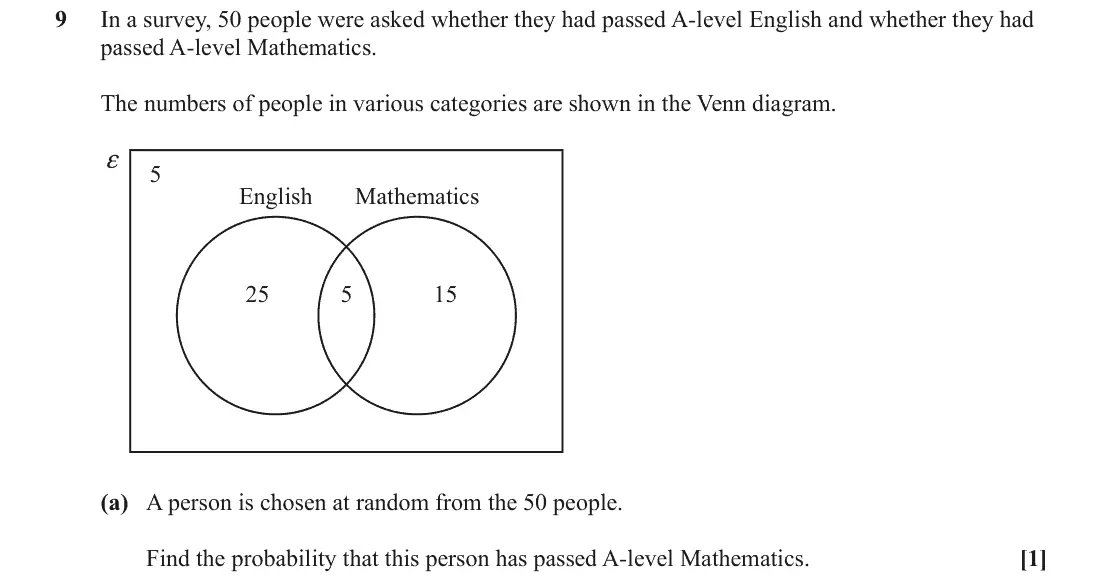
20/50 = 0.4
June 2023 · AS Paper 1 · Q9(b)3 marksHard
Show the start of this question
Mark scheme for this part
Examiner's comment
Fewer than half of candidates achieved full marks here. Many candidates over-complicated it by only using part of the information given in the question, for example drawing a tree diagram and attempting to sum the various combinations (which often resulted in errors, but did obtain the M mark). Those candidates who interpreted the given information carefully were able to write the ‘one line’ solution as given in the scheme. A common error was 50 × 49 (i.e. not accounting for the ‘5’ students who did not pass English or Mathematics). Some candidates simplified 45 to 9 before multiplying and although this is valid, it occasionally led to errors in the subtraction from numerator and denominator required for ‘without replacement’.
Key points and common errors
restrict to the 45 who passed at least one: (20/45) × (19/44) = 19/99 = 0.192
error using 50 × 49
fewer than half fully correct
June 2023 · Paper 2 · Q14(a)3 marksHard
Mark scheme for this part
Examiner's comment
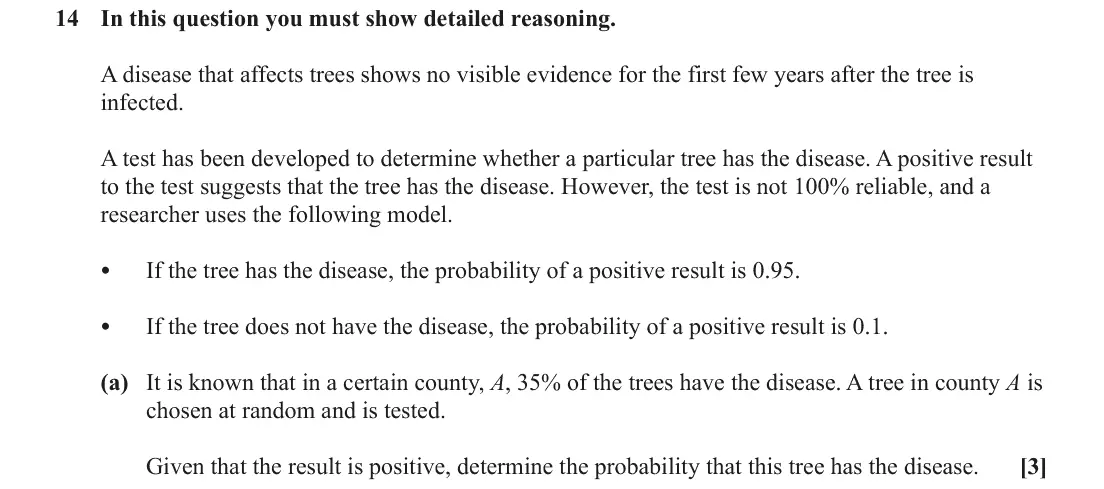
A substantial minority of candidates answered this question correctly, although with it being the final question on the paper it may be that some were running short of time. Those who made an attempt were likely to obtain the correct answer, demonstrating their knowledge of conditional probability to obtain the required answer. Some candidates did not use the conditional probability formula and just multiplied two values together.
Very few candidates achieved 3 or 4 marks in this part. Some misinterpreted the question and used 0.43 as a further probability (e.g. multiplying it by 0.1 or 0.43) rather than setting up the required equation in terms of p (or other variable). Of those who did the question correctly, the majority used the solution set out in the mark scheme. A minority wrote 0.95a + 0.1b = 0.43, 0.05a + 0.9b = 0.57 and then used simultaneous equations to find the answer correctly. Almost all candidates who correctly found the answer to be 0.388 did not go on to (as was required) state an approximation in context, and so could not be awarded the final B mark. For this mark, candidates needed to state their answer in context, and show clearly that they understood it was an approximation – for instance by using the word ‘approximately’.
Key points and common errors
0.95p + 0.1(1 − p) = 0.43 so p = 0.388
must state 'about 39%' in context
0.43 misused as a probability
June 2022 · AS Paper 1 · Q11(a)(i)2 marksMedium
Mark scheme for this part
Examiner's comment
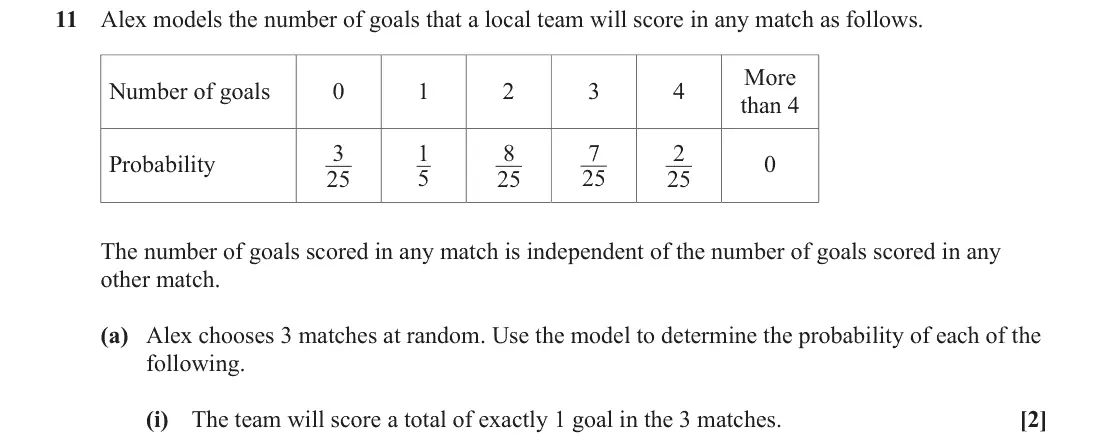
Many correct solutions were seen. ( ) 2 1 4 One partially correct solution that was also common was , which ignores the three possible 5 5 orders. A very common incorrect solution was ( ) 3 1 , which is P(exactly 1 goal will be scored in each of 5 the 3 matches) rather than P(a total of exactly 1 goal will be scored in the 3 matches). A few candidates added probabilities instead of multiplying.
Key points and common errors
(3/25)² × 1/5 × 3 = 27/3125 = 0.00864
must multiply by 3 for the order
(1/5)³ is wrong
June 2022 · AS Paper 1 · Q11(a)(ii)3 marksMedium
Show the start of this question
Mark scheme for this part
Examiner's comment
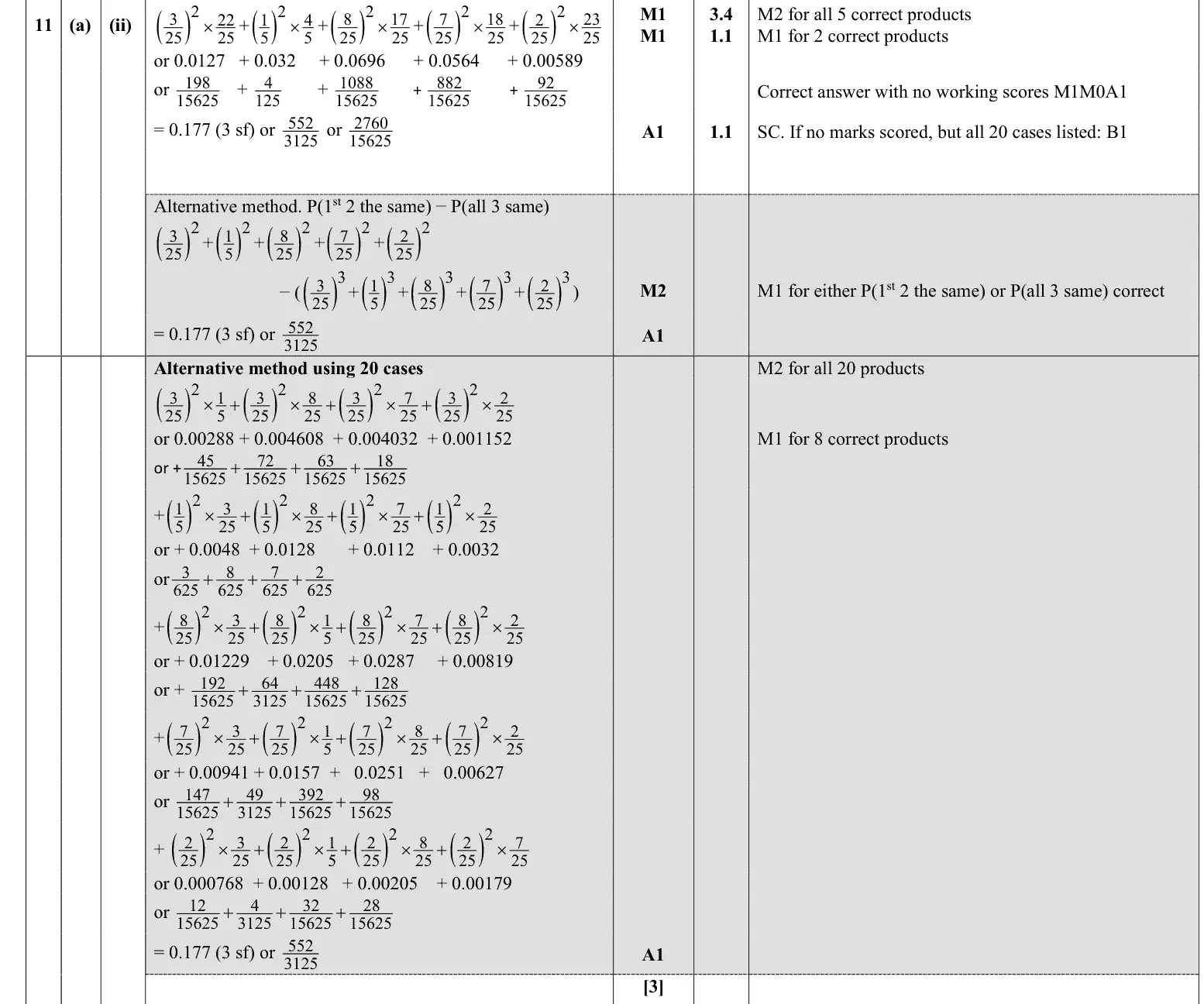
The “standard” method is to consider five cases, P(0, 0) × (1 − P(not 0)) + P(1, 1) × (1 − P(not 1)) etc, giving ( ) 25 + ( ) 3 22 1 4 5 + . . . . Many candidates used this method successfully, although some 25 5 omitted one or more of the five cases. A few candidates used an incorrect variation on this method, ( ) 25 + ( ) 3 19 1 3 5 + . . . . . 25 5 Many other candidates used the “long” method of considering all 20 cases (0, 0, 1), (0, 0, 2), etc. Many of these made arithmetical errors. Others gave up after a few calculations, presumably feeling daunted by the large number of individual products that would need to be found. Candidates who showed all 20 cases but did not show at least eight of the actual products, gained one mark. Some candidates used the rather neat method of P(the first two are the same) − P(all three are the same), usually successfully. Two related incorrect methods were 1 − P(all three are the same) and P(the first two are the same).
Key points and common errors
sum over k of P(k)² × (1 − P(k)) = 0.177
or P(first two same) − P(all three same)
20-case method error-prone
June 2022 · Paper 2 · Q7(b)4 marksHard
Show the start of this question
Mark scheme for this part
Examiner's comment
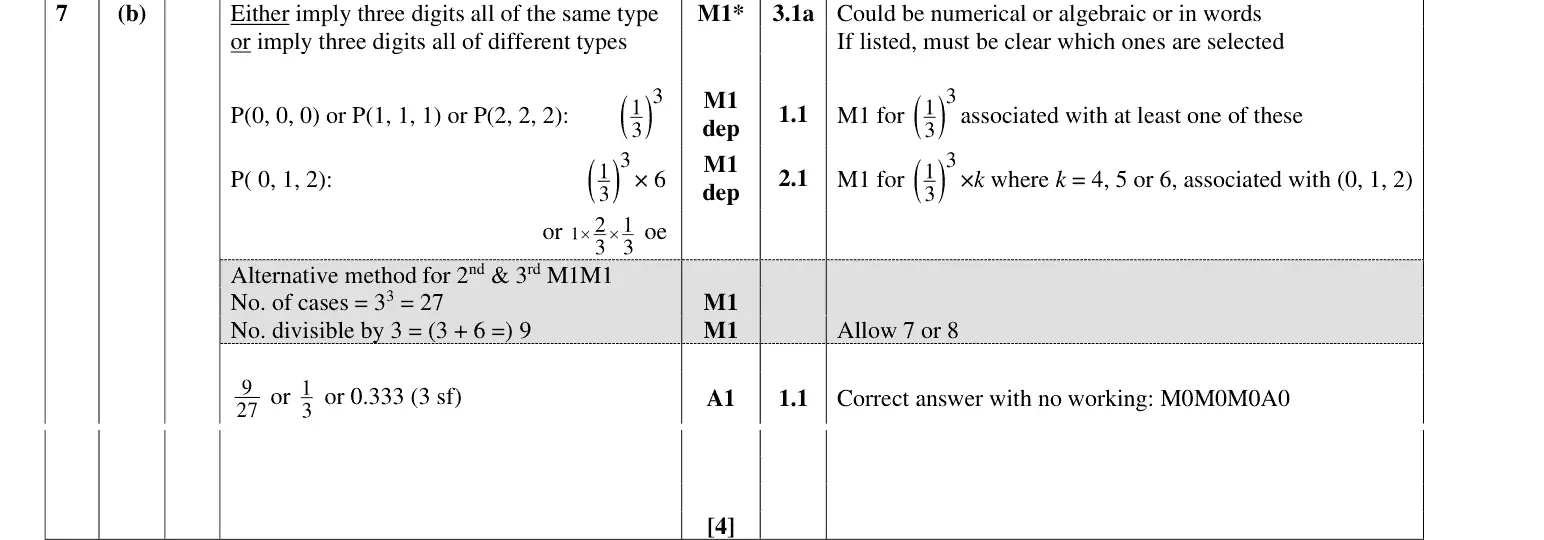
This rather unusual question puzzled many candidates. However, many made a reasonable attempt at it, using native wit rather than learned techniques. Those who used an algebraic approach, with 3m, 3m + 1 and 3m + 2 made some progress in recognising the different cases (three integers being either all of the same type or of three different types). But they usually did not obtain the correct number of combinations that are possible. Those who actually listed the possibilities were more likely to be successful. However, even this method was not always pursued successfully. In some cases, some of the possibilities were omitted. One particular example was as follows. The possible combinations of values of r are these: 000, 111, 222, 012, 112, 221, 110, 001, 220, 002. Four of these 10 combinations have a total that is divisible by 3, hence P(total is divisible by 3) = 4 10 . Another incorrect approach was this: P(an integer is divisible by 3) = 33 99 , hence P(the total is divisible by 3) = ( ) 3 33 = 1 27 . 99 An interesting incorrect method that leads to the correct answer was as follows. For the sum to be divisible by 3, all three integers must be of the form 3m OR all three must be either of the form 3m + 1 or 3m + 2. Hence P(sum is divisible by 3) = [P(r = 0)]3 + [1 − P(r = 0)]3 = ( ) 3 + ( ) 3 1 2 = 1 27 + 8 27 = 1 3 . 3 3
Key points and common errors
33 of each type r = 0, 1, 2 so each has probability 1/3
all same type 3 × (1/3)³ or all different 6 × (1/3)³
9/27 = 1/3
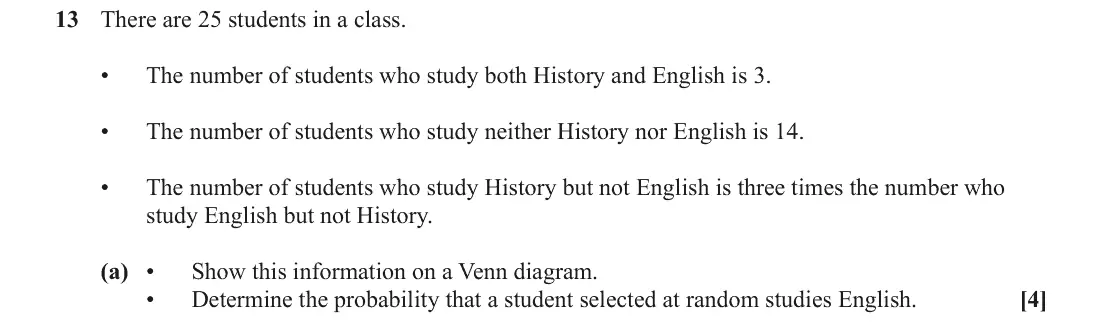
June 2022 · Paper 2 · Q13(a)4 marksEasy
Mark scheme for this part
Examiner's comment
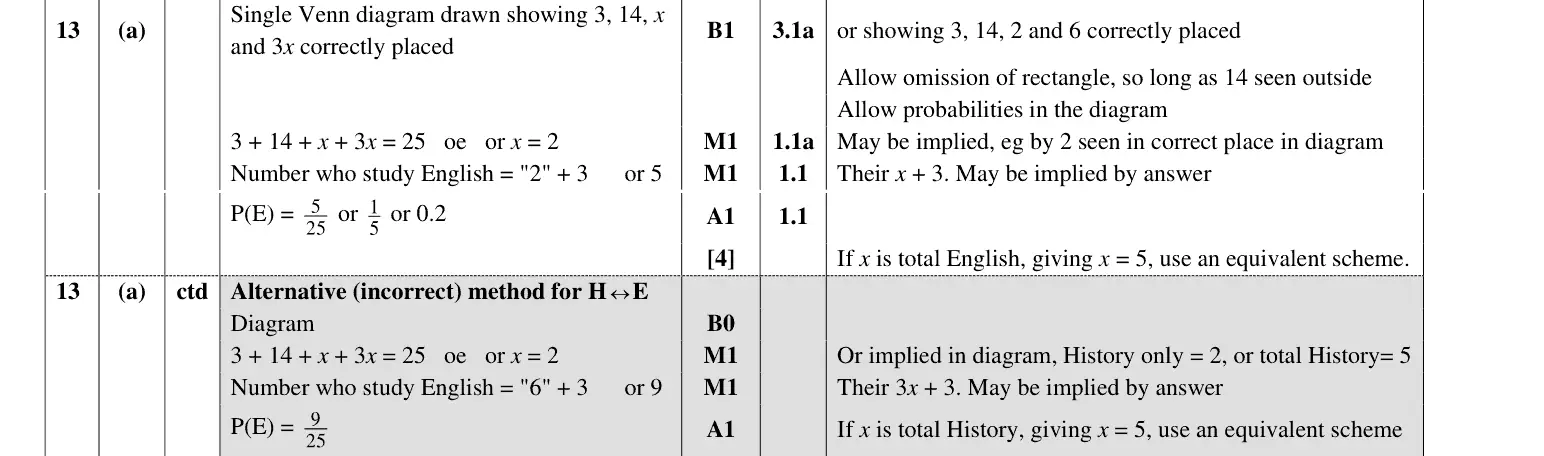
This question was very well answered by almost all candidates. A few placed History and English the wrong way round in their Venn diagram. A few others gave a correct Venn diagram, but found P(the student studies only English), i.e. 2 25 instead of 5 25 . Some gave a correct Venn diagram but omitted to find the probability.
Key points and common errors
Venn: 3 both, 14 neither, x English only, 3x History only
x = 2
P(English) = 5/25
History and English swapped is a common error
June 2022 · Paper 2 · Q13(b)6 marksMedium
Show the start of this question
Mark scheme for this part
Examiner's comment
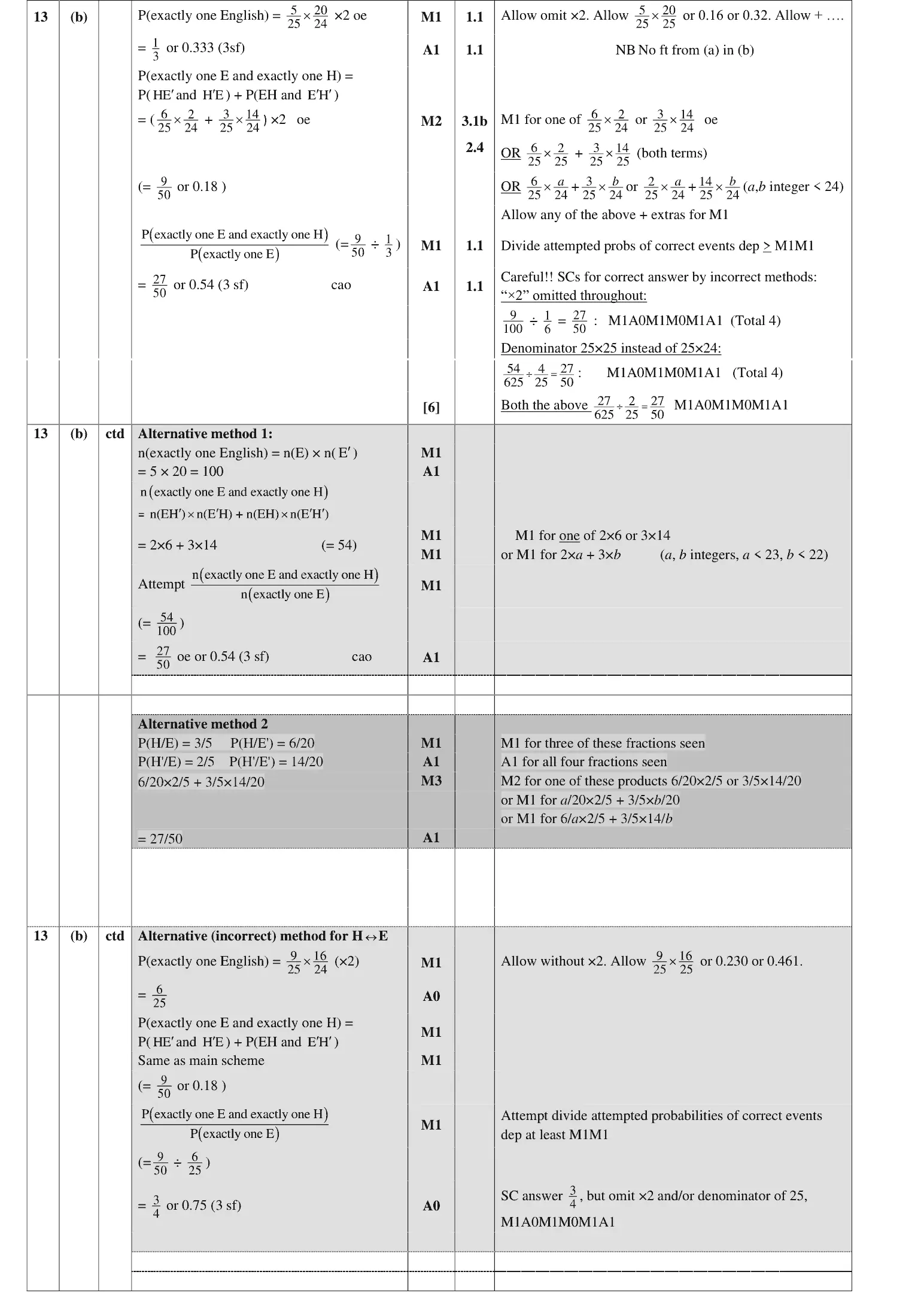
A number of different correct approaches to this problem were seen, some of them quite ingenious. The most common method that was reasonably successful was to use the conditional probability formula: ( ) P exactly one E and exactly one H . ( ) P exactly one E The correct working for the denominator is P(Exactly one English) = P( EH′) = 5 20 × ×2, 25 24 and for the numerator is P(exactly one E and exactly one H) = P( HE′and H E ′ ) + P(EH and E H ′ ′ ) = ( 6 2 + 3 14 × × ) ×2. 25 24 25 24 Many candidates used this method correctly, except for one or both of the following errors. They used 25 instead of 24 (i.e. “with replacement”). They omitted the “× 2” (i.e. ignoring the order in which the two students are chosen). If the method was otherwise correct, these candidates scored 4 marks out of 6. Some candidates attempted the above method for the numerator, but only included one of the products, either 6 2 or 3 14 × × . 25 24 25 24 Many candidates made errors involving which regions in the Venn diagram to include. As examples of this, here are some incorrect attempts to calculate P( HE′and H E ′ ) + P(EH and E H ′ ′ ). ( 6 2 + 9 14 ) ×2 (Here the 9 25 is P(H) where it should be 3 × × 25 which is P(EH)) 25 24 25 24 5 9 + 5 2 2 9 + 3 8 + 6 5 + 3 4 × × , × × × × , 25 24 25 24 25 24 25 24 25 24 25 24 9 16 × × 2 25 25 Some candidates attempted to use probabilities that applied to only one student. For example P(E and H) = 3/25 3 . = P(E) 5/25 5 This result can, of course, be written down immediately, and some candidates did this as the first step towards another, rather elegant, method that uses conditional probability but not the conditional probability formula: 2 6 + 3 14 = 27 P(E only / E) × P(H only / not E) + P(E&H / E) × P(Neither / not E) = × × 50 . 5 20 5 20 Some candidates appeared to be attempting something like this method, but muddled it with the above 2 6 + 3 14 × × correct method, showing working such as . 5 24 5 24
Key points and common errors
without replacement: P(exactly one E) = 2 × 5/25 × 20/24 = 1/3
numerator 2(6/25 × 2/24 + 3/25 × 14/24) = 9/50
answer 27/50
errors 25 for 24, omitting × 2
Autumn 2021 · AS Paper 1 · Q10(a)2 marksMedium
Mark scheme for this part
Key points and common errors
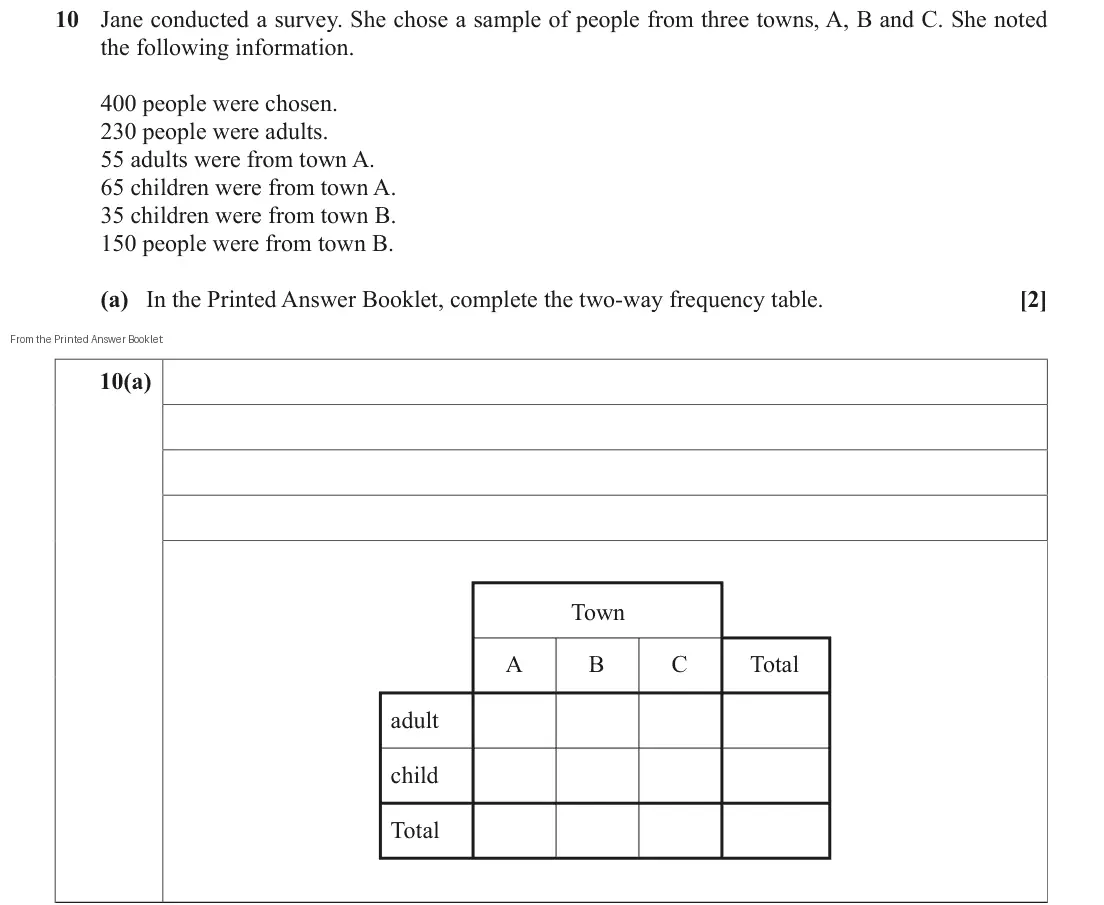
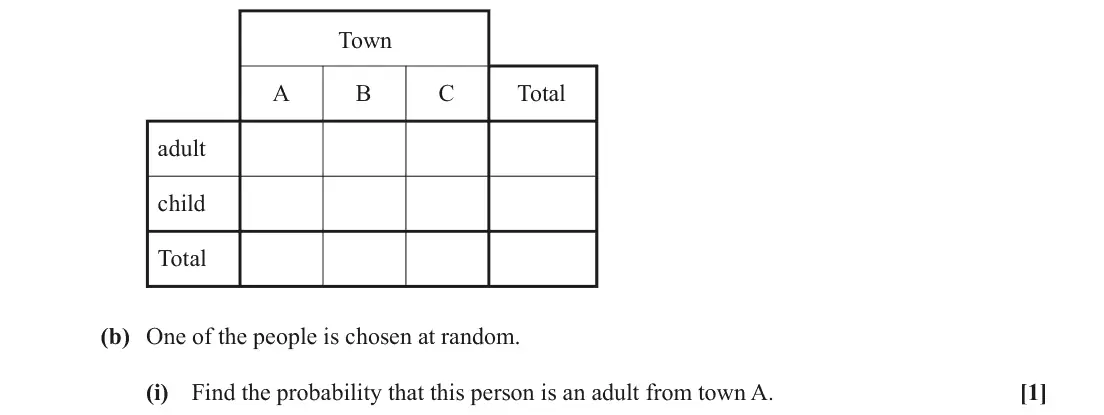
fill the two-way table from the given totals: adults 55, 115, 60
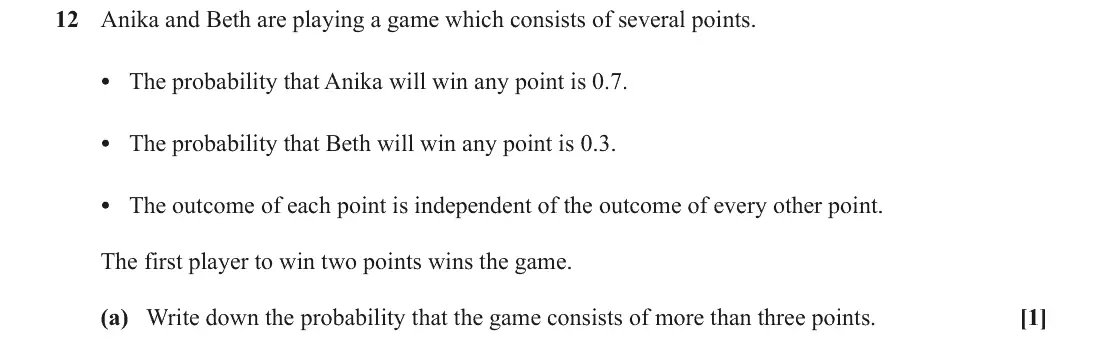
exactly three points means the first two are split: 2 × 0.7 × 0.3 = 0.42
Autumn 2021 · Paper 2 · Q12(e)4 marksMedium
Show the start of this question
Mark scheme for this part
Examiner's comment
(From the general report) Question 12(e): A common error in the numerator was to use P(AB) = P(A) × P(B) rather than P(A B) = P(A) × P(B/A), i.e. in this case the numerator was incorrectly evaluated using 0.216 × 0.42 instead of 2 × 0.32 × 0.7.
Key points and common errors
P(B wins and 3 points) = 2 × 0.063 = 0.126
÷ 0.216 = 7/12
error: numerator 0.216 × 0.42 (treating events as independent)
Autumn 2021 · Paper 2 · Q14(c)3 marksMedium
Show the start of this question
Mark scheme for this part
Examiner's comment
(From the general report) Question 14(c): A common misconception was to interpret P(X1 > X2 + X3) to mean that it is required to find three values of X such that the probability of the 1st value is greater than the sum of the probabilities of the 2nd and 3rd values.
Key points and common errors
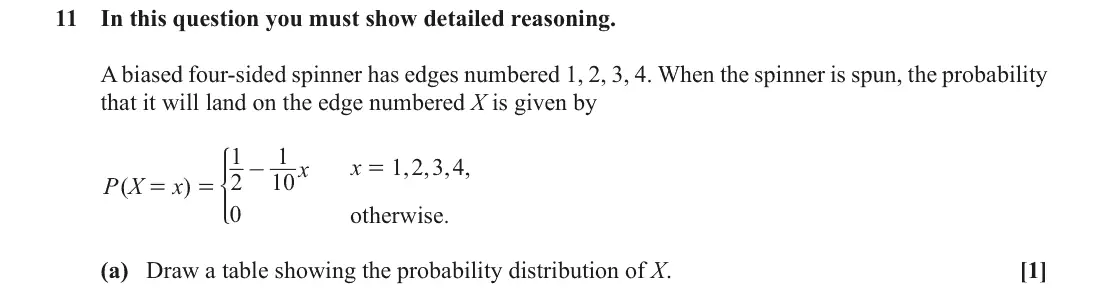
outcomes (3,1,1) (4,1,1) (4,2,1) (4,1,2)
288/3125 = 0.0922
error: comparing probabilities instead of values
Autumn 2021 · Paper 2 · Q14(d)5 marksMedium
Show the start of this question
Mark scheme for this part
Key points and common errors
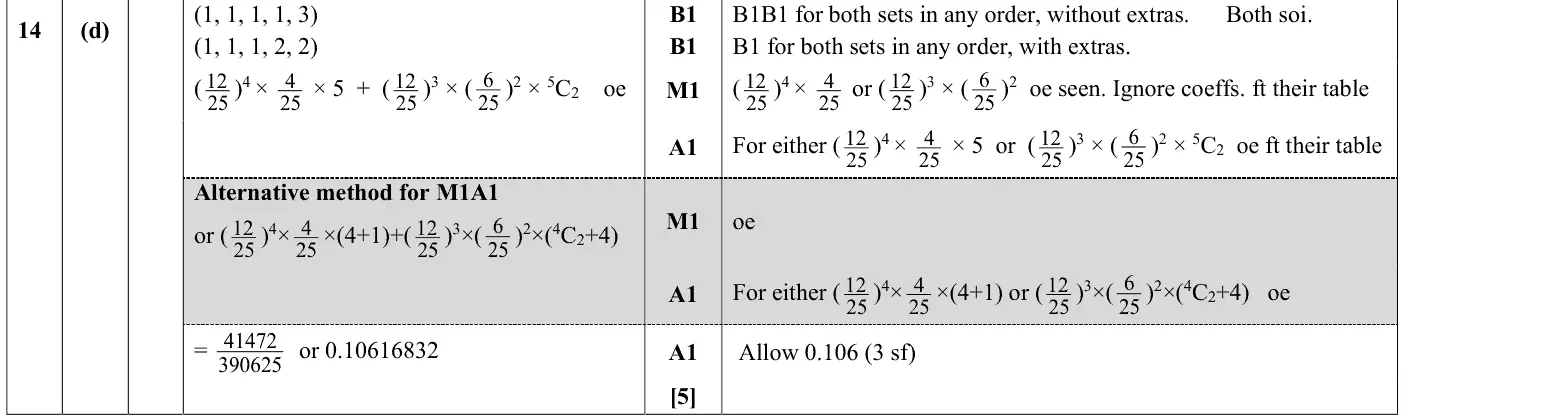
sets {1,1,1,1,3} (5 orders) and {1,1,1,2,2} (⁵C₂ orders)
(12/25)⁴(4/25) × 5 + (12/25)³(6/25)² × 10 = 0.106
Autumn 2020 · AS Paper 1 · Q11(b)3 marksHard
Show the start of this question
Mark scheme for this part
Examiner's comment
Many candidates did not identify all four cases. Some only found the products of two, rather than three, probabilities. Common misconceptions Key teaching and learning points – comments on improving performance The way to answer hypothesis test questions successfully can be taught as a simple list of steps to be learnt by rote. For more information, see the OCR Maths blog A Level Maths – hypothesis tests and the art of being non-assertive. It is difficult to teach candidates how to answer questions requiring deduction from data. Perhaps the best strategy is to look carefully at all the past papers and practice papers, for both AS and A Level. In particular, a close study of the published mark schemes, and examiners' reports, will help teachers and candidates to understand what kinds of answers are acceptable. Teachers should advise candidates carefully about the meanings of the command words given on pages 10 to 15 of the Specification, such as "Detailed reasoning", "Exact, "Determine", "State" and "Hence". These words are intended to be pointers as to how particular questions should be approached, so candidates need to be familiar with these before sitting the exam. Guidance on using this paper as a mock This paper covers the following topics: simple calculus, 2-dimensional; vectors, trigonometrical equations and identities, the binomial expansion of (1 + x)n, sketching a cubic curve, solution of simple quadratic inequalities and equations, simple indices, simultaneous linear and quadratic equations, histograms, making deductions from a table of data, hypothesis testing for a binomial distribution, discrete probability distributions and addition and multiplication of probabilities. In general, it tests algebraic skills of various kinds, and the understanding of relatively simple statistical ideas.
Key points and common errors
cases (1,1,3), (1,1,4), (1,2,4), (2,1,4)
sum of products of three probabilities = 9/125
many missed cases
Autumn 2020 · Paper 2 · Q13(a)(i)2 marksMedium
Mark scheme for this part
Key points and common errors
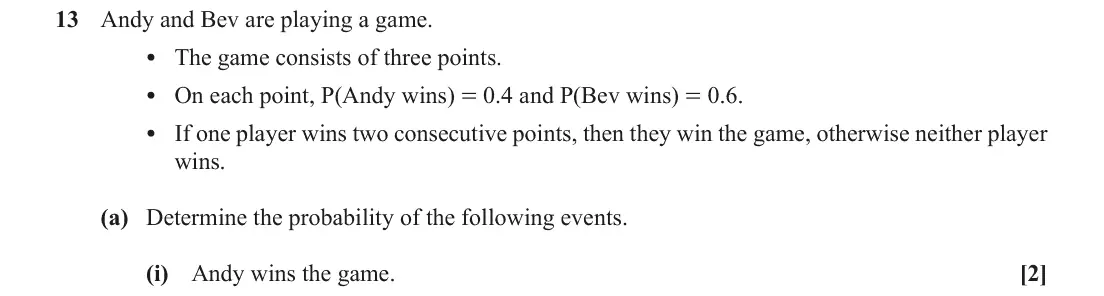
Andy wins with AA or BAA: 0.4² + 0.6 × 0.4² = 0.256
Autumn 2020 · Paper 2 · Q13(a)(ii)3 marksMedium
Show the start of this question
Mark scheme for this part
Key points and common errors
neither wins: ABA or BAB: 0.4² × 0.6 + 0.6² × 0.4 = 0.24
0.4 × 0.6 scores nothing
Autumn 2020 · Paper 2 · Q13(b)3 marksHard
Show the start of this question
Mark scheme for this part
Examiner's comment
(From the general report) In answering Question 13(b), most candidates did not recognise that an infinite series was involved.
Key points and common errors
infinite geometric series 0.256 + 0.24 × 0.256 + …
0.256/(1 − 0.24) = 32/95 = 0.337
most did not recognise an infinite series
Autumn 2020 · Paper 2 · Q15(b)6 marksHard
Show the start of this question
Mark scheme for this part
Examiner's comment
Most candidates were unable to find their way through the various calculations needed. Some obtained a correct product of three probabilities (e. g. for 2, 2, 5) but omitted to multiply by 3. Others omitted the case 3, 3, 3 altogether.
Key points and common errors
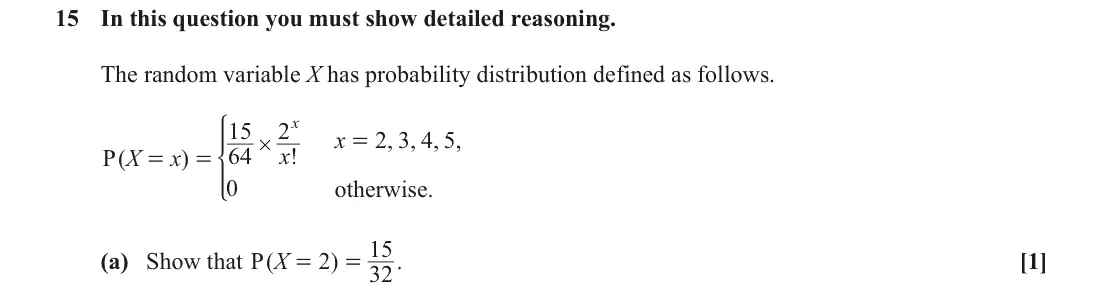
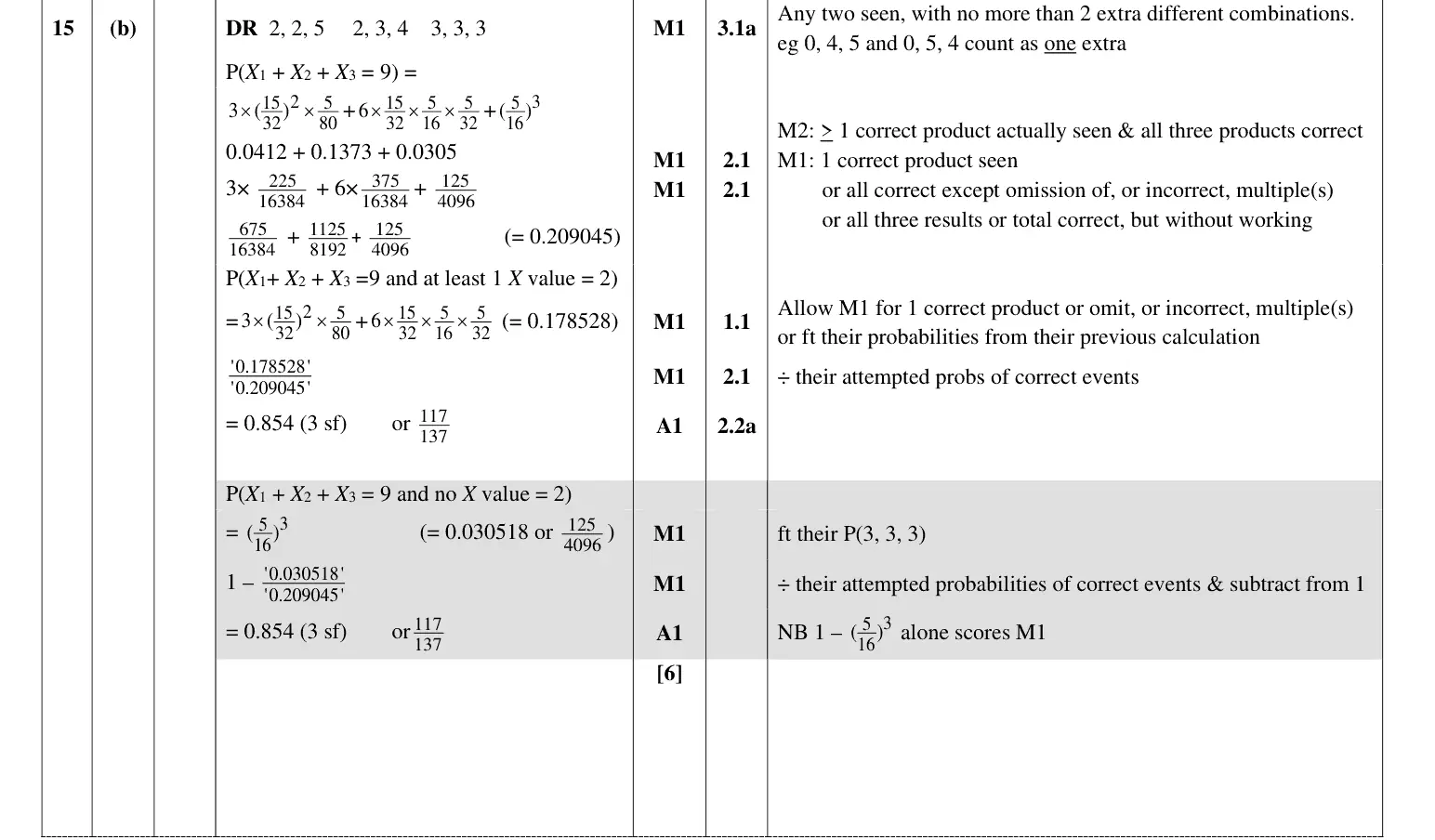
combinations 2,2,5
2,3,4
3,3,3 with arrangements 3, 6, 1
P(sum 9) = 0.209
conditional 0.1785/0.209 = 0.854 (117/137)
errors: omitting ×3 or the 3,3,3 case
Autumn 2020 · Paper 2 · Q15(c)3 marksHard
Show the start of this question
Mark scheme for this part
Examiner's comment
Most candidates did not recognise the need to consider the first 9 values separately before considering the 10th. Some candidates seemed unfamiliar with the binomial distribution. Common misconceptions Key teaching and learning points – comments on improving performance One way to answer hypothesis test questions successfully can be taught as a simple list of steps to be learnt by rote. For more information, see the OCR Maths blog A Level Maths – hypothesis tests and the art of being non-assertive. It is difficult to teach candidates how to answer questions requiring deduction from data. Perhaps the best strategy is to look carefully at all the past papers and practice papers, for both AS and A Level. In particular, a close study of the published mark schemes, and examiner's reports, will help teachers and candidates to understand what kinds of answers are acceptable. Brevity is of the essence. Teachers should advise candidates carefully about the meanings of the command words given in section 2d of the specification, such as ‘Detailed reasoning’, ‘Exact’, ‘Determine’, ‘State’ and ‘Hence’. These words are intended to be pointers as to how particular questions should be approached, so candidates need to be familiar with these before sitting the exam. As an example, in Question 3(c), attention to the word "hence" made the question fairly simple, but most candidates missed this. Factorisation of polynomials by means of the factor theorem is almost always useful in this type of exam paper. Careful explanation of the need for the modulus sign when integrating 1 x would be useful to candidates. Question such as 15(b) are common, involving the need to considers a list of all possible cases. It is necessary to recognise, for example, that 2, 2, 5 can be arranged in three different orders, but 2, 3, 4 can be arranged in six different orders. Practice of this type of question in the classroom would yield dividends. Guidance on using this paper as a mock This paper covers the following pure topics: simple calculus, algebraic factorisation and simplification, the binomial expansion for non-positive integer n, geometrical progressions, trigonometrical equations and identities, algebraic proof, vectors (position vectors, modulus, distance between points, mid-point), the cartesian equation of a circle, differential equations, This paper covers the follow statistics topics: histograms, hypothesis tests for μ and for p, rejection region, calculation of mean and standard deviation, properties of the normal distribution, addition and multiplication of probabilities, inference from data and discrete probability distributions. In general, the paper tested algebraic manipulation and application of calculus in several contexts, together with various statistical concepts and understanding of probability.
Key points and common errors
exactly two 2s in the first nine (⁹C₂ (15/32)² (17/32)⁷) then a 2 on the tenth
0.0443
most missed treating the first 9 separately
June 2019 · AS Paper 1 · Q124 marksHard
Mark scheme for this part
Examiner's comment
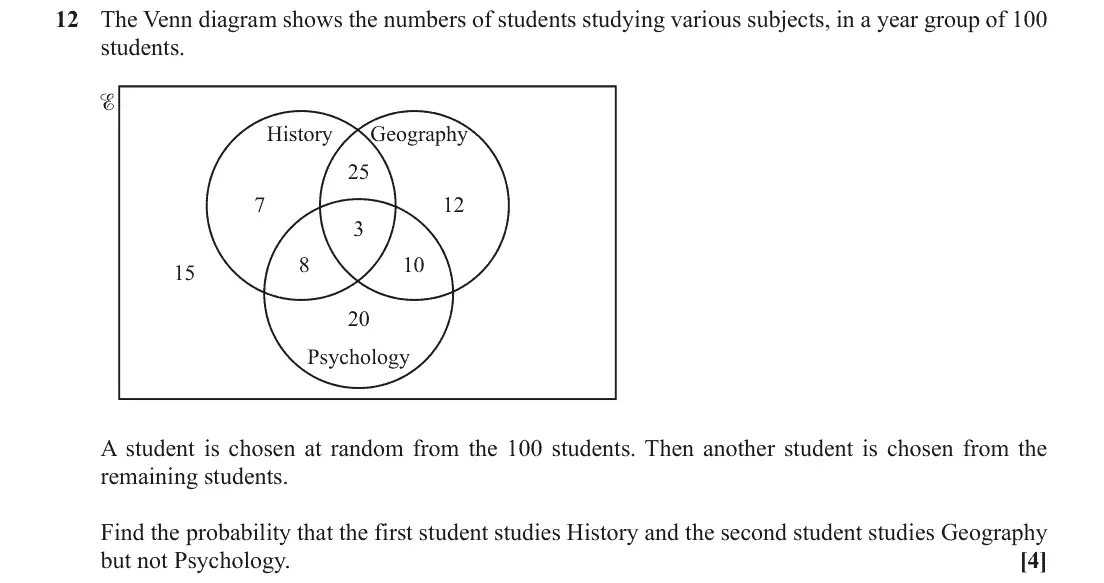
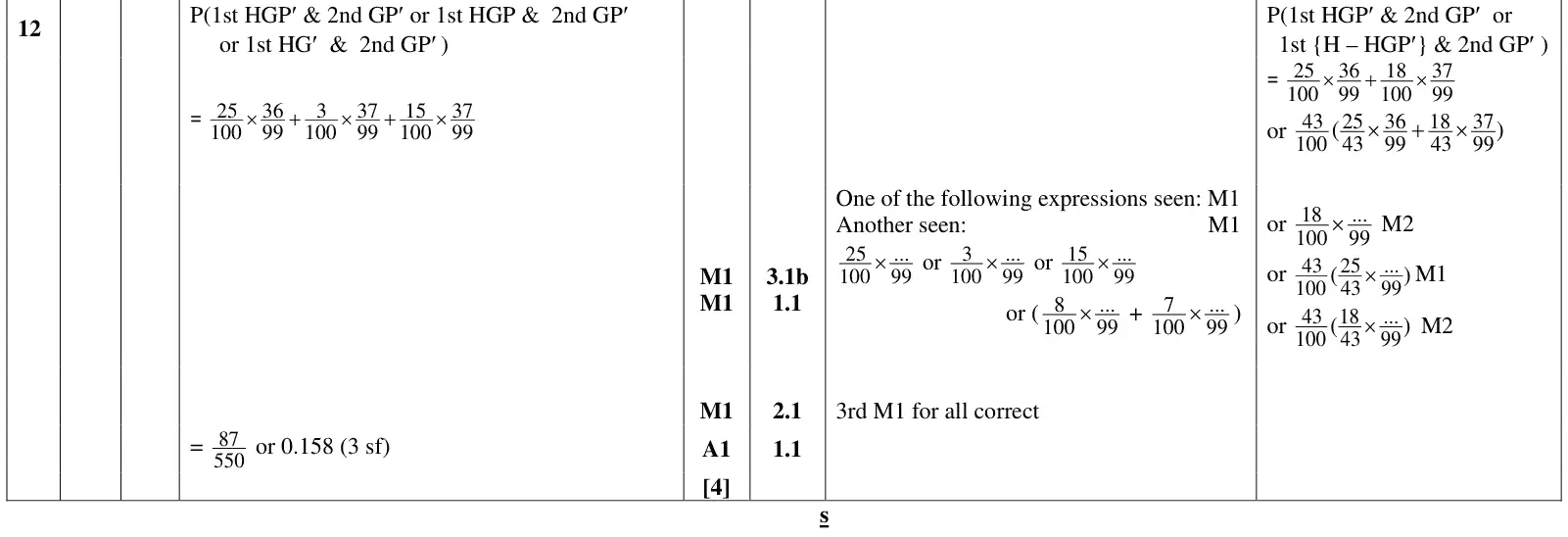
Most candidates found P(1st studies History) × P(2nd studies Geography but not Psychology) = 43 37 or possibly 43 36 × × . These methods do not take into account the possible overlaps 100 99 100 99 between the two events. The two events need to be separated into different cases. In order to gain any marks, candidates needed to show products such as 25 36 or 3 37 × × . Full details can be found in 100 99 100 99 the published mark scheme.
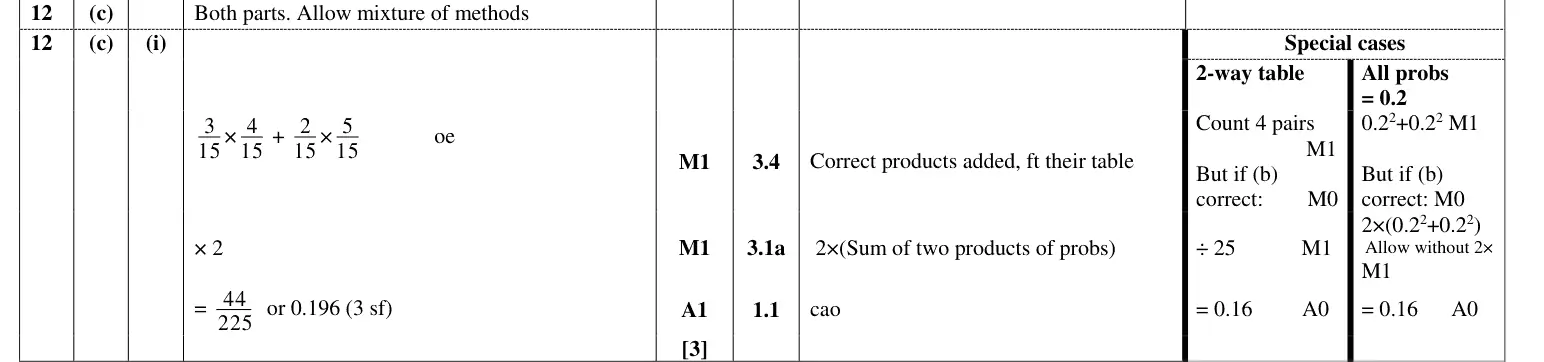
Many candidates recognised that for T = 7 could be found by considering 2+5 and 3+4, but forgot to consider 5+2 and 4+3. This candidate has shown clear working, but forgotten to multiple by two in order to consider all the ways to score T = 7 .
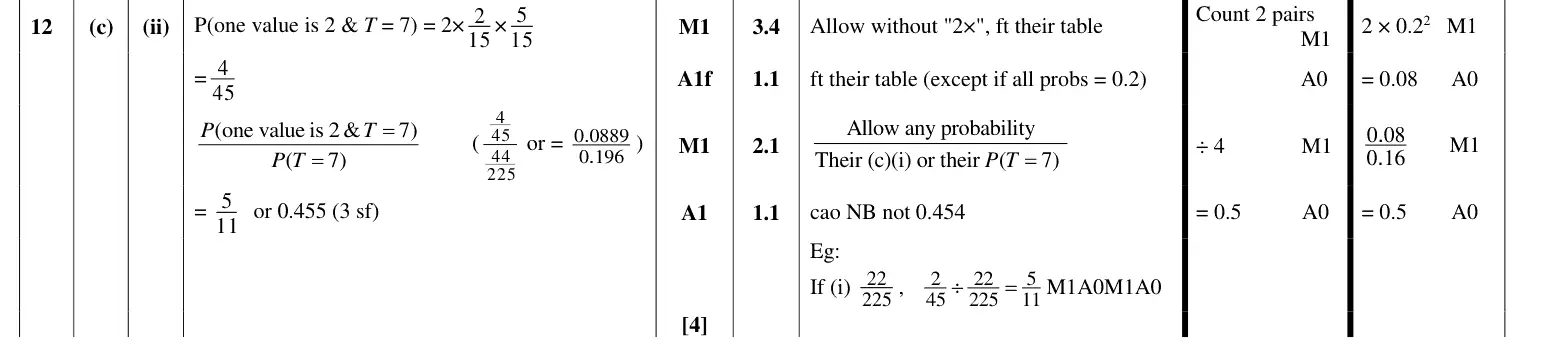
Most candidates attempted to use the conditional probability formula and, correctly, placed their answer to part (c)(i) in the denominator of a fraction. But many were unable to identify the pairs of values that gave rise to "T = 7 AND one of the values is 2".
Key points and common errors
P(one is 2 and T = 7) = 2 × 2/15 × 5/15 = 4/45
divide by P(T = 7) to get 5/11
June 2018 · AS Paper 1 · Q10(ii)3 marksHard
Show the start of this question
Mark scheme for this part
Examiner's comment
Most candidates scored only one mark because they omitted one or two of the three possible routes to obtaining a product of 0.
Key points and common errors
product 0 if either is 0: 1 − (5/8)² = 39/64
one or two of the three routes omitted
June 2018 · Paper 2 · Q12(ii)1 markEasy
Show the start of this question
Mark scheme for this part
Examiner's comment
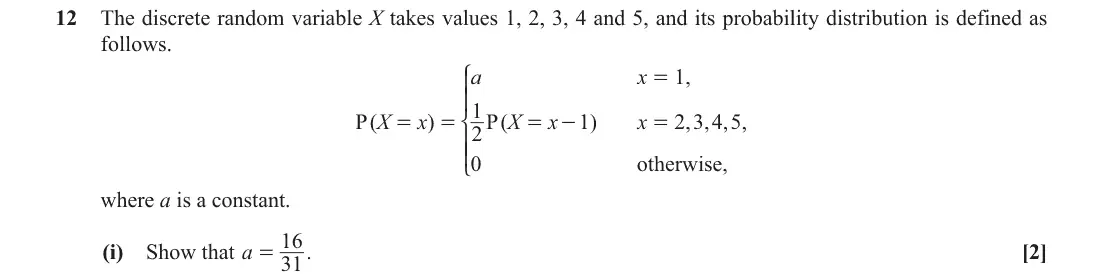
This question was well answered.
Key points and common errors
P(1, 3 or 5) = 21/31
June 2018 · Paper 2 · Q12(iii)2 marksMedium
Show the start of this question
Mark scheme for this part
Examiner's comment
Some candidates did not see that their answer to part (ii) could be used, and started from scratch using the probabilities in the table. Many of these omitted at least one possible pair, and others included all possible pairs, but omitted to double their answer. A few candidates ignored the probabilities (and their answer to part (ii)) and assumed the each value of X is equally likely.
Key points and common errors
P(OE) + P(EO) = 2 × 21/31 × 10/31 = 420/961
use (ii)
missing the factor 2
assuming equally likely values
June 2018 · Paper 2 · Q12(iv)3 marksMedium
Show the start of this question
Mark scheme for this part
Examiner's comment
Most candidates recognised the need to find P(S = 9), but some omitted to include both 4, 5 and 5, 4 . Many then correctly divided by their answer to part (iv).
Key points and common errors
S > 8 and odd means S = 9: (4, 5) and (5, 4) give 4/961
divide by 420/961 to get 1/105
both orders needed
Find an A-level maths tutor
Stuck on this? Book a trial session with an A-level maths tutor.