Discrete distributions and the binomial distribution Statistics
Papers
Paper 2, AS Paper 1
Level
AS and A level
Spec
2.04a, 2.04b, 2.04c
Formulae sheet
P(X = x), the mean np and the variance np(1 − p) are given. There are no binomial tables: use your calculator.
Since 2018
70 question parts, 205 marks, each rated Easy, Medium or Hard from the wording of the examiners' report
Notes, worked examples and practice for this topic are being written by our tutors. The past-paper questions below are ready now: work each one on paper, then open the mark scheme and the examiner's comment.
Tap a question to zoom it. Mark scheme and examiner's comment open under each question.
June 2025 · AS Paper 1 · Q114 marksHard
Mark scheme for this part
Examiner's comment
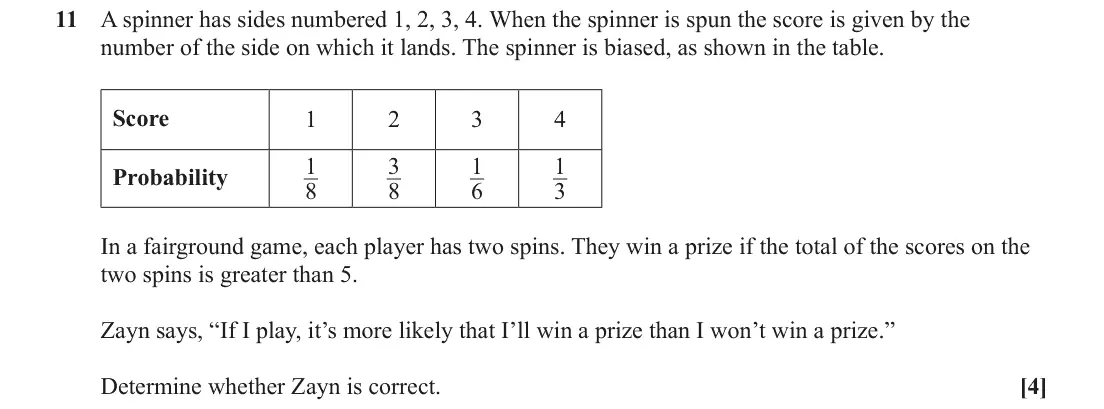
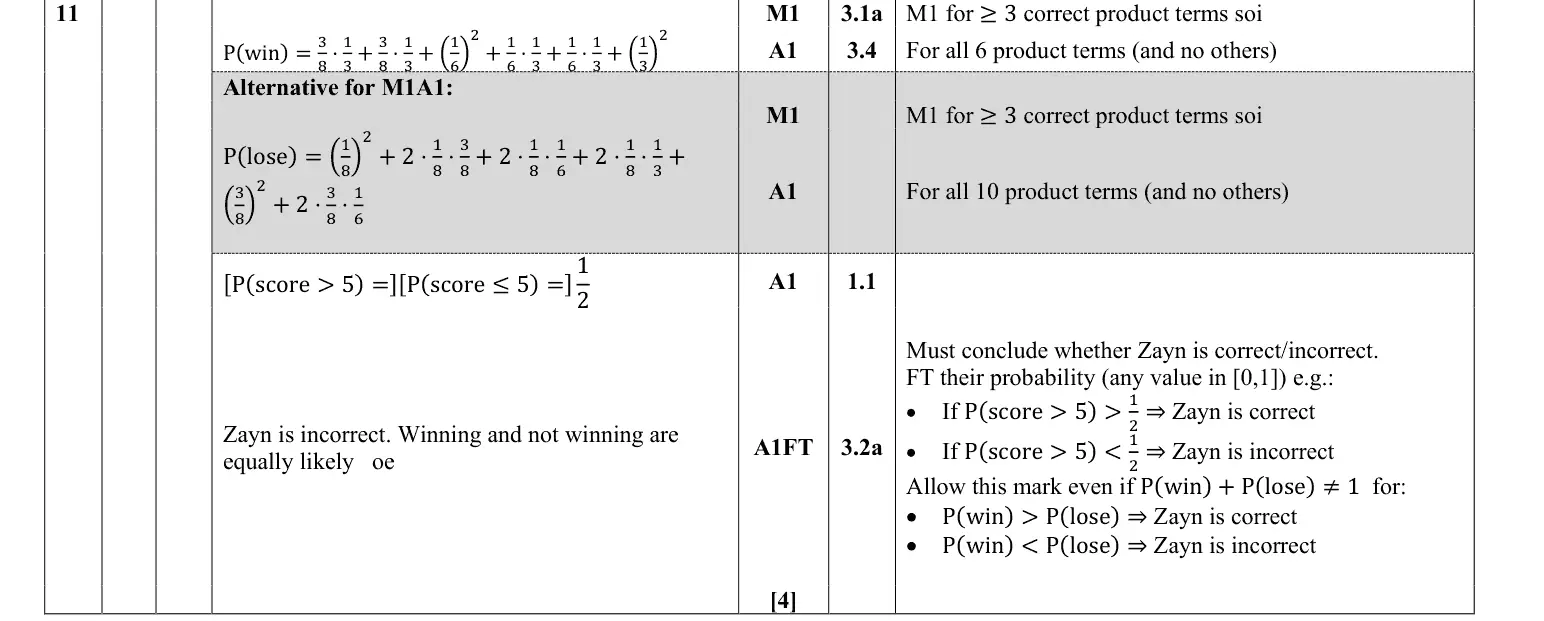
Some candidates scored full marks on this probability question. In order to determine whether Zayn’s statement is correct, candidates needed to calculate the probability of a ‘win’ (i.e. score greater than 5) or ‘lose’ and then make an appropriate conclusion. Most candidates recognised the need to combine the probabilities for two spins, and some drew a tree diagram to represent these. Provided candidates had three or more correct products (for either ‘win’ or ‘lose’) then they could score M1, but they needed all 6 (or 10 for ‘lose’) to be correct for the first A mark, which very few candidates achieved. Candidates could score the final A mark as FT provided that they gave a conclusion (following three or more correct products) that was correct for their values. Candidates who denoted the sample space with a grid tended to have more success in identifying the correct pairs of probabilities. Candidates should be encouraged to make full use of the answer space available and to use systematic methods to make sure they have the right number of terms in their summation. Most candidates gave an appropriate conclusion, but (as in Question 10(a) ) candidates needed to clearly and unambiguously state whether they were saying that Zayn is correct or incorrect.
Key points and common errors
list all pairs with total > 5 (6 products) or ≤ 5 (10 products)
P(win) = ½, so winning and not winning are equally likely and Zayn is incorrect
a sample-space grid helps
very few got all products
June 2025 · AS Paper 1 · Q12(b)5 marksMedium
Show the start of this question
Mark scheme for this part
Examiner's comment
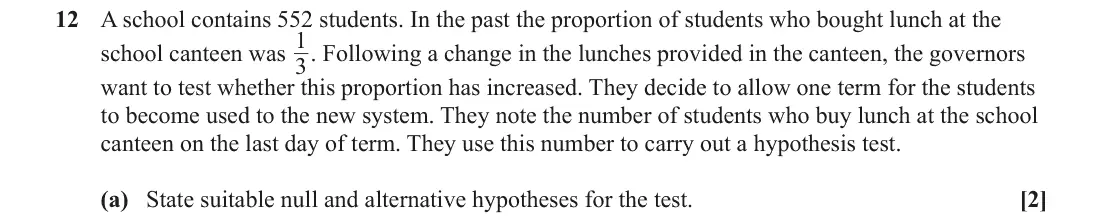
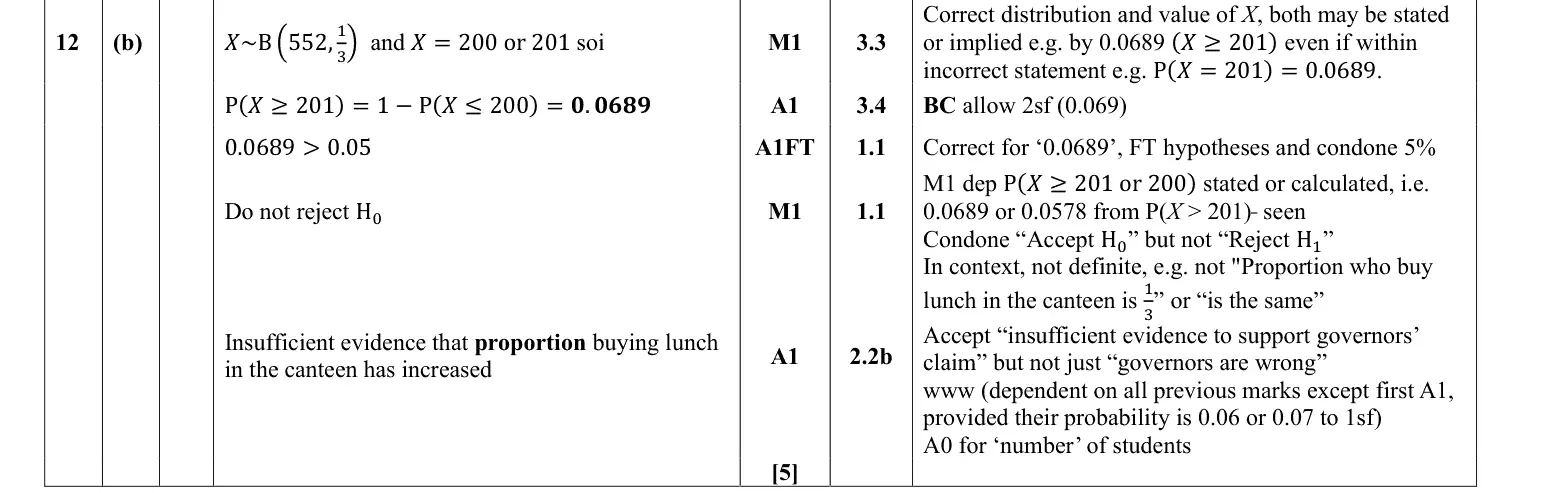
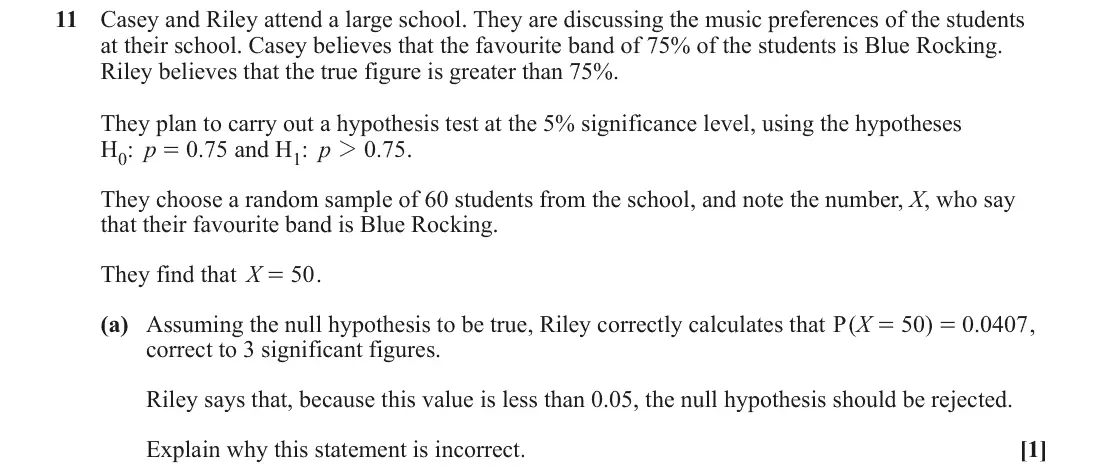
Most candidates scored most of the marks in this part, demonstrating their understanding of how to complete a hypothesis test. Candidates should be encouraged to be clear and precise when calculating the required probability (and, although on this occasion the scheme allowed this to be given to 2sf, it should always be given to 3sf in the absence of any other direction). Most candidates gave the correct conclusion in terms of the hypotheses but as is often the case, many candidates could not be awarded the final A mark because their conclusion was inappropriate –, e.g. through being definite or by making a statement that is not supported by the test. Candidates should refer to the helpful guidance from OCR’s subject advisors on this (noting that ‘not rejecting’ the null hypothesis means that there is insufficient evidence to conclude that there has been a change – i.e. the test does not show that the proportion is, in this case, exactly 3).
Key points and common errors
X ~ B(552, 1/3)
P(X ≥ 201) = 0.0689 > 0.05
do not reject H₀
insufficient evidence that the proportion has increased
definite conclusions lose the last mark
June 2025 · Paper 2 · Q10(a)2 marksEasy
Mark scheme for this part
Examiner's comment
Most candidates scored 2/2 marks here. A few candidates made a place value error when writing down their answer (e.g. writing 0.664 instead of 0.0664). Throughout all three parts of Q10 (and across Section B more generally), many candidates did not gain marks for giving insufficiently precise (or incorrectly rounded answers). The mark scheme, as is usual, allows for small variations which may arise from using different calculators (or statistical tables) but candidates should be reminded that on this specification, answers should be given to 3 significant figures – and be correct to 3 significant figures – unless otherwise specified in the question. ‘0.066 (3sf)’ [sic] was a common answer here, which could score M1A0 only (as not correct to 3sf).
Key points and common errors
P(W ≥ 7) = 1 − P(W ≤ 6) = 0.0664
place-value errors
give 3 s.f.
June 2025 · Paper 2 · Q11(a)7 marksMedium
Mark scheme for this part
Examiner's comment
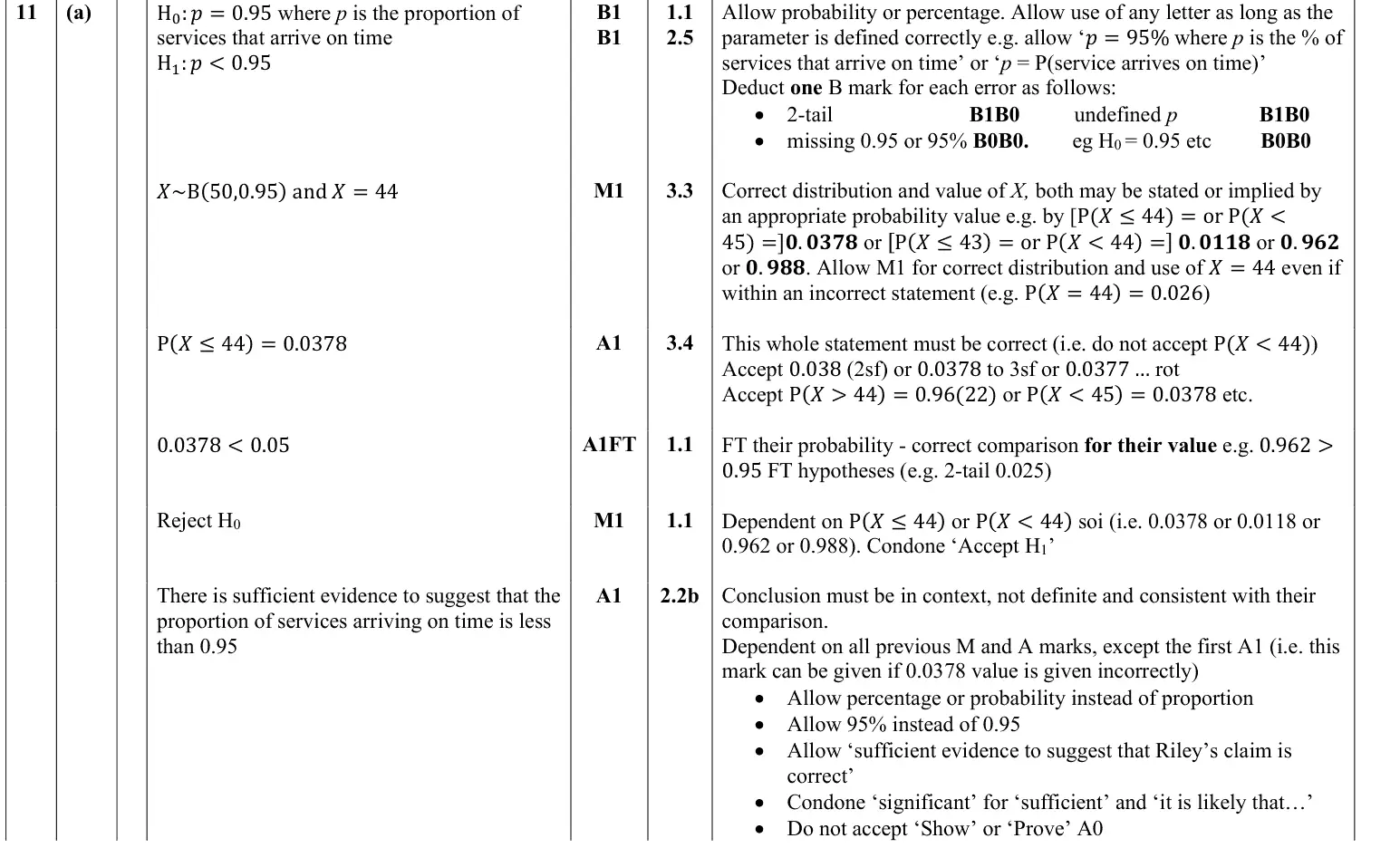
As in previous years, the mark scheme for this hypothesis testing question provides useful detail on the structure of answer that candidates should aim to provide. Almost all candidates appeared to know what was expected and gave the right sequence of overall working. The hypotheses setup (for B1B1) were generally very well done, with most candidates scoring both of these marks. Most candidates identified the appropriate Binomial distribution and went on to obtain an appropriate probability using the given value of 44 successes (for M1A1A1). Some candidates over-complicated the problem at this point by attempting to find an inverse or complement probability – which could score if correct but was not required in this case. Most candidates correctly compared their probability to the significance level (0.05) and gave the first part of the conclusion correctly. Just under a half of the cohort finished the question will a clear, non-assertive conclusion (for the final M1A1). However, many candidates were over-assertive in their conclusion (for instance, stating ‘therefore Riley is correct’ without appropriate caveats) and could not score the final accuracy mark. Candidates should be reminded that, even within the context of a question like this, it is important that they demonstrate their understanding of what a hypothesis test does and doesn’t indicate by including suitable caveats (such as ‘there is sufficient evidence to suggest that…’) in their conclusion.
Key points and common errors
H₀: p = 0.95, H₁: p < 0.95 with p defined
X ~ B(50, 0.95), P(X ≤ 44) = 0.0378 < 0.05
reject H₀
conclusion in context and not over-assertive (many said 'Riley is correct')
June 2025 · Paper 2 · Q11(b)1 markEasy
Show the start of this question
Mark scheme for this part
Examiner's comment
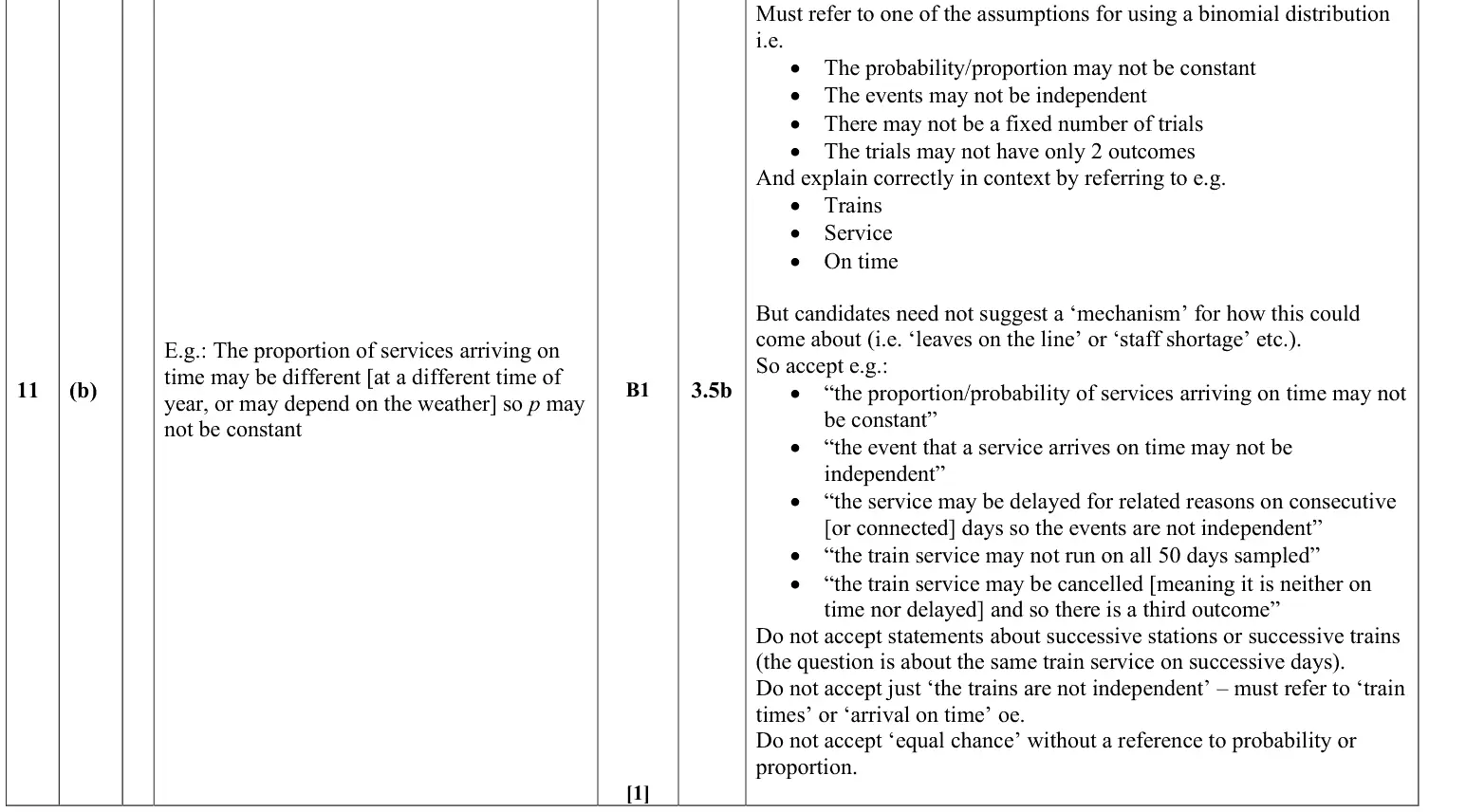
Most candidates gave a sufficiently good answer to score the mark in this part. As set out in the scheme, candidates needed to give a reason in context that directly links to one of the required assumptions for using a Binomial distribution. Most candidates argued that the probability may not be constant, or that the train service’s on-time arrival on successive days may not be independent of previous days. A few candidates identified that there may be more than two possible outcomes (e.g. ‘early’ or ‘cancelled’ as distinct from ‘on-time’ or ‘late’), which was acceptable. Some candidates appeared to struggle with the combination of mathematical and in-context language required to score the mark in this part – for instance, answers that did not specifically link to one of the assumptions in reasonably precise mathematical language were not sufficient (e.g. ‘chance not always the same’). Other candidates gave generic reasons why the result may not be reliable (e.g. ‘small sample size’) which were not acceptable as they did not relate to one of the required assumptions. A number of candidates appeared unsure about the distinction (in definition) between ‘independent events’ and ‘constant probability’ and seemed to confuse these concepts in their answer.
Key points and common errors
probability of arriving on time may not be constant (season, weather) or days may not be independent
must be in context of the train service
June 2025 · Paper 2 · Q154 marksEasy
Mark scheme for this part
Examiner's comment
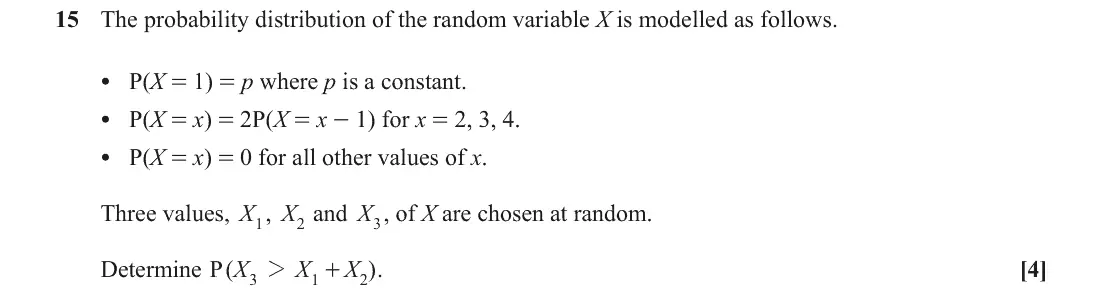
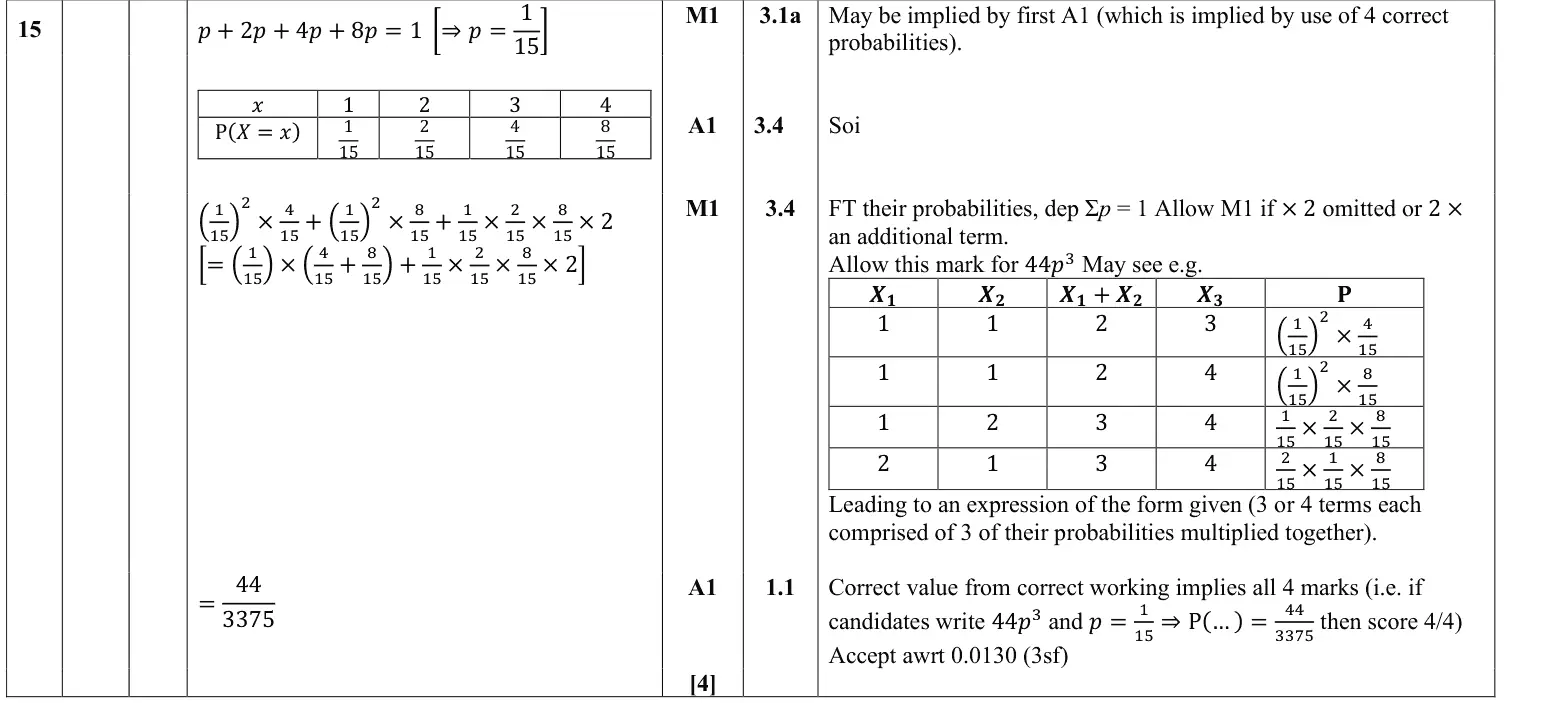
This final question was well answered, with many candidates scoring at least 2 marks. Candidates needed to interpret the information given in the question to deduce four probabilities for M1A1 and then combine these appropriately to find the required answer. Most candidates were able to find 𝑝= 15 correctly and often made an acceptable attempt at combining their probabilities (3-4 terms of 3 probabilities each), but not all candidates had the right combination to obtain the correct answer. A minority of candidates chose to work in terms of p throughout (but fewer than on the equivalent question in 2024). Some candidates misinterpreted the given information and used 6p instead of 8p. Candidates did not need to itemise all 4 probabilities as shown in the scheme, but this approach is encouraged – candidates who ‘deduced as they went along’ sometimes made errors or did not include all 4 probabilities which meant that this mark could not be implied. This candidate has given a fully correct solution. Notice that they have itemised their probabilities before proceeding to combine them – this step was not explicitly required (so these probabilities could be ‘implied’ if seen used later) but it is good practice and ensures that the working is clear (so that, for instance, a later error doesn’t remove the opportunity to ‘imply’ that first A mark), 4/4.
Key points and common errors
p + 2p + 4p + 8p = 1 so p = 1/15
list outcomes with X₃ > X₁ + X₂ (1,1,3), (1,1,4), (1,2,4), (2,1,4)
44/3375
some used 6p instead of 8p
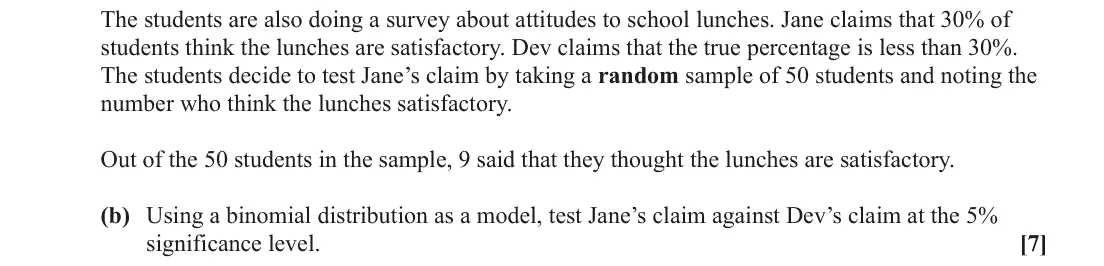
June 2024 · AS Paper 1 · Q13(b)7 marksEasy
Show the start of this question
Mark scheme for this part
Examiner's comment
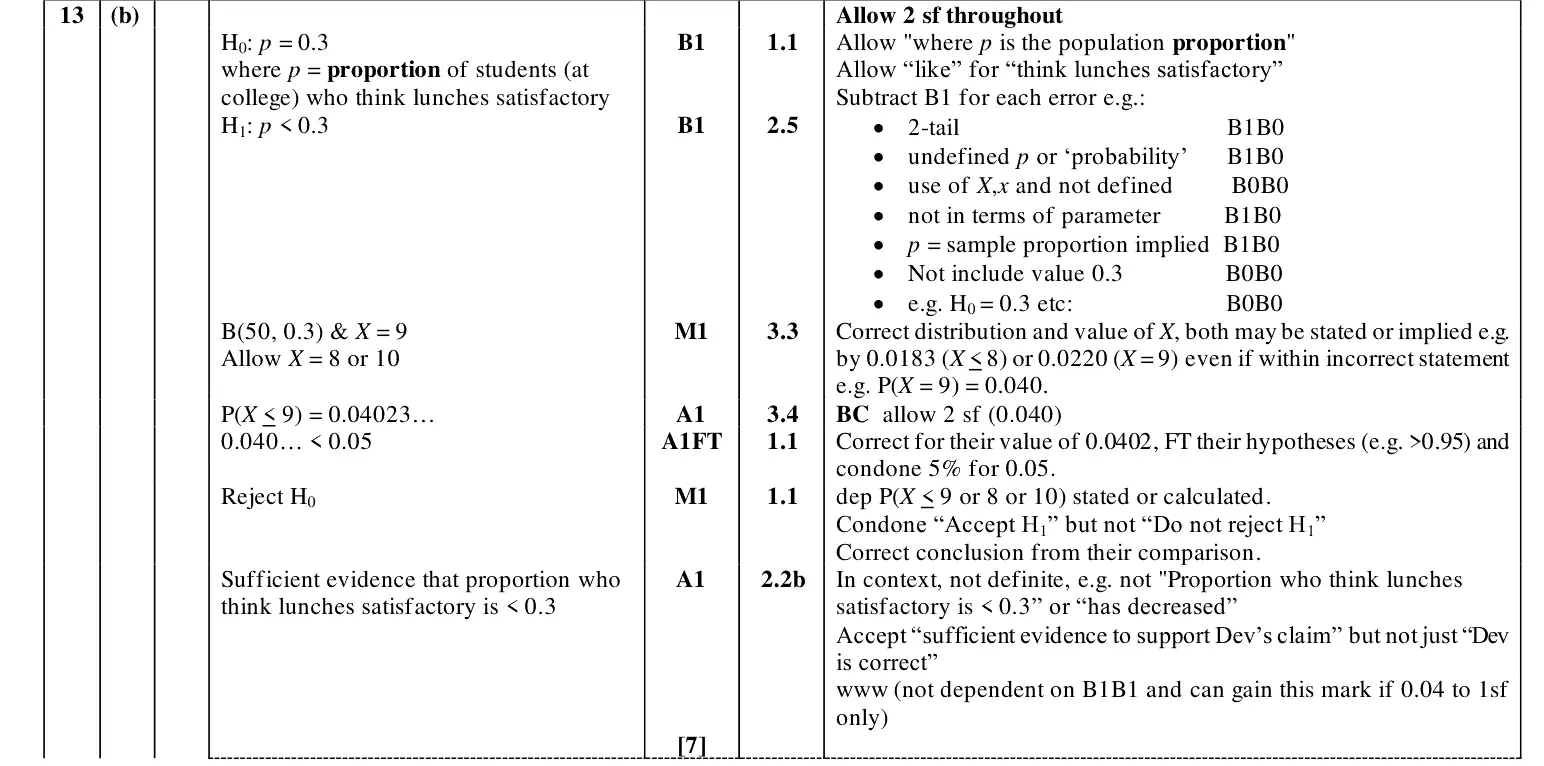
The mark scheme demonstrates the standard setup that is expected for this type of hypothesis question, and most candidates demonstrated some understanding of this, achieving close to full marks. Some candidates did not define the hypotheses accurately and others gave no final conclusion, or too definite a conclusion. A number gave the probability to only one significant figure accuracy while others looked to find P(X=9) or P(X<9) rather than P(X≤9). Candidates should be reminded that 3sf are generally required (as per the rubric) although in this case the MS only required the probabilities to be correct to 2sf. This candidate has made a good attempt at this hypothesis test, with most steps correct. However, they did not give a definition of their parameter p, and their probability value is only given to 1sf, so they score 5/7.
Key points and common errors
H₀: p = 0.3, H₁: p < 0.3 with p the population proportion
X ~ B(50, 0.3)
P(X ≤ 9) = 0.0402 < 0.05
reject H₀
evidence proportion < 0.3, not definite
not P(X = 9)
June 2024 · AS Paper 1 · Q13(c)1 markMedium
Show the start of this question
Mark scheme for this part
Examiner's comment
This was quite well answered, although omitted by many candidates. Some candidates gave a correct statement but did not specify whether they were agreeing or disagreeing. Some candidates incorrectly argued that the probability of a given student being selected was not constant.
Key points and common errors
Yes: responses may not be independent, p not constant
or No: school is large so P(success) nearly constant
must state agree/disagree
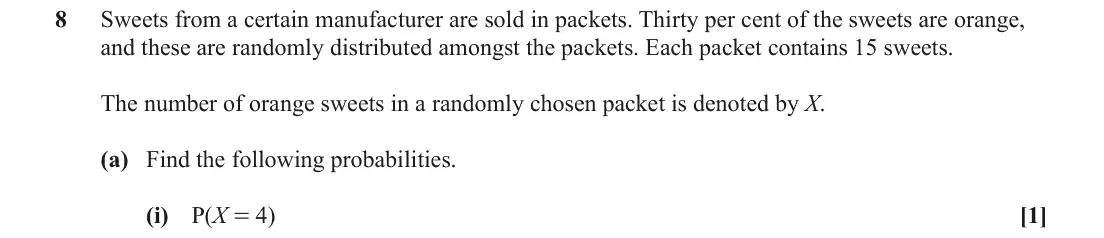
June 2024 · Paper 2 · Q8(a)(i)1 markEasy
Mark scheme for this part
Examiner's comment
Almost all candidates answered this correctly.
Key points and common errors
X ~ B(15, 0.3)
0.219
June 2024 · Paper 2 · Q8(a)(ii)2 marksEasy
Show the start of this question
Mark scheme for this part
Examiner's comment
Nearly all candidates answered this correctly.
Key points and common errors
P(X ≥ 4) = 1 − P(X ≤ 3) = 0.703
June 2024 · Paper 2 · Q8(b)(i)1 markEasy
Show the start of this question
Mark scheme for this part
Examiner's comment
Most candidates answered this correctly, although some did not give a fully correct expression. Common errors included ‘1-r’ instead of ’15-r’, using a different letter (question specifies r) or omitting the coefficient 15Cr.
Key points and common errors
¹⁵Cᵣ 0.3ʳ 0.7^(15−r)
errors: 1 − r for 15 − r, missing coefficient
June 2024 · Paper 2 · Q8(b)(ii)2 marksHard
Show the start of this question
Mark scheme for this part
Examiner's comment
Few candidates gave a fully correct response here. Candidates were required to explain the connection by stating that this is for the case when n=15 (more candidates scored this B1 mark) and then specifying that P(X=r) is a term of the expansion (B1). Ideally it should have been observed that this was the r±1th term, but responses that did not specify this were condoned. Many candidates appeared to recognise the connection but gave vague explanations such as ‘it is the expansion’ or ‘it is one of the probabilities’ - the key idea here was to demonstrate the connection between the Binomial probability and the terms in the Binomial expansion.
Key points and common errors
n = 15 and P(X = r) is a term of the expansion (not 'the coefficient')
June 2024 · Paper 2 · Q13(b)3 marksMedium
Show the start of this question
Mark scheme for this part
Examiner's comment
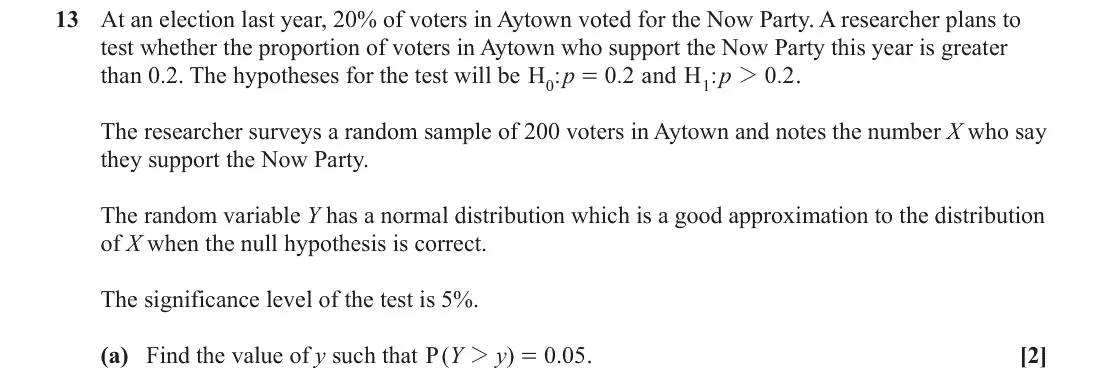
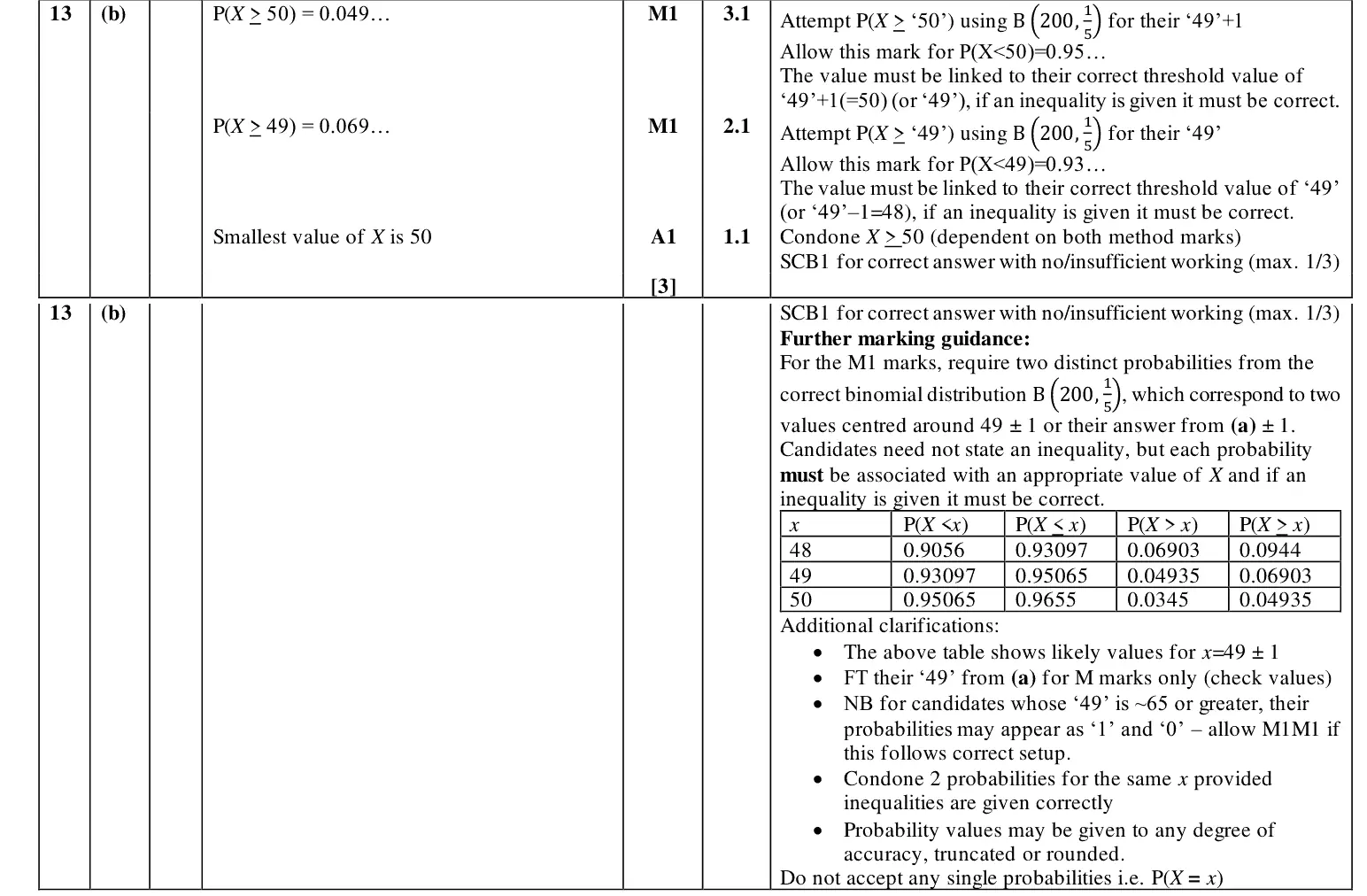
This part required candidates to select and compute (at least) two probabilities to deduce the critical value for the given hypothesis test. Many candidates attempted probabilities but gave incorrect values or associated them with the wrong inequality. A few candidates continued to confuse X and Y and gave probabilities from the Normal distribution (as in part (a)) rather than the Binomial, which could not be given marks. Many candidates were able to deduce the value 𝑋= 50 from their work in part (a) or by following incorrect probabilities - which was allowed as a Special Case B1. Although on this occasion the mark scheme did not require candidates to demonstrate probabilities either side of 0.05, candidates should be reminded that in a ‘Determine’ question this is the level of working that might be required.
Key points and common errors
use B(200, 0.2): P(X ≥ 50) = 0.049 and P(X ≥ 49) = 0.069, so 50
normal-distribution values from part (a) gain nothing here
June 2024 · Paper 2 · Q148 marksHard
Mark scheme for this part
Examiner's comment
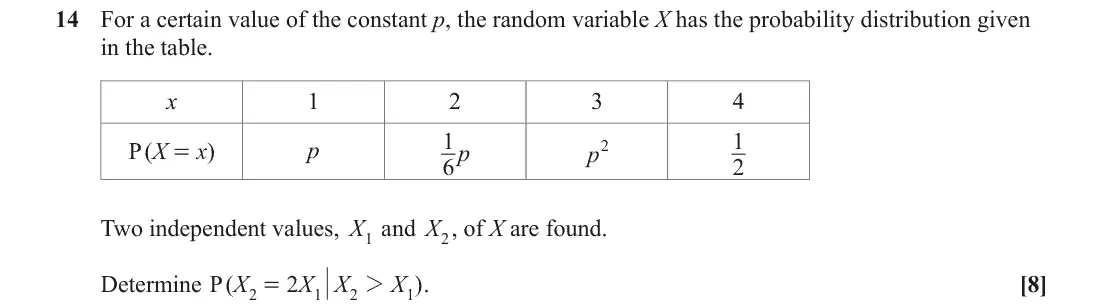
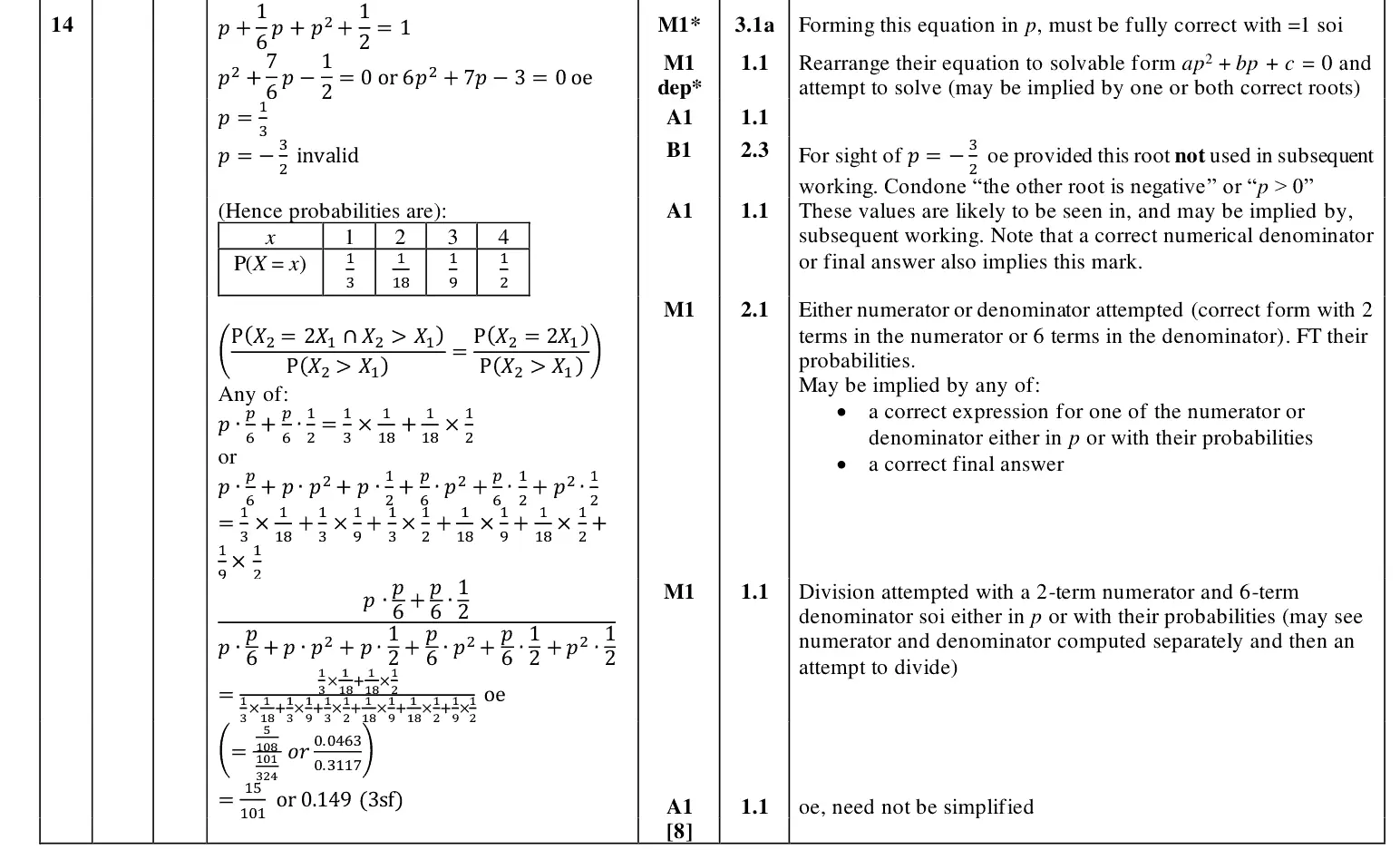
Most candidates obtained a number of marks in this question, although very few attained all 8. The majority of candidates approached the question in the order described in the mark scheme, first forming and solving a quadratic in p. This was almost always done correctly. Some candidates did not note or otherwise consider the − 2 root and could not be given the B1. (This root did not need to be found, but candidates did need to explicitly consider it, for instance by stating ‘the other root is negative’). Most candidates then went on to correctly find the conditional probability, but numerical errors were common - meaning that many candidates gained one or both method marks but not the final A1. Many candidates did not write down their probabilities once they had found a value for p (this mark could be implied, but only from correct responses or these values seen in working). A few candidates appeared not to have noticed the significance of the values in terms of p and started with a conditional probability formula in terms of p. This could gain M1M1 but nothing further unless they proceeded to work with the quadratic to find a value of p. This candidate has provided an excellent response to Question 14. They lose a single mark (B0) for not showing (or otherwise excluding) the other, negative, root of the quadratic. Their response is otherwise correct and therefore scores 7/8.
Key points and common errors
probabilities sum to 1 gives p = 1/3 (reject −3/2)
list outcomes with X₂ = 2X₁ and X₂ > X₁
15/101
June 2023 · AS Paper 1 · Q11(b)5 marksEasy
Show the start of this question
Mark scheme for this part
Examiner's comment
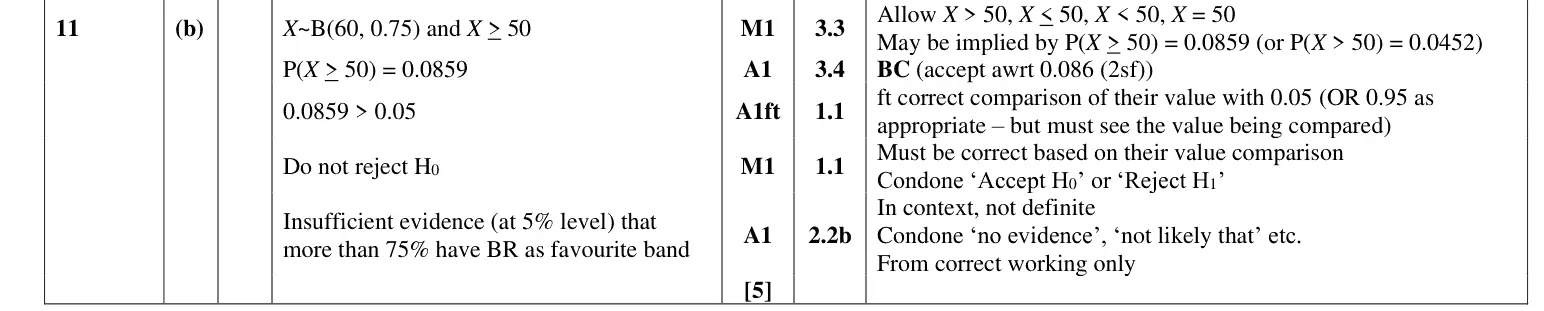
This hypothesis testing question was generally well answered. As in previous years, the mark scheme is worth reviewing to understand the structured answer that is required. The majority of students appeared well-trained in this structure and followed it closely (noting that, unusually, this paper did not require students to first state their hypotheses). Some candidates made an error in selecting the right probability value (e.g. using P(X = 50)), but could obtain some FT marks. Most candidates gained the first M1 for using the correct binomial and 50. The comparison of their probability with 0.05 was generally clearly shown correctly, but the conclusion of whether to reject or not reject the null hypothesis did not always follow correctly. Most candidates made an appropriate statement about H0, but quite a few candidates lost the final mark for not giving their explanation in context or for making an inaccurate ‘definite’ statement. Some candidates stated a conclusion along the lines of ‘there is insufficient evidence to suggest that the probability of Blue Rocking being the favourite is increased’, which shows a misunderstanding of the context (the probability has not been increased, the hypothesis is testing whether there is evidence that it is above a certain value). Some students, having made the correct initial statement (‘do not reject H0’) went on to make a definitive statement that the null hypothesis is ‘true’, e.g. ‘the proportion of students whose favourite band is BR is 75%’; this is not correct and is not what the test shows (insignificance does not ‘prove’ the null hypothesis). This candidate has performed the first steps of the hypothesis test correctly (although we would ideally see the values to at least 3sf throughout). However, they have drawn the incorrect conclusion from their comparison, to ‘reject H0’. Their conclusion does not correctly follow from this statement, because it asserts that this shows the probability is 75%.
Key points and common errors
X ~ B(60, 0.75), P(X ≥ 50) = 0.0859 > 0.05
do not reject H₀
insufficient evidence that more than 75% favour BR
non-definite and in context
June 2023 · AS Paper 1 · Q11(c)(i)1 markMedium
Show the start of this question
Mark scheme for this part
Examiner's comment
This question was asking for the straightforward statement X~B(60,0.75), which many candidates had already obtained and used in part (b). However, quite a few candidates misidentified the ‘binomial theorem’ and/or did not state the parameters. We condoned ‘binomial expansion’ if accompanied by the correct values for n and p. Some candidates stated ‘binomial PD’ or ‘C–’, which was allowed, but centres should make sure that students understand the underlying characteristics of these distributions beyond the formulae in their calculator.
Key points and common errors
B(60, 0.75) with both parameters
'binomial theorem' not accepted
June 2023 · AS Paper 1 · Q11(c)(ii)1 markHard
Show the start of this question
Mark scheme for this part
Examiner's comment
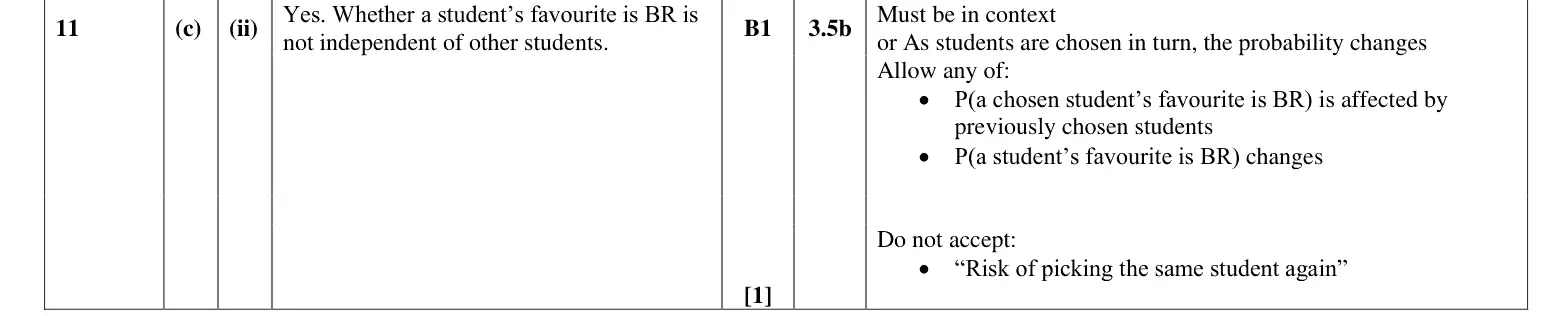
Relatively few candidates obtained the mark here. This question required an answer in context explaining that the non-replacement does invalidate the test. Some candidates were able to recite the standard ‘fact’ that the binomial distribution does require replacement, but were unable to explain in context why this is the case. We needed to see evidence that the lack of replacement means that the probability of success (i.e. choosing a student whose favourite is BR) is not constant with each trial. Some candidates made reference to repeats or ‘choosing the same person each time’, which was not enough to gain the mark. Some candidates confused the number of trials and the overall number of students in the population from which the sample is drawn.
Key points and common errors
yes: without replacement the probability changes so trials are not independent
must be in context
reciting the fact alone not enough
relatively few scored
June 2023 · Paper 2 · Q9(a)1 markEasy
Mark scheme for this part
Examiner's comment
This was generally well answered, although some candidates erroneously gave n = 250 or 750, or gave an inexact value for p = 0.3 or 0.33. Some candidates gave p as 0.5 or 2/75.
Key points and common errors
B(20, 1/3)
p must be exact, not 0.33
n = 250 or 750 wrong
June 2023 · Paper 2 · Q9(b)(i)1 markMedium
Show the start of this question
Mark scheme for this part
Examiner's comment
Many candidates were able to give this expression for the standard Binomial probability correctly (often with follow-through using their values from part (a)). Some candidates omitted the combination term or gave the general expression without values substituted in, which was not enough for the mark.
Key points and common errors
²⁰Cₓ (1/3)ˣ (2/3)^(20 − x)
values must be substituted
coefficient often omitted
June 2023 · Paper 2 · Q9(b)(ii)1 markHard
Show the start of this question
Mark scheme for this part
Examiner's comment
Very few candidates obtained this mark. Some identified the correct range of values, in correct set notation, but hardly any candidates stated that only integer values in the range were appropriate.
Key points and common errors
{x : x ∈ ℤ, 0 ≤ x ≤ 20}
x must be stated to be an integer
June 2023 · Paper 2 · Q9(c)2 marksHard
Show the start of this question
Mark scheme for this part
Examiner's comment
Candidates’ responses to this question were very mixed, with only a minority of candidates obtaining the correct answer. Many candidates did not appear to recognise which probabilities they needed to calculate and subtract, or used a complement such as 1 −𝑃(𝑋≤4). The method mark was awarded for inaccurate working such as 𝑃(𝑋≤9) −𝑃(𝑋≤5), which was a common answer (giving 0.611).
Key points and common errors
P(X ≤ 9) − P(X ≤ 4) = 0.757
P(X ≤ 9) − P(X ≤ 5) = 0.611 is a common error
June 2023 · Paper 2 · Q12(a)3 marksEasy
Mark scheme for this part
Examiner's comment
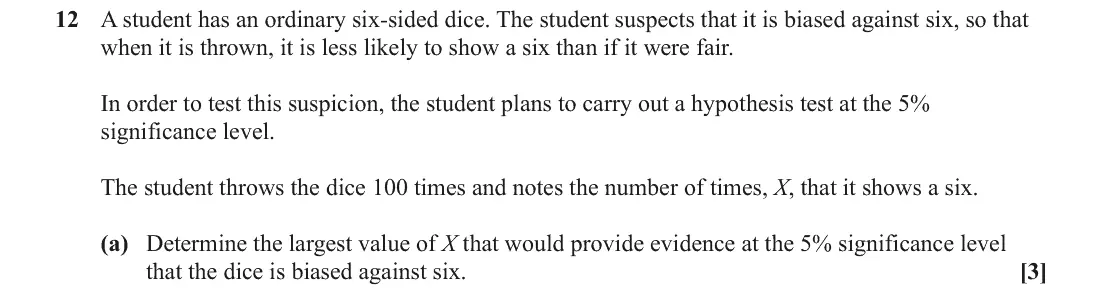
This question was broadly well answered, with many candidates successfully concluding with the correct answer of 10. Some candidates did not show sufficient working (for ‘Determine’) to support their conclusion, or were not sufficiently accurate with the probabilities they were using to support their answer (these could be rounded, but needed to be rounded correctly or ‘…’ used to show truncation). A small number of candidates attempted to use a normal approximation, which was a good (if laborious) way of identifying the borderline values to test, but then did not go on to calculate the Binomial probabilities required to support a final conclusion. Some candidates used the pdf rather than the cdf (obtaining incorrect values). This candidate has found one of the required probabilities (although they have ‘chopped’ their answer so it is not rounded correctly), but has then concluded directly – without providing the value for x = 11 to justify this as the largest value, so they could only be awarded the first M mark.
Key points and common errors
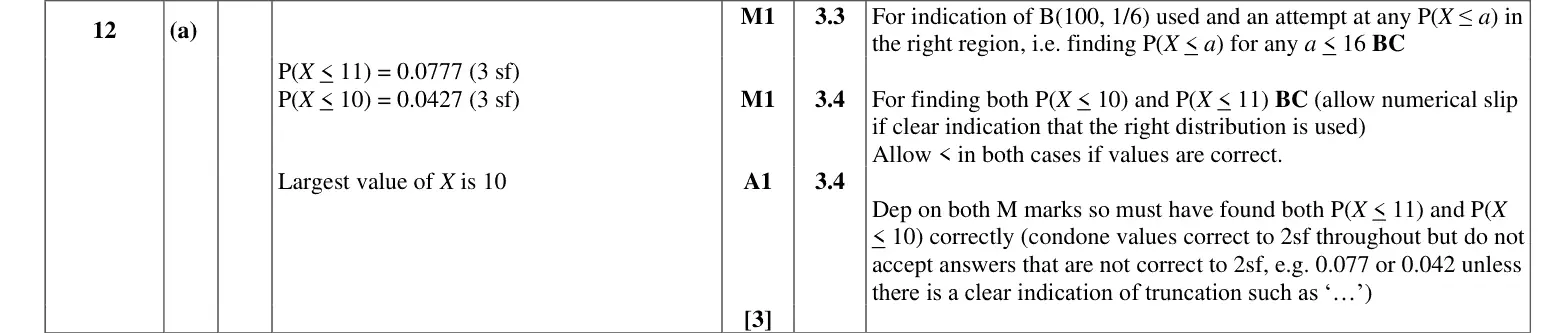
X ~ B(100, 1/6)
P(X ≤ 10) = 0.0427 and P(X ≤ 11) = 0.0777 both needed so largest value 10
probabilities must be accurate
June 2023 · Paper 2 · Q12(b)1 markHard
Show the start of this question
Mark scheme for this part
Examiner's comment
This question was only correctly answered by a minority of candidates. Many candidates appeared to misunderstand that the critical region for a test (with a discrete distribution) is not exactly 0.05, and gave this as an incorrect answer (even though they may have calculated the required probability in part (a)).
Key points and common errors
probability of the critical region is P(X ≤ 10) = 0.0427, not 0.05 (discrete distribution)
June 2022 · AS Paper 1 · Q9(a)(i)1 markEasy
Mark scheme for this part
Examiner's comment
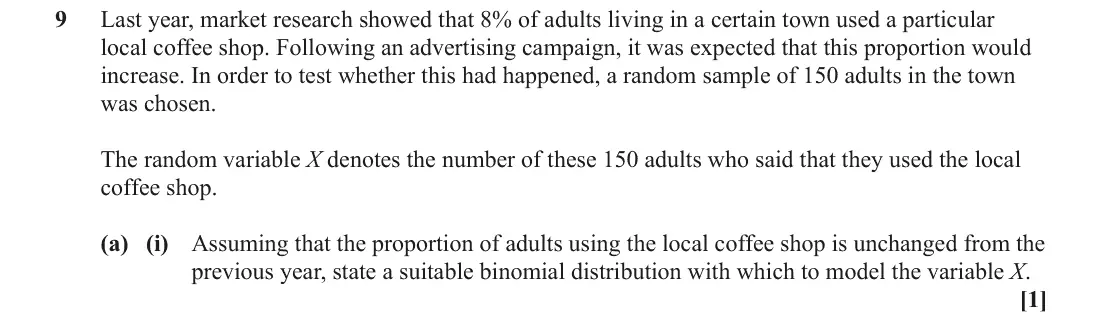
Most gave the correct answer. However, a number of incorrect answers suggested that, although candidates may be familiar with calculating binomial probabilities by rote, they are unaware of the distribution that lies behind the calculations. Examples of incorrect answers were: P(X = 0.8), P(X > 0.8), 150 , n (150 − x ) x ( n x − ) x 0.92 0.08 0.92 0.08 , B ~ X(150, 0.08), x x , B ~ X(150, 8 X N(150,0.08) 150 ), 150 × 0.08 = 12, X = 0.08 & n = 150, P = 12(150, 0.08).
Key points and common errors
X ~ B(150, 0.08)
errors like N(150, 0.08) or P(X = 0.08)
June 2022 · AS Paper 1 · Q9(a)(ii)1 markMedium
Show the start of this question
Mark scheme for this part
Examiner's comment
This question was intended to test candidates’ understanding of the relationship between the binomial distribution (in statistics) and the binomial expansion (in pure maths). Many candidates answered correctly, but some answers suggested a lack of understanding of this relationship. Examples of incorrect answers were: P(X = x) = 150 (150 − x ) x 0.92 0.08 , (1 − 0.08)150, (150 + 12)0.08, (1 − 0.92)1, x (1 − 0.08)150, 150 ×0.08 = 12, (a + b)0.08.
Key points and common errors
(0.92 + 0.08)¹⁵⁰
not the general term
June 2022 · AS Paper 1 · Q9(b)7 marksMedium
Show the start of this question
Mark scheme for this part
Examiner's comment
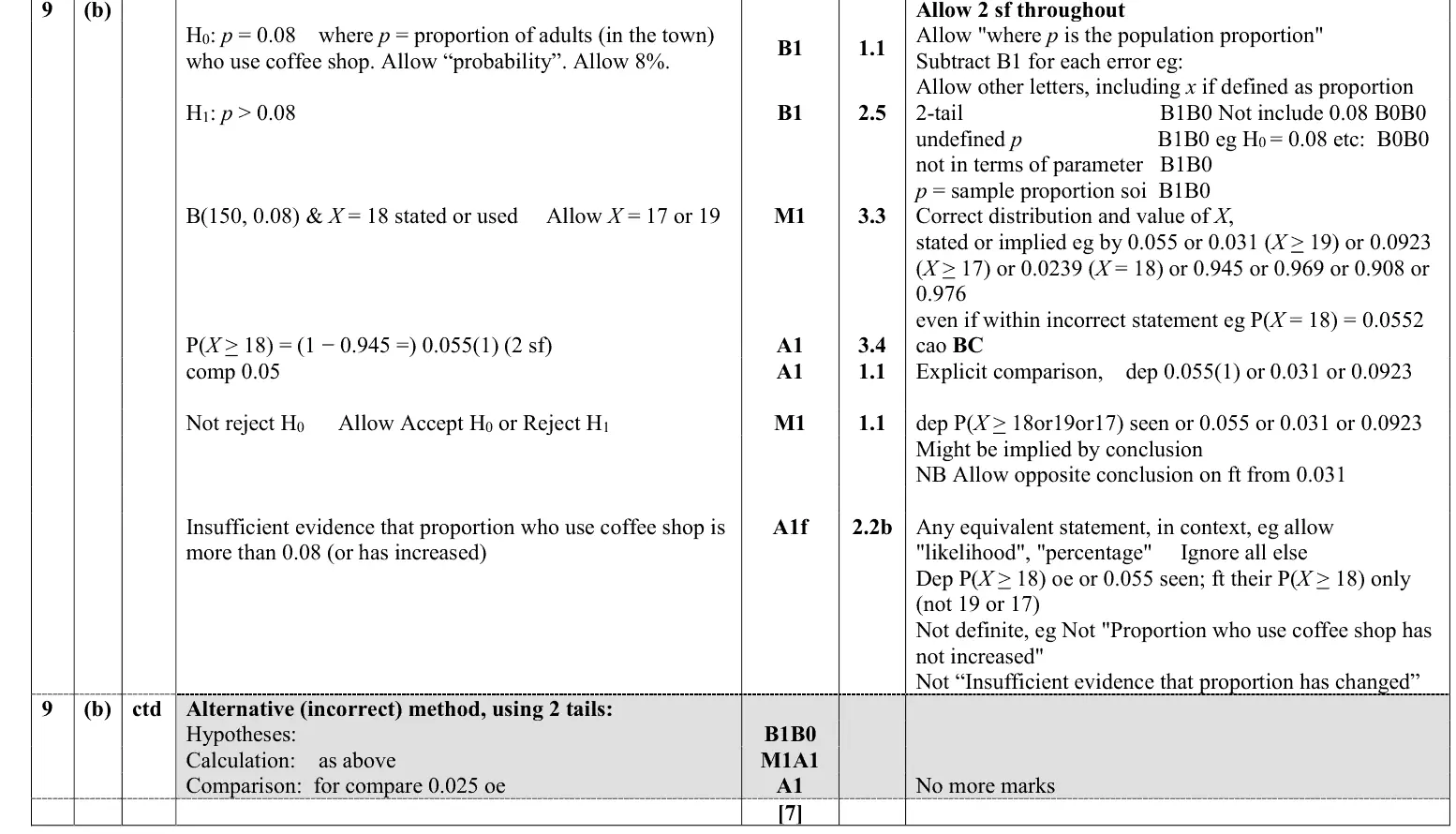
The mark scheme for this question (as for all hypothesis test questions) is long and complicated and would reward careful study. A good number of candidates answered this question correctly. Several lost just one or two marks, sometimes by not defining p in the hypotheses, or by omitting to show explicitly the comparison with 0.05, or by giving a “definite” conclusion such as “The proportion using the coffee shop has not increased.” Although a large number of candidates showed familiarity with the relevant terminology, they showed little understanding of the process required for a hypothesis test. Content statement 2.05a in the specification states that the hypotheses for a hypothesis test must be stated in terms of the relevant parameter. In addition to this, the parameter must be defined in context and must be clearly described as the population value. In this question, many candidates did not define the relevant parameter clearly, thus losing a mark. Others gave the hypotheses in words, not in terms of the parameter. A common error was P(X > 18) = 0.031. This comes from the incorrect step P(X > 18) = 1 − P(X < 18). Candidates who made this error could, nevertheless, score a possible 6 marks out of 7. Another common error was to find P(X = 18) rather than P(X > 18). This led to the loss of most of the marks. Some candidates wrote “P(X = 18)”, but actually calculated P(X > 18). Some candidates found the correct probability (0.055) and made the correct explicit comparison, 0.055 > 0.05, but then drew the wrong conclusion, rejecting Ho.
Key points and common errors
H₀: p = 0.08, H₁: p > 0.08 with p the population proportion
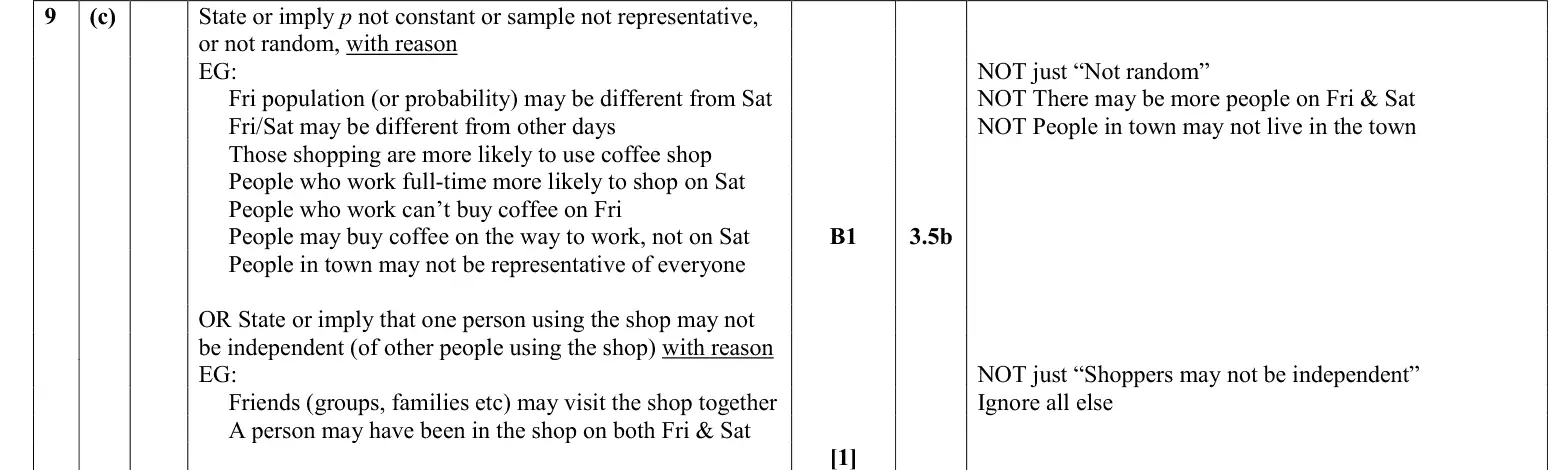
To gain the mark, there needed to be an implication that one of the two binomial conditions (constant probability of success or independent events) was not satisfied. This required a reasonable explanation either for why the clientele on Friday and Saturday might be different from other days, or for why the Friday clientele might be different from the Saturday clientele or for why one adult’s use of the coffee shop might not be independent of another’s. Two categories of answers that were not accepted were these: Any suggestion that there may be more people in town on Fridays and Saturdays than other days, or that there might be people from outside town who come in on Fridays and Saturdays. For a more detailed list of acceptable and non-acceptable answers, please refer to the published mark scheme.
Key points and common errors
p may not be constant (Friday/Saturday shoppers differ from other days) or choices not independent (friends together), with a reason
'more people in town' gains nothing
June 2022 · AS Paper 1 · Q11(a)(i)2 marksMedium
Mark scheme for this part
Examiner's comment
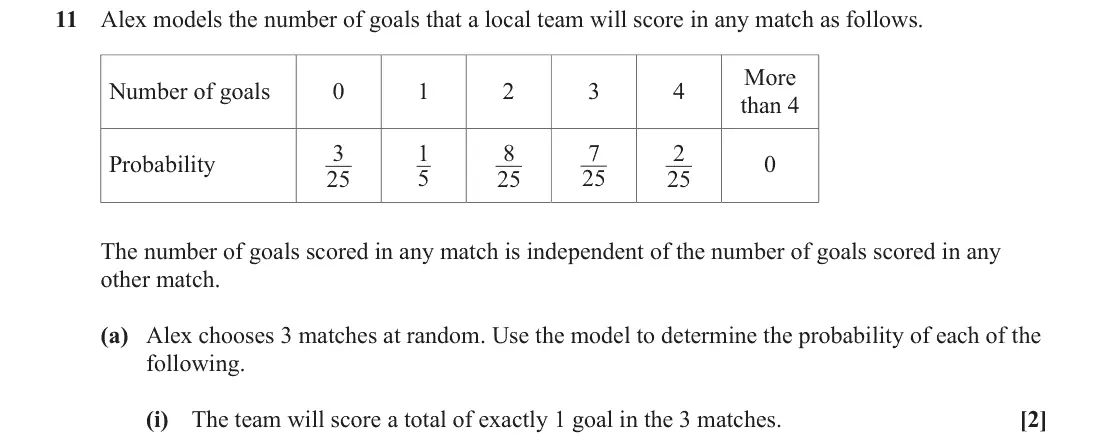
Many correct solutions were seen. ( ) 2 1 4 One partially correct solution that was also common was , which ignores the three possible 5 5 orders. A very common incorrect solution was ( ) 3 1 , which is P(exactly 1 goal will be scored in each of 5 the 3 matches) rather than P(a total of exactly 1 goal will be scored in the 3 matches). A few candidates added probabilities instead of multiplying.
Key points and common errors
(3/25)² × 1/5 × 3 = 27/3125 = 0.00864
must multiply by 3 for the order
(1/5)³ is wrong
June 2022 · AS Paper 1 · Q11(a)(ii)3 marksMedium
Show the start of this question
Mark scheme for this part
Examiner's comment
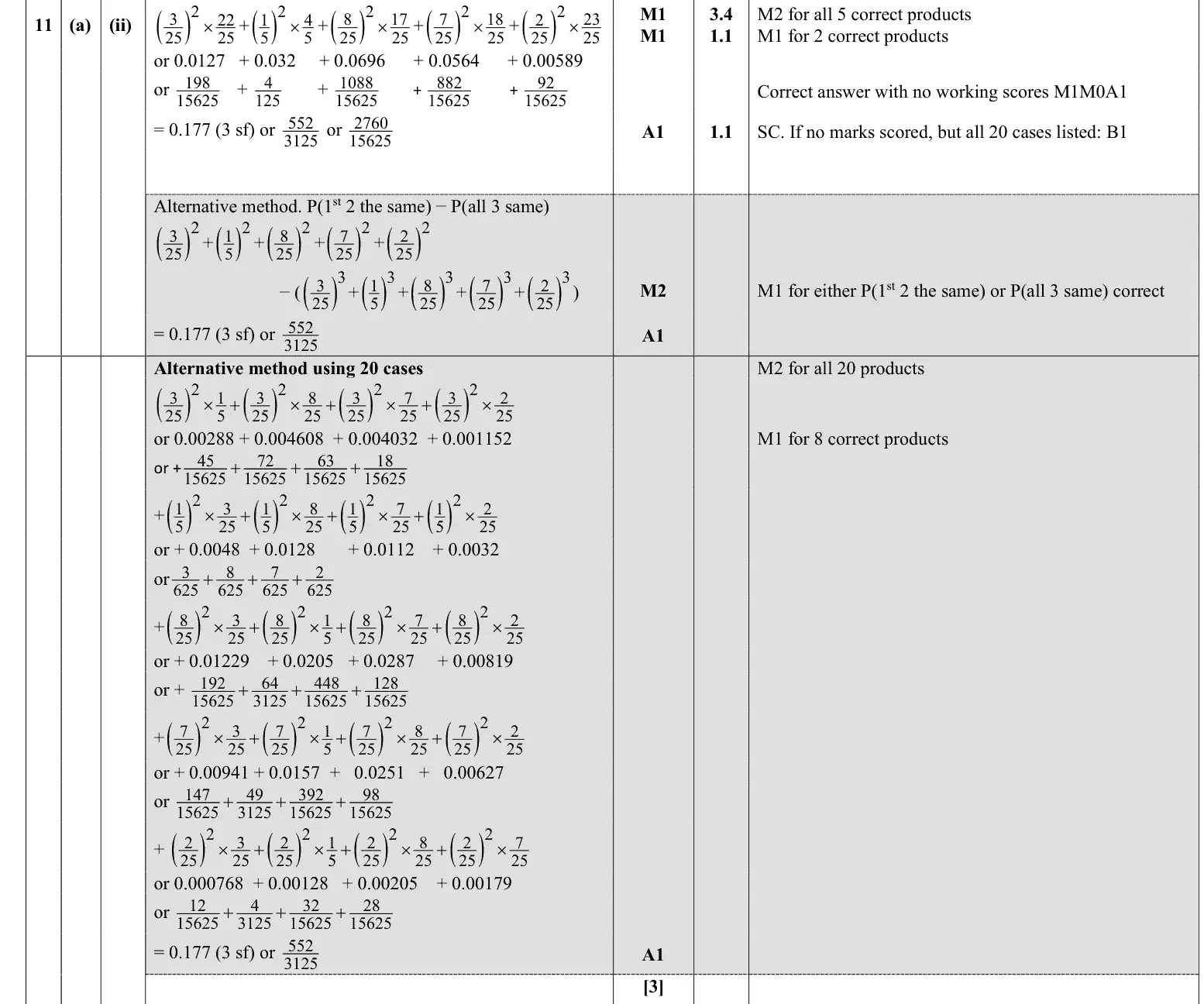
The “standard” method is to consider five cases, P(0, 0) × (1 − P(not 0)) + P(1, 1) × (1 − P(not 1)) etc, giving ( ) 25 + ( ) 3 22 1 4 5 + . . . . Many candidates used this method successfully, although some 25 5 omitted one or more of the five cases. A few candidates used an incorrect variation on this method, ( ) 25 + ( ) 3 19 1 3 5 + . . . . . 25 5 Many other candidates used the “long” method of considering all 20 cases (0, 0, 1), (0, 0, 2), etc. Many of these made arithmetical errors. Others gave up after a few calculations, presumably feeling daunted by the large number of individual products that would need to be found. Candidates who showed all 20 cases but did not show at least eight of the actual products, gained one mark. Some candidates used the rather neat method of P(the first two are the same) − P(all three are the same), usually successfully. Two related incorrect methods were 1 − P(all three are the same) and P(the first two are the same).
Key points and common errors
sum over k of P(k)² × (1 − P(k)) = 0.177
or P(first two same) − P(all three same)
20-case method error-prone
June 2022 · AS Paper 1 · Q11(b)1 markMedium
Show the start of this question
Mark scheme for this part
Examiner's comment
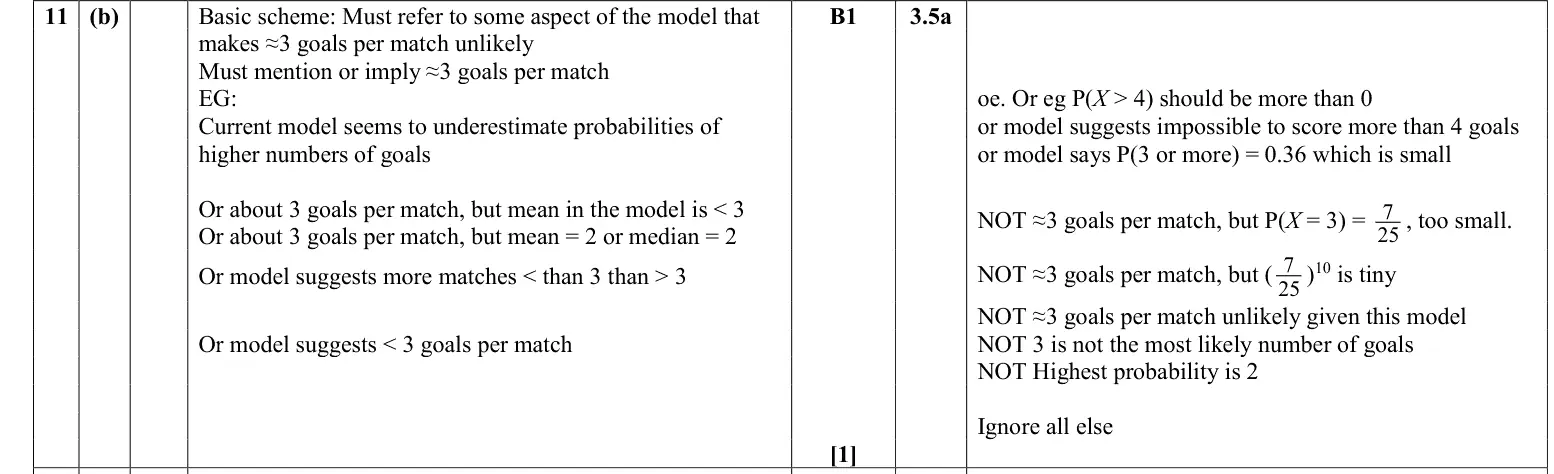
One way to gain the mark was to refer to the model as a whole, showing that 3.1 was an unlikely value for the mean in 10 matches. This could be implied by reference to the mean (“2” or “about 2”) or by a statement such as “The model implies that fewer than 3 goals is more likely than more than 3.” Another way to gain the mark was to state or imply that, in order to achieve a mean of about 3, the probability of scoring 4 goals would be likely to be greater than 0. Some common unacceptable answers were as follows. “The most common score is 2”, “P(3 goals) is small”, “3 is not the most likely number of goals”, “P(scoring 3 goals in each of 10 matches is ( ) 7 25 which is tiny”. A common response that, although true, was considered inadequate was “According to the model, a mean of about 3 is unlikely”.
Key points and common errors
31 goals in 10 matches is about 3 per match, but the model's mean is about 2 (or P(more than 4) = 0 too small), so doubt on the model
June 2022 · Paper 2 · Q12(a)5 marksHard
Mark scheme for this part
Examiner's comment
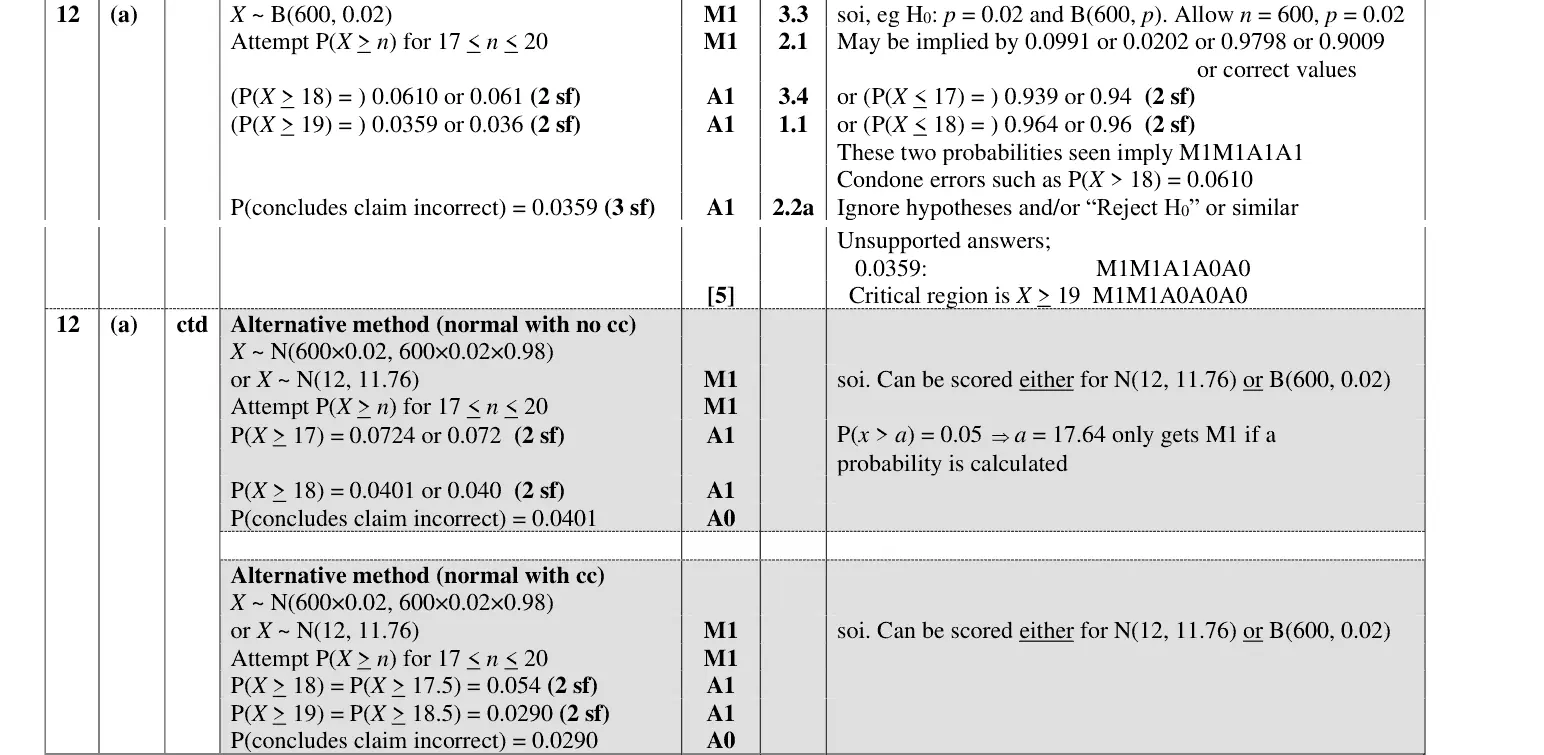
In this question, probably more than any other, candidates suffered from not reading the question carefully. The question is quite explicit: “... determine the probability ....”. But many candidates thought that the question was asking them to carry out a hypothesis test. Thus they gave hypotheses and a conclusion. In the process of doing this, some candidates carried out some of the processes needed to answer the actual question, and so scored some marks. However, most of these candidates scored only 1 mark (for correctly identifying the distribution B(600, 0.02)). Those candidates who understood the question correctly generally gave good solutions. Some found P(X > 19) = 0.0359, then stated that this is less than 0.05, and concluded that the required probability was 0.0359. These scored 4 marks out of 5. In order to gain full marks, candidates had also to show that P(X > 18) = 0.0610, which is greater than 0.05. Some candidates appeared to think that the binomial probability function of their calculator gave them, e.g. P(X < 18), whereas it actually gives P(X < 18). A few candidates wrongly assumed that P(X > 18) = 1 − P(X < 18). Many candidates correctly identified B(600, 0.02), but then found np = 12 and gave P(X > 12) = 0.540 as their answer. Some candidates used the normal approximation to the binomial distribution to find the relevant probabilities. These candidates could score a maximum of 4 marks out of 5. But it should be noted that finding probabilities by this method is not in the syllabus. A few candidates used the normal approximation to the binomial to find roughly which values of X they should consider. Thus: P(X > a) = 0.05 ⇒X = about 17. This was acceptable, but scored only 1 mark unless the candidate then went on to use the binomial distribution to find P(X > 18) and P(X > 19). Many candidates carried out correct working and obtained 0.0359, but then took an extra step such as P(concludes claim incorrect) = 0.0359 0.05 = 0.718.
Key points and common errors
X ~ B(600, 0.02)
P(X ≥ 18) = 0.0610 > 0.05, P(X ≥ 19) = 0.0359
critical region X ≥ 19
answer 0.0359
many did a full test instead
Autumn 2021 · AS Paper 1 · Q12(a)1 markMedium
Mark scheme for this part
Key points and common errors
n = 50, a = 5/6, b = 1/6 (or the other way round)
Autumn 2021 · AS Paper 1 · Q12(c)4 marksMedium
Show the start of this question
Mark scheme for this part
Key points and common errors
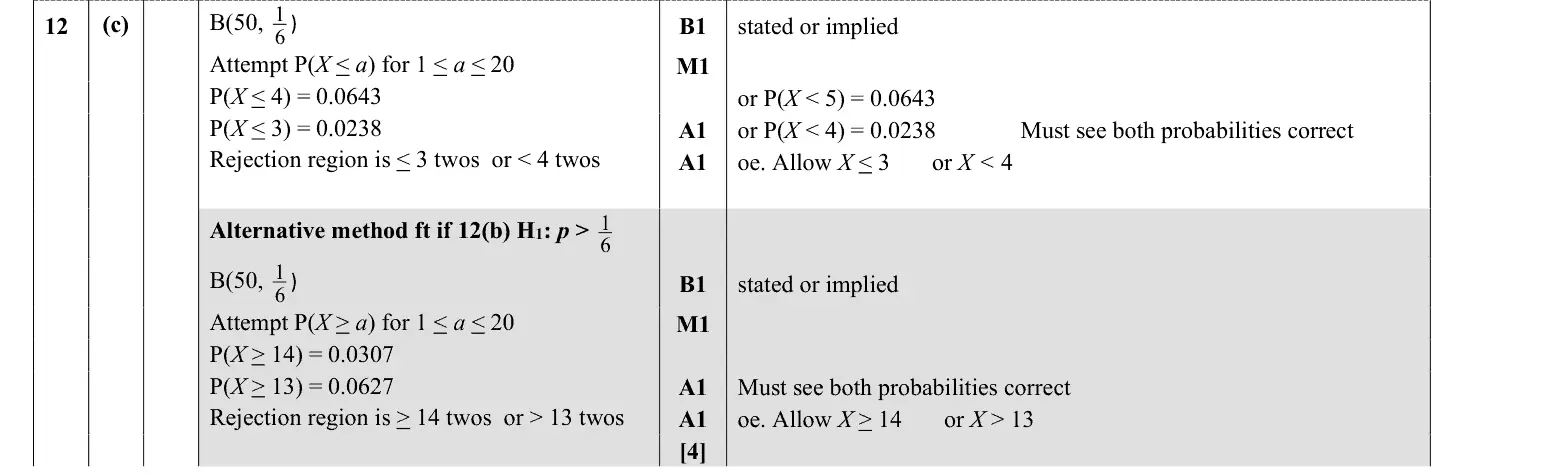
X ~ B(50, 1/6)
P(X ≤ 4) = 0.0643 > 0.05 and P(X ≤ 3) = 0.0238
rejection region X ≤ 3
both probabilities must be shown
Autumn 2021 · AS Paper 1 · Q13(a)5 marksMedium
Mark scheme for this part
Key points and common errors
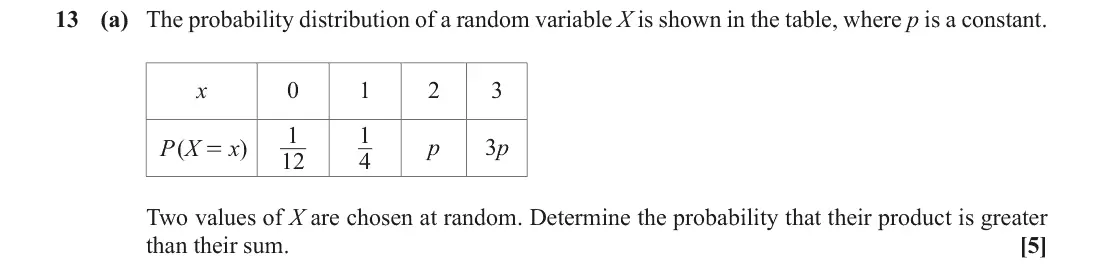
probabilities sum to 1 gives p = 1/6
product > sum for (2,3), (3,2), (3,3)
1/12 + 1/12 + 1/4 = 5/12
Autumn 2021 · AS Paper 1 · Q13(b)2 marksMedium
Mark scheme for this part
Key points and common errors
by symmetry P(Y₁ > Y₂) = ½(1 − 0.02) = 0.49
Autumn 2021 · Paper 2 · Q14(a)2 marksMedium
Mark scheme for this part
Key points and common errors
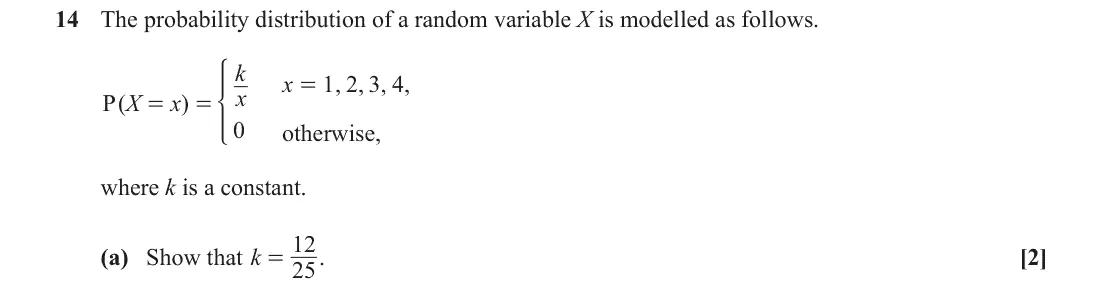
k(1 + ½ + ⅓ + ¼) = 1 so 25k/12 = 1
or verify the four probabilities sum to 1
Autumn 2021 · Paper 2 · Q14(b)1 markMedium
Show the start of this question
Mark scheme for this part
Key points and common errors
P = 12/25, 6/25, 4/25, 3/25 for x = 1, 2, 3, 4
Autumn 2021 · Paper 2 · Q14(c)3 marksMedium
Show the start of this question
Mark scheme for this part
Examiner's comment
(From the general report) Question 14(c): A common misconception was to interpret P(X1 > X2 + X3) to mean that it is required to find three values of X such that the probability of the 1st value is greater than the sum of the probabilities of the 2nd and 3rd values.
Key points and common errors
outcomes (3,1,1) (4,1,1) (4,2,1) (4,1,2)
288/3125 = 0.0922
error: comparing probabilities instead of values
Autumn 2021 · Paper 2 · Q14(d)5 marksMedium
Show the start of this question
Mark scheme for this part
Key points and common errors
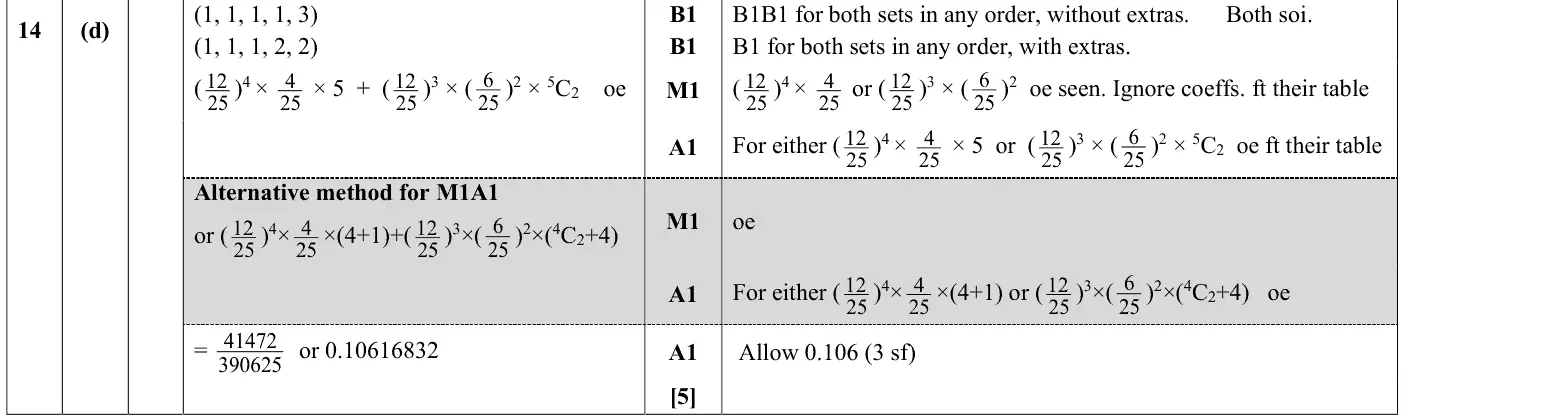
sets {1,1,1,1,3} (5 orders) and {1,1,1,2,2} (⁵C₂ orders)
(12/25)⁴(4/25) × 5 + (12/25)³(6/25)² × 10 = 0.106
Autumn 2020 · AS Paper 1 · Q10(a)7 marksMedium
Mark scheme for this part
Examiner's comment
(Comment on Question 10 as a whole) There were some very good responses to this question. However, it was clear that the candidates fell into two classes - those that had been trained to answer hypothesis test questions and those that had not been so well trained. A common error was to omit to define p in the hypotheses. Another, more serious, error was to find P(X = 1) rather than P(X < 1). A third common error was to give a definite conclusion such as “The proportion of packets containing a gift is less than 25%”, rather than a correct, more limited, statement such as “There is significant evidence to suggest that the proportion of packets containing a gift is less than 25%”.
Key points and common errors
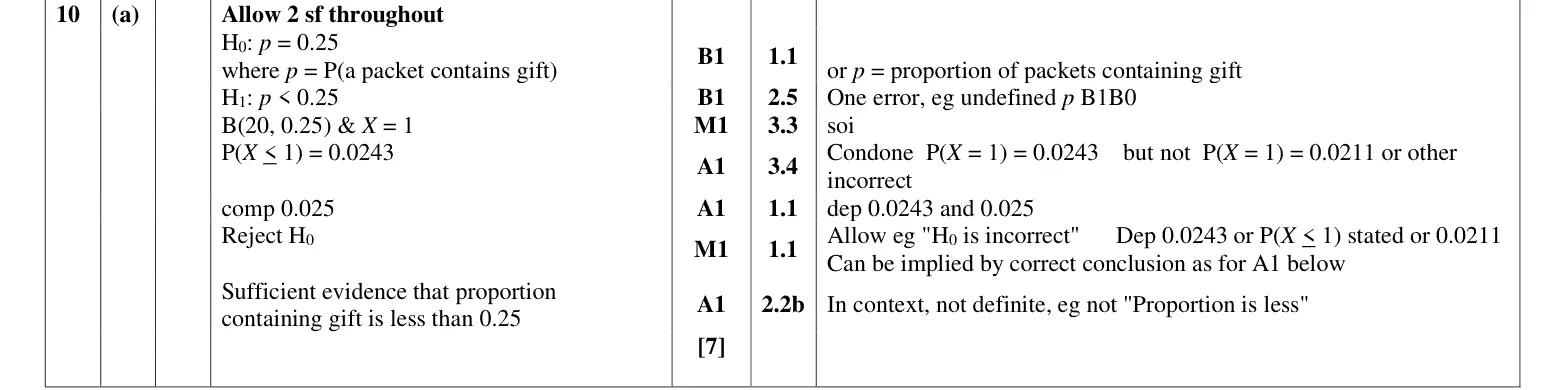
H₀: p = 0.25, H₁: p < 0.25 with p defined
B(20, 0.25)
P(X ≤ 1) = 0.0243 < 0.025
reject H₀
non-definite conclusion in context
P(X = 1) is wrong
Autumn 2020 · AS Paper 1 · Q10(b)1 markMedium
Show the start of this question
Mark scheme for this part
Examiner's comment
(Comment on Question 10 as a whole) There were some very good responses to this question. However, it was clear that the candidates fell into two classes - those that had been trained to answer hypothesis test questions and those that had not been so well trained. A common error was to omit to define p in the hypotheses. Another, more serious, error was to find P(X = 1) rather than P(X < 1). A third common error was to give a definite conclusion such as “The proportion of packets containing a gift is less than 25%”, rather than a correct, more limited, statement such as “There is significant evidence to suggest that the proportion of packets containing a gift is less than 25%”.
Key points and common errors
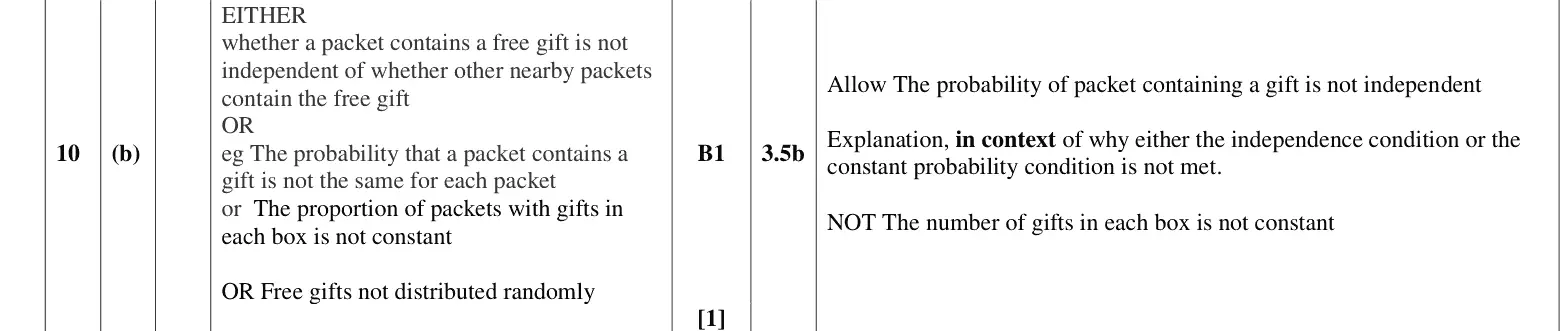
gifts not independent between nearby packets, or probability not constant from box to box, in context
Autumn 2020 · AS Paper 1 · Q11(a)1 markMedium
Mark scheme for this part
Key points and common errors
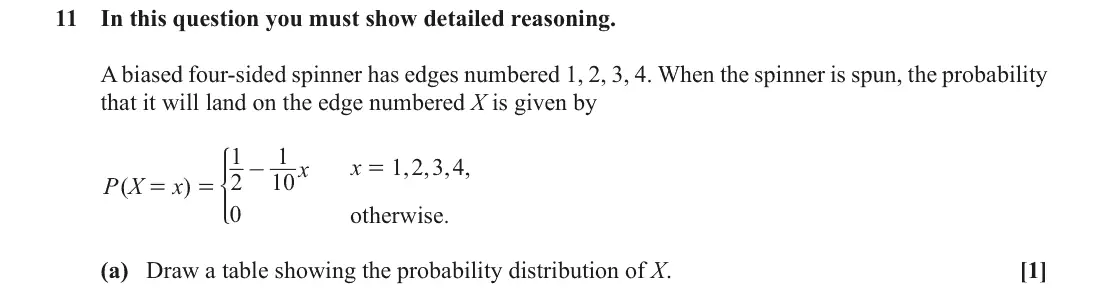
P(X = 1, 2, 3, 4) = 2/5, 3/10, 1/5, 1/10
Autumn 2020 · AS Paper 1 · Q11(b)3 marksHard
Show the start of this question
Mark scheme for this part
Examiner's comment
Many candidates did not identify all four cases. Some only found the products of two, rather than three, probabilities. Common misconceptions Key teaching and learning points – comments on improving performance The way to answer hypothesis test questions successfully can be taught as a simple list of steps to be learnt by rote. For more information, see the OCR Maths blog A Level Maths – hypothesis tests and the art of being non-assertive. It is difficult to teach candidates how to answer questions requiring deduction from data. Perhaps the best strategy is to look carefully at all the past papers and practice papers, for both AS and A Level. In particular, a close study of the published mark schemes, and examiners' reports, will help teachers and candidates to understand what kinds of answers are acceptable. Teachers should advise candidates carefully about the meanings of the command words given on pages 10 to 15 of the Specification, such as "Detailed reasoning", "Exact, "Determine", "State" and "Hence". These words are intended to be pointers as to how particular questions should be approached, so candidates need to be familiar with these before sitting the exam. Guidance on using this paper as a mock This paper covers the following topics: simple calculus, 2-dimensional; vectors, trigonometrical equations and identities, the binomial expansion of (1 + x)n, sketching a cubic curve, solution of simple quadratic inequalities and equations, simple indices, simultaneous linear and quadratic equations, histograms, making deductions from a table of data, hypothesis testing for a binomial distribution, discrete probability distributions and addition and multiplication of probabilities. In general, it tests algebraic skills of various kinds, and the understanding of relatively simple statistical ideas.
Key points and common errors
cases (1,1,3), (1,1,4), (1,2,4), (2,1,4)
sum of products of three probabilities = 9/125
many missed cases
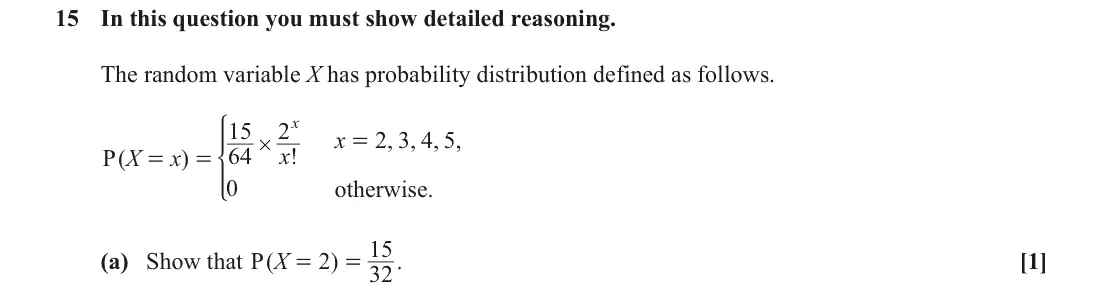
Autumn 2020 · Paper 2 · Q107 marksMedium
Mark scheme for this part
Examiner's comment
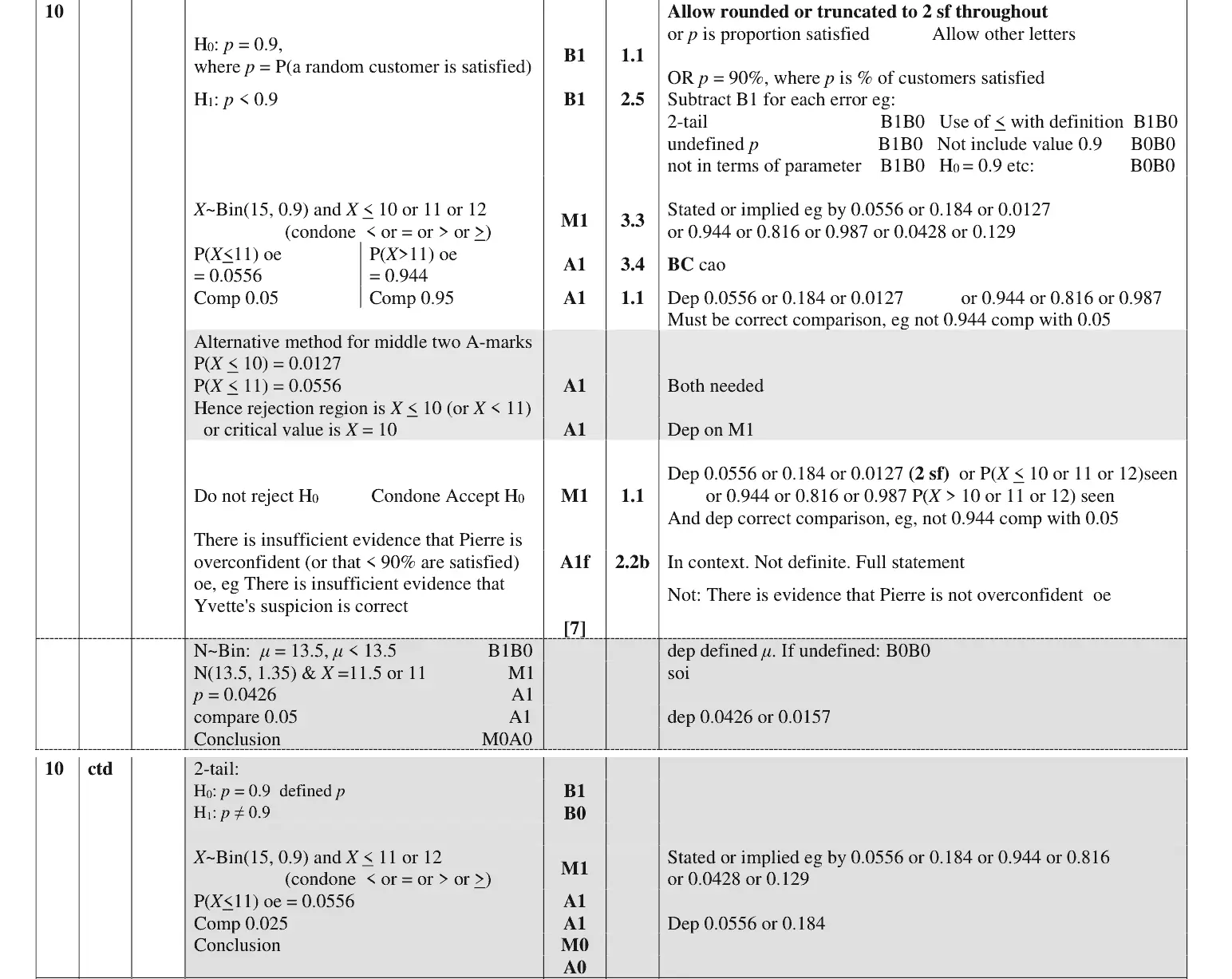
The usual errors were seen, such as incorrectly stated hypotheses (including omitting to define p), the use of ( ) instead of ( ) P X = 11 P X ≤ 11 and definite conclusions, such as "Pierre is not over-confident". Guidance on all these points can be found in section 2.05a of the specification.
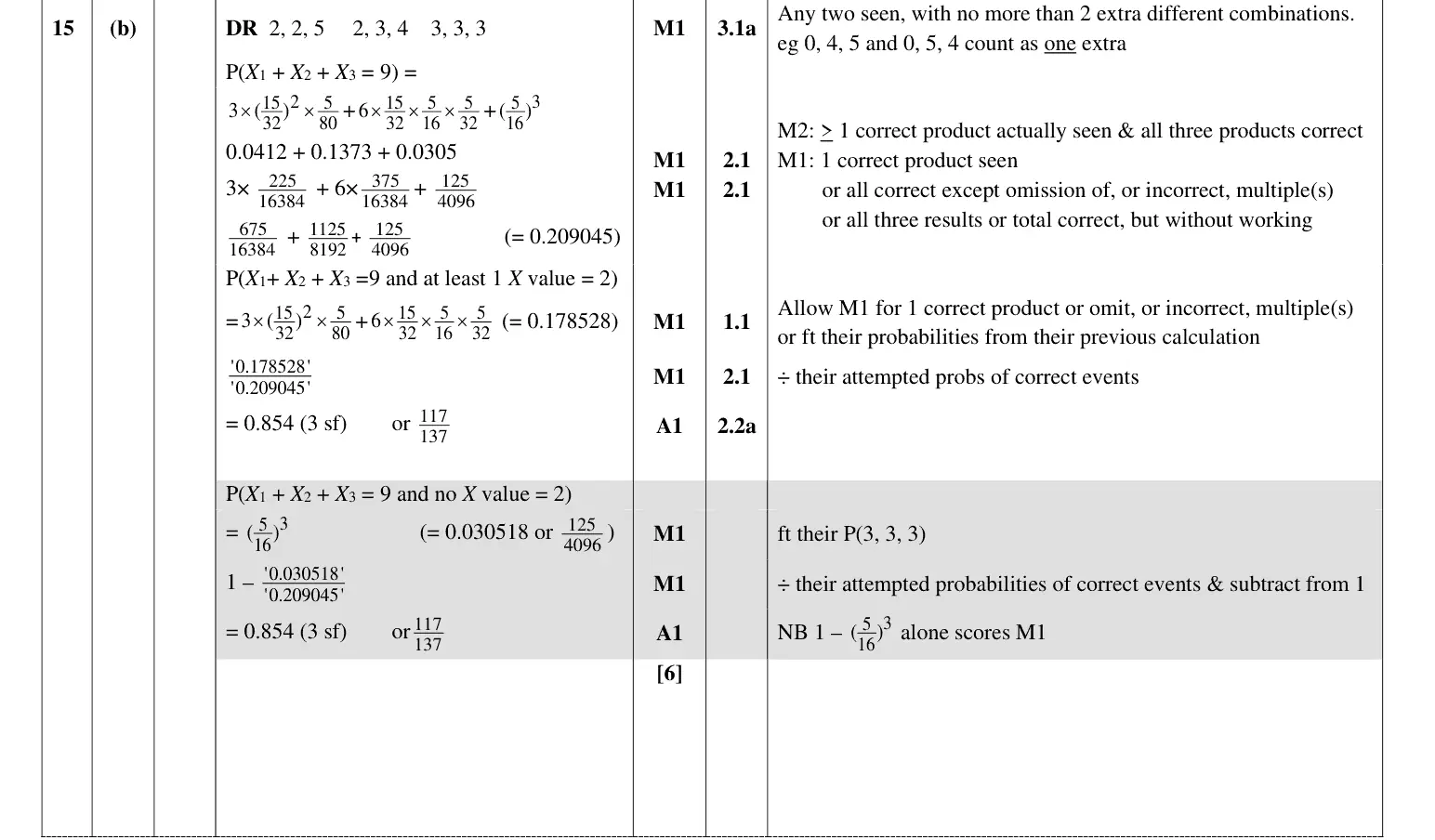
Most candidates were unable to find their way through the various calculations needed. Some obtained a correct product of three probabilities (e. g. for 2, 2, 5) but omitted to multiply by 3. Others omitted the case 3, 3, 3 altogether.
Key points and common errors
combinations 2,2,5
2,3,4
3,3,3 with arrangements 3, 6, 1
P(sum 9) = 0.209
conditional 0.1785/0.209 = 0.854 (117/137)
errors: omitting ×3 or the 3,3,3 case
Autumn 2020 · Paper 2 · Q15(c)3 marksHard
Show the start of this question
Mark scheme for this part
Examiner's comment
Most candidates did not recognise the need to consider the first 9 values separately before considering the 10th. Some candidates seemed unfamiliar with the binomial distribution. Common misconceptions Key teaching and learning points – comments on improving performance One way to answer hypothesis test questions successfully can be taught as a simple list of steps to be learnt by rote. For more information, see the OCR Maths blog A Level Maths – hypothesis tests and the art of being non-assertive. It is difficult to teach candidates how to answer questions requiring deduction from data. Perhaps the best strategy is to look carefully at all the past papers and practice papers, for both AS and A Level. In particular, a close study of the published mark schemes, and examiner's reports, will help teachers and candidates to understand what kinds of answers are acceptable. Brevity is of the essence. Teachers should advise candidates carefully about the meanings of the command words given in section 2d of the specification, such as ‘Detailed reasoning’, ‘Exact’, ‘Determine’, ‘State’ and ‘Hence’. These words are intended to be pointers as to how particular questions should be approached, so candidates need to be familiar with these before sitting the exam. As an example, in Question 3(c), attention to the word "hence" made the question fairly simple, but most candidates missed this. Factorisation of polynomials by means of the factor theorem is almost always useful in this type of exam paper. Careful explanation of the need for the modulus sign when integrating 1 x would be useful to candidates. Question such as 15(b) are common, involving the need to considers a list of all possible cases. It is necessary to recognise, for example, that 2, 2, 5 can be arranged in three different orders, but 2, 3, 4 can be arranged in six different orders. Practice of this type of question in the classroom would yield dividends. Guidance on using this paper as a mock This paper covers the following pure topics: simple calculus, algebraic factorisation and simplification, the binomial expansion for non-positive integer n, geometrical progressions, trigonometrical equations and identities, algebraic proof, vectors (position vectors, modulus, distance between points, mid-point), the cartesian equation of a circle, differential equations, This paper covers the follow statistics topics: histograms, hypothesis tests for μ and for p, rejection region, calculation of mean and standard deviation, properties of the normal distribution, addition and multiplication of probabilities, inference from data and discrete probability distributions. In general, the paper tested algebraic manipulation and application of calculus in several contexts, together with various statistical concepts and understanding of probability.
Key points and common errors
exactly two 2s in the first nine (⁹C₂ (15/32)² (17/32)⁷) then a 2 on the tenth
0.0443
most missed treating the first 9 separately
June 2019 · AS Paper 1 · Q11(a)1 markHard
Mark scheme for this part
Examiner's comment
Many candidates attempted to give an assumption in context referring to, for example, other conditions that might cause side effects, or patients being in the same hospital, or there being only two outcomes: side effects or no side effects. These generally did not address the main point. Many others addressed the main point, but did so just by quoting by rote from the text book, without reference to context. The mark was gained by a statement equivalent to one of the following. "Whether a patient experiences side effects is independent of whether any other patient does so." or "The probability that a patient experiences side effects is the same for each patient." or "Patients form a random sample from the population of people with the disease." Many gave roughly the following statement: "The probability that a patient experiences side effects is independent of other patients." This is not quite correct since it is the events that need to be independent, not the probabilities. Some candidates referred to the probability of a patient getting the disease, rather than experiencing side effects. Some candidates used the words constant, random and independent but not in the correct way. Some candidates gave assumptions that were possibly relevant to the experimental design, but not relevant to the binomial distribution in particular, for example: We need to assume that the patients are telling the truth, and we need to assume that it is the medication that is causing the side effects. It is worth noting that two of the conditions for a binomial distribution (Repeated trials and only two possible outcomes to each trial) are not "assumptions" that need to be made in a particular context. They are conditions that are built into the context.
Key points and common errors
in context: probability of side effects constant for each patient, or patients independent
textbook wording without context gains nothing
June 2019 · AS Paper 1 · Q11(b)7 marksMedium
Show the start of this question
Mark scheme for this part
Examiner's comment
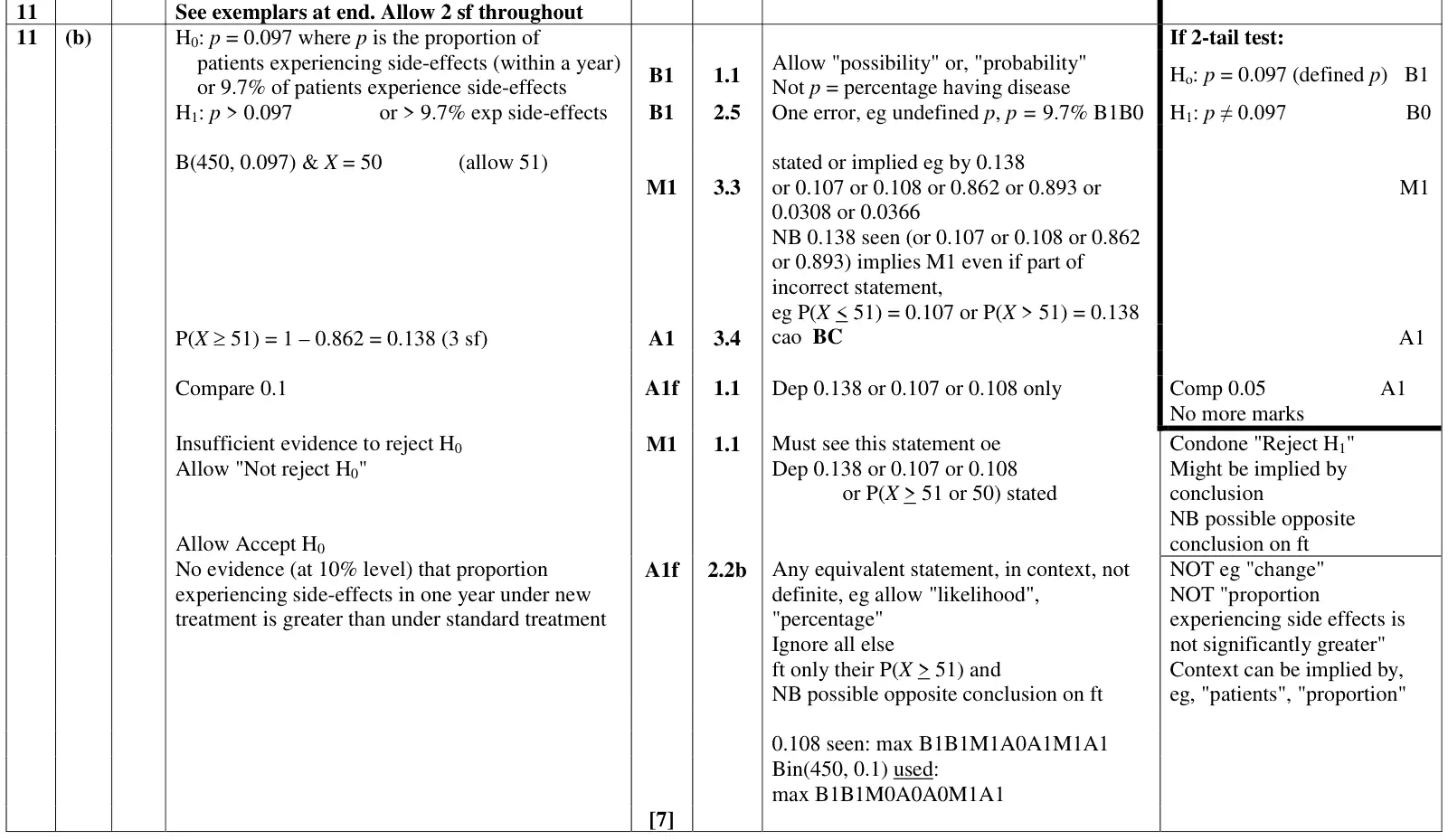
Many candidates had clearly been well prepared for hypothesis test questions. However, a few candidates appeared to have no familiarity at all with this topic. Many candidates lost a mark because they correctly stated the hypotheses in terms of p, but did not define p. A few gave incorrect forms of the hypotheses such as H0: P(X = 0.975) and P(H0 = 0.975). A few used 0.1 in their hypotheses instead of 0.097. Most candidates used the correct binomial distribution and some stated that they were finding P(X > 51). However, the calculations that many carried out were incorrect. Many actually calculated 1 – P(X < 51) or P(X < 51) or P(X < 50) or P(X = 51) or P(X = 50). Most candidates gave a conclusion referring to H0 and a conclusion in context, and many of these were correct. Some candidates gave their conclusion as "There is evidence to accept H0" or "There is evidence to reject H1" rather than "There is insufficient evidence to reject H0". These forms of the conclusion are not quite correct. Some gave the opposite to the correct conclusion. For example: "0.138 > 0.1 so reject H0". A few compared their calculated probability with 0.097 instead of 0.1. A few gave their contextual conclusion in a definite form, for example "The proportion experiencing side effects under the new treatment is not greater than under the standard treatment." These lost the final mark.
Key points and common errors
H₀: p = 0.097, H₁: p > 0.097 with p defined
B(450, 0.097)
P(X ≥ 51) = 0.138 > 0.1
do not reject H₀
non-definite conclusion in context
June 2019 · Paper 2 · Q12(a)3 marksEasy
Mark scheme for this part
Examiner's comment
Most candidates answered this question correctly. Many, however, (perhaps misunderstanding the phrase "where k is a constant") assumed that all five probabilities were equal, and therefore each probability was 0.2
Key points and common errors
15k = 1 so k = 1/15
P(X = 3) = 3/15 = 0.2
assuming all probabilities equal
June 2019 · Paper 2 · Q12(b)2 marksEasy
Show the start of this question
Mark scheme for this part
Examiner's comment
Almost all candidates answered this correctly, or incorrectly but consistently with their method for part (a). Question 12 (c) (i) and (c)(ii) In both these parts, some candidates either assumed that the probabilities for all the values of X were equal, or (which is equivalent) drew up a two-way table of all the possible outcomes and counted up the relevant ones. These were able to gain only a few marks. Some candidates used one of these incorrect methods, despite having answered parts (a) and (b) correctly.
Key points and common errors
probabilities 1/15, 2/15, 3/15, 4/15, 5/15
June 2019 · Paper 2 · Q12(c)(i)3 marksMedium
Show the start of this question
Mark scheme for this part
Examiner's comment
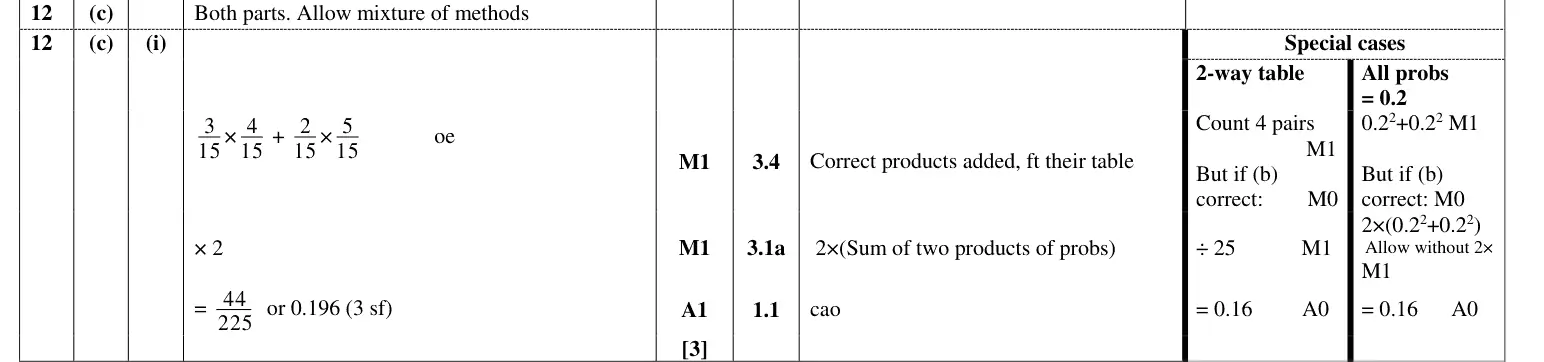
Many candidates recognised that for T = 7 could be found by considering 2+5 and 3+4, but forgot to consider 5+2 and 4+3. This candidate has shown clear working, but forgotten to multiple by two in order to consider all the ways to score T = 7 .
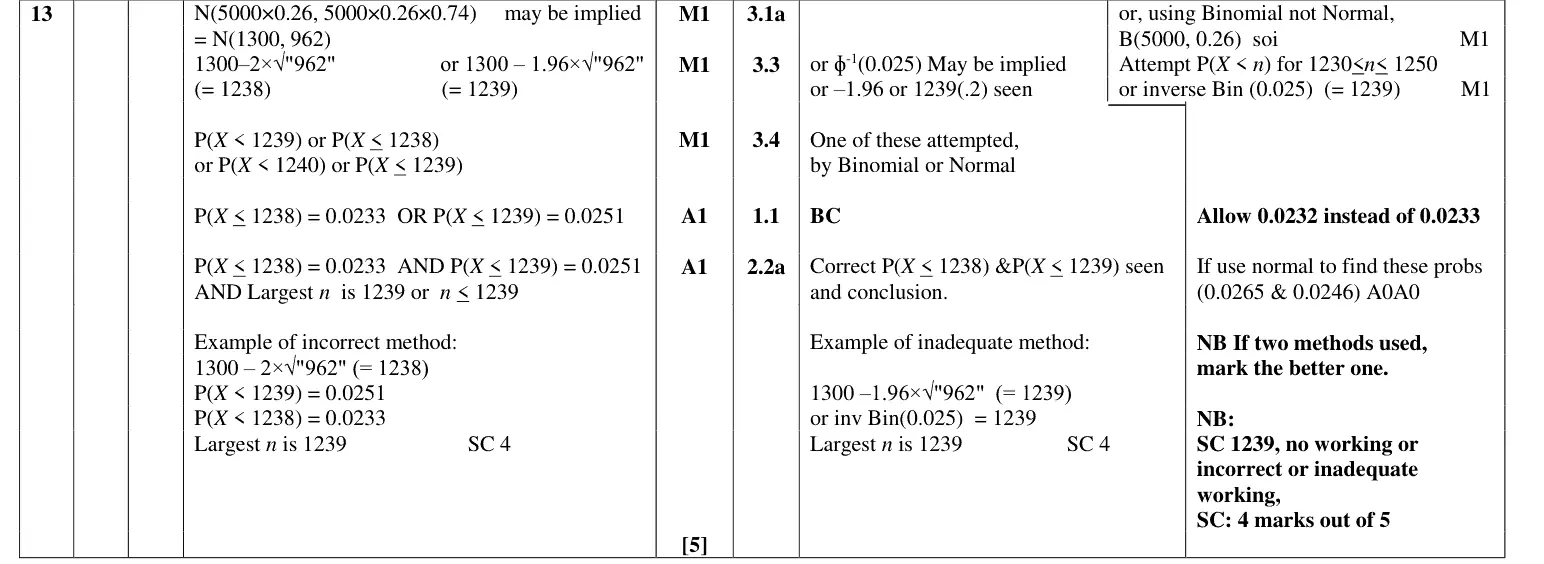
normal approximation N(1300, 962) gives about 1239
must check P(X ≤ 1238) = 0.0233 and P(X ≤ 1239) = 0.0251 by binomial
largest n = 1239
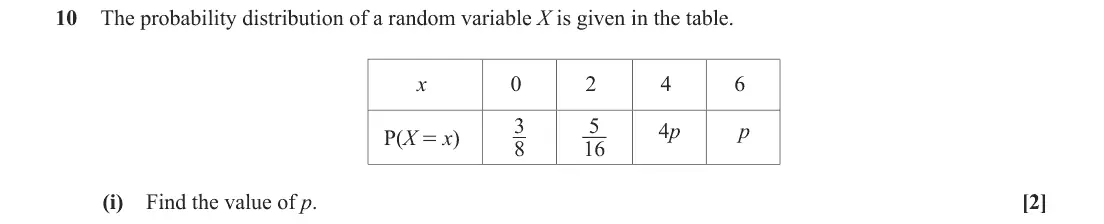
June 2018 · AS Paper 1 · Q10(i)2 marksEasy
Mark scheme for this part
Examiner's comment
Most candidates answered this question correctly. A few tried to use Σxp instead of Σp.
Key points and common errors
3/8 + 5/16 + 4p + p = 1 so p = 1/16
using Σxp
June 2018 · AS Paper 1 · Q10(ii)3 marksHard
Show the start of this question
Mark scheme for this part
Examiner's comment
Most candidates scored only one mark because they omitted one or two of the three possible routes to obtaining a product of 0.
Key points and common errors
product 0 if either is 0: 1 − (5/8)² = 39/64
one or two of the three routes omitted
June 2018 · AS Paper 1 · Q11(i)1 markHard
Mark scheme for this part
Examiner's comment
Despite almost identical questions having been asked in many examples of paper 4732 over many years, most candidates did not score the mark. Many quoted from their textbooks, to no avail, for example "Repeated trials" or "Only two possible outcomes, seeing or not seeing a kingfisher" or "There must be a fixed number of days". Many gave a correct answer, but not in context, such as "Independent trials" or "Constant probability of success." None of the above scored the mark. Some came a little nearer, but confused the two correct conditions, e.g. "The probability of seeing a kingfisher on a certain day is independent of other days."
Key points and common errors
in context: probability of seeing a kingfisher is the same each day, or days independent
textbook conditions not in context gain nothing
June 2018 · AS Paper 1 · Q11(ii)1 markEasy
Show the start of this question
Mark scheme for this part
Examiner's comment
Most candidates understood how to calculate a binomial probability. Some used the formula, while others used the calculator function, giving only the answer. This is acceptable because "detailed reasoning" is not asked for. Many candidates truncated, rather than rounded, their three significant figure answer. A few candidates just found 0.32.
Key points and common errors
B(7, 0.3): P(X = 2) = 0.318
truncating instead of rounding
June 2018 · AS Paper 1 · Q11(iii)3 marksMedium
Show the start of this question
Mark scheme for this part
Examiner's comment
Many candidates understood that they needed to use their answer from part (ii), but many did not do so correctly. Some used the formula without the relevant coefficients. Candidates should be aware that they can use the binomial distribution function on their calculator, thus avoiding the possibility arithmetic errors in binomial problems. Some candidates found P(exactly 4 days) instead of P(at least 4 days). Others just found 0.3184. A few candidates misunderstood the question and found P(at least 8 days out of 42).
Key points and common errors
B(6, 0.318): P(Y ≥ 4) = 1 − P(Y ≤ 3) = 0.0854
P(exactly 4) found instead
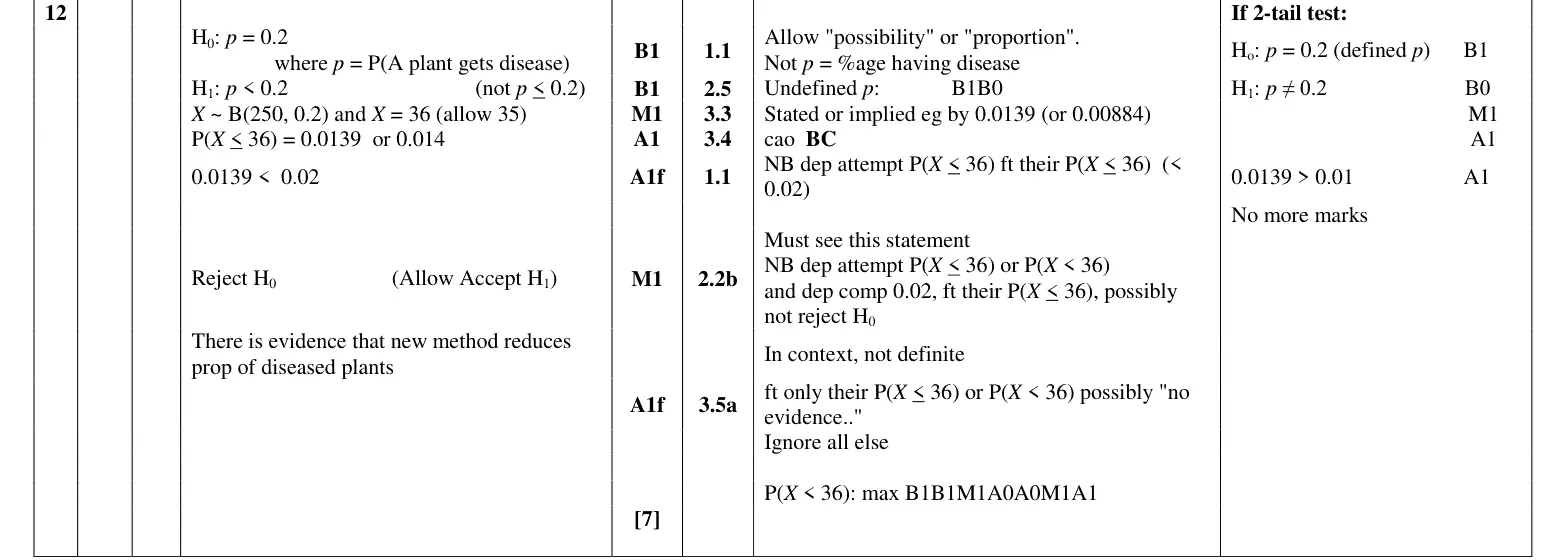
June 2018 · AS Paper 1 · Q127 marksMedium
Mark scheme for this part
Examiner's comment
Many candidates had clearly been well prepared for a hypothesis test question. However, even these often made errors. Examples of such errors were as follows. • Failure to define "p" in the hypotheses • H1: p ≠ 0.02 • Finding P(X < 36) instead of P(X < 36) • Finding P(X = 36) instead of P(X < 36) • Writing P(X < 0.2) instead of P(X < 36) • Comparing the probability with 0.2 instead of 0.02 • Omitting to state "Reject H0" in the conclusion • Giving a definite conclusion such as "Reject Ho. The new method reduces the proportion . . . ." • Stating that because 0.0139 < 0.02, we do not reject H0 There was a significant minority that could not access this question on Hypothesis Testing.
Key points and common errors
H₀: p = 0.2, H₁: p < 0.2 with p defined
X ~ B(250, 0.2), P(X ≤ 36) = 0.0139 < 0.02
reject H₀
non-definite conclusion in context
P(X = 36) or comparing with 0.2
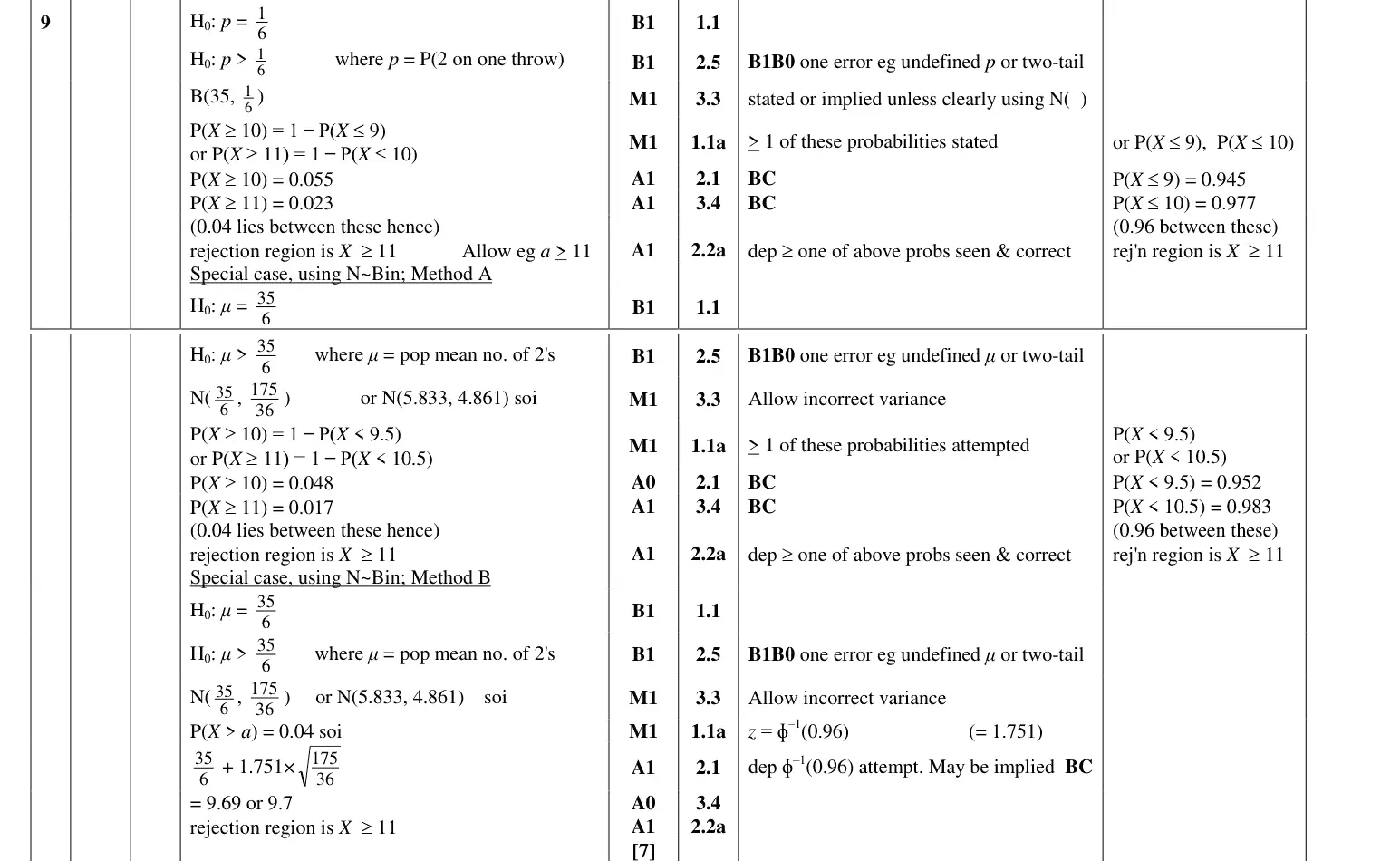
June 2018 · Paper 2 · Q97 marksMedium
Mark scheme for this part
Examiner's comment
This question was well answered by many candidates. A common error was the omission of a definition of p in the hypotheses. To gain full marks candidates had to use an exact method, using the binomial distribution. This involved finding P(X > 10) and P(X > 9) or a similar method. Many candidates stated that they were finding, for example, P(X < 10) but their result was actually the value for P(X < 10). (Perhaps this is due to insufficient familiarity with the use of the binomial function on the calculator). Some candidates found only one of P(X > 10) and P(X > 9). These lost a mark. Some gave completely correct probabilities, but gave an incorrect final answer of X > 10 instead of X > 11. Some candidates misread the question and attempted actually to carry out a test. Some candidates used the normal approximation to the binomial distribution. (These were able to gain a maximum of six marks out of the seven). Many of these candidates arrived correctly at a = 9.69, but then gave an answer of X > 10.
Key points and common errors
H₀: p = 1/6, H₁: p > 1/6 with p defined
B(35, 1/6)
P(X ≥ 10) = 0.055 and P(X ≥ 11) = 0.023 both needed
rejection region X ≥ 11
normal approximation loses marks
June 2018 · Paper 2 · Q12(i)2 marksEasy
Mark scheme for this part
Examiner's comment
This question was well answered on the whole, although a few candidates used the probabilities in the + + + table, just finding 1 – ( ).
Key points and common errors
probabilities sum to 1: a(1 + 1/2 + 1/4 + 1/8 + 1/16) = 1 gives a = 16/31
some used the table values, which assumes the answer
June 2018 · Paper 2 · Q12(ii)1 markEasy
Show the start of this question
Mark scheme for this part
Examiner's comment
This question was well answered.
Key points and common errors
P(1, 3 or 5) = 21/31
June 2018 · Paper 2 · Q12(iii)2 marksMedium
Show the start of this question
Mark scheme for this part
Examiner's comment
Some candidates did not see that their answer to part (ii) could be used, and started from scratch using the probabilities in the table. Many of these omitted at least one possible pair, and others included all possible pairs, but omitted to double their answer. A few candidates ignored the probabilities (and their answer to part (ii)) and assumed the each value of X is equally likely.
Key points and common errors
P(OE) + P(EO) = 2 × 21/31 × 10/31 = 420/961
use (ii)
missing the factor 2
assuming equally likely values
June 2018 · Paper 2 · Q12(iv)3 marksMedium
Show the start of this question
Mark scheme for this part
Examiner's comment
Most candidates recognised the need to find P(S = 9), but some omitted to include both 4, 5 and 5, 4 . Many then correctly divided by their answer to part (iv).
Key points and common errors
S > 8 and odd means S = 9: (4, 5) and (5, 4) give 4/961
divide by 420/961 to get 1/105
both orders needed
June 2018 · Paper 2 · Q12(v)2 marksHard
Mark scheme for this part
Examiner's comment
Some candidates recognised the need for an infinite series, but most could not cope with the fact that the first term is unknown. Many candidates thought that Y cannot be 0, hence P(Y = 0) = 0 and hence P(Y = 1) = 0.5 × 0 = 0
Key points and common errors
sum to infinity p/(1 − 0.5) = 1 so P(Y = 1) = 0.5
many could not handle the unknown first term or wrongly took P(Y = 0) = 0
June 2018 · Paper 2 · Q12(vi)1 markMedium
Show the start of this question
Mark scheme for this part
Examiner's comment
A choice of either X or Y with a reasonable justification was acceptable. Some candidates felt that it was unrealistic for Sheila to go on trying after five attempts, so X is the better model. Others said that she might well need more than five attempts so Y is the better model. One ingenious answer was that X is better, because it gives a higher chance of the car starting first time! Unfortunately, this answer did not deal with the question as to which model is more appropriate. A common incorrect response was that Y is a good model because according to Y the probability that the car starts decreases, rather than increases, with each attempt. Others stated that Y is not a good model, quoting exactly the same reason. Some answers did not include a choice of either X or Y. Another answer was that model Y implies that the car never starts. Many answers seemed to imply that using model X, the probabilities do not decrease.
Key points and common errors
Y: may need more than 5 attempts (X cannot exceed 5)
or X: more than 5 attempts very unlikely
a choice with a reason
June 2018 · Paper 2 · Q13(i)3 marksMedium
Mark scheme for this part
Examiner's comment
Because this question required "detailed reasoning", correct answers did not necessarily score full marks. Thus, for example, some candidates gave the following working: 5 X ~ B(450. 0.15); P(X < a) = 6 ; X = 75. These scored only one mark. Trial and improvement methods only scored marks if they were very clearly explained, with the distribution fully described and with at least two values close to 75 being tried, with the relevant probabilities actually seen. The better method was to use the normal approximation to the binomial and the fact that approximately 2 3 of values lie within the range μ – σ < X < μ + σ.
Key points and common errors
N(67.5, 57.375) approximation
about 2/3 within μ ± σ so a ≈ μ + σ = 74.8, a = 74 or 75
450/6 = 75 scores nothing
T&I only with clear probabilities
June 2018 · Paper 2 · Q13(ii)3 marksHard
Show the start of this question
Mark scheme for this part
Examiner's comment
Some candidates appeared not to understand the definition of Tr and Tr+ 1. Many candidates omitted the relevant powers of 0.85 in their expressions for Tr and Tr + 1. Some wrote the correct expressions for both Tr and Tr+ 1, but were unable to find any common factors to cancel. Many attempted to expand the given binomial expression, but did not include a general term. Some candidates "fudged" the answers giving, for example, Tr = 0.85(r + 1) and Tr + 1 = 0.15(50 – r) etc.
Key points and common errors
Tᵣ = ⁵⁰Cᵣ 0.15ʳ 0.85^(50−r)
cancel factorials to (r + 1)/(50 − r) × 0.85/0.15
many omitted the powers of 0.85
June 2018 · Paper 2 · Q13(iii)(a)4 marksHard
Show the start of this question
Mark scheme for this part
Examiner's comment
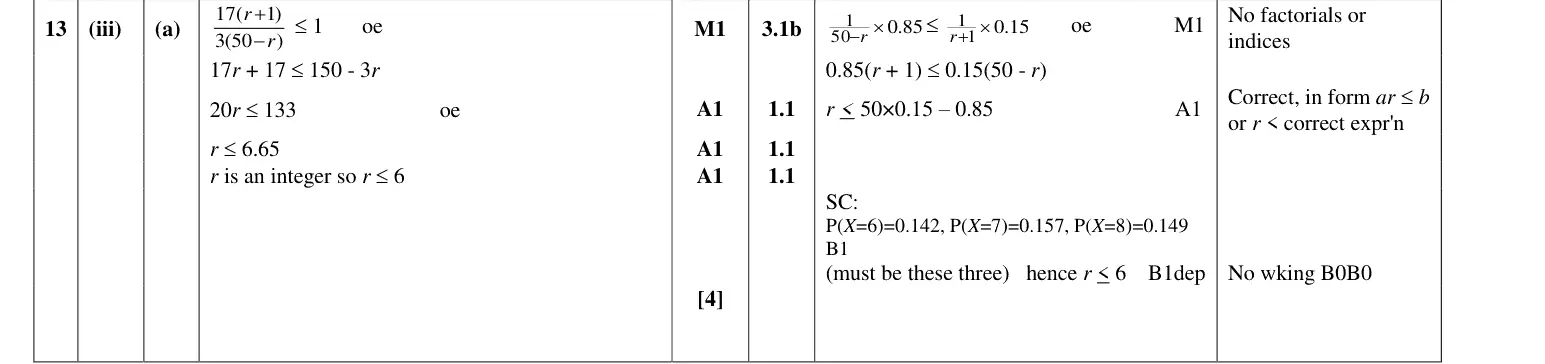
(Comment on Question 13(iii) as a whole) Many candidates did not see the connection with part (ii). These went back to the binomial distribution but very few succeeded. Some candidates carried out a correct method but stopped after obtaining r < 6.65. Others found r < 6.65 but then gave the answer r = 6. A trial and improvement method could score a maximum of 2 marks in this question. Almost no candidates gave a correct solution based on their answer to part (iii)(a). Some used trial and improvement, but did not consider enough values of X. (At least X = 6 and 7 were required). Some rounded their figure of 6.65 from part (iii)(a) to 7. This did not score any marks.
Key points and common errors
Tᵣ/Tᵣ₊₁ ≤ 1 gives 20r ≤ 133, r ≤ 6.65, so r ≤ 6 as r is an integer
many did not use (ii)
June 2018 · Paper 2 · Q13(iii)(b)2 marksHard
Show the start of this question
Mark scheme for this part
Examiner's comment
(Comment on Question 13(iii) as a whole) Many candidates did not see the connection with part (ii). These went back to the binomial distribution but very few succeeded. Some candidates carried out a correct method but stopped after obtaining r < 6.65. Others found r < 6.65 but then gave the answer r = 6. A trial and improvement method could score a maximum of 2 marks in this question. Almost no candidates gave a correct solution based on their answer to part (iii)(a). Some used trial and improvement, but did not consider enough values of X. (At least X = 6 and 7 were required). Some rounded their figure of 6.65 from part (iii)(a) to 7. This did not score any marks.
Key points and common errors
P(X = r) increases up to r = 7, P(6)/P(7) = 0.902 < 1, so most likely value 7
'6.65 rounds to 7' scores nothing
Find an A-level maths tutor
Stuck on this? Book a trial session with an A-level maths tutor.


















































































![12 The discrete random variable X takes values 1, 2, 3, 4 and 5, and its probability distribution is defined as follows. Z a x , = ] ] X x X x x P ( ) [ P ( ) 2 3 4 5 , , , , = = = - = ]] otherwise, \ where a is a constant. (i) Show that a [2] . =](/img/JUN18_H2402/JUN18_H2402_12(i).webp)