68 question parts, 189 marks, each rated Easy, Medium or Hard from the wording of the examiners' report
Notes, worked examples and practice for this topic are being written by our tutors. The past-paper questions below are ready now: work each one on paper, then open the mark scheme and the examiner's comment.
Tap a question to zoom it. Mark scheme and examiner's comment open under each question.
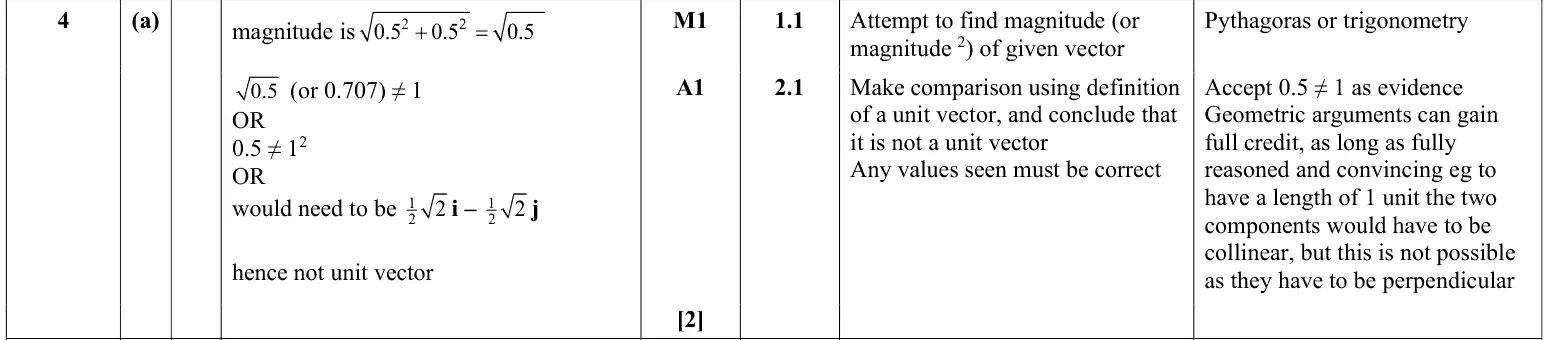
June 2025 · Paper 1 · Q4(a)2 marksEasy
Mark scheme for this part
Examiner's comment
Candidates seemed familiar with the command word ‘determine’ and usually provided sufficient detail in their solution. Most candidates were able to correctly find the magnitude of the given vector and then conclude appropriately. To gain full credit candidates were expected to explicitly compare the correct magnitude of the given vector to 1, which some omitted to do.
Key points and common errors
magnitude √0.5 ≈ 0.707
must explicitly compare with 1 and conclude
June 2025 · Paper 1 · Q4(b)2 marksMedium
Show the start of this question
Mark scheme for this part
Examiner's comment
Most candidates gained 1 mark for calculating a relevant angle, most typically 45o. However many candidates did not seem familiar with the definition of the ‘direction’ of a vector as given in the specification. Giving the answer as a bearing from the vertical axis was one of the more common misunderstandings, as was giving a negative angle as opposed to the (0o, 360o) convention.
Key points and common errors
direction measured from positive x-axis in [0°, 360°): 315°
−45° or a bearing loses the mark
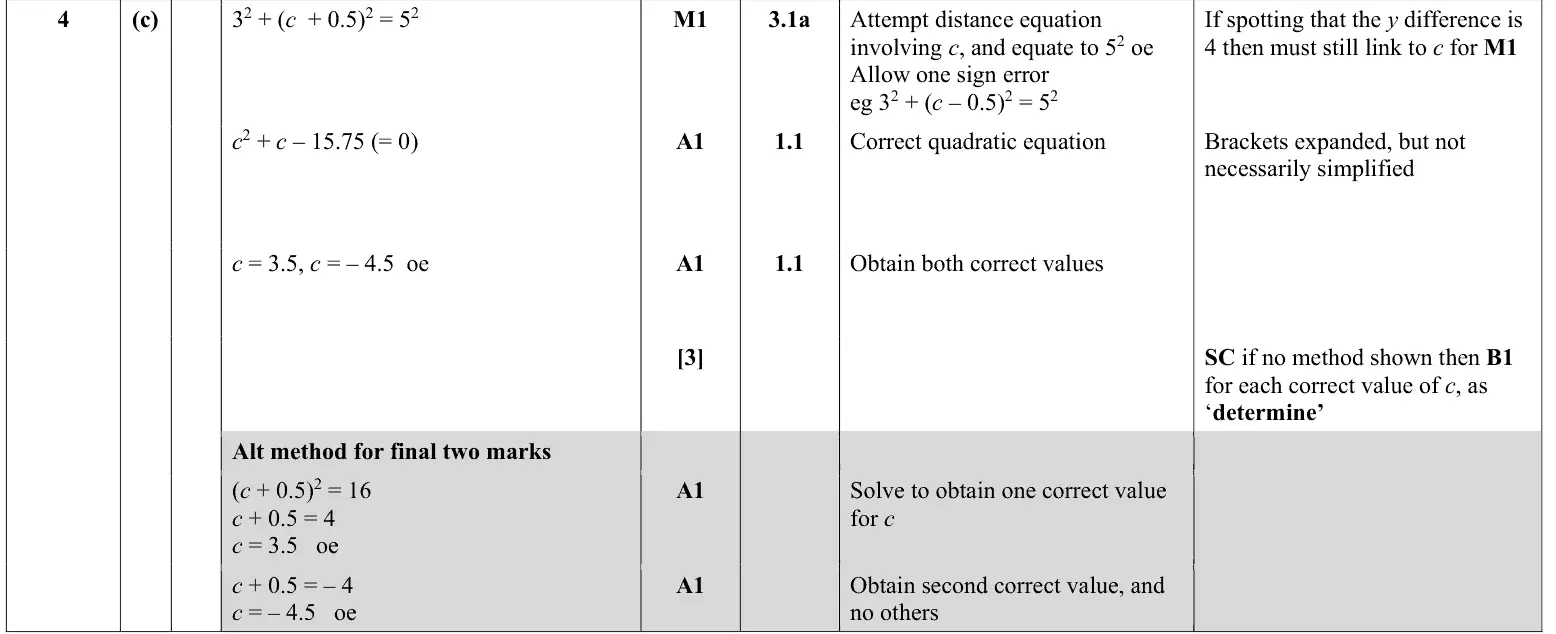
June 2025 · Paper 1 · Q4(c)3 marksEasy
Show the start of this question
Mark scheme for this part
Examiner's comment
Most candidates were able to set up and solve a quadratic equation to obtain the two correct values for c, although more informal methods involving a y difference of 4 were also seen. Some candidates were clearly attempting the correct distance equation but made a sign error when considering c – (– 0.5).
Key points and common errors
3² + (c + 0.5)² = 5²
c = 3.5 or −4.5
sign error with c − (−0.5)
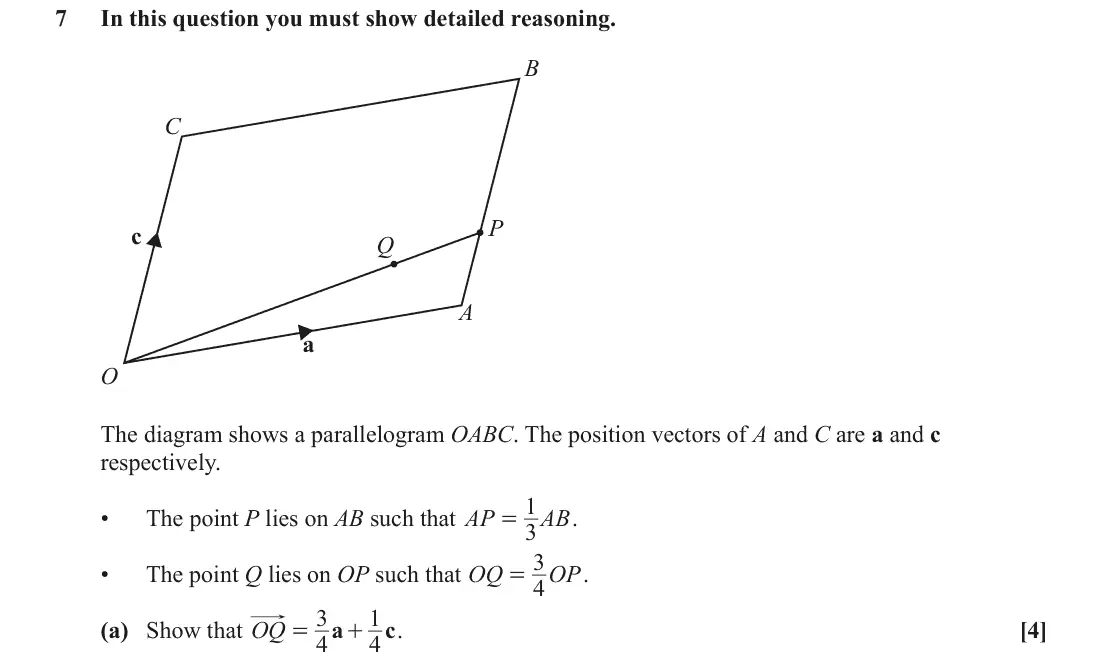
June 2025 · AS Paper 1 · Q7(a)4 marksMedium
Mark scheme for this part
Examiner's comment
Most candidates made a good attempt at this part, with many scoring 3 or 4 marks. As shown on the scheme, candidates needed to find a vector expression for 𝑂𝑃⃗⃗⃗⃗⃗ in terms of the given vectors a and c, and then use the given fact 𝑂𝑄⃗⃗⃗⃗⃗⃗ = 4 𝑂𝑃⃗⃗⃗⃗⃗ to reach the answer given. Many candidates chose to combine these two steps, which was acceptable provided that sufficient working was shown. Some candidates used the path OAPQ or considered that 𝑂𝑄⃗⃗⃗⃗⃗⃗ = 𝑂𝑃⃗⃗⃗⃗⃗ −1 4 𝑂𝑃⃗⃗⃗⃗⃗ , either of which could lead to the correct result if completed in full. As this was a ‘show that’ question the DR instruction serves to remind candidates that they needed to show their working in full. The scheme was quite accommodating of candidates who skipped intermediate steps, but nonetheless some candidates did not show a convincing demonstration of the given answer. Some candidates appeared to be trying to ‘work backwards’ based on the fractions in the given expression, but this was typically unsuccessful. Throughout Q7, some candidates’ working was not sufficiently clear as to which vector on the parallelogram they were attempting to find. Candidates should be encouraged to set out their working clearly and label vectors correctly (using the vertices of the figure) so that it is clear what they are trying to show in each step.
Key points and common errors
OP = a + (1/3)c
OQ = (3/4)OP = (3/4)a + (1/4)c with the intermediate step shown
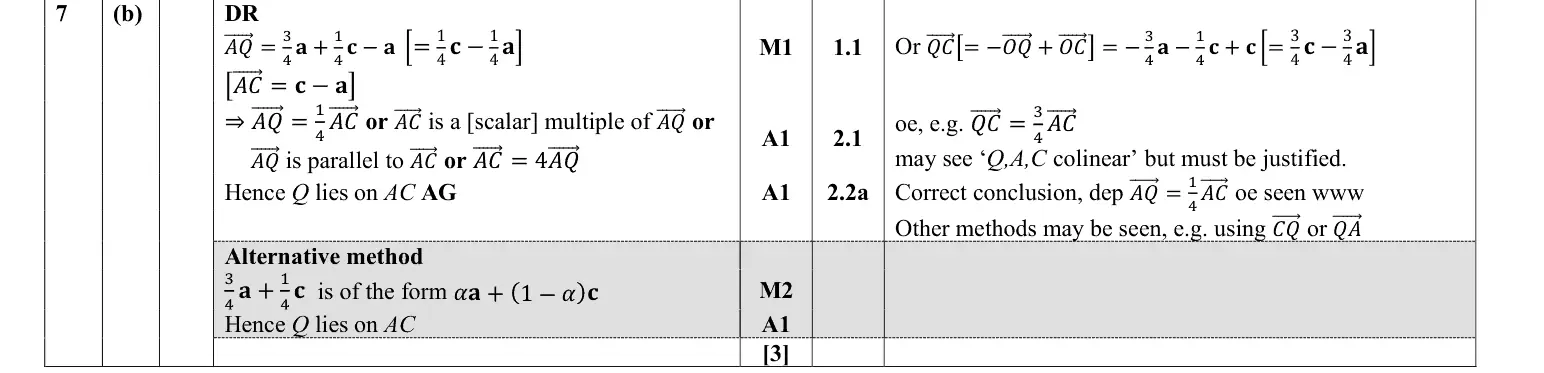
June 2025 · AS Paper 1 · Q7(b)3 marksHard
Show the start of this question
Mark scheme for this part
Examiner's comment
Most candidates started well here, finding a vector expression for 𝐴𝑄⃗⃗⃗⃗⃗ or 𝑄𝐶⃗⃗⃗⃗⃗ , etc. and scoring M1. However, many candidates then did not score either A mark by either trying to state that this first line is sufficient to prove the required fact, or by demonstrating that 𝐴𝑄⃗⃗⃗⃗⃗ + 𝑄𝐶⃗⃗⃗⃗⃗ = 𝐴𝐶⃗⃗⃗⃗⃗ (which is true, but not sufficient to prove that Q lies on AC). On this occasion, the scheme condoned statements which omitted the word ‘scalar’ or used less precise wording, but candidates should be reminded that – especially in a DR question – they should expect to show that the given fact meets all of the requirements. Strictly, to show that Q lies on AC via this method requires that 𝐴𝐶⃗⃗⃗⃗⃗ is a scalar multiple of 𝐴𝑄⃗⃗⃗⃗⃗ and that these two vectors share a common point (A). The latter point was not required but candidates did need to state a clear conclusion to demonstrate understanding of what they have shown. The alternative method was rarely seen.
Key points and common errors
AQ = (1/4)c − (1/4)a = (1/4)AC, a scalar multiple with A common, so Q lies on AC
showing AQ + QC = AC is not enough
clear conclusion needed
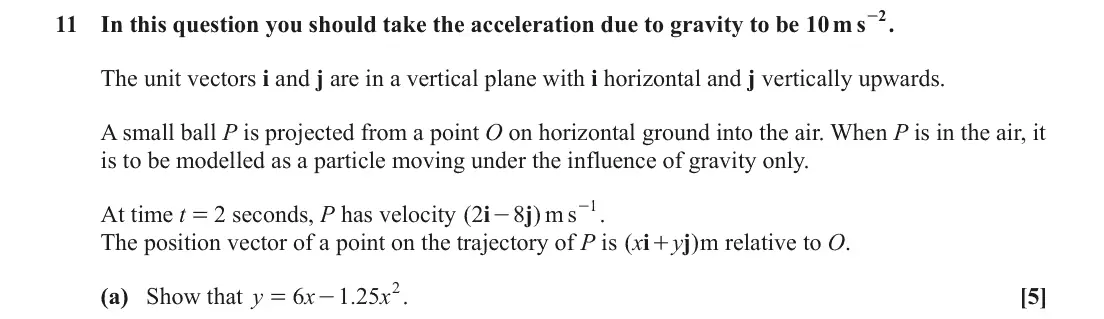
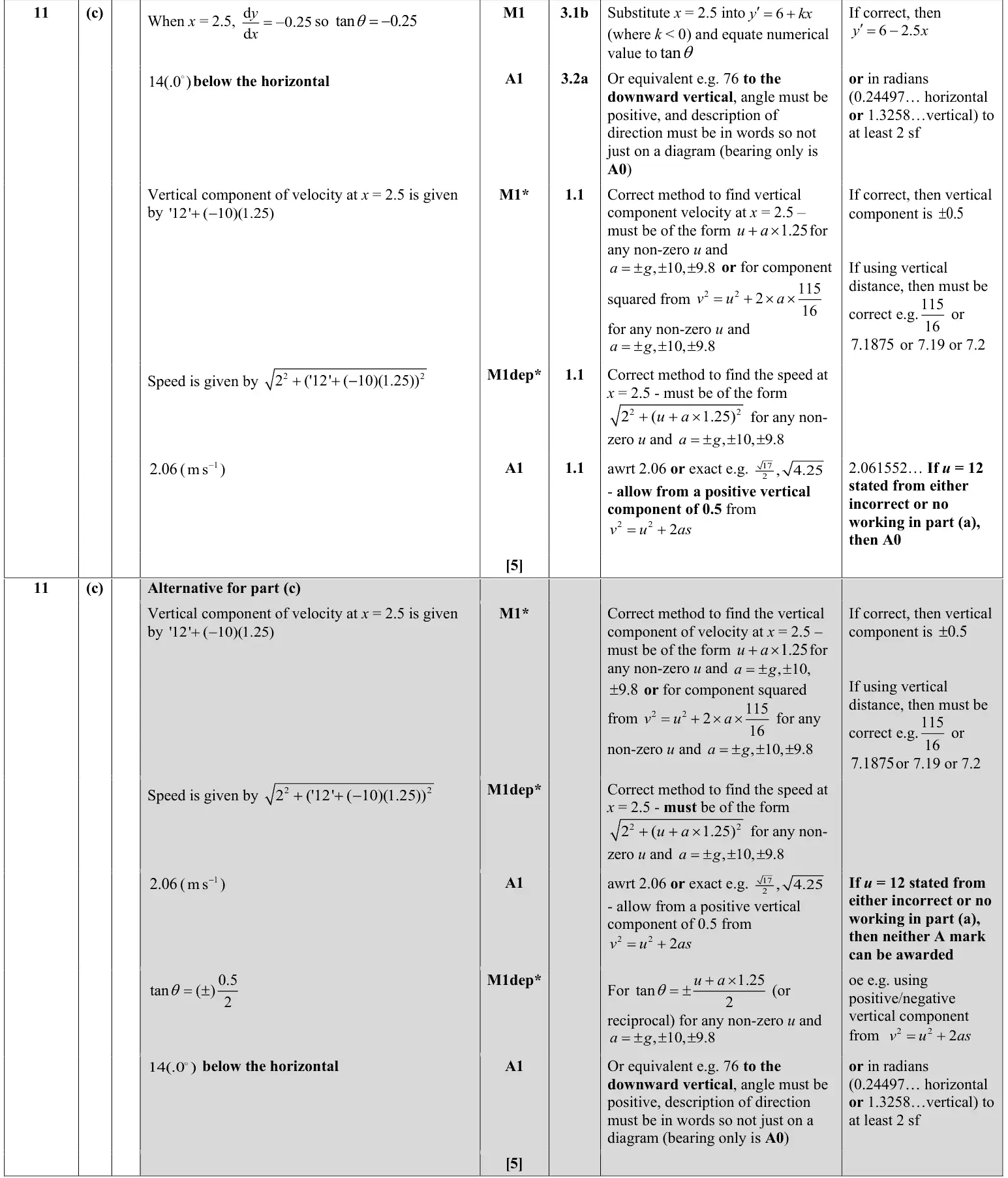
June 2025 · Paper 3 · Q11(c)5 marksMedium
Show the start of this question
Mark scheme for this part
Examiner's comment
The responses to this part were mixed with many candidates believing that both the speed and direction of motion could be found by considering the vertical and horizontal displacement of P when 𝑥= 2.5. Of those that did use the velocity components many did not give sufficient detail when it came to the direction of motion; an angle alone was not sufficient as it needed to be clear if the angle was below or above the horizontal (or equivalently to the upward or downward vertical).
Key points and common errors
gradient at x = 2.5 is −0.25 so direction 14° below the horizontal
vertical velocity 12 − 10 × 1.25 = −0.5
speed √4.25 = 2.06 m/s
displacement gives neither
direction needs 'below the horizontal'
June 2024 · AS Paper 1 · Q2(a)1 markMedium
Mark scheme for this part
Examiner's comment
Most candidates seemed to know what to do here, but many gave the coordinates of the midpoint (0.5,4) ሬሬሬሬሬ⃗) and or giving an attempt at AB or ½ AB rather than the midpoint. the vector 𝐴𝐴𝐴𝐴 rather than a vector, which was not an acceptable answer. Common errors include -1.5i+j (from halving
Key points and common errors
0.5i + 4j as a vector
coordinates (0.5, 4) not accepted
½AB is not the midpoint
June 2024 · AS Paper 1 · Q2(b)3 marksEasy
Show the start of this question
Mark scheme for this part
Examiner's comment
This was generally well answered. As this was a ‘Find’ question marks could be gained without working their method in full. Most candidates were able to reach the required answer, but often their vector 𝐴𝐴𝐴𝐴 ሬሬሬሬሬ⃗ (provided the answer was not from incorrect working), but candidates should still be encouraged to show ሬሬሬሬሬ⃗ as 3i −2j. The was unclear and potentially inaccurate. Many candidates indicated ‘3i’ and ‘2j’ or gave 𝐵𝐵𝐵𝐵 method mark could not be gained for finding the magnitude of an irrelevant vector (e.g. those given in the question).
Key points and common errors
AB = −3i + 2j
√(3² + 2²) = √13 exact
June 2024 · AS Paper 1 · Q2(c)2 marksEasy
Show the start of this question
Mark scheme for this part
Examiner's comment
This was generally well answered, with most candidates taking the direct route shown in the scheme. A few candidates used the cosine rule, which was more onerous. Many candidates were able to obtain the correct angle of 56.3o but a few candidates stated the angle as 33.7o.
Key points and common errors
tan⁻¹(3/2) = 56.3°
33.7° is the angle with the y-axis
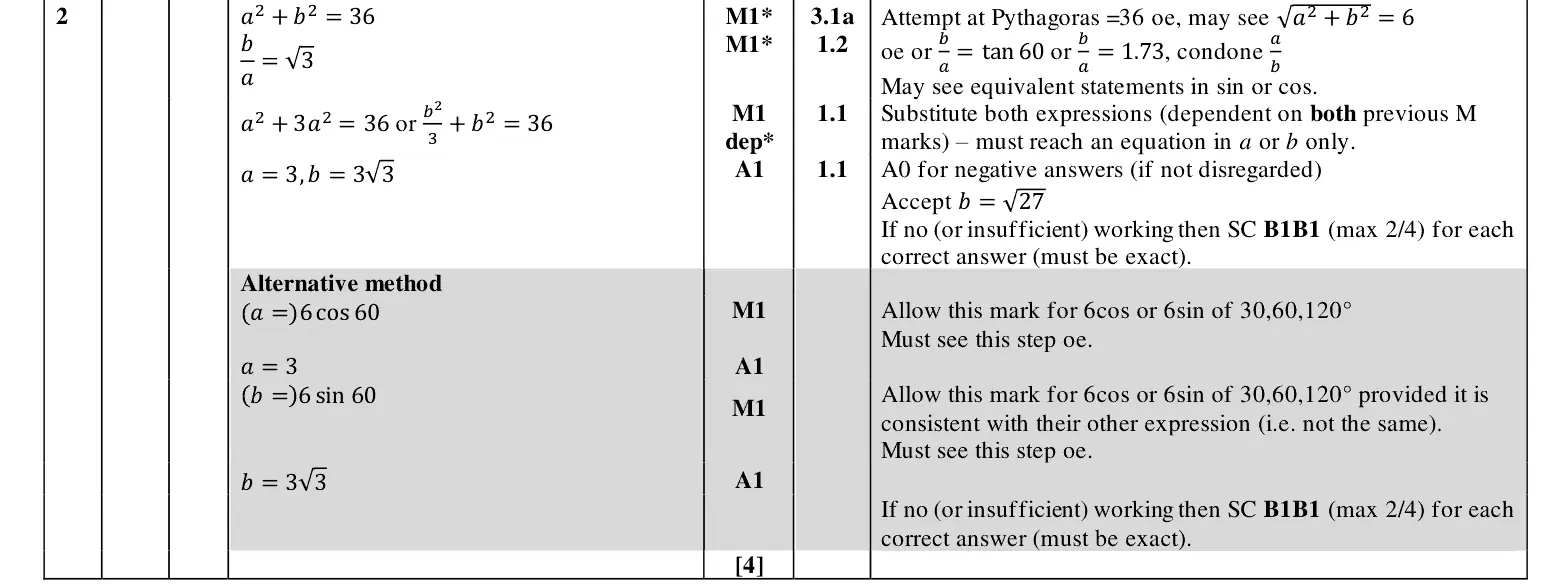
June 2024 · Paper 2 · Q24 marksEasy
Mark scheme for this part
Examiner's comment
This question was well answered by most candidates. The alternative method using cos and sin was most popular, with many candidates immediately writing down the two correct expressions for a and b as required and calculating the values correctly. A small number of candidates gave a and b the wrong way around or did not label them (neither of which could be given accuracy marks). Of those who used the main method (Pythagoras, etc.), most of the responses were successful, but quite a few candidates made an error when combining their two expressions to solve (for instance, square rooting both terms separately). There were others that used a mixture of both methods, which was acceptable provided sufficient working was shown (noting the ‘Determine’ instruction).
Key points and common errors
a = 6cos60° = 3, b = 6sin60° = 3√3
must be exact
A0 for negative values
June 2024 · AS Paper 2 · Q9(a)2 marksEasy
Mark scheme for this part
Examiner's comment
There were a lot of correct answers to this question. Marks were lost by some for simple arithmetical errors or for using F1 + F2 = F3.
Key points and common errors
F₁ + F₂ + F₃ = 0 gives F₃ = (2, −3) N
using F₁ + F₂ = F₃ is wrong
June 2024 · AS Paper 2 · Q9(b)2 marksEasy
Show the start of this question
Mark scheme for this part
Examiner's comment
This question was also well attempted, with many correct answers. The most common error was to use 8i + j = 2.5a. Also sometimes given was √62 + 42 = 2.5a, with no vector equation.
Key points and common errors
resultant (6, 4) = 2.5a
a = (2.4, 1.6) m s⁻²
must use the full resultant
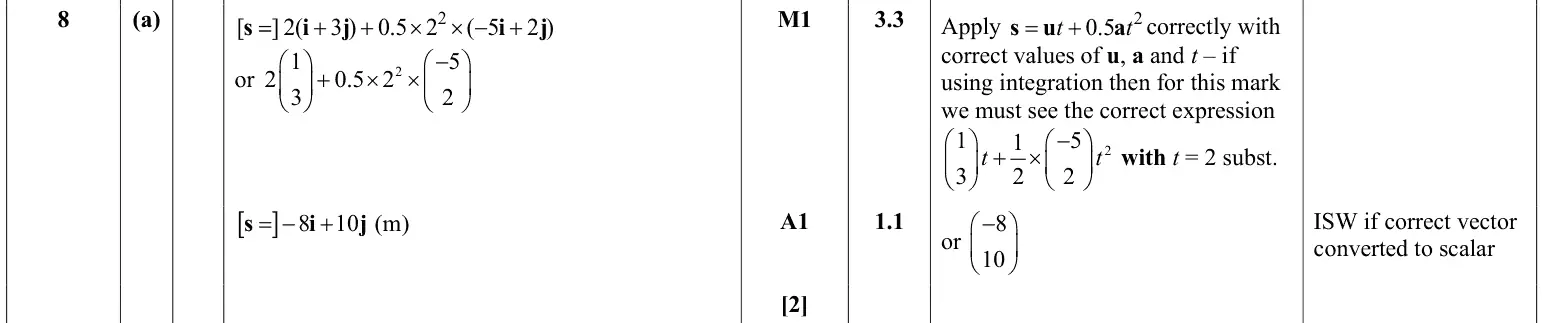
June 2024 · Paper 3 · Q8(a)2 marksEasy
Mark scheme for this part
Examiner's comment
2 𝐚𝑡2 to find the This part was answered extremely well with most candidates correctly applying 𝐬= 𝐮𝑡+ required displacement of 𝑃 at time 𝑡= 2. Those that used integration were less successful as they tended to make arithmetic (or algebraic) slips or did not substitute 𝑡= 2 correctly.
Key points and common errors
s = ut + ½at² = 2(i + 3j) + 2(−5i + 2j) = −8i + 10j
integration attempts made more slips
June 2024 · Paper 3 · Q8(b)4 marksMedium
Show the start of this question
Mark scheme for this part
Examiner's comment
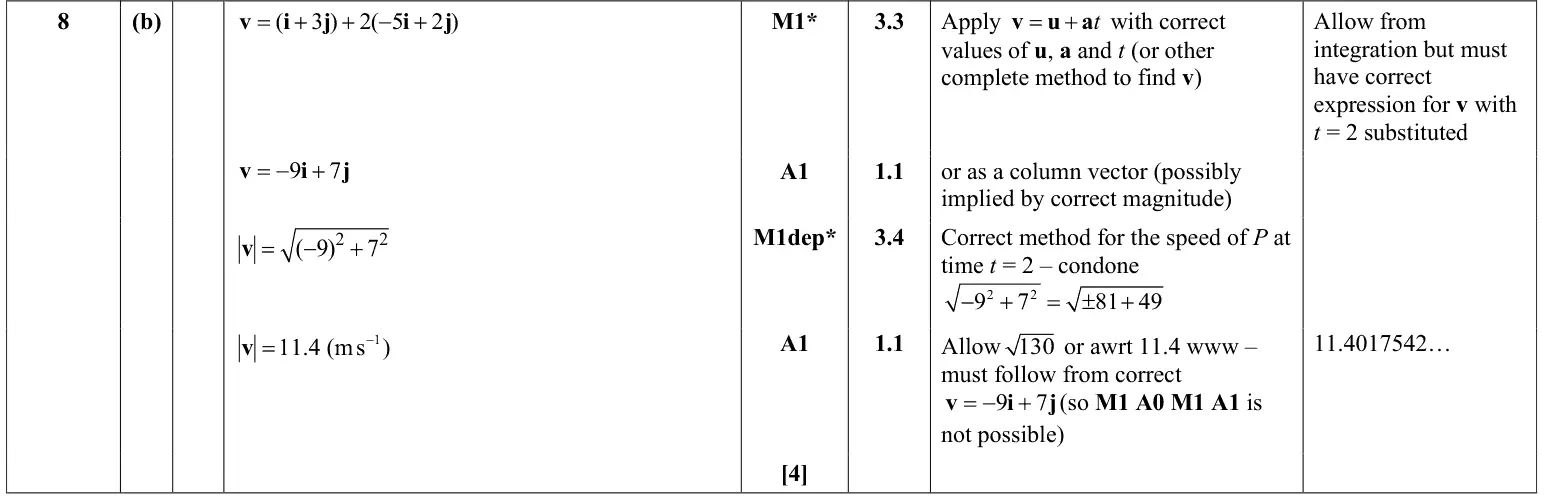
Most candidates correctly applied 𝐯= 𝐮+ 𝐚𝑡 to obtain the velocity vector for 𝑃 as −9𝐢+ 7𝐣. Many candidates left their answer as a vector and did not find the corresponding speed as directed. In this case the number of marks available should have been a strong indication of the amount of work required. Furthermore, a number of candidates attempted to use a vector form of 𝑣2 = 𝑢2 + 2𝑎𝑠 but most did not apply |𝐯|2 = |𝐮|2 + 2𝐚∙𝐬 correctly (not realising that each term of this equation was a scalar).
Key points and common errors
v = u + at = −9i + 7j
speed √130 = 11.4 m s⁻¹
many left the answer as a vector
June 2024 · Paper 3 · Q9(a)6 marksMedium
Mark scheme for this part
Examiner's comment
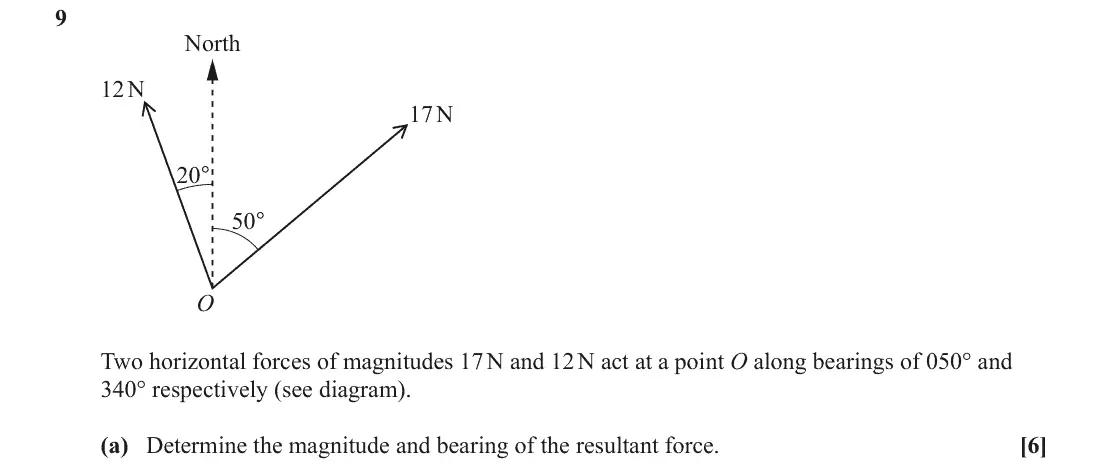
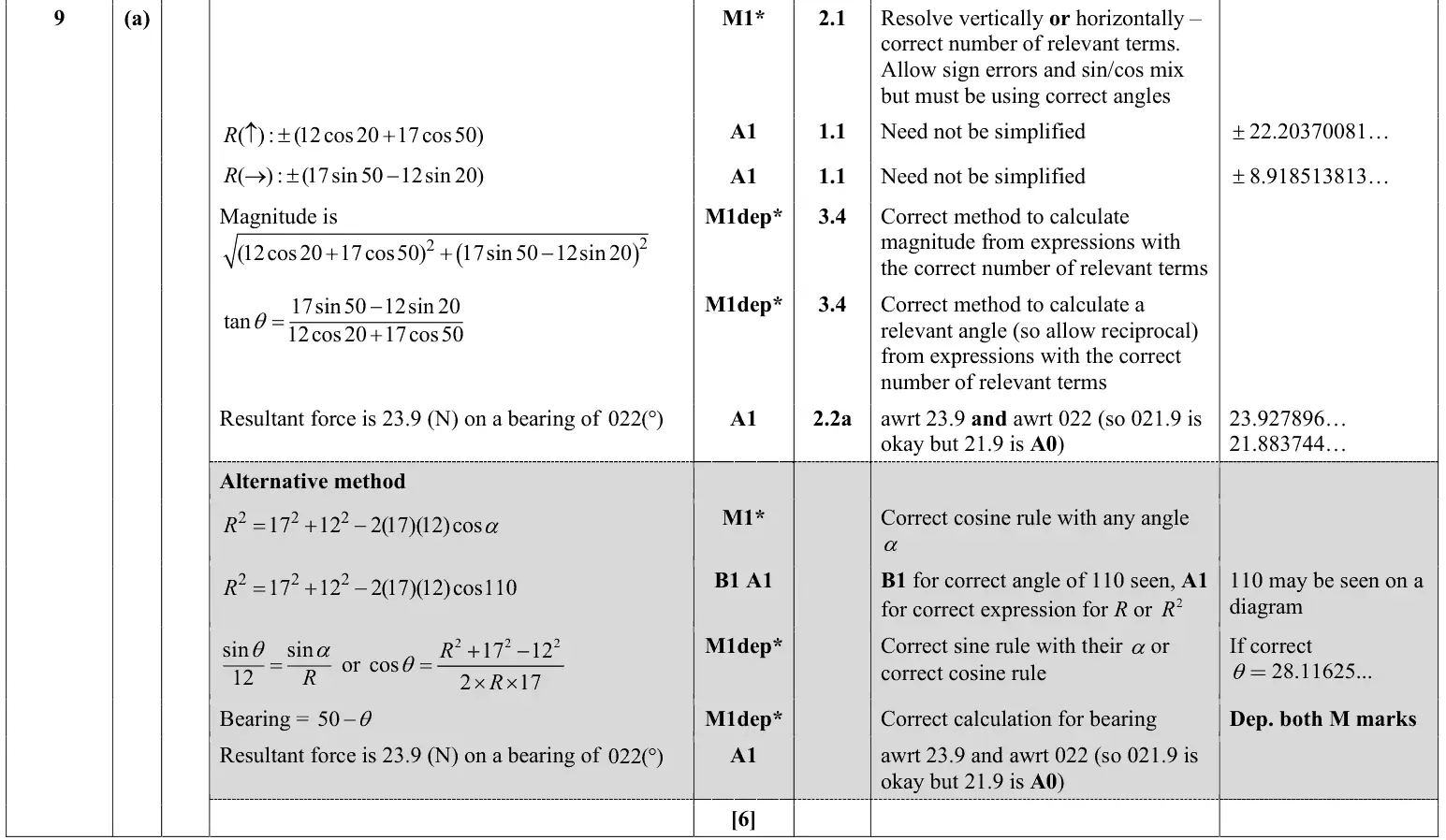
Most candidates resolved in a northerly and easterly direction in their attempts to find the magnitude and bearing of the resultant force (although attempts using a triangle of forces and the sine/cosine rules were just as successful). While many resolved correctly there were the usual sin/cos confusion and sign errors. It was surprising how many candidates, who found the magnitude correctly, did not find the correct bearing (and many who did not give the bearing in a correct three-figure form even though an example of a three-figure bearing was given in the question).
Key points and common errors
resolve N: 12cos20 + 17cos50 = 22.20
E: 17sin50 − 12sin20 = 8.92
R = 23.9 N on bearing 022°
or cosine rule with 110°
many found the magnitude but not the bearing
June 2023 · AS Paper 1 · Q2(a)(i)2 marksMedium
Mark scheme for this part
Examiner's comment
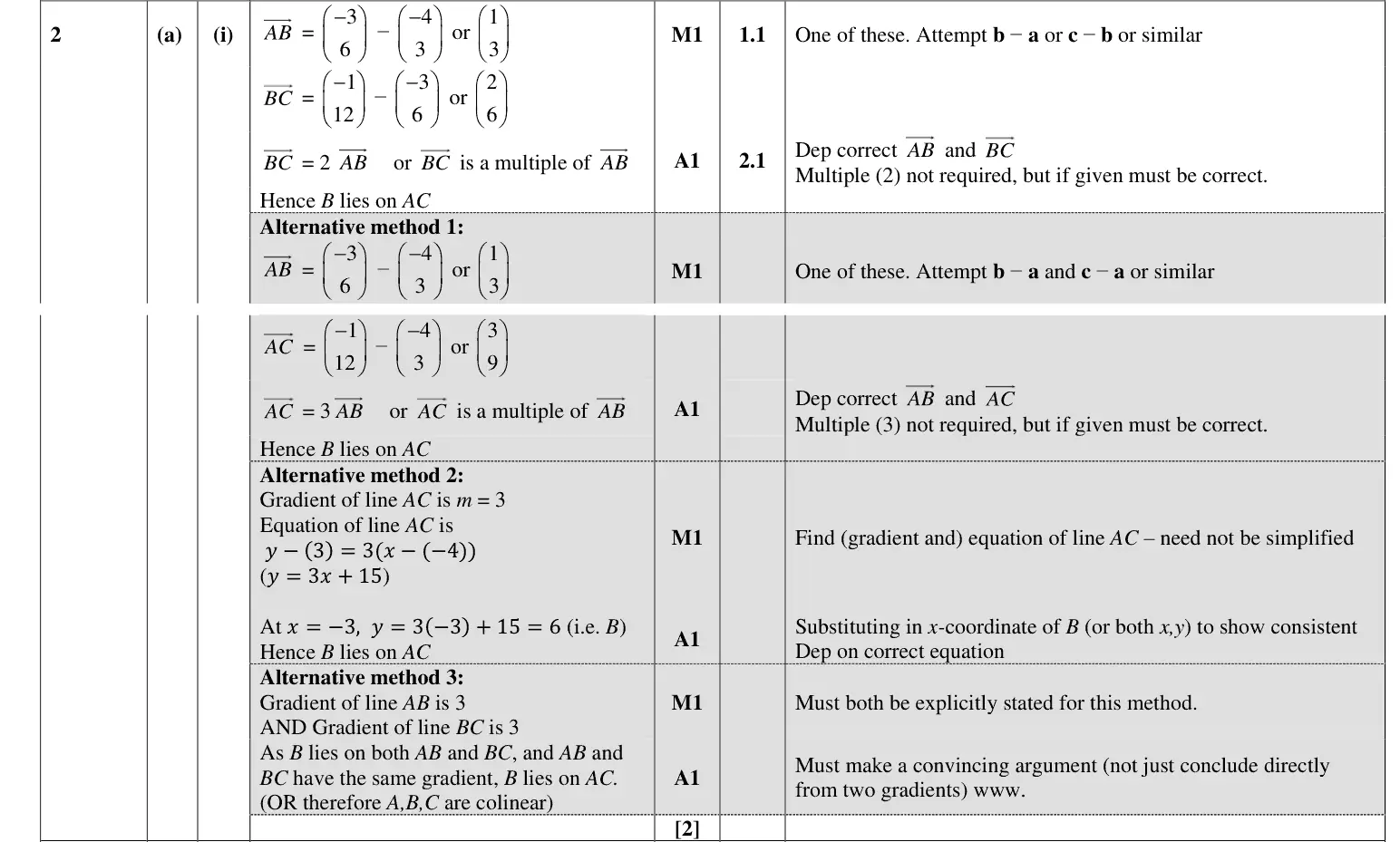
Many candidates chose to approach this question in a ‘non-vector’ method, using standard coordinate geometry, which was permitted (but required appropriate rigour). For example, finding the equation of ሬሬሬሬሬ⃗ and BC ሬሬሬሬሬሬ⃗ ) then showed that AC ሬሬሬሬሬሬ⃗ = AB ሬሬሬሬሬ⃗ + BC ሬሬሬሬሬሬ⃗ and claimed this the line between A and C, then showing that B satisfies the equation of that line. A number of candidates found two of the required vectors (e.g. AB proved that B lies on the line AC (which it doesn’t prove). A method stating two gradients could only be credited if candidates showed that the gradients of AB and BC were 3 and stated that B was a common point (showing that, for instance, AB and AC have the same gradient and share the point A does not prove that B lies on the line [segment] AC). Many candidates confused x and y when attempting to find a gradient. Centres should encourage students to be familiar with vector manipulation, as this was the most straightforward way to answer this question.
Key points and common errors
AB = (1, 3), BC = (2, 6) = 2AB so B lies on AC
AC = AB + BC does not prove it
June 2023 · AS Paper 1 · Q2(a)(ii)1 markMedium
Show the start of this question
Mark scheme for this part
Examiner's comment
ሬሬሬሬሬ⃗ and AB. Many candidates left responses in the form of a ratio of vectors rather than This was reasonably well answered, but some candidates did not appear to recognise the difference in notation between AB lengths. Candidates who had not computed the vectors AB and BC needed to do so in this part. Some candidates made an error in comparing vectors, or gave the ratio the wrong way around (which could not be credited unless they specified the ratio as BC : AB). Only ratios in the form p : q were acceptable here (a ‘ratio’ of vectors could not be credited).
Key points and common errors
AB : BC = 1 : 2
must be a ratio of lengths not of vectors
June 2023 · AS Paper 1 · Q2(b)3 marksHard
Mark scheme for this part
Examiner's comment
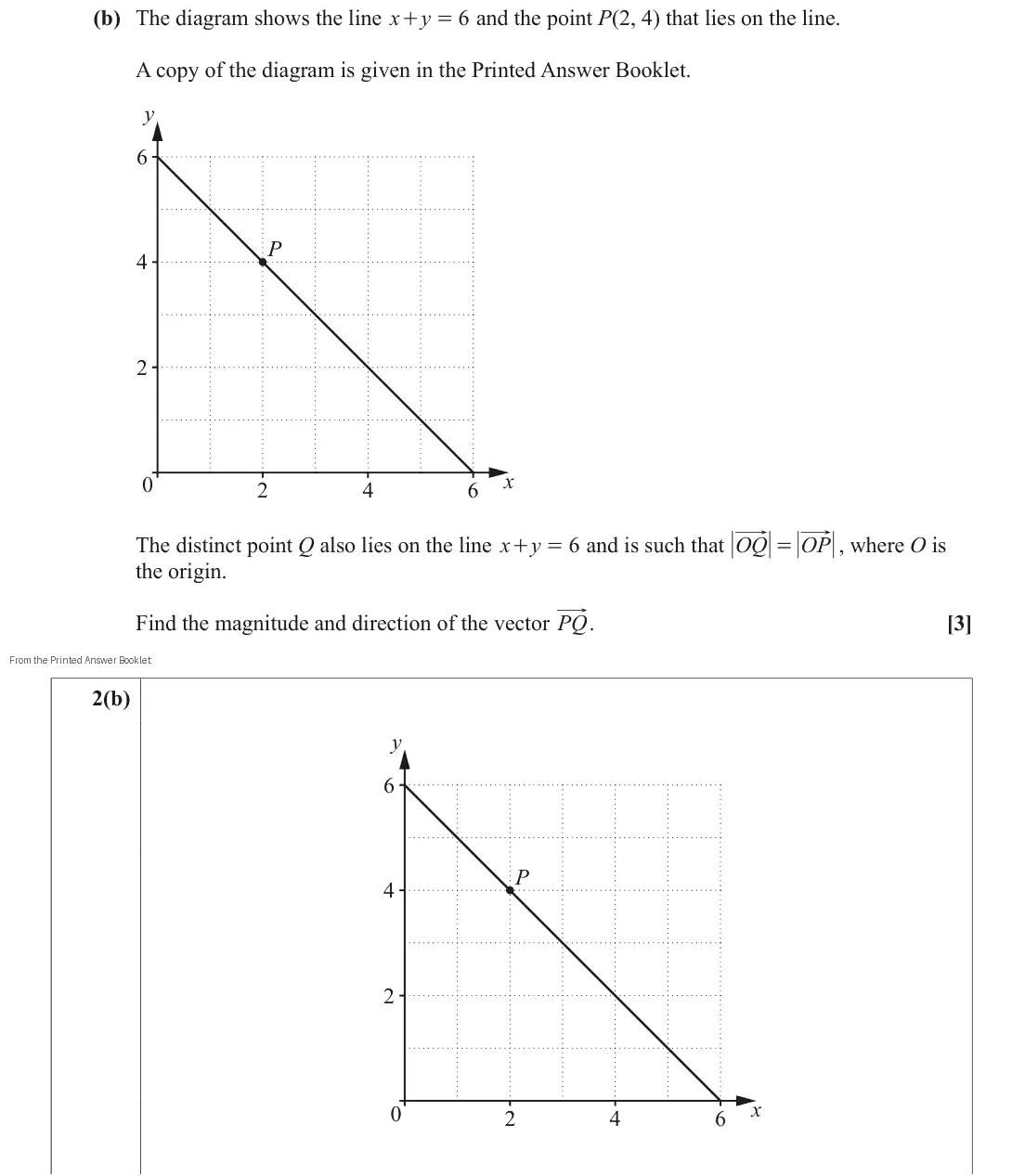
ሬሬሬሬሬሬ⃗ or OQ ሬሬሬሬሬሬሬ⃗ instead of PQ ሬሬሬሬሬሬ⃗ as required. Many candidates were able to correctly identify the point Q as (4, 2). Some candidates misread the question and gave the magnitude of OP ሬሬሬሬሬሬ⃗ (as -45° or 315°); in general candidates Relatively few candidates correctly computed the direction of PQ should know that the term ‘direction’ in questions relating to vectors means ‘compute the anti-clockwise angle to the positive x-axis’. Note that 135° could only be credited if specified as a bearing. Candidates who made use of the diagram in the answer booklet (while not required) were more likely to achieve 2 or 3 marks on this question.
Key points and common errors
Q = (4, 2) by symmetry
magnitude of PQ = 2√2
direction −45° or 315° measured anticlockwise from the positive x-axis
relatively few got the direction
June 2023 · AS Paper 1 · Q2(c)2 marksHard
Show the start of this question
Mark scheme for this part
Examiner's comment
Many candidates omitted this part, and relatively few candidates achieved one or both marks (including those who had obtained full or nearly full marks across parts (a) and (b)). Many appeared to not have understood the request in the question and computed some related vectors or magnitudes without reaching the required vectors for R. Again use of the diagram appeared to correlate with success. The command words ‘Write down’ indicates that very little algebraic working was required. Those candidates who found the gradient of OP (i.e. 2) and then the corresponding perpendicular gradient (i.e. -0.5) and drew a line of this gradient through P were most likely to produce the correct answers. Those who tried to rely on algebra and use the distance formula would often get stuck by not realising they needed to substitute the equation of the line through P (y = -0.5x + 5) to get their final answers. Some candidates did not give their responses in the required form (position vectors) and gave the co- ordinates of R instead.
Key points and common errors
PR perpendicular to OP = (2, 4) with half its length: R = (4, 3) or (0, 5) as position vectors
many omitted
relatively few scored
June 2023 · Paper 1 · Q4(a)1 markEasy
Mark scheme for this part
Examiner's comment
This part of the question was invariably correct, with the most common error being to simply find the vector AB as opposed to the length of this vector.
Key points and common errors
AB = √20 = 2√5
common error giving the vector AB not its length
June 2023 · Paper 1 · Q4(b)3 marksEasy
Show the start of this question
Mark scheme for this part
Examiner's comment
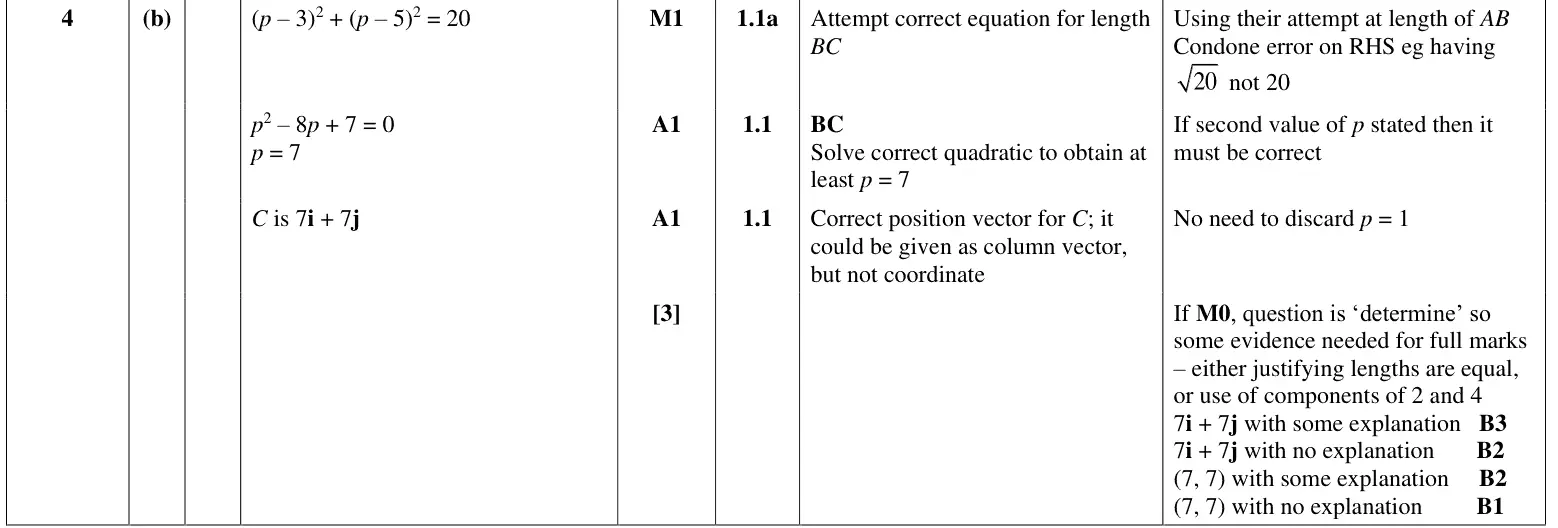
Most candidates were able to make a good attempt at this question, setting up an expression for the length of BC, equating it to the length of AB and solving the resulting quadratic to obtain at least p = 7. Some candidates stopped at this point without appreciating that the position vector of C had been requested. The most common error was to use the distance OC rather than BC. Some candidates simply observed from the information given that C must be 7i + 7j; this did gain some credit but the question uses the command word ‘determine’ so their answer had to be justified to gain full credit.
Key points and common errors
(p − 3)² + (p − 5)² = 20 gives p = 7 (p > 1)
C is 7i + 7j
common error using OC not BC
'determine' needs justification
June 2023 · Paper 1 · Q4(c)2 marksHard
Show the start of this question
Mark scheme for this part
Examiner's comment
This part of the question proved to be unexpectedly challenging, and only the most able candidates gained both marks. Many candidates seemed unsure as to how to find the midpoint, with 3i + 3j most typically being given as the position vector of M. The more successful candidates made good use of a sketch diagram.
Key points and common errors
M = 4i + 4j
MD = 2BM gives D = 6i + 2j
many gave M as 3i + 3j
a sketch helps
June 2023 · Paper 1 · Q4(d)2 marksHard
Show the start of this question
Mark scheme for this part
Examiner's comment
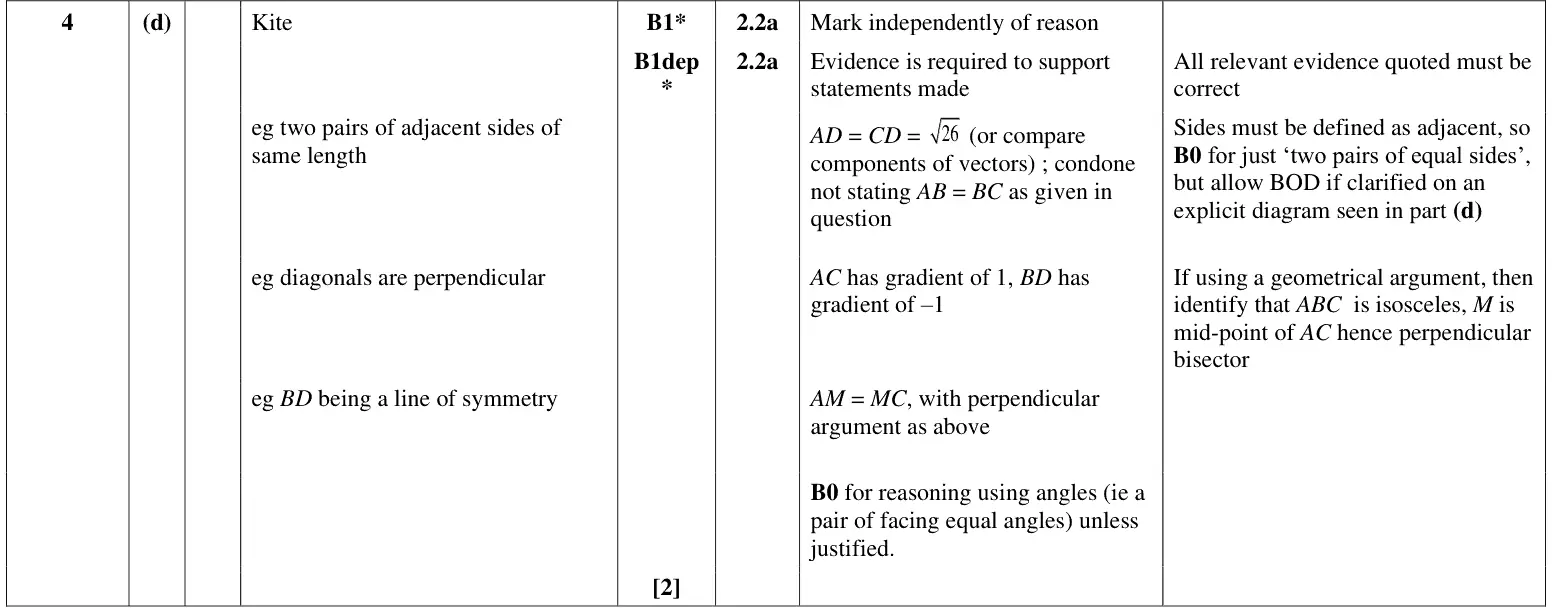
Only a minority of candidates were able to identify that the quadrilateral was a kite. So as to gain both marks, candidates also had to justify their answer with appropriate evidence, such as finding the lengths of AD and CD. Rather than considering the information given in parts (b) and (c) of the question, most candidates attempted to plot their sometimes incorrect position vectors, leading to erroneous conclusions.
Key points and common errors
kite: two pairs of adjacent equal sides (AD = CD = √26) or perpendicular diagonals
reason required
June 2023 · Paper 2 · Q2(a)1 markMedium
Mark scheme for this part
Examiner's comment
Many candidates found the vector OP correctly but did not go on to give the required expression for the length. A few candidates muddled the 6 and 8. Almost all candidates gave the answer as 10k which was permitted, even though strictly the correct expression is 10|k| since length cannot be negative.
Key points and common errors
OP = k(6, 0, 8) so length 10 × modulus of k (10k allowed)
many found the vector but not the length
June 2023 · Paper 2 · Q2(b)4 marksHard
Show the start of this question
Mark scheme for this part
Examiner's comment
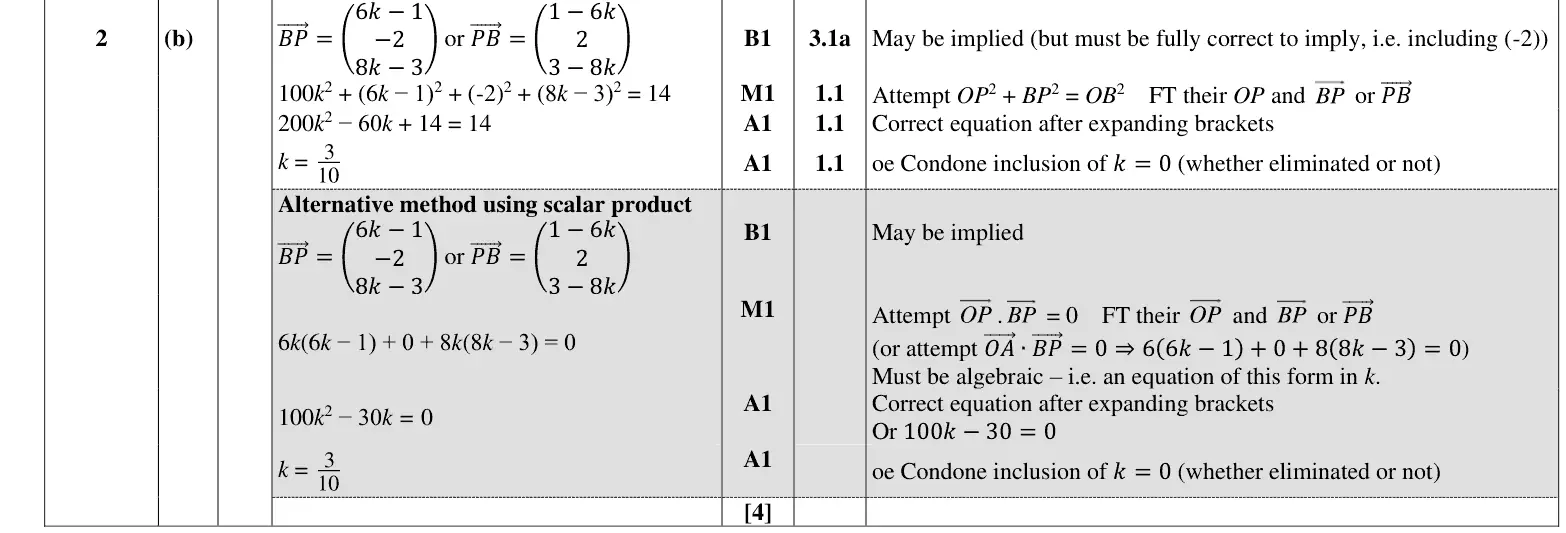
Many candidates appeared to struggle with this question, and a variety of unfruitful methods were seen. The command word is ‘Determine’ so some working is required. Many candidates misunderstood the ‘triangle’ to which they were applying Pythagoras and so obtained a ‘not useful’ equation. Candidates were permitted to ‘imply’ the B mark for BP or PB but (in a determine question) it would of course be preferable if this was explicitly stated first. Algebraic errors were quite commonly seen in the equation derived from Pythagoras, although many of those who completed this correctly went on disregard the additional solution k = 0, which is good practice. In general those candidates using the scalar product method (from Further Maths) obtained the correct answer and full credit. A few candidates recognised that a simpler equation could be obtained by working with the angle AOB (which is the same as BOP), and either using OA.BP or the right-angled triangle to obtain the required answer.
Key points and common errors
BP = (6k − 1, −2, 8k − 3)
OP² + BP² = OB² (or OP·BP = 0) gives 200k² − 60k = 0 so k = 3/10
Pythagoras on the wrong triangle
June 2023 · Paper 3 · Q84 marksMedium
Mark scheme for this part
Examiner's comment
Most candidates correctly applied 𝐯𝐯= 𝐮𝐮+ 𝐚𝐚𝑡𝑡 to obtain the initial velocity vector for P as −6𝐢𝐢+ 8𝐣𝐣. Sadly, many candidates left their answer as a vector and did not find the corresponding speed as directed. In this case the number of marks available should have been a strong indication of the amount of work required.
Key points and common errors
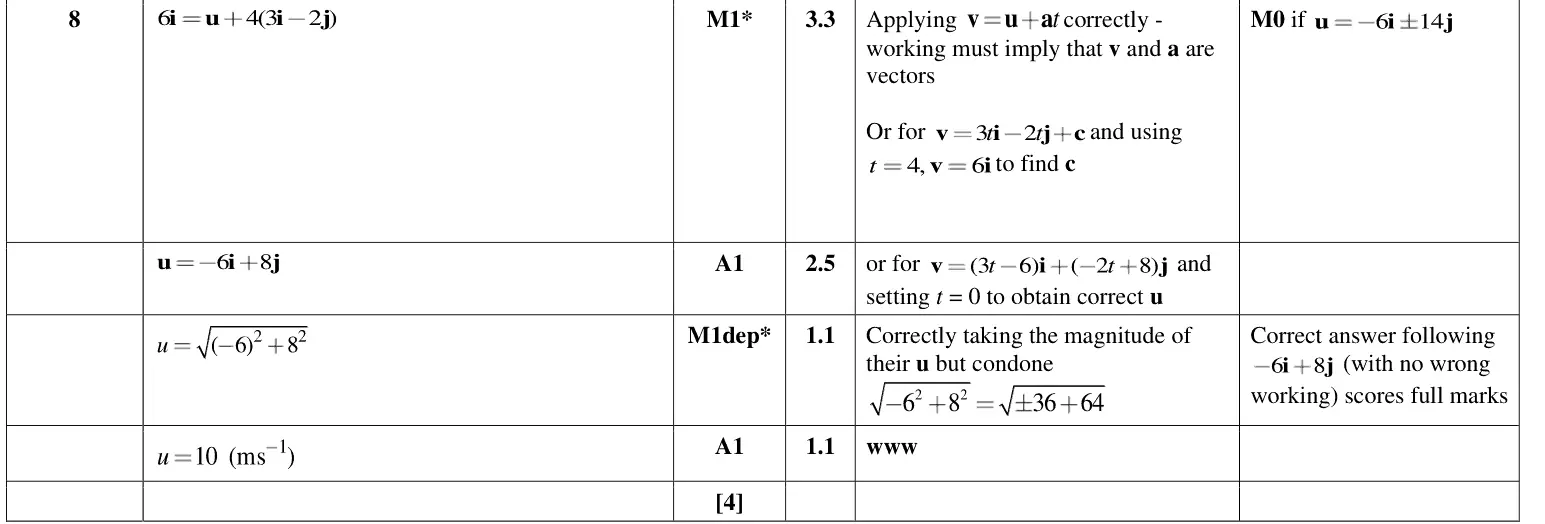
v = u + at with vectors: u = 6i − 4(3i − 2j) = −6i + 8j
speed = √(36 + 64) = 10 m s⁻¹
many stopped at the vector
June 2023 · Paper 3 · Q10(a)3 marksMedium
Mark scheme for this part
Examiner's comment
There were two common errors in this part. The first was the incorrect assumption that the resultant of the two forces was found by subtracting rather than adding the two horizontal forces together (possibly the resultant of the two forces equal to −𝐢𝐢+ 3𝐣𝐣 and not a multiply of this vector. Those that did state that candidates were confusing ‘resultant’ vector with ‘direction’ vector). The other common error was setting ቀ−4 + 𝑎𝑎 2 + 𝑏𝑏ቁ= 𝑘𝑘ቀ−1 3 ቁ usually eliminated k and derived the given result correctly.
Key points and common errors
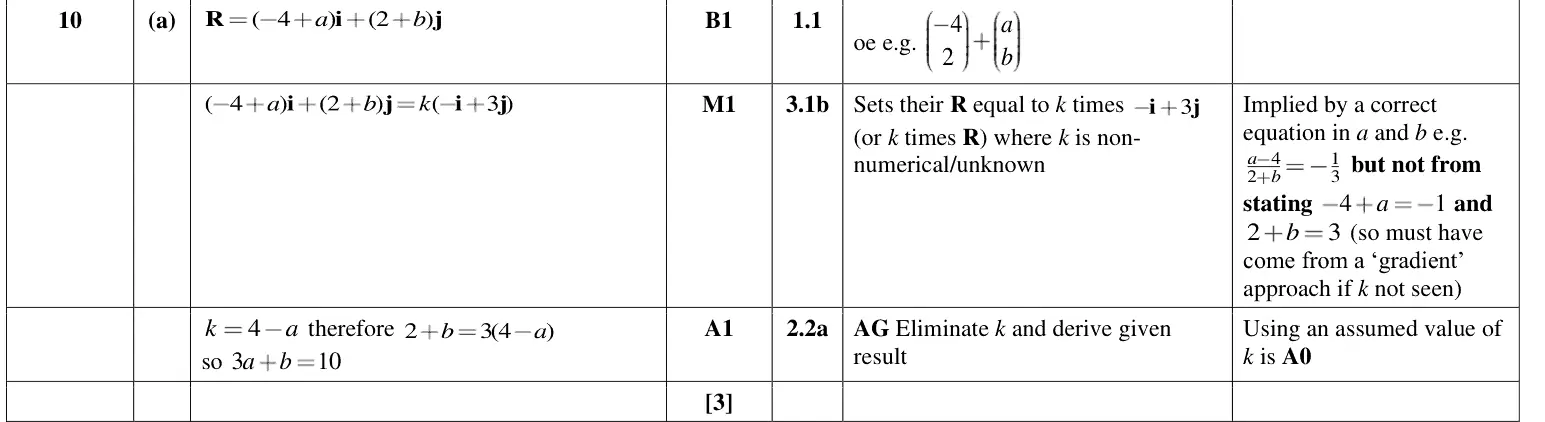
R = (a − 4)i + (2 + b)j = k(−i + 3j)
eliminate k to get 3a + b = 10
errors: subtracting the forces, setting R equal to −i + 3j itself
June 2023 · Paper 3 · Q10(b)4 marksEasy
Show the start of this question
Mark scheme for this part
Examiner's comment
determine that 𝐑𝐑= 2𝐢𝐢−6𝐣𝐣. Most then went on to correctly apply |𝐅𝐅| = 𝑚𝑚|𝐚𝐚| and found the correct value This part was answered well with most candidates using the given value of a to then find b and hence of m.
Key points and common errors
b = −8 so R = 2i − 6j
magnitude √40 = m × 5√10 so m = 0.4
June 2022 · Paper 2 · Q2(a)2 marksEasy
Mark scheme for this part
Examiner's comment
This question was answered well by most candidates. A few found AB , but did not go on to find the length, perhaps because of a misreading of the question. Some others thought that AB = a + b. Some did not use good notation, omitting brackets: 12 + −52 = 26.
Key points and common errors
AB = b − a = i − 5k
length √26
AB is not a + b
June 2022 · Paper 2 · Q2(b)3 marksHard
Show the start of this question
Mark scheme for this part
Examiner's comment
Perhaps the quickest way to approach this question is to use Pythagoras’ theorem. However, very few candidates used this approach. Many attempted to find the position vector of the centre, C, of the circle and then used |PC|2 = radius2. These candidates generally scored the first mark, but lost the other marks by making arithmetical slips. Some omitted the j component. Some omitted to halve the diameter. A common, more serious, error was |OP|2 = radius2.
Key points and common errors
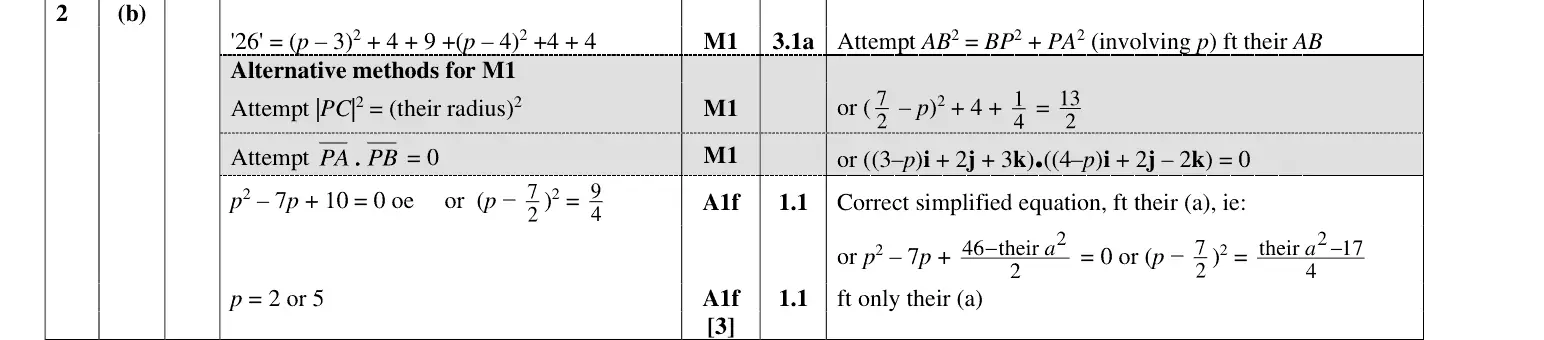
angle in a semicircle: AB² = AP² + BP², or PC² = r² with C the midpoint
p² − 7p + 10 = 0
p = 2 or 5
errors: forgetting to halve the diameter, using OP
June 2022 · AS Paper 2 · Q7(a)5 marksMedium
Mark scheme for this part
Examiner's comment
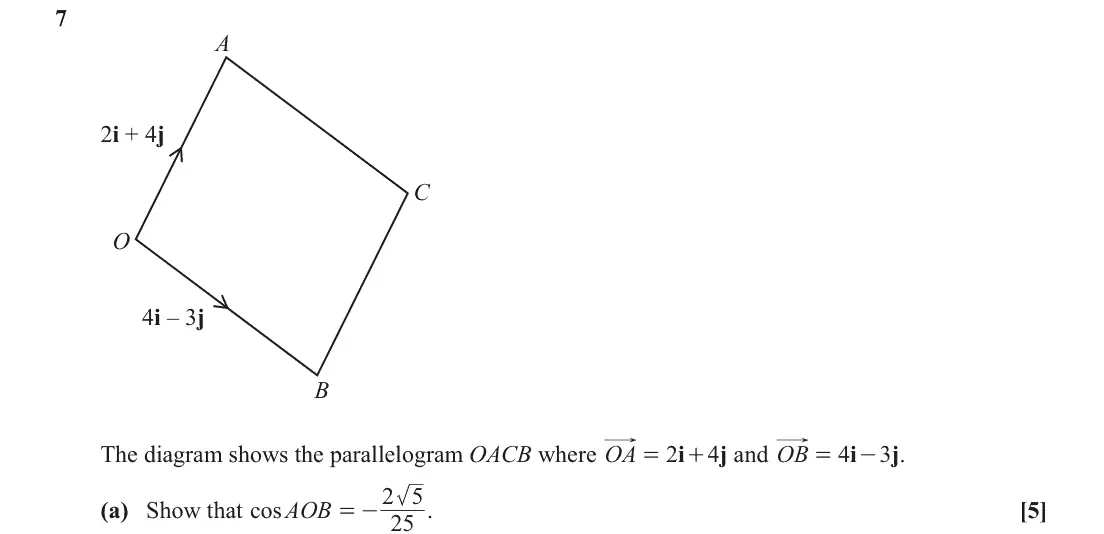
IOAI and IOBI were correctly found by many, and often less successful attempts could obtain AB and its length. Most realised the triangle AOB was not right angled and attempted the cosine rule. It is good practice for candidates to be in the habit of showing surd simplification even if the calculator is used to do the relevant work. Exact working was expected for full credit. Those who just used AOB = tan-1(4/2) + tan-1(3/4) to get 100.3° and their calculator with this to try and show the given result scored 0 marks.
Key points and common errors
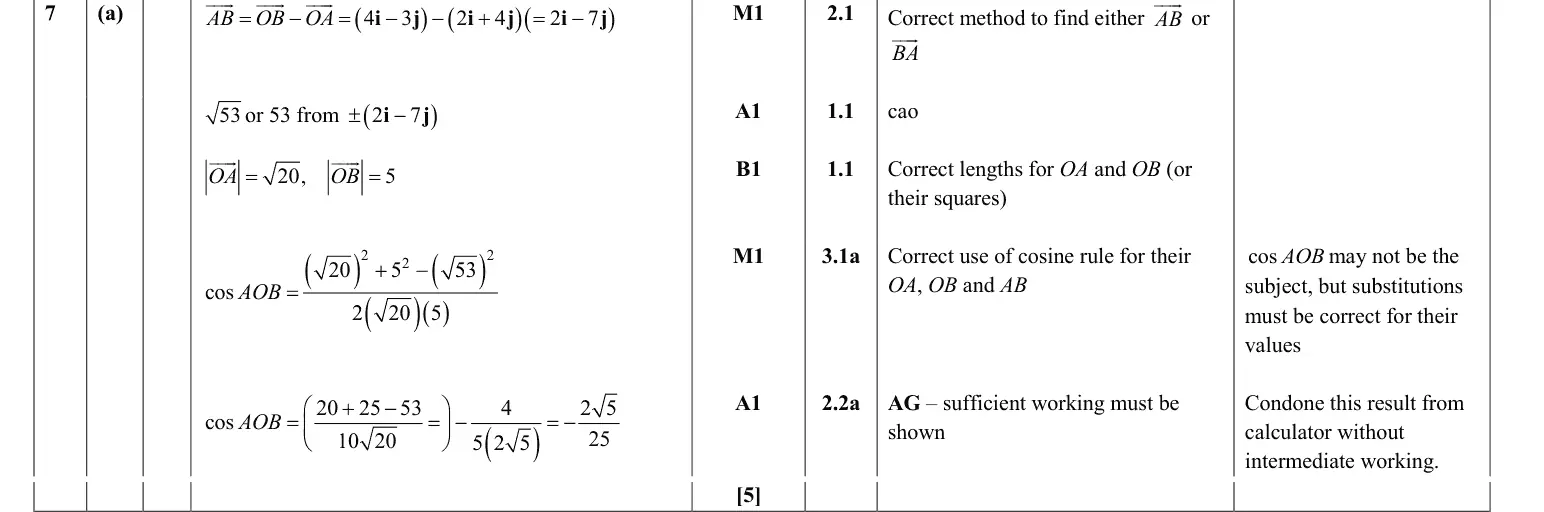
AB = 2i − 7j so AB = √53, OA = √20, OB = 5
cosine rule with exact surd working gives −2√5/25
using tan⁻¹ angles and calculator scores 0
June 2022 · Paper 3 · Q12(c)5 marksHard
Show the start of this question
Mark scheme for this part
Examiner's comment
How to deal with ‘…moving in the direction of the vector 2 − i + j ’ was not well known by most candidates (and it would seem that many candidates did not realise that the direction of motion of P is governed by the corresponding velocity vector and not the displacement vector). For those candidates who did realise − − 2 1 2 t = that k for some constant k most usually went on to find the correct value of t as 2.5. + − 1 2 t t 13 In comparison, the vector expression for F (and corresponding magnitude) were much better known by candidates and even if they did not obtain the correct value of t they could still access some marks for their knowledge of these results.
Key points and common errors
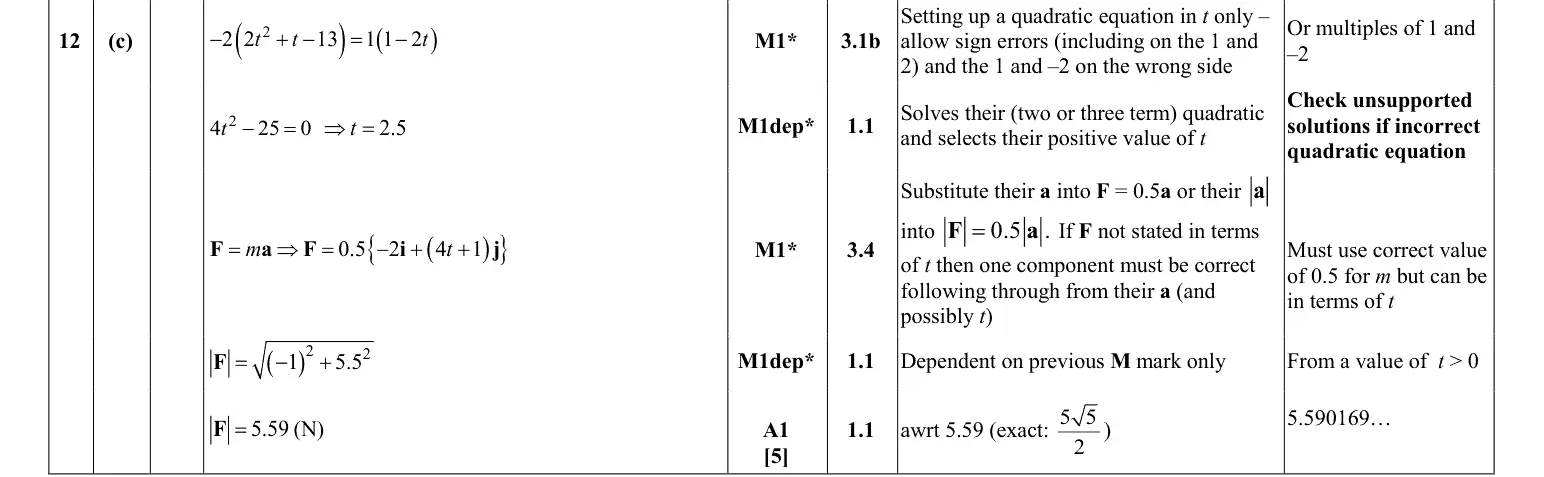
direction of motion is the velocity: (2t² + t − 13)/(1 − 2t) = −1/2 gives 4t² = 25, t = 2.5
F = 0.5a
magnitude 5.59 N
June 2022 · Paper 3 · Q12(d)5 marksMedium
Show the start of this question
Mark scheme for this part
Examiner's comment
This question was much better answered than part (c) with many candidates correctly integrating the velocity vector to obtain the corresponding displacement vector. Some candidates did not include a vector constant of integration (and some just automatically assumed that it would be a zero vector). 3 33 However, many correctly found the displacement at time 1.5 as − − j and although many used the i 4 8 tan ratio to work out a suitable angle only some correctly found the required bearing.
Key points and common errors
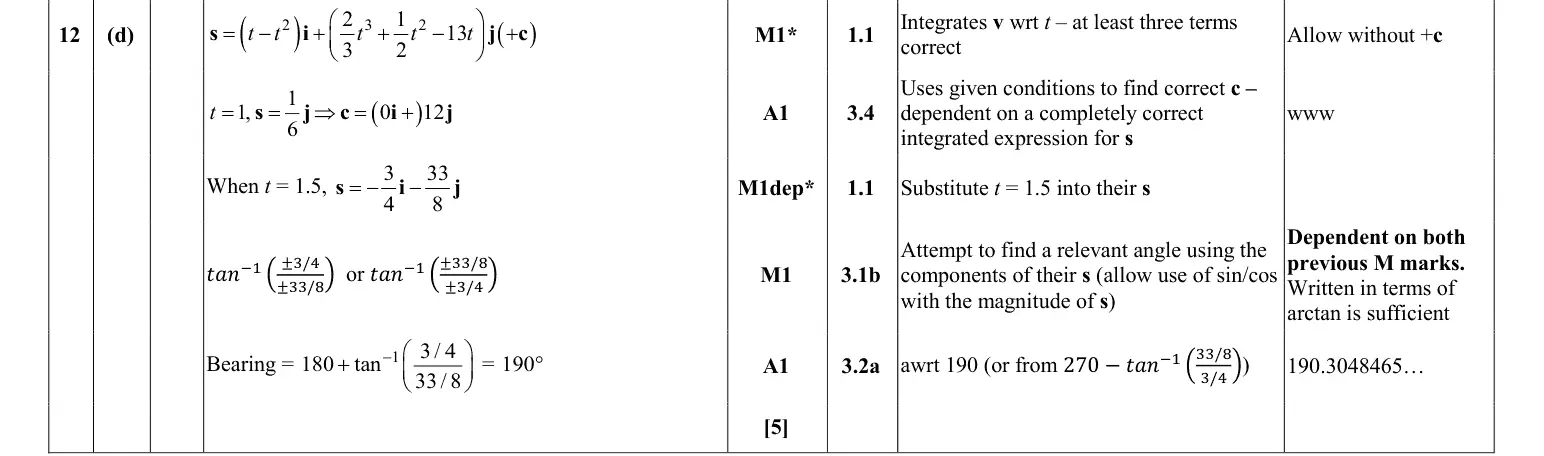
integrate v with vector constant
c = 12j from s(1) = j/6
s(1.5) = −3/4 i − 33/8 j
bearing 190°
Autumn 2021 · AS Paper 1 · Q4(a)2 marksMedium
Mark scheme for this part
Key points and common errors
2(6, −3) − 3(−1, 2) = (15, −12) or 15i − 12j
Autumn 2021 · AS Paper 1 · Q4(b)5 marksMedium
Show the start of this question
Mark scheme for this part
Key points and common errors
parallel to y-axis so x-component 6r − s = 0, s = 6r
magnitude (9r)² = 9 gives r = ±1/3
pairs r = 1/3, s = 2 and r = −1/3, s = −2 correctly paired
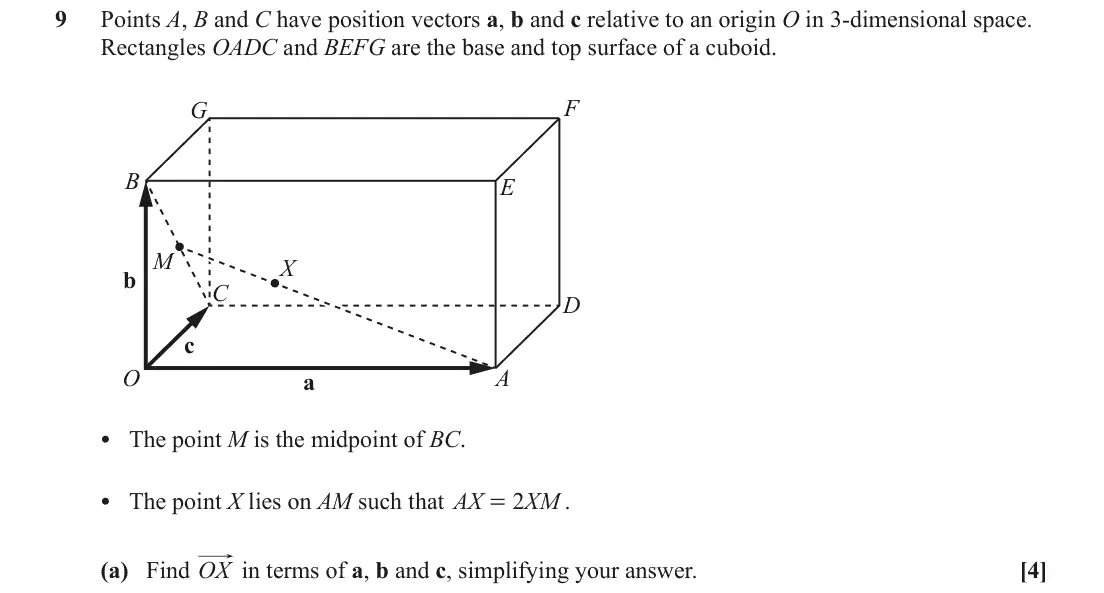
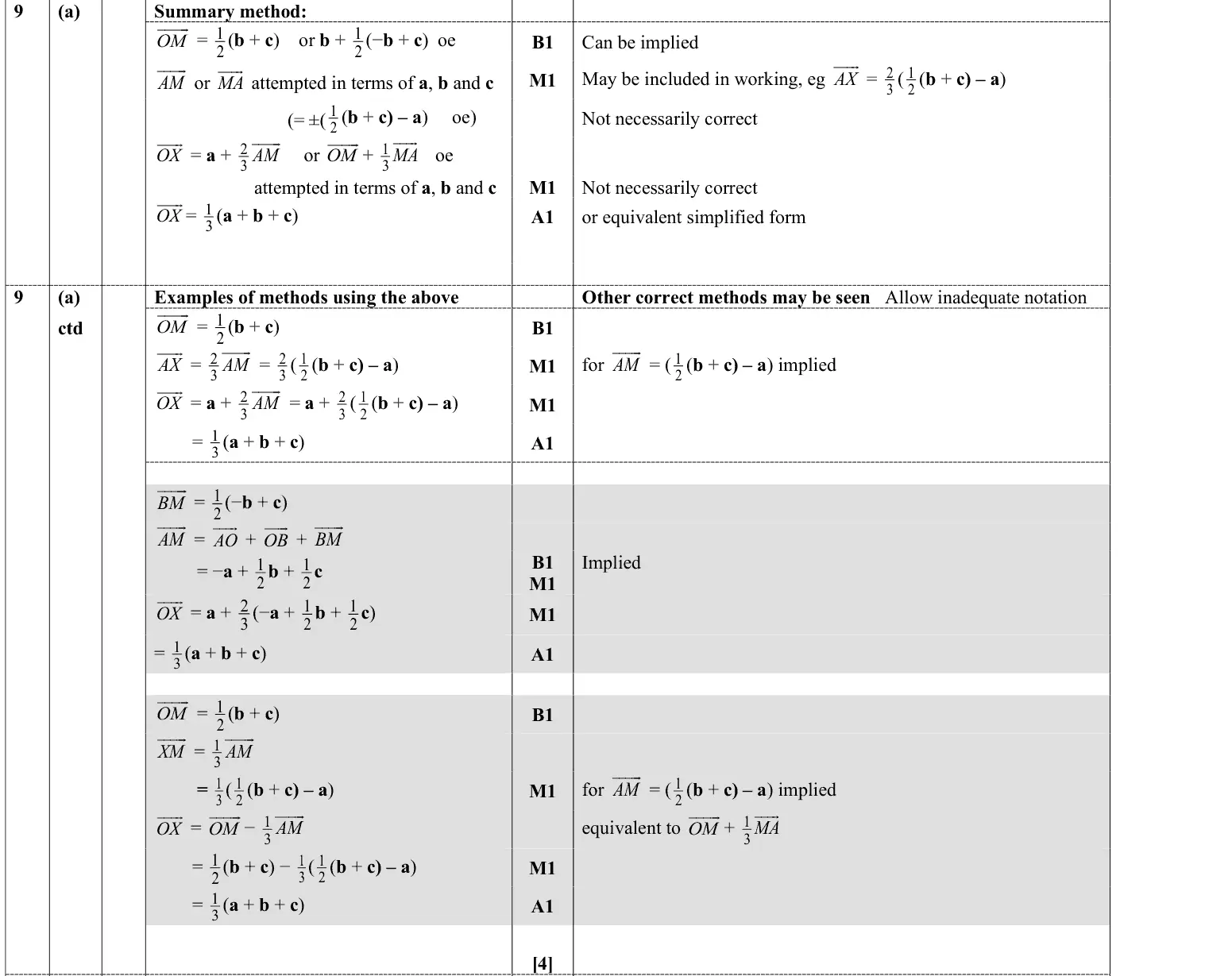
Autumn 2021 · Paper 2 · Q9(a)4 marksMedium
Mark scheme for this part
Examiner's comment
(From the general report) Question 9(a): Some candidates attempted ’lengths’ of vectors, rather than 1 2 2 vectors themselves.
Key points and common errors
OM = ½(b + c)
AM = ½(b + c) − a
OX = a + ⅔AM = ⅓(a + b + c)
some worked with lengths instead of vectors
Autumn 2021 · Paper 2 · Q9(b)2 marksEasy
Show the start of this question
Mark scheme for this part
Examiner's comment
(From the general report) Question 9(b): Most candidates correctly noted that OF = a + b + c, and that consequently OF is a multiple of OX .
Key points and common errors
OF = a + b + c = 3OX so X lies on OF and on AM
both statements needed
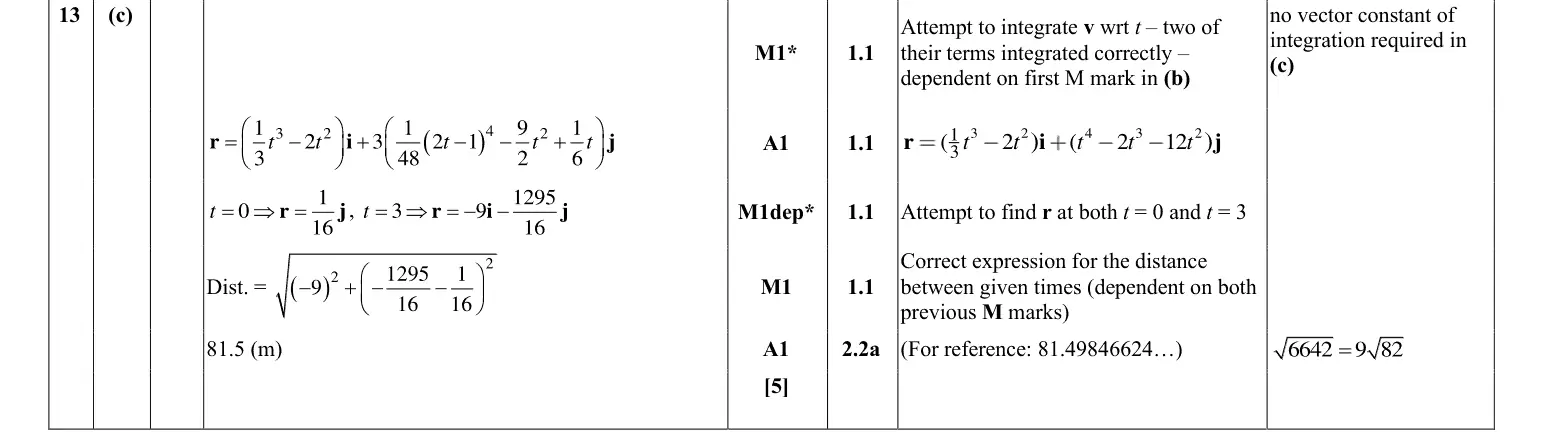
Autumn 2021 · Paper 3 · Q13(c)5 marksMedium
Show the start of this question
Mark scheme for this part
Examiner's comment
(From the general report) Question 9 states constant acceleration so ‘suvat’ can be used, whereas Question 13 has a variable force term so calculus must be used.
Key points and common errors
integrate v for r
evaluate at t = 0 and t = 3
distance √6642 = 81.5 m
Autumn 2020 · AS Paper 1 · Q2(a)2 marksMedium
Mark scheme for this part
Examiner's comment
(Comment on Question 02 as a whole) Many candidates answered the first part correctly although, in some cases, the working was difficult to decipher. Some candidates did not appear to understand vectors, and in particular, addition and subtraction of vectors. In part (b) many were confused about the gradients of perpendicular lines.
Key points and common errors
AB and BC in the same direction (ratio of components) or line y = −x/2 + 5/2 through (p, 1)
p = 3
working often hard to follow
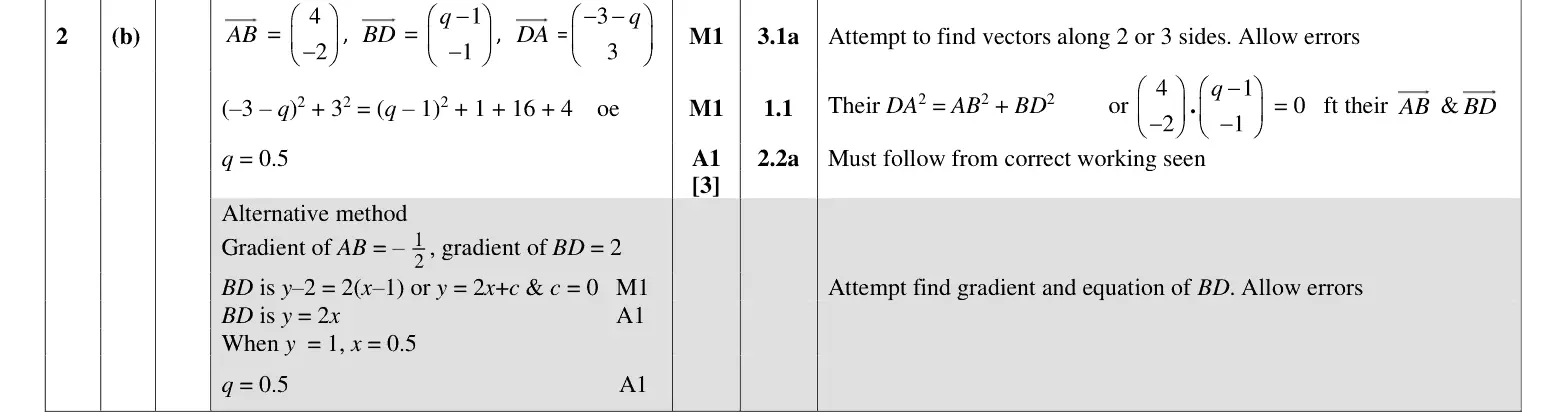
Autumn 2020 · AS Paper 1 · Q2(b)3 marksMedium
Show the start of this question
Mark scheme for this part
Examiner's comment
(Comment on Question 02 as a whole) Many candidates answered the first part correctly although, in some cases, the working was difficult to decipher. Some candidates did not appear to understand vectors, and in particular, addition and subtraction of vectors. In part (b) many were confused about the gradients of perpendicular lines.
Key points and common errors
AB = (4, −2), BD = (q − 1, −1)
Pythagoras DA² = AB² + BD², or gradient of BD = 2 perpendicular to AB
q = 0.5
perpendicular gradients often confused
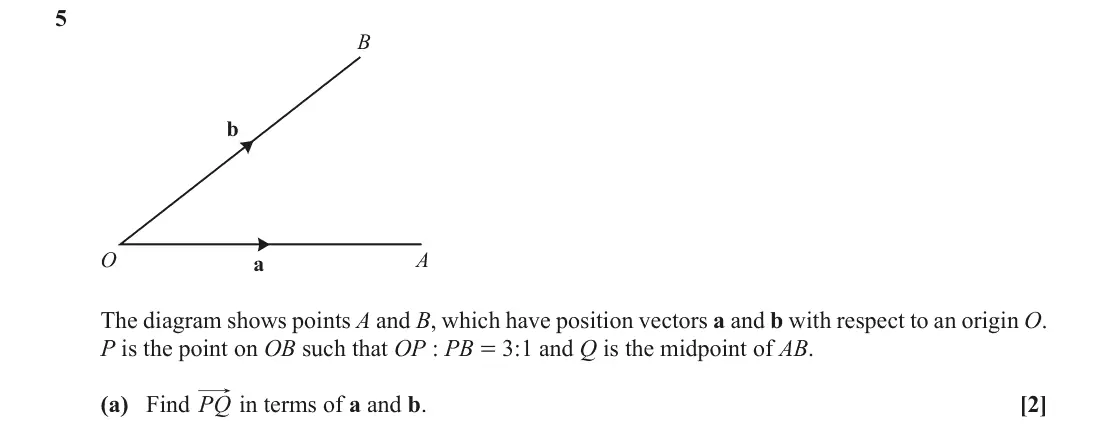
Autumn 2020 · Paper 1 · Q5(a)2 marksMedium
Mark scheme for this part
Key points and common errors
BQ = ½(a − b)
PQ = ¼b + ½(a − b) = ½a − ¼b
Autumn 2020 · Paper 1 · Q5(b)2 marksMedium
Show the start of this question
Mark scheme for this part
Key points and common errors
PR parallel to PQ so a scalar multiple
¼λ(2a − b) = k(2a − b)
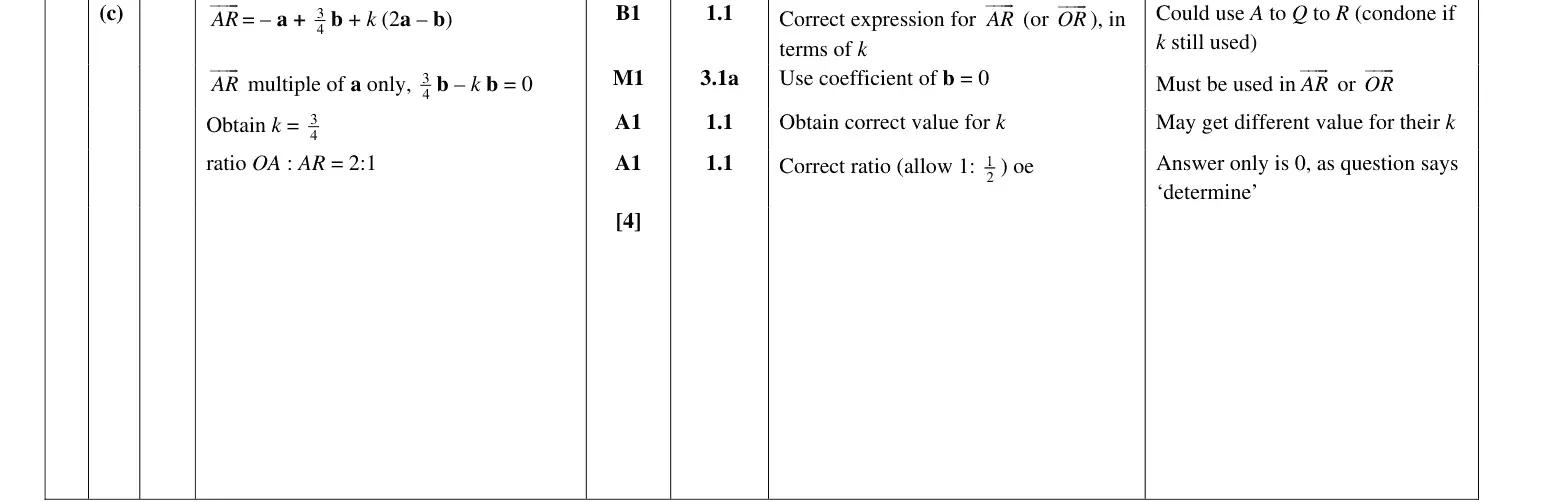
Autumn 2020 · Paper 1 · Q5(c)4 marksMedium
Show the start of this question
Mark scheme for this part
Key points and common errors
AR = −a + ¾b + k(2a − b) must be a multiple of a only so k = ¾
OA : AR = 2 : 1
method needed for 'determine'
Autumn 2020 · Paper 2 · Q7(a)1 markMedium
Mark scheme for this part
Examiner's comment
(From the general report) Common misconceptions Misconception In answering Question 7 (about vectors) some candidates appeared not to appreciate the different significances of a, a and A.
Key points and common errors
length (distance) AB
must refer to points A and B, not vectors a and b
Autumn 2020 · Paper 2 · Q7(b)1 markMedium
Show the start of this question
Mark scheme for this part
Examiner's comment
(From the general report) Common misconceptions Misconception In answering Question 7 (about vectors) some candidates appeared not to appreciate the different significances of a, a and A.
Key points and common errors
position vector of the midpoint of AB
refer to A and B not a and b
Autumn 2020 · Paper 2 · Q7(c)(i)1 markMedium
Show the start of this question
Mark scheme for this part
Examiner's comment
(From the general report) Common misconceptions Misconception In answering Question 7 (about vectors) some candidates appeared not to appreciate the different significances of a, a and A.
Key points and common errors
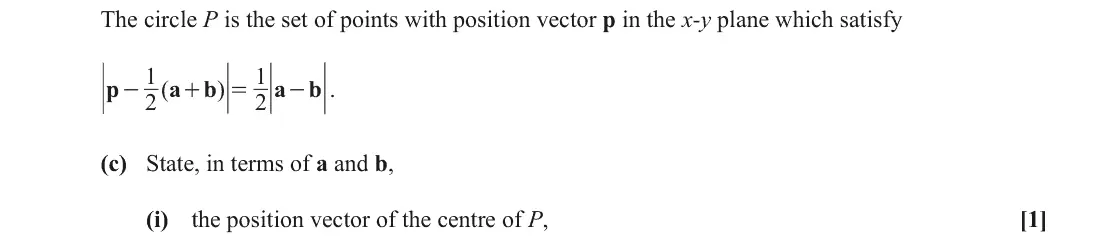
centre ½(a + b)
Autumn 2020 · Paper 2 · Q7(c)(ii)1 markMedium
Show the start of this question
Mark scheme for this part
Examiner's comment
(From the general report) Common misconceptions Misconception In answering Question 7 (about vectors) some candidates appeared not to appreciate the different significances of a, a and A.
Key points and common errors
radius ½ × magnitude of (a − b)
Autumn 2020 · Paper 2 · Q7(d)4 marksMedium
Show the start of this question
Mark scheme for this part
Examiner's comment
(From the general report) Common misconceptions Misconception In answering Question 7 (about vectors) some candidates appeared not to appreciate the different significances of a, a and A.
Key points and common errors
centre (3, 2), r² = 10
(x − 3)² + (y − 2)² = 10
Autumn 2020 · AS Paper 2 · Q83 marksMedium
Mark scheme for this part
Examiner's comment
(From the general report) Section A is Pure Mathematics (Questions 1-7), allocated 50 marks and Section B is Mechanics (Questions 8-11), allocated 25 marks.
(Comment on Question 07 as a whole) This was perhaps the best answered question on the paper. Unfortunately, marks were dropped in both parts where candidates gave an answer for velocity when speed was requested or for distance when displacement was requested. A significant number of candidates attempted this question using calculus; while valid, the responses were more likely to include arithmetic errors.
Key points and common errors
v = u + at = −5i + 12j
speed 13 m s⁻¹ (a speed not a velocity)
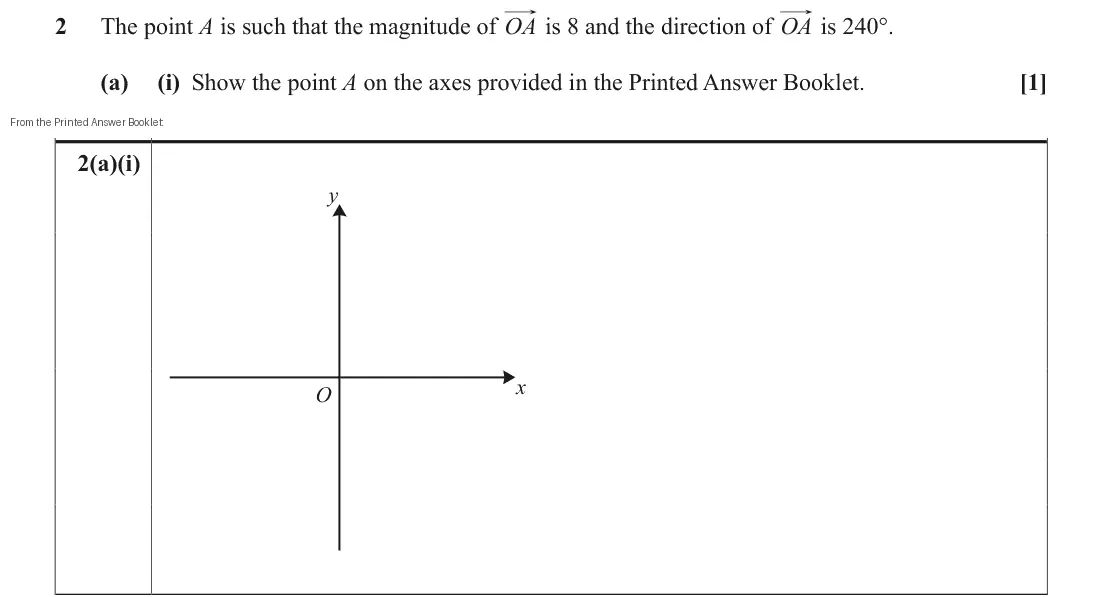
June 2019 · Paper 1 · Q2(a)(i)1 markHard
Mark scheme for this part
Examiner's comment
This proved to be a challenging question; while candidates appeared to be familiar with the term ‘magnitude’ they were less certain about the ‘direction’ of a vector and many treated it as a bearing, taking it clockwise from the y-axis. Candidates should make sure that they show sufficient detail on any sketch; in this question both the length of OA and a relevant angle were expected to be labelled.
Key points and common errors
direction measured anticlockwise from the positive x-axis, not a bearing
A in the third quadrant with length 8 and an angle labelled
June 2019 · Paper 1 · Q2(a)(ii)3 marksMedium
Show the start of this question
Mark scheme for this part
Examiner's comment
Most candidates were able to make some attempt at finding the components of the position vector, with some using basic trigonometry and others setting up, and solving, simultaneous equations using Pythagoras’ theorem and invtan. However, the incorrect positioning of the point A in the previous part of the question inevitably limited the marks gained in this part for many of the candidates.
Key points and common errors
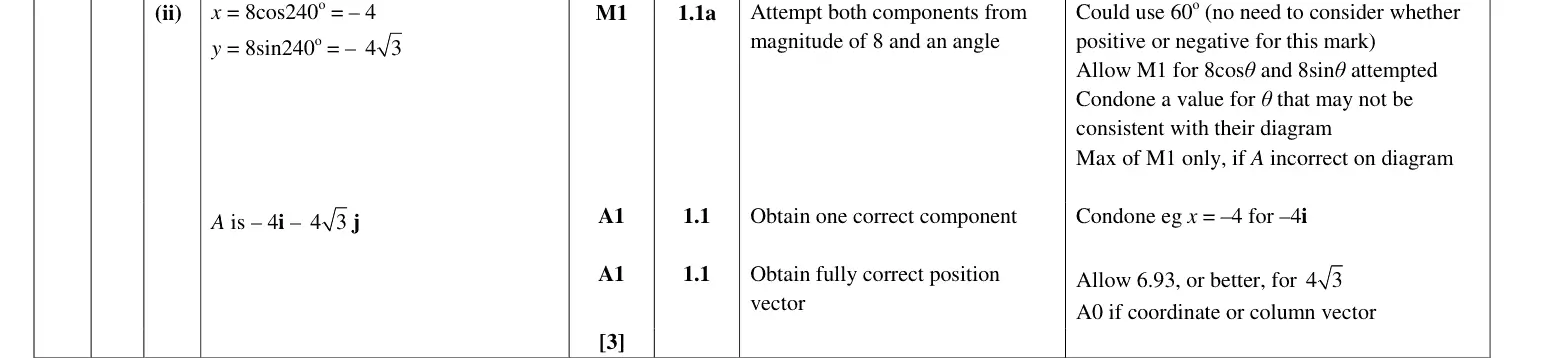
8cos240° = −4, 8sin240° = −4√3 so −4i − 4√3j
marks limited by a wrongly placed A
not a coordinate or column vector
June 2019 · Paper 1 · Q2(b)2 marksMedium
Show the start of this question
Mark scheme for this part
Examiner's comment
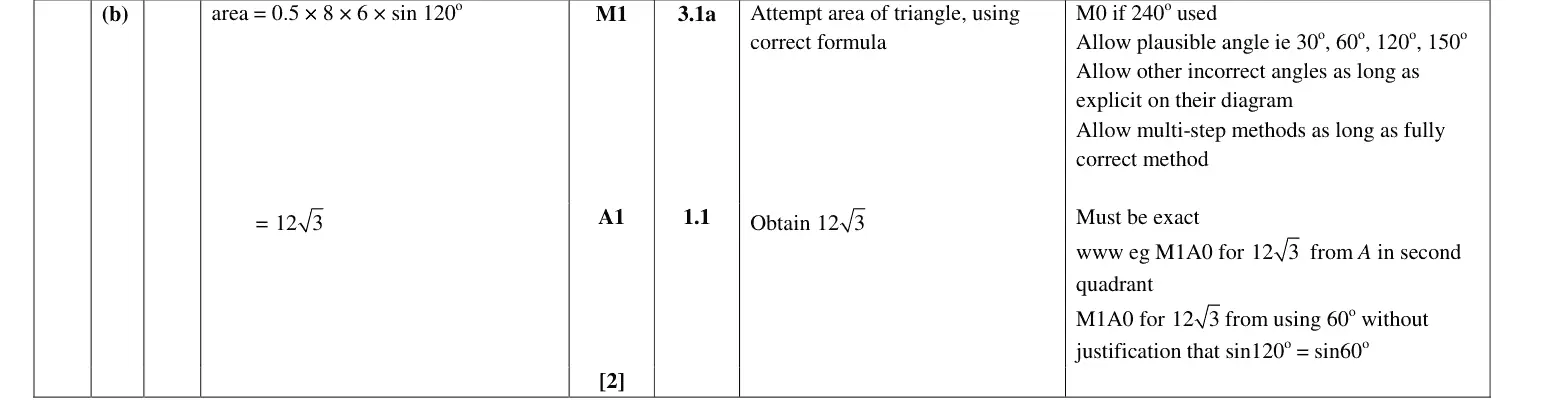
Most candidates were able to attempt the area of the triangle, using what they believed angle AOB to be. Notice that this question explicitly asked for the ‘exact area’; full marks would not be given for a decimal approximation of the surd, regardless of the number of decimal places quoted.
Key points and common errors
½ × 8 × 6 × sin120° = 12√3
exact answer required, decimals lose the mark
June 2019 · Paper 1 · Q2(c)2 marksMedium
Show the start of this question
Mark scheme for this part
Examiner's comment
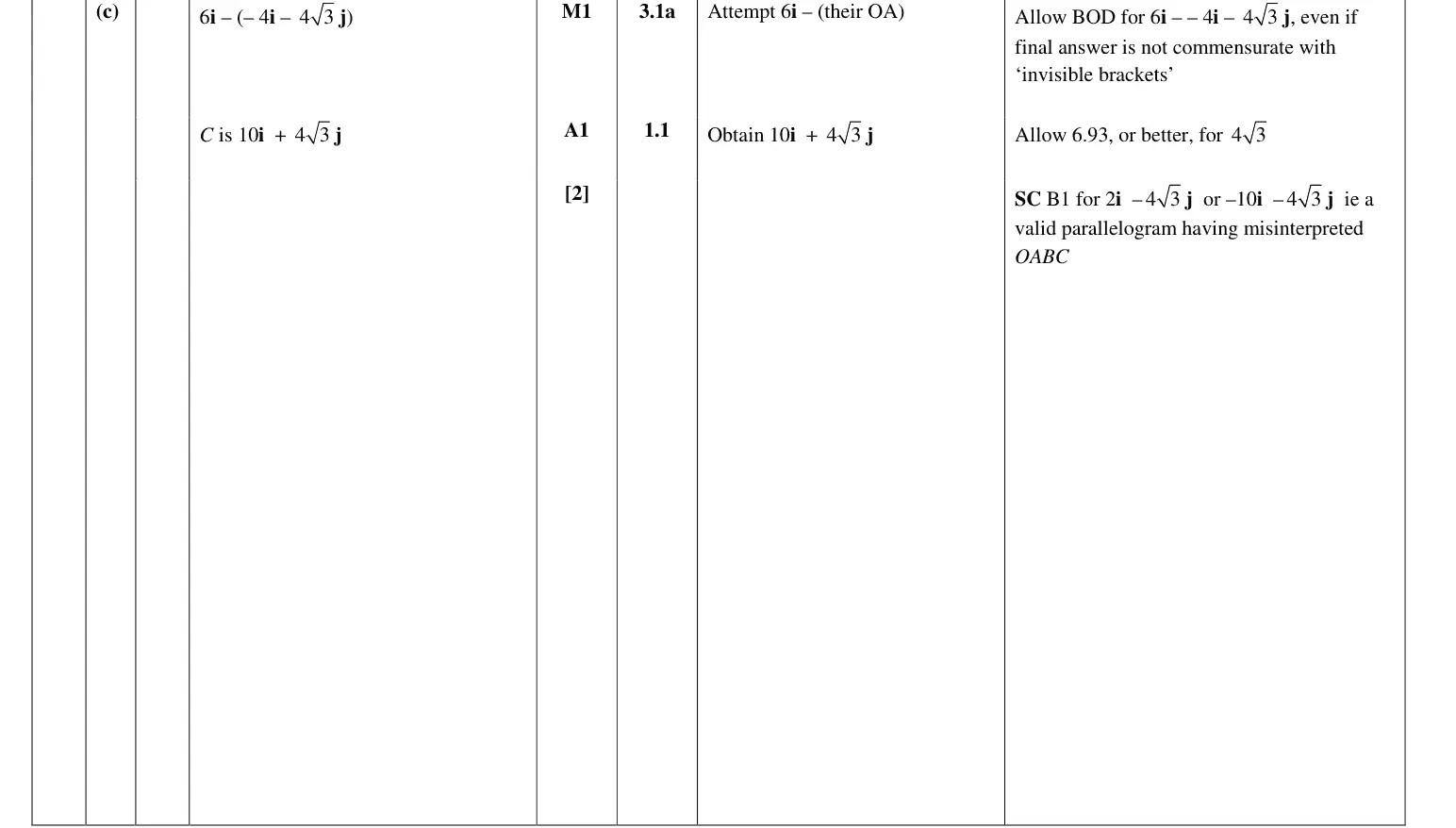
Many candidates seemed unfamiliar with the labelling convention for a polygon, and placed the point C such that the parallelogram being considered was actually OACB. The more successful candidates made good use of a diagram, with clear calculations to justify the relevant vectors that were being found.
Key points and common errors
OABC order: OC = OB − OA = 10i + 4√3j
many placed C to give OACB instead
June 2019 · AS Paper 2 · Q5(a)1 markEasy
Mark scheme for this part
Examiner's comment
Very well attempted.
Key points and common errors
midpoint of AC is (4, 3) so k = 3
June 2019 · AS Paper 2 · Q5(b)3 marksMedium
Mark scheme for this part
Examiner's comment
Many candidates made progress here, successfully setting up the required quadratic in k . Although ( ) k − 2 = 4 provides a neat solution, more often than not the correct answers followed from k − 4 k = 0 . Some expanded the brackets incorrectly and a few candidates thought AD = a + d .
Key points and common errors
(1 − 4)² + (2 − k)² = 13 gives k = 0 or 4
errors expanding
AD is d − a, not a + d
June 2019 · AS Paper 2 · Q5(c)2 marksHard
Mark scheme for this part
Examiner's comment
This was found to be more challenging. Many had no idea how to start or produced a wrong value of k with no evidence of how it had been obtained, but those who made sensible attempts used either gradients or vectors. For those using gradients (more common), some seemingly used perpendicularity. Attention to detail was important. A common issue throughout this paper involved marks dropped due to careless notation. This candidate 1 has shown sufficient working for the method mark, but having correctly found m = − , went on to use 4 1 m = and so dropped the accuracy mark. 4
Key points and common errors
trapezium needs one pair of parallel sides: AB parallel to DC gives k = 16/3 (or k = −½ or 5/4 from other pairs)
show the gradient or vector working
perpendicularity is wrong
June 2019 · AS Paper 2 · Q92 marksEasy
Mark scheme for this part
Examiner's comment
This was generally very well answered.
Key points and common errors
sum of forces is zero: F = (−9, 1) N
June 2019 · Paper 3 · Q8(d)4 marksHard
Show the start of this question
Mark scheme for this part
Examiner's comment
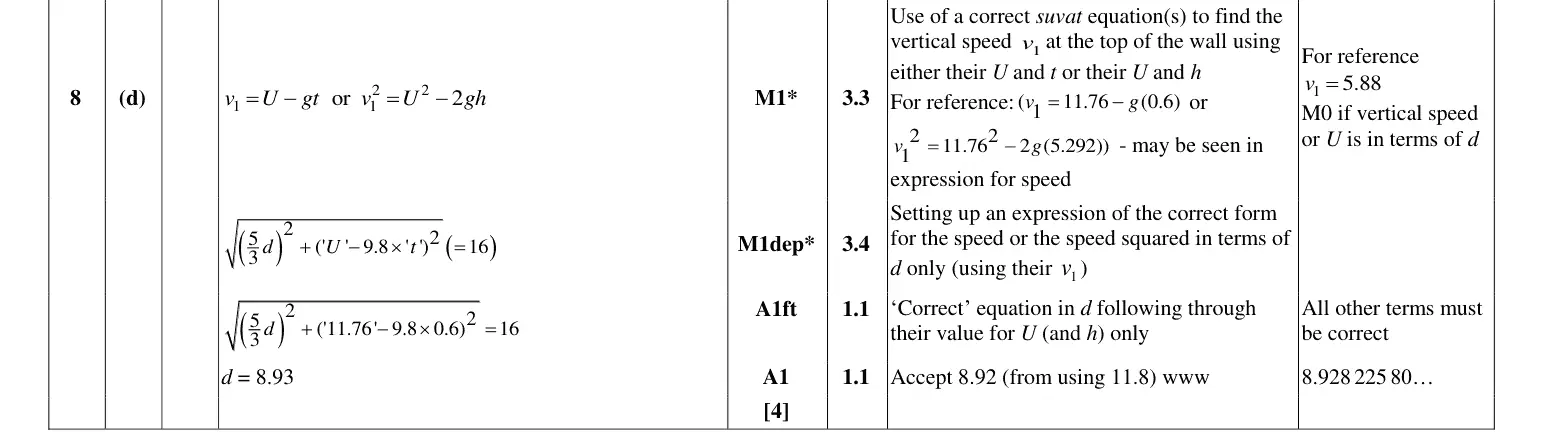
The most common misconception here was to use the result from part (b) together with v = 16 in the equation v = u + 2 as instead of realising that the vertical component of the speed, v , at the top of the wall had to be worked out first before then using the equation ( ) 16 and solving to find the d + v = value of d.
Key points and common errors
vertical speed at wall 11.76 − 0.6g = 5.88
((5/3)d)² + 5.88² = 16²
d = 8.93
using 16 directly in v² = u² + 2as
June 2019 · Paper 3 · Q10(a)6 marksMedium
Mark scheme for this part
Examiner's comment
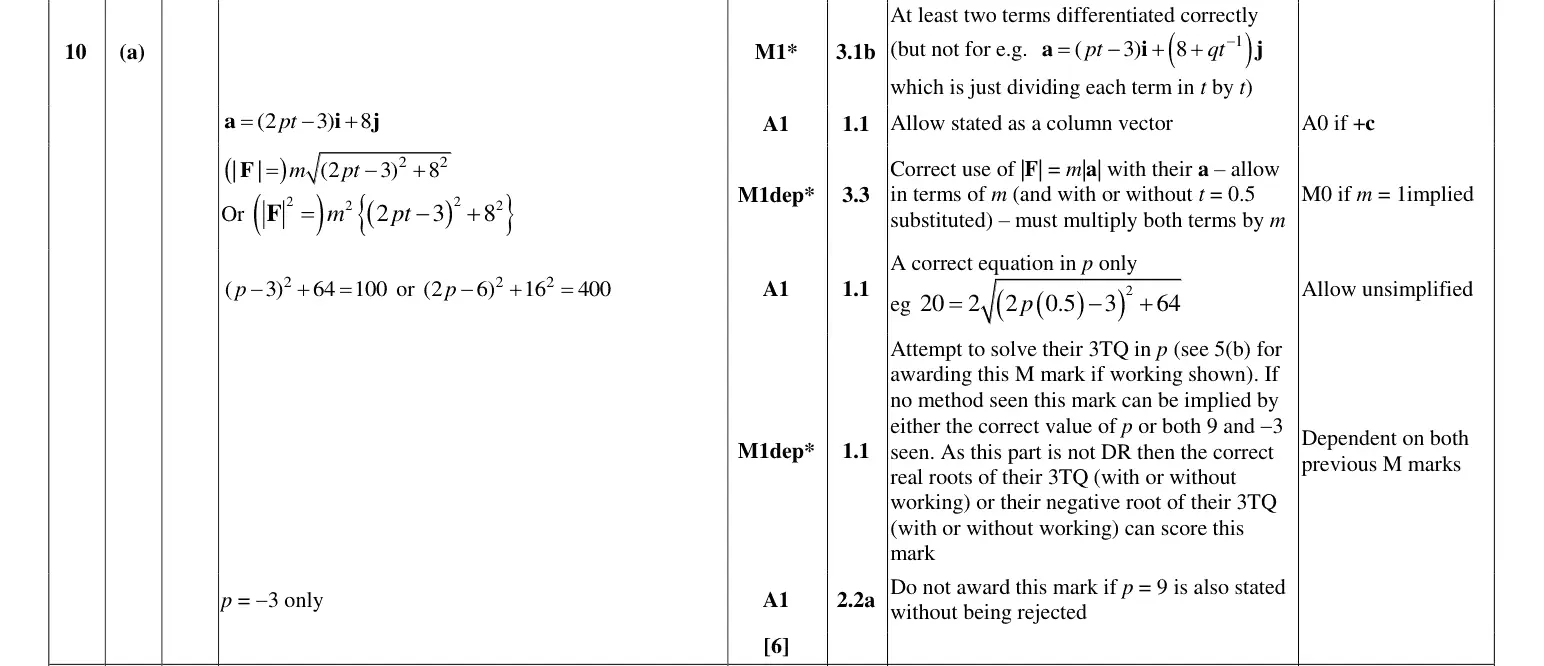
( ) Nearly all candidates correctly differentiated v and obtained a = 2 pt − 3 i + 8 j Unfortunately many . candidates then made careless slips in applying F = m a to obtain an equation in p only with the most common errors being forgetting the mass completely or only multiplying the i component by the value of m. Candidates are one again reminded to read the question carefully as while many had a correct equation in p e.g. ( p − 3 ) + 64 = 100 many solved and gave the positive root even though the question specifically said that p was negative. This response scored the first five marks. An almost perfect response let down by the fact that the candidate did not read the question carefully enough and assumed that the value of p could not be negative.
Key points and common errors
a = (2pt − 3)i + 8j
F = 2a with magnitude 20 at t = 0.5
(p − 3)² + 64 = 100
p = −3 only since p < 0
forgetting mass
June 2019 · Paper 3 · Q10(c)3 marksHard
Show the start of this question
Mark scheme for this part
Examiner's comment
This part discriminated well with many candidates making little progress apart from substituting t = 1 into their expression from part (b). Those candidates who realised that one way to find q was to equate a scalar multiple of their displacement vector (evaluated at t = 1) to 2 i − 8 j were usually successful in first finding the scalar multiple and hence the value of q.
Key points and common errors
t = 1: s = −½i + (1 + q)j
must be a scalar multiple of 2i − 8j
k = −4, q = 1
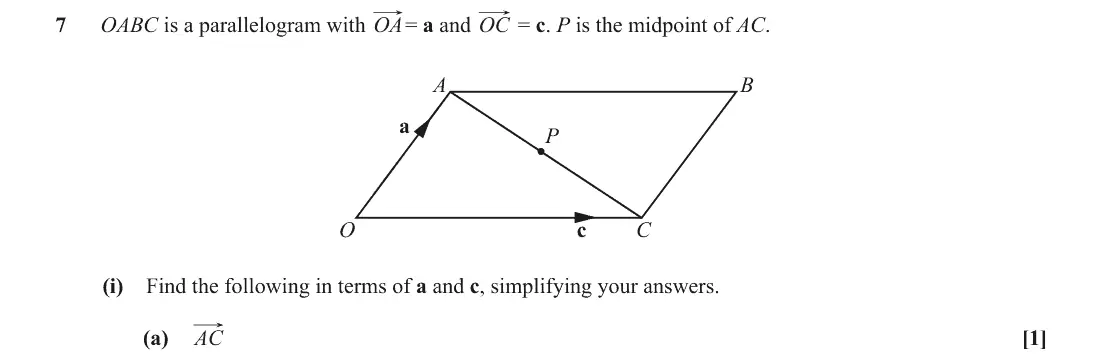
June 2018 · AS Paper 1 · Q7(i)(a)1 markEasy
Mark scheme for this part
Examiner's comment
(Comment on Question 07(i) as a whole) Almost all candidates answered this question correctly. 1 (c – a). Most answered this question correctly. A few made a sign error, for example c + 2
Key points and common errors
AC = c − a
correct vector notation
June 2018 · AS Paper 1 · Q7(i)(b)2 marksEasy
Show the start of this question
Mark scheme for this part
Examiner's comment
(Comment on Question 07(i) as a whole) Almost all candidates answered this question correctly. 1 (c – a). Most answered this question correctly. A few made a sign error, for example c + 2
Key points and common errors
OP = a + ½(c − a) = ½(a + c)
sign errors
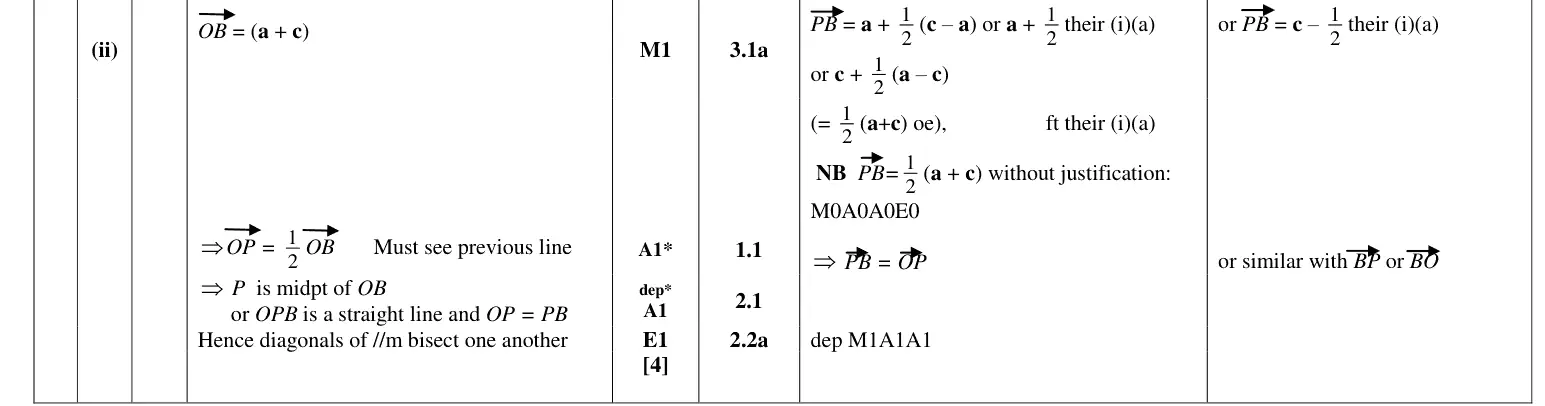
June 2018 · AS Paper 1 · Q7(ii)4 marksMedium
Show the start of this question
Mark scheme for this part
Examiner's comment
This question proved challenging for a significant majority of candidates. Many assumed the result by 1 (c + a), instead of deriving this result. Some candidates considered starting with, for example, PB = 2 the modulus of some vectors. Some candidates seemed unaware of the meaning of the word "bisect”, in some cases confusing it with "perpendicular". Thus many wrote that a + c is perpendicular to a – c, and that this somehow proves that the diagonals bisect one another. Perhaps the majority of candidates did not know how to start answering this question at all. An example of a candidate's solution that suggested they had no understanding of proof by vectors was as follows: "BO = AC. As they are the same length it means they would both meet in the centre, hence meaning they bisect one another."
Key points and common errors
OB = a + c so OP = ½OB
P is the midpoint of both diagonals
PB = ½(a + c) needs justification
June 2018 · Paper 2 · Q2(i)2 marksEasy
Mark scheme for this part
Examiner's comment
This question was very well answered. A few candidates made sign errors.
Key points and common errors
√((1 + 3)² + (−2 + 1)² + (5 − 2)²) = √26
sign errors
June 2018 · Paper 2 · Q2(ii)1 markMedium
Show the start of this question
Mark scheme for this part
Examiner's comment
A surprisingly large number of candidates simply halved their answer to part (i). Perhaps they did not understand the concept of a "position vector".
Key points and common errors
midpoint (−1, −1.5, 3.5)
many simply halved the length from (i)
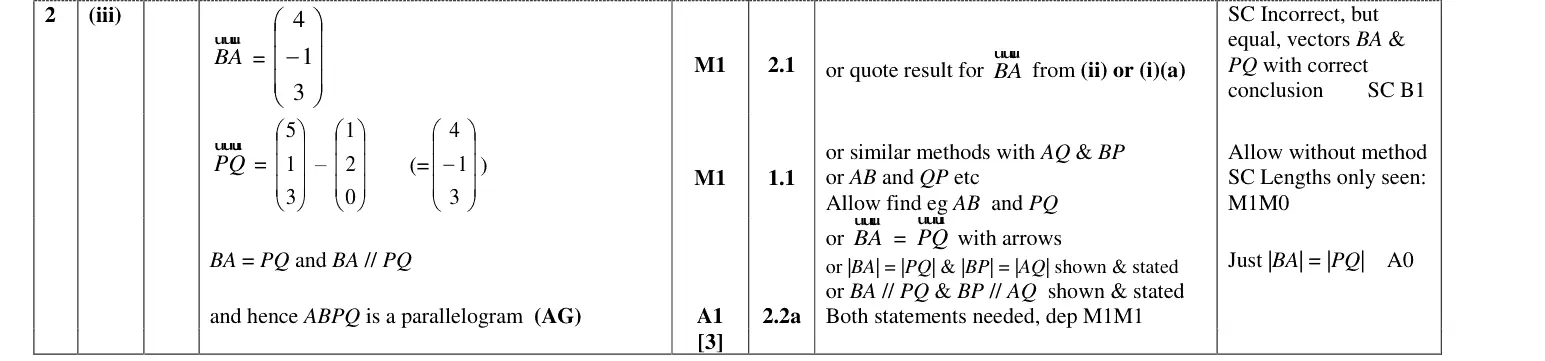
June 2018 · Paper 2 · Q2(iii)3 marksMedium
Show the start of this question
Mark scheme for this part
Examiner's comment
Only a minority of candidates answered this question in the most efficient way, using the vector forms of one pair of sides. Many found the vector forms of both pairs of sides. Then they commented either that both pairs consisted of two parallel lines, or they found the lengths of all four sides and commented that both pairs consisted of lines of equal length. Some candidates found the vector form for two opposite sides and then stated that because these two sides are parallel, ABPQ is a parallelogram. A few candidates made sign errors while finding vectors. Some did not use correct vector notation. Some candidates (quite reasonably) replaced the column vector notation by the i, j, k notation. Some candidates discussed the "gradients" of opposite sides.
Key points and common errors
BA = PQ = (4, −1, 3) so one pair of sides equal and parallel
showing only parallel sides, or only equal lengths, is not enough
vector notation
June 2018 · AS Paper 2 · Q94 marksHard
Mark scheme for this part
Examiner's comment
This question proved to be challenging for the majority of candidates. The need to find the magnitude of the acceleration was not well understood. For those who did use it, algebraic and numerical errors sometimes marred the solution. (±)10 = 2(3(2t – 5)i + 4j) was common, even when the correct methods then followed, but in many cases equations like 10 = 12t – 30 were used. A number of candidates ignored the mass and F = a pursued.
Key points and common errors
F = ma with magnitude: 2√(9(2T − 5)² + 16) = 10 gives 2T − 5 = ±1 so T = 2 or 3
magnitude of acceleration was often ignored
F = a ignoring mass
Find an A-level maths tutor
Stuck on this? Book a trial session with an A-level maths tutor.