53 question parts, 206 marks, each rated Easy, Medium or Hard from the wording of the examiners' report
Notes, worked examples and practice for this topic are being written by our tutors. The past-paper questions below are ready now: work each one on paper, then open the mark scheme and the examiner's comment.
Tap a question to zoom it. Mark scheme and examiner's comment open under each question.
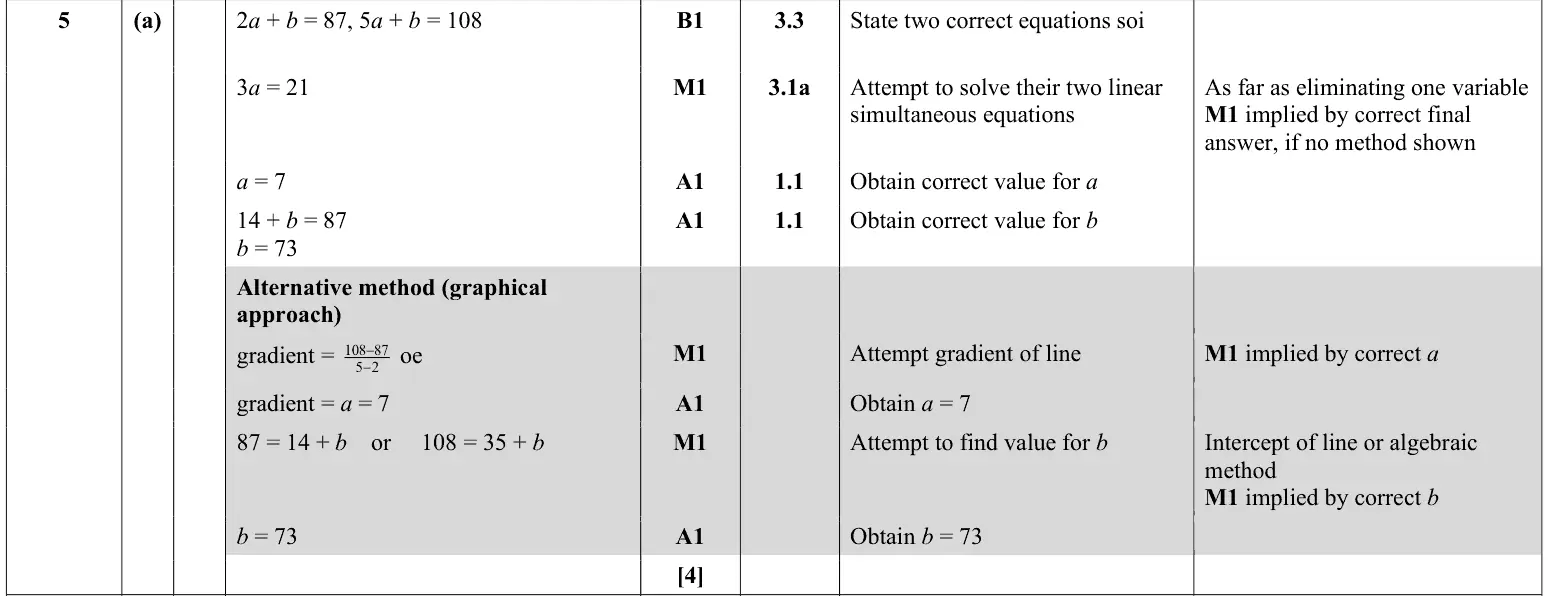
June 2025 · Paper 1 · Q5(a)4 marksEasy
Mark scheme for this part
Examiner's comment
This question was exceptionally well answered, with candidates being able to accurately set up and solve two simultaneous equations based on the given model.
Key points and common errors
2a + b = 87, 5a + b = 108
a = 7, b = 73
June 2025 · Paper 1 · Q5(b)(i)2 marksEasy
Show the start of this question
Mark scheme for this part
Examiner's comment
Candidates were then able to use their model to predict Sam’s height, with lack of units being condoned.
Key points and common errors
h = 7 × 4 + 73 = 101 cm
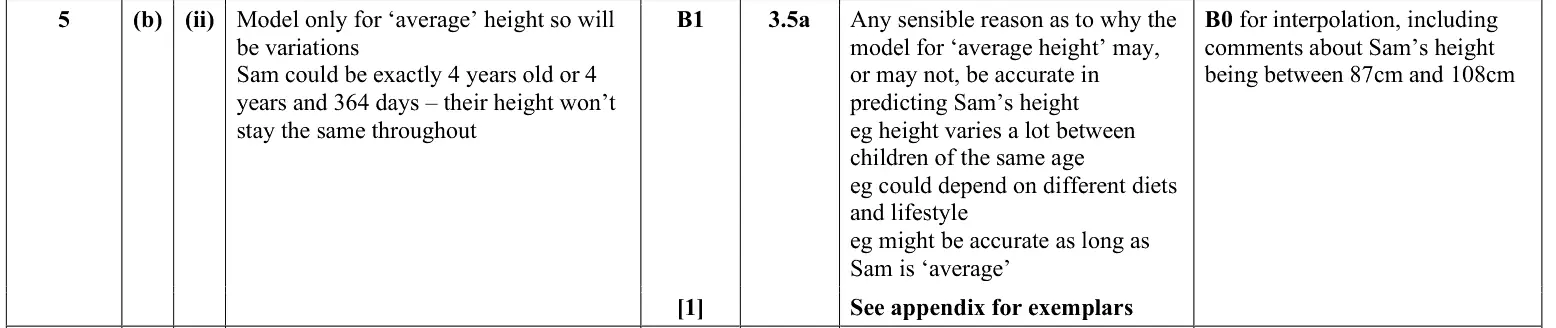
June 2025 · Paper 1 · Q5(b)(ii)1 markMedium
Show the start of this question
Mark scheme for this part
Examiner's comment
Candidates were expected to suggest a reason as to why this model for average height may not be accurate when predicting the height of an individual. Explanations that gained credit included reference to Sam not necessarily being of average height, with various reasons given, or identifying that having an age of 4 ignores the number of days since their 4th birthday and height will not remain the same until their 5th birthday. The most common error was to focus on interpolation being accurate as opposed to the potential issues with using an ‘average’ model to predict a single height. As with all of the explanation questions on this paper, the handwriting of some candidates made it difficult to discern their intent.
Key points and common errors
model is for average height, individuals vary
age 4 covers a whole year
comments on interpolation gain nothing
June 2025 · Paper 1 · Q5(c)1 markMedium
Show the start of this question
Mark scheme for this part
Examiner's comment
While the previous question focused on using the given model to predict the height of an individual, this question was expecting candidates to consider why the given linear model may no longer be appropriate. The better explanations identified that increase in average height was unlikely to continue (due to puberty) or that extrapolation from the last recorded data of a 5 year old would be unreliable. Some candidates did not appreciate that it was the general model for average height that could possibly be limited and instead referred to a single child not fitting the model due to circumstances, which was not allowed.
Key points and common errors
growth unlikely to stay linear (puberty spurt)
extrapolation
comments on individual children gain nothing
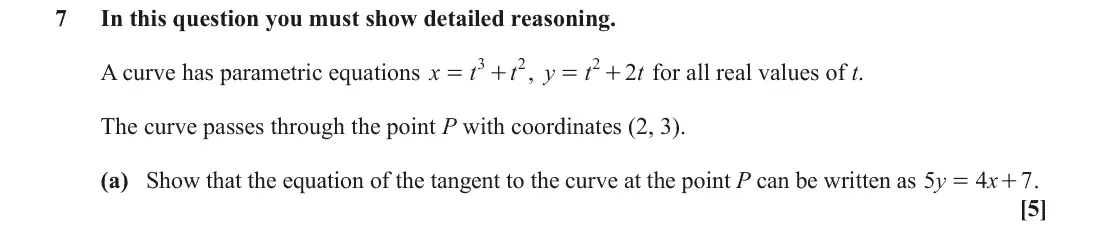
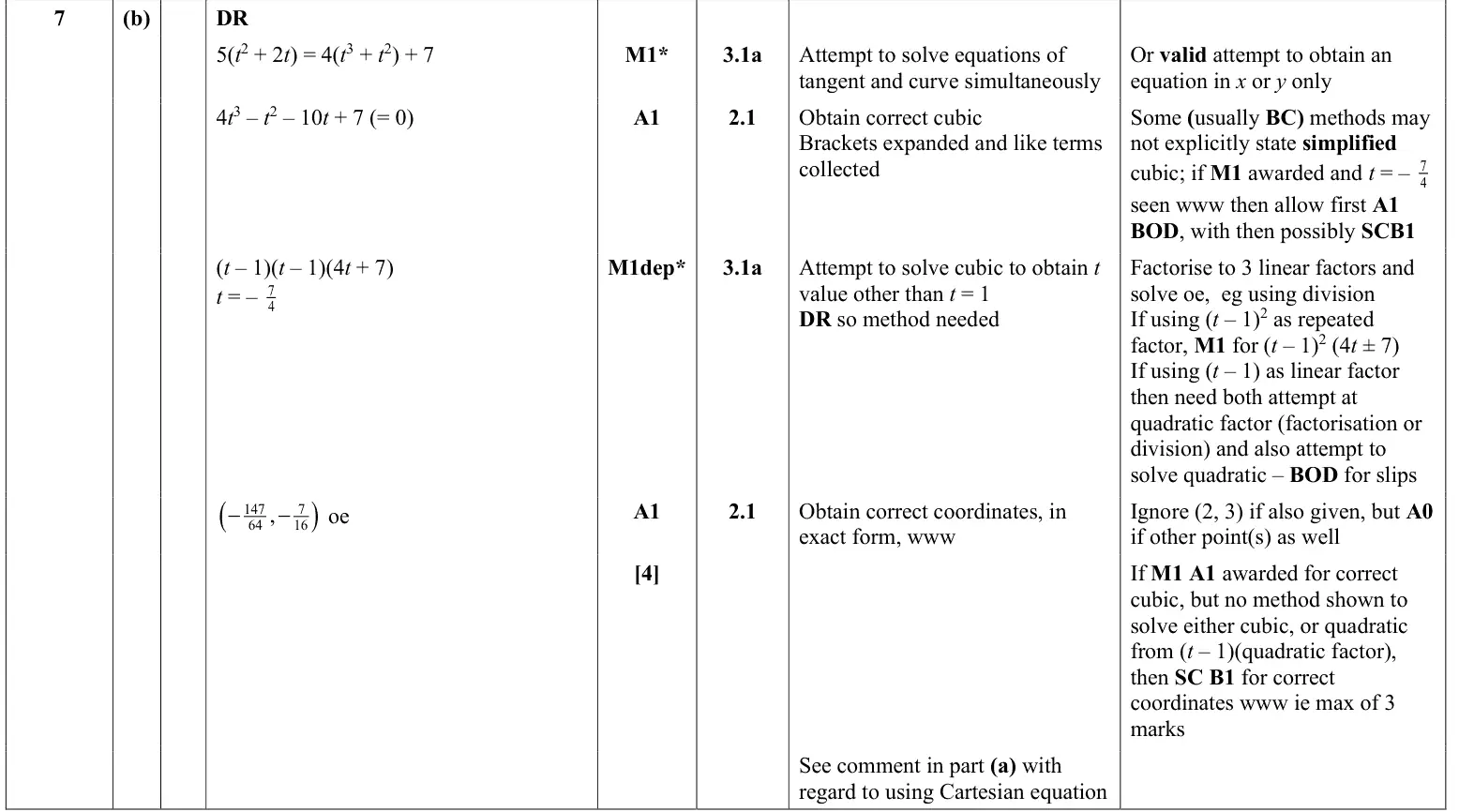
June 2025 · Paper 1 · Q7(b)4 marksMedium
Show the start of this question
Mark scheme for this part
Examiner's comment
It was expected that candidates would attempt to solve the equations of the tangent and the curve simultaneously to obtain an equation in t only, and many were able to do so. It was then expected that candidates would recognise that the tangent should have a repeated root at t = 1, and use this to solve the cubic equation to find the other t-value. Candidates should appreciate that method needs to be shown, as the command word used was ‘determine’ along with a ‘detailed reasoning’ instruction for the entire question. Many candidates were indeed able to show a convincing method, through repeated division by (t – 1), inspection or an equivalent method, all of which tended to be effective. A number of candidates seemingly solved the cubic equation on their calculator instead. Some candidates simply stated the t-values whereas others did try to work backwards to produce the required factors but this was rarely successful due to the calculator not identifying a repeated root. Having found the other t-value, through whatever method used, candidates were then usually able to give the correct coordinates in an exact form although a few did instead give a rounded decimal value. A surprisingly common error was to equate the gradient of the curve, in terms of t, to the gradient of the tangent i.e. attempting to find other points on the curve that would have tangents parallel to the one already found. A minority of candidates attempted to first find a Cartesian equation for the curve, either in this part of the question or continuing with an equation attempted in part (a). This was rarely successful, and candidates should consider the most effective and efficient method when attempting a question. While some previous questions on parametric equations may have requested the Cartesian equation, this is usually the final part of the question as opposed to the starting point.
Key points and common errors
substitute parametric x, y into tangent: 4t³ − t² − 10t + 7 = 0
(t − 1) is a repeated factor
t = −7/4 gives (−147/64, −7/16)
method must be shown
June 2025 · AS Paper 1 · Q88 marksEasy
Mark scheme for this part
Examiner's comment
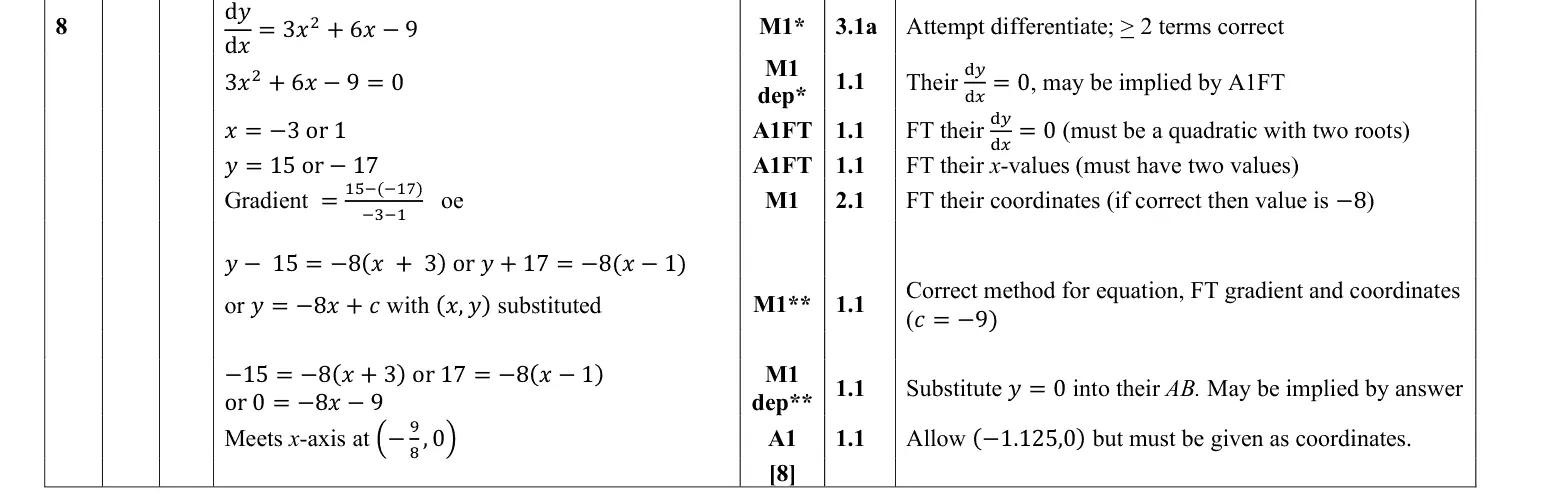
This question was generally very well answered. Almost all candidates were able to differentiate, set =0 and solve to obtain two values of x for M1M1A1. Some candidates made a numerical error in finding the corresponding values of y, but were still able to go on obtaining the subsequent method marks. Most candidates identified the need to find the gradient, equation and then set 𝑦= 0 although some instead solved for 𝑥= 0, etc. A few candidates stopped after the first four marks. Notice that (in contrast with Question 1 (b) as there is no DR instruction here, candidates were not required to show the working to solve their quadratic d𝑦 d𝑥= 0 but it remains best practice to do so. The question asked for the ‘coordinates of the point’ so 𝑥= − 8 was not sufficient as a final answer. This was a common omission and led to candidates receiving 7/8. This candidate has made a good start, scoring M1M1A1 for their differentiation and correct values of x for the turning points. They then make an error in finding one of the corresponding values of y (A0) but go on to work correctly with their values, scoring M1M1M1. The final answer is incorrect (A0) so this response scored 6/8.
Key points and common errors
dy/dx = 3x² + 6x − 9 = 0: A(−3, 15), B(1, −17)
gradient −8
y = −8x − 9 meets the x-axis at (−9/8, 0)
give coordinates, not just x
June 2025 · AS Paper 2 · Q13 marksEasy
Mark scheme for this part
Examiner's comment
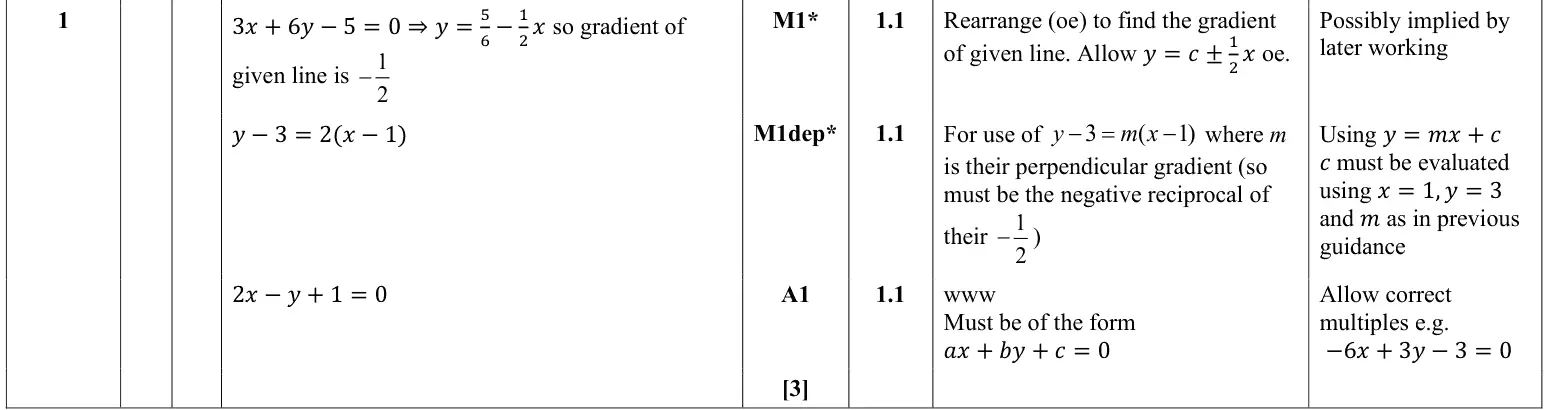
This question was done well, with many candidates knowing how to find the required gradient and its perpendicular. Both y – y1 = m(x – x1) and y = mx + c were used accurately to find the line. The most common error in good attempts was to leave the final answer as y = 2x + 1. A candidates scored less well as they took the initial gradient to be 3 or -3.
Key points and common errors
given line has gradient −1/2 so perpendicular gradient 2
y − 3 = 2(x − 1)
answer 2x − y + 1 = 0 in the required form, not y = 2x + 1
June 2025 · AS Paper 2 · Q24 marksMedium
Mark scheme for this part
Examiner's comment
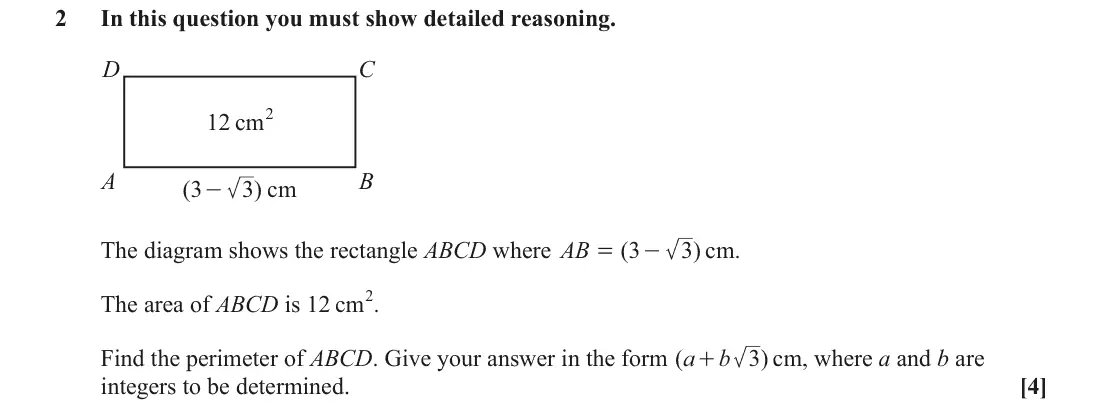
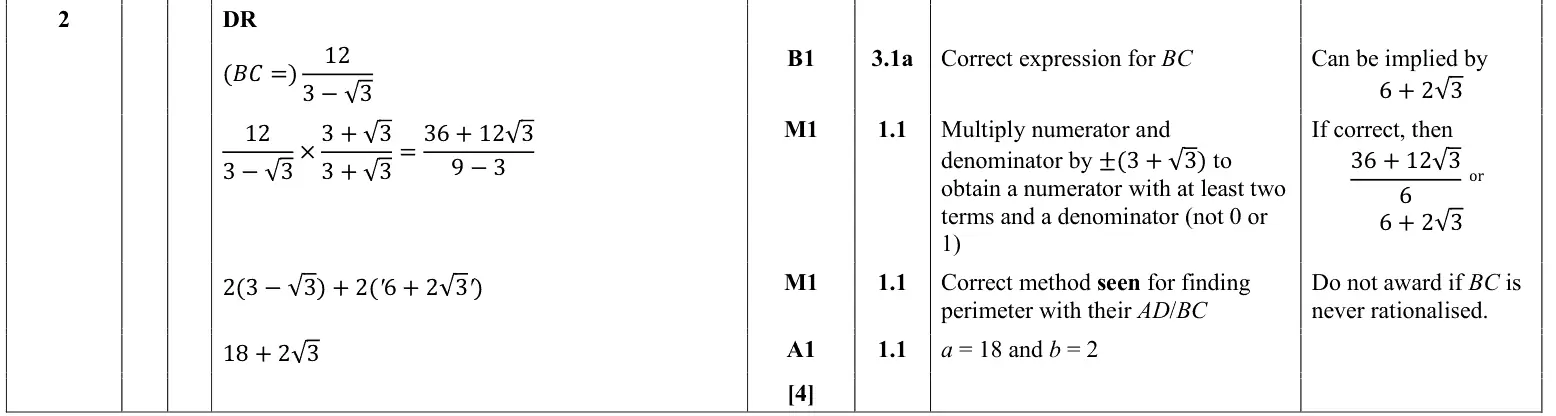
This was the first of the three DR questions, so candidates need to be aware that sufficient working and explanation of methods is required. This means they need to consider calculator use carefully – calculators can be used to check or support working but candidates should consider writing down calculations for each step. Exemplar 1 and its commentary illustrate a common deficiency. The methods needed here were well understood, with many solutions obtaining 18 + 2√3. A few candidates had responses that went no further than the value for BC , seemingly forgetting to find the perimeter. Use of 122 for the area was seen. This solution, seen quite frequently, scored B1 M0 M1 A0 only. DR requires, to quote the Specification, a solution which leads to a conclusion showing a detailed analytical method.’ Here we wanted to see the working for the rationalisation of the denominator, refer the mark scheme for details, and it is not given here. 6 + 2√3 comes from the calculator. Hence M0 and A0.
Key points and common errors
BC = 12/(3 − √3)
rationalise: 6 + 2√3
perimeter 2(3 − √3) + 2(6 + 2√3) = 18 + 2√3
calculator steps must be written out
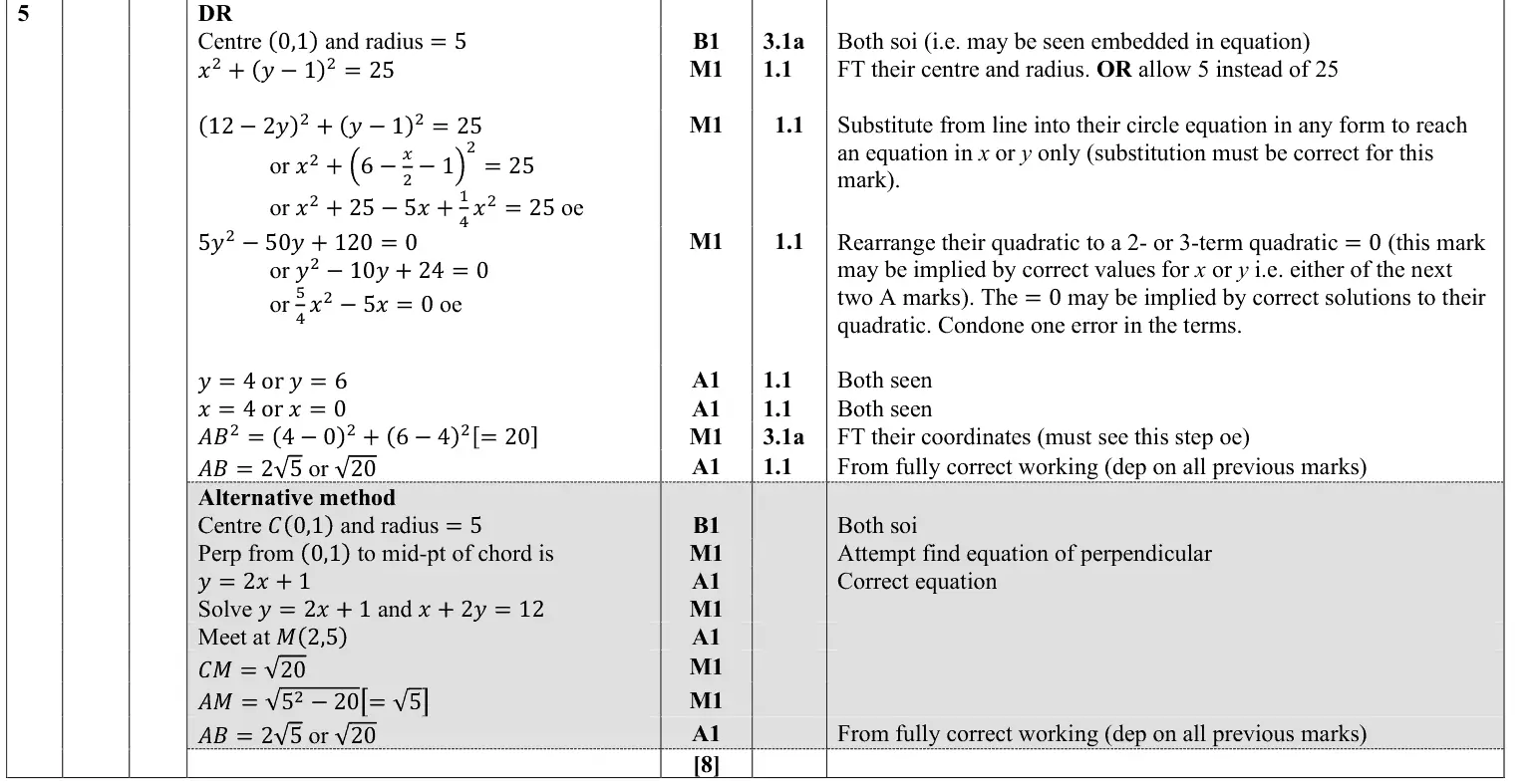
June 2025 · Paper 2 · Q58 marksEasy
Mark scheme for this part
Examiner's comment
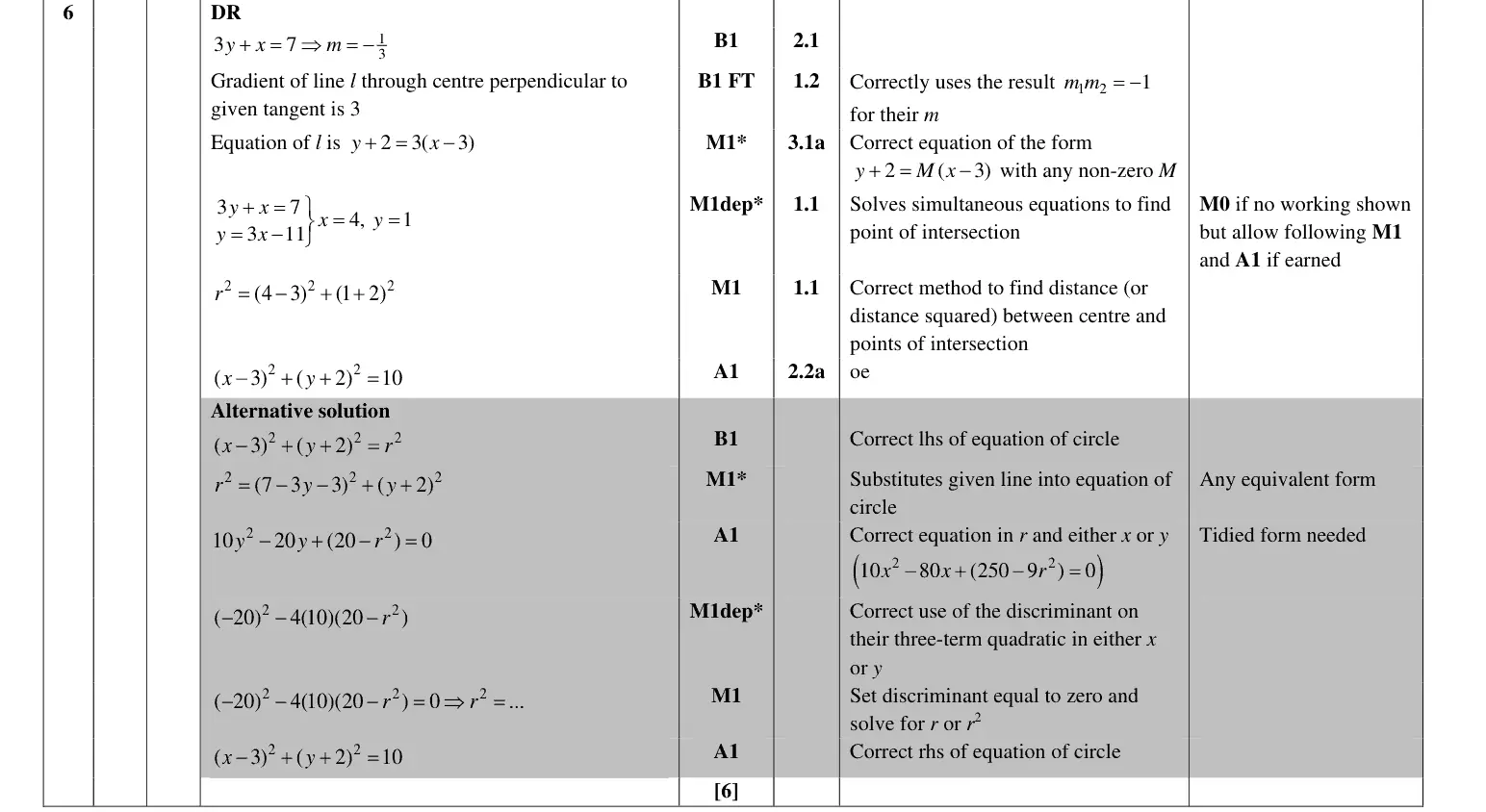
This problem-solving question was well answered by most candidates, with many fully correct responses seen. Candidates first needed to deduce the centre and radius of the circle from the given information to score B1 (which was generally done well, although some candidates wrote down 10 and misinterpreted this as the radius rather than the diameter). The next step was to write down a cartesian equation for the circle for M1 (the most common error here was forgetting to square the radius), and solve this simultaneously with the line equation by substitution for x or y. Most candidates proceeded well to obtain a quadratic in x or y and solve this to find the coordinates of the two points of intersection, although quite a few incorrectly factorised the quadratic. Most candidates who obtained two points correctly used coordinate geometry to calculate the distance between them. Most candidates heeded the DR instruction and showed an appropriate amount of working in this question. The alternative method shown in the scheme was only occasionally seen. This candidate has identified the correct parameters for the circle and setup the equation correctly, substituting appropriately to reduce to a 3-term quadratic in y only (scoring B1M1M1M1). However, they obtain a quadratic with a sign error (the scheme allowed ‘one error in the terms’ for the method mark) so do not find the correct coordinates of the points of intersection (A0A0). They go on to compute the distance between these (M1) but do not obtain the correct final answer because of their earlier error (A0). This is a good example of a candidate who has shown their method in full (as required by DR) and scores the majority of the marks in this question despite making an error.
Key points and common errors
centre (0, 1), radius 5 (not 10)
substitute line into x² + (y − 1)² = 25
A(4, 4) and B(0, 6)
AB = 2√5
errors forgetting to square radius, factorising
June 2025 · Paper 3 · Q1(c)1 markHard
Show the start of this question
Mark scheme for this part
Examiner's comment
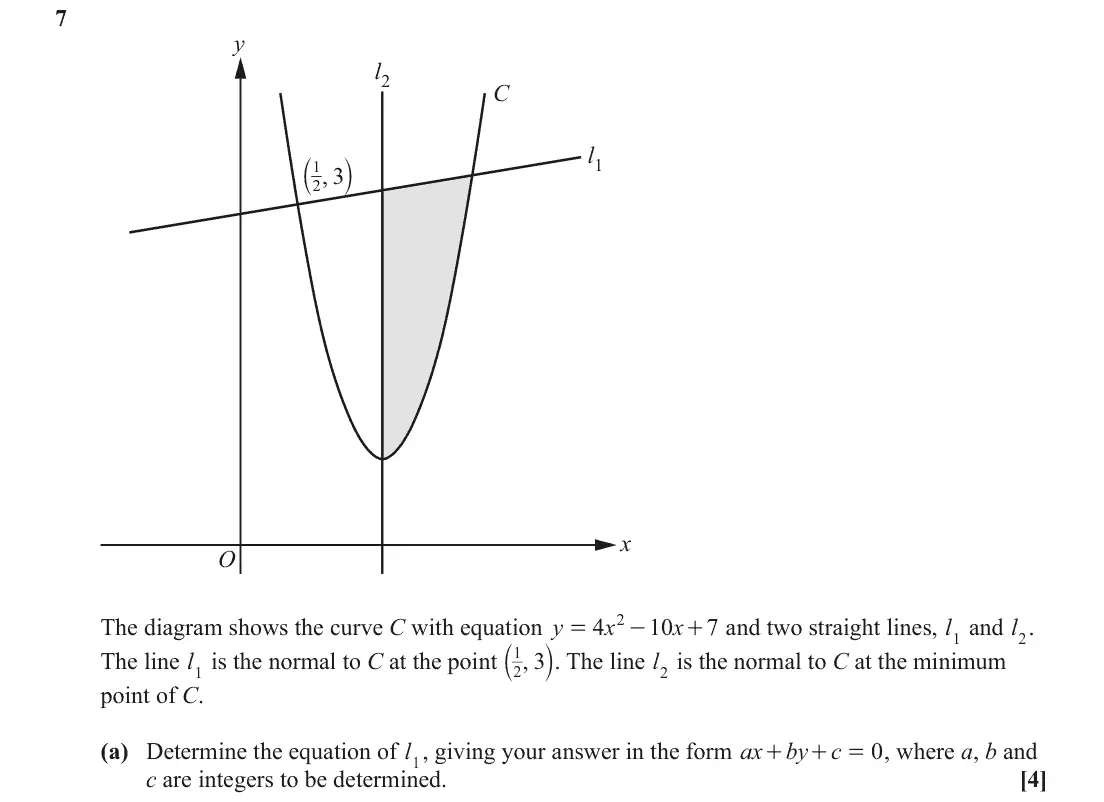
Many candidates struggled to realise that the equation of the normal to the curve at its minimum point was equivalent to asking for the equation of the line of symmetry. Many candidates unsuccessfully attempted to use the result 𝑦−𝑦1 = − f′(𝑥1) (𝑥−𝑥1) to find this equation (even though the command was to ‘state’ and there only being 1 mark available). The most common incorrect answer seen by examiners was 𝑦= 5 (which was the equation of the tangent to the curve at its minimum point).
Key points and common errors
the normal at the minimum point is vertical: x = 2 (the line of symmetry)
must be an equation
the formula y − y₁ = −(x − x₁)/f′(x₁) fails here
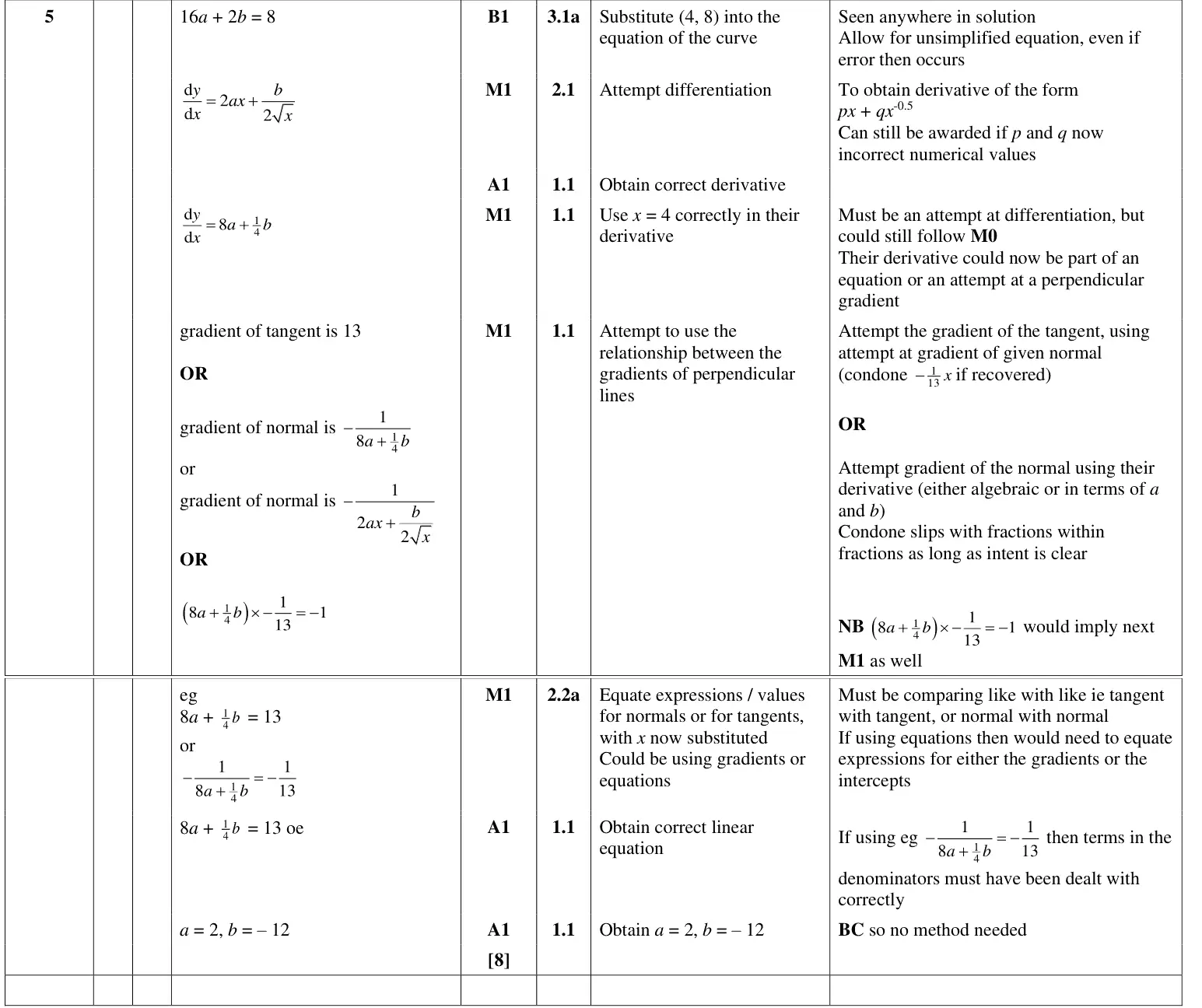
June 2024 · Paper 1 · Q58 marksEasy
Mark scheme for this part
Examiner's comment
This longer unstructured question was generally well attempted. Quite a few neat, elegant and completely correct solutions were seen. Some unnecessary work was also seen, with quite a few candidates obtaining the equation of the tangent with some trying to solve that with the given equation. Only a very small number of candidates did not realise differentiation was involved. When the differentiation was attempted, it was invariably correct with the fractional powers well handled. Those candidates who substituted x = 4 into their algebraic expression for the gradient of the tangent, were more likely to score full marks compared to those who went on to form an algebraic expression for the gradient of the normal. Most candidates were able to find the numerical value for the gradient of the tangent from the equation of the normal, although not everyone was able to use this information to produce a correct equation in a and b only. A few candidates confused the gradients of the tangent and normal. Some candidates often omitted substituting (4,8) into the equation of the curve, failing to produce a second independent equations in a and b. Solving these two equations simultaneously could be completed by using a calculator for the final mark. This is a good solution to Question 5 with efficient and clear working.
Key points and common errors
(4, 8) on curve: 16a + 2b = 8
dy/dx = 2ax + b/(2√x) = 8a + b/4 at x = 4
normal gradient −1/13 so tangent gradient 13
a = 2, b = −12
finding the tangent equation is unnecessary
June 2024 · Paper 1 · Q7(a)2 marksEasy
Mark scheme for this part
Examiner's comment
Most candidates successfully found the values h = 2.5, either by finding the increase in y divided by the increase in x and setting it equal to 2, or by calculating the equation of the line through A with gradient 2 and then putting x = h, y = 10 into this. Most common errors were either inverting the expression for the gradient or inconsistent order for the x and y-values in the gradient formula.
Key points and common errors
(10 − 7)/(h − 1) = 2 so h = 5/2
errors: inverted gradient, inconsistent order
June 2024 · Paper 1 · Q7(b)2 marksEasy
Show the start of this question
Mark scheme for this part
Examiner's comment
Most candidates were able to calculate the coordinates of C. If necessary, follow through marks were available for their value for h. A common mistake was thinking that C was the midpoint of AB, instead of B being the midpoint of AC. A few candidates gave their answer as a column vector rather than using coordinates, as asked for.
Key points and common errors
B is the midpoint of AC so C = (2h − 1, 13) = (4, 13)
error: C as the midpoint of AB
give coordinates, not a vector
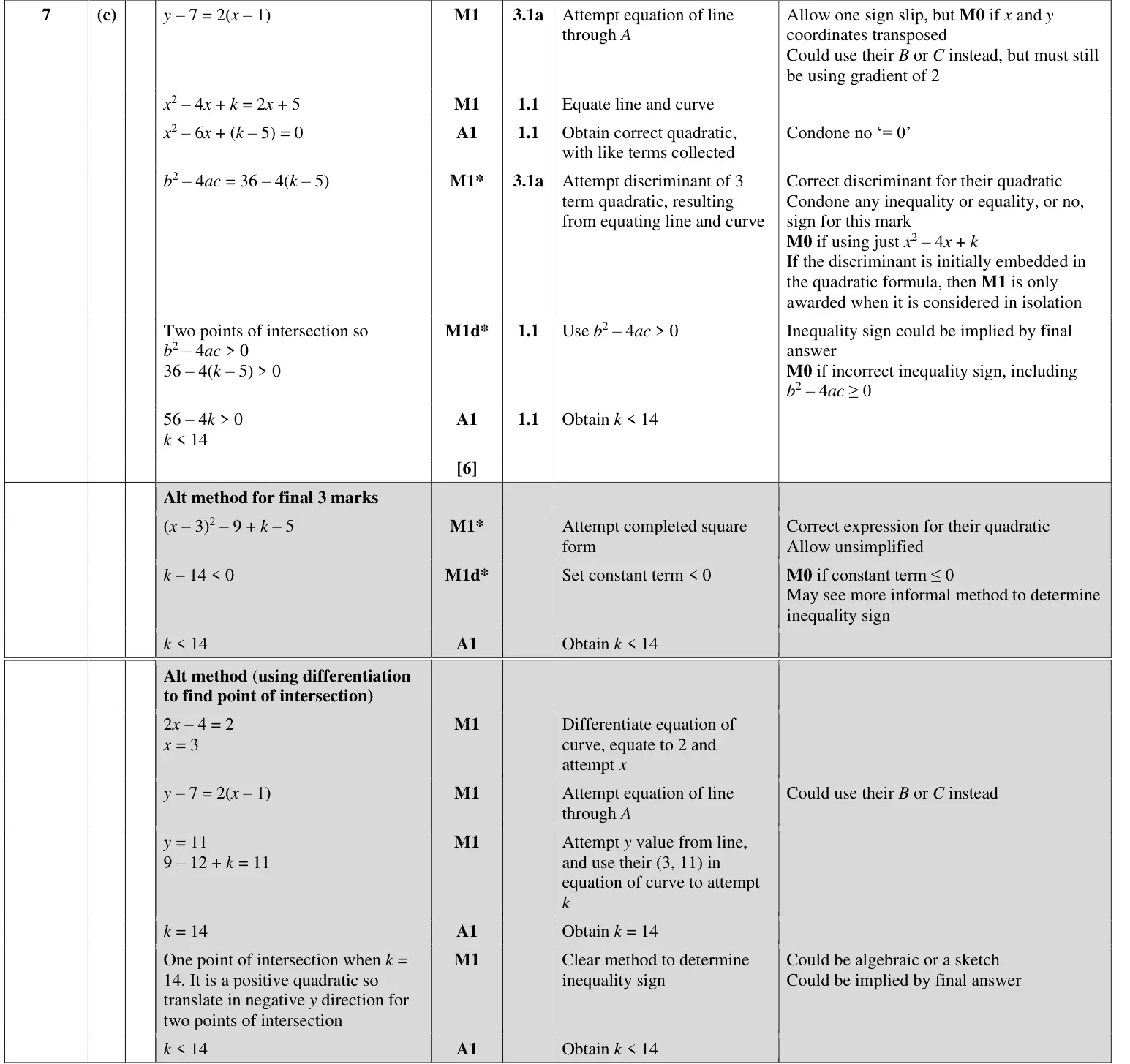
June 2024 · Paper 1 · Q7(c)6 marksEasy
Show the start of this question
Mark scheme for this part
Examiner's comment
Most candidates found the equation of the line and equated it to the curve to get a quadratic equation in x for the points of intersection. The majority then used the discriminant property to get an inequality for k, although some lost a minus sign in calculating the discriminant or in dealing with the inequality while others made slips in expanding brackets. A few candidates used ‘completing the square’ to find the values of k for which the quadratic had two roots.
Key points and common errors
line y = 2x + 5
x² − 6x + (k − 5) = 0
b² − 4ac = 36 − 4(k − 5) > 0
k < 14
sign errors in discriminant
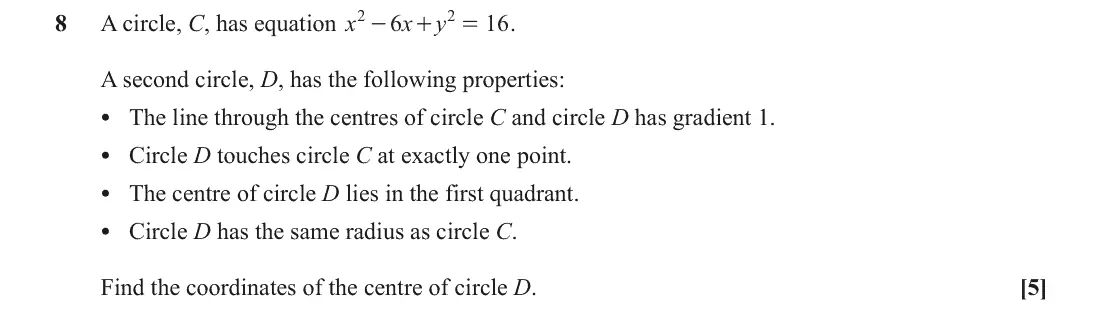
June 2024 · AS Paper 1 · Q85 marksMedium
Mark scheme for this part
Examiner's comment
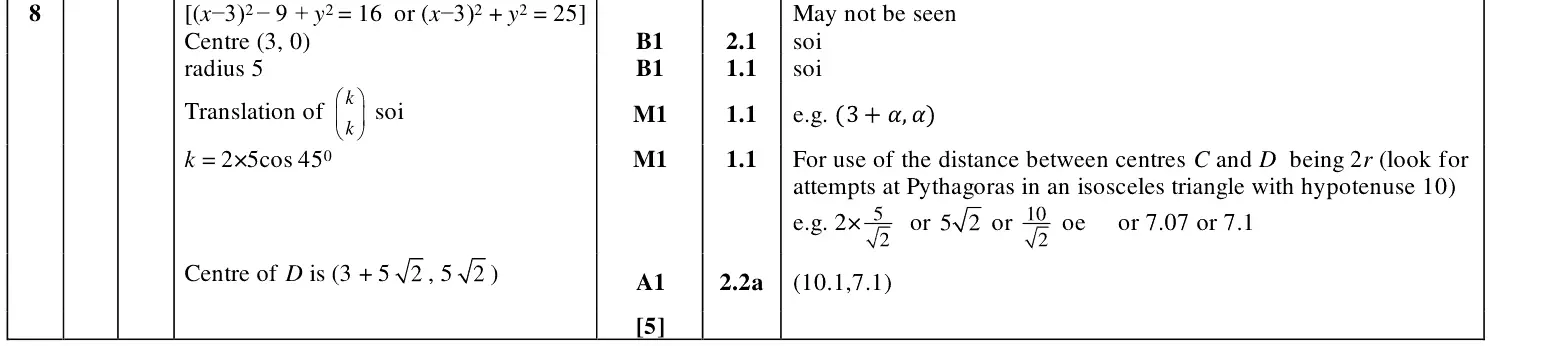
Most candidates successfully completed the square to correctly obtain the centre and radius of circle C (although a number did not do so in full and assumed that the radius was 4). Many candidates correctly interpreted the ‘gradient 1’ statement and deduced an equation of the line between the two centres, although often did not progress this into the deduction about the difference in the coordinates of the centre of D being 3. Fewer candidates used the other information to deduce that the distance between the two centres was 2r (=10), but those who did were then able to apply Pythagoras, or trigonometry, to compute the x- and y- change.
Key points and common errors
complete the square: centre (3, 0), radius 5 (not 4)
centres lie on a line of gradient 1 and are 2r = 10 apart
translation (k, k) with k = 5√2
centre D (3 + 5√2, 5√2)
June 2024 · AS Paper 2 · Q8(a)1 markEasy
Mark scheme for this part
Examiner's comment
This was well done. A column vector gained B0, unless there was enough other working worthy of the B1.
Key points and common errors
midpoint (5, (8 + p)/2)
June 2024 · AS Paper 2 · Q8(b)1 markEasy
Show the start of this question
Mark scheme for this part
Examiner's comment
Many correct answers appeared. m = Δx/Δy was used by some.
Key points and common errors
gradient (p − 8)/2
June 2024 · AS Paper 2 · Q8(c)5 marksHard
Show the start of this question
Mark scheme for this part
Examiner's comment
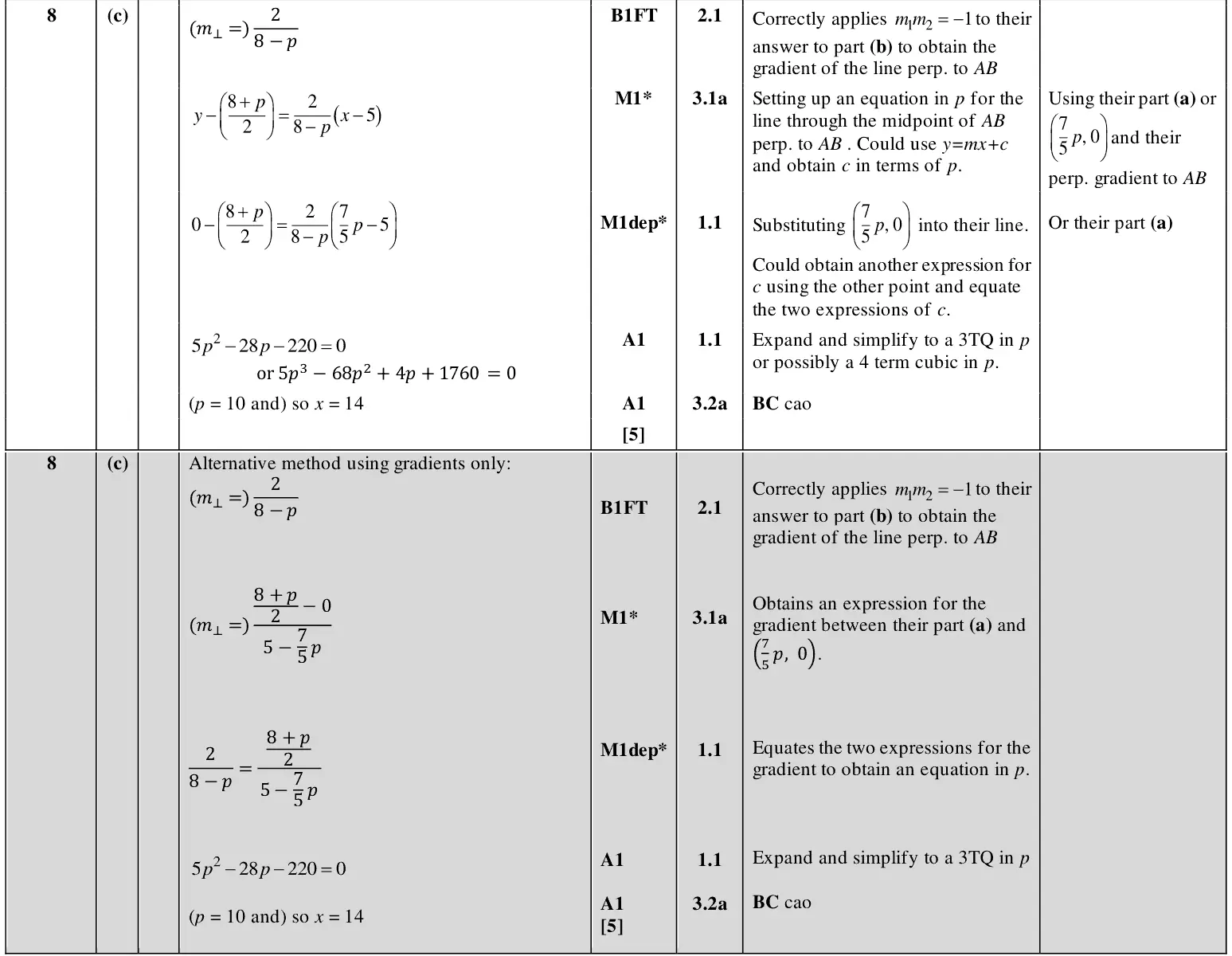
This part proved very challenging, perhaps because of the algebra involved. Very few fully correct answers were seen. The B1FT was often given, although some candidates missed it because the signs were changed on both the numerator and denominator of the reciprocal. The M1 for an attempt at the equation of the perpendicular bisector was also often given, but what to do next seemed to prove elusive to many. The alternative method using gradients only was rarely seen. This exemplar earns the initial B1FT M1, as did many. Following that, the candidate finds the equation of the line AB and tries to solve this simultaneously with the equation of the perpendicular bisector. This ineffective continuation appeared on several occasions.
Key points and common errors
perpendicular gradient 2/(8 − p)
line through the midpoint
substitute (7p/5, 0): 5p² − 28p − 220 = 0 so p = 10
x = 14
June 2023 · AS Paper 1 · Q2(c)2 marksHard
Show the start of this question
Mark scheme for this part
Examiner's comment
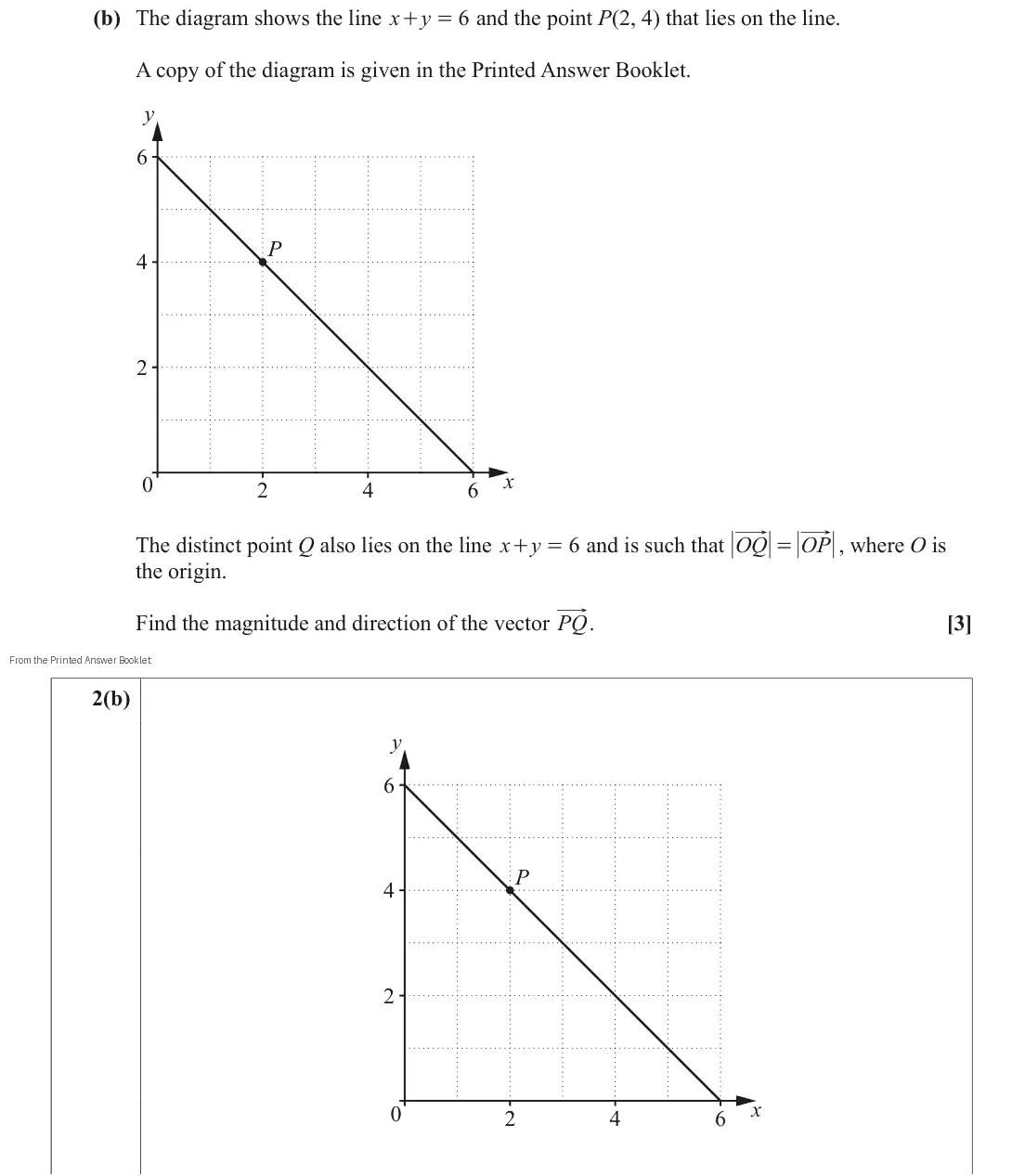
Many candidates omitted this part, and relatively few candidates achieved one or both marks (including those who had obtained full or nearly full marks across parts (a) and (b)). Many appeared to not have understood the request in the question and computed some related vectors or magnitudes without reaching the required vectors for R. Again use of the diagram appeared to correlate with success. The command words ‘Write down’ indicates that very little algebraic working was required. Those candidates who found the gradient of OP (i.e. 2) and then the corresponding perpendicular gradient (i.e. -0.5) and drew a line of this gradient through P were most likely to produce the correct answers. Those who tried to rely on algebra and use the distance formula would often get stuck by not realising they needed to substitute the equation of the line through P (y = -0.5x + 5) to get their final answers. Some candidates did not give their responses in the required form (position vectors) and gave the co- ordinates of R instead.
Key points and common errors
PR perpendicular to OP = (2, 4) with half its length: R = (4, 3) or (0, 5) as position vectors
many omitted
relatively few scored
June 2023 · Paper 2 · Q4(b)3 marksHard
Show the start of this question
Mark scheme for this part
Examiner's comment
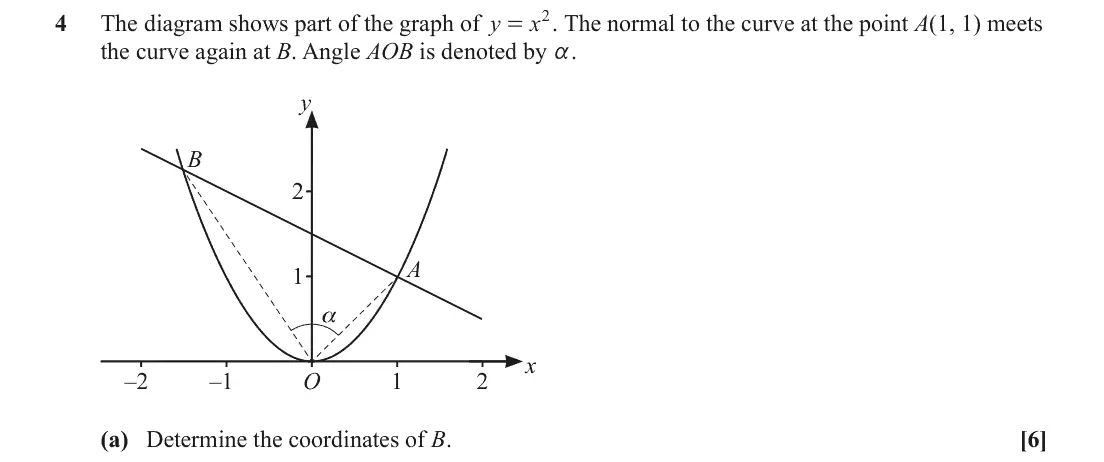
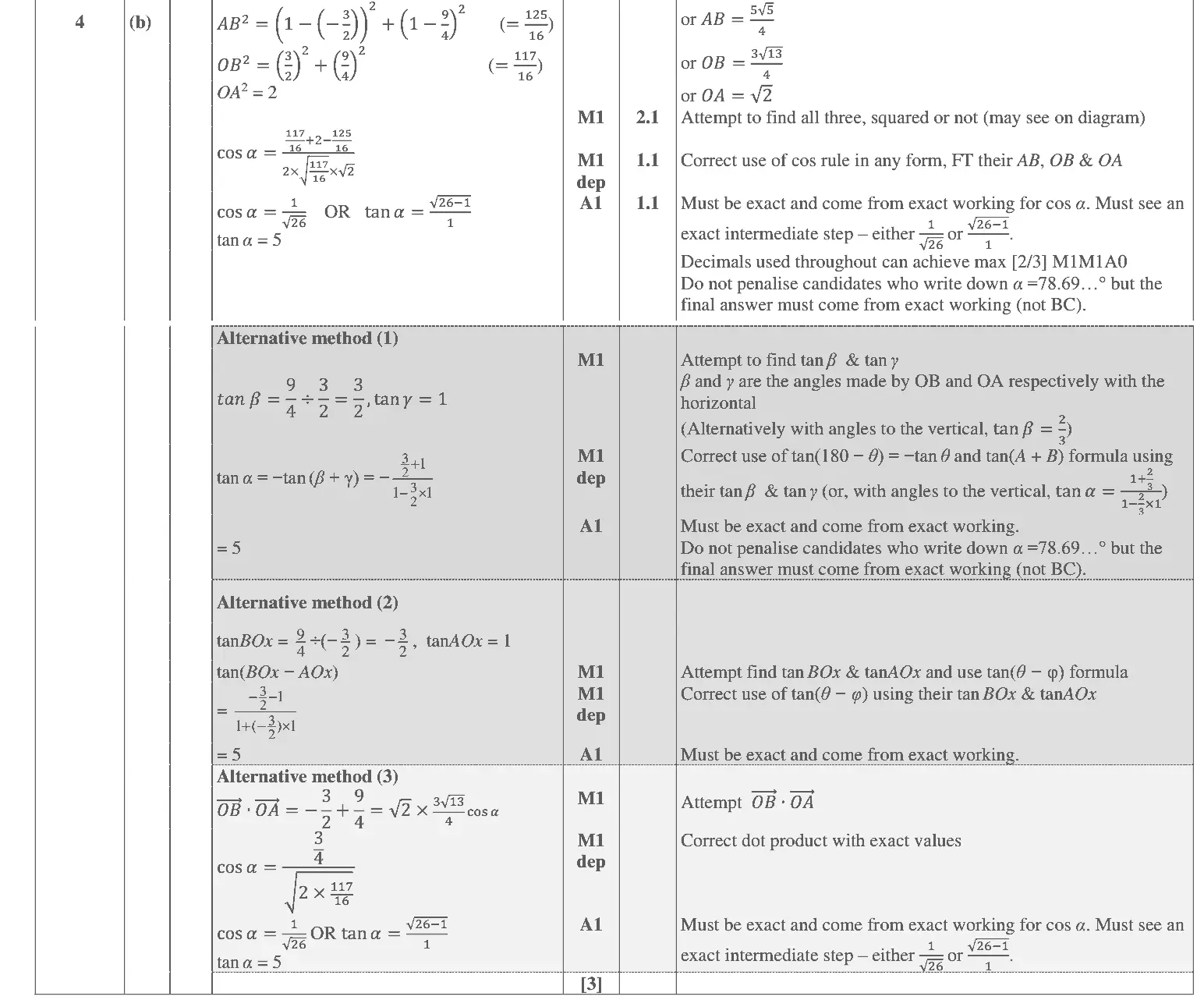
This challenging question was not well answered. Many candidates either used their calculator (to compute inverse tan, add the angles together and then ‘re-tan’) which was not appropriate for ‘Determine’ as they then provided inexact working which did not lead to tan α = 5 exactly. Alternatively, a number of candidates misinterpreted the angle and assumed that BAO=90°, when it isn’t (the line is normal to the curve, not the line OA). The main method in the scheme, using the cosine rule, was most common, although many candidates made a slip in computing one of the lengths. A small number of candidates used the (more direct) method given in the scheme as Alt 1, but on both methods candidates sought shortcuts without showing exact working, which meant they could not be credited. As in Question 3, the ‘exact’ instruction in the question is critical here. An inexact answer that rounds to 5 was not sufficient, exact working that leads to an exact answer was required. However, this is a good example of a question where some candidates made good use of their calculator to check their solution (having found it using exact working) by computing α = 78.69…° This candidate (who obtained full marks) is an example of sufficient exact working being shown, together with the (calculator-obtained) value that has been used to verify their solution. Although included in the flow of the working here, the computation of α does not undermine their correct, exact, working for cos α.
Key points and common errors
find OA, OB, AB and use the cosine rule (or tan(A ± B))
cos α = 1/√26 so tan α = 5 exactly
calculator angles not exact
BAO is not 90°
June 2023 · AS Paper 2 · Q6(a)2 marksEasy
Mark scheme for this part
Examiner's comment
This was done well by most candidates. A few lost the answer mark through careless labelling, e.g. AB = 65. Exact values were expected, so working with decimals only also lost the answer mark.
Key points and common errors
AB = BC = √65 exactly
careless labelling or decimals lose the mark
June 2023 · AS Paper 2 · Q6(b)2 marksEasy
Mark scheme for this part
Examiner's comment
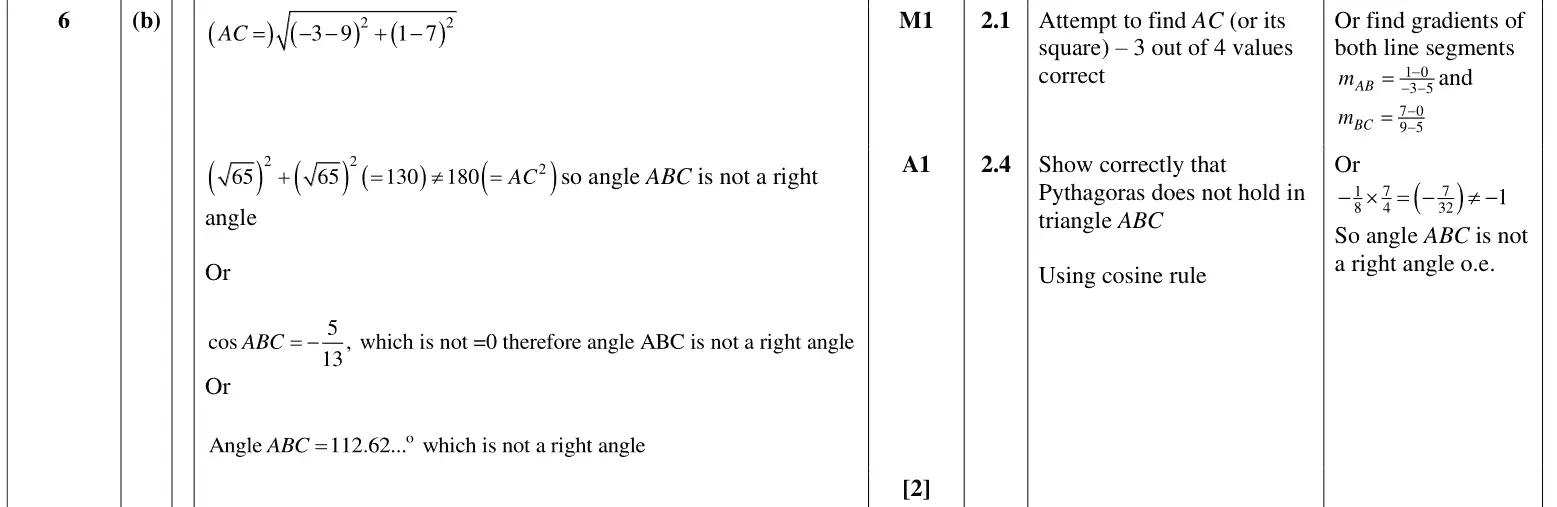
This was also well done, but as a ‘Show that…’ question we did expect candidates’ calculations to be involved in the conclusion, for whichever method they chose.
There were many correct responses here. The most common incorrect response was (6, 3).
Key points and common errors
midpoint of AC is (3, 4)
(6, 3) is a common error
June 2023 · AS Paper 2 · Q6(d)2 marksMedium
Show the start of this question
Mark scheme for this part
Examiner's comment
Those candidates who understood that the line BM was expected often gained full marks, although some candidates did not give their response in the requested form. Some thought the line AC was needed. Most attempts started by finding a gradient and then using it with one point in either y = mx + c or y – y1 = m(x – x1). Using m = Δx/Δy was given M0.
Key points and common errors
line of symmetry is BM through B(5, 0) and M(3, 4): 2x + y = 10 in the required integer form
AC is not the line
June 2023 · AS Paper 2 · Q7(a)4 marksEasy
Mark scheme for this part
Examiner's comment
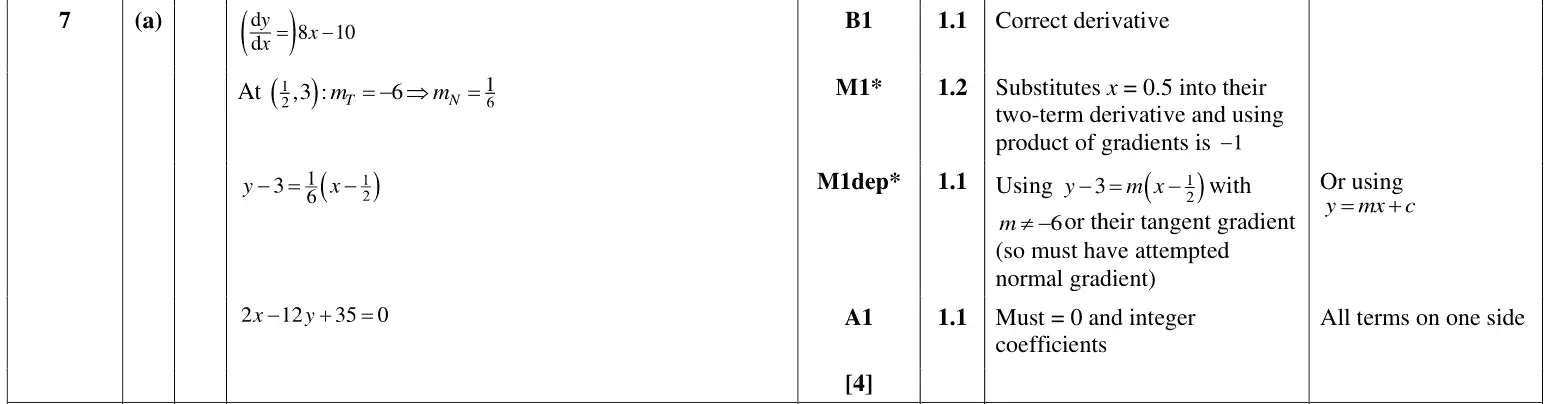
The majority of candidates obtained the correct derivative (i.e. 8x – 10) and those who used it correctly with the given point mainly scored full marks. As was the case elsewhere, a few lost the final mark by not giving their answer in the requested form (e.g. x – 6y + 17.5 = 0, from candidates either not spotting or misunderstanding the request for integers). A significant number of responses took the gradient of l1 to 10 be 8 straight from the derivative, or 8 (from setting their derivative to 0) and then finding the negative reciprocal. Using y = mx + c to find the normal was popular.
Key points and common errors
dy/dx = 8x − 10 = −6 at x = ½
normal gradient 1/6
2x − 12y + 35 = 0 with integer coefficients
June 2022 · Paper 1 · Q12(b)8 marksHard
Show the start of this question
Mark scheme for this part
Examiner's comment
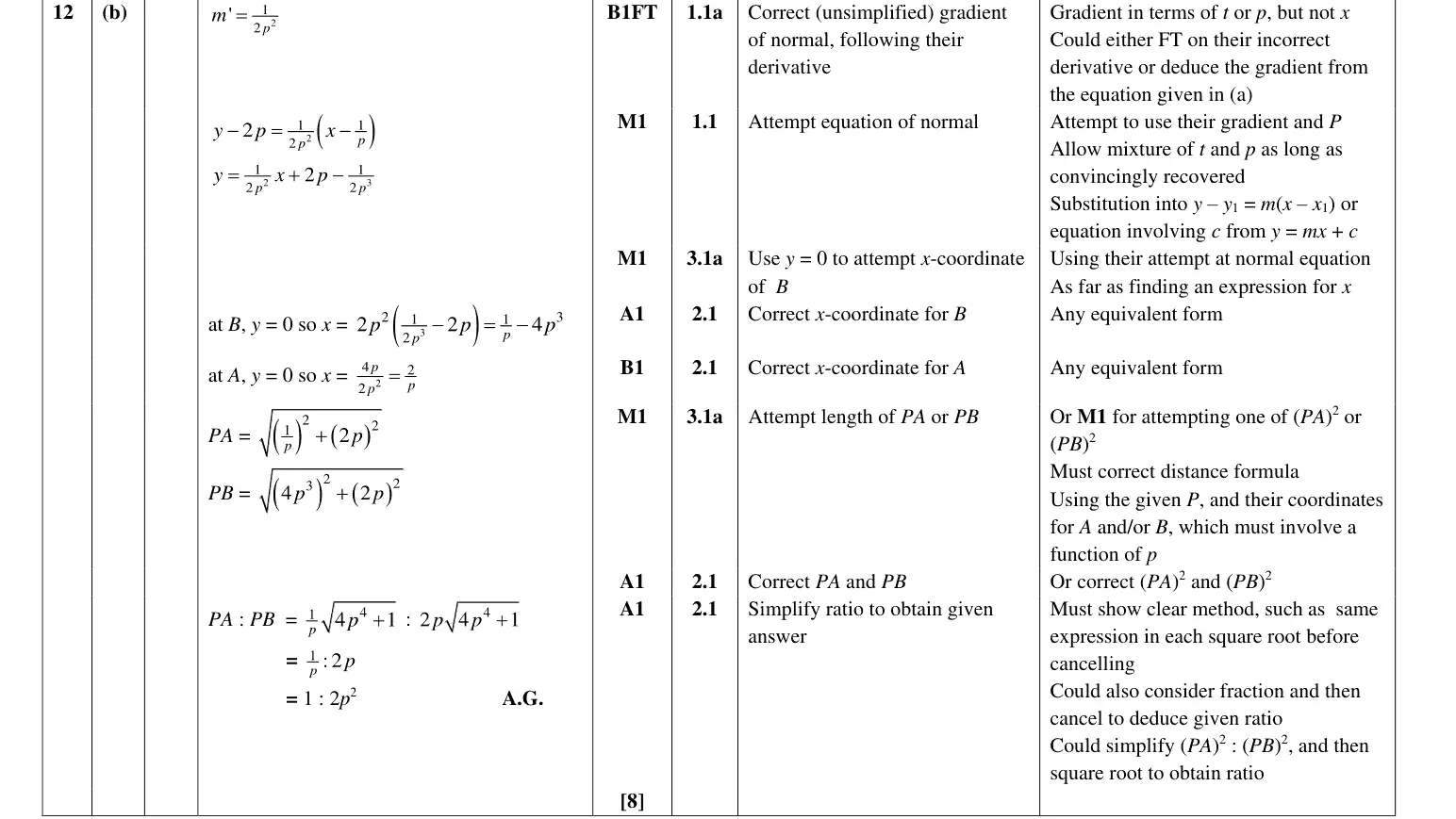
This proved to be a suitable challenging end to the paper, and fully correct solutions were in the minority. A number of candidates made no attempt at all at this part of the question, although it was unclear whether they were lacking inspiration or had run out of time. Of the remainder, most were able to make a reasonable attempt at finding the coordinates of A and B, though a number struggled with the algebraic manipulation required. Some candidates did not realise that it was the ratio of lengths that was required, and made no progress on the final 3 marks. When attempting the ratio, some candidates simplified both surds to a common factor, others attempted a division or demonstrated the veracity of the given answer, all with convincing use of algebra.
Key points and common errors
normal gradient 1/(2p²)
A at x = 2/p, B at x = 1/p − 4p³
PA = (1/p)√(4p⁴ + 1), PB = 2p√(4p⁴ + 1) so PA:PB = 1:2p²
ratio of lengths, not coordinates
June 2022 · AS Paper 2 · Q6(d)4 marksHard
Show the start of this question
Mark scheme for this part
Examiner's comment
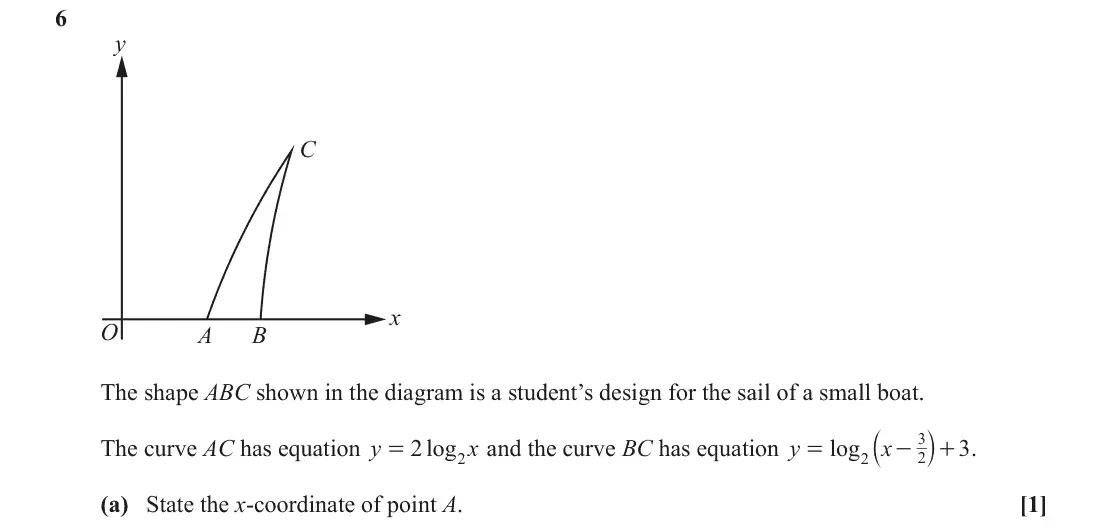
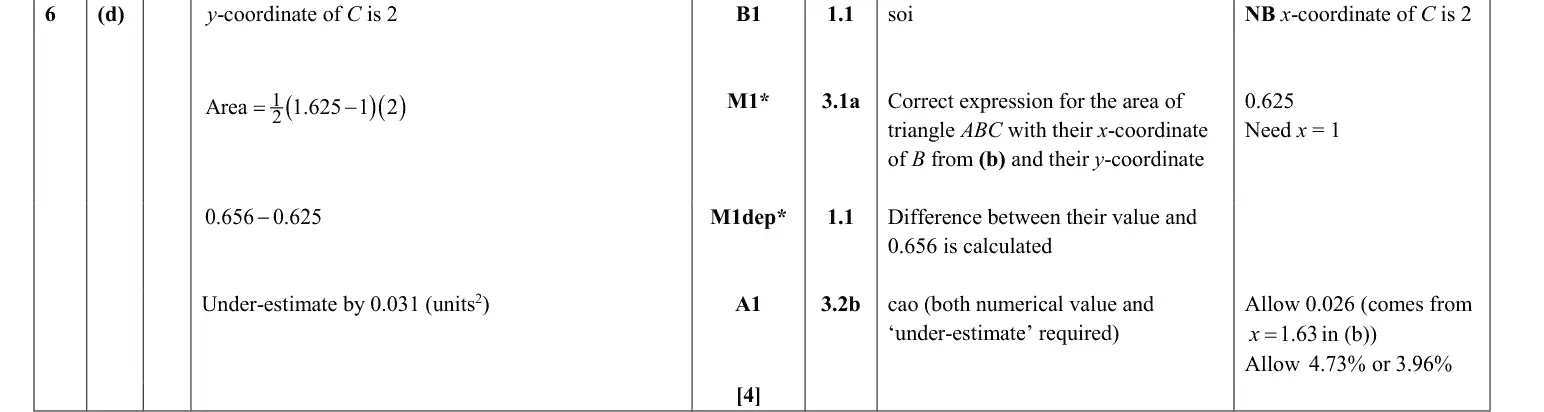
This part was found to be more difficult, perhaps because it is slightly unusual. The area of the required triangle is easy to calculate using ½bh but some complicated attempts using the cosine rule and ½absinC were seen. Occasionally, the underestimation of 0.031 was not calculated. Candidates should be encouraged to read questions carefully and to check their answers to ensure they provide all the requested information.
Key points and common errors
C = (2, 2)
triangle area ½ × 0.625 × 2 = 0.625
under-estimate by 0.031
both value and 'under-estimate' needed
found more difficult
June 2022 · AS Paper 2 · Q8(b)7 marksMedium
Show the start of this question
Mark scheme for this part
Examiner's comment
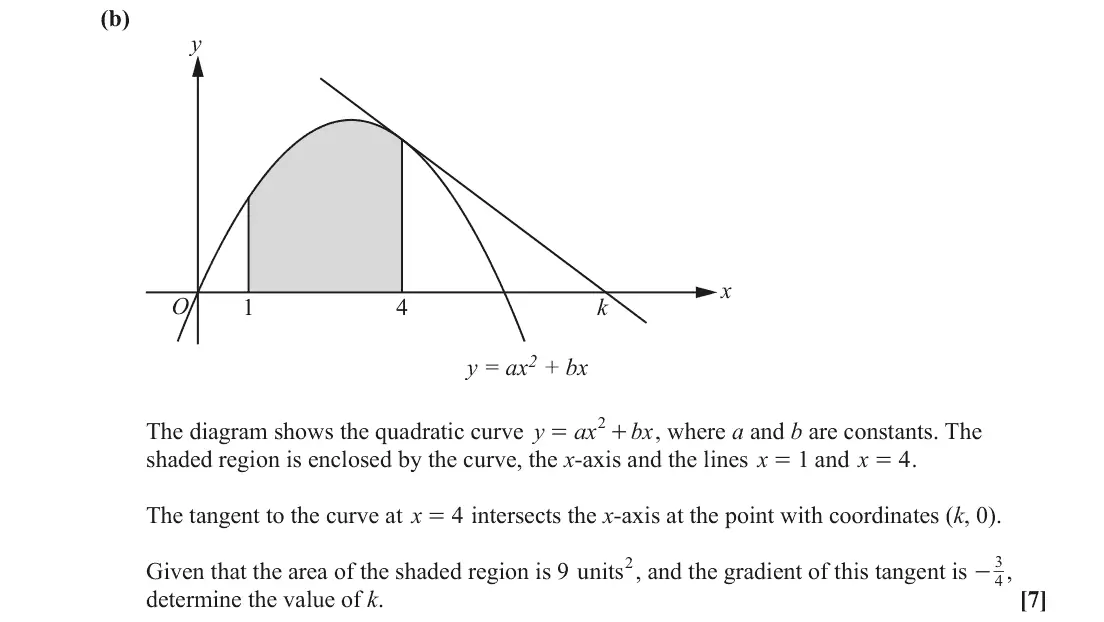
Many candidates earned the first 3 method marks here, most integrating correctly, a few making a sign error when evaluating the limits. Less successful was recognising where the second equation in a and b came from, and hence not finding their values. Those who managed this often produced a complete solution, but not all provided the correct method to find k. Some thought y = 2ax +b was the equation of the tangent. Only a few started this question by differentiating y = ax2 + bx rather than integrating it.
Key points and common errors
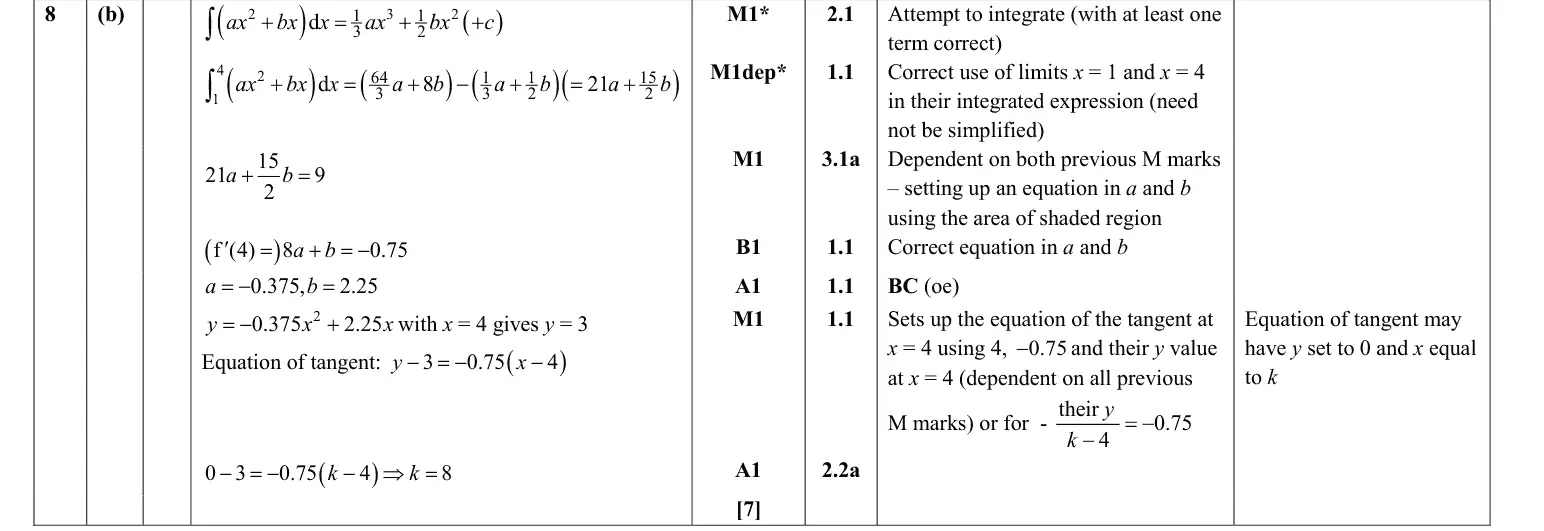
∫₁⁴ (ax² + bx) dx = 21a + 7.5b = 9
f′(4) = 8a + b = −0.75
a = −0.375, b = 2.25
tangent at (4, 3): y − 3 = −0.75(x − 4) gives k = 8
second equation often missed
June 2022 · Paper 3 · Q34 marksMedium
Mark scheme for this part
Examiner's comment
Almost all candidates attempted to find the equation of the required circle by first finding the corresponding centre and radius. However, many candidates clearly thought that the distance between the two given points was the radius and not the diameter and, although less common, several x − x y − y , . candidates thought that the centre of the circle was given by the formula Even when 2 2 5 37 ( ) − + + = candidates correctly had the circle in the form x y 2 , many struggled to simplify to the 2 4 required form.
Key points and common errors
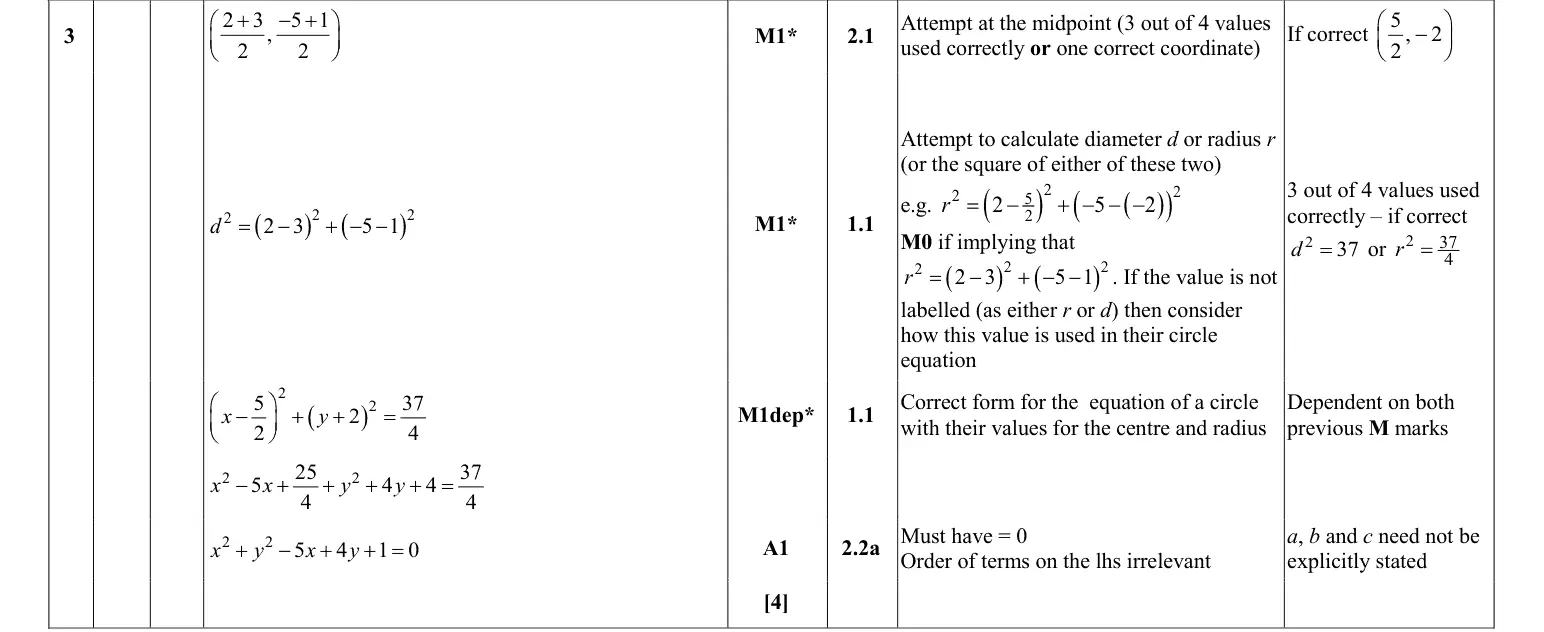
centre is the midpoint (5/2, −2)
PQ is the diameter, r² = 37/4
x² + y² − 5x + 4y + 1 = 0
errors: using PQ as the radius
Autumn 2021 · Paper 1 · Q2(a)2 marksMedium
Mark scheme for this part
Examiner's comment
(From the general report) Question 2 was a real-life application of linear equations with candidates expected to set up two equations in the first part of the question, and then solve them in the second part.
Key points and common errors
A: 4000 + 4m pence (or 40 + 0.04m pounds)
B: 6(m − 100)
keep units consistent
using m = 0 at 100 minutes is an error
Autumn 2021 · Paper 1 · Q2(b)2 marksMedium
Show the start of this question
Mark scheme for this part
Examiner's comment
(From the general report) Question 2 was a real-life application of linear equations with candidates expected to set up two equations in the first part of the question, and then solve them in the second part.
Key points and common errors
equate the two linear expressions
m = 2300 minutes
Autumn 2021 · AS Paper 1 · Q96 marksMedium
Mark scheme for this part
Key points and common errors
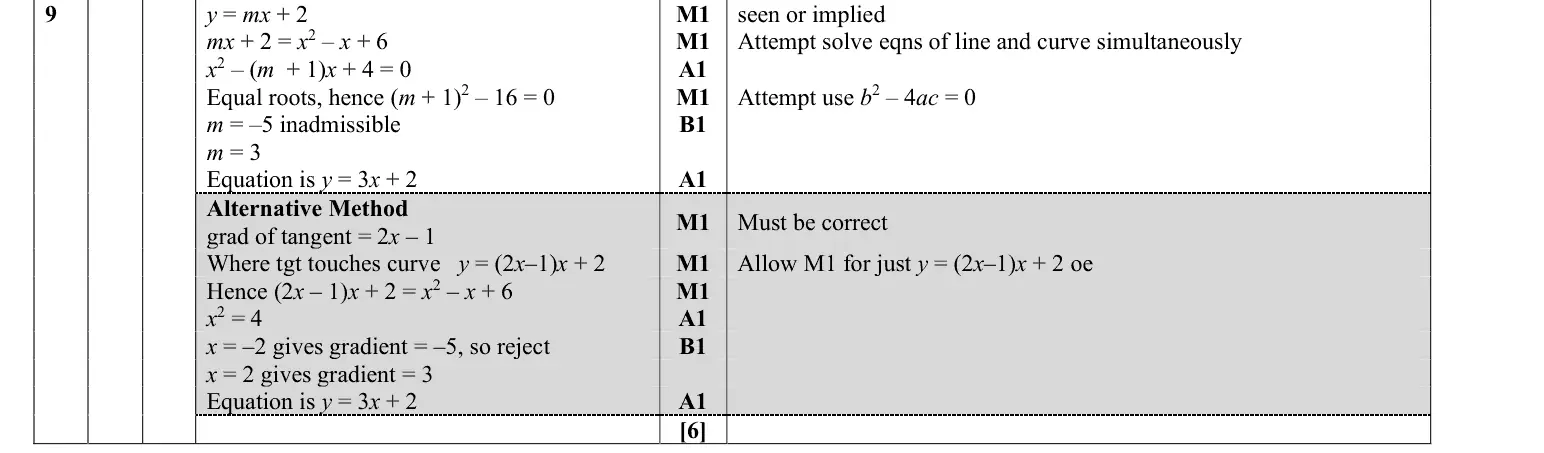
y = mx + 2
x² − (m + 1)x + 4 = 0
equal roots so (m + 1)² − 16 = 0
m = 3 (reject −5)
y = 3x + 2
alt: tangent gradient 2x − 1 gives x² = 4
Autumn 2021 · Paper 1 · Q11(b)7 marksMedium
Show the start of this question
Mark scheme for this part
Examiner's comment
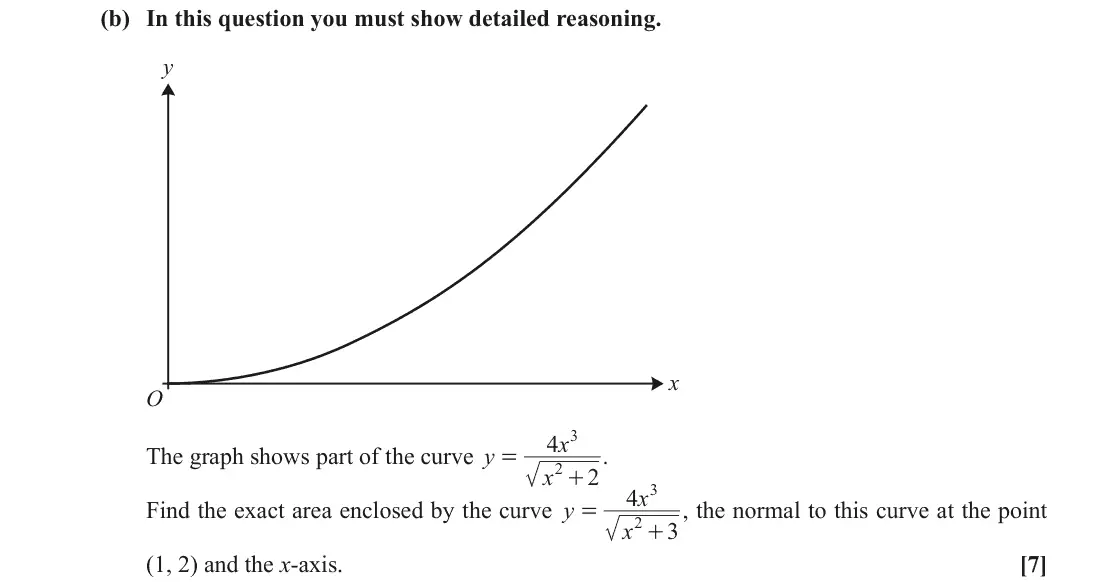
(From the general report) Teachers should make sure that they use an amended version of the question paper, correcting the 4 x description of the graph in Question 11(b) as “part of the curve y = ” to match the information in x + 3 the rest of the question.
Key points and common errors
paper misprint: graph label should read √(x² + 3)
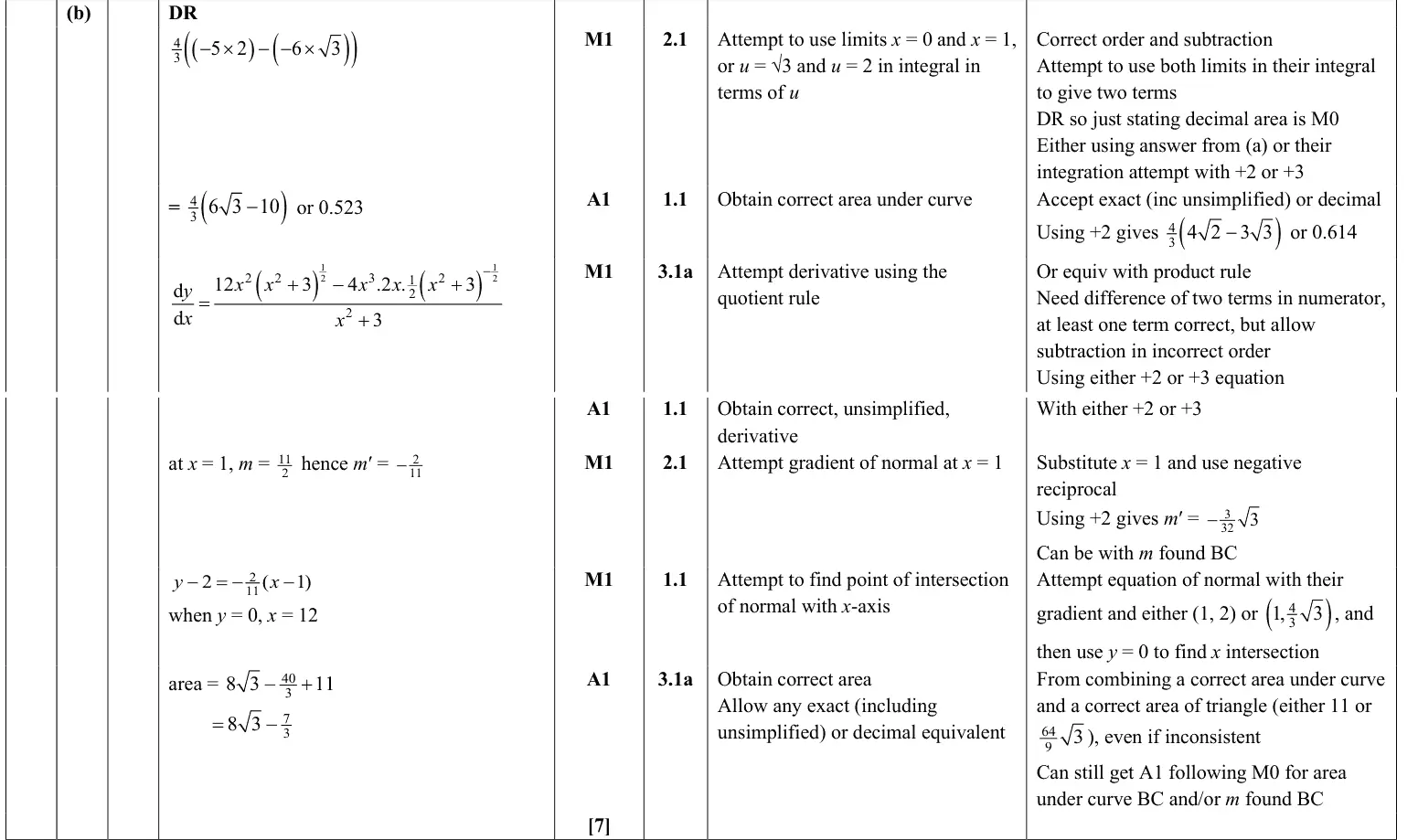
area under curve (4/3)(6√3 − 10)
quotient rule gives gradient 11/2 at x = 1 so normal gradient −2/11
normal meets x-axis at x = 12, triangle area 11
total 8√3 − 7/3
Autumn 2021 · AS Paper 2 · Q3(a)3 marksMedium
Mark scheme for this part
Key points and common errors
V = at + b with (6, 2375) and (12, 2825): gradient 75, V = 75t + 1925
Autumn 2021 · AS Paper 2 · Q3(b)2 marksMedium
Show the start of this question
Mark scheme for this part
Key points and common errors
at t = 0 the model gives £1925
compare with £1900 and comment sensibly on whether the model is supported (close, so supports)
Autumn 2021 · Paper 2 · Q5(a)3 marksEasy
Mark scheme for this part
Examiner's comment
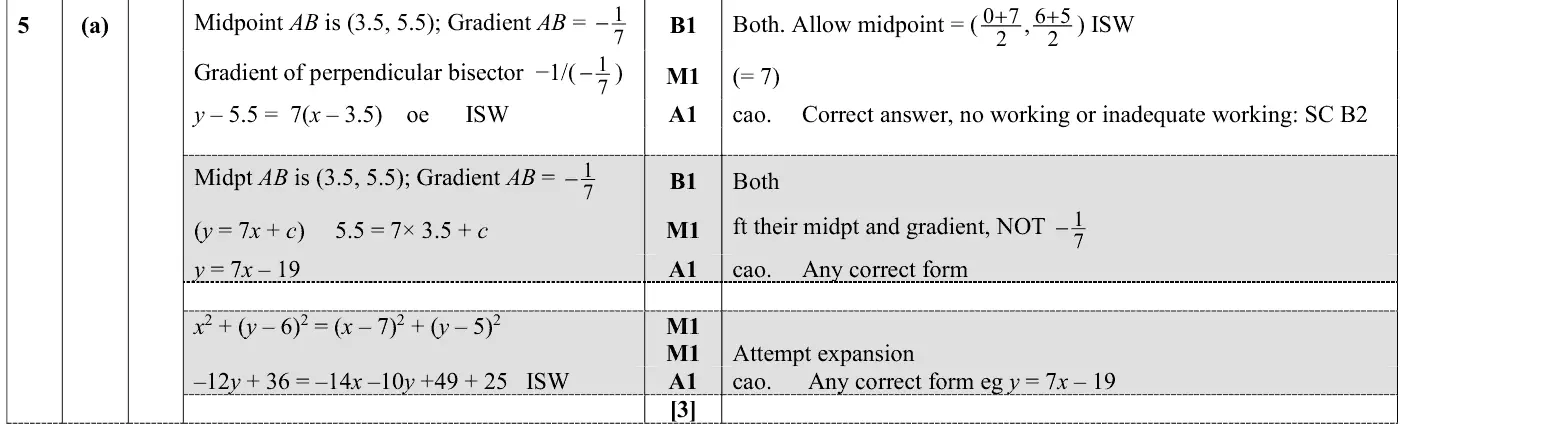
(From the general report) Question 5: Most candidates coped well with part (a), but many made no headway with part (b).
Key points and common errors
midpoint (3.5, 5.5)
gradient AB = −1/7 so perpendicular gradient 7
y = 7x − 19
Autumn 2021 · Paper 2 · Q5(b)5 marksHard
Show the start of this question
Mark scheme for this part
Examiner's comment
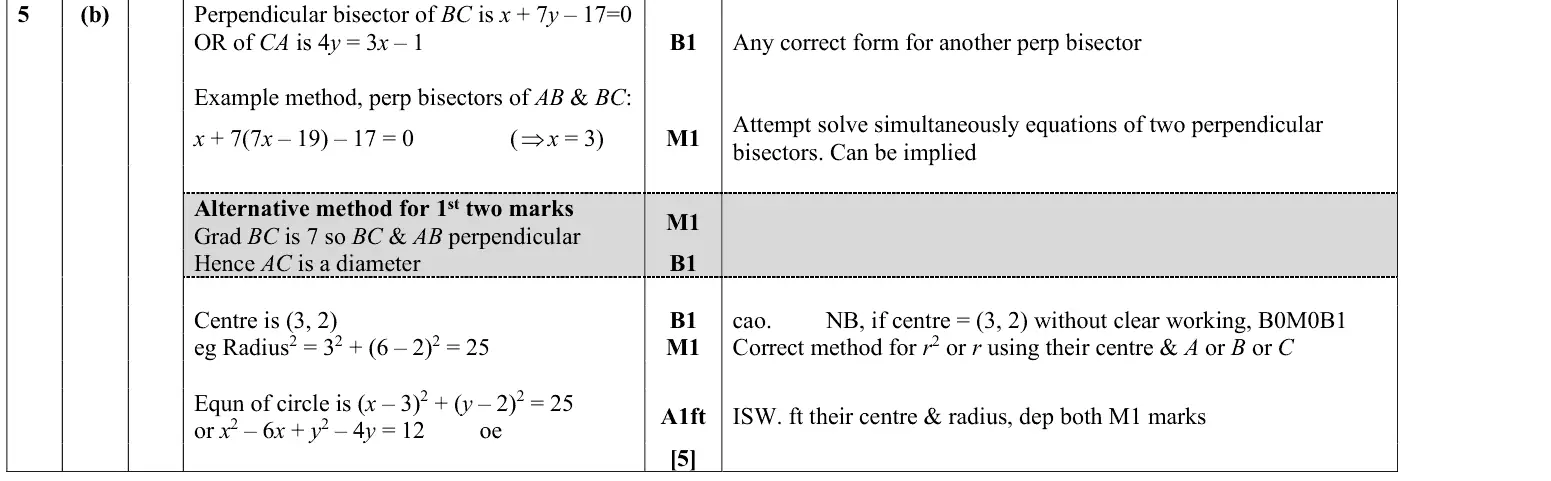
(From the general report) Question 5: Most candidates coped well with part (a), but many made no headway with part (b).
Key points and common errors
centre is the intersection of two perpendicular bisectors (or AC is a diameter since AB ⟂ BC)
centre (3, 2), r² = 25
(x − 3)² + (y − 2)² = 25
many made no headway
Autumn 2021 · AS Paper 2 · Q7(b)6 marksMedium
Show the start of this question
Mark scheme for this part
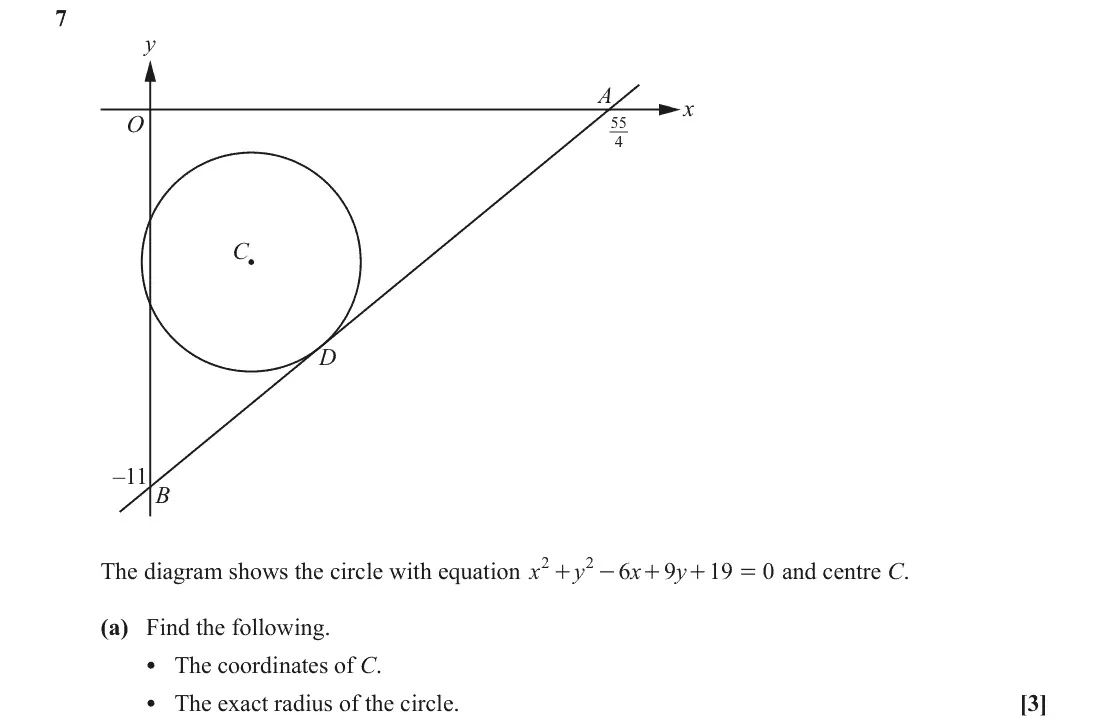
Key points and common errors
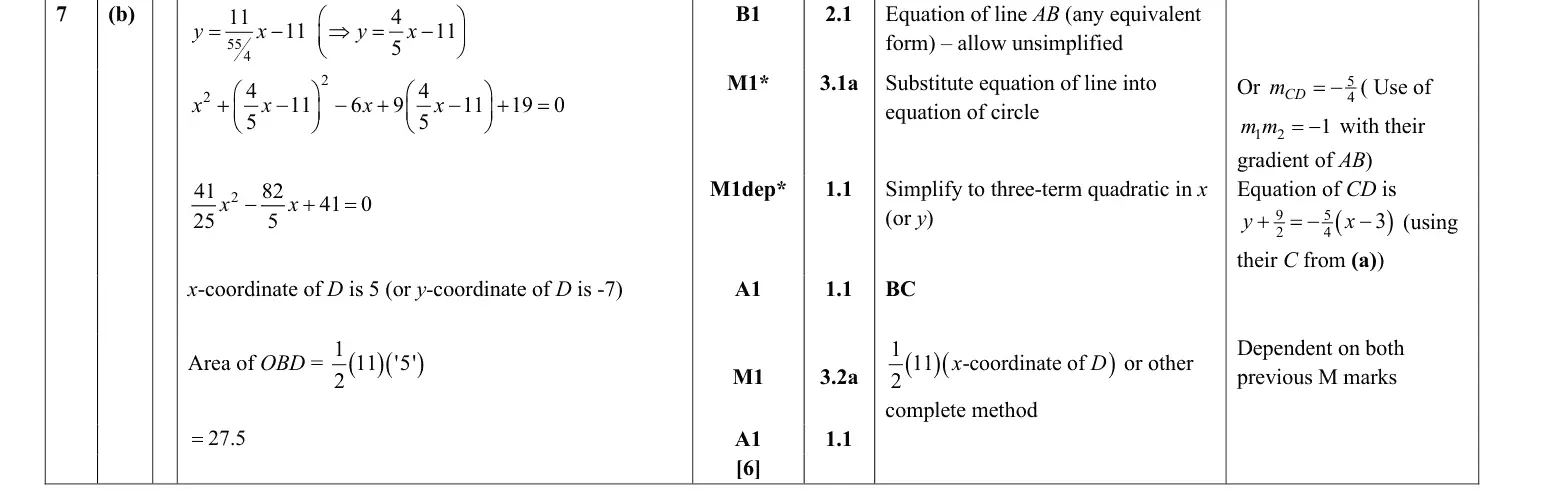
line AB: y = (4/5)x − 11
substitute into the circle to get a repeated root x = 5 (or use CD perpendicular to AB)
area OBD = ½ × 11 × 5 = 27.5
Autumn 2021 · AS Paper 2 · Q8(a)5 marksMedium
Mark scheme for this part
Key points and common errors
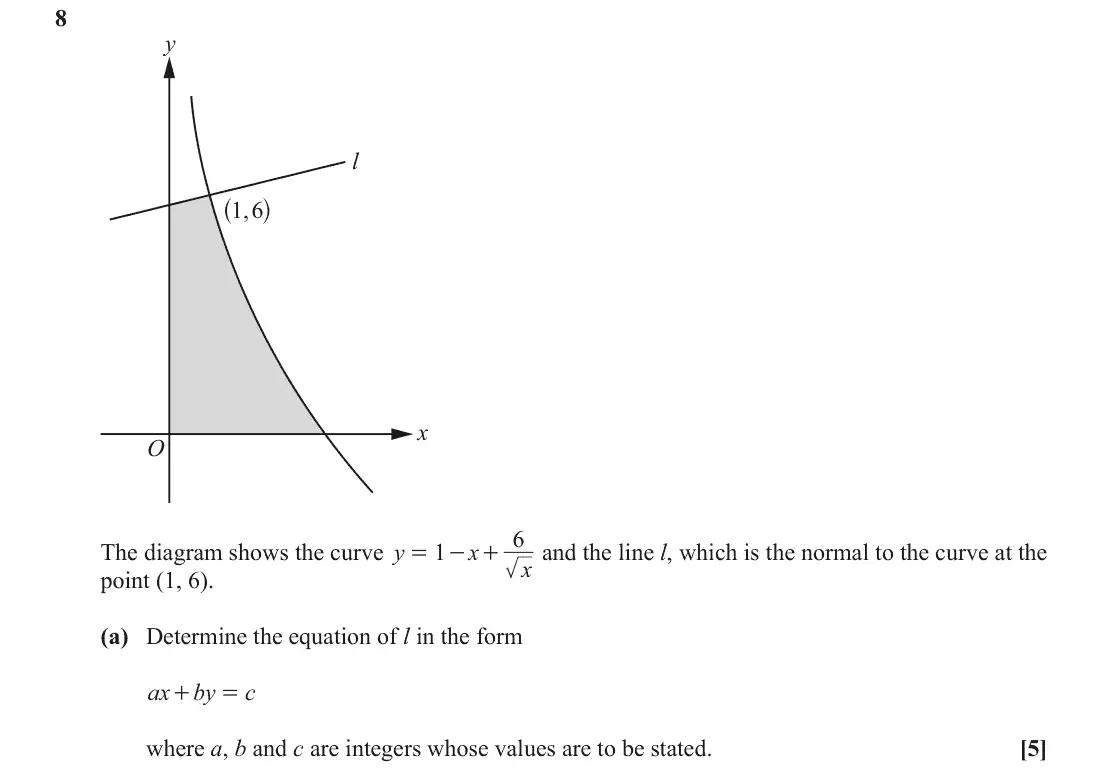
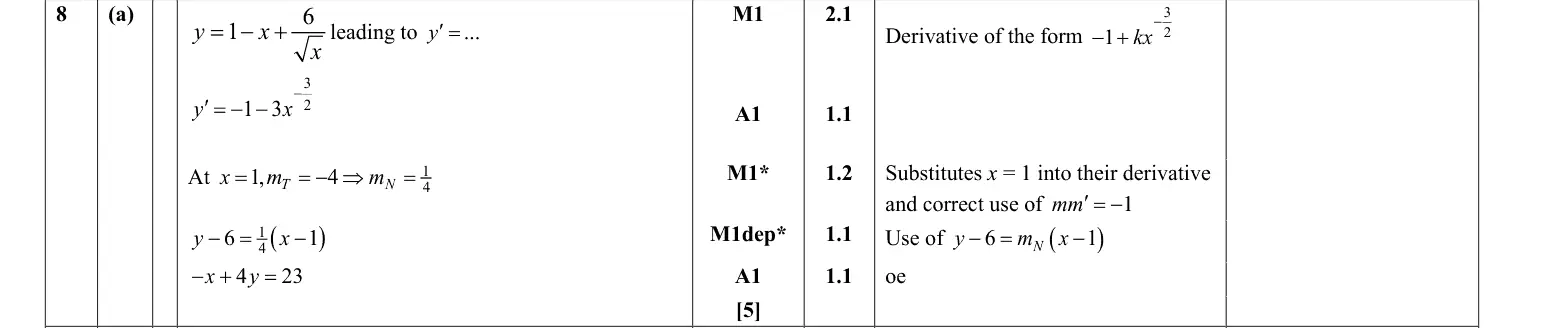
y′ = −1 − 3x^(−3/2)
tangent gradient −4 at x = 1 so normal gradient ¼
−x + 4y = 23 with integers
Autumn 2021 · AS Paper 2 · Q8(c)5 marksMedium
Show the start of this question
Mark scheme for this part
Key points and common errors
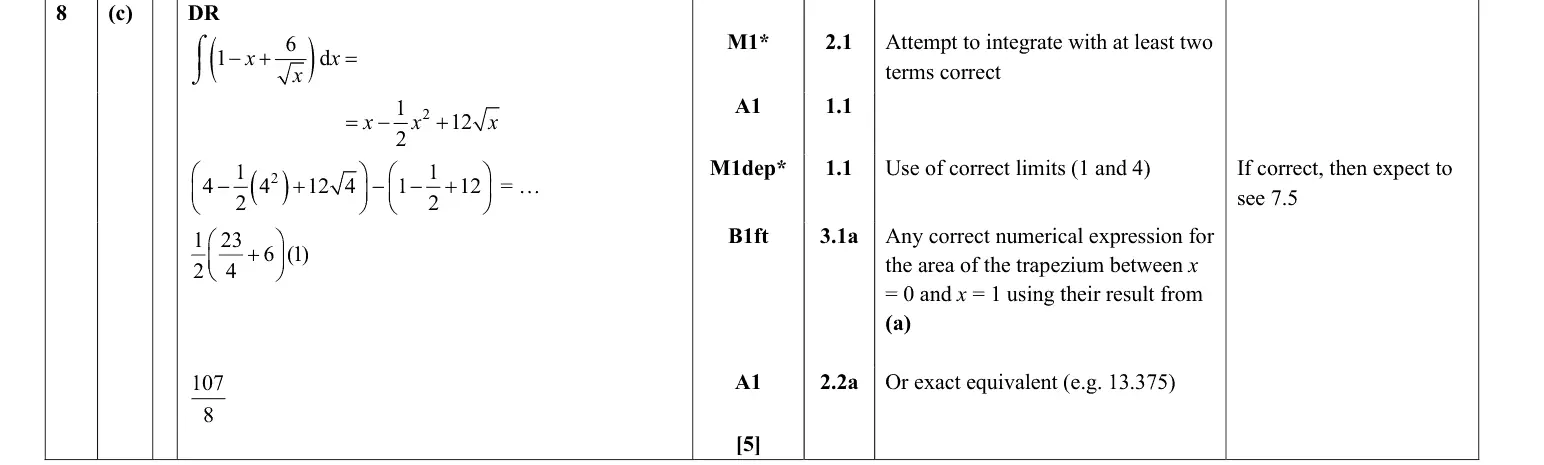
∫ from 1 to 4 of (1 − x + 6x^(−1/2)) dx = 7.5
trapezium from x = 0 to 1 under l: ½(23/4 + 6) = 47/8
total 107/8
Autumn 2021 · Paper 3 · Q13 marksMedium
Mark scheme for this part
Key points and common errors
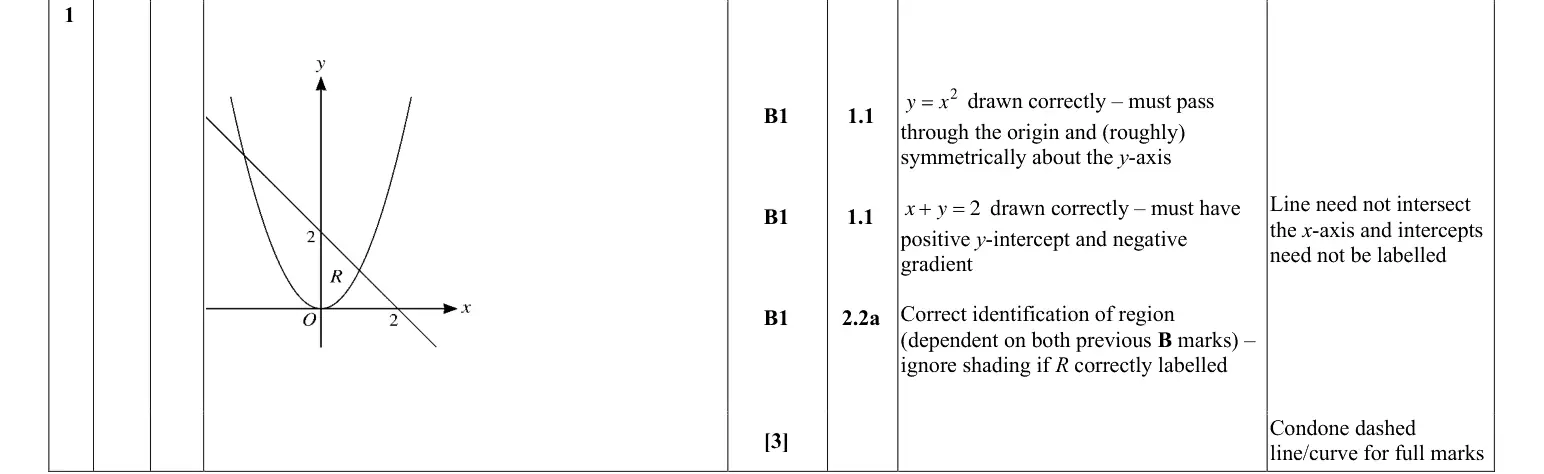
sketch y = x² through O and the line x + y = 2 with positive y-intercept and negative gradient
label region R (between curve, line and y-axis)
Autumn 2021 · Paper 3 · Q7(a)2 marksMedium
Mark scheme for this part
Key points and common errors
dy/dx = 3(y − 2)/(x − 3)
Autumn 2020 · AS Paper 1 · Q2(a)2 marksMedium
Mark scheme for this part
Examiner's comment
(Comment on Question 02 as a whole) Many candidates answered the first part correctly although, in some cases, the working was difficult to decipher. Some candidates did not appear to understand vectors, and in particular, addition and subtraction of vectors. In part (b) many were confused about the gradients of perpendicular lines.
Key points and common errors
AB and BC in the same direction (ratio of components) or line y = −x/2 + 5/2 through (p, 1)
p = 3
working often hard to follow
Autumn 2020 · AS Paper 1 · Q2(b)3 marksMedium
Show the start of this question
Mark scheme for this part
Examiner's comment
(Comment on Question 02 as a whole) Many candidates answered the first part correctly although, in some cases, the working was difficult to decipher. Some candidates did not appear to understand vectors, and in particular, addition and subtraction of vectors. In part (b) many were confused about the gradients of perpendicular lines.
Key points and common errors
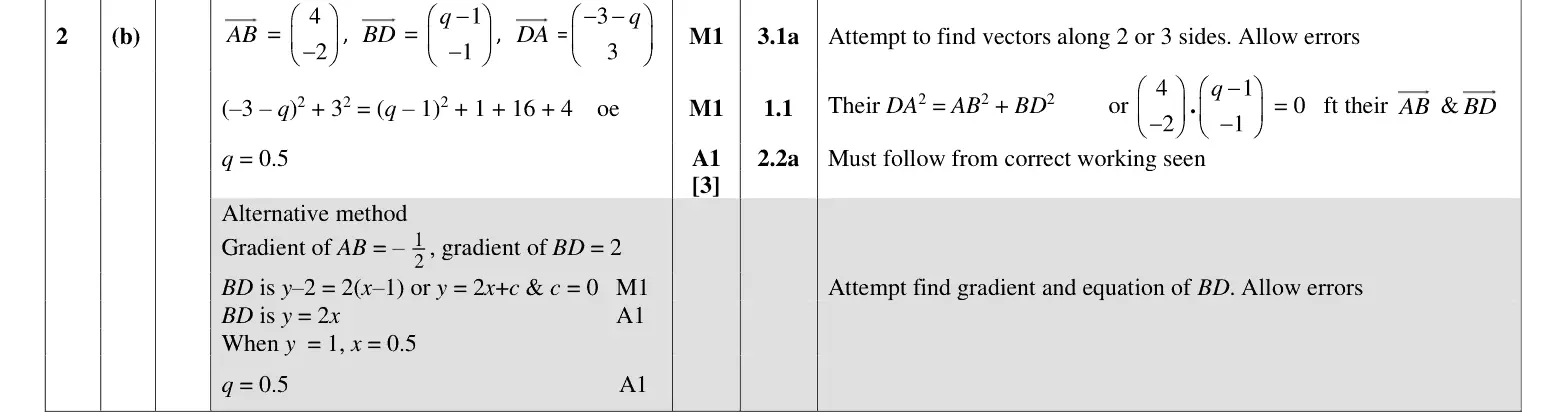
AB = (4, −2), BD = (q − 1, −1)
Pythagoras DA² = AB² + BD², or gradient of BD = 2 perpendicular to AB
q = 0.5
perpendicular gradients often confused
Autumn 2020 · AS Paper 2 · Q37 marksMedium
Mark scheme for this part
Examiner's comment
(From the general report) Note that ‘find’ was used in Question 3 and Question 6 with the instruction to show detailed reasoning, which now means evidence is vital.
Key points and common errors
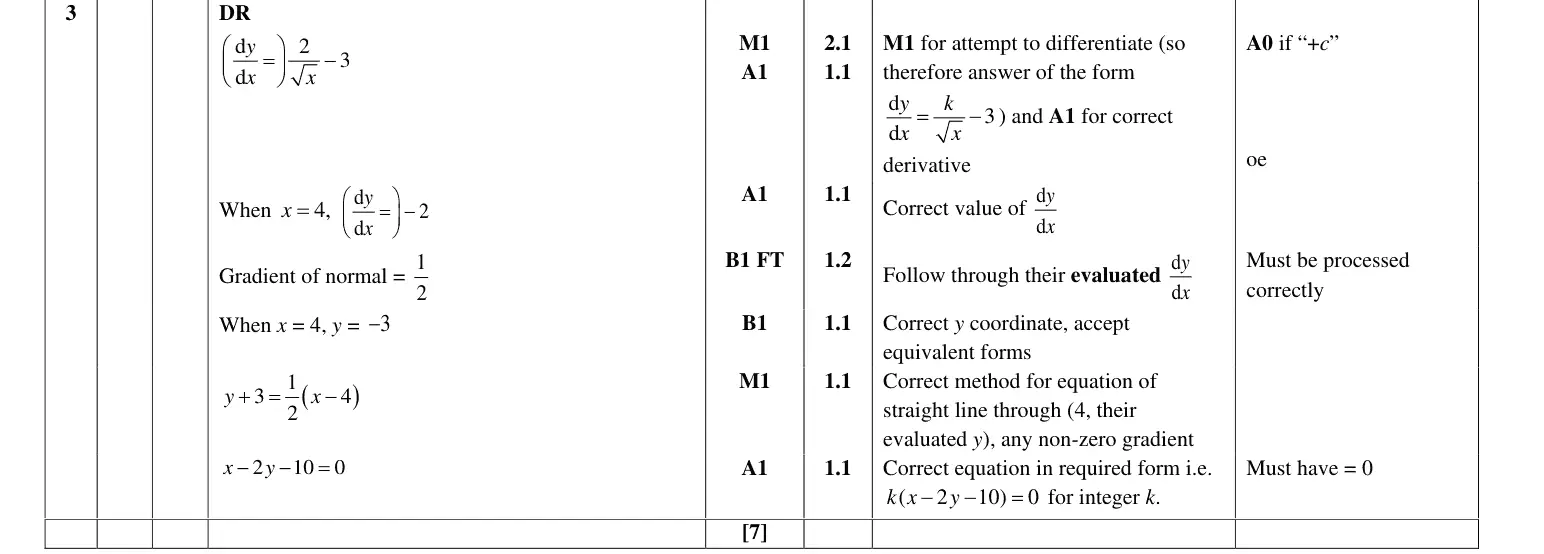
dy/dx = 2/√x − 3 = −2 at x = 4
normal gradient ½ through (4, −3)
x − 2y − 10 = 0 with integer coefficients
Autumn 2020 · AS Paper 2 · Q66 marksMedium
Mark scheme for this part
Examiner's comment
(From the general report) Note that ‘find’ was used in Question 3 and Question 6 with the instruction to show detailed reasoning, which now means evidence is vital. So, for example, in Question 6 on this paper the method for solving the simultaneous equations was expected and those just doing it on the calculator earned M0 for this skill. 2.
Key points and common errors
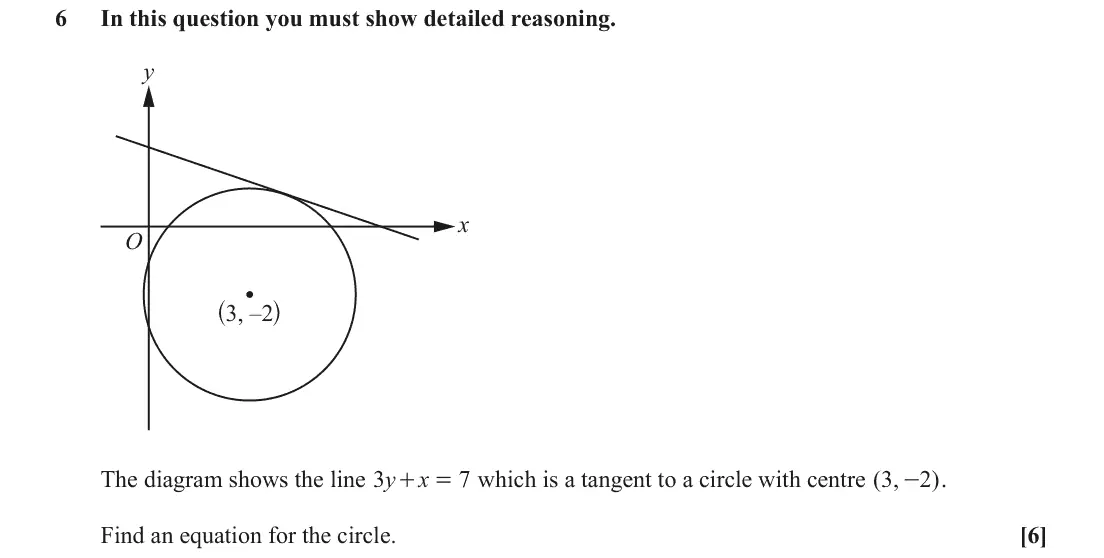
tangent gradient −1/3 so radius line y + 2 = 3(x − 3)
intersection (4, 1) found algebraically (calculator alone M0)
r² = 10
(x − 3)² + (y + 2)² = 10
Autumn 2020 · Paper 3 · Q6(b)8 marksMedium
Show the start of this question
Mark scheme for this part
Examiner's comment
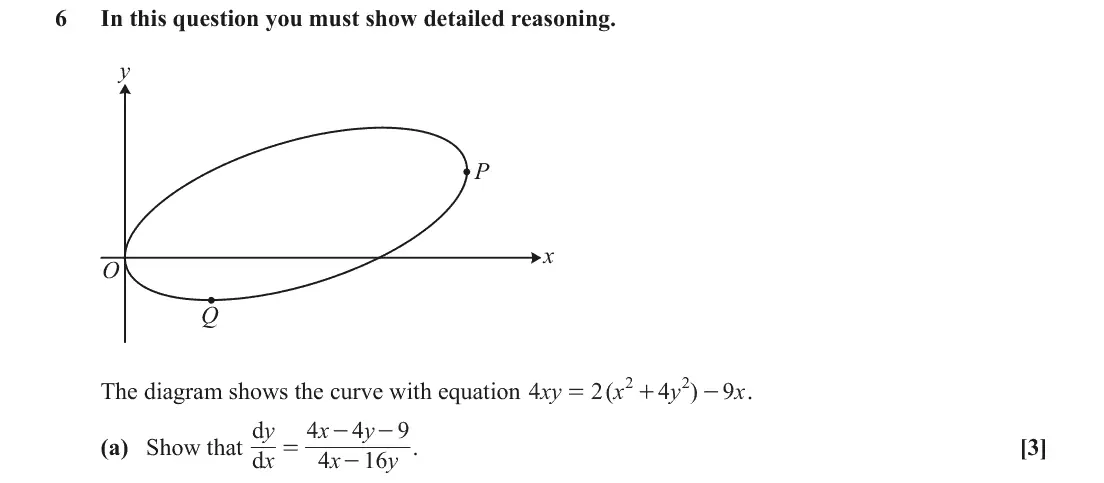
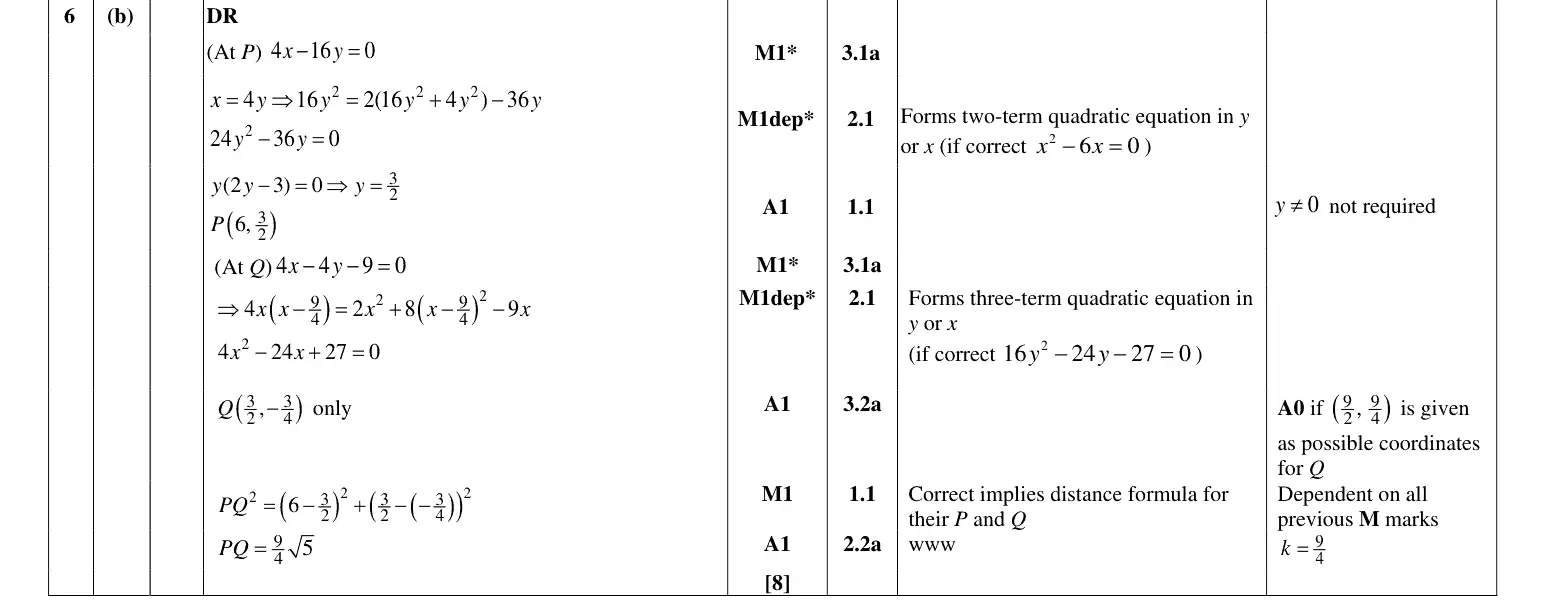
(Comment on Question 06 as a whole) This was the only ‘In this question you must show detailed reasoning’ on this paper. Examiners will be very focused on the individual steps of the calculation on these questions, signified by the ‘DR’ notation in the mark scheme. Part (a) was generally well answered, candidates appeared to be well prepared for this type of question. A common error was to start the mathematical argument with d y x = followed by the correct set of d differentiated terms with equals sign. Some candidates dropped marks due to careless algebra manipulation. In part (b), those candidates that recognised the correct gradients of the tangents at P and Q generally went on to use their values for the coordinates to find PQ and score many of the 5 method marks. However poor algebra manipulation cost accuracy marks. A number of candidates solved the quadratic equation generated to find Q, but then chose the coordinates 9 9 , . Candidates should use all information given in the question, including any sketched 2 4 d y curves. In this case, candidates were expected to recognise that the two results for x = 0 were valid, d but that the diagram indicated which horizontal tangent was to be used. Note that those candidates that used 9 9 , to find their PQ with no wrong working would have scored 6 out 8. There was not an explicit 2 4 mark given for discounting the unwanted quadratic solutions on this question, however it is good practice and may be penalised in other ‘DR’ questions.
Key points and common errors
P: denominator 0 so x = 4y, gives P(6, 3/2)
Q: numerator 0 gives Q(3/2, −3/4) (reject (9/2, 9/4) using the diagram)
PQ = (9/4)√5
June 2019 · AS Paper 2 · Q2(c)1 markHard
Show the start of this question
Mark scheme for this part
Examiner's comment
‘State’ again, with the same implication as in 2(c). This part was the least successful. A significant number of candidates found the tangent y = − 17 rather than the requested normal x = 2 .
Key points and common errors
normal at the minimum is vertical: x = 2
common error the tangent y = −17
June 2019 · Paper 2 · Q3(b)6 marksMedium
Mark scheme for this part
Examiner's comment
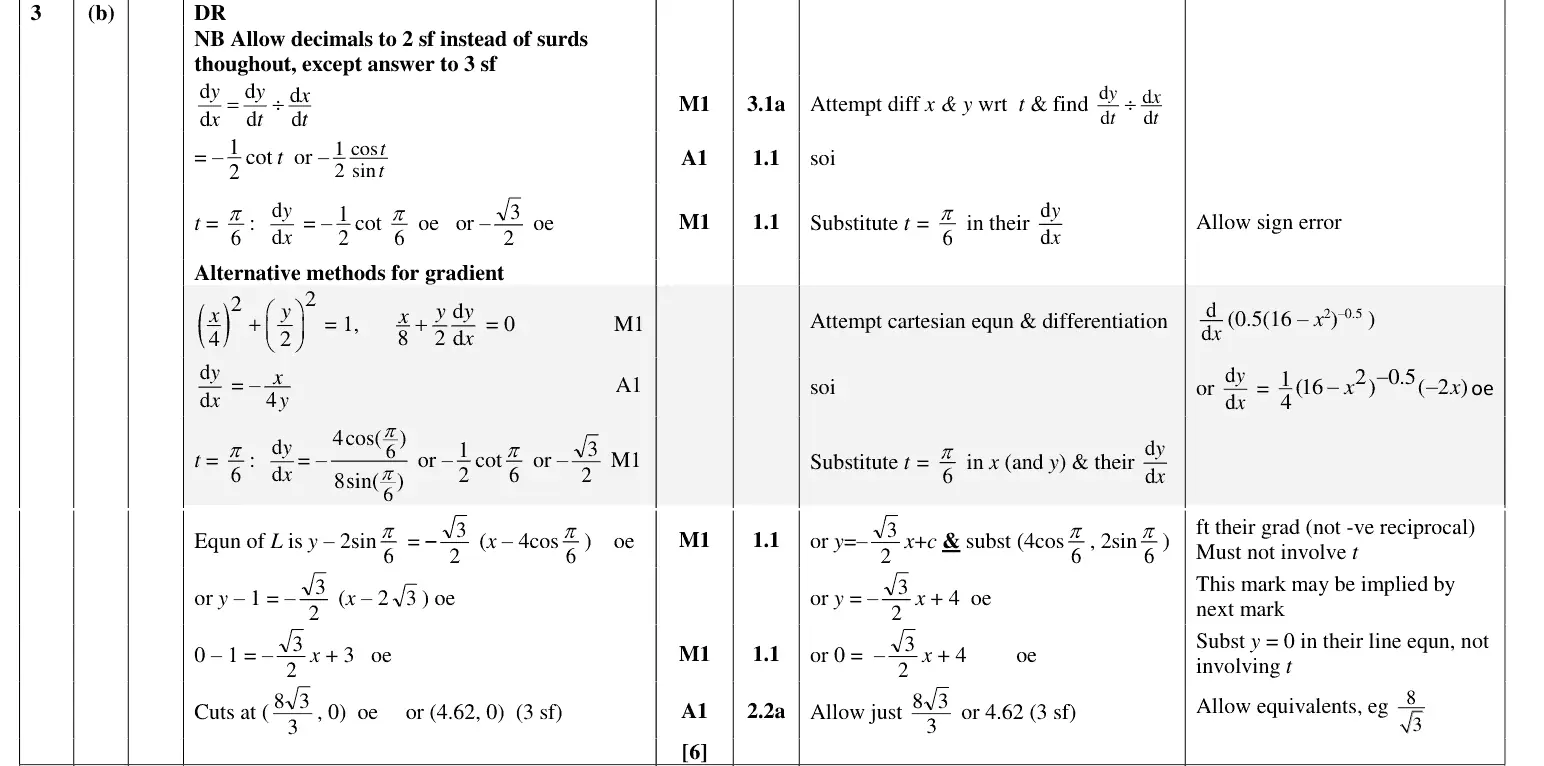
Most candidates recognised that the starting point was to find the gradient of the curve at the relevant point. Most of these successfully found d x by dividing d y y t by d x t . A few made errors while substituting d d d π t = , such as omitting the "–" sign. Many candidates carried out the next two steps (finding the 6 equation of the line and substituting y = 0) correctly. However, arithmetical errors were legion. It is worth noting that some candidates combined these steps into one, not giving explicitly the equation of the line before substituting y = 0. This is not incorrect and was not penalised, but it possibly led to more errors than would otherwise have occurred. It also certainly made the marking more difficult, and sometimes marks could not be awarded because candidates' working was not clear enough. Some candidates found the gradient of the normal and used this as the gradient of the tangent. π Some candidates retained "t " in their working until a late stage, only substituting t = at the end. This 6 led to working being more complex and confusing than necessary, and sometime led to errors along the way. A few candidates found the point where the curve cuts the x-axis, instead of where the line cuts the x- axis.
Key points and common errors
dy/dx = (dy/dt)/(dx/dt) = −½cot t
at t = π/6 gradient −√3/2
tangent through (2√3, 1)
cuts x-axis at 8√3/3
arithmetic errors common
June 2019 · AS Paper 2 · Q5(c)2 marksHard
Mark scheme for this part
Examiner's comment
This was found to be more challenging. Many had no idea how to start or produced a wrong value of k with no evidence of how it had been obtained, but those who made sensible attempts used either gradients or vectors. For those using gradients (more common), some seemingly used perpendicularity. Attention to detail was important. A common issue throughout this paper involved marks dropped due to careless notation. This candidate 1 has shown sufficient working for the method mark, but having correctly found m = − , went on to use 4 1 m = and so dropped the accuracy mark. 4
Key points and common errors
trapezium needs one pair of parallel sides: AB parallel to DC gives k = 16/3 (or k = −½ or 5/4 from other pairs)
show the gradient or vector working
perpendicularity is wrong
June 2018 · Paper 1 · Q14 marksEasy
Mark scheme for this part
Examiner's comment
This question was very well answered, with most candidates gaining full credit. As with all solutions, it is important for candidates to show clear details of the method used; on this question some candidates made an error when finding the gradient. If the correct method was shown then a mark was credited, but if an incorrect value for the gradient was all that was shown then the method mark cannot be credited. This question requested that the final answer be given in a specified form, so candidates need to pay heed to this. Non-integer values for a, b and c were accepted but best practice would be to use integer coefficients when giving the equation of a line in this form.
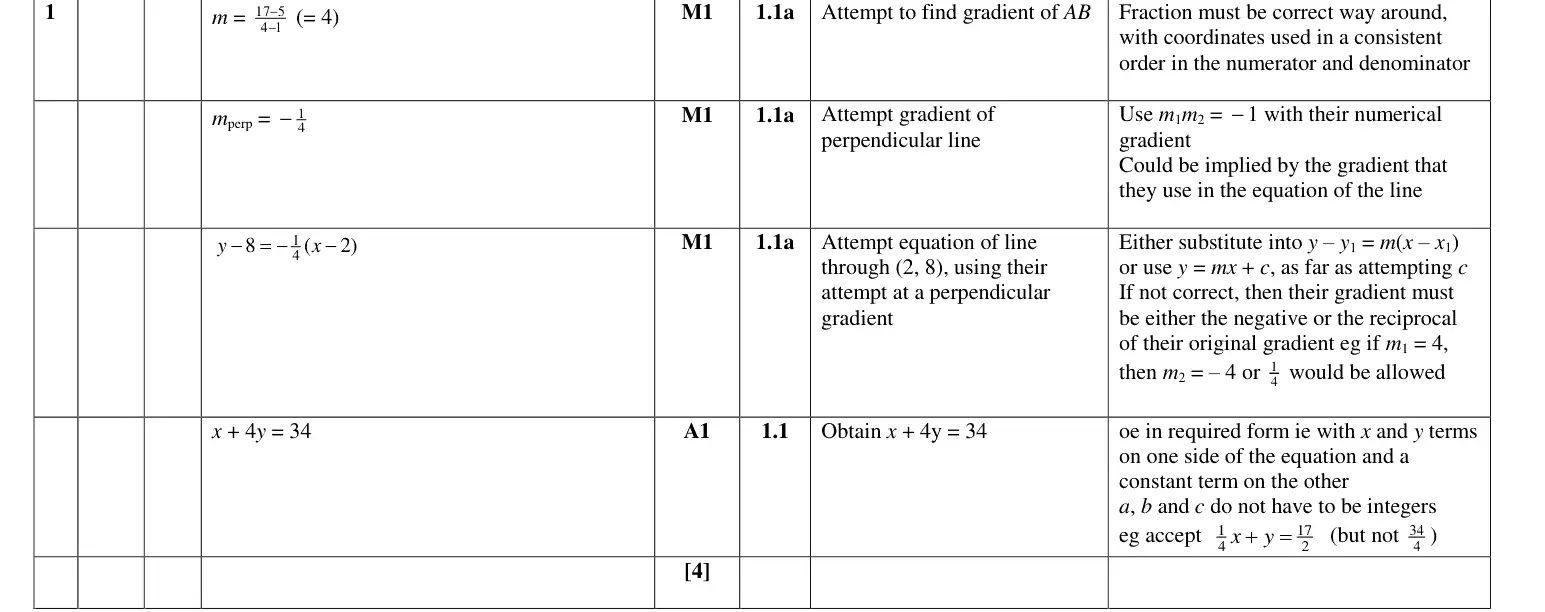
Key points and common errors
gradient AB = 4 so perpendicular gradient −¼
y − 8 = −¼(x − 2)
x + 4y = 34
show the gradient method
June 2018 · AS Paper 1 · Q86 marksMedium
Mark scheme for this part
Examiner's comment
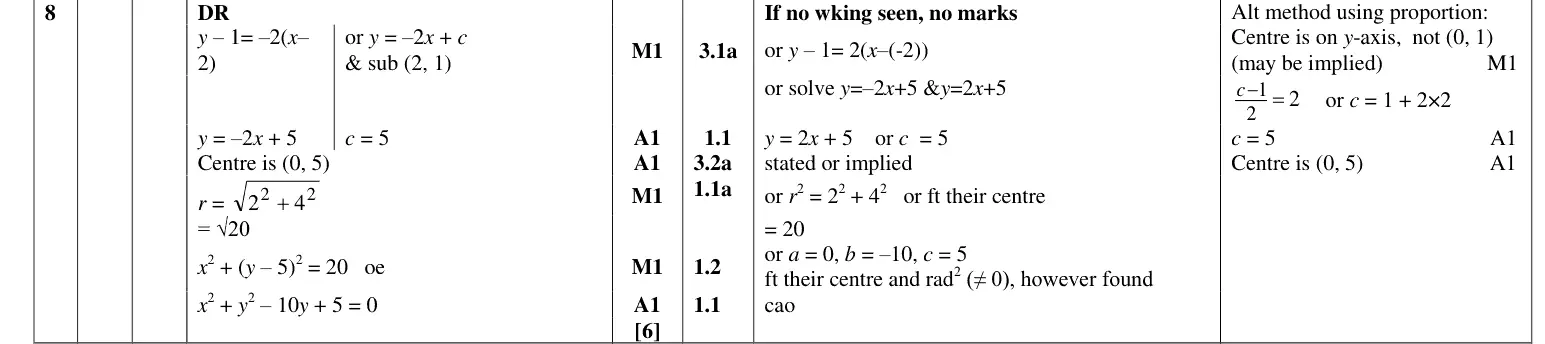
A clear initial sketch proved to be extremely useful for the majority of candidates that successfully answered this question. Some failed to consider one or both normals and therefore were unable to make any significant progress. Some found the centre incorrectly, for example by finding the midpoint of the line joining (2, 1) and (–2, 1). Others treated (0, 0) as the centre of the circle. However, despite many false starts, many used their incorrect centre and radius in the equation of a circle, and gained at least one mark. However, some candidates found a centre (p, q) and radius r, and then wrote x2 + y2 + px + qy + r. A great many candidates started from the equation x2 + y2 + ax + by + c = 0, given in the question, and attempted to find a, b and c by substituting coordinates and various other devices. Not surprisingly, these generally failed to gain any marks. (Although one candidate did actually succeed by this method, taking several pages to do so, and gained full credit.)
Key points and common errors
normals y = −2x + 5 and y = 2x + 5 meet at centre (0, 5)
r² = 20
x² + y² − 10y + 5 = 0
midpoint of the points or origin used as centre
June 2018 · AS Paper 2 · Q55 marksMedium
Mark scheme for this part
Examiner's comment
The instruction requesting detailed reasoning did not prove to be an issue in this question. The two methods outlined in the mark scheme were both seen fairly often, with perhaps the ‘substitution’ route more popular. This required accurate algebraic work for complete success, but sign errors in the working were quite common and some petered out at the ‘b2 – 4ac’ stage. In the ‘gradient’ approach, candidates who worked from y = x2/4 – 10 or y = -x/5 + k to the correct value were not given full credit.
Key points and common errors
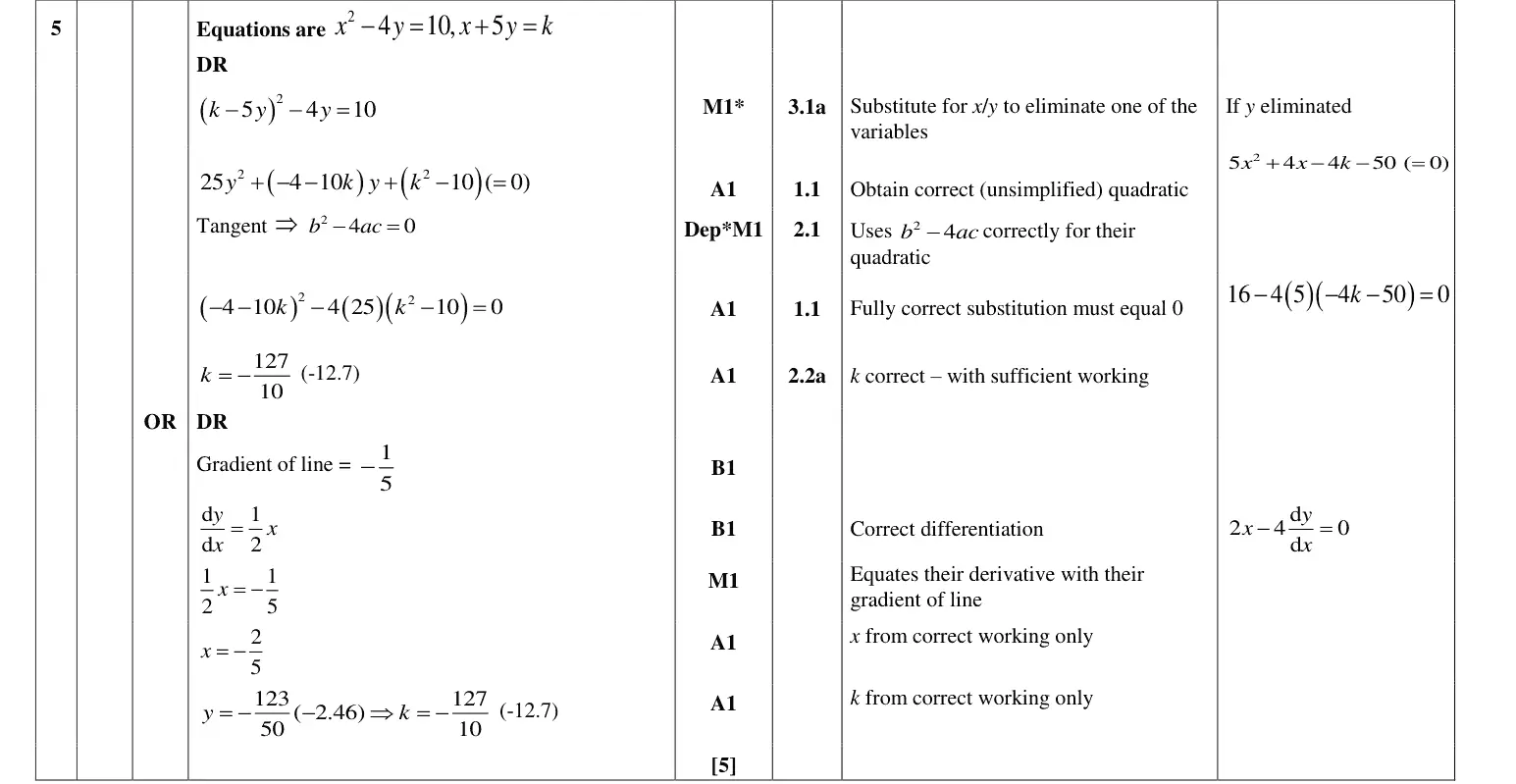
substitute x = k − 5y: 25y² − (10k + 4)y + k² − 10 = 0
tangent so b² − 4ac = 0
k = −12.7
or gradient method: x/2 = −1/5
sign errors common
Find an A-level maths tutor
Stuck on this? Book a trial session with an A-level maths tutor.