Nothing is given; the laws of logarithms must be learned.
Since 2018
92 question parts, 319 marks, each rated Easy, Medium or Hard from the wording of the examiners' report
Notes, worked examples and practice for this topic are being written by our tutors. The past-paper questions below are ready now: work each one on paper, then open the mark scheme and the examiner's comment.
Tap a question to zoom it. Mark scheme and examiner's comment open under each question.
June 2025 · AS Paper 1 · Q1(c)2 marksEasy
Mark scheme for this part
Examiner's comment
This question was very well answered by the majority of candidates. Many candidates gave quite lengthy working (often including logs) before obtaining the required linear equation in z, which scored the M1. In this case, the mark scheme allowed candidates to leave numerical (i.e. not in z) log terms in the final step before their answer so, e.g. 𝑧= was acceptable for the M1. However, in general candidates should show a complete method where the DR instruction is given.
Key points and common errors
16 = 2⁴ so 3z − 10 = 4, z = 14/3
June 2025 · AS Paper 1 · Q6(a)4 marksMedium
Mark scheme for this part
Examiner's comment
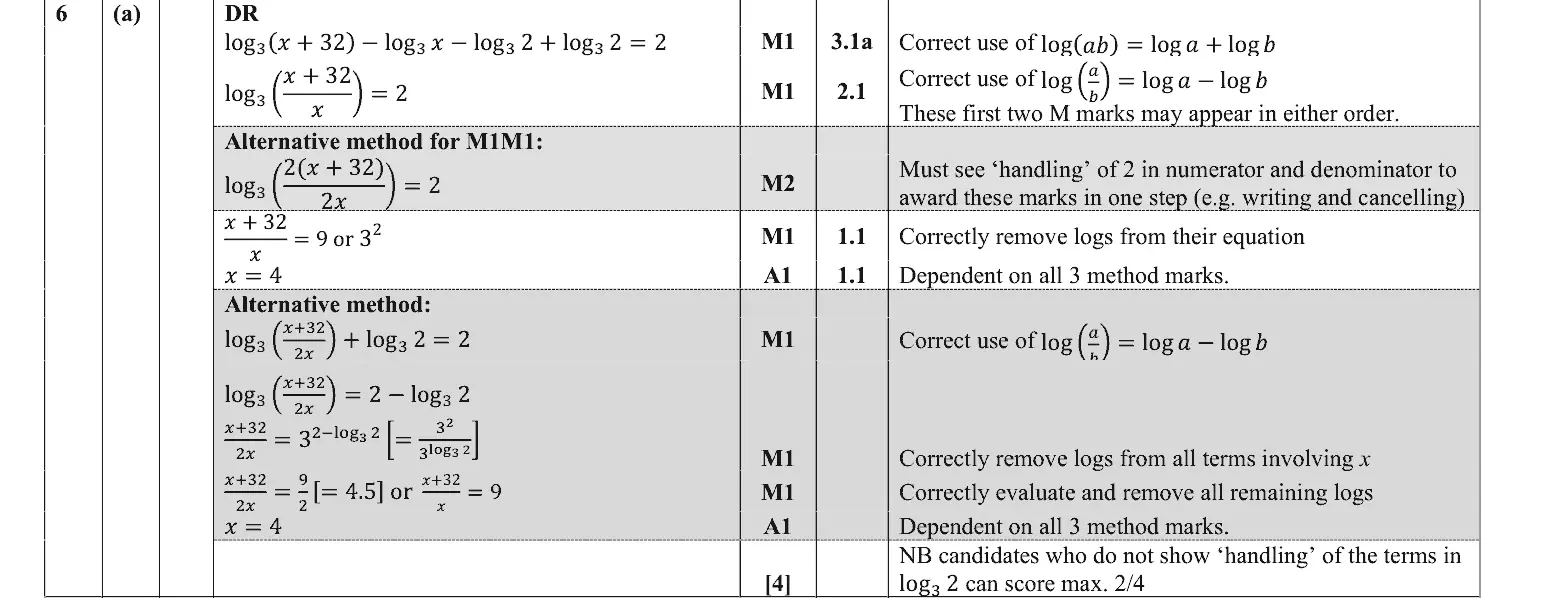
This challenging question was well answered by many candidates. As in Question 1, most candidates heeded the DR instruction and showed a good amount of working to demonstrate their work to simplify the log terms in the given equation. Some candidates combined all the log terms in a single step, which was permissible provided that it was clear and correct – specifically here this meant that candidates needed to show two in both the numerator and denominator so that it was clear that these terms had been ‘handled’ correctly. Quite a few candidates misremembered the relevant log laws and confused multiplication/addition, etc. leading to errors such as log3 32𝑥. Some candidates completed the first two simplifying steps correctly and then made an error in ‘converting’ the log terms, for instance giving the base as two rather than three. Some candidates incorrectly combined the last two terms to log 4𝑥. It was quite common to see the correct answer 𝑥= 4 from incorrect working, which was not credited.
Key points and common errors
log₃((x + 32)/x) = 2 after handling the log 2 terms
(x + 32)/x = 9 so x = 4
misremembered log laws
wrong base when removing logs
June 2025 · AS Paper 1 · Q6(b)3 marksHard
Show the start of this question
Mark scheme for this part
Examiner's comment
Here, in contrast to Question 1 and Question 6 (a), many candidates did not show sufficient working to gain full credit under the DR instruction. For three marks, candidates needed to demonstrate appropriate understanding by removing the log (M1), simplifying to a solvable form (M1) and obtaining the correct answer (A1). Candidates should be reminded that the DR instruction is ‘not a restriction on a candidate’s use of a calculator’ – and, here, a calculator is likely to be useful to check the final answer – but ‘it is a restriction on what will be accepted as evidence of a complete method’ and so candidates who ‘jumped’ to the final answer without an appropriate intermediate step could not score full marks. Some candidates omitted the 𝑦 and so did not obtain an appropriate solvable form.
Key points and common errors
y^(−3/2) = 1/8 so y^(3/2) = 8, y = 4
an intermediate step must be seen
many jumped to the answer
June 2025 · Paper 1 · Q10(a)(i)1 markEasy
Mark scheme for this part
Examiner's comment
Most candidates were able to gain this mark by stating the correct scale factor.
Key points and common errors
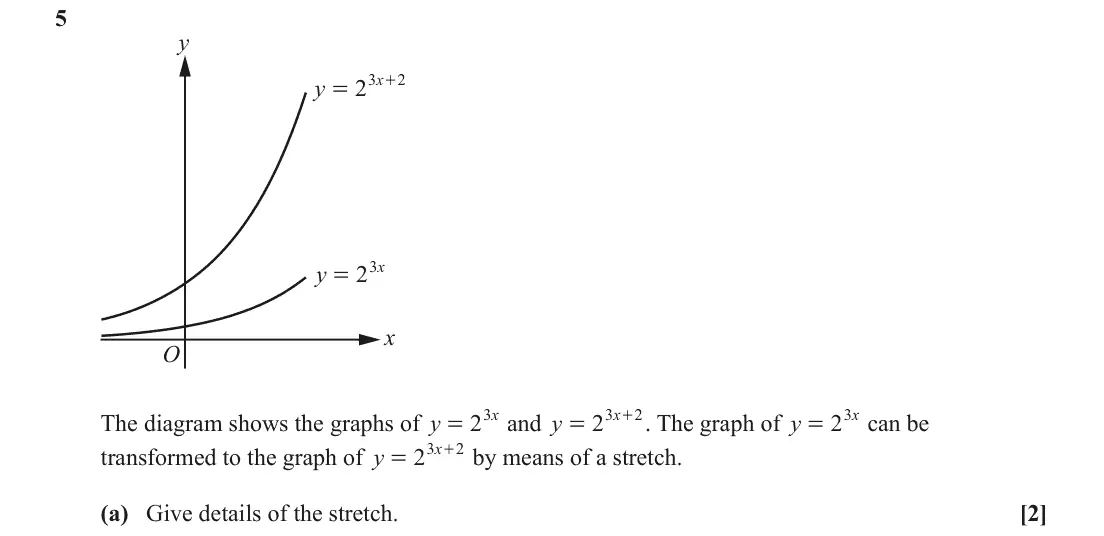
stretch parallel to x-axis scale factor ½
June 2025 · Paper 1 · Q10(a)(ii)2 marksHard
Show the start of this question
Mark scheme for this part
Examiner's comment
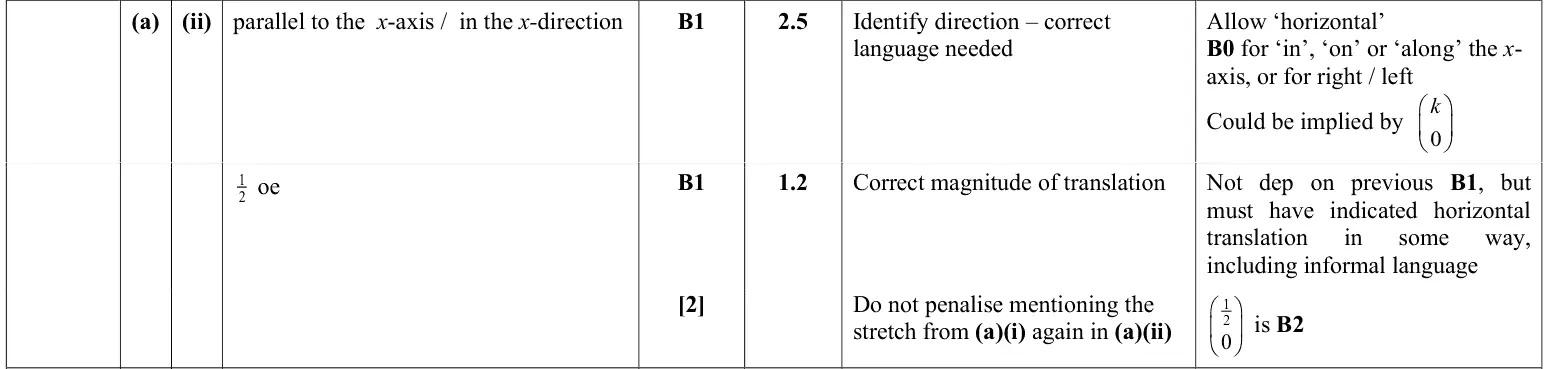
One mark was available for identifying the correct direction of the translation, using the expected mathematical terminology; this could also be implied by stating a vector for the translation with a y component of 0. Most candidates were able to gain this mark, usually through their vector statement, as long as this was not contradicted by their worded statement (e.g. stating that the translation was ‘vertical’ but giving a vector with a y component of 0 is ambiguous and thus B0). Identifying the magnitude of 0.5 proved to be more challenging, and only the most able candidates gained both of the marks available.
Key points and common errors
translation of ½ parallel to the x-axis (vector (½, 0)) after the stretch
direction language needed
magnitude ½ challenging
June 2025 · Paper 1 · Q10(b)1 markHard
Mark scheme for this part
Examiner's comment
This part of the question proved to be more challenging, with just less than half of the candidates gaining the mark available. Those who were successful appreciated the need to rewrite the given equation in the form y = aebx, so as to address the information given in the question, and could then identify the magnitude of the stretch in the y-direction, giving the answer in an exact form.
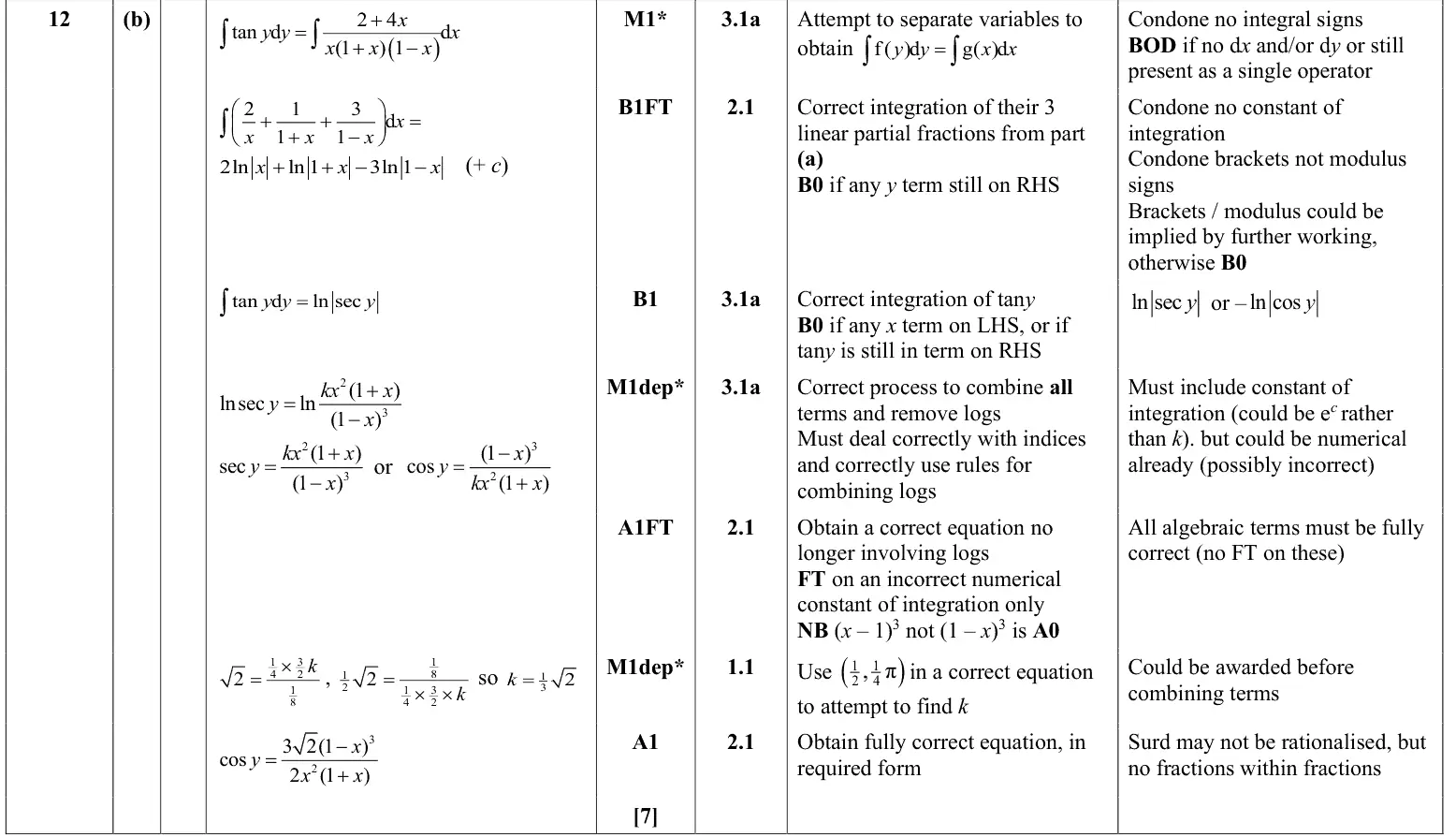
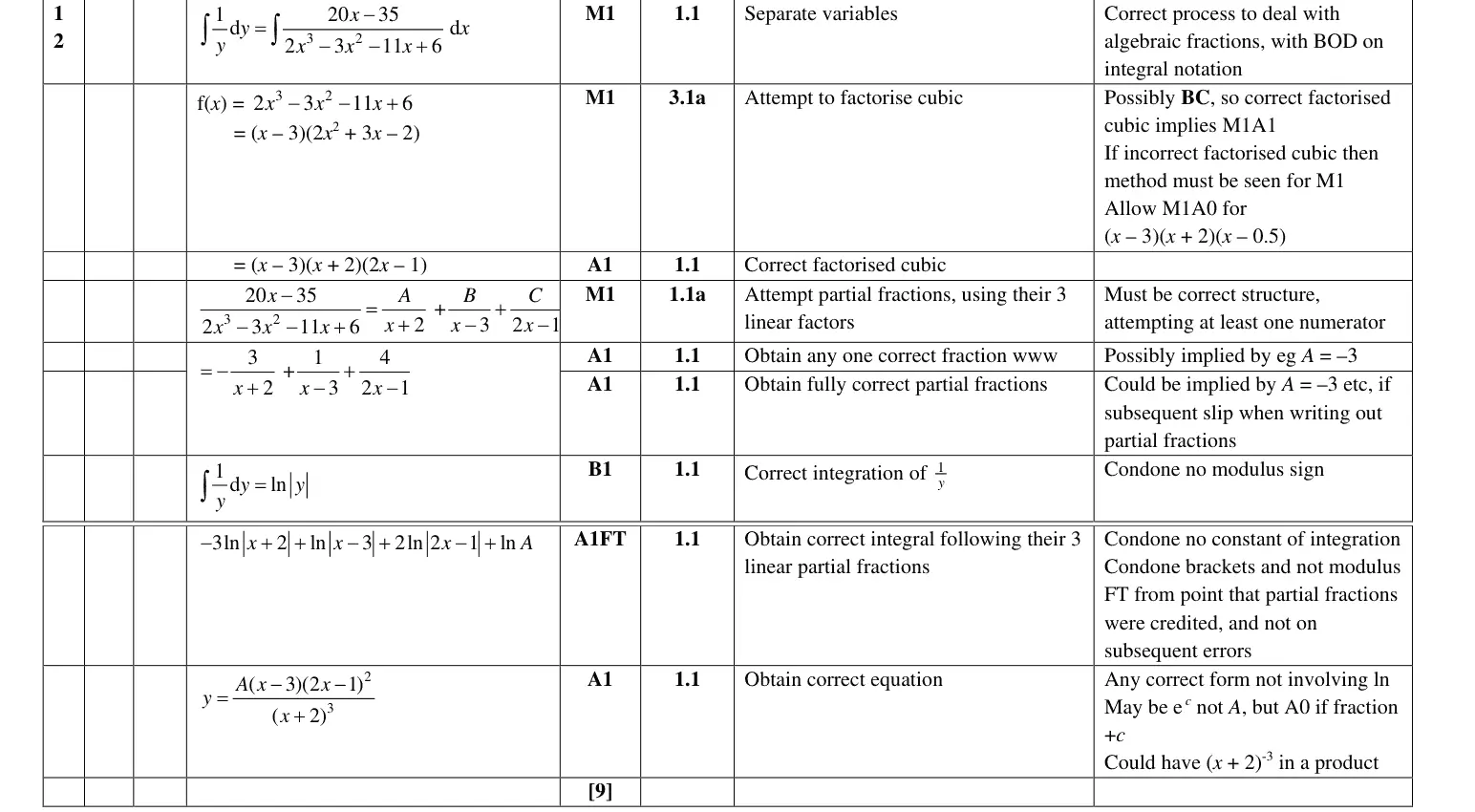
This question proved to be a suitably challenging final question, with only those candidates that had successfully completed the majority of the paper gaining full credit here. To gain the first mark candidates needed to identify that this was a differential equation with separable variables and attempt to do so; no credit was given for any integration attempts on an equation that still involved both x and y terms. Once variables had been separated, integrating tany is a standard specification statement (1.08h) yet this was not always done correctly; sign errors were common, as was finding the derivative and not the integral of tany. Candidates nearly always realised the need to use their partial fractions from the first part of the question, and could attempt integration of these, but there were often sign errors when integrating the fraction with the denominator of (1 – x). Further credit could still be gained for correctly combining all of their terms and removing logarithms; while many candidates could correctly combine the algebraic terms it was a common error to see the constant term still as +c even once logs had been removed. Of the candidates who had made reasonable progress with this question, most were able to attempt the required method but made slips in their working.
Key points and common errors
separate variables: ∫tan y dy = ln sec y
2ln x + ln(1 + x) − 3ln(1 − x) + c
combine logs
use (½, π/4) to find k
cos y = 3√2(1 − x)³ / (2x²(1 + x))
sign errors with tan y and with ln(1 − x)
June 2025 · Paper 2 · Q2(b)2 marksEasy
Show the start of this question
Mark scheme for this part
Examiner's comment
This part was very well answered. Most candidates showed at least the required step of working and wrote down the correct, exact answer (although the decimal equivalent could also be credited). A few candidates appeared unsure as to whether they were taking log10 or ln – which was sometimes recovered but often led to an incorrect answer.
Key points and common errors
take ln of both sides: 3y = ln 2, y = (1/3)ln 2
confusion between log10 and ln
June 2025 · AS Paper 2 · Q6(a)2 marksMedium
Mark scheme for this part
Examiner's comment
The correct response appeared quite often and fewer candidates seemed to omit ‘y =’ this series. Note that in this instance, credit was not given for only ‘f(x) = ‘, as the question requested an equation of a curve. Some incorrect offerings : 3lnx , ln(x – 3), ⅓lnx, ln(-3x).
Key points and common errors
y = ln(x/3) (or ln x − ln 3)
must be an equation
ln 3x, ln(x − 3), 3 ln x are common errors
June 2025 · Paper 2 · Q85 marksMedium
Mark scheme for this part
Examiner's comment
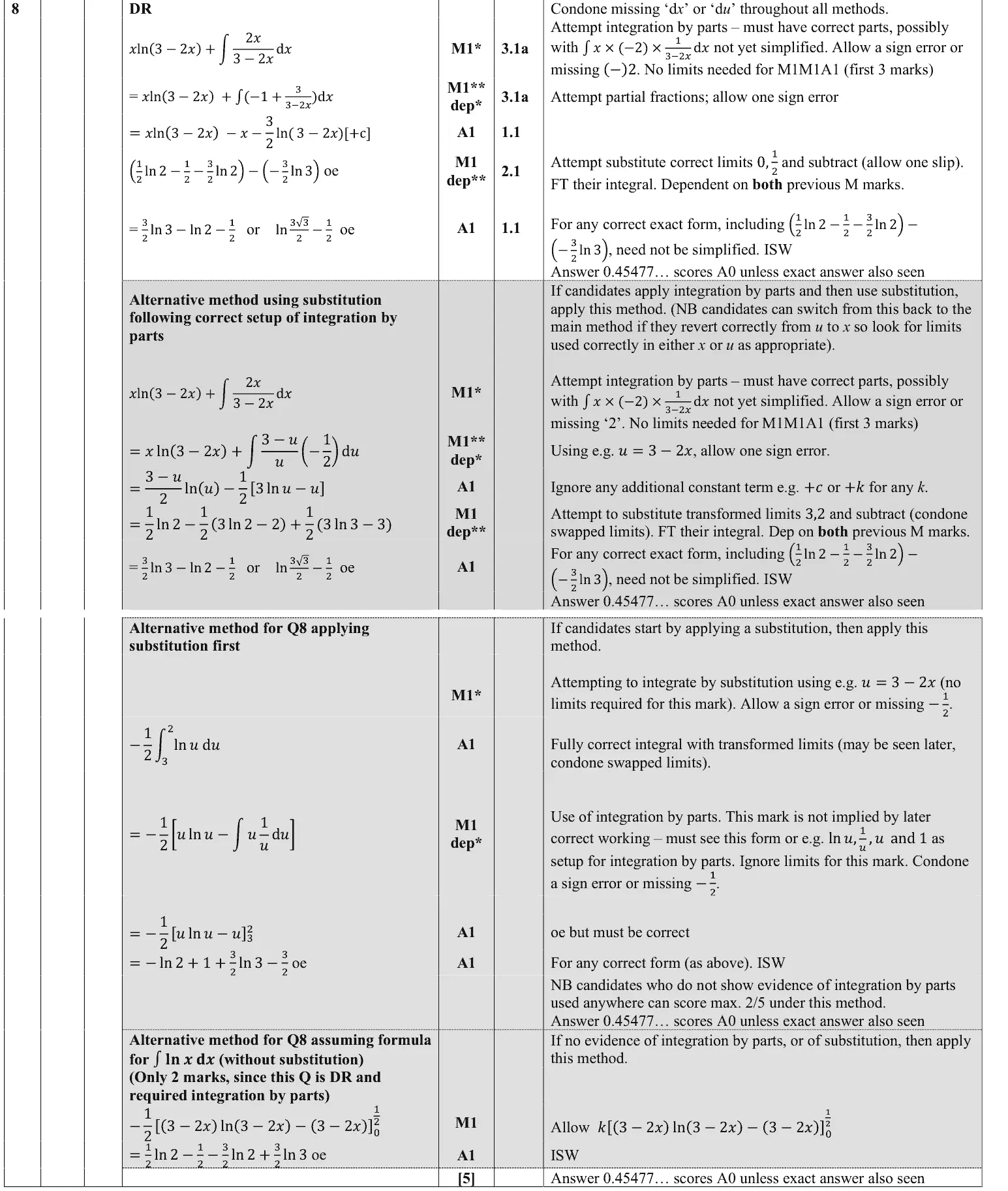
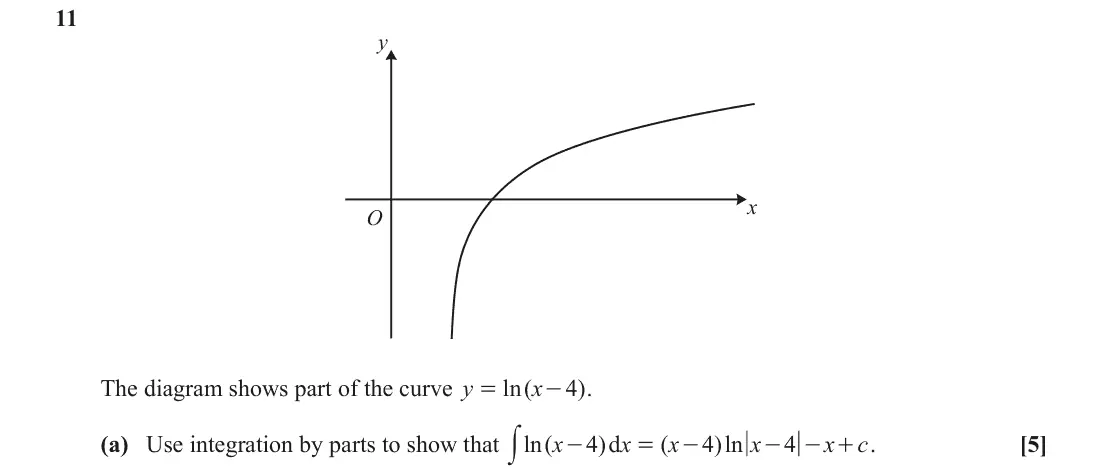
Many candidates scored at least 3 marks in this question, and some very good answers were seen, although a significant number of candidates made no progress beyond the initial setup (typically scoring M1 only). The question specified the use of integration by parts, so answers which did not use this technique anywhere could not score full marks (see the third alternative method in the scheme). Most candidates applied ‘by parts’ directly to the given integral and then proceeded via either partial fractions or substitution on the resulting second integral as shown in the first two methods on the scheme. A few candidates made an error in setting up their ‘by parts’ (resulting in an inconsistent statement). Some candidates, perhaps in trying to solve the resulting integral, went backwards by attempting ‘by parts’ again and undoing their initial setup – which normally resulted in no further progress being made. The second alternative method was quite often seen, with candidates starting by applying a substitution (which is a logical way to approach the given integral). Candidates still needed to demonstrate the use of ‘by parts’ in their working in order to be eligible for full marks– as shown in the scheme. In all methods, sign errors were very common – often meaning that the method marks were scored but one or both of the accuracy marks were not. For candidates who used a substitution, some did not ‘translate’ the limits at the point of applying the substitution. This was often recovered (especially for candidates who reversed the substitution later) and some candidates even chose to work in a mixture of variables (i.e. keeping the first term of the ‘by parts’ in x and substituting within the second integral to, e.g. u). The scheme was deliberately flexible to accommodate this, but candidates should be reminded that, when using a substitution on a definite integral, it is important that the limits are adjusted at the point the substitution is made so that the integral remains correct throughout. This is particularly important when working under a DR instruction – which means there is greater emphasis on fully correct working leading to the answer. In a few cases (whether from substitution or sign errors) candidates inadvertently recovered to the correct final answer, but the final mark could not be awarded for answers that arose from incorrect working. This is an excellent example of a fully correct solution to this question. This candidate correctly sets up the integration by parts and proceeds to use a substitution to evaluate the ‘new’ integral (as shown in the first alternative method on the scheme). They do this correctly and revert to the original form in x before applying the appropriate limits correctly, leading to the correct final answer, 5/5.
Key points and common errors
by parts with u = ln(3 − 2x), v = x
second integral by division or substitution
exact answer (3/2)ln3 − ln2 − 1/2
sign errors common
change limits when substituting
by parts must be used
June 2025 · AS Paper 2 · Q8(a)1 markMedium
Mark scheme for this part
Examiner's comment
This was a ‘Show that’ question so we expected fully accurate working.
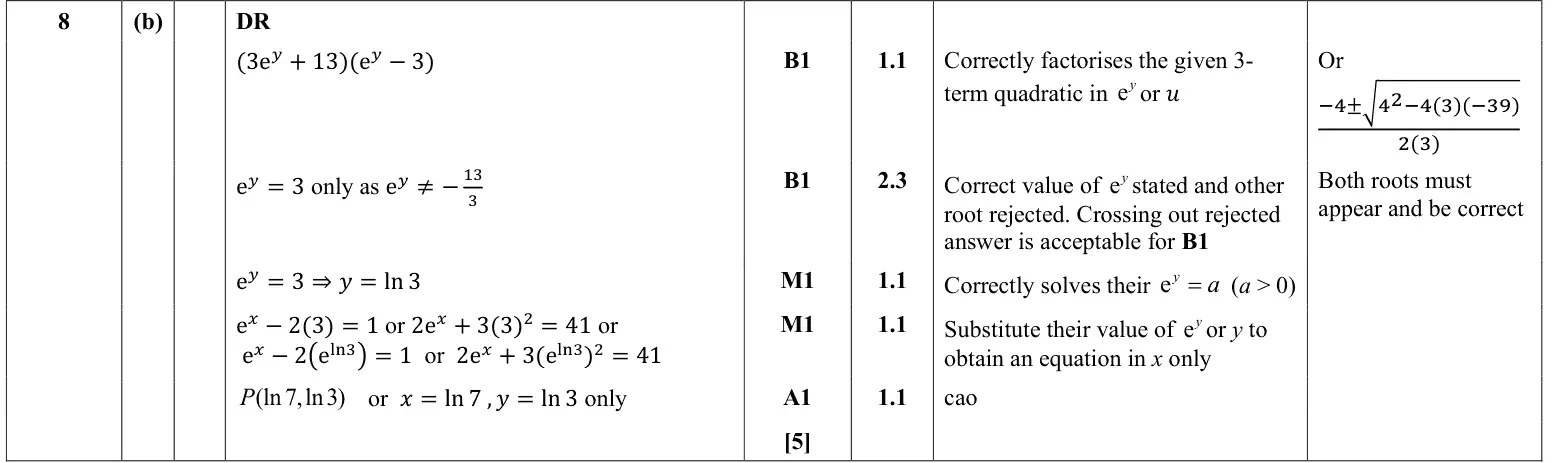
This was the third DR question. The given equation was widely recognised as a quadratic and well solved (see note below). The negative root was often rejected with a good reason provided. We expected exact answers to be seen for full marks. Those who did not use a quadratic tended to write things like ln(3e2y) + ln(4ey) = ln(39) and not make any further progress.
Key points and common errors
quadratic in eʸ: (3eʸ + 13)(eʸ − 3) = 0
reject eʸ = −13/3 with reason
y = ln 3, eˣ = 7 so P(ln 7, ln 3) exact
logging term by term fails
June 2025 · Paper 3 · Q3(c)3 marksMedium
Show the start of this question
Mark scheme for this part
Examiner's comment
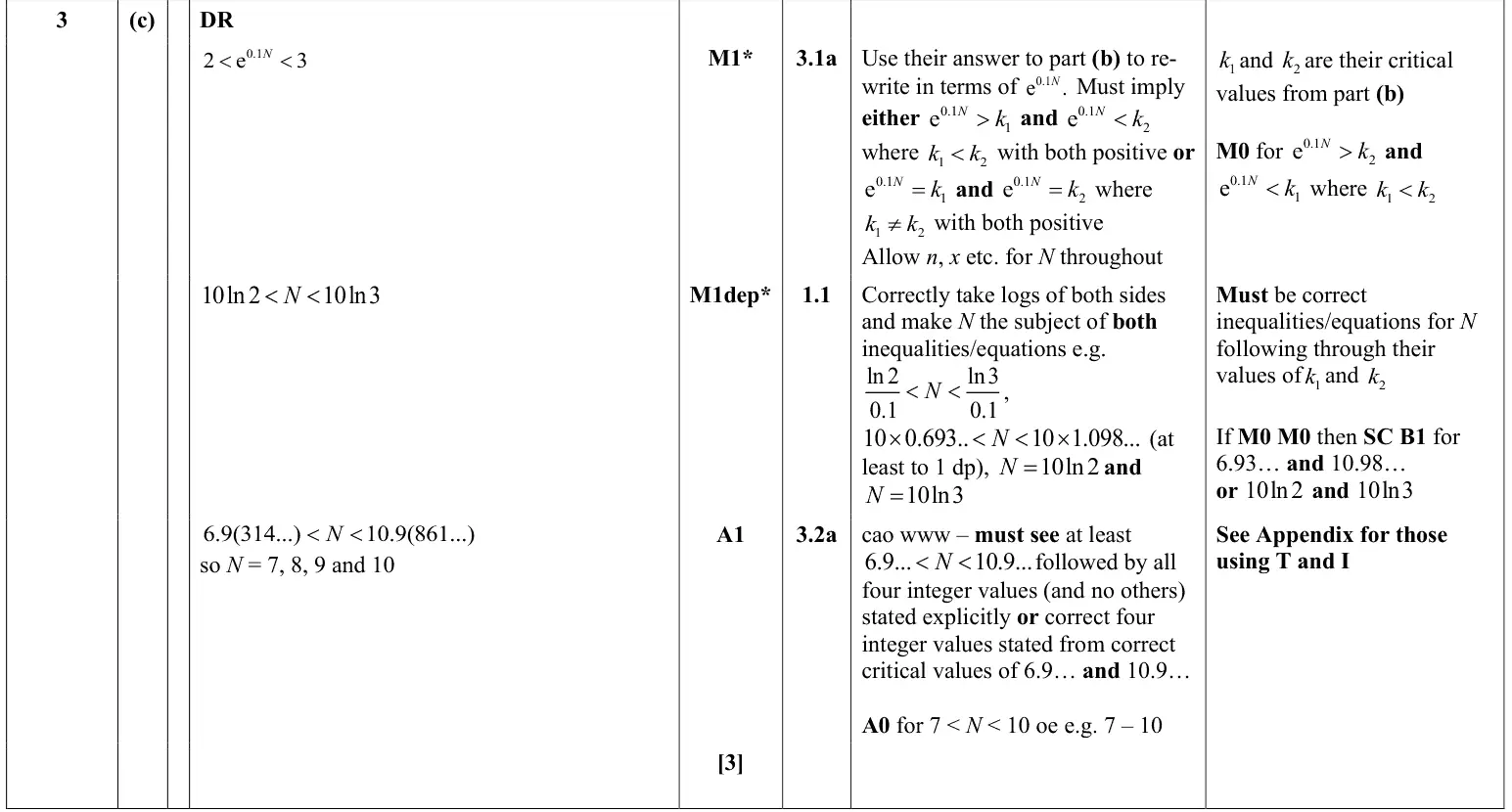
Although most candidates realised that importance of their answer to part (b) and started by stating that 2 < e01.𝑁< 3, many re-started in this part or did not see the significance of the previous part. While many candidates correctly stated that 10ln2 < 𝑁< 10ln3 many did not read the question carefully and either left this as their final answer or gave an answer in a form that did not make it explicitly clear what positive integers satisfied the given inequality (e.g. an answer of 7 ≤𝑁≤10 was far too common). Finally, as this question required detailed reasoning (DR) many went straight from 10ln2 < 𝑁< 10ln3 to N = 7, 8, 9 and 10 without first showing the critical values of 6.93… and 10.98….
Key points and common errors
replace x by e^(0.1N): 2 < e^(0.1N) < 3
10 ln 2 < N < 10 ln 3 i.e. 6.93 < N < 10.99
integers N = 7, 8, 9, 10
many stopped at the log inequality
June 2025 · Paper 3 · Q5(b)4 marksMedium
Show the start of this question
Mark scheme for this part
Examiner's comment
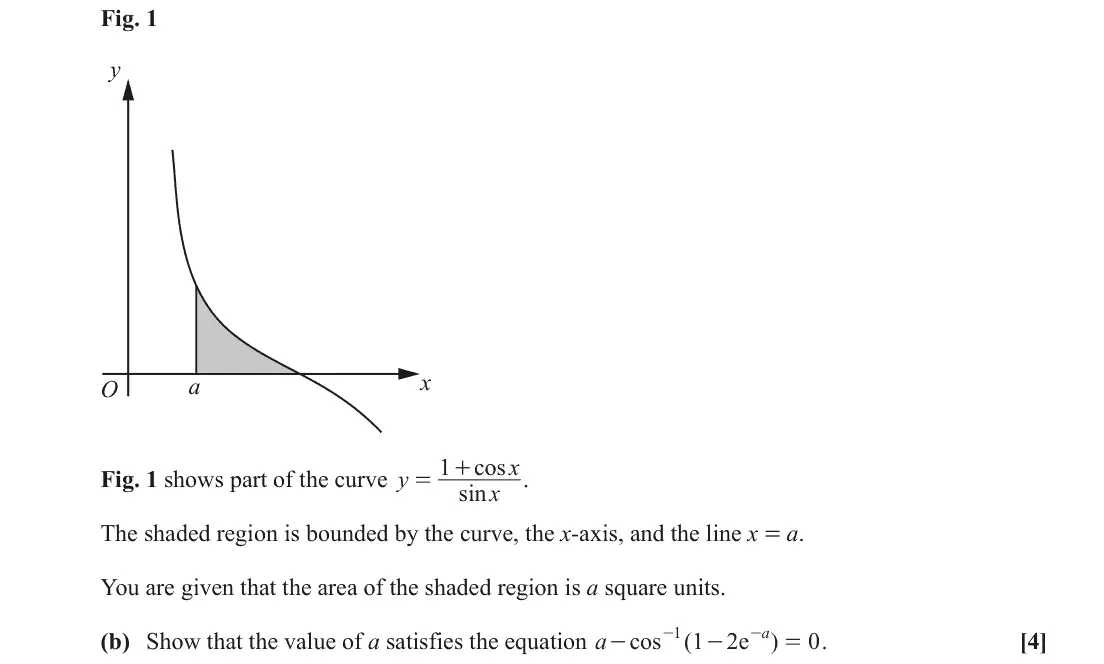
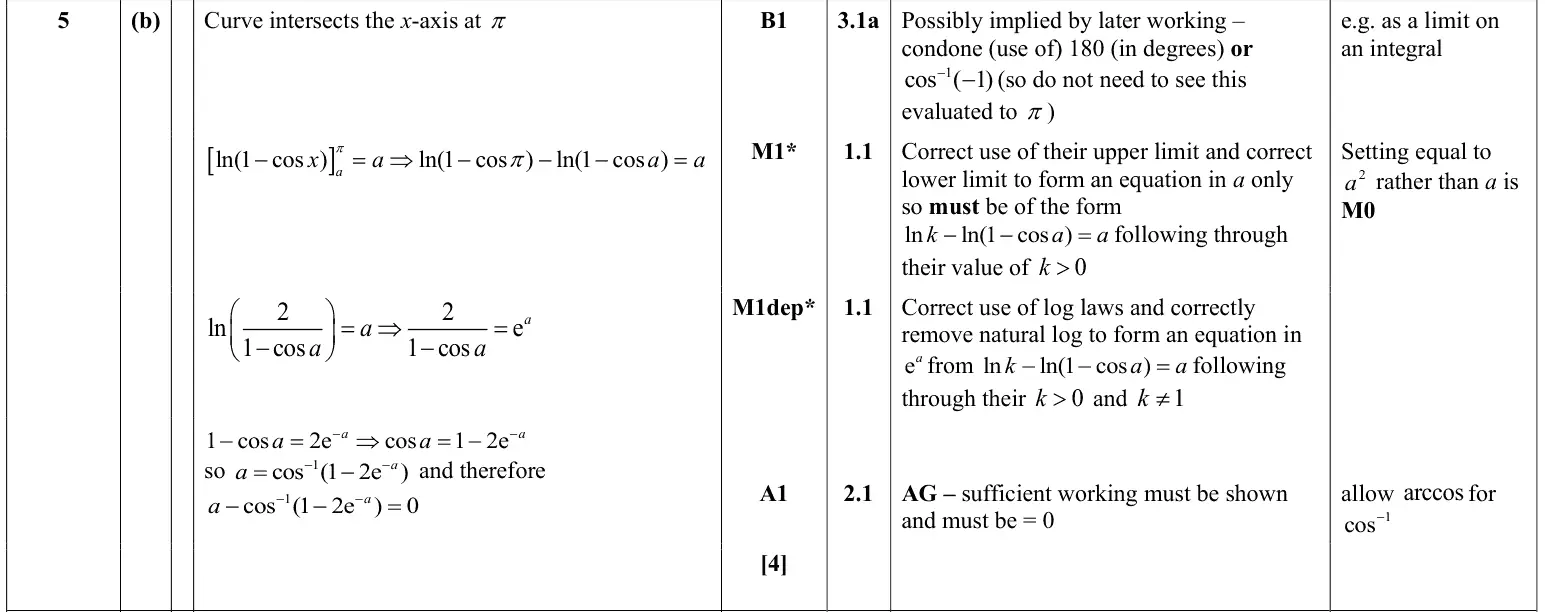
While many candidates correctly found that the curve intersected the 𝑥-axis at 𝜋, some struggled with applying the limits correctly to the given answer from part (a), and a number of candidates incorrectly thought that the shaded region had an area of 𝑎2. Of those that did correctly obtain the equation ln2 − ln(1 −𝑎) = 𝑎 many struggled with the associated log work required to get the answer in the given form with many incorrect replacing ln2 −ln(1 −𝑎) = 𝑎 with 2 −(1 −𝑎) = e𝑎.
Key points and common errors
curve meets the x-axis at π
ln 2 − ln(1 − cos a) = a
2/(1 − cos a) = eᵃ so a = cos⁻¹(1 − 2e^(−a))
area is a, not a²
June 2024 · AS Paper 1 · Q13 marksHard
Mark scheme for this part
Examiner's comment
question challenging. Common errors include ln 5𝑥𝑥2 = 2 ln 5𝑥𝑥 and mixing up log rules for This question was only answered correctly by a minority of candidates – who seemed to find this subtracting/dividing. A number of candidates gave 𝑥𝑥= 0 as an extra solution without noting that the question specified 𝑥𝑥> 0 – on this occasion this was not penalised but in general candidates should specifically exclude solutions outside the given range. Candidates who attempted to combine terms were side correctly a small, but significant, number of candidates did not notice that ln 5 = ln 2 → 5 = 2 can be generally more successful than those who attempted to ‘split’. However, having combined the left-hand implied directly.
Key points and common errors
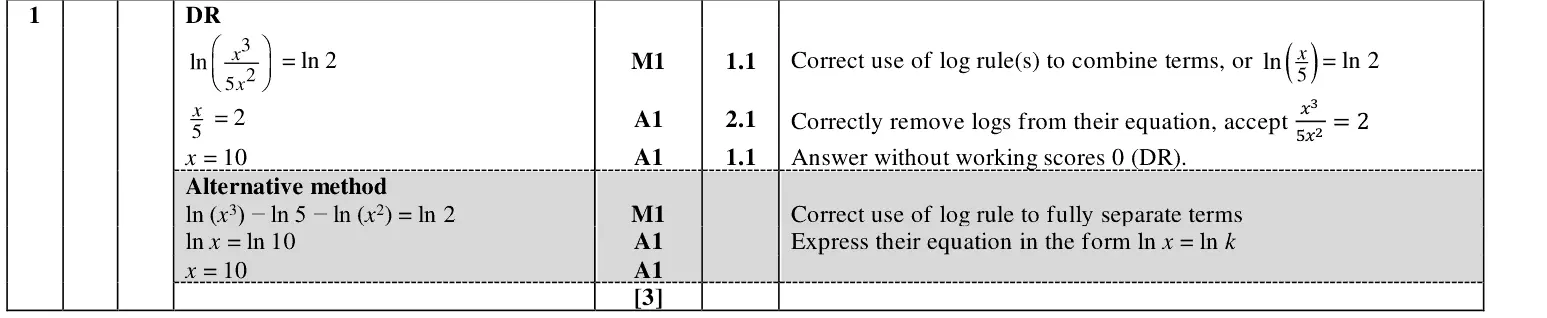
ln(x³/(5x²)) = ln 2 so x/5 = 2, x = 10
errors: ln 5x² = 2ln 5x, mixing up subtraction/division rules
answer without working scores 0
June 2024 · Paper 1 · Q1(a)4 marksEasy
Mark scheme for this part
Examiner's comment
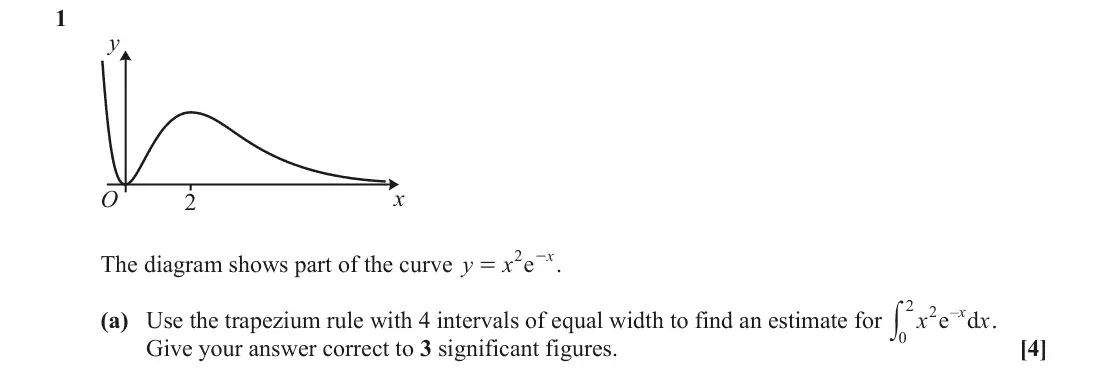
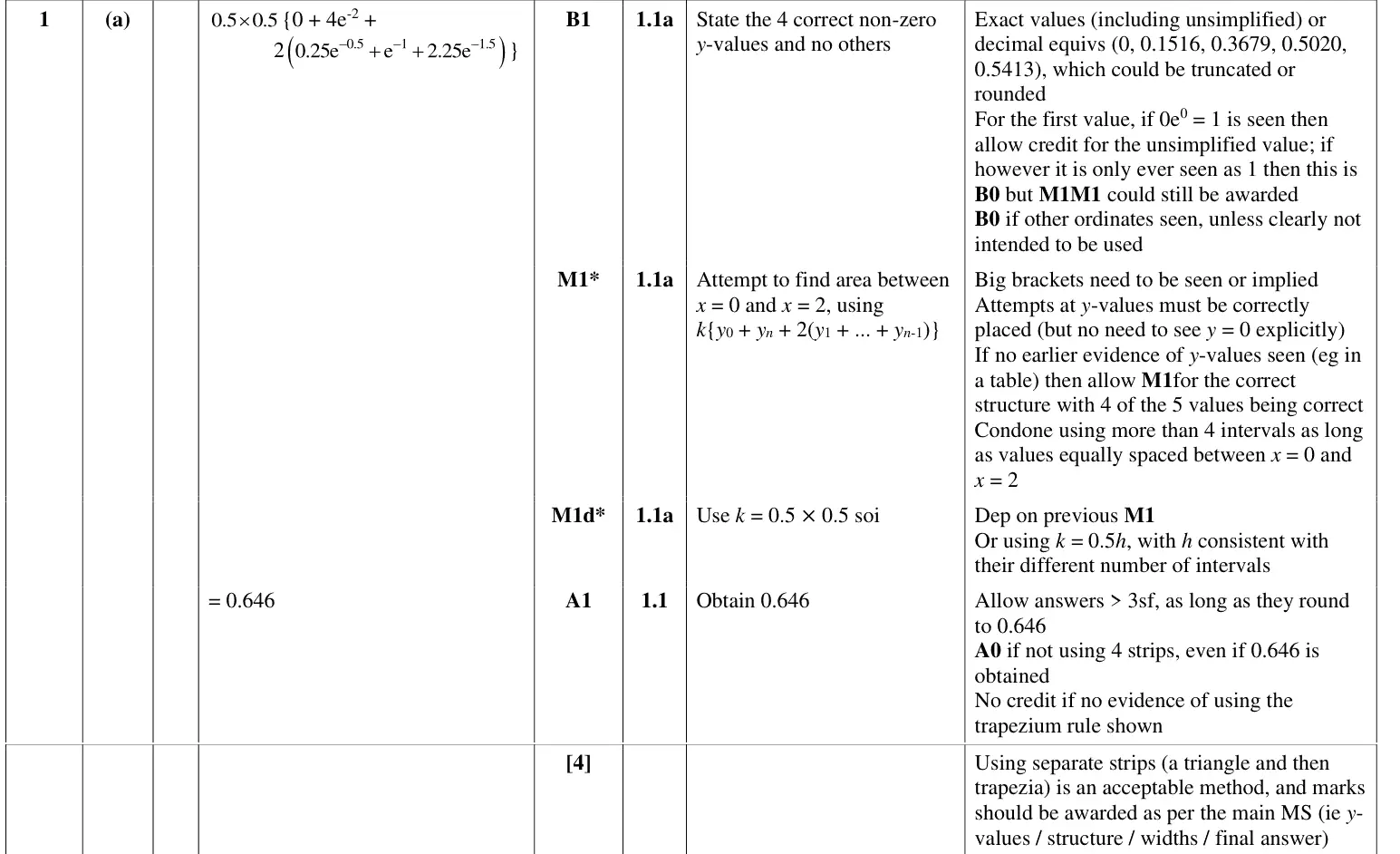
Most candidates made a good attempt at this question and achieved full marks. Those who lost marks often missed out brackets in their formula. Some candidates had used 1 as their first y-value rather than 0. Some omitted 0 completely, leading to them incorrectly approximating the integral between 0.5 and 2 with 3 intervals. A small number were not able to access this question, using either x-values or incorrect y-values placed incorrectly in the formula.
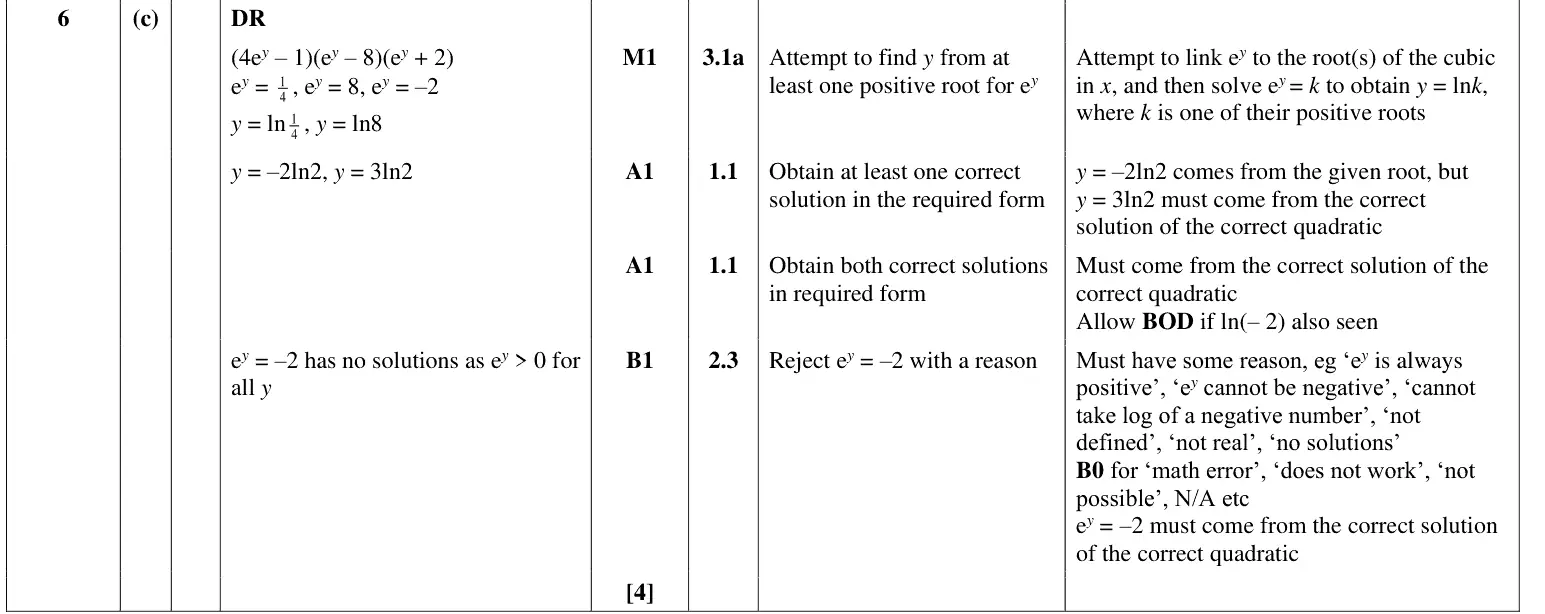
The question was very well answered with many candidates getting full marks on this question. Most candidates made the connection with the previous parts. The most commonly lost mark was the B mark for explaining why 𝑒𝑦= −2 did not result in a solution. It is important in detailed reasoning questions that candidates explain why rejected answers are not used; ‘not possible’ is not enough and incorrect statements like ‘negative logs are not possible’ are not given credit. Some candidates realised there was a connection to part (b) but unfortunately, thought it was an equation in 𝑒3𝑦 instead of 𝑒𝑦. This is a good solution to Question 6 (c), in that it provides clear evidence as to how the solutions are obtained and gives detailed reasoning on why one solution has been rejected.
Key points and common errors
x = e^y: (4e^y − 1)(e^y − 8)(e^y + 2) = 0
y = −2ln2, 3ln2
reject e^y = −2 since e^y > 0
'not possible' is not a reason
June 2024 · Paper 1 · Q11(a)2 marksHard
Mark scheme for this part
Examiner's comment
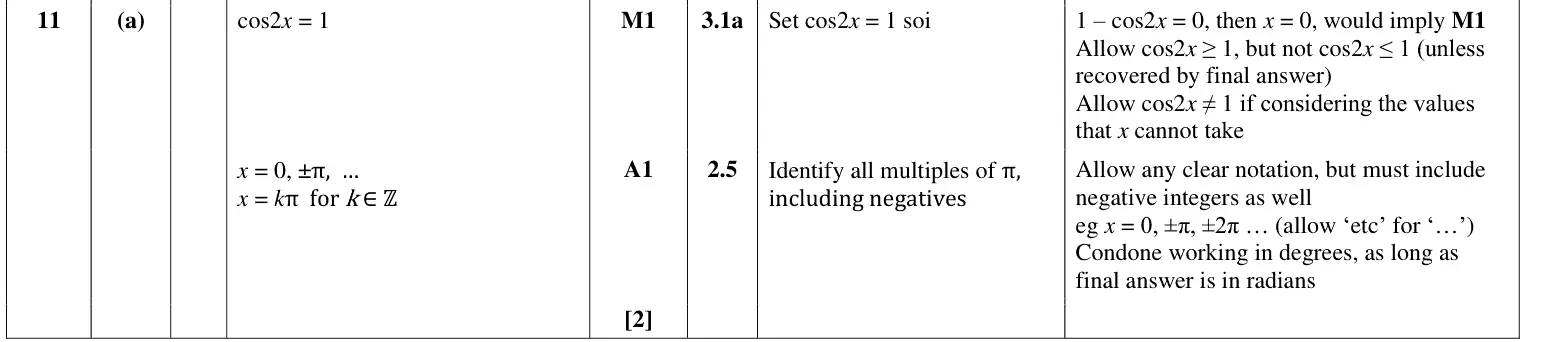
This proved to be a challenging question as although the vast majority recognised when the logarithmic function is undefined and related cos 2x to 1 in some way, very few were able to identify the full set of values. Candidates seem comfortable solving a trigonometric equation in a given range, so most simply proceeded to give an incomplete answer with negative values of x rarely considered.
Key points and common errors
ln undefined when 1 − cos2x = 0 (cannot be negative): cos2x = 1, x = kπ for all integers k including negatives
very few gave the full set
June 2024 · Paper 1 · Q11(c)(i)5 marksMedium
Show the start of this question
Mark scheme for this part
Examiner's comment
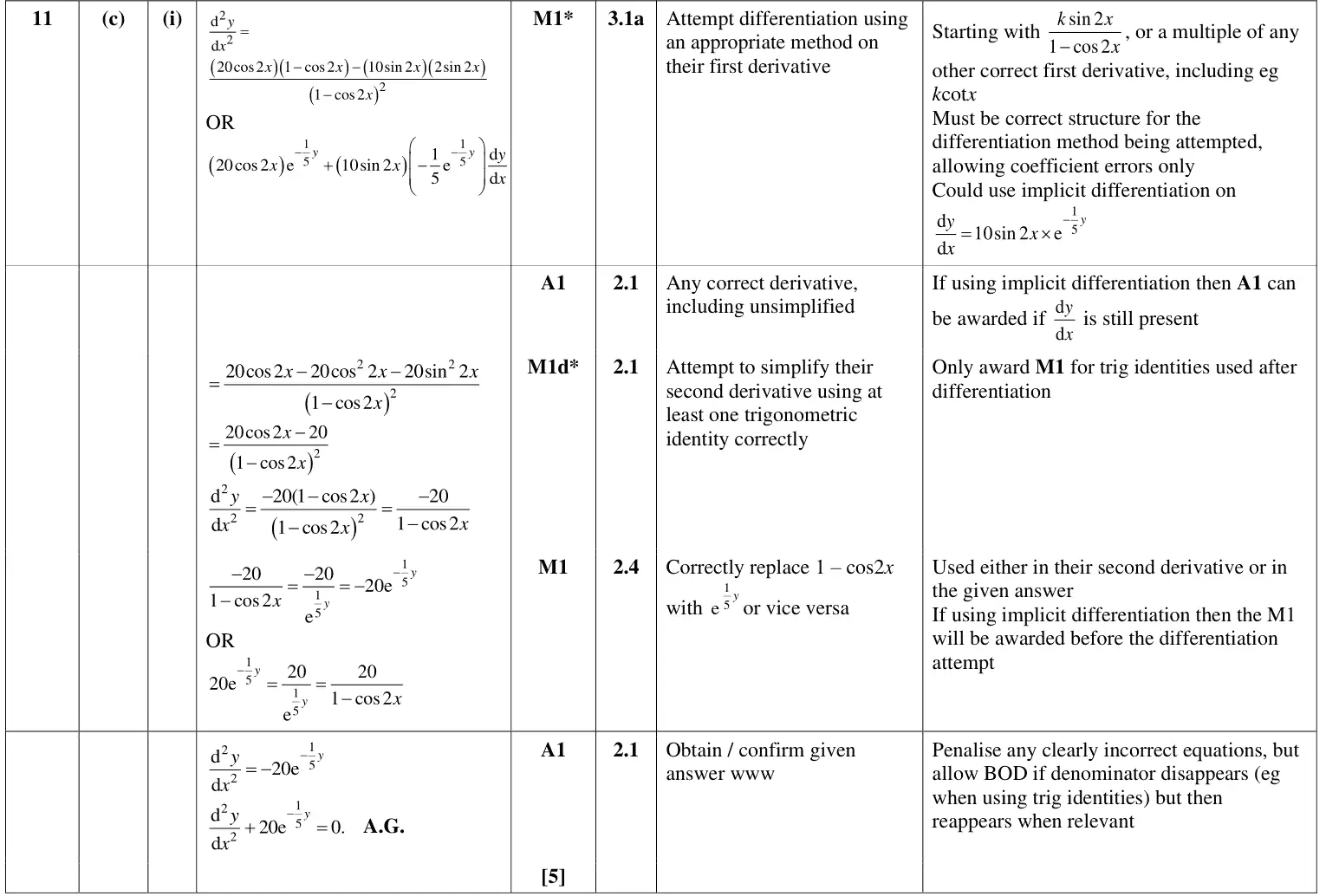
The attempts at the second derivative were very good when a correct first derivative had been obtained in part (b). The majority used the quotient rule rather than the product rule, the latter of which proved trickier for candidates to manipulate correctly to secure full marks. With a given answer, there is an expectation that method is clearly shown, and many candidates were able to simplify their second derivative by using a trigonometric identity but often struggled to obtain a fully correct solution. Those who struggled with part (b) often did not make progress with this part.
Key points and common errors
quotient rule on 10sin2x/(1 − cos2x)
simplify with sin² + cos² = 1 to −20/(1 − cos2x)
replace 1 − cos2x by e^(y/5)
given answer so full method needed
June 2024 · Paper 1 · Q11(c)(ii)1 markHard
Show the start of this question
Mark scheme for this part
Examiner's comment
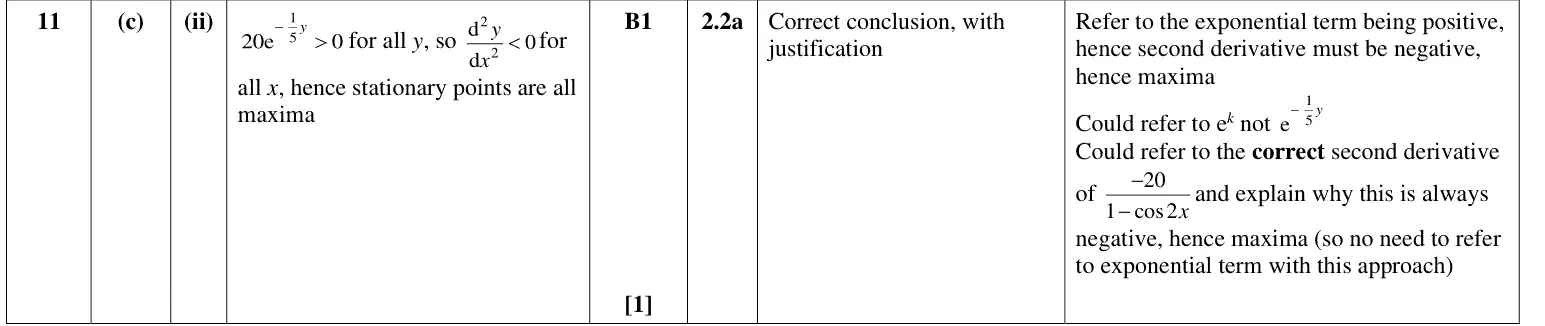
This was not well answered and was often left blank. Quite a few candidates who deduced that the stationary points must all be maxima did not give sufficient reasoning.
Key points and common errors
20e^(−y/5) > 0 so d²y/dx² < 0 for all x: every stationary point is a maximum
reason required
June 2024 · Paper 2 · Q4(a)3 marksMedium
Mark scheme for this part
Examiner's comment
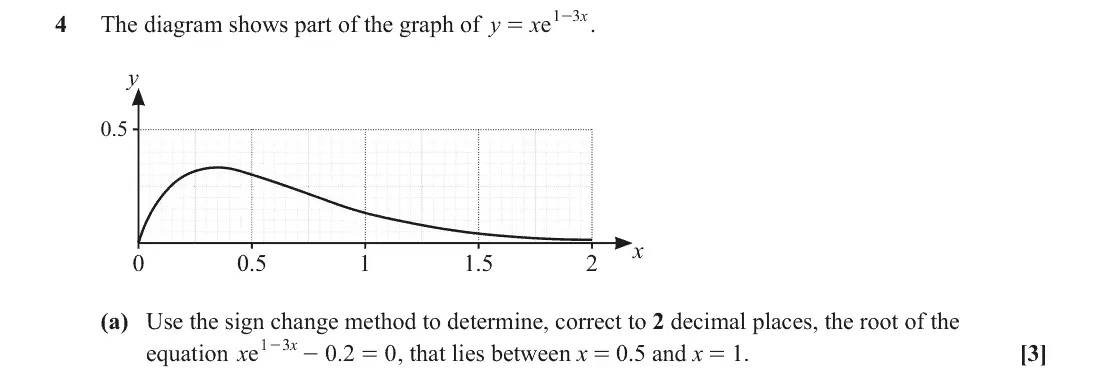
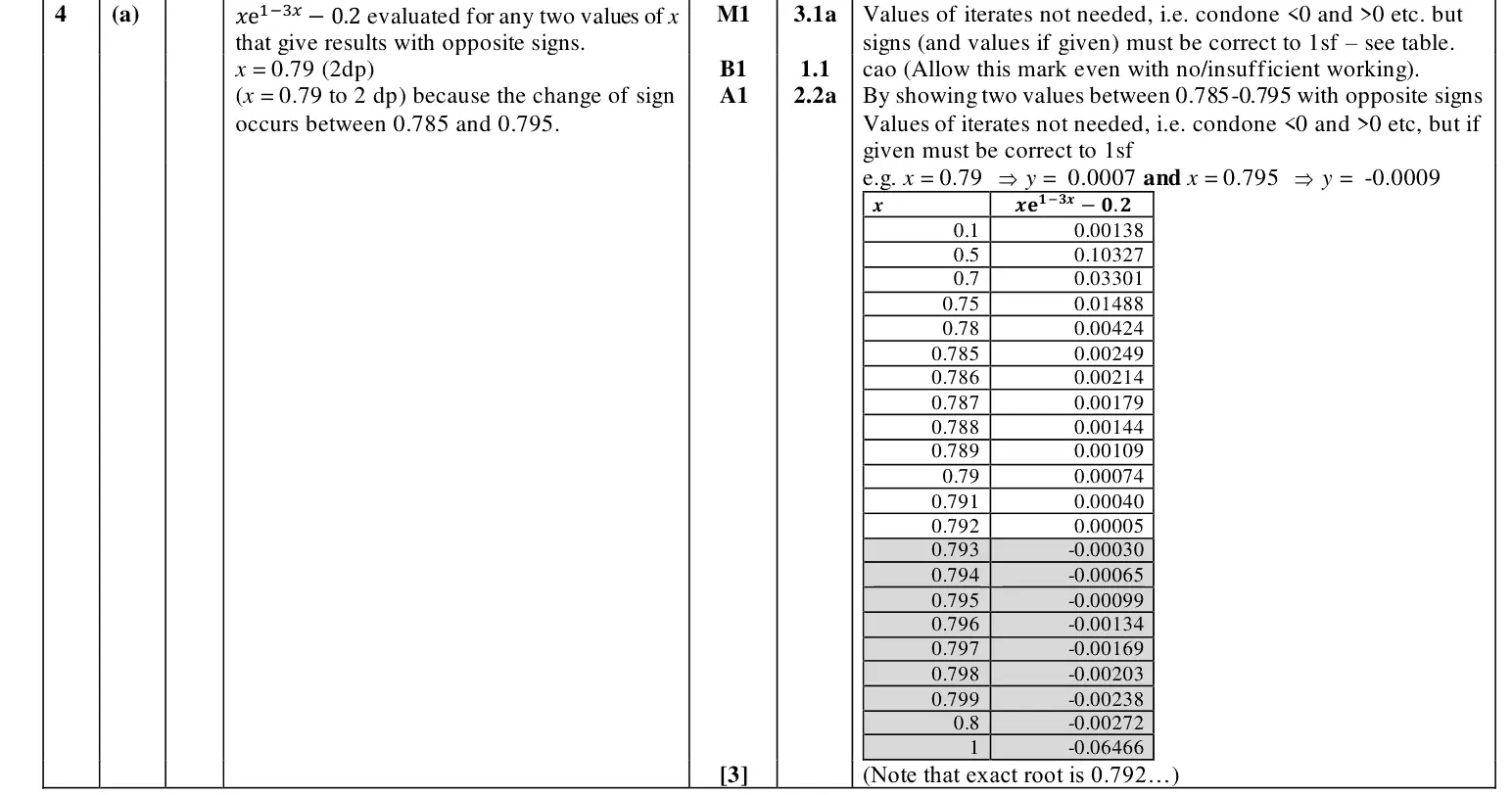
A minority of candidates scored all 3 marks in this part, although many candidates scored at least 1 and often 2. Most candidates correctly substituted 0.5 and 1 into the given expression to show a change of sign within the given interval, although quite a few stopped at this point (which could only score M1). Many candidates gave the correct value x=0.79 to 2dp - and this is an excellent example of a question where a calculator can be used effectively to verify a solution (or to give an idea of where to ‘look’ for the root). However, this root alone could only score B1. In order to achieve the final accuracy mark (and demonstrate that this is the correct root to 2dp) candidates needed to show a change of sign using a pair of iterates within the interval [0.785,0.795] with opposite signs, which very few did. Quite a few candidates gave a collection of iterates and claimed that led them to this conclusion but could only gain credit for two correct iterates in that interval. Note that informed choices of iterates, e.g. 0.79 and 0.793 could be credited, as could the boundary values of 0.785 and 0.795. Some candidates used Newton- Raphson to obtain an initial value (which is of course acceptable, but earned no credit on its own as the question specified a sign change). Candidates did not need to write down the value of the expression for their iterates, but if they did it needed to be correct to 1sf - some made a place value error when copying. This is a (typical) example of a candidate’s response where they have made a very good attempt at their sign change, with many correct iterates and the correct value to 2dp given. However, their iterates do not fully justify the solution to 2dp (there is only one in the range [0.785,0.795] and their explanation ‘closer to’ is not sufficient) so this response scores M1B1A0 for a total of 2/3.
Key points and common errors
evaluate at 0.785 and 0.795 to justify 2 d.p.
many stopped at the change of sign between 0.5 and 1
June 2024 · AS Paper 2 · Q5(a)4 marksMedium
Mark scheme for this part
Examiner's comment
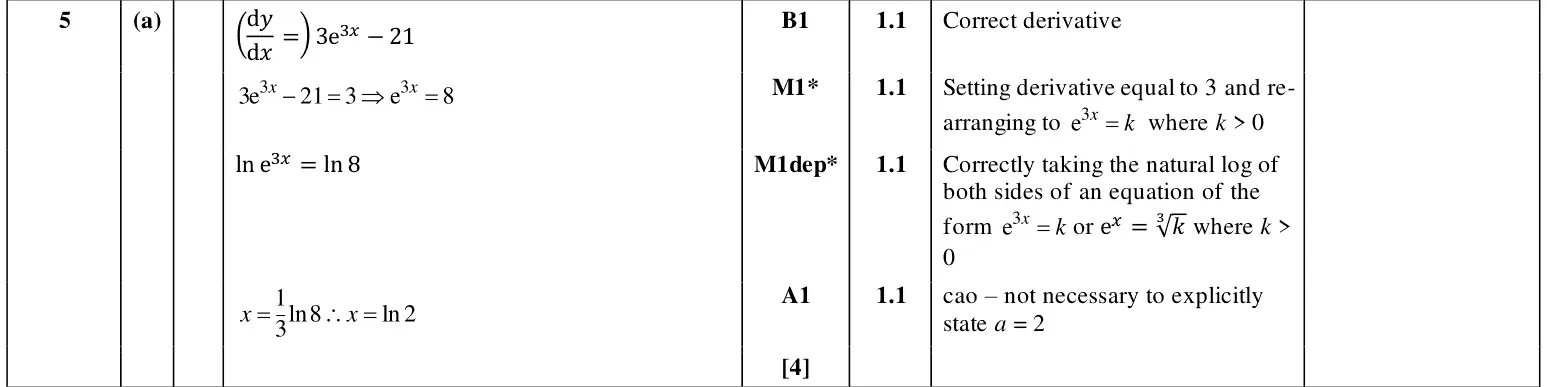
A lot of good responses lost the final mark because the answer was left as 3ln8, ignoring the instruction to give the answer in the form lna. Those who differentiated e3x to 3xe3x, 3xe3x - 1, e2x or similar were 1 given no marks. A small number set their differential equal to − 3. Understanding of the log laws still needs strengthening. Some did not attempt differentiation, but started with things like lny = lne3x − ln21x − ln8.
Key points and common errors
dy/dx = 3e^(3x) − 21 = 3 gives e^(3x) = 8
x = ⅓ln 8 = ln 2 (must be in the form ln a)
June 2024 · AS Paper 2 · Q5(b)3 marksHard
Show the start of this question
Mark scheme for this part
Examiner's comment
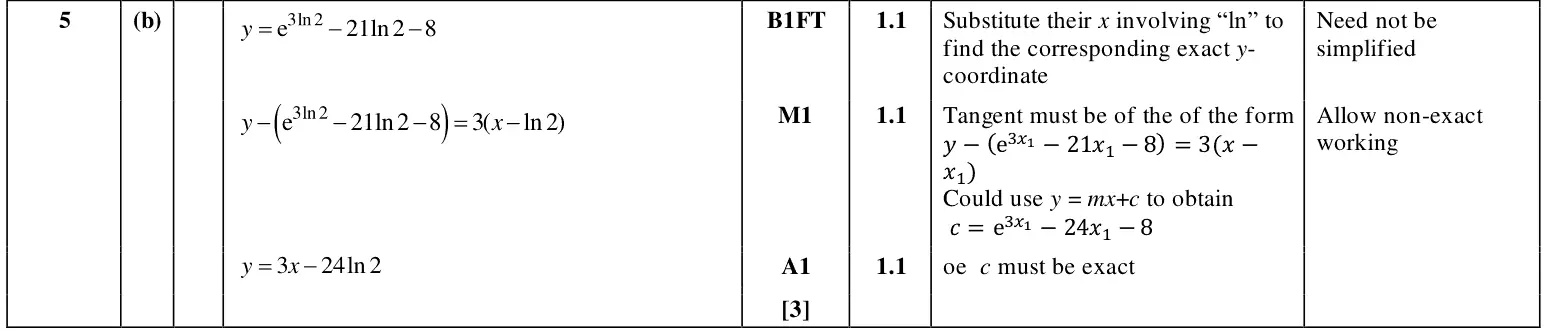
This part was not well done. Those who did not find an x in (a) made no progress. Those who had an x often responded with a decimal, ignoring the request for an exact c (particularly those who had 1 responded with 3ln8 in the previous part).
Key points and common errors
y = e^(3ln2) − 21ln2 − 8 = −21ln2
y = 3x − 24ln2
c must be exact
June 2024 · Paper 3 · Q5(b)6 marksMedium
Show the start of this question
Mark scheme for this part
Examiner's comment
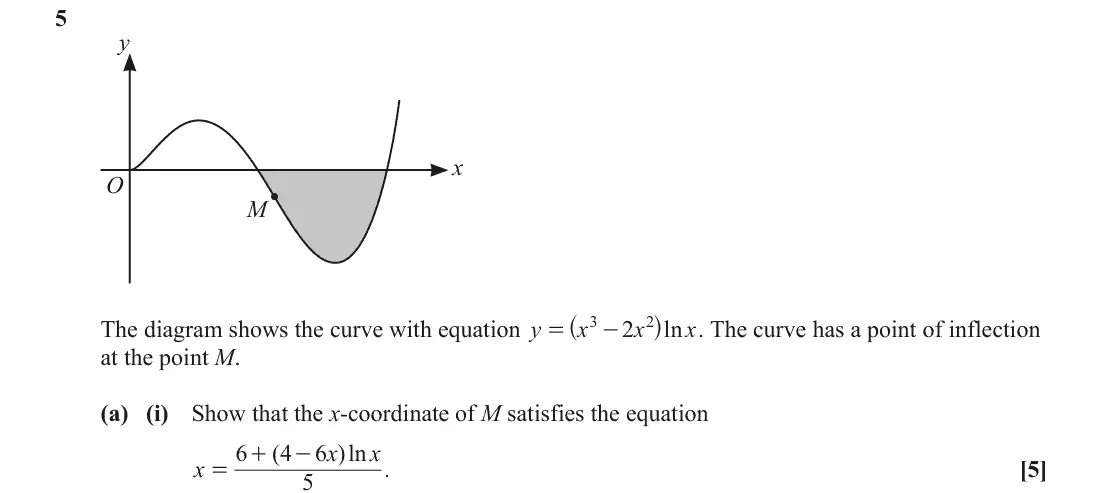
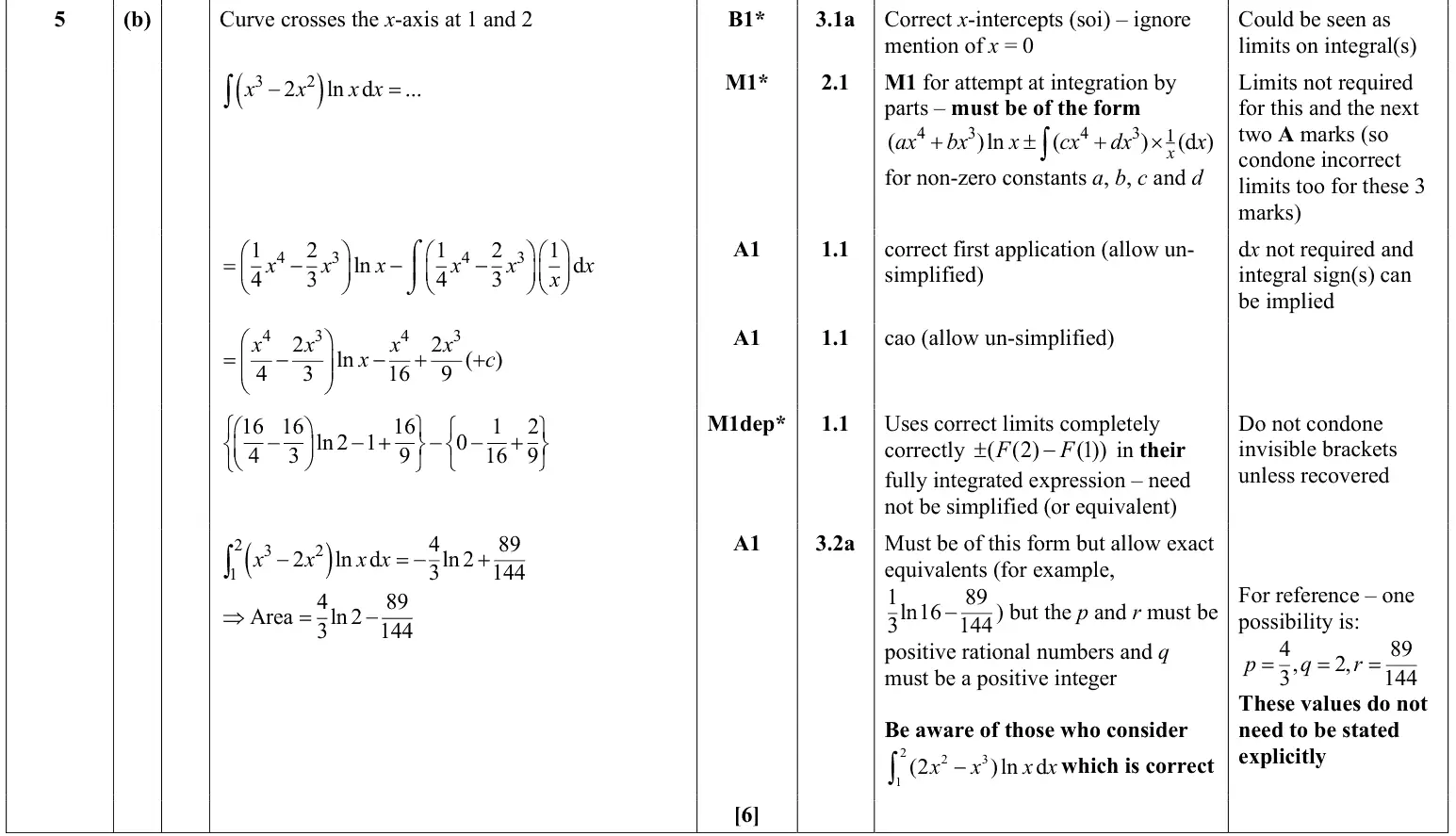
Most candidates correctly calculated the limits for the required area as 1 and 2 (although occasionally a lower limit of 0 was seen). Most candidates adopted the method of integration by parts when attempting to evaluate ∫(𝑥3 −2𝑥2)ln𝑥 d𝑥 and many were successful in obtaining the correct integrated expression. Those that attempted to use a substitution were generally unsuccessful. The most common errors in both the integration and when applying the limits were sign errors. Although many candidates correctly evaluated this integral as − 3 ln2 + 144, many did not realise that this was negative (as the shaded area was below the 𝑥-axis) and did not take the required modulus (even though the question made it clear what form the constants 𝑝, 𝑞 and 𝑟 should take).
Key points and common errors
limits 1 and 2 (x-intercepts)
by parts with u = ln x
integral = −(4/3)ln2 + 89/144 so area = (4/3)ln2 − 89/144
substitution unsuccessful
June 2023 · Paper 1 · Q2(b)4 marksEasy
Mark scheme for this part
Examiner's comment
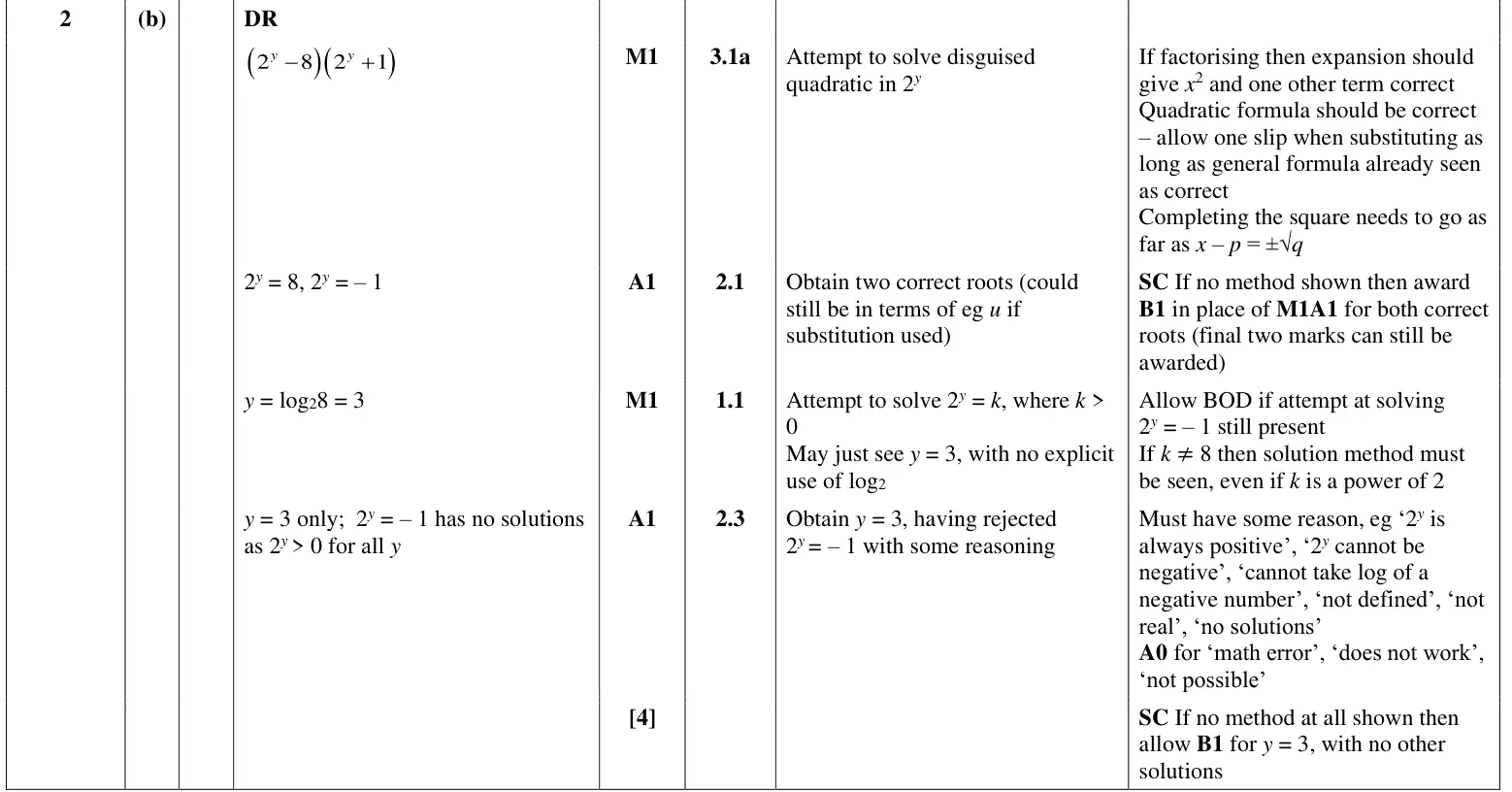
Most candidates could identify this as a disguised quadratic and make a good attempt to solve it, either directly or by using a substitution. As it is a ‘detailed reasoning’ question candidates were expected to show explicit detail of their solution method, and the majority did indeed do so. In addition to obtaining the correct root of y = 3 candidates also had to explain why 2y = −1 would yield no further roots. This was generally done well, although some candidates need to take more care with their use of mathematical language; saying that logs cannot be negative is not the same as saying that the log of a negative number cannot be taken. A common misconception was the belief that the equation was actually a disguised cubic, from the misapplication of the order of operations.
Key points and common errors
disguised quadratic (2ʸ − 8)(2ʸ + 1) = 0
y = 3 only
reject 2ʸ = −1 as 2ʸ > 0 (not 'logs cannot be negative')
June 2023 · AS Paper 1 · Q4(a)2 marksEasy
Mark scheme for this part
Examiner's comment
This was well answered by the majority of candidates, with most being able to correctly take logs of both sides and reach the required answer. Note that as a ‘Determine’ question some working was required and most candidates followed this instruction adequately. Quite a few candidates rounded incorrectly (giving 0.767 or 0.77 as their final response), but most of these had reached an exact form in their working first so few lost marks for this error.
Key points and common errors
3x = ln 10, x = (1/3) ln 10 = 0.768
rounding errors
June 2023 · Paper 1 · Q11(a)3 marksMedium
Mark scheme for this part
Examiner's comment
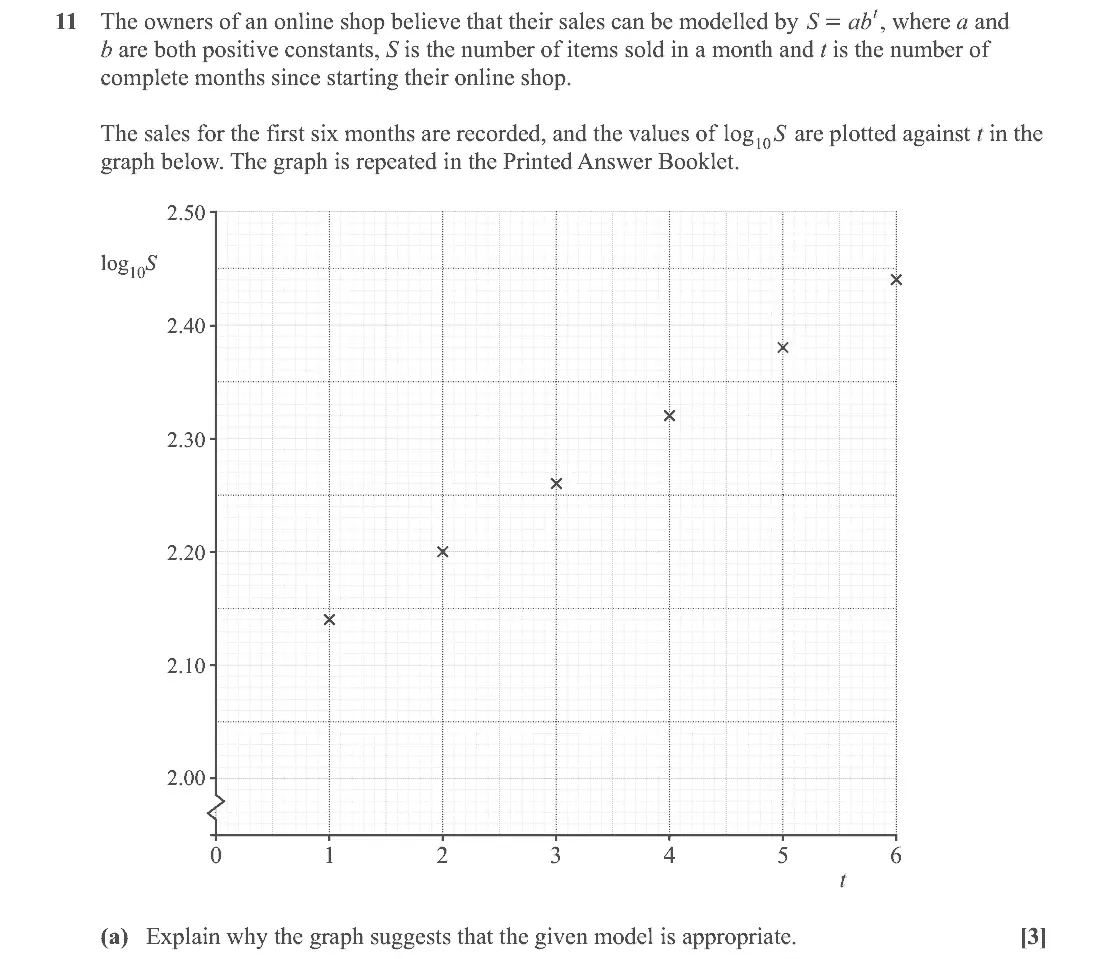
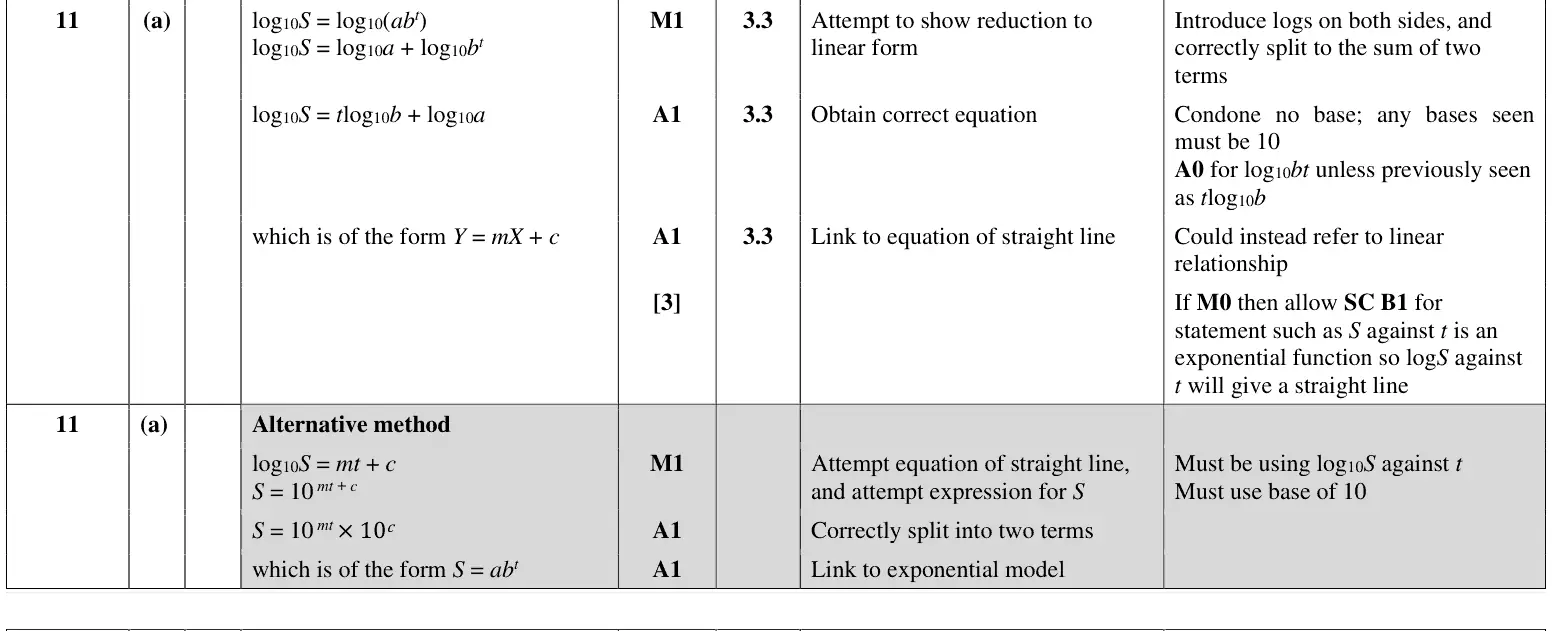
To gain full credit candidates had to show reduction to linear form, and relate this to the axes in the given graph. Many candidates were able to do so with sufficient detail, and others worked backwards from the equation of the straight line to show that removing logs did match the given exponential model. For less detailed solutions, there was one mark available for explaining that taking logs of an exponential model would result in a straight line. In weaker responses, candidates tended to just say that a line of best fit validated the model, without considering the axes, or gave explanations about why a business may increase their sales after opening.
Key points and common errors
log S = t log b + log a is of the form Y = mX + c
plotted points lie on a straight line
relate to the axes
June 2023 · Paper 1 · Q11(b)2 marksEasy
Show the start of this question
Mark scheme for this part
Examiner's comment
This part of the question was generally well answered, either by relating the gradient and intercept to their linear reduction or by substituting the given parameters into the equation and then verifying that this matched the points in the graph. For the second method, evidence of substitution was required, and candidates had to verify at least two points to get both marks.
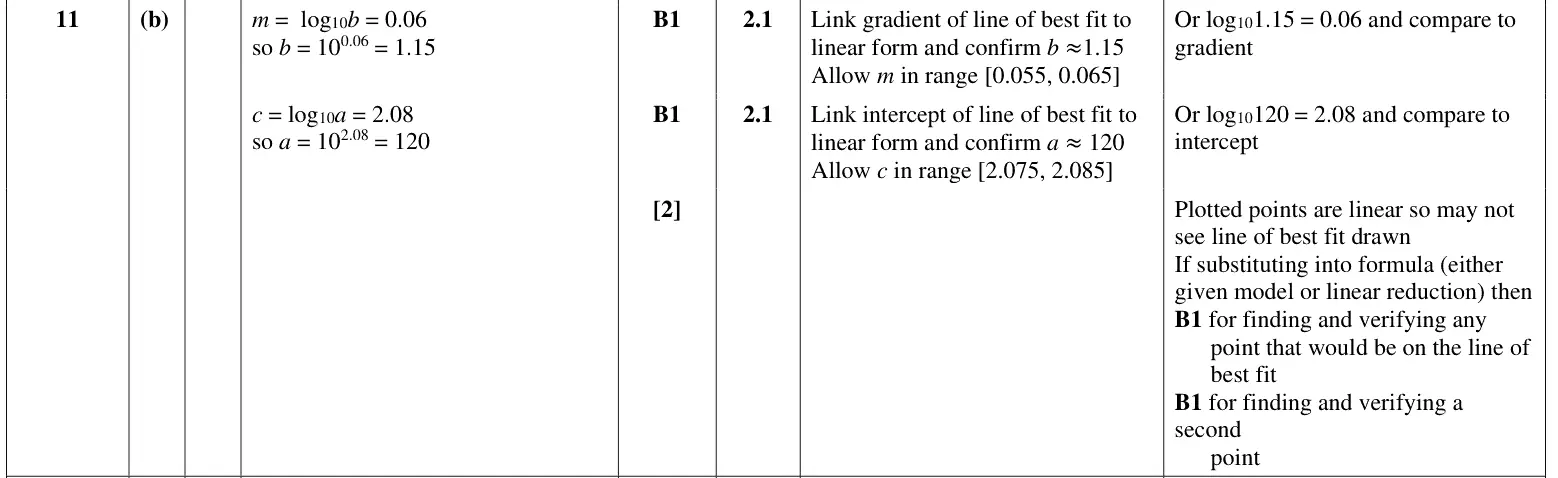
Key points and common errors
gradient ≈ 0.06 = log b gives b ≈ 1.15
intercept ≈ 2.08 = log a gives a ≈ 120
June 2023 · Paper 1 · Q11(d)(i)4 marksHard
Show the start of this question
Mark scheme for this part
Examiner's comment
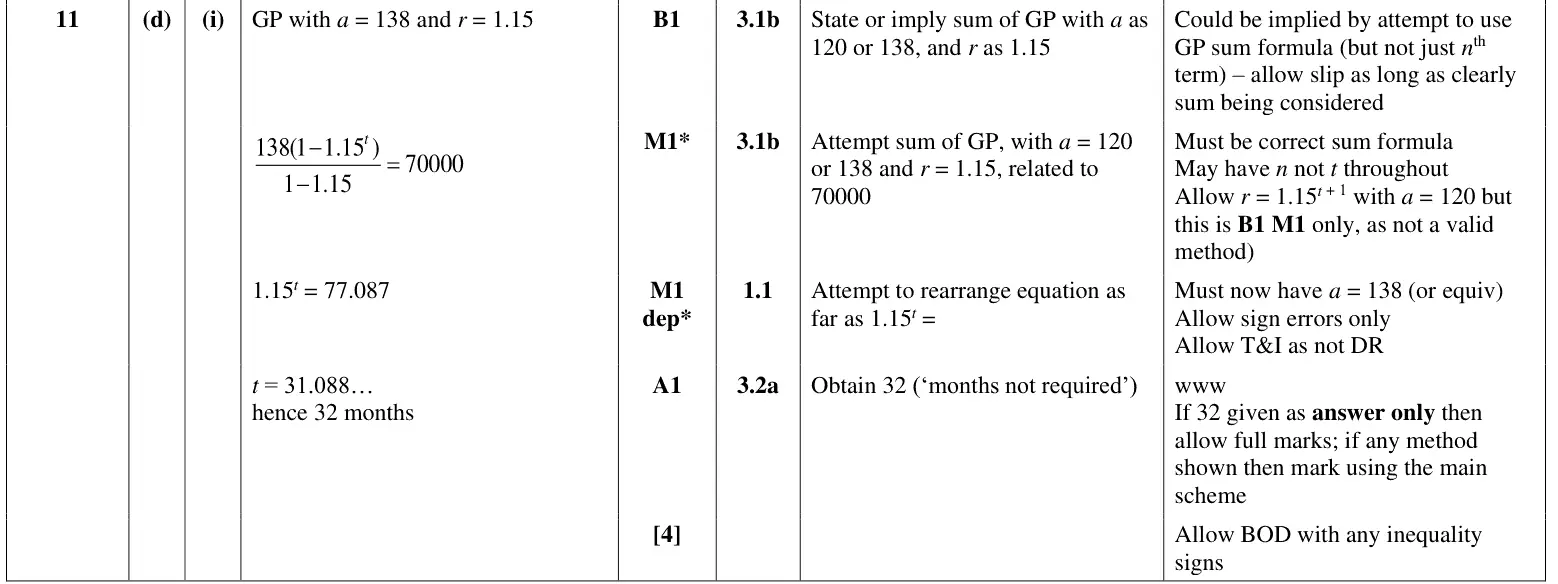
The two equally common approaches were to either equate the monthly sales to 70000 or to consider total sales, using the sum of a GP but with an initial value of 120. Only the higher scoring candidates realised that the first value in the GP should be 138, and these candidates invariably solved the equation correctly to gain full marks.
Key points and common errors
sum of GP with first term 138 (not 120) and r = 1.15
1.15ᵗ = 77.087
t = 31.09 so 32 months
June 2023 · Paper 1 · Q12(b)7 marksHard
Show the start of this question
Mark scheme for this part
Examiner's comment
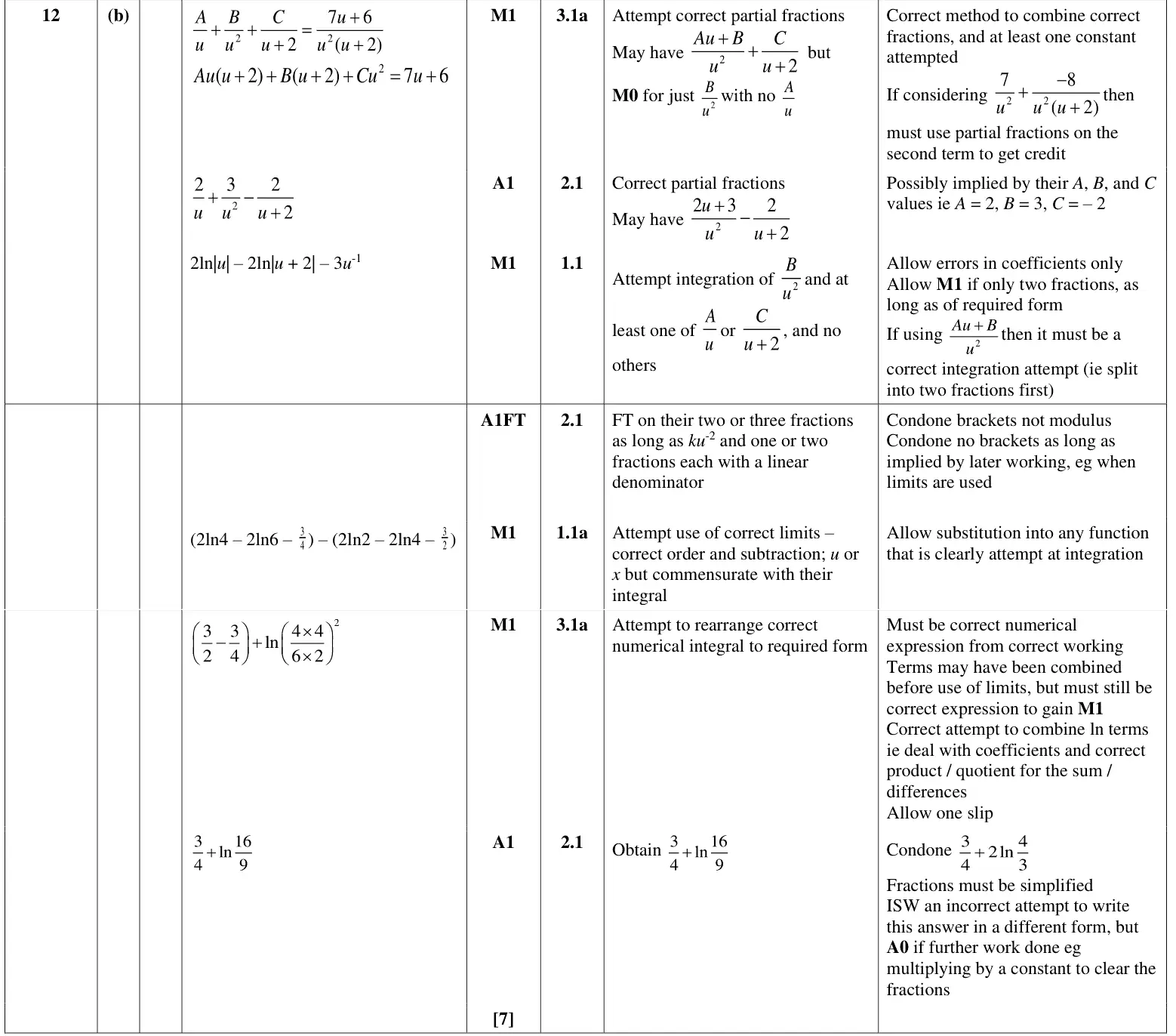
This question appears to have been very challenging for many candidates, with a variety of inappropriate integration techniques attempted. Candidates could still gain a method mark for attempting correct use of limits, but unfortunately some had given up before reaching this point. The factorised denominator should have indicated to candidates that using partial fractions would be a sensible strategy, and many did attempt to do so. The most common error was to not deal correctly with the repeated factor, but these candidates could still get further credit for integrating at least two fractions of the correct structure. However, a good number of candidates were able to provide fully correct solutions, successfully finding the partial fractions, using limits after integration and finally using laws of logs to manipulate their answer to the required form.
Key points and common errors
partial fractions 2/u + 3/u² − 2/(u + 2)
limits u = 2 to 4
3/4 + ln(16/9)
repeated factor often mishandled
June 2023 · Paper 2 · Q33 marksEasy
Mark scheme for this part
Examiner's comment
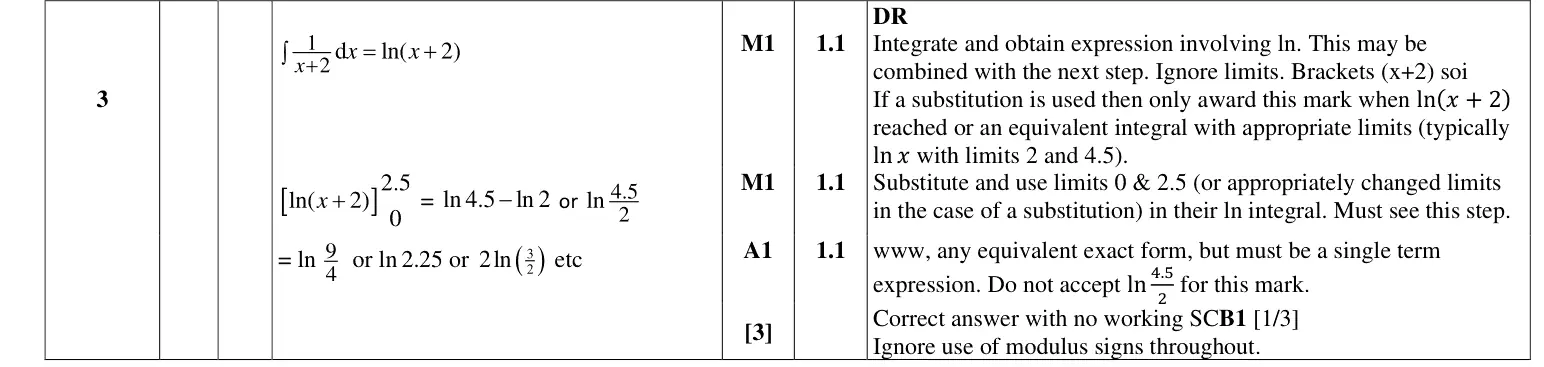
Most candidates answered this question well. A small number did not heed the ‘In this question you must show detailed reasoning’ instruction and used their calculator to compute the integral, giving an inexact answer, which could not be credited. Candidates needed to use log rules to combine and simplify their final answer into an exact form. Some candidates did not find the correct limits, which meant that they could only obtain the first M mark (if their integration was correct). A small number used a substitution, generally correctly, although this represented much more work than was required as this integral can be found directly. Detailed reasoning and exact answers ‘Detailed reasoning’ means that sufficient working must be seen to clearly justify the answer obtained. The use of calculators is permitted to check or verify solutions, but the algebraic working given must ‘stand alone’ and lead to the required answer. In Question 3, many candidates performed the integration correctly but then went on to use a calculator to give an inexact answer – even though the question specifically requested the ‘exact area’.
Key points and common errors
∫1/(x + 2) dx = ln(x + 2)
limits 0 and 2.5
ln 4.5 − ln 2 = ln(9/4) as a single exact term
calculator answers gain nothing
June 2023 · AS Paper 2 · Q5(b)3 marksHard
Show the start of this question
Mark scheme for this part
Examiner's comment
Most attempts gained 1 mark, for finding the correct equation in x. Using 23x+2 = 4(23x) to obtain the equation 23x = 12 was very rare. The exemplar below shows the typical next step in many solutions. Less successful efforts did not involve 36 at all. Taking logs like this was very prevalent and often led to the solution being abandoned quickly (presumably because x disappears). Incorrect use of the logarithm laws was frequent in this question.
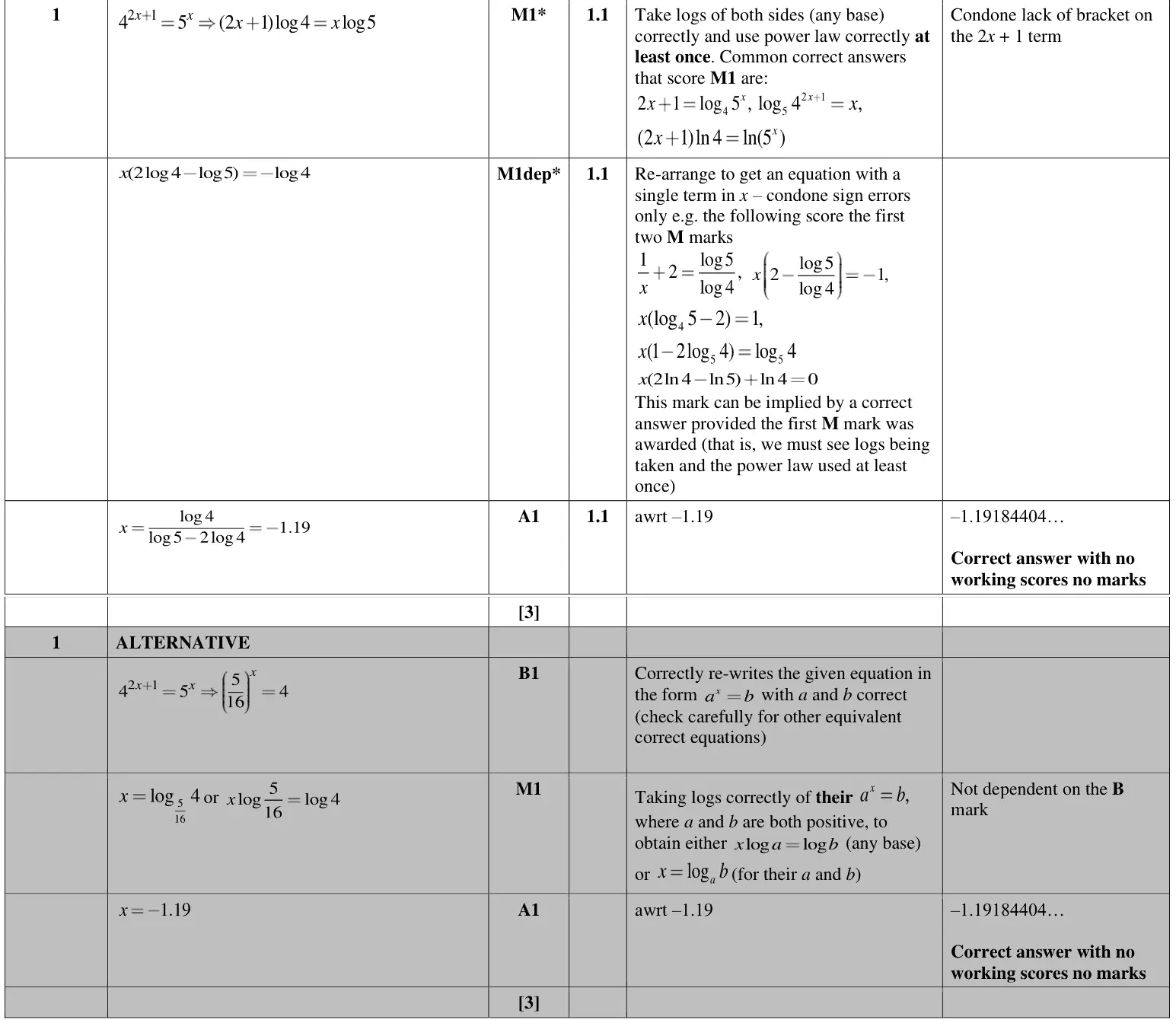
would appear to be a routine demand of using logs to solve an equation of the form 𝑎𝑎f(𝑥𝑥) = 𝑏𝑏g(𝑥𝑥). The Examiners noted that candidates’ responses to this question were mixed with many struggling with what most common error was to take logs of both sides with two different bases, e.g. (2𝑥𝑥+ 1)log54 = 𝑥𝑥log45. linear equation. A number of candidates left their answer in an exact form, e.g. 𝑥𝑥= For those candidates that did take logs correctly many then appeared to struggle to solve the resulting log5−2log4 and did not give the answer to 3 significant figures as requested.
Key points and common errors
take logs of both sides with the same base: (2x + 1)log 4 = x log 5
collect x terms
x = −1.19 to 3 s.f.
errors: different bases on each side, leaving an exact form
June 2023 · Paper 3 · Q7(b)6 marksMedium
Show the start of this question
Mark scheme for this part
Examiner's comment
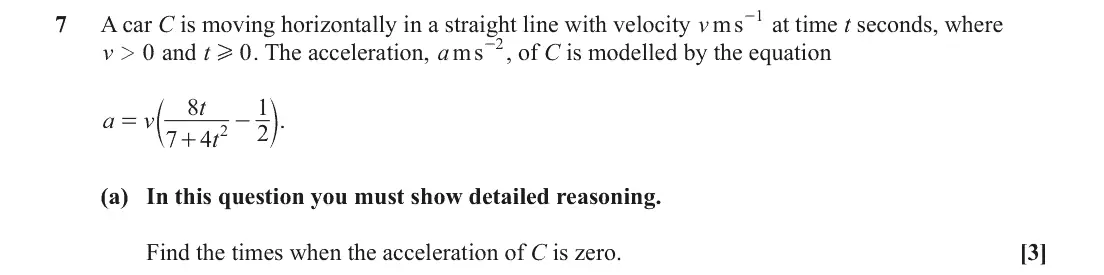
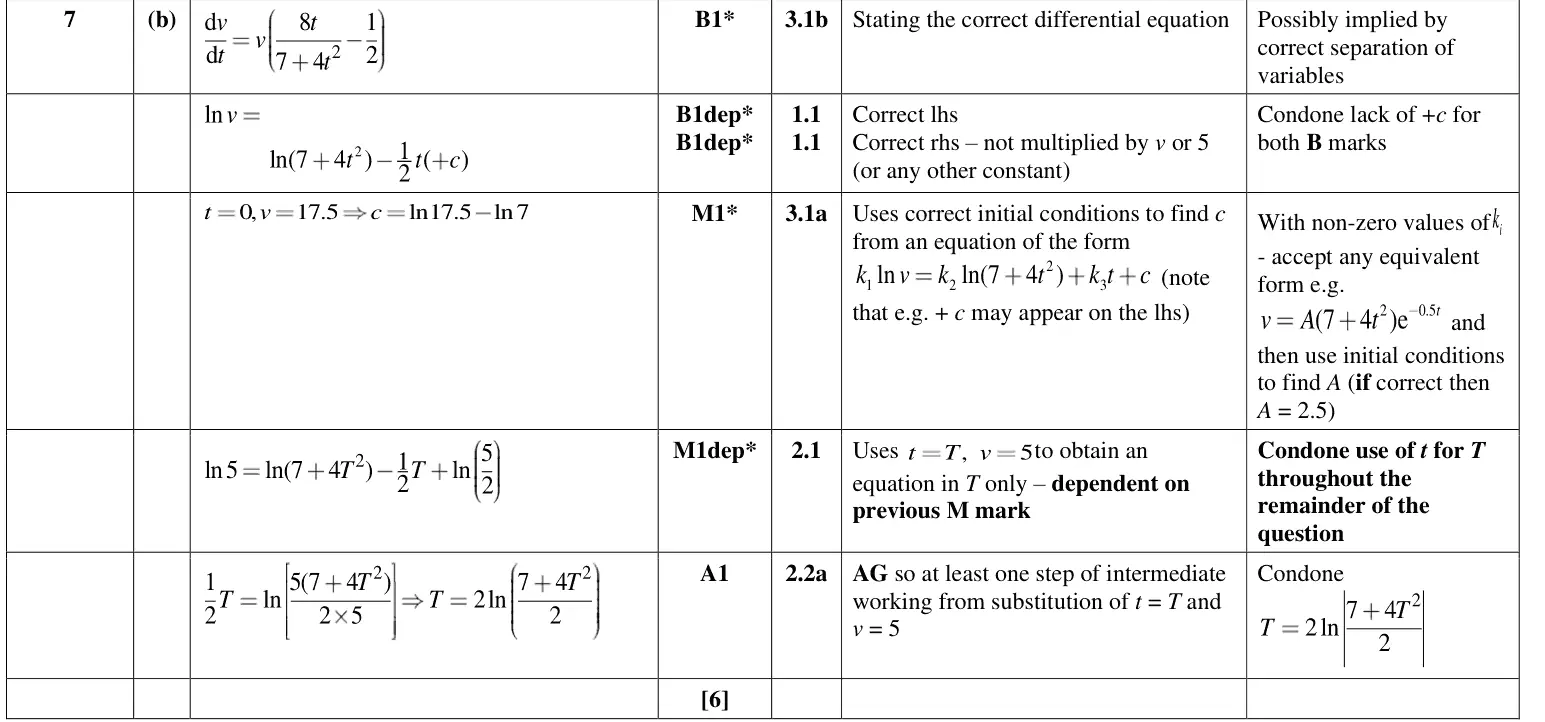
fact that 𝑎𝑎= d𝑡𝑡= 𝑣𝑣ቀ 7+4𝑡𝑡2 − 2ቁ usually separated the variables correctly and went It was surprising in this part how many candidates did not set up a correct differential equation using the d𝑡𝑡. Those that did write on to correctly derive the given result (using the results that 𝑣𝑣= 17.5 when 𝑡𝑡= 0 and 𝑣𝑣= 5 when 𝑡𝑡= 𝑇𝑇). f(𝑥𝑥) d𝑥𝑥= ln|f(𝑥𝑥)| is provided in the formulae at the attempt to integrate ∫ 7+4𝑡𝑡2 d𝑡𝑡 even though the result ∫ Some candidates, after correctly setting up the required differential equation were unsuccessful in their beginning of the assessment.
Key points and common errors
dv/dt = v(8t/(7 + 4t²) − ½)
separate: ln v = ln(7 + 4t²) − ½t + c
t = 0, v = 17.5 gives c
v = 5 at t = T gives the result
∫f′/f = ln f is in the formula book
June 2022 · Paper 1 · Q5(a)(i)2 marksMedium
Mark scheme for this part
Examiner's comment
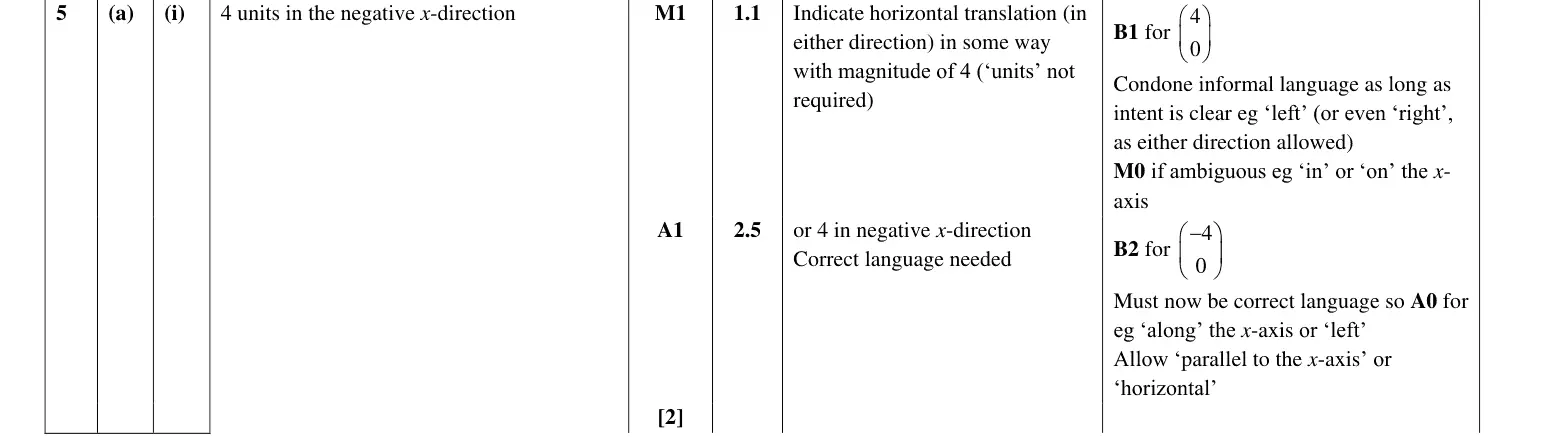
Most candidates could identify that a horizontal translation of 4 units was required, and also that it would be in the negative x-direction. To gain full credit, mathematically correct language was required but ambiguous statements such as ‘in’ the x-axis or informal ones such as ‘along’ the axis were all too common. The most successful approach was to state the correct column vector, thus avoiding the need for any additional description.
Key points and common errors
translation 4 units in the negative x-direction, or vector (−4, 0)
'along' or 'in' the x-axis is not acceptable
June 2022 · Paper 1 · Q5(a)(ii)2 marksHard
Mark scheme for this part
Examiner's comment
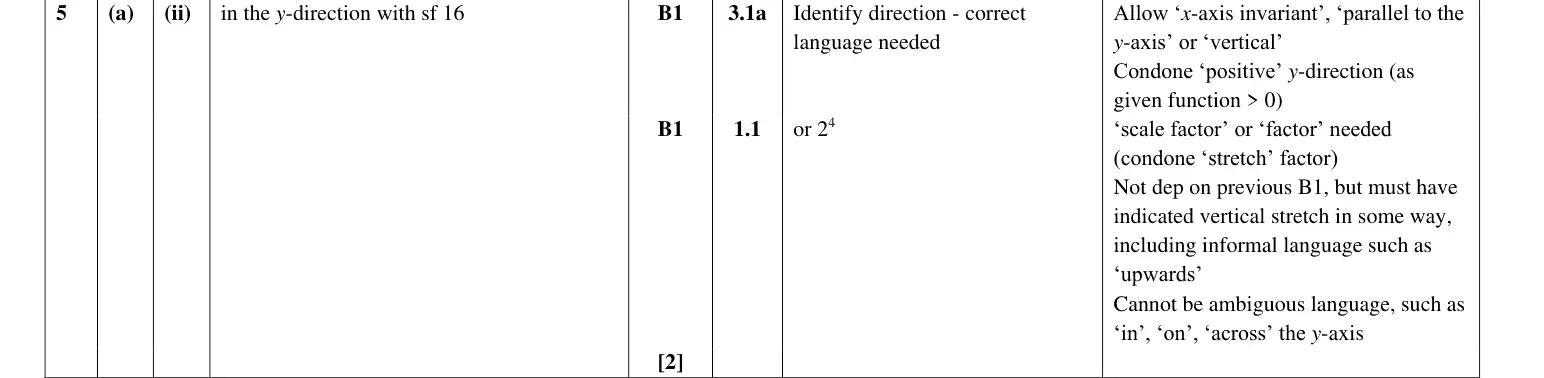
This part proved to be more challenging, with around half of the candidates being able to identify both the correct direction and the correct scale factor. Once again, incorrect language was all too common.
Key points and common errors
2^(x+4) = 16 × 2ˣ: stretch parallel to the y-axis, scale factor 16
correct language needed
June 2022 · Paper 1 · Q5(b)4 marksEasy
Mark scheme for this part
Examiner's comment
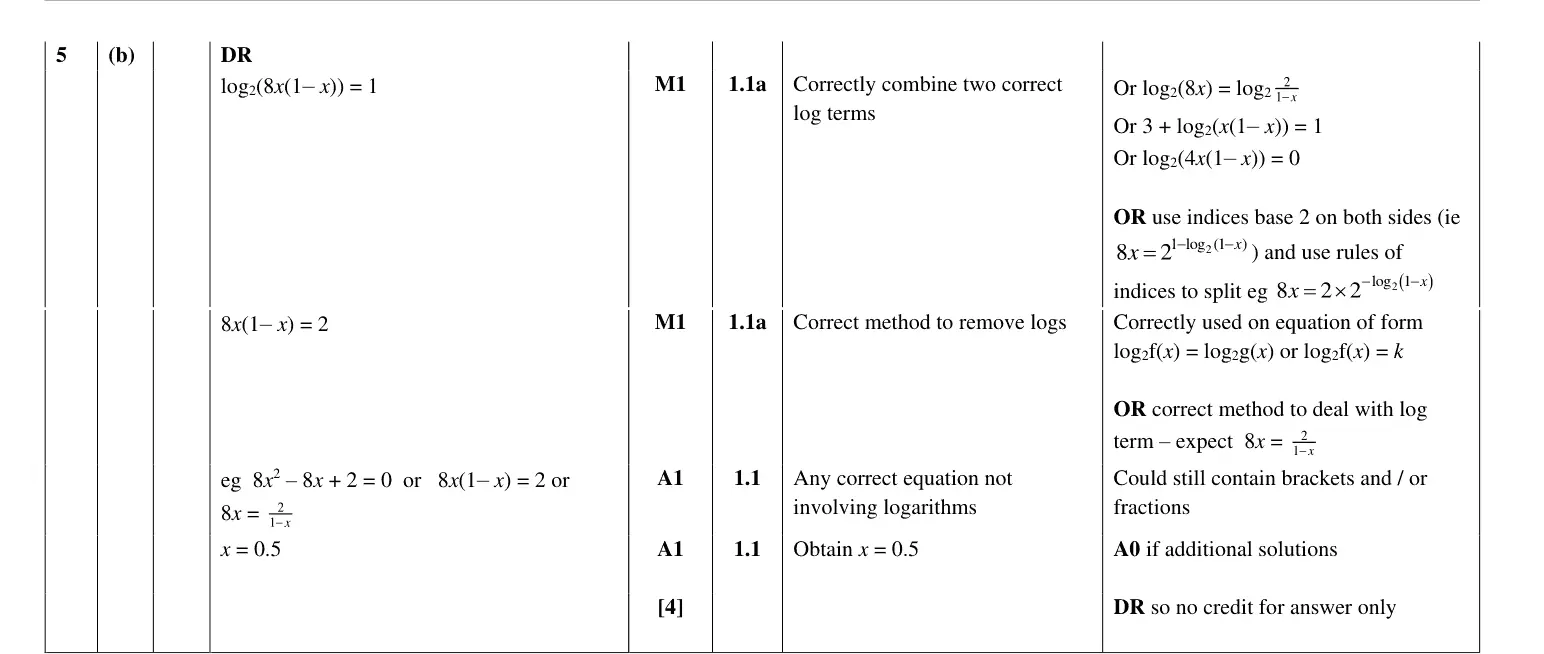
This question was very well answered, with many candidates gaining full credit. The most common approach was to first combine log terms and then remove the logs, and this was usually successful. Some candidates first introduced indices, base 2, on both sides but the subsequent simplification of the right-hand side proved to be problematic for some. Despite this being a ‘detailed reasoning’ question, some candidates went straight from the quadratic equation to stating the root. On this occasion this was condoned, but candidates would be well advised to make sure that sufficient detail is always provided in these types of questions.
Key points and common errors
combine: log₂(8x(1 − x)) = 1 so 8x(1 − x) = 2
8x² − 8x + 2 = 0 gives x = 0.5 (repeated)
show the solving
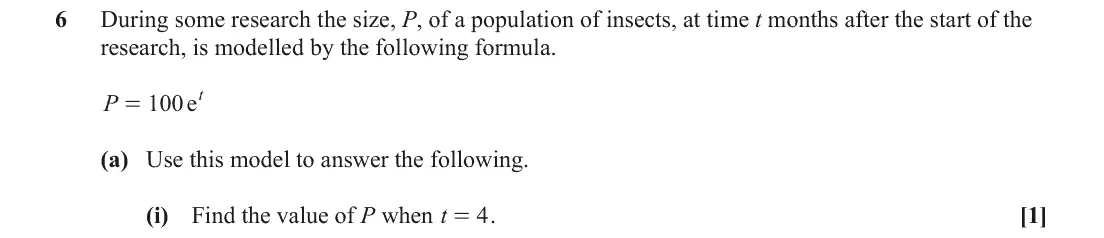
June 2022 · AS Paper 1 · Q6(a)(i)1 markEasy
Mark scheme for this part
Examiner's comment
This question was answered correctly by almost all candidates.
Key points and common errors
P = 100e⁴ = 5460
June 2022 · AS Paper 1 · Q6(a)(ii)2 marksEasy
Show the start of this question
Mark scheme for this part
Examiner's comment
This question was answered correctly by most candidates. Some started correctly with 100et = 9000 but went on to write et = 900.
Key points and common errors
100eᵗ = 9000 so t = ln 90 = 4.50
error eᵗ = 900
June 2022 · AS Paper 1 · Q6(b)(i)2 marksMedium
Show the start of this question
Mark scheme for this part
Examiner's comment
Some candidates tried to answer this by taking particular values, or by drawing a graph. These did not score. Others took logs of both sides, but then made an error, such as log10 P = t log10 ka. However, many candidates obtained the correct equation and gave a good explanation as to why this was in the form y = mx + c .
Key points and common errors
log P = log k + t log a, which has the form y = mx + c
particular values or a graph score 0
error t log ka
June 2022 · AS Paper 1 · Q6(b)(ii)2 marksEasy
Show the start of this question
Mark scheme for this part
Examiner's comment
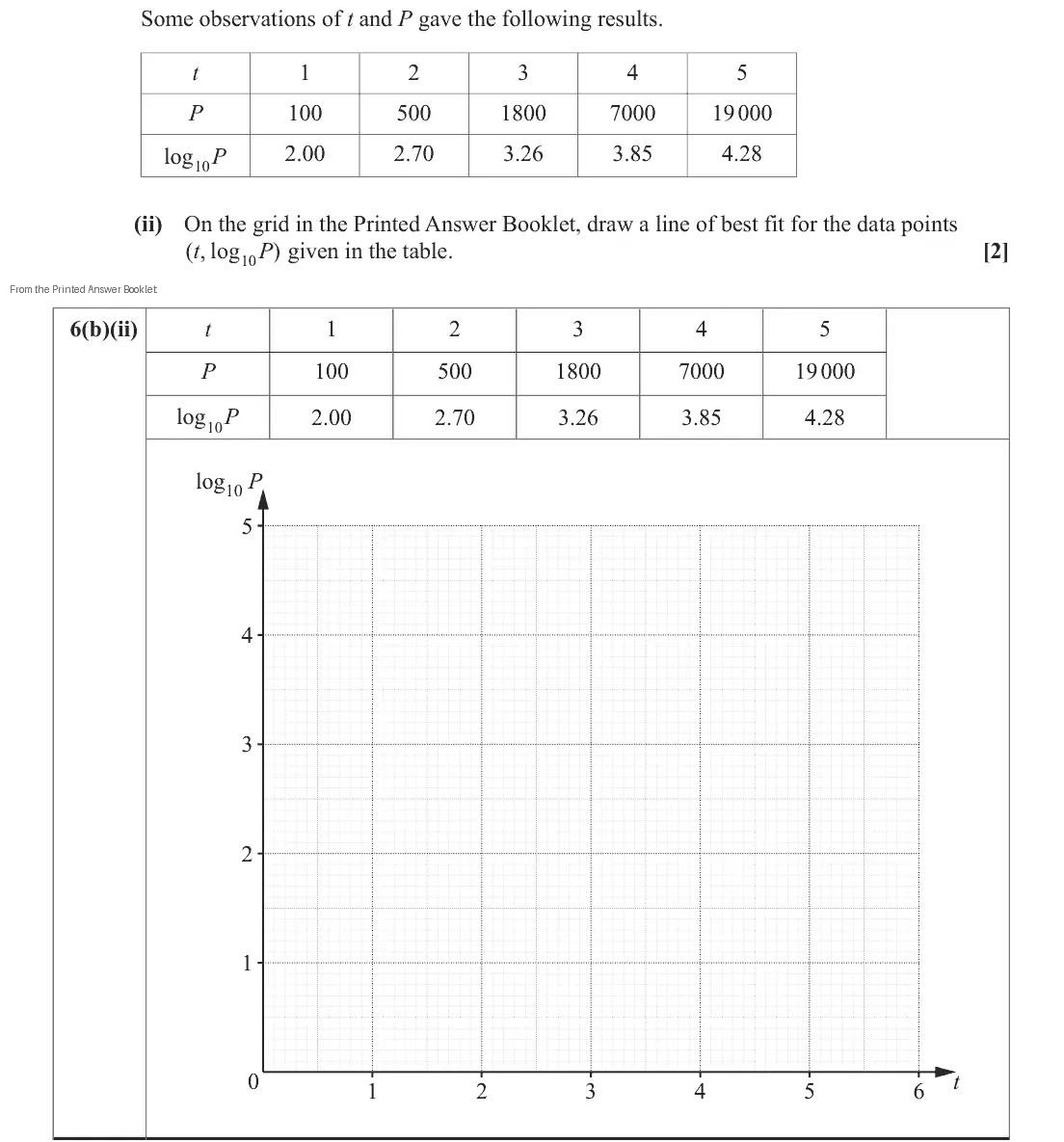
Almost all candidates plotted the points correctly, and most drew a reasonable line of best fit. The acceptable limits for the line are shown in the mark scheme.
Key points and common errors
plot (t, log P) and draw a line of best fit through the points
June 2022 · AS Paper 1 · Q6(b)(iii)4 marksMedium
Show the start of this question
Mark scheme for this part
Examiner's comment
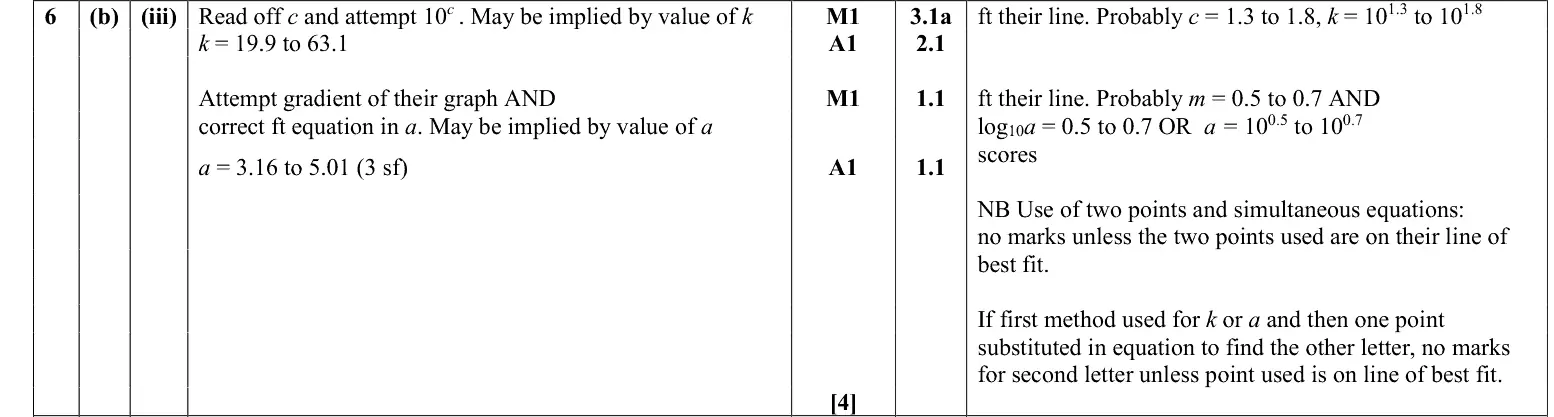
Those candidates who understood what was required answered this question well. Other candidates used values from the table, despite their line not going through these points, to form two simultaneous equations from which they obtained values of k and a. This method did not score any marks because the word “Hence” required candidates to use their line of best fit to answer this question. Those candidates who had given a good explanation in part 6(b)(i) (such as “Plotting log10 P against t produces a straight line with gradient log10 a and y-intercept log10 k”) were more likely than others to gain full marks in Question 6 (b) (iii).
Key points and common errors
intercept log k gives k = 10^c (20 to 63)
gradient log a gives a (3.16 to 5.01)
simultaneous equations from table points not on the line score 0
June 2022 · Paper 1 · Q8(b)(i)3 marksEasy
Show the start of this question
Mark scheme for this part
Examiner's comment
This question was very well answered, with the majority of candidates gaining full marks for setting their model equal to 80 and solving for t. A surprisingly common error was to start with the correct equation, but then miscopy it from one line to the next with the index invariably becoming – 0.55t. In all questions, candidates would be well advised to check their working for copying errors.
Key points and common errors
160e^(−0.055t) = 80 so t = ln2/0.055 = 12.6 minutes
miscopying the index as −0.55t
June 2022 · Paper 1 · Q11(b)3 marksHard
Show the start of this question
Mark scheme for this part
Examiner's comment
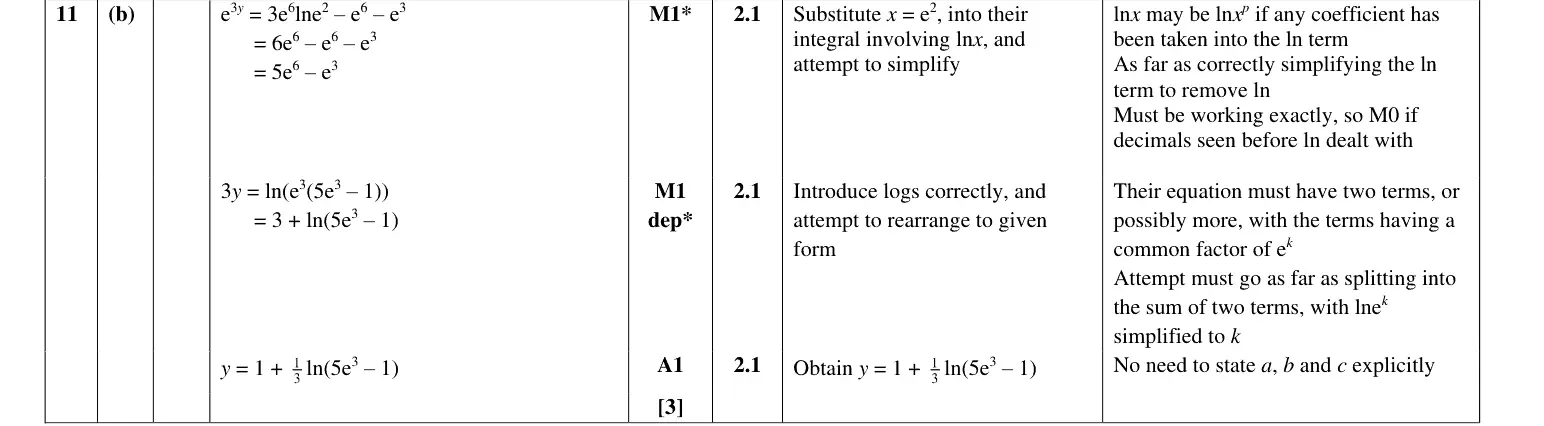
Many candidates were able to make an attempt to use x = e2, and simplify the ensuing expression which did require a term involving ln to still be present. Rearranging the expression to the given form proved to be more challenging and only the more astute candidates were able to attempt this, either by splitting into the sum of two terms or by taking out a factor of e3 and combining this with the exponential term.
Key points and common errors
x = e²: e^(3y) = 5e⁶ − e³ = e³(5e³ − 1) so y = 1 + ⅓ln(5e³ − 1)
work exactly
rearranging was the hard step
June 2022 · Paper 2 · Q1(c)2 marksEasy
Mark scheme for this part
Examiner's comment
This question was well answered by most candidates. A wide variety of methods was seen, some involving logs, others involving manipulation of indices. Some candidates omitted the ± in their answer. A few candidates showed lacking understanding of logs, such as x2 − 7 = ln 1 243 , or of indices, such as 1 2 1 x = . 7 243 3
Key points and common errors
1/243 = 3⁻⁵ so x² − 7 = −5
x = ±√2
± often omitted
June 2022 · Paper 2 · Q3(c)4 marksMedium
Mark scheme for this part
Examiner's comment
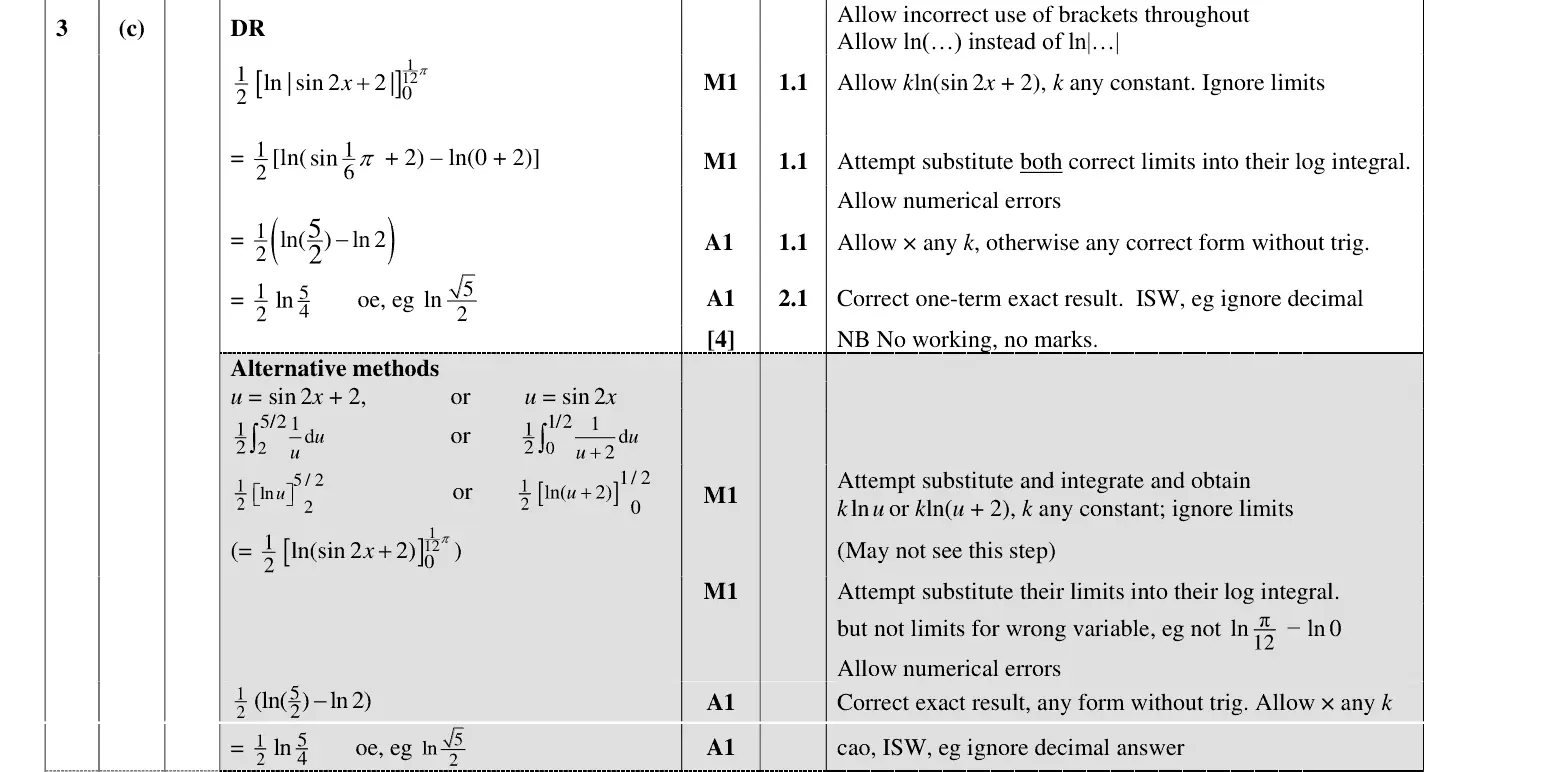
There were many neat and correct solutions. Many candidates used a substitution. However, many others used the more efficient method that comes from recognising that the numerator is k × the derivative of the denominator. Some candidates omitted “k” or had k = 2 instead of 1 2 . A few candidates correctly obtained ( ) 5 1 2 ln( ) 2 − ln 2 , but omitted the final step of simplification (presumably, as in part (a) (i), because they had not read the question carefully). Others used decimals, ignoring the word “exact” in the question. There were also some unsuccessful attempts at this question. Some candidates used the double angle formulae. Others attempted to use integration by parts on cos 2x × (sin 2x + 2)−1. A few rewrote the integrand as cos2 cos2 x x x + . None of these attempts yielded any marks. sin 2 2
Key points and common errors
numerator is ½ × derivative of denominator: ½ln(sin2x + 2)
limits 0 and π/12
½ln(5/4)
exact simplest form
June 2022 · Paper 2 · Q45 marksMedium
Mark scheme for this part
Examiner's comment
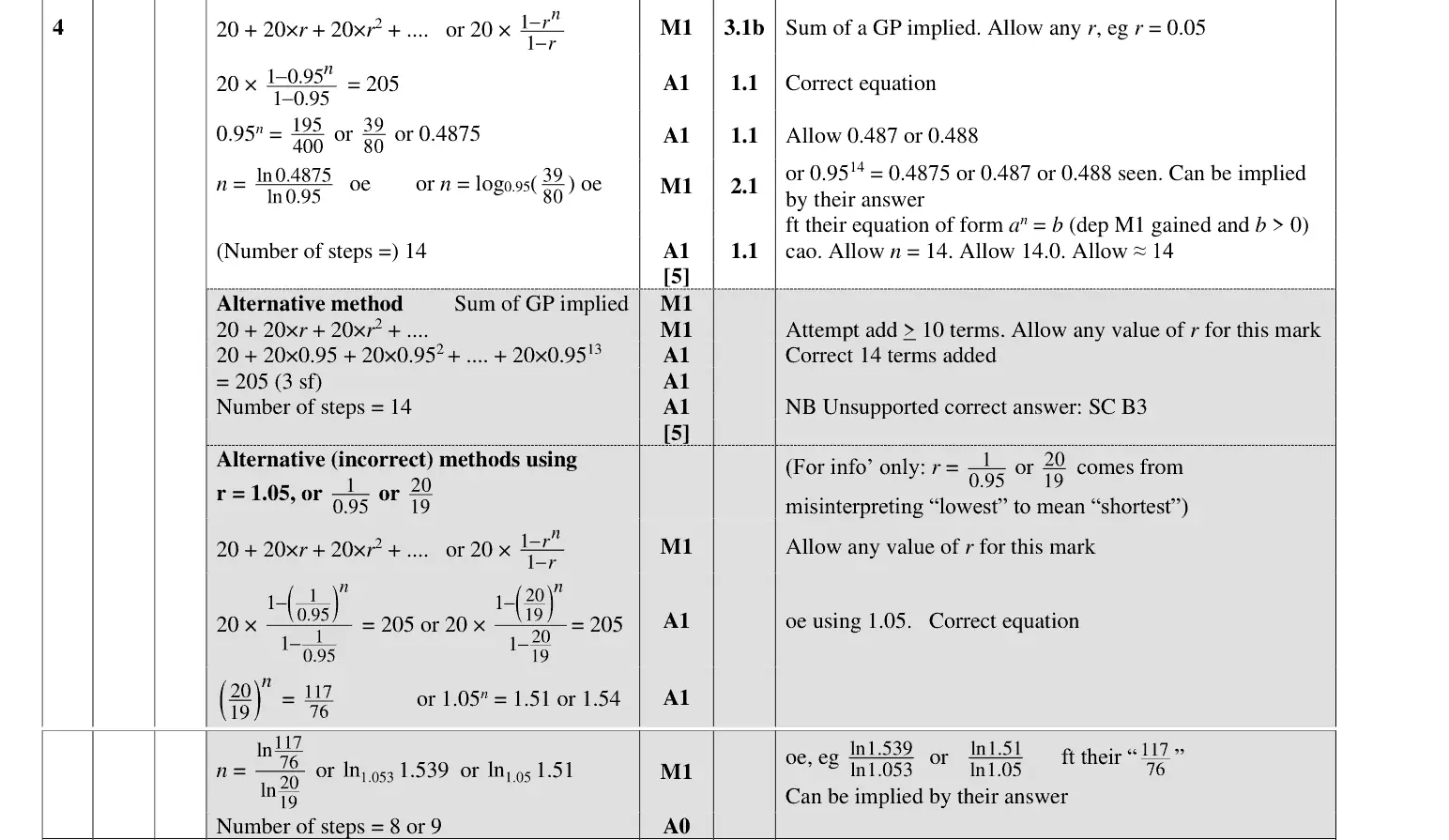
Almost all candidates recognised the need to consider the sum of a geometric progression. (Although a few used either the formula for the nth term of a GP or the formula for the sum of n terms of an AP.) In most cases, there was some good algebraic manipulation, including the use of logs to solve an equation such as 0.95n = 39 80 . There were two common errors. Firstly some candidates used r = 1.05 (representing 1 increasing, rather than decreasing, heights). Others used r = 0.95 (resulting from a misreading of the word “lowest” in the question to mean “shortest”). Candidates who made either of these errors, but whose working was otherwise correct, scored 4 marks out of 5. A more serious error was to use r = 0.05. Candidates who made this error could only score one mark for recognising a geometric progression.
Key points and common errors
sum of GP with a = 20, r = 0.95: 20(1 − 0.95ⁿ)/0.05 = 205
0.95ⁿ = 0.4875
n = 14
errors r = 1.05 or 1/0.95
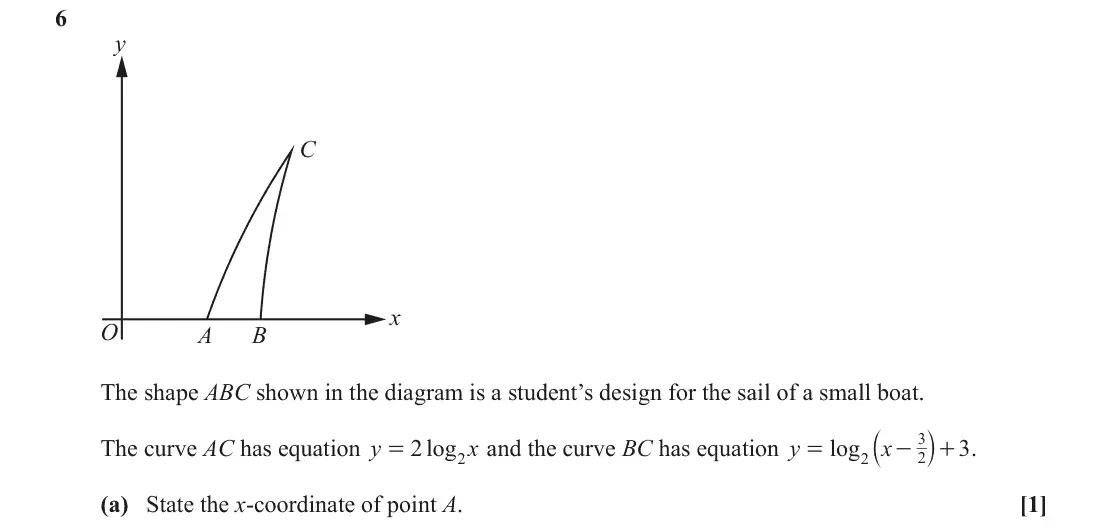
June 2022 · AS Paper 2 · Q6(a)1 markEasy
Mark scheme for this part
Examiner's comment
There were many correct answers in this part, although we occasionally saw x = 2.
Key points and common errors
2 log₂ x = 0 so x = 1
June 2022 · AS Paper 2 · Q6(b)3 marksMedium
Show the start of this question
Mark scheme for this part
Examiner's comment
Note the instruction ‘Determine’ here, so justification should be given for any results found, with appropriate working. There were quite a lot of good efforts at this part, isolating the log term and 3 removing logs sensibly. The most common error was to try and split the log x − term. Having done 2 this the mark for removing logs was not given, so this approach scored 0/3.
Key points and common errors
log₂(x − 3/2) = −3 so x = 2⁻³ + 3/2 = 1.625
splitting log₂(x − 3/2) wrongly scores 0
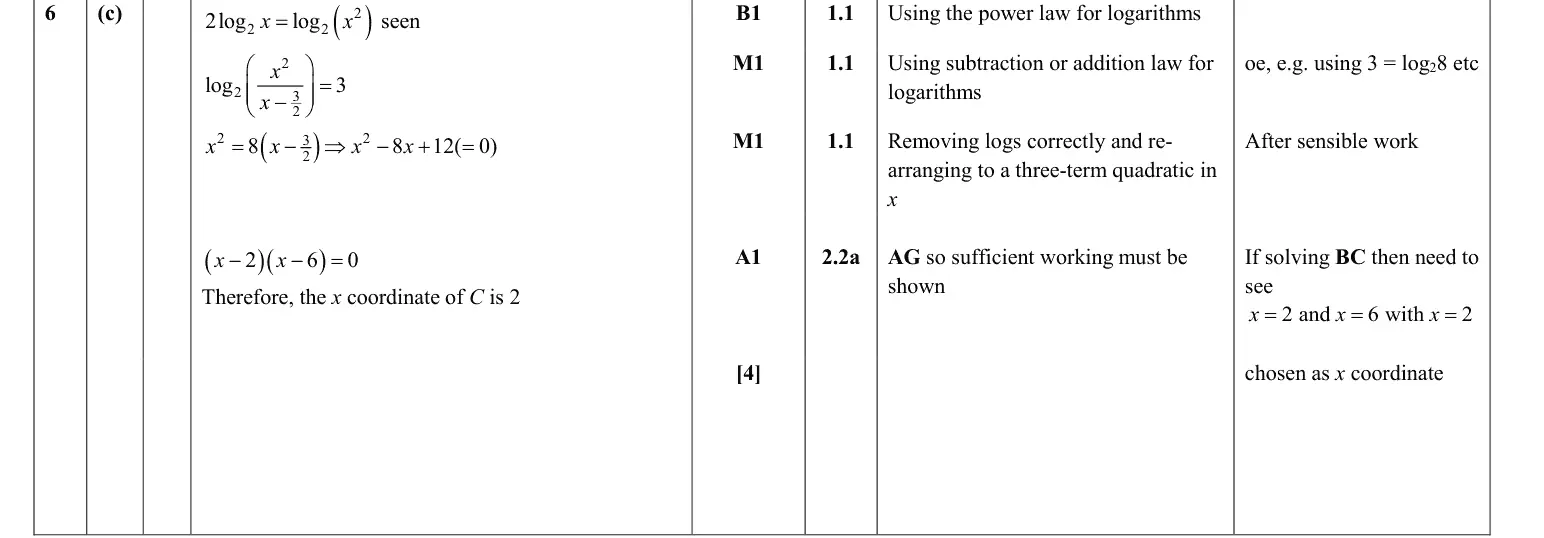
June 2022 · AS Paper 2 · Q6(c)4 marksMedium
Show the start of this question
Mark scheme for this part
Examiner's comment
This proved more challenging than part (b), especially so when 2log2x was not recognised as log2x2 at 3 the start. The problem noted with log x − in part (b) inevitably reappeared. Again, however, there 2 were quite a few good solutions seen if the logarithm laws were understood. We expected x = 2 to be chosen as the required answer.
Key points and common errors
2 log₂ x = log₂ x²
log₂(x²/(x − 3/2)) = 3
x² − 8x + 12 = 0, x = 2 or 6, choose 2
harder when 2 log₂ x not recognised as log₂ x²
June 2022 · AS Paper 2 · Q6(d)4 marksHard
Show the start of this question
Mark scheme for this part
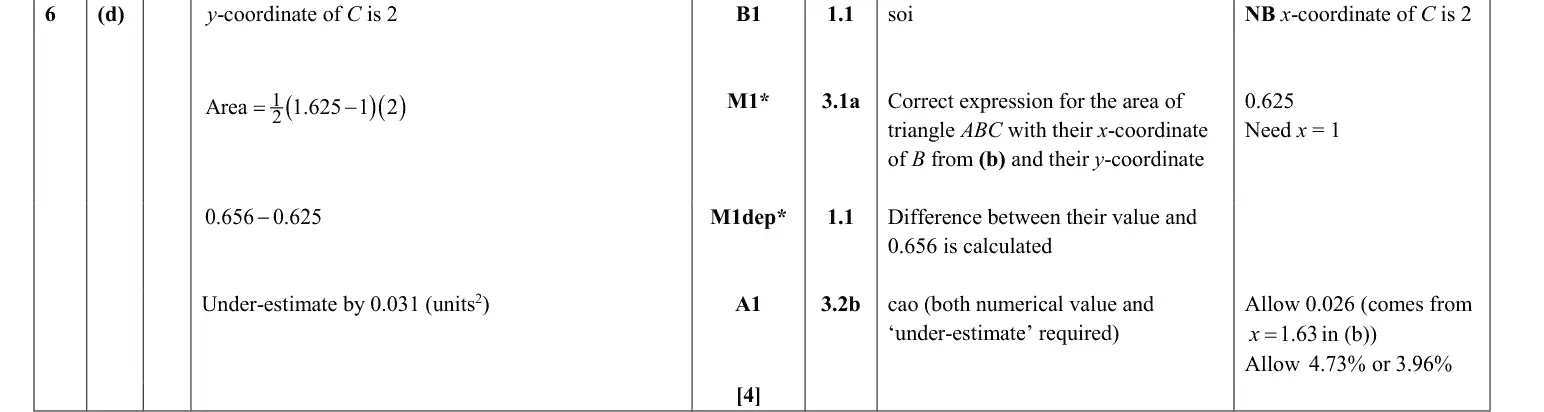
Examiner's comment
This part was found to be more difficult, perhaps because it is slightly unusual. The area of the required triangle is easy to calculate using ½bh but some complicated attempts using the cosine rule and ½absinC were seen. Occasionally, the underestimation of 0.031 was not calculated. Candidates should be encouraged to read questions carefully and to check their answers to ensure they provide all the requested information.
Key points and common errors
C = (2, 2)
triangle area ½ × 0.625 × 2 = 0.625
under-estimate by 0.031
both value and 'under-estimate' needed
found more difficult
June 2022 · Paper 3 · Q68 marksEasy
Mark scheme for this part
Examiner's comment
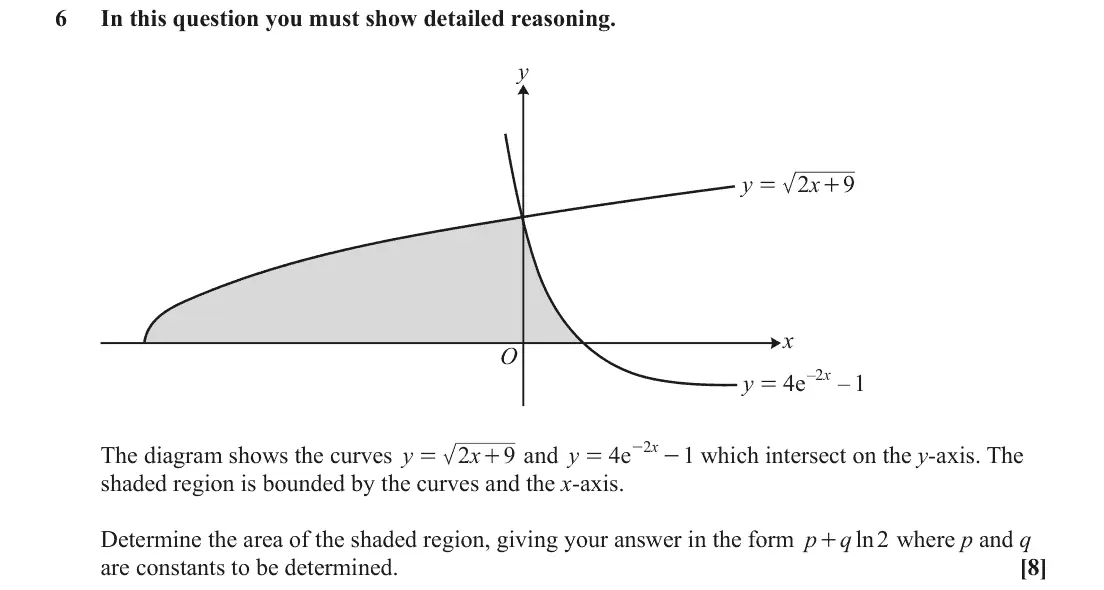
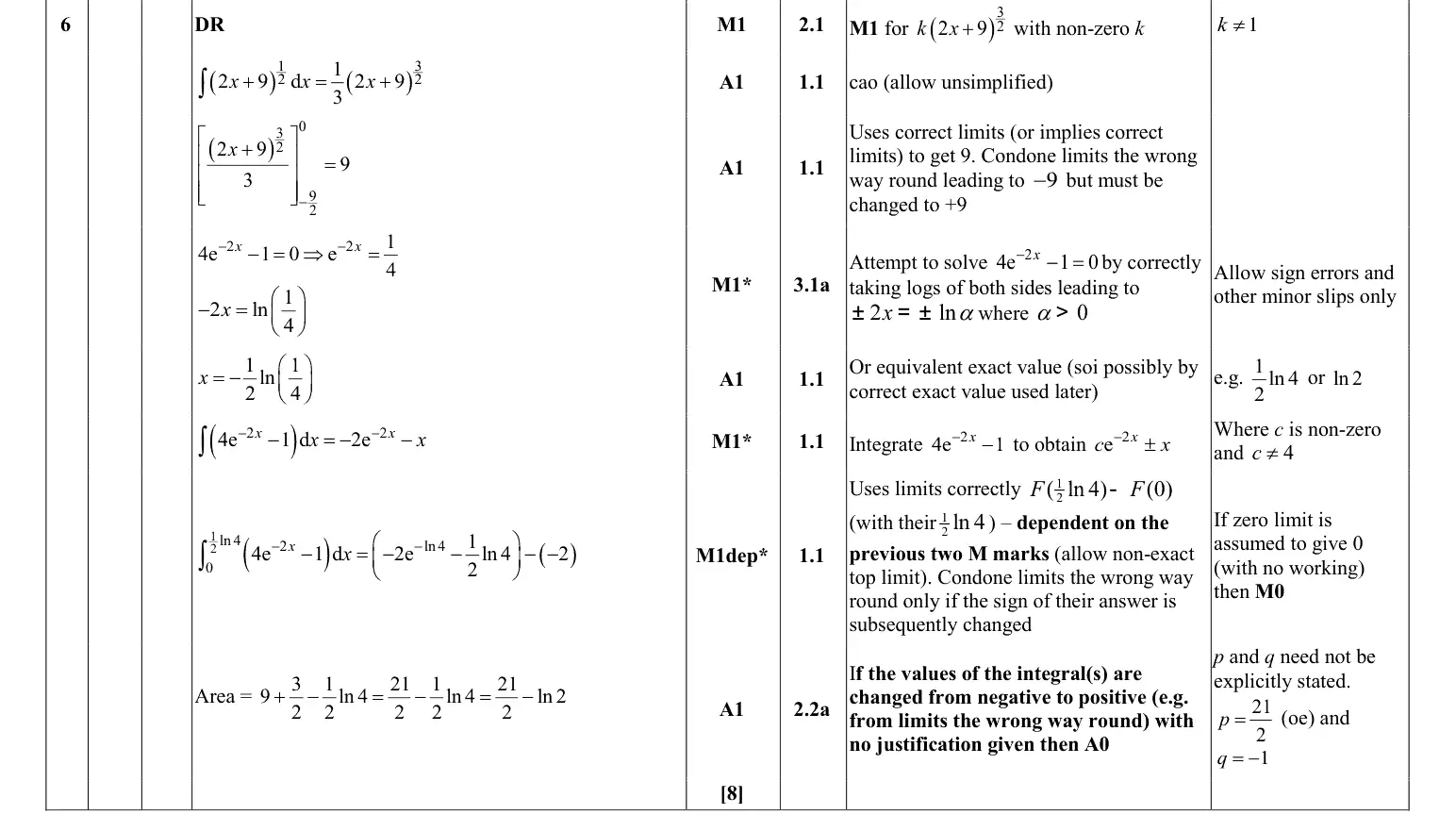
This question was answered extremely well with many candidates scoring all 8 marks for correctly determining the required shaded area of the given region. As this was a DR question it was not 0 2 ( ) + = acceptable to simply state that x 9 d x 9 or to apply the limits the wrong way round and then − to 9 without suitable justification. Some candidates struggled to solve the change a response of 9 −= 4e − 1d . x equation 4e 1 0 exactly or to find the required upper limit for the integral Furthermore, some had difficulty with evaluating this indefinite integral (it was common for examiners to report that this was often integrated to − 8e − x ). Many candidates struggled to evaluate − − accurately 2e x even though they had access to calculators which would have enabled them to check their response.
Key points and common errors
∫ from −9/2 to 0 of √(2x + 9) = 9
4e^(−2x) − 1 = 0 at x = ½ln4
∫(4e^(−2x) − 1) = 3/2 − ½ln4
area 21/2 − ln2
correct limit order needed under DR
Autumn 2021 · Paper 1 · Q4(c)3 marksMedium
Show the start of this question
Mark scheme for this part
Examiner's comment
(From the general report) Common misconceptions Candidates should appreciate that merely discarding a value that cannot be pursued is not sufficient; a reason is also required e.g., in Question 4(c) 2y = -2 has no solution as 2y is always positive.
Key points and common errors
recognise x = 2^y
y = −1 and y = log₂3
must give a reason for rejecting 2^y = −2 (2^y > 0 for all y), not just discard it
Autumn 2021 · AS Paper 1 · Q7(a)1 markMedium
Mark scheme for this part
Key points and common errors
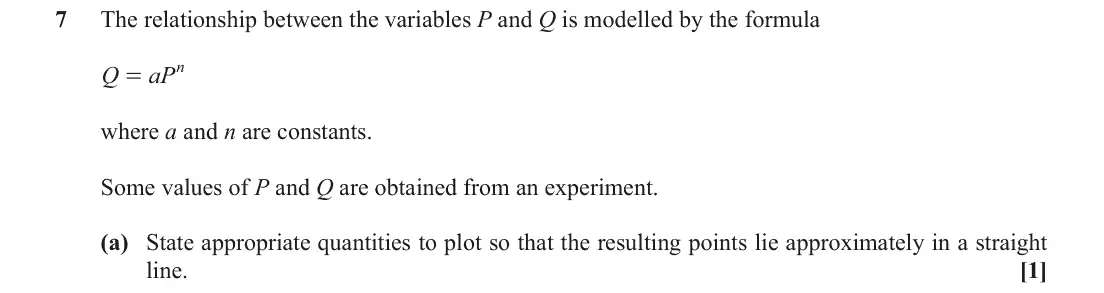
plot log Q against log P (either way round)
Autumn 2021 · AS Paper 1 · Q7(b)2 marksMedium
Show the start of this question
Mark scheme for this part
Key points and common errors
log Q = log a + n log P compared with Y = mX + c
line of best fit
gradient is n when log Q is on the vertical axis
Autumn 2021 · Paper 1 · Q9(a)1 markHard
Mark scheme for this part
Examiner's comment
(From the general report) Question 9, covering aspects of parametric equations, proved challenging for a significant proportion of candidates. Question 9 highlighted confusion about when to use x = 0 or y = 0 when investigating the path of a particle defined parametrically.
Key points and common errors
y = 2e^(−3t) > 0 for all t so y is never 0
must refer to y
Autumn 2021 · Paper 1 · Q9(b)2 marksHard
Show the start of this question
Mark scheme for this part
Examiner's comment
(From the general report) Question 9, covering aspects of parametric equations, proved challenging for a significant proportion of candidates. Question 9 highlighted confusion about when to use x = 0 or y = 0 when investigating the path of a particle defined parametrically.
Key points and common errors
crossing y-axis means x = 0 (confusion with y = 0 common)
(eᵗ − 1)(eᵗ − 3) = 0
t = 0 and t = ln 3
ln 1 must be simplified
Autumn 2021 · Paper 1 · Q12(b)(ii)6 marksMedium
Show the start of this question
Mark scheme for this part
Key points and common errors
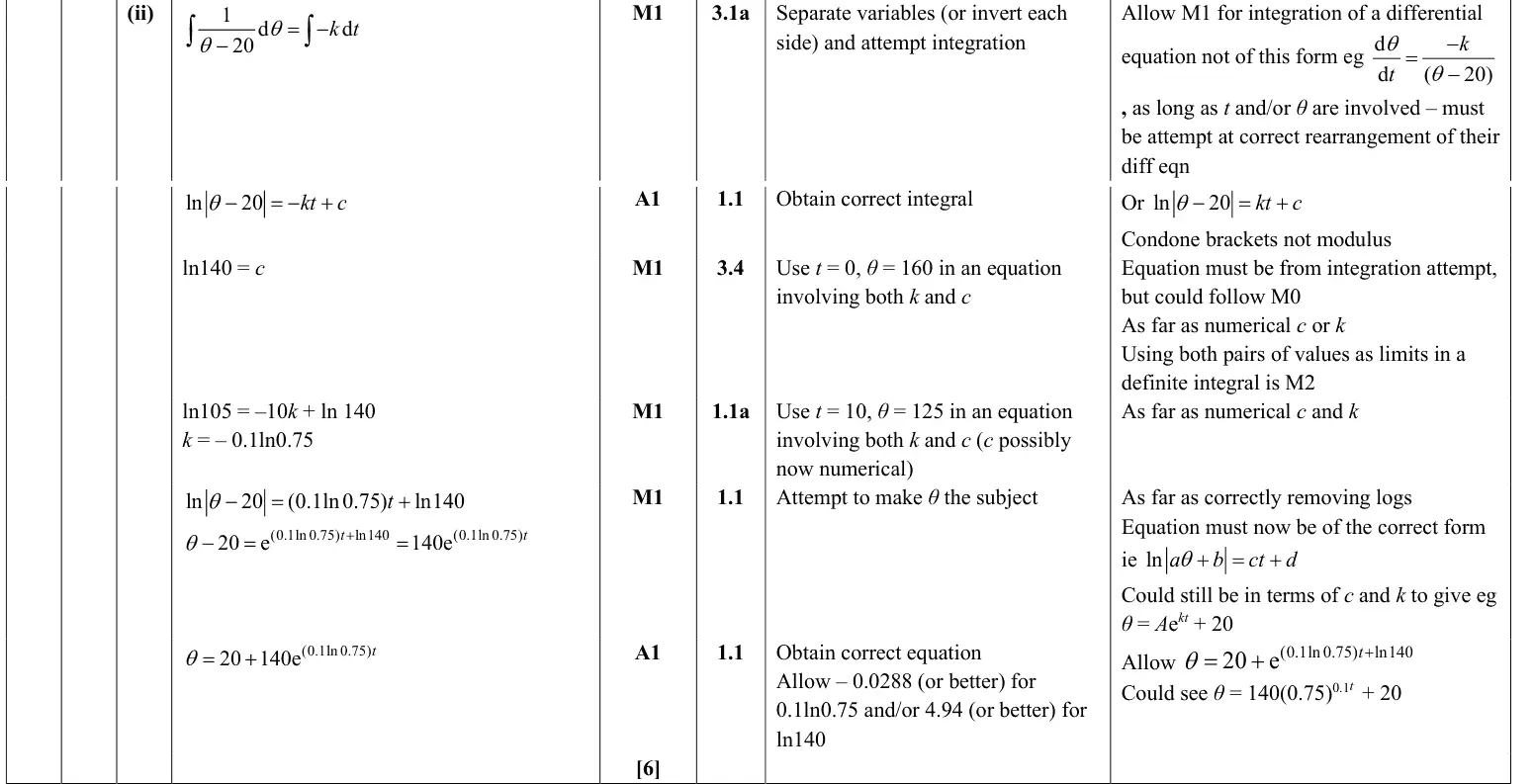
separate variables: ln abs(θ − 20) = −kt + c
c = ln 140
k = −0.1 ln 0.75
θ = 20 + 140e^(0.1 ln 0.75 t)
Autumn 2021 · Paper 1 · Q12(c)2 marksMedium
Show the start of this question
Mark scheme for this part
Key points and common errors
θ = 25 in both: 38.6 and 115.8 minutes
difference 77 minutes
Autumn 2021 · Paper 3 · Q7(b)4 marksMedium
Show the start of this question
Mark scheme for this part
Key points and common errors
separate: ln(y − 2) = 3ln(x − 3) + c
(4, 3) gives c = 0
y = (x − 3)³ + 2
Autumn 2020 · Paper 1 · Q6(a)3 marksMedium
Mark scheme for this part
Examiner's comment
(Comment on Question 06 as a whole) In the first part of Question 6 a number of candidates attempted a worded explanation as opposed to reducing the equation to linear form which is then linked to the equation of a straight line. A lack of precision resulted in some candidates not gaining full credit, as they neglected to indicate that they were using logs to base 10. In part (b) the expectation was that candidates would use the relevant parameters from their linear equation; an alternative, and equally acceptable, strategy was to identify coordinates of points on the straight line and use them in the given exponential equation; this is a good example of candidates who could not answer part (a) finding a method that still allowed them to attempt this part of the question. In part (d) any sensible reason that identified why the sales may not continue at the same rate was allowed, but a number of solutions were too vague to gain credit. Candidates were also given credit if they identified that extrapolation was unreliable.
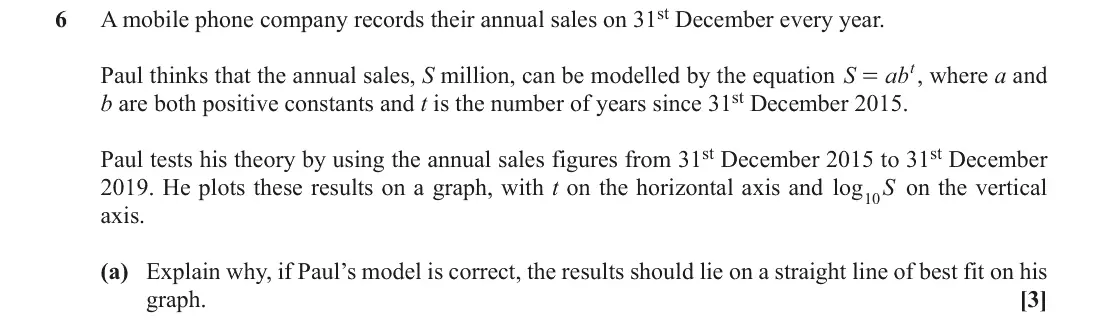
Key points and common errors
log₁₀S = log₁₀a + t log₁₀b, of the form Y = mX + c
base 10 must be explicit
worded explanations alone fail
Autumn 2020 · Paper 1 · Q6(b)2 marksMedium
Show the start of this question
Mark scheme for this part
Examiner's comment
(Comment on Question 06 as a whole) In the first part of Question 6 a number of candidates attempted a worded explanation as opposed to reducing the equation to linear form which is then linked to the equation of a straight line. A lack of precision resulted in some candidates not gaining full credit, as they neglected to indicate that they were using logs to base 10. In part (b) the expectation was that candidates would use the relevant parameters from their linear equation; an alternative, and equally acceptable, strategy was to identify coordinates of points on the straight line and use them in the given exponential equation; this is a good example of candidates who could not answer part (a) finding a method that still allowed them to attempt this part of the question. In part (d) any sensible reason that identified why the sales may not continue at the same rate was allowed, but a number of solutions were too vague to gain credit. Candidates were also given credit if they identified that extrapolation was unreliable.
Key points and common errors
a = 10^0.583 = 3.8
b = 10^0.146 = 1.4
Autumn 2020 · AS Paper 1 · Q6(c)5 marksMedium
Mark scheme for this part
Key points and common errors
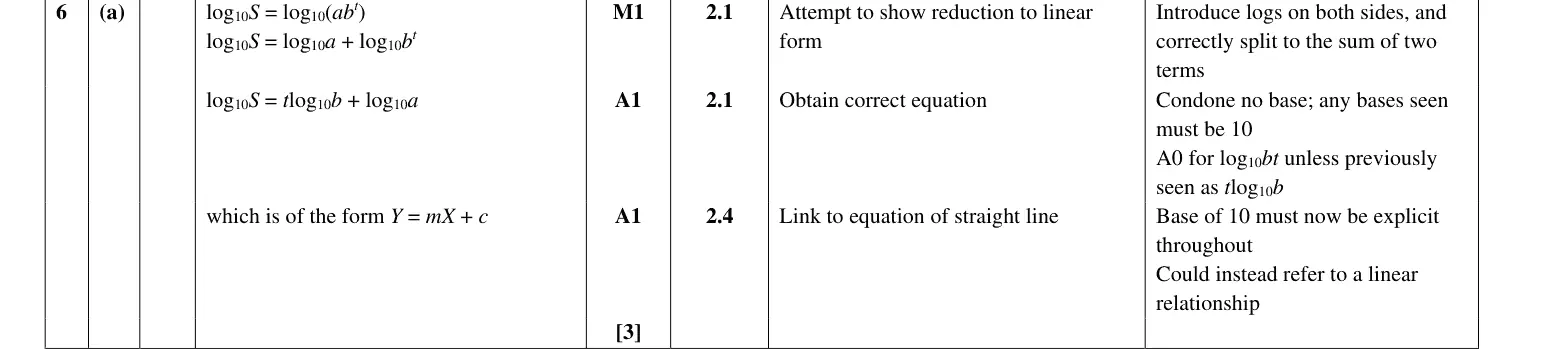
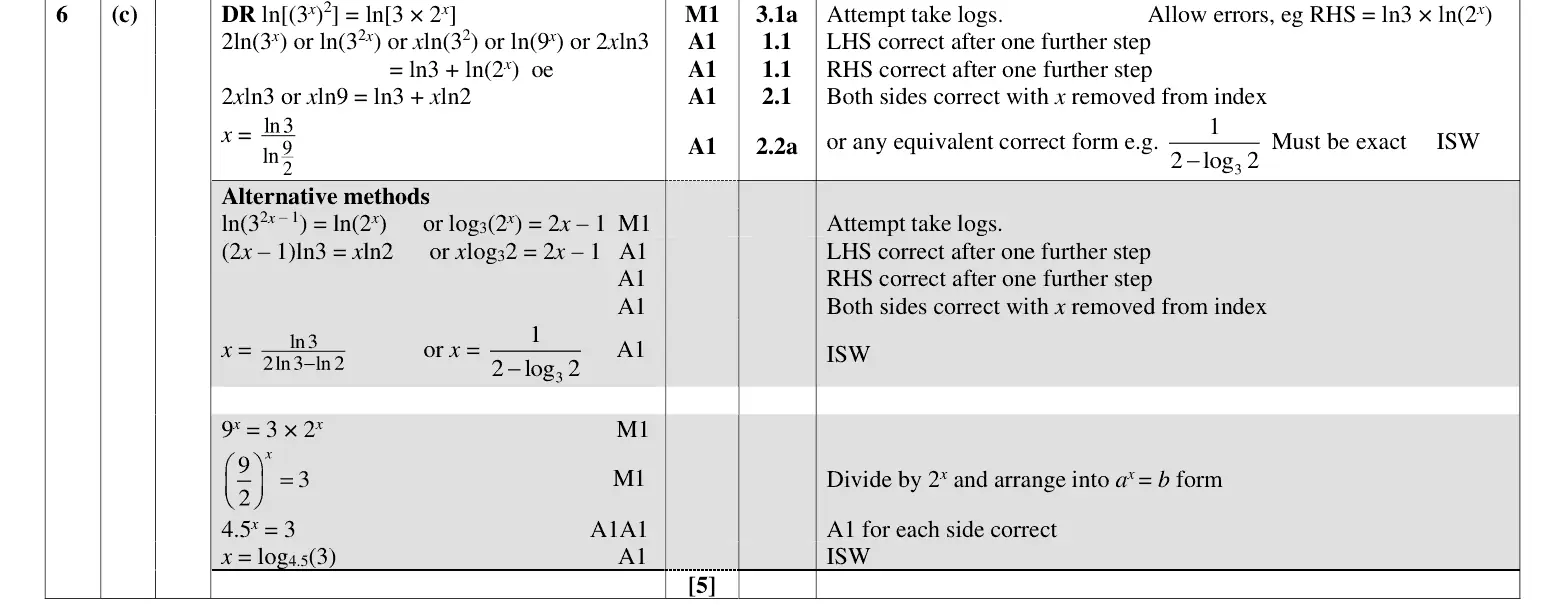
9ˣ = 3 × 2ˣ so (9/2)ˣ = 3, or take logs: 2x ln3 = ln3 + x ln2
x = ln3/ln(9/2) exact
Autumn 2020 · Paper 1 · Q6(c)3 marksMedium
Show the start of this question
Mark scheme for this part
Examiner's comment
(Comment on Question 06 as a whole) In the first part of Question 6 a number of candidates attempted a worded explanation as opposed to reducing the equation to linear form which is then linked to the equation of a straight line. A lack of precision resulted in some candidates not gaining full credit, as they neglected to indicate that they were using logs to base 10. In part (b) the expectation was that candidates would use the relevant parameters from their linear equation; an alternative, and equally acceptable, strategy was to identify coordinates of points on the straight line and use them in the given exponential equation; this is a good example of candidates who could not answer part (a) finding a method that still allowed them to attempt this part of the question. In part (d) any sensible reason that identified why the sales may not continue at the same rate was allowed, but a number of solutions were too vague to gain credit. Candidates were also given credit if they identified that extrapolation was unreliable.
Key points and common errors
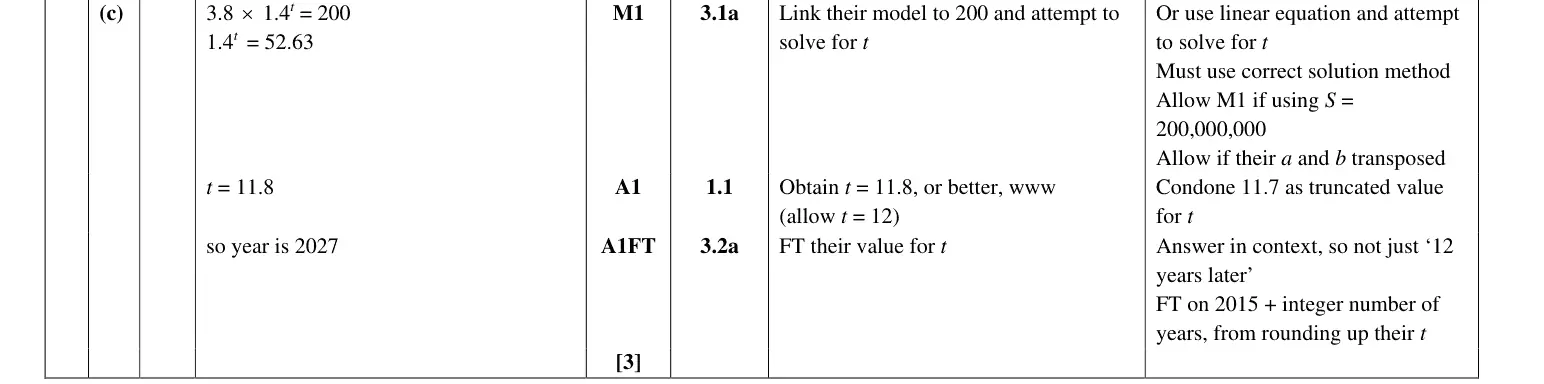
3.8 × 1.4ᵗ = 200 gives t = 11.8
year 2027 in context, not just '12 years'
Autumn 2020 · Paper 1 · Q7(b)3 marksMedium
Show the start of this question
Mark scheme for this part
Examiner's comment
(Comment on Question 07 as a whole) The final part of Question 7 was another example of where candidates were expected to give clearly explained and sensible answers. Many could identify that there will eventually not be enough hours in the day, but finding a reason on a different theme for their second answer proved more problematical.
Key points and common errors
30 × 1.1^(X−1) > 30 + 15(X − 1)
divide and take logs base 1.1 to reach the given inequality
keep > not =
Autumn 2020 · Paper 1 · Q129 marksEasy
Mark scheme for this part
Examiner's comment
Question 12 was the final question on the paper and was generally well answered, with a number of candidates able to make good progress in this unstructured, multi-step question. As the question did not require ‘detailed reasoning’, calculator use to find the roots of the cubic denominator was acceptable. However, when then working backwards from the roots to the factors, it was fairly common to lose the lead coefficient of 2 with the expected factor of ( ) being given as ( ) 2 x − 1 x − 0 5. but with no compensation in the other factors. Candidates who took the longer method of identifying a factor, carrying out algebraic long division and then finding the other two linear factors were usually more successful. This demonstrates the need for candidates to know how to use the calculator functions effectively and accurately. The remainder of the question was generally well attempted, although only the most able candidates gained the final mark for correctly dealing with both the indices and the constant of integration when removing the logarithms to make y the subject. Common misconceptions One common misconception was commenting on the model in Question 7; a number of candidates commented on why the revision programme may be difficult for the student to implement (e.g. may get bored and not want to revise) as opposed to why it may not be realistic. Key teaching and learning points – comments on improving performance Candidates need to be aware of the command words that are used, and the implication for the detail in their solutions. ‘Determine’ was used in a number of questions and candidates should appreciate that this indicates that justification should be given; just stating the answer is unlikely to attract much, if any, credit. When commenting on the reliability of a model, or how realistic it may be, candidates are expected to give a sensible, specific reason; vague comments that refer just to ‘other factors’ are insufficient. It is essential that candidates are familiar with all areas of the specification; on this paper a number of candidates seemed less confident on topic areas that did not feature on the legacy 7890 specification, namely small angle approximations, proof by contradictions and upper and lower bounds. Guidance on using this paper as a mock When marking the mock examination, teachers should pay close attention to the additional guidance in the mark scheme to make sure that lack of sufficient detail in a solution is clearly identified and feedback given to the candidates as to what additional detail was required.
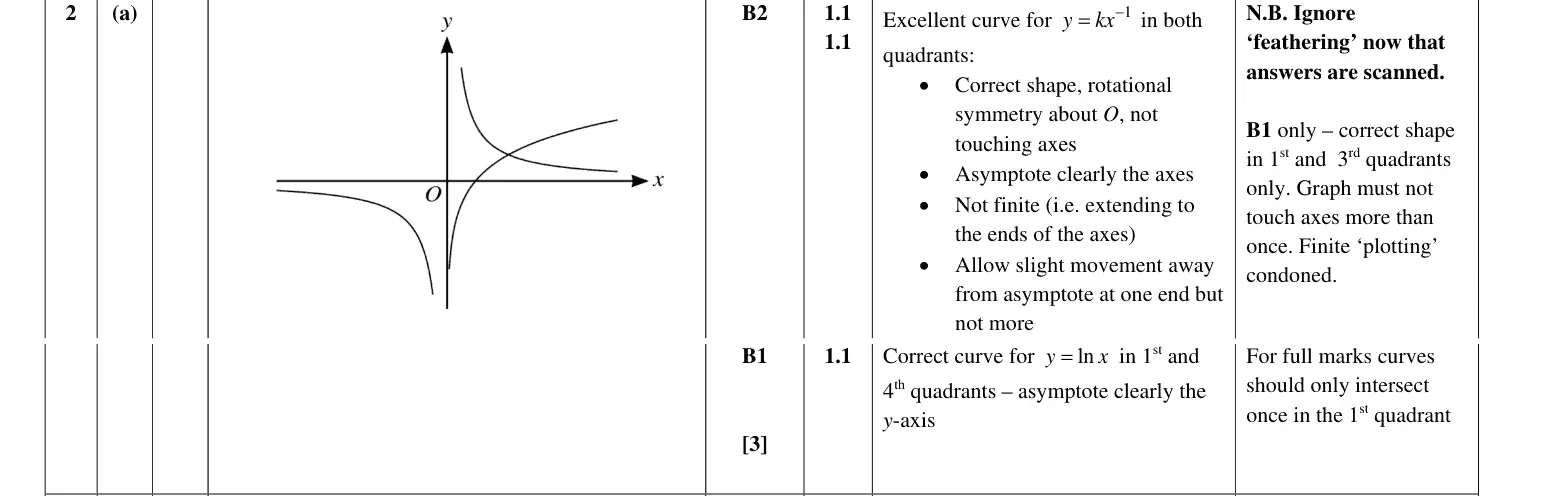
(Comment on Question 02 as a whole) Part (a) - Candidates should draw their curves to ‘fill’ the axes and sketch asymptotes carefully. There should not be too big a ‘gap’ between the curve and the asymptote and there should not be significant movement away from the asymptote. y = ln x attempts were disappointing. Part (b) - The connection between the given equation and ln x = k/x was not well appreciated or explained. Some were looking for an axis crossing point to justify one root.
Key points and common errors
y = k/x in 1st and 3rd quadrants approaching the axes
y = ln x through (1, 0) with y-axis asymptote
one intersection in 1st quadrant
ln x attempts disappointing
Autumn 2020 · AS Paper 2 · Q4(c)(i)2 marksHard
Show the start of this question
Mark scheme for this part
Examiner's comment
(Comment on Question 04 as a whole) Part (a) - Long division was seen here, ignoring the request for the factor theorem. This gained no credit because of the instruction ‘Use the factor theorem’. Note that only the statement f(½) = 0 so k = -37 was not enough working because of DR and AG. Part (b) - DR so evidence for the factorisation was required. Candidates that just quoted their answer, possibly obtained from the polynomial solve function on the calculator scored M0. Part (c) - Only candidates who did well on this paper seemed to understand what was required. NR was not uncommon.
Key points and common errors
equation is f(e⁻ᵗ) = 0 so e⁻ᵗ = ½, 5/3, 4
t = −ln(½), −ln(5/3), −ln 4
Autumn 2020 · AS Paper 2 · Q4(c)(ii)2 marksHard
Show the start of this question
Mark scheme for this part
Examiner's comment
(Comment on Question 04 as a whole) Part (a) - Long division was seen here, ignoring the request for the factor theorem. This gained no credit because of the instruction ‘Use the factor theorem’. Note that only the statement f(½) = 0 so k = -37 was not enough working because of DR and AG. Part (b) - DR so evidence for the factorisation was required. Candidates that just quoted their answer, possibly obtained from the polynomial solve function on the calculator scored M0. Part (c) - Only candidates who did well on this paper seemed to understand what was required. NR was not uncommon.
Key points and common errors
sum = −ln(½ × 5/3 × 4) = ln(3/10)
Autumn 2020 · Paper 2 · Q8(a)7 marksHard
Mark scheme for this part
Examiner's comment
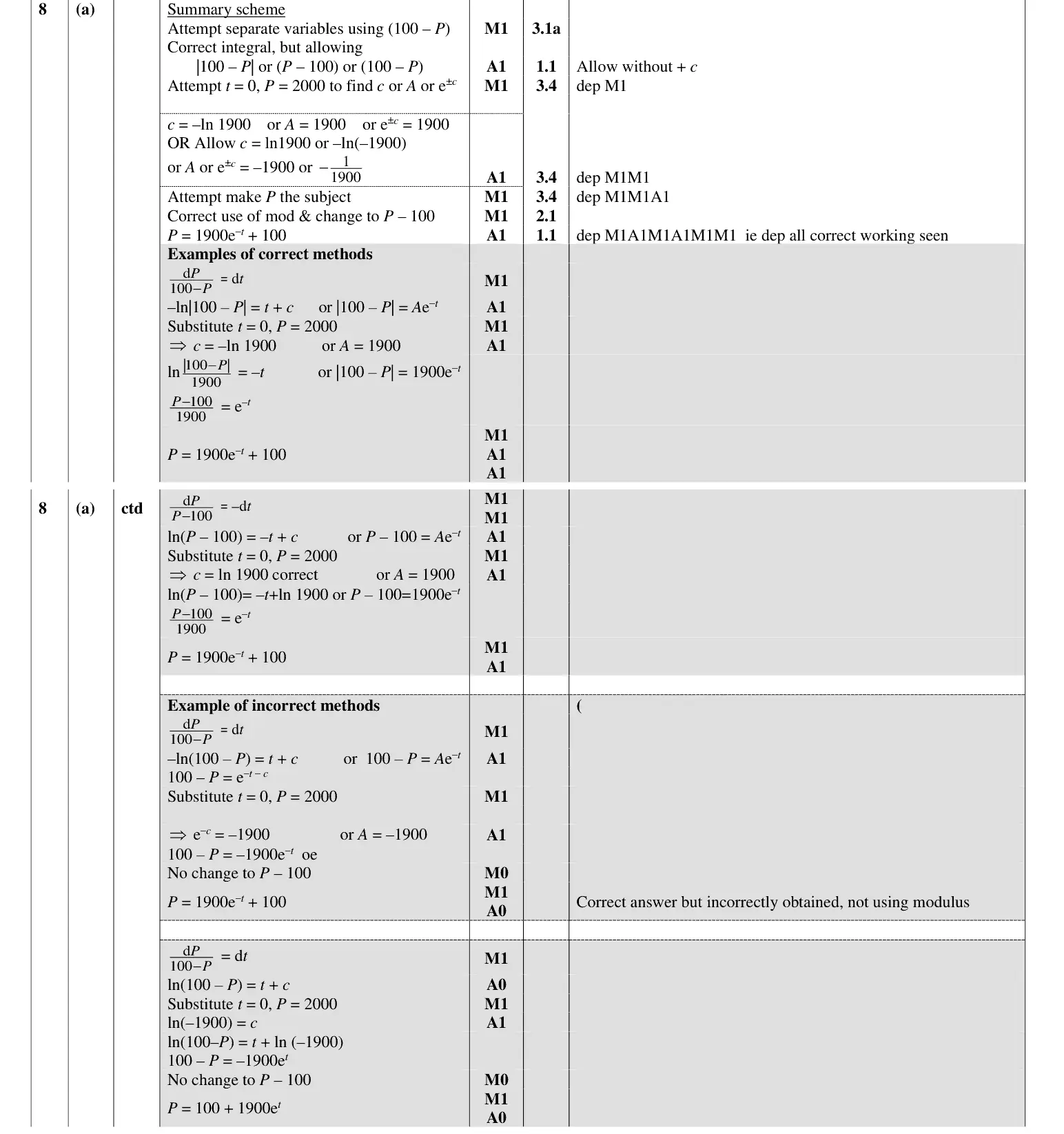
(Comment on Question 08 as a whole) This differential equation was difficult in that a correct solution depended on the correct use of the modulus sign when integrating . The majority of candidates either did not include the modulus sign or included it but then just ignored it. These candidates then obtained an impossible value for the ec = − constant of integration, such as ln ( 1900 ) or . Some noticed this and just dropped the c = − 1900 negative sign, while others ploughed on, seemly unaware of that this was a problem. Candidates who made errors such as these could, nevertheless, score 5 marks out of 7 if they made no other errors. A few candidates made no attempt to separate the variables and "integrated" to obtain equations such as . P = 100 t − Pt Section B: Statistics
Key points and common errors
separate variables: −ln(mod(100 − P)) = t + c
the modulus matters since P > 100: P = 1900e⁻ᵗ + 100
majority omitted or ignored the modulus giving impossible c = −ln 1900
Autumn 2020 · Paper 3 · Q23 marksHard
Mark scheme for this part
Examiner's comment
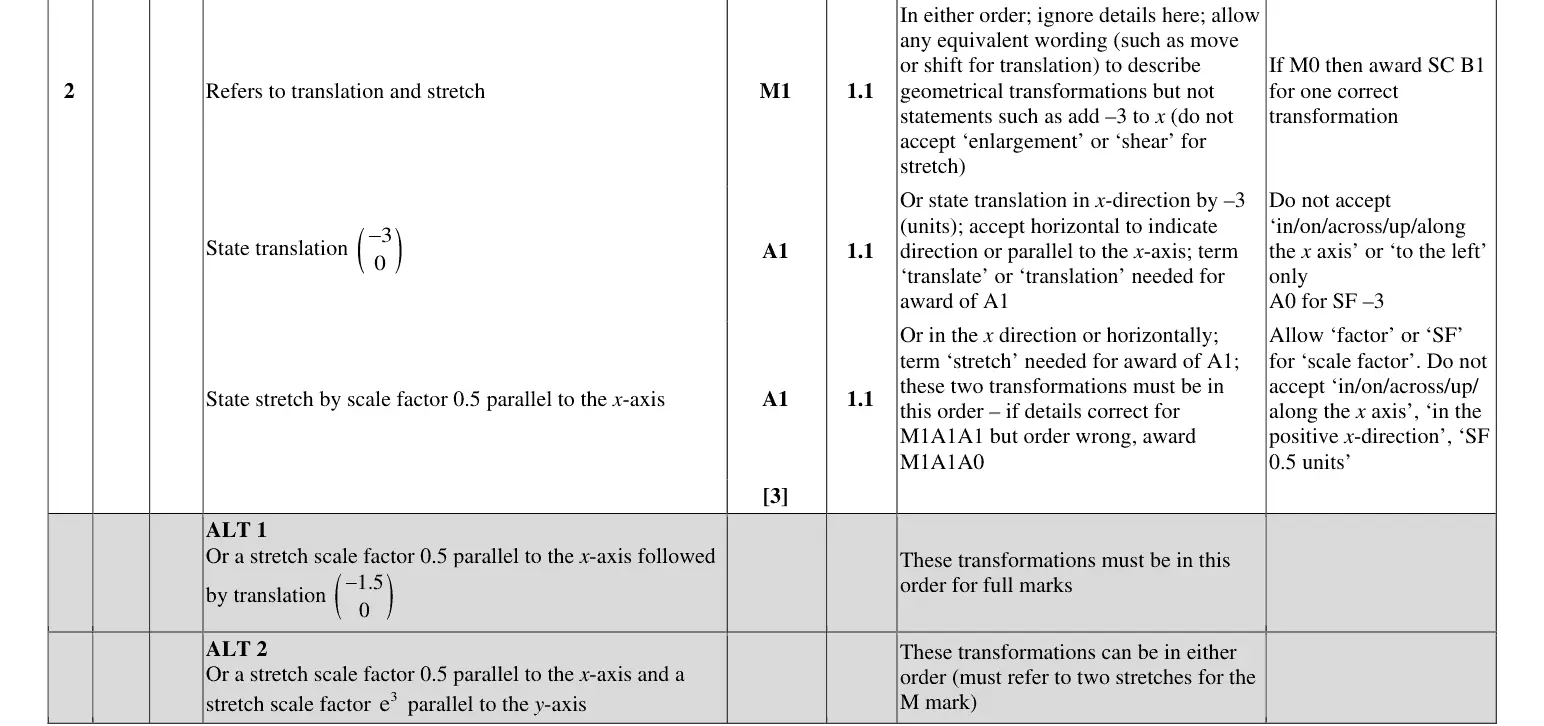
Although the majority of candidates demonstrated a clear understanding of the process of transformation there were very few who scored full marks, with most scoring 2 out of the 3 marks available. Some lost a mark for imprecise language, while others had the order of the transformations in the wrong order.
Key points and common errors
translation by (−3, 0) then stretch parallel to the x-axis, scale factor ½ (or stretch then translation (−1.5, 0))
order matters
imprecise language ('along', 'enlargement') loses marks
very few full marks
June 2019 · Paper 1 · Q78 marksHard
Mark scheme for this part
Examiner's comment
Most candidates were able to gain some credit on this question, but fully correct solutions were in a minority. The most effective method was to start by writing out the first few terms of the sequence, to allow the first term and common ratio to be identified. These values could then be substituted into the relevant formulae, and the inequality rearranged to useable form. Candidates were generally able to make a good attempt at this, but sign errors were relatively common. In this ‘detailed reasoning’ question, there was an expectation that the use of logarithms to solve the inequality would be explicit and this was nearly always the case. Candidates then had to conclude by stating the correct integer value of N, a step that some omitted and concluded with a decimal answer. The final answer had to be fully justified by correct use of inequalities throughout (which was often not the case with log0.6 involved), or by testing at least one relevant integer value. The most common misconception was to assume that the first term of the sequence was 25, with no check of n = 1.
Key points and common errors
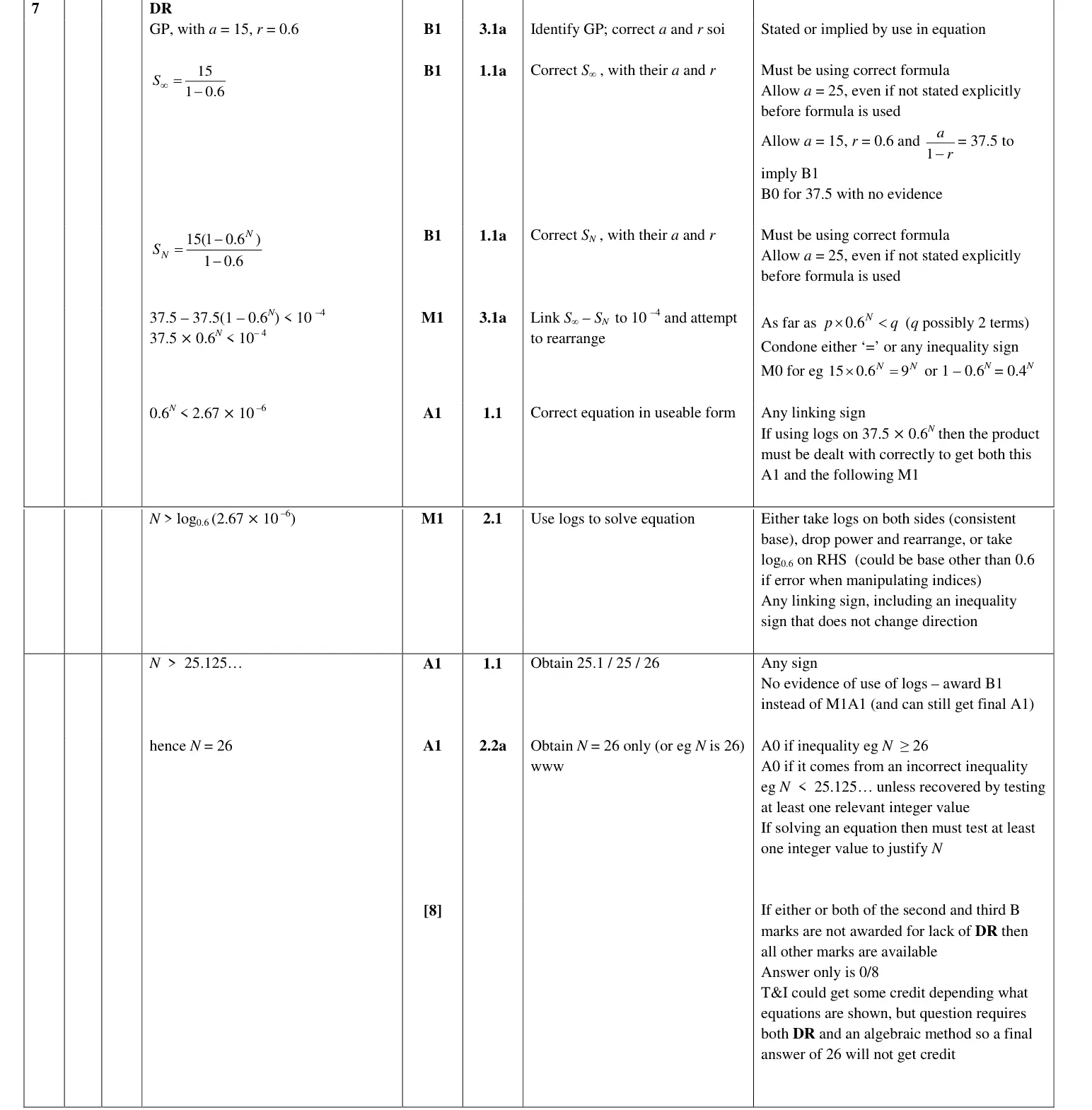
GP with a = 15, r = 0.6
S∞ − S_N = 37.5 × 0.6^N < 10⁻⁴
logs give N > 25.1 so N = 26
inequality reverses on dividing by log 0.6
trial and improvement scores nothing
June 2019 · AS Paper 1 · Q7(c)6 marksHard
Mark scheme for this part
Examiner's comment
Erratum notice 1 2e x , but then proceeded to attempt to The majority of candidates wrote a correct equation, 3ex = 1 – 2 take the logarithms of both sides. Their attempts were invariably incorrect. A few candidates wrote a correct first equation but then attempted to combine the exponential terms, obtaining equations such as 3 5e x = 1. 2 Some candidates recognised the "hidden" quadratic equation. Of these candidates, some did not 1 x 2e x – 1 = 0 and generally succeeded. However, many 1 2 2 substitute, but obtained the equation 3 (e ) + 2 e x , often made errors such as obtaining 2u2 + 3u – 1 = 0 or 1 who substituted, for example u = 2 (3u)2 + 2u – 1 = 0. 1 e x = 1 The correct method leads to 2 3 or –1. To gain full marks candidates had to indicate in some way 1 e x = –1 has no solutions. that the equation 2 Some candidates used a graphical calculator either from the start or after abandoning the incorrect logarithm method. In some cases, correct responses were seen, but preceded by incorrect working. Because the command word in this question is "Determine" rather than "Find", answers obtained in this way, without working equivalent to that shown in the mark scheme, were not given full credit. They scored 2 marks (out of 6 marks), if correct to 3 significant figures The best solutions worked with exact values, expressed in terms of e. Working in terms of decimals was accepted, but the final response needed to be correct to 3 significant figures. It is worth noting that similar questions in the future might explicitly require candidates to work with exact values and in such questions, working and/or responses in terms of rounded decimals would be penalised.
Key points and common errors
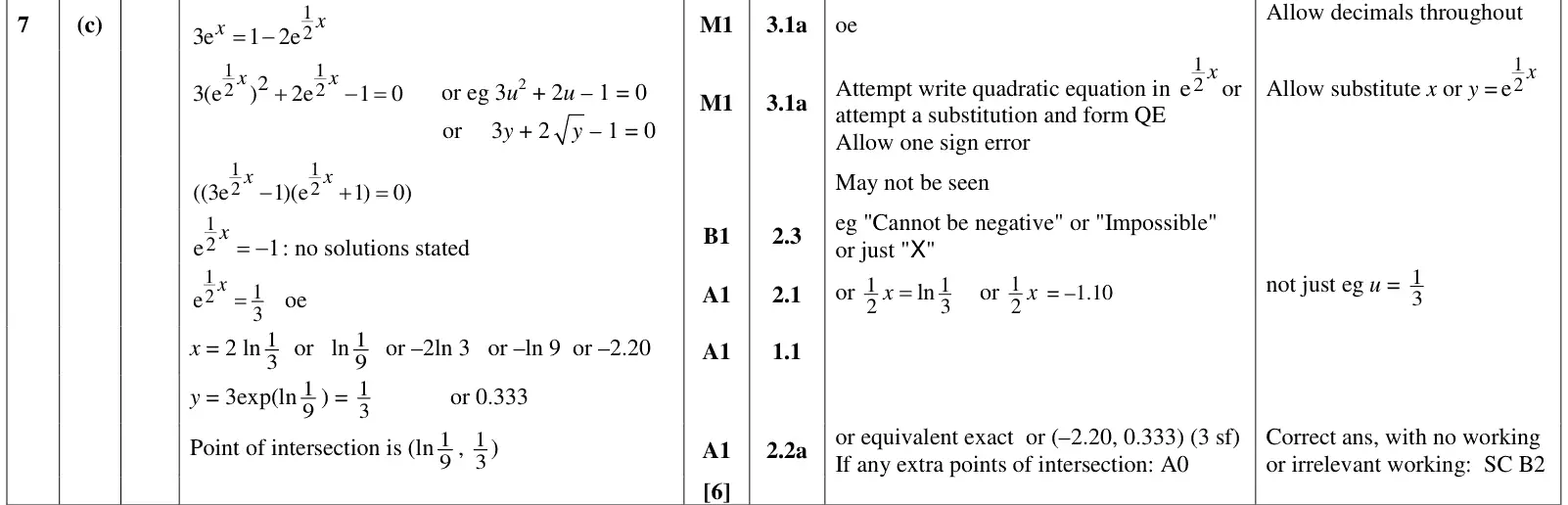
3eˣ = 1 − 2e^(x/2) is a quadratic in e^(x/2): (3u − 1)(u + 1) = 0
reject e^(x/2) = −1
x = ln(1/9), y = 1/3
taking logs of both sides fails
June 2019 · Paper 1 · Q11(b)1 markEasy
Show the start of this question
Mark scheme for this part
Examiner's comment
This question was generally very well answered, with most candidates able to state the correct equation.
Key points and common errors
x = 4, must be an equation
June 2019 · Paper 1 · Q11(c)4 marksHard
Show the start of this question
Mark scheme for this part
Examiner's comment
Only the most able candidates appreciated that the requested area existed both above and below the x- axis and were able to devise an appropriate strategy. Other candidates did calculate the two areas separately, but then simply added them together rather changing the relevant signs before combining the two integrals. However the majority of candidates simply used the two limits in the integral; many of these were still able to gain a mark for rewriting ln0.5 as –ln2.
Key points and common errors
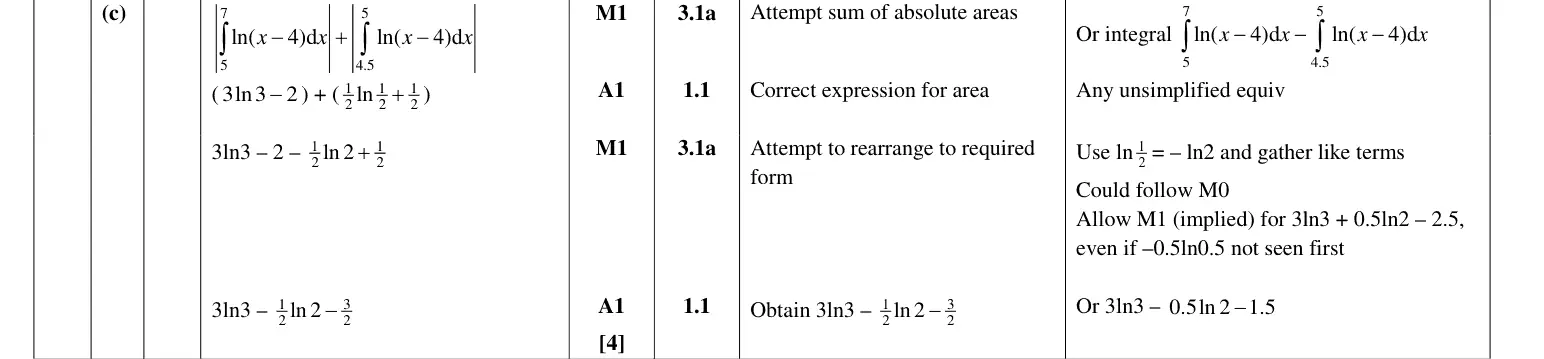
region is below the axis from 4.5 to 5 and above from 5 to 7
combine magnitudes: 3ln3 − ½ln2 − 3/2
the majority integrated from 4.5 to 7 in one go
June 2019 · Paper 1 · Q12(b)4 marksMedium
Show the start of this question
Mark scheme for this part
Examiner's comment
A number of candidates were able to make a good attempt at this question, producing fully correct solutions. The most common approach was to find a general equation for the tangent and then substitute in the given points, sometimes to give an equation that could be then solved and other times to set up two simultaneous equations. The less common, but more efficient, method was to use the two given points to find an expression for the gradient that was then equated to the derivative. Some candidates did not read the question carefully and used the wrong point when finding the gradient of the tangent, and others attempted to use both points in the derivative. A common misconception was to use the derivative in terms of x as the gradient rather than appreciating that a straight line must have a constant gradient.
Key points and common errors
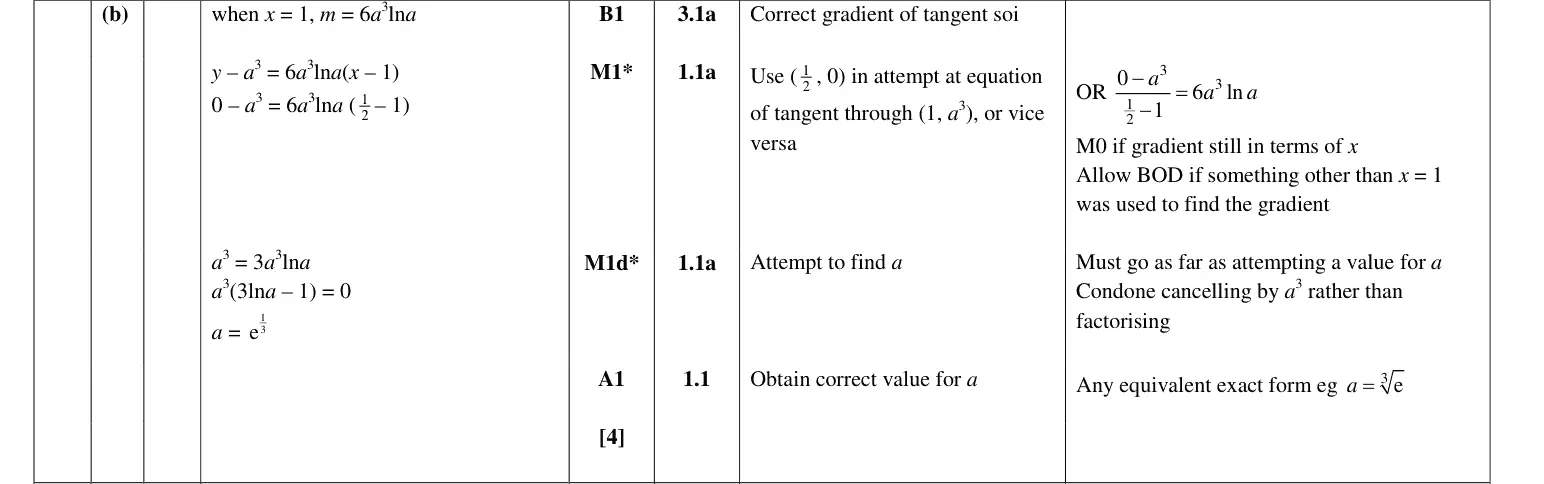
gradient 6a³ln a at x = 1
tangent through (½, 0) gives a³ = 3a³ln a so a = e^(1/3)
using the wrong point for the gradient
June 2019 · Paper 2 · Q4(b)(i)1 markHard
Show the start of this question
Mark scheme for this part
Examiner's comment
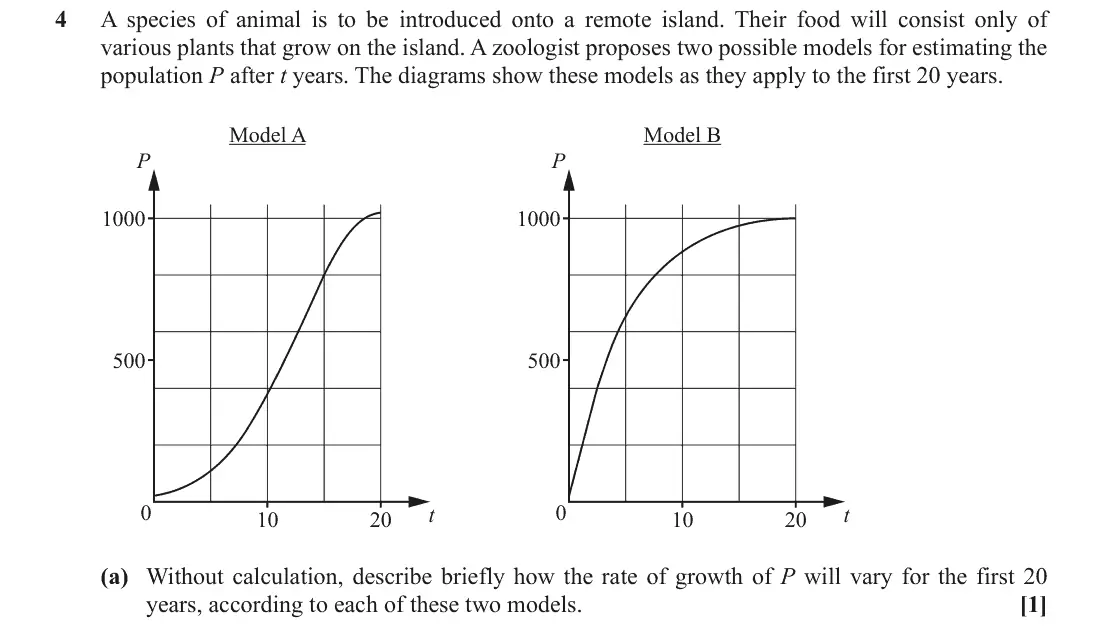
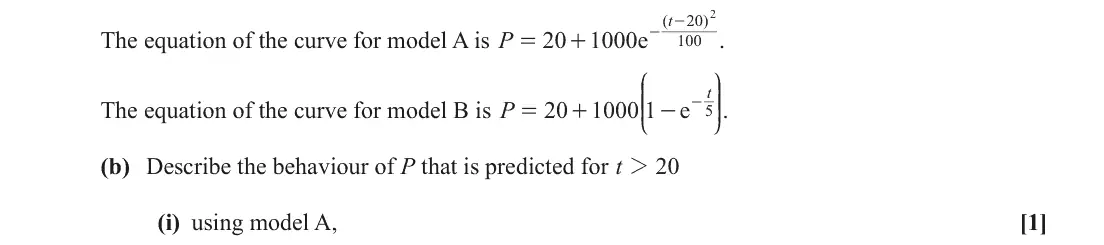
This part (and the next) depend on an ability to interpret the relevant equation involving an exponential function. Some candidates were able to interpret the equation correctly without quoting particular values of P. Others calculated values but were unable to give a proper interpretation. In some cases, candidates' answers to this part fitted the next part, and vice versa, suggesting a misunderstanding of the two equations. Some examples of inadequate or incorrect answers were as follows. P will decrease. P decreases exponentially after t = 20. P tends to zero. P will grow exponentially. The population will grow to about 1000 and then drop. P will tend to 1020. P will grow, but very slowly. The curve will be a reflection of the given curve. A good succinct answer is as follows: After t = 20 P will decrease, tending to 20.
Key points and common errors
P decreases and tends to 20
must mention 20
June 2019 · Paper 2 · Q4(b)(ii)1 markHard
Show the start of this question
Mark scheme for this part
Examiner's comment
Some of the comments on the previous part apply also to this part. Some examples of inadequate or incorrect answers were as follows. The growth of the population will slow until it stops. P will rise but increasingly slowly. P will increase. P will increase exponentially. P tends to 1000. The population is at a fixed number. P will decay exponentially. P will decrease and tend to 20. A good succinct answer is as follows: After t = 20 P will continue to increase, tending to 1020.
Key points and common errors
P tends to 1020 (not 1000)
must mention 1020
June 2019 · AS Paper 2 · Q8(a)4 marksHard
Mark scheme for this part
Examiner's comment
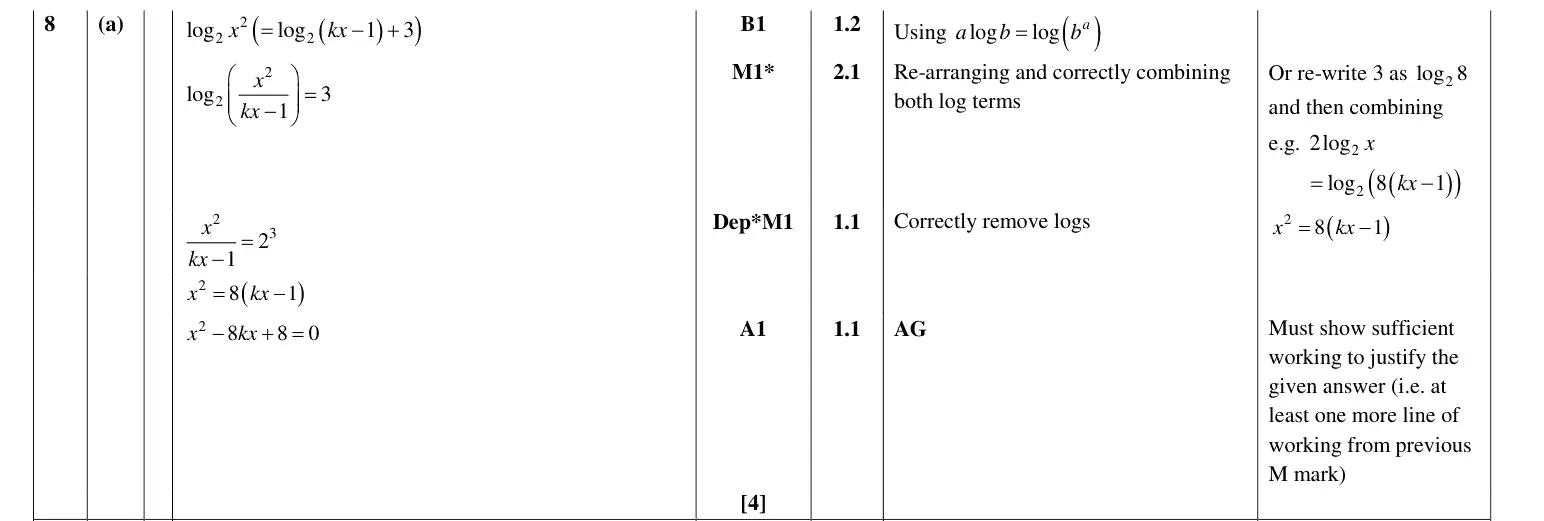
Many candidates here scored only one mark for log x . A confidence with using the laws of logarithms ( ) regularly stated. A few introduced 32 rather than 23. This was was not often seen, e.g. log x − kx + 1 ‘Show that’ question, with the answer given in the question, so we expected sufficient justification in the written response.
Key points and common errors
2log₂x = log₂x²
combine to log₂(x²/(kx − 1)) = 3 so x² = 8(kx − 1)
log(x) − log(kx − 1) errors and using 3² instead of 2³
June 2019 · AS Paper 2 · Q8(b)4 marksHard
Show the start of this question
Mark scheme for this part
Examiner's comment
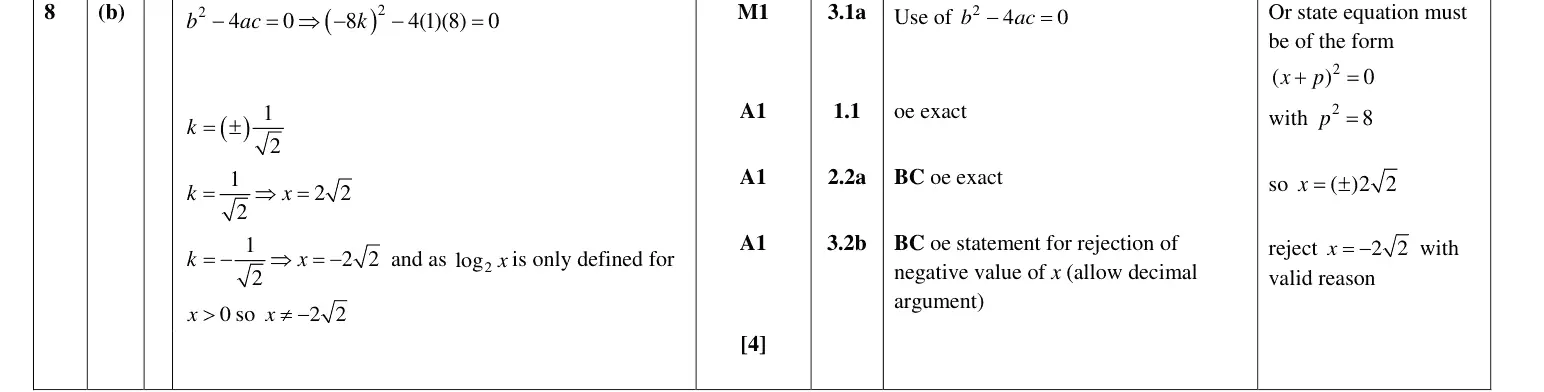
Many recognised the need for ‘ − 4 ’, but this was sometimes carelessly applied to give b ac 64 k − 32 = 0 , − 8 k − 32 = 0 or some such, and many more accurate tries only gave the positive value of k . Often the attempt stopped at the value for k with no effort to find x . Presumably candidates thought k was the root. We expected a valid reason for why the negative value for x was rejected. Simply stating x > 0 was not sufficient as they needed to explain that log x is only defined for x > 0 (not that log x cannot be negative).
Key points and common errors
one root: 64k² − 32 = 0 so k = ±1/√2
x = ±2√2
reject −2√2 because log₂x needs x > 0
many stopped at k
June 2019 · Paper 3 · Q610 marksHard
Mark scheme for this part
Examiner's comment
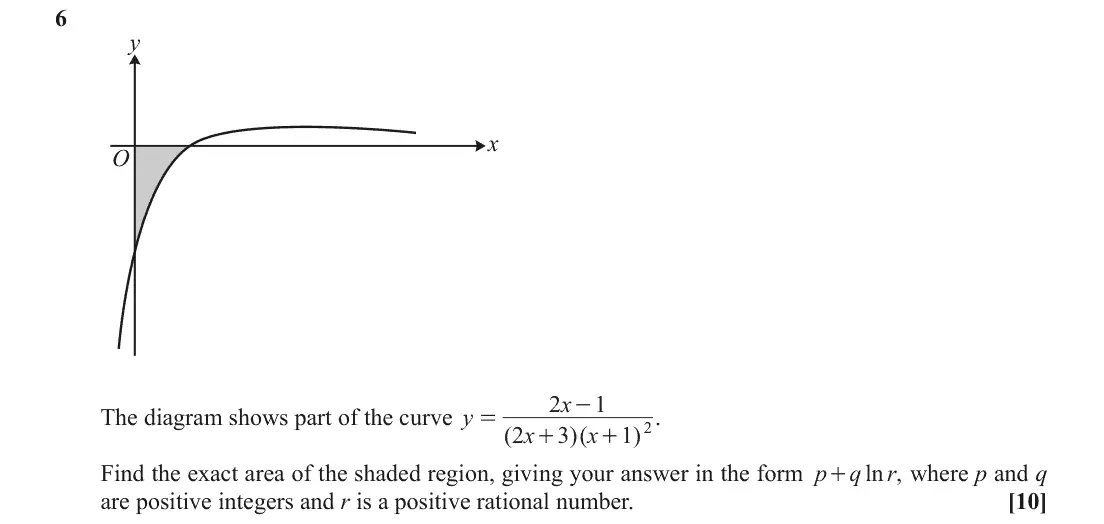
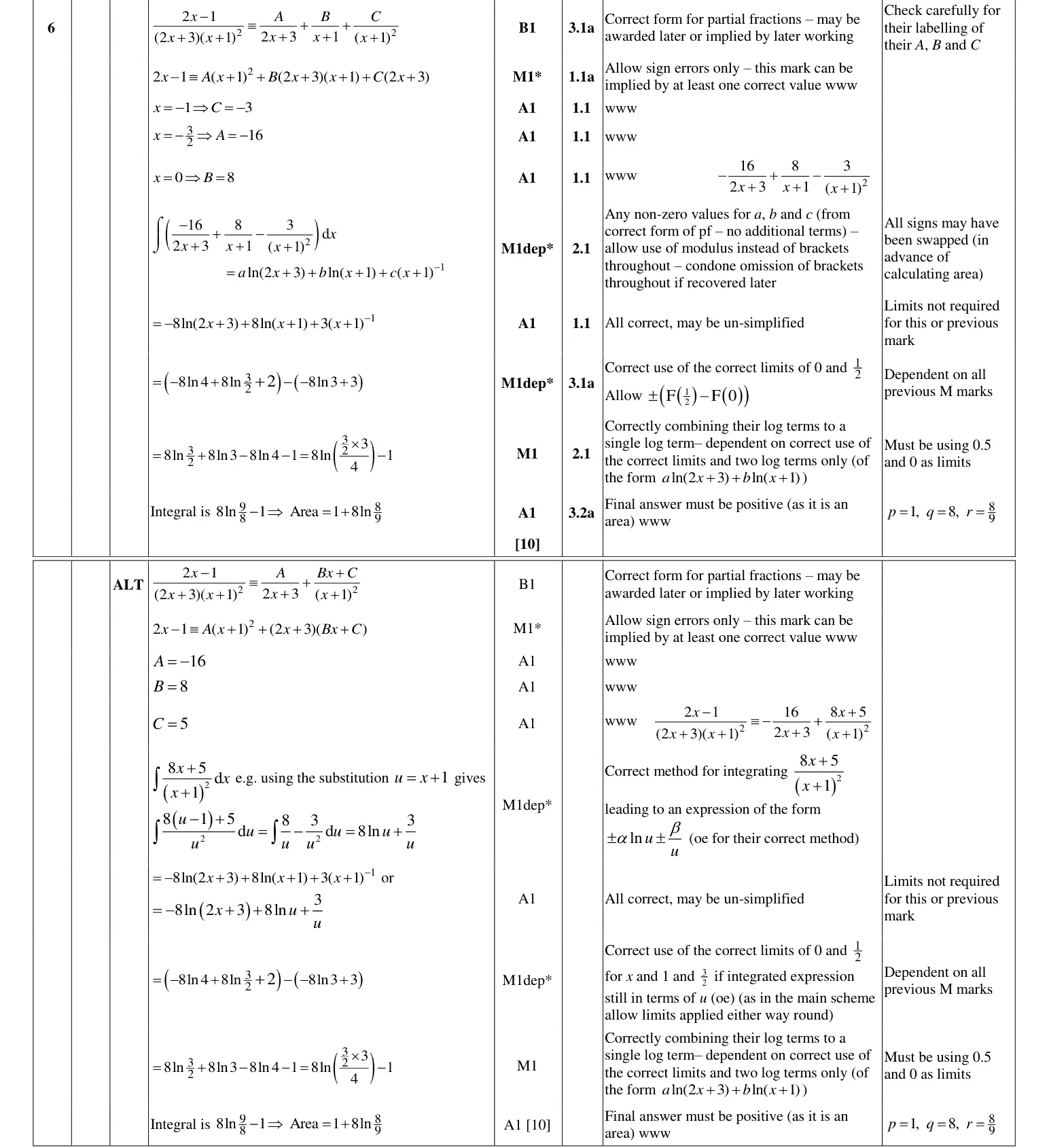
Many candidates made a good attempt at this question with most realising that to integrate 2 x − 1 A B C , partial fractions of the form + + were required, and many used a ( 2 3 )( 1 ) 2 x + 3 x + 1 ( 1 ) x + x + x + 16 8 3 correct method to obtain an answer of − + − (and so scored the first five marks in 2 x + 3 x + 1 ( ) x + 1 this part). It was the subsequent integration that most candidates found difficult with many believing that dx 1 all three integrated expressions involved the natural log function or that ∫ Of those = − . ( ) ( ) x + 1 x + 1 that integrated correctly and used the correct limits of 0.5 and 0 it was pleasing to note that many obtain a correct value for the integral as 8ln −. However, most candidates who had got this far did not 1 realise that this was not of the required form as stated in the question (and so therefore this was not an expression for the exact area of the shaded region). Only the most able of candidates realised that the area of the shaded region was in fact 1 + 8ln . This response scored the first nine marks. The candidate provided an almost perfect solution to the problem but due to the nature of their exact answer the candidate has not realised that their answer is negative (and therefore not the exact area of the shaded region). Even though the question explicitly said that the answer should be given in the form p + q r ln with p as a positive integer many candidates ( ) failed to realise that the required area was in fact 1 + 8ln .
Key points and common errors
A/(2x + 3) + B/(x + 1) + C/(x + 1)²: −16, 8, −3
∫3/(x + 1)² is not a log
limits 0 to ½
area 1 + 8ln(8/9) as a positive value
June 2018 · Paper 1 · Q2(i)3 marksEasy
Mark scheme for this part
Examiner's comment
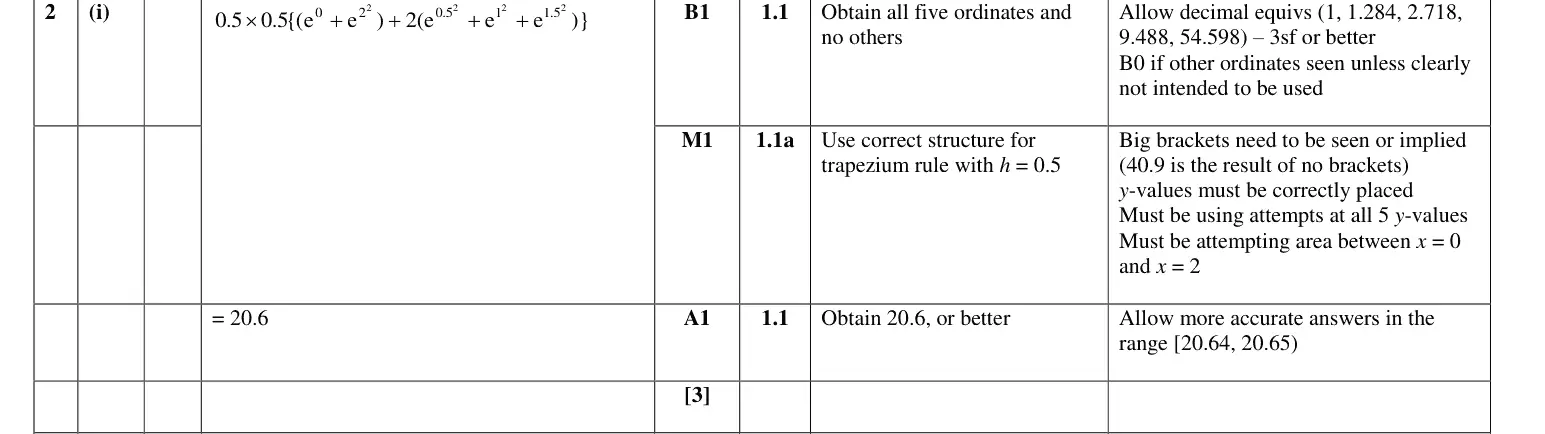
This question was also very well answered, with many fully correct solutions seen. The most successful candidates started by identifying the relevant x values, used exact y values rather than decimal approximations and made effective use of brackets.
Key points and common errors
five ordinates at x = 0, 0.5, 1, 1.5, 2
h = 0.5
exact y-values and brackets
20.6
June 2018 · Paper 1 · Q7(ii)3 marksEasy
Show the start of this question
Mark scheme for this part
Examiner's comment
Candidates could correctly equate the expression for the sum of n terms to 2974, and most were able to solve this equation. Most candidates showed a clear mathematical justification even though there was no specific command in the question requiring this level of detail for full credit. Once again, the final answer was expected to be given in context.
Key points and common errors
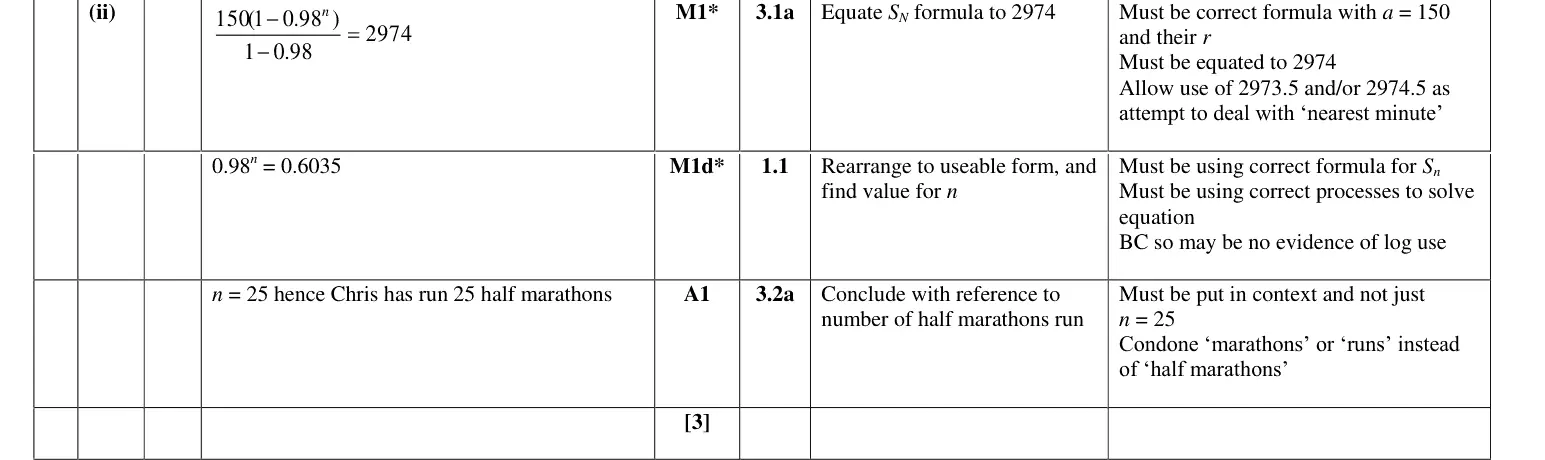
150(1 − 0.98ⁿ)/(1 − 0.98) = 2974
0.98ⁿ = 0.6035
n = 25 half marathons, answer in context
June 2018 · Paper 1 · Q11(i)3 marksEasy
Mark scheme for this part
Examiner's comment
This question was very well answered with candidates identifying the initial mass, and then setting up and solving a relevant equation. Most candidates worked exactly throughout to provide a sufficiently accurate final answer.
Key points and common errors
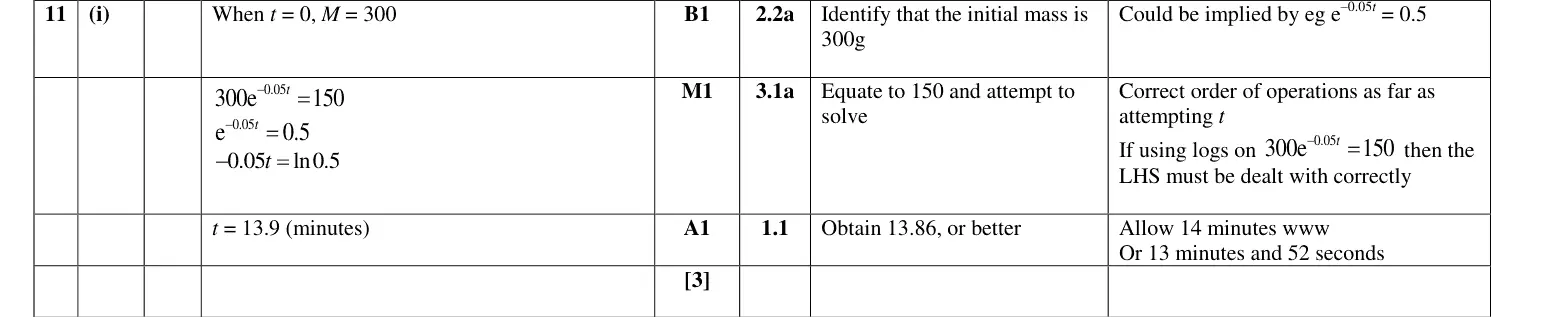
initial mass 300
e^(−0.05t) = 0.5
t = 13.9 minutes
June 2018 · Paper 1 · Q11(ii)8 marksMedium
Show the start of this question
Mark scheme for this part
Examiner's comment
The vast majority of candidates were able to make some progress on this question, and a number of fully correct solutions were seen. Candidates appreciated the need to find an expression for the mass of the second substance, and were able to make a good attempt at finding the two parameters. As the substance was decaying, some candidates used an initial structure of M = Ae-kt, but sign errors were relatively common when substituting back for k. A few candidates simply equated the two expressions for the mass, but most realised that it was the derivatives that should be equated and made a reasonable attempt to do so. Solving the ensuing equation was found to be challenging. Some attempted to rearrange first whereas others introduced logarithms straightaway. Sign errors were common, especially in solutions where candidates were working exactly as the coefficient of 0.1ln0.8 is not obviously negative. Some candidates spoilt an otherwise correct solution by not working to a sufficient degree of accuracy throughout their solution resulting in an incorrect final answer.
Key points and common errors
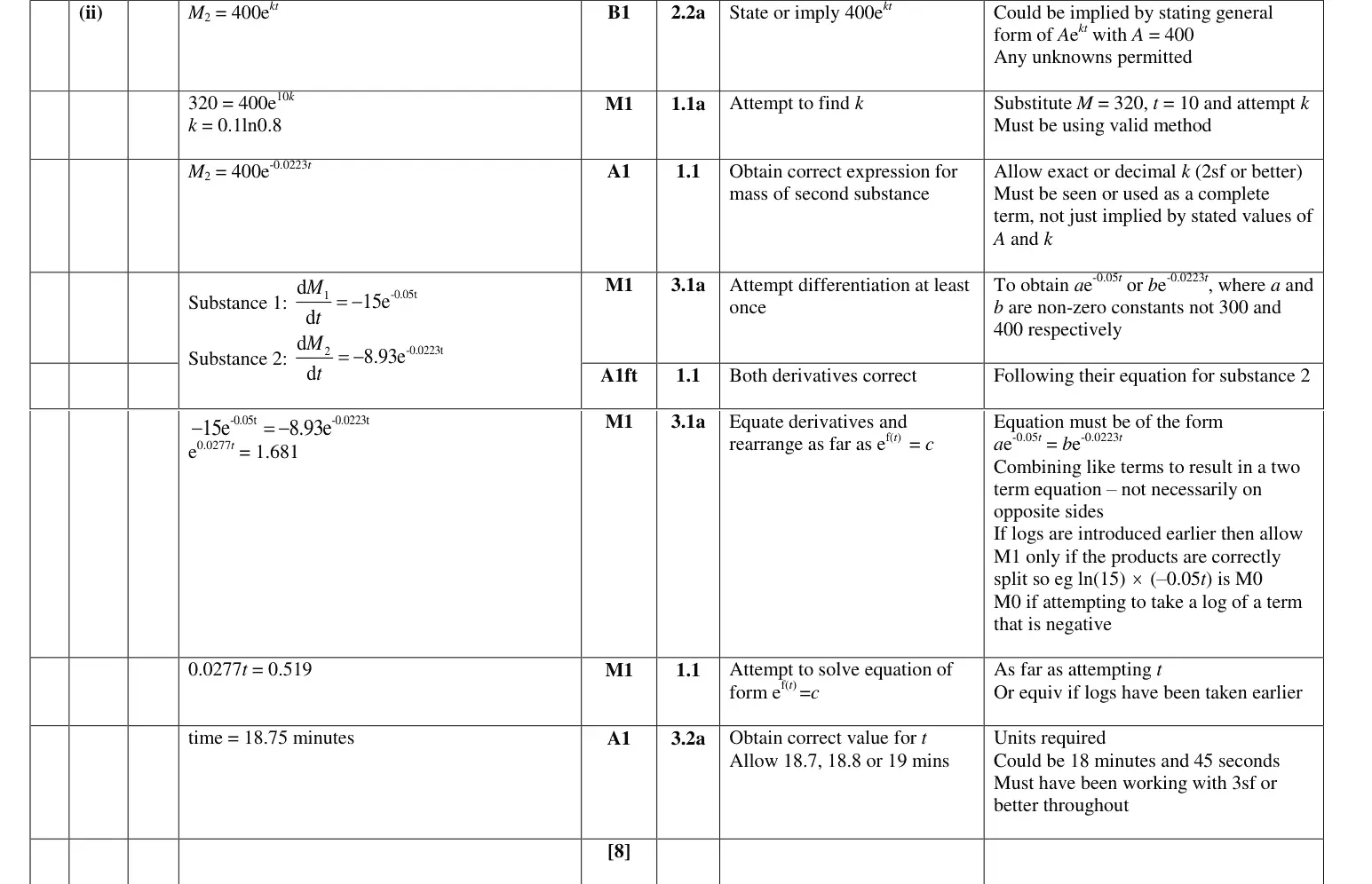
M₂ = 400e^(kt) with k = 0.1 ln 0.8
differentiate both
equate rates (not masses)
t = 18.75 minutes
June 2018 · Paper 1 · Q1210 marksMedium
Mark scheme for this part
Examiner's comment
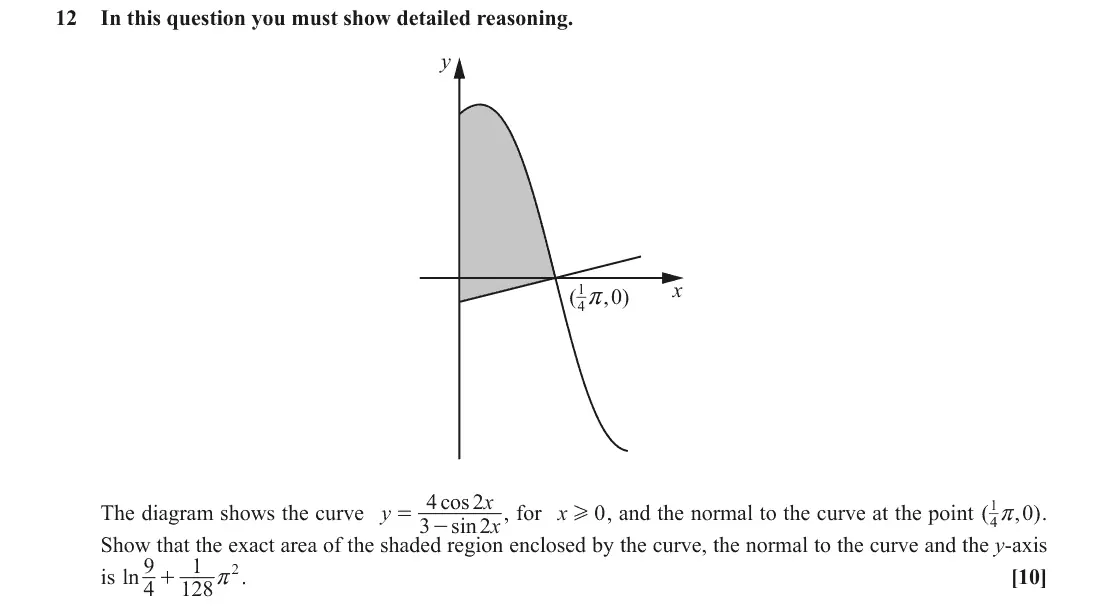
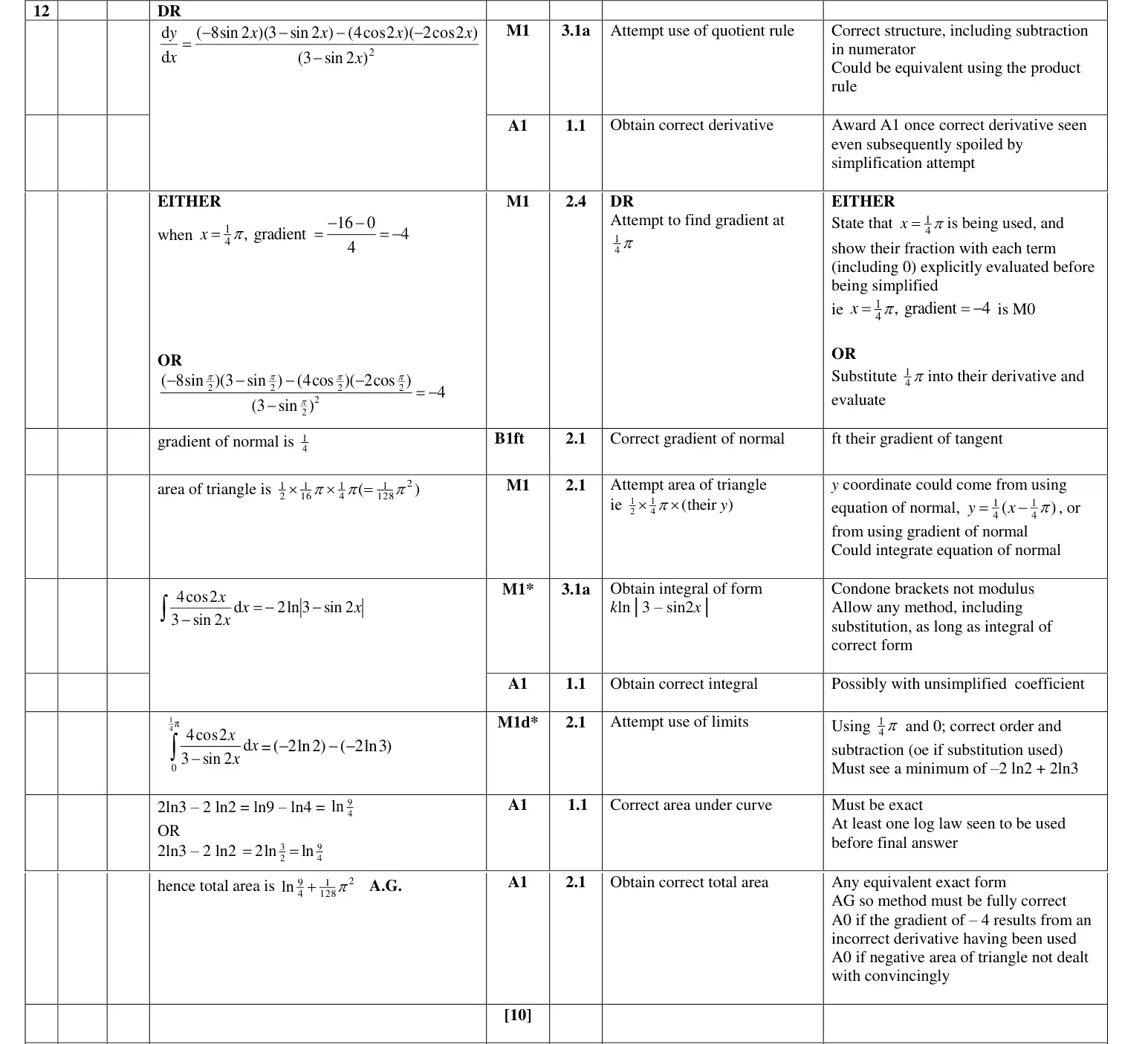
This was a question requiring detailed reasoning, so candidates were expected to show sufficient evidence of method throughout which not seen on all scripts. Candidates were generally successful when using the quotient rule to find the gradient of the curve. They were then expected to show evidence of finding the gradient at the given point; whilst some showed clear detail, others just stated the gradient with no justification. There were a variety of methods seen when finding the area of the triangle; the most common was to find the y intercept from the equation of the normal whereas others used integration. Some candidates identified that the 128π in the given answer must be the area of the triangle and attempted to fudge their answer to obtain this, in some cases deleting correct work and replacing it with a solution that was now worth less credit. Most candidates were able to correctly integrate the equation of the curve, some by inspection and others by using a substitution of their choosing. The limits were usually used correctly, but not all candidates provided sufficient evidence of use of logarithms before the appearance of ln 9 4 . This response gained full credit for a correct solution with sufficient justification seen throughout. The derivative is correct, and there is clear evidence of substitution to find the gradient at x = 1 4 π . Had the gradient of – 4 just been stated, but with no evidence, then this would have been penalised. The equation of the normal is used to find the intercept on the y-axis, and this is used to find the area of the triangle. The integration is also correct and limits are used correctly. There is then clear evidence of at least one log law being used to obtain the correct area under the curve. The two areas are then summed to justify the given answer.
Key points and common errors
quotient rule
gradient −4 at x = ¼π shown explicitly, normal gradient ¼
triangle area π²/128
∫4cos2x/(3 − sin2x) = −2ln(3 − sin2x)
area under curve ln(9/4)
handle the triangle below the axis convincingly
June 2018 · AS Paper 2 · Q3(iii)1 markHard
Mark scheme for this part
Examiner's comment
The most common error was P ⇔ Q. P⇐ Q was also seen, perhaps because candidates thought each statement would be used once in this question. Note this was not the case and is not inevitable. P → Q was condoned. This part was found to be the most difficult.
Key points and common errors
P ⇒ Q: ln y < 0 means 0 < y < 1, but y < 1 includes y ≤ 0 where ln y is undefined
common error P ⇔ Q
June 2018 · Paper 2 · Q6(i)2 marksEasy
Mark scheme for this part
Examiner's comment
This question was well answered.
Key points and common errors
ln x = 0 so x = 1
June 2018 · Paper 2 · Q6(ii)2 marksHard
Show the start of this question
Mark scheme for this part
Examiner's comment
− = 0 Many candidates just stated or implied that , either without proof, or by using their calculator and decimals. These candidates scored no marks, because of the "detailed reasoning" instruction.
Key points and common errors
ln4/4 = 2ln2/4 = ln2/2 using log laws
decimals from a calculator score nothing under DR
June 2018 · AS Paper 2 · Q6(iv)3 marksHard
Show the start of this question
Mark scheme for this part
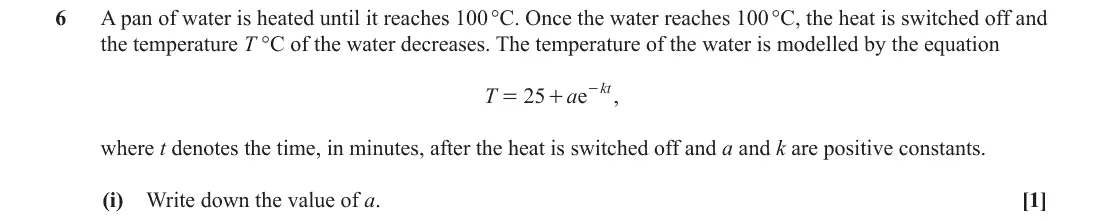
Examiner's comment
Inevitably those who did not obtain a value of a and/or k were unable to make progress in this part. Those who had incorrect values seemed to understand the method. A few set T = 55. Because of the difficulties encountered in (iii) very few correct answers were seen. Note that here units were expected to be mentioned (cf AO3.2a) and candidates need to be aware that these are important, particularly in modelling questions.
Key points and common errors
45 = 25 + 75e^(−t/5) so t = −5ln(4/15) = 6.6 minutes
units required
June 2018 · Paper 3 · Q5(ii)6 marksMedium
Show the start of this question
Mark scheme for this part
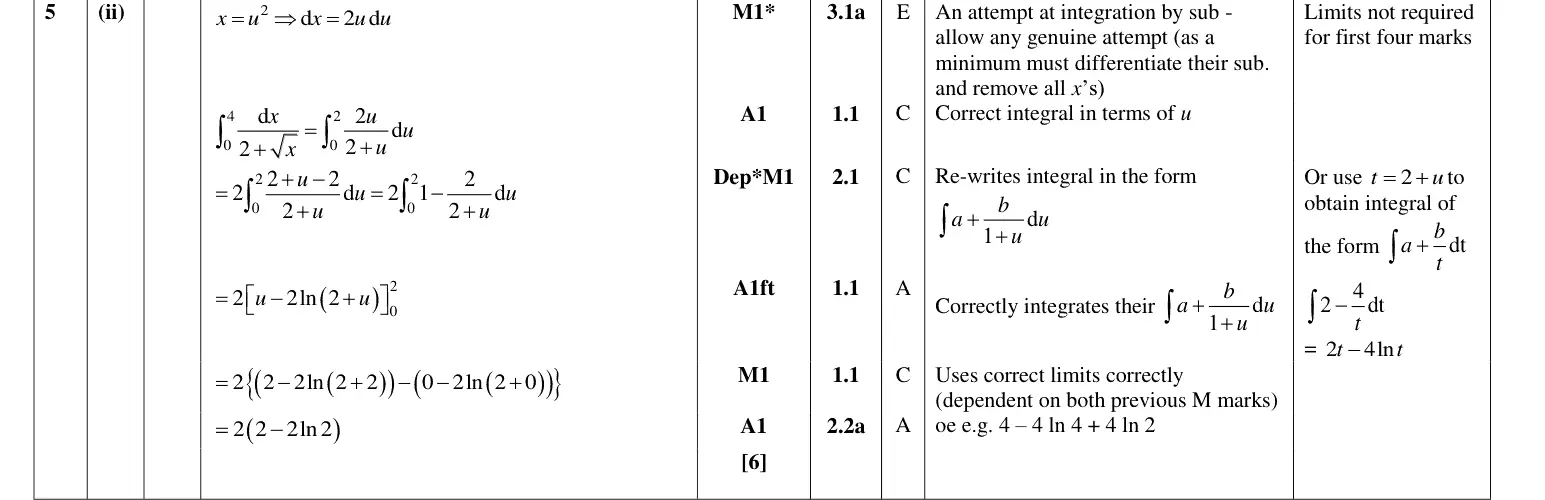
Examiner's comment
2 u ∫ While nearly all candidates used the substitution correctly and re-wrote the integral as d u many 2 + u could not deal with the resulting improper fraction in the integrand. The most successful candidates re- 2 u 2 u 4 + 2 u − 4 4 wrote u either by using long division or realising that = = 2 − u While examiners . 2 + 2 + u 2 + u 2 + noted that some candidates employed more extreme methods (for example, further substitutions and the method of integration by parts) these were usually unsuccessful.
Key points and common errors
dx = 2u du
∫₀² 2u/(2 + u) du
rewrite as 2∫(1 − 2/(2 + u)) du
2[u − 2 ln(2 + u)] = 4 − 4 ln 2
improper fraction caused difficulty
June 2018 · Paper 3 · Q5(iii)2 marksEasy
Show the start of this question
Mark scheme for this part
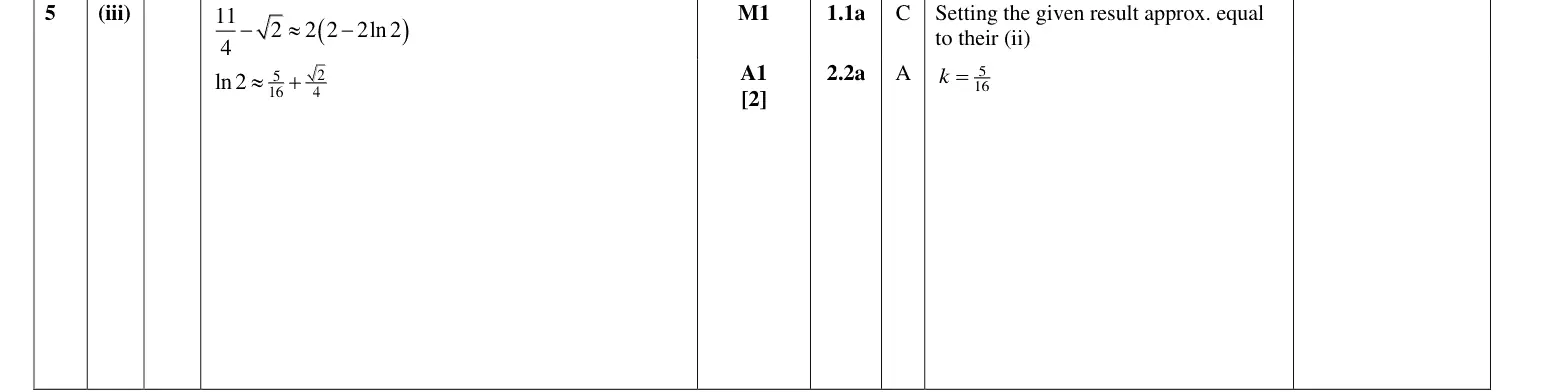
Examiner's comment
While some, who had struggled with part (ii), left this part blank the majority of candidates equated their answers to parts (i) and (ii) with nearly all who were successful in part (ii) correctly determining that = 5 k . 16
Key points and common errors
11/4 − √2 ≈ 4 − 4 ln 2 gives ln 2 ≈ 5/16 + √2/4, so k = 5/16
Find an A-level maths tutor
Stuck on this? Book a trial session with an A-level maths tutor.