Chain, product and quotient rules; connected rates of change Pure
Papers
Paper 1, Paper 2, Paper 3
Level
A level only
Spec
1.07q, 1.07r
Formulae sheet
The quotient rule is given; the chain and product rules are not.
Since 2018
36 question parts, 147 marks, each rated Easy, Medium or Hard from the wording of the examiners' report
Notes, worked examples and practice for this topic are being written by our tutors. The past-paper questions below are ready now: work each one on paper, then open the mark scheme and the examiner's comment.
Tap a question to zoom it. Mark scheme and examiner's comment open under each question.
June 2025 · Paper 3 · Q6(e)1 markEasy
Mark scheme for this part
Examiner's comment
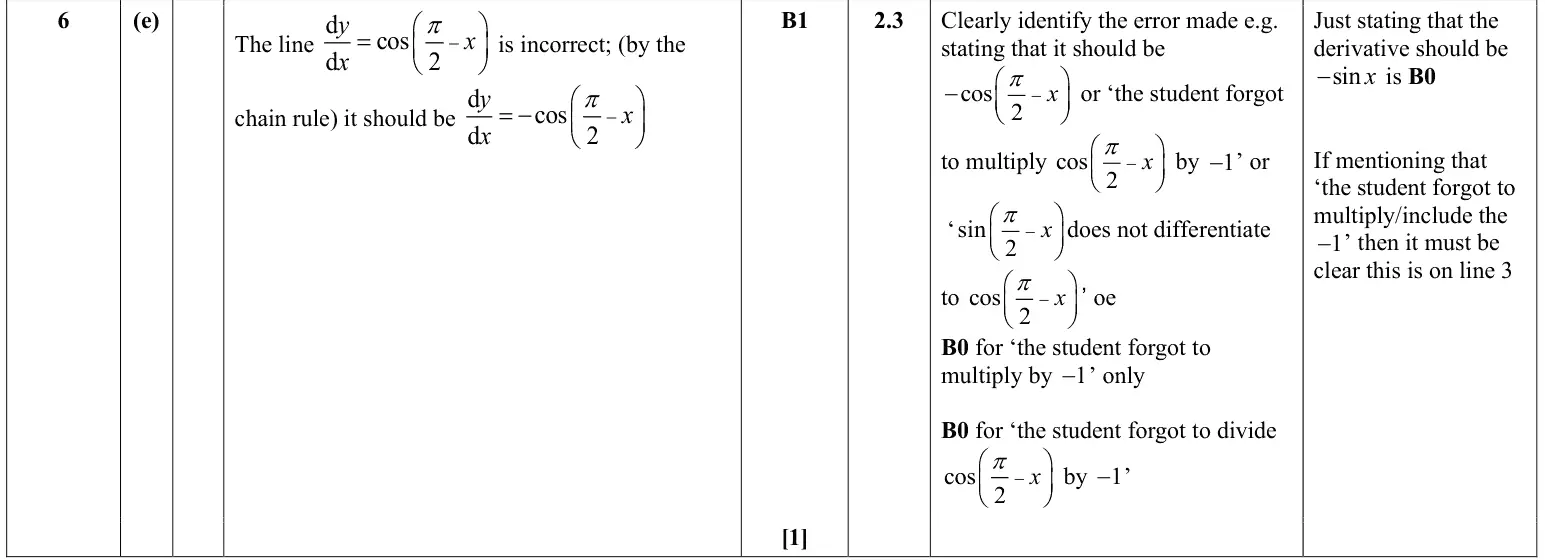
It was pleasing that most candidates in this part could identify the error and most explained too what the correct line of working should have been.
Key points and common errors
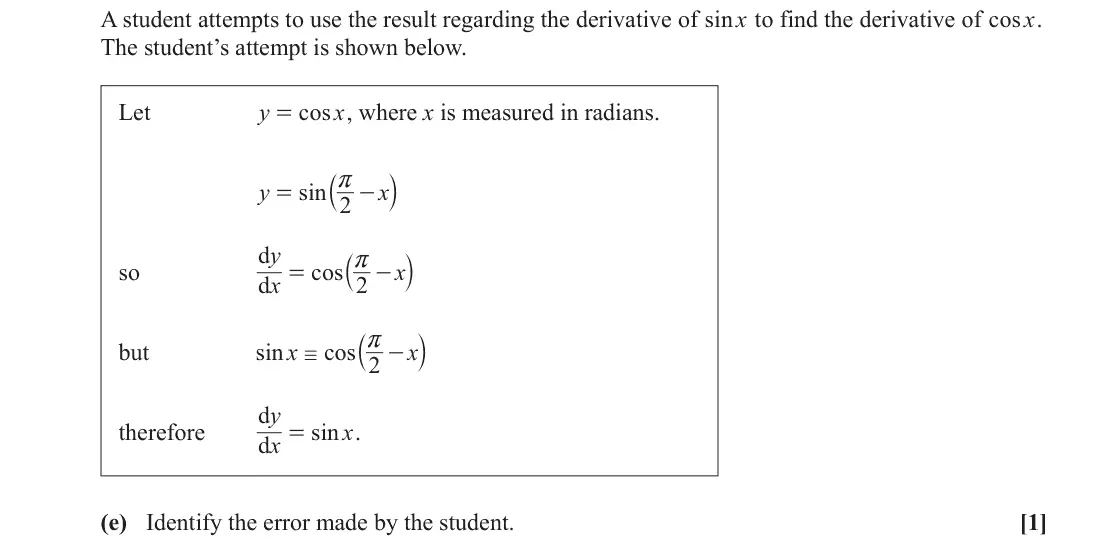
the derivative of sin(π/2 − x) is −cos(π/2 − x) by the chain rule
the student omitted the factor −1 on line 3
June 2024 · Paper 1 · Q11(b)4 marksMedium
Show the start of this question
Mark scheme for this part
Examiner's comment
The differentiation of the logarithmic function was reasonably well done with the correct derivative often seen. Many did not produce a non-zero value for x when seeking the required stationary point. The most common incorrect answers given were 𝑥= 0 and 𝑥= 𝜋. The correct y-value often came from an incorrect x value and so was not given credit.
Key points and common errors
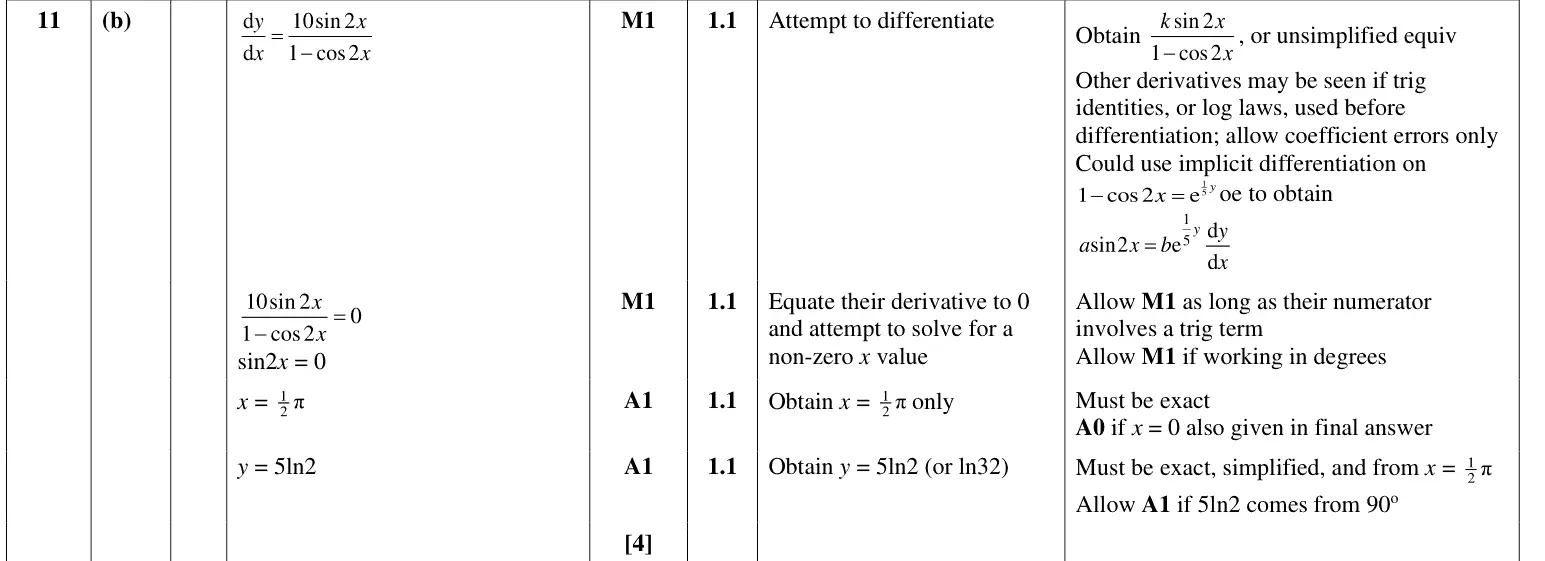
dy/dx = 10sin2x/(1 − cos2x)
sin2x = 0, smallest positive x = π/2
y = 5ln2
x = 0 or π common errors
June 2024 · Paper 1 · Q11(c)(i)5 marksMedium
Show the start of this question
Mark scheme for this part
Examiner's comment
The attempts at the second derivative were very good when a correct first derivative had been obtained in part (b). The majority used the quotient rule rather than the product rule, the latter of which proved trickier for candidates to manipulate correctly to secure full marks. With a given answer, there is an expectation that method is clearly shown, and many candidates were able to simplify their second derivative by using a trigonometric identity but often struggled to obtain a fully correct solution. Those who struggled with part (b) often did not make progress with this part.
Key points and common errors
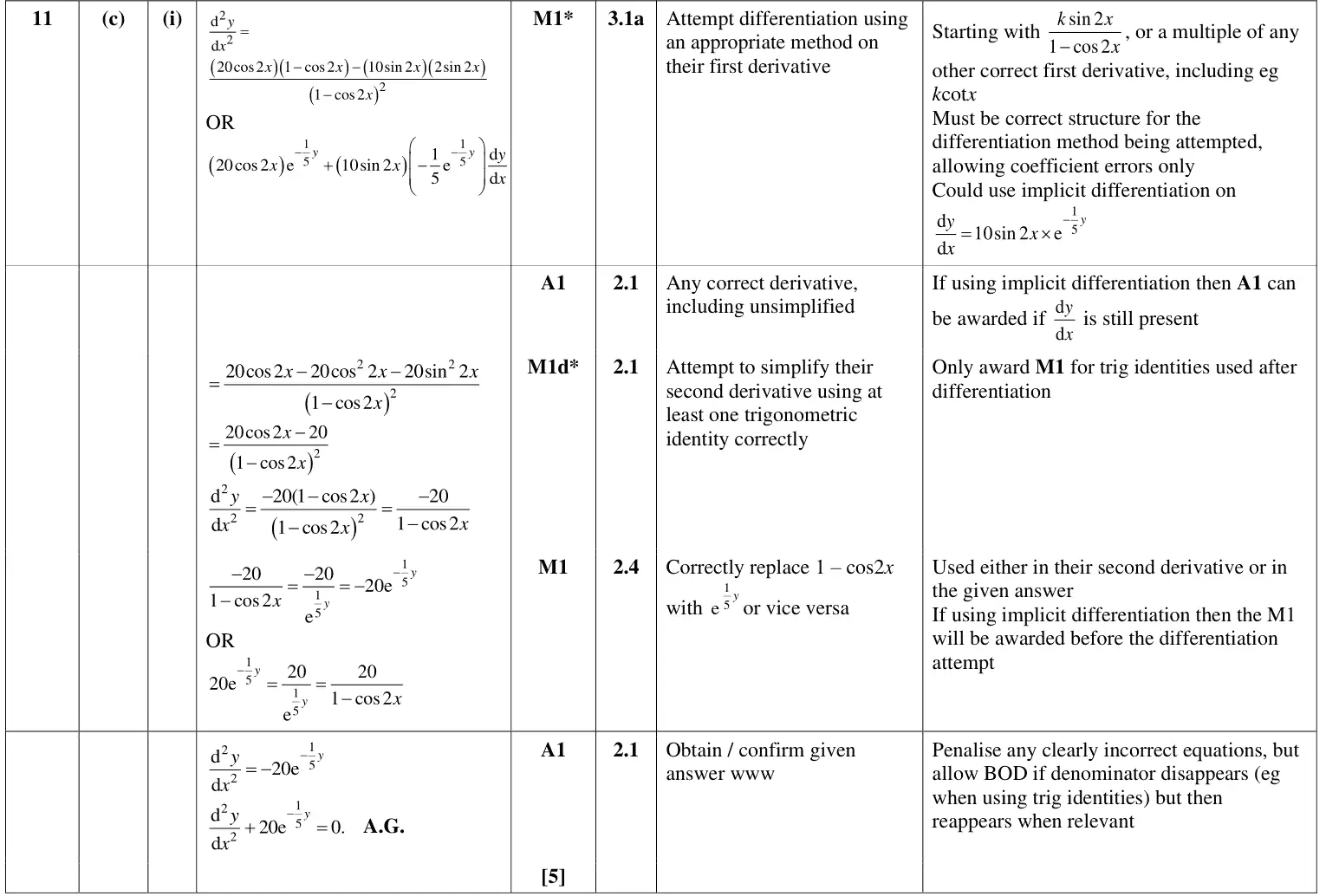
quotient rule on 10sin2x/(1 − cos2x)
simplify with sin² + cos² = 1 to −20/(1 − cos2x)
replace 1 − cos2x by e^(y/5)
given answer so full method needed
June 2024 · Paper 2 · Q4(b)3 marksEasy
Show the start of this question
Mark scheme for this part
Examiner's comment
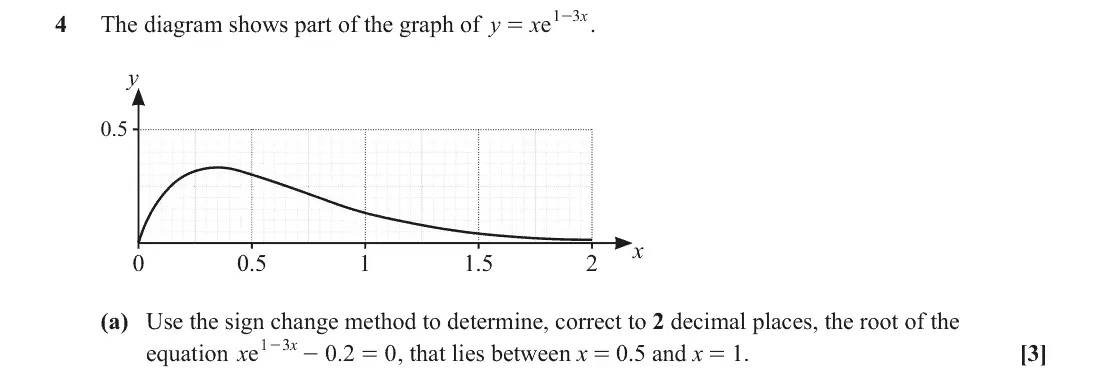
This question was well answered. Most candidates made an acceptable attempt at differentiating the given expression and noticed that they needed to use the product rule to do so (those who didn’t scored M0). Of those who differentiated correctly, most were able to go on to solve =0 and reach the required response for A1. Relatively few candidates explicitly considered (and excluded) further roots from 𝑒1−3𝑥= 0 but the B1 mark could be implied by only giving a single value for x from the other factor. Some candidates attempted to find a further root (or incorrectly deduced x=0) which meant they scored B0. Other candidates attempted the second derivative and mistakenly set this equal to zero.
Key points and common errors
product rule needed
e^(1−3x) is never 0 so x = 1/3
June 2024 · Paper 3 · Q5(a)(i)5 marksEasy
Mark scheme for this part
Examiner's comment
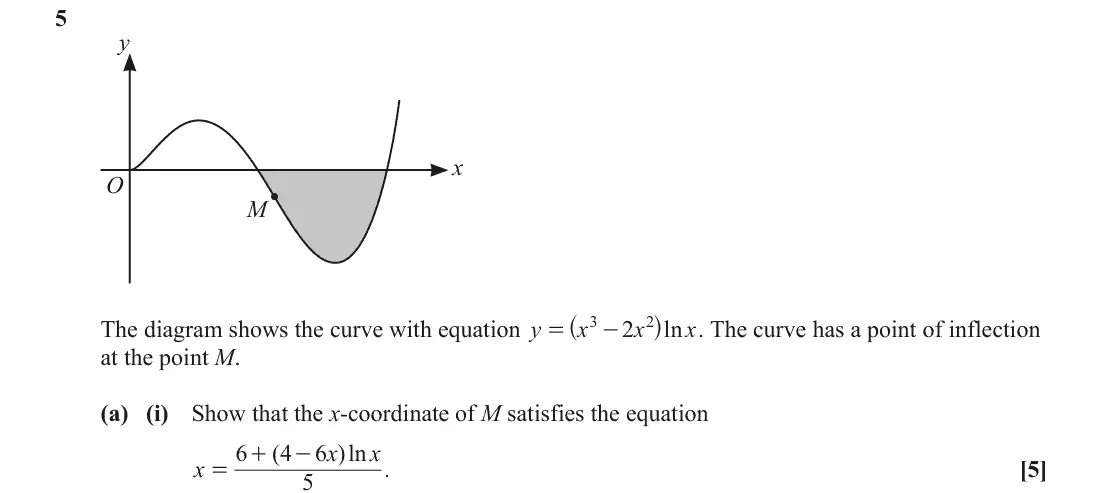
While a small minority of candidates incorrectly believed that the point of inflection was when the first derivative was equal to zero, most candidates correctly set the second derivative equal to zero in their attempt to show that the 𝑥-coordinate of 𝑀 satisfied the given equation.
Key points and common errors
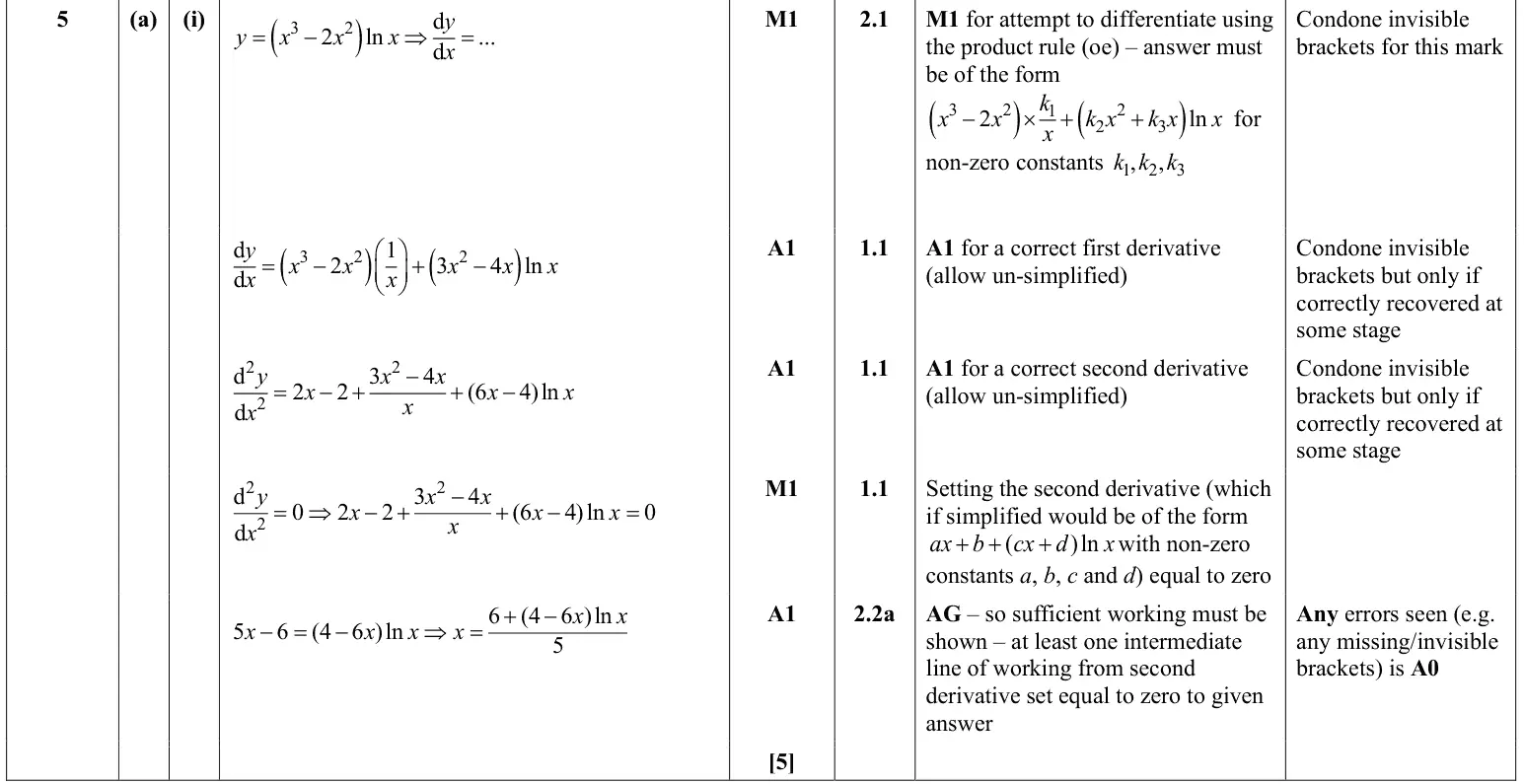
product rule for dy/dx and d²y/dx²
set d²y/dx² = 0 (not dy/dx)
rearrange to the given equation
June 2024 · Paper 3 · Q77 marksMedium
Mark scheme for this part
Examiner's comment
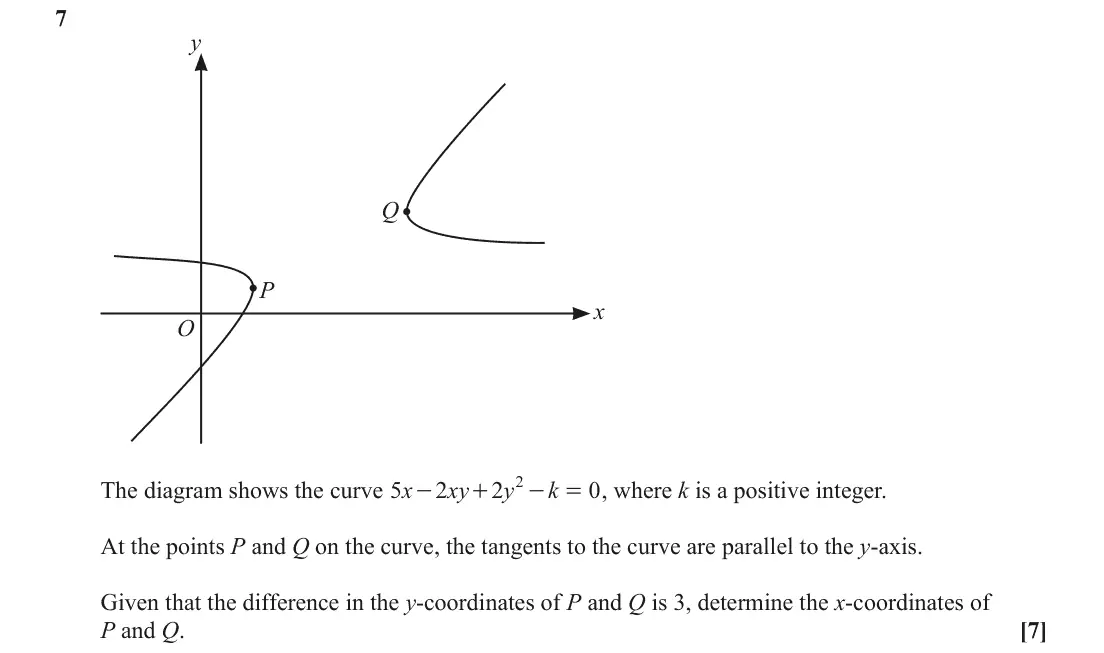
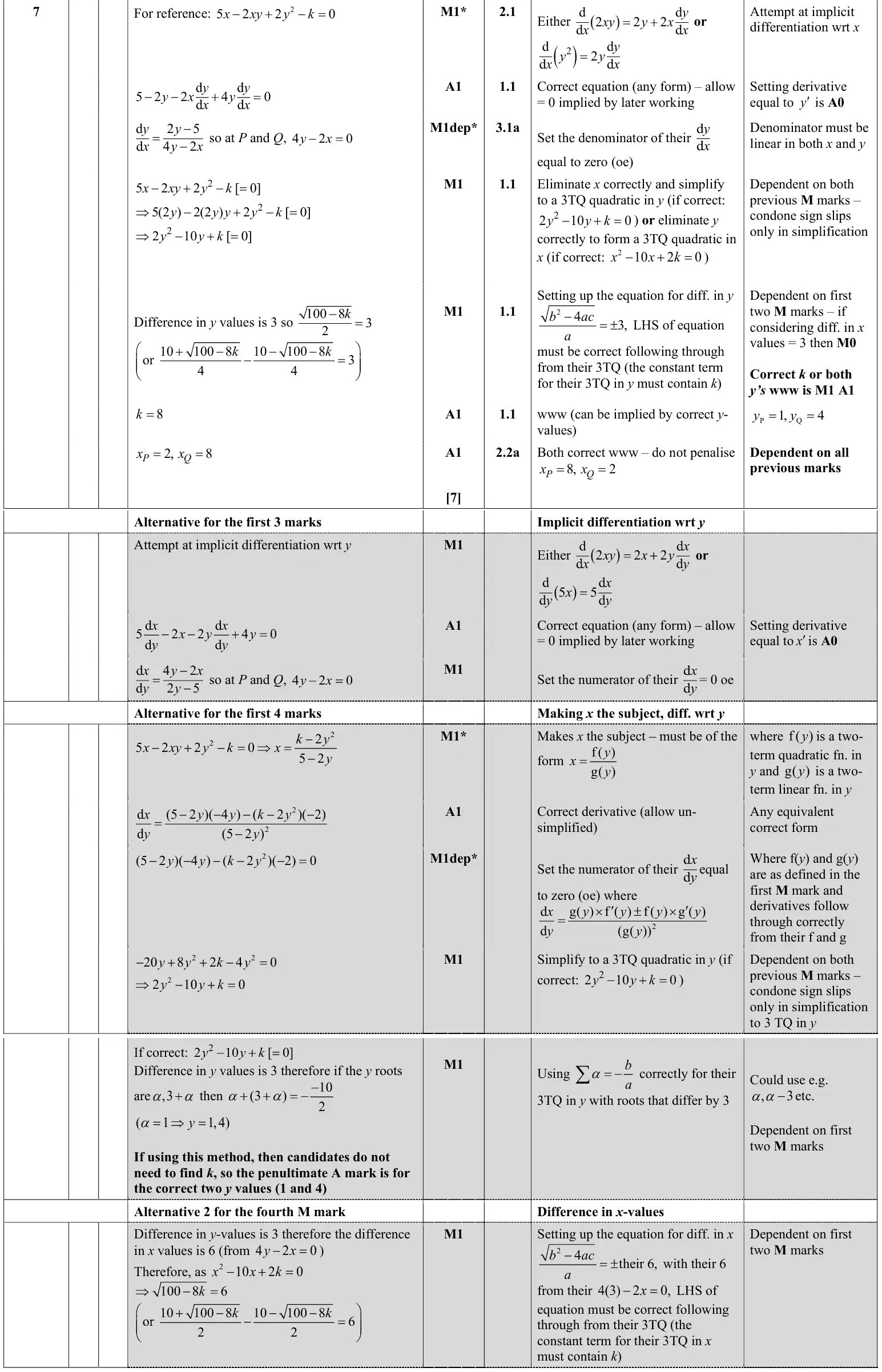
The vast majority of candidates made a good start to this unstructured problem and used implicit differentiation to correctly differentiate the given expression with respect to either 𝑥 or 𝑦. When errors occurred with this differentiation it was usually sign errors when differentiating −2𝑥𝑦 (using the product rule). Most candidates then found an expression for d𝑥 and were then almost equally split between either correctly setting the denominator equal to zero or incorrectly setting the numerator equal to zero. From there it was noted that while many candidates either obtained a correct quadratic equation in either 𝑦 (e.g. 2𝑦2 −10𝑦+ 𝑘= 0) or 𝑥 (e.g. 𝑥2 −10𝑥+ 2𝑘= 0) very few could use the given condition that the difference in the 𝑦-coordinates was 3 (or equivalently the difference in 𝑥-coordinates was 6) to find the correct 𝑥-coordinates of 𝑃 and 𝑄. This candidate scored 4 out of the 7 marks available for correctly differentiating implicitly and obtaining the correct relationship that 4𝑦−2𝑥= 0. They then went on to obtain a correct quadratic equation in 𝑥 but then did not make any further progress. This was relatively common as many candidates did not then realise how they could use the fact that the difference in the 𝑦 values was 3 to find the required 𝑥 coordinates. Section B Overview One general point with regard to the answering of certain mechanics questions should be made in this overview. This is that unless told otherwise the value that candidates should use for the acceleration due to gravity, g, is 9.8 and not 10 or 9.81 (and this value is stated explicitly on the front cover of the examination paper).
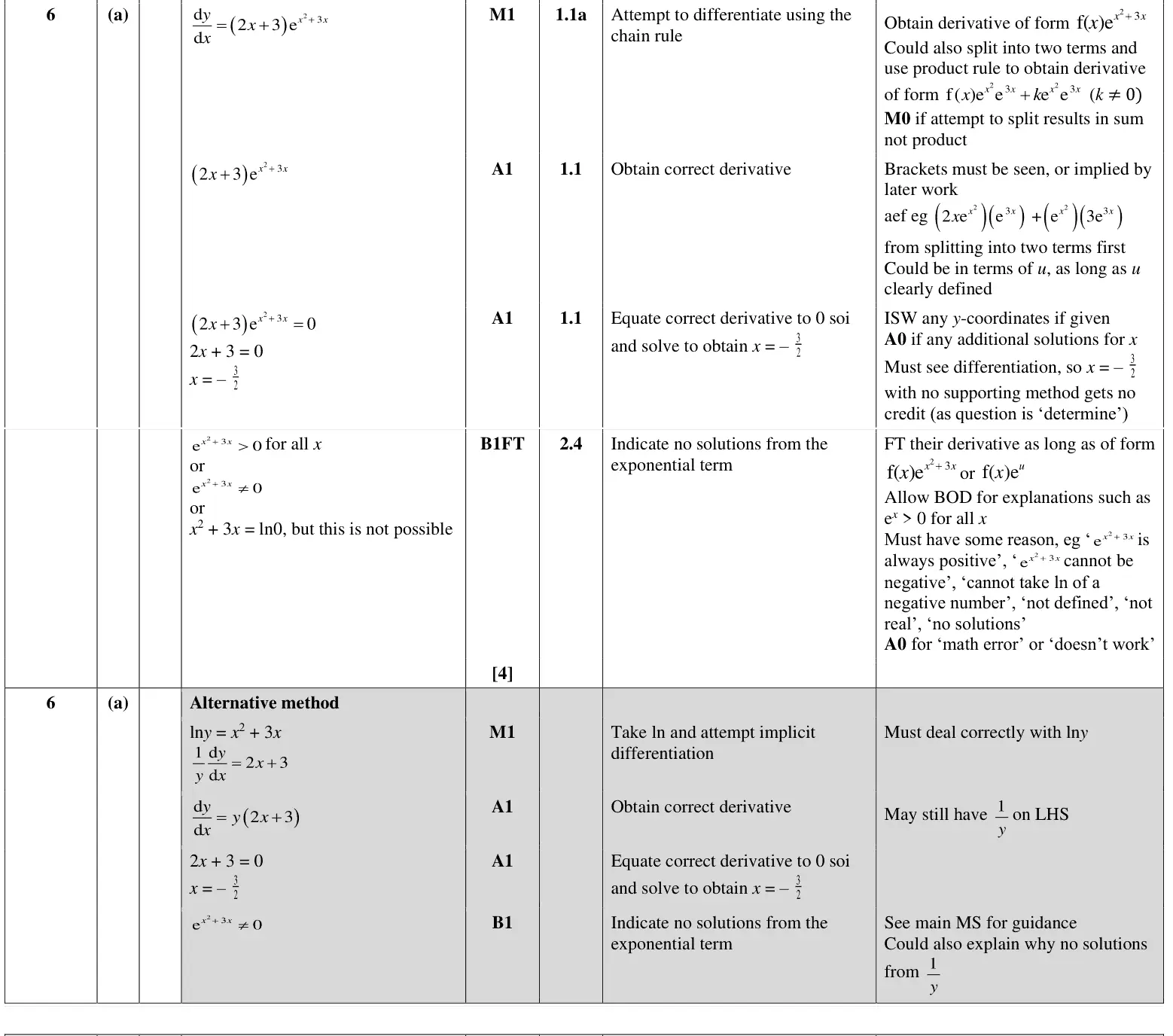
This part of the question was generally well answered, with candidates providing detailed and convincing solutions. Most were able to differentiate the given function using the chain rule, whereas a few first introduced logs and then used implicit differentiation. Candidates then had to equate the derivative to 0, solve to find x = −1.5 and explain why the exponential term would not give any solutions when equated to 0.
Key points and common errors
chain rule (2x + 3)e^(x² + 3x)
x = −3/2
must state e^(x² + 3x) ≠ 0
June 2023 · Paper 1 · Q6(b)5 marksHard
Mark scheme for this part
Examiner's comment
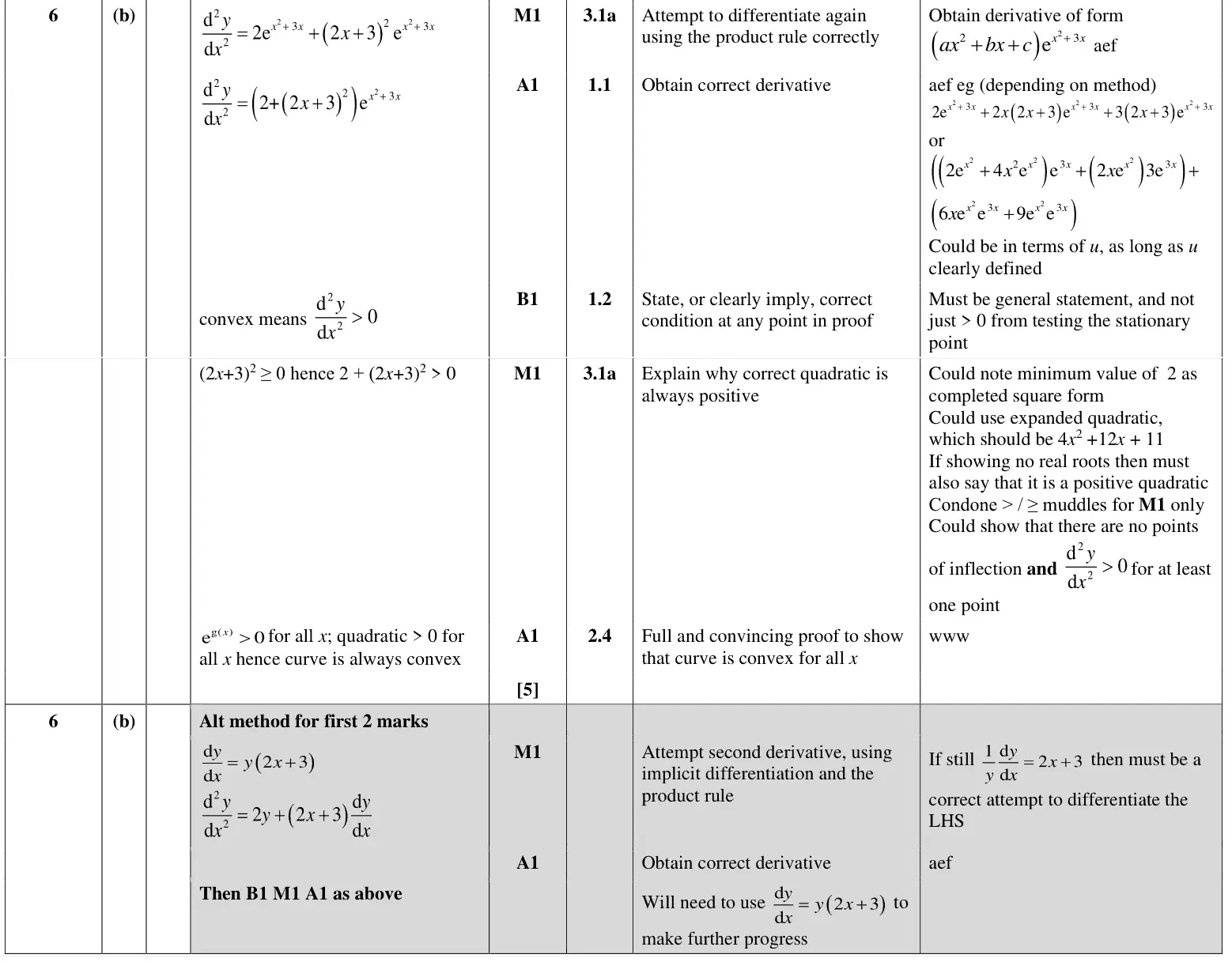
Most candidates were aware that the second derivative was required, and could make some attempt to find this, but the differentiation proved too challenging for many. Some candidates started the entire question by first splitting the given equation into the product of two exponential terms. When using this approach, the first derivative was usually correct but the second derivative rarely so. Most candidates gained a mark for identifying that the second derivative was always positive for a convex curve, and could attempt to show this. However, only the most able candidates were able to provide a convincing justification for this. To gain full credit candidates had to make mathematically correct statements throughout, so vague statements regarding ‘squares always positive’ could not be credited for the final mark. At the start of the solution the candidate gained a mark for stating the condition for the curve to be convex. They also gained 2 marks for a correct second derivative, with method clearly shown. They then attempted to show that this is always positive, but there was an error with the inequality sign; it should be (2x + 3)2 ≥0. They were still given the method mark for their attempt, but not the accuracy mark.
Key points and common errors
product rule: (2 + (2x + 3)²)e^(x² + 3x)
f″ > 0 for all x means convex
argue each factor positive
June 2023 · Paper 1 · Q9(a)1 markMedium
Mark scheme for this part
Examiner's comment
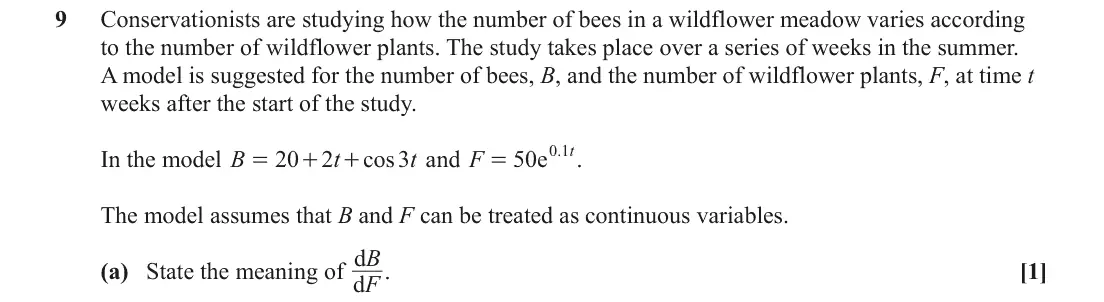
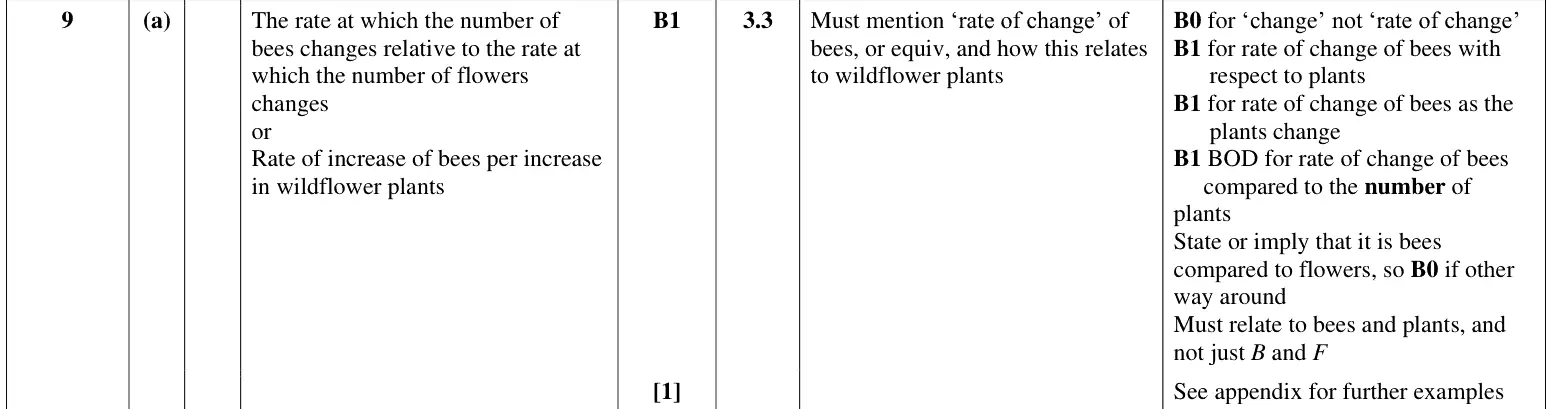
To gain this mark, candidates had to give an answer in the context of the question and many were able to do so. The most common errors were to say that it was the ‘change’ not ‘rate of change’, and to not indicate the dependency.
Key points and common errors
rate of change of number of bees with respect to number of wildflower plants
'change' alone gets nothing
June 2023 · Paper 1 · Q9(b)4 marksEasy
Show the start of this question
Mark scheme for this part
Examiner's comment
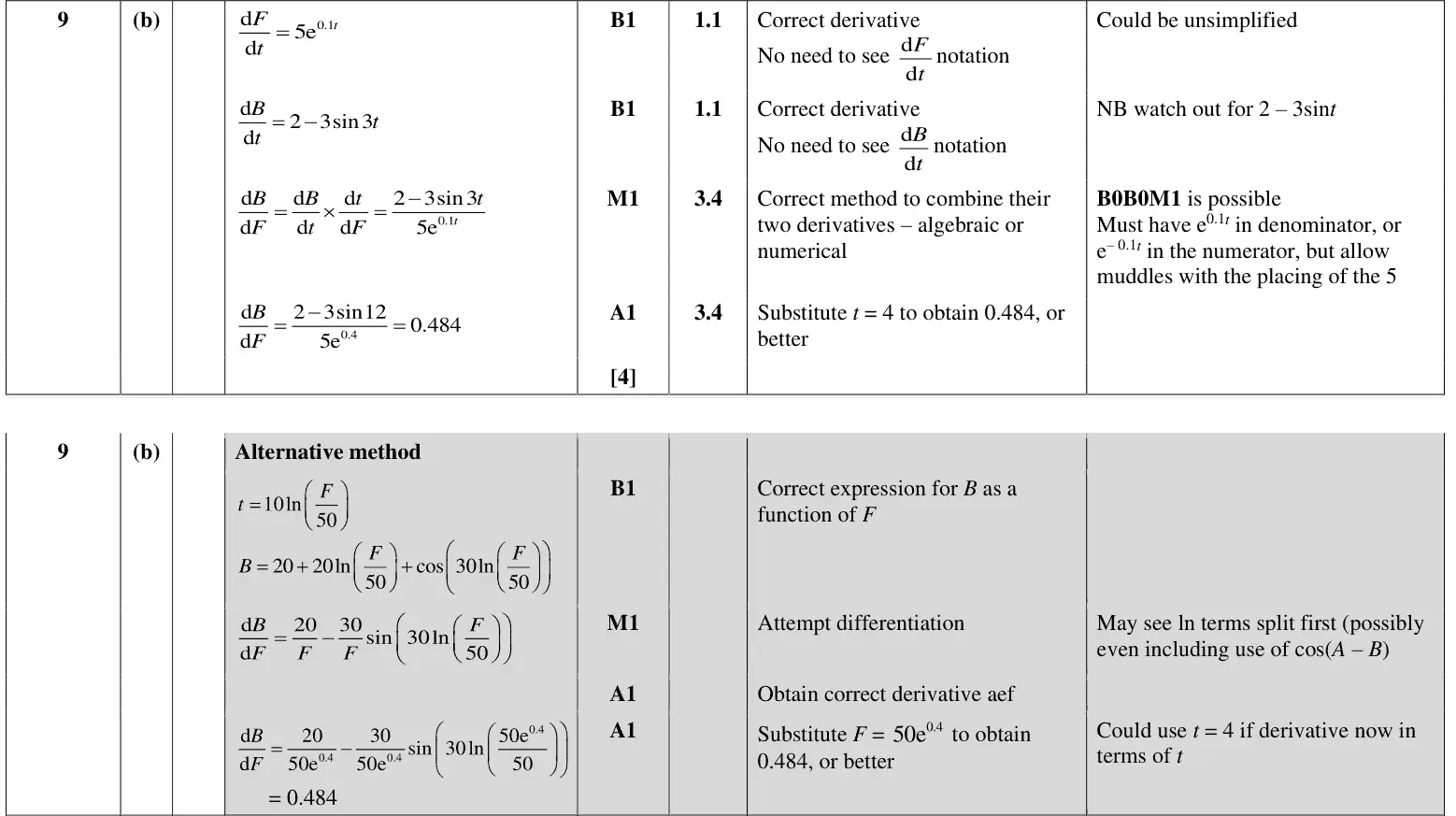
This part of the question was very well answered, with the majority of candidates able to state the two correct derivatives and then correctly combine them. However, the modal mark was 3 as it was only the more astute candidates that appreciated that radians should be used with calculus involving trigonometric functions.
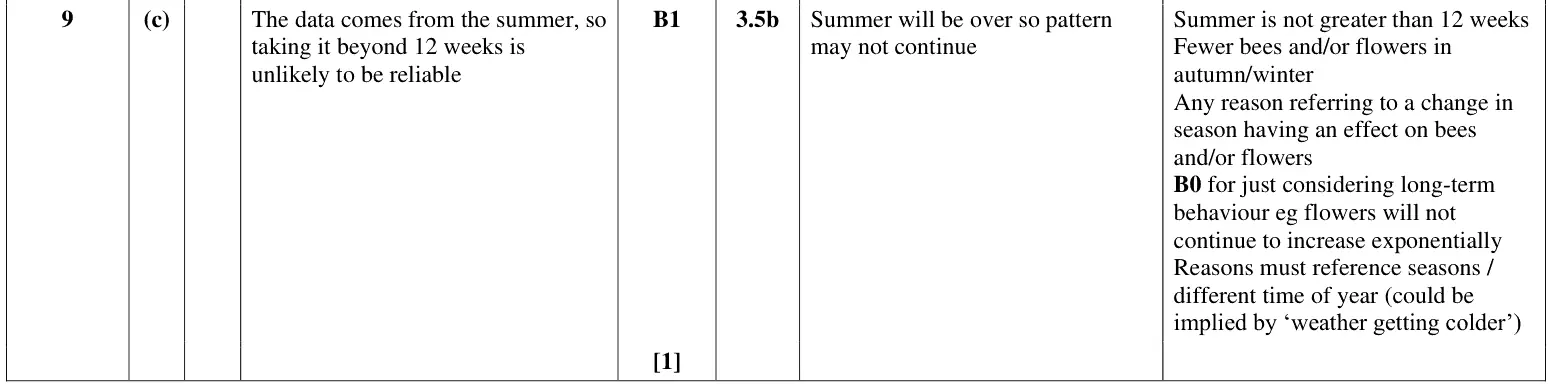
Candidates needed to consider the relevance of 12 weeks in the context of this model, and identify that the change of season would be likely to affect the validity of the given model; many were able to give a sensible explanation. Some candidates simply considered the behaviour of the derivatives as t tended towards infinity. Others tried to give explanations in context, such as insufficient flowers to support the growing bee population, without appreciating the relevance of the specific value of t given in the question. When answering a question about the limitations of a model, candidates should pay close attention to how the question is actually phrased rather than giving a more generic answer.
Key points and common errors
study only in summer
season changes after 12 weeks
long-term behaviour of derivatives gains nothing
June 2023 · Paper 1 · Q10(d)3 marksMedium
Show the start of this question
Mark scheme for this part
Examiner's comment
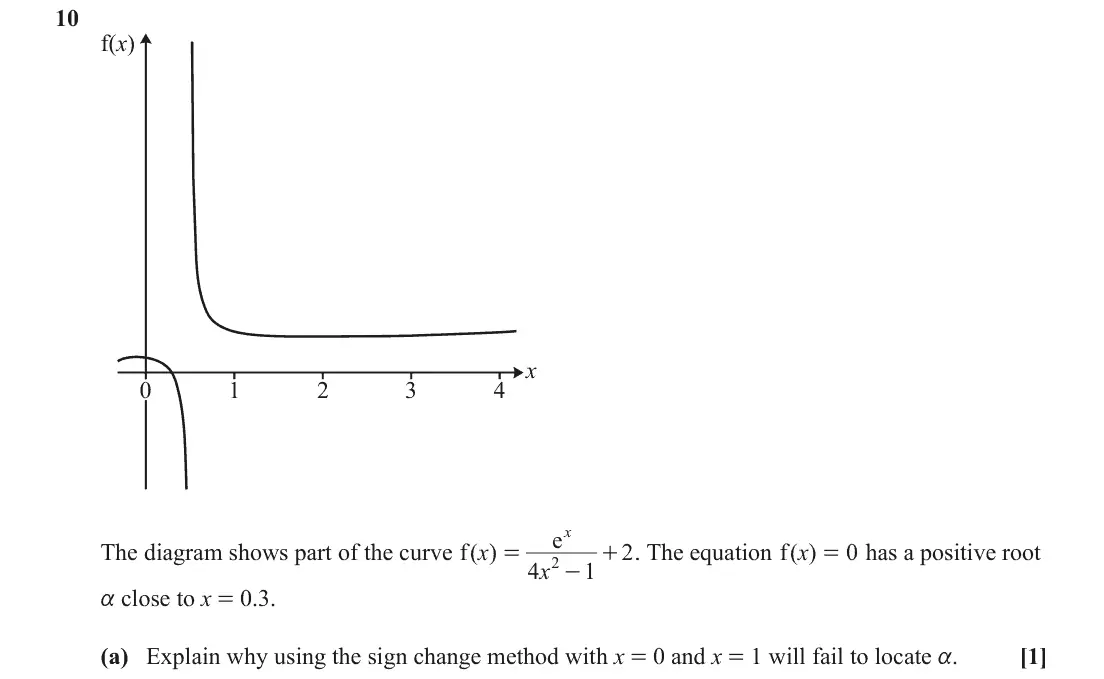
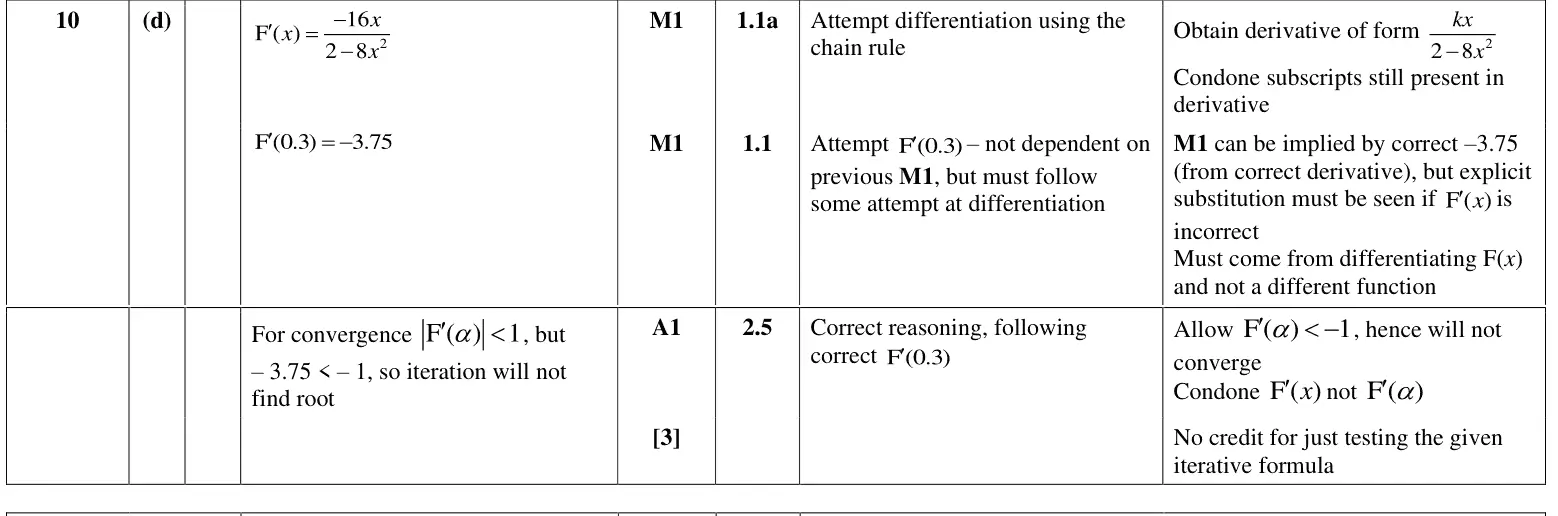
The required method was indicated in the question, and candidates were able to gain the first mark for a reasonable attempt to differentiate F(x). Most candidates did attempt to do this, but the derivatives were not always of the correct form. The second mark was for substituting x = 0.3. While a correct response can imply a correct method, that is not the case for an incorrect response; if the derivative was incorrect then candidates had to show explicit substitution for this mark to be credited. The final mark was for explaining why the value of F’(0.3) indicated divergence not convergence; some excellent explanations were seen but others thought that the fact that it was negative was the reason without also considering the magnitude. As the initial method was given in the question it was perhaps surprising that some candidates didn’t even attempt differentiation, with simply using the iterative formula being the most common error.
Key points and common errors
F′(x) = −16x/(2 − 8x²)
F′(0.3) = −3.75
modulus of F′ > 1 so the iteration diverges
June 2022 · Paper 1 · Q78 marksHard
Mark scheme for this part
Examiner's comment
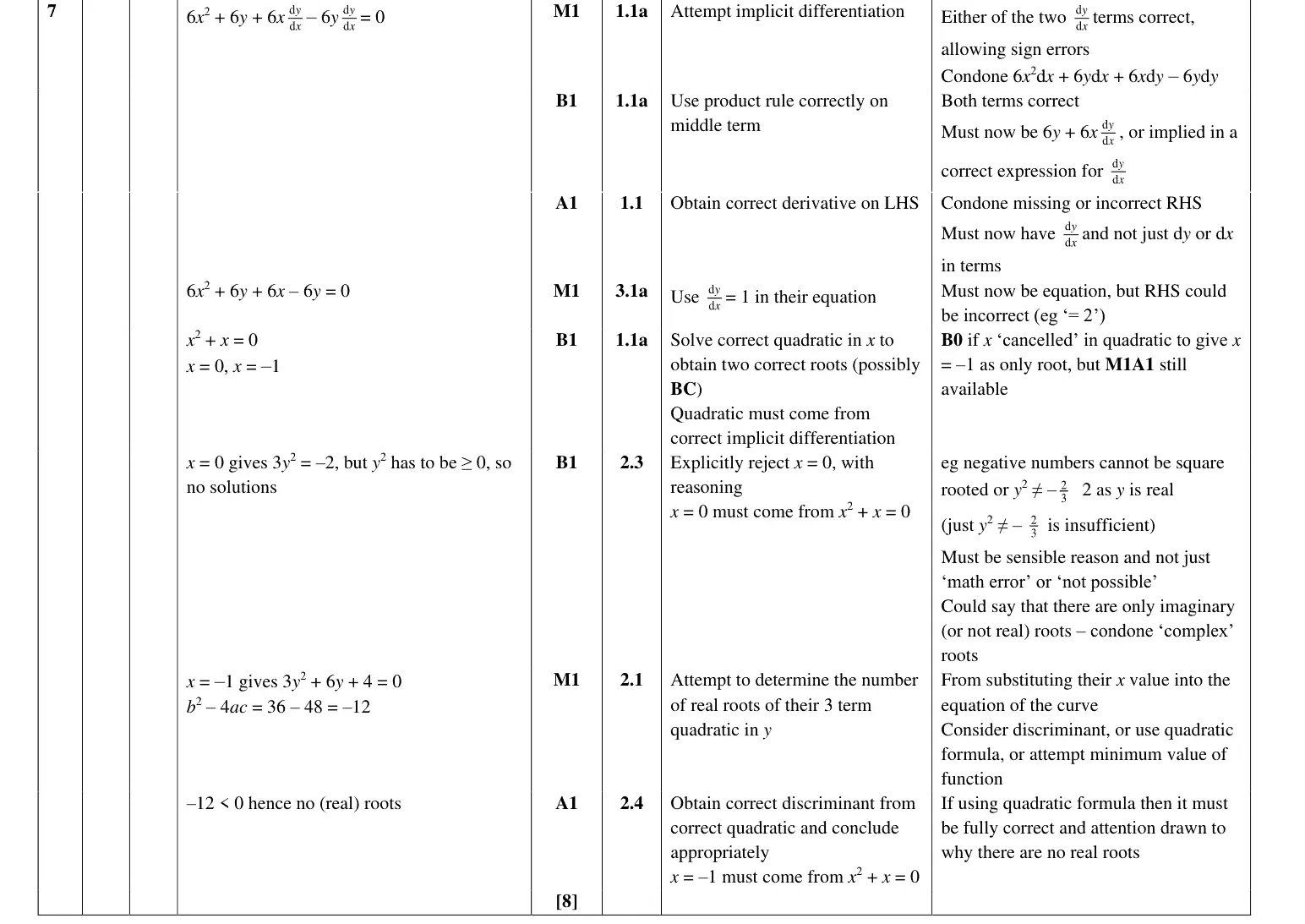
Most candidates could make progress on this question by recognising that it was an implicit equation and making a good attempt to differentiate it. The derivative was usually correct, but the modal mark on this question was 3 marks as many candidates were unsure as to how to then proceed. While a number did set the derivative equal to 1, a common error was to substitute y = x into their derivative. The correct quadratic of x2 + x = 0 was often seen, but there was often some uncertainty as to how to solve this and only the more able candidates were able to obtain both correct roots. Some candidates found just one of the roots by inspection and others, having obtained x2 = – x, observed that a square cannot be negative hence this equation has no roots at all. To gain full credit, examiners expected to see sufficient detail as to why neither root would yield solutions when substituted back into the original equation. While the substitution was seen, the explanations were often lacking in detail. Just stating that 3y2 = – 2 was impossible was not enough and, when considering x = – 1, it was not sufficient to just say that the ensuing quadratic had no roots; this needed to be demonstrated, most typically through considering the discriminant. compelling reasons whenever a solution is discarded. A good solution to Question 7, with clear reasons given as to why neither root will give a valid solution.
Key points and common errors
implicit differentiation with product rule on 6xy
set dy/dx = 1 (not y = x) to get x² + x = 0
x = 0 gives y² = −2/3 impossible
x = −1 gives 3y² + 6y + 4 = 0 with discriminant −12 < 0
June 2022 · Paper 2 · Q87 marksHard
Mark scheme for this part
Examiner's comment
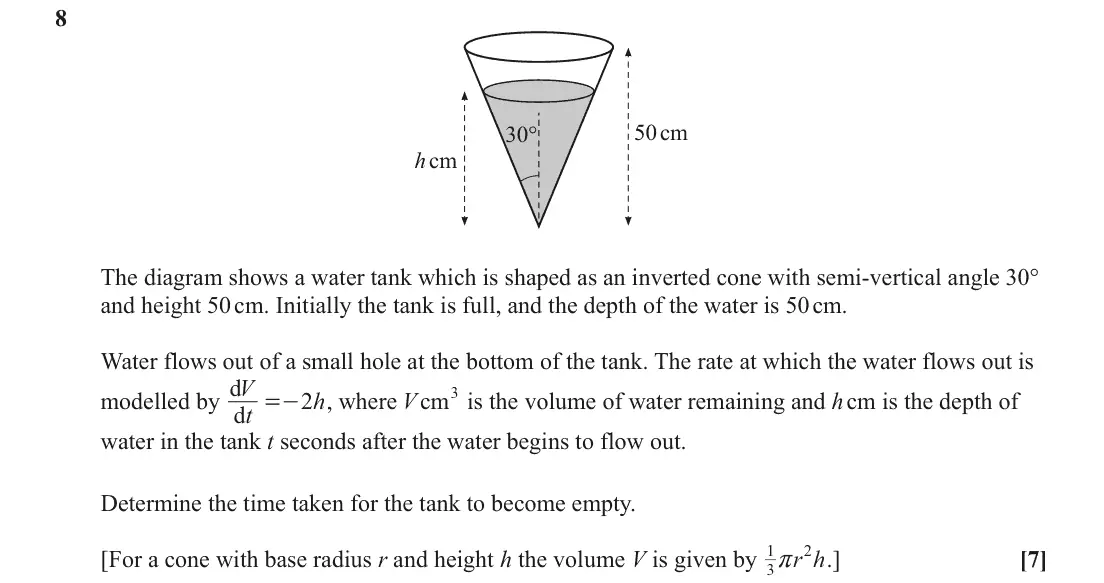
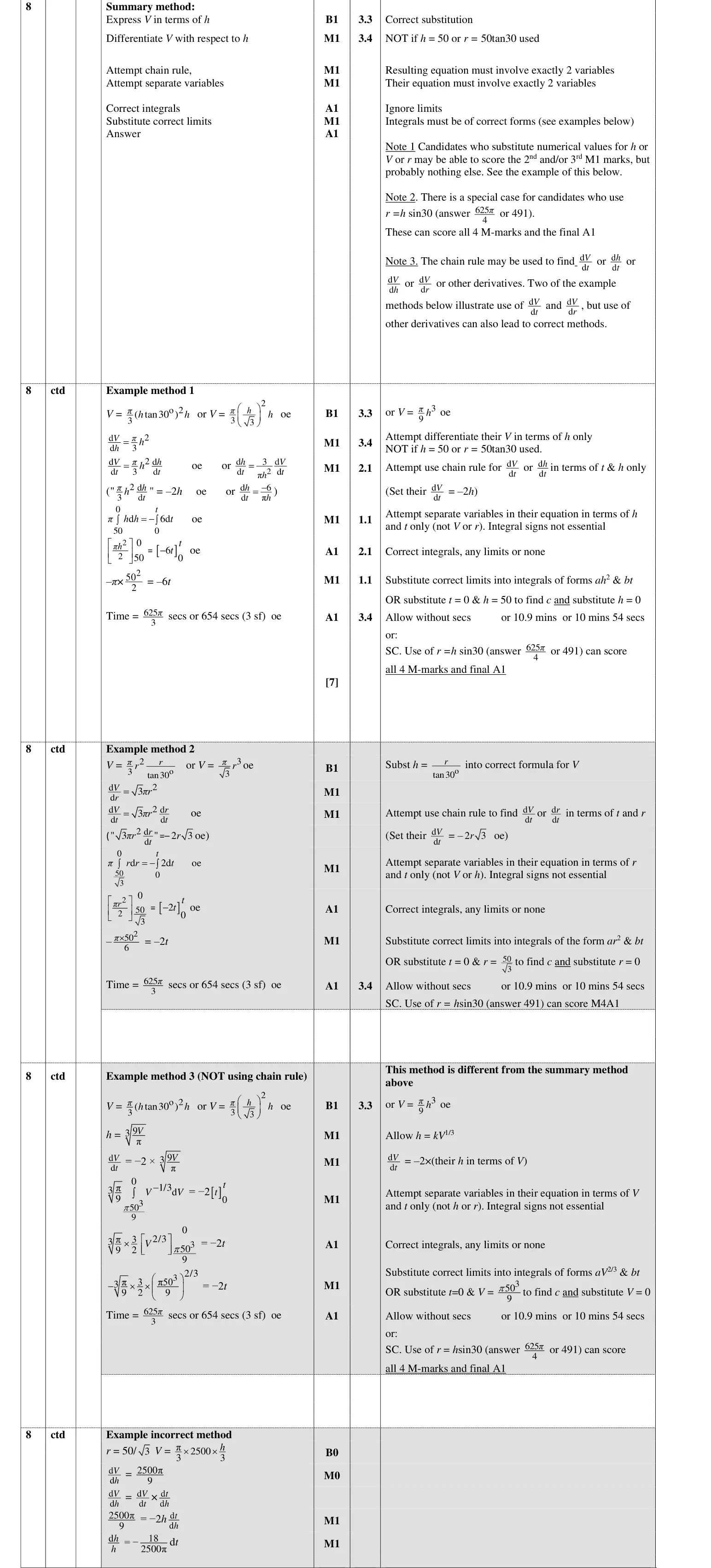
This differential equation question is of a fairly standard type, found in many text books. So one might reasonably expect candidates to be familiar with questions of this type. Despite this, responses were, on the whole, disappointing. In fact, about half the candidates scored 0 marks on this question. However, there were also a good number of excellent solutions. A few candidates thought that r = hsin 30°, but gave an otherwise completely correct solution. These candidates scored 5 marks out of 7. The main difficulty faced by candidates was that there were more than two variables involved (V, h, t and r). Most candidates obtained an equation in three variables, but then attempted to differentiate or integrate, treating one of the variables as a constant. For example: d V d V 1 2 1 3 πr2h ⇒ V = d r = 3 πrh (or d h = 3 πr2). d V h = −2t ⇒ dV = −2tdh ⇒ V = −2th. d Some candidates avoided this trap by using a numerical value for one of the variables, e.g. h = 50 or 50 3 3 r = , thus rendering their equation incorrect. Some candidates appreciated the need to use the chain rule but, while doing so, made one of the above d V d V d t d V d t 1 1 3 πr2 ⇒ h ⇒ d h = d t × d h , but d h = 3 πr2 = (−2t) × d errors. Thus a typical solution was as follows. 2 2 50 3 50 3 π d t 1 ∫ d h 2500 3 3 3 3 π = −2t d h ⇒ = −2tdt ⇒ 9 h = −2t + c. Then use h = 50 when t = 0 to find c and finally substitute h = 0 to find t. Finally, some candidates used a different, correct method that did not require the use of the chain rule. It did, however, involve some rather awkward substitution of a limit. This method can be found on the published mark scheme, Question 8, Example method 3.
Key points and common errors
r = h tan30° so V = πh³/9
dV/dt = (dV/dh)(dh/dt) = −2h
separate variables
t = 625π/3 s ≈ 654 s
r = h sin30° is a common error
about half scored 0
June 2022 · Paper 3 · Q5(a)5 marksMedium
Mark scheme for this part
Examiner's comment
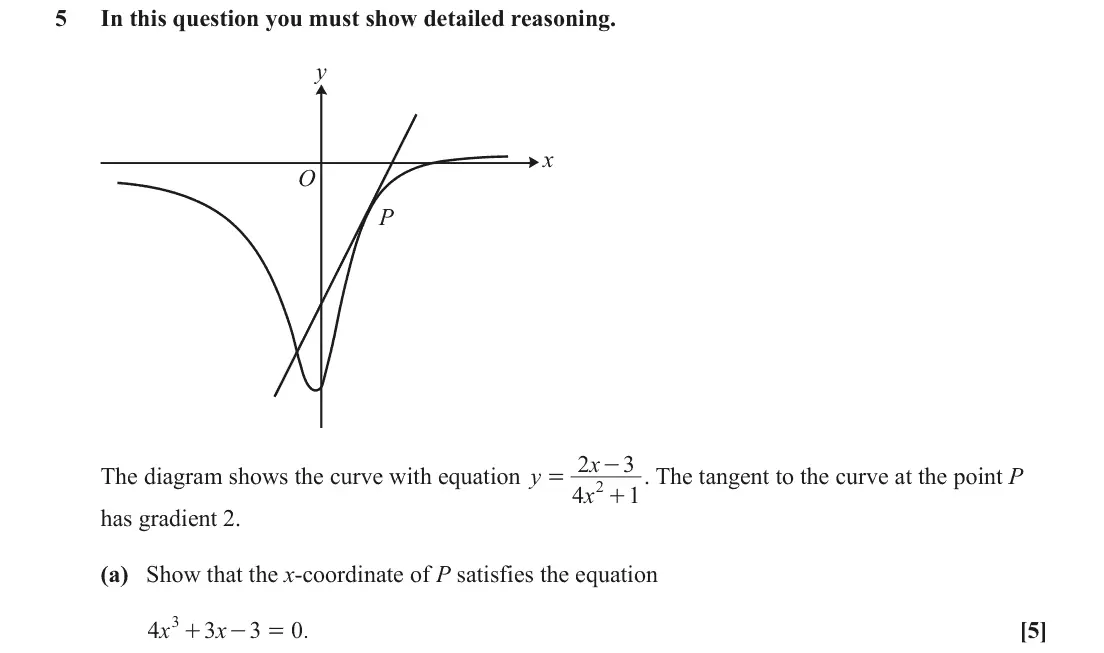
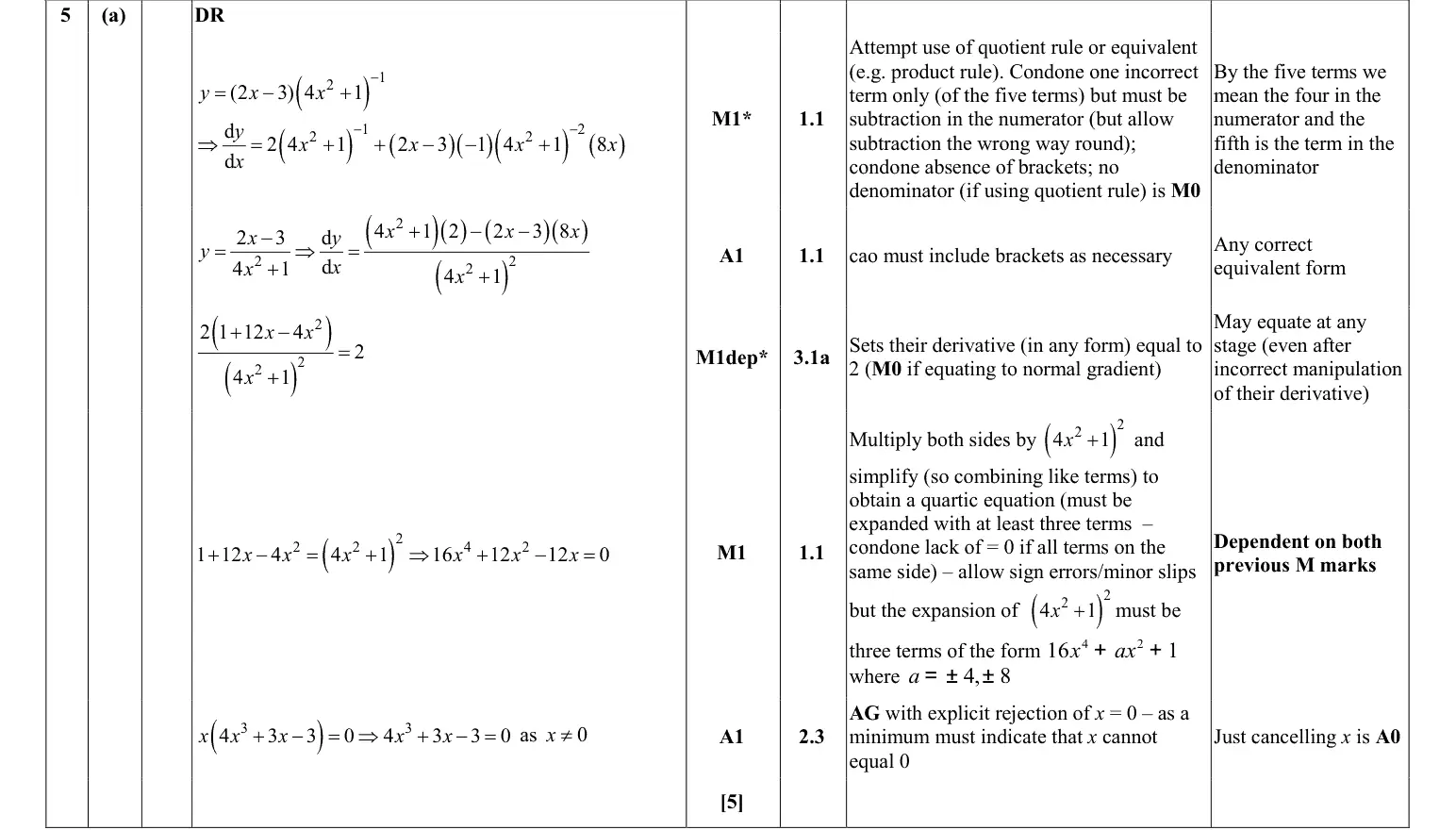
It was very pleasing that most candidates correctly applied the quotient rule to the given equation and put the resulting derivative equal to 2 (although examiners did note that on occasion the derivative was set equal to zero). Most candidates then removed the fraction(s) and bracket(s) successfully and derived the equation 16 x + 12 x − 12 x = 0 (or a multiple of this). However, the question required ‘detailed reasoning’, and it was evident that a large number of candidates simply cancelled anx from each term of their equation believing that this was sufficient to show the required result. Only the most successful responses made any reference to the given diagram which showed that the x-coordinate of point P could not be equal to zero. This response scored 4 (of the 5) marks. This was a very common response seen by examiners. The candidate has correctly applied the quotient rule and set the derivative equal to 2. They have then removed the fraction, expanded and simplified to a correct quartic equation in x ( ) + − = 4 x 3 x 3 x 0 . However, no justification is given by the candidate for why it is acceptable to cancel the x’s when simplifying the quartic equation to the required cubic equation which is why they did not achieve full marks.
Key points and common errors
quotient rule
set dy/dx = 2 (not 0)
16x⁴ + 12x² − 12x = 0
must explicitly reject x = 0 before dividing by x
Autumn 2021 · Paper 1 · Q7(a)2 marksMedium
Mark scheme for this part
Examiner's comment
(From the general report) The first part of Question 7 was a ‘show that’ question and candidates were expected to provide sufficient detail to be convincing, including expressing the derivative equated to 0 before dealing with the fractional term.
Key points and common errors
product rule: 2x ln x + (x² − 2)/x
must equate to 0 before clearing the fraction
Autumn 2021 · Paper 1 · Q7(b)4 marksMedium
Show the start of this question
Mark scheme for this part
Examiner's comment
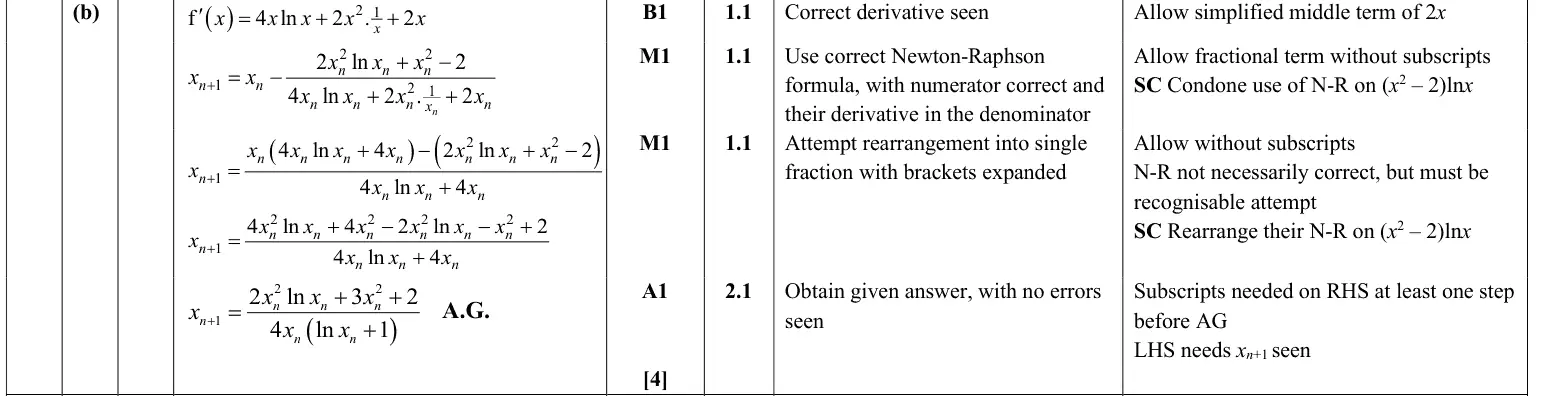
(From the general report) The first part of Question 7 was a ‘show that’ question and candidates were expected to provide sufficient detail to be convincing, including expressing the derivative equated to 0 before dealing with the fractional term.
Key points and common errors
f′(x) = 4x ln x + 4x
substitute into Newton-Raphson and rearrange to a single fraction
subscripts needed
Autumn 2021 · Paper 1 · Q11(b)7 marksMedium
Show the start of this question
Mark scheme for this part
Examiner's comment
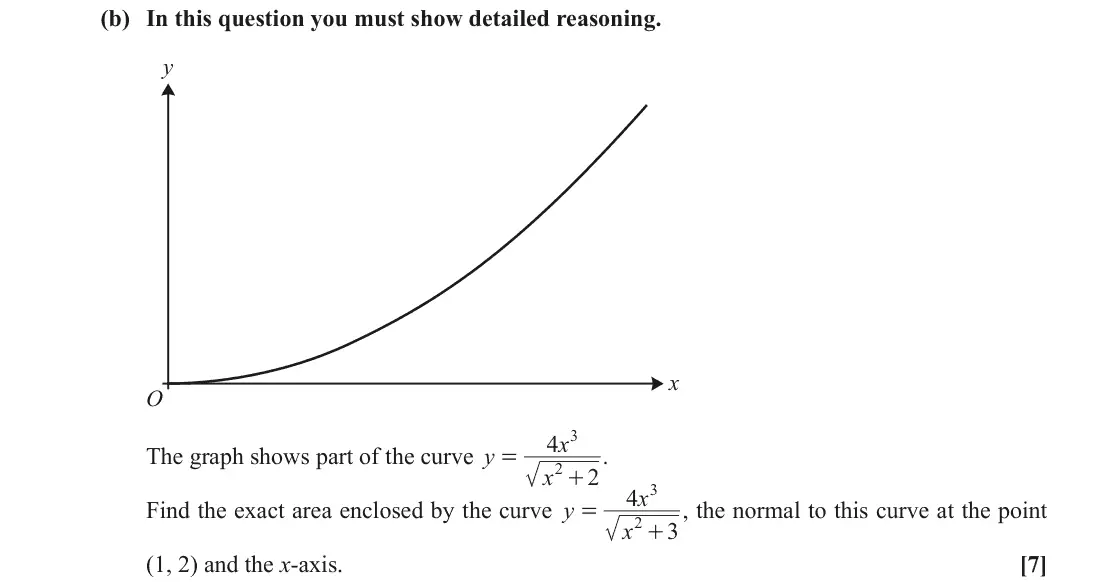
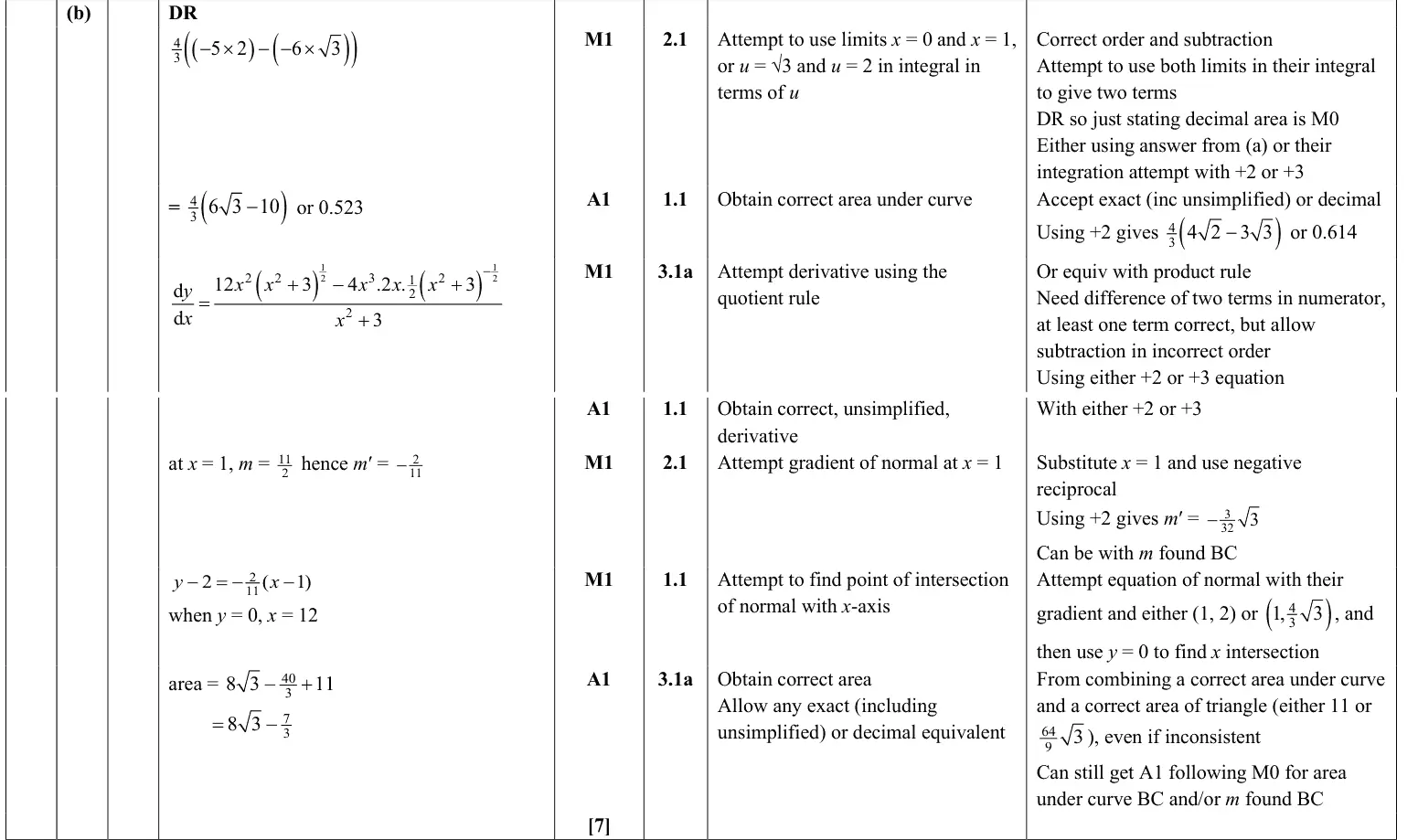
(From the general report) Teachers should make sure that they use an amended version of the question paper, correcting the 4 x description of the graph in Question 11(b) as “part of the curve y = ” to match the information in x + 3 the rest of the question.
Key points and common errors
paper misprint: graph label should read √(x² + 3)
area under curve (4/3)(6√3 − 10)
quotient rule gives gradient 11/2 at x = 1 so normal gradient −2/11
normal meets x-axis at x = 12, triangle area 11
total 8√3 − 7/3
Autumn 2021 · Paper 2 · Q1(b)2 marksMedium
Mark scheme for this part
Key points and common errors
quotient rule ((x + 1)·2x − x²)/(x + 1)²
or product/chain rule on x²(x + 1)⁻¹
ISW
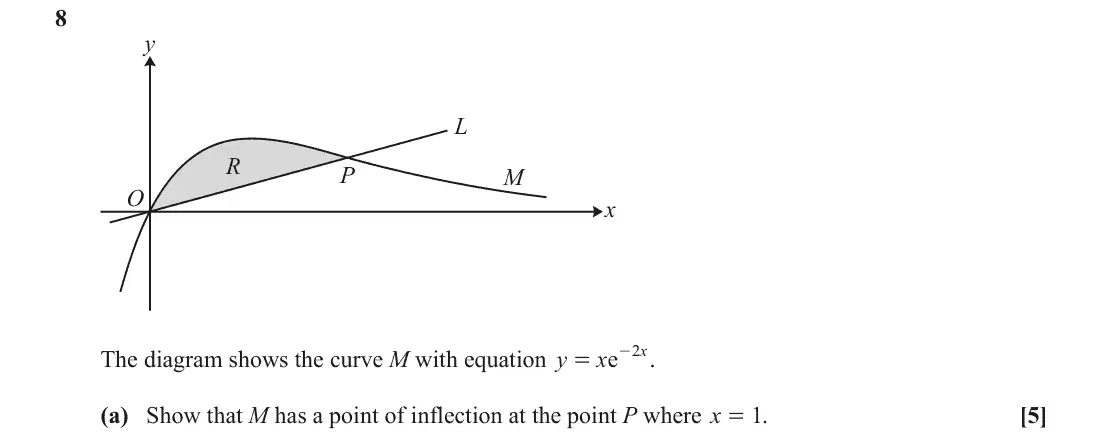
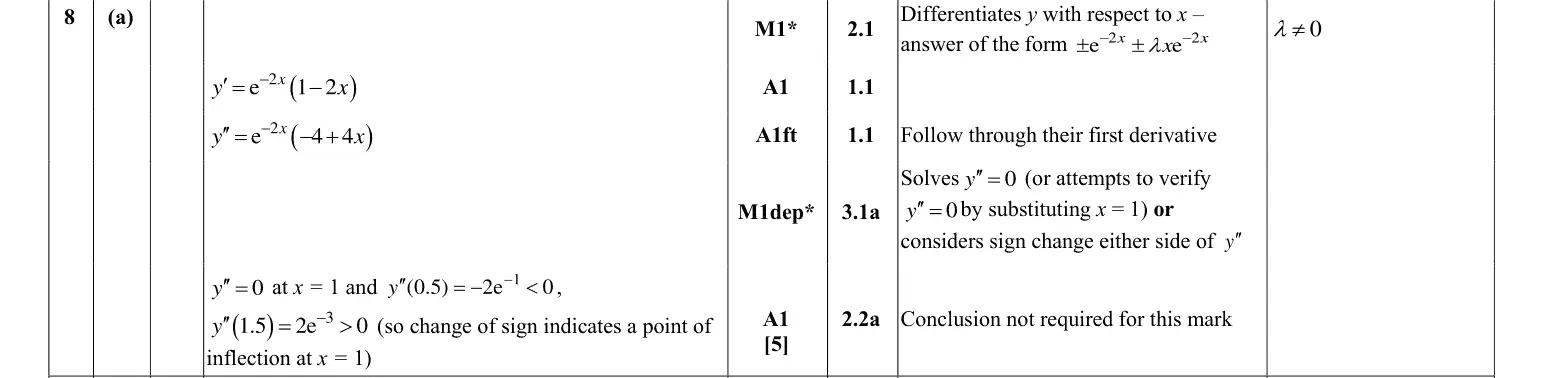
Autumn 2021 · Paper 3 · Q8(a)5 marksMedium
Mark scheme for this part
Key points and common errors
y′ = e^(−2x)(1 − 2x)
y″ = e^(−2x)(4x − 4) = 0 at x = 1
sign change of y″ either side confirms inflection
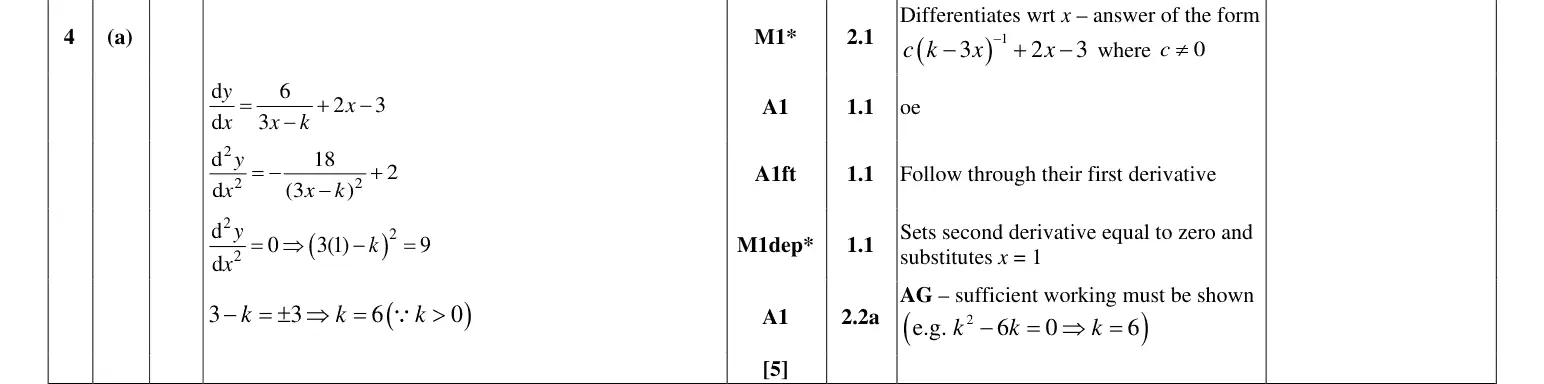
Autumn 2020 · Paper 1 · Q8(a)3 marksMedium
Mark scheme for this part
Examiner's comment
(Comment on Question 08 as a whole) The second part of Question 8 proved to be challenging; some candidates did not seem familiar with the definition of an increasing function and were unsure how to proceed whereas others stated that the first derivative needed to be positive, but then continued by considering the second derivative instead. Of the minority who attempted the correct method, many gave vague statements such as ‘the quadratic is always positive’ but with no evidence to support this. In a ‘show that’ question, sufficient detail must be provided so as to be convincing. Equally, statements must be fully correct so stating that e x is never negative lacks the required precision.
(Comment on Question 04 as a whole) In part (a) it was seen that a significant number of candidates only showed that the curve had a turning d y d y point at x = using 1 x = 0 rather than that the curve had a point of inflection at x = using 1 = 0 . d d x d y Some candidates substituted the values of x = and 1 k = 6 to ‘verify’ that = 0 and did not provide d x sufficient evidence to ‘show that k = 6 ’. Where questions ask for candidates to solve a problem to ‘show that’ a given answer is correct then it is good practice that the working leads to that answer and does not make use of the answer as part of the working. In part (b) the examiners were looking for actual numerical values with an explanation that the change of sign indicates that the x-intercept is between those values. Some candidates simply provided a generic explanation of what a change in sign would represent, but no numerical confirmation in the context of this question, which was not sufficient for the request ‘Show by calculation …’. Part (c) was generally done well, although some candidates dropped marks when imprecise notation resulted in subsequent substitution errors. In order to demonstrate that the Newton – Raphson method has indeed been used, it is good practice to write out the iteration formulae, taking care with the x and x + notation. Candidates that gave their results to the iterations to an accuracy greater than the specified 6 dp were not penalised, but the final accuracy mark required the answer to be quoted to the specified 5 dp. Part (d) was generally answered well by those that had successfully completed part (c). Most verified their 5 dp answer by checking for the sign change 0 000005 ± . , although a few investigated smaller interval bounds. Those candidates that did not gain credit either investigated 0 00001 ± . or did not explain how their calculations verified the result.
Key points and common errors
dy/dx = 6/(3x − k) + 2x − 3
d²y/dx² = −18/(3x − k)² + 2 = 0 at x = 1 gives k = 6 (k > 0)
many used dy/dx = 0 (turning point) instead of the second derivative
verifying with k = 6 is not enough
Autumn 2020 · Paper 3 · Q4(c)3 marksEasy
Show the start of this question
Mark scheme for this part
Examiner's comment
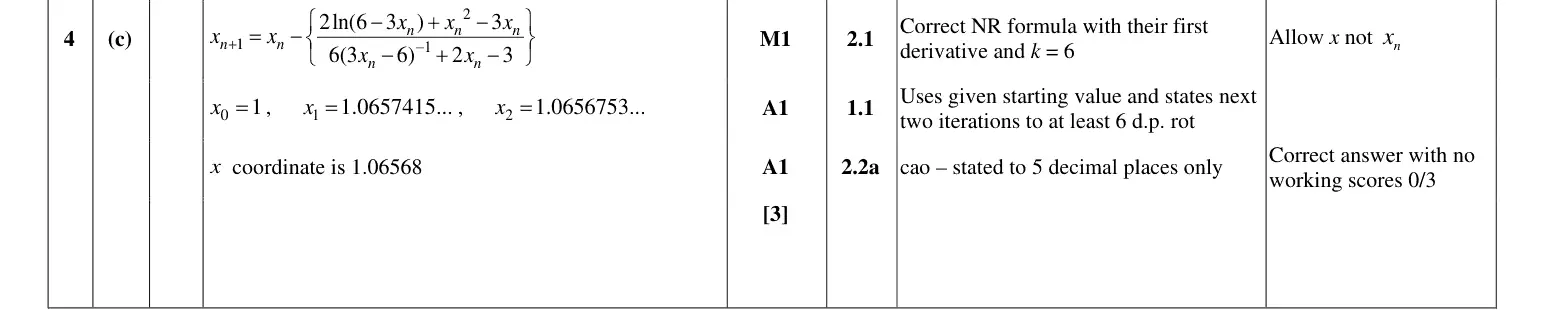
(Comment on Question 04 as a whole) In part (a) it was seen that a significant number of candidates only showed that the curve had a turning d y d y point at x = using 1 x = 0 rather than that the curve had a point of inflection at x = using 1 = 0 . d d x d y Some candidates substituted the values of x = and 1 k = 6 to ‘verify’ that = 0 and did not provide d x sufficient evidence to ‘show that k = 6 ’. Where questions ask for candidates to solve a problem to ‘show that’ a given answer is correct then it is good practice that the working leads to that answer and does not make use of the answer as part of the working. In part (b) the examiners were looking for actual numerical values with an explanation that the change of sign indicates that the x-intercept is between those values. Some candidates simply provided a generic explanation of what a change in sign would represent, but no numerical confirmation in the context of this question, which was not sufficient for the request ‘Show by calculation …’. Part (c) was generally done well, although some candidates dropped marks when imprecise notation resulted in subsequent substitution errors. In order to demonstrate that the Newton – Raphson method has indeed been used, it is good practice to write out the iteration formulae, taking care with the x and x + notation. Candidates that gave their results to the iterations to an accuracy greater than the specified 6 dp were not penalised, but the final accuracy mark required the answer to be quoted to the specified 5 dp. Part (d) was generally answered well by those that had successfully completed part (c). Most verified their 5 dp answer by checking for the sign change 0 000005 ± . , although a few investigated smaller interval bounds. Those candidates that did not gain credit either investigated 0 00001 ± . or did not explain how their calculations verified the result.
Key points and common errors
Newton-Raphson x₁ = 1.065742, x₂ = 1.065675
root 1.06568 to 5 d.p.
write out the iteration formula
Autumn 2020 · Paper 3 · Q5(a)4 marksMedium
Mark scheme for this part
Examiner's comment
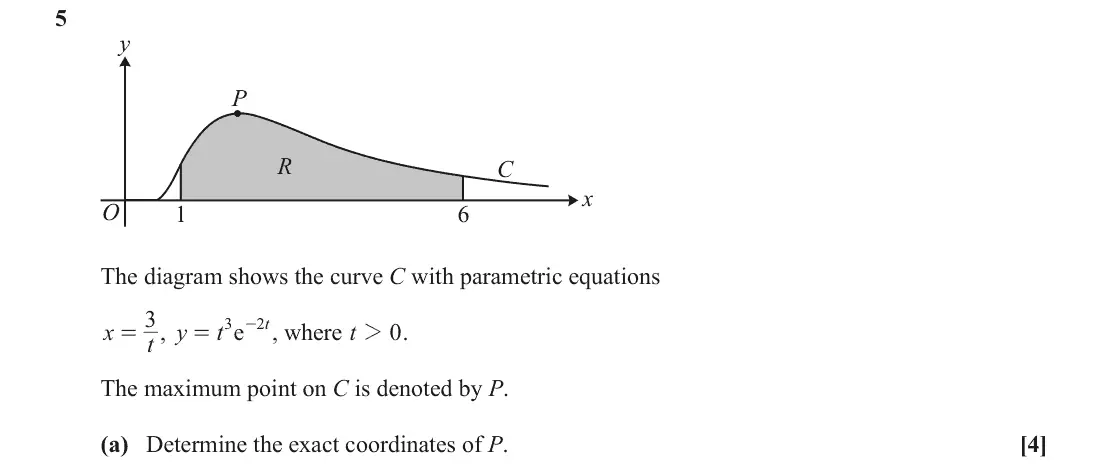
(Comment on Question 05 as a whole) Unless explicitly requested, candidates should avoid converting parametric equations into the cartesian form due to the complexity. d y In part (a) candidates only needed to determine where t = 0 . Unfortunately, some candidates made d errors in the denominator when finding d y x , and while this may not impact the numerical answer d obtained, there is a standard principle that answers obtained with wrong working will not gain full credit. The other issue with this question was that the ‘exact coordinates of P ’ was needed, those candidates that provided a decimal approximation would not gain full credit (unless the exact value had been seen as part of the working). The first issue with part (b) was that the limits were given on the diagram as x = and 1 , but the x = 6 integration was to be done with respect to t ; a number of candidates did not spot this. This was a ‘Show that’ question so the initial method mark was to find d x t and to show a clear attempt to use this in d d d x ∫ y t . The final accuracy mark was to rearrange into the given form. d t Part (c) involved using the formula given in part (b) to ‘Hence’ determine the area. Generally, this was done well, with candidates correctly giving their answer in ‘exact’ form in terms of e .
Key points and common errors
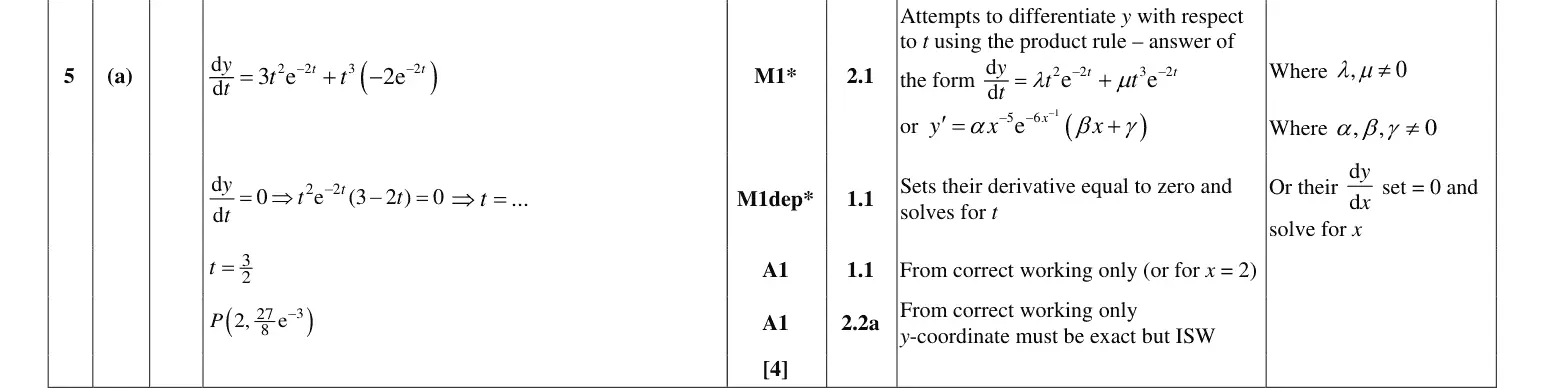
dy/dt = 3t²e⁻²ᵗ − 2t³e⁻²ᵗ = 0 so t = 3/2
P(2, (27/8)e⁻³) exact
no need to convert to cartesian
June 2019 · Paper 1 · Q5(a)4 marksEasy
Mark scheme for this part
Examiner's comment
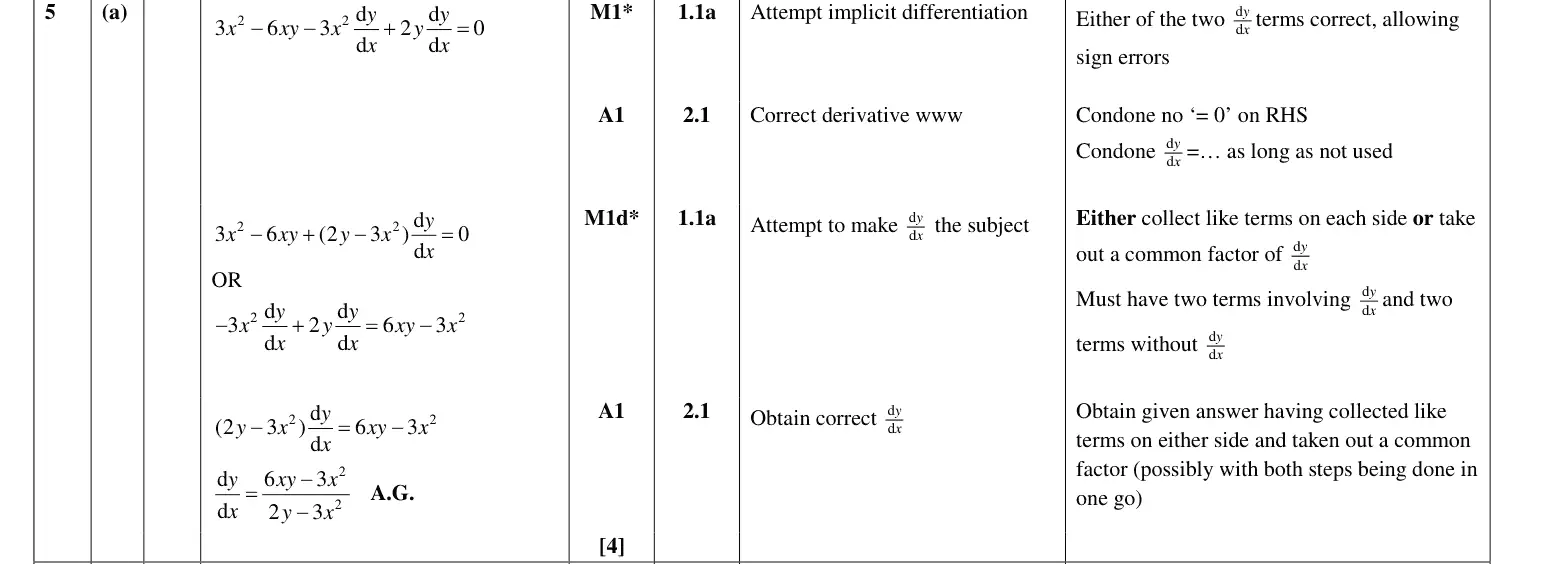
This question was very well answered, with many fully correct solutions seen. Candidates seemed familiar with implicit differentiation, and were then able to provide convincing evidence of how the given answer was obtained. The most common error was for the sign to be incorrect on the second term coming from the differentiation of –3x2y. It was clear that some candidates realised from their final answer that a sign error had occurred, and attempted to correct this, but did not always amend all of the relevant lines. When a candidate identifies that an error has occurred it can be better to delete this solution and start afresh so as to provide a fully convincing solution.
Key points and common errors
implicit differentiation, product rule on −3x²y (sign errors common)
collect dy/dx terms to reach the given answer
June 2019 · Paper 1 · Q12(a)3 marksMedium
Mark scheme for this part
Examiner's comment
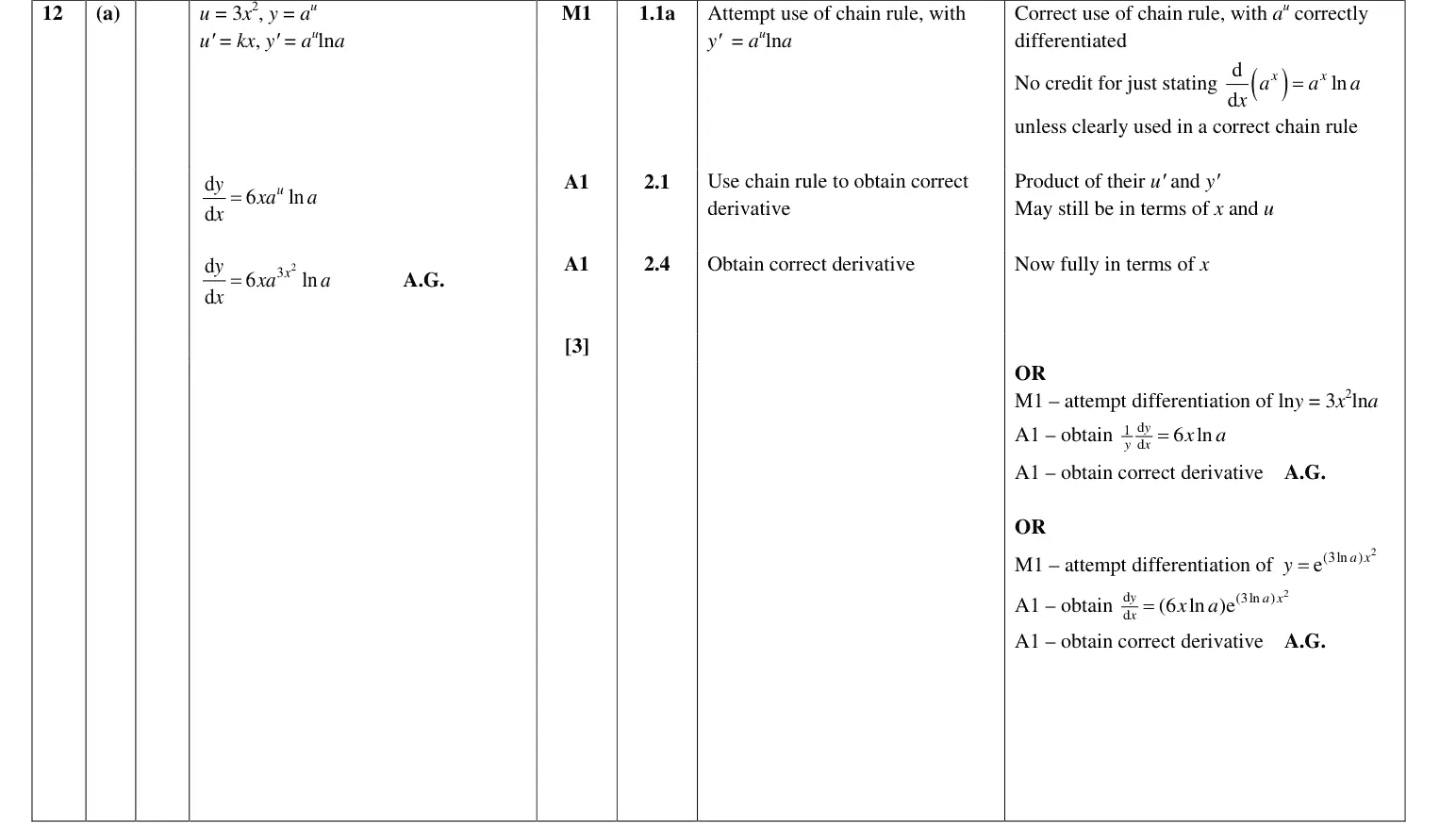
The derivative of ax is a new specification item, and candidates were expected to use this in the chain rule to show the given answer. Some were able to provide a convincing justification using this method, and others either introduced logarithms and used implicit differentiation or rewrote the function in the form ef(x). These different approaches tended to be equally successful. Some candidates were unable to devise an appropriate strategy and others seemed to be working back from the given answer in an attempt to justify it. This candidate gains full credit for making clear use of the derivative of au in the chain rule. This candidate cannot recall the required derivative so instead writes it in the form ef(x) which they are able to differentiate. Each step is clear in showing this given answer. Another candidate who cannot recall the required derivative so takes logarithms on both sides and differentiates implicitly. This is a good example of a candidate being able to recall and apply a relevant part of the specification.
Key points and common errors
chain rule with d(aᵘ)/du = aᵘ ln a, or take logs, or write as e^(3x² ln a)
working back from the answer gains nothing
June 2019 · Paper 1 · Q12(c)5 marksHard
Show the start of this question
Mark scheme for this part
Examiner's comment
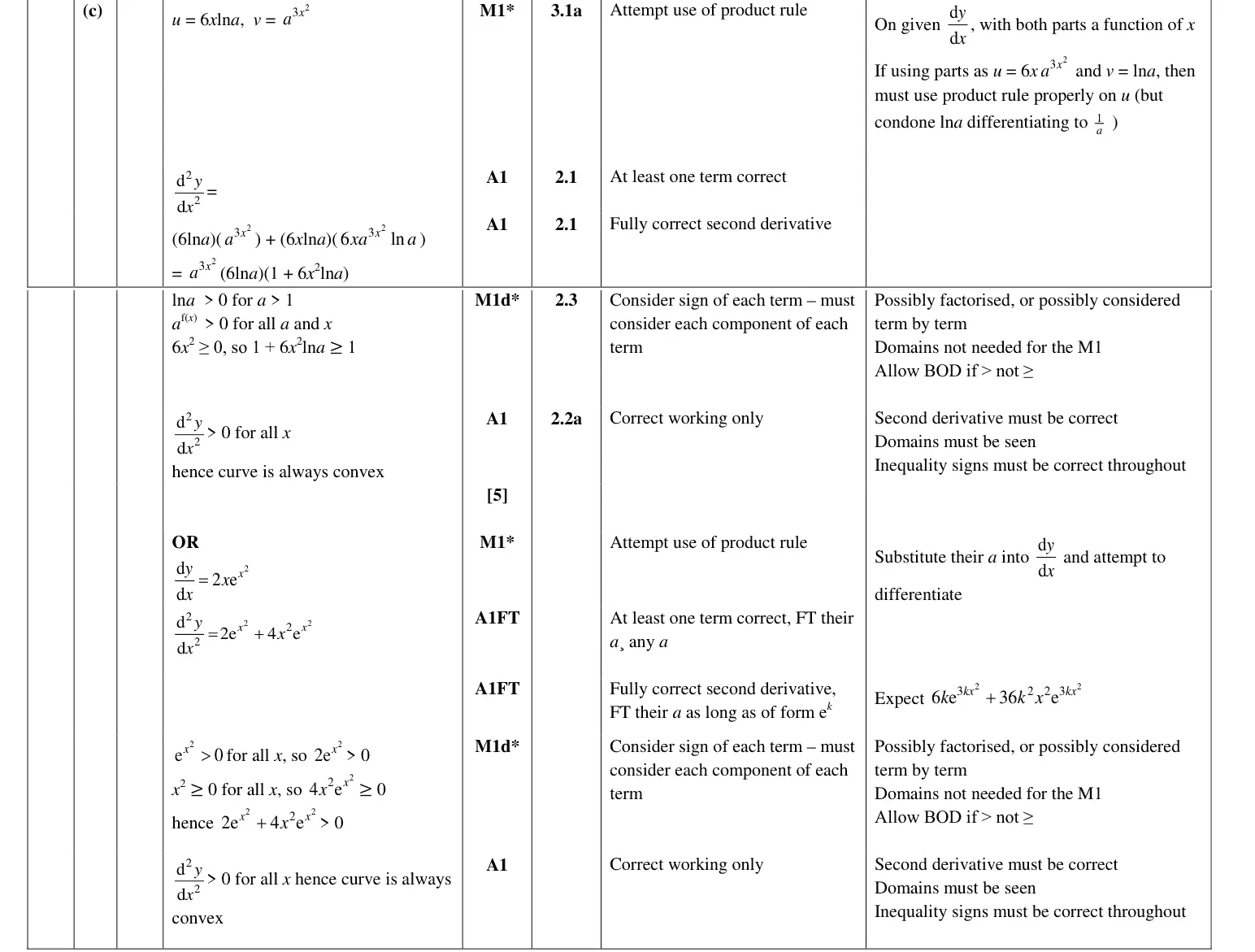
This proved to be a challenging finish to the paper and only the most able candidates were able to make much progress. The majority continued to work with the function in terms of a, with only a few using the numerical value for a from part (b); either approach could gain full credit. Candidates appreciated the need to use the product rule, but one part of the product was often seen as lna rather than splitting it into two functions of x. Some did then attempt a further split but an all too common error was for lna to differentiate to a-1 rather than 0. Candidates were then expected to consider the sign of each component of each term to show that the second derivative was always positive and hence the curve always convex. Many candidates were clearly familiar with the definition of a convex curve and could make some attempt at a relevant method, but statements were not always suitably specific; it was common to see ‘x2 is always positive’ and candidates should be precise with their reasoning.
Key points and common errors
product rule: d²y/dx² = a^(3x²)(6ln a)(1 + 6x²ln a)
each factor positive for a > 1 so convex for all x
ln a wrongly differentiated to 1/a
June 2019 · Paper 2 · Q1(a)(i)3 marksEasy
Mark scheme for this part
Examiner's comment
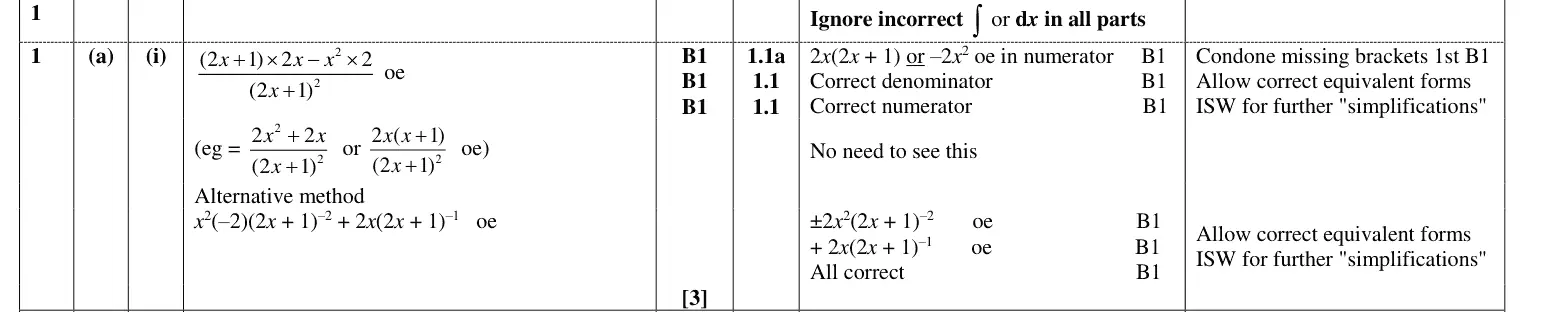
Most candidates answered this question well, using either the quotient rule or the product rule. Some candidates simplified their answers incorrectly.
Key points and common errors
quotient rule (or product rule)
some simplified incorrectly afterwards
June 2019 · Paper 2 · Q1(a)(ii)2 marksMedium
Mark scheme for this part
Examiner's comment
Many correct answers were seen. Some candidates omitted one or both pairs of brackets in their answer. Most knew that the derivative of tan x is sec x , although a few resorted to the quotient rule ( ) sin x − 3 x ( ) ( ) applied to . A few candidates gave sec 2 x − 3 . Some candidates used the tan A − B ( ) cos x − 3 x formula. Some then stopped, while others attempted to differentiate the result, usually making errors.
Key points and common errors
(2x − 3)sec²(x² − 3x)
brackets omitted
sec²(2x − 3) seen
June 2019 · Paper 2 · Q5(b)5 marksMedium
Show the start of this question
Mark scheme for this part
Examiner's comment
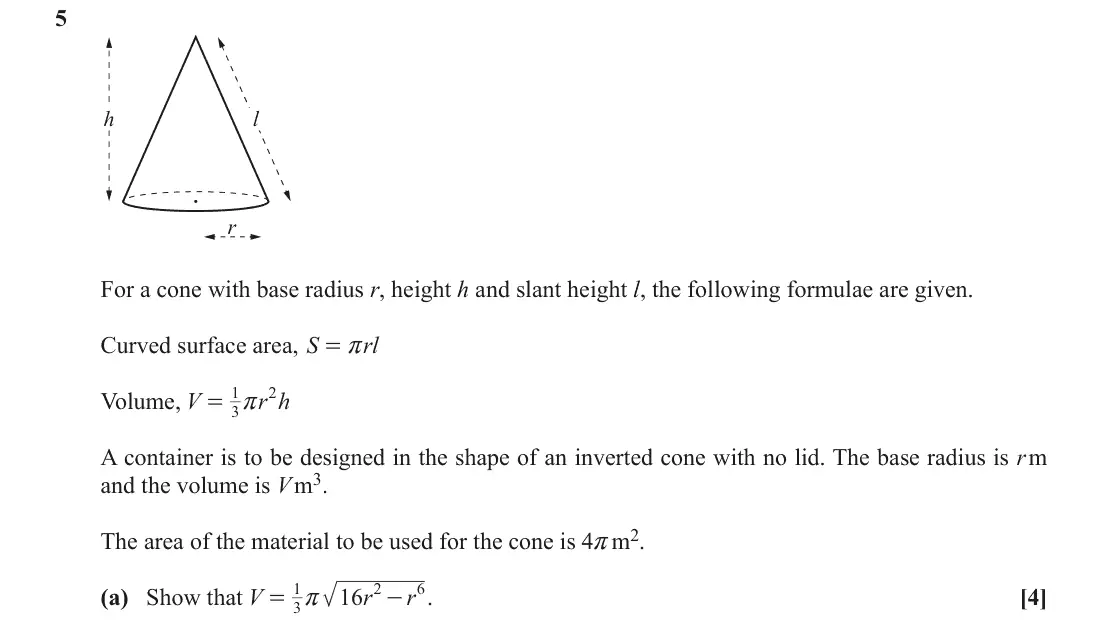
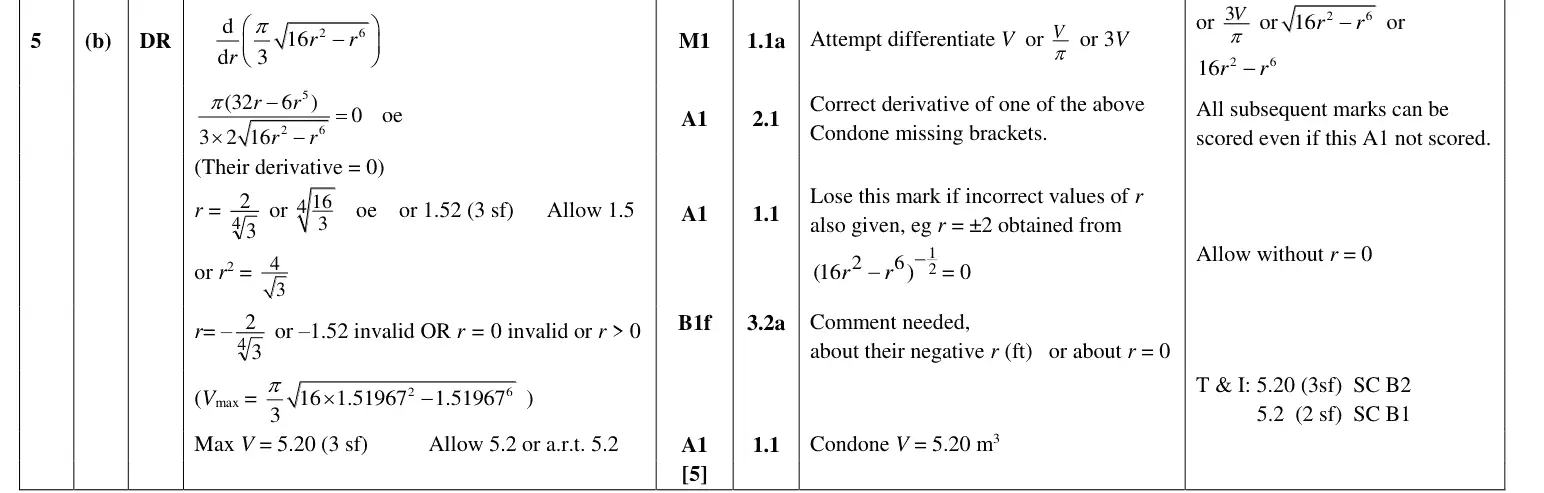
Most attempted to differentiate V, with varying levels of success. Some made arithmetical errors. Others ( ) 0.5 ( ) π π d V 2 6 5 had = 16 r − r × 32 r − 6 r or 32 r − 6 r . Some differentiated correctly, but then d r 6 6 (incorrectly) set 16 r − r = 0 , as well as (correctly) setting 32 r − 6 r = 0 . The ‘Detailed reasoning’ instruction indicates that the solution must lead to a conclusion by showing a detailed and complete analytical method; this meant that candidates were expected to give a reason for 2 rejecting one or both of r = 0 and r = − . Similarly, a ‘Trial and Improvement’ method to identify 4 3 r = 1 52 . , seen by a few candidates, was not considered an adequate method for full credit.
Key points and common errors
differentiate √(16r² − r⁶) by chain rule
32r − 6r⁵ = 0 gives r⁴ = 16/3
must reject r = 0 and negative r
V = 5.20
trial and improvement not enough
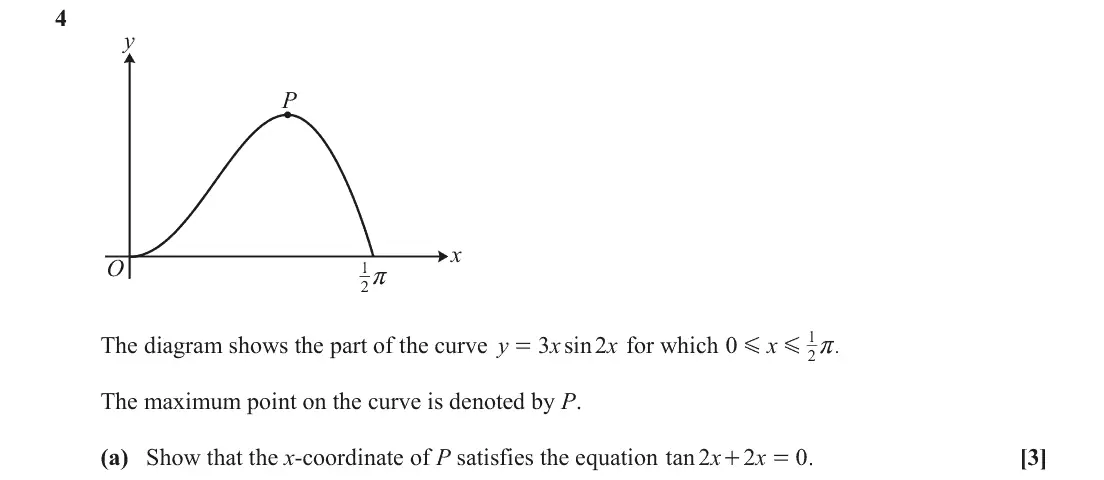
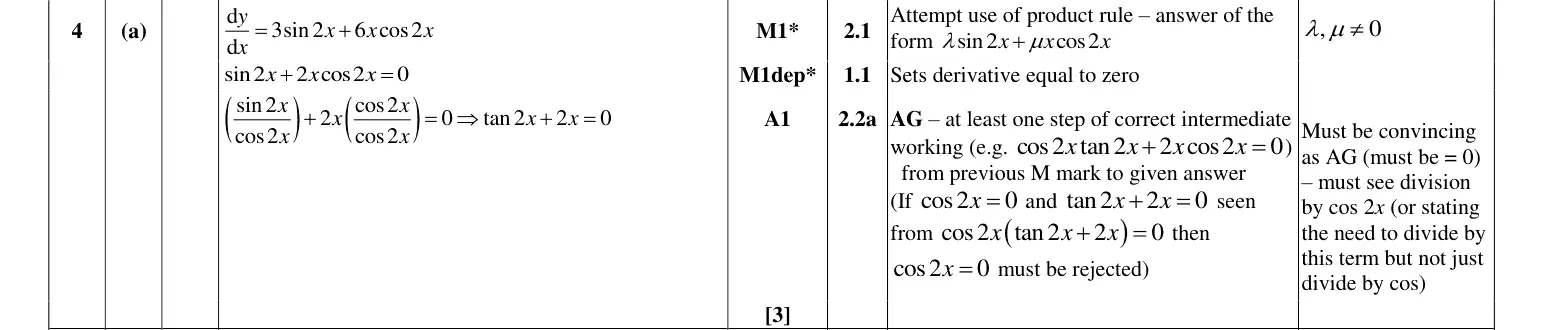
June 2019 · Paper 3 · Q4(a)3 marksMedium
Mark scheme for this part
Examiner's comment
While most candidates differentiated y correctly (using the product rule) and obtained 3sin2 x + 6 cos2 x x = 0 many candidates did not show enough working to convince examiners that they had derived and not simply stated the given result. For example, sin 2 x + 2 cos 2 x x = 0 ⇒ tan 2 x + 2 x = 0 scored A0. sin2 x But sin2 x + 2 cos2 x x = 0 ⇒ + 2 x = 0 ⇒ tan2 x + 2 x = 0 scored A1. cos2 x
Key points and common errors
product rule: 3sin2x + 6xcos2x = 0
divide by cos 2x explicitly to reach tan2x + 2x = 0
insufficient working
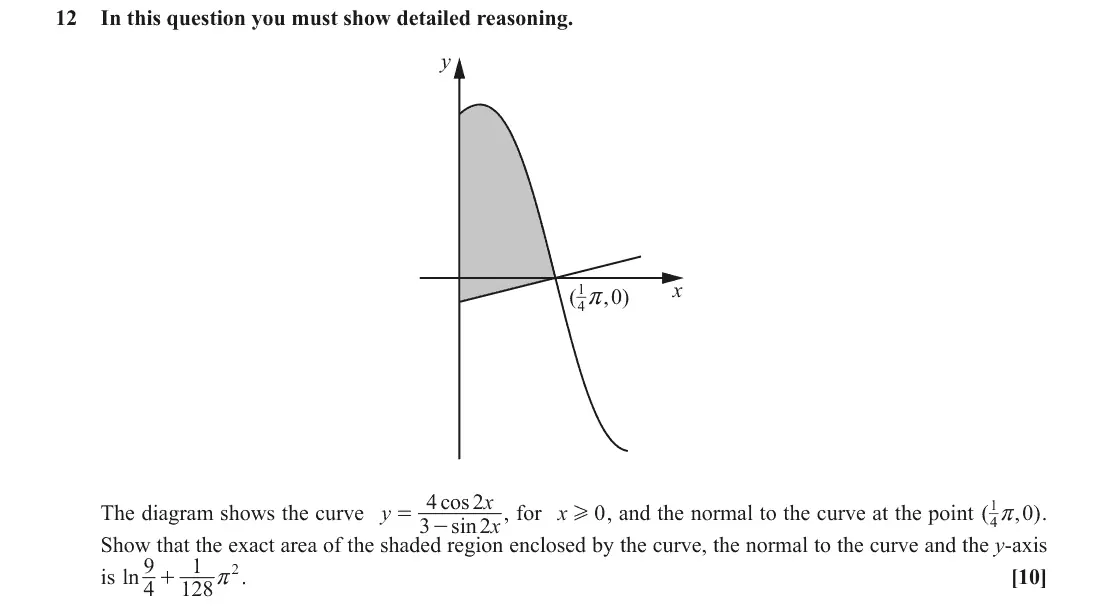
June 2018 · Paper 1 · Q1210 marksMedium
Mark scheme for this part
Examiner's comment
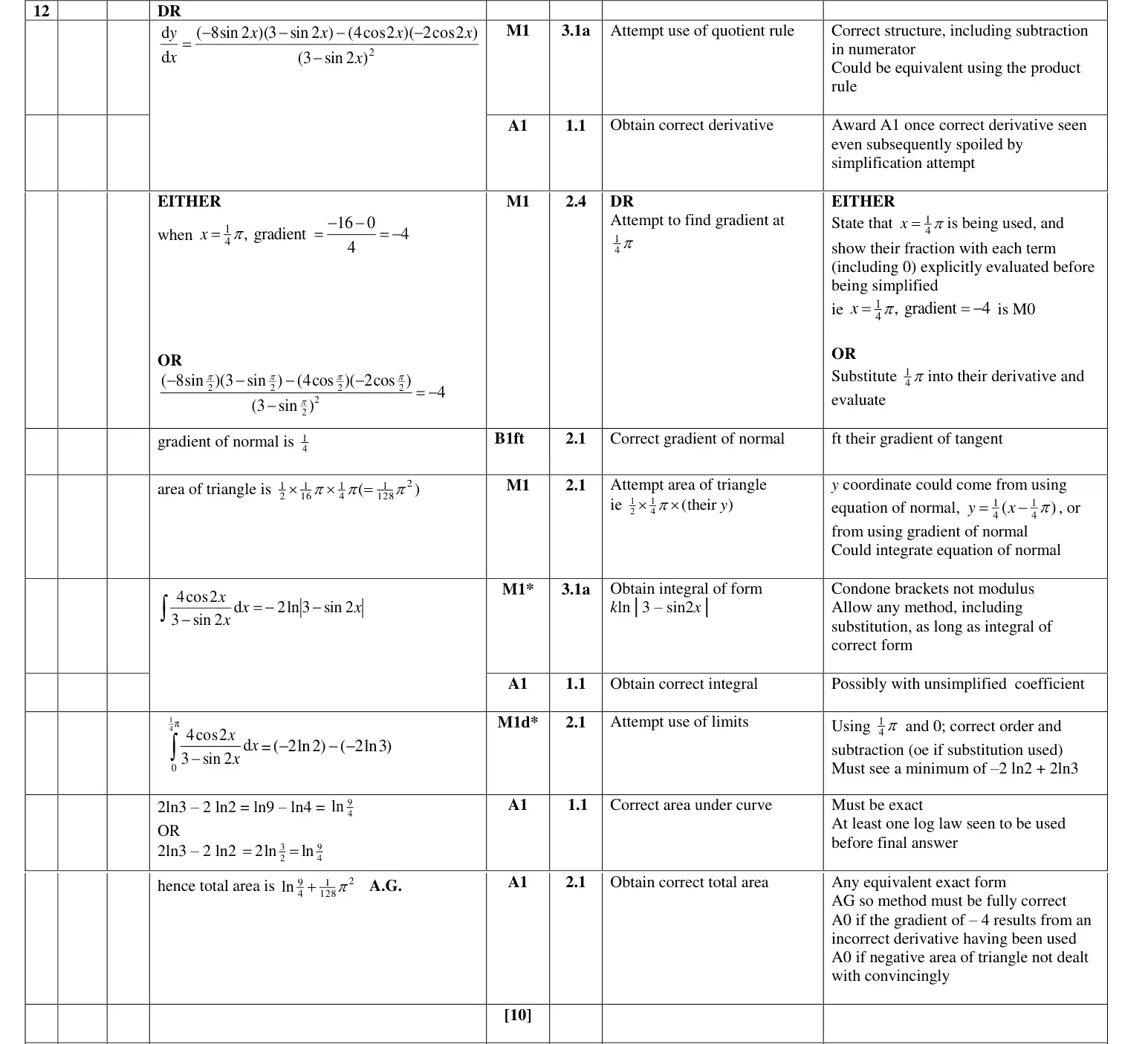
This was a question requiring detailed reasoning, so candidates were expected to show sufficient evidence of method throughout which not seen on all scripts. Candidates were generally successful when using the quotient rule to find the gradient of the curve. They were then expected to show evidence of finding the gradient at the given point; whilst some showed clear detail, others just stated the gradient with no justification. There were a variety of methods seen when finding the area of the triangle; the most common was to find the y intercept from the equation of the normal whereas others used integration. Some candidates identified that the 128π in the given answer must be the area of the triangle and attempted to fudge their answer to obtain this, in some cases deleting correct work and replacing it with a solution that was now worth less credit. Most candidates were able to correctly integrate the equation of the curve, some by inspection and others by using a substitution of their choosing. The limits were usually used correctly, but not all candidates provided sufficient evidence of use of logarithms before the appearance of ln 9 4 . This response gained full credit for a correct solution with sufficient justification seen throughout. The derivative is correct, and there is clear evidence of substitution to find the gradient at x = 1 4 π . Had the gradient of – 4 just been stated, but with no evidence, then this would have been penalised. The equation of the normal is used to find the intercept on the y-axis, and this is used to find the area of the triangle. The integration is also correct and limits are used correctly. There is then clear evidence of at least one log law being used to obtain the correct area under the curve. The two areas are then summed to justify the given answer.
Key points and common errors
quotient rule
gradient −4 at x = ¼π shown explicitly, normal gradient ¼
triangle area π²/128
∫4cos2x/(3 − sin2x) = −2ln(3 − sin2x)
area under curve ln(9/4)
handle the triangle below the axis convincingly
June 2018 · Paper 2 · Q6(iii)4 marksEasy
Show the start of this question
Mark scheme for this part
Examiner's comment
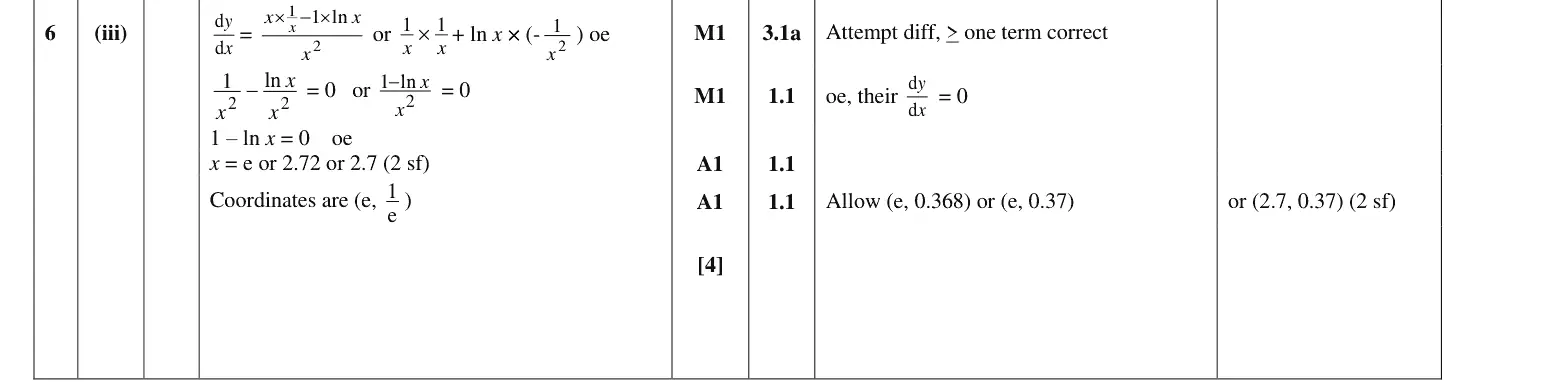
This question was well answered. A few candidates did not find the y-coordinate. Some made mistakes in the differentiation.
Key points and common errors
quotient rule: (1 − ln x)/x² = 0 so x = e
coordinates (e, 1/e)
some omitted the y-coordinate
June 2018 · Paper 2 · Q6(iv)5 marksMedium
Show the start of this question
Mark scheme for this part
Examiner's comment
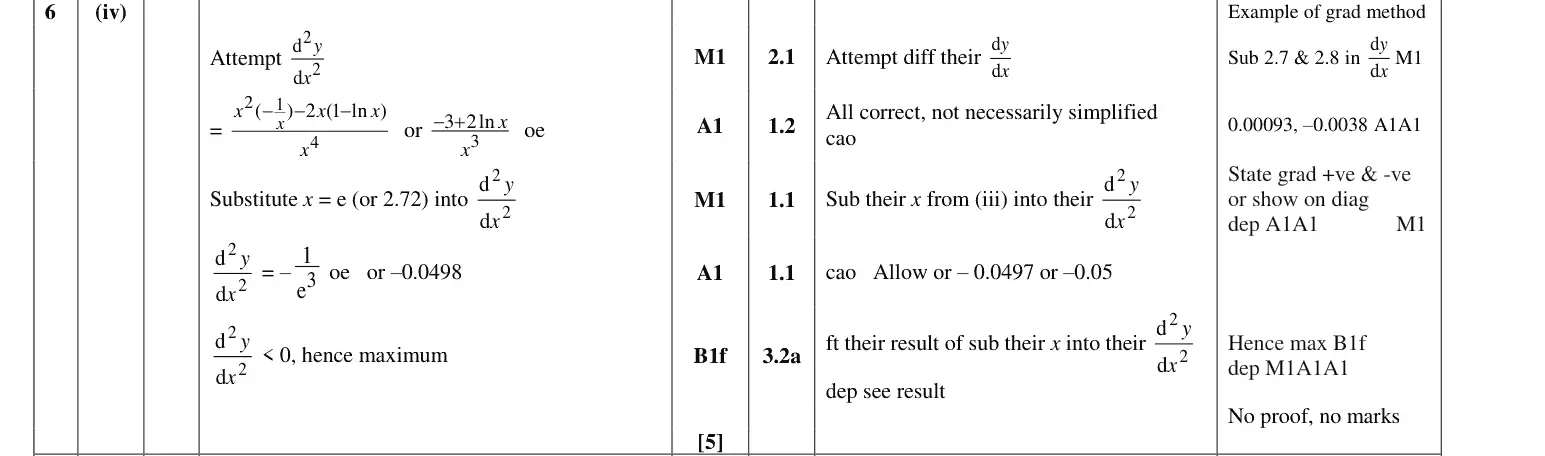
Most candidates attempted a correct method. Some made mistakes in the differentiation. Others made 2 d y 2 d x numerical errors when substituting x = e into . Some considered the gradient on either side of the turning point, generally correctly. In both this part and part (iii), candidates who used "e" throughout, rather than its approximate decimal value, produced neater and more efficient solutions.
Key points and common errors
d²y/dx² = (2ln x − 3)/x³ = −1/e³ < 0 so maximum
working with e rather than decimals is neater
gradient either side also accepted
Find an A-level maths tutor
Stuck on this? Book a trial session with an A-level maths tutor.