Addition and double-angle formulae, harmonic form Pure
Papers
Paper 1, Paper 2, Paper 3
Level
A level only
Spec
1.05l, 1.05m, 1.05n
Formulae sheet
The addition formulae for sin, cos and tan(A ± B) are given; the double-angle formulae are not.
Since 2018
32 question parts, 108 marks, each rated Easy, Medium or Hard from the wording of the examiners' report
Notes, worked examples and practice for this topic are being written by our tutors. The past-paper questions below are ready now: work each one on paper, then open the mark scheme and the examiner's comment.
Tap a question to zoom it. Mark scheme and examiner's comment open under each question.
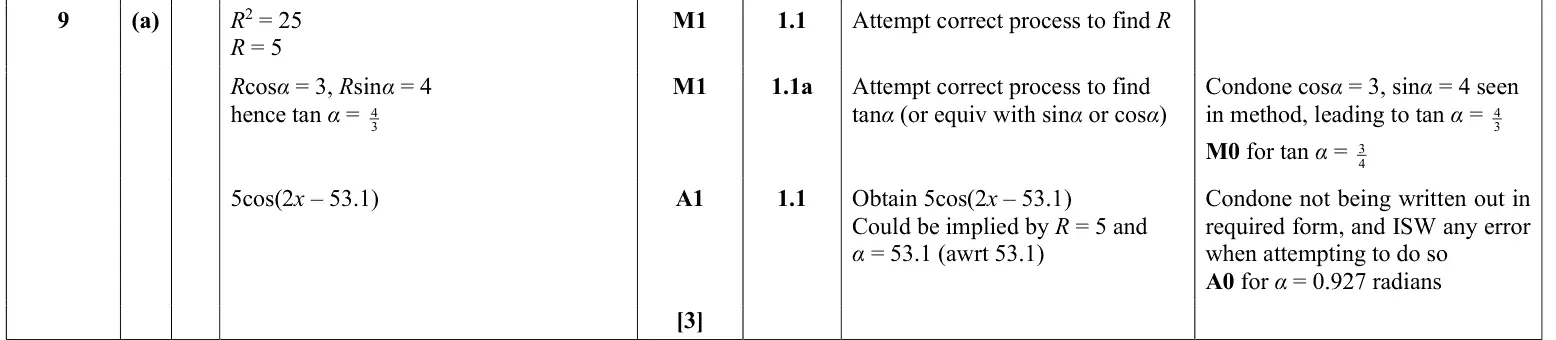
June 2025 · Paper 1 · Q9(a)3 marksEasy
Mark scheme for this part
Examiner's comment
Most candidates showed a clear method, expanding the given harmonic form, equating coefficients and obtaining a correct expression. Some candidates simply wrote down values for R and tanα; while the former was usually correct, the latter did vary as to whether the values of 3 and 4 were correctly placed in the expected fraction. In this examination session, the correct value of tanα being found from cosα = 3, sinα = 4 (i.e. R being omitted) was condoned for the method mark where no defined command word had been employed, but candidates should not be employing methods that are mathematically invalid.
Key points and common errors
R = 5, tan α = 4/3, 5cos(2x − 53.1°)
tan α = 3/4 errors
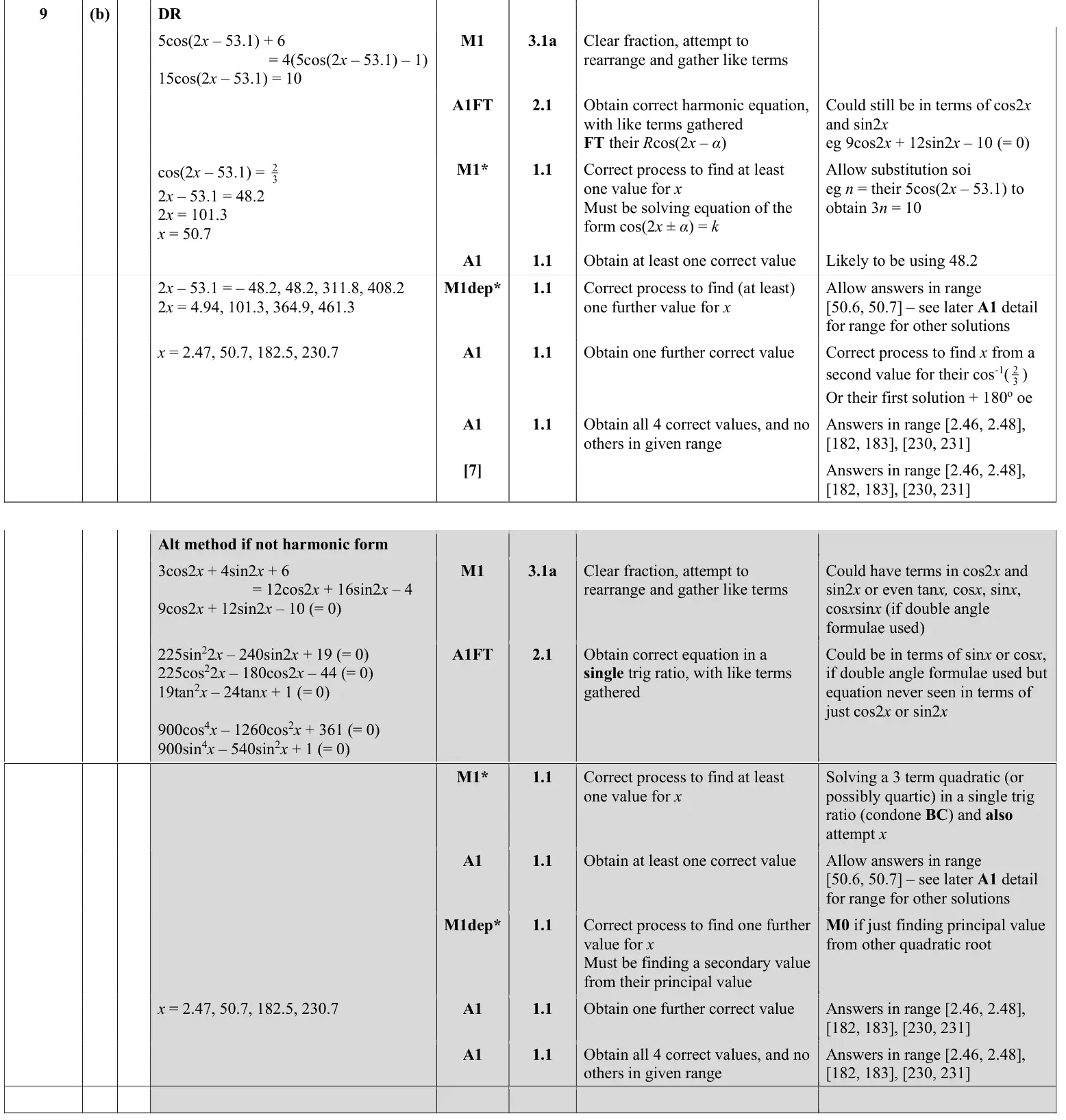
June 2025 · Paper 1 · Q9(b)7 marksMedium
Show the start of this question
Mark scheme for this part
Examiner's comment
Many candidates used the harmonic form from the first part of the question to obtain a simplified equation that could then be solved to gain at least 6 of the marks available. Only the most astute candidates gained full credit for also including the smallest angle of 2.47o, as this was often either not attempted at all or not given to a sufficient degree of accuracy. This was a ‘detailed reasoning’ question, so candidates were expected to show convincing method to support their solution; simply using the calculator to quote the four expected values with no other working was not accepted. A surprising number of candidates did not recognise the connection with the previous part of the question and instead attempted to use double angle formulae and trigonometric identities. While some initial credit was often awarded, those attempting this method rarely made any further progress.
Key points and common errors
15cos(2x − 53.1°) = 10, cos(2x − 53.1°) = 2/3
x = 2.47, 50.7, 182.5, 230.7
smallest solution 2.47 often missed
calculator-only answers not accepted
June 2025 · Paper 2 · Q4(a)2 marksEasy
Mark scheme for this part
Examiner's comment
This question asked candidates to complete two, related, trigonometric proofs. This part, the first, was more straightforward and most candidates scored both marks. Some candidates did not fully complete their proof (i.e. not fully simplifying to the RHS form given having started with the LHS of the given identity) or made errors, e.g. writing 1 + 2 sin 2𝜃. In both parts, many candidates offered working that did not constitute a clear, logical argument. The scheme allowed candidates to score marks where, to some extent, these steps had been shown in an illogical order, but candidates should be reminded that a question with the instruction ‘prove’ or ‘show that’ requires a clear, convincing argument that demonstrates the given result without any skipped steps or ‘fudges’. It is best practice, when proving an identity, to start from one side and work sequentially to demonstrate the other. Candidates may of course choose to work on ‘bits’ of an expression separately – for instance, when simplifying terms or ‘testing out’ some thinking – this is not at all discouraged but candidates should make sure that, if they choose to ‘split up’ the identity and work on part of it, that it is clear that they have done so and clear when they bring everything back together. This might be as simple as using arrows to indicate this. An increasing number of candidates choose to write down the given identity in its entirety and manipulate both sides until an ‘obvious’ result (e.g. 1=1) is reached. This is permitted (although not encouraged) and the mark scheme will generally follow ‘down’ one side and then ‘up’ the other. However, candidates who worked this way were (in both parts) more likely to omit an important step or make an error which meant their proof was not complete.
Key points and common errors
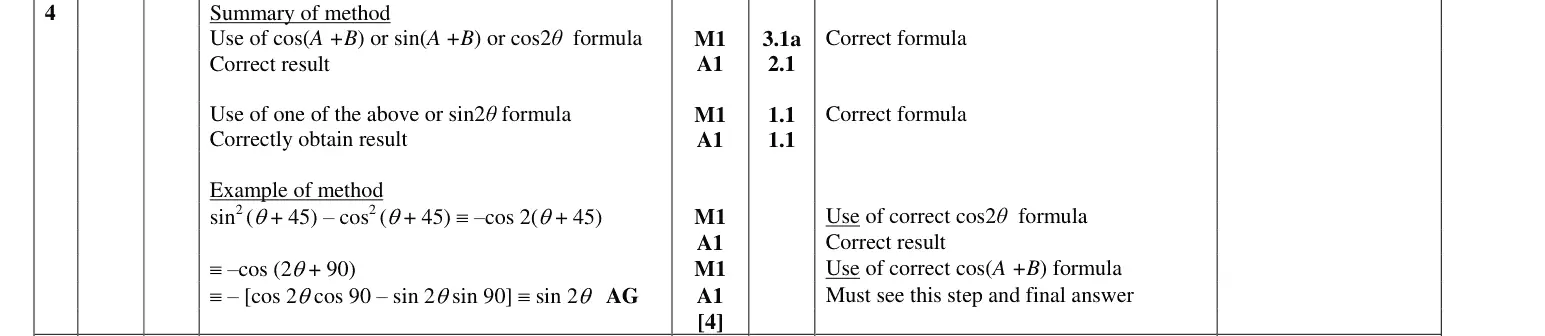
expand and use sin²θ + cos²θ = 1 and sin2θ = 2sinθcosθ
must reach the RHS
error 1 + 2sin2θ
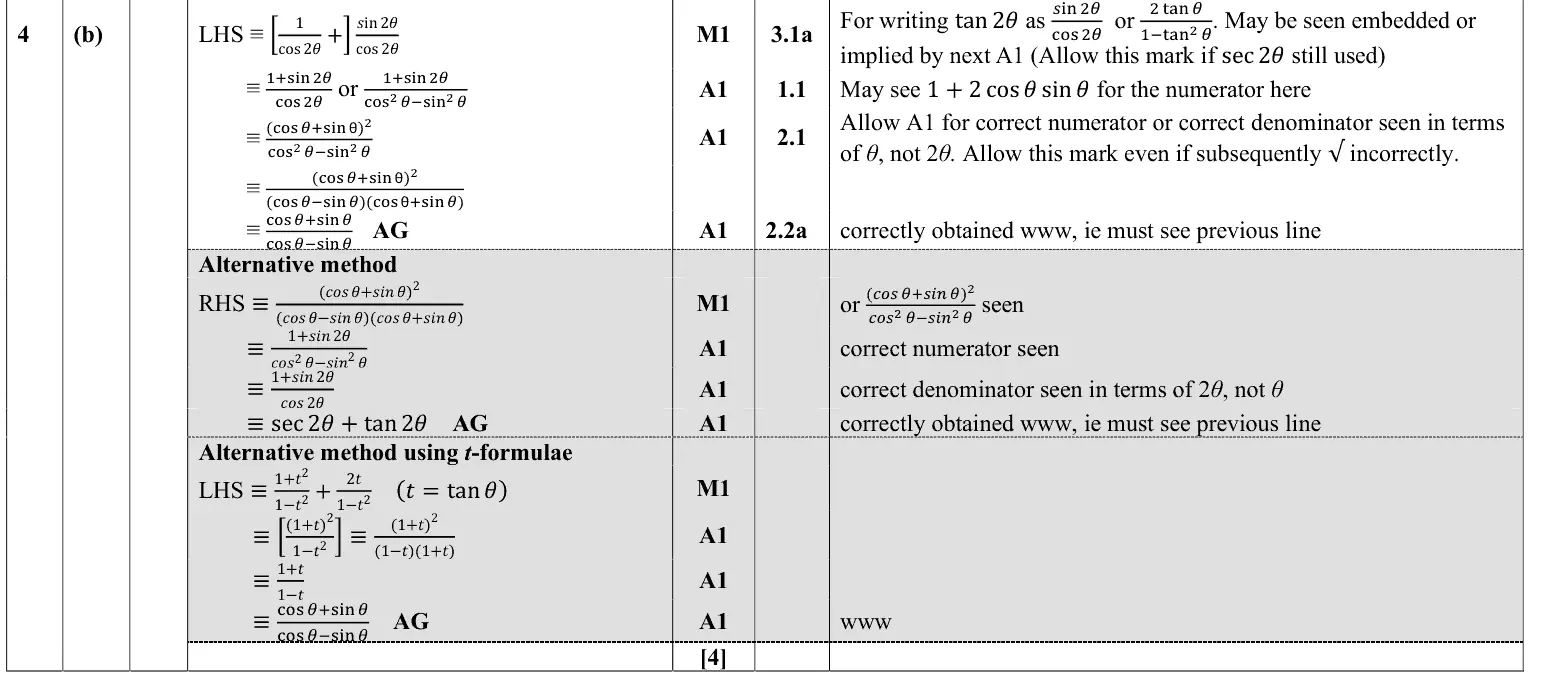
June 2025 · Paper 2 · Q4(b)4 marksEasy
Show the start of this question
Mark scheme for this part
Examiner's comment
This part was also well answered by most candidates, with many scoring at least 3 of the 4 marks available. Most candidates started well, noticing that they needed to use an identity to write tan 2𝜃 in terms of sin 2𝜃 and cos 2𝜃 or to turn the statements in 2𝜃 into expressions in 𝜃 only. As noted above, some proofs were insufficiently rigorous. The scheme documents several different approaches (although others were seen and credited if correct and complete). The most common omission was not showing how (in the main method on the scheme) line 3 leads to the RHS of the given identity by factorising the denominator as a difference of two squares. The question included the instruction ‘hence or otherwise’ – most candidates identified that the identity from part (a) would be helpful although some candidates inadvertently proved this again as part of their work in this part.
Key points and common errors
write sec2θ + tan2θ as (1 + sin2θ)/cos2θ
use (a) for numerator and cos²θ − sin²θ as difference of squares
must show the factor cancelling
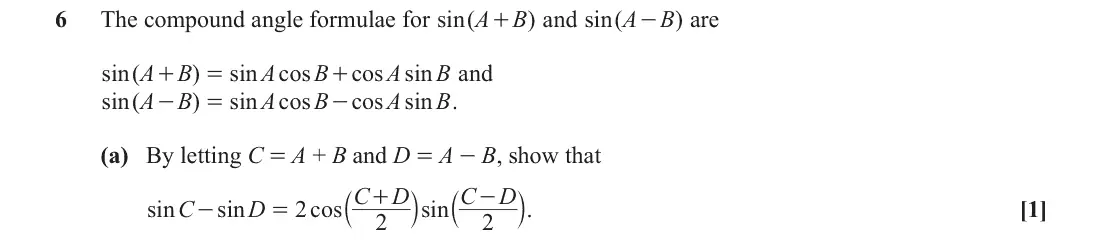
June 2025 · Paper 3 · Q6(a)1 markHard
Mark scheme for this part
Examiner's comment
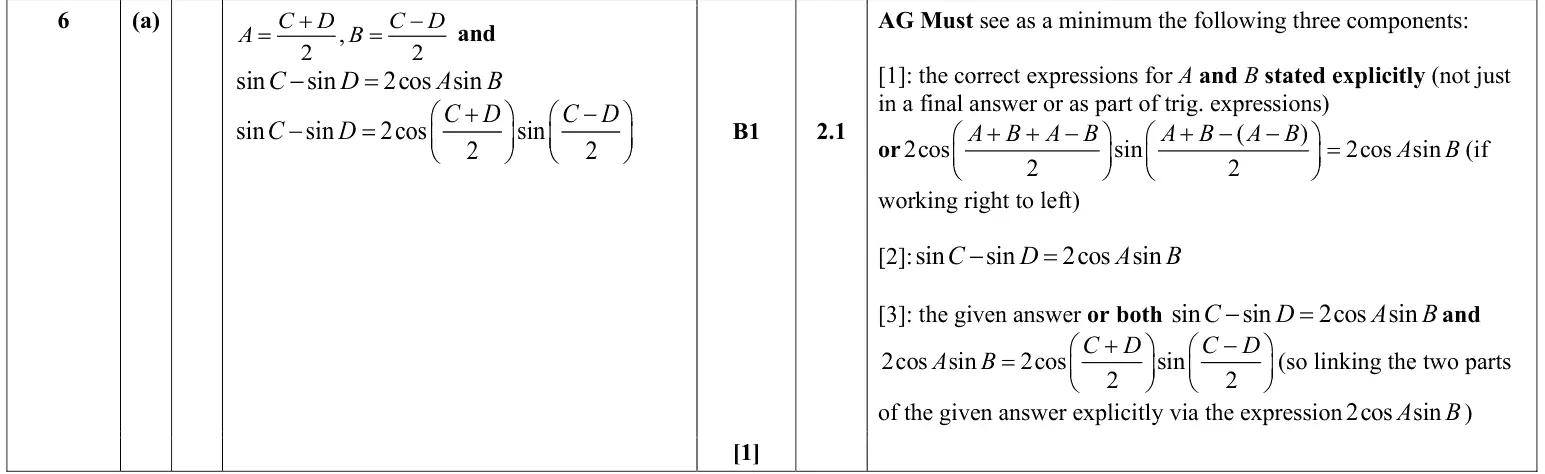
A significant proportion of candidates struggled with deriving the given trigonometric identity with many not showing sufficient detail that sin𝐶−sin𝐷 was equal to the given result via 2cos𝐴sin𝐵 together with the results that 𝐴= 2 and 𝐵= 2 .
Key points and common errors
subtract the formulae: sin C − sin D = 2 cos A sin B with A = (C + D)/2 and B = (C − D)/2 stated explicitly
June 2025 · Paper 3 · Q6(d)4 marksMedium
Show the start of this question
Mark scheme for this part
Examiner's comment
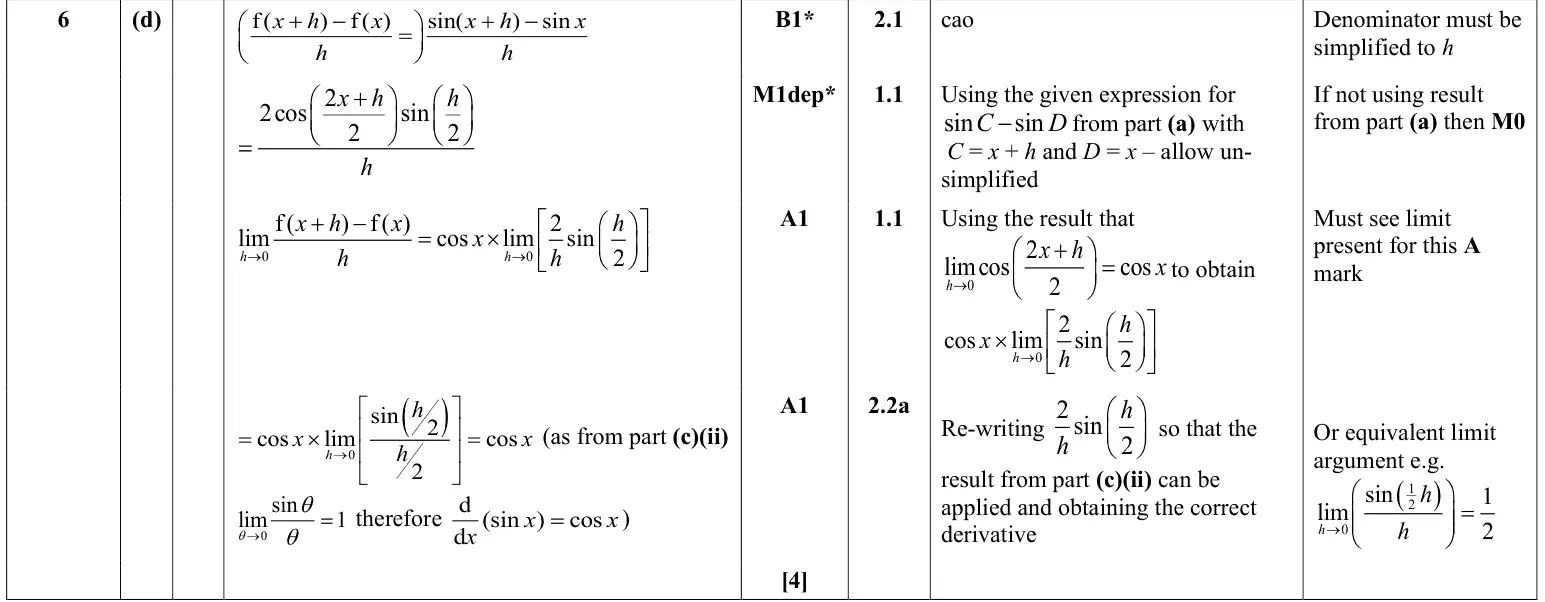
Although many candidates scored the first mark in this part for correctly considering many did not read the question carefully and instead used the standard approach of expanding the numerator using the compound angle formula instead of using the result from part (a). Of those that did use part (a) most were successful in correctly showing from first principles that the derivative of sin𝑥 was cos 𝑥.
Key points and common errors
(sin(x + h) − sin x)/h = 2cos((2x + h)/2) sin(h/2)/h using part (a)
limit gives cos x × 1
using the compound angle expansion instead gains little
June 2024 · Paper 1 · Q11(c)(i)5 marksMedium
Show the start of this question
Mark scheme for this part
Examiner's comment
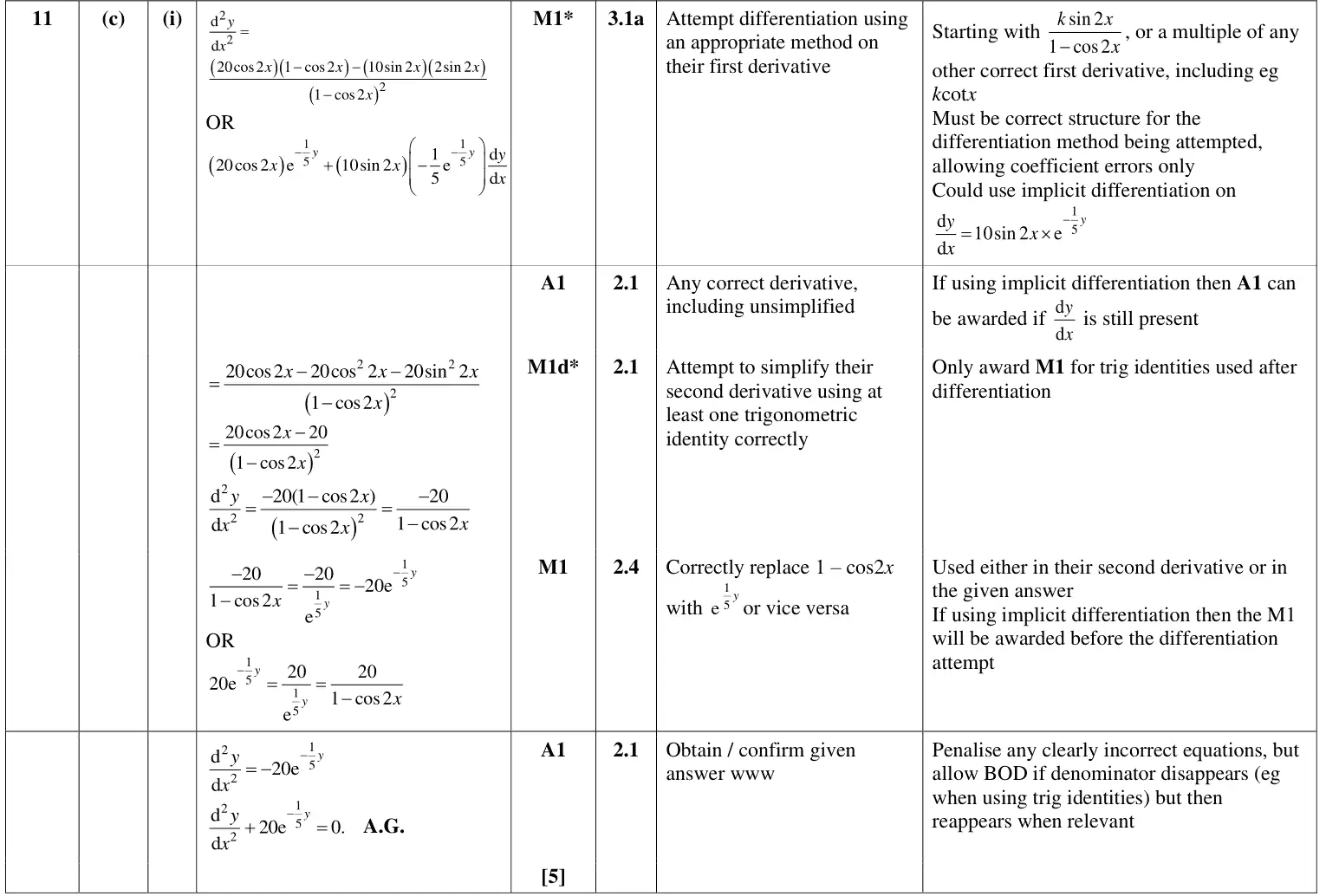
The attempts at the second derivative were very good when a correct first derivative had been obtained in part (b). The majority used the quotient rule rather than the product rule, the latter of which proved trickier for candidates to manipulate correctly to secure full marks. With a given answer, there is an expectation that method is clearly shown, and many candidates were able to simplify their second derivative by using a trigonometric identity but often struggled to obtain a fully correct solution. Those who struggled with part (b) often did not make progress with this part.
Key points and common errors
quotient rule on 10sin2x/(1 − cos2x)
simplify with sin² + cos² = 1 to −20/(1 − cos2x)
replace 1 − cos2x by e^(y/5)
given answer so full method needed
June 2024 · Paper 2 · Q6(a)(i)2 marksEasy
Mark scheme for this part
Examiner's comment
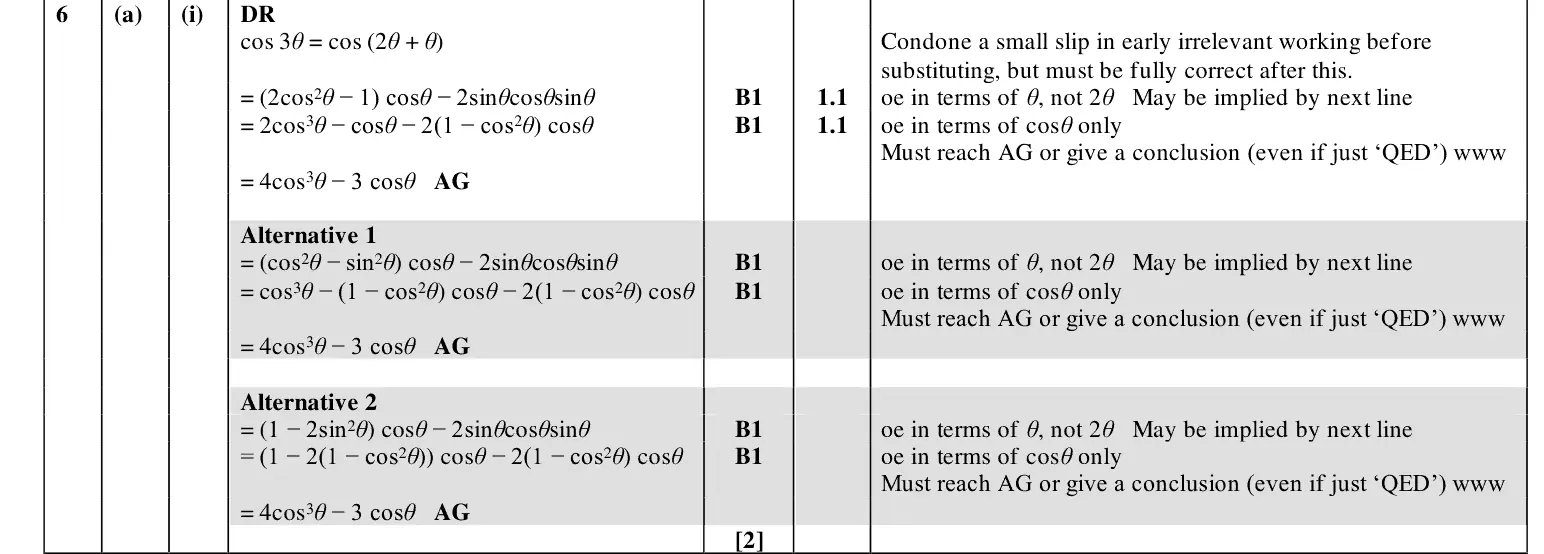
This part was well answered, with most candidates completing the proof successfully and almost all gaining at least the first B1 for using identities to rewrite in terms of theta only. Noting the DR instruction, quite a few candidates lost the second mark for making an error (e.g. omitting a bracket) in their working or by ‘jumping’ to the given response. Candidates should be reminded that ‘Detailed Reasoning’ means that every step in the working needs to be clearly shown.
Key points and common errors
cos3θ = cos(2θ + θ)
express in cos θ only
reach the given answer
June 2023 · Paper 1 · Q7(a)2 marksHard
Mark scheme for this part
Examiner's comment
It was a minority of candidates who could both identify the need to replace B with – B, and also provide suitable justification for the final answer.
Key points and common errors
replace B by −B
must state cos(−B) = cos B and sin(−B) = −sin B
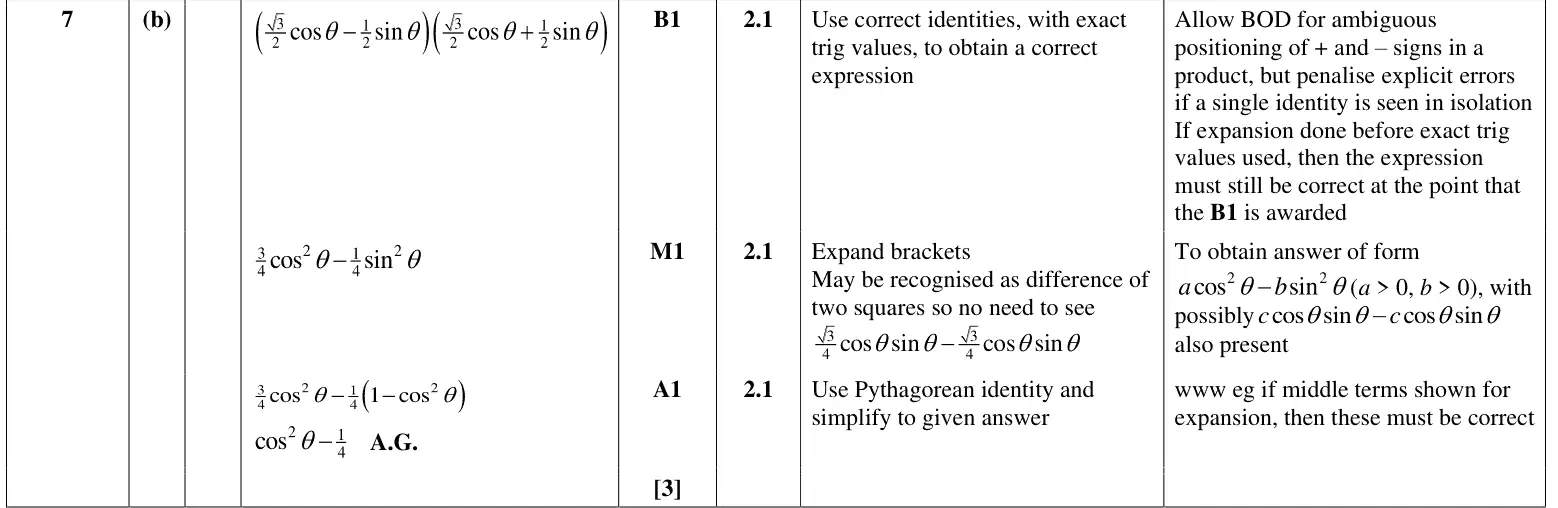
June 2023 · Paper 1 · Q7(b)3 marksEasy
Mark scheme for this part
Examiner's comment
This part of the question was very well answered, with many fully correct solutions seen. Candidates who used the exact trigonometric values in the two separate identities before expanding the brackets tended to be more successful than those who expanded first.
Key points and common errors
use exact values √3/2 and 1/2 before expanding
difference of two squares
sin²θ = 1 − cos²θ
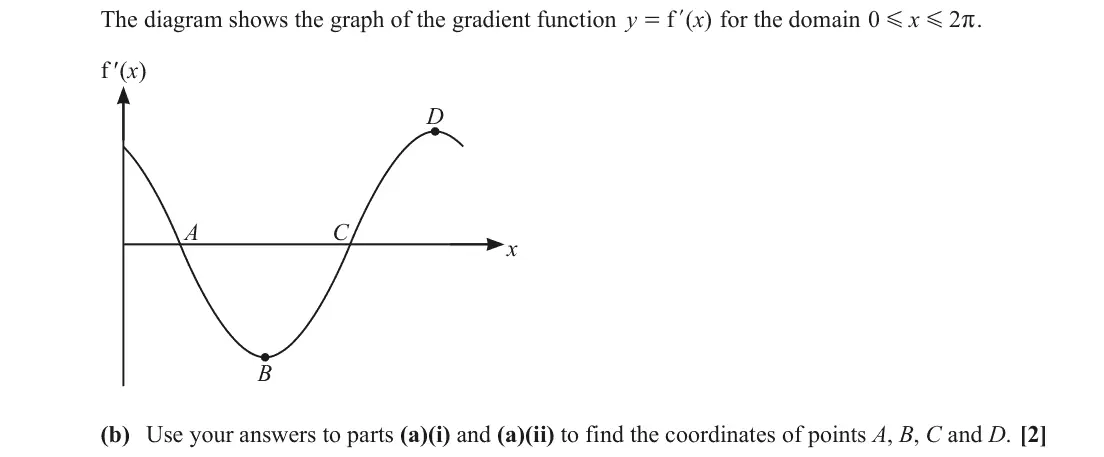
June 2023 · Paper 2 · Q5(b)2 marksHard
Show the start of this question
Mark scheme for this part
Examiner's comment
Relatively few candidates gave a fully correct set of answers to this question. Many candidates were able to correctly match their x-values from part (a) to the four points, but then didn’t go on to compute the corresponding y-values (receiving B1 under the SC if all four matched correctly). A number of candidates also assumed, incorrectly, that the y-values were +/-1.
Key points and common errors
A(π/3, 0), C(4π/3, 0), B(5π/6, −2), D(11π/6, 2)
many matched x-values but did not compute y-values
y = ±1 is wrong
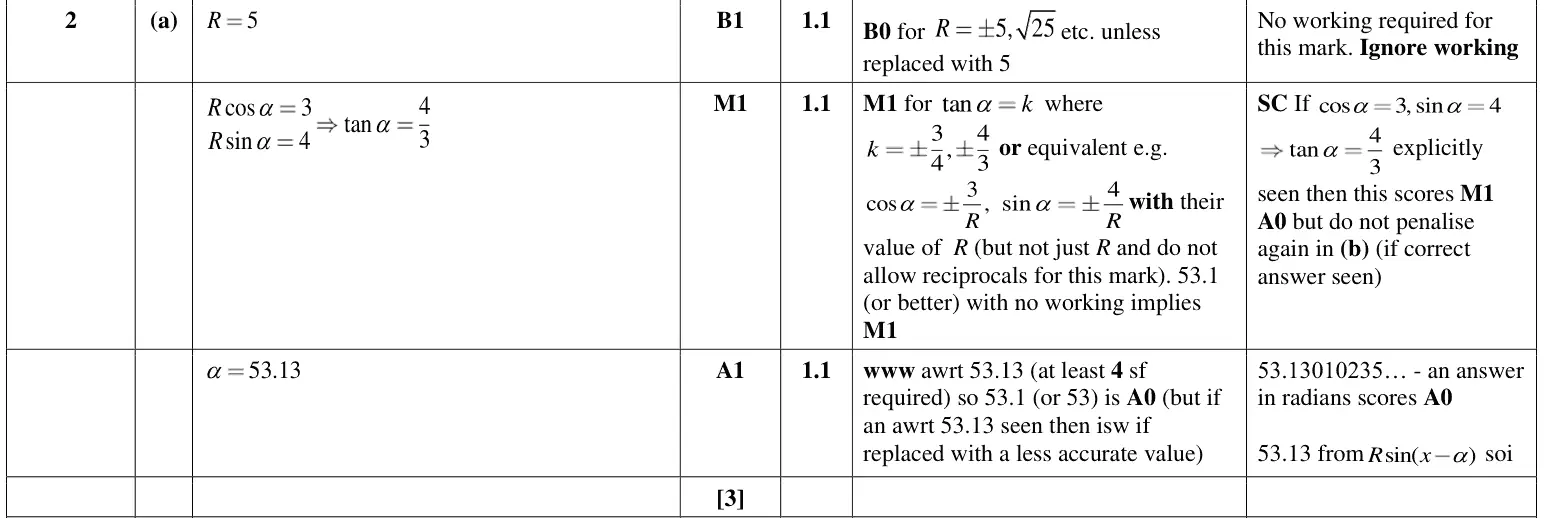
June 2023 · Paper 3 · Q2(a)3 marksEasy
Mark scheme for this part
Examiner's comment
The most common errors when it came to determining the value of 𝛼𝛼 was to suggest that This question was answered particularly well with almost all candidates stating the correct value for R. cos𝛼𝛼= 3 , sin𝛼𝛼= 4 or to incorrectly state that 𝑅𝑅sin𝛼𝛼= −4 ⟹𝛼𝛼= −53.13 ∴3sin𝑥𝑥−4cos𝑥𝑥= 5 sin(𝑥𝑥−53.13), so obtaining the correct answer from incorrect working (which was value of 𝛼𝛼 to 3 significant figures (or in some cases as an exact value in terms of arctan). penalised with the final mark in this, and the next part). Furthermore, many candidates only gave the
Key points and common errors
R = 5
tan α = 4/3 gives α = 53.13° to 4 s.f.
errors cos α = 3/5 with sin α = 4/5 swapped, Rsin α = −4, only 3 s.f.
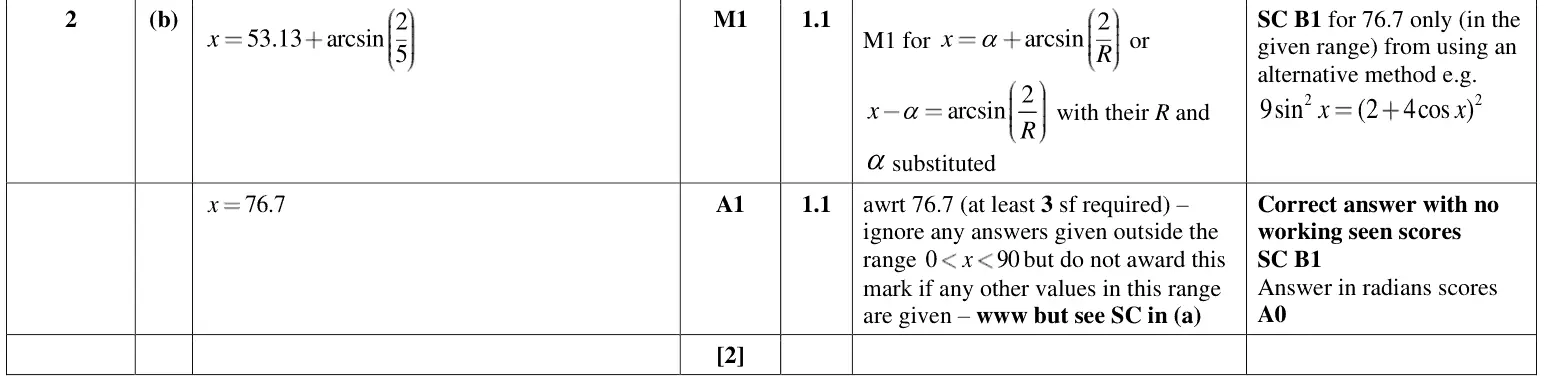
June 2023 · Paper 3 · Q2(b)2 marksEasy
Show the start of this question
Mark scheme for this part
Examiner's comment
Most candidates used the harmonic form from part (a) to obtain the correct value of x in this part. Occasionally candidates spent time finding further solutions that were not in the required range. Those candidates who ignored the advice of ‘hence’ and attempted to solve this equation by other methods where not penalised for not following the question request in this instance, however they were rarely completed the solution successfully. ‘Hence’ or ‘Hence or otherwise’ Candidates should recognise that where a question uses the word ‘hence’ they are best advised to start their solution based on the previous work. If ‘hence or otherwise’ is used then alternative (perhaps using Further Maths techniques) routes may be appropriate, although these may be more time consuming or complex.
Key points and common errors
x − 53.13 = arcsin(2/5)
x = 76.7 only in range
other methods rarely completed
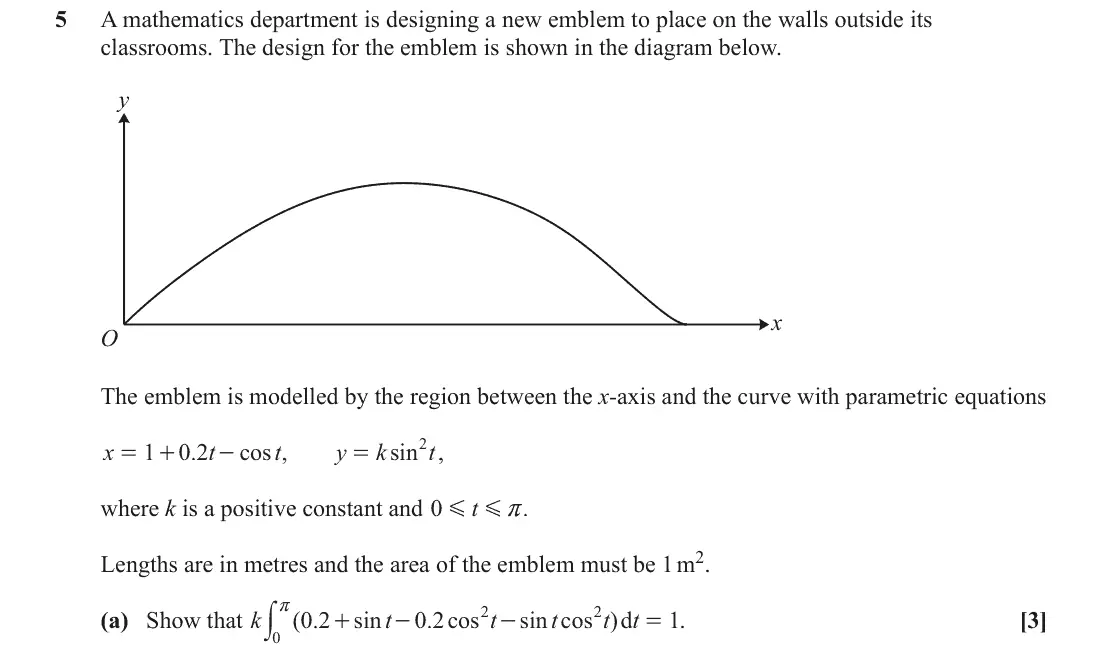
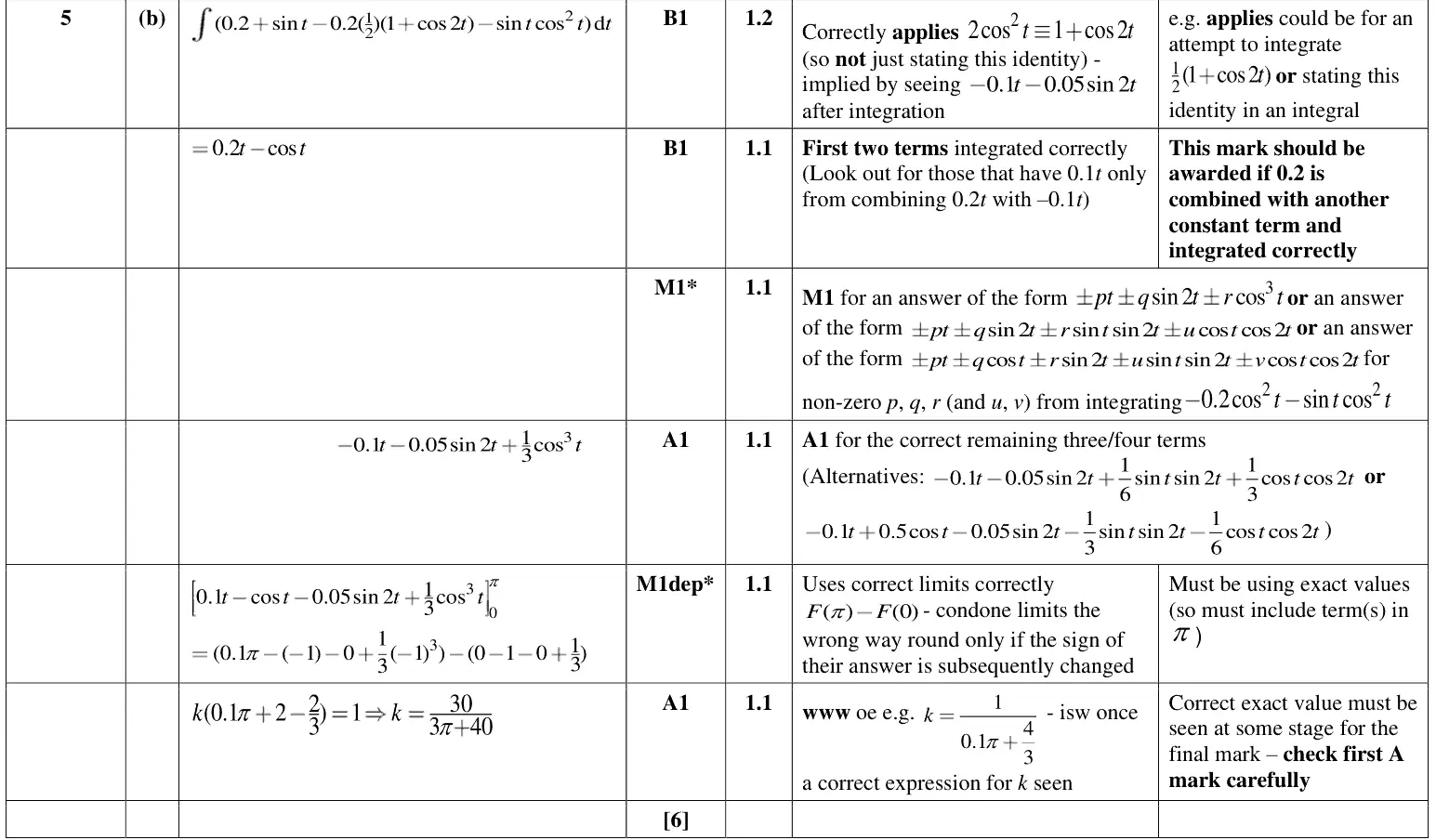
June 2023 · Paper 3 · Q5(b)6 marksHard
Show the start of this question
Mark scheme for this part
Examiner's comment
Although there were several ways of tackling this integral (to find the exact value of k) it was expected that candidates would deal with each term separately (and not attempt to combine terms together). The form of the integral given to the candidates in part (a) was meant to assist (rather than hamper) their attempts to solve this part. So, to that end it was expected that candidates would tackle the integral in the following way: ∫0.2 + sin𝑡𝑡 d𝑡𝑡= 0.2𝑡𝑡−cos𝑡𝑡 (integrate the first two terms immediately) ∫cos2𝑡𝑡 d𝑡𝑡= 2 ∫1 + cos2𝑡𝑡 d𝑡𝑡= 2 ቀ𝑡𝑡+ 2 sin2𝑡𝑡ቁ (use the standard double-angle formula to integrate cos2𝑡𝑡) 𝑛𝑛+1 (f(𝑥𝑥))𝑛𝑛+1 + 𝑐𝑐 from the formulae given on ∫sin𝑡𝑡cos2𝑡𝑡 d𝑡𝑡= − 3 cos3𝑡𝑡 (use the result ∫f ′(𝑥𝑥)൫f(𝑥𝑥)൯ 𝑛𝑛d𝑥𝑥= page 2 of the question paper) The small number of candidates who did integrate each term correctly usually applied the limits correctly too and obtained the correct value for k.
Key points and common errors
integrate term by term: 0.2t − cos t
cos²t = ½(1 + cos2t)
sin t cos²t integrates to −⅓cos³t (by inspection)
exact k = 30/(3π + 40)
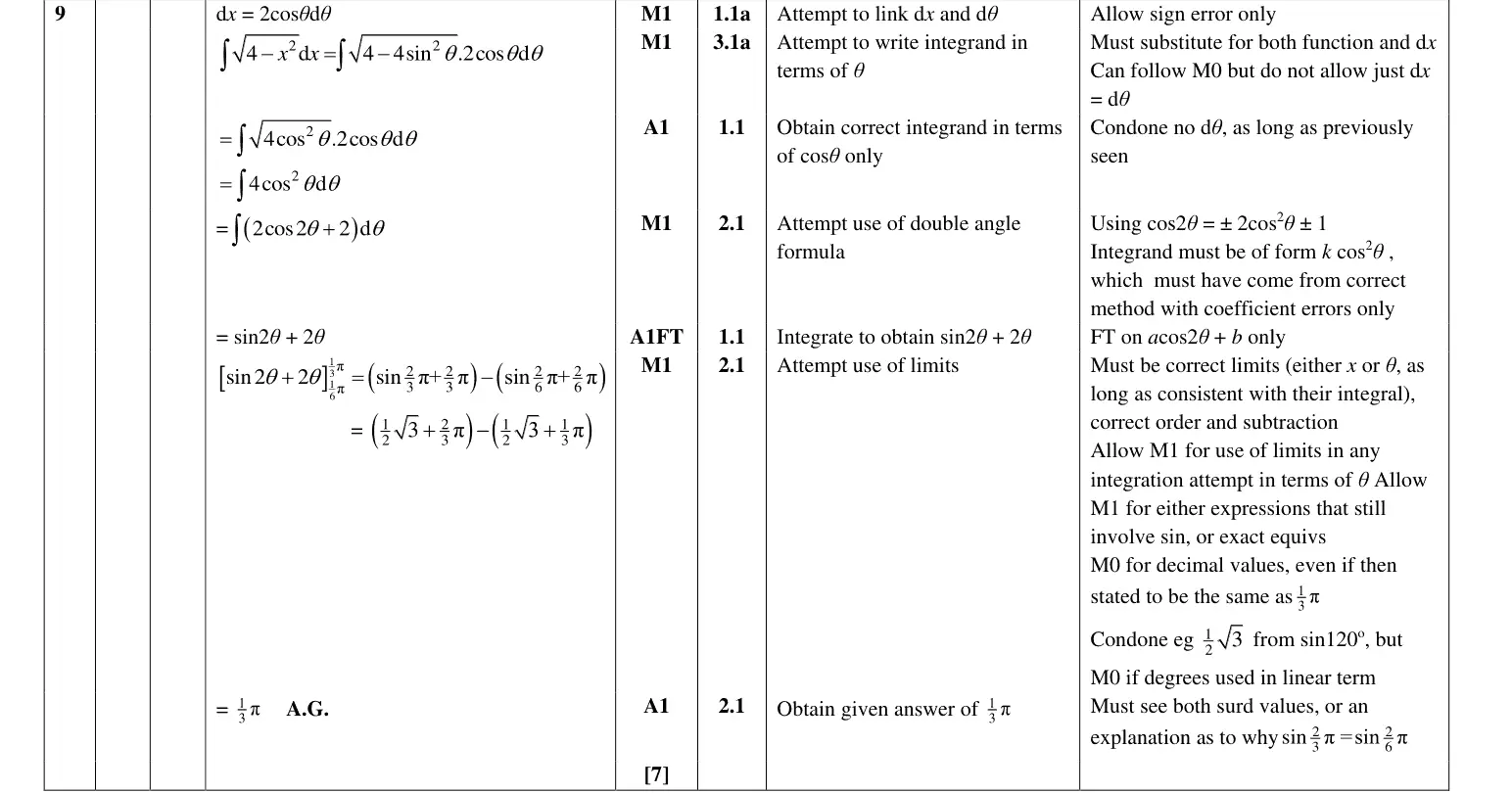
June 2022 · Paper 1 · Q97 marksHard
Mark scheme for this part
Examiner's comment
This proved to be a surprisingly challenging question, and the full range of marks was seen. The majority did attempt to use the given substitution, with only a few continuing to work in terms of x. Most appreciated the need to attempt the integrand in terms of θ, and attempted to do so. The most common errors were for an incorrect variable of u to be introduced, and for the simplification of the square root to be incorrect, with √(4 – 4sin2θ) becoming 2 – 2sinθ. Of the candidates who did obtain the correct integrand, most were able to select the correct identity and then usually produced a fully correct solution.
Key points and common errors
dx = 2cosθ dθ
√(4 − 4sin²θ) = 2cosθ (not 2 − 2sinθ)
∫4cos²θ dθ = sin2θ + 2θ via the double angle formula
limits π/6 to π/3 give π/3
exact values needed
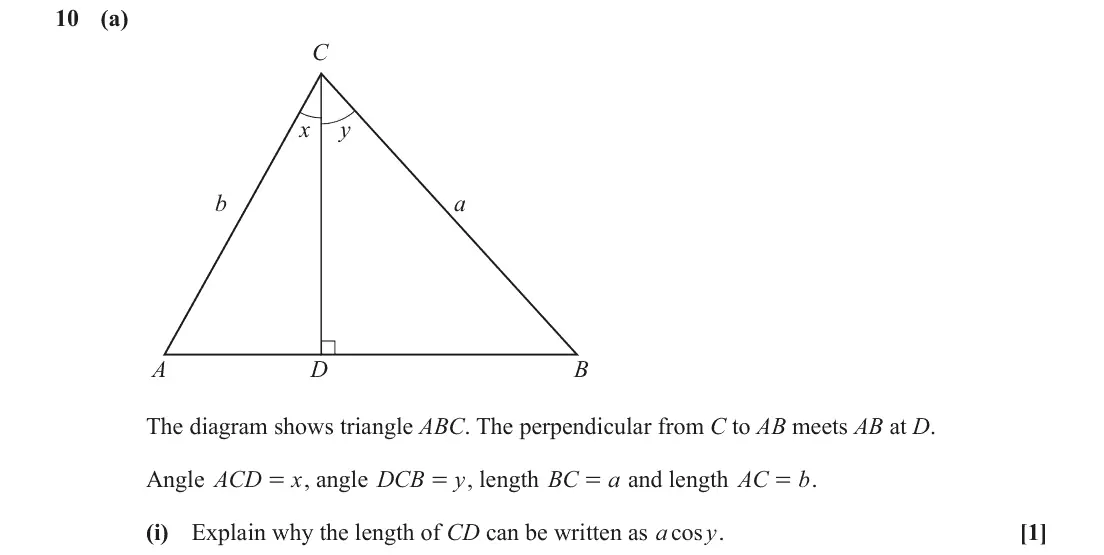
Autumn 2021 · Paper 1 · Q10(a)(i)1 markMedium
Mark scheme for this part
Examiner's comment
(From the general report) Some structure was given at the start of Question 10(a) to support candidates in making progress through the geometric proof of the trigonometric identity.
Key points and common errors
right-angled triangle BCD: cos y = CD/a
Autumn 2021 · Paper 1 · Q10(a)(ii)1 markMedium
Show the start of this question
Mark scheme for this part
Examiner's comment
(From the general report) Some structure was given at the start of Question 10(a) to support candidates in making progress through the geometric proof of the trigonometric identity.
Key points and common errors
area = ½ × AC × CD × sin x = ½ab sin x cos y
sides used must be clearly identified
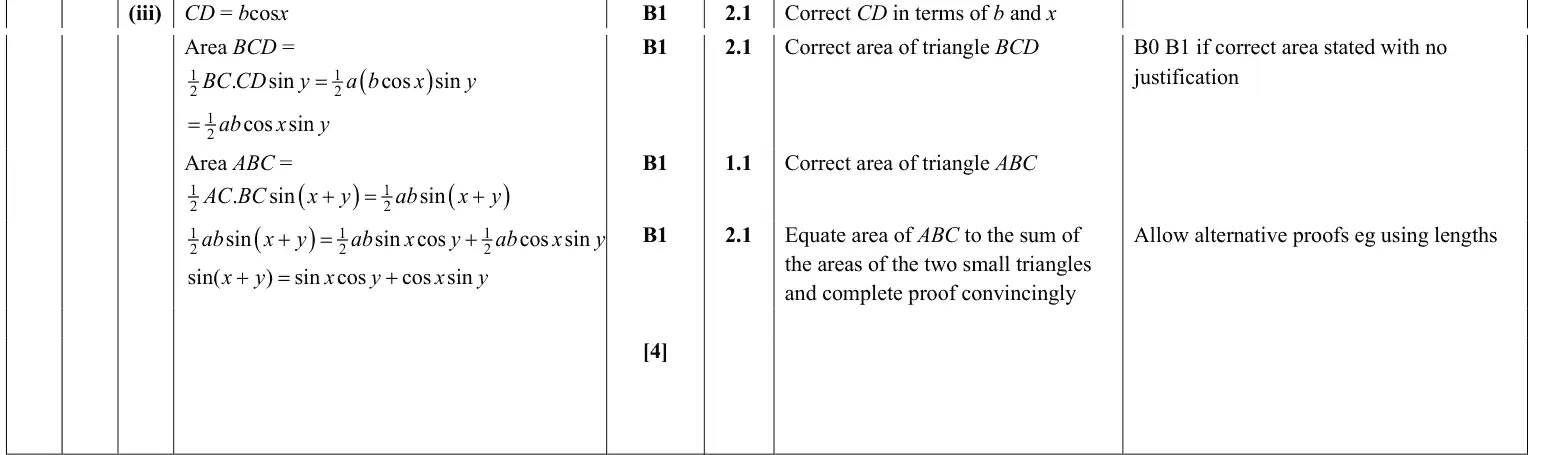
Autumn 2021 · Paper 1 · Q10(a)(iii)4 marksMedium
Show the start of this question
Mark scheme for this part
Examiner's comment
(From the general report) In Question 10(a)(iii) the more successful candidates clearly identified which lengths, angles and triangles were being considered.
Key points and common errors
CD = b cos x
area BCD = ½ab cos x sin y
area ABC = ½ab sin(x + y)
equate area ABC to sum of the two triangles
clearly identify lengths, angles and triangles
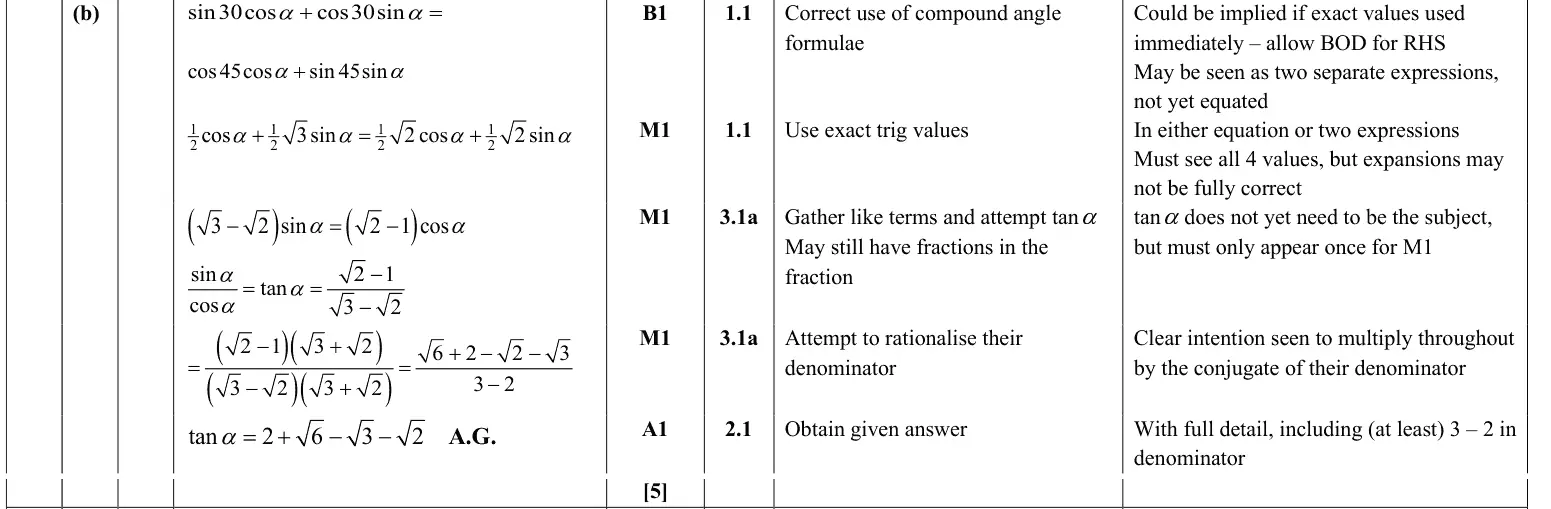
Autumn 2021 · Paper 1 · Q10(b)5 marksMedium
Mark scheme for this part
Key points and common errors
expand both compound angles and use exact values
collect to tan α = (√2 − 1)/(√3 − √2)
rationalise the denominator to reach 2 + √6 − √3 − √2
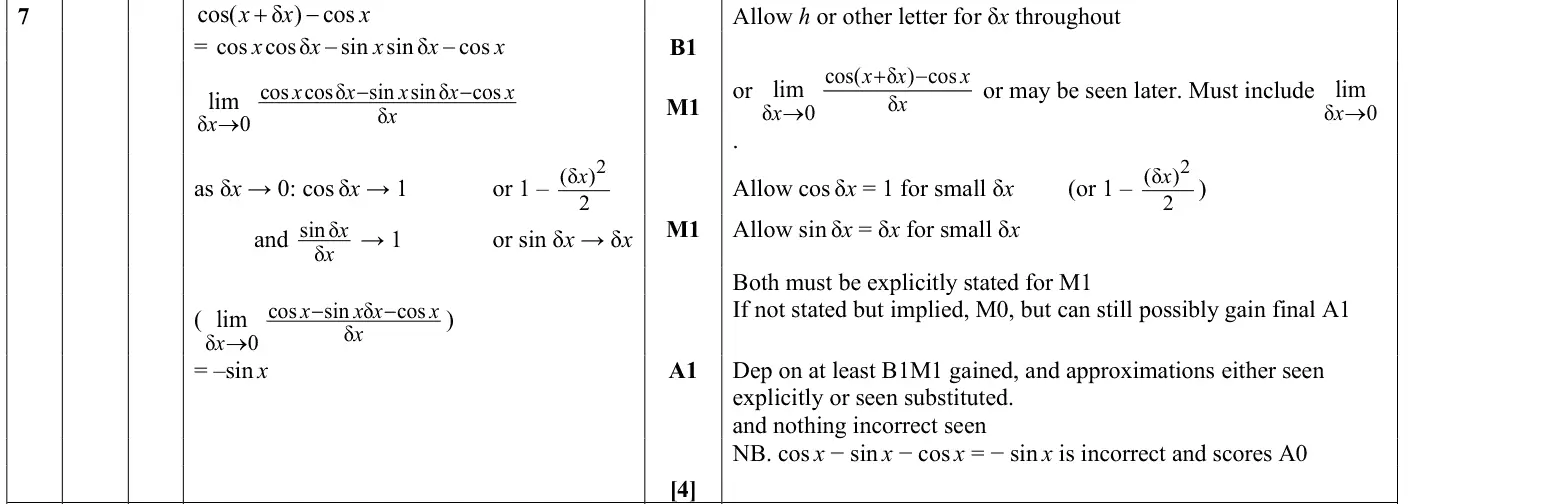
Autumn 2021 · Paper 2 · Q74 marksMedium
Mark scheme for this part
Examiner's comment
(From the general report) Question 7: Most candidates knew how to start and gained at least 2 marks. However, it is worth noting that the total number of questions requiring verbal rather than numerical answers is a little more than in the corresponding papers in 2019 and 2020. (But note that this precedent may or may not be followed in future papers.) When using this paper as a mock, it is important to make use of the published mark scheme, particularly for Questions 7, 8(b) and 13.
Key points and common errors
expand cos(x + δx)
lim δx→0 must be written
cos δx → 1 and sin δx/δx → 1 stated explicitly
−sin x
Autumn 2021 · Paper 3 · Q5(a)3 marksMedium
Mark scheme for this part
Examiner's comment
(From the general report) Conversely Questions 5(a), 6(c) and 14(b) specified the level of accuracy to give the final answer.
Key points and common errors
R = 13
tan α = 5/12
α = 0.3948 (radians, 4 s.f.)
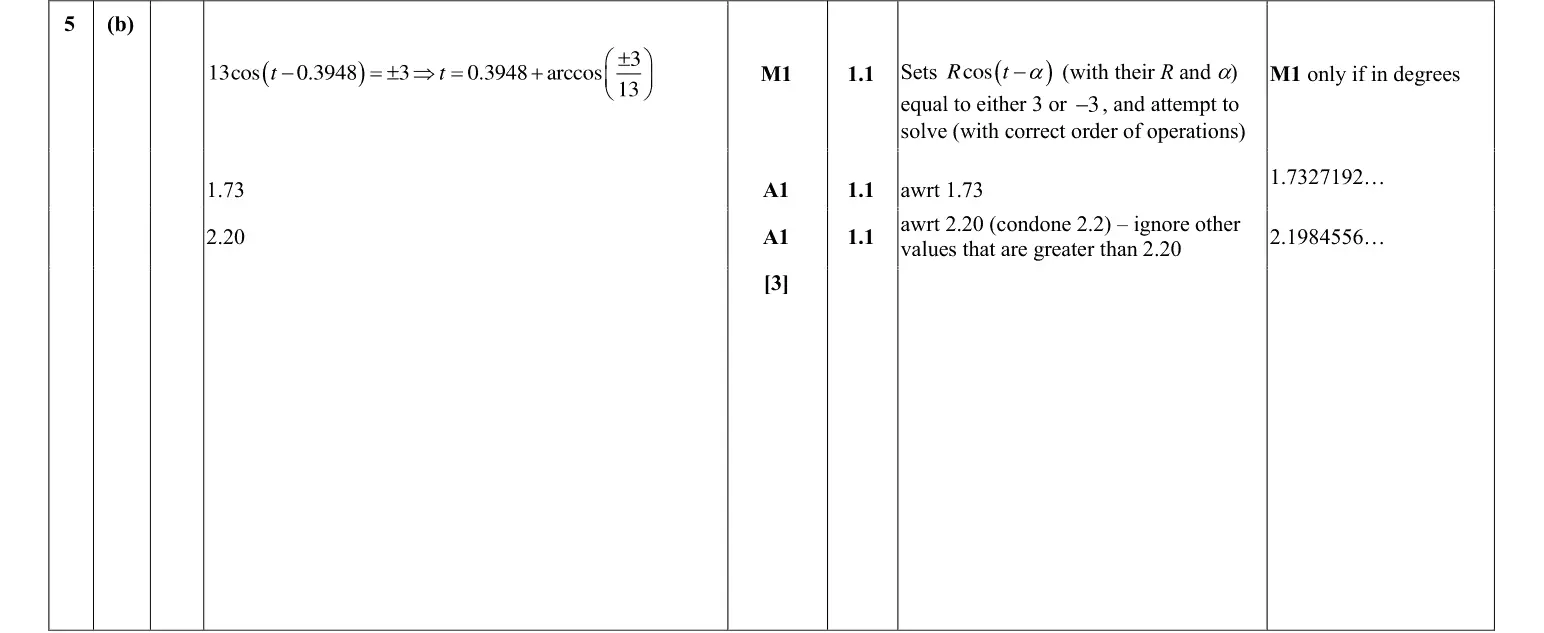
Autumn 2021 · Paper 3 · Q5(b)3 marksMedium
Show the start of this question
Mark scheme for this part
Key points and common errors
speed 3 means v = ±3
13cos(t − 0.3948) = ±3
t = 1.73 and 2.20
work in radians
Autumn 2020 · Paper 1 · Q11(b)4 marksHard
Show the start of this question
Mark scheme for this part
Examiner's comment
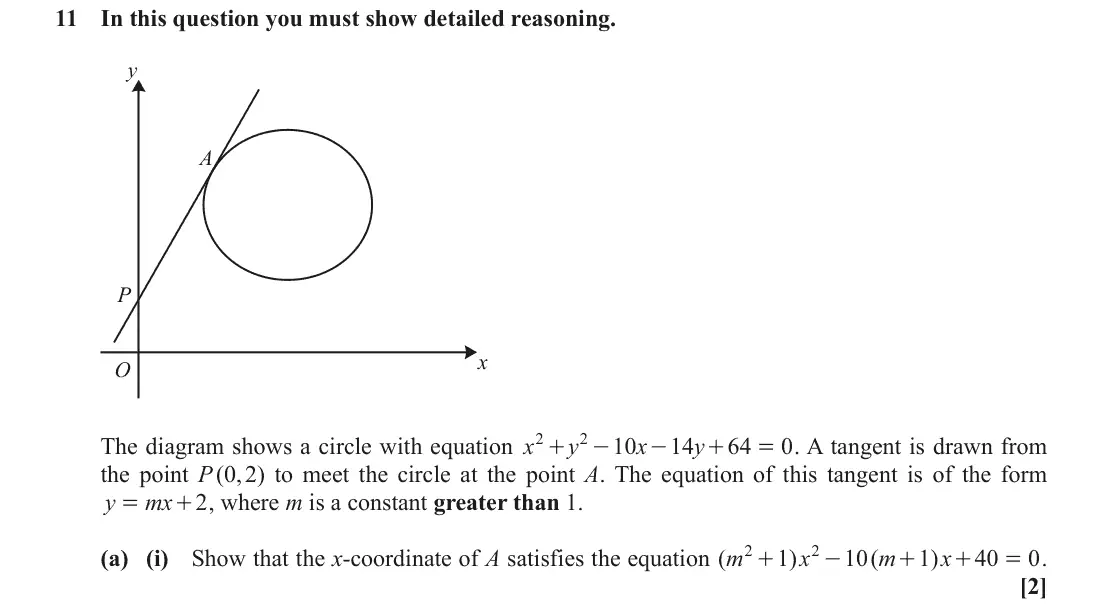
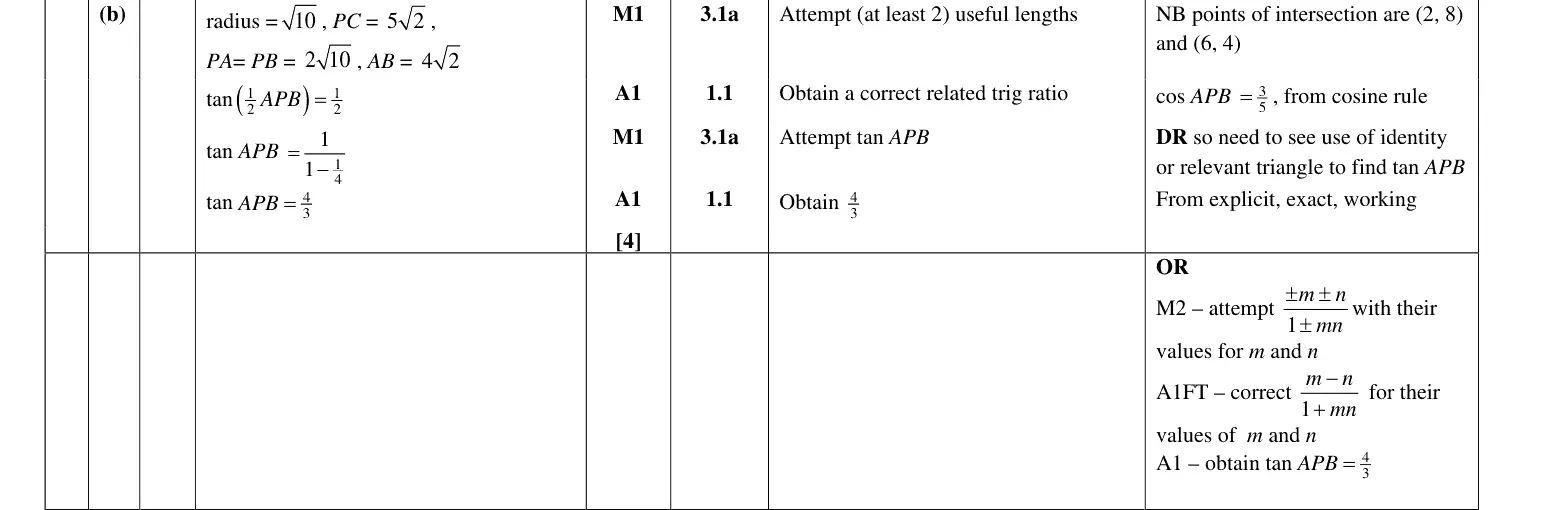
(Comment on Question 11 as a whole) Question 11 was the only ‘In this question you must show detailed reasoning’ question on the paper, and candidates were expected to show a detailed and complete analytical method. Part (a)(i) was generally very well answered, but the remainder of the question proved challenging. Part (ii) is a good example of where candidates have to link different topic areas – they are considering a quadratic equation and the fact that the line is tangential should indicate that the required strategy is to equate the discriminant to 0. Candidates struggled with the non-standard aspect of part (b), although some were able to gain some credit for working out relevant lengths and a relevant trigonometric ratio. Of the few that were so far successful, they were expected to continue to work in exact values to justify the request in the question, which not all candidates appreciated.
Key points and common errors
other tangent has n = ⅓
tan APB = (m − n)/(1 + mn) = 4/3, or use centre (5, 7), radius √10 and half-angle with tan = ½
exact working needed
Autumn 2020 · Paper 2 · Q63 marksEasy
Mark scheme for this part
Examiner's comment
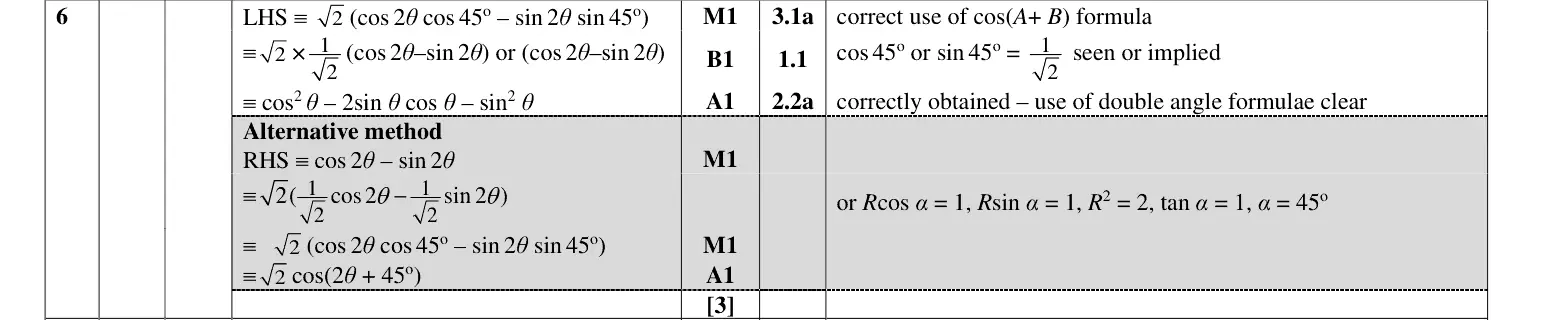
This question was very well answered by most candidates. A few had an incorrect sign in their trigonometric identities, despite these being given on the question paper. A few also did not make use of 1 the fact that cos 45 sin 45 , perhaps not spotting that in this question θ was measured in ° = ° = 2 degrees.
Key points and common errors
expand cos(2θ + 45°) with cos45° = sin45° = 1/√2
then double angle formulae for cos 2θ and sin 2θ
sign errors in the identities
June 2019 · Paper 1 · Q9(a)3 marksEasy
Mark scheme for this part
Examiner's comment
The majority of candidates were familiar with this standard process, gaining all 3 marks with ease. Some candidates did not gain the final mark through giving their angle in degrees and not radians as specified.
Key points and common errors
R = √58, tanα = 7/3, α = 1.17 radians
degrees lose the final mark
June 2019 · Paper 1 · Q9(b)4 marksHard
Show the start of this question
Mark scheme for this part
Examiner's comment
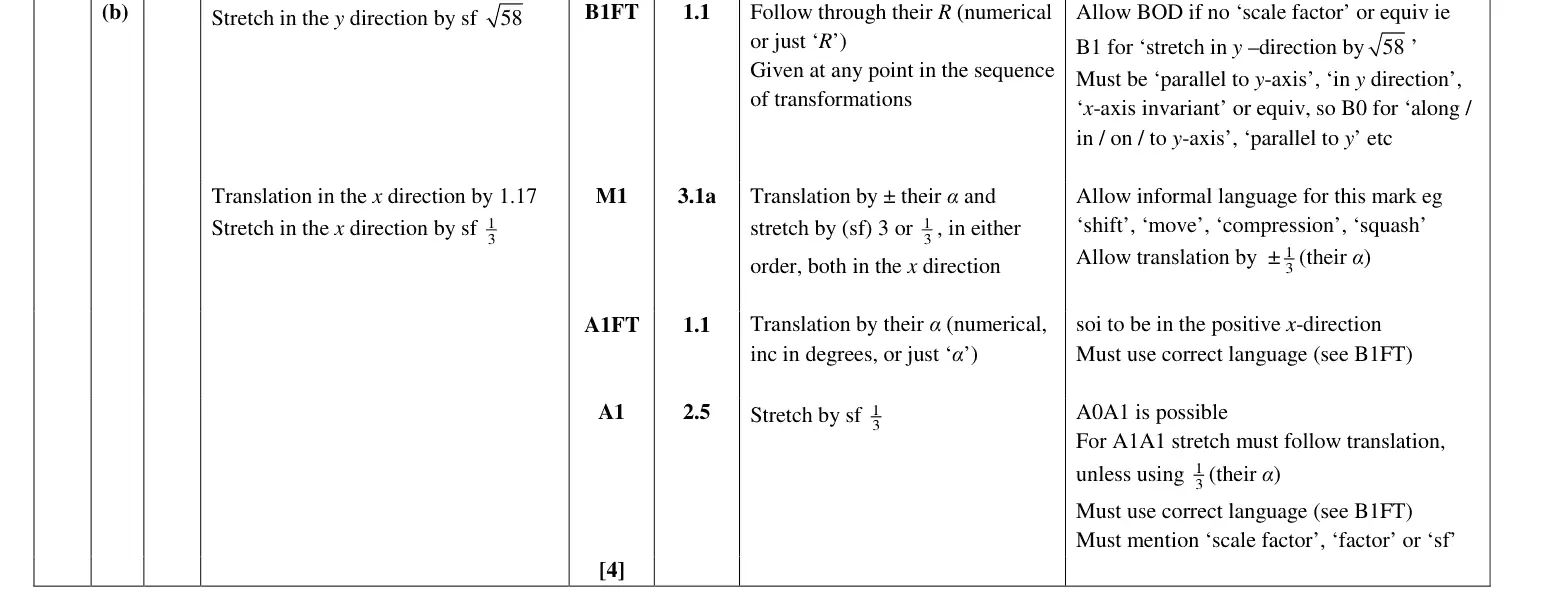
This part of the question proved to be much more challenging, and fully correct solutions were in the minority. Barely a third of the candidates could identify the three transformations and describe them using the correct terminology and only the most able could also give them in the correct order. There were some candidates who could use informal language to convey their intention (such as ‘shift’ and ‘compression’) and other explanations were ambiguous (for example ‘a stretch in the x-axis’). There was however a number of candidates who did not appreciate the link with part (a) and gave descriptions that involved a translation of 7sin3x. Candidates should always consider whether earlier parts of a question have been posed to give them assistance with later parts.
Key points and common errors
stretch parallel to y-axis sf √58
translation 1.17 in the positive x-direction then stretch parallel to x-axis sf 1/3 (order matters)
precise language needed, not 'shift' or 'squash'
June 2019 · Paper 1 · Q9(c)2 marksMedium
Show the start of this question
Mark scheme for this part
Examiner's comment
Candidates were marginally more successful in identifying the greatest value of the function as opposed to the value of x where it occurred. While just writing down the greatest value was condoned, the ‘determine’ instruction meant that some justification was required for the value of x. A surprising number of candidates did not make the link between this part of the question and the form of the function found in part (a), with some resorting to calculus, use of their calculator or simply considering the function term by term. A good example of sufficient justification being given in response to the command word of ‘determine’ in the question.
Key points and common errors
greatest value √58 when 3x − 1.17 = 0, x = 0.389 (radians)
'Determine' needs a method
use (a), not calculus
June 2019 · Paper 1 · Q9(d)2 marksHard
Show the start of this question
Mark scheme for this part
Examiner's comment
This part of the question was less well answered, with the most common error being to assume that the least value of the function was 0 and then giving the associated value of x.
Key points and common errors
least value −√58 when 3x − 1.17 = π, x = 1.44
common error least value 0
June 2018 · Paper 2 · Q44 marksMedium
Mark scheme for this part
Examiner's comment
A large variety of correct methods were seen, some shorter than others. Some candidates made mistakes in quoting formulae, despite the formulae being given on the question paper.
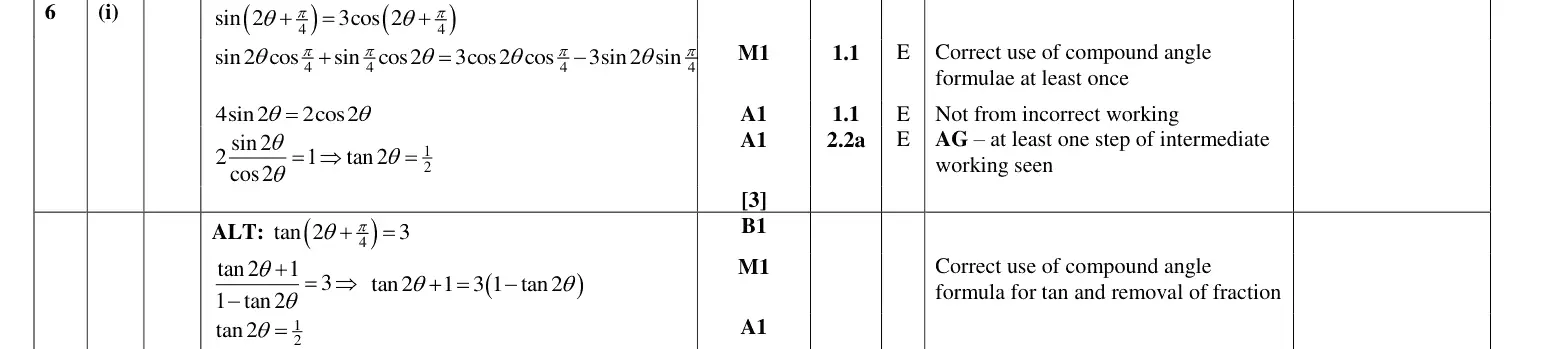
Candidates were equally split in how to tackle this part. Approximately half expanding the brackets π (using the correct compound-angle formulae) while the other half re-wrote as tan 2 θ + = 3 before 4 expanding. Both approaches proved equally successful in obtaining the expected result.
Key points and common errors
expand both sides with compound angle formulae (or tan(2θ + π/4) = 3)
4 sin 2θ = 2 cos 2θ so tan 2θ = ½
June 2018 · Paper 3 · Q6(ii)5 marksMedium
Show the start of this question
Mark scheme for this part
Examiner's comment
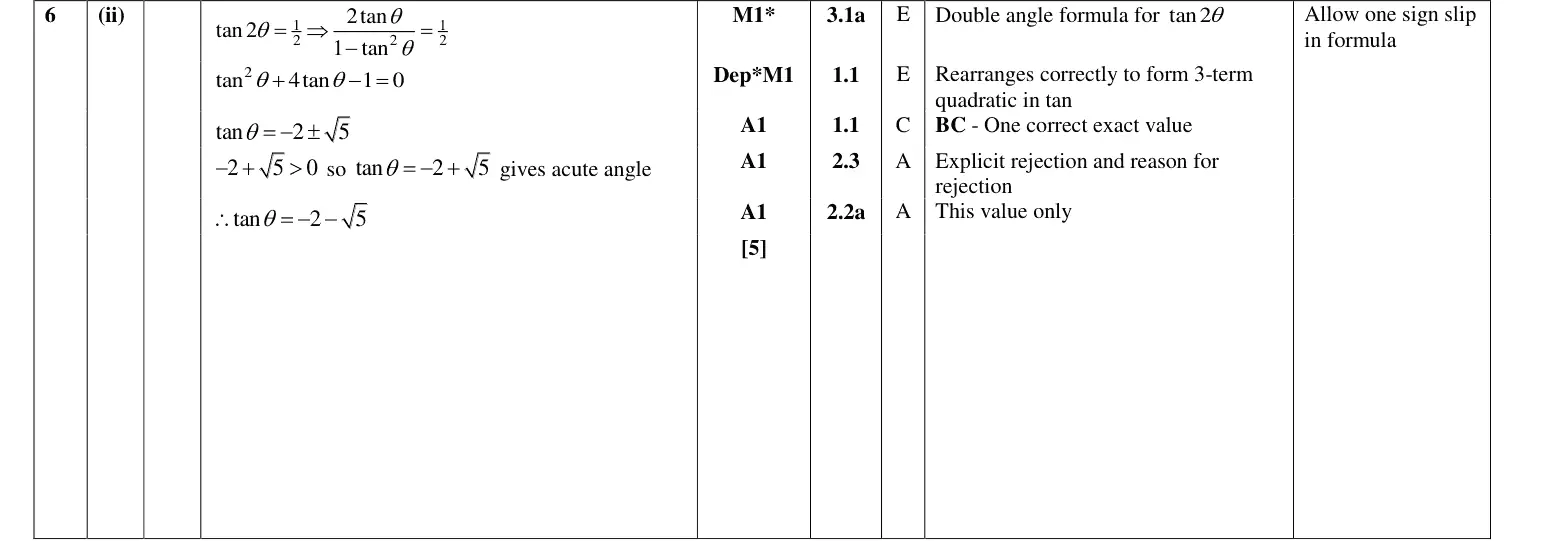
Many candidates did not read the question carefully and began their response by writing − 1 1 2 θ = tan ⇒ θ = ... even though the question specifically asked for the exact value of tan . Of θ 2 tan2 many derived the correct three- θ those candidates that used the correct double-angle formula for term quadratic in tan with most correctly stating that tan θ = −± 2 5.However, a significant proportion ended their response here and did not go on to determine the exact value of tan given that θ is an θ obtuse angle. A full solution needed the explicit realisation that since −+ 2 5 > 0 , tan θ = −+ 2 5 tan θ = −− 2 5. would not give an obtuse angle and therefore the only valid solution was
Key points and common errors
2t/(1 − t²) = ½ gives t² + 4t − 1 = 0
t = −2 ± √5
reject −2 + √5 (θ acute)
tan θ = −2 − √5
must not use inverse tan on a calculator
June 2018 · Paper 3 · Q10(i)4 marksMedium
Mark scheme for this part
Examiner's comment
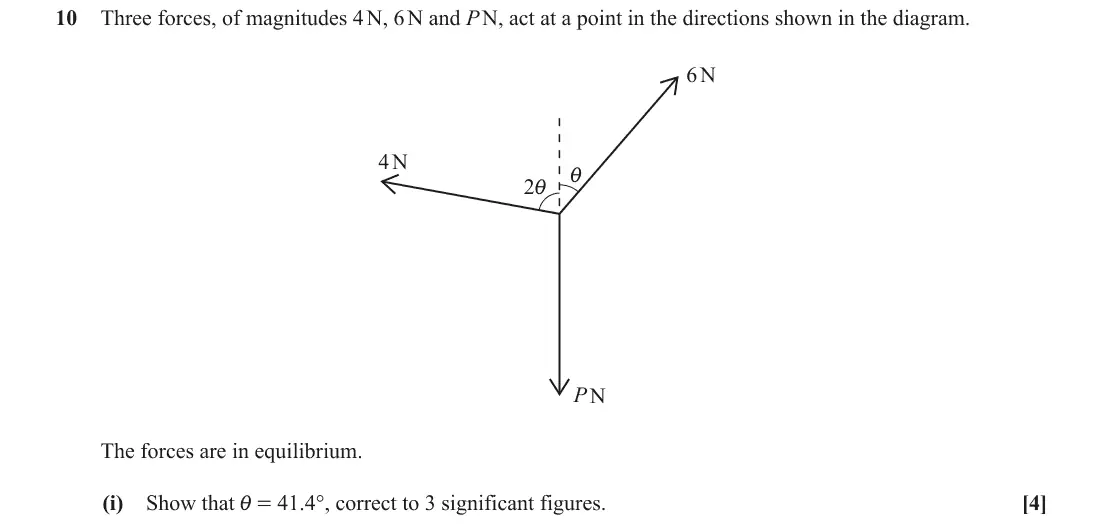
For those candidates who correctly resolve horizontally and stated that 4sin2 θ = 6sin θ most went on to show with sufficient detail the required given answer. The most common errors, as expected, were those that did not deal correctly with the two different angles or those that had the standard confusion with sine and cosine when resolving forces.
Key points and common errors
resolve horizontally: 4 sin 2θ = 6 sin θ
double angle: 8 sin θ cos θ = 6 sin θ so cos θ = 3/4
θ = 41.4°
sin/cos confusion and mixing the two angles
Find an A-level maths tutor
Stuck on this? Book a trial session with an A-level maths tutor.