Oct 2020: Paper 1: Pure Mathematics 1

100 marks · 32 question parts · Question paper, mark scheme and examiner's report on Pearson's site

Question by question

QTopicMarksDifficulty
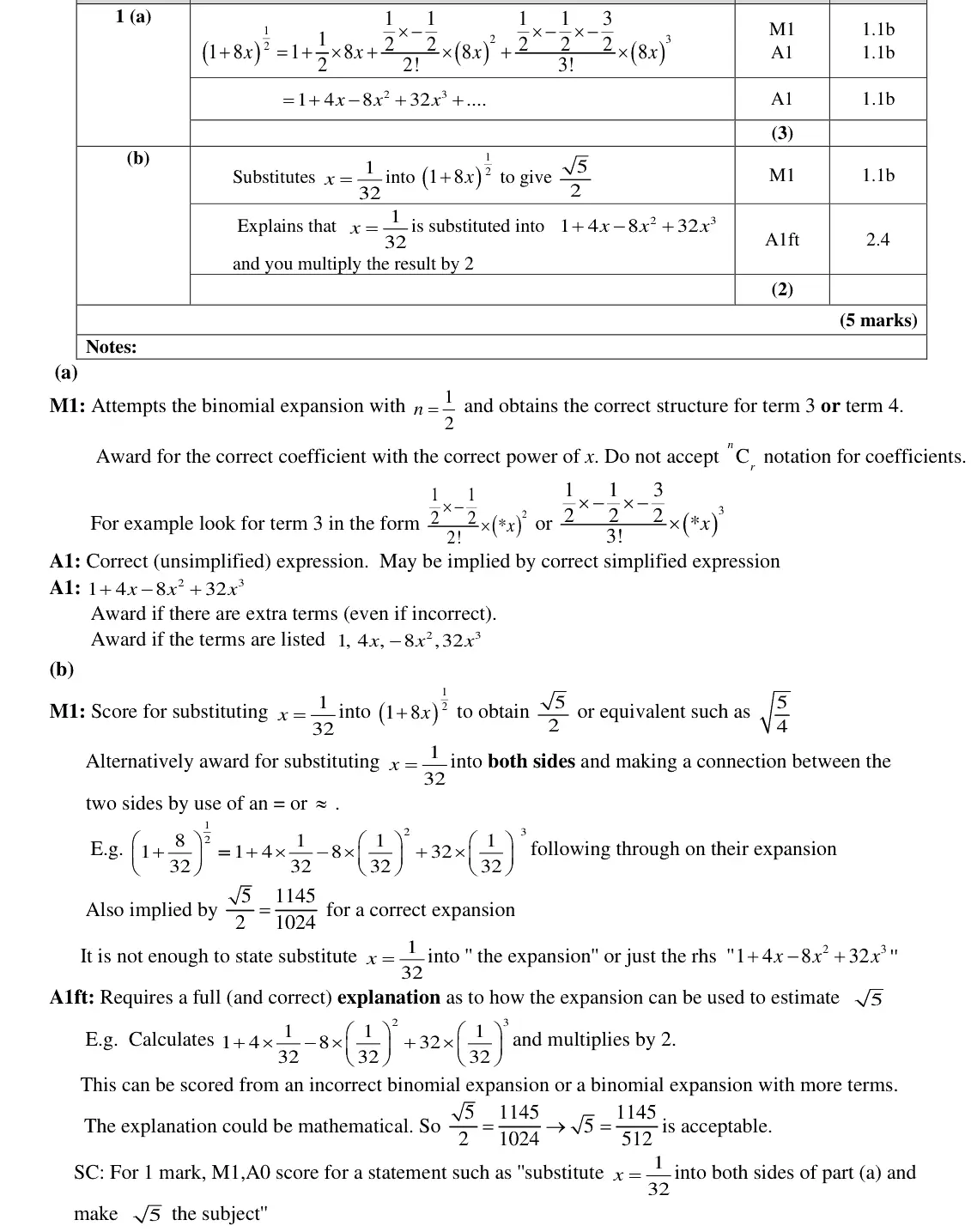
1(a) Binomial expansion 3 —
1(b) Binomial expansion, Indices and surds 2 —
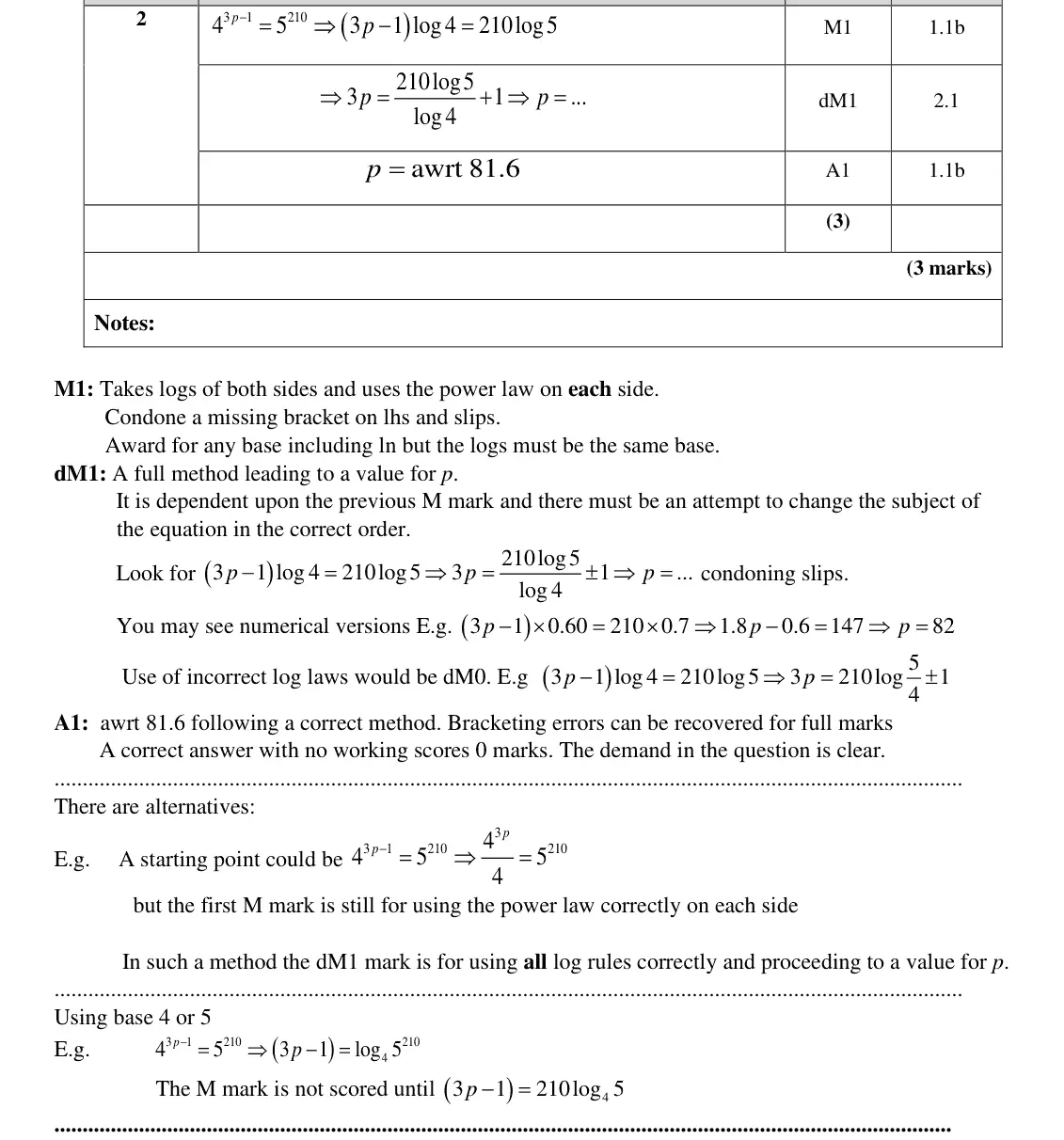
2 Exponentials and logarithms 3 —
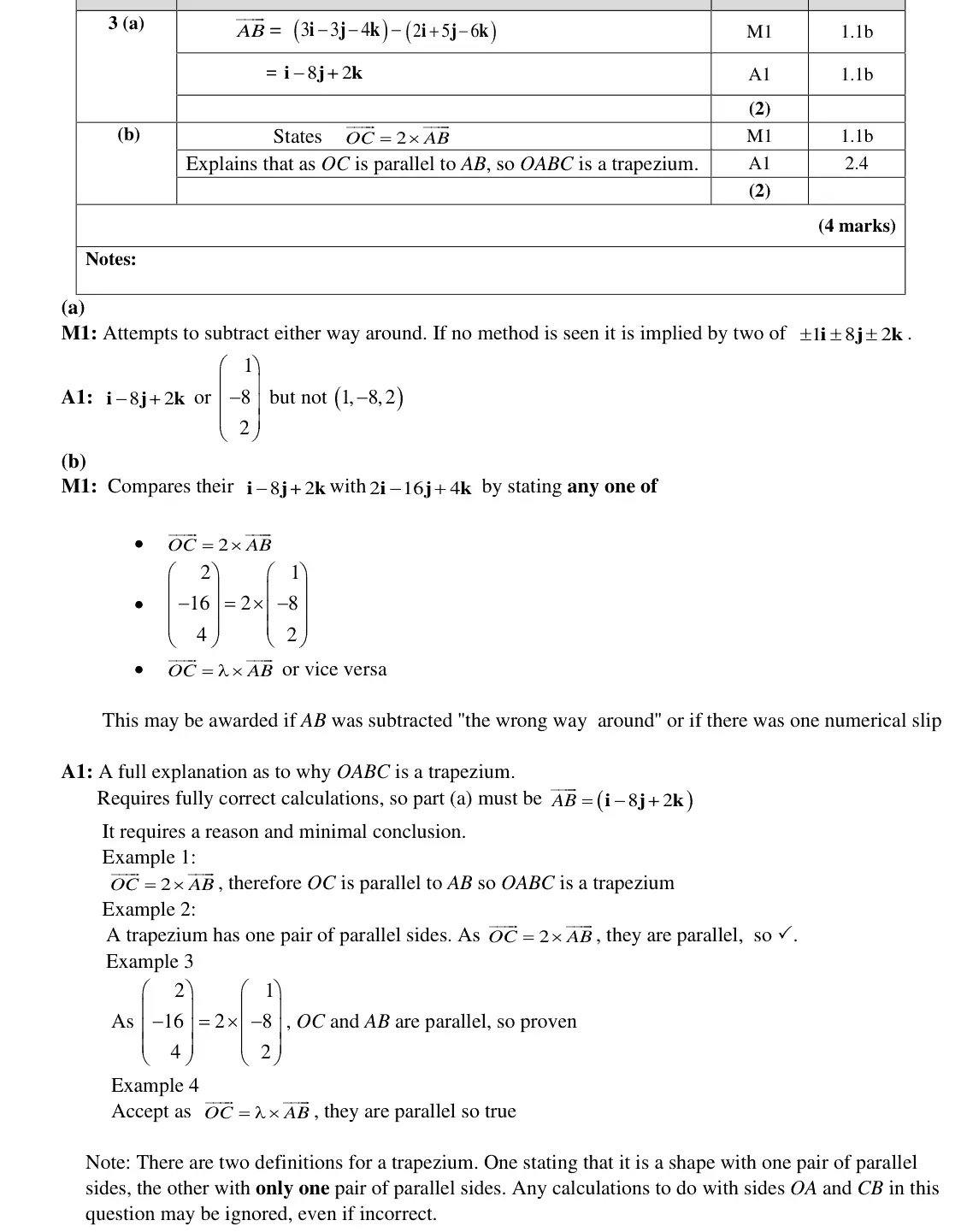
3(a) Vectors 2 —
3(b) Vectors 2 —
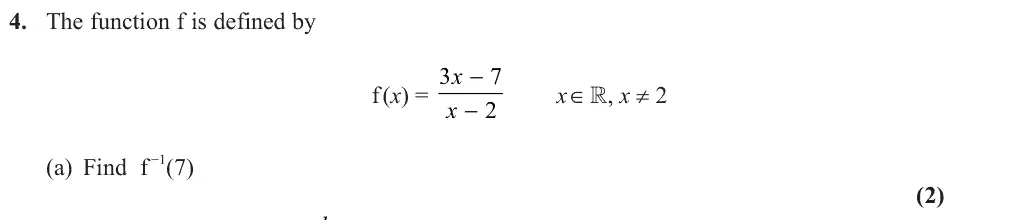
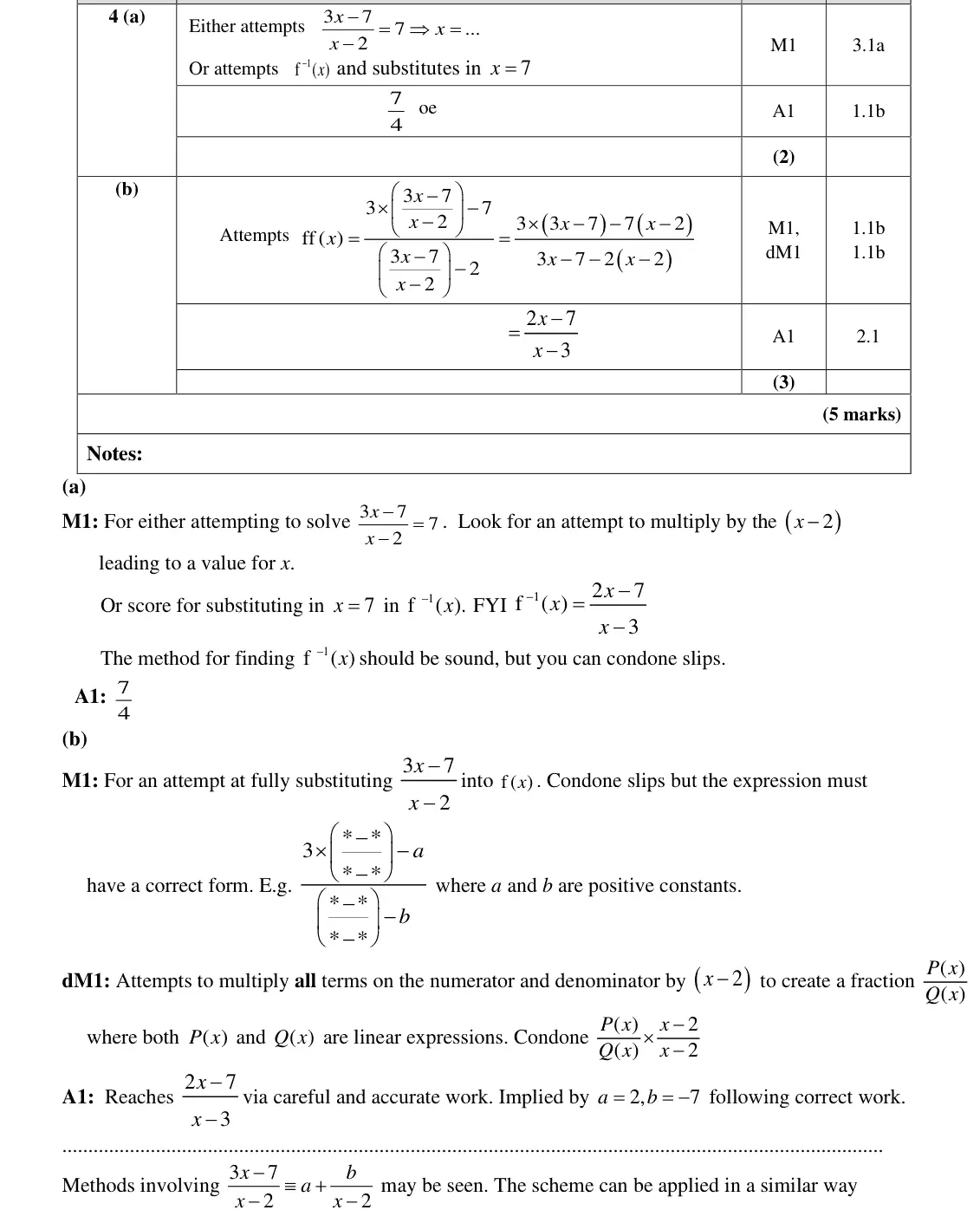
4(a) Functions, composite and inverse functions, modulus 2 —
4(b) Functions, composite and inverse functions, modulus, Algebraic methods: polynomials, factor theorem and division 3 —
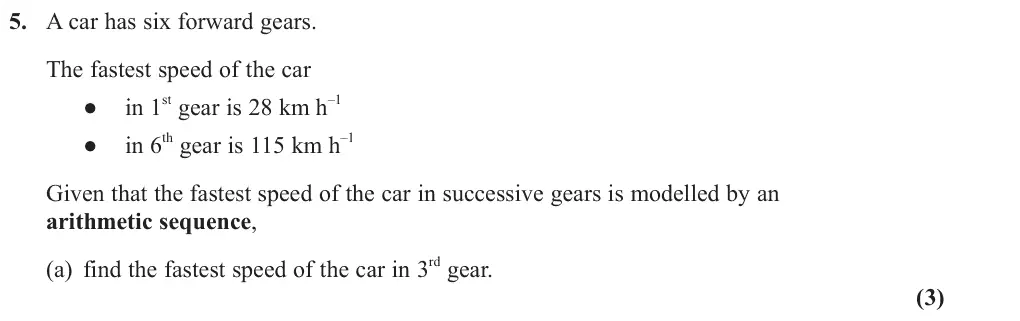
5(a) Sequences and series 3 —
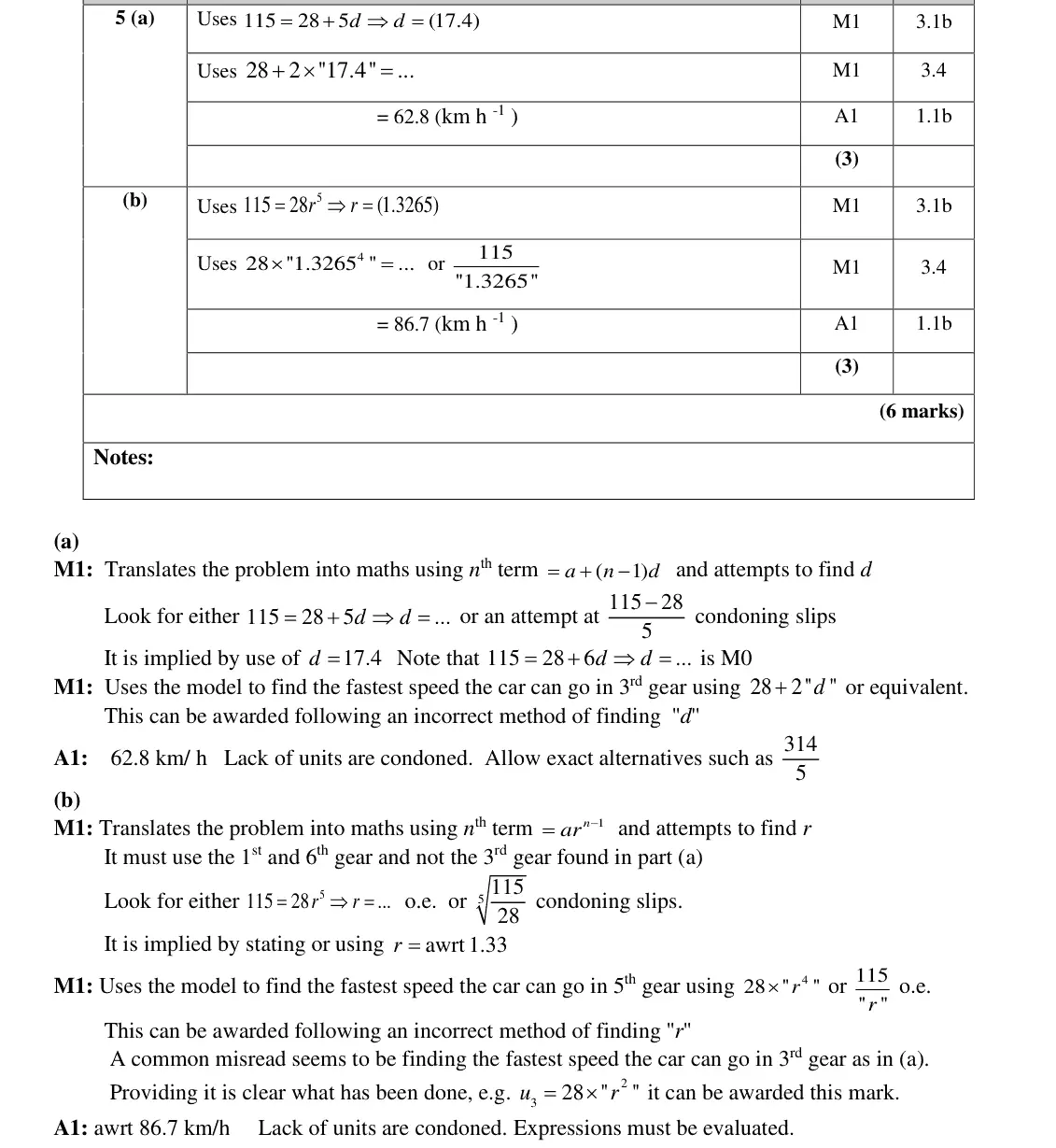
5(b) Sequences and series 3 —
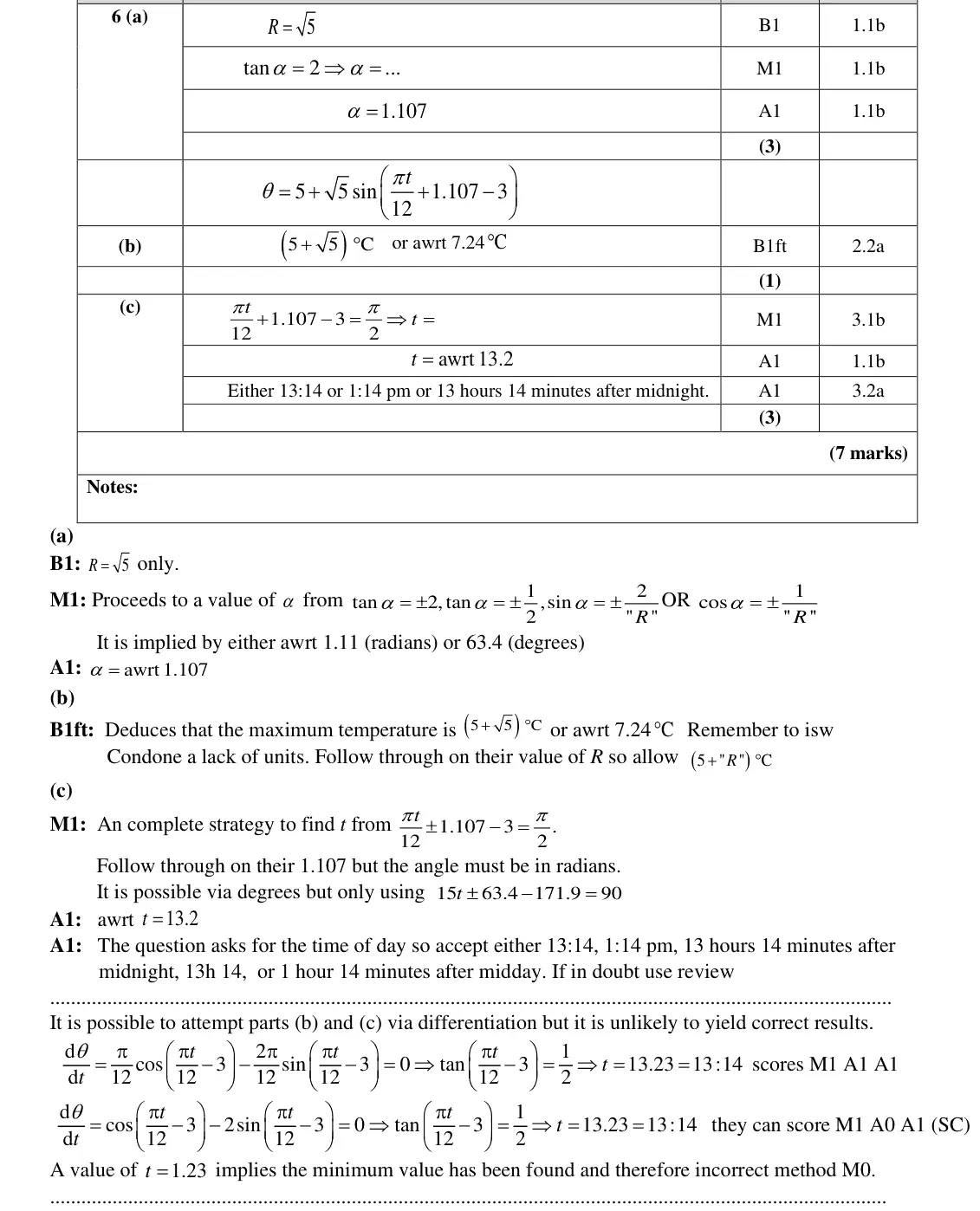
6(a) Addition and double-angle formulae, harmonic form 3 —
6(b) Trigonometric modelling, Addition and double-angle formulae, harmonic form, Trigonometric ratios, graphs, radians and the sine and cosine rules 1 —
6(c) Trigonometric modelling, Solving trigonometric equations 3 —
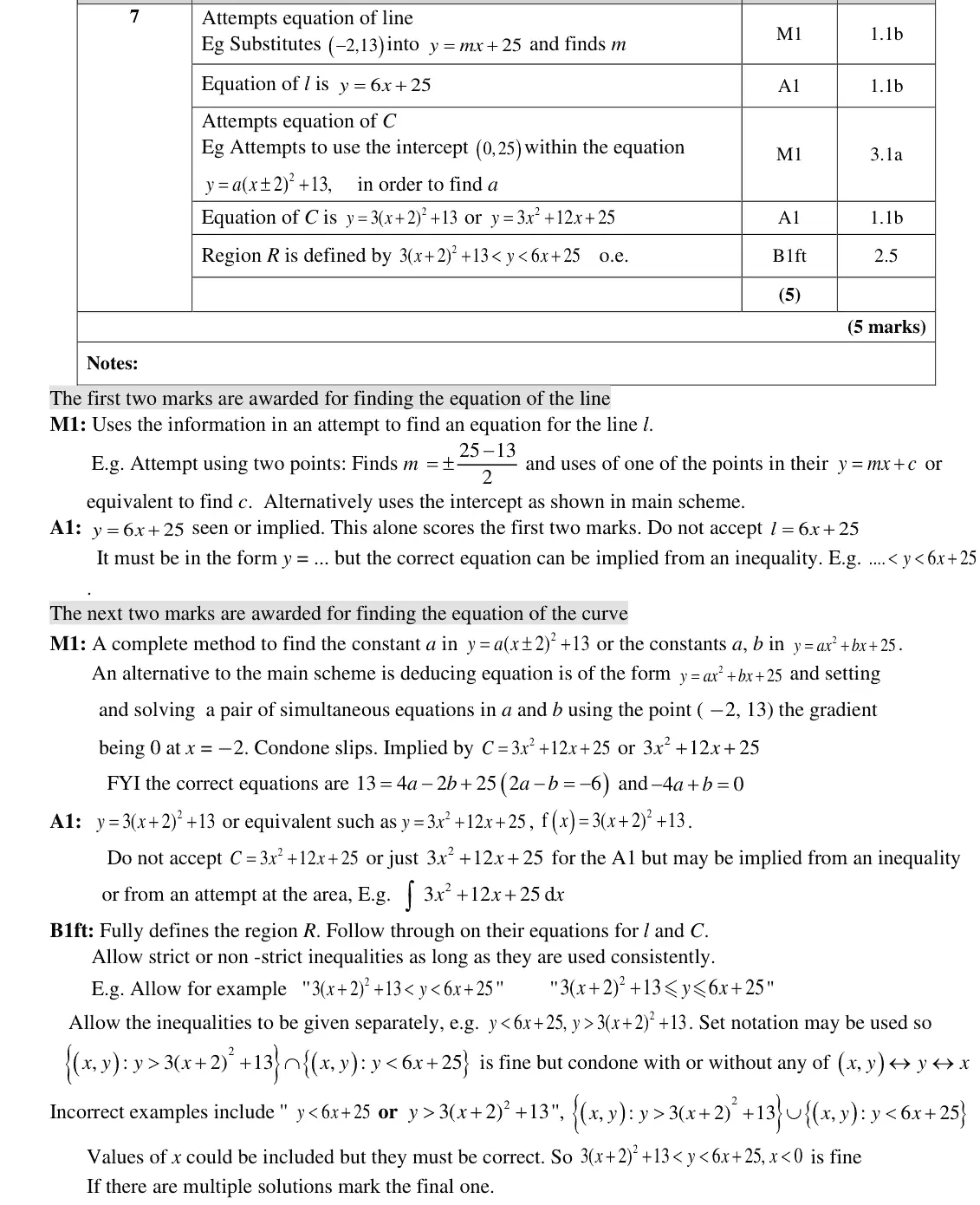
7 Inequalities, Quadratics and the discriminant, Straight lines 5 —
8 Exponentials and logarithms, Exponential growth, decay and modelling, Differential equations 2 —
9(a) Chain, product and quotient rules; connected rates of change, Differentiation: first principles, gradients, stationary points 3 —
9(b) Differentiation: first principles, gradients, stationary points, Quadratics and the discriminant, Exponentials and logarithms 3 —
9(c) Functions, composite and inverse functions, modulus, Graphs and transformations, Differentiation: first principles, gradients, stationary points 3 —
10(a) Integration by parts and by substitution 4 —
10(b) Partial fractions, Exponentials and logarithms 6 —
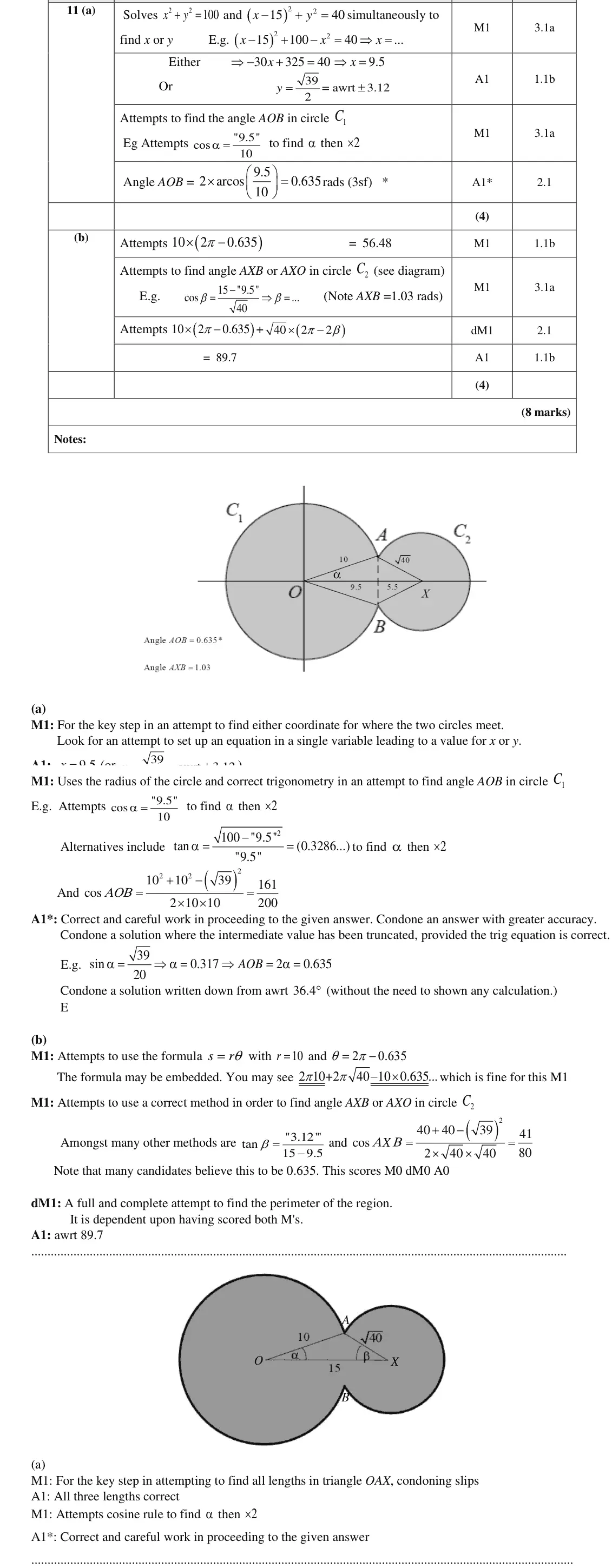
11(a) Trigonometric ratios, graphs, radians and the sine and cosine rules, Simultaneous equations, Circles 4 —
11(b) Trigonometric ratios, graphs, radians and the sine and cosine rules, Circles 4 —
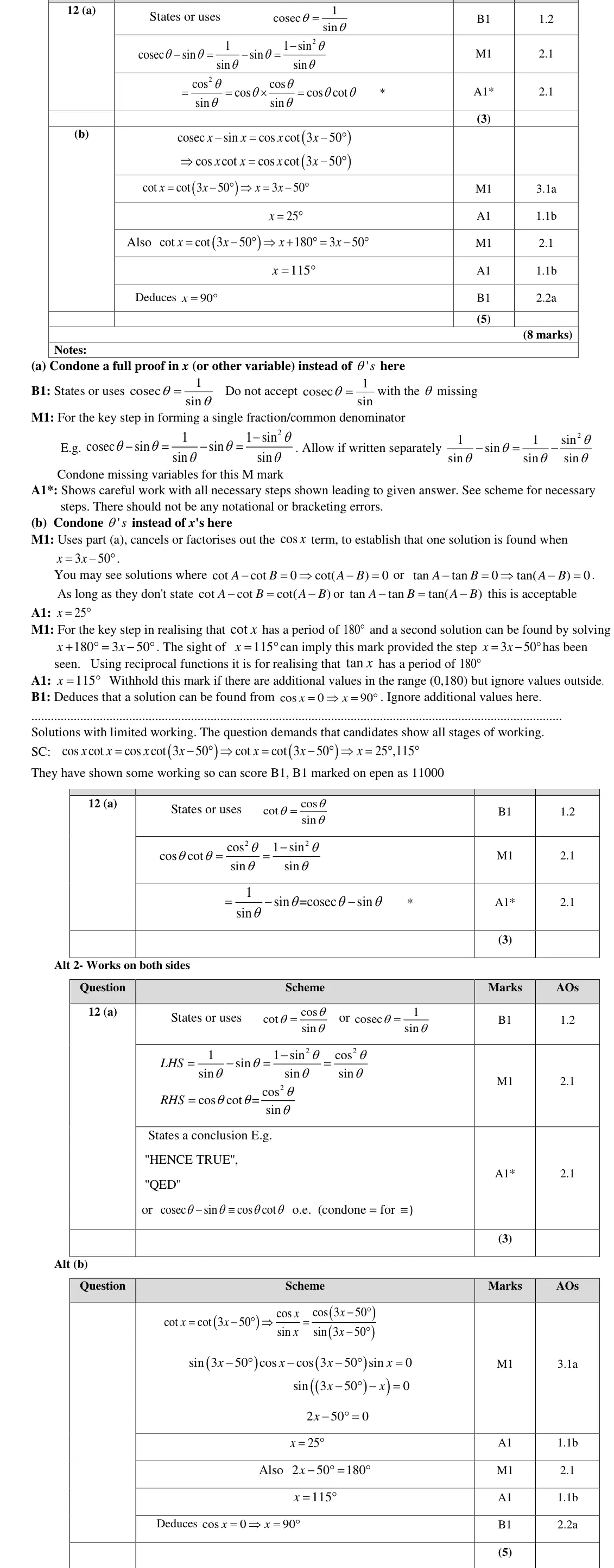
12(a) Trigonometric identities and proofs, Reciprocal and inverse trigonometric functions 3 —
12(b) Solving trigonometric equations, Trigonometric ratios, graphs, radians and the sine and cosine rules, Reciprocal and inverse trigonometric functions 5 —
13(a) Sequences and series, Algebraic methods: polynomials, factor theorem and division 3 —
13(b) Sequences and series 1 —
13(c) Sequences and series, Quadratics and the discriminant 3 —
14(a) Chain, product and quotient rules; connected rates of change, Differential equations 3 —
14(b) Differential equations 5 —
14(c) Differential equations 2 —
15(a) Implicit and parametric differentiation, Trigonometric identities and proofs, Reciprocal and inverse trigonometric functions, Chain, product and quotient rules; connected rates of change 4 —
15(b) Differentiation: first principles, gradients, stationary points, Chain, product and quotient rules; connected rates of change 3 —
16 Proof, including contradiction, Simultaneous equations, Algebraic methods: polynomials, factor theorem and division 4 —

The questions

1(a)1(b)23(a)3(b)4(a)4(b)5(a)5(b)6(a)6(b)6(c)789(a)9(b)9(c)10(a)10(b)11(a)11(b)12(a)12(b)13(a)13(b)13(c)14(a)14(b)14(c)15(a)15(b)16
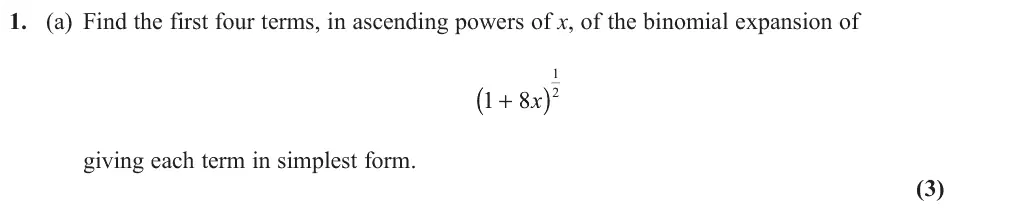
Oct 2020 · Paper 1 · Q1(a) 3 marks binomial expansion
1. (a) Find the first four terms, in ascending powers of x, of the binomial expansion of ( ) + x giving each term in simplest form. (3)
Oct 2020 · Paper 1 · Q1(b) 2 marks binomial expansionindices and surds
(b) Explain how you could use x = 1 32 in the expansion to find an approximation for There is no need to carry out the calculation. (2)
Oct 2020 · Paper 1 · Q2 3 marks exponentials and logs
2. By taking logarithms of both sides, solve the equation 43 p -1 = 5210 giving the value of p to one decimal place. (3)
Oct 2020 · Paper 1 · Q3(a) 2 marks vectors
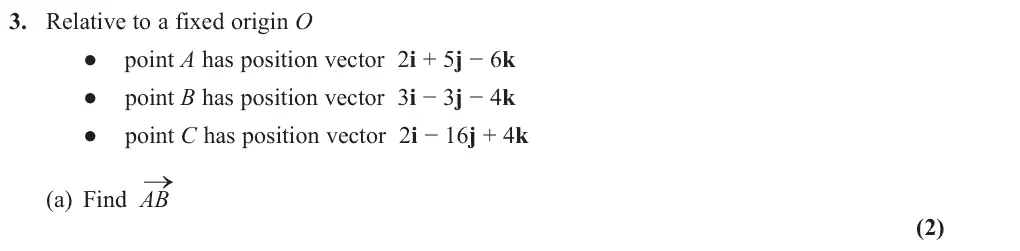
3. Relative to a fixed origin O ● point A has position vector 2i + 5j - 6k ● point B has position vector 3i - 3j - 4k ● point C has position vector 2i - 16j + 4k → (a) Find AB (2)
Oct 2020 · Paper 1 · Q3(b) 2 marks vectors
(b) Show that quadrilateral OABC is a trapezium, giving reasons for your answer. (2)
Oct 2020 · Paper 1 · Q4(a) 2 marks functions
4. The function f is defined by x - f (x) = 3 x , x ≠ 2 x - (a) Find f -1(7) (2)
Oct 2020 · Paper 1 · Q4(b) 3 marks functionsalgebraic methods
(b) Show that ff (x) = ax + b -3 where a and b are integers to be found. x (3)
Oct 2020 · Paper 1 · Q5(a) 3 marks sequences and series
5. A car has six forward gears. The fastest speed of the car ● in 1st gear is 28 km h–1 ● in 6th gear is 115 km h–1 Given that the fastest speed of the car in successive gears is modelled by an arithmetic sequence, (a) find the fastest speed of the car in 3rd gear. (3)
Oct 2020 · Paper 1 · Q5(b) 3 marks sequences and series
Given that the fastest speed of the car in successive gears is modelled by a geometric sequence, (b) find the fastest speed of the car in 5th gear. (3)
Oct 2020 · Paper 1 · Q6(a) 3 marks double angle formulae
6. (a) Express sin x + 2 cos x in the form R sin (x + alpha ) where R and alpha are constants, R > 0 pi and 0 < alpha < 2 Give the exact value of R and give the value of alpha in radians to 3 decimal places. (3)
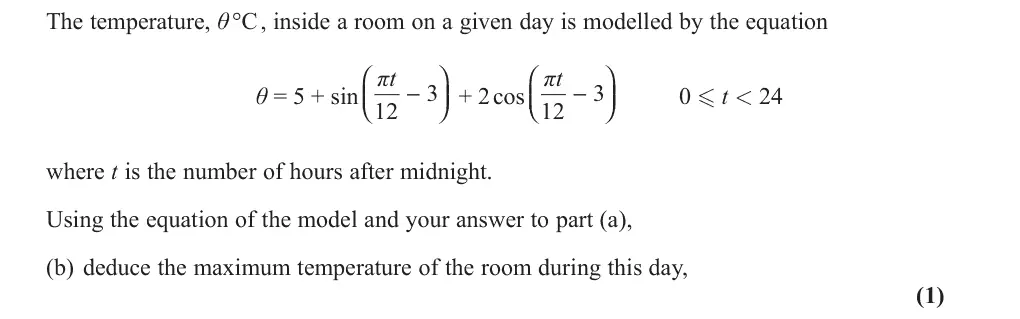
The temperature, theta °C , inside a room on a given day is modelled by the equation pi t pi t - - 0 t < 24 theta = 5 + sin + 2 cos where t is the number of hours after midnight. Using the equation of the model and your answer to part (a), (b) deduce the maximum temperature of the room during this day, (1)
Oct 2020 · Paper 1 · Q6(c) 3 marks trigonometric modellingtrigonometric equations
(c) find the time of day when the maximum temperature occurs, giving your answer to the nearest minute. (3)
Oct 2020 · Paper 1 · Q7 5 marks inequalitiesquadraticsstraight lines
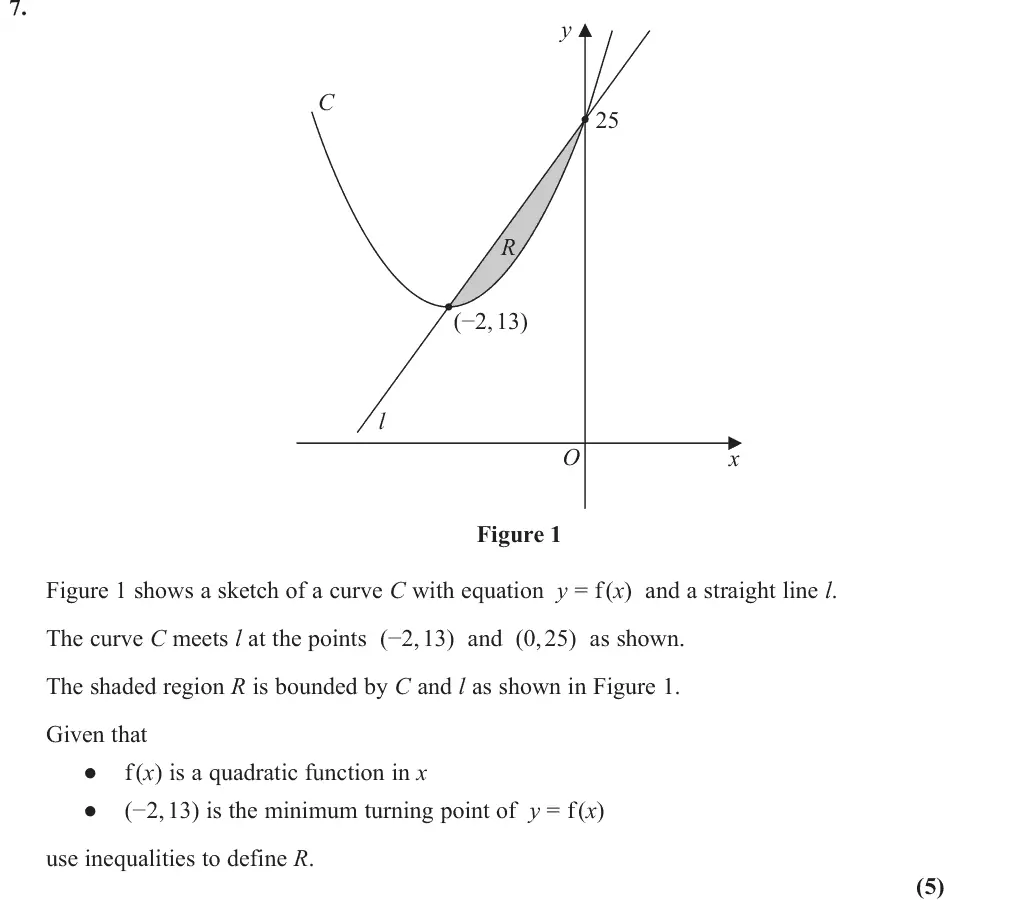
7. y C R (-2, 13) l x Figure 1 Figure 1 shows a sketch of a curve C with equation y = f (x) and a straight line l. The curve C meets l at the points (-2, 13) and (0, 25) as shown. The shaded region R is bounded by C and l as shown in Figure 1. Given that ● f (x) is a quadratic function in x ● (-2, 13) is the minimum turning point of y = f (x) use inequalities to define R. (5)
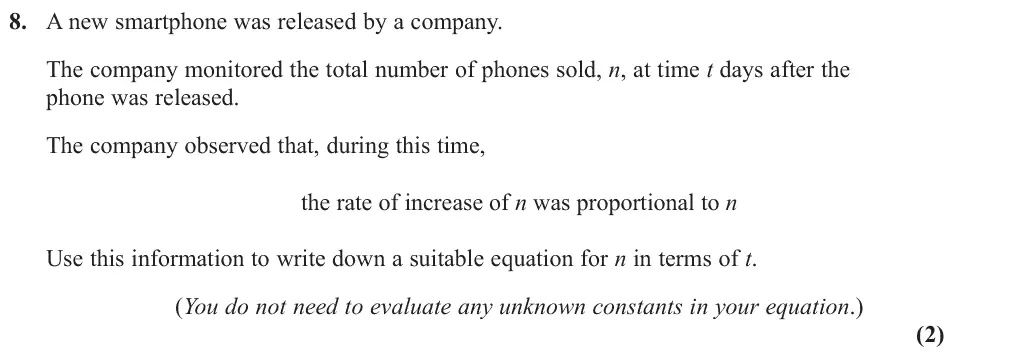
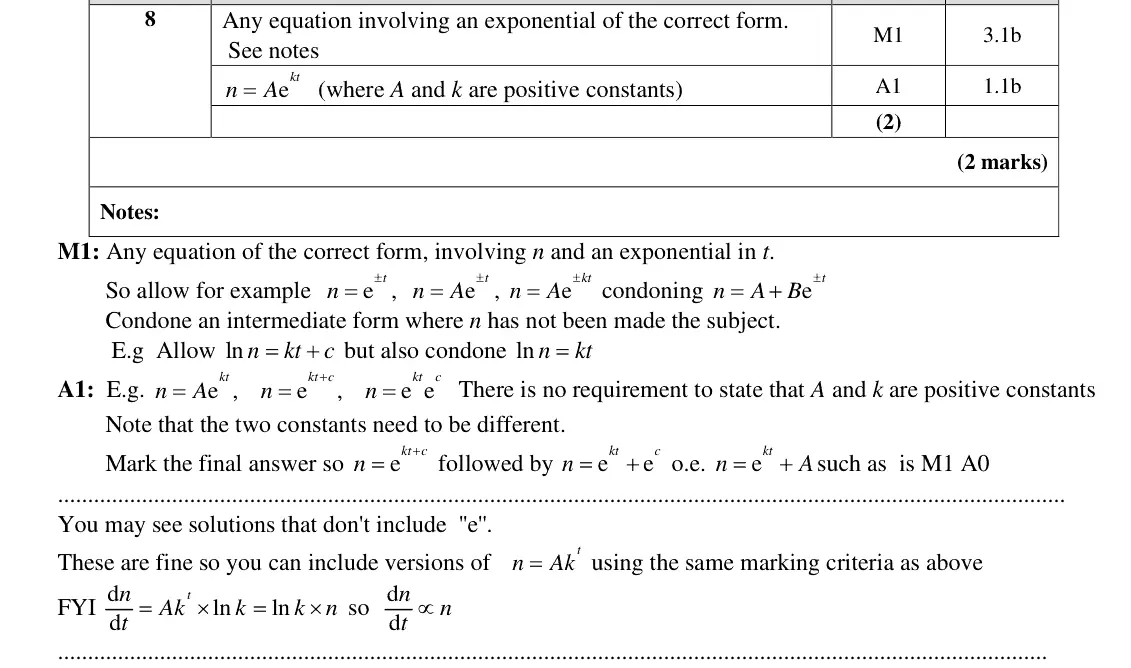
8. A new smartphone was released by a company. The company monitored the total number of phones sold, n, at time t days after the phone was released. The company observed that, during this time, the rate of increase of n was proportional to n Use this information to write down a suitable equation for n in terms of t. (You do not need to evaluate any unknown constants in your equation.) (2)
Oct 2020 · Paper 1 · Q9(a) 3 marks differentiation rulesdifferentiation
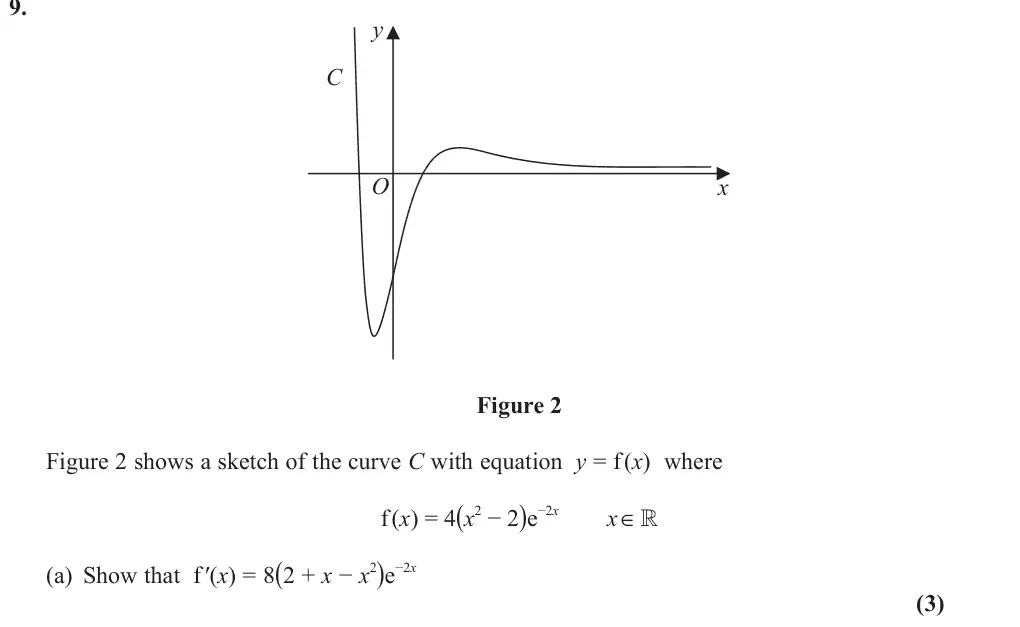
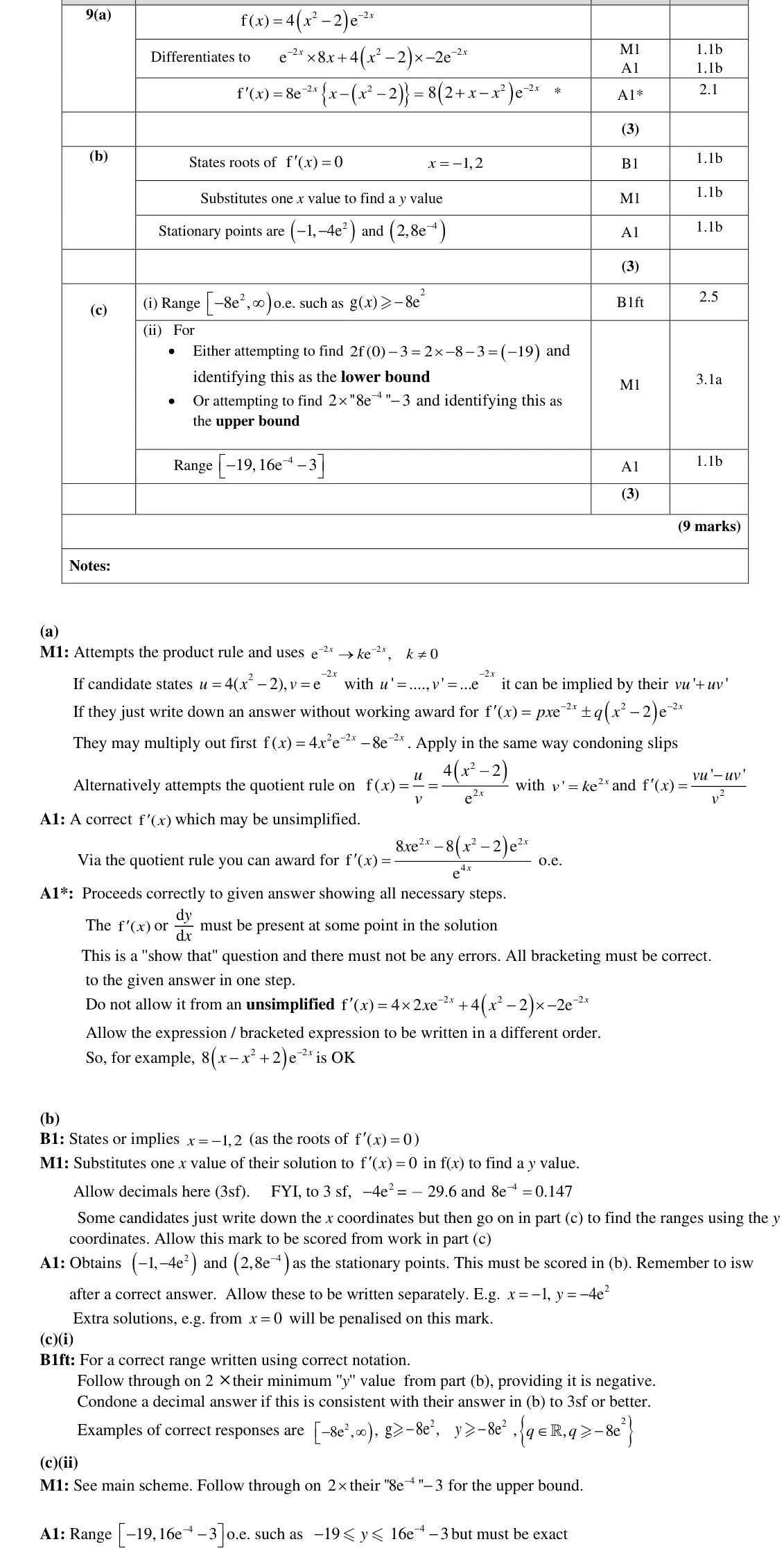
9. y C x Figure 2 Figure 2 shows a sketch of the curve C with equation y = f (x) where f (x) = 4(x2 - 2)e-2x x (a) Show that f ʹ(x) = 8(2 + x - x2)e-2x (3)
Oct 2020 · Paper 1 · Q9(b) 3 marks differentiationquadraticsexponentials and logs
(b) Hence find, in simplest form, the exact coordinates of the stationary points of C. (3)
Oct 2020 · Paper 1 · Q9(c) 3 marks functionsgraphs and transformationsdifferentiation
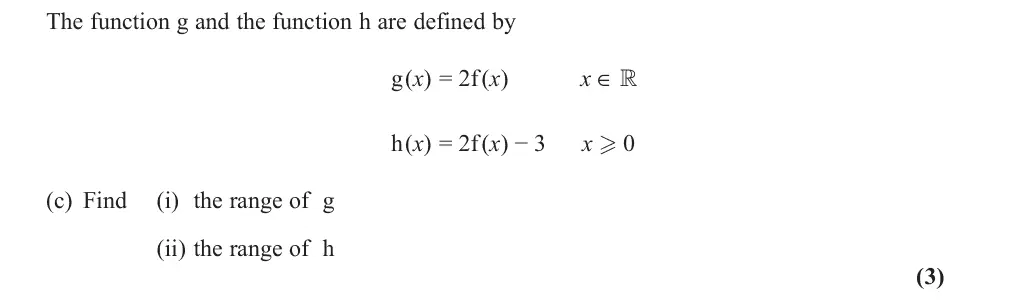
The function g and the function h are defined by g (x) = 2f (x) x h (x) = 2f (x) - 3 x 0 (c) Find (i) the range of g (ii) the range of h (3)
Oct 2020 · Paper 1 · Q10(a) 4 marks integration by parts and substitution
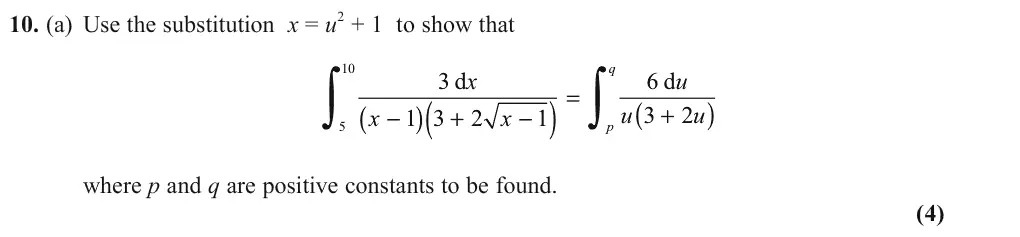
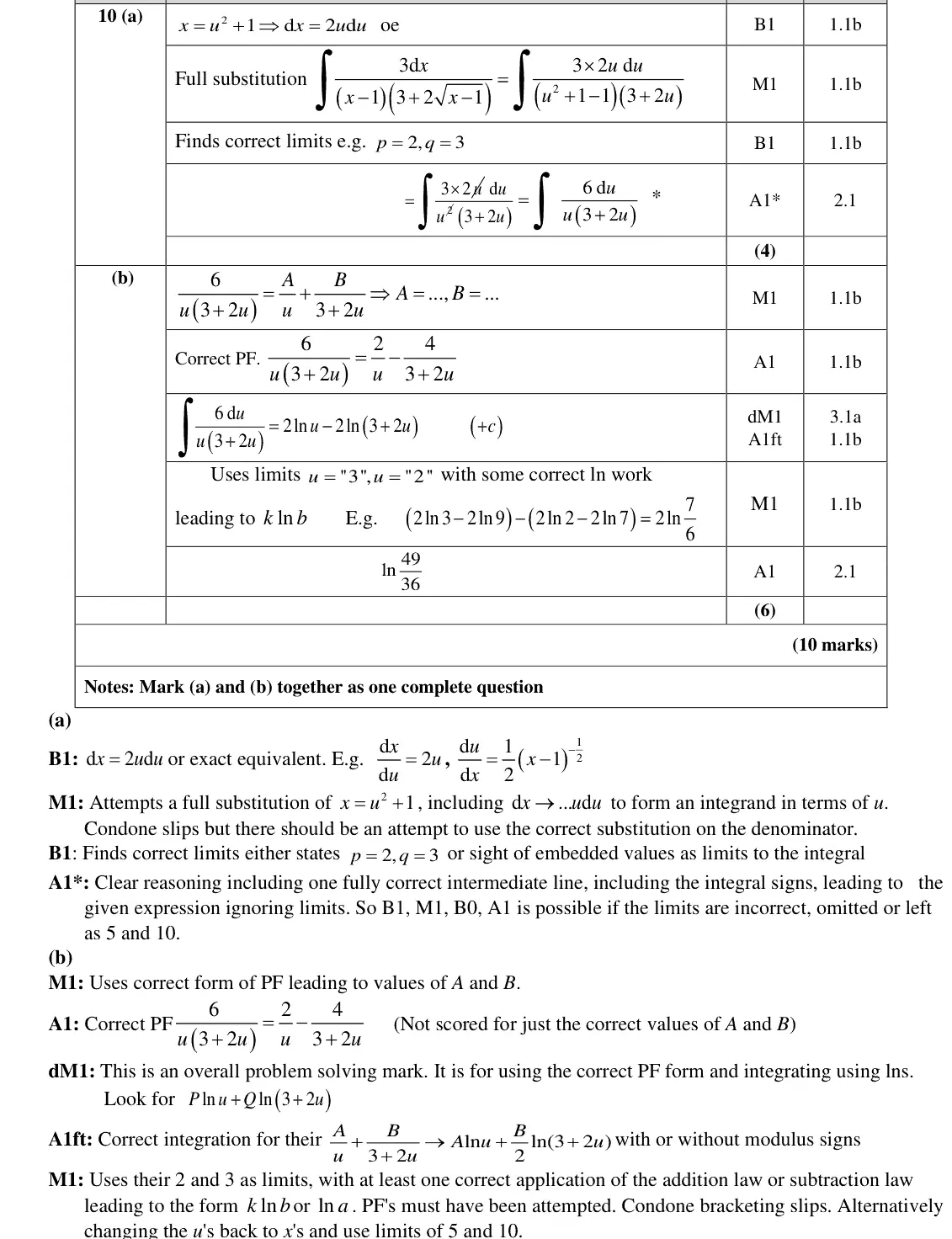
10. (a) Use the substitution x = u2 + 1 to show that q ∫ ∫ x u d d = ( ) ( ) ( ) u + u x x - + - 1 3 p where p and q are positive constants to be found. (4)
Oct 2020 · Paper 1 · Q10(b) 6 marks partial fractionsexponentials and logs
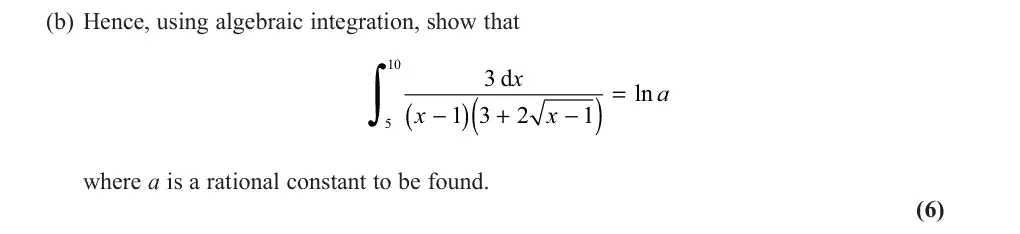
(b) Hence, using algebraic integration, show that ∫ dx = a ( ) ln ( ) x - + x - 1 3 where a is a rational constant to be found. (6)
Oct 2020 · Paper 1 · Q11(a) 4 marks trigonometric ratiossimultaneous equationscircles
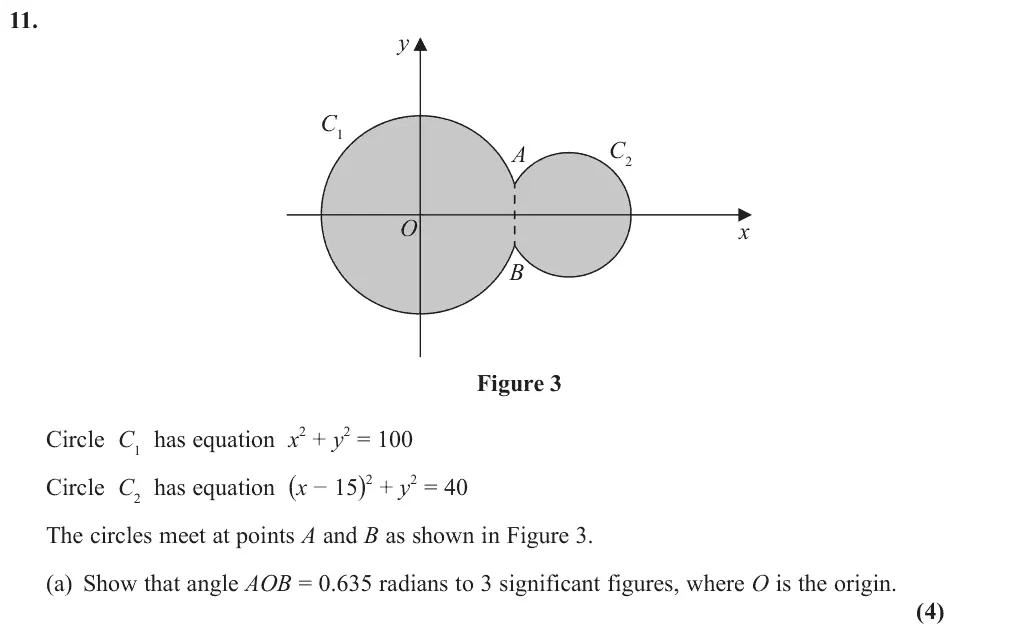
11. y C1 C2 A x B Figure 3 Circle C1 has equation x2 + y2 = 100 Circle C2 has equation (x - 15)2 + y2 = 40 The circles meet at points A and B as shown in Figure 3. (a) Show that angle AOB = 0.635 radians to 3 significant figures, where O is the origin. (4)
Oct 2020 · Paper 1 · Q11(b) 4 marks trigonometric ratioscircles
The region shown shaded in Figure 3 is bounded by C1 and C2 (b) Find the perimeter of the shaded region, giving your answer to one decimal place. (4)
Oct 2020 · Paper 1 · Q12(a) 3 marks trig identitiesreciprocal trig functions
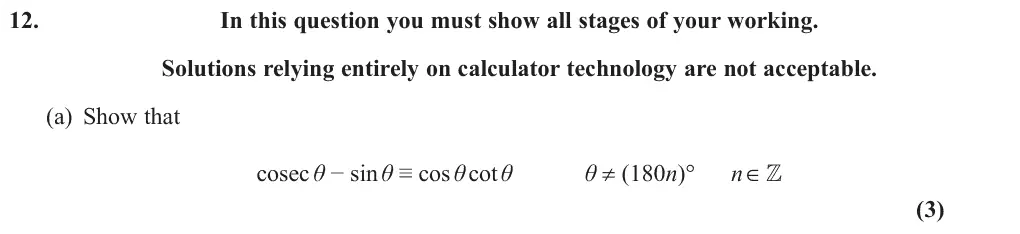
12. In this question you must show all stages of your working. Solutions relying entirely on calculator technology are not acceptable. (a) Show that cosec theta - sin theta ≡ cos theta cot theta theta ≠ (180n)° n (3)
(b) Hence, or otherwise, solve for 0 < x < 180° cosec x - sin x = cos x cot (3x - 50°) (5)
Oct 2020 · Paper 1 · Q13(a) 3 marks sequences and seriesalgebraic methods
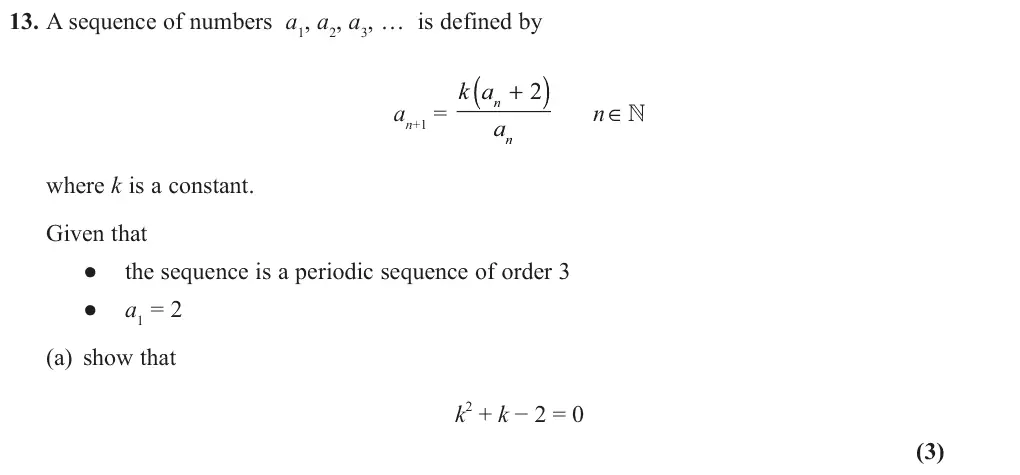
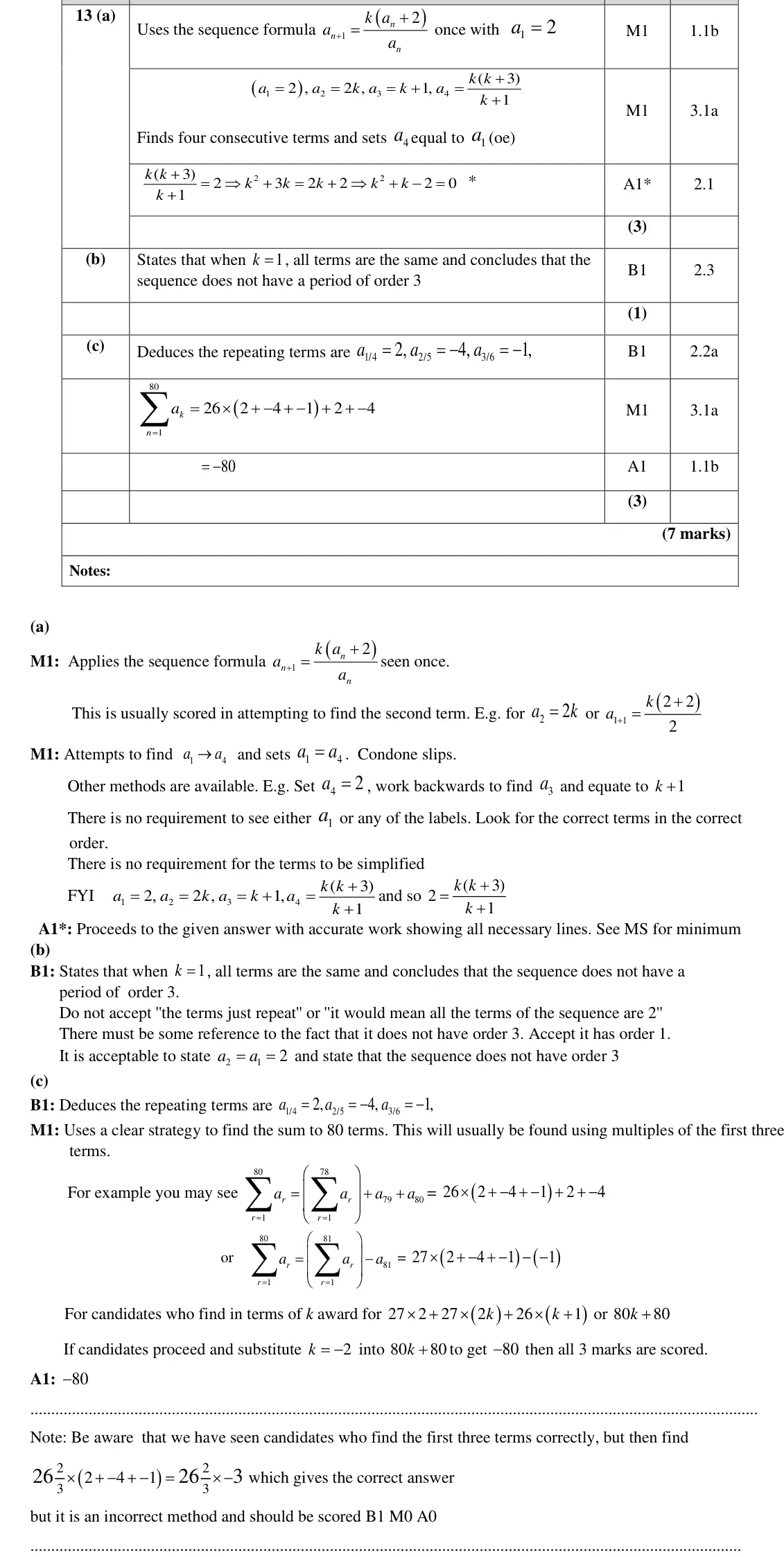
13. A sequence of numbers a1, a2, a3, … is defined by ( ) k a + n n an+1 = a n where k is a constant. Given that ● the sequence is a periodic sequence of order 3 ● a1 = 2 (a) show that k2 + k - 2 = 0 (3)
Oct 2020 · Paper 1 · Q13(b) 1 mark sequences and series
(b) For this sequence explain why k ≠ 1 (1)
Oct 2020 · Paper 1 · Q13(c) 3 marks sequences and seriesquadratics
(c) Find the value of r=∑ ar (3)
Oct 2020 · Paper 1 · Q14(a) 3 marks differentiation rulesdifferential equations
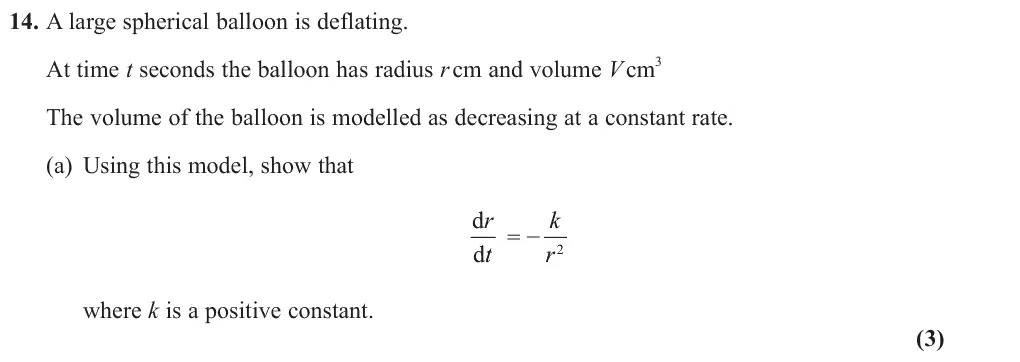
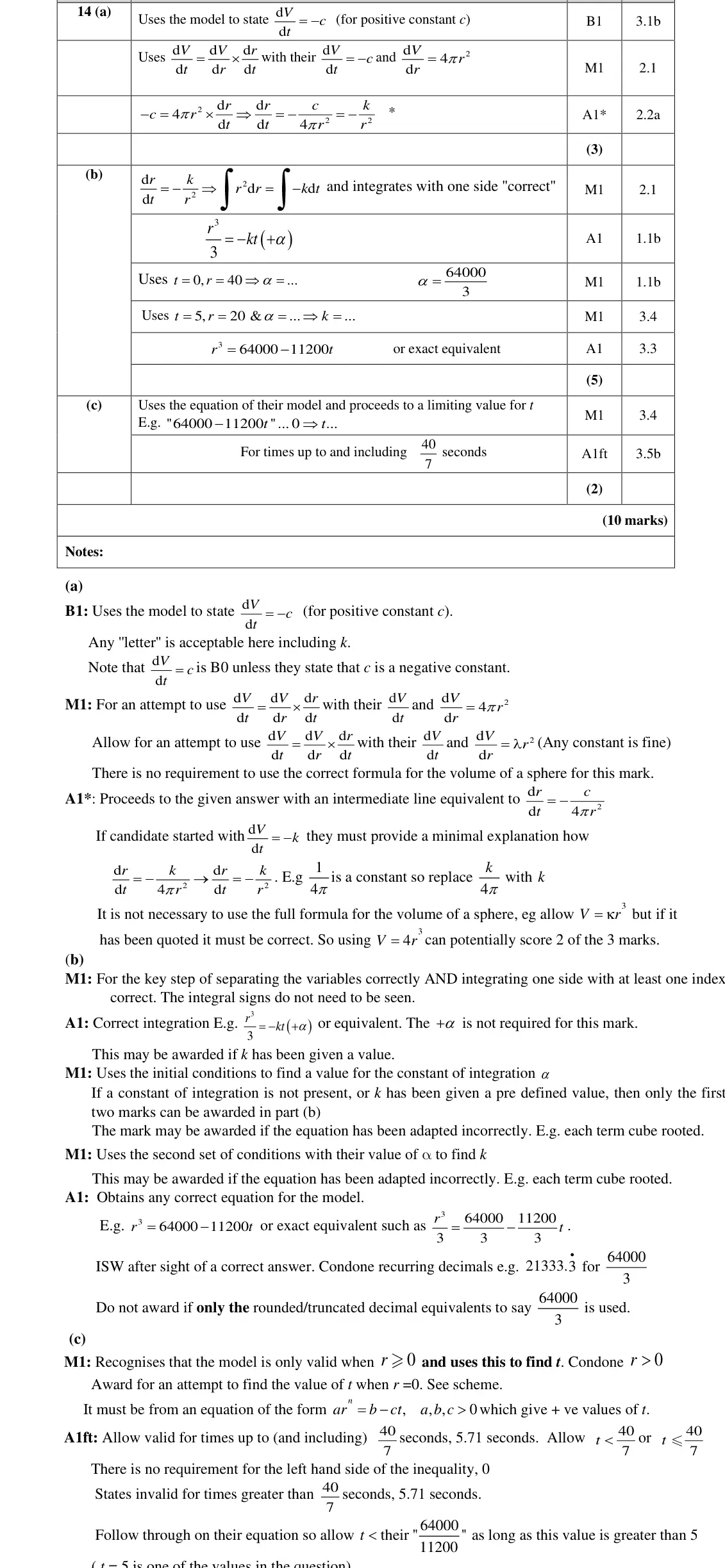
14. A large spherical balloon is deflating. At time t seconds the balloon has radius r cm and volume V cm3 The volume of the balloon is modelled as decreasing at a constant rate. (a) Using this model, show that d r t = -k d r 2 where k is a positive constant. (3)
Oct 2020 · Paper 1 · Q14(b) 5 marks differential equations
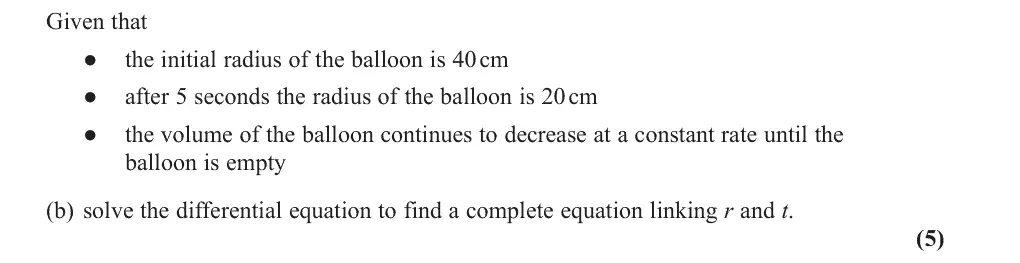
Given that ● the initial radius of the balloon is 40 cm ● after 5 seconds the radius of the balloon is 20 cm ● the volume of the balloon continues to decrease at a constant rate until the balloon is empty (b) solve the differential equation to find a complete equation linking r and t. (5)
Oct 2020 · Paper 1 · Q14(c) 2 marks differential equations
(c) Find the limitation on the values of t for which the equation in part (b) is valid. (2)
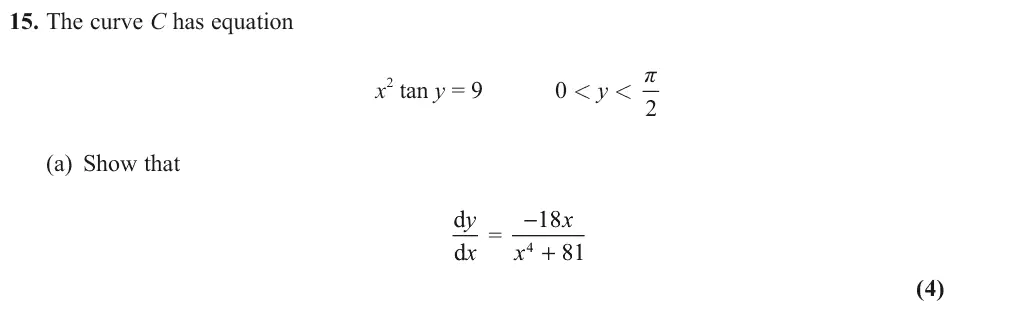
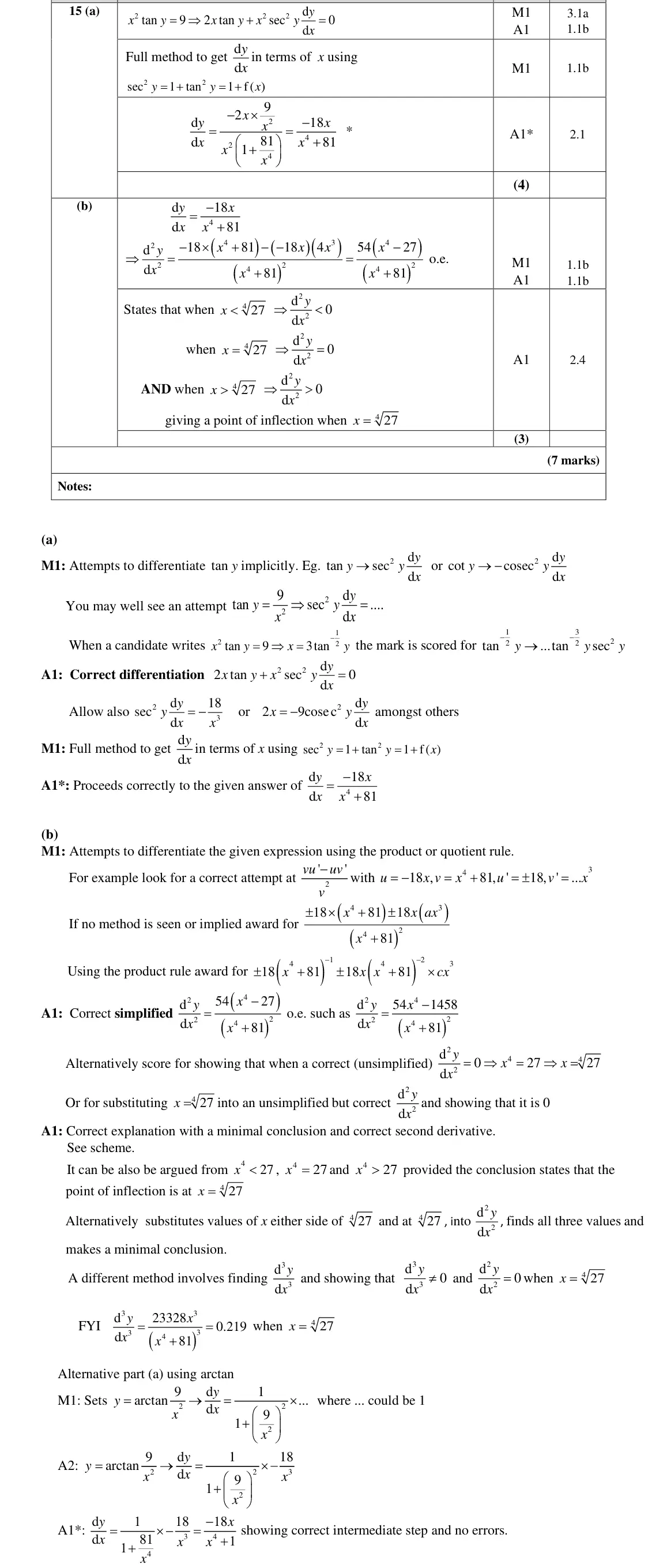
15. The curve C has equation pi x2 tan y = 9 0 < y < 2 (a) Show that d y x = - x d x + (4)
Oct 2020 · Paper 1 · Q15(b) 3 marks differentiationdifferentiation rules
(b) Prove that C has a point of inflection at x = (3)
Oct 2020 · Paper 1 · Q16 4 marks proofsimultaneous equationsalgebraic methods
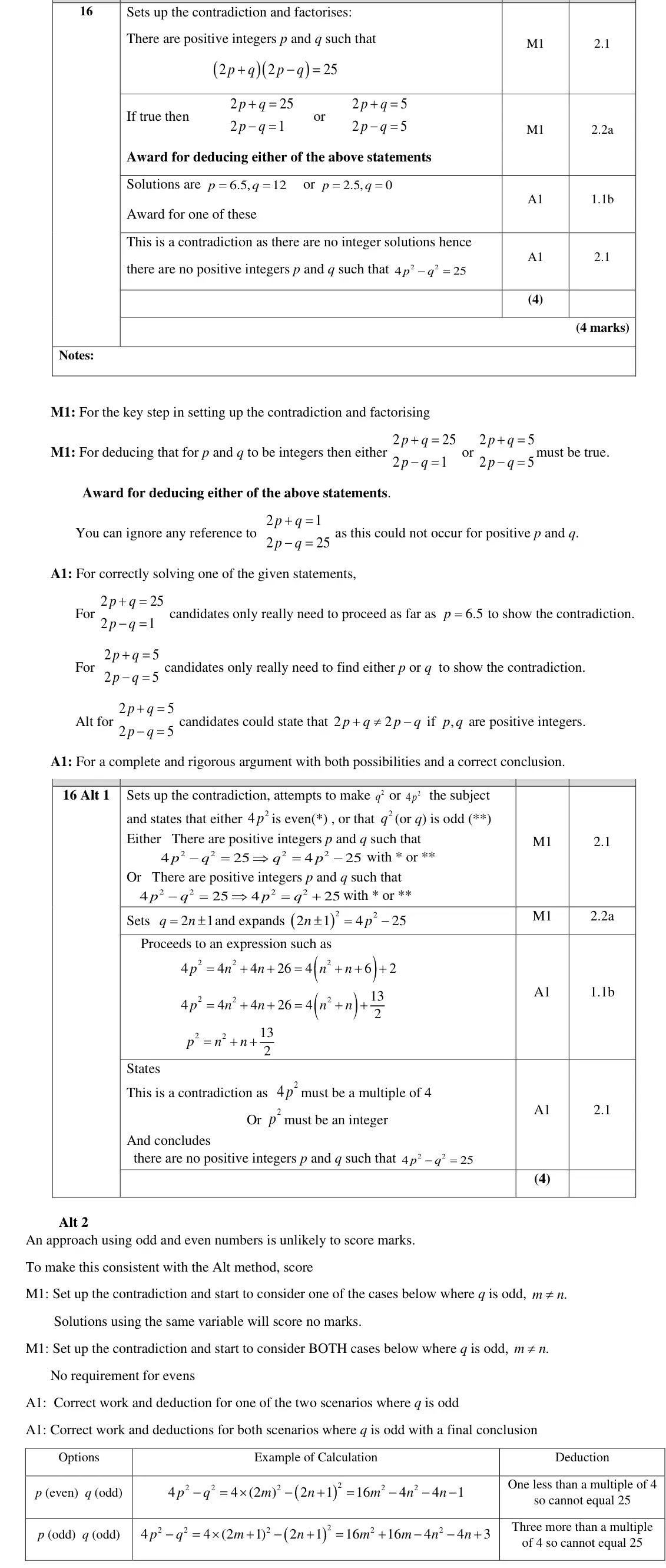
16. Prove by contradiction that there are no positive integers p and q such that 4 p2 - q2 = 25 (4)

Find an Edexcel maths tutor

Want this paper marked and gone through with you? Message us.

Prefer email? Send an enquiry

If you are under 18, please include a parent's contact details. Enquiries go to enquiries@mathsaleveltutor.com and are deleted once handled.