Reciprocal and inverse trigonometric functions Pure
Papers
Paper 1, Paper 2, Paper 3 (Mechanics)
Level
A level only
Spec
P5.4
Since 2018
12 question parts, 42 marks
Notes, worked examples and practice for this topic are being written by our tutors. The past-paper questions below are ready now: work each one on paper, then open the mark scheme and the examiner's comment.
Tap a question to zoom it. Mark scheme and examiner's comment open under each question.
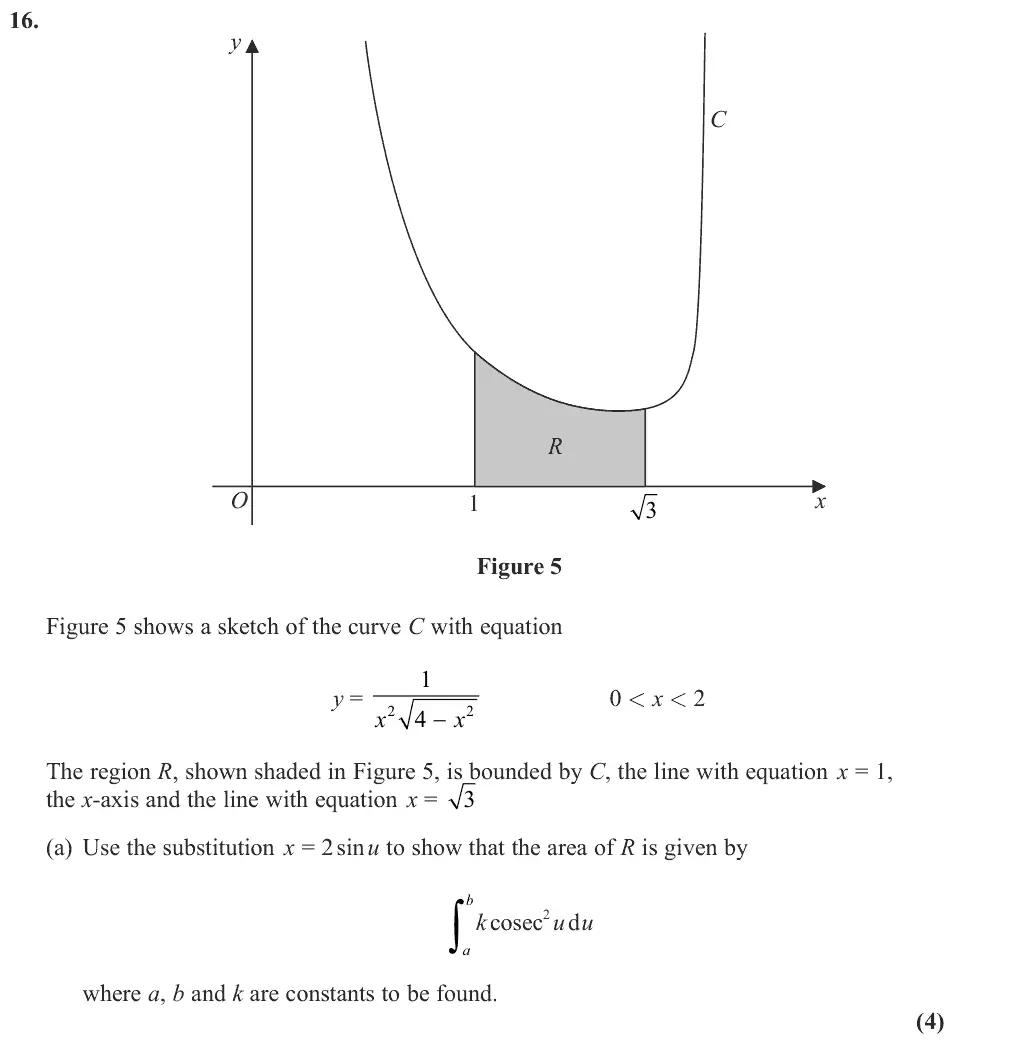
June 2025 · Paper 1 · Q16(a)4 marks
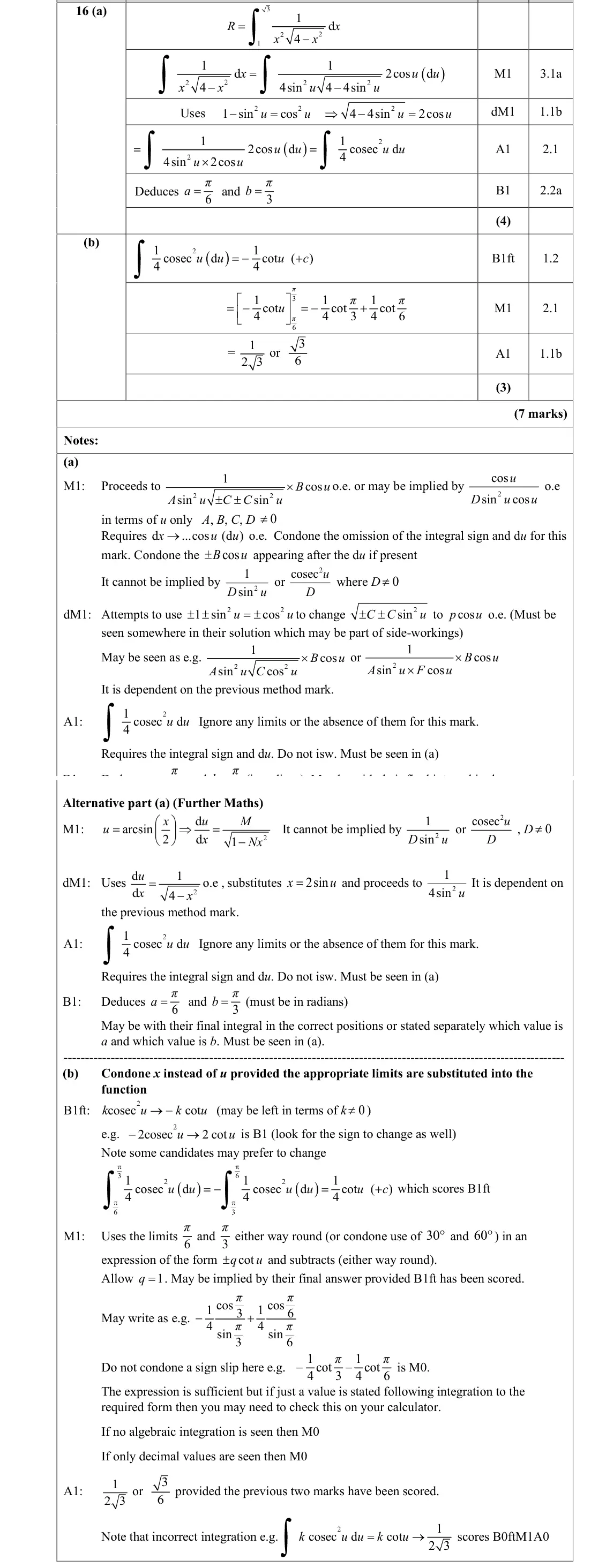
Mark scheme (whole question; this part is marked with the orange bar)
Examiner's comment
This proved to be a challenging question demanding good algebraic skills and attention to detail. For a final question on a paper, most made an attempt. In part (a), many responses did not successfully manage to fully substitute for all elements of the integral. The main issue was the correct substitution for dx. Responses commonly successfully substituted u in everything except the ‘du’, with some omitting it. Additionally, many did not achieve marks because they did not successfully substitute and achieve 2cosu in the denominator with others attempting to substitute d d 2cos u x u = . Many responses were not presented in a logical structure and did not gain marks because they did not bring together the elements of the substitution into a single expression which showed the progress of the substitution, the manipulation and simplification to the required result. This occasionally resulted in just amending to the result because they knew what the required form was but did not know how to get there. A large proportion did not spot the need to use the identity 2 2 sin cos 1 x x + = and often just square rooted all the values in the bracket achieving (2 2sin )x - . Some learners misapplied identities, using for example cos2x . Those who did use the identity correctly tended to go on to also gain the accuracy mark, but a few had 2 1 4sin u and ended with 2 4cosec u . Those who did compete the full substitution often did it in stages leaving the substitution for dx until the final stage of their proof which was condoned but should not be encouraged. A good proportion also changed the limits into angles in degrees and so did not gain the mark for changing the limits. The limits were often given as 30 degrees and 60 degrees, costing the final mark.
Common mistakes
substitute every part including dx = 2cos u du
√(4 − 4sin²u) = 2cos u using sin² + cos² = 1 (not √4 − √(4sin²u))
simplify to ∫ ¼cosec²u du
limits in radians π/6 and π/3, not 30° and 60°
June 2025 · Paper 1 · Q16(b)3 marks
Mark scheme (whole question; this part is marked with the orange bar)
Examiner's comment
This proved to be a challenging question demanding good algebraic skills and attention to detail. For a final question on a paper, most made an attempt. In part (b), it was notable that those who did not reach a correct answer in part (a) often did not go on to attempt this, even though these marks were available to them. Even though they were told that the integral was a multiple of 2 cosec u some learners tried unsuccessfully to integrate their very complex answers to (a). A large number did not appear to know the integral of 2 cosec u or did not use the formula booklet correctly and some attempted very convoluted methods of integration. Those that did not score at all got muddled in the initial stage, choosing to use ln or some other given integration from the formula book that they had misread or misinterpreted. A significant number got confused between the integral of 2 cosec u andcosec u , which meant they ended up with expressions involving ln(tan ) u or ln(cosec cot ) u u + . However, several responses obtained the correct answer of 1 cot 4 u - , although a few omitted the negative sign, and others 23 stated the answer was 1 cot . 4 u There was a proportion who did not include the negative sign and consequently amended the resulting negative in their final answer. 24
Common mistakes
∫cosec²u du = −cot u (sign often lost
confused with ∫cosec u)
−¼cot(π/3) + ¼cot(π/6) = 1/(2√3) = √3/6
can be attempted even if (a) was not completed
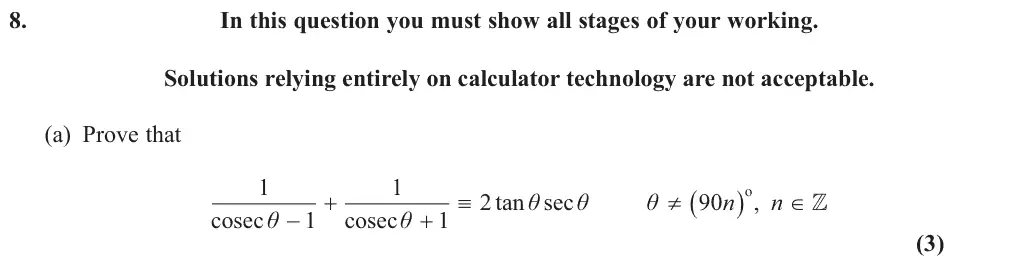
June 2024 · Paper 2 · Q8(a)3 marks
Mark scheme (whole question; this part is marked with the orange bar)
Examiner's comment
A significant number of candidates found this question challenging. In part (a) the first challenge candidates faced was combining the two terms to produce a single fraction. This was completed successfully by many candidates, either as a fraction in cosec or a fraction in sin . The second challenge was using trigonometric identities correctly. The majority used 2 2 sin cos 1 + = but the more successful candidates typically used 2 2 1 cot cosec + = . It was only a minority who managed to complete the proof successfully. It was possible to complete the proof starting either from either side of the identity, however, generally those candidates who started with the left-hand side were more successful. Few, if any, candidates gave a completely correct solution starting from the right-hand side and the majority only obtained the mark for using a correct Pythagorean identity. A small number of candidates used a “meet in the middle” approach with varying degrees of success. Notational errors were not widespread, but variables were sometimes missing, or indices misplaced resulting in the loss of the final mark. Many also lost the accuracy mark because they did not show all the necessary steps by proceeding to the given answer using sine and cosine.
Common mistakes
combine into one fraction 2cosecθ/(cosec²θ − 1)
use cosec²θ − 1 = cot²θ (or sin² + cos² = 1)
convert to sin and cos to reach 2tanθsecθ
no notational slips (cos²θ not cosθ²)
starting from the RHS rarely succeeded
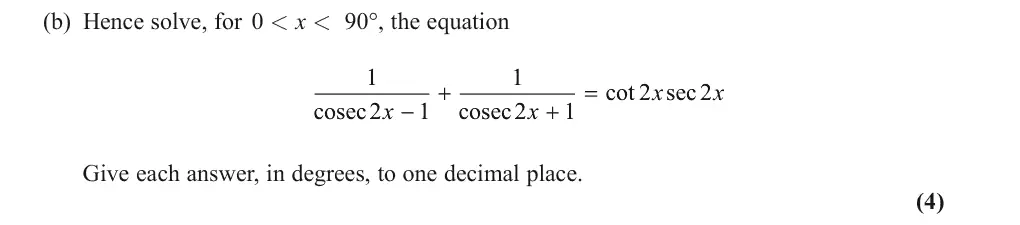
June 2024 · Paper 2 · Q8(b)4 marks
Mark scheme (whole question; this part is marked with the orange bar)
Examiner's comment
A significant number of candidates found this question challenging. In part (b), candidates that spotted the connection with part (a) tended to achieve at least 3 out of the 4 marks available. Those who failed to get the first line right with the variable of 2x on both sides but just substituted 2tan sec x x or even 2tan sec on the left-hand side gained no marks in this part. Candidates took a number of different approaches to solving the correct equation. The most frequent was to obtain 2 1 tan 2 2 x = but approaches involving 2 3sin 2 1 x = or 2 3cos 2 2 x = were relatively common. There were a few candidates who used the identity 2 2tan tan 2 1 tan x x x = - to reach a quadratic in 2 tan .x These attempts were usually successful. Some candidates stated that the square root of 1 2 is 1 4 which lost them the final two marks in this part. However, those candidates that did get to one of the correct equations could normally proceed to one correct answer (which was typically x = 17.6°). It was only a minority of candidates who gave both correct answers. The final mark was regularly lost because only one solution was identified, or candidates had incorrectly found 45 degrees by incorrectly solving sec2x = 0 and interpreting this as cos2x = 0 rather than being undefined. Most candidates that achieved marks in this part of the questions could correctly identify the order of operations to solve their equations although there were some candidates who struggled with this. For the final mark, a few wrote down 17.7 instead of 17.6 and some had extra answers in the given range and therefore lost the accuracy mark. A small minority of candidates did not show appropriate working in part (b), sometimes merely writing down the two correct answers to the given equation. The question explicitly asked for all stages of a candidate’s working as the answers can be found using a calculator. Hence candidates that gave the correct answers without appropriate working were not awarded any marks in this part of the question.
Common mistakes
replace θ by 2x: 2tan2x sec2x = cot2x sec2x
sec2x ≠ 0 (not 45° from cos2x = 0)
tan²2x = ½ (or sin²2x = ⅓)
x = 17.6°, 72.4° (both, 1 d.p., none extra)
answers without working score 0
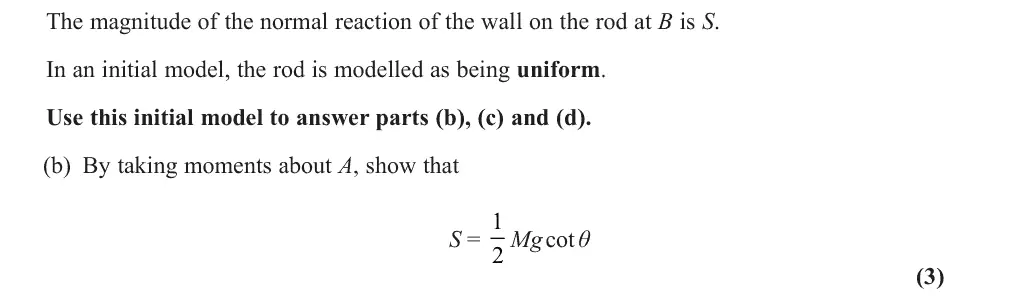
June 2023 · Paper 3 (Mechanics) · Q6(b)3 marks
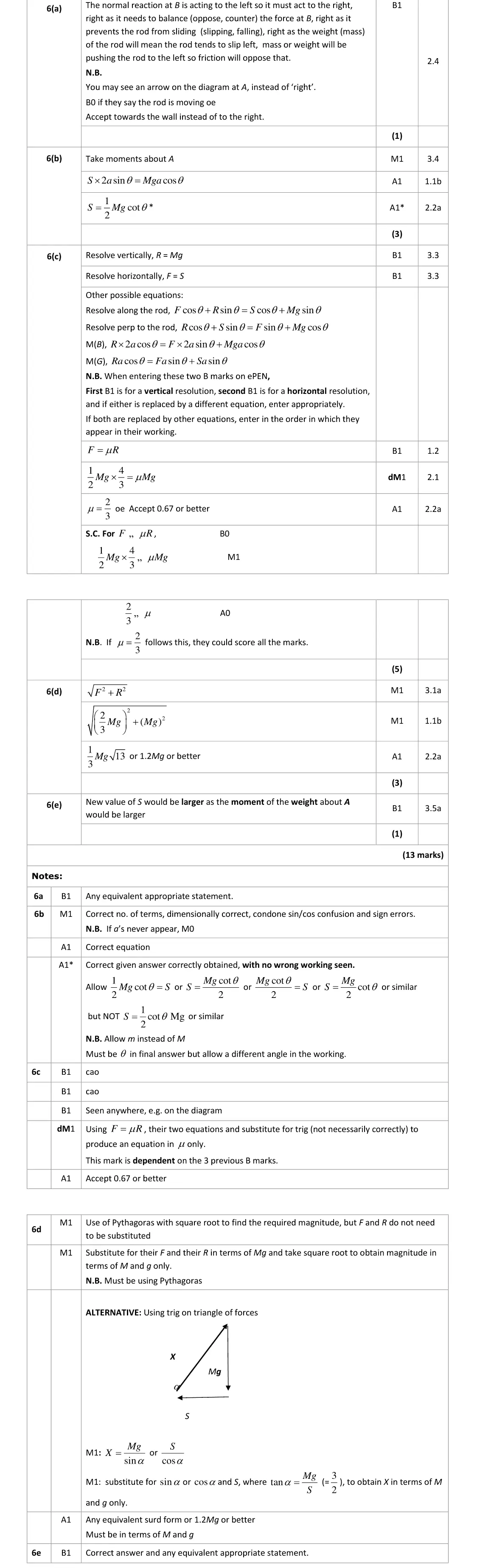
Mark scheme (whole question; this part is marked with the orange bar)
Examiner's comment
number thought that the direction was left or gave no reason at all. In part (b), the question directed the candidates to take moments about A and most were able to do so successfully with many achieving the three available marks. The occasional incorrect response had the distance to the reaction at B unresolved as 2a. Also a small number had a’s missing from both sides of their equation. Since this was a “show that” question it was important that all stages of the solution were shown and were correct. It should be noted that the candidate’s final answer had to be written exactly as the printed answer, using the same symbols in the same order, to achieve the final mark. Part (c) required a calculation of the
Common mistakes
S × 2a sin θ = Mg × a cos θ
perpendicular distance of S from A is 2a sin θ, not 2a
final answer exactly as printed
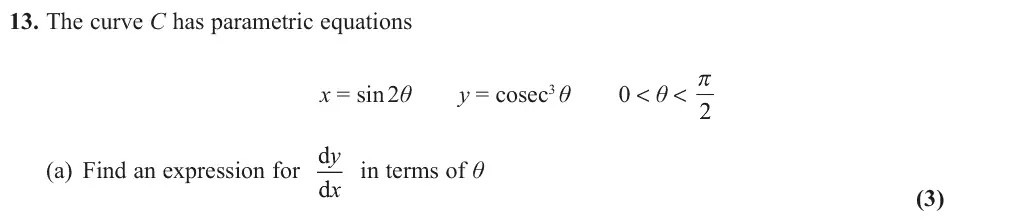
Oct 2021 · Paper 2 · Q13(a)3 marks
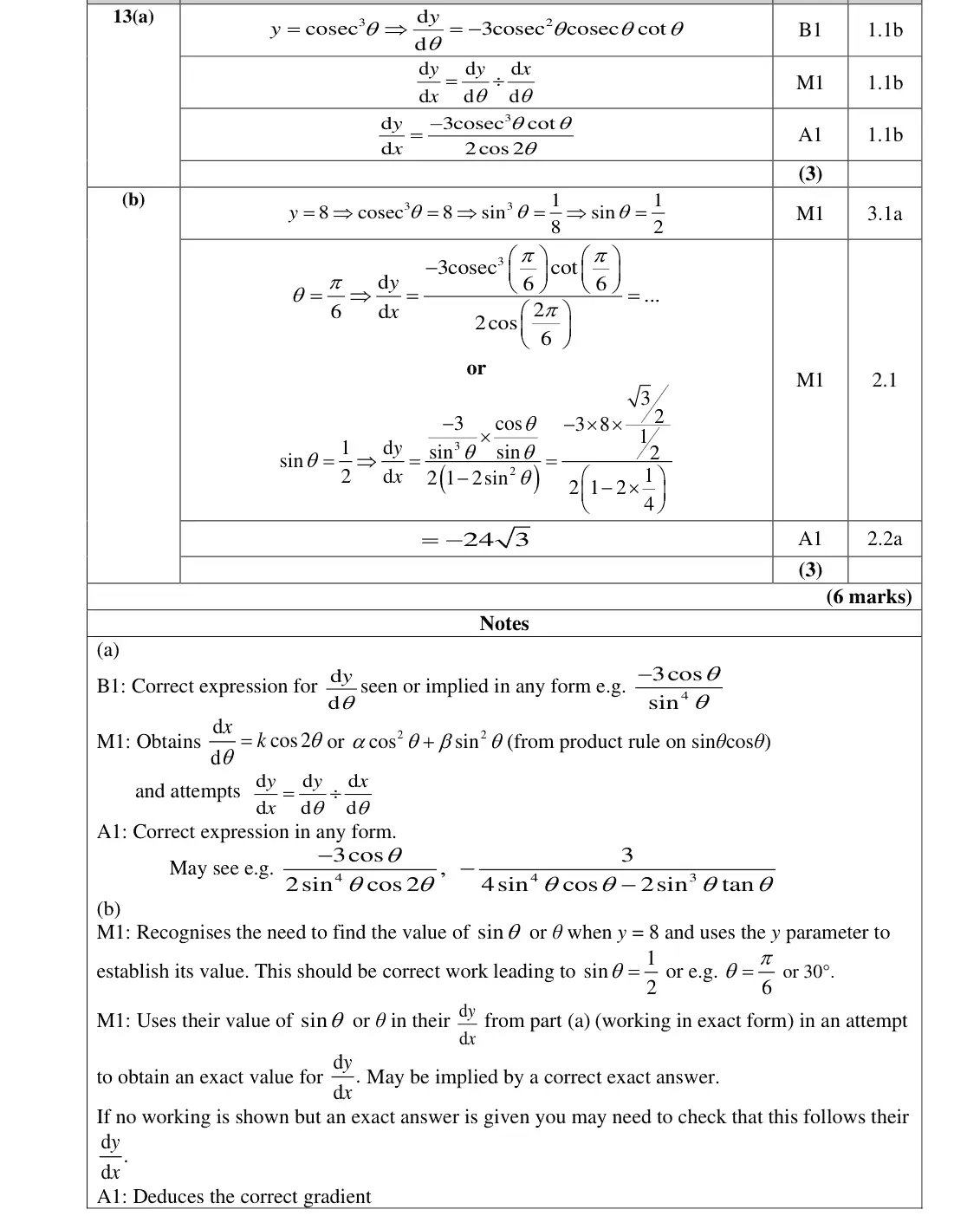
Mark scheme (whole question; this part is marked with the orange bar)
Examiner's comment
This question involving differentiation of parametric equations was found to be challenging by the majority of students, particularly the differentiation of 𝑦𝑦= cosec3 𝜃𝜃 and part (b). The majority of candidates knew what was expected in part (a) and proceeded to attempt to use the chain rule to find d𝑦𝑦 d𝑥𝑥, however they found differentiating 𝑦𝑦= cosec3 𝜃𝜃 challenging. Some did not check in the formula book that the derivative of cosec theta was negative, or omitted the constant 3, and this cost 3 of the 6 marks available in the whole question. For those that attempted to write 𝑦𝑦= sin-3 𝜃𝜃 and use either the chain rule or the quotient rule success was mixed. Other common incorrect derivatives included d𝑦𝑦 d𝜃𝜃= (cosec3 𝜃𝜃cot3 𝜃𝜃) and variants of this. Differentiating 𝑥𝑥= sin 2𝜃𝜃 proved less troublesome, with most doing so correctly. There was a proportion of candidates that rewrote sin 2𝜃𝜃 as 2 sin 𝜃𝜃cos 𝜃𝜃 and used the product rule, creating more work but ultimately doing so successfully in most cases. The method mark was scored by the majority of candidates as a result, although there were a few candidates who tried to write 𝑦𝑦 in terms of 𝑥𝑥 and differentiate, with no marks being scored for this approach. A number of candidates, having found a correct derivative, proceeded to attempt to tidy this up, unfortunately using time that could have been spent elsewhere in the paper.
Common mistakes
dy/dθ = −3cosec³θ cotθ (chain rule
derivative of cosec is negative
keep the 3)
dx/dθ = 2cos 2θ
Oct 2021 · Paper 2 · Q13(b)3 marks
Mark scheme (whole question; this part is marked with the orange bar)
Examiner's comment
This question involving differentiation of parametric equations was found to be challenging by the majority of students, particularly the differentiation of 𝑦𝑦= cosec3 𝜃𝜃 and part (b). Part (b) proved more challenging for many candidates, with some unable to make a start as they were unable to process 8 = cosec3 𝜃𝜃 to arrive at either a value for sin 𝜃𝜃 or 𝜃𝜃. Of those that did arrive at a value for sin 𝜃𝜃 or 𝜃𝜃, many were able to work in exact form using their value to find an exact value for their 𝑑𝑑𝑑𝑑 𝑑𝑑𝑑𝑑, others were unable to proceed or attempted to give a decimal answer. 24 sqrt 3 and 8 sqrt 3 were common incorrect final answers. There were, however, some excellent and concise responses to this question.
Common mistakes
cosec³θ = 8 gives sinθ = ½, θ = π/6
work in exact values
−24√3 (not 24√3 or 8√3)
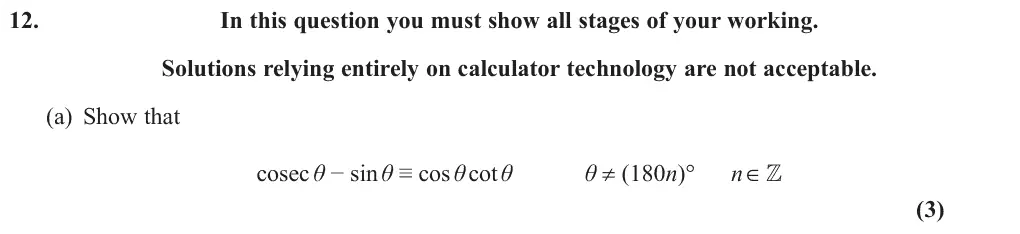
Oct 2020 · Paper 1 · Q12(a)3 marks
Mark scheme (whole question; this part is marked with the orange bar)
Examiner's comment
Part (a) was generally answered well and there were remarkably few solutions containing missing variables. On this occasion, candidates who started with the RHS fared better as those who worked from the LHS occasionally missed the required step between 𝑐𝑐𝑐𝑐𝑐𝑐2𝜃𝜃/sin𝜃𝜃 and cos𝜃𝜃cot𝜃𝜃, while those who worked from both sides would often get confused or, if they progressed correctly they simply failed to make the necessary conclusion.
Common mistakes
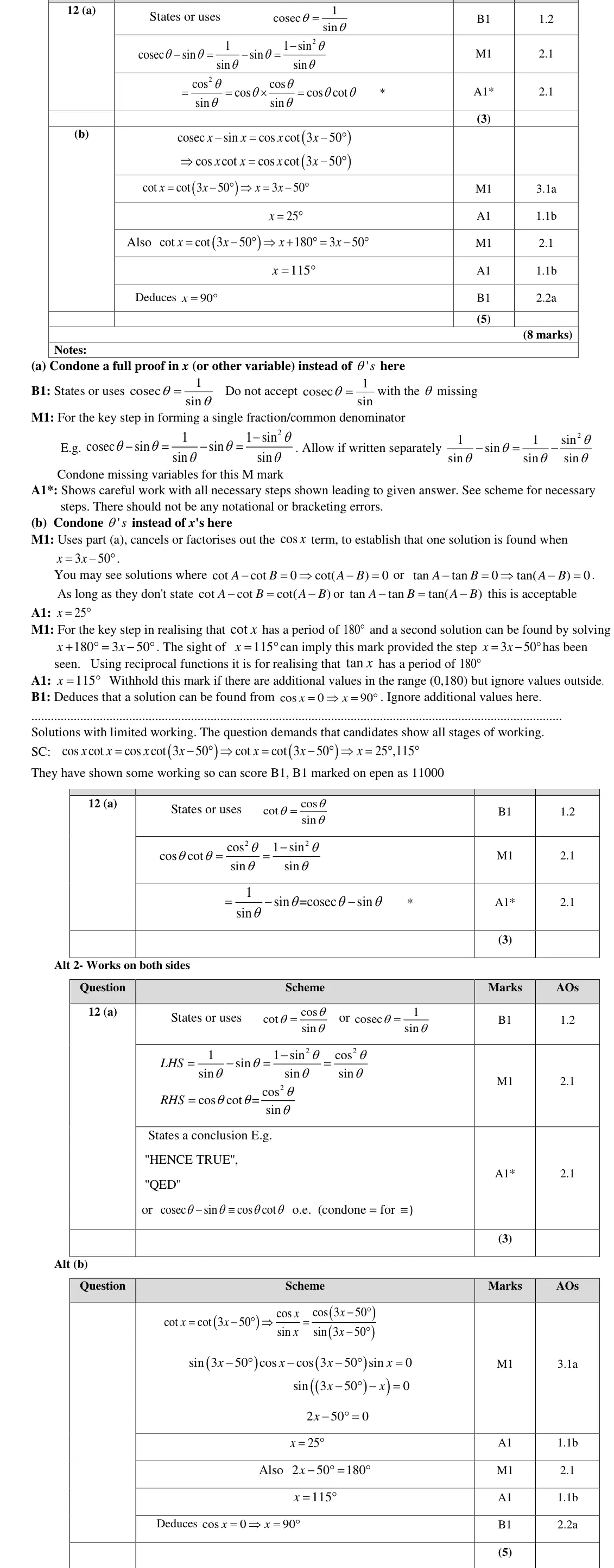
cosec θ = 1/sin θ, single fraction (1 − sin²θ)/sin θ = cos²θ/sin θ, then cos θ × cos θ/sin θ
show the step to cos θ cot θ
working on both sides needs a conclusion
Oct 2020 · Paper 1 · Q12(b)5 marks
Mark scheme (whole question; this part is marked with the orange bar)
Examiner's comment
Part (b), however was very often left completely blank. Many who attempted it failed to see the connection with (a) and got lost in complicated trig expansions which led nowhere. Of those who did use part (a) to answer part (b), the most common solution was simply 𝑥𝑥=25 after cos 𝑥𝑥 had been cancelled, thus losing the solution given by cos 𝑥𝑥 =0. Only a small minority of the most able found all 3 solutions.
Common mistakes
use (a) to get cos x cot x = cos x cot(3x − 50°)
do not cancel cos x without cos x = 0 (x = 90°)
cot x = cot(3x − 50°) gives x = 25° and, as cot has period 180°, x = 115°
three solutions
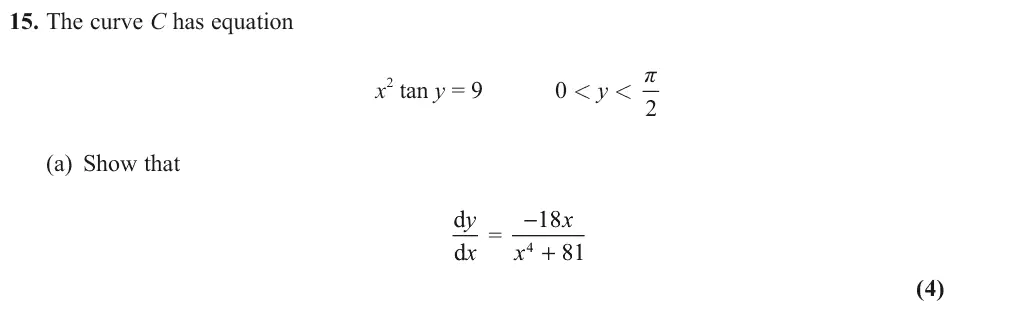
Oct 2020 · Paper 1 · Q15(a)4 marks
Mark scheme (whole question; this part is marked with the orange bar)
Examiner's comment
Although fully correct solutions to this question were very rare, many candidates were able to score marks from both parts. In part (a) the first two marks for the implicit differentiation were very accessible for the prepared candidate. Proceeding to the required result for the second two marks proved a little more challenging. Only high achieving students noticed the relationship could be 2 2 proven via the trigonometric identity 1 tan sec . y y + =
Common mistakes
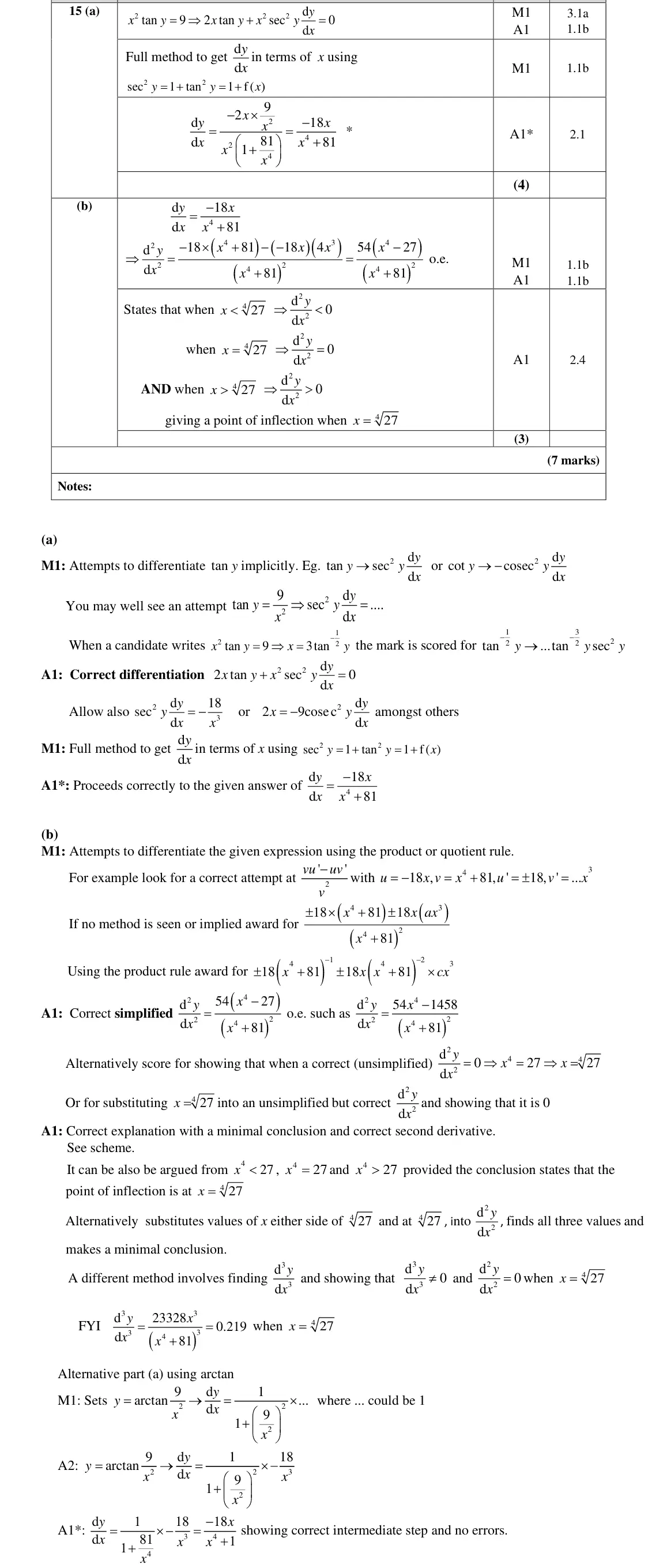
implicit differentiation 2x tan y + x² sec²y dy/dx = 0
use sec²y = 1 + tan²y = 1 + 81/x⁴ to get dy/dx in terms of x only
June 2019 · Paper 2 · Q12(b)3 marks
Mark scheme (whole question; this part is marked with the orange bar)
Examiner's comment
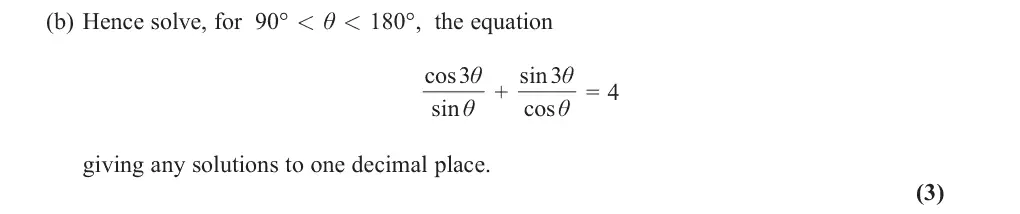
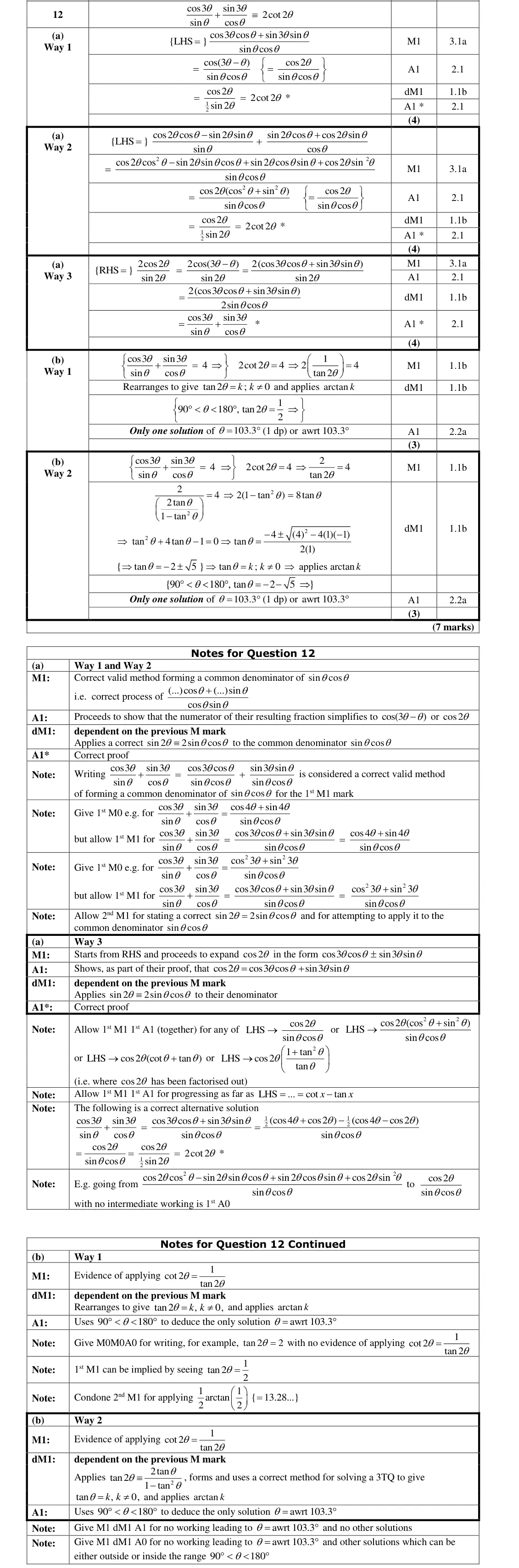
Q12(a) discriminated well between the higher ability candidates and it was possible for candidates of all abilities to gain access to Q12(b). In Q12(a), many candidates struggled to apply a complete strategy which would help them to make significant progress in proceeding from cos3 sin3 , via an sin cos 2 2 cos2 (cos sin ) intermediate stage of cos(3 ) , cos2 , or to the given sin cos sin cos sin cos result 2cot2 . Candidates who used Way 1, as described in the mark scheme, gained some credit for rationalising cos3 sin3 to give cos3 cos sin3 sin . Of those candidates sin cos sin cos 1 sin cos sin 2 who correctly applied to the denominator, only a few realised that 2 A common error in using Way 1 was to the numerator could be written as cos2 . 2 2 cos 3 sin 3 simplify cos3 sin3 or cos4 sin 4 . to give sin cos sin cos sin cos Way 2, as described in the mark scheme (and variations of this), was the most popular approach among candidates who completed the proof successfully. Candidates only started to access the marks for Way 2 when they combined their fractions by rationalising the denominator. Errors using Way 2 included the incorrect expansion of cos(2 ) or sin(2 ) , bracketing errors, manipulation errors or sign errors. They usually progressed as far as A few candidates started their proof from 2cot2 . 2 2(1 tan ) 2cos2 2cot 2 , 2cot 2 writing either or but could make no sin 2 2tan creditable progress until they applied a Way 3 method as described in the mark scheme. Some candidates spent a considerable amount of time attempting to write 3 3 4cos 3cos 3sin 4sin cos3 sin3 in terms of to give e.g. . sin cos sin cos candidates only started to access the marks for this method when they combined their fractions by rationalising the denominator. In Q13(b), most candidates used the result given in Q13(a) to deduce the equation 1 2cot 2 4. tan 2 , Most of these then attempted to solve and some obtained the 2 Common errors included attempting to solve tan2 correct answer 103.3 . 2 A few candidates obtained by . and finding more than one value for 103.3 2 2(1 tan ) 4. solving the equation 2tan
Common mistakes
2cot2θ = 4 so tan2θ = ½
2θ in (180°, 360°) gives only θ = 103.3°
solving tan2θ = 2 or giving extra solutions
June 2018 · Paper 2 · Q7(i)4 marks
Mark scheme (whole question; this part is marked with the orange bar)
Examiner's comment
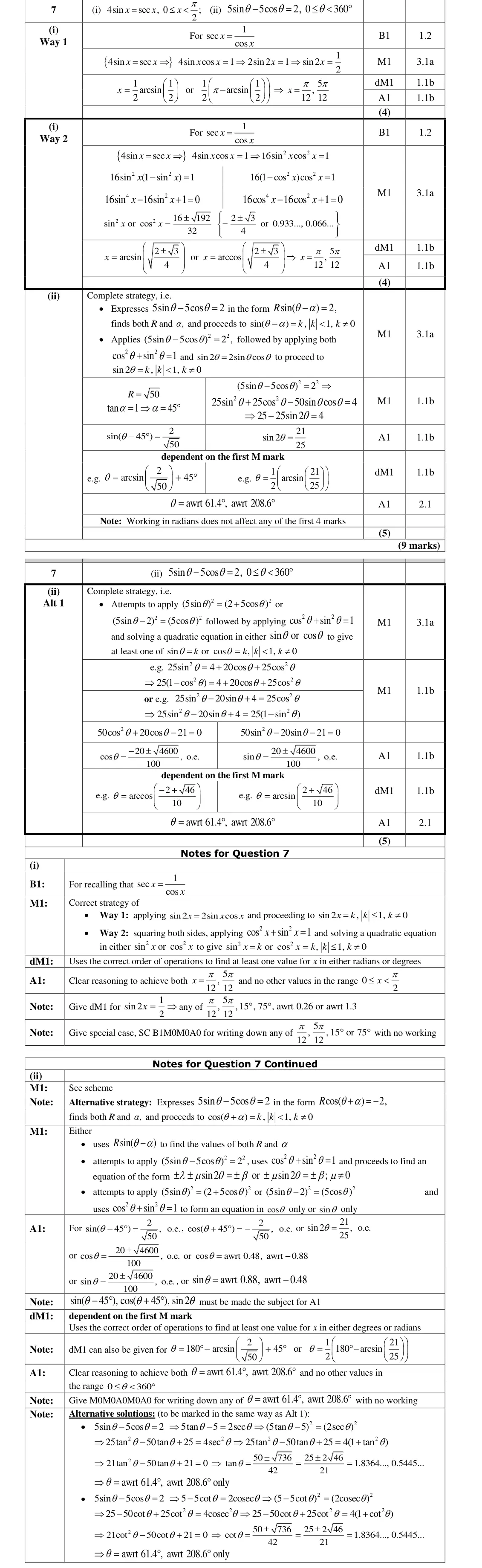
Part (i) was accessible to most students, whereas some students struggled to gain access to part (ii). 1 x In part (i), many students replaced secx with cos x and arrived at 4sin cos A few 1. x x with sin 4 ,x but most used the identity sin2 students replaced 4sin cos to x 2sin cos x x x 1 x sin 2 . give the correct Many students obtained both correct exact solutions in radians, 2 with only a few omitting the second solution 5 . 12 Some students made no attempt at part (ii) while a significant number of other students did not employ a correct strategy for solving 5sin The majority of students, 5cos 2. however, attempted one of several correct strategies. The most popular strategy was to and 2 2 cos sin 1 square both sides of the given equation and apply the identities 21 sin 2 . to achieve A second strategy was to square both sides of sin2 2sin cos 25 to achieve a quadratic equation 2 2 cos sin 1 and apply the identity 5sin 2 5cos in either cos or sin . In both of these strategies, extra (incorrect) solutions were generated as a result of squaring both sides of their equation. Only a few students rejected these extra A third strategy was to rewrite the 61.4 , 208.6 . solutions to leave the correct solutions 50 sin( 45 ) 2 50 cos( 45 ) 2, given equation as or even which were usually A few students applied other correct strategies which led 61.4 , 208.6 . solved to give to solving quadratic equations in either tan or cot .
Common mistakes
sec x = 1/cos x
4 sin x cos x = 1 gives sin 2x = ½
x = π/12 and 5π/12 (second solution often omitted)
answers in radians
Find an Edexcel maths tutor
Stuck on this? Book a trial session with an Edexcel specialist.