33 question parts, 98 marks, 6 with a difficulty rating from the examiner's report
Notes, worked examples and practice for this topic are being written by our tutors. The past-paper questions below are ready now: work each one on paper, then open the mark scheme and the examiner's comment.
Tap a question to zoom it. Mark scheme and examiner's comment open under each question.
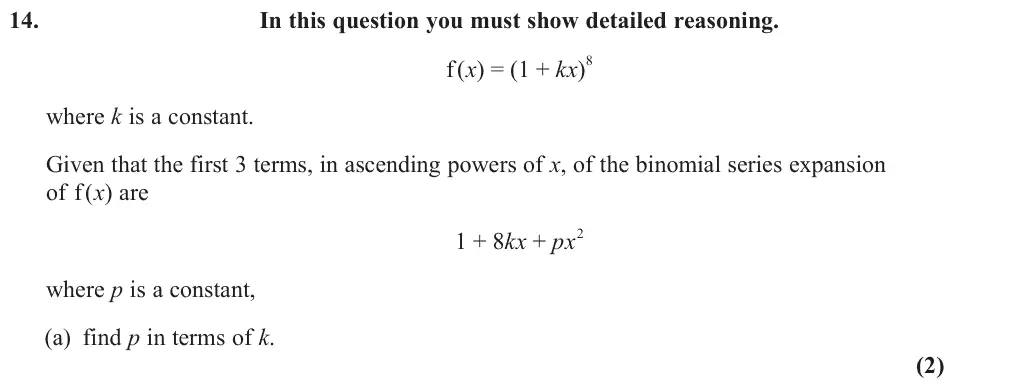
June 2025 · AS Paper 1 · Q14(a)2 marks
Mark scheme (whole question; this part is marked with the orange bar)
Examiner's comment
Although there were a small number of blank responses to part (a), most candidates found this question accessible. There was a fairly even split between M1A0 and M1A1 being awarded. When A0 was awarded it was generally due to candidates omitting brackets and thus not squaring k. A large proportion of candidates produced the full expansion of the first three terms (and more in cases) even though this was not necessary. As well as not being as efficient it also resulted in it being less likely to extract the coefficient of x^2 resulting again in A0.
Common mistakes
coefficient of x² is 8C2 k² = 28k²
brackets needed so that k is squared
expanding more terms than needed then not extracting p
June 2025 · AS Paper 1 · Q14(b)5 marks
Mark scheme (whole question; this part is marked with the orange bar)
Examiner's comment
Part (b) was much more demanding with very few candidates achieving full marks and many blank responses seen. The majority of candidates failed to identify the necessary terms to set up the two required equations or made errors in expanding the brackets. The equation resulting from the constant term appeared the more accessible of the two and resulted in the first M1 at least. Where candidates were able to identify the two correct equations they generally went on to score full marks. For these more able candidates who were able to find a solution it was pleasing to see them pairing a and k correctly.
Common mistakes
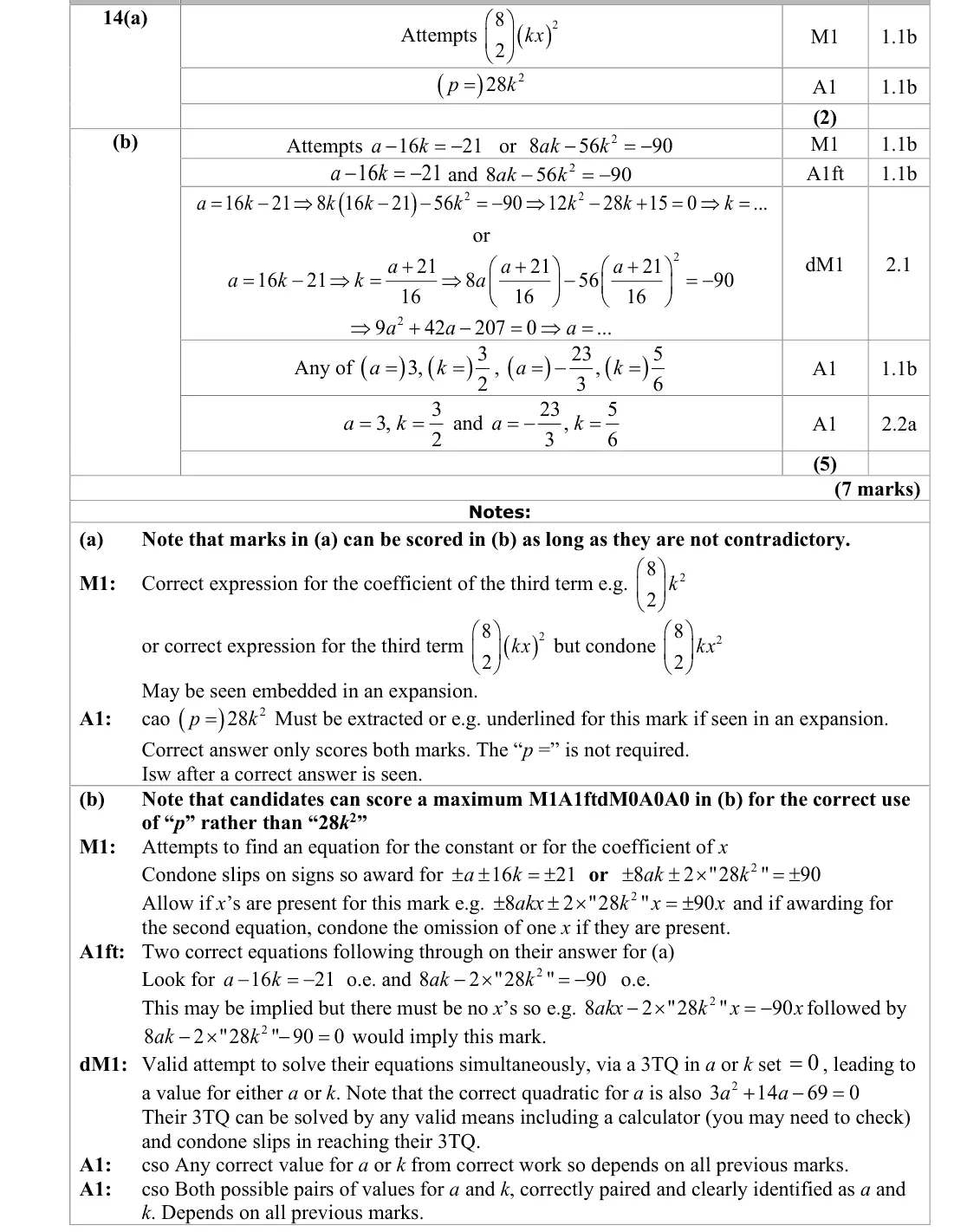
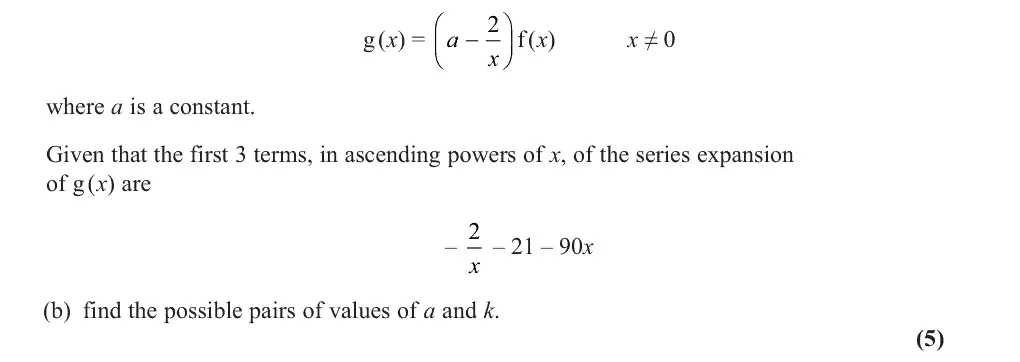
multiply (a − 2/x)(1 + 8kx + 28k²x² + …): constant a − 16k = −21, x coefficient 8ak − 56k² = −90
substitute to a 3TQ 12k² − 28k + 15 = 0
pair correctly: a = 3, k = 3/2 and a = −23/3, k = 5/6
identifying the wrong terms
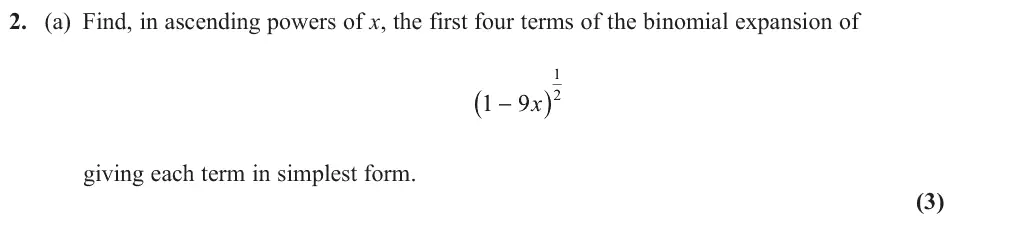
June 2024 · Paper 1 · Q2(a)3 marks
Mark scheme (whole question; this part is marked with the orange bar)
Examiner's comment
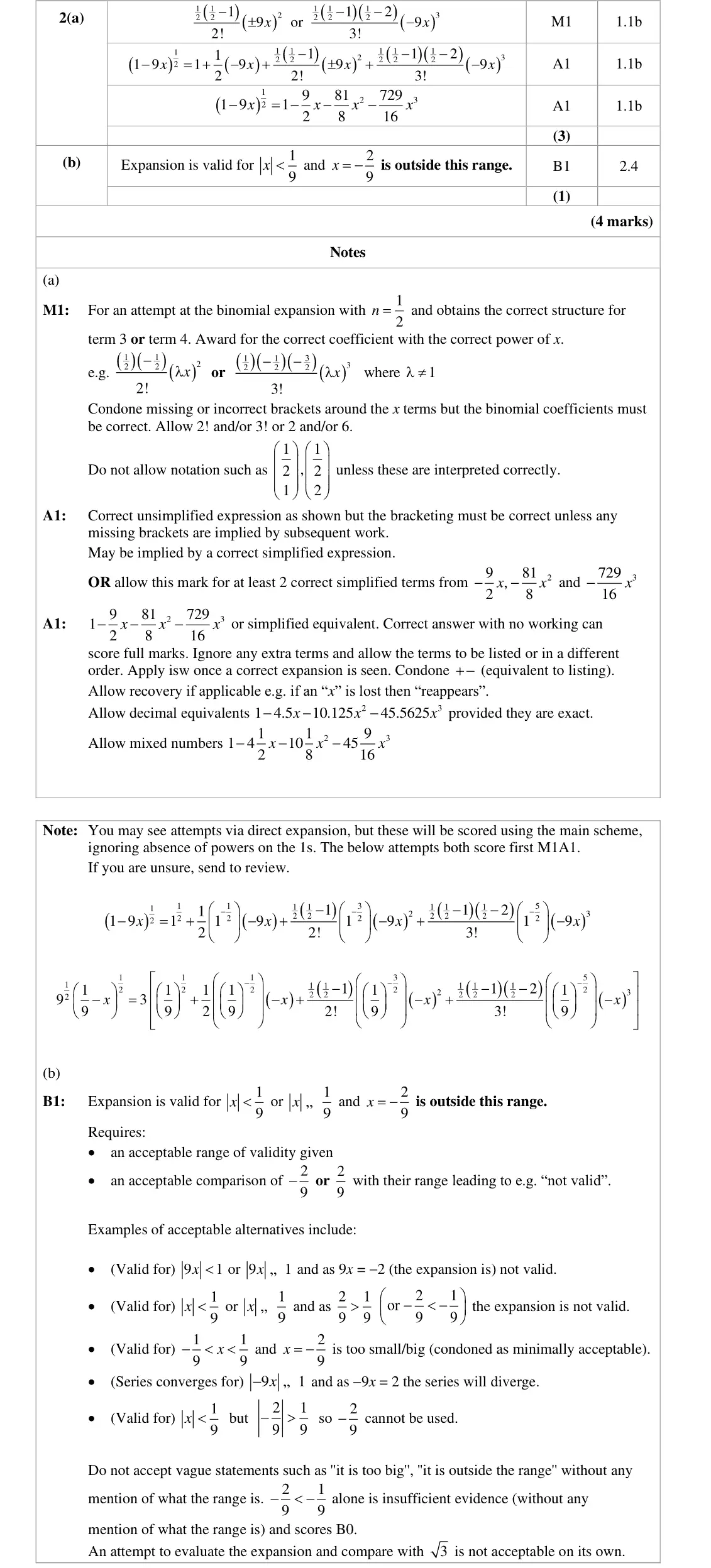
This was another question that was familiar to candidates, providing excellent access, with plenty of candidates scoring full marks and many more scoring 3 marks out of the available 4. In part (a), the presentation of the binomial structure was generally very good. Inconsistency with brackets or lack of attention to detail (often not simplifying correctly) were the main reasons why candidates who started correctly dropped accuracy marks for their final answer. A small minority attempted to use the version of the binomial expansion where the power is required to be a positive integer and made no progress, while some candidates ignored the coefficient of x, simplifying the problem and thus scored no marks. Candidates were able to recover these errors in subsequent work, but it was not common for this to happen. The most common error was using 9 instead of –9 which was allowed to score the method mark. A small number of candidates employed a Maclaurin expansion which was acceptable but should not be encouraged. Equally, although it was possible to use direct expansion to solve the problem these attempts by candidates were usually unsuccessful, particularly for those that tried to take out a factor of 9. Occasionally, candidates multiplied their correct simplified expansion by a constant such as 16 at the end, this could still achieve full marks as examiners could apply ISW. Finally, some candidates attempted to use notation of the form 1 2 2 but the majority using this did not evaluate it to a suitable form to be able to score the method mark.
Common mistakes
n = ½ with (−9x): using +9x or ignoring the 9 are common errors
brackets around (−9x)² and (−9x)³
simplify each term
the positive-integer formula does not apply
June 2024 · Paper 1 · Q2(b)1 mark
Mark scheme (whole question; this part is marked with the orange bar)
Examiner's comment
This was another question that was familiar to candidates, providing excellent access, with plenty of candidates scoring full marks and many more scoring 3 marks out of the available 4. Part (b) proved to be more challenging for candidates. Candidates who stated an acceptable range of validity were usually able to compare this to 2 9 - and correctly conclude that the expansion was not valid. However, there were also incomplete attempts where the range of validity was found but without a correct comparison or conclusion. Candidates often struggled to correctly identify the range of validity giving answers such as 1 9 x - . Quite a few responses were blank, while those who attempted it fell evenly between those who gave vague or incorrect responses, and those who recognised what the question was asking. Amongst those candidates, the mark was often missed due to a misunderstanding of the nature of the modulus function, leading to incorrect statements such as x > 1 9 or 1 2 9 9 - . Many attempts to evaluate the expansion by substituting 2 9 x = - into 2 3 9 81 729 1 2 8 16 x x x - - - to give 2, then stating 2 3 were seen and these did not score the mark.
Common mistakes
must state validity (modulus of x < 1/9) and compare −2/9 with it
"too big" without the range scores 0
evaluating the expansion and comparing with √3 scores 0
June 2024 · AS Paper 1 · Q6(a)2 marks
Mark scheme (whole question; this part is marked with the orange bar)
Examiner's comment
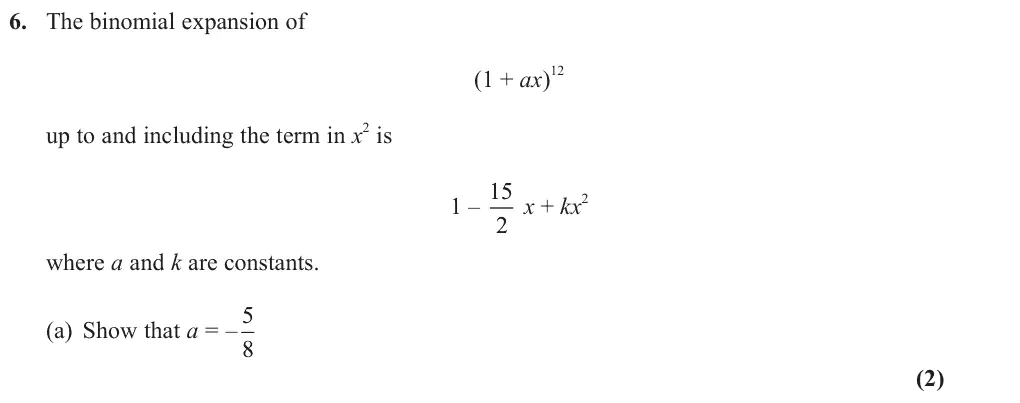
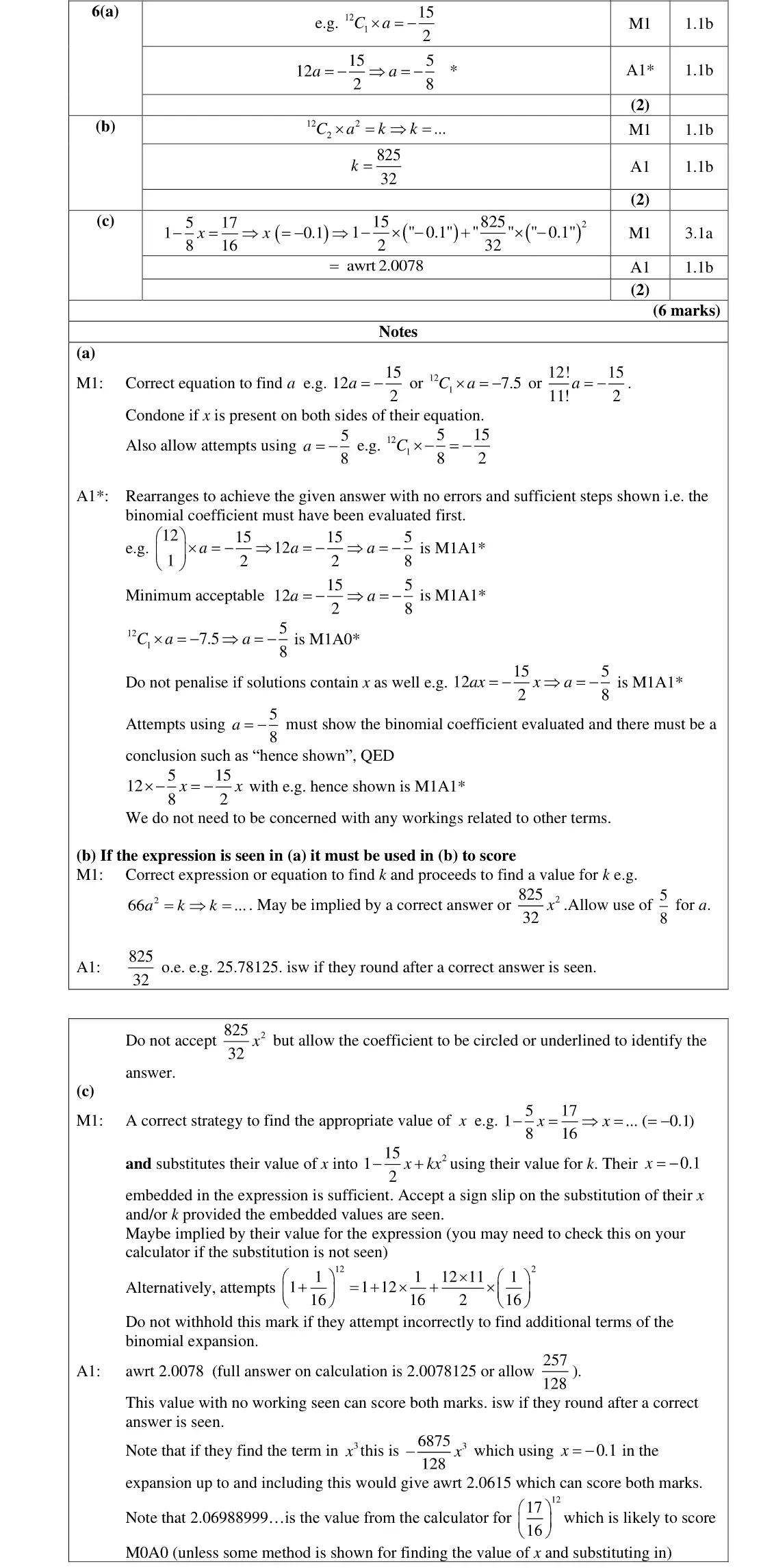
This was a very accessible question and candidates clearly felt comfortable with this topic. In particular, parts (a) and (b) were well answered, although part (c) did provide much more challenge and discriminated candidates well. Part (a) was generally done well with most candidates able to form a correct equation and proceed to find a. Those who used 5 8 a = - usually forgot to write a conclusion. There were a few who expanded and achieved 2 2 1 12 66 ax a x + + but then did not equate the terms or substitute in a and did not score any marks.
Common mistakes
¹²C₁ × a = −15/2 so 12a = −15/2
binomial coefficient must be evaluated
conclusion needed if verifying with a = −5/8
June 2024 · AS Paper 1 · Q6(b)2 marks
Mark scheme (whole question; this part is marked with the orange bar)
Examiner's comment
This was a very accessible question and candidates clearly felt comfortable with this topic. In particular, parts (a) and (b) were well answered, although part (c) did provide much more challenge and discriminated candidates well. In part (b), many candidates achieved the correct value for k. The most common mistake was to not square the a and ended up with 164 4 k = - . A few who just gave the answer as a decimal had rounded and lost the A mark.
Common mistakes
k = ¹²C₂ × a² = 66 × 25/64 = 825/32
forgetting to square a
rounding a decimal
June 2024 · AS Paper 1 · Q6(c)2 marks
Mark scheme (whole question; this part is marked with the orange bar)
Examiner's comment
This was a very accessible question and candidates clearly felt comfortable with this topic. In particular, parts (a) and (b) were well answered, although part (c) did provide much more challenge and discriminated candidates well. In part (c), a minority of candidates achieved both marks. A common mistake was to solve 5 17 1 8 16 x - = to find an appropriate value of x but to stop there and not substitute it into their expansion. A few substituted it back into 12 5 1 8 x - and ended up just evaluating 12 17 16 . For those who did substitute their x into the expansion, several had made errors when solving the equation and had an incorrect value of x. Again a few made rounding errors and lost the accuracy mark. Some candidates also found the next term in 3x which was not required and took up additional time, however, successful responses were credited with both marks.
Common mistakes
solve 1 − (5/8)x = 17/16 to get x = −0.1 and substitute into 1 − (15/2)x + kx²
awrt 2.0078
stopping after finding x
calculator value 2.0699 with no method scores 0
June 2023 · AS Paper 1 · Q145 marks
Mark scheme (whole question; this part is marked with the orange bar)
Examiner's comment
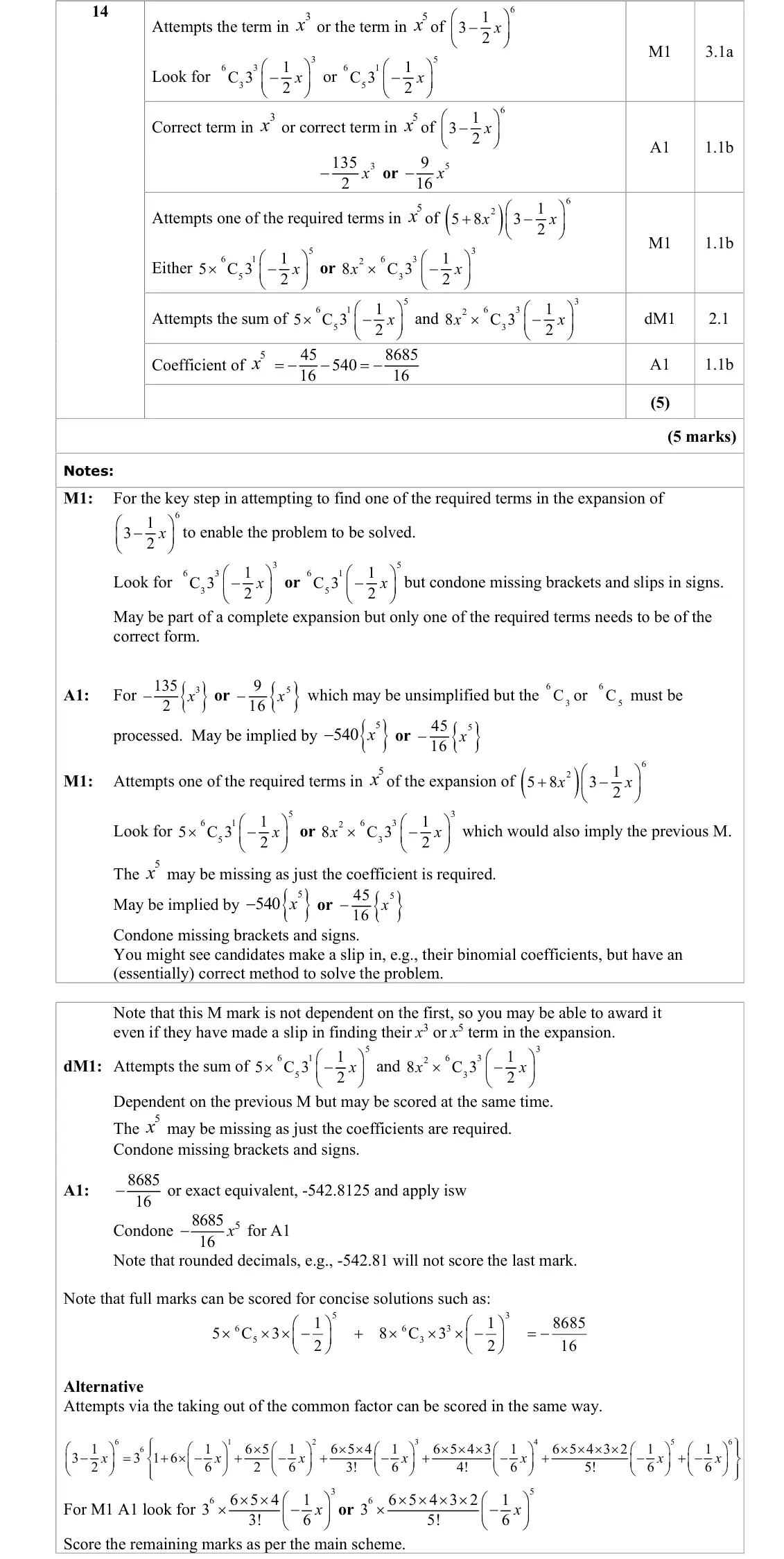
This question required candidates to isolate the required terms from the binomial expansion of 6 1 3 2 x - and is a reasonably familiar question from previous papers, but this was less structured to those that candidates have seen before. Many candidates elected to attempt the first few terms of the binomial expansion of 6 1 3 2 x - despite there being no requirement to do so, probably due to it being the most common first step of these questions. For those that took this approach, most candidates managed to begin the expansion correctly, but there were a lot of instances where the brackets were missing around 1 2 - . Often this was recovered and either one or both of the required terms were found correctly. A significant proportion of the candidates who got so far progressed either to multiply the 5x term by 5 and/or the 3x term by 8 and gained the second method mark, but often only one of the two required terms were found, scoring a maximum of 3 out of 5. Many candidates who achieved a ‘correct’ answer had left in the 5x and were only able to achieve full marks because the mark scheme condoned this. Candidates in future series must ensure that they fulfil the demand of the question and select the coefficient required. There were, however, a pleasing number of concise solutions in which candidates decided which terms were needed at the outset and elected only to find those that were required. These were often fully correct.
Common mistakes
only terms in x³ and x⁵ of (3 − x/2)⁶ are needed: ⁶C₃3³(−x/2)³ = −135x³/2 and ⁶C₅3(−x/2)⁵ = −9x⁵/16
multiply by 8x² and 5 and add: −8685/16
missing brackets on −1/2
finding only one of the two terms
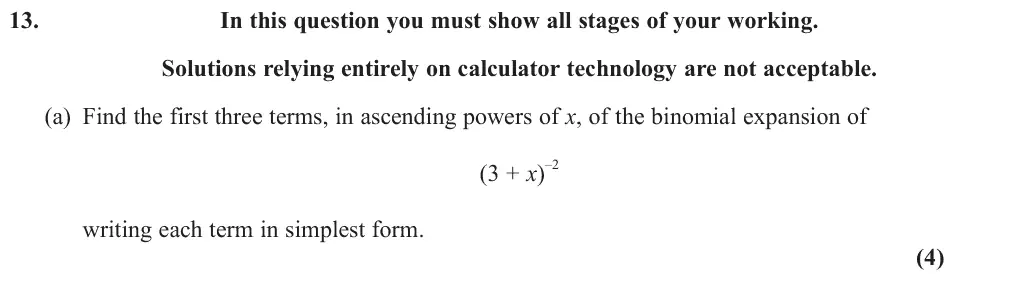
June 2023 · Paper 2 · Q13(a)4 marks
Mark scheme (whole question; this part is marked with the orange bar)
Examiner's comment
Most candidates attempted at least part (a) of this question, but some found the work more demanding in (b) and (c) and made little progress in either part. Despite this, there were many fully correct or nearly fully correct attempts at the whole question. In part (a), most candidates successfully factorised out 2 3-and attempted the correct resulting expansion of 2 1 3 x - + . There were some arithmetic slips, but generally candidates often reached the correct answer. A common error, however, was failing to factorise properly, reaching ( ) 2 2 3 1 . x - - + There were a number of attempts at direct expansion. Some of these used non-standard binomial coefficients involving negative integers. To achieve credit for using these, candidates needed to demonstrate the meaning of their non-standard notation. Very occasionally candidates multiplied their correct simplified expansion by 9 or 27 at the end. This still received full marks as examiners could ignore subsequent working following seeing a correct simplified answer.
Common mistakes
take out 3⁻² = 1/9 first: (1/9)(1 + x/3)⁻²
1/9 − 2x/27 + x²/27
common error taking out 3 instead of 3⁻²
brackets on (x/3)²
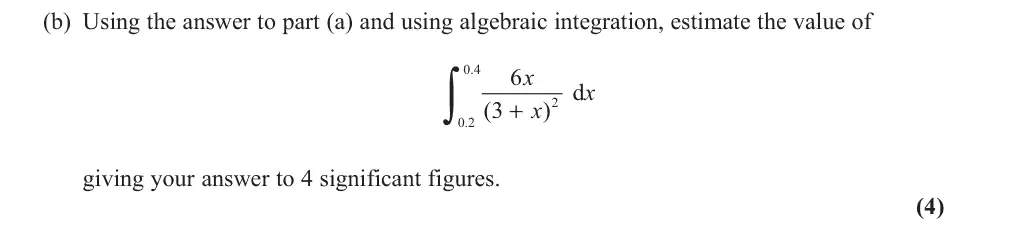
June 2023 · Paper 2 · Q13(b)4 marks
Mark scheme (whole question; this part is marked with the orange bar)
Examiner's comment
In part (b), many candidates correctly multiplied their expansion by 6x and then integrated using the limits of 0.2 and 0.4 reaching 0.03304, gaining full marks. A common error, however, was not giving the final answer to the required accuracy of four significant figures, thus losing the final accuracy mark. Those candidates who had expanded part (a) to more than three terms also lost this final accuracy mark as it led to a different approximation. A more complicated and unnecessary method involving integration by parts was used by a small minority of candidates. Candidates also often tried inappropriate approaches like dividing 6x by their expansion followed by a logarithmic integral. A minority of candidates, despite the warning at the start of the question, clearly used calculator technology to obtain 0.032865, rather than the answer of 0.03304 required. Others made inappropriate attempts at the trapezium rule, thus gaining no credit as algebraic integration was required.
Common mistakes
multiply the expansion by 6x, integrate term by term and use limits 0.2 and 0.4: 0.03304 (4 s.f.)
calculator value 0.032865 or trapezium rule scores 0
extra terms give a different estimate
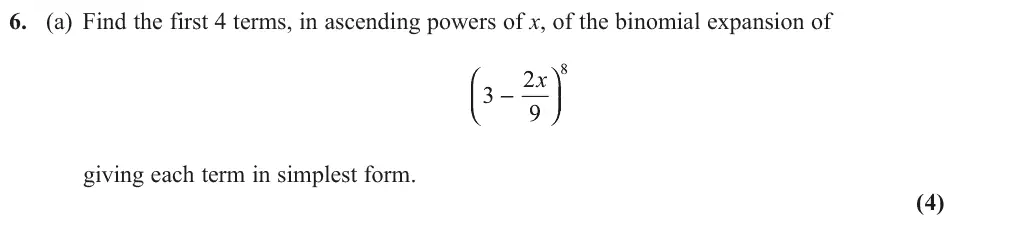
June 2022 · AS Paper 1 · Q6(a)4 marks
Mark scheme (whole question; this part is marked with the orange bar)
Examiner's comment
The binomial question was fairly typical in its structure, so most candidates were able to make a lot of progress in part (a), but part (b) proved to be much more challenging. Part (a) was general answered well, with almost all candidates scoring at least the first 2 marks. Of those who did not score all of the marks, the most common mistake was ignoring the negative sign in the bracket. Candidate dealt well with the coefficient of x, remembering in most cases to apply the power to it.
Common mistakes
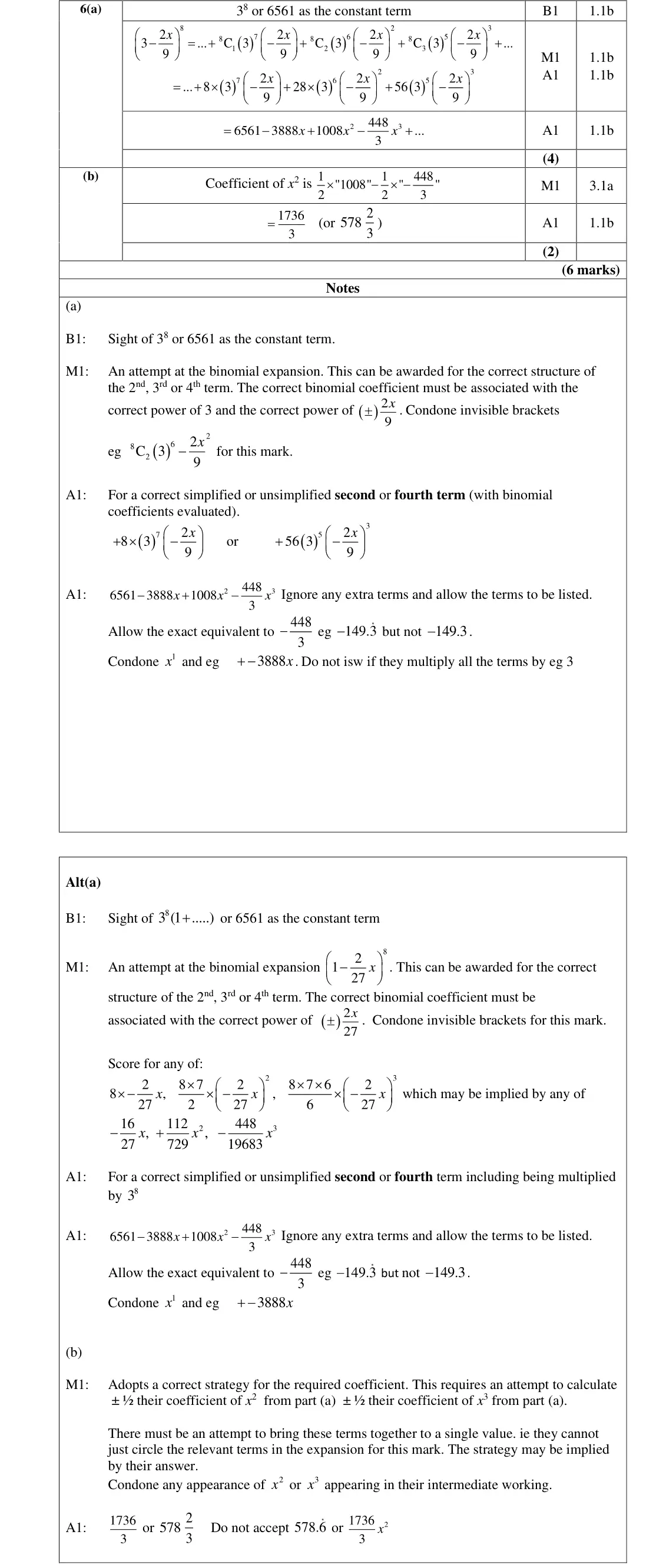
constant term 3⁸ = 6561
keep the negative sign in −2x/9 and raise the whole term to the power
6561 − 3888x + 1008x² − (448/3)x³
June 2022 · AS Paper 1 · Q6(b)2 marks
Mark scheme (whole question; this part is marked with the orange bar)
Examiner's comment
The binomial question was fairly typical in its structure, so most candidates were able to make a lot of progress in part (a), but part (b) proved to be much more challenging. Part (b) on the other hand was misunderstood by many candidates. Several simply stated the coefficient of the 2x term in their expansion, or attempted to multiply the bracket by their coefficient of 2x , leading to variations of ( ) 2 3 504 504 x x x - . A significant minority understood what was being asked of them, but incorrectly wrote 1 2x as 1 2x- instead of 1 1 2 x-.
Common mistakes
(x − 1)/(2x) = ½ − 1/(2x), so the x² coefficient is ½(1008) − ½(−448/3) = 1736/3
quoting 1008 or multiplying the bracket by the coefficient is wrong
1/(2x) is ½x^(−1), not 2x^(−1)
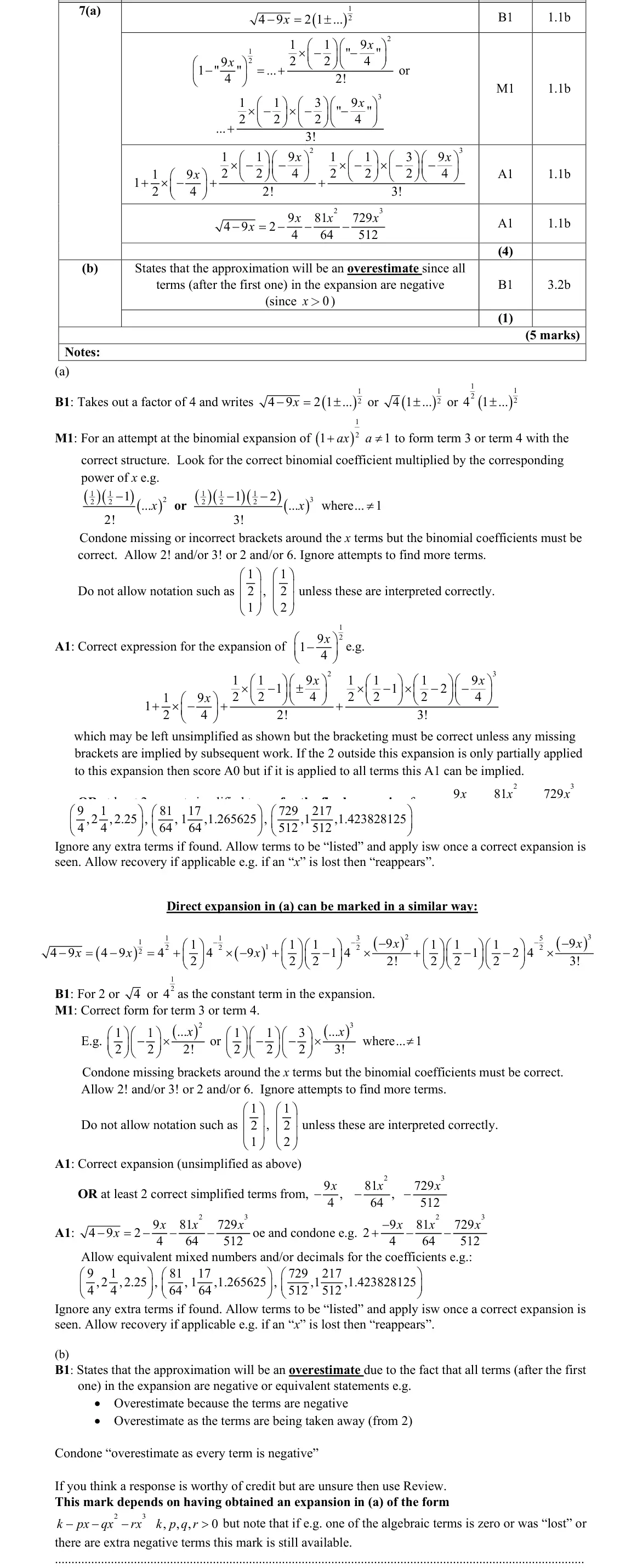
June 2022 · Paper 2 · Q7(a)4 marks
Mark scheme (whole question; this part is marked with the orange bar)
Examiner's comment
This question on binomial expansion was well attempted and generally well answered by most candidates. In part (a), almost all candidates achieved at least 1 mark, either by extracting the factor of 41/2 correctly, or for having a correct binomial coefficient 𝑥𝑥2 as their 3rd term, which was not awarded the ቀ1 2ቁቀ1 2-1ቁ multiplied by the corresponding power of x on their 3rd or 4th term. A few candidates 2! omitted the -9/4 and wrote method mark. Some candidates used 9/4 erroneously, instead of -9/4 in their expansion, and this could still gain the method mark but meant the two accuracy marks were lost. Candidates A common response seen was a correct expansion of ቀ1 - 4 ቁ 1/2 9𝑥𝑥 bracketing was sometimes incorrect but often recovered by later work. but failure to multiply this by the “2” they had factorised outside the bracket at the beginning. A minority of candidates attempted a direct expansion method, and many of these achieved the first mark only for a correct first term, as they often did not find the correct binomial coefficients. Unfortunately, several candidates made number of slips, or omitted an exponent, in their final line and did not write the correct answer following correct working and so lost the final accuracy mark.
Common mistakes
take out 4^½ = 2 and multiply every term by 2
use −9x/4 not 9x/4
2 − 9x/4 − 81x²/64 − 729x³/512
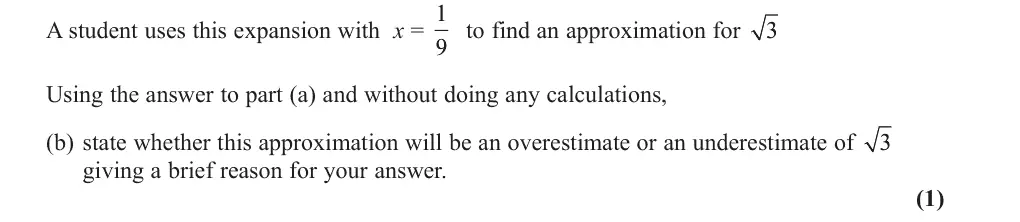
June 2022 · Paper 2 · Q7(b)1 mark
Mark scheme (whole question; this part is marked with the orange bar)
Examiner's comment
This question on binomial expansion was well attempted and generally well answered In part (b) very few could articulate correctly why this was an overestimate. Many left this part out or just wrote overestimate or underestimate with no explanation. Some were very inventive in their reasons. Poor wording/clarity on subtracting terms, such as ‘decreasing trend’, or ‘terms decreased’ but not specifically stated to be subtracted from the leading 2. Many tried substituting in values to show it was smaller which was not sufficient. The majority did not relate the reasoning back to the binomial expansion directly. Some went on to evaluate the binomial using x = 1/9. Some said the terms were getting smaller rather than pointing out that they were negative. Some, however, gave a very clear reasoned argument. Several students answered part (b) with an explanation about the validity of the expansion using |x|<1. Some students thought the overestimation was due to the fact that the expansion had only used 4 terms and that the approximation would be better if more common mistake was stating that 𝒙𝒙< ቂ 𝟗𝟗ቃ which in their opinion meant that the 𝟒𝟒 terms were used, with no reference to the fact that they should be subtracted from 2. A 𝟗𝟗< 𝟒𝟒 𝟏𝟏 𝟗𝟗 or the other way approximation was over/underestimation due to the fact that round.
Common mistakes
overestimate because every term after the 2 is negative (subtracted)
"terms getting smaller", validity or "only 4 terms" are not reasons
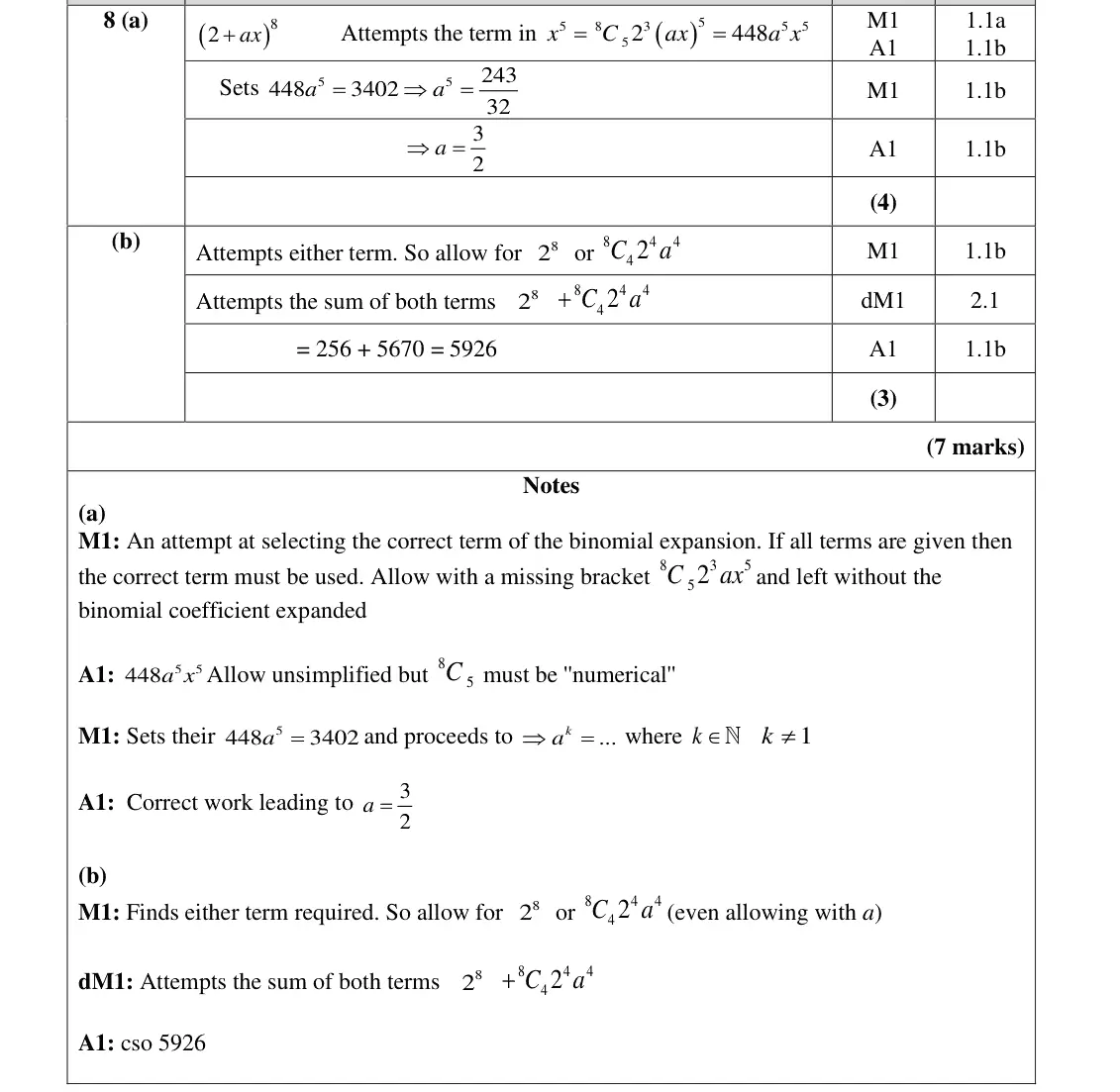
Oct 2021 · AS Paper 1 · Q8(a)4 marks
Mark scheme (whole question; this part is marked with the orange bar)
Examiner's comment
The binomial expansion question proved to be very accessible to begin with, but for many, part (b) was too challenging so full marks was extremely rare on this question. In part (a), candidates were usually very successful in finding that 3 2 a = . Candidates typically wrote out all the terms up to the coefficient for 5x , although some did proceed straight to the required term. The small minority made errors with the correct binomial coefficient. Candidates were often able to equate their coefficient for 5x to the coefficient given in the question, although bracket errors meant that the most frequent error was not achieving 5a so no further marks could be scored in this part as they had simplified the question.
Common mistakes
term in x⁵ is ⁸C₅ 2³ (ax)⁵ = 448a⁵x⁵
brackets needed so a is raised to the 5th power
a⁵ = 243/32 gives a = 3/2
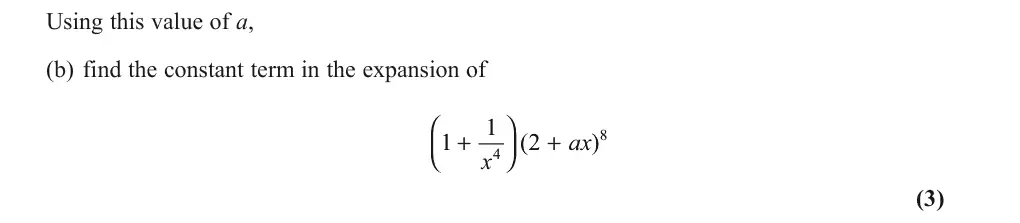
Oct 2021 · AS Paper 1 · Q8(b)3 marks
Mark scheme (whole question; this part is marked with the orange bar)
Examiner's comment
The binomial expansion question proved to be very accessible to begin with, but for many, part (b) was too challenging so full marks was extremely rare on this question. In part (b) candidates often recognised that 82 was a required term, but very few found the other term, and hardly any attempted to add the two required terms together.
Mark scheme (whole question; this part is marked with the orange bar)
Examiner's comment
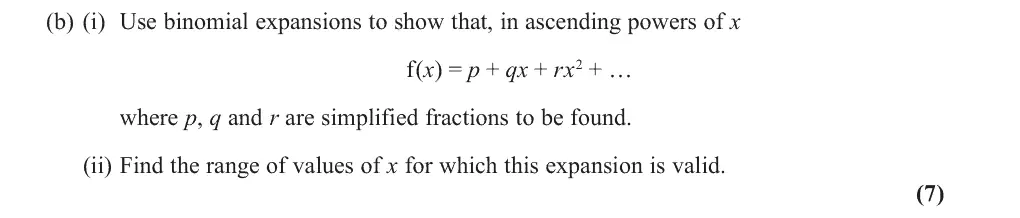
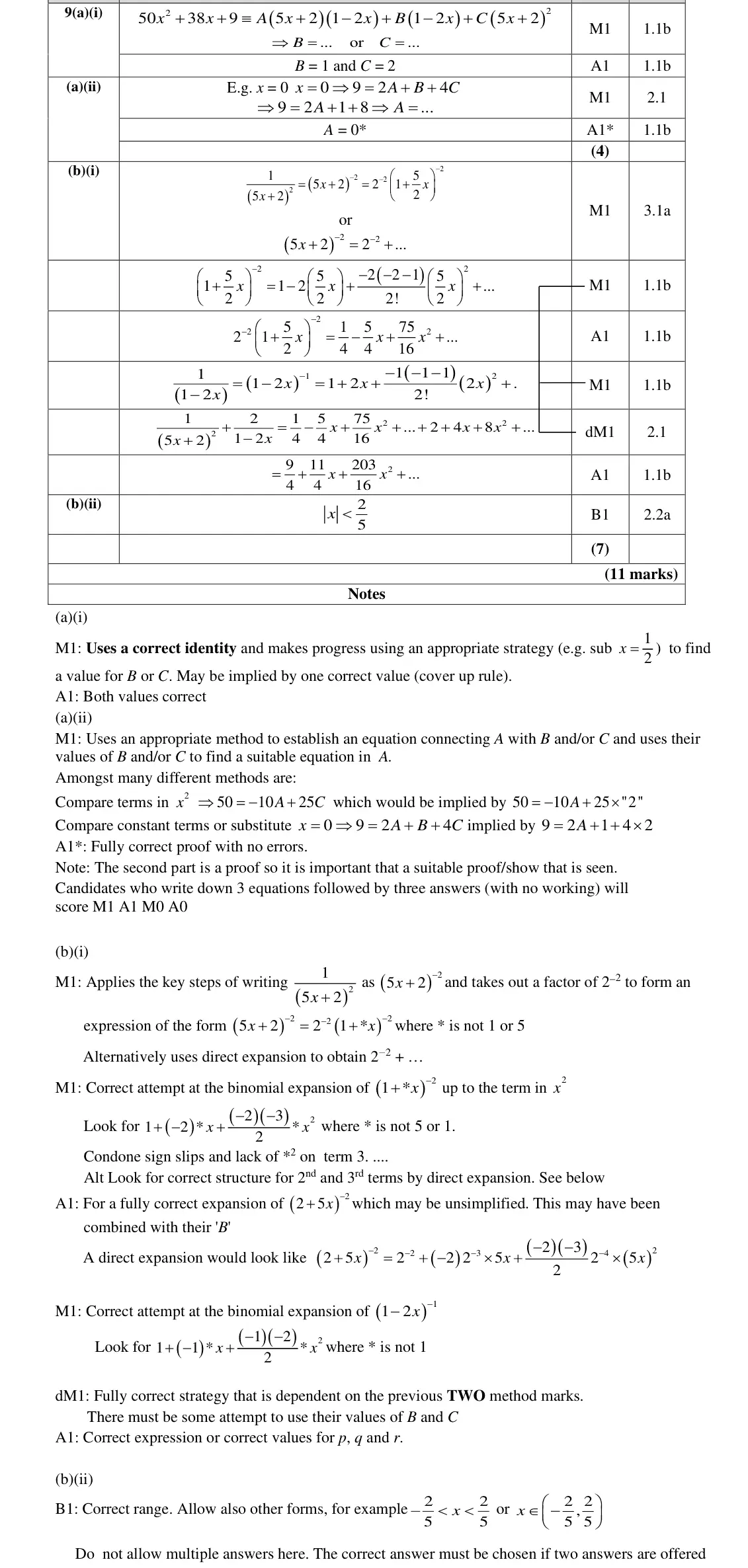
This question was answered with varying degrees of success. Around 28% of the candidates failed to score any marks here at all, which was very suprising. There were however, many well formed and accurate solutions by careful candidates. In part (b)(i) it was rare to see fully correct expansions. Good candidates often lost the final mark due to an error in adding the required terms. A common error was forgetting to use their value for C and only adding the expansion for (1-2x)-1 rather than C(1-2x)-1. A few were unable to extract 2-1 correctly from (5x+2)-2 (usually having this as 2). Other errors seen involved an expansion of (1 + 2/5 x)-2 or else (1 + 5/2 x) 2 rather than (1 + 5/2 x) -2. Very few correct answers were seen for part (b)(ii) and this was very often not attempted. Those who did write a correct range sometimes also gave a second range which therefore did not gain the B mark here.
Common mistakes
write (5x + 2)⁻² as ¼(1 + 5x/2)⁻², not (1 + 2x/5)⁻² or a factor of 2
multiply (1 − 2x)⁻¹ by C = 2
f(x) = 9/4 + 11x/4 + 203x²/16
valid for modulus of x < 2/5 (the stricter range only
two ranges scores B0)
Oct 2020 · Paper 1 · Q1(a)3 marks
Mark scheme (whole question; this part is marked with the orange bar)
Examiner's comment
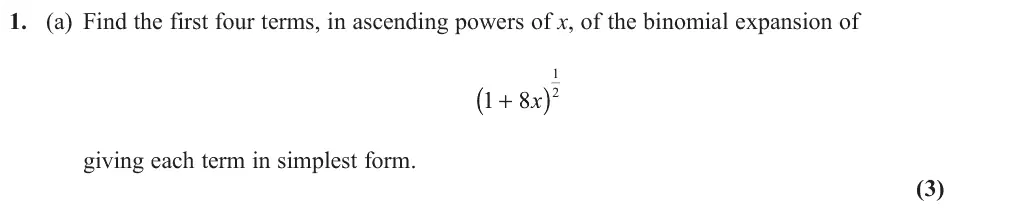
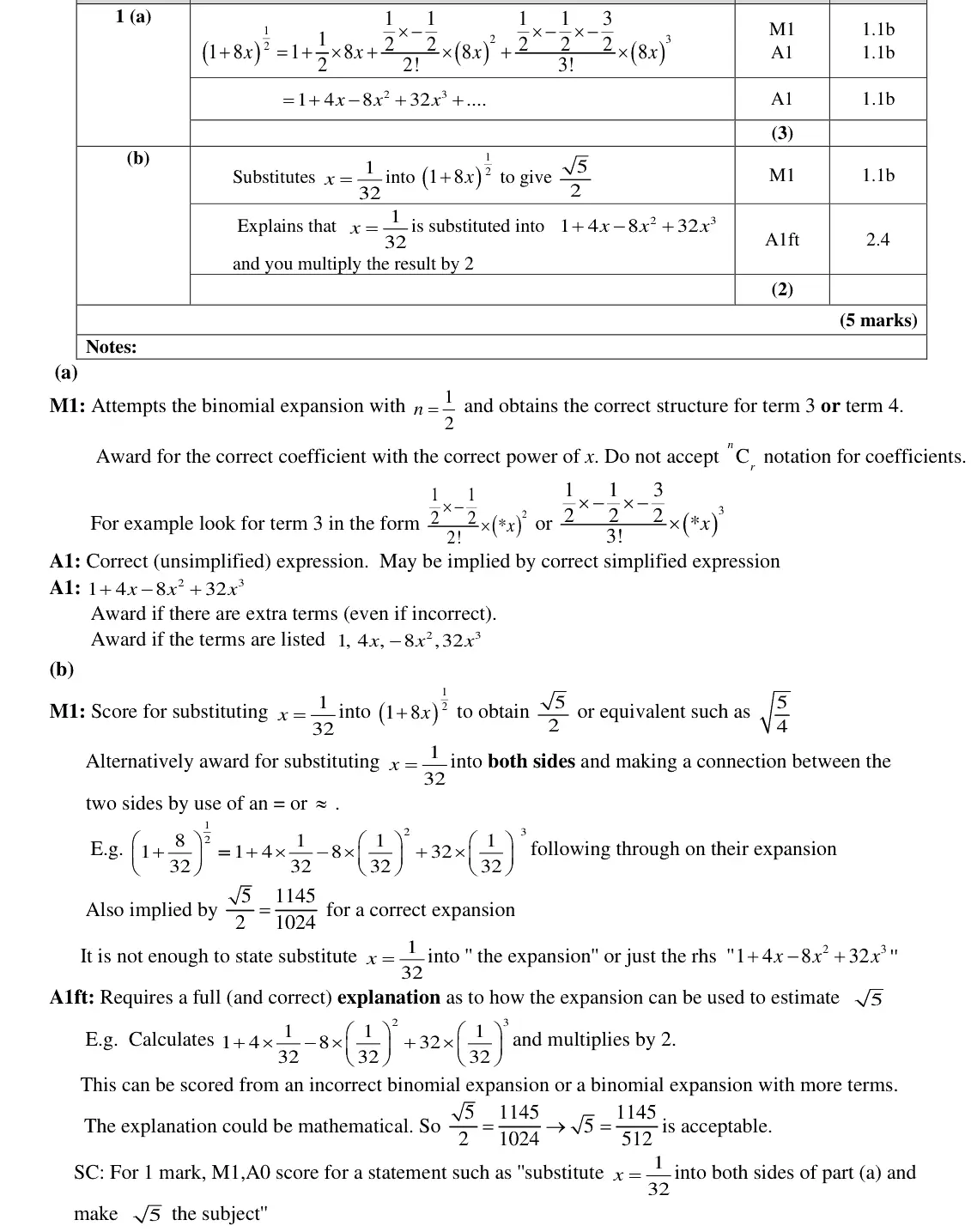
As hoped for, this proved to be a gentle and accessible start to the paper. The majority of prepared candidates scored all available marks in part (a). Errors, although rare, were mainly seen in the failure not to square the 8 of ( ) 2 Part (b) was found to be more 8 . x 1 into the expansion in (a) and multiply the result by 2. Concise substitute x = 32 explanations are still a weakness in the early years of this specification.
Common mistakes
n = ½ with (8x)ⁿ: square and cube the 8 (common error 8x² instead of 64x²)
nCr notation not accepted for coefficients
1 + 4x − 8x² + 32x³
Oct 2020 · Paper 1 · Q1(b)2 marks
Mark scheme (whole question; this part is marked with the orange bar)
Examiner's comment
As hoped for, this proved to be a gentle and accessible start to the paper. The majority mainly seen in the failure not to square the 8 of ( ) 2 Part (b) was found to be more 8 . x 1 1 into ( ) 1 8x demanding. Successful students substituted and noted that the x = + 2 32 5 . result was It then became a simple task of stating that you merely needed to 2 1 into the expansion in (a) and multiply the result by 2. Concise substitute x = 32
Common mistakes
x = 1/32 makes (1 + 8x)^½ = √(5/4) = √5/2, so substitute into 1 + 4x − 8x² + 32x³ and multiply by 2
"substitute into the expansion" alone is not enough
Oct 2020 · AS Paper 1 · Q6(a)3 marks
Mark scheme (whole question; this part is marked with the orange bar)
Examiner's comment
The binomial expansion seemed a welcome relief with many candidates achieving full marks in part (a). The usual problems with exponents crept in but fortunately there were no ‘negatives raised to powers’ to contend with. The simple equation in part (b) was not answered quite as well but coefficients were followed through from part (a) allowing some marks if they multiplied the correct expression by 3. In part (a), candidates answered this well with a mix of methods due to the expression being of the form (1 ...)n + . The most common mistake was to not raise k to the various powers as well as the x. Some candidates were one step out in their binomial expansion such that the coefficients did not match the term. A few candidates found expansions in decreasing powers of x and could not score any marks. In part (b), those who got an answer for part (a) would usually achieve at least the first mark in part (b). Some candidates were unable to form a correct equation for the coefficients and simply set them equal to each other without multiplying the linear term by 3. There was a small number of cases where the wrong side was multiplied by 3. It was disappointing that a large number are still uncomfortable with the term “coefficient” as there were a lot of scripts that kept the x and x3 in the equation and even tried to solve to find x. Others removed the x and x3 later on, but this should be discouraged as a general approach.
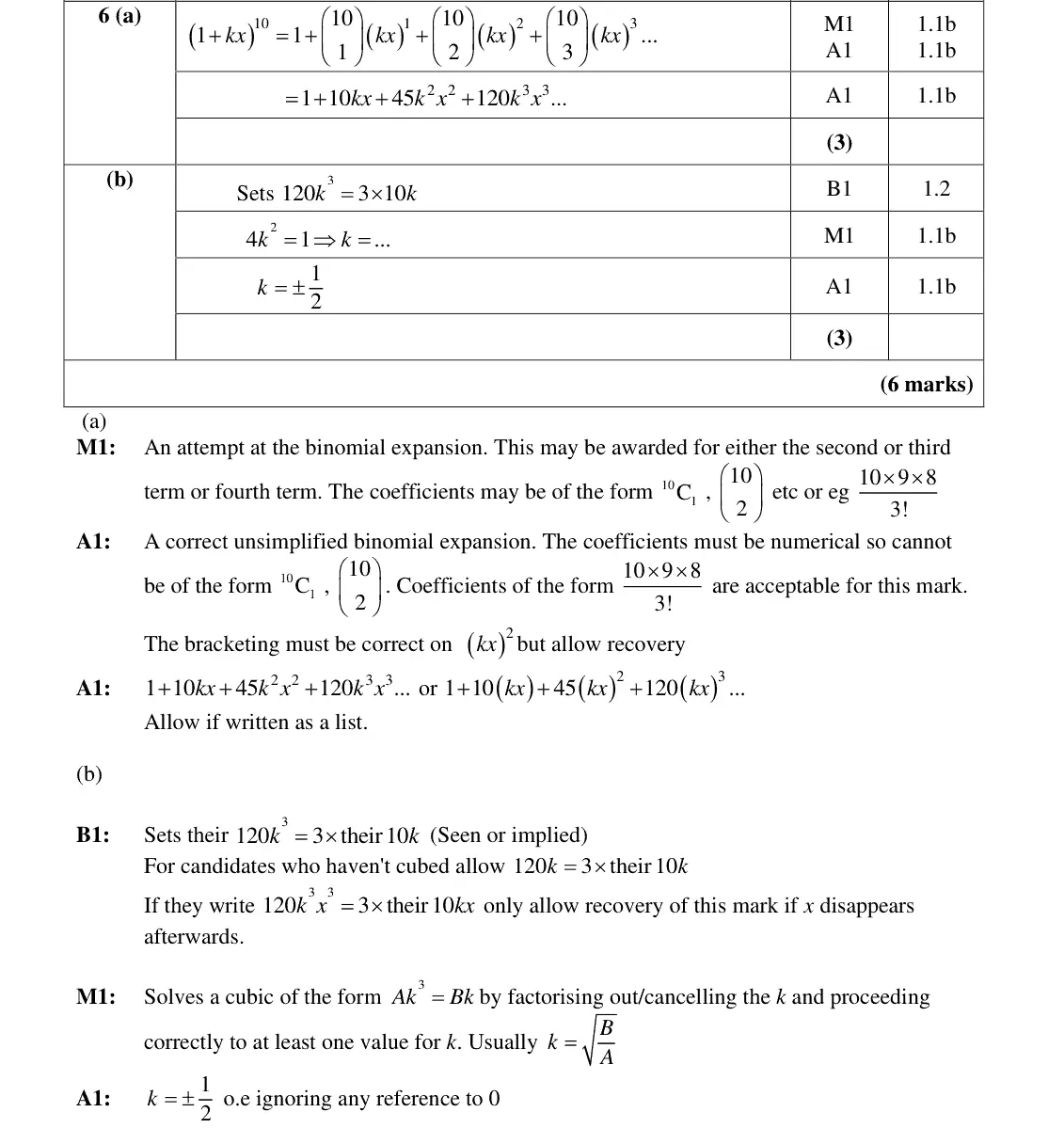
Common mistakes
raise k to the powers as well as x
coefficients 10k, 45k², 120k³
ascending powers
Oct 2020 · AS Paper 1 · Q6(b)3 marks
Mark scheme (whole question; this part is marked with the orange bar)
Examiner's comment
The binomial expansion seemed a welcome relief with many candidates achieving full marks in part (a). The usual problems with exponents crept in but fortunately there were no ‘negatives raised to powers’ to contend with. The simple equation in part (b) was not answered quite as well but coefficients were followed through from part (a) allowing some marks if they multiplied the correct expression by 3. In part (b), those who got an answer for part (a) would usually achieve at least the first mark in part (b). Some candidates were unable to form a correct equation for the coefficients and simply set them equal to each other without multiplying the linear term by 3. There was a small number of cases where the wrong side was multiplied by 3. It was disappointing that a large number are still uncomfortable with the term “coefficient” as there were a lot of scripts that kept the x and x3 in the equation and even tried to solve to find x. Others removed the x and x3 later on, but this should be discouraged as a general approach.
Common mistakes
120k³ = 3 × 10k (multiply the x coefficient by 3, not the x³ one)
coefficients do not include x
cancel k (k ≠ 0) to get k = ±½
Oct 2020 · Paper 2 · Q43 marks
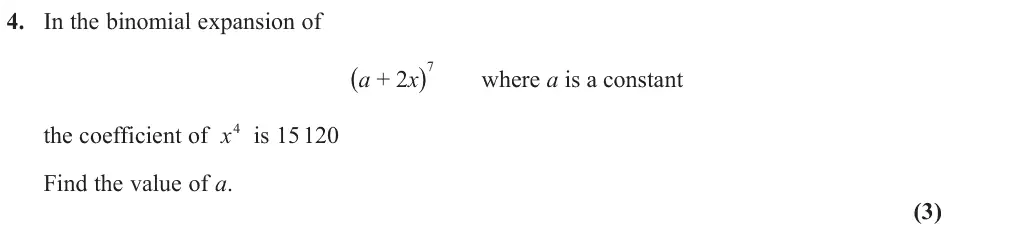
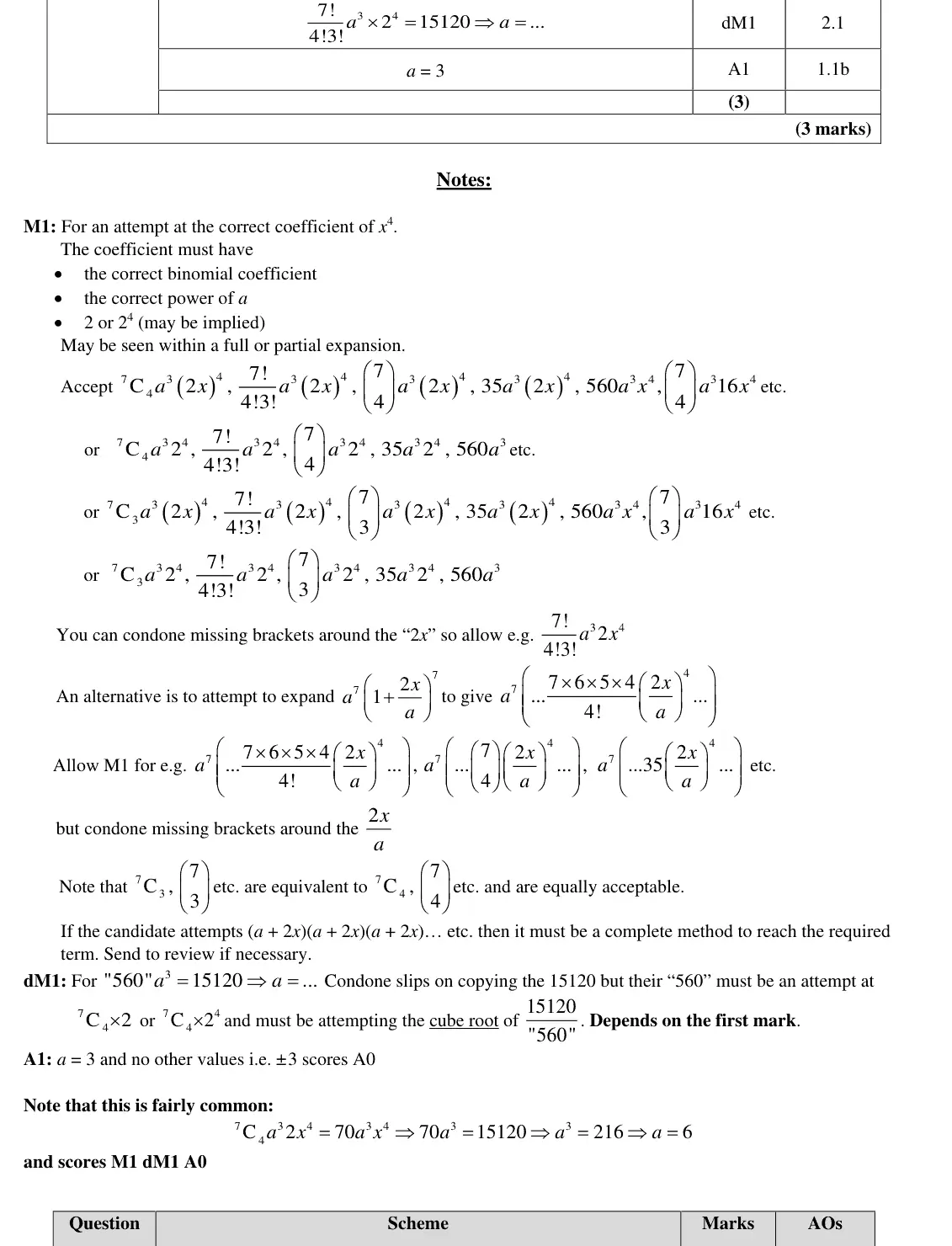
Mark scheme (whole question; this part is marked with the orange bar)
Examiner's comment
This was generally well done, and most candidates scored full marks. A few candidates missed out the brackets around the 2x which usually led to a = 6. Several candidates made a mistake when finding the correct coefficient of x4 and scored no marks. This was either because the power of a was incorrect or the binomial coefficient was incorrect or occasionally completely missing. The most common error was having the wrong power of a, usually as a4 or sometimes a or a7 Several candidates used a7(1 + 2x/a)7 and errors with the power of a were also common with this method. Some candidates forgot to multiply by a7 and some forgot to divide the 2x by a.
Common mistakes
coefficient ⁷C₄ a³ (2x)⁴ = 560a³
brackets round 2x (missing gives a = 6)
wrong power of a (a⁴, a⁷) is the most common error
a = 3 only
June 2019 · Paper 1 · Q4(a)4 marksMedium
Mark scheme (whole question; this part is marked with the orange bar)
Examiner's comment
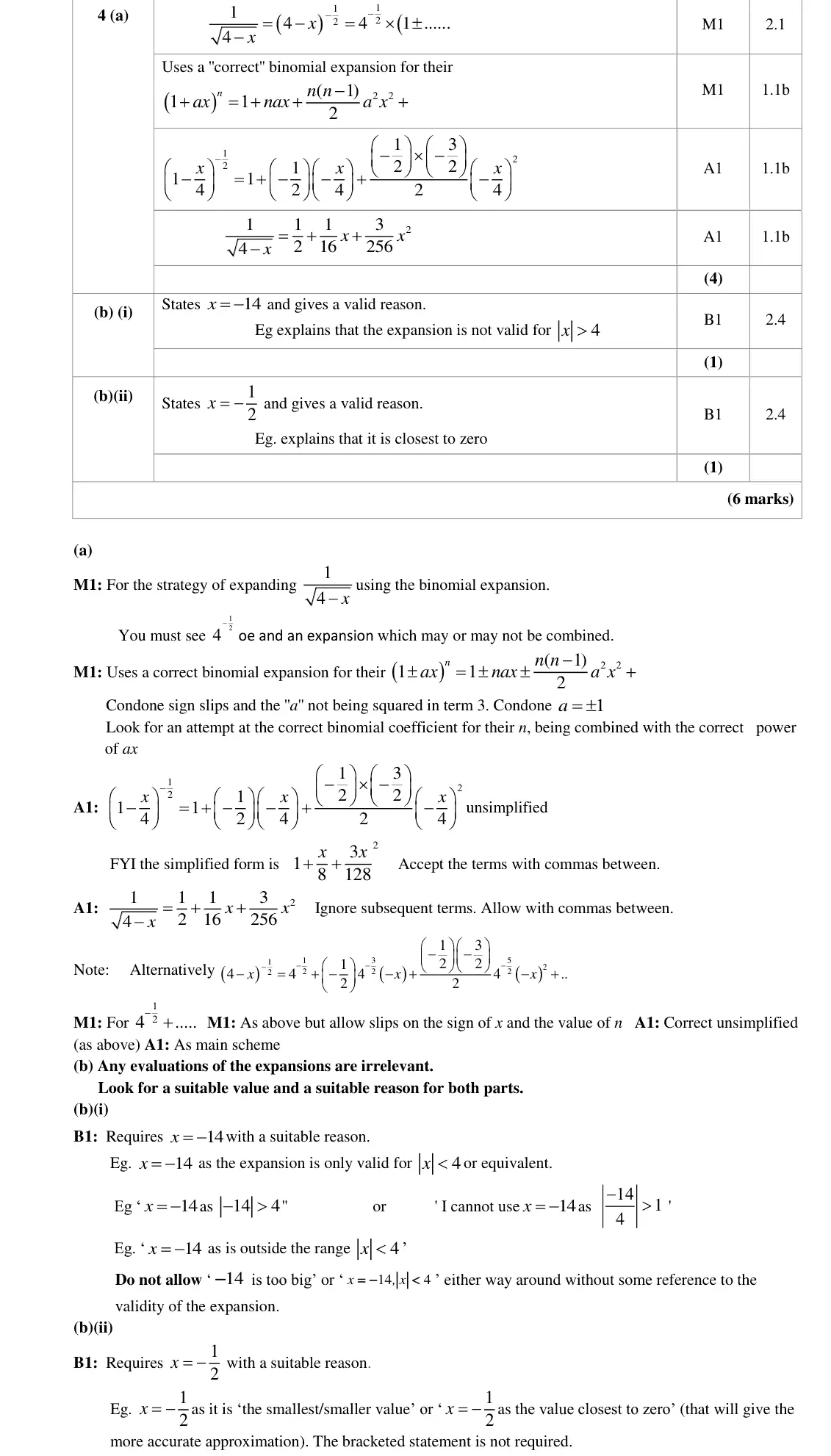
The vast majority of candidates did well in part (a), securing most or all of the marks available. They appreciated the need to rewrite the expression with a negative power and dealt confidently with the factorisation. The binomial expansion itself was also correctly executed and careful working ensured that there were relatively few slips in powers or signage. Common errors included 2 2 x x bracketing errors seen with in the third term rather than 4 4 1 2 3 x x 1 4 failing to correctly combine the factored out with the expansion 2 8 128
Common mistakes
take out 4^(−½) = ½ to get (1 − x/4)^(−½)
bracket (−x/4)²
½ + x/16 + 3x²/256
June 2019 · Paper 1 · Q4(b)(i)1 markMedium
Mark scheme (whole question; this part is marked with the orange bar)
Examiner's comment
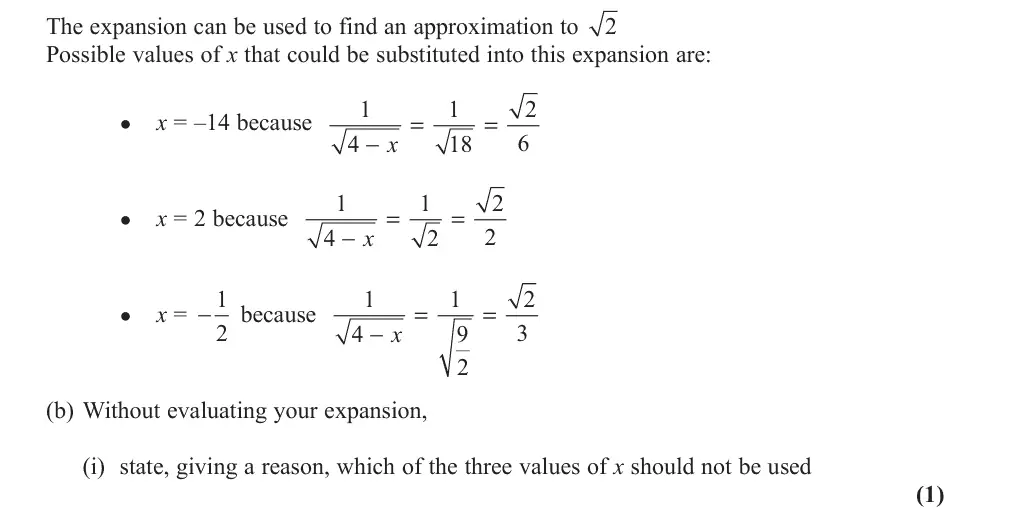
Part (b) caused more difficulty. In part (i), many candidates appeared to realise that the question was linked to x 14 the range of valid x values and the correct answer, , was selected most often. To gain this mark however, the correct answer and a valid reason needed to be given. Examples of valid reasons were ''the x x 14 4 4 14 expansion is only valid for '' , ''the expansion is not valid for as ''. In part (ii), only a small proportion of the candidates realised that the expansion is more accurate for values of x closest to 0. Many resorted to using the three values given and comparing the results to the exact value of 2 or else stating that the answer was 2 as it was the closest value to 2 .
Common mistakes
x = −14 because the expansion is only valid for modulus of x < 4
"−14 is too big" without reference to validity scores 0
June 2019 · Paper 1 · Q4(b)(ii)1 markMedium
Mark scheme (whole question; this part is marked with the orange bar)
Examiner's comment
The vast majority of candidates did well in part (a), securing most or all of the marks available. They appreciated the need to rewrite the expression with a negative power and dealt confidently with the factorisation. The binomial expansion itself was also correctly executed and careful working ensured that there were relatively few slips in powers or signage. Common errors included 2 2 x x bracketing errors seen with in the third term rather than 4 4 1 2 3 x x 1 4 failing to correctly combine the factored out with the expansion 2 8 128 Part (b) caused more difficulty. In part (i), many candidates appeared to realise that the question was linked to x 14 the range of valid x values and the correct answer, , was selected most often. To gain this mark however, the correct answer and a valid reason needed to be given. Examples of valid reasons were ''the x x 14 4 4 14 expansion is only valid for '' , ''the expansion is not valid for as ''. In part (ii), only a small proportion of the candidates realised that the expansion is more accurate for values of x closest to 0. Many resorted to using the three values given and comparing the results to the exact value of 2 or else stating that the answer was 2 as it was the closest value to 2 .
Common mistakes
x = −½ because it is closest to zero
evaluating the expansions or choosing the value nearest √2 is wrong
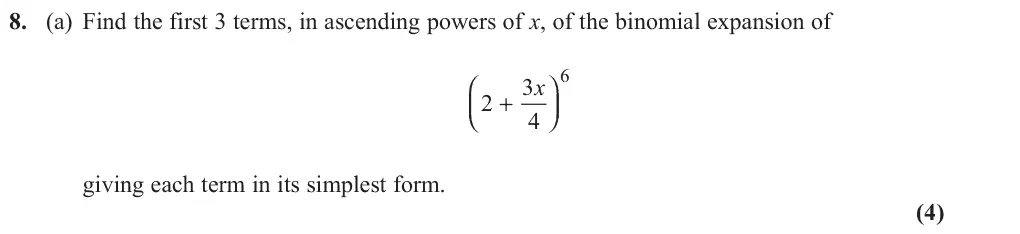
June 2019 · AS Paper 1 · Q8(a)4 marksEasy
Mark scheme (whole question; this part is marked with the orange bar)
Examiner's comment
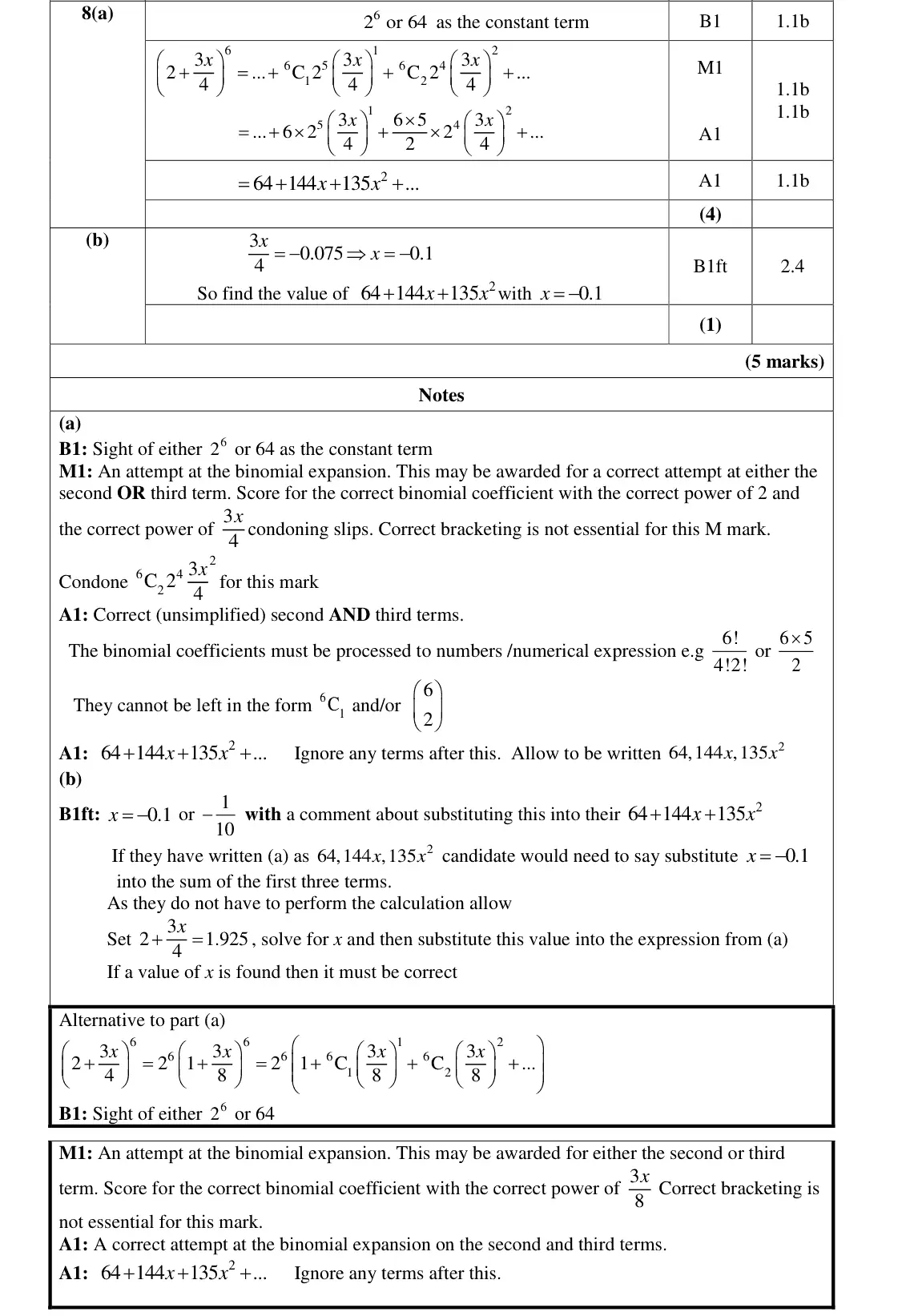
This question was generally well answered with many candidates scoring full marks in part (a). Candidates had been clearly well rehearsed with binomial expansion and were able to make an attempt at applying the correct technique. For those that had some success with the question, the ‘64’ to score B1 was almost always seen, as was the ‘144x’. The most common mistake was with ‘135x2’, with many candidates not including the coefficient of x when squaring and using 3x2/4 instead of 9x2/16. Seeing more than three terms calculated was rare. Occasionally candidates did not sum the terms, but this was condoned for the question. Finally, there were some candidates who failed to simplify their expressions fully, which was penalised in the final accuracy mark.
Common mistakes
constant term 2⁶ = 64
bracket the (3x/4)² so the third term is 135x² (not using 3x²/4)
simplify each term: 64 + 144x + 135x²
June 2019 · AS Paper 1 · Q8(b)1 markEasy
Mark scheme (whole question; this part is marked with the orange bar)
Examiner's comment
In part (b) candidates had less success. While the vast majority had some idea what to do, frequently the language used was unclear and candidates did not always fully explain what to do, often omitting the detail of substituting the value of x into their binomial expansion. Ambiguous phrasing, such as, “substituted into the previous equation” was penalised here. Many candidates went beyond the requirements of the question and calculated x, with some going further and substituted their value in to the binomial expansion. As usual, a common misconception was to let x = 1.925 and substitute it into the expansion.
Common mistakes
2 + 3x/4 = 1.925 gives x = −0.1
say substitute x = −0.1 into 64 + 144x + 135x²
x = 1.925 is wrong
June 2018 · AS Paper 1 · Q11(a)4 marks
Mark scheme (whole question; this part is marked with the orange bar)
Examiner's comment
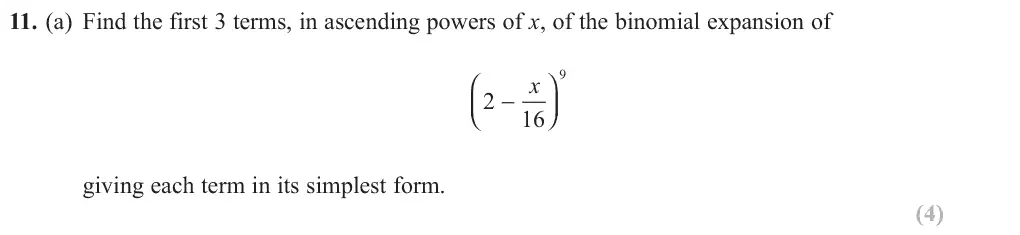
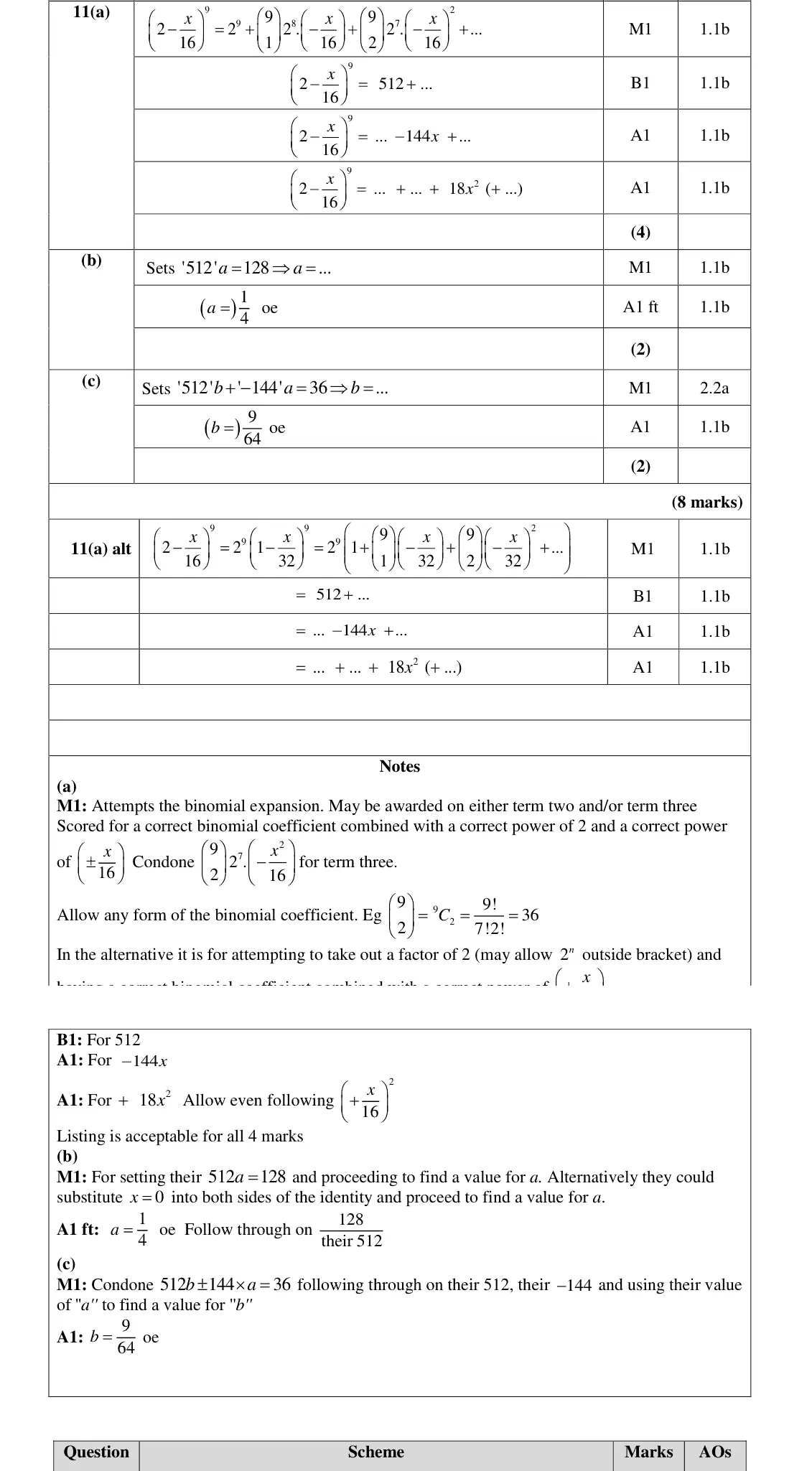
Part (a) was standard ‘book work’ on the binomial expansion. This was usually well done but applying this expansion within a new expression was met with limited success. Many students did not attempt parts (b) and (c). The majority of students attempted part (a) of this question. Most were able to apply the binomial expansion and gain the correct unsimplified quadratic form. Common errors included missing out the negative in the expansion, so 512+144x+18x2 was a common incorrect answer. Some students failed to simplify correctly leaving their coefficients as fractions.
Common mistakes
512 − 144x + 18x²
the negative sign of −x/16 is often lost (512 + 144x + 18x²)
coefficients must be simplified
June 2018 · Paper 1 · Q11(a)6 marks
Mark scheme (whole question; this part is marked with the orange bar)
Examiner's comment
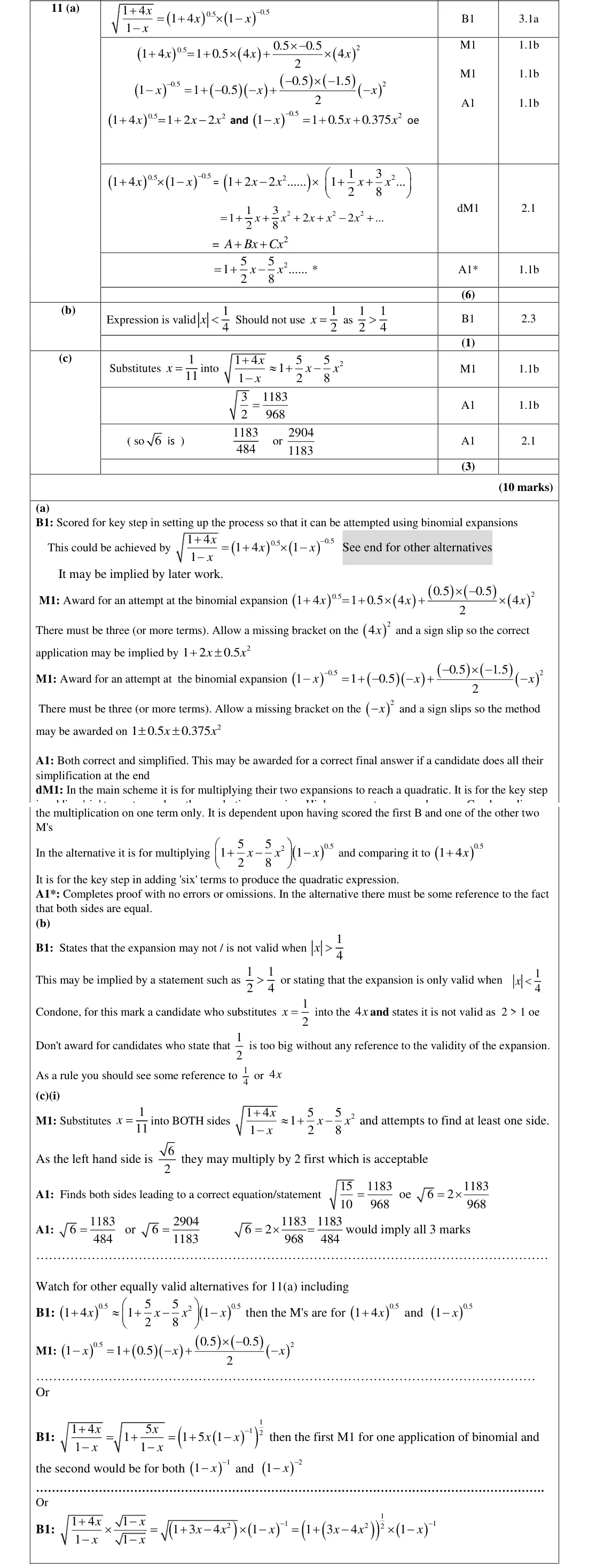
This question on the binomial expansion was well attempted by many students, although showing sufficient detail to prove the given result in part (a) and providing a comprehensive explanation in part (b) proved difficult. In part (a), the majority of students started by attempting to expand 0.5 0.5 . As mentioned in previous years, it is good 1 4 1 x x practice to give the unsimplified version (of each expansion) before attempting to find the simplified form. Those who did find the correct simplified forms of both expansions often lost the last two marks as many proceeded to just write down the given answer. This is a show that question and there was a requirement to show the six key terms that when collected together formed the given expression. Strangely there were a number of cases where the correct expansions were added, and in other cases divided, in an attempt to find the given answer. As with other ''explain'' questions on this paper, (b) was the worst attempted part of the
Common mistakes
write as (1 + 4x)^½ × (1 − x)^(−½)
expand each to x² (square the 4x, sign of −x)
multiply and show the key terms before the given answer
adding or dividing the expansions is wrong
June 2018 · AS Paper 1 · Q11(b)2 marks
Mark scheme (whole question; this part is marked with the orange bar)
Examiner's comment
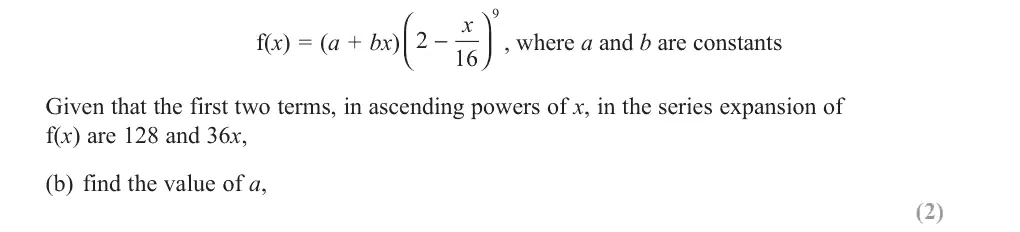
A common error in parts (b) and (c) was to set up a pair of (incorrect) simultaneous equations in a and b. Solutions of this type, that is via attempting to solve 512(a + bx) = 128 does show a lack of understanding between constants and variables. Students who did successfully find a = 0.25 rarely could handle the more complex process required to find b. Students scoring full marks in this question were rare.
Common mistakes
constant term: 512a = 128 so a = ¼
do not treat (a + bx) as a variable and form wrong simultaneous equations such as 512(a + bx) = 128
June 2018 · Paper 1 · Q11(b)1 mark
Mark scheme (whole question; this part is marked with the orange bar)
Examiner's comment
This question on the binomial expansion was well attempted by many students, although explanation in part (b) proved difficult. In part (a), the majority of students started by attempting to expand 0.5 0.5 . As mentioned in previous years, it is good 1 4 1 x x practice to give the unsimplified version (of each expansion) before attempting to find the simplified form. Those who did find the correct simplified forms of both expansions often lost the last two marks as many proceeded to just write down the given answer. This is a show that question and there was a requirement to show the six key terms that when collected together formed the given expression. Strangely there were a number of cases where the correct expansions were added, and in other cases divided, in an attempt to find the given answer. As with other ''explain'' questions on this paper, (b) was the worst attempted part of the question. Many merely pointed out that 1/2 was too big or could not be used to find 6, rather than focussing in on the range in values of x for which the expansion was valid. Part c was the most successful part of this question for many students with many gaining all three marks. Errors seen were mostly arithmetic, with the incorrect fraction 1183 968 commonly seen
Common mistakes
expansion valid only for modulus of x < ¼ (because of the 4x) and ½ > ¼
"½ is too big" without reference to validity scores 0
June 2018 · AS Paper 1 · Q11(c)2 marks
Mark scheme (whole question; this part is marked with the orange bar)
Examiner's comment
A common error in parts (b) and (c) was to set up a pair of (incorrect) simultaneous equations in a and b. Solutions of this type, that is via attempting to solve 512(a + bx) = 128 does show a lack of understanding between constants and variables. Students who did successfully find a = 0.25 rarely could handle the more complex process required to find b. Students scoring full marks in this question were rare.
Common mistakes
x term comes from two products: 512b − 144a = 36 so b = 9/64
rarely done correctly
June 2018 · Paper 1 · Q11(c)3 marks
Mark scheme (whole question; this part is marked with the orange bar)
Examiner's comment
This question on the binomial expansion was well attempted by many students, although
Common mistakes
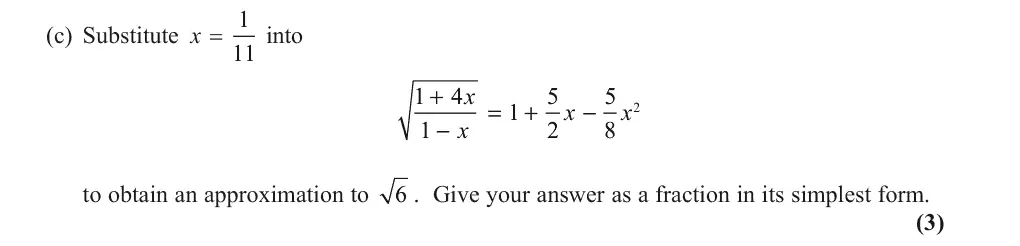
substitute into BOTH sides: LHS √(15/10) = √6/2, RHS 1183/968
√6 ≈ 1183/484 (or 2904/1183) in simplest form
Find an Edexcel maths tutor
Stuck on this? Book a trial session with an Edexcel specialist.