40 question parts, 131 marks, 7 with a difficulty rating from the examiner's report
Notes, worked examples and practice for this topic are being written by our tutors. The past-paper questions below are ready now: work each one on paper, then open the mark scheme and the examiner's comment.
Tap a question to zoom it. Mark scheme and examiner's comment open under each question.
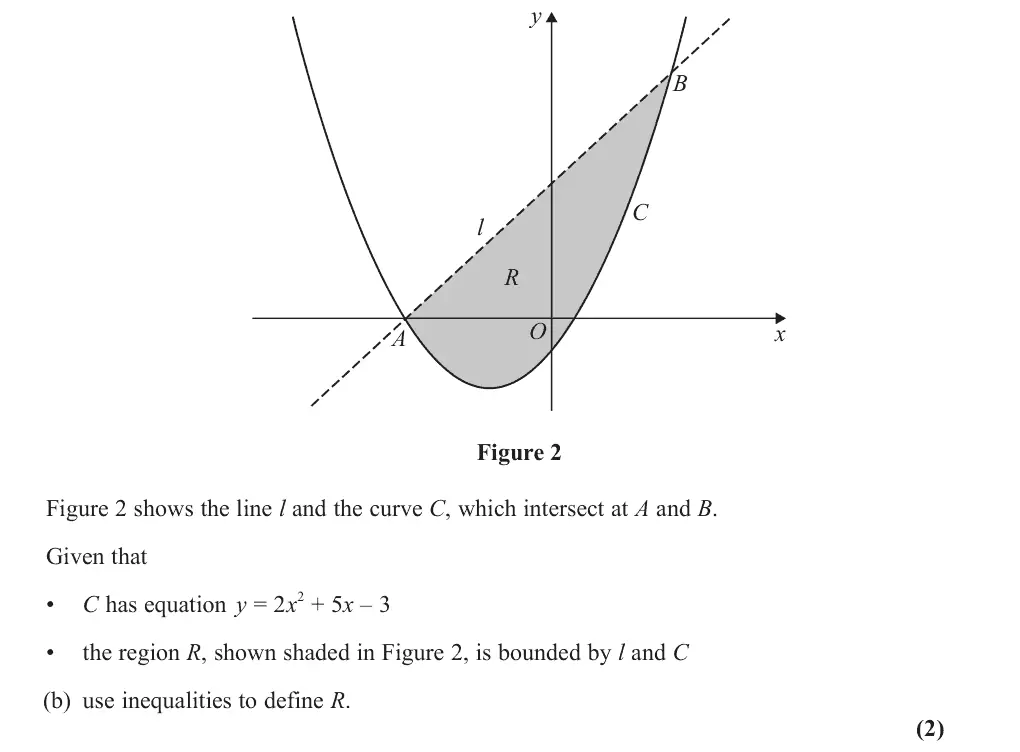
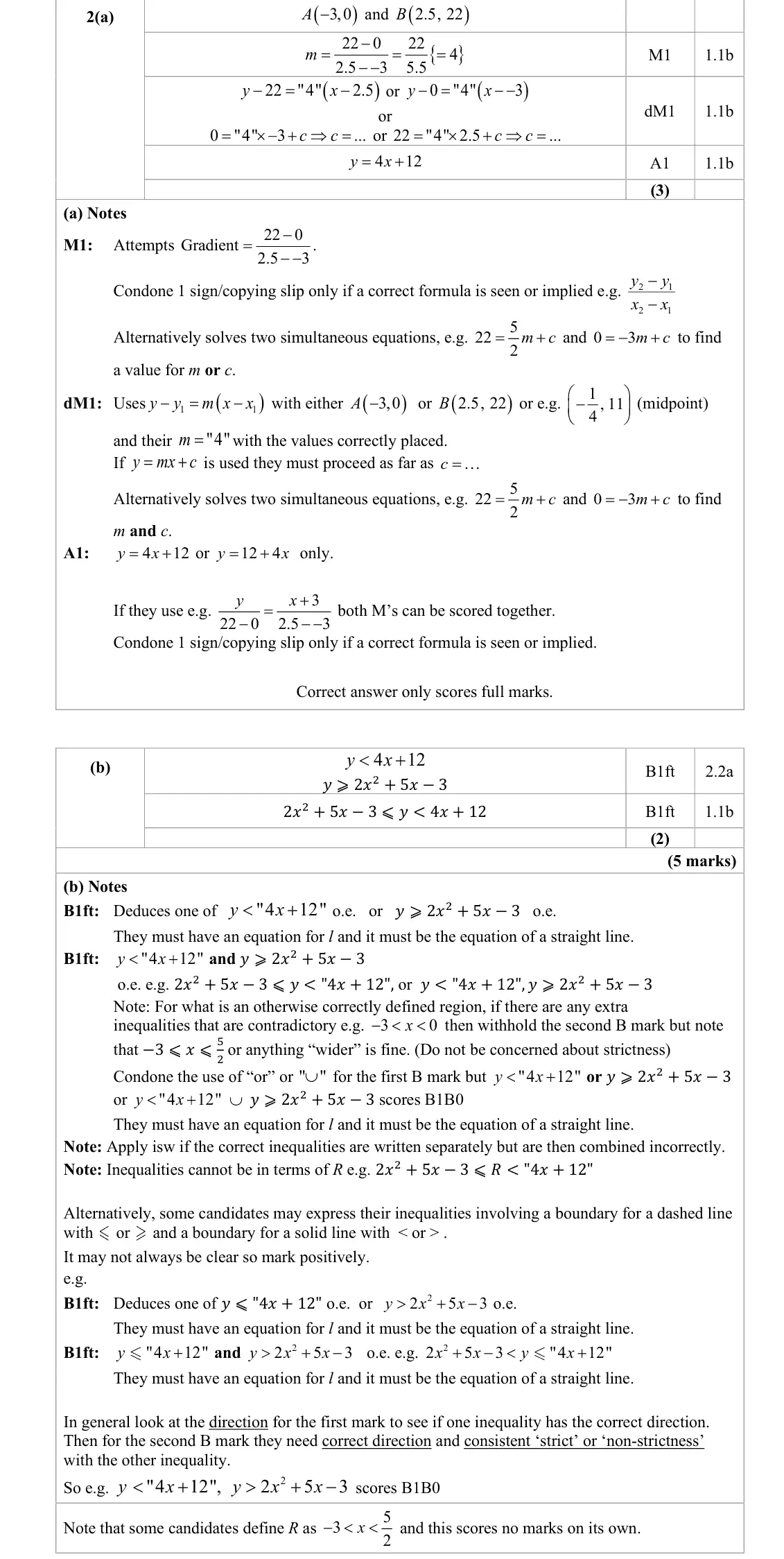
June 2025 · AS Paper 1 · Q2(b)2 marks
Mark scheme (whole question; this part is marked with the orange bar)
Examiner's comment
The performance in part (b) was much more varied. Whilst many candidates who correctly completed part (a) were able to identify and write the inequalities describing the bounded region, e.g. 2 12 y x < + and 𝑦𝑦⩾2𝑥𝑥2 + 5𝑥𝑥+ 3, a significant number misunderstood the question and presumably seeing the shaded area, attempted to find the area between the line and the curve. Of those who interpreted the question correctly, as in previous series, there were a large number of candidates who defined the region using R instead of expressing inequalities in terms of y. This usually resulted in the loss of both marks. Of those who did attempt inequalities, common errors included • writing inequalities the wrong way round or using inconsistent inequality symbols • using set notation incorrectly • defining the region purely in terms of x e.g. 5 3 2 x -< < This part of the question highlighted a significant gap in understanding how to describe regions using inequalities.
Common mistakes
y < 4x + 12 (dashed line, strict) and y ≥ 2x² + 5x − 3 (solid curve)
inequalities in terms of y, not R
"or" or ∪ loses the second mark
finding the area instead
−3 < x < 5/2 alone scores nothing
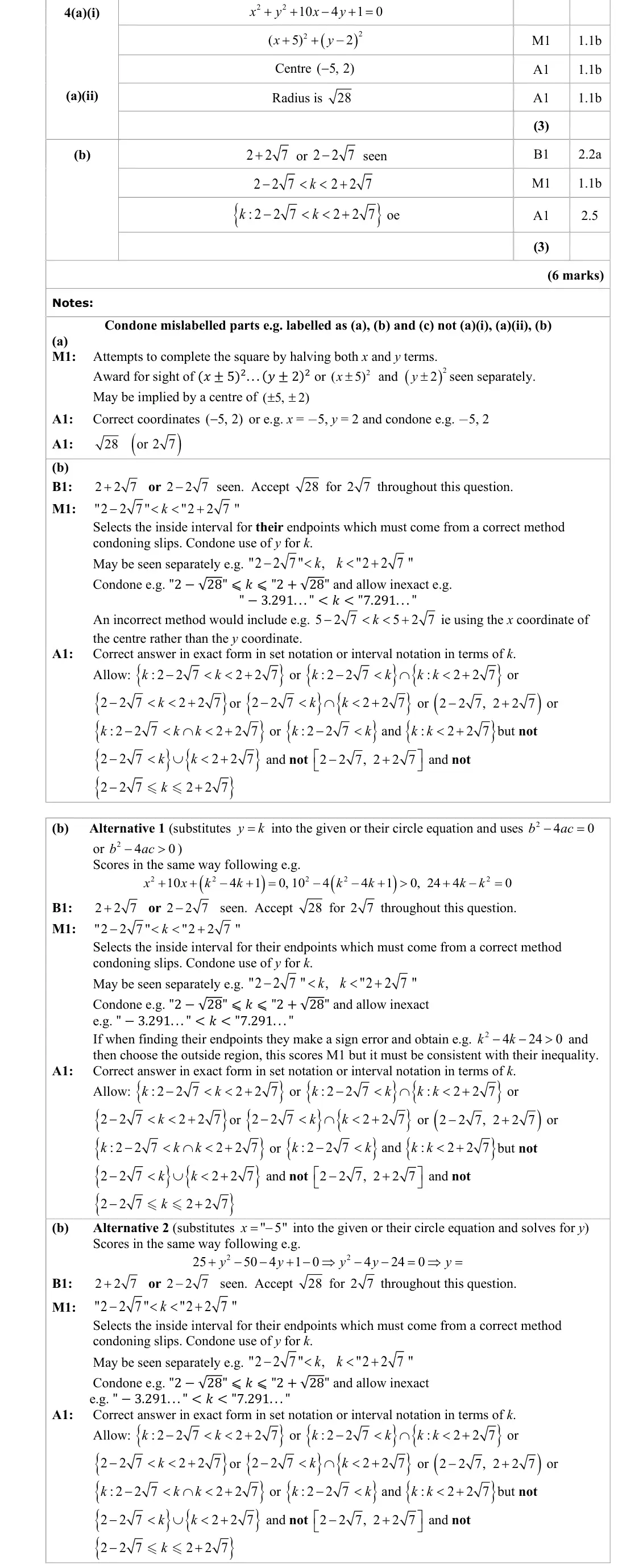
June 2025 · AS Paper 1 · Q4(b)3 marks
Mark scheme (whole question; this part is marked with the orange bar)
Examiner's comment
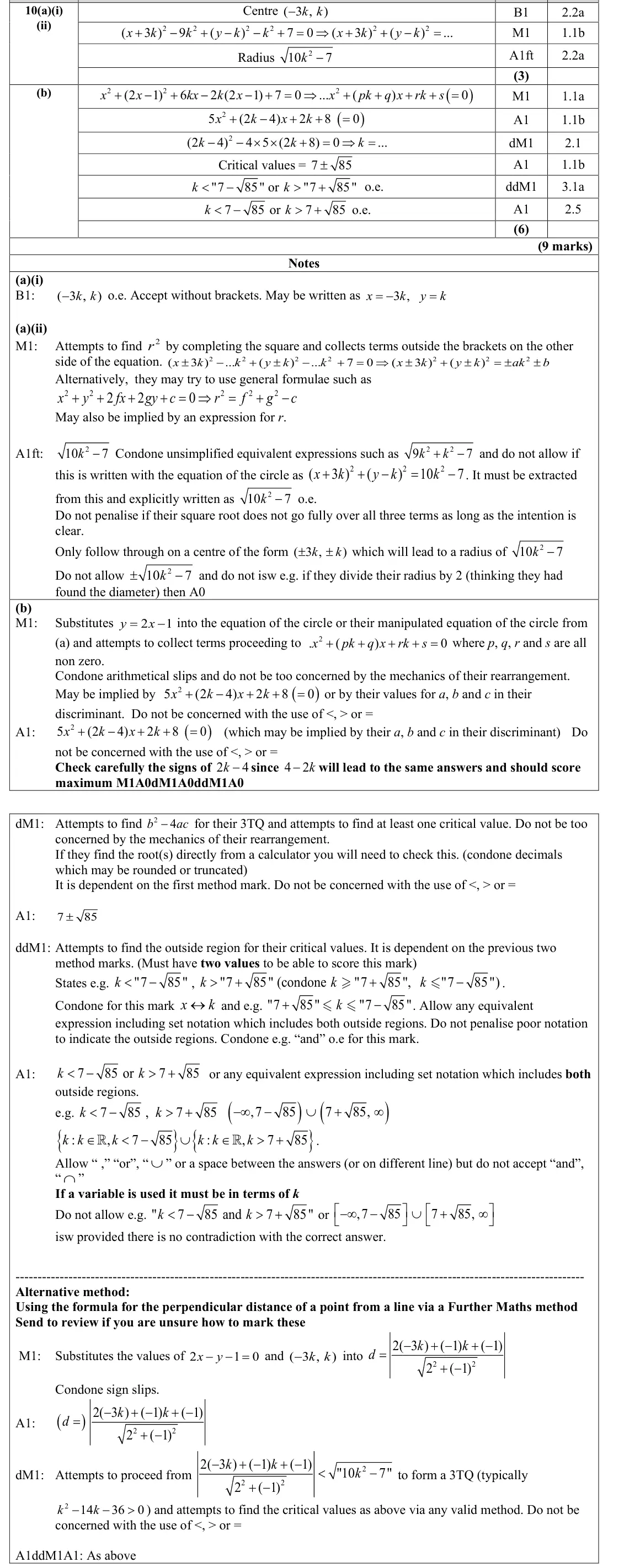
In part (b), a variety of approaches were seen, many attempting an algebraic method using the equation of the circle and discriminant rather than a geometrical approach. The geometrical approach was generally much more successful and succinct. Many candidates would have benefitted from drawing a diagram illustrating a circle and a horizontal line with equation y = k to enable them to visualise the situation. Some diagrams with y = k drawn as a diagonal line were seen. Algebraic methods were generally less successful, with errors in the algebra and errors in identifying the coefficients to apply to the discriminant. Without the context, candidates often chose the wrong range of values since the quadratic inequality obtained contained a negative 2x term. Many candidates did not provide a final answer in set notation despite identifying the correct range of values. Use of “union” instead of “intersection” was seen quite frequently.
Common mistakes
geometric: y-coordinate of centre ± radius gives 2 − 2√7 < k < 2 + 2√7
using the x-coordinate (5 ± 2√7) is wrong
discriminant method error-prone (negative k² term leads to the wrong region)
answer must be in set notation, not ∪ and not ⩽
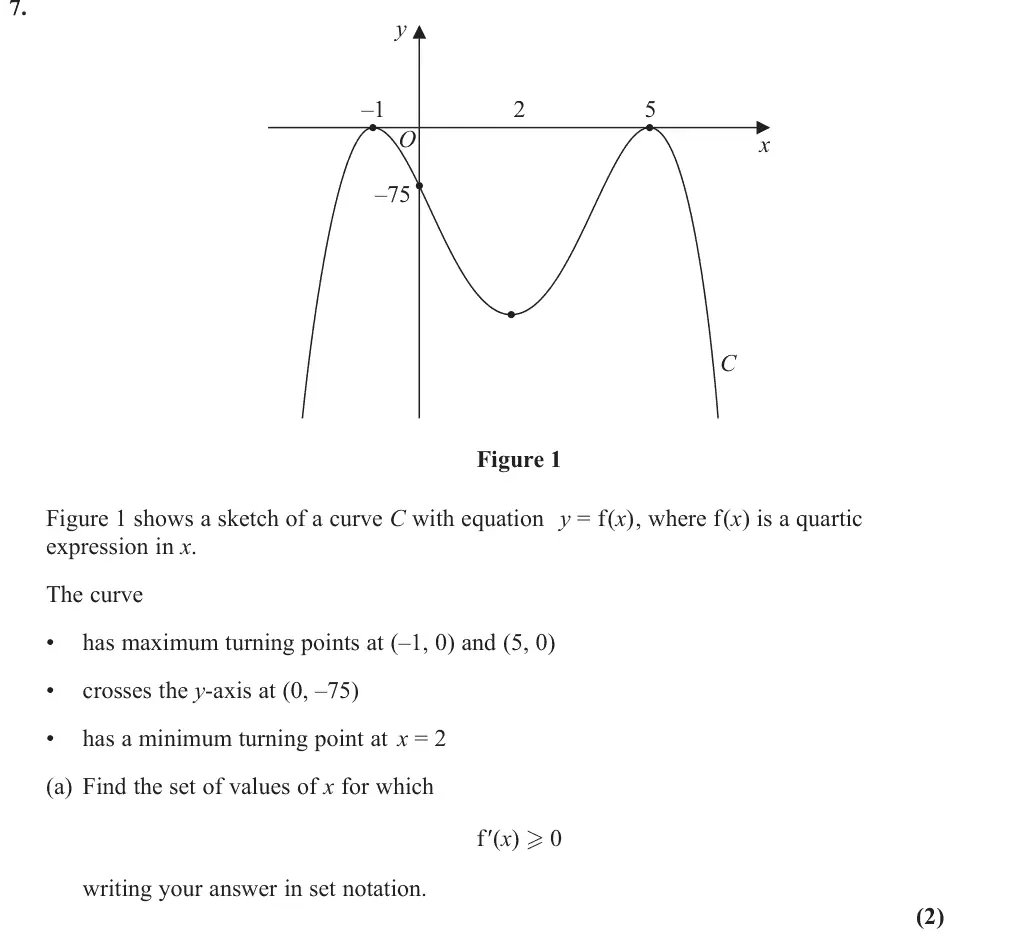
June 2025 · Paper 1 · Q7(a)2 marks
Mark scheme (whole question; this part is marked with the orange bar)
Examiner's comment
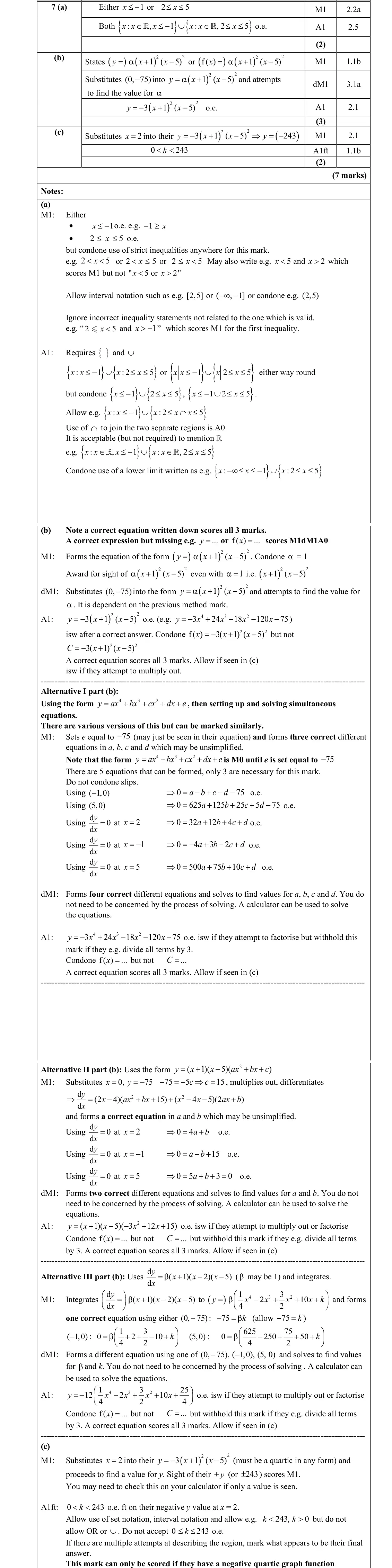
This was the first question on the paper where there was wide discrimination between the marks of responses, and many struggled with knowing how to handle a quartic function. Part (a) involved using the given information and the figure to find the set of values that satisfied f ( ) 0 x ′ and to represent this in set notation. Most identified the critical values that formed the boundaries of the regions where f ( ) 0 x ′ . In general, these critical values were used within a relevant inequality although these were often strict rather than inclusive. Some learners incorrectly interpreted the function giving incorrect inequalities or just considering the region between the two local maxima. Presenting the regions in set notation was done to varying degrees of success. Although a large proportion were able to present their solution in an acceptable form including the brackets { } and the union, ∪, there were many errors seen including intersection signs, no link between the regions, interval notation and strict inequalities. The majority used x as the variable within the inequalities but ( ) f , x ( ) f x ′ and k were all seen. Of those using a correct form of set notation, very few mentioned x was a real number although this was not specifically required on this occasion. It was clear that a significant proportion of learners did not appreciate what was required for set notation.
Common mistakes
f is increasing (or stationary) for x ≤ −1 and 2 ≤ x ≤ 5 (inclusive inequalities)
set notation needs { } and the union, not intersection or interval notation
June 2025 · AS Paper 1 · Q7(b)3 marks
Mark scheme (whole question; this part is marked with the orange bar)
Examiner's comment
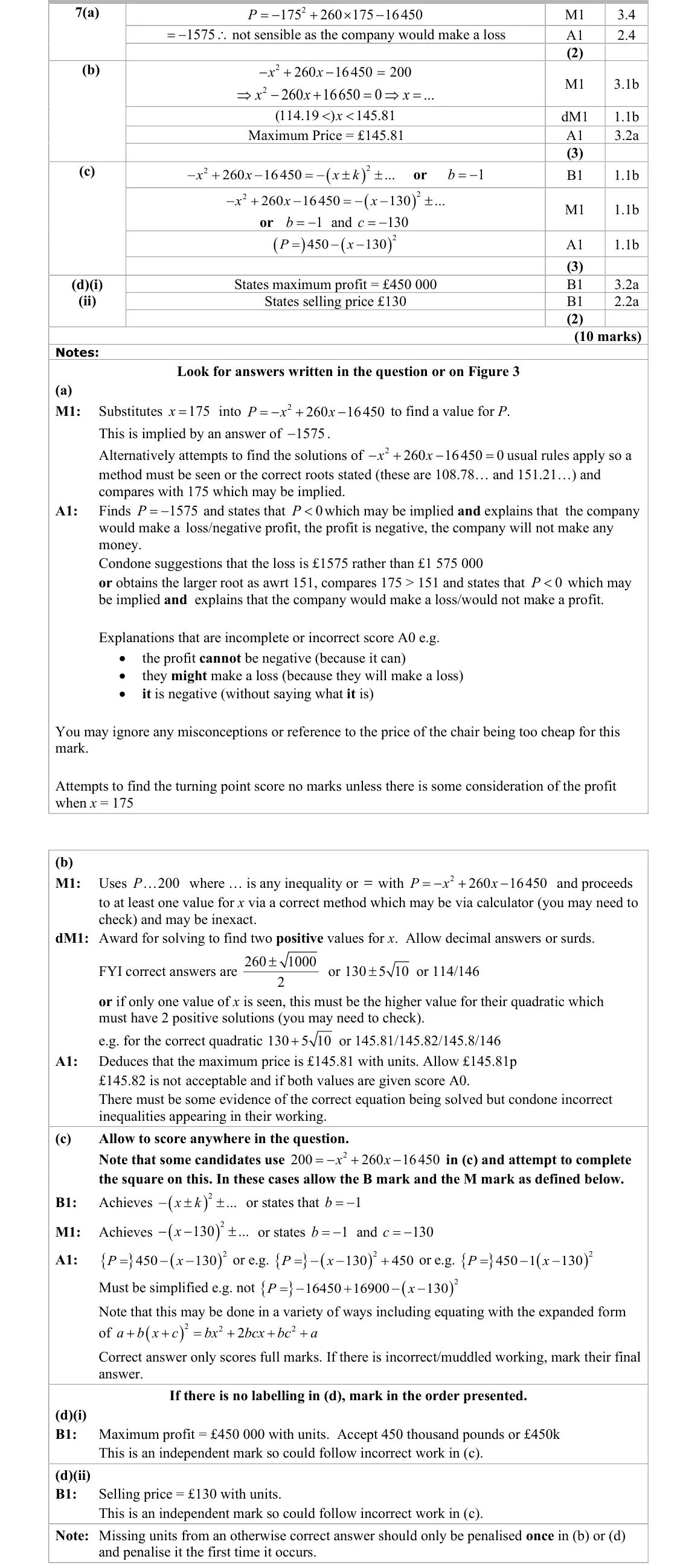
Part (b) of the question was completed less successfully. A common error saw candidates replacing P with 200 000 instead of 200, leading to incorrect solutions and loss of three marks. While some candidates annotated the figure with a horizontal line at 200 to enable them to visualise that there were 2 possible solutions that gave P = 200, the word ‘highest’ in the question prompted some pupils towards an optimisation approach, differentiating and setting = 0, ignoring the minimum profit. A large number of candidates lost the final mark due to either losing the £ sign from their final answer or not giving the answer to two decimal places as is expected when working with money.
Common mistakes
P is in thousands so set P = 200, not 200 000
solve x² − 260x + 16 650 = 0: 114.19 < x < 145.81
highest price £145.81 (2 d.p. with £
£145.82 is wrong)
differentiating to find the maximum ignores the profit condition
June 2025 · Paper 2 · Q8(c)4 marks
Mark scheme (whole question; this part is marked with the orange bar)
Examiner's comment
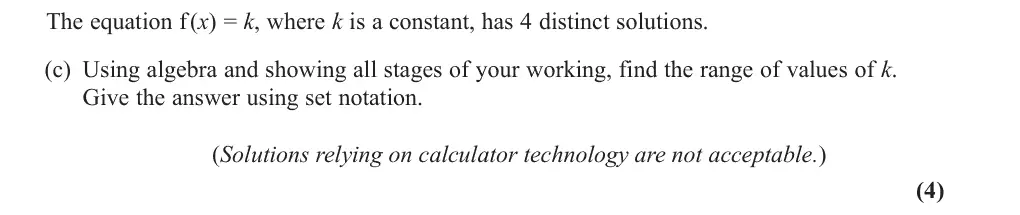
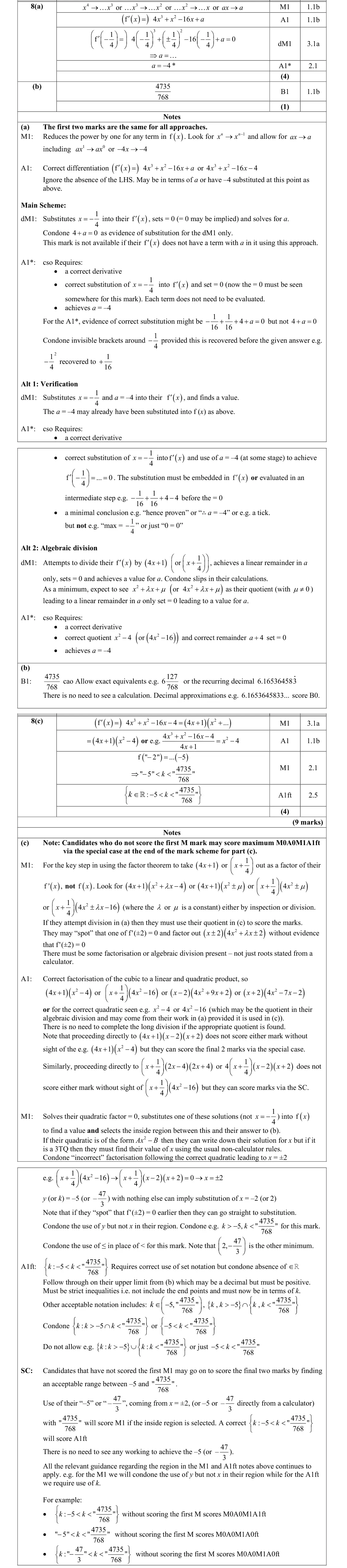
This question, involving the factor theorem and differentiation, was attempted by the vast majority of learners, with nearly all engaging with all three parts. Parts (a) and (b) were generally well-answered. Part (c), however, proved more challenging, with a significant proportion of learners relying on calculator-based methods despite the question clearly stating that these were not acceptable. Part (c) was the most challenging part of the question but was well supported by a clear diagram that helped to improve learners’ ability to solve the problem. A good range of marks were seen for this part of the question, and it differentiated well between the varying understanding of learners across the cohort. While many learners correctly identified that the number of real solutions to the equation f(x) = k depended on the location of k relative to the turning points of the curve, a substantial number relied on calculator methods to find the critical values of k, rather than using written methods as instructed. There were many responses where the required quadratic of x2 – 4 (or maybe 4x2 – 16) was never seen, the cubic was either followed directly by x = 1 4 - , 2, –2, or (4x + 1)(x – 2)(x + 2). These responses scored M0A0 and could only receive limited credit under the special case. Those who did attempt the algebra often reached the correct values but struggled with set notation. A common error when writing the final answer was using the union of two intervals instead of an intersection, while some used inclusive inequalities instead of strict inequalities and others made no attempt to use set notation. Despite this, many understood the underlying concept and were able to identify the correct range for k, even if it was not expressed with the required detail.
Common mistakes
use the factor theorem on f′(x): (4x + 1)(x² − 4) must be seen, not roots from a calculator
lower minimum f(−2) = −5
four solutions between the lower minimum and the local maximum: {k : −5 < k < 4735/768}
intersection not union
strict inequalities
must use set notation
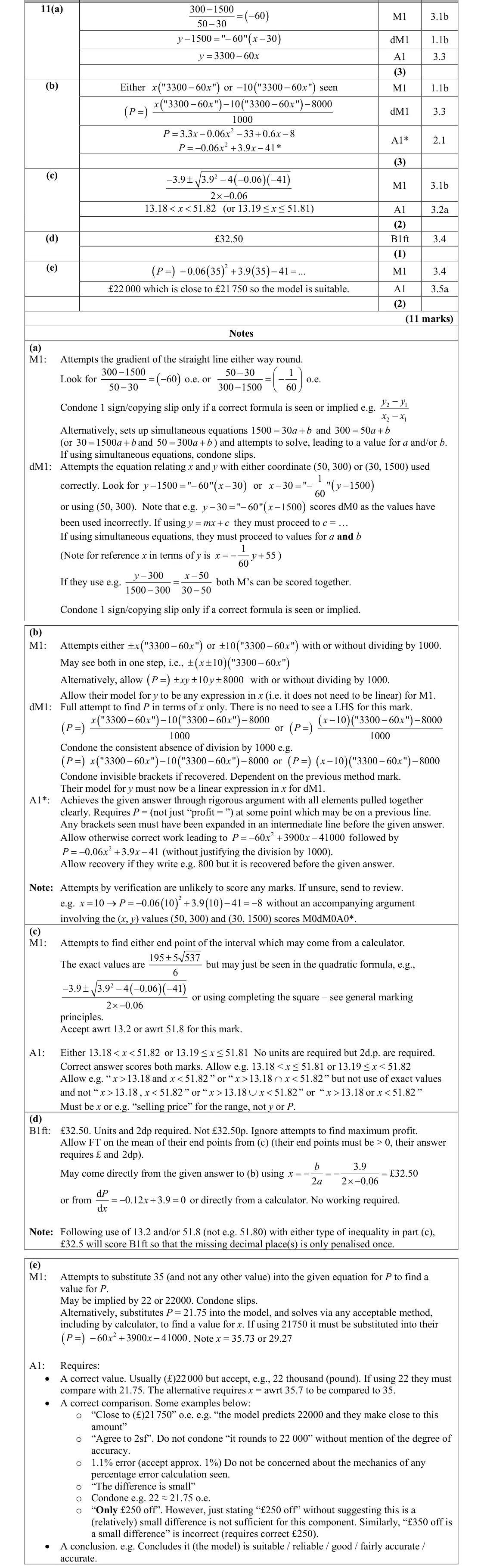
June 2025 · Paper 2 · Q11(c)2 marks
Mark scheme (whole question; this part is marked with the orange bar)
Examiner's comment
This modelling question required learners to construct and interpret a linear demand model, derive a profit function, solve a quadratic inequality, identify the optimal selling price, and assess the suitability of a model against real data. Overall, performance was mixed across the different parts of the question. Part (c) allowed many learners to make the most of the restart opportunity, with the majority attempting this part. Most recognised that they needed to solve the equation by setting P equal to zero and most did so by directly calculating values of x using their calculators. As this was a question involving money, responses did not gain the accuracy mark for not rounding their answers to two decimal places as required. Among those who gave a decimal answer, many did not earn the A mark either because they rounded to one decimal place or used an incorrect inequality, misinterpreting when the profit would be positive in the vicinity of their critical values, with a common incorrect answer being 13.19 < x < 51.81.
Common mistakes
solve P = 0 and take the inside region where P > 0
money so 2 d.p.: 13.18 < x < 51.82 (13.19 < x < 51.81 with strict signs is wrong)
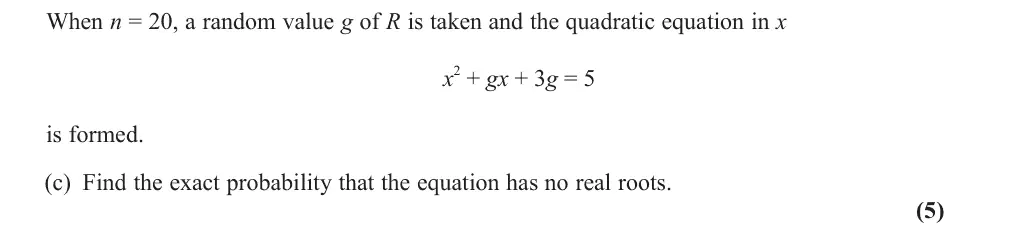
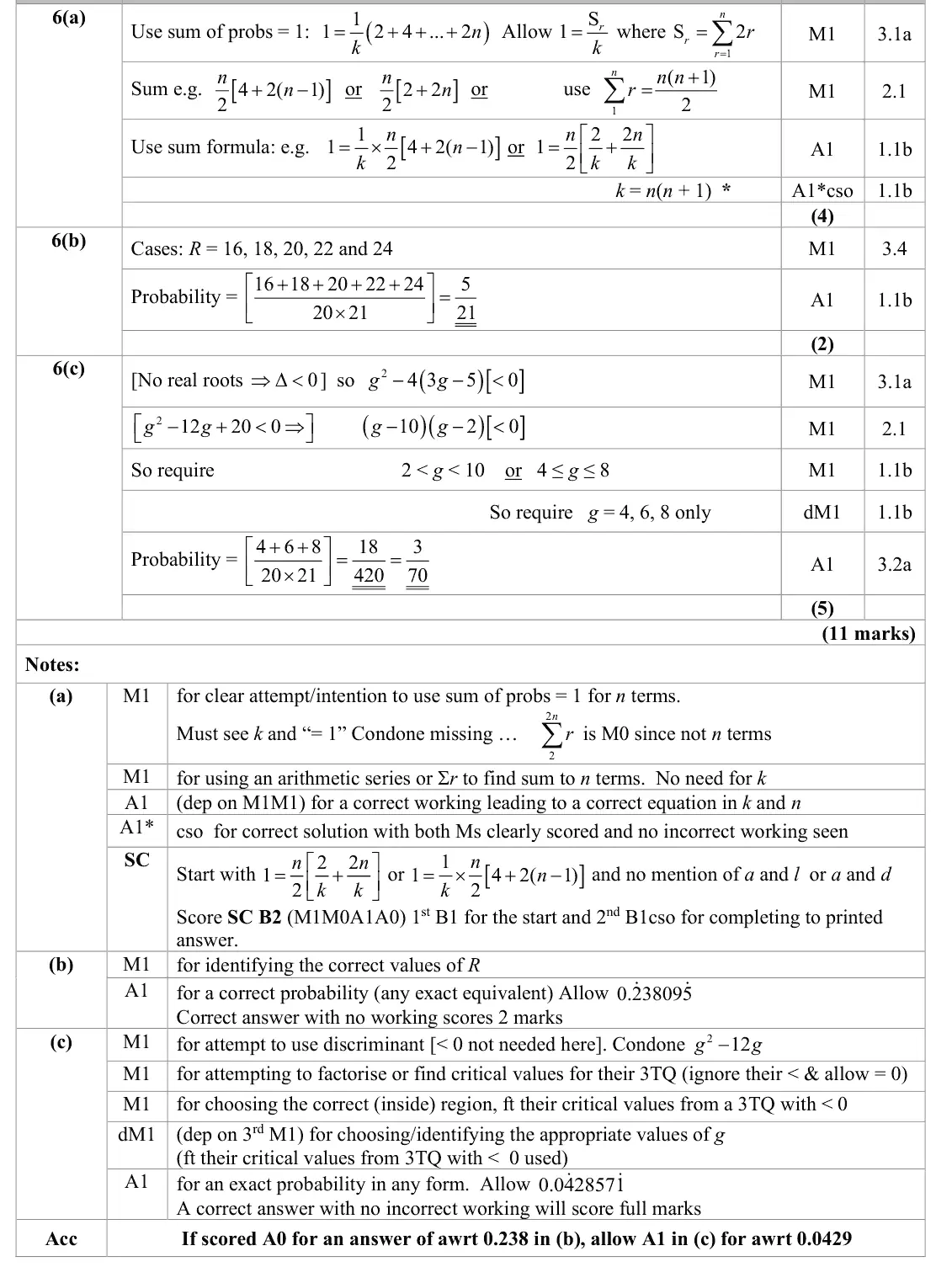
June 2025 · Paper 3 (Statistics) · Q6(c)5 marks
Mark scheme (whole question; this part is marked with the orange bar)
Examiner's comment
This question provided some challenge and discrimination for the end of the paper. Most learners attempted this and made some progress. The attempts seen in part (c) were encouraging with many realising that the discriminant of the quadratic equation was required and for “no real roots” this must be negative. Most of these learners were able to form the correct quadratic equation in g and find the correct critical values but the correct critical region eluded some with g < 2 and g < 10 being a common error. From the correct inequalities for g it was a small step to identify that the values of g required were 4, 6 and 8 and the majority of learners who got this far were able to complete the solution and state the correct probability in the correct form.
Common mistakes
no real roots: g² − 4(3g − 5) < 0 so (g − 2)(g − 10) < 0 and 2 < g < 10 (inside region)
even values g = 4, 6, 8
probability 18/420 = 3/70
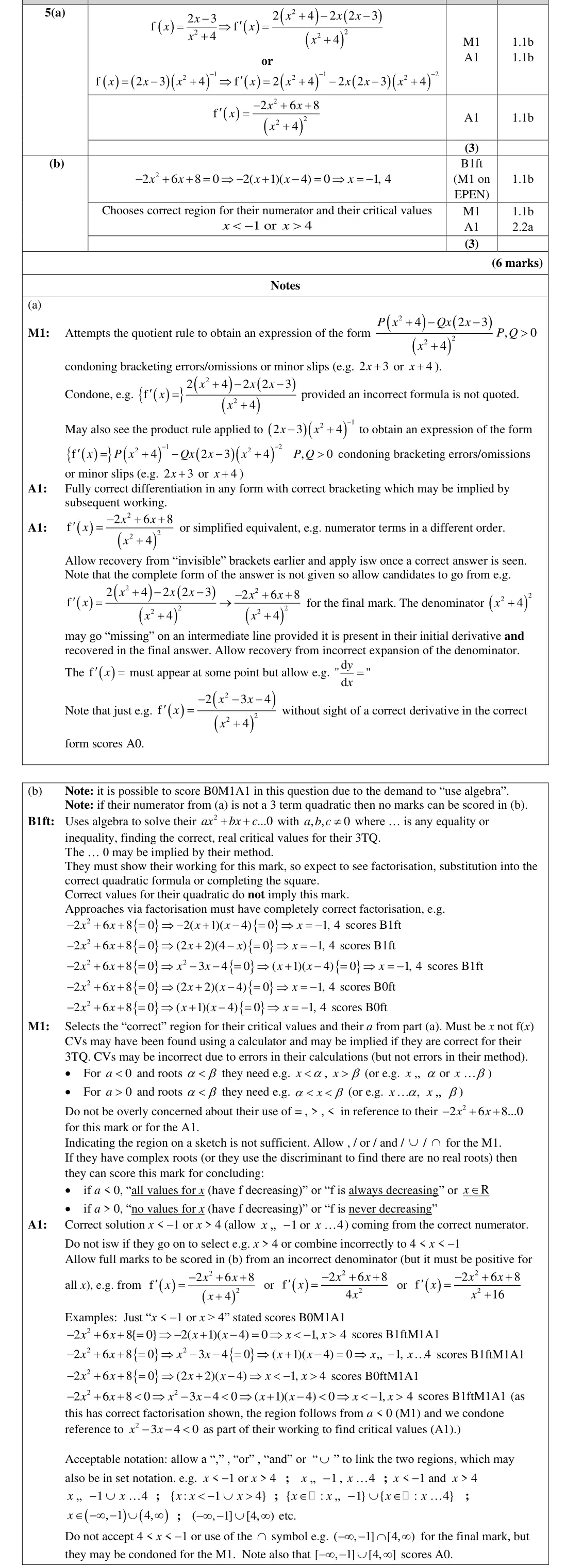
June 2024 · Paper 1 · Q5(b)3 marks
Mark scheme (whole question; this part is marked with the orange bar)
Examiner's comment
( ) x In part (b), candidates generally recognised the need to set their to find values f ' 0 ( ) x is decreasing and solve their three-term quadratic to find critical of x for which f ' values. However, not all candidates observed the demand to use algebra and consequently those who used their calculator to solve the quadratic or gave an incorrect factorisation of their quadratic forfeited the first mark. Most candidates chose to simplify their quadratic before factorising and solving to find the critical values, but lack of rigour was evident in this part. Many candidates who factorised their quadratic - 2 2x jumped straight from a quadratic with a term to factorisation of the form (𝑥 ± … )(𝑥 ± … ) (possibly having used their calculator and attempting to work backwards), and consequently lost the B mark. A few used the quadratic formula and showed their working in full thus scoring the B mark, while attempts to complete the square were rarely seen. Once critical values had been obtained, candidates were required to identify the correct region and, while many candidates were successful, there were some who did not know how to proceed. It was common to see incorrect regions selected, particularly 2x - , not realising that their original quadratic had a negative coefficient of 1 4 x and therefore the outside region was required. Candidates who sketched the graph generally performed better in identifying the correct region but again, many drew a positive graph instead of a negative. There was confusion observed in the use of 'and' and commas instead of 'or', indicating weaknesses in formal mathematical language. It was notable how many candidates did not accurately identify the correct region for their x2 coefficient and critical values, often stemming from dividing their quadratic by –2 but forgetting or not knowing to change the direction of the inequality sign. Other observations that were common to see in this part of the question that were not required or caused complications included: • not recognising that the denominator would be positive due to the square • attempting to find a critical value for the denominator unnecessarily • trying to multiply the denominator and numerator and then work on the resulting quadratic • attempting to find turning points or second derivatives to identify the region, often unsuccessfully.
Common mistakes
solve f′(x) < 0
factorisation −2(x + 1)(x − 4) must be shown (calculator roots lose B1)
outside region x < −1 or x > 4, not 4 < x < −1 or ∩
June 2024 · Paper 2 · Q14(b)5 marks
Mark scheme (whole question; this part is marked with the orange bar)
Examiner's comment
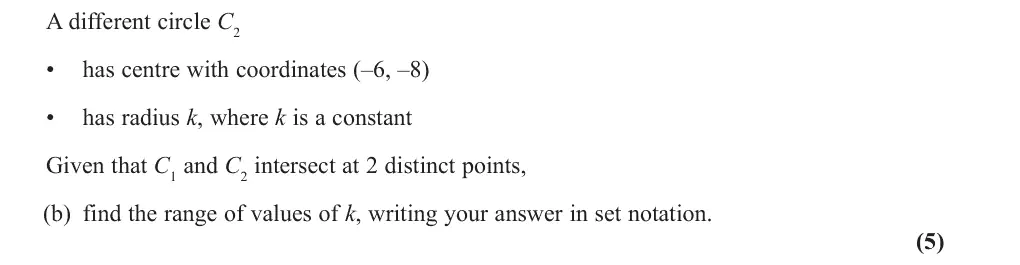
A common marking profile in this question was to score all three marks in (a) followed by zero marks in (b). In part (b), it was common for no marks to be scored and there were a large number of non- attempts. The most successful candidates were those who drew diagrams and looked at the problem geometrically. However, the most common approach was an algebraic one. This typically involved solving the 2 circle equations simultaneously, but the majority of such attempts were aborted before any marks were gained. There was also some poor use of algebra with things such as ( ) ( ) 2 2 3 7 25 3 7 5 x y x y - + + = -+ + = seen a surprising number of times and such attempts gained no credit. Many candidates did recognise that there would be a discriminant involved so they often arrived at a point when they thought that it would be appropriate to calculate one. However, this was usually prematurely. Despite this, it was noted that some examiners did report the occasional successful algebraic attempt. Some candidates calculated the equation of the line passing through the centres but then did not realise what they had to do with it. Most who were able to find the correct distance between the centres recognised they had to add and subtract the radius found earlier to give the limits of the solution set. Candidates who made it this far sometimes lost the final accuracy mark due to the use of incorrect notation. For candidates who got as far as the correct interval for k, the most successful were those who gave the final answer as a single set. Candidates who broke the answer into two sets, often used the incorrect symbol between them.
Common mistakes
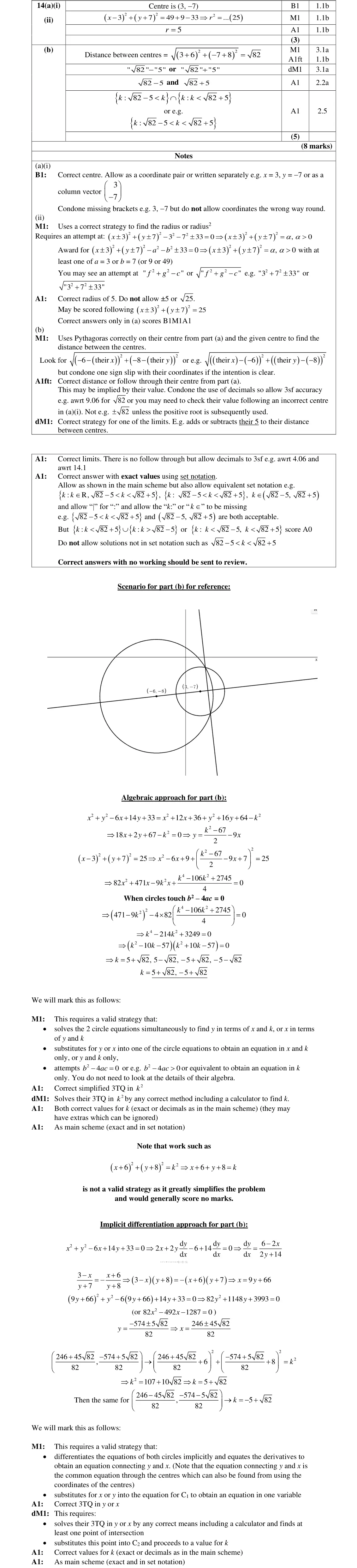
distance between centres √82 by Pythagoras
two intersections when √82 − 5 < k < √82 + 5
answer in set notation (one set, or ∩ between two sets, not ∪)
a diagram makes it straightforward
solving simultaneously is long and usually aborted
June 2023 · AS Paper 1 · Q1(b)4 marks
Mark scheme (whole question; this part is marked with the orange bar)
Examiner's comment
This question was a friendly and well-attempted start to the paper. Most candidates were able to score a high proportion of the marks available here. In part (b), a significant minority of candidates were unclear on the correct way to identify the correct critical values and, as a result, some attempted to solve 2 2 d 0 d y x = in pursuit of a ‘critical value’. Perhaps because the question had asked where y was decreasing, an occasional misconception led candidates to find y values corresponding to the x values resulting from d 0 d y x = followed by an attempt to use these y coordinates to define a range rather than using the values of x. Nonetheless, most candidates recognised the need to set d 0 d y x = to find the turning points of the curve and most were able to solve the three-term-quadratic set equal to zero. Commonly, the use of calculators was apparent. But many others took an algebraic approach with sometimes mixed results. Factorisation was the most successful of these, with errors mainly occurring with the signs within the linear factors. The quadratic formula was sometimes inaccurately applied and omissions of the – sign in front of ‘b’ in the numerator, or the use of ‘2ac’ in the denominator, caused issues and the resulting loss of the M mark. Completing the square was seen but it seemed to be a fairly unreliable approach for the candidates that chose to use it. A significant minority of candidates did not write down their critical values clearly, instead confining them to being labelled only on a graph of the d d y x curve. A significant number of candidates who had found critical values appeared to believe that stating them was sufficient to define the required range, or perhaps they were unable to make further progress in stating the range and so stopped short by simply stating the two values of x. Those candidates who did realise, however, that an interval needed more careful definition, usually did so correctly. This was most often achieved using standard inequality notation. The most successful candidates were those who drew a sketch of the quadratic to accompany their determination of the range for x, but some candidates determined 2 2 d d y x as a means to identifying the correct region. A minority of candidates lost a mark for inconsistent use of inequalities by mixing, for example, and in their statement of the range. Only a relatively small proportion of candidates defined the outside region; a small number of whom wrote non-sensical inequalities such as 1 4 2 x - . Answers such as 1 , 4 2 x x - were also not uncommon. The use of set notation tended to be more problematic for those that used it as there was sometimes some confusion between the union and the intersection symbols.
Common mistakes
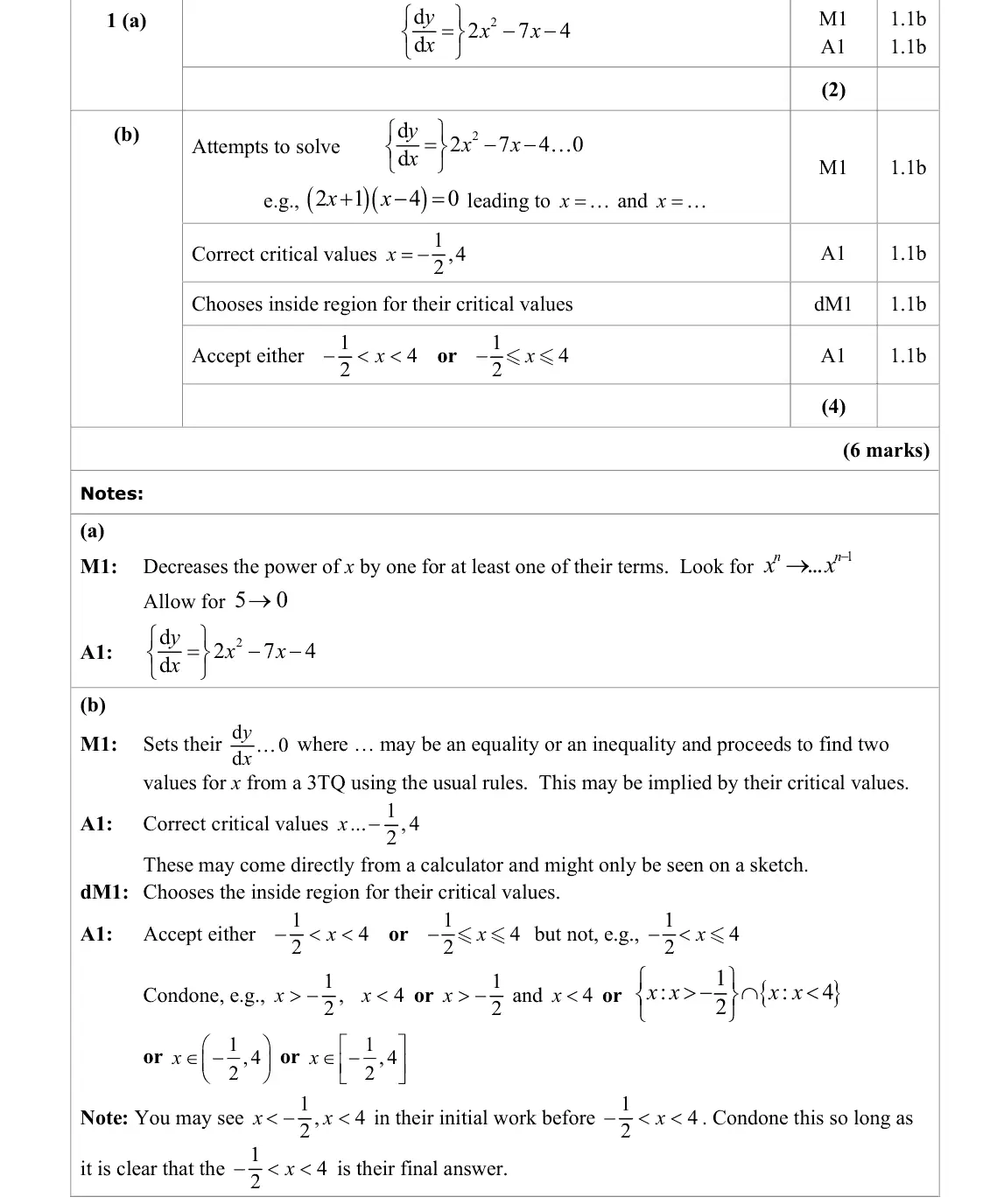
set dy/dx < 0 (not d²y/dx² = 0)
critical values −1/2 and 4 from (2x + 1)(x − 4)
choose the inside region −1/2 < x < 4
stating just the two values is not a range
use x values, not y values
do not mix strict and non-strict inequalities or confuse union and intersection
June 2023 · Paper 1 · Q3(b)2 marks
Mark scheme (whole question; this part is marked with the orange bar)
Examiner's comment
This was another short question on two-dimensional vectors with many candidates able to score 2 out of the 3 marks. In part (b), the most common approach was to proceed to 2 18 a or 2 18 a = , and the majority of candidates were able to achieve this. However, a significant number of candidates did not conclude that 5 a = , with some claiming that e.g. 18 is an integer or missing the requirement that “a” had to be an integer. Some other incorrect answers included 19 a = following 18 a and the answer 5 a was not condoned, which lots the final mark for a number of candidates. A common processing error was the simplification of 2 20 a + to 20 a + . Very few candidates used the substitution method and some of those did not reach any conclusion in the end.
Common mistakes
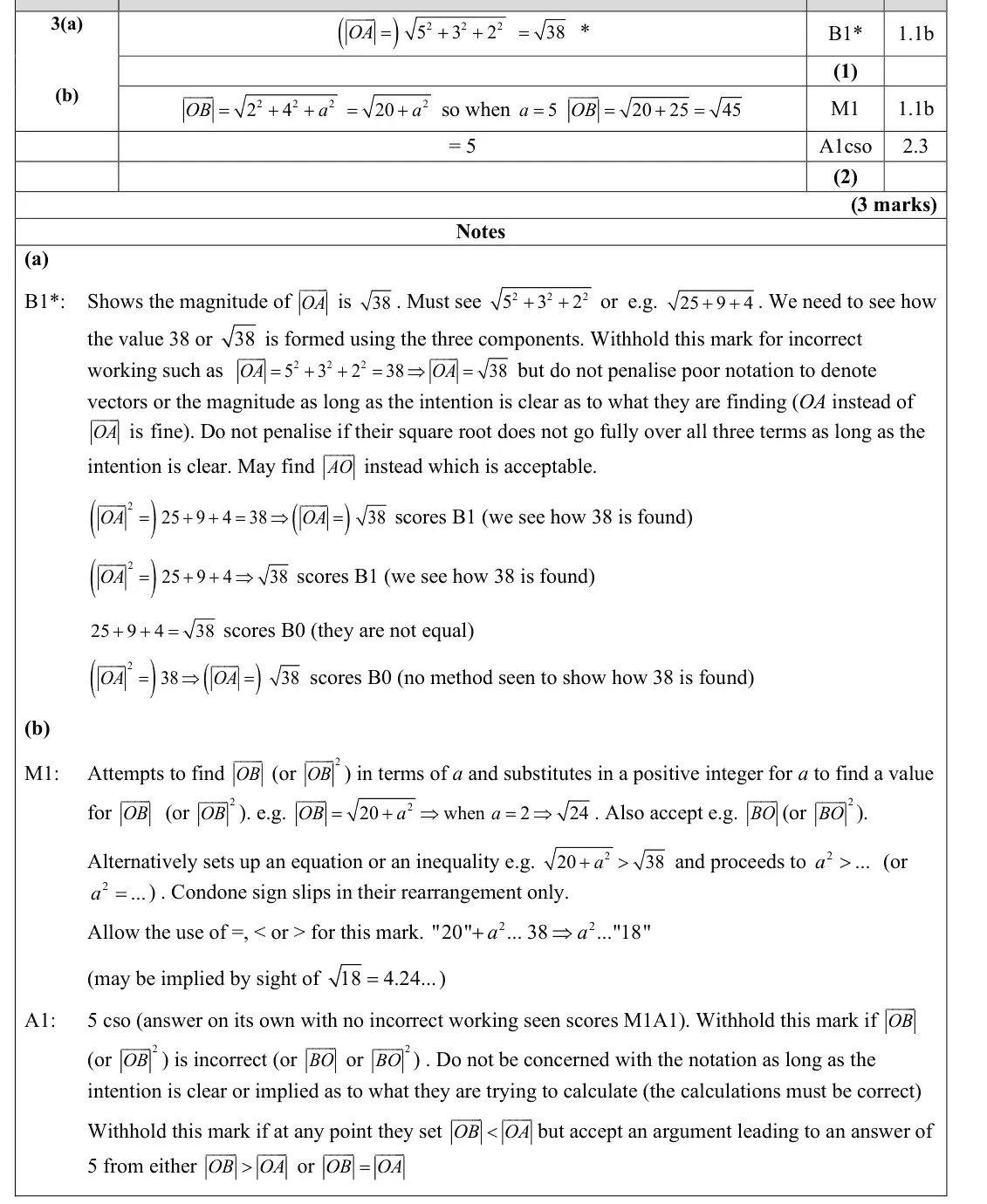
a must be a positive integer: a² > 18 gives a = 5, not a ≥ 5 or √19
√(20 + a²) wrongly split into √20 + a
June 2023 · AS Paper 1 · Q4(b)3 marks
Mark scheme (whole question; this part is marked with the orange bar)
Examiner's comment
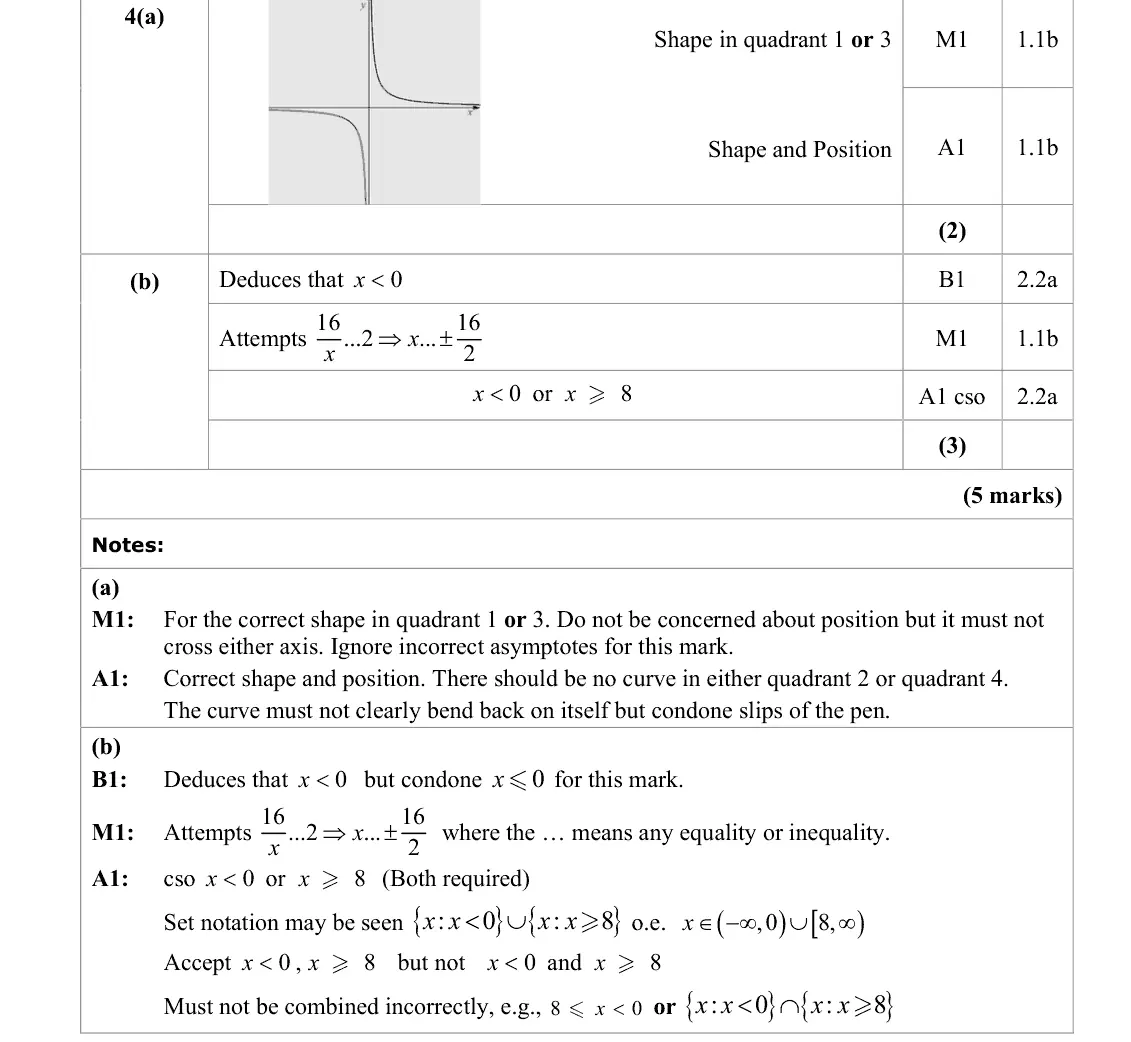
In part (b), most candidates only scored 1 mark out of 3 as they did not consider the section of the graph where x was negative. Those who sketched the line y = 2 on the graph were far more likely to identify the region x < 0, although this was often given as x 0 despite the curve being undefined at x = 0. As such, fully correct answers were few and far between.
Common mistakes
x < 0 also satisfies the inequality (negative branch)
x ⩽ 0 is wrong as the curve is undefined at x = 0
answer x < 0 or x ⩾ 8, not "and" or ∩
most found only x ⩾ 8
June 2023 · AS Paper 1 · Q6(b)3 marks
Mark scheme (whole question; this part is marked with the orange bar)
Examiner's comment
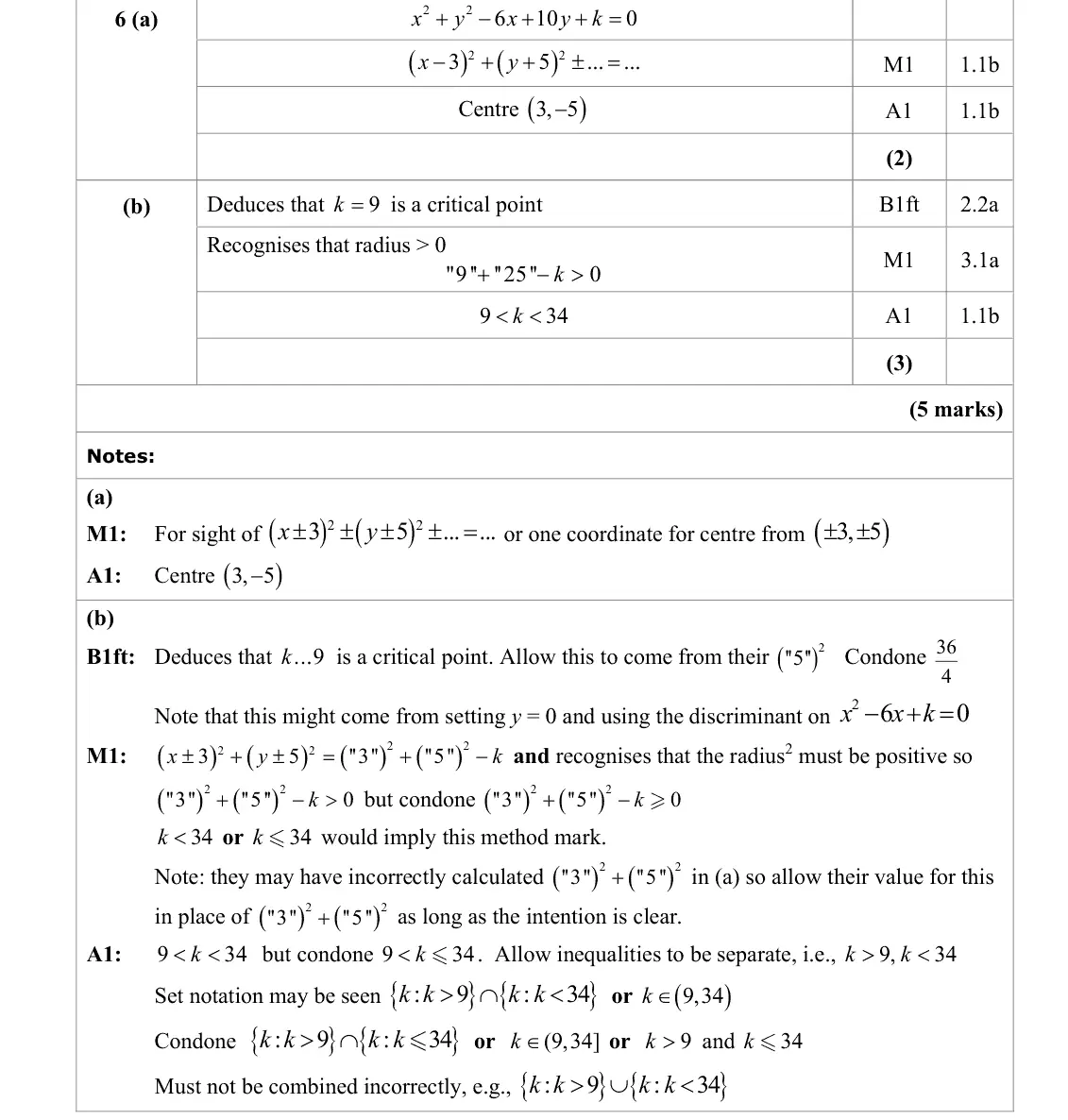
However, part (b) appeared to be inaccessible to the majority of candidates as they failed to interpret and/or k which arose from the requirement that the circle did not touch the x-axis. Here, the most common mistake was in assuming the circle must not touch the x-axis, resulting in 25 k . Some candidates approached this part of the question by substituting the coordinates of their centre and then using the discriminant involving k, while those who drew a decent sketch used the far simpler geometric approach and arrived at the result in a far more concise fashion. In contrast, a good number were able to determine the upper limit of k, 34 k . However, a good number of candidates did not attempt this part of the question, illustrating the candidates’ struggle with circle geometry and that, for many centres, it would be worth investing more time into developing deeper understanding of the various types of problems that can arise in circle geometry.
Common mistakes
not touching the x-axis needs radius < 5 (the modulus of the y coordinate of the centre), so 34 − k < 25 gives k > 9
radius² > 0 gives k < 34
answer 9 < k < 34
a sketch makes it much easier
many missed k > 9
June 2023 · AS Paper 1 · Q85 marks
Mark scheme (whole question; this part is marked with the orange bar)
Examiner's comment
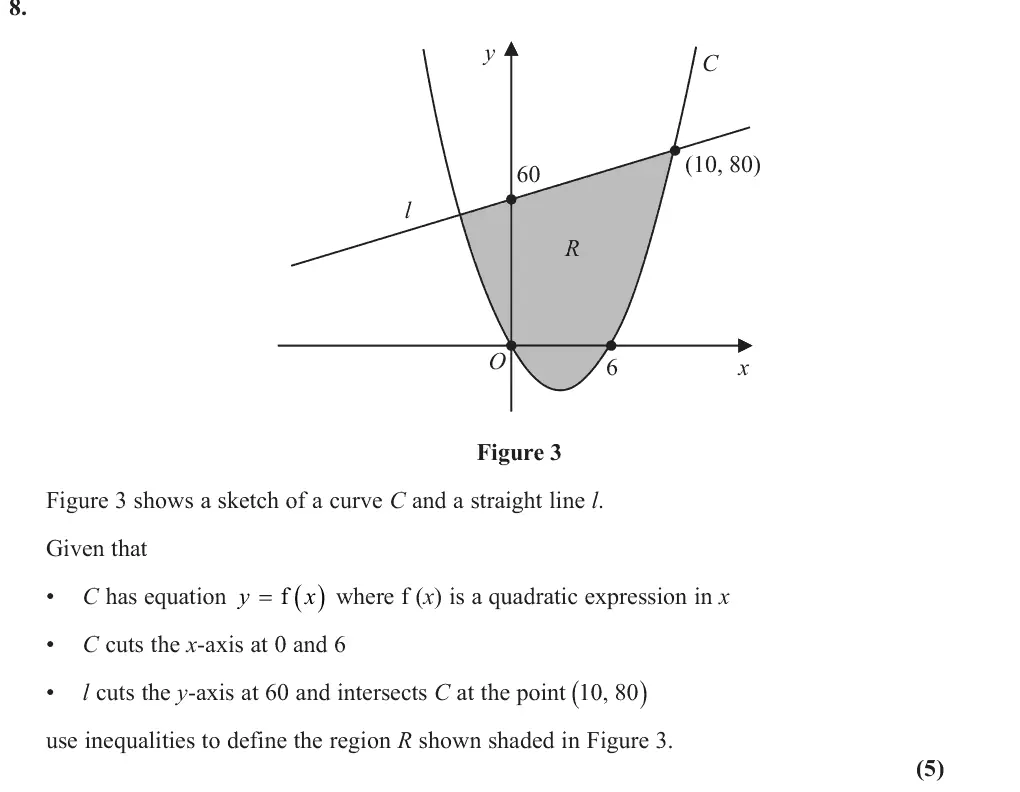
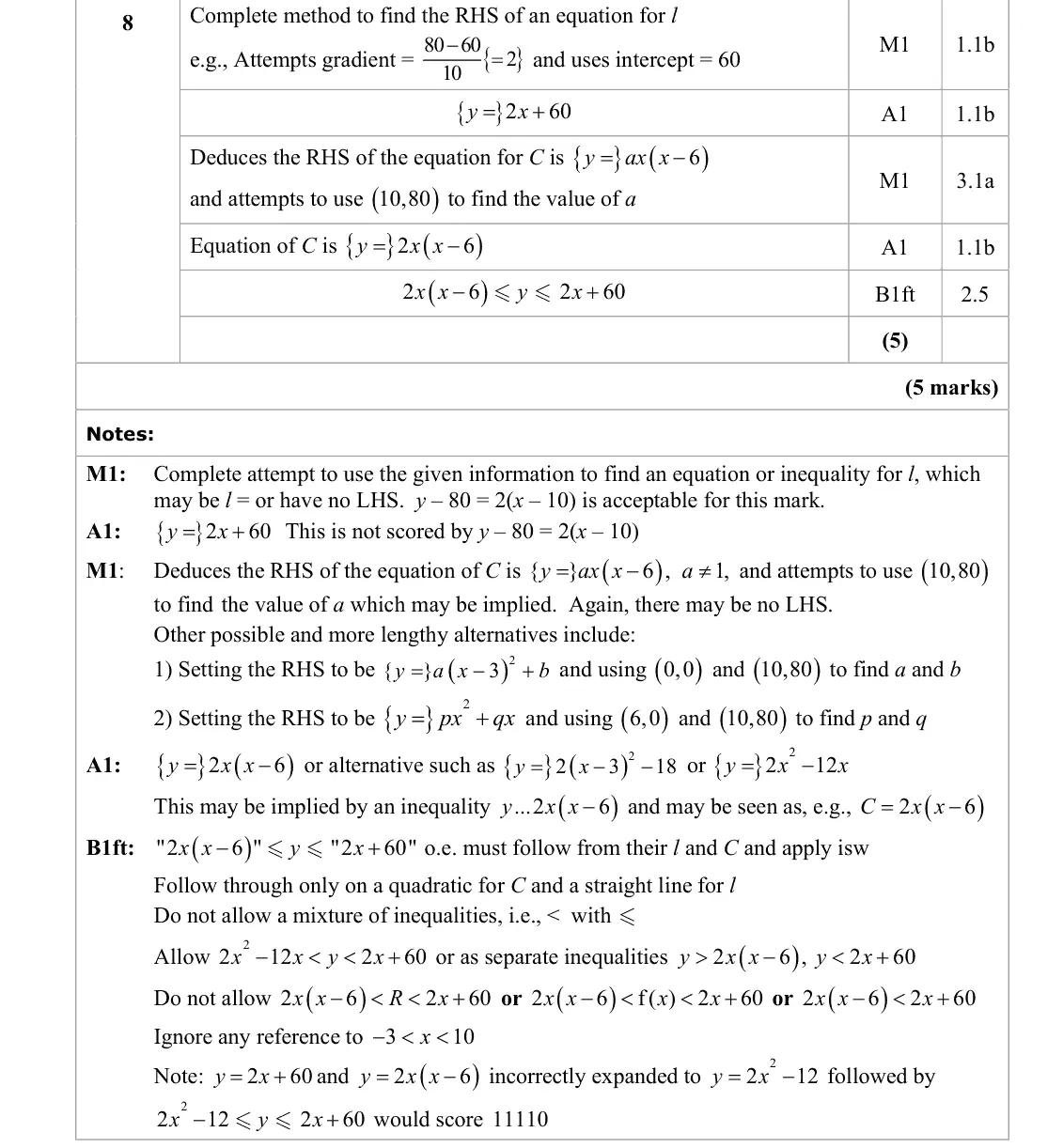
Very few candidates achieved full marks on this question. The vast majority of candidates were able to find the linear equation successfully, with a significant proportion making no further attempt at the question. While the majority did recognise the form of the quadratic equation using the two x-intercepts, most simply stated 2 6 y x x = - or equivalent and did not use the coordinates on the graph to find the coefficient of the 2x term. There were a lot of candidates who did not understand what the final part of the question required as they were trying to find intercepts (often assuming that the region needs to be defined as 3 10 x - ) or find the area between the curves. Very few candidates seemed to understand what the regions were and how to use the inequalities to determine the region. Incorrect use of notation was also seen here with R used instead of y linking the two equations.
Common mistakes
line l: y = 2x + 60
curve y = ax(x − 6) and use (10, 80) to get a = 2 (not just y = x² − 6x)
region 2x(x − 6) ⩽ y ⩽ 2x + 60 in y, not R or f(x)
do not mix < and ⩽
finding area or x-intercepts is not what is asked
June 2023 · Paper 1 · Q10(b)6 marks
Mark scheme (whole question; this part is marked with the orange bar)
Examiner's comment
Candidates were typically able to make good progress in part (a) with the method of completing the square being familiar to many when dealing with the equation of the circle. Part (b) was focused on using the discriminant and solving a quadratic inequality, however, the manipulation proved to be a lot for some, resulting in a wide range of marks. Again, the access was good on this question such that candidates who could not do part (a) were not restricted from attempting part (b), although those with errors from part (a) often found that this caused issues in part (b) and resulted in losing many of the marks. In part (b), whilst a number of candidates had little idea how to proceed, the vast majority did realise what was required and attempted to produce an equation in x by substitution. Many lost their way in the algebraic complexity, or did not know what to do with the equation (sometimes trying to solve it to find a value for k). A significant number of candidates did produce a three-term quadratic for x, with coefficients in terms of k. Centres should note that the scheme required the quadratic in x to be of the form specified, and that it be set out in a way which identified the coefficients (possibly implied by later use in the discriminant). So, for example, “ (2 4) k - x” was required rather than “ 2 4 kx x - ” as this provided evidence of recognising that the coefficients were the key to solving this problem. Quite a few candidates had a constant term which was not of the required form which meant that no marks could be scored. In general candidates who found critical values for their discriminant by solving 2 4 0 b ac - = were more successful than those who expressed it as an inequality. Often the inequality was simply carried forward to a statement about k; those who identified the two critical values by solving an equation perhaps thought more carefully about where the region was. The “need” to write a single inequality was seemingly pressing for many, so 7 85 7 85 k + - was seen. A few candidates did not use exact values of k and lost the final accuracy mark. Some candidates used 'and' with their two regions, however, most recognised that this needed to be 'or', either stating this explicitly or just using a comma between their two answers. A number of capable candidates brought some interesting approaches to bear on the problem, adopting a variety of techniques from Further Maths specifications.
Common mistakes
substitute y = 2x − 1 into the circle
b² − 4ac > 0
critical values 7 ± √85
outside region with "or" or ∪, not "and"
June 2023 · Paper 2 · Q12(c)5 marks
Mark scheme (whole question; this part is marked with the orange bar)
Examiner's comment
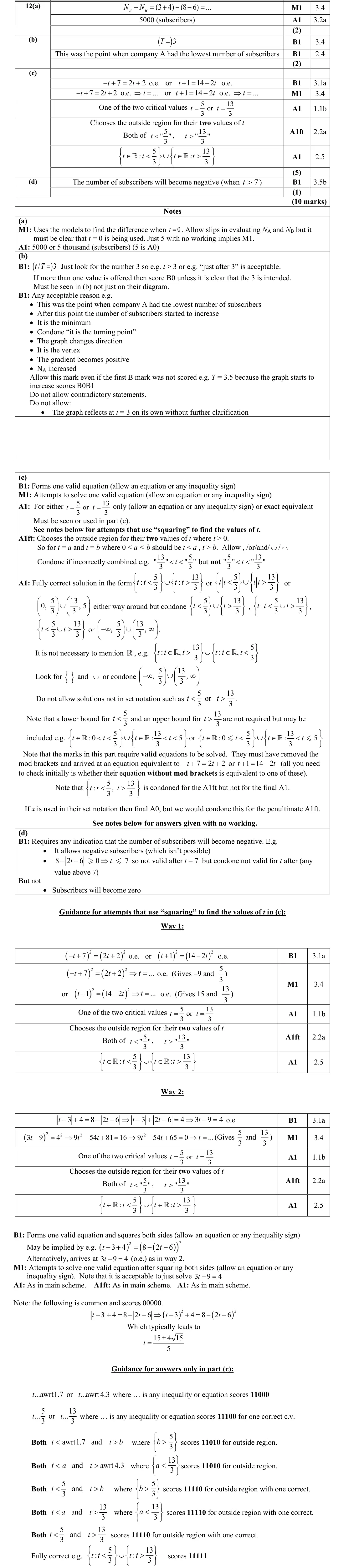
In part (c), a significant number of candidates failed to identify either of the correct equations. Many were able to identify and solve correctly at least one equation to find one critical value for t. A common error often followed their correct equation of 5 = 3t when they wrote the value of t as 3/5 and similarly, but less common, 13 = 3t leading to 3 13 t = . Some students kept the modulus signs within their equations and ignored them at various stages in their working which often led to incorrect equations. There was an array of methods seen trying to negotiate the modulus signs, and A B A B + = + was seen a few times and 2 2 2 A B k A B k + = + = was also seen. Those who found two values for t were generally able to score the 2nd follow through accuracy mark for choosing the outside region for their critical values. The biggest challenge was the final accuracy mark as quite a few candidates did not write the inequalities using set notation. Those who attempted set notation usually were unable to write their answer correctly in that form, some confusing with . A common answer was 5 13 3 3 t t which was condoned for this final mark. Those who attempted the squaring method in this part had minimal success depending on when they chose to square.
Common mistakes
from the graph form the two valid linear equations without modulus: −t + 7 = 2t + 2 (t = 5/3) and t + 1 = 14 − 2t (t = 13/3)
outside region
answer in set notation {t : t < 5/3} ∪ {t : t > 13/3}
5 = 3t written as t = 3/5
squaring incorrectly
ignoring modulus signs
June 2022 · Paper 1 · Q6(b)2 marksMedium
Mark scheme (whole question; this part is marked with the orange bar)
Examiner's comment
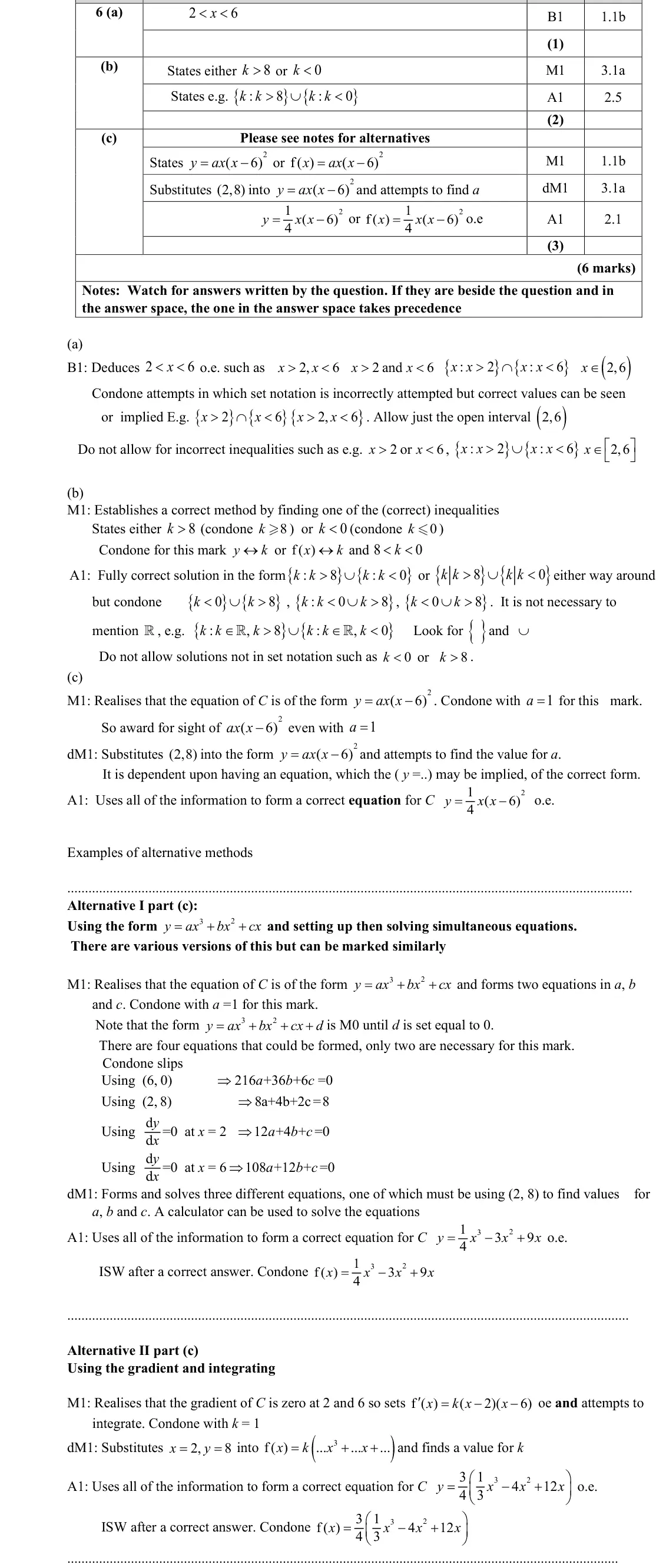
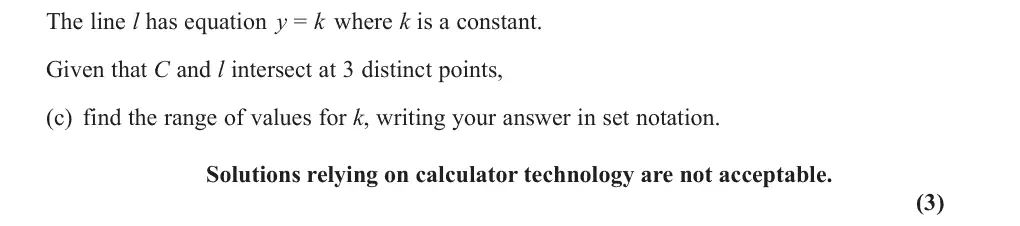
There was a very mixed response to this question on a cubic function with only one in eight candidates scoring all 6 marks. In part (b) the request to give the answer in set notation proved a challenge for many candidates, with many only gaining the M mark for correctly identifying at least one of the correct inequalities. A minority of candidates gained both marks by giving their answer in acceptable . set notation but there was widespread misapplication of ∩ rather than ∪
Common mistakes
horizontal line meets C once if k > 8 or k < 0
set notation {k : k > 8} ∪ {k : k < 0}
∩ instead of ∪ is common
June 2022 · AS Paper 1 · Q7(c)3 marks
Mark scheme (whole question; this part is marked with the orange bar)
Examiner's comment
Generally, candidates scored well in the first two parts of this question, by factorising the cubic expression and drawing a graph. The final part, however, where the candidates were required to find a range, was very poorly answered, with few gaining any marks and very few reaching the correct final answer. Part (c) proved to be very challenging. Candidates were unable to identify the need to differentiate with many of them treating the equation as if it were quadratic and attempting to find the discriminant. Candidates who recognised the need to differentiate generally went on to find the x coordinates successfully, however, it was common for these candidates to write an inequality in terms of x rather than moving forward to find the associated y coordinates. It appears many candidates are not truly confident in the specific meaning of the terms “domain” and “range”. Of the relatively few candidates who did correctly calculate the y coordinate of the turning points, some still lost the final mark by failing to use correct set notation. A few responses were seen where decimal approximations to 6 3 had clearly been obtained from calculator technology alone and these gained no credit.
Common mistakes
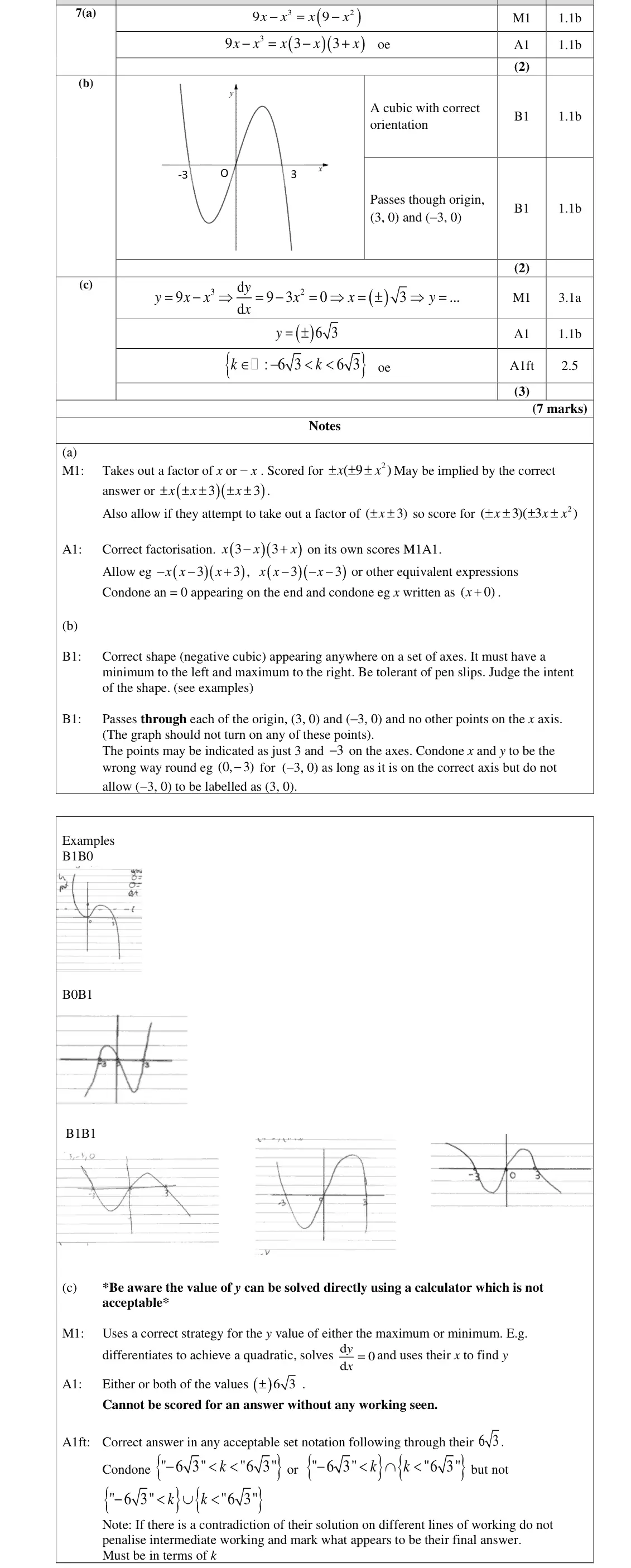
three intersections means k lies between the turning values: dy/dx = 9 − 3x² = 0, x = ±√3, y = ±6√3
using a discriminant is wrong (cubic)
answer in k, not x
set notation {k : −6√3 < k < 6√3} (union is wrong)
calculator decimals score nothing
June 2022 · Paper 1 · Q7(ii)2 marksHard
Mark scheme (whole question; this part is marked with the orange bar)
Examiner's comment
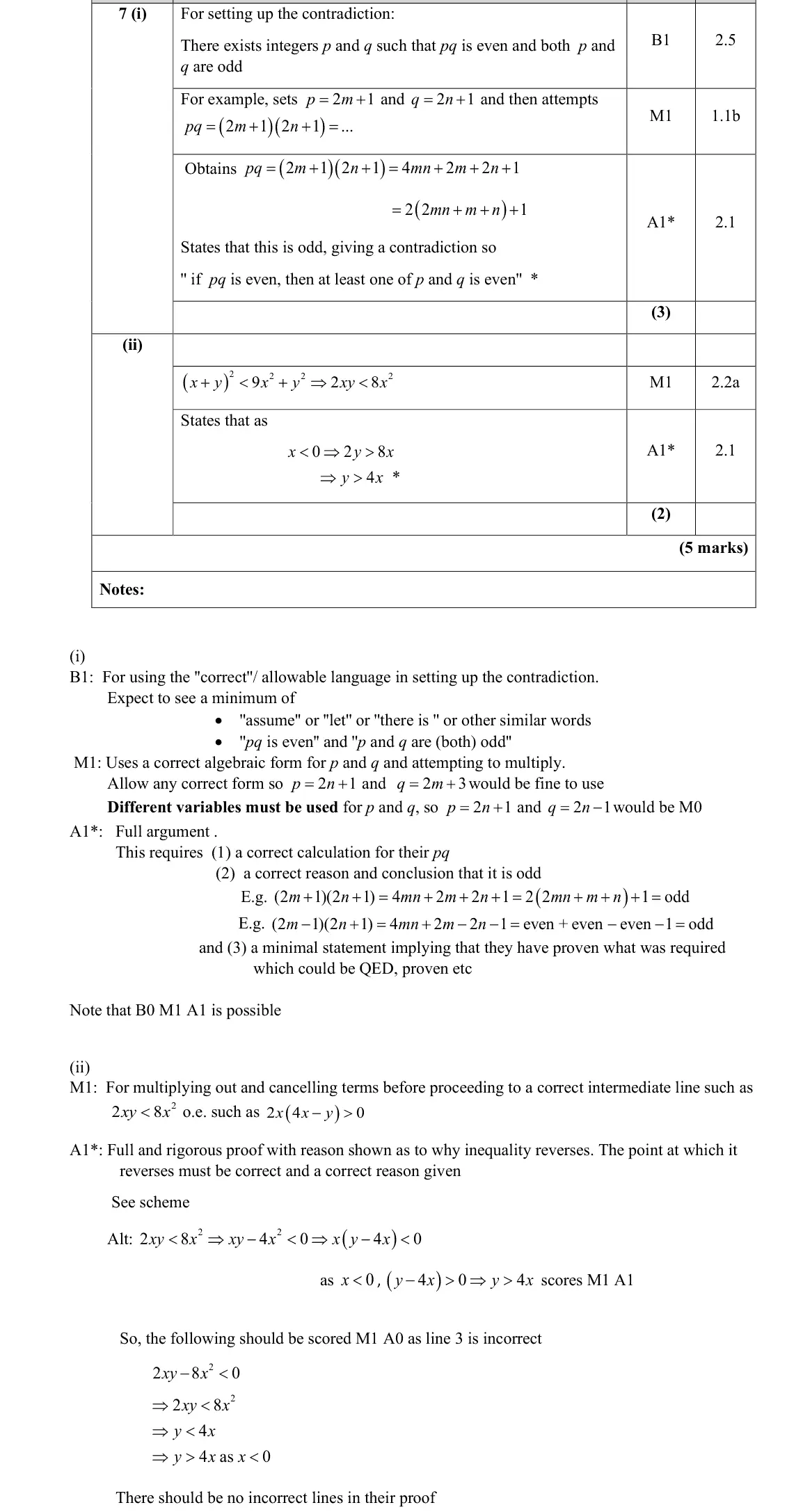
This question, on two different kinds of proof, proved more demanding than expected. As a result, there were very few completely correct solutions to both parts of this question. In part (i) candidates were often unable to set up a proof by contradiction using appropriate language, failing to use words such as 'assume', 'there exists' or 'let' . Others simply set up a contradiction such as 'assume p and q are odd' without any reference to pq being even. Many candidates also failed to use different variables for their odd numbers p and q, implying that p and q were either the same odd number, or two consecutive odd numbers such as 2n+1 and 2n+3. Candidates who managed to write p and q using different variables were generally able to multiply out pq correctly and write it in the form 2(.....)+1. If this stage was reached, the conclusion was generally correct and an acceptable sentence was written down. A mark of 011 was possible from the mark scheme. In part (ii) most candidates expanded the left hand side and cancelled terms getting to 2xy < 8x2 or equivalent for the method mark. Many then lost the second mark by failing to identify the point at which the inequality reverses, simply writing down y < 4x followed by 'so y > 4x'. Other candidates did reverse the inequality at the right point but didn't give an explanation as to why, and so lost the final mark.
Common mistakes
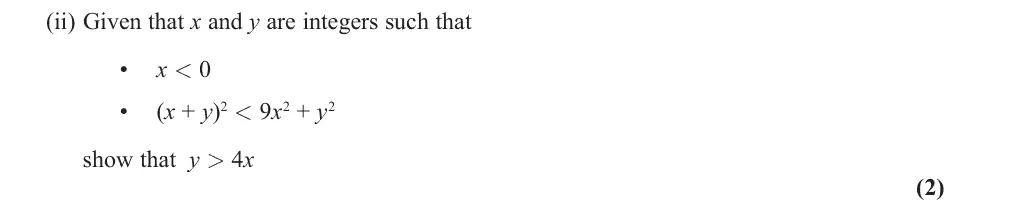
expand and cancel to 2xy < 8x²
dividing by x < 0 reverses the inequality, with the reason, to get y > 4x
no incorrect lines
June 2022 · Paper 2 · Q12(b)3 marks
Mark scheme (whole question; this part is marked with the orange bar)
Examiner's comment
Candidates found part (b) more challenging. Although most knew to set f′(x) to zero for stationary points, there were many marks lost due to insufficient rigour in the presentation of method when looking for one or more roots. Generally candidates understood that it was the quadratic expression that needed to be used and not any part of g(x). Overall, most realised that the number of solutions for a quadratic was determined by the discriminant although a significant number did not. The majority attempted b2 – 4ac with the appropriate values but candidates often set 𝑏𝑏2 -4𝑎𝑎𝑎𝑎= 0 rather than 𝑏𝑏2 -4𝑎𝑎𝑎𝑎 >= 0. The B mark was usually gained by the use of the discriminant > or >= 0, it was rarely gained by making an appropriate statement. Some stated g(𝑥𝑥) ≠0 and a few g(𝑥𝑥) > 0 which may have been required if full justification had been required. Most candidates gained the M mark for calculating the value of the discriminant using the correct values for a, b and c. Other methods included completing the square to find the least value of the quadratic and then considering the y coordinate. Some differentiated the quadratic to find the minimum turning point and again considered the y value. These alternative methods were often incomplete and unsuccessful in most cases seen. Few realized the range had a lower limit, but this was condoned for the A mark as the k was defined as positive in the question. A common error was to give the final inequality as 4 9 k < .
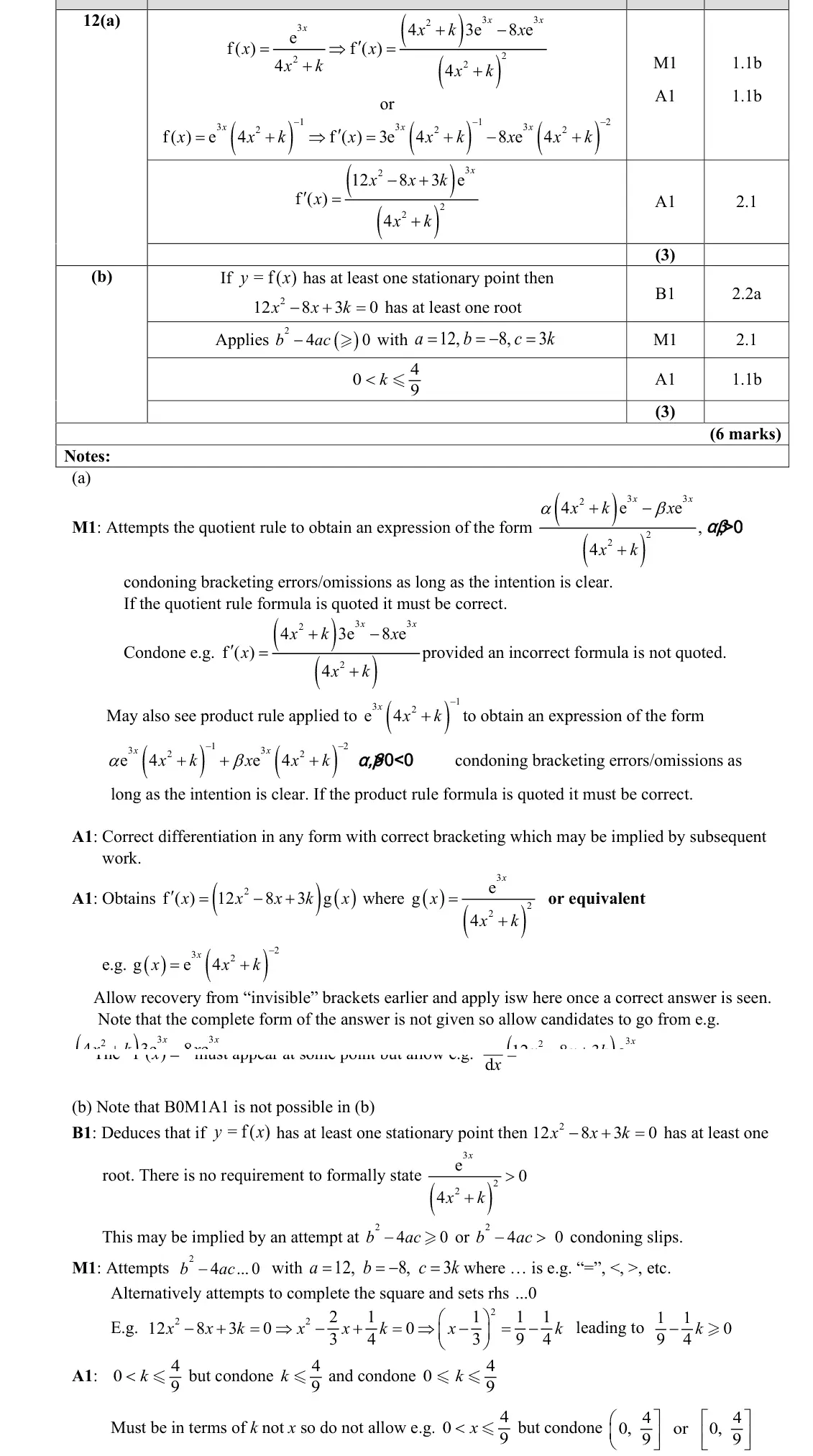
b² − 4ac ≥ 0 not = 0: 64 − 144k ≥ 0 gives 0 < k ≤ 4/9 (not k < 4/9)
June 2022 · Paper 2 · Q16(c)5 marks
Mark scheme (whole question; this part is marked with the orange bar)
Examiner's comment
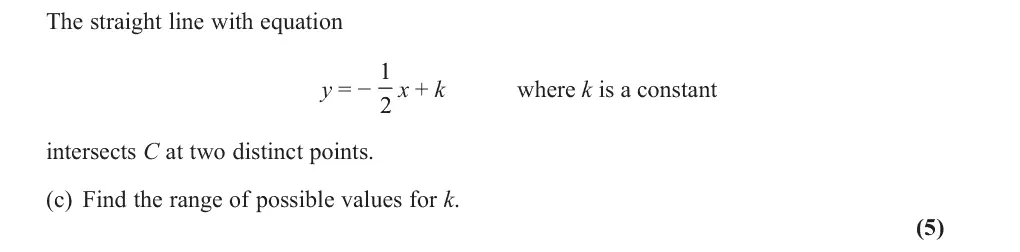
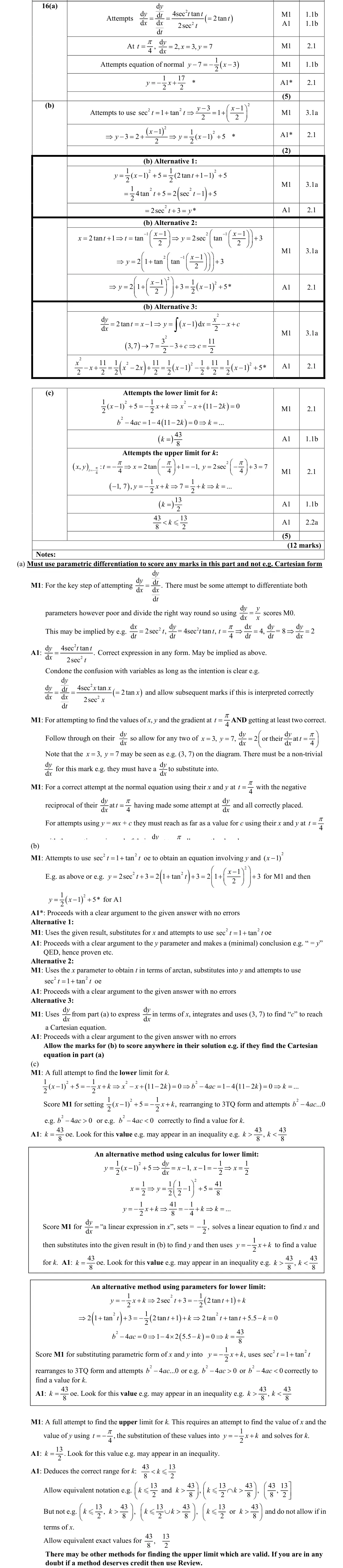
This question proved to be a good differentiator between candidates. It provided a challenge for many candidates but equally there were a number of accessible marks here. Most candidates attempted part (a), many attempted part (b) and at least partially attempted part (c), usually attempting to find the lower limit for k. There were, however, very few completely correct answers to this question and a substantial minority made no attempt at any part, perhaps having run out of time by the time they reached the last question on the paper. Part (c) provided a particular challenge and usually only the lower limit was attempted. Most candidates appeared to completely miss the need to find an upper limit. Of those who did manage to find both limits, only a small minority of candidates got to the final solution with correct inequality interpretation. It is worth noting that candidates achieving full marks for this part very often had clear construction lines on their graph that enabled them to see the correct approach. Most often though, candidates gained the method mark for the lower limit, 43 8 , for identifying that two intersections were required and set up a correct inequality for the discriminant for the quadratic equation obtained by equating the equations of the line and the curve. Common errors in manipulation, particularly of the coefficient of ½ from the quadratic meant that a number of candidates did not earn the accuracy mark for 43/8. Many candidates stopped after obtaining a lower limit for k, but others explored the parameter limits at 𝑡𝑡= - 𝜋𝜋 4 and 𝑡𝑡 = 𝜋𝜋 3 to identify 𝑘𝑘 values of 13 2 and 23 2 - sqrt 3 for the line passing through the associated points. Very few, however, recognised 13 2 as an upper limit and a number of candidates assumed incorrectly that 13 2 < 𝑘𝑘 < 23 2 - sqrt 3. A minority of candidates incorrectly thought that setting d𝑦𝑦 d𝑥𝑥 = 0 or d𝑦𝑦 d𝑥𝑥 =- 1 2 would provide limiting criterion for k values. In summary this was an interesting question which gave rise to a wide variety of responses in all three parts. There were instances of both succinct and ingenious approaches seen, particularly in part (c) and it was pleasing to see tenacity in some response where candidates had inadvertently opted for less efficient approaches but had persevered nonetheless to obtain the required results.
Common mistakes
lower limit: tangency, discriminant of x² − x + (11 − 2k) = 0 gives k = 43/8
upper limit from the end point t = −π/4, (−1, 7): k = 13/2
43/8 < k ≤ 13/2 (most missed the upper limit
draw lines on the sketch)
Oct 2021 · AS Paper 1 · Q13 marks
Mark scheme (whole question; this part is marked with the orange bar)
Examiner's comment
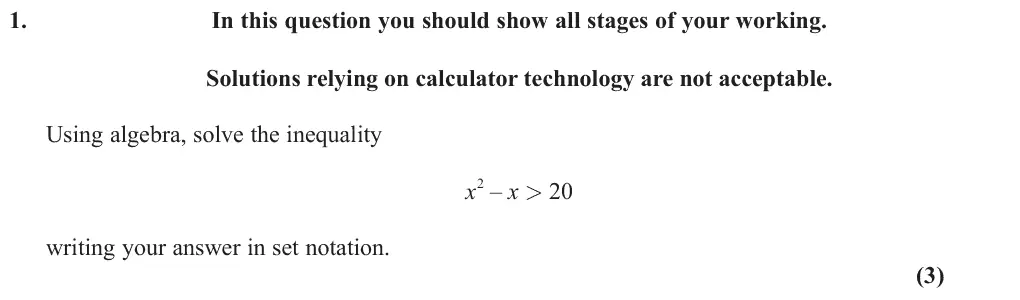
This was a short opening question to the paper, which enabled nearly all candidates to score at least one mark. However, several candidates did not find their critical values correctly, sometimes equating to 20 rather than rearranging and equating to 0 or making errors when factorising. Most, however, were able to find 5 and -4. Typically, most realised that they needed to select the outside region, although there were a few responses with incorrect inequalities. It was very rare for candidates to correctly give their answer using set notation, and very few being able to score full marks.
Common mistakes
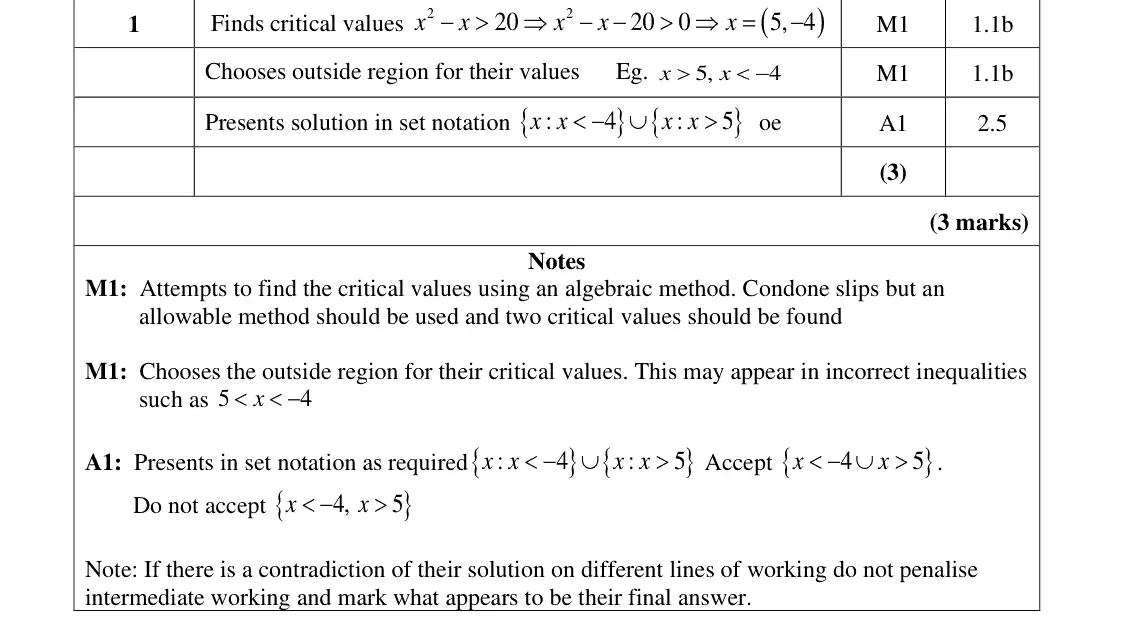
rearrange to x² − x − 20 > 0 before finding critical values 5 and −4 (do not equate to 20)
outside region
set notation {x : x < −4} ∪ {x : x > 5} needed for A1 (very rarely seen)
{x < −4, x > 5} not accepted
Oct 2021 · Paper 2 · Q11(b)4 marks
Mark scheme (whole question; this part is marked with the orange bar)
Examiner's comment
Part (b) was better answered than part (a). Many candidates made correct attempts to find the second critical value of , gaining the M mark, but was often not found. The ‘squaring’ method was occasionally seen, but as this led to a 3TQ in x and k and which was hard to factorise this was rarely successful. The final A mark was often lost due to lack of correct set notation.
Common mistakes
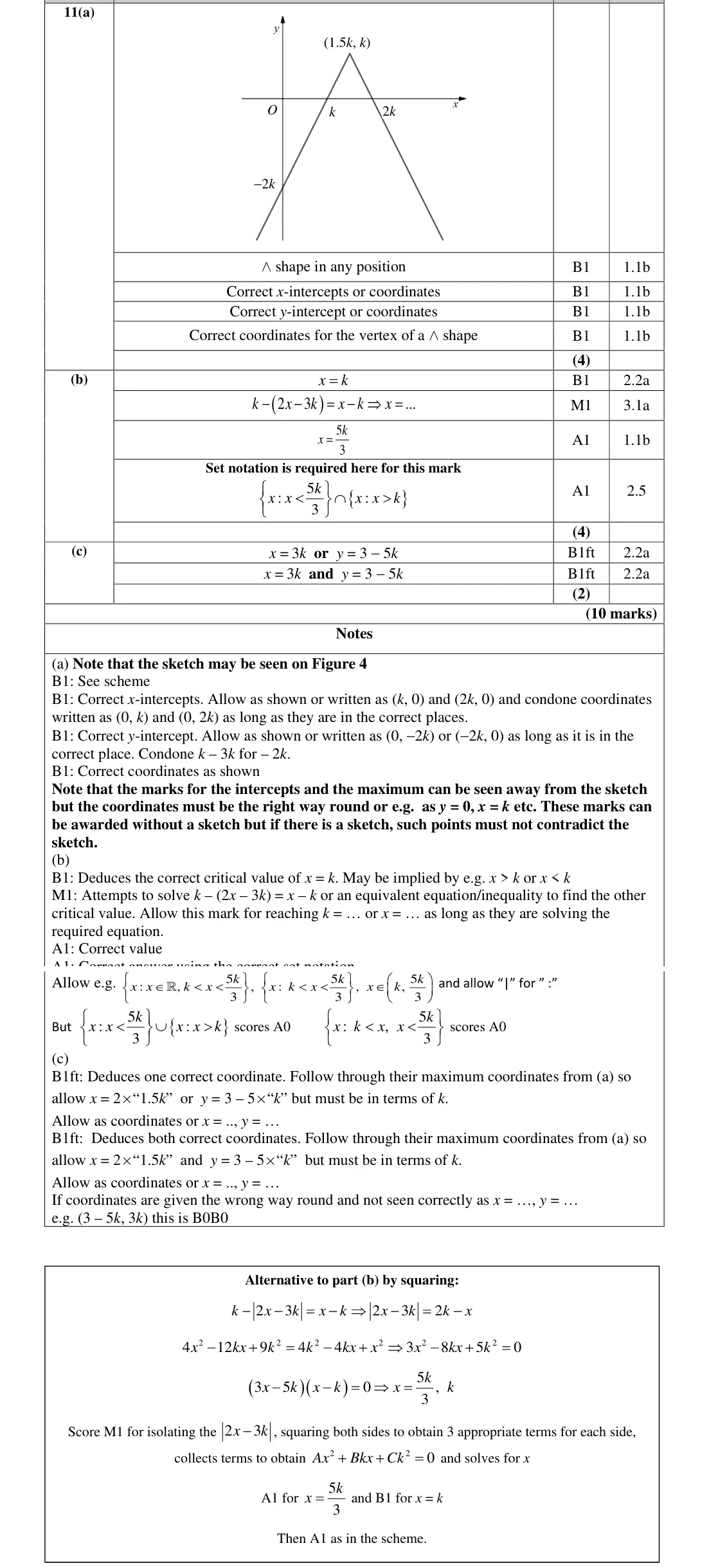
critical values x = k and x = 5k/3 (solve k − (2x − 3k) = x − k)
answer {x : x < 5k/3} ∩ {x : x > k}, union scores A0
set notation required
squaring is rarely successful
Oct 2020 · Paper 1 · Q75 marks
Mark scheme (whole question; this part is marked with the orange bar)
Examiner's comment
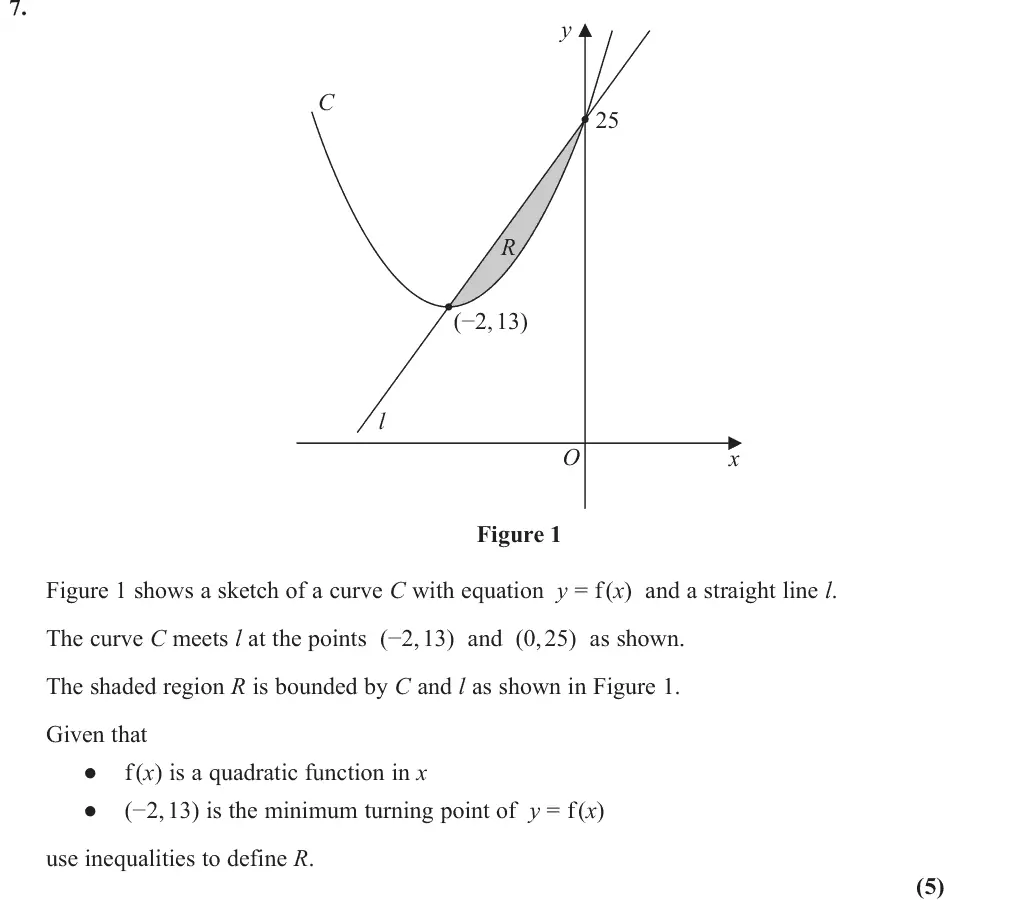
A very significant majority of the candidates did not seem to know how to define a region using inequalities. It was common to see a response where the area of region R was attempted using integration. It was only a small minority of candidates who made a correct inequality statement at the end, even with the allowance of follow through on their quadratic curve and their line equations. It was often the case that this final mark was lost due to a candidate using the letter R rather than y in their inequality. Finding the equations of the boundaries of the region is essential when defining the inequalities, so candidates who went on to find an area were mostly still trying to do this and if successful would have only lost the final mark. A very small minority of candidates found the area below the line by using a trapezium area formula and so did not manage to gain the marks for the line equation. Finding the line equation correctly was achieved by a majority of candidates, although a slip with the line gradient did occur occasionally even if the diagram showed a convincingly positive gradient. Finding the equation of the quadratic curve was found to be more difficult, with a common error being f(x)=(x+2)2+13. Occasionally a candidate spotted that this was not consistent with the curve going through (0,25) and tried to adjust their answer, but not often in a correct way. Attempts at using f (x)=a(x+2)2+13 were often successful at finding a, whilst attempts at using f (x)=ax2+bx+c were much less often correct.
Common mistakes
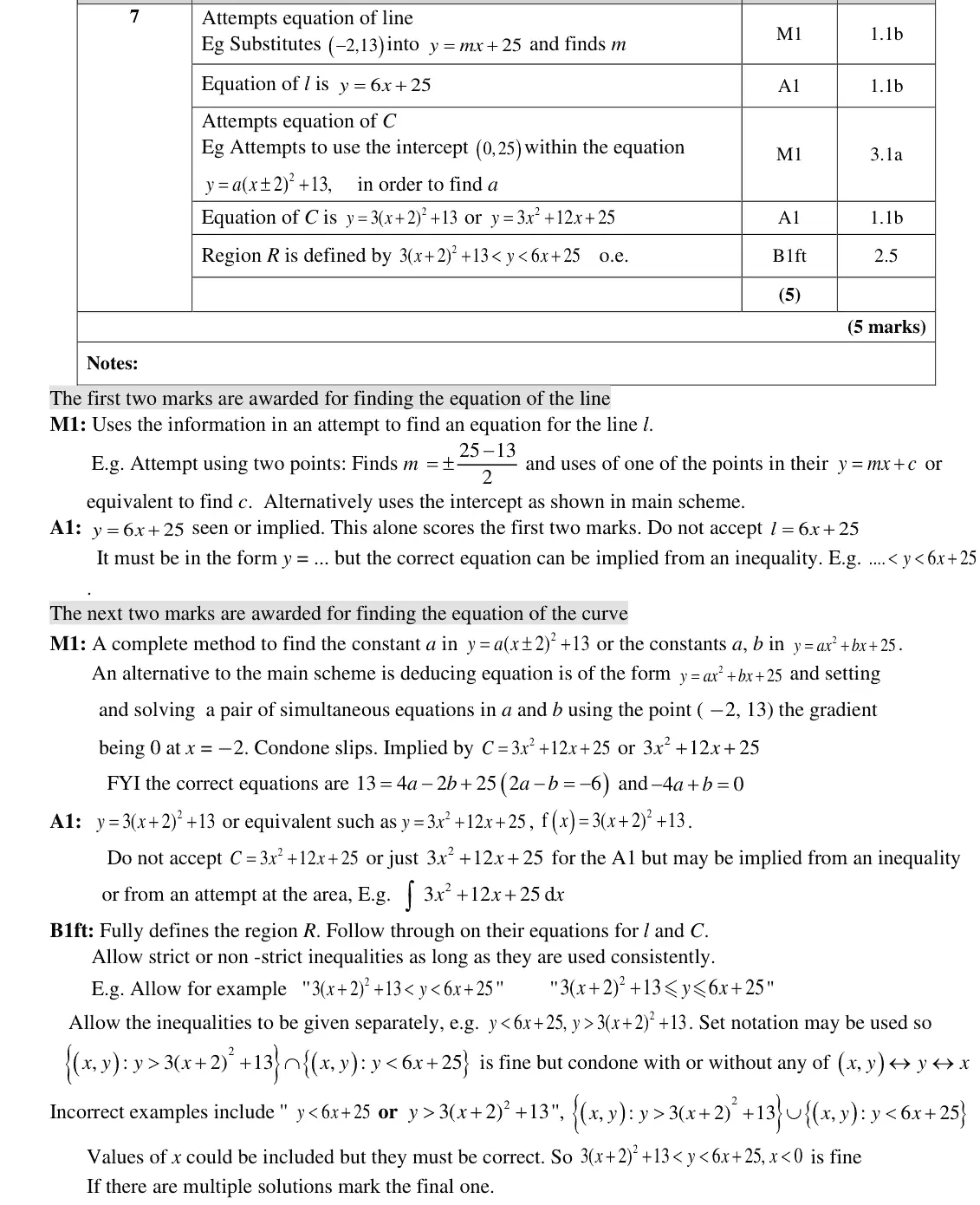
l is y = 6x + 25
C from the vertex form y = a(x + 2)² + 13 through (0, 25), y = 3(x + 2)² + 13
region 3(x + 2)² + 13 < y < 6x + 25 (use y, not R or C
∩ not ∪)
many found the area by integration instead
Oct 2020 · AS Paper 1 · Q11(ii)4 marks
Mark scheme (whole question; this part is marked with the orange bar)
Examiner's comment
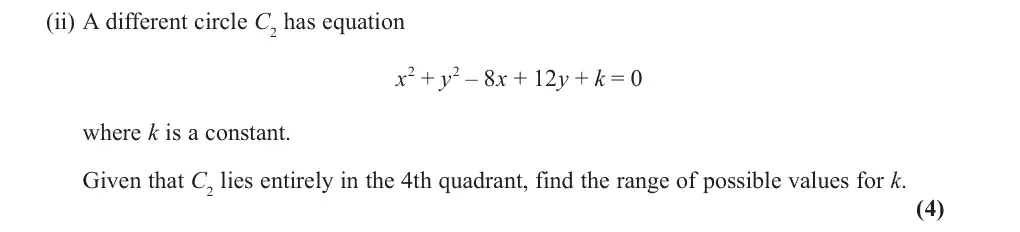
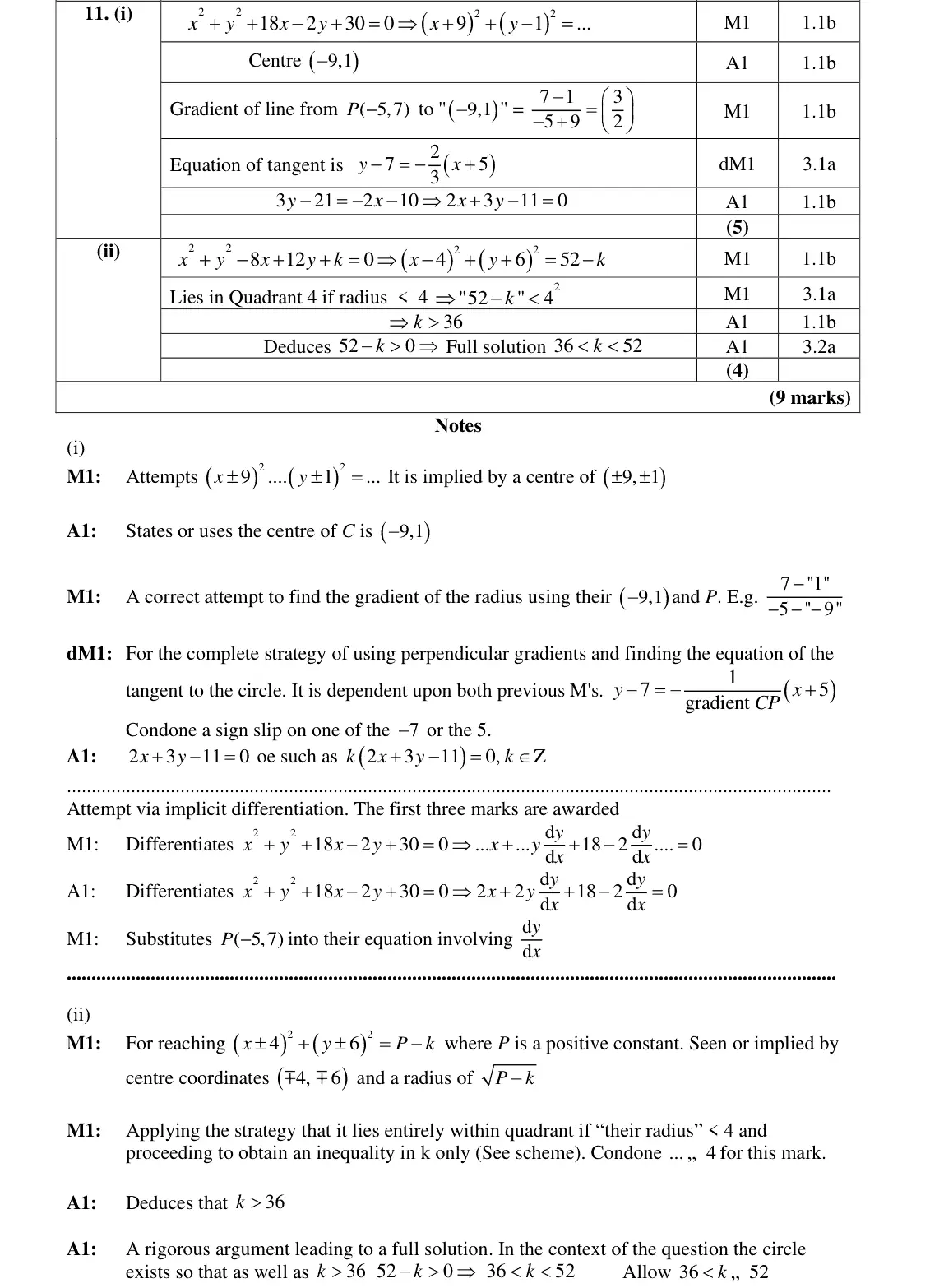
Candidates were generally successful in answering the first part of this question, but found the second part more challenging, with only a few gaining full marks. In part (i), most candidates were confident in completing the square to find the coordinates of the centre of the circle, and many could then successfully find the gradient of the line from the centre to the given point. There were still a number of candidates who made sign errors when finding the gradient, however. Some candidates forgot to then find the negative reciprocal of this gradient in order to find the tangent, and a few did not give their final answer in the requested form, but this was generally answered well. Candidates should be reminded to check the form that the answer should be given in to ensure that they score marks that they are more than capable of achieving. In part (ii), again most candidates were confident in completing the square and finding the radius of this circle in terms of k, but a number then stated this radius needed to be less than 6, rather than saying it needed to be less than 4. There were a large number who made errors + 52 k just rearranging the equation resulting in the radius as . Only a very small number of k candidates picked up the final mark for realising that, in addition to , we also required 36 k in order for the circle to actually exist. 52
Common mistakes
centre (4, −6), radius √(52 − k)
in the 4th quadrant needs radius < 4 (distance from the centre to the y-axis, not 6) so k > 36
circle exists needs 52 − k > 0
36 < k < 52
Oct 2020 · Paper 2 · Q11(c)3 marks
Mark scheme (whole question; this part is marked with the orange bar)
Examiner's comment
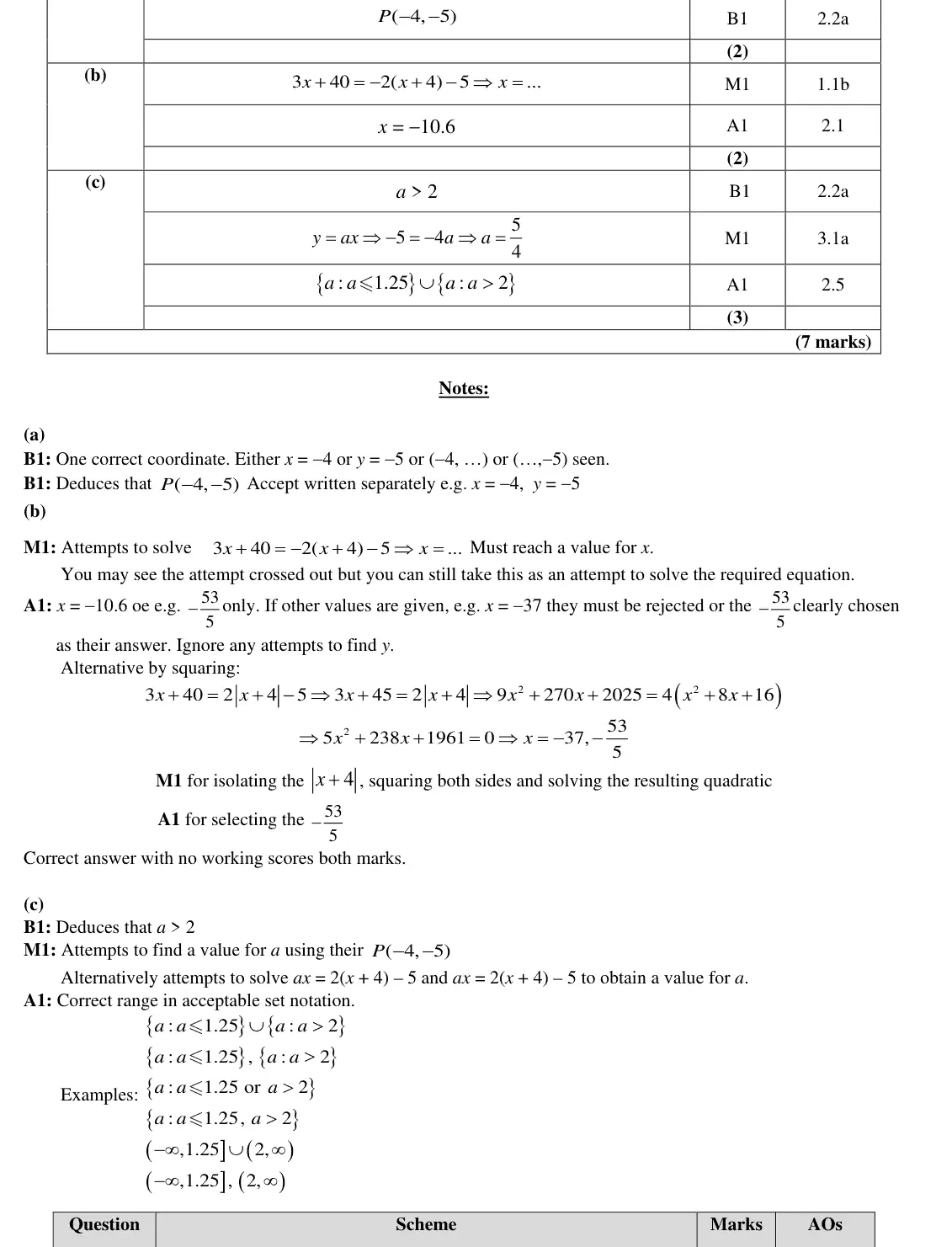
Part (a) of this question was generally well answered, with most candidates being able locate P correctly. A few candidates launched into some lengthy algebra, in some cases resulting in values for x and y bearing no relation to the position of P on the diagram. Answers to part (b) from this cohort of candidates were very disappointing and displayed an overreliance on algebra and poor understand of modulus graphs. Very few candidates identified x = -10.6 as the solution to the equation. Instead most answers wrote down the solution to 3x+40 = 2(x+4) – 5 {x =-37} as well as x = -10.6, scoring M1A0. A few candidates used a calculator to directly write down the correct value of x to gain both marks – perhaps not a bad strategy for students who are weak at modulus graphs. A simple check on a calculator would also have established that only x = -10.6 was a solution to the printed equation. Part [c] of this question was one of the most challenging parts of this paper, with hardly any candidates gaining all 3 marks. Candidates seemed unable to ‘visualise’ the question and see directly that there would be an intersection if a was greater than 2, so the B mark was hardly ever gained (and consequently the A mark was immediately lost). The M mark for considering P and attempting a = 5/4 was occasionally gained, although as above this often entailed long winded algebraic methods e.g. solving simultaneous equations to find a.
Common mistakes
a > 2 (steeper than the right branch)
line through P gives a = 5/4, so a ≤ 1.25
set notation {a : a ≤ 1.25} ∪ {a : a > 2}
Oct 2020 · Paper 2 · Q13(c)2 marks
Mark scheme (whole question; this part is marked with the orange bar)
Examiner's comment
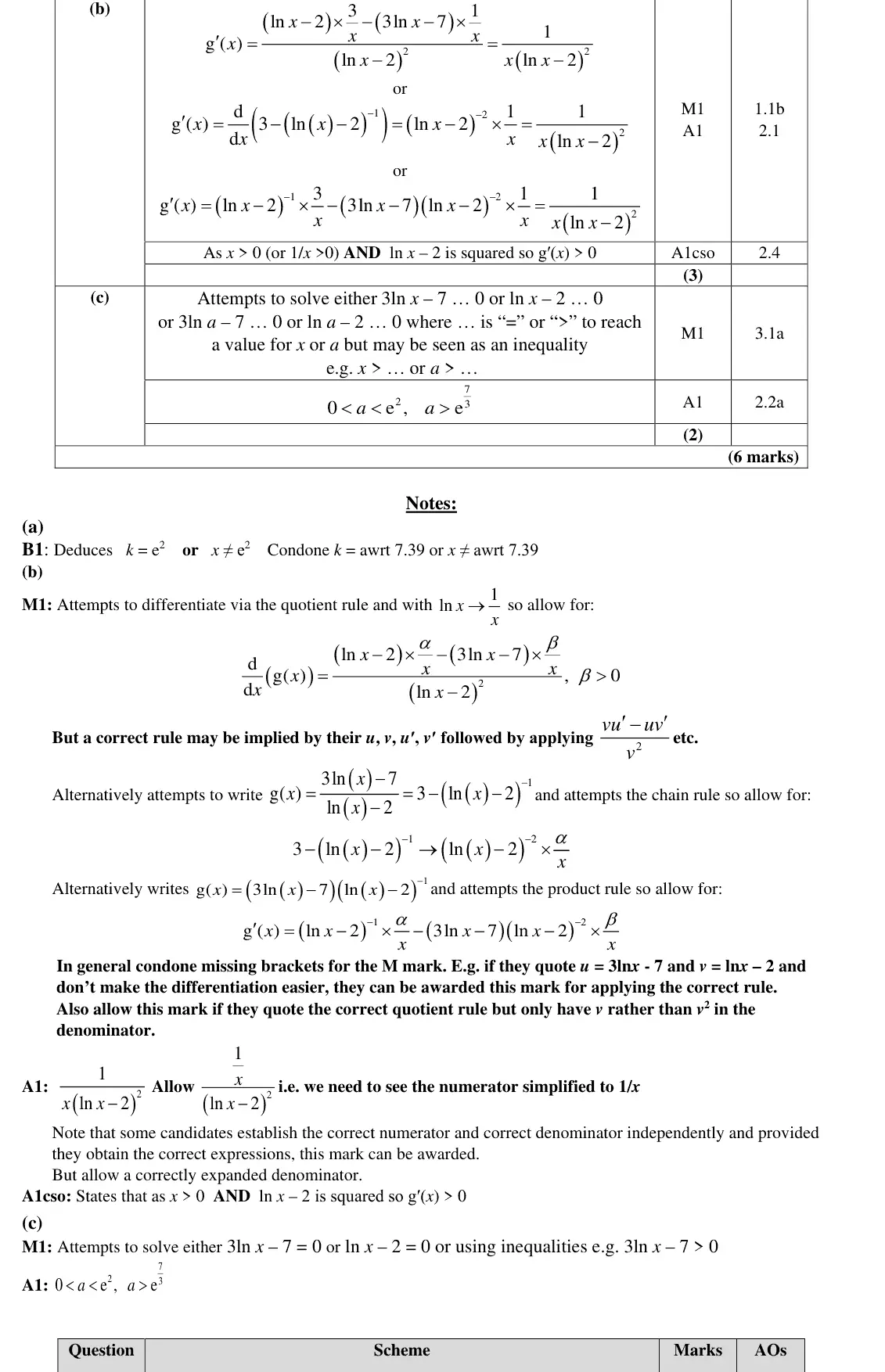
In part (c), most candidates only gained one out of two available marks as they usually considered only the set of values of 𝑎𝑎 for which the numerator is positive by solving 3𝑙𝑙𝑙𝑙𝑙𝑙-7 = 0 to obtain 𝑎𝑎> 𝑒𝑒 7 3. Usually no consideration was given to the case where the numerator and denominator are both negative and the few that did solve 𝑙𝑙𝑙𝑙𝑙𝑙= 2 usually failed to state 0 < 𝑎𝑎< 𝑒𝑒2.
Common mistakes
both numerator and denominator positive OR both negative: 0 < a < e² or a > e^(7/3)
most only found a > e^(7/3)
June 2019 · Paper 1 · Q3(b)1 markMedium
Mark scheme (whole question; this part is marked with the orange bar)
Examiner's comment
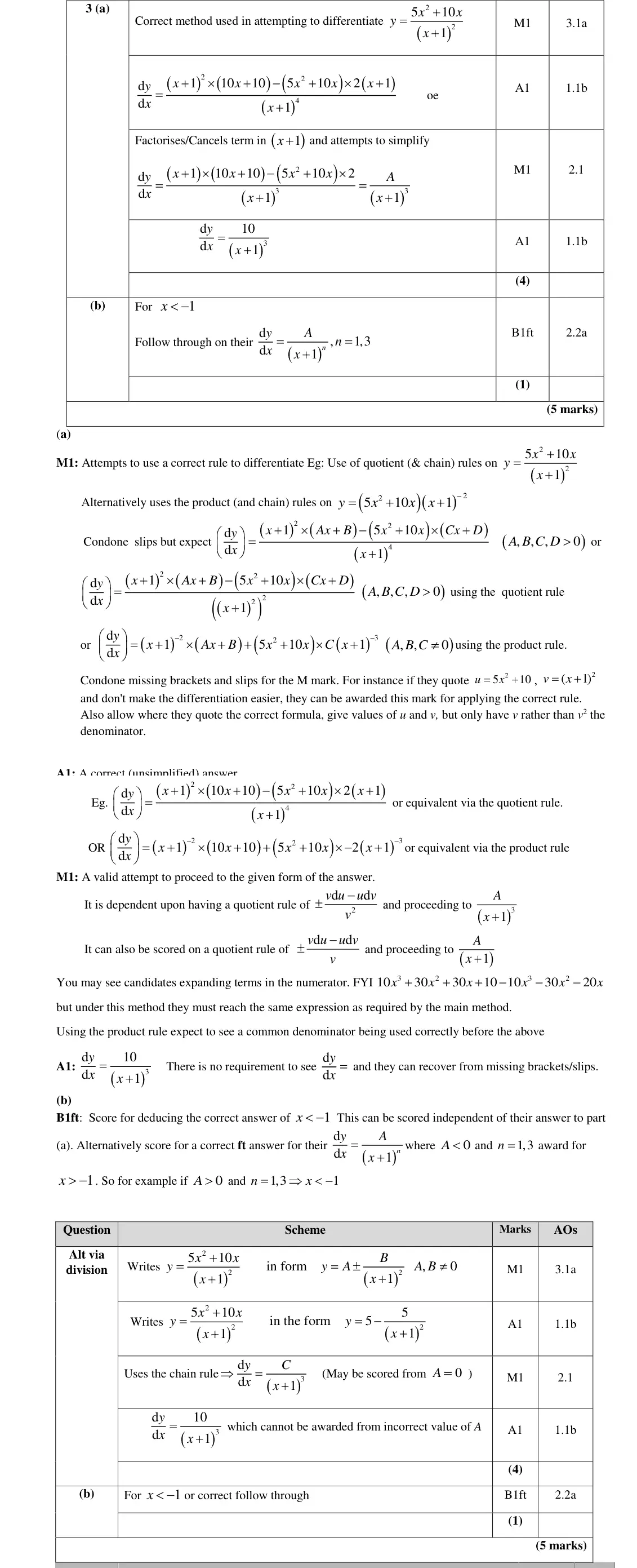
Nearly all students who were correct in part (a) achieved the mark for part (b), including many who had failed to cancel the (x+1). Indeed, there were many cases where a correct answer to part (b) was seen following incorrect work in (a), presumably due to the use of a calculator to plot and inspect the graph.
Common mistakes
dy/dx < 0 when (x + 1)³ < 0 so x < −1
June 2019 · AS Paper 1 · Q5(b)2 marksEasy
Mark scheme (whole question; this part is marked with the orange bar)
Examiner's comment
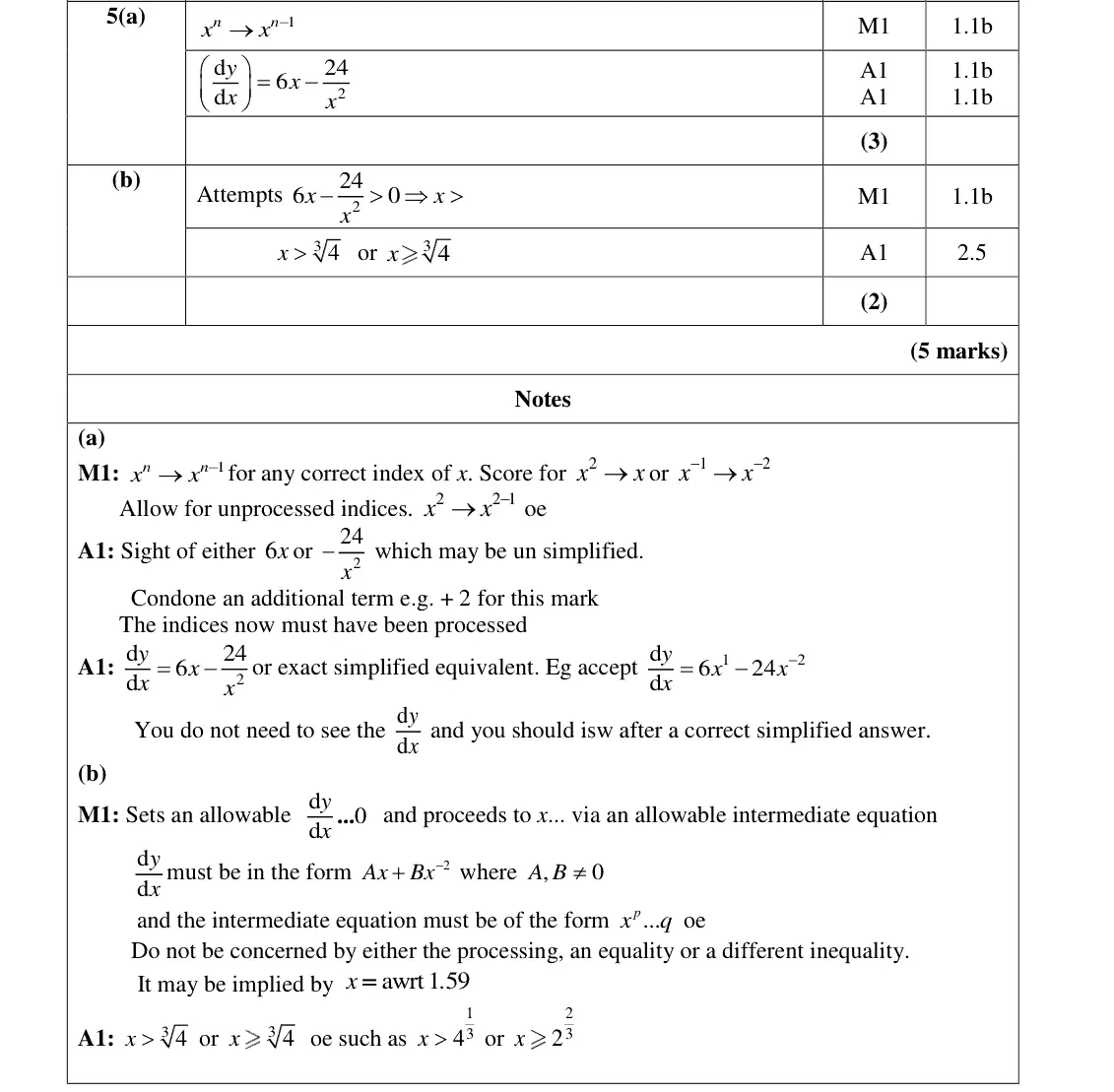
Almost all candidates were able to access some of the marks available in this question with many gaining full marks in (a). However, (b) was done with much less confidence with many candidates making little or no attempt. (b) Some candidates seemed unfamiliar with what was meant by an increasing function and did not attempt to use dy/dx > 0. Common incorrect attempts included finding d2y/dx2 or treating the original function as a quadratic with attempts to complete the square or find the discriminant. Of those who constructed the correct inequality, a number lacked the algebraic manipulation skills to deal with inequalities with both positive and negative powers of x. Candidates should ensure they provide answers in the form requested by the question. It was very common to see final answers given as rounded decimals only, when an exact answer was required.
Common mistakes
increasing means dy/dx > 0 (not d²y/dx² or the discriminant)
6x − 24/x² > 0 gives x³ > 4
exact answer x > ∛4, not a rounded decimal
June 2019 · Paper 1 · Q9(b)2 marksMedium
Mark scheme (whole question; this part is marked with the orange bar)
Examiner's comment
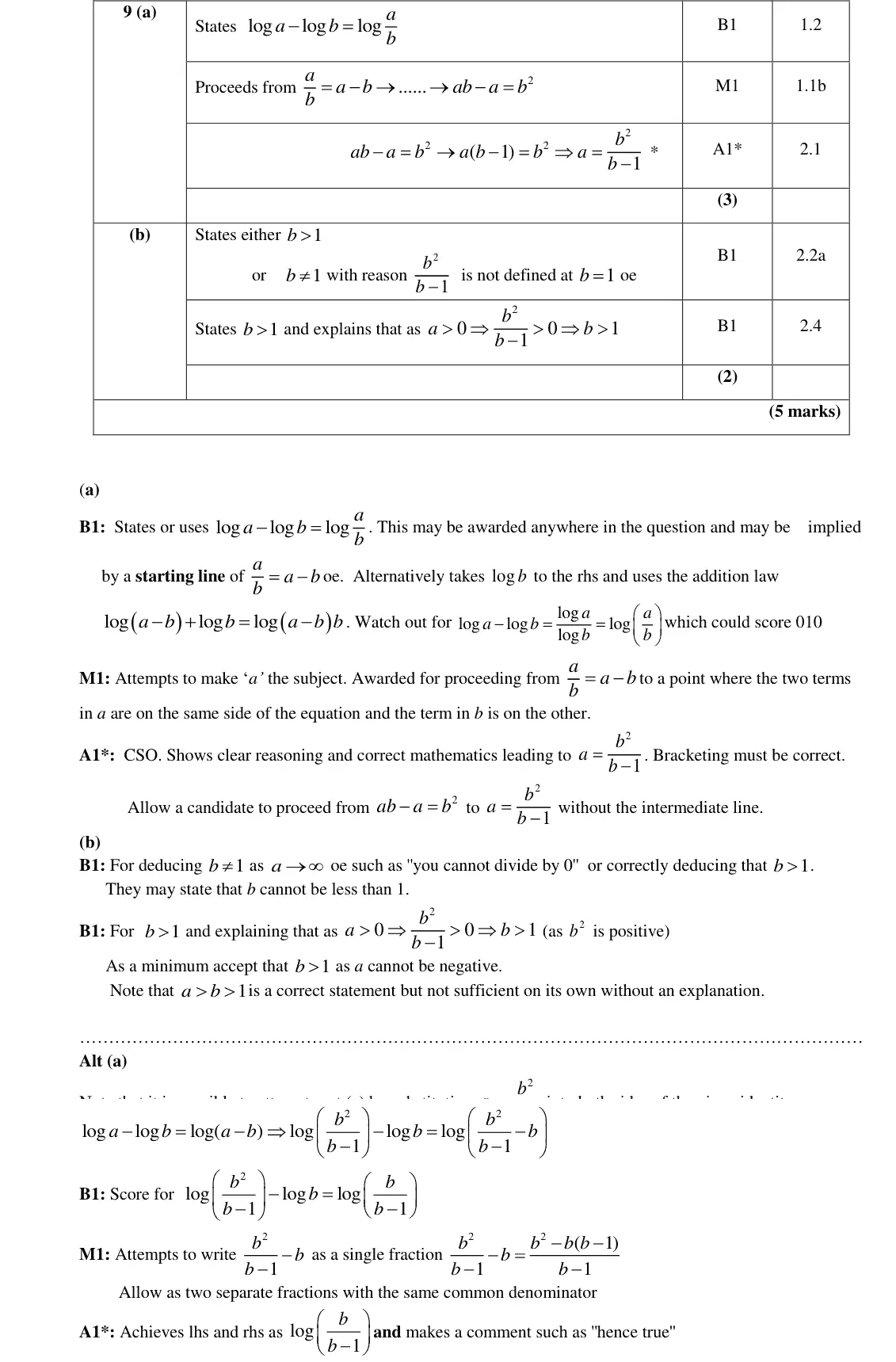
There were many good attempts to this question, though complete answers to part (b) were achieved only by the very best. Part (b) was more challenging with many only scoring the first mark. Many students focused solely on the exclusion of b = 1 from the denominator and paid no heed to the condition that a >0. Few students were able to provide a full explanation including that as a >0, 2 0 1 b b and so b > 1. Most candidates knew that the denominator of a fraction cannot be zero, though few of them used the words “undefined” or “infinity” in their answers, but would more often refer to 'math error' or 'can’t didide by 0'.
Common mistakes
b > 1 because a > 0 so b²/(b − 1) > 0
b ≠ 1 (denominator zero) alone gets only the first mark
June 2019 · Paper 1 · Q10(ii)2 marksHard
Mark scheme (whole question; this part is marked with the orange bar)
Examiner's comment
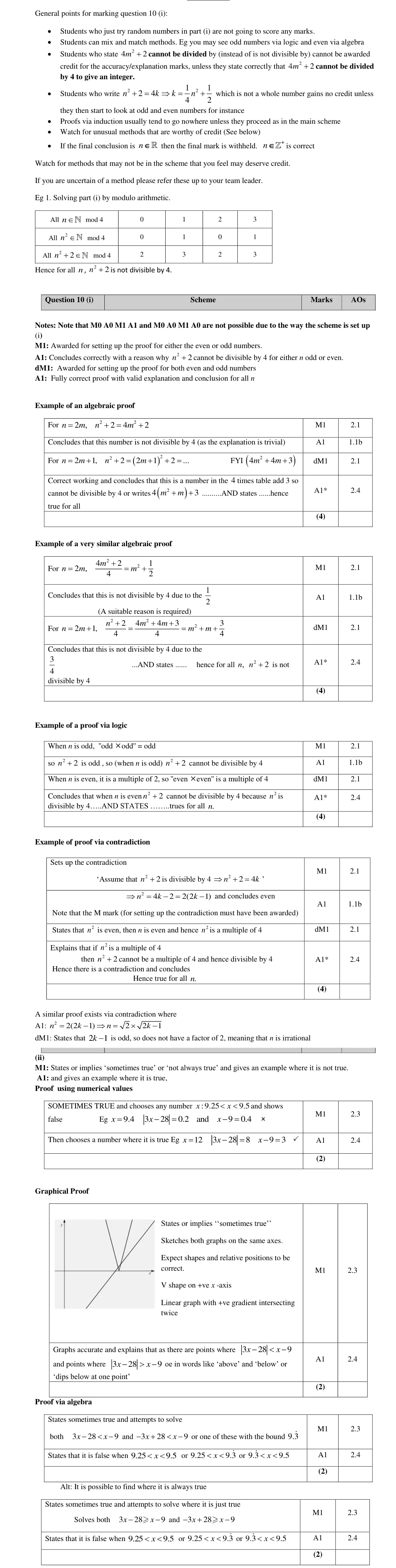
The idea of proof is another new one in this updated specification. It was not well known and a disproportionate number of blank or barely started solutions indicated a lack of expertise in this topic. Candidates who scored full marks for part (i) most often did so via algebraic proof, letting n=2m (for even numbers) and then n=2m+1 (for odd numbers), although several candidates missed out on the final accuracy mark as they failed to insert a conclusion for all n. Weaker candidates tried to use m + 1 instead of 2m + 1 to represent odd numbers. Also many candidates only considered either odd or even numbers, but not both. Candidates who set out to use proof via contradiction tended to score few marks as they did not show an understanding of how to use that method of proof. Proofs via logic were rare and tended to appear as part of a mix of different methods where the candidates seemed to be unclear of the best way to proceed. Some candidates seemed to think that using random numbers to show that the expression is not divisible by 4 amounted to proof (receiving 0 marks). Students need more practice on this style of proof. In part (ii) more candidates approached the problem algebraically than graphically. They were generally able to set up the two equations / inequalities required, but errors often occurred in their use of algebra when attempting to solve them. Some candidates only set up one of the two required inequalities. Many students attempted the question by just substituting numbers in to the expression, with most of these deducing that the statement was always true. Where candidates drew a graph, they often did not describe why their graph indicated that the statement is sometimes true. Many graphs showed a line and a V shape but some were incorrect in the relative positioning of these shapes.
Common mistakes
sometimes true: false for 9.25 < x < 9.5, true e.g. x = 12
give one example of each
substituting a few numbers led many to "always true"
graph needs V shape and line crossing twice
June 2019 · Paper 2 · Q6(b)4 marks
Mark scheme (whole question; this part is marked with the orange bar)
Examiner's comment
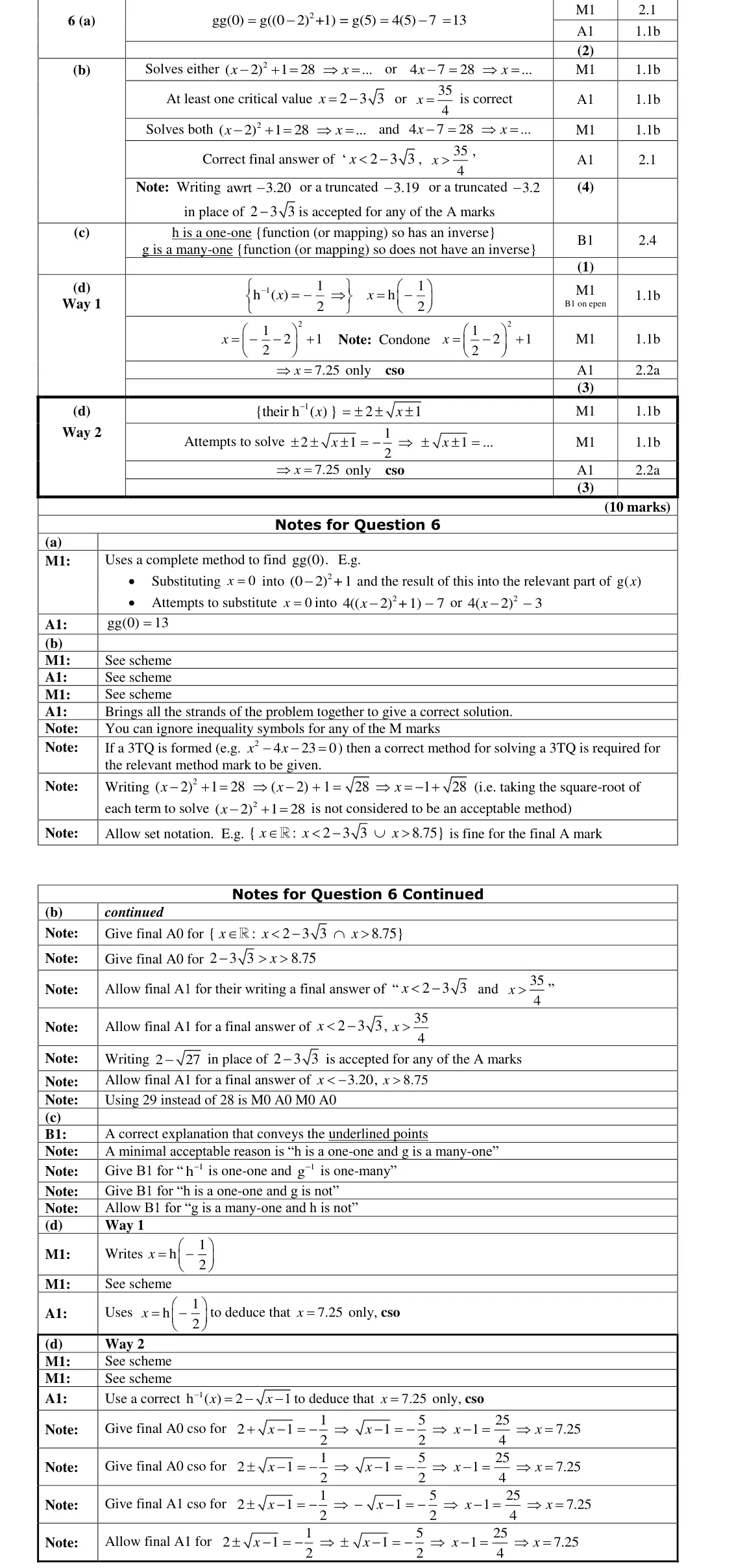
Q06 discriminated well between candidates of all abilities, with only a few candidates gaining full marks. There were some marks in Q06(b) and Q06(d) which were accessible to the majority of candidates. x In Q06(a), many candidates struggled with the split domain for g( )x (i.e. for 2, and for 2 g( ) ( 2) 1 x x 2, g( ) 4 7) x x x and only a minority gained both marks. Many candidates found a correct g(0) 5, but a significant number used the incorrect 2 gg(0) (5 2) 1 10. method of substituting ‘5’ to give Only a minority used a correct method and found gg(0) 4(5) 3 13. Occasionally candidates found an algebraic expression for gg( ), x although this was often incorrect. Very few obtained a x x x 2 2 correct answer of 13 by substituting into or 0 4(( 2) + 1) 7 4( 2) 3. x In Q06(b), many candidates attempted to solve the inequality g( ) 28 by finding the critical values for x. Most solved the linear equation to find a correct critical value 35 , x x 2 3 3. and many solved the quadratic equation to find A minority 4 x x 2 3 3 2 3 3 rejected and deduced that was the second critical value. Only a few candidates used the critical values and the diagram in Q6 to write down the correct 35 35 , x 2 3 3 . x x solution Some candidates, however, incorrectly gave 4 4 35 x 2 3 3 2 3 3 x x or gave as their final answer. A few candidates 4 made no creditable progress in Q06(b) by using a method of equating both parts of 2 ( 2) 1 4 7. x x g( )x and attempting to solve the equation Although Q6(c) required a comment for both functions, f and g, some candidates only wrote a comment about one of the two functions. A significant number of candidates believed that g did not have an inverse due to its being defined in ‘two parts’. Candidates who were successful in Q6(c) usually gave a reason such as, ‘g is a many- one function and h is a one-one function’. A few correctly stated that the inverse of g is one-many, which is not a function, whereas the inverse of h is one-one, which is a function. A few candidates incorrectly described g as a ‘one-many function’. 1 h . In Q06(d), only a few candidates applied the method of finding x by applying 2 As this method was less prone to error, most candidates who used it scored full marks. 1 h ( ), x Most candidates applied a complete method of finding their inverse followed 1 1 h ( ) . x by using their inverse to form and solve the equation Many candidates 2 x who found a correct answer lost the final mark in Q06(d). This was because 7.25 1 h ( ) 2 1 x x they used the incorrect inverse (instead of the correct 1 ) which led to their ‘solving’ the incorrect x 1 h ( ) 2 1 x x 1 (which has 2 x 7.25. no solutions) to give A few candidates in Q06(d) incorrectly believed that 1 h ( )x referred to the reciprocal of h, or even to the first derivative of h with respect to x.
Common mistakes
solve each branch = 28
reject 2 + 3√3 (not in x ≤ 2)
answer x < 2 − 3√3 or x > 35/4 (not "and" or ∩)
do not equate the two branches
June 2019 · Paper 2 · Q7(d)2 marks
Mark scheme (whole question; this part is marked with the orange bar)
Examiner's comment
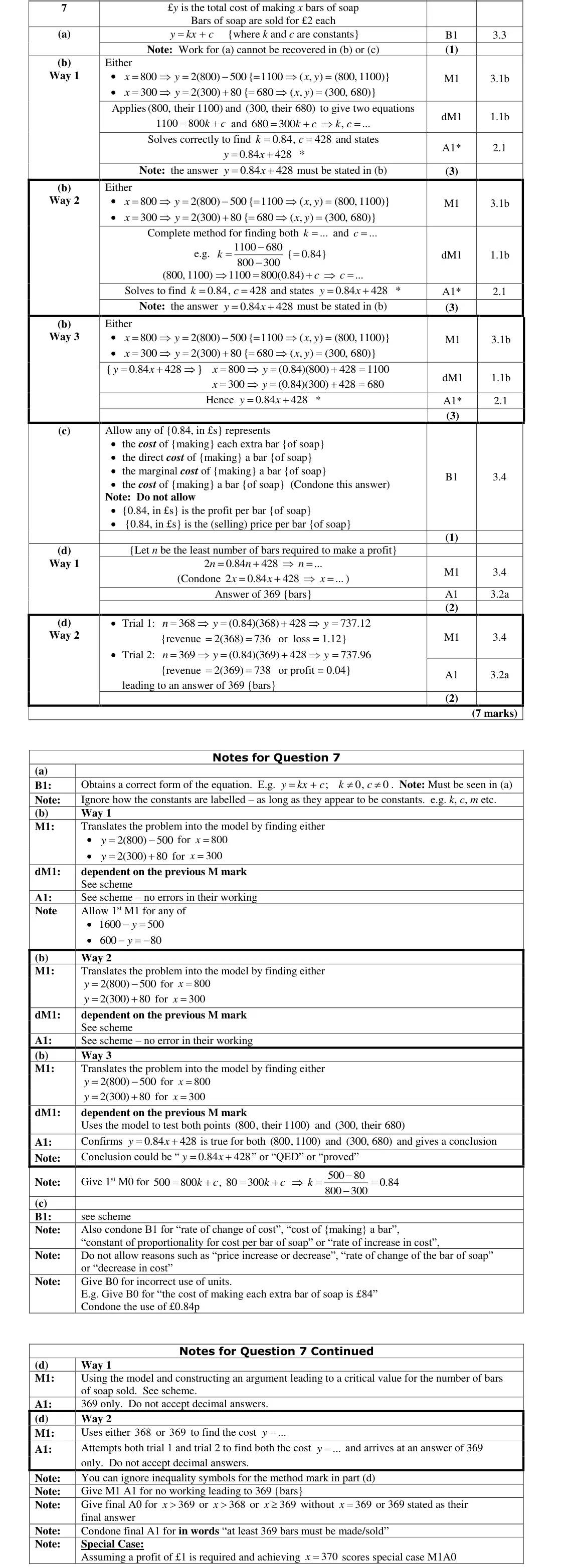
Q07 discriminated well between the medium and higher ability candidates. Lower ability candidates struggled to make much progress with this modelling question and most of them scored no more than one mark. In Q07(a), most candidates wrote down a correct equation for the model in the form , y kx c with constants k and c. A minority struggled to give a suitable form of the linear equation, with some omitting the fixed cost constant, c. Some candidates gave ; y x incorrect answers, such as equations involving exponential models; or differential equations. Q07(b) proved challenging for those candidates who struggled to grasp the concept ‘profit sales cost ’, with many of them incorrectly assuming that the model from Q07(a) was for the profit made. Many of these candidates used (800, 500) and either (300, 80) or (300, 80) to form two linear equations, with some erroneously finding a gradient of 0.84. Those candidates who understood the link between profit and cost usually found the total cost to the factory of £1100 and £680 for 800 and 300 bars of soap respectively. Most used (800, 1100) and (300, 680) to form two linear equations and proceeded to find the gradient, 0.84, and y-intercept, 428. A large proportion concluded by stating 0.84 428. y x the given equation A few candidates, however, did not complete their analysis with a suitable conclusion, and so lost the final mark. Some candidates used (800, 1100) and (300, 680)to verify the model 0.84 428. y x Many of these were successful but often failed to give a suitable conclusion stating that the given model was true. Q07(c) gave a significant number of candidates their only creditable access to Q07. Some candidates gave a correct interpretation such as 0.84 represented ‘the cost of making an extra bar of soap’. Incorrect explanations included that 0.84 represented ‘the selling price of a bar of soap’ or ‘the profit per bar of soap made’. There was a mixed response to Q07(d). The most popular approach was to form and or 2 0.84 428, n n solve a correct 2 which mostly led to the correct 0.84 428 n n n n n 369. 369, answer A final answer left as an inequality such as or 368 without reference to the statement that 369 was the number of bars required, was not n n sufficient for the final mark. Some candidates used trials of both and 368 369 n 369. in a complete trial and error method leading to a correct conclusion of
Common mistakes
solve 2n > 0.84n + 428
answer 369 bars (whole number, not n > 368.9 or a decimal)
June 2018 · AS Paper 1 · Q2(ii)2 marks
Mark scheme (whole question; this part is marked with the orange bar)
Examiner's comment
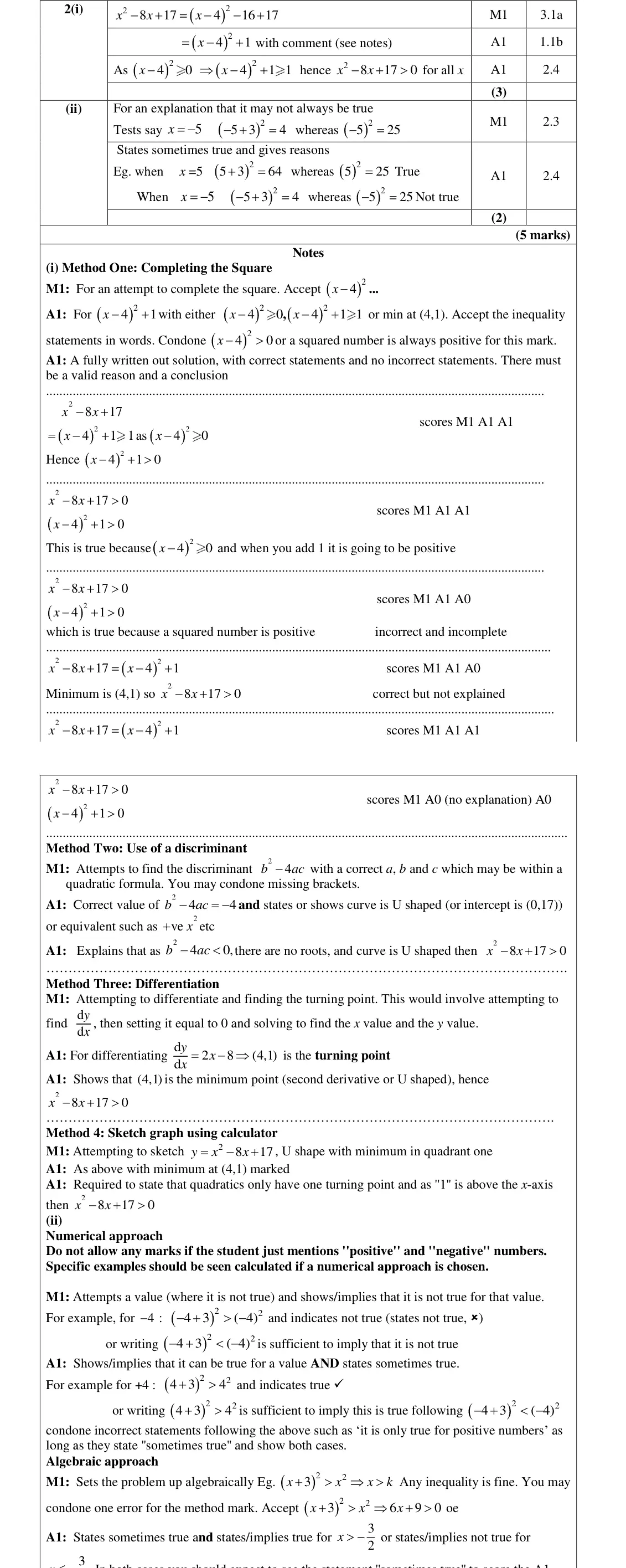
Most students gained marks in at least one part of this question. However, the rigorous approach required to achieve full marks was generally lacking. In part (i), most attempted to complete the square but a common error was to state that a square number must be positive, with no reference to the possibility of it being zero. Those who found the discriminant rarely scored more than the first mark as they did not realise the need to consider the shape of the curve. A small number attempted differentiation and whilst they stated (4,1) was a minimum it was very unusual to have this confirmed (e.g. using the second derivative). It was rare to see a fully graphical approach but those who tried usually gained two marks for a correct sketch with the correct minimum shown. A few students tried to give an explanation in words or used a few numerical examples. In part (ii), most students used a numerical approach and the majority concluded that the statement is ‘sometimes true’. It was common, however, to show working for a negative value only, for which the statement is not true. Some attempted a true and a false value, as required, but failed to conclude that the statement is ‘sometimes true’. Many students unsuccessfully tried to write general statements referring to positive and negative values being used, but only scored marks if they produced a counter-example. Of those who attempted an algebraic approach, many reached 6x + 9 > 0 but tended to stop there and did not gain the final mark for a correct conclusion.
Common mistakes
answer is sometimes true
a numerical approach needs specific values calculated, e.g. x = −5 gives 4 < 25 (not true) and x = 5 gives 64 > 25 (true)
just mentioning positive and negative numbers scores 0
algebraically 6x + 9 > 0 so true only for x > −3/2
June 2018 · AS Paper 1 · Q6(b)3 marks
Mark scheme (whole question; this part is marked with the orange bar)
Examiner's comment
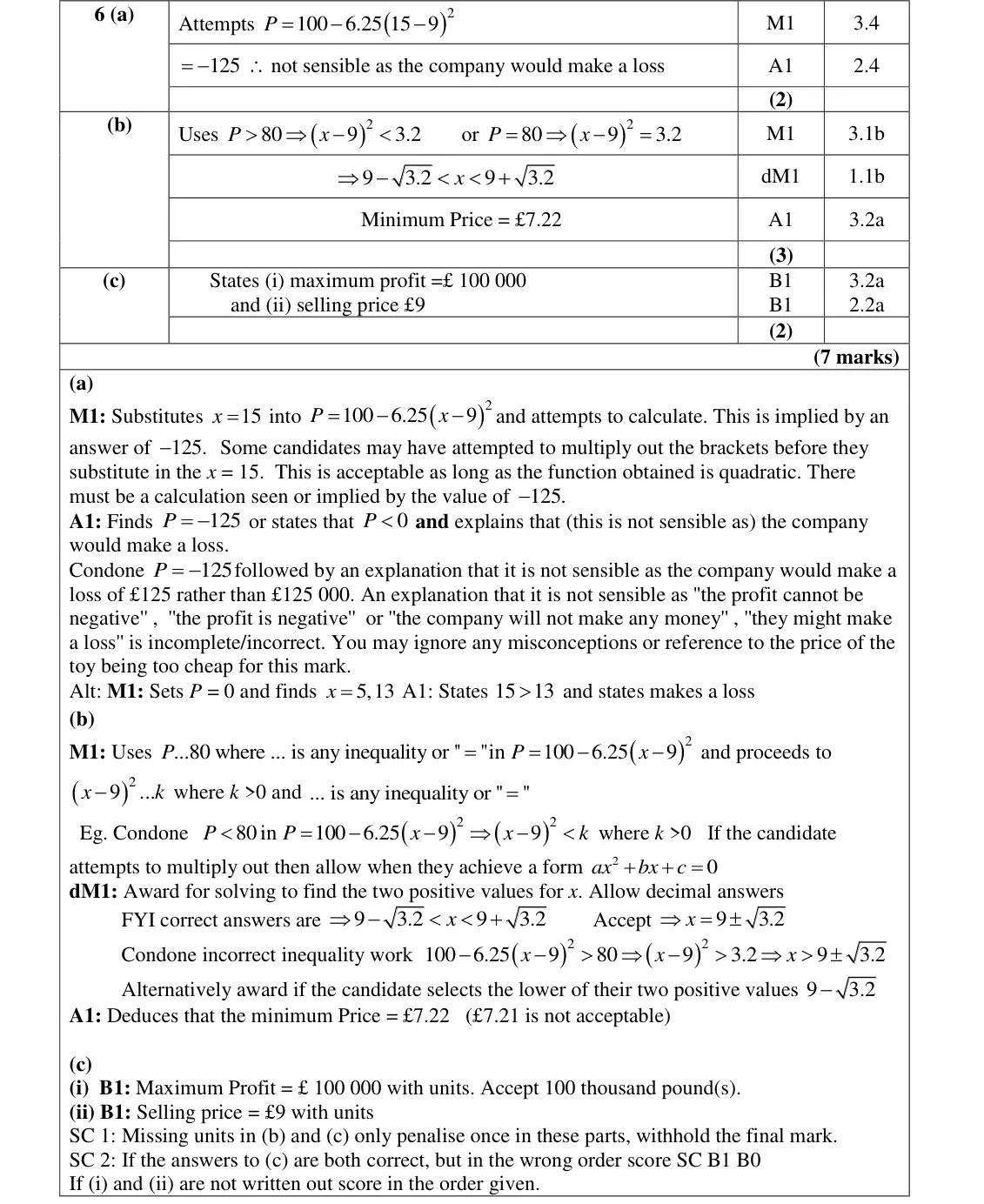
Success on this question was partially determined by students realising that P was measured in thousands of pounds. Additionally, students should be aware that units are necessary in modelling questions and in particular the answer to (c)(i) is £100 000 and not 100, £100 or 100 000 as commonly seen. (b) Many students attempted this part. The most common error was to use 80,000 rather than 80. This error resulted in a score of 000. Students who did use 80 usually attempted to solve the quadratic, but many by expanding and factorising rather than by using the form given. Some students only found one solution, rather than the two required. Very few students gained the final accuracy mark, with most students incorrectly stating £7.21 as the final value, not taking into account the need to round up. A small number of students used a trial and improvement method, which was often more successful in achieving the correct answer. Others used their graphical calculators to gain the correct answer with limited working.
Common mistakes
P is in thousands, so use P > 80 not 80 000
(x − 9)² < 3.2 gives 9 − √3.2 < x < 9 + √3.2 (use the completed-square form rather than expanding)
round up to £7.22 (£7.21 is not acceptable)
find both values
June 2018 · AS Paper 1 · Q9(c)3 marks
Mark scheme (whole question; this part is marked with the orange bar)
Examiner's comment
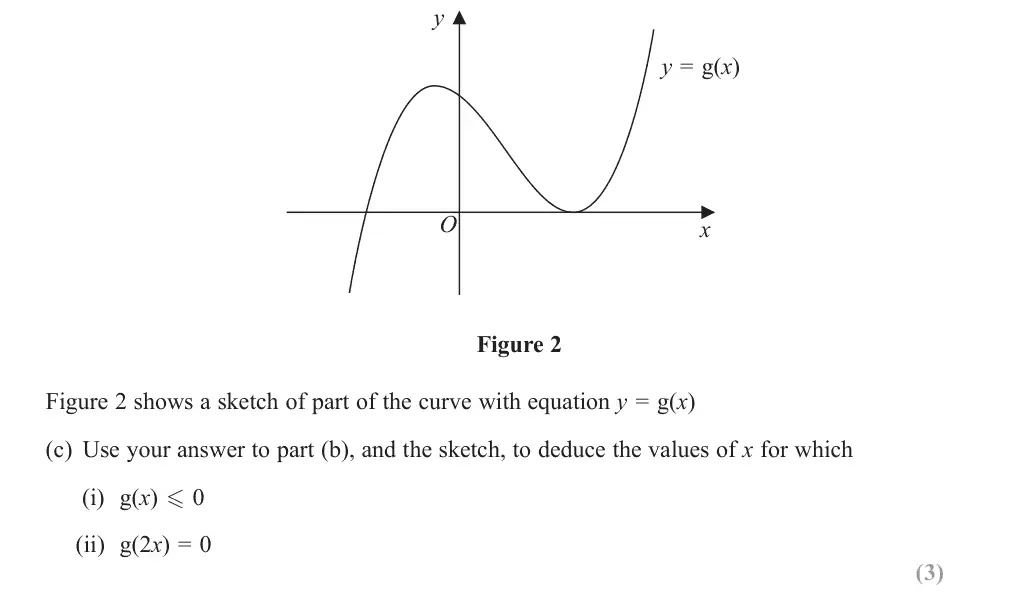
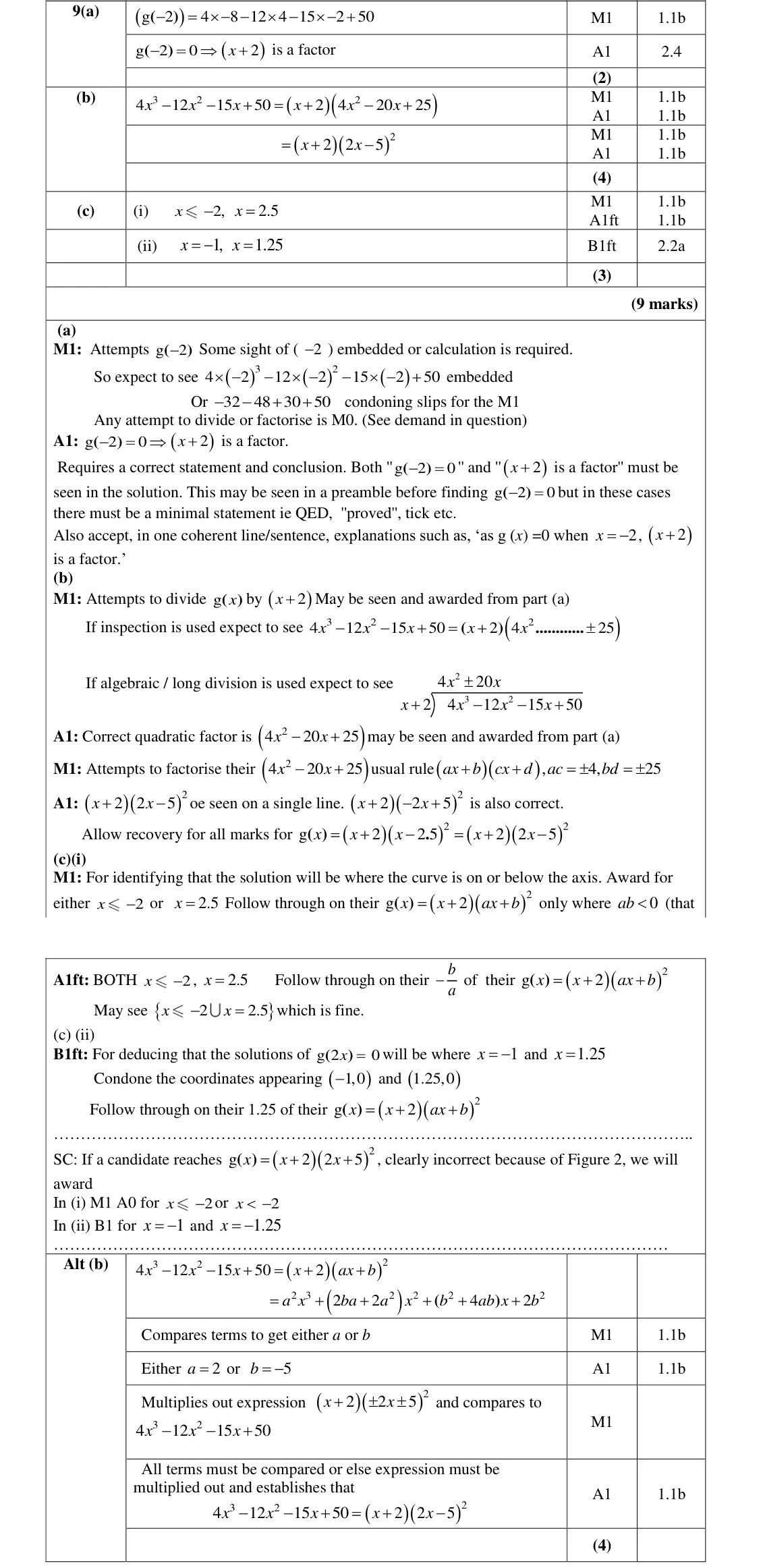
This question on the factor theorem proved to be a good source of marks for many students. Clearly they had been well prepared for this kind of question. Part (c) was usually attempted, but with limited success. In part (i) many achieved one mark, usually for 2 x (or x < - 2 which was condoned for the M mark). Errors from part (b) were often followed through correctly. Only more able (and careful) students gained full marks. In part (ii) many correctly use transformations to state x = -1 and x = 1.25. Some students multiplied the critical values by 2 (instead of dividing by 2) or in other cases they wrote down just one of the two solutions.
Common mistakes
(i) curve on or below the axis: x ≤ −2 or x = 2.5 (the repeated root where the curve touches the axis is often missed)
(ii) g(2x) = 0 halves the roots: x = −1, 1.25 (not doubled)
June 2018 · AS Paper 1 · Q14(b)6 marks
Mark scheme (whole question; this part is marked with the orange bar)
Examiner's comment
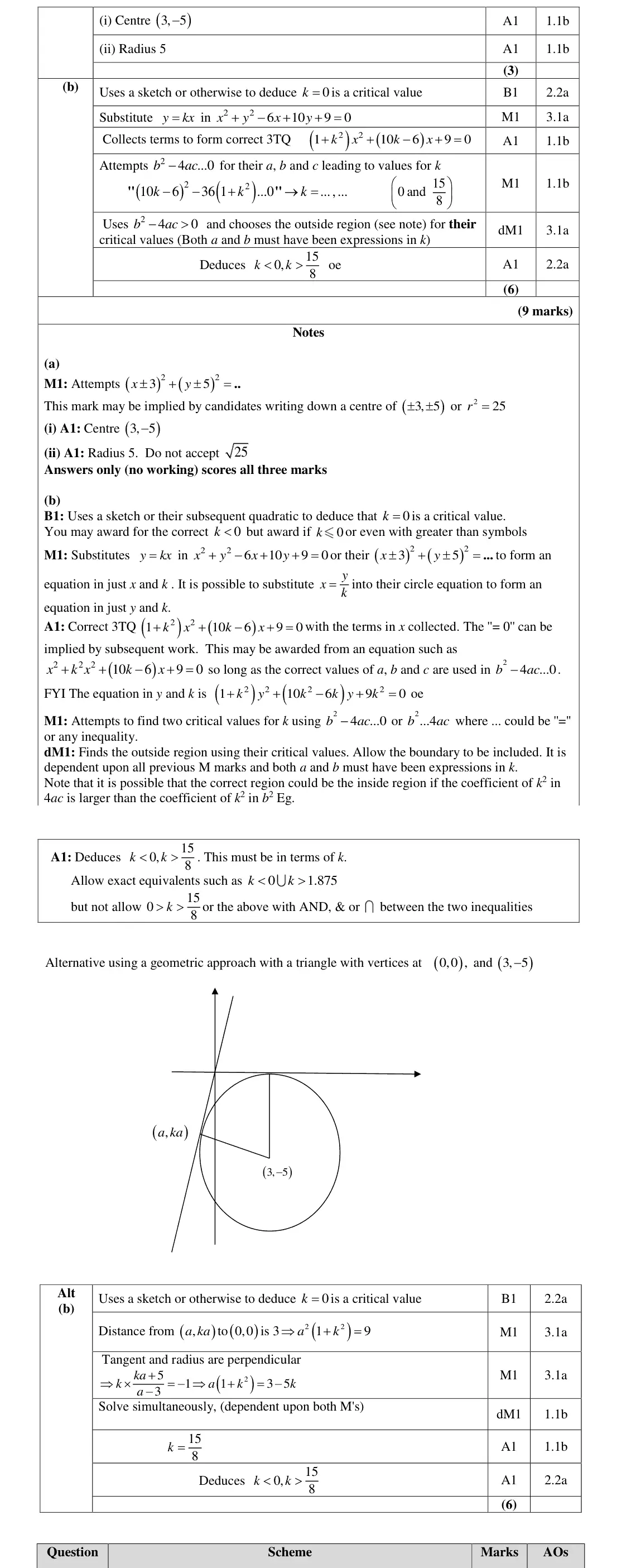
Part (a) was very accessible, part (b) less so. In (b), the first method mark was scored by the majority of students who showed their substitution of y = k x . Those who substituted into the equation given in the question rather than their (a) answer often coped better with the less challenging algebra. Collecting terms to reach a correct three term quadratic was a significant hurdle for many, although the most common error was to write kx2 for (kx)2. Most students correctly quoted b2 – 4ac before using it. Having done this they were usually able to factorise their expression to obtain k = 0 and another critical value. Having done the bulk of the work, many spoiled an otherwise perfect solution by stating the inside region.
Common mistakes
substitute y = kx: (1 + k²)x² + (10k − 6)x + 9 = 0 (write (kx)², not kx²)
b² − 4ac > 0 gives critical values 0 and 15/8
outside region k < 0 or k > 15/8 (not the inside region and not joined with "and")
June 2018 · Paper 1 · Q14(c)5 marks
Mark scheme (whole question; this part is marked with the orange bar)
Examiner's comment
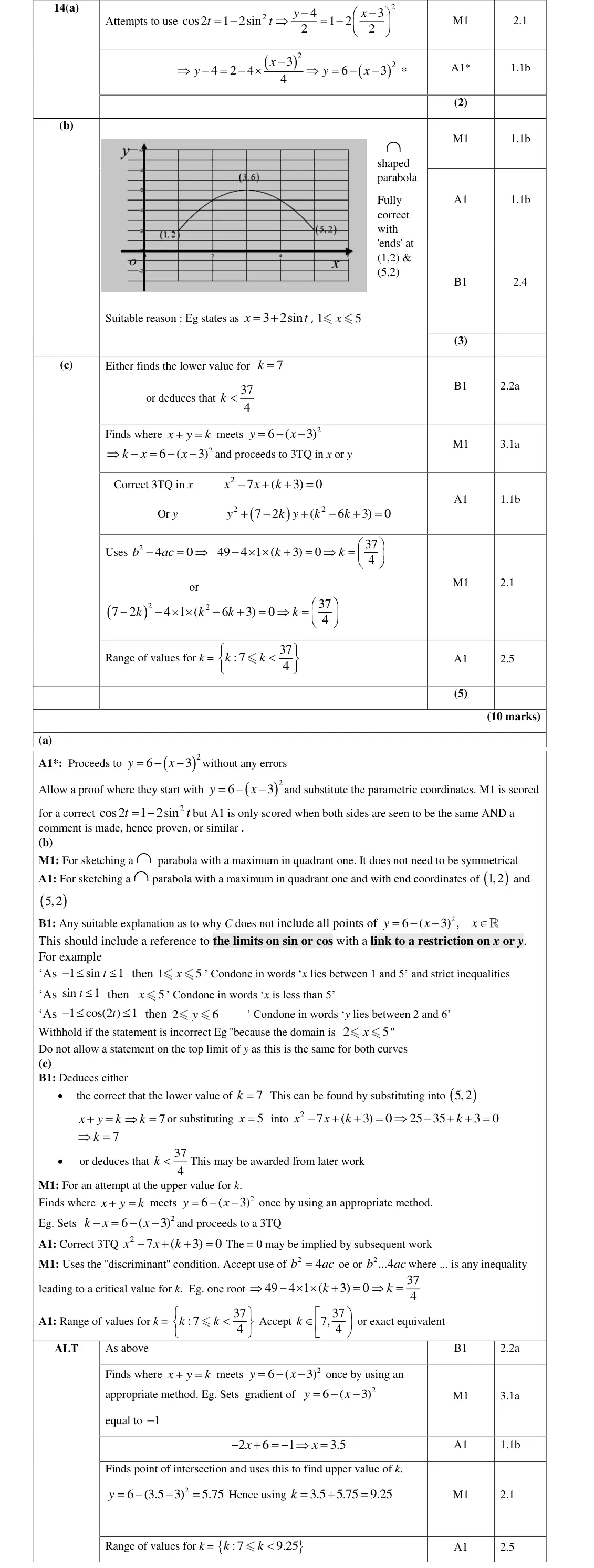
Part (c) was also demanding and better students annotated their graphs to help their understanding of the question (See Figure 1). Most however used the discriminant condition 2 for two roots and were able to proceed to two values. Arithmetic errors were 4 0 b ac quite common using this method. Most students who proceeded to the answer were well versed in writing their answer using set notation. Figure 1
Common mistakes
lower value k = 7 from the end point (5, 2)
x² − 7x + (k + 3) = 0 with b² − 4ac = 0 gives k = 37/4
answer {k : 7 ≤ k < 37/4} in set notation
annotate the sketch
June 2018 · AS Paper 2 · Q5(c)3 marksMedium
Mark scheme (whole question; this part is marked with the orange bar)
Examiner's comment
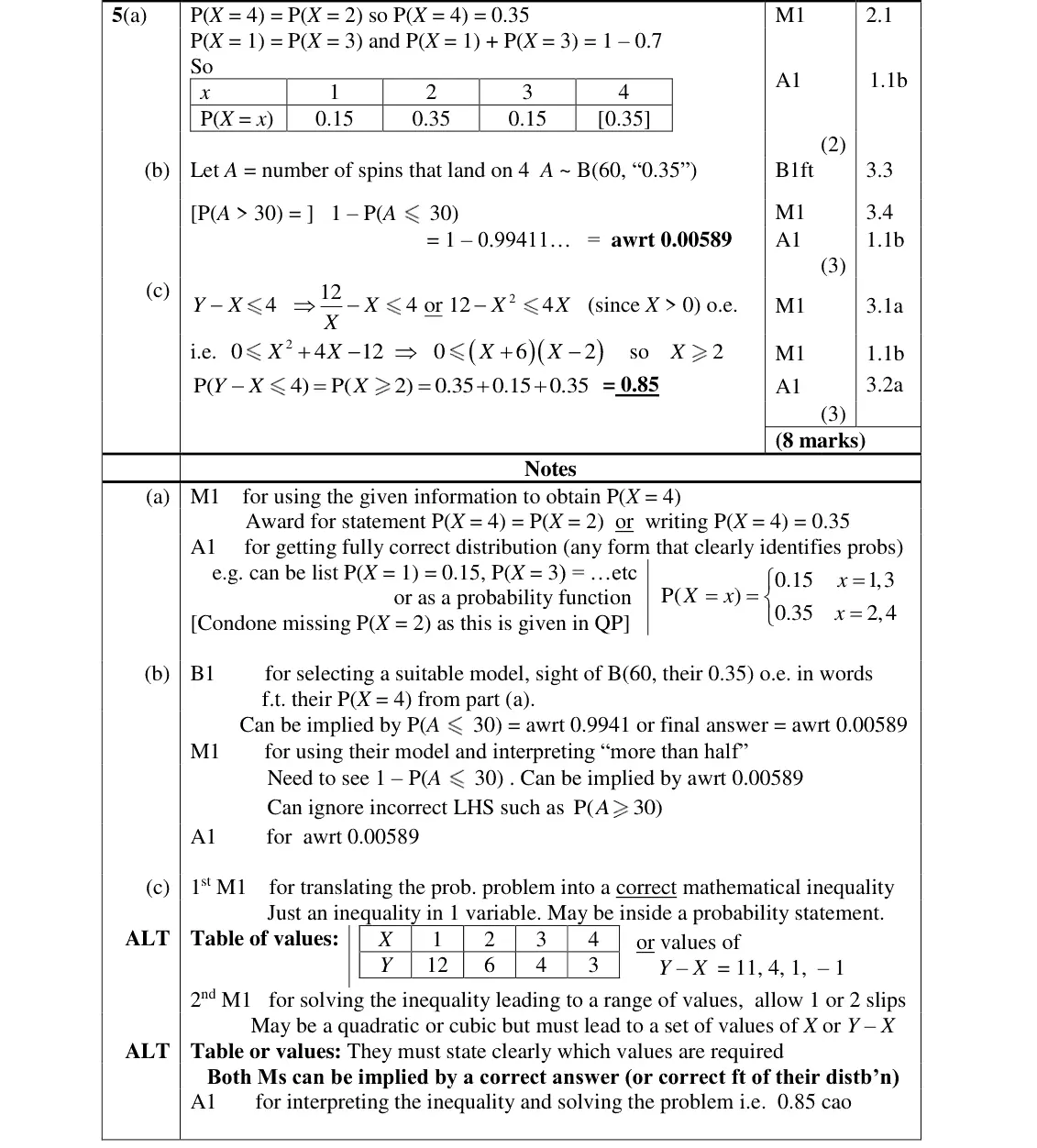
again we expect answers to be given to 3 significant figures. The final part required students to either form a list of values for Y , or even Y – X, or solve an inequality to realise that they needed P(X …2). Some were able to do this and this proved to be a good discriminator on this section. SECTION B: MECHANICS Introduction A significant proportion of the students were poorly prepared and showed little understanding of basic mechanics and displayed poor algebraic/numerical skills. There were a number of blank or incomplete responses to question 9 but it was difficult to determine whether this was due to a lack of time or a lack of knoeledge. Question 7 was by far the most successfully answered with just under a third of students scoring 6 out of 7 but the last two questions worked well as discriminator questions for the more able students. Just under 30% of the students scored nothing on question 8 and about a quarter failed to score on question 9. In calculations the numerical value of g which should be used is 9.8, unless otherwise stated. Final answers should then be given usually to 3 significant figures (unless otherwise stated) – more accurate answers will be penalised, including fractions but exact multiples of g are usually accepted. If there is a printed answer to show then students need to ensure that they show sufficient detail in their working to warrant being awarded all of the marks available. In all cases, as stated on the front of the question paper, students should show sufficient working to make their methods clear to the examiner and correct answers without working may not score all, or indeed, any of the marks available. If a student runs out of space in which to give his/her answer than he/she is advised to use a supplementary sheet.
Common mistakes
12/X − X ≤ 4 gives X² + 4X − 12 ≥ 0, so X ≥ 2 since X > 0 (or tabulate Y − X = 11, 4, 1, −1)
P(X ≥ 2) = 0.85
a good discriminator
June 2018 · Paper 3 · Q9(d)3 marks
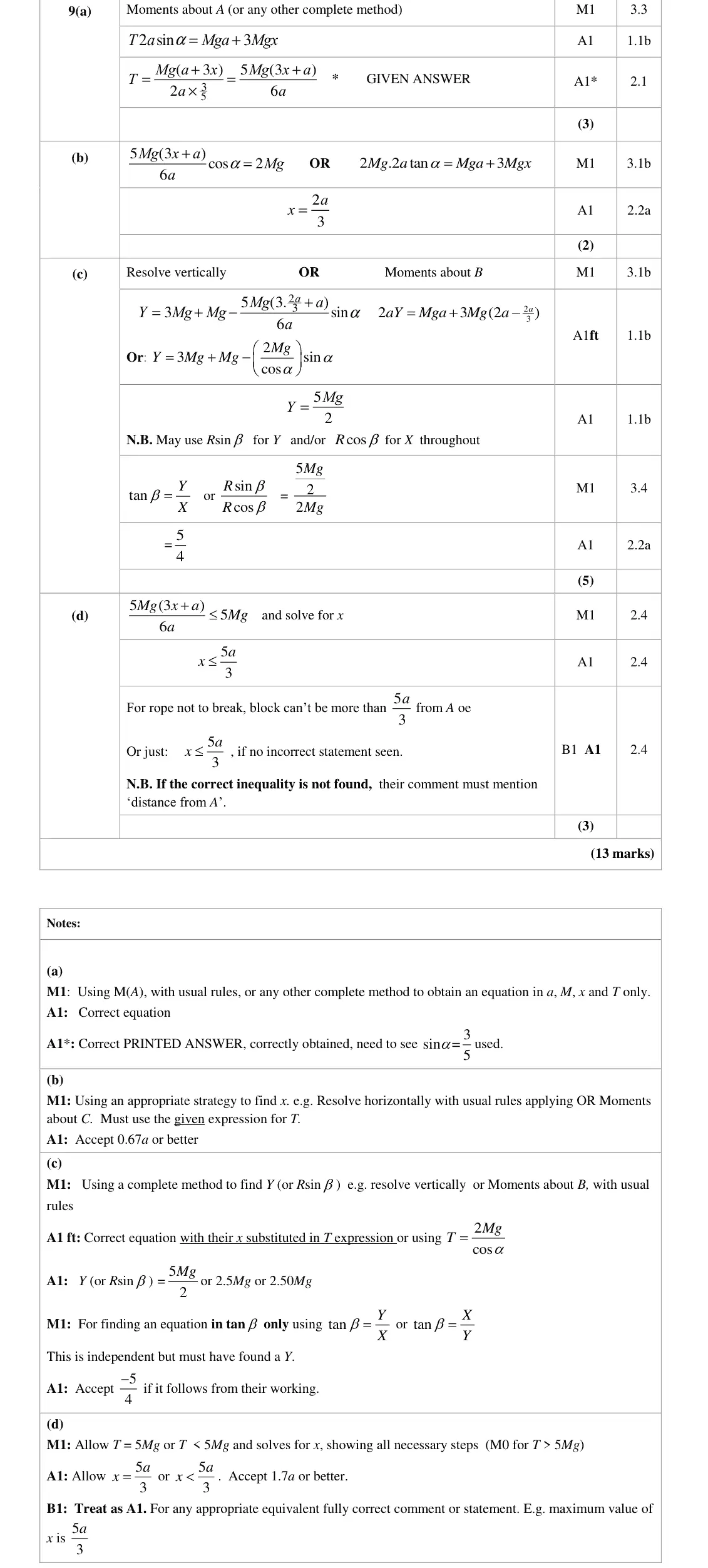
Mark scheme (whole question; this part is marked with the orange bar)
Examiner's comment
Part (d) required a calculation of the maximum value of x which was possible for the rope not to break. This required a comparison of the given expression for T with the maximum possible (5Mg). Following correct algebra some students concluded that the weight had to be less than (rather than ‘not more than’ or ‘less than or equal to’) 5a/3 from A and achieved 2 out of the 3 available marks. Those who wrote in general terms about why there was a limit to how far the weight could be placed relative to A could achieve no credit without an attempt to calculate a value of x.
Common mistakes
solve 5Mg(3x + a)/6a ≤ 5Mg to get x ≤ 5a/3, i.e. block no more than 5a/3 from A
strict "<" lost a mark
general comments without calculating x score nothing
Find an Edexcel maths tutor
Stuck on this? Book a trial session with an Edexcel specialist.