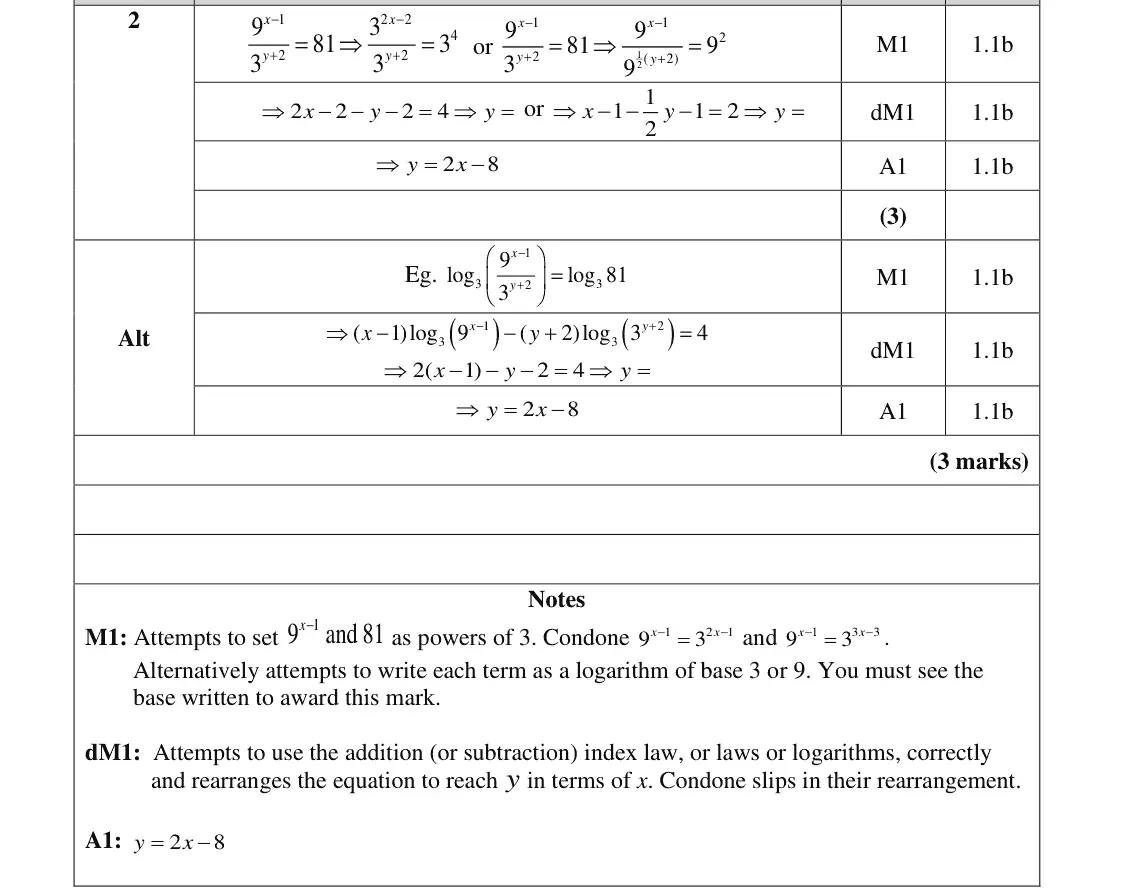
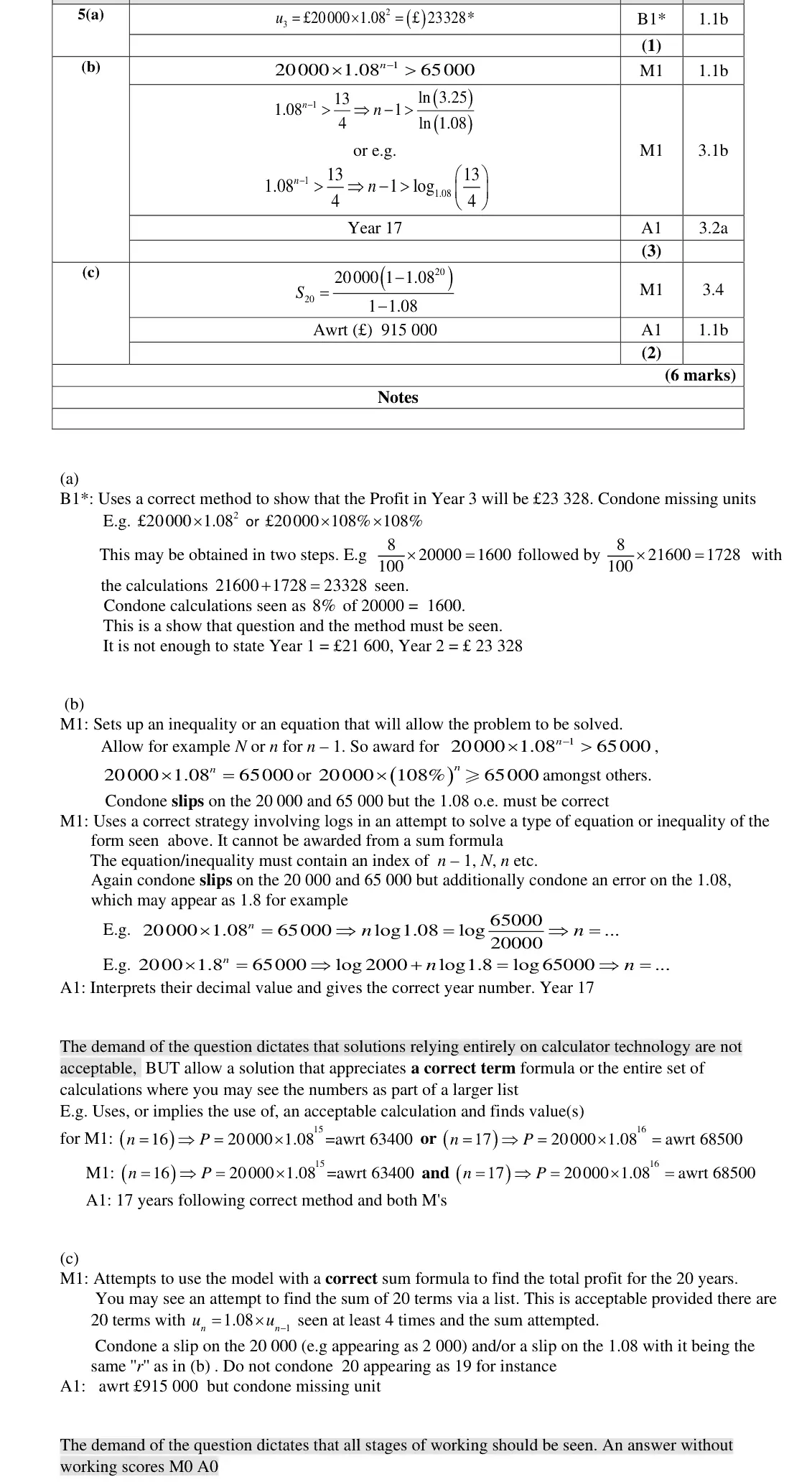
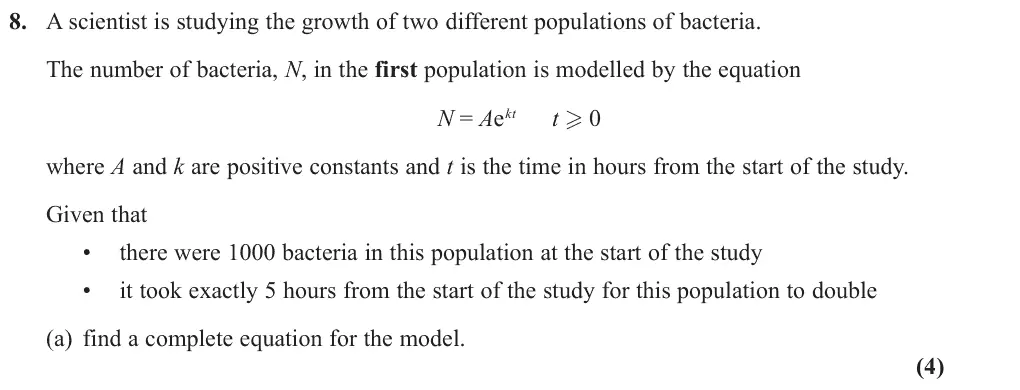
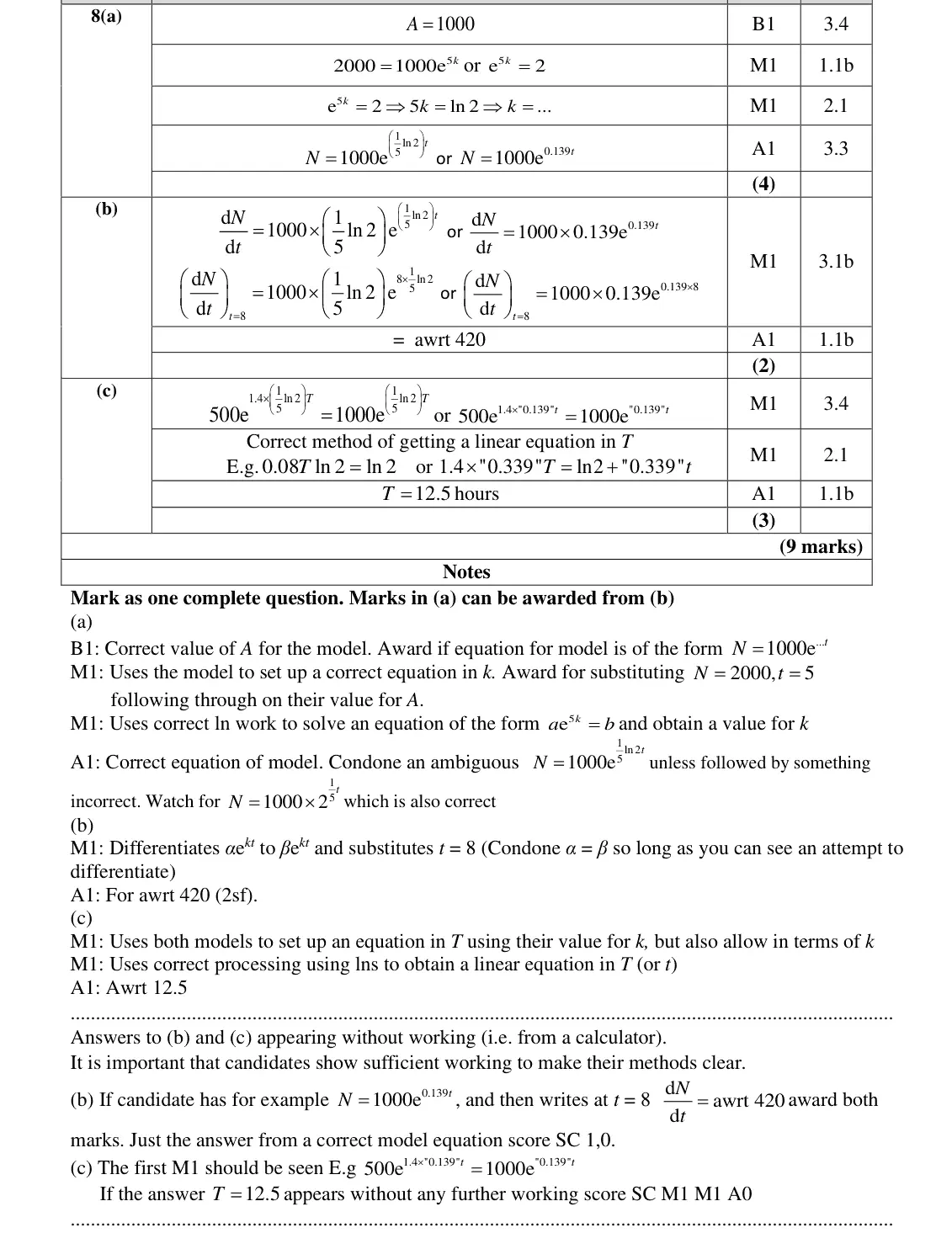
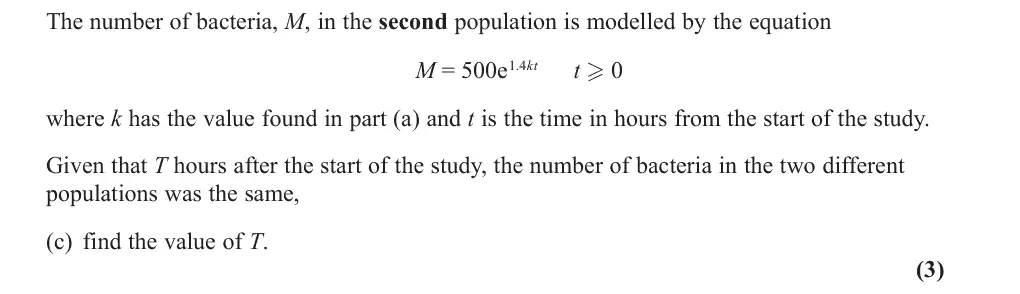
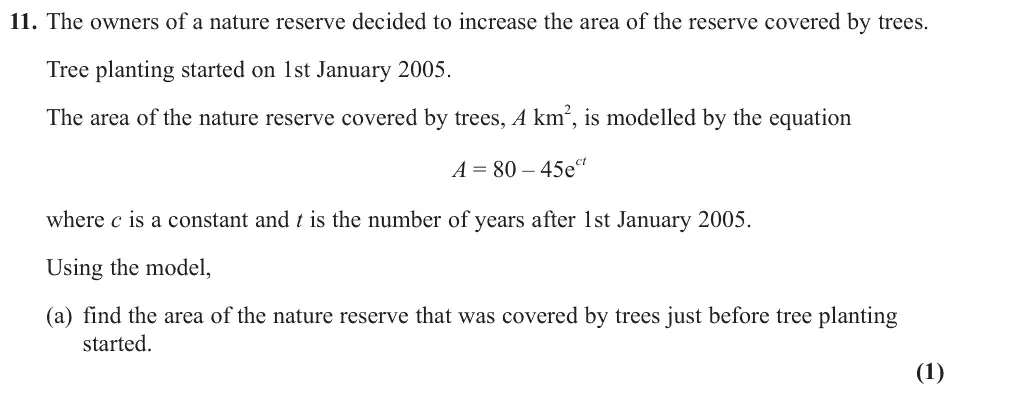
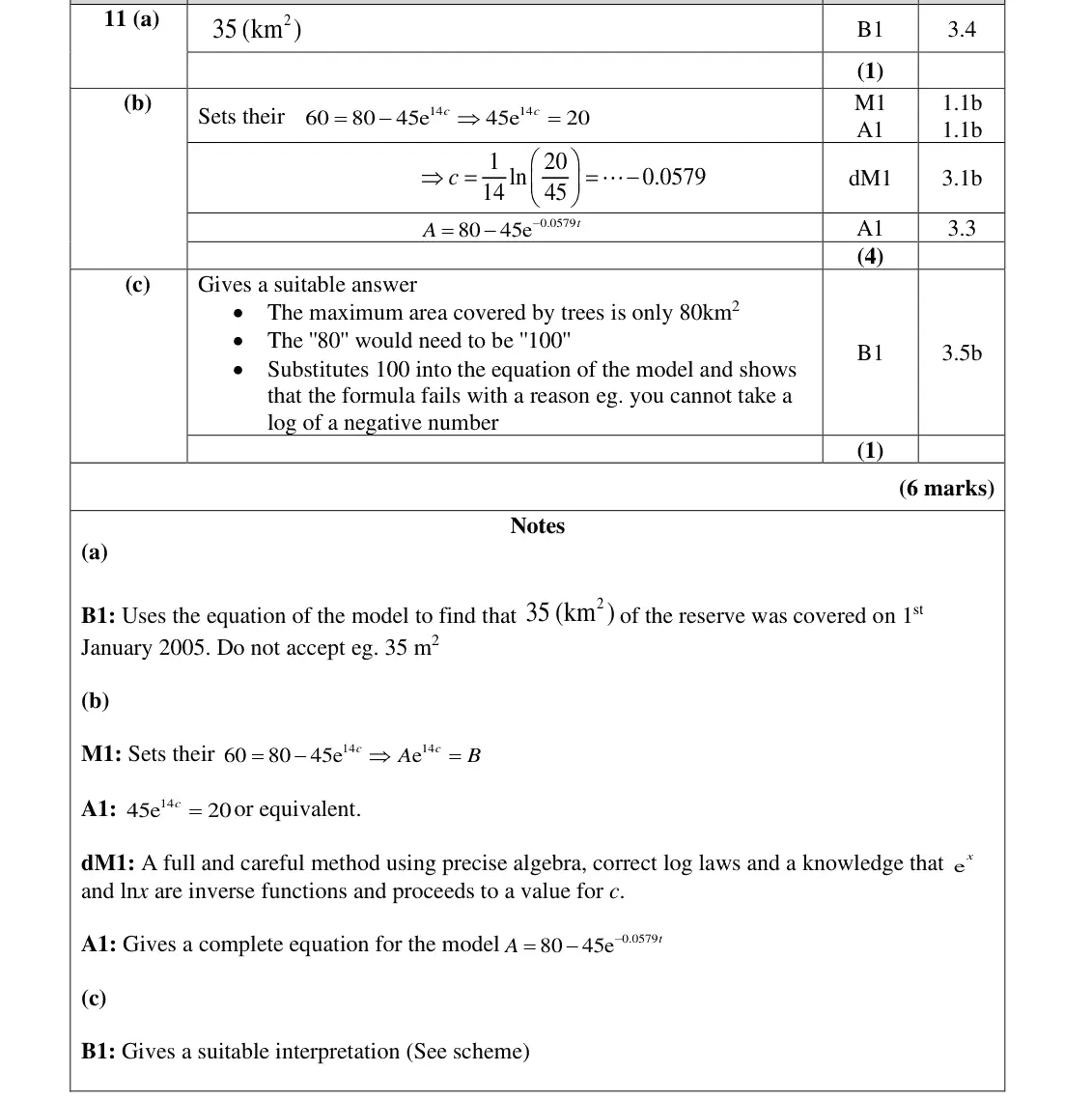
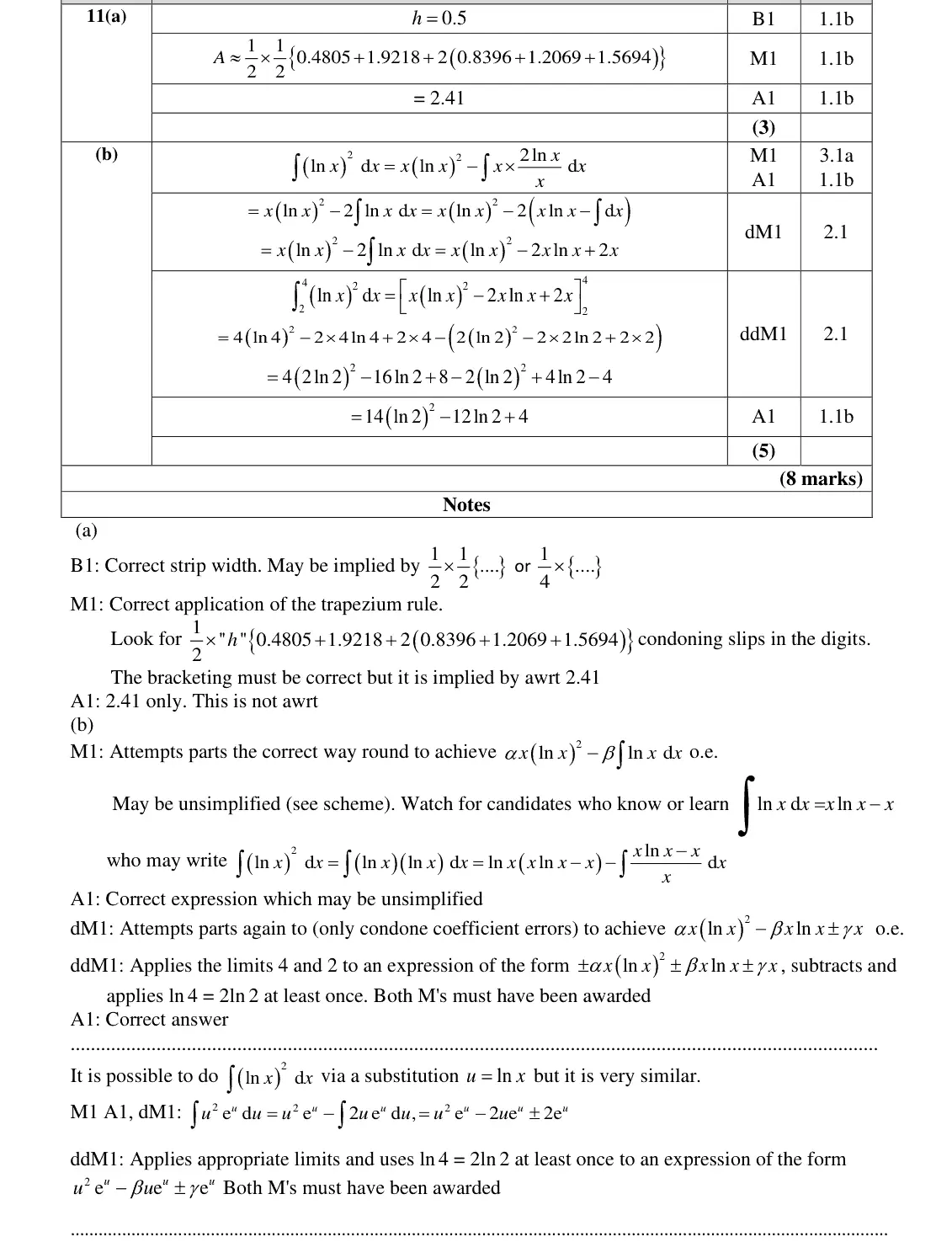
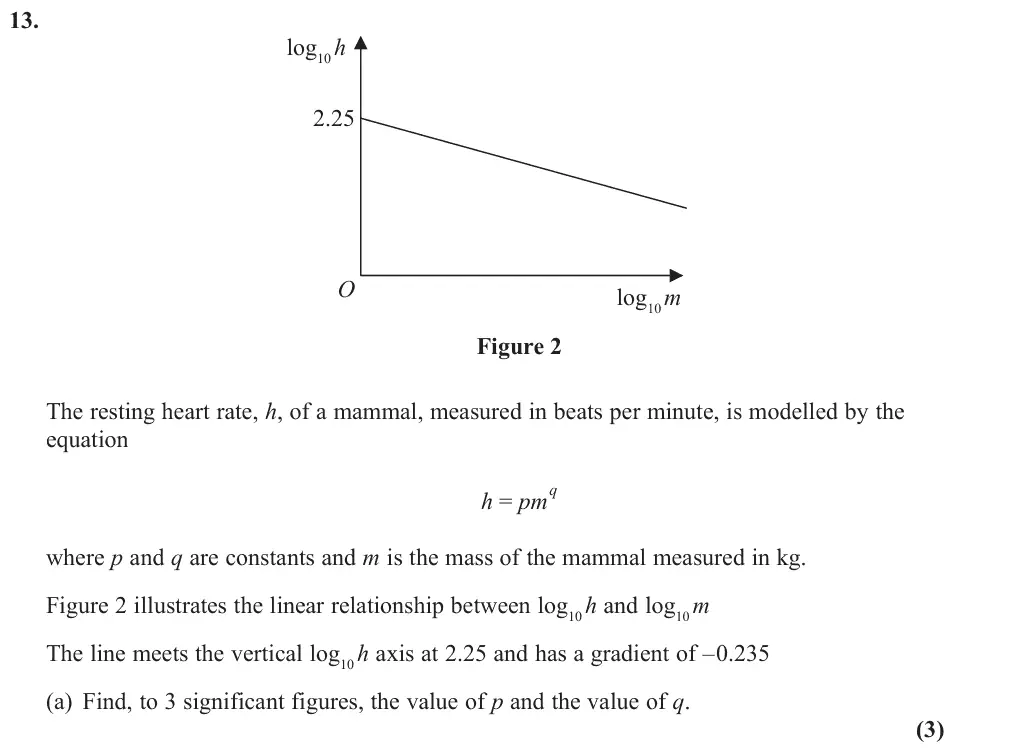
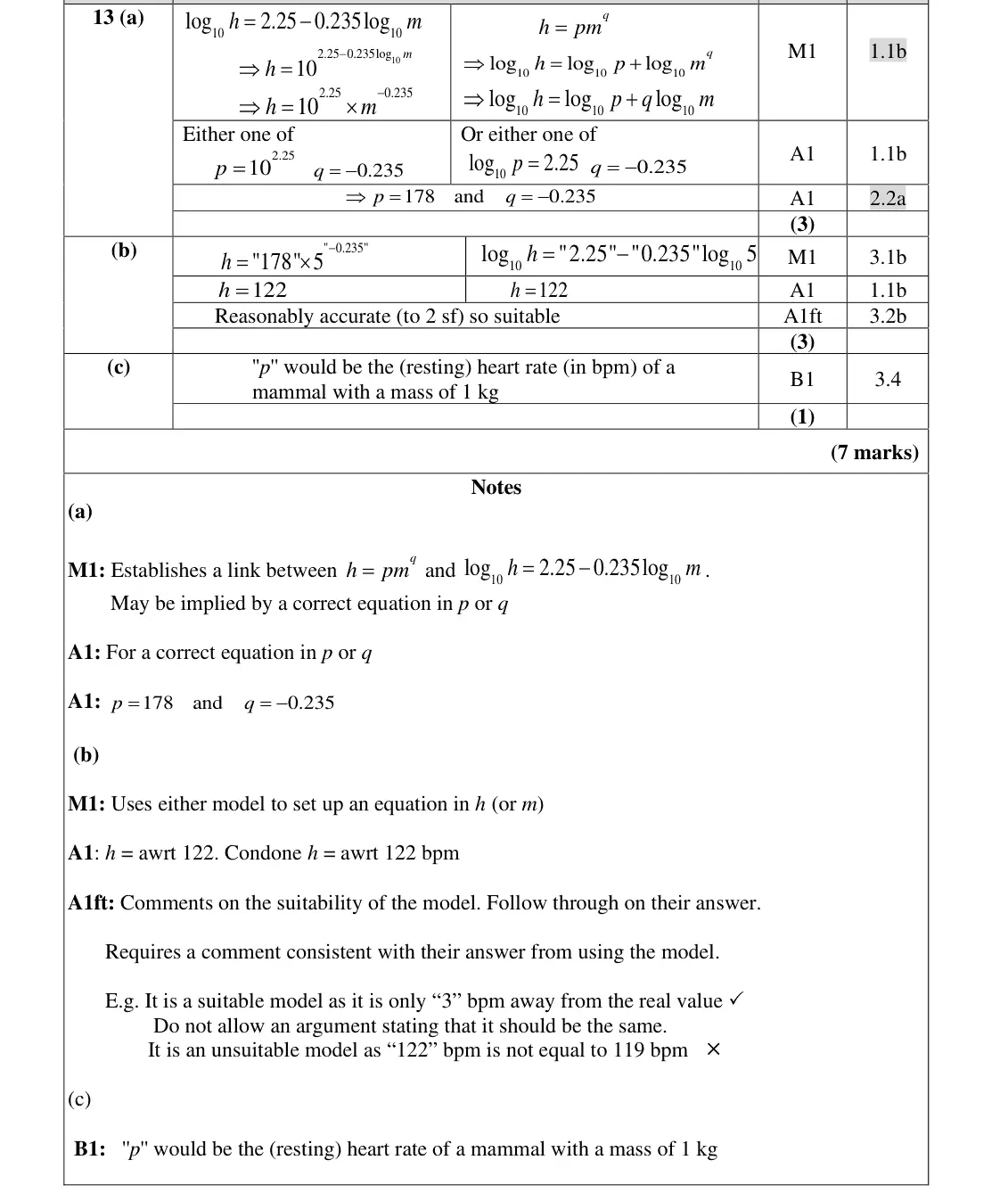
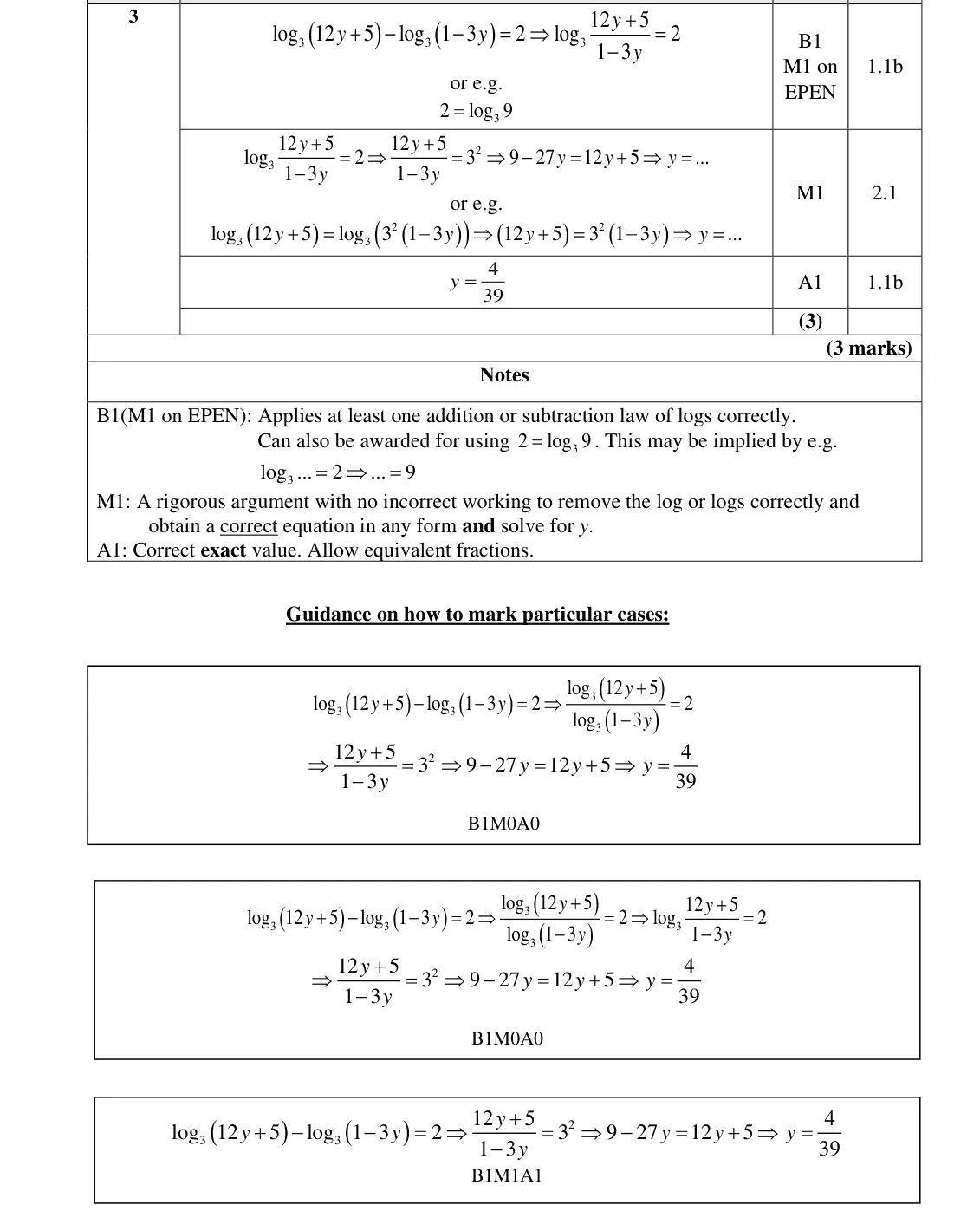
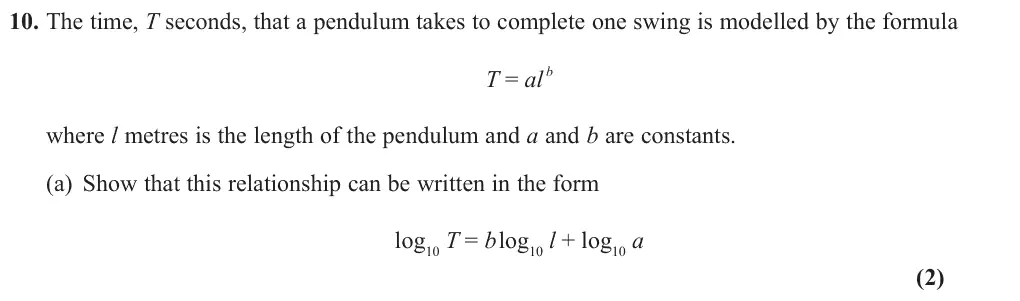
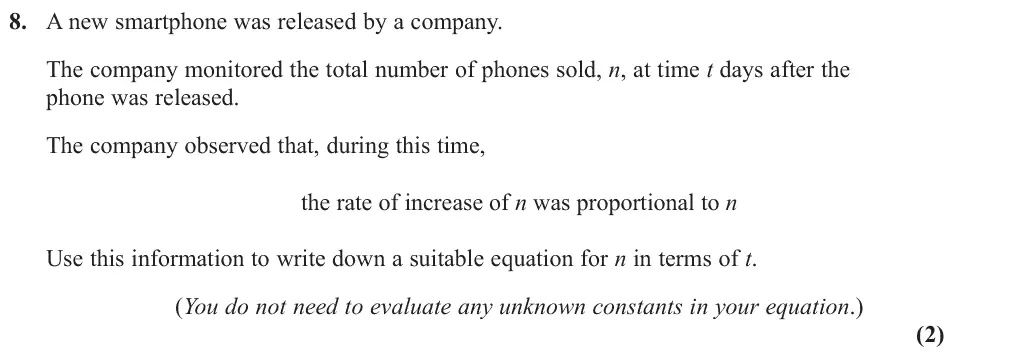
121 question parts, 367 marks, 13 with a difficulty rating from the examiner's report
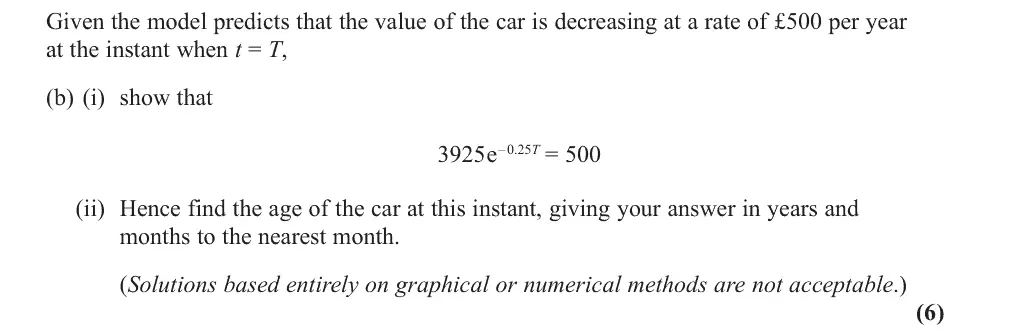
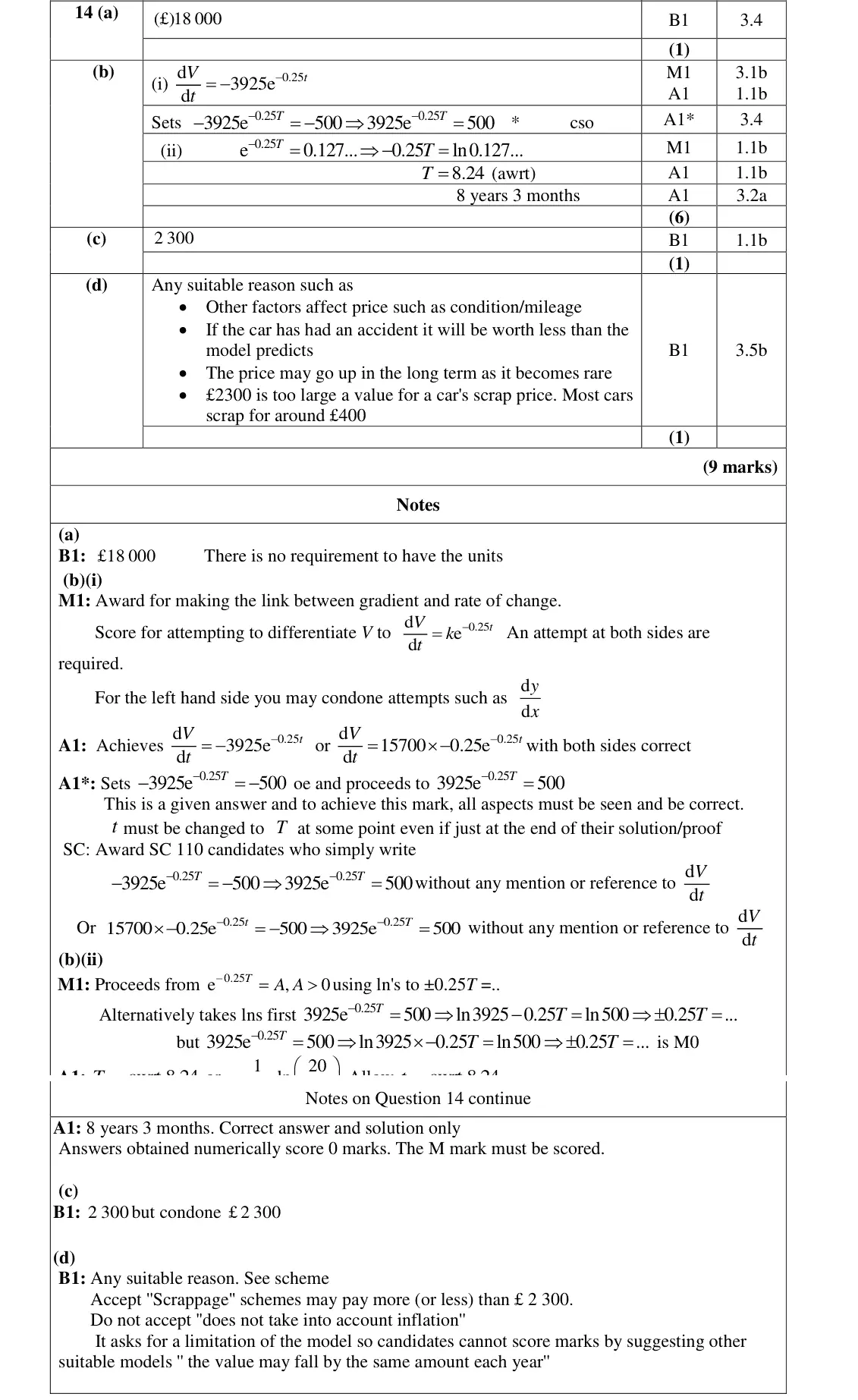
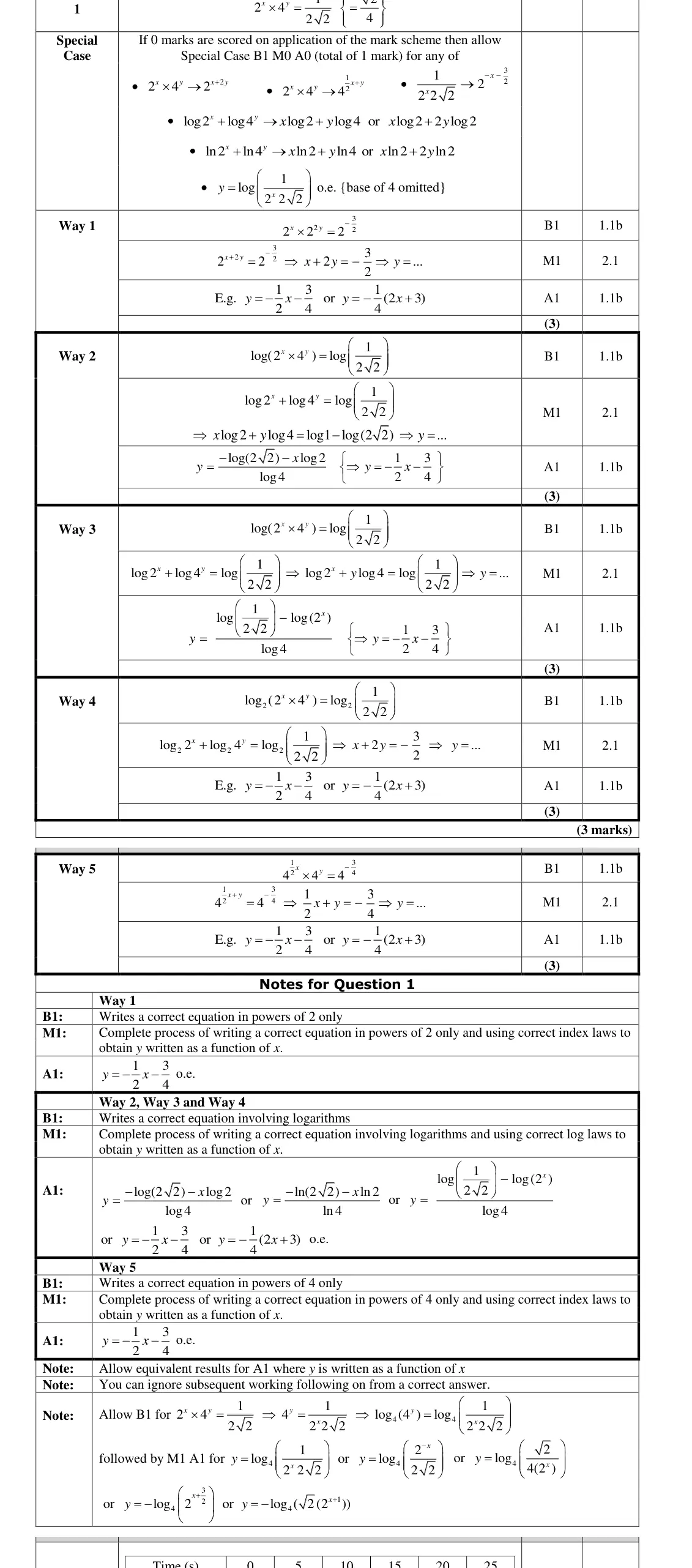
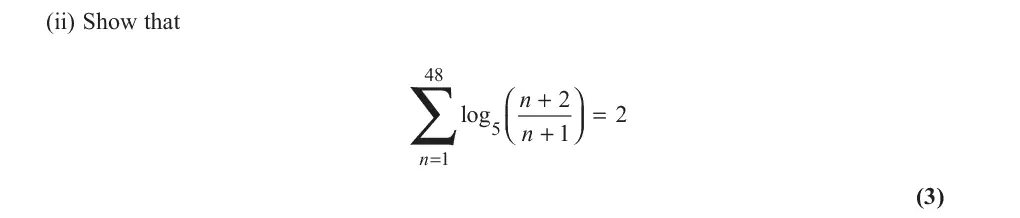
Notes, worked examples and practice for this topic are being written by our tutors. The past-paper questions below are ready now: work each one on paper, then open the mark scheme and the examiner's comment.
Tap a question to zoom it. Mark scheme and examiner's comment open under each question.
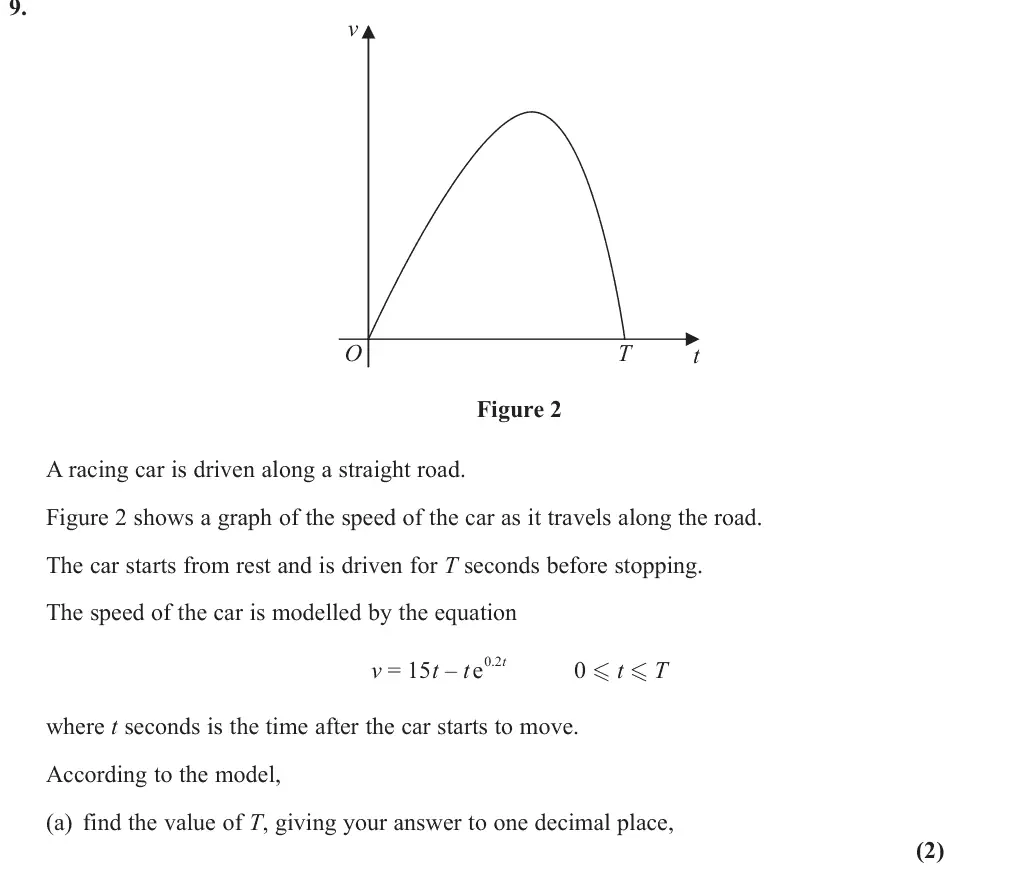
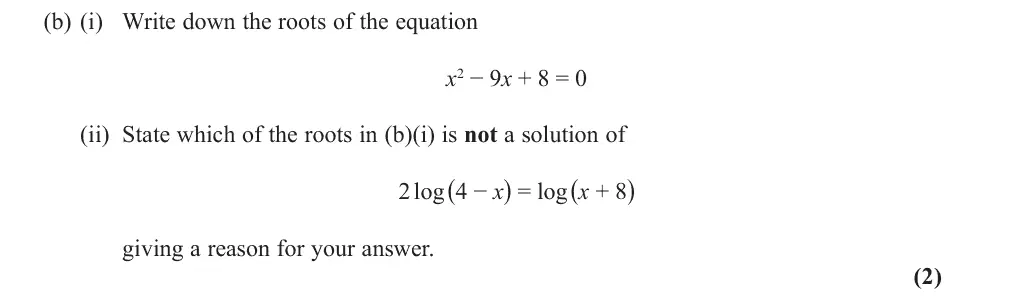
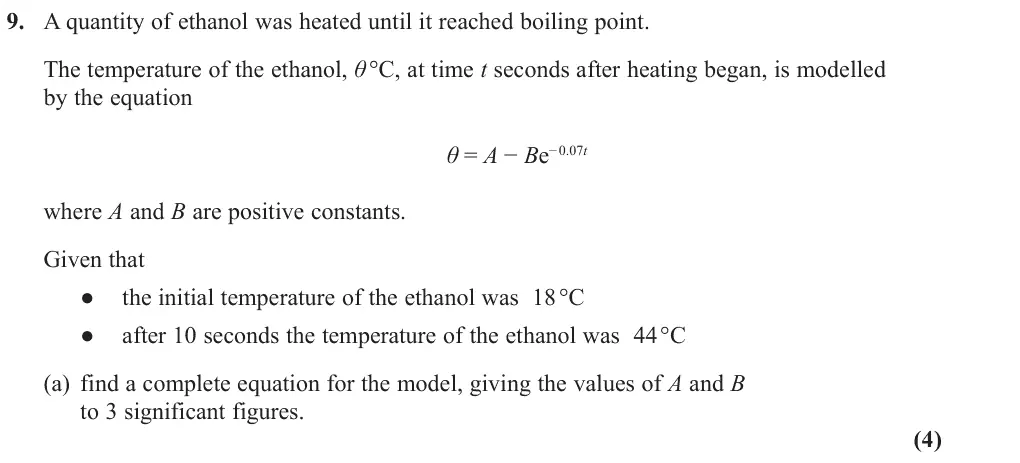
June 2025 · Paper 1 · Q9(a)2 marks
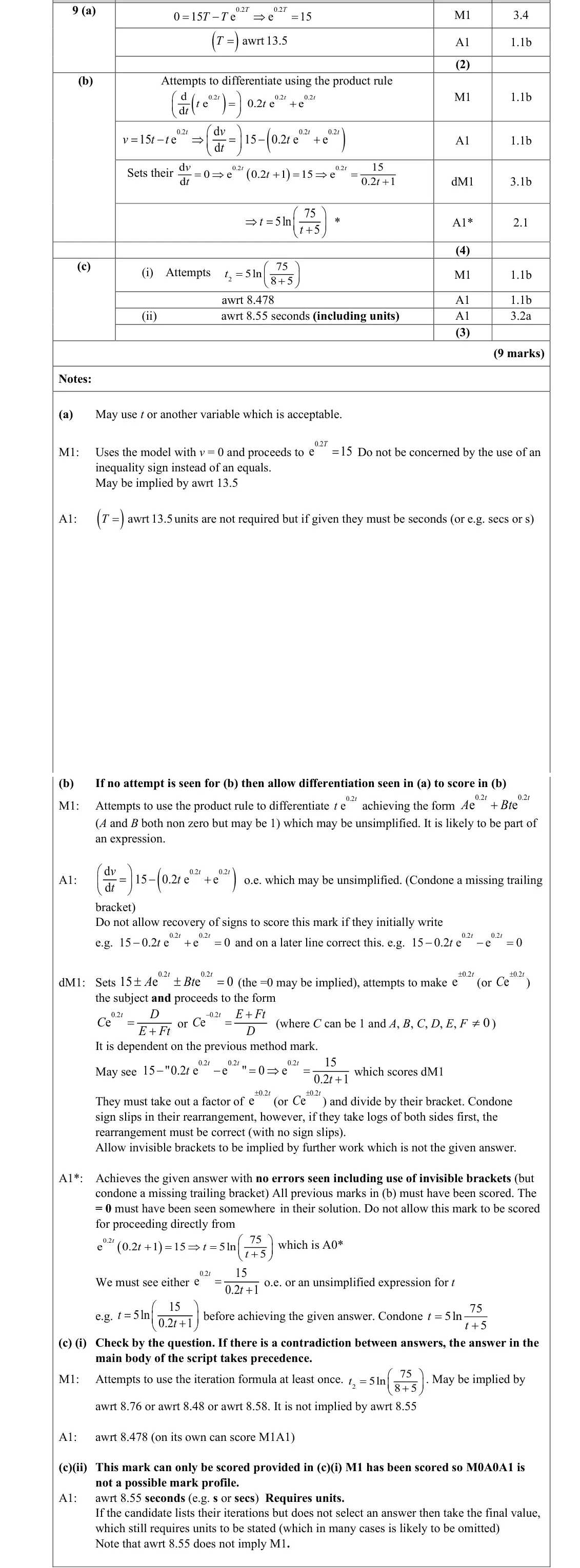
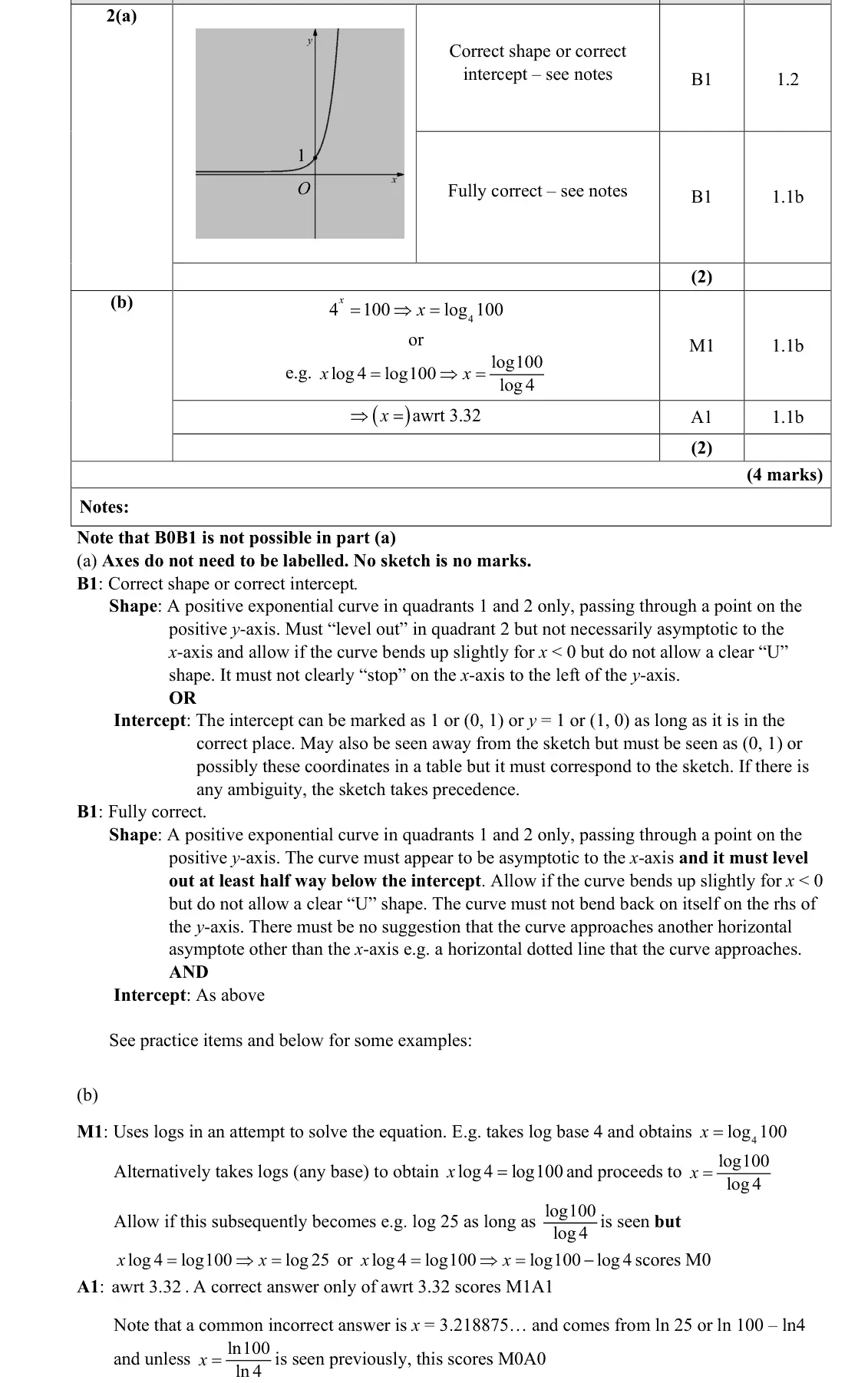
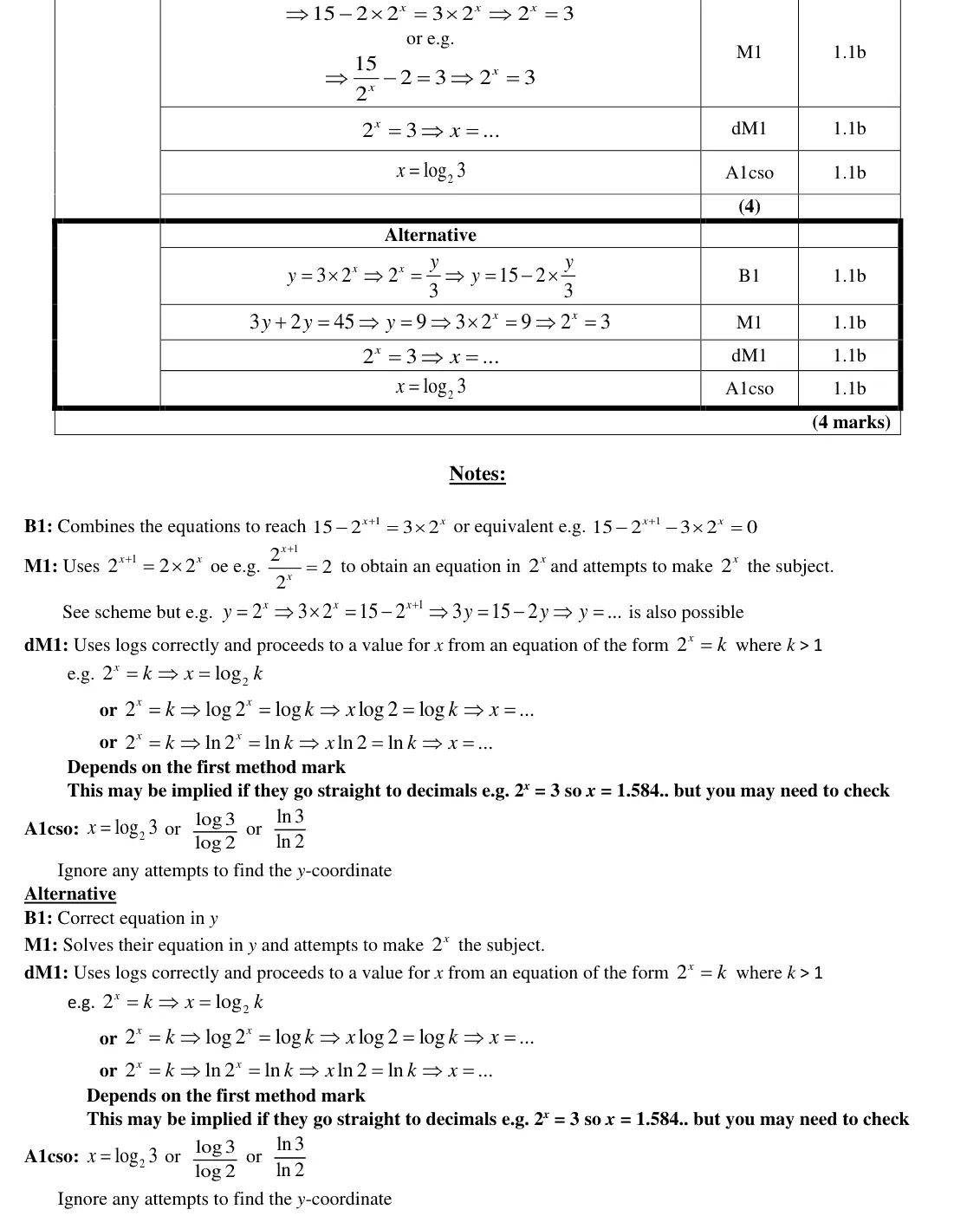
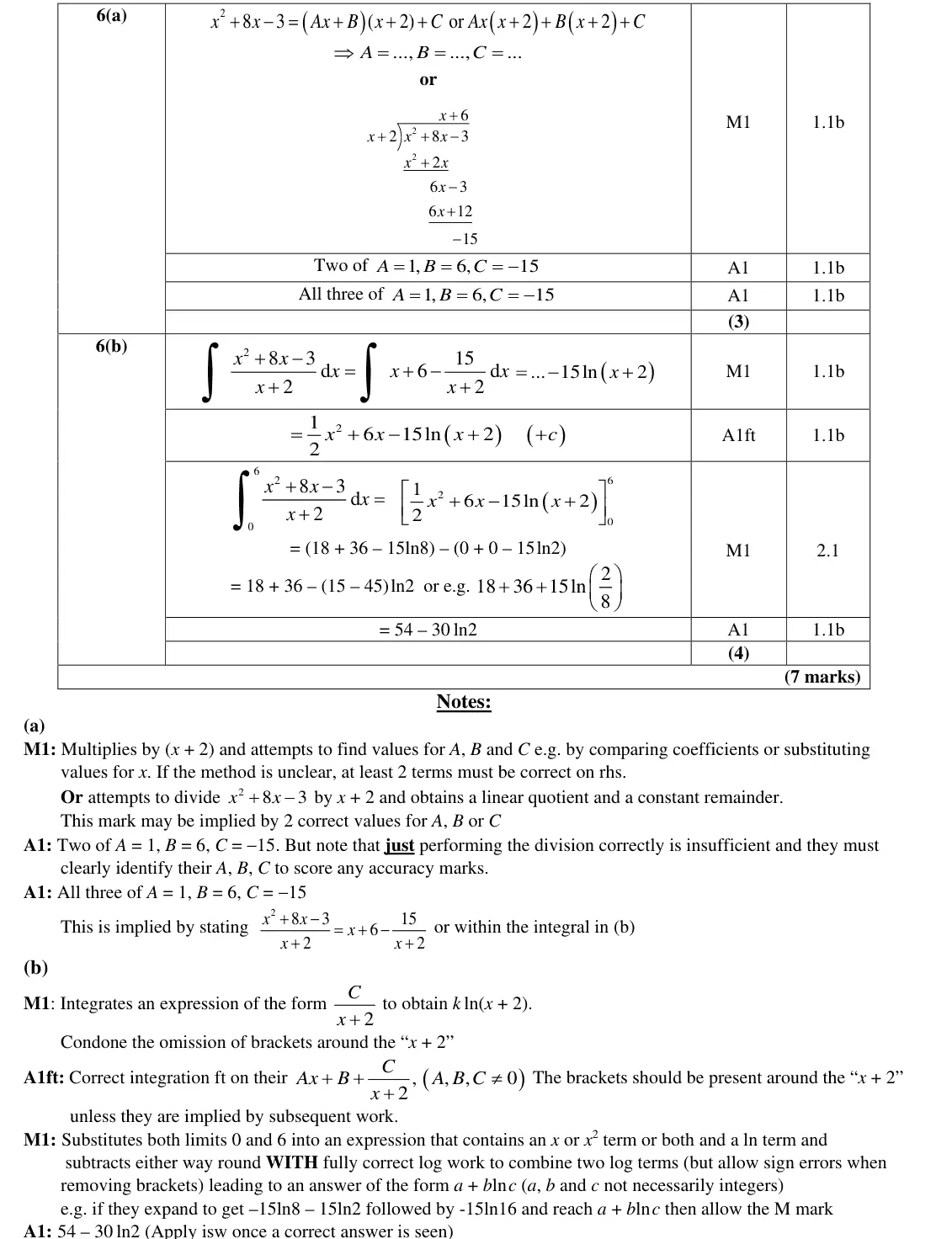
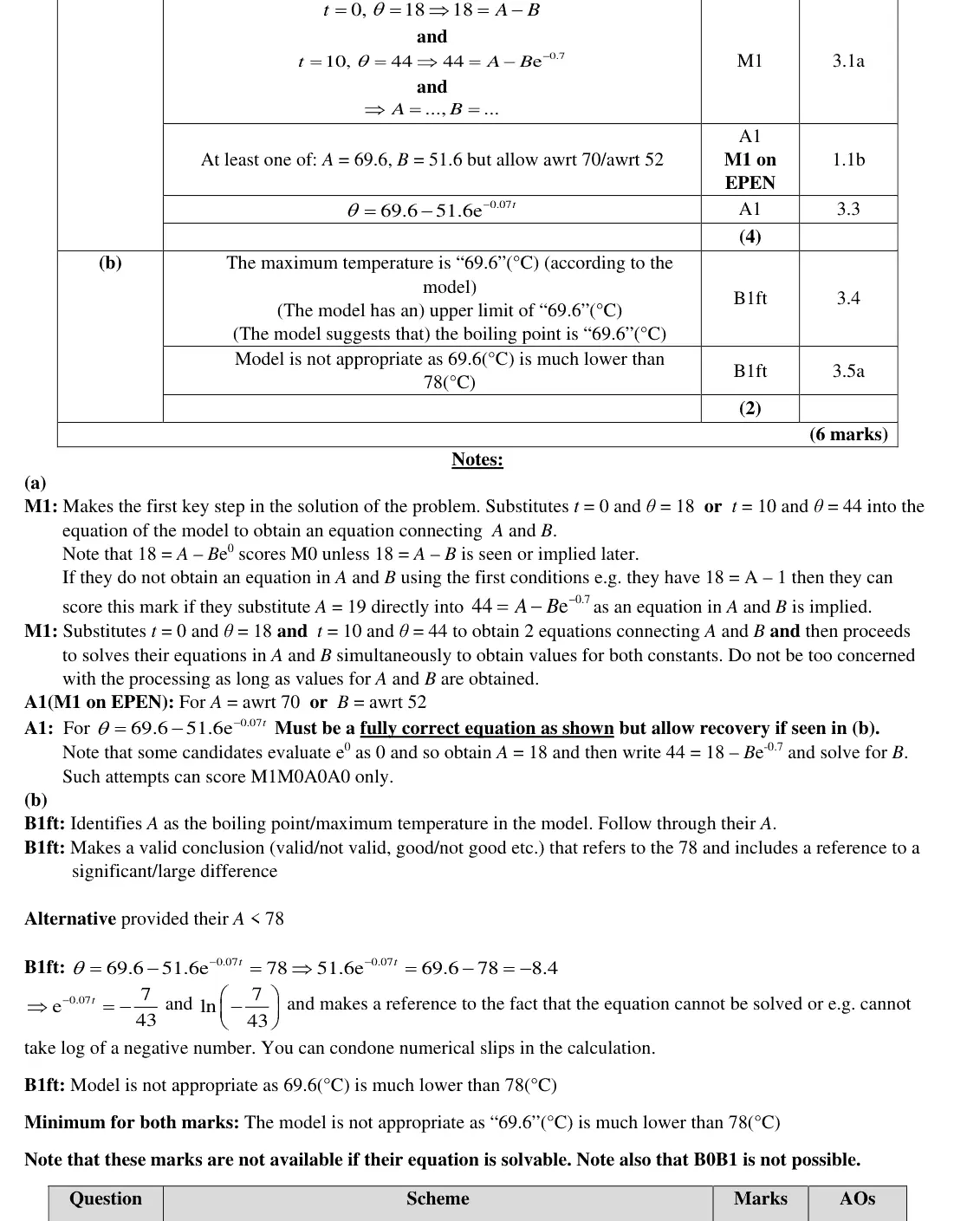
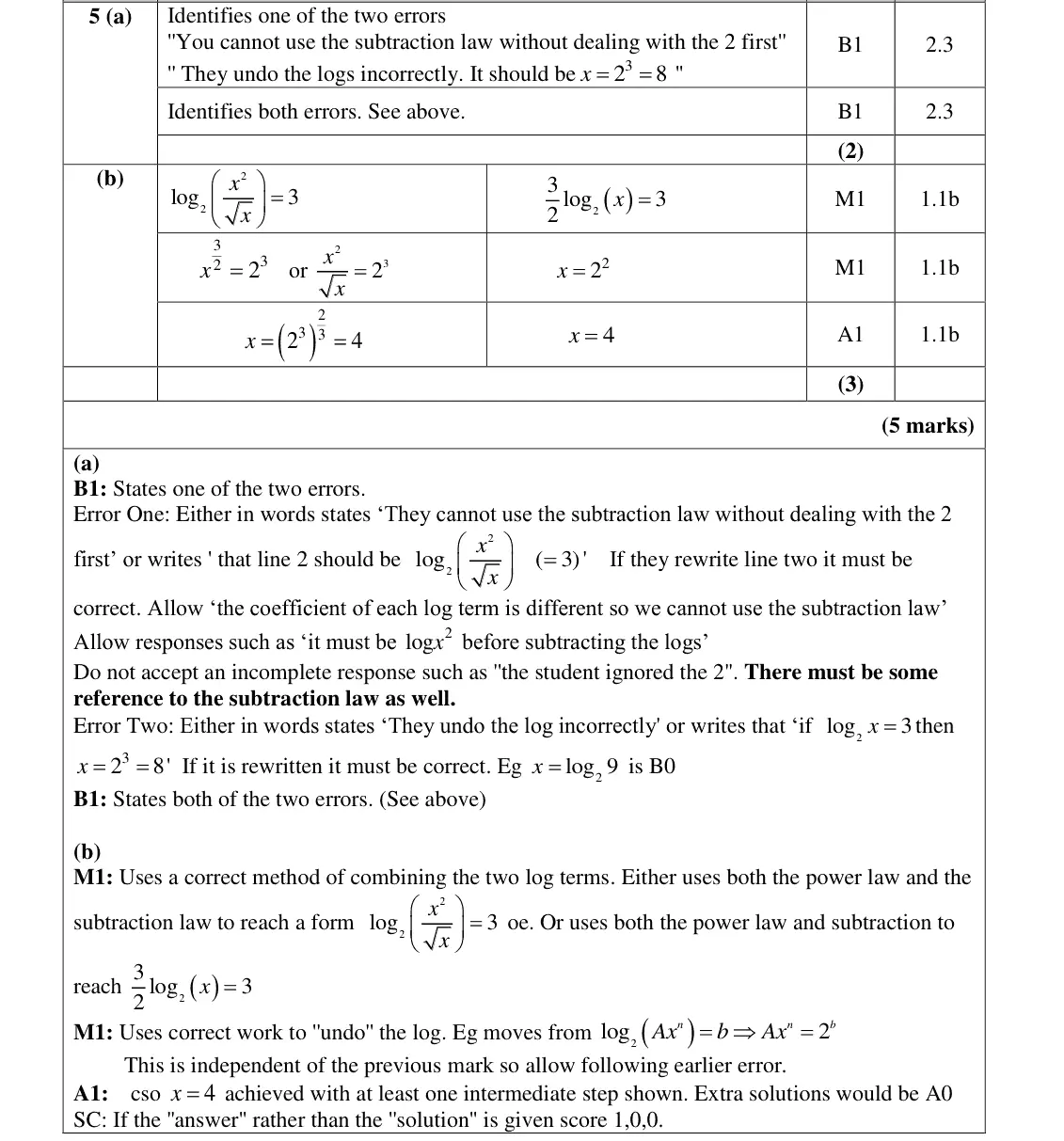
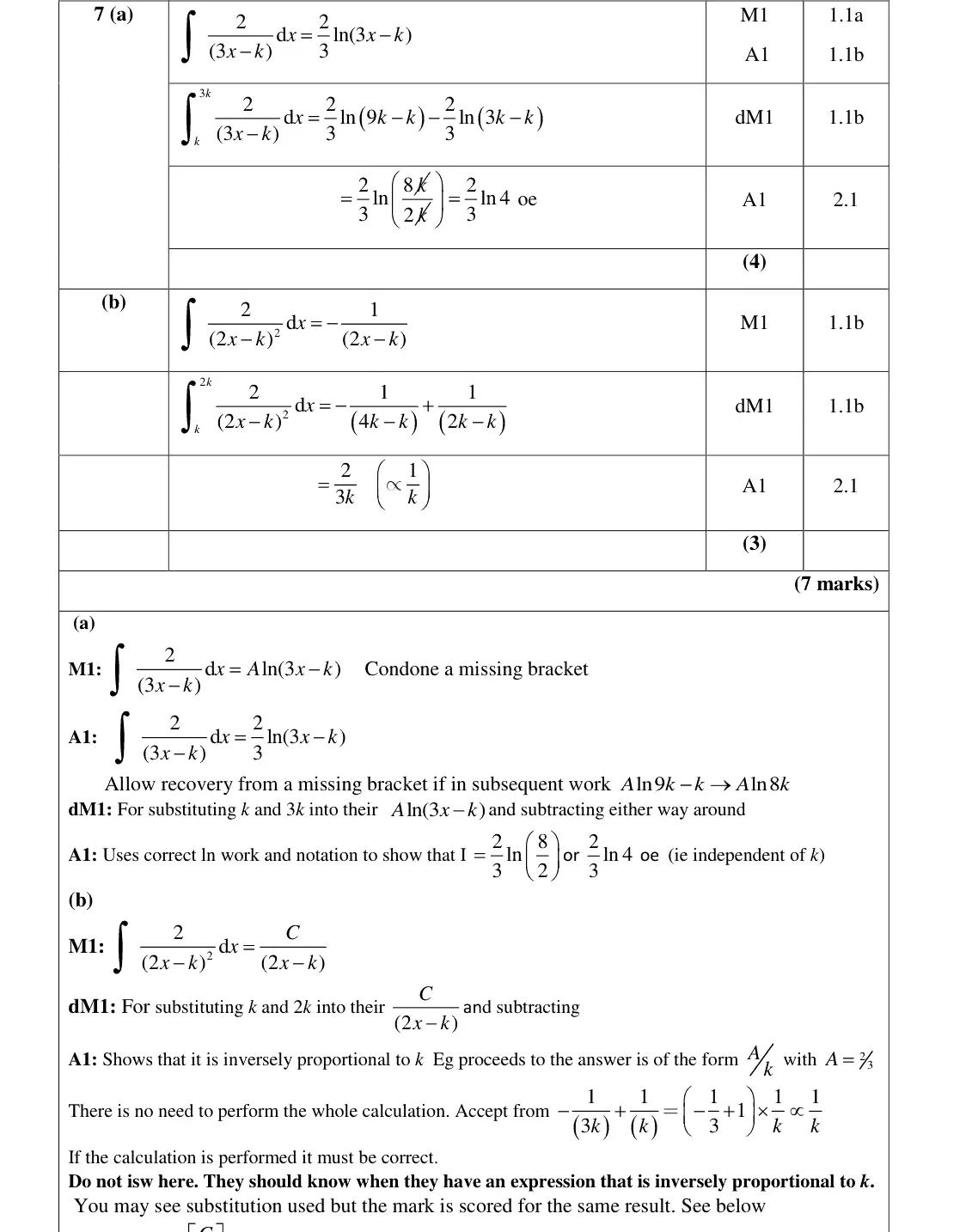
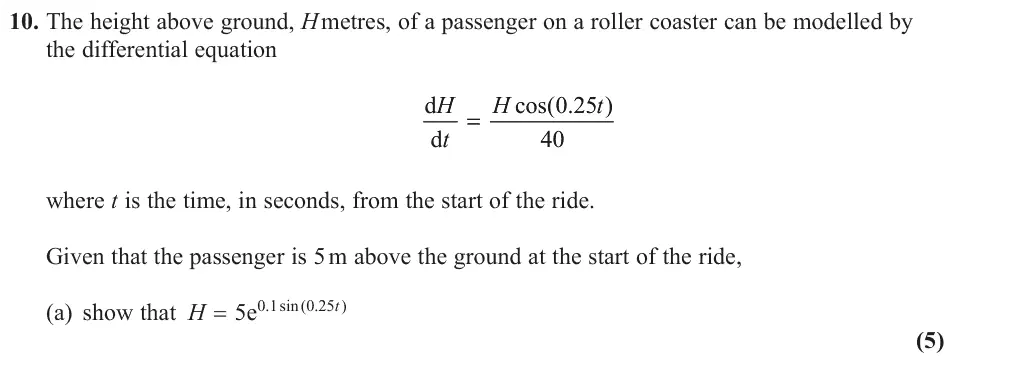
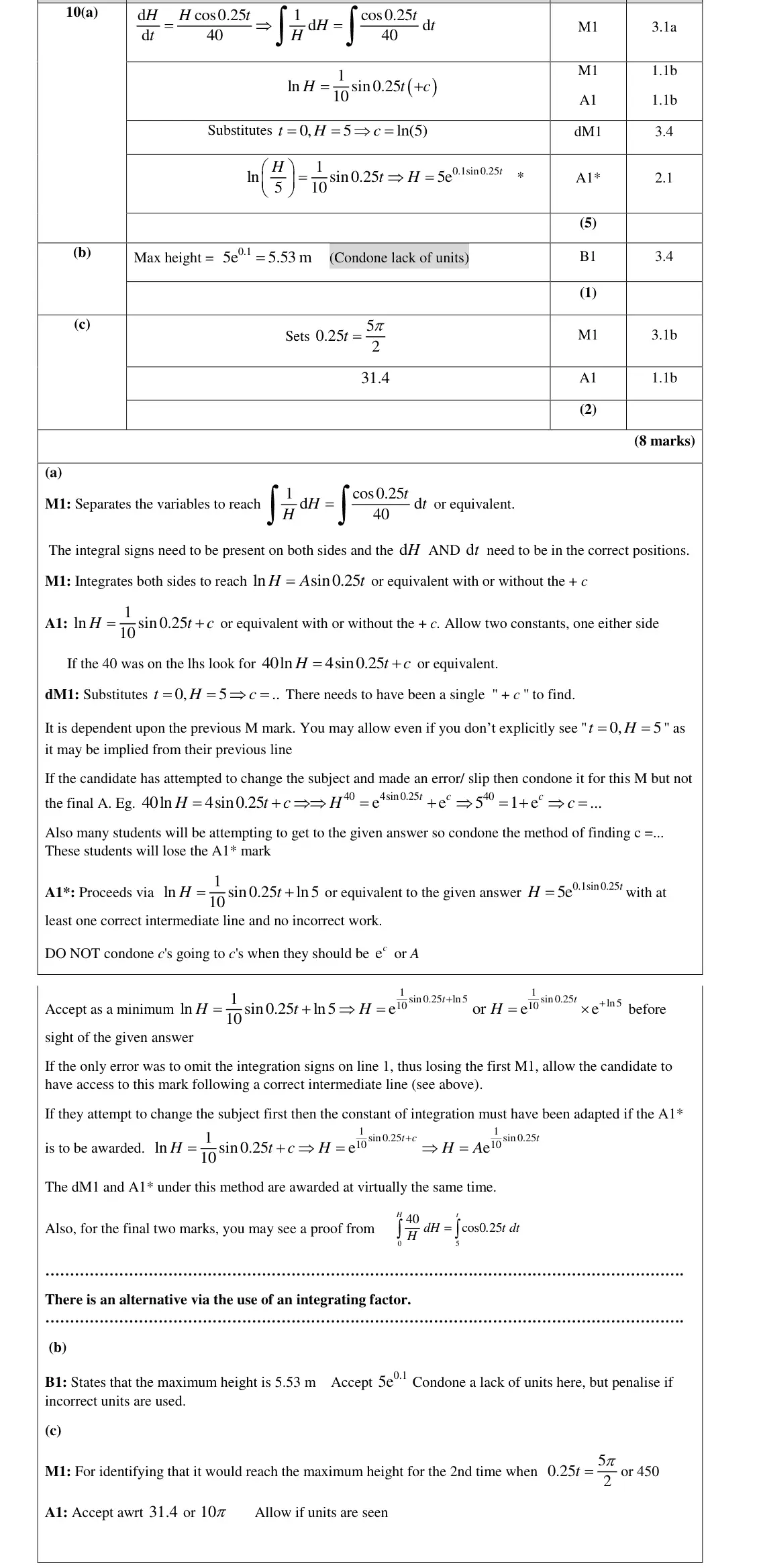
Mark scheme (whole question; this part is marked with the orange bar)
Examiner's comment
This question was generally well-answered, with most learners demonstrating a good grasp of the concepts. However, some common pitfalls were noted, particularly in differentiation and the inclusion of units. Part (a) required the learners to set the given model equal to zero and solve. Many made good progress in this part, by setting 0 v = , mostly dividing by t and attempting to rearrange to the form 0.2 e 15 t = or 0.2 e 15 T = . The majority reached a correct answer rounded to the required degree of accuracy or left in a simplified exact form. Errors were rare but often stemmed from a fundamental misunderstanding of logarithms or not dividing by t.
Common mistakes
set v = 0 and divide by T (T ≠ 0): e^(0.2T) = 15, T = 5 ln 15 = 13.5 (1 d.p.)
log errors
June 2025 · Paper 1 · Q9(b)4 marks
Mark scheme (whole question; this part is marked with the orange bar)
Examiner's comment
This question was generally well-answered, with most learners demonstrating a good grasp of the concepts. However, some common pitfalls were noted, particularly in differentiation and the inclusion of units. Part (b) involved differentiating the given model, setting this equal to zero and rearranging to the given form. This was generally well-answered, however a significant number of learners lost all the marks by not using the product rule. Accuracy marks were typically not awarded due to sign errors as a result of not using brackets correctly. Learners who wrote out the product rule separately before substitution were more likely to avoid such errors. In addition, some learners struggled with algebraic manipulation after differentiation, particularly when taking natural logarithms too early or when simplifying fractions.
Common mistakes
product rule on te^(0.2t): dv/dt = 15 − (0.2te^(0.2t) + e^(0.2t)) = 0 (many did not use the product rule
bracket/sign errors)
factor e^(0.2t)(0.2t + 1) = 15 then take logs to reach the given t = 5 ln(75/(t + 5))
June 2025 · AS Paper 1 · Q105 marks
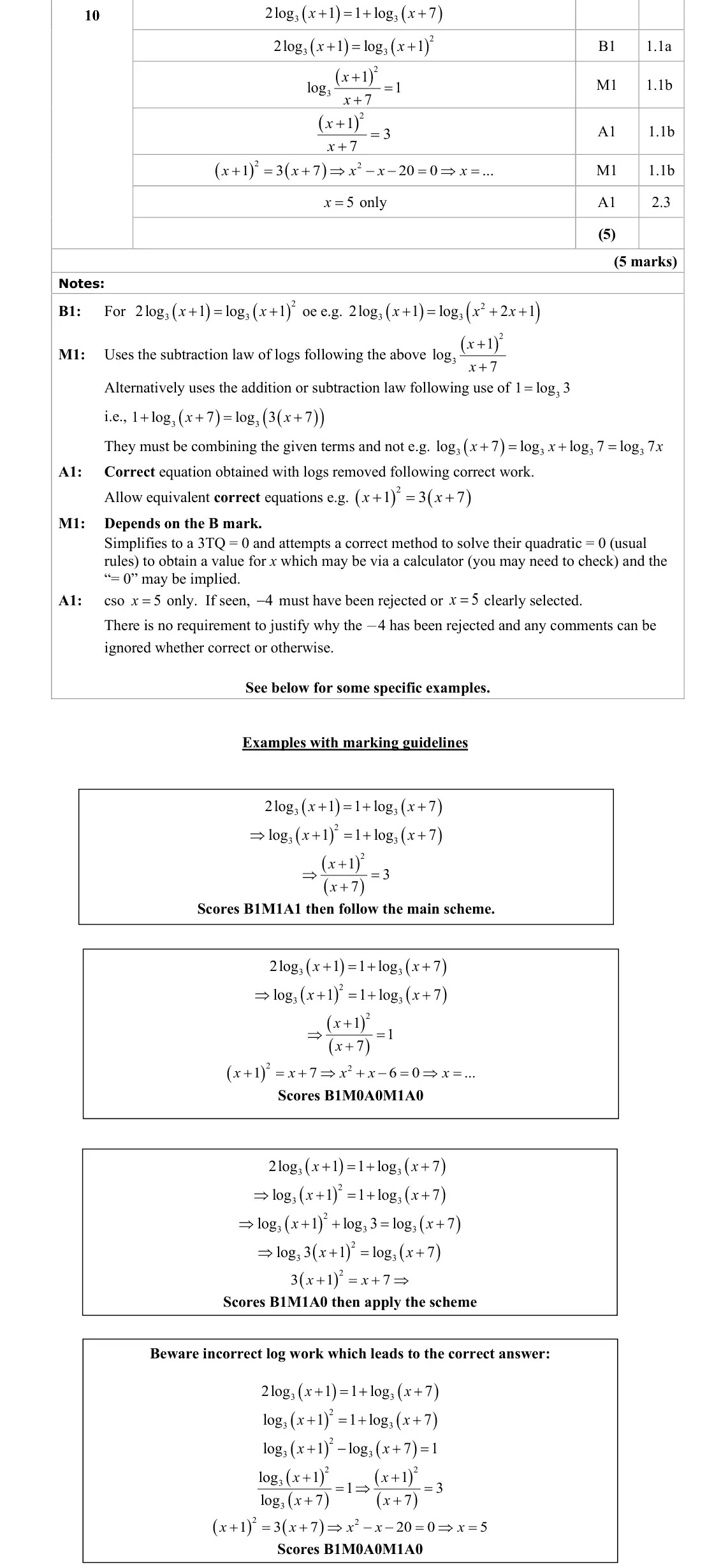
Mark scheme (whole question; this part is marked with the orange bar)
Examiner's comment
This question was generally well answered, with many candidates demonstrating a solid understanding of the laws of logarithms. Most were able to apply the key rules, such as the power law and the subtraction law, to progress effectively through the problem. The majority of students gained the first mark for correctly applying the power law and many successfully used the subtraction rule to combine logs into a single expression and then correctly equated it to a constant. Most candidates were able to solve the resulting quadratic equation and correctly identified the roots x = 5 and x = -4 although a significant number of candidates failed to reject x = -4 and ss a result, lost the final accuracy mark. Several candidates incorrectly expanded ( ) 3 2log 1 x + as 3 3 2log 2log 1 x + or displayed other misconceptions such as ( ) ( ) ( ) ( ) 2 2 3 3 3 3 log 1 log 1 log 7 log 7 x x x x + + - + = + , showing a misunderstanding of logarithmic laws. In terms of algebra, mistakes were seen in expanding expressions such as 3(x + 7) which was sometimes incorrectly expanded to 3x + 7. A few students attempted polynomial division after correctly combining logarithmic terms, showing confusion in handling the rational expression. Generally candidates who demonstrated a secure grasp of logarithmic laws and followed a logical, structured approach were generally successful. However, persistent issues with rejecting invalid solutions and applying basic algebra correctly meant that some otherwise capable candidates lost marks unnecessarily. The question effectively discriminated between those with strong conceptual understanding and those with only procedural fluency.
Common mistakes
power law 2log₃(x + 1) = log₃(x + 1)²
subtraction law then 3¹ to remove logs: (x + 1)² = 3(x + 7)
x² − x − 20 = 0
reject x = −4, so x = 5 only
2log₃(x + 1) is not 2log₃x + 2log₃1
log₃(x + 7) ≠ log₃x + log₃7
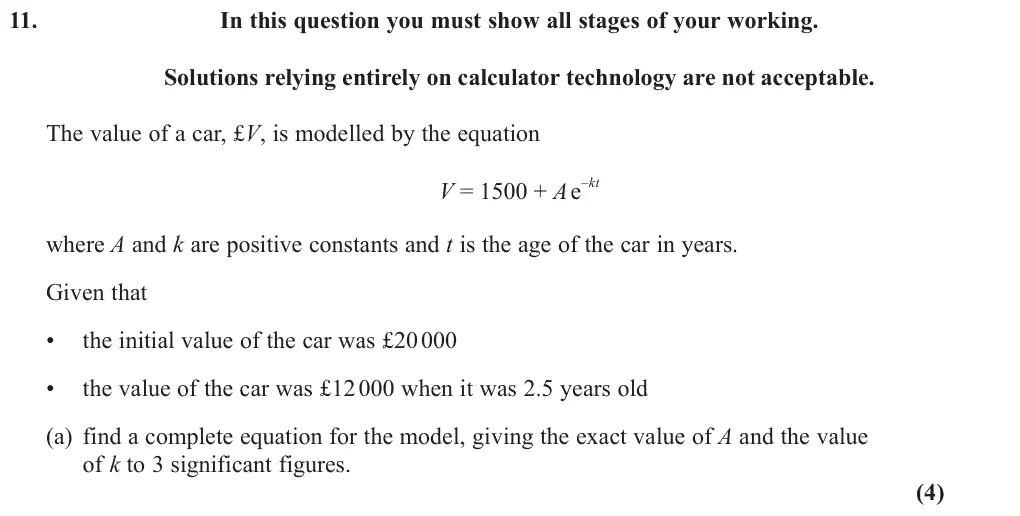
June 2025 · Paper 1 · Q11(a)4 marks
Mark scheme (whole question; this part is marked with the orange bar)
Examiner's comment
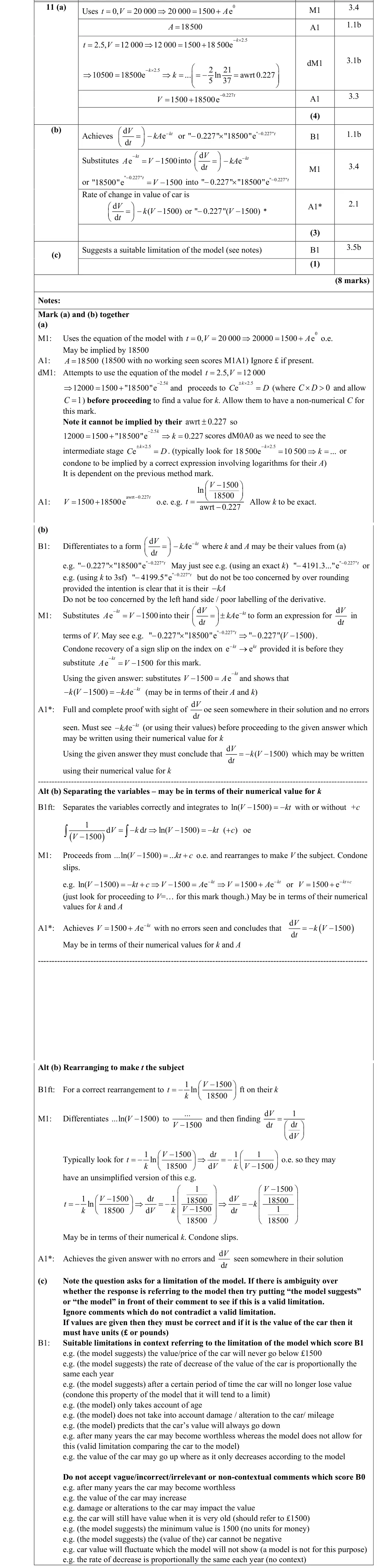
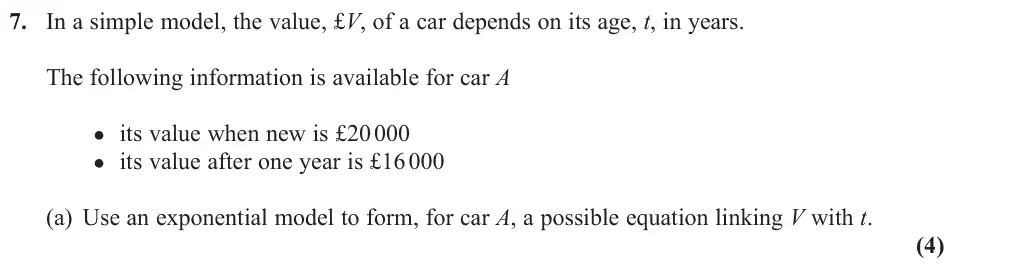
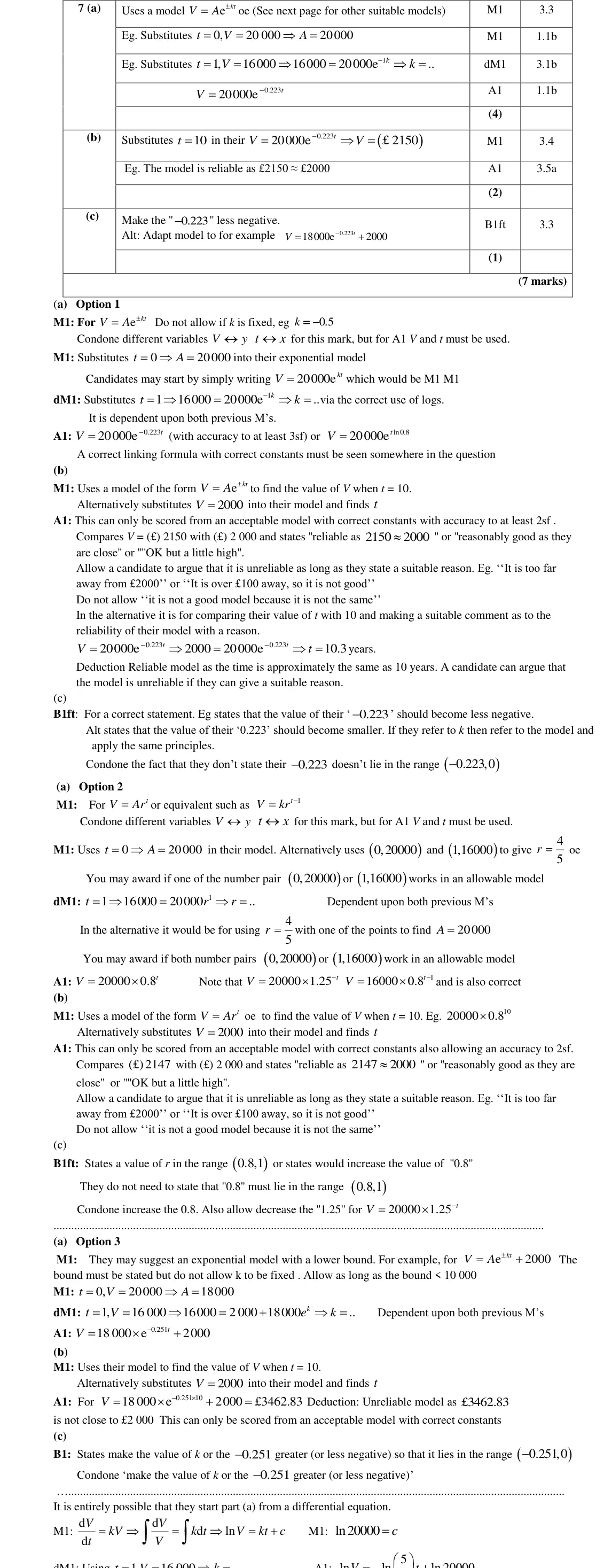
0, 20000 t V In part (a) many responses substituted in and proceeded correctly to = = to score the first two marks. The majority were able to rearrange the equation 18500 A = appropriately to find k , with accurate logarithmic manipulation following an equation of the required form. Calculation errors were rare and primarily arose from minor slips rather than conceptual misunderstandings. The most common reason for not gaining the final accuracy mark was due to not writing out the full exponential model explicitly after finding A and k . However, a small number retrieved this mark in part (b) by correctly stating the equation at k but many used their own model from part (a) which could also score all the marks. Nearly all learners who completed (b) included d V t in their solution. Some learners tried to use the d given answer in their working but to score full marks they needed to conclude that d V ( ) 1500 . k V t = - - d e kt - kA Those who worked in terms of A and k and differentiated to get tended to be more - successful in completing the proof, as the substitution step was more direct: simply e kt e kt 1500 - A - and replacing in the derivative. When they used V A to isolate rearranging = + d V 0.227 t 0.227 18500e - numerical values, it would typically result in which was the most = - x d t successful form, as they continued from here with a logical method to get to the final stage of 0.227 t 0.227 18500e - the proof. A very efficient way to do this was by rewriting as - x ( ) ( ) , which made their proof very clear 0.227 t 0.227 1500 18500e 1500 0.227 1500 - V - + - = - - d d V V 0.227 0.227 t t 4191.3e 4199.5e - - and easy to follow. Those using or were often = - = - d d t t unable to rearrange it in the desired form or made errors and wrote down the correct answer at the end, without clear steps in their working There were several alternative methods that were used by a minority of learners. Those who attempted to start with the given answer, separate the variables and then integrate rarely scored more than one mark. A common error was to omit the c + , but of those who included the they were often unable to rearrange to make V the subject or did not include a ,c + conclusion. Some learners rearranged the original equation to a form without the exponential and then used implicit differentiation. 1 1500 ln V - Another alternative method was to rearrange to get then proceed to find t = - k A d V before finding d 1 t V . Here the most common error was with the coefficient when = d t d d t d V 1500 ln V - trying to apply the chain rule to . These learners were still usually able to score A two marks if there were no other errors. Learners should note that the question asks for a limitation of the model so if there was ambiguity in their answer, it was assumed that the comment was referring to the model. A large proportion made sensible comments relating to the model's limitation, with the most common correct answers being a reference to the car’s value approaching but never going below £1500, or suggesting the model does not take into account any additional damage to the car, or that, according to the model, the value only decreases whereas it may also increase in value. Responses that did not score the mark included vague statements or those which misunderstood the mathematics, such as claiming the model suggested the car could have a negative value or saying damage would impact the value without any reference to the model. A number of responses did not gain the mark due to omitting units, e.g. stating “1500” instead of “£1500”. 16 17
Common mistakes
t = 0 gives A = 18500
12000 = 1500 + 18500e^(−2.5k) gives e^(−2.5k) = 21/37, k = 0.227 (working with logs shown)
must write the complete model V = 1500 + 18500e^(−0.227t)
misreads 1200 or 15000
June 2025 · Paper 1 · Q11(b)3 marks
Mark scheme (whole question; this part is marked with the orange bar)
Examiner's comment
However, a small number retrieved this mark in part (b) by correctly stating the equation at the beginning of their working. There were only a few examples of not using enough significant figures or incorrectly rounding the value of k. Misreads were fairly common on this question (usually 1200 instead of 12000 or 15000 instead of 1500) which often meant that learners were unable to proceed to a value of k as they ended up with an equation with no real solutions. In part (b), most were able to identify the need for differentiation. The execution of the method was well-attempted, although some struggled to make the necessary links for the final part of the solution. The intention was that the question would be answered in terms of A and k but many used their own model from part (a) which could also score all the marks. Nearly
Common mistakes
dV/dt = −kAe^(−kt) then substitute Ae^(−kt) = V − 1500 to get −k(V − 1500)
dV/dt must be seen
working backwards by separating variables rarely scored
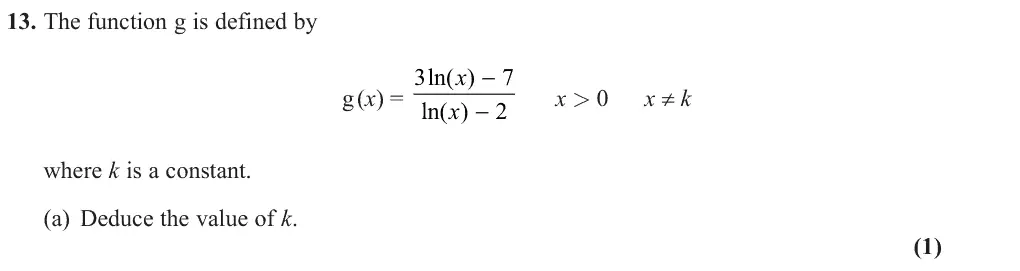
June 2025 · AS Paper 1 · Q13(a)4 marks
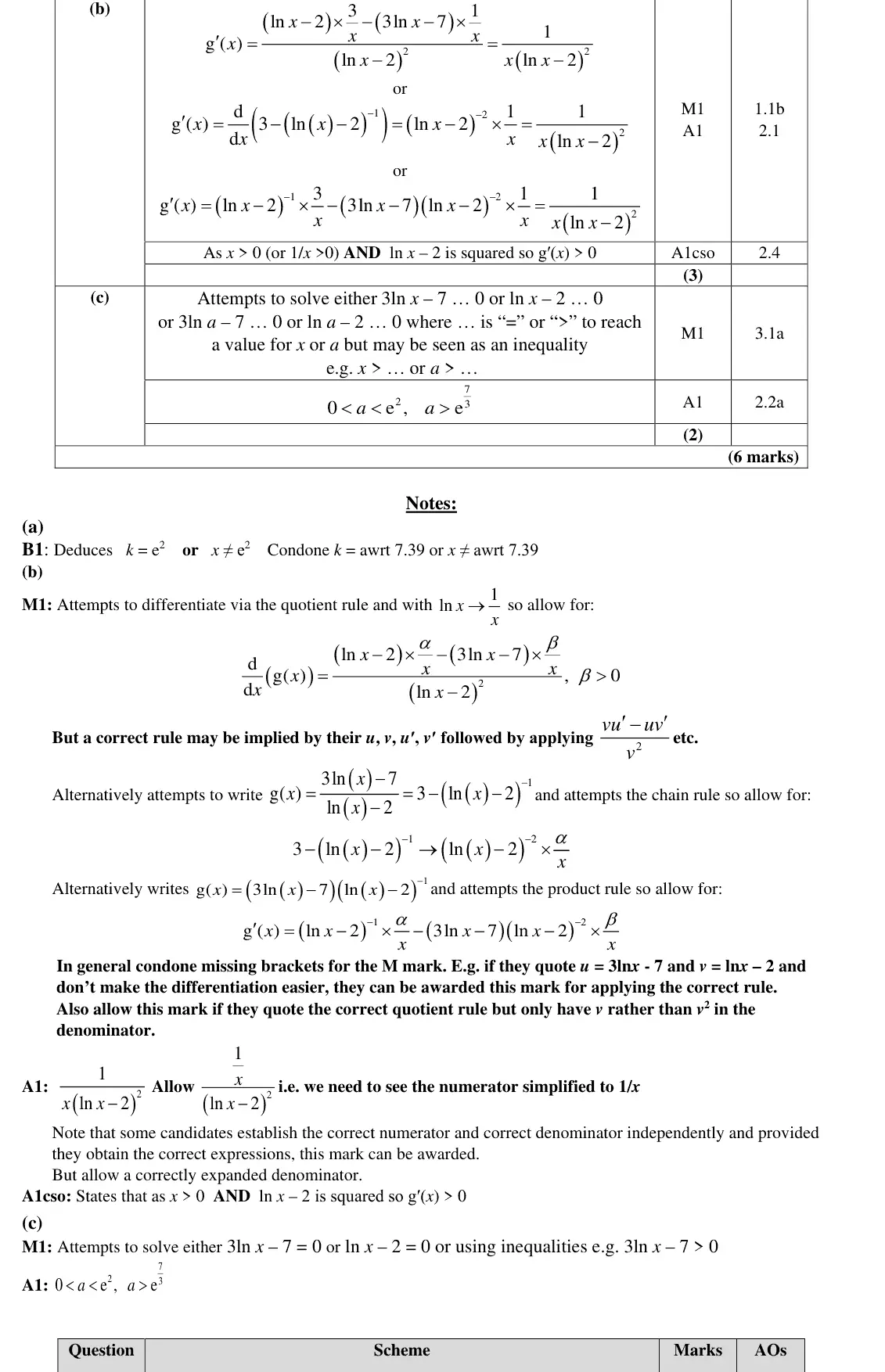
Mark scheme (whole question; this part is marked with the orange bar)
Examiner's comment
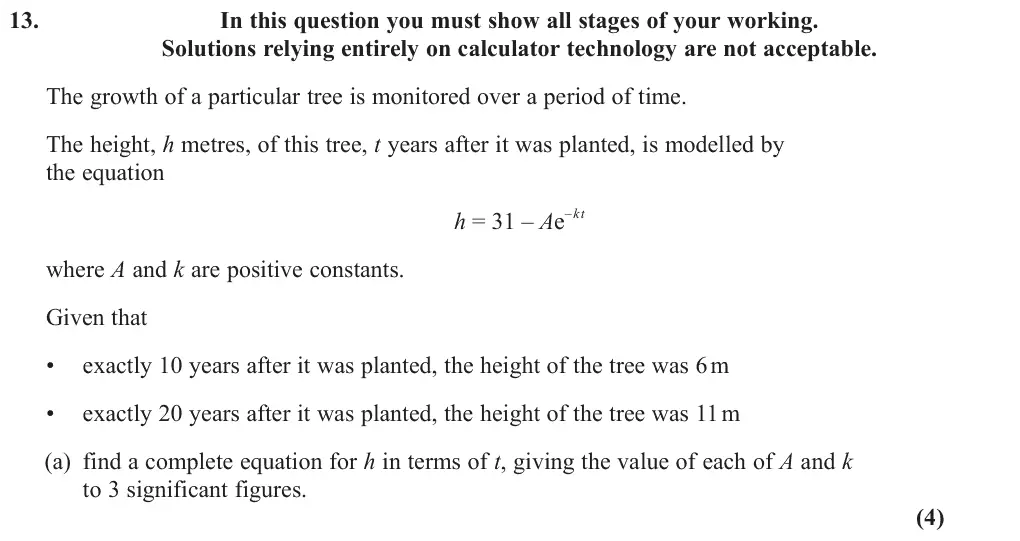
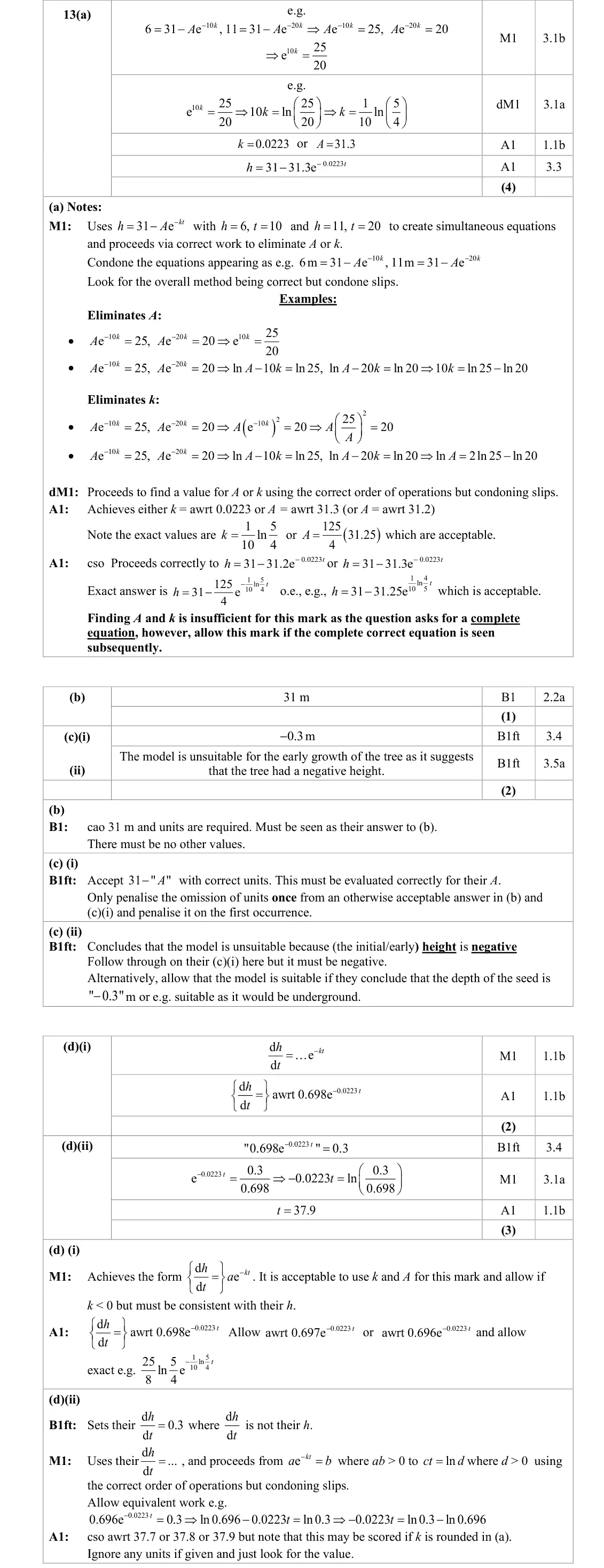
Candidates’ performances in this exponential modelling question were varied with some able to obtain full or nearly full marks, whilst others made very little progress. Candidates who did fail to score marks in (a) were often able to gain credit later in the question. Units were required in the answers to (b) and (c)(i), and the omission of these were penalised the first time it In part (a), candidates who had the necessary algebra skills successfully used the given equation and information to set up simultaneous equations in A and k and correctly solved them to reach 0.0223 31 31.3e t - h or a similar acceptable equation. Candidates often, however, made major = - algebraic mistakes after initially setting up the correct equations, often involving the use of incorrect log or indices work, and made no progress in (a). Others failed to appreciate that the question was asking for an exponential model and attempted to use the given information to set up a linear model instead. A number of candidates failed to write down the complete equation of the model and just gave the values of A and k, losing the final mark in (a). Many candidates realised that in (b) the required limit to the height of the tree was 31m,
Common mistakes
form Ae^(−10k) = 25 and Ae^(−20k) = 20 and divide: e^(10k) = 5/4, k = 0.0223, A = 31.3
log or index errors
must give the complete equation h = 31 − 31.3e^(−0.0223t)
June 2025 · AS Paper 1 · Q13(b)1 mark
Mark scheme (whole question; this part is marked with the orange bar)
Examiner's comment
Candidates’ performances in this exponential modelling question were varied with some able to obtain full or nearly full marks, whilst others made very little progress. Candidates who did Many candidates realised that in (b) the required limit to the height of the tree was 31m, although many omitted the units losing the mark. For some candidates this was the only mark scored in this question.
Common mistakes
as t → ∞, e^(−kt) → 0 so h → 31 m (units required)
June 2025 · AS Paper 1 · Q13(d)(i)2 marks
Mark scheme (whole question; this part is marked with the orange bar)
Examiner's comment
Candidates’ performances in this exponential modelling question were varied with some able to obtain full or nearly full marks, whilst others made very little progress. Candidates who did In (d)(i) candidates were generally able to differentiate their equation of the model to obtain an expression of the correct form, earning the first mark. Many did not obtain the correct answer so were not awarded the second mark. A number of candidates incorrectly differentiated to e kt - which gained no credit in (d)(i). The first mark in (d)(i) was again at obtain expressions like aften awarded to candidates who made little progress elsewhere in this question. In (d)(ii)
Common mistakes
dh/dt = Ake^(−kt) ≈ 0.698e^(−0.0223t)
differentiating to −e^(−kt) or keeping the 31
June 2025 · AS Paper 1 · Q13(d)(ii)3 marks
Mark scheme (whole question; this part is marked with the orange bar)
Examiner's comment
Candidates’ performances in this exponential modelling question were varied with some able to obtain full or nearly full marks, whilst others made very little progress. Candidates who did aften awarded to candidates who made little progress elsewhere in this question. In (d)(ii) candidates knew they needed to set their d h t equal to 30cm, but often confused the units and d used d rather than d . Having set up an equation using d h h h t candidates were often 30 0.3 t = t = d d d able to use appropriate log rules to progress from a suitable equation to obtain a value for t. The final correct answer of 37.9 was obtained by some, but errors often appeared during the course of this long question, causing the final answer to be incorrect.
Common mistakes
30 cm per year = 0.3 m per year (not 30)
set dh/dt = 0.3, not h = 0.3
take ln: t ≈ 37.9
June 2025 · Paper 2 · Q32 marks
Mark scheme (whole question; this part is marked with the orange bar)
Examiner's comment
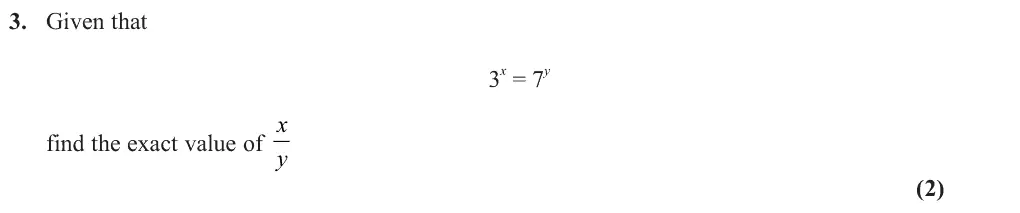
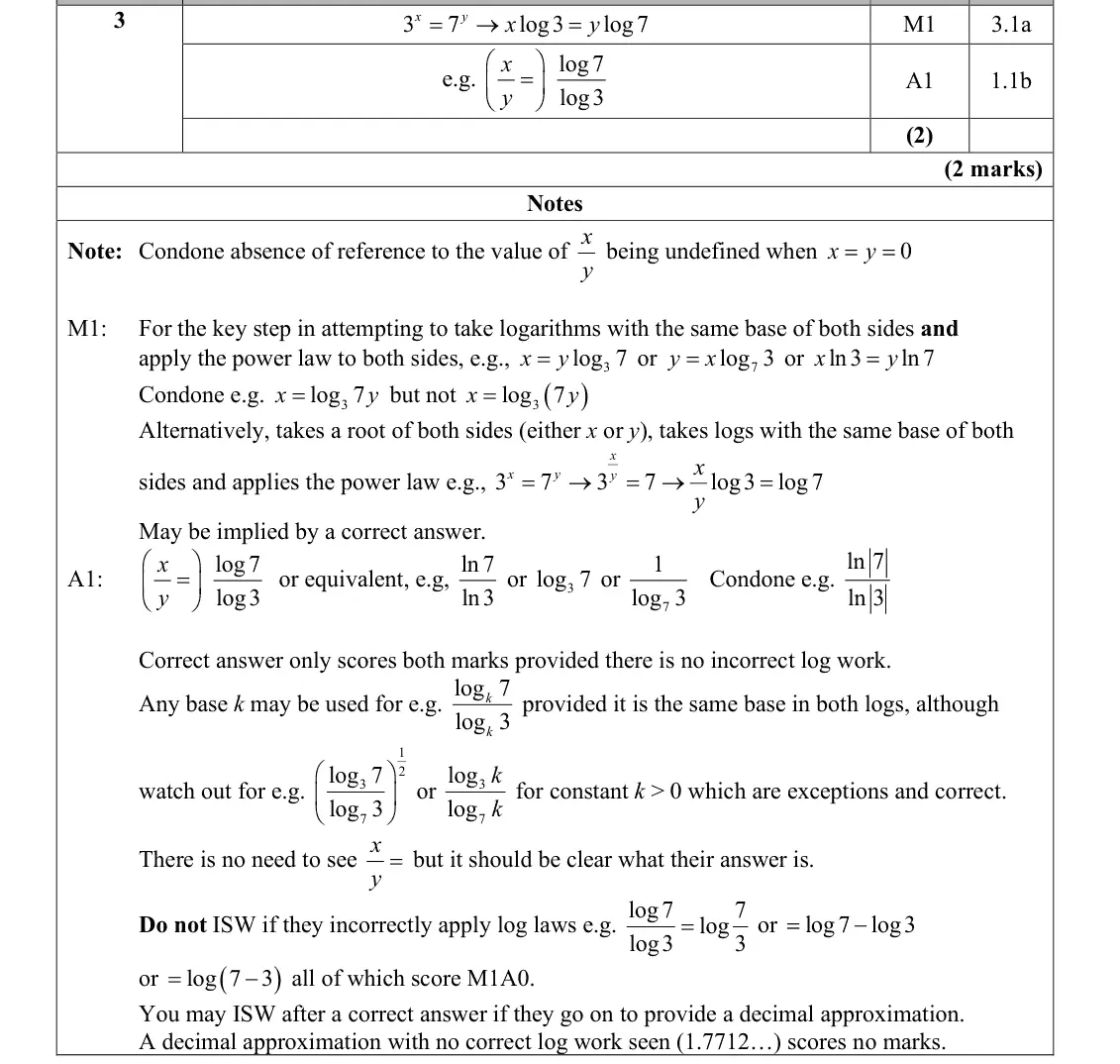
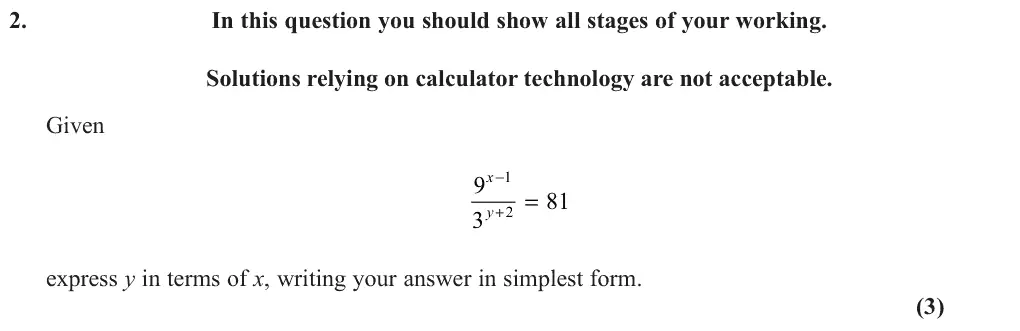
The vast majority of learners found this question, which involved an understanding of indices and logarithms, to be accessible. Most were able to take logarithms with the same base of each side and apply the power law to both sides in one step. It was common in responses to take natural logarithms or logarithms to base 10; sometimes logarithms to base 3 or, on rarer occasions, base 7 were used. Usually, this was followed by correct division to achieve x y as the subject and gaining the accuracy mark. A few divided incorrectly and obtained the reciprocal of the correct answer and so lost the A mark. Some proceeded from a correct answer with incorrect logarithm work, such as to 7 ln 3 or ( ) ln 7 3 - , and did not gain the accuracy mark. A number of concise responses attempted to take logarithms of base 3 and achieved 3 log 7 x y = , gaining both marks. On rare occasions, responses took logarithms of base 3 and logarithms of base 7 of the original equation separately to produce 3 log 7 y x = and 7 log 3x y = and simply divided from here. Having not dealt with the powers appropriately, they left x and y variables on both sides of the equation and so scored no marks. Others took the same approach but did deal with the powers to produce 3 log 7 x y = and 7 log 3 y x = but did not recognise how to combine the equations to achieve x y as the subject by square rooting. Many learners appeared unclear about what “exact value” means and following a correct answer provided a decimal approximation. However, such responses were condoned.
Common mistakes
take logs of the same base of both sides and use the power law: x log 3 = y log 7
x/y = log 7 / log 3 (not the reciprocal)
log 7/log 3 is not log(7/3) or log 7 − log 3
a decimal alone scores 0
June 2025 · Paper 2 · Q9(b)3 marks
Mark scheme (whole question; this part is marked with the orange bar)
Examiner's comment
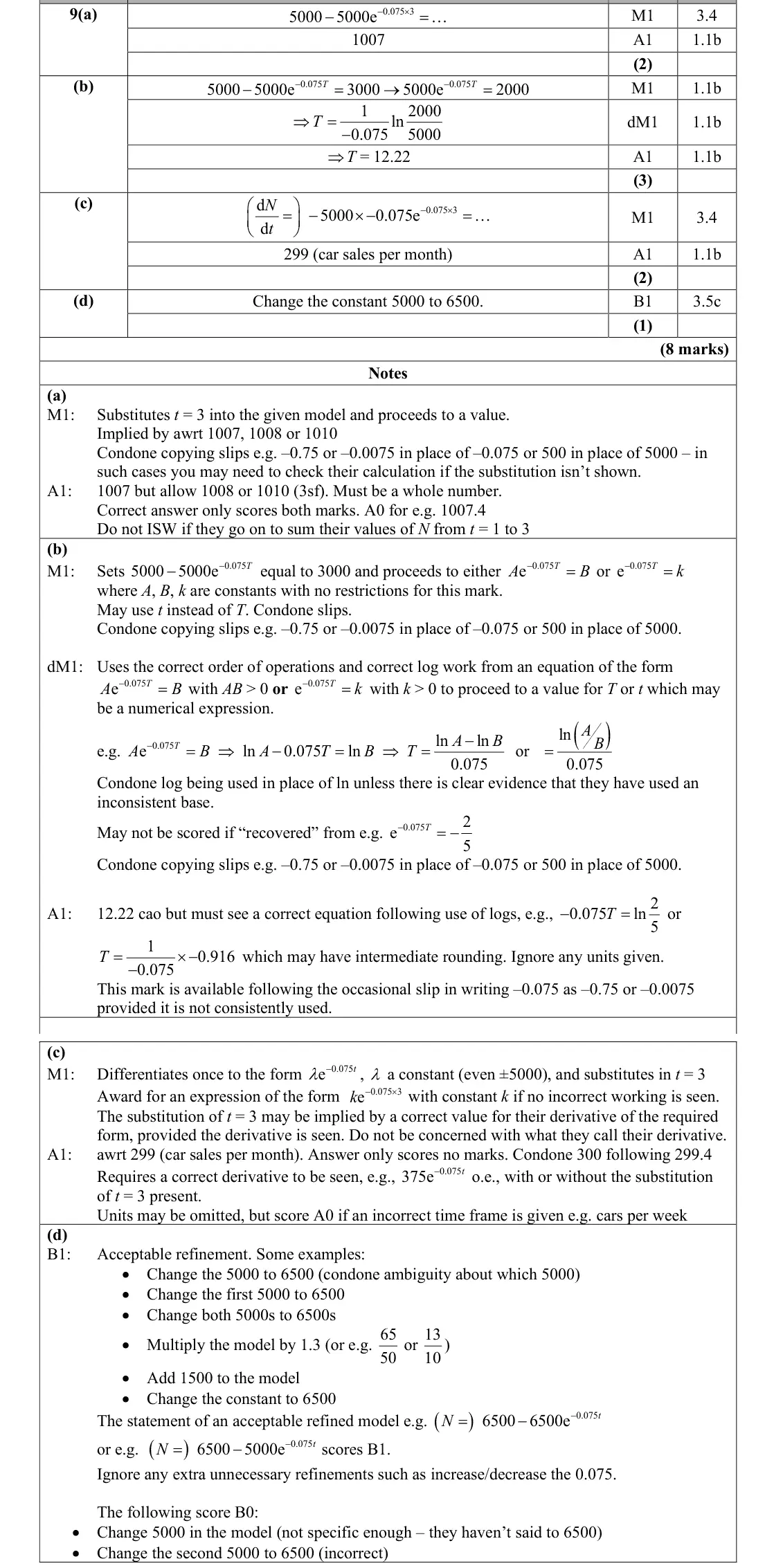
This question assessed understanding of exponential modelling and differentiation. Performance across the question was generally very good, but common errors in dealing with exponential equations and differentiating exponential models persist. Part (b) required setting N = 2000, rearrangement of the resulting equation using rules of logarithms correctly to achieve a value of T. The question required sufficient working to be shown and had the warning that solutions should not rely entirely on calculator technology. While most solutions showed intermediate working leading to the correct answer of T = 12.22, there were attempts where the equation was immediately followed by a solution. This was not sufficient and could only achieve a maximum of one mark out of three. Errors seen included taking logarithms to different bases on each side, rounding the final answer incorrectly and seeing logarithms of negative numbers due to an earlier error.
Common mistakes
5000e^(−0.075T) = 2000 then take ln correctly (same base both sides)
show the log step, not just the answer
T = 12.22
June 2025 · Paper 2 · Q9(c)2 marks
Mark scheme (whole question; this part is marked with the orange bar)
Examiner's comment
This question assessed understanding of exponential modelling and differentiation. Performance across the question was generally very good, but common errors in dealing with exponential equations and differentiating exponential models persist. Part (c) was the least well answered part of the question with learners often not realising that differentiation was required to find the rate of increase. Finding two values of N using the gradient of a straight-line formula was seen. Another common error was to substitute t = 3 first and then try to differentiate which gained no credit. The final answer did not require units to be given but occasionally incorrect time periods were referred to, thus changing the rate, which scored A0.
Common mistakes
rate of increase needs dN/dt = 375e^(−0.075t), not the gradient of a chord
do not substitute t = 3 before differentiating
299 cars per month (wrong time unit loses the A mark)
June 2025 · Paper 2 · Q10(b)5 marks
Mark scheme (whole question; this part is marked with the orange bar)
Examiner's comment
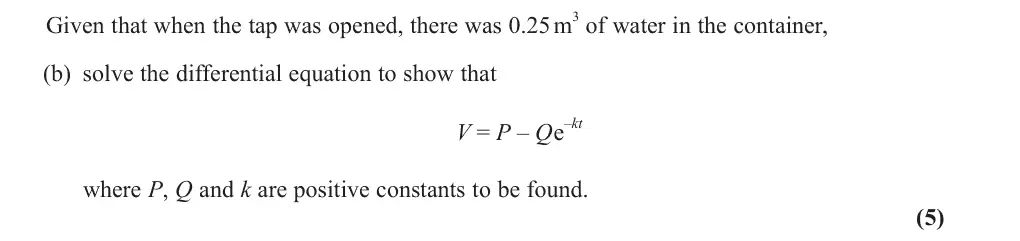
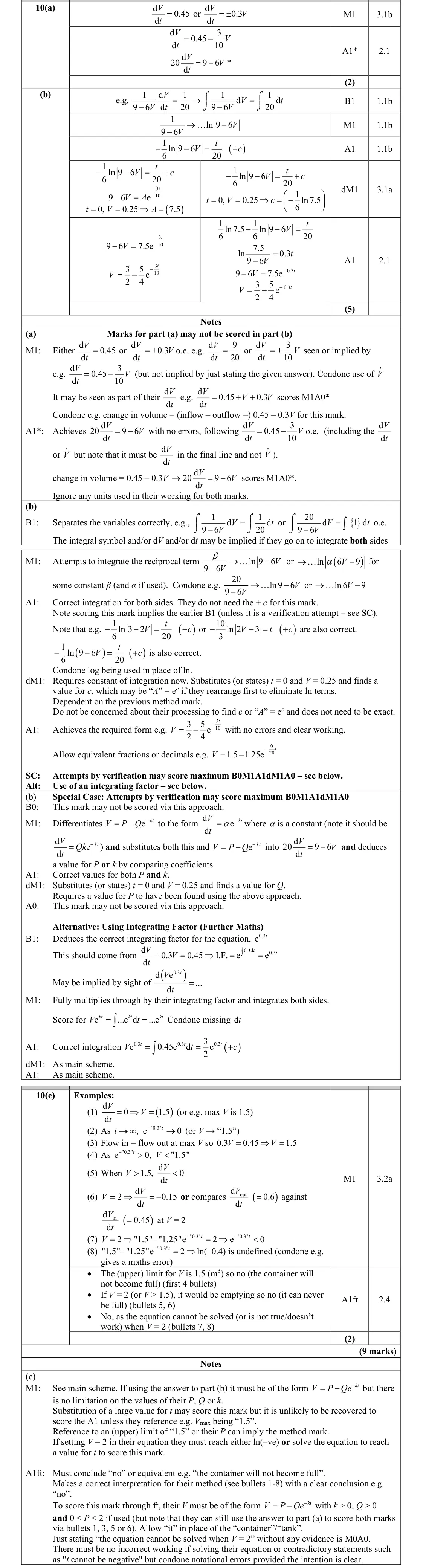
This question, which involved setting up and solving a differential equation using separation of variables, proved to discriminate across the cohort, with a wide range in quality of responses seen. The restart opportunities provided were well used, allowing many learners to access later parts of the question even if they had struggled in earlier parts. In part (b), some learners recognised the need to separate the variables and were able to do this successfully. A significant number placed the 20 incorrectly and others struggled to separate correctly into the reciprocal form which limited access to further marks. Those who separated the variables were generally able to score the method mark for the integration at the beginning of the process. Common mistakes were omitting the 1 6 - , not including the minus sign or multiplying by –6. Most learners included a constant of integration, and most learners recognised the need to use the given initial conditions to find it - those who made it this far generally made the correct substitution of V = 0.25 and t = 0 and obtained a value for the constant. The final mark proved challenging for many, with errors in rearranging their equation to the given form being particularly common. Many struggled with the logarithm work, not applying sum/product or difference/quotient rules correctly, often taking e to the power of individual terms rather than the whole expression on each side of the equation.
Common mistakes
separate correctly: ∫ 1/(9 − 6V) dV = ∫ 1/20 dt
−⅙ ln(9 − 6V) (missing −⅙ or sign)
use t = 0, V = 0.25 for the constant
exponentiate the whole of each side, not term by term
V = 3/2 − (5/4)e^(−0.3t)
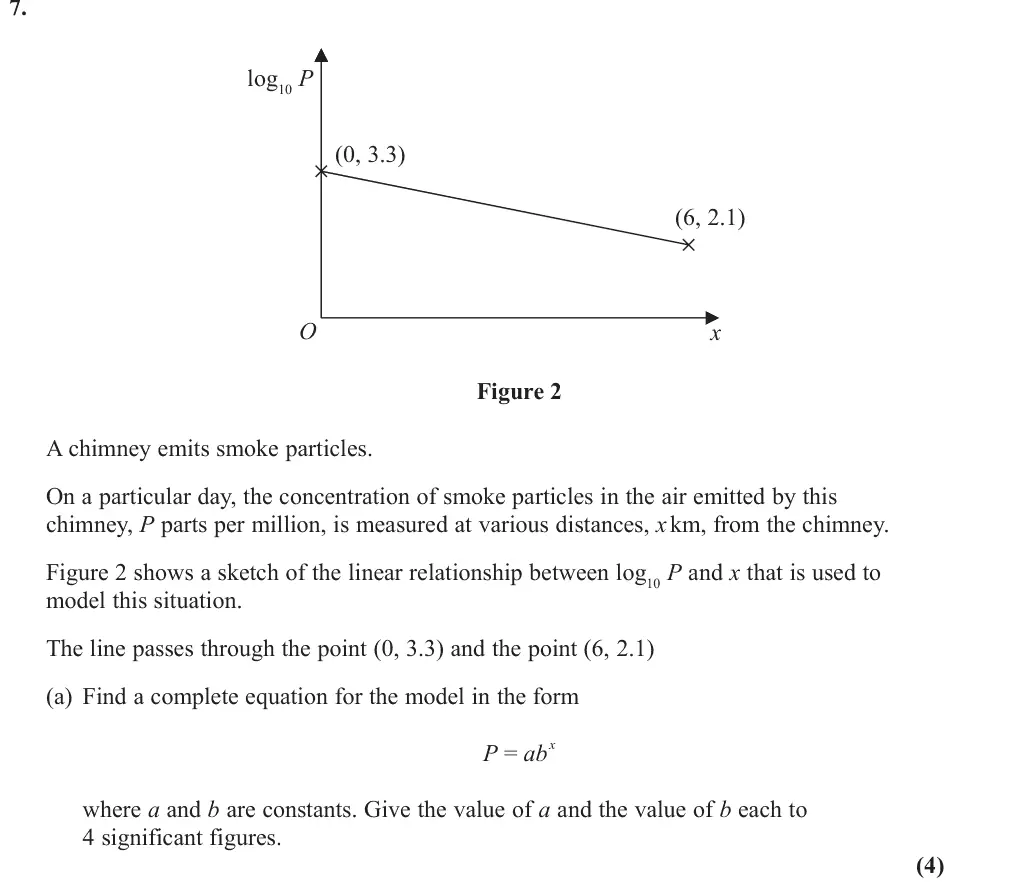
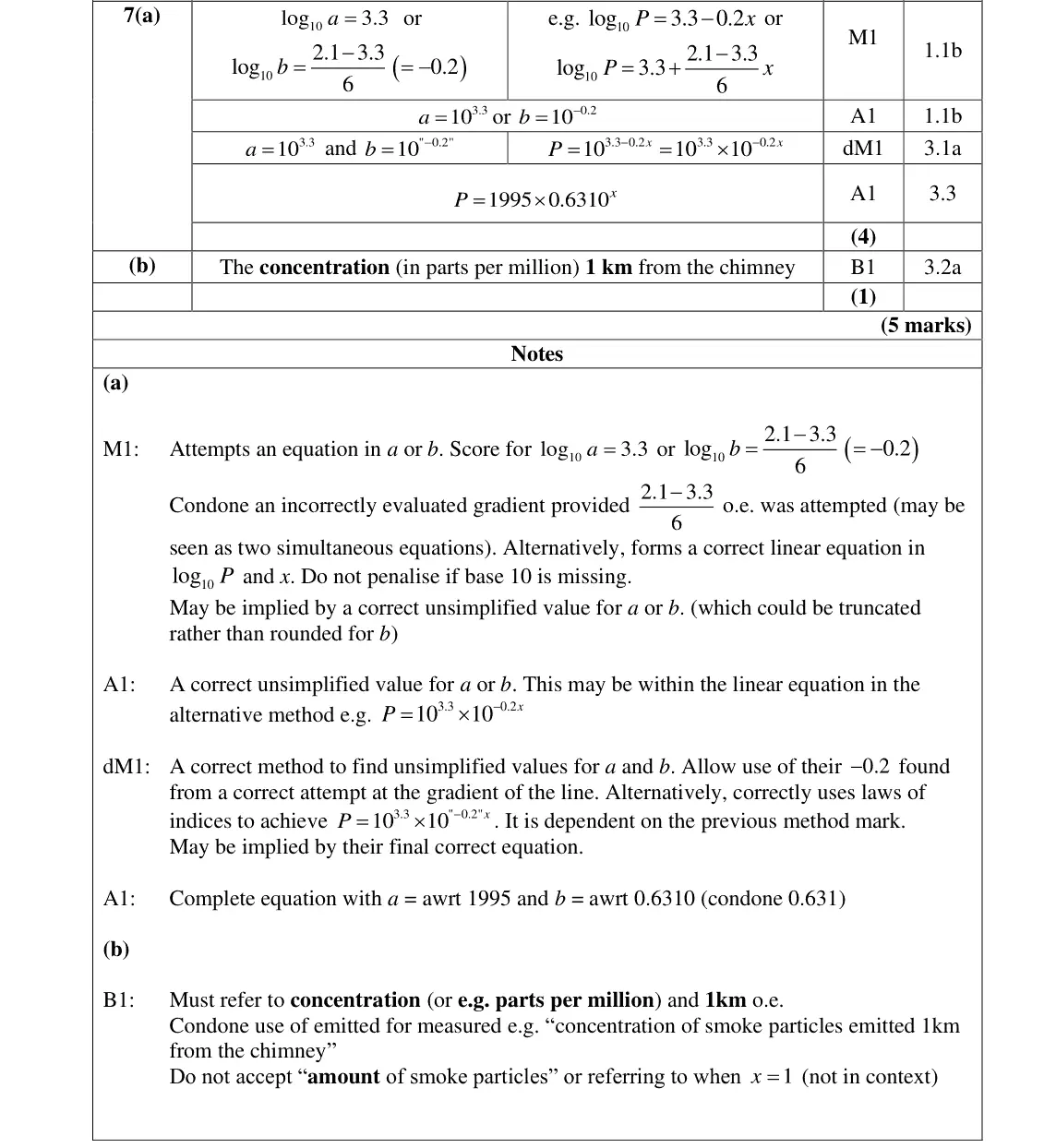
June 2024 · AS Paper 1 · Q7(a)4 marks
Mark scheme (whole question; this part is marked with the orange bar)
Examiner's comment
This question tested the understanding of logarithmic graphs and exponential growth. This was successful in differentiating between candidates, although surprisingly
Common mistakes
log₁₀P = 3.3 − 0.2x so a = 10^3.3 ≈ 1995 and b = 10^(−0.2) ≈ 0.6310 (4 s.f.)
gradient slips
using 3.3 instead of 10^3.3 for a
writing y for log₁₀P
June 2024 · AS Paper 1 · Q7(b)1 mark
Mark scheme (whole question; this part is marked with the orange bar)
Examiner's comment
This question tested the understanding of logarithmic graphs and exponential growth. This was successful in differentiating between candidates, although surprisingly candidates still struggle with this relationship. In addition, part (b) provided challenging for most who were unable to interpret in context. = x P ab Many candidates lacked confidence in relating the exponential form of the model to the log P against x. Whilst some very poor log work was seen, some straight-line graph of 10 candidates also made fundamental errors whilst forming the equation of a straight line, for - 6 0 = - 5 example, an incorrect method for calculating the gradient, e.g. - 2.1 3.3 log P when writing down the equation of the straight line. Many candidates used y instead of 10 log 3.3 within their Some candidates appeared confused as to whether they should use 3.3 or 10 equation, whilst others also showed a lack of robust understanding in manipulating indices after achieving a correct equation for P. A significant minority of candidates who achieved the correct values for both a and b failed to then write down the complete equation required. In part (b), the vast majority of candidates were unable to correctly explain the meaning of “ab”. ab = = 1005 0.6310 1259 Some thought that they simply had to calculate its value i.e . Many others assumed they needed to give the meanings of each of a and b separately, as on previous papers.
Common mistakes
ab is the concentration (parts per million) 1 km from the chimney
"amount of smoke" or "when x = 1" is not in context
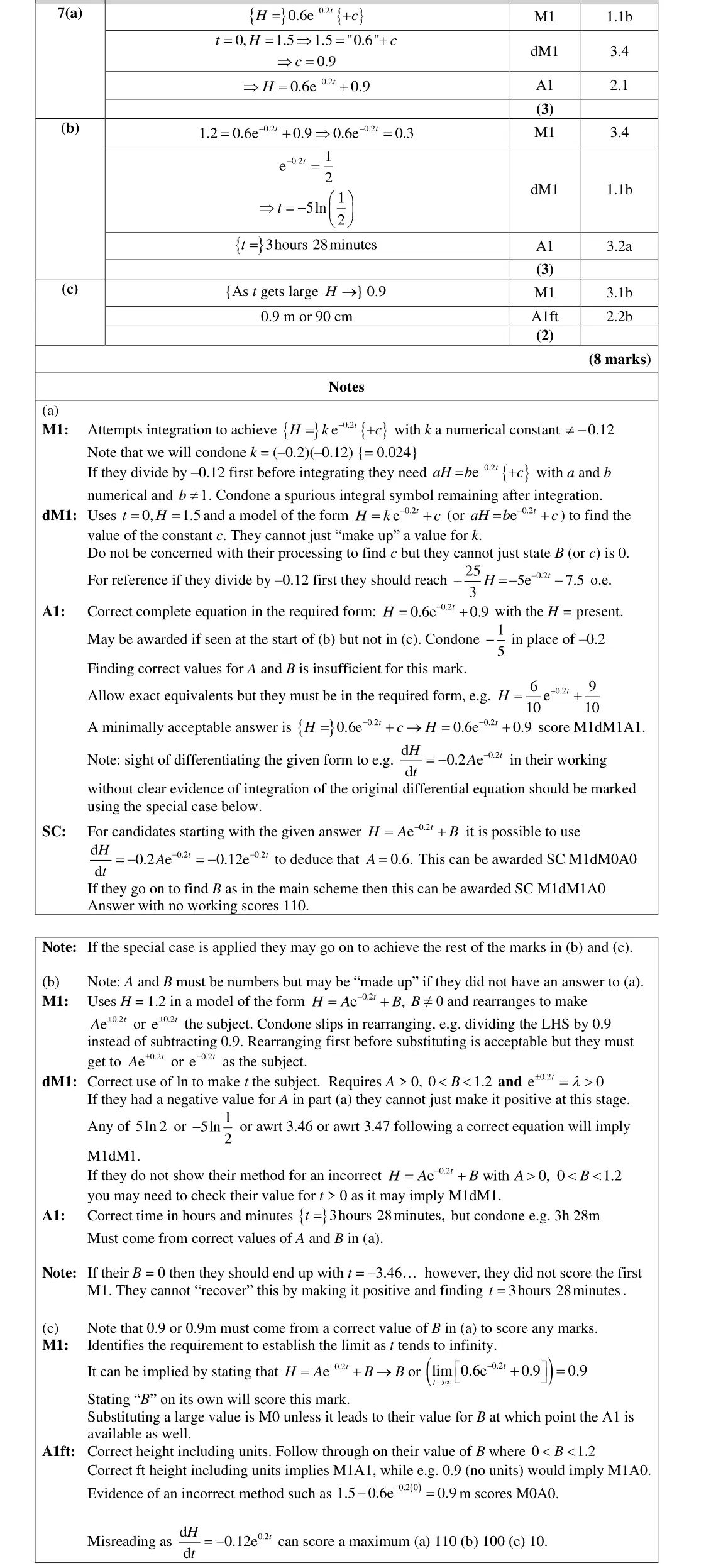
June 2024 · Paper 1 · Q7(b)3 marks
Mark scheme (whole question; this part is marked with the orange bar)
Examiner's comment
marks being lost in (b) and (c) due to having an impossible equation to solve. The vast majority of candidates remembered to include the constant of integration and use the given information to find it, likely supported by the question giving the required form of the answer as a reminder. Occasionally candidates missed out on the second method mark as they used 1.5 as the constant of integration rather than finding the constant of integration by correctly substituting H = 1.5 and t = 0, but the majority managed this with success, obtaining correct values for their constant and gaining the second method mark. A common reason for the loss of the final accuracy mark was failing to write out the final version of the model, generally omitting H = , or simply stating the values of A and B. Some candidates opted to differentiate the given answer and compare coefficients to find the values of A before going on to find B in the usual way. This verification strategy was not in line with the requirement of the question but candidates that used this method were allowed to score all but the final mark. Candidates who had a correct answer in part (a) generally performed well in part (b), with the majority able to rearrange the equation and use logarithms correctly to find the value of t. If these candidates were not awarded full marks, it was often because they were unable to convert their decimal into hours and minutes correctly, and therefore lost the final accuracy mark. Candidates who did not have a correct answer to part (a) Part (c) was generally less well attempted than parts (a) and (b) with some candidates failing to understand what the question was asking them to do. The most common error was for candidates to attempt to solve d H t = . A surprising proportion of candidates 0 d gave answers higher than the maximum height. For candidates with successful approaches, marks were frequently lost by forgetting units and therefore not satisfying the demand of the question and finding the height of the hole. Similarly, many decided to subtract an often correct 0.9 from the maximum height, which indicated a misunderstanding of the model.
Common mistakes
0.6e^(−0.2t) = 0.3 so t = 5 ln 2 = 3.47 h
convert to 3 hours 28 minutes (conversion errors common)
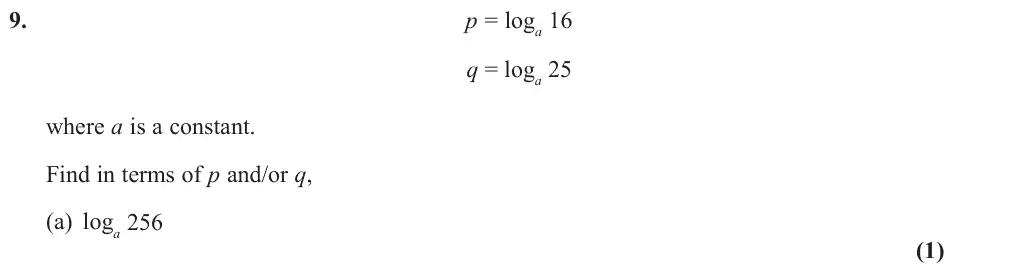
June 2024 · AS Paper 1 · Q9(a)1 mark
Mark scheme (whole question; this part is marked with the orange bar)
Examiner's comment
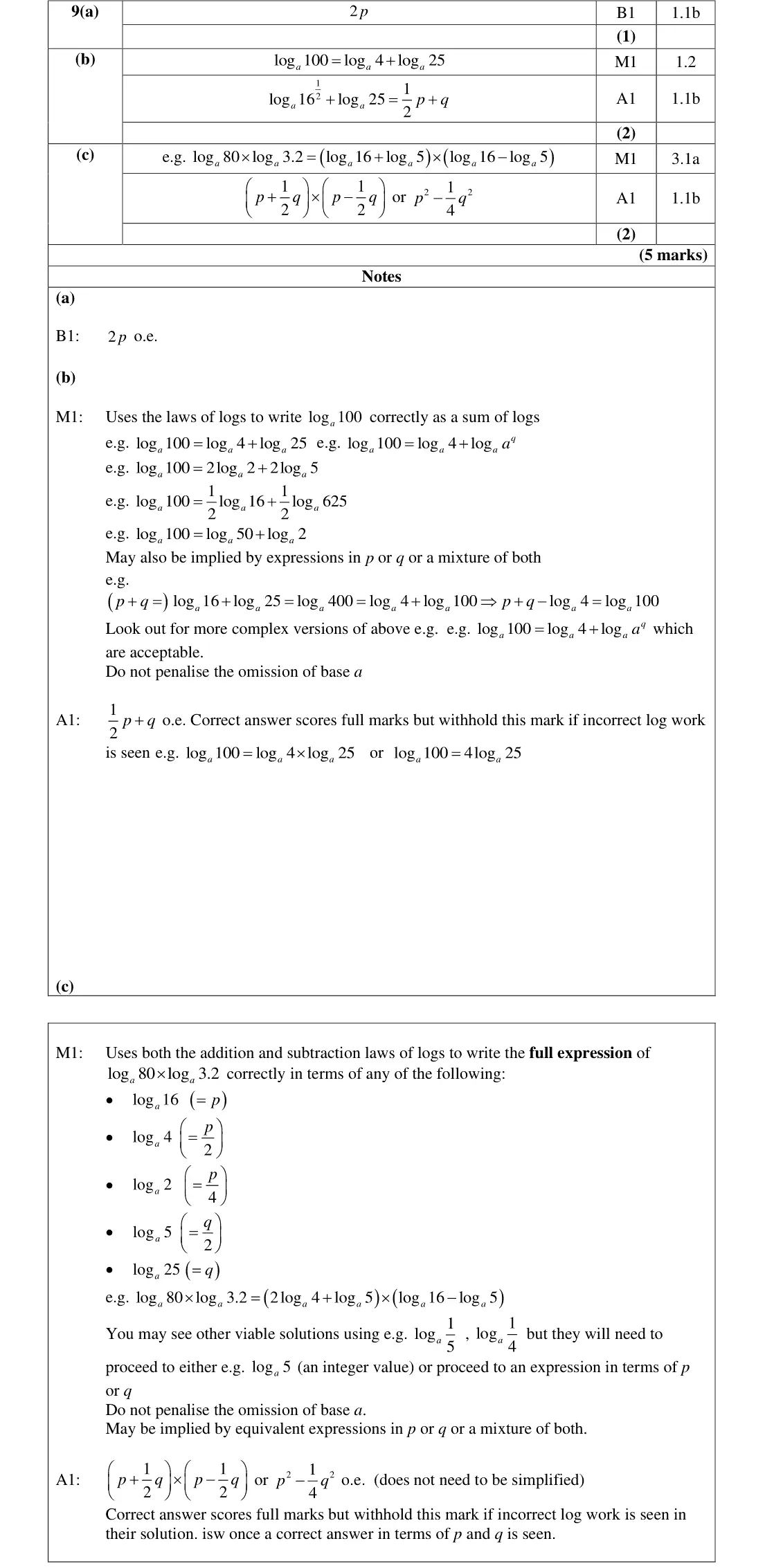
This question, testing the topic of logarithms, was poorly answered with the majority of candidates simply unable to engage with parts (b) and (c). Some candidates did not appear to understand what was being asked of them. This portrayed both a lack of understanding of logarithms, and also a lack of practice on similar past paper questions. Part (a) however, was answered relatively well, with many candidates reaching the correct answer of 2p. Errors included, for example, candidates writing log 256 2log 16 a a = without going onto write this in terms of p. Many appeared to think they had fully answered the question because it is given that log 16 a p = .
Common mistakes
log 256 = 2 log 16 = 2p
stopping at 2 log₂16
June 2024 · Paper 1 · Q9(a)3 marks
Mark scheme (whole question; this part is marked with the orange bar)
Examiner's comment
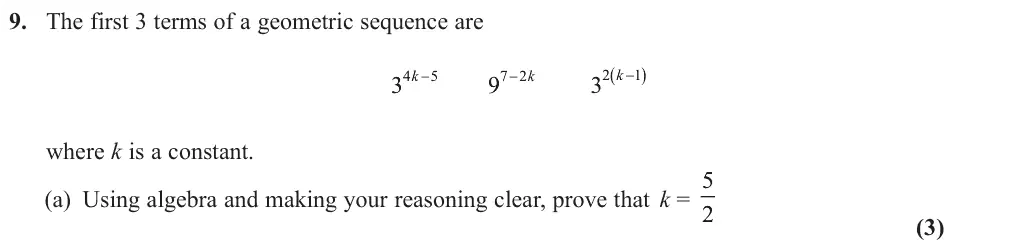
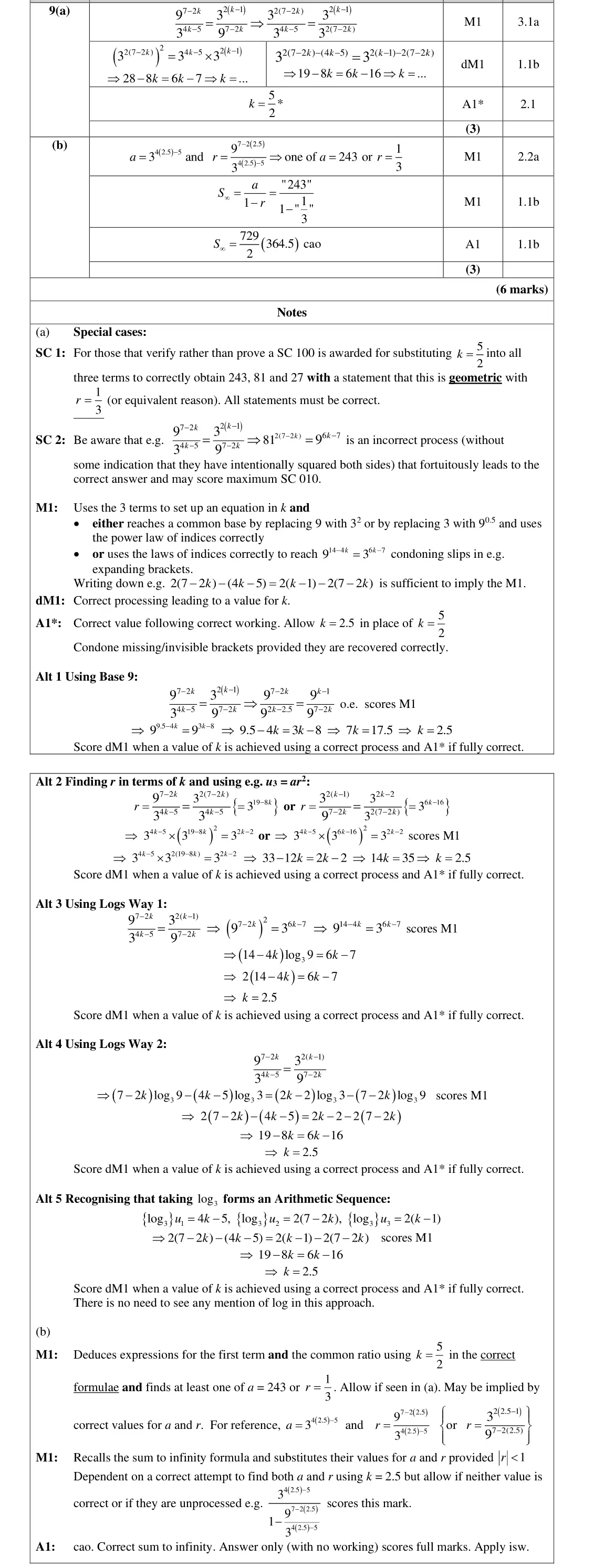
Part (a) was a discriminatory question with many different approaches seen; the mix of algebraic indices coupled with a geometric sequence caused problems for many candidates and often work lacked structure. It was evident that many candidates are not as familiar with the laws of indices as they should be and are not practised in the set-up of proof questions. The layout of candidates work varied enormously and they should be encouraged to practice showing a proof that flows and that is not interrupted by their thought processes. Despite the challenges many faced in part (a), the majority of candidates found part (b) to be accessible due to the given answer in (a) providing a restart opportunity. In part (a), many candidates were able to achieve full marks by setting up an appropriate equation, changing to the common base of 3 and using the index laws to form a linear equation in k and then solving. The most common (and successful) method was using 2 ar ar a ar = and then changing to the common base of 3, using the power law of indices and, either subtracting the indices or by cross-multiplying and then adding the indices. The most common error, which was highly prevalent, was incorrect use of the division/subtraction law of indices – whereby they divided indices rather than subtracted and then formed quadratic equations in k, resulting in no further marks being awarded. Most initial difficulties arose from not understanding how to use the power law correctly for 7 2 9 k - or failing to notice that the bases needed changing at all and many simply subtracted the indices regardless of the differing bases. Changing the base to 9 was rarely seen and attempts at using logarithms were mostly unsuccessful as again, the laws were not generally adhered to. Some candidates demonstrated a lack of understanding of indices by multiplying the bases but adding the indices to achieve ( ) 2 7 2 6 7 81 9 k k - - = . These were given some benefit of doubt and awarded one mark by a special case in the mark scheme, provided the rest of their processing was correct. Other candidates tried to verify the sequence being geometric by substituting in the given value of k, which did not satisfy the demand of the question. These attempts were allowed to score a maximum of 1 mark but were often unsuccessful as not enough of a conclusion was made. It is also worth noting that candidates should pay attention to the form of the given value and realise that this is what is required; an equivalent fraction 35 14 k = was not accepted for the final mark.
Common mistakes
equate ratios (u₂² = u₁u₃)
write 9 as 3² and use index laws to get a linear equation in k
index-law errors very common
verifying k = 5/2 earns only a special case
June 2024 · AS Paper 1 · Q9(b)2 marks
Mark scheme (whole question; this part is marked with the orange bar)
Examiner's comment
This question, testing the topic of logarithms, was poorly answered with the majority of candidates simply unable to engage with parts (b) and (c). Some candidates did not appear to understand what was being asked of them. This portrayed both a lack of understanding of logarithms, and also a lack of practice on similar past paper questions. Similarly, in part (b), many candidates wrote log 100 log 25 log 4 a a a = + but never proceeded further than this. These candidates lost the A mark, seemingly thinking they had given a complete correct answer.
Common mistakes
log 100 = log 4 + log 25 = ½p + q
stopping at log 4 + log 25 without writing log 4 in terms of p
June 2024 · AS Paper 1 · Q9(c)2 marks
Mark scheme (whole question; this part is marked with the orange bar)
Examiner's comment
This question, testing the topic of logarithms, was poorly answered with the majority of candidates simply unable to engage with parts (b) and (c). Some candidates did not appear to understand what was being asked of them. This portrayed both a lack of understanding of logarithms, and also a lack of practice on similar past paper questions. It was rare in part (c) for candidates to make any progress, having already struggled on part (b). The lack of the use of brackets often caused issues, too. It was rare for candidates to progress to the impressive, simplified solution of 2 2 1 4 p q - . The general understanding of the laws of logarithms was very poor. Examples of conceptual misunderstandings were numerous. E.g. ( ) 2 2 log 256 log 16 a a p = = , log 16 a p = so log 256 16 a p = , log 25 4 4 4 a q q = = , log (80 3.2) log 256 2 a a p = = . There were, of course, some excellent solutions, too.
Mark scheme (whole question; this part is marked with the orange bar)
Examiner's comment
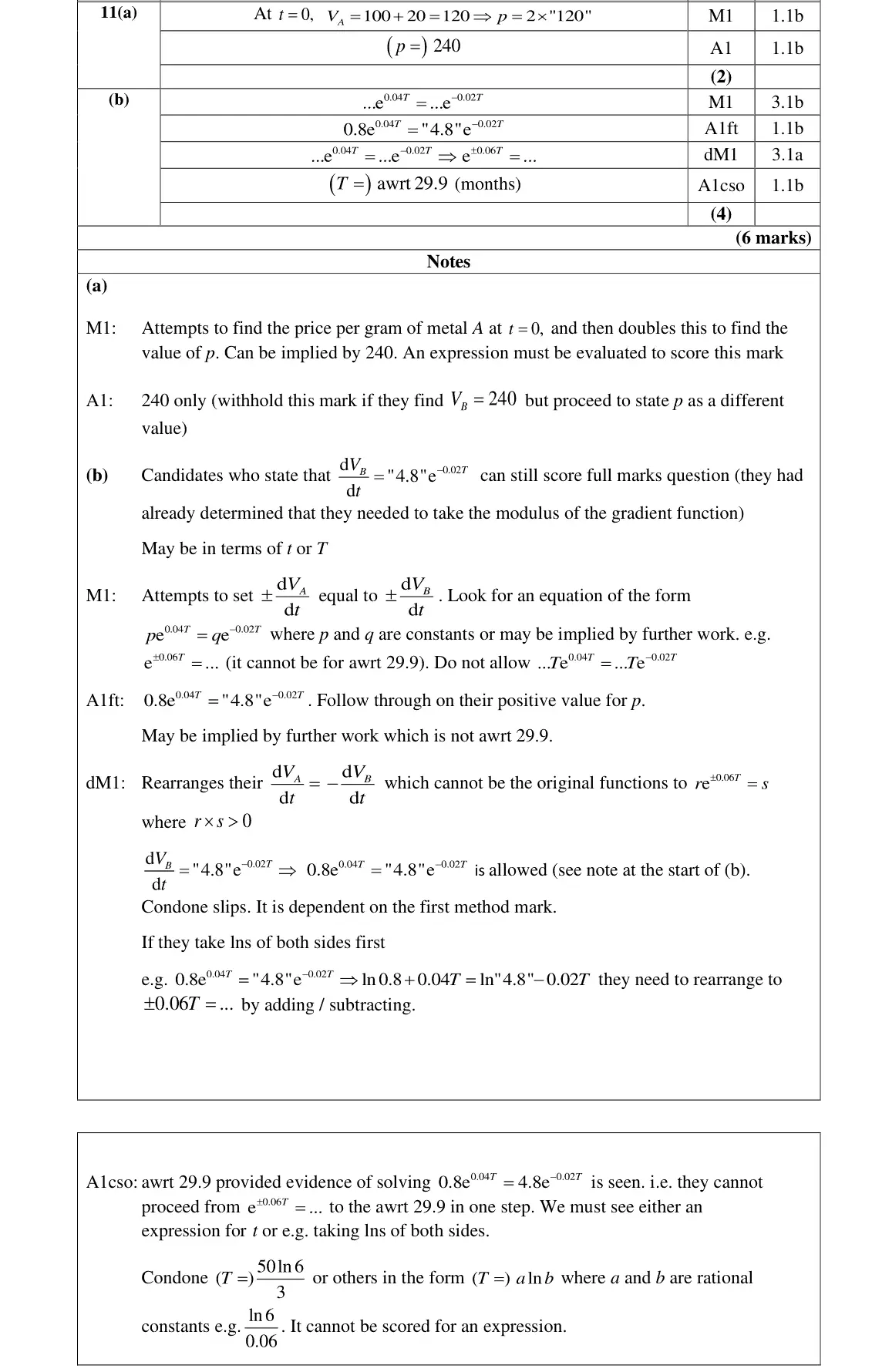
This question was a modelling one relating to the price per gram of two different metals. It enabled candidates to demonstrate understanding of working with exponential functions and differentiating them. Part (b) was generally poorly answered, and a number of candidates made no attempt to answer this part. A common error was to set A B V V = . For those that found d d A V t and d d B V t some did not put them equal to each other, or they set one or both equal to 0 instead, but the most common mistake was to keep the negative and write 0.04 0.02 0.8e 4.8e t t - = - thus forfeiting the last three marks. The minority who did set d d A V t d d B V t = - were usually able to use a correct method to solve the equation. Some candidates did appreciate the issue of trying to take logs of a negative was not possible, but rather than go back to the original equation, they opted to either ignore it or scribble out the negative at some point of the solution which was not acceptable to score these final marks.
Common mistakes
rate of increase of A equals rate of decrease of B: 0.8e^(0.04T) = 4.8e^(−0.02T) (drop the negative sign)
e^(0.06T) = 6 so T = 29.9 months
setting V_A = V_B or derivatives = 0
logs of a negative
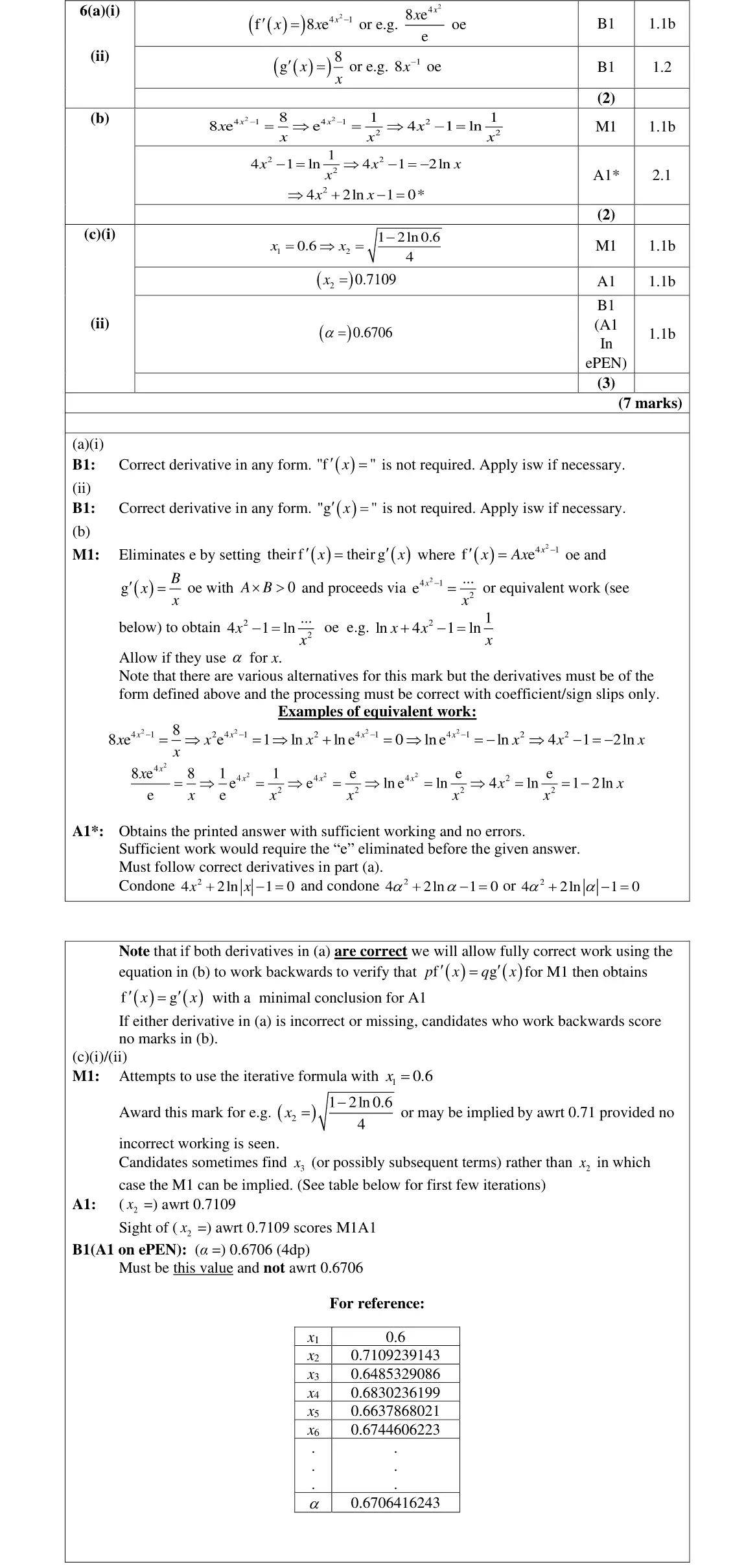
June 2024 · Paper 2 · Q6(b)2 marks
Mark scheme (whole question; this part is marked with the orange bar)
Examiner's comment
Success in part (b) was dependent on having the correct forms of the derivatives in part (a). 2 4 1 u x = - 7 8 8x x There were often mistakes in using log rules (e.g. ) and some did not know what to do with 2 1 ln x . As with question 4, of those who proceeded correctly, some forgot to include the “= 0”. Generally, candidates did whatever they could to manipulate their working, and many wrote down the given answer following completely incorrect work.
Common mistakes
equate 8x e^(4x² − 1) = 8/x, take ln to eliminate e
ln(1/x²) = −2ln x
must end with "= 0"
working backwards only credited with correct derivatives
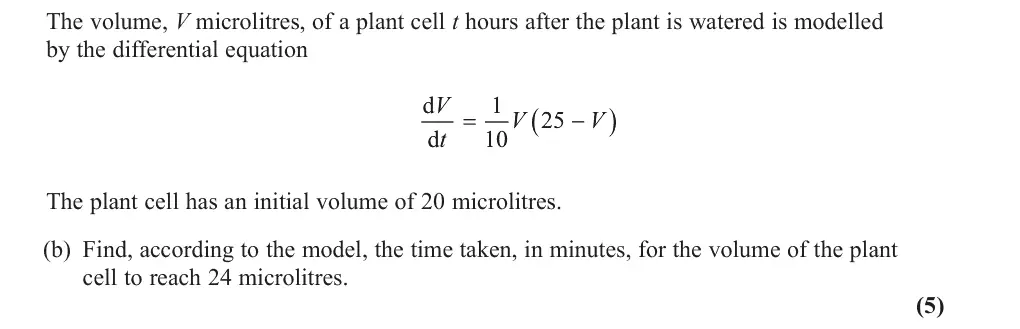
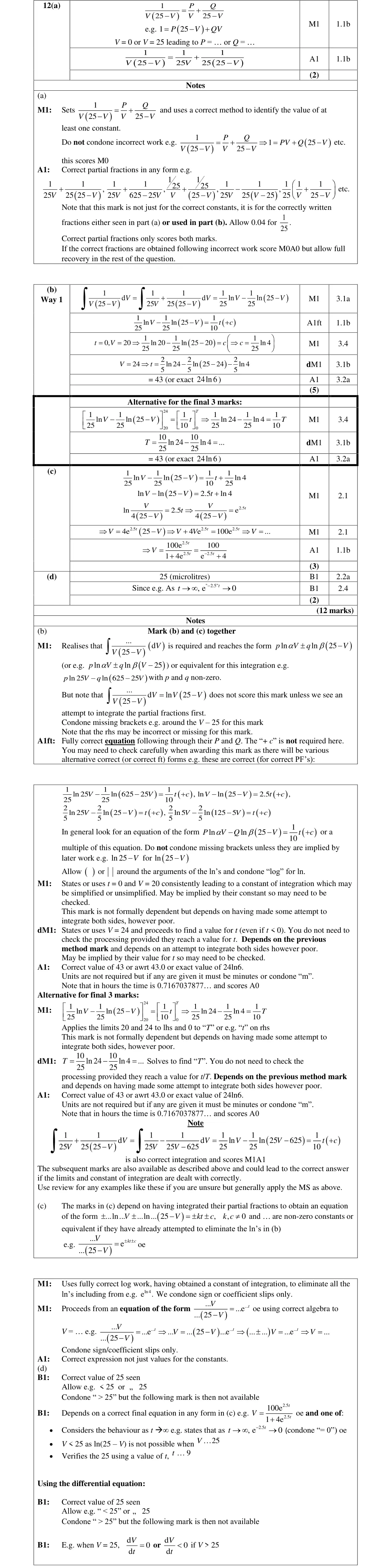
June 2024 · Paper 2 · Q12(b)5 marks
Mark scheme (whole question; this part is marked with the orange bar)
Examiner's comment
This question tested the candidates’ skill in various areas, i.e. finding partial fractions, integration, rules of logarithms, manipulating equations to eliminate logarithms using exponentials, indices, and commentating on the expected behaviour of a variable as another tends to infinity. This was a challenging question which in a number of instances, candidates struggled with after part (a). Those however, who were well prepared, were able to score full marks often with relatively concise solutions. There were occasional sign slips in the coefficients, and some candidates failed to write down their final answer, or use it in part (b), losing the second mark here. In part (b) a number of correct forms of integration were possible. Many candidates appreciated that an attempt at separation of variables and integration was required, and many reached correct equations such as ( ) 1 1 1 ln ln 25 25 25 10 V V t c - - = + or ( ) 1 1 1 ln 25 ln 25 25 25 25 10 V V t c - - = + . There were however, many slips with coefficients, and the omission of the minus sign in front of the ln(25 – V) or ln25(25 – V) term was common. Additionally, some omitted a constant of integration entirely, which meant that no further progress could be made. A surprising number of candidates did not see any link with part (a) and instead, integrated a quadratic in V, or did not integrate at all. Most candidates who attempted integration on both sides and included a constant of integration were able to score 2 method marks by using t = 0 and V = 20 to find the value of their constant and then substituting V = 24 to find the time taken. Most who got this far converted their final answer into minutes as required by the question although some candidates left the answer as 0.7167 which lost the final accuracy mark in this part. A few candidates used the alternative method of applying limits of 20 and 24 to their integral with respect to V and 0 and T for their integral with respect to t.
Common mistakes
separate variables and use the partial fractions from (a)
−ln(25 − V) sign often lost
include + c and find it from t = 0, V = 20
t = 0.7167 hours must be converted: 43 minutes
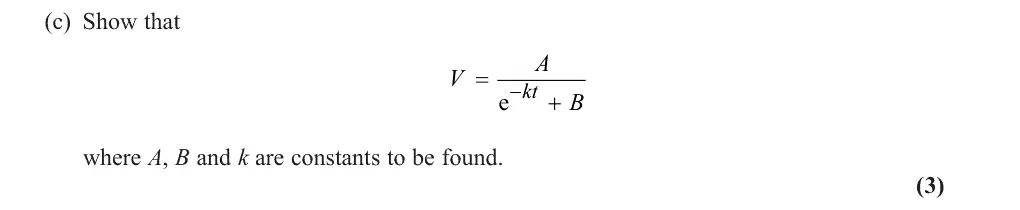
June 2024 · Paper 2 · Q12(c)3 marks
Mark scheme (whole question; this part is marked with the orange bar)
Examiner's comment
This question tested the candidates’ skill in various areas, i.e. finding partial fractions, integration, rules of logarithms, manipulating equations to eliminate logarithms using exponentials, indices, and commentating on the expected behaviour of a variable as another tends to infinity. This was a challenging question which in a number of instances, candidates struggled with after part (a). Those however, who were well prepared, were able to score full marks often with relatively concise solutions. Many candidates did not reach part (c), and some who did were not able to gain marks there because they either had not established a numerical constant of integration, or because their integrated expression was not of a correct form to earn credit. Successful attempts started with expressions such as ( ) 1 1 1 1 ln ln 25 ln 4 25 25 10 25 V V t - - = + to obtain expressions such as ( ) 1 1 ln 25 4 25 10 V t V = - and then eliminated the log to obtain ( ) 2.5 e 4 25 t V V = - and made V the subject. Some candidates obtained a correct expression for V but failed to reach the form required by the question. Incorrect log work, however, was common and expressions such as ( ) 2.5 e 4 4 25 t V V = + - were seen frequently. Candidates often made sign or coefficient errors but were awarded the method marks in (c) for a correct algebraic approach for the required rearrangement. A significant number didn’t reach the required form, leaving their answer with two 2.5 e t terms rather than the required single 2.5 e t - term.
Common mistakes
needs a numerical constant from (b)
combine logs to ln(V/(4(25 − V))) = 2.5t
make V the subject: V = 100/(e^(−2.5t) + 4)
common error splitting e^(a + b) as a sum
final form needs a single e^(−2.5t) term
June 2024 · Paper 2 · Q12(d)2 marks
Mark scheme (whole question; this part is marked with the orange bar)
Examiner's comment
This question tested the candidates’ skill in various areas, i.e. finding partial fractions, integration, rules of logarithms, manipulating equations to eliminate logarithms using exponentials, indices, and commentating on the expected behaviour of a variable as another tends to infinity. This was a challenging question which in a number of instances, candidates struggled with after part (a). Those however, who were well prepared, were able to score full marks often with relatively concise solutions. In part (d), candidates sometimes identified that L = 25, even when little else of credit was presented throughout, but usually those who had not attempted part (c) also made no attempt at (d). The reasons given were often not rigorous enough to gain credit, even when 25 had been established as the required value of L. When correct explanations were seen they usually stated that L = 25 because 2.5 e 0 t - → as t → or that L = 25 because d 0. d V t =
Common mistakes
L = 25
reason: as t → ∞, e^(−2.5t) → 0 (or dV/dt = 0 when V = 25)
reason must be rigorous
June 2024 · Paper 2 · Q13(a)4 marks
Mark scheme (whole question; this part is marked with the orange bar)
Examiner's comment
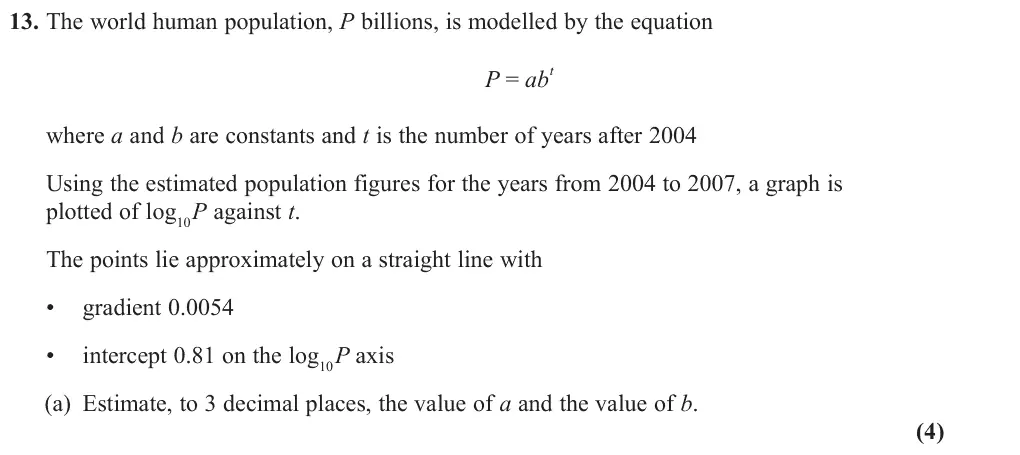
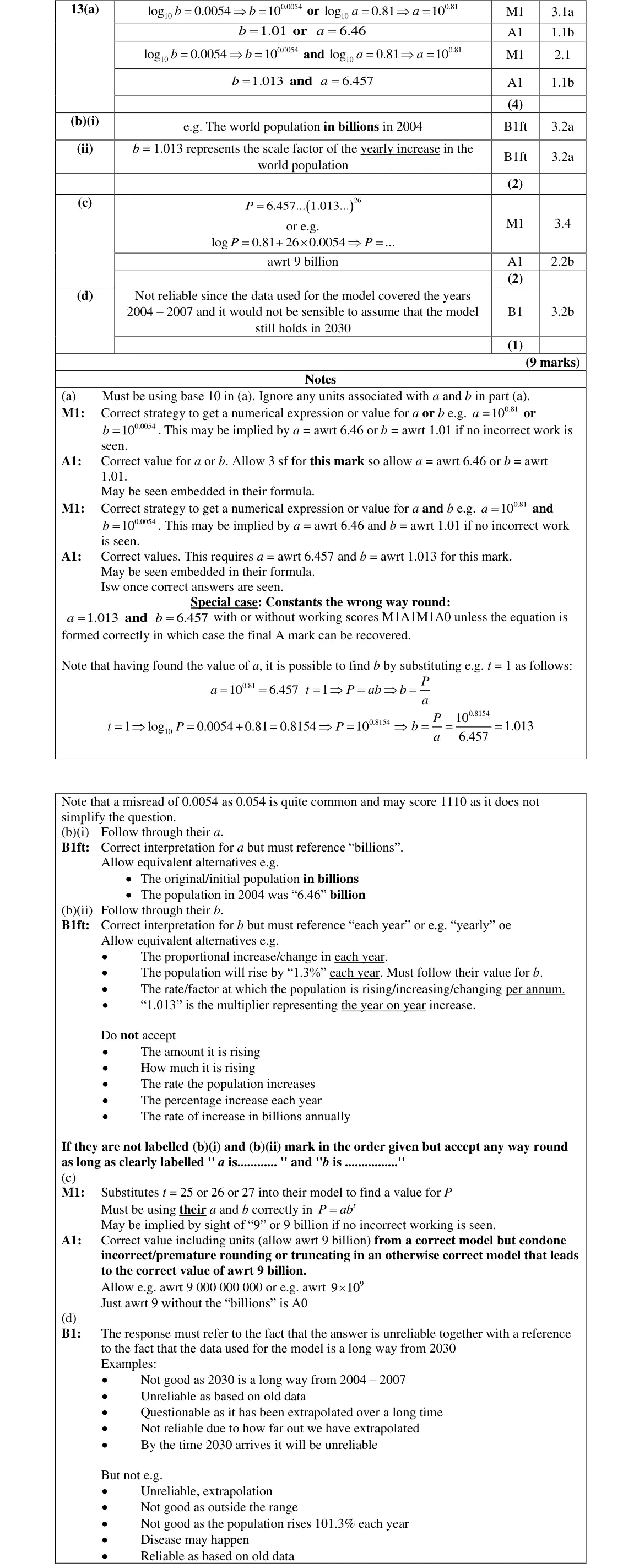
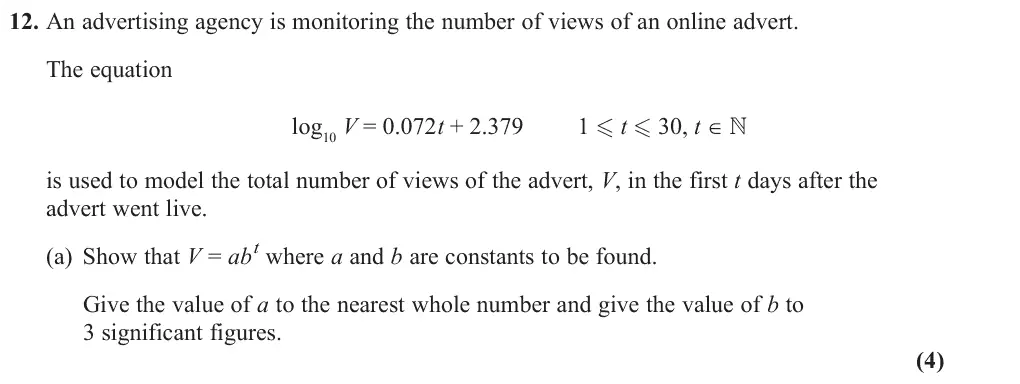
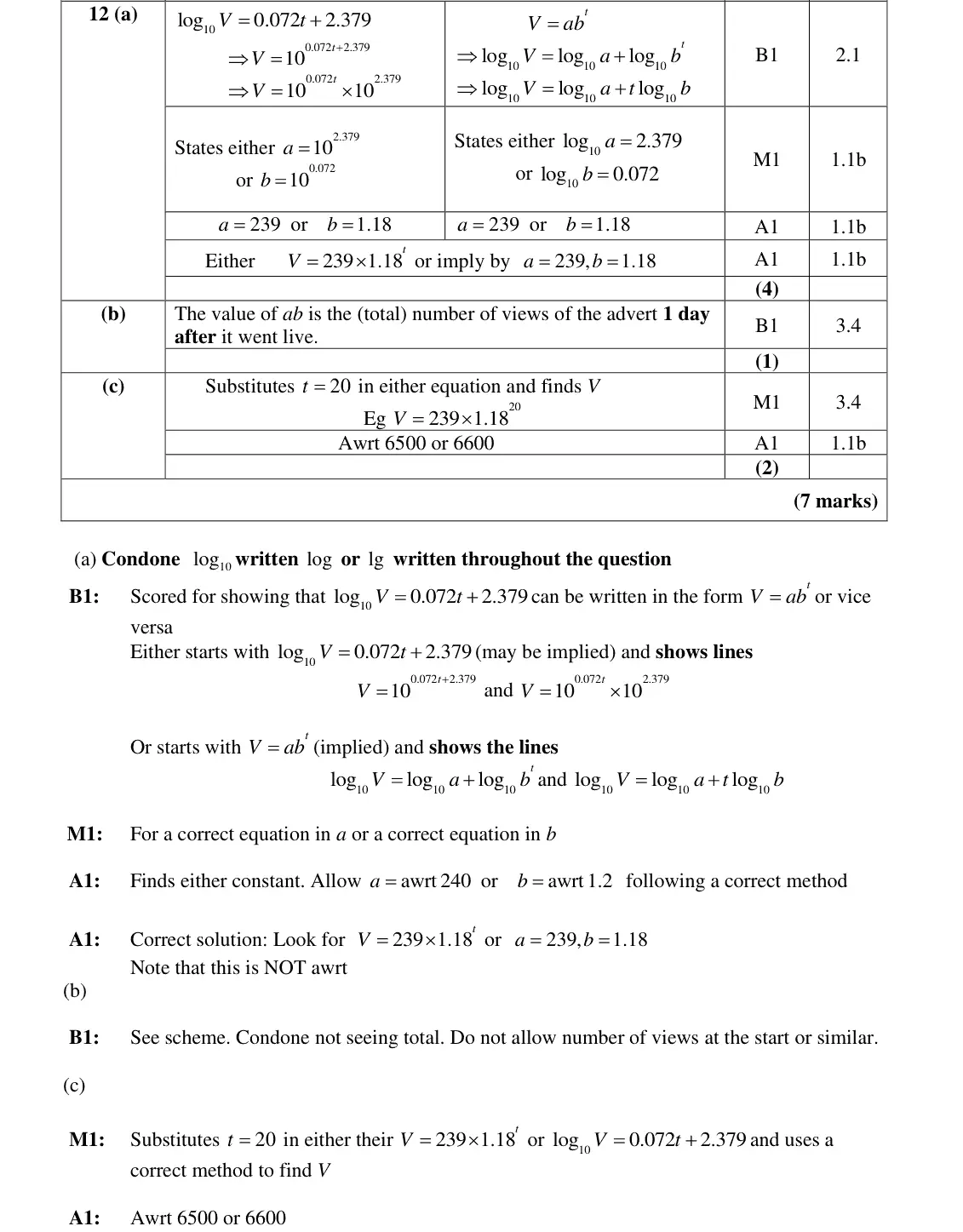
Part (a) was generally well answered with candidates commonly using the main method in the mark scheme, having made the link with y = mx + c and taking logarithms. Most candidates recognised log a = 0.81 and log b = 0.0054 with minimal preamble. When this was recognised it almost always led to correct answers. There were occasional errors with logs such as using base e instead of base 10. The misread of the 0.0054 as 0.054 was seen quite often. A common issue was candidates not reading the 3 decimal place requirement and instead writing things such as b = 1.0125 (awrt was applied so no marks were lost) or giving 3 significant figures. The method where values for t were used to obtain the values for a and b was sometimes used, but often candidates made limited progress towards obtaining an accurate answer.
Common mistakes
log P = log a + t log b so log₁₀a = 0.81, log₁₀b = 0.0054
a = 6.457, b = 1.013 (3 d.p., base 10 not e)
misreading 0.0054 as 0.054
June 2024 · Paper 2 · Q13(b)2 marks
Mark scheme (whole question; this part is marked with the orange bar)
Examiner's comment
For part (b)(i), most candidates understood that this was the initial population but the word billion was often omitted, showing a lack of full comprehension of the model. Part (b)(ii) was less well answered than (b)(i). The proportionality or rate was often recognised but “per year” was sometimes omitted. The wording of answers also cost candidates the mark as they often talked about the “amount” or “how much” the population went up by, or they wrote correct responses followed by it increases by “1.013 billion”.
Common mistakes
(i) a = world population in billions in 2004 ("billions" needed)
(ii) b = yearly scale factor (1.3% increase per year)
"how much it rises" or "1.013 billion" not accepted
June 2023 · Paper 1 · Q6(a)1 mark
Mark scheme (whole question; this part is marked with the orange bar)
Examiner's comment
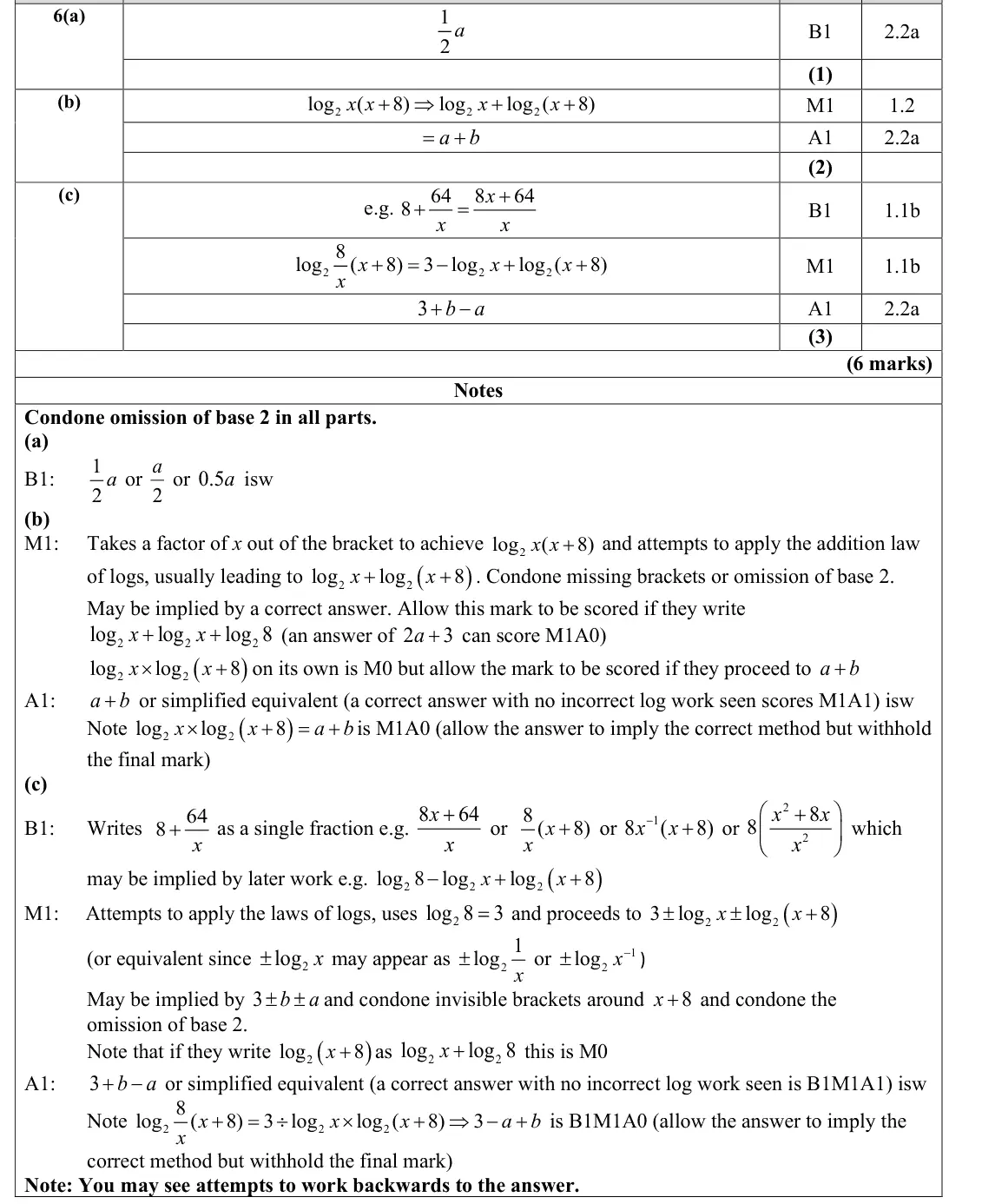
This was again another accessible question with a total of 6 marks split between 3 different sub-parts. However, this topic continues to be one which candidates struggle with and in all parts of this question. It was not uncommon to see candidates attempting to use rules of indices rather than logarithms, starting off with 2a x = , 2 8 b x = + and attempting (usually incorrectly) to substitute these into the expressions given. Where this was successful candidates generally failed to remove 2 log 2 resulting in them losing one mark per part. Part (a) was a B mark for achieving the correct answer. Several candidates got as far as 2 0.5log x without substituting a into this and so gained no credit. Others could not apply the index log law to the square root of x correctly and so ended up with the answer square root of a often written as 1 2 a
Common mistakes
answer must be in terms of a (½a), not ½log₂x
√a is a common wrong answer
June 2023 · Paper 1 · Q6(b)2 marks
Mark scheme (whole question; this part is marked with the orange bar)
Examiner's comment
This was again another accessible question with a total of 6 marks split between 3 different sub-parts. However, this topic continues to be one which candidates struggle with and in all parts of this question. It was not uncommon to see candidates attempting to use rules of indices rather than logarithms, starting off with 2a x = , 2 8 b x = + and attempting (usually incorrectly) to substitute these into the expressions given. Where this was successful candidates generally failed to remove 2 log 2 resulting in them losing one mark per part. Part (b) surprisingly seemed to have more success. It was generally answered well with most candidates realising that factorising the argument of the logarithm was needed before applying the addition law of logarithms. There were several candidates who, having factorised correctly, applied the addition law incorrectly, resulting in an answer of a b and so lost both marks. Several candidates just wrote down the correct answer and gained both marks. If the correct answer followed the product of the relevant logs, ( ) ( ) log log 8 x x + rather than the sum, then the answer was allowed to imply the correct method, but the final mark was withheld for this incorrect working seen. The main misconception was the sight of 2 log log8 x x + which was awarded no marks, although writing log log log log8 x x + + + (possibly seen as 2 3 a + ) gained the method mark as evidence of correct addition law used at some point. Some candidates attempted to work backwards from the given log expressions for a and b with very limited success.
Common mistakes
factorise x² + 8x = x(x + 8) first
log₂x × log₂(x + 8) is not the addition law
June 2023 · Paper 1 · Q6(c)3 marks
Mark scheme (whole question; this part is marked with the orange bar)
Examiner's comment
This was again another accessible question with a total of 6 marks split between 3 different sub-parts. However, this topic continues to be one which candidates struggle with and in all parts of this question. It was not uncommon to see candidates attempting to use rules of indices rather than logarithms, starting off with 2a x = , 2 8 b x = + and attempting (usually incorrectly) to substitute these into the expressions given. Where this was successful candidates generally failed to remove 2 log 2 resulting in them losing one mark per part. Part (c) was the most challenging part of this question and clearly identified the stronger mathematicians of the cohort. Many responses to this part were blank, whilst the more able candidates provided very succinct solutions. For those who attempted with less success there were some rather dubious attempts at writing 64 8 x + as a single fraction. Of those who managed this correctly and progressed to applying the laws of logarithms, quite a few left in the 2 log 8 rather than simplifying to its value of 3, which meant that only the first mark was available: marks had already been awarded for the power law and addition law in previous parts of the question and here we required an understanding of reaching an answer in its simplest form. This further demonstrated the lack of logarithmic fluency for a number of candidates. Others factorised 8 from 64 8 x + but then struggled to apply the laws appropriately as they had not completed the process of writing the argument as a single fraction. Misconceptions were seen such as expressing 64 log 8 x + as 64 log8 log x + and sign errors often occurred.
Common mistakes
write 8 + 64/x as one fraction (8/x)(x + 8)
log₂8 = 3
log₂(x + 8) ≠ log₂x + log₂8
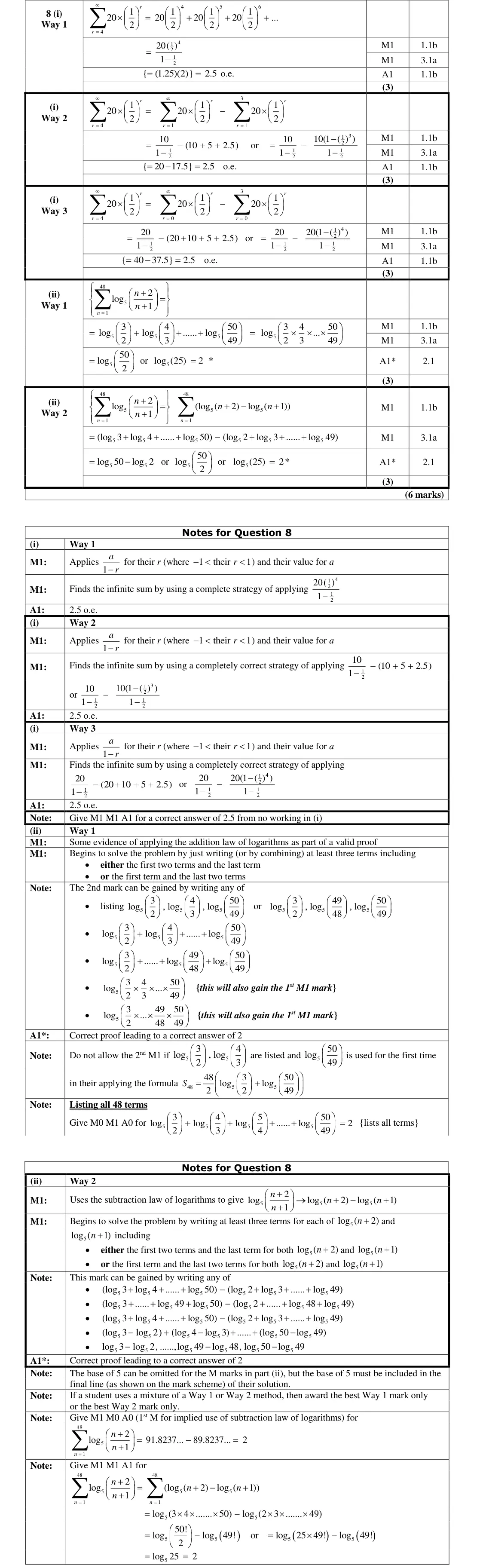
June 2023 · AS Paper 1 · Q95 marks
Mark scheme (whole question; this part is marked with the orange bar)
Examiner's comment
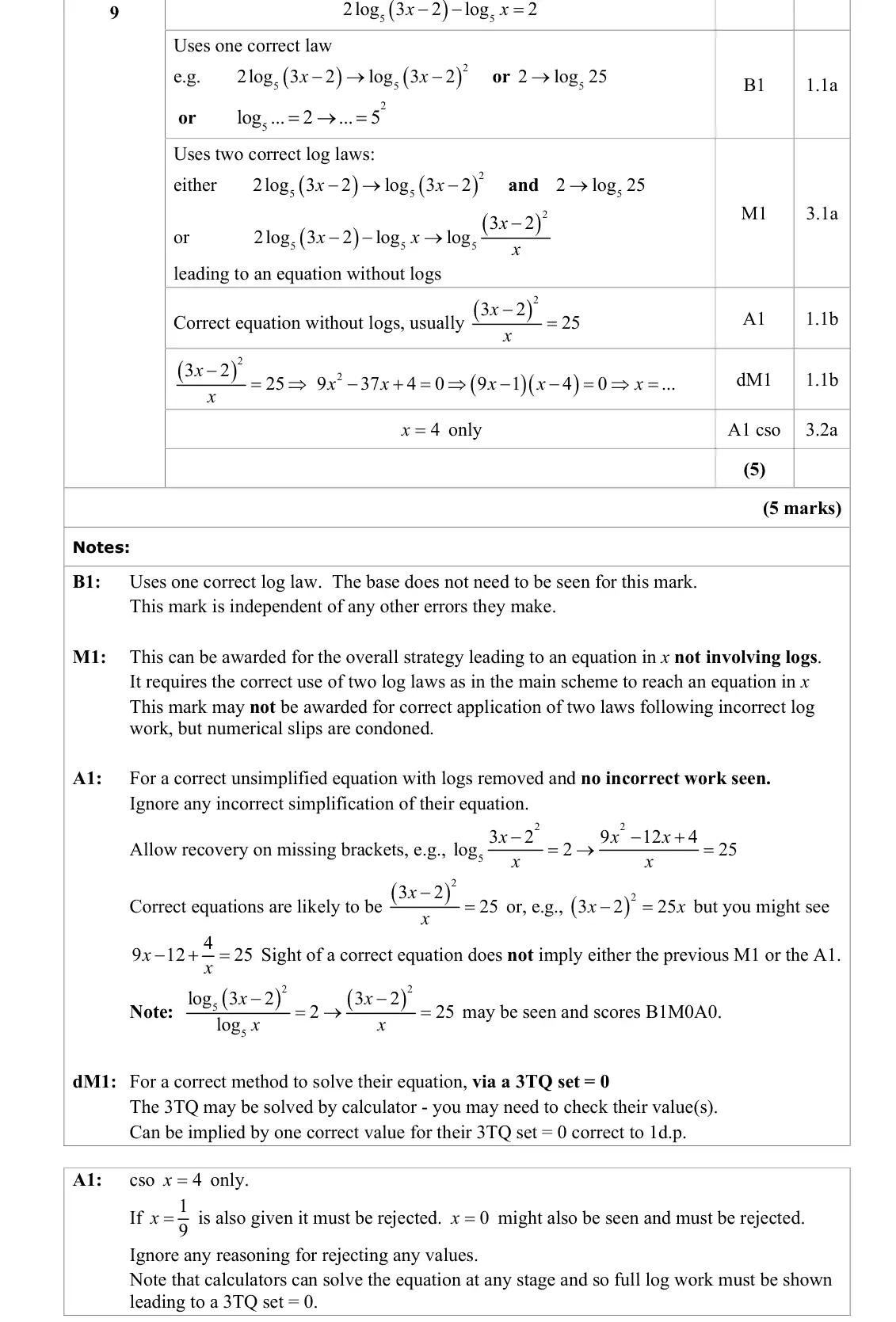
This question was an effective discriminator between candidates. There was evidence of log misconceptions in a substantial proportion of candidates’ work and there were a number of completely blank scripts seen. Often though, even weaker candidates were able to pick up the first mark for evidence of a log law correctly applied, albeit amidst otherwise erroneous work which limited them to the first mark only. Most commonly this was earned in isolation either for use of the power law ( ) ( ) 2 5 5 2log 3 2 log 3 2 x x - → - or for 2 2 5 → when both sides of the equation were raised to base 5 in an attempt to remove logs. It was not uncommon, however, to see the right-hand side become 25 rather than 52. Another common error involved a misapplication of the log law for subtraction whereby log log A B - was believed to be equal to log log A B with the log terms on numerator and denominator subsequently ‘cancelled’. In contrast, however, there were a large number of candidates who were well-prepared for this question and were able to demonstrate clear understanding and apply their log knowledge accurately to gain the first three marks. Following a successful removal of logs, most were able to rearrange their equation into a solvable form and gain the final method mark for solving the resulting quadratic equation. There was a surprising proportion of candidates who chose to attempt to simplify the algebraic fraction 2 9 12 4 x x x - + , often correctly, to 4 9 12 x x - + . Of these, a good proportion managed to recover, but many candidates simply used an equation solver on their calculator to arrive at the two solutions, and thus forfeited the final two marks. Similar errors to those observed in question 1 were also apparent here in the solving of a quadratic equation and factorisation proved again to be the most successful algebraic method. The final mark was a particularly good discriminator as only a minority of stronger candidates checked the viability of each root in the original equation and so most candidates failed to reject the 1 9 x = root. It was again disappointing to see the number of attempts that jumped straight to 1 9 x = without showing sufficient log work to achieve an equation without logs. Candidates must be clear that using calculators to solve equations must be treated with caution and that they risk losing a substantial number of marks.
Common mistakes
2log₅(3x − 2) = log₅(3x − 2)²
2 = log₅25 (not 2⁵)
subtraction law gives a quotient, not log A / log B
(3x − 2)² = 25x leads to 9x² − 37x + 4 = 0
reject x = 1/9 (3x − 2 < 0), x = 4 only
full log work must be shown, not calculator
June 2023 · AS Paper 1 · Q11(a)2 marks
Mark scheme (whole question; this part is marked with the orange bar)
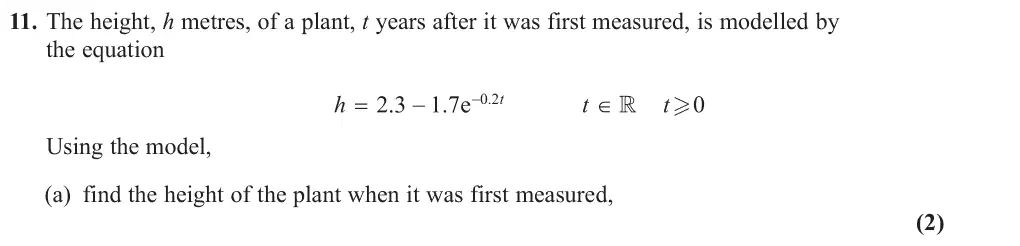
Examiner's comment
This question on exponential functions caused problems for the majority in part (b), as they failed to recognise that differentiation was required. However, generally parts (a) and (c) were answered well. In part (a), most candidates identified that they needed to substitute t = 0 into the given equation and successfully reached h = 0.6 metres, which was often seen as 60cm or 3 5 , both of which were allowed. A few failed to use e0 = 1 and as a result arrived at an incorrect answer.
Common mistakes
t = 0 and e⁰ = 1 gives h = 0.6 m (60 cm)
June 2023 · Paper 1 · Q11(a)2 marks
Mark scheme (whole question; this part is marked with the orange bar)
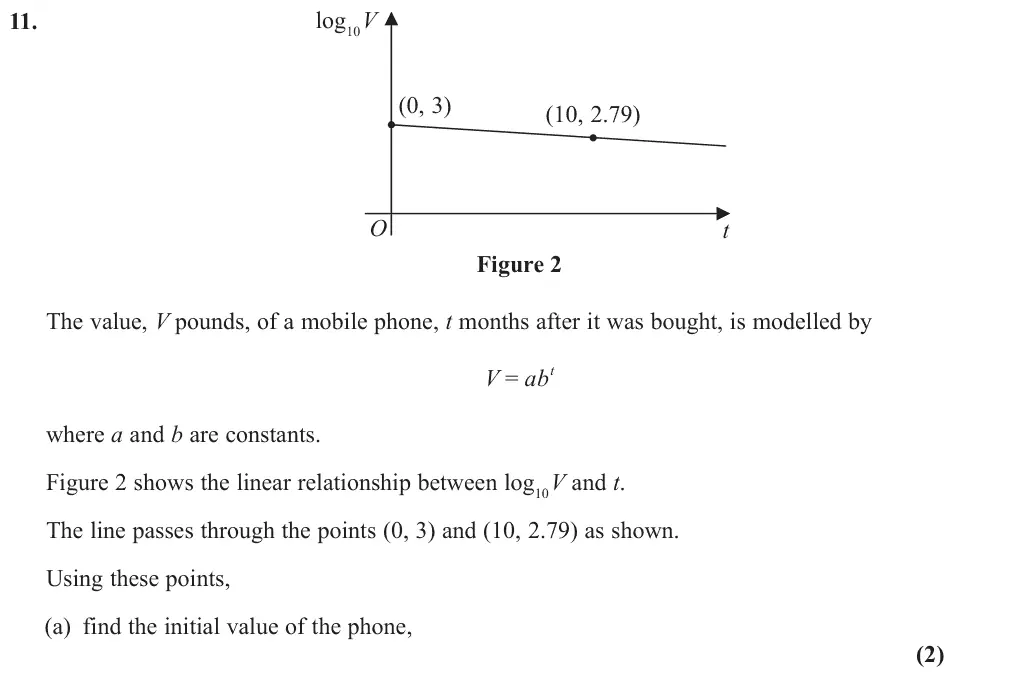
Examiner's comment
This question proved to be quite challenging for a number of candidates, however those who were able to manipulate logarithms using the rules correctly, along with calculating the gradient, were often very successful. It is worth noting that there were a number of candidates who did not pay attention to the labelling on the y-axis and therefore were unable to score any marks on this question. As with many modelling questions, candidates currently lack proficiency at relating the mathematics to the context of the question. In part (a), most candidates were able to find the initial value correctly, although several lost the accuracy mark by forgetting to include units. The location of the unit was condoned e.g. 1000£ was seen on many occasions. A common reason for candidates not achieving any marks was to assume 3 V = or 10 log 3 V = , instead of 10 log 3 V = . A few candidates used natural logs instead of 10 log , resulting in 3e V = instead of 3 10 V = . Some candidates just stated the initial value was 3, not fully appreciating what information the linear graph was representing.
Common mistakes
log₁₀V = 3 when t = 0, so V = 10³ = £1000 (units needed)
June 2023 · AS Paper 1 · Q11(b)3 marks
Mark scheme (whole question; this part is marked with the orange bar)
Examiner's comment
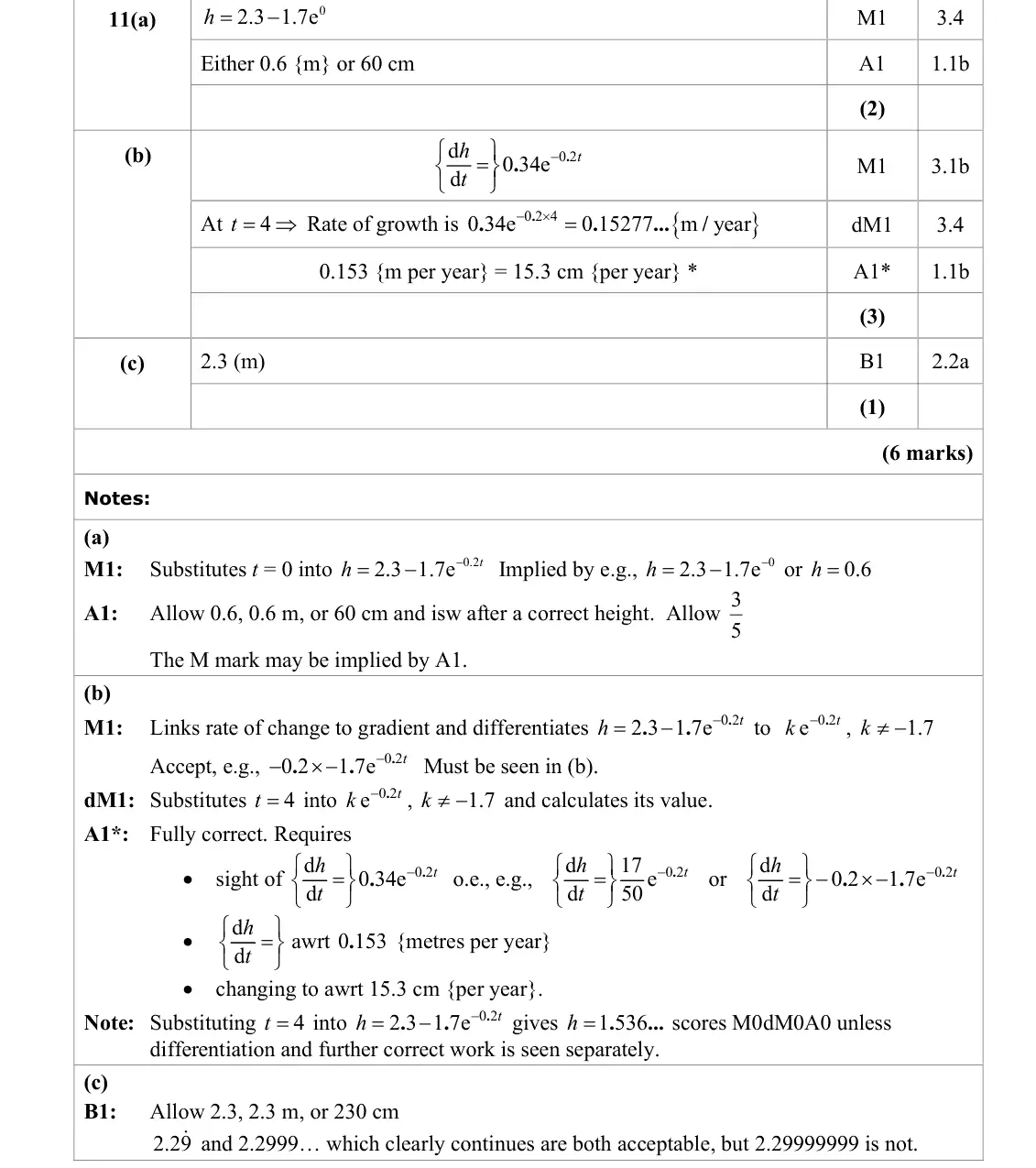
This question on exponential functions caused problems for the majority in part (b), as they failed to recognise that differentiation was required. However, generally parts (a) and (c) were answered well. In part (b), the majority of candidates failed to recognise that the 15.3 cm per year meant that they were required to differentiate to obtain a rate of change, and attempted instead to substitute t = 4 into the expression for h. This answer resembled 15.3 cm, so many incorrectly assumed that they had answered the question, even though the subsequent conversion from metres to cm made no sense. Some attempted to divide this value by 4, showing some appreciation for the units given in the question, but lacking an appreciation that the information given provided an instantaneous rate of change and not an average rate over the four years. Without an attempt at differentiation no marks could be scored in (b) but those candidates who did differentiate generally successfully answered this part of the question.
Common mistakes
rate of growth means dh/dt = 0.34e^(−0.2t), not h at t = 4 (1.536 m) or h/4
0.153 m per year = 15.3 cm per year
June 2023 · Paper 1 · Q11(b)3 marks
Mark scheme (whole question; this part is marked with the orange bar)
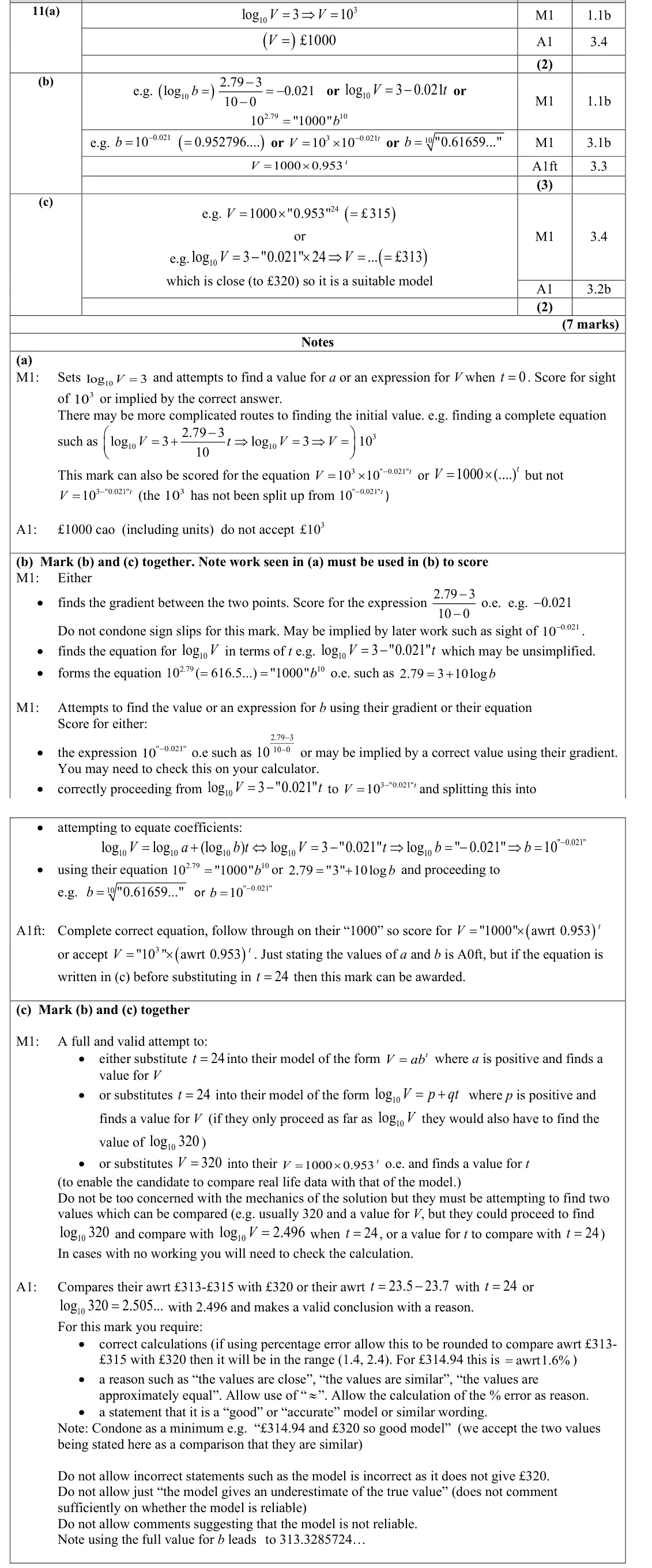
Examiner's comment
This question proved to be quite challenging for a number of candidates, however those who were able to manipulate logarithms using the rules correctly, along with calculating the gradient, were often very successful. It is worth noting that there were a number of candidates who did not pay attention to the labelling on the y-axis and therefore were unable to score any marks on this question. As with many modelling questions, candidates currently lack proficiency at relating the mathematics to the context of the question. Part (b) was discriminating, requiring some understanding of the relationship between t V ab = and the linear graph. Those candidates who were most successful with this part of the question, made the link between part (a) and the value of a without having to do additional calculations. Many candidates were able to find the gradient of the graph correctly and pick up the first method mark. However, finding a value for b was difficult for many candidates. Those candidates who did not make the link with part (a) often had to recalculate a or attempted to use simultaneous equations, often with little success. There were a lot of very convoluted incorrect solutions in this question which showed a poor grasp of logarithms and the associated rules; log t ab was commonly seen; others failed to correctly relate log log log V a t b = + to y mx c = + despite previous questions on the topic, confusing which were the variables and which were the constants. There were several cases of candidates mixing up the x, y coordinates in their substitution. It was encouraging to see that most candidates tried to give the full equation if they found values for a and b, but there was still a good number that did not and thus, lost the final mark. A few candidates were unable to score the final mark for leaving their answer as 10 log 3 0.021 V t = - . Candidates were able to gain the final mark of part (b), if the complete equation was seen in part (c), although this was rare to see.
Common mistakes
gradient −0.021 = log₁₀b, so b = 10^−0.021 ≈ 0.953
give the complete equation V = 1000 × 0.953ᵗ
June 2023 · AS Paper 1 · Q11(c)1 mark
Mark scheme (whole question; this part is marked with the orange bar)
Examiner's comment
This question on exponential functions caused problems for the majority in part (b), as they failed to recognise that differentiation was required. However, generally parts (a) and (c) were answered well. In part (c), most candidates identified that the limiting value was 2.3 m, although a number missed this part out, especially after a poor attempt at part (b).
Common mistakes
as t → ∞, e^(−0.2t) → 0 so the limit is 2.3 m
June 2023 · Paper 2 · Q3(a)3 marks
Mark scheme (whole question; this part is marked with the orange bar)
Examiner's comment
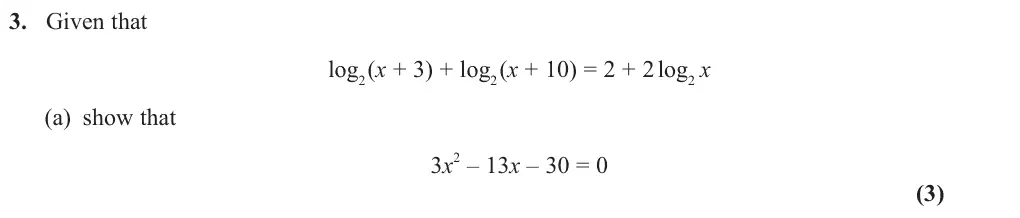
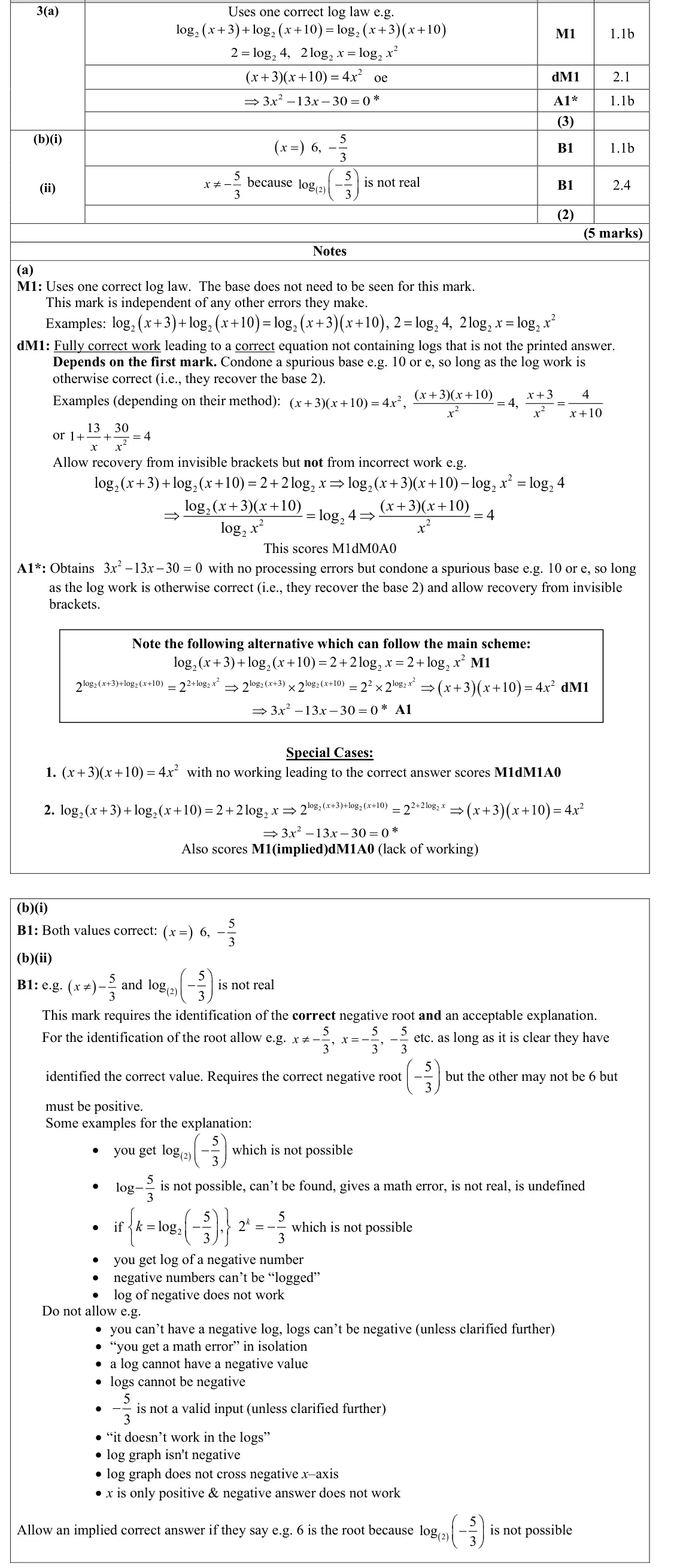
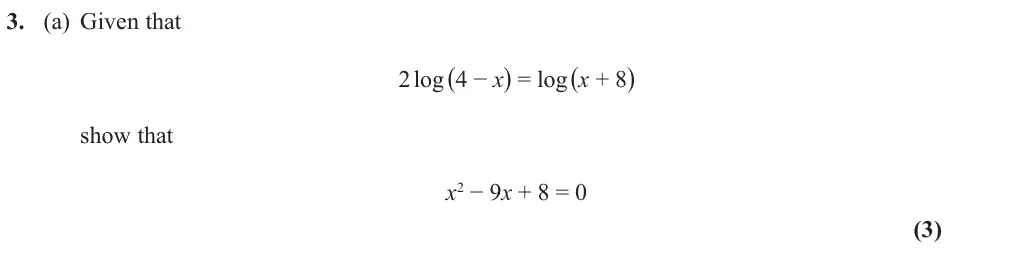
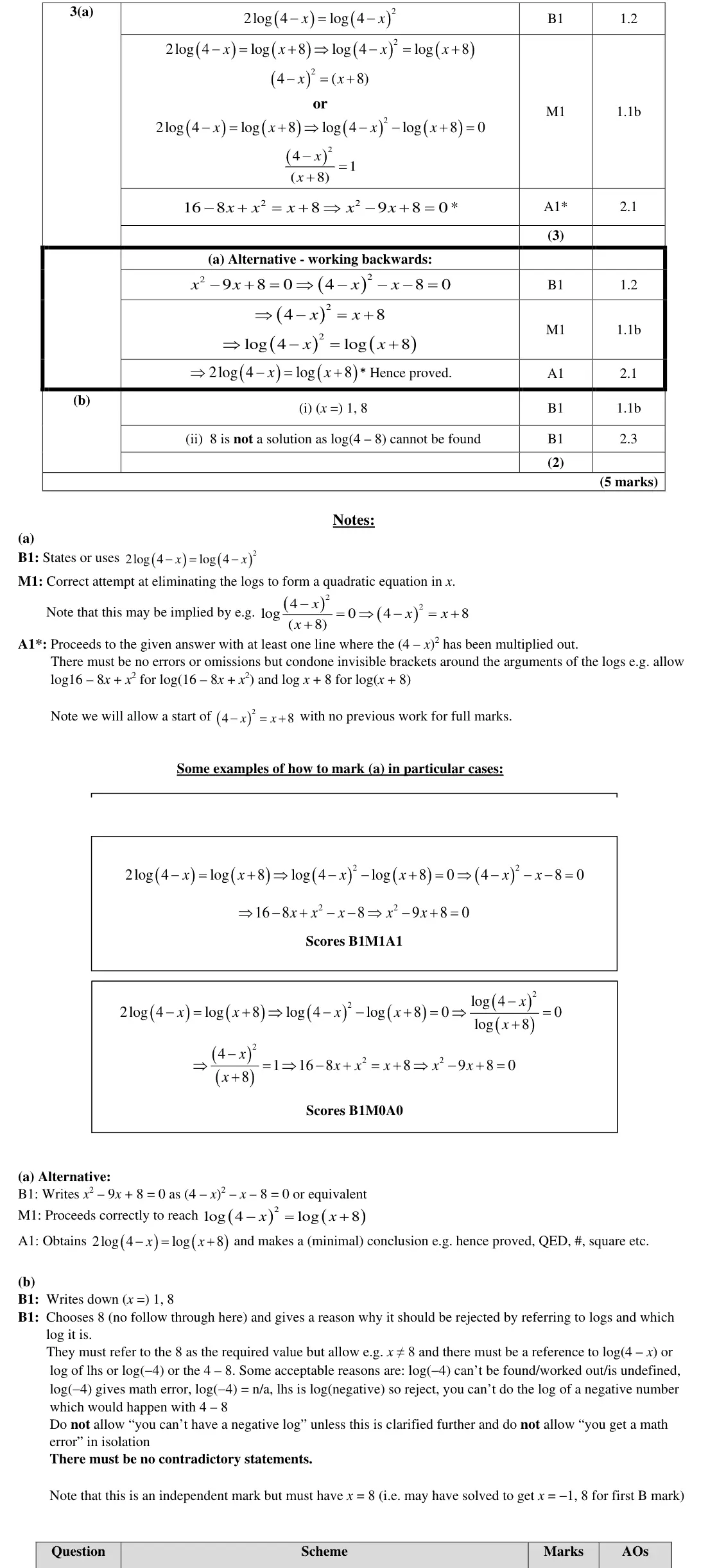
There were very few non-attempts or zero scores here and this question proved to be a good discriminator with a spread of marks achieved by candidates. Most students managed to score at least one mark out of three in part (a) by correctly applying a single log law, usually the product, division or power rules for logs. Dealing with the constant, 2, proved to be more challenging for many. Those who wrote 2 as log2(4) and then applied the product rule for logs on the right- hand-side had most success. Others grouped the three log terms and applied the exponential rule to eliminate the logs. Sometimes there was a lot of working which wasn’t always set out as clearly as it could have been. A significant proportion of candidates did succeed, but it was not uncommon to see correct use of a log law followed by incorrect log work in an attempt to fudge the printed result. Some poor responses involved an initial ‘cancelling’ of logs before any attempt to combine log terms or to raise both sides to the base 2 correctly. There was a minority of candidates who perhaps knew how to proceed but did not show sufficient working to gain full marks in a ‘show that’ question. Candidates should be reminded that all steps should be shown in this type of question. It was a shame when fully correct log work was followed by an incomplete ‘equation’ at the end of this part, as missing the ‘= 0’ meant the loss of the final mark here. A small number of candidates who were unsure how to start part (a) used the printed answer and tried to “work backwards” but often made errors leading to incorrect solutions.
Common mistakes
write 2 as log₂4 and 2log₂x as log₂x², combine to (x + 3)(x + 10) = 4x²
"cancelling" logs before combining
dividing logs (log A / log B) is wrong
show enough steps for a given answer
June 2023 · Paper 2 · Q3(b)2 marks
Mark scheme (whole question; this part is marked with the orange bar)
Examiner's comment
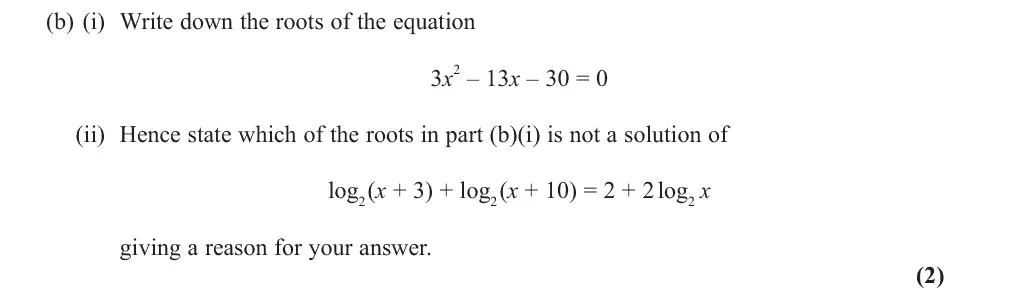
There were very few non-attempts or zero scores here and this question proved to be a good discriminator with a spread of marks achieved by candidates. Most students managed to score at 5 - In (b) part (i), almost all candidates were able to correctly state the values ‘6’ and ‘ ’, it was 3 clear that in many cases candidates were making use of their calculators to solve the quadratic equation which was acceptable. Part (ii) however, was answered less reliably. Although most 5 x = - candidates had some understanding of the domain of a log function and knew that was 3 not a valid solution, many were unable to provide reasoning that was precise enough for the mark here. It was common to see, for example, “a log can’t be negative”, which was not considered sufficiently clear. Others stated simply ‘because it is negative’ which was also insufficient. A range of responses which engaged specifically with the domain of a log function needing to be positive were considered acceptable such as; ‘log of a negative value is undefined/impossible/gives a math error’.
Common mistakes
roots 6 and −5/3
−5/3 is rejected because log₂(−5/3) is not real/undefined (log of a negative number)
"logs can't be negative" or "because it is negative" is not enough
June 2023 · Paper 2 · Q4(b)3 marks
Mark scheme (whole question; this part is marked with the orange bar)
Examiner's comment
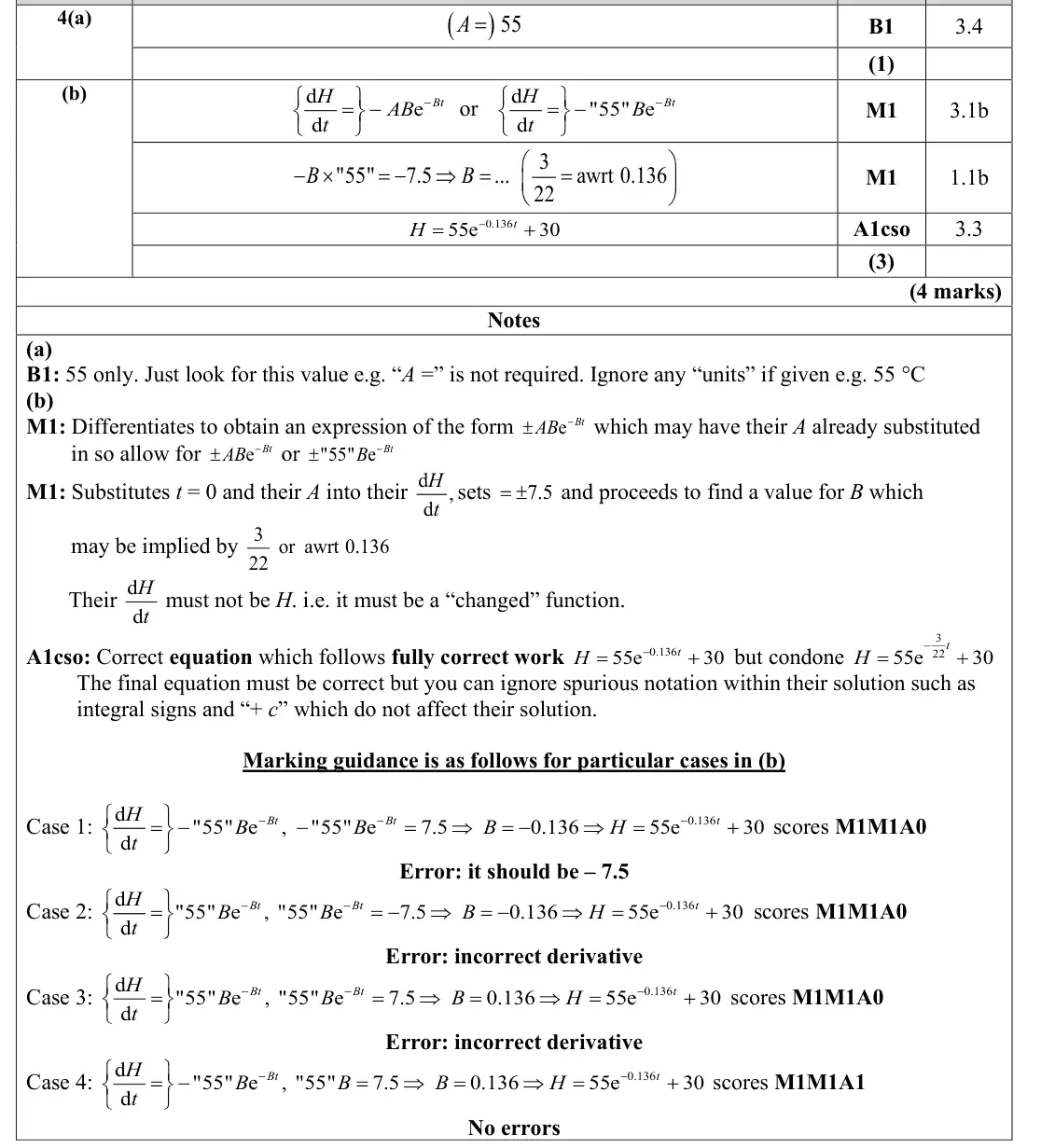
Those scoring full marks in this question were in a significant minority of candidates. Part (b) had mixed outcomes for candidates. Interpretation of the given initial rate of cooling was problematic for many candidates. There was a general lack of appreciation that the rate of cooling was a continuous variable which represented d . d H t - Those candidates not recognising this and using a difference method (similar to those introduced at GCSE) between t = 0 and t = 1 were restricted to the initial B mark in part (a). The most common attempt at a response for these candidates was setting H(1) = 85 - 7.5 and working from there. Of those who recognised the need to first find d d H t and then substitute t = 0, many incorrectly used d d H t = 7.5 rather than the correct d d H t = -7.5 to express a negative increase in temperature. This led to the loss of the last mark. Another error was to forget to differentiate the + 30 to zero leaving a constant in their d d H t , only scoring at most the second method mark for substituting t = 0 and their A into their d d H t . Some differentiated incorrectly to obtain -55Bte-Bt. Several students missed out on the final mark despite correct work by not writing out the final equation. It is important that centres make candidates aware that when a question asks for the complete equation for a model that it is given as such and not just the values of any required constants.
Common mistakes
rate of cooling is dH/dt = −55Be^(−Bt) = −7.5 at t = 0 (sign matters), B = 3/22 ≈ 0.136
give the complete equation H = 55e^(−0.136t) + 30
using H(1) = 85 − 7.5 (difference method) is wrong
derivative of +30 is 0
June 2023 · Paper 2 · Q9(a)3 marks
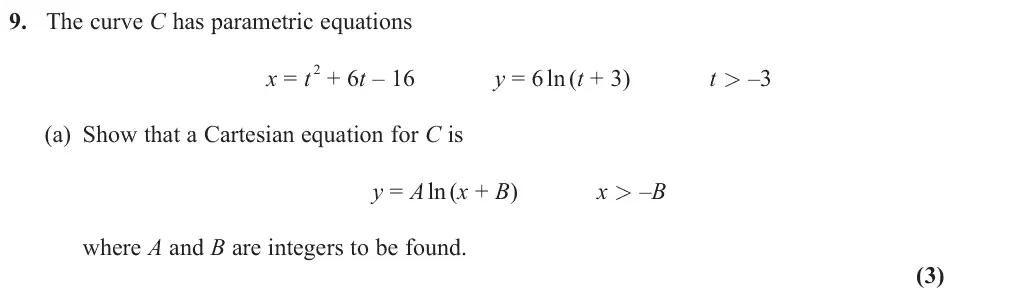
Mark scheme (whole question; this part is marked with the orange bar)
Examiner's comment
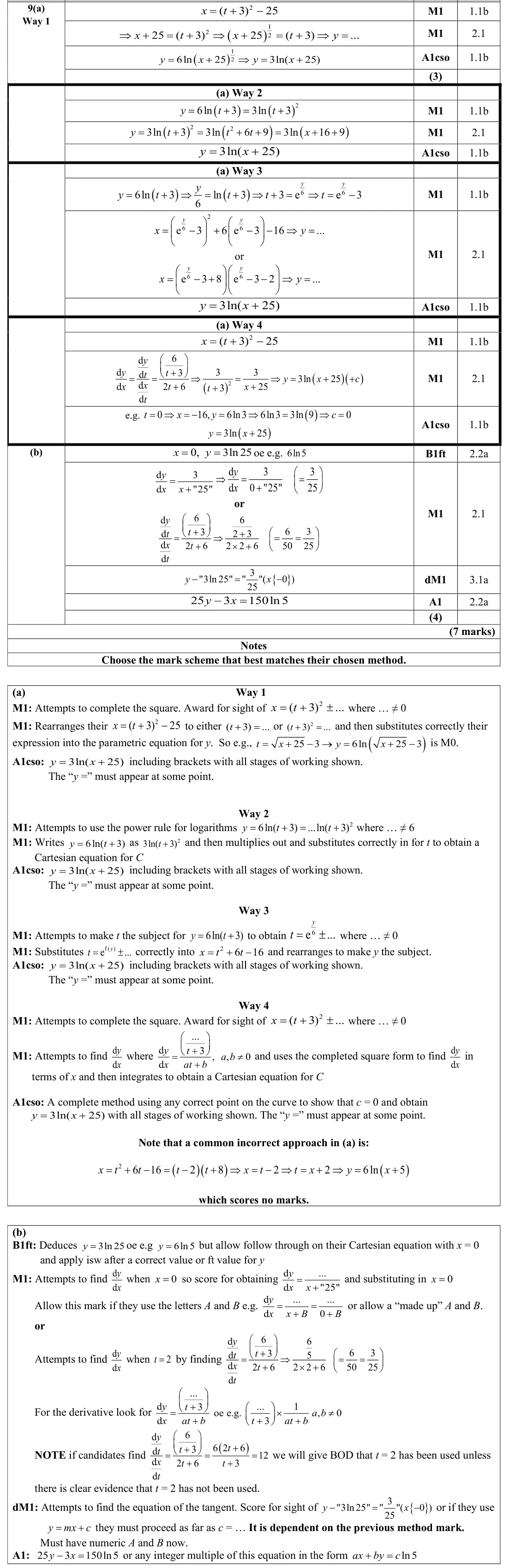
Most candidates found part (a) challenging but it was usually attempted. There were not many blank responses. Of the four methods listed on the mark scheme, one common successful method was to substitute t in terms of x into y = 6ln(t + 3) via “completing the square” (way 1). When substituting into y = 6ln(t + 3), if a correct t equation was created, then this usually led to full marks. Another common approach was to rearrange t in terms of y, usually successfully as 6 e 3 y t = - and substitute into x = t2 + 6t 16 (way 3). When using this method some candidates had difficulty squaring 6 e y meaning they were unable to earn full marks. Some candidates incorrectly set 25 5 x x + = + thus also losing the accuracy mark. A significant number of candidates factorised x = t2 + 6t 16 to give x = (t 2)(t + 8) and then wrongly thought x = t 2. This then often led to y = 6ln(x + 5) which scored no marks in this part.
Common mistakes
complete the square: x = (t + 3)² − 25 so t + 3 = √(x + 25), y = 6ln√(x + 25) = 3ln(x + 25), A = 3, B = 25
common error x = (t − 2)(t + 8) so "x = t − 2" giving 6ln(x + 5) scores 0
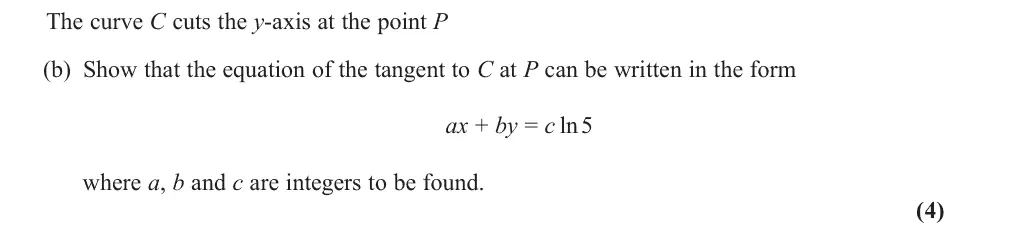
June 2023 · Paper 2 · Q9(b)4 marks
Mark scheme (whole question; this part is marked with the orange bar)
Examiner's comment
Candidates were generally more successful in part (b) than part (a). Many candidates found the y intercept by substituting t = 2 into the parametric equation for y rather than substituting x = 0 into the Cartesian equation. The first method mark was more challenging. Some candidates attempted the derivative from the Cartesian equation and they usually reached either ( ) 3 x A + or 3 x whilst others attempted to use the chain rule approach. Some candidates obtained the correct derivative but failed to substitute x = 0. If a candidate achieved the first method mark, they usually went on to achieve the dependent method mark for attempting to find the equation of the tangent. There were very few cases where the candidate used the negative reciprocal of their gradient. The most successful way candidates achieved full marks was differentiating their Cartesian equation. Those that differentiated parametrically were often caught out by arithmetic and algebraic errors or substituted t = 0 instead of t = 2 and failed to achieve the gradient correctly. For the final answer, some candidates had failed to realise the form of equation the question was asking for so left their answer as “y =” or they didn’t have 𝑎, 𝑏 and 𝑐 as integers. Many candidates who had incorrectly answered (a), were able to go on to achieve full marks in (b) by using parametric differentiation to work out the gradient. There were very few blank responses for this part of the question.
Common mistakes
P at x = 0, y = 3ln25 = 6ln5 (t = 2, not t = 0)
gradient 3/25 from the Cartesian form or dy/dt ÷ dx/dt at t = 2
25y − 3x = 150ln5
answer must be in the form ax + by = c ln5
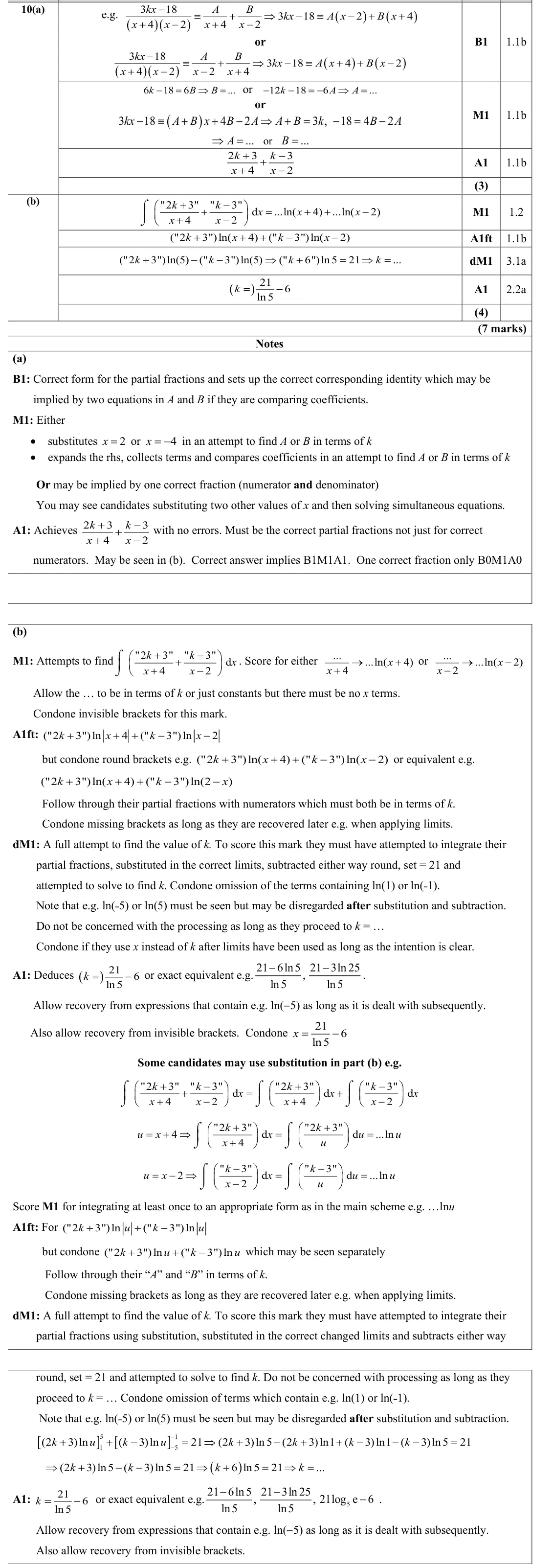
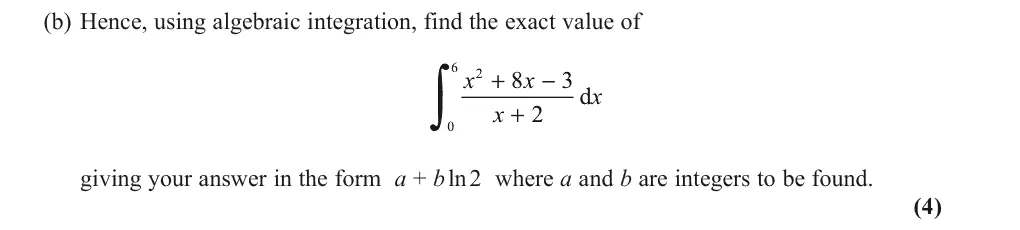
June 2023 · Paper 2 · Q10(b)4 marks
Mark scheme (whole question; this part is marked with the orange bar)
Examiner's comment
Very few candidates managed full marks in part (b), although the majority did gain the first method mark for integrating to obtain …ln(x + 4) or …ln(x 2). Those who did not recognise the logarithmic form for the integration were unable to score any marks in this part. Some achieved the correct form after first using a formal substitution. Of those who integrated their partial fractions successfully, the vast majority were far from strict in their use of the modulus symbol and many lost marks due to lack of appreciation of its importance. Use of modulus notation for integrating reciprocal functions should be picked up by centres as a teaching point with future cohorts. Students who had written the incorrect term ( ) ( ) 3 ln 5 k - - - or even the correct term ( ) 3 ln 5 k - - - after applying the limit 3 x = -, went on to indicate that they believed this term was zero or could just be ignored. Another example of poor practice was missing brackets around the coefficients e.g. ( ) ( ) 2 3ln 4 3ln 2 k x k x + + + - - being surprisingly common. The “invisible” brackets were sometimes recovered but in many cases were not. There were also examples where the brackets around the (x + 4) and the (x 2) were also missing. Those with a systematic well-laid out approach for the substitution of limits in both terms and identifying clear subtraction of the lower limit, went on to score 3 or 4 marks in part (b) and commonly full marks for the question. Many candidates however were hampered by their own layout making the correct interpretation of ln ( 5) as ln |5| even more challenging. The perhaps unfamiliar, exact form needed for k also proved a challenge for even the best candidates. There were some elaborate attempts to achieve an expression for k, some using exponentials, but many gave up along the way. There were, however some very elegant and correct solutions to this question and some different forms of the exact equivalent answer were seen, for example 5 21log e 6 - but most correct answers were given as 21 6. ln5 -
Common mistakes
(2k + 3)ln(modulus of x + 4) + (k − 3)ln(modulus of x − 2)
use modulus signs (ln of a negative)
brackets round the coefficients
(k + 6)ln5 = 21 so k = 21/ln5 − 6
terms in ln1 vanish but ln(5) from the second term does not
June 2023 · Paper 2 · Q13(c)5 marks
Mark scheme (whole question; this part is marked with the orange bar)
Examiner's comment
In part (c), the commonest methods of integration adopted were substitution, using either u = x + 3 or u = (x + 3)2 , integration by parts, integration after applying partial fractions and integration using the reverse chain rule after writing the integrand in appropriate form. Candidates had varying success with all of these approaches, gaining a variety of marks. Integration by parts seemed to lead to most arithmetical mistakes. Errors resulted from using parts ‘the wrong way round’ and others integrated the ( ) 2 3 x - + term incorrectly. When integrating by substitution some students incorrectly thought that 2 18 u - would integrate to a natural logarithm. There was some confusion with the limits; some candidates did not change the limits to “u” values and other who did evaluate new limits for their substitution switched back to an expression in x before substituting their changed limits. When using partial fractions some students struggled with the initial format for the partial fractions and it was not uncommon to see partial fractions of the form 3 3 A B x x + + + . There was a number of candidates who either did not attempt this part of the question at all or who lacked a correct strategy. There were responses where students attempted to integrate numerator and denominator separately, e.g. 6x to 3x2 and ( ) 2 1 3 x + to a variation of ( ) 2 ln 3 x + , and proceeded to multiply both results. A number of candidates were awarded just the first mark as their overall problem solving strategy was correct despite the fact they were unable to fully implement it. There were also many candidates who could carry out the work in this part completely successfully.
Common mistakes
substitution u = 3 + x (change limits to 3.2 and 3.4), parts, or partial fractions 6/(3 + x) − 18/(3 + x)²
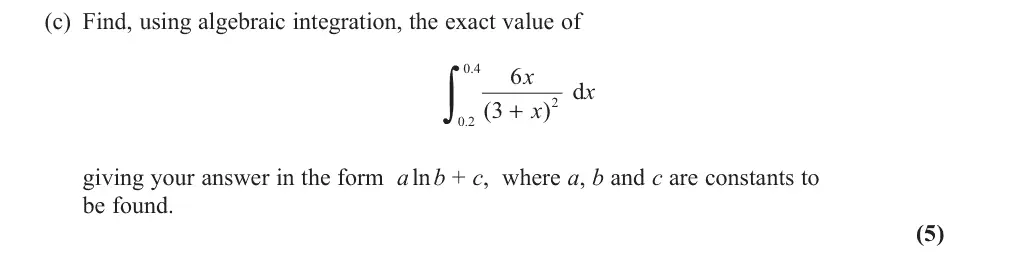
result 6ln(17/16) − 45/136
18/u² does not integrate to a log
switching back to x but using u limits
June 2022 · Paper 1 · Q4(b)2 marksEasy
Mark scheme (whole question; this part is marked with the orange bar)
Examiner's comment
Candidates who had attempted part (a) generally went on to attempt part (b). Most candidates provided a fully correct solution and gained both marks. Where errors were made, this was usually at the last mark. Common errors seen were; • incorrectly integrating the expression to ln x or ln 2x differentiating 2 • x rather than integrating it • leaving the answer as 2ln3 rather than ln9
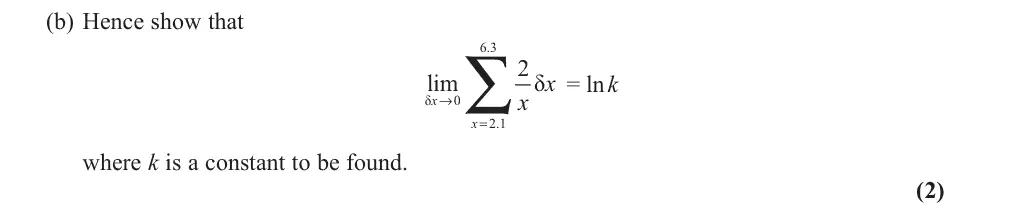
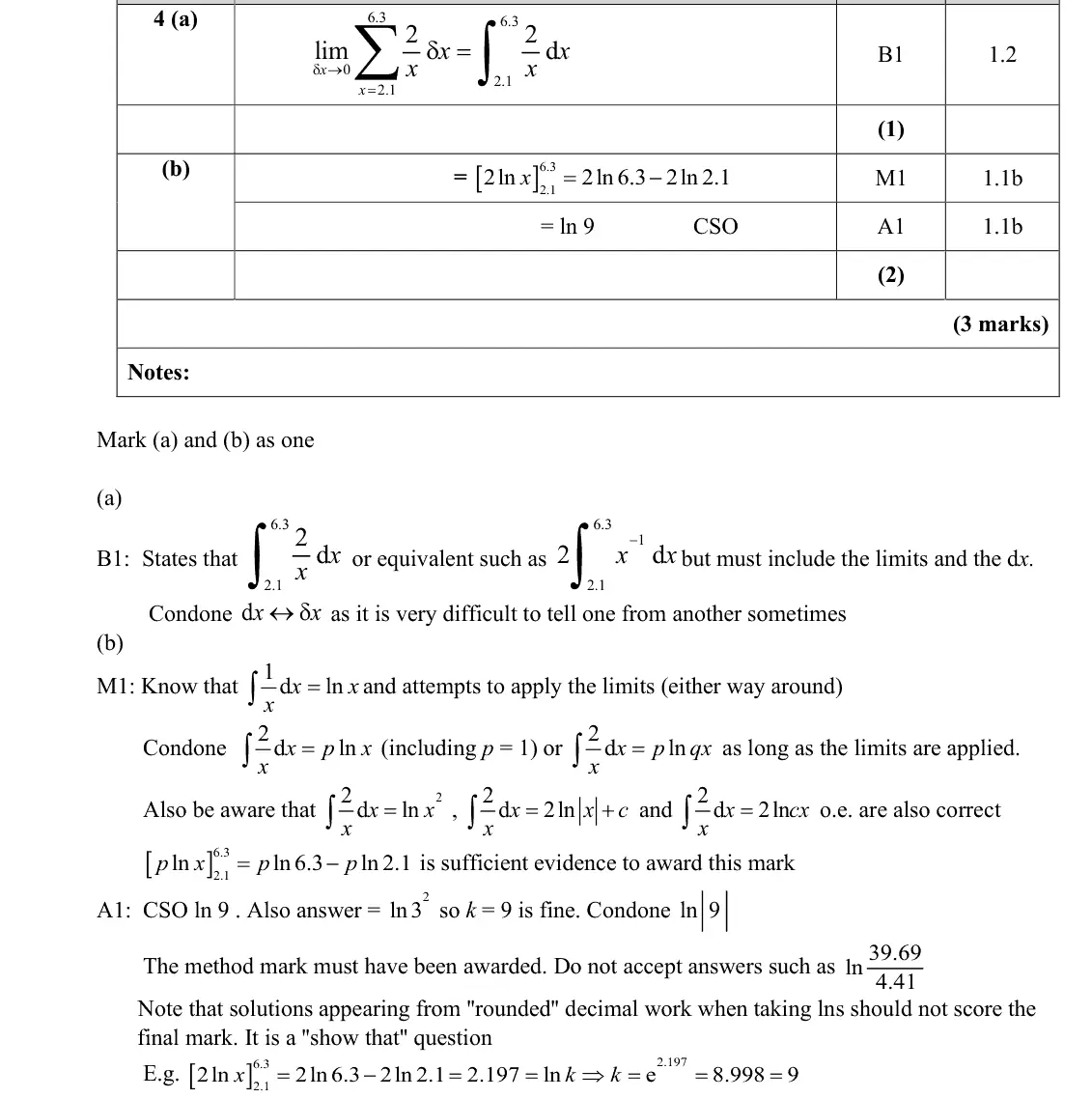
Common mistakes
[2 ln x] from 2.1 to 6.3 = 2 ln 3 = ln 9, so k = 9
integrating to ln x², ln 2x or differentiating instead
leaving 2 ln 3
rounded decimal work loses the A mark
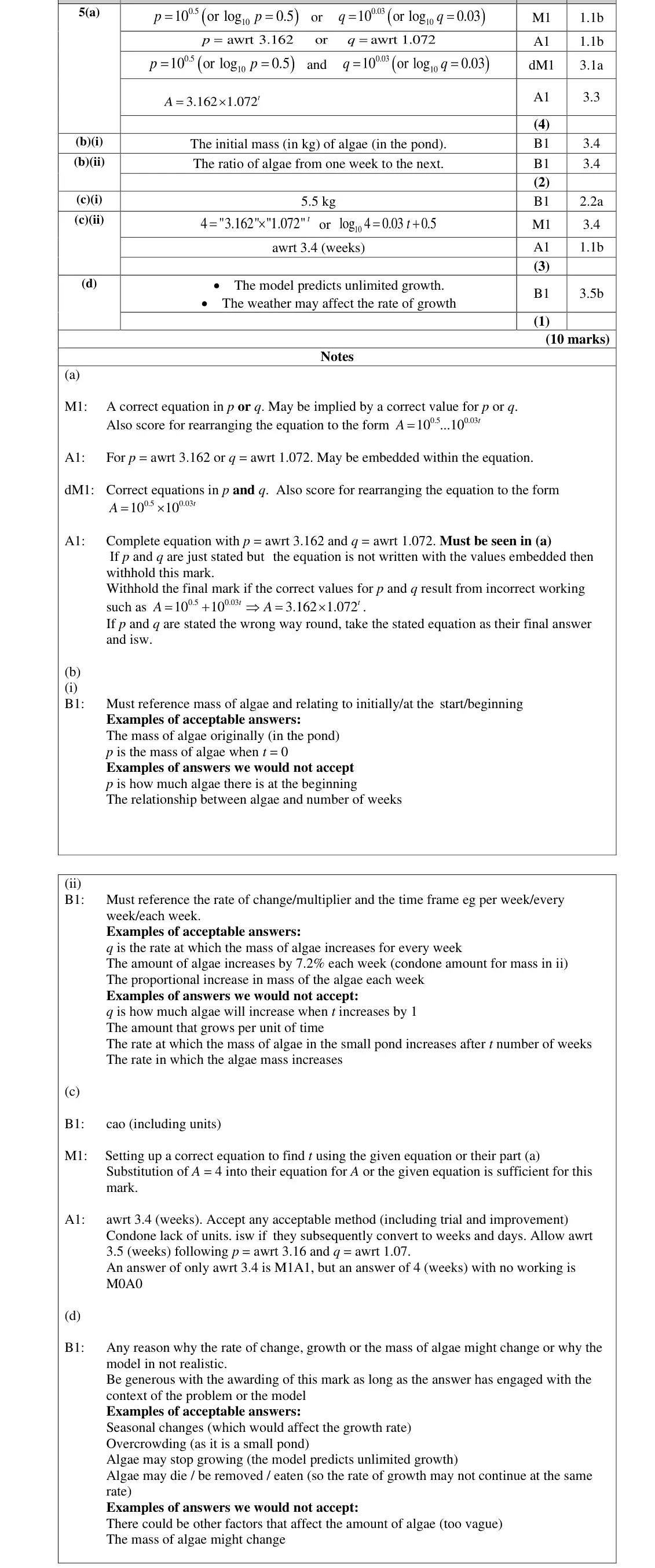
June 2022 · AS Paper 1 · Q5(a)4 marks
Mark scheme (whole question; this part is marked with the orange bar)
Examiner's comment
Generally, candidates found this question accessible with many scoring consistently throughout. In part (a), most candidates were able to make progress often correctly establishing the values of p and q following a valid method. A significant proportion of candidates, who correctly calculated the values of both p and q, failed to write down “a complete equation for the model” in the required form, and a small minority candidates failed to evaluate p and q to four decimal places. The need to carefully read the question’s requirements should be emphasised to candidates and whilst in a number of questions we will allow anything which rounds to that level of accuracy, the modelling questions in particular can sometimes require a specific level of rounding to score full marks.
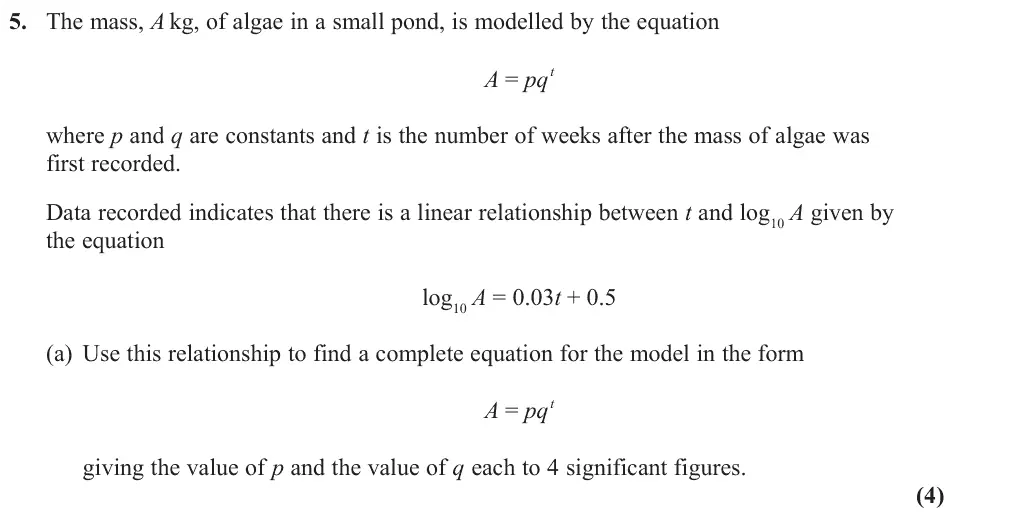
Common mistakes
log₁₀p = 0.5 and log₁₀q = 0.03 so p = 3.162, q = 1.072 (4 s.f.)
must write the complete equation A = 3.162 × 1.072^t
A = 10^0.5 + 10^0.03t is wrong
June 2022 · AS Paper 1 · Q5(c)3 marks
Mark scheme (whole question; this part is marked with the orange bar)
Examiner's comment
Generally, candidates found this question accessible with many scoring consistently throughout. In part (c), candidates who had a correct equation were generally able to complete the substitution successfully. Some candidates gained full marks after having incorrectly answered part (a), by using the equation linking 10 log A and t given in the question. As it was a modelling question, units were required to score this mark; most candidates used the correct units. This part of the question was also well attempted by many candidates. Those who found difficulties often tried to use 8 t = which was information given for use in part i.
Common mistakes
(i) 5.5 kg to the nearest 0.5 kg with units
(ii) solve 4 = 3.162 × 1.072^t or log₁₀4 = 0.03t + 0.5: t ≈ 3.4 weeks
using t = 8 again in (ii)
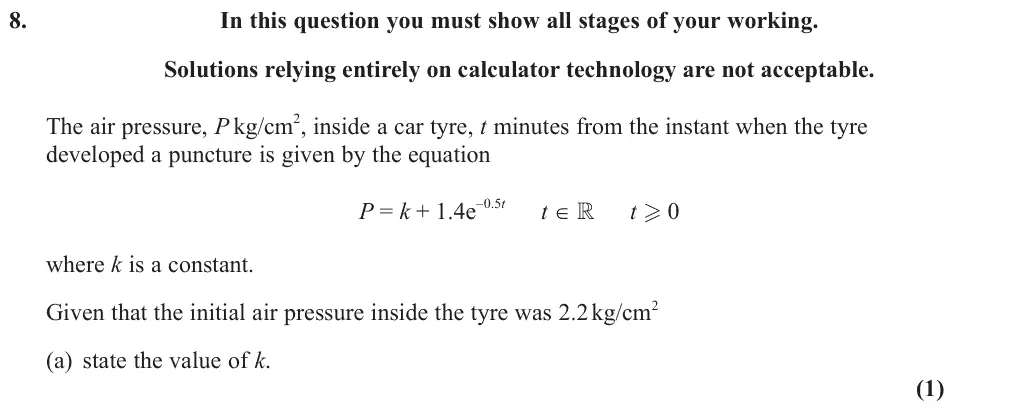
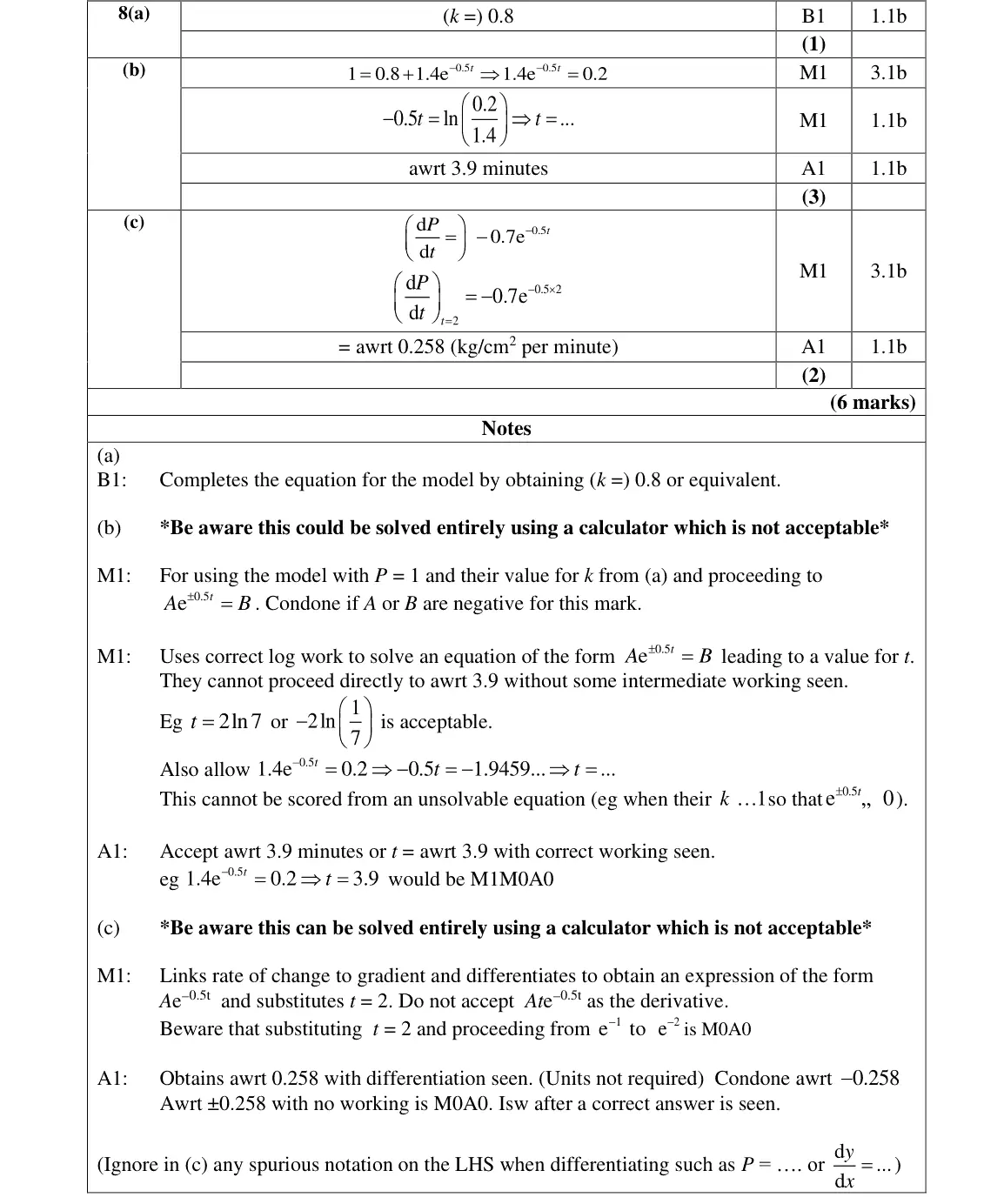
June 2022 · AS Paper 1 · Q8(a)1 mark
Mark scheme (whole question; this part is marked with the orange bar)
Examiner's comment
This question was reasonably well attempted. Logs continue to be an area of challenge for many candidates but despite this, a significant proportion were able to earn a good number of marks here. In part (a), many candidates were able to earn the mark for recognising that it was necessary to set 0 t = and correctly obtained 0.8 k = . The most common error here occurred when candidates assumed, in error, that 0e 0 = and so obtained 2.2 k =
Common mistakes
t = 0 gives k + 1.4 = 2.2, k = 0.8
e⁰ = 1, not 0 (giving k = 2.2)
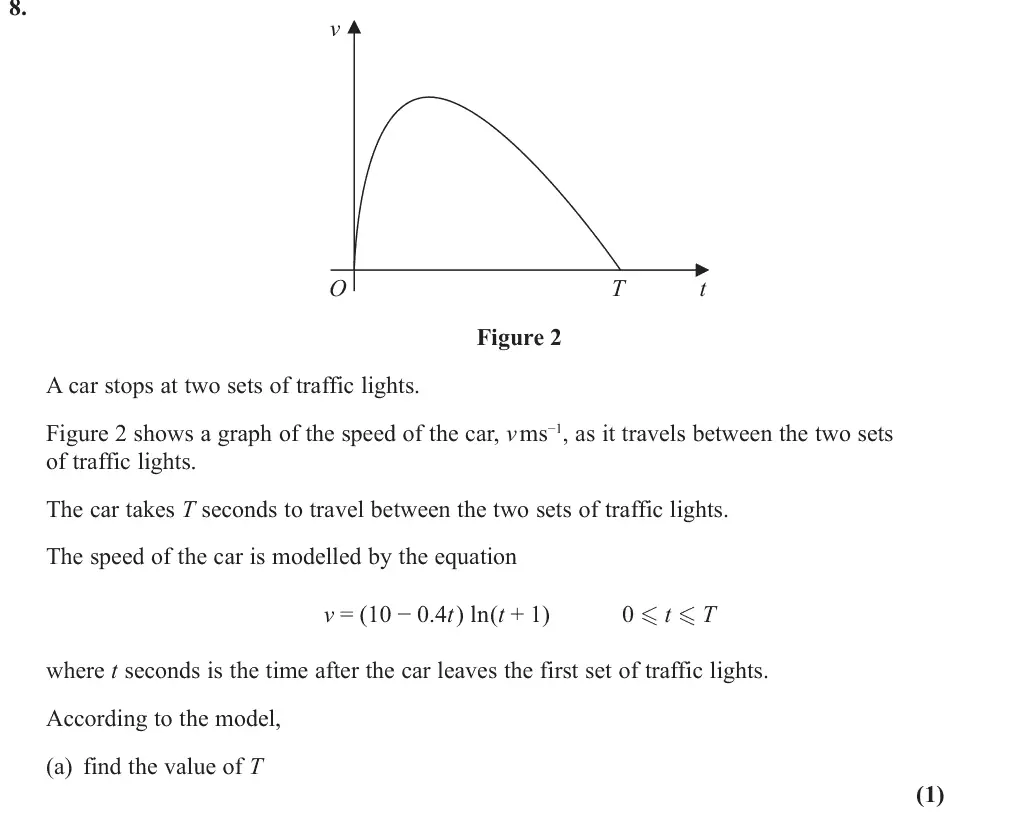
June 2022 · Paper 1 · Q8(a)1 markMedium
Mark scheme (whole question; this part is marked with the orange bar)
Examiner's comment
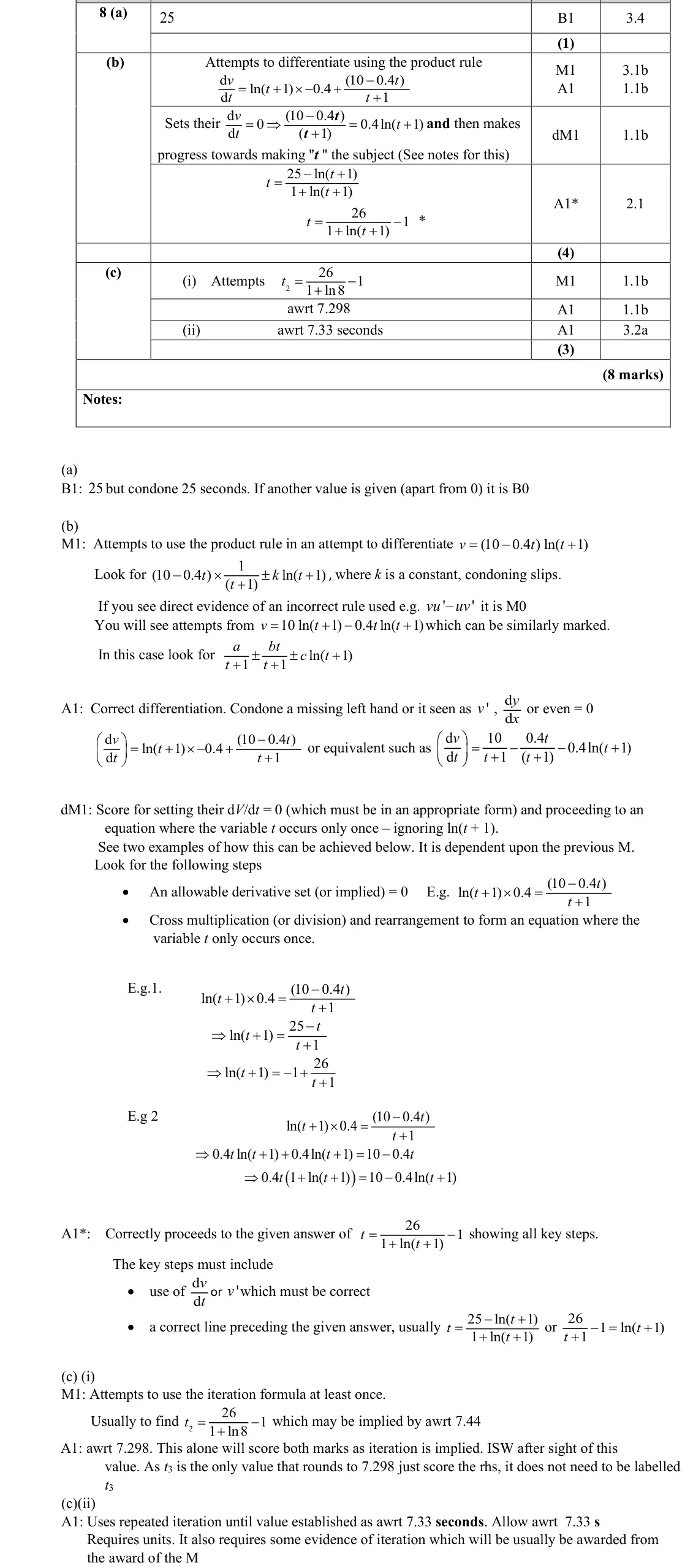
This was the second modelling question on the paper. The given equation modelled the speed of and scored marks in the more accessible parts (a) and (c). Most candidates managed to reach the correct answer of 25 in part (a). A common incorrect answer was 10, (10 0.4 )ln( 1) v t t = - + possibly from sight of the 10 in the given equation The first two marks in part (b) were often achieved by those who attempted it. Using the product rule to find
Common mistakes
v = 0 when 10 − 0.4t = 0, T = 25
10 is a common wrong answer
June 2022 · AS Paper 1 · Q8(b)3 marks
Mark scheme (whole question; this part is marked with the orange bar)
Examiner's comment
This question was reasonably well attempted. Logs continue to be an area of challenge for many candidates but despite this, a significant proportion were able to earn a good number of marks here. In part (b), the majority of candidates were able to recognise that they needed to set their equation for P equal to 1. Those who had achieved 0.8 k = in (a) usually made good progress and scored full marks in this part. Those candidates who obtained k = 2.2 were able to make a first step in solving the equation. They were, however, limited in their progress as the equation was ultimately unsolvable, but many attempted to persevere through taking logs of a negative value which was not creditworthy. Some candidates misunderstood the context here and thought that they needed P = 1.2, perhaps misreading the question which asked for a drop to an air pressure of 1 kg/cm3 rather than a drop in air pressure of 1 kg/cm3. Nonetheless these candidates were usually able to make good progress as the resulting equation was solvable in this case and some good log work was seen. There were a small proportion of candidates who were clearly less secure in their log work however and some attempted to take logs of each term separately before rearranging or neglected to divide by 1.4 before taking logs. A small number of candidates attempted to use 10 log rather than natural logs. Almost all candidates realised they need to show all stages of their working and it was rare to see answers appear from nowhere due to overreliance on a calculator.
Common mistakes
set P = 1 (fall to 1, not by 1)
divide by 1.4 before taking ln: e^(−0.5t) = 1/7, t = 2 ln 7 ≈ 3.9 minutes
taking logs of each term is wrong
working must be shown
June 2022 · AS Paper 1 · Q8(c)2 marks
Mark scheme (whole question; this part is marked with the orange bar)
Examiner's comment
This question was reasonably well attempted. Logs continue to be an area of challenge for many candidates but despite this, a significant proportion were able to earn a good number of marks here. Part (c) of this question was a good differentiator and was a challenge to many candidates. For a significant proportion of candidates, “rate” did not signal the need for rate of change 8 and hence differentiation. It was common to see candidates simply substituting in t = 2 into their equation for P to obtain P = 1.32. Of those candidates who did attempt to find d d P t many seemed to struggle with the chain rule. Some candidates obtained results of the form Ate-0.5t, whilst others retained the constant term 0.8 when differentiating. Others began by substituting in t = 2 and then proceeded from e-2 to e-1 or ‘differentiated’ e-1 to get e-2. It was common for candidates who were able to progress to a correct value to give the final answer of -0.258 rather than 0.258 but this was condoned.
Common mistakes
rate means dP/dt = −0.7e^(−0.5t) (the constant k disappears
not Ate^(−0.5t))
substituting t = 2 into P is wrong
0.258 kg/cm² per minute
June 2022 · AS Paper 1 · Q9(a)2 marks
Mark scheme (whole question; this part is marked with the orange bar)
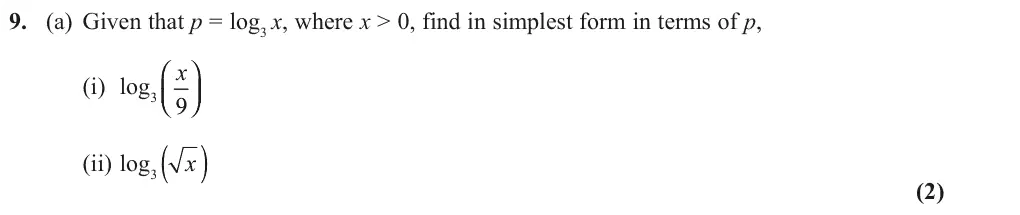
Examiner's comment
Candidates still find working with logs a challenge and this type of question requires a careful approach to applying the laws of logarithms and making use of the “hence” which linked the two parts together. Many candidates found part (a) difficult and hence this impacted on the overall scores. It required the understanding and use of logarithm laws. A majority were unable to write part (i) in terms of p often because they could not simplify 3 log 9 . Part (ii) was more successful.
Common mistakes
(i) log₃(x/9) = p − log₃9 = p − 2 (log₃9 often not simplified)
(ii) ½p
June 2022 · AS Paper 1 · Q9(b)4 marks
Mark scheme (whole question; this part is marked with the orange bar)
Examiner's comment
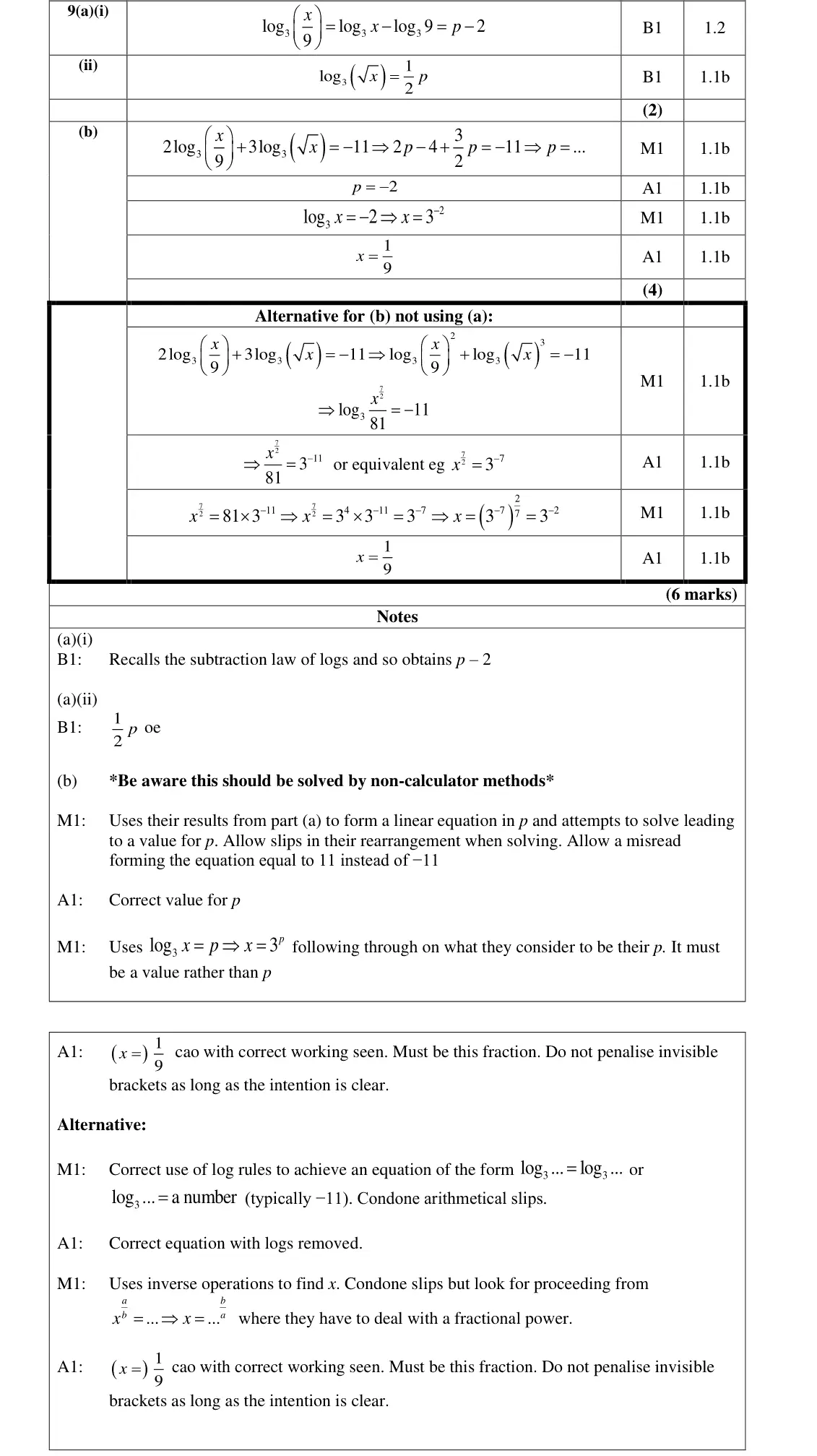
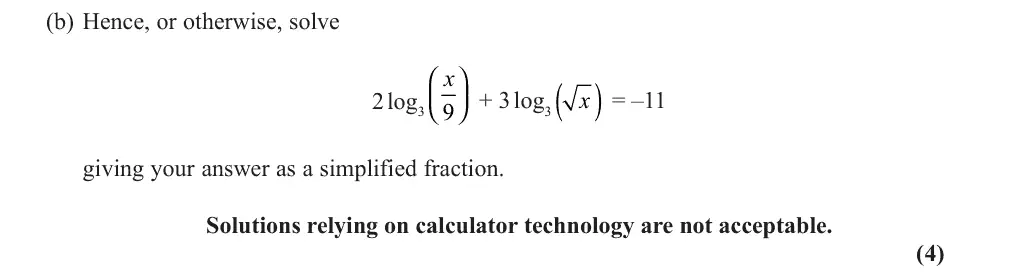
Candidates still find working with logs a challenge and this type of question requires a careful approach to applying the laws of logarithms and making use of the “hence” which linked the two parts together. In part (b), a pleasing number of the candidates received full marks with the majority not connecting part (a) to part (b), often starting again from the original equation and using laws of logarithms. Those candidates that did see the link often went on to find 2 p = - and thus 1 3 x = . However, a significant number stopped after finding the value of p rather than x. Those that had the linear terms correct in part (a) found this part easy and many proceeded to gain full marks. Overall, there were far too many candidates unable to make any progress with this question on logs and many indicated a lack of understanding of the relationship 3 log 3p p x x = =
Common mistakes
use (a): 2(p − 2) + (3/2)p = −11, p = −2
then x = 3^p = 3⁻² = 1/9 (many stopped at p)
a fully log-laws method from scratch also works
June 2022 · Paper 1 · Q10(b)3 marksMedium
Mark scheme (whole question; this part is marked with the orange bar)
Examiner's comment
This was the third modelling question on the paper, this time based around an exponential model. This should have been expected given the Advance Information and candidates performed well on parts (a) and (b). Part (c) was more of a challenge with only higher achieving students scoring all 4 marks. Most candidates recognised the need to differentiate in part (b), and used appropriate notation. Most did this accurately before substituting in t =10 to obtain 18.1. A number of candidates failed to secure the final mark however, for not providing a minimal conclusion relating their answer to 18,000. Common reasons for not achieving full marks were • failing to use appropriate notation often using d d y x instead of d d N t • failing to recognise the need to use differentiation often subtracting the values of b N at t =9 and 10 or else t =10 and 11
Common mistakes
dN/dt = 11e^(0.05t), at t = 10 gives 18.1
conclude about 18 thousand per year
subtracting N at t = 9 and 10 is not a rate
use dN/dt notation, not dy/dx
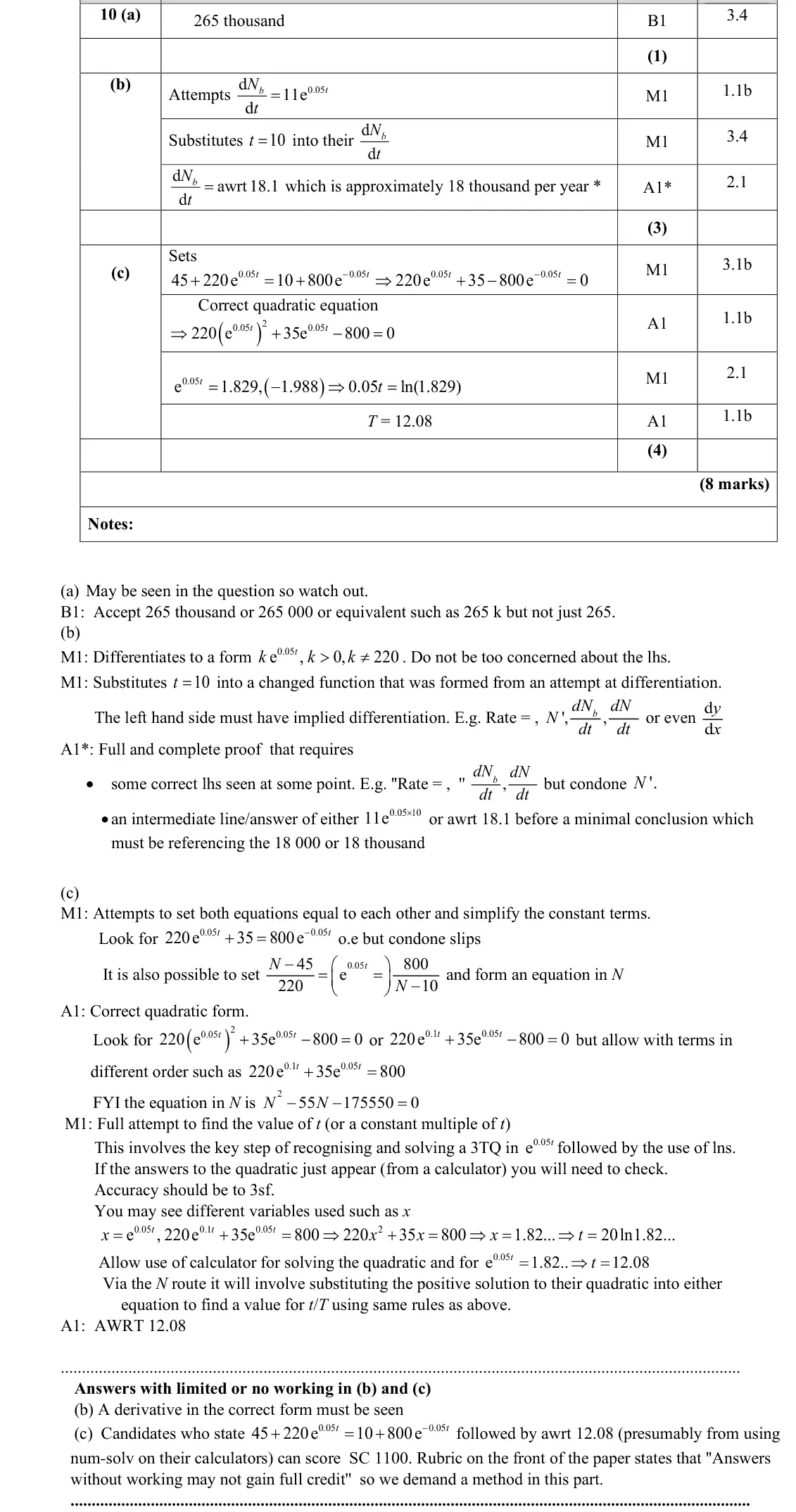
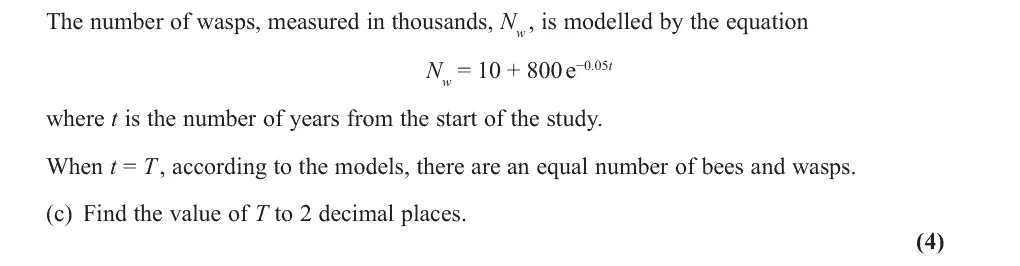
June 2022 · Paper 1 · Q10(c)4 marksMedium
Mark scheme (whole question; this part is marked with the orange bar)
Examiner's comment
This was the third modelling question on the paper, this time based around an exponential model. This should have been expected given the Advance Information and candidates performed well on parts (a) and (b). Part (c) was more of a challenge with only higher achieving students scoring all 4 marks. Part (c) was the most demanding part of the question with many candidates just picking up the first mark for equating the two expressions. Having equated the two expressions, the significance of the negative exponential term seemed to be poorly understood. Very common errors included • changing the 0.05 e t - term to 0.05 e t and then solving • applying 'ln' to each term in the equation to form a linear equation in t • slips in coefficients with 220 becoming 200 A number of candidates reverted to numerical methods or the use of their calculator to solve the equation rather than solve by algebraic methods. The strongest candidates recognised the quadratic equation in 0.05 e t and were able then to solve it correctly, many after making a substitution 0.05 =e t x .
Common mistakes
multiply by e^(0.05t): 220(e^(0.05t))² + 35e^(0.05t) − 800 = 0
e^(0.05t) = 1.829 (reject negative)
T = 20 ln 1.829 = 12.08
taking ln of each term or changing e^(−0.05t) to e^(0.05t)
calculator-only answer is SC
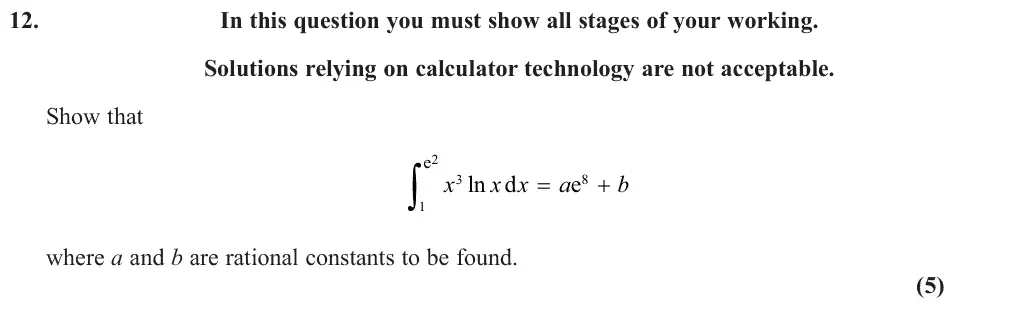
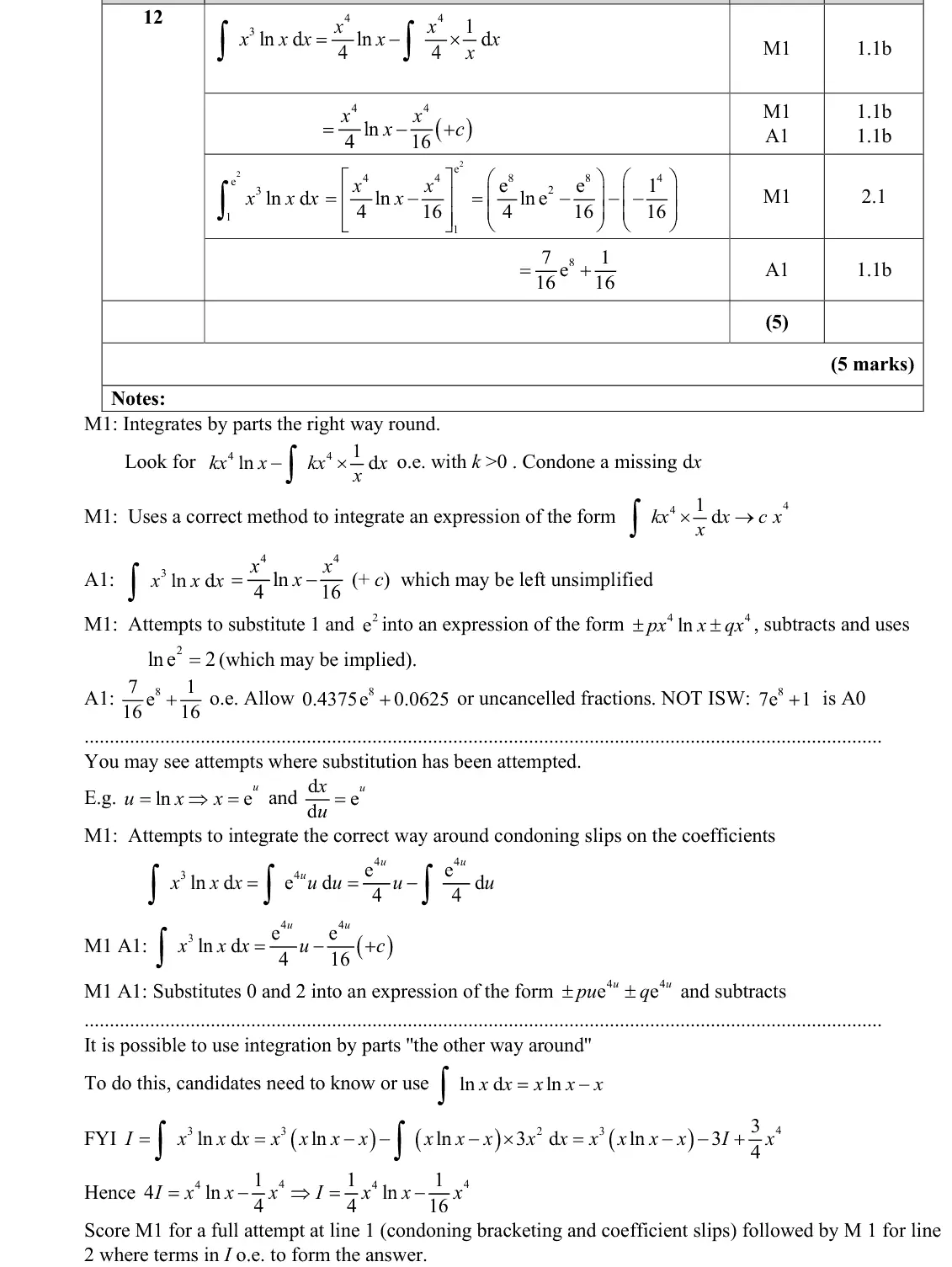
June 2022 · Paper 1 · Q125 marksEasy
Mark scheme (whole question; this part is marked with the orange bar)
Examiner's comment
This was a very straight forward question on integration by parts with 40% of the candidates scoring full marks. On the reverse side there were also a sizeable number, some 30%, who did not know how to begin and failed to score any marks. Those candidates who knew the method nearly always scored 3, 4 or 5 marks. Reasons for these candidates dropping 1 or 2 marks nearly always centred around • a failure to integrate the term 4 1 4 x x x correctly, many times to 4 12 x • failing to correctly apply the limits, usually achieving 8 7 1 e 16 16 - • achieving a correct answer of 8 7 1 e 16 16 + then inexplicably ''simplifying'' this to 8 7e 1 + Low scoring candidates who attempted the question, usually resorted to integrating each term of the integrand or else having made a good start, disappointingly integrating the 4 1 4 x x x term to 5 ln 20 x x x
Common mistakes
by parts with u = ln x: (x⁴/4) ln x − x⁴/16
ln e² = 2
answer (7/16)e⁸ + 1/16
x⁴/4 × 1/x integrated wrongly
"simplifying" to 7e⁸ + 1
June 2022 · Paper 2 · Q2(a)2 marks
Mark scheme (whole question; this part is marked with the orange bar)
Examiner's comment
This question on an exponential function saw full marks for most. Of the small number of errors that were seen in part (a), a common one was an incorrect intercept of (0, 4) from replacing 40 with 4 instead of 1. The intercept was occasionally seen as (1, 0) although this was condoned if it was positioned correctly on the sketch. A few graphs did not go into the second quadrant and others were not carefully drawn – some did not get close enough to the asymptote of y = 0, sometimes due to a poor choice of scale. Other graphs bent back on themselves in the first quadrant. Some students offered an incorrect or extra horizontal or even a vertical asymptote. Although almost all knew the correct shape, a few responses had a straight line graph.
Common mistakes
intercept (0, 1) not (0, 4)
curve in quadrants 1 and 2 only, asymptotic to the x-axis (no other asymptote)
must not bend back or be U-shaped
June 2022 · Paper 2 · Q2(b)2 marks
Mark scheme (whole question; this part is marked with the orange bar)
Examiner's comment
This question on an exponential function saw full marks for most. Of the small number Part (b) was similarly well-answered and most used logarithms correctly to obtain a correct numerical expression for x. Those who did not use x = log4100 and arrived at log100 sometimes processed this incorrectly, arriving at log 96, log 25 or even 25. x = log 4 Some candidates who did not know how to solve the equation resorted to trial and improvement with varied success and is not a recommended strategy.
Common mistakes
x = log₄100 = log100/log4 = 3.32
log100/log4 is not log 25 or log100 − log4 (3.22 is a common wrong answer)
trial and improvement not recommended
June 2022 · Paper 2 · Q5(b)3 marks
Mark scheme (whole question; this part is marked with the orange bar)
Examiner's comment
Part (b) of the question clearly stated that the result from part (a) was to be used and that the method used was to be made clear. Thus, candidates who proceeded to use the Trapezium Rule again with revised values of y received no credit. In (b)(i) many realised that the power law of logs had to be used and realised that their answer to part (a) had to be multiplied by 10, so achieving a correct answer. Many on the other hand unfortunately raised their answer to part (a) by a power of 10.
Common mistakes
(i) power law: 10 × 13.3 = 133, not 13.3¹⁰
(ii) log₃18x = 2 + log₃2x, so 12 + 13.3 = 25.3 with the ∫2 dx = 12 shown
reusing the trapezium rule scores 0
June 2022 · Paper 2 · Q14(b)5 marks
Mark scheme (whole question; this part is marked with the orange bar)
Examiner's comment
The most challenging aspect of part (b) for the candidates was to separate the variables correctly. A large proportion of candidates did not make the link to part (a) and often divided both sides by 3V as a starting point, i.e. ∫ 1 3𝑉𝑉. 𝑑𝑑𝑑𝑑= ∫ 1 (2𝑡𝑡-1)(𝑡𝑡+1) . 𝑑𝑑𝑑𝑑 Where candidates did this they often would incorrectly replace the right hand side with the partial fraction they had found in part (a). For the candidates that got as far as this, the integration of the partial fractions they put in place was generally completed well with the key …ln(2t - 1) - …ln(t + 1) being found more often than not although a common error was leaving a multiplier of 2 when integrating the first fraction to give 2ln(2𝑡𝑡-1). Regardless of the integration a candidate had achieved, there were a large number of candidates that did not consider the constant of integration and tried to jump straight to the answer at this stage. Generally, if a candidate remembered their integration constant, they were more often than not successful in using the given limits to obtain a value which they could use to find an equation for V. A few attempts at solving the first order linear differential equation using an Integrating Factor were seen. Those employing this method were usually reasonably successful.
Common mistakes
separate as ∫1/V dV = ∫3/((2t − 1)(t + 1)) dt and use (a) (not dividing by 3V then misusing (a))
∫2/(2t − 1) dt = ln(2t − 1), not 2ln
include + c and find it from t = 2, V = 3 before combining logs
June 2022 · Paper 3 (Statistics) · Q6(c)5 marks
Mark scheme (whole question; this part is marked with the orange bar)
Examiner's comment
In part (a) a large number of students simply wrote ‘negative correlation’, with no context. The word Interpret in the question hints that context is required. Of the students that did try to truly interpret the correlation in a contextual statement, the vast majority were successful. Whilst many students realised that one- tailed hypotheses were needed in part (b) few used ρ for the parameter. Most students had ± the correct CV but the final A1 was lost by many students, as they compared the positive value 0.3887 to the negative test statistic. This showed these students were unfamiliar with the meaning of the CV/CR and how it related to their test statistic. Part (d) differentiated well between students with basic knowledge and those with deeper understanding. The majority of students scored 5/5 on this part. Almost all used the LH approach on the MS. This was usually well done, though a good number made errors with the laws of indices and maintained a + between the two terms after making the equation into powers of 10. The students knew their log rules, but many did only so to a basic degree, and came unstuck during their working. Sometimes this was to such an extent that they lost the marks. A surprisingly high number of students used natural logarithms and hence the exponential function in this question showing a less secure grip of this topic.
Common mistakes
substitute x = log₁₀m, y = log₁₀h
power and addition log laws
h = 10^1.92 × m^−0.05 = 83.2m^−0.05
keep the plus inside the log, not between powers of 10
use log base 10, not ln
Oct 2021 · AS Paper 1 · Q23 marks
Mark scheme (whole question; this part is marked with the orange bar)
Examiner's comment
This question proved to be one of the most challenging questions on the paper. Most were able to score one mark, however, it was very rare for a candidate to achieve the correct final answer. A good number appreciated the need to make each of the terms as a 3 to the power of something. However, errors were often made in multiplying the power together on 2( 1) 3 x- or 9 was written as 33 . Others opted to try and log both sides, but those who did not state the base were unable to score as working in base 10 would not be possible without a calculator. Those who selected a suitable base were often able to score at least one mark, although a significant number of candidates either applied index laws or laws of logarithms incorrectly. It was disappointing that several candidates rearranged by multiplying both sides by 2 3y+ such that the left-hand side became 4 8 243 y+ thinking that the two base numbers could be multiplied together and that the powers would also be multiplied. Those who did achieve an equation where all the terms were 3 to the power of something were typically able to equate the powers and proceed to find an equation for y in terms of x. 4 However, some poor rearrangements by applying incorrect inverse operations meant that a correct final answer was rarely seen.
Common mistakes
write 9^(x − 1) and 81 as powers of 3: 3^(2x − 2) (not 3^(2x − 1))
81 = 3⁴, not 3³
equate powers 2x − 2 − (y + 2) = 4 so y = 2x − 8
if taking logs the base 3 or 9 must be stated
9 ÷ 3 cannot be combined into one base by multiplying
Oct 2021 · Paper 1 · Q5(b)3 marks
Mark scheme (whole question; this part is marked with the orange bar)
Examiner's comment
This was yet another good source of marks with the modal mark being 6 out of 6, achieved by over 35% of the candidature. Part (b) was more problematic for many candidates. There was a very good understanding of the inequality/equation to be formed, and the use of logs was almost always very good. However, a significant minority of candidates failed to gain the final A mark giving an answer of 15.3 or 16 instead of Year 17.
Common mistakes
20 000 × 1.08ⁿ⁻¹ > 65 000
solve with logs: n − 1 > ln 3.25 / ln 1.08 = 15.3
answer Year 17, not 15.3 or 16
a sum formula is wrong
Oct 2021 · Paper 1 · Q8(a)4 marks
Mark scheme (whole question; this part is marked with the orange bar)
Examiner's comment
This was the first significant modelling question on this paper. As with other series, candidates find aspects of modelling difficult. The barriers to success here were parts (b) and (c). In part (a) many candidates made progress and achieved a complete equation for the model with k given exactly as ln(2)/5 or rounded to 0.139. A few students rounded more accurately giving k as 0.1386. Some rounded k to 0.14 and lost the accuracy mark. A fair number of students who failed to find the correct value of ‘A’ evaluated e0 as e.
Common mistakes
A = 1000 (e⁰ = 1, not e)
e⁵ᵏ = 2 so k = (ln 2)/5 or 0.139 (0.14 loses accuracy)
give the complete equation N = 1000e^(0.139t)
Oct 2021 · Paper 1 · Q8(b)2 marks
Mark scheme (whole question; this part is marked with the orange bar)
Examiner's comment
This was the first significant modelling question on this paper. As with other series, candidates find aspects of modelling difficult. The barriers to success here were parts (b) and (c). In part (b) many students used an incorrect method to find the rate of increase in the number of bacteria. Some substituted t =8 into their expression for N, which just found the number of bacteria after 8 hours; others then went on to divide this number by 8 or even 1000 to try and find the rate of increase. Those who realised that the expression for N needed to be differentiated to find the rate of increase often scored at least the method mark.
Common mistakes
rate of increase means dN/dt = 1000k e^(kt) at t = 8: 420 (2 s.f.)
substituting t = 8 into N, or dividing N by 8, is wrong
Oct 2021 · Paper 1 · Q8(c)3 marks
Mark scheme (whole question; this part is marked with the orange bar)
Examiner's comment
This was the first significant modelling question on this paper. As with other series, candidates find aspects of modelling difficult. The barriers to success here were parts (b) and (c). For part (c) the majority of candidates who obtained the correct equation of the model in (a) were able to use both models given to set up an appropriate equation in t or T to gain the first method mark. Processing the resulting equation using logs to obtain a linear equation in t or T posed more of a challenge and many made no further progress. A large proportion who did attempt to make progress often used incorrect log work: some multiplied the logs rather than add them; others did not find the log of all the components, usually the ‘2’. Some students combined the exponential functions incorrectly by dividing the powers rather than subtracting them. Those scoring all three marks here were usually the most able candidates.
Common mistakes
set 500e^(1.4kT) = 1000e^(kT)
take logs to get a linear equation 0.4kT = ln 2
T = 12.5 hours
log errors (multiplying logs, dropping ln 2)
Oct 2021 · AS Paper 1 · Q11(a)1 mark
Mark scheme (whole question; this part is marked with the orange bar)
Examiner's comment
This question was generally answered well by most candidates. It was typically silly mistakes or not reading the question which resulted in full marks not being scored. In part (a), most candidates were successful in finding the area to be 35 km2. Some just opted for 80 and the units were also incorrect, at times, such as being given as trees.
Common mistakes
t = 0 gives A = 80 − 45 = 35 km² (not 80)
correct units needed
Oct 2021 · AS Paper 1 · Q11(b)4 marks
Mark scheme (whole question; this part is marked with the orange bar)
Examiner's comment
This question was generally answered well by most candidates. It was typically silly mistakes or not reading the question which resulted in full marks not being scored. In part (b), candidates typically were able to equate the expression to 60 and rearrange correctly. A pleasing number were able to proceed to the correct value for c, although a significant number did not then state the equation which the question asked the candidates to find a complete equation. Some over rounded the value of c, whilst others tried to take logs of each term.
Common mistakes
t = 14 (2005 to 2019): 45e^(14c) = 20 so c = (1/14)ln(20/45) = −0.0579
give the complete equation A = 80 − 45e^(−0.0579t)
taking logs of each term separately
over-rounding c
Oct 2021 · Paper 1 · Q11(b)5 marks
Mark scheme (whole question; this part is marked with the orange bar)
Examiner's comment
The modal mark here was 3, most likely due to the accessibility of part (a). Marks in part (b) were only really awarded to the highest scoring candidates on this exam. In part (b) many candidates failed to recognise that integration by parts was needed to make progress. Several students, who made progress and correctly applied ‘integration by parts’ twice, unfortunately lost the final accuracy mark due to sign or coefficient errors that had crept in. Most who integrated appropriately applied the correct limits and applied ln(4) = 2ln(2). Errors were many and varied here and included • Candidates who believed that ( ) ( ) 2 3 1 d 3 ln x x ln x = ∫ • Candidates who believed that ( ) 2 2 ln x ln x = Candidates who used the substitution ln u x = seemed to more easily recognise 2e d u u u ∫ as integration by parts twice.
Common mistakes
integration by parts twice (u = (ln x)², then ∫ln x dx = x ln x − x)
14(ln 2)² − 12 ln 2 + 4 using ln 4 = 2 ln 2
∫(ln x)² is not (ln x)³/3 and (ln x)² is not 2 ln x
sign and coefficient errors
Oct 2021 · AS Paper 1 · Q13(a)3 marks
Mark scheme (whole question; this part is marked with the orange bar)
Examiner's comment
In part (a) candidates found forming a correct relationship between the linear graph and the given exponential model too difficult. Many produced incorrect equations and poor working with logarithms followed, resulting in incorrect values for p and q. As part (a) was not completed successfully in many cases, part (b) automatically was limited in its accessibility. Some candidates just made a comment, rather than use the model as they did not have values for p and q, or even those who did seemed unsure what they were finding.
Common mistakes
log h = log p + q log m: intercept log₁₀p = 2.25 gives p = 10^2.25 = 178, gradient q = −0.235
p is not 2.25
poor log work
Oct 2021 · AS Paper 1 · Q13(b)3 marks
Mark scheme (whole question; this part is marked with the orange bar)
Examiner's comment
As part (a) was not completed successfully in many cases, part (b) automatically was limited in its accessibility. Some candidates just made a comment, rather than use the model as they did not have values for p and q, or even those who did seemed unsure what they were finding.
Common mistakes
use the model with m = 5: h = 178 × 5^(−0.235) ≈ 122 bpm
compare with 119: close, so suitable
"not equal so unsuitable" does not score
must use the model, not just comment
Oct 2021 · AS Paper 1 · Q13(c)1 mark
Mark scheme (whole question; this part is marked with the orange bar)
Examiner's comment
Part (c) had a range of responses, but it was extremely rare for a mark to be scored and most failed to appreciate that the resting heart rate related to a mammal with a mass of 1 kg.
Common mistakes
p is the resting heart rate (bpm) of a mammal of mass 1 kg (m = 1 so h = p)
answered correctly very rarely
Oct 2021 · Paper 2 · Q33 marks
Mark scheme (whole question; this part is marked with the orange bar)
Examiner's comment
This 3 mark question was attempted by almost all students and differentiated between those who could apply laws of logarithms and those who could not. It was generally a well answered question and most students were able to get some marks and a large majority scored full marks. A few students showed an invalid line of before recovering the error and continuing to the correct value of 4/39 for y, so only scored 1 of the 3 available marks. A few students were unable to apply the subtraction law but they were often able to score the B mark for 9 seen. This was a straight forward question on logarithms so it was nice to see the candidates were generally prepared and those that correctly removed the logs were, on the whole, able to go on get full marks. A few students make slips when solving their linear equation, obtaining 39/4 instead of 4/39. A few also tried to use base e incorrectly, and a minority tried expanding the logs, hence getting no marks. ( ) ( ) ( ) ( ) 3 3 3 3 log 12 5 log 12 5 log 1 3 2 2 log 1 3 y y y y + + - - = ⇒ = -
Common mistakes
combine to log₃((12y + 5)/(1 − 3y)) = 2, then = 3² = 9
dividing the logs (log ÷ log) is an invalid step even if recovered
exact y = 4/39 (not 39/4)
Oct 2021 · Paper 2 · Q10(a)2 marks
Mark scheme (whole question; this part is marked with the orange bar)
Examiner's comment
The majority of candidates scored both marks for part (a). A common error was omitting base 10 when writing their final equation. In “show that” questions, we need to see the equation as stated in the question.
Common mistakes
take logs base 10 and use addition and power laws
base 10 must appear in the final line
Oct 2021 · Paper 2 · Q10(b)3 marks
Mark scheme (whole question; this part is marked with the orange bar)
Examiner's comment
Part (b) was demanding for many candidates, with confusion as to how to correctly deal with the log terms. Most candidates who were successful found the value of by finding the gradient of the line. A less popular but usually successful approach was using simultaneous equations to eliminate . Solving the equation to find the value of caused some problems. The question required a complete equation for the model, so just stating the correct values of and without the equation written explicitly meant candidates scored 3 out of 4 marks, which was a very common error.
Common mistakes
gradient b = 0.45/0.91 = 0.495
intercept is log₁₀a so a = 10^0.346 = 2.22
must write the complete equation T = 2.22l^0.495
Oct 2021 · Paper 2 · Q10(c)1 mark
Mark scheme (whole question; this part is marked with the orange bar)
Examiner's comment
Part (c) was very rarely completed successfully. Common errors were thinking was the intercept on the T axis or the time for the initial swing of the pendulum.
Common mistakes
a is the time (s) for one swing of a 1 m pendulum (l = 1)
not the intercept or the time of the first swing
Oct 2021 · Paper 2 · Q14(b)6 marks
Mark scheme (whole question; this part is marked with the orange bar)
Examiner's comment
This question proved challenging for the majority of candidates, with many not answering it at all. Students who progressed well in (b) often interpreted their formula correctly to obtain marks in (c). A minority of students who didn’t complete (b) still attempted (c) with some success, e.g. recognising that d d h t was zero at the maximum height or using a ‘ flow in = flow out’ argument.
Common mistakes
separate variables
t = −240 ln(24 − 5h) + c
use t = 0, h = 2 to find c
correct log work to h = 4.8 − 2.8e^(−t/240)
forgetting + c
Oct 2021 · Paper 3 (Statistics) · Q6(a)5 marks
Mark scheme (whole question; this part is marked with the orange bar)
Examiner's comment
There is a requirement in the specification for questions occasionally to draw together knowledge from different areas of 9MA0 and this was a question aiming to do that. Many students realised that to start the problem they could use the fact that the sum of the probabilities must equal 1 but fewer than half of the students could move beyond that mark. Those who realised they had a sum of logarithms were often able to arrive at the equation abc = 36 but few could devise a strategy to deduce the values of a, b and c. Some stated that all of the values had to be greater than 1 though it was not always clear that they deduced this from the given bullet points in the question. Around a quarter of the
Common mistakes
sum of probabilities = 1 gives log₃₆(abc) = 1 so abc = 36
each probability > 0 so a, b, c > 1
distinct, so 2, 3, 6
working must be shown (answer only 2/5)
Oct 2021 · Paper 3 (Statistics) · Q6(b)2 marksHard
Mark scheme (whole question; this part is marked with the orange bar)
Examiner's comment
students found the correct set of values with varying degrees of explanation on the way. Part (b) was often left blank though the first mark was available without values for a, b and c provided brackets were used correctly for the expression. Nearly 10% managed to score full marks for the question.
Common mistakes
P(X₁ = X₂) = sum of squared probabilities (log₃₆a)² + (log₃₆b)² + (log₃₆c)² = 0.381
brackets needed
Oct 2020 · Paper 1 · Q23 marks
Mark scheme (whole question; this part is marked with the orange bar)
Examiner's comment
As with question 1 there were many fully correct answers here. Of these, most took logs or lns of both sides, then used the power law on each side and the correct order of operations before proceeding to the correct answer of 81.6. There were a few candidates who failed to put brackets around (3p -1) but they were usually able to recover. There were several cases of candidates failing to apply the power rule to both sides, usually not dealing with the ‘210’. Some candidates misapplied the power rule, multiplying first for example by 3, rather than 3p -1. Common errors were • after applying the power rule correctly changing log5/log 4 to log(5/4). • taking either log4 of one side or log5 of the other without any application of the power law
Common mistakes
take logs of both sides and use the power law on each side: (3p − 1)log 4 = 210 log 5
bracket round 3p − 1
log5/log4 is not log(5/4)
answer with no working scores 0
p = 81.6
Oct 2020 · AS Paper 1 · Q3(ii)3 marks
Mark scheme (whole question; this part is marked with the orange bar)
Examiner's comment
This question really highlighted the dependence on calculators amongst candidates. Part (a) required simple rationalisation of a denominator and part (b) wanted candidates to work with indices/bases. In part (a) they perhaps did not fully appreciate the wording at the top of the question ‘Solutions relying on calculator technology are not acceptable’, whilst in part (b) they did not have the algebra skills to solve on their own. In part (a), when squaring both sides many candidates squared each individual term before 2x ; they seemed happier factorising the x out when the coefficients were combining the rational numbers. In a similar vein, many instead simplified the 18 and then factored out a common 2 , leaving multiple x terms in the equation. Some candidates opted to square both sides. Where a correct quadratic was built and solved, candidates gave both roots and lost the final mark. Where x was found with an irrational denominator, most candidates then went on to rationalise the denominator, but neglected to show the steps. In many cases it was clear they had typed into the calculator and read off the simplified display. When the question says ‘not relying on calculator technology’ candidates should be showing each step to secure the marks. The 18 must also be simplified when writing in simplest form. In part (b) log base 10 or natural logs were commonly used, and these could only be evaluated on the calculator. These scored no marks. Even where attempts were made to use 1 logs to base 4 or 2 there was an over reliance on calculators to find . The most log 4 2 2 common approach was to immediately take log base 4 and simplify the left-hand side. There 3 1 - log was then often little evidence of how they got from to . 4 4 2 2 Those who chose to rewrite as common bases more often led to full marks; base 2 was most common. Whilst the use of calculator technology is encouraged on the new specification, candidates should make sure that they are confident of working without one when required. 5
Common mistakes
write both sides as powers of 2 (2^(6x − 4) = 2^(−3/2)) or use logs base 2 or 4 with working
log₁₀ or ln needs a calculator and scores nothing
x = 5/12
Oct 2020 · Paper 1 · Q82 marks
Mark scheme (whole question; this part is marked with the orange bar)
Examiner's comment
Candidates were expected to realise that ''when the rate of change is proportional to the y value, an exponential model should be used.'' The question seemed to take a great many candidates by surprise and many assumed that 'n was proportional to n' or that 'n was proportional to t', not that the rate of growth of 'n was proportional to n'. Those that did interpret the situation correctly could write down an equation very quickly whereas others attempted to solve a differential equation. Equations scoring one of two marks were common and included e , e t kt n A n = = and e kt n A b = +
Common mistakes
rate of change proportional to n means an exponential model n = Ae^(kt)
not n ∝ t
the two constants must be different (n = e^(kt + c) fine, n = e^(kt) + A is not)
Oct 2020 · AS Paper 1 · Q8(a)1 mark
Mark scheme (whole question; this part is marked with the orange bar)
Examiner's comment
This question was another which focussed on problem solving, with the majority of candidates only able to score around half of the marks available. Part (d), in particular proved to be too difficult for most candidates so it was rare to see full marks. In part (a), many candidates could score at least one mark here by calculating the value of 83, however, it was not uncommon for units to be omitted which meant that the mark was not awarded.
Common mistakes
t = 0 gives 83 °C
units needed
Oct 2020 · AS Paper 1 · Q8(b)3 marks
Mark scheme (whole question; this part is marked with the orange bar)
Examiner's comment
This question was another which focussed on problem solving, with the majority of candidates only able to score around half of the marks available. Part (d), in particular proved to be too difficult for most candidates so it was rare to see full marks. In part (b), the majority of candidates scored full marks here and seemed very comfortable with the fact that ln is the inverse. There were some slips with rearrangements of the equation, which was often dividing by 8 rather than multiplying by 8. It was evident that some candidates used their calculators to solve the equation without demonstrating any method. Candidates should be encouraged to show all of their working, to ensure that full marks can be scored.
Common mistakes
65e^(−t/8) = 17 so t = −8 ln(17/65) = 10.7
multiply by 8, not divide
show the ln step
Oct 2020 · AS Paper 1 · Q8(c)1 mark
Mark scheme (whole question; this part is marked with the orange bar)
Examiner's comment
This question was another which focussed on problem solving, with the majority of candidates only able to score around half of the marks available. Part (d), in particular proved to be too difficult for most candidates so it was rare to see full marks. Most candidates were successful in part (c), which may have been due to the graph having been provided. Many stated 18 C as being the minimum temperature of the model which was condoned for the mark, although a significant number stated that “15 C is the room temperature” which did not show an understanding of the model. The other most popular way to answer the question was to substitute 15 into the equation and concluded that you cannot log a negative. Just stating that “you can’t log a negative” without providing the working to 8 back this up was not sufficient as it was not enough evidence that the candidate had engaged with the model.
Common mistakes
as t → ∞ θ → 18 from above (minimum 18 °C)
"cannot log a negative" needs the working 15 − 18 = −3
"15 °C is room temperature" scores nothing
Oct 2020 · AS Paper 1 · Q8(d)4 marks
Mark scheme (whole question; this part is marked with the orange bar)
Examiner's comment
This question was another which focussed on problem solving, with the majority of candidates only able to score around half of the marks available. Part (d), in particular proved to be too difficult for most candidates so it was rare to see full marks. Part (d) caused more issues than the rest of the question for candidates. Several of them assumed A was equal to 94 and therefore did not score highly in this part. Some candidates attempted to find the gradient between the given coordinates and therefore did not score any marks. However, once candidates formed the two simultaneous equations, they seemed to find it quite easy to use the elimination method to eliminate A, and then go on to correctly solve for A and B and therefore work out the equation of the asymptote.
Common mistakes
form A + B = 94 and A + Be^(−1) = 50 and solve
asymptote μ = A ≈ 24.4 (not A = 94)
gradient between the points is wrong
Oct 2020 · Paper 1 · Q9(b)3 marks
Mark scheme (whole question; this part is marked with the orange bar)
Examiner's comment
Parts (a) and (b) of question 9 were standard bookwork involving the product rule of differentiation using an exponential function. Well rehearsed candidates were very successful here scoring the majority of marks. The diagram should have helped in determining the maximum and minimum points of the function.
Common mistakes
f′(x) = 0 when 2 + x − x² = 0 (e^(−2x) is never 0), x = −1 and 2
exact points (−1, −4e²) and (2, 8e⁻⁴)
extra point from x = 0 penalised
Oct 2020 · Paper 1 · Q10(b)6 marks
Mark scheme (whole question; this part is marked with the orange bar)
Examiner's comment
This question proved to be more discriminating than expected with many failing to notice the partial fractions in part (b), thereby losing 6 marks. Of those who did use partial fractions in part (b), most found the values of "A" and "B" correctly. Unfortunately many integrated B/(3 + 2u) to B ln(3 + 2u), failing to divide the coefficient by 2. The final Method mark was still available for these candidates, but a number failed to simplify their numerical logs to an expression of the required form and so did not gain this mark. A pleasing number of well prepared candidates did gain full marks in this question.
Mark scheme (whole question; this part is marked with the orange bar)
Examiner's comment
This question proved to be more challenging for candidates than was anticipated. There were a large number of candidates who did not attempt the question at all, or of those who did, most seemed to struggle with showing the relationship between the log form of the equation and t V ab = . It was very rare for full marks to be achieved, with most securing around half of the available marks in total for the question. In part (a) many candidates were able to correctly calculate the value for ‘a’ and ‘b’, however, they lost marks due to the fact that they did not appreciate the “show that” nature of the question. Missing out writing both log log log t V a b = + and log log log V a t b = + was common and this resulted in the first mark. As it was an incomplete solution, candidates also lost the final mark, too. A number of candidates rounded both of their values to the nearest whole number, which was only required for a. This was only penalised if they never had 1.18 b = at some point. Usually, candidates had lost the first mark anyway from insufficient working, so it rarely was the reason for not achieving full marks.
Common mistakes
must show V = 10^(0.072t) × 10^2.379 (or log V = log a + t log b)
a = 239, b = 1.18
only a is to the nearest whole number
Oct 2020 · AS Paper 1 · Q12(b)1 mark
Mark scheme (whole question; this part is marked with the orange bar)
Examiner's comment
This question proved to be more challenging for candidates than was anticipated. There were a large number of candidates who did not attempt the question at all, or of those who did, most seemed to struggle with showing the relationship between the log form of the equation and t V ab = . It was very rare for full marks to be achieved, with most securing around half of the available marks in total for the question. Very few candidates were successful in part (b). Most went with a standard response of stating it was the “the initial number of views” which was incorrect as t could not be 0. Had they just copied the relevant part at the start of the question replacing t with one, they would have scored the mark. 11
Common mistakes
ab is the total views 1 day after the advert went live (t = 1), not the initial number of views (t ≥ 1)
Oct 2020 · AS Paper 1 · Q12(c)2 marks
Mark scheme (whole question; this part is marked with the orange bar)
Examiner's comment
This question proved to be more challenging for candidates than was anticipated. There were a large number of candidates who did not attempt the question at all, or of those who did, most seemed to struggle with showing the relationship between the log form of the equation and t V ab = . It was very rare for full marks to be achieved, with most securing around half of the available marks in total for the question. In part (c) candidates could either use their formula from part (a) or use the formula given in the question, so it did not rely on the candidates getting correct answers to part (a) or (b). The majority of candidates who attempted this question were successful, or at least gained the method mark, if their values for a and b were incorrect. When using the given formula, several candidates were able to calculate the value of 10 log V , however, they did not know how to then proceed to calculate the value of V.
Common mistakes
V = 239 × 1.18²⁰ or 10^(0.072 × 20 + 2.379)
about 6500 to 2 s.f.
finding log V and not converting
Oct 2020 · Paper 2 · Q3(a)3 marks
Mark scheme (whole question; this part is marked with the orange bar)
Examiner's comment
This was a fairly accessible question for prepared candidates and provided an early source of marks correctly obtained 2 log(4 -𝑥𝑥) = log (4 -𝑥𝑥)2, then proceeded to remove the logs. In fact, many for many. Generally, most candidates recognised the need to use the power law for logs and candidates jumped immediately to (4 -𝑥𝑥)2 = (𝑥𝑥+ 8) with no sign of logs whatsoever in their that’ question can be risky. Some candidates diligently wrote out 10log (4-𝑥𝑥)2 = 10 log(𝑥𝑥+8) before solution. This was condoned although it must be noted that combining steps of working in a ‘show removing logs, others subtracted log (4 -𝑥𝑥)2 from both sides and used the log subtraction law to latter tended to be the riskier of the two as some candidates forgot that 100 = 1 and instead combine the log terms before removing the log. Both approaches were often successful although the (𝑥𝑥+8) = 0 which was then fudged to give the required solution. Those candidates that did (4-𝑥𝑥) obtained not recognise the need to employ the power law for logs early on in their solution made very little progress. Disappointingly, some candidates failed to earn the final mark in part (a) as their final line was missing the “= 0”. Candidates should take care to check their final line matches the printed answer in a ‘show that’ question. The first part of part (b) was straightforward and gave an opportunity to re-enter the question for those who had come unstuck in part (a). Indeed, for some candidates this was the only mark (𝑥𝑥-1)(𝑥𝑥-8) or gave ‘solutions’: (𝑥𝑥-1) and (𝑥𝑥-8). Only a very small number of candidates attained in this question. It was surprising that a number of candidates left their ‘solution’ as incorrectly obtained 𝑥𝑥= -1 or 𝑥𝑥= -8. Most candidates were able to identify 𝑥𝑥= 8 as the value which was not a solution. However, in The second part of part (b) was more discriminating and a careful explanation was required here. log(4 -8) is undefined. Too many candidates simply stated ‘logs can’t be negative’ which was order to gain credit, it was also necessary for candidates to make specific reference to the fact that incorrect and quite different to ‘you can’t take logs of a negative number’. Candidates should be reminded that reasoning should be precise and specific.
Common mistakes
2log(4 − x) = log(4 − x)² first
log(4 − x)² − log(x + 8) = 0 gives a quotient = 1, not 0
final line must include "= 0"
Oct 2020 · Paper 2 · Q3(b)2 marks
Mark scheme (whole question; this part is marked with the orange bar)
Examiner's comment
The first part of part (b) was straightforward and gave an opportunity to re-enter the question for those who had come unstuck in part (a). Indeed, for some candidates this was the only mark (𝑥𝑥-1)(𝑥𝑥-8) or gave ‘solutions’: (𝑥𝑥-1) and (𝑥𝑥-8). Only a very small number of candidates attained in this question. It was surprising that a number of candidates left their ‘solution’ as incorrectly obtained 𝑥𝑥= -1 or 𝑥𝑥= -8. Most candidates were able to identify 𝑥𝑥= 8 as the value which was not a solution. However, in The second part of part (b) was more discriminating and a careful explanation was required here. log(4 -8) is undefined. Too many candidates simply stated ‘logs can’t be negative’ which was order to gain credit, it was also necessary for candidates to make specific reference to the fact that incorrect and quite different to ‘you can’t take logs of a negative number’. Candidates should be reminded that reasoning should be precise and specific.
Common mistakes
roots 1 and 8 (not factors or −1, −8)
reject 8 because log(4 − 8) = log(−4) cannot be found
"logs can't be negative" is not accepted
Oct 2020 · Paper 2 · Q54 marks
Mark scheme (whole question; this part is marked with the orange bar)
Examiner's comment
Nearly all candidates combined the equations correctly and gained the first mark. Many then struggled to progress further. A few made mistakes with the indices such as changing 3(2x) into 6x but the most common mistake was attempting to take logs incorrectly, usually log15 - log(2(2x)) or log(15 - 2x+1 ) being wrongly expanded to arrive at log15 - (x + 1)log2. Those who realised 2x+1 = 2(2x) usually went on to solve correctly, giving a correct exact answer and therefore gain full marks. Candidates need to understand that seeing an equation with an unknown index does not automatically mean that it is a question involving logarithms.
Common mistakes
write 2^(x+1) as 2 × 2^x to get 2^x = 3
taking logs of 15 − 2^(x+1) term by term is wrong
exact answer log₂3
Oct 2020 · Paper 2 · Q6(b)4 marks
Mark scheme (whole question; this part is marked with the orange bar)
Examiner's comment
As would be hoped, most candidates scored some marks on this question. Many found part the accuracy marks. There were many more errors seen when students attempted to values of 𝑥𝑥 to substitute in, any errors usually cost both accuracy marks. In comparison, multiply (Ax + B) by (x + 2) and compare the numerators, and when candidates selected (-3 - +12 = 9 being a common slip) and so secure the first accuracy mark. those who used long division were more likely to make an error only in the remainder In part (b), a pleasingly high number of candidates who had found values for A, B and C were able to successfully integrate to gain the first two marks, often aided by the follow through mark that was available. Candidates generally substituted the limits correctly and there was occasional sign errors. The most common being “-15ln 8 -(-15 ln 2) = -15ln 8 - also a relatively good use of the laws of logarithms to combine their terms, albeit with 15 ln 2”. It was not uncommon for a candidate to then incorrectly combine this to get " - 15ln 8 2”. Most success was seen where candidates changed the ln (8) into ln (23) and then 3 ln(2) before combining the two ln 2 terms.
Common mistakes
integral of 15/(x + 2) is 15ln(x + 2)
−15ln8 + 15ln2 = −30ln2 (write ln8 = 3ln2), not −15ln(8 − 2) or −15ln16
answer 54 − 30ln2
Oct 2020 · Paper 2 · Q9(a)4 marks
Mark scheme (whole question; this part is marked with the orange bar)
Examiner's comment
This question proved to be quite challenging for many candidates and awarding full marks was rare. Nonetheless, most candidates recognised the need to set up simultaneous equations in A and B and linking A and B. Usually problems arose initially with the 18 = 𝐴𝐴 - 𝐵𝐵𝑒𝑒0 which was frequently were often able to use the information provided in the question to establish at least one equation incorrectly simplified to 18 = 𝐴𝐴 or sometimes 18 = 𝐴𝐴 - 1. Indeed, some candidates assumed immediately that A = initial temperature = 18 as is sometimes the case in modelling questions. Such errors proved costly as candidates were then limited to one mark from four in part (a). It was unphased by the presence of e-0.7as a coefficient of B. Often this was rewritten as a decimal pleasing to see that most candidates who managed to set up the two equations correctly were often approximation before solving for B. This was acceptable although some candidates did not provide sufficiently accurate approximations and so lost a mark for values of A and B that were not accurate to 3sf (51.7 and 69.7 were sometimes seen). Candidates also lost a mark here for being too accurate and giving their final values of A and B to 3dp for example. Candidates should be advised to check the question carefully for the required degree of accuracy. Unfortunately, it was quite common for candidates to find correct values for A and B but then fail to state the equation of the model in full which led to the loss of one mark. Part (b) was quite discriminating. Occasionally, candidates noted that the maximum temperature 𝜃𝜃(𝑡𝑡) = 78 and attempt to solve for 𝑡𝑡. Some candidates were unable to solve the equation but according to the model is 69.6°C but the most common approach taken by candidates was to set allowed their work to peter out without comment. However, a good number of candidates correctly noted that a solution was not possible - recognising that the model would not reach the boiling point conveniently disappear in order to obtain a solution for 𝑡𝑡 at all costs. Such candidates usually of ethanol which was sufficient for one mark. It was also common however to see minus signs obtained 𝑡𝑡 = 25.9 and concluded that the model would be appropriate up to this time; or obtained 𝑡𝑡= -25.9 noting that ‘time cannot be negative’. A significant number of responses gave general comments relating to the model being inappropriate once ethanol’s boiling point was reached - such sometimes resulted in a version of 𝜃𝜃(𝑡𝑡) = 78 which could legitimately be solved which precluded responses were not creditworthy. Unfortunately, errors in the calculation of A and B from part (a) the marks in (b). It was extremely rare to award the second mark in part (b) as candidates almost always failed to acknowledge that the model was inappropriate because the maximum value of 69.6°C is significantly lower than the boiling point of 78°C.
Common mistakes
t = 0 gives 18 = A − B (e⁰ = 1, not 0
A is not the initial temperature)
solve simultaneously with 44 = A − Be^−0.7
A = 69.6, B = 51.6 to 3 s.f.
state the complete equation
Oct 2020 · Paper 2 · Q13(a)1 mark
Mark scheme (whole question; this part is marked with the orange bar)
Examiner's comment
Part (a) was often answered correctly and candidates knew to set the denominator equal to zero and solve to obtain a value for 𝑘𝑘. Unfortunately, candidates sometimes left their answer as 𝑥𝑥= e2 which was, of course, incorrect. Some candidates gave the inexact answer of 𝑘𝑘 = 7.39 which was condoned. Commonly seen incorrect answers included 𝑘𝑘 = 0, or 𝑘𝑘 = 1. A number of candidates gave the value 𝑘𝑘= 3 suggesting that the expression in the denominator had been incorrectly interpreted as ln(𝑥𝑥-2) rather than ln(𝑥𝑥) -2 as was stated. A small number of candidates wrote “there is no 𝑘𝑘 in the question” perhaps failing to spot its presence in the domain.
Common mistakes
the denominator ln x − 2 = 0 gives k = e²
answer k =, not x = e²
not ln(x − 2)
Oct 2020 · Paper 2 · Q13(c)2 marks
Mark scheme (whole question; this part is marked with the orange bar)
Examiner's comment
In part (c), most candidates only gained one out of two available marks as they usually considered only the set of values of 𝑎𝑎 for which the numerator is positive by solving 3𝑙𝑙𝑙𝑙𝑙𝑙-7 = 0 to obtain 𝑎𝑎> 𝑒𝑒 7 3. Usually no consideration was given to the case where the numerator and denominator are both negative and the few that did solve 𝑙𝑙𝑙𝑙𝑙𝑙= 2 usually failed to state 0 < 𝑎𝑎< 𝑒𝑒2.
Common mistakes
both numerator and denominator positive OR both negative: 0 < a < e² or a > e^(7/3)
most only found a > e^(7/3)
June 2019 · Paper 1 · Q7(a)4 marksEasy
Mark scheme (whole question; this part is marked with the orange bar)
Examiner's comment
It was pleasing to see that most candidates attempted to form an exponential model using a suitable equation. This is one of the new topics in the specification and candidates who didn't gain any marks on this question, generally did so because they did not attempt it, or that they tried to use a non-exponential model. In part (a) t V Ar or kt V Ae were the most popular types of correct models that candidates opted for. However, some methods were often muddled or poorly shown, but many candidates who used a correct model were able to proceed to obtain correct values for their constants. Those candidates who used the model kt V Ae frequently gave the constant k as a log and errors sometimes occurred with the sign of this constant. Errors in calculating constants with the model t V Ar often occurred when candidates used 1 t V Ar instead.
Common mistakes
V = Ae^(kt) or Arᵗ
A = 20000 from t = 0
k = ln 0.8 = −0.223 (sign errors)
using Ar^(t − 1) is wrong
June 2019 · Paper 1 · Q9(a)3 marksMedium
Mark scheme (whole question; this part is marked with the orange bar)
Examiner's comment
There were many good attempts to this question, though complete answers to part (b) were achieved only by the very best. In part (a) most students gained the B mark by writing log log log a a b b , though a few did attempt to rearrange first and used other equivalents. Students who gained this mark generally were successful at 'undoing' the logs and making a the subject. Students who failed to recognise the logarithmic rule for subtraction or addition often made no progress with the question.
Common mistakes
log a − log b = log(a/b), then a/b = a − b and make a the subject
June 2019 · Paper 1 · Q9(b)2 marksMedium
Mark scheme (whole question; this part is marked with the orange bar)
Examiner's comment
There were many good attempts to this question, though complete answers to part (b) were achieved only by the very best. Part (b) was more challenging with many only scoring the first mark. Many students focused solely on the exclusion of b = 1 from the denominator and paid no heed to the condition that a >0. Few students were able to provide a full explanation including that as a >0, 2 0 1 b b and so b > 1. Most candidates knew that the denominator of a fraction cannot be zero, though few of them used the words “undefined” or “infinity” in their answers, but would more often refer to 'math error' or 'can’t didide by 0'.
Common mistakes
b > 1 because a > 0 so b²/(b − 1) > 0
b ≠ 1 (denominator zero) alone gets only the first mark
June 2019 · Paper 1 · Q12(b)2 marksMedium
Mark scheme (whole question; this part is marked with the orange bar)
Examiner's comment
This question discriminated well between students of all abilities with part (a) and (b) more accessible to students compared to part (c) and (d). Part (b) was the most successfully answered part of the question. Students realised that the graph of |f(x)| should be above the x-axis. Where students did not gain full credit, this was usually due to poor drawing of loops (not decreasing heights, or rounding at the cusps). A few students chose to draw over the original figure which made it difficult in many cases to determine which pieces formed their graph. They would be well advised to sketch separate graphs in similar questions.
Common mistakes
modulus graph: negative loops reflected above the axis
cusps (not rounded) on the t-axis
decreasing heights
June 2019 · Paper 1 · Q13(b)8 marksMedium
Mark scheme (whole question; this part is marked with the orange bar)
Examiner's comment
Only the strongest candidates scored all 11 marks here, with the majority losing at least 1 mark, usually the first mark in (a) or the last mark in (b). In part (b) the vast majority of students knew they had to use partial fractions to attempt the question with many achieving the correct expression and correct integration. The most common error was in simplifying the final logarithmic expression with many candidates leaving some of their answers in terms of ln (3/4) or ln (4/3) for example. It was uncommon therefore to see a fully correct solution in the required form.
Common mistakes
partial fractions 0.9/(x − 2) − 2.4/(x + 3)
upper limit 5 from 15 − 3x = 0
ln 6 = ln 2 + ln 3, ln 8 = 3 ln 2
final 3.3 ln 3 − 4.8 ln 2, not left with ln(3/4)
June 2019 · AS Paper 1 · Q14(b)6 marksMedium
Mark scheme (whole question; this part is marked with the orange bar)
Examiner's comment
Part (b) was the part candidates found most challenging, and many left it completely blank. Of those that attempted part (i), most knew to multiply by 0.25, but many struggled to construct a sufficiently thorough explanation to support their work to arrive at the given equation. The most common mistake was getting confused by the negative sign. Some candidates didn’t seem to have recognised that a decreasing rate of change would be negative, and quite often the negative sign was just ignored. Often the given equation was relied upon too heavily, with some appearing to work backwards – the mark scheme required some evidence that they had differentiated, and as a result, many scored no marks due to no reference to dV/dt (or at least dy/dx for the first M1). Occasionally candidates who had otherwise been successful here were not awarded the final accuracy mark due to a failure to replace t with T. It was encouraging to see that even when candidates were unable to make progress with (b)(i), they frequently had a go at part (ii), often with some success. Candidates’ use of logarithms was broadly good, with only a few forgetting to divide by 3925 before introducing logs. If attempted, most were able to get to T=8.24. There were several instances of this then being written as 8 years 2 months, instead of the correct 8 years 3 months, but the majority of those got to the decimal answer were able to convert it successfully.
Common mistakes
dV/dt = −3925e^(−0.25t) must be seen and set equal to −500 (decreasing: negative rate)
replace t by T
divide by 3925 before taking ln
T = 8.24 is 8 years 3 months, not 2 months
June 2019 · AS Paper 1 · Q14(c)1 markMedium
Mark scheme (whole question; this part is marked with the orange bar)
Examiner's comment
In general parts (a), (c) and (d) were well attempted, with many scoring the three available marks here and nothing else. A good understanding of the exponential graph was clear in part (c) as the vast majority scored the mark here for (£)2300. Occasionally 500 was seen here, perhaps misinterpreting the question. Responses to (d) were many and varied. Frequent correct answers included mentioning damage to the vehicle, variability in mileage, and the potential for the car to become an antique. For those who weren’t awarded the mark the most popular responses were that it only made predictions based on year, not months or days, claiming the car’s value may not follow a linear pattern of decrease and predicting that the car’s value will eventually become zero.
Common mistakes
as t → ∞ the exponential term → 0, so A = 2300 (not 500)
June 2019 · Paper 2 · Q13 marks
Mark scheme (whole question; this part is marked with the orange bar)
Examiner's comment
Q01 proved challenging for a significant number of candidates. This was probably because of the more open-ended nature of the question, allowing candidates to select their own problem-solving strategy to express y as a function of x. It was not apparent to most candidates that y could be expressed as a linear function of x. More able candidates, however, were able to provide a concise solution. Other candidates were still able to achieve full marks but expressed y as a more complicated function of x. A few candidates attempted to express x as a function of y, suggesting a lack of understanding of the terminology. It appeared that most candidates failed to realise that Q01 could be solved purely using indices. Instead, most candidates chose to immediately take logarithms as their first step towards a solution. A correct first step, e.g. 1 log(2 4 ) log , 2 2 x y was rewarded by the mark scheme. Unfortunately, some candidates combined taking logarithms with an incorrect application of the addition law for logarithms as their first step, therefore gaining no marks. E.g. 2 4 log2 log4 . x y x y Most candidates who had a correct first step of work went on to achieve full marks, with some only failing to do so by making an arithmetic error. Q01 highlighted some candidates’ weaker algebraic, indices and logarithms skills. Common errors included 2 4 8 , x y xy 2 4 8 , x y x y 1 1 , 2 2 2 4 2 x x or 1 2 2 4 4 . 2 2 2 2 x x y y The most common correct answers were 1 2 2 log log(2 ) , log4 x y 4 1 log 2 2 2 x y or 1 2 2 2 ln . ln 4 x y Only a minority of candidates obtained a correct 1 3. 2 4 y x
Common mistakes
write both sides as powers of 2: 2^(x + 2y) = 2^(−3/2), so y = −½x − ¾
taking logs is longer and log(2ˣ × 4ʸ) wrongly split as log2ˣ × log4ʸ or 2ˣ × 4ʸ = 8^(x + y)
answer must be y in terms of x, not x in terms of y
June 2019 · Paper 2 · Q8(ii)3 marks
Mark scheme (whole question; this part is marked with the orange bar)
Examiner's comment
Q08 was found challenging by many candidates, with Q08(i) more successfully answered than Q08(ii). The most successful candidates were the ones who listed the first few terms of the series. In other words, those candidates that wrote 4 5 6 3 4 5 1 1 1 log log log ... and gained a 20 20 20 ... 5 5 5 2 3 4 2 2 2 better understanding of the series that they were required to sum. There were, however, many attempts that made no creditable progress and a significant number of blank responses to either one or both parts of Q08. In Q08(i), many candidates identified that a sum to infinity was required in their 1 a r . solution and attempted to apply the formula Most used in this formula, 2 1 r 1 1 . r r although some used incorrect values such as or Disappointingly, a 4 2 r 4 significant number of candidates used from the expression given in the question a , and applied it to the formula even though the formula only works when 1 r 1 1. r There were a number of correct strategies that candidates could use. The 4 a 1 1 , most successful strategy was to apply to and many 20 , a r 1 r 2 2 candidates who used this strategy achieved the correct answer of 2.5. Other complete 3 r r 1 1 strategies included applying or 20 20 2 2 1 1 r r 3 r r 1 1 which led to (20 17.5) or (40 37.5) respectively. 20 20 2 2 0 0 r r Some candidates applied an incorrect overall strategy by subtracting an incorrect number of terms from their sum to infinity. These candidates gave incorrect answers such as (20 18.75), (40 38.75), (40 35) or (40 17.5). A few candidates obtained the correct answer of 2.5 by using their calculator. Only a few candidates produced a correct solution to Q08(ii). There were two main correct methods that were used by candidates in equal measure. One was to list the first few terms and the last few terms of the series and use the addition law of logarithms 3 4 50 log ... . to achieve Many candidates used cancelling to complete their 5 2 3 49 50 proof correctly by writing The other method was to use the log log (25) 2. 5 5 2 48 subtraction law of logarithms to give and list terms to (log ( 2) log ( 1)) n n 5 5 1 n (log 3 log 4 ...... log 50) (log 2 log 3 ...... log 49). give Again many 5 5 5 5 5 5 candidates used cancelling and completed their proof by writing A few candidates progressed by writing log (50) log (2) log (25) 2. 5 5 5 log (3 4 ....... 50) log (2 3 ....... 49) and used factorials to give 5 5 50! 50! log log 49! log log (25) 2. 5 5 5 5 2 2(49!) Some candidates incorrectly assumed an arithmetic series and attempted to find its sum 3 50 n a n 48, log , log n a l ( ) l [2 ( 1) ] a n d by using or with and 5 5 2 49 2 2 4 3 log log . d A few candidates incorrectly assumed a geometric series and 5 5 3 2 attempted to find its sum. Some candidates, who made no creditable progress, resorted to listing their terms as decimals, or attempted to add all 48 terms as decimals by writing 0.2519... 0.1787... 0.1386... ...... 0.0125... 2.
Common mistakes
write out first and last terms: log₅(3/2 × 4/3 × … × 50/49) = log₅25 = 2 (telescoping/cancelling)
it is not an arithmetic or geometric series
adding decimals scores nothing
June 2019 · Paper 2 · Q9(a)3 marks
Mark scheme (whole question; this part is marked with the orange bar)
Examiner's comment
In general, Q09 discriminated well between candidates of all abilities. Q09(b) and Q09(c) were more accessible to candidates than Q09(a). Some candidates left Q09(a) blank while others struggled to make any creditable progress. In Q09(a), many candidates wrote down a valid log equation as part of their explanation. log log log d k n V Those who used mathematical reasoning to progress from 10 10 10 n d kV to (or vice versa) usually showed an intermediate step in their working and so were successful in their explanation. A few candidates made errors in progressing between these two equations, such as an incorrect method of combining logarithms (e.g. c n log log d n kV 10 ). d V ), or an incorrect use of powers (e.g. Those who 10 10 usually did so clearly made a direct comparison of their log equation with y mx c n log k in d kV enough but sometimes did not allude to (if using 1.77 rather than 10 10 1.77 their log equation). A significant number of candidates did not apply or use k logarithms to show that 0.017. V d n d kV In Q09(b), the majority of candidates substituted and into and 30 20 n 2.08. applied logarithms correctly, leading to the correct value of A few 0.017(30)n candidates used the incorrect method of simplifying 20 to give n 20 (0.51) . Some candidates substituted in V and d the wrong way around, usually n 2.50, leading to and a few used both V and d as 20. A small minority substituted V d and into a correct log equation, while a few others correctly found n by 30 20 (log 30, log 20). finding the gradient between the known points (0, 1.77) and 10 10 2.08 (0.017) d V The most common mistake was not writing a complete equation or n log 1.77 2.08log d V 2.08. after finding a correct 10 10 V In Q09(c), most candidates applied to their exponential model and found the 60 braking distance. Some then used the incorrect method of comparing this breaking distance with the overall stopping distance. The majority attempted to calculate the thinking distance and either added it to their breaking distance d or subtracted it from 100. The main error was due to the units. Some candidates did not attempt to convert 60 kmh to ms and simply multiplied 60 by the thinking time of 0.8 seconds to 1 1 obtain a thinking distance of 48 metres. Others only managed a partial conversion, with 1 some using 1 instead of 13.3m km 75 metres as their thinking distance. In 75 some of the answers, candidates used an incorrect method of combining their values to give a dimensionally incorrect quantity. For example, they might add their breaking distance to either a speed or a time. Candidates who obtained a thinking distance of 13.3m usually reached a correct answer and conclusion. A few compared the maximum speed needed to stop at the puddle with the given 60, while even fewer n 2.08; compared the maximum value of n needed to stop at the puddle with and with correct conclusions these were valid solutions.
Common mistakes
log d = log k + n log V compared with Y = mX + c, with an intermediate step
intercept −1.77 gives k = 10^−1.77 = 0.017 (must be linked)
log(kVⁿ) wrongly as n log(kV)
June 2019 · Paper 2 · Q9(b)3 marks
Mark scheme (whole question; this part is marked with the orange bar)
Examiner's comment
In general, Q09 discriminated well between candidates of all abilities. Q09(b) and Q09(c) were more accessible to candidates than Q09(a). Some candidates left Q09(a) blank while others struggled to make any creditable progress. In Q09(a), many candidates wrote down a valid log equation as part of their explanation. log log log d k n V Those who used mathematical reasoning to progress from 10 10 10 n d kV to (or vice versa) usually showed an intermediate step in their working and so were successful in their explanation. A few candidates made errors in progressing between these two equations, such as an incorrect method of combining logarithms (e.g. c n log log d n kV 10 ). d V ), or an incorrect use of powers (e.g. Those who 10 10 usually did so clearly made a direct comparison of their log equation with y mx c n log k in d kV enough but sometimes did not allude to (if using 1.77 rather than 10 10 1.77 their log equation). A significant number of candidates did not apply or use k logarithms to show that 0.017. V d n d kV In Q09(b), the majority of candidates substituted and into and 30 20 n 2.08. applied logarithms correctly, leading to the correct value of A few 0.017(30)n candidates used the incorrect method of simplifying 20 to give n 20 (0.51) . Some candidates substituted in V and d the wrong way around, usually n 2.50, leading to and a few used both V and d as 20. A small minority substituted V d and into a correct log equation, while a few others correctly found n by 30 20 (log 30, log 20). finding the gradient between the known points (0, 1.77) and 10 10 2.08 (0.017) d V The most common mistake was not writing a complete equation or n log 1.77 2.08log d V 2.08. after finding a correct 10 10 V In Q09(c), most candidates applied to their exponential model and found the 60 braking distance. Some then used the incorrect method of comparing this breaking distance with the overall stopping distance. The majority attempted to calculate the thinking distance and either added it to their breaking distance d or subtracted it from 100. The main error was due to the units. Some candidates did not attempt to convert 60 kmh to ms and simply multiplied 60 by the thinking time of 0.8 seconds to 1 1 obtain a thinking distance of 48 metres. Others only managed a partial conversion, with 1 some using 1 instead of 13.3m km 75 metres as their thinking distance. In 75 some of the answers, candidates used an incorrect method of combining their values to give a dimensionally incorrect quantity. For example, they might add their breaking distance to either a speed or a time. Candidates who obtained a thinking distance of 13.3m usually reached a correct answer and conclusion. A few compared the maximum speed needed to stop at the puddle with the given 60, while even fewer n 2.08; compared the maximum value of n needed to stop at the puddle with and with correct conclusions these were valid solutions.
Common mistakes
substitute V = 30, d = 20 the correct way round: n = 2.08
give the complete equation d = 0.017V^2.08
20 = 0.017(30)ⁿ wrongly simplified to (0.51)ⁿ
June 2019 · Paper 2 · Q9(c)3 marks
Mark scheme (whole question; this part is marked with the orange bar)
Examiner's comment
In general, Q09 discriminated well between candidates of all abilities. Q09(b) and Q09(c) were more accessible to candidates than Q09(a). Some candidates left Q09(a) blank while others struggled to make any creditable progress. In Q09(a), many candidates wrote down a valid log equation as part of their explanation. log log log d k n V Those who used mathematical reasoning to progress from 10 10 10 n d kV to (or vice versa) usually showed an intermediate step in their working and so were successful in their explanation. A few candidates made errors in progressing between these two equations, such as an incorrect method of combining logarithms (e.g. c n log log d n kV 10 ). d V ), or an incorrect use of powers (e.g. Those who 10 10 usually did so clearly made a direct comparison of their log equation with y mx c n log k in d kV enough but sometimes did not allude to (if using 1.77 rather than 10 10 1.77 their log equation). A significant number of candidates did not apply or use k logarithms to show that 0.017. V d n d kV In Q09(b), the majority of candidates substituted and into and 30 20 n 2.08. applied logarithms correctly, leading to the correct value of A few 0.017(30)n candidates used the incorrect method of simplifying 20 to give n 20 (0.51) . Some candidates substituted in V and d the wrong way around, usually n 2.50, leading to and a few used both V and d as 20. A small minority substituted V d and into a correct log equation, while a few others correctly found n by 30 20 (log 30, log 20). finding the gradient between the known points (0, 1.77) and 10 10 2.08 (0.017) d V The most common mistake was not writing a complete equation or n log 1.77 2.08log d V 2.08. after finding a correct 10 10 V In Q09(c), most candidates applied to their exponential model and found the 60 braking distance. Some then used the incorrect method of comparing this breaking distance with the overall stopping distance. The majority attempted to calculate the thinking distance and either added it to their breaking distance d or subtracted it from 100. The main error was due to the units. Some candidates did not attempt to convert 60 kmh to ms and simply multiplied 60 by the thinking time of 0.8 seconds to 1 1 obtain a thinking distance of 48 metres. Others only managed a partial conversion, with 1 some using 1 instead of 13.3m km 75 metres as their thinking distance. In 75 some of the answers, candidates used an incorrect method of combining their values to give a dimensionally incorrect quantity. For example, they might add their breaking distance to either a speed or a time. Candidates who obtained a thinking distance of 13.3m usually reached a correct answer and conclusion. A few compared the maximum speed needed to stop at the puddle with the given 60, while even fewer n 2.08; compared the maximum value of n needed to stop at the puddle with and with correct conclusions these were valid solutions.
Common mistakes
d(60) = 84.9 m
thinking distance 60 km/h = 16.7 m/s × 0.8 = 13.3 m (not 48 m – convert units)
98.3 < 100 so he stops in time
compare total stopping distance, not braking distance alone
June 2019 · Paper 2 · Q11(a)5 marks
Mark scheme (whole question; this part is marked with the orange bar)
Examiner's comment
In general, Q11 discriminated well between candidates of all abilities. Q11(a) was demanding with most candidates scoring no more than one mark. Q11(b), Q11(c) and Q11(d) proved accessible to candidates of all abilities. In Q11(a), most candidates took logs, as advised by the question, and many obtained either ln ln y x x or log log . y x x At this point a significant number of candidates made no further creditable progress. Some candidates used a complete method of applying the product rule on x and implicit differentiation to obtain a correct ln x Most of these candidates then applied d y 1 d y x 1 y x e . x 0 to obtain Some 1 ln . x d d x log ’ method to obtain candidates, who received partial credit, used a ‘ after 0.1, 10 1 d y x finding A few candidates used logarithms without reference to a 1 log . x 10 d y x base. Those who proceeded to obtain received partial credit and those who 0.1 1 e x obtained were allowed full marks. There were some alternative methods employed by a few candidates in Q11(a). A few d y y x ln e x x x ln x x y x candidates rewrote as and applied to give a (1 ln )e 0 x d 1 e . x Others differentiated both sides of the equation ln ln y x x correct with 1 e . x respect to y and usually proceeded to find A very few candidates applied the ln y , x quotient rule to the equation but were rarely successful with this method. ln x xx x x xx or 2 1.6. In Q11(b), most candidates evaluated either at both and 1.5 Many candidates compared their values with either 2 or 0 (depending on whether they xx xx or 2 ). Although many of these concluded that 1.5 1.6, evaluated only a few made any reference to the curve being continuous in this interval. A few candidates, x who made no creditable progress, used values of x outside the given range, e.g. 1.4 x x 1.6. and Very few candidates used values within the range e.g. and 1.51 x 1.59, which meant that they were able to earn both marks. x 1.673, 4x In Q11(c), most candidates found a correct although a few did not state 4 , x x and 3x as part of their correct to 3 decimal places. Some wrote down the iterates 1 2 4x with no intermediate work. solution, while others stated In Q11(d), some candidates gave correct descriptions such as ‘sequence oscillates between 1 and 2’ or ‘the sequence is periodic with period 2’. Other descriptions such as ‘alternates between 1 and 2’, ‘keep getting 1 and 2’ or ‘fluctuates between 1 and 2’ were condoned. Some credit was given for partial explanations such as ‘sequence is non-convergent’, ‘sequence oscillates’ or ‘sequence is divergent’.
Common mistakes
ln y = x ln x, implicit differentiation with product rule: (1/y)dy/dx = 1 + ln x
set = 0 so x = e⁻¹ (0.368)
using log₁₀ to get x = 0.1 max 3 marks
no marks without working
June 2019 · Paper 3 (Statistics) · Q3(c)5 marks
Mark scheme (whole question; this part is marked with the orange bar)
Examiner's comment
This was the second most successful question on the paper with nearly a quarter of candidates A variety of approaches were taken to answer part (c). Those that opted to take method 2 (working from the model) on the whole were usually more successful, as many could jump . A common error was to give n = 7.762… .0.89 log log log y a n x straight to 10 10 10 10 Those candidates that struggled with this question were able to score the first mark as many log 1.82 0.89(log ) y x could state but then failed to make y the subject. Even those 10 10 candidates that could deal with logarithms often lost the final mark as did not evaluate their 10 1.82 value of a (too many left this as ).
Common mistakes
log y = −1.82 + 0.89 log x
make y the subject: y = 10^−1.82 × x^0.89 = 0.015x^0.89
evaluate a (not left as 10^−1.82)
n = 0.89 not 10^0.89
June 2018 · Paper 1 · Q4(a)2 marks
Mark scheme (whole question; this part is marked with the orange bar)
Examiner's comment
This was perhaps the most poorly attempted question on the whole of the paper. Part (a) should have been familiar to centres but one which required the students to set up their own function, usuallyf( ) before substituting in the x values of 3 and 4. This was 2ln(8 ) , x x x well done, but also quite commonly, the only mark gained in the question. To show that a student needed two correct calculations, give a valid reason, which required both 3 4, a change in sign and a mention of continuity, as well as giving a brief deduction. Explanations rarely mentioned the fact that the function needed to be continuous in this interval. Fully correct solutions to part (b) were very rare. Many students assumed that this
Common mistakes
set up f(x) = 2ln(8 − x) − x
f(3) = 0.22 and f(4) = −1.23
must state change of sign AND f continuous on [3, 4] and conclude – continuity rarely mentioned
June 2018 · AS Paper 1 · Q5(a)2 marks
Mark scheme (whole question; this part is marked with the orange bar)
Examiner's comment
Students found it difficult to explain the errors in part (a) even though fully correct answers were seen
Common mistakes
error 1: the subtraction law was used without first dealing with the coefficient 2 (2log₂x = log₂x²)
error 2: log₂x = 3 means x = 2³ = 8, not 3²
a full explanation of each error is needed
June 2018 · AS Paper 1 · Q5(b)3 marks
Mark scheme (whole question; this part is marked with the orange bar)
Examiner's comment
in (b). The error in line 2 caused the most problems with many students failing to mention the x log 3 should be 23 not 32 was more successfully dealt with. It is subtraction law. The second error 2 really important in questions such as these that a full explanation is given. Students were much more successful in part (b). Log work, in general, remains a difficult topic for less able students.
Common mistakes
combine to log₂(x²/√x) = 3 or (3/2)log₂x = 3
undo the log: x^(3/2) = 2³ so x = 4
at least one intermediate step must be shown
giving only the answer scores 1 mark
June 2018 · Paper 1 · Q7(a)4 marks
Mark scheme (whole question; this part is marked with the orange bar)
Examiner's comment
Both parts of this question were answered well, allowing students to demonstrate their confidence in integrating fractional expressions in x and working with unknown constants. The majority of students failed to make any statement regarding the integral in (a) being independent of k, or in (b) inversely proportional to k. Whilst not a requirement for the final part (b) as well as part (a). Additionally, despite the successful implementation of limits, some careless and disappointing algebra was seen in simplifying their final expressions in an attempt to answer the question. A more unusual but not uncommon error was related to the fact that ‘k’ occurred both in the integral and in the limits. Some students integrated with respect to k whilst others substituted the limits for the term in k rather than the term in x. Other unusual attempts were seen by students attempting to use partial fractions within part (b).
Common mistakes
∫2/(3x − k) dx = (2/3)ln(3x − k)
substitute the limits into x, not into k (some integrated w.r.t. k)
(2/3)ln(8k/2k) = (2/3)ln4 and state independent of k
June 2018 · Paper 1 · Q10(a)5 marks
Mark scheme (whole question; this part is marked with the orange bar)
Examiner's comment
This was another modelling question, this time modelling the height of a roller coaster above the ground by a differential equation. In part (a), the majority of students were able to separate the variables of H and t and thus integrate both sides. Integrating cos0.25t was done well with most dividing by 0.25 or multiplying by 4. Almost all students were then able to ln 0.1sin 0.25 H t proceed with ease to . The last two marks proved harder to score. Quite a sizeable proportion of students failed to include the constant of integration in and so were unable to apply the boundary condition ln 0.1sin 0.25 H t c in 0, 5 t H an attempt to find c. The final mark was the hardest to gain. The answer was given and many students merely copied down the result on the examination paper. There had to be clear evidence that the constant they found was processed correctly and that their log work was sound. The requirement of at least one correct line of working between their working and the given equation, with no incorrect working, was fair to those who showed a clear argument. Part (b) was found by almost all students, even those who could not attempt part (a). In this case the exact answer 5e 0.1 was accepted as well as 5.53 metres. Fewer students scored both t marks in (c), but many were aware that it would occur when sin(0.25 ) The most 1.
Common mistakes
separate: ∫1/H dH = ∫cos(0.25t)/40 dt
ln H = 0.1 sin(0.25t) + c – constant often omitted
t = 0, H = 5 gives c = ln5
at least one correct log line before the given answer
June 2018 · Paper 1 · Q12(a)4 marks
Mark scheme (whole question; this part is marked with the orange bar)
Examiner's comment
t This question, based upon the formula modelled the value of a car in £'s against the , V ap time in years after 1st January 2001. Part (a) was very well answered by the majority of students. Most chose the correct values of t and V and successfully solved a pair of simultaneous equations. Common errors involved using incorrect values for t or failing to show that A was approximately 24 800. It is important in answering questions such as (b) that students are precise about the language and words that they choose. For example, for (b)(i) the statement was required to
Common mistakes
t = 4 and t = 11 (years after 2001), not 5 and 12
divide to get p⁷ = 50000/32000, p = 1.0658
show A between 24 795 and 24 805 before ≈ 24 800
June 2018 · Paper 1 · Q12(c)4 marks
Mark scheme (whole question; this part is marked with the orange bar)
Examiner's comment
t This question, based upon the formula modelled the value of a car in £'s against the , V ap In part (c), students generally scored the first 3 marks by correctly using logarithms and proceeding to t =21.8 or 21.9. Most students then thought that the year must be 2023 instead of 2022 as they had rounded 21.8 to 22 and added it to 2001.
Common mistakes
1.0658^t = 100000/24800 so t = 21.8 or 21.9
the year is 2022, not 2023 (rounding t to 22 and adding to 2001)
June 2018 · AS Paper 1 · Q13(a)4 marks
Mark scheme (whole question; this part is marked with the orange bar)
Examiner's comment
Although this was another new question, it was less well attempted than others with more students leaving this question blank, or starting the question but not gaining any marks. (a) where students correctly identified the link with p, q and the formula, they were able to correctly work out the values of p and q. The most common method was to convert to powers of 10. A common error was incorrectly rounding p = 63095. to 6310, instead of 63100. Although this was not penalised in part (a), it did often lead to a wrong answer in part (c). A small number of students converted the question into logs and a few also substituted values in for t and used logs to solve. Part (b) was attempted by the majority of students, even for those who failed to attempt part (a). Part (i) was well answered with the majority of students identifying p as the initial value of the painting. A few students did not put their statement in the context of the model. In part (ii) common mistakes were to state it was the increase in value, rather than to link it to the rate or proportional increase, or to state it was the gradient of the line. Very few students explained that the value of the painting would rise by 12.2% a year or that 1.122 was the decimal multiplier representing the year on year increase in value. part (a) often led to the loss of the accuracy mark here.
Common mistakes
log V = log p + t log q, so p = 10^4.8 = 63 100 and q = 10^0.05 = 1.122 (4 s.f.)
rounding p to 6310 is a common slip that spoils (c)
June 2018 · AS Paper 1 · Q13(b)2 marks
Mark scheme (whole question; this part is marked with the orange bar)
Examiner's comment
Although this was another new question, it was less well attempted than others with more students leaving this question blank, or starting the question but not gaining any marks. Part (b) was attempted by the majority of students, even for those who failed to attempt part (a). Part (i) was well answered with the majority of students identifying p as the initial value of the painting. A few students did not put their statement in the context of the model. In part (ii) common mistakes were to state it was the increase in value, rather than to link it to the rate or proportional increase, or to state it was the gradient of the line. Very few students explained that the value of the painting would rise by 12.2% a year or that 1.122 was the decimal multiplier representing the year on year increase in value.
Common mistakes
p is the value on 1 January 1980 (initial value)
q is the proportional increase per year (rises 12.2% a year), not "the amount" it rises by or the gradient of the line
June 2018 · Paper 2 · Q14(c)4 marks
Mark scheme (whole question; this part is marked with the orange bar)
Examiner's comment
This was the most demanding question on the paper. Parts (a) and (d) were accessible to many students. Most students made some creditable progress in part (b), but many students found it difficult to access the demanding material in part (c). In part (c), most students misinterpreted the question and instead applied a method to find the time T for the maximum value of N, rather than the time T at which the rate of growth d d N t was a maximum. Many students, therefore, used 300 N and manipulated 0.25 900 300 3 7e T to give 0.25 e 0. T A few students differentiated d , d N t with most writing 2 2 d , d N t which was condoned, and solved the equation 1 (300 2 ) 1200 N to give 150. N It was rare to see students using the symmetry of the quadratic function (300 ) 1200 N N to deduce that 150. N Although some students gave their answer to part (c) as 150, T most students who progressed this far solved the equation 0.25 900 150 3 7e T to give the correct value for T.
Common mistakes
maximise dN/dt, not N (common error using N = 300)
N(300 − N)/1200 is maximum at N = 150 by symmetry or d²N/dt² = 0
e^(−0.25T) = 3/7 so T = 4 ln(7/3) ≈ 3.4 months
Find an Edexcel maths tutor
Stuck on this? Book a trial session with an Edexcel specialist.