Addition and double-angle formulae, harmonic form Pure
Papers
Paper 1, Paper 2
Level
A level only
Spec
P5.6
Booklet
Addition formulae and the R cos(x ± α) form are given; double-angle forms are not.
Since 2018
32 question parts, 117 marks, 4 with a difficulty rating from the examiner's report
Notes, worked examples and practice for this topic are being written by our tutors. The past-paper questions below are ready now: work each one on paper, then open the mark scheme and the examiner's comment.
Tap a question to zoom it. Mark scheme and examiner's comment open under each question.
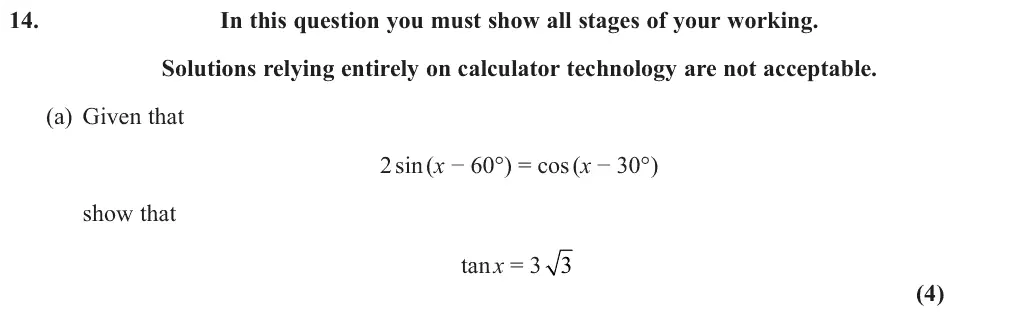
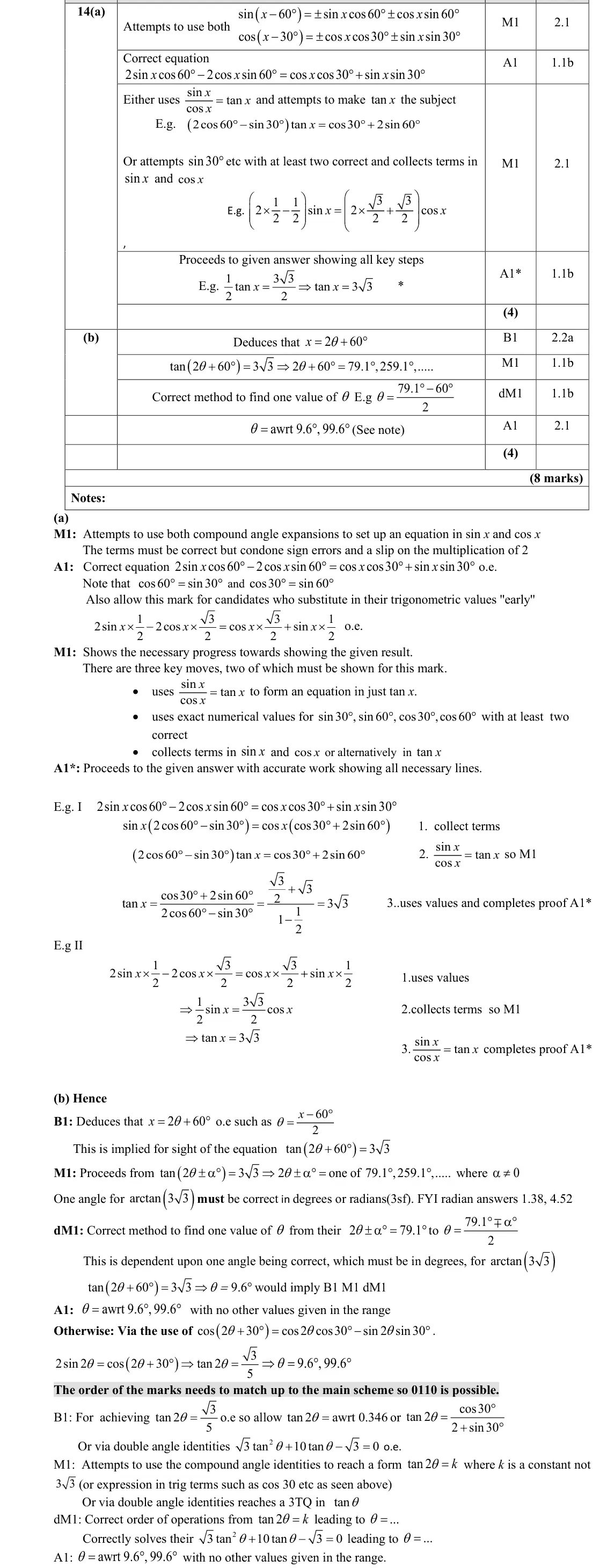
June 2025 · Paper 1 · Q14(a)3 marks
Mark scheme (whole question; this part is marked with the orange bar)
Examiner's comment
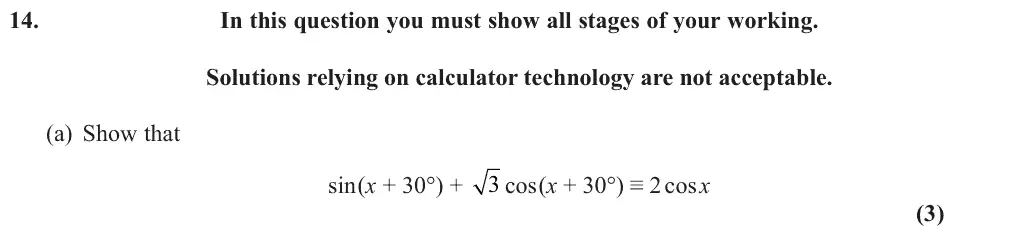
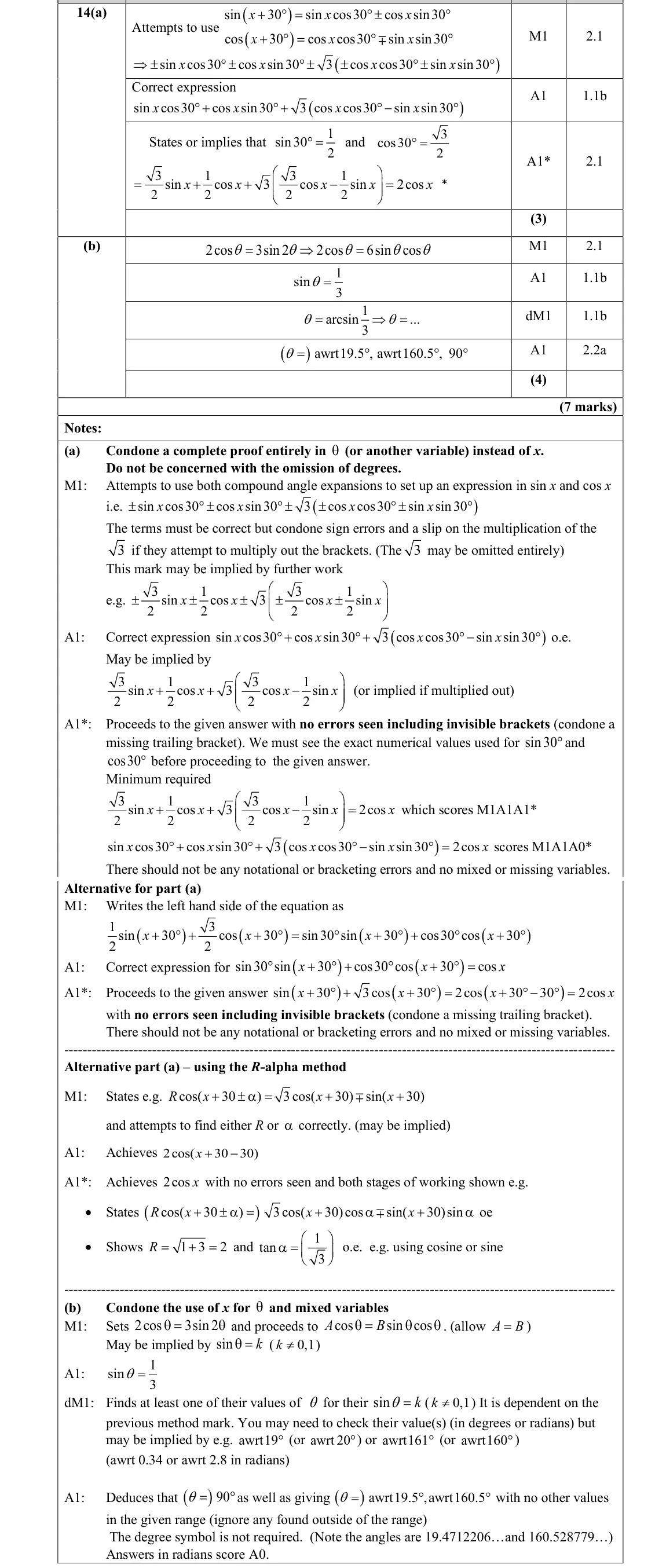
This question was a good differentiator at the later end of the paper. Success with this question was somewhat mixed, with some learners scoring most marks in part (b), whilst part (a) proved to be more challenging as it tested not only their knowledge of trigonometric identities but also their algebraic manipulation skills. In part (a), most responses attempted the proof by using both compound angle expansions to reach an expression in sin x and cos x, usually gaining the method mark and in most cases also the first accuracy mark. Once a correct expression was achieved, some stronger responses reached the given result by simplifying the terms. The most common mistakes committed while implementing this approach, were sign errors, especially for the compound angle expansion of ( ) cos 30 x + ° , incorrect multiplication by 3 and bracketing errors, which were not condoned in this ‘show’ question. A smaller proportion of responses used the R-alpha method with ( ) cos 30 R x + °± alpha , which required learners to find both R and alpha correctly to reach ( ) 2cos 30 30 2cos x x + °- ° = as requested.
Common mistakes
expand both compound angles (sign of cos(x + 30°) expansion), use sin 30° = ½ and cos 30° = √3/2 exactly
bracket errors not condoned
R-alpha method needs R = 2 and the angle
June 2025 · Paper 1 · Q14(b)4 marks
Mark scheme (whole question; this part is marked with the orange bar)
Examiner's comment
This question was a good differentiator at the later end of the paper. Success with this question was somewhat mixed, with some learners scoring most marks in part (b), whilst part (a) proved to be more challenging as it tested not only their knowledge of trigonometric identities but also their algebraic manipulation skills. Part (b) was generally answered well, most responses used the result in part (a) to set up the equation 2cos 3sin 2 = theta theta and then proceeded to reach and equation in cos and sin theta theta by applying the double angle formula on the right hand side, gaining the first method mark. From here, almost all responses reached the equation 1 sin 3 = theta , through either factorising correctly ( ) ( ) ( ) i.e. 2cos 1 3sin or cos 2 6sin - - theta theta theta theta , or dividing both sides by cos . theta Those that divided both sides by cos theta usually did not find that there was a further solution, 90 . = ° theta Those learners who reached 1 sin 3 = theta or equivalent, were usually able to gain the dependent method mark by finding at least one of the solutions of the equation in the given range. Responses that factorised the equation correctly, usually gained full marks by finding all solutions. Learners who used a calculator solely to find the correct angles scored no marks. 21
Common mistakes
use (a): 2cos θ = 3sin 2θ = 6sin θ cos θ
factorise cos θ(1 − 3sin θ) = 0 to get θ = 90° as well as sin θ = 1/3 giving 19.5°, 160.5°
dividing by cos θ loses 90°
calculator-only solutions score 0
June 2025 · Paper 2 · Q15(b)5 marks
Mark scheme (whole question; this part is marked with the orange bar)
Examiner's comment
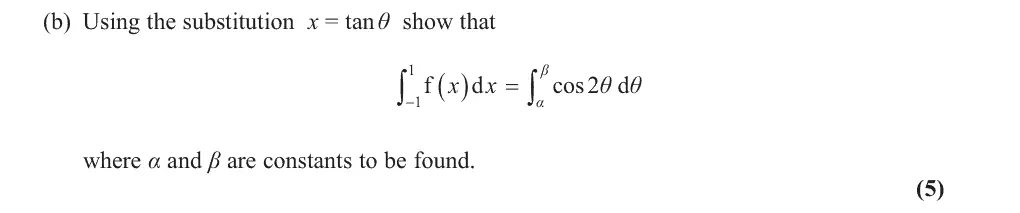
The final question, which involved differentiation, integration by substitution and trigonometric identities, provided challenge in dealing with the algebra but, given its layout, proved accessible. The majority of learners attempted at least part of this question with some success due to the restart opportunities available. In part (b), learners generally made a good start and seemed to be confident with the method of substitution. Most were able to score the first two B marks and the first M mark for an attempt at a complete substitution. For those that did not achieve the first M mark, it was almost always due to not dealing with the dx. However, the simplification to the required form using the trigonometric identities proved more challenging for many. Although there were many very neat and succinct solutions using various effective approaches, some responses expanded brackets unnecessarily, applied multiple trigonometric identities or worked with cumbersome fractions until they achieved something close to the required form. A small but noticeable number used degrees.
Common mistakes
limits −π/4 and π/4 (radians, not degrees)
dx = sec²θ dθ (dx must be replaced)
1 + tan²θ = sec²θ then cos²θ − sin²θ = cos 2θ
avoid unnecessary expansion
June 2024 · Paper 1 · Q12(a)3 marks
Mark scheme (whole question; this part is marked with the orange bar)
Examiner's comment
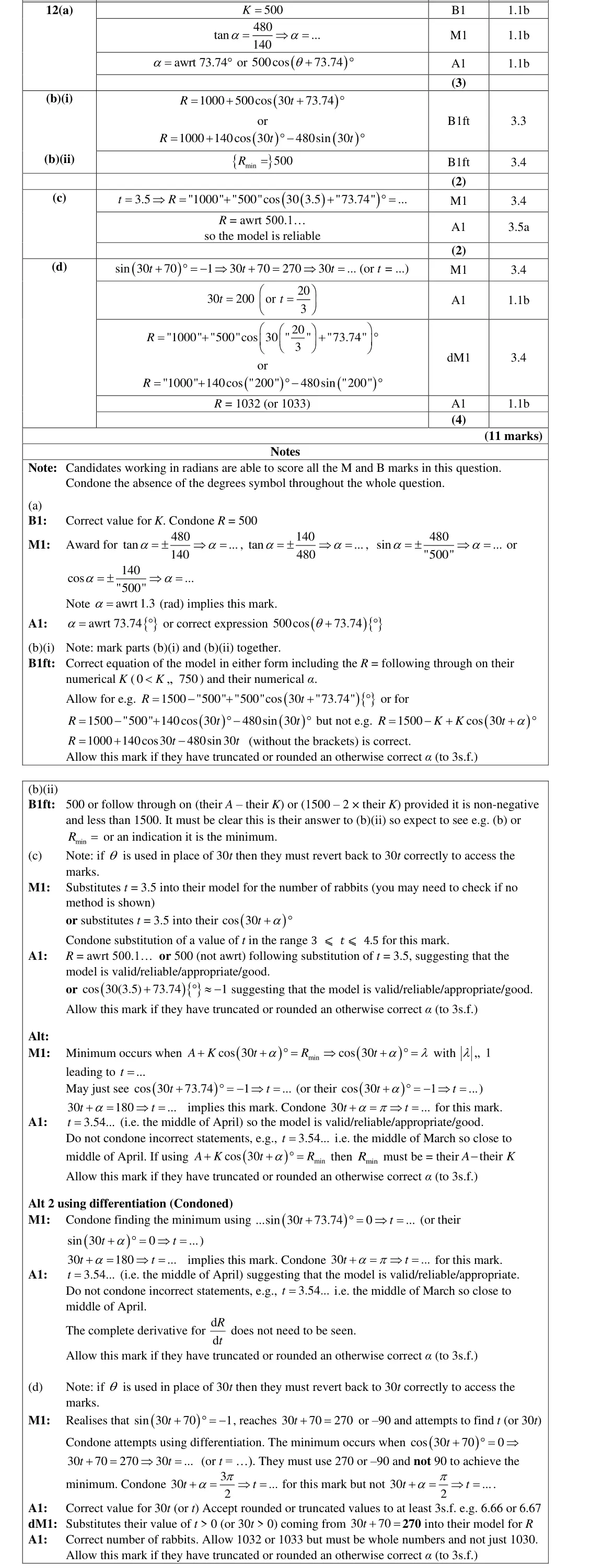
This harmonic form question was seen to be relatively challenging, despite similar questions being seen on several previous exam papers. That said, many candidates were able to attempt all parts of the question, and many follow through marks were available to those that made errors early on in their attempt. It was pleasing that most candidates identified that this question used degrees rather than radians. It was also pleasing to see many candidates continue to work through all parts of this modelling question despite having errors or not attempting previous parts. Part (a) was, as usual, answered well, with most candidates being able to find both K and correctly. Of those who failed to score all 3 marks for this part of the question, common mistakes included using radians instead of degrees and calculating 140 arctan 480 rather than 480 arctan 140 . There were very few responses that used trigonometric functions other than tan.
Common mistakes
K = 500
tan α = 480/140 (not 140/480)
work in degrees
α = 73.74°
June 2024 · Paper 1 · Q12(b)2 marks
Mark scheme (whole question; this part is marked with the orange bar)
Examiner's comment
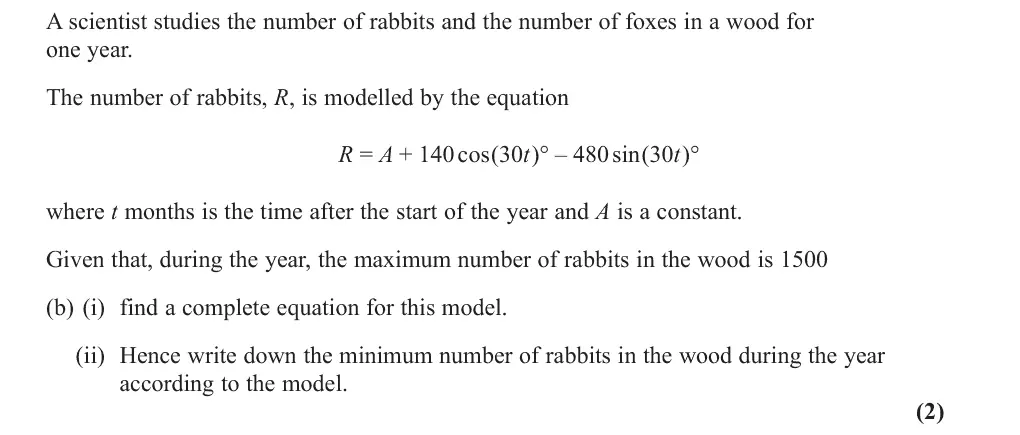
This harmonic form question was seen to be relatively challenging, despite similar questions being seen on several previous exam papers. That said, many candidates were able to attempt all parts of the question, and many follow through marks were available to those that made errors early on in their attempt. It was pleasing that most candidates identified that this question used degrees rather than radians. It was also pleasing to see many candidates continue to work through all parts of this modelling question despite having errors or not attempting previous parts. Responses to part (b)(i) suggested that candidates are not as confident at using the harmonic form as they are at forming it. Far too many candidates ignored their work from part (a) even if it was correct. Although given the maximum value for R, it was not uncommon to see candidates failing to use their harmonic form from part (a), but instead simultaneously setting 1500 R = , ( ) cos 30 1 t = - and ( ) sin 30 0 t = to obtain an incorrect value for A. Most of those who correctly identified that 1000 A = did then proceed to write down the full equation of the model, although many left this part with just a value for A. In part (b)(ii), some candidates struggled to calculate the value of min R as they did not recognise the link between their min R and the values of K and A. There were a few who added their values of A and K and hence did not score this B mark. Those who had found the correct value, 1000 A = , generally went on to identify the minimum value of R, but the follow through allowed those who understood the required method to gain this mark with an incorrect value for A.
Common mistakes
use the harmonic form: max = A + K so A = 1000 (not cos = −1 and sin = 0 together)
give the full equation, not just A
min = A − K = 500
June 2024 · Paper 1 · Q13(a)4 marks
Mark scheme (whole question; this part is marked with the orange bar)
Examiner's comment
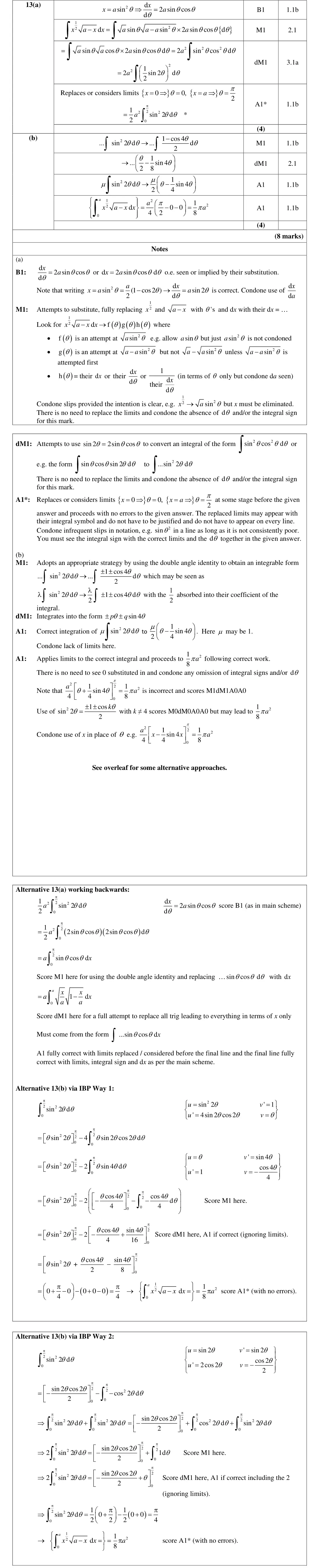
were available on both parts regardless of success in part (a) but many candidates who failed to prove the result in part (a) then went on to omit part (b) and missed out on this opportunity. However, it was not uncommon to see full marks in part (a) followed by no marks in part (b), and vice versa. Most candidates who attempted part (a) recognised the requirement to find d x and d attempted to do so, with varying levels of success. Those who differentiated successfully generally went on to substitute into the expression correctly and gained at least the first 2 marks. The flexibility in the first method mark made this accessible to d = most candidates who had tried at differentiation. appeared several d x 2 sin cos a times and benefited from the flexibility of the first method mark. The most common . In many cases the notation was 2 and cos a incorrect derivatives were 2 cos a particularly poor, although d x a was very generously condoned provided the right-hand d side was correct. Candidates struggled with the rearrangement of the integrand into the form required to successfully use the double angle formula. Many were not able to work with or simplify the square root terms successfully, and even those that did sometimes failed to recognise the need to use the double angle formula for sin 2 . A minority of candidates progressed correctly to the final answer, while some of those that achieved the final expression still lost the final mark for failing to address the limits, or for missing the d or the integral sign. For those who did not achieve the first method mark this was commonly due to careless copying or premature simplification such as - - 2 2 instead of . sin a a sin a a Those who recognised the requirement for using double angle formulae to integrate a squared trigonometric function were generally successful in part (b) of this question.
Common mistakes
dx/dθ = 2a sin θ cos θ
√(a − a sin²θ) = √a cos θ
sin²θ cos²θ = ¼ sin²2θ (rearranging the integrand is where most fail)
change limits to 0 and π/2
June 2024 · Paper 1 · Q13(b)4 marks
Mark scheme (whole question; this part is marked with the orange bar)
Examiner's comment
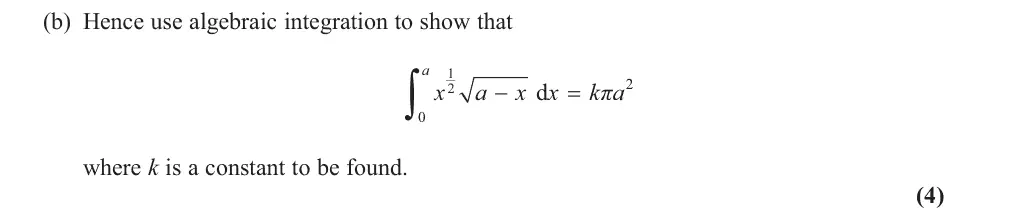
failed to prove the result in part (a) then went on to omit part (b) and missed out on this opportunity. However, it was not uncommon to see full marks in part (a) followed by no marks in part (b), and vice versa. Most candidates who attempted part (a) recognised the requirement to find d x and d squared trigonometric function were generally successful in part (b) of this question. - 1 cos2 = Occasionally candidates struggled to deal with 2 correctly, with 2 sin 2 2 seen all too frequently. These candidates scored no marks following incorrect use of the double angle identity. The other main errors in this part were in sign errors in the double cos4 - angle identity and in the integration of the trigonometric term: commonly was 1 sin 4 + integrated to , and despite this still leading to the correct answer it was at the 4 expense of the two accuracy marks. A significant proportion of candidates incorrectly sin . Some 3 attempted to increase the power and divide leading to a term in 1 1 ( ) - by parts were also seen. x a x unsuccessful attempts at restarting and integrating 2 2 There was also a significant proportion of candidates who attempted integration by parts which generally gained no credit. Candidates who were successful in using integration and at this point 2 cos 2 by parts often had a succinct approach, while many reached realised the use of double angle identity would help, where it would have been more concise to use the double angle identities in the first place.
Common mistakes
sin²2θ = (1 − cos 4θ)/2 (sign or angle errors common)
∫cos 4θ = ¼ sin 4θ
k = 1/8
by parts is long
June 2023 · Paper 1 · Q125 marks
Mark scheme (whole question; this part is marked with the orange bar)
Examiner's comment
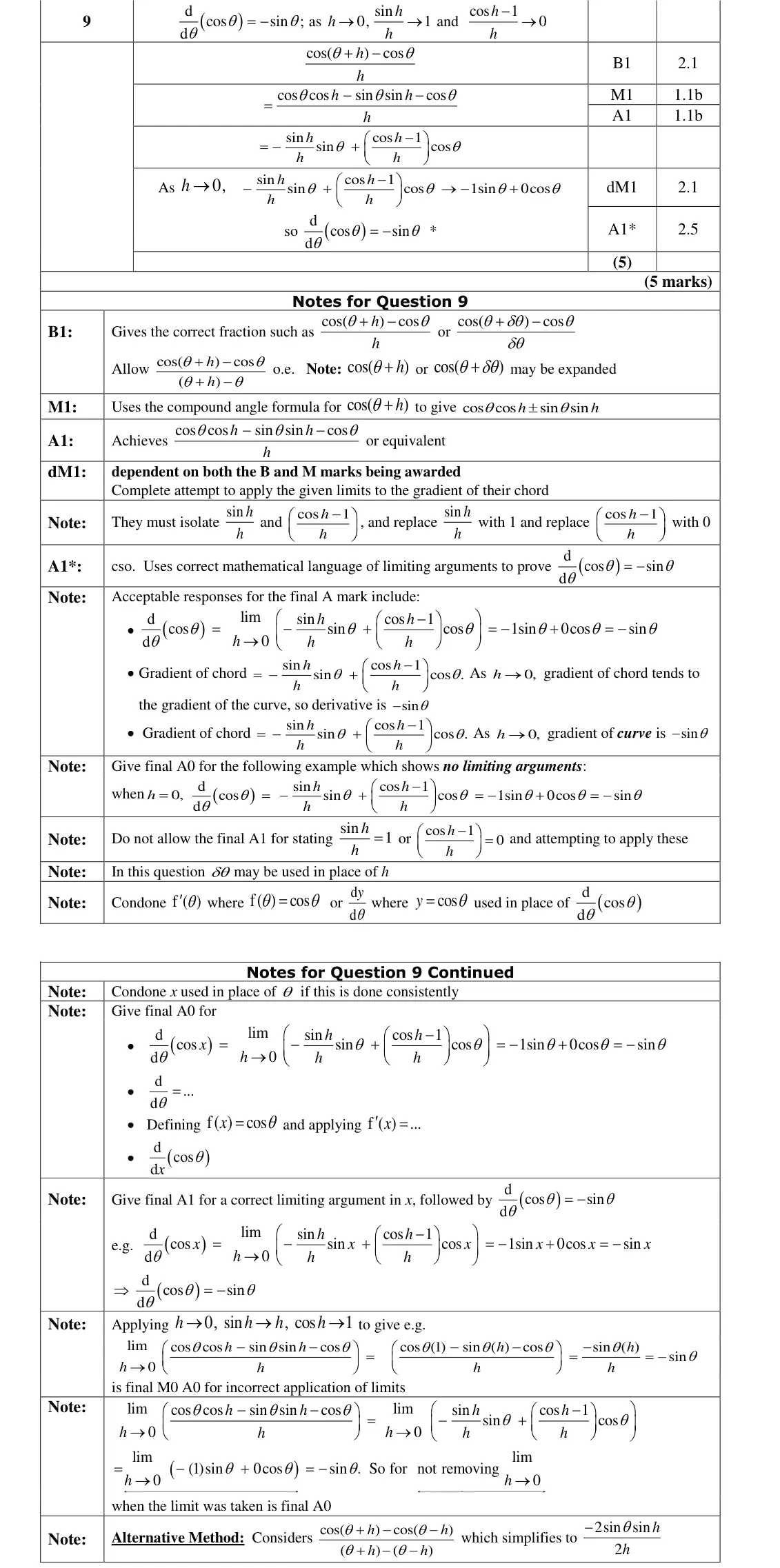
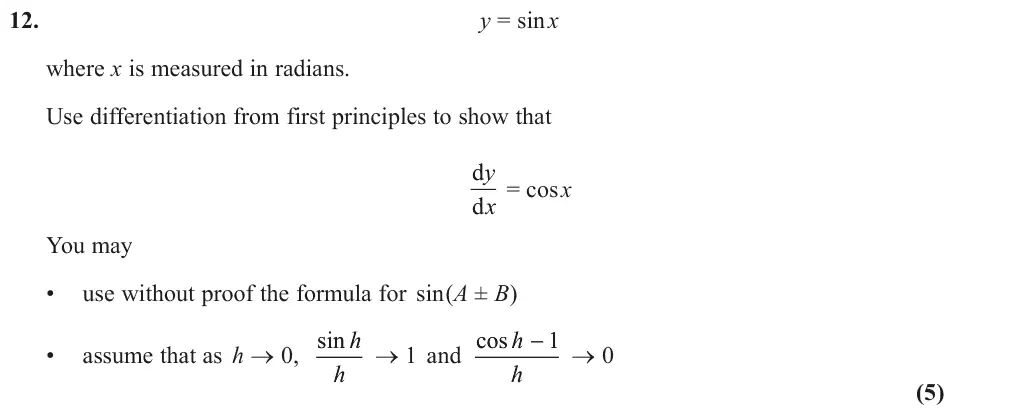
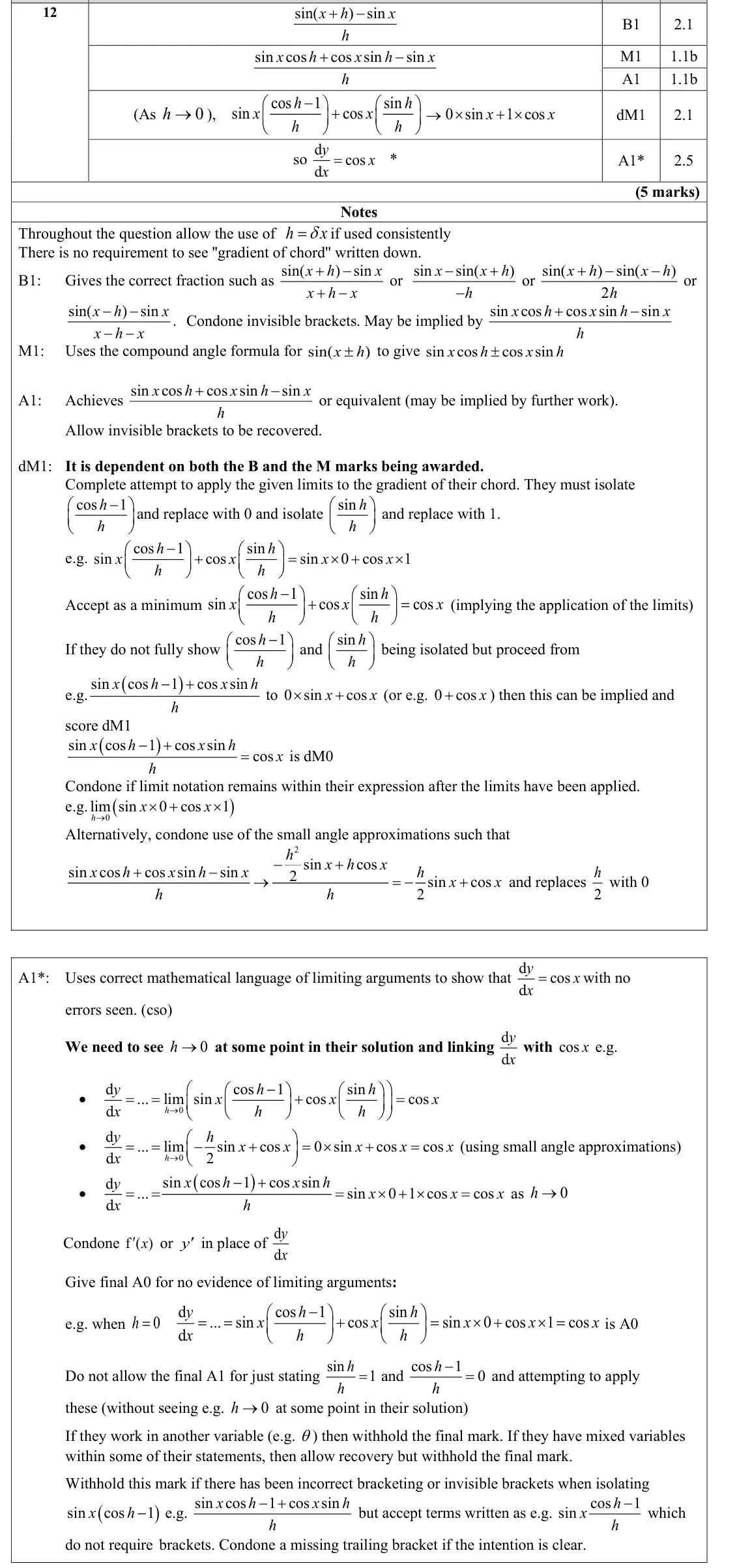
This differentiation from first principles question was similar to the one that appeared in 2018 and candidates demonstrated a much greater confidence with the way in which they should approach this topic. The limits were provided in the question and the accessibility was evident as it was very rare to see a completely blank script, which is not always true for a differentiating from first principles question. Most candidates were able to obtain the first 3 marks of this question, with very few sign errors seen when using the addition formula. Most correctly started with the fraction for the gradient of the chord f( ) f( ) x h x h + - as given in the formula booklet. Occasionally all a candidate would attempt was the addition formula in terms of A and B, but more often than not it was in the correct format and correct. Scoring the last two marks was not as common, but still achieved more often than not. There were a variety of layouts used for the candidates to justify the replacement of terms with 0 and 1. If candidates lost marks here, it was often because they failed to separate their terms in h correctly. Some candidates introduced extra h’s, forming expressions likecos sin xh hh . At other times, candidates simply tried to cancel terms incorrectly or stopped. Notation was generally good with limiting arguments correct. The main mistakes that resulted in lost marks were either failing to isolate the required expressions and jumping to the answer or trying to replace each of the 3 terms separately, failing to spot the common factor of sin x in two of them. There were also several candidates incorrectly splitting up the product of each term resulting in an extra h in the denominators. Incorrect notation resulted in the loss of the final mark, in particular the limit notation was often seen right through to the end, in the final answer, even after the limits had been used. A small number of candidates proceeded by using the small angle formula which was generally done well; where errors were seen it was generally not cancelling correctly. One surprising thing to note was the number of candidates who felt it acceptable to not clearly identify the numerator of the fraction by using very small fraction lines, resulting in their solution looking like only one term was being divided by h. Many candidates failed to write d cos d y x x = at the end, despite this being what they had been asked to show. If f ( )x had not been acceptable as an answer, then many candidates would have lost the final A mark. Only a very small handful of candidates used small angle approximations.
Common mistakes
gradient of chord (sin(x + h) − sin x)/h
compound angle formula
isolate (cos h − 1)/h and (sin h)/h
h → 0 must be seen
June 2023 · Paper 2 · Q8(a)3 marks
Mark scheme (whole question; this part is marked with the orange bar)
Examiner's comment
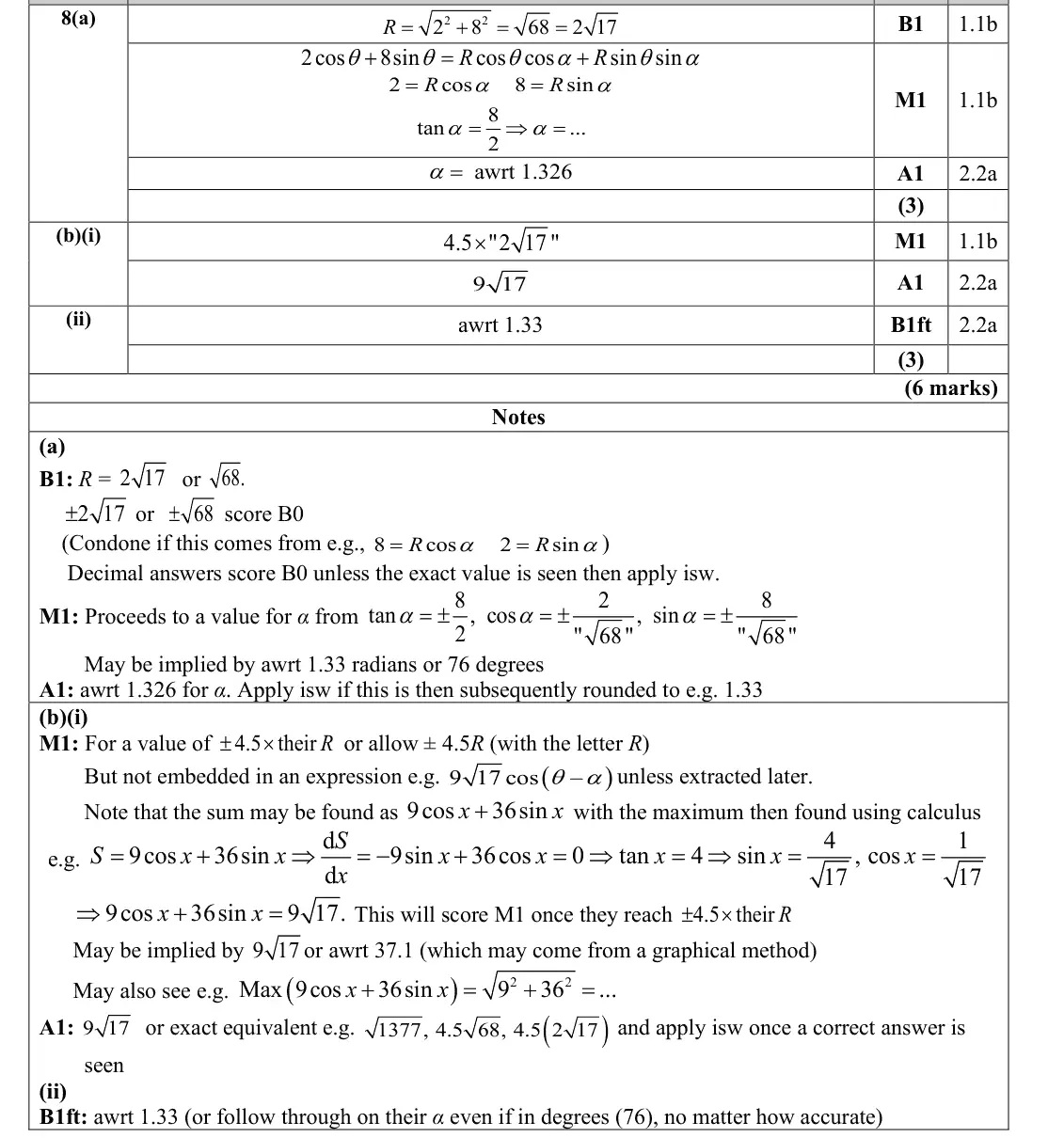
Part (a) of this question was generally answered very well with candidates regularly scoring full marks. Candidates seemed to be well practiced at converting to harmonic form and working in radians. The most successful candidates wrote out the full expansion of ( ) cos R - rather than trying to take a short cut. The common issues included giving a decimal solution for R or rounding the value of alpha to a lower degree of accuracy than was required in the question. There were a small number of candidates who worked with 2 tan 8 = and so lost the method mark and the accuracy mark. Candidates were slightly more successful in part (ii). Most candidates who stated a correct value for the maximum, also got the value of x correct, more often than not giving it to the same accuracy as in part (a). A few benefitted from this being a follow through mark. Some candidates tried to find a subsequent value for and were often out by or 2 , or attempted to rearrange 1.326 x - = . A few responses were seen where S was differentiated and set to zero to find a maximum. These candidates often lost the accuracy mark as they found an answer of 37.1. A lot of incorrect responses gave a maximum of 36 when sin 1 x = or 45 from finding 36 + 9.
Common mistakes
R = √68 = 2√17 exact (decimal R scores 0)
tan α = 8/2 (not 2/8), α = 1.326 radians to 3 d.p.
June 2023 · Paper 2 · Q8(b)3 marks
Mark scheme (whole question; this part is marked with the orange bar)
Examiner's comment
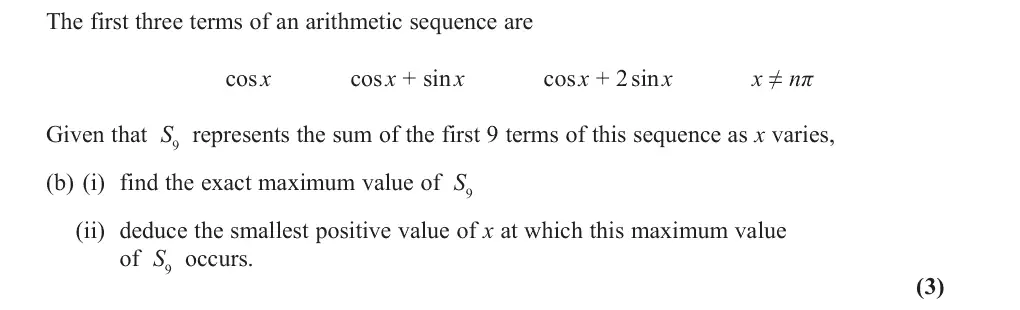
Candidates found part (b) more challenging, with many failing to link areas of mathematics, in this case trigonometry and series. Even where a candidate successfully found the sum, 9cos 36sin S x x = + , many did not relate it to part (a). Those who did recognise the form were usually able to get 4.5 " " R , usually 4.5 2 17 for part (i). Some seemed to misread the question and stated the minimum value, so lost the accuracy mark. A significant number of candidates found a correct expression in harmonic form but lost both the M1 and A1 as they kept a correct 9 17 embedded in their expression.
Common mistakes
common difference sin x: S₉ = 9cos x + 36sin x = 4.5(2cos x + 8sin x), so max = 4.5R = 9√17 (not left embedded in an expression)
occurs when x = α ≈ 1.33
many did not link to (a)
giving the minimum
June 2023 · Paper 2 · Q14(a)3 marks
Mark scheme (whole question; this part is marked with the orange bar)
Examiner's comment
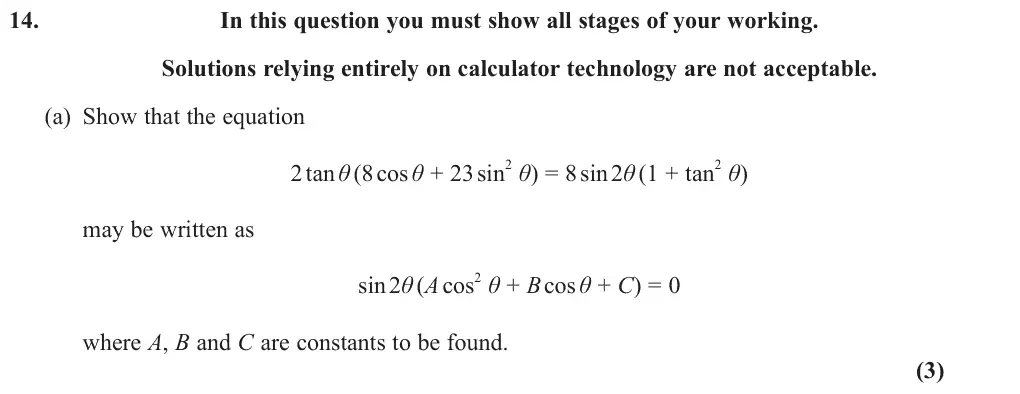
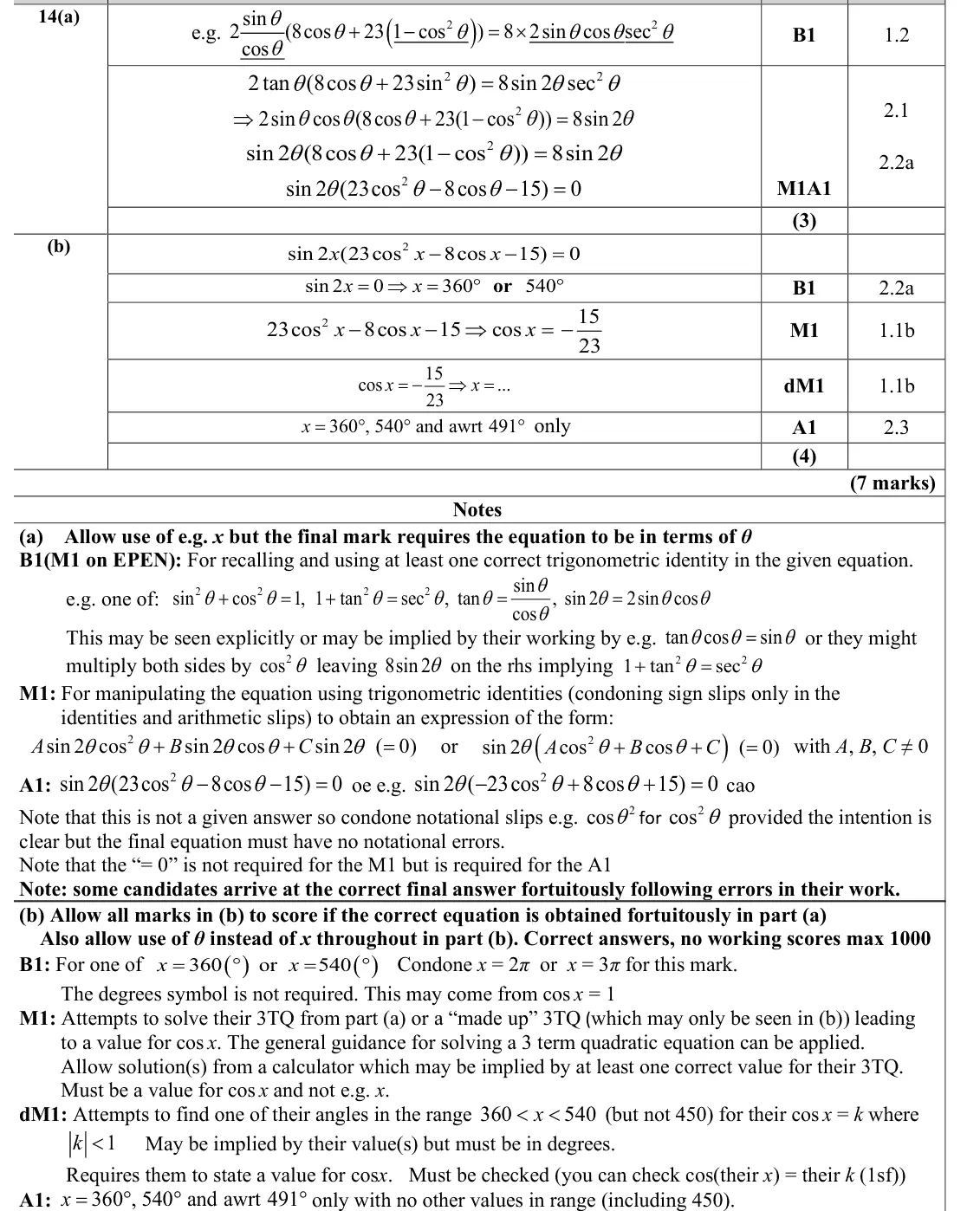
Part (a) was at least started by many but when students failed to make any progress towards the result, they tended not to attempt part (b). In part (a) the vast majority of candidates scored the first mark for using a correct trigonometric identity. The M and A marks were often both given or both lost, as candidates explored multiple manipulative steps to reach the final form for the equation. In many cases this involved expanding the brackets, using a substitution for sin 2 theta , but later putting back into sin 2 theta form i.e., undoing the manipulation that had been introduced. Whilst in many cases this resulted in the candidate getting there in the end, there were many examples of multiple attempts or unnecessarily long solutions. The most efficient methods did not involve multiplying out the bracket on the LHS which seemed to be the default first step for most students. A common mistake was to suddenly put the RHS equal to zero so it disappeared rather than being subtracted on the LHS. For those that were successful, there were a variety of approaches as well as variety in the number of steps required to reach the correct final form, with some methods considerably more efficient than others. Arithmetic errors were commonly seen in this question. Many successful candidates attempted to find a factor of sin 2 theta on both sides of the equation before proceeding to collecting these on the same side. Another typical successful method involved writing all the terms in terms of sin theta and cos theta , collecting all terms on the same side, and then taking a factor of 2sin theta cos theta . However, many candidates who expanded tended to forget terms when expanding or factorising, leading to an expression in an incorrect format. Replacing tan theta and sin 2 theta was usually handled well, as was replacing 1 + tan2 theta with sec2 theta and then 2 1 cos but many candidates didn’t follow the manipulation to the end and were unsure what to do with the sin 2 theta on the right hand side, so either left it on the right hand side and lost both the M and A marks, or moved it to the left but then incorrectly dealt with it when combined with the quadratic formed on that side.
Common mistakes
use tanθ = sinθ/cosθ, 1 + tan²θ = sec²θ, sin²θ = 1 − cos²θ, sin2θ = 2sinθcosθ to get sin2θ(23cos²θ − 8cosθ − 15) = 0
do not divide by sin2θ or drop the RHS
long unnecessary expansions
June 2023 · Paper 2 · Q153 marks
Mark scheme (whole question; this part is marked with the orange bar)
Examiner's comment
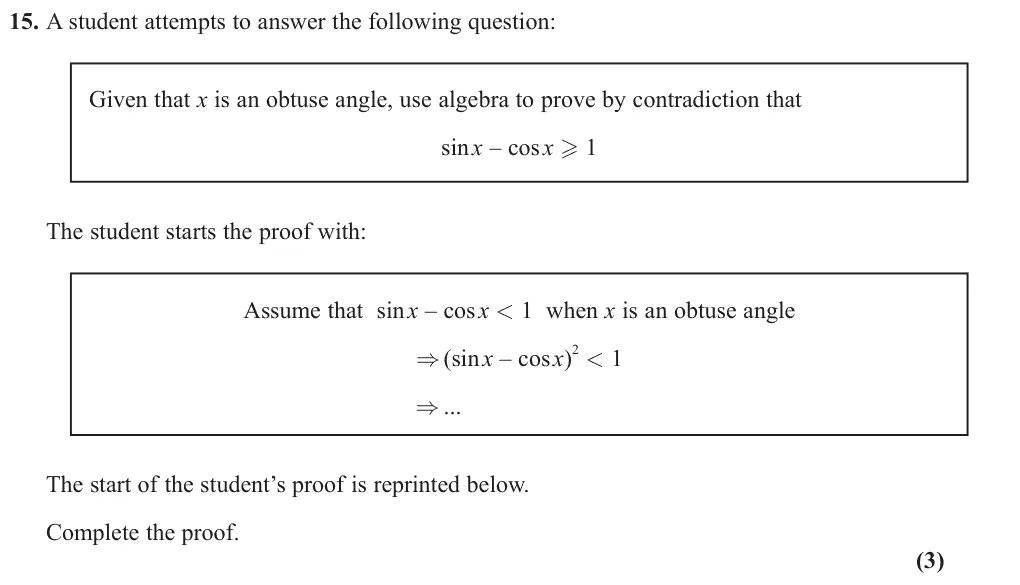
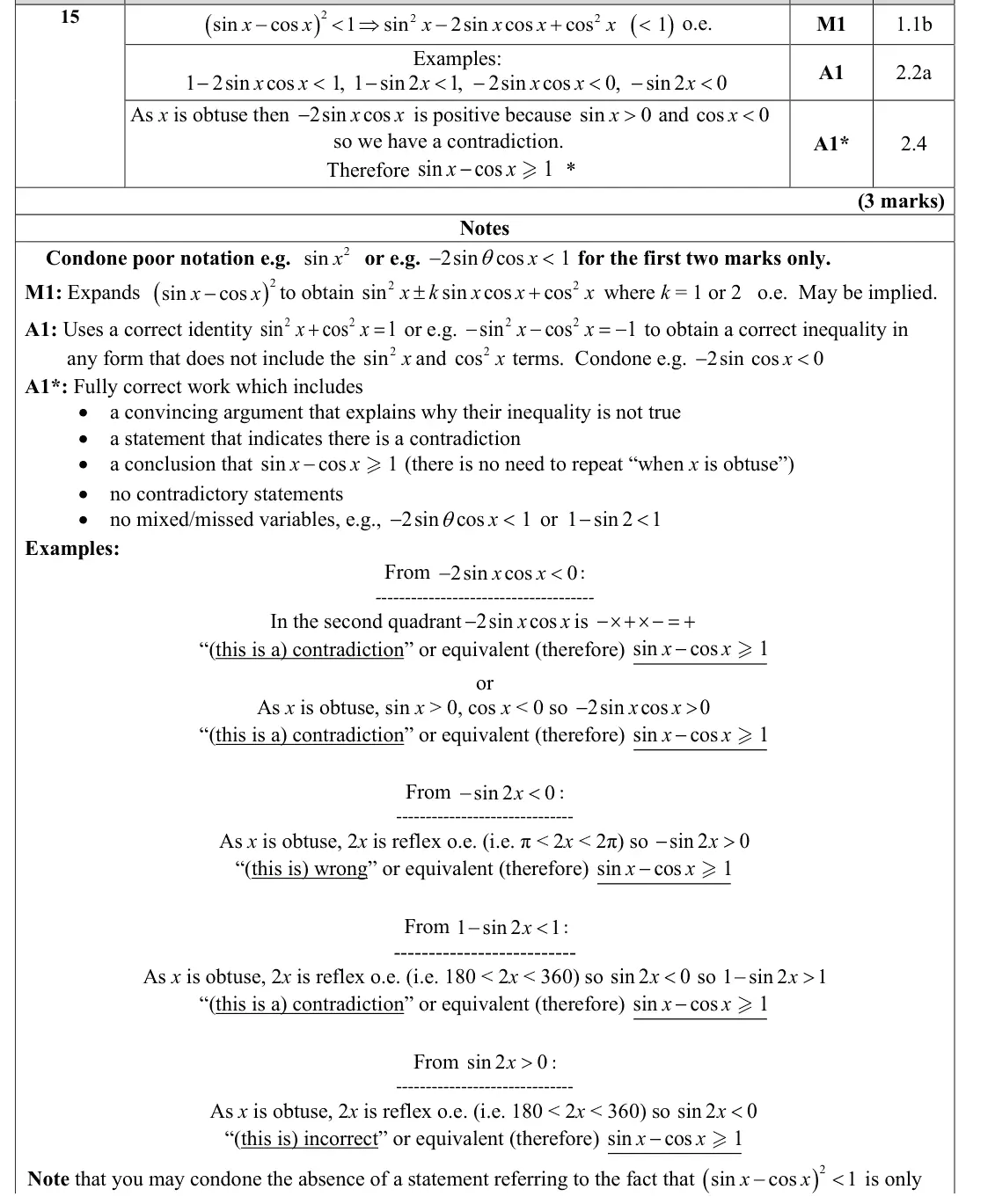
A number of candidates lost all marks on this question by not attempting any solution. Most candidates correctly expanded the given expression and used sin2 x + cos2 x = 1 to simplify and score the first two marks. A small number incorrectly used (sin x - cos x)2 = sin2 x - cos2 x, scoring no marks. Others attempted to substitute values of 90 and 180 into the given expression instead of using algebraic manipulation. Whilst most candidates scored the first two marks, only the very best were able to score the final mark, with most candidates failing to offer a convincing reason for a contradiction. Candidates who drew a graph of sin x and cos x or sin 2x to support their understanding tended to score well. Successful candidates typically explained that 2x must be between 180 and 360, and hence sin 2x must be negative, which is a contradiction with their inequality. Those that worked with sin x cos x were generally more successful in achieving this mark than those who chose to use sin2x. However, it was clear that not all students understood what an obtuse angle was. Another typical correct conclusion involved candidates stating if x is obtuse, sin x must be positive and cos x must be negative, leading to a negative product and a contradiction. Of those who were able to offer a reason for the contradiction, some still lost the final A mark for failing to then reach a conclusion that the original statement was true or because of errors in the proof such as missing x’s or mixed variables.
Common mistakes
expand (sin x − cos x)² = sin²x − 2sinxcosx + cos²x (not sin²x − cos²x)
use sin²x + cos²x = 1 to get −2sinxcosx < 0
obtuse so sin x > 0, cos x < 0 (or 180° < 2x < 360°, sin2x < 0): contradiction, so sin x − cos x ≥ 1
substituting 90° and 180° is not a proof
many did not explain the contradiction
June 2022 · Paper 1 · Q14(a)4 marksMedium
Mark scheme (whole question; this part is marked with the orange bar)
Examiner's comment
This question was another big discriminator. Good candidates found it familiar and accessible with some 25% scoring full marks. Strangely, for candidates who dropped marks, they seemed to be able to do either part (a) or part (b), but not both. For those candidates who attempted part (a) most recognised the need to use the compound angle expansions. Carelessness with the multiplication by 2, signs and use of the formulas was seen in a small minority of the scripts. Students who attempted to use sin (A+B) and cos (A+B) with a negative angle B, often introduced sign errors; it is clear that such a method is not to be recommended. Substituting exact numerical values was usually correct, however candidates occasionally fudged their working to get the given answer.
Common mistakes
expand both compound angles
exact values of sin/cos 30° and 60°
collect terms and use tan x = sin x/cos x
doubling slips and fudging to the given answer
June 2022 · Paper 1 · Q14(b)4 marksMedium
Mark scheme (whole question; this part is marked with the orange bar)
Examiner's comment
This question was another big discriminator. Good candidates found it familiar and accessible with some 25% scoring full marks. Strangely, for candidates who dropped marks, they seemed to be able to do either part (a) or part (b), but not both. Part (b) could be attempted without having done part (a) and many took up this opportunity. Those who paid attention to the 'hence', deducing that x = 2 theta + 60, were very successful in achieving the correct answers, though quite a few only found one solution. For the many students who did not see the link between parts (a) and (b), generally encountered much more complex, longer algebraic manipulation. Such students re-started the question using the compound angle formulae with a combination of other trigonometric identities, but were often not able to reach an equation in one function, or else made numerous slips. If quadratics in tan 𝜃𝜃 were reached, they were dealt with competently. If the candidate’s efforts led to tan2 theta = k, k≠ 3 sqrt 3 or tan (2 theta ± 60) = 3 sqrt 3 they were generally able to use the correct order of operations to solve their equation to find at least one solution. A fair number of correct answers were seen written down without any correct working. As the question had a warning about the use of calculator technology, these responses gained no marks
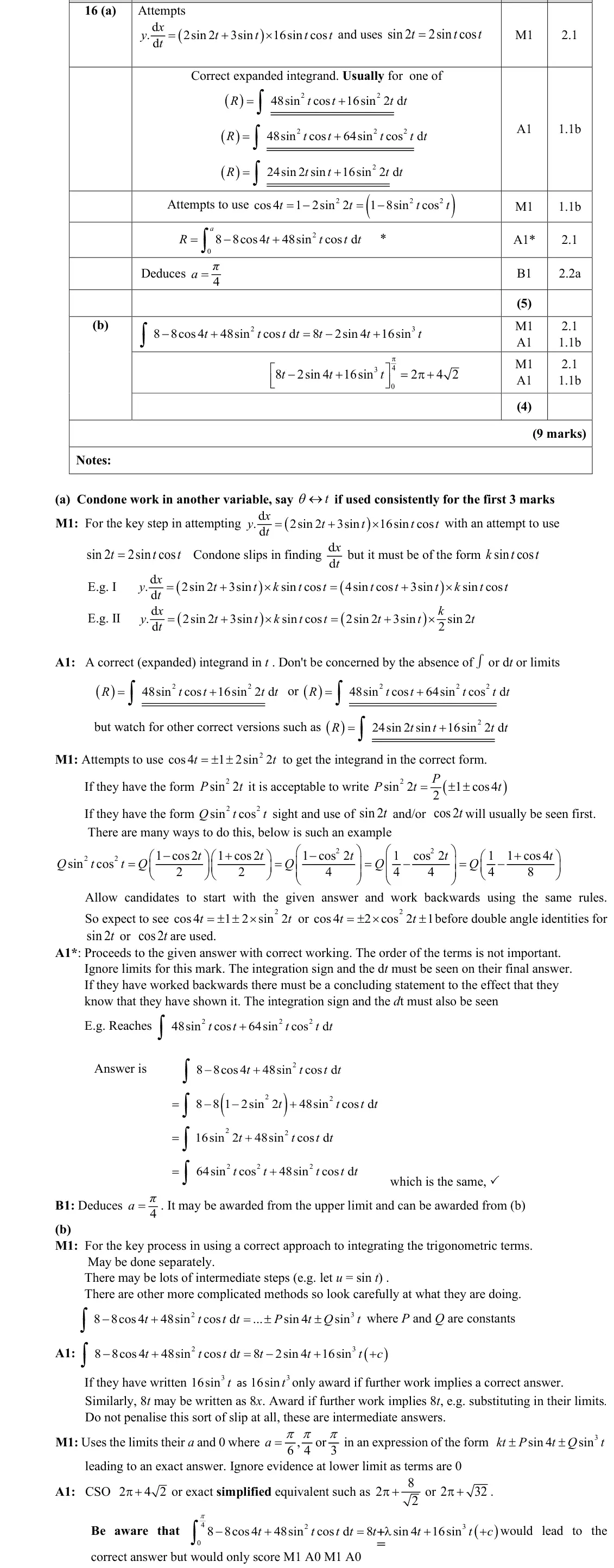
Mark scheme (whole question; this part is marked with the orange bar)
Examiner's comment
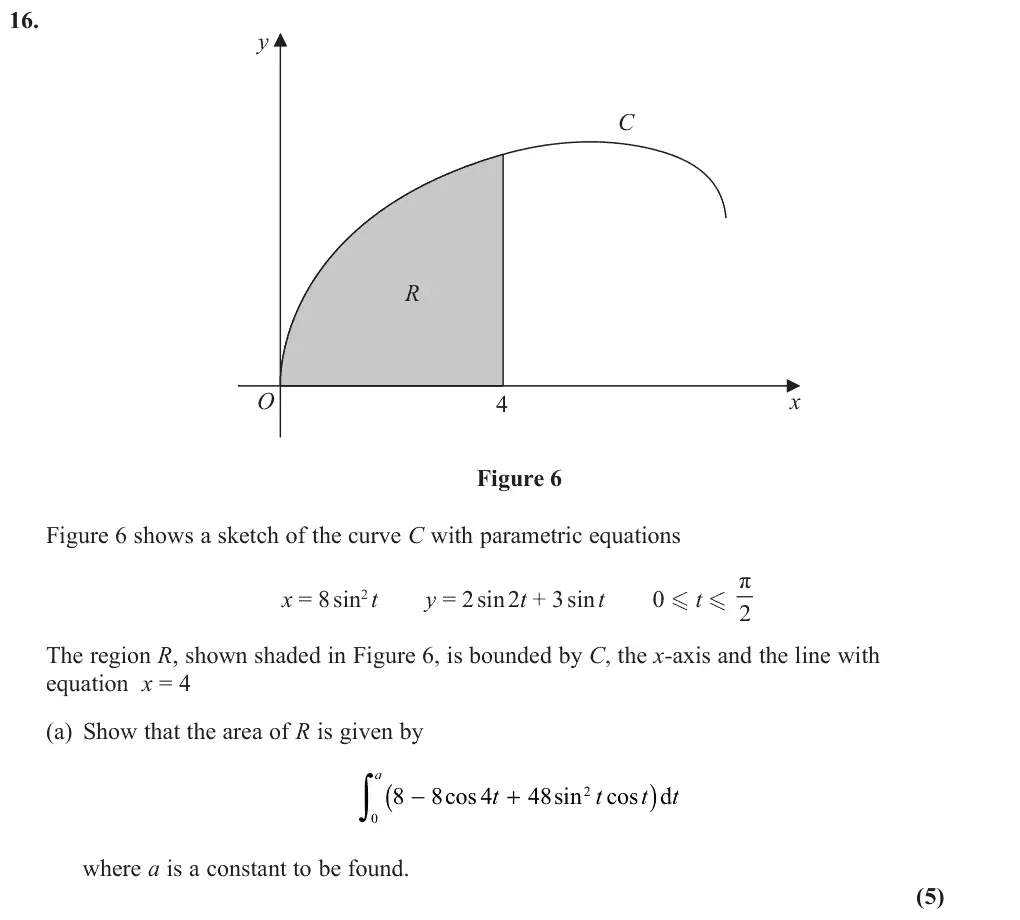
The final question on the paper proved to be a challenge for many candidates and there were several blank responses seen. It is possible that this was due to time management. Some candidates attempted unsuccessfully to change to a Cartesian equation, suggesting that possibly parametric integration had not been covered. In part (a), candidates who recognised the need to use parametric integration were usually able to differentiate correctly to find d d x t , multiply this by y and then use the double angle formulae to find an acceptable expression for d d x y t . It was common for candidates to score the first two marks. The next two marks were more elusive, and it was common to see candidates perform a lot of onerous manipulation without making any significant progress. Those who were most likely to be successful were the ones who had an expression in terms of 2 sin 2t and then spotting the need to use the double angle formula to form a term in cos 4t. For many candidates the mark for the upper limit was all that was achieved in part (a). However, some failed to achieve it as they left it as 4 (value for x not t) or 45 (degrees).
Common mistakes
area = integral of y dx/dt dt with dx/dt = 16 sin t cos t
sin 2t = 2 sin t cos t
cos 4t = 1 − 2sin²2t
x = 4 gives sin²t = ½ so a = π/4
changing to Cartesian fails
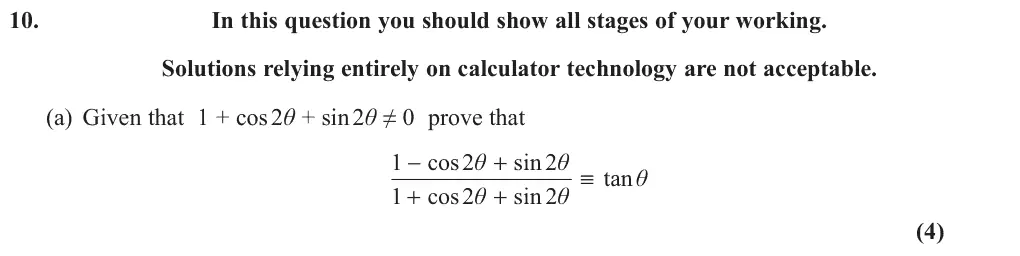
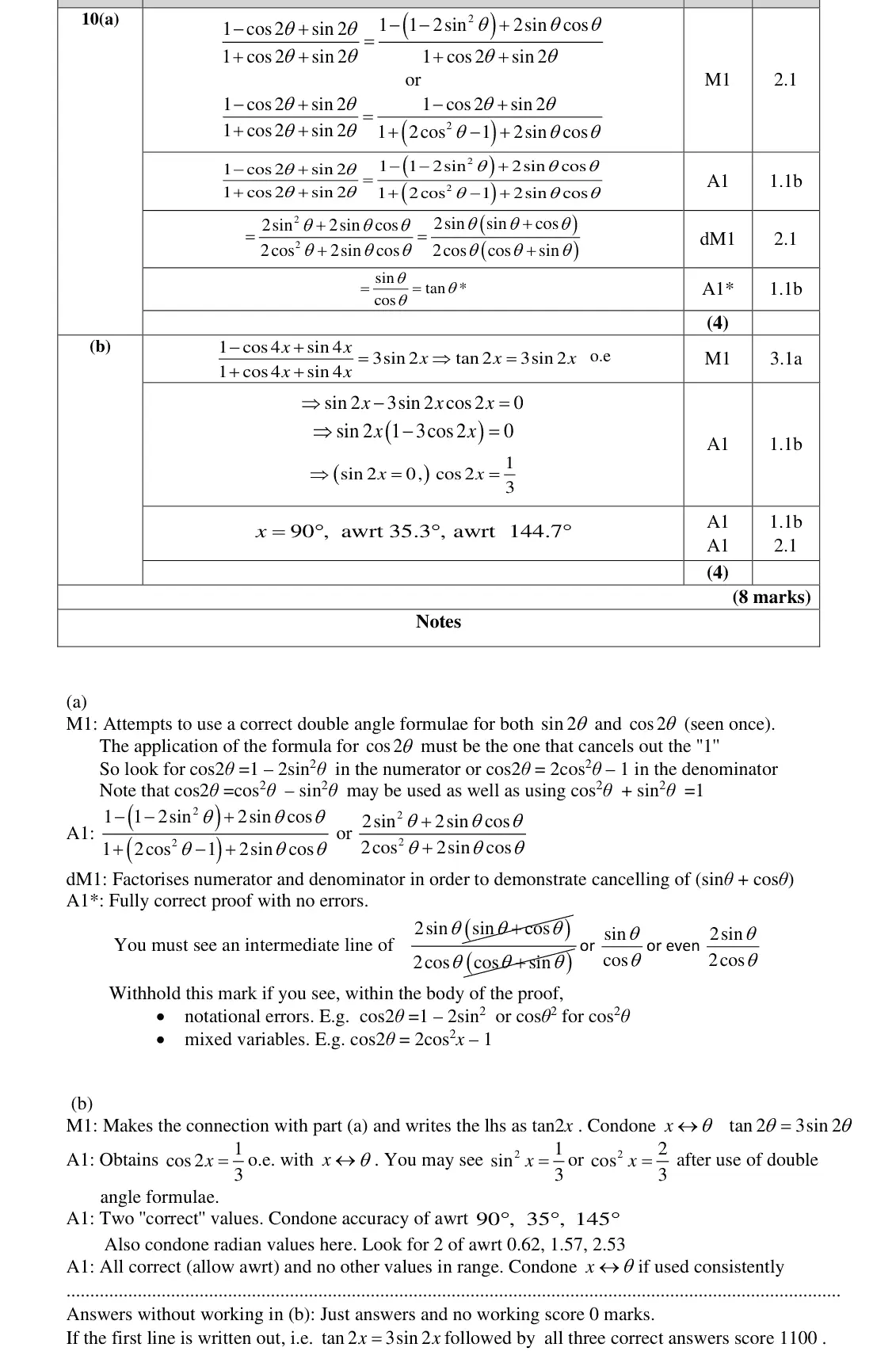
Oct 2021 · Paper 1 · Q10(a)4 marks
Mark scheme (whole question; this part is marked with the orange bar)
Examiner's comment
This was found to be another discriminating question. Those who were familiar with the topic made good progress yet there were many other attempts that scored no marks at all. Part(a) There were a significant number of fully correct solutions for this part, although some candidates did not achieve the stage where both the numerator and denominators of their fraction were factorised correctly with a common factor of ( sin theta +cos theta ). Another difficulty encountered by some, was how to use the different forms of the identity for cos2 theta in order to deal with, and remove, the presence of both “1’s ” in the fraction. Very few notational errors were seen, which was a pleasing improvement.
Common mistakes
choose cos 2θ = 1 − 2sin²θ on top and 2cos²θ − 1 below to remove the 1s
factorise to cancel (sin θ + cos θ)
no notation errors (cosθ², mixed variables)
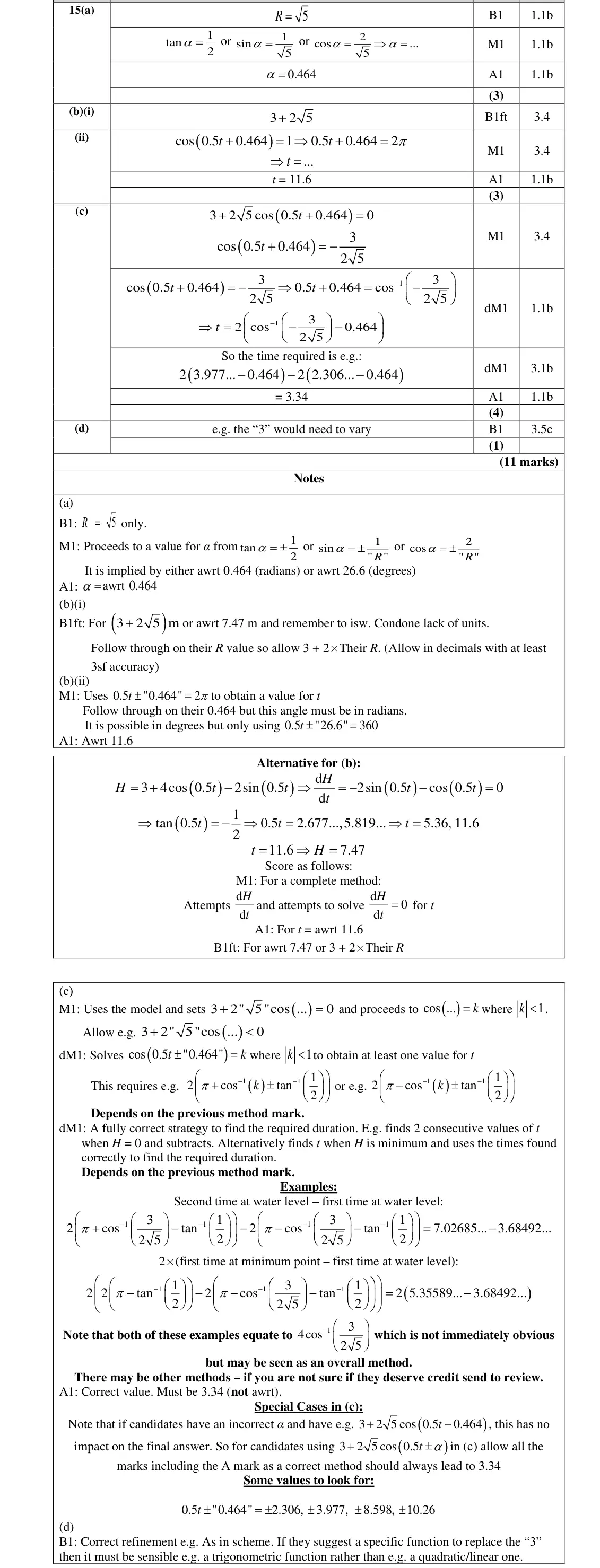
Oct 2021 · Paper 2 · Q15(a)3 marks
Mark scheme (whole question; this part is marked with the orange bar)
Examiner's comment
This question discriminated well between candidates that got this far, but it did appear that many candidates had simply run out of time, perhaps indicative of a generally lower understanding than in a June series because of it being a resit paper following the pandemic. Part (a) was answered very accurately by the vast majority of candidates, recognising the need to use the compound angle formulae for cos(𝜃𝜃+ 𝛼𝛼). Two common errors occurred, namely tan 𝛼𝛼= - 1 2, following inaccurate equating of the coefficients of cos 𝜃𝜃 and sin 𝜃𝜃, and an approximate value for 𝑅𝑅, which usually arose from candidates using their value of 𝛼𝛼 to find 𝑅𝑅 from either sin 𝛼𝛼= 1 𝑅𝑅 or cos 𝛼𝛼= 2 𝑅𝑅. These candidates should be encouraged to find 𝑅𝑅 using Pythagoras.
Common mistakes
R = √5 by Pythagoras (not from α)
tan α = ½, not −½
α = 0.464 rad
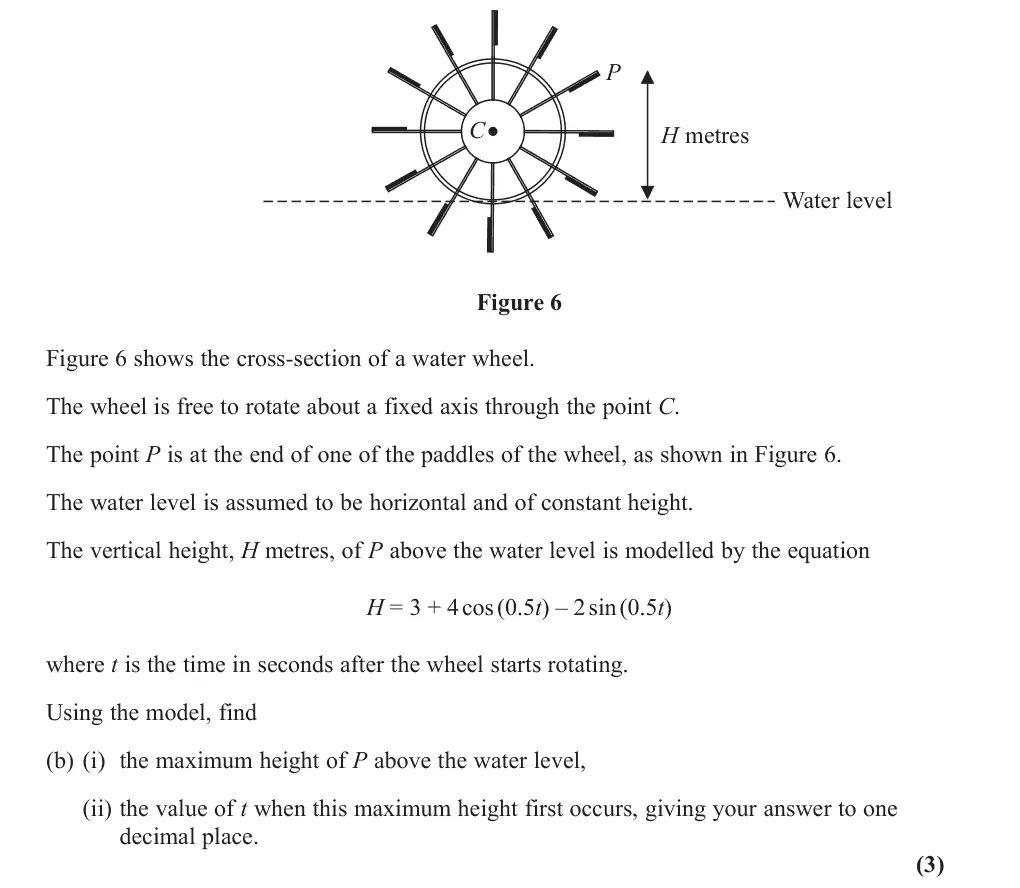
Oct 2021 · Paper 2 · Q15(b)3 marks
Mark scheme (whole question; this part is marked with the orange bar)
Examiner's comment
This question discriminated well between candidates that got this far, but it did appear that many candidates had simply run out of time, perhaps indicative of a generally lower understanding than in a June series because of it being a resit paper following the pandemic. Part (b)(i) was usually well attempted by those who had answered part (a), however, some candidates did not recognise the need to double 𝑅𝑅 and arrived at 3 + 𝑅𝑅 rather than 3 + 2𝑅𝑅 instead. Others simply assumed that the maximum was 3, 5 or 7, from a poor understanding of combining two trigonometric functions and the purpose of using the compound angle formulae to combine these two functions. Part (b)(ii) proved to cause problems for many candidates, with the majority incorrectly assuming that 0.5𝑡𝑡+ 𝛼𝛼= 0, and proceeded to ignore that this equation results in a negative value of 𝑡𝑡 (usually -0.9) by simply making this value of 𝑡𝑡 positive. They had failed to recognise that the first maximum would occur when 0.5𝑡𝑡+ 𝛼𝛼= 2𝜋𝜋. Perhaps the use of a sketch or graphical calculators would have helped these candidates. An alternative approach to part (b) required candidates to differentiate 𝐻𝐻, either in its original form or having used part (a) and solve the equation d𝐻𝐻 d𝑡𝑡= 0. This approach was more complicated and resulted in needing to solve tan(0.5𝑡𝑡) = - 1 2 and find the third solution, in order to avoid finding the maximum when 𝑡𝑡< 0 or the first minimum. Generally, candidates taking this approach were unsuccessful in scoring the accuracy mark, although the method mark was scored reasonably frequently.
Common mistakes
H = 3 + 2√5 cos(0.5t + 0.464), so maximum 3 + 2R = 7.47 m (not 3 + R)
first maximum when 0.5t + α = 2π (0 gives negative t)
t = 11.6
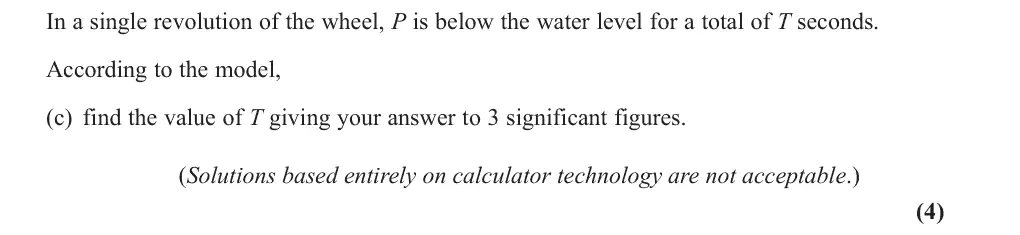
Oct 2021 · Paper 2 · Q15(c)4 marks
Mark scheme (whole question; this part is marked with the orange bar)
Examiner's comment
This question discriminated well between candidates that got this far, but it did appear that many candidates had simply run out of time, perhaps indicative of a generally lower understanding than in a June series because of it being a resit paper following the pandemic. Part (c) was another challenging part to this question and many candidates made no attempt. A surprising proportion of candidates attempted to solve the equation cos(0.5𝑡𝑡+ 𝛼𝛼) = -1, apparently in an attempt to find the minimum, but did not appear to understand how to use this to solve the problem. It was uncommon to see this method result in a correct value for 𝑇𝑇. More commonly, candidates were successful in finding a value for 𝑡𝑡 that satisfied 𝐻𝐻= 0, but incorrectly interpreted this as the solution to the problem. Instead, they were required to find a second value of 𝑡𝑡 and find the difference between these times. Again, there were a number of efficient and concise solutions to the problem that demonstrated an excellent understanding of what was required.
Common mistakes
set H = 0: cos(0.5t + 0.464) = −3/(2√5)
need two consecutive solutions and their difference (one time is not T)
3.34 exactly to 3 s.f.
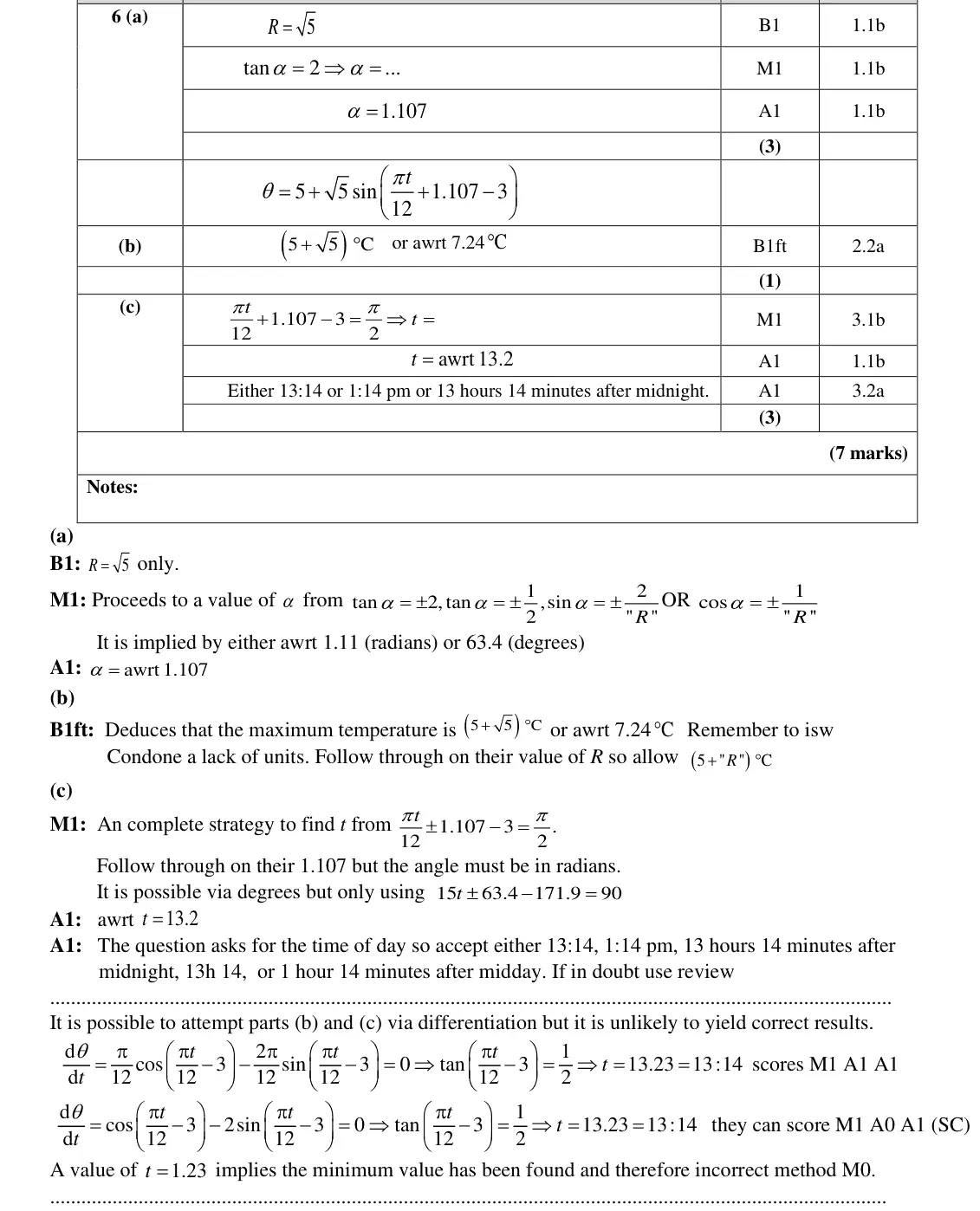
Oct 2020 · Paper 1 · Q6(a)3 marks
Mark scheme (whole question; this part is marked with the orange bar)
Examiner's comment
This was the second modelling question on the paper. Part (a) was generally well done, with few errors on giving the exact value of R or the angle in radians to the required degree of accuracy. A very small number of candidates gave R as a decimal or the angle in degrees.
Common mistakes
R = √5 exact (not a decimal)
tan α = 2, α = 1.107 in radians (not degrees)
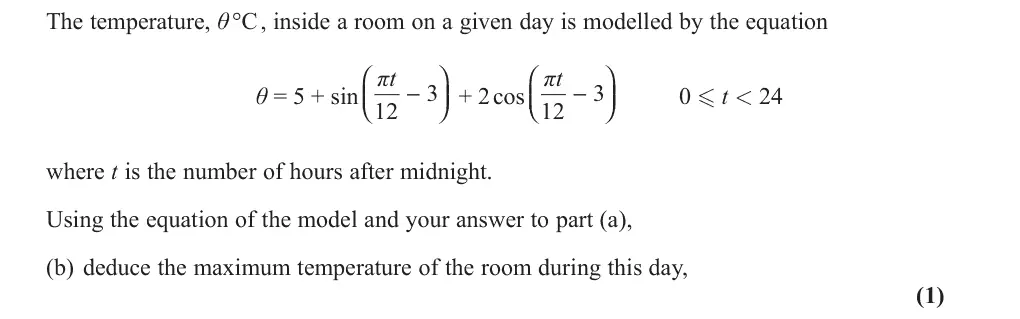
Oct 2020 · Paper 1 · Q6(b)1 mark
Mark scheme (whole question; this part is marked with the orange bar)
Examiner's comment
This was the second modelling question on the paper. Part (b) was also well done with most of those candidates giving the exact answer for the temperature. Occasionally candidates obtained an answer of 8° C from 5 + 1 + 2, which they obtained from taking the maximum values of sin and cos.
Common mistakes
θ = 5 + √5 sin(πt/12 + 1.107 − 3), so maximum 5 + √5 = 7.24 °C
adding the maxima of sin and cos separately (5 + 1 + 2 = 8) is wrong
Oct 2020 · Paper 2 · Q10(a)4 marks
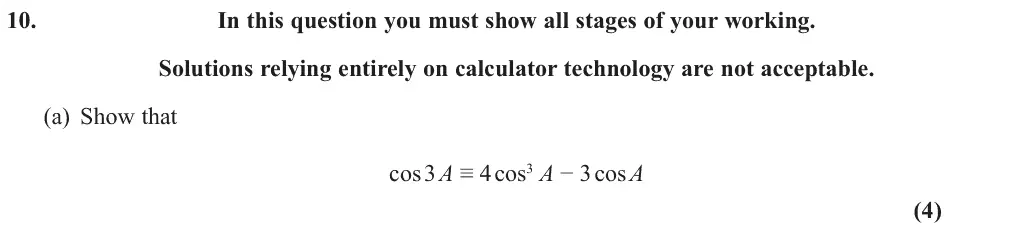
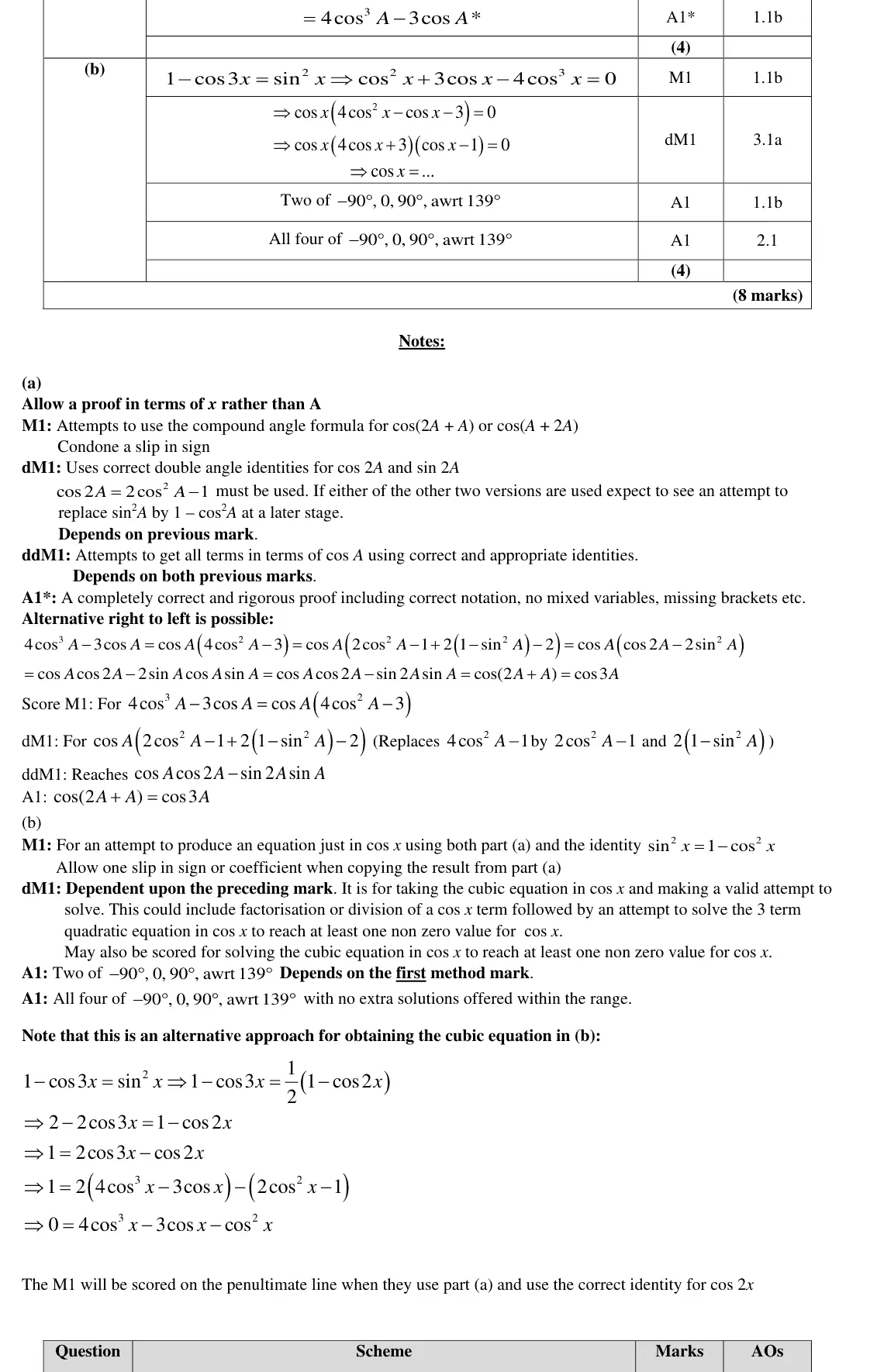
Mark scheme (whole question; this part is marked with the orange bar)
Examiner's comment
Many students were able to get started in part (a) with correct use of cos(2A + A) alongside the addition formula. Candidates who managed this, regularly went on to apply the double angle formulae correctly to achieve an expression in cosA only. Often circuitous routes were taken, most notably with the use of cos2A = cos2A - sin2A and then making a second substitution for sin2A (this sometimes resulted in bracketing and/or sign errors). A small number of candidates added a proof for the double angle formulae from the addition formulae even though this was unnecessary. A high proportion of students who managed to get the first mark went on to get at least 3 if not 4 marks in this part of the question. It was very much an all or nothing question with many only getting the first mark. A significant number presented their work in a way that was sometimes difficult to follow even if they did manage to score full marks.
Common mistakes
write cos 3A = cos(2A + A) and use the compound angle formula
cos 2A = 2cos²A − 1 and sin²A = 1 − cos²A
rigorous with no mixed variables or missing brackets
Oct 2020 · Paper 2 · Q12(a)(i)3 marks
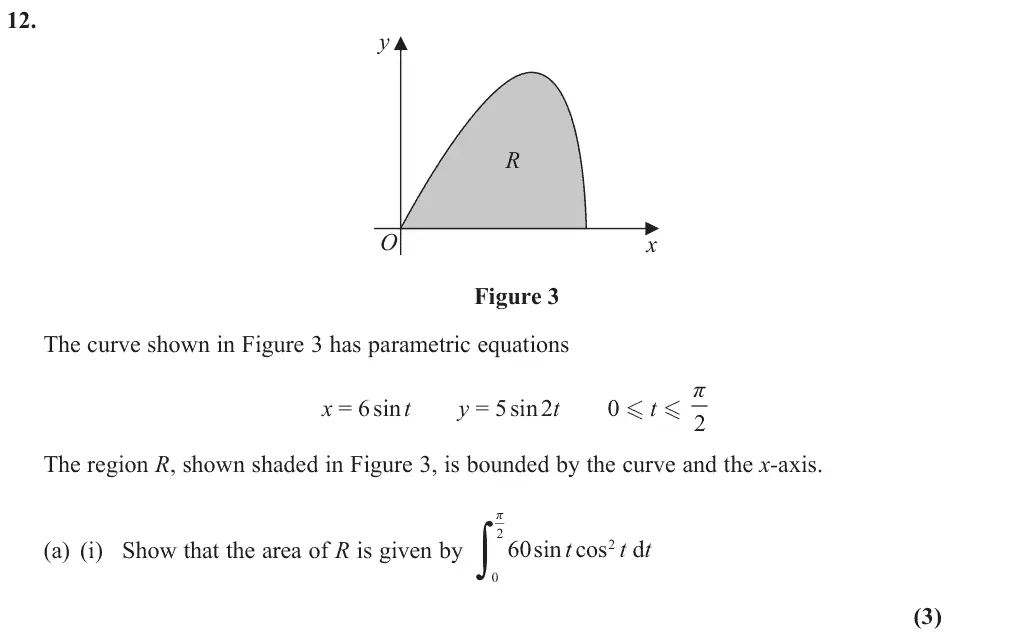
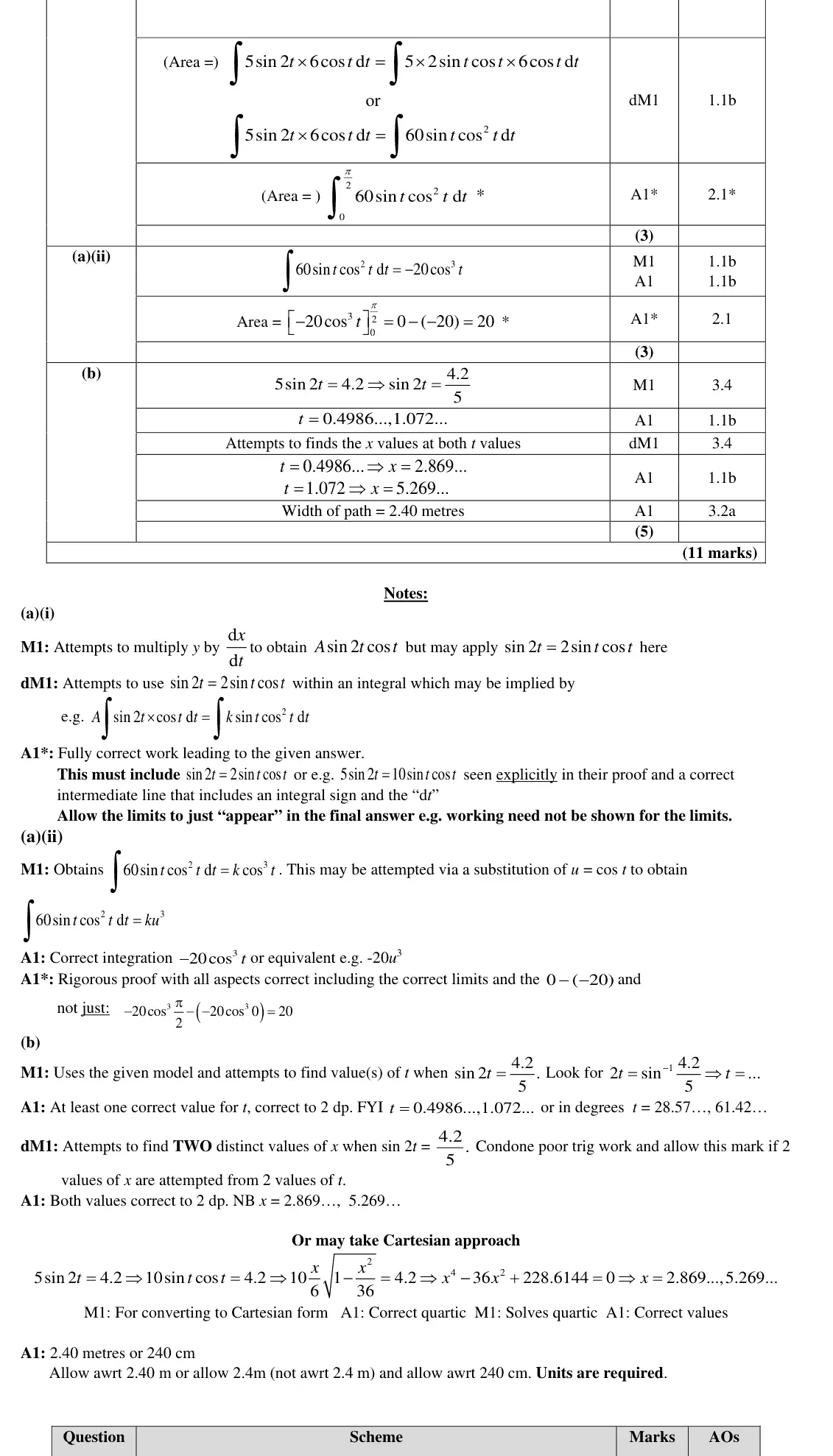
Mark scheme (whole question; this part is marked with the orange bar)
Examiner's comment
Many candidates left the entire question or parts of this question completely blank and clearly found it difficult to access the content being assessed here, perhaps due to a lack of familiarity with integration using parametric equations. Many tried to establish the Cartesian equation to answer various parts. That said, there were many candidates who provided clear and concise solutions to each part. In part (a)(i), most candidates recalled the formula for integrating parametric equations and knew to find 𝑑𝑑𝑑𝑑 𝑑𝑑𝑑𝑑. Awareness of the double angle formula for sin2t was good. The main problem caused for these candidates was a lack of “dt” throughout their work, and only included this in the final line, losing the final accuracy mark. There was a significant proportion of candidates who attempt ed some differentiation using the chain rule: 𝑑𝑑𝑑𝑑 𝑑𝑑𝑑𝑑= 𝑑𝑑𝑑𝑑 𝑑𝑑𝑑𝑑 x 𝑑𝑑𝑑𝑑 𝑑𝑑𝑑𝑑 , scoring no marks. In part (b) many candidates who had found part (a) difficult gave up and lost the opportunity of scoring some easier marks. Many candidates who scored no marks elsewhere were still able to access at least the first two marks in part (b) by setting sin2t = 4.2 5 and solving, frequently getting at least one correct angle; but too many of these found their second value of t by subtracting their first value from pi instead of calculating pi – 𝑠𝑠𝑠𝑠𝑠𝑠-1( 0.84) before dividing by 2. The following mark was for finding two values of x, but many simply substituted their first value in to find x, thinking that this gave them the width of the walkway. Too many marks were lost by approximating too soon and hence not having values with the required accuracy. A few lost the last mark because they omitted the units.
Common mistakes
area = integral of y (dx/dt) dt
sin 2t = 2sin t cos t must be seen explicitly
keep dt throughout
dy/dx by the chain rule is the wrong method
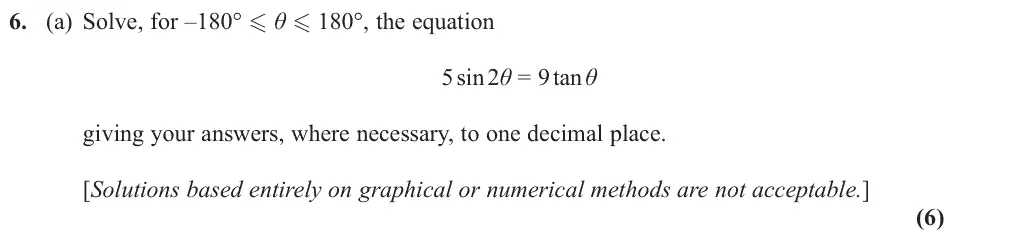
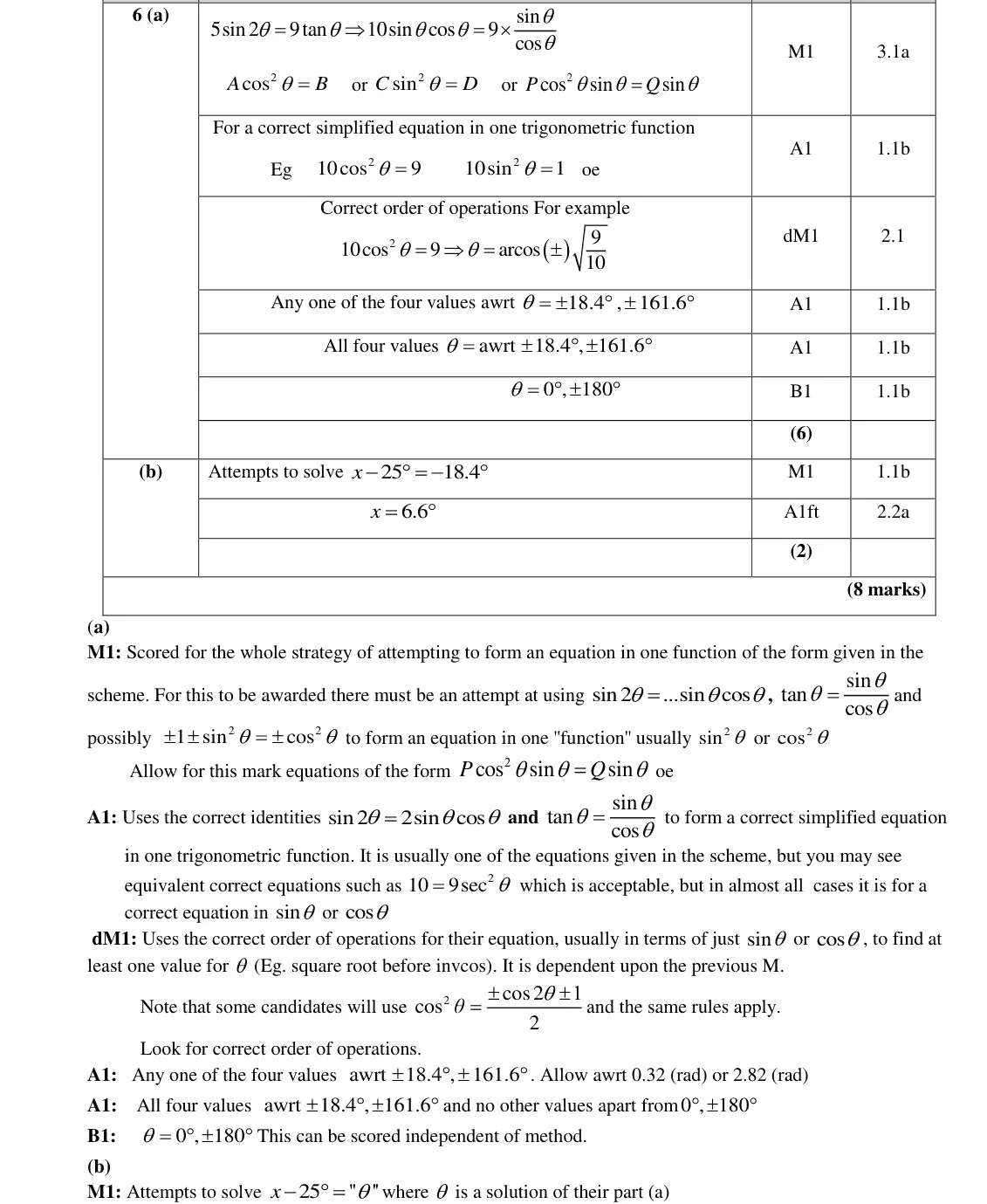
June 2019 · Paper 1 · Q6(a)6 marksMedium
Mark scheme (whole question; this part is marked with the orange bar)
Examiner's comment
This was generally a well attempted question with most candidates able to score over half of the marks. In part (a) the correct identities were well known and efficiently used in order to obtain an equation in one function. Almost all candidates who reached this stage were then able to proceed to find at least one correct angle. It was clear from the graphs and diagrams sketched by most candidates that they had been taught to look for all angles in the required range and many were able to give all four of the angles needed. Only a minority of candidates identified 0, 180 as solutions to the equations. Most candidates divided through by sin or cos and failed to identify any of these values.
Common mistakes
sin 2θ = 2 sin θ cos θ and tan θ = sin θ/cos θ
10cos²θ = 9 gives ±18.4°, ±161.6°
dividing by sin θ loses 0° and ±180°
June 2019 · Paper 2 · Q12(a)4 marks
Mark scheme (whole question; this part is marked with the orange bar)
Examiner's comment
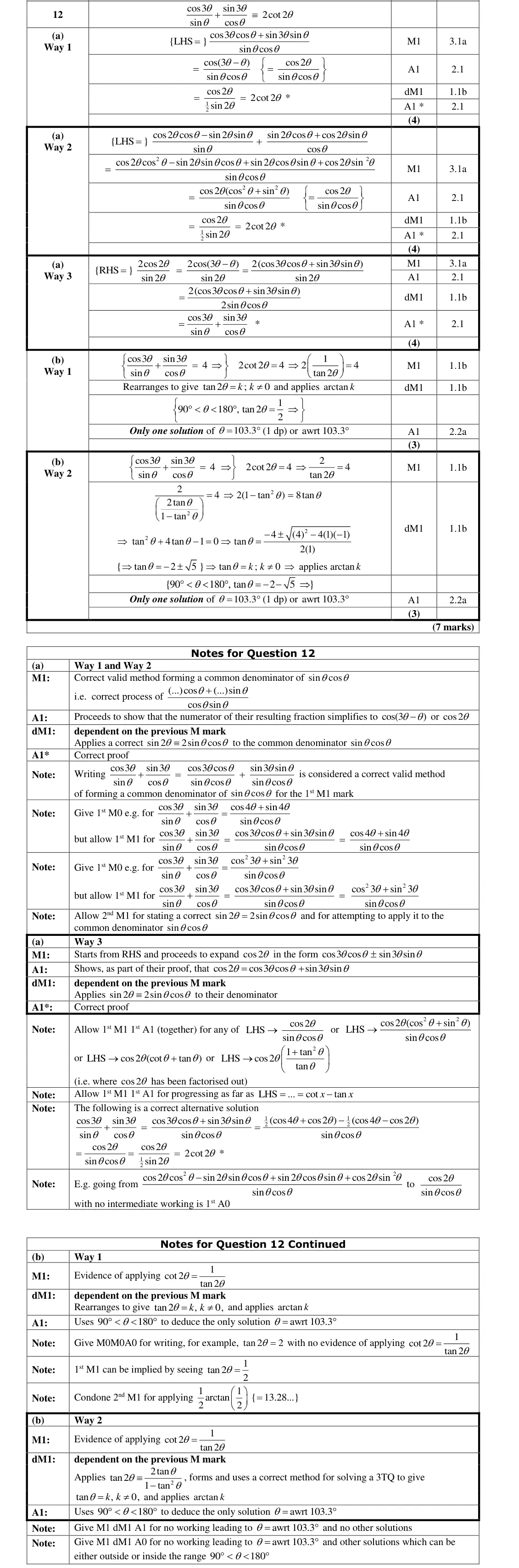
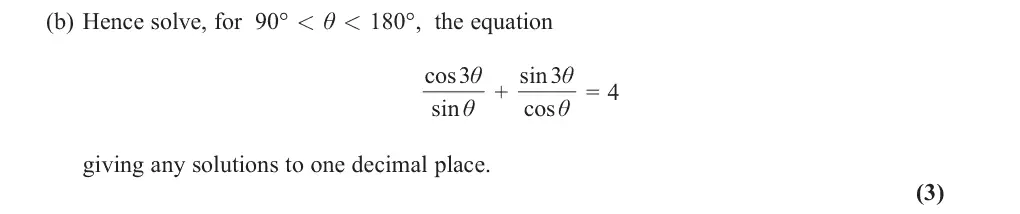
Q12(a) discriminated well between the higher ability candidates and it was possible for candidates of all abilities to gain access to Q12(b). In Q12(a), many candidates struggled to apply a complete strategy which would help them to make significant progress in proceeding from cos3 sin3 , via an sin cos 2 2 cos2 (cos sin ) intermediate stage of cos(3 ) , cos2 , or to the given sin cos sin cos sin cos result 2cot2 . Candidates who used Way 1, as described in the mark scheme, gained some credit for rationalising cos3 sin3 to give cos3 cos sin3 sin . Of those candidates sin cos sin cos 1 sin cos sin 2 who correctly applied to the denominator, only a few realised that 2 A common error in using Way 1 was to the numerator could be written as cos2 . 2 2 cos 3 sin 3 simplify cos3 sin3 or cos4 sin 4 . to give sin cos sin cos sin cos Way 2, as described in the mark scheme (and variations of this), was the most popular approach among candidates who completed the proof successfully. Candidates only started to access the marks for Way 2 when they combined their fractions by rationalising the denominator. Errors using Way 2 included the incorrect expansion of cos(2 ) or sin(2 ) , bracketing errors, manipulation errors or sign errors. They usually progressed as far as A few candidates started their proof from 2cot2 . 2 2(1 tan ) 2cos2 2cot 2 , 2cot 2 writing either or but could make no sin 2 2tan creditable progress until they applied a Way 3 method as described in the mark scheme. Some candidates spent a considerable amount of time attempting to write 3 3 4cos 3cos 3sin 4sin cos3 sin3 in terms of to give e.g. . sin cos sin cos candidates only started to access the marks for this method when they combined their fractions by rationalising the denominator. In Q13(b), most candidates used the result given in Q13(a) to deduce the equation 1 2cot 2 4. tan 2 , Most of these then attempted to solve and some obtained the 2 Common errors included attempting to solve tan2 correct answer 103.3 . 2 A few candidates obtained by . and finding more than one value for 103.3 2 2(1 tan ) 4. solving the equation 2tan
Common mistakes
2cot2θ = 4 so tan2θ = ½
2θ in (180°, 360°) gives only θ = 103.3°
solving tan2θ = 2 or giving extra solutions
June 2018 · Paper 1 · Q55 marks
Mark scheme (whole question; this part is marked with the orange bar)
Examiner's comment
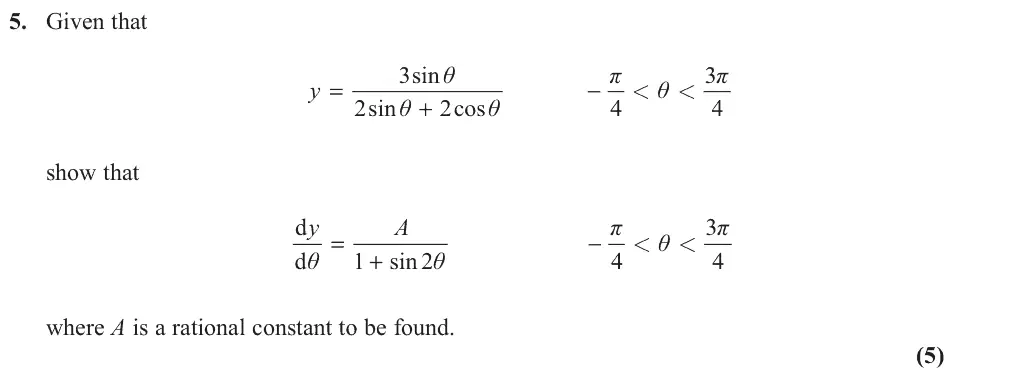
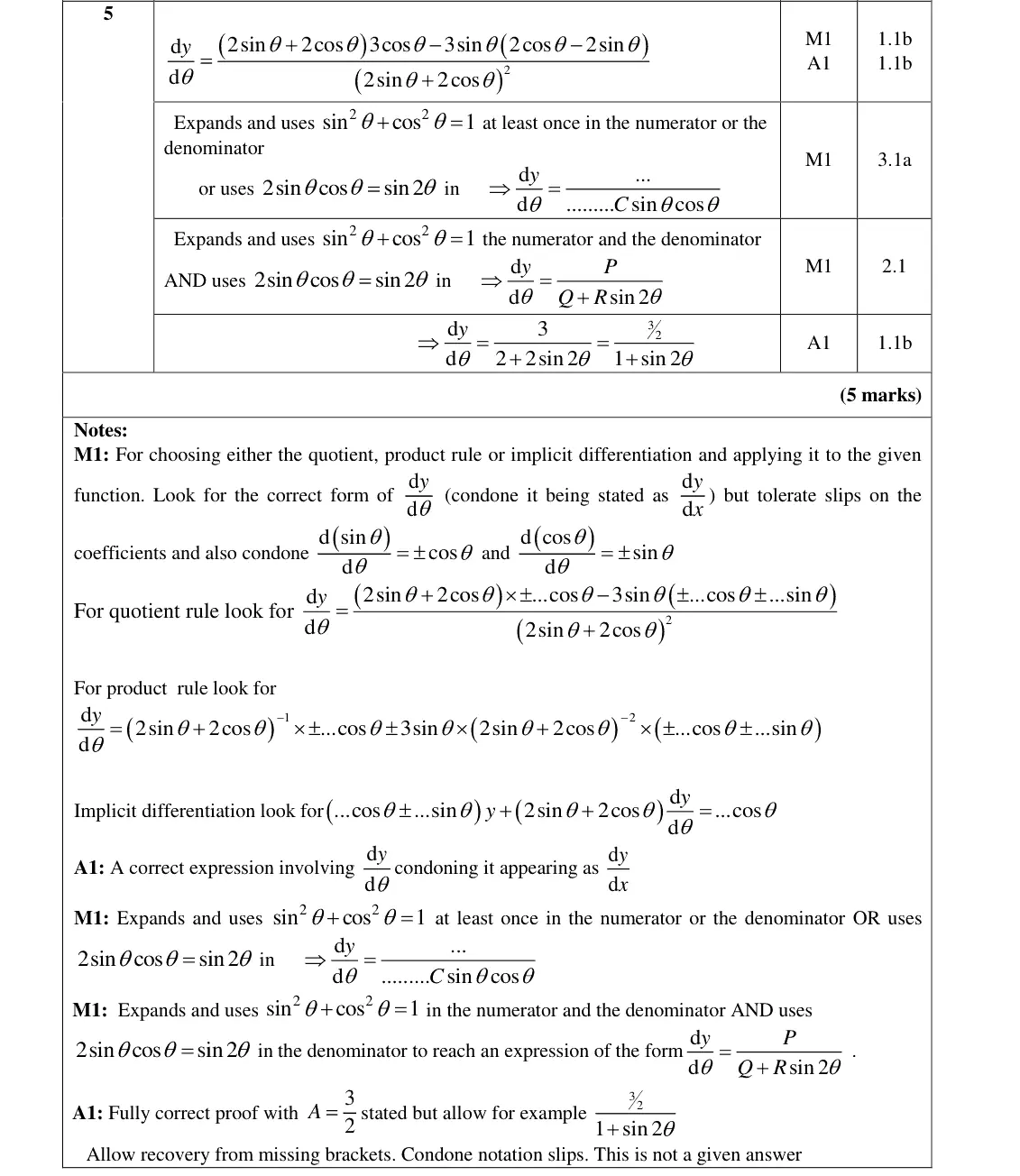
The majority of students knew to use the quotient rule in this question, although the slips on signs and bracketing in the terms of the numerator were commonplace. We would encourage all students to state the formula being used, with their expressions for ‘u’ ‘v’ ‘du’ and ‘dv’, to ensure that their method is made clear to examiners. Getting a correct derivative into the required form using trigonometric identities proved to be more challenging than the differentiation in this question. Students recognised the need to use the Pythagorean identity for sine and cosine to simplify their numerator and denominator but were less confident when applying the double angle formula for sine, and it was not uncommon for a final answer to be left as 3 2 2sin 2 , or for there to be errors in an attempt to write this fraction in the required form.
Common mistakes
quotient rule – sign and bracket slips in the numerator
use sin²θ + cos²θ = 1 in numerator and denominator and 2sinθcosθ = sin2θ
A = 3/2 (not left as 3/(2 + 2sin2θ))
June 2018 · Paper 1 · Q14(a)2 marks
Mark scheme (whole question; this part is marked with the orange bar)
Examiner's comment
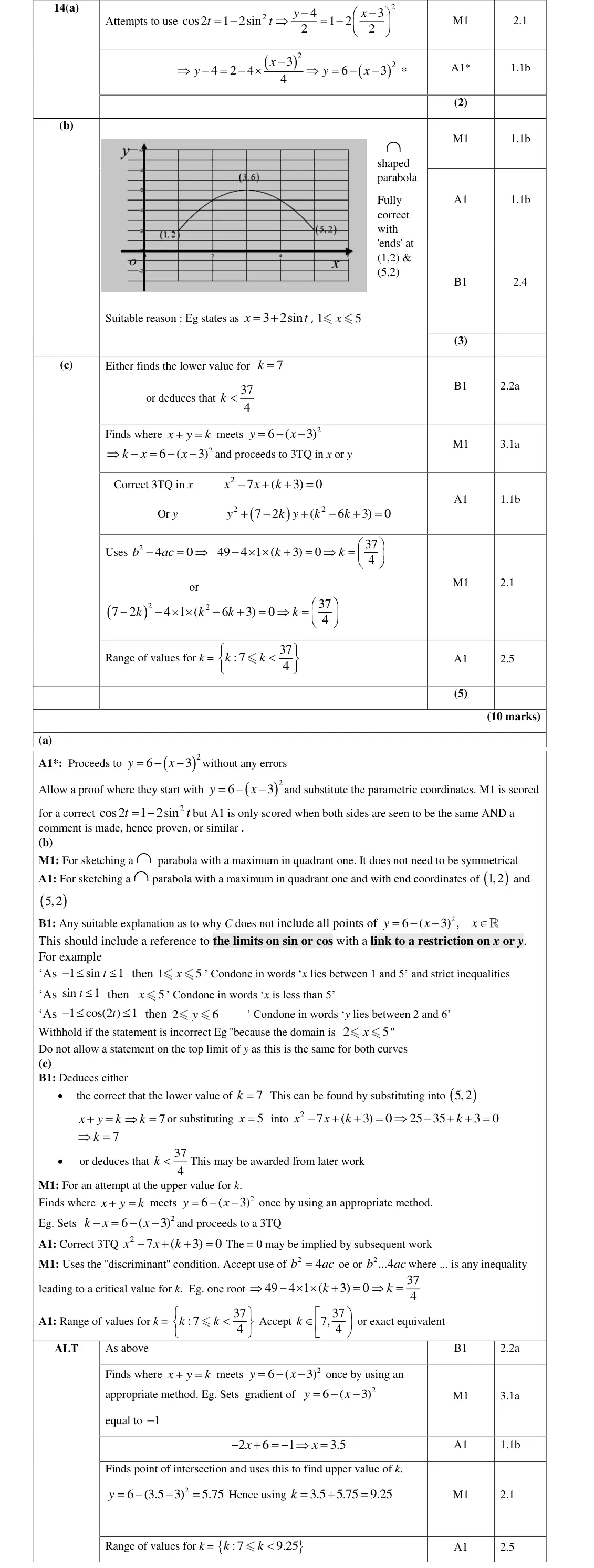
The final question on the paper was a challenge to all. Part (a) was straightforward with most 2 recognising the need to use the identity in some form to prove the required cos2 1 2sin t t result. This was one of the more successful ''show that'' parts of the paper. Only stronger students, however, were able to understand and explain why the curve C did 2 not include all points of the curve Many drew the whole of the parabola in 6 3 . y x
Common mistakes
use cos2t = 1 − 2sin²t with sin t = (x − 3)/2
June 2018 · Paper 2 · Q7(i)4 marks
Mark scheme (whole question; this part is marked with the orange bar)
Examiner's comment
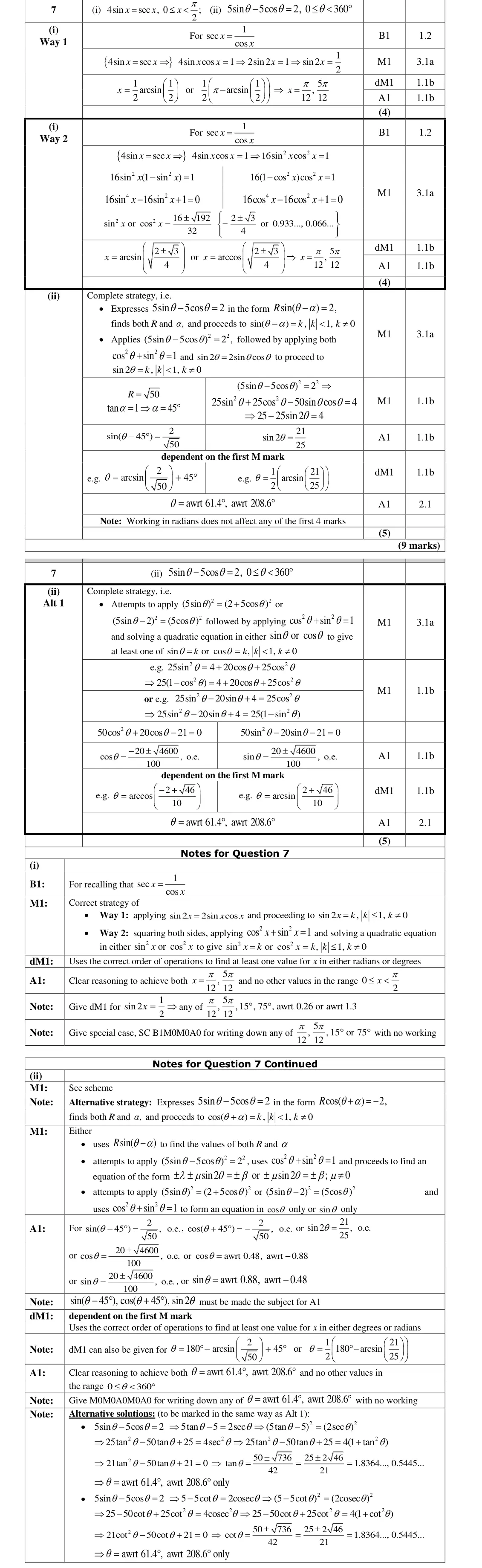
Part (i) was accessible to most students, whereas some students struggled to gain access to part (ii). 1 x In part (i), many students replaced secx with cos x and arrived at 4sin cos A few 1. x x with sin 4 ,x but most used the identity sin2 students replaced 4sin cos to x 2sin cos x x x 1 x sin 2 . give the correct Many students obtained both correct exact solutions in radians, 2 with only a few omitting the second solution 5 . 12 Some students made no attempt at part (ii) while a significant number of other students did not employ a correct strategy for solving 5sin The majority of students, 5cos 2. however, attempted one of several correct strategies. The most popular strategy was to and 2 2 cos sin 1 square both sides of the given equation and apply the identities 21 sin 2 . to achieve A second strategy was to square both sides of sin2 2sin cos 25 to achieve a quadratic equation 2 2 cos sin 1 and apply the identity 5sin 2 5cos in either cos or sin . In both of these strategies, extra (incorrect) solutions were generated as a result of squaring both sides of their equation. Only a few students rejected these extra A third strategy was to rewrite the 61.4 , 208.6 . solutions to leave the correct solutions 50 sin( 45 ) 2 50 cos( 45 ) 2, given equation as or even which were usually A few students applied other correct strategies which led 61.4 , 208.6 . solved to give to solving quadratic equations in either tan or cot .
Common mistakes
sec x = 1/cos x
4 sin x cos x = 1 gives sin 2x = ½
x = π/12 and 5π/12 (second solution often omitted)
answers in radians
June 2018 · Paper 2 · Q7(ii)5 marks
Mark scheme (whole question; this part is marked with the orange bar)
Examiner's comment
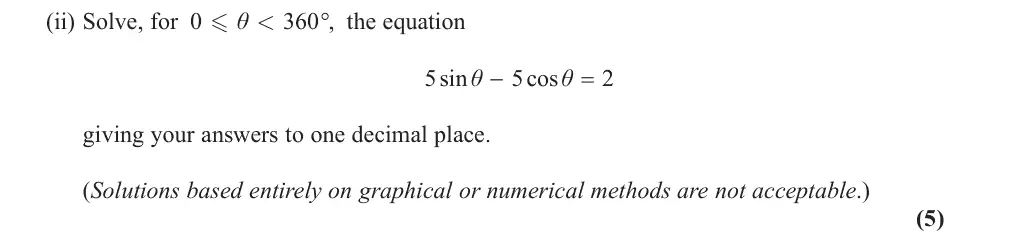
Part (i) was accessible to most students, whereas some students struggled to gain access to part (ii). 1 x In part (i), many students replaced secx with cos x and arrived at 4sin cos A few 1. x x with sin 4 ,x but most used the identity sin2 students replaced 4sin cos to x 2sin cos x x x 1 x sin 2 . give the correct Many students obtained both correct exact solutions in radians, 2 with only a few omitting the second solution 5 . 12 Some students made no attempt at part (ii) while a significant number of other students did not employ a correct strategy for solving 5sin The majority of students, 5cos 2. however, attempted one of several correct strategies. The most popular strategy was to and 2 2 cos sin 1 square both sides of the given equation and apply the identities 21 sin 2 . to achieve A second strategy was to square both sides of sin2 2sin cos 25 to achieve a quadratic equation 2 2 cos sin 1 and apply the identity 5sin 2 5cos in either cos or sin . In both of these strategies, extra (incorrect) solutions were generated as a result of squaring both sides of their equation. Only a few students rejected these extra A third strategy was to rewrite the 61.4 , 208.6 . solutions to leave the correct solutions 50 sin( 45 ) 2 50 cos( 45 ) 2, given equation as or even which were usually A few students applied other correct strategies which led 61.4 , 208.6 . solved to give to solving quadratic equations in either tan or cot .
Common mistakes
R sin(θ − α) with R = √50, α = 45°
squaring both sides creates extra roots that must be rejected
θ = 61.4°, 208.6°
June 2018 · Paper 2 · Q95 marks
Mark scheme (whole question; this part is marked with the orange bar)
Examiner's comment
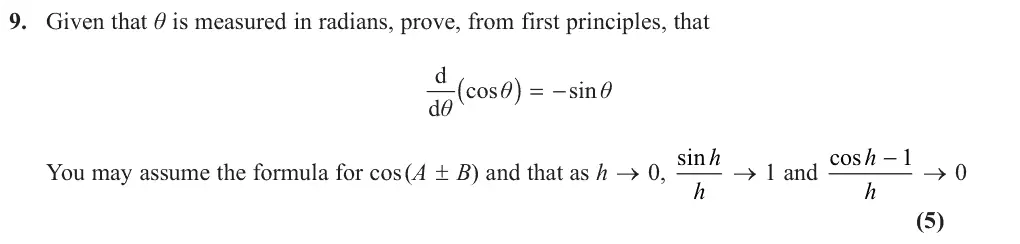
This was a well-answered question considering that this was the first time that differentiation from first principles has been tested on the new specification. Most students wrote down a correct expression for the gradient of the chord joining the points ( , cos ) and ( , cos( )) h h for a small value h. Many students simplified their gradient expression to give a correct sin cos 1 sin cos h h h h and applied the limiting arguments given in the question to deduce that d cos sin . d Some students lost the final mark for not applying limiting arguments correctly. Common errors included: stating that sin cos 1 1, 0 h h h h ; not using a limiting argument; or applying the limiting argument inconsistently. Other students lost the final mark for the use of inconsistent notation in their proof. These students, who usually referred to both x and in their proof, wrote incorrect statements such as d cos sin dx or f( ) cos . x
Common mistakes
gradient of chord (cos(θ + h) − cos θ)/h
compound angle formula
isolate (sin h)/h and (cos h − 1)/h
limit h → 0 must be applied correctly and notation kept consistent (θ not x)
June 2018 · Paper 2 · Q12(a)3 marks
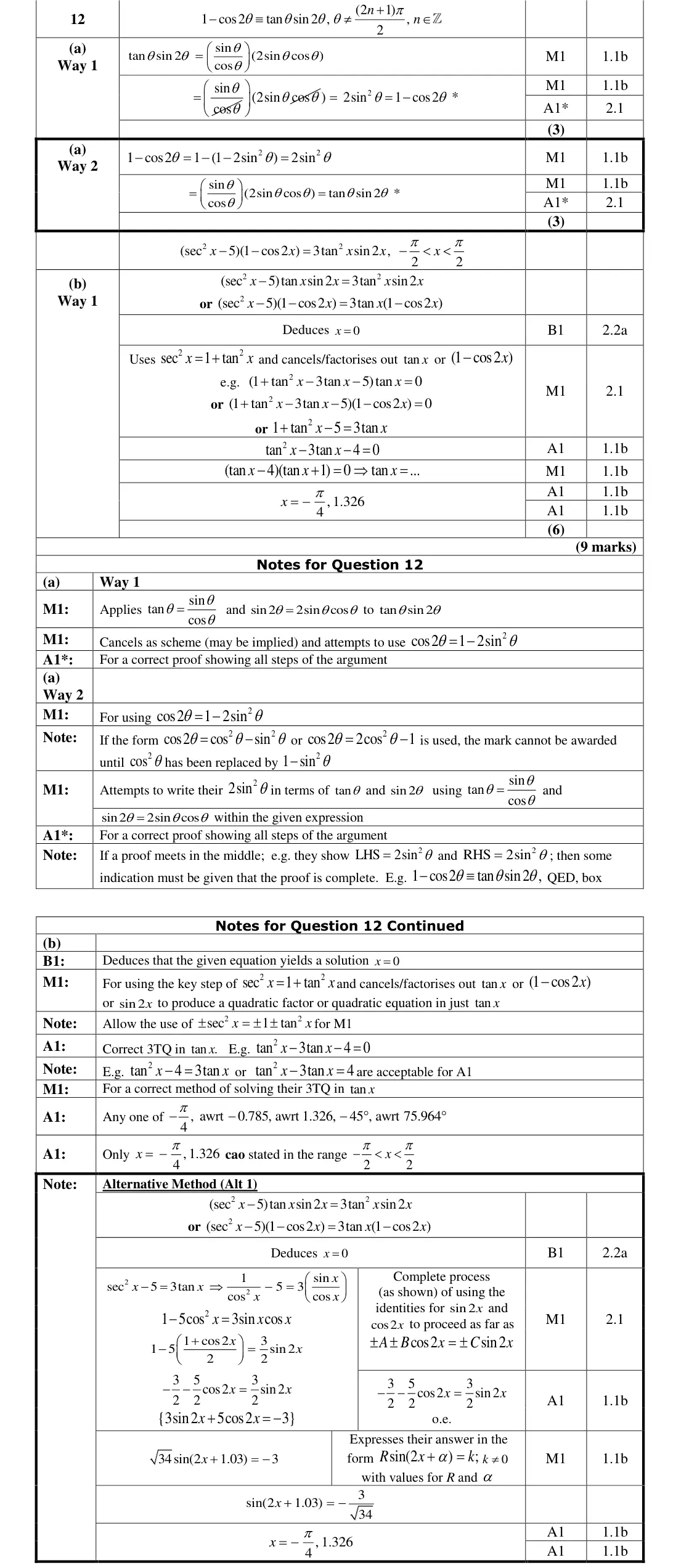
Mark scheme (whole question; this part is marked with the orange bar)
Examiner's comment
This question discriminated well between students of all abilities with part (a) more accessible to students than part (b). In part (a), most students provided a proof which progressed from one side of the identity to the other by using methodical steps and correct trigonometric identities. There was no preference seen for starting their proof on a particular side of the identity. Some students manipulated both sides of the identity to give a common expression 2 2sin , with many providing some indication that their proof was complete.
Common mistakes
tan θ = sin θ / cos θ and sin 2θ = 2 sin θ cos θ
cos 2θ = 1 − 2sin²θ
show all steps to 2sin²θ
Find an Edexcel maths tutor
Stuck on this? Book a trial session with an Edexcel specialist.








![12. (a) Prove cos3 theta + sin3 theta theta theta { 2cot 2ș ș z (90n)°, n ] sin cos (4)](/img/JUN19_9MA002/JUN19_9MA002_12(a).webp)