41 question parts, 124 marks, 6 with a difficulty rating from the examiner's report
Notes, worked examples and practice for this topic are being written by our tutors. The past-paper questions below are ready now: work each one on paper, then open the mark scheme and the examiner's comment.
Tap a question to zoom it. Mark scheme and examiner's comment open under each question.
June 2025 · Paper 1 · Q4(b)2 marks
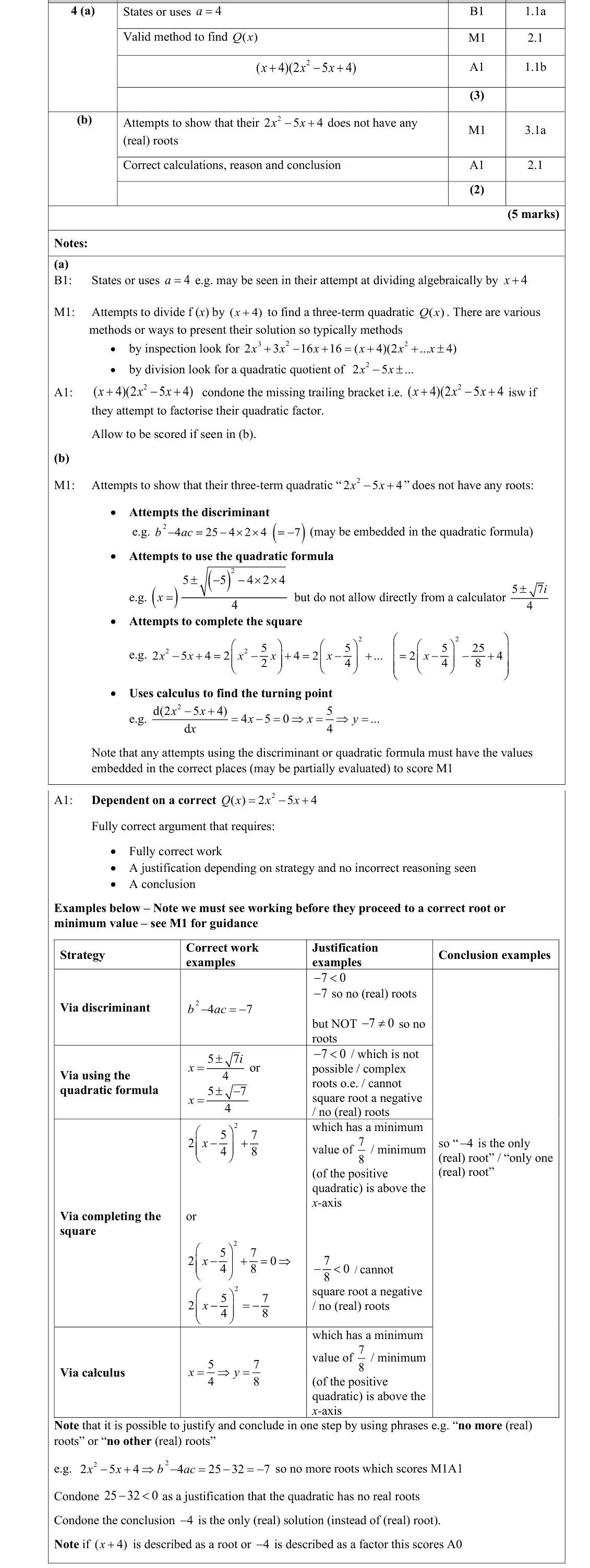
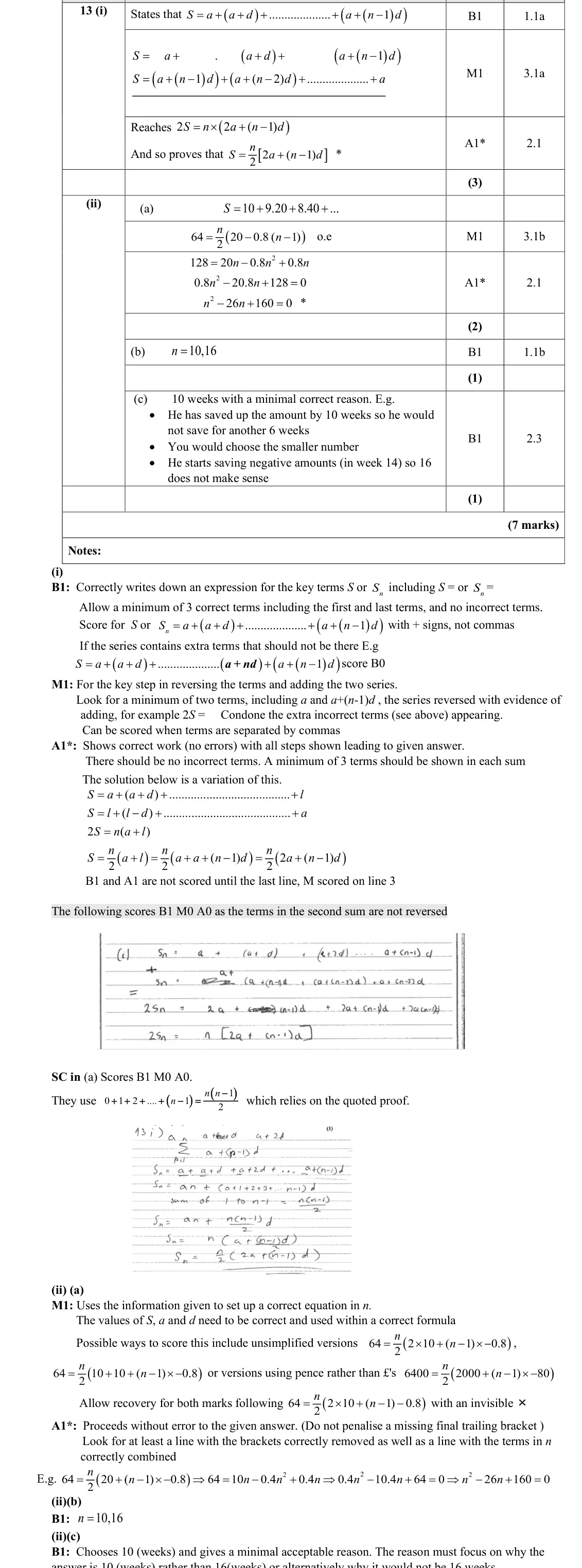
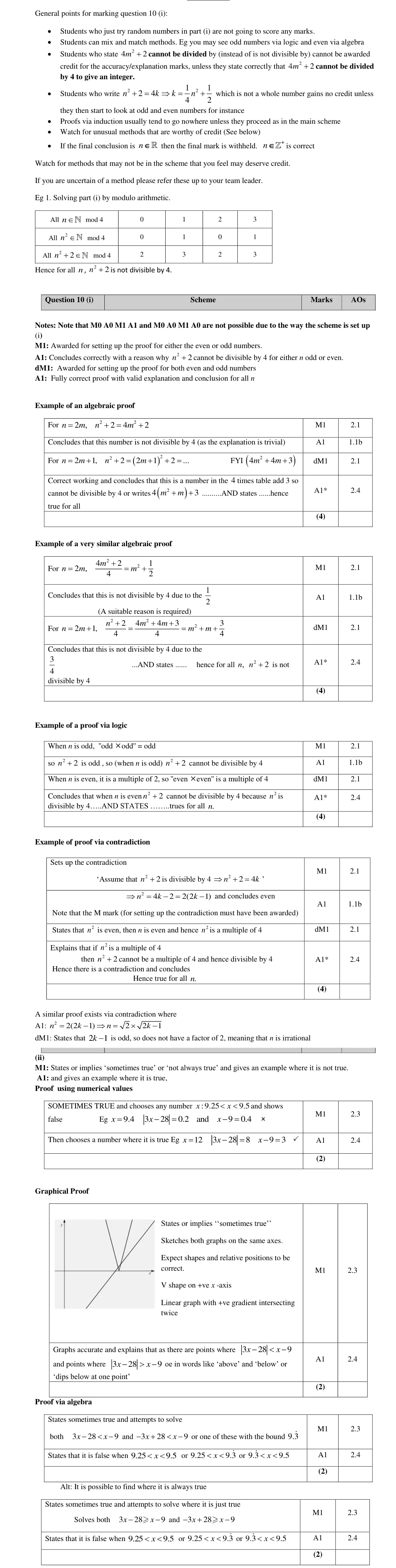
Mark scheme (whole question; this part is marked with the orange bar)
Examiner's comment
Part (b) proved to be a little more challenging with many responses not being clear enough in their explanations. By far the most popular method seen was to use the discriminant of Q(x) to show that Q(x) has no real roots. Almost every response calculated the discriminant as 7 - , then Q(x) had no real roots. A significant minority then did not go and state that as 7 0 -< on to say that “there was only one (real) root i.e. 4 -”. Learners should be reminded that in this type of question they should be referring to the question asked in their final line of working to ensure full marks are scored. The other possible methods outlined in the mark scheme were seen in a minority of cases; the quadratic formula method was well handled, however some did not complete correctly as above. A small number of learners used completing the square and usually did it correctly with some, again, not concluding correctly as above. There was only a very small number of learners who used calculus. 8
Common mistakes
discriminant of 2x² − 5x + 4 is 25 − 32 = −7 < 0 so no real roots from the quadratic
must conclude that −4 is the only real root (many stopped after −7 < 0)
"−7 ≠ 0" is not a justification
calling (x + 4) a root or −4 a factor loses the mark
June 2025 · Paper 1 · Q8(a)1 mark
Mark scheme (whole question; this part is marked with the orange bar)
Examiner's comment
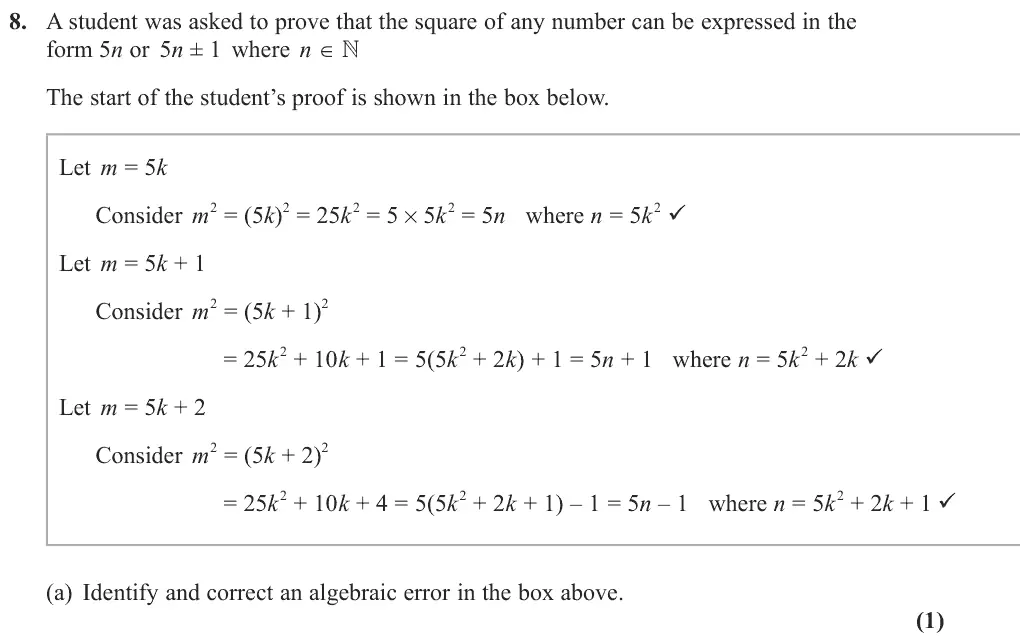
This question tested proof by exhaustion which many learners found challenging. Part (a) was usually more successfully answered, although many were able to make progress in part (b). Part (a) was mostly answered well with many managing to spot the error and correct it. Most learners were able to see and correct the error in the expansion with some correcting not just the error but the work afterwards, showing that the expansion was equivalent to 5 1. n - Occasionally a response would highlight the mistake but not correct it, thus gaining no credit. Some assumed that there were other or further errors, often thinking that the factorisation was incorrect. For example, suggesting that 2 25 10 4 k k + + should be factorised as 2 5(5 2 ) 4. k k + +
Common mistakes
(5k + 2)² = 25k² + 20k + 4, not 10k
some thought other steps (the factorisation) were wrong
June 2025 · Paper 1 · Q8(b)4 marks
Mark scheme (whole question; this part is marked with the orange bar)
Examiner's comment
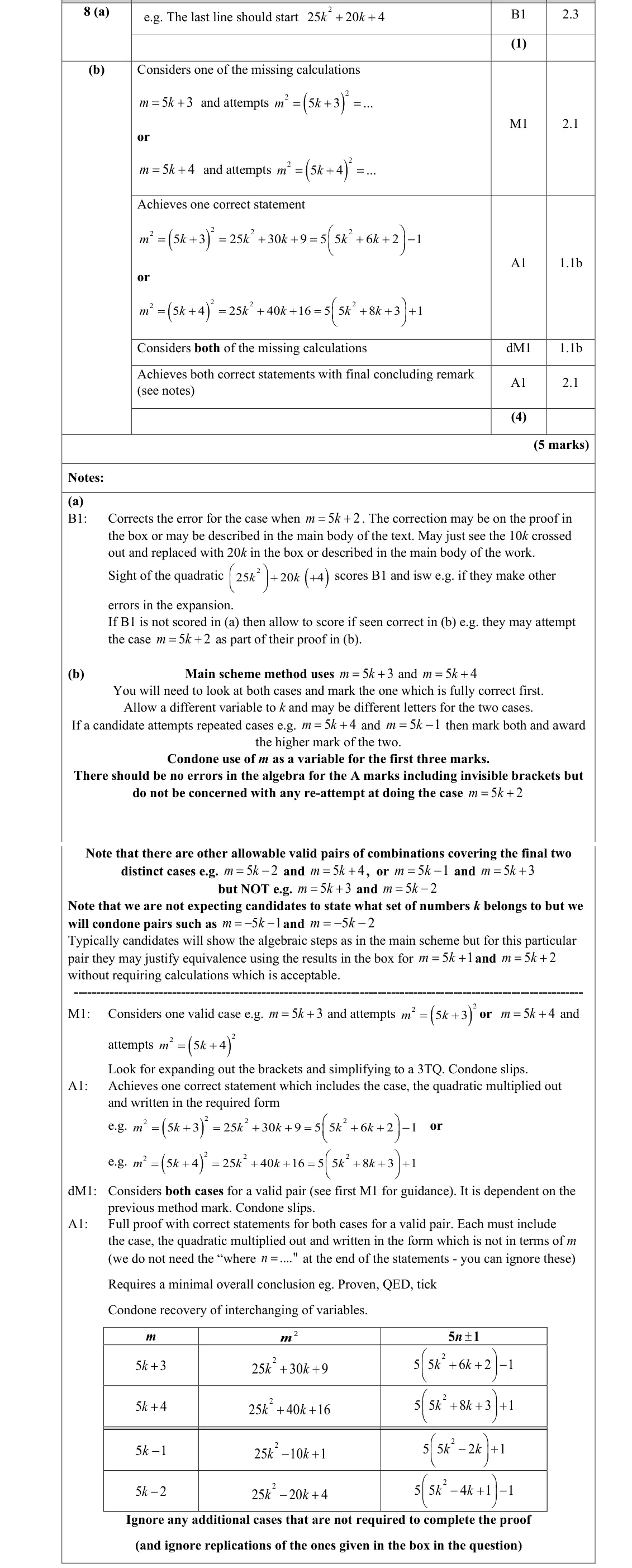
This question tested proof by exhaustion which many learners found challenging. Part (a) was usually more successfully answered, although many were able to make progress in part (b). In part (b), many responses never considered the remaining cases despite the partially provided proof. Several responses just reiterated what was already in the questions using 5 , m k = 5 1 m k = + and 5 2 m k = + again (but with the correction). Some assumed the work was pretty much complete and just wrote a concluding statement. A few responses looked at odd and even numbers and considered 2k and 2 1, k + or even 10k and 10 1. k + Many learners did not pay adequate attention to the mark allocation in part (b) with 4 marks indicating a much larger quantity of work required, and they simply copied the proof shown in the question but with the correction made from part (a). The majority of those who realised that the question was asking for something beyond correcting an error, managed to complete the question successfully, using either 5 3 k + and 5 4 k + or 5 1 k - and 5 2 k - . A few chose 5 1 m k = - - and 5 2. m k = - - Learners who chose correct cases would usually then successfully manage to give a general conclusion. Occasionally, the consideration of a case such as 5 5 k + or 5 3 k -was seen but gained no credit owing to the fact that it was a repetition of one of the cases printed in the question. Lack of accuracy with the k^2 and k terms resulted in accuracy marks not being awarded in this question with errors such as ‘ 2 2 (5 1) 25 20 1 k k k - = - + ’ In some cases, responses gave fully accurate working for two correct cases but did not gain the final mark owing to the lack of any kind of conclusion or acknowledgement that their proof was complete. 13
Common mistakes
proof by exhaustion needs the two remaining cases, e.g. m = 5k + 3 gives 5(5k² + 6k + 2) − 1 and m = 5k + 4 gives 5(5k² + 8k + 3) + 1 (or 5k − 1, 5k − 2)
many only repeated or corrected the given cases
expansion errors
a concluding statement is required
June 2025 · AS Paper 1 · Q15(a)2 marks
Mark scheme (whole question; this part is marked with the orange bar)
Examiner's comment
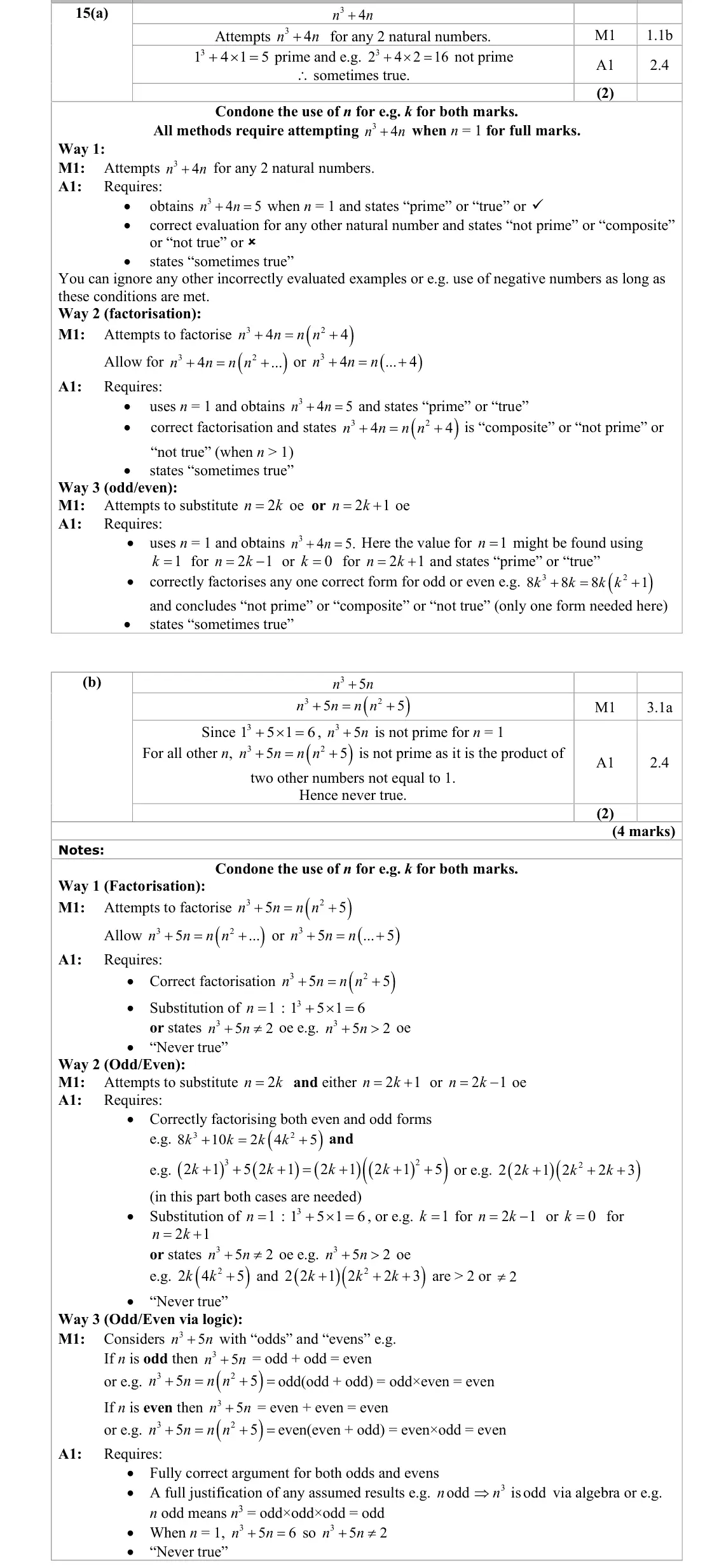
Many candidates made a start to this proof question in (a) and/or (b) but very few candidates were completely successful throughout. The second mark in part (a) was awarded relatively infrequently, whilst the final mark in (b) was rarely awarded. Candidates either did not know the correct way to approach the proofs required or were unable to include all of the rigorous steps and conclusions needed. In part (a) candidates approached the question in a number of ways. Most attempted to substitute values of n into n3 + 4n. Attempts using two natural numbers for n were required to obtain the first mark this way. Many candidates, however, used negative integers and made no progress. Candidates did often use n = 1 to obtain n3 + 4n = 5 alongside the substitution of another value of n to obtain a composite number, but failed to conclude which case gave a prime number and which case did not, losing the second mark. Other candidates attempted to factorise n3 + 4n, gaining the first mark, but then failed to test the n = 1 case or missed the necessary conclusions. A third strategy was to attempt an odds/evens approach by substituting n = 2k or n = 2k + 1 which scored the first mark. Candidates often then again failed to show that n = 1 gave a prime number or did not include the necessary conclusions, losing the second mark. Some candidates were, however, completely successful in (a) and correctly established that the statement was sometimes true.
Common mistakes
n = 1 gives 5 (prime) and e.g. n = 2 gives 16 (not prime), so sometimes true
must use natural numbers (not negatives) and state which case is prime
n = 1 is required
June 2025 · AS Paper 1 · Q15(b)2 marks
Mark scheme (whole question; this part is marked with the orange bar)
Examiner's comment
Many candidates made a start to this proof question in (a) and/or (b) but very few candidates were completely successful throughout. The second mark in part (a) was awarded relatively infrequently, whilst the final mark in (b) was rarely awarded. Candidates either did not know the correct way to approach the proofs required or were unable to include all of the rigorous steps and conclusions needed. In part (b) candidates’ attempts to show that the statement was never true, again employed varied methods. Many candidates attempted no form of algebraic proof and simply tested values of n, failing to appreciate that this approach would not prove the result in general, and this gained no credit. Other candidates attempted a ‘descriptive’ approach, again without algebra, considering the cases when n was odd and even (e.g. when n is even n3 + 5n = even + even = even etc.). When done accurately this approach could score the first mark in (b), but unless a full explanation was included of the results used, the second mark could not be scored. The most successful method was to factorise n3 + 5n to show it was composite (for n > 1) and then test the n = 1 case separately before drawing the correct conclusion. Some candidates attempted to consider the even and odd cases algebraically. Attempting both cases like this earned the first mark, but candidates then often failed to test the n = 1 case or made mistakes in their algebra or factorisation of the cases, losing the second mark. Few candidates earned full marks in (b) regardless of the way they approached it.
Common mistakes
n³ + 5n = n(n² + 5): for n = 1 it is 6
for n > 1 it is a product of two factors greater than 1, so never true
testing values does not prove it
odd/even arguments must be fully justified
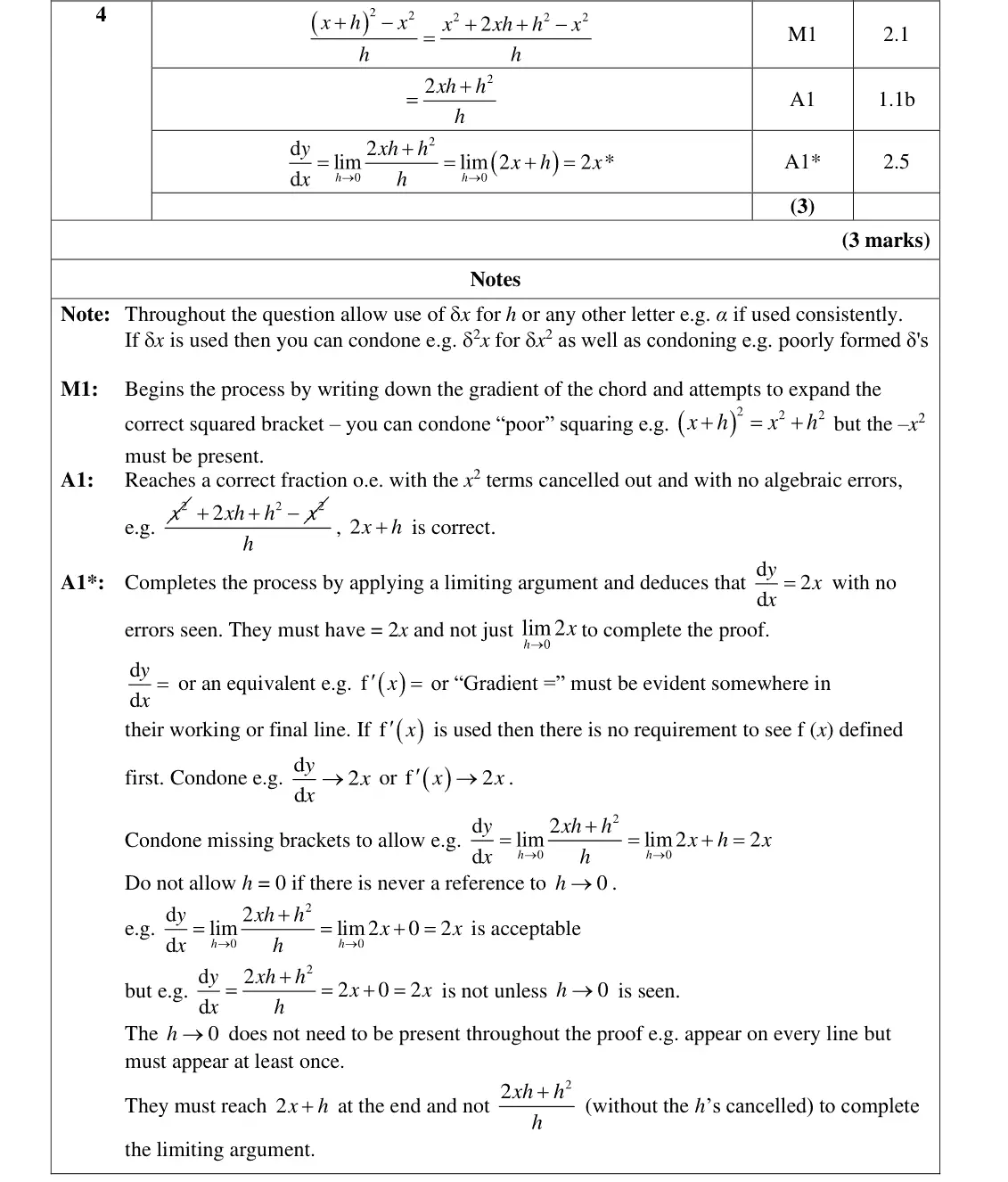
June 2024 · Paper 1 · Q43 marks
Mark scheme (whole question; this part is marked with the orange bar)
Examiner's comment
This question was very similar to previous differentiation from first principles questions and many candidates scored full marks, being much better prepared than in previous series. Most candidates used ( ) ( ) f f x h x h + - to find the gradient of the chord, although a small number of candidates attempted to use ( ) ( ) f f x x h - + but failed to change the denominator to .h - Misunderstanding the definition of the derivative led to some candidates losing some or all of the marks, by writing, for example ( ) ( ) f ^2 f x ^2 x h h + - or ( ) ( ) f ^2 f x^2 x h h + - . Slips when expanding ( ) 2 x h + were condoned for the method mark but the 2x - was required. Most candidates were able to correctly expand and proceed to 2 2xh h h + or 2x h + to score the first two marks. Common errors included incorrectly simplifying the fraction, failure to cancel h correctly or an incomplete limiting argument (e.g. stopping at 0 lim2 h x → ), each of which led to the loss of the final accuracy mark. Notation was generally good, and most candidates included a reference to 0 h → somewhere in their working. A significant minority of candidates failed to include d d y x = or equivalent anywhere in their answer despite being asked to show d 2 d y x x = in the question, thereby losing the final mark.
Common mistakes
gradient of chord ((x + h)² − x²)/h with the −x² kept
cancel h to 2x + h
limit h → 0 must be written and must end "= 2x"
dy/dx = must appear
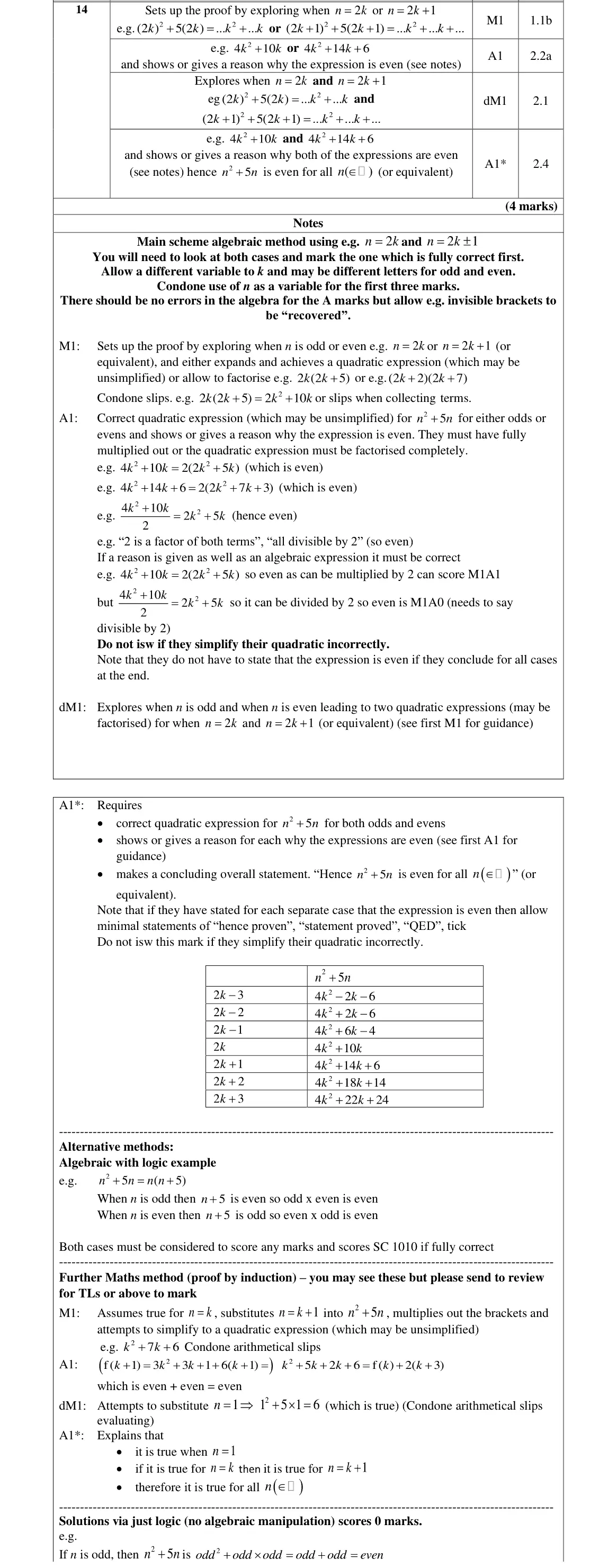
June 2024 · AS Paper 1 · Q144 marks
Mark scheme (whole question; this part is marked with the orange bar)
Examiner's comment
This question proved to be a challenge for the majority of candidates and full marks were not common. The instruction to ‘use algebra’ was lost on a number of candidates who employed logical approaches or attempted to test an array of integer values for n. Perhaps a casualty of being the last question on the paper, there were also a number of blank responses seen. For those employing a logical approach, some credit was given when algebra was used to factorise the quadratic followed by a consideration of the parity of the factors. This was often left incomplete however, and so rarely scored the two marks out of four for a complete attempt via this approach. The majority of candidates who attempted the question did grasp the need to consider the general form for odd and even integers and made a reasonable attempt. Although some candidates incorrectly used ‘ 1 k + ’ or considered even integers twice e.g. ‘ 2k ’ and ‘ 2 2 k + ’. Unfortunately, marks were very commonly, yet surprisingly, lost due to basic mistakes in simple algebraic manipulation. These errors occurred in both the expansion and the factorisation of brackets and included errors such as 5(2 1) 10 1 k k + = + or 2 2 4 10 2( 5 ) k k k k + = + . It was surprisingly common for candidates to use n in their general form i.e. ‘ 2 n n = ’ which led to the loss of the final mark, especially since this has been in previous mark schemes that this would not garner full marks. A large proportion of candidates failed to give an overall conclusion to their proof which was also penalised with the final mark. A small minority of candidates employed proof by induction and, when seen, this was usually confidently executed.
Common mistakes
consider n = 2k and n = 2k + 1: 4k² + 10k = 2(2k² + 5k) and 4k² + 14k + 6 = 2(2k² + 7k + 3)
give a reason each is even and a final conclusion
testing values or pure logic (odd × even) without algebra scores little
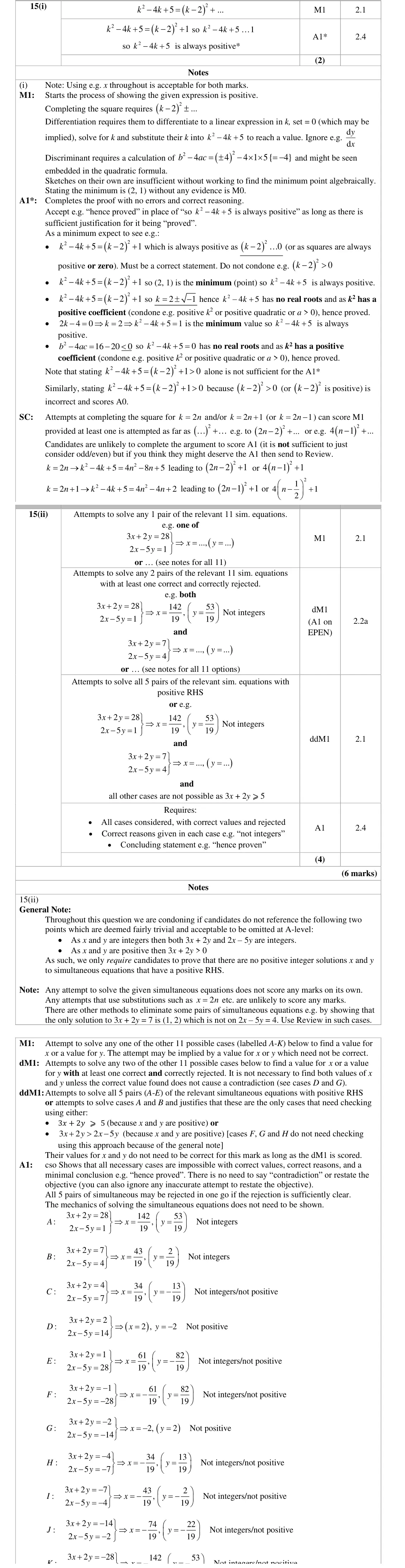
June 2024 · Paper 1 · Q15(i)2 marks
Mark scheme (whole question; this part is marked with the orange bar)
Examiner's comment
This question was a clear discriminator between the most secure and intermediate candidates with many making little or no progress in part (i), although many candidates made at least a respectable attempt at part (ii). The most common techniques employed in part (i) were completing the square and using the discriminant. When completing the square, candidates often stated that squared numbers are always positive and gave no indication that they could also equal 0, which was a common error the last time a similar question was asked. When finding the discriminant, candidates often obtained the answer of –4, but very little explanation followed this, and notably many seemed to think this was sufficient to conclude that the 2 k given quadratic was always positive with no reference to the coefficient of the term. It was not uncommon to see attempts analysing even and odd number scenarios, but none were seen that recovered from only considering whole numbers and extended to the entire set of real numbers. A few candidates used differentiation to find the turning point and some of these candidates calculated the second derivative to prove that their turning point was a minimum, but they usually lost the final mark as they did not write a conclusion to complete their proof. The least confident candidates simply substituted a few integer values for k into the expression and attempted to draw a conclusion from the results, scoring no marks. In part (ii), many candidates did not fully appreciate what they were being asked to do, most likely due to the unfamiliar nature of the question. As a result, some attempted algebraic manipulation of the expression, such as expanding the brackets, and were unable to progress to a solution. Other candidates believed they were being asked simply to write out the proof by adding text to the information supplied or by detailing the working for the solutions of the simultaneous equations given. However, there was a good proportion of candidates who realised that the example given was just one of many possible scenarios and proceeded to attempt to find solutions to the remaining cases. It was rare to see all of the 11 other factor pairs examined, and, in most cases, candidates only considered simultaneous equations with a positive right-hand side. The mark scheme enabled all the marks to be scored for this approach given that the simultaneous equations with negative right-hand sides could be discarded quite trivially. Often candidates only determined x or y for a couple of factors of 28 securing 1 or 2 marks. A good proportion only dealt with factor pairs ‘one way round’ and gave no justification as to why, limiting themselves to 2 marks out of the available 4. Calculators could legitimately be used to solve the simultaneous equations and candidates who did this found, almost without exception, correct values for x and y as well as saving time. Full algebraic processing of the simultaneous equations was time-consuming and prone to error. A minority of candidates realised it was possible to argue that 3𝑥+ 2𝑦 ⩾ 5 and limited themselves to examining just cases A and B from the mark scheme, but it was nice to see the strongest candidates able to distinguish themselves in this manner. Most candidates identified the reasons for rejecting factor pairs as they went along whilst a few left the rejection of the solutions to the overall conclusion, and both approaches were acceptable. Sadly, some made no comment at all on the solutions they found and were unable to score either accuracy mark as a result.
Common mistakes
(k − 2)² + 1 with (k − 2)² ≥ 0 (not > 0)
discriminant route also needs positive k² coefficient
odd/even cases do not cover real k
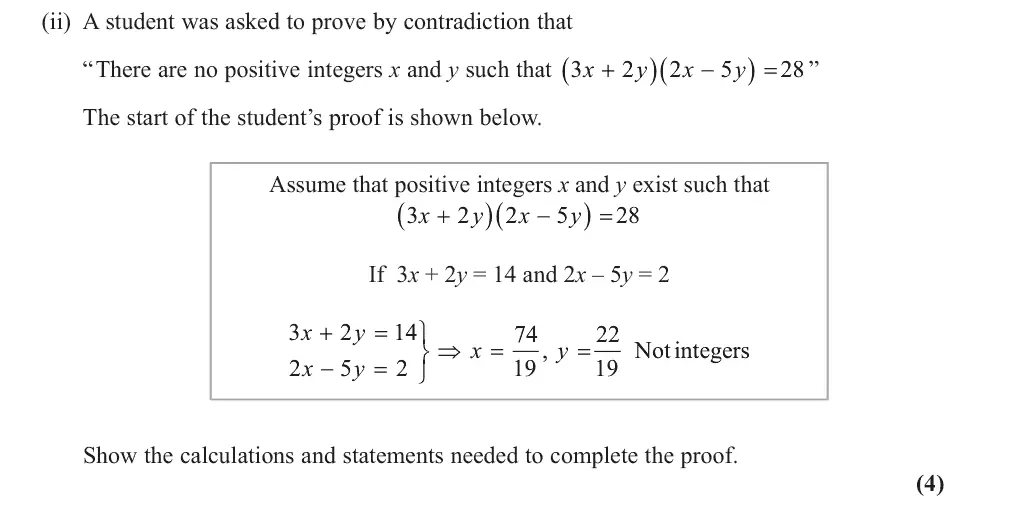
June 2024 · Paper 1 · Q15(ii)4 marks
Mark scheme (whole question; this part is marked with the orange bar)
Examiner's comment
This question was a clear discriminator between the most secure and intermediate candidates with many making little or no progress in part (i), although many candidates made at least a respectable attempt at part (ii). The most common techniques employed in part (i) were completing the square and using the discriminant. When completing the square, candidates often stated that squared numbers are always positive and gave no indication that they could also equal 0, which was a common error the last time a similar question was asked. When finding the discriminant, candidates often obtained the answer of –4, but very little explanation followed this, and notably many seemed to think this was sufficient to conclude that the 2 k given quadratic was always positive with no reference to the coefficient of the term. It was not uncommon to see attempts analysing even and odd number scenarios, but none were seen that recovered from only considering whole numbers and extended to the entire set of real numbers. A few candidates used differentiation to find the turning point and some of these candidates calculated the second derivative to prove that their turning point was a minimum, but they usually lost the final mark as they did not write a conclusion to complete their proof. The least confident candidates simply substituted a few integer values for k into the expression and attempted to draw a conclusion from the results, scoring no marks. In part (ii), many candidates did not fully appreciate what they were being asked to do, most likely due to the unfamiliar nature of the question. As a result, some attempted algebraic manipulation of the expression, such as expanding the brackets, and were unable to progress to a solution. Other candidates believed they were being asked simply to write out the proof by adding text to the information supplied or by detailing the working for the solutions of the simultaneous equations given. However, there was a good proportion of candidates who realised that the example given was just one of many possible scenarios and proceeded to attempt to find solutions to the remaining cases. It was rare to see all of the 11 other factor pairs examined, and, in most cases, candidates only considered simultaneous equations with a positive right-hand side. The mark scheme enabled all the marks to be scored for this approach given that the simultaneous equations with negative right-hand sides could be discarded quite trivially. Often candidates only determined x or y for a couple of factors of 28 securing 1 or 2 marks. A good proportion only dealt with factor pairs ‘one way round’ and gave no justification as to why, limiting themselves to 2 marks out of the available 4. Calculators could legitimately be used to solve the simultaneous equations and candidates who did this found, almost without exception, correct values for x and y as well as saving time. Full algebraic processing of the simultaneous equations was time-consuming and prone to error. A minority of candidates realised it was possible to argue that 3𝑥+ 2𝑦 ⩾ 5 and limited themselves to examining just cases A and B from the mark scheme, but it was nice to see the strongest candidates able to distinguish themselves in this manner. Most candidates identified the reasons for rejecting factor pairs as they went along whilst a few left the rejection of the solutions to the overall conclusion, and both approaches were acceptable. Sadly, some made no comment at all on the solutions they found and were unable to score either accuracy mark as a result.
Common mistakes
complete a proof by contradiction: factor pairs of 28 with positive RHS (28,1) (7,4) (4,7) (2,14) (1,28), as 3x + 2y ≥ 5
solve each pair and reject (not integers or not positive)
concluding statement needed
June 2024 · Paper 2 · Q15(c)5 marks
Mark scheme (whole question; this part is marked with the orange bar)
Examiner's comment
This question provided a challenge to most candidates and was in general a good discriminator. Part (c) provided a challenge for many candidates and was a good discriminator. It is possible that some candidates were running out of time by this part of the paper, and this seemed to lead to simple algebraic and sign errors. However, many candidates were able to make at least some progress and most recognised the need to substitute the equation from part (b), which had been provided, into the equation from part (a). Most were able to expand to obtain a cubic in x albeit with frequent errors and slips, in particular a common error of cancelling the constant terms leading to a cubic with only three terms was often seen. The alternative elimination of x to lead to a cubic in y was rarely seen. Having obtained a cubic equation, many candidates made little creditworthy further progress and the majority seemed not to have made the link to earlier parts of the question and so did not attempt to take (x - 1) out as a factor of their cubic. This was perhaps understandable when the cubic was incorrect although it seemed that even candidates with the correct cubic did not consider using the fact that x = 1 was a root. Many candidates used their calculator to obtain the three roots of their cubic and others employed dubious techniques either attempting to find a ‘discriminant’ by ignoring the 3x term or attempting to take out a factor of x whilst ignoring the constant term. Those candidates who had a three-term cubic rather than a four-term cubic were unable to progress here. The final two marks of the paper were only accessible to those who were very secure in their algebraic accuracy and knowledge as these marks were contingent on both a correct cubic and a correct quadratic factor. Most candidates who met these criteria successfully used the discriminant to demonstrate that the quadratic had no roots although some used more elaborate reasoning involving the gradient of the cubic or the minimum point of the quadratic. Unfortunately, a significant proportion of candidates who got this far, did not manage to earn both marks because their justification or conclusion was insufficient, and it was sometimes disappointing to see otherwise well-answered solutions lose the final mark because they concluded with ‘no roots’ rather than also relating this back to the question to conclude that there could be ‘no further points of intersection’.
Common mistakes
substitute y = −2x + 2 into the curve: x³ − 3x² + 18x − 16 = 0 (constant term often lost)
use (x − 1) as a known factor: x² − 2x + 16
discriminant 4 − 64 < 0 so no other real roots
conclude "the normal does not meet C again"
calculator roots alone score no more
June 2023 · Paper 1 · Q125 marks
Mark scheme (whole question; this part is marked with the orange bar)
Examiner's comment
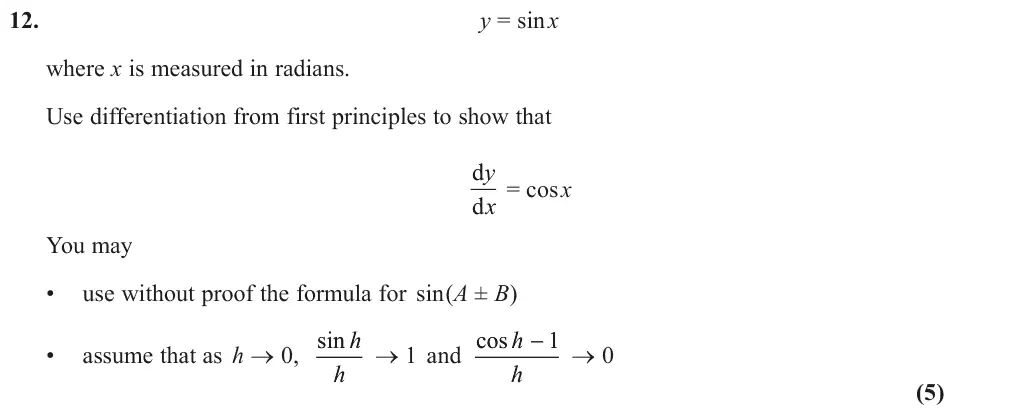
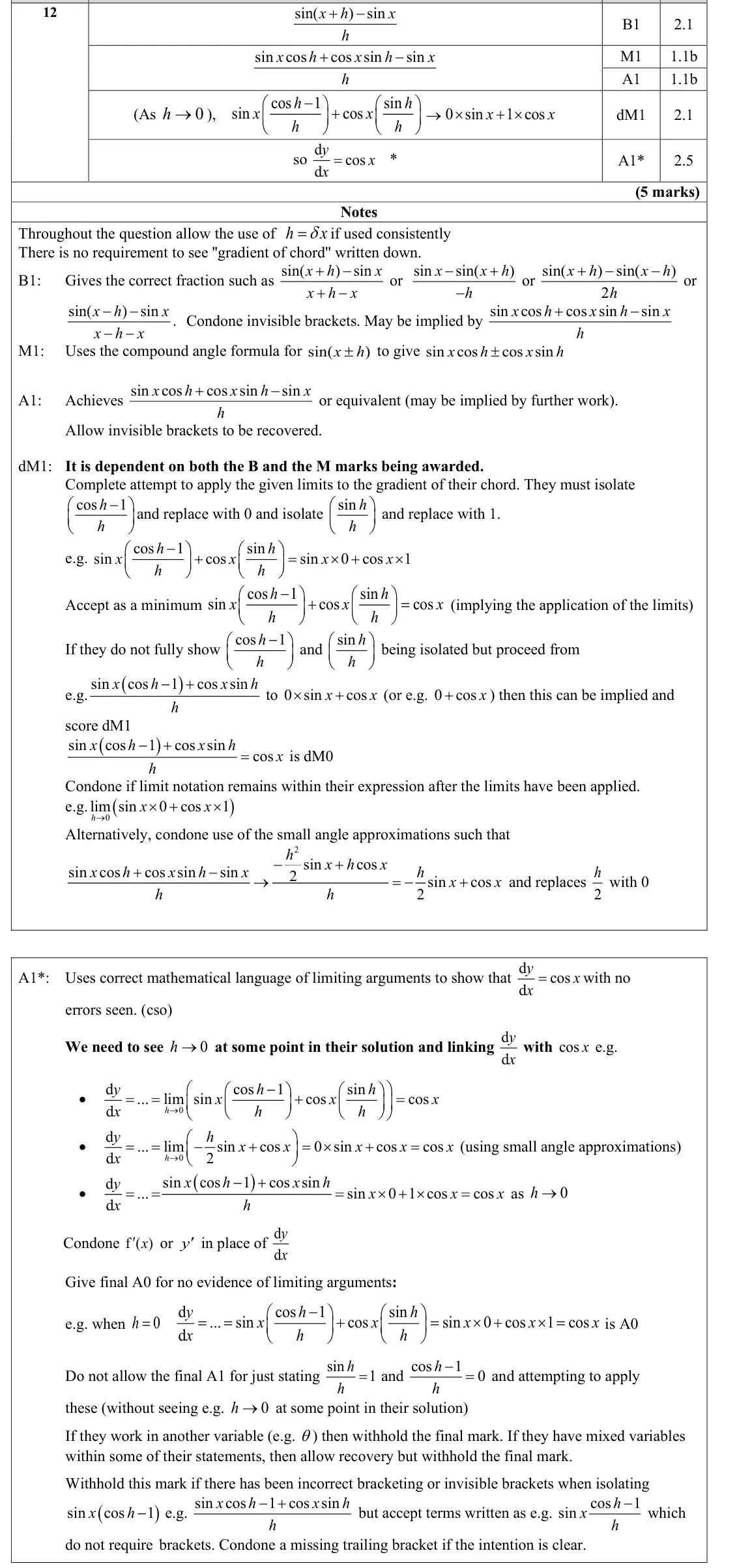
This differentiation from first principles question was similar to the one that appeared in 2018 and candidates demonstrated a much greater confidence with the way in which they should approach this topic. The limits were provided in the question and the accessibility was evident as it was very rare to see a completely blank script, which is not always true for a differentiating from first principles question. Most candidates were able to obtain the first 3 marks of this question, with very few sign errors seen when using the addition formula. Most correctly started with the fraction for the gradient of the chord f( ) f( ) x h x h + - as given in the formula booklet. Occasionally all a candidate would attempt was the addition formula in terms of A and B, but more often than not it was in the correct format and correct. Scoring the last two marks was not as common, but still achieved more often than not. There were a variety of layouts used for the candidates to justify the replacement of terms with 0 and 1. If candidates lost marks here, it was often because they failed to separate their terms in h correctly. Some candidates introduced extra h’s, forming expressions likecos sin xh hh . At other times, candidates simply tried to cancel terms incorrectly or stopped. Notation was generally good with limiting arguments correct. The main mistakes that resulted in lost marks were either failing to isolate the required expressions and jumping to the answer or trying to replace each of the 3 terms separately, failing to spot the common factor of sin x in two of them. There were also several candidates incorrectly splitting up the product of each term resulting in an extra h in the denominators. Incorrect notation resulted in the loss of the final mark, in particular the limit notation was often seen right through to the end, in the final answer, even after the limits had been used. A small number of candidates proceeded by using the small angle formula which was generally done well; where errors were seen it was generally not cancelling correctly. One surprising thing to note was the number of candidates who felt it acceptable to not clearly identify the numerator of the fraction by using very small fraction lines, resulting in their solution looking like only one term was being divided by h. Many candidates failed to write d cos d y x x = at the end, despite this being what they had been asked to show. If f ( )x had not been acceptable as an answer, then many candidates would have lost the final A mark. Only a very small handful of candidates used small angle approximations.
Common mistakes
gradient of chord (sin(x + h) − sin x)/h
compound angle formula
isolate (cos h − 1)/h and (sin h)/h
h → 0 must be seen
June 2023 · Paper 1 · Q144 marks
Mark scheme (whole question; this part is marked with the orange bar)
Examiner's comment
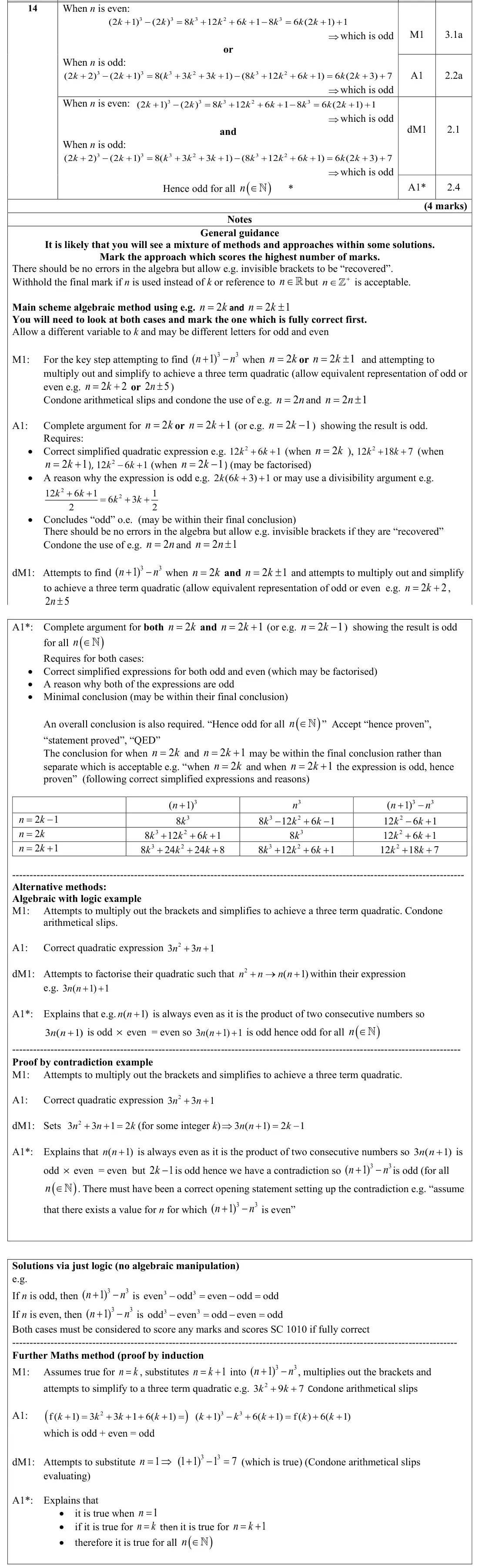
Candidates were required to prove the statement: 3 3 ( 1) n n + - is odd for all natural numbers, n. This was similar to some of the proof questions that have been on previous papers, so it was pleasing to see the majority of candidates were able to make more progress on this type of question this time. A large number of candidates tried to start correctly by substituting 2 n k = and 2 1 n k = + (or 2 1 n k = -) for even and odd numbers; this was the most likely method to achieve full marks. Candidates would often produced the correct expressions which were written in the form 2(......)+1 and then conclude appropriately. The final mark was often lost in many of the complete attempts as at least one element of the proof was either missing or had errors. Some candidates only proved one case (odd or even only) and some candidates did not include an overall conclusion, which was necessary for the final mark. Most common errors seen in expansions were from 3 3 (2 ) 2 k k = and this often led to candidates achieving a cubic expression rather than a quadratic. Some used 2n and 2 1 n + which was penalised by losing the final mark. Errors in expanding and simplifying the algebra were common: expanding triple brackets was the most common approach, although the binomial expansion was also seen, on occasion. The other common approach was from an attempt of algebra with logic. It was common to see candidates expand and simplify the expression to achieve a three-term quadratic but only a few went on to factorise their quadratic as required, and even fewer explained the logic for why ( 1) n n + was even correctly. A significant number of candidates tried to expand and simplify the given expression and usually achieved 2 3 3 1 n n + + scoring the first 2 marks, but very few got beyond this without making any logical arguments at all or did not factorise the expression. e.g. 3 ( 1) 1 n n + + which gained 3 marks. Success was also seen when the given expression was expanded and simplified to 2 3 3 1 n n + + and then candidates substituted 2 n k = and 2 1 n k = + to much the same result as the main method seen in the mark scheme. A number of candidates tried proof by contradiction, but these almost all fell into being marked either from the main scheme or by an expanding and factorising attempt. Whilst the question did require candidates to use algebra, credit was given for those candidates who did just try to apply logic with a maximum score of 2 marks. It was pleasing, however, to see that most candidates had appreciated the demand of the question and attempted some manipulation. A few candidates tried the Further Maths Method “proof by induction”, but most could not complete the proof correctly.
Common mistakes
consider n even (n = 2k) and n odd (n = 2k + 1) and conclude for all n, or show 3n(n + 1) + 1 with n(n + 1) even
June 2023 · AS Paper 1 · Q17(a)1 mark
Mark scheme (whole question; this part is marked with the orange bar)
Examiner's comment
This was a relatively accessible proof question and gave candidates two opportunities to demonstrate their knowledge and understanding of proof. It was pleasing to see that the general standard of response to this proof question was good, and it is clear that candidates’ confidence in and experience of tackling proof questions has improved over recent sessions. In part (a), most candidates understood what was meant by a counter example and many successfully found a pair of suitable numbers. The mark here was often lost only due to insufficient reasoning. Candidates should be reminded that when showing a falsehood via counter-example it is necessary to provide accompanying minimal reasoning. It was a shame that a significant number of candidates did not notice, or forgot, that the question specified that p and q were positive and that q > p and it was not uncommon to see candidates chose numbers that broke these constraints which meant they were ineligible for this mark. A small proportion of candidates misunderstood or perhaps misread the question and believed they were being asked to demonstrate instead that q3 – p3 is a multiple of 5.
Common mistakes
counter example with q > p, both positive integers, e.g. 6³ − 1³ = 215 = 5 × 43
must show it is a multiple of 5 (a reason)
choosing values breaking q > p
June 2023 · AS Paper 1 · Q17(b)4 marks
Mark scheme (whole question; this part is marked with the orange bar)
Examiner's comment
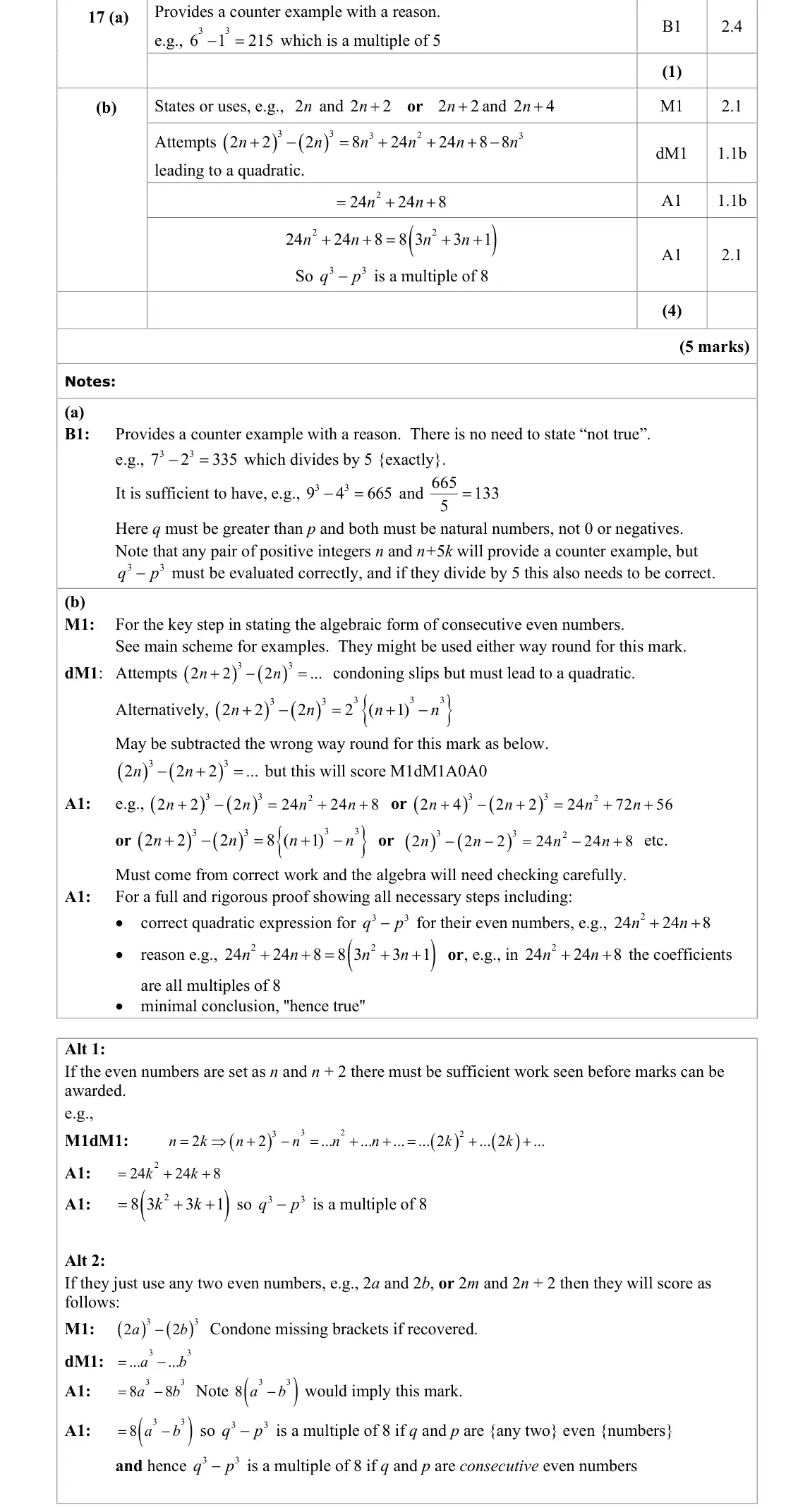
This was a relatively accessible proof question and gave candidates two opportunities to demonstrate their knowledge and understanding of proof. It was pleasing to see that the general standard of response to this proof question was good, and it is clear that candidates’ confidence in and experience of tackling proof questions has improved over recent sessions. Part (b) was more challenging and weaker candidates spent time here testing specific values for p and q, but in general it provided good access for the majority of candidates. Most candidates pursued general forms for p and q as consecutive even numbers and most of these chosen forms had merit (usually 2n and 2n + 2 but sometimes 2n + 2 and 2n + 4). Incorrect forms included n and n + 2 (without consideration of n as an even number), or sometimes n and m which were neither consecutive nor even. The issue of failing to recognise that q > p persisted into part (b) and a number of candidates lost marks for selecting p as the larger even number and subtracting the two terms the wrong way around. Expanding (2n + 2)3 also proved problematic for many candidates and so it was common for candidates to lose the accuracy marks. It was also common for poor subtraction to result in a cubic expression rather a quadratic which was even more costly in terms of marks. Unfortunately, many candidates failed to give even a minimal conclusion following impeccable algebra and so lost the final mark. Again, candidates should be reminded of the importance of a final statement in proof such as this.
Common mistakes
use 2n and 2n + 2 (n and n + 2 are not necessarily even)
q is the larger so (2n + 2)³ − (2n)³ = 24n² + 24n + 8 = 8(3n² + 3n + 1)
expansion errors
final conclusion statement needed
June 2023 · Paper 2 · Q153 marks
Mark scheme (whole question; this part is marked with the orange bar)
Examiner's comment
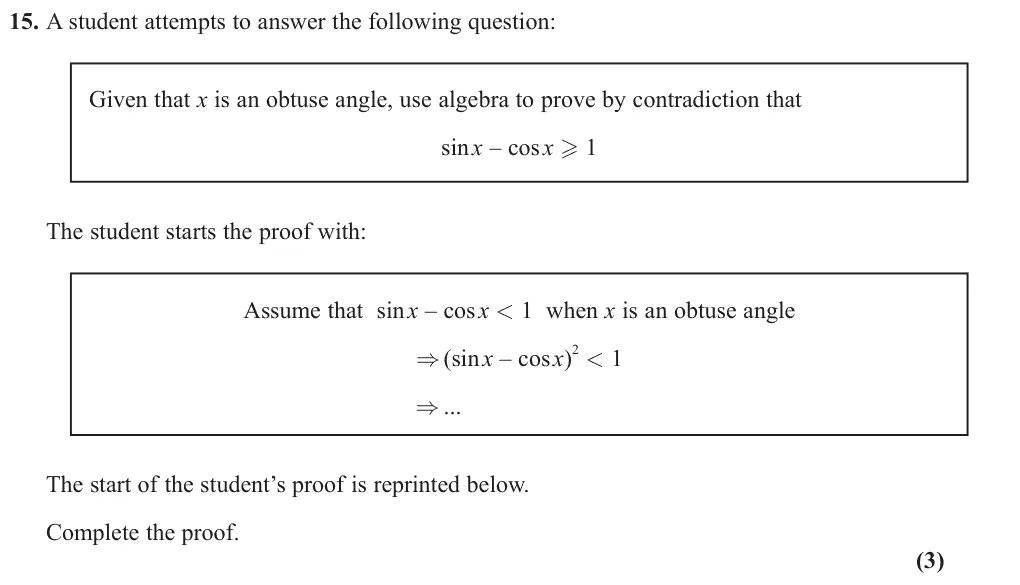
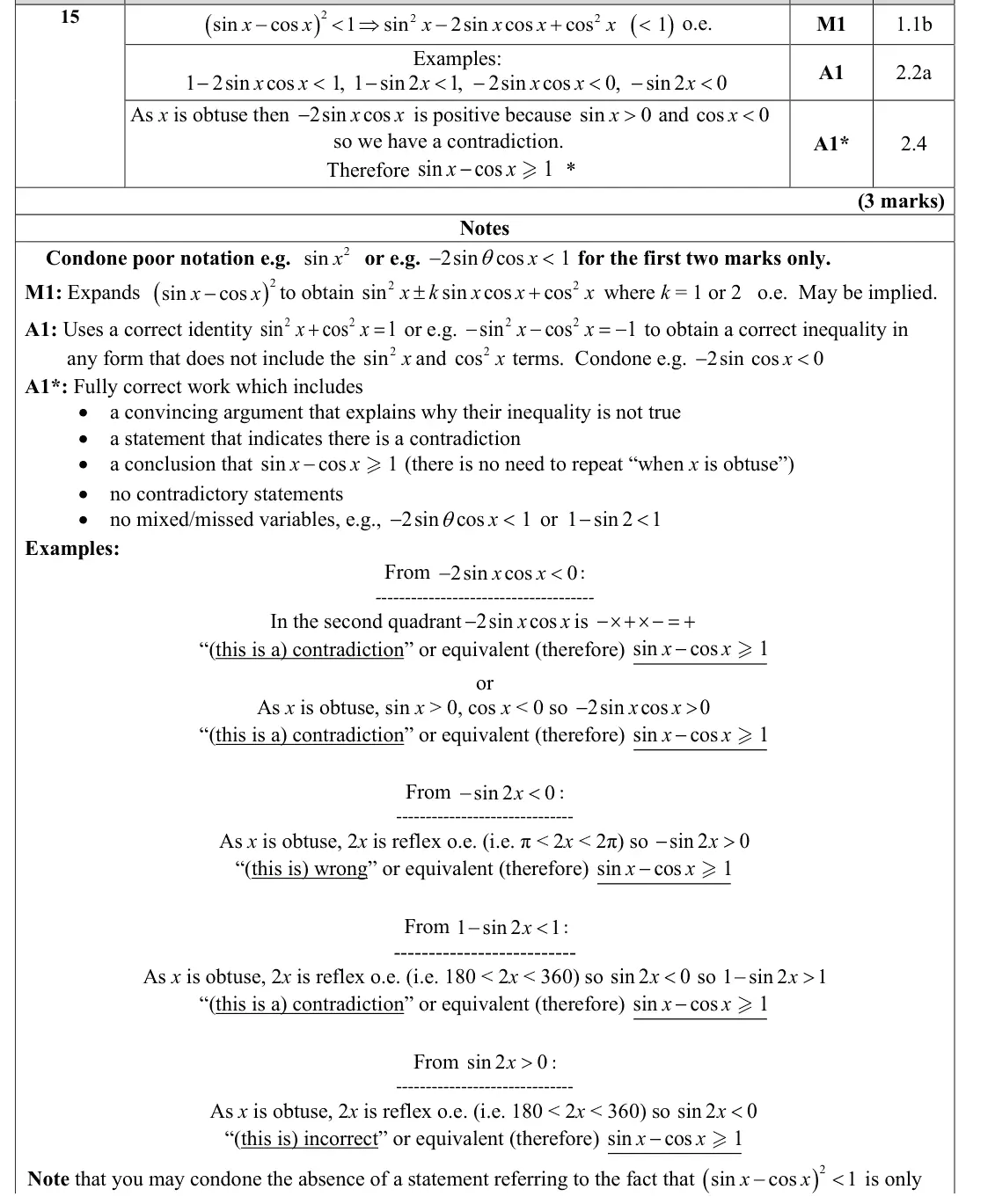
A number of candidates lost all marks on this question by not attempting any solution. Most candidates correctly expanded the given expression and used sin2 x + cos2 x = 1 to simplify and score the first two marks. A small number incorrectly used (sin x - cos x)2 = sin2 x - cos2 x, scoring no marks. Others attempted to substitute values of 90 and 180 into the given expression instead of using algebraic manipulation. Whilst most candidates scored the first two marks, only the very best were able to score the final mark, with most candidates failing to offer a convincing reason for a contradiction. Candidates who drew a graph of sin x and cos x or sin 2x to support their understanding tended to score well. Successful candidates typically explained that 2x must be between 180 and 360, and hence sin 2x must be negative, which is a contradiction with their inequality. Those that worked with sin x cos x were generally more successful in achieving this mark than those who chose to use sin2x. However, it was clear that not all students understood what an obtuse angle was. Another typical correct conclusion involved candidates stating if x is obtuse, sin x must be positive and cos x must be negative, leading to a negative product and a contradiction. Of those who were able to offer a reason for the contradiction, some still lost the final A mark for failing to then reach a conclusion that the original statement was true or because of errors in the proof such as missing x’s or mixed variables.
Common mistakes
expand (sin x − cos x)² = sin²x − 2sinxcosx + cos²x (not sin²x − cos²x)
use sin²x + cos²x = 1 to get −2sinxcosx < 0
obtuse so sin x > 0, cos x < 0 (or 180° < 2x < 360°, sin2x < 0): contradiction, so sin x − cos x ≥ 1
substituting 90° and 180° is not a proof
many did not explain the contradiction
June 2022 · Paper 1 · Q7(i)3 marksHard
Mark scheme (whole question; this part is marked with the orange bar)
Examiner's comment
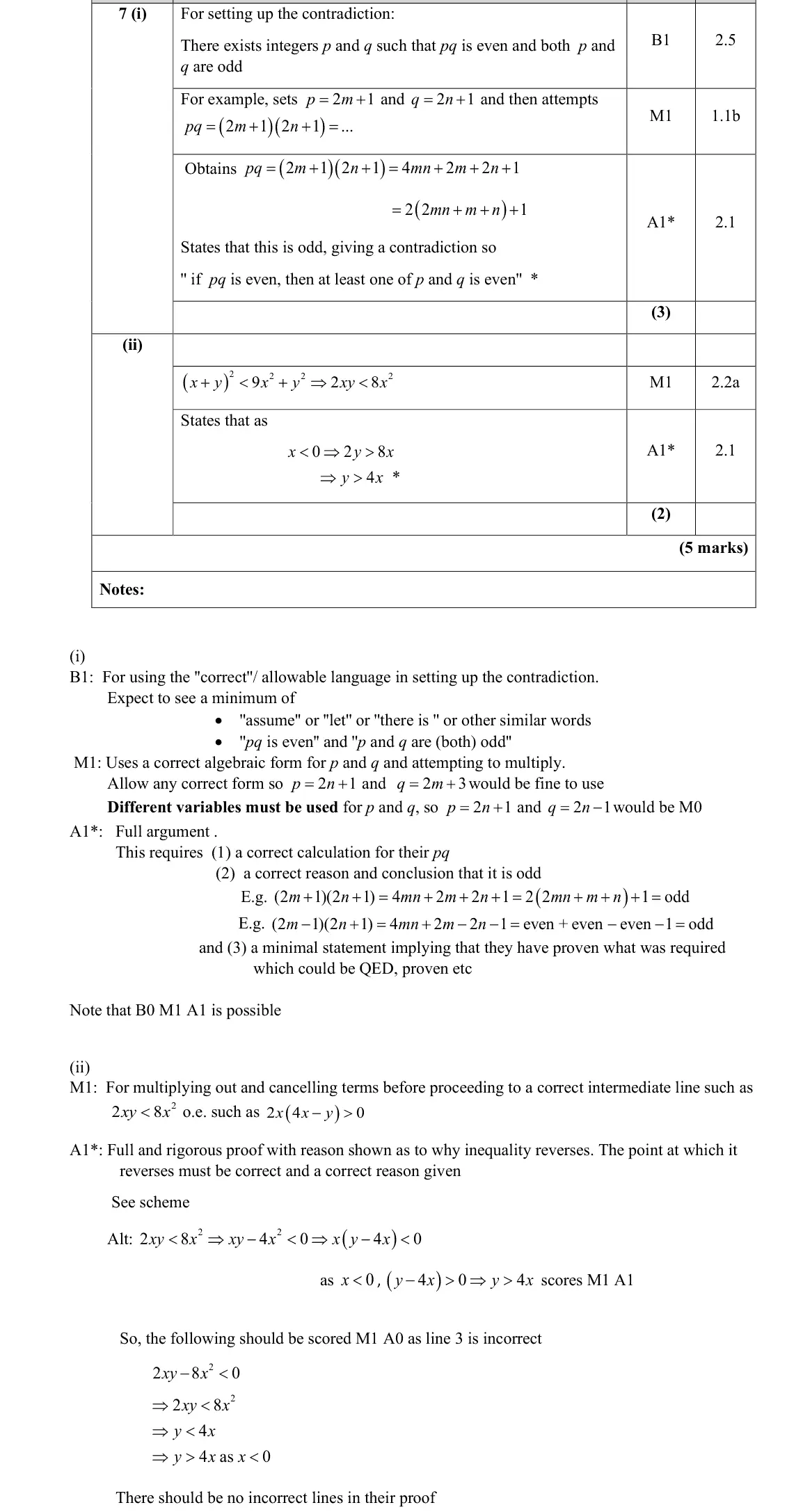
This question, on two different kinds of proof, proved more demanding than expected. As a result, there were very few completely correct solutions to both parts of this question. In part (i) candidates were often unable to set up a proof by contradiction using appropriate language, failing to use words such as 'assume', 'there exists' or 'let' . Others simply set up a contradiction such as 'assume p and q are odd' without any reference to pq being even. Many candidates also failed to use different variables for their odd numbers p and q, implying that p and q were either the same odd number, or two consecutive odd numbers such as 2n+1 and 2n+3. Candidates who managed to write p and q using different variables were generally able to multiply out pq correctly and write it in the form 2(.....)+1. If this stage was reached, the conclusion was generally correct and an acceptable sentence was written down. A mark of 011 was possible from the mark scheme. In part (ii) most candidates expanded the left hand side and cancelled terms getting to 2xy < 8x2 or equivalent for the method mark. Many then lost the second mark by failing to identify the point at which the inequality reverses, simply writing down y < 4x followed by 'so y > 4x'. Other candidates did reverse the inequality at the right point but didn't give an explanation as to why, and so lost the final mark.
Common mistakes
assume pq even AND p, q both odd ("assume/there exists")
different variables p = 2m + 1, q = 2n + 1
pq = 2(2mn + m + n) + 1 is odd, contradiction, then conclude
June 2022 · Paper 1 · Q7(ii)2 marksHard
Mark scheme (whole question; this part is marked with the orange bar)
Examiner's comment
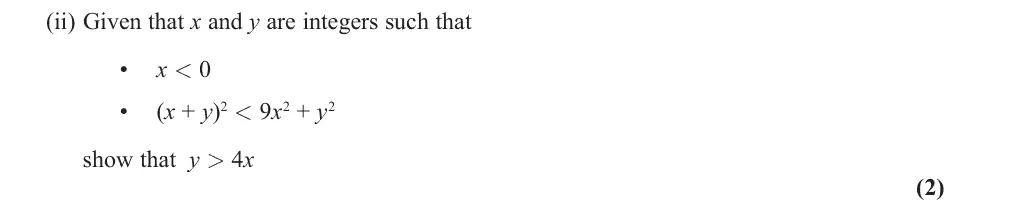
This question, on two different kinds of proof, proved more demanding than expected. As a result, there were very few completely correct solutions to both parts of this question. In part (i) candidates were often unable to set up a proof by contradiction using appropriate language, failing to use words such as 'assume', 'there exists' or 'let' . Others simply set up a contradiction such as 'assume p and q are odd' without any reference to pq being even. Many candidates also failed to use different variables for their odd numbers p and q, implying that p and q were either the same odd number, or two consecutive odd numbers such as 2n+1 and 2n+3. Candidates who managed to write p and q using different variables were generally able to multiply out pq correctly and write it in the form 2(.....)+1. If this stage was reached, the conclusion was generally correct and an acceptable sentence was written down. A mark of 011 was possible from the mark scheme. In part (ii) most candidates expanded the left hand side and cancelled terms getting to 2xy < 8x2 or equivalent for the method mark. Many then lost the second mark by failing to identify the point at which the inequality reverses, simply writing down y < 4x followed by 'so y > 4x'. Other candidates did reverse the inequality at the right point but didn't give an explanation as to why, and so lost the final mark.
Common mistakes
expand and cancel to 2xy < 8x²
dividing by x < 0 reverses the inequality, with the reason, to get y > 4x
no incorrect lines
June 2022 · Paper 1 · Q13(i)3 marksMedium
Mark scheme (whole question; this part is marked with the orange bar)
Examiner's comment
This question on arithmetic sequences and series proved to be very discriminating. The proof of the sum of an arithmetic sequence is standard, but was not answered well by many candidates. Most candidates however were able to then made progress with the rest of the question, having been given the required formula. Good candidates often did well in this question however, with 17% of the cohort achieving full marks. In part(i) those who had learned the standard proof for the sum of the first n terms of an arithmetic series often gained full marks. It was however, unusual to see a well set out, fully correct proof. Candidates often failed to write a correct expression for Sn at the start of their proof, or sometimes having an incorrect first or last term or extra terms (most often a+nd) within their sum. Other errors included not displaying a sufficient number of terms, not writing S= or Sn =, and using commas instead of + sign between the terms. In part(ii) most realised that they could make headway even if they hadn’t attempted part (i). In (ii) (a) many of the candidates used a=20, d = -0.8 and Sn = 64 in the sum formula to score the M mark. Poor notation such as (n-1)-0.8 was frequently seen, but candidates usually recovered from this. Following a correct equation most were able to proceed correctly to the given quadratic for the accuracy mark. A common error was where candidates used +0.8 as the common difference rather than -0.8 Part (ii) (b) was generally answered without issues. Almost all candidates managed to get B1 for getting the two values of n, either by factorising or by using a calculator. Part (ii)(c) was not answered very well with most candidates identifying 10 as the valid solution but not adequately justifying this choice. The reasons provided were often too vague or not related to why 10 was better than 16. More tended to score the mark by explaining that at 16 weeks he would be saving a negative amount rather than using the fact that 10 was the smaller number or that he would have had enough by 10 weeks so would not continue saving until 16 weeks.
Common mistakes
write Sn = a + (a + d) + ... + (a + (n − 1)d) with + signs, reverse and add to get 2Sn = n(2a + (n − 1)d)
wrong extra terms such as a + nd
too few terms shown
June 2022 · AS Paper 1 · Q14(i)1 mark
Mark scheme (whole question; this part is marked with the orange bar)
Examiner's comment
This question was poorly answered by the vast majority of candidates, although its position on the paper reflected that this topic is still a challenge to many. x = x = , taking no account In part (a), many candidates focussed inappropriately on and 9 3 of the > signs in the question. For those choosing to correctly look for counter examples, a - 2 lack of brackets (e.g. ) meant their work was inaccurate and they did not score the mark, 4 x or they did not give an acceptable conclusion. Several candidates only considered and 3 it was surprising how many candidates concluded the statement was true as a result. Finally, some candidates misinterpreted the syntax of the question, resulting in answers like "sometimes true", which gained no credit, even though they had recognised the values required to find a counter example. In part (b), the few candidates gaining any credit managed to factorise and then occasionally state that these were consecutive values, thus gaining 1 or occasionally 2 marks. A rare candidate went on to achieve the final accuracy mark using this approach with correct reasoning. The most common attempts generally included consideration of n being even and then n being odd with appropriate substitutions into the factorised expression and then an algebraic attempt which could not make any progress. Less common was an attempt to write 𝑛 as the k + etc. and complete similar algebraic work. This produced multiples of variations of 6k, 6 1 6 but almost all candidates failed to progress to show the result holds for all 6 cases. A few attempts at induction were seen. These normally started with a factorisation, the use of + = + n = and attempts at algebraic manipulation to the stage showing f( 1) f( ) g( ) k k k . 1 Here, candidates generally made errors in the getting the coefficients of g( ) k or failed to factorise to the point at which they could reasonably conclude that g( ) k was a multiple of 6, instead often incorrectly changing their expression so that a factor of 6 then appeared.
Common mistakes
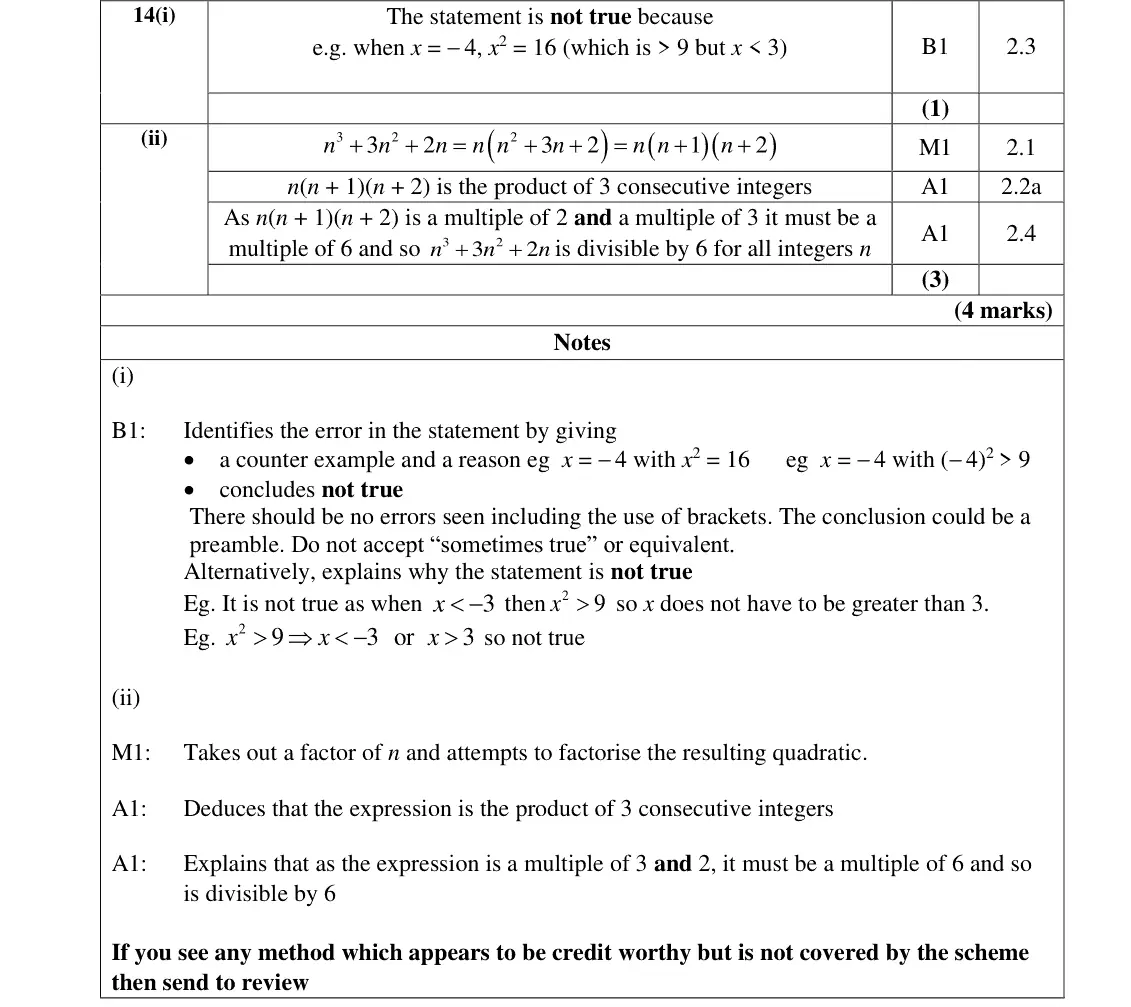
disprove with a counter-example, e.g. x = −4: (−4)² = 16 > 9 but x < 3, and conclude "not true"
brackets needed on (−4)²
"sometimes true" scores 0
considering only x = ±3
June 2022 · AS Paper 1 · Q14(ii)3 marks
Mark scheme (whole question; this part is marked with the orange bar)
Examiner's comment
This question was poorly answered by the vast majority of candidates, although its position on the paper reflected that this topic is still a challenge to many. x = x = , taking no account In part (a), many candidates focussed inappropriately on and 9 3 of the > signs in the question. For those choosing to correctly look for counter examples, a - 2 lack of brackets (e.g. ) meant their work was inaccurate and they did not score the mark, 4 x or they did not give an acceptable conclusion. Several candidates only considered and 3 it was surprising how many candidates concluded the statement was true as a result. Finally, some candidates misinterpreted the syntax of the question, resulting in answers like "sometimes true", which gained no credit, even though they had recognised the values required to find a counter example. In part (b), the few candidates gaining any credit managed to factorise and then occasionally state that these were consecutive values, thus gaining 1 or occasionally 2 marks. A rare candidate went on to achieve the final accuracy mark using this approach with correct reasoning. The most common attempts generally included consideration of n being even and then n being odd with appropriate substitutions into the factorised expression and then an algebraic attempt which could not make any progress. Less common was an attempt to write 𝑛 as the k + etc. and complete similar algebraic work. This produced multiples of variations of 6k, 6 1 6 but almost all candidates failed to progress to show the result holds for all 6 cases. A few attempts at induction were seen. These normally started with a factorisation, the use of + = + n = and attempts at algebraic manipulation to the stage showing f( 1) f( ) g( ) k k k . 1 Here, candidates generally made errors in the getting the coefficients of g( ) k or failed to factorise to the point at which they could reasonably conclude that g( ) k was a multiple of 6, instead often incorrectly changing their expression so that a factor of 6 then appeared.
Common mistakes
factorise to n(n + 1)(n + 2), the product of three consecutive integers, so a multiple of 2 and of 3, hence of 6
even/odd case attempts rarely completed
June 2022 · Paper 2 · Q43 marks
Mark scheme (whole question; this part is marked with the orange bar)
Examiner's comment
This question on differentiation from first principles saw good scoring and the method was widely recalled. A small number of slips with the algebra were seen and some replaced f (x + h) with 2x2 + h or (2x + h)2 or 2(x2 + h) instead of 2(x + h)2. There was the occasional poor squaring and mishandling of the “2”s e.g. expanding 2(x + h)2 to get 2x2 + 2xh + h2 was surprisingly common. Some leeway was afforded to the students with notation here although use of h = 0 instead of h 0 was penalised if no indication of the limiting process was seen. A small number of responses did not have an “f′(x) =” or equivalent and so forfeited the final mark.
Common mistakes
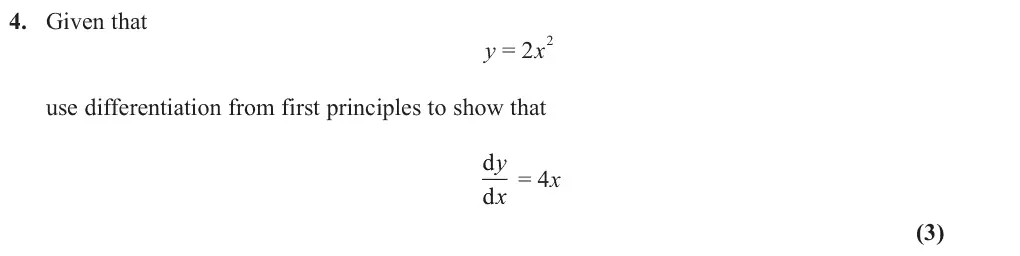
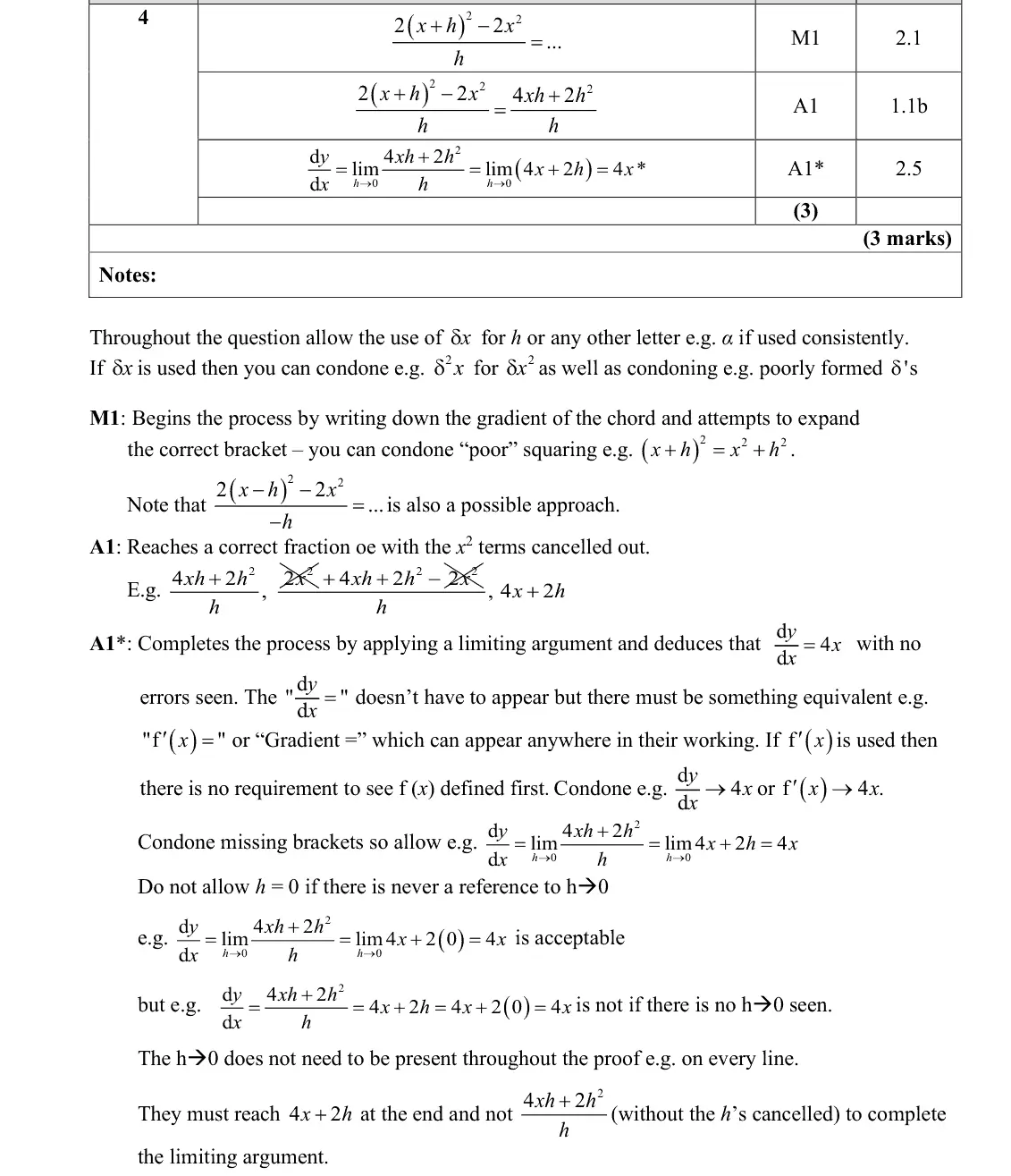
gradient of chord (2(x + h)² − 2x²)/h
expand 2(x + h)² correctly (not 2x² + 2xh + h²)
reach 4x + 2h and show h → 0 (not h = 0)
dy/dx = or f′(x) = must appear
June 2022 · Paper 2 · Q114 marks
Mark scheme (whole question; this part is marked with the orange bar)
Examiner's comment
Most students made some attempt at this proof question, and there was a mixture of responses that achieved the full range of possible marks. It was striking that a number of students attempted to answer the question without doing any algebra, despite the clear instruction within the question. Most candidates who used algebra recognised that a strategy of considering odd and even numbers could be used to prove the statement with most using 𝑛𝑛= 2𝑘𝑘 and 𝑛𝑛= 2𝑘𝑘+ 1, although a minority only attempted one of these. Within the algebra, a common misconception was that (2𝑘𝑘)2 = 2𝑘𝑘2. Occasionally there were a few candidates that tried to consider the cases of 3k – 1, 3k, and 3k + 1 which caused those candidates difficulty in progressing the proof. Although students knew that they needed to show the expression was a multiple of 2 to conclude that it was even, few seemed to be looking for the earliest opportunity to do this, and therefore did more algebraic manipulation than was necessary. Some also presented expressions like 8𝑘𝑘3 + 12𝑘𝑘2 + 16𝑘𝑘+ 6 and declared them to be even without explaining why this is the case. A handful used 𝑛𝑛= 2𝑛𝑛+ 2 for the even case, again having to do more algebraic manipulation than was needed. Most candidates who attempted this approach gained the method marks but the accuracy marks were sometimes lost for algebraic slips or more commonly for failing to give a final statement that the result was even for both odd and even cases, or simply stating that the statement was a multiple of 2 without concluding that it was therefore even. It was surprising for the odd case how many candidates had a preference for fully expanding their expressions into a cubic before factorising, i.e. 8k3 + 12k2 + 16k + 6 = 2(4k3 + 6k2 + 8k + 3) rather than simply factoring (2k + 1)(4k2 + 4k + 6) into 2(2k + 1)(2k2 + 2k + 3) for example which is algebraically easier to achieve. Where algebra was not used, the most common approach was to use a logic argument involving the rules of combining odd and even numbers. Where the argument was convincing students were sometimes able to gain the method marks. A few candidates attempted a proof by contradiction or by induction, but usually produced an argument that was incomplete and made little progress.
Common mistakes
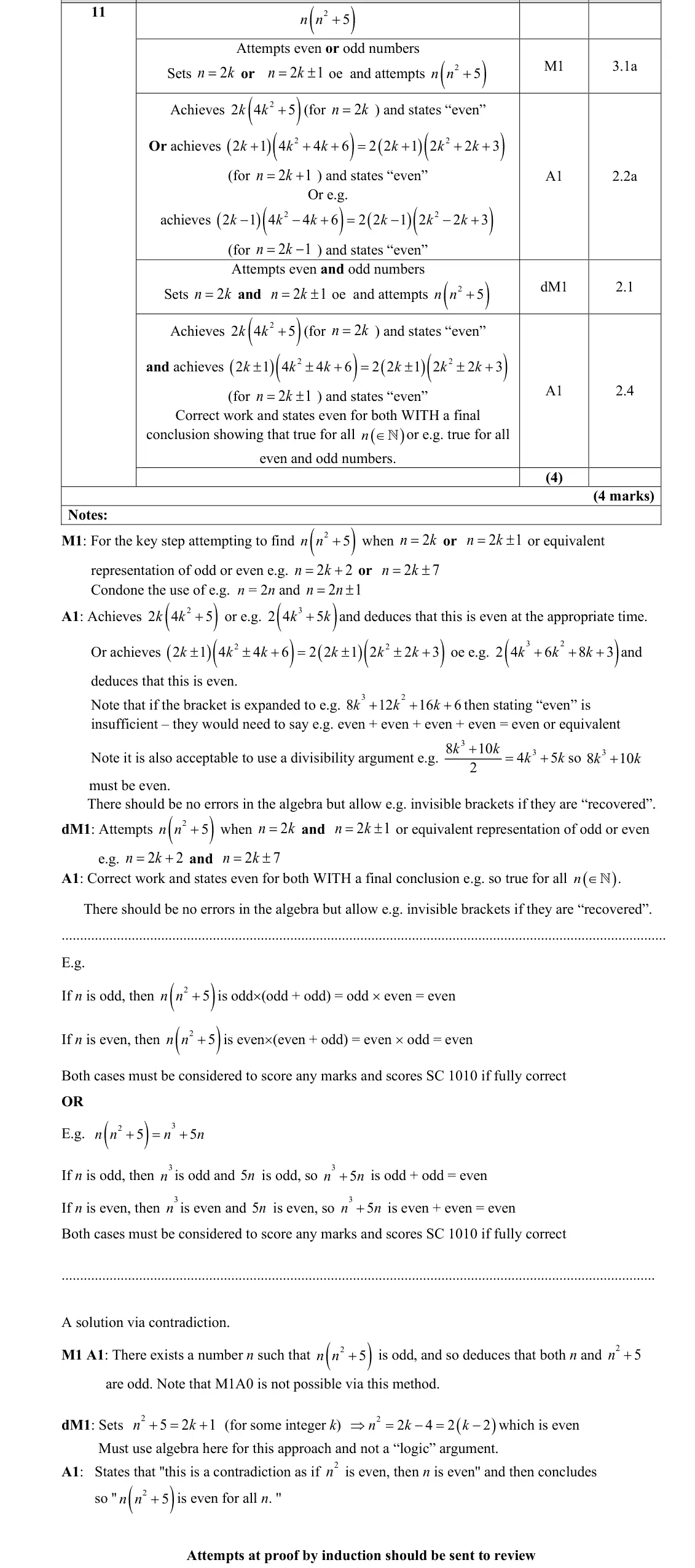
n = 2k gives 2k(4k² + 5)
n = 2k + 1 gives 2(2k + 1)(2k² + 2k + 3)
(2k)² ≠ 2k²
factor out 2 (stating an expanded cubic is "even" is not enough)
conclude for all n
a logic-only argument gets a special case 2/4
Oct 2021 · AS Paper 1 · Q10(a)4 marks
Mark scheme (whole question; this part is marked with the orange bar)
Examiner's comment
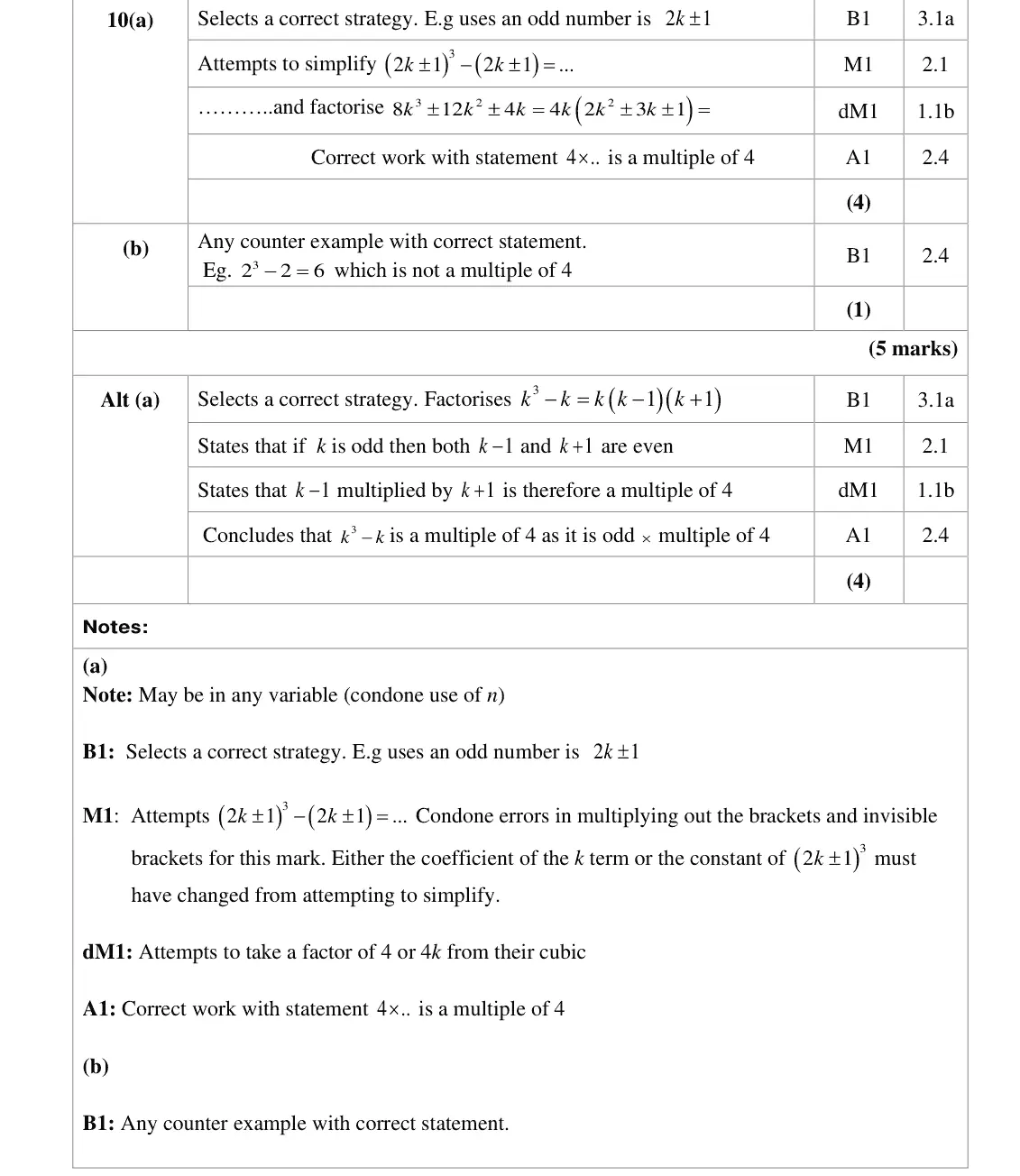
This question tested both proof by deduction and proof by counter-example. It was pleasing to see improved attempts made on this type of question. In part (a) candidates were usually able to set up their proof using 2 1 k + or similar. Some continue to set 2 1 n n = + which was condoned on this occasion. Some candidates unfortunately set up their proof with 4 1 k + or 2 1 n + which could not score. Candidates were usually successful in substituting into the expression, multiplying out and simplifying. Some candidates did forget later to subtract 2 1 k + or similar as they had become to engrossed in the multiplying out of the cubic, although most then knew they needed to take a factor of 4 out of their expression. The final mark was typically lost for bracket errors, or the omission of them, in their proof at some point in their working so candidates should be encouraged to check their work carefully. Most candidates knew that they needed to conclude at the end.
Mark scheme (whole question; this part is marked with the orange bar)
Examiner's comment
This question tested both proof by deduction and proof by counter-example. It was pleasing to see improved attempts made on this type of question. In part (b), this proved to be harder work for many candidates. A significant number seemed to not understand what a natural number was and opted to substitute a negative number, or a 7 fraction, into the expression. There was also some confusion regarding whether 0 was a multiple of 4 as well.
Common mistakes
counter example with an even natural number, e.g. 2³ − 2 = 6, not a multiple of 4, with a statement
negative numbers, fractions and 0 are not suitable
Oct 2021 · Paper 1 · Q15(i)2 marks
Mark scheme (whole question; this part is marked with the orange bar)
Examiner's comment
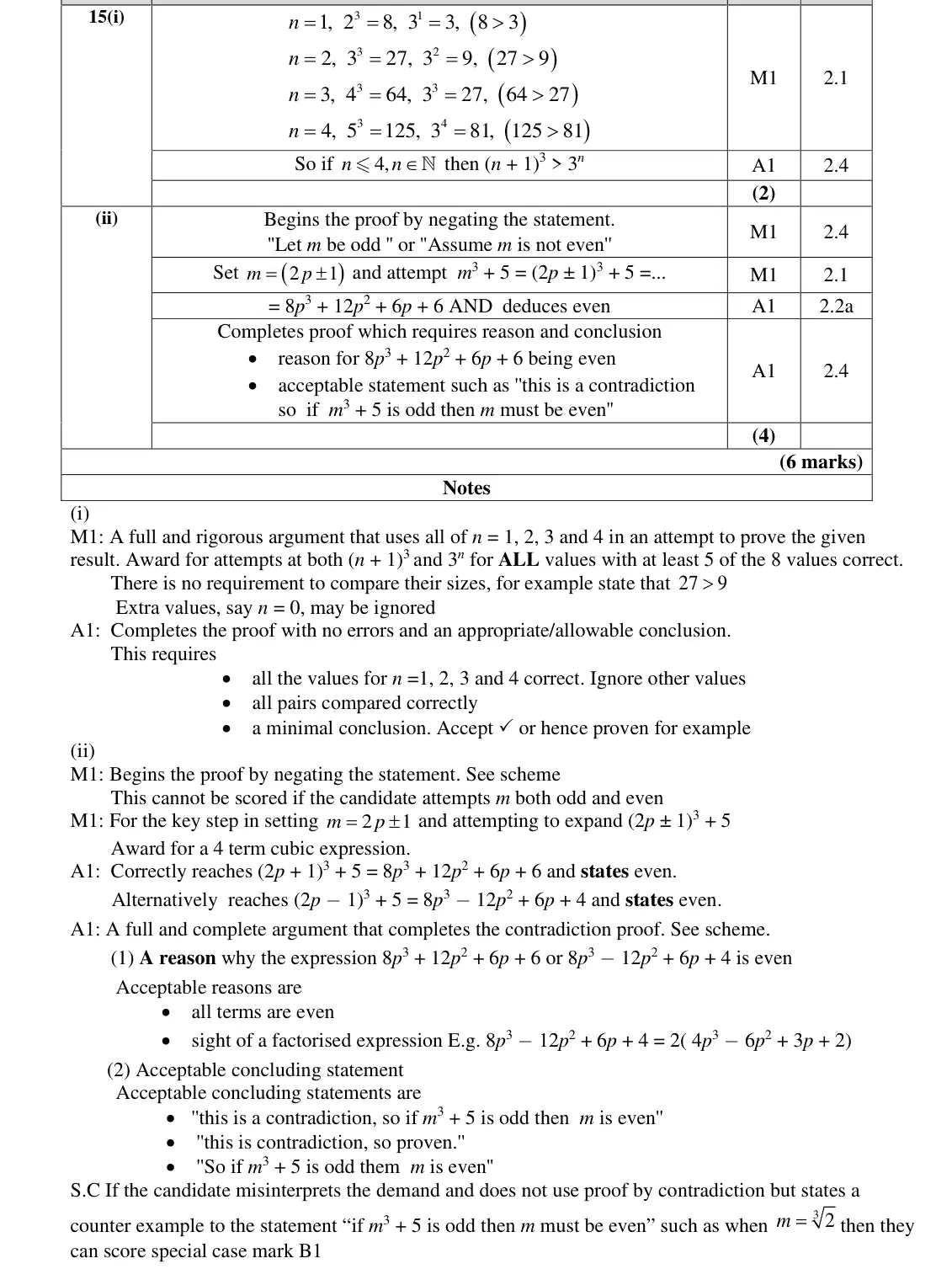
Candidates have not been too successful in answering questions on the topic of ‘Proof’ within this new specification, and this question proved to be no different. Part (i) The meaning of “proof by exhaustion” was not fully understood by all. Many candidates failing to consider all four of the possible cases mentioned. A common response was to test just n =4 and n =5 and conclude that it was true for n = 4 but not n = 5 so it was proven for n <= 4. Some candidates who did consider all values of n = 1,2,3 and 4, left some expressions unevaluated. Occasionally the eight required values were found but there was no evidence that they were being compared. It was essential that a proper conclusion is made at the end of a proof, and despite having convincing working and reasons, some candidates lost the final accuracy mark here because they did not have a conclusion saying that the required result was indeed true. Part (ii) Very many candidates did score the first mark here for saying “Suppose that m is odd”. However, a common error was to state “let m3+5 be odd” instead leading to 0 marks. It was common to see 2p+1 or 2k+1 being used to represent an odd number and there were many occasions where (2p+1)3+5 was seen in a candidate’s working. In some cases there were algebraic errors in attempting to expand the cube of (2p+1), but most candidates did achieve the required four term cubic 8p3+12p2+6p+6. When this cubic was correct, those candidates very often went on to gain the next two accuracy marks by proving, by factorisation, that m3+5 was even, and then stating that there is a contradiction (to the assumption that m is odd) and so m must be even. .
Common mistakes
proof by exhaustion must test all of n = 1, 2, 3, 4 (not n = 4 and 5), evaluate and compare both sides, and end with a conclusion
Oct 2021 · Paper 1 · Q15(ii)4 marks
Mark scheme (whole question; this part is marked with the orange bar)
Examiner's comment
Candidates have not been too successful in answering questions on the topic of ‘Proof’ within this new specification, and this question proved to be no different. Part (i) The meaning of “proof by exhaustion” was not fully understood by all. Many candidates failing to consider all four of the possible cases mentioned. A common response was to test just n =4 and n =5 and conclude that it was true for n = 4 but not n = 5 so it was proven for n <= 4. Some candidates who did consider all values of n = 1,2,3 and 4, left some expressions unevaluated. Occasionally the eight required values were found but there was no evidence that they were being compared. It was essential that a proper conclusion is made at the end of a proof, and despite having convincing working and reasons, some candidates lost the final accuracy mark here because they did not have a conclusion saying that the required result was indeed true. Part (ii) Very many candidates did score the first mark here for saying “Suppose that m is odd”. However, a common error was to state “let m3+5 be odd” instead leading to 0 marks. It was common to see 2p+1 or 2k+1 being used to represent an odd number and there were many occasions where (2p+1)3+5 was seen in a candidate’s working. In some cases there were algebraic errors in attempting to expand the cube of (2p+1), but most candidates did achieve the required four term cubic 8p3+12p2+6p+6. When this cubic was correct, those candidates very often went on to gain the next two accuracy marks by proving, by factorisation, that m3+5 was even, and then stating that there is a contradiction (to the assumption that m is odd) and so m must be even. .
Mark scheme (whole question; this part is marked with the orange bar)
Examiner's comment
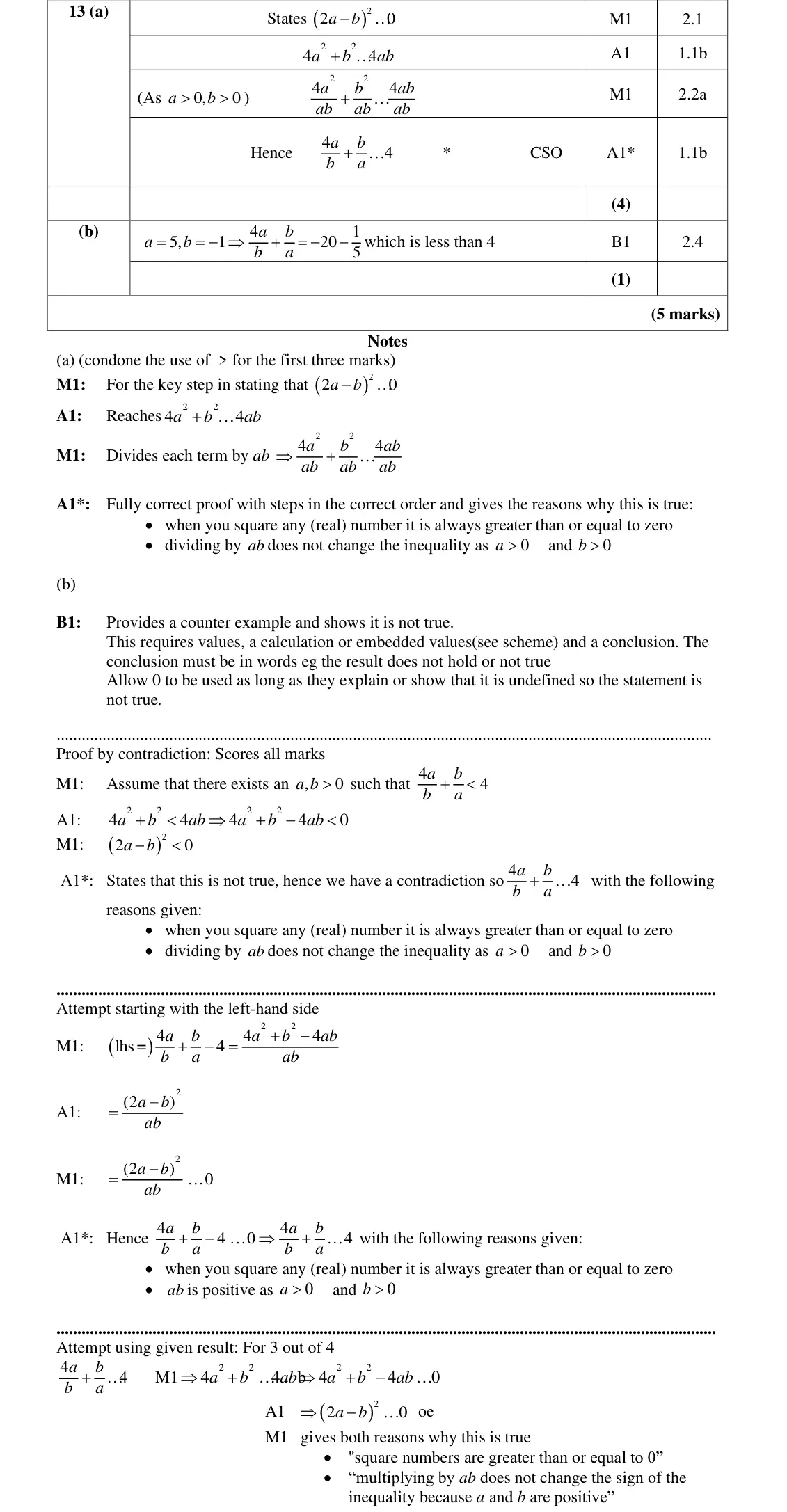
This proved to be a challenging question with only a few candidates scoring full marks in the first part, although more candidates were successful with the second part. In part (a), the expected approach was to begin with some known true statement, such as 2 (2 ) 0 a b - , and then to argue logically, step by step, until you arrived at the statement given in the question. Most candidates incorrectly began by using the given statement and then proceeding, which meant that they could not score full marks. The algebraic processing was generally well done, meaning most candidates scored 2 out of the available 4 marks, but most lost the final mark by not including full detail of their reasoning (squaring a real number will always give an answer greater than or equal to zero and, since both a and b are positive, multiplying the inequality through by ab will not change the inequality sign).
Common mistakes
start from (2a − b)² ≥ 0, not from the given result
give both reasons (a square is non-negative
dividing by ab > 0 keeps the inequality)
Oct 2020 · AS Paper 1 · Q13(b)1 mark
Mark scheme (whole question; this part is marked with the orange bar)
Examiner's comment
This proved to be a challenging question with only a few candidates scoring full marks in the first part, although more candidates were successful with the second part. In part (b), many candidates realised that the result does not hold if one value is positive and one is negative. However, a calculation is not enough for a proof, and a conclusion in words was necessary in order to obtain the mark. It was disappointing that many still opted to just state the inequality the other way round or not provide a conclusion at all. Other candidates did not substitute their values in correctly, or their answer for the expression on the left-hand side was incorrect.
Common mistakes
one positive and one negative value, e.g. a = 5, b = −1 gives −20.2 < 4
a conclusion in words is needed
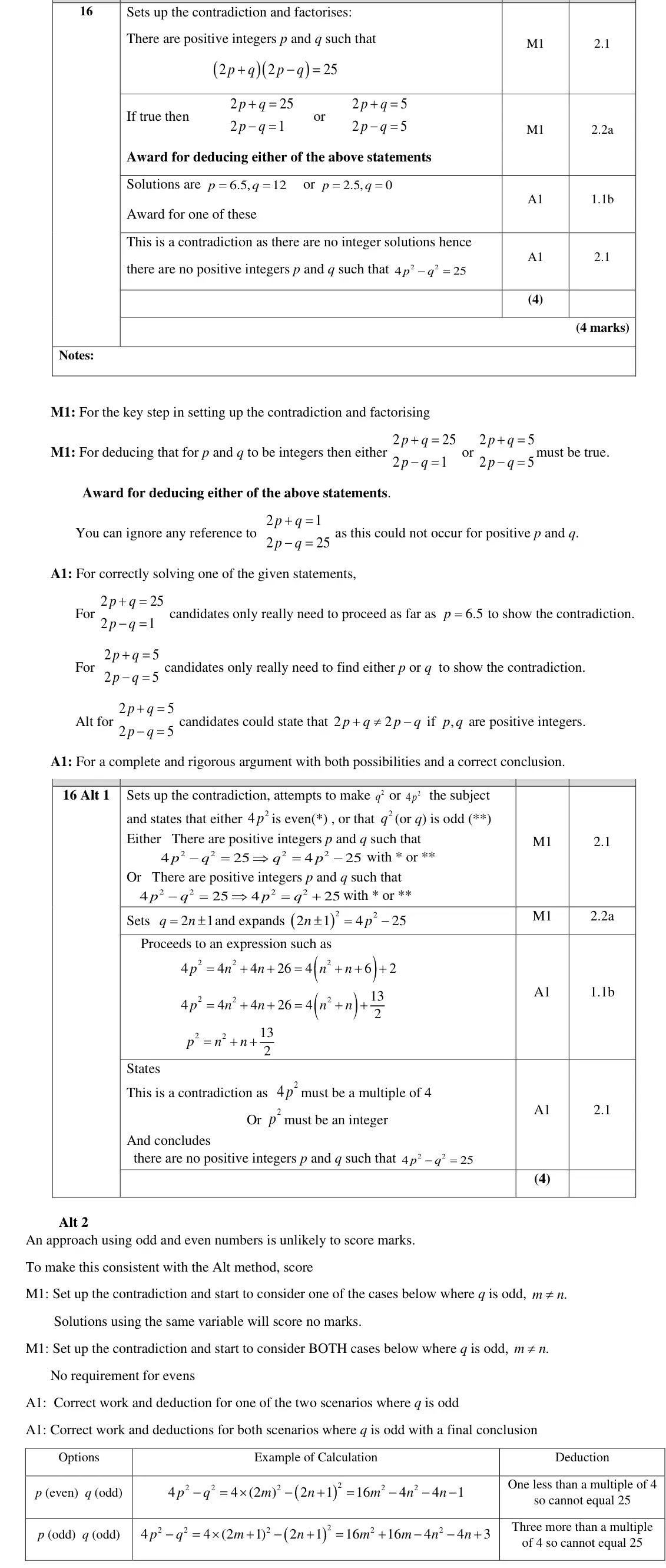
Oct 2020 · Paper 1 · Q164 marks
Mark scheme (whole question; this part is marked with the orange bar)
Examiner's comment
Marks on this question were only scored by above average candidates and many made little or no progress towards a proof. There were many blank responses. Candidates who attempted to factorise 2 2 4p q - were more successful than by other methods, although the large majority of these scored only the first mark, by stating the assumption and factorising to ( )( ) 2 2 p q p q + - , but making no further progress. Of those that did consider the factors of 25, many did set up and solve two relevant equations simultaneously, and so gained 3 marks, but very few considered both of the required pairs of equations and so did not all marks. There were many discussions of odd/even integers but this was commonly followed by working in the same variable for p and q, which gained no marks
Common mistakes
assume integers exist
factorise (2p + q)(2p − q) = 25
consider both 2p + q = 25, 2p − q = 1 and 2p + q = 5, 2p − q = 5 (non-integer or q = 0)
conclude
odd/even arguments using the same letter for p and q score nothing
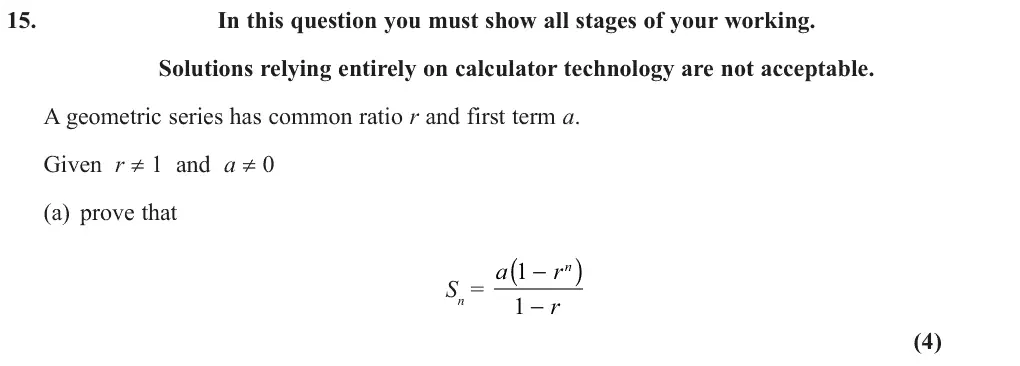
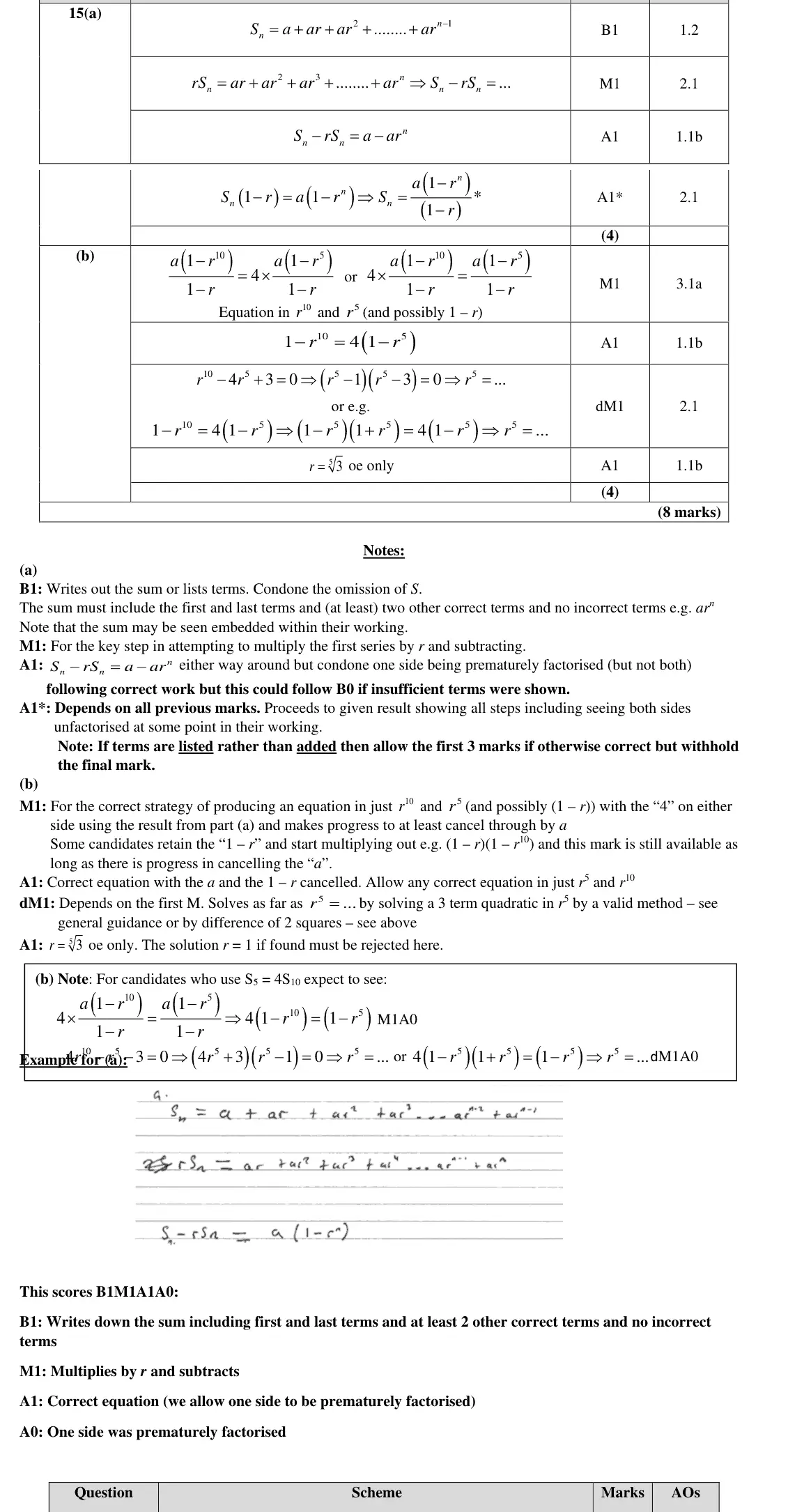
Oct 2020 · Paper 2 · Q15(a)4 marks
Mark scheme (whole question; this part is marked with the orange bar)
Examiner's comment
A number of the responses were completely blank suggesting perhaps that candidates had run out of time to complete this question. In part (a), very high proportion of the candidates had some idea what the layout of the proof looked like yet only around 50% were able to complete it accurately and rigorously. There were many solutions containing the final the term of Sn as arn rather than arn - 1. Candidates who had the correct initial sequence regularly went on to complete the proof correctly. Only a small number prematurely factorised. Some were trying to apply the method of proving the sum of an arithmetic series instead, hence losing the majority of the marks.
Common mistakes
last term is ar^(n−1), not arⁿ
multiply by r and subtract
both sides seen unfactorised
do not use the arithmetic series method
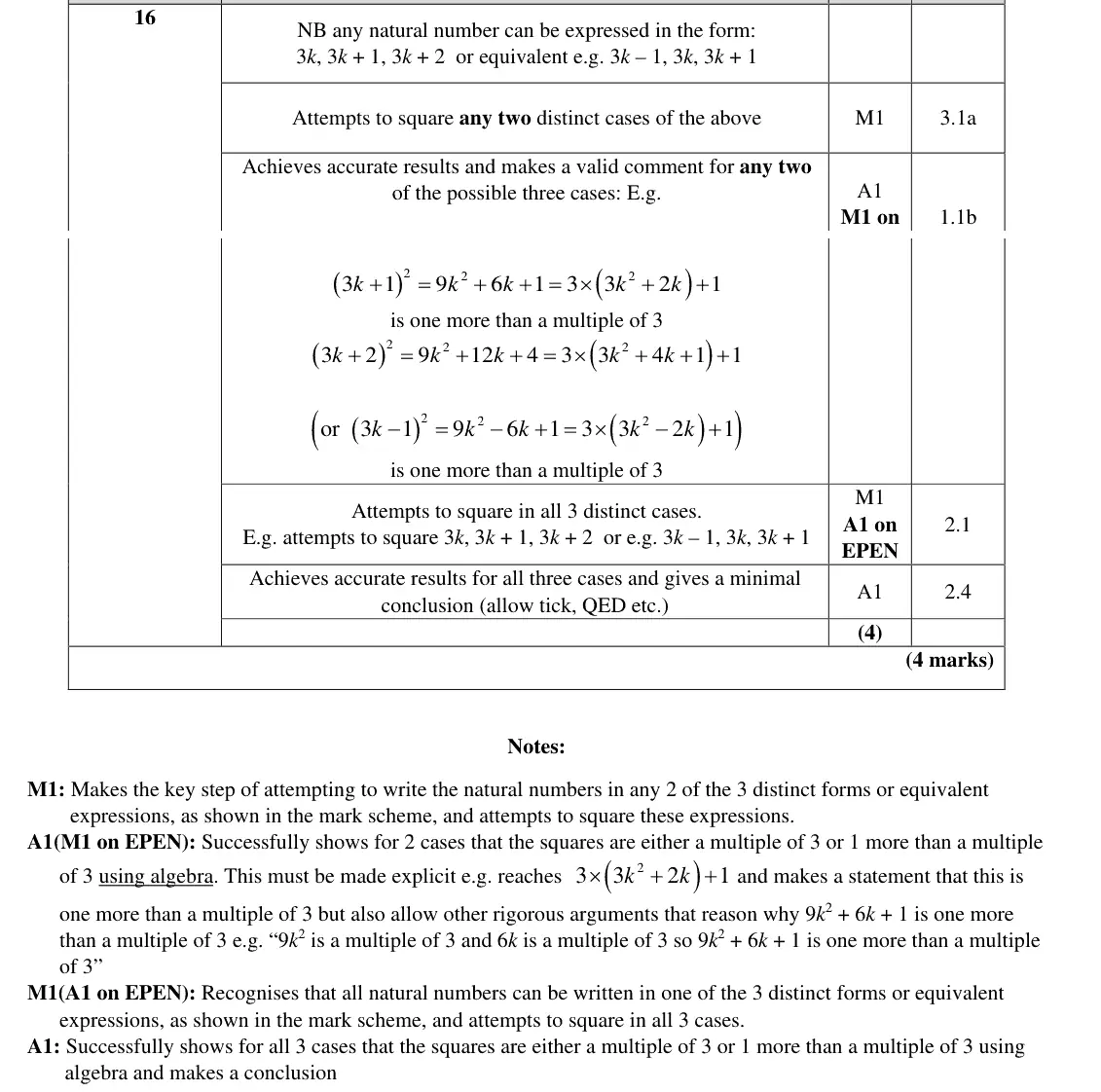
Oct 2020 · Paper 2 · Q164 marks
Mark scheme (whole question; this part is marked with the orange bar)
Examiner's comment
This was a very poorly answered question, with the majority of candidates not writing anything at all. A fairly common attempt was to only split the natural numbers into odd/even cases and square 2n, 2n+1, which gained no marks. Many students who obtained any marks on this question seemed to stumble on these more by chance than by considering the problem. The problem mentioned that the square was to be a multiple of 3 or one more than a multiple of 3 and many students were able to write this as 3n and 3n + 1. Some went on to square these and show that the result was also a multiple of 3 or one more than a multiple of 3. Few students realised that they needed a third case (e.g. 3n - 1 or 3n + 2) to cover all integers, and as a result two marks was the most that could be achieved. It was very rare to see full marks scored in this question. Candidates who did gain full marks typically presented model solutions with thorough explanations and conclusions.
Common mistakes
consider all three cases 3k, 3k + 1, 3k + 2 (odd/even cases score nothing)
show each square as 3( ) or 3( ) + 1 explicitly
conclusion needed
June 2019 · Paper 1 · Q10(i)4 marksHard
Mark scheme (whole question; this part is marked with the orange bar)
Examiner's comment
The idea of proof is another new one in this updated specification. It was not well known and a disproportionate number of blank or barely started solutions indicated a lack of expertise in this topic. Candidates who scored full marks for part (i) most often did so via algebraic proof, letting n=2m (for even numbers) and then n=2m+1 (for odd numbers), although several candidates missed out on the final accuracy mark as they failed to insert a conclusion for all n. Weaker candidates tried to use m + 1 instead of 2m + 1 to represent odd numbers. Also many candidates only considered either odd or even numbers, but not both. Candidates who set out to use proof via contradiction tended to score few marks as they did not show an understanding of how to use that method of proof. Proofs via logic were rare and tended to appear as part of a mix of different methods where the candidates seemed to be unclear of the best way to proceed. Some candidates seemed to think that using random numbers to show that the expression is not divisible by 4 amounted to proof (receiving 0 marks). Students need more practice on this style of proof. In part (ii) more candidates approached the problem algebraically than graphically. They were generally able to set up the two equations / inequalities required, but errors often occurred in their use of algebra when attempting to solve them. Some candidates only set up one of the two required inequalities. Many students attempted the question by just substituting numbers in to the expression, with most of these deducing that the statement was always true. Where candidates drew a graph, they often did not describe why their graph indicated that the statement is sometimes true. Many graphs showed a line and a V shape but some were incorrect in the relative positioning of these shapes.
Common mistakes
consider n = 2m and n = 2m + 1 (not m + 1), both cases
conclude for all n
trying numbers scores 0
June 2019 · Paper 1 · Q10(ii)2 marksHard
Mark scheme (whole question; this part is marked with the orange bar)
Examiner's comment
The idea of proof is another new one in this updated specification. It was not well known and a disproportionate number of blank or barely started solutions indicated a lack of expertise in this topic. Candidates who scored full marks for part (i) most often did so via algebraic proof, letting n=2m (for even numbers) and then n=2m+1 (for odd numbers), although several candidates missed out on the final accuracy mark as they failed to insert a conclusion for all n. Weaker candidates tried to use m + 1 instead of 2m + 1 to represent odd numbers. Also many candidates only considered either odd or even numbers, but not both. Candidates who set out to use proof via contradiction tended to score few marks as they did not show an understanding of how to use that method of proof. Proofs via logic were rare and tended to appear as part of a mix of different methods where the candidates seemed to be unclear of the best way to proceed. Some candidates seemed to think that using random numbers to show that the expression is not divisible by 4 amounted to proof (receiving 0 marks). Students need more practice on this style of proof. In part (ii) more candidates approached the problem algebraically than graphically. They were generally able to set up the two equations / inequalities required, but errors often occurred in their use of algebra when attempting to solve them. Some candidates only set up one of the two required inequalities. Many students attempted the question by just substituting numbers in to the expression, with most of these deducing that the statement was always true. Where candidates drew a graph, they often did not describe why their graph indicated that the statement is sometimes true. Many graphs showed a line and a V shape but some were incorrect in the relative positioning of these shapes.
Common mistakes
sometimes true: false for 9.25 < x < 9.5, true e.g. x = 12
give one example of each
substituting a few numbers led many to "always true"
graph needs V shape and line crossing twice
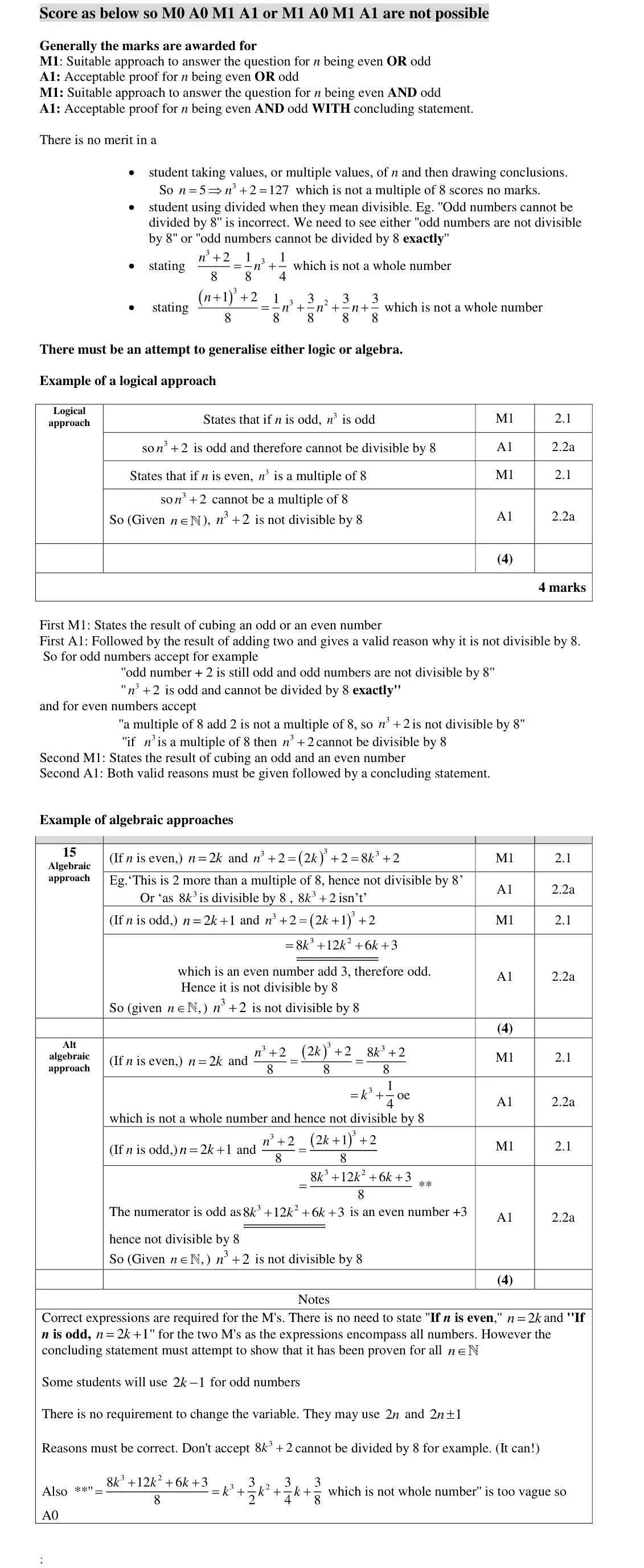
June 2019 · AS Paper 1 · Q154 marksHard
Mark scheme (whole question; this part is marked with the orange bar)
Examiner's comment
It was very rare to see a response worthy of full marks and many candidates made no attempt to answer this question. It was clear that this new aspect of the specification was not well known by candidates. It was expected that candidates would consider odd and even numbers separately using a logical or an algebraic approach as detailed in the mark scheme. Almost all the candidates who gained any marks used either approach, or even a mixture of both. Marks were commonly lost by: using n (even) and n +1 (odd) which brought no success at all failing to appreciate the difference between “cannot be divided by 8” and “is not divisible by 8” errors in the expansion and simplification of (2k + 1)3 + 2 a lack of rigour in the explanation that 8k3 + 12k2 + 6k + 3 is not divisible by 8 failing to write a concluding statement (for the final mark) There were also a few attempts at proof by contradiction, some of which were quite impressive, considering the more difficult nature of this approach. Many embarked on a completely numerical approach (in some cases claiming to have demonstrated proof by exhaustion) and did not, of course, score any marks.
Common mistakes
consider n even (2k) and n odd (2k + 1) and conclude for all n
numerical examples score nothing
n and n + 1 is not even/odd
"8k³ + 2 cannot be divided by 8" is wrong (not exactly divisible)
concluding statement needed
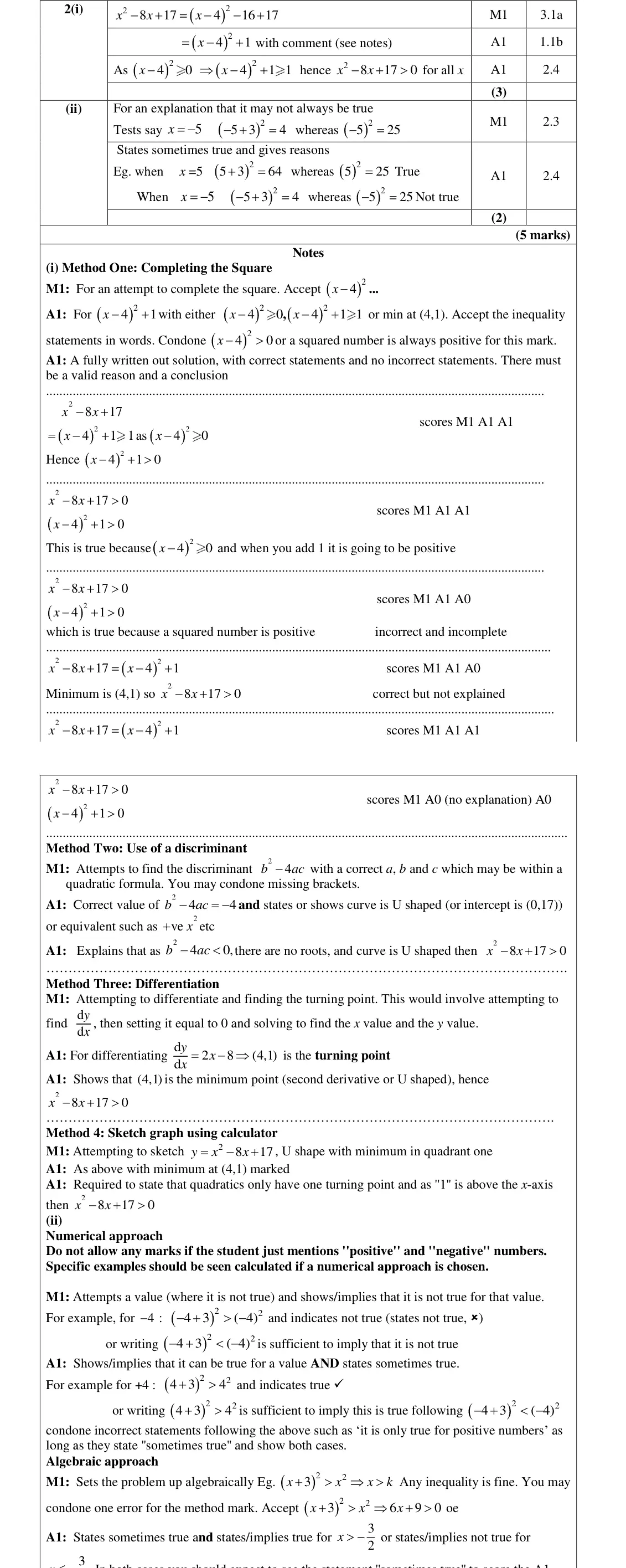
June 2018 · AS Paper 1 · Q2(i)3 marks
Mark scheme (whole question; this part is marked with the orange bar)
Examiner's comment
Most students gained marks in at least one part of this question. However, the rigorous approach required to achieve full marks was generally lacking. In part (i), most attempted to complete the square but a common error was to state that a square number must be positive, with no reference to the possibility of it being zero. Those who found the discriminant rarely scored more than the first mark as they did not realise the need to consider the shape of the curve. A small number attempted differentiation and whilst they stated (4,1) was a minimum it was very unusual to have this confirmed (e.g. using the second derivative). It was rare to see a fully graphical approach but those who tried usually gained two marks for a correct sketch with the correct minimum shown. A few students tried to give an explanation in words or used a few numerical examples. In part (ii), most students used a numerical approach and the majority concluded that the statement is ‘sometimes true’. It was common, however, to show working for a negative value only, for which the statement is not true. Some attempted a true and a false value, as required, but failed to conclude that the statement is ‘sometimes true’. Many students unsuccessfully tried to write general statements referring to positive and negative values being used, but only scored marks if they produced a counter-example. Of those who attempted an algebraic approach, many reached 6x + 9 > 0 but tended to stop there and did not gain the final mark for a correct conclusion.
Common mistakes
complete the square (x − 4)² + 1
reason must be (x − 4)² ≥ 0 so expression ≥ 1 (saying a square is always positive is incomplete)
discriminant method also needs the U shape
a conclusion is required
June 2018 · AS Paper 1 · Q2(ii)2 marks
Mark scheme (whole question; this part is marked with the orange bar)
Examiner's comment
Most students gained marks in at least one part of this question. However, the rigorous approach required to achieve full marks was generally lacking. In part (i), most attempted to complete the square but a common error was to state that a square number must be positive, with no reference to the possibility of it being zero. Those who found the discriminant rarely scored more than the first mark as they did not realise the need to consider the shape of the curve. A small number attempted differentiation and whilst they stated (4,1) was a minimum it was very unusual to have this confirmed (e.g. using the second derivative). It was rare to see a fully graphical approach but those who tried usually gained two marks for a correct sketch with the correct minimum shown. A few students tried to give an explanation in words or used a few numerical examples. In part (ii), most students used a numerical approach and the majority concluded that the statement is ‘sometimes true’. It was common, however, to show working for a negative value only, for which the statement is not true. Some attempted a true and a false value, as required, but failed to conclude that the statement is ‘sometimes true’. Many students unsuccessfully tried to write general statements referring to positive and negative values being used, but only scored marks if they produced a counter-example. Of those who attempted an algebraic approach, many reached 6x + 9 > 0 but tended to stop there and did not gain the final mark for a correct conclusion.
Common mistakes
answer is sometimes true
a numerical approach needs specific values calculated, e.g. x = −5 gives 4 < 25 (not true) and x = 5 gives 64 > 25 (true)
just mentioning positive and negative numbers scores 0
algebraically 6x + 9 > 0 so true only for x > −3/2
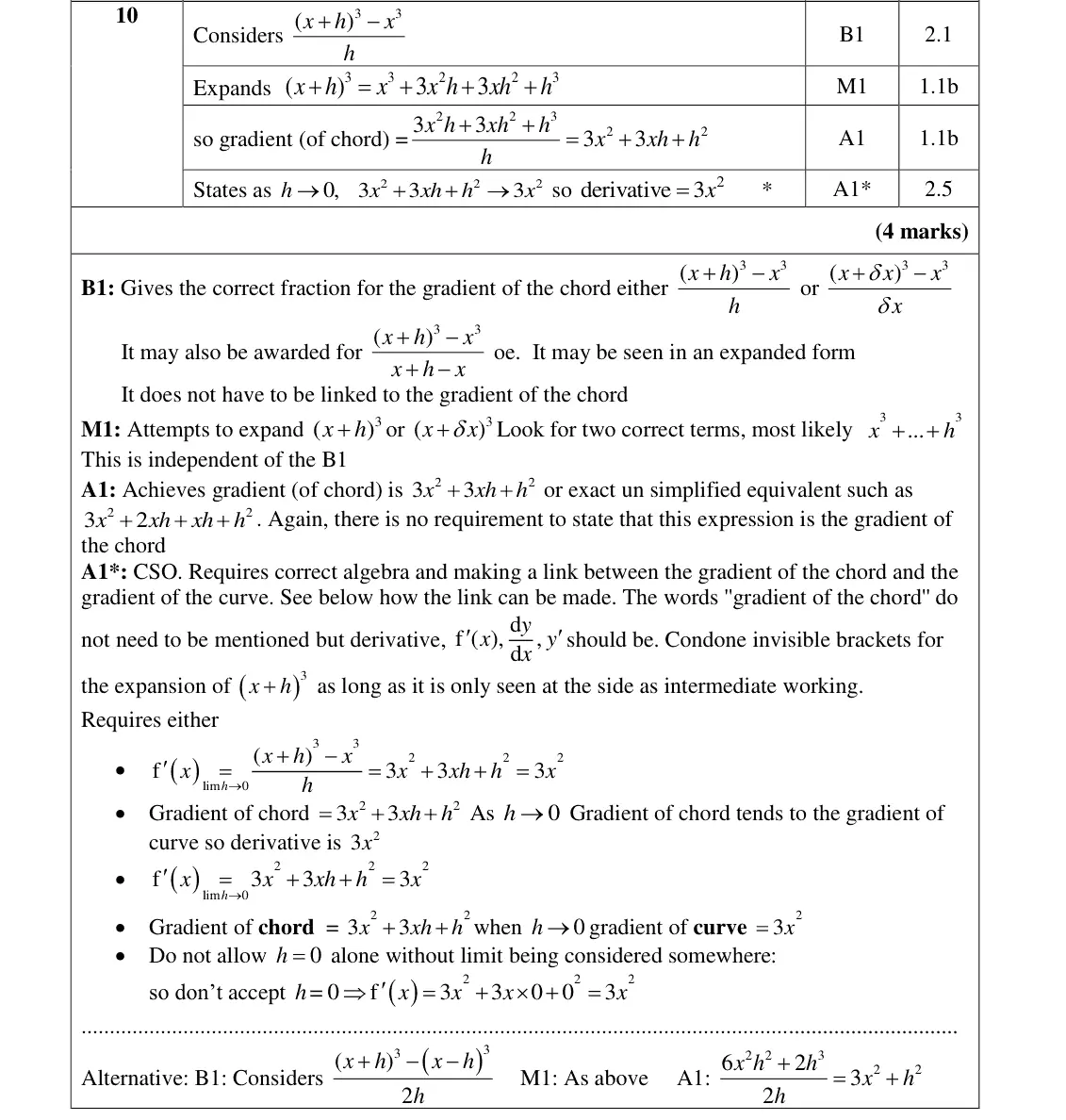
June 2018 · AS Paper 1 · Q104 marks
Mark scheme (whole question; this part is marked with the orange bar)
Examiner's comment
This is a new topic on the specification. There were some very good solutions, showing full understanding of limits with all necessary steps shown. However, several students did not understand what was meant by ‘prove from first principles’ and simply stated and applied the general rule: if y=xn, dy/dx= nxn-1 or wrote comments such as ‘multiply by the power and subtract one from it’. Those who knew what was required usually gained the first two marks but poor algebra often cost the third (and hence the fourth) mark. The final mark was frequently lost by failing to link the gradient of the chord and the gradient of the curve in some way.
Common mistakes
consider ((x + h)³ − x³)/h
expand (x + h)³ correctly
gradient of chord 3x² + 3xh + h²
state h → 0 and link the gradient of the chord to the derivative
quoting dy/dx = nxⁿ⁻¹ scores 0
June 2018 · Paper 2 · Q3(a)2 marks
Mark scheme (whole question; this part is marked with the orange bar)
Examiner's comment
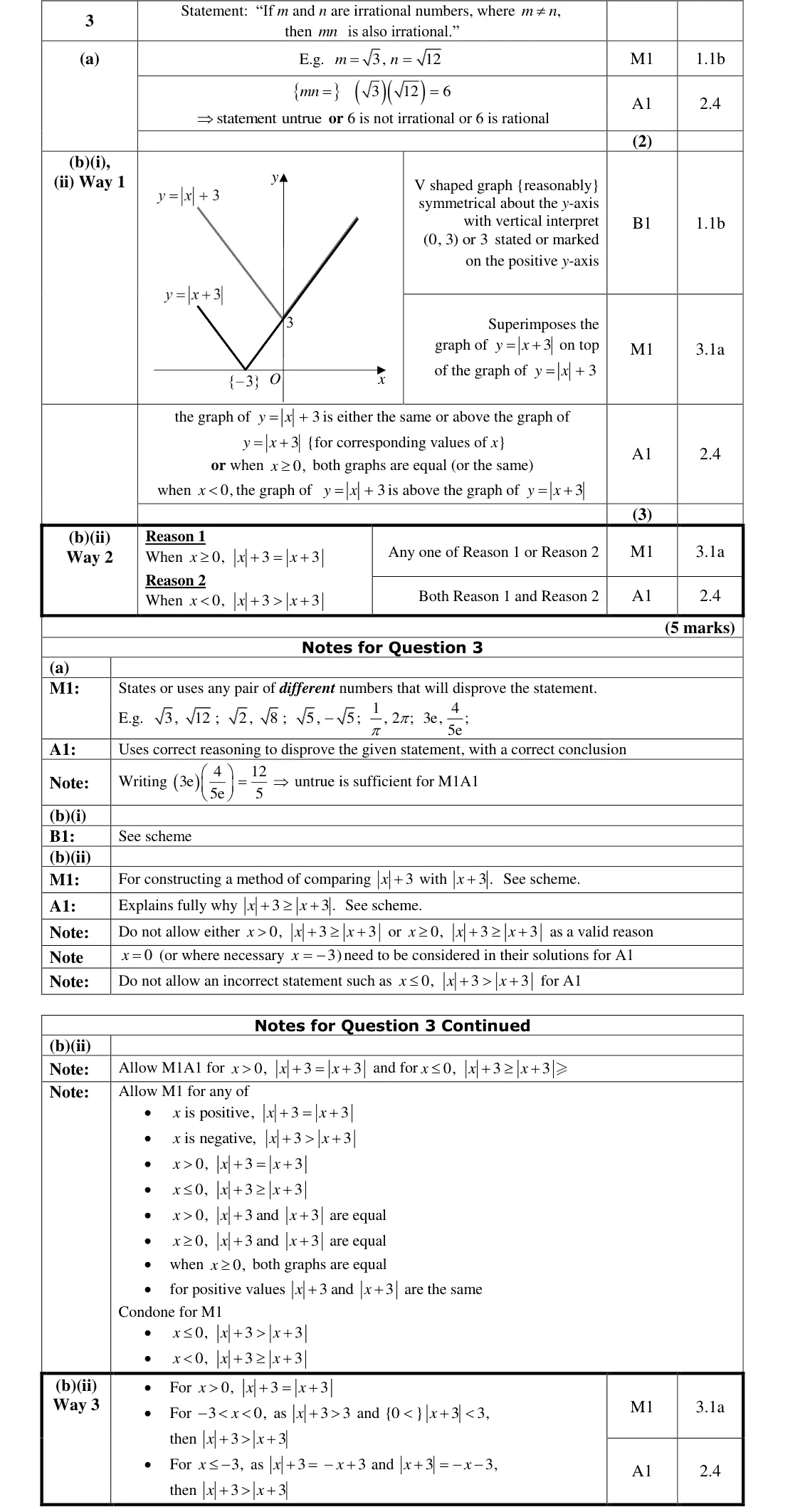
This question discriminated well between students of all abilities with some students struggling to access the final mark in part (b). In part (a), most students provided a complete solution to disprove the statement given in the question. Common errors included: choosing inappropriate values for , m n (e.g. 2 and 3 which were sometimes seen); choosing two rational numbers; attempting to disprove the general statement by using algebra; and not giving a conclusion, despite choosing appropriate values for , . m n
Common mistakes
choose two different irrational numbers whose product is rational (e.g. √3 and √12, product 6)
must conclude the statement is untrue
algebraic attempts or rational choices score nothing
June 2018 · Paper 2 · Q3(b)3 marks
Mark scheme (whole question; this part is marked with the orange bar)
Examiner's comment
This question discriminated well between students of all abilities with some students struggling to access the final mark in part (b). In part (b)(i), most students drew a V-shaped graph in the correct position with many labelling 3 or (0, 3) as the y-intercept. In part (b)(ii), those students who superimposed the graph of 3 y x over the graph of 3 y x were usually more successful in explaining why 3 3 x x for all real values of x. Otherwise, a variety of explanations were seen, of which some were detailed, usually containing at least one correct statement. Common errors included explanations which did not consider the case 0 x or explanations including the statement that the graphs of 3 y x and 3 y x were parallel for all 0. x A significant number of students who only tested the statement 3 3 x x for specific values of x (usually one positive and one negative) did not receive any credit in this part.
Common mistakes
V shape with vertex (0, 3)
superimpose y = modulus of (x + 3)
for x ≥ 0 equal, for x < 0 modulus of x plus 3 is greater
testing particular values gets no credit
graphs are not "parallel" for x < 0
June 2018 · Paper 2 · Q6(b)2 marks
Mark scheme (whole question; this part is marked with the orange bar)
Examiner's comment
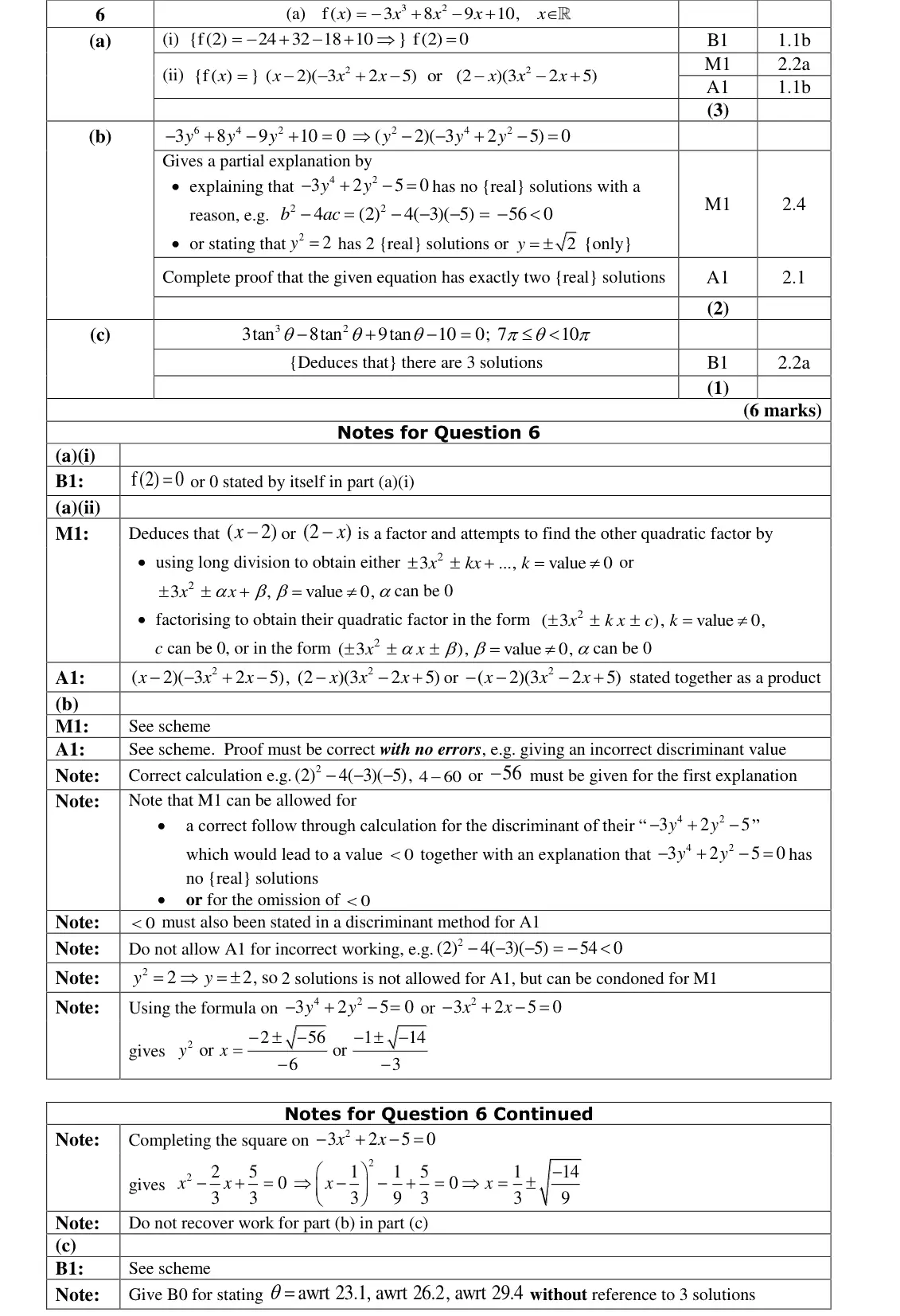
This was a well-answered question with part (b) and part (c) providing most of the discrimination. In part (b), many students used part (a) to write down 2 4 2 ( 2)( 3 2 5) 0 y y y and most deduced the two real solutions 2. y Surprisingly a few students solved 2 2 y to give 2. y A significant number of students stated, without proof, that 2 ( 3 2 5) x x or 4 2 ( 3 2 5) y y where 2, x y had no real solutions. Some students applied ‘ 2 2 4 (2) 4( 3)( 5) 56 0 b ac ’ with an appropriate conclusion to show that 4 2 ( 3 2 5) 0 y y had no real solutions. Common errors included just stating ‘ 2 4 0 b ac ’ with no reference to a discriminant calculation or the omission of ‘ 0 ’ after a correct discriminant calculation. Only a minority of students were able to bring the two strands of the proof together to show that the given equation had only two real solutions.
Common mistakes
replace x by y²: (y² − 2)(−3y⁴ + 2y² − 5) = 0
discriminant 4 − 60 = −56 < 0 must be calculated and compared with 0
y² = 2 gives exactly y = ±√2
bring both strands together
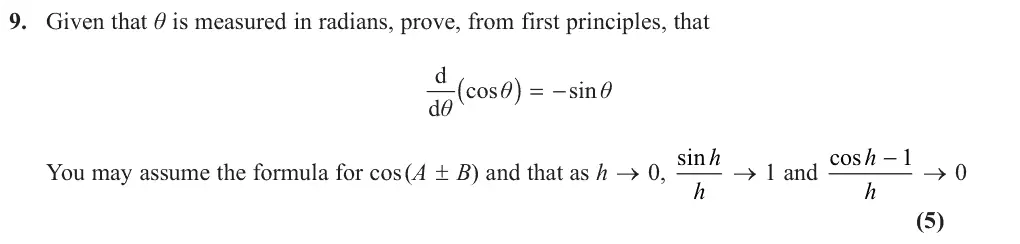
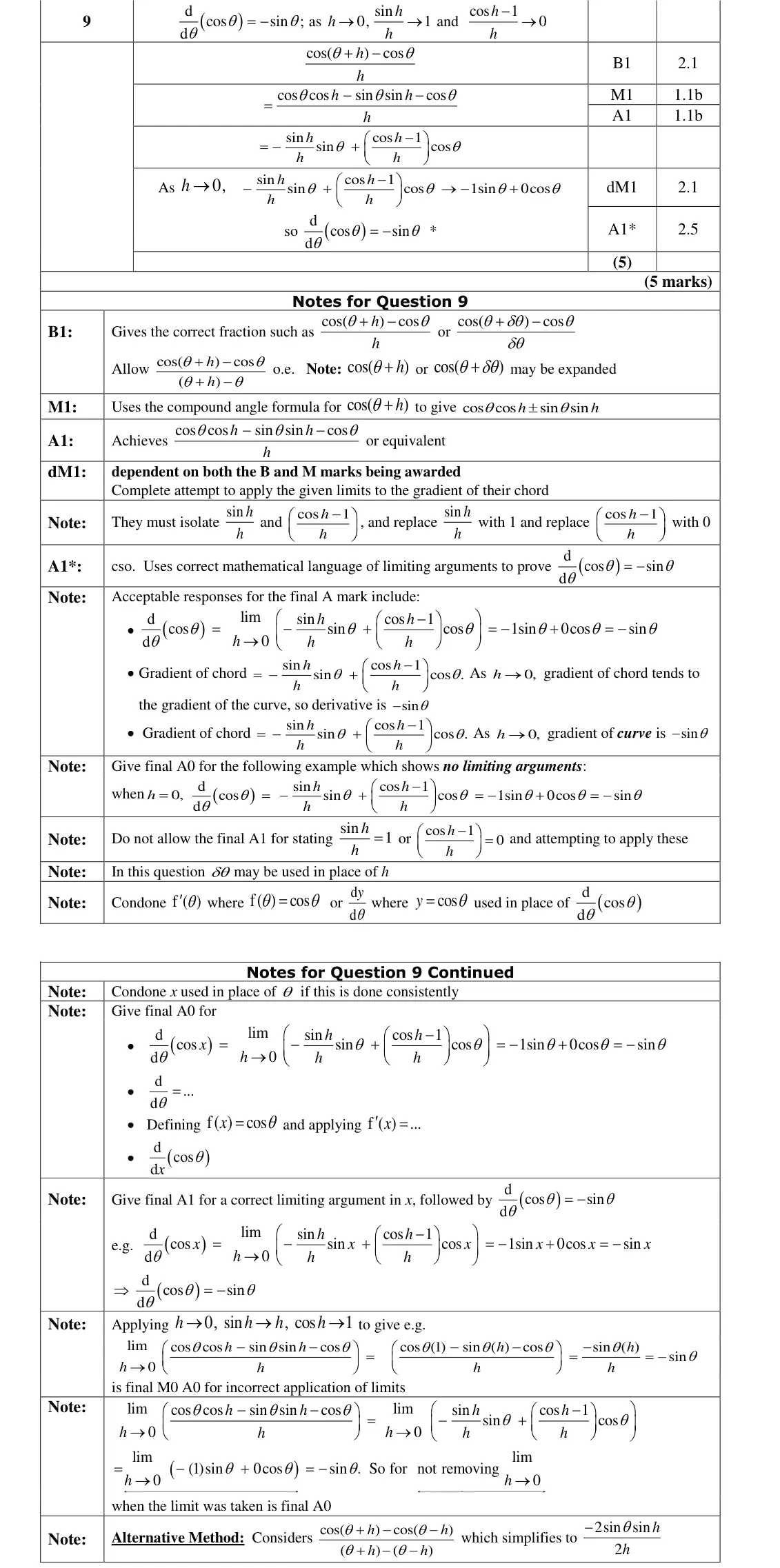
June 2018 · Paper 2 · Q95 marks
Mark scheme (whole question; this part is marked with the orange bar)
Examiner's comment
This was a well-answered question considering that this was the first time that differentiation from first principles has been tested on the new specification. Most students wrote down a correct expression for the gradient of the chord joining the points ( , cos ) and ( , cos( )) h h for a small value h. Many students simplified their gradient expression to give a correct sin cos 1 sin cos h h h h and applied the limiting arguments given in the question to deduce that d cos sin . d Some students lost the final mark for not applying limiting arguments correctly. Common errors included: stating that sin cos 1 1, 0 h h h h ; not using a limiting argument; or applying the limiting argument inconsistently. Other students lost the final mark for the use of inconsistent notation in their proof. These students, who usually referred to both x and in their proof, wrote incorrect statements such as d cos sin dx or f( ) cos . x
Common mistakes
gradient of chord (cos(θ + h) − cos θ)/h
compound angle formula
isolate (sin h)/h and (cos h − 1)/h
limit h → 0 must be applied correctly and notation kept consistent (θ not x)
Find an Edexcel maths tutor
Stuck on this? Book a trial session with an Edexcel specialist.