Notes, worked examples and practice for this topic are being written by our tutors. The past-paper questions below are ready now: work each one on paper, then open the mark scheme and the examiner's comment.
Tap a question to zoom it. Mark scheme and examiner's comment open under each question.
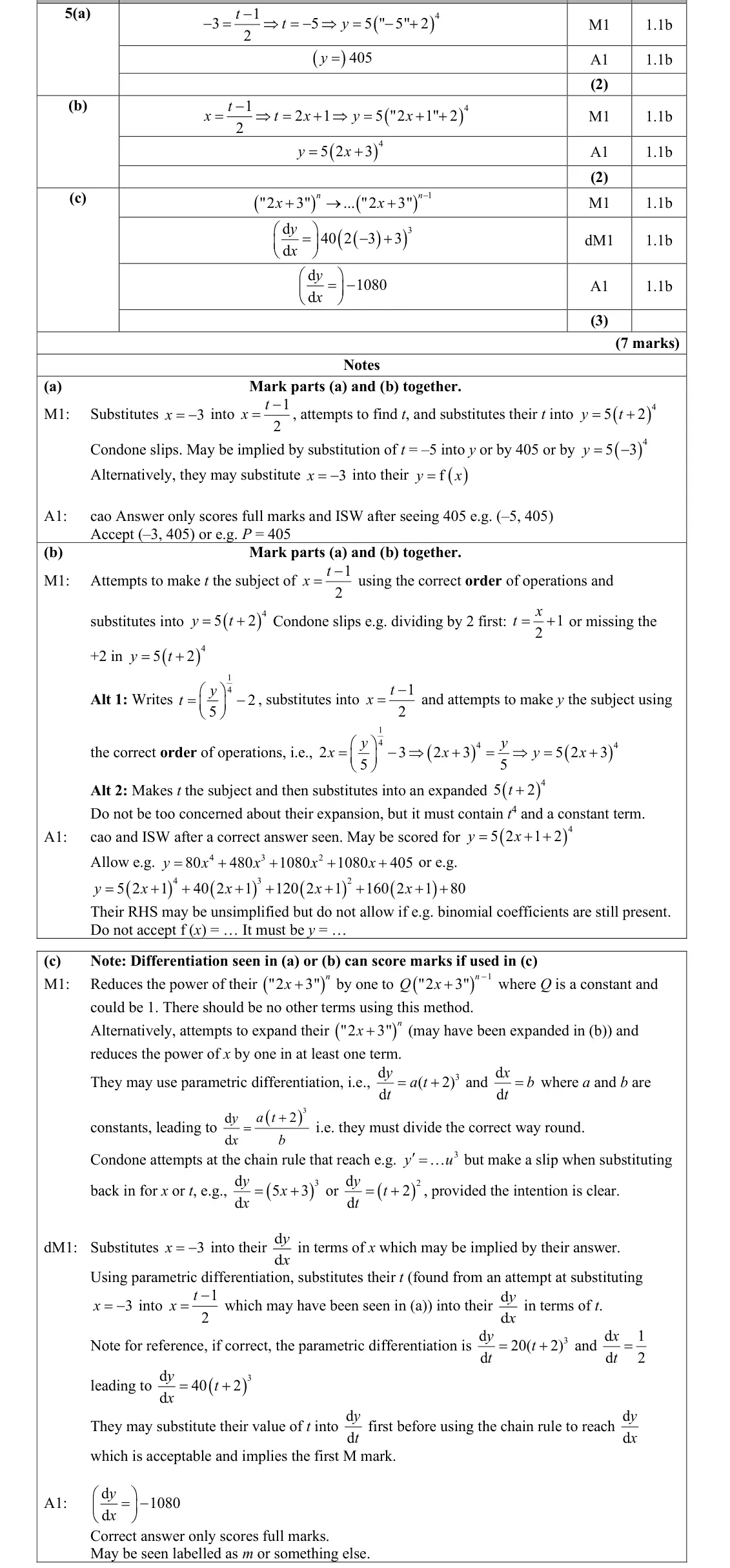
June 2025 · Paper 2 · Q5(c)3 marks
Mark scheme (whole question; this part is marked with the orange bar)
Examiner's comment
This question involved a simple parametric equation, and learners generally performed very well across all three parts. The structure of the question offered a steady progression through substitution, rearranging and then differentiating, with each part building on the previous one. This allowed learners to approach each part confidently, with the majority performing well in parts (a) and (b), even if they did encounter difficulties with part (c). Part (c) was the most variable in terms of performance. Learners who applied the chain rule to differentiate the Cartesian equation generally did well. Those who attempted parametric differentiation were more prone to errors, especially in dividing derivatives in the wrong order d d d d x y t t ÷ or multiplying by 1 2 instead of dividing by 1 2 or substituting x = -3 instead of the correct t value. Responses that tried to expand their cartesian equation from (b) tended to make errors in accuracy in their expansion. Quite a few responses did not recognise that x was a simple linear function of t and used approaches such as the quotient rule, often incorrectly. A very small number did not link the idea of finding the gradient to differentiation at all and instead attempted to use a linear method such as y = mx + c, which gained no credit.
Common mistakes
chain rule on 5(2x + 3)⁴ then x = −3
parametric route: dy/dx = (dy/dt) ÷ (dx/dt) = 40(t + 2)³ with t = −5, not x = −3
dividing the wrong way round or multiplying by ½
answer −1080
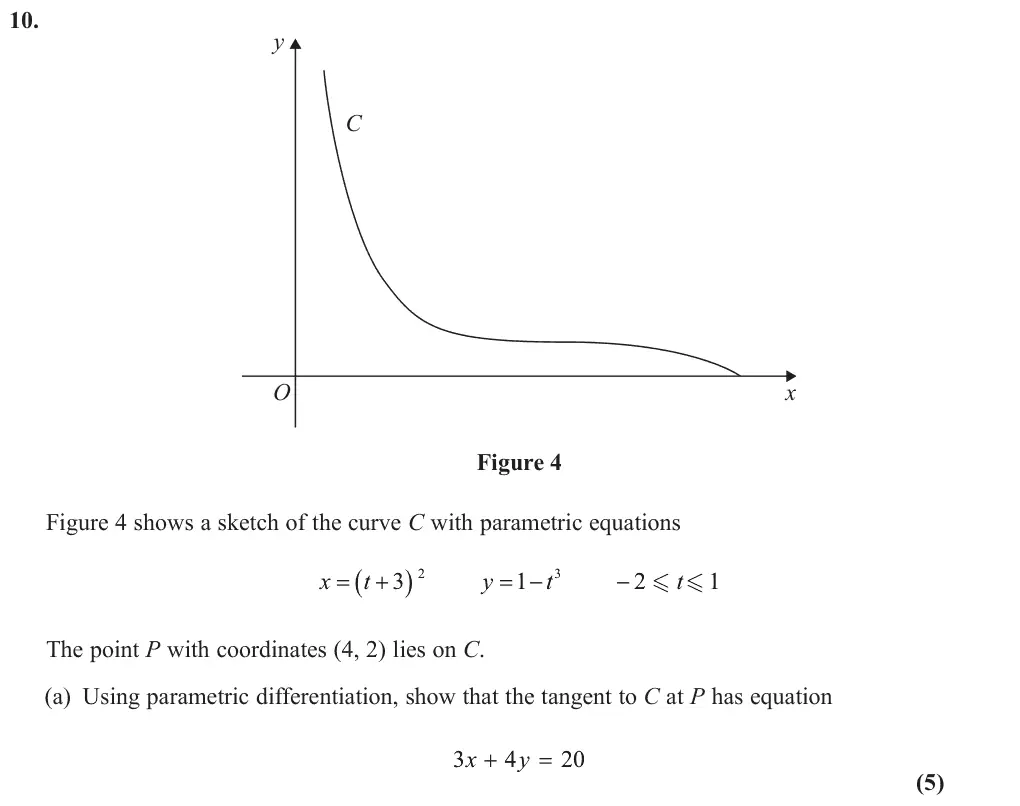
June 2024 · Paper 2 · Q10(a)5 marks
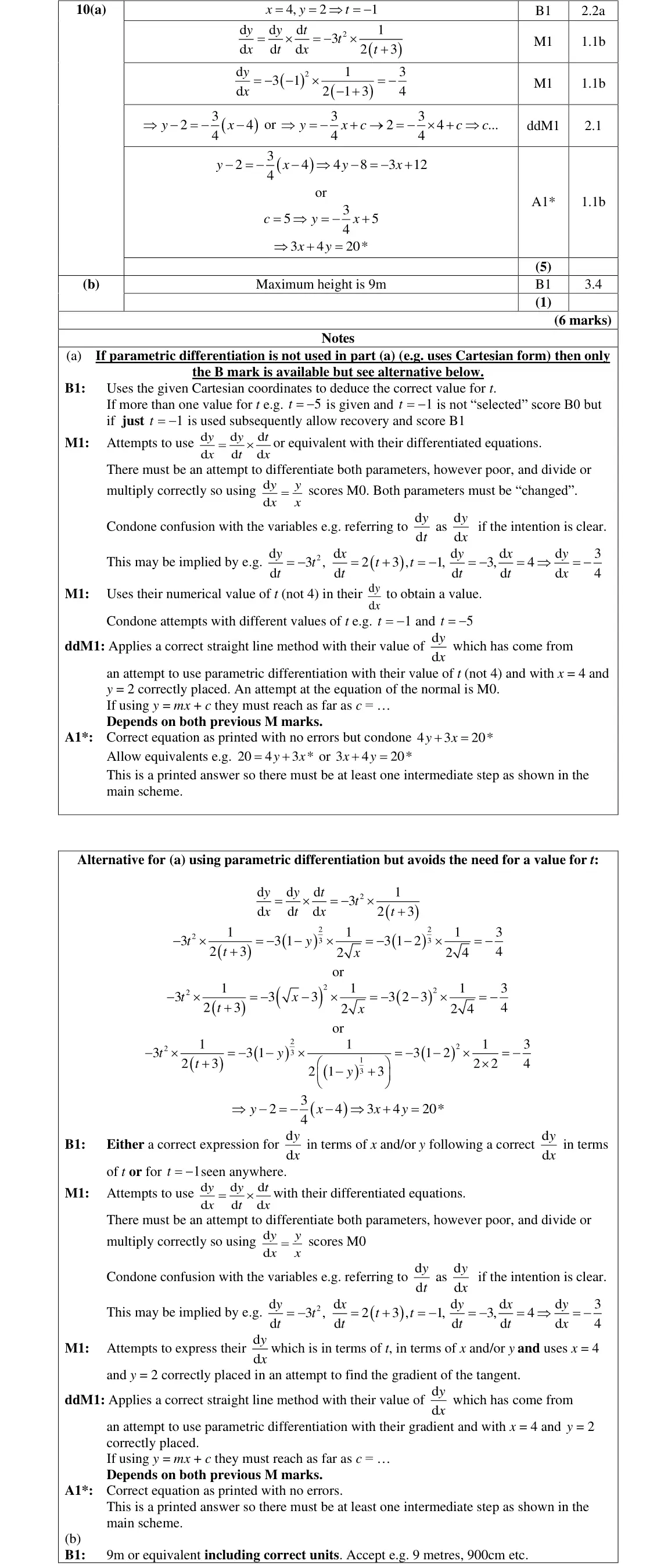
Mark scheme (whole question; this part is marked with the orange bar)
Examiner's comment
Most candidates were successful in this question, showing that parametric differentiation was overall well understood by candidates. In part (a), many candidates successfully found the given equation of the tangent using parametric differentiation as specified in the question. By far, the most common approach seen involved finding the value of t and then substituting it into an expression for d d y x obtained by using d d d d d d y y t x t x = and then using standard coordinate geometry to find the equation of the tangent. There were a number of careless slips and algebraic errors, with 2(t + 3) = 2t + 3 being disappointingly common. Once the numerical gradient had been obtained, there were usually no issues in finding the equation of the tangent in the required form, showing at least one intermediate step as this was a given answer. Most candidates achieved the equation of the tangent via the Point-Slope form although a large number went via the Slope-Intercept form. A few candidates made coefficient and/or sign errors when manipulating their equation to obtain the given answer and unfortunately lost the final accuracy mark. Those candidates who gained few, if any, marks in this question often failed to see the need to find the value of the parameter ‘t’ for the given point P (4, 2) and were unsuccessful in using the alternative method to continue to find a value for d d y x . Some candidates used an incorrect value of ‘t’, usually t = -5 rather than t = -1, as they either did not note the restrictions for t given in the question, or did not find the t value for the y coordinate of P. A few gave two equations for each value of t found. The attempted use of the Chain Rule was not always completed accurately. Some candidates converted their gradient from the use of the Chain Rule into the gradient of the normal which resulted in an inappropriate equation. When finding the value of d d y x , some candidates substituted 4 for their value of t, confusing it with the x coordinate of point P. Some candidates did not follow the instructions stating that the question had to be answered ‘using parametric differentiation’ and, consequently, scored no marks even though they achieved the required result by obtaining the Cartesian equation of the curve. Some candidates tried to complete the question by unnecessarily converting their d d d d y t t x in terms of t to be in terms of x and/or y which often led to incorrect solutions due to algebraic and/or differentiation errors. There were many candidates who initially went wrong and restarted the question. A number of these ran out of space and incorrectly used the back pages of their answer booklet to continue this question rather than using supplementary paper.
Common mistakes
find t = −1 from P(4, 2) (t = −5 is outside −2 ≤ t ≤ 1)
dy/dx = −3t²/(2(t + 3)) = −3/4
must use parametric differentiation (Cartesian scores only B1)
2(t + 3) ≠ 2t + 3
tangent not normal
show an intermediate step to 3x + 4y = 20
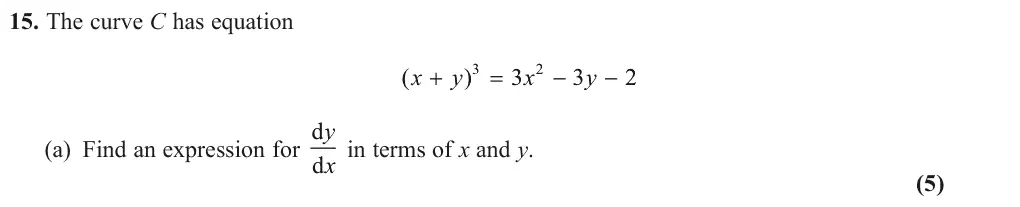
June 2024 · Paper 2 · Q15(a)5 marks
Mark scheme (whole question; this part is marked with the orange bar)
Examiner's comment
This question provided a challenge to most candidates and was in general a good discriminator. In part (a), it was perhaps disappointing, although not unexpected, to see that so many candidates’ instinctive first step was to multiply out the brackets rather than realising that a simpler, quicker and more accurate method was available. In part (a), the use of the chain rule and factorisation could greatly reduce the required effort and the potential for making mistakes. Those candidates with a good understanding of the chain rule and implicit differentiation were able to use this efficient method quickly to accumulate the 5 marks available. However, a common error of omitting the 1 in (1 + d d y x ) was seen many times. Furthermore, a significant proportion of candidates who differentiated the left-hand side using the chain rule, often chose to expand the derivative, nonetheless, thus complicating the remainder of the question. Unfortunately, the majority of candidates chose to first expand ( ) 3 x y + before attempting to differentiate. Whilst this was, in many cases, completed correctly there was of course an inherent time penalty. A significant proportion of candidates made errors when expanding and displayed a lack of algebraic fluency and poor application of the binomial expansion. Common errors that were seen included missing out terms in the expansion and poor understanding of indices. Once the brackets had been expanded, there were clearly some gaps in understanding of how to successfully carry out the implicit differentiation, particularly for terms that also required application of the product rule. It was quite common to see for example 2 3x y going to d 6 d y x x and 2 3xy going to d 6 d y x . Overall, the right-hand-side was dealt with correctly although the constant term -2 was sometimes retained following differentiation and sometimes d 6 d y y x was seen. When candidates attempted to move all terms over to one side of the equation, there were sometimes sign errors or slips in copying terms. Upon completion of the process of differentiation, almost all candidates seemed to understand that the task was to gather the d d y x terms together, factorise and divide in order to isolate the d d y x , and the majority who reached this stage were able to earn credit here provided their differentiation had been sufficiently structurally correct to produce sufficient terms in d d y x . It was very rare to see a spurious d d y x term retained which has been an issue in previous sessions.
Common mistakes
chain rule on (x + y)³: 3(x + y)²(1 + dy/dx) (the 1 often missed)
expanding first is slower and error-prone (product rule on 3x²y, 3xy²)
−2 differentiates to 0
collect dy/dx terms and factorise
June 2024 · Paper 2 · Q15(b)2 marks
Mark scheme (whole question; this part is marked with the orange bar)
Examiner's comment
This question provided a challenge to most candidates and was in general a good discriminator. In general, those candidates who were able to successfully complete part (a) found part (b) straightforward. However, the accuracy mark in this part was not available to those candidates who had not managed to achieve the correct derivative in part (a). Due to the nature of the function, setting x = 1 and y = 0, gave a ‘correct’ value of d 1 d 2 y x = in many cases even when d d y x was incorrect. As a result, candidates were often not alerted to the fact they had an incorrect d d y x . Disappointingly, candidates who did not obtain 1 2 due to errors in their differentiation, often attempted to manipulate their work to obtain the value that they could see was required from the printed answer and this often meant that the method mark was out of reach, which was a shame.
Common mistakes
substitute (1, 0): dy/dx = ½, normal gradient −2
y = −2x + 2
incorrect derivatives may fortuitously give ½ so A needs a correct (a)
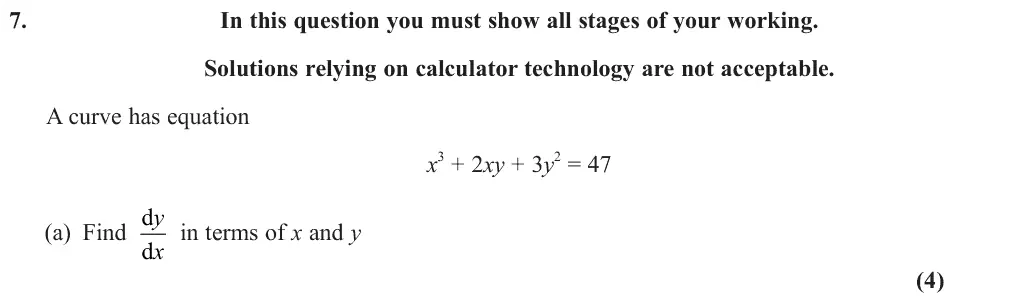
June 2023 · Paper 2 · Q7(a)4 marks
Mark scheme (whole question; this part is marked with the orange bar)
Examiner's comment
had been unsuccessful in part (a). The least successful approach for calculation of the gradient of the normal tended to involve an attempt to rearrange the expression for d y d x - prior to into d x d y substitution and this seem to be more error-prone than the alternative of substituting in values as a first. Some candidates did not spot that point P on the curve had been given in the question and so didn’t use this point in order to find the equation of the line. In some cases, candidates found the equation of the tangent rather than the normal whilst others made arithmetical slips and lost the accuracy mark. Occasionally candidates did not state their equation in the required form which was a shame when it followed correct work.
Mark scheme (whole question; this part is marked with the orange bar)
Examiner's comment
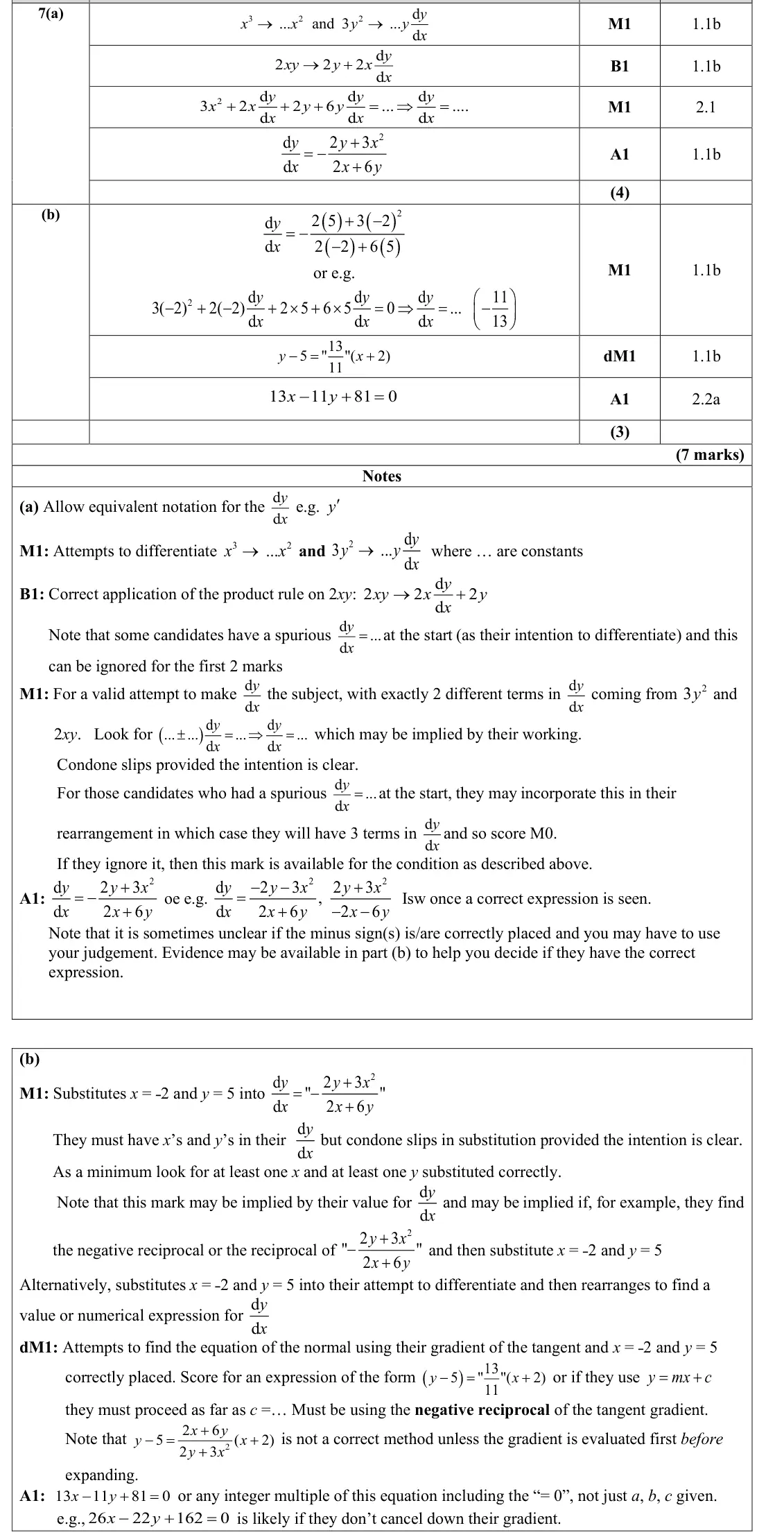
denominator) which led to sign errors in part (b). Others made slips in the rearrangement which lost the final mark. In some cases, there were issues with clarity of notation for the final statement of d y x in terms of the positioning of the minus sign and candidates should be advised d to take care when drawing the vinculum, particularly when the starting term of the numerator is negative to make sure the sign is in the correct place. In part (b), the majority of candidates were able to use the correct approach to find the equation of the normal and candidates were often able to earn at least some of the marks here even if they had been unsuccessful in part (a). The least successful approach for calculation of the gradient
Common mistakes
substitute (−2, 5) first: tangent gradient −11/13, normal gradient 13/11
13x − 11y + 81 = 0 with integers and "= 0"
finding the tangent instead
rearranging to dx/dy before substituting is error-prone
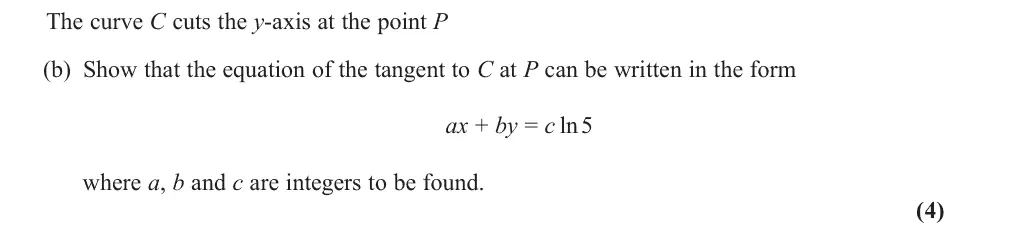
June 2023 · Paper 2 · Q9(b)4 marks
Mark scheme (whole question; this part is marked with the orange bar)
Examiner's comment
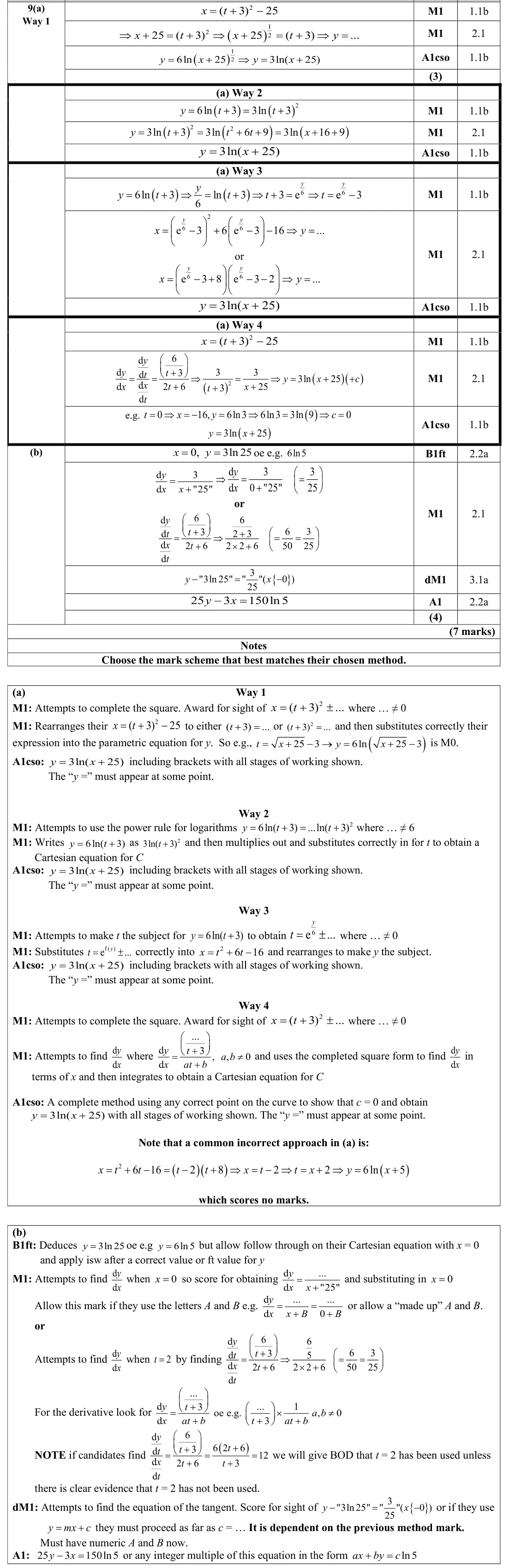
Candidates were generally more successful in part (b) than part (a). Many candidates found the y intercept by substituting t = 2 into the parametric equation for y rather than substituting x = 0 into the Cartesian equation. The first method mark was more challenging. Some candidates attempted the derivative from the Cartesian equation and they usually reached either ( ) 3 x A + or 3 x whilst others attempted to use the chain rule approach. Some candidates obtained the correct derivative but failed to substitute x = 0. If a candidate achieved the first method mark, they usually went on to achieve the dependent method mark for attempting to find the equation of the tangent. There were very few cases where the candidate used the negative reciprocal of their gradient. The most successful way candidates achieved full marks was differentiating their Cartesian equation. Those that differentiated parametrically were often caught out by arithmetic and algebraic errors or substituted t = 0 instead of t = 2 and failed to achieve the gradient correctly. For the final answer, some candidates had failed to realise the form of equation the question was asking for so left their answer as “y =” or they didn’t have 𝑎, 𝑏 and 𝑐 as integers. Many candidates who had incorrectly answered (a), were able to go on to achieve full marks in (b) by using parametric differentiation to work out the gradient. There were very few blank responses for this part of the question.
Common mistakes
P at x = 0, y = 3ln25 = 6ln5 (t = 2, not t = 0)
gradient 3/25 from the Cartesian form or dy/dt ÷ dx/dt at t = 2
25y − 3x = 150ln5
answer must be in the form ax + by = c ln5
June 2022 · Paper 2 · Q16(a)5 marks
Mark scheme (whole question; this part is marked with the orange bar)
Examiner's comment
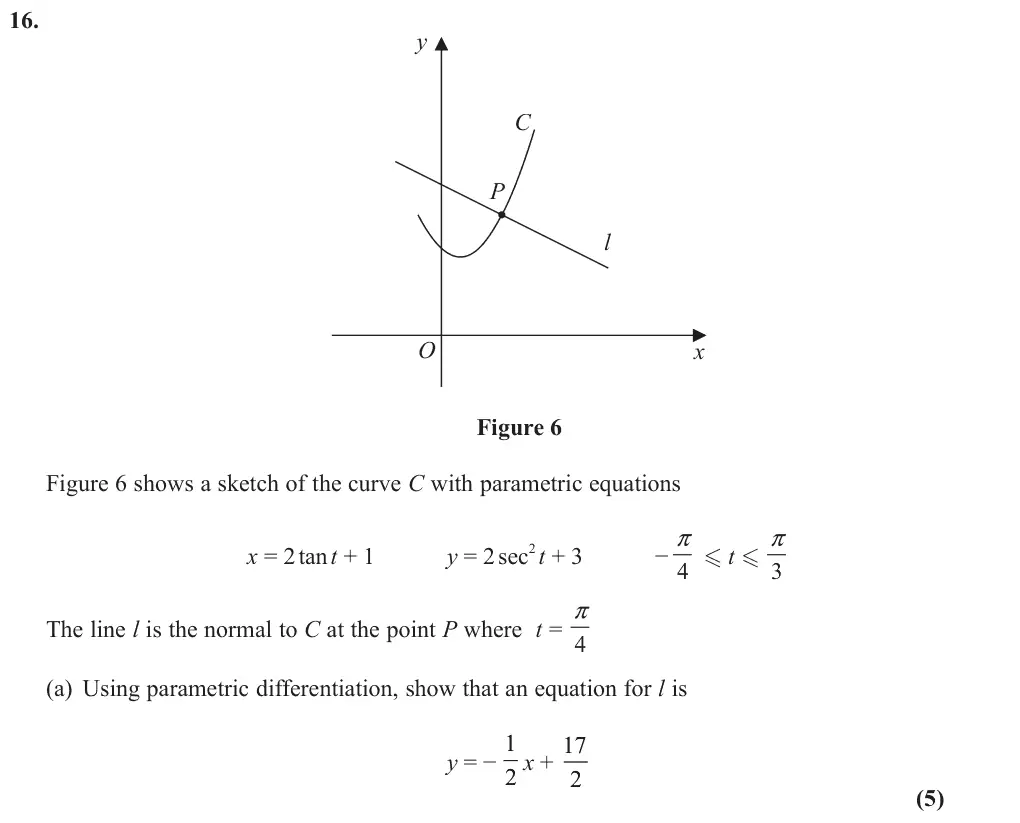
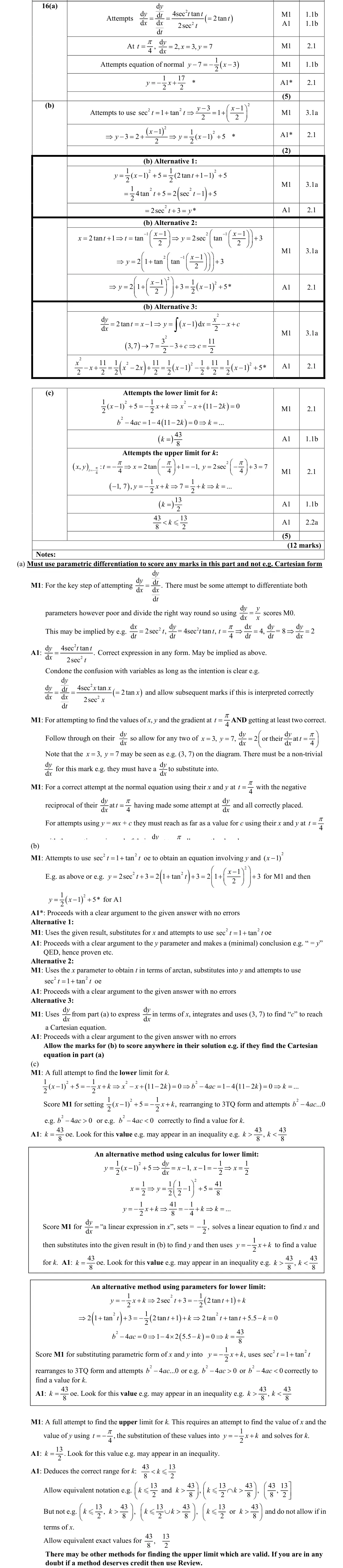
This question proved to be a good differentiator between candidates. It provided a challenge for many candidates but equally there were a number of accessible marks here. Most candidates attempted part (a), many attempted part (b) and at least partially attempted part (c), usually attempting to find the lower limit for k. There were, however, very few completely correct answers to this question and a substantial minority made no attempt at any part, perhaps having run out of time by the time they reached the last question on the paper. Part (a) was mostly approached correctly with a good number scoring full marks. Candidates generally noticed the instruction to use parametric differentiation. Whilst d𝑥𝑥 d𝑡𝑡 was most often correct, d𝑦𝑦 d𝑡𝑡 proved a challenge for many who struggled to differentiate sec2𝑡𝑡. Many did not seem to know that these functions were standard derivatives presented in the formula booklet and instead there were some long-winded and overly complex attempts to convert to sine or cosine functions and such approaches often led to errors. However, even some of the most inefficient approaches managed to persevere through lengthy algebra to obtain a correct d𝑦𝑦 d𝑥𝑥 eventually. Almost all who attempted d𝑥𝑥 d𝑡𝑡 and d𝑦𝑦 d𝑡𝑡 knew and attempted d𝑦𝑦 d𝑥𝑥= d𝑦𝑦 d𝑡𝑡 ÷ d𝑥𝑥 d𝑡𝑡. Those who made errors when determining d𝑦𝑦 d𝑥𝑥 often exhibited an over-reliance on trying to match the printed result and thus ‘adjusted’ their d𝑦𝑦 d𝑥𝑥 in an attempt to obtain the required value for the normal gradient. Often this meant the loss of a method mark. Candidates would be better advised to utilise a correct method rather than incorrectly manipulating their answers to match the result they are attempting to achieve and caution should always be advised when working backwards from a given answer. Nonetheless, application of negative reciprocals and equations of lines was generally successfully attempted, and candidates were clearly confident in these areas. There were a few attempts at a Cartesian approach in part (a) which gained zero marks as the question had specified the use of parametric differentiation.
Common mistakes
must use parametric differentiation
dy/dt = 4sec²t tan t (sec²t is a standard result), dy/dx = 2tan t = 2 at t = π/4
P(3, 7)
normal gradient −½
do not fudge dy/dx to fit the given answer
Oct 2021 · Paper 2 · Q8(a)4 marks
Mark scheme (whole question; this part is marked with the orange bar)
Examiner's comment
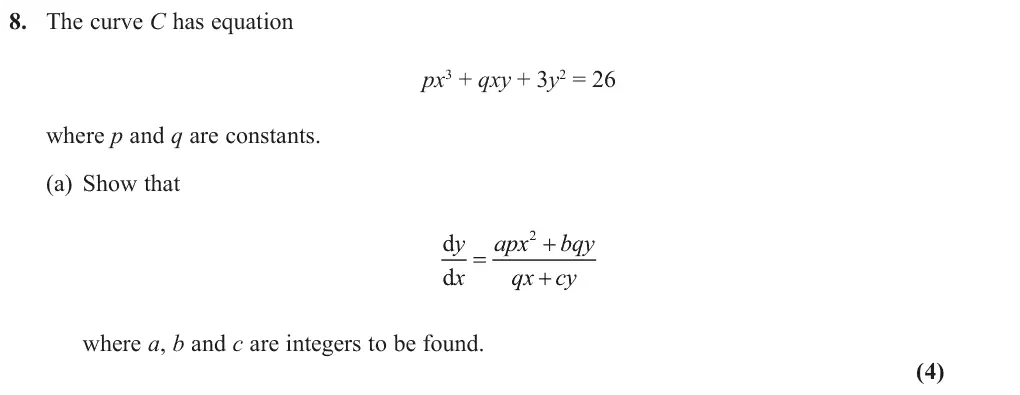
Many candidates gained some credit in this question but few gained full marks. Part (a) was relatively well answered. Most candidates identified that implicit differentiation was required and made good progress by correctly differentiating the given equation. When mistakes happened at this stage, they usually appeared in the differentiation of rather than in the differentiation of or . There were a few candidates, however, who clearly were not able to employ implicit differentiation and who gained no marks. Once a differentiated expression had been obtained, many were able to rearrange correctly to make the subject, obtaining the required answer of . A common mistake, however, was to make sign errors in the rearranging process and incorrect answers like and were surprisingly common following correct differentiation.
Common mistakes
product rule on qxy
d/dx(3y²) = 6y dy/dx
sign errors when rearranging
dy/dx = (−3px² − qy)/(qx + 6y)
Oct 2021 · Paper 2 · Q8(b)5 marks
Mark scheme (whole question; this part is marked with the orange bar)
Examiner's comment
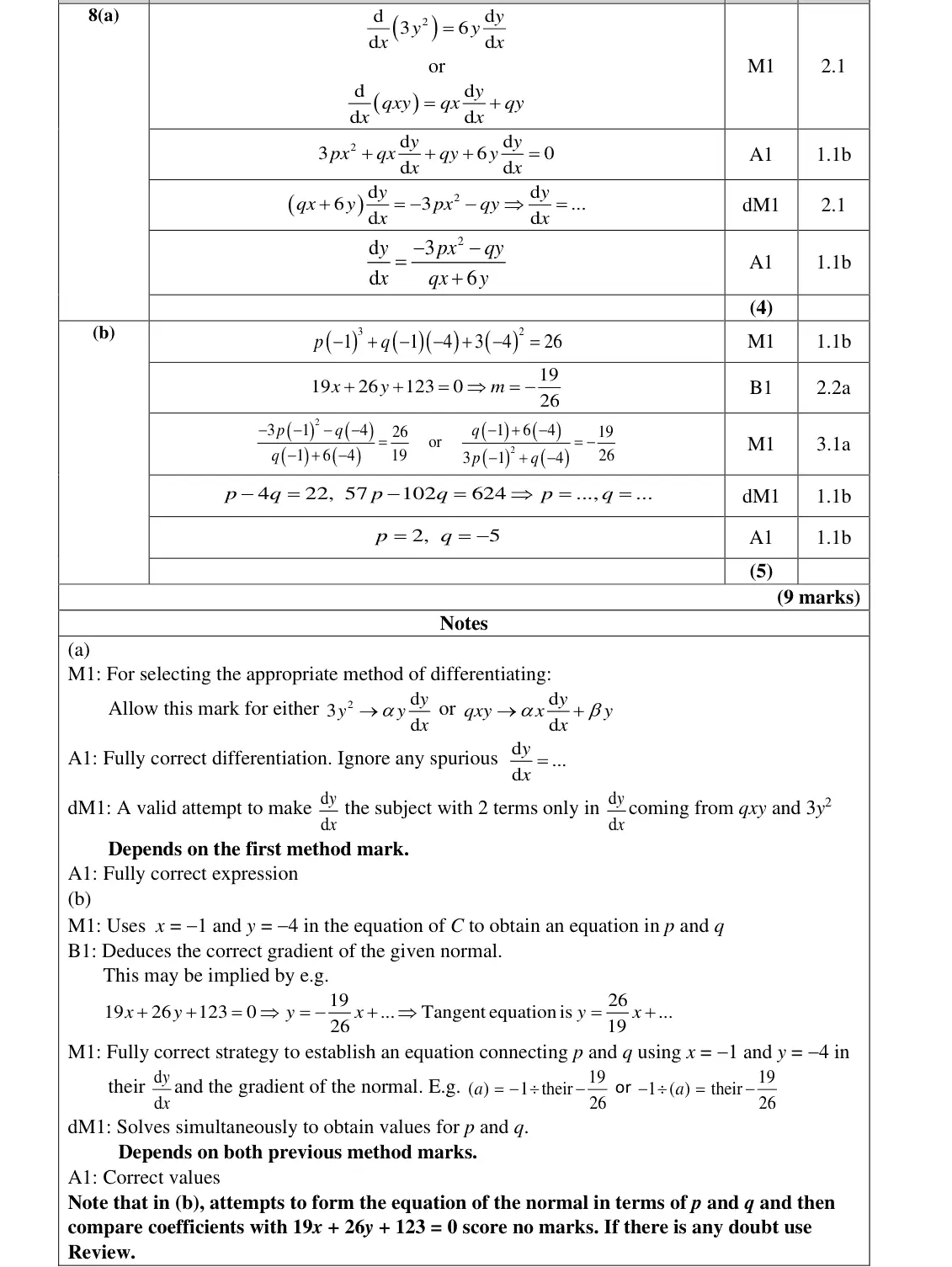
Many candidates gained some credit in this question but few gained full marks. In (b) most candidates gained some marks but few used a fully correct method to achieve the correct answer of and . Most were able to rearrange the equation of the normal, and identified that its gradient was . They then identified the gradient of the tangent as and used their result from (a) at and to attempt to form a correct equation in and such as . A number of candidates incorrectly equated the numerators and denominators to form the equations and and solved these to fortuitously arrive at the correct solution, losing most marks in (b). Another incorrect approach was to form the equation of the normal of the form and to rearrange to the form followed by 'comparing coefficients' with (an incorrect method). Many candidates successfully substituted and into the equation of C to get . This step was missed, however, by quite a few candidates, who could not then gain full marks for the question.
Common mistakes
substitute P into C for p − 4q = 22
normal gradient −19/26 so tangent gradient 26/19
equating numerators and denominators separately or comparing coefficients with the normal scores nothing
p = 2, q = −5
Oct 2021 · Paper 2 · Q13(a)3 marks
Mark scheme (whole question; this part is marked with the orange bar)
Examiner's comment
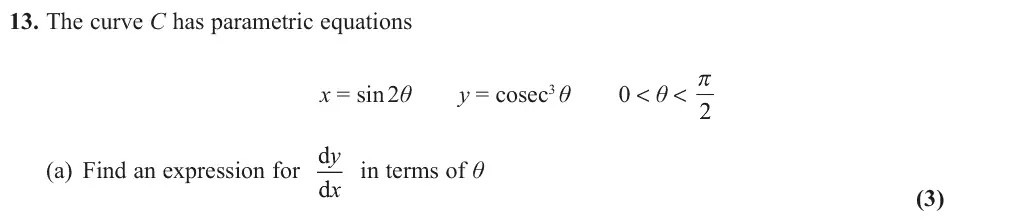
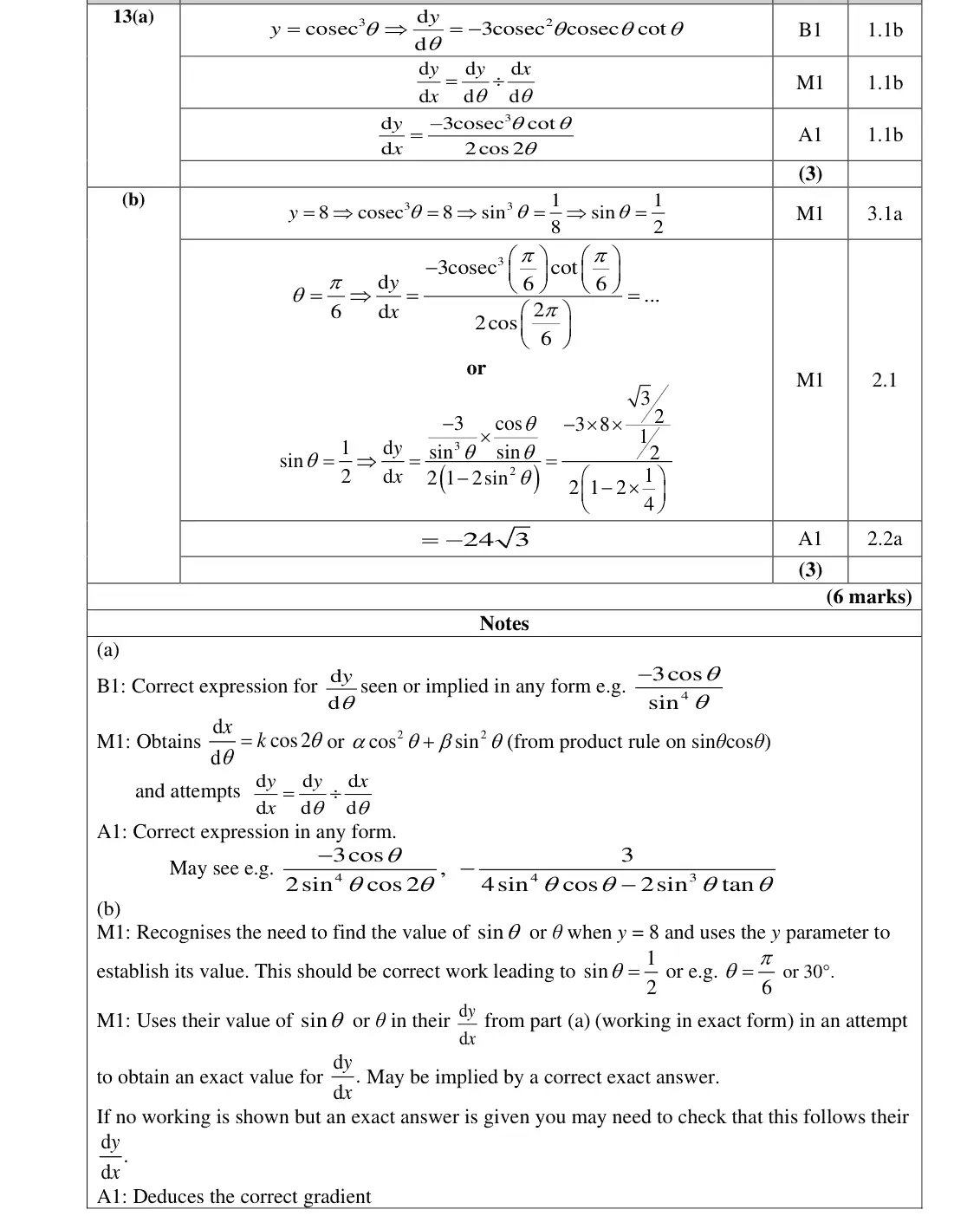
This question involving differentiation of parametric equations was found to be challenging by the majority of students, particularly the differentiation of 𝑦𝑦= cosec3 𝜃𝜃 and part (b). The majority of candidates knew what was expected in part (a) and proceeded to attempt to use the chain rule to find d𝑦𝑦 d𝑥𝑥, however they found differentiating 𝑦𝑦= cosec3 𝜃𝜃 challenging. Some did not check in the formula book that the derivative of cosec theta was negative, or omitted the constant 3, and this cost 3 of the 6 marks available in the whole question. For those that attempted to write 𝑦𝑦= sin-3 𝜃𝜃 and use either the chain rule or the quotient rule success was mixed. Other common incorrect derivatives included d𝑦𝑦 d𝜃𝜃= (cosec3 𝜃𝜃cot3 𝜃𝜃) and variants of this. Differentiating 𝑥𝑥= sin 2𝜃𝜃 proved less troublesome, with most doing so correctly. There was a proportion of candidates that rewrote sin 2𝜃𝜃 as 2 sin 𝜃𝜃cos 𝜃𝜃 and used the product rule, creating more work but ultimately doing so successfully in most cases. The method mark was scored by the majority of candidates as a result, although there were a few candidates who tried to write 𝑦𝑦 in terms of 𝑥𝑥 and differentiate, with no marks being scored for this approach. A number of candidates, having found a correct derivative, proceeded to attempt to tidy this up, unfortunately using time that could have been spent elsewhere in the paper.
Common mistakes
dy/dθ = −3cosec³θ cotθ (chain rule
derivative of cosec is negative
keep the 3)
dx/dθ = 2cos 2θ
Oct 2021 · Paper 2 · Q13(b)3 marks
Mark scheme (whole question; this part is marked with the orange bar)
Examiner's comment
This question involving differentiation of parametric equations was found to be challenging by the majority of students, particularly the differentiation of 𝑦𝑦= cosec3 𝜃𝜃 and part (b). Part (b) proved more challenging for many candidates, with some unable to make a start as they were unable to process 8 = cosec3 𝜃𝜃 to arrive at either a value for sin 𝜃𝜃 or 𝜃𝜃. Of those that did arrive at a value for sin 𝜃𝜃 or 𝜃𝜃, many were able to work in exact form using their value to find an exact value for their 𝑑𝑑𝑑𝑑 𝑑𝑑𝑑𝑑, others were unable to proceed or attempted to give a decimal answer. 24 sqrt 3 and 8 sqrt 3 were common incorrect final answers. There were, however, some excellent and concise responses to this question.
Common mistakes
cosec³θ = 8 gives sinθ = ½, θ = π/6
work in exact values
−24√3 (not 24√3 or 8√3)
Oct 2020 · Paper 1 · Q15(a)4 marks
Mark scheme (whole question; this part is marked with the orange bar)
Examiner's comment
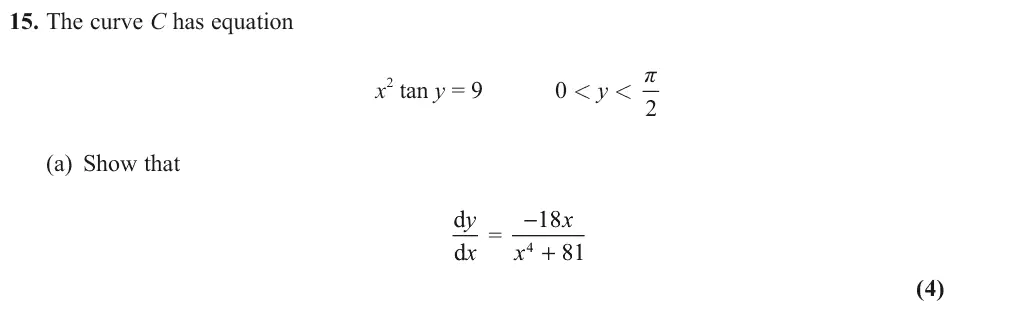
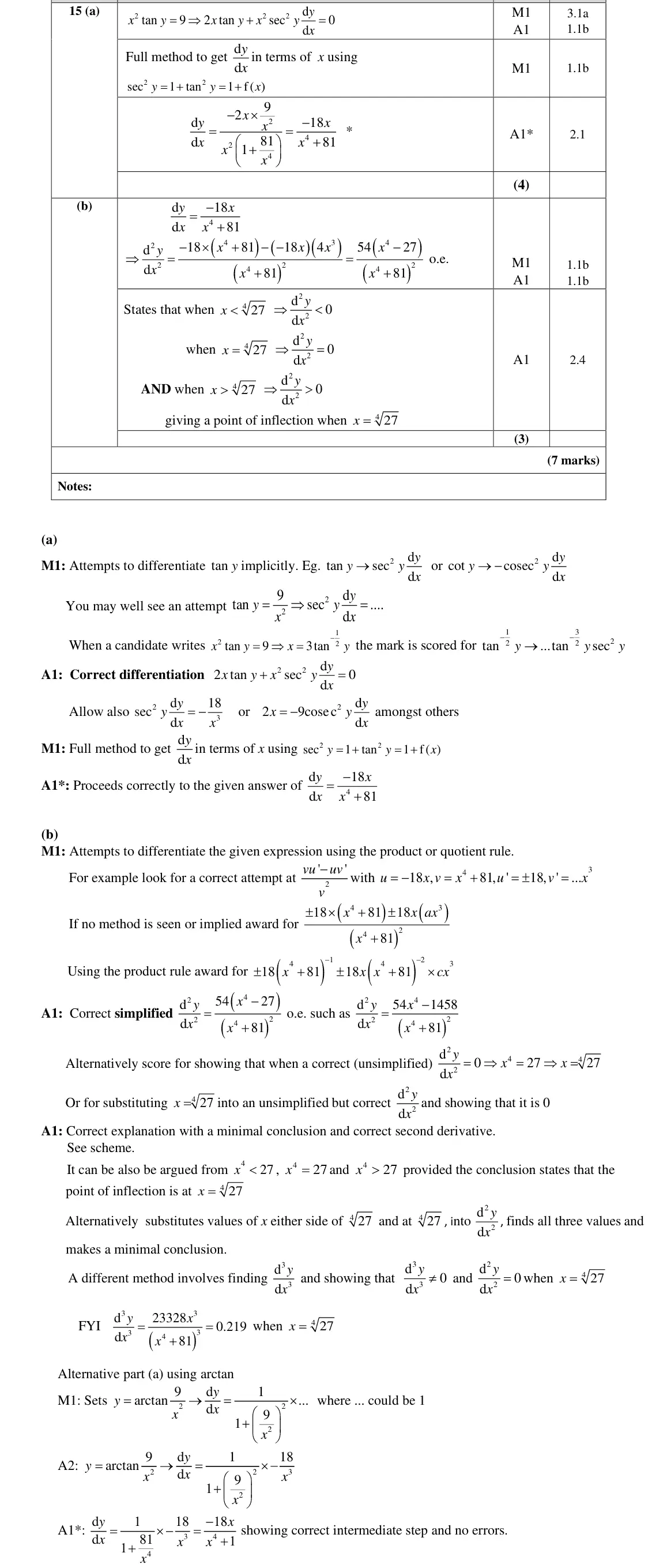
Although fully correct solutions to this question were very rare, many candidates were able to score marks from both parts. In part (a) the first two marks for the implicit differentiation were very accessible for the prepared candidate. Proceeding to the required result for the second two marks proved a little more challenging. Only high achieving students noticed the relationship could be 2 2 proven via the trigonometric identity 1 tan sec . y y + =
Common mistakes
implicit differentiation 2x tan y + x² sec²y dy/dx = 0
use sec²y = 1 + tan²y = 1 + 81/x⁴ to get dy/dx in terms of x only
June 2019 · Paper 2 · Q11(a)5 marks
Mark scheme (whole question; this part is marked with the orange bar)
Examiner's comment
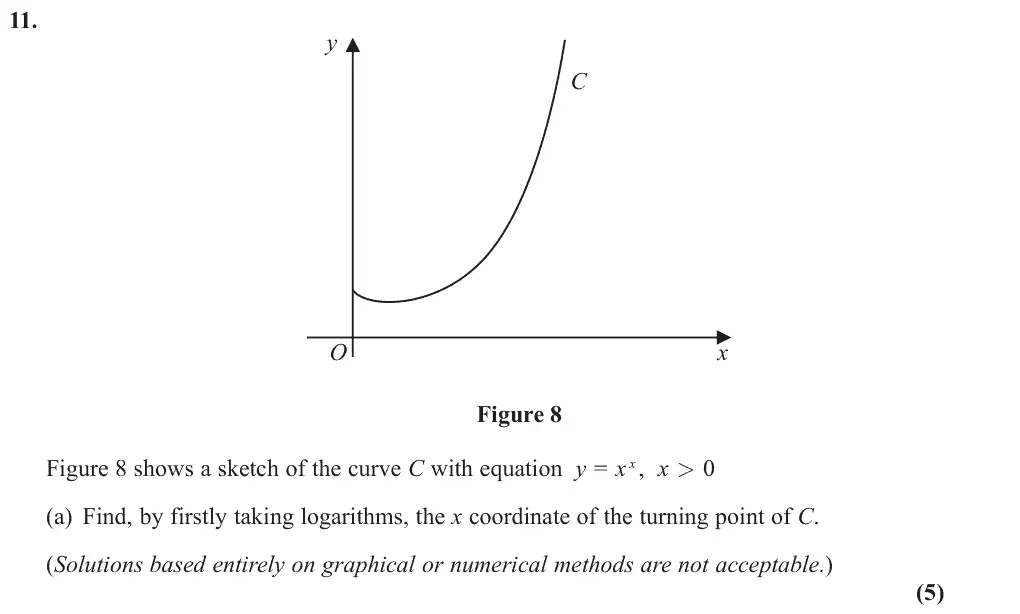
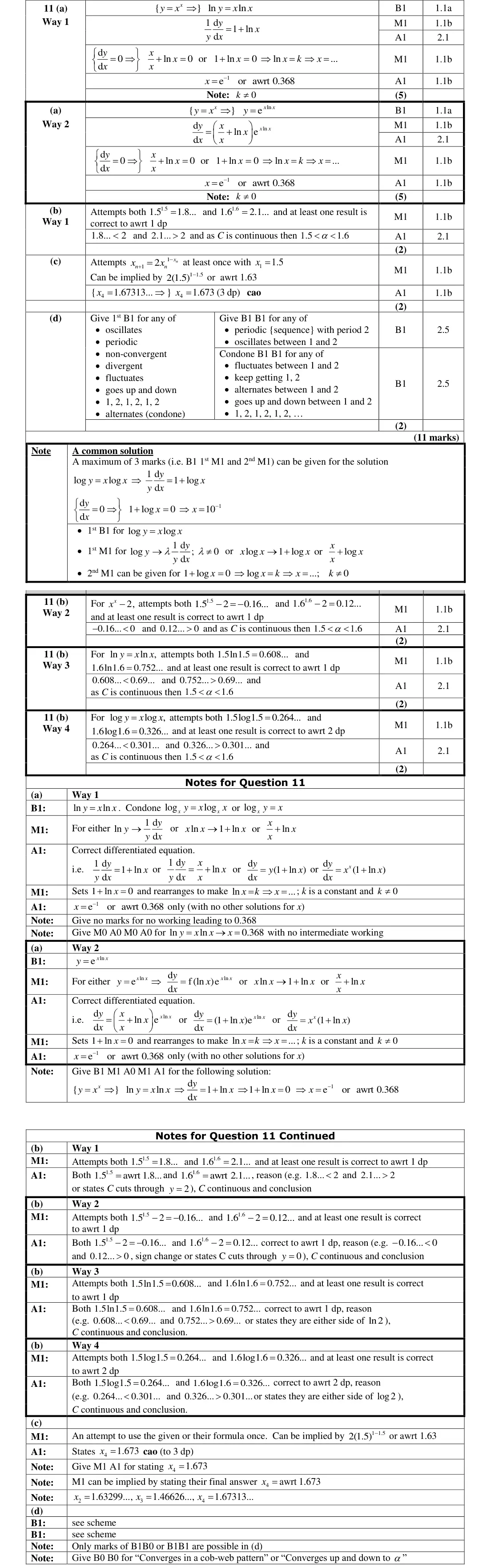
In general, Q11 discriminated well between candidates of all abilities. Q11(a) was demanding with most candidates scoring no more than one mark. Q11(b), Q11(c) and Q11(d) proved accessible to candidates of all abilities. In Q11(a), most candidates took logs, as advised by the question, and many obtained either ln ln y x x or log log . y x x At this point a significant number of candidates made no further creditable progress. Some candidates used a complete method of applying the product rule on x and implicit differentiation to obtain a correct ln x Most of these candidates then applied d y 1 d y x 1 y x e . x 0 to obtain Some 1 ln . x d d x log ’ method to obtain candidates, who received partial credit, used a ‘ after 0.1, 10 1 d y x finding A few candidates used logarithms without reference to a 1 log . x 10 d y x base. Those who proceeded to obtain received partial credit and those who 0.1 1 e x obtained were allowed full marks. There were some alternative methods employed by a few candidates in Q11(a). A few d y y x ln e x x x ln x x y x candidates rewrote as and applied to give a (1 ln )e 0 x d 1 e . x Others differentiated both sides of the equation ln ln y x x correct with 1 e . x respect to y and usually proceeded to find A very few candidates applied the ln y , x quotient rule to the equation but were rarely successful with this method. ln x xx x x xx or 2 1.6. In Q11(b), most candidates evaluated either at both and 1.5 Many candidates compared their values with either 2 or 0 (depending on whether they xx xx or 2 ). Although many of these concluded that 1.5 1.6, evaluated only a few made any reference to the curve being continuous in this interval. A few candidates, x who made no creditable progress, used values of x outside the given range, e.g. 1.4 x x 1.6. and Very few candidates used values within the range e.g. and 1.51 x 1.59, which meant that they were able to earn both marks. x 1.673, 4x In Q11(c), most candidates found a correct although a few did not state 4 , x x and 3x as part of their correct to 3 decimal places. Some wrote down the iterates 1 2 4x with no intermediate work. solution, while others stated In Q11(d), some candidates gave correct descriptions such as ‘sequence oscillates between 1 and 2’ or ‘the sequence is periodic with period 2’. Other descriptions such as ‘alternates between 1 and 2’, ‘keep getting 1 and 2’ or ‘fluctuates between 1 and 2’ were condoned. Some credit was given for partial explanations such as ‘sequence is non-convergent’, ‘sequence oscillates’ or ‘sequence is divergent’.
Common mistakes
ln y = x ln x, implicit differentiation with product rule: (1/y)dy/dx = 1 + ln x
set = 0 so x = e⁻¹ (0.368)
using log₁₀ to get x = 0.1 max 3 marks
no marks without working
June 2018 · Paper 1 · Q9(a)4 marks
Mark scheme (whole question; this part is marked with the orange bar)
Examiner's comment
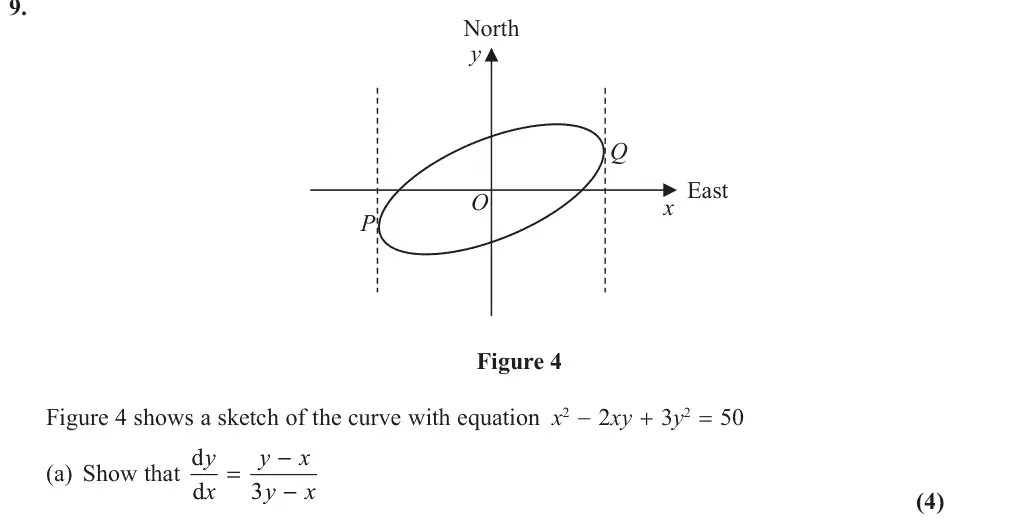
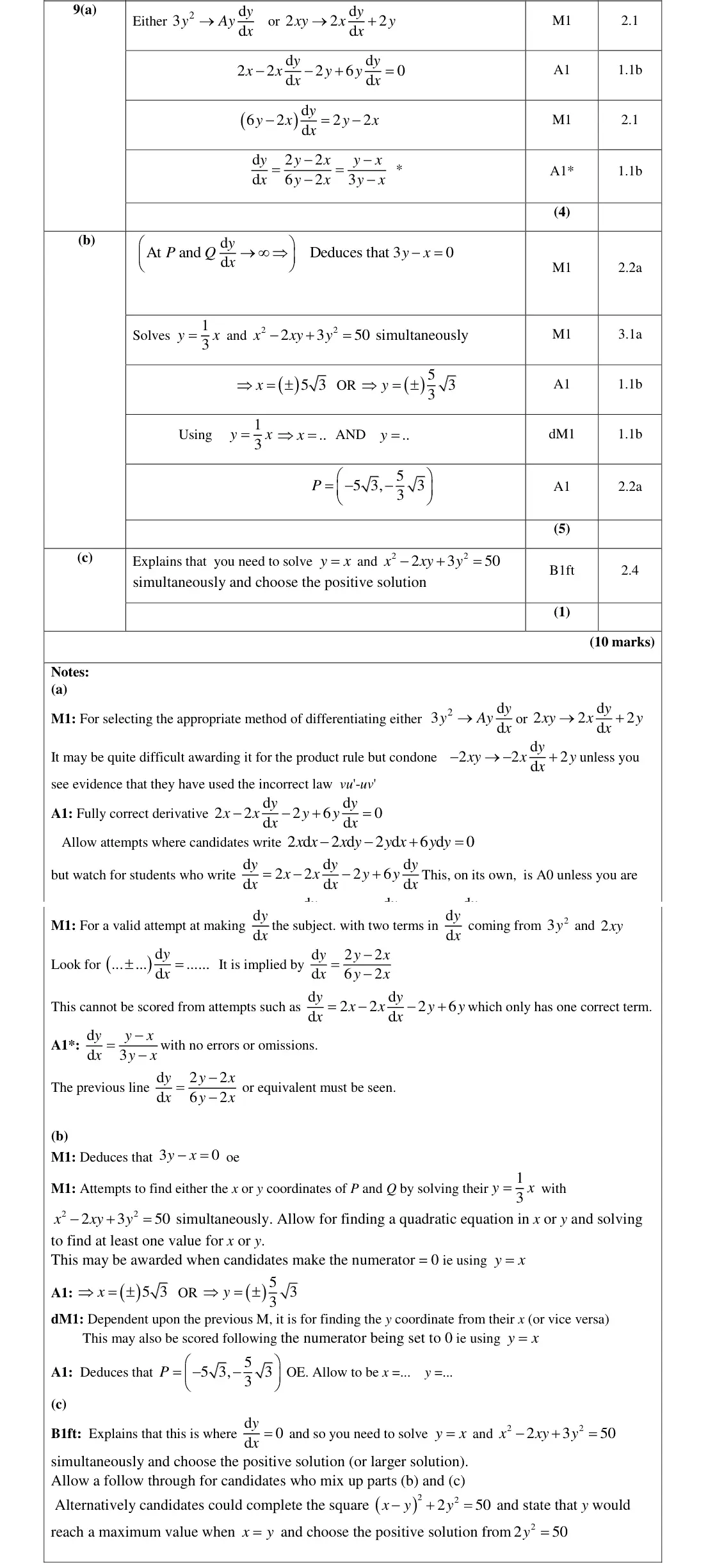
Question 9(a) was well answered. Students generally demonstrated a good understanding of implicit differentiation as well as the chain and product rules. Most reached the given result scoring all 4 marks. In question 9(b) however, many made the numerator of the fraction equal zero (i.e. y = x) instead of the denominator (x = 3y). This kind of error usually resulted in only two of the five marks being scored. There were however many full and accurate solutions, with very few students unable to pick out the coordinates of the point P from the two solutions to their simultaneous equations. Only a small number of students gained the B1 mark in question 9(c). They simply needed to state that the point furthest north can be found by substituting y= x into the equation of the curve and picking out the positive solution. Explanations tended to be incorrect or x y 0 incomplete, with many stating that it could be found by putting either or 0.
Common mistakes
product rule on 2xy and chain rule on 3y²
collect dy/dx terms and cancel the 2 to reach the given answer
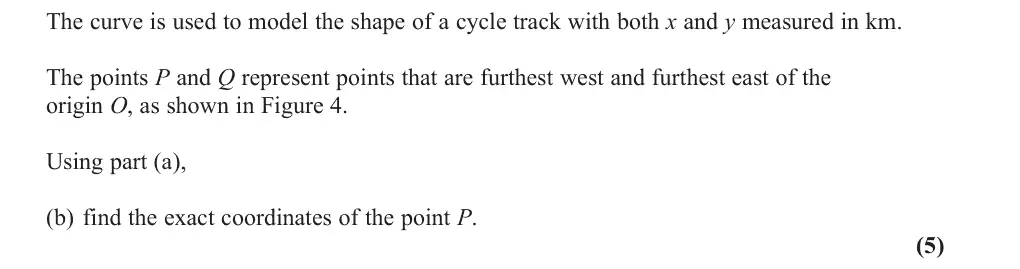
June 2018 · Paper 1 · Q9(b)5 marks
Mark scheme (whole question; this part is marked with the orange bar)
Examiner's comment
Question 9(a) was well answered. Students generally demonstrated a good understanding of implicit differentiation as well as the chain and product rules. Most reached the given result scoring all 4 marks. In question 9(b) however, many made the numerator of the fraction equal zero (i.e. y = x) instead of the denominator (x = 3y). This kind of error usually resulted in only two of the five marks being scored. There were however many full and accurate solutions, with very few students unable to pick out the coordinates of the point P from the two solutions to their simultaneous equations. Only a small number of students gained the B1 mark in question 9(c). They simply needed to state that the point furthest north can be found by substituting y= x into the equation of the curve and picking out the positive solution. Explanations tended to be incorrect or x y 0 incomplete, with many stating that it could be found by putting either or 0.
Common mistakes
furthest west/east means vertical tangent: denominator 3y − x = 0, not numerator (y = x is a common error)
solve with the curve, x = ±5√3
choose P = (−5√3, −(5/3)√3), exact
June 2018 · Paper 1 · Q9(c)1 mark
Mark scheme (whole question; this part is marked with the orange bar)
Examiner's comment
Question 9(a) was well answered. Students generally demonstrated a good understanding of implicit differentiation as well as the chain and product rules. Most reached the given result scoring all 4 marks. In question 9(b) however, many made the numerator of the fraction equal zero (i.e. y = x) instead of the denominator (x = 3y). This kind of error usually resulted in only two of the five marks being scored. There were however many full and accurate solutions, with very few students unable to pick out the coordinates of the point P from the two solutions to their simultaneous equations. Only a small number of students gained the B1 mark in question 9(c). They simply needed to state that the point furthest north can be found by substituting y= x into the equation of the curve and picking out the positive solution. Explanations tended to be incorrect or x y 0 incomplete, with many stating that it could be found by putting either or 0.
Common mistakes
furthest north is where dy/dx = 0: solve y = x with the curve and take the positive solution
"put x = 0 or y = 0" is wrong
rarely scored
Find an Edexcel maths tutor
Stuck on this? Book a trial session with an Edexcel specialist.