17 question parts, 78 marks, 3 with a difficulty rating from the examiner's report
Notes, worked examples and practice for this topic are being written by our tutors. The past-paper questions below are ready now: work each one on paper, then open the mark scheme and the examiner's comment.
Tap a question to zoom it. Mark scheme and examiner's comment open under each question.
June 2025 · Paper 1 · Q135 marks
Mark scheme (whole question; this part is marked with the orange bar)
Examiner's comment
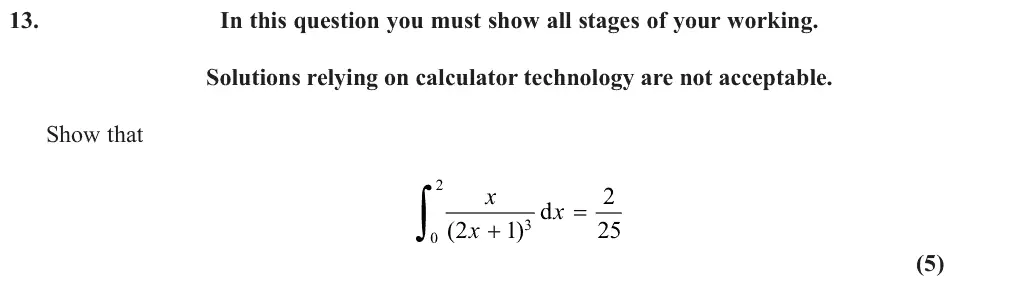
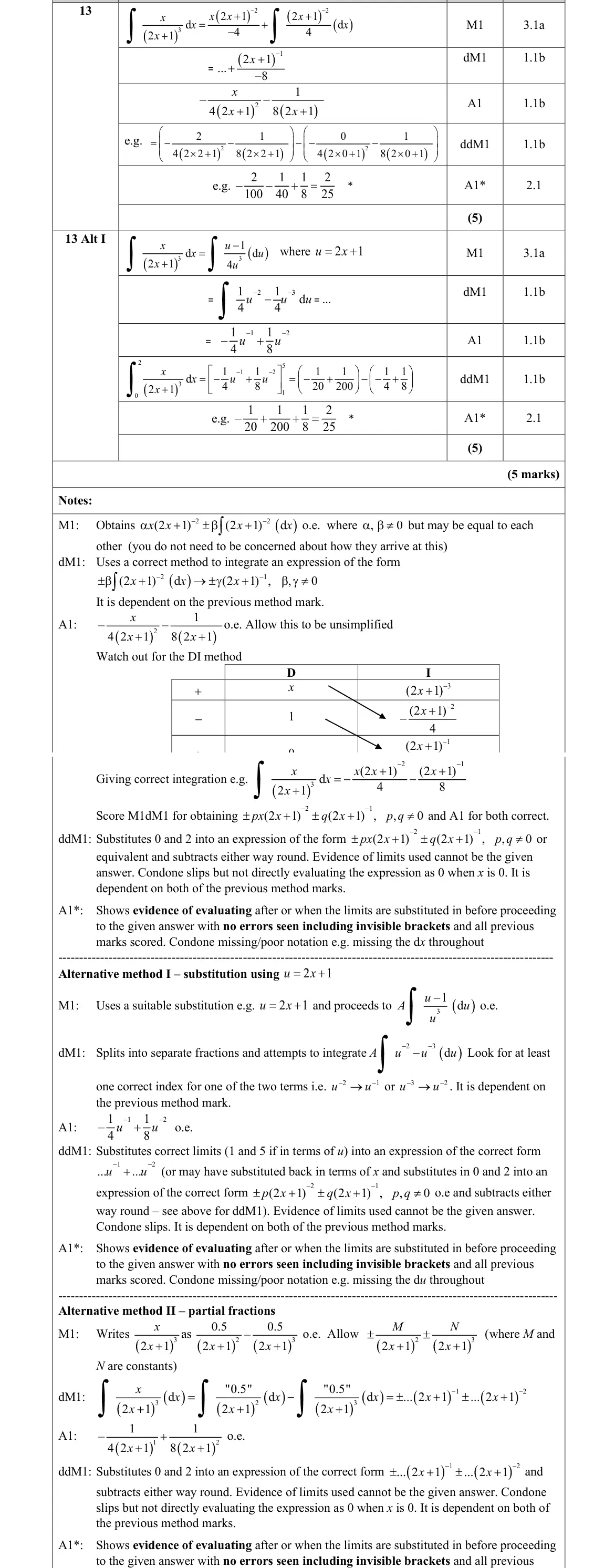
This unstructured question required learners to evaluate a definite integral and it was approached in a wide variety of ways with varying degrees of success. The question included a calculator warning which made it clear that solutions relying on calculator technology were not acceptable. Integration by substitution and integration by parts were the most common methods by far and seen in roughly equal measure. For the substitution method, most learners chose to use 2 1 u x = + . A few proceeded no further than rewriting the integral fully in terms of u as they did not recognise that the resulting expression could be split up into two distinct terms which could be integrated directly. Successful attempts using integration by parts required u x = and ( ) 3 d 2 1 d v x x - = + . Some learners who rely on acronyms and found that the “LATE” method to decide the choice of u and d d v x did not help them in this instance. Many chose to restart the question when they realised that they were not making any progress. Most responses that executed these methods and mistakes in the early stages tended to be made with their coefficients rather than the powers. Less commonly seen was first splitting the integrand into partial fractions or using a less efficient substitution such as 3 (2 1) u x = + or even a trigonometric substitution. Some responses negated to heed the calculator warning and jumping to the given answer without any evaluation of limits. Overall, whilst most learners could begin the question by a viable method, sustained accuracy and attention to fine detail were required in order to achieve full marks, many had to restart their solutions or amend earlier work which made it very challenging at times to determine what work was credible, or which solution they wanted to be marked. Due to no errors being allowed for the final mark learners risked not being awarded this mark by not clearly identifying their final attempt. 20
Common mistakes
by parts with u = x, dv/dx = (2x + 1)^(−3), or substitution u = 2x + 1 (limits 1 and 5) splitting into u^(−2) − u^(−3)
the LATE rule misleads here
show the limits substituted before 2/25
coefficient slips
several restarts made work hard to follow
June 2025 · Paper 2 · Q74 marks
Mark scheme (whole question; this part is marked with the orange bar)
Examiner's comment
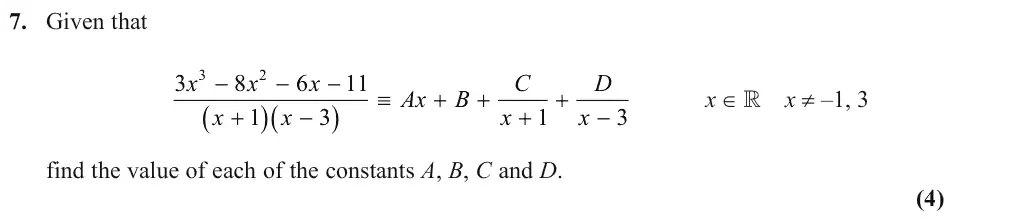
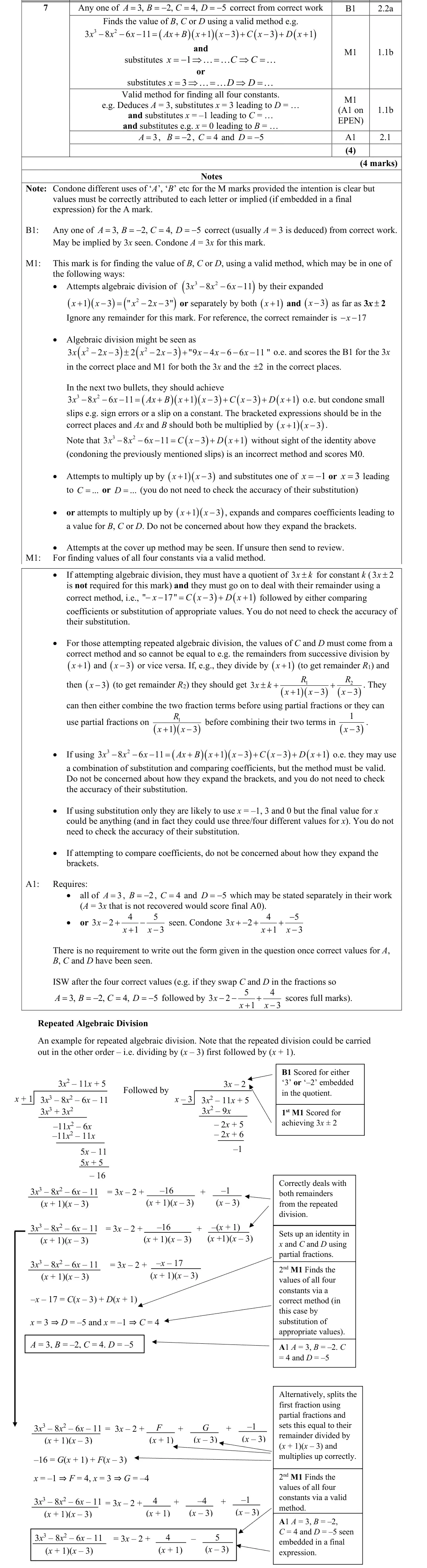
This question, which required learners to find the constants in a partial fraction identity, provided good differentiation between learners due to slightly more difficult nature of this question compared to similar problems from previous series. A large variety of methods were seen in this question. The most common approaches used one of two main methods: algebraic division or multiplying through to set up an identity without any fractions. The most successful method tended to be to multiply by the denominator to make a single identity then use substitution and/or comparing coefficients to find the missing values. Some responses did not multiply their Ax and B by the denominator this led to finding correct values for constants C and D through substitution (e.g., using x = -1 and x = 3), but, since the underlying method was flawed, marks could not be awarded. Slips in writing out the full identity were often seen but condoned provided the intention was clear. Whilst algebraic division was a successful method for some, errors were common in the division or dealing with the remainder, either calculating it incorrectly or not knowing how to use it to form an identity involving C and D. Some confused the quotient and the remainder when finding the final constants and others set their partial fractions equal to the original expression rather than their remainder. Those who did use the correct set up for partial fractions generally substituted correctly to score all 4 marks. Attempting algebraic division in two stages (dividing by each linear factor in turn) was much rarer, and often led to a maximum of two marks being scored, as responses used the remainders correctly to find C and D. Some responses expanded all their expressions after multiplying the identity by the denominator and then compared coefficients of powers of x and were successful overall. This method, while slightly longer, proved more accurate than algebraic division. Notably, few responses spotted that certain constants (like A) could be quickly deduced, suggesting an area for improvement in identifying shortcuts or patterns. There were responses that successfully managed to use elimination and comparing coefficients interchangeably and demonstrated very good fluency and understanding of working with partial fractions.
Common mistakes
improper fraction: multiply through by (x + 1)(x − 3) including the (Ax + B) term, then substitute x = −1, 3 and compare coefficients
A = 3 can be deduced directly
algebraic division errors with the remainder (−x − 17)
A = 3, B = −2, C = 4, D = −5
June 2024 · Paper 2 · Q12(a)2 marks
Mark scheme (whole question; this part is marked with the orange bar)
Examiner's comment
This question tested the candidates’ skill in various areas, i.e. finding partial fractions, integration, rules of logarithms, manipulating equations to eliminate logarithms using exponentials, indices, and commentating on the expected behaviour of a variable as another tends to infinity. This was a challenging question which in a number of instances, candidates struggled with after part (a). Those however, who were well prepared, were able to score full marks often with relatively concise solutions. Part (a) was well answered. Most candidates were familiar with the process of rewriting expressions using partial fractions and obtained a correct answer such as ( ) 1 1 25 25 25 V V + - .
Common mistakes
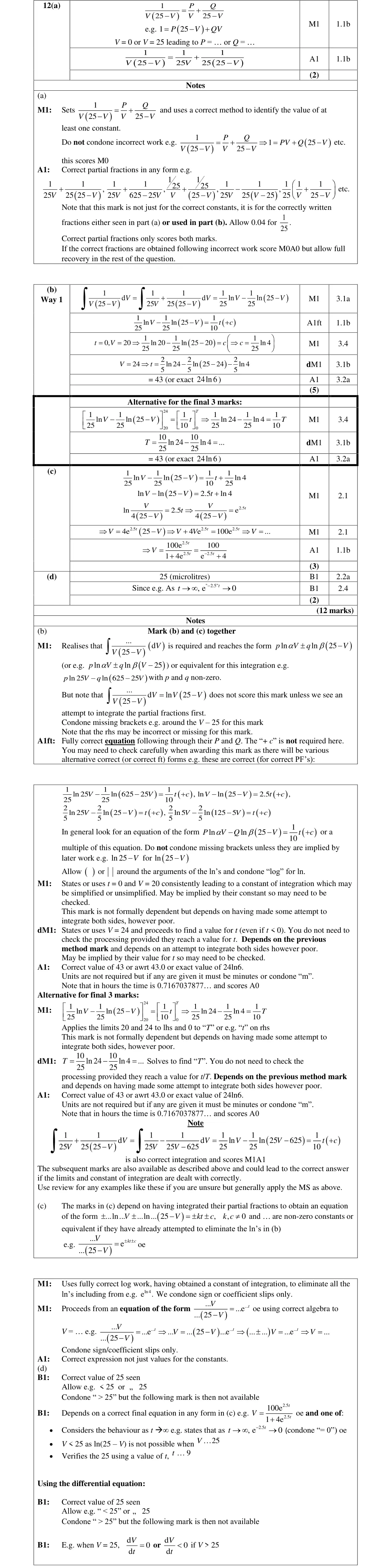
1 = P(25 − V) + QV, V = 0 and V = 25
1/(25V) + 1/(25(25 − V))
June 2024 · Paper 2 · Q12(b)5 marks
Mark scheme (whole question; this part is marked with the orange bar)
Examiner's comment
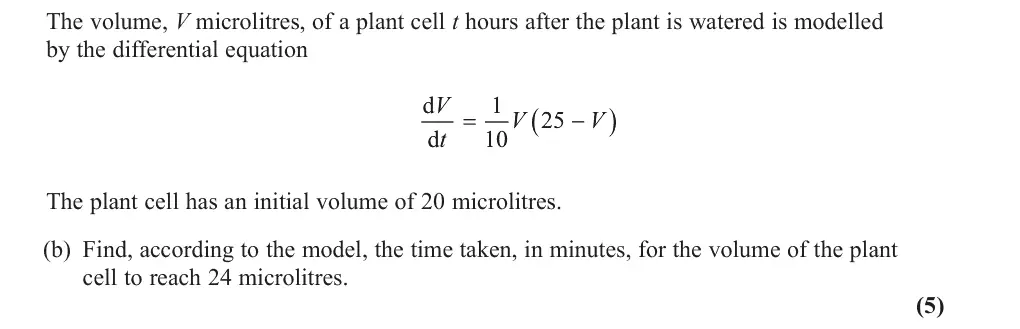
This question tested the candidates’ skill in various areas, i.e. finding partial fractions, integration, rules of logarithms, manipulating equations to eliminate logarithms using exponentials, indices, and commentating on the expected behaviour of a variable as another tends to infinity. This was a challenging question which in a number of instances, candidates struggled with after part (a). Those however, who were well prepared, were able to score full marks often with relatively concise solutions. There were occasional sign slips in the coefficients, and some candidates failed to write down their final answer, or use it in part (b), losing the second mark here. In part (b) a number of correct forms of integration were possible. Many candidates appreciated that an attempt at separation of variables and integration was required, and many reached correct equations such as ( ) 1 1 1 ln ln 25 25 25 10 V V t c - - = + or ( ) 1 1 1 ln 25 ln 25 25 25 25 10 V V t c - - = + . There were however, many slips with coefficients, and the omission of the minus sign in front of the ln(25 – V) or ln25(25 – V) term was common. Additionally, some omitted a constant of integration entirely, which meant that no further progress could be made. A surprising number of candidates did not see any link with part (a) and instead, integrated a quadratic in V, or did not integrate at all. Most candidates who attempted integration on both sides and included a constant of integration were able to score 2 method marks by using t = 0 and V = 20 to find the value of their constant and then substituting V = 24 to find the time taken. Most who got this far converted their final answer into minutes as required by the question although some candidates left the answer as 0.7167 which lost the final accuracy mark in this part. A few candidates used the alternative method of applying limits of 20 and 24 to their integral with respect to V and 0 and T for their integral with respect to t.
Common mistakes
separate variables and use the partial fractions from (a)
−ln(25 − V) sign often lost
include + c and find it from t = 0, V = 20
t = 0.7167 hours must be converted: 43 minutes
June 2023 · Paper 2 · Q10(a)3 marks
Mark scheme (whole question; this part is marked with the orange bar)
Examiner's comment
Part (a) was generally done well with most candidates not deterred by the occurrence of the “k” in the numerator. The majority of students correctly formed the partial fractions and set up the identity in terms of A and B. Once there, most of them correctly went forward by substituting x as 2 and 4 and finding A and B in terms of k. Some set up their partial fractions in the form 4 2 B C A x x + + + - but very rarely managed to achieve A = 0. The method of comparing coefficients and solving two equations in A and B simultaneously was seen very occasionally. Errors were made where candidates had assigned the wrong values for A and B in their final partial fractions. A common sign error was made when substituting in x = - 4, leading to solving -12k - 18 = -6A to obtain A = 2k - 3, instead of A = 2k + 3. Some did not fully simplify their expressions for 𝐴 or 𝐵, leaving them as fractions. Another error at this stage generally involved not substituting for x in the 3kx term, leaving A and B in terms of x. Some students transposed the x 2 and x + 4 at the beginning so lost the B mark but generally followed through correctly and scored the method mark. In a small number of cases, the last mark was lost after candidates correctly found the numerators in terms of 𝑘, but did not write down the correct partial fractions.
Common mistakes
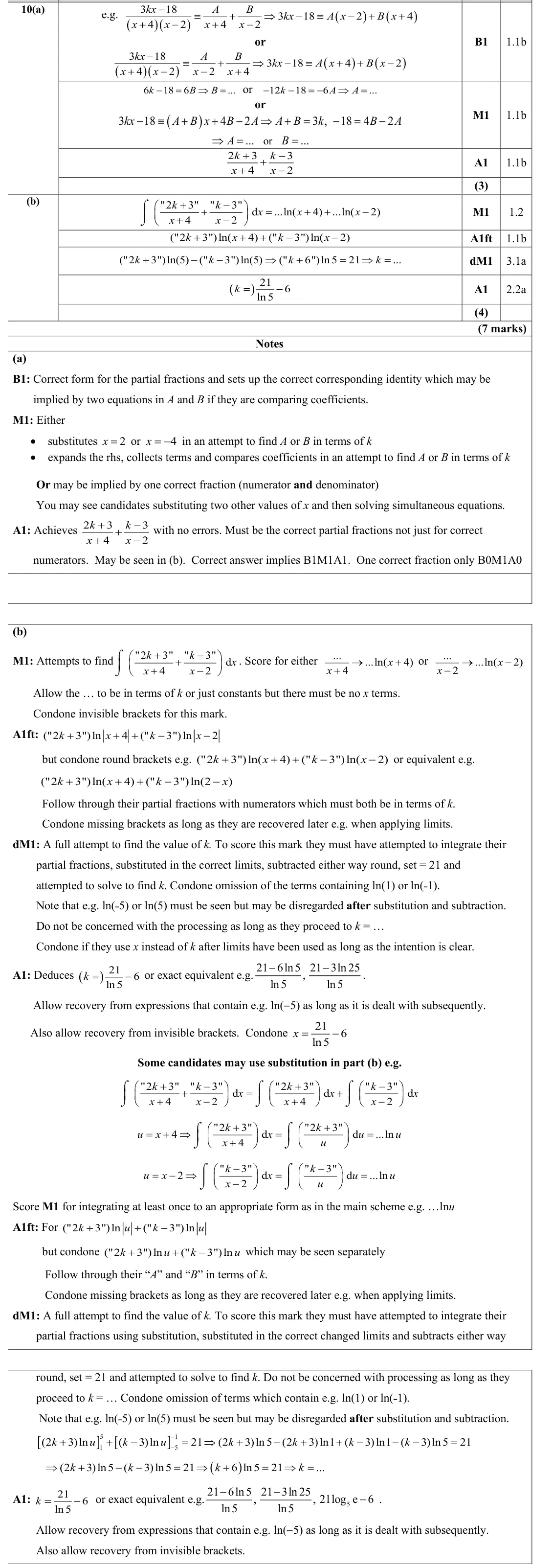
3kx − 18 ≡ A(x − 2) + B(x + 4)
x = −4 gives −12k − 18 = −6A so A = 2k + 3 (sign error gives 2k − 3)
B = k − 3
keep k, substitute for x in 3kx
June 2023 · Paper 2 · Q10(b)4 marks
Mark scheme (whole question; this part is marked with the orange bar)
Examiner's comment
Very few candidates managed full marks in part (b), although the majority did gain the first method mark for integrating to obtain …ln(x + 4) or …ln(x 2). Those who did not recognise the logarithmic form for the integration were unable to score any marks in this part. Some achieved the correct form after first using a formal substitution. Of those who integrated their partial fractions successfully, the vast majority were far from strict in their use of the modulus symbol and many lost marks due to lack of appreciation of its importance. Use of modulus notation for integrating reciprocal functions should be picked up by centres as a teaching point with future cohorts. Students who had written the incorrect term ( ) ( ) 3 ln 5 k - - - or even the correct term ( ) 3 ln 5 k - - - after applying the limit 3 x = -, went on to indicate that they believed this term was zero or could just be ignored. Another example of poor practice was missing brackets around the coefficients e.g. ( ) ( ) 2 3ln 4 3ln 2 k x k x + + + - - being surprisingly common. The “invisible” brackets were sometimes recovered but in many cases were not. There were also examples where the brackets around the (x + 4) and the (x 2) were also missing. Those with a systematic well-laid out approach for the substitution of limits in both terms and identifying clear subtraction of the lower limit, went on to score 3 or 4 marks in part (b) and commonly full marks for the question. Many candidates however were hampered by their own layout making the correct interpretation of ln ( 5) as ln |5| even more challenging. The perhaps unfamiliar, exact form needed for k also proved a challenge for even the best candidates. There were some elaborate attempts to achieve an expression for k, some using exponentials, but many gave up along the way. There were, however some very elegant and correct solutions to this question and some different forms of the exact equivalent answer were seen, for example 5 21log e 6 - but most correct answers were given as 21 6. ln5 -
Common mistakes
(2k + 3)ln(modulus of x + 4) + (k − 3)ln(modulus of x − 2)
use modulus signs (ln of a negative)
brackets round the coefficients
(k + 6)ln5 = 21 so k = 21/ln5 − 6
terms in ln1 vanish but ln(5) from the second term does not
June 2023 · Paper 2 · Q13(c)5 marks
Mark scheme (whole question; this part is marked with the orange bar)
Examiner's comment
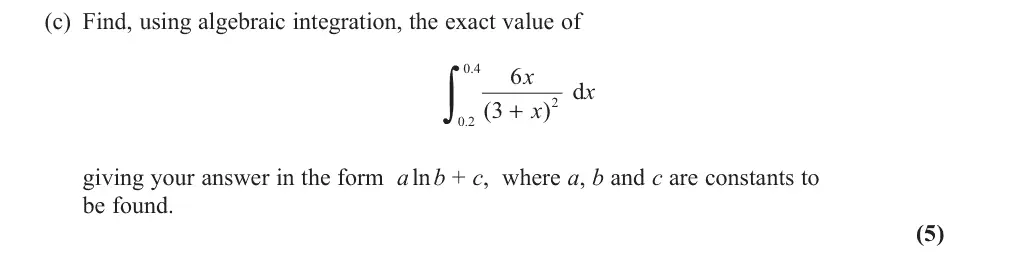
In part (c), the commonest methods of integration adopted were substitution, using either u = x + 3 or u = (x + 3)2 , integration by parts, integration after applying partial fractions and integration using the reverse chain rule after writing the integrand in appropriate form. Candidates had varying success with all of these approaches, gaining a variety of marks. Integration by parts seemed to lead to most arithmetical mistakes. Errors resulted from using parts ‘the wrong way round’ and others integrated the ( ) 2 3 x - + term incorrectly. When integrating by substitution some students incorrectly thought that 2 18 u - would integrate to a natural logarithm. There was some confusion with the limits; some candidates did not change the limits to “u” values and other who did evaluate new limits for their substitution switched back to an expression in x before substituting their changed limits. When using partial fractions some students struggled with the initial format for the partial fractions and it was not uncommon to see partial fractions of the form 3 3 A B x x + + + . There was a number of candidates who either did not attempt this part of the question at all or who lacked a correct strategy. There were responses where students attempted to integrate numerator and denominator separately, e.g. 6x to 3x2 and ( ) 2 1 3 x + to a variation of ( ) 2 ln 3 x + , and proceeded to multiply both results. A number of candidates were awarded just the first mark as their overall problem solving strategy was correct despite the fact they were unable to fully implement it. There were also many candidates who could carry out the work in this part completely successfully.
Common mistakes
substitution u = 3 + x (change limits to 3.2 and 3.4), parts, or partial fractions 6/(3 + x) − 18/(3 + x)²
result 6ln(17/16) − 45/136
18/u² does not integrate to a log
switching back to x but using u limits
June 2022 · Paper 2 · Q14(a)3 marks
Mark scheme (whole question; this part is marked with the orange bar)
Examiner's comment
In part (a) a large proportion of candidates demonstrated a good understanding of how to find the partial fractions and the methods seen were often very clear. Substitution of 𝑥𝑥 = -1 and 𝑥𝑥 = 1/2 was much more common than comparing coefficients. Generally the only mistakes made on this part of the question were arithmetic. A small number lost the final mark for failing to write out the complete partial fractions. A minority of candidates used 𝐴𝐴 + B( 𝑥𝑥 + 1) + 𝐶𝐶 (2𝑥𝑥-1) thinking it was an improper fraction but many proceeded correctly to found 𝐴𝐴 = 0 .
Common mistakes
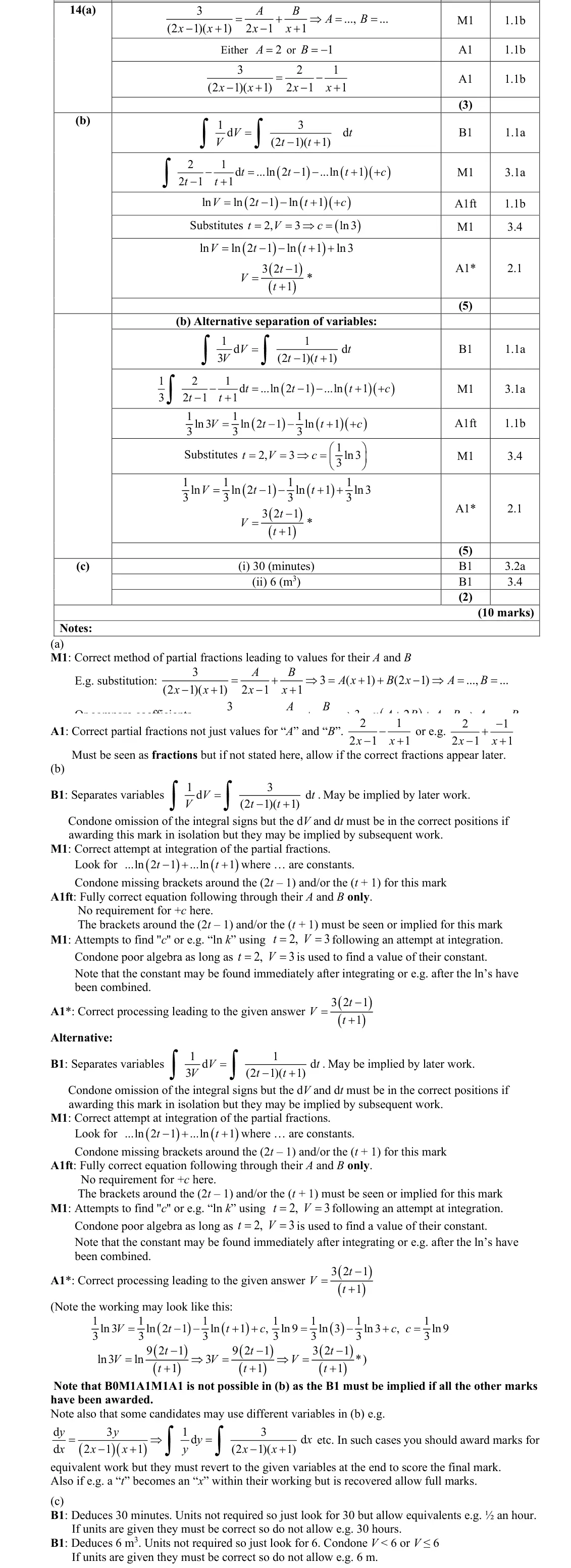
3 = A(x + 1) + B(2x − 1): A = 2, B = −1
write the fractions, not just A and B
June 2022 · Paper 2 · Q14(b)5 marks
Mark scheme (whole question; this part is marked with the orange bar)
Examiner's comment
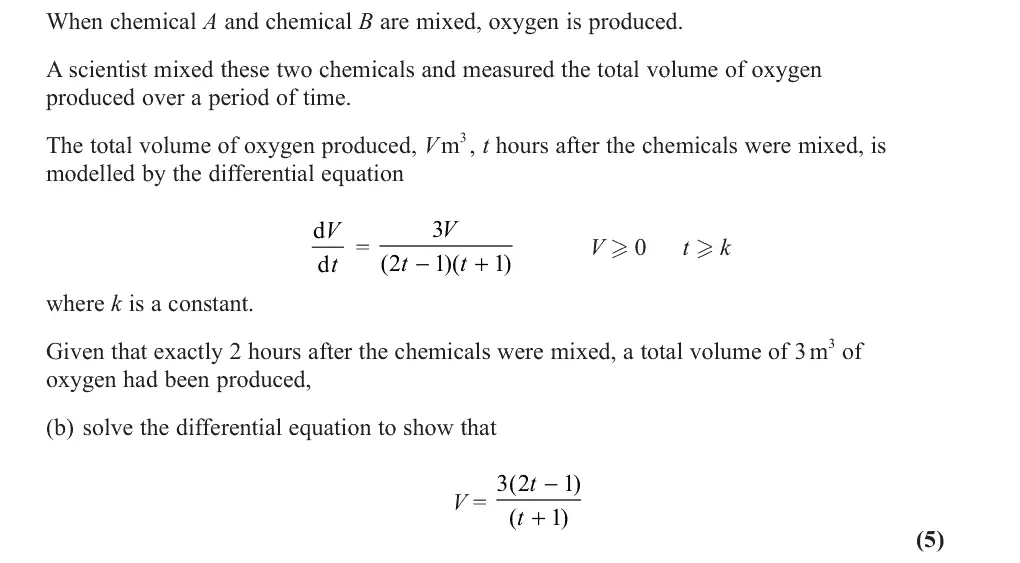
The most challenging aspect of part (b) for the candidates was to separate the variables correctly. A large proportion of candidates did not make the link to part (a) and often divided both sides by 3V as a starting point, i.e. ∫ 1 3𝑉𝑉. 𝑑𝑑𝑑𝑑= ∫ 1 (2𝑡𝑡-1)(𝑡𝑡+1) . 𝑑𝑑𝑑𝑑 Where candidates did this they often would incorrectly replace the right hand side with the partial fraction they had found in part (a). For the candidates that got as far as this, the integration of the partial fractions they put in place was generally completed well with the key …ln(2t - 1) - …ln(t + 1) being found more often than not although a common error was leaving a multiplier of 2 when integrating the first fraction to give 2ln(2𝑡𝑡-1). Regardless of the integration a candidate had achieved, there were a large number of candidates that did not consider the constant of integration and tried to jump straight to the answer at this stage. Generally, if a candidate remembered their integration constant, they were more often than not successful in using the given limits to obtain a value which they could use to find an equation for V. A few attempts at solving the first order linear differential equation using an Integrating Factor were seen. Those employing this method were usually reasonably successful.
Common mistakes
separate as ∫1/V dV = ∫3/((2t − 1)(t + 1)) dt and use (a) (not dividing by 3V then misusing (a))
∫2/(2t − 1) dt = ln(2t − 1), not 2ln
include + c and find it from t = 2, V = 3 before combining logs
Oct 2021 · Paper 1 · Q9(a)4 marksMedium
Mark scheme (whole question; this part is marked with the orange bar)
Examiner's comment
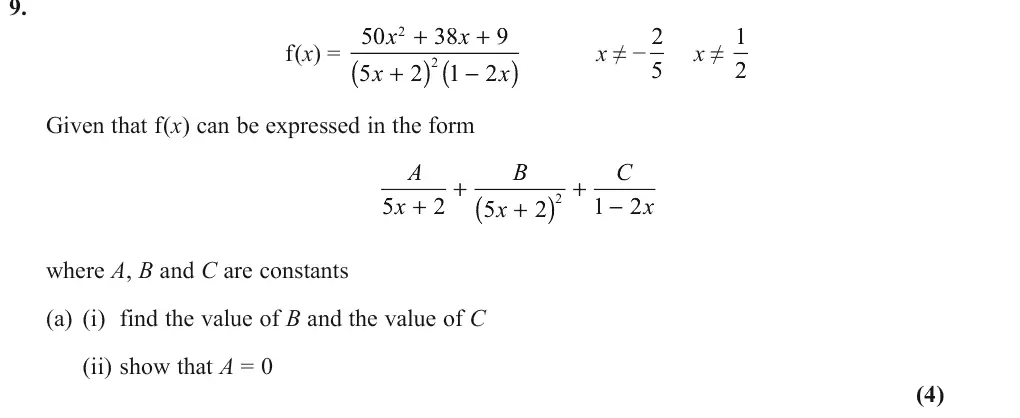
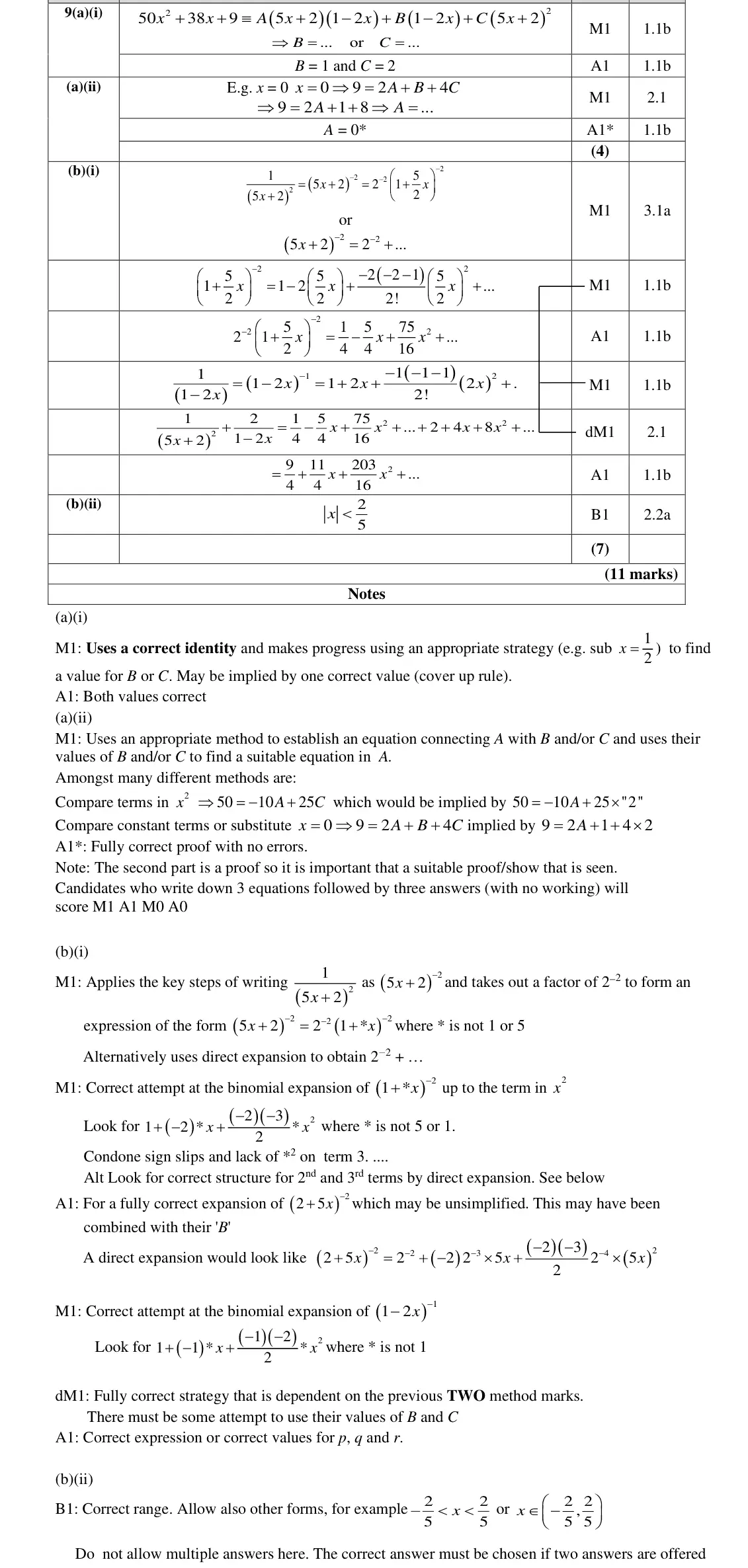
This question was answered with varying degrees of success. Around 28% of the candidates failed to score any marks here at all, which was very suprising. There were however, many well formed and accurate solutions by careful candidates. In part (a) most candidates managed to write down a correct identity and use an appropriate method to find values for B and C. To prove A =0 was generally done via equating coefficients of x2 or by setting x = 0 or x=1. A few candidates wrote down three equations for the coefficients and constants, but rarely was a correct set of solutions gained from this method. It was also not uncommon to see the RHS expanded either with or without the terms involving A in an attempt to prove that A = 0. Errors included having an incorrect identity from the start which resulted in no marks.
show A = 0 by comparing x² or constant terms (a proof, so working needed)
Oct 2021 · Paper 1 · Q9(b)7 marksMedium
Mark scheme (whole question; this part is marked with the orange bar)
Examiner's comment
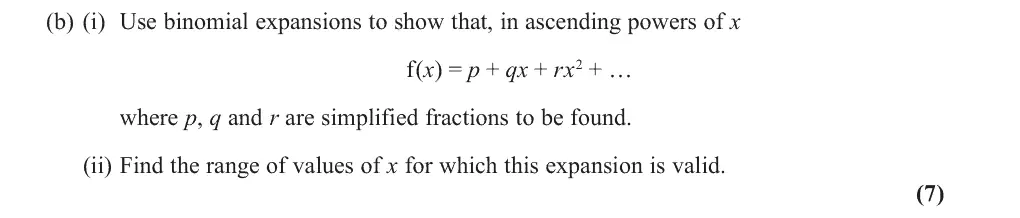
This question was answered with varying degrees of success. Around 28% of the candidates failed to score any marks here at all, which was very suprising. There were however, many well formed and accurate solutions by careful candidates. In part (b)(i) it was rare to see fully correct expansions. Good candidates often lost the final mark due to an error in adding the required terms. A common error was forgetting to use their value for C and only adding the expansion for (1-2x)-1 rather than C(1-2x)-1. A few were unable to extract 2-1 correctly from (5x+2)-2 (usually having this as 2). Other errors seen involved an expansion of (1 + 2/5 x)-2 or else (1 + 5/2 x) 2 rather than (1 + 5/2 x) -2. Very few correct answers were seen for part (b)(ii) and this was very often not attempted. Those who did write a correct range sometimes also gave a second range which therefore did not gain the B mark here.
Common mistakes
write (5x + 2)⁻² as ¼(1 + 5x/2)⁻², not (1 + 2x/5)⁻² or a factor of 2
multiply (1 − 2x)⁻¹ by C = 2
f(x) = 9/4 + 11x/4 + 203x²/16
valid for modulus of x < 2/5 (the stricter range only
two ranges scores B0)
Oct 2021 · Paper 2 · Q14(b)6 marks
Mark scheme (whole question; this part is marked with the orange bar)
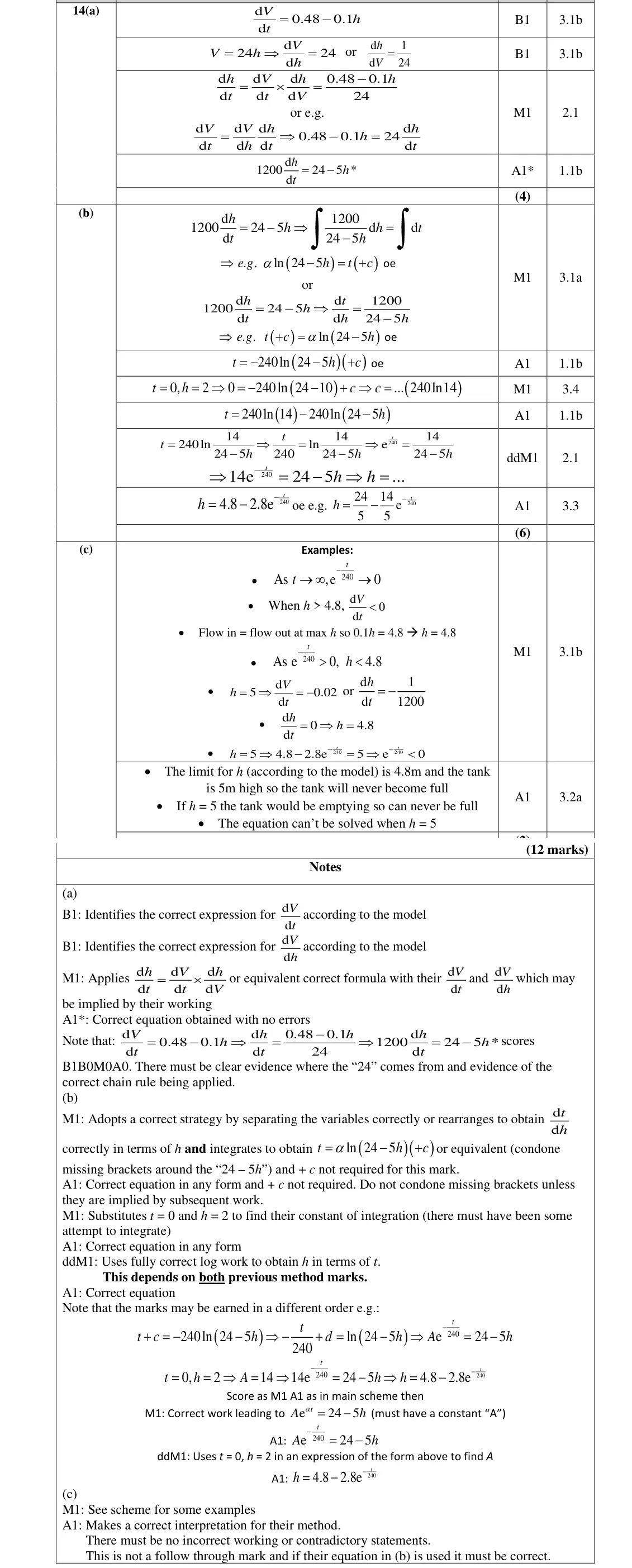
Examiner's comment
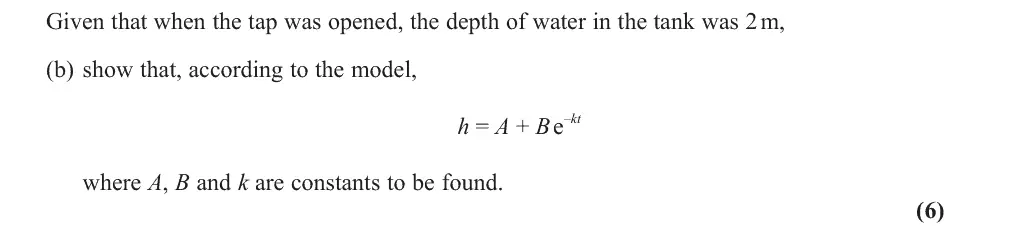
This question proved challenging for the majority of candidates, with many not answering it at all. Students who progressed well in (b) often interpreted their formula correctly to obtain marks in (c). A minority of students who didn’t complete (b) still attempted (c) with some success, e.g. recognising that d d h t was zero at the maximum height or using a ‘ flow in = flow out’ argument.
Common mistakes
separate variables
t = −240 ln(24 − 5h) + c
use t = 0, h = 2 to find c
correct log work to h = 4.8 − 2.8e^(−t/240)
forgetting + c
Oct 2020 · Paper 1 · Q10(b)6 marks
Mark scheme (whole question; this part is marked with the orange bar)
Examiner's comment
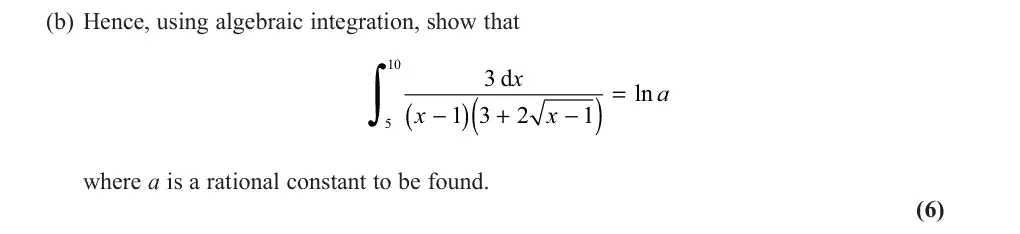
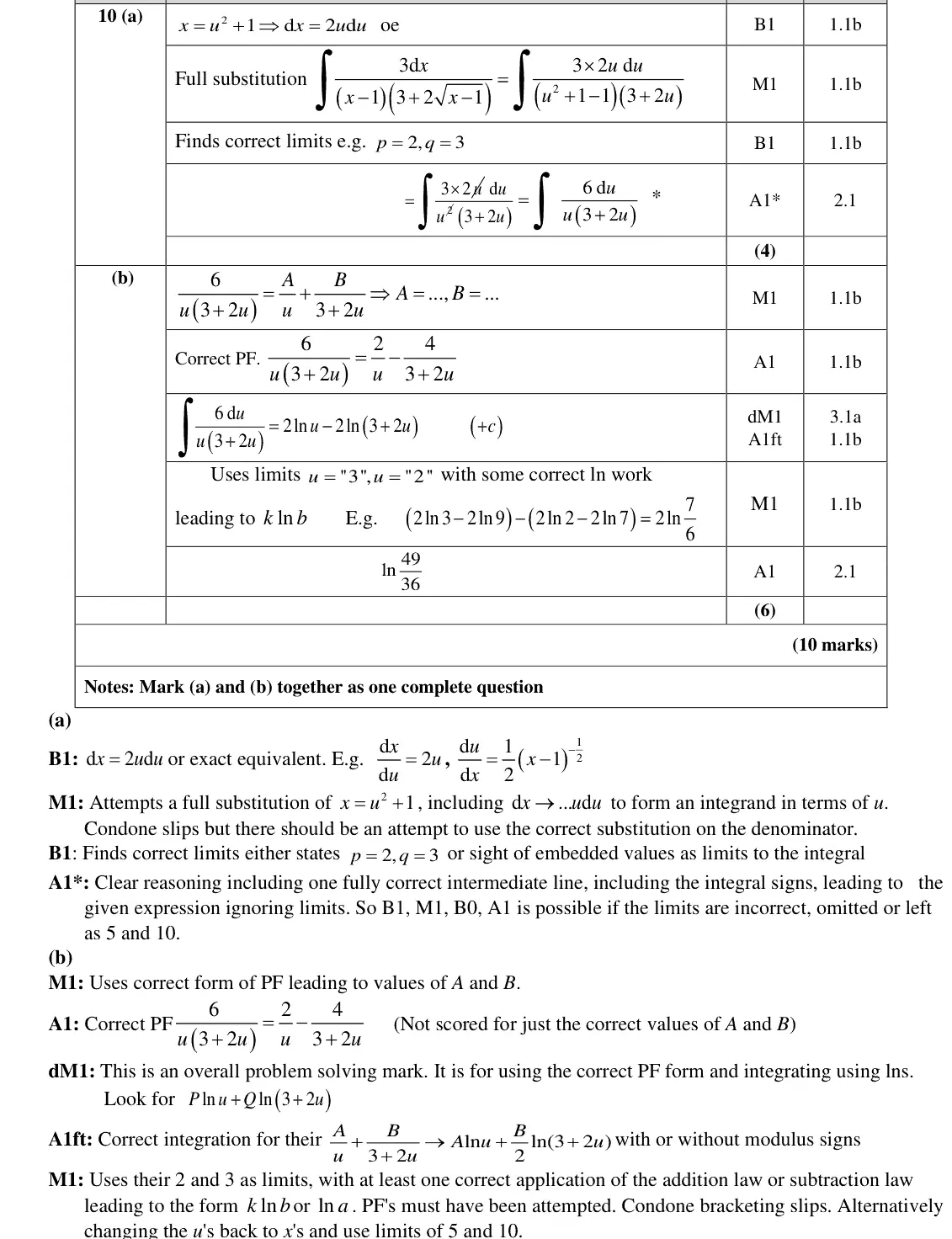
This question proved to be more discriminating than expected with many failing to notice the partial fractions in part (b), thereby losing 6 marks. Of those who did use partial fractions in part (b), most found the values of "A" and "B" correctly. Unfortunately many integrated B/(3 + 2u) to B ln(3 + 2u), failing to divide the coefficient by 2. The final Method mark was still available for these candidates, but a number failed to simplify their numerical logs to an expression of the required form and so did not gain this mark. A pleasing number of well prepared candidates did gain full marks in this question.
Mark scheme (whole question; this part is marked with the orange bar)
Examiner's comment
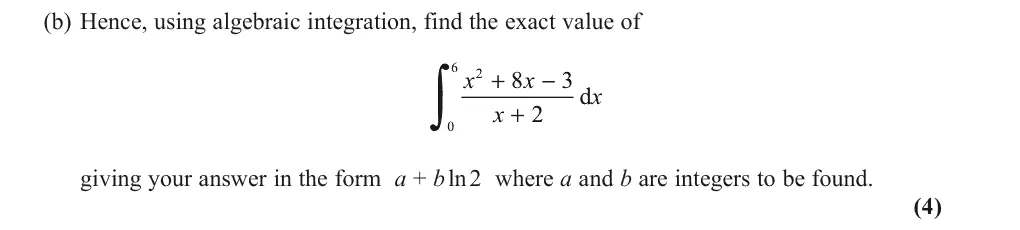
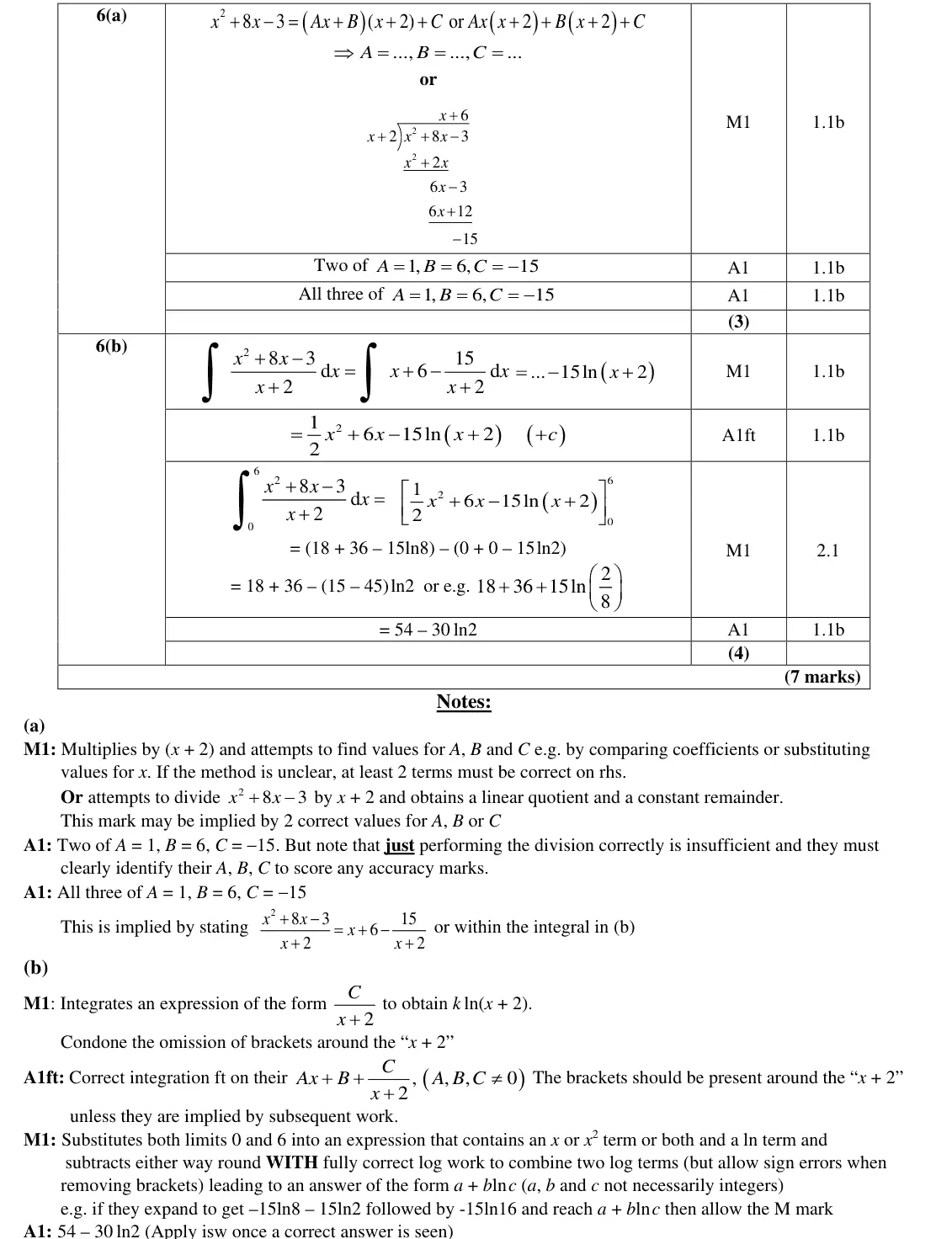
As would be hoped, most candidates scored some marks on this question. Many found part the accuracy marks. There were many more errors seen when students attempted to values of 𝑥𝑥 to substitute in, any errors usually cost both accuracy marks. In comparison, multiply (Ax + B) by (x + 2) and compare the numerators, and when candidates selected (-3 - +12 = 9 being a common slip) and so secure the first accuracy mark. those who used long division were more likely to make an error only in the remainder In part (b), a pleasingly high number of candidates who had found values for A, B and C were able to successfully integrate to gain the first two marks, often aided by the follow through mark that was available. Candidates generally substituted the limits correctly and there was occasional sign errors. The most common being “-15ln 8 -(-15 ln 2) = -15ln 8 - also a relatively good use of the laws of logarithms to combine their terms, albeit with 15 ln 2”. It was not uncommon for a candidate to then incorrectly combine this to get " - 15ln 8 2”. Most success was seen where candidates changed the ln (8) into ln (23) and then 3 ln(2) before combining the two ln 2 terms.
Common mistakes
integral of 15/(x + 2) is 15ln(x + 2)
−15ln8 + 15ln2 = −30ln2 (write ln8 = 3ln2), not −15ln(8 − 2) or −15ln16
answer 54 − 30ln2
June 2019 · Paper 1 · Q13(b)8 marksMedium
Mark scheme (whole question; this part is marked with the orange bar)
Examiner's comment
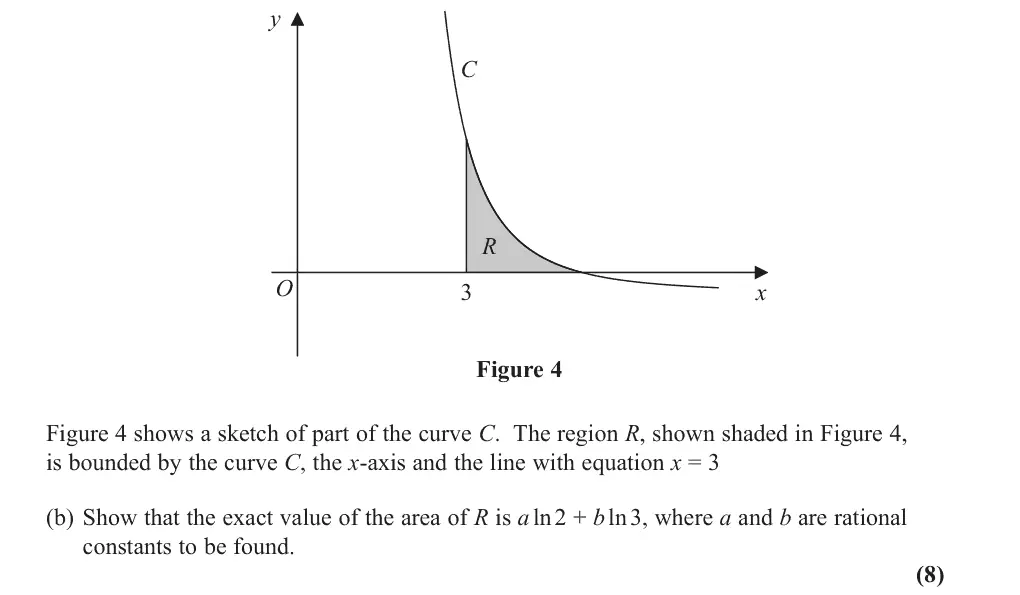
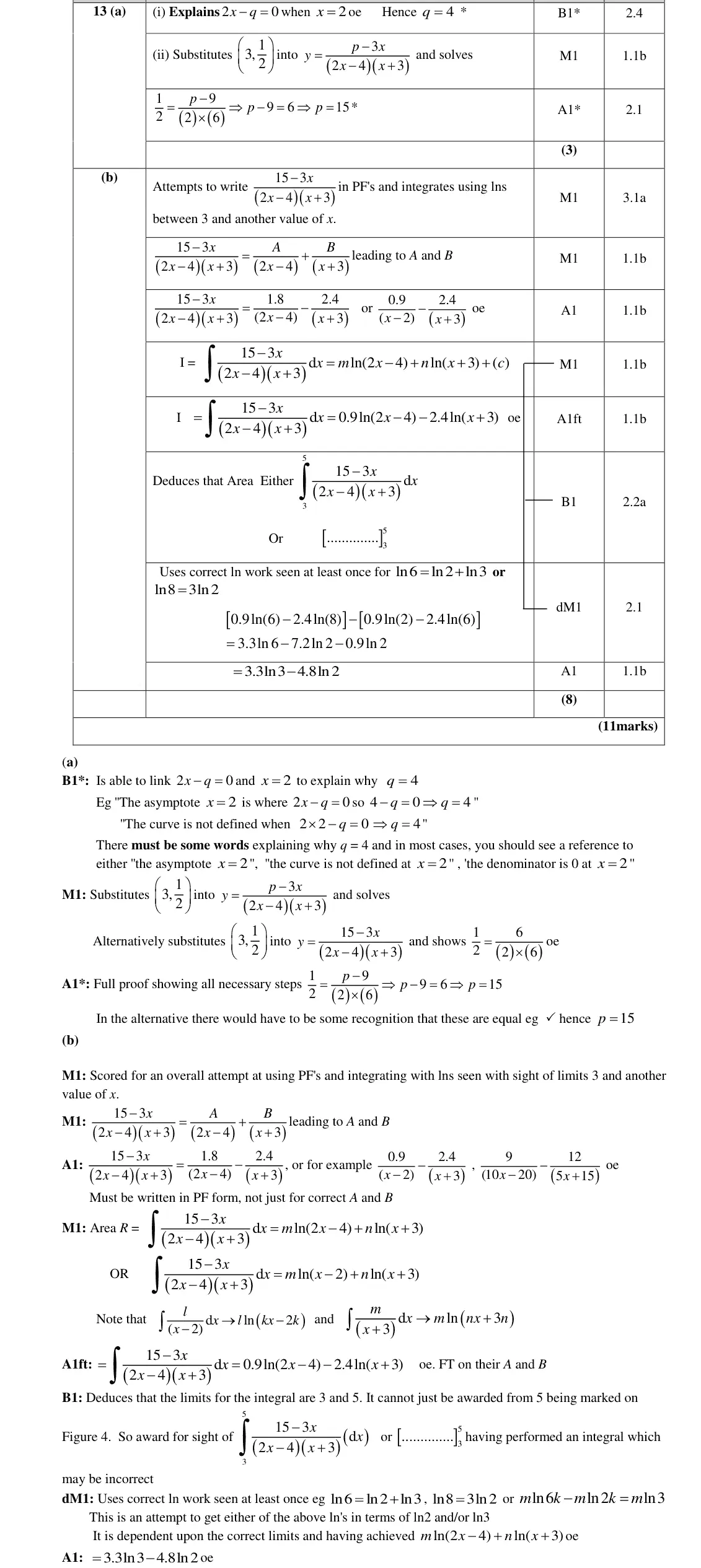
Only the strongest candidates scored all 11 marks here, with the majority losing at least 1 mark, usually the first mark in (a) or the last mark in (b). In part (b) the vast majority of students knew they had to use partial fractions to attempt the question with many achieving the correct expression and correct integration. The most common error was in simplifying the final logarithmic expression with many candidates leaving some of their answers in terms of ln (3/4) or ln (4/3) for example. It was uncommon therefore to see a fully correct solution in the required form.
Common mistakes
partial fractions 0.9/(x − 2) − 2.4/(x + 3)
upper limit 5 from 15 − 3x = 0
ln 6 = ln 2 + ln 3, ln 8 = 3 ln 2
final 3.3 ln 3 − 4.8 ln 2, not left with ln(3/4)
June 2018 · Paper 2 · Q11(a)4 marks
Mark scheme (whole question; this part is marked with the orange bar)
Examiner's comment
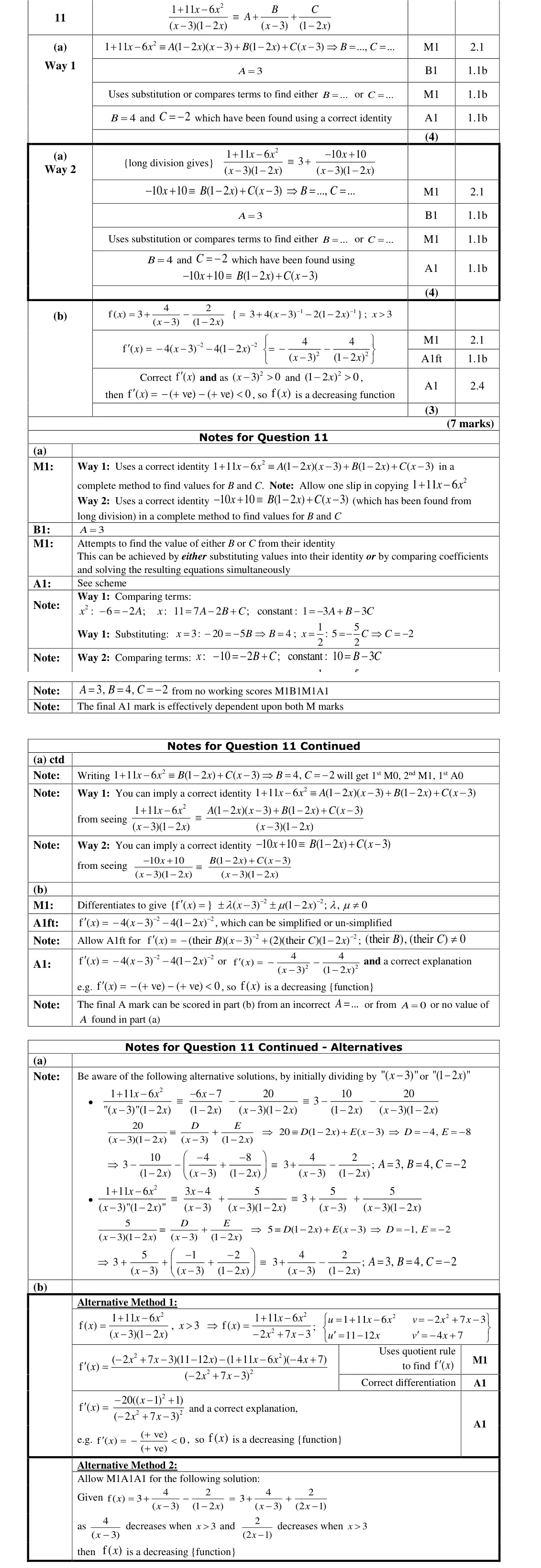
Part (a) was accessible to most students, whereas some students struggled to gain access to part (b). In part (a), most students used the given 2 1 11 6 ( 3)(1 2 ) ( 3) (1 2 ) x x B C A x x x x to write down a correct identity 2 1 11 6 (1 2 )( 3) (1 2 ) ( 3). x x A x x B x C x Some students used a method of long division to deduce that 3 A and formulated the correct identity 10 10 (1 2 ) ( 3). x B x C x Only a few students wrote down the incorrect identity 2 1 11 6 (1 2 ) ( 3). x x B x C x Most students used either a method of substituting values into their identity or a method of comparing coefficients with most finding the correct values for A, B and C.
Common mistakes
improper fraction so A = 3 (by division or comparing x² terms)
Mark scheme (whole question; this part is marked with the orange bar)
Examiner's comment
In part (b), a minority of students struggled to make any creditable progress. These students usually evaluated f ( )x for increasing x-values and concluded that the corresponding values for f ( )x were continually decreasing. The majority used the chain rule to differentiate f( ). x A common error at this stage was for students to differentiate 1 2(1 2 )x to give 2 2(1 2 ) , x while other students tried to apply an incorrect method of showing f ( ) 0. x Only a few of the students who obtained a correct 2 2 f ( ) 4( 3) 4(1 2 ) x x x provided an acceptable explanation detailing why f ( ) 0. x
Common mistakes
use the partial fractions: f(x) = 3 + 4(x − 3)⁻¹ − 2(1 − 2x)⁻¹