Notes, worked examples and practice for this topic are being written by our tutors. The past-paper questions below are ready now: work each one on paper, then open the mark scheme and the examiner's comment.
Tap a question to zoom it. Mark scheme and examiner's comment open under each question.
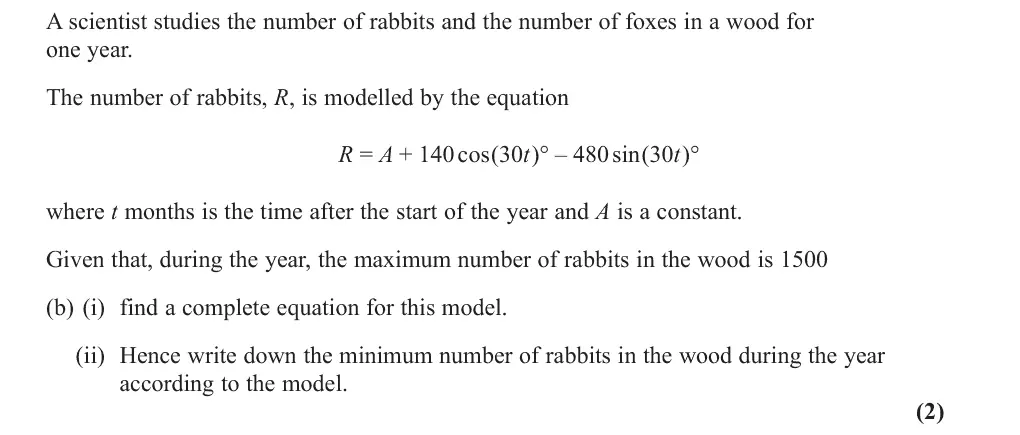
June 2024 · Paper 1 · Q12(b)2 marks
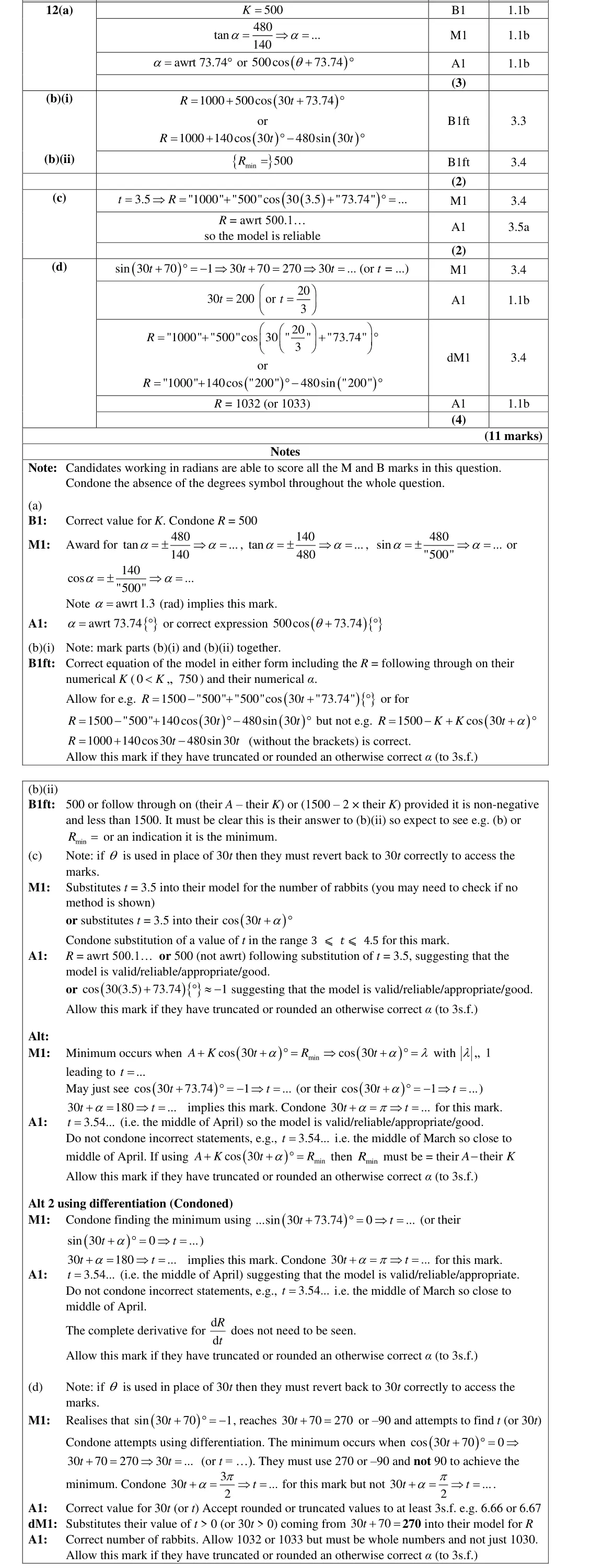
Mark scheme (whole question; this part is marked with the orange bar)
Examiner's comment
This harmonic form question was seen to be relatively challenging, despite similar questions being seen on several previous exam papers. That said, many candidates were able to attempt all parts of the question, and many follow through marks were available to those that made errors early on in their attempt. It was pleasing that most candidates identified that this question used degrees rather than radians. It was also pleasing to see many candidates continue to work through all parts of this modelling question despite having errors or not attempting previous parts. Responses to part (b)(i) suggested that candidates are not as confident at using the harmonic form as they are at forming it. Far too many candidates ignored their work from part (a) even if it was correct. Although given the maximum value for R, it was not uncommon to see candidates failing to use their harmonic form from part (a), but instead simultaneously setting 1500 R = , ( ) cos 30 1 t = - and ( ) sin 30 0 t = to obtain an incorrect value for A. Most of those who correctly identified that 1000 A = did then proceed to write down the full equation of the model, although many left this part with just a value for A. In part (b)(ii), some candidates struggled to calculate the value of min R as they did not recognise the link between their min R and the values of K and A. There were a few who added their values of A and K and hence did not score this B mark. Those who had found the correct value, 1000 A = , generally went on to identify the minimum value of R, but the follow through allowed those who understood the required method to gain this mark with an incorrect value for A.
Common mistakes
use the harmonic form: max = A + K so A = 1000 (not cos = −1 and sin = 0 together)
give the full equation, not just A
min = A − K = 500
June 2024 · Paper 1 · Q12(c)2 marks
Mark scheme (whole question; this part is marked with the orange bar)
Examiner's comment
This harmonic form question was seen to be relatively challenging, despite similar questions being seen on several previous exam papers. That said, many candidates were able to attempt all parts of the question, and many follow through marks were available to those that made errors early on in their attempt. It was pleasing that most candidates identified that this question used degrees rather than radians. It was also pleasing to see many candidates continue to work through all parts of this modelling question despite having errors or not attempting previous parts. Most candidates were able to gain some credit for part (c) as the method mark was quite generous regarding the candidates’ interpretation of the phrasing “middle of April” in terms of the model. Approaches using a value of t condoned values in the range 3 ⩽ 𝑡 ⩽ 4.5 to be substituted into their model for R. The most common incorrect values used were 4 t = or 4.5 t = and were condoned for the method mark. However, for full marks in part (c) candidates were required to translate ‘mid-April’ into 3.5 t = and substitute this into their model. A comparison with 500 R = could then be made, and the model was seen to be reliable. Another approach requiring more work was to set 500 R = and solve for t , via ( ) cos 30 73.74 1 t + = -. This value of t could then be used to identify the month in which the model predicted R would be minimum. A common mistake seen in this approach was to incorrectly identify 3.54 t = as being ‘mid-March’ which led to mixed responses of the model being both reliable and unreliable for different candidates.
Common mistakes
mid-April is t = 3.5 (not 4 or 4.5)
R ≈ 500 = the minimum so the model is reliable
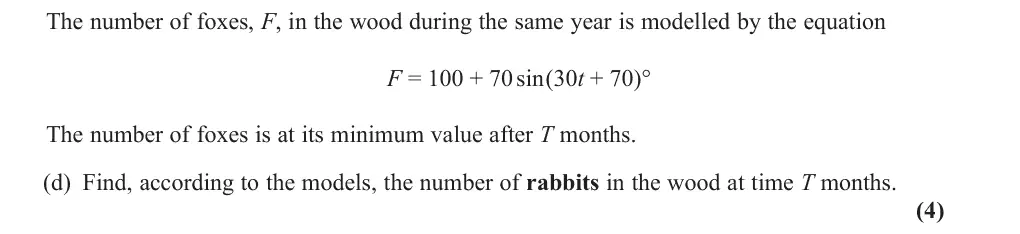
June 2024 · Paper 1 · Q12(d)4 marks
Mark scheme (whole question; this part is marked with the orange bar)
Examiner's comment
This harmonic form question was seen to be relatively challenging, despite similar questions being seen on several previous exam papers. That said, many candidates were able to attempt all parts of the question, and many follow through marks were available to those that made errors early on in their attempt. It was pleasing that most candidates identified that this question used degrees rather than radians. It was also pleasing to see many candidates continue to work through all parts of this modelling question despite having errors or not attempting previous parts. Part (d) was accessible to most candidates and fully correct answers were not uncommon. The simplest and most successful approach was to set ( ) sin 30 70 1 t + = - and solve for t, then substitute this into their model for R. Some candidates incorrectly set ( ) sin 30 70 1 t + = or 0, leading to the equation 30 70 90 t + = or 180. To score full marks for this part of the question, candidates needed to find a value of t from 30 70 270 t + = , use it with sufficient accuracy when substituting into their expression for R and round their final answer to an integer. Some candidates obtained a correct decimal answer but then rounded to 3 significant figures, giving 1030 as their final answer rather than the required 1032 or 1033. Many candidates incorrectly found a value of 16 3 t = - (coming from 30 70 90 t + = - ) which should have been an indication to restart this part having recognised that time cannot be negative. A significant proportion of candidates used 90 on the right-hand side, or even 0 or 180, which were not acceptable, and these failed to score any marks. There was also a minority of candidates who thought they were being asked to find the value of F. Another minority of candidates incorrectly assumed the question was asking when the populations of foxes and rabbits were the same and wrote down equations which they quickly concluded they could not solve.
Common mistakes
fox minimum when sin(30t + 70)° = −1 so 30t + 70 = 270 (not 90 or 180), t = 20/3
substitute into the rabbit model
whole number 1032
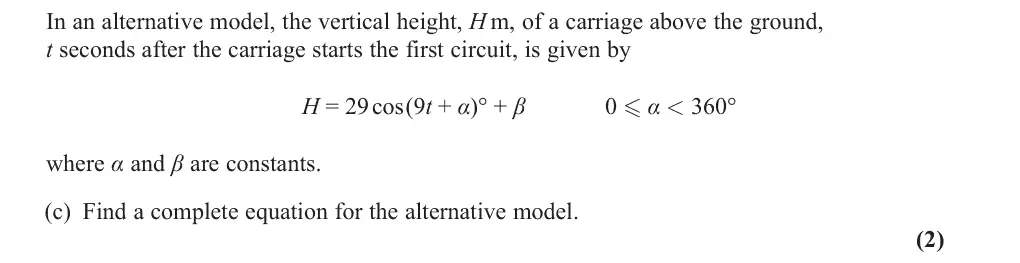
June 2023 · Paper 1 · Q13(c)2 marks
Mark scheme (whole question; this part is marked with the orange bar)
Examiner's comment
A significant number of candidates found this question very challenging, with a fair proportion of blank answers, and another significant number working with various substitutions in (a) that were quickly abandoned. Those who were able to work with both the quadratic and trigonometric models confidently were able to score highly and demonstrated a good understanding of how mathematics can be used to model real life contextual problems. In part (c), a significant number of candidates had no real idea how to start this. Many attempts involved fruitlessly expanding cos(9 ) t + but most candidates who successfully found and did not do this. The candidates who realised that when 60 H = , cos(9 ) 1 t + = which meant 31 = had the most success. Candidates who did this typically then substituted 20 t = into cos(9 ) 1 t + = to find a value of . Candidates who found one value typically found the other. There were a number of candidates who found the two values that did not ‘find a complete equation’ as the question required. However, there were a pleasing number of fully correct solutions, and almost all candidates who found and continued to give the full model.
Common mistakes
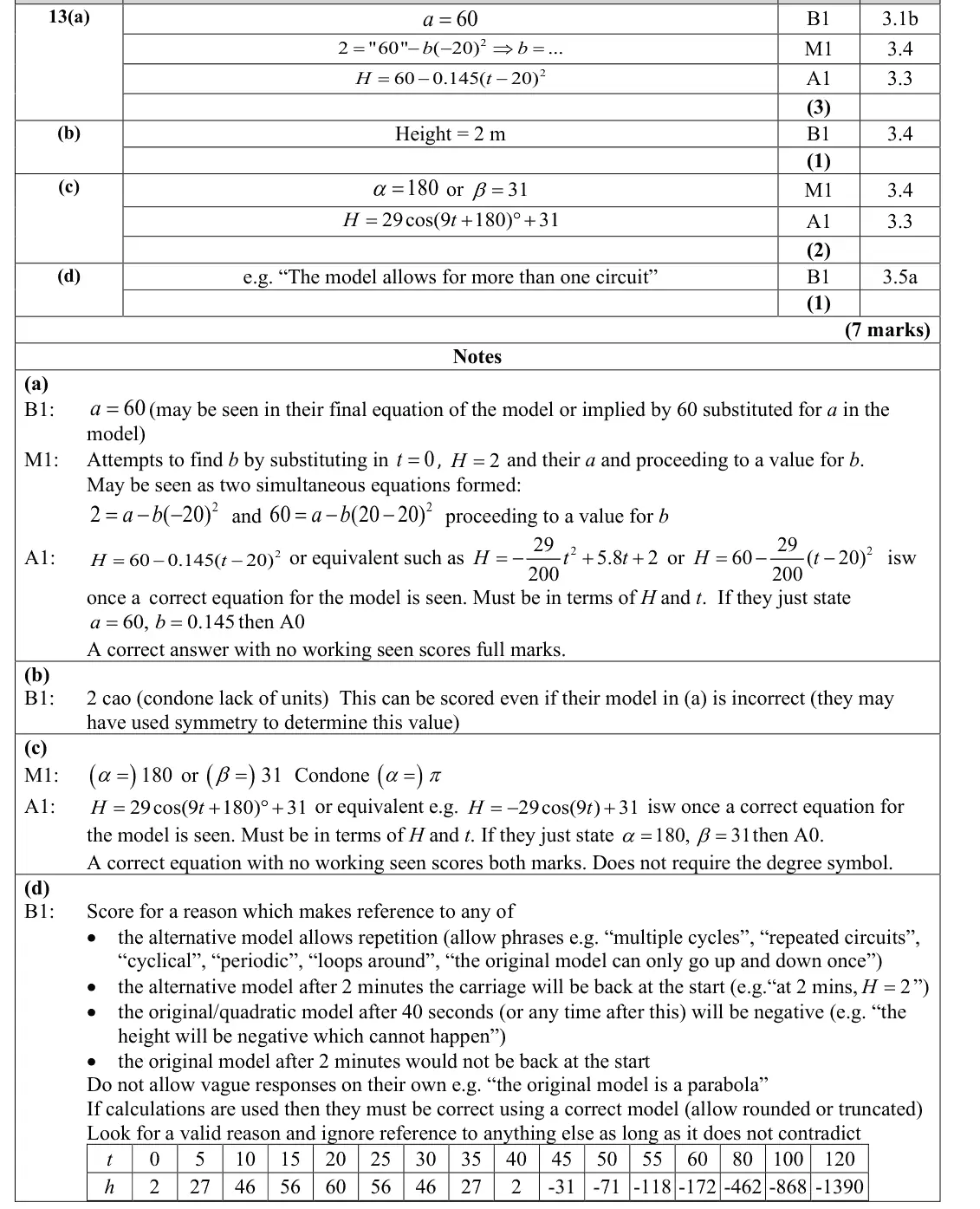
β = 31 (mid-height), α = 180 so that H = 2 at t = 0
June 2023 · Paper 1 · Q13(d)1 mark
Mark scheme (whole question; this part is marked with the orange bar)
Examiner's comment
A significant number of candidates found this question very challenging, with a fair proportion of blank answers, and another significant number working with various substitutions in (a) that were quickly abandoned. Those who were able to work with both the quadratic and trigonometric models confidently were able to score highly and demonstrated a good understanding of how mathematics can be used to model real life contextual problems. In part (d), the most popular correct answers involved an identification of the cyclic nature of the trigonometric function, or realising the first model would become very negative. A significant number of incorrect answers involved candidates saying the original model would keep increasing over time, which showed a lack of understanding of the negative quadratic model. Others made reference to the alternative model being continuous which was too vague. Some candidates managed to score this mark without scoring any other mark on this question which was, again, pleasing to see candidates attempting later parts of questions even if they have made little progress on earlier parts.
Common mistakes
the cosine model repeats (multiple circuits)
the quadratic goes negative after 40 s
June 2022 · Paper 2 · Q9(a)4 marks
Mark scheme (whole question; this part is marked with the orange bar)
Examiner's comment
This was a challenging question for the majority of the candidates with very few scoring most 1 or 2 marks. These were the initial B1 mark for realising that 𝐴𝐴= 50, however all four of the marks in part (a). For those that attempted the question, most scored at many wrote that 𝐻𝐻= 50 and did not relate that 𝐻𝐻 meant 𝐴𝐴. The second B mark for finding a value for 𝑏𝑏 was very poorly answered, with many not realising a simple 720 was needed and attempted to use an ‘𝑅𝑅-𝛼𝛼’ method or failed to take 180 calculation of d𝐻𝐻 into account transformations of the sine function, showing a lack of understanding of d𝑡𝑡 with very limited success. A the properties of the sine wave. Some also tried to use small minority of students achieved b = 1/4. The best answers tended to use transformation arguments, recognising that the full cycle depicted must represent a scale factor of 4 though many students attempting this approach did not appreciate the effect of the modulus in determining the value of b, obtaining instead a value of b = ½. A common incorrect method came from consideration of the wheel taking 720 seconds to complete 1 revolution leading candidates to solve the equation 720b + 1.15 = 180 or from thinking that the maximum occurs at t = 360 leading to 360b + 1.15 = 90. Of those 𝜋𝜋 2𝜋𝜋 that managed to access the question, few mixed radians with degrees and managed to 720 or 720, which scored no marks. 1010 was the most common mark profile for this question, as a significant number of students went on to find 𝛼𝛼 correctly give an answer as (albeit occasionally in radians) as they were able to spot that at 𝑡𝑡= 0, 𝐻𝐻= 1. Sadly, a few that did achieve all three elements did not conclude with an equation of the model and so lost the (easy) last mark, with this final mark being scored very rarely, at less than 5% of the cohort (the second least commonly scored mark in the paper). In part (b), many candidates incorrectly referred to the fact that the passenger was 1 m above the ground and related the value of 𝑑𝑑 to this fact, for the most part because they had not appreciated that the original model already took this into account. Some responses referred to the fact that the height needed to be a positive value or could not There were many attempts at part (b) without any attempt at part (a). It was unfortunately quite common that responses to this part were very difficult to read and centres need to stress to candidates that work cannot be awarded marks if it is illegible.
Common mistakes
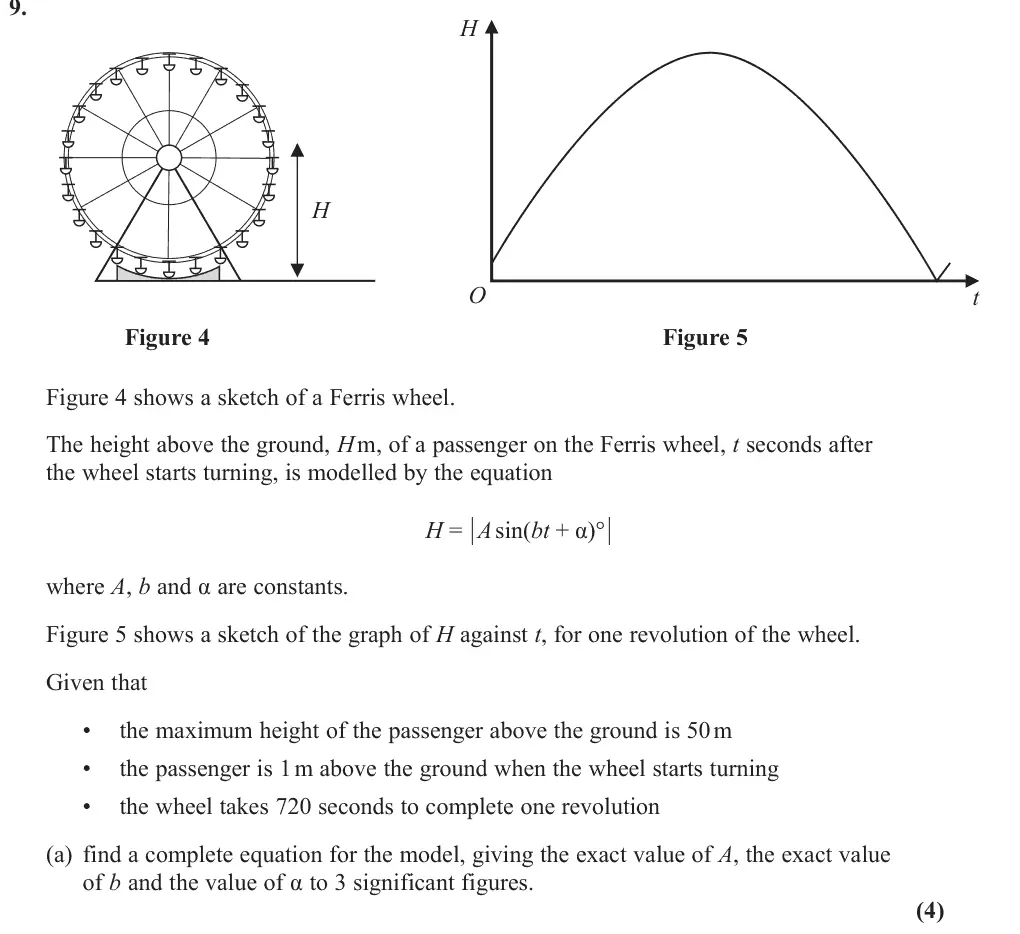
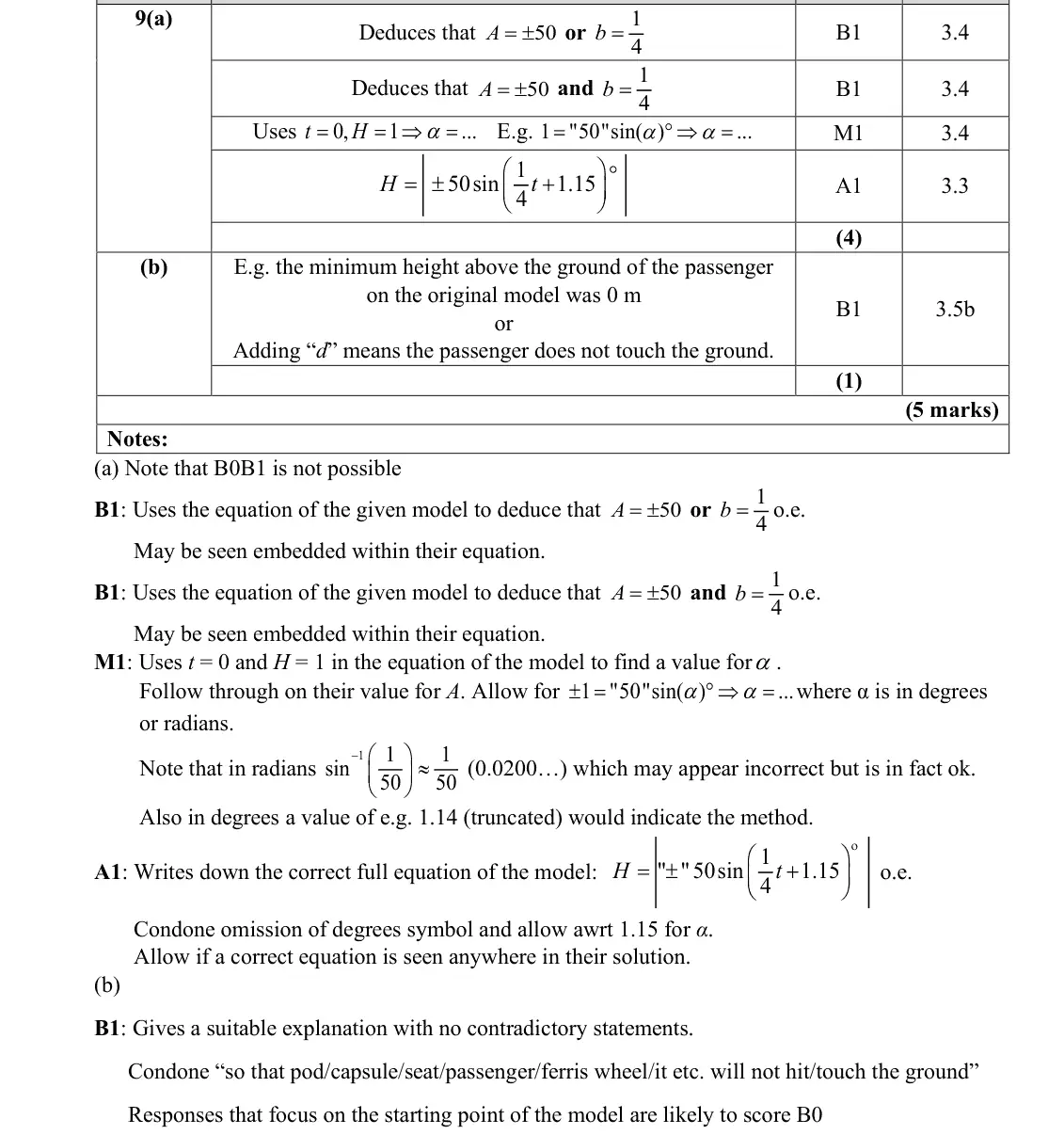
A = 50
the modulus means one revolution is half a sine period, so 180/b = 720 gives b = ¼ (not ½ or 1/720)
α from 1 = 50 sin α, α = 1.15 (degrees)
give the full equation H = modulus of 50 sin(¼t + 1.15)°
June 2022 · Paper 2 · Q9(b)1 mark
Mark scheme (whole question; this part is marked with the orange bar)
Examiner's comment
than 5% of the cohort (the second least commonly scored mark in the paper). In part (b), many candidates incorrectly referred to the fact that the passenger was 1 m above the ground and related the value of 𝑑𝑑 to this fact, for the most part because they had not appreciated that the original model already took this into account. Some responses referred to the fact that the height needed to be a positive value or could not be negative, again missing that the modulus signs in the original model accounted for this. Some responses did not refer to the context of the model in their explanation. ground without adding the constant ‘𝑑𝑑.’ There were also a few illogical answers Overall, around a fifth of candidates understood that the passenger would touch the referring to air resistance, etc. A few students also incorrectly though that ‘+ d’ was in reference to the different heights of the passengers. A small number of candidates seemed to think that the graph showed the path of the position of the passenger, referencing that the passenger “bounced off the ground” and that the ‘+ d’ had the effect of smoothing out the ride. When students were successful in this part the most common responses were that ‘+ d’ meant that: the Ferris wheel would not touch/scrape the ground, the passenger/seat cannot touch the ground or there needed to be a minimum gap between the passenger/wheel and the ground. There were many attempts at part (b) without any attempt at part (a). It was unfortunately quite common that responses to this part were very difficult to read and centres need to stress to candidates that work cannot be awarded marks if it is illegible.
Common mistakes
the original model has minimum height 0 m, so the passenger would touch the ground
answers about starting 1 m above the ground or H being non-negative score 0
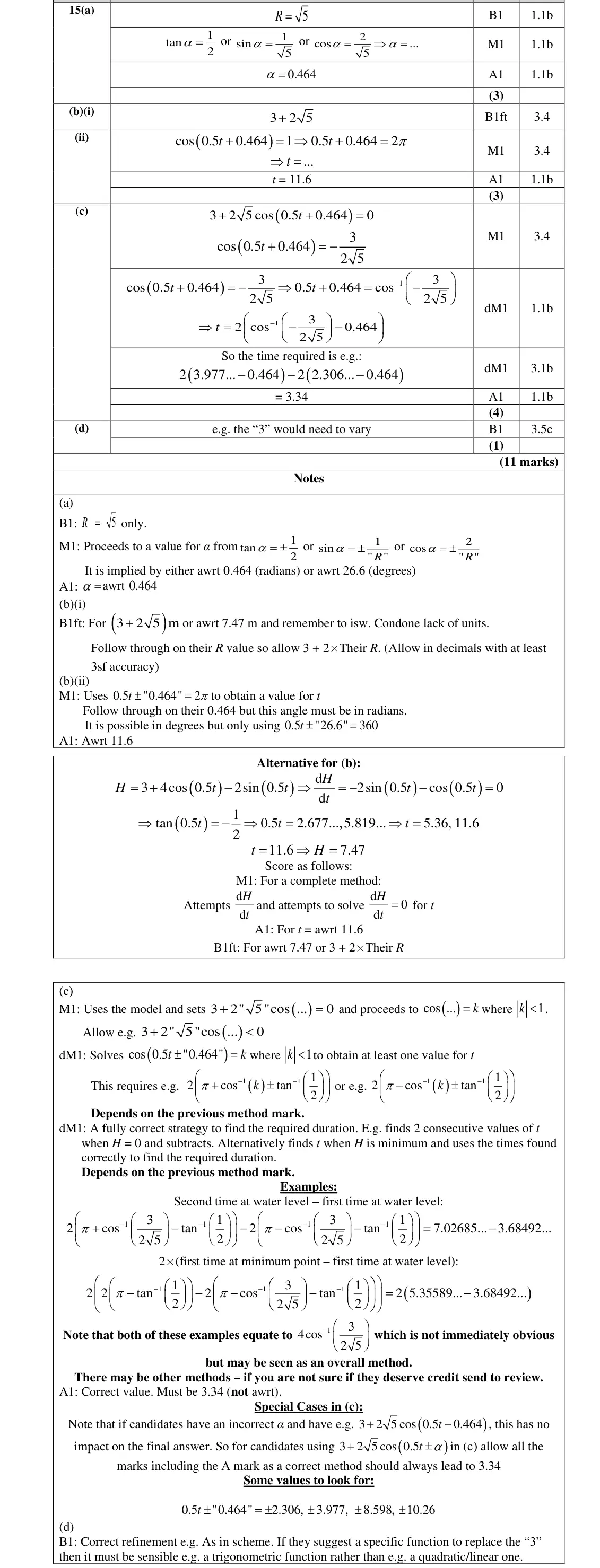
Oct 2021 · Paper 2 · Q15(b)3 marks
Mark scheme (whole question; this part is marked with the orange bar)
Examiner's comment
This question discriminated well between candidates that got this far, but it did appear that many candidates had simply run out of time, perhaps indicative of a generally lower understanding than in a June series because of it being a resit paper following the pandemic. Part (b)(i) was usually well attempted by those who had answered part (a), however, some candidates did not recognise the need to double 𝑅𝑅 and arrived at 3 + 𝑅𝑅 rather than 3 + 2𝑅𝑅 instead. Others simply assumed that the maximum was 3, 5 or 7, from a poor understanding of combining two trigonometric functions and the purpose of using the compound angle formulae to combine these two functions. Part (b)(ii) proved to cause problems for many candidates, with the majority incorrectly assuming that 0.5𝑡𝑡+ 𝛼𝛼= 0, and proceeded to ignore that this equation results in a negative value of 𝑡𝑡 (usually -0.9) by simply making this value of 𝑡𝑡 positive. They had failed to recognise that the first maximum would occur when 0.5𝑡𝑡+ 𝛼𝛼= 2𝜋𝜋. Perhaps the use of a sketch or graphical calculators would have helped these candidates. An alternative approach to part (b) required candidates to differentiate 𝐻𝐻, either in its original form or having used part (a) and solve the equation d𝐻𝐻 d𝑡𝑡= 0. This approach was more complicated and resulted in needing to solve tan(0.5𝑡𝑡) = - 1 2 and find the third solution, in order to avoid finding the maximum when 𝑡𝑡< 0 or the first minimum. Generally, candidates taking this approach were unsuccessful in scoring the accuracy mark, although the method mark was scored reasonably frequently.
Common mistakes
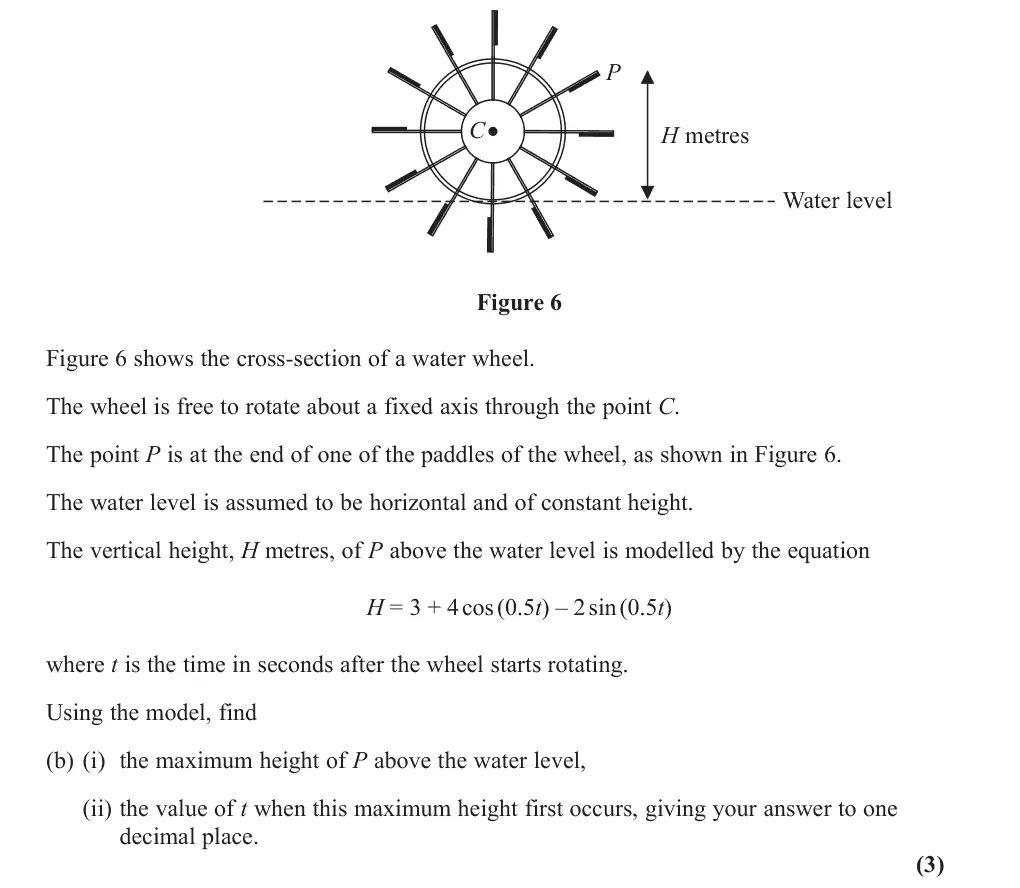
H = 3 + 2√5 cos(0.5t + 0.464), so maximum 3 + 2R = 7.47 m (not 3 + R)
first maximum when 0.5t + α = 2π (0 gives negative t)
t = 11.6
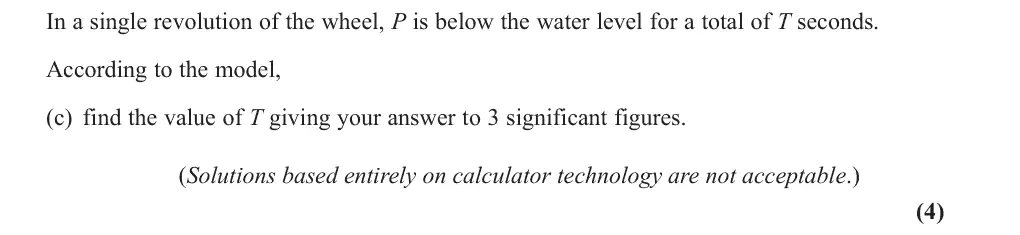
Oct 2021 · Paper 2 · Q15(c)4 marks
Mark scheme (whole question; this part is marked with the orange bar)
Examiner's comment
This question discriminated well between candidates that got this far, but it did appear that many candidates had simply run out of time, perhaps indicative of a generally lower understanding than in a June series because of it being a resit paper following the pandemic. Part (c) was another challenging part to this question and many candidates made no attempt. A surprising proportion of candidates attempted to solve the equation cos(0.5𝑡𝑡+ 𝛼𝛼) = -1, apparently in an attempt to find the minimum, but did not appear to understand how to use this to solve the problem. It was uncommon to see this method result in a correct value for 𝑇𝑇. More commonly, candidates were successful in finding a value for 𝑡𝑡 that satisfied 𝐻𝐻= 0, but incorrectly interpreted this as the solution to the problem. Instead, they were required to find a second value of 𝑡𝑡 and find the difference between these times. Again, there were a number of efficient and concise solutions to the problem that demonstrated an excellent understanding of what was required.
Common mistakes
set H = 0: cos(0.5t + 0.464) = −3/(2√5)
need two consecutive solutions and their difference (one time is not T)
3.34 exactly to 3 s.f.
Oct 2021 · Paper 2 · Q15(d)1 mark
Mark scheme (whole question; this part is marked with the orange bar)
Examiner's comment
This question discriminated well between candidates that got this far, but it did appear that many candidates had simply run out of time, perhaps indicative of a generally lower understanding than in a June series because of it being a resit paper following the pandemic. The final mark in this question, in part (d), was rarely scored, and demonstrated that candidates are generally not well prepared to answer questions about refining models, as required in AO3.5c. Many candidates did attempt this part, often despite making little or no progress with the earlier parts of the question. Most concentrated on having an extra constant, wanted the average water level to be used, or simply restated the question by saying that the varying water level needed to be accounted for, without suggesting how this might be done. Others knew that they needed to adjust the model, but suggested exponential, linear or quadratic terms to do this, which would not have been appropriate. Again, there were some excellent and detailed explanations of how a trigonometric function could be included to taken into account the varying water level .
Common mistakes
the constant 3 must vary with t, e.g. a trigonometric function (not linear/quadratic or just "use an average")
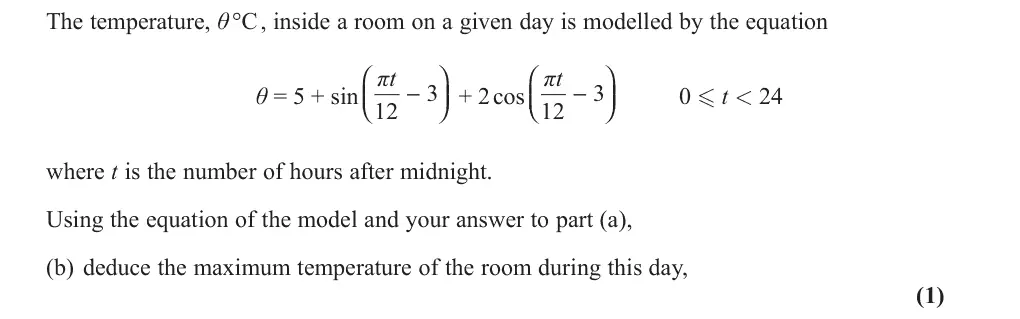
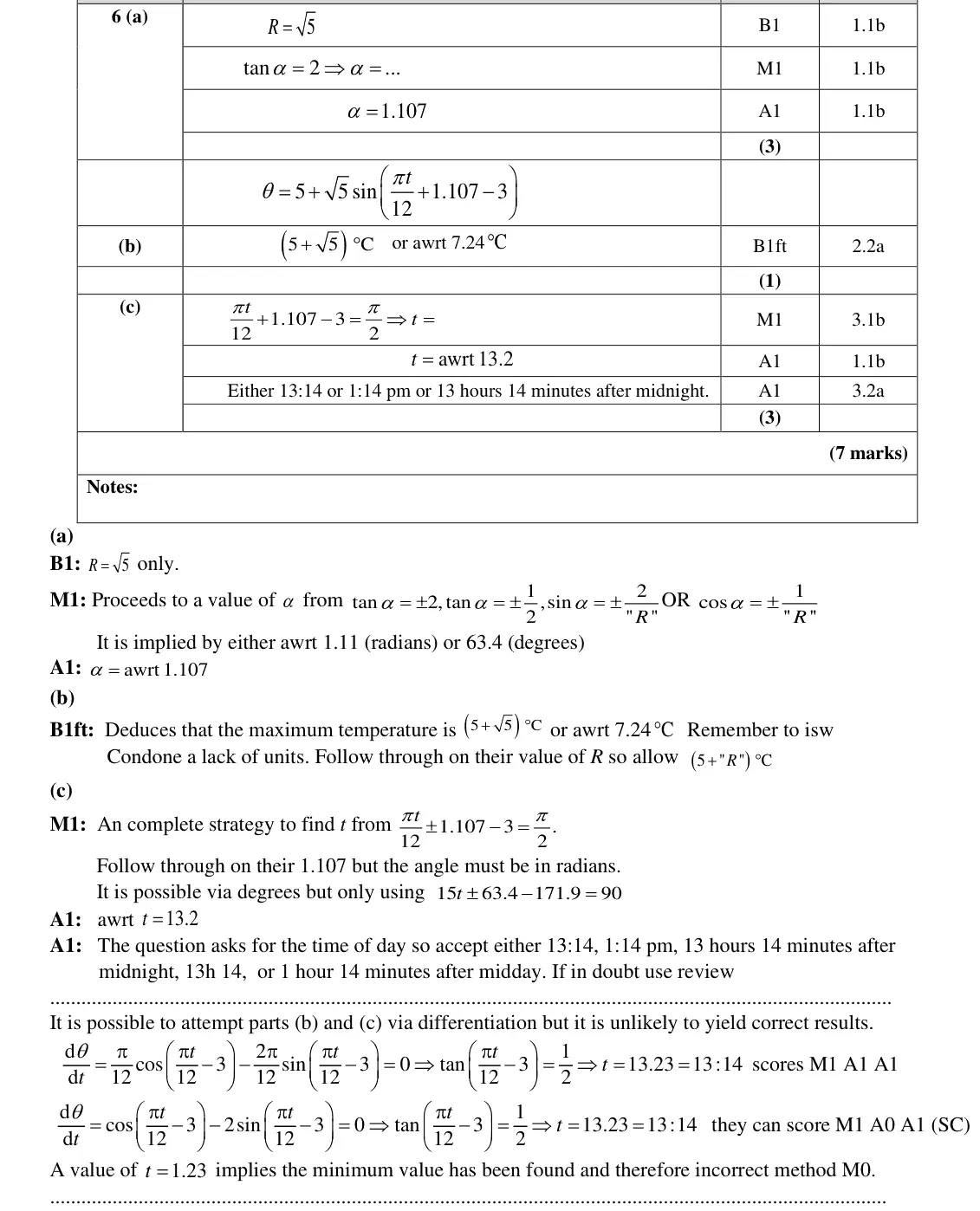
Oct 2020 · Paper 1 · Q6(b)1 mark
Mark scheme (whole question; this part is marked with the orange bar)
Examiner's comment
This was the second modelling question on the paper. Part (b) was also well done with most of those candidates giving the exact answer for the temperature. Occasionally candidates obtained an answer of 8° C from 5 + 1 + 2, which they obtained from taking the maximum values of sin and cos.
Common mistakes
θ = 5 + √5 sin(πt/12 + 1.107 − 3), so maximum 5 + √5 = 7.24 °C
adding the maxima of sin and cos separately (5 + 1 + 2 = 8) is wrong
Oct 2020 · Paper 1 · Q6(c)3 marks
Mark scheme (whole question; this part is marked with the orange bar)
Examiner's comment
This was the second modelling question on the paper. Part (c) was more challenging. The correct answer could be obtained fairly quickly by solving 1.107 3 12 2 t + - = pi pi but often the 1.107 and/or the 3 were omitted. Stating the time in an acceptable format also proved surprisingly difficult.
Common mistakes
solve πt/12 + 1.107 − 3 = π/2 in radians, t = 13.2
the 1.107 and the 3 are often omitted
give a time of day, 13:14 (1:14 pm)
June 2018 · Paper 1 · Q8(a)1 mark
Mark scheme (whole question; this part is marked with the orange bar)
Examiner's comment
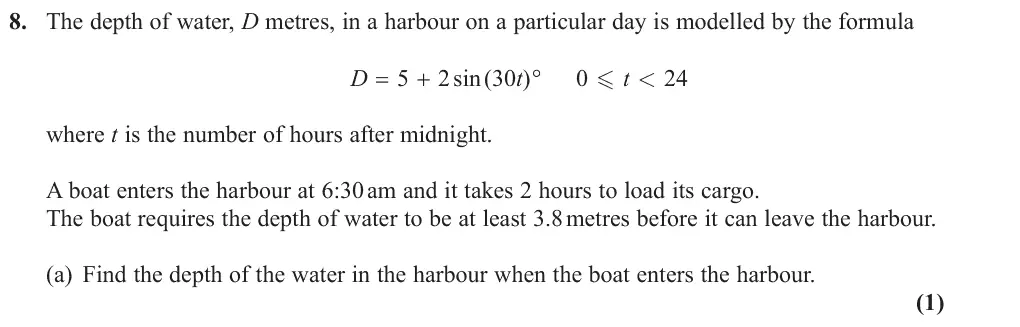
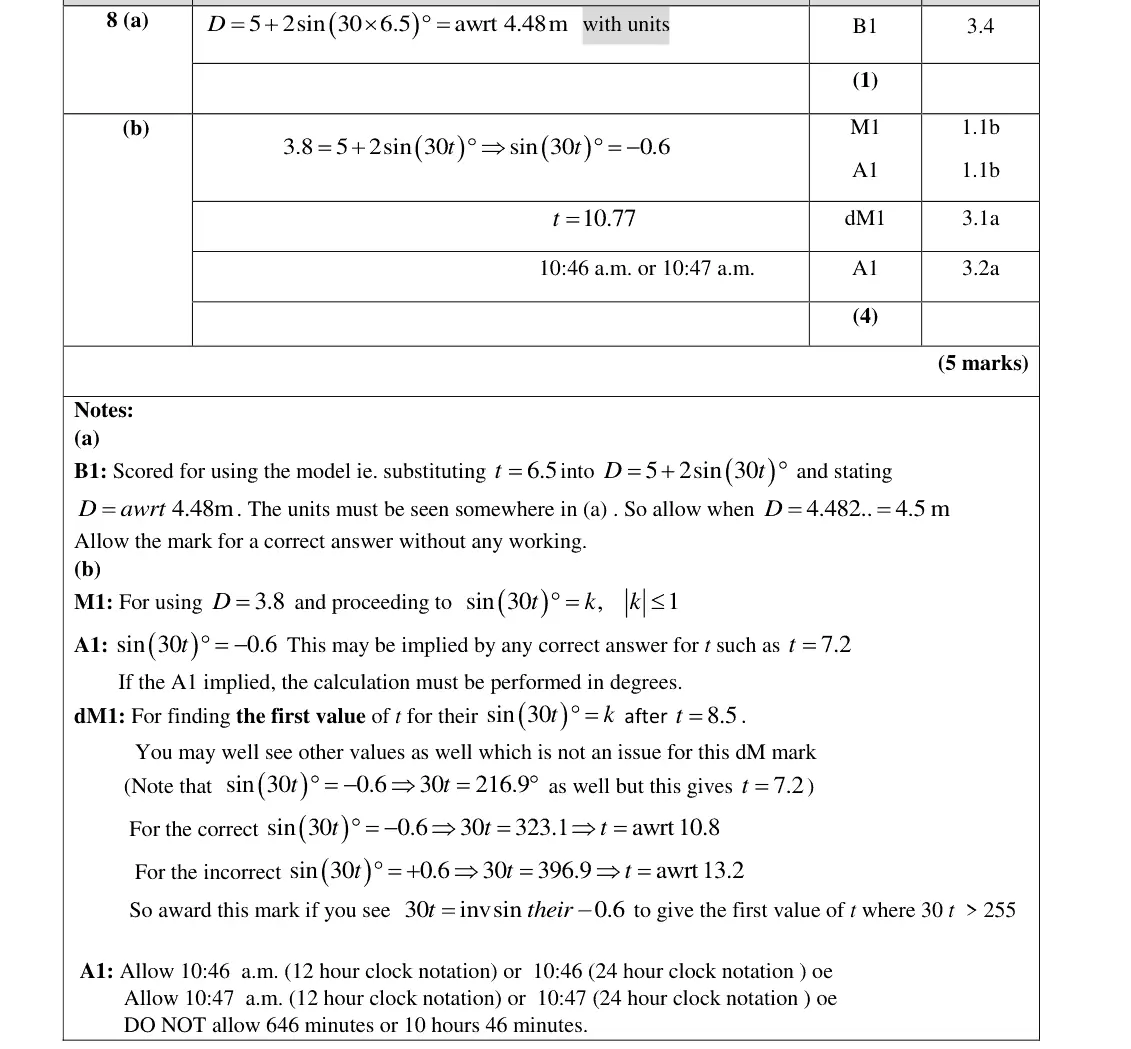
This question involved modelling the depth of water in a harbour using a trigonometric function. The mark in part (a) was usually scored, although some students did forget to include the units for the answer of 4.48 metres. Other errors seen were as a result of t 0 substituting incorrect values of t , usually , into the equation for D or prematurely rounding their answer to 4.5 metres. Most students also started part (b) correctly and were able to proceed to the intermediate
Common mistakes
t = 6.5 (not t = 0), calculator in degrees
4.48 m with units, not rounded to 4.5
June 2018 · Paper 1 · Q8(b)4 marks
Mark scheme (whole question; this part is marked with the orange bar)
Examiner's comment
This question involved modelling the depth of water in a harbour using a trigonometric Most students also started part (b) correctly and were able to proceed to the intermediate t point of sin30 0.6 without much difficulty. The final part of the question, however, proved to be much more difficult, with many students not finding a value of t greater than 8.5, giving 𝑡= 7.2 then a time of 7: 14𝑎𝑚. Of those who correctly found 𝑡= 10.77 a large number failed to give their final answer as a time, with 10 hours and 46 minutes being common. A number of successful students were noteworthy in terms of the clear presentation and communication of their solutions, often producing sketch graphs of the sine curve to aid their understanding.
Common mistakes
sin(30t)° = −0.6
need the first t after 8.5 (loading ends 8:30): 30t = 323.1 so t = 10.77, not 7.2 (7:14 am)
answer as a time 10:46 am, not 10 hours 46 minutes
Find an Edexcel maths tutor
Stuck on this? Book a trial session with an Edexcel specialist.