Notes, worked examples and practice for this topic are being written by our tutors. The past-paper questions below are ready now: work each one on paper, then open the mark scheme and the examiner's comment.
Tap a question to zoom it. Mark scheme and examiner's comment open under each question.
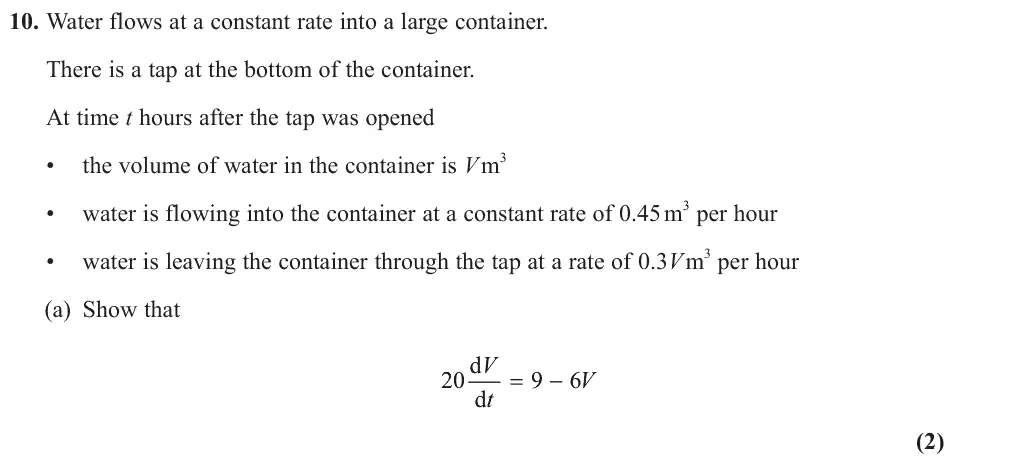
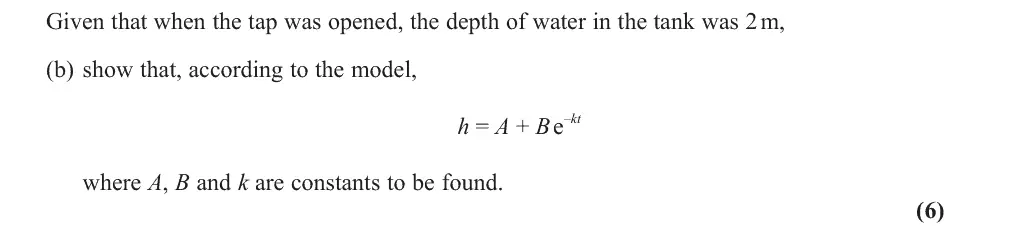
June 2025 · Paper 2 · Q10(a)2 marks
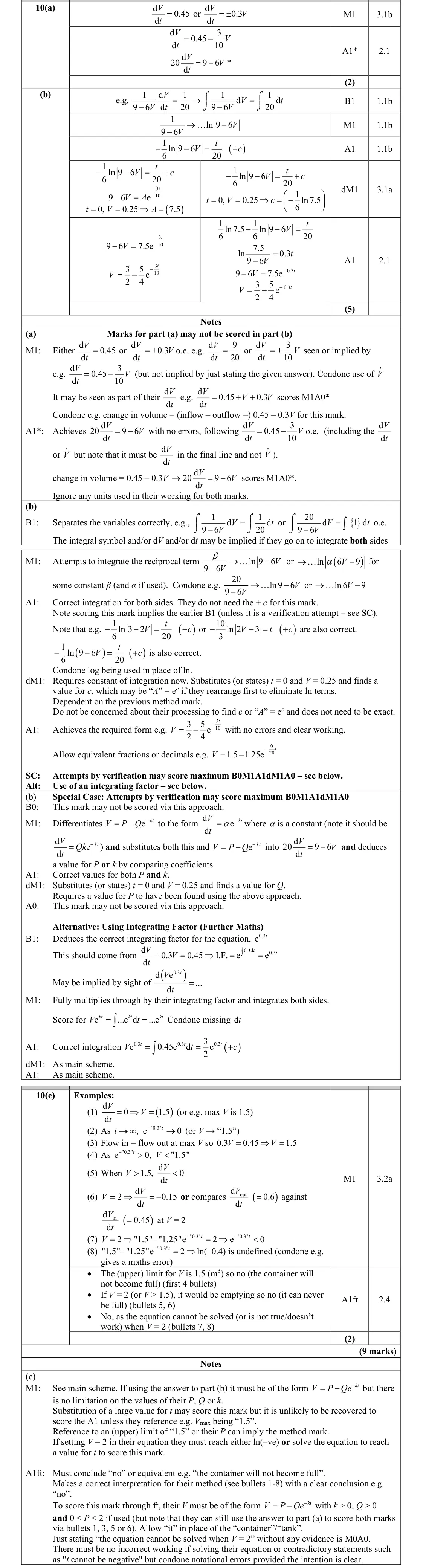
Mark scheme (whole question; this part is marked with the orange bar)
Examiner's comment
This question, which involved setting up and solving a differential equation using separation of variables, proved to discriminate across the cohort, with a wide range in quality of responses seen. The restart opportunities provided were well used, allowing many learners to access later parts of the question even if they had struggled in earlier parts. Part (a) was generally well answered with most responses demonstrating good understanding of the problem. Responses generally deduced an expression for d d V t and went on to score full marks for multiplying through by 20. The few responses that did not score on this part often tried to incorporate a connected rates of change type approach and some deriving an expression for V = 0.45t – 0.3VT and attempted to differentiate it, usually incorrectly.
Common mistakes
dV/dt = 0.45 − 0.3V (rate in minus rate out) then multiply by 20
connected-rates approaches fail
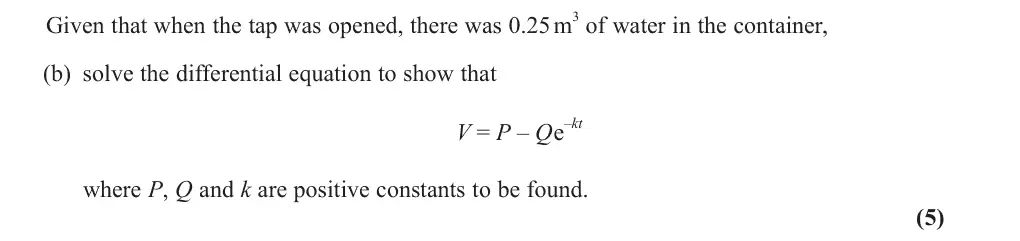
June 2025 · Paper 2 · Q10(b)5 marks
Mark scheme (whole question; this part is marked with the orange bar)
Examiner's comment
This question, which involved setting up and solving a differential equation using separation of variables, proved to discriminate across the cohort, with a wide range in quality of responses seen. The restart opportunities provided were well used, allowing many learners to access later parts of the question even if they had struggled in earlier parts. In part (b), some learners recognised the need to separate the variables and were able to do this successfully. A significant number placed the 20 incorrectly and others struggled to separate correctly into the reciprocal form which limited access to further marks. Those who separated the variables were generally able to score the method mark for the integration at the beginning of the process. Common mistakes were omitting the 1 6 - , not including the minus sign or multiplying by –6. Most learners included a constant of integration, and most learners recognised the need to use the given initial conditions to find it - those who made it this far generally made the correct substitution of V = 0.25 and t = 0 and obtained a value for the constant. The final mark proved challenging for many, with errors in rearranging their equation to the given form being particularly common. Many struggled with the logarithm work, not applying sum/product or difference/quotient rules correctly, often taking e to the power of individual terms rather than the whole expression on each side of the equation.
Common mistakes
separate correctly: ∫ 1/(9 − 6V) dV = ∫ 1/20 dt
−⅙ ln(9 − 6V) (missing −⅙ or sign)
use t = 0, V = 0.25 for the constant
exponentiate the whole of each side, not term by term
V = 3/2 − (5/4)e^(−0.3t)
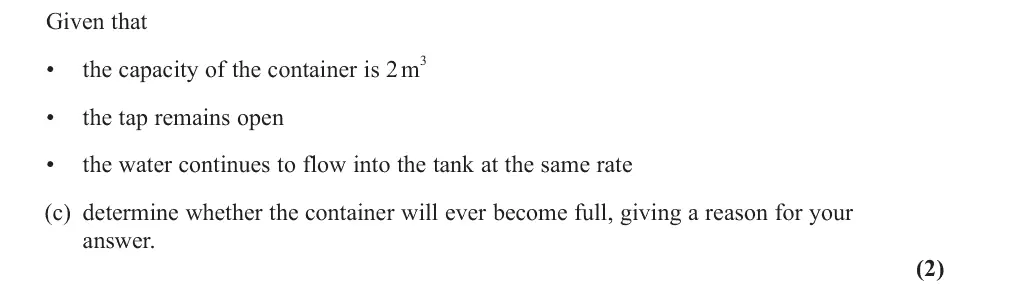
June 2025 · Paper 2 · Q10(c)2 marks
Mark scheme (whole question; this part is marked with the orange bar)
Examiner's comment
This question, which involved setting up and solving a differential equation using separation of variables, proved to discriminate across the cohort, with a wide range in quality of responses seen. The restart opportunities provided were well used, allowing many learners to access later parts of the question even if they had struggled in earlier parts. In part (c), it was pleasing that learners generally considered the behaviour of the curve as t tended to infinity. The use of appropriate notation was generally good and often lead to full marks for the justification. A large number of responses set their equation equal to 2 and attempted to solve it, interpreting the fact that there were no solutions as meaning that the tank would not become full. If a response gained the M1 mark, the A1ft mark was achieved with a high success rate, suggesting the practical problem that was being modelled was generally well understood by learners. Many learners who did not have a successful approach to part (b) were able to engage sufficiently with the problem and access the marks in part (c) using the given answer part (a). Those attempting the problem in this way did so by considering flow rates into and out of the tank either when the volume in the tank was 2 or by identifying that the flow rate was negative once the volume reached 1.5 (or some intermediate value).
Common mistakes
as t → ∞ V → 1.5 (or dV/dt = 0 at V = 1.5) and 1.5 < 2, so it never becomes full
setting V = 2 needs ln of a negative noted
must conclude "no"
June 2024 · Paper 1 · Q7(a)3 marks
Mark scheme (whole question; this part is marked with the orange bar)
Examiner's comment
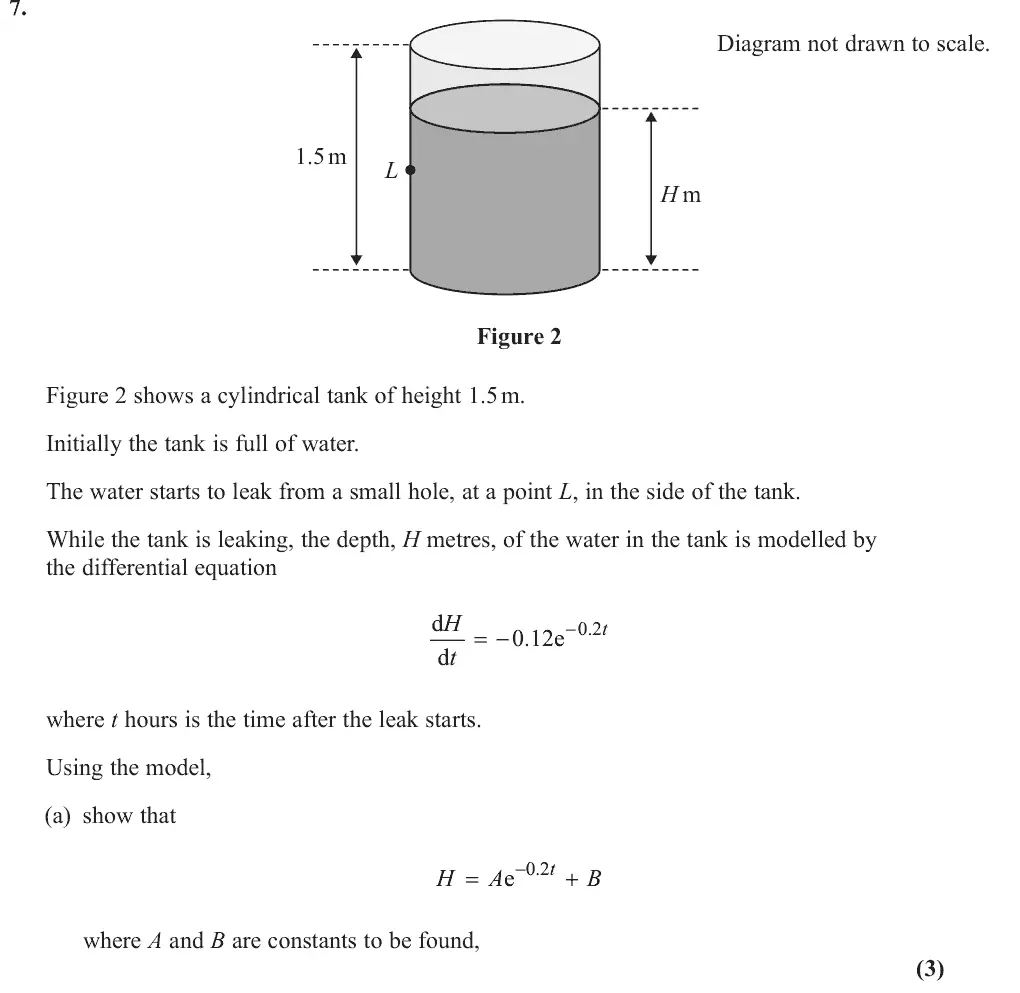
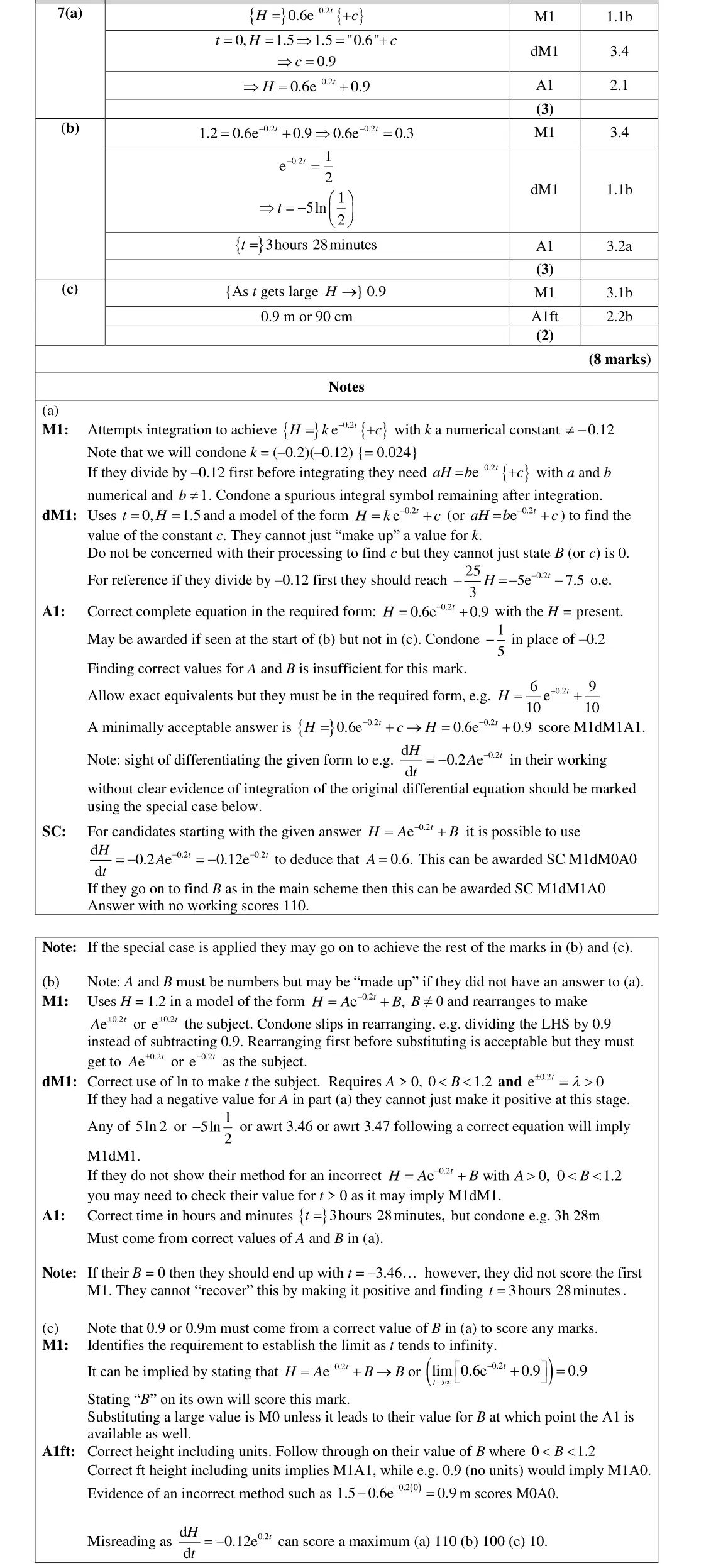
part (a) to do so. In part (a), most candidates recognised the need to integrate the expression and were able to integrate an exponential function; various methods were seen here but the majority followed the main approach in the mark scheme. A significant minority of candidates multiplied by –0.2 instead of dividing, resulting in an incorrect model and marks being lost in (b) and (c) due to having an impossible equation to solve. The vast Candidates who had a correct answer in part (a) generally performed well in part (b), with the majority able to rearrange the equation and use logarithms correctly to find the value of t. If these candidates were not awarded full marks, it was often because they were unable to convert their decimal into hours and minutes correctly, and therefore lost the final accuracy mark. Candidates who did not have a correct answer to part (a) A 0.2 t e generally gained the first method mark for making the subject of the equation, but many were not able to achieve the second method mark due to the context of the model. Candidates with B > 1.2 reached the logarithm of a negative value which should have provided an indication that there must have been an earlier error in need of addressing but few re-traced their workings and tended to use incorrect methods to create a positive answer. Part (c) was generally less well attempted than parts (a) and (b) with some candidates failing to understand what the question was asking them to do. The most common error was for candidates to attempt to solve d H t = . A surprising proportion of candidates 0 d gave answers higher than the maximum height. For candidates with successful approaches, marks were frequently lost by forgetting units and therefore not satisfying the demand of the question and finding the height of the hole. Similarly, many decided to subtract an often correct 0.9 from the maximum height, which indicated a misunderstanding of the model.
Common mistakes
integrate −0.12e^(−0.2t) to 0.6e^(−0.2t) + c (divide by −0.2, not multiply)
use t = 0, H = 1.5 to get c = 0.9 (not c = 1.5)
give the complete equation with H =
June 2024 · Paper 1 · Q7(b)3 marks
Mark scheme (whole question; this part is marked with the orange bar)
Examiner's comment
marks being lost in (b) and (c) due to having an impossible equation to solve. The vast majority of candidates remembered to include the constant of integration and use the given information to find it, likely supported by the question giving the required form of the answer as a reminder. Occasionally candidates missed out on the second method mark as they used 1.5 as the constant of integration rather than finding the constant of integration by correctly substituting H = 1.5 and t = 0, but the majority managed this with success, obtaining correct values for their constant and gaining the second method mark. A common reason for the loss of the final accuracy mark was failing to write out the final version of the model, generally omitting H = , or simply stating the values of A and B. Some candidates opted to differentiate the given answer and compare coefficients to find the values of A before going on to find B in the usual way. This verification strategy was not in line with the requirement of the question but candidates that used this method were allowed to score all but the final mark. Candidates who had a correct answer in part (a) generally performed well in part (b), with the majority able to rearrange the equation and use logarithms correctly to find the value of t. If these candidates were not awarded full marks, it was often because they were unable to convert their decimal into hours and minutes correctly, and therefore lost the final accuracy mark. Candidates who did not have a correct answer to part (a) Part (c) was generally less well attempted than parts (a) and (b) with some candidates failing to understand what the question was asking them to do. The most common error was for candidates to attempt to solve d H t = . A surprising proportion of candidates 0 d gave answers higher than the maximum height. For candidates with successful approaches, marks were frequently lost by forgetting units and therefore not satisfying the demand of the question and finding the height of the hole. Similarly, many decided to subtract an often correct 0.9 from the maximum height, which indicated a misunderstanding of the model.
Common mistakes
0.6e^(−0.2t) = 0.3 so t = 5 ln 2 = 3.47 h
convert to 3 hours 28 minutes (conversion errors common)
June 2024 · Paper 1 · Q7(c)2 marks
Mark scheme (whole question; this part is marked with the orange bar)
Examiner's comment
marks being lost in (b) and (c) due to having an impossible equation to solve. The vast majority of candidates remembered to include the constant of integration and use the given information to find it, likely supported by the question giving the required form of the answer as a reminder. Occasionally candidates missed out on the second method mark as they used 1.5 as the constant of integration rather than finding the constant of integration by correctly substituting H = 1.5 and t = 0, but the majority managed this with success, obtaining correct values for their constant and gaining the second method mark. A common reason for the loss of the final accuracy mark was failing to write out the final version of the model, generally omitting H = , or simply stating the values of A and B. Some candidates opted to differentiate the given answer and compare coefficients to find the values of A before going on to find B in the usual way. This verification strategy was not in line with the requirement of the question but candidates that used this method were allowed to score all but the final mark. Candidates who had a correct answer in part (a) generally performed well in part (b), Part (c) was generally less well attempted than parts (a) and (b) with some candidates failing to understand what the question was asking them to do. The most common error was for candidates to attempt to solve d H t = . A surprising proportion of candidates 0 d gave answers higher than the maximum height. For candidates with successful approaches, marks were frequently lost by forgetting units and therefore not satisfying the demand of the question and finding the height of the hole. Similarly, many decided to subtract an often correct 0.9 from the maximum height, which indicated a misunderstanding of the model.
Common mistakes
as t → ∞, e^(−0.2t) → 0 so H → B = 0.9 m (units needed)
1.5 − 0.6 is a wrong method
substituting a large t scores M0
June 2024 · Paper 1 · Q14(a)1 mark
Mark scheme (whole question; this part is marked with the orange bar)
Examiner's comment
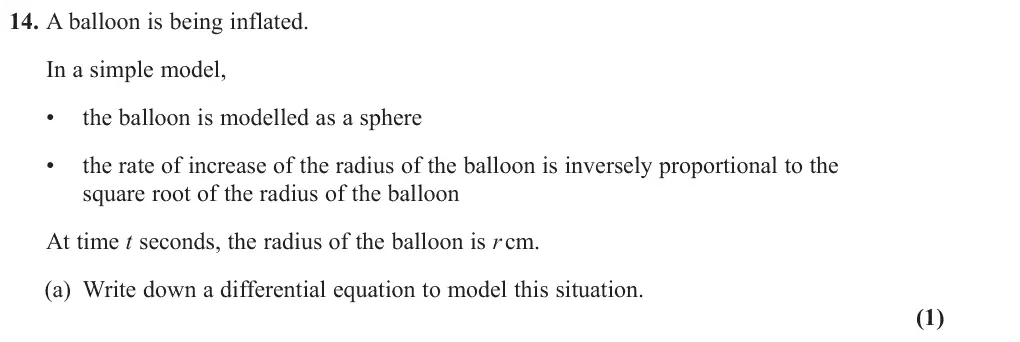
This question involved a balloon modelled as a sphere such that its radius was increasing at a rate that was inversely proportional to the square root of the radius. Those that were unable to find a correct differential equation in part (a) were fairly limited in the number of marks that could be scored in part (b), but the given answer In part (a), 1 mark was available for writing down a correct differential equation to model the given situation. Very often this part was answered successfully. When the mark was not awarded it was usually because candidates had simply used d 1 r = d t r rather than d r k = . d t r differential equation from part (a). For those that offered an equation without a constant of proportionality, i.e. d 1 r = , d t r it was only possible to access two out of five marks in part (b). Generally, candidates
Common mistakes
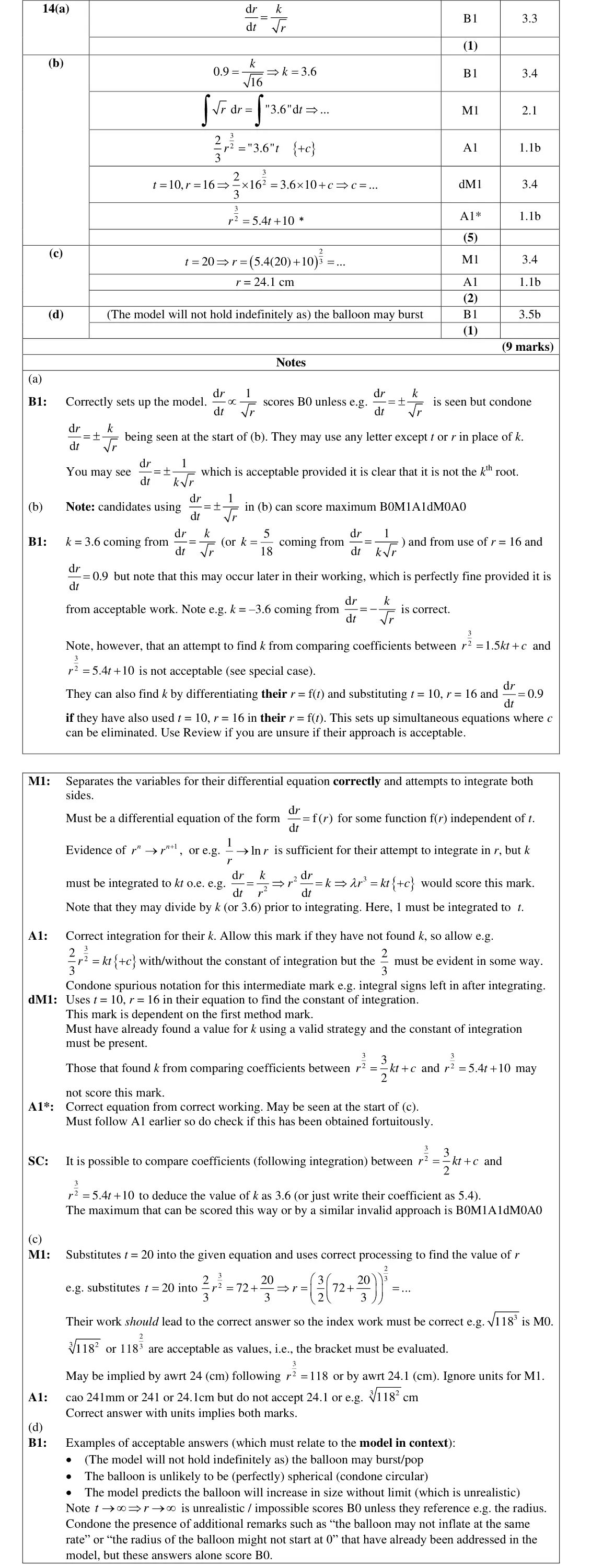
dr/dt = k/√r with a constant of proportionality (dr/dt = 1/√r scores 0)
June 2024 · Paper 1 · Q14(b)5 marks
Mark scheme (whole question; this part is marked with the orange bar)
Examiner's comment
This question involved a balloon modelled as a sphere such that its radius was increasing at a rate that was inversely proportional to the square root of the radius. limited in the number of marks that could be scored in part (b), but the given answer provided an excellent restart opportunity, and a significant proportion went on to score full marks in parts (c) and (d). In part (b) candidates were given some values for the model and were required to solve their differential equation and use the given values to show the given answer solved the differential equation from part (a). it was only possible to access two out of five marks in part (b). Generally, candidates seemed well practiced in separating the variables and integrating the resulting equation correctly. When attempted, the most common error was in the index of the radius, either by using an incorrect model or by separating variables incorrectly. The most successful responses found the constant of proportionality straight away, before integrating. Some of those who did not do this at the start struggled to know to go back to find it and therefore could not progress further by substituting for t and r in their integrated model as they had both k and c still to be found. Occasionally, candidates substituted 0.9 or another value for k, instead of substituting 0.9 for d r t . d The given answer to part (b) enabled many who were unsuccessful in the early parts of this question to go on and successfully answer part (c). This question was generally very
Common mistakes
k = 3.6 from 0.9 = k/√16 (comparing coefficients with the given answer is invalid)
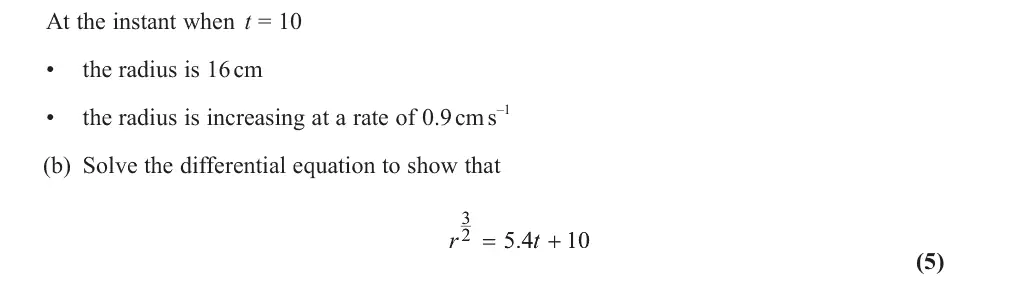
separate √r dr = k dt
⅔r^(3/2) = 3.6t + c
use t = 10, r = 16 for c
June 2024 · Paper 1 · Q14(c)2 marks
Mark scheme (whole question; this part is marked with the orange bar)
Examiner's comment
This question involved a balloon modelled as a sphere such that its radius was increasing at a rate that was inversely proportional to the square root of the radius. full marks in parts (c) and (d). this question to go on and successfully answer part (c). This question was generally very well attempted, and most candidates used correct processing to calculate the correct value. However, some failed to do so with the required accuracy or made an error in unit conversion. Many did not give the correct units, or any units, forfeiting the final 3 r = 118 mark. There was a significant minority who, having progressed to , failed to 2 3 118 and did not score use correct processing to solve the equation, incorrectly finding 2 the method mark as a result. A single mark was available in part (d), for suggesting a limitation to the model, and for
Common mistakes
r = 118^(2/3) = 24.1 cm (nearest mm), units needed
index errors e.g. √118³
June 2024 · Paper 1 · Q14(d)1 mark
Mark scheme (whole question; this part is marked with the orange bar)
Examiner's comment
This question involved a balloon modelled as a sphere such that its radius was increasing at a rate that was inversely proportional to the square root of the radius. full marks in parts (c) and (d). A single mark was available in part (d), for suggesting a limitation to the model, and for some candidates this was the only mark gained in the question. Very many candidates scored the mark for pointing out that the balloon would eventually “pop”, or that the assumption that the balloon was perfectly spherical was unrealistic. Some candidates offered a more sophisticated response involving taking the limit for large times, although this was only acceptable if there was some reference to context such as the radius or volume. The most common incorrect response involved commenting on the “rate of inflation of the balloon being constant” as unrealistic, but this aspect had already been addressed in the model.
Common mistakes
balloon bursts / is not a perfect sphere / grows without limit
comments on rate of inflation are already in the model and score 0
June 2024 · Paper 2 · Q12(b)5 marks
Mark scheme (whole question; this part is marked with the orange bar)
Examiner's comment
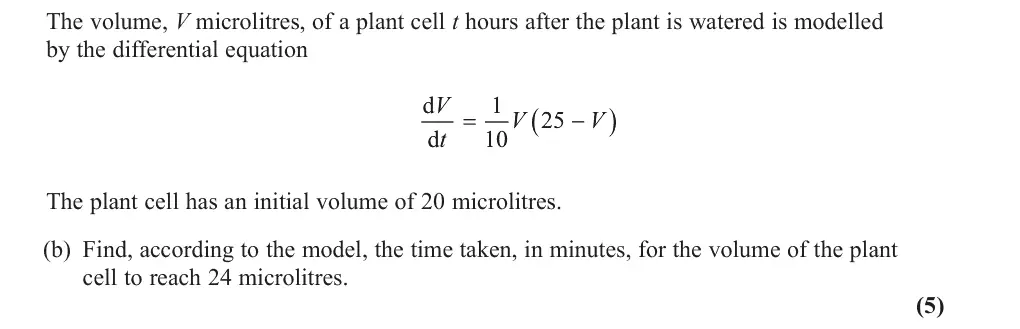
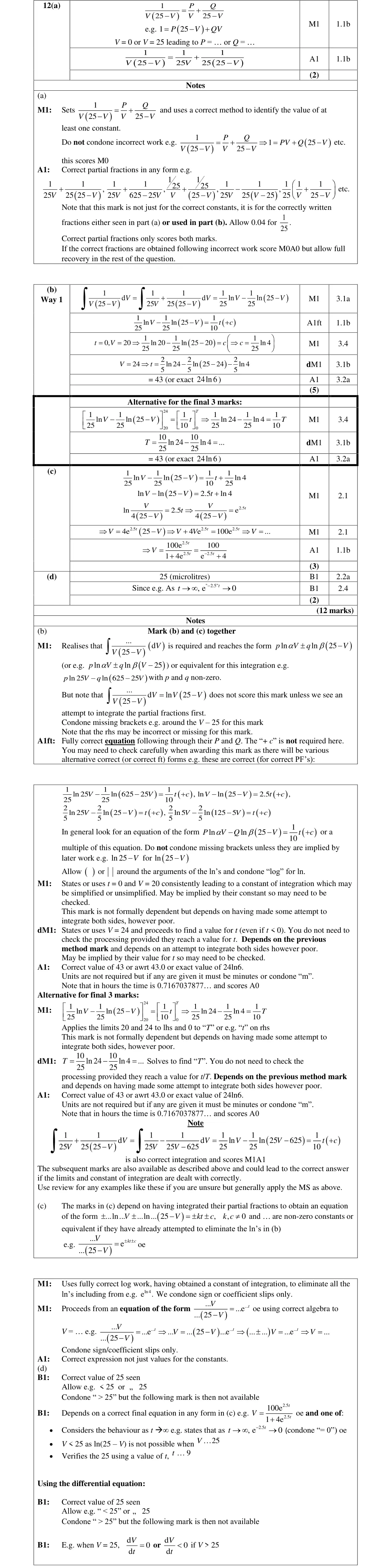
This question tested the candidates’ skill in various areas, i.e. finding partial fractions, integration, rules of logarithms, manipulating equations to eliminate logarithms using exponentials, indices, and commentating on the expected behaviour of a variable as another tends to infinity. This was a challenging question which in a number of instances, candidates struggled with after part (a). Those however, who were well prepared, were able to score full marks often with relatively concise solutions. There were occasional sign slips in the coefficients, and some candidates failed to write down their final answer, or use it in part (b), losing the second mark here. In part (b) a number of correct forms of integration were possible. Many candidates appreciated that an attempt at separation of variables and integration was required, and many reached correct equations such as ( ) 1 1 1 ln ln 25 25 25 10 V V t c - - = + or ( ) 1 1 1 ln 25 ln 25 25 25 25 10 V V t c - - = + . There were however, many slips with coefficients, and the omission of the minus sign in front of the ln(25 – V) or ln25(25 – V) term was common. Additionally, some omitted a constant of integration entirely, which meant that no further progress could be made. A surprising number of candidates did not see any link with part (a) and instead, integrated a quadratic in V, or did not integrate at all. Most candidates who attempted integration on both sides and included a constant of integration were able to score 2 method marks by using t = 0 and V = 20 to find the value of their constant and then substituting V = 24 to find the time taken. Most who got this far converted their final answer into minutes as required by the question although some candidates left the answer as 0.7167 which lost the final accuracy mark in this part. A few candidates used the alternative method of applying limits of 20 and 24 to their integral with respect to V and 0 and T for their integral with respect to t.
Common mistakes
separate variables and use the partial fractions from (a)
−ln(25 − V) sign often lost
include + c and find it from t = 0, V = 20
t = 0.7167 hours must be converted: 43 minutes
June 2024 · Paper 2 · Q12(c)3 marks
Mark scheme (whole question; this part is marked with the orange bar)
Examiner's comment
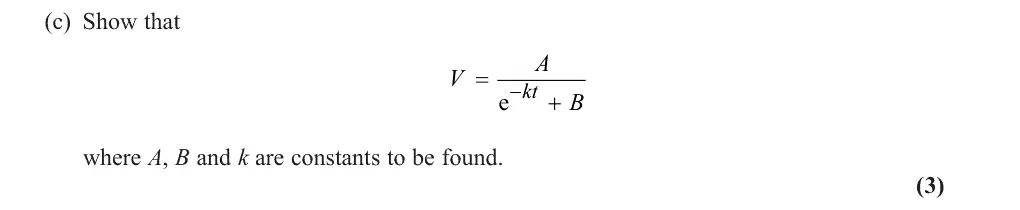
This question tested the candidates’ skill in various areas, i.e. finding partial fractions, integration, rules of logarithms, manipulating equations to eliminate logarithms using exponentials, indices, and commentating on the expected behaviour of a variable as another tends to infinity. This was a challenging question which in a number of instances, candidates struggled with after part (a). Those however, who were well prepared, were able to score full marks often with relatively concise solutions. Many candidates did not reach part (c), and some who did were not able to gain marks there because they either had not established a numerical constant of integration, or because their integrated expression was not of a correct form to earn credit. Successful attempts started with expressions such as ( ) 1 1 1 1 ln ln 25 ln 4 25 25 10 25 V V t - - = + to obtain expressions such as ( ) 1 1 ln 25 4 25 10 V t V = - and then eliminated the log to obtain ( ) 2.5 e 4 25 t V V = - and made V the subject. Some candidates obtained a correct expression for V but failed to reach the form required by the question. Incorrect log work, however, was common and expressions such as ( ) 2.5 e 4 4 25 t V V = + - were seen frequently. Candidates often made sign or coefficient errors but were awarded the method marks in (c) for a correct algebraic approach for the required rearrangement. A significant number didn’t reach the required form, leaving their answer with two 2.5 e t terms rather than the required single 2.5 e t - term.
Common mistakes
needs a numerical constant from (b)
combine logs to ln(V/(4(25 − V))) = 2.5t
make V the subject: V = 100/(e^(−2.5t) + 4)
common error splitting e^(a + b) as a sum
final form needs a single e^(−2.5t) term
June 2024 · Paper 2 · Q12(d)2 marks
Mark scheme (whole question; this part is marked with the orange bar)
Examiner's comment
This question tested the candidates’ skill in various areas, i.e. finding partial fractions, integration, rules of logarithms, manipulating equations to eliminate logarithms using exponentials, indices, and commentating on the expected behaviour of a variable as another tends to infinity. This was a challenging question which in a number of instances, candidates struggled with after part (a). Those however, who were well prepared, were able to score full marks often with relatively concise solutions. In part (d), candidates sometimes identified that L = 25, even when little else of credit was presented throughout, but usually those who had not attempted part (c) also made no attempt at (d). The reasons given were often not rigorous enough to gain credit, even when 25 had been established as the required value of L. When correct explanations were seen they usually stated that L = 25 because 2.5 e 0 t - → as t → or that L = 25 because d 0. d V t =
Common mistakes
L = 25
reason: as t → ∞, e^(−2.5t) → 0 (or dV/dt = 0 when V = 25)
reason must be rigorous
June 2023 · Paper 2 · Q11(a)3 marks
Mark scheme (whole question; this part is marked with the orange bar)
Examiner's comment
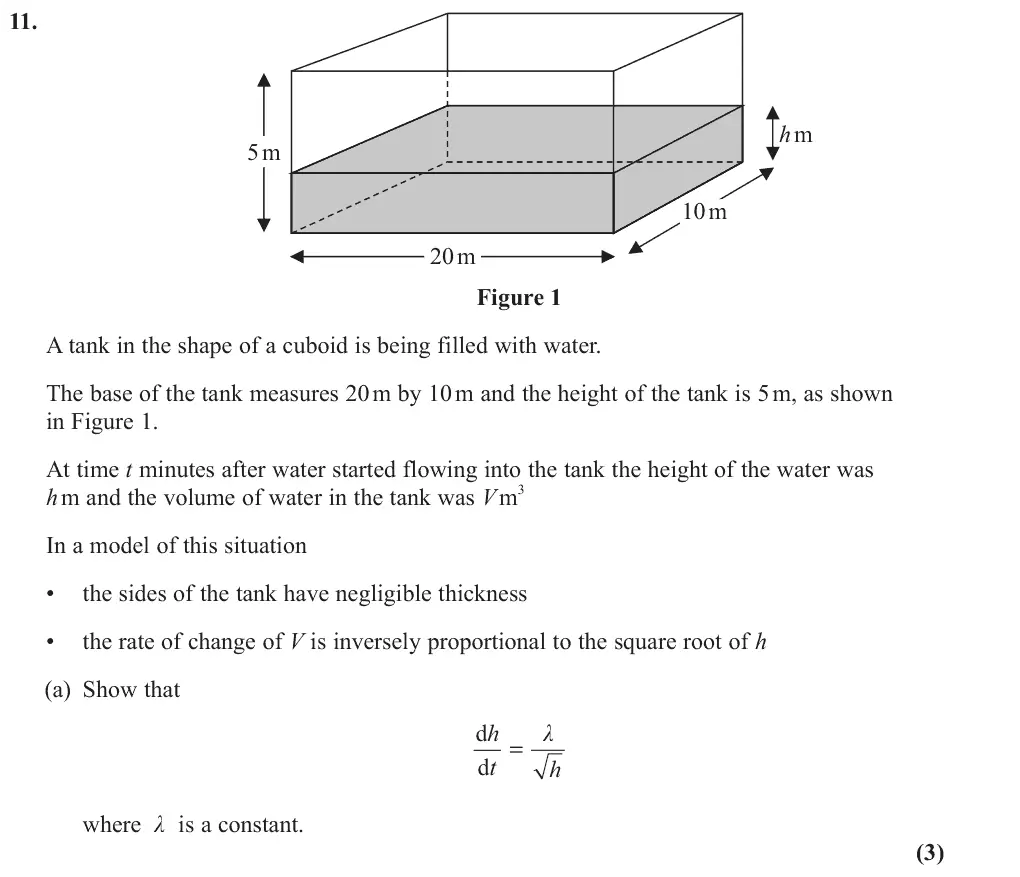
Many candidates found this question challenging and there were a significant number of blank responses. Candidates found part (a) particularly challenging, with many attaining either no marks or the first mark only. The concept of connected rates of change is one that candidates frequently struggle with. A good number found an expression for V and successfully differentiated to get d V h = 200 , although some confused the volume of water with the volume of the tank. Many d candidates failed to recognise that d V 1 and hence d V k = . Of those who had some d t d t h h concept of the rate being d V , many misunderstood the idea of inverse proportion and others d t missed the constant of proportionality. Even where candidates had correct expressions for both d and d V V , they often failed to use the chain rule correctly to find d h . Many candidates d h d t d t who did link their expressions correctly, achieving d 1 h k = d 200 t h , with k = or equivalent, stated that this could be expressed as and so gained all 200 h three marks. Others made no reference to 𝜆 and so lost the accuracy mark. A less common, but ( ) d 200 h d V = correct, approach used d d t t Approaches to part (b) of the question were very mixed. Many candidates failed to realise that,
Common mistakes
V = 200h so dV/dh = 200
dV/dt = k/√h (inverse proportion with a constant)
chain rule dh/dt = dh/dV × dV/dt = k/(200√h), then λ = k/200 must be defined
using λ for both constants loses the A mark
June 2023 · Paper 2 · Q11(b)5 marks
Mark scheme (whole question; this part is marked with the orange bar)
Examiner's comment
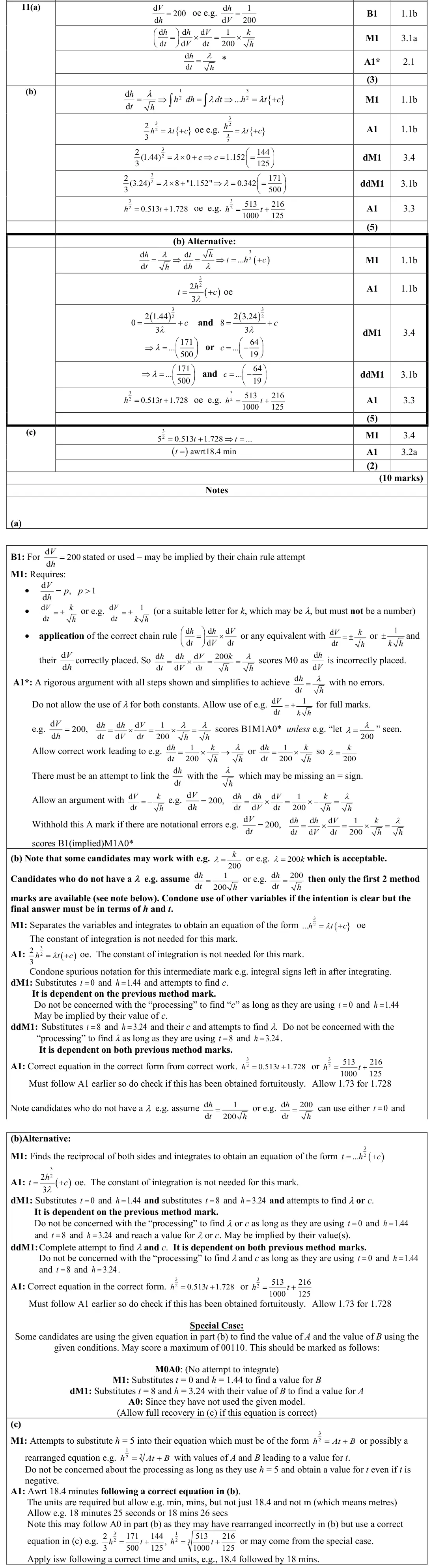
Many candidates found this question challenging and there were a significant number of blank responses. Approaches to part (b) of the question were very mixed. Many candidates failed to realise that, as the question said, ‘use the model to find an equation’, they were expected to, for example, separate the variables and use calculus to solve the differential equation. As they were asked to give their answer in a specific form, a large number started from this and found the constants A and B using the given values of t and h. Fortunately, they were able to gain two marks from the h , although special case. Candidates who used calculus rarely had problems integrating 3 h or in dealing with the 2 2 errors were seen later when substituting into when rearranging the 3 equation. Candidates who started this part with the 𝜆 were generally more successful. Some candidates correctly found c and 𝜆, and then rearranged. Others rearranged before making substitutions, stating 3 and 3 = = A 2 c B . A minority lost the second accuracy mark as they 2 did not give the final equation in the correct form. Some candidates who had correctly found d 1 h k k = solved the differential equation using 200 in place of 𝜆, in most cases d 200 t h successfully, although the algebraic manipulation was more tricky. Some candidates who had made an incorrect attempt at (a) continued with their answer, usually d 1 1 h = , in this d 200 t h part. As they only had one constant, the ‘c’, in their expression, they could only attain the first two method marks. It was rare to see the constant of integration missed and basic arithmetical errors when finding either 𝜆 and c or A and B were also relatively infrequent. The alternative approach, rearranging to give d t h or 200 h = was seen on a few occasions. d h k The majority of candidates who had a correct form of the equation in part (b) made a good attempt at part (c) and were generally able to gain the method mark. Relatively few lost the
Common mistakes
separate variables: ∫√h dh = ∫λ dt gives (2/3)h^(3/2) = λt + c
t = 0, h = 1.44 gives c = 1.152
t = 8, h = 3.24 gives λ = 0.342
h^(3/2) = 0.513t + 1.728
starting from the given form without integrating scores only 2 marks
June 2023 · Paper 2 · Q11(c)2 marks
Mark scheme (whole question; this part is marked with the orange bar)
Examiner's comment
Many candidates found this question challenging and there were a significant number of blank responses. attempt at part (c) and were generally able to gain the method mark. Relatively few lost the accuracy mark due to missing the units in their final answer. A number of candidates used an incorrect value for h, most commonly 1000, and so lost both marks.
Common mistakes
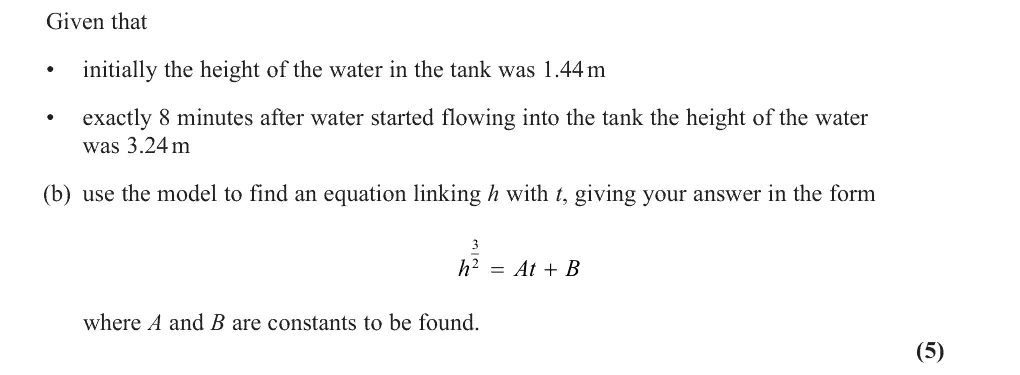
full when h = 5 (not 1000): 5^(3/2) = 0.513t + 1.728 gives t = 18.4 minutes
units needed
June 2022 · Paper 2 · Q14(b)5 marks
Mark scheme (whole question; this part is marked with the orange bar)
Examiner's comment
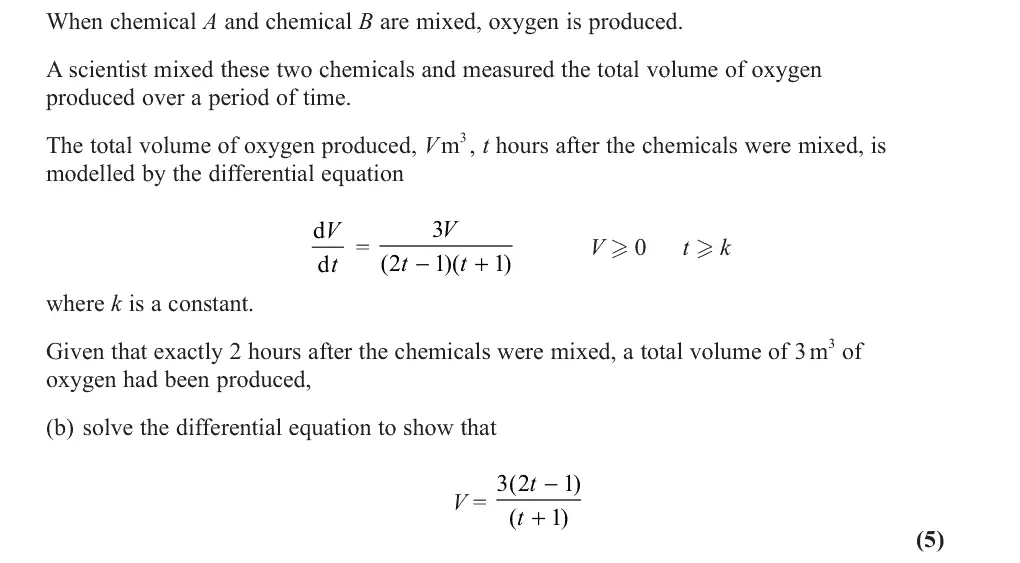
The most challenging aspect of part (b) for the candidates was to separate the variables correctly. A large proportion of candidates did not make the link to part (a) and often divided both sides by 3V as a starting point, i.e. ∫ 1 3𝑉𝑉. 𝑑𝑑𝑑𝑑= ∫ 1 (2𝑡𝑡-1)(𝑡𝑡+1) . 𝑑𝑑𝑑𝑑 Where candidates did this they often would incorrectly replace the right hand side with the partial fraction they had found in part (a). For the candidates that got as far as this, the integration of the partial fractions they put in place was generally completed well with the key …ln(2t - 1) - …ln(t + 1) being found more often than not although a common error was leaving a multiplier of 2 when integrating the first fraction to give 2ln(2𝑡𝑡-1). Regardless of the integration a candidate had achieved, there were a large number of candidates that did not consider the constant of integration and tried to jump straight to the answer at this stage. Generally, if a candidate remembered their integration constant, they were more often than not successful in using the given limits to obtain a value which they could use to find an equation for V. A few attempts at solving the first order linear differential equation using an Integrating Factor were seen. Those employing this method were usually reasonably successful.
Common mistakes
separate as ∫1/V dV = ∫3/((2t − 1)(t + 1)) dt and use (a) (not dividing by 3V then misusing (a))
∫2/(2t − 1) dt = ln(2t − 1), not 2ln
include + c and find it from t = 2, V = 3 before combining logs
June 2022 · Paper 2 · Q14(c)2 marks
Mark scheme (whole question; this part is marked with the orange bar)
Examiner's comment
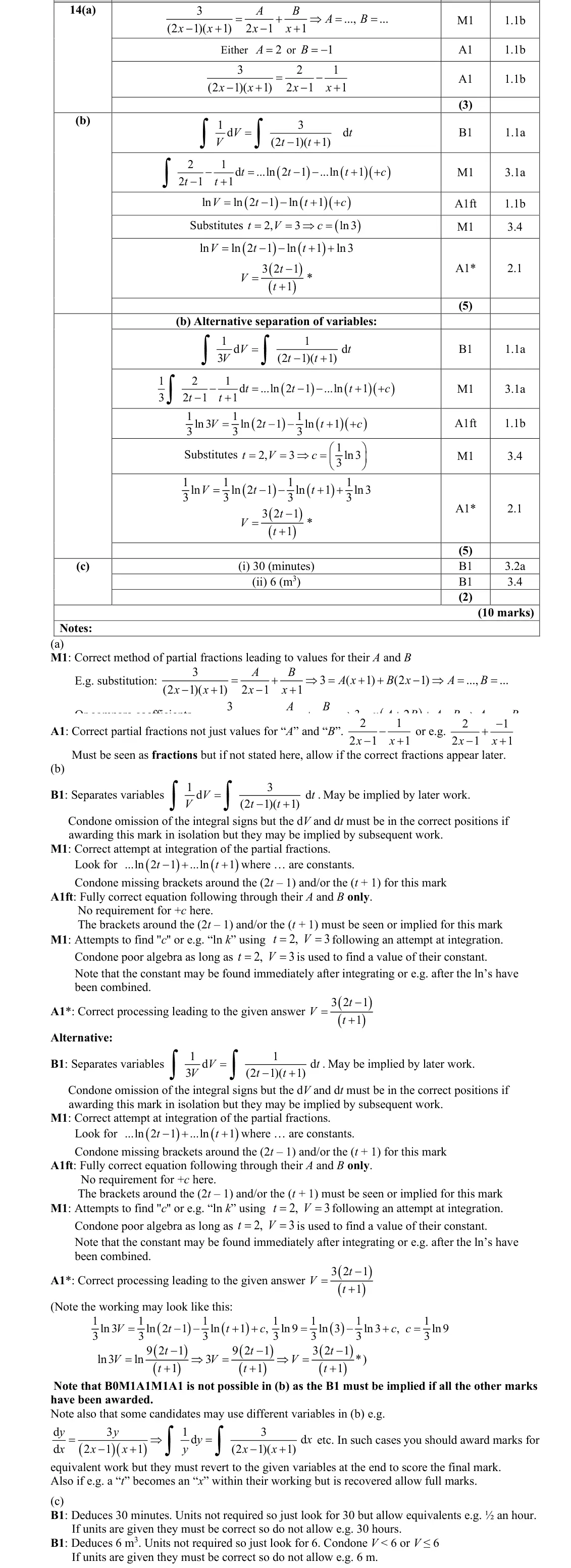
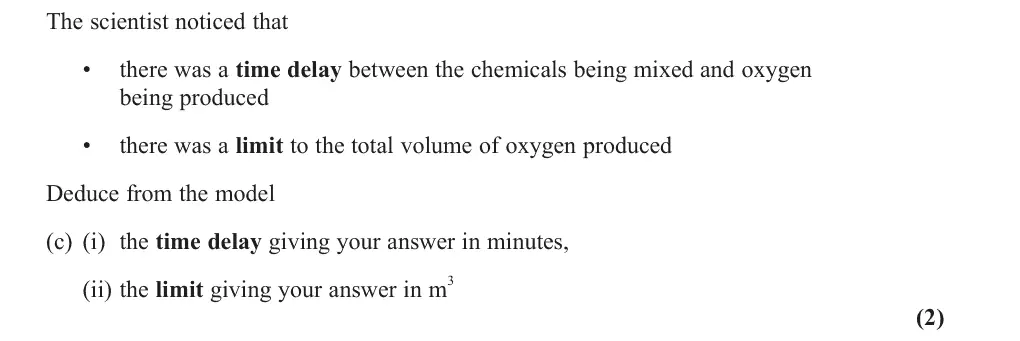
In part (c) the solution of 30mins was only obtained by the strongest candidates although many did not attempt this part of the question or possibly failed to see it. Of those that did attempt this part, a common answer was to obtain ½ but not recognise the units of the question were in hours, some giving it incorrectly as 0.5 minutes As the equation for the volume was a given in this question most candidates were able to attempt this in spite of their attempt at part (b). Candidates gave the correct 6m3 although a substantial number thought that 3m3 was the answer. Although candidates were not required to provide units, many did so correctly and marks were rarely lost for stating incorrect units although a few instances of mm3 were seen.
Common mistakes
(i) V = 0 at t = ½ hour = 30 minutes (not 0.5 or 0.5 minutes)
(ii) V → 6 m³ as t → ∞ (3 is wrong)
Oct 2021 · Paper 2 · Q14(a)4 marks
Mark scheme (whole question; this part is marked with the orange bar)
Examiner's comment
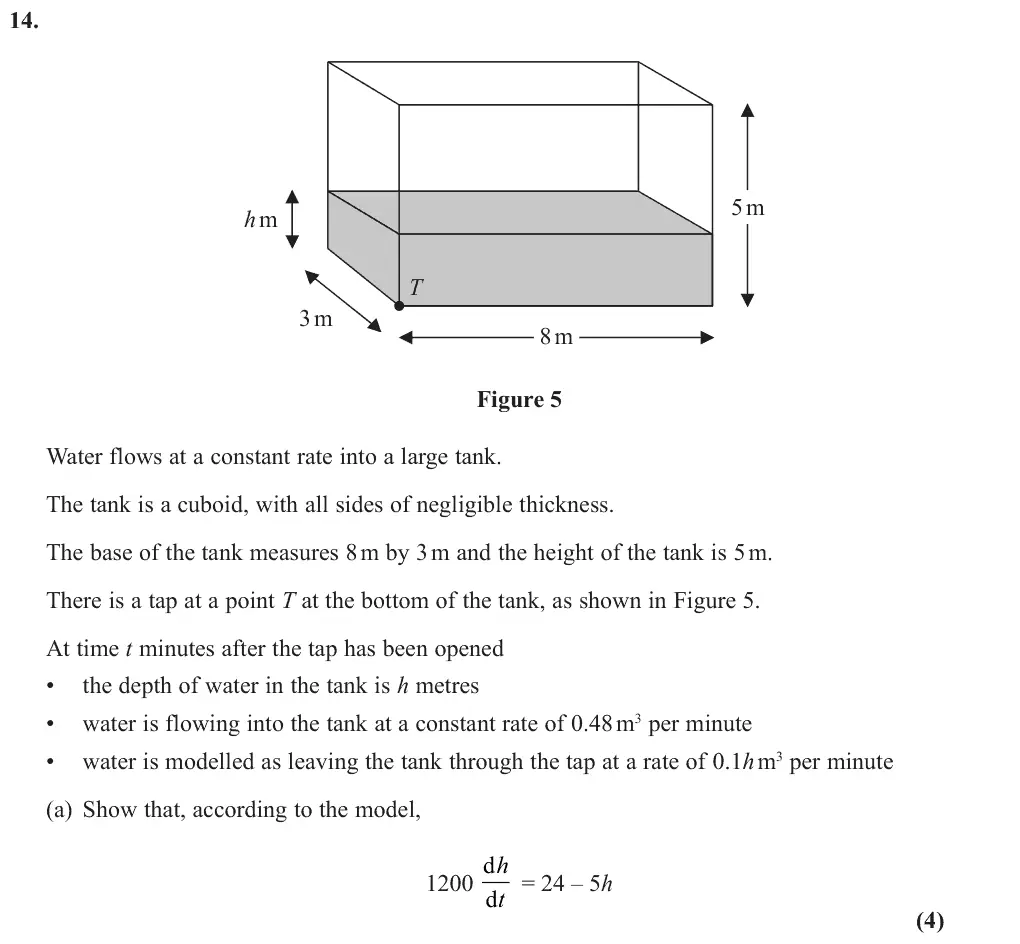
This question proved challenging for the majority of candidates, with many not answering it at all. For those that did attempt a response, part (a) was reasonably well answered, with many candidates gaining at least one of the B marks but quite a few then failing to correctly apply the chain rule and complete the proof. Some weaker candidates recognised they had to consider "flow in - flow out” but didn’t identify this as d d V t , with d 0.48 0.1 d h h t = - sometimes seen. It was also not uncommon to see d d V t = 0.48 or d d V t = 'uncombined' in some responses. Some candidates even started with and “differentiated” to get the printed result. Responses to part (b) were mixed. Some candidates failed to separate the variables correctly or did not recognise the logarithmic form for the integration. It was not unusual for the “+c” to be missed completely, but if it was included candidates were able to gain the 2nd method mark despite poor integration. Some candidates changed to , making their following working much harder. There was some occasional use of Further Maths methods (e.g. integrating factors), potentially gaining full marks. Candidates who did not answer (a) rarely attempted (b), perhaps not realising (b) could be answered independently using the printed differential equation.
Common mistakes
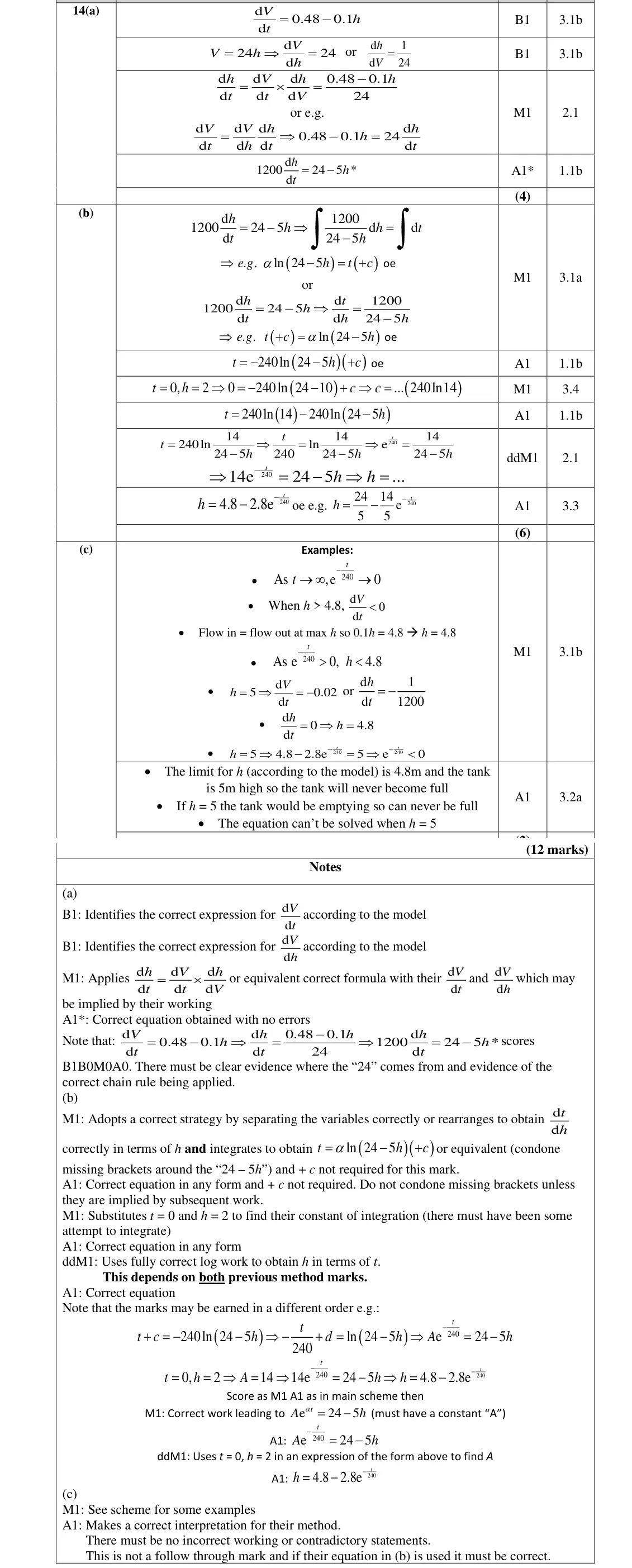
dV/dt = 0.48 − 0.1h (flow in − flow out)
V = 24h so dV/dh = 24
must show the chain rule and where 24 comes from
Oct 2021 · Paper 2 · Q14(b)6 marks
Mark scheme (whole question; this part is marked with the orange bar)
Examiner's comment
This question proved challenging for the majority of candidates, with many not answering it at all. Students who progressed well in (b) often interpreted their formula correctly to obtain marks in (c). A minority of students who didn’t complete (b) still attempted (c) with some success, e.g. recognising that d d h t was zero at the maximum height or using a ‘ flow in = flow out’ argument.
Common mistakes
separate variables
t = −240 ln(24 − 5h) + c
use t = 0, h = 2 to find c
correct log work to h = 4.8 − 2.8e^(−t/240)
forgetting + c
Oct 2021 · Paper 2 · Q14(c)2 marks
Mark scheme (whole question; this part is marked with the orange bar)
Examiner's comment
This question proved challenging for the majority of candidates, with many not answering it at all. Part (c) was attempted by many candidates, even if they hadn’t attempted (a) and (b).
Common mistakes
as t → ∞, h → 4.8 m < 5 m so the tank never fills (or flow in = flow out at h = 4.8)
no contradictory statements
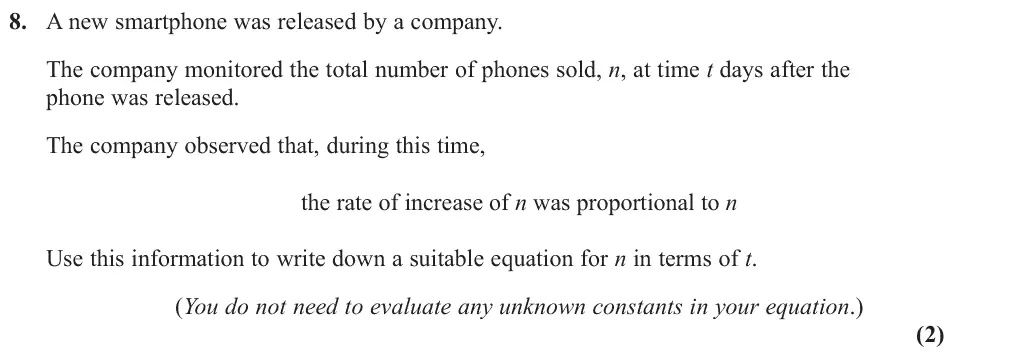
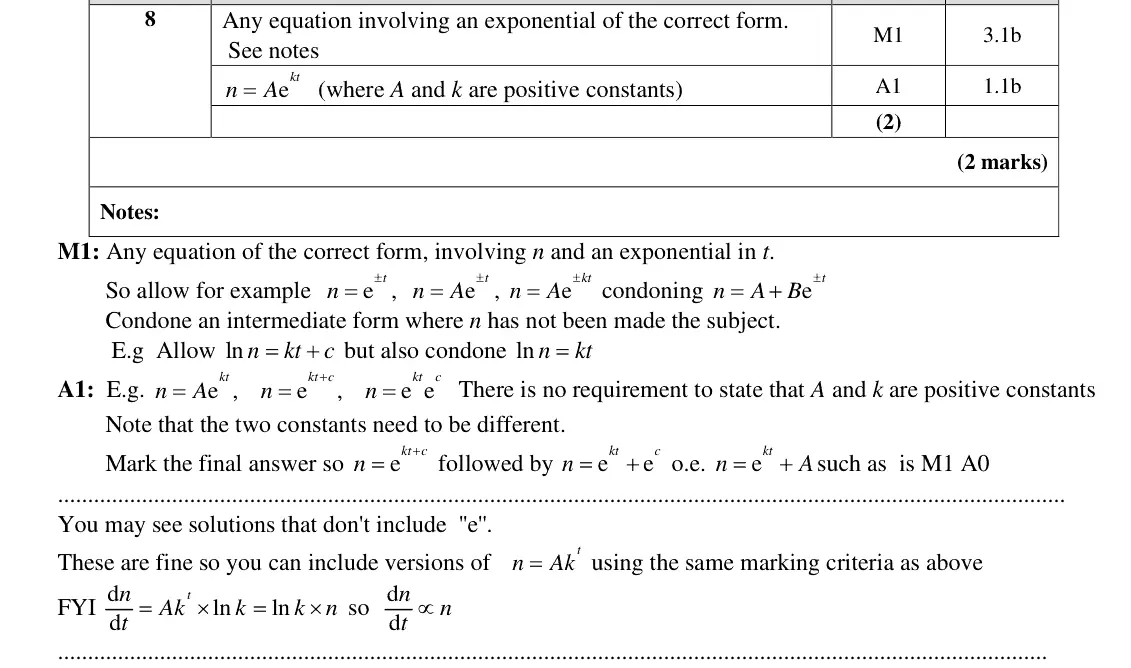
Oct 2020 · Paper 1 · Q82 marks
Mark scheme (whole question; this part is marked with the orange bar)
Examiner's comment
Candidates were expected to realise that ''when the rate of change is proportional to the y value, an exponential model should be used.'' The question seemed to take a great many candidates by surprise and many assumed that 'n was proportional to n' or that 'n was proportional to t', not that the rate of growth of 'n was proportional to n'. Those that did interpret the situation correctly could write down an equation very quickly whereas others attempted to solve a differential equation. Equations scoring one of two marks were common and included e , e t kt n A n = = and e kt n A b = +
Common mistakes
rate of change proportional to n means an exponential model n = Ae^(kt)
not n ∝ t
the two constants must be different (n = e^(kt + c) fine, n = e^(kt) + A is not)
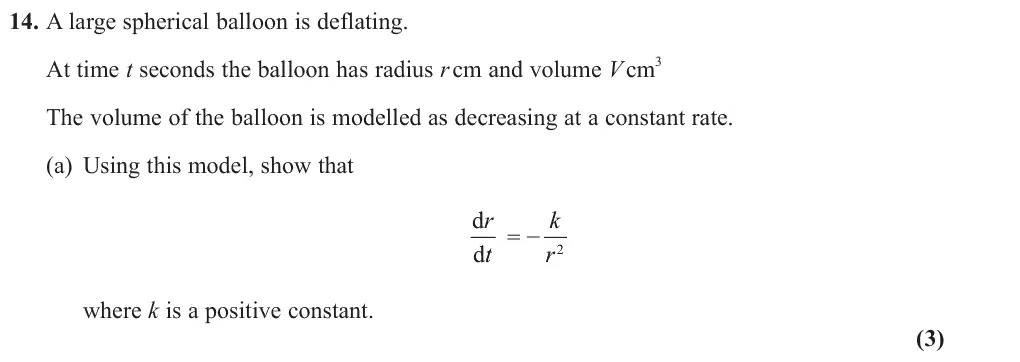
Oct 2020 · Paper 1 · Q14(a)3 marks
Mark scheme (whole question; this part is marked with the orange bar)
Examiner's comment
Students found aspects of this question difficult despite the fact that the differential equation to be solved in (b) was not too demanding. Only high scoring candidates tended to make any significant progress in this question. In part (a) many candidates failed to use the chain rule d d d d d d V V r t r t = x with an acceptable d d V t and d . d V r It was possible to proceed to the given answer without knowing the formula for a sphere, using 3 V r = λ but errors and blank solutions were common. Common errors were; • stating d d V k t = -, and then failing to provide a minimal explanation of how their k/4𝜋𝜋 was replaced with k. • quoting an incorrect formula for the volume of a sphere. Attempts included V = pi r3 , 2 pi r3 , 4 pi r3 and even 4 pi r2.
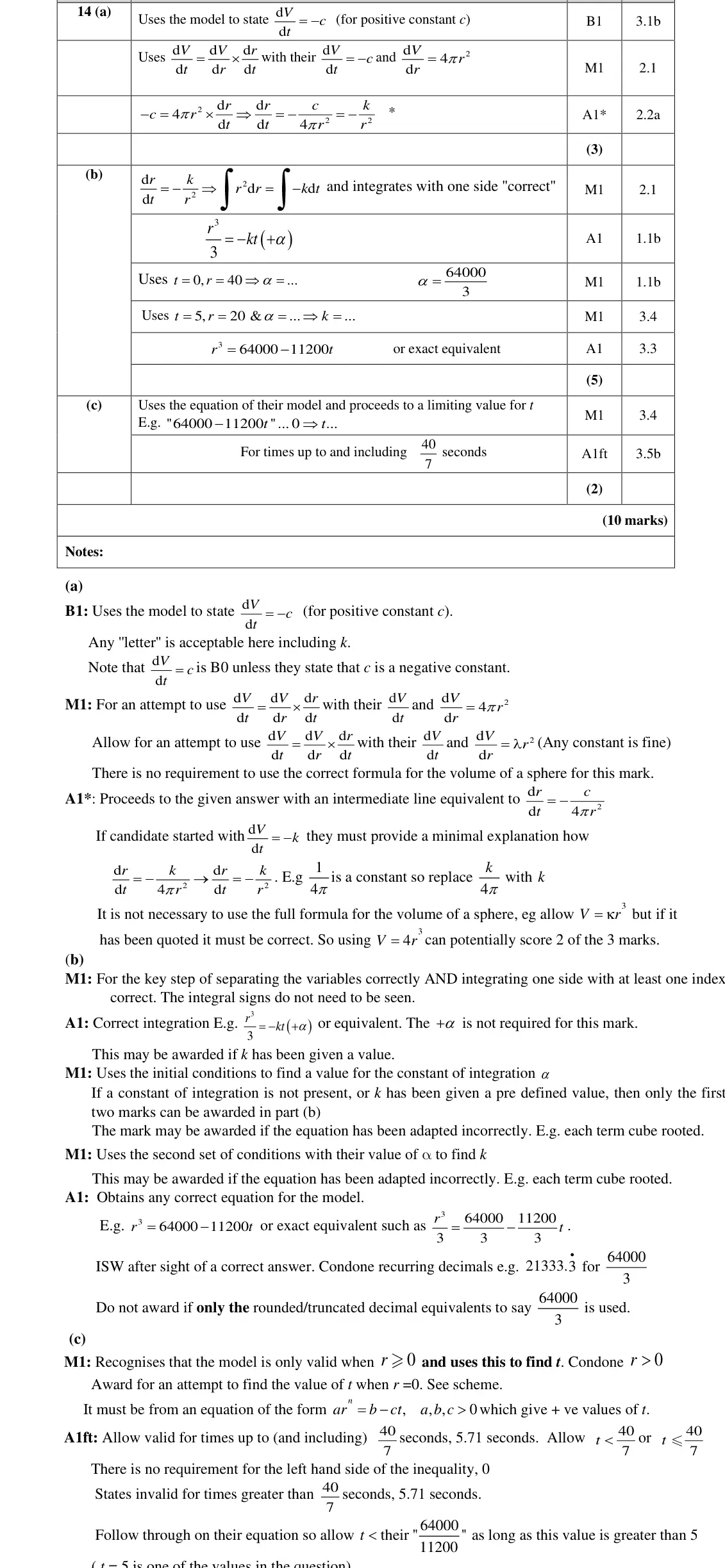
Mark scheme (whole question; this part is marked with the orange bar)
Examiner's comment
Students found aspects of this question difficult despite the fact that the differential equation to be solved in (b) was not too demanding. Only high scoring candidates tended to make any significant progress in this question. In (b) students who attempted to solve the given differential equation often separated the variables correctly and integrated both sides with both indices correct. Marks were lost when students failed to give a constant of integration and as a result could not apply the given conditions correctly to their equation in r and t.
Common mistakes
separate variables: ∫r² dr = −∫k dt, r³/3 = −kt + α
constant of integration is essential
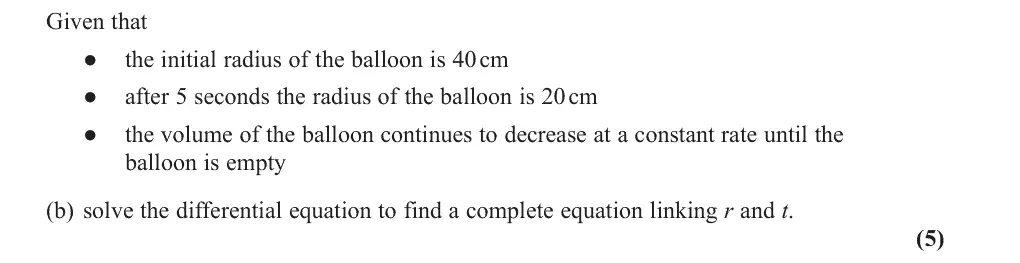
r = 40 at t = 0 and r = 20 at t = 5 give r³ = 64000 − 11200t
exact, not rounded decimals
Oct 2020 · Paper 1 · Q14(c)2 marks
Mark scheme (whole question; this part is marked with the orange bar)
Examiner's comment
Students found aspects of this question difficult despite the fact that the differential equation to be solved in (b) was not too demanding. Only high scoring candidates tended to make any significant progress in this question. In part (c) many students were confused by the wording and did not realise that a limiting value for t was required. Many attempts merely stated that t could not be negative or that t >0. Those candidates who did proceed to a limiting value for t generally had the right idea and most of these obtained a value of t >5 and gained the A mark when their equation form part (b) was followed through.
Common mistakes
the model is valid only while r ≥ 0: 64000 − 11200t ≥ 0 gives t ≤ 40/7 (5.71 s)
"t > 0" or "t cannot be negative" scores nothing
June 2019 · Paper 2 · Q14(b)2 marks
Mark scheme (whole question; this part is marked with the orange bar)
Examiner's comment
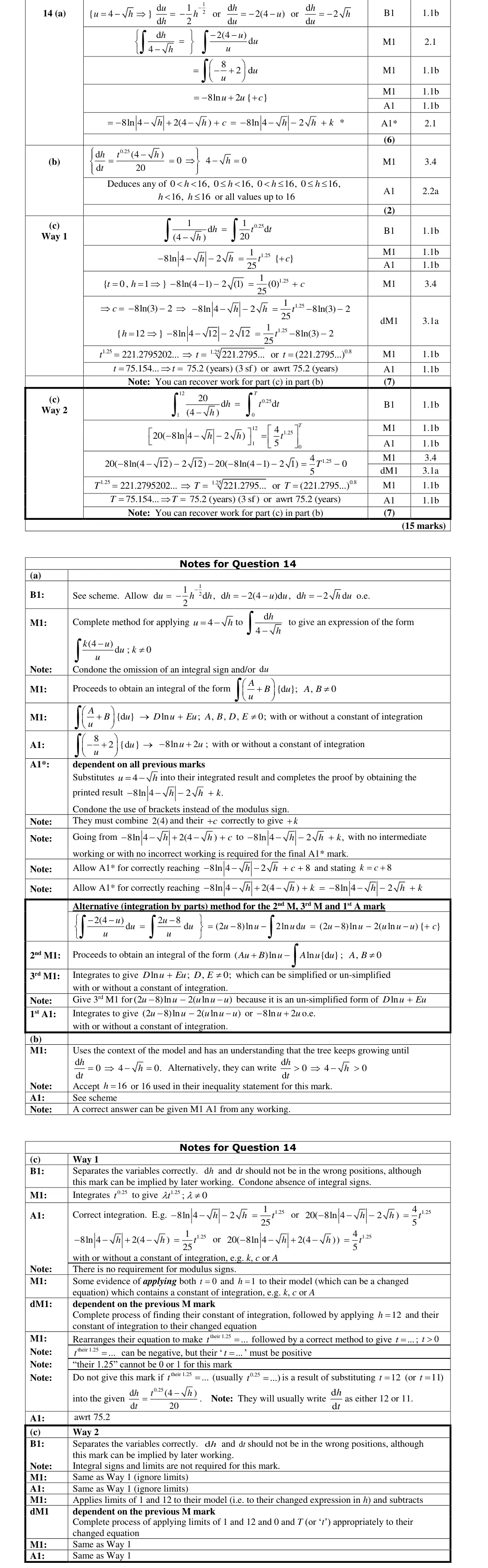
Q14 discriminated well between the higher ability candidates. Lower and medium ability candidates, however, found this question demanding with most of these candidates scoring no more than two marks. There were a few candidates who made no attempt at this question, either because the question was too demanding, or because their time had run out. Most higher ability candidates made good progress in Q14(a) and Q14(c) but they often struggled to make progress in Q14(b). 4 u h In Q14(a), most candidates who attempted this part differentiated to give a 1 d 1 u with a few finding a correct d h u , h 2(4 ) u correct and some 2 d d 2 h 1 d 1 u . h differentiating incorrectly to give At this stage, some candidates failed to 2 d 2 h make further creditable progress. Many candidates struggled to apply the substitution (4 ) d , k u completely to give an integral of the form with some making sign errors u u in the numerator of this integral. Those who progressed this far generally went on to A divide each term in the numerator by u to give an integral of the form d , B u u 8 with many of them obtaining a correct Most integrated correctly and 2 d .u u 4 u h applied to obtain a correct Some 8ln 4 2(4 ) . h h c candidates could not deal with the transition from 8 c to k to achieve the given and a large number of these candidates incorrectly stated 8ln 4 2 , h h k 2 8 d u k u Those few candidates who applied integration by parts on rarely 8. u progressed to give a correct solution to this part. In Q14(b), some candidates correctly set d h t 0 but only a few deduced the equation d h 4 0. h Some candidates used to state a correct allowable answer such as 16 h h 4 0 16, h 16. or A common mistake was to solve to give 0 16 h h 2. Material for Q14(c) was sometimes seen in Q14(b). Most candidates who attempted 0.25 t Q14(c) separated the variables correctly. Some candidates integrated incorrectly 1 5 0.25 0.75 1.25 , t t 4 t to give or while others integrated without reference to (4 ) h to find their constant of 0, 1 t h the result from Q14(a). Many candidates applied integration. Common errors at this stage included not applying a constant of integration to find their constant of integration. Most 0, 0 t h 1, 1 t h and using either or candidates who progressed this far applied a complete process of substituting their h constant of integration and into their integrated equation and solving this 12 equation to find their value for t. In many cases, sign errors, bracketing errors, manipulation errors or an incorrect method of solving a correct 1.25 221.2795202..., t t prevented candidates from obtaining the correct answer years. 75.2
Common mistakes
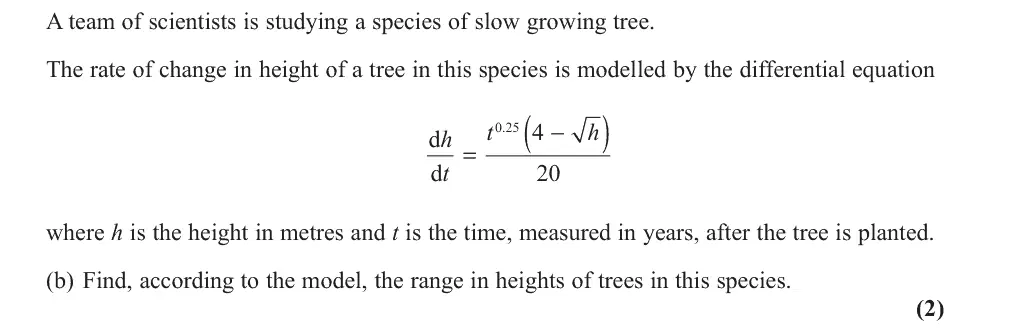
tree grows while dh/dt > 0: 4 − √h = 0 gives h = 16, so 0 < h < 16
common error h = 2
June 2019 · Paper 2 · Q14(c)7 marks
Mark scheme (whole question; this part is marked with the orange bar)
Examiner's comment
Q14 discriminated well between the higher ability candidates. Lower and medium ability candidates, however, found this question demanding with most of these candidates scoring no more than two marks. There were a few candidates who made no attempt at this question, either because the question was too demanding, or because their time had run out. Most higher ability candidates made good progress in Q14(a) and Q14(c) but they often struggled to make progress in Q14(b). 4 u h In Q14(a), most candidates who attempted this part differentiated to give a 1 d 1 u with a few finding a correct d h u , h 2(4 ) u correct and some 2 d d 2 h 1 d 1 u . h differentiating incorrectly to give At this stage, some candidates failed to 2 d 2 h make further creditable progress. Many candidates struggled to apply the substitution (4 ) d , k u completely to give an integral of the form with some making sign errors u u in the numerator of this integral. Those who progressed this far generally went on to A divide each term in the numerator by u to give an integral of the form d , B u u 8 with many of them obtaining a correct Most integrated correctly and 2 d .u u 4 u h applied to obtain a correct Some 8ln 4 2(4 ) . h h c candidates could not deal with the transition from 8 c to k to achieve the given and a large number of these candidates incorrectly stated 8ln 4 2 , h h k 2 8 d u k u Those few candidates who applied integration by parts on rarely 8. u progressed to give a correct solution to this part. In Q14(b), some candidates correctly set d h t 0 but only a few deduced the equation d h 4 0. h Some candidates used to state a correct allowable answer such as 16 h h 4 0 16, h 16. or A common mistake was to solve to give 0 16 h h 2. Material for Q14(c) was sometimes seen in Q14(b). Most candidates who attempted 0.25 t Q14(c) separated the variables correctly. Some candidates integrated incorrectly 1 5 0.25 0.75 1.25 , t t 4 t to give or while others integrated without reference to (4 ) h to find their constant of 0, 1 t h the result from Q14(a). Many candidates applied integration. Common errors at this stage included not applying a constant of integration to find their constant of integration. Most 0, 0 t h 1, 1 t h and using either or candidates who progressed this far applied a complete process of substituting their h constant of integration and into their integrated equation and solving this 12 equation to find their value for t. In many cases, sign errors, bracketing errors, manipulation errors or an incorrect method of solving a correct 1.25 221.2795202..., t t prevented candidates from obtaining the correct answer years. 75.2
Common mistakes
separate variables
∫t^0.25 dt = 0.8t^1.25
use the result of (a)
constant from t = 0, h = 1 (not h = 0)
t^1.25 = 221.28 so t = 75.2 years
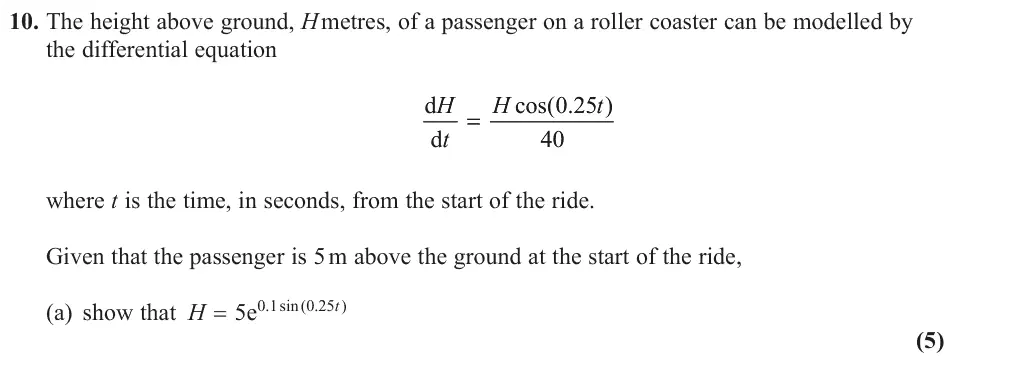
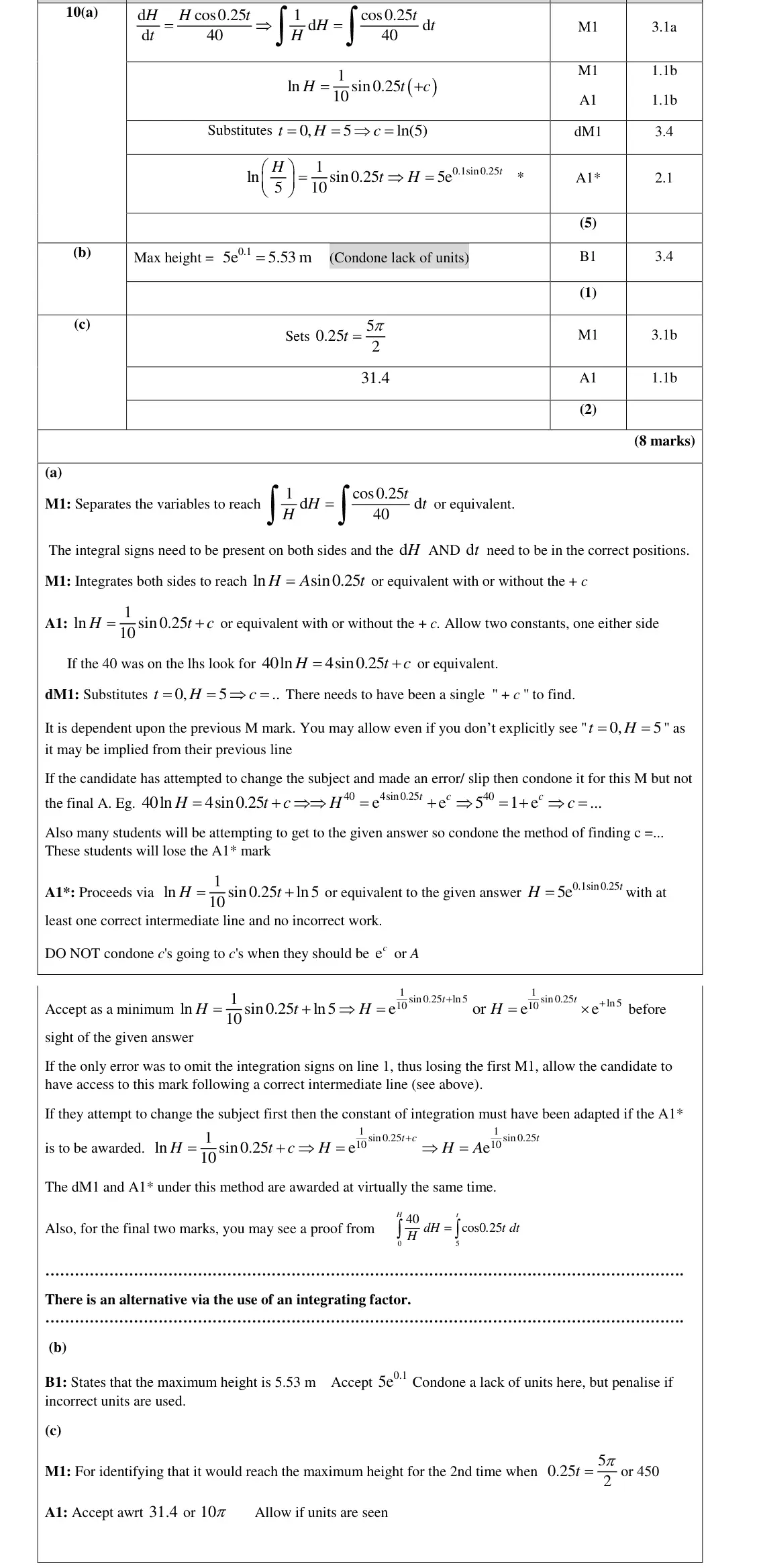
June 2018 · Paper 1 · Q10(a)5 marks
Mark scheme (whole question; this part is marked with the orange bar)
Examiner's comment
This was another modelling question, this time modelling the height of a roller coaster above the ground by a differential equation. In part (a), the majority of students were able to separate the variables of H and t and thus integrate both sides. Integrating cos0.25t was done well with most dividing by 0.25 or multiplying by 4. Almost all students were then able to ln 0.1sin 0.25 H t proceed with ease to . The last two marks proved harder to score. Quite a sizeable proportion of students failed to include the constant of integration in and so were unable to apply the boundary condition ln 0.1sin 0.25 H t c in 0, 5 t H an attempt to find c. The final mark was the hardest to gain. The answer was given and many students merely copied down the result on the examination paper. There had to be clear evidence that the constant they found was processed correctly and that their log work was sound. The requirement of at least one correct line of working between their working and the given equation, with no incorrect working, was fair to those who showed a clear argument. Part (b) was found by almost all students, even those who could not attempt part (a). In this case the exact answer 5e 0.1 was accepted as well as 5.53 metres. Fewer students scored both t marks in (c), but many were aware that it would occur when sin(0.25 ) The most 1.
Common mistakes
separate: ∫1/H dH = ∫cos(0.25t)/40 dt
ln H = 0.1 sin(0.25t) + c – constant often omitted
t = 0, H = 5 gives c = ln5
at least one correct log line before the given answer
June 2018 · Paper 1 · Q10(b)1 mark
Mark scheme (whole question; this part is marked with the orange bar)
Examiner's comment
This was another modelling question, this time modelling the height of a roller coaster above Part (b) was found by almost all students, even those who could not attempt part (a). In this case the exact answer 5e 0.1 was accepted as well as 5.53 metres. Fewer students scored both t marks in (c), but many were aware that it would occur when sin(0.25 ) The most 1.
Common mistakes
maximum when sin(0.25t) = 1: 5e^0.1 = 5.53 m (exact 5e^0.1 accepted)
June 2018 · Paper 1 · Q10(c)2 marks
Mark scheme (whole question; this part is marked with the orange bar)
Examiner's comment
This was another modelling question, this time modelling the height of a roller coaster above t marks in (c), but many were aware that it would occur when sin(0.25 ) The most 1. or else use 450 rather than 5 thus , , common errors were to find the first value using 2 2 arriving at the incorrect answer of 1800 seconds.
Common mistakes
second maximum when 0.25t = 5π/2 (radians), T = 10π ≈ 31.4 s
using π/2 (first maximum) or 450 in degrees (giving 1800) is wrong
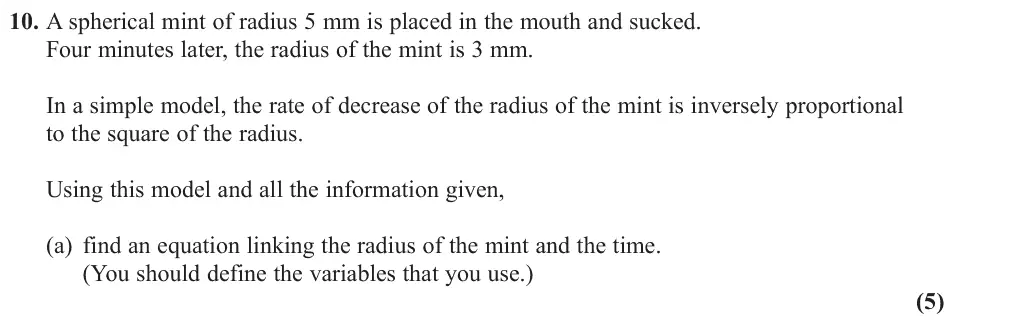
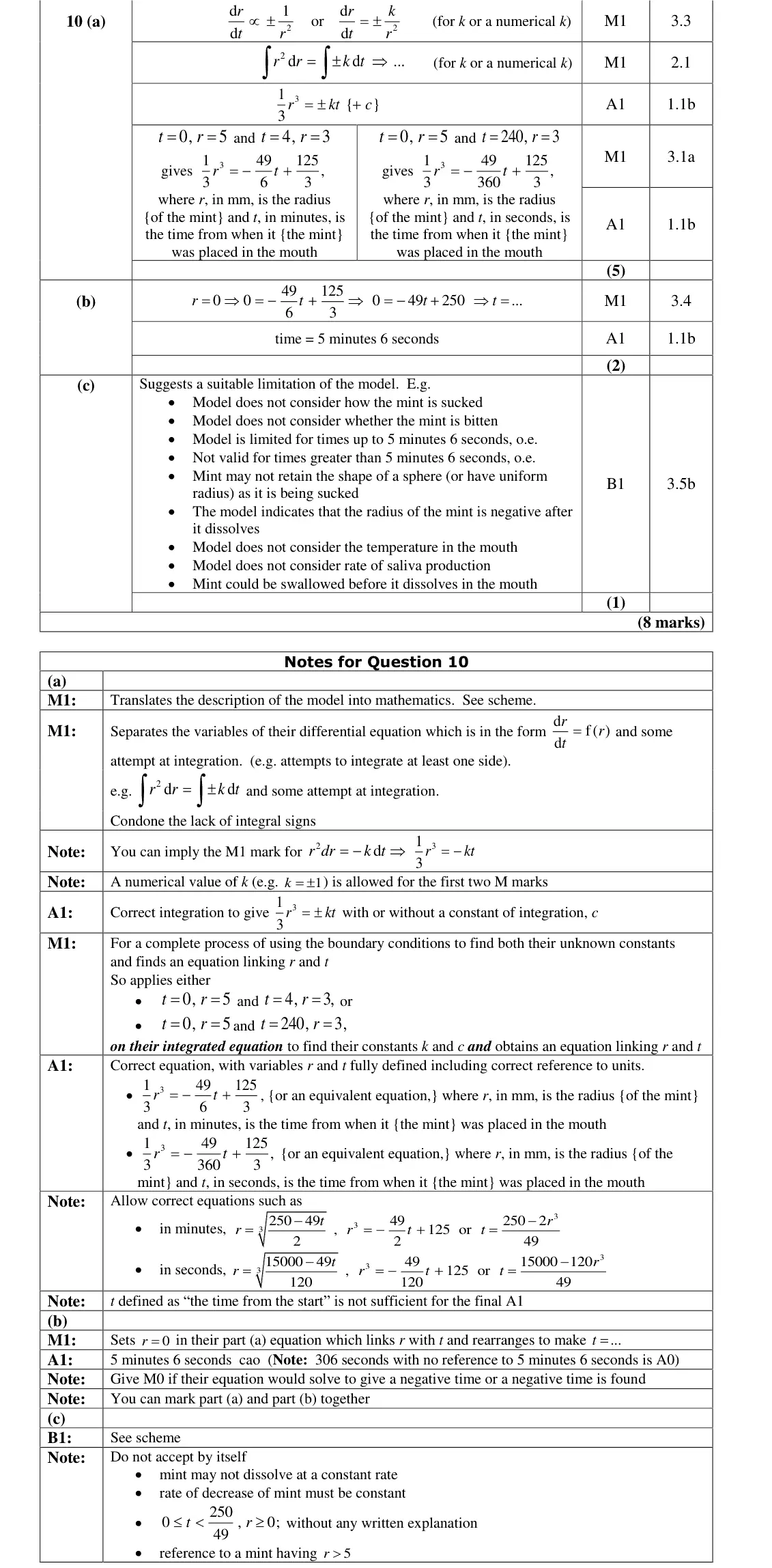
June 2018 · Paper 2 · Q10(a)5 marks
Mark scheme (whole question; this part is marked with the orange bar)
Examiner's comment
This question discriminated well between the average and more able students. There waere a significant minority of students, however, that made no creditable progress. In part (a), many students struggled to translate the description of the model into a mathematical statement. Some incorrect statements, such as 2 d 1 , d r t r 2 d d r r t or d 1 , d r t r did not contain a constant of proportionality; while other incorrect statements 2 d , d r kr t 2 d d r r t k or d d r k t r contained a constant of proportionality. Many students used a correct method to separate the variables and most proceeded to integrate their 2 d d r r k t to give an equation linking r and t which contained a constant of integration. At this stage, some students incorrectly integrated 2r to give 2 .r The majority of students applied the boundary conditions 0, 5 t r and 4, 3 t r (or 240, 3 t r ) to find both constants and proceeded to give an equation linking r with t. Some students who worked in minutes obtained correct answers of either 3 250 49 , 2 t r 3 49 125 2 r t or 3 250 2 . 49 r t A few students who worked in seconds obtained correct answers of either 3 15000 49 , 120 t r 3 49 125 120 r t or 3 15000 120 . 49 r t Many students lost the final mark in this part by not including sufficient detail in their definition of their variables. Some students defined r as the radius of the mint, in mm, but it was rare to see the time, t, defined from a correct starting point (i.e. from when the mint was placed in the mouth) and with the correct unit of time used.
Common mistakes
dr/dt = −k/r² (constant of proportionality needed)
separate to ∫r² dr = −∫k dt
two conditions (t = 0, r = 5
t = 4, r = 3) for k and c
r³/3 = −49t/6 + 125/3
define r (mm) and t (minutes from placing in the mouth)
June 2018 · Paper 2 · Q10(b)2 marks
Mark scheme (whole question; this part is marked with the orange bar)
Examiner's comment
This question discriminated well between the average and more able students. There waere a significant minority of students, however, that made no creditable progress. In part (b), many students substituted 0 r in their equation from part (a) and rearranged to find a value for t, with a significant number obtaining the correct answer, 5 minutes 6 seconds. Some students lost the final mark by giving their final answer as either 5.10 minutes, 250 49 minutes or 306 seconds.
Common mistakes
set r = 0: t = 250/49 minutes = 5 minutes 6 seconds
5.10 minutes, 250/49 or 306 seconds alone lose the mark
June 2018 · Paper 2 · Q10(c)1 mark
Mark scheme (whole question; this part is marked with the orange bar)
Examiner's comment
This question discriminated well between the average and more able students. There waere a significant minority of students, however, that made no creditable progress. Part (c) was generally well-answered with a variety of valid limitations given. Students commented on the shape of the mint while it was being sucked; on how the mint was sucked; or that the model predicted a negative radius for the mint after a time of 5 minutes 6 seconds after the mint was placed in the mouth. Some students who stated that ‘the radius of the mint may not decrease at a constant rate’ did not receive any credit because the radius of the mint in the original model was not decreasing at a constant rate.
Common mistakes
e.g. mint may not stay spherical, bitten or swallowed, invalid after 5 min 6 s (negative radius)
"radius does not decrease at a constant rate" is not credited
Find an Edexcel maths tutor
Stuck on this? Book a trial session with an Edexcel specialist.