Sum formulae for arithmetic and geometric series are given.
Since 2018
49 question parts, 132 marks, 9 with a difficulty rating from the examiner's report
Notes, worked examples and practice for this topic are being written by our tutors. The past-paper questions below are ready now: work each one on paper, then open the mark scheme and the examiner's comment.
Tap a question to zoom it. Mark scheme and examiner's comment open under each question.
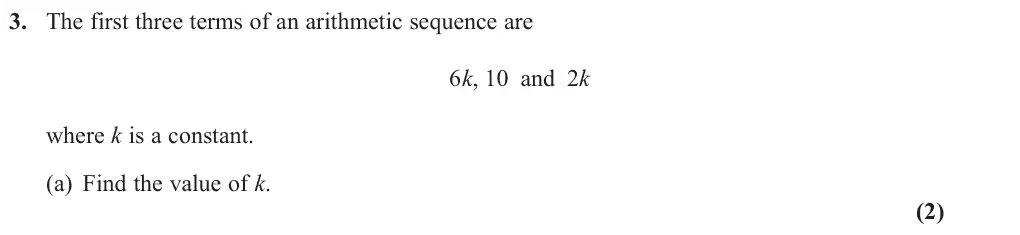
June 2025 · Paper 1 · Q3(a)2 marks
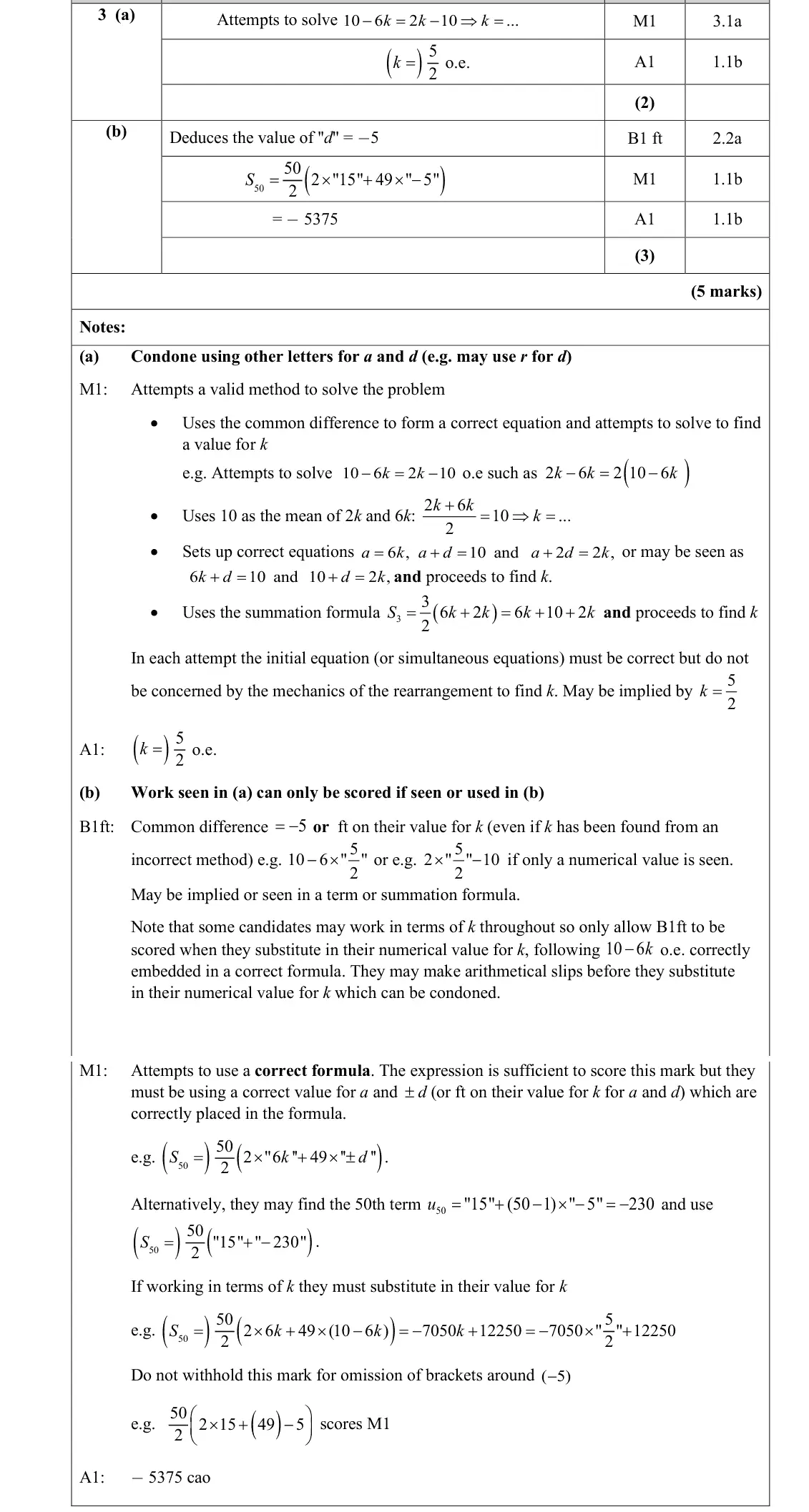
Mark scheme (whole question; this part is marked with the orange bar)
Examiner's comment
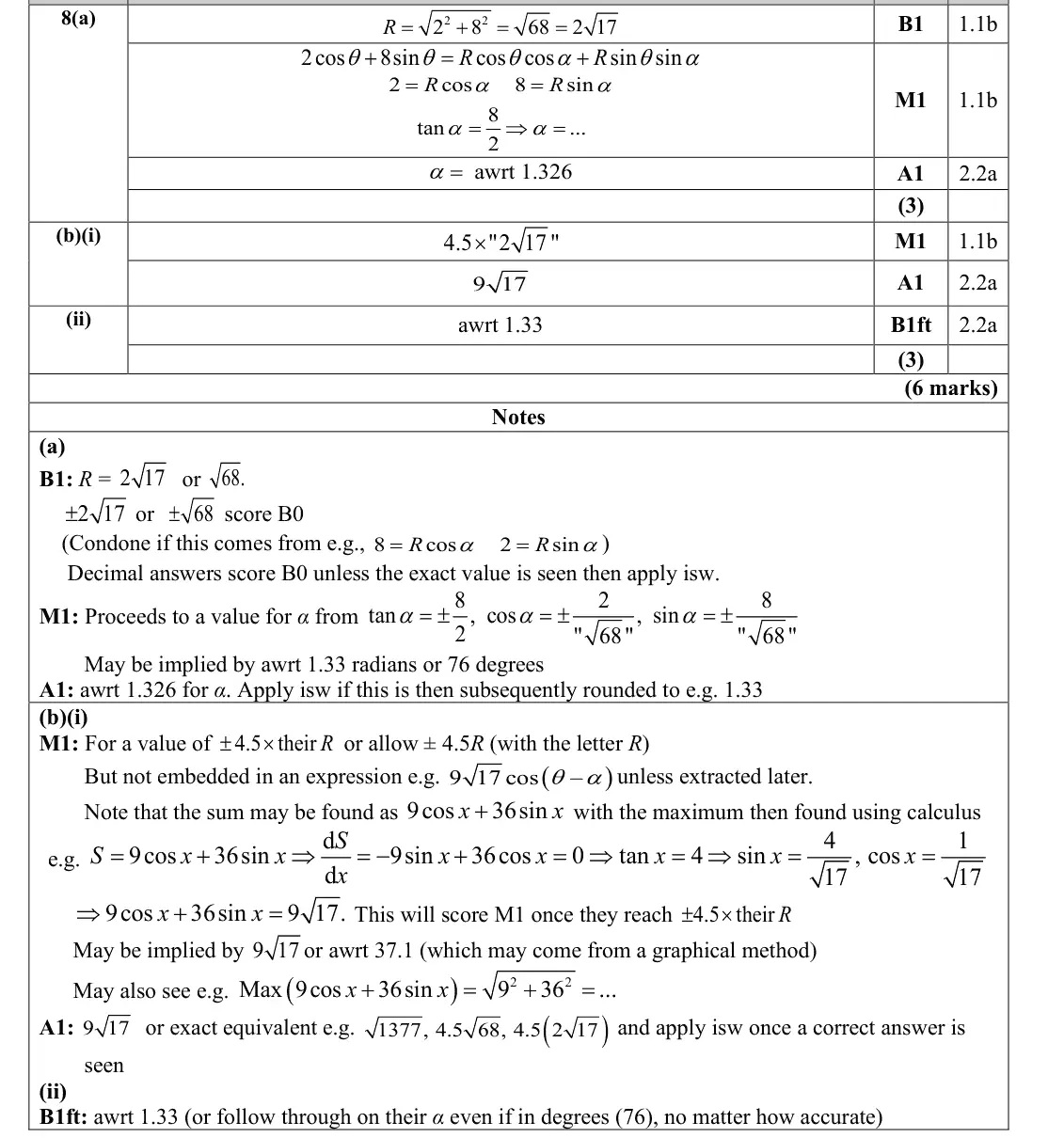
This question tested arithmetic sequences, followed by finding the sum for a given number of terms. Part (a) was usually answered well. There was a variety of ways which could be used to set up a valid equation or equations from the information given. The most common method was equating the common difference between consecutive terms resulting in a single linear equation that was easily solved for k. Some responses used slightly less efficient methods by using the nth term formula which created two linear equations in k and the common difference, d, which they then solved simultaneously. A few responses used the sum formula in addition to an nth term formula which proved quite time consuming and often incurred errors when solving. A minority of responses mistakenly treated the sequence as geometric and gained no marks. Occasionally learners deduced the value of k with little or no working by spotting that the second term must be 4k in order that the sequence was arithmetic (2k, 4k, 6k) and then simply divided 10 by 4.
Common mistakes
equal common differences 10 − 6k = 2k − 10 (or 10 is the mean of 6k and 2k) gives k = 5/2
treating it as geometric scores 0
June 2025 · Paper 1 · Q3(b)3 marks
Mark scheme (whole question; this part is marked with the orange bar)
Examiner's comment
This question tested arithmetic sequences, followed by finding the sum for a given number of terms. Part (b) was also well attempted, although more errors were noted here. The responses seen usually found the values for the first term and common difference by substituting their value of k back into the original sequence. A few mistakenly used d = 5 as they did not acknowledge that the sequence was decreasing. Some simply used their value of k in place of d in the sum formula which gained no marks at all. The responses that had set up two linear equations in part (a) had often already evaluated d in part (a) when they were solving their simultaneous equations, but it was only when it was seen or used in part (b) that they gained credit. While full marks were often earned in this part, errors in applying a correctly quoted formula sometimes resulted in marks not being gained. For example, (50 – 1) – 5 instead of (50 – 1)(–5) commonly resulted in 44 instead of –245 which lost the final mark. A few responses adopted an alternative approach of using 5 20 n - + ∑ and either used their calculators or standard sum formulae from Further Maths to evaluate it. Those who had treated the sequence as geometric in part (a) often continued to do so in part (b) gaining no marks, although a small number of responses did use their surd value of k to correctly find follow through values for the first term and common difference of an arithmetic sequence. A very small minority opted for the primitive method of writing out all 50 terms and adding them together individually. They were sometimes successful, but this was an extremely time- consuming method and would have compromised the time available for other questions on the paper. 7
Common mistakes
a = 15, d = −5 (the sequence decreases
d = 5 and using k as d are common errors)
S₅₀ = 25(30 + 49 × (−5)) = −5375
bracket slips such as (50 − 1) − 5
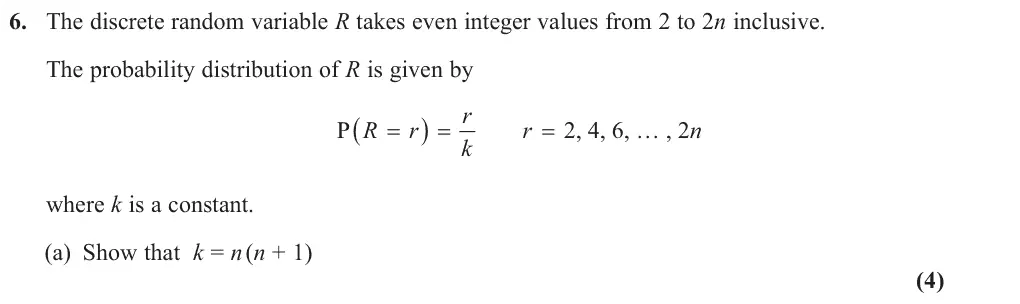
June 2025 · Paper 3 (Statistics) · Q6(a)4 marks
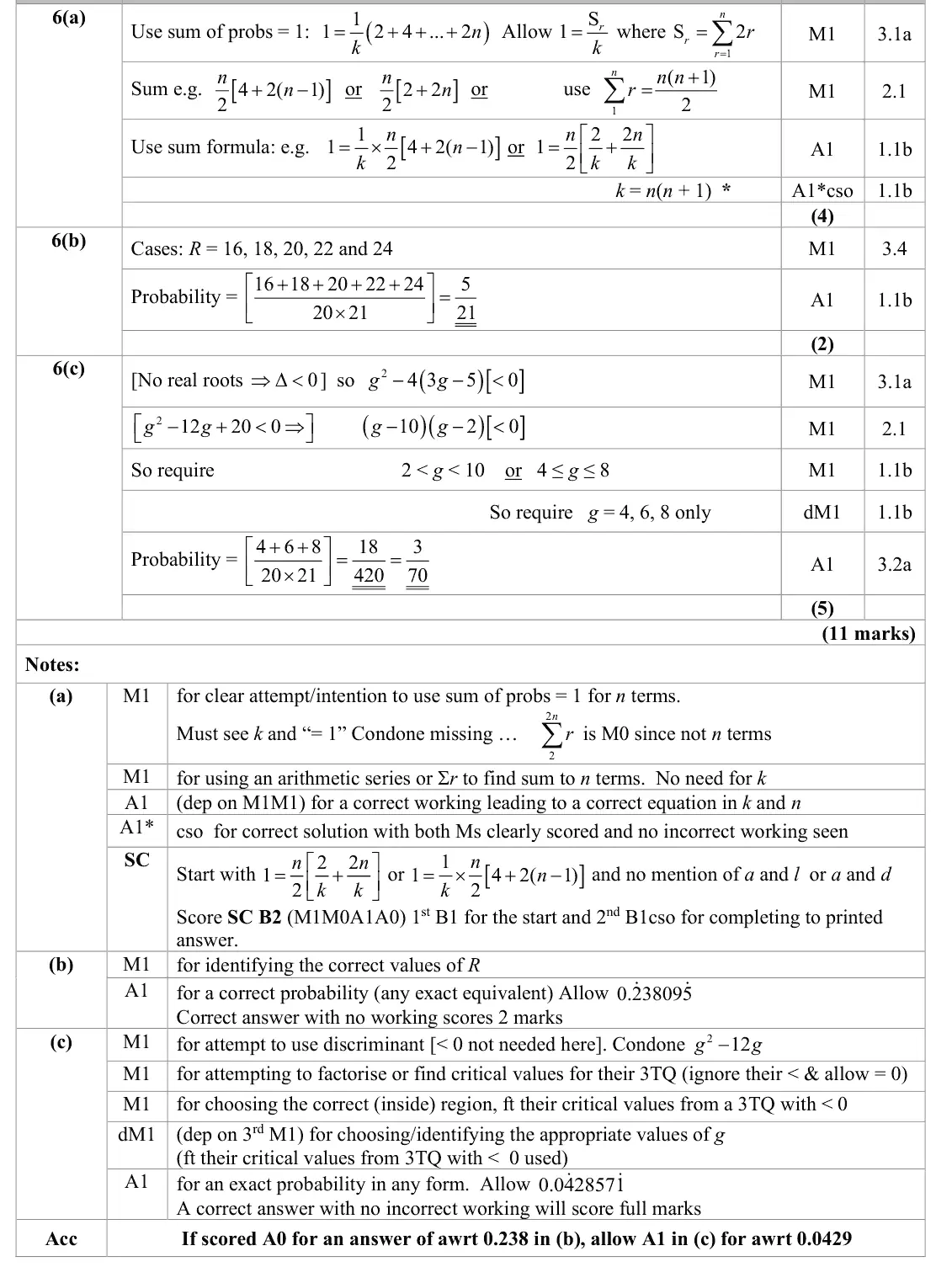
Mark scheme (whole question; this part is marked with the orange bar)
Examiner's comment
This question provided some challenge and discrimination for the end of the paper. Most learners attempted this and made some progress. Part (a) was a “show that” question and learners need to remember therefore to show all steps in their working clearly and present a solution without incorrect working. Most were able to identify that they needed to use the fact that the sum of the probabilities equalled 1. A popular starting point was to write down 1= 2 4 6 2 ... n k k k k + + + + and some were then able to recognise that an arithmetic series was involved and use a suitable formula to find the sum. Some learners didn’t use the correct number of terms with 2n or 4 (from the 4 terms 2, 4, 6 and 2n) being common errors. Full and concisely presented solutions were rare.
Common mistakes
sum of probabilities = 1: (2 + 4 + ... + 2n)/k = 1 with n terms (not 2n or 4)
arithmetic series sum n(n + 1)
every step shown for the given answer
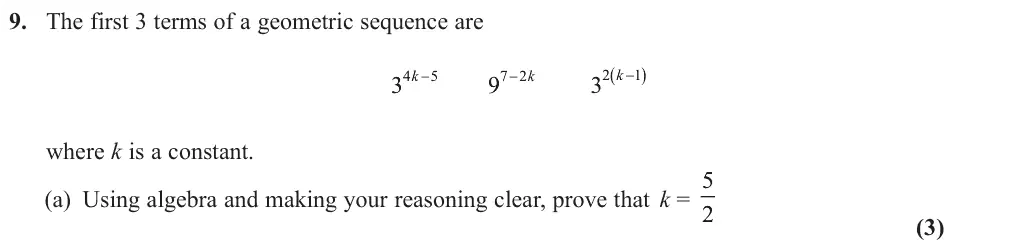
June 2024 · Paper 1 · Q9(a)3 marks
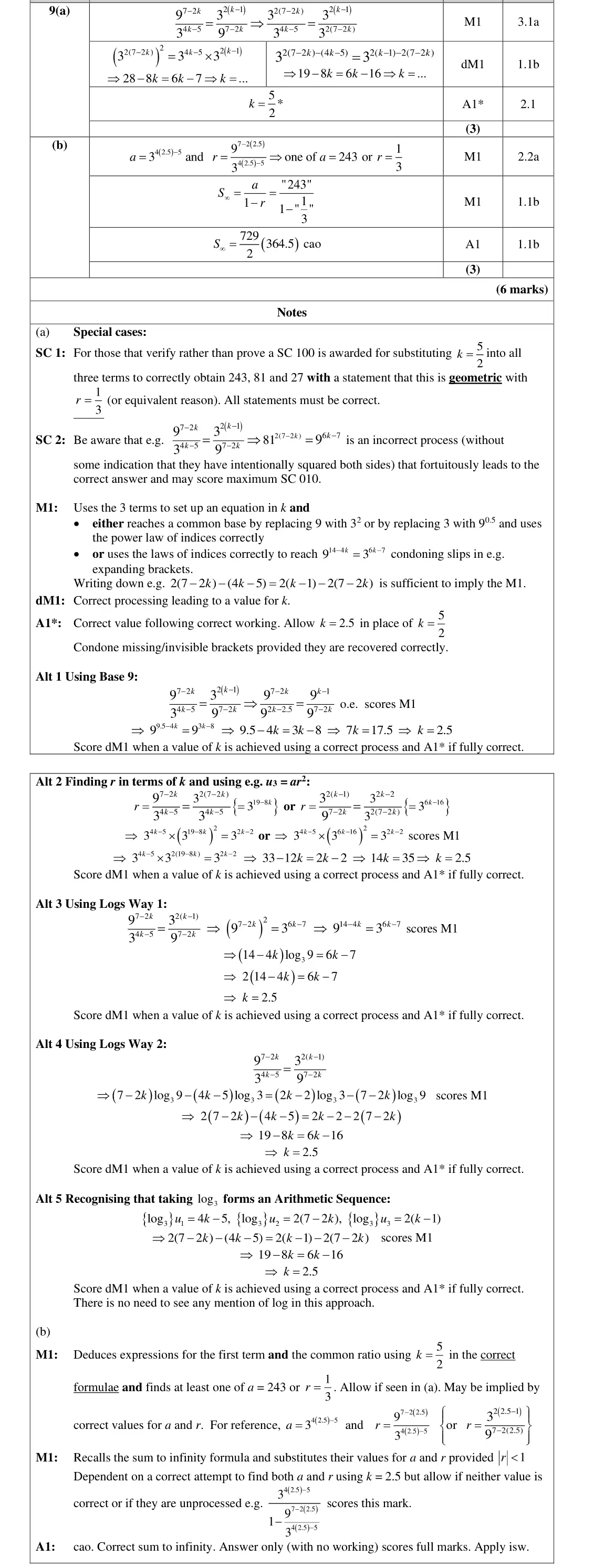
Mark scheme (whole question; this part is marked with the orange bar)
Examiner's comment
Part (a) was a discriminatory question with many different approaches seen; the mix of algebraic indices coupled with a geometric sequence caused problems for many candidates and often work lacked structure. It was evident that many candidates are not as familiar with the laws of indices as they should be and are not practised in the set-up of proof questions. The layout of candidates work varied enormously and they should be encouraged to practice showing a proof that flows and that is not interrupted by their thought processes. Despite the challenges many faced in part (a), the majority of candidates found part (b) to be accessible due to the given answer in (a) providing a restart opportunity. In part (a), many candidates were able to achieve full marks by setting up an appropriate equation, changing to the common base of 3 and using the index laws to form a linear equation in k and then solving. The most common (and successful) method was using 2 ar ar a ar = and then changing to the common base of 3, using the power law of indices and, either subtracting the indices or by cross-multiplying and then adding the indices. The most common error, which was highly prevalent, was incorrect use of the division/subtraction law of indices – whereby they divided indices rather than subtracted and then formed quadratic equations in k, resulting in no further marks being awarded. Most initial difficulties arose from not understanding how to use the power law correctly for 7 2 9 k - or failing to notice that the bases needed changing at all and many simply subtracted the indices regardless of the differing bases. Changing the base to 9 was rarely seen and attempts at using logarithms were mostly unsuccessful as again, the laws were not generally adhered to. Some candidates demonstrated a lack of understanding of indices by multiplying the bases but adding the indices to achieve ( ) 2 7 2 6 7 81 9 k k - - = . These were given some benefit of doubt and awarded one mark by a special case in the mark scheme, provided the rest of their processing was correct. Other candidates tried to verify the sequence being geometric by substituting in the given value of k, which did not satisfy the demand of the question. These attempts were allowed to score a maximum of 1 mark but were often unsuccessful as not enough of a conclusion was made. It is also worth noting that candidates should pay attention to the form of the given value and realise that this is what is required; an equivalent fraction 35 14 k = was not accepted for the final mark.
Common mistakes
equate ratios (u₂² = u₁u₃)
write 9 as 3² and use index laws to get a linear equation in k
index-law errors very common
verifying k = 5/2 earns only a special case
June 2024 · Paper 1 · Q9(b)3 marks
Mark scheme (whole question; this part is marked with the orange bar)
Examiner's comment
Part (b) was well attempted and generally candidates were highly successful even if part (a) was poorly attempted or not attempted at all. The majority of candidates were able to evaluate both a and r having used k to find the terms in the sequence first, they then used the sum to infinity formula correctly to achieve the answer, resulting in 3 marks. Unfortunately, some candidates found the reciprocal of the ratio which gave them a value of 3 and some mistakenly thought that 5 2 r = , neither of these values met the limitations of the infinite sum formula but this was not spotted by candidates.
Common mistakes
a = 243, r = ⅓, S∞ = a/(1 − r) = 729/2
r = 3 (reciprocal) or 5/2 is invalid since modulus of r must be < 1
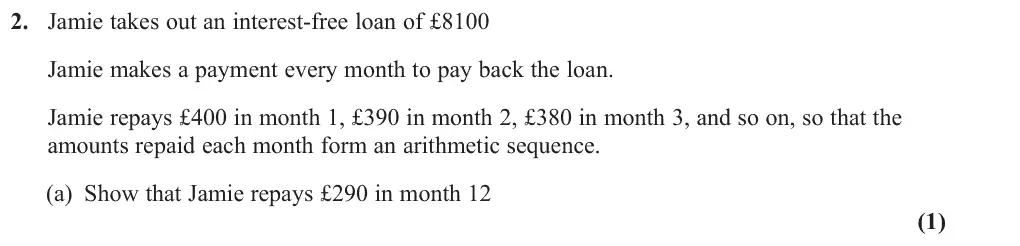
June 2024 · Paper 2 · Q2(a)1 mark
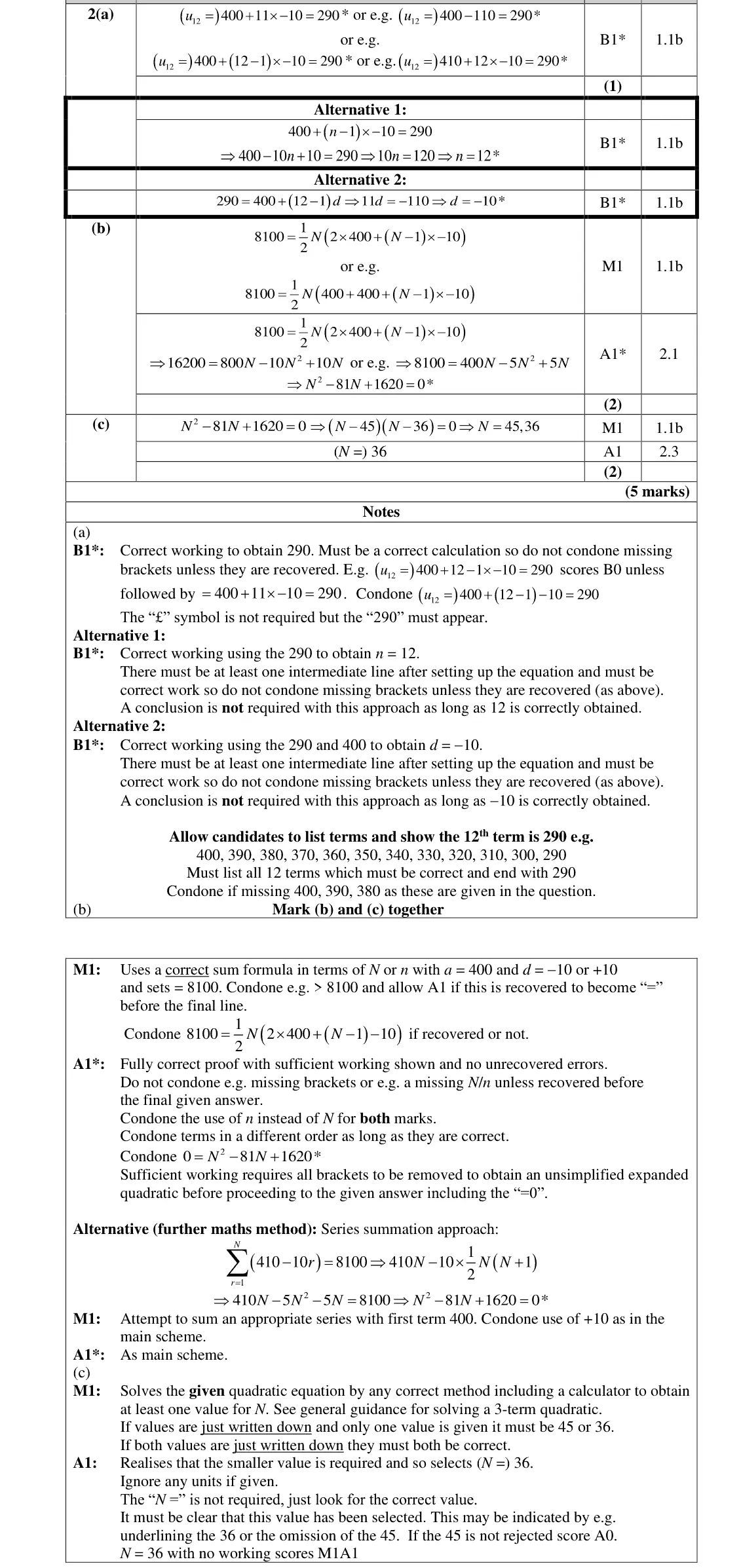
Mark scheme (whole question; this part is marked with the orange bar)
Examiner's comment
Part (a) was very accessible and very well answered. The vast majority of candidates deduced the value of the common difference and then substituted this into the standard term formula for an arithmetic sequence. Those candidates that were unfamiliar with this formula were able to produce a correct calculation, or even just list the payments for all 12 months, which was acceptable. Occasionally the formula was simplified to 410 - 10n before substituting in n = 12.
Common mistakes
d = −10
u₁₂ = 400 + 11(−10) = 290 with brackets correct
listing all 12 terms is acceptable
June 2024 · Paper 2 · Q2(b)2 marks
Mark scheme (whole question; this part is marked with the orange bar)
Examiner's comment
Part (b) was usually answered well, and candidates were able to substitute the given values into the sum formula correctly, expand brackets and obtain the required quadratic equation in N. The fact that the common difference was negative caused some candidates algebraic difficulties. Some candidates did not realise they needed to set their expression equal to 8100 but soon realised this and added it in later in their working but a few persisted with e.g. = 0 rather than = 8100. A few had bracketing and/or arithmetic errors and some missed out the ‘= 0’ in the given answer therefore losing the final accuracy mark. A small number of candidates attempted to use the term formula in this part. Another rarer approach involved using a series summation approach. These attempts were mostly successful as it required further maths knowledge and were therefore performed by most proficient mathematicians.
Common mistakes
set S_N = ½N(800 + (N − 1)(−10)) equal to 8100 (not 0)
negative d causes sign slips
expand all brackets and include "= 0" in the given answer
June 2024 · Paper 2 · Q2(c)2 marks
Mark scheme (whole question; this part is marked with the orange bar)
Examiner's comment
In part (c), most candidates were able to solve the given quadratic equation and achieve the method mark. Overall, this was done with a calculator. Most chose the correct answer but quite a few left both answers or chose N = 45, appearing not to take into account the context of the question. They needed to realise that, when the loan was fully repaid after 36 months, the borrower would not continue to make loan repayments, so the second answer of 45 months needed to be rejected. This took significant effort for some - rechecking the sum for 36 and 45 terms and then finding the value of the 36th and 45th term and then rejecting 45 when the 45th term was negative - when thinking about the context would have been easier.
Common mistakes
N = 36 or 45
reject 45 in context (loan repaid after 36 months, later payments would be negative)
leaving both values loses the A mark
June 2024 · Paper 2 · Q4(a)2 marks
Mark scheme (whole question; this part is marked with the orange bar)
Examiner's comment
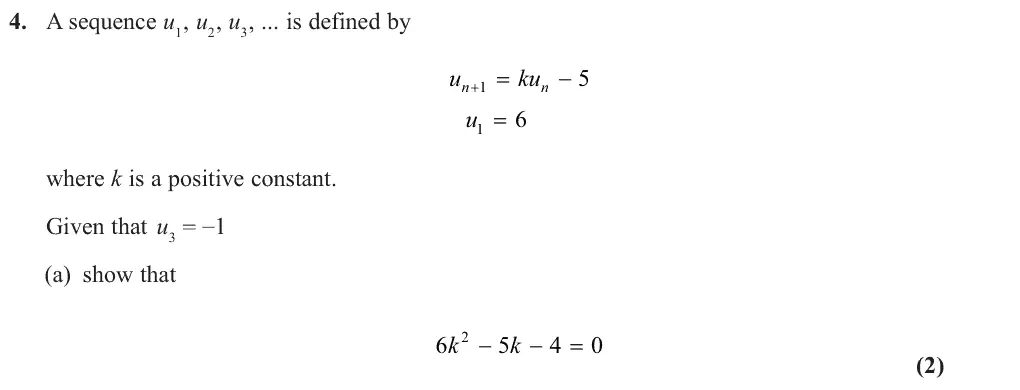
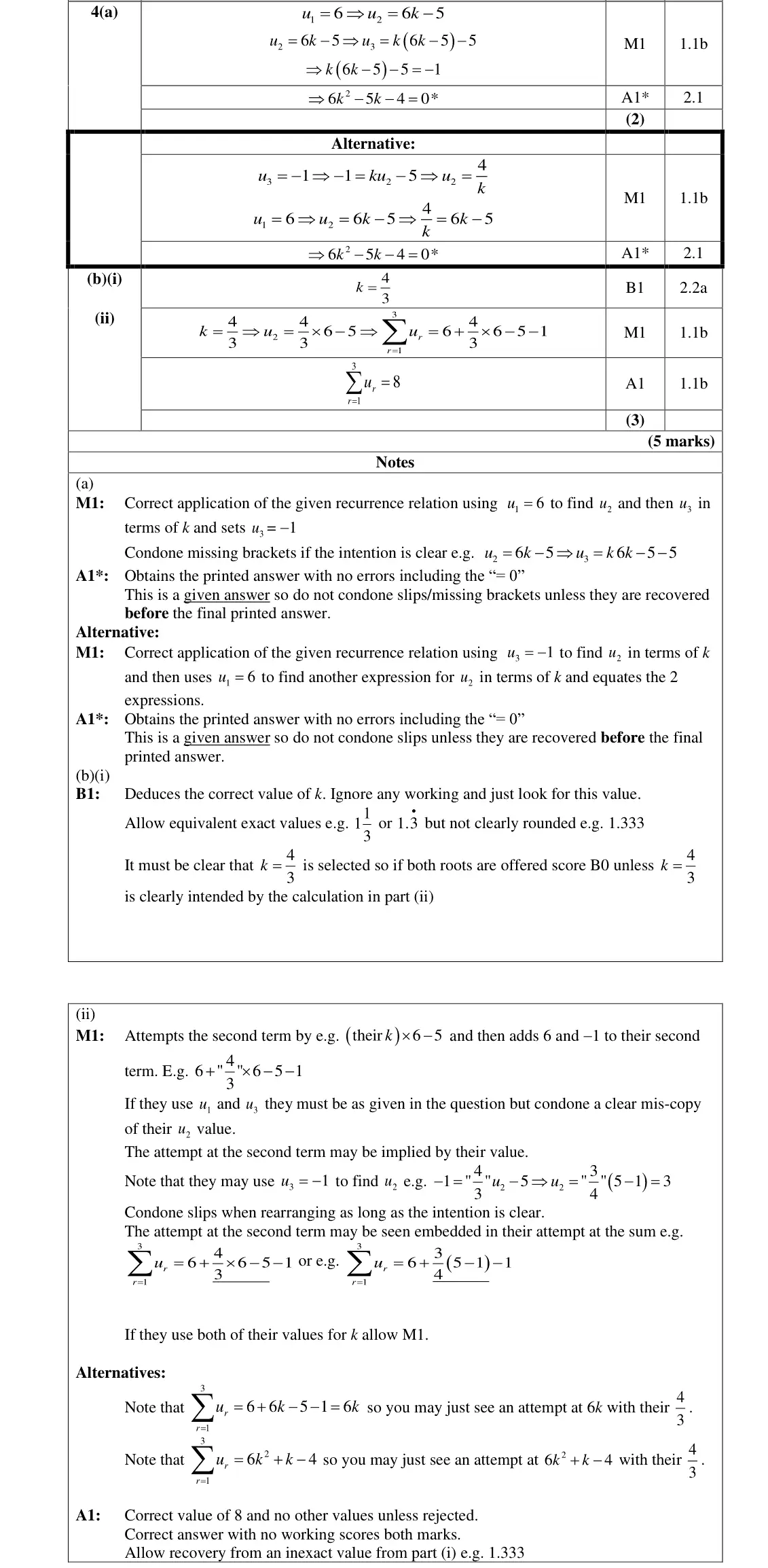
Generally, candidates found this question accessible, with many scoring full marks or nearly full marks. In part (a) most candidates used the given recurrence relation along with u1 = 6 to find u2 = 6k – 5 and then u3 = 6k2 – 5k – 5, and then set u3 = – 1 and rearranged to obtain the given answer 6k2 – 5k – 4 = 0. Algebraic errors were few, but some candidates forgot to include the ‘= 0’ in their final line and lost the second mark in this part. There were occasional attempts at using arithmetic or geometric series which gained no credit.
Common mistakes
u₂ = 6k − 5, u₃ = k(6k − 5) − 5 = −1
must include "= 0" in the given answer
AP/GP formulae score 0
June 2024 · Paper 2 · Q4(b)3 marks
Mark scheme (whole question; this part is marked with the orange bar)
Examiner's comment
Generally, candidates found this question accessible, with many scoring full marks or nearly full marks. In part (b)(i) most candidates were able to solve the quadratic equation, but not all identified that k = 4 3 was the only correct answer, or subsequently used this value, so lost the mark in this part of the question. Some candidates spent more time than they needed using the quadratic formula, where a factorisation of the quadratic would have been more direct. Use of the calculator equation solver was also permitted here. Candidates must learn to check their answers against any limitations given in the question. When errors did occur, they were most likely to appear in part (b)(ii), although most still answered it well. Most candidates identified the requirement of the question to add the first three terms of the sequence together, and correctly used k = 4 3 to calculate u2 =6 ( 4 3 ) -5 before finding 6 + 3 + (-1) = 8. Others first simplified the sum to obtain 6k or 6k2 + k - 4 before substituting the value of k. A common incorrect approach was to use u3 = 6k2 – 5k – 4 in the sum. Some also used k = 4 3 and k = 1 2 - to calculate the sum, without identifying which was the required answer. Alternatively, a good number of candidates attempted, correctly and incorrectly, to work out the values of u1 and u3 even though they were given in the question. It was also noticeable that a number of candidates used the quadratic expression from part (a) in order to work out values in (b)(ii), usually assuming u3 = k2 – 5k – 4. They, therefore, did not clearly understand what this equation represented. A few candidates incorrectly attempted to use the recurrence relation to find things like ( 4 3 )(1) – 5, ( 4 3 )(2) – 5 and ( 4 3 )(3) – 5, using these expressions to find their sum, and there were again occasional attempts using arithmetic or geometric series which also gained no credit. There were also a few attempts at integration. Overall, this was a question that allowed candidates to gain a good number of marks with confidence.
Common mistakes
k = 4/3 only (k positive, reject −½)
sum = 6 + 3 + (−1) = 8
do not use the quadratic 6k² − 5k − 4 as u₃
AP/GP formulae score 0
June 2023 · Paper 1 · Q9(a)2 marks
Mark scheme (whole question; this part is marked with the orange bar)
Examiner's comment
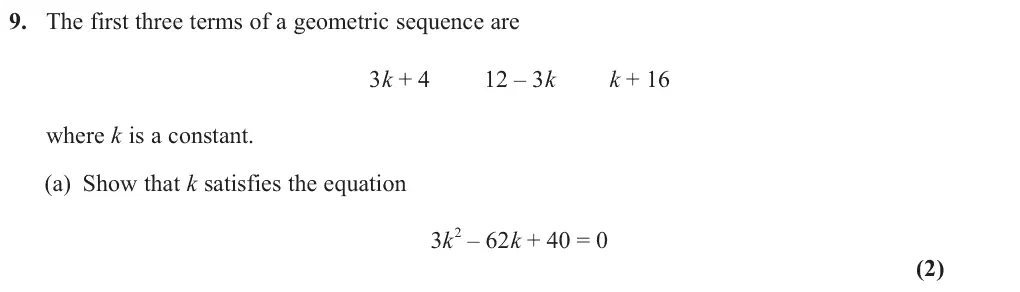
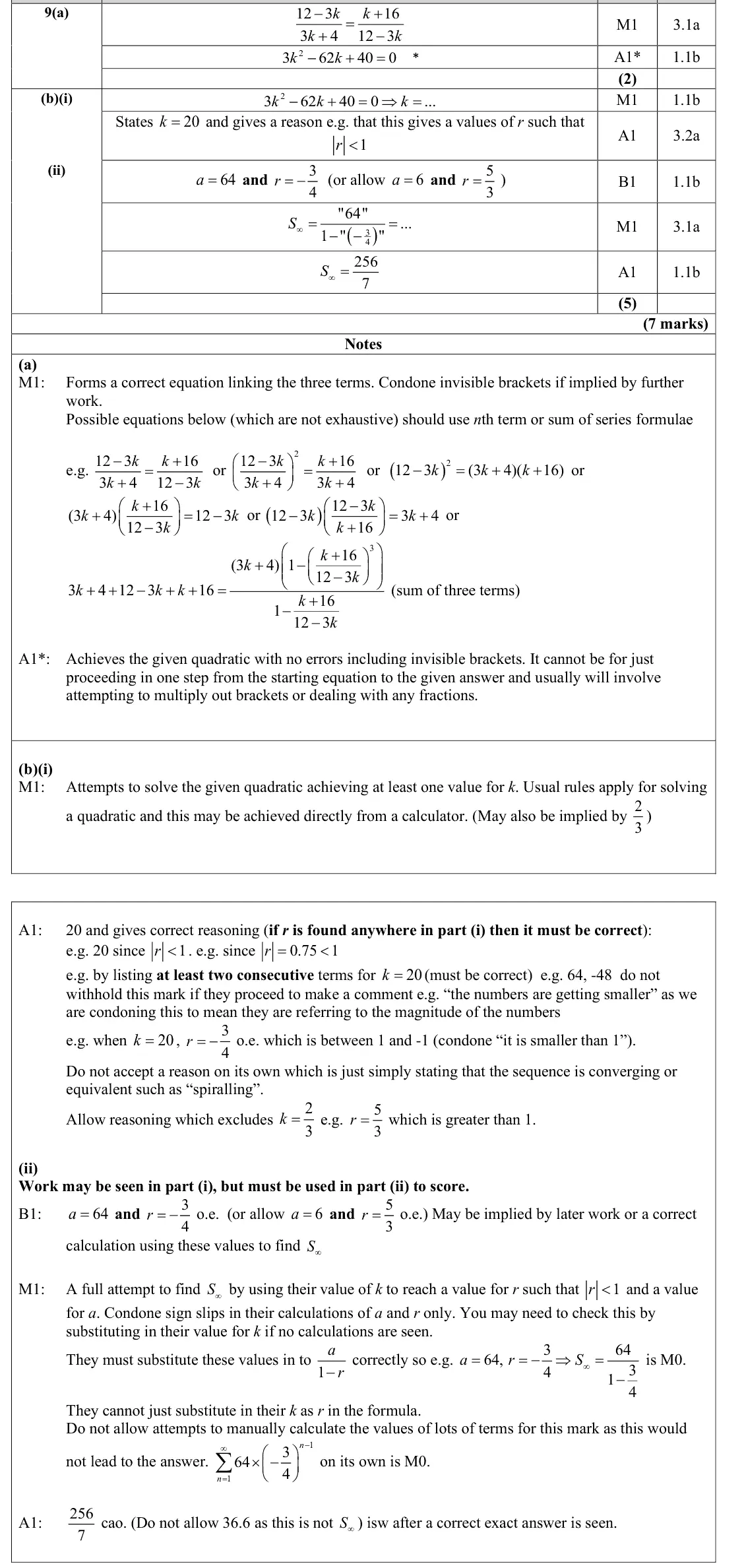
This was a more demanding than expected question on geometric sequences with a number of candidates getting confused with the value of k and the subsequent values of a and r required for the question. There was still access to later parts as the quadratic in k was given such that part (b) and part (c) could be attempted without part (a). Most candidates were able to score full marks in part (a) by correctly giving an equation in k, almost always 12 3 16 3 4 12 3 k k k k - + = + - and proceeding to the given quadratic with no errors seen. A noticeable number of candidates failed to gain the final mark as they gave a 40 - term in their quadratic. Given that this was a printed answer, it was disappointing that candidates did not identify their error and correct it. Some candidates wrote down a correct expression for r but failed to create an equation, whilst a few candidates formed an equation for the sum of three terms, but invariably failed to expand and simplify correctly. There were several valid but more complicated efforts such as expressing the third term as the first term multiplied by the square of the ratio. This was more likely to result in errors and there were a significant number who did not know where to start. The common mistake where they could not set up an equation in r was to look for a common difference as if it was an arithmetic sequence.
Common mistakes
equate the common ratios (or use u₂² = u₁u₃)
not a common difference
June 2023 · Paper 1 · Q9(b)5 marks
Mark scheme (whole question; this part is marked with the orange bar)
Examiner's comment
This was a more demanding than expected question on geometric sequences with a number of candidates getting confused with the value of k and the subsequent values of a and r required for the question. There was still access to later parts as the quadratic in k was given such that part (b) and part (c) could be attempted without part (a). In part (b)(i) candidates were told that the given sequence converges. Candidates were required to find the value of k and to give a reason for their answer. Solving from calculator, or without working, was allowed and the majority of candidates were able to correctly solve the quadratic reaching the terms 20 k = and 2 3 k = . However, many found giving a reason particularly challenging. Of those who did score both marks, listing values in the sequence was a common explanation, as was finding the value of r and using the fact that 1 r . When attempting to reason via a calculation of the common ratio, there were often errors. A common response was to assume k was equal to r and then selecting 2 3 k = as the final value. Some did not select a final value, keeping 20 and 2 3 . Some candidates who had chosen 20 k = gave comments such as “because it is an integer/whole number” or “because it is a constant”. A significant number chose 20 k = giving a reason “because the sequence is convergent” which they had already been told and did not demonstrate an understanding of what the term means. Part (b)(ii) proved to be very challenging for many candidates. It was quite often the case that candidates tried to use 2 3 r = and just found the value 6 a = when 2 3 k = . It was very frequent that those who had correctly identified 20 k = in part (b)(i) did not show their working to find a and r and lost all marks in (b)(ii) as the sign error in substituting in 3 4 - meant that it was unclear whether the correct value for r had been found, or if the correct sum to infinity formula was being used. Some candidates having found 256 7 correctly then proceeded to give a rounded decimal as their answer which was condoned. Those who found 6 a = and 5 3 r = were still able to score the B mark for a correct pair of values for a and r, even though they could not score the mark for using the sum to infinity formula with an invalid value for r.
Common mistakes
k = 20 because the modulus of r (¾) is less than 1 (k = ⅔ gives r = 5/3)
S∞ = a/(1 − r) with a = 64, r = −¾
June 2023 · Paper 2 · Q2(a)3 marks
Mark scheme (whole question; this part is marked with the orange bar)
Examiner's comment
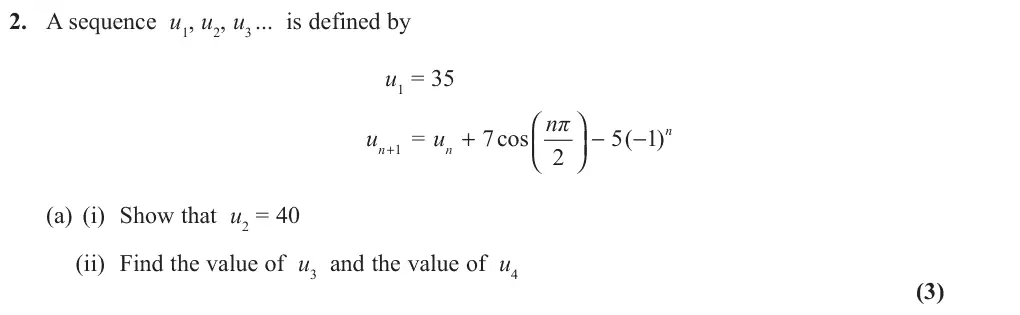
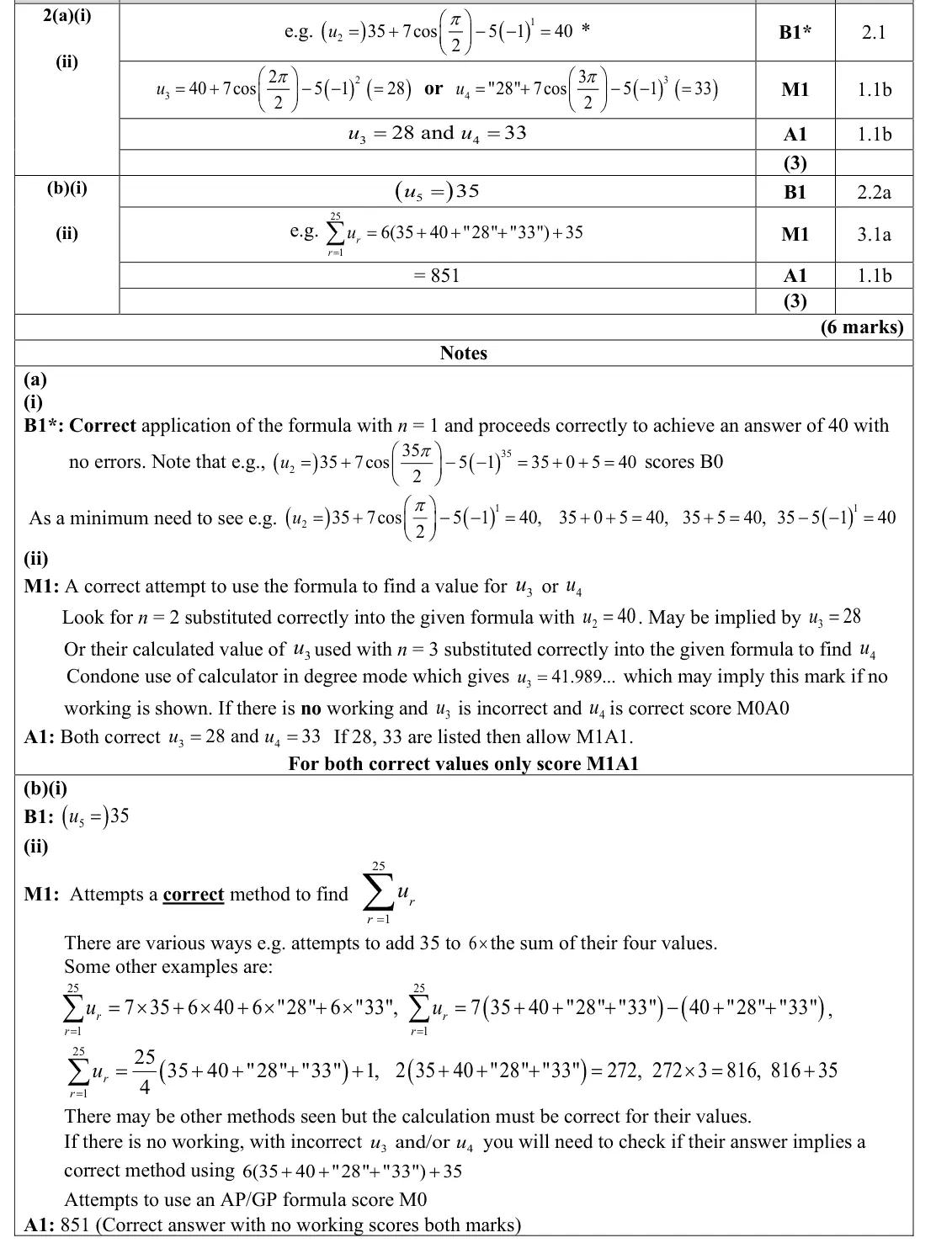
For the most part candidates answered this question well. This was dependent on whether they correctly understood the iteration formula. In part (a) (i), although many scored this first mark, there was a common misunderstanding of how a recurrence relationship works with confusion as to the meaning of n. Rather than term position, it was often confused with 𝑢𝑛 so that the incorrect calculation ( ) 35 2 35 35 7cos 5 1 2 u = + - - was often seen, giving the correct answer but obviously not scoring the B mark. Also not uncommonly seen was n replaced by 1 n u + , with candidates stating ( ) 40 2 40 40 7cos 5 1 2 u = + - - . The errors stated above also affected the performance of some candidates in part (ii). Furthermore, a minority of candidates had difficulty with accuracy in the sign of the final term, struggling with the odd/even power of -1 . For example, when calculating 3 u , ( ) 2 3 2 40 7cos 5 1 40 7 5 38 2 u = + - - = - + = , was not uncommon. Occasionally, candidates were seen to be working with degrees rather than radians, also leading to loss of the accuracy mark. In part (ii) many candidates recognised how to construct the arithmetic calculation to find the required sum. The most common of these attempts were: ( ) 1 2 3 4 1 6 u u u u u + + + + and ( ) 2 3 4 1 6 7 u u u u + + + Credit was given to candidates who used such ideas with incorrect values from earlier in the question for 3 u and 4 u , although those who had a wrong answer in (a)(i) who used their incorrect value for 2 u (rather than the given 2 40 u = ), lost both marks. It is important that centres make candidates aware that they must use the ‘show that’ answer in subsequent calculations no matter what they achieve in their working. Occasionally, candidates used ( ) 25 1 2 3 4 1 6.25 r r u u u u u = = + + + but these usually did not add 1 to give a fully correct method. Some also incorrectly tried summing the series as though the terms formed an arithmetic progression. Some candidates incorrectly multiplied (u1 + u2 + u3 + u4) by 4 instead of by 6. A minority forgot to add 35 to their total. A very small minority of candidates generated all the terms of the whole sequence and added them together.
Common mistakes
n is the term position: u₂ = 35 + 7cos(π/2) − 5(−1)¹ = 40 (using n = 35 scores 0 even though it gives 40)
u₃ = 28, u₄ = 33
work in radians
sign of (−1)ⁿ
June 2023 · Paper 2 · Q2(b)3 marks
Mark scheme (whole question; this part is marked with the orange bar)
Examiner's comment
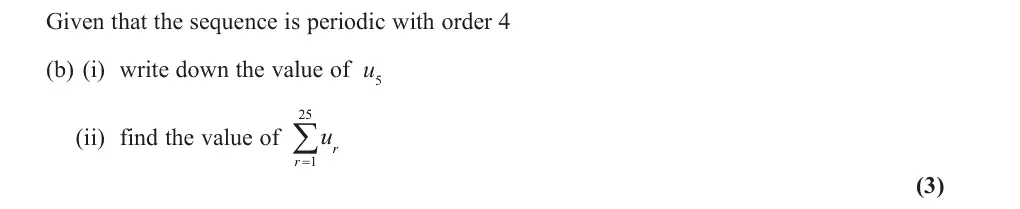
For the most part candidates answered this question well. This was dependent on whether they correctly understood the iteration formula. In part (b) (i) most candidates understood the order 4, periodic nature of the recurrence relationship and that 5 1 4 3, k u u u k Z + - = = . Occasionally, candidates unnecessarily calculated 5 u , using 4 u in the recurrence relationship, which sometimes led to the mark being lost either if 4 u had an incorrect value or if an error was made in the calculation.
Common mistakes
order 4 so u₅ = u₁ = 35
Σ to 25 = 6 × (35 + 40 + 28 + 33) + 35 = 851
AP/GP formulas score 0
June 2023 · Paper 2 · Q8(b)3 marks
Mark scheme (whole question; this part is marked with the orange bar)
Examiner's comment
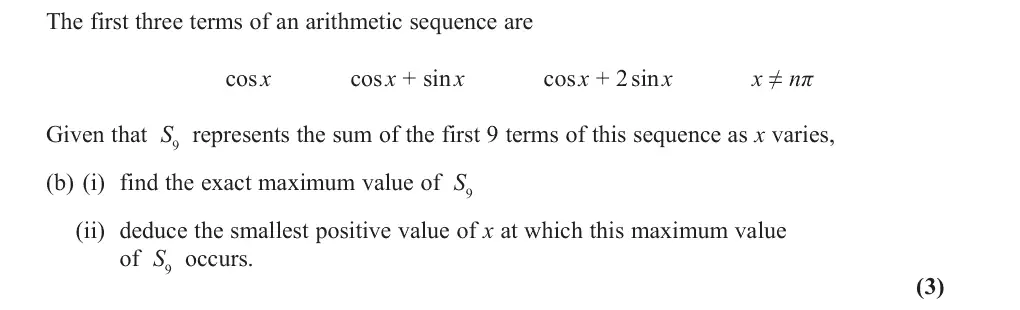
Candidates found part (b) more challenging, with many failing to link areas of mathematics, in this case trigonometry and series. Even where a candidate successfully found the sum, 9cos 36sin S x x = + , many did not relate it to part (a). Those who did recognise the form were usually able to get 4.5 " " R , usually 4.5 2 17 for part (i). Some seemed to misread the question and stated the minimum value, so lost the accuracy mark. A significant number of candidates found a correct expression in harmonic form but lost both the M1 and A1 as they kept a correct 9 17 embedded in their expression.
Common mistakes
common difference sin x: S₉ = 9cos x + 36sin x = 4.5(2cos x + 8sin x), so max = 4.5R = 9√17 (not left embedded in an expression)
occurs when x = α ≈ 1.33
many did not link to (a)
giving the minimum
June 2022 · Paper 1 · Q13(i)3 marksMedium
Mark scheme (whole question; this part is marked with the orange bar)
Examiner's comment
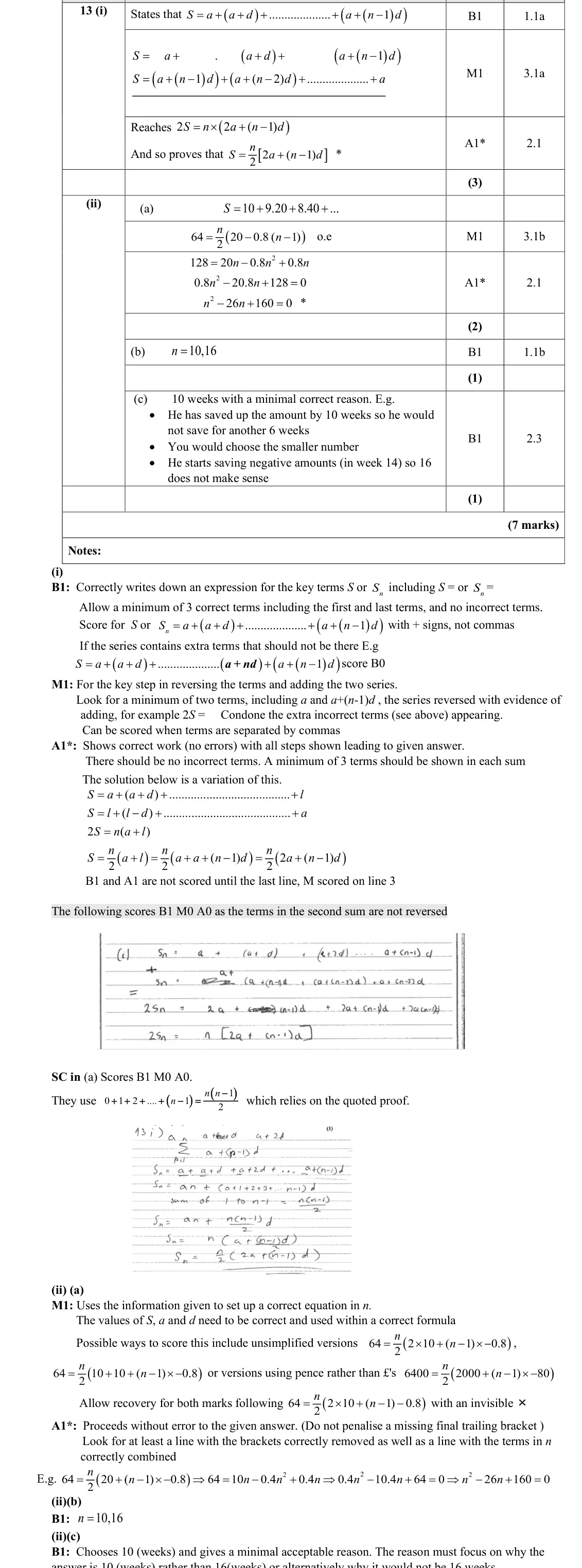
This question on arithmetic sequences and series proved to be very discriminating. The proof of the sum of an arithmetic sequence is standard, but was not answered well by many candidates. Most candidates however were able to then made progress with the rest of the question, having been given the required formula. Good candidates often did well in this question however, with 17% of the cohort achieving full marks. In part(i) those who had learned the standard proof for the sum of the first n terms of an arithmetic series often gained full marks. It was however, unusual to see a well set out, fully correct proof. Candidates often failed to write a correct expression for Sn at the start of their proof, or sometimes having an incorrect first or last term or extra terms (most often a+nd) within their sum. Other errors included not displaying a sufficient number of terms, not writing S= or Sn =, and using commas instead of + sign between the terms. In part(ii) most realised that they could make headway even if they hadn’t attempted part (i). In (ii) (a) many of the candidates used a=20, d = -0.8 and Sn = 64 in the sum formula to score the M mark. Poor notation such as (n-1)-0.8 was frequently seen, but candidates usually recovered from this. Following a correct equation most were able to proceed correctly to the given quadratic for the accuracy mark. A common error was where candidates used +0.8 as the common difference rather than -0.8 Part (ii) (b) was generally answered without issues. Almost all candidates managed to get B1 for getting the two values of n, either by factorising or by using a calculator. Part (ii)(c) was not answered very well with most candidates identifying 10 as the valid solution but not adequately justifying this choice. The reasons provided were often too vague or not related to why 10 was better than 16. More tended to score the mark by explaining that at 16 weeks he would be saving a negative amount rather than using the fact that 10 was the smaller number or that he would have had enough by 10 weeks so would not continue saving until 16 weeks.
Common mistakes
write Sn = a + (a + d) + ... + (a + (n − 1)d) with + signs, reverse and add to get 2Sn = n(2a + (n − 1)d)
wrong extra terms such as a + nd
too few terms shown
June 2022 · Paper 1 · Q13(ii)(a)2 marksMedium
Mark scheme (whole question; this part is marked with the orange bar)
Examiner's comment
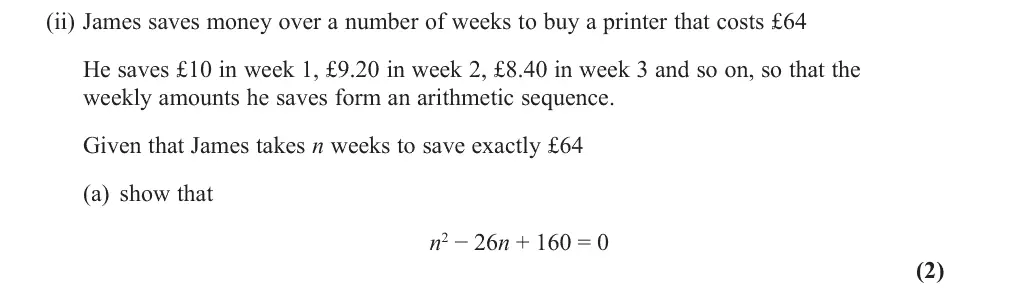
This question on arithmetic sequences and series proved to be very discriminating. The proof of the sum of an arithmetic sequence is standard, but was not answered well by many candidates. Most candidates however were able to then made progress with the rest of the question, having been given the required formula. Good candidates often did well in this question however, with 17% of the cohort achieving full marks. In part(i) those who had learned the standard proof for the sum of the first n terms of an arithmetic series often gained full marks. It was however, unusual to see a well set out, fully correct proof. Candidates often failed to write a correct expression for Sn at the start of their proof, or sometimes having an incorrect first or last term or extra terms (most often a+nd) within their sum. Other errors included not displaying a sufficient number of terms, not writing S= or Sn =, and using commas instead of + sign between the terms. In part(ii) most realised that they could make headway even if they hadn’t attempted part (i). In (ii) (a) many of the candidates used a=20, d = -0.8 and Sn = 64 in the sum formula to score the M mark. Poor notation such as (n-1)-0.8 was frequently seen, but candidates usually recovered from this. Following a correct equation most were able to proceed correctly to the given quadratic for the accuracy mark. A common error was where candidates used +0.8 as the common difference rather than -0.8 Part (ii) (b) was generally answered without issues. Almost all candidates managed to get B1 for getting the two values of n, either by factorising or by using a calculator. Part (ii)(c) was not answered very well with most candidates identifying 10 as the valid solution but not adequately justifying this choice. The reasons provided were often too vague or not related to why 10 was better than 16. More tended to score the mark by explaining that at 16 weeks he would be saving a negative amount rather than using the fact that 10 was the smaller number or that he would have had enough by 10 weeks so would not continue saving until 16 weeks.
Common mistakes
a = 10, d = −0.8: 64 = n/2(20 − 0.8(n − 1)) then expand and simplify to the given quadratic
June 2022 · Paper 1 · Q13(ii)(c)1 markHard
Mark scheme (whole question; this part is marked with the orange bar)
Examiner's comment
This question on arithmetic sequences and series proved to be very discriminating. The proof of the sum of an arithmetic sequence is standard, but was not answered well by many candidates. Most candidates however were able to then made progress with the rest of the question, having been given the required formula. Good candidates often did well in this question however, with 17% of the cohort achieving full marks. In part(i) those who had learned the standard proof for the sum of the first n terms of an arithmetic series often gained full marks. It was however, unusual to see a well set out, fully correct proof. Candidates often failed to write a correct expression for Sn at the start of their proof, or sometimes having an incorrect first or last term or extra terms (most often a+nd) within their sum. Other errors included not displaying a sufficient number of terms, not writing S= or Sn =, and using commas instead of + sign between the terms. In part(ii) most realised that they could make headway even if they hadn’t attempted part (i). In (ii) (a) many of the candidates used a=20, d = -0.8 and Sn = 64 in the sum formula to score the M mark. Poor notation such as (n-1)-0.8 was frequently seen, but candidates usually recovered from this. Following a correct equation most were able to proceed correctly to the given quadratic for the accuracy mark. A common error was where candidates used +0.8 as the common difference rather than -0.8 Part (ii) (b) was generally answered without issues. Almost all candidates managed to get B1 for getting the two values of n, either by factorising or by using a calculator. Part (ii)(c) was not answered very well with most candidates identifying 10 as the valid solution but not adequately justifying this choice. The reasons provided were often too vague or not related to why 10 was better than 16. More tended to score the mark by explaining that at 16 weeks he would be saving a negative amount rather than using the fact that 10 was the smaller number or that he would have had enough by 10 weeks so would not continue saving until 16 weeks.
Common mistakes
10 weeks: he has £64 by week 10 (and amounts go negative from week 14)
reason must explain why not 16
June 2022 · Paper 2 · Q3(a)2 marks
Mark scheme (whole question; this part is marked with the orange bar)
Examiner's comment
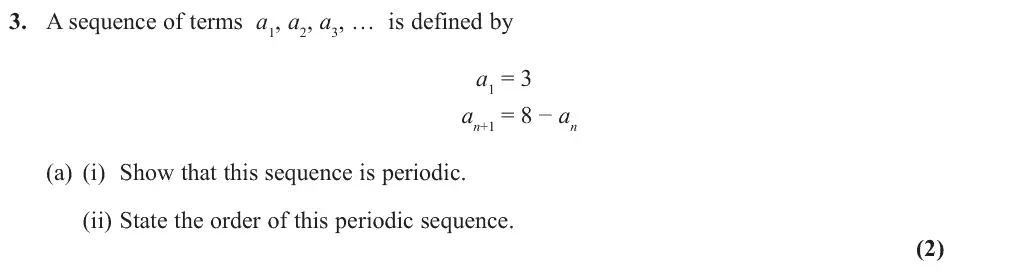
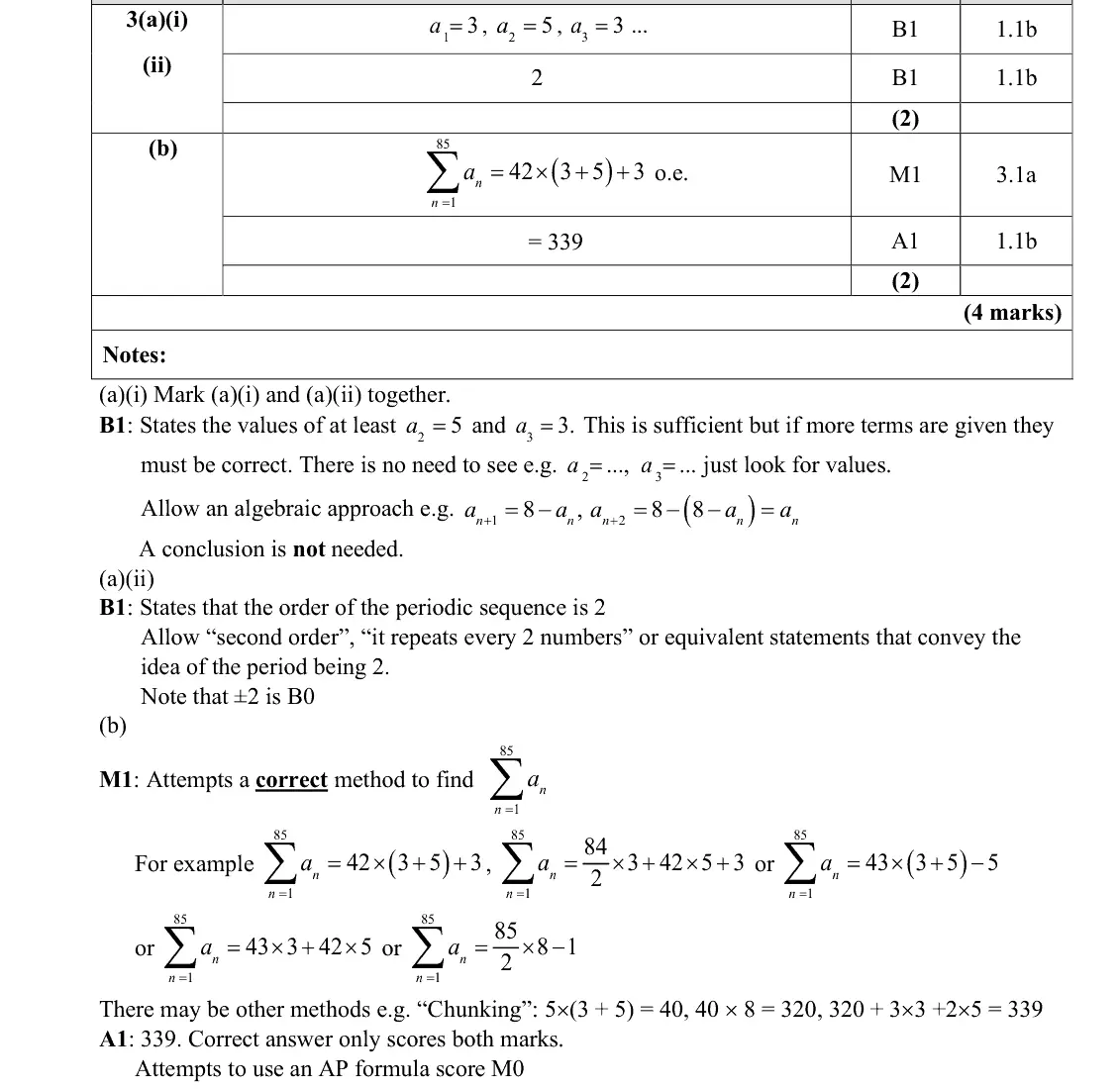
This question proved to be successful for many candidates and many scored full marks here. In part (a)(i), the vast majority were able to successfully write down the sequence of terms and hence demonstrate that the sequence was periodic. An algebraic proof was not required here, and one was only rarely seen. Perhaps surprisingly having identified the pattern in the sequence in (a)(i), not all were able to identify the order of the sequence as ‘2’ in (a)(ii). This perhaps highlights a lack here were: ‘first order’; ‘order 3, 5’; ‘±2’or just a re-writing of their sequence from part of awareness of what is meant by “order” of a sequence. Common incorrect answers (a)(i). In part b), candidates were most successful when they considered the nature of the sequence rather than trying to resort to a formula. A fairly common first step was to divide 85 by 2 to give 42 with remainder 1. Many students then correctly broke down 42 x 3 + 43 x 5 or equivalently (42 x 8) + 3 . Errors occurred when candidates the sum into either 42.5 x 5 + 42.5 x 3 resulting in an answer of 340, or when candidates mistakenly struggled with the odd number of terms and believed they should calculate errors included summing only 84 terms (42 x 8 = 336) or attempts to ‘chunk’ thought that the 85th term was ‘5’ rather than ‘3’ resulting in an answer of 341. Other incorrectly into blocks of e.g. size 5: in such attempts the sum of the first five terms was (3 + 5 + 3 + 5 + 3 = 19) followed by deduction that 5 = 17 leading to an incorrect 85 obtained answer of 19 x 17 = 323. A sizeable number of incorrect attempts involving use of the sum of arithmetic or geometric series were also commonly seen. Perhaps most surprising was the significant minority who were able to set up a correct approach and write down a correct method but who then made arithmetical errors to write down an incorrect total which cost them the final A mark.
Common mistakes
a₂ = 5, a₃ = 3 is enough
order is 2 (not ±2, first order or 3, 5)
June 2022 · Paper 2 · Q3(b)2 marks
Mark scheme (whole question; this part is marked with the orange bar)
Examiner's comment
This question proved to be successful for many candidates and many scored full marks here.
Common mistakes
42 × (3 + 5) + 3 = 339
85 terms is odd and the 85th term is 3 (not 5, giving 341)
42.5 × 8 = 340 is wrong
AP/GP formulae score 0
June 2022 · Paper 2 · Q15(a)3 marks
Mark scheme (whole question; this part is marked with the orange bar)
Examiner's comment
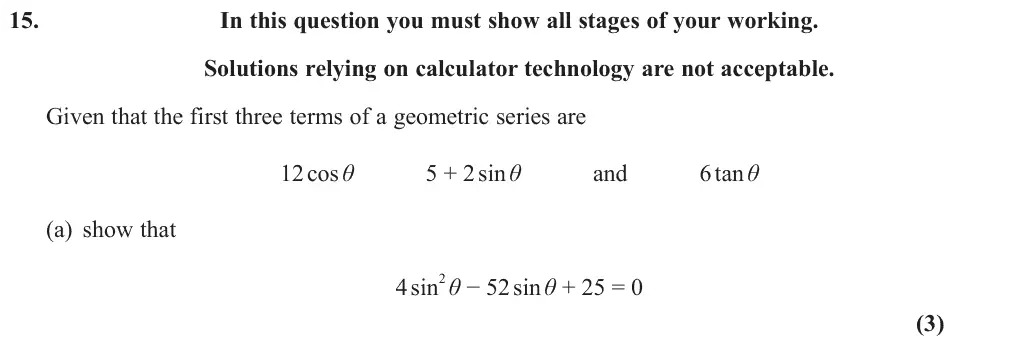
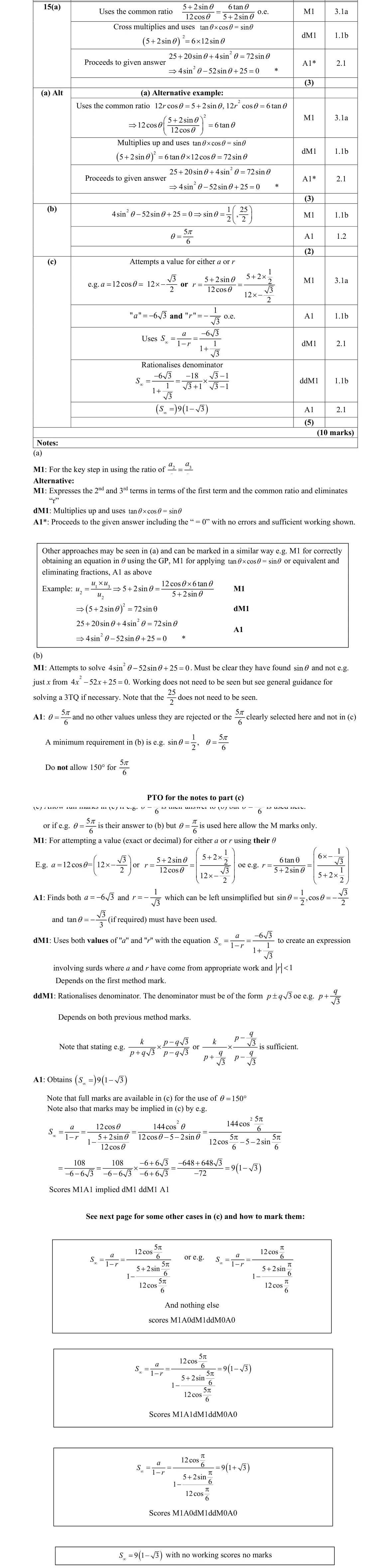
The majority of candidates found this question accessible and were able to score consistently throughout. Where marks were lost they were usually in parts (b) and (c). 12𝑐𝑐𝑐𝑐𝑐𝑐𝑐𝑐= 5+2𝑠𝑠𝑠𝑠𝑠𝑠𝑠𝑠 6𝑡𝑡𝑎𝑎𝑎𝑎𝑎𝑎 Part (a) was attempted successfully by most candidates, starting usually with 5+2𝑠𝑠𝑠𝑠𝑠𝑠𝑠𝑠. Candidates then successfully cross multiplied and used the was 6𝑡𝑡𝑡𝑡𝑡𝑡𝑡𝑡= 12𝑐𝑐𝑐𝑐𝑐𝑐𝑐𝑐ቀ 12𝑐𝑐𝑐𝑐𝑐𝑐𝑐𝑐ቁ 2 5+2𝑠𝑠𝑠𝑠𝑠𝑠𝑠𝑠 appropriate identity to reach the required result. Another starting point regularly seen . Errors in the proof were rare if candidates started from a correct statement. Occasionally the “ = 0” was carelessly missing. 𝜋𝜋 In part (b) most candidates correctly solved the equation either by factorising or using 6 rather than the required 5𝜋𝜋 5𝜋𝜋 calculator technology, but many reached the acute angle 6 . Others found a number of solutions but failed to identify 6 as the obtuse angle of 𝜋𝜋 required answer. A few candidates worked in degrees and again lost the accuracy mark. 6 in (b) then usually carried this error into (c) and 𝜋𝜋 Those who had obtained an angle of 6 in (c) often would reach 9൫1 + sqrt 3൯, but did not seem to worry that this did not match the required answer were in a position only to earn the method marks. Candidates using format given in the question. There were many attempts, however, to use the correct formula for the sum to infinity with appropriate values for the first term and the (often incorrectly) algebraic expressions for the sum to infinity involving ��𝜃, without common ratio. Some candidates unfortunately put effort into finding and rearranging 𝑎𝑎 1+𝑟𝑟 incorrectly as the formula substituting an angle in, gaining no credit, and others used for the sum to infinity. The most common mistake in (c) was failure to show the steps 3 ൰ straight into their calculators to obtain 9 -9 sqrt 3 losing the last two marks in -6 sqrt 3 where the denominator was rationalised. Many candidates clearly typed an expression 1-൬- sqrt 3 like the question.
Common mistakes
equate the common ratios (5 + 2sinθ)/12cosθ = 6tanθ/(5 + 2sinθ)
tanθ × cosθ = sinθ
"= 0" needed
June 2022 · Paper 2 · Q15(c)5 marks
Mark scheme (whole question; this part is marked with the orange bar)
Examiner's comment
The majority of candidates found this question accessible and were able to score consistently throughout. Where marks were lost they were usually in parts (b) and (c). 12𝑐𝑐𝑐𝑐𝑐𝑐𝑐𝑐= 5+2𝑠𝑠𝑠𝑠𝑠𝑠𝑠𝑠 6𝑡𝑡𝑎𝑎𝑎𝑎𝑎𝑎 Part (a) was attempted successfully by most candidates, starting usually with 5+2𝑠𝑠𝑠𝑠𝑠𝑠𝑠𝑠. Candidates then successfully cross multiplied and used the was 6𝑡𝑡𝑡𝑡𝑡𝑡𝑡𝑡= 12𝑐𝑐𝑐𝑐𝑐𝑐𝑐𝑐ቀ 12𝑐𝑐𝑐𝑐𝑐𝑐𝑐𝑐ቁ 2 5+2𝑠𝑠𝑠𝑠𝑠𝑠𝑠𝑠 appropriate identity to reach the required result. Another starting point regularly seen . Errors in the proof were rare if candidates started from a correct statement. Occasionally the “ = 0” was carelessly missing. 𝜋𝜋 In part (b) most candidates correctly solved the equation either by factorising or using 6 rather than the required 5𝜋𝜋 5𝜋𝜋 calculator technology, but many reached the acute angle 6 . Others found a number of solutions but failed to identify 6 as the obtuse angle of 𝜋𝜋 required answer. A few candidates worked in degrees and again lost the accuracy mark. 6 in (b) then usually carried this error into (c) and 𝜋𝜋 Those who had obtained an angle of 6 in (c) often would reach 9൫1 + sqrt 3൯, but did not seem to worry that this did not match the required answer were in a position only to earn the method marks. Candidates using format given in the question. There were many attempts, however, to use the correct formula for the sum to infinity with appropriate values for the first term and the (often incorrectly) algebraic expressions for the sum to infinity involving 𝜃𝜃, without common ratio. Some candidates unfortunately put effort into finding and rearranging 𝑎𝑎 1+𝑟𝑟 incorrectly as the formula substituting an angle in, gaining no credit, and others used for the sum to infinity. The most common mistake in (c) was failure to show the steps 3 ൰ straight into their calculators to obtain 9 -9 sqrt 3 losing the last two marks in -6 sqrt 3 where the denominator was rationalised. Many candidates clearly typed an expression 1-൬- sqrt 3 like the question.
Common mistakes
a = −6√3, r = −1/√3 (modulus less than 1)
S∞ = a/(1 − r) and rationalise the denominator to 9(1 − √3)
using θ = π/6 gives 9(1 + √3), which does not match the given form
steps must be shown, not calculator
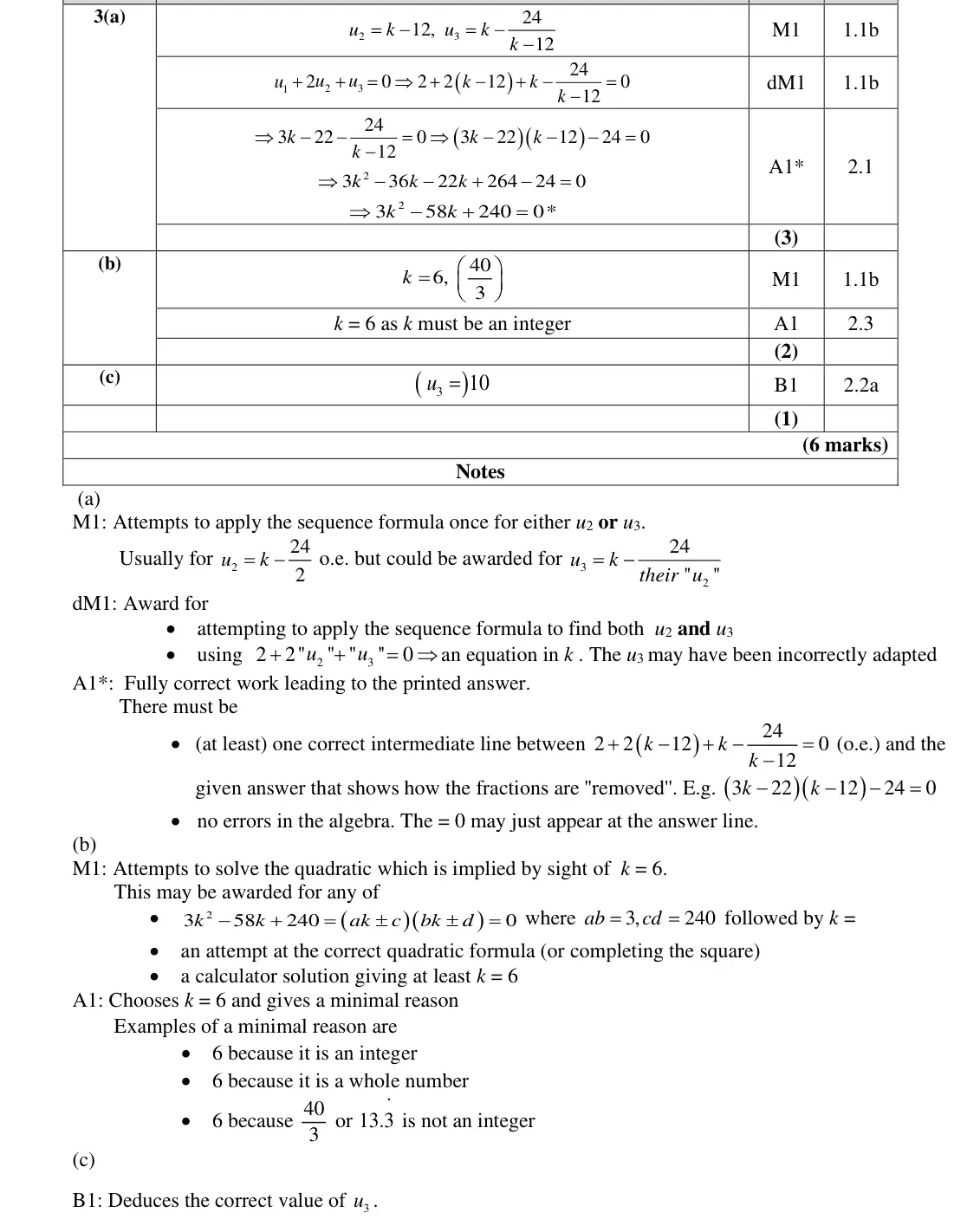
Oct 2021 · Paper 1 · Q3(a)3 marksEasy
Mark scheme (whole question; this part is marked with the orange bar)
Examiner's comment
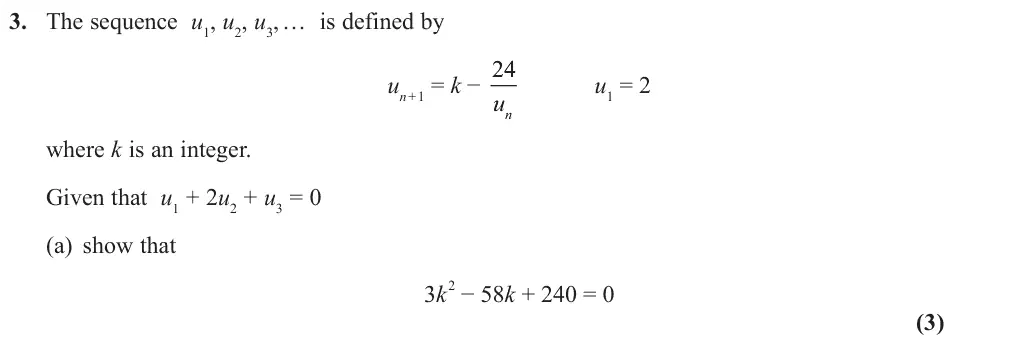
This proved to be a little more demanding than the first two questions but over 40% of candidates still scored all 6 marks. Errors seen by candidates are summarised below. In part (a) several candidates did not simplify 𝑢𝑢2 sufficiently, giving 𝑢𝑢2 =𝑘𝑘-24/2 which then lead to a more complicated expression for 𝑢𝑢3 which they had difficulty simplifying. Some candidates did not use the given expression, but rather used 𝑢𝑢1+𝑢𝑢2+𝑢𝑢3 = 0.
Common mistakes
u₂ = k − 12 (simplify 24/2), u₃ = k − 24/(k − 12)
use the given u₁ + 2u₂ + u₃ = 0
show how the fractions are removed before the given answer
Oct 2021 · Paper 1 · Q3(b)2 marksMedium
Mark scheme (whole question; this part is marked with the orange bar)
Examiner's comment
This proved to be a little more demanding than the first two questions but over 40% of candidates still scored all 6 marks. Errors seen by candidates are summarised below. In part (b) candidates usually found both roots of the given quadratic either by factorisation or by use of the quadratic formula, with a small number by completing the square. A significant minority failed to gain the A mark here as they did not state that 6 was an integer or that 40/3 was not an integer, with some excluding 40/3 on the grounds that it was irrational.
Common mistakes
roots 6 and 40/3
k = 6 because k must be an integer (40/3 is not an integer
it is not irrational)
Oct 2021 · Paper 1 · Q3(c)1 markMedium
Mark scheme (whole question; this part is marked with the orange bar)
Examiner's comment
This proved to be a little more demanding than the first two questions but over 40% of candidates still scored all 6 marks. Errors seen by candidates are summarised below. Part (c) was invariably answered correctly by those who had solved the quadratic in part (b). although there were some candidates who gave a choice of answers.
Common mistakes
u₃ = 10 from k = 6
give one answer only
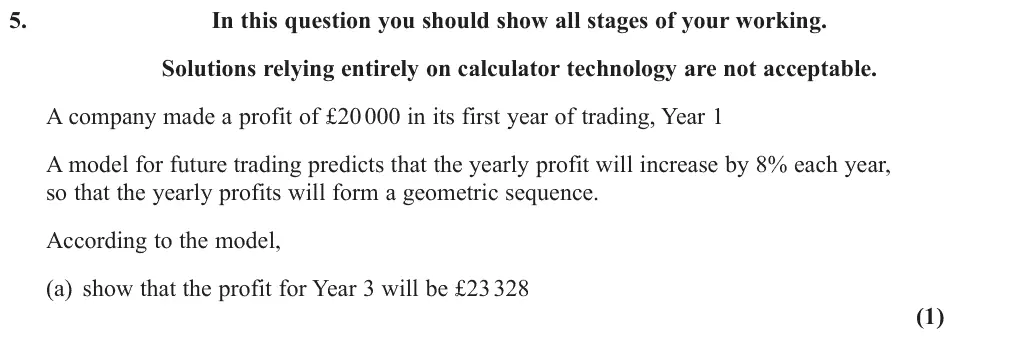
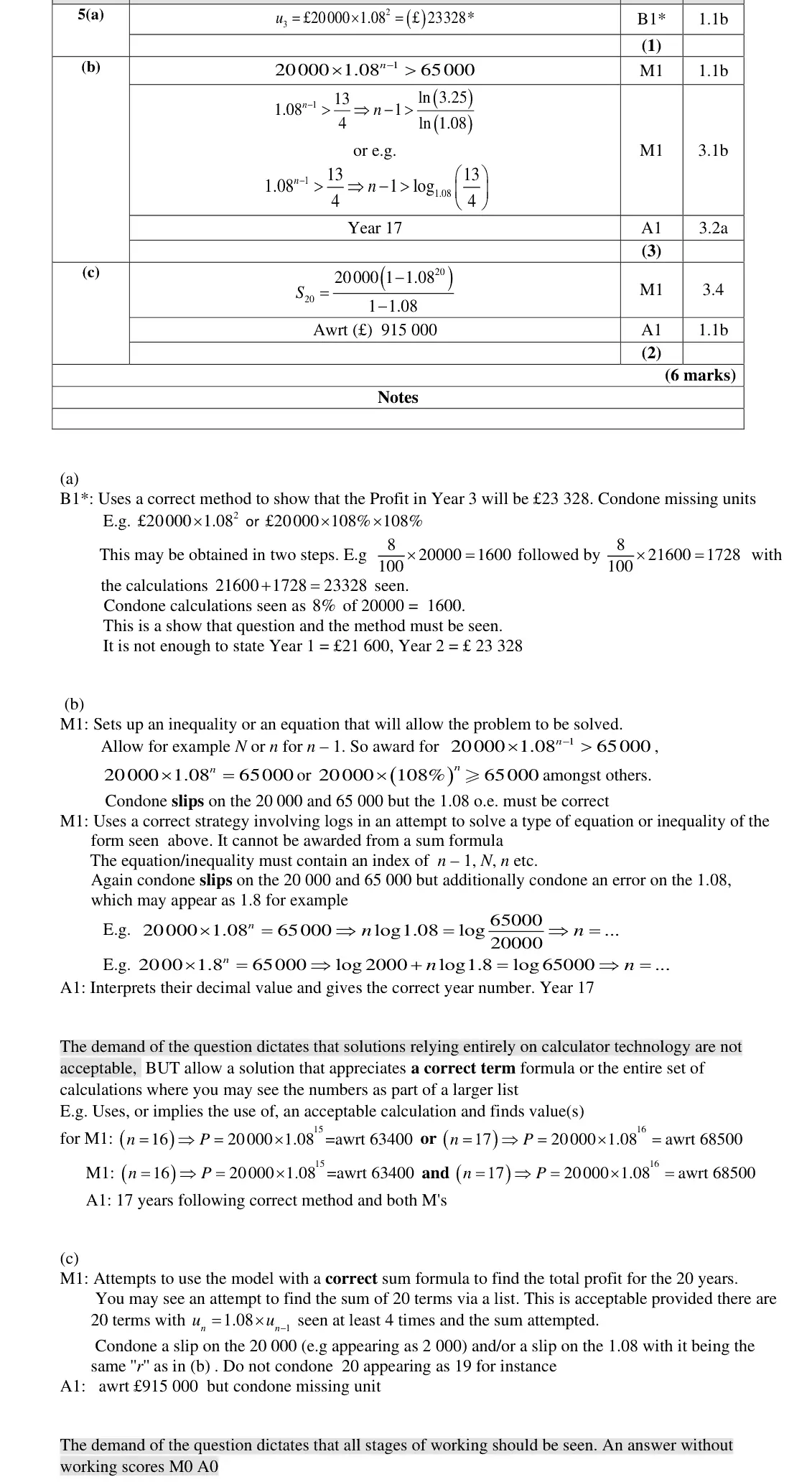
Oct 2021 · Paper 1 · Q5(a)1 mark
Mark scheme (whole question; this part is marked with the orange bar)
Examiner's comment
This was yet another good source of marks with the modal mark being 6 out of 6, achieved by over 35% of the candidature. Almost every candidate gained the B1 mark in part (a) with a fairly even split between those who used 20 000 x 1.082 and those who first calculated the profit after Year 1 = 21600 and then Year 2 = 23328 showing each step of their working to gain the mark.
Common mistakes
20 000 × 1.08² = 23 328 with the method shown
stating Year 2 and Year 3 values alone is not enough
Oct 2021 · Paper 1 · Q5(b)3 marks
Mark scheme (whole question; this part is marked with the orange bar)
Examiner's comment
This was yet another good source of marks with the modal mark being 6 out of 6, achieved by over 35% of the candidature. Part (b) was more problematic for many candidates. There was a very good understanding of the inequality/equation to be formed, and the use of logs was almost always very good. However, a significant minority of candidates failed to gain the final A mark giving an answer of 15.3 or 16 instead of Year 17.
Common mistakes
20 000 × 1.08ⁿ⁻¹ > 65 000
solve with logs: n − 1 > ln 3.25 / ln 1.08 = 15.3
answer Year 17, not 15.3 or 16
a sum formula is wrong
Oct 2021 · Paper 1 · Q5(c)2 marks
Mark scheme (whole question; this part is marked with the orange bar)
Examiner's comment
This was yet another good source of marks with the modal mark being 6 out of 6, achieved by over 35% of the candidature. Part (c) proved to be very well answered with the vast majority using the sum formula correctly. Errors included using n =19 instead of 20 in the formula or finding the 20th term instead of the sum. A few candidates listed all the terms before adding them which often led to accuracy errors.
Common mistakes
S₂₀ = 20 000(1.08²⁰ − 1)/(1.08 − 1) = £915 000
n = 19 or finding the 20th term instead of the sum
listing terms causes accuracy errors
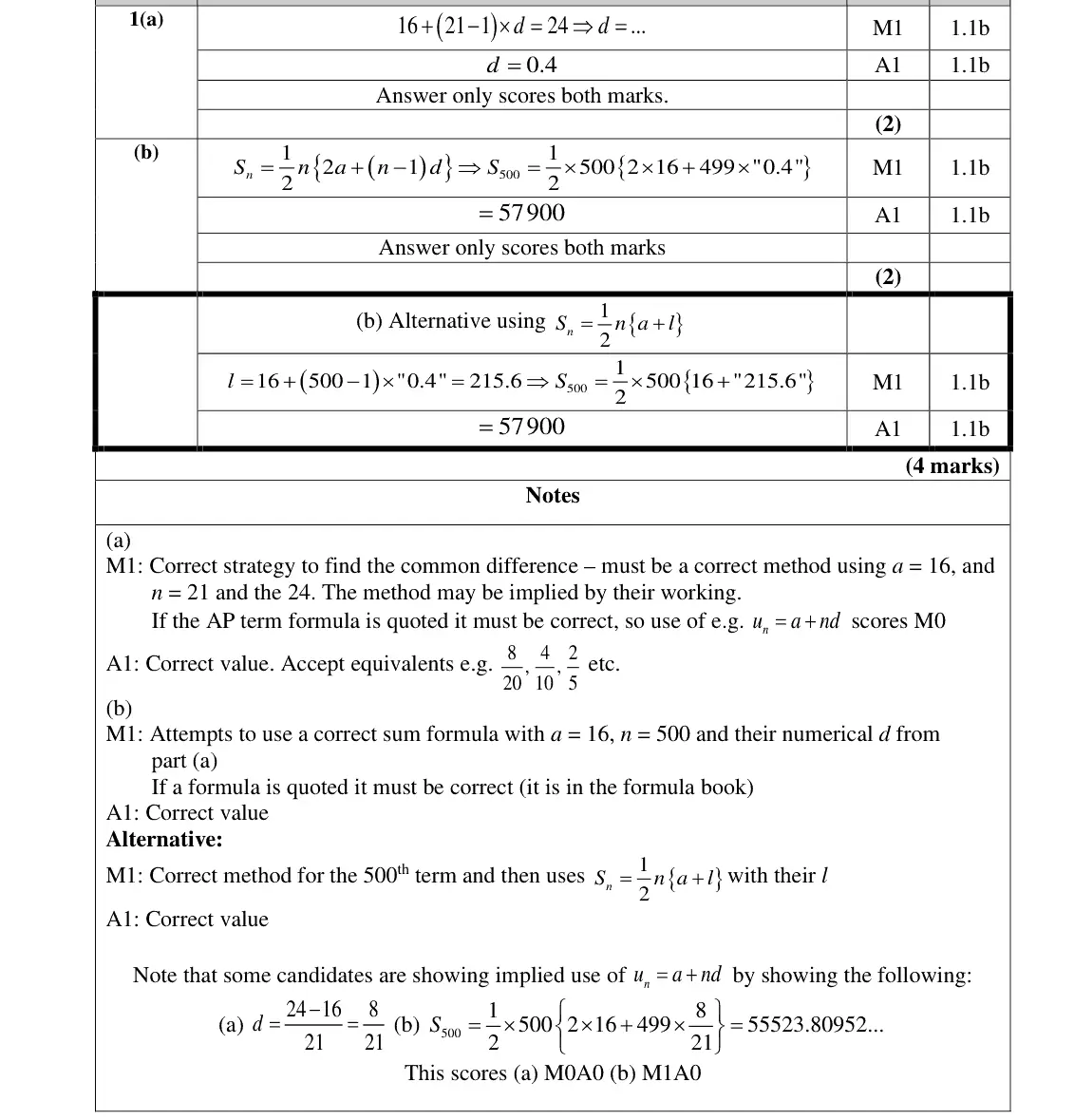
Oct 2021 · Paper 2 · Q1(a)2 marks
Mark scheme (whole question; this part is marked with the orange bar)
Examiner's comment
As the first question of the paper this did its job in settling nervous students: a straightforward question on arithmetic series which was answered correctly by the vast majority of students. Where mistakes were made the most common error in part (a) was to use the 21st term as 21, rather than 24, or students used an incorrect formula for the nth term, using un = a + nd and not un = a + (n -1)d. A few students incorrectly treated 24 as the sum of the first 21 terms in their attempt to find d.
Common mistakes
uₙ = a + (n − 1)d, not a + nd
the 21st term is 24, not 21
24 is a term, not the sum of 21 terms
Oct 2021 · Paper 2 · Q1(b)2 marks
Mark scheme (whole question; this part is marked with the orange bar)
Examiner's comment
As the first question of the paper this did its job in settling nervous students: a straightforward question on arithmetic series which was answered correctly by the vast majority of students. For part (b) most students used the correct formula and therefore gained the method mark, however some lost the accuracy mark from the incorrect common difference, and a very small minority of students used 𝑆𝑆500 = 𝑛𝑛 2(a + (n - 1)d) rather than 𝑆𝑆500 = 𝑛𝑛 2(2a + (n - 1)d).
Common mistakes
Sₙ = ½n{2a + (n − 1)d} with a = 16, n = 500
using a instead of 2a
wrong d from (a) loses the A mark
Oct 2021 · Paper 2 · Q93 marks
Mark scheme (whole question; this part is marked with the orange bar)
Examiner's comment
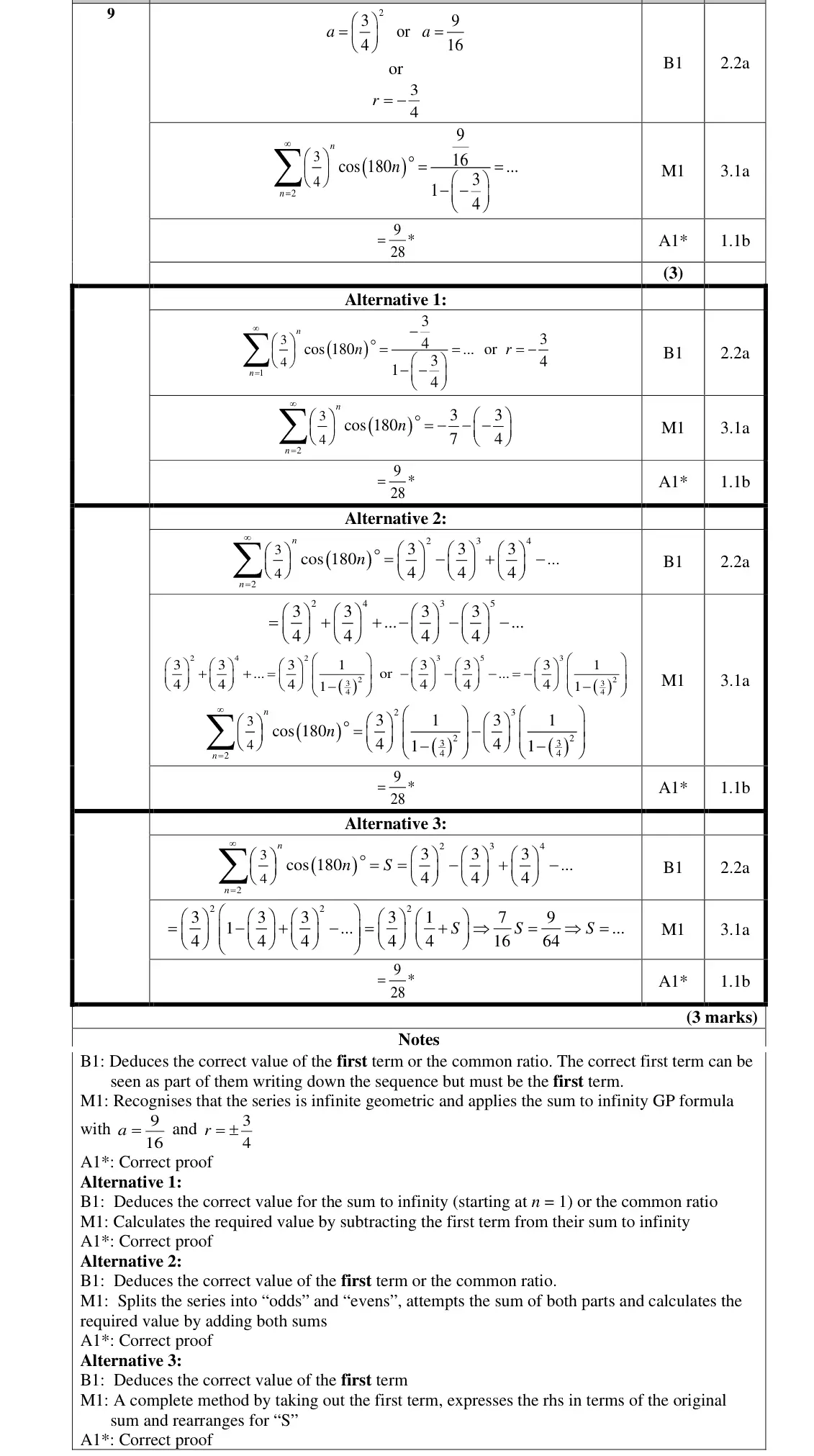
This question was fairly well answered by a number of candidates, who understood the need to use the sum to infinity formula, but a sizeable majority made little or no progress, not realising for example, that the sum started from n = 2 and not n =1 – hence they often did not get the first mark for a correct first term and/or common ratio. 9/16 was seen fairly often, but not always attributed to the first term, with some candidates thinking this was the value of the sum. One candidate misread the infinity symbol as an 8 and applied the sum to 8 terms correctly, but was obviously not able to score any marks. A number of students found the sum to infinity, using n = 1 to infinity and then subtracting the first term. This was done well by candidates who went down this route. Unfortunately, many students achieved no marks on this part due to a wide variety of errors at the beginning. Calculating cos (360) on the calculator in radians instead of degrees was seen. Some tried to split the summation incorrectly into ∑ ቀ 3 4ቁ 𝑛𝑛 ∞ 2 x ∑ cos 180𝑛𝑛 ∞ 1 and find the sum to infinity of the trigonometric terms separately. A few wrote ( 3 4)2cos (360) but did not evaluate the cos(360). There were some very good solutions but in many responses there was often a lack of clear structure to their proof.
Common mistakes
cos(180n)° = (−1)ⁿ so r = −3/4
first term is (3/4)² = 9/16 because the sum starts at n = 2
calculator in radians gives wrong values
do not split into two separate sums
Oct 2020 · Paper 1 · Q5(a)3 marks
Mark scheme (whole question; this part is marked with the orange bar)
Examiner's comment
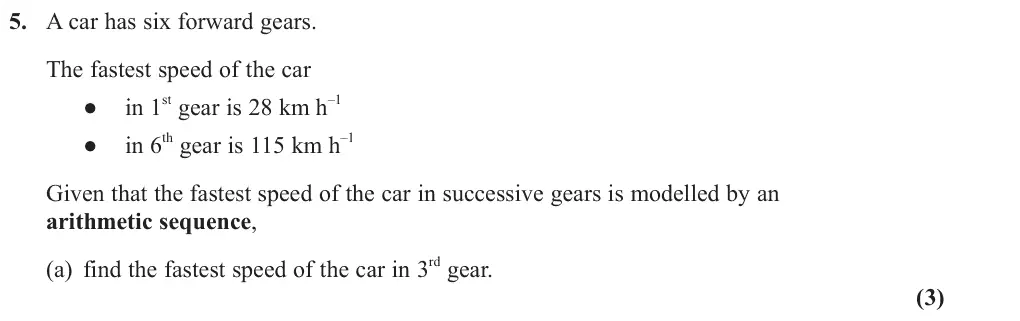
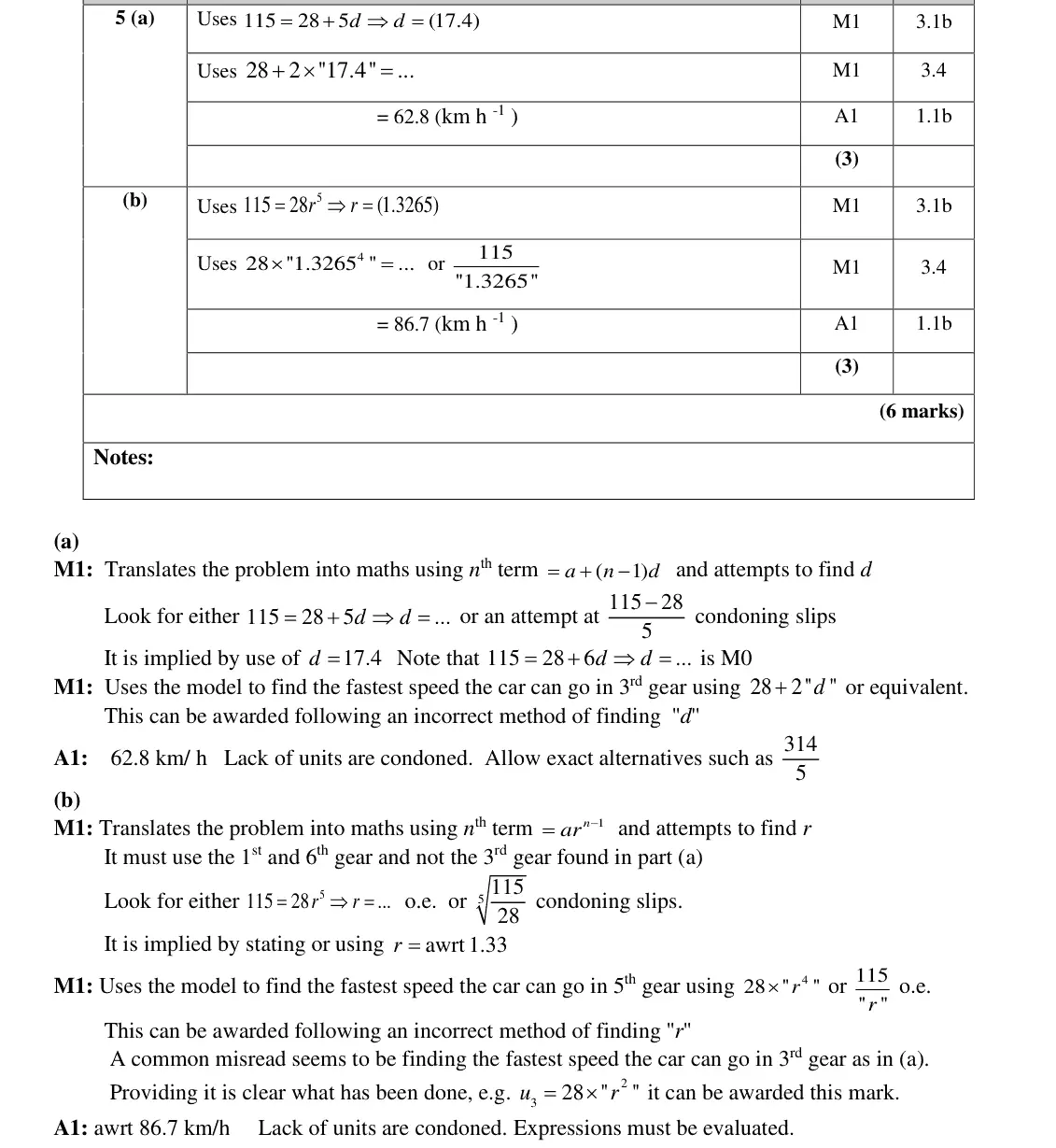
This question on modelling the speed of a car using arithmetic and geometric sequences proved popular. Many candidates answered both parts well and gained full marks. In (a) the most common errors were to divide ( ) 115 28 - by 6 in finding d. In part (b) errors were mainly due to a lack of accuracy and prematurely rounding their value for r.
Common mistakes
115 = 28 + 5d (not 6d, not (115 − 28)/6), d = 17.4
3rd gear is 28 + 2d = 62.8 km/h
using the sum formula scores 0
Oct 2020 · Paper 1 · Q5(b)3 marks
Mark scheme (whole question; this part is marked with the orange bar)
Examiner's comment
This question on modelling the speed of a car using arithmetic and geometric sequences proved popular. Many candidates answered both parts well and gained full marks. A small number of candidates used the sum formula in both (a) and (b) and as a result scored no marks. Additionally other candidates used their answer from (a) as one of the terms in (b), leading to an incorrect value of r. The second method mark was made available to these candidates.
Common mistakes
115 = 28r⁵ (use 1st and 6th gear, not the answer to (a)), r = 1.3265
5th gear 28r⁴ = 86.7 km/h
premature rounding of r
Oct 2020 · Paper 1 · Q13(a)3 marks
Mark scheme (whole question; this part is marked with the orange bar)
Examiner's comment
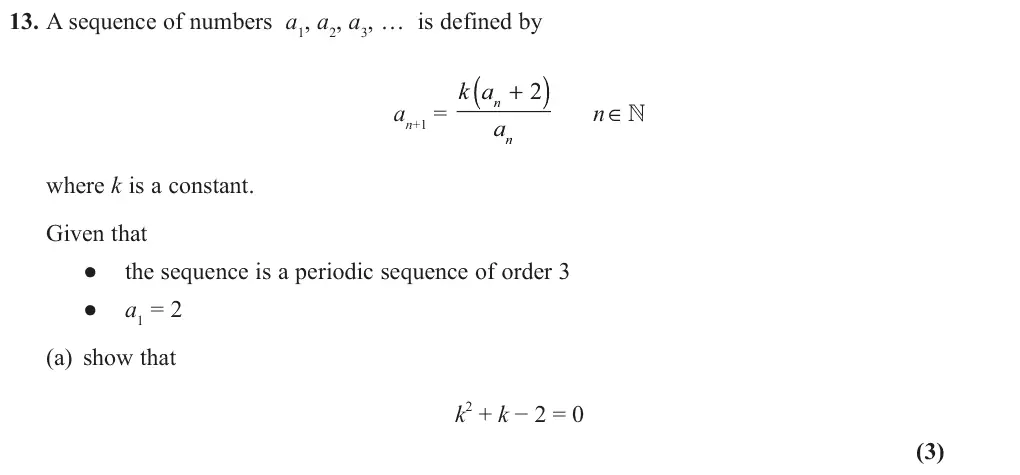
This question on sequences proved very discriminating, with weaker candidates scoring only the first mark. As with many questions on this paper however, there were some excellent and well written responses. In part (a) applying the iterative formula to find a2 was achieved by almost every candidate. A significant number then attempted to find a3 and also a4 in many cases but failed to simplify expressions for 2 4 2 k a = and 3 (2 2) 2 k k a k + = . Setting 4 1 a a = was often seen but fully correct proofs were rare.
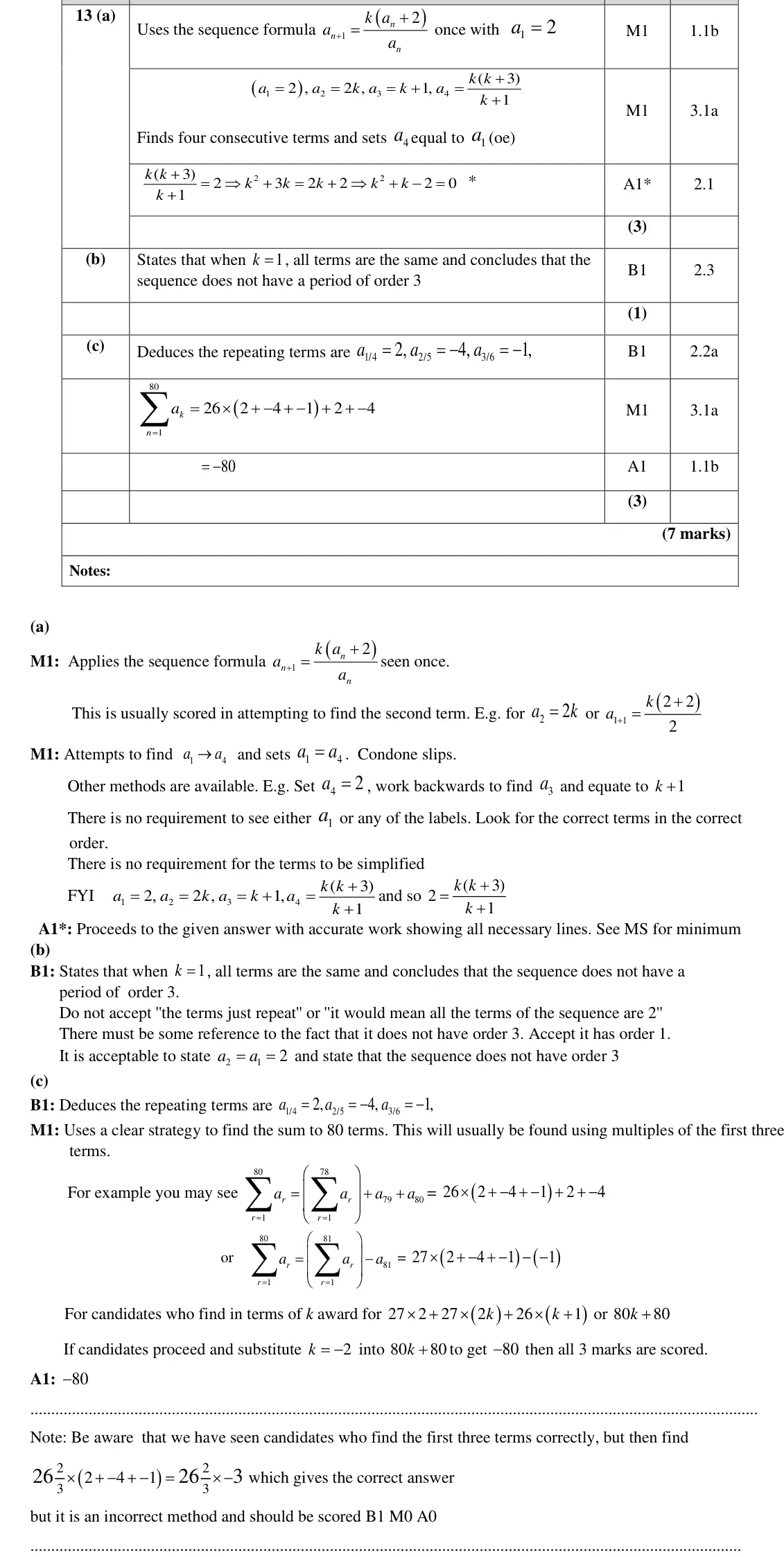
Common mistakes
a₂ = 2k, a₃ = k + 1, a₄ = k(k + 3)/(k + 1)
periodic of order 3 so set a₄ = a₁ = 2
simplify the terms
Oct 2020 · Paper 1 · Q13(b)1 mark
Mark scheme (whole question; this part is marked with the orange bar)
Examiner's comment
This question on sequences proved very discriminating, with weaker candidates scoring only the first mark. As with many questions on this paper however, there were some excellent and well written responses. In part (b) only a very small minority of candidates gave a correct and sufficient reason why k cannot be equal to 1. Although a larger minority did state the sequence would be 2,2,2, … only a small number of these pointed out that this is not a periodic sequence with order 3. Part (c) could be done independently to (a) and (b), and many candidates took advantage of this. It was not uncommon to see the terms 2, 4, 1 - - in (c) where only the first mark in (a) had been scored. Methods of finding the sum to 80 terms generally revolved around the calculation ( ) ( ) ( ) 26 2 4 1) 2 4 x + -+ - + + - . Incorrect attempts involved uses of both arithmetic or geometric sum formula or ones involving an average of the terms.
Common mistakes
k = 1 gives 2, 2, 2, ... (all terms equal), which has order 1, not order 3
must refer to the order
Oct 2020 · Paper 1 · Q13(c)3 marks
Mark scheme (whole question; this part is marked with the orange bar)
Examiner's comment
This question on sequences proved very discriminating, with weaker candidates scoring only the first mark. As with many questions on this paper however, there were some excellent and well written responses. Part (c) could be done independently to (a) and (b), and many candidates took advantage of this. It was not uncommon to see the terms 2, 4, 1 - - in (c) where only the first mark in (a) had been scored. Methods of finding the sum to 80 terms generally revolved around the calculation ( ) ( ) ( ) 26 2 4 1) 2 4 x + -+ - + + - . Incorrect attempts involved uses of both arithmetic or geometric sum formula or ones involving an average of the terms.
Common mistakes
k = −2 (k ≠ 1) gives repeating terms 2, −4, −1
26 full cycles plus 2 + (−4) = −80
arithmetic or geometric sum formulas do not apply
Oct 2020 · Paper 2 · Q15(a)4 marks
Mark scheme (whole question; this part is marked with the orange bar)
Examiner's comment
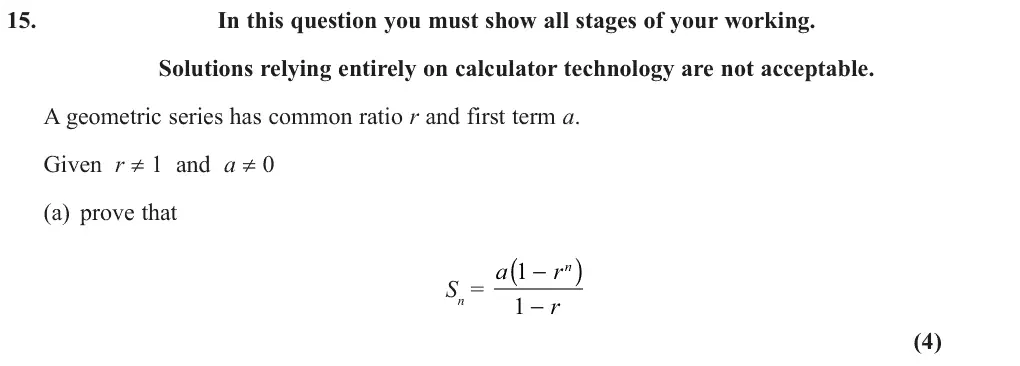
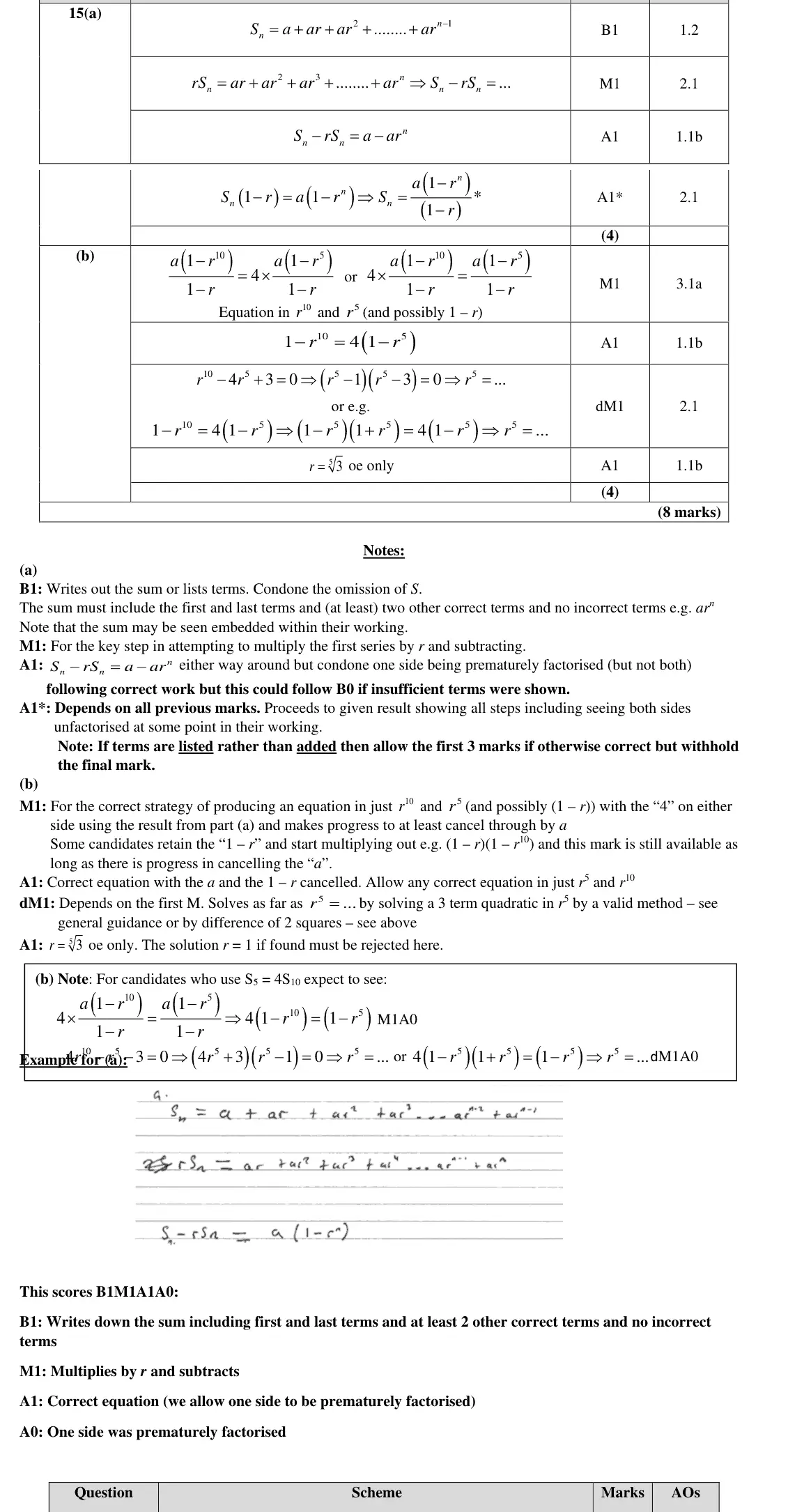
A number of the responses were completely blank suggesting perhaps that candidates had run out of time to complete this question. In part (a), very high proportion of the candidates had some idea what the layout of the proof looked like yet only around 50% were able to complete it accurately and rigorously. There were many solutions containing the final the term of Sn as arn rather than arn - 1. Candidates who had the correct initial sequence regularly went on to complete the proof correctly. Only a small number prematurely factorised. Some were trying to apply the method of proving the sum of an arithmetic series instead, hence losing the majority of the marks.
Common mistakes
last term is ar^(n−1), not arⁿ
multiply by r and subtract
both sides seen unfactorised
do not use the arithmetic series method
Oct 2020 · Paper 2 · Q15(b)4 marks
Mark scheme (whole question; this part is marked with the orange bar)
Examiner's comment
A number of the responses were completely blank suggesting perhaps that candidates had run out In part (b), the first method mark was gained by the majority of students. Some didn’t divide by “a” or wrongly cancelled r10 and r5 in their equation, so lost the first accuracy mark. However, many of the students who gained the first two marks continued to gain the last two marks by dealing with the quadratic and achieving the correct solution for “r”. A few candidates used (n - 1) in the formula rather than n and a number of candidates got confused with n and r, replacing r = 10 and 5 in the denominator of each fraction. Only around 50% realised that they had ended up with a quadratic equation in r5 and candidates who did not cancel the "a" out early often ended up with an overcomplicated equation which they could not solve. Very few did not eliminate r = 1 if they found it, although a few solved the quadratic and then forgot to cube root the answer and so had r = 3.
Common mistakes
cancel a and (1 − r): 1 − r¹⁰ = 4(1 − r⁵)
quadratic in r⁵
reject r = 1
r = fifth root of 3 (not r = 3)
S₁₀ = 4S₅, not S₅ = 4S₁₀
Oct 2020 · Paper 3 (Statistics) · Q4(c)5 marks
Mark scheme (whole question; this part is marked with the orange bar)
Examiner's comment
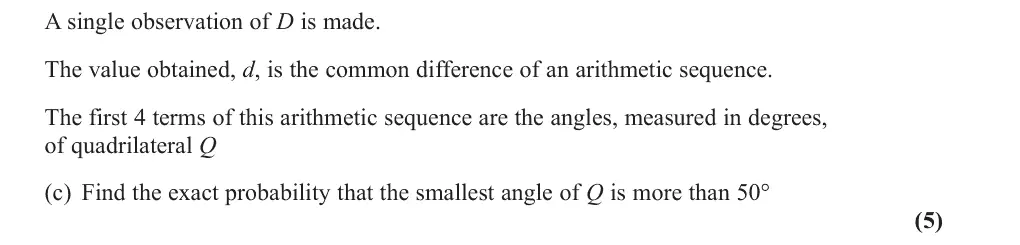
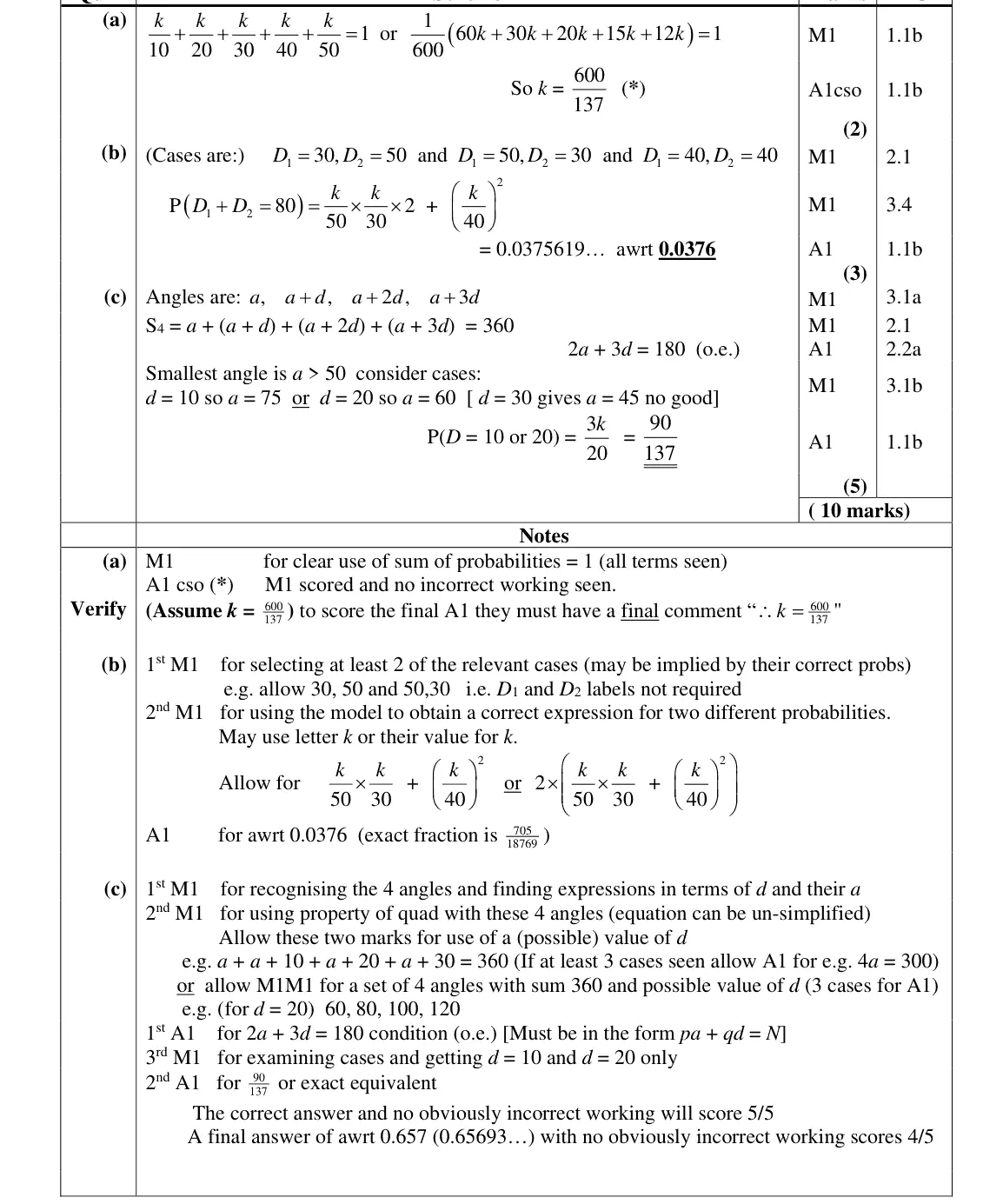
students who had faltered on (b) still making a start on part (c). Many identified the 4 angles as terms of an arithmetic series and some were able to reach the condition 2a + 3d = 180 (or equivalent) but many could not see how to complete the problem. Some used the information that a > 50 to reach d < 80 3 but were unable to make the connection that this meant that only the two cases d = 10 and d = 20 were required and so the probability could simply be written down.
Common mistakes
angles a, a + d, a + 2d, a + 3d sum to 360 so 2a + 3d = 180
a > 50 only for d = 10 or 20
P(D = 10 or 20) = 3k/20 = 90/137 exact
June 2019 · Paper 1 · Q11(a)2 marksMedium
Mark scheme (whole question; this part is marked with the orange bar)
Examiner's comment
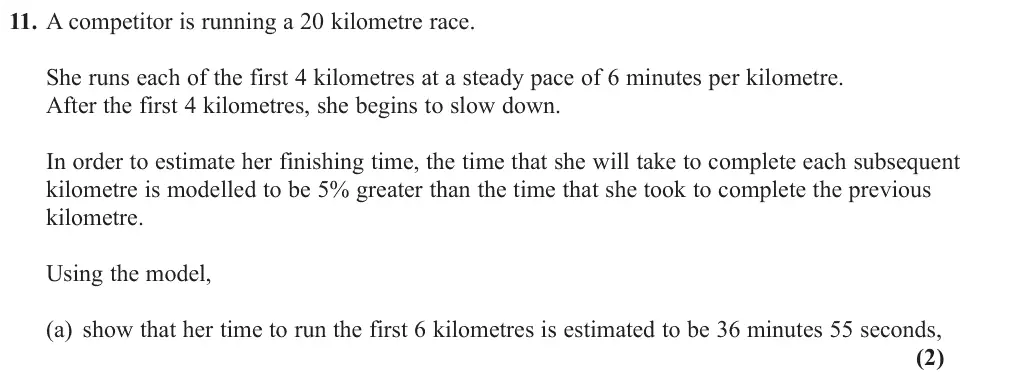
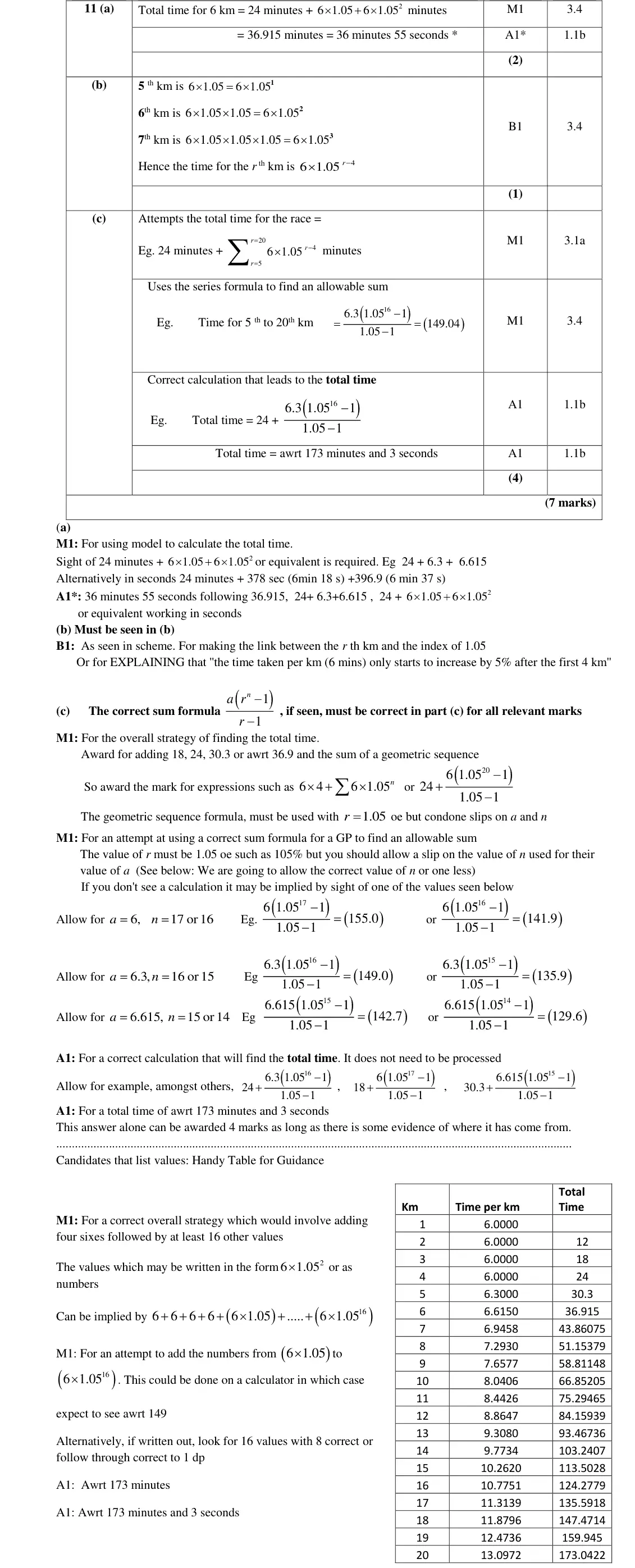
Overall very good attempts to this question were spoiled by a lack in accuracy . Part (a) was routine for most and candidates were thorough in showing their method. The most frequent and concise method involved calculations of the form 2 24 6 1.05 6 1.05 . Occasionally the work was overcomplicated by converting to seconds though the end result was generally satisfactory.
Common mistakes
24 + 6 × 1.05 + 6 × 1.05² = 36.915 min = 36 min 55 s
June 2019 · Paper 1 · Q11(b)1 markMedium
Mark scheme (whole question; this part is marked with the orange bar)
Examiner's comment
Overall very good attempts to this question were spoiled by a lack in accuracy . Part (b) was found to be challenging with some candidates choosing not to answer. The most straightforward way was to use some values and spot the patterns. This is a skill taught at GCSE yet seemed forgotten to many. Time taken Using the pattern on the left the time taken for the r th kilometre would be 4 6 1.05r
Common mistakes
write out the 5th, 6th, 7th km times to see the pattern 6 × 1.05^(r − 4)
June 2019 · Paper 1 · Q11(c)4 marksMedium
Mark scheme (whole question; this part is marked with the orange bar)
Examiner's comment
Overall very good attempts to this question were spoiled by a lack in accuracy . 5th kilometre 6 1.05 1 6th kilometre 6 1.05 2 7th kilometre 6 1.05 3 Although most candidates knew that for part (c) they needed to sum a sequence of terms, errors were frequent and many. A sizeable minority lacked any appreciation of the model and resorted to the calculation 20 6 1.05 1 1.05 1 . The majority of errors however were mainly due to a failure to link up the correct values for a and n in the formula for a geometric series. The most common of these was to use the strategy 24 + 16 6 1.05 1 1.05 1 , forgetting that the geometric sequence in this case should start at 6.3 instead of 6. It is often a good idea in such a question to write out the first few terms to gain an appreciation of the model and how the sequence is formed. (See below) Km 1st 2nd 3rd 4th 5th 6th 7th 20th Time 6 6 6 6 6 1.05 2 6 1.05 3 6 1.05 16 6 1.05 From here it should be a fairly straightforward task to write down 24 + 16 6.3 1.05 1 1.05 1
Common mistakes
24 + 6.3(1.05¹⁶ − 1)/0.05
first term 6.3 not 6 and n = 16
wrong 6(1.05²⁰ − 1)/0.05 ignores the model
173 min 3 s
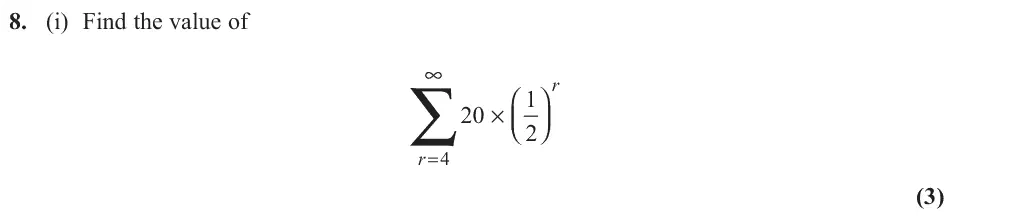
June 2019 · Paper 2 · Q8(i)3 marks
Mark scheme (whole question; this part is marked with the orange bar)
Examiner's comment
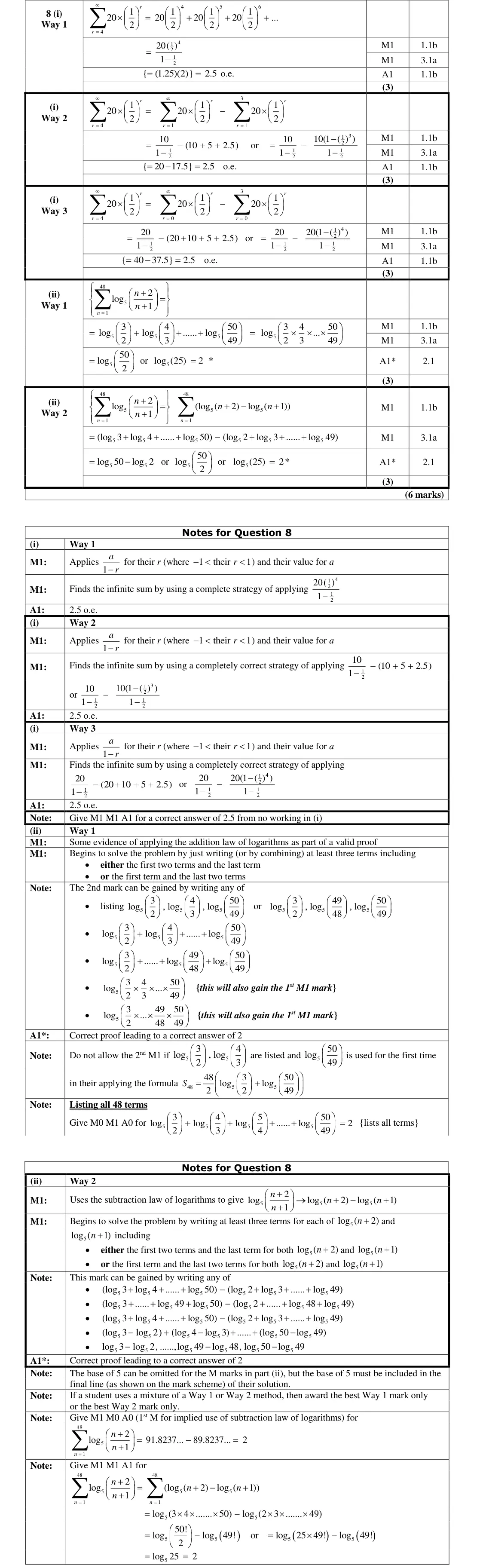
Q08 was found challenging by many candidates, with Q08(i) more successfully answered than Q08(ii). The most successful candidates were the ones who listed the first few terms of the series. In other words, those candidates that wrote 4 5 6 3 4 5 1 1 1 log log log ... and gained a 20 20 20 ... 5 5 5 2 3 4 2 2 2 better understanding of the series that they were required to sum. There were, however, many attempts that made no creditable progress and a significant number of blank responses to either one or both parts of Q08. In Q08(i), many candidates identified that a sum to infinity was required in their 1 a r . solution and attempted to apply the formula Most used in this formula, 2 1 r 1 1 . r r although some used incorrect values such as or Disappointingly, a 4 2 r 4 significant number of candidates used from the expression given in the question a , and applied it to the formula even though the formula only works when 1 r 1 1. r There were a number of correct strategies that candidates could use. The 4 a 1 1 , most successful strategy was to apply to and many 20 , a r 1 r 2 2 candidates who used this strategy achieved the correct answer of 2.5. Other complete 3 r r 1 1 strategies included applying or 20 20 2 2 1 1 r r 3 r r 1 1 which led to (20 17.5) or (40 37.5) respectively. 20 20 2 2 0 0 r r Some candidates applied an incorrect overall strategy by subtracting an incorrect number of terms from their sum to infinity. These candidates gave incorrect answers such as (20 18.75), (40 38.75), (40 35) or (40 17.5). A few candidates obtained the correct answer of 2.5 by using their calculator. Only a few candidates produced a correct solution to Q08(ii). There were two main correct methods that were used by candidates in equal measure. One was to list the first few terms and the last few terms of the series and use the addition law of logarithms 3 4 50 log ... . to achieve Many candidates used cancelling to complete their 5 2 3 49 50 proof correctly by writing The other method was to use the log log (25) 2. 5 5 2 48 subtraction law of logarithms to give and list terms to (log ( 2) log ( 1)) n n 5 5 1 n (log 3 log 4 ...... log 50) (log 2 log 3 ...... log 49). give Again many 5 5 5 5 5 5 candidates used cancelling and completed their proof by writing A few candidates progressed by writing log (50) log (2) log (25) 2. 5 5 5 log (3 4 ....... 50) log (2 3 ....... 49) and used factorials to give 5 5 50! 50! log log 49! log log (25) 2. 5 5 5 5 2 2(49!) Some candidates incorrectly assumed an arithmetic series and attempted to find its sum 3 50 n a n 48, log , log n a l ( ) l [2 ( 1) ] a n d by using or with and 5 5 2 49 2 2 4 3 log log . d A few candidates incorrectly assumed a geometric series and 5 5 3 2 attempted to find its sum. Some candidates, who made no creditable progress, resorted to listing their terms as decimals, or attempted to add all 48 terms as decimals by writing 0.2519... 0.1787... 0.1386... ...... 0.0125... 2.
Common mistakes
first term a = 20(½)⁴ = 1.25, r = ½, S∞ = 2.5
listing the first terms helps
subtracting the wrong number of terms from a sum from r = 0 or 1
using r = 20 or ¼
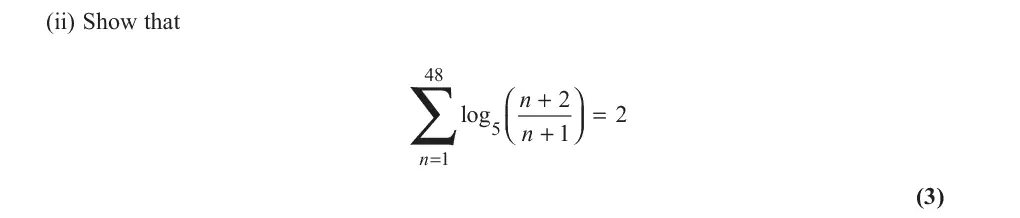
June 2019 · Paper 2 · Q8(ii)3 marks
Mark scheme (whole question; this part is marked with the orange bar)
Examiner's comment
Q08 was found challenging by many candidates, with Q08(i) more successfully answered than Q08(ii). The most successful candidates were the ones who listed the first few terms of the series. In other words, those candidates that wrote 4 5 6 3 4 5 1 1 1 log log log ... and gained a 20 20 20 ... 5 5 5 2 3 4 2 2 2 better understanding of the series that they were required to sum. There were, however, many attempts that made no creditable progress and a significant number of blank responses to either one or both parts of Q08. In Q08(i), many candidates identified that a sum to infinity was required in their 1 a r . solution and attempted to apply the formula Most used in this formula, 2 1 r 1 1 . r r although some used incorrect values such as or Disappointingly, a 4 2 r 4 significant number of candidates used from the expression given in the question a , and applied it to the formula even though the formula only works when 1 r 1 1. r There were a number of correct strategies that candidates could use. The 4 a 1 1 , most successful strategy was to apply to and many 20 , a r 1 r 2 2 candidates who used this strategy achieved the correct answer of 2.5. Other complete 3 r r 1 1 strategies included applying or 20 20 2 2 1 1 r r 3 r r 1 1 which led to (20 17.5) or (40 37.5) respectively. 20 20 2 2 0 0 r r Some candidates applied an incorrect overall strategy by subtracting an incorrect number of terms from their sum to infinity. These candidates gave incorrect answers such as (20 18.75), (40 38.75), (40 35) or (40 17.5). A few candidates obtained the correct answer of 2.5 by using their calculator. Only a few candidates produced a correct solution to Q08(ii). There were two main correct methods that were used by candidates in equal measure. One was to list the first few terms and the last few terms of the series and use the addition law of logarithms 3 4 50 log ... . to achieve Many candidates used cancelling to complete their 5 2 3 49 50 proof correctly by writing The other method was to use the log log (25) 2. 5 5 2 48 subtraction law of logarithms to give and list terms to (log ( 2) log ( 1)) n n 5 5 1 n (log 3 log 4 ...... log 50) (log 2 log 3 ...... log 49). give Again many 5 5 5 5 5 5 candidates used cancelling and completed their proof by writing A few candidates progressed by writing log (50) log (2) log (25) 2. 5 5 5 log (3 4 ....... 50) log (2 3 ....... 49) and used factorials to give 5 5 50! 50! log log 49! log log (25) 2. 5 5 5 5 2 2(49!) Some candidates incorrectly assumed an arithmetic series and attempted to find its sum 3 50 n a n 48, log , log n a l ( ) l [2 ( 1) ] a n d by using or with and 5 5 2 49 2 2 4 3 log log . d A few candidates incorrectly assumed a geometric series and 5 5 3 2 attempted to find its sum. Some candidates, who made no creditable progress, resorted to listing their terms as decimals, or attempted to add all 48 terms as decimals by writing 0.2519... 0.1787... 0.1386... ...... 0.0125... 2.
Common mistakes
write out first and last terms: log₅(3/2 × 4/3 × … × 50/49) = log₅25 = 2 (telescoping/cancelling)
it is not an arithmetic or geometric series
adding decimals scores nothing
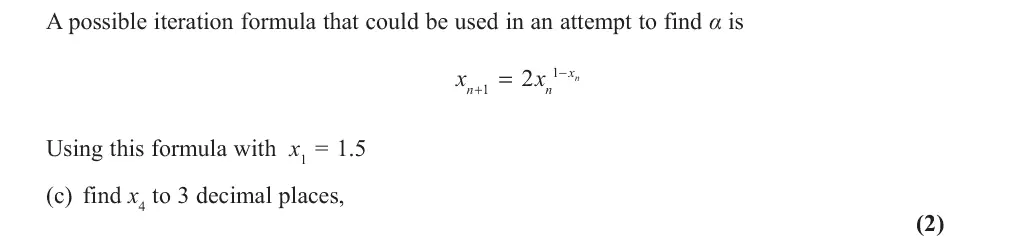
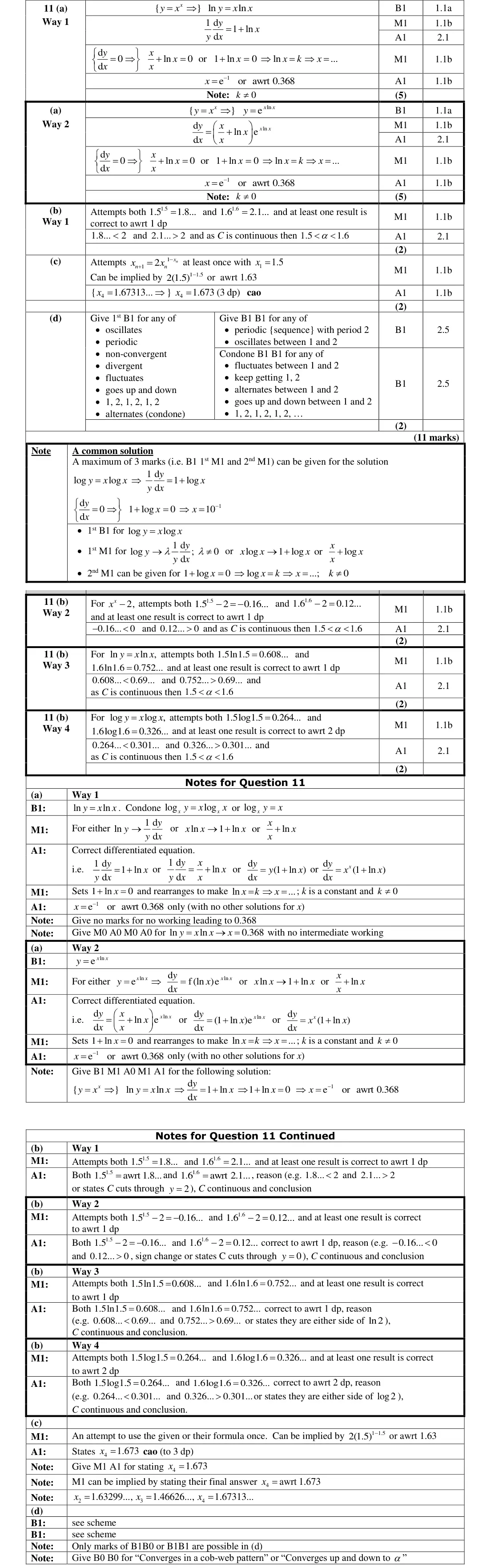
June 2019 · Paper 2 · Q11(c)2 marks
Mark scheme (whole question; this part is marked with the orange bar)
Examiner's comment
In general, Q11 discriminated well between candidates of all abilities. Q11(a) was demanding with most candidates scoring no more than one mark. Q11(b), Q11(c) and Q11(d) proved accessible to candidates of all abilities. In Q11(a), most candidates took logs, as advised by the question, and many obtained either ln ln y x x or log log . y x x At this point a significant number of candidates made no further creditable progress. Some candidates used a complete method of applying the product rule on x and implicit differentiation to obtain a correct ln x Most of these candidates then applied d y 1 d y x 1 y x e . x 0 to obtain Some 1 ln . x d d x log ’ method to obtain candidates, who received partial credit, used a ‘ after 0.1, 10 1 d y x finding A few candidates used logarithms without reference to a 1 log . x 10 d y x base. Those who proceeded to obtain received partial credit and those who 0.1 1 e x obtained were allowed full marks. There were some alternative methods employed by a few candidates in Q11(a). A few d y y x ln e x x x ln x x y x candidates rewrote as and applied to give a (1 ln )e 0 x d 1 e . x Others differentiated both sides of the equation ln ln y x x correct with 1 e . x respect to y and usually proceeded to find A very few candidates applied the ln y , x quotient rule to the equation but were rarely successful with this method. ln x xx x x xx or 2 1.6. In Q11(b), most candidates evaluated either at both and 1.5 Many candidates compared their values with either 2 or 0 (depending on whether they xx xx or 2 ). Although many of these concluded that 1.5 1.6, evaluated only a few made any reference to the curve being continuous in this interval. A few candidates, x who made no creditable progress, used values of x outside the given range, e.g. 1.4 x x 1.6. and Very few candidates used values within the range e.g. and 1.51 x 1.59, which meant that they were able to earn both marks. x 1.673, 4x In Q11(c), most candidates found a correct although a few did not state 4 , x x and 3x as part of their correct to 3 decimal places. Some wrote down the iterates 1 2 4x with no intermediate work. solution, while others stated In Q11(d), some candidates gave correct descriptions such as ‘sequence oscillates between 1 and 2’ or ‘the sequence is periodic with period 2’. Other descriptions such as ‘alternates between 1 and 2’, ‘keep getting 1 and 2’ or ‘fluctuates between 1 and 2’ were condoned. Some credit was given for partial explanations such as ‘sequence is non-convergent’, ‘sequence oscillates’ or ‘sequence is divergent’.
Common mistakes
x₂ = 1.633, x₃ = 1.466, x₄ = 1.673 (3 d.p.)
June 2019 · Paper 2 · Q11(d)2 marks
Mark scheme (whole question; this part is marked with the orange bar)
Examiner's comment
In general, Q11 discriminated well between candidates of all abilities. Q11(a) was demanding with most candidates scoring no more than one mark. Q11(b), Q11(c) and Q11(d) proved accessible to candidates of all abilities. In Q11(a), most candidates took logs, as advised by the question, and many obtained either ln ln y x x or log log . y x x At this point a significant number of candidates made no further creditable progress. Some candidates used a complete method of applying the product rule on x and implicit differentiation to obtain a correct ln x Most of these candidates then applied d y 1 d y x 1 y x e . x 0 to obtain Some 1 ln . x d d x log ’ method to obtain candidates, who received partial credit, used a ‘ after 0.1, 10 1 d y x finding A few candidates used logarithms without reference to a 1 log . x 10 d y x base. Those who proceeded to obtain received partial credit and those who 0.1 1 e x obtained were allowed full marks. There were some alternative methods employed by a few candidates in Q11(a). A few d y y x ln e x x x ln x x y x candidates rewrote as and applied to give a (1 ln )e 0 x d 1 e . x Others differentiated both sides of the equation ln ln y x x correct with 1 e . x respect to y and usually proceeded to find A very few candidates applied the ln y , x quotient rule to the equation but were rarely successful with this method. ln x xx x x xx or 2 1.6. In Q11(b), most candidates evaluated either at both and 1.5 Many candidates compared their values with either 2 or 0 (depending on whether they xx xx or 2 ). Although many of these concluded that 1.5 1.6, evaluated only a few made any reference to the curve being continuous in this interval. A few candidates, x who made no creditable progress, used values of x outside the given range, e.g. 1.4 x x 1.6. and Very few candidates used values within the range e.g. and 1.51 x 1.59, which meant that they were able to earn both marks. x 1.673, 4x In Q11(c), most candidates found a correct although a few did not state 4 , x x and 3x as part of their correct to 3 decimal places. Some wrote down the iterates 1 2 4x with no intermediate work. solution, while others stated In Q11(d), some candidates gave correct descriptions such as ‘sequence oscillates between 1 and 2’ or ‘the sequence is periodic with period 2’. Other descriptions such as ‘alternates between 1 and 2’, ‘keep getting 1 and 2’ or ‘fluctuates between 1 and 2’ were condoned. Some credit was given for partial explanations such as ‘sequence is non-convergent’, ‘sequence oscillates’ or ‘sequence is divergent’.
Common mistakes
sequence is periodic with period 2 / oscillates between 1 and 2 (both marks)
"non-convergent", "oscillates" or "divergent" alone gets one mark
June 2018 · Paper 2 · Q4(i)4 marks
Mark scheme (whole question; this part is marked with the orange bar)
Examiner's comment
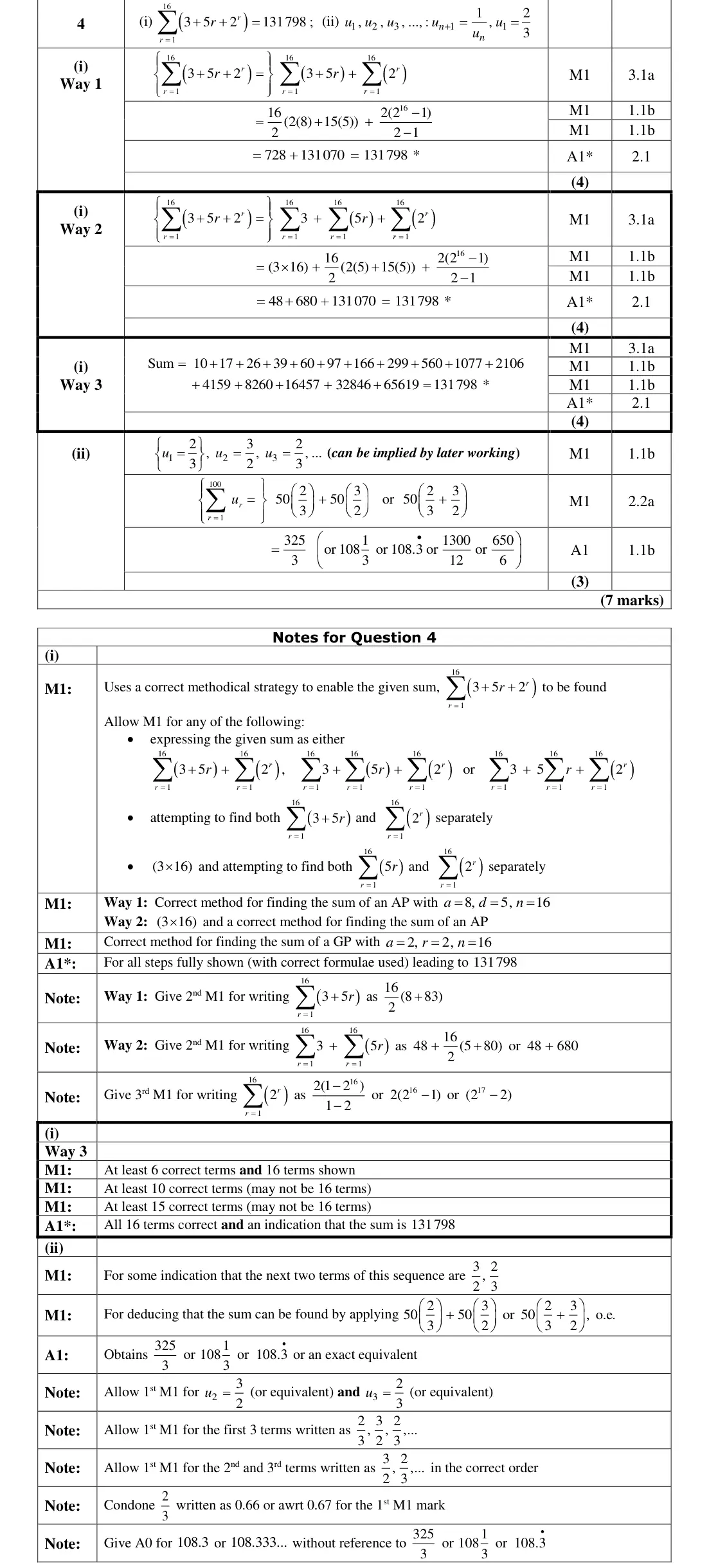
This was an accessible question with part (ii) more successfully answered than part (i). 16 r (3 5 2 ) r In part (i), some students attempted to find by applying the strategy 1 r 16 16 16 16 r r (3 16) 5 2 , r (3 5 ) 2 . r while other students applied the strategy Most 1 1 r r 1 1 r r 5, 5 a d students applied the sum formula for an arithmetic series with to 16 16 8, 5 a d (3 16) 5 r (3 16) (2(5) 15(5)) to give while some applied to 2 1 r 16 n 1 ( to give 16 (2(8) 15(5)). (3 5 ) r 1) r n n A few students used to help them to 2 2 1 r 1 r 16 5 . r evaluate Students were generally less successful with using the formula for the sum 1 r 16 r r 2 . of a geometric series to find Common errors included assuming the first term, a, was 1 1 or writing down the value 131070 with no method (perhaps by working back from the given answer). A significant number of students listed all 16 terms and added them to achieve the given result. Those students who did not list all the terms, but just wrote e.g. 10 17 26 39 60 ... 65619 131798, did not receive any credit. Some students, who attempted to find the first, second and third differences between the terms of the series 10, 17, 26, 39, 60,..., usually made no creditable progress. Part (ii) was very well attempted, even by those who failed to gain any credit in part (i). Almost all students wrote down the next two terms u correctly. Many deduced that they , u 2 3 100 were working with an alternating sequence and found the correct exact value for . u r 1 r Some students attempted to round their answer, usually to 108.3. A few students attempted 100 to find by using the formula for the sum of an arithmetic series or the formula for the u r 1 r sum of a geometric series.
Common mistakes
split into Σ(3 + 5r) + Σ2^r
AP sum 8(8 + 83) = 728
GP sum with a = 2 (not 1), r = 2: 2(2^16 − 1) = 131070
listing terms needs all 16 shown
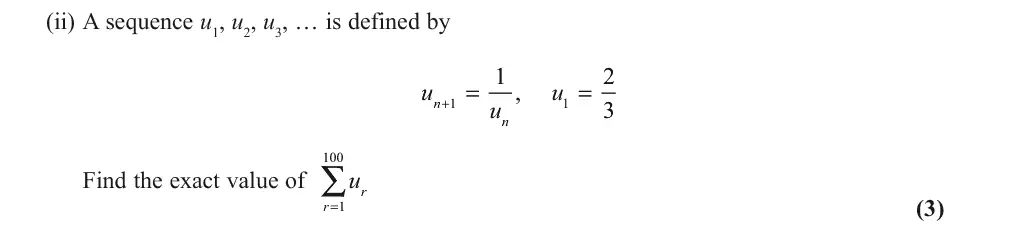
June 2018 · Paper 2 · Q4(ii)3 marks
Mark scheme (whole question; this part is marked with the orange bar)
Examiner's comment
This was an accessible question with part (ii) more successfully answered than part (i). 16 r (3 5 2 ) r In part (i), some students attempted to find by applying the strategy 1 r 16 16 16 16 r r (3 16) 5 2 , r (3 5 ) 2 . r while other students applied the strategy Most 1 1 r r 1 1 r r 5, 5 a d students applied the sum formula for an arithmetic series with to 16 16 8, 5 a d (3 16) 5 r (3 16) (2(5) 15(5)) to give while some applied to 2 1 r 16 n 1 ( to give 16 (2(8) 15(5)). (3 5 ) r 1) r n n A few students used to help them to 2 2 1 r 1 r 16 5 . r evaluate Students were generally less successful with using the formula for the sum 1 r 16 r r 2 . of a geometric series to find Common errors included assuming the first term, a, was 1 1 or writing down the value 131070 with no method (perhaps by working back from the given answer). A significant number of students listed all 16 terms and added them to achieve the given result. Those students who did not list all the terms, but just wrote e.g. 10 17 26 39 60 ... 65619 131798, did not receive any credit. Some students, who attempted to find the first, second and third differences between the terms of the series 10, 17, 26, 39, 60,..., usually made no creditable progress. Part (ii) was very well attempted, even by those who failed to gain any credit in part (i). Almost all students wrote down the next two terms u correctly. Many deduced that they , u 2 3 100 were working with an alternating sequence and found the correct exact value for . u r 1 r Some students attempted to round their answer, usually to 108.3. A few students attempted 100 to find by using the formula for the sum of an arithmetic series or the formula for the u r 1 r sum of a geometric series.
Common mistakes
sequence is periodic (2/3, 3/2, 2/3, ...) of order 2
sum = 50(2/3 + 3/2) = 325/3 exact
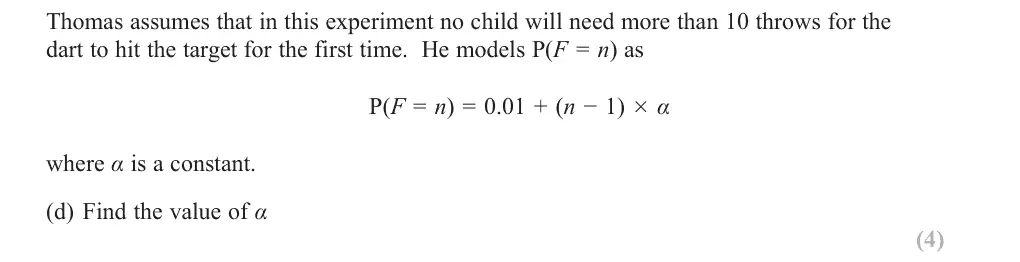
June 2018 · Paper 3 · Q3(d)4 marks
Mark scheme (whole question; this part is marked with the orange bar)
Examiner's comment
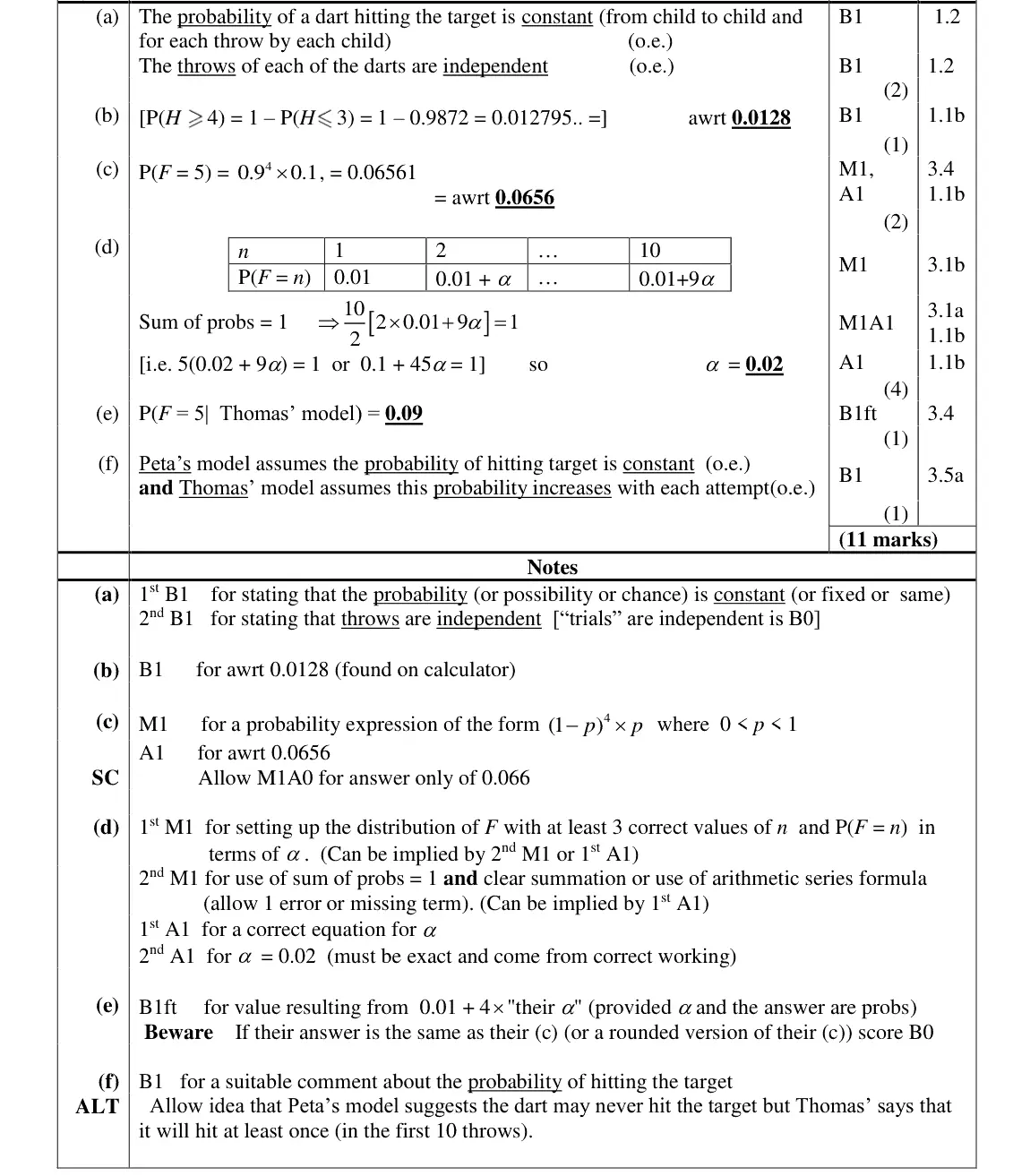
P(H = 5) rather than P(F = 5). Part (d) proved more challenging; those who carefully started to list the probabilities were often able to add these manually (few identified the arithmetic series as intended) and those who realised that the sum of the probabilities was equal to 1 usually went on to score all the marks and the mark in part (e). However, many thought that P(F = 10) = 1 or even that P(F = 5) had to equal their answer to part (c) and made little progress in (d) but could often collect the mark in (e). Part (f) was not answered well; the question clearly steered students to comment on the
Common mistakes
list P(F = n) for n = 1 to 10 and use sum of probabilities = 1 (arithmetic series 5(0.02 + 9α) = 1) giving α = 0.02
errors: assuming P(F = 10) = 1 or P(F = 5) equals answer to (c)
Find an Edexcel maths tutor
Stuck on this? Book a trial session with an Edexcel specialist.