Paper 1, Paper 2, Paper 2 (Mechanics), Paper 2 (Statistics), Paper 3 (Mechanics), Paper 3 (Statistics)
Level
AS and A level
Spec
P2.4
Since 2018
48 question parts, 219 marks, 4 with a difficulty rating from the examiner's report
Notes, worked examples and practice for this topic are being written by our tutors. The past-paper questions below are ready now: work each one on paper, then open the mark scheme and the examiner's comment.
Tap a question to zoom it. Mark scheme and examiner's comment open under each question.
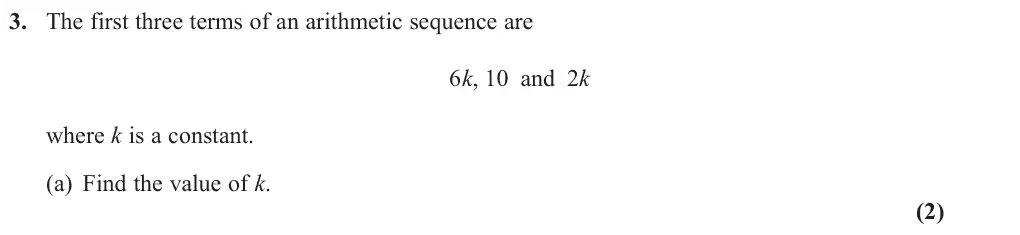
June 2025 · Paper 1 · Q3(a)2 marks
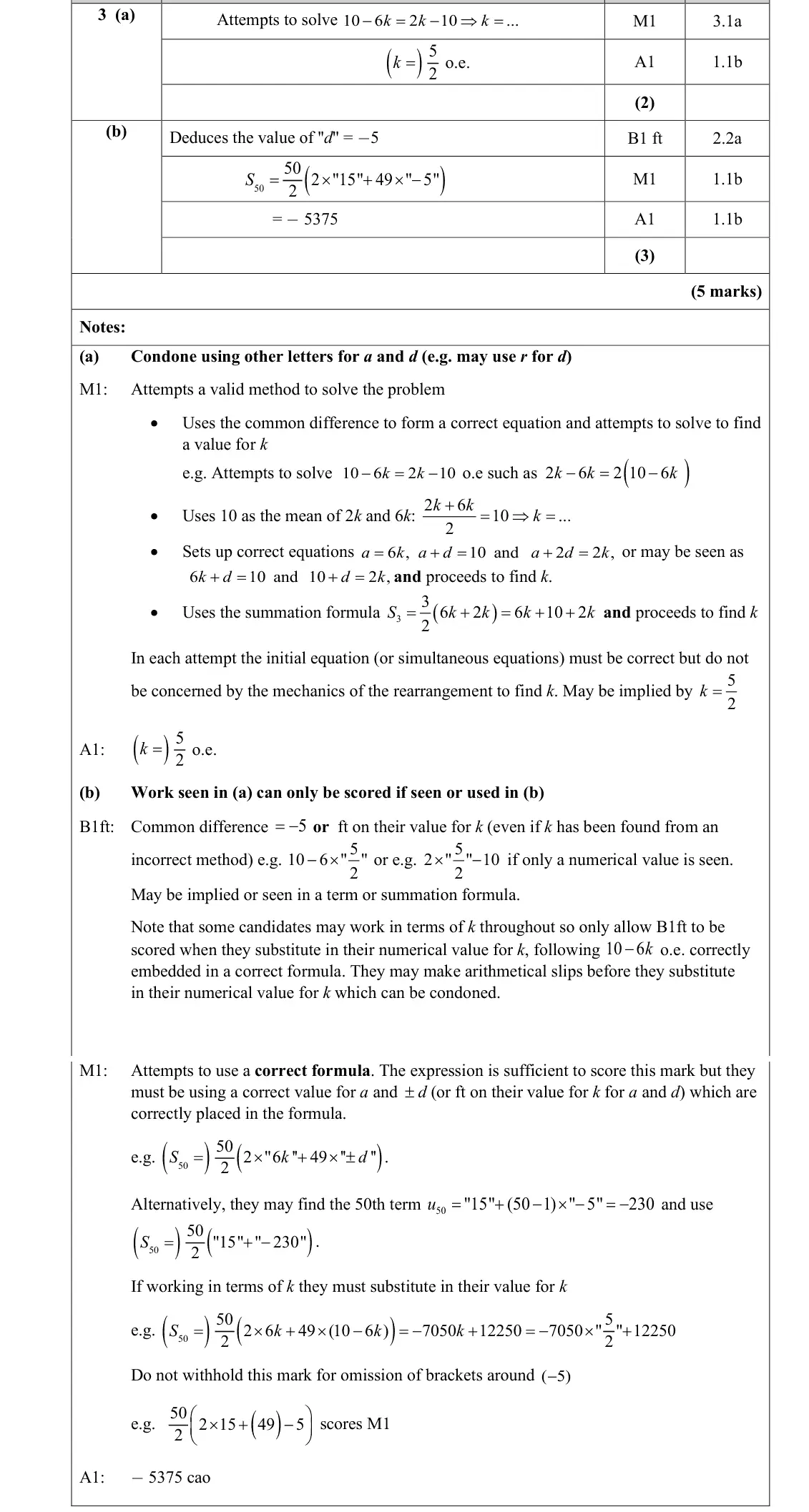
Mark scheme (whole question; this part is marked with the orange bar)
Examiner's comment
This question tested arithmetic sequences, followed by finding the sum for a given number of terms. Part (a) was usually answered well. There was a variety of ways which could be used to set up a valid equation or equations from the information given. The most common method was equating the common difference between consecutive terms resulting in a single linear equation that was easily solved for k. Some responses used slightly less efficient methods by using the nth term formula which created two linear equations in k and the common difference, d, which they then solved simultaneously. A few responses used the sum formula in addition to an nth term formula which proved quite time consuming and often incurred errors when solving. A minority of responses mistakenly treated the sequence as geometric and gained no marks. Occasionally learners deduced the value of k with little or no working by spotting that the second term must be 4k in order that the sequence was arithmetic (2k, 4k, 6k) and then simply divided 10 by 4.
Common mistakes
equal common differences 10 − 6k = 2k − 10 (or 10 is the mean of 6k and 2k) gives k = 5/2
treating it as geometric scores 0
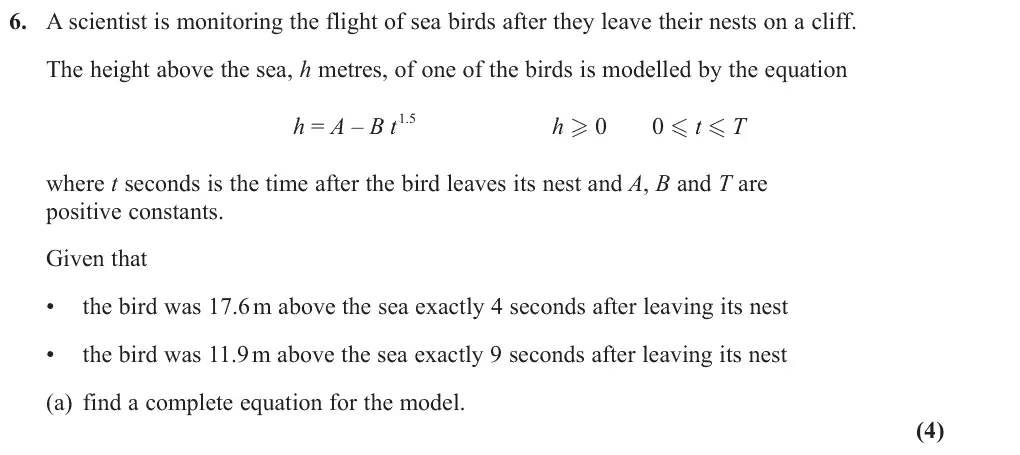
June 2025 · Paper 1 · Q6(a)4 marks
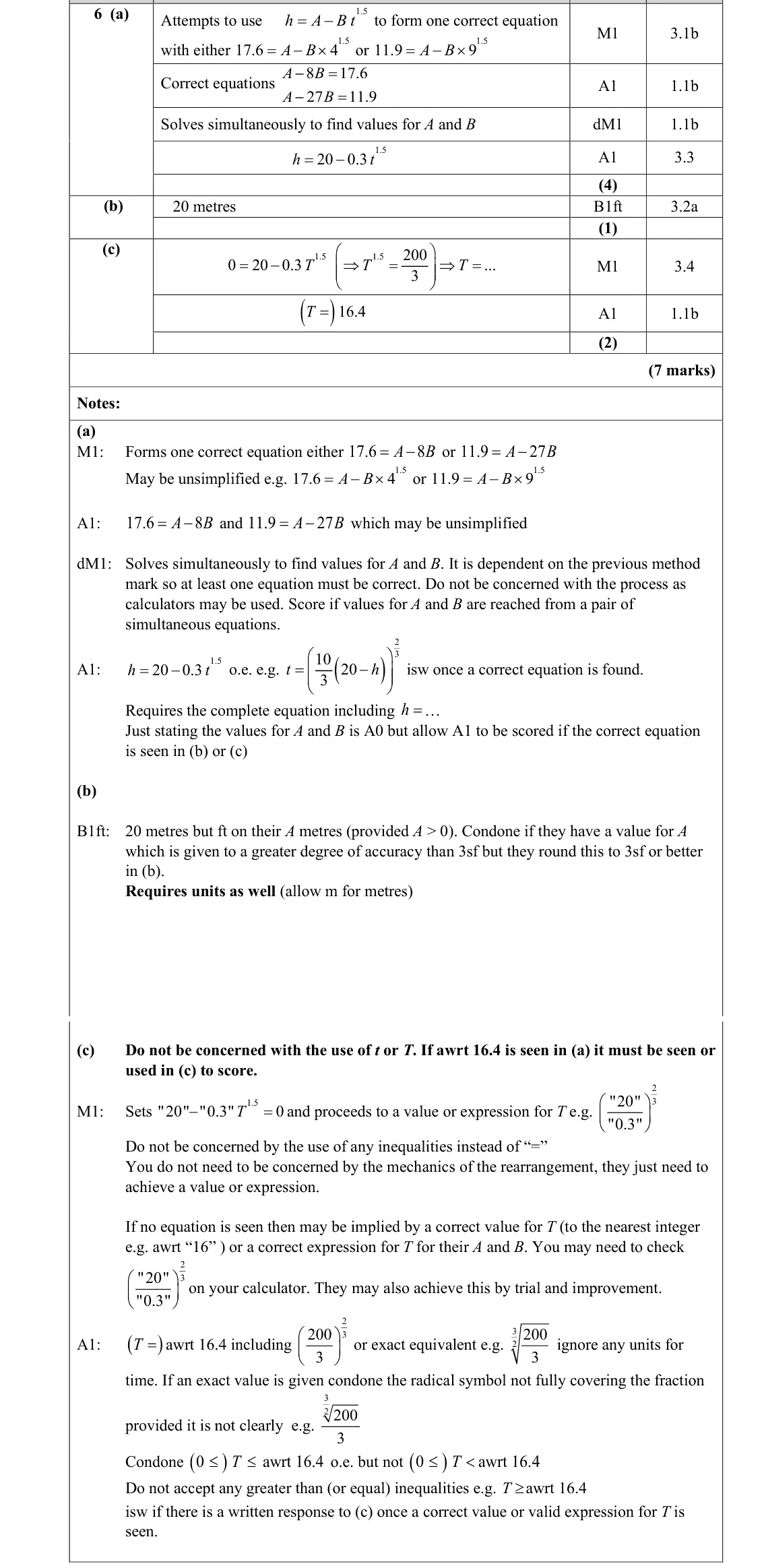
Mark scheme (whole question; this part is marked with the orange bar)
Examiner's comment
This was the first modelling question on the paper. In part (a), most learners demonstrated a strong grasp of the initial requirements, successfully forming and solving the correct pair of simultaneous equations to determine the values of A and B. However, a minority of responses overcomplicated their approach by unnecessarily introducing logarithms or misapplying algebraic techniques, leading to errors. Common mistakes included arithmetic slips, particularly with decimal values such as 17.6 or 11.9, and confusion between addition and subtraction within algebraic manipulation. It was observed that learners relying on calculators tended to achieve more accurate results than those attempting manual algebraic solutions, with the latter occasionally making sign errors or misplacing powers. Some responses applied the power of 1.5 to B instead of t, or incorrectly simplified expressions such as 41.5 and 91.5. The final mark was sometimes not awarded due to omission of the complete model equation as their answer, or by not checking that their solution met the question’s requirement for B to be a positive constant. A small number disregarded the model altogether and adopted a linear approach.
Common mistakes
17.6 = A − 8B and 11.9 = A − 27B give A = 20, B = 0.3
must state the complete equation h = 20 − 0.3t^1.5
some put the power on B or used a linear model
June 2025 · AS Paper 1 · Q6(b)5 marks
Mark scheme (whole question; this part is marked with the orange bar)
Examiner's comment
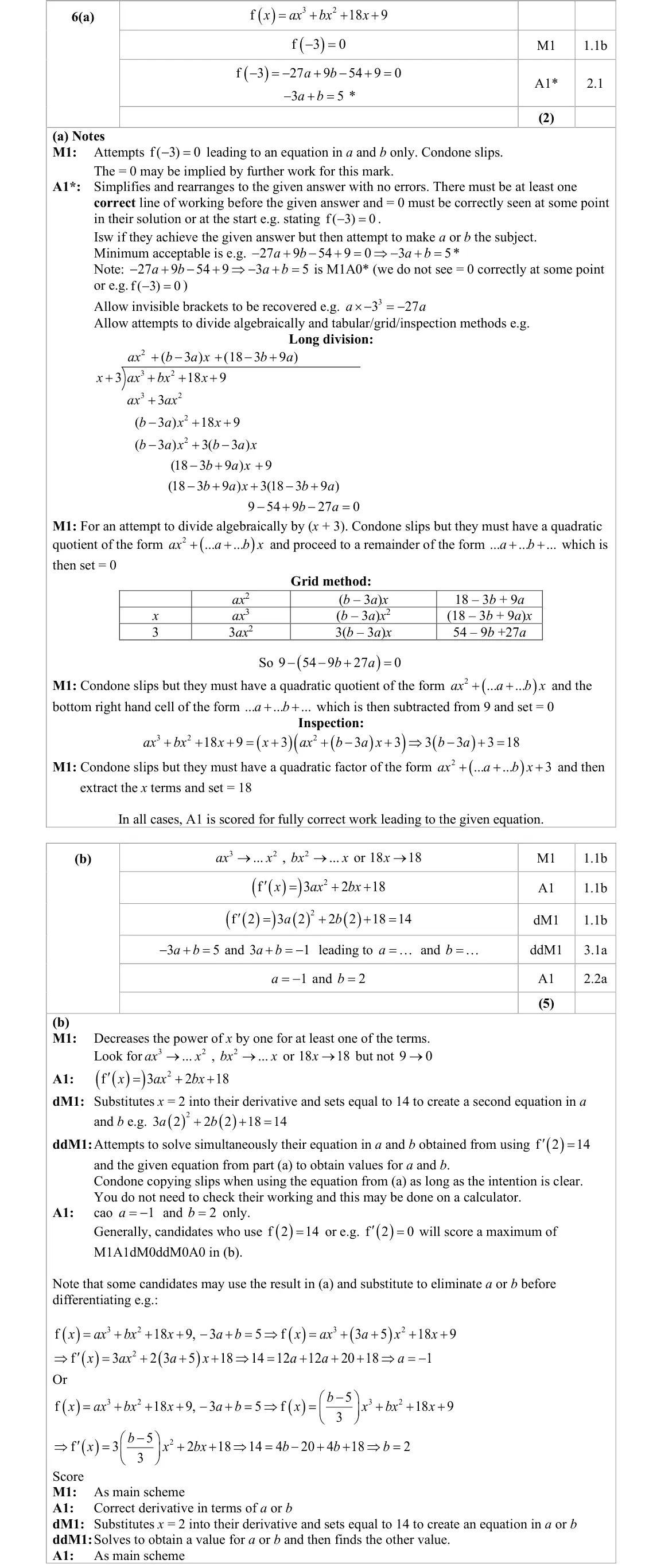
Although the skills involved in part (b) were quite fundamental, the understanding of the demand of the question differentiated the candidates. Pleasingly the majority were able to differentiate correctly, substitute 2 into their derivative and set equal to 14, then solve the two equations simultaneously. On occasion those candidates who solved algebraically, as opposed to using their calculator, lost the final accuracy mark. Arithmetical errors were also seen in rearranging the second equation. A number of candidates achieved the first two marks for correctly differentiating however they then went on to set f ′(2) = 0. Other candidates achieved no marks as there was no attempt to differentiate and instead attempted f (2) = 0 or f (2) = 14 or integrated instead of differentiating. In all cases there was very minimal evidence of candidates checking that their solutions to a and b satisfied the given conditions.
Common mistakes
differentiate f′(x) = 3ax² + 2bx + 18, then f′(2) = 14 gives 3a + b = −1
solve with −3a + b = 5: a = −1, b = 2
using f(2) = 14, f′(2) = 0 or integrating scores little
June 2025 · AS Paper 1 · Q14(b)5 marks
Mark scheme (whole question; this part is marked with the orange bar)
Examiner's comment
Part (b) was much more demanding with very few candidates achieving full marks and many blank responses seen. The majority of candidates failed to identify the necessary terms to set up the two required equations or made errors in expanding the brackets. The equation resulting from the constant term appeared the more accessible of the two and resulted in the first M1 at least. Where candidates were able to identify the two correct equations they generally went on to score full marks. For these more able candidates who were able to find a solution it was pleasing to see them pairing a and k correctly.
Common mistakes
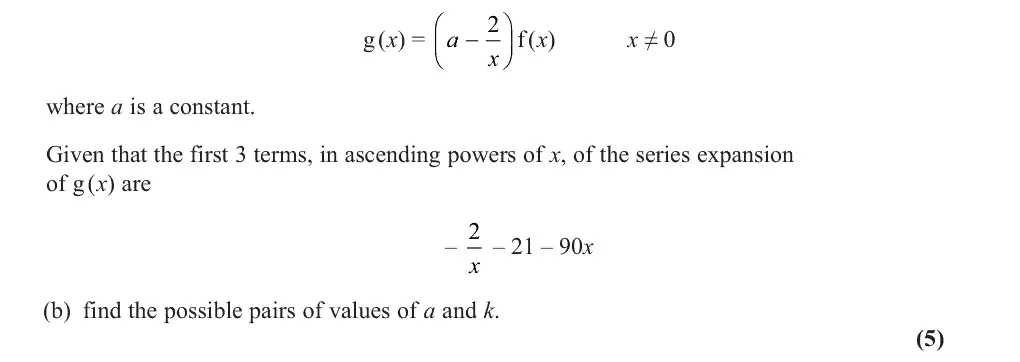
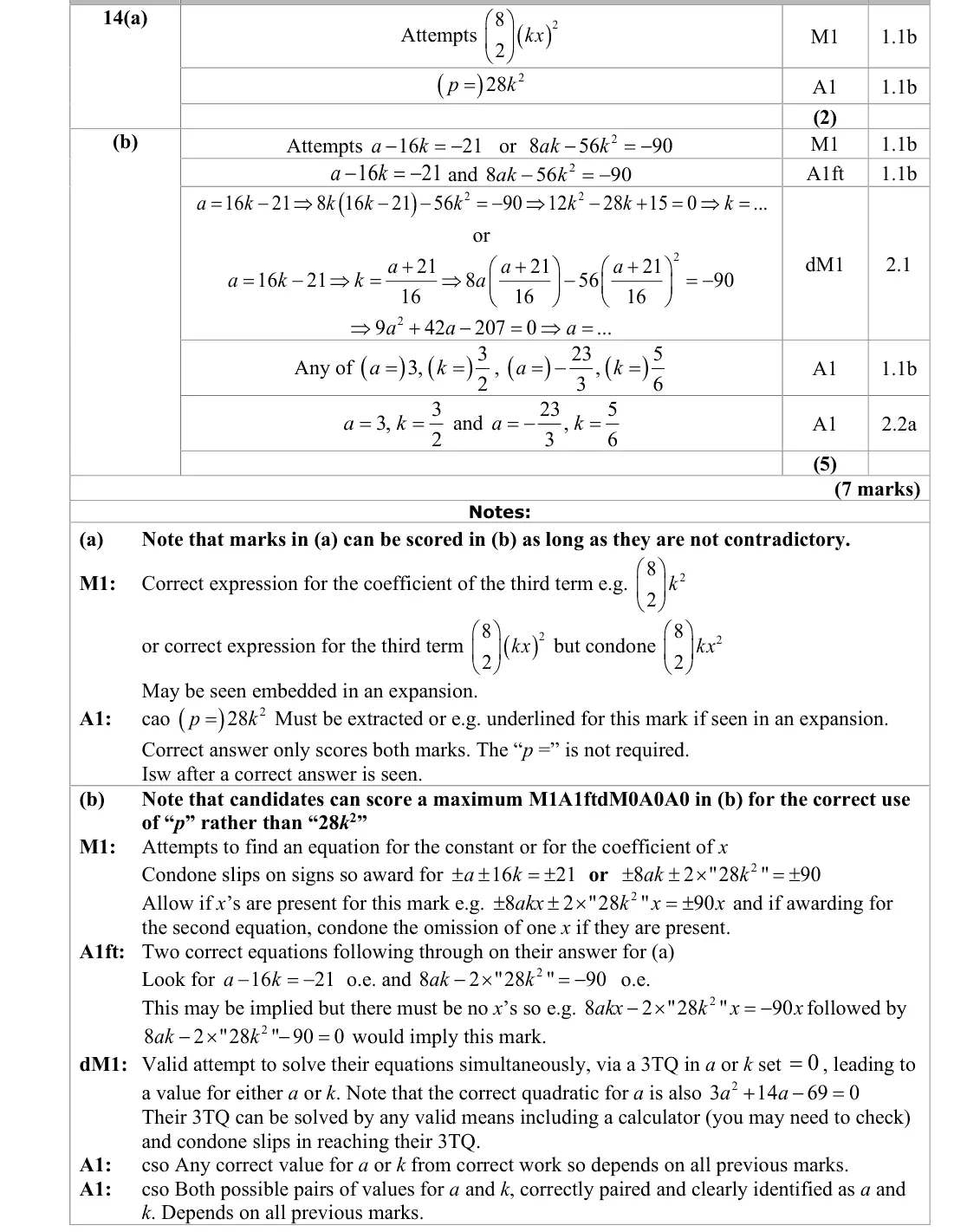
multiply (a − 2/x)(1 + 8kx + 28k²x² + …): constant a − 16k = −21, x coefficient 8ak − 56k² = −90
substitute to a 3TQ 12k² − 28k + 15 = 0
pair correctly: a = 3, k = 3/2 and a = −23/3, k = 5/6
identifying the wrong terms
June 2025 · Paper 2 · Q14(b)5 marks
Mark scheme (whole question; this part is marked with the orange bar)
Examiner's comment
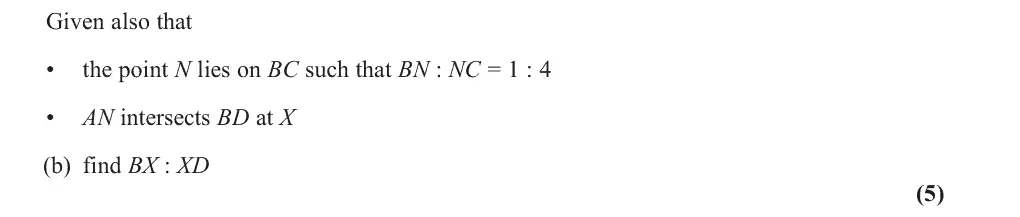
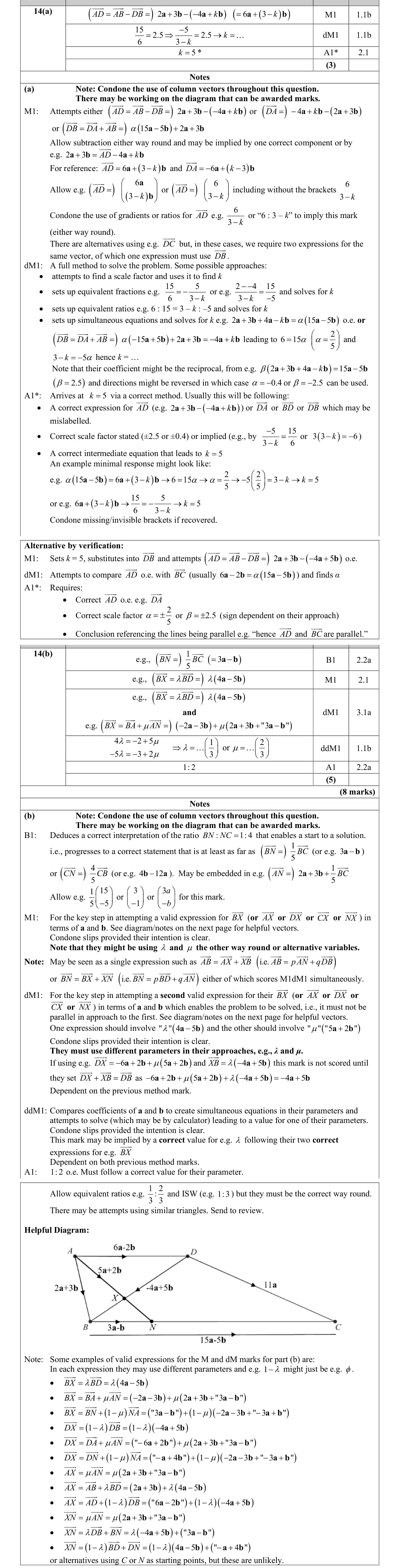
This question about vectors proved to be a good differentiator between learners. Many were only able to make progress in part (a), whilst learners who had a good knowledge of the techniques required progressed through part (b) as well. Most learners made some progress, but also found this question to be challenging. Throughout, responses saw varied methods, and many made effective use of the given diagram to help answer the question. In general, those that wrote the route down using good vector notation fared better than those who did not in both parts of the question. Learners found part (b) of the question significantly harder. Many responses earned the first mark for identifying that 1 , 5 BN BC = and this was often the only mark scored in this question. A common error, however, was to misinterpret the ratio BN : NC, and to incorrectly use 1 4 BN BC = . Most learners who made progress found two expressions for one of the vectors BX ± , AX ± , NX ± or DX ± , one using a multiple of AN and one using a multiple of DB . Where responses found a second vector with a different parameter, they were typically successful in solving simultaneous equations and identifying the correct ratio. Common errors included: only finding one expression or using the same vector ( AN or DB ) in both of their expressions or using the same parameter in both expressions. There were other strategies employed, but invariably they had the same issues as the strategy covered in the main scheme. A neat approach was to establish that triangles AXD and NXB were similar and since AD = 2BN it followed immediately that BX : XD = 1 : 2. There were some responses that attempted to use a similar strategy, but often the work was not detailed enough, simply stating that AD and BN were parallel without further justification that they understood the triangles were similar.
Common mistakes
BN = ⅕BC = 3a − b (not ¼BC)
two expressions for BX with different parameters (λ along BD, μ along AN) then compare coefficients
BX : XD = 1 : 2
similar triangles AXD and NXB (AD = 2BN) need justifying
June 2025 · AS Paper 2 (Statistics) · Q4(b)(ii)2 marks
Mark scheme (whole question; this part is marked with the orange bar)
Examiner's comment
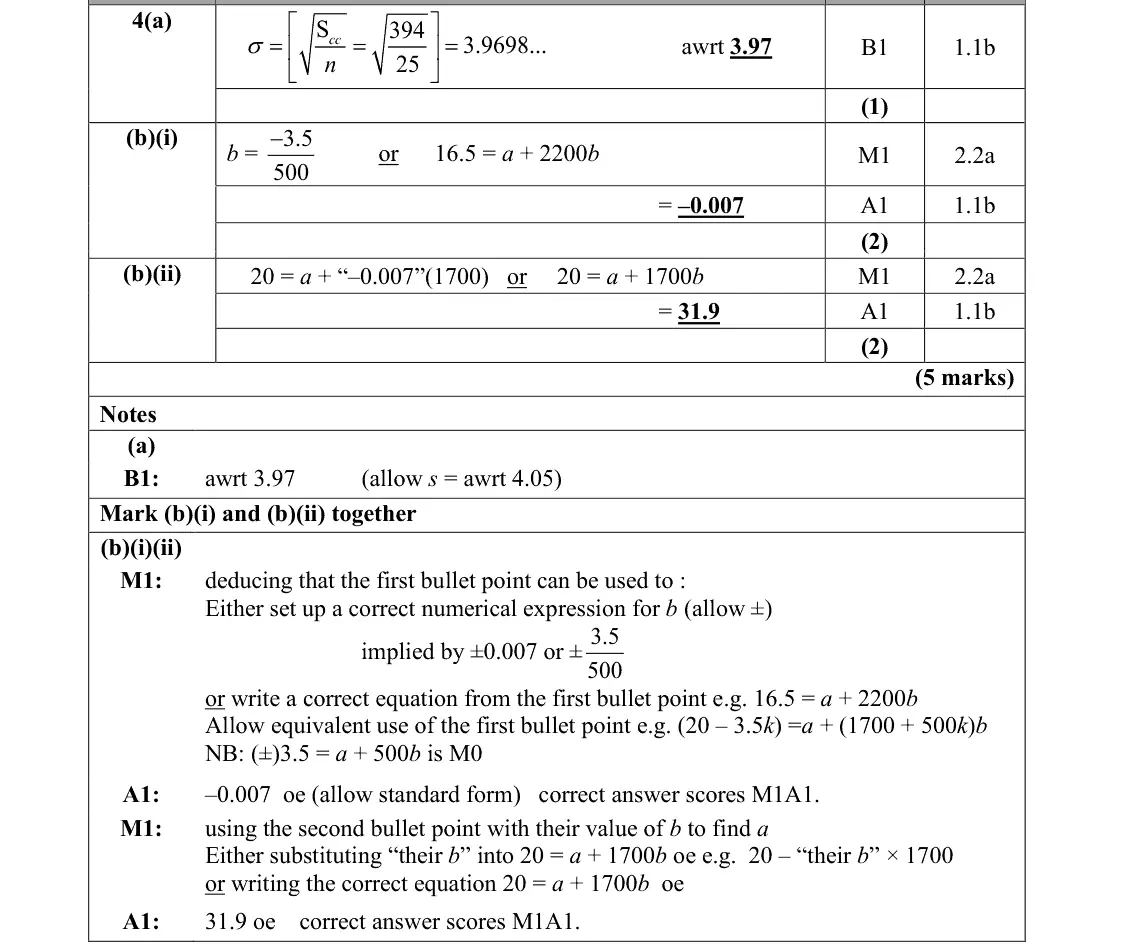
In part (a), it appeared that many students did not recognise the sum given as that used in the Common errors were sqrt 394 and 394 original definition of variance/standard deviation and so were unable to attempt an answer. 25 although other wrong solutions involving extensive calculations were also seen. For part (b) many students misinterpreted the information in the first bullet point and used the incorrect equation 3.5 = a + 500b together with the correct one of 20 = a + 1700b. Those who had interpreted the information correctly generally used it in conjunction with the second bullet point to obtain 16.5 = a + 2200b as their equation together with 20 = a + 1700b ∓3.5 although a few of those using this approach used 1200b instead of 2200b. 500 were more successful although some of Those who used the gradient approach with b = these did not pick up that the gradient was negative. There were some students who had the gradient upside down.
Common mistakes
substitute their b into 20 = a + 1700b to get a = 31.9
1200b used instead of 2200b in the simultaneous-equation approach
June 2025 · AS Paper 2 (Statistics) · Q5(c)4 marks
Mark scheme (whole question; this part is marked with the orange bar)
Examiner's comment
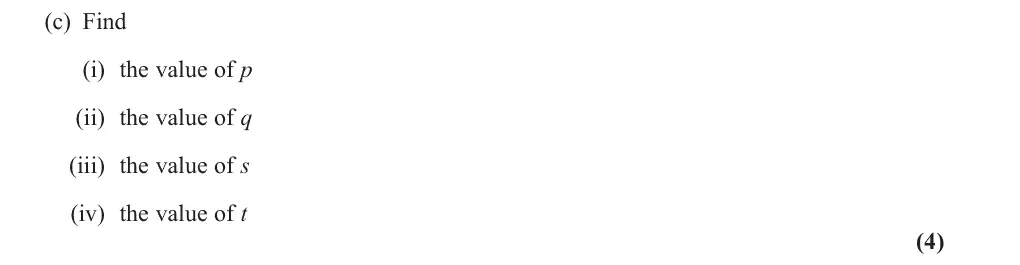
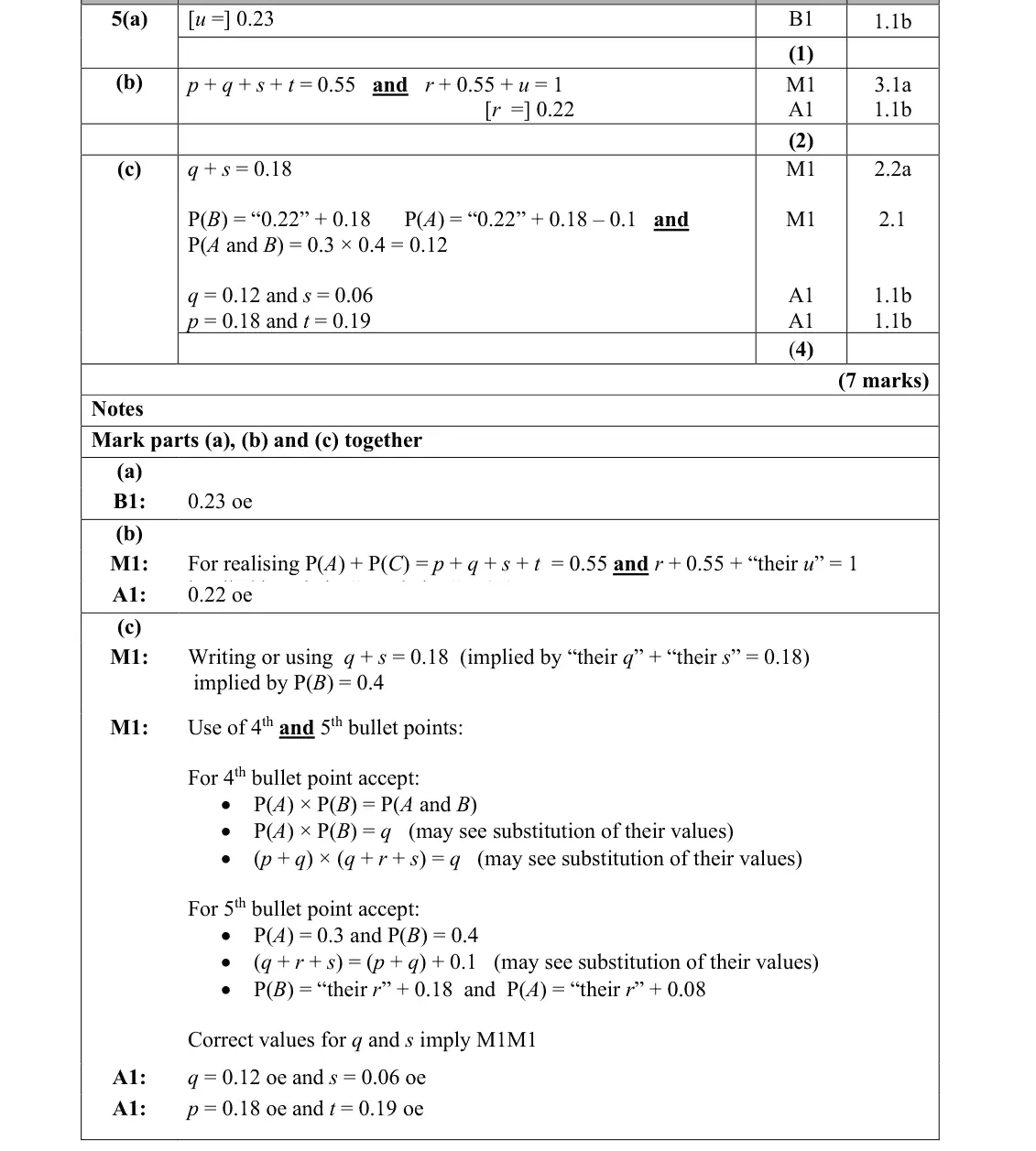
Those attempting part (c) often gained one of the two method marks available. More commonly this was for realising that q + s = 0.18. To score the second method mark, students needed to use two pieces of information and this proved difficult for many. Had students realised that numerical values could be substituted into their expressions at an early stage, they would have avoided pages of unnecessary algebraic expansion and simultaneous equations. This part proved to be one of the most discriminating parts of the entire paper.
Common mistakes
exactly two gives q + s = 0.18
P(B) = r + q + s = 0.4 so P(A) = 0.3
independence P(A and B) = 0.3 × 0.4 = 0.12 = q, s = 0.06, p = 0.18, t = 0.19
substitute numbers early to avoid long algebra
most discriminating part of the paper
June 2025 · Paper 3 (Statistics) · Q5(b)5 marks
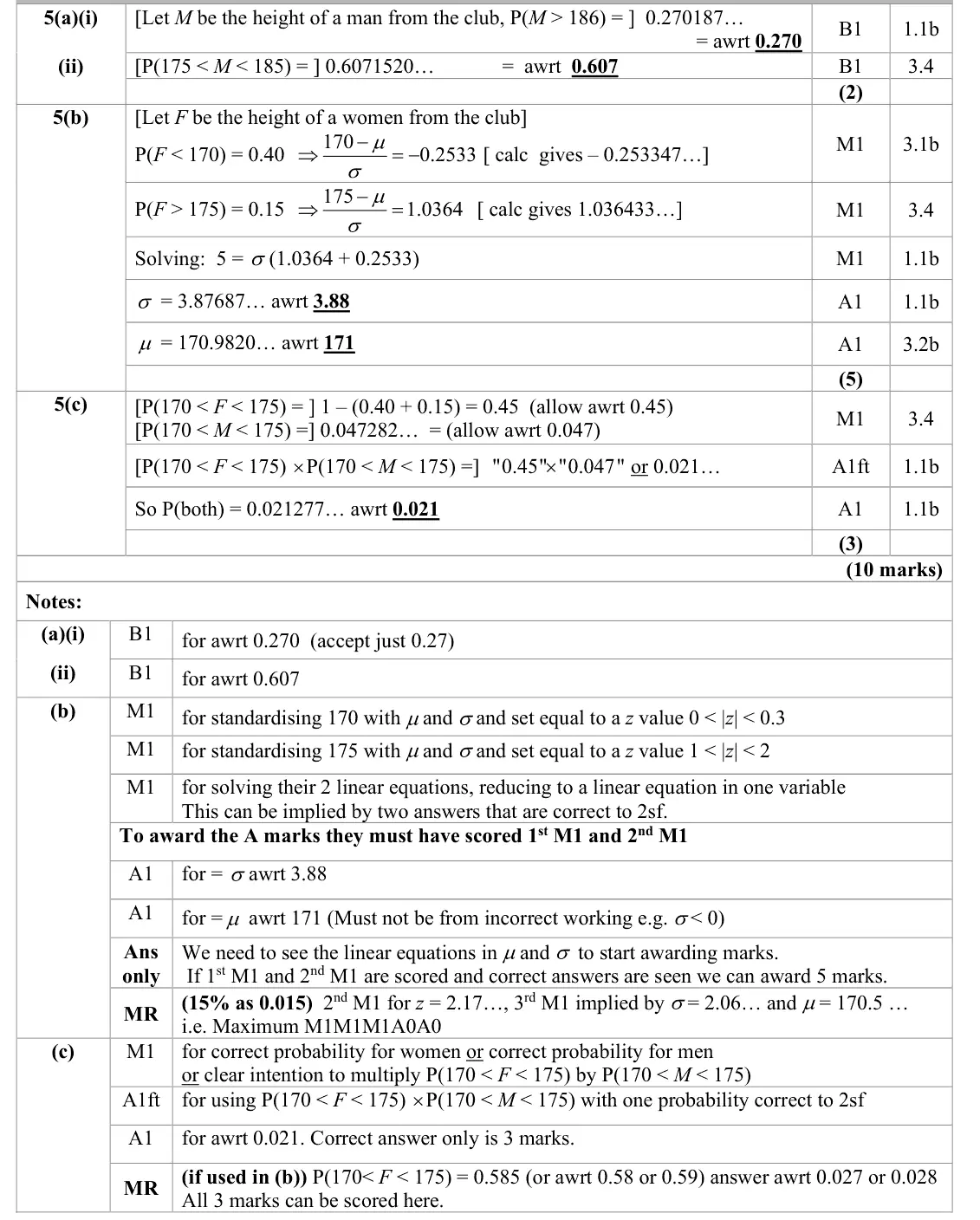
Mark scheme (whole question; this part is marked with the orange bar)
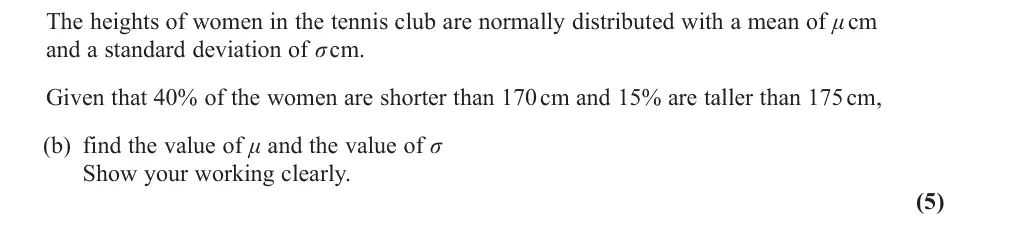
Examiner's comment
This question was answered very well. Most knew how to use their calculators to answer part variables and in part (i) calculated P(𝑀𝑀⩾187) whilst others incorrectly applied a continuity (a) though some didn’t appreciate the difference between discrete and continuous random correction. In part (b) many correctly formed and solved their simultaneous equations, but some made sign errors in their z-values and a few did not standardise correctly for example using 0.4 and 0.15 as z-values. Those who sketched a diagram of the distribution usually avoided sign errors. Some did not use accurate enough z-values (the tables give values to 4 decimal places) and this often meant they lost an accuracy mark for their value of sigma. Many relied on their calculator for solving the simultaneous equations which was fine if the equations were correct but without some written attempt to eliminate one variable, we were unable to give further credit if the equations were incorrect. Some responses accepted a negative standard deviation without checking to identify the error. mean and standard deviation from part (b) to calculate P(170 < F < 175) rather than using the information in the question in the calculation 1 – (0.4 + 0.15). A few responses added the two probabilities rather than multiplying here.
Common mistakes
(170 − μ)/σ = −0.2533 and (175 − μ)/σ = 1.0364
z-value signs from a sketch
do not use 0.4 or 0.15 as z
σ = 3.88, μ = 171
show the elimination, not only calculator answers
June 2024 · AS Paper 1 · Q2(b)4 marks
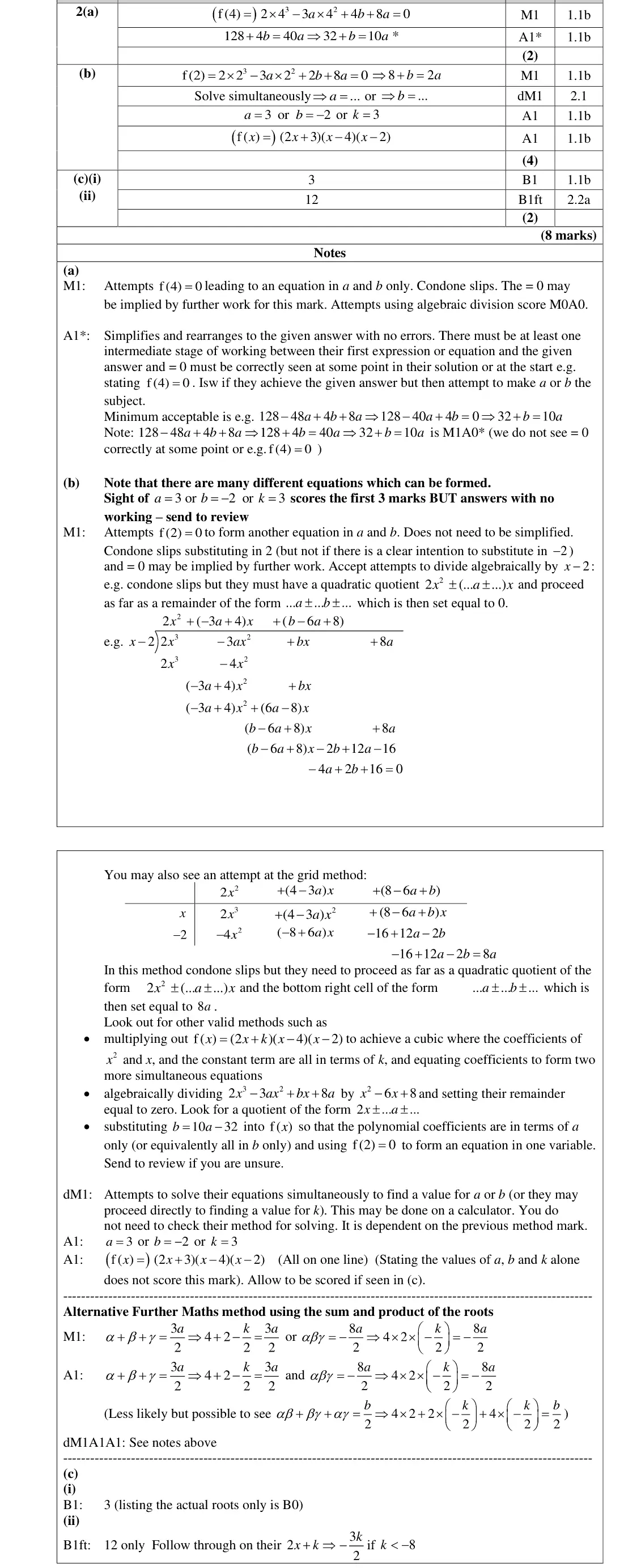
Mark scheme (whole question; this part is marked with the orange bar)
Examiner's comment
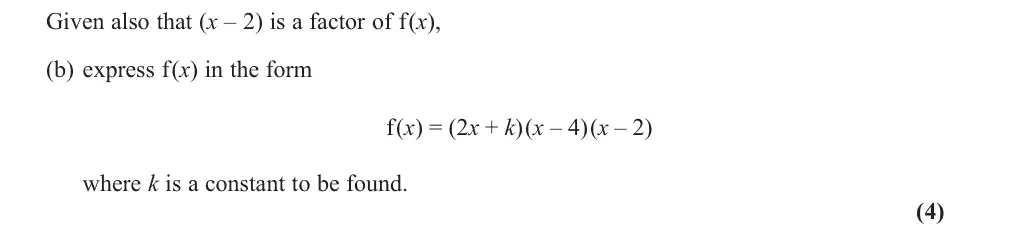
This question which required use of the factor theorem and solving simultaneous equations provided an opportunity to score a good number of marks. Some candidates found this question to be accessible and scored full marks or nearly full marks. Others however, encountered difficulties, particularly with part (b) and dropped marks accordingly. Some candidates lost marks because they did not pay heed to the instruction to show all stages of their working. For part (b), many candidates continued with the theme of the question and applied the factor theorem a second time using f(2) 0 = , obtaining a second equation in a and b. This was the easiest way to proceed. Surprisingly however, a significant number of candidates chose more difficult routes and progressed instead with entirely different methods. Many candidates had some success by expanding (2 )( 4)( 2) x k x x + - - and then comparing coefficients with the original function, obtaining further equations. Others attempted to divide the original function by ( 2) x - or sometimes by 2 6 8 x x - + , using long division. This approach was less successful because of the algebra involved and few reached a second equation. There were also a few attempts using the sum and product of the roots of a cubic equation. Some candidates attempted to use f(2) 0 = with f( ) (2 )( 4)( 2) x x k x x = + - - and made no progress in part (b). Generally, when candidates obtained further correct equations in part (b), they were then able to successfully solve them simultaneously to obtain values of a, b or k which were usually correct. This was often followed by the correct factorised expression for f(x), although a number of candidates failed to write this down and lost the final mark. A few correct answers were presented with no working, which gained no credit in part (b).
Common mistakes
f(2) = 0 gives 8 + b = 2a
solve with 10a = 32 + b: a = 3, b = −2, k = 3
final answer (2x + 3)(x − 4)(x − 2) on one line
expanding (2x + k)(x − 4)(x − 2) and comparing coefficients is longer
June 2024 · Paper 1 · Q10(c)5 marks
Mark scheme (whole question; this part is marked with the orange bar)
Examiner's comment
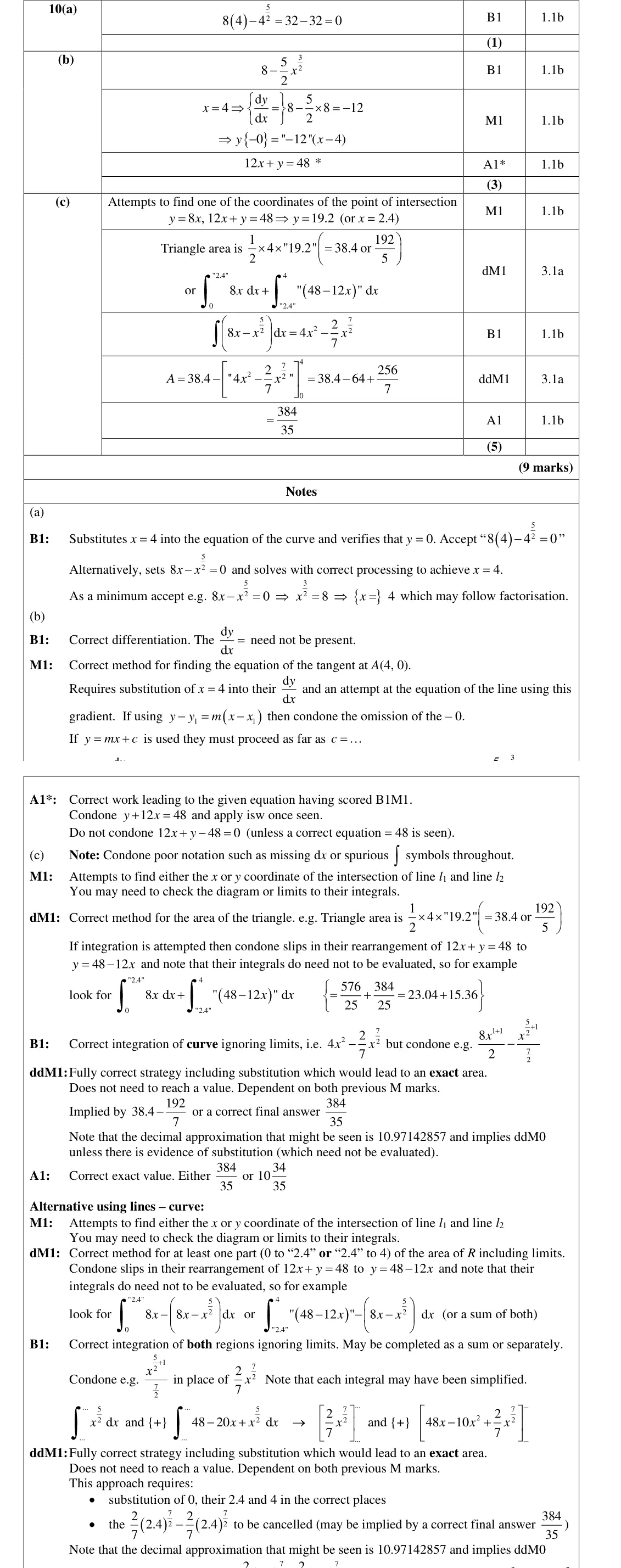
part (c). The final part of the question proved more challenging and differentiated between the candidates, with many producing concise and fully correct answers. Most candidates realised it required the use of integration and often scored the B mark for integrating the curve. Many candidates failed to note that the question required an exact answer and use of algebraic integration. This meant that using a calculator to provide a decimal approximation was insufficient for the final method mark. The quality of notation in this part of the question was very varied with the dx often missing from integrals and spurious integral signs included throughout working. 1 = The majority of successful candidates used or integration to find the area of A bh 2 the triangle and then subtracted the area under the curve. However, a significant proportion of candidates made the question much more difficult than necessary, using a mixture of Pythagoras and trigonometry to find the area of the triangle-this often led to errors or premature rounding. Other common errors when finding the area of the triangle included assuming the triangle was isosceles, and therefore that the intersection x = point was at , or splitting the triangle into two right-angled triangles and assuming 2 they both had the same area. Candidates attempting to use the alternative method using lines – curve were more likely to make errors with signs, brackets or limits. They were also required to correctly 2 2.4 7 ( ) cancel the terms to find an exact answer and so most often were unable to 2 7 score the final method and accuracy marks. The most common invalid method was attempting to combine the lines and curve before integrating using the limits 0 and 4, and this scored no marks unless the point of intersection had been found.
Common mistakes
l1 and l2 meet at (2.4, 19.2)
triangle 38.4 minus ∫₀⁴ (8x − x^(5/2)) dx = 192/7
exact 384/35 (calculator decimal loses marks)
triangle is not isosceles
missing dx
June 2024 · Paper 1 · Q15(ii)4 marks
Mark scheme (whole question; this part is marked with the orange bar)
Examiner's comment
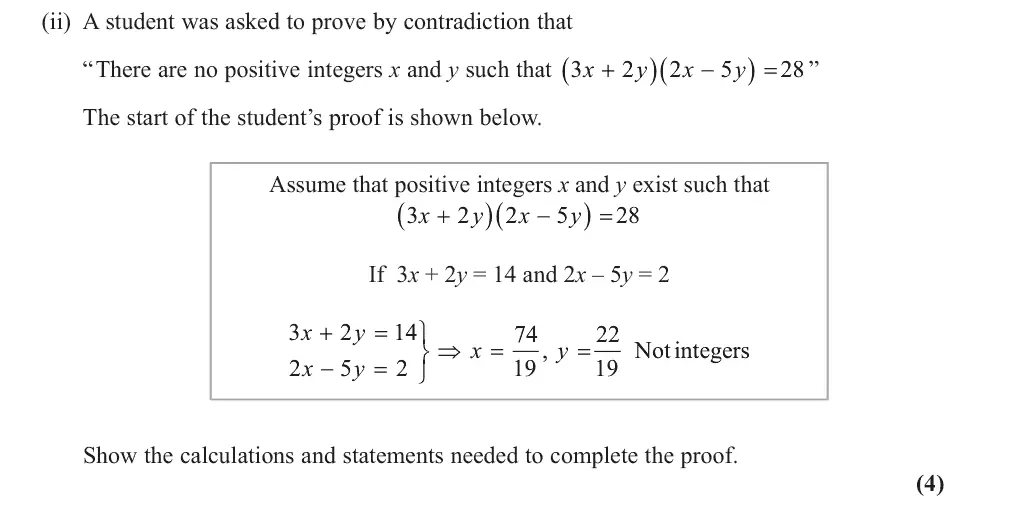
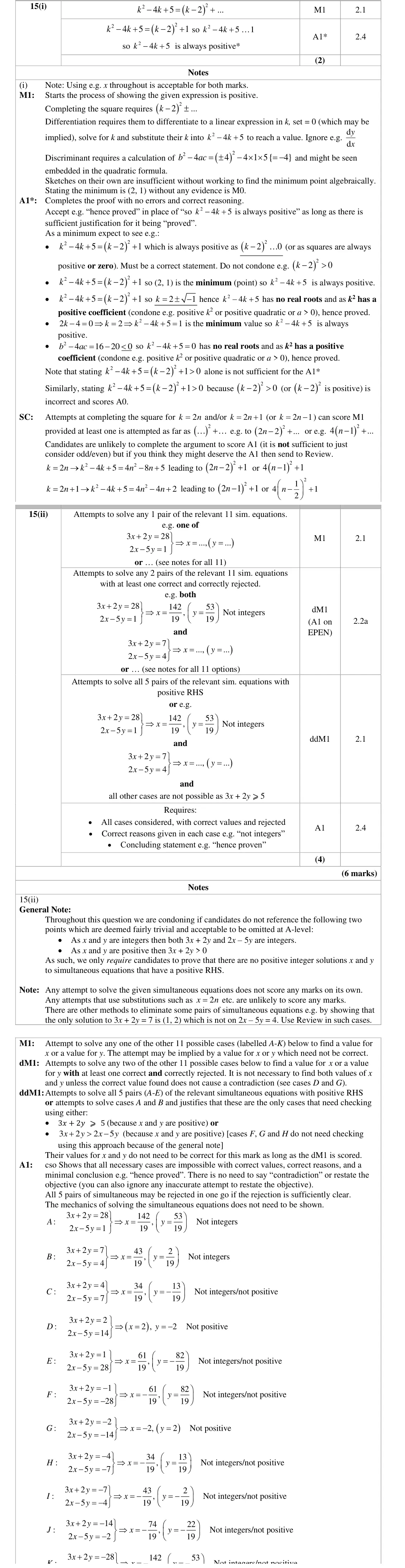
This question was a clear discriminator between the most secure and intermediate candidates with many making little or no progress in part (i), although many candidates made at least a respectable attempt at part (ii). The most common techniques employed in part (i) were completing the square and using the discriminant. When completing the square, candidates often stated that squared numbers are always positive and gave no indication that they could also equal 0, which was a common error the last time a similar question was asked. When finding the discriminant, candidates often obtained the answer of –4, but very little explanation followed this, and notably many seemed to think this was sufficient to conclude that the 2 k given quadratic was always positive with no reference to the coefficient of the term. It was not uncommon to see attempts analysing even and odd number scenarios, but none were seen that recovered from only considering whole numbers and extended to the entire set of real numbers. A few candidates used differentiation to find the turning point and some of these candidates calculated the second derivative to prove that their turning point was a minimum, but they usually lost the final mark as they did not write a conclusion to complete their proof. The least confident candidates simply substituted a few integer values for k into the expression and attempted to draw a conclusion from the results, scoring no marks. In part (ii), many candidates did not fully appreciate what they were being asked to do, most likely due to the unfamiliar nature of the question. As a result, some attempted algebraic manipulation of the expression, such as expanding the brackets, and were unable to progress to a solution. Other candidates believed they were being asked simply to write out the proof by adding text to the information supplied or by detailing the working for the solutions of the simultaneous equations given. However, there was a good proportion of candidates who realised that the example given was just one of many possible scenarios and proceeded to attempt to find solutions to the remaining cases. It was rare to see all of the 11 other factor pairs examined, and, in most cases, candidates only considered simultaneous equations with a positive right-hand side. The mark scheme enabled all the marks to be scored for this approach given that the simultaneous equations with negative right-hand sides could be discarded quite trivially. Often candidates only determined x or y for a couple of factors of 28 securing 1 or 2 marks. A good proportion only dealt with factor pairs ‘one way round’ and gave no justification as to why, limiting themselves to 2 marks out of the available 4. Calculators could legitimately be used to solve the simultaneous equations and candidates who did this found, almost without exception, correct values for x and y as well as saving time. Full algebraic processing of the simultaneous equations was time-consuming and prone to error. A minority of candidates realised it was possible to argue that 3𝑥+ 2𝑦 ⩾ 5 and limited themselves to examining just cases A and B from the mark scheme, but it was nice to see the strongest candidates able to distinguish themselves in this manner. Most candidates identified the reasons for rejecting factor pairs as they went along whilst a few left the rejection of the solutions to the overall conclusion, and both approaches were acceptable. Sadly, some made no comment at all on the solutions they found and were unable to score either accuracy mark as a result.
Common mistakes
complete a proof by contradiction: factor pairs of 28 with positive RHS (28,1) (7,4) (4,7) (2,14) (1,28), as 3x + 2y ≥ 5
solve each pair and reject (not integers or not positive)
concluding statement needed
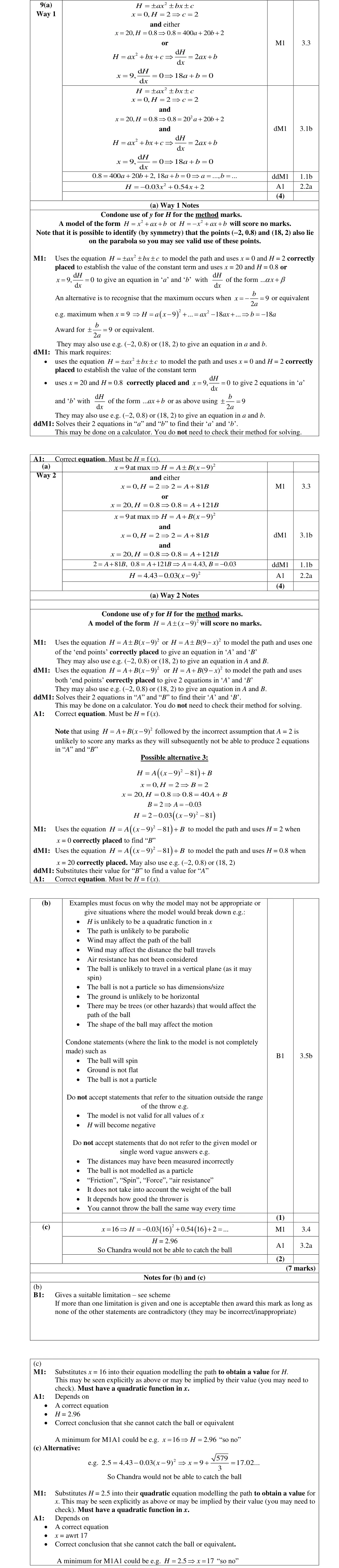
June 2024 · Paper 2 · Q9(a)4 marks
Mark scheme (whole question; this part is marked with the orange bar)
Examiner's comment
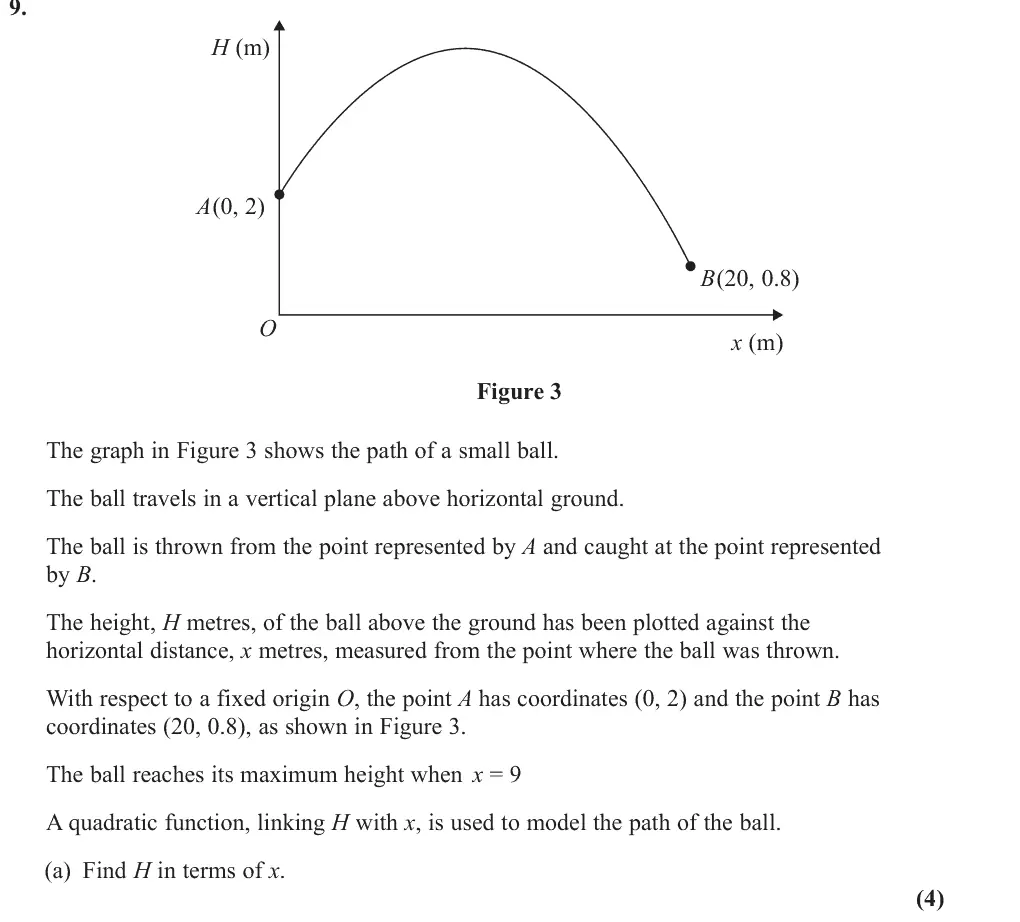
and candidates who achieved an incorrect quadratic model in part (a) were still able to achieve the method mark. When candidates achieved full marks in part (a) they usually went on to achieve full marks in part (c) too. It was extremely rare for H = 2.96 to be achieved and an incorrect
Common mistakes
H = ax² + bx + c with c = 2
use (20, 0.8) and max at x = 9 (dH/dx = 0 or −b/2a = 9)
H = −0.03x² + 0.54x + 2
assuming vertex form with A = 2 fails
June 2024 · Paper 2 · Q15(c)5 marks
Mark scheme (whole question; this part is marked with the orange bar)
Examiner's comment
This question provided a challenge to most candidates and was in general a good discriminator. Part (c) provided a challenge for many candidates and was a good discriminator. It is possible that some candidates were running out of time by this part of the paper, and this seemed to lead to simple algebraic and sign errors. However, many candidates were able to make at least some progress and most recognised the need to substitute the equation from part (b), which had been provided, into the equation from part (a). Most were able to expand to obtain a cubic in x albeit with frequent errors and slips, in particular a common error of cancelling the constant terms leading to a cubic with only three terms was often seen. The alternative elimination of x to lead to a cubic in y was rarely seen. Having obtained a cubic equation, many candidates made little creditworthy further progress and the majority seemed not to have made the link to earlier parts of the question and so did not attempt to take (x - 1) out as a factor of their cubic. This was perhaps understandable when the cubic was incorrect although it seemed that even candidates with the correct cubic did not consider using the fact that x = 1 was a root. Many candidates used their calculator to obtain the three roots of their cubic and others employed dubious techniques either attempting to find a ‘discriminant’ by ignoring the 3x term or attempting to take out a factor of x whilst ignoring the constant term. Those candidates who had a three-term cubic rather than a four-term cubic were unable to progress here. The final two marks of the paper were only accessible to those who were very secure in their algebraic accuracy and knowledge as these marks were contingent on both a correct cubic and a correct quadratic factor. Most candidates who met these criteria successfully used the discriminant to demonstrate that the quadratic had no roots although some used more elaborate reasoning involving the gradient of the cubic or the minimum point of the quadratic. Unfortunately, a significant proportion of candidates who got this far, did not manage to earn both marks because their justification or conclusion was insufficient, and it was sometimes disappointing to see otherwise well-answered solutions lose the final mark because they concluded with ‘no roots’ rather than also relating this back to the question to conclude that there could be ‘no further points of intersection’.
Common mistakes
substitute y = −2x + 2 into the curve: x³ − 3x² + 18x − 16 = 0 (constant term often lost)
use (x − 1) as a known factor: x² − 2x + 16
discriminant 4 − 64 < 0 so no other real roots
conclude "the normal does not meet C again"
calculator roots alone score no more
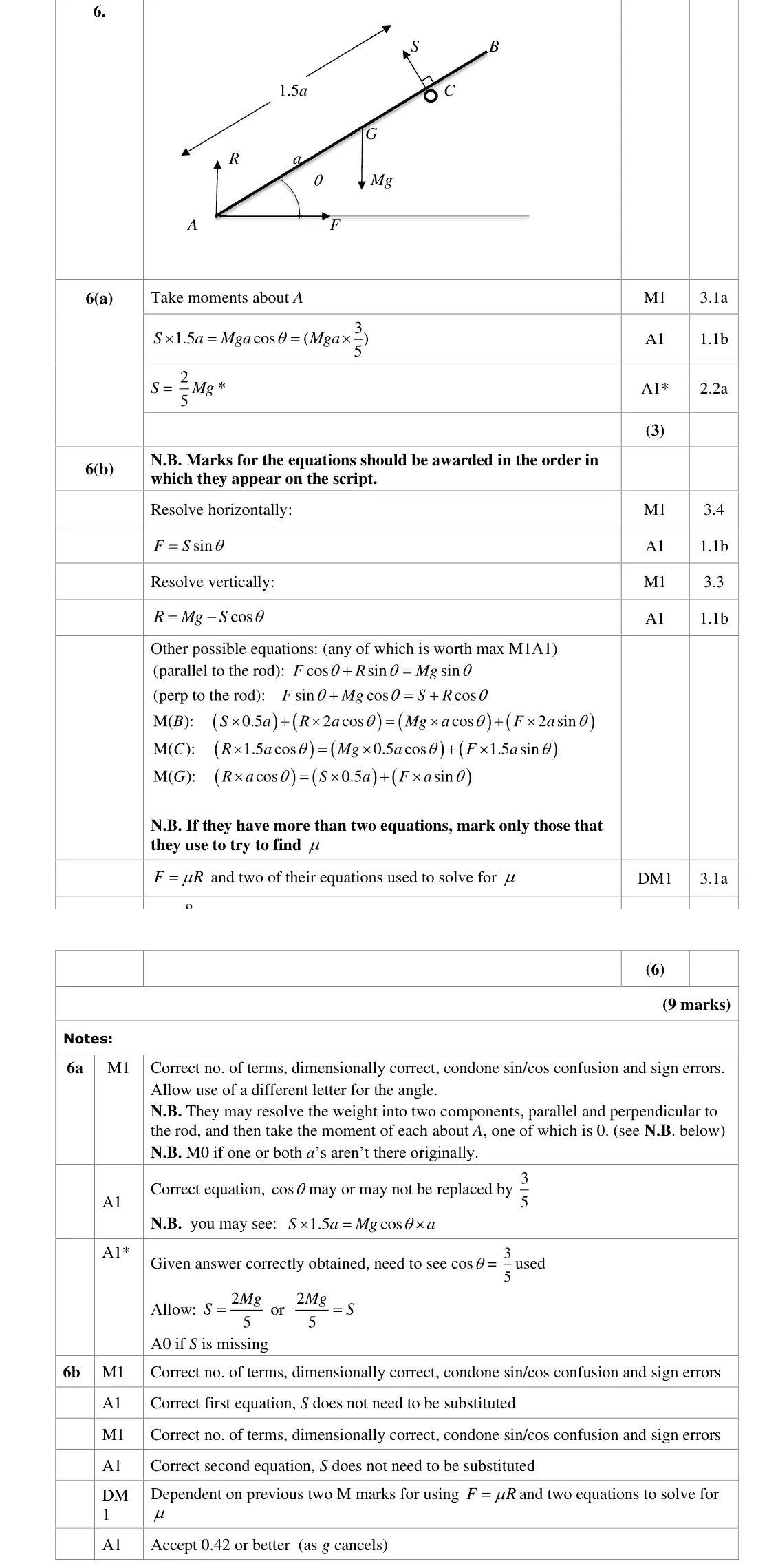
June 2024 · Paper 3 (Mechanics) · Q6(b)6 marks
Mark scheme (whole question; this part is marked with the orange bar)
Examiner's comment
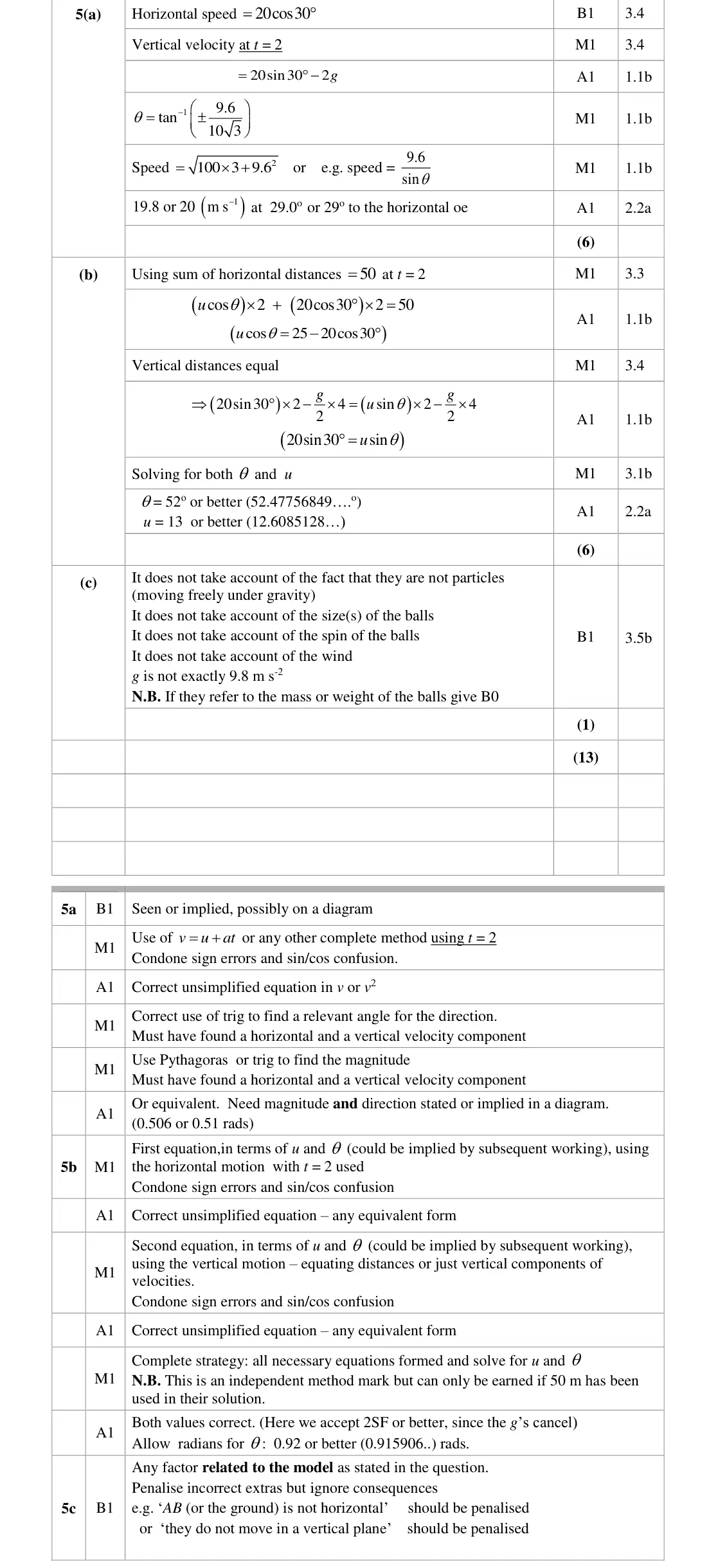
(b) Many candidates scored all six marks in this part. Resolving vertically and horizontally was the most common and the most successful method. There were few errors apart from sin and cos confusion. Taking moments about C to give an equation in R and F and then resolving was the next most common method, but candidates were more likely to make errors using this approach, either by confusing sin with cos or by omitting a force entirely. Very few candidates resolved parallel and perpendicular to the rod and most of those who used this method failed to arrive at the correct answer due to the more challenging algebra. Occasionally candidates wrote dimensionally inconsistent equations by failing to include lengths in all of their moment terms or, more rarely, erroneously including lengths in their force terms. Errors included missing a g where there should have been one or not having the correct number of terms in a moment or a resolution equation. A surprisingly common error was for students to confuse the reaction force S 2 = F Mg with the reaction force at A, resulting in the incorrect equation Some 5 candidates lost method marks by resolving forces that did not need resolving (for and ). Whichever method Mg sin example, by writing an equation with both cos S was used, early substitution for F into their solutions was often seen, with almost all candidates realising that they needed to use F = μR. Some candidates clearly still incorrectly believe that μ cannot be greater than 1 and were ‘dismissive’ when their value was. It was not uncommon to see very messy responses, with multiple attempts and work crossed out. Many candidates made a good attempt at solving for mu , but this was often impeded by the lack of clarity over the previous equations. The mark scheme enabled candidates who used a correct method but who made sign errors, confused sin and cos or used incorrect distances to score half marks (generally, M1A0M1A0M1A0), while those with more fundamental misunderstandings were prevented from accessing the dependent method mark; this seemed to sort out the candidates well. When mu was found, most candidates gave the answer as a fraction or to an appropriate degree of accuracy.
Common mistakes
resolve horizontally F = S sin θ and vertically R = Mg − S cos θ, then F = μR: μ = 8/19 ≈ 0.42
confusing S with the reaction at A
sin/cos confusion
resolving forces that need no resolving
μ may be greater than 1 in general
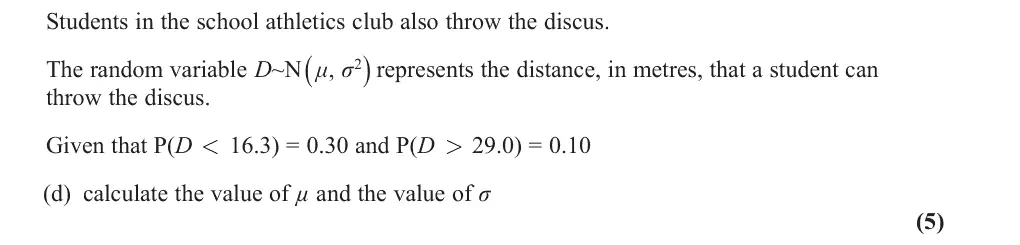
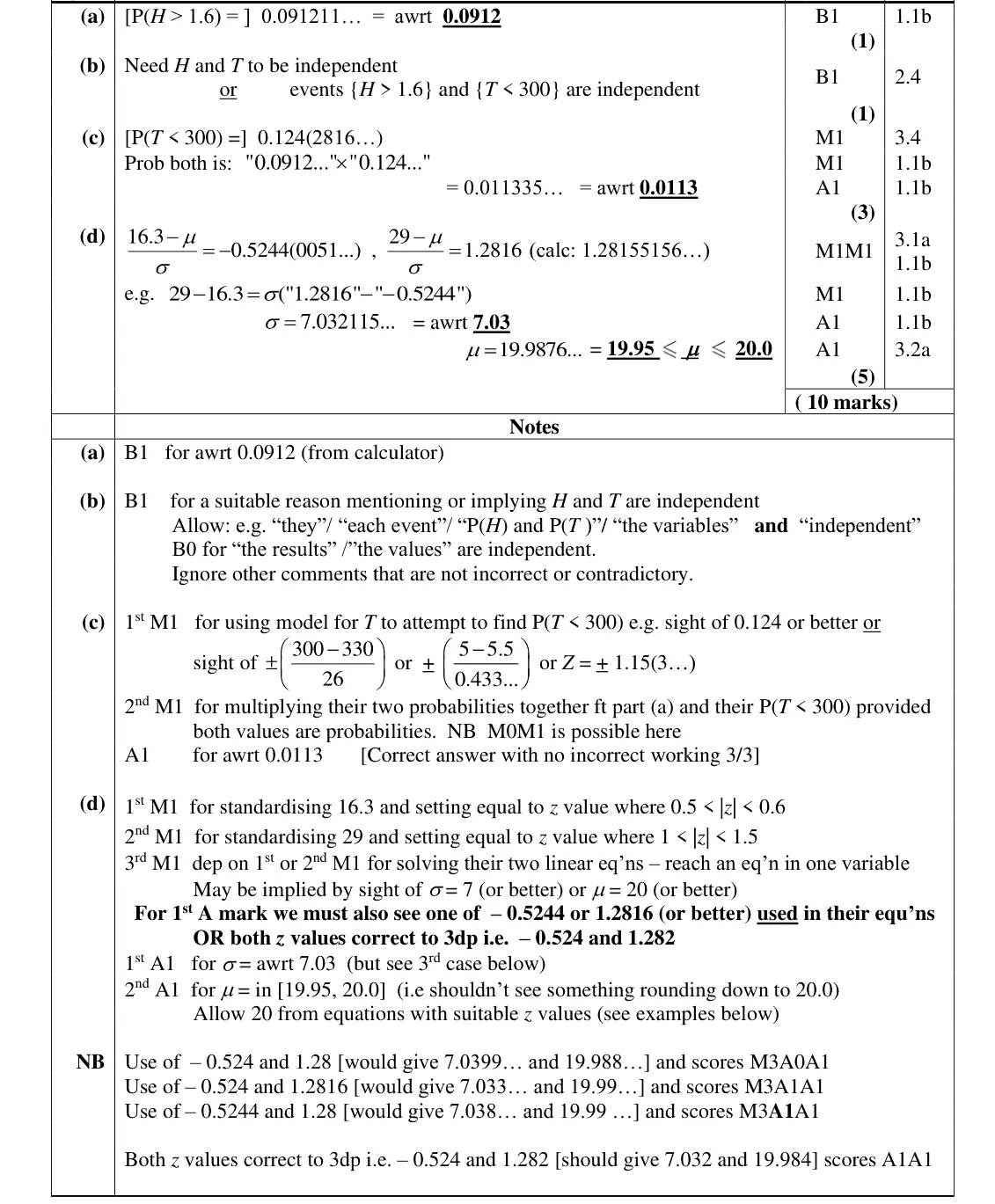
June 2024 · Paper 3 (Statistics) · Q5(d)5 marks
Mark scheme (whole question; this part is marked with the orange bar)
Examiner's comment
There were many good attempts at part (d). Most students could start the problem and write down a pair of linear equations in and with suitable values of z. Many students showed some working when solving their equations whilst others simply wrote down solutions using their calculators. This is fine if the equations are correct but if there are errors in the equations then the method mark cannot be awarded if no method for solving the equations is seen. The front of the paper indicates that if students use their calculators instead of the tables, then they should use an equivalent degree of accuracy which in this case, for finding the z values, was 4 decimal places. Some failed to do this and lost one of the accuracy marks but there were a good number of students scoring full marks for this part. A common error here was missing the minus sign on the z value for the lower tail and a few students assigned the z values the wrong way around.
Common mistakes
(16.3 − μ)/σ = −0.5244 (negative for the lower tail) and (29 − μ)/σ = 1.2816
z to 4 d.p.
σ = 7.03, μ = 20.0
show a method if equations are wrong
z values the wrong way round
June 2023 · Paper 1 · Q5(b)3 marks
Mark scheme (whole question; this part is marked with the orange bar)
Examiner's comment
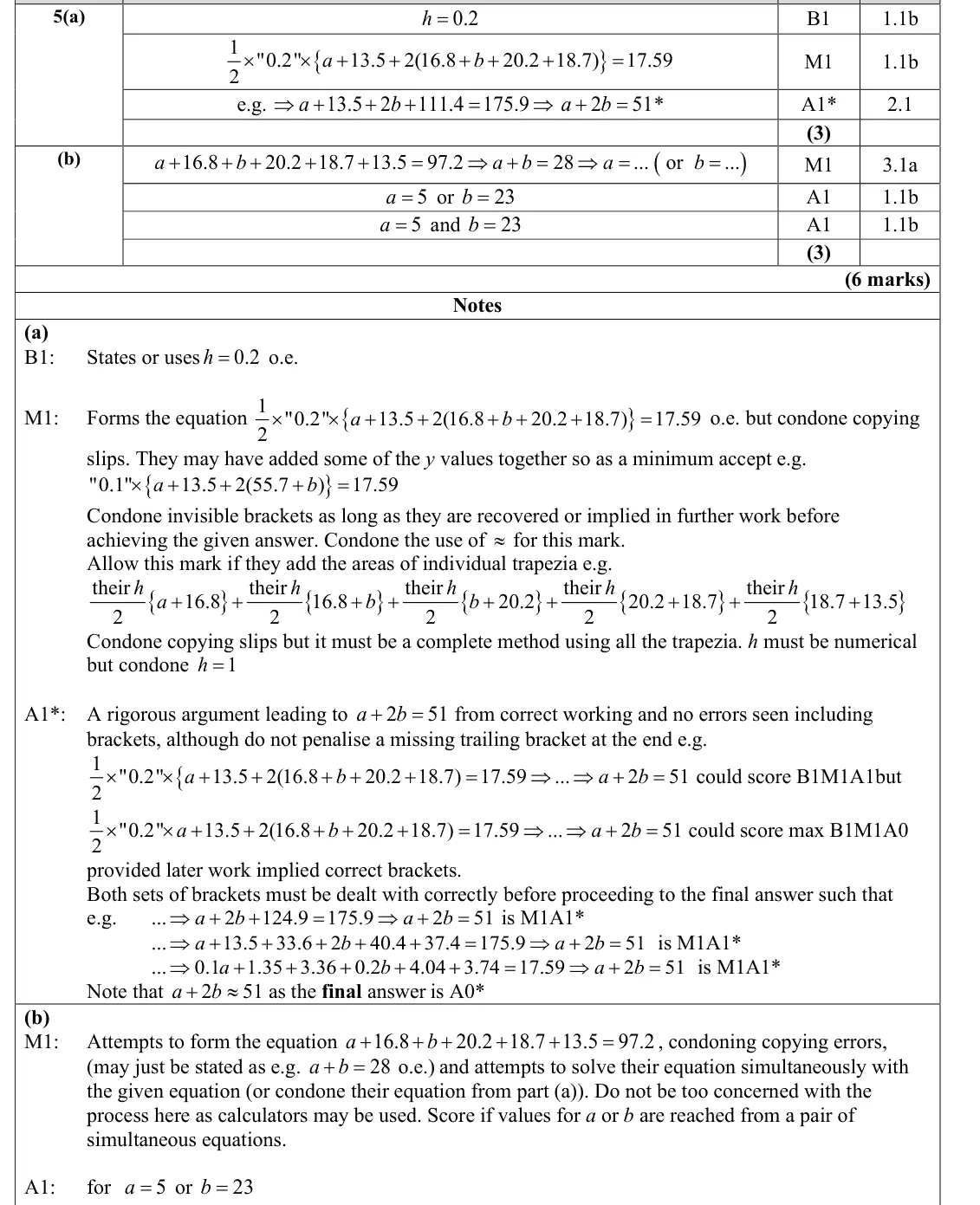
This was a lovely twist on a usually very standard question using the trapezium rule that was overall very well-answered. It was very rare to see a blank response to this question. Part (b) was dealt with very well overall, with a variety of different methods used to solve the equations simultaneously, usually via the use of a calculator. Some arithmetic errors were seen in forming the second equation, 28 a b + = , which resulted in the wrong values for a and b. Again, despite requiring the copying of many values from the given table of x and y values to form the required equation, there were few transcription errors. It is also worth noting that nearly all candidates used the given equation in (a) to correctly solve for values of a and b. Although it was made possible for them to gain the method mark for using “their” equation, this was very infrequently utilised, or required. Furthermore, it was pleasing to see candidates who made no attempt at (a) still proceeded to use the given answer to attempt and generally gain full marks in (b).
Common mistakes
form a + b = 28 from the sum of the y values and solve with a + 2b = 51
June 2023 · AS Paper 1 · Q7(a)4 marks
Mark scheme (whole question; this part is marked with the orange bar)
Examiner's comment
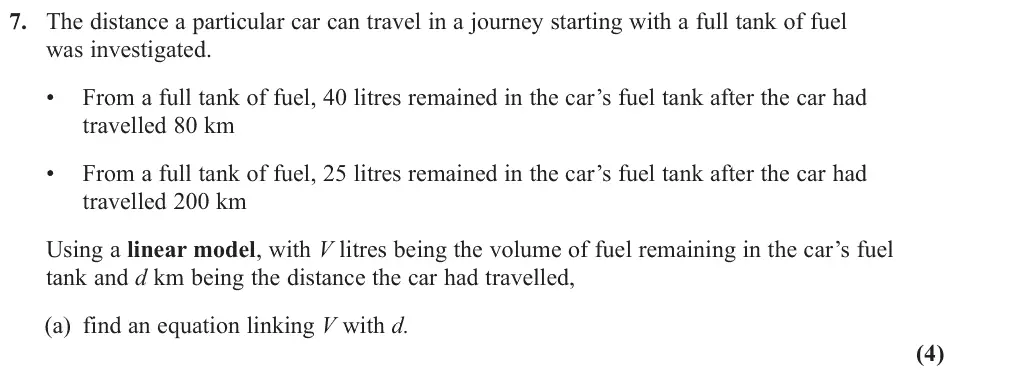
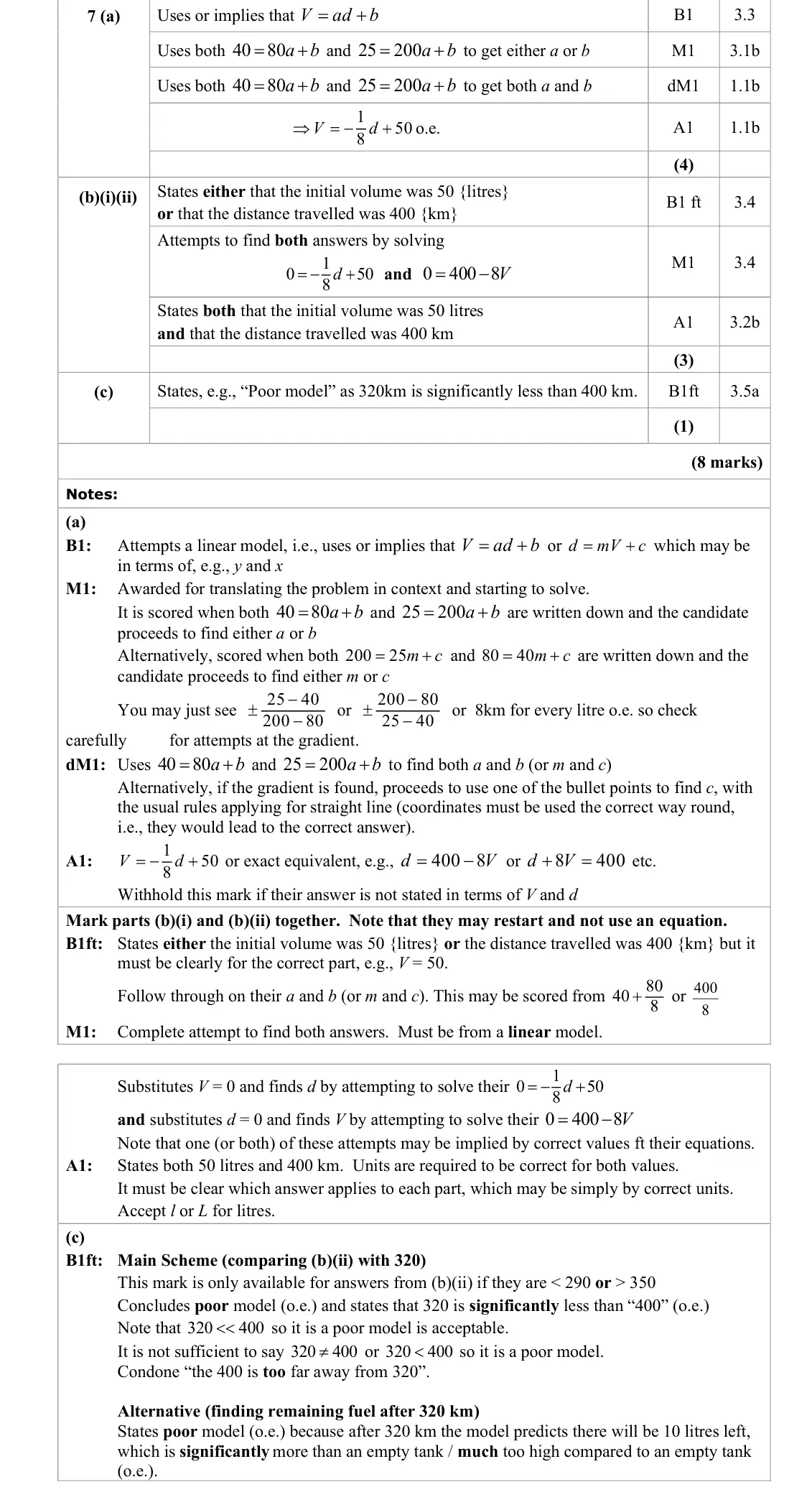
Most candidates attempted this question, with only a small number leaving it blank. Most candidates In part (a), candidates who set up a linear model correctly tended to go on to get the correct linear model required and performed well in the rest of the question. Those who were successful tended to use the ( ) - = - gradient and rather than attempting to use simultaneous equations. The most common y y m x x 1 1 error was to use the coordinates the wrong way round, which resulted in candidates’ incorrectly calculating 1 - the gradient as –8 instead of . However, a good proportion of candidates recovered by using the gradient 8 of –8 to achieve a formula in terms of V (i.e., d = 400 – 8V or equivalent). There were a few candidates who did not include the ‘+c’ part of a linear model and instead seem to think the relationship was proportional. These candidates were often limited to one mark in this question for correctly identifying the link of 1 litre = 8km. Where a linear equation was not recognised an exponential was the most common alternative. Candidates who achieved a formula in part (a) generally continued onto part (b) and used their formula to attempt the question correctly. A common error was to omit the units, which cost just the final mark in part
Common mistakes
linear model V = ad + b (not proportional, not exponential)
gradient −1/8 (using coordinates the wrong way round gives −8)
V = 50 − d/8 or d = 400 − 8V
answer must be in V and d
June 2023 · AS Paper 1 · Q10(b)5 marks
Mark scheme (whole question; this part is marked with the orange bar)
Examiner's comment
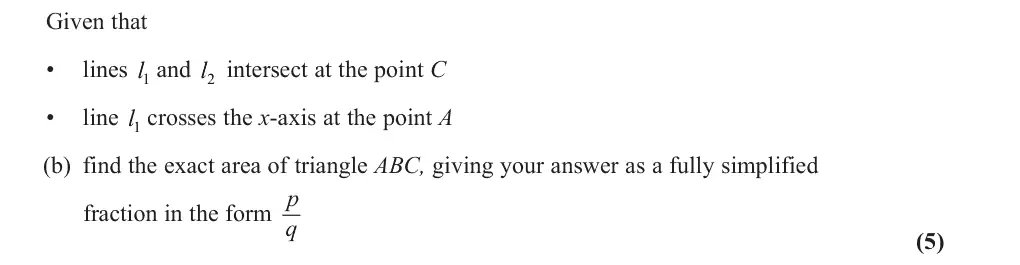
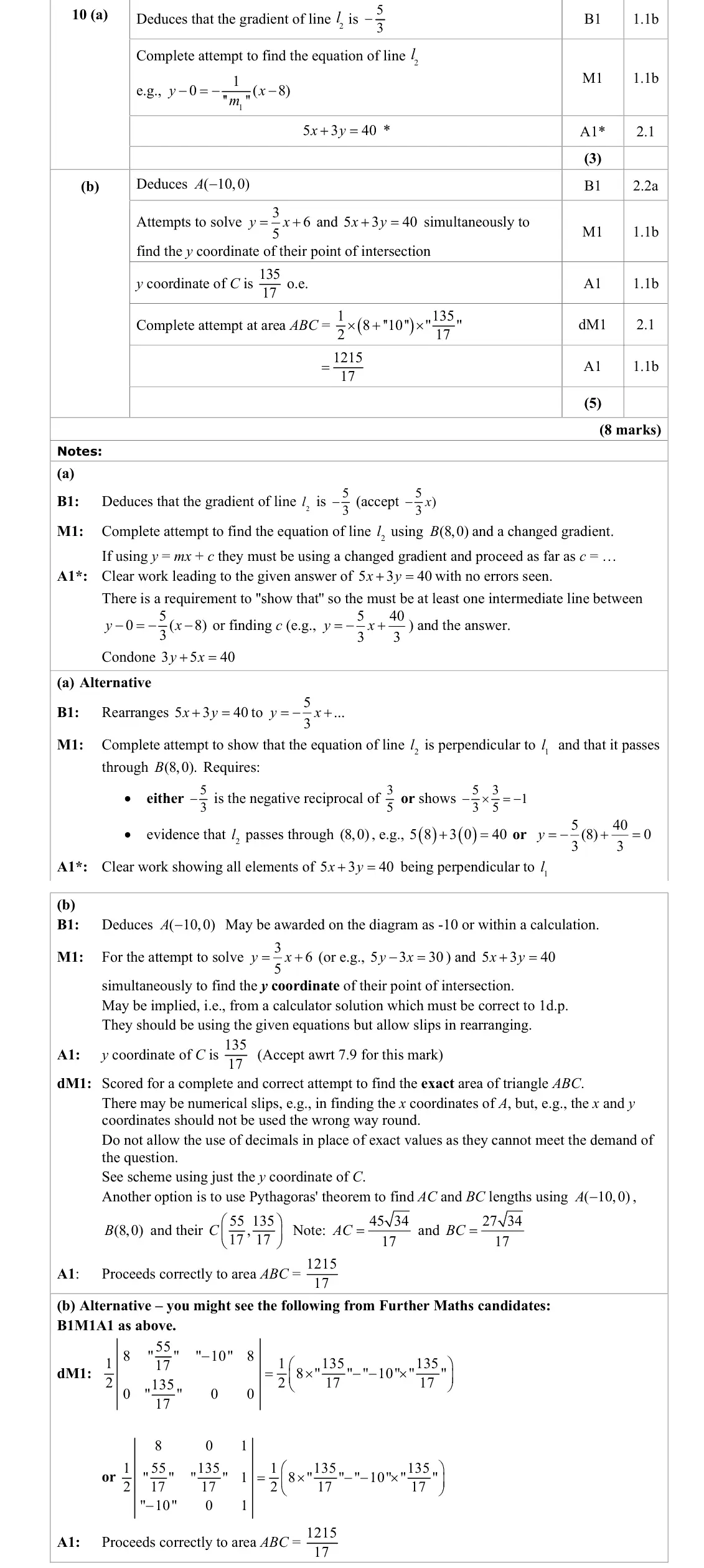
This question on straight-line coordinate geometry was well attempted by the vast majority of candidates and there was a good proportion of candidates scoring full marks. Part (b) was also very well attempted, with the vast majority of candidates obtaining the correct coordinates for A and C. However, many failed to recognise that the base of the triangle was 18 and the height was simply the y coordinate of C and instead focused on the fact that AC and BC were perpendicular and used Pythagoras to find the lengths of AC and BC. Sometimes they lost the accuracy with this rather laborious method by using decimal answers, although some very accurate candidates were able to proceed using this method to the exact answer. Quite often candidates only obtained the x coordinate of C and were thus unable to proceed further. Very few attempts were seen that used discriminant approaches to find the required area.
Common mistakes
A(−10, 0) from y = 0 on l1
solve simultaneously for C, y = 135/17
area = ½ × base 18 × height 135/17 = 1215/17
using Pythagoras for AC and BC is laborious and decimals lose accuracy
exact fraction required
June 2023 · Paper 1 · Q10(b)6 marks
Mark scheme (whole question; this part is marked with the orange bar)
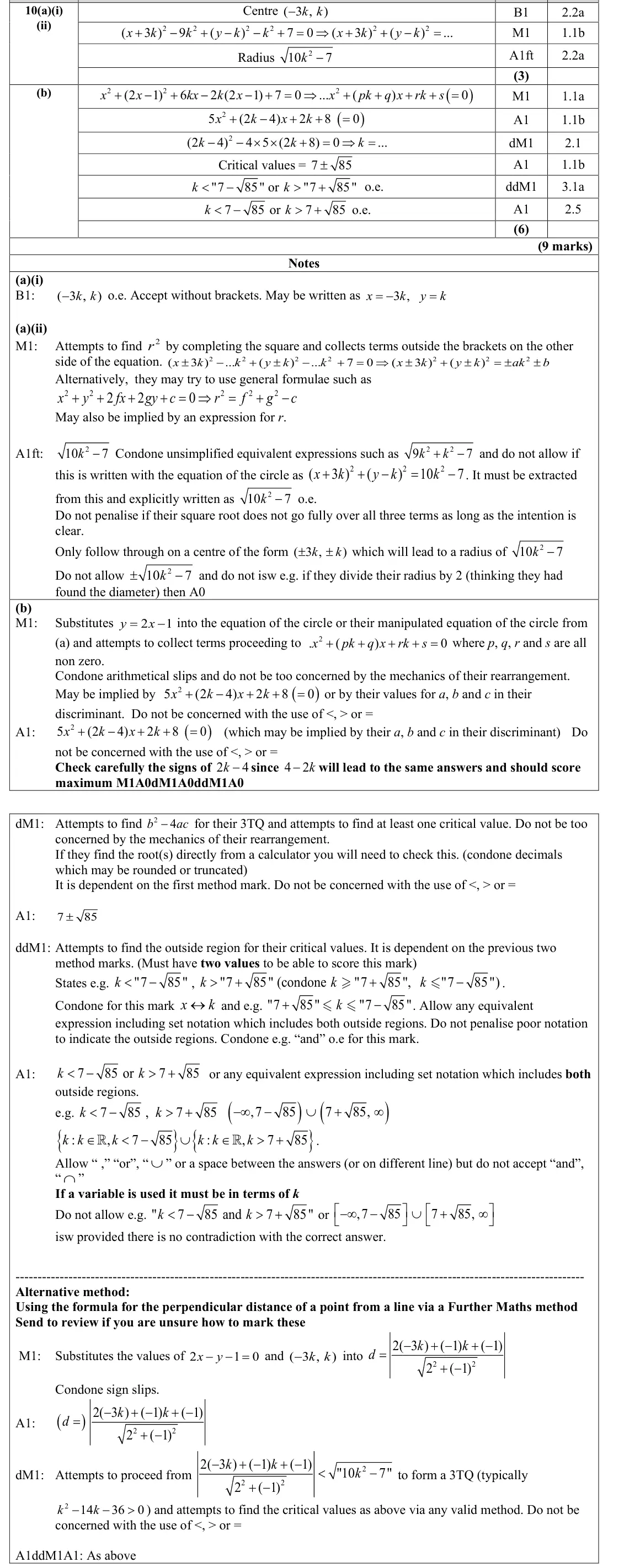
Examiner's comment
Candidates were typically able to make good progress in part (a) with the method of completing the square being familiar to many when dealing with the equation of the circle. Part (b) was focused on using the discriminant and solving a quadratic inequality, however, the manipulation proved to be a lot for some, resulting in a wide range of marks. Again, the access was good on this question such that candidates who could not do part (a) were not restricted from attempting part (b), although those with errors from part (a) often found that this caused issues in part (b) and resulted in losing many of the marks. In part (b), whilst a number of candidates had little idea how to proceed, the vast majority did realise what was required and attempted to produce an equation in x by substitution. Many lost their way in the algebraic complexity, or did not know what to do with the equation (sometimes trying to solve it to find a value for k). A significant number of candidates did produce a three-term quadratic for x, with coefficients in terms of k. Centres should note that the scheme required the quadratic in x to be of the form specified, and that it be set out in a way which identified the coefficients (possibly implied by later use in the discriminant). So, for example, “ (2 4) k - x” was required rather than “ 2 4 kx x - ” as this provided evidence of recognising that the coefficients were the key to solving this problem. Quite a few candidates had a constant term which was not of the required form which meant that no marks could be scored. In general candidates who found critical values for their discriminant by solving 2 4 0 b ac - = were more successful than those who expressed it as an inequality. Often the inequality was simply carried forward to a statement about k; those who identified the two critical values by solving an equation perhaps thought more carefully about where the region was. The “need” to write a single inequality was seemingly pressing for many, so 7 85 7 85 k + - was seen. A few candidates did not use exact values of k and lost the final accuracy mark. Some candidates used 'and' with their two regions, however, most recognised that this needed to be 'or', either stating this explicitly or just using a comma between their two answers. A number of capable candidates brought some interesting approaches to bear on the problem, adopting a variety of techniques from Further Maths specifications.
Common mistakes
substitute y = 2x − 1 into the circle
b² − 4ac > 0
critical values 7 ± √85
outside region with "or" or ∪, not "and"
June 2023 · AS Paper 1 · Q166 marks
Mark scheme (whole question; this part is marked with the orange bar)
Examiner's comment
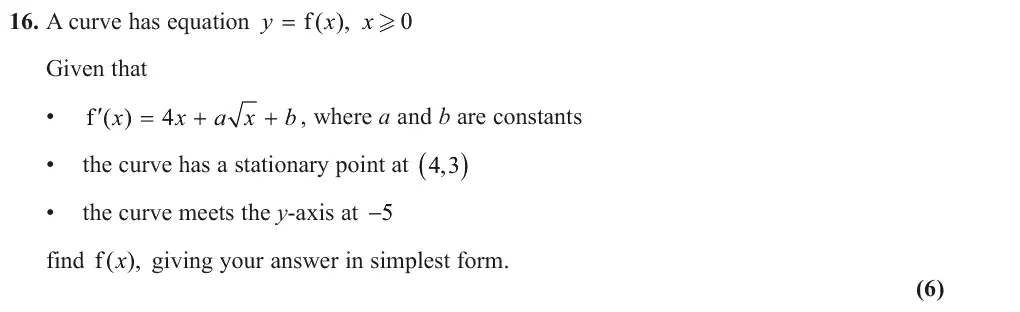
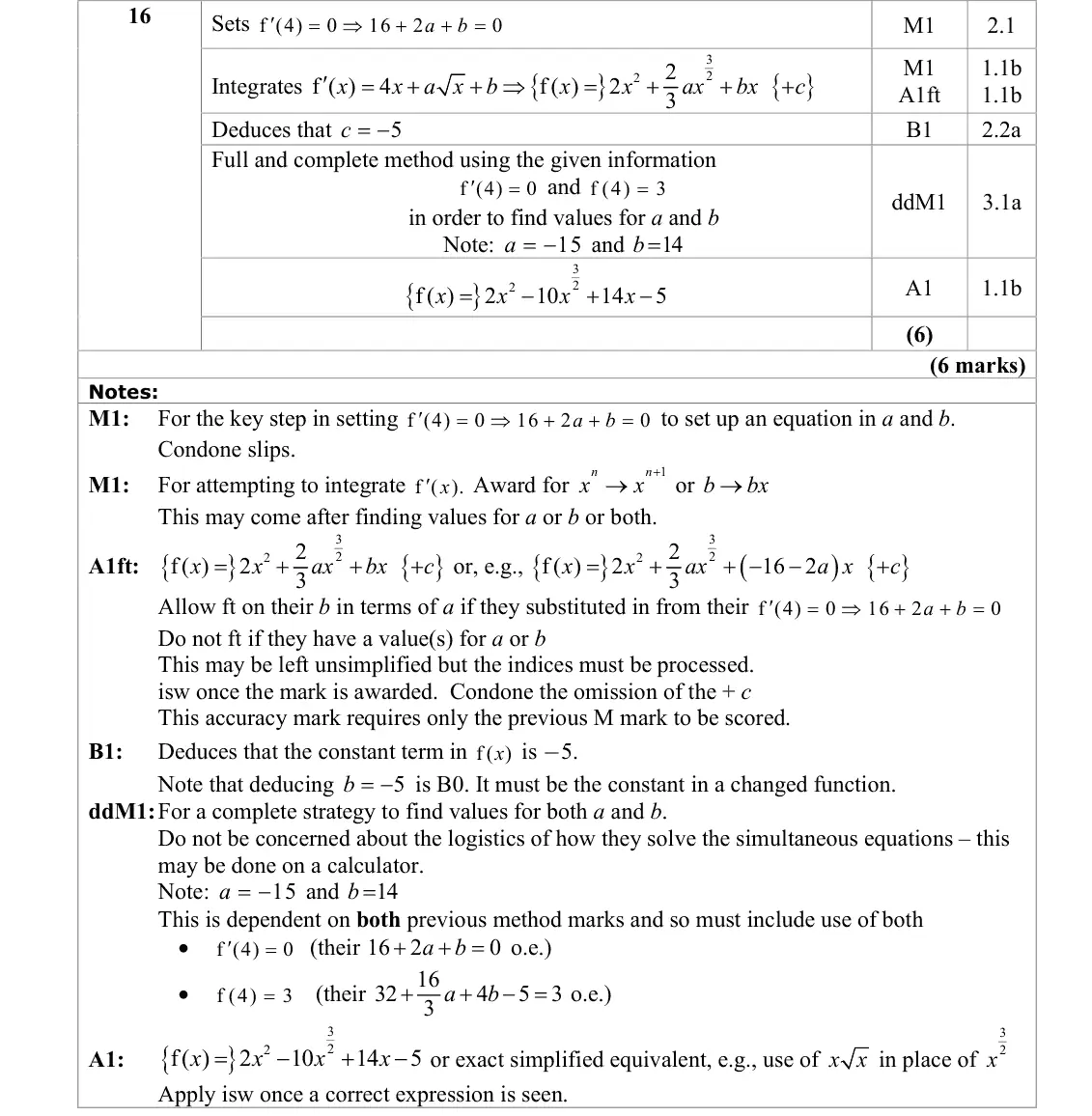
Generally, the candidates that made a full attempt at this question did very well by achieving full marks or at least 4 out of 6. However, many failed to use the information in the second bullet point fully (that the curve has a stationary point at ( ) 4,3 ). The majority of the candidates achieved the first mark by understanding that the stationary point at ( ) 4,3 meant that the first derivative must be equal to zero at 4 x = , arriving at 16 2 0 a b + + = . Again, the majority went on to perform the integration of the gradient function ( ) 4 d x a x b x + + to achieve ( ) 3 2 2 2 f 2 3 x x ax bx c = + + + with the majority able to determine that 5 c = -. A common error was to achieve 3 2 3 2 ax following integration, although those who had written the unsimplified 3 2 3 2 ax were still able to access the intermediate accuracy mark. Common problems were for candidates to misinterpret the information about the stationary point, either using ( ) f 4 3 = or ( ) f 4 0 = , or to miss out a constant of integration, which often resulted in concluding that b was 5 -. It was fairly common to see candidates substitute a rearranged 16 2 0 a b + + = into their integrated expression (usually for b) and this typically did not hinder further progress, although it did result in some sign errors that meant their final expression ( ) f x was incorrect.
Common mistakes
stationary at (4, 3) means f′(4) = 0 (16 + 2a + b = 0) and f(4) = 3, not f′(4) = 3
integrate a√x to (2/3)ax^(3/2)
+ c with c = −5 (b = −5 is wrong)
a = −15, b = 14
f(x) = 2x² − 10x^(3/2) + 14x − 5
June 2022 · Paper 1 · Q5(a)4 marksEasy
Mark scheme (whole question; this part is marked with the orange bar)
Examiner's comment
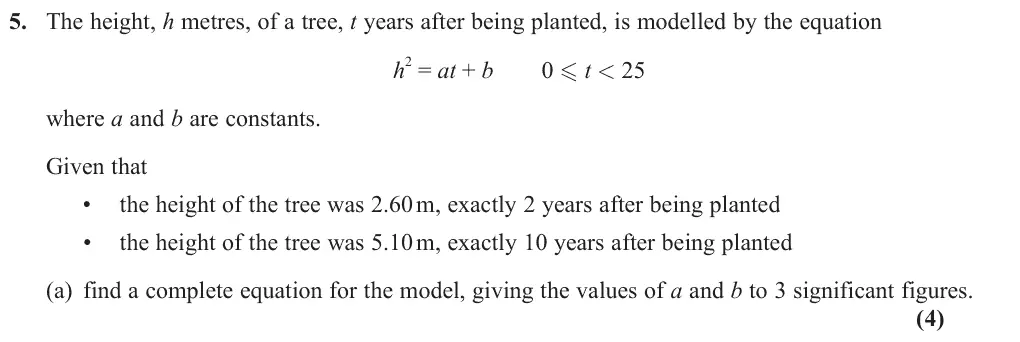
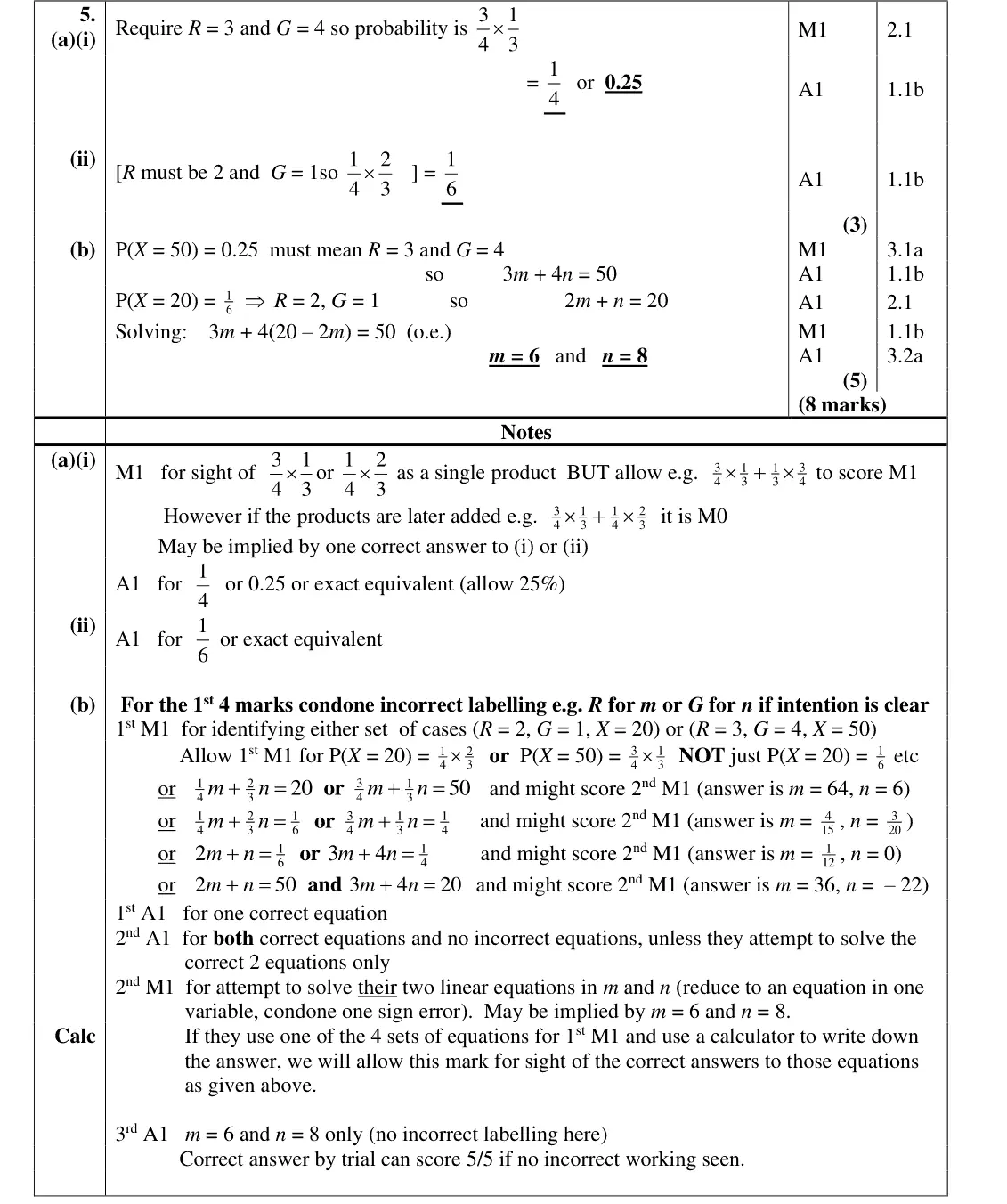
This question involved solving simultaneous equations set within the context of the height of a tree modelled over a number of years. The question was very accessible for many candidates. In part (a) the majority of candidates gained the first three marks for forming and solving two correct simultaneous equations. Many went to a great deal of effort to solve the simultaneous equations using algebraic methods, whereas some just put the equations into a calculator and wrote down the values of the constants a and b. Some candidates used the 3 significant figure value of a to subsequently find the value of b, resulting in finding b as 1.94 rather than 1.95 and thus losing the final A mark. A significant number of candidates correctly found the values of the constants a and b, but then failed to state the equation of the model explicitly anywhere in their answer, losing the final A mark.
Common mistakes
square the heights: 2a + b = 6.76, 10a + b = 26.01
h² = 2.41t + 1.95 must be stated as a complete equation
using rounded a gives b = 1.94
using h = at + b is a special case
June 2022 · AS Paper 1 · Q11(b)5 marks
Mark scheme (whole question; this part is marked with the orange bar)
Examiner's comment
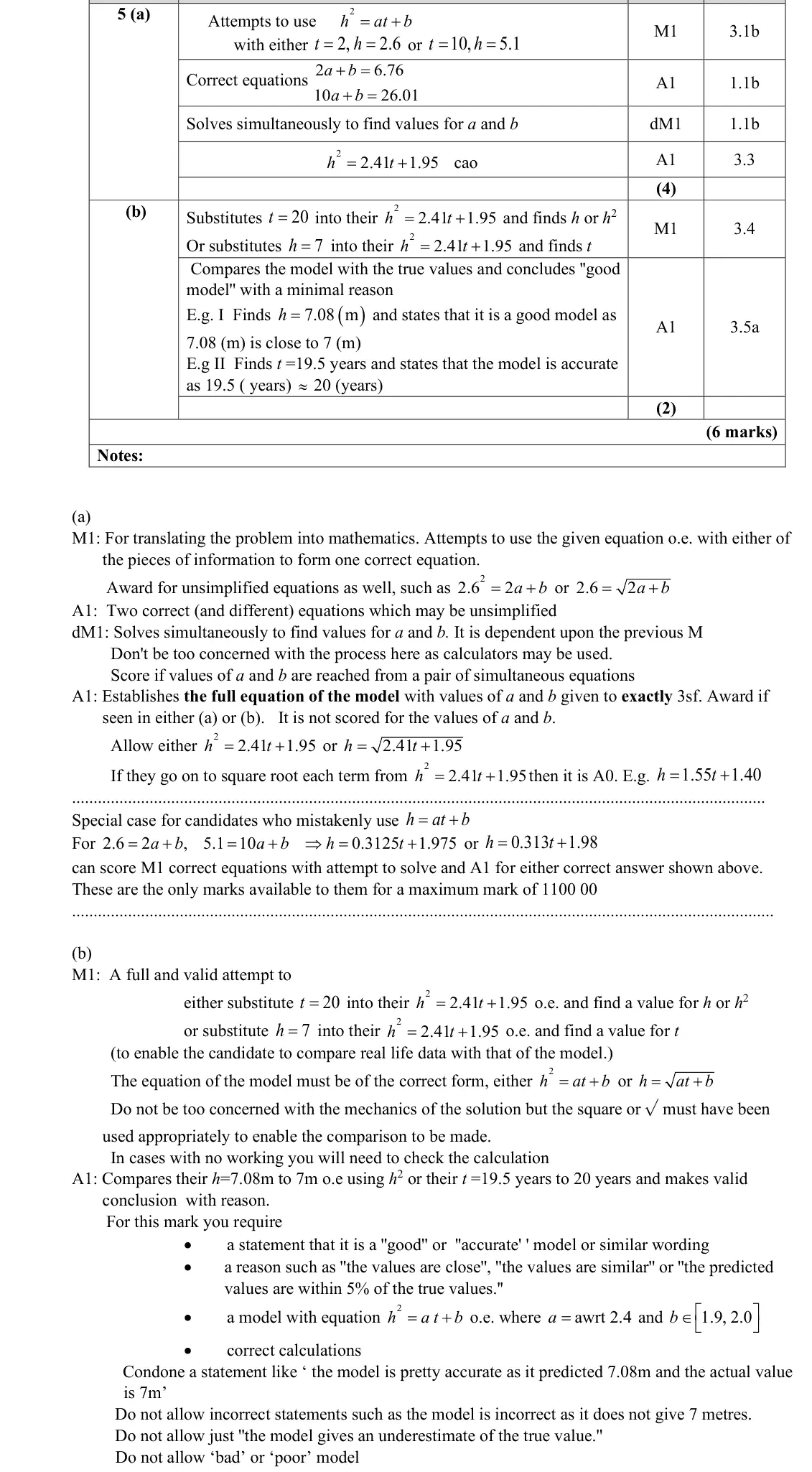
This question often enabled candidates to score marks in the first part, however, part (b) proved to be very good at discriminating between the most able candidates. Part (b) was challenging for many; non attempts or attempts which achieved no marks were common. Quite a few candidates scored the B mark for the gradient of the perpendicular and some went on to find the equation of the normal, but they did not find the point of intersection of the straight lines and so could not progress to the remaining marks. It was common to see one of the straight-line equations substituted into the equation of the circle. Those who substituted the normal equation and had also found the point of intersection of the straight lines, often correctly found the distance between the points correctly and gained full marks. Those who found the distance between the centre and the point of intersection of the straight lines, often forgot to subtract 3 for the radius, thus losing the last two marks. A large number of candidates found the y intercept of the line l, and then the distance between (0,3) and the centre. A very small number of candidates used a vector method.
Common mistakes
the normal to l through the centre has gradient 2
intersect with l at (6/5, −18/5)
distance from the centre minus the radius 3 (often forgotten)
using the y-intercept (0, −3) is wrong
(19√5 − 15)/5 ≈ 5.50
June 2022 · AS Paper 2 (Statistics) · Q5(b)5 marksMedium
Mark scheme (whole question; this part is marked with the orange bar)
Examiner's comment
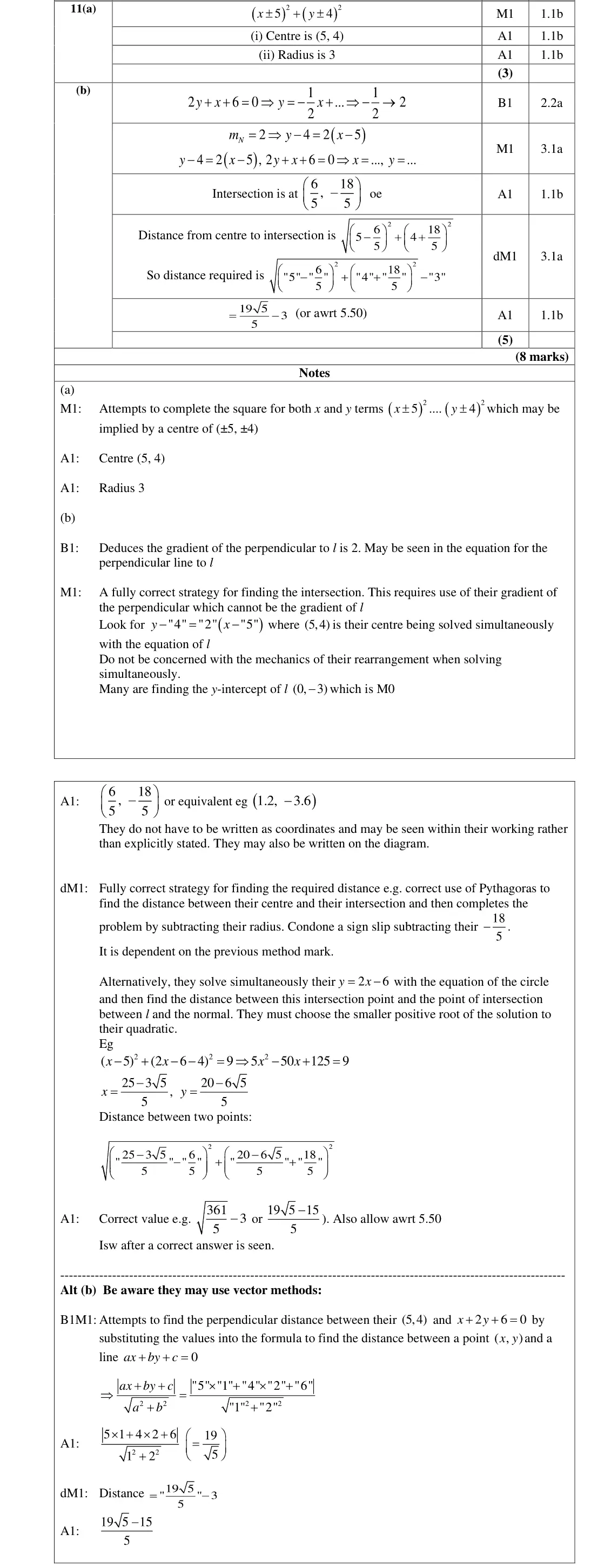
first mark. Part (b) was designed as a problem solving question and it was good to see a number of students trying it though understandable that many felt there were easier pickings available in paper 22 and moved onto that. Most attempts involved setting up two linear equations and solving them but there was some confusion over values of the random variables and probabilities associated with these values. However over 10% of candidates scored full marks on this question and shoed a good understanding of this topic.
Common mistakes
P(X = 50) = ¼ means R = 3, G = 4 so 3m + 4n = 50
P(X = 20) = 1/6 means R = 2, G = 1 so 2m + n = 20
m = 6, n = 8
confusion between values of X and probabilities (e.g. ¼m + ⅔n = 20)
Oct 2021 · Paper 1 · Q7(b)5 marks
Mark scheme (whole question; this part is marked with the orange bar)
Examiner's comment
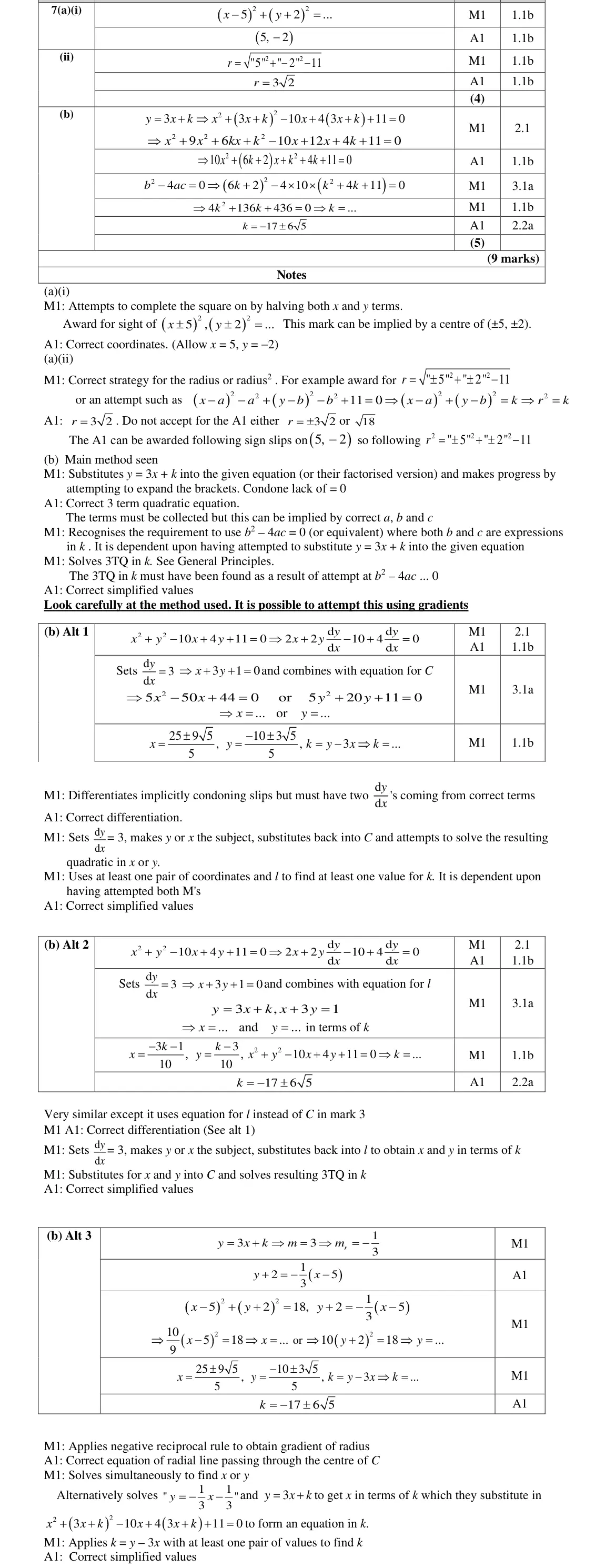
The first few marks in this question were very accessible but the final part of the question proved to be a useful discriminator especially around grade C and below. Part (b) This part was found to be discriminating with complete solutions seen from only the most competent of candidates. The most common approach was to substitute y = 3x + k into the circle equation to find a quadratic in x (with coefficients in terms of k) for the points of intersection. Errors mostly arose when (3x + k +2)2 was expanded incorrectly or the 2x + 6kx terms not being gathered together. Many solutions then stopped after the substitution and expansion step, as candidates did not seem to appreciate what to do with an equation of this complexity in two variables. Application of b 2 = 4ac to find equal roots was used on many occasions but errors frequently occurred. Only a very few solutions involved attempts via b2 - 4ac > 0. It was not always obvious to see how a student had solved their quadratic (formula not quoted and values for a, b and c not seen) but a limited number of correct solutions were seen. Using a calculator quadratic solver was frequent and acceptable. Several attempts started by using implicit differentiation on the circle equation. Although this is a possible method, it did not often go beyond using dy/dx = 3 to get x+3y+1= 0. Another method seen several times was to find the equation of the normal ( i.e. the radius ) to try to make progress towards finding values of k, but this method also seldom went further than the equation of the line.
Common mistakes
substitute y = 3x + k into the circle to get 10x² + (6k + 2)x + k² + 4k + 11 = 0
tangent means b² − 4ac = 0
k = −17 ± 6√5
alternatives via the radius gradient −1/3 or implicit differentiation rarely completed
Oct 2021 · Paper 1 · Q12(a)5 marks
Mark scheme (whole question; this part is marked with the orange bar)
Examiner's comment
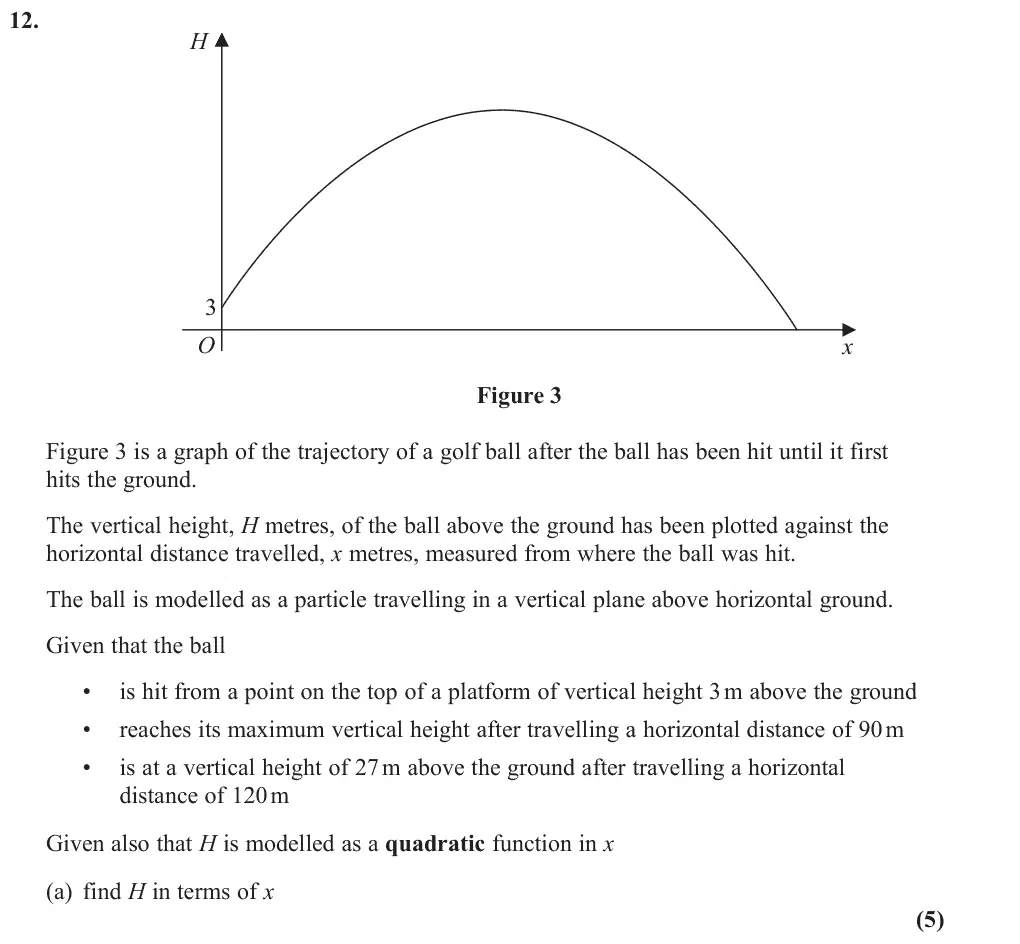
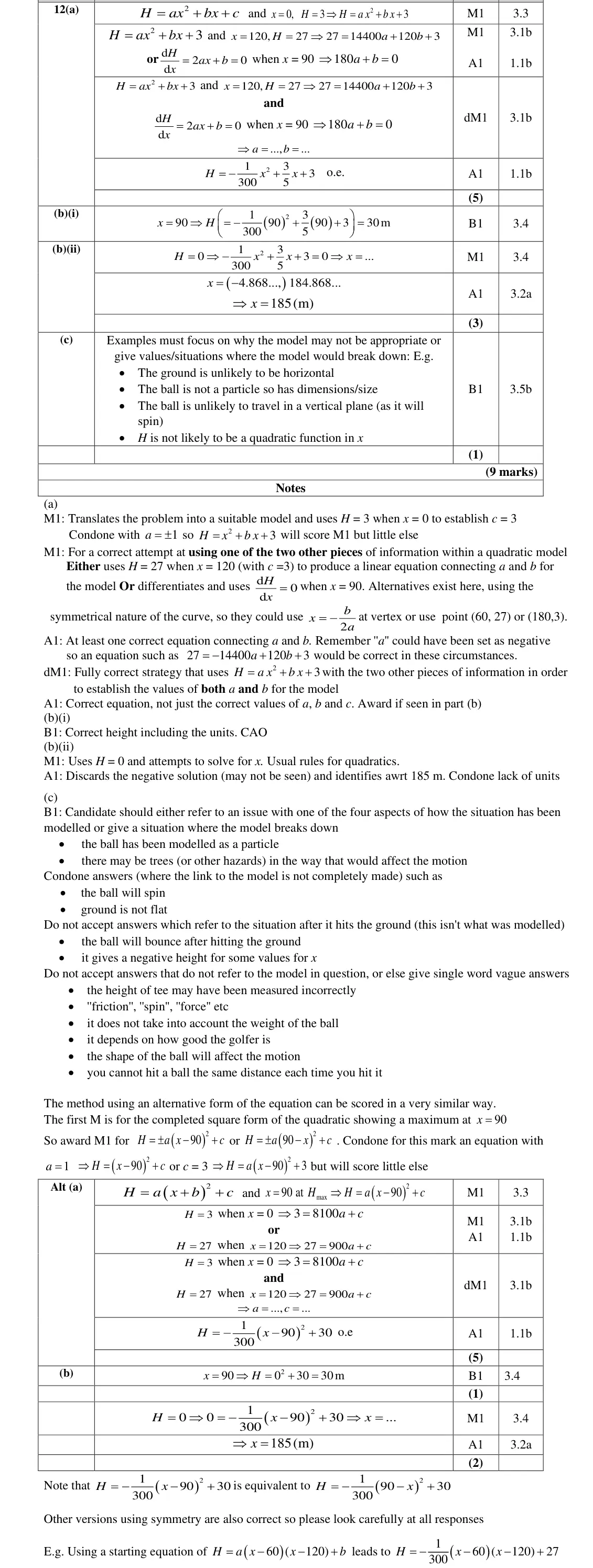
This was the second modelling question on this paper. It proved to be a significant discriminator between candidates, with a significant minority making little or no progress. It certainly seems to be a topic that students find hard to access. Part (a) The most common approach which led to either partial or complete success was to start with H=ax2+bx+c and use (0,3) to find that c =3. Many candidates then used (120,27) to find an equation connecting a and b, but sometimes no more progress was made. Of those who did make further progress, the most common approach was to use differentiation and the knowledge that the gradient was zero when x=90 to get a second equation in a and b. Candidates using this approach often went on to get (a) fully correct and then also to gain most if not all of the marks in (b) as well. It was only rarely that there was a misunderstanding about H=0 rather than H=3 when x=0. There were other methods used in (a) and any of these could have led to success if applied correctly. For example, using the fact that the quadratic has a turning point when x =90 and so H = a(x-90)2+c was used correctly by some candidates. Alternatively, using additional implied points such as (60,27) or (180,3) due to the symmetry of quadratic curves, was used appropriately by candidates.
Common mistakes
H = ax² + bx + 3 (H = 3 when x = 0, not 0)
use H = 27 at x = 120 and dH/dx = 0 at x = 90 (or vertex form a(x − 90)² + c, or symmetry points (60, 27), (180, 3))
H = −x²/300 + 3x/5 + 3
Oct 2021 · AS Paper 1 · Q15(b)4 marks
Mark scheme (whole question; this part is marked with the orange bar)
Examiner's comment
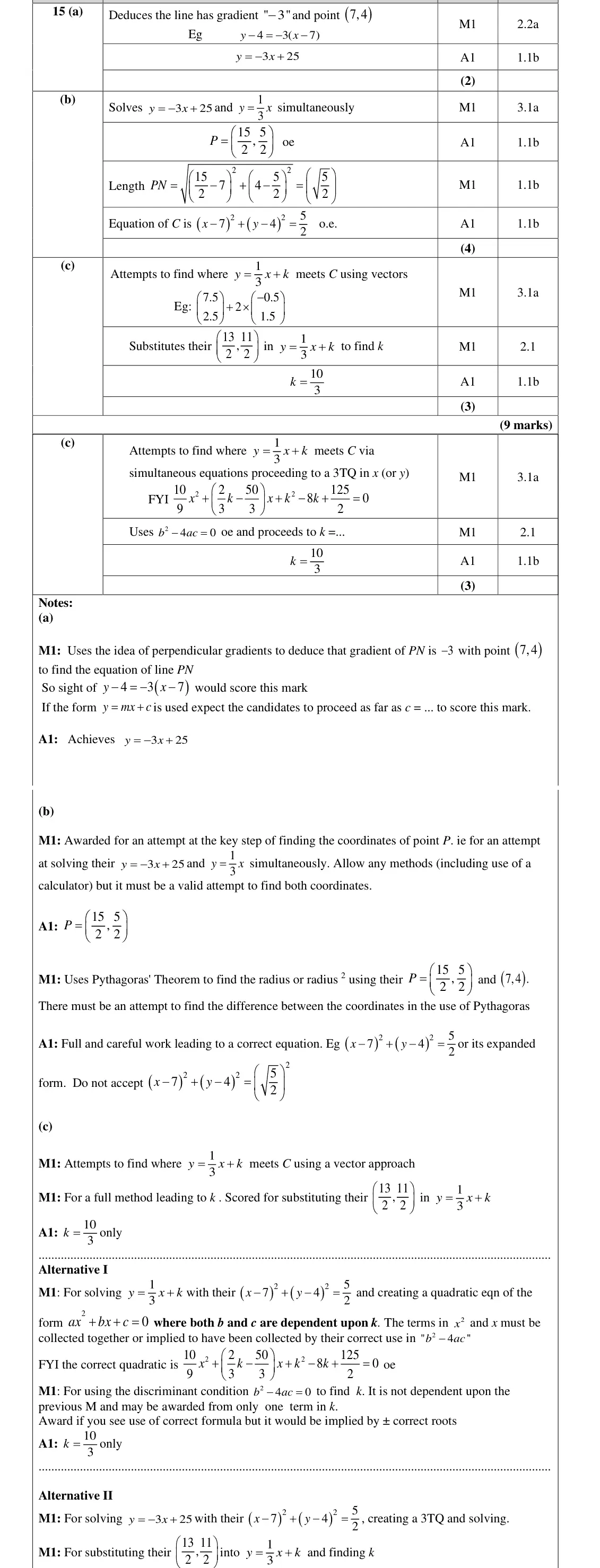
9 This question provided a good range of marks between the candidates, although nearly all candidates struggled to proceed to the final answer in part (c). There were also several blank responses on this question which may have been down to candidates either running out of time or just getting overwhelmed towards the end of a paper. Part (b) was generally attempted well. Most knew and attempted to find the point where the two lines intersected each other and found the point P correctly. They were then able to find the radius and usually proceeded to find the equation of the circle. Sometimes the equation of the circle had the squared missing from the brackets or it was equated to the radius rather than 2r .
Mark scheme (whole question; this part is marked with the orange bar)
Examiner's comment
9 This question provided a good range of marks between the candidates, although nearly all candidates struggled to proceed to the final answer in part (c). There were also several blank responses on this question which may have been down to candidates either running out of time or just getting overwhelmed towards the end of a paper. Part (c) was either not attempted at all or candidates made an attempted but abandoned due to the expressions formed appearing so complicated that it seemed as though they were convinced they had gone wrong. Usually, candidates opted to substitute their part (a) answer into their part (b) equation of the circle. To score the first mark candidates had to multiply out the brackets and collect terms together to form a 3TQ where k was in both the b and c coefficients of the quadratic. Some candidates stopped before getting this far, although it was pleasing that some continued to persevere and pick up the first mark. Those who continued, realised the discriminant needed to be used, but disappointingly once they had their expression also decided to stop even if they had a quadratic in k which they could solve. Therefore only 1 or no marks was scored in nearly all responses. The easiest way was the vector approach, which was seen, but far too frequently, and even then, it was only a few candidates who were able to score full marks on this question.
Common mistakes
the other tangent touches at the opposite end of the diameter through P: (13/2, 11/2), then k = 10/3
via simultaneous equations the quadratic in x has b and c depending on k and b² − 4ac = 0 (k = 0 is rejected)
candidates often abandoned the messy algebra
Oct 2021 · AS Paper 1 · Q16(a)4 marks
Mark scheme (whole question; this part is marked with the orange bar)
Examiner's comment
The last question on the paper was attempted by most candidates, although there were a significant number of blank responses. Again, this was possibly either due to time, or more likely due to candidates just feeling overwhelmed as the question was the longest on the paper. In part (a) candidates struggled with the information being presented in reverse order. As a result, candidates typically formed the equation in a and b but then got stuck as they could not see how they would find a. It was those who differentiated and equated to 3 - who were able to fully complete part (a) correctly. It was noted that a large number did not seem to be that confident with turning points and derivatives and it may have been that this had not been covered which prevented candidates from doing this question particularly well.
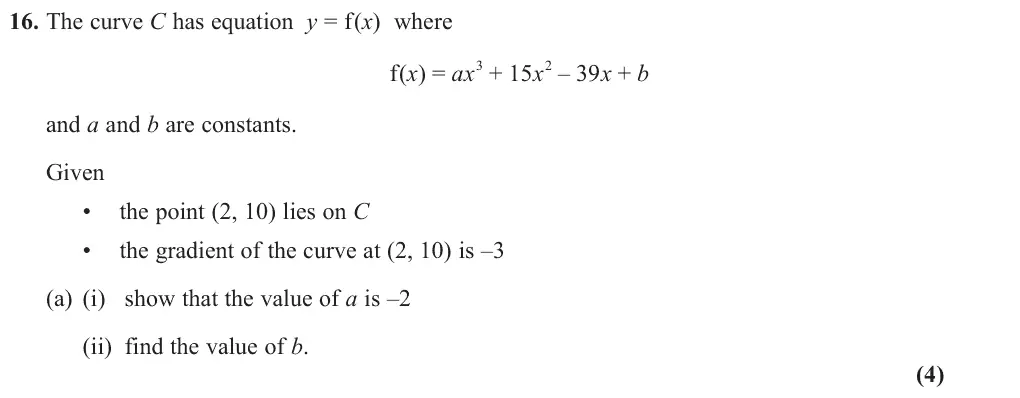
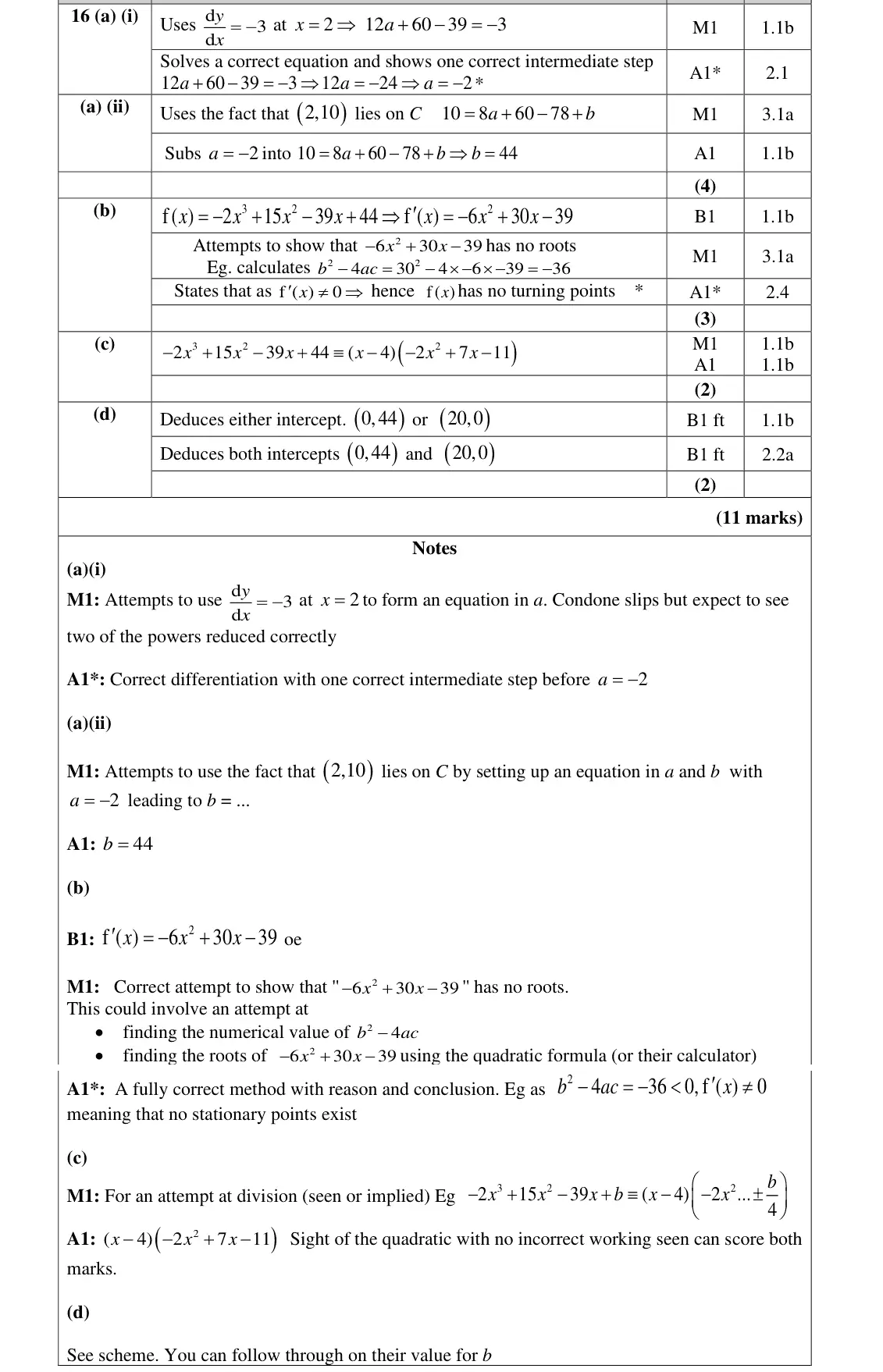
Common mistakes
use the gradient first: f′(2) = 12a + 60 − 39 = −3 gives a = −2 with an intermediate step
then (2, 10) on C gives b = 44
candidates who started with the point were stuck with two unknowns
Oct 2021 · Paper 2 · Q8(b)5 marks
Mark scheme (whole question; this part is marked with the orange bar)
Examiner's comment
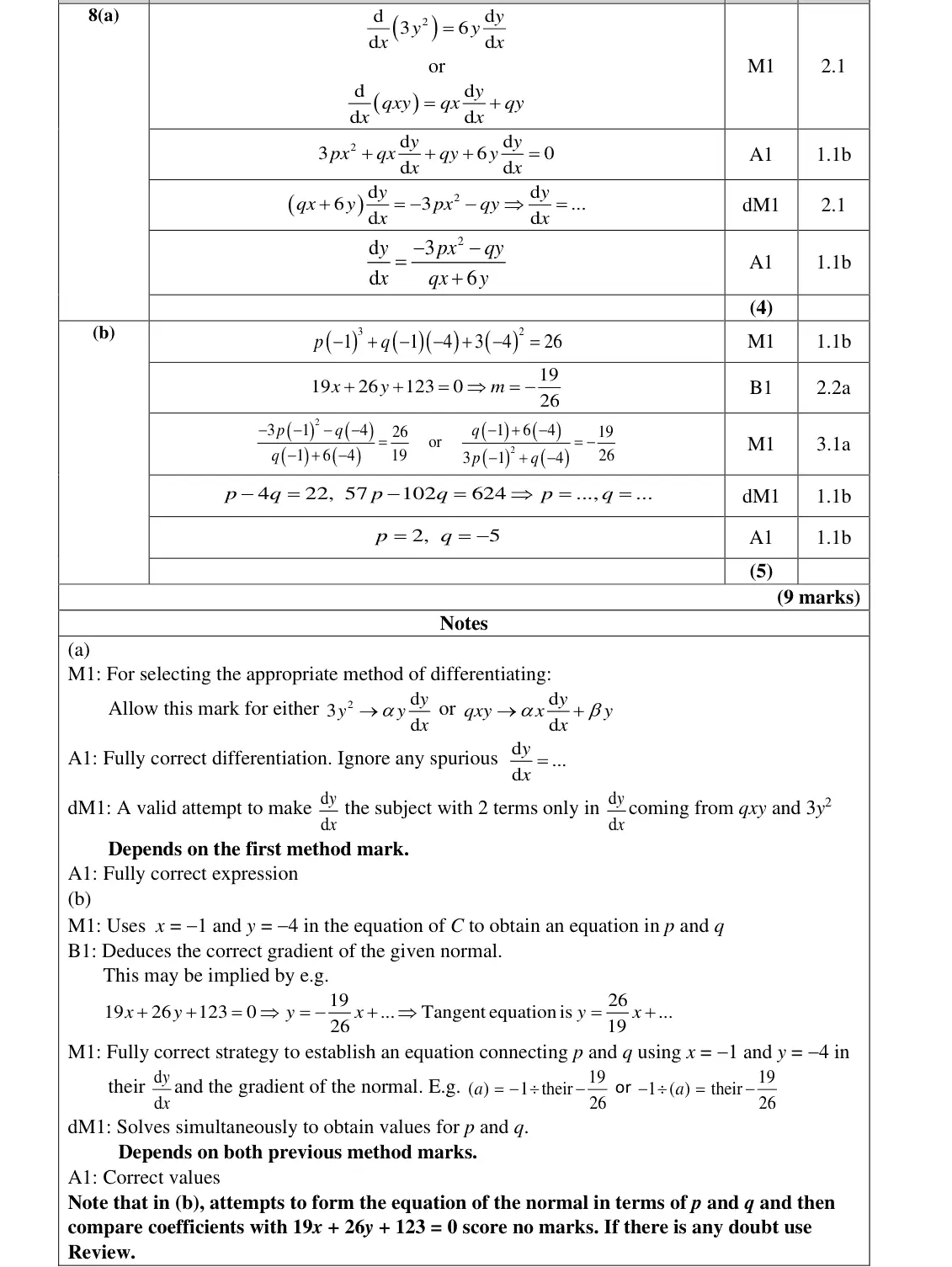
Many candidates gained some credit in this question but few gained full marks. In (b) most candidates gained some marks but few used a fully correct method to achieve the correct answer of and . Most were able to rearrange the equation of the normal, and identified that its gradient was . They then identified the gradient of the tangent as and used their result from (a) at and to attempt to form a correct equation in and such as . A number of candidates incorrectly equated the numerators and denominators to form the equations and and solved these to fortuitously arrive at the correct solution, losing most marks in (b). Another incorrect approach was to form the equation of the normal of the form and to rearrange to the form followed by 'comparing coefficients' with (an incorrect method). Many candidates successfully substituted and into the equation of C to get . This step was missed, however, by quite a few candidates, who could not then gain full marks for the question.
Common mistakes
substitute P into C for p − 4q = 22
normal gradient −19/26 so tangent gradient 26/19
equating numerators and denominators separately or comparing coefficients with the normal scores nothing
p = 2, q = −5
Oct 2021 · AS Paper 2 (Mechanics) · Q3(b)7 marks
Mark scheme (whole question; this part is marked with the orange bar)
Examiner's comment
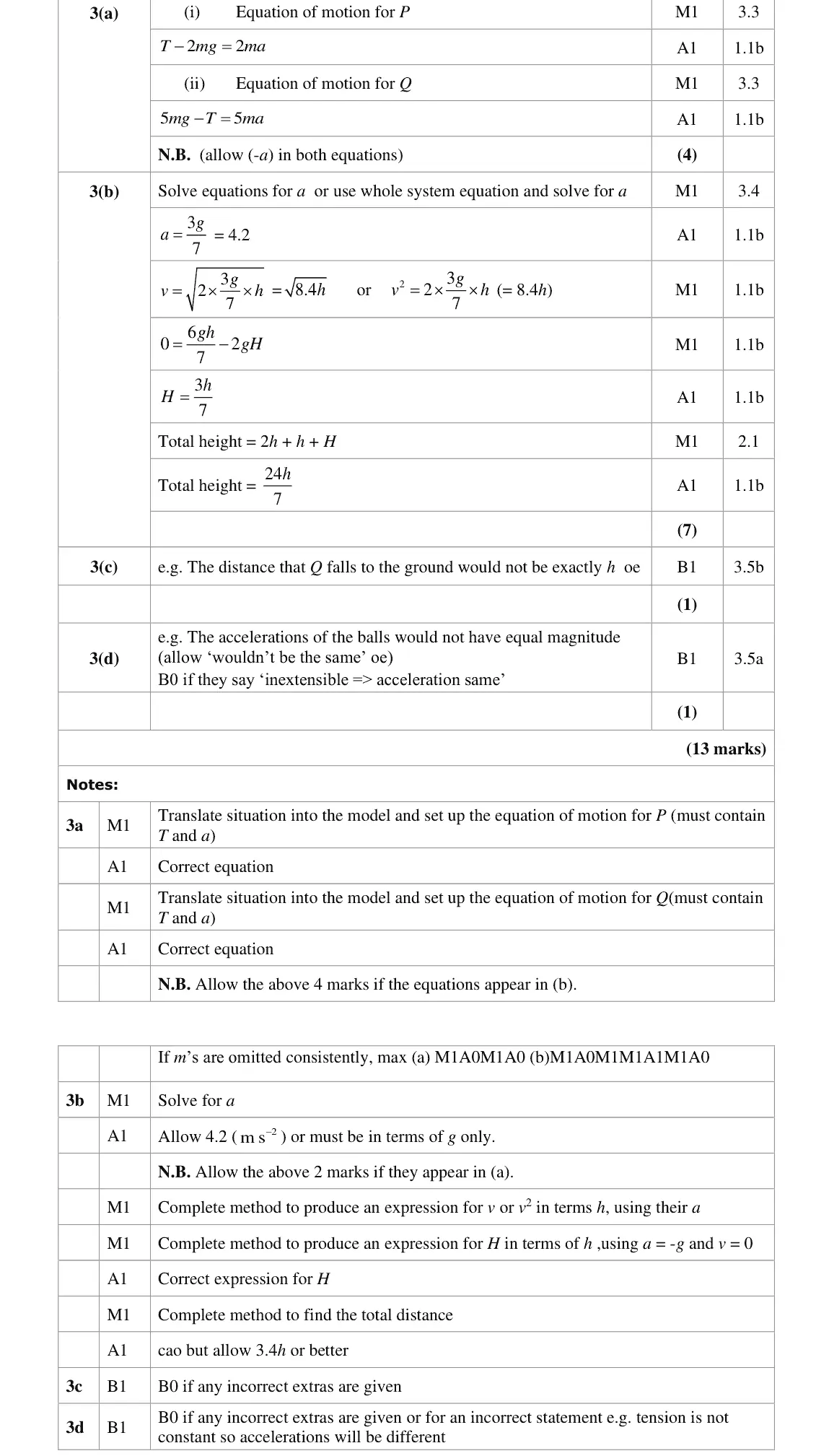
motion for P and Q but if they went on to use correct equations of motion in part (b) they scored the marks for part (a). Some had no idea at all and T never appeared. (b)Those who had correct equations of motion generally went on to find the acceleration but some missed g in their answer. Not many progressed successfully after this - some found T because that is what is usually required but in this question, it was not necessary. Some calculated the time taken for Q to reach the ground and used it in an equation for P, not realising that they had to find the velocity that P had acquired. Of those who did make progress, some missed the h in their answer for v, and others only added 2h instead of 3h in the final step.
Common mistakes
a = 3g/7
P's speed when Q lands from v² = 2ah (P has risen h)
then P moves freely under gravity: H = 3h/7
total height 2h + h + H = 24h/7
T is not needed
adding only 2h, or using the time Q takes to fall, are common errors
Oct 2020 · AS Paper 1 · Q8(d)4 marks
Mark scheme (whole question; this part is marked with the orange bar)
Examiner's comment
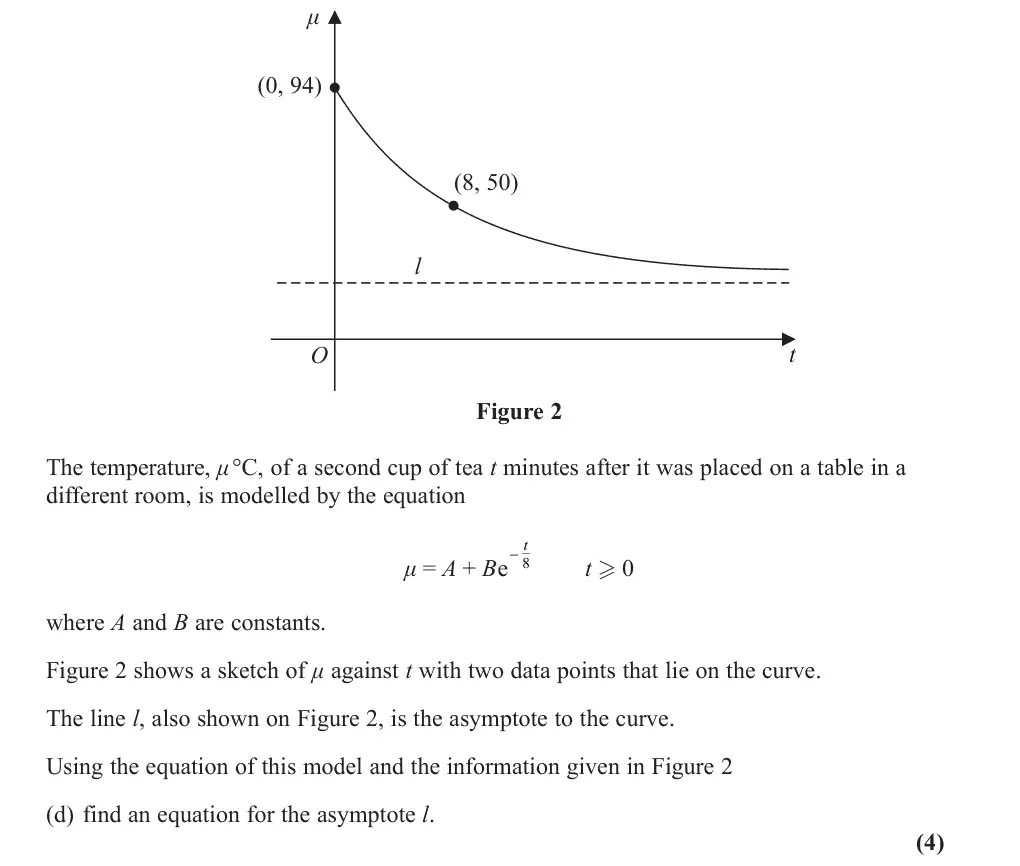
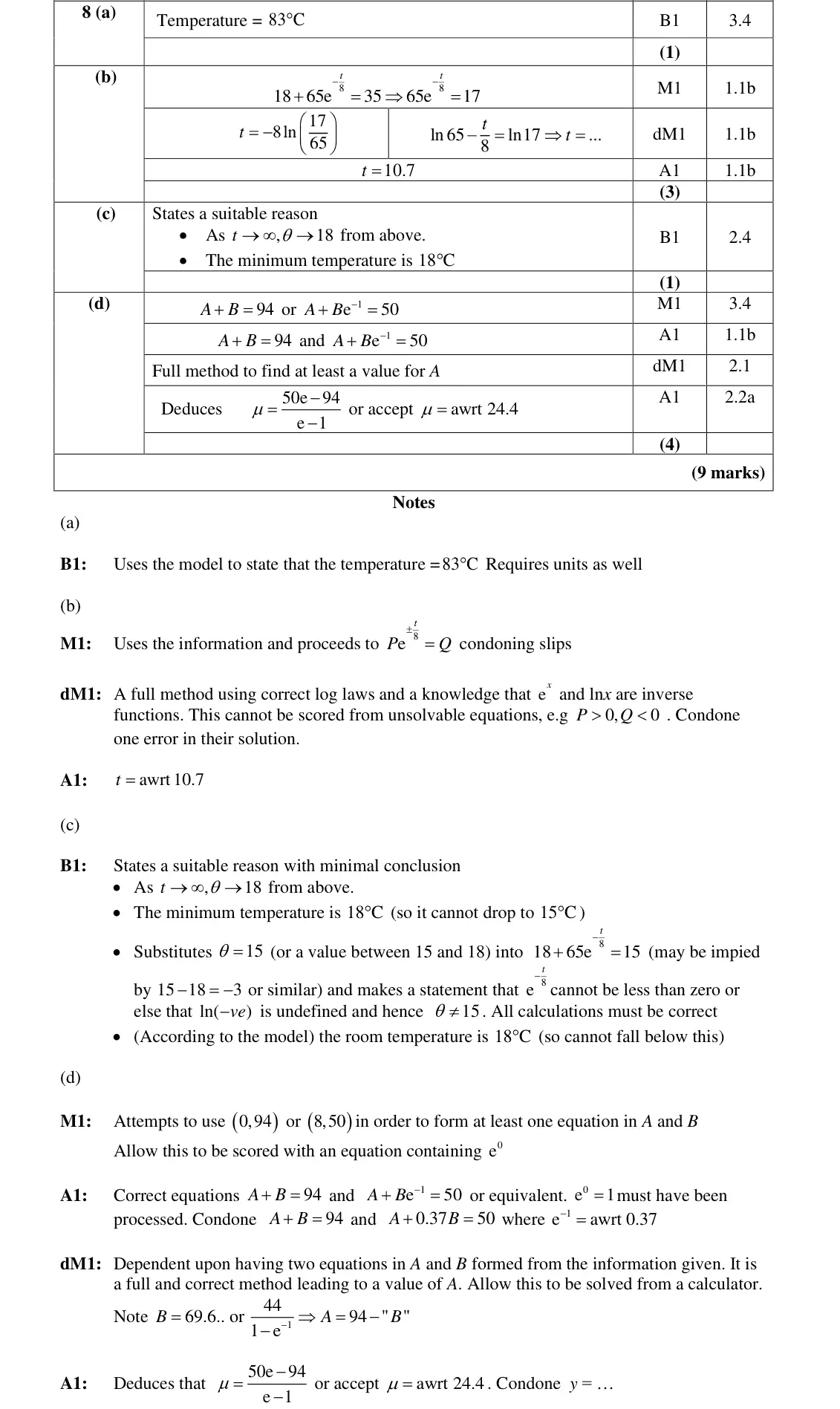
This question was another which focussed on problem solving, with the majority of candidates only able to score around half of the marks available. Part (d), in particular proved to be too difficult for most candidates so it was rare to see full marks. Part (d) caused more issues than the rest of the question for candidates. Several of them assumed A was equal to 94 and therefore did not score highly in this part. Some candidates attempted to find the gradient between the given coordinates and therefore did not score any marks. However, once candidates formed the two simultaneous equations, they seemed to find it quite easy to use the elimination method to eliminate A, and then go on to correctly solve for A and B and therefore work out the equation of the asymptote.
Common mistakes
form A + B = 94 and A + Be^(−1) = 50 and solve
asymptote μ = A ≈ 24.4 (not A = 94)
gradient between the points is wrong
Oct 2020 · Paper 1 · Q11(a)4 marks
Mark scheme (whole question; this part is marked with the orange bar)
Examiner's comment
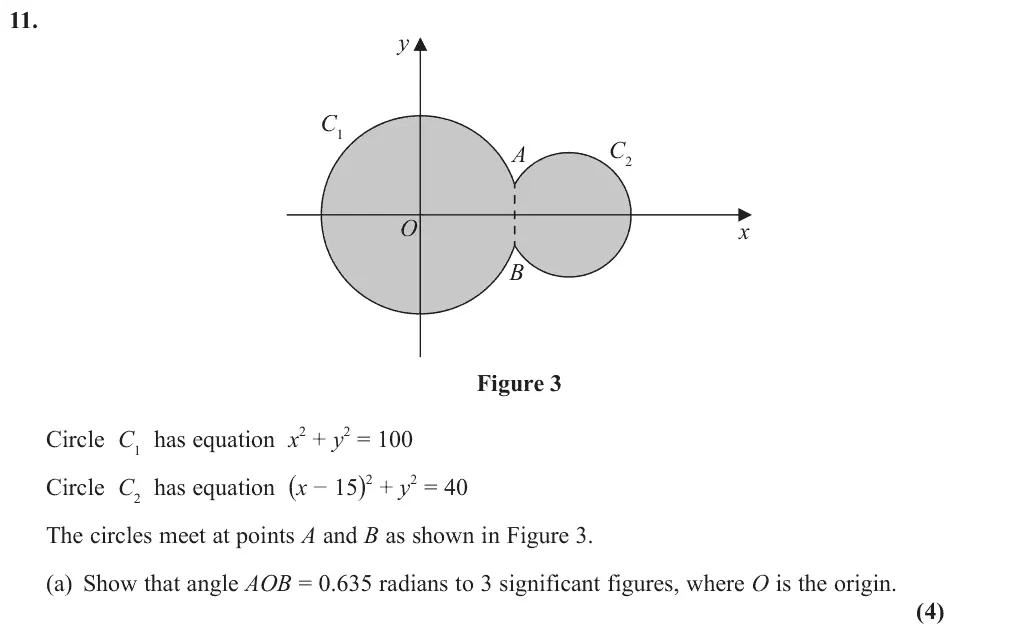
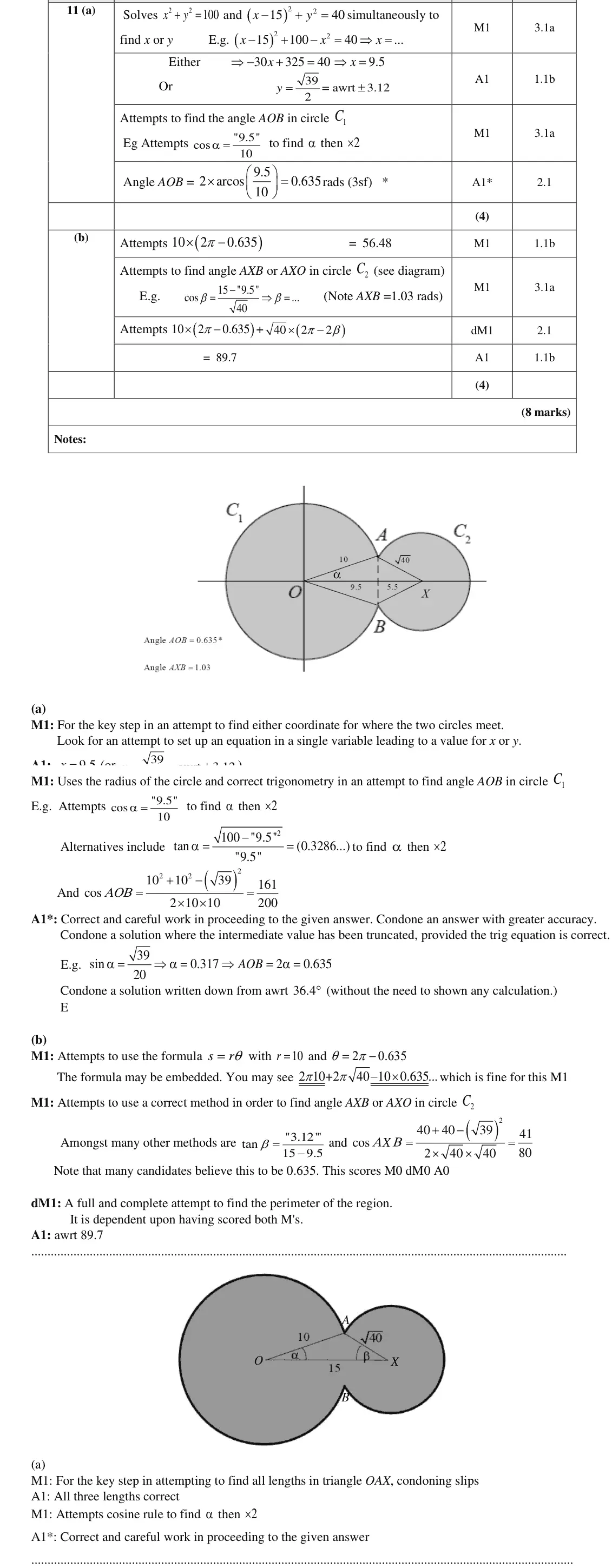
This proved to be a challenging question with very few candidates achieving full marks (a) Candidates used a variety of approaches. The most common started by using algebra to find the coordinates of the points where the circles meet. This was achieved correctly by a majority of those who did the question this way. Then the required angle was found either by trigonometry in a right angled triangle and doubling an angle, or by the cosine rule in triangle AOB. Errors in this approach included processing x2+y2=100 into x+y=10. Although a minority of candidates’ answers stopped after finding coordinates for A or B, there were a significant number who went on to score the remaining 2 marks. However, some did not seem to realise that length OA=10 as it is a radius of C1, and had to use the distance formula to find this length. Another approach that was seen, but not so frequently was to use knowledge of circle equations in finding the radii and centres, to establish the lengths of the sides of triangle OAX, with X being the centre of circle C2. Using the cosine rule then led to half of the required angle. When used, this method often gained all four marks. (See relevant diagram below)
Common mistakes
solve the circle equations simultaneously, x = 9.5 (x² + y² = 100 is not x + y = 10)
OA = 10 is the radius
cos α = 9.5/10, AOB = 2α = 0.635
Oct 2020 · AS Paper 1 · Q14(a)7 marks
Mark scheme (whole question; this part is marked with the orange bar)
Examiner's comment
The final question was not attempted in a significant number of cases. This may have been due to the demand of the question for the majority of candidates. Of those candidates who did attempt this question, it was rare for full marks to be achieved. In part (a), candidates struggled with getting started which then cost them dearly. They seemed to struggle with forming an equation without being given one, despite it being a cubic equation, which then meant they lacked the confidence to pursue any further. Common errors were not appreciating that there was no constant term which meant they produced simultaneous equations with too many unknowns. Others knew they needed to differentiate g(x) and sub in 2 x = but then they equated it to 9 and not 0. Clearly having lots of information provided at the same time and having to select which is appropriate for each stage of their working the majority of candidates found difficult. The lack of understanding 12 surrounding coefficients may have led to not being able to set up the cubic with the coefficients for 3x and x being the same. Some even assigned numerical values rather than unknowns. There were some candidates who were able to form two simultaneous equations, however, and most of these successfully found a and b. They were asked to find the function, so it was essential that they did state their answer at the end to score full marks in this part.
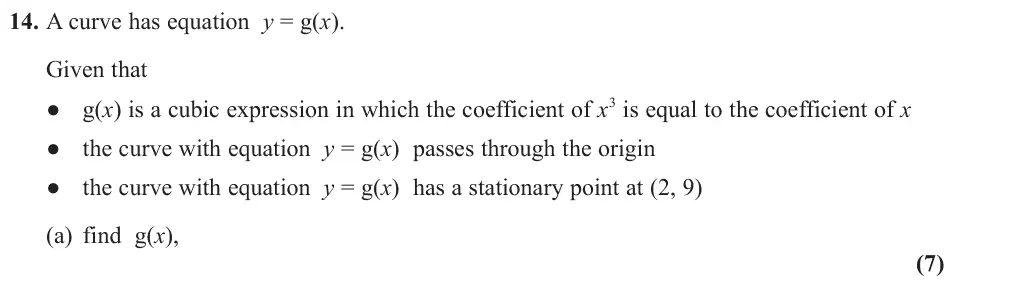
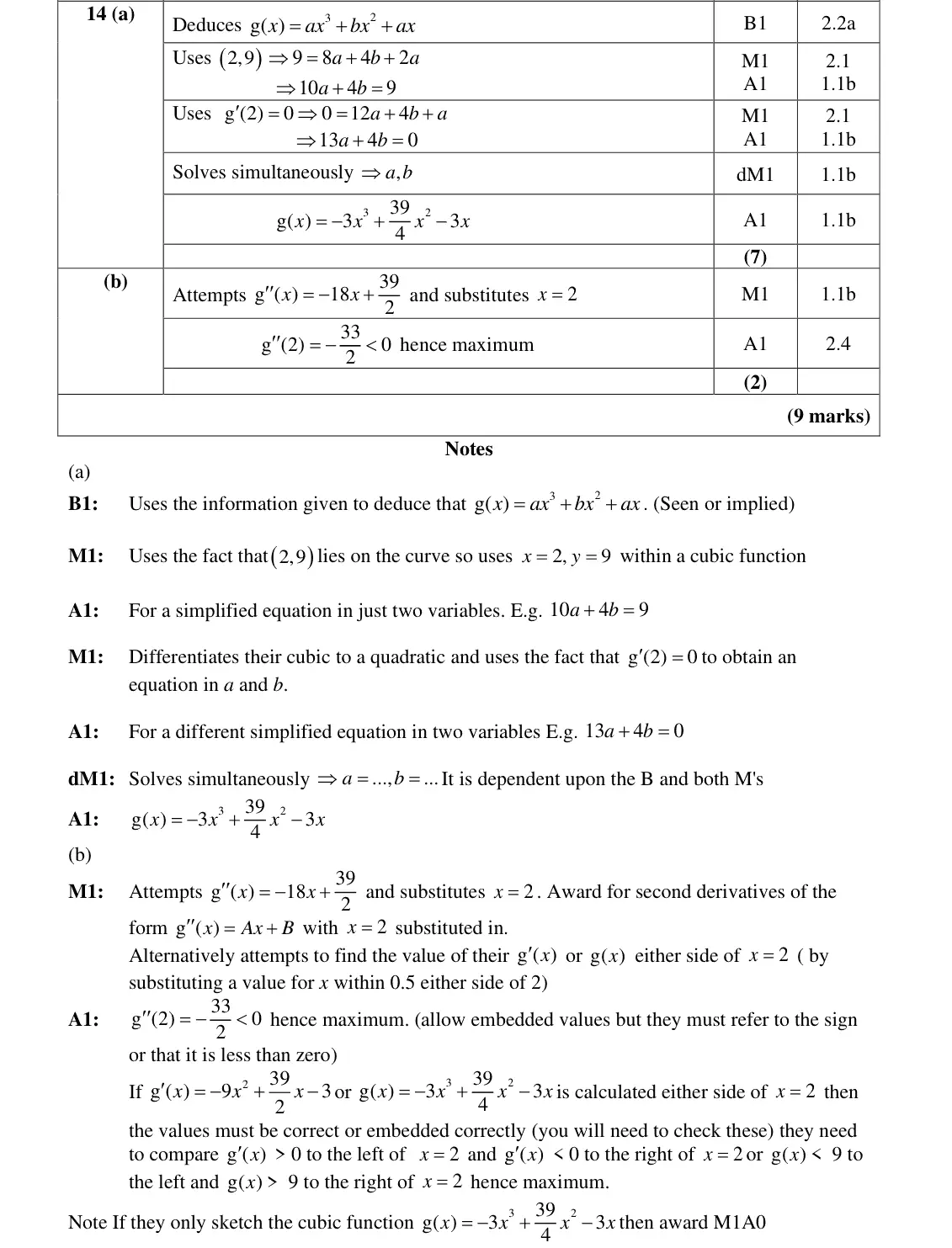
Common mistakes
g(x) = ax³ + bx² + ax (no constant: through the origin)
use g(2) = 9 and g′(2) = 0 (not 9)
solve 10a + 4b = 9, 13a + 4b = 0
state g(x) = −3x³ + (39/4)x² − 3x
Oct 2020 · Paper 1 · Q164 marks
Mark scheme (whole question; this part is marked with the orange bar)
Examiner's comment
Marks on this question were only scored by above average candidates and many made little or no progress towards a proof. There were many blank responses. Candidates who attempted to factorise 2 2 4p q - were more successful than by other methods, although the large majority of these scored only the first mark, by stating the assumption and factorising to ( )( ) 2 2 p q p q + - , but making no further progress. Of those that did consider the factors of 25, many did set up and solve two relevant equations simultaneously, and so gained 3 marks, but very few considered both of the required pairs of equations and so did not all marks. There were many discussions of odd/even integers but this was commonly followed by working in the same variable for p and q, which gained no marks
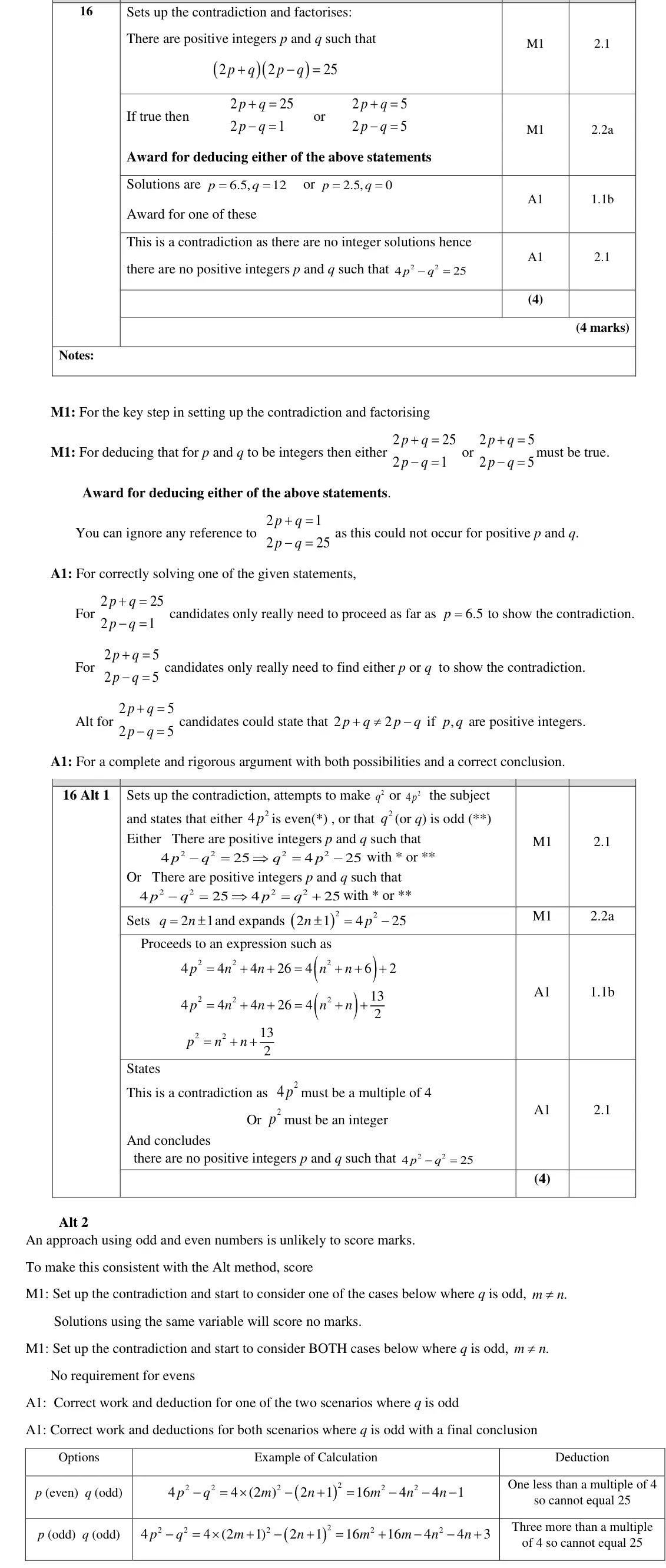
Common mistakes
assume integers exist
factorise (2p + q)(2p − q) = 25
consider both 2p + q = 25, 2p − q = 1 and 2p + q = 5, 2p − q = 5 (non-integer or q = 0)
conclude
odd/even arguments using the same letter for p and q score nothing
Oct 2020 · Paper 2 · Q9(a)4 marks
Mark scheme (whole question; this part is marked with the orange bar)
Examiner's comment
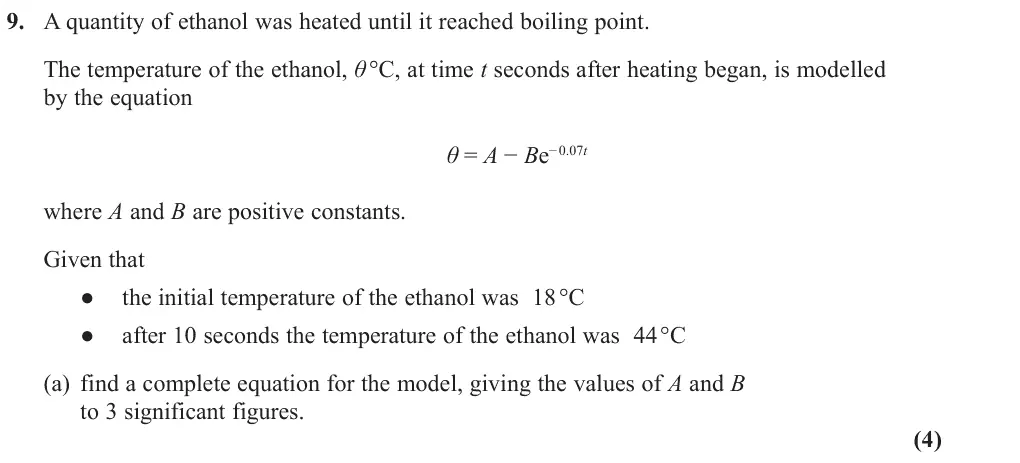
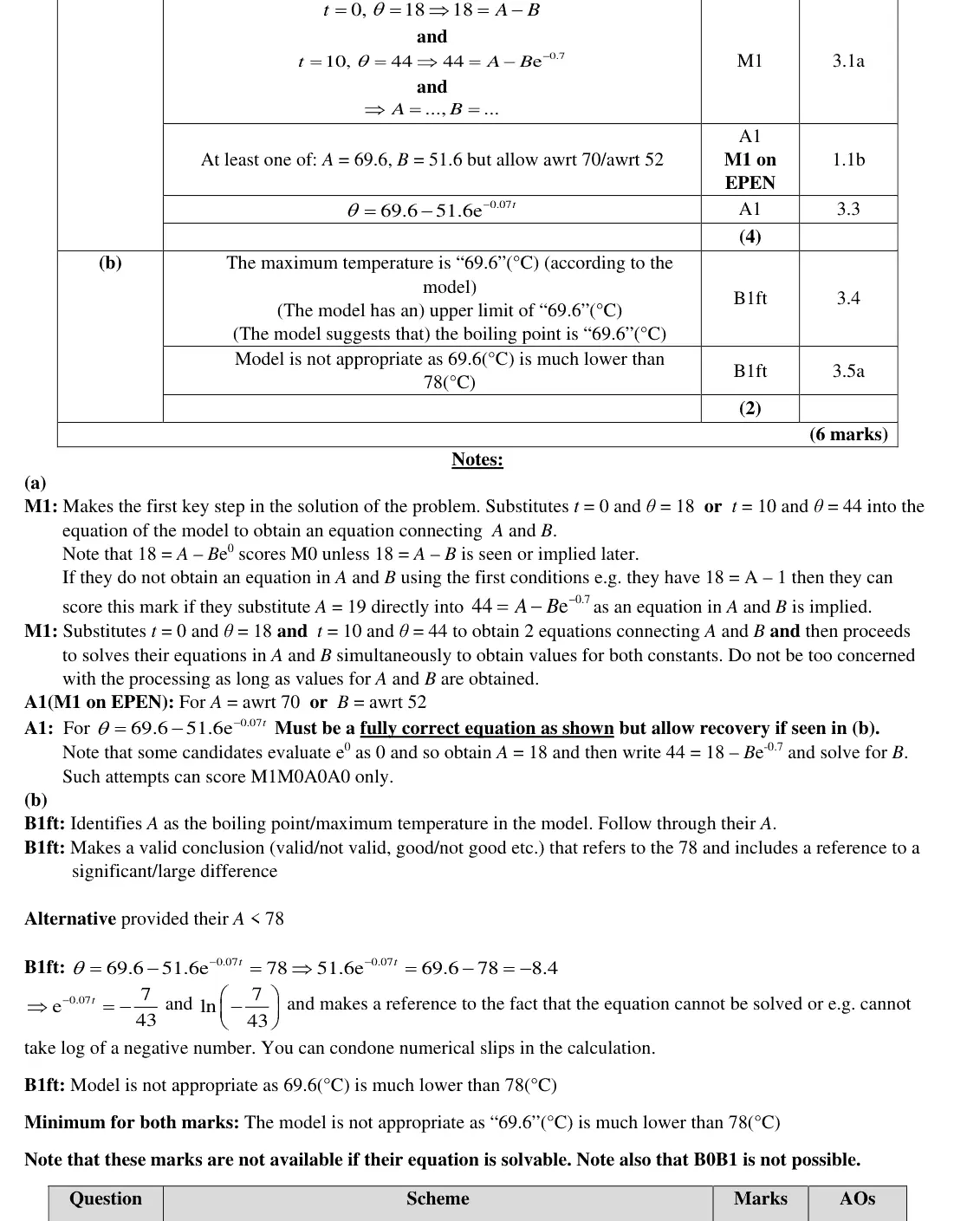
This question proved to be quite challenging for many candidates and awarding full marks was rare. Nonetheless, most candidates recognised the need to set up simultaneous equations in A and B and linking A and B. Usually problems arose initially with the 18 = 𝐴𝐴 - 𝐵𝐵𝑒𝑒0 which was frequently were often able to use the information provided in the question to establish at least one equation incorrectly simplified to 18 = 𝐴𝐴 or sometimes 18 = 𝐴𝐴 - 1. Indeed, some candidates assumed immediately that A = initial temperature = 18 as is sometimes the case in modelling questions. Such errors proved costly as candidates were then limited to one mark from four in part (a). It was unphased by the presence of e-0.7as a coefficient of B. Often this was rewritten as a decimal pleasing to see that most candidates who managed to set up the two equations correctly were often approximation before solving for B. This was acceptable although some candidates did not provide sufficiently accurate approximations and so lost a mark for values of A and B that were not accurate to 3sf (51.7 and 69.7 were sometimes seen). Candidates also lost a mark here for being too accurate and giving their final values of A and B to 3dp for example. Candidates should be advised to check the question carefully for the required degree of accuracy. Unfortunately, it was quite common for candidates to find correct values for A and B but then fail to state the equation of the model in full which led to the loss of one mark. Part (b) was quite discriminating. Occasionally, candidates noted that the maximum temperature 𝜃𝜃(𝑡𝑡) = 78 and attempt to solve for 𝑡𝑡. Some candidates were unable to solve the equation but according to the model is 69.6°C but the most common approach taken by candidates was to set allowed their work to peter out without comment. However, a good number of candidates correctly noted that a solution was not possible - recognising that the model would not reach the boiling point conveniently disappear in order to obtain a solution for 𝑡𝑡 at all costs. Such candidates usually of ethanol which was sufficient for one mark. It was also common however to see minus signs obtained 𝑡𝑡 = 25.9 and concluded that the model would be appropriate up to this time; or obtained 𝑡𝑡= -25.9 noting that ‘time cannot be negative’. A significant number of responses gave general comments relating to the model being inappropriate once ethanol’s boiling point was reached - such sometimes resulted in a version of 𝜃𝜃(𝑡𝑡) = 78 which could legitimately be solved which precluded responses were not creditworthy. Unfortunately, errors in the calculation of A and B from part (a) the marks in (b). It was extremely rare to award the second mark in part (b) as candidates almost always failed to acknowledge that the model was inappropriate because the maximum value of 69.6°C is significantly lower than the boiling point of 78°C.
Common mistakes
t = 0 gives 18 = A − B (e⁰ = 1, not 0
A is not the initial temperature)
solve simultaneously with 44 = A − Be^−0.7
A = 69.6, B = 51.6 to 3 s.f.
state the complete equation
Oct 2020 · Paper 2 · Q14(a)3 marks
Mark scheme (whole question; this part is marked with the orange bar)
Examiner's comment
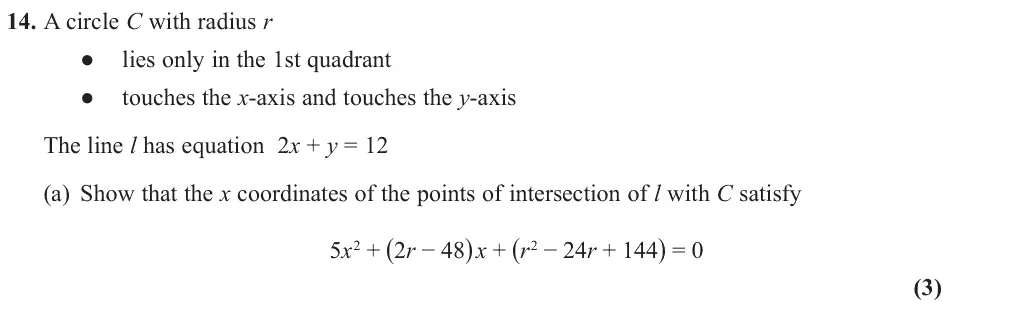
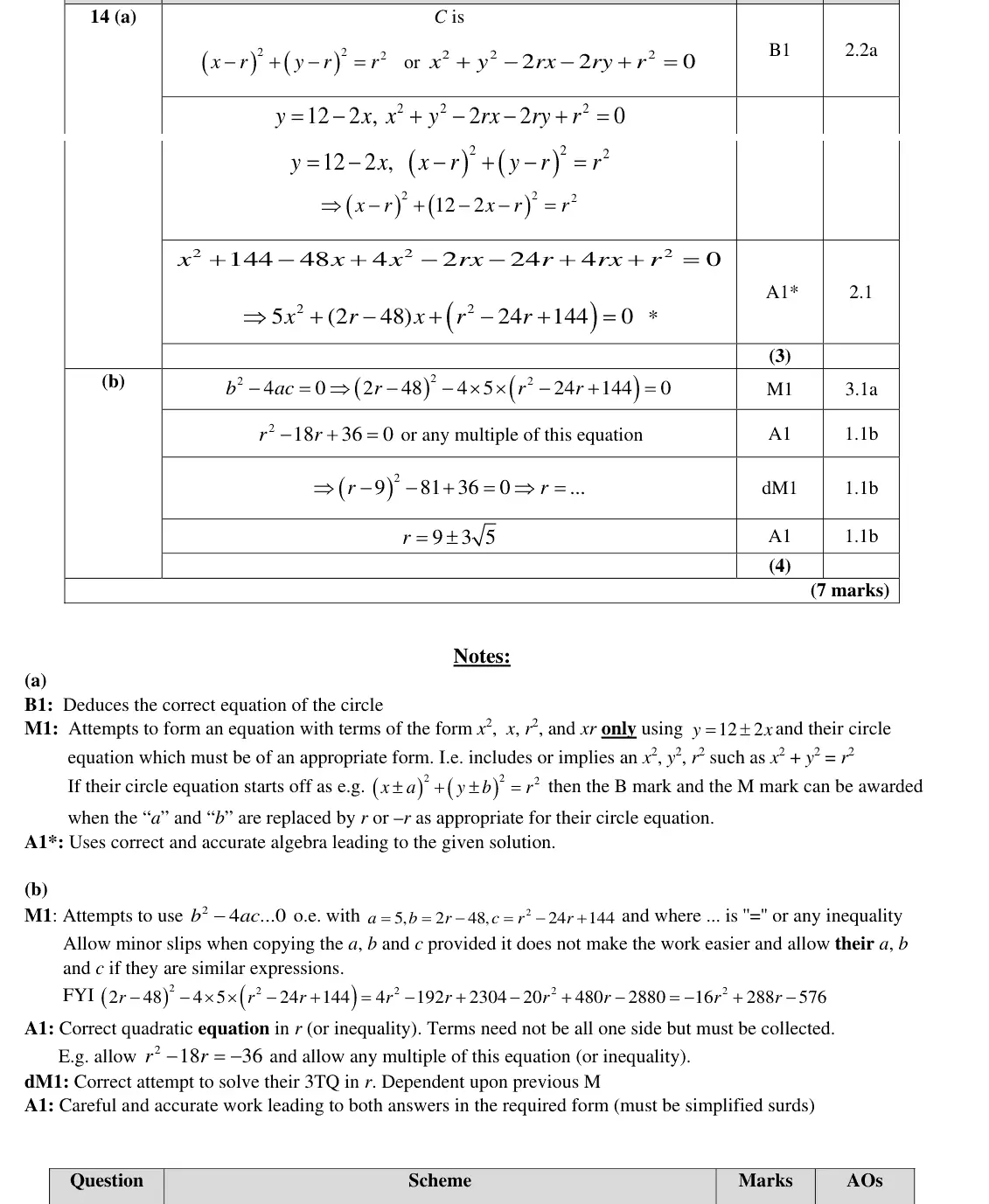
Part (a) presented some thinking challenges for many candidates, in particular spotting that a = b = r in their equation for the circle. About half of the candidates were not able to deduce the correct equation of the circle. The most commonly seen incorrect equations were 𝑥𝑥2 + 𝑦𝑦2 = 𝑟𝑟2 , (𝑥𝑥+ 𝑟𝑟)2 + (𝑦𝑦+ 𝑟𝑟)2 = 𝑟𝑟2 and (𝑥𝑥 ± 𝑎𝑎)2 + (𝑦𝑦 ± 𝑏𝑏)2 = 𝑟𝑟2. Some of these candidates managed to gain the method mark for using 𝑦𝑦= 12 – 2𝑥𝑥, but a disappointingly high number didn’t progress. Relatively few candidates who initially used 𝑎𝑎 and 𝑏𝑏, correctly replaced them with 𝑟𝑟 to attain at least one mark. Some candidates tried to use a sketch to help them. This did allow some to identify the centre as (𝑟𝑟, 𝑟𝑟), but many put the circle in the wrong quadrant and proceeded to use (𝑟𝑟, -𝑟𝑟) or (-𝑟𝑟, 𝑟𝑟). The majority of candidates who gained the B1 and M1 expanded their expressions correctly to give the correct equation and attain the A1, although the algebra involved in squaring the 3-term expression (𝑟𝑟2 -24𝑟𝑟+ 144)was not always carried out correctly. Candidates were generally more successful when they expanded (𝑦𝑦-𝑟𝑟)2 first before substituting 𝑦𝑦= 12 - 2𝑥𝑥.
Common mistakes
touching both axes in the 1st quadrant gives centre (r, r)
not x² + y² = r² or centre (−r, r)
substitute y = 12 − 2x and expand carefully
Oct 2020 · Paper 3 (Mechanics) · Q4(b)7 marks
Mark scheme (whole question; this part is marked with the orange bar)
Examiner's comment
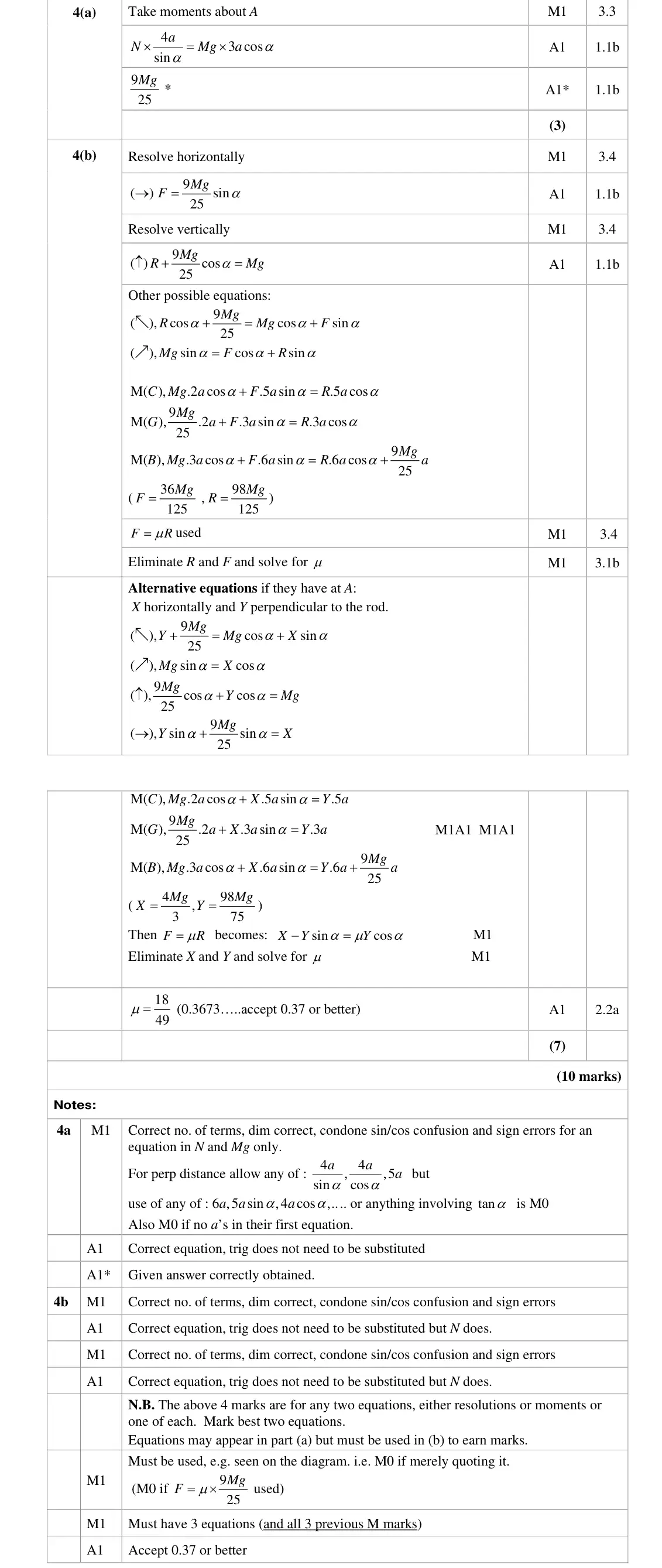
A significant number of candidates made little or no progress with this question; a number of responses showed a complete lack of understanding of the nature and directions of the used and this invalidated the method. The most straightforward approach for part (b) was to resolve horizontally and vertically. Some candidates chose to take moments about various points or to resolve perpendicular and/or parallel to the ladder. These methods often led to errors including missing terms and incorrect distances. Some thought the normal reaction at C was horizontal. Those who attempted to use a reaction perpendicular to the ladder generally used this in F= mu R and were unaware that this is only valid for a normal reaction. Confusion between sin/cos in resolving the reaction at C horizontally and vertically was surprisingly common. There were, nevertheless, some well-expressed fully correct solutions seen.
Common mistakes
resolve horizontally F = (9Mg/25) sin α and vertically R + (9Mg/25) cos α = Mg
the reaction at C is perpendicular to the ladder, not horizontal
F = μR only with the normal reaction at A (not 9Mg/25)
sin/cos confusion
μ = 18/49 ≈ 0.37
Oct 2020 · Paper 3 (Mechanics) · Q5(a)6 marks
Mark scheme (whole question; this part is marked with the orange bar)
Examiner's comment
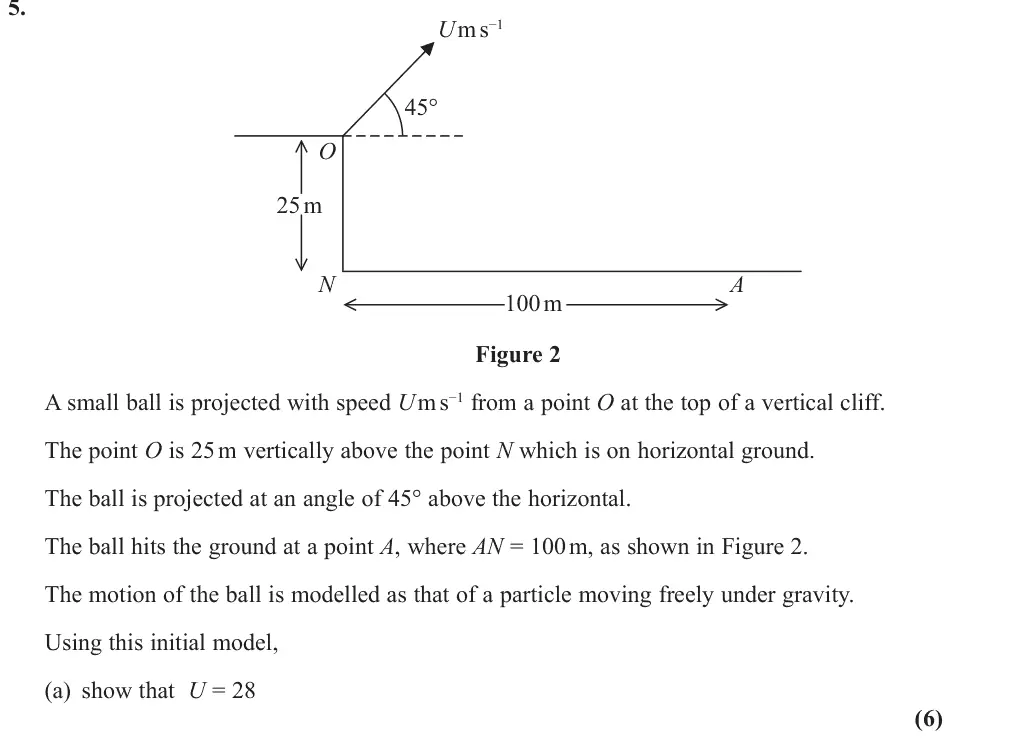
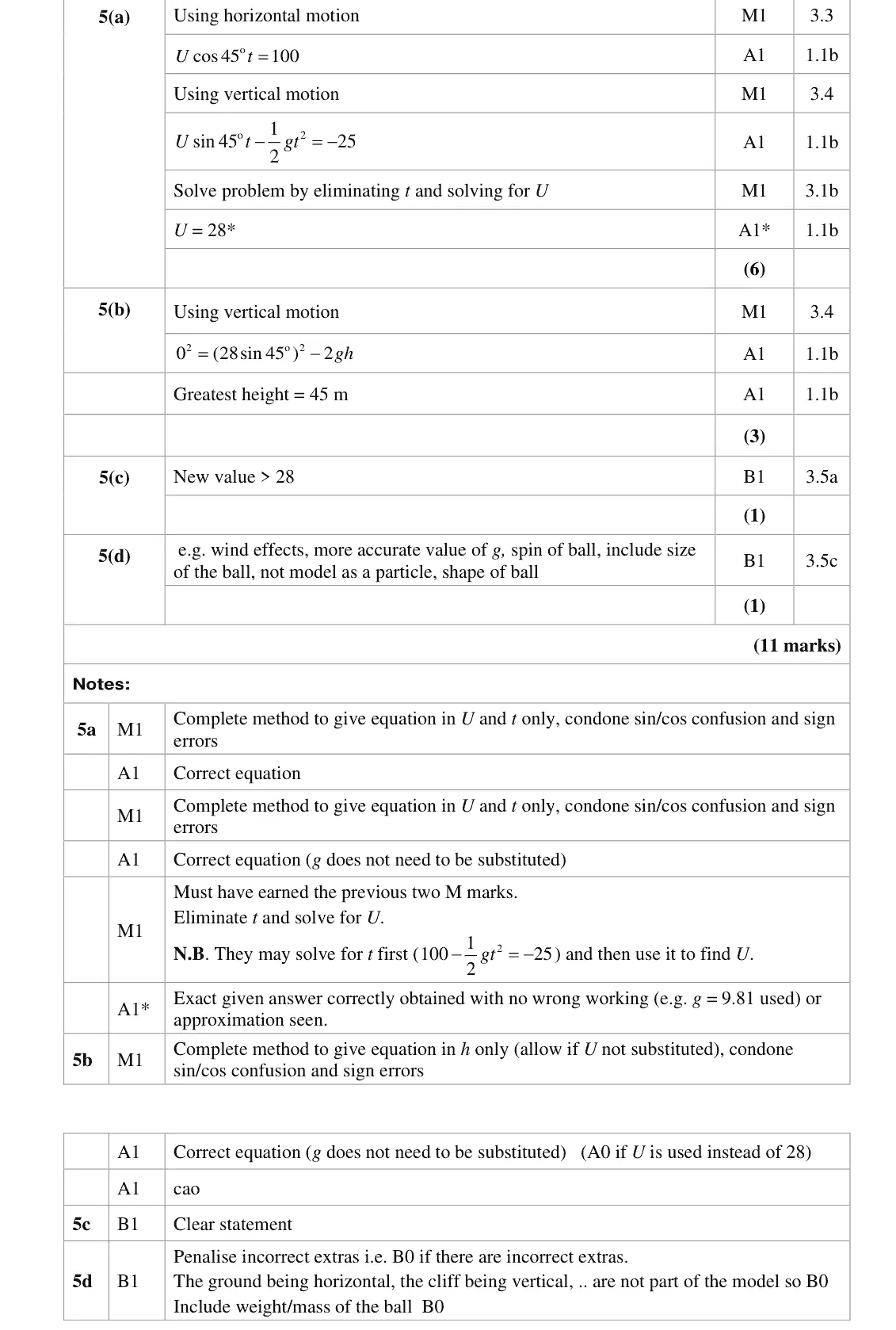
In part (a), many candidates made some valid progress in creating horizontal and vertical distance equations in terms of t and U. Most tried to eliminate or find t to solve for U but sometimes lacked systematic working and gave up before reaching an answer or simply stated the given answer following incorrect or incomplete work. Those who did not complete a solution for U could go on to gain full marks for part (b) which was generally
Common mistakes
horizontal U cos 45° t = 100 and vertical U sin 45° t − ½gt² = −25 (sign of the 25)
eliminate t systematically to reach U = 28
no approximations or g = 9.81
June 2019 · AS Paper 1 · Q1(b)2 marksEasy
Mark scheme (whole question; this part is marked with the orange bar)
Examiner's comment
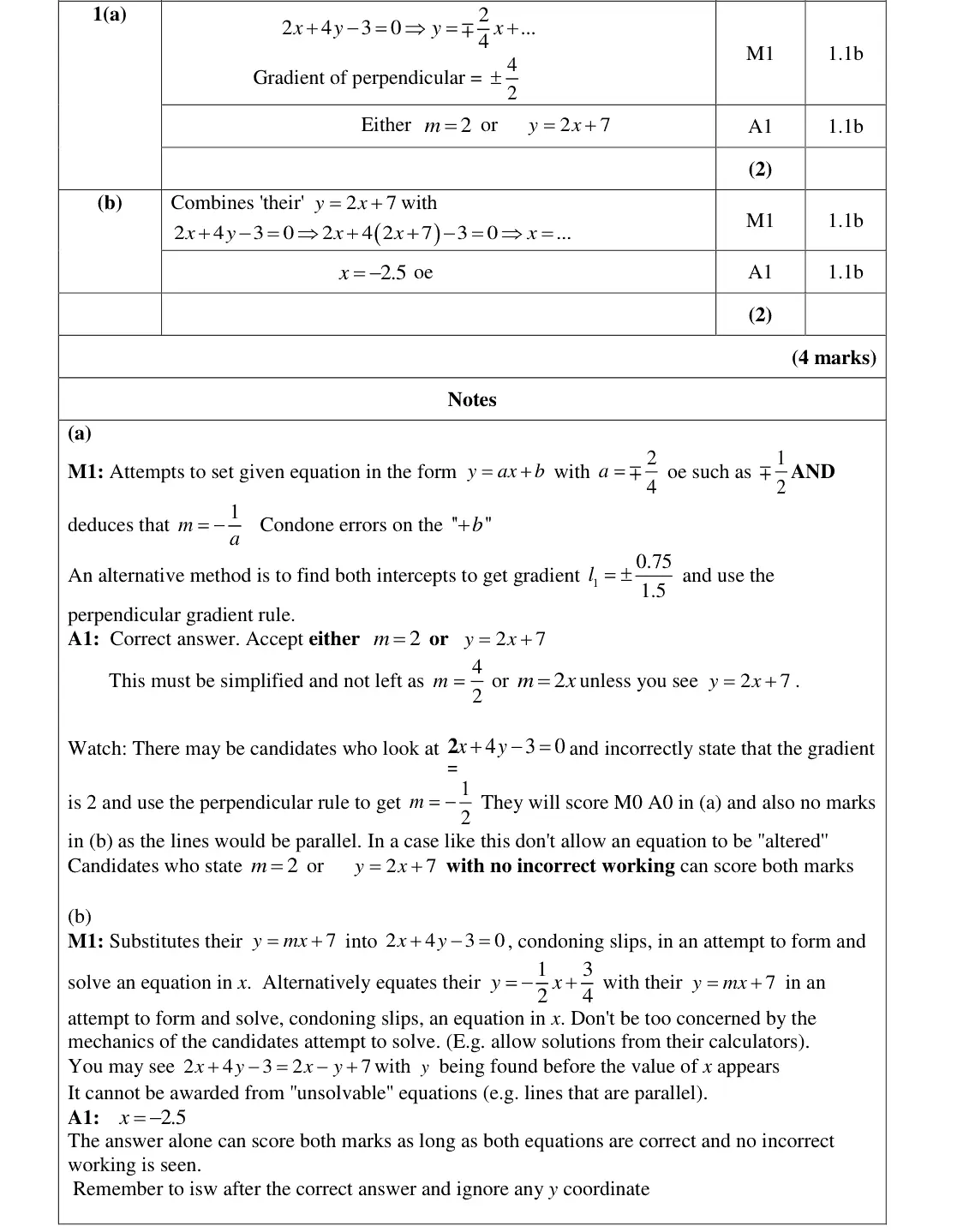
This question was generally well answered. (b) Marks were lost owing to slips in the rearrangement of the equation of l1 by either a sign error or, more frequently, a failure to divide the constant by 4. Most candidates attempted to equate two equations rather than substituting their y = 2x + 7 into the original equation. Sign errors, particularly with the constant, were a frequent cause of lost marks as the candidates attempted to solve their equation for x. Many candidates continued, unnecessarily, to find the y-coordinate. A few candidates, who erroneously had parallel lines, still tried to find a point of intersection.
Common mistakes
substitute y = 2x + 7 into 2x + 4y − 3 = 0
slips dividing the constant by 4 or with signs
y coordinate not needed
parallel lines (wrong m) have no intersection
June 2019 · AS Paper 1 · Q7(b)2 marksMedium
Mark scheme (whole question; this part is marked with the orange bar)
Examiner's comment
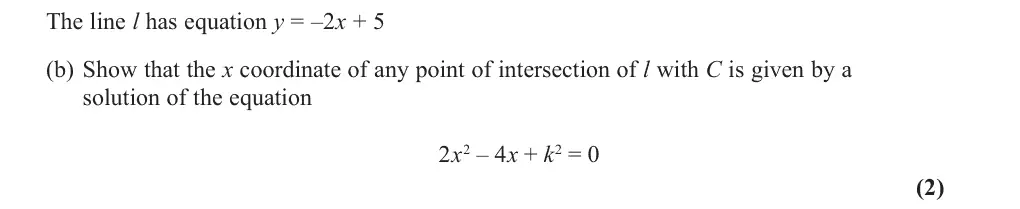
In general, parts (a) and (b) were well done with part (c) causing some issues. (b) This part was answered well, and most candidates, realising that a proof was required, took care over their presentation and showed all their steps. A few lost the final mark for failing to show how they had multiplied by x, or for small algebraic errors.
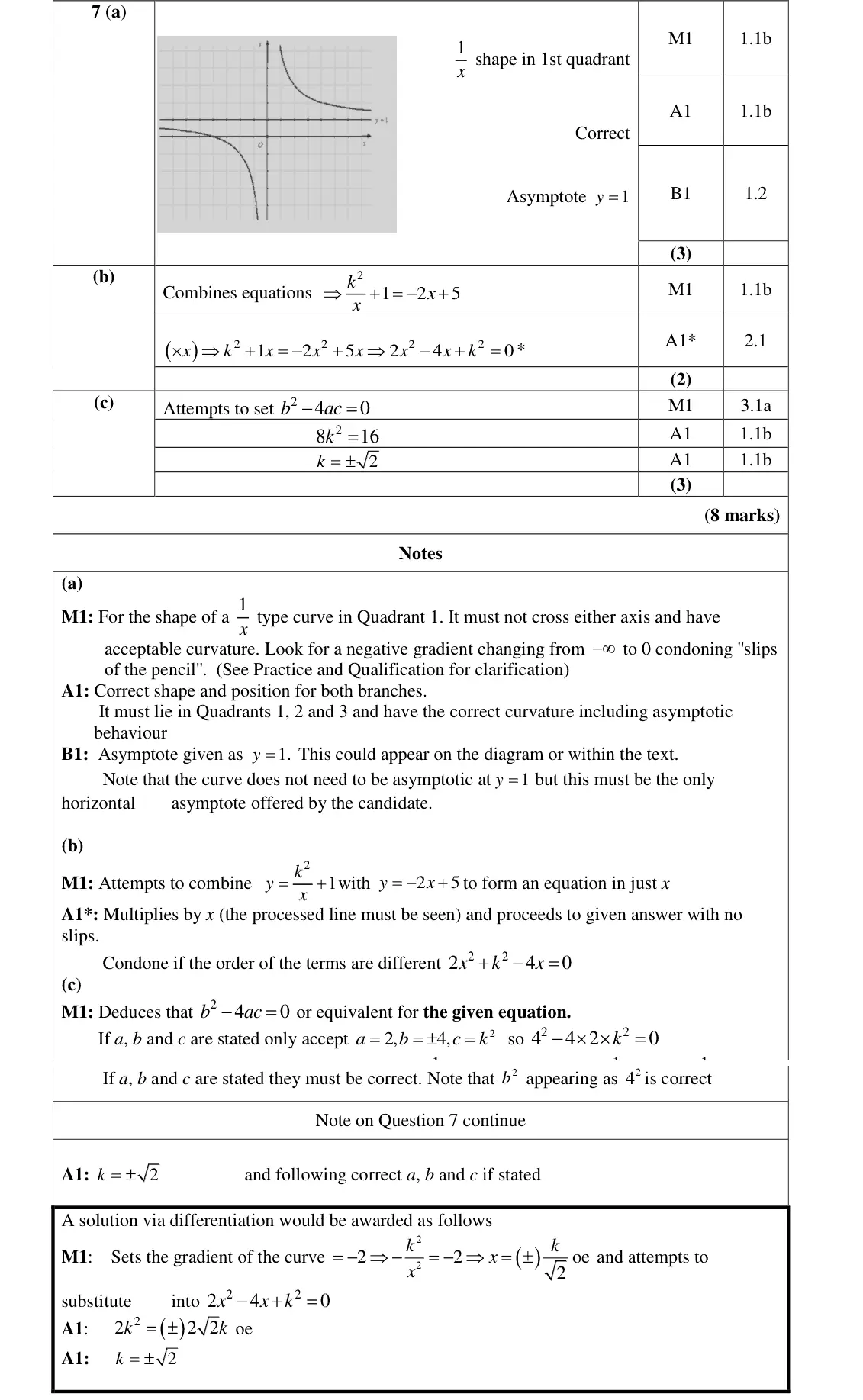
Common mistakes
equate k²/x + 1 = −2x + 5 and show the multiplication by x before the given answer
June 2019 · Paper 2 · Q7(b)3 marks
Mark scheme (whole question; this part is marked with the orange bar)
Examiner's comment
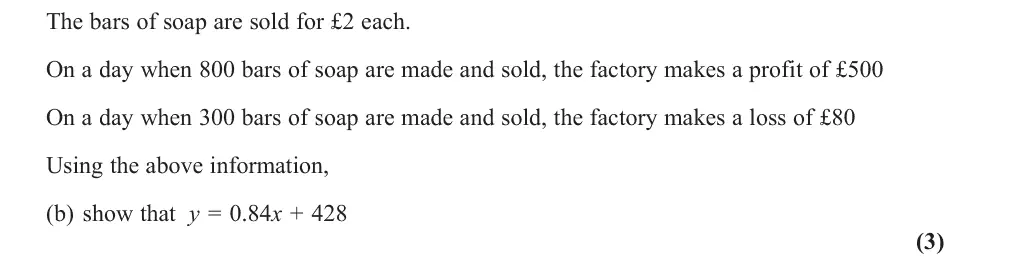
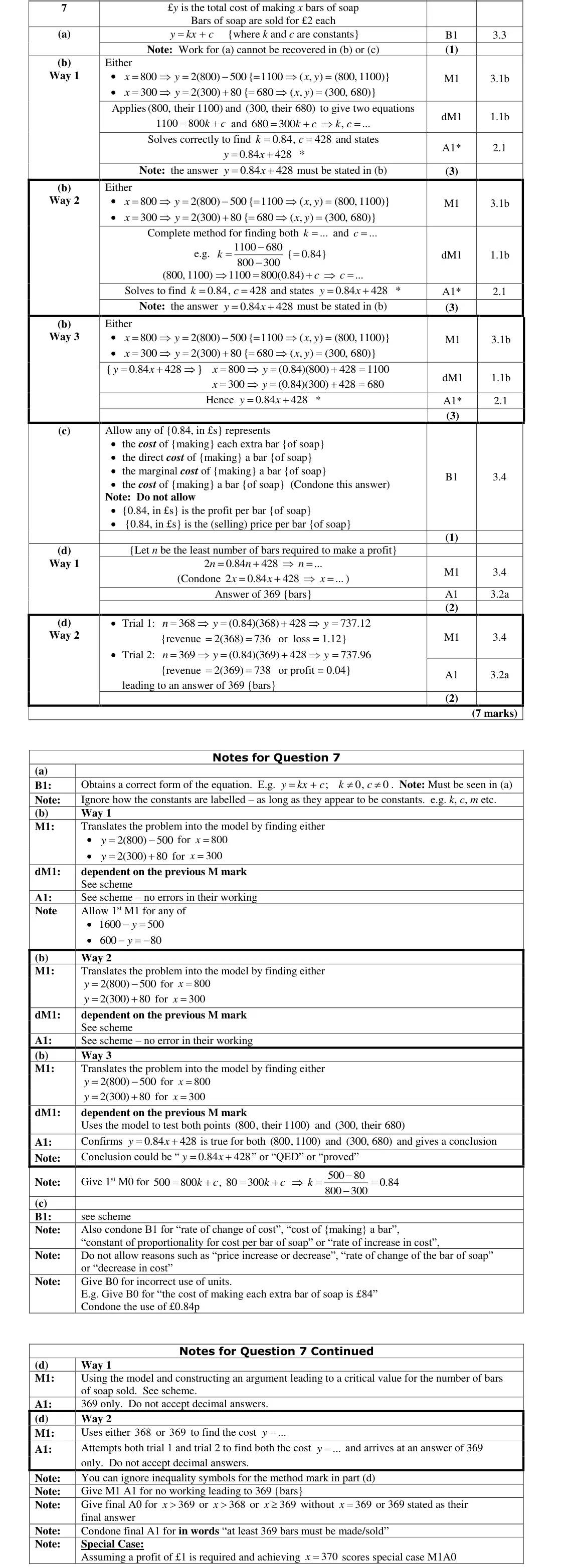
Q07 discriminated well between the medium and higher ability candidates. Lower ability candidates struggled to make much progress with this modelling question and most of them scored no more than one mark. In Q07(a), most candidates wrote down a correct equation for the model in the form , y kx c with constants k and c. A minority struggled to give a suitable form of the linear equation, with some omitting the fixed cost constant, c. Some candidates gave ; y x incorrect answers, such as equations involving exponential models; or differential equations. Q07(b) proved challenging for those candidates who struggled to grasp the concept ‘profit sales cost ’, with many of them incorrectly assuming that the model from Q07(a) was for the profit made. Many of these candidates used (800, 500) and either (300, 80) or (300, 80) to form two linear equations, with some erroneously finding a gradient of 0.84. Those candidates who understood the link between profit and cost usually found the total cost to the factory of £1100 and £680 for 800 and 300 bars of soap respectively. Most used (800, 1100) and (300, 680) to form two linear equations and proceeded to find the gradient, 0.84, and y-intercept, 428. A large proportion concluded by stating 0.84 428. y x the given equation A few candidates, however, did not complete their analysis with a suitable conclusion, and so lost the final mark. Some candidates used (800, 1100) and (300, 680)to verify the model 0.84 428. y x Many of these were successful but often failed to give a suitable conclusion stating that the given model was true. Q07(c) gave a significant number of candidates their only creditable access to Q07. Some candidates gave a correct interpretation such as 0.84 represented ‘the cost of making an extra bar of soap’. Incorrect explanations included that 0.84 represented ‘the selling price of a bar of soap’ or ‘the profit per bar of soap made’. There was a mixed response to Q07(d). The most popular approach was to form and or 2 0.84 428, n n solve a correct 2 which mostly led to the correct 0.84 428 n n n n n 369. 369, answer A final answer left as an inequality such as or 368 without reference to the statement that 369 was the number of bars required, was not n n sufficient for the final mark. Some candidates used trials of both and 368 369 n 369. in a complete trial and error method leading to a correct conclusion of
Common mistakes
cost = revenue − profit: (800, 1100) and (300, 680), not (800, 500) and (300, −80)
solve for k = 0.84, c = 428 and state the equation as a conclusion
June 2019 · Paper 3 (Mechanics) · Q4(b)9 marks
Mark scheme (whole question; this part is marked with the orange bar)
Examiner's comment
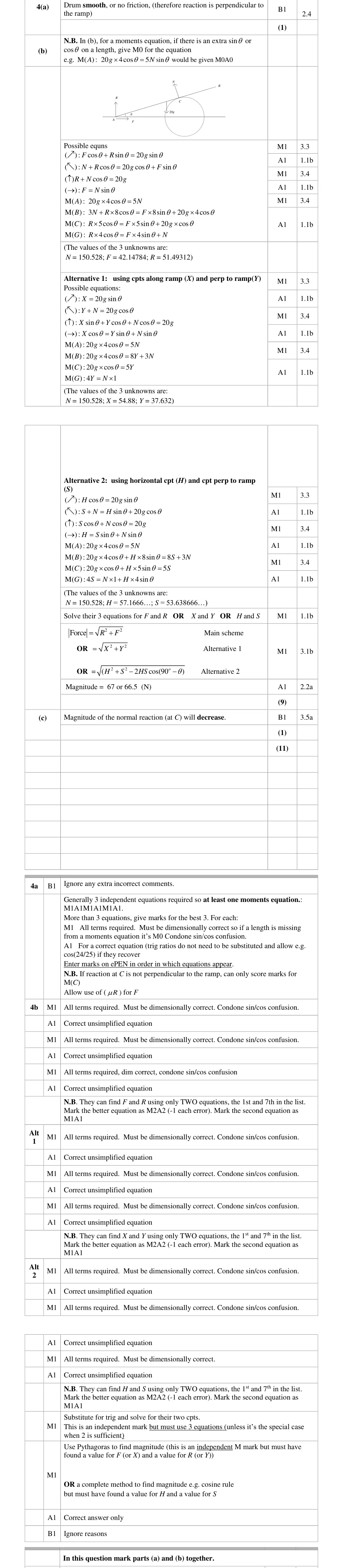
second part involved finding the components of the resultant force on the ramp at the point of contact with the ground and hence its magnitude. This proved challenging for many and some made little valid progress. A clearly labelled diagram would have helped to identify forces and distances. Most used a normal reaction and a horizontal frictional force at A; however, the latter was sometimes omitted which significantly reduced the number of marks available for subsequent equations. Some employed components parallel and perpendicular to the ramp; such attempts were rare but generally successful. A variety of resolution and moments equations were attempted but sometimes components were omitted, forces not resolved or perpendicular distances not used. Working was often difficult to decipher. Those who attempted vertical and horizontal resolutions and a ‘moments about A’ equation tended to be the more successful although a significant number stopped when they had found the normal reaction only. Some introduced a coefficient of friction which was not necessary to answer the question (even giving it the value 2 from the previous question). Occasionally those who completed a correct solution by 3 squaring and adding components to find the magnitude of the resultant failed to achieve the final accuracy mark for not rounding to 2 or 3 significant figures following the use of g = 9.8 m s-2. Some who had achieved very few marks for the rest of the question managed to secure the mark in part (c)
Common mistakes
friction at A is horizontal and must be included
at least one moments equation (e.g. M(A): 20g × 4cos θ = 5N) with perpendicular distances
three equations then magnitude √(F² + R²) ≈ 67 N (2 or 3 s.f. after g = 9.8)
μ is not needed
stopping at R
June 2019 · Paper 3 (Mechanics) · Q5(b)6 marks
Mark scheme (whole question; this part is marked with the orange bar)
Examiner's comment
part of their working for part (b). Of those who found the horizontal and vertical components of the velocity, only a proportion proceeded to calculate the speed and of those, very few found the direction. This was despite the clear lead from the question which had given each velocity as a speed with a direction. A sizeable minority broke the universal rule that answers must be given in terms of quantities which are given in the question, giving their velocity in terms of i and j, which had not been defined in this question. The second part proved to be quite discriminating although a significant number of candidates did successfully find the correct values of both and u. The most common error was for candidates to simply equate both the horizontal and vertical displacements at the time of collision and ignore the 50 m horizontal distance altogether. Others assumed that the particles met halfway between A and B. However, only a minority of candidates made errors when resolving their velocities. In the final part, a substantial number of candidates correctly identified a limitation of the model with the size
Common mistakes
horizontal distances sum to 50 m at t = 2 (not equal, not meeting halfway)
vertical displacements equal gives u sin θ = 20 sin 30°
θ = 52°, u = 12.6
June 2018 · Paper 1 · Q34 marks
Mark scheme (whole question; this part is marked with the orange bar)
Examiner's comment
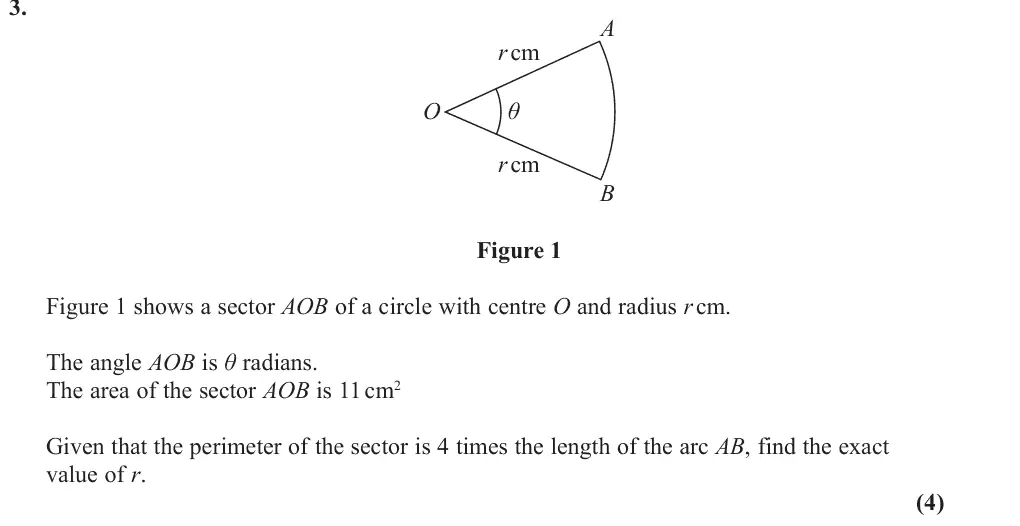
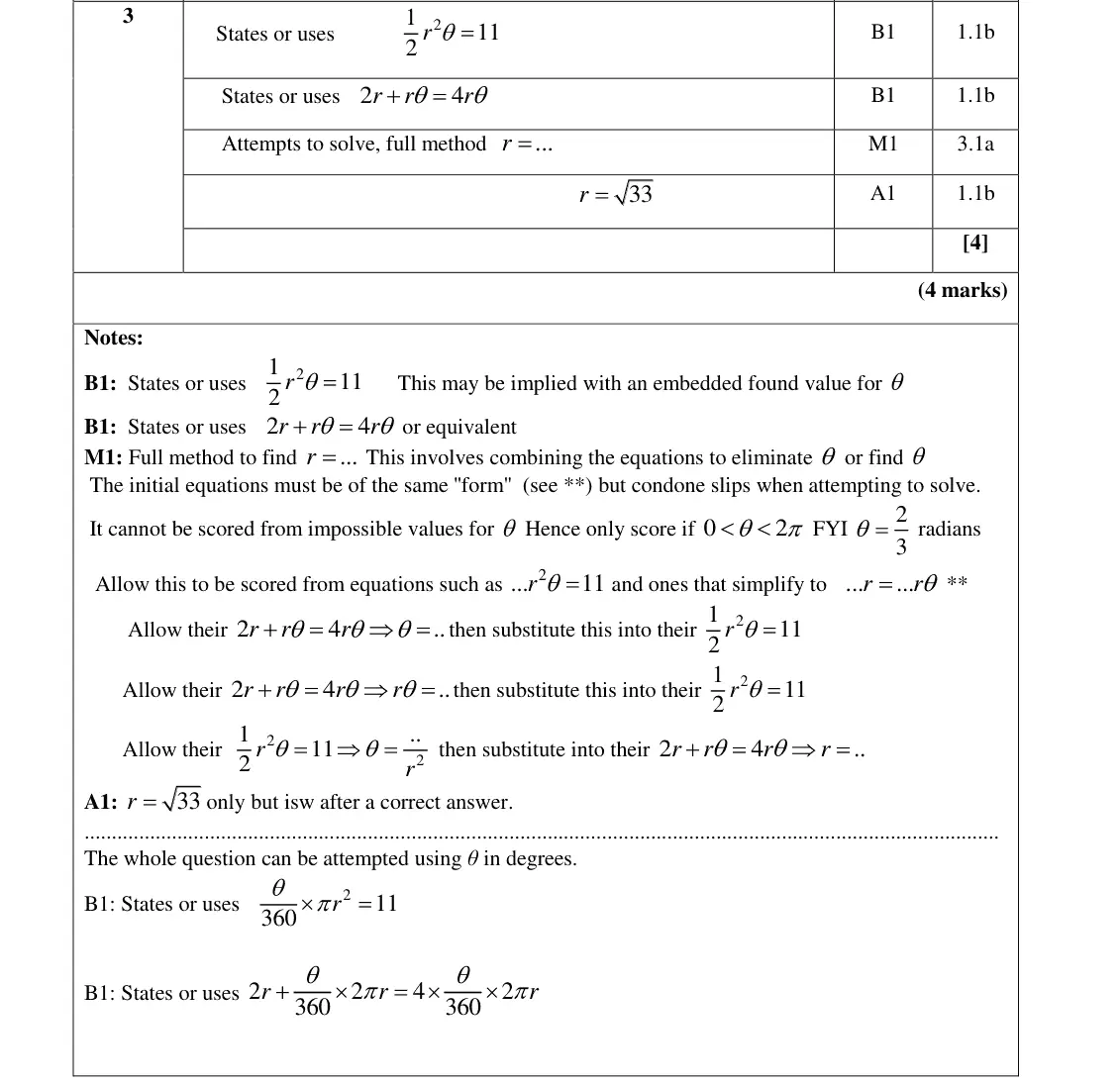
This question was well answered by the vast majority of students. The formulae for arc length and area of a sector were well known and applied, and although the 4 was occasionally seen on the incorrect side of the equation, this was rare. Most students worked in radians and used simultaneous equations to find the value of before proceeding to find an exact (positive) value for r. Algebraic and numerical slips, however, when manipulating equations were not an uncommon reason for losing marks. If method errors were made in this question, it was usually to miss the half from the sector area or to confuse the area of a sector with that of a triangle.
Common mistakes
½r²θ = 11 and 2r + rθ = 4rθ give θ = 2/3 and r = √33 (exact, positive)
missing the ½ in the sector area or using a triangle area
4 on the wrong side of the perimeter equation
June 2018 · Paper 1 · Q6(b)4 marks
Mark scheme (whole question; this part is marked with the orange bar)
Examiner's comment
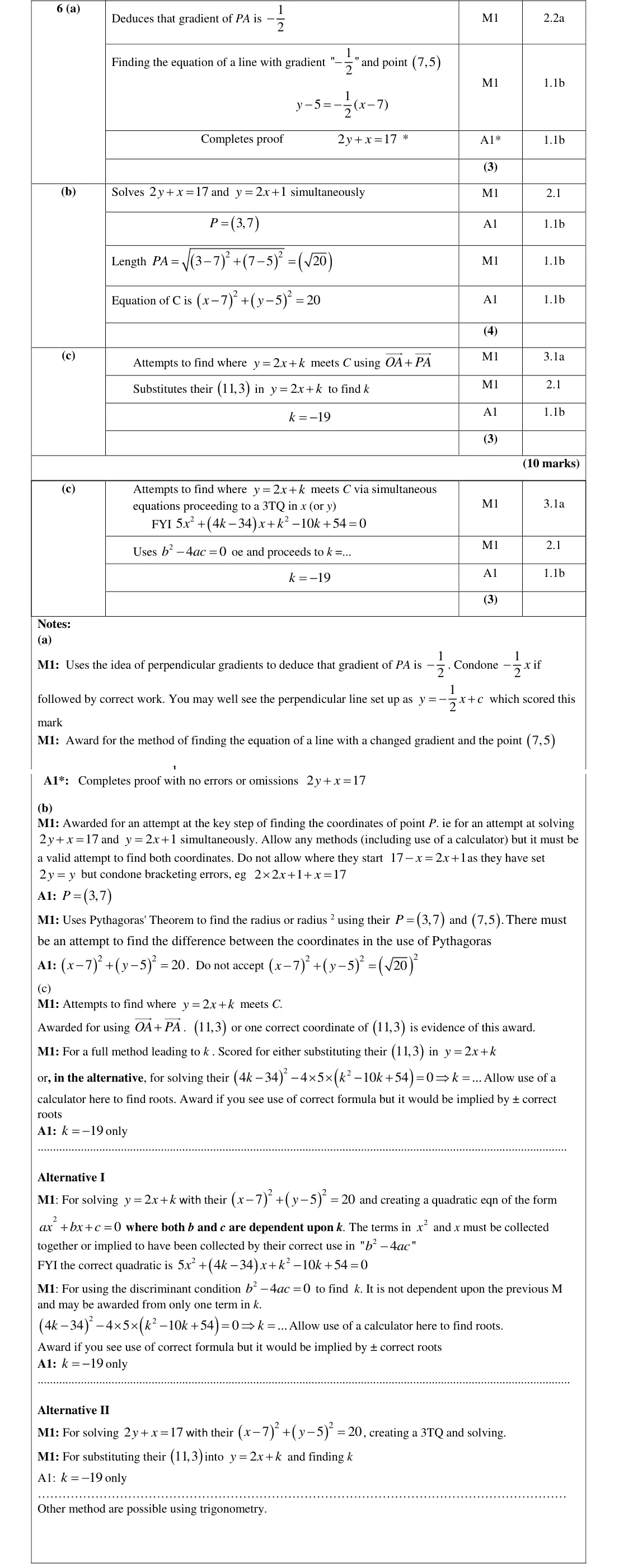
students scoring the 3 marks. Part (b) required the students to find the equation of the circle C using the information given. Again most students attempted this with ease, finding firstly the coordinates of point P, and then the radius PA, before writing down the equation of the circle. Errors witnessed tended to be arithmetic, although some students complicated the question by attempting to solve 2 2 simultaneously in an attempt to 2 and 7 5 x y r 2 1 y x find r. There were numerous ways to find the value of k in part (c). One of the best involved
Common mistakes
solve y = 2x + 1 with 2y + x = 17 to get P(3, 7)
r² = PA² = 20
equation (x − 7)² + (y − 5)² = 20, not (√20)²
June 2018 · Paper 1 · Q9(b)5 marks
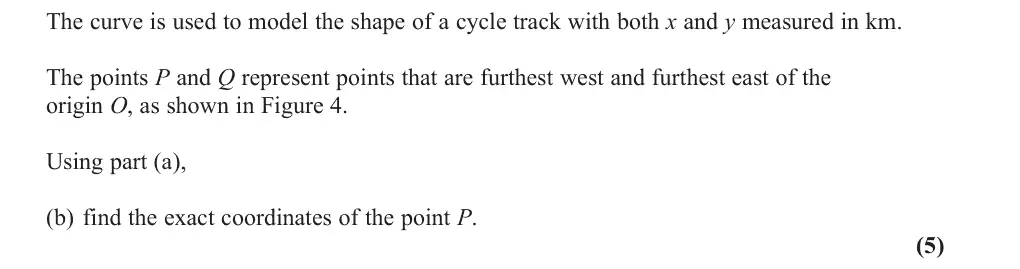
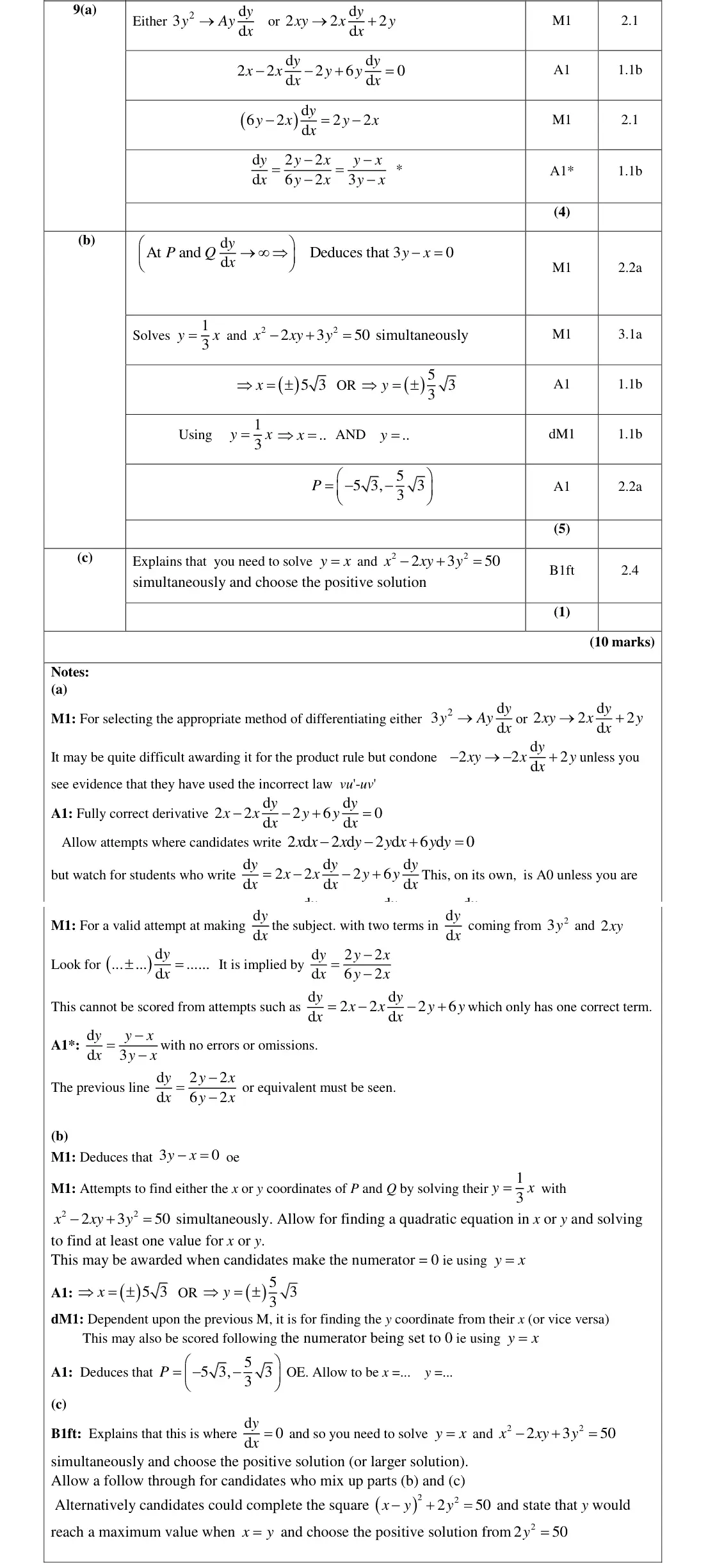
Mark scheme (whole question; this part is marked with the orange bar)
Examiner's comment
Question 9(a) was well answered. Students generally demonstrated a good understanding of implicit differentiation as well as the chain and product rules. Most reached the given result scoring all 4 marks. In question 9(b) however, many made the numerator of the fraction equal zero (i.e. y = x) instead of the denominator (x = 3y). This kind of error usually resulted in only two of the five marks being scored. There were however many full and accurate solutions, with very few students unable to pick out the coordinates of the point P from the two solutions to their simultaneous equations. Only a small number of students gained the B1 mark in question 9(c). They simply needed to state that the point furthest north can be found by substituting y= x into the equation of the curve and picking out the positive solution. Explanations tended to be incorrect or x y 0 incomplete, with many stating that it could be found by putting either or 0.
Common mistakes
furthest west/east means vertical tangent: denominator 3y − x = 0, not numerator (y = x is a common error)
solve with the curve, x = ±5√3
choose P = (−5√3, −(5/3)√3), exact
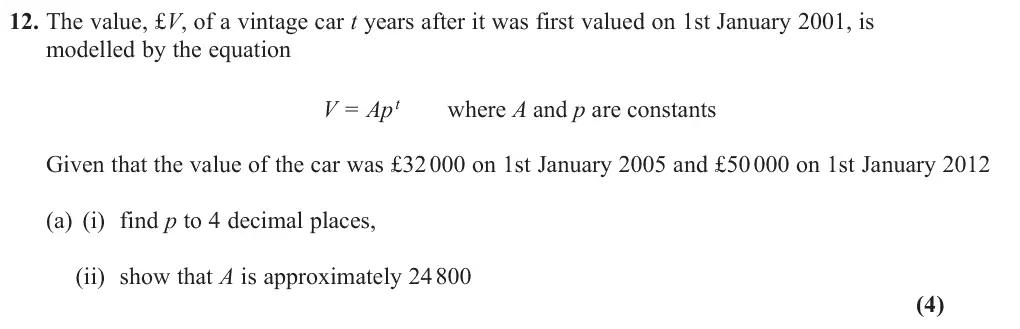
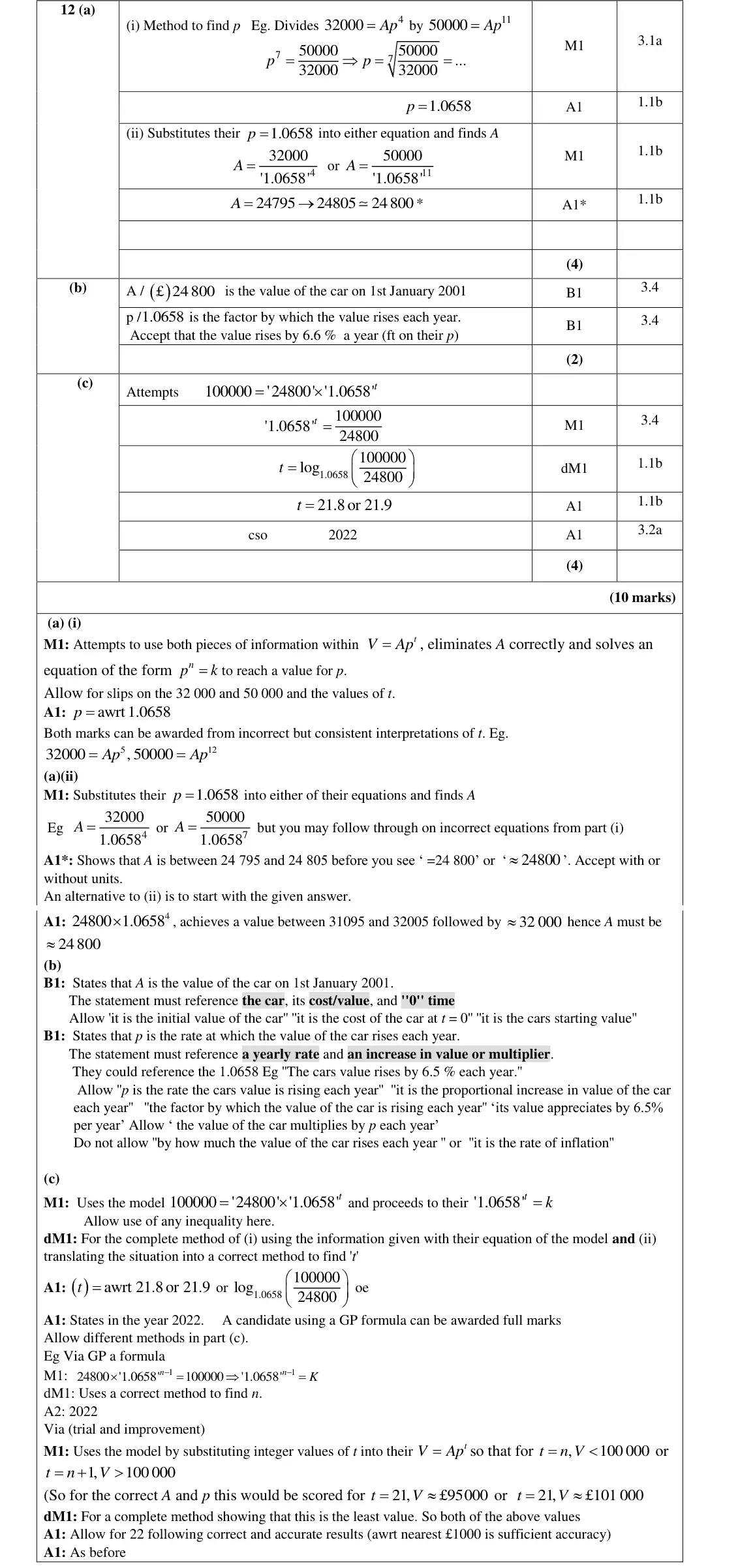
June 2018 · Paper 1 · Q12(a)4 marks
Mark scheme (whole question; this part is marked with the orange bar)
Examiner's comment
t This question, based upon the formula modelled the value of a car in £'s against the , V ap time in years after 1st January 2001. Part (a) was very well answered by the majority of students. Most chose the correct values of t and V and successfully solved a pair of simultaneous equations. Common errors involved using incorrect values for t or failing to show that A was approximately 24 800. It is important in answering questions such as (b) that students are precise about the language and words that they choose. For example, for (b)(i) the statement was required to
Common mistakes
t = 4 and t = 11 (years after 2001), not 5 and 12
divide to get p⁷ = 50000/32000, p = 1.0658
show A between 24 795 and 24 805 before ≈ 24 800
June 2018 · Paper 1 · Q14(c)5 marks
Mark scheme (whole question; this part is marked with the orange bar)
Examiner's comment
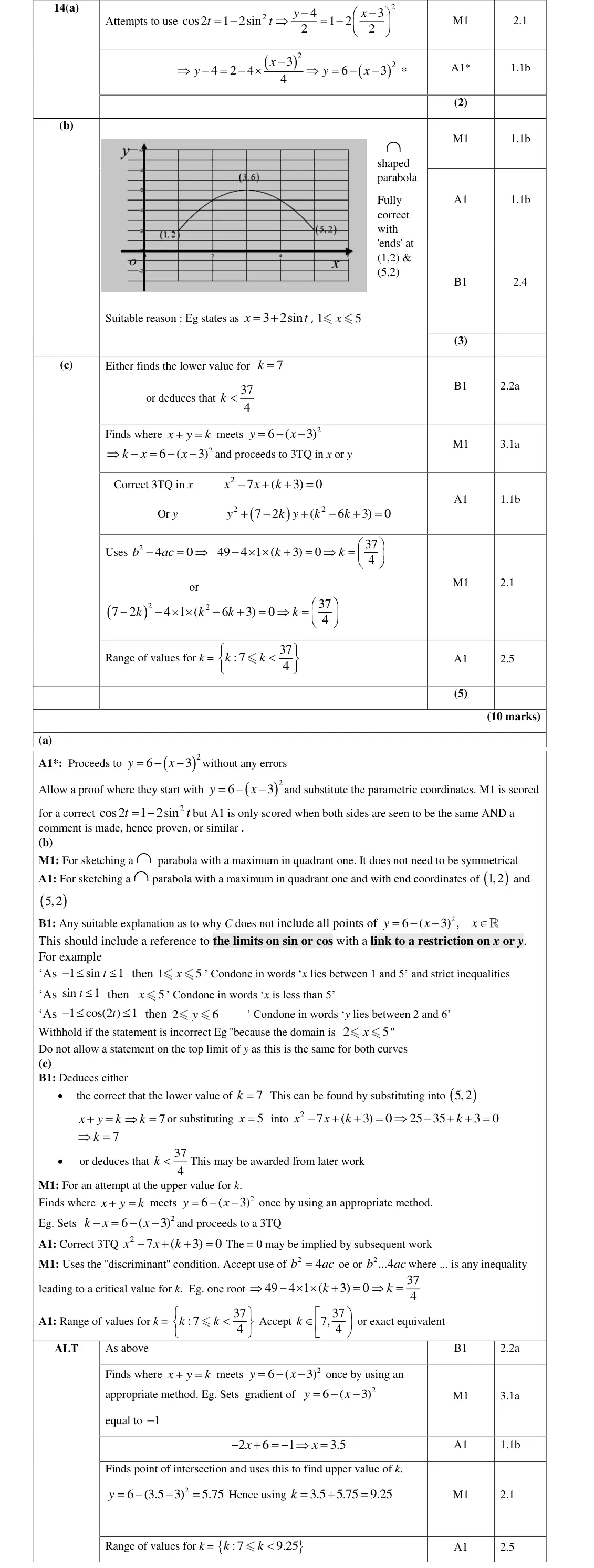
Part (c) was also demanding and better students annotated their graphs to help their understanding of the question (See Figure 1). Most however used the discriminant condition 2 for two roots and were able to proceed to two values. Arithmetic errors were 4 0 b ac quite common using this method. Most students who proceeded to the answer were well versed in writing their answer using set notation. Figure 1
Common mistakes
lower value k = 7 from the end point (5, 2)
x² − 7x + (k + 3) = 0 with b² − 4ac = 0 gives k = 37/4
answer {k : 7 ≤ k < 37/4} in set notation
annotate the sketch
Find an Edexcel maths tutor
Stuck on this? Book a trial session with an Edexcel specialist.