Autumn 2020: Paper 3: Pure Mathematics and Mechanics

100 marks · 32 question parts · Question paper, mark scheme and examiner's report on OCR's site

Question by question

QTopicMarksDifficulty
1 Trigonometric ratios, graphs, radians and the sine and cosine rules 2 Easy
2 Graphs and transformations, Exponentials and logarithms 3 Hard
3(a) Functions, composite and inverse functions, modulus, Quadratics and the discriminant 3 Medium
3(b) Functions, composite and inverse functions, modulus 1 Medium
3(c) Functions, composite and inverse functions, modulus 4 Medium
3(d) Inequalities 3 Medium
4(a) Differentiation: first principles, gradients, stationary points, Chain, product and quotient rules; connected rates of change 5 Medium
4(b) Numerical methods: roots, iteration and Newton–Raphson 2 Medium
4(c) Numerical methods: roots, iteration and Newton–Raphson, Chain, product and quotient rules; connected rates of change 3 Easy
4(d) Numerical methods: roots, iteration and Newton–Raphson 1 Medium
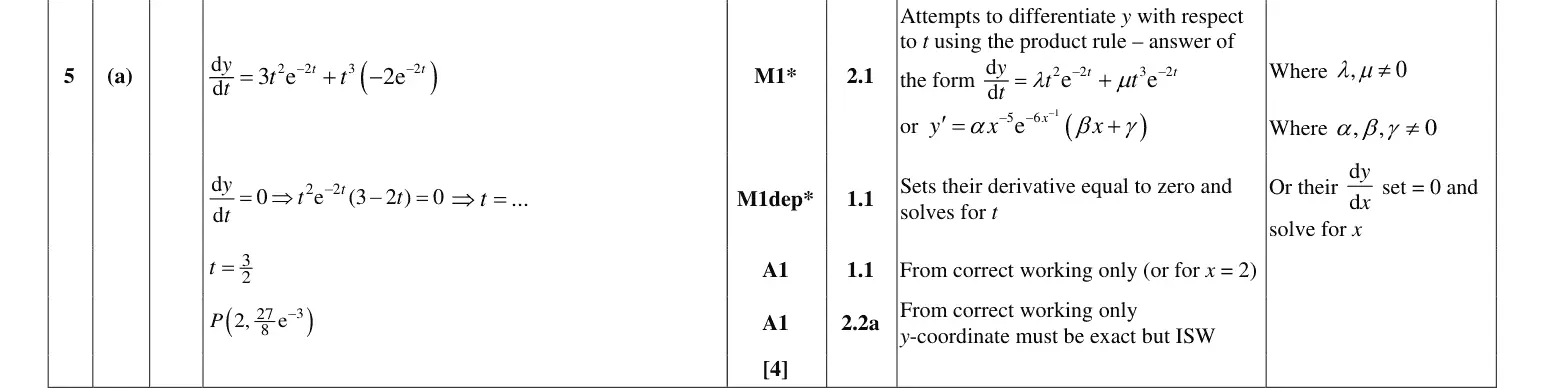
5(a) Implicit and parametric differentiation, Chain, product and quotient rules; connected rates of change, Parametric equations, Differentiation: first principles, gradients, stationary points 4 Medium
5(b) Integration by parts and by substitution, Parametric equations 3 Medium
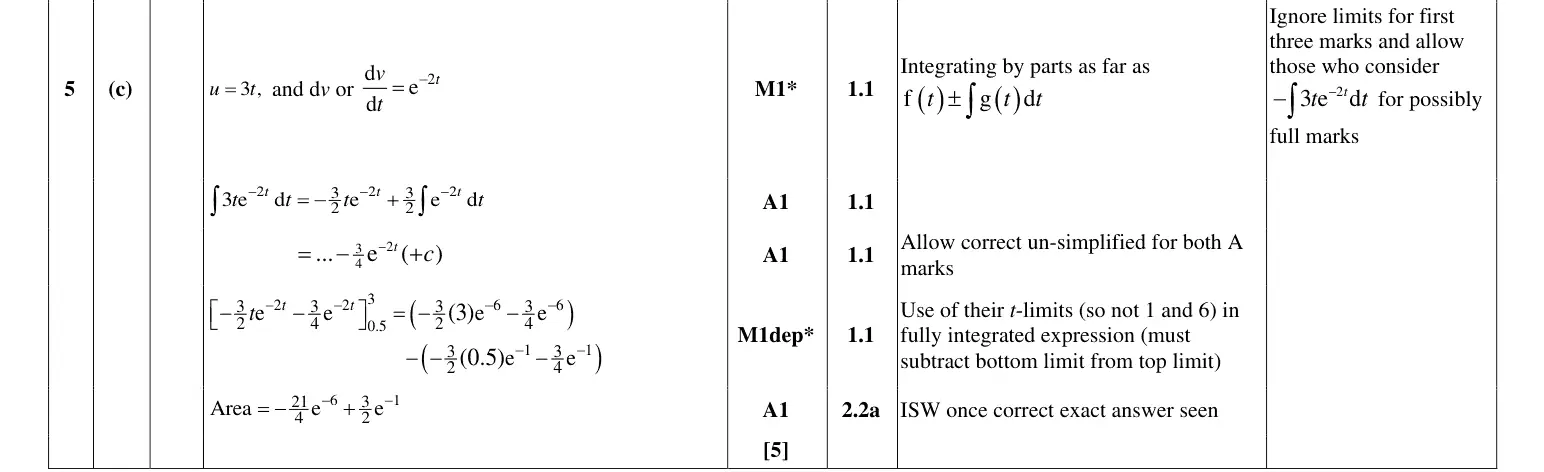
5(c) Integration by parts and by substitution, Integration: standard integrals, definite integrals and areas 5 Easy
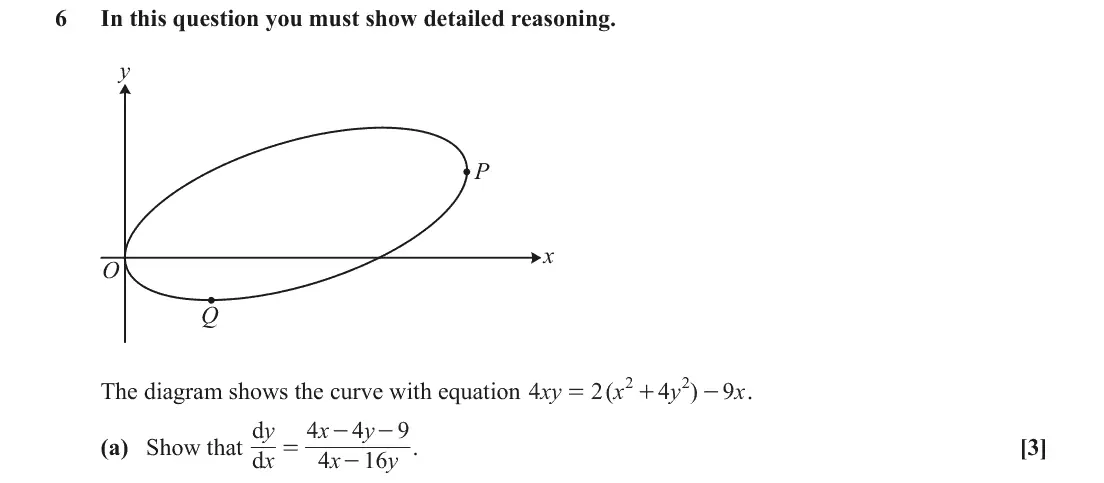
6(a) Implicit and parametric differentiation 3 Easy
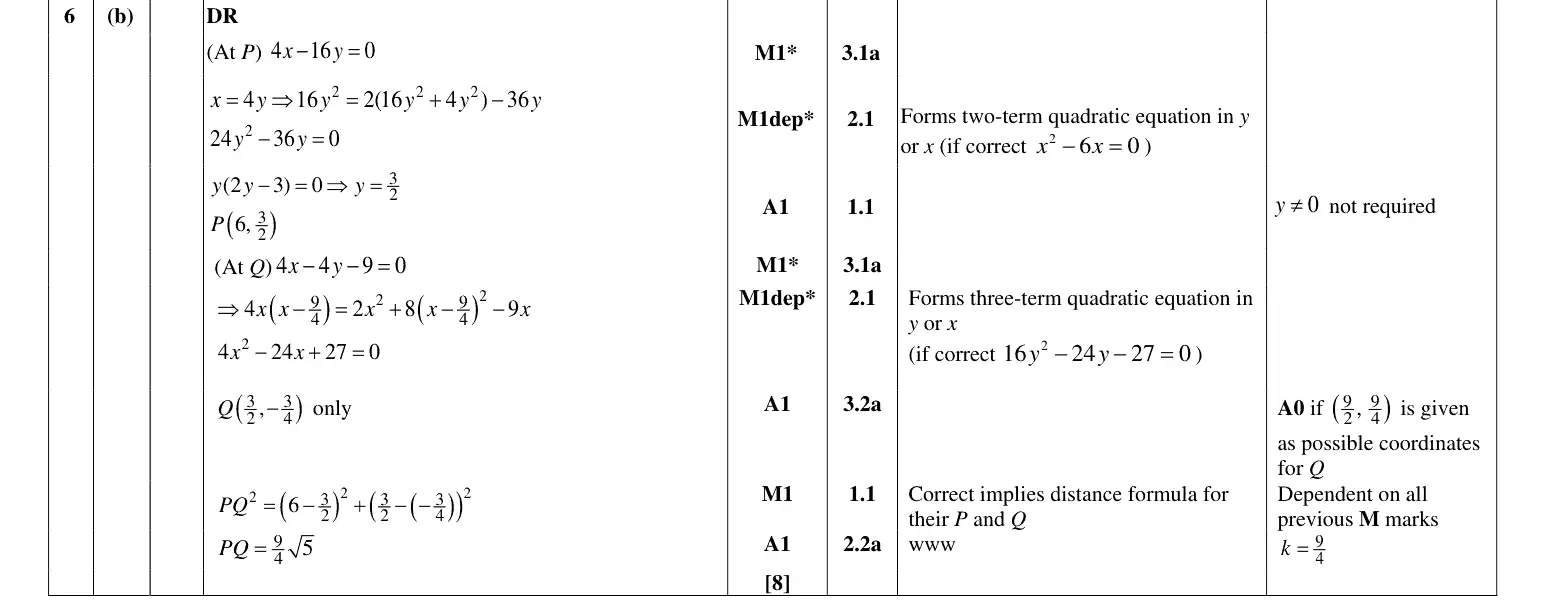
6(b) Implicit and parametric differentiation, Simultaneous equations, Straight lines, Quadratics and the discriminant 8 Medium
7(a) Constant acceleration (SUVAT), Vectors 4 Easy
7(b) Constant acceleration (SUVAT) 2 Easy
8(a) Variable acceleration 1 Easy
8(b) Variable acceleration, Differentiation: first principles, gradients, stationary points, Simultaneous equations 4 Easy
8(c) Variable acceleration, Integration: standard integrals, definite integrals and areas 2 Medium
9(a) Constant acceleration (SUVAT) 1 Easy
9(b) Forces, Newton's laws and connected particles 3 Medium
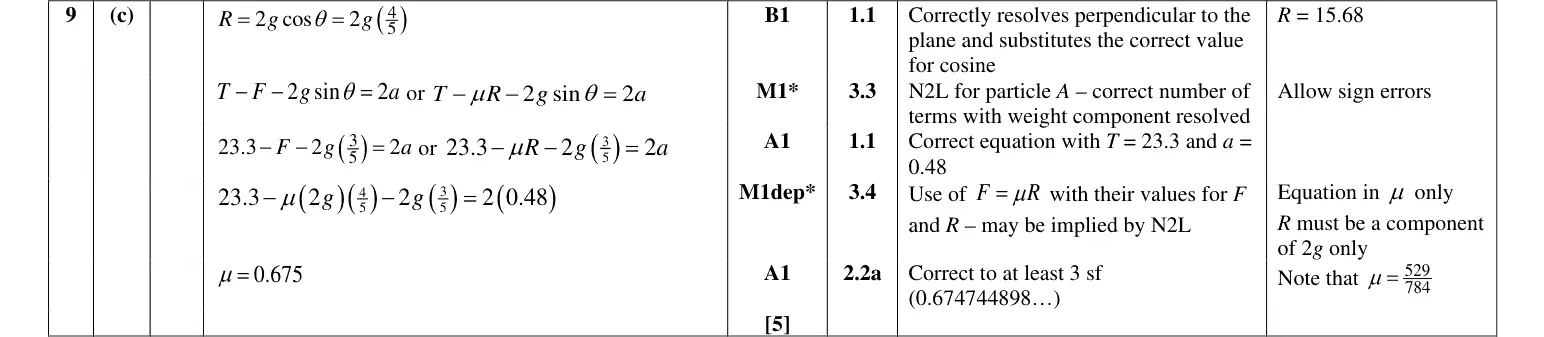
9(c) Forces, Newton's laws and connected particles, Friction, resultant forces and motion in a plane, Trigonometric ratios, graphs, radians and the sine and cosine rules 5 Medium
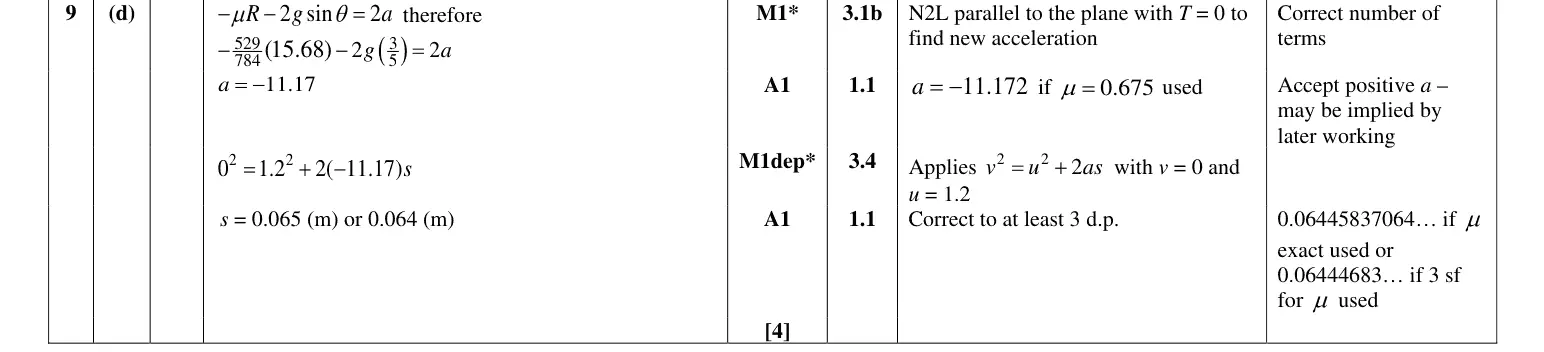
9(d) Friction, resultant forces and motion in a plane, Constant acceleration (SUVAT) 4 Medium
10(a) Moments, Trigonometric ratios, graphs, radians and the sine and cosine rules 4 Medium
10(b)(i) Moments, Friction, resultant forces and motion in a plane, Trigonometric ratios, graphs, radians and the sine and cosine rules 4 Medium
10(b)(ii) Friction, resultant forces and motion in a plane, Trigonometric ratios, graphs, radians and the sine and cosine rules 2 Medium
10(c) Moments 1 Medium
11(a) Projectiles, Constant acceleration (SUVAT) 4 Medium
11(b) Projectiles, Constant acceleration (SUVAT) 2 Medium
11(c) Projectiles 3 Hard
11(d) Projectiles, Trigonometric ratios, graphs, radians and the sine and cosine rules 4 Hard

The questions

123(a)3(b)3(c)3(d)4(a)4(b)4(c)4(d)5(a)5(b)5(c)6(a)6(b)7(a)7(b)8(a)8(b)8(c)9(a)9(b)9(c)9(d)10(a)10(b)(i)10(b)(ii)10(c)11(a)11(b)11(c)11(d)
Autumn 2020 · Paper 3 · Q1 2 marks Easy trigonometric ratios
1 Triangle ABC has AB = 8.5 cm, BC = 6.2 cm and angle B = 35°. Calculate the area of the triangle. [2]
Autumn 2020 · Paper 3 · Q2 3 marks Hard graphs and transformationsexponentials and logs
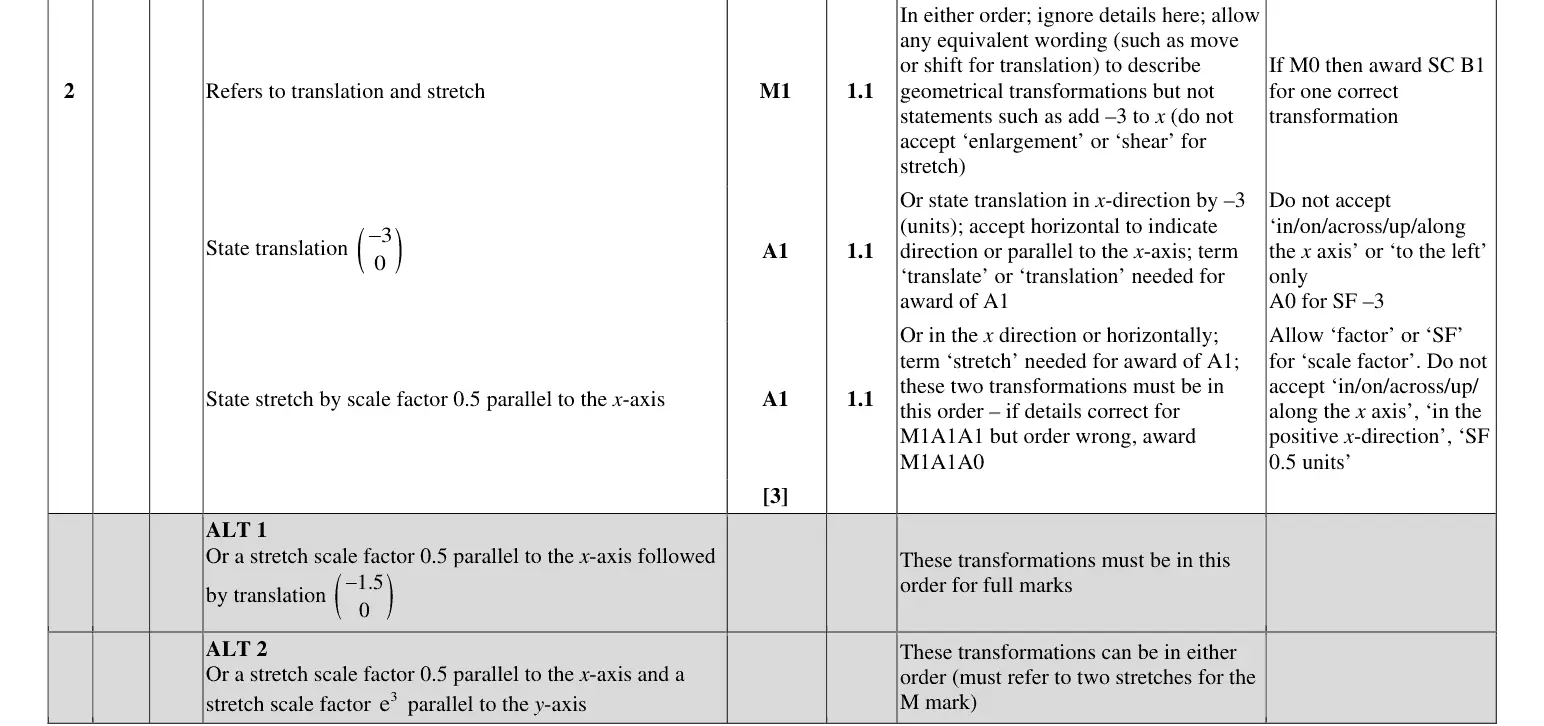
+ . ex e x 2 A sequence of transformations maps the curve y to the curve y = = Give details of these transformations. [3]

Autumn 2020 · Paper 3 · Q3(a) 3 marks Medium functionsquadratics
3 The functions f and g are defined for all real values of x by f x ( ) x x and ( ) g x x + . = + = (a) Find the range of f. [3]
Autumn 2020 · Paper 3 · Q3(b) 1 mark Medium functions
Show the start of this questionEarlier part of this question
(b) Give a reason why f has no inverse. [1]
Autumn 2020 · Paper 3 · Q3(c) 4 marks Medium functions
Show the start of this questionEarlier part of this question
(c) Given that fg ( ) g - ( ) a , where a is a constant, determine the value of a. [4] - =
Autumn 2020 · Paper 3 · Q3(d) 3 marks Medium inequalities
Show the start of this questionEarlier part of this question
(d) Determine the set of values of x for which ( ) f x g ( ) x . Give your answer in set notation. [3]
Autumn 2020 · Paper 3 · Q4(a) 5 marks Medium differentiationdifferentiation rules
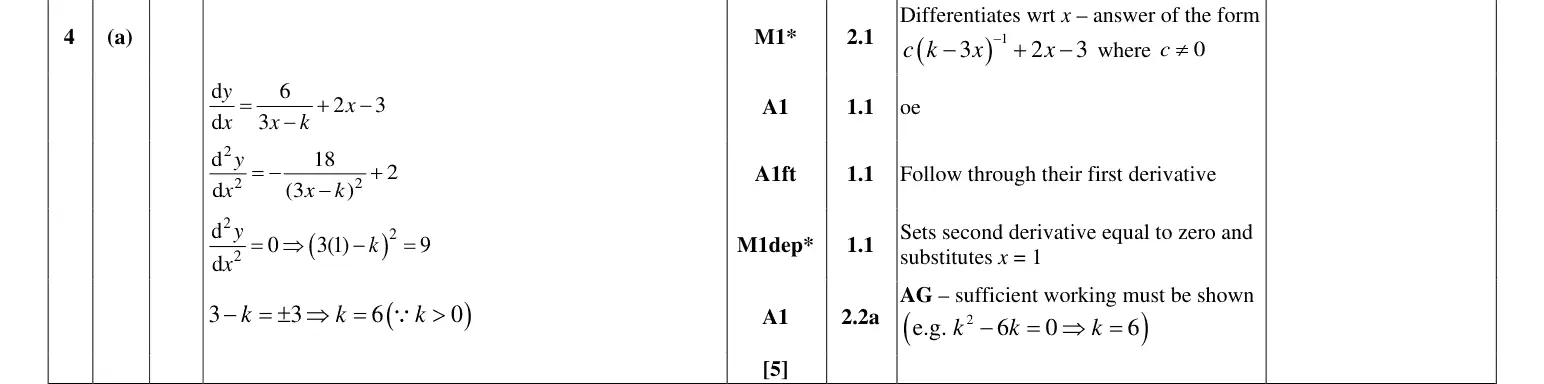
4 A curve has equation y ln ( k x ) x x , where k is a positive constant. = - + - (a) Given that the curve has a point of inflection where x = 1, show that k = 6. [5]
Autumn 2020 · Paper 3 · Q4(b) 2 marks Medium numerical methods
Show the start of this questionEarlier part of this question
It is also given that the curve intersects the x-axis at exactly one point. (b) Show by calculation that the x-coordinate of this point lies between 0.5 and 1.5. [2]
Autumn 2020 · Paper 3 · Q4(c) 3 marks Easy numerical methodsdifferentiation rules
Show the start of this questionEarlier part of this questionEarlier part of this question
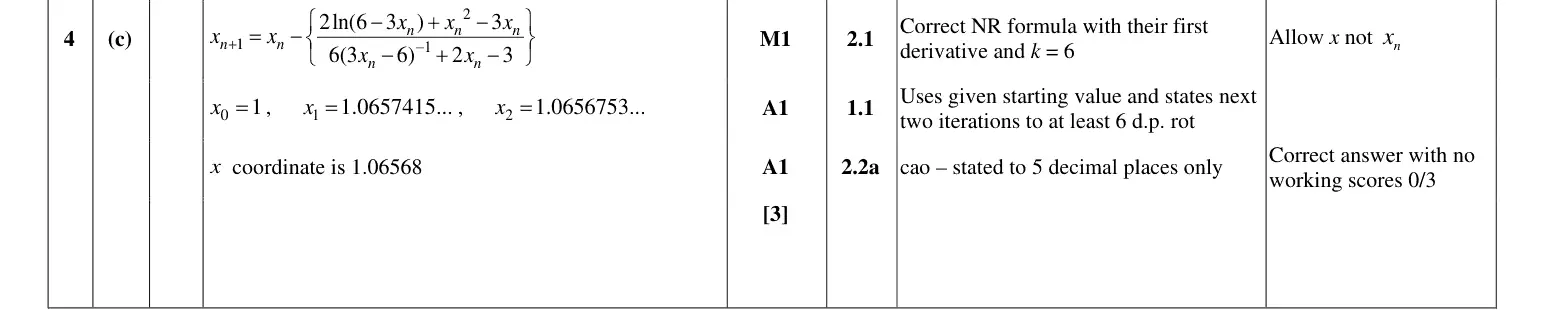
(c) Use the Newton-Raphson method, with initial value x 0 = , to find the x-coordinate of the point where the curve intersects the x-axis, giving your answer correct to 5 decimal places. Show the result of each iteration to 6 decimal places. [3]


Autumn 2020 · Paper 3 · Q4(d) 1 mark Medium numerical methods
Show the start of this questionEarlier part of this question
(d) By choosing suitable bounds, verify that your answer to part (c) is correct to 5 decimal places. [1]
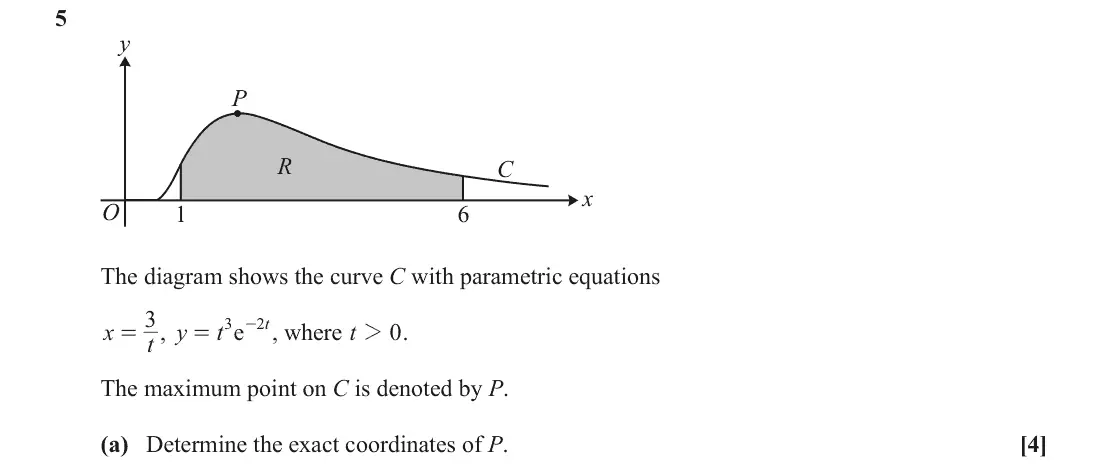
5 y P R C x O The diagram shows the curve C with parametric equations - , where t t x , y t e . = = t The maximum point on C is denoted by P. (a) Determine the exact coordinates of P. [4]
Autumn 2020 · Paper 3 · Q5(b) 3 marks Medium integration by parts and substitutionparametric equations
Show the start of this questionEarlier part of this question
The shaded region R is enclosed by the curve, the x-axis and the lines x = 1 and x = 6. (b) Show that the area of R is given by b y t 3 e t - d t , a where a and b are constants to be determined. [3]
Autumn 2020 · Paper 3 · Q5(c) 5 marks Easy integration by parts and substitutionintegration
Show the start of this questionEarlier part of this questionEarlier part of this question
(c) Hence determine the exact area of R. [5]
Autumn 2020 · Paper 3 · Q6(a) 3 marks Easy implicit and parametric differentiation
6 In this question you must show detailed reasoning. y P x O Q The diagram shows the curve with equation xy ( x y ) x . = + - y x y d = - . - (a) Show that x [3] x y d -
Show the start of this questionEarlier part of this question
At the point P on the curve the tangent to the curve is parallel to the y-axis and at the point Q on the curve the tangent to the curve is parallel to the x-axis. (b) Show that the distance PQ is k 5, where k is a rational number to be determined. [8]
Autumn 2020 · Paper 3 · Q7(a) 4 marks Easy constant accelerationvectors
- . At time t = 0 seconds, P is moving 2 ms 2 7 A particle P moves with constant acceleration ( i j ) - + - . 6 ms 1 with velocity ( i j ) + (a) Determine the speed of P when t = 3. [4]
Autumn 2020 · Paper 3 · Q7(b) 2 marks Easy constant acceleration
Show the start of this questionEarlier part of this question
(b) Determine the change in displacement of P between t = 0 and t = 3. [2]
Autumn 2020 · Paper 3 · Q8(a) 1 mark Easy variable acceleration
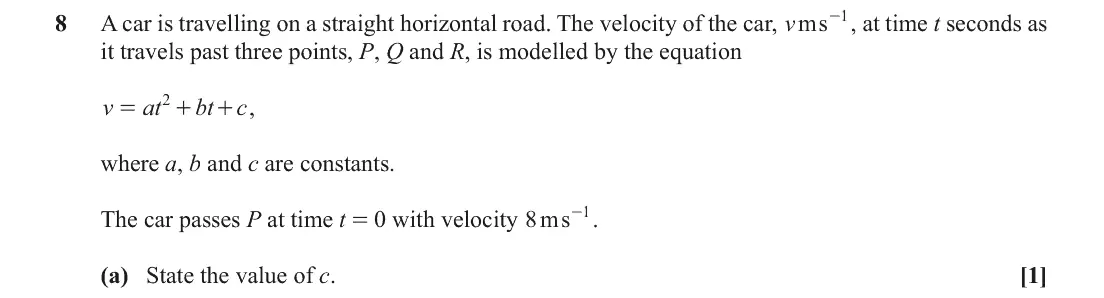
- , at time t seconds as A car is travelling on a straight horizontal road. The velocity of the car, vms 1 8 it travels past three points, P, Q and R, is modelled by the equation v at bt + , c = + where a, b and c are constants. - . The car passes P at time t = 0 with velocity 8ms 1 (a) State the value of c. [1]
Autumn 2020 · Paper 3 · Q8(b) 4 marks Easy variable accelerationdifferentiationsimultaneous equations
Show the start of this questionEarlier part of this question
- . The car passes R at The car passes Q at time t = 5 and at that instant its deceleration is .0 12 ms 2 - . time t = 18 with velocity .2 96 ms 1 (b) Determine the values of a and b. [4]
Autumn 2020 · Paper 3 · Q8(c) 2 marks Medium variable accelerationintegration
Show the start of this questionEarlier part of this questionEarlier part of this question
(c) Find, to the nearest metre, the distance between points P and R. [2]
Autumn 2020 · Paper 3 · Q9(a) 1 mark Easy constant acceleration
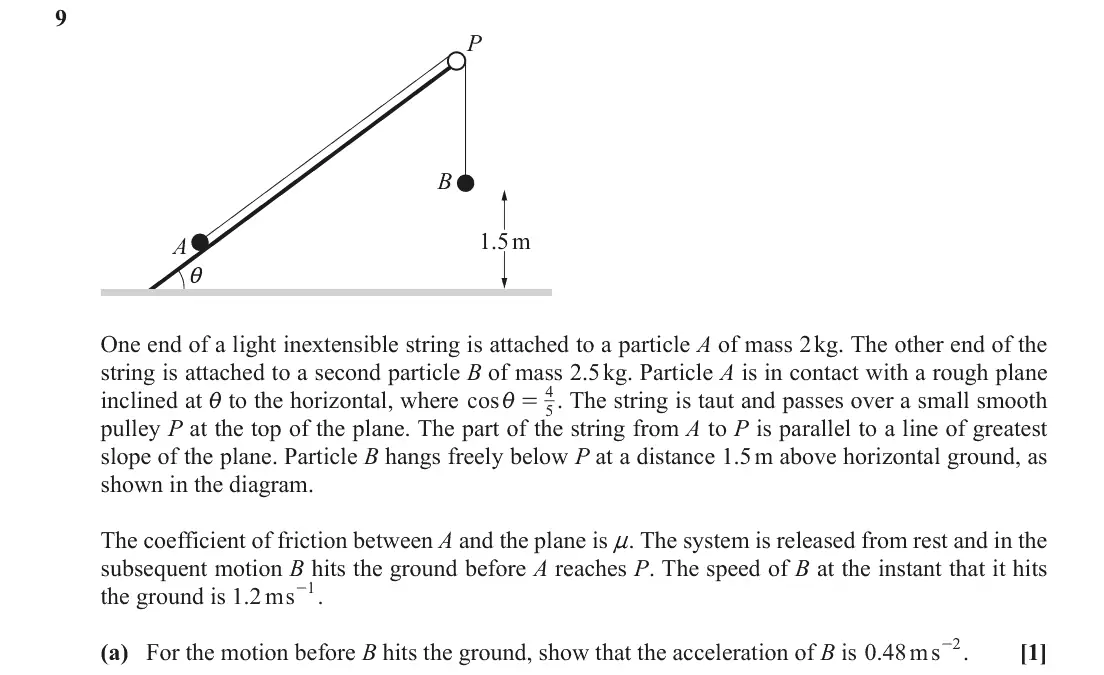
9 P B 1.5 m A i One end of a light inextensible string is attached to a particle A of mass 2 kg. The other end of the string is attached to a second particle B of mass 2.5 kg. Particle A is in contact with a rough plane inclined at i to the horizontal, where cos . The string is taut and passes over a small smooth i = pulley P at the top of the plane. The part of the string from A to P is parallel to a line of greatest slope of the plane. Particle B hangs freely below P at a distance 1.5 m above horizontal ground, as shown in the diagram. The coefficient of friction between A and the plane is n. The system is released from rest and in the subsequent motion B hits the ground before A reaches P. The speed of B at the instant that it hits - . the ground is .1 2 ms 1 - . (a) For the motion before B hits the ground, show that the acceleration of B is . 0 48 ms [1]
Autumn 2020 · Paper 3 · Q9(b) 3 marks Medium forces and newtons laws
Show the start of this questionEarlier part of this question
(b) For the motion before B hits the ground, show that the tension in the string is 23.3 N. [3]
Autumn 2020 · Paper 3 · Q9(c) 5 marks Medium forces and newtons lawsfriction and forces in a planetrigonometric ratios
Show the start of this questionEarlier part of this questionEarlier part of this question
(c) Determine the value of n. [5]
Autumn 2020 · Paper 3 · Q9(d) 4 marks Medium friction and forces in a planeconstant acceleration
Show the start of this questionEarlier part of this questionEarlier part of this questionEarlier part of this question
After B hits the ground, A continues to travel up the plane before coming to instantaneous rest before it reaches P. (d) Determine the distance that A travels from the instant that B hits the ground until A comes to instantaneous rest. [4]
Autumn 2020 · Paper 3 · Q10(a) 4 marks Medium momentstrigonometric ratios
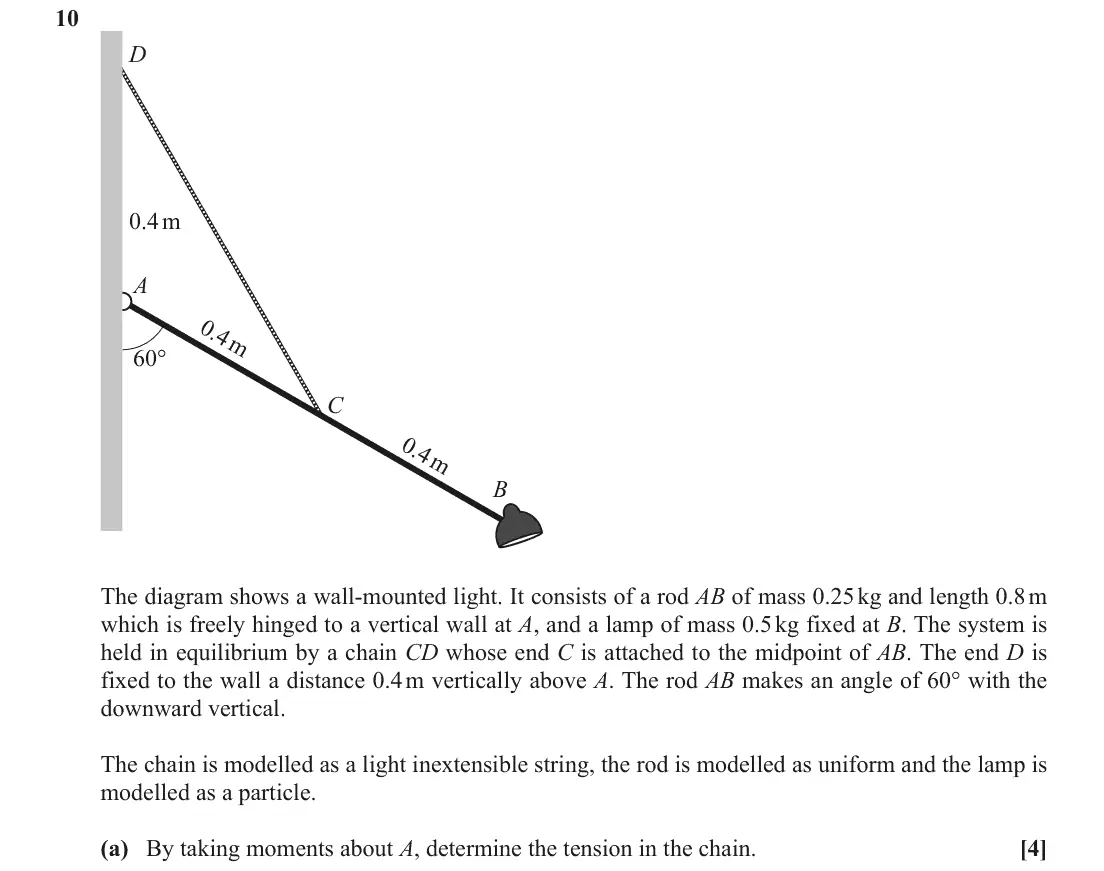
10 D 0.4 m A 0.4 m 60° C 0.4 m B The diagram shows a wall-mounted light. It consists of a rod AB of mass 0.25 kg and length 0.8 m which is freely hinged to a vertical wall at A, and a lamp of mass 0.5 kg fixed at B. The system is held in equilibrium by a chain CD whose end C is attached to the midpoint of AB. The end D is fixed to the wall a distance 0.4 m vertically above A. The rod AB makes an angle of 60° with the downward vertical. The chain is modelled as a light inextensible string, the rod is modelled as uniform and the lamp is modelled as a particle. (a) By taking moments about A, determine the tension in the chain. [4]
Autumn 2020 · Paper 3 · Q10(b)(i) 4 marks Medium momentsfriction and forces in a planetrigonometric ratios
Show the start of this questionEarlier part of this question
(b) (i) Determine the magnitude of the force exerted on the rod at A. [4]
Autumn 2020 · Paper 3 · Q10(b)(ii) 2 marks Medium friction and forces in a planetrigonometric ratios
Show the start of this questionEarlier part of this questionEarlier part of this question
(ii) Calculate the direction of the force exerted on the rod at A. [2]
Autumn 2020 · Paper 3 · Q10(c) 1 mark Medium moments
Show the start of this questionEarlier part of this question
(c) Suggest one improvement that could be made to the model to make it more realistic. [1]
Autumn 2020 · Paper 3 · Q11(a) 4 marks Medium projectilesconstant acceleration
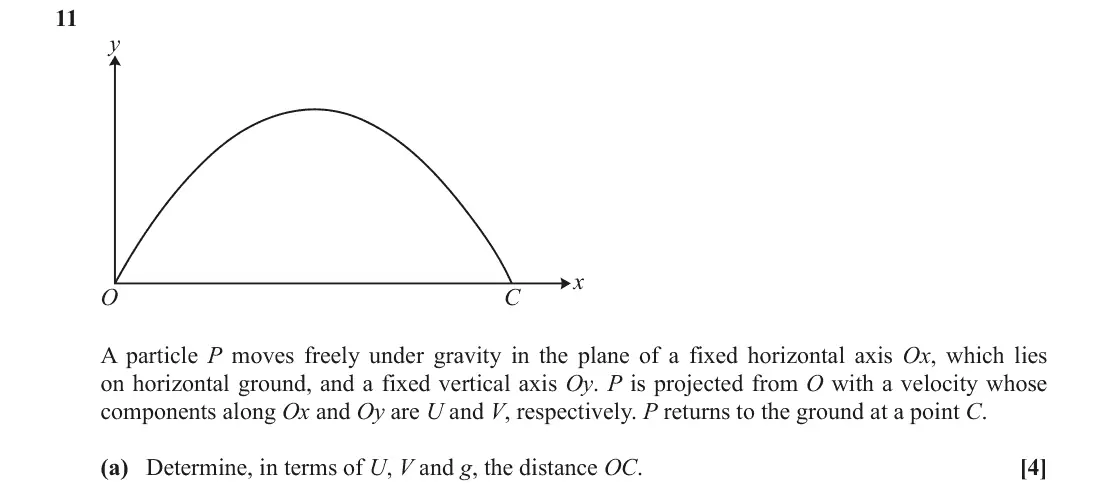
11 y x O C A particle P moves freely under gravity in the plane of a fixed horizontal axis Ox, which lies on horizontal ground, and a fixed vertical axis Oy. P is projected from O with a velocity whose components along Ox and Oy are U and V, respectively. P returns to the ground at a point C. (a) Determine, in terms of U, V and g, the distance OC. [4]
Autumn 2020 · Paper 3 · Q11(b) 2 marks Medium projectilesconstant acceleration
Show the start of this questionEarlier part of this question
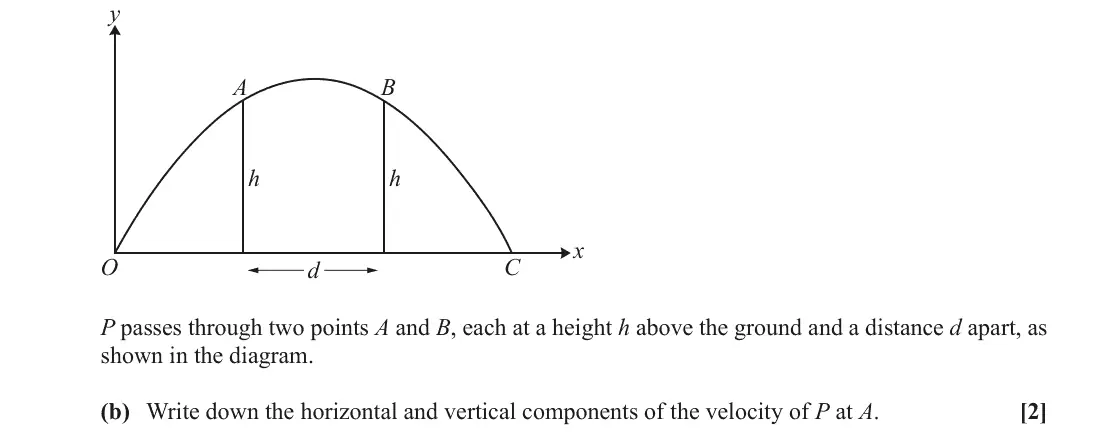
y A B h h x O C d P passes through two points A and B, each at a height h above the ground and a distance d apart, as shown in the diagram. (b) Write down the horizontal and vertical components of the velocity of P at A. [2]
Autumn 2020 · Paper 3 · Q11(c) 3 marks Hard projectiles
Show the start of this questionEarlier part of this questionEarlier part of this question
(c) Hence determine an expression for d in terms of U, V, g and h. [3]
Autumn 2020 · Paper 3 · Q11(d) 4 marks Hard projectilestrigonometric ratios
Show the start of this questionEarlier part of this questionEarlier part of this question
(d) Given that the direction of motion of P as it passes through A is inclined to the horizontal at an angle i, where tan , determine an expression for V in terms of g, d and h. [4] i =

Find an A-level maths tutor

Want this paper marked and gone through with you? Message us.

Prefer email? Send an enquiry

If you are under 18, please include a parent's contact details. Enquiries go to enquiries@mathsaleveltutor.com and are deleted once handled.