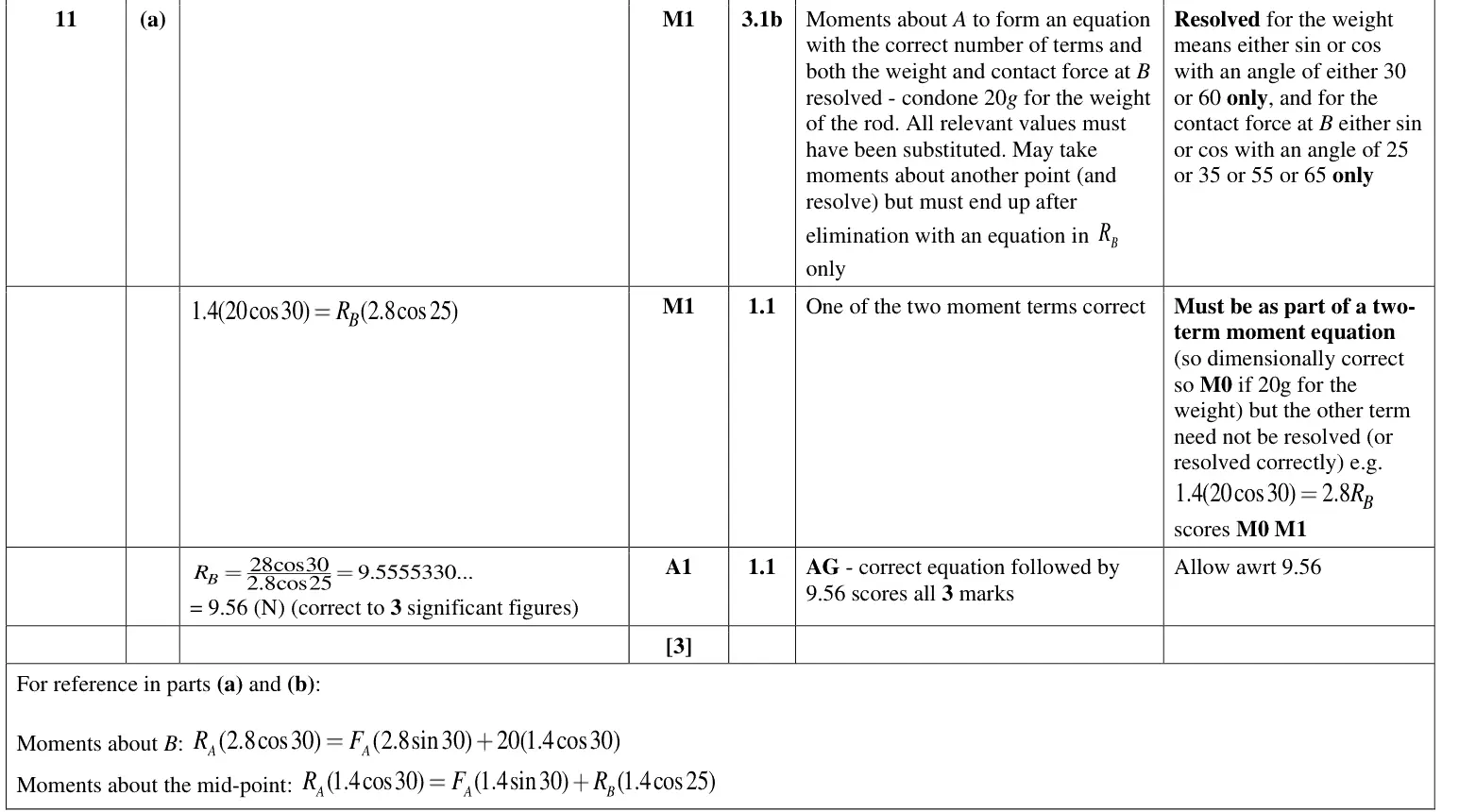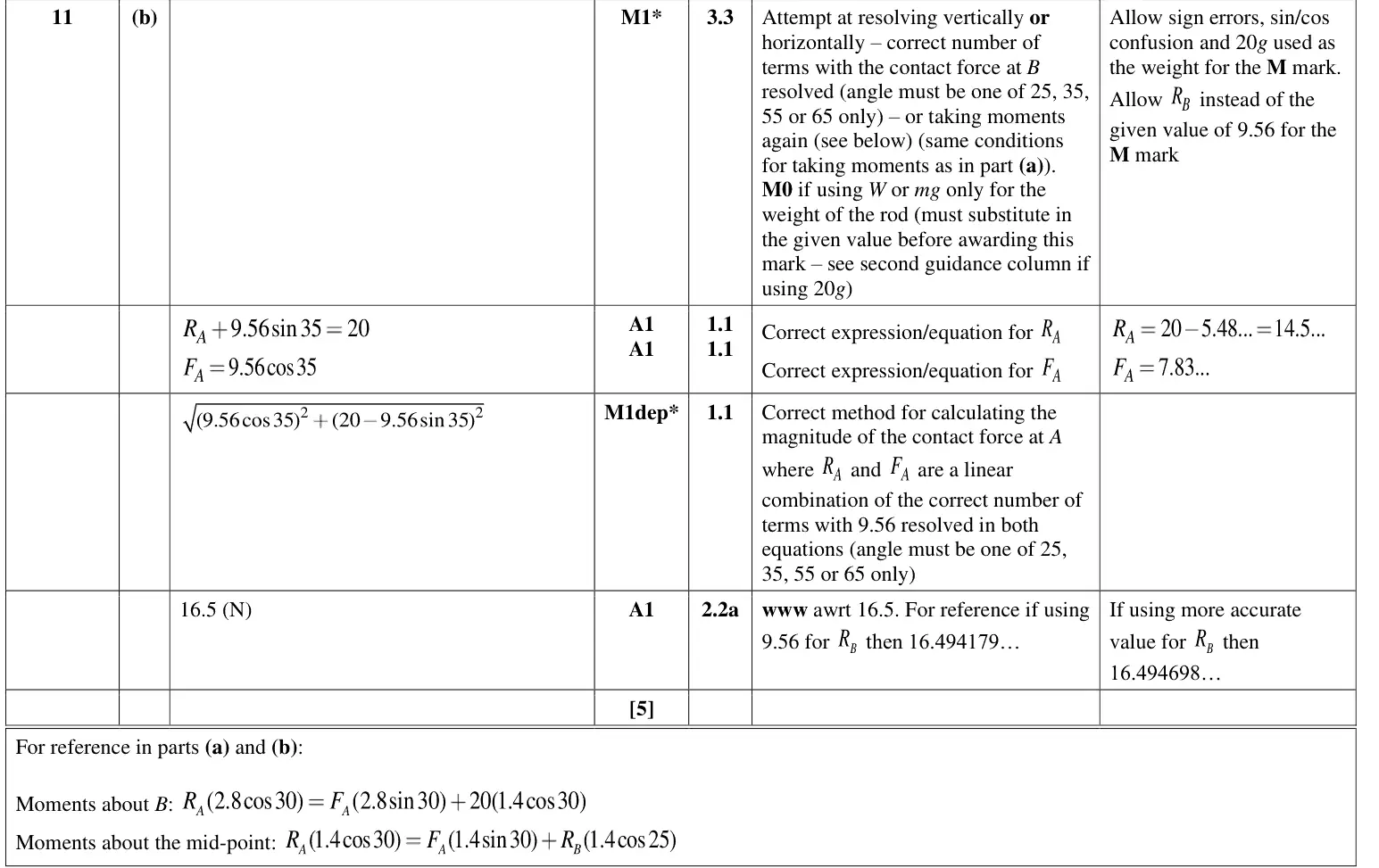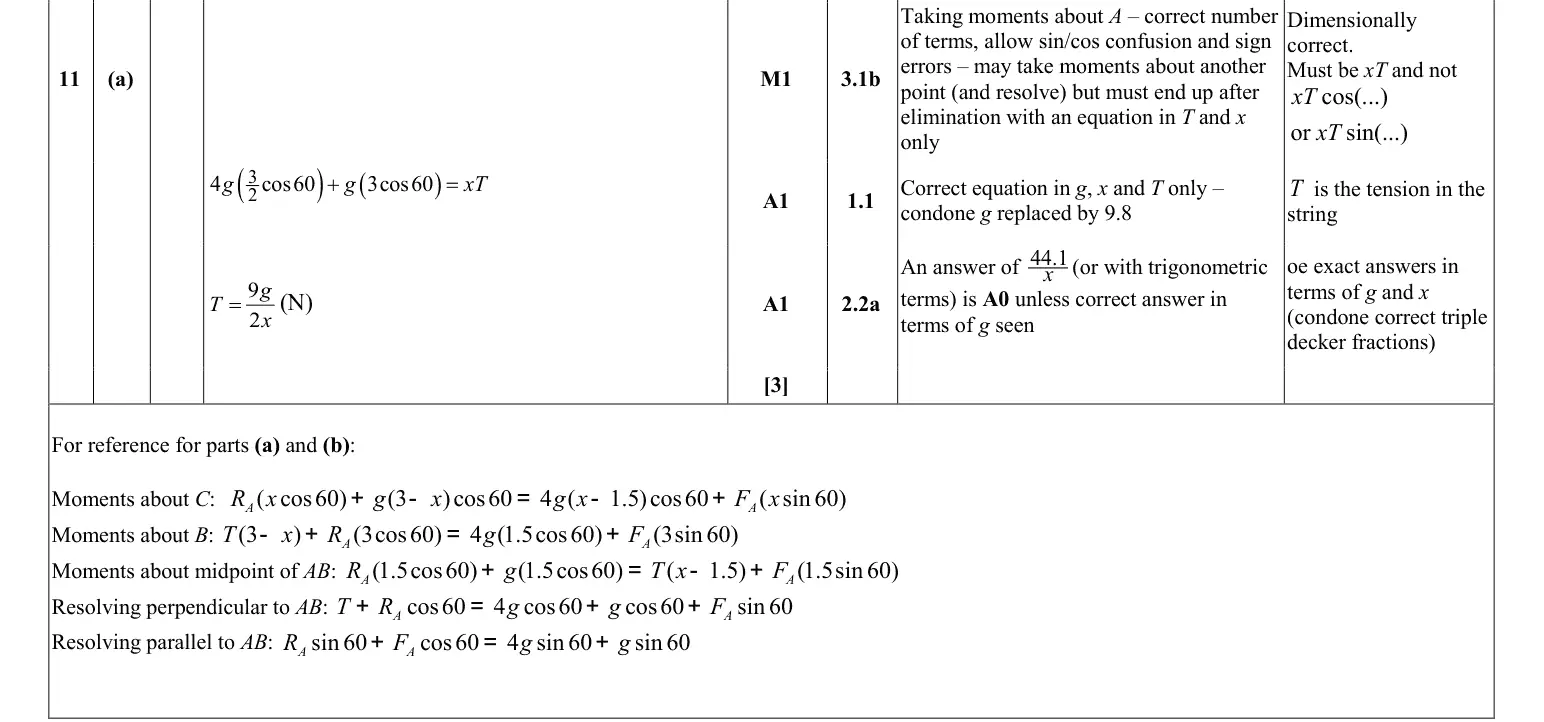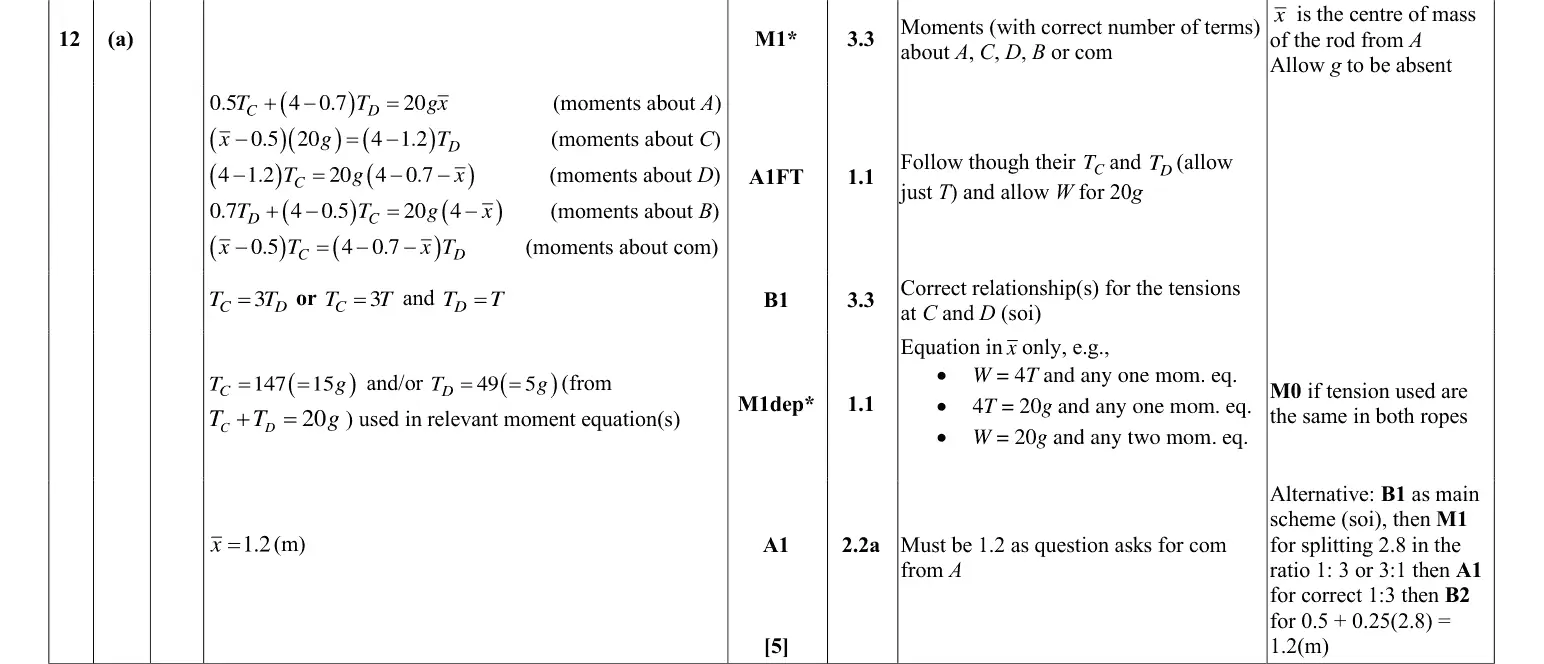
Mark scheme for this part

Examiner's comment
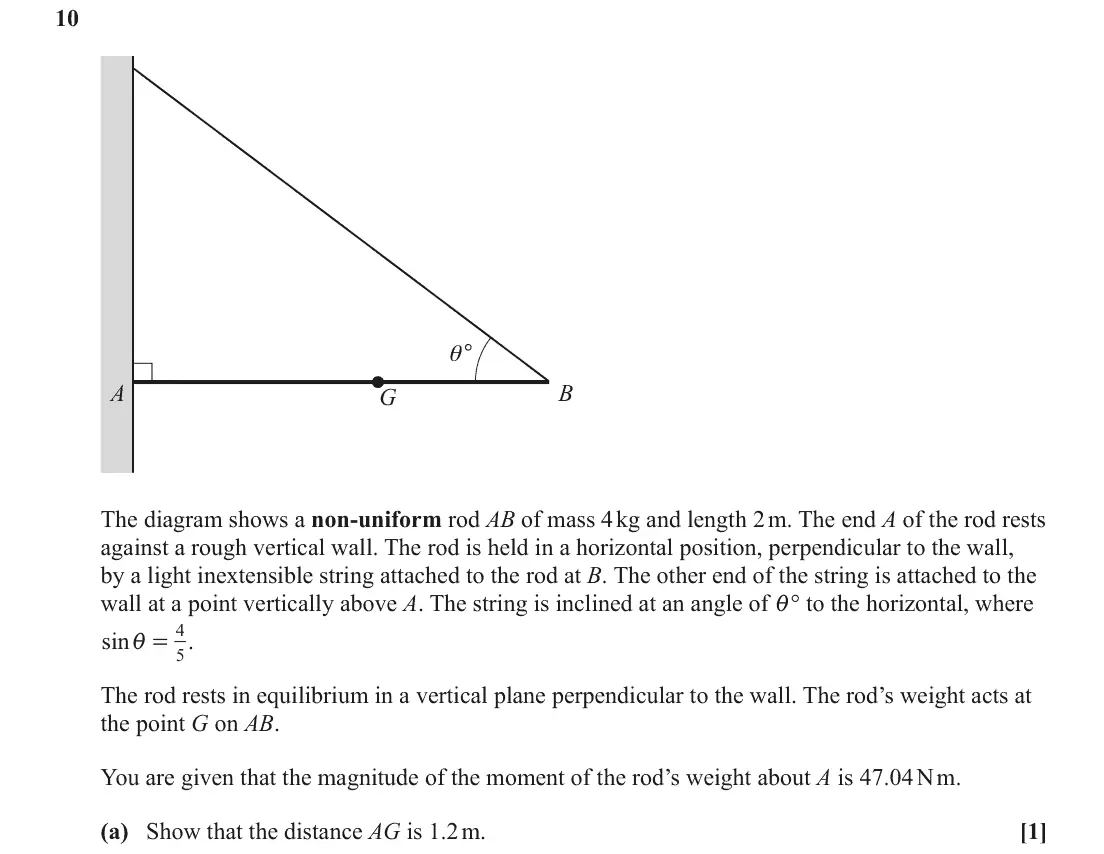
Most candidates correctly showed the required distance in this part by considering 𝐴𝐺× 4𝑔= 47.04.
Key points and common errors
- AG × 4g = 47.04 so AG = 1.2 m
Notes, worked examples and practice for this topic are being written by our tutors. The past-paper questions below are ready now: work each one on paper, then open the mark scheme and the examiner's comment.
Print this topic as a pack questions first, then the mark schemes
Most candidates correctly showed the required distance in this part by considering 𝐴𝐺× 4𝑔= 47.04.

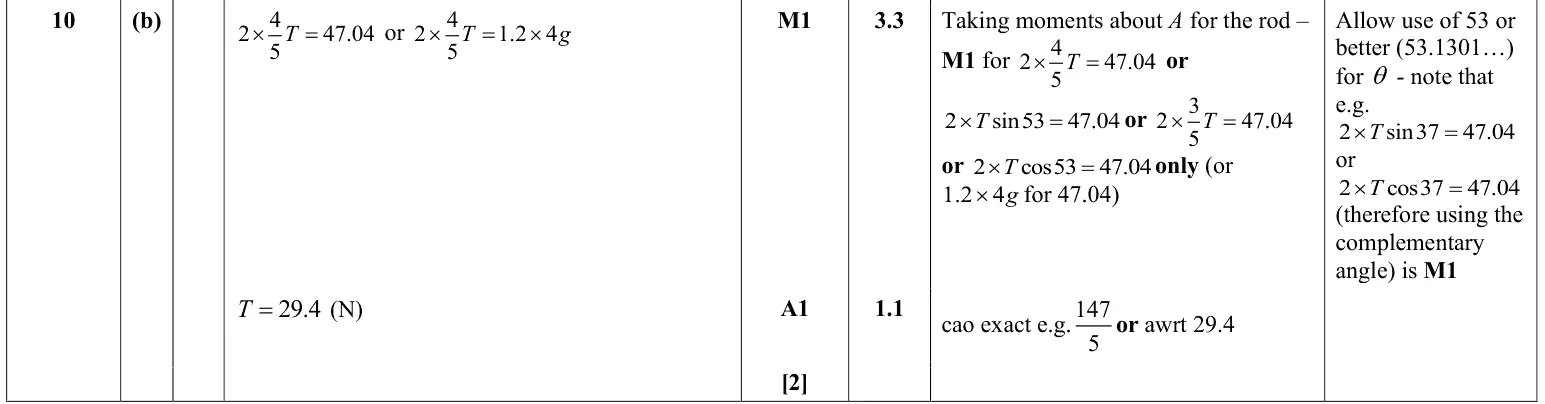
While most candidates seem to realise that the most effective way of finding the tension in the string was to take moments about A, many forgot to include a distance or used a wrong angle.

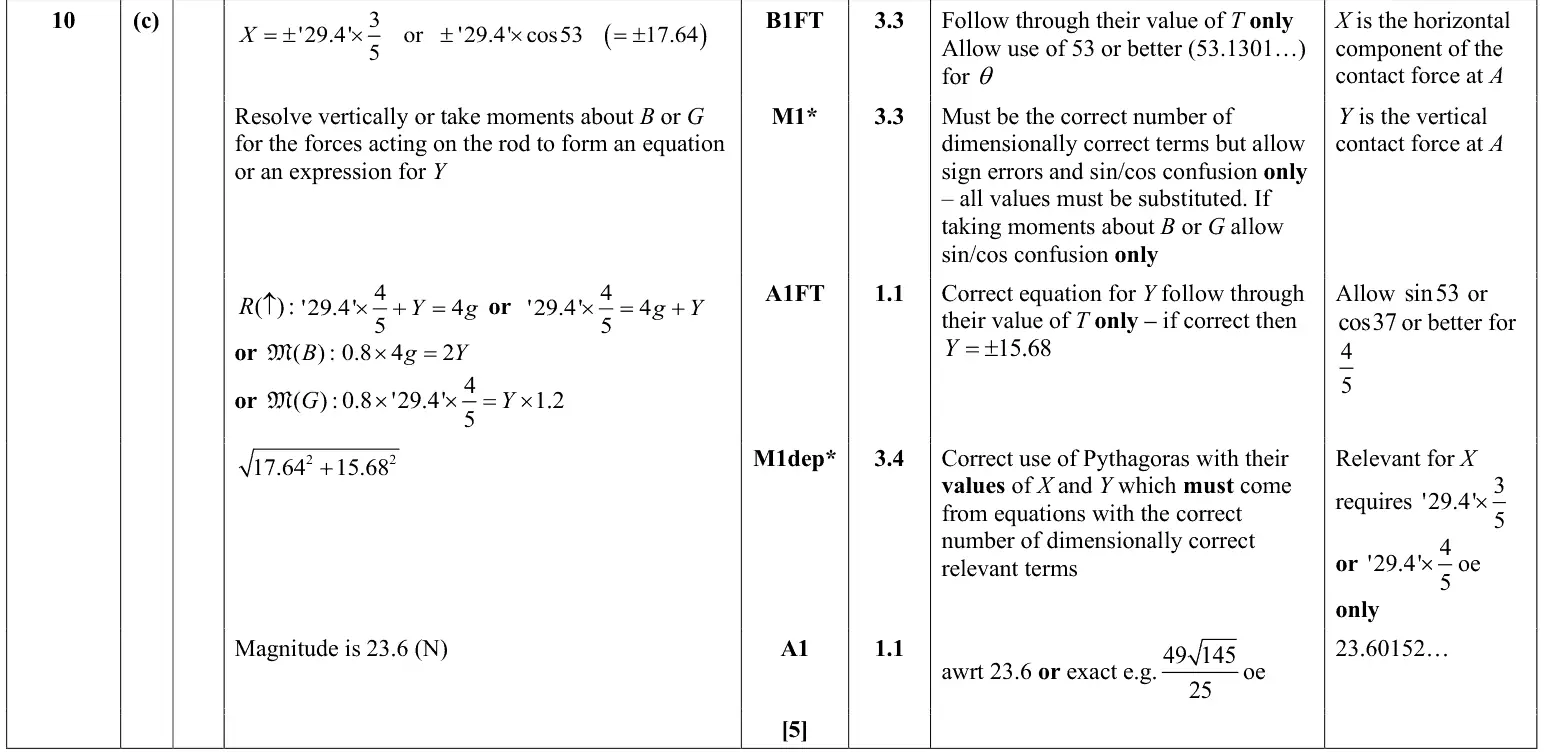
There was a common misconception in this part that the ‘magnitude of the contact force exerted on the rod by the wall at A’ referred only to a force with a horizontal component at the wall and not a vertical component too. Some candidates attempted to take moments again (most commonly about either points G or B) but these attempts were usually not as successful as those who resolved vertically and horizontally (and then completed the problem by used Pythagoras).
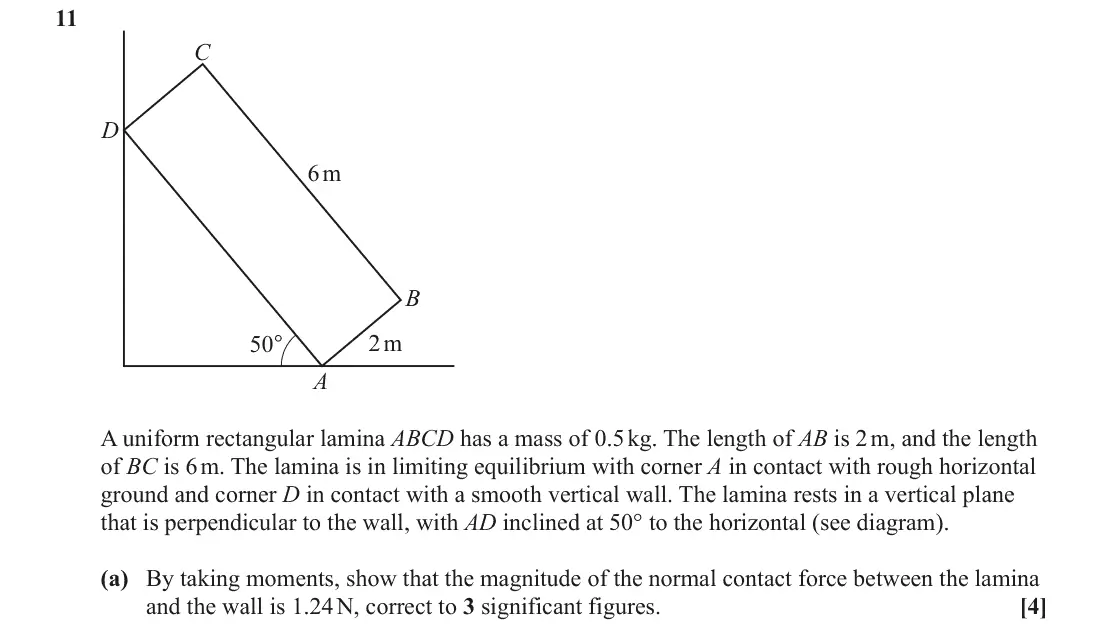
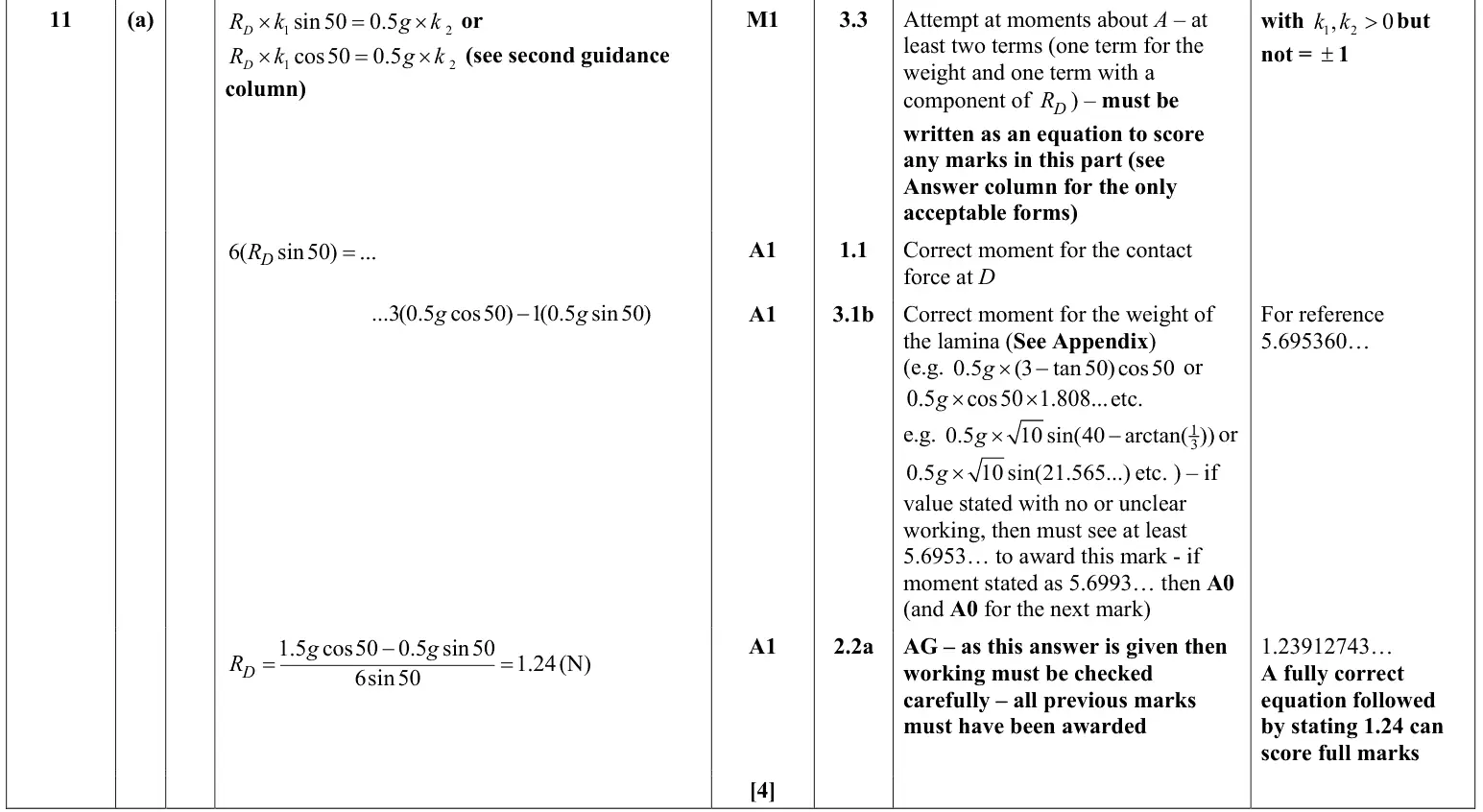
Although most candidates realised that the way to find the magnitude of the normal contact force acting on the lamina at 𝐵 was to take moments about point 𝐴, many struggled with the corresponding geometry of the situation. Although most correctly realised that the expression for the moment of the normal contact force was given by 𝑅𝐷× (6sin50), almost all could not deal correctly with the corresponding moment for the weight. The most efficient way of considering this moment was to resolve the weight in directions parallel and perpendicular to the sides of the lamina (and hence obtain the moment as 3 × (0.5𝑔cos 50) −1 × (0.5𝑔× sin50)).

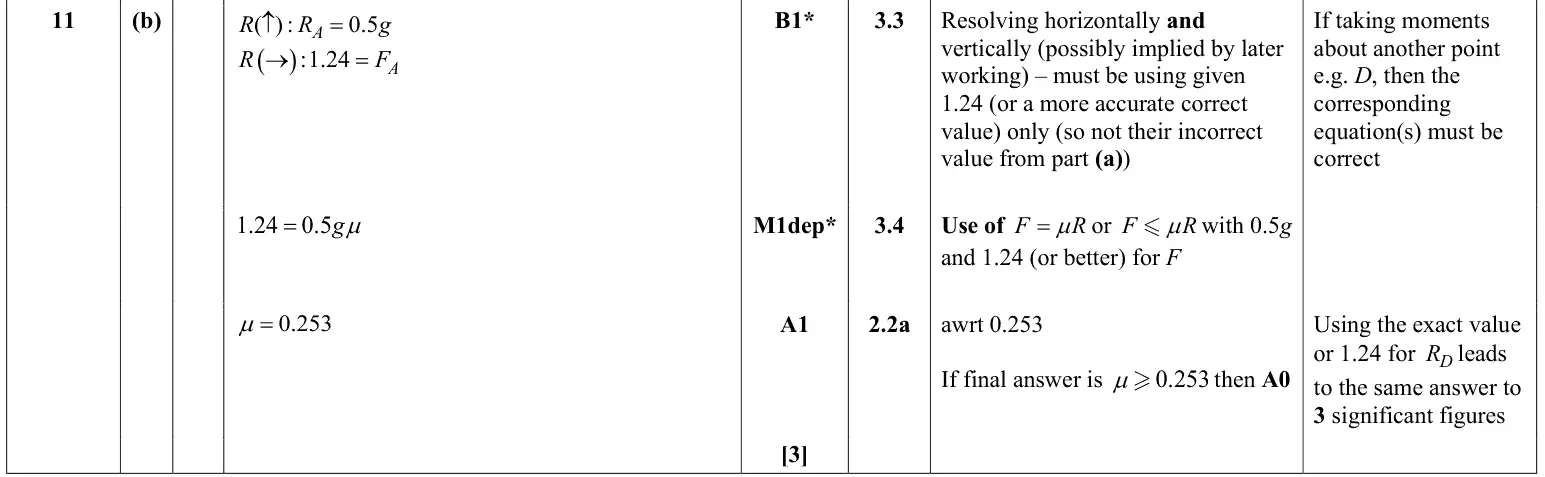
Many candidates left this relatively straightforward part blank (most likely due to their inability in obtaining the given answer in part (a)). It is clear that many candidates did not realise the direction of the forces acting at 𝐴 and/or 𝐷 and included unnecessary trigonometric terms. Occasionally candidates gave an answer that was not correct to 3 significant figures.
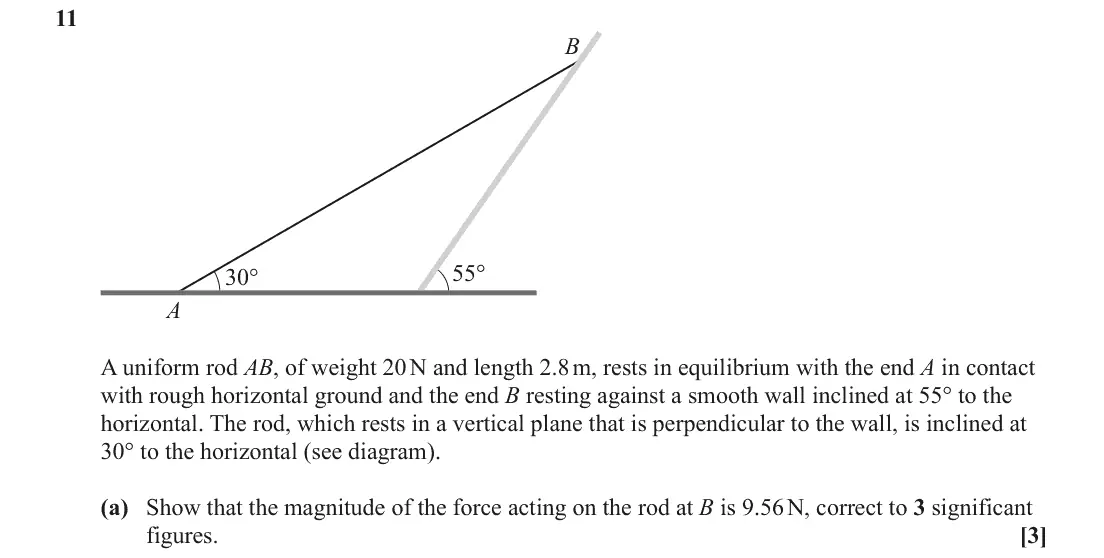
Although most candidates realised that the best way to find the magnitude of the force acting on the rod at B was to take moments about point A, many struggled with the corresponding geometry of the was given by 1.4(20cos30), most could not deal with the corresponding moment for the force acting at B situation. Although most candidates correctly realised that the expression for the moment of the weight with many having either an angle of 30, 60, 35 or 55.

There was a common misconception here that that the ‘magnitude of the contact force between the rod and the ground’ was just referring to the normal contact force at the ground and not the frictional force too. The same issue in part (a) was evident in this part too as many could not deal with the geometry when resolving vertically and horizontally (again it was common to see angles of 30 and 60 being used in this part even from those candidates who had the correct angle of either 25 or 65 in part (a)). Some candidates attempted to take moments again (most commonly about B) or resolved parallel and perpendicular to the rod but these attempts were rarely successful (as in most cases one or more forces were missing).
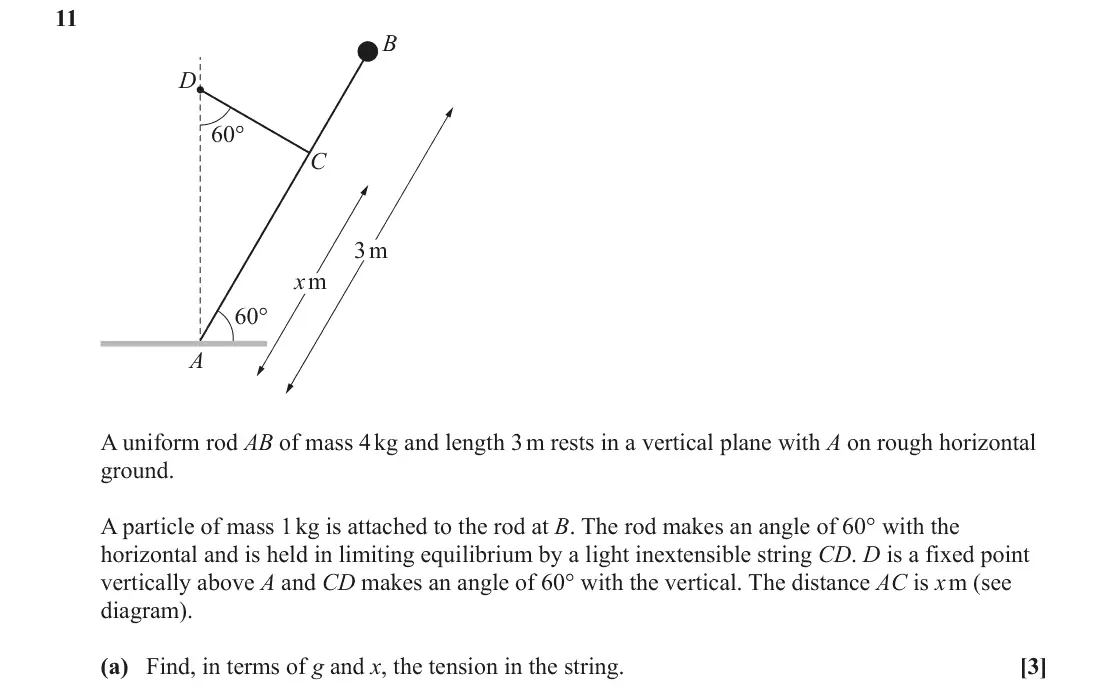
Although most candidates realised that the best way to find the tension in the string was to take moments about point A for the rod, many struggled with the corresponding geometry of the situation. ( ) ( ) xT = 4 g cos60 + g 3cos60 Although many did obtain the correct equation a number of candidates left their response either in terms of cos(60) or gave their response as 44.1 even though the question x specifically asked for a response in terms of g and x.
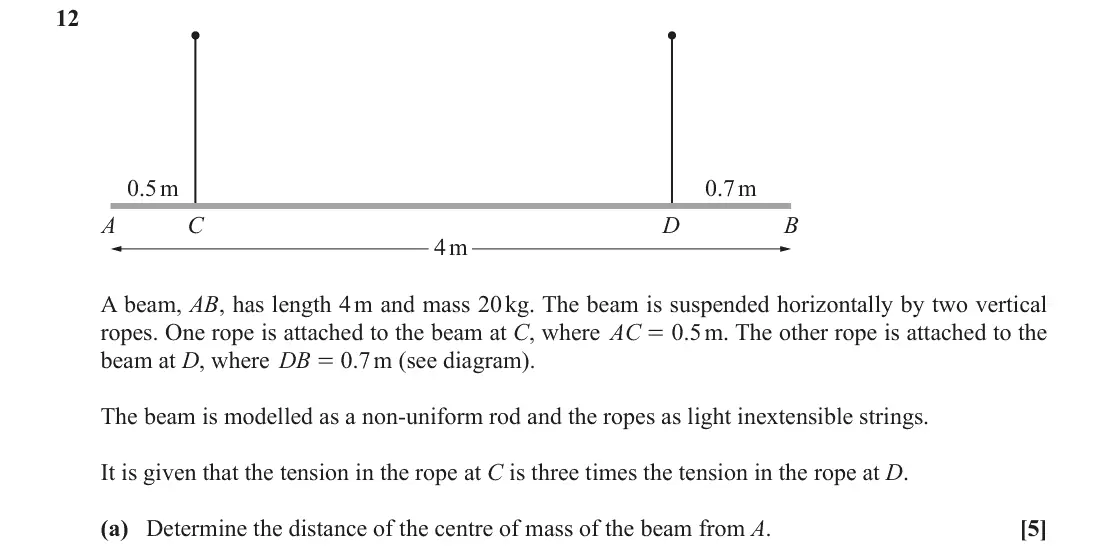

This was found to be the most demanding part of the paper. Most candidates did not realise that as the question asked for the largest possible value of m the most efficient way of finding this was to take moments about D as the tension in the rope at C would be zero. Most candidates who took moments about C still assumed the information about the relationship between the tensions in the two ropes from the stem to (a) still applied instead of realising that the tension in D would now be of magnitude 20 g mg .
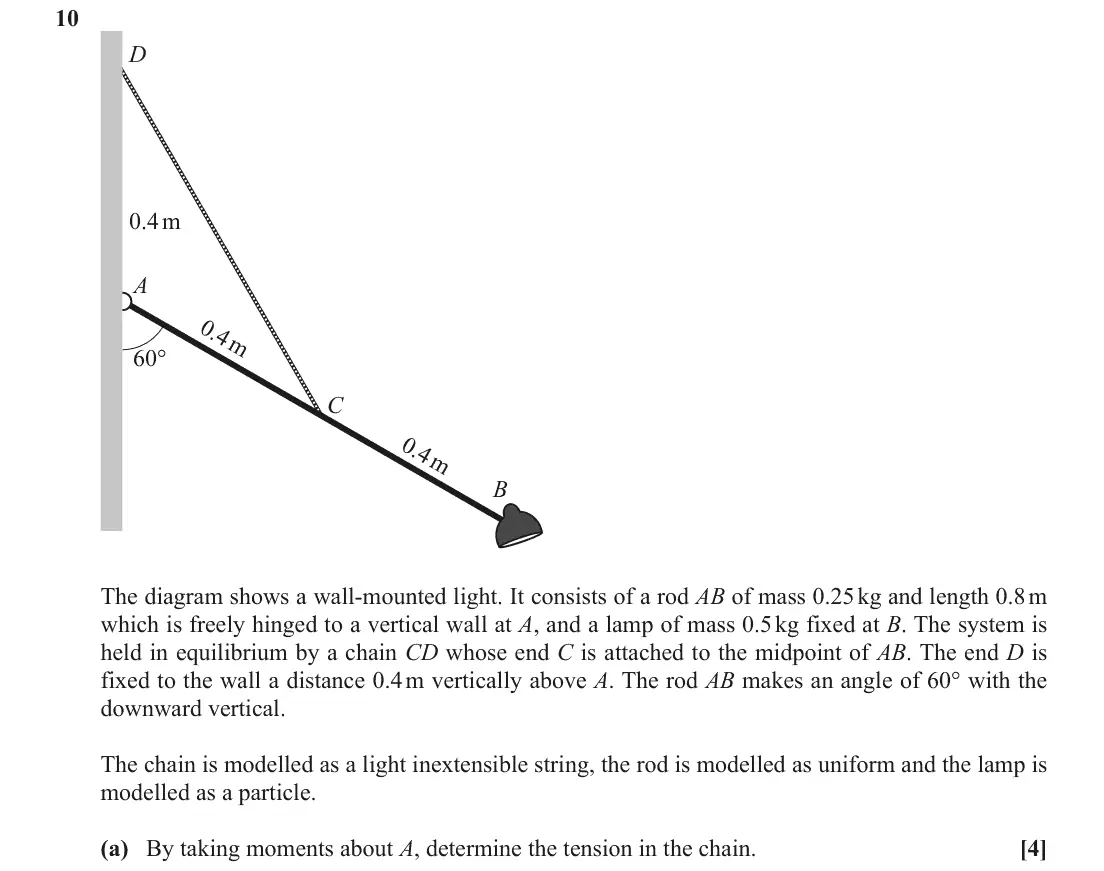
(Comment on Question 10 as a whole) A significant number of candidates did not follow the instruction to take moments about point A in part (a). It was also common to see candidates use mass rather than weight or miss some of the terms. Mixing sine and cosine was also common. In part (b) (i) it was mathematically easier to work with vertical and horizontal components of the force exerted on the rod at A rather than components parallel and perpendicular to the rod. Candidates that picked up marks on this question generally provided an annotated sketch with some degree of success. Part (b) (ii) was generally answered well by those that attempted it from their work on part (b) (i). However, of those, a few did not score both marks due to not clearly indicating what their angle was measured from (below the horizontal or measured from the downward vertical).

(Comment on Question 10 as a whole) A significant number of candidates did not follow the instruction to take moments about point A in part (a). It was also common to see candidates use mass rather than weight or miss some of the terms. Mixing sine and cosine was also common. In part (b) (i) it was mathematically easier to work with vertical and horizontal components of the force exerted on the rod at A rather than components parallel and perpendicular to the rod. Candidates that picked up marks on this question generally provided an annotated sketch with some degree of success. Part (b) (ii) was generally answered well by those that attempted it from their work on part (b) (i). However, of those, a few did not score both marks due to not clearly indicating what their angle was measured from (below the horizontal or measured from the downward vertical).

(Comment on Question 10 as a whole) A significant number of candidates did not follow the instruction to take moments about point A in part (a). It was also common to see candidates use mass rather than weight or miss some of the terms. Mixing sine and cosine was also common. In part (b) (i) it was mathematically easier to work with vertical and horizontal components of the force exerted on the rod at A rather than components parallel and perpendicular to the rod. Candidates that picked up marks on this question generally provided an annotated sketch with some degree of success. Part (b) (ii) was generally answered well by those that attempted it from their work on part (b) (i). However, of those, a few did not score both marks due to not clearly indicating what their angle was measured from (below the horizontal or measured from the downward vertical).
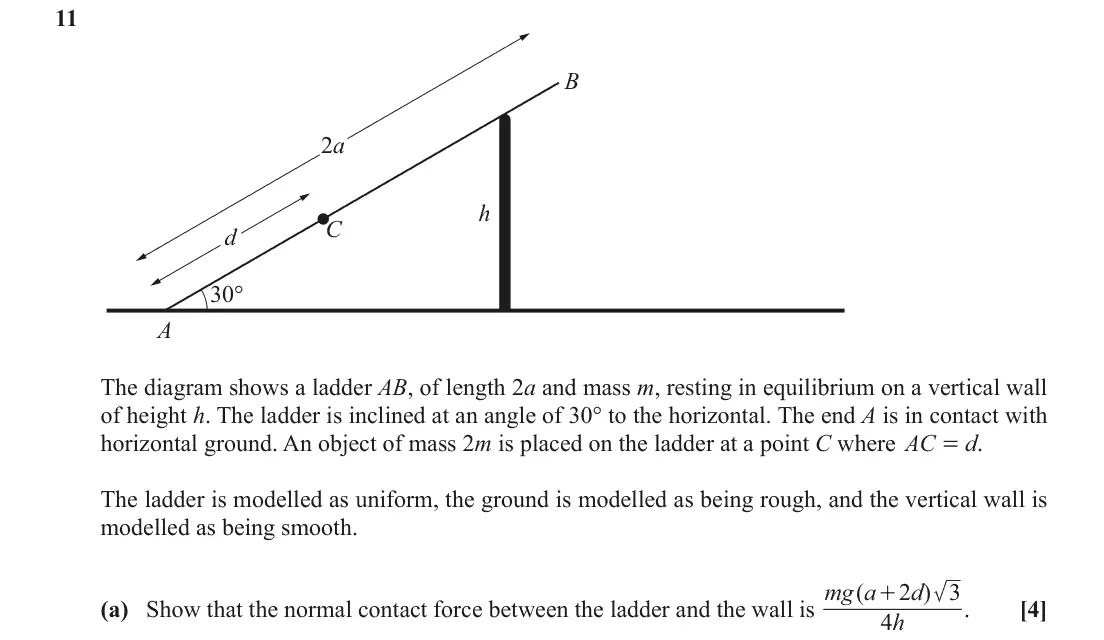
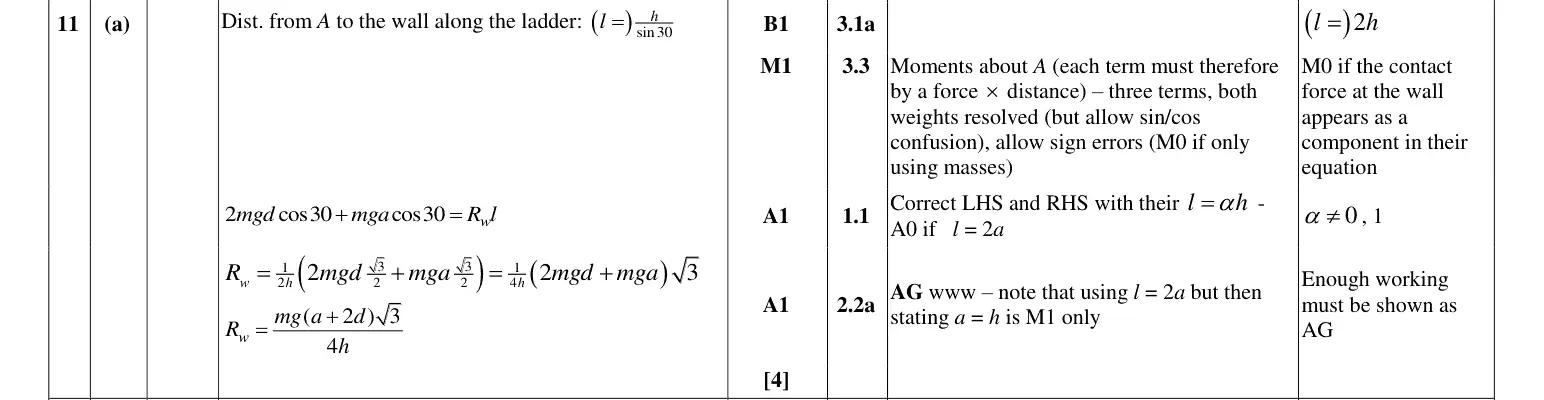
While many candidates correctly derived the given answer for the normal contact force between the ladder and the wall it was clear that many candidates were unclear how to proceed and many were hampered by assuming that this normal contact force was acting either horizontally or vertically at the wall instead of acting perpendicular to the ladder. It was evident to examiners that while many candidates did attempt to take moments about A and some correctly achieved the clockwise moment of 2 m d g cos30 + m a g cos30 (for the two weights) many fudged the anticlockwise moment with very few h convincingly realising that this anticlockwise moment was given by the expression R . sin30 This response scored no marks. The diagram, together with the fact that in their moments equation they have a component of the normal contact force at the wall, indicates that their normal contact force is not pointing in the correct direction for this problem. The fact that the candidates obtains the ‘correct’ answer does not change the fact this response scored no marks as in the penultimate line of working the denominator is clearly equivalent to 2a but conveniently appears as the correct 4h in the final line.

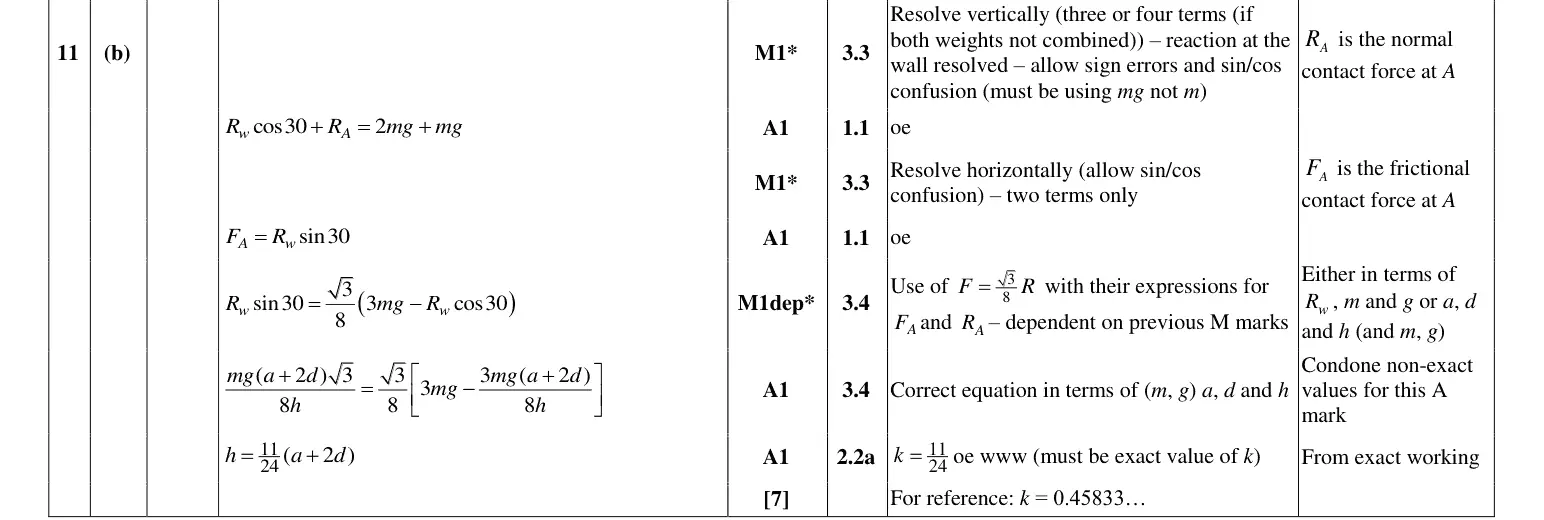
For those candidates who realised that resolving vertically and horizontally for the system and then applying F = µ R was the way of deriving the ‘Show that’ in this part most came unstuck due to the early error in part (a) of not having the correct direction for the normal contact force at the wall. Of those that did resolve correctly, a number then struggled with the corresponding algebra and very few achieved the correct answer of k = . A completely correct solution in which the candidate has clearly shown each stage of working from resolving horizontally and vertically to applying F leading to the correct expression for h in terms of = µ R a and d.

Only the most able candidates realised that h could not exceed 2 30 and therefore the greatest asin possible value of d was 13 22 a.

Although many candidates gave a correct improvement (e.g. model the ladder as non-uniform, include a frictional component for the contact of the ladder with the wall) many either believed that the model could be improved by modelling the ground as smooth or using a more accurate value of g. Also, some candidates did not read this part carefully and instead gave a limitation of the model (e.g. the wall is unlikely to be smooth) and not an improvement.
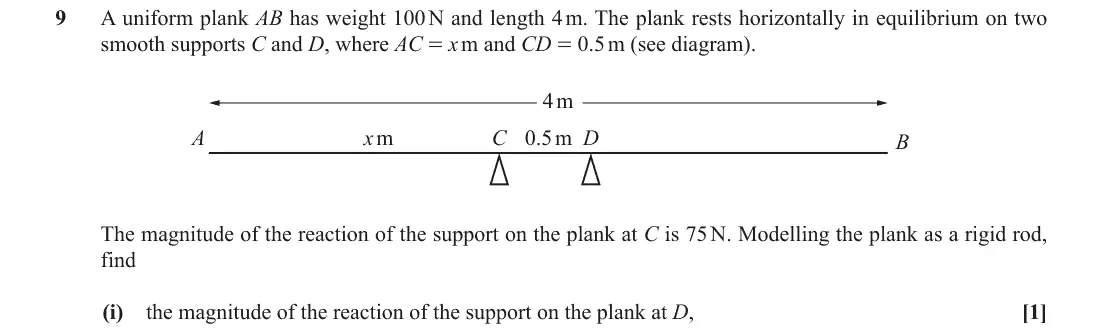
Nearly all candidates correctly stated that the magnitude of the reaction of the support on the plank at D was 25 N

The most common point on the plank to take moment about in this part was A and most who did so were successful in finding x. Of those that considered moments about a different point, while some were successful, too often examiners noted that candidates did not include all the required terms.

Many candidates struggled with this part and did not realise that if the plank was about to tilt about D then this was the point to take moments about as the reaction at C is therefore zero in this limiting case. Candidates are strongly advised when taking moments to make it clear to the examiners which point (in this case on the plank) they are taking moments about. A number of candidates attempted to take moments about another point together with resolve forces vertically; these attempts were usually unsuccessful. Key:

(Comment on Question 09(iv) as a whole) It was pleasing that candidates were well prepared for this type of question with many correctly stating that the modelling the stone as a particle assumes that the weight of the block acts exactly at B and therefore the block’s dimensions (or the distribution of the mass of the block) has not been taken into account. A number of candidates incorrectly stated that modelling the block as a particle implied that the block had negligible mass. This part was also answered extremely well, with many correctly stating that modelling the block as a rigid rod assumes that the plank remains in a straight line and does not bend. A number of candidates, however, assumed that friction and/or air resistance had some relevance to this part.

(Comment on Question 09(iv) as a whole) It was pleasing that candidates were well prepared for this type of question with many correctly stating that the modelling the stone as a particle assumes that the weight of the block acts exactly at B and therefore the block’s dimensions (or the distribution of the mass of the block) has not been taken into account. A number of candidates incorrectly stated that modelling the block as a particle implied that the block had negligible mass. This part was also answered extremely well, with many correctly stating that modelling the block as a rigid rod assumes that the plank remains in a straight line and does not bend. A number of candidates, however, assumed that friction and/or air resistance had some relevance to this part.
Stuck on this? Book a trial session with an A-level maths tutor.