Integration by parts is given; substitution is not.
Since 2018
27 question parts, 142 marks, each rated Easy, Medium or Hard from the wording of the examiners' report
Notes, worked examples and practice for this topic are being written by our tutors. The past-paper questions below are ready now: work each one on paper, then open the mark scheme and the examiner's comment.
Tap a question to zoom it. Mark scheme and examiner's comment open under each question.
June 2025 · Paper 1 · Q12(b)7 marksHard
Show the start of this question
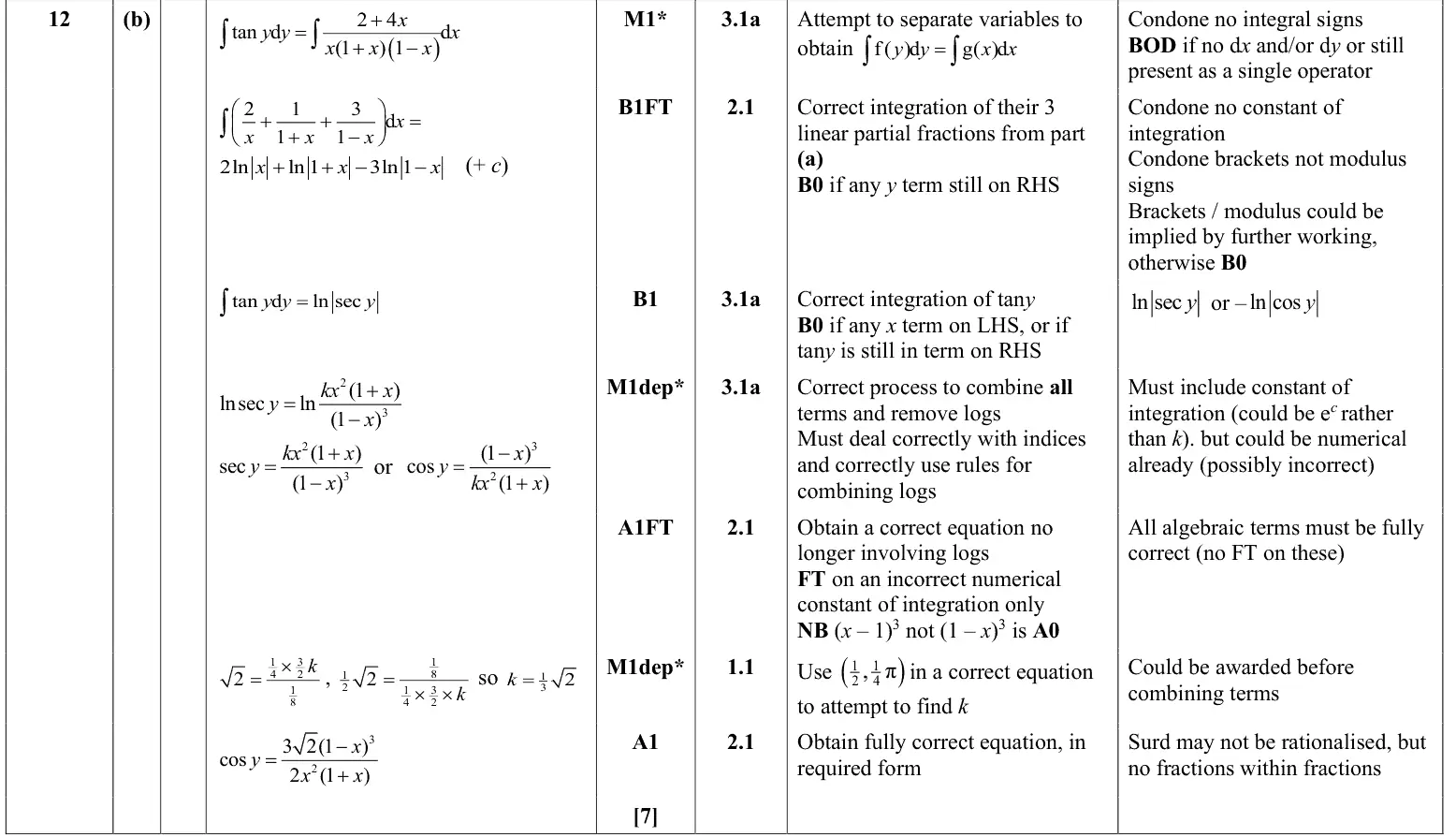
Mark scheme for this part
Examiner's comment
This question proved to be a suitably challenging final question, with only those candidates that had successfully completed the majority of the paper gaining full credit here. To gain the first mark candidates needed to identify that this was a differential equation with separable variables and attempt to do so; no credit was given for any integration attempts on an equation that still involved both x and y terms. Once variables had been separated, integrating tany is a standard specification statement (1.08h) yet this was not always done correctly; sign errors were common, as was finding the derivative and not the integral of tany. Candidates nearly always realised the need to use their partial fractions from the first part of the question, and could attempt integration of these, but there were often sign errors when integrating the fraction with the denominator of (1 – x). Further credit could still be gained for correctly combining all of their terms and removing logarithms; while many candidates could correctly combine the algebraic terms it was a common error to see the constant term still as +c even once logs had been removed. Of the candidates who had made reasonable progress with this question, most were able to attempt the required method but made slips in their working.
Key points and common errors
separate variables: ∫tan y dy = ln sec y
2ln x + ln(1 + x) − 3ln(1 − x) + c
combine logs
use (½, π/4) to find k
cos y = 3√2(1 − x)³ / (2x²(1 + x))
sign errors with tan y and with ln(1 − x)
June 2025 · Paper 2 · Q85 marksMedium
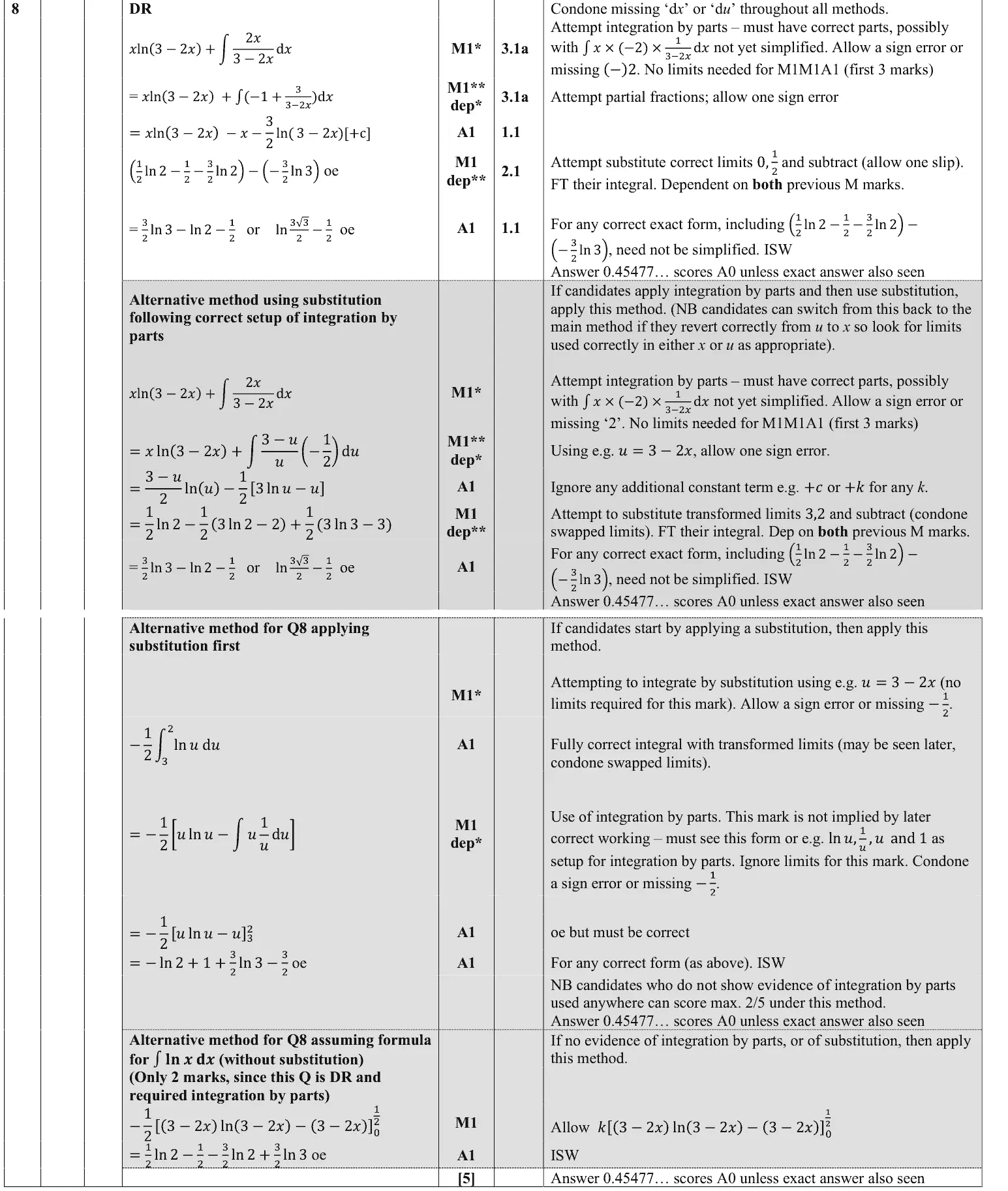
Mark scheme for this part
Examiner's comment
Many candidates scored at least 3 marks in this question, and some very good answers were seen, although a significant number of candidates made no progress beyond the initial setup (typically scoring M1 only). The question specified the use of integration by parts, so answers which did not use this technique anywhere could not score full marks (see the third alternative method in the scheme). Most candidates applied ‘by parts’ directly to the given integral and then proceeded via either partial fractions or substitution on the resulting second integral as shown in the first two methods on the scheme. A few candidates made an error in setting up their ‘by parts’ (resulting in an inconsistent statement). Some candidates, perhaps in trying to solve the resulting integral, went backwards by attempting ‘by parts’ again and undoing their initial setup – which normally resulted in no further progress being made. The second alternative method was quite often seen, with candidates starting by applying a substitution (which is a logical way to approach the given integral). Candidates still needed to demonstrate the use of ‘by parts’ in their working in order to be eligible for full marks– as shown in the scheme. In all methods, sign errors were very common – often meaning that the method marks were scored but one or both of the accuracy marks were not. For candidates who used a substitution, some did not ‘translate’ the limits at the point of applying the substitution. This was often recovered (especially for candidates who reversed the substitution later) and some candidates even chose to work in a mixture of variables (i.e. keeping the first term of the ‘by parts’ in x and substituting within the second integral to, e.g. u). The scheme was deliberately flexible to accommodate this, but candidates should be reminded that, when using a substitution on a definite integral, it is important that the limits are adjusted at the point the substitution is made so that the integral remains correct throughout. This is particularly important when working under a DR instruction – which means there is greater emphasis on fully correct working leading to the answer. In a few cases (whether from substitution or sign errors) candidates inadvertently recovered to the correct final answer, but the final mark could not be awarded for answers that arose from incorrect working. This is an excellent example of a fully correct solution to this question. This candidate correctly sets up the integration by parts and proceeds to use a substitution to evaluate the ‘new’ integral (as shown in the first alternative method on the scheme). They do this correctly and revert to the original form in x before applying the appropriate limits correctly, leading to the correct final answer, 5/5.
Key points and common errors
by parts with u = ln(3 − 2x), v = x
second integral by division or substitution
exact answer (3/2)ln3 − ln2 − 1/2
sign errors common
change limits when substituting
by parts must be used
June 2025 · Paper 3 · Q5(a)4 marksMedium
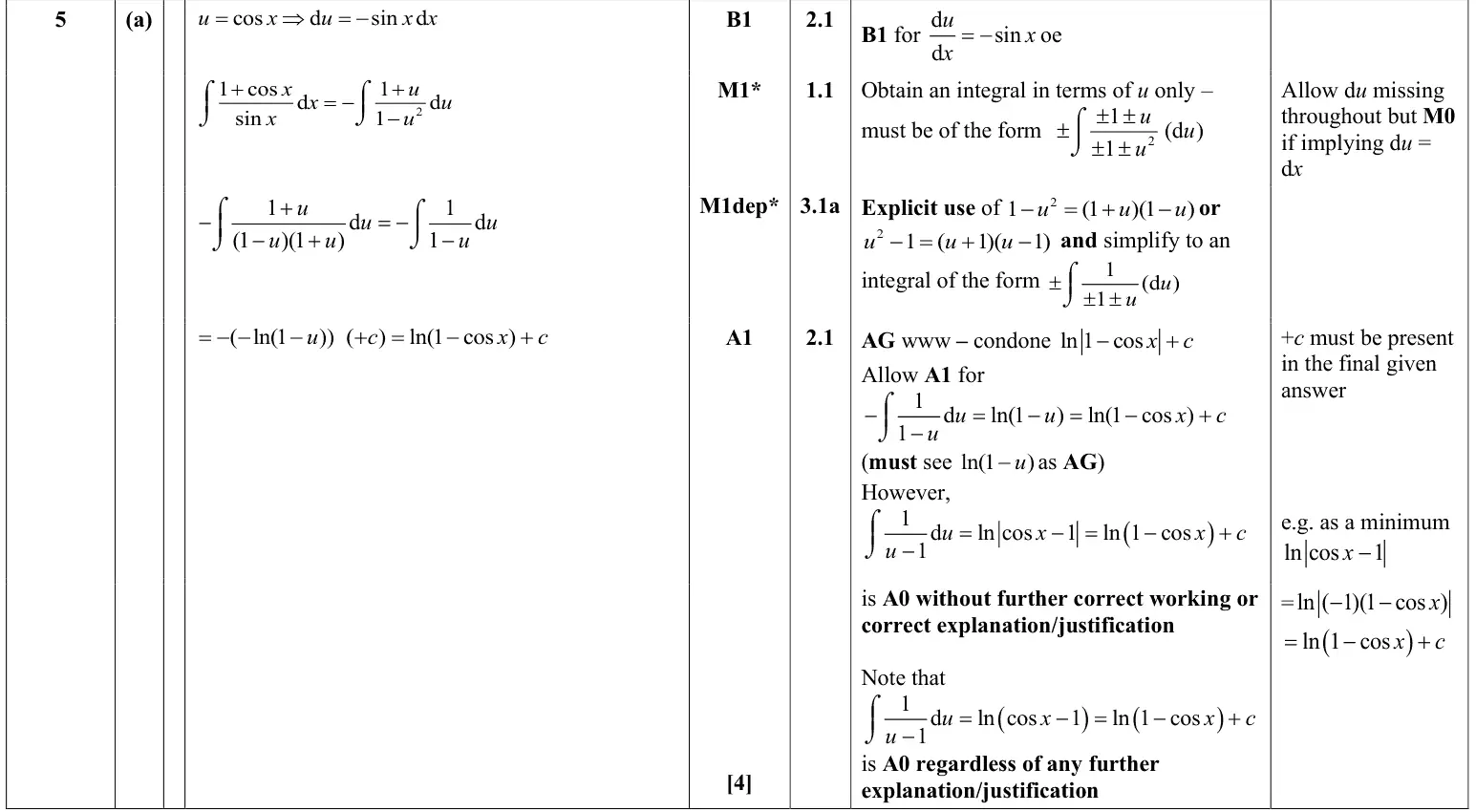
Mark scheme for this part
Examiner's comment
This part was answered relatively well with many candidates scoring the first 3 marks for correctly applying the given substitution and obtaining −∫ 1−𝑢d𝑢 from −∫ 1−𝑢2 d𝑢 (by using a difference of two squares). When errors occurred, they were usually down to sign errors from applying the identity sin2𝑥+ cos2𝑥= 1 when simplifying the denominator, or from incorrect differentiating cos 𝑥 as sin𝑥. Those candidates who left the integral as −∫ 1−𝑢d𝑢 were much more successful in obtaining the given answer than those who re-wrote this as ∫ 𝑢−1 d𝑢. It was common in this part for many candidates to incorrectly claim that ∫ 1−𝑢d𝑢= ln(1 −𝑢) + 𝑐. As discussed earlier, this exemplar illustrates the issues faced by candidates if they re-wrote the integral as ∫ 𝑢−1 d𝑢. It was not acceptable to simply replace |ln(cos 𝑥−1)| + 𝑐 with the given answer without some comment of why it was appropriate to do so.
Key points and common errors
du = −sin x dx
−∫(1 + u)/(1 − u²) du = −∫1/(1 − u) du via difference of two squares
ln(1 − cos x) + c
sign errors from sin²x = 1 − cos²x
June 2024 · Paper 1 · Q12(b)6 marksHard
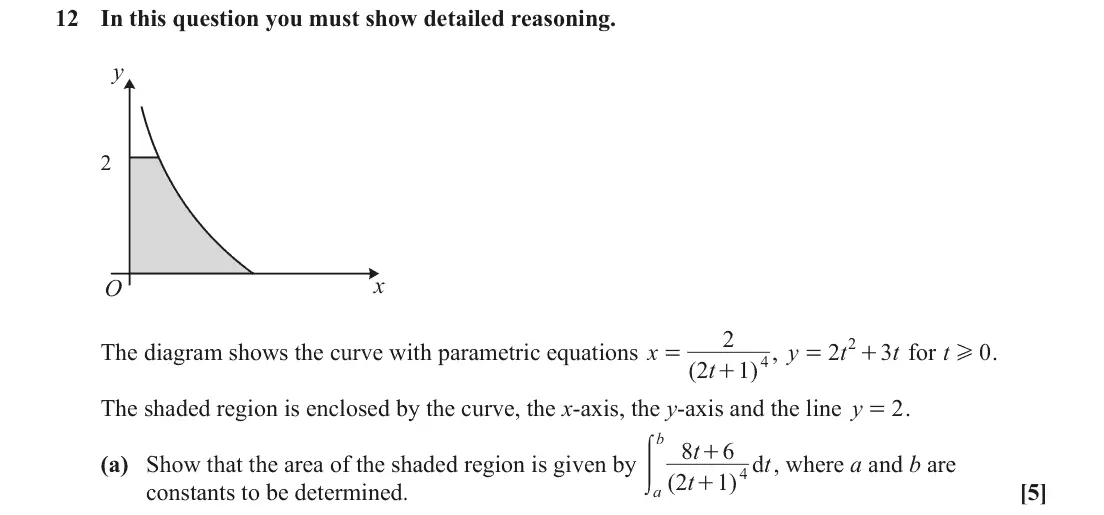
Show the start of this question
Mark scheme for this part
Examiner's comment
This question proved challenging for many candidates. There may be some indication that time management was a problem as there were a significant proportion of blank responses. However, there were many strong responses covering a variety of methods, most commonly substitution and integration by parts, and these were the most successful. Those not determining the correct limits from part (a) were unable to access the last two marks of this part. Some candidates attempted to use their knowledge on partial fractions but had mixed success in doing so. There were also many candidates that used a combination of methods, the most common being separate fractions and then integration by parts. This is a good and efficient solution to Question 12 (b).
Key points and common errors
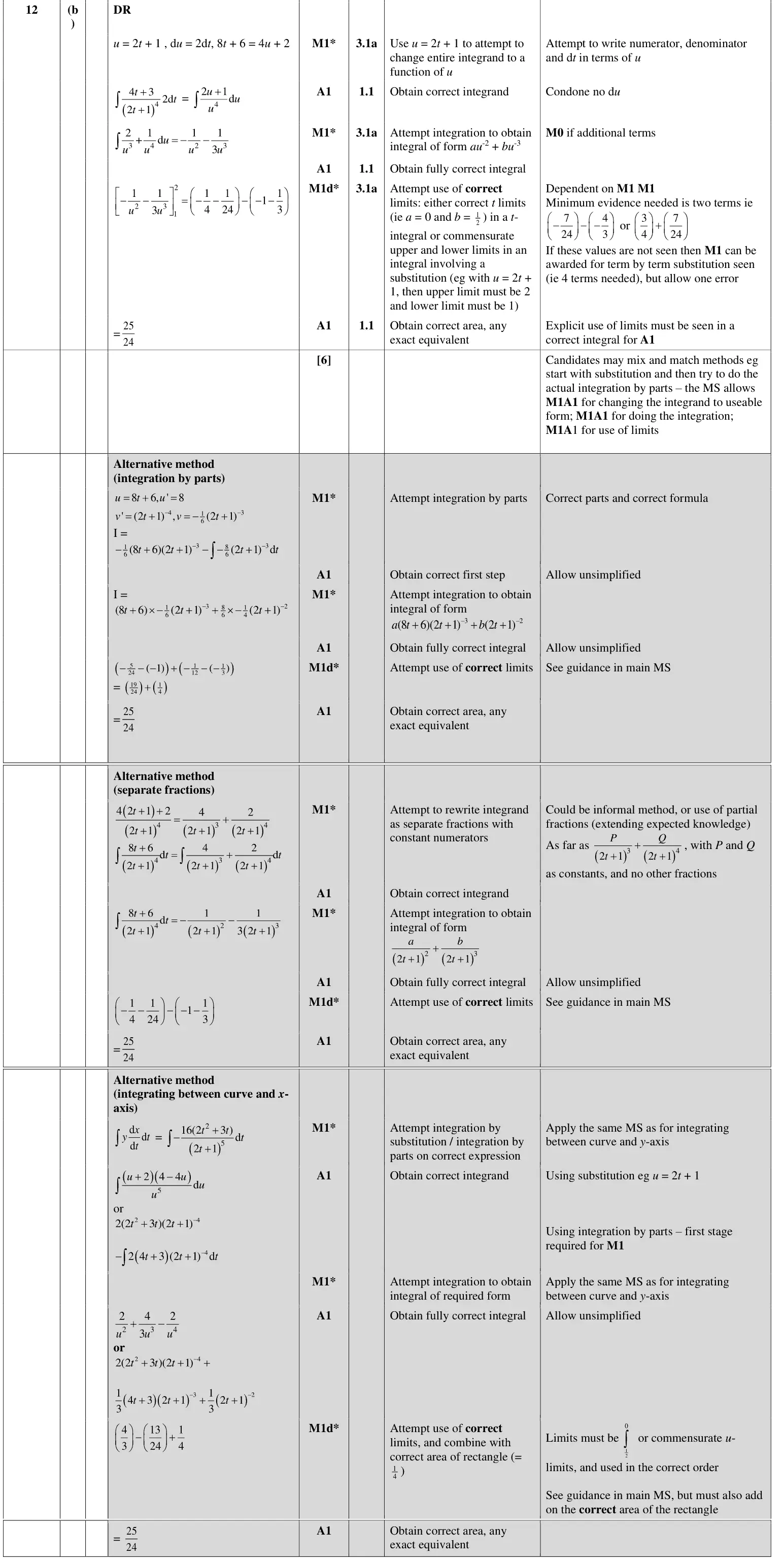
u = 2t + 1: ∫(2u + 1)/u⁴ du = [−1/u² − 1/(3u³)] from 1 to 2 = 25/24
or by parts or separate fractions
limits must match the variable
June 2024 · Paper 2 · Q4(c)4 marksEasy
Show the start of this question
Mark scheme for this part
Examiner's comment
Most candidates made a very good attempt at this question, with the integration often fully correct. Some candidates lost the first M mark for not setting up their integration by parts correctly (for instance, omitting the ‘-‘ sign or limits). A few candidates made sign errors in the intermediate steps, but most were successful with the two steps of integration to obtain A1A1. On this occasion unsimplified responses 3 𝑒−2 − (after limits substituted in) were allowed, although many candidates left their response as, e.g. − 9 𝑒−2 + 9 𝑒. Candidates should always be encouraged to simplify their responses, combining terms where possible. Some candidates gave a decimal response (which scored A0), but there were very few cases of ‘answers only’ which indicated that most candidates had paid attention to the detailed reasoning (DR) instruction here. Some candidates assumed that 𝑥= 0 meant both terms in the final integral would ‘disappear’, meaning that they omitted the term in 𝑒1 from their final response (A0). A few candidates attempted integration by substitution, which was only very rarely successful.
Key points and common errors
integration by parts
sign of the −1/3 factor
exact answer (e³ − 4)/(9e²)
June 2024 · Paper 3 · Q5(b)6 marksMedium
Show the start of this question
Mark scheme for this part
Examiner's comment
Most candidates correctly calculated the limits for the required area as 1 and 2 (although occasionally a lower limit of 0 was seen). Most candidates adopted the method of integration by parts when attempting to evaluate ∫(𝑥3 −2𝑥2)ln𝑥 d𝑥 and many were successful in obtaining the correct integrated expression. Those that attempted to use a substitution were generally unsuccessful. The most common errors in both the integration and when applying the limits were sign errors. Although many candidates correctly evaluated this integral as − 3 ln2 + 144, many did not realise that this was negative (as the shaded area was below the 𝑥-axis) and did not take the required modulus (even though the question made it clear what form the constants 𝑝, 𝑞 and 𝑟 should take).
Key points and common errors
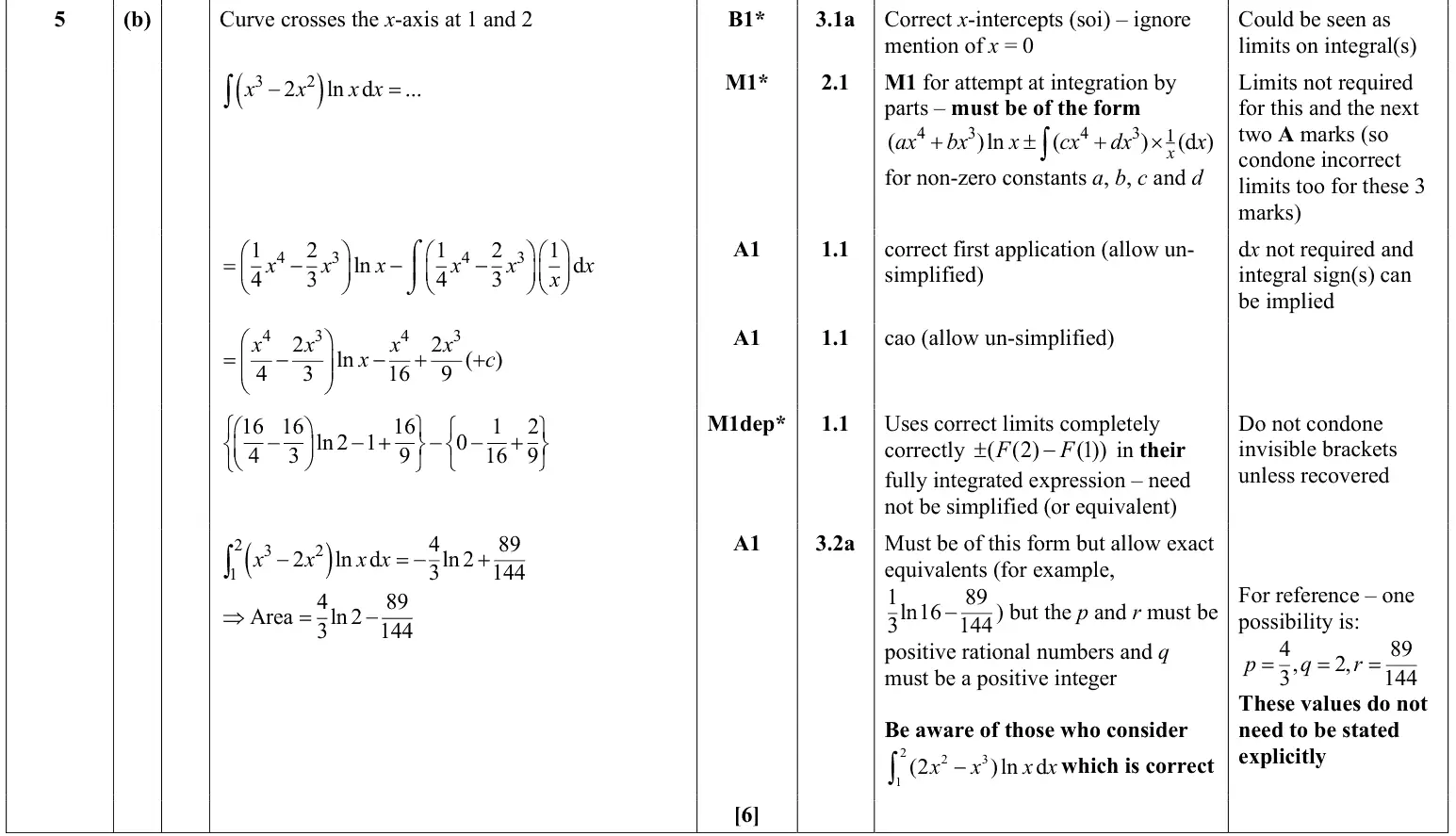
limits 1 and 2 (x-intercepts)
by parts with u = ln x
integral = −(4/3)ln2 + 89/144 so area = (4/3)ln2 − 89/144
substitution unsuccessful
June 2023 · Paper 1 · Q12(a)3 marksEasy
Mark scheme for this part
Examiner's comment
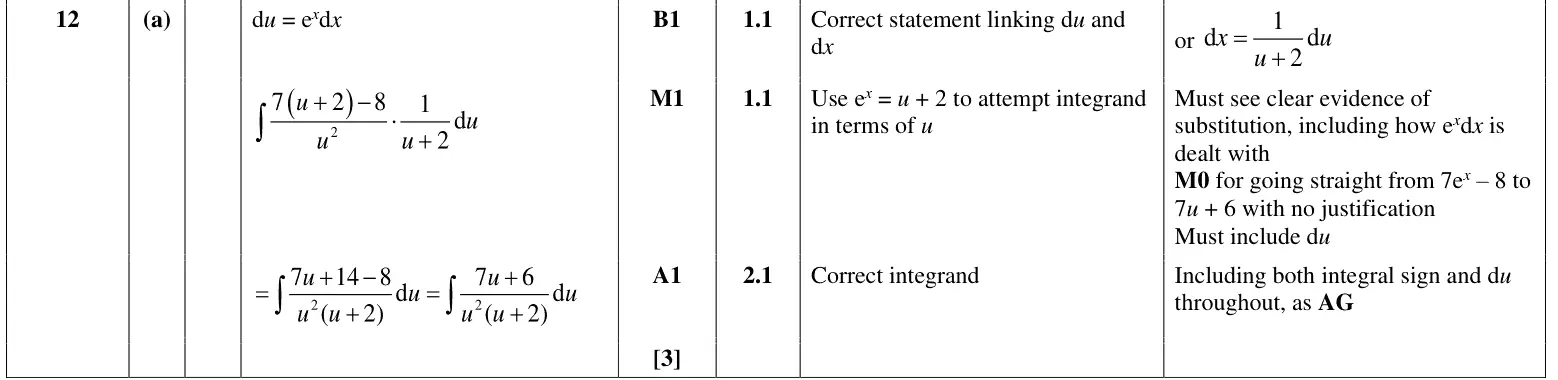
Most candidates were able to make an attempt at this question, and the majority gained all 3 marks by demonstrating clearly how the given answer was derived. The most common errors were not showing sufficient detail when attempting the integrand in terms of u, and being careless with notation, i.e. the integral sign and du not appearing consistently throughout.
Key points and common errors
du = eˣ dx so dx = du/(u + 2)
eˣ = u + 2 in the numerator
keep ∫ and du throughout
June 2023 · Paper 3 · Q5(b)6 marksHard
Show the start of this question
Mark scheme for this part
Examiner's comment
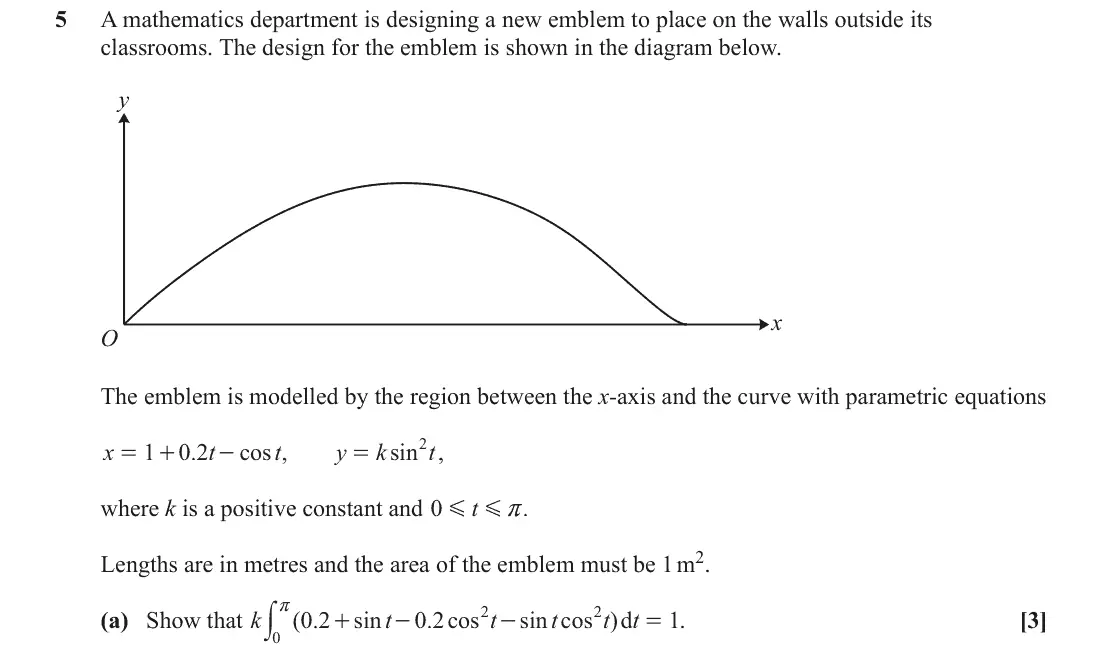
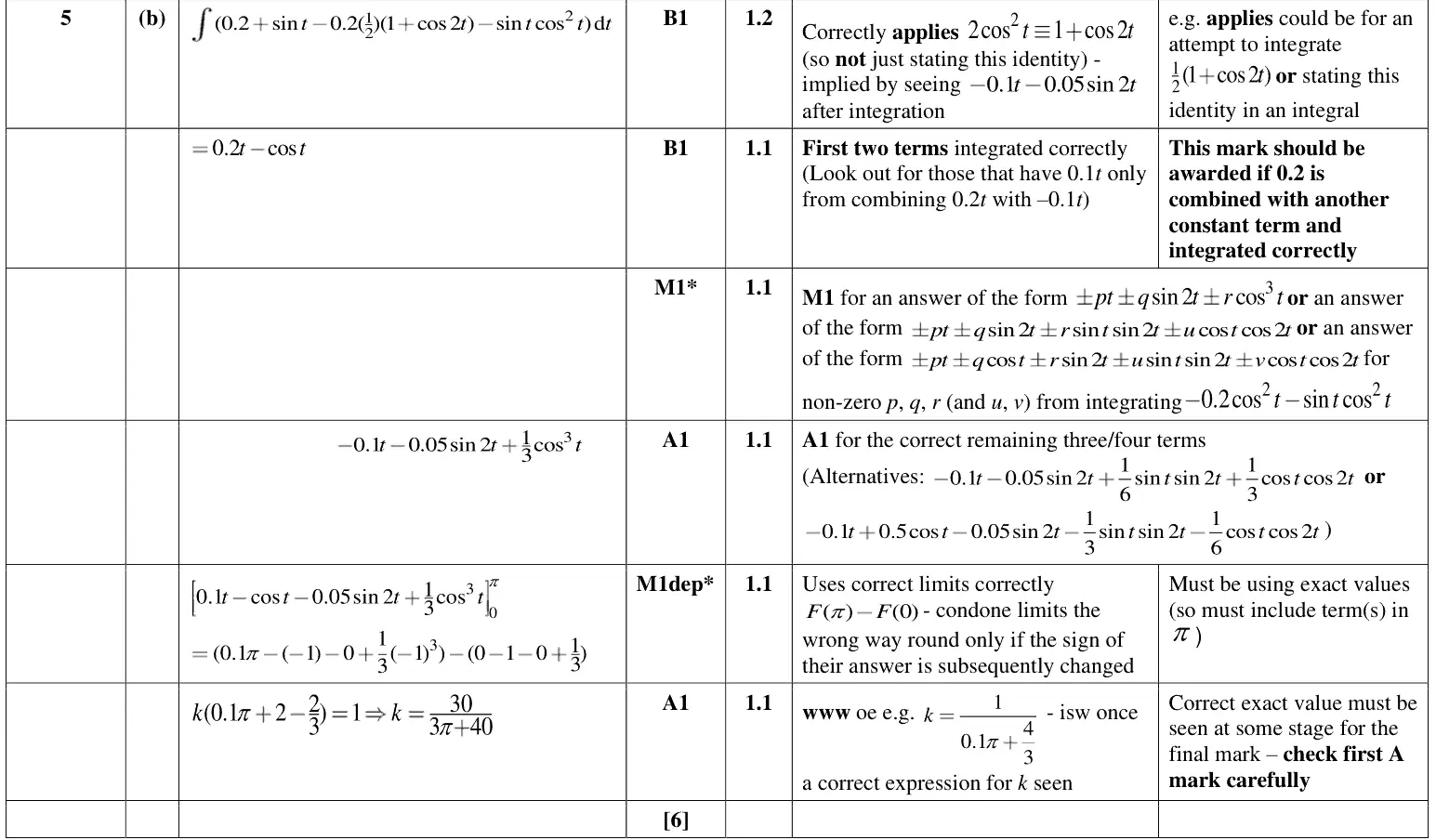
Although there were several ways of tackling this integral (to find the exact value of k) it was expected that candidates would deal with each term separately (and not attempt to combine terms together). The form of the integral given to the candidates in part (a) was meant to assist (rather than hamper) their attempts to solve this part. So, to that end it was expected that candidates would tackle the integral in the following way: ∫0.2 + sin𝑡𝑡 d𝑡𝑡= 0.2𝑡𝑡−cos𝑡𝑡 (integrate the first two terms immediately) ∫cos2𝑡𝑡 d𝑡𝑡= 2 ∫1 + cos2𝑡𝑡 d𝑡𝑡= 2 ቀ𝑡𝑡+ 2 sin2𝑡𝑡ቁ (use the standard double-angle formula to integrate cos2𝑡𝑡) 𝑛𝑛+1 (f(𝑥𝑥))𝑛𝑛+1 + 𝑐𝑐 from the formulae given on ∫sin𝑡𝑡cos2𝑡𝑡 d𝑡𝑡= − 3 cos3𝑡𝑡 (use the result ∫f ′(𝑥𝑥)൫f(𝑥𝑥)൯ 𝑛𝑛d𝑥𝑥= page 2 of the question paper) The small number of candidates who did integrate each term correctly usually applied the limits correctly too and obtained the correct value for k.
Key points and common errors
integrate term by term: 0.2t − cos t
cos²t = ½(1 + cos2t)
sin t cos²t integrates to −⅓cos³t (by inspection)
exact k = 30/(3π + 40)
June 2023 · Paper 3 · Q7(b)6 marksMedium
Show the start of this question
Mark scheme for this part
Examiner's comment
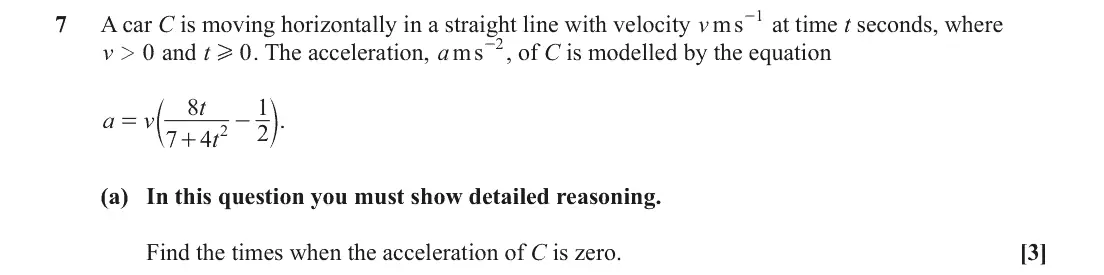
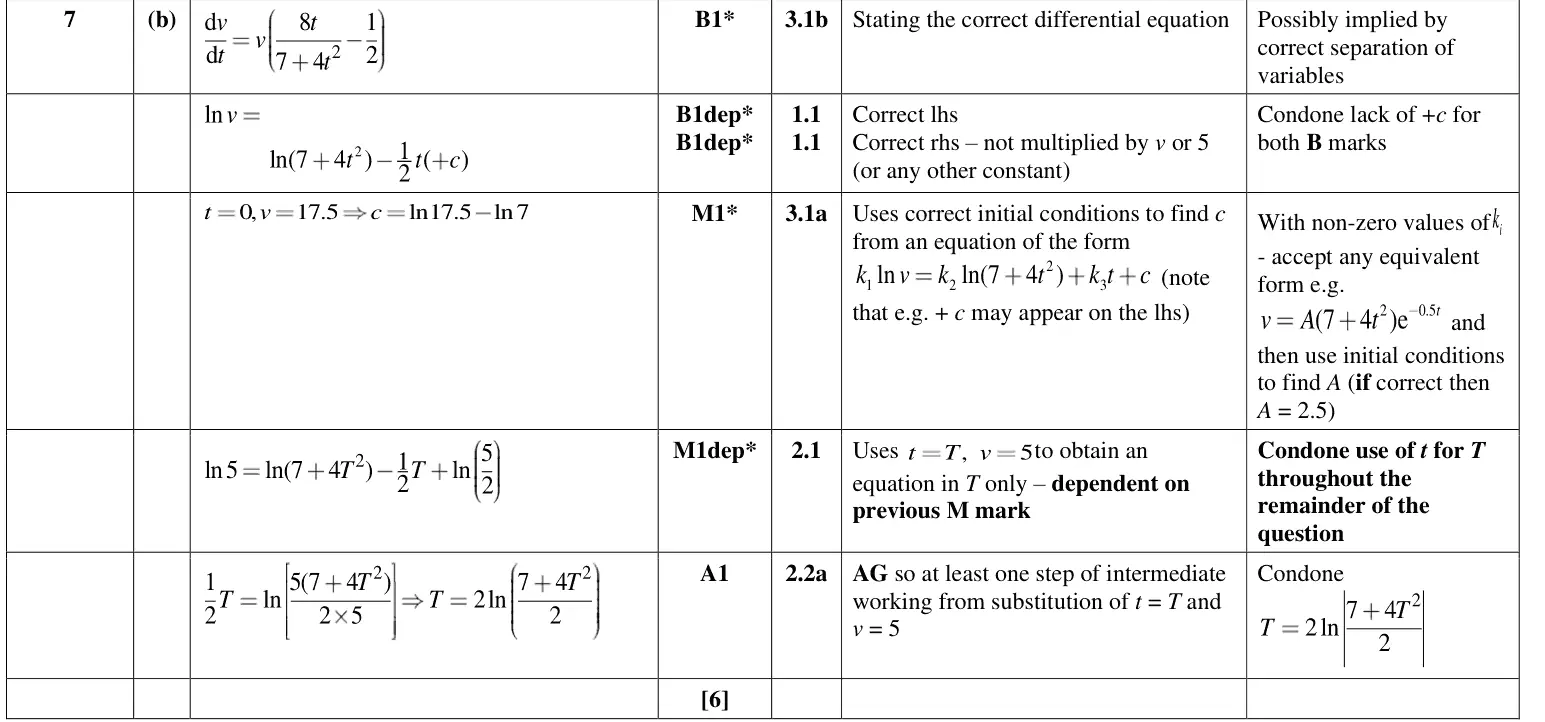
fact that 𝑎𝑎= d𝑡𝑡= 𝑣𝑣ቀ 7+4𝑡𝑡2 − 2ቁ usually separated the variables correctly and went It was surprising in this part how many candidates did not set up a correct differential equation using the d𝑡𝑡. Those that did write on to correctly derive the given result (using the results that 𝑣𝑣= 17.5 when 𝑡𝑡= 0 and 𝑣𝑣= 5 when 𝑡𝑡= 𝑇𝑇). f(𝑥𝑥) d𝑥𝑥= ln|f(𝑥𝑥)| is provided in the formulae at the attempt to integrate ∫ 7+4𝑡𝑡2 d𝑡𝑡 even though the result ∫ Some candidates, after correctly setting up the required differential equation were unsuccessful in their beginning of the assessment.
Key points and common errors
dv/dt = v(8t/(7 + 4t²) − ½)
separate: ln v = ln(7 + 4t²) − ½t + c
t = 0, v = 17.5 gives c
v = 5 at t = T gives the result
∫f′/f = ln f is in the formula book
June 2022 · Paper 1 · Q97 marksHard
Mark scheme for this part
Examiner's comment
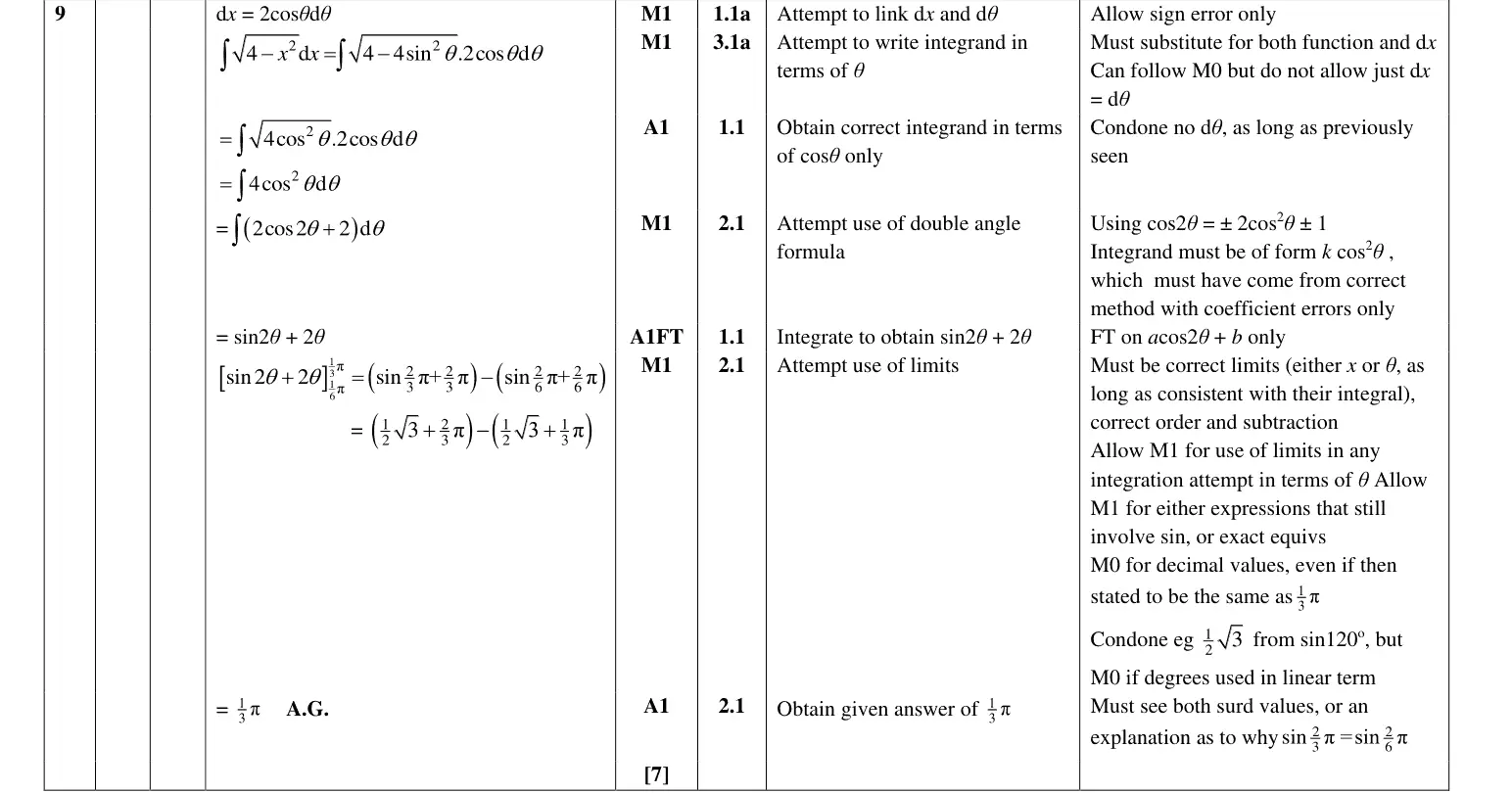
This proved to be a surprisingly challenging question, and the full range of marks was seen. The majority did attempt to use the given substitution, with only a few continuing to work in terms of x. Most appreciated the need to attempt the integrand in terms of θ, and attempted to do so. The most common errors were for an incorrect variable of u to be introduced, and for the simplification of the square root to be incorrect, with √(4 – 4sin2θ) becoming 2 – 2sinθ. Of the candidates who did obtain the correct integrand, most were able to select the correct identity and then usually produced a fully correct solution.
Key points and common errors
dx = 2cosθ dθ
√(4 − 4sin²θ) = 2cosθ (not 2 − 2sinθ)
∫4cos²θ dθ = sin2θ + 2θ via the double angle formula
limits π/6 to π/3 give π/3
exact values needed
June 2022 · Paper 1 · Q11(a)6 marksMedium
Mark scheme for this part
Examiner's comment
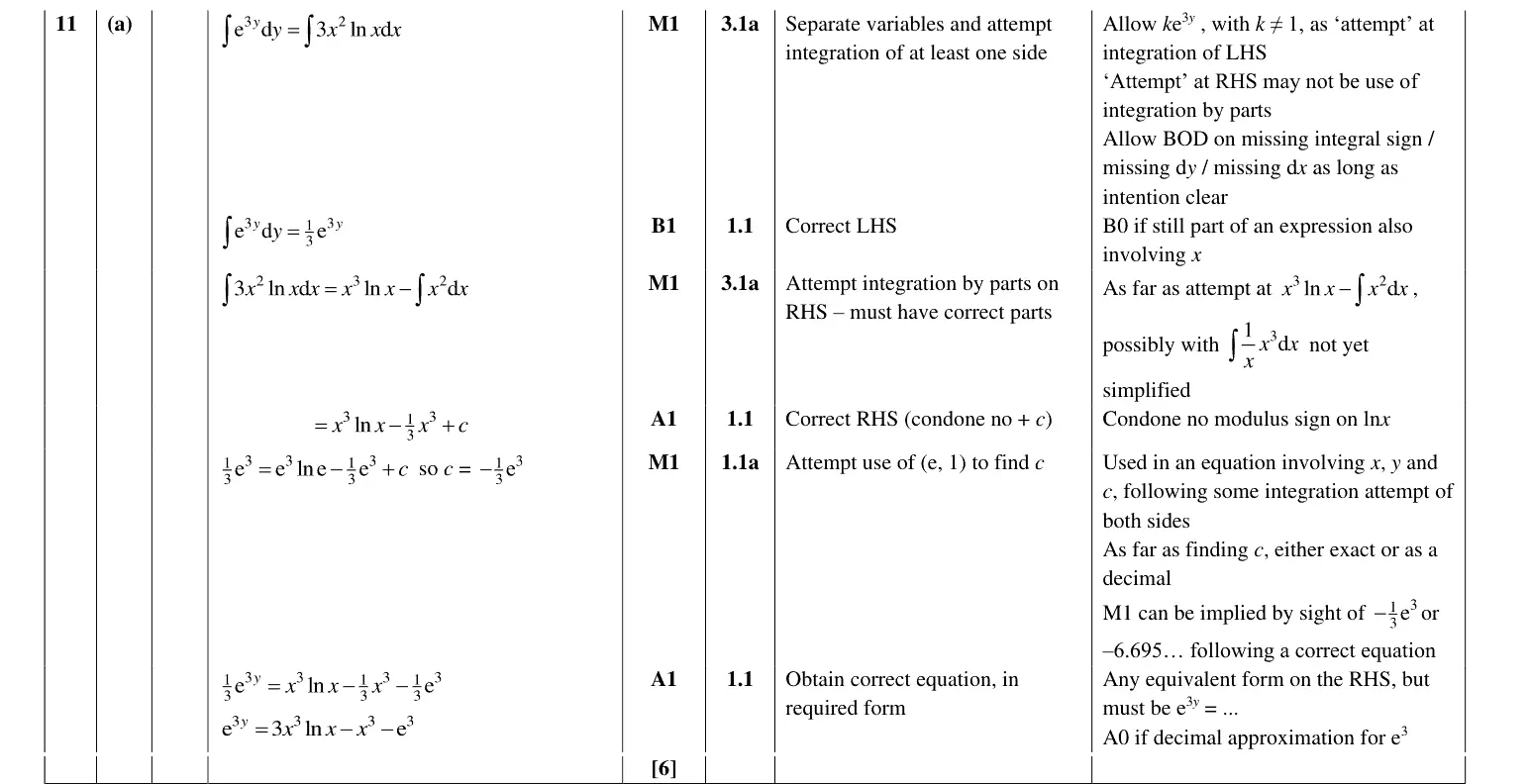
Most candidates appreciated the need to separate the variables and could make a reasonable attempt to do so. The integration of the exponential term was usually correct. While integration by parts was often attempted on 3x2lnx, the parts and/or the formula were not always correct. The latter is surprising as it is given in the list of formulae at the start of the paper. As long as there had been some attempt to integrate both sides, there was a mark available for attempting to use the given point of (e, 1) and many candidates did indeed gain this mark.
Key points and common errors
separate: ∫e^(3y)dy = ∫3x² ln x dx
parts gives x³ln x − x³/3
(e, 1) gives c = −e³/3
e^(3y) = 3x³ln x − x³ − e³
parts formula often misapplied though given
June 2022 · Paper 2 · Q3(c)4 marksMedium
Mark scheme for this part
Examiner's comment
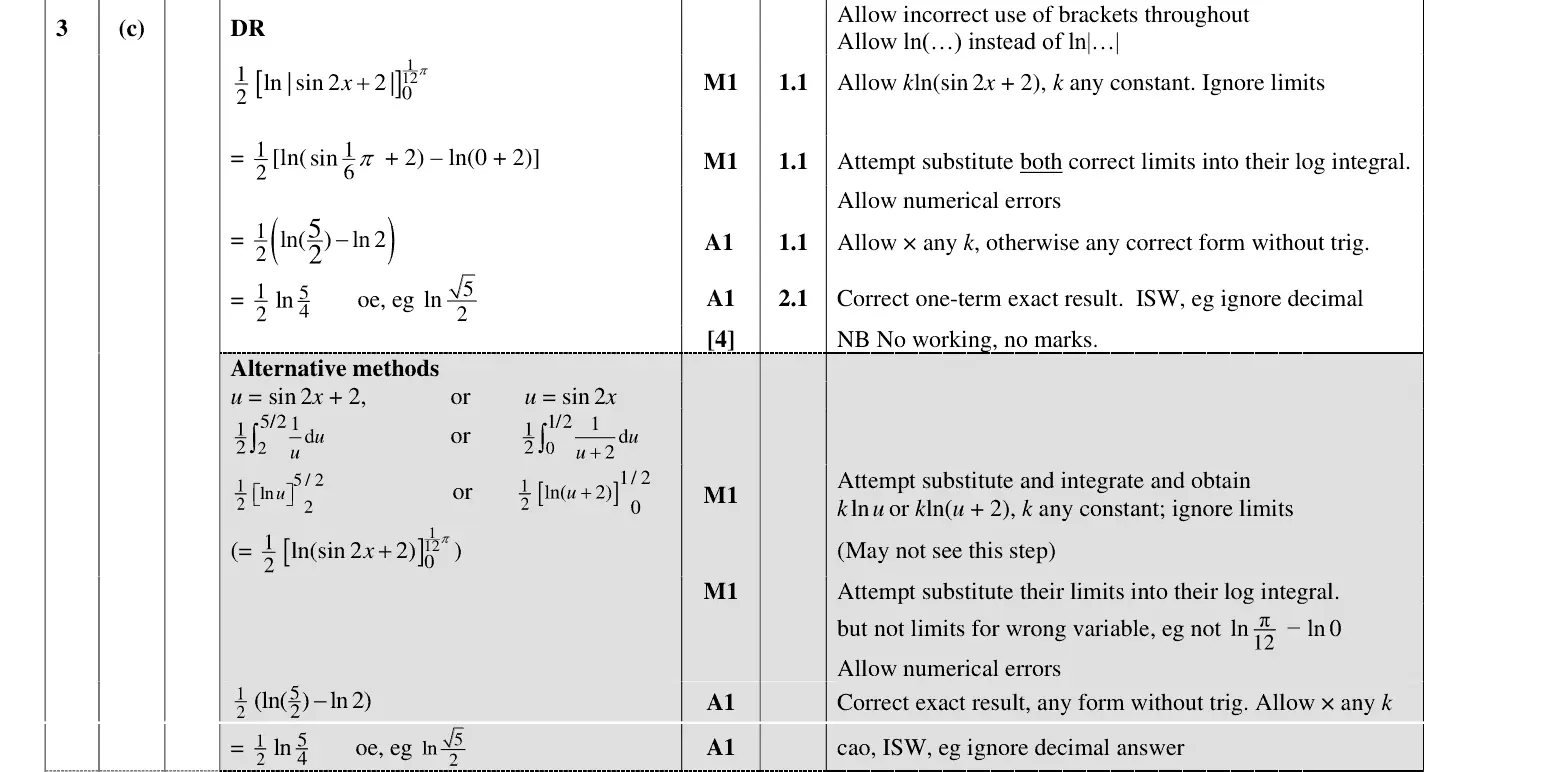
There were many neat and correct solutions. Many candidates used a substitution. However, many others used the more efficient method that comes from recognising that the numerator is k × the derivative of the denominator. Some candidates omitted “k” or had k = 2 instead of 1 2 . A few candidates correctly obtained ( ) 5 1 2 ln( ) 2 − ln 2 , but omitted the final step of simplification (presumably, as in part (a) (i), because they had not read the question carefully). Others used decimals, ignoring the word “exact” in the question. There were also some unsuccessful attempts at this question. Some candidates used the double angle formulae. Others attempted to use integration by parts on cos 2x × (sin 2x + 2)−1. A few rewrote the integrand as cos2 cos2 x x x + . None of these attempts yielded any marks. sin 2 2
Key points and common errors
numerator is ½ × derivative of denominator: ½ln(sin2x + 2)
limits 0 and π/12
½ln(5/4)
exact simplest form
June 2022 · Paper 3 · Q68 marksEasy
Mark scheme for this part
Examiner's comment
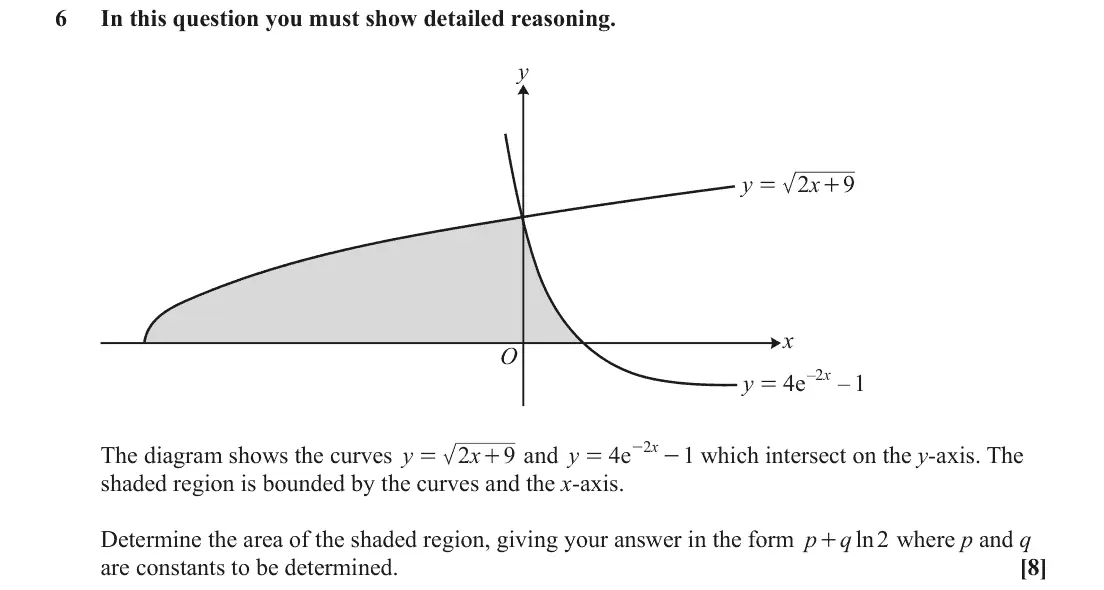
This question was answered extremely well with many candidates scoring all 8 marks for correctly determining the required shaded area of the given region. As this was a DR question it was not 0 2 ( ) + = acceptable to simply state that x 9 d x 9 or to apply the limits the wrong way round and then − to 9 without suitable justification. Some candidates struggled to solve the change a response of 9 −= 4e − 1d . x equation 4e 1 0 exactly or to find the required upper limit for the integral Furthermore, some had difficulty with evaluating this indefinite integral (it was common for examiners to report that this was often integrated to − 8e − x ). Many candidates struggled to evaluate − − accurately 2e x even though they had access to calculators which would have enabled them to check their response.
Key points and common errors
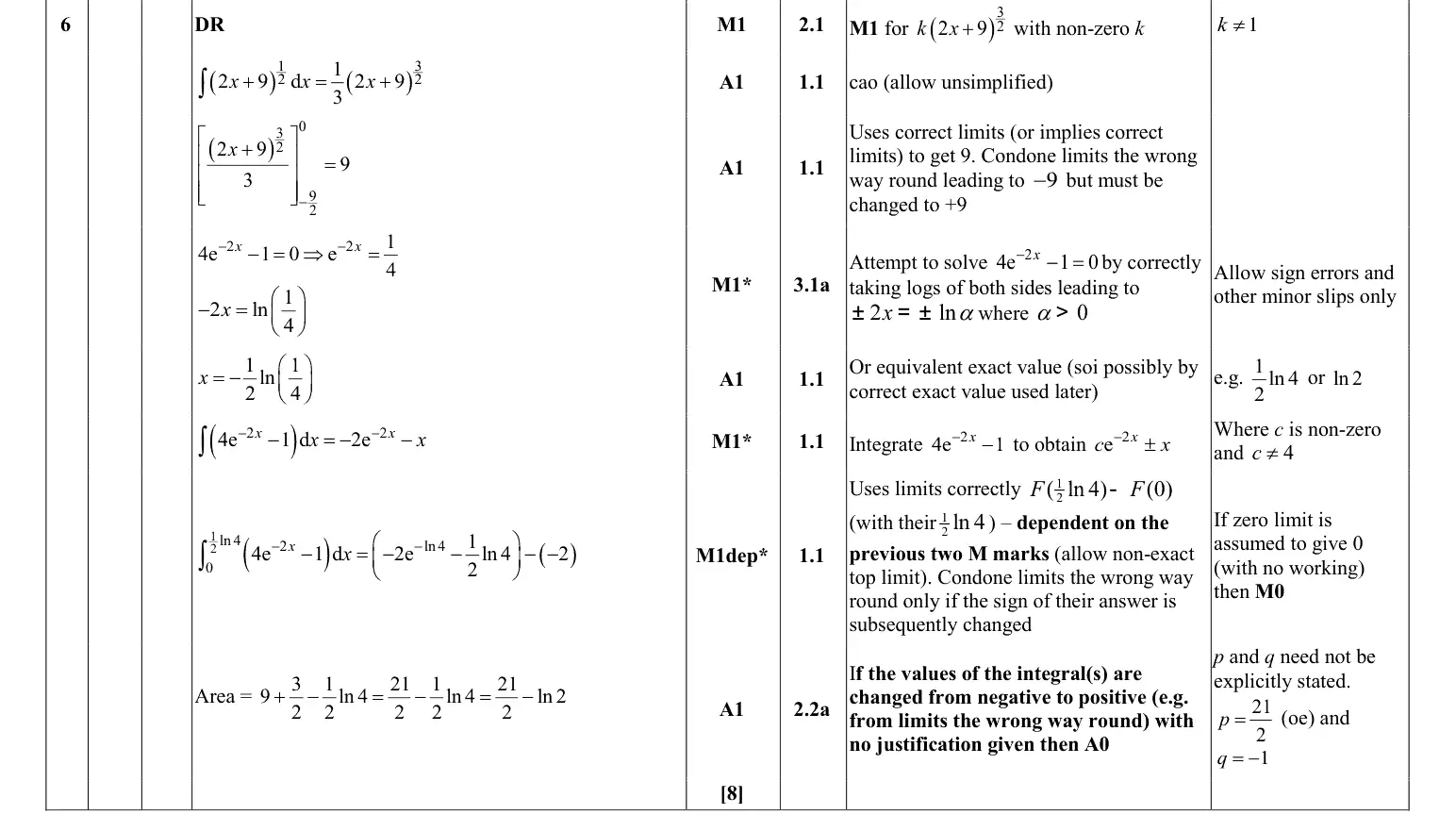
∫ from −9/2 to 0 of √(2x + 9) = 9
4e^(−2x) − 1 = 0 at x = ½ln4
∫(4e^(−2x) − 1) = 3/2 − ½ln4
area 21/2 − ln2
correct limit order needed under DR
Autumn 2021 · Paper 1 · Q11(a)5 marksHard
Mark scheme for this part
Examiner's comment
(From the general report) Despite being given the substitution in Question 11(a) this question proved to be challenging for many.
Key points and common errors
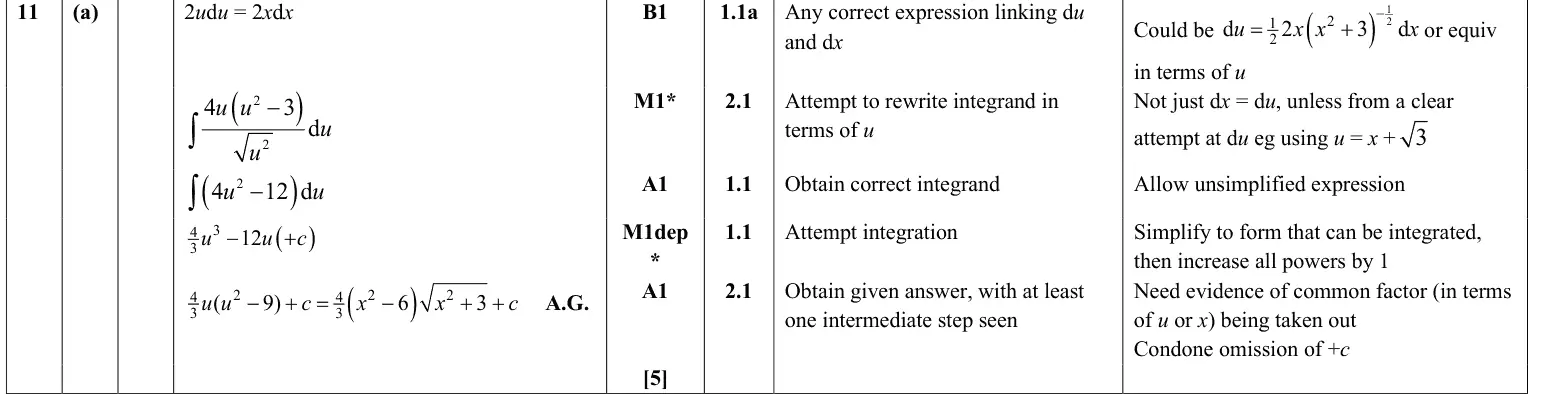
2u du = 2x dx
integrand becomes 4u² − 12
(4/3)u³ − 12u
take out common factor to reach given answer
Autumn 2021 · Paper 1 · Q11(b)7 marksMedium
Show the start of this question
Mark scheme for this part
Examiner's comment
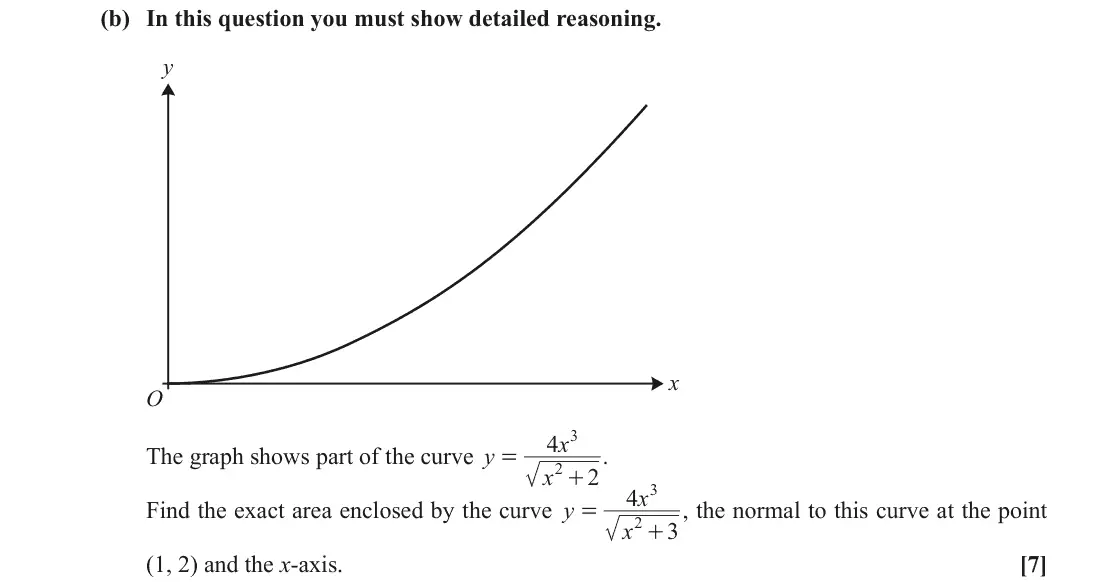
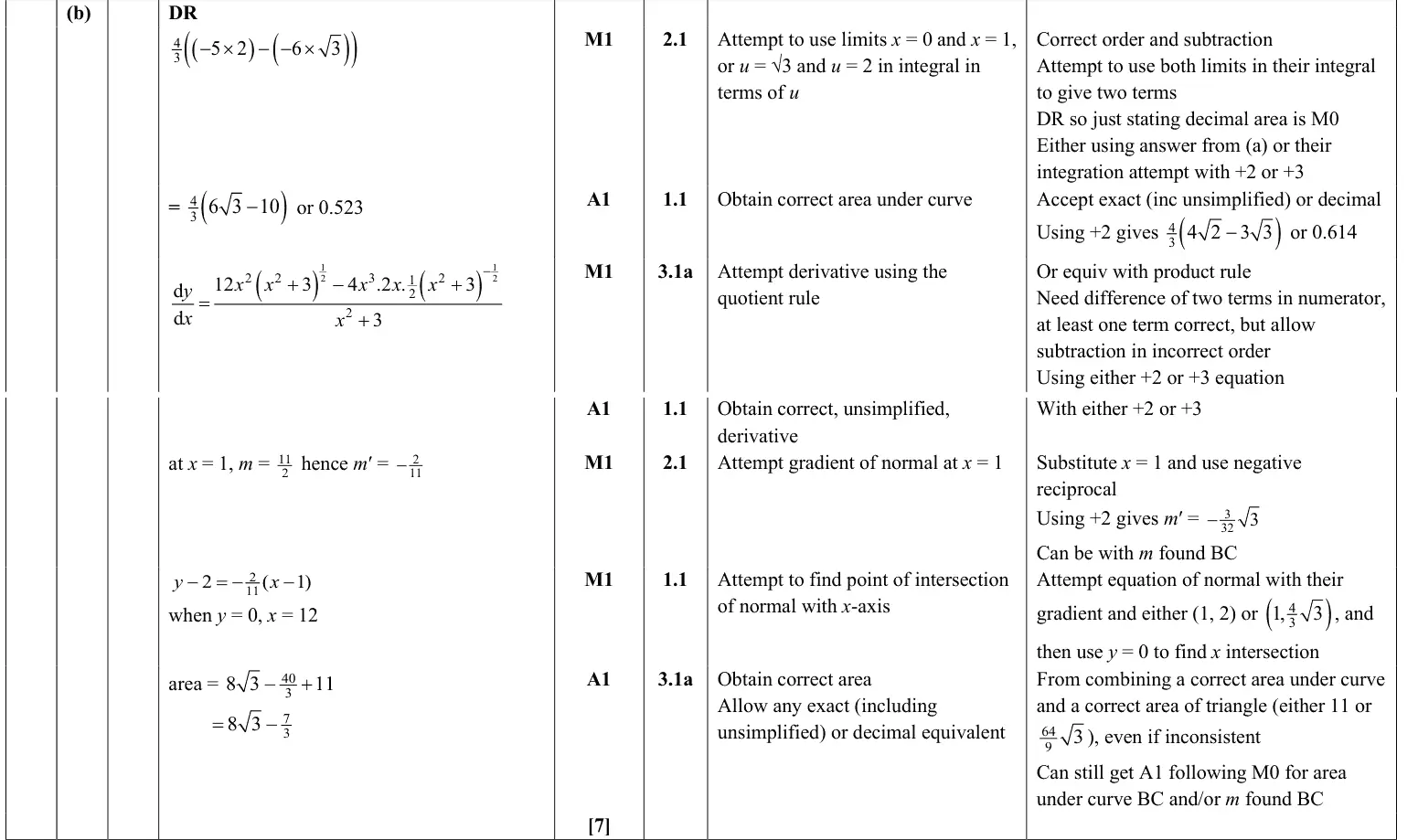
(From the general report) Teachers should make sure that they use an amended version of the question paper, correcting the 4 x description of the graph in Question 11(b) as “part of the curve y = ” to match the information in x + 3 the rest of the question.
Key points and common errors
paper misprint: graph label should read √(x² + 3)
area under curve (4/3)(6√3 − 10)
quotient rule gives gradient 11/2 at x = 1 so normal gradient −2/11
normal meets x-axis at x = 12, triangle area 11
total 8√3 − 7/3
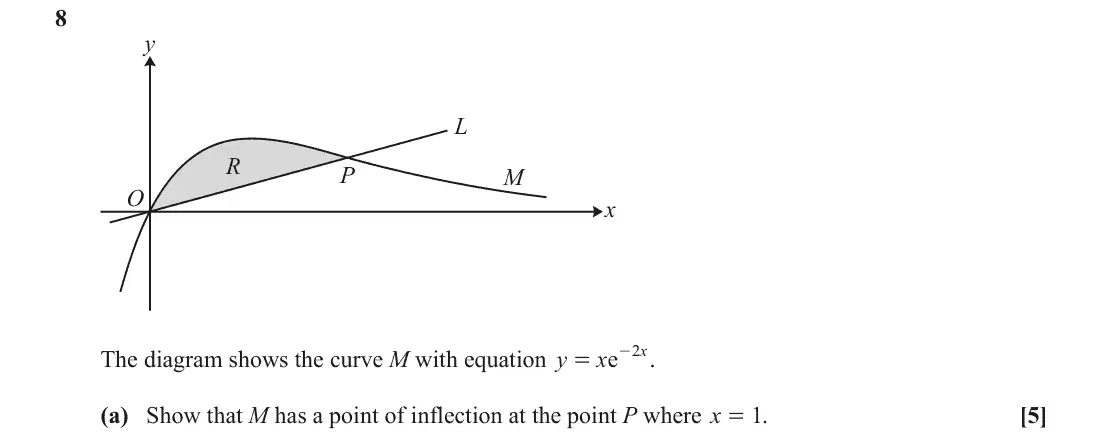
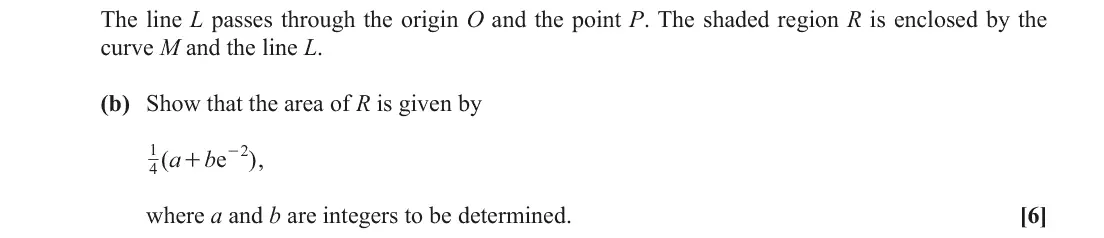
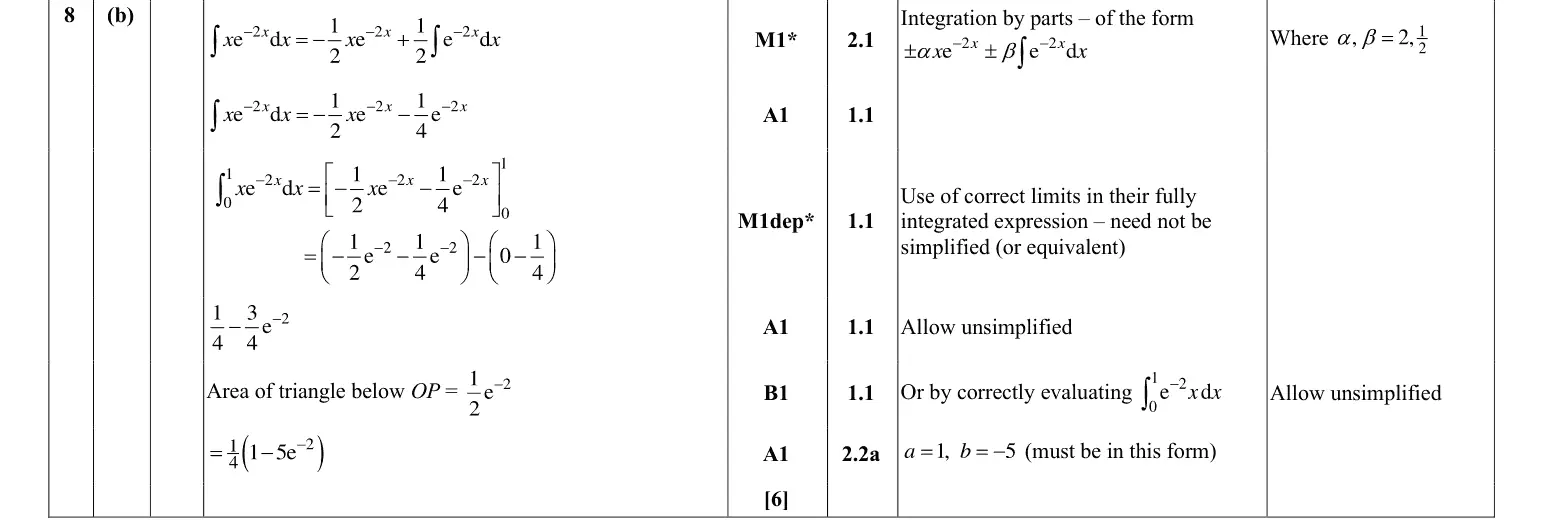
Autumn 2021 · Paper 3 · Q8(b)6 marksMedium
Show the start of this question
Mark scheme for this part
Key points and common errors
integrate xe^(−2x) by parts: ¼ − ¾e⁻² from 0 to 1
subtract triangle below OP of area ½e⁻²
¼(1 − 5e⁻²) so a = 1, b = −5
Autumn 2020 · Paper 1 · Q10(b)(i)3 marksMedium
Show the start of this question
Mark scheme for this part
Examiner's comment
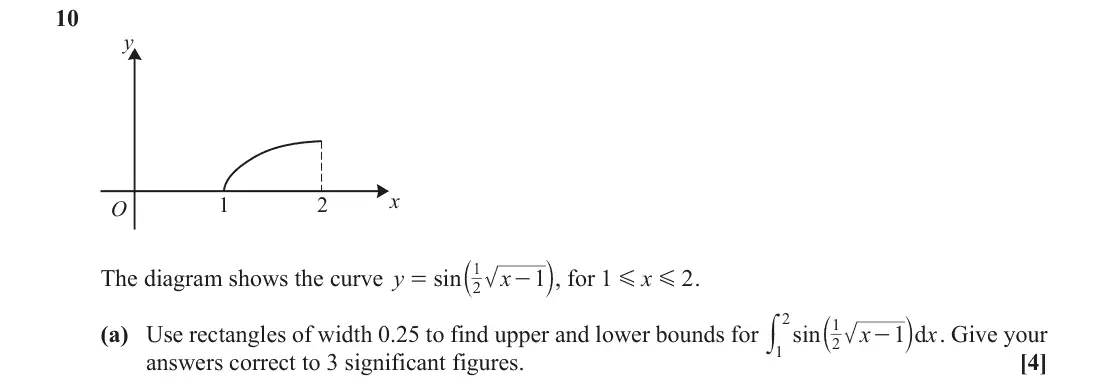
(Comment on Question 10 as a whole) It was apparent in Question 10 that many candidates were not familiar with the concept of using rectangles to establish upper and lower bounds. The most common error was to instead use the trapezium rule, often attempting to then establish bounds for their final answer. In part (b)(i) it was a given answer so sufficient detail was required, and in part (b)(ii) it was again a given answer so there had to be some evidence of the change of limits (assuming that candidates were now working in t) and also that the lower limit of t = 0 had been considered rather than just ignoring it.
Key points and common errors
t² = x − 1 so 2t dt = dx
rewrite the integrand fully in t
Autumn 2020 · Paper 1 · Q10(b)(ii)4 marksMedium
Show the start of this question
Mark scheme for this part
Examiner's comment
(Comment on Question 10 as a whole) It was apparent in Question 10 that many candidates were not familiar with the concept of using rectangles to establish upper and lower bounds. The most common error was to instead use the trapezium rule, often attempting to then establish bounds for their final answer. In part (b)(i) it was a given answer so sufficient detail was required, and in part (b)(ii) it was again a given answer so there had to be some evidence of the change of limits (assuming that candidates were now working in t) and also that the lower limit of t = 0 had been considered rather than just ignoring it.
Key points and common errors
parts: −4t cos(½t) + 8 sin(½t)
change limits to t = 0 and 1
lower limit must be seen to be considered
Autumn 2020 · Paper 3 · Q5(b)3 marksMedium
Show the start of this question
Mark scheme for this part
Examiner's comment
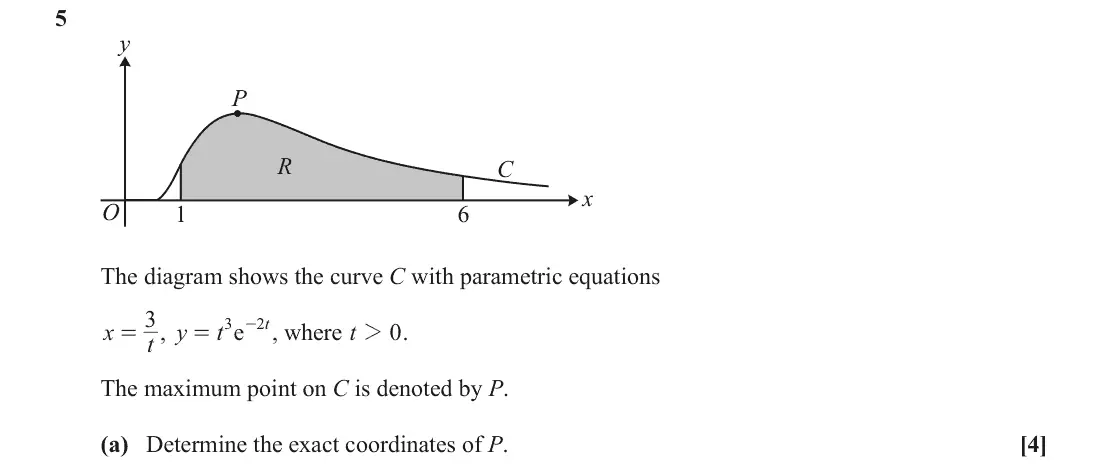
(Comment on Question 05 as a whole) Unless explicitly requested, candidates should avoid converting parametric equations into the cartesian form due to the complexity. d y In part (a) candidates only needed to determine where t = 0 . Unfortunately, some candidates made d errors in the denominator when finding d y x , and while this may not impact the numerical answer d obtained, there is a standard principle that answers obtained with wrong working will not gain full credit. The other issue with this question was that the ‘exact coordinates of P ’ was needed, those candidates that provided a decimal approximation would not gain full credit (unless the exact value had been seen as part of the working). The first issue with part (b) was that the limits were given on the diagram as x = and 1 , but the x = 6 integration was to be done with respect to t ; a number of candidates did not spot this. This was a ‘Show that’ question so the initial method mark was to find d x t and to show a clear attempt to use this in d d d x ∫ y t . The final accuracy mark was to rearrange into the given form. d t Part (c) involved using the formula given in part (b) to ‘Hence’ determine the area. Generally, this was done well, with candidates correctly giving their answer in ‘exact’ form in terms of e .
Key points and common errors
area = ∫ y (dx/dt) dt with dx/dt = −3/t²
x = 1 ↔ t = 3, x = 6 ↔ t = 0.5
swap limits to remove the minus sign
many kept x-limits
Autumn 2020 · Paper 3 · Q5(c)5 marksEasy
Show the start of this question
Mark scheme for this part
Examiner's comment
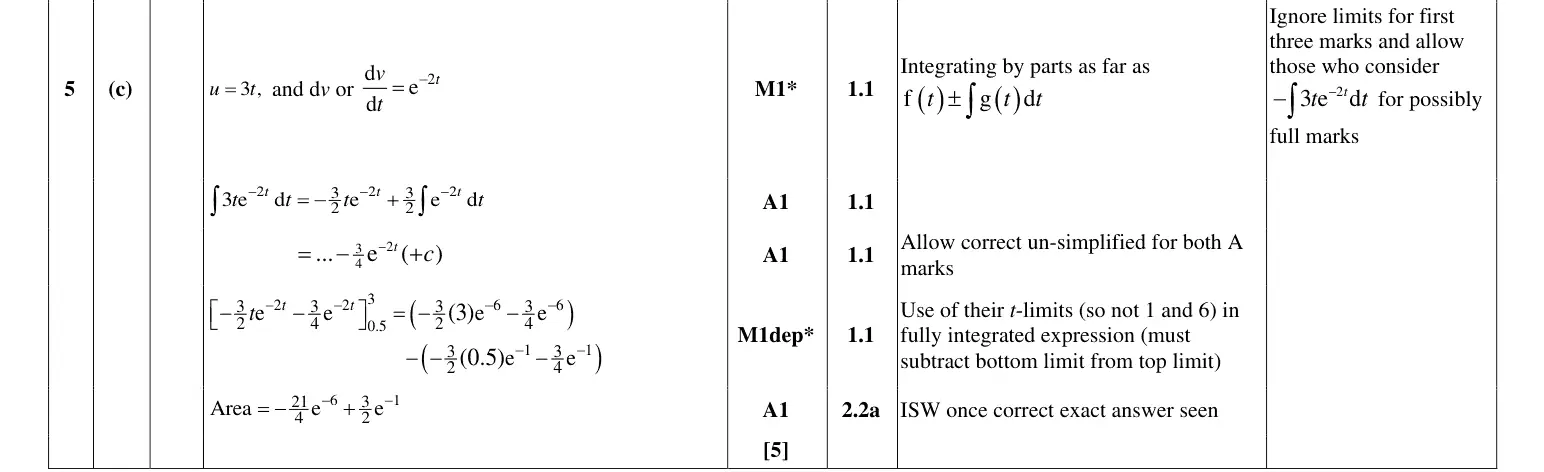
(Comment on Question 05 as a whole) Unless explicitly requested, candidates should avoid converting parametric equations into the cartesian form due to the complexity. d y In part (a) candidates only needed to determine where t = 0 . Unfortunately, some candidates made d errors in the denominator when finding d y x , and while this may not impact the numerical answer d obtained, there is a standard principle that answers obtained with wrong working will not gain full credit. The other issue with this question was that the ‘exact coordinates of P ’ was needed, those candidates that provided a decimal approximation would not gain full credit (unless the exact value had been seen as part of the working). The first issue with part (b) was that the limits were given on the diagram as x = and 1 , but the x = 6 integration was to be done with respect to t ; a number of candidates did not spot this. This was a ‘Show that’ question so the initial method mark was to find d x t and to show a clear attempt to use this in d d d x ∫ y t . The final accuracy mark was to rearrange into the given form. d t Part (c) involved using the formula given in part (b) to ‘Hence’ determine the area. Generally, this was done well, with candidates correctly giving their answer in ‘exact’ form in terms of e .
Key points and common errors
integration by parts on 3te⁻²ᵗ from 0.5 to 3
exact area (3/2)e⁻¹ − (21/4)e⁻⁶
June 2019 · Paper 1 · Q11(a)5 marksMedium
Mark scheme for this part
Examiner's comment
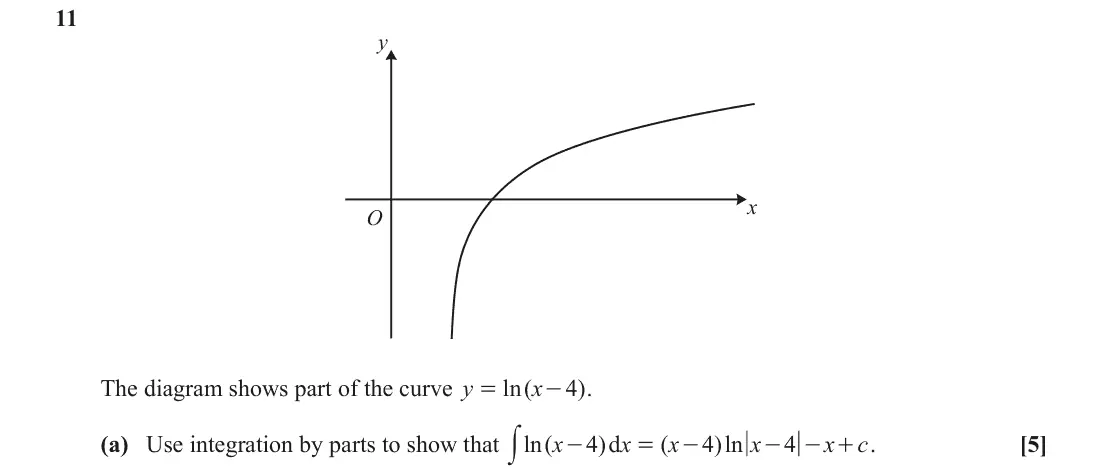
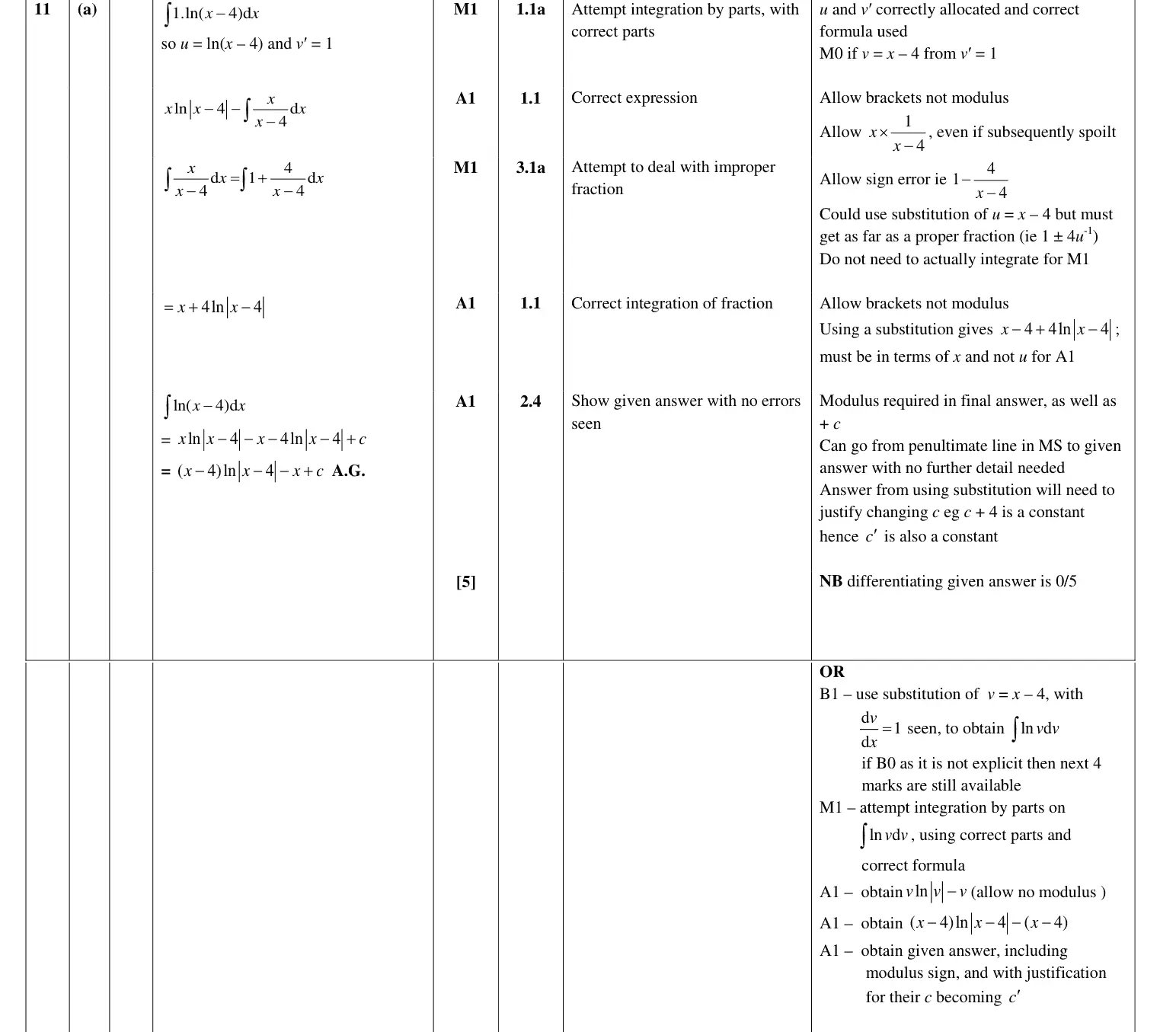
Many candidates could attempt integration by parts and gain the first two marks available, but were then unsure as to how to deal with the improper fraction and struggled to make any further progress. The most efficient method was to carry out a division attempt, either formal algebraic division or an informal balancing method, and then integrate the resulting expression. The other common method was to use a substitution that resulted in the denominator becoming a single term, thus facilitating the subsequent division. The latter method did cause problems for some candidates as it resulted in an extra term of +4 which they had to justify being absorbed into the constant of integration; in some cases it just conveniently disappeared. Some candidates used a substitution as their first step; this approach was condoned as integration by parts was still required in this method. Candidates were expected to produce the given result and a lack of clear modulus signs in the final answer was penalised. There was also evidence that a few candidates initially used the correct method but then spoiled this by attempting to adjust their working to give the given answer straightaway. The candidate makes a good start to the question producing work that would have been worth 2 marks. Rather than trying to make further progress with this solution, they delete it and instead attempt to adjust their working to achieve the given answer straightaway. A given answer is often included to allow the candidate to make further progress in the later part of the question, and they should not allow this to influence their method.
Key points and common errors
u = ln(x − 4), v′ = 1
deal with x/(x − 4) = 1 + 4/(x − 4) by division
modulus and + c in the answer
differentiating the given answer scores 0
June 2019 · Paper 2 · Q1(b)4 marksMedium
Mark scheme for this part
Examiner's comment
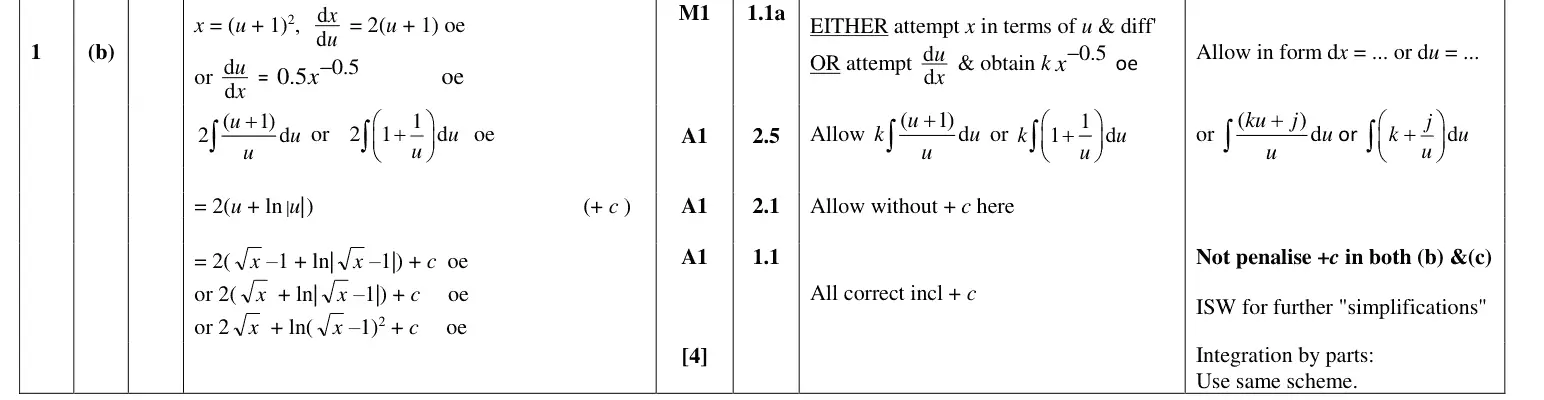
d u The majority of candidates found = 0 5 . x and attempted to express x− in terms of u . Many of d x 1 these candidates made mistakes in the algebra. Some found 2 x u∫ d u . Candidates who found x in terms of u and then found d x u were much less likely to make algebraic errors. Some candidates d substituted u for the denominator, but then just replaced dx by du . A few omitted the " + c ".
Key points and common errors
x = (u + 1)², dx/du = 2(u + 1)
2∫(1 + 1/u) du
algebra errors expressing dx in u
replacing dx by du
omitted + c
June 2019 · Paper 2 · Q1(c)2 marksMedium
Mark scheme for this part
Examiner's comment
Many candidates recognised that the numerator is a multiple of the derivative of the denominator. Most of these gave ln 2 x − 8 x − 1 , but some multiplied by 4, instead of dividing by 4. Some omitted brackets or " + c ". Those who did not recognise the basic form of the integrand attempted various strategies such as partial fractions or integration by parts, but without success.
Key points and common errors
numerator is a multiple of the derivative of the denominator: ¼ln(mod(2x² − 8x − 1)) + c
multiplying by 4 instead of dividing
partial fractions or parts fail
June 2019 · Paper 3 · Q4(d)(i)1 markMedium
Show the start of this question
Mark scheme for this part
Examiner's comment
It was expected that candidates would evaluate this definite integral on their calculator and therefore write down the correct answer of 3 π far too many candidates used integration by parts or a substitution 4 , even though only 1 mark was available.
Key points and common errors
calculator: 3π/4 ≈ 2.356
integration by parts unnecessary for 1 mark
June 2018 · Paper 1 · Q1210 marksMedium
Mark scheme for this part
Examiner's comment
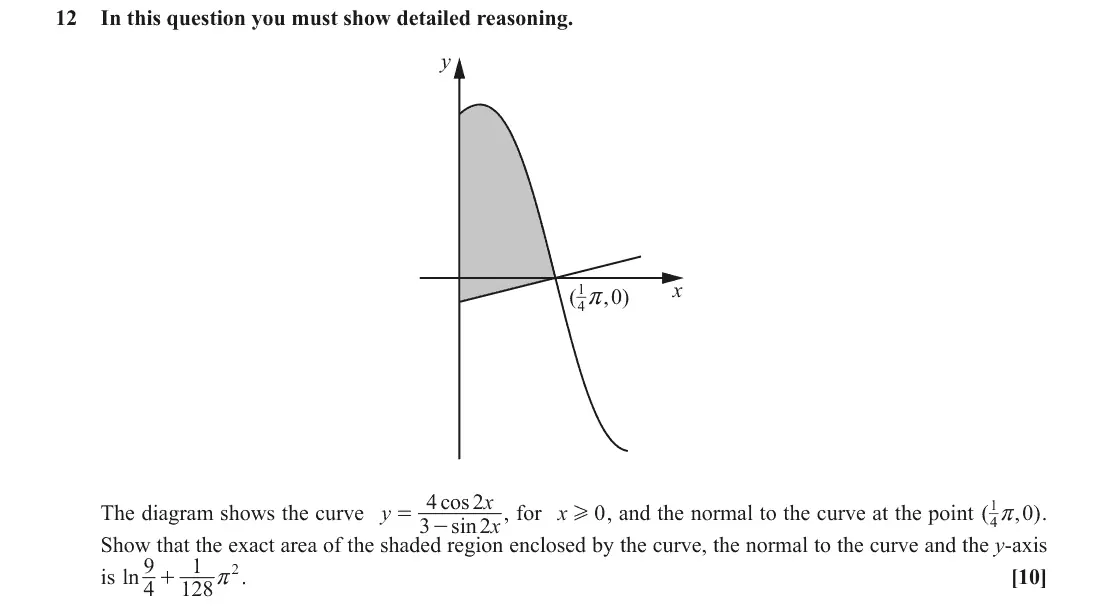
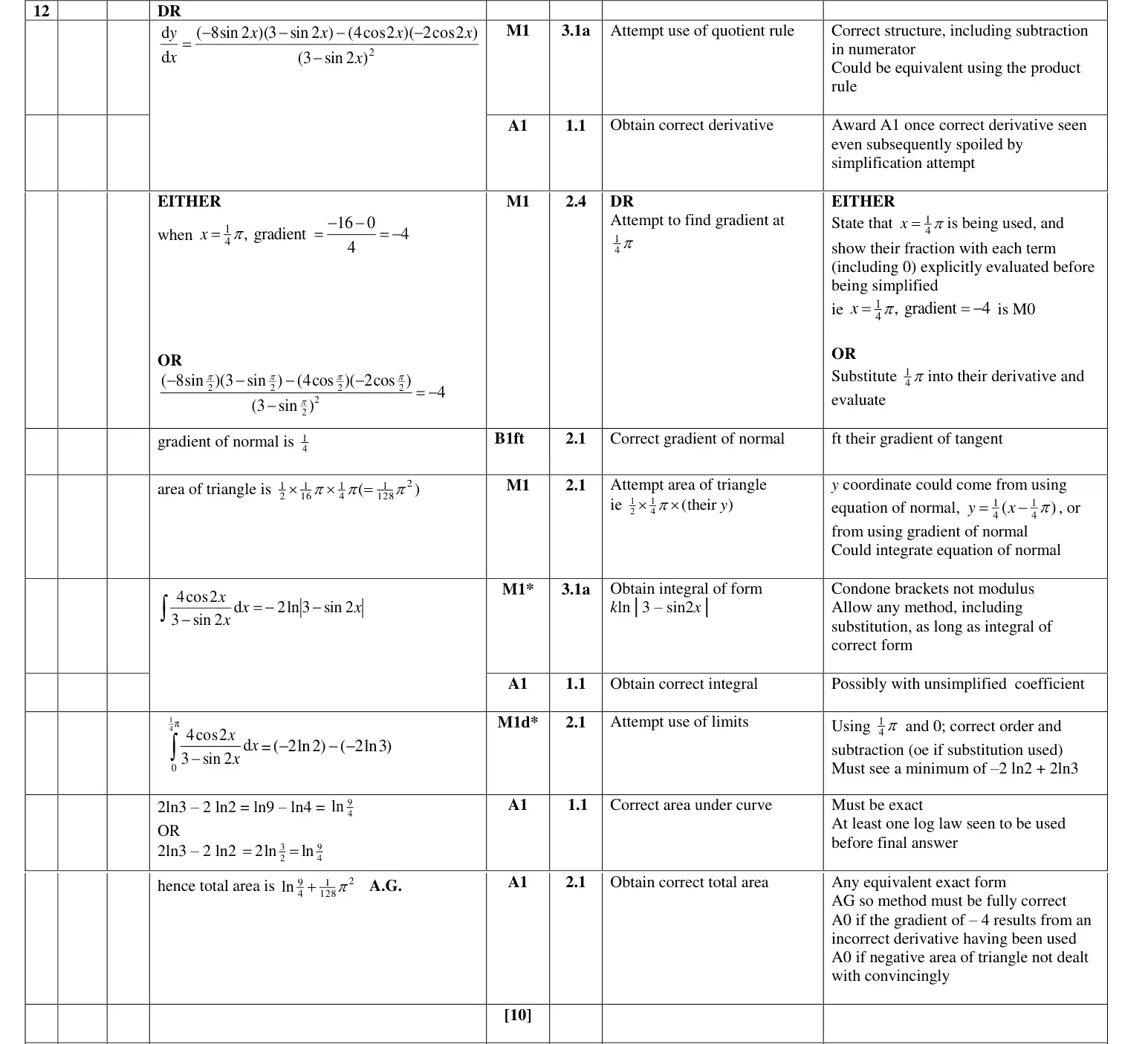
This was a question requiring detailed reasoning, so candidates were expected to show sufficient evidence of method throughout which not seen on all scripts. Candidates were generally successful when using the quotient rule to find the gradient of the curve. They were then expected to show evidence of finding the gradient at the given point; whilst some showed clear detail, others just stated the gradient with no justification. There were a variety of methods seen when finding the area of the triangle; the most common was to find the y intercept from the equation of the normal whereas others used integration. Some candidates identified that the 128π in the given answer must be the area of the triangle and attempted to fudge their answer to obtain this, in some cases deleting correct work and replacing it with a solution that was now worth less credit. Most candidates were able to correctly integrate the equation of the curve, some by inspection and others by using a substitution of their choosing. The limits were usually used correctly, but not all candidates provided sufficient evidence of use of logarithms before the appearance of ln 9 4 . This response gained full credit for a correct solution with sufficient justification seen throughout. The derivative is correct, and there is clear evidence of substitution to find the gradient at x = 1 4 π . Had the gradient of – 4 just been stated, but with no evidence, then this would have been penalised. The equation of the normal is used to find the intercept on the y-axis, and this is used to find the area of the triangle. The integration is also correct and limits are used correctly. There is then clear evidence of at least one log law being used to obtain the correct area under the curve. The two areas are then summed to justify the given answer.
Key points and common errors
quotient rule
gradient −4 at x = ¼π shown explicitly, normal gradient ¼
triangle area π²/128
∫4cos2x/(3 − sin2x) = −2ln(3 − sin2x)
area under curve ln(9/4)
handle the triangle below the axis convincingly
June 2018 · Paper 3 · Q5(ii)6 marksMedium
Show the start of this question
Mark scheme for this part
Examiner's comment
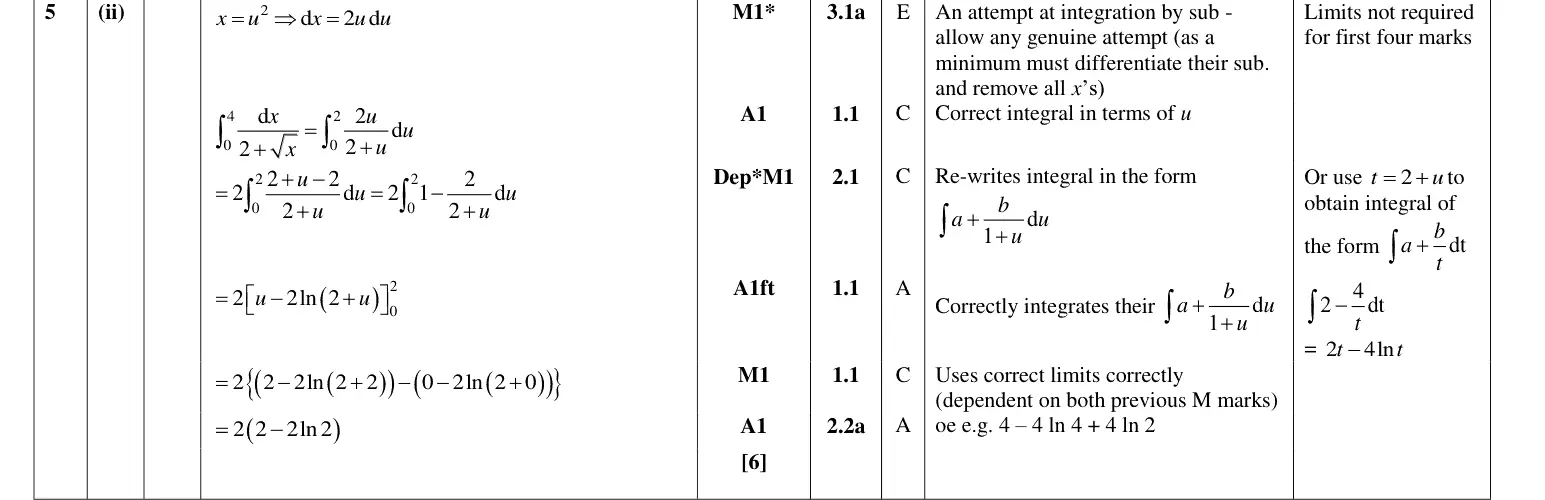
2 u ∫ While nearly all candidates used the substitution correctly and re-wrote the integral as d u many 2 + u could not deal with the resulting improper fraction in the integrand. The most successful candidates re- 2 u 2 u 4 + 2 u − 4 4 wrote u either by using long division or realising that = = 2 − u While examiners . 2 + 2 + u 2 + u 2 + noted that some candidates employed more extreme methods (for example, further substitutions and the method of integration by parts) these were usually unsuccessful.
Key points and common errors
dx = 2u du
∫₀² 2u/(2 + u) du
rewrite as 2∫(1 − 2/(2 + u)) du
2[u − 2 ln(2 + u)] = 4 − 4 ln 2
improper fraction caused difficulty
June 2018 · Paper 3 · Q79 marksMedium
Mark scheme for this part
Examiner's comment
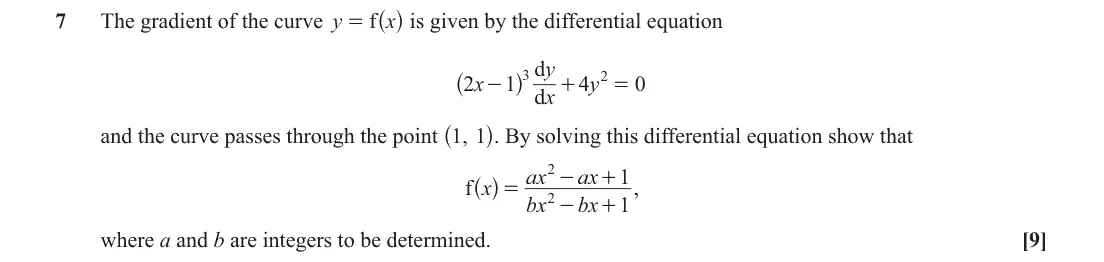
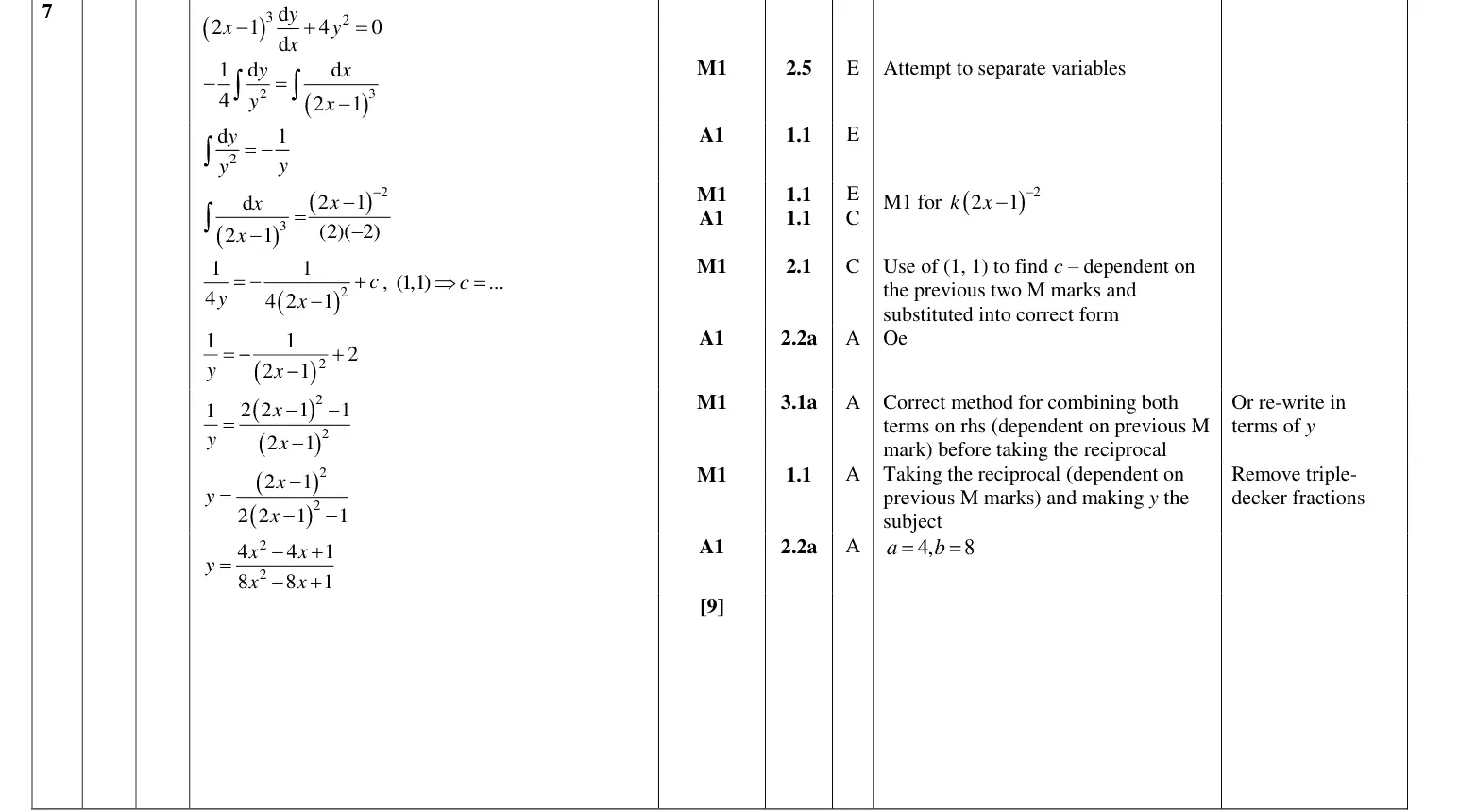
The responses to this final question in the pure section were mixed with examiners reporting a mixture of excellent responses followed by those that struggled with both the integration and the resulting algebraic manipulation required to obtain the answer in the required form. While most correctly separated the 1 d y d x variables and wrote − ∫ = ∫ many candidates had issues with the placement of the fraction 4 y ( ) 2 x − 1 on the left-hand side with examiners reporting that frequently this became a 4 rather than remaining as a quarter. While many candidates correctly integrated and remembered to include an arbitrary constant many decided to re-arrange their equation before attempting to find this constant; candidates are advised that in the majority of situations it is probably wisest to work out the +c immediately. Of those 1 1 that obtained a correct particular solution to this differential equation, for example, = − + 2 y ( 2 x − 1 ) many did not know the correct method for obtaining the result for f(x) in the required form. Many candidates took the reciprocal of each term separately rather than combining all relevant fractions first before taking the reciprocal and then expanding the brackets.
Key points and common errors
separate: −¼∫y⁻² dy = ∫(2x − 1)⁻³ dx
1/(4y) = −1/(4(2x − 1)²) + c
(1, 1) gives c
combine into a single fraction then take the reciprocal: a = 4, b = 8
Find an A-level maths tutor
Stuck on this? Book a trial session with an A-level maths tutor.