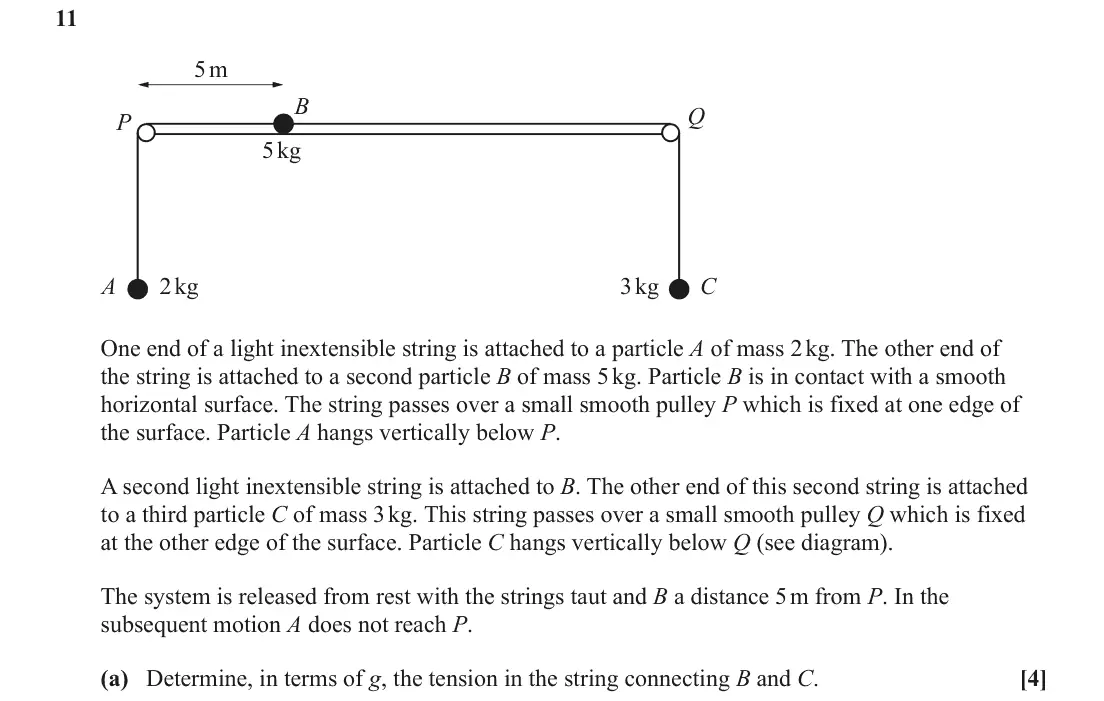
Nothing is given; F = ma and weight = mg must be known.
Since 2018
60 question parts, 192 marks, each rated Easy, Medium or Hard from the wording of the examiners' report
Notes, worked examples and practice for this topic are being written by our tutors. The past-paper questions below are ready now: work each one on paper, then open the mark scheme and the examiner's comment.
Tap a question to zoom it. Mark scheme and examiner's comment open under each question.
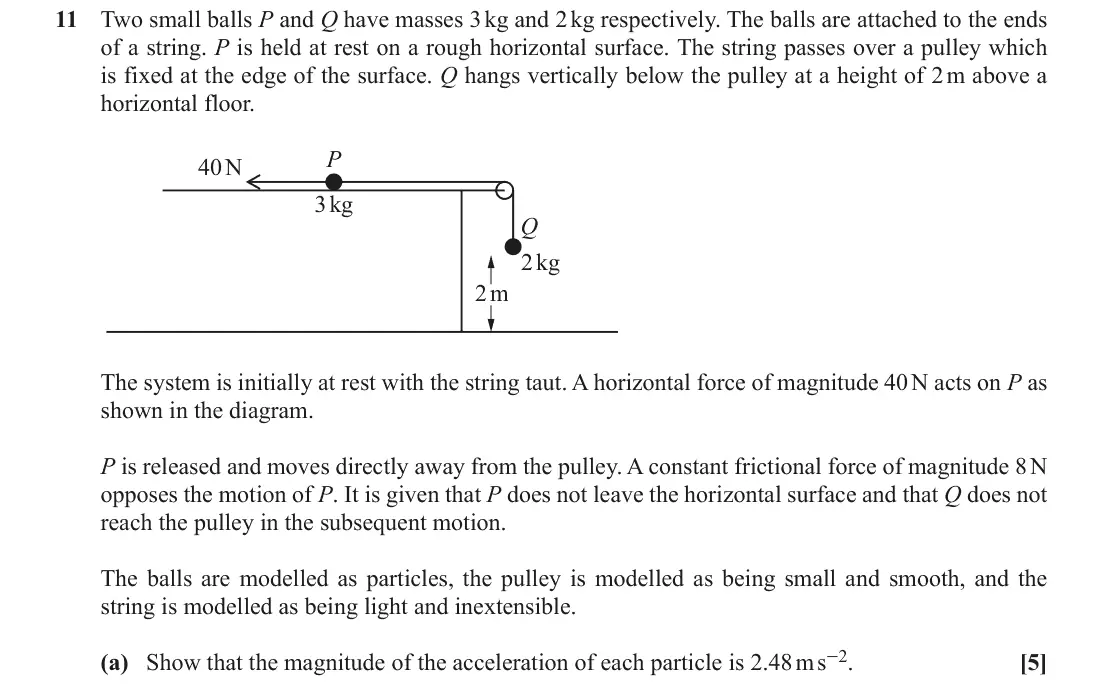
June 2025 · AS Paper 2 · Q11(a)4 marksMedium
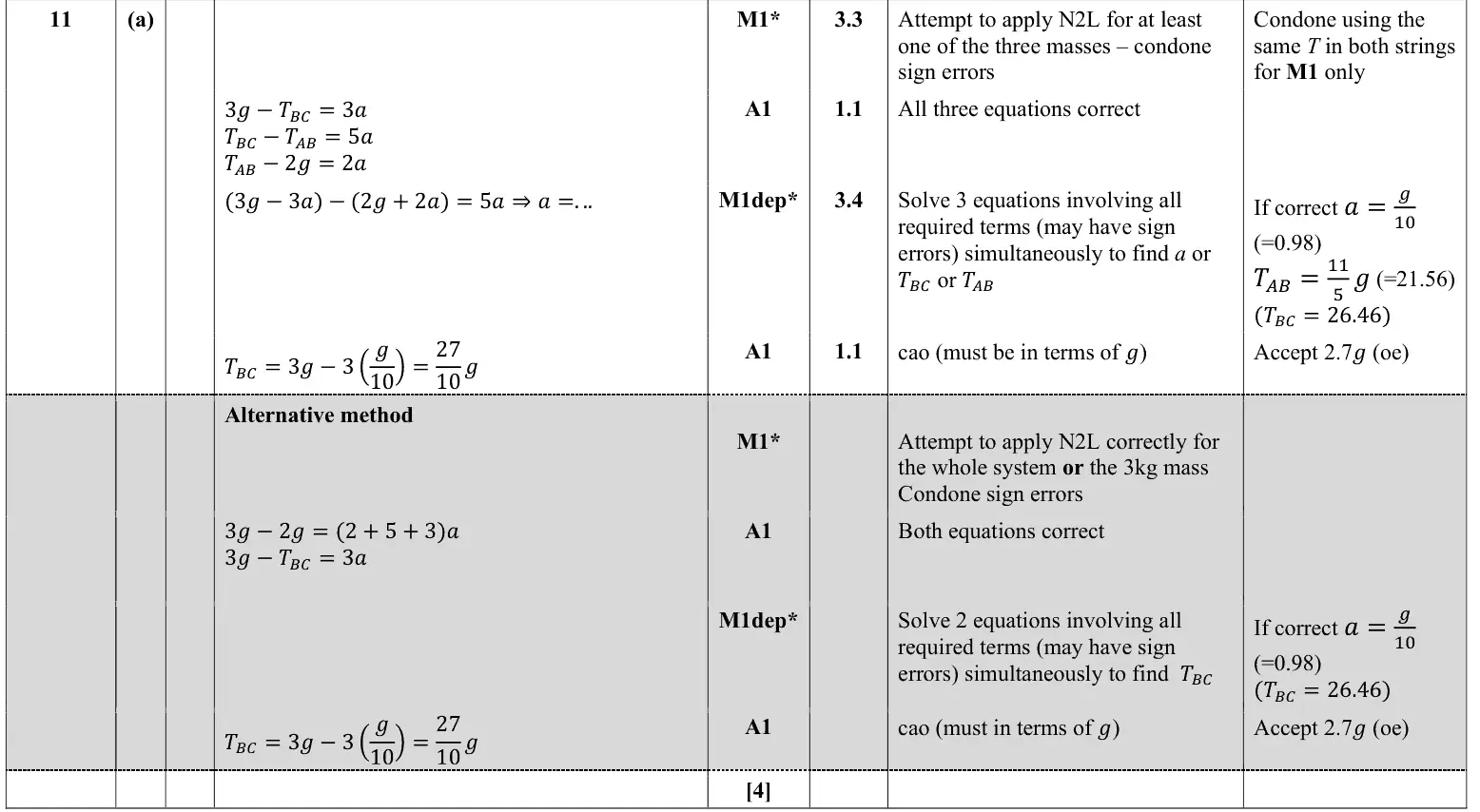
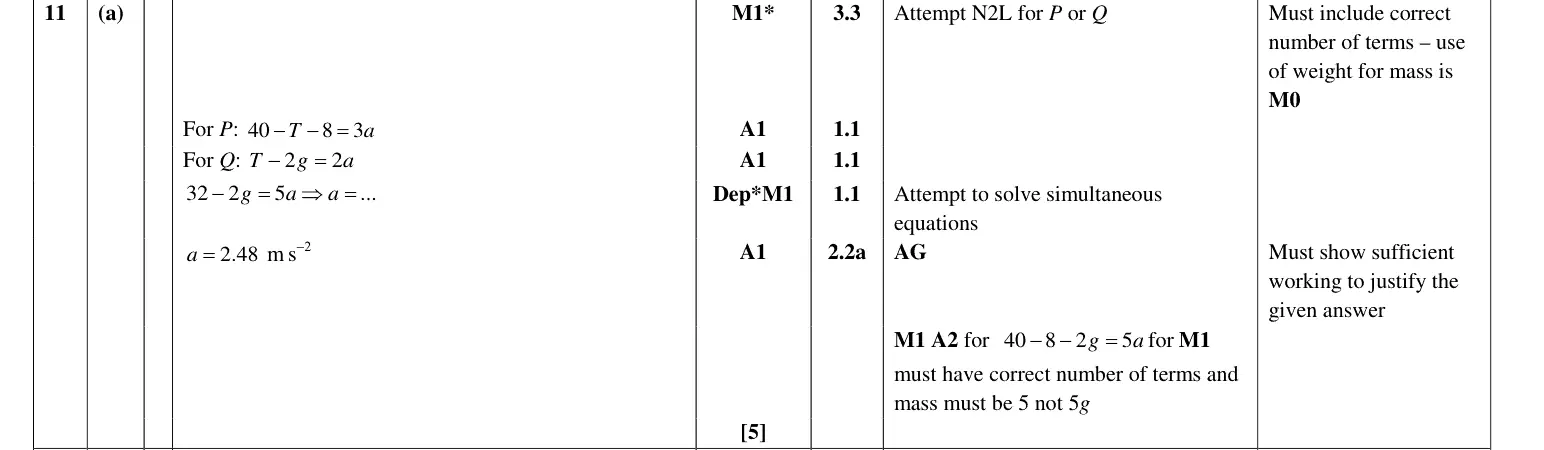
Mark scheme for this part
Examiner's comment
Those candidates who realised that the tension in AB was not the same as the tension in BC were generally very successful in this part, usually providing accurate working. Occasionally the answer was not given in terms of g as requested. Many assumed there was only one tension to find, which gained at most the first M mark.
Key points and common errors
two different tensions: 3g − T_BC = 3a, T_BC − T_AB = 5a, T_AB − 2g = 2a
a = g/10
T_BC = 27g/10
answer in terms of g
June 2025 · AS Paper 2 · Q11(b)6 marksHard
Show the start of this question
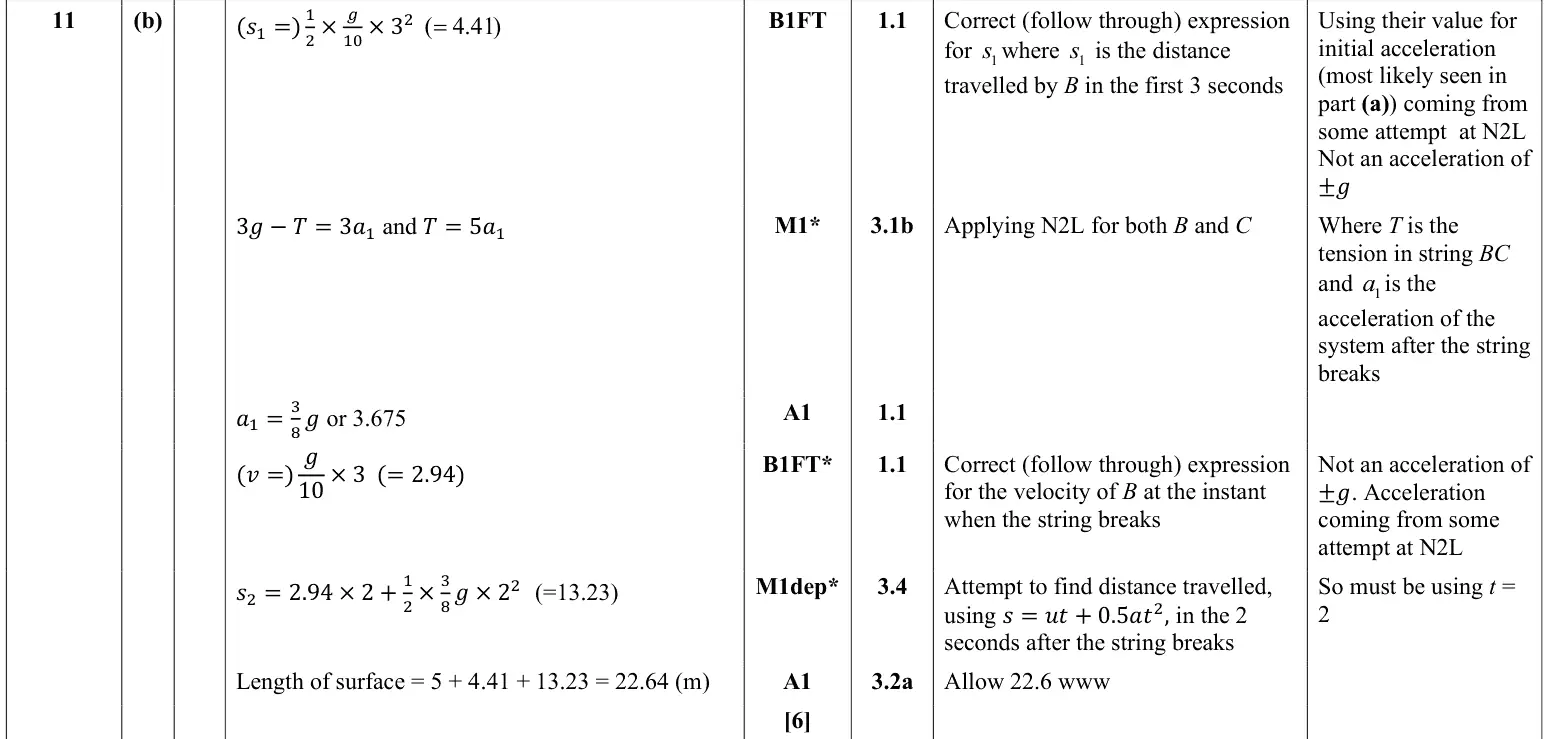
Mark scheme for this part
Examiner's comment
This question proved difficult for many candidates. There were some good solutions to this part seen, but full marks depended on a correctly obtained acceleration in (a). A few ignored the 5m when giving their final answer. Many candidates did not apply Newton’s Second Law to the situation after the string broke, using their previous acceleration, or g, or 0, so gaining at most the 2 B marks. In this solution, which follows from a fully correct part (a), the acceleration g/10 is correctly found although this had already been done in (a) actually so there was no need to repeat the calculation. It is used correctly for the 2 B marks to be given. Then T = 5a, one of the correct equations needed, is used with the tension found in part (a) and the equation 3g – T = 3a never appears. So M0 and no further marks were awarded.
Key points and common errors
first 3 s: s₁ = 4.41 m, v = 2.94
after break N2L for B and C: a₁ = 3g/8
s₂ = 2.94 × 2 + ½(3g/8)(4) = 13.23
PQ = 5 + 4.41 + 13.23 = 22.6 m
June 2025 · AS Paper 2 · Q11(c)1 markHard
Show the start of this question
Mark scheme for this part
Examiner's comment
The mark scheme lays out that to earn this mark ‘Any statement which suggests the tension is not constant…’ was required and this was rare. Most responses just said either the tension had increased or it had decreased.
Key points and common errors
a rough pulley means the tension is not the same throughout the string BC
'increases' or 'decreases' alone gains nothing
June 2025 · AS Paper 2 · Q11(d)1 markMedium
Mark scheme for this part
Examiner's comment
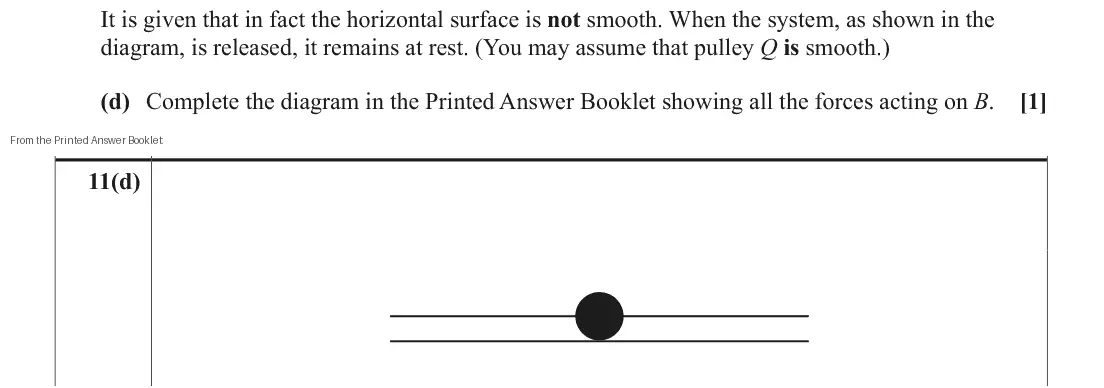
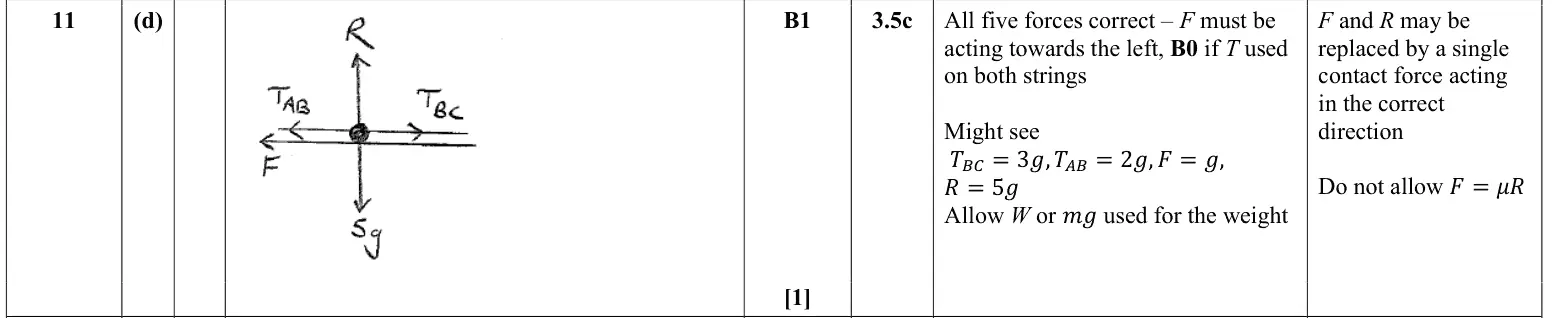
Diagrams often had at least one force missing, some missed the friction, others both the weight and the normal reaction. The tensions needed to be labelled differently and frequently were not. A few had friction going both to the left and right.
Key points and common errors
five forces on B: T_AB, T_BC (labelled differently), friction towards A, weight 5g, normal reaction
June 2025 · Paper 3 · Q7(a)3 marksMedium
Mark scheme for this part
Examiner's comment
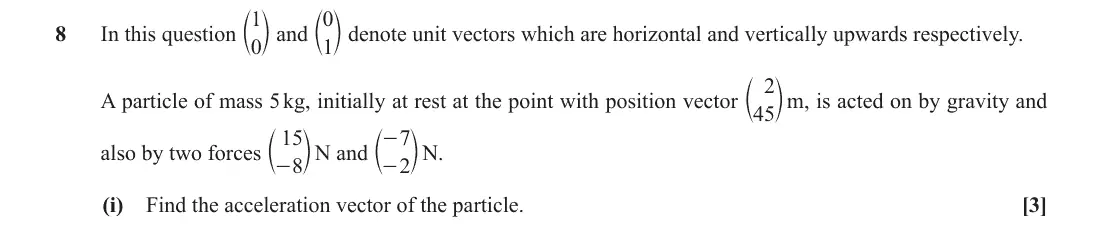
While most candidates correctly set up a vector equation using F = ma to find the values of a and b it was surprising how many candidates either misread the second force vector as (𝑎𝐢+ 𝑏𝐣) or included gravity as an additional force. Those that did set up the correct equation usually obtained both correct values of a and b.
Key points and common errors
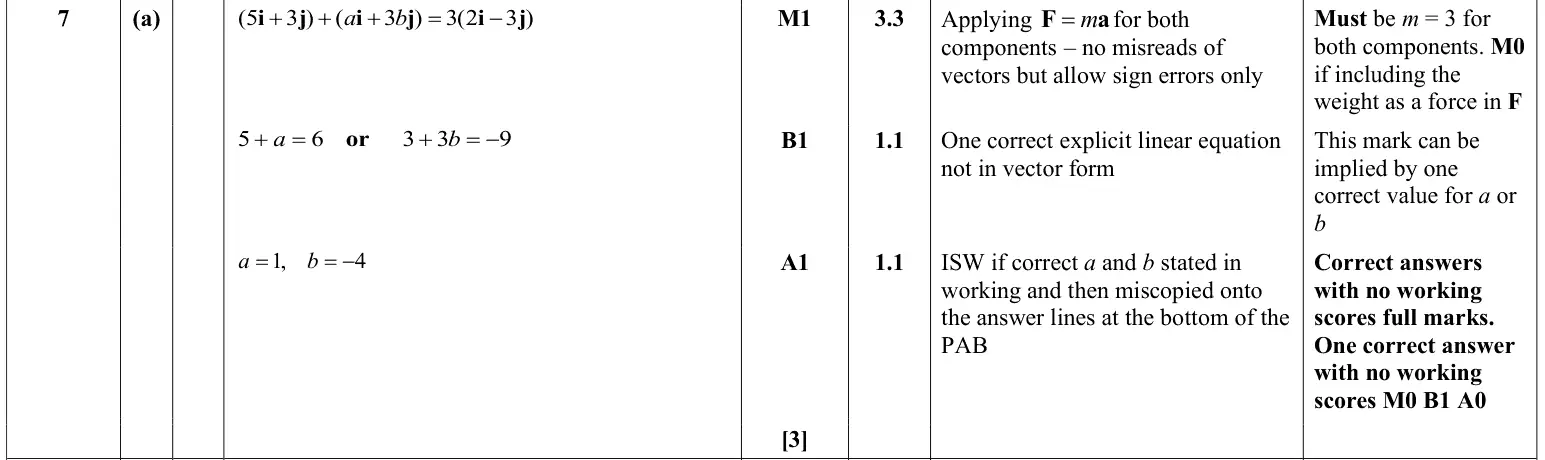
(5i + 3j) + (ai + 3bj) = 3(2i − 3j)
a = 1, b = −4
misreading the force as ai + bj or including weight
June 2025 · Paper 3 · Q8(a)2 marksEasy
Mark scheme for this part
Examiner's comment
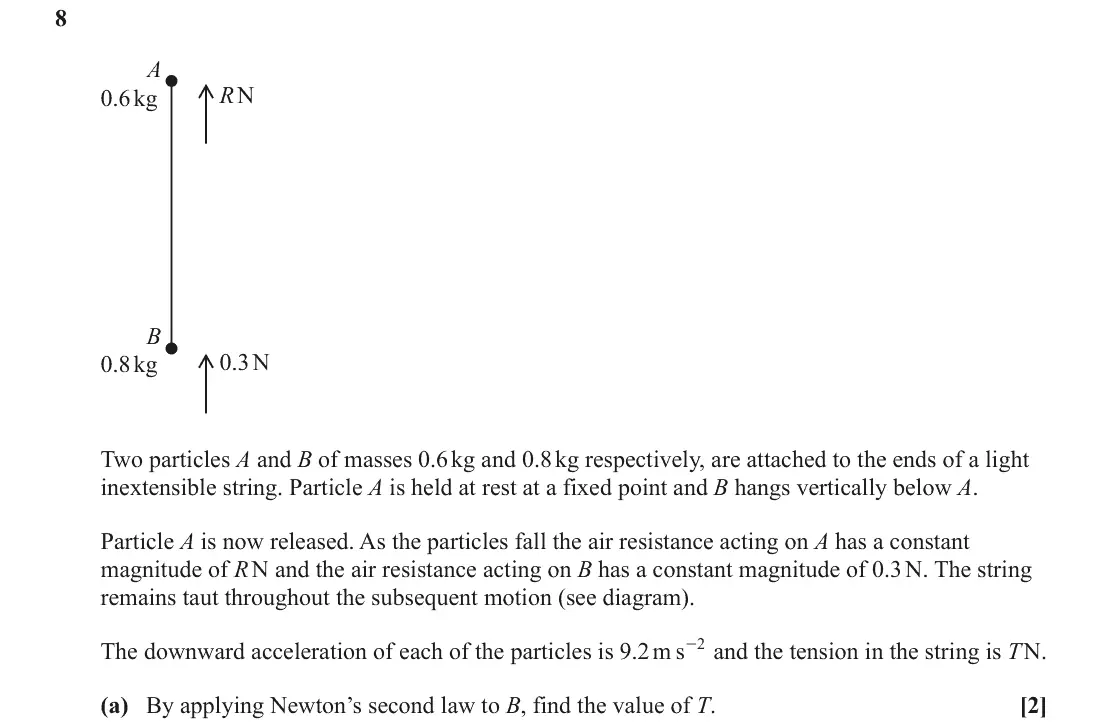
Although answered well by most candidates some struggled to include all the forces acting on B with many forgetting to include the weight of B. Of those that did include all three forces acting on B many made sign error with the acceleration term which led to a common incorrect answer of 14.9 for the tension in the string.
Key points and common errors
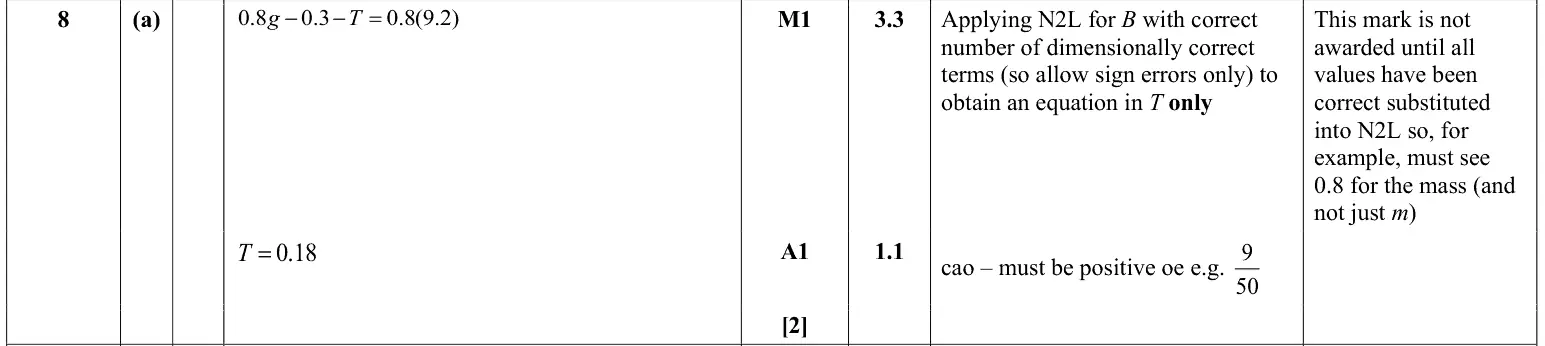
N2L for B: 0.8g − 0.3 − T = 0.8 × 9.2 so T = 0.18
weight of B often omitted
sign error gives 14.9
June 2025 · Paper 3 · Q8(b)2 marksMedium
Show the start of this question
Mark scheme for this part
Examiner's comment
Candidates were evenly split between applying Newton’s second law to A or the system to answer this part. Those who attempted the former were usually more successful as many who attempted a ‘system’ equation included, in error, the tension in the string (or missed off one of the forces).
Key points and common errors
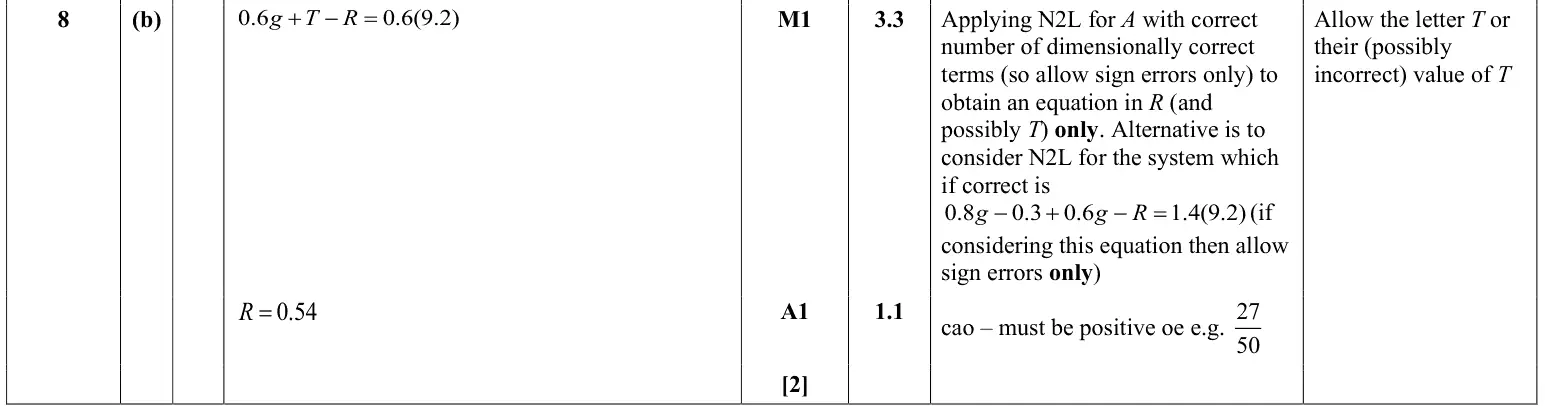
N2L for A: 0.6g + T − R = 0.6 × 9.2 so R = 0.54
system equations wrongly include T
June 2024 · AS Paper 2 · Q9(a)2 marksEasy
Mark scheme for this part
Examiner's comment
There were a lot of correct answers to this question. Marks were lost by some for simple arithmetical errors or for using F1 + F2 = F3.
Key points and common errors
F₁ + F₂ + F₃ = 0 gives F₃ = (2, −3) N
using F₁ + F₂ = F₃ is wrong
June 2024 · AS Paper 2 · Q9(b)2 marksEasy
Show the start of this question
Mark scheme for this part
Examiner's comment
This question was also well attempted, with many correct answers. The most common error was to use 8i + j = 2.5a. Also sometimes given was √62 + 42 = 2.5a, with no vector equation.
Key points and common errors
resultant (6, 4) = 2.5a
a = (2.4, 1.6) m s⁻²
must use the full resultant
June 2024 · AS Paper 2 · Q10(a)4 marksEasy
Mark scheme for this part
Examiner's comment
This part was successfully done by many. The need to use Newton’s Second law was well recognised and the correct answer was often seen. Most found a first and then T. We still saw equations like 3g – T = T – 2g with no mention of a, but these seemed less common than in the past.
Key points and common errors
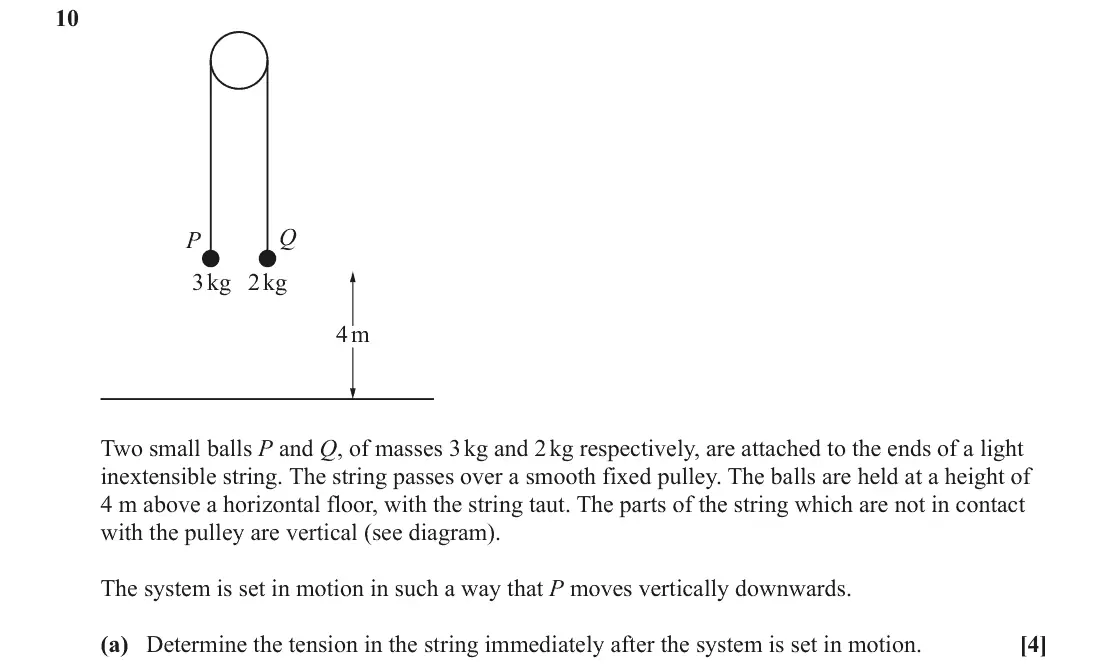
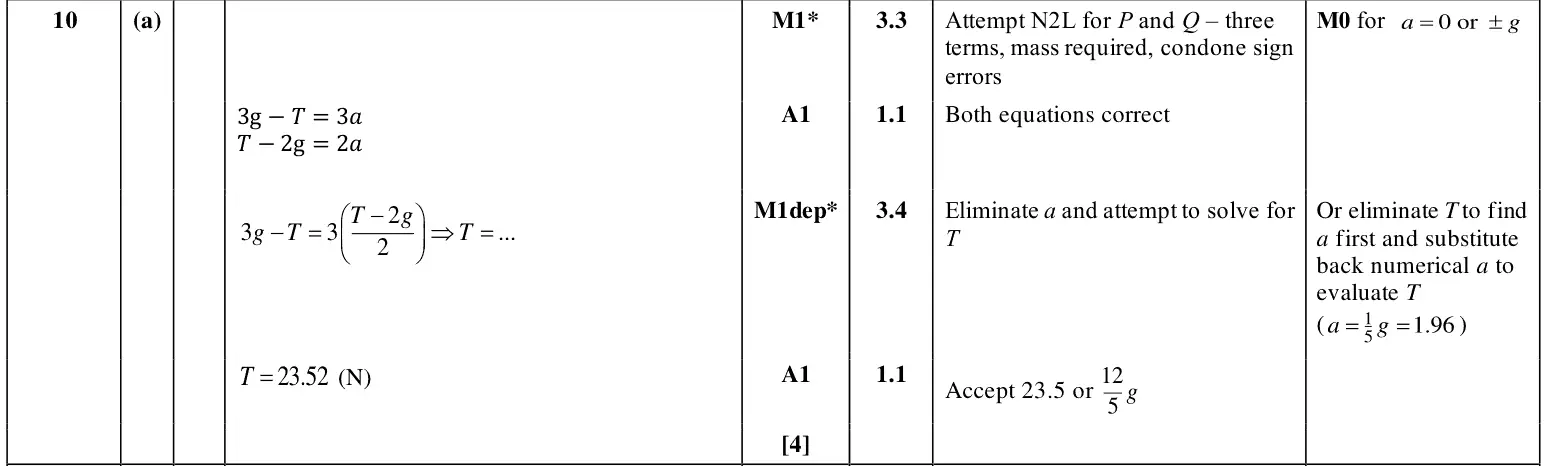
N2L: 3g − T = 3a and T − 2g = 2a
a = g/5 = 1.96
T = 23.52 N
June 2024 · AS Paper 2 · Q10(c)4 marksMedium
Show the start of this question
Mark scheme for this part
Examiner's comment
Attempts at this part were less successful. To calculate t1, using s = ut + ½at 2 was prevalent, but a = 9.8 again appeared. Giving t1 = 0.8 or 0.80 resulted in A0, unless anything more accurate was seen. Some found t1 and gave it as their final answer. Some candidates recalculated v using u = 0 and used this new value in their working for t1 and t2, rather than the value found in (b). Occasionally s = ut + ½at 2 was attempted with s = 8.
Key points and common errors
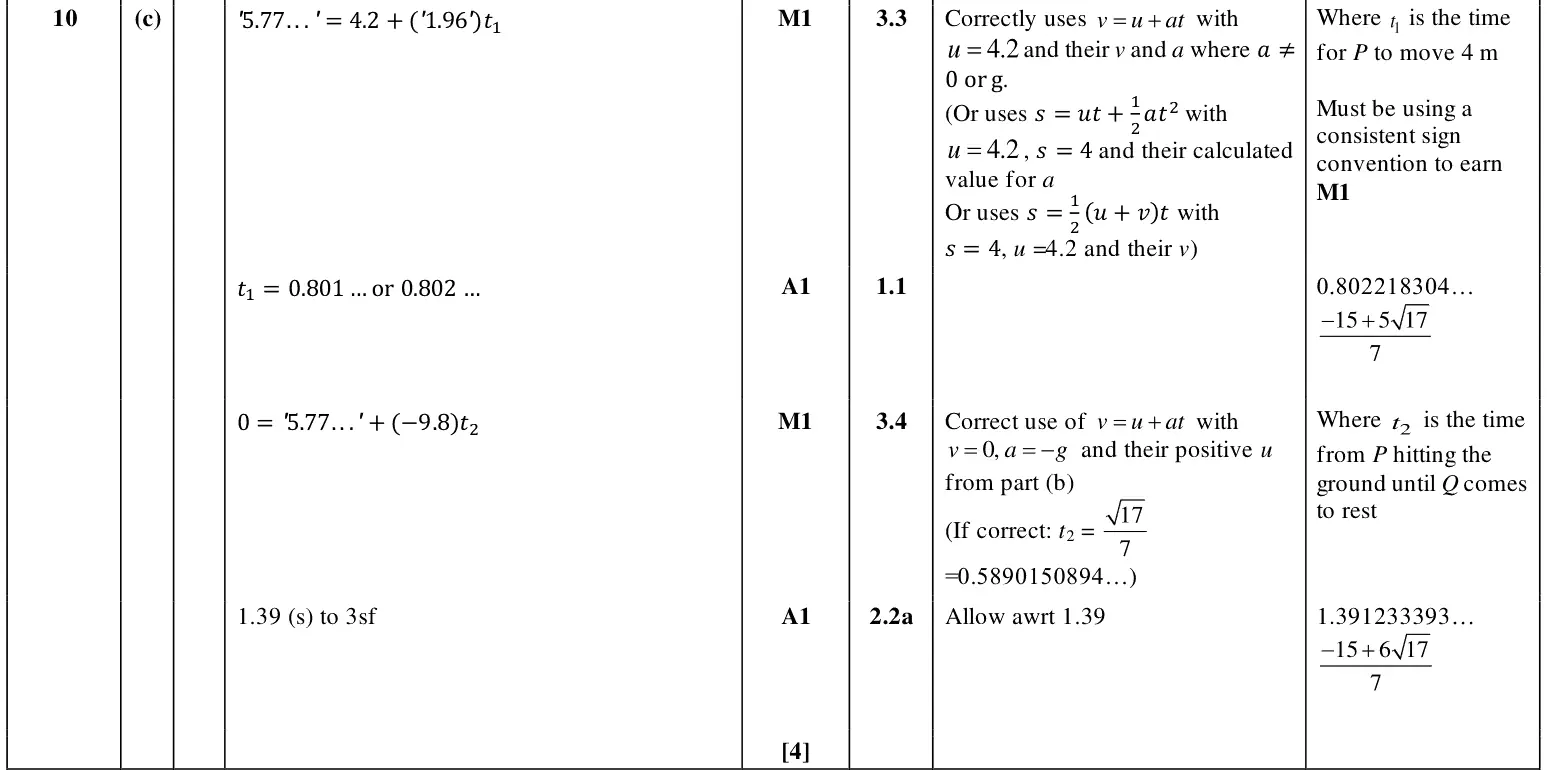
t₁ = 0.802 s for P to fall 4 m
then Q moves freely under gravity: 0 = 5.77 − 9.8t₂, t₂ = 0.589
total 1.39 s
June 2024 · AS Paper 2 · Q10(d)1 markHard
Show the start of this question
Mark scheme for this part
Examiner's comment
Hardly any candidates referred to the magnitude of the acceleration. Please refer to the mark scheme’s appendix for what we were expecting and examples of what was and was not accepted.
Key points and common errors
accelerations of P and Q would not have equal magnitude
June 2024 · Paper 3 · Q10(a)3 marksEasy
Mark scheme for this part
Examiner's comment
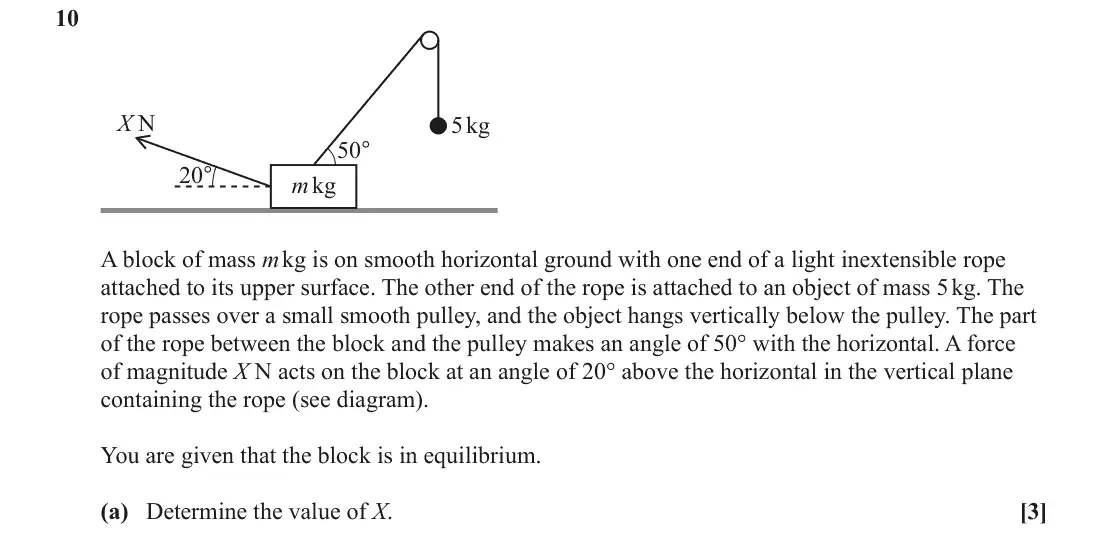
This part was answered very well with most candidates resolving vertically for the object (so obtaining the tension in the rope as 5𝑔), and then resolving horizontally for the block to obtain the correct value for 𝑋.
Key points and common errors
object: T = 5g
block horizontally: T cos50 = X cos20
X = 33.5
June 2024 · Paper 3 · Q10(b)3 marksMedium
Show the start of this question
Mark scheme for this part
Examiner's comment
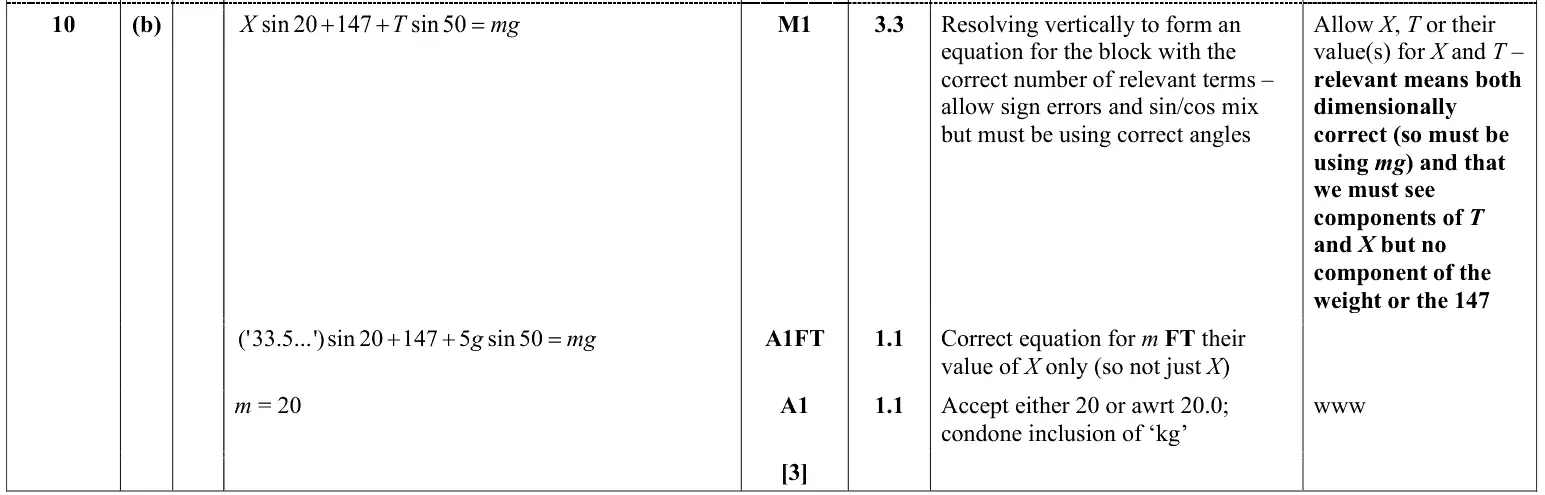
The responses to this part were more mixed with many candidates either making sign errors or failing, when resolving vertically for the block, to include all four forces that were required to find the correct value of 𝑚. It was also common to see some candidates forgetting the 𝑔 and therefore only having the mass (and not the weight) as one of the terms in their equation.
Key points and common errors
vertically on block: X sin20 + 147 + T sin50 = mg
m = 20
all four forces needed
weight mg not m
June 2023 · AS Paper 2 · Q11(a)2 marksMedium
Mark scheme for this part
Examiner's comment
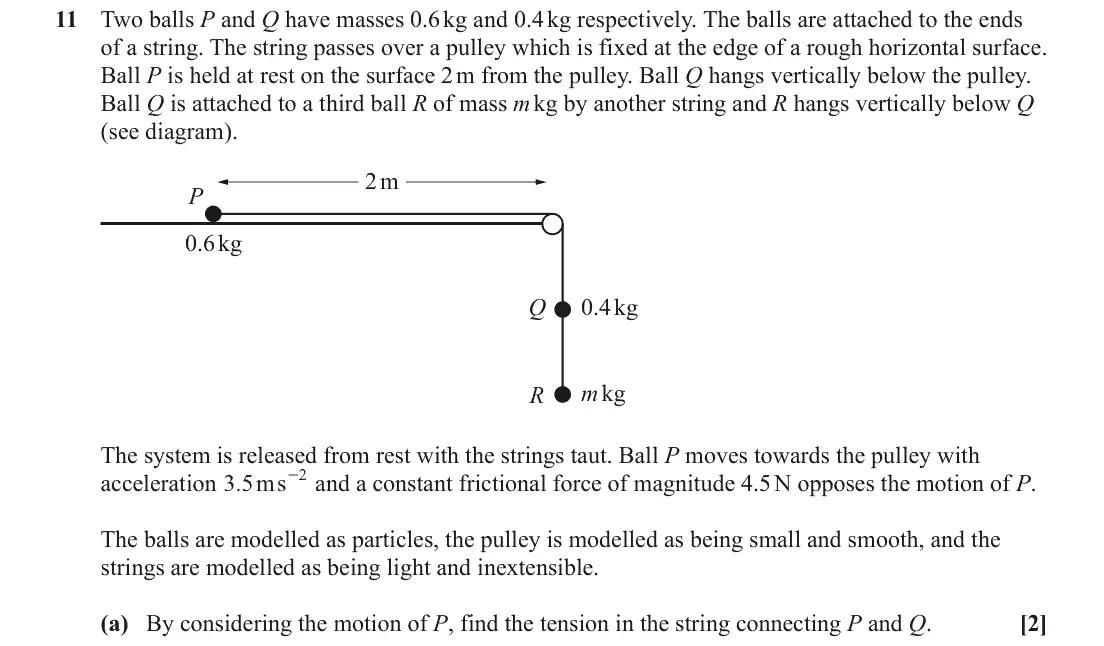
This part of Question 11 was done reasonably well. The question stated ‘By considering the motion of P’ to hopefully help focus candidates’ minds, although some equations involved 0.6 g. Some less successful responses also introduced 0.4 into their equation(s).
Key points and common errors
N2L for P: T − 4.5 = 0.6 × 3.5 so T = 6.6 N
0.6g does not belong in the horizontal equation
June 2023 · AS Paper 2 · Q11(b)4 marksMedium
Show the start of this question
Mark scheme for this part
Examiner's comment
We saw some good solutions to this part, but quite a lot of equations had extra or missing terms. In the equation for R the value found for T1 was sometimes placed where T2 should have been, resulting in this equation alone being used to find m. Those considering Q and R together here needed to be careful (see the comment in (a)). 04m was used in some equations. The request for 3 significant figures was well followed here.
Key points and common errors
for Q: T₂ + 0.4g − 6.6 = 0.4 × 3.5
for R: mg − T₂ = 3.5m
m = 0.648 (3 s.f.)
missing or extra terms
tensions mixed up
June 2023 · AS Paper 2 · Q11(c)6 marksHard
Show the start of this question
Mark scheme for this part
Examiner's comment
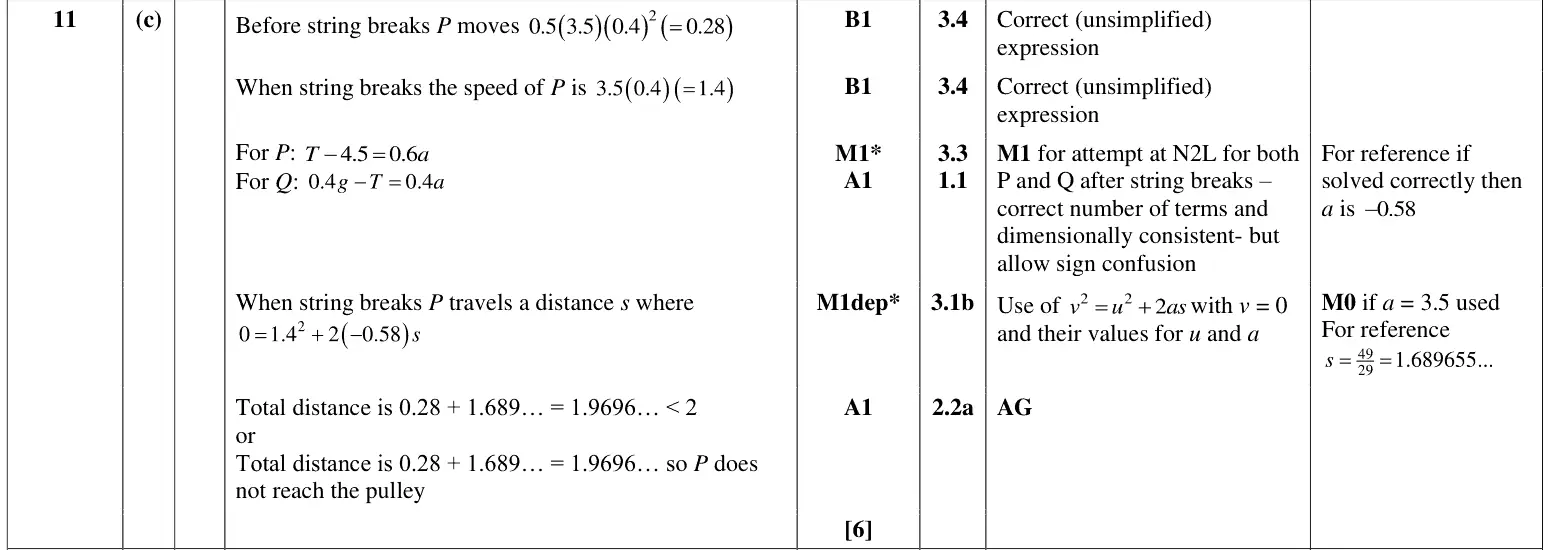
Many candidates earned the first 2 B marks for the motion until the string breaks, but what happened after this was often confused. Some just thought P only moved 0.28 m and compared this with 2 or used a = g in the subsequent motion. Others who attempted one or two Newton II equations used T = 0 or maybe 6.6. Use of the correct deceleration was uncommon. This shows a candidate who realises that there is a change of acceleration but uses Newton II with T = 0.
Key points and common errors
before break: 0.28 m and speed 1.4
after: P and Q decelerate with a = −0.58 (T ≠ 0 and ≠ 6.6)
0 = 1.4² + 2(−0.58)s gives s = 1.69
total 1.97 < 2
June 2023 · AS Paper 2 · Q11(d)1 markMedium
Show the start of this question
Mark scheme for this part
Examiner's comment
The mark scheme provides examples of the sort of things we accepted here and it would be recommended for centres to review this with future students. Candidates should be encouraged to write their response in a full sentence, as it was not always clear what a candidate meant. For example, some candidates just wrote ‘Friction’, which could mean the frictional force opposing the motion of P is not constant (which means the ball could reach the pulley), or there is a frictional force on the pulley (which would make the ball less likely to reach the pulley). Some comments were difficult to read; we encourage candidates to always write their responses clearly. It is also worth noting that one factor was requested; if more than one factor was given then all had to be acceptable to gain the mark.
Key points and common errors
P and the pulley modelled as having no size
or friction not constant, string not light/inextensible
must be clearly stated
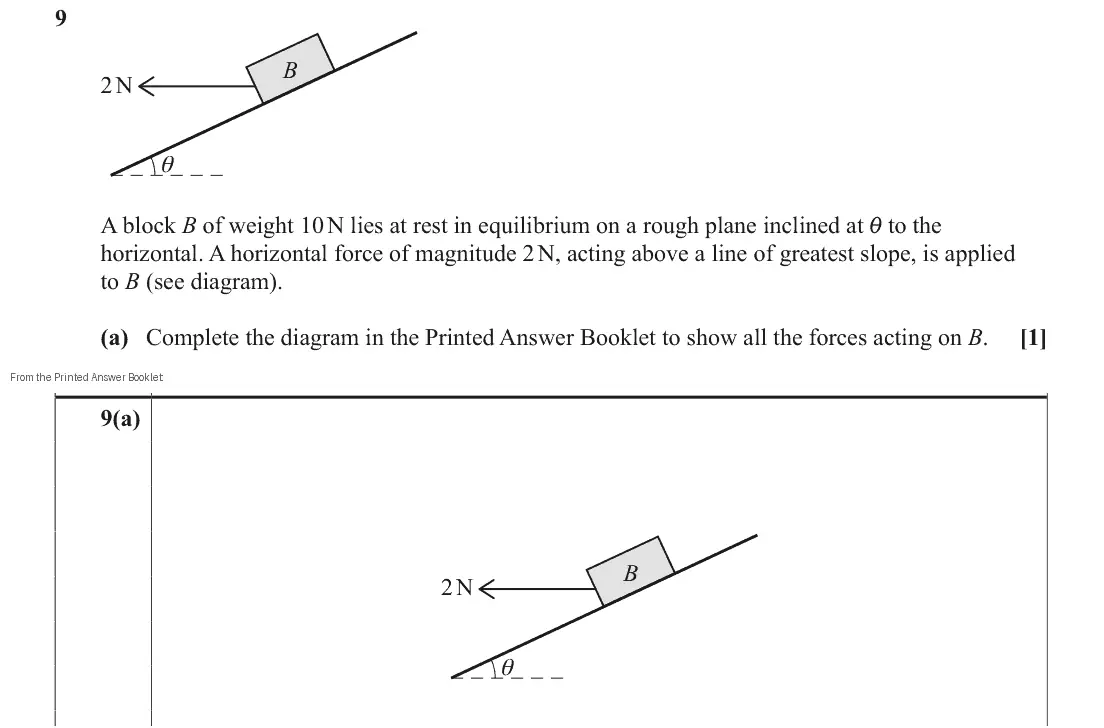
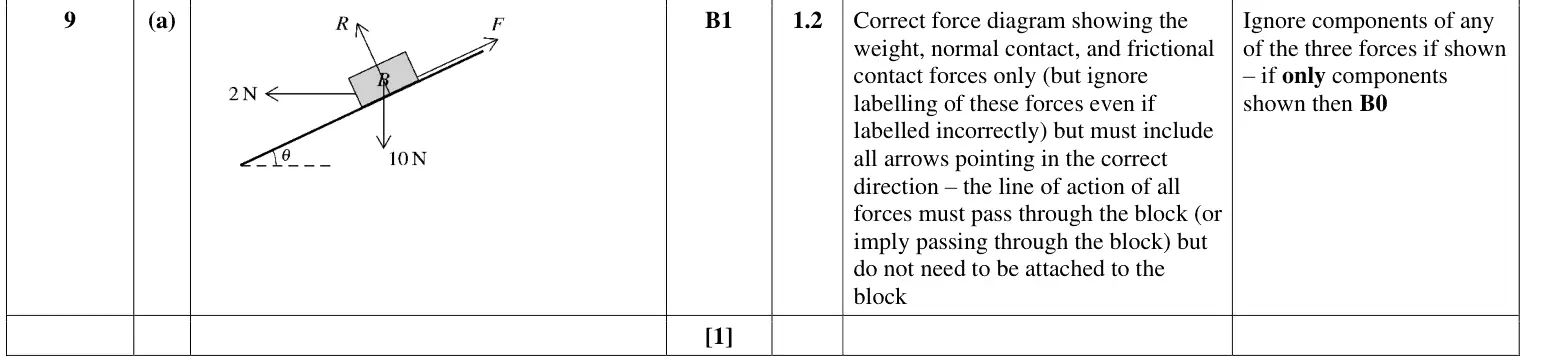
June 2023 · Paper 3 · Q9(a)1 markEasy
Mark scheme for this part
Examiner's comment
This part was answered extremely well with most candidates correctly adding the weight and the two contact forces (normal and friction) to their diagram. Candidates are reminded that arrows should be included to show the direction of these forces. The most common error in this part was to draw the normal contact force at B acting vertically upwards rather than perpendicular to the plane.
Key points and common errors
add weight 10 N, normal contact force perpendicular to the plane and friction up the plane, with arrows
error drawing the normal vertically
June 2023 · Paper 3 · Q10(b)4 marksEasy
Show the start of this question
Mark scheme for this part
Examiner's comment
determine that 𝐑𝐑= 2𝐢𝐢−6𝐣𝐣. Most then went on to correctly apply |𝐅𝐅| = 𝑚𝑚|𝐚𝐚| and found the correct value This part was answered well with most candidates using the given value of a to then find b and hence of m.
Key points and common errors
b = −8 so R = 2i − 6j
magnitude √40 = m × 5√10 so m = 0.4
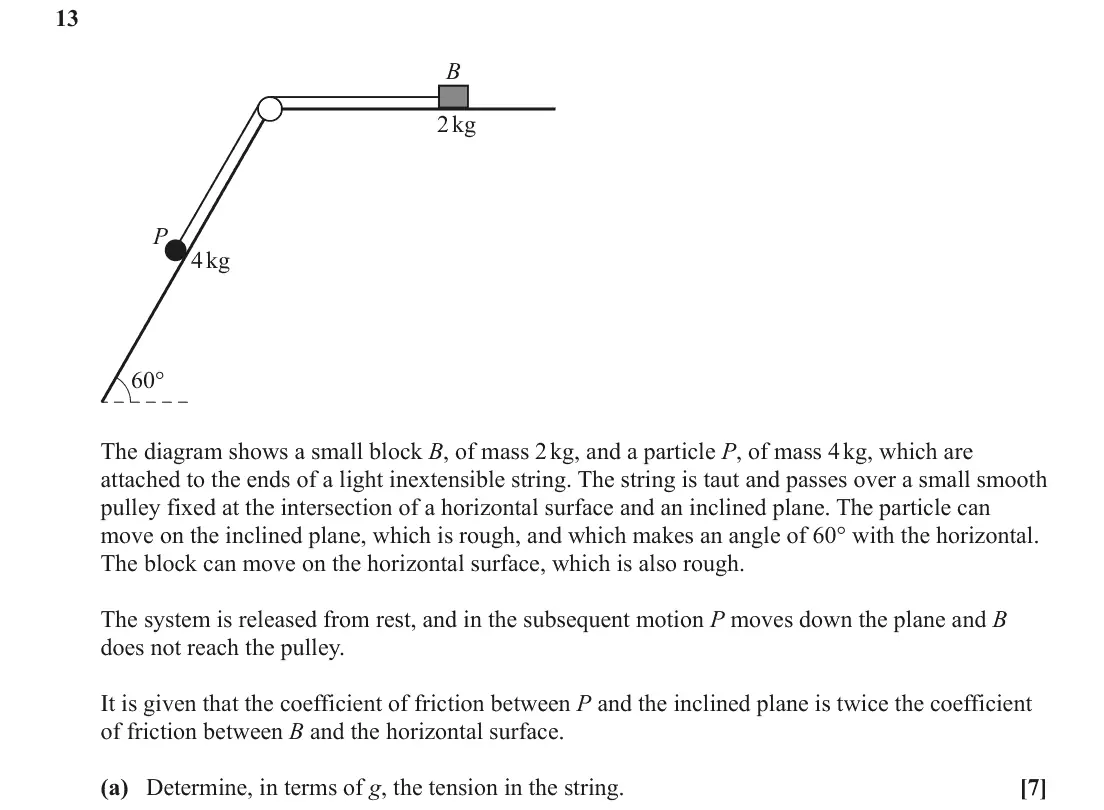
June 2023 · Paper 3 · Q13(a)7 marksMedium
Mark scheme for this part
Examiner's comment
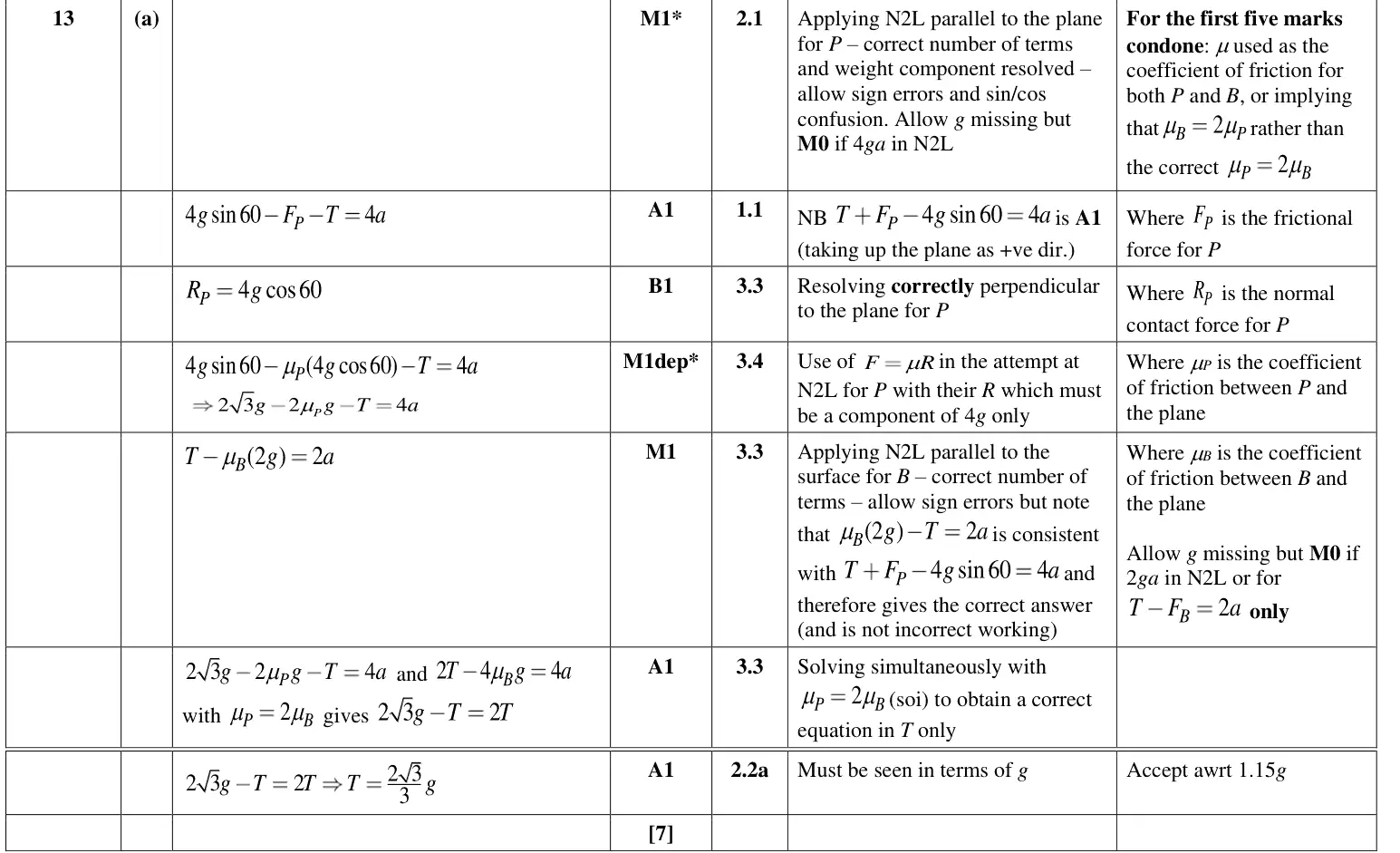
Most candidates in this part attempted to apply Newton’s second law for the motion of P and B the coefficients of friction of P and B. If done correctly this resulted in the equations: 4𝑔𝑔𝑔𝑔𝑔𝑔𝑔𝑔60 − separately to obtain two equations relating the tension in the string, the acceleration of the system and 𝜇𝜇𝑃𝑃(4𝑔𝑔𝑔𝑔𝑔𝑔𝑔𝑔60) −𝑇𝑇= 4𝑎𝑎 and 𝑇𝑇−𝜇𝜇𝐵𝐵(2𝑔𝑔) = 2𝑎𝑎. It was surprising therefore how many candidates derived eliminating 𝑎𝑎, and use the given result that 𝜇𝜇𝑃𝑃= 2𝜇𝜇𝐵𝐵, to find the required tension in the string. Apart from these two equations correctly (and so scored the first 5 marks) but did not complete the problem by acceleration of the system was zero or assuming that as 𝜇𝜇𝑃𝑃= 2𝜇𝜇𝐵𝐵 then this implied that 𝐹𝐹𝑃𝑃= 2𝐹𝐹𝐵𝐵 (which the common sign errors and sine/cosine confusion other errors seen in this part were assuming that the although true in this particular case it could not be assumed to be true without evidence of considering the relevant normal contact forces). This response scored the first 5 marks. This candidate has set their working out in a clear and logical manner (and included a diagram to assist them in setting up the required equations of motion). The candidate manages to set up both equations for P and B correctly but then makes an error when they write sin 30 rather than sin 60 which leads to an incorrect expression for the tension in the string.
Key points and common errors
N2L for P down the plane: 4g sin60° − μ_P(4g cos60°) − T = 4a
for B: T − μ_B(2g) = 2a
use μ_P = 2μ_B and eliminate a and μ: T = (2√3/3)g
many stopped after the two equations
June 2022 · AS Paper 2 · Q92 marksEasy
Mark scheme for this part
Examiner's comment
A straightforward question to start the Mechanics section. It was often fully correct. A few made sign errors and less successful attempts applied F = ma using the magnitudes of the vectors.
Key points and common errors
F + (3i + 2j) = 4(−2i + 3j) so F = −11i + 10j
error using magnitudes
June 2022 · AS Paper 2 · Q103 marksMedium
Mark scheme for this part
Examiner's comment
The ‘direct’ method written out on the scheme was obviously quicker than considering the motion in various parts but seemed to be less popular. Those who tried to apply it often did not appreciate that the initial velocity was not in the same direction as the displacement and acceleration. Note the quadratic here could be done by calculator (BC). Those who did it by considering the motion up and the motion down, for example, often got full marks but a complete method for what we requested was needed to gain any credit. If a relevant time was omitted, no marks were given.
Key points and common errors
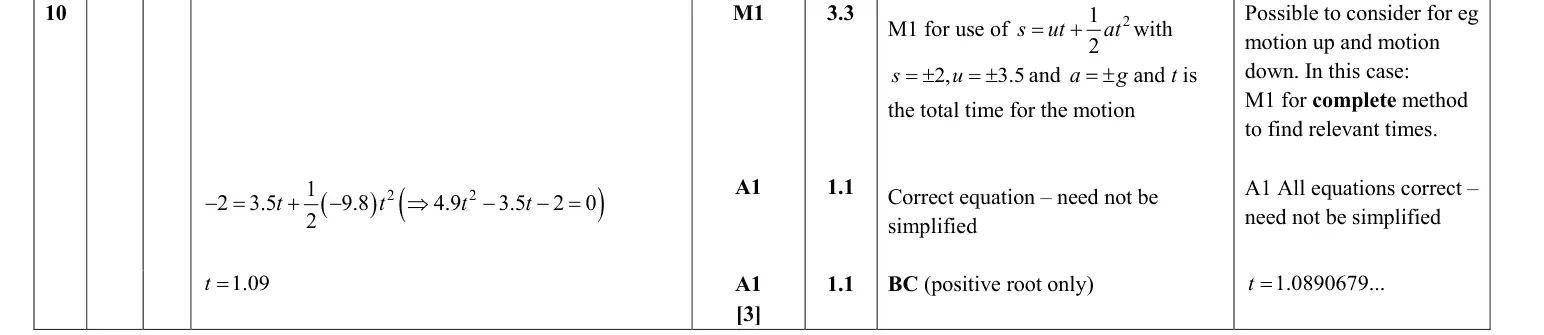
s = ut + ½at² with s = −2, u = 3.5, a = −9.8: 4.9t² − 3.5t − 2 = 0, t = 1.09
directions of u, s, a must be consistent
split-motion methods need all times
June 2022 · AS Paper 2 · Q12(a)1 markHard
Mark scheme for this part
Examiner's comment
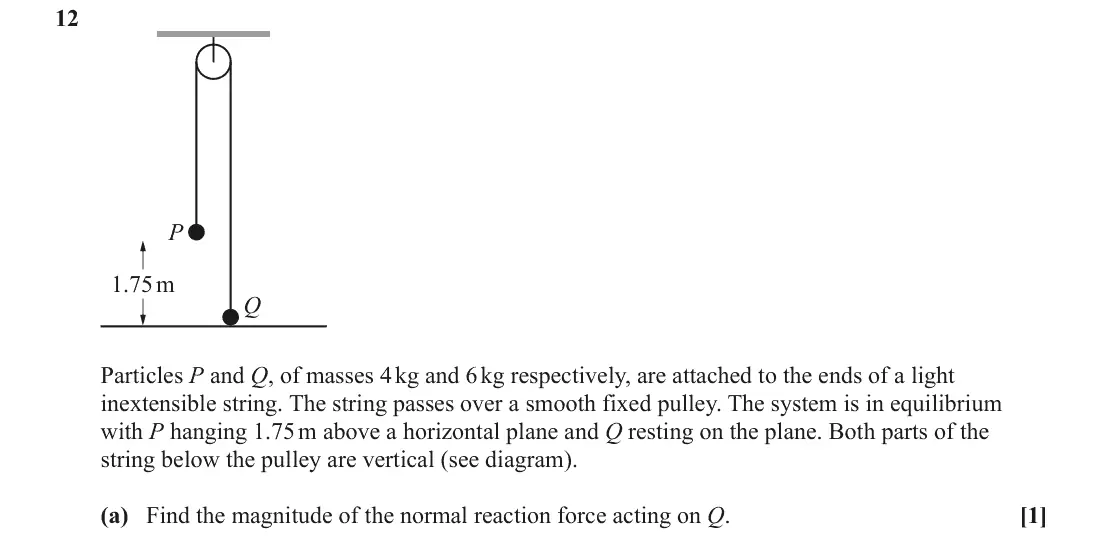
Correct answers were rare here, with 6g the value generally given.
Key points and common errors
R = 6g − 4g = 2g = 19.6 N
6g commonly given
June 2022 · AS Paper 2 · Q12(b)5 marksHard
Show the start of this question
Mark scheme for this part
Examiner's comment
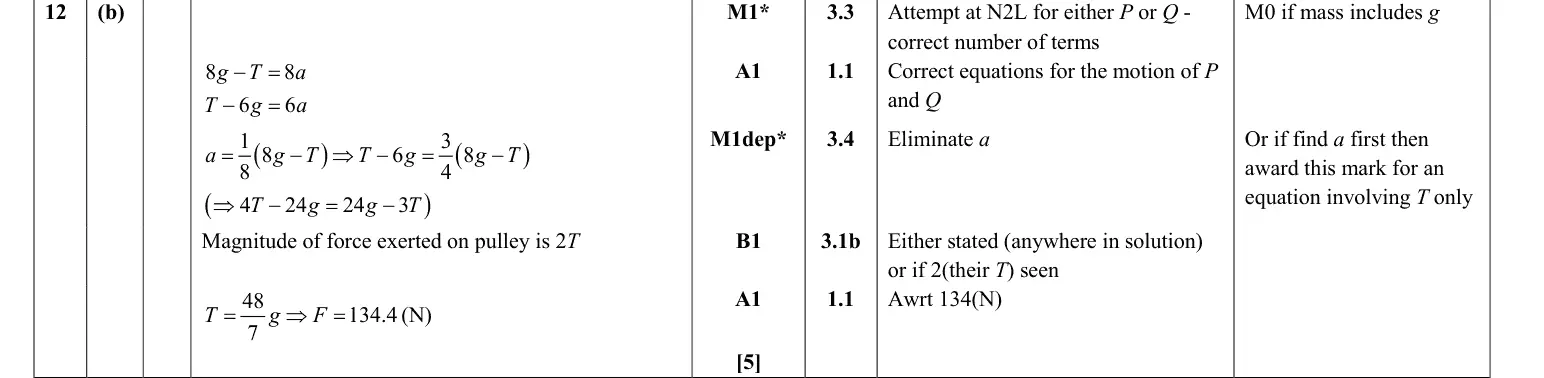
In this part many just gained the first 3 marks, applying Newton’s Second Law to both particles and calculating a and T. Few realised that the magnitude of the force exerted on the pulley by the string was 2T. One examiner mentioned that when teaching this topic, they got students to draw the tensions acting downwards from the pulley as well as the tensions acting upwards just in case this sort of question came up! In this type of question, a good diagram of the forces involved is to be encouraged. Those who considered the system as a whole, which is to be discouraged, often did not score full marks . If they succeeded in finding a sensibly, they did not then show clarity when trying to find T.
Key points and common errors
8g − T = 8a, T − 6g = 6a
T = 48g/7
force on pulley 2T = 134 N
few realised 2T
June 2022 · AS Paper 2 · Q12(c)4 marksHard
Show the start of this question
Mark scheme for this part
Examiner's comment
Many struggled with this question. The most common error was not understanding that the acceleration of Q changed when P hit the floor. 9.8 or their answer to part (b) was used in both stages of the motion. Finding the velocity of Q at the instant when P hits the floor was critical to solving this problem. A few good efforts lost the final mark by giving the answer as 2 x (0.25) + 1.75. This exemplar illustrates the above comment about acceleration. This candidate uses the acceleration found in part (b) of 1.4ms-2 in both stages of the motion.
Key points and common errors
a = 1.4: v² = 2(1.4)(1.75) = 4.9 when P lands
then Q moves freely under gravity: s = 0.25
total 2 m
common error using the same acceleration in both stages
June 2022 · AS Paper 2 · Q12(d)1 markEasy
Show the start of this question
Mark scheme for this part
Examiner's comment
Many correctly cited ‘air resistance’ or ‘friction at the pulley’.
Key points and common errors
e.g. air resistance, friction at the pulley, string not light or inextensible
'more accurate g' not accepted
June 2022 · Paper 3 · Q10(a)2 marksEasy
Mark scheme for this part
Examiner's comment
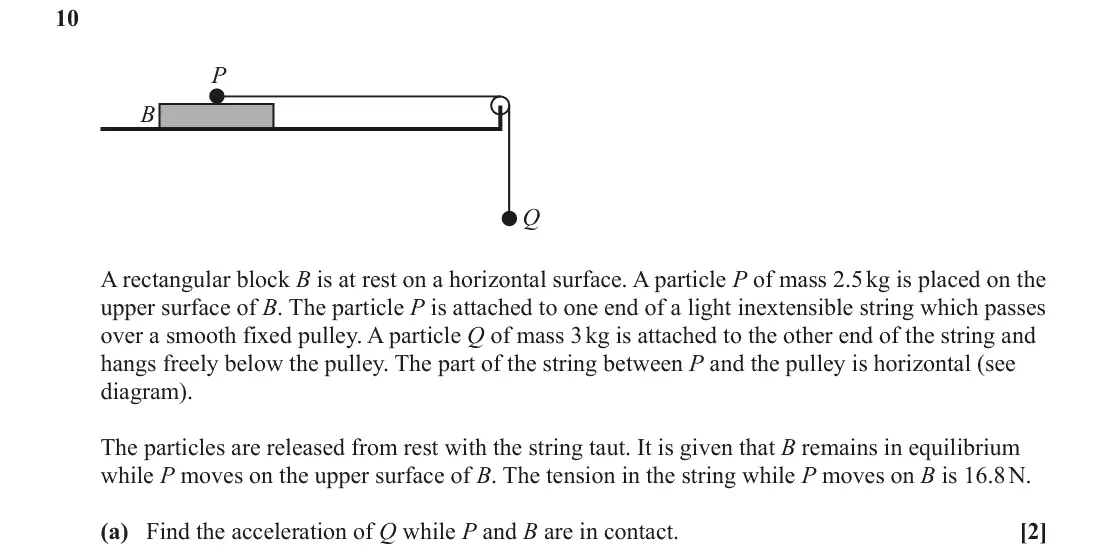
This question was answered very well with most candidates correctly applying Newton’s second law vertically for particle Q. Occasionally, candidates attempted to apply Newton’s second law to either the entire system or to P (but without any success).
Key points and common errors
N2L for Q: 3g − 16.8 = 3a
a = 4.2 m s⁻²
June 2022 · Paper 3 · Q10(b)3 marksEasy
Show the start of this question
Mark scheme for this part
Examiner's comment
Like part (a) this question was answered extremely well with most candidates scoring the method marks for applying Newton’s second law horizontally for P and using F = R . Occasionally, candidates incorrectly used the mass of Q in their equation or attempted to apply Newton’s second law for the entire system, but these were almost always unsuccessful.
Key points and common errors
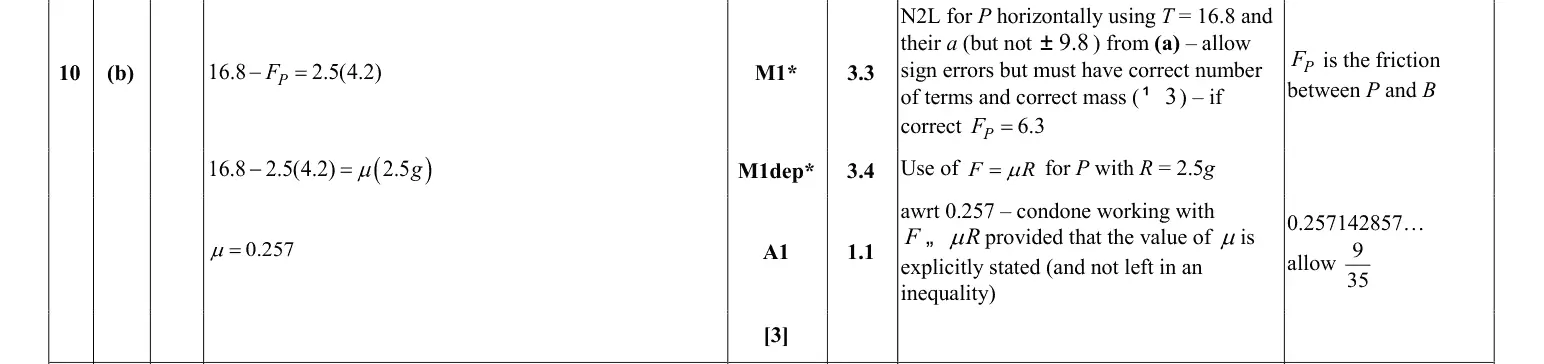
N2L for P: 16.8 − F = 2.5 × 4.2 so F = 6.3
μ = 6.3/(2.5g) = 0.257
June 2022 · Paper 3 · Q10(c)3 marksHard
Show the start of this question
Mark scheme for this part
Examiner's comment
Not very many candidates made any real progress with this question even though it was a relatively straightforward application of Newton’s third law. Very few candidates realised that when resolving = + R 2.5 g Mg vertically for B that (where M was the mass of B), and that horizontally for B the frictional forces acted in opposite directions but were of equal magnitude. It was very rare for examiners to see the correct response of 3.8 (with the most common incorrect response being 6.3 coming from = R Mg , so ignoring the normal contact force of P on B). This response scored zero. Although the candidate has used the correct value of 6.3 for the friction between P and B, they have not considered the force of P acting on B vertically. This is indicated by the candidate suggesting that the magnitude of the contact force between the horizontal surface and B is only equal to weight of B which therefore ignores the fact that P exists and lies on the upper surface of B.
Key points and common errors
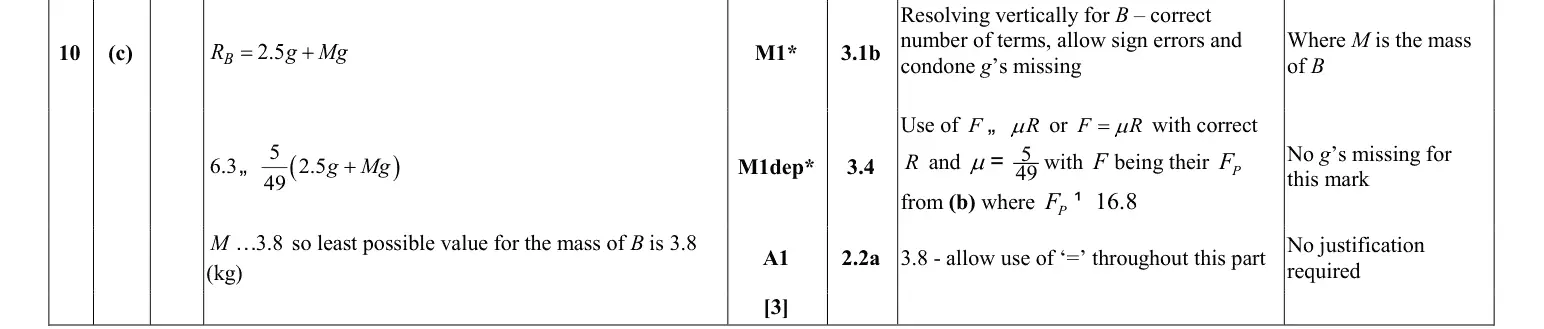
R on B = 2.5g + Mg
friction on B from P equals 6.3 N
6.3 ≤ (5/49)(2.5g + Mg) gives M ≥ 3.8 kg
ignoring P's weight gives 6.3
June 2022 · Paper 3 · Q12(c)5 marksHard
Show the start of this question
Mark scheme for this part
Examiner's comment
How to deal with ‘…moving in the direction of the vector 2 − i + j ’ was not well known by most candidates (and it would seem that many candidates did not realise that the direction of motion of P is governed by the corresponding velocity vector and not the displacement vector). For those candidates who did realise − − 2 1 2 t = that k for some constant k most usually went on to find the correct value of t as 2.5. + − 1 2 t t 13 In comparison, the vector expression for F (and corresponding magnitude) were much better known by candidates and even if they did not obtain the correct value of t they could still access some marks for their knowledge of these results.
Key points and common errors
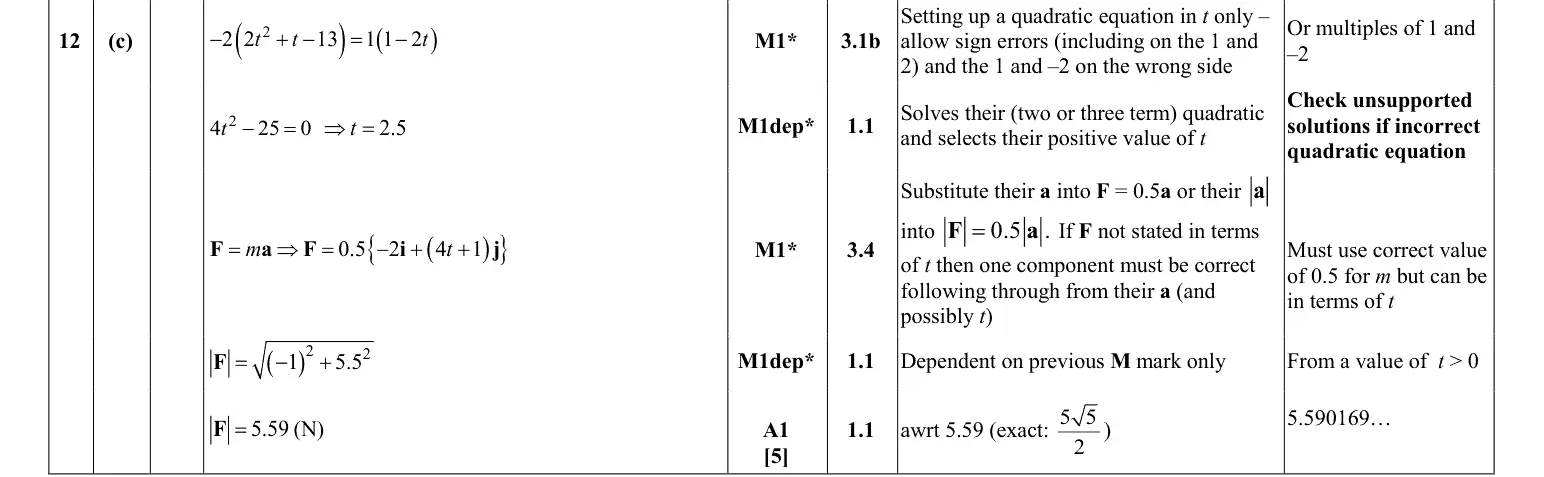
direction of motion is the velocity: (2t² + t − 13)/(1 − 2t) = −1/2 gives 4t² = 25, t = 2.5
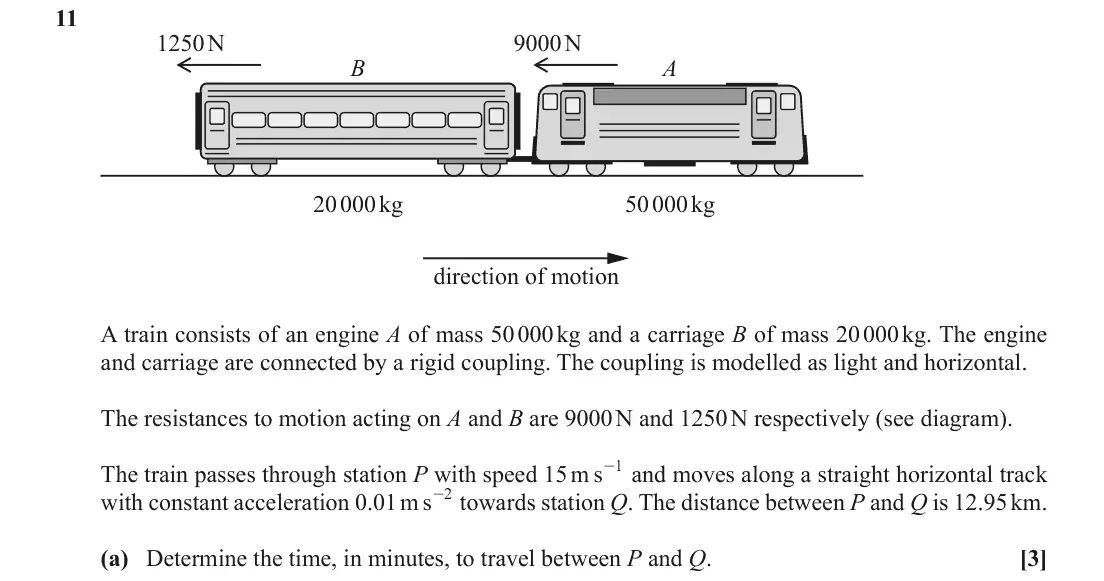
N2L for the whole train: D − 1250 − 9000 = 70 000 × 0.01
D = 10 950 N
Autumn 2021 · AS Paper 2 · Q11(c)2 marksMedium
Show the start of this question
Mark scheme for this part
Key points and common errors
N2L for carriage B: T − 1250 = 20 000 × 0.01
T = 1450 N
Autumn 2021 · Paper 3 · Q10(a)1 markMedium
Mark scheme for this part
Key points and common errors
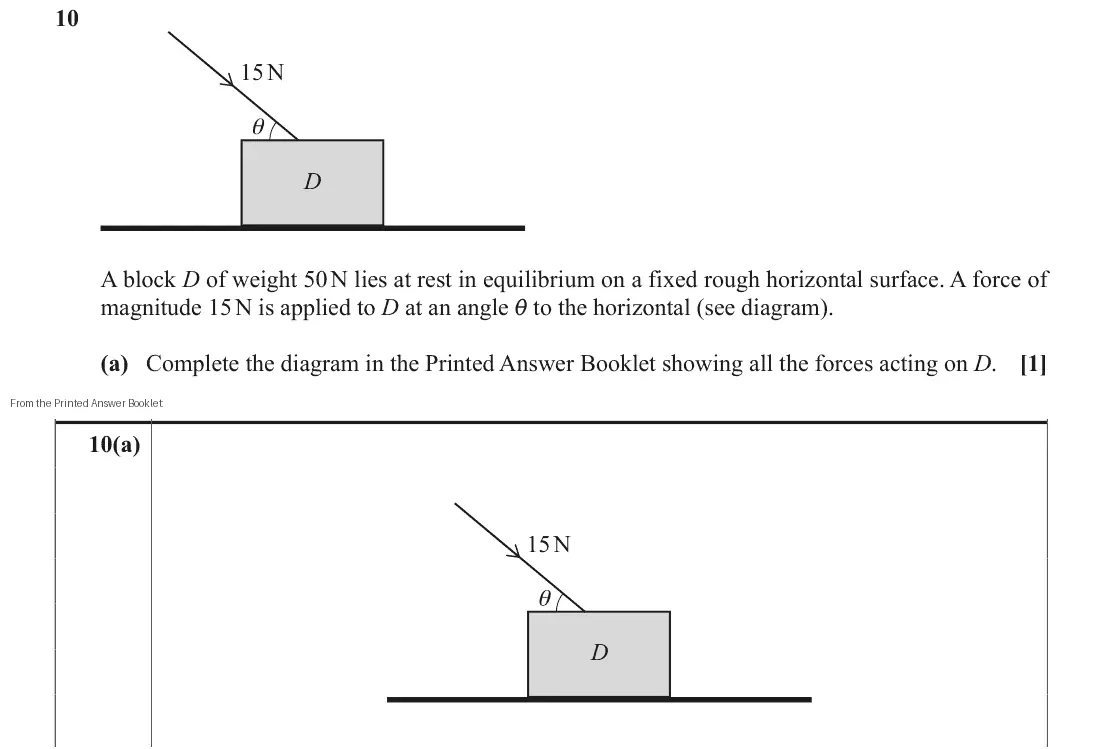
add weight 50 N, normal reaction R and friction F opposing the horizontal component
extra forces get B0
Autumn 2021 · Paper 3 · Q13(a)2 marksMedium
Mark scheme for this part
Examiner's comment
(From the general report) Question 9 states constant acceleration so ‘suvat’ can be used, whereas Question 13 has a variable force term so calculus must be used.
Key points and common errors
resultant (4t − 8)i + 6((2t − 1)² − 9)j = 0
t = 2 only
Autumn 2021 · Paper 3 · Q13(b)6 marksMedium
Show the start of this question
Mark scheme for this part
Examiner's comment
(From the general report) Question 9 states constant acceleration so ‘suvat’ can be used, whereas Question 13 has a variable force term so calculus must be used.
Key points and common errors
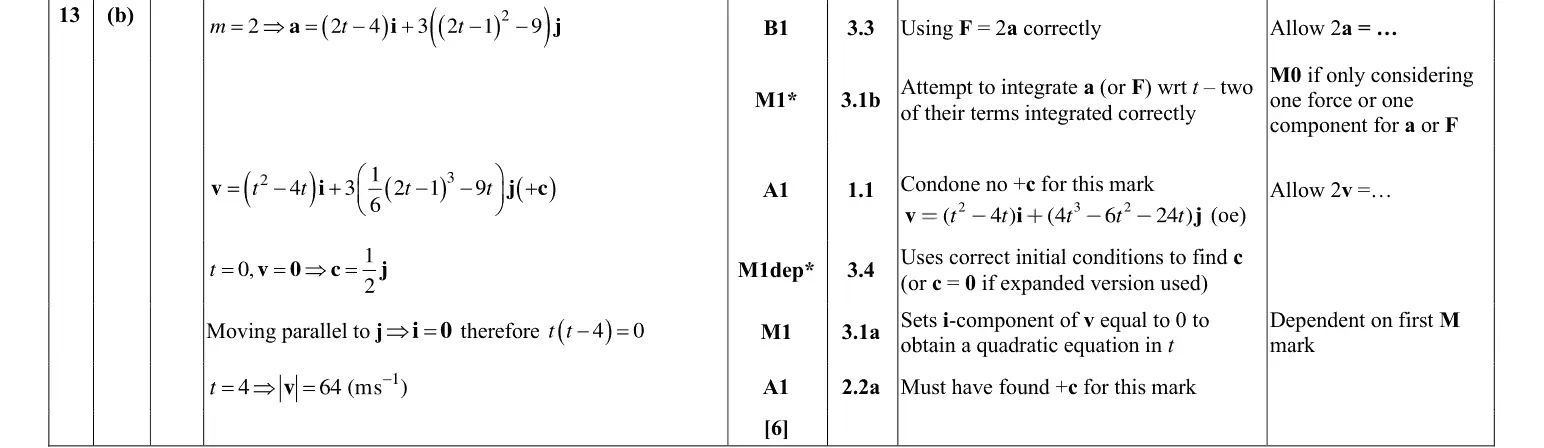
a = F/2
integrate for v with constant from v = 0 at t = 0
moving due north means i-component zero: t = 4
speed 64 m s⁻¹
variable force so calculus not suvat
Autumn 2021 · Paper 3 · Q14(a)7 marksMedium
Mark scheme for this part
Examiner's comment
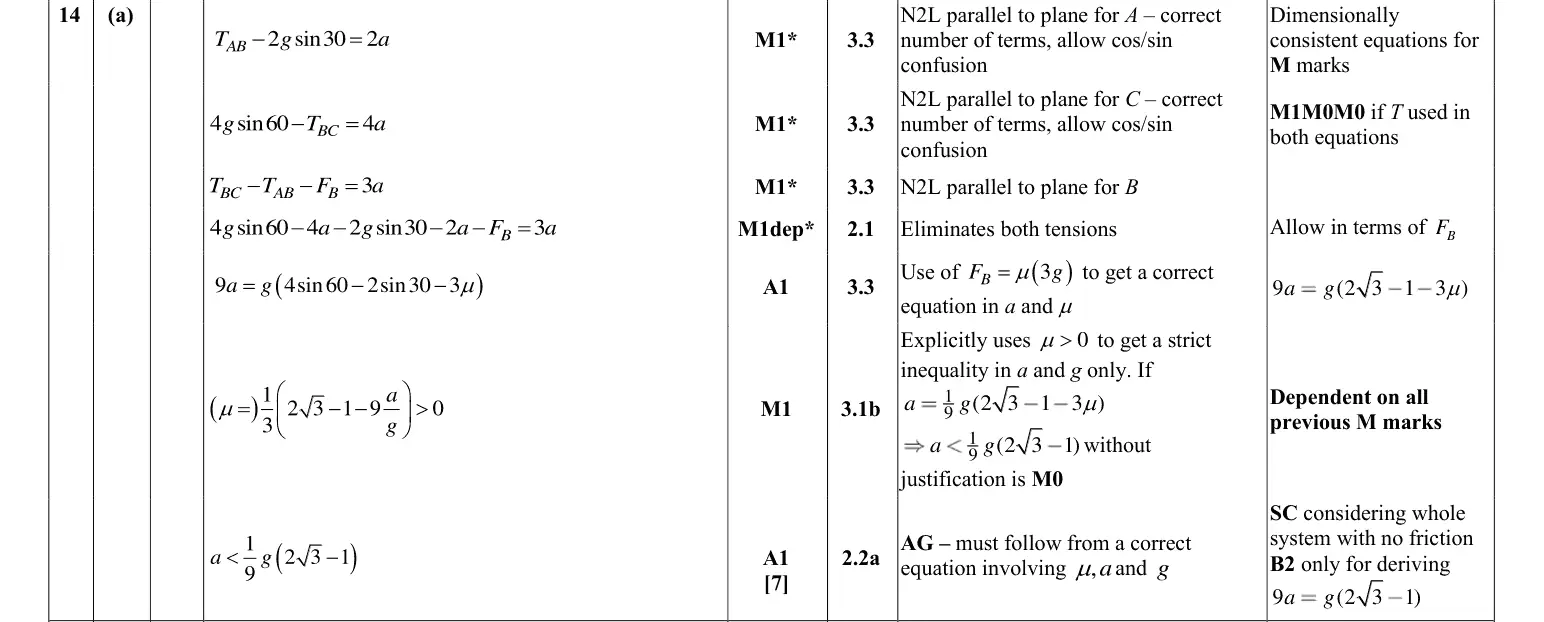
Candidates are reminded to read the question carefully as the question asked candidates to find an equation involving , a and g , many instead tried to find an inequality involving a and g only.
Key points and common errors
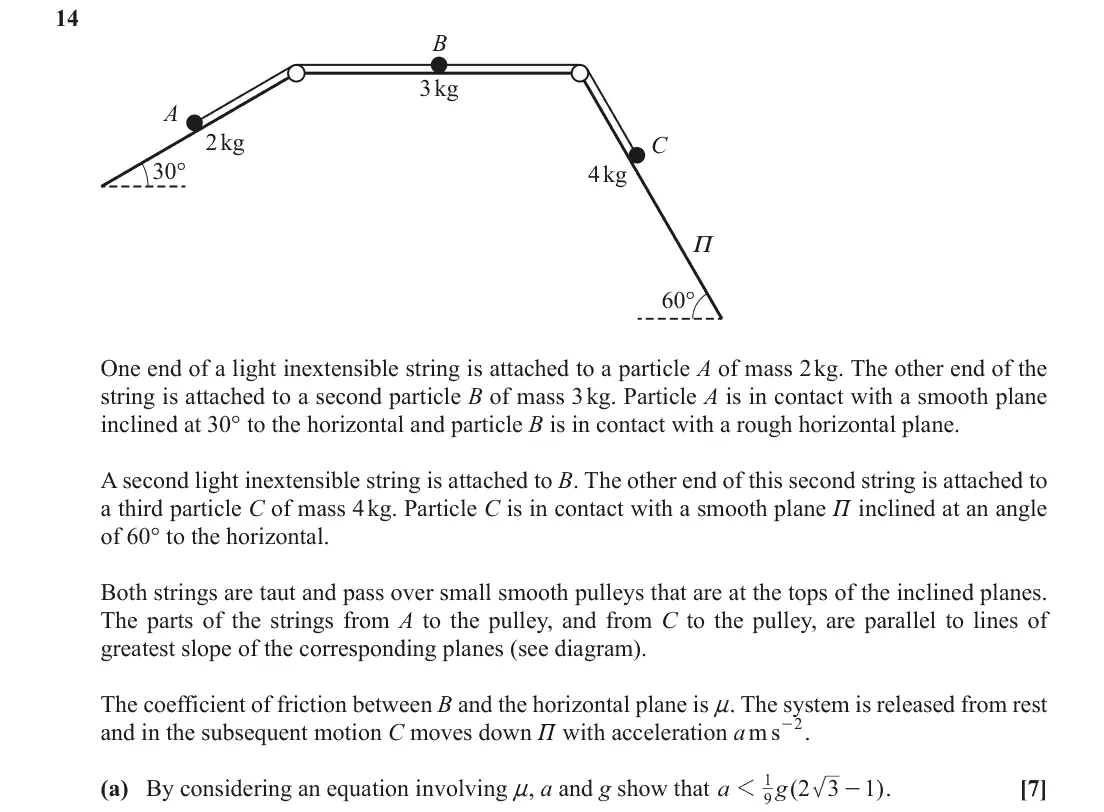
N2L for A, B and C separately
eliminate tensions
F_B = 3μg gives 9a = g(2√3 − 1 − 3μ)
use μ > 0 for the strict inequality
must find an equation involving μ, a and g first
Autumn 2020 · AS Paper 2 · Q83 marksMedium
Mark scheme for this part
Examiner's comment
(From the general report) Section A is Pure Mathematics (Questions 1-7), allocated 50 marks and Section B is Mechanics (Questions 8-11), allocated 25 marks.
(Comment on Question 09 as a whole) Part (a) - 9500 = 885a prevalent. Examiners really want to see the correct number of terms in Newton’s second law, else it is regarded as a fundamental misunderstanding. Also, of course, weight and mass must not be confused. Part (b) - This did not appear to be understood at all well by most candidates. Many candidates could not isolate the forces on the crate and display just those on a diagram. R often missing. Part (c) - Much confusion with the use of Newton’s second law ; 885 appearing in equations with R.
Key points and common errors
9500 − 885g = 885a: a = 0.934 m/s²
9500 = 885a common
weight and mass confused
Autumn 2020 · AS Paper 2 · Q9(b)1 markHard
Mark scheme for this part
Examiner's comment
(Comment on Question 09 as a whole) Part (a) - 9500 = 885a prevalent. Examiners really want to see the correct number of terms in Newton’s second law, else it is regarded as a fundamental misunderstanding. Also, of course, weight and mass must not be confused. Part (b) - This did not appear to be understood at all well by most candidates. Many candidates could not isolate the forces on the crate and display just those on a diagram. R often missing. Part (c) - Much confusion with the use of Newton’s second law ; 885 appearing in equations with R.
Key points and common errors
crate only: tension up, weight down, reaction from the car down
R often missing
Autumn 2020 · AS Paper 2 · Q9(c)3 marksHard
Show the start of this question
Mark scheme for this part
Examiner's comment
(Comment on Question 09 as a whole) Part (a) - 9500 = 885a prevalent. Examiners really want to see the correct number of terms in Newton’s second law, else it is regarded as a fundamental misunderstanding. Also, of course, weight and mass must not be confused. Part (b) - This did not appear to be understood at all well by most candidates. Many candidates could not isolate the forces on the crate and display just those on a diagram. R often missing. Part (c) - Much confusion with the use of Newton’s second law ; 885 appearing in equations with R.
Key points and common errors
N2 for car: R − 830g = 830a or for crate
R = 8910 N
using 885 with R
Autumn 2020 · Paper 3 · Q9(b)3 marksMedium
Show the start of this question
Mark scheme for this part
Examiner's comment
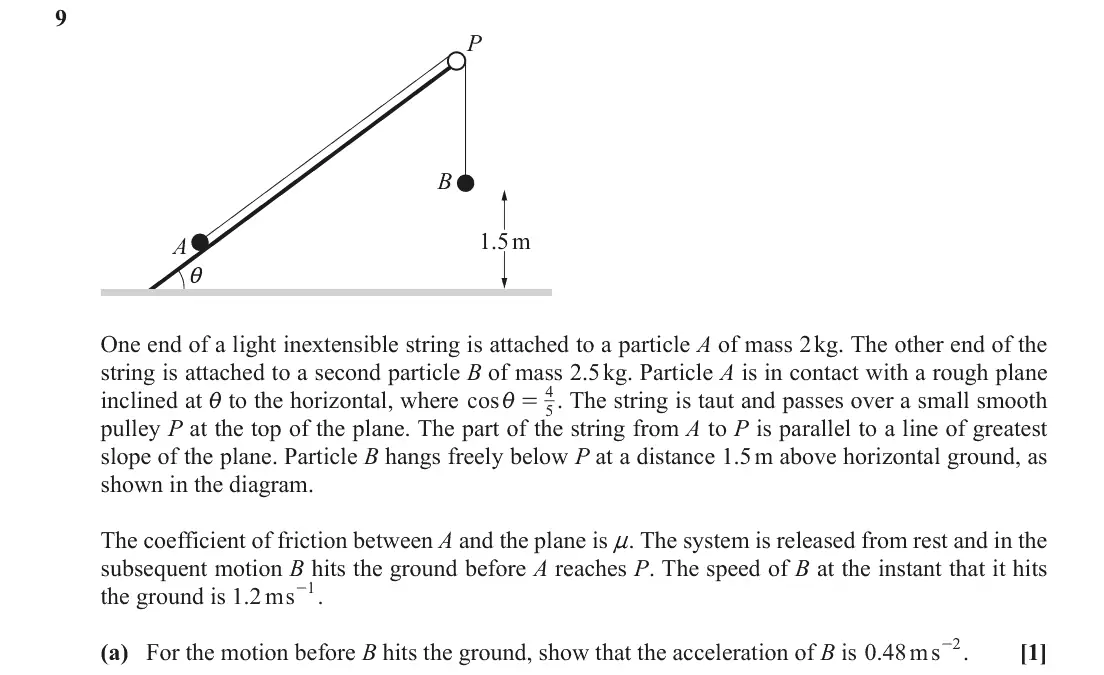
(Comment on Question 09 as a whole) 4 In this question the angle θ was defined as cosθ = . Candidates should resist the temptation to 5 calculate the decimal approximation for θ and instead use their knowledge of Pythagoras Triples to state the exact values for sinθ (and tanθ if required). The exact values have been chosen to make the arithmetic easier. Similarly, some questions will use the values of θ that candidates are expected to know the exact values for, and these should be used rather than the decimal approximation. If the examiner wants the decimal approximations to be used, then the angle θ will simply be defined as a numerical value. Most candidates showed sufficient working using for part (a). There was evidence that most candidates understood how to obtain the given answer in part (b), but some responses did not fully justify their working. A few students used mass rather than weight and did not include g in their equations. Part (c) was attempted by all candidates but one or more of the following mistakes were made: ● Assumed a = 0 . ● Used rather than using components. R = 2g ● Sine/Cosine confusion when stating the components of any force. 4 3 ● Rounding errors with calculated values of θ rather than using cosθ = and sinθ = . 5 5 ● Incorrect directions used leading to sign errors. ● Under-specifying the final answer given to less than 3 sf. Although a fairly standard question, part (d) is traditionally expected to be a challenge for most candidates. For this reason, it was pleasing to see the number of fully correct answers. Common mistakes included: ● Tension was still applied. ● Incorrect acceleration; either the same a = 0 48 . , or a > 0 , or even a = 9 8. . ● Distance = speed × time used rather than ‘suvat’.
Key points and common errors
N2L for B: 2.5g − T = 2.5a
T = 23.3 N
use weight not mass
Autumn 2020 · Paper 3 · Q9(c)5 marksMedium
Show the start of this question
Mark scheme for this part
Examiner's comment
(Comment on Question 09 as a whole) 4 In this question the angle θ was defined as cosθ = . Candidates should resist the temptation to 5 calculate the decimal approximation for θ and instead use their knowledge of Pythagoras Triples to state the exact values for sinθ (and tanθ if required). The exact values have been chosen to make the arithmetic easier. Similarly, some questions will use the values of θ that candidates are expected to know the exact values for, and these should be used rather than the decimal approximation. If the examiner wants the decimal approximations to be used, then the angle θ will simply be defined as a numerical value. Most candidates showed sufficient working using for part (a). There was evidence that most candidates understood how to obtain the given answer in part (b), but some responses did not fully justify their working. A few students used mass rather than weight and did not include g in their equations. Part (c) was attempted by all candidates but one or more of the following mistakes were made: ● Assumed a = 0 . ● Used rather than using components. R = 2g ● Sine/Cosine confusion when stating the components of any force. 4 3 ● Rounding errors with calculated values of θ rather than using cosθ = and sinθ = . 5 5 ● Incorrect directions used leading to sign errors. ● Under-specifying the final answer given to less than 3 sf. Although a fairly standard question, part (d) is traditionally expected to be a challenge for most candidates. For this reason, it was pleasing to see the number of fully correct answers. Common mistakes included: ● Tension was still applied. ● Incorrect acceleration; either the same a = 0 48 . , or a > 0 , or even a = 9 8. . ● Distance = speed × time used rather than ‘suvat’.
Key points and common errors
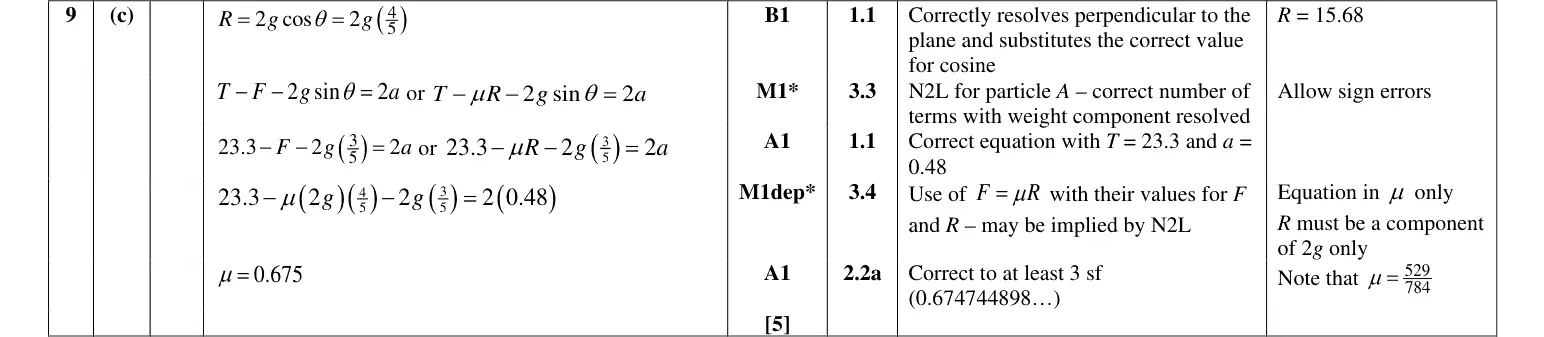
R = 2g cos θ = 15.68 with cos θ = 4/5, sin θ = 3/5 exactly
T − μR − 2g sin θ = 2a
μ = 0.675
errors: a = 0, R = 2g, sin/cos confusion, rounding θ
June 2019 · AS Paper 2 · Q92 marksEasy
Mark scheme for this part
Examiner's comment
This was generally very well answered.
Key points and common errors
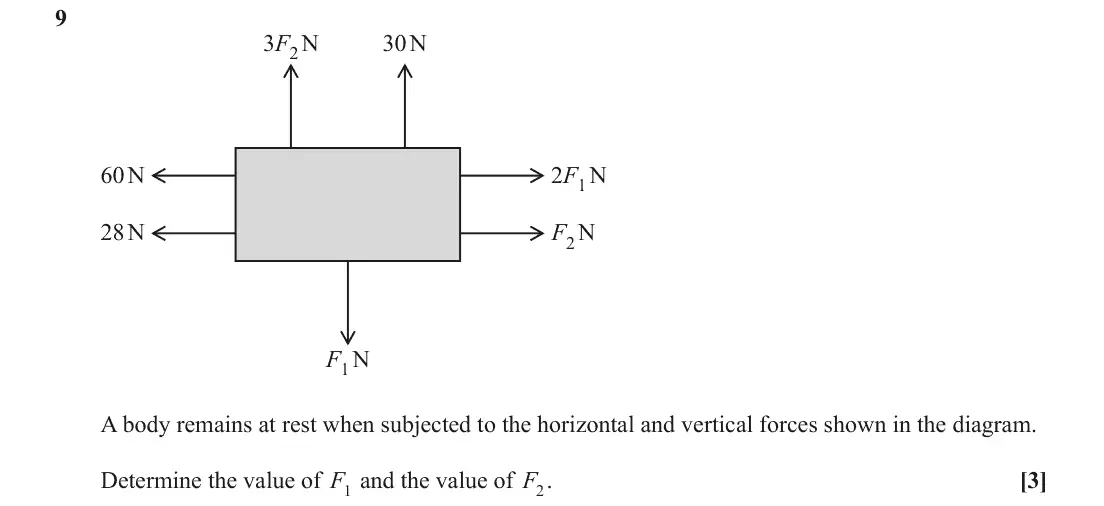
sum of forces is zero: F = (−9, 1) N
June 2019 · AS Paper 2 · Q11(a)5 marksMedium
Mark scheme for this part
Examiner's comment
Candidates should be completely discouraged from treating the system as a whole (this is a high risk strategy because when thing go wrong it nearly always scores 0) and keep things simple by applying F = ma to each particle. It is good practice to draw a diagram of the forces involved for each particle and show the direction of positive acceleration. This helps to avoid missing forces in the two equations, examiners considered this quite a serious error, and also encourages sensible consistent use of signs. Use of mga also lost the method marks. If - 2.48 appeared we expected the negative to be explained.
Key points and common errors
N2L for each particle: 40 − T − 8 = 3a and T − 2g = 2a gives a = 2.48
whole-system equations risky
missing forces
mass not weight on the right
June 2019 · AS Paper 2 · Q11(b)2 marksMedium
Show the start of this question
Mark scheme for this part
Examiner's comment
We expected 2.48 to be used here. 2g – T = 2a with this value gained the method mark.
Key points and common errors
T − 2g = 2 × 2.48 so T = 24.56 N
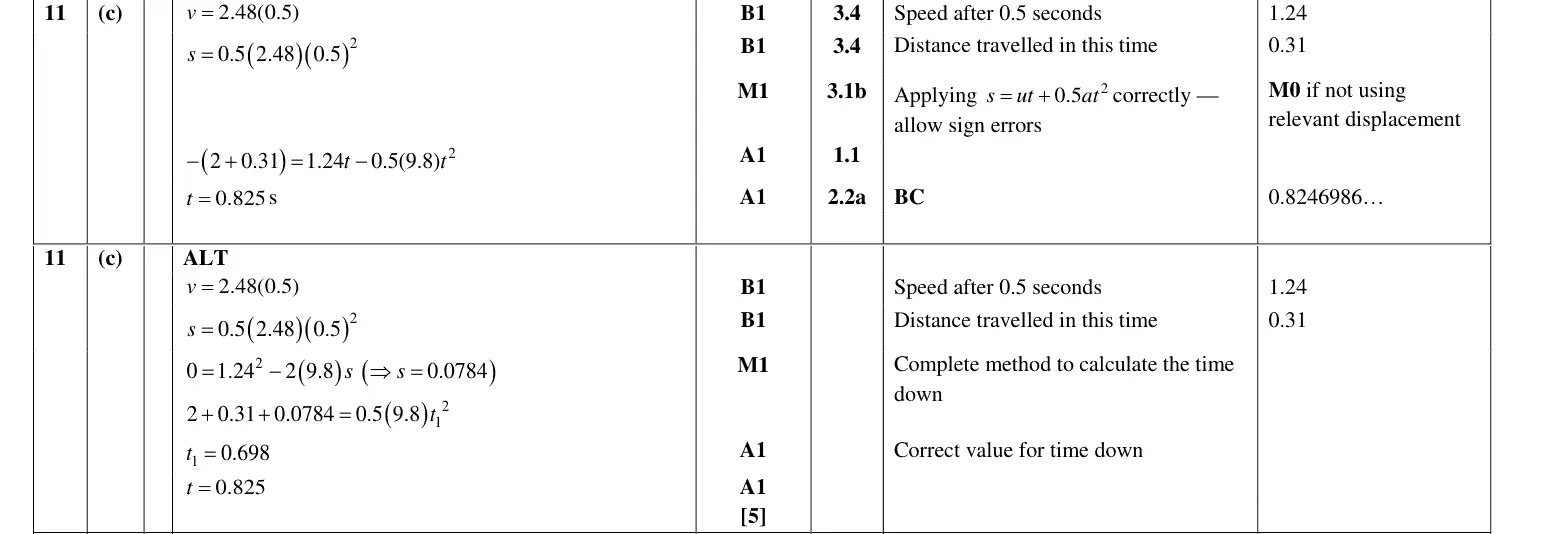
June 2019 · AS Paper 2 · Q11(c)5 marksHard
Show the start of this question
Mark scheme for this part
Examiner's comment
This part proved challenging. Those trying to follow the main approach on the Mark Scheme who realised they had to find the extra distance travelled until the string broke, and the velocity at this instant, then often did not take account of the signs needed for a correct equation from s = ut + ½at2.Some used s = 1.69 and/or u = 0, both of which scored M0. Those who tried to break the motion into ‘up’ and ‘down’ often used 2.31as the distance down, failing to calculate the extra distance needed to reach the highest point. This approach was generally not very successful.
Key points and common errors
after 0.5 s Q is moving up at 1.24 m/s, 0.31 m higher
then free fall: −2.31 = 1.24t − 4.9t² gives t = 0.825 s
using u = 0 or s = 1.69 scores nothing
June 2019 · AS Paper 2 · Q11(e)1 markEasy
Show the start of this question
Mark scheme for this part
Examiner's comment
Well answered.
Key points and common errors
R = 2g = 19.6 N
June 2019 · AS Paper 2 · Q11(f)1 markMedium
Show the start of this question
Mark scheme for this part
Examiner's comment
Quite a few candidates suggested changes to the physical model rather than the mathematical one. So, we saw comments like: ‘ have a stronger string so that it does not break’ or ‘increase the height of the pulley’. Many thought that an improvement would be to make the surface smooth. If they suggested accounting for other external forces we wanted them to specify what force(s) they meant.
Key points and common errors
improve the mathematical model: friction at the pulley, variable resistance, more accurate g, size of pulley
physical changes (stronger string, smooth surface) gain nothing
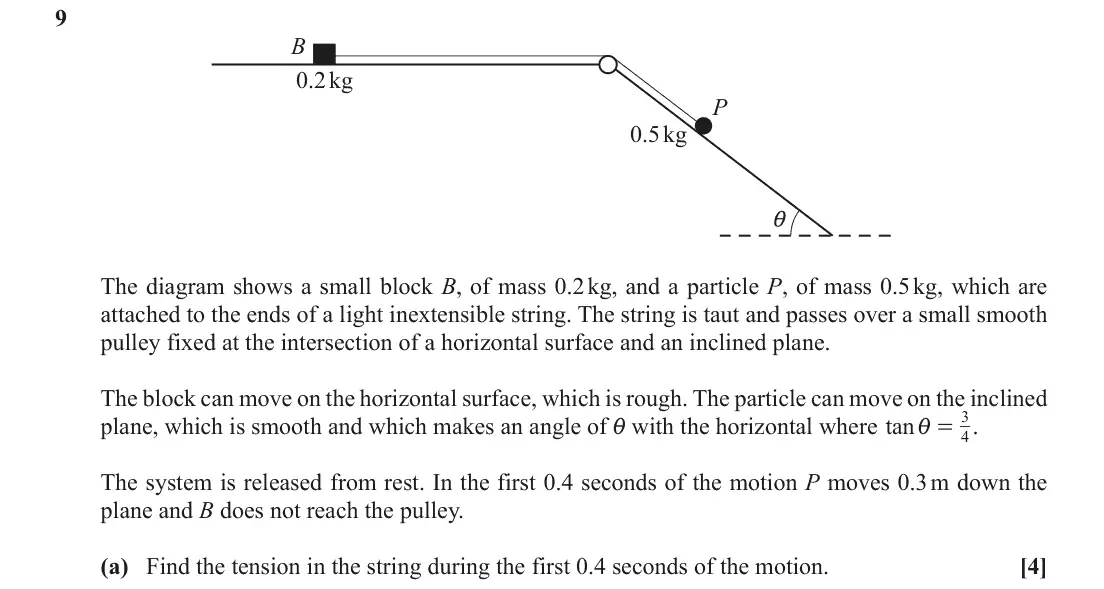
June 2019 · Paper 3 · Q9(a)4 marksMedium
Mark scheme for this part
Examiner's comment
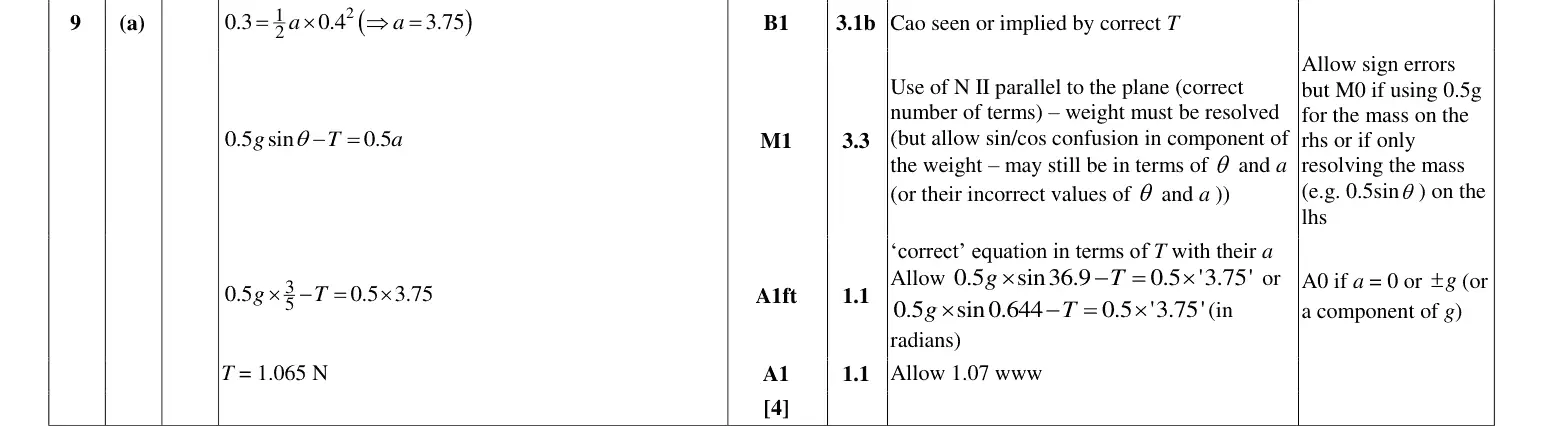
Examiners noted that it was rather surprising that while many candidates could correctly apply Newton’s second law for particle P and obtain a correct equation of the form 0 5gsin . θ − T = 0 5 . a , a significant proportion failed to calculate the acceleration correctly as 3.75 with many believing that the acceleration was 0.75 (which came from incorrectly dividing 0.3 by 0.4). It was pleasing though to note that many candidates used the correct exact value of sinθ = instead of needing to work out θ as 36.869…
Key points and common errors
0.3 = ½a(0.4)² so a = 3.75 (not 0.75)
sin θ = 3/5
N2 for P: 0.5g sin θ − T = 0.5a, T = 1.065 N
June 2019 · Paper 3 · Q9(b)5 marksHard
Show the start of this question
Mark scheme for this part
Examiner's comment
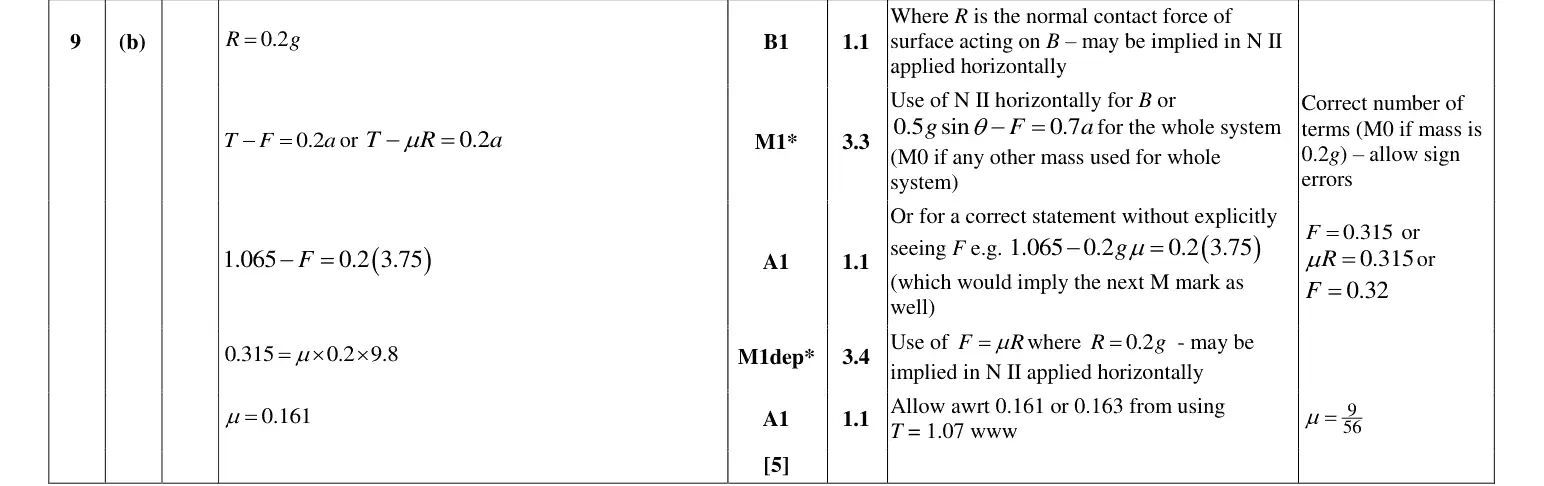
Some candidates only managed to score the mark for realising that the normal contact force R, at B, was equal to 0.2g. Many then incorrectly believed that the coefficient of friction was simply given by the value found in (a) divided by 0.2g. Of those that correctly applied Newton’s second law for block B as T −µ R = 0 2 . a most went on to obtain a correct value for . µ As mentioned in the Section B overview candidates are advised to apply Newton’s second law to each particle separately and not attempt to apply it to the whole system as very few obtained the correct equation of 0 5gsin 0 7 . θ −µ R = . a.
Key points and common errors
R = 0.2g
N2 for B: T − μR = 0.2a
μ = 0.161
whole-system equation usually wrong
dividing T by 0.2g
June 2019 · Paper 3 · Q10(a)6 marksMedium
Mark scheme for this part
Examiner's comment
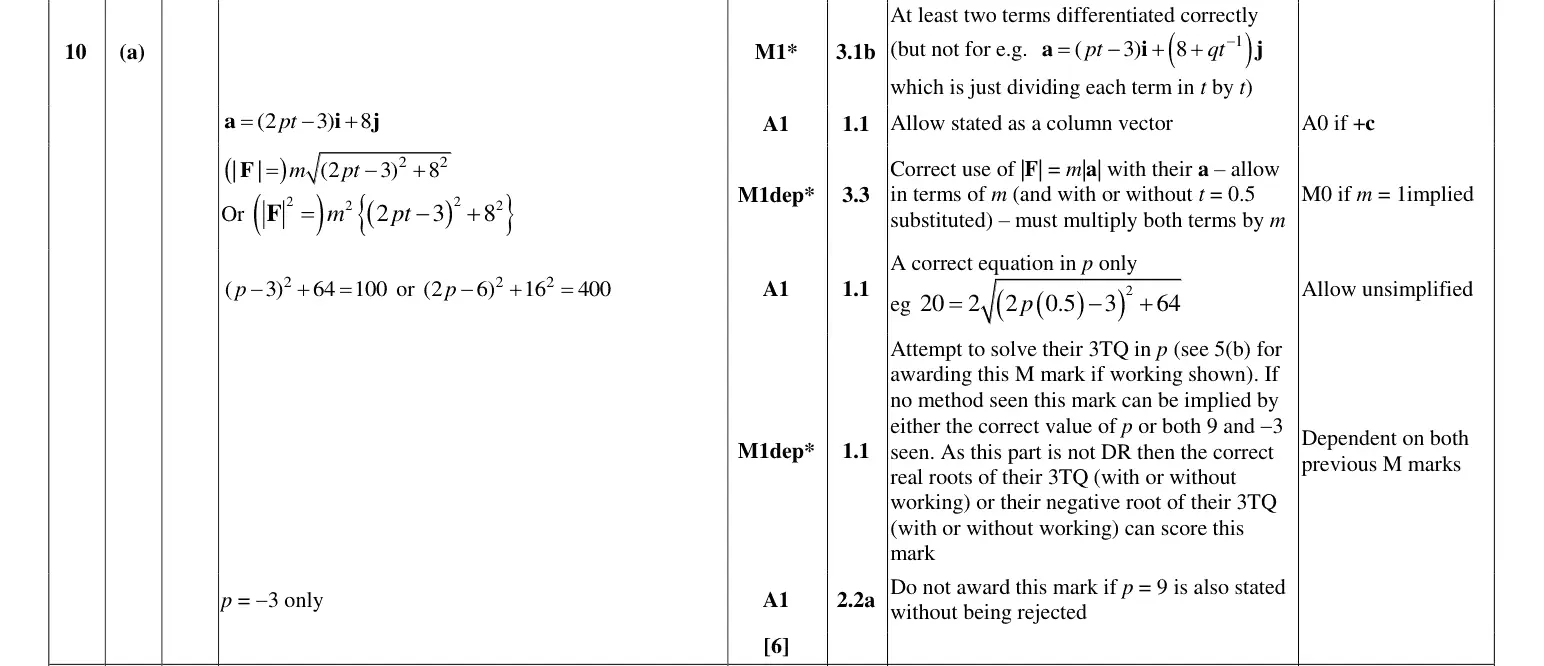
( ) Nearly all candidates correctly differentiated v and obtained a = 2 pt − 3 i + 8 j Unfortunately many . candidates then made careless slips in applying F = m a to obtain an equation in p only with the most common errors being forgetting the mass completely or only multiplying the i component by the value of m. Candidates are one again reminded to read the question carefully as while many had a correct equation in p e.g. ( p − 3 ) + 64 = 100 many solved and gave the positive root even though the question specifically said that p was negative. This response scored the first five marks. An almost perfect response let down by the fact that the candidate did not read the question carefully enough and assumed that the value of p could not be negative.
Key points and common errors
a = (2pt − 3)i + 8j
F = 2a with magnitude 20 at t = 0.5
(p − 3)² + 64 = 100
p = −3 only since p < 0
forgetting mass
June 2018 · AS Paper 2 · Q94 marksHard
Mark scheme for this part
Examiner's comment
This question proved to be challenging for the majority of candidates. The need to find the magnitude of the acceleration was not well understood. For those who did use it, algebraic and numerical errors sometimes marred the solution. (±)10 = 2(3(2t – 5)i + 4j) was common, even when the correct methods then followed, but in many cases equations like 10 = 12t – 30 were used. A number of candidates ignored the mass and F = a pursued.
Key points and common errors
F = ma with magnitude: 2√(9(2T − 5)² + 16) = 10 gives 2T − 5 = ±1 so T = 2 or 3
magnitude of acceleration was often ignored
F = a ignoring mass
June 2018 · AS Paper 2 · Q10(i)4 marksEasy
Mark scheme for this part
Examiner's comment
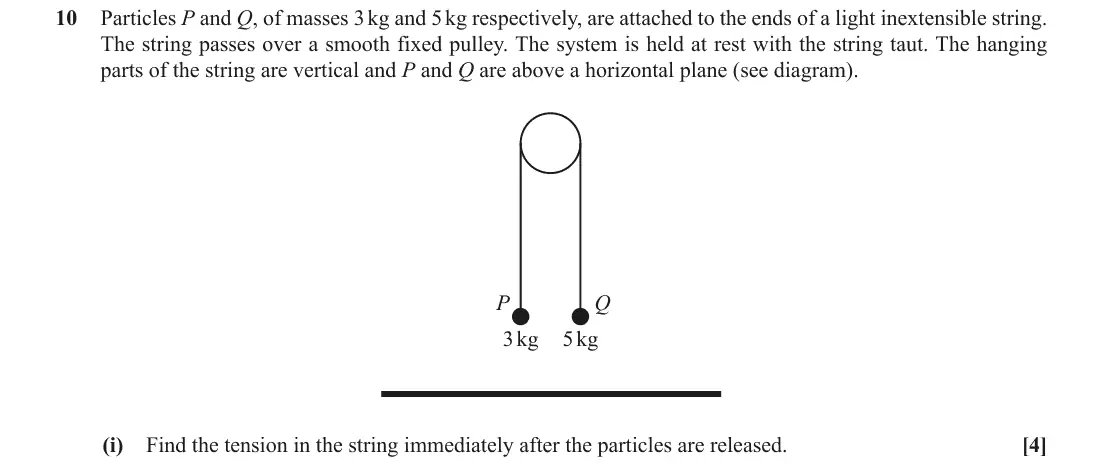
Whilst this standard situation was generally well understood, it was not uncommon to see attempts which assumed the acceleration after release was g or 0. Those who produced initial appropriate equations generally produced fully accurate solutions, although sign errors were sometimes seen.
Key points and common errors
T − 3g = 3a and 5g − T = 5a
T = 36.75 N (15g/4)
assuming acceleration g or 0
June 2018 · AS Paper 2 · Q10(ii)4 marksMedium
Show the start of this question
Mark scheme for this part
Examiner's comment
We expected to see an acceleration other than g or 0 used for the descent of Q. Some candidates used v = 0 for this phase rather than u = 0, presumably because ‘Q strikes the plane and is immediately brought to rest’. Those who now looked at the next phase of the motion sometimes did not realise that it was motion under gravity. Some good attempts omitted to double 0.625.
Key points and common errors
a = 0.25g
v² = 2 × 2.45 × 2.5 = 12.25 when Q lands
P then moves freely under gravity: h = 0.625 up, so distance up and down 1.25 m
forgetting to double 0.625
June 2018 · Paper 3 · Q8(i)3 marksMedium
Mark scheme for this part
Examiner's comment
A significant number of candidates either forgot to include a gravity term or wrote that 15 − 7 0 + + = 5 a therefore forgetting to multiply the gravity term by the mass of the particle. − 8 − 2 − 9 8 .
Key points and common errors
resultant (15, −8) + (−7, −2) + 5(0, −9.8) = 5a
a = (1.6, −11.8)
weight must be included and multiplied by the mass
June 2018 · Paper 3 · Q12(i)(a)7 marksEasy
Mark scheme for this part
Examiner's comment
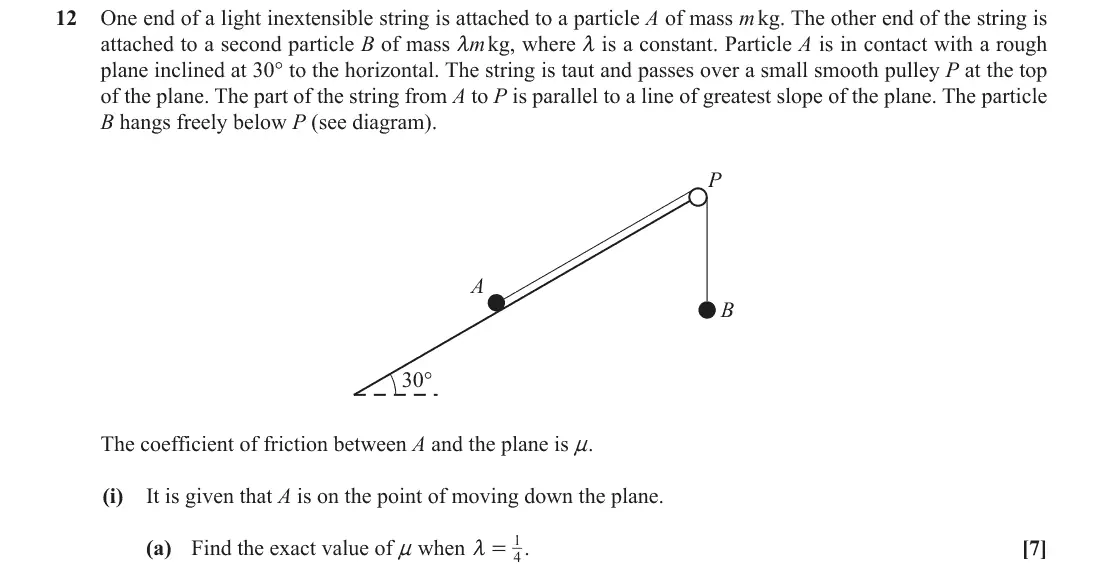
(Comment on Question 12(i) as a whole) This question was answered extremely well with most candidates setting out their working clearly and explaining what they were doing at each step. As mentioned in the overview candidates are strongly advised to deal with each particle separately and many correctly resolved vertically for B, and resolved both parallel and perpendicular to the plane for A using F ≤ µ R to find the value of µ when λ = 1 4 . This part differentiated well with very few candidates showing clearly why λ < 1 2 . Only the most able realised that resolving parallel to the plane and then considering the fact that frictional force had to be positive was the easiest way of tackling this part. A number of candidates started by assuming that λ = 1 2 and then concluding that the magnitude of the frictional force would therefore be zero. It was rarely felt by examiners that in these situations candidates made it clear why it was therefore less than (and not greater than) a half. In general, candidates are reminded that ‘show that’ questions are just that; the information in the question should be used to show a given result and therefore the result (or a limiting case of it) should not be used in an attempt to show that the given result is indeed true.
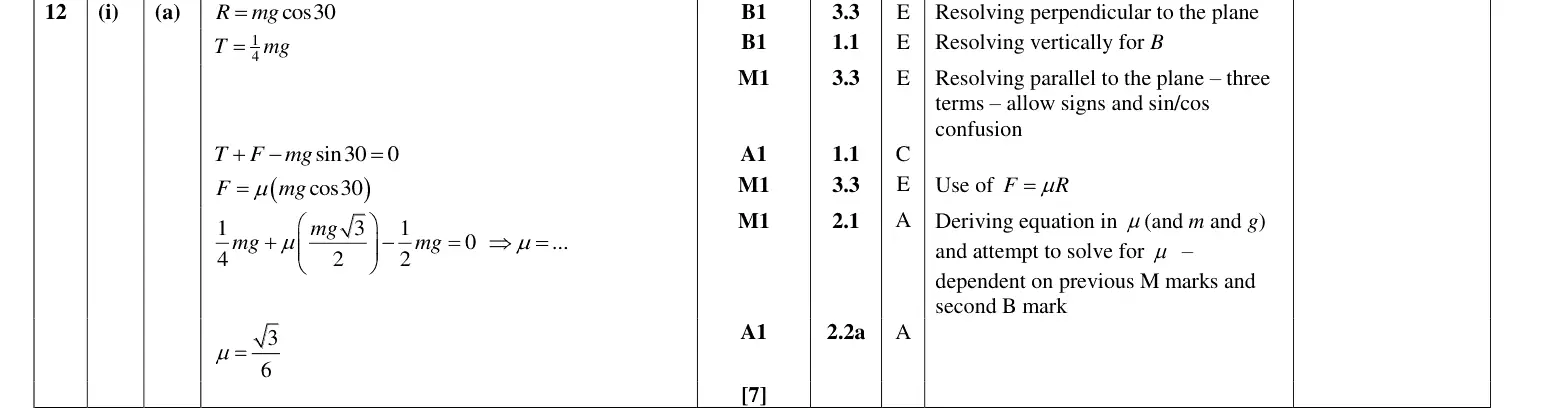
Key points and common errors
R = mg cos 30
T = ¼mg from B
T + F = mg sin 30 with friction up the plane
F = μR
μ = √3/6
treat each particle separately
June 2018 · Paper 3 · Q12(i)(b)2 marksMedium
Show the start of this question
Mark scheme for this part
Examiner's comment
(Comment on Question 12(i) as a whole) This question was answered extremely well with most candidates setting out their working clearly and explaining what they were doing at each step. As mentioned in the overview candidates are strongly advised to deal with each particle separately and many correctly resolved vertically for B, and resolved both parallel and perpendicular to the plane for A using F ≤ µ R to find the value of µ when λ = 1 4 . This part differentiated well with very few candidates showing clearly why λ < 1 2 . Only the most able realised that resolving parallel to the plane and then considering the fact that frictional force had to be positive was the easiest way of tackling this part. A number of candidates started by assuming that λ = 1 2 and then concluding that the magnitude of the frictional force would therefore be zero. It was rarely felt by examiners that in these situations candidates made it clear why it was therefore less than (and not greater than) a half. In general, candidates are reminded that ‘show that’ questions are just that; the information in the question should be used to show a given result and therefore the result (or a limiting case of it) should not be used in an attempt to show that the given result is indeed true.
Key points and common errors
A on the point of moving down needs F = mg sin 30 − λmg > 0 so λ < ½
June 2018 · Paper 3 · Q12(ii)5 marksHard
Show the start of this question
Mark scheme for this part
Examiner's comment
Like part (ii) this part differentiated well with many candidate unaware that if the value of λ was now greater than a half then particle A would move up the plane; many candidates assumed that the motion of A was down the plane. Of those that did have the correct direction of motion most correctly applied Newton’s second law to both particles separately and obtained the correct value for the coefficient of friction. Clear diagrams, with arrows showing the direction of motion and/or acceleration help to reduce the risk of sign errors when identifying the direction that any frictional force will act.
Key points and common errors
λ = 2 so A moves up the plane and friction acts down
for A: T − F − mg sin 30 = m(g/4)
for B: 2mg − T = 2m(g/4)
μ = √3/2
many assumed A moves down
Find an A-level maths tutor
Stuck on this? Book a trial session with an A-level maths tutor.