Numerical methods: roots, iteration and Newton–Raphson Pure
Papers
Paper 1, Paper 2, Paper 3
Level
A level only
Spec
1.09a, 1.09b, 1.09c, 1.09d, 1.09e, 1.09g
Formulae sheet
The Newton–Raphson formula is given.
Since 2018
32 question parts, 76 marks, each rated Easy, Medium or Hard from the wording of the examiners' report
Notes, worked examples and practice for this topic are being written by our tutors. The past-paper questions below are ready now: work each one on paper, then open the mark scheme and the examiner's comment.
Tap a question to zoom it. Mark scheme and examiner's comment open under each question.
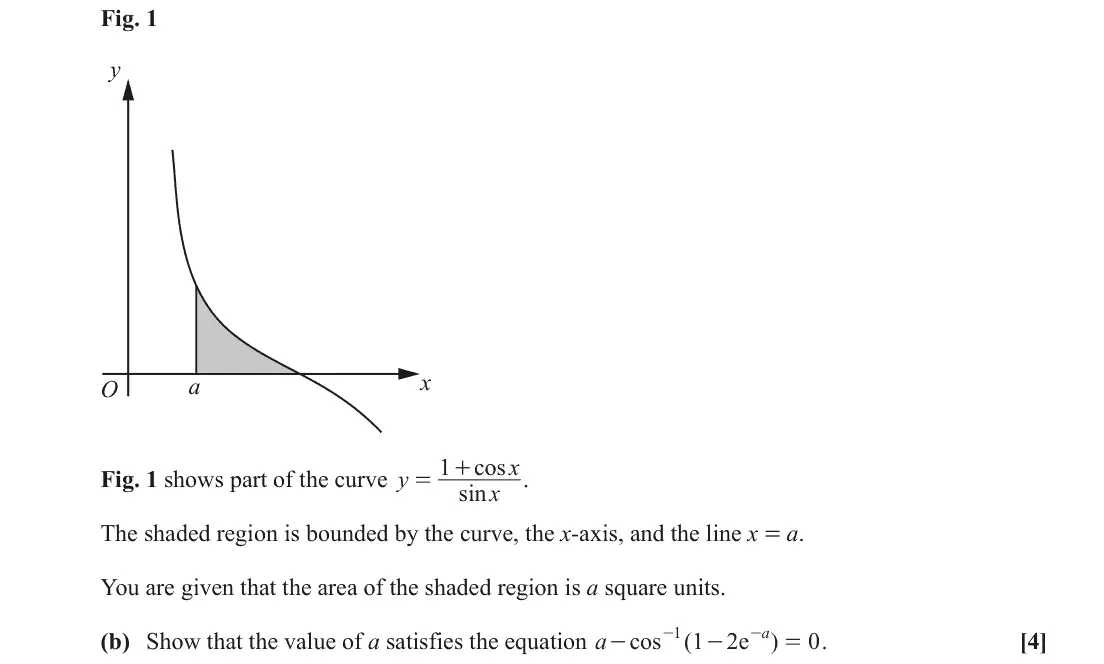
June 2025 · Paper 3 · Q5(c)2 marksEasy
Show the start of this question
Mark scheme for this part
Examiner's comment
Most candidates correctly used the change of sign test to show that a was between 1.1. and 1.2 (although it was clear to examiners that a few candidates had their calculators set in degrees rather than radians). The most common errors were to give the value at 1.2 as 0.38… rather than 0.038, not to indicate that a change of sign had occurred, or to not give a conclusion that mentioned that as there was a change of sign this indicated that a would lie in between 1.1 and 1.2.
Key points and common errors
f(1.1) = −0.129 < 0, f(1.2) = 0.038 > 0
state change of sign and conclusion
calculator must be in radians
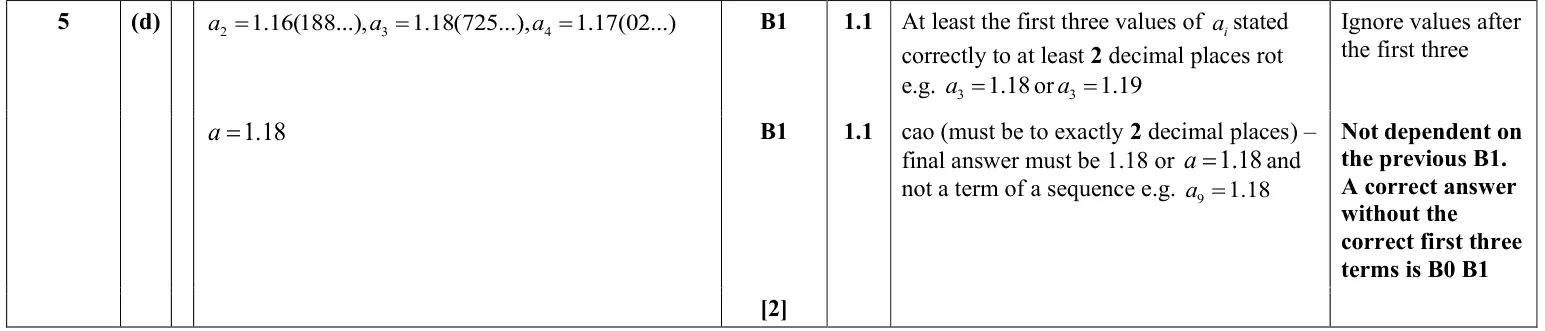
June 2025 · Paper 3 · Q5(d)2 marksEasy
Show the start of this question
Mark scheme for this part
Examiner's comment
This part was answered extremely well with most candidates using the given iterative equation and showing sufficient iterations to obtain the correct value of 1.18 for the value of a. Occasionally, some candidates gave answers which implied that their calculator was set in degrees or did not give the answer to the required 2 decimal places.
Key points and common errors
a₂ = 1.1619, a₃ = 1.1873, a₄ = 1.1702 …
a = 1.18 to 2 d.p.
radians
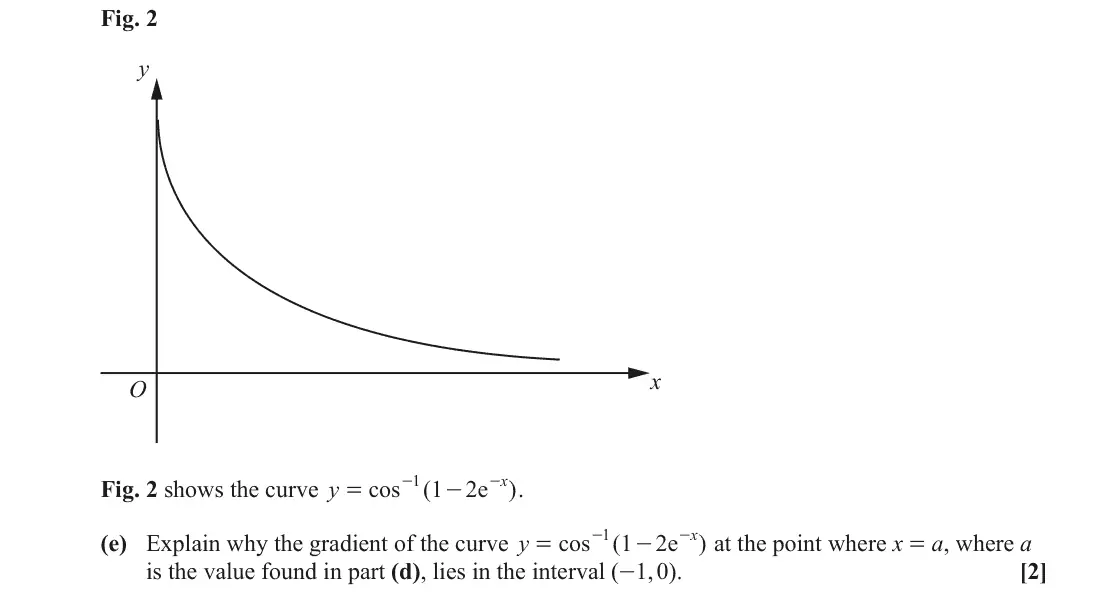
June 2025 · Paper 3 · Q5(e)2 marksHard
Show the start of this question
Mark scheme for this part
Examiner's comment
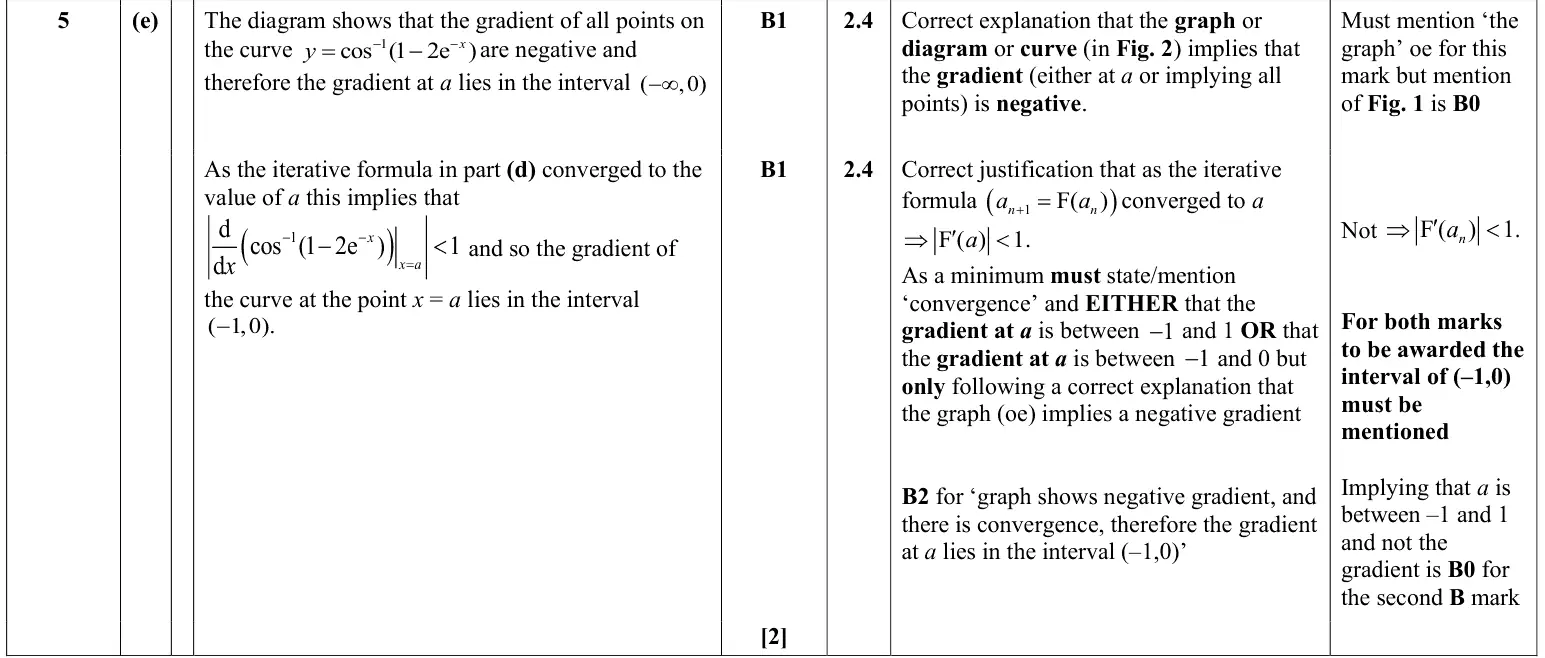
Candidates struggled with this part with very few able to give a correct explanation of why the gradient would lie in the given interval. Candidates needed to articulated that the given figure indicated that the curve had a negative gradient for all values of 𝑥 and as the iterative formula converged to the value of a in part (d) this implied that | d𝑥(cos−1(1 −2e−𝑥))| 𝑥=𝑎< 1 and so the gradient at the point 𝑥= 𝑎 would be in the interval (−1,0).
Key points and common errors
Fig. 2 shows the gradient is negative everywhere
the iteration converged so the modulus of g′(a) is less than 1
together the gradient lies in (−1, 0)
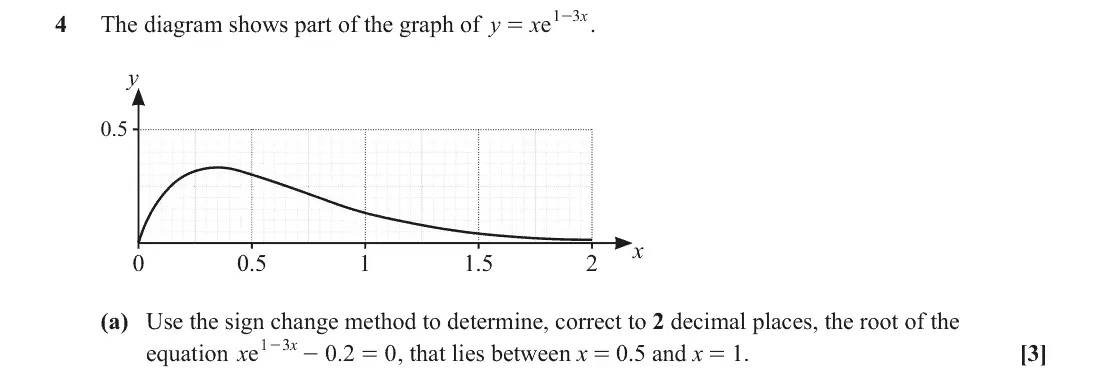
June 2024 · Paper 2 · Q4(a)3 marksMedium
Mark scheme for this part
Examiner's comment
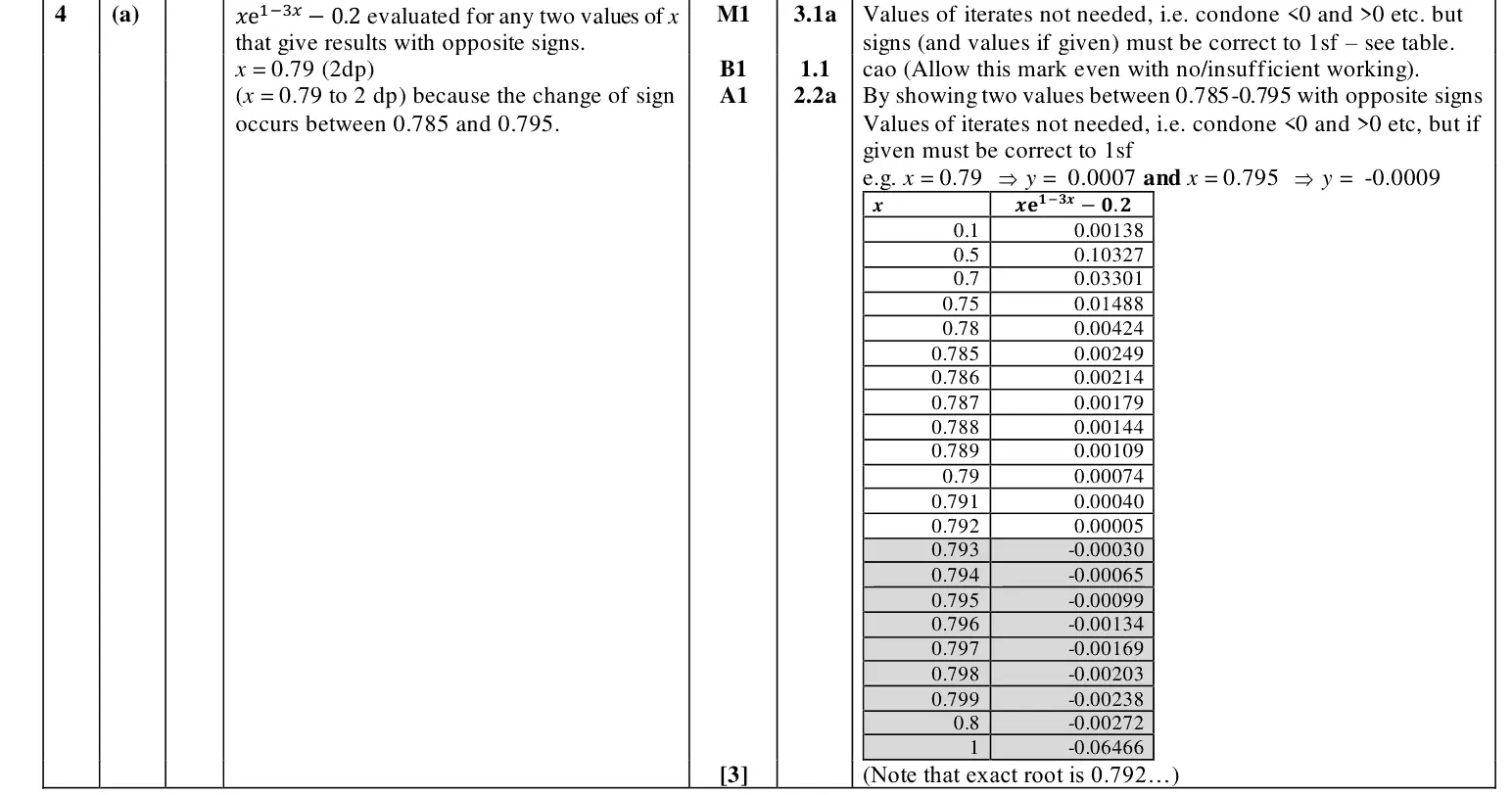
A minority of candidates scored all 3 marks in this part, although many candidates scored at least 1 and often 2. Most candidates correctly substituted 0.5 and 1 into the given expression to show a change of sign within the given interval, although quite a few stopped at this point (which could only score M1). Many candidates gave the correct value x=0.79 to 2dp - and this is an excellent example of a question where a calculator can be used effectively to verify a solution (or to give an idea of where to ‘look’ for the root). However, this root alone could only score B1. In order to achieve the final accuracy mark (and demonstrate that this is the correct root to 2dp) candidates needed to show a change of sign using a pair of iterates within the interval [0.785,0.795] with opposite signs, which very few did. Quite a few candidates gave a collection of iterates and claimed that led them to this conclusion but could only gain credit for two correct iterates in that interval. Note that informed choices of iterates, e.g. 0.79 and 0.793 could be credited, as could the boundary values of 0.785 and 0.795. Some candidates used Newton- Raphson to obtain an initial value (which is of course acceptable, but earned no credit on its own as the question specified a sign change). Candidates did not need to write down the value of the expression for their iterates, but if they did it needed to be correct to 1sf - some made a place value error when copying. This is a (typical) example of a candidate’s response where they have made a very good attempt at their sign change, with many correct iterates and the correct value to 2dp given. However, their iterates do not fully justify the solution to 2dp (there is only one in the range [0.785,0.795] and their explanation ‘closer to’ is not sufficient) so this response scores M1B1A0 for a total of 2/3.
Key points and common errors
evaluate at 0.785 and 0.795 to justify 2 d.p.
many stopped at the change of sign between 0.5 and 1
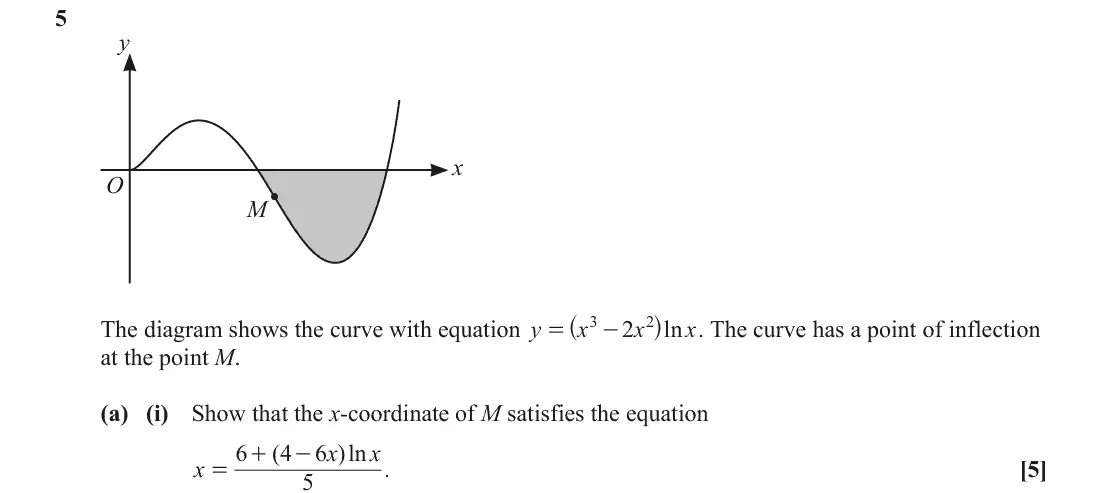
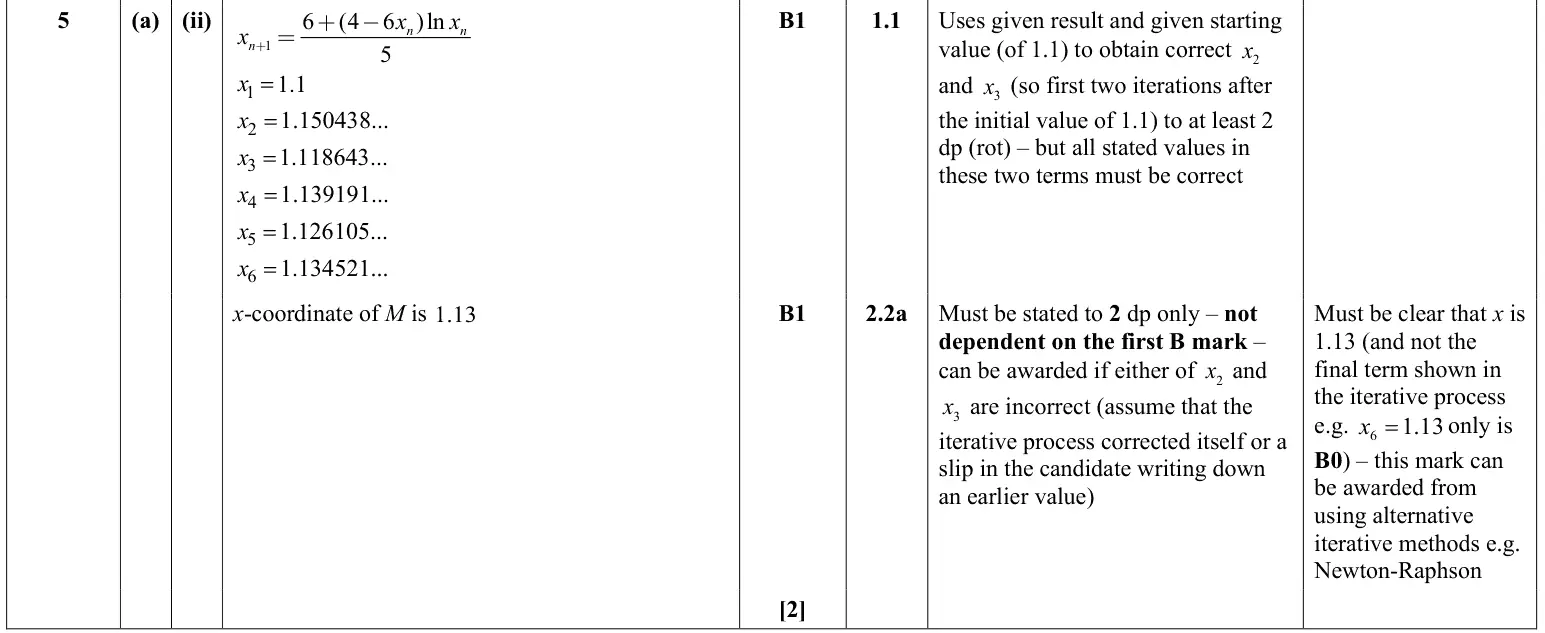
June 2024 · Paper 3 · Q5(a)(ii)2 marksEasy
Show the start of this question
Mark scheme for this part
Examiner's comment
This part was answered well with most candidates using the iterative equation 𝑥𝑛+1 = and showing sufficient iterations to obtain the correct value of 1.13 for the 𝑥- coordinate of 𝑀. Some candidates attempted to apply Newton-Raphson or did not give the answer to the required 2 decimal places.
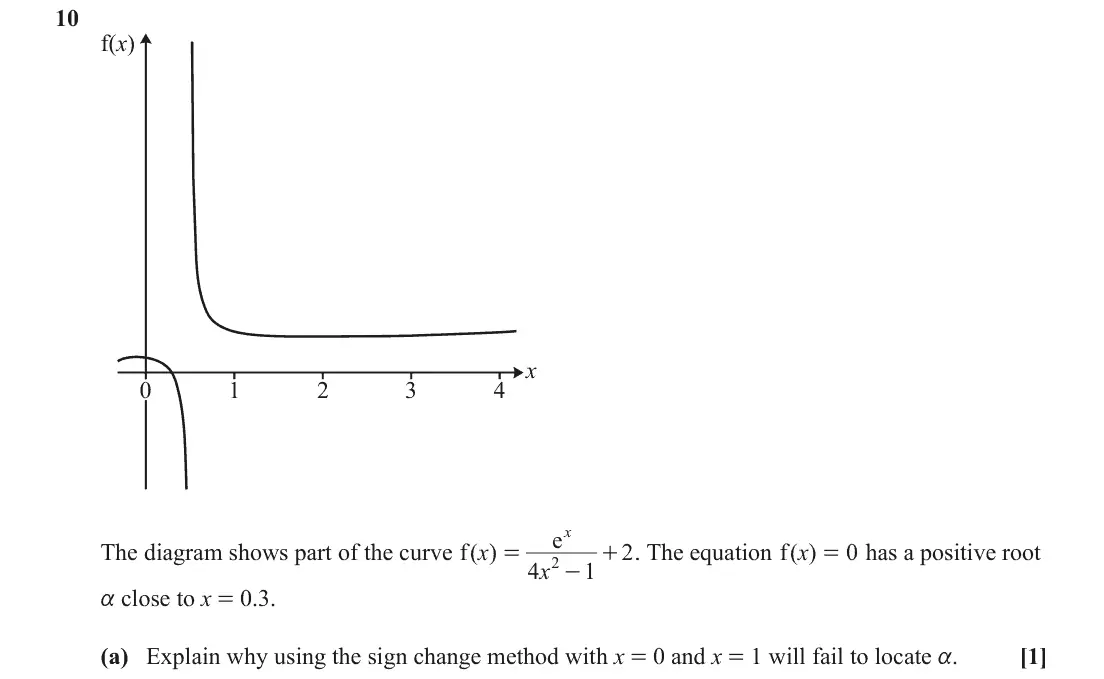
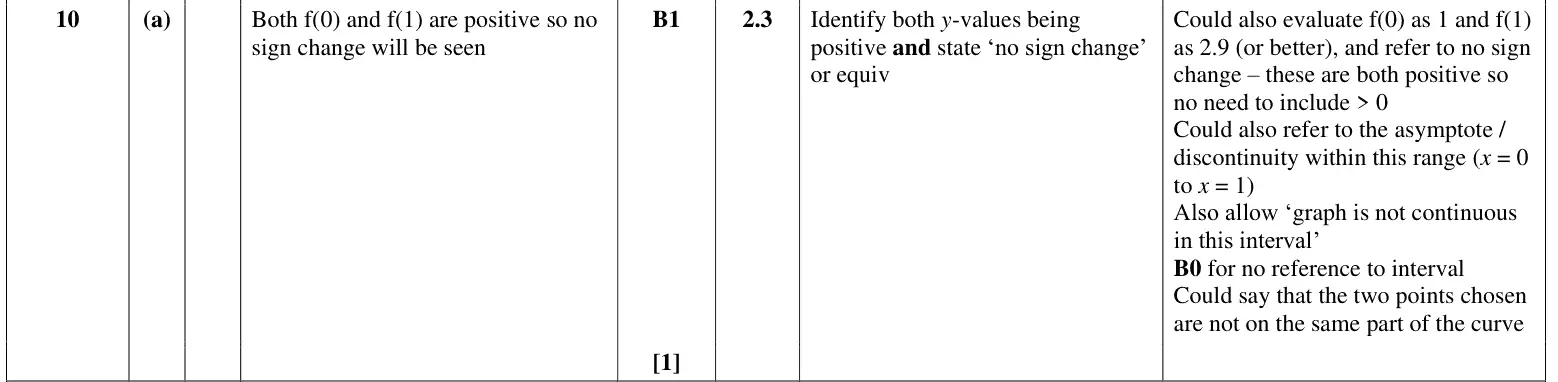
A variety of answers were possible; candidates could note that both f(0) and f(1) were positive hence no sign change would be seen or refer to the vertical asymptote and/or the discontinuity in the given interval. Most candidates seemed to have some idea of why the method would fail, but only a minority of candidates were able to give explanations that were suitably detailed and convincing. For example, just stating ‘they are both positive’ did not make clear what ‘they’ referred to nor reference the impact on the sign change method.
Key points and common errors
f(0) and f(1) both positive so no sign change
or vertical asymptote/discontinuity in [0, 1]
'they are both positive' too vague
June 2023 · Paper 1 · Q10(b)2 marksMedium
Show the start of this question
Mark scheme for this part
Examiner's comment
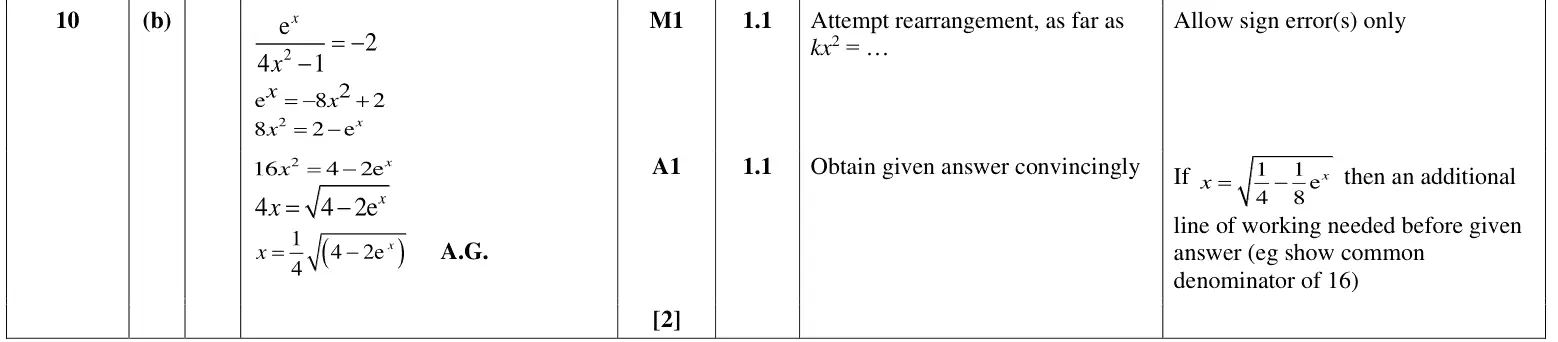
Most candidates were able to gain at least 1 mark for rearranging as far as making kx2 the subject of the equation. To gain full marks, the given answer had to be obtained convincingly and many candidates were able to do so. Some candidates gained the first method mark, and then jumped straight to the final answer either because they were unable to complete the proof or because they did not see the need to detail all steps.
Key points and common errors
rearrange to 16x² = 4 − 2eˣ
show enough steps to the given answer
June 2023 · Paper 1 · Q10(c)3 marksEasy
Show the start of this question
Mark scheme for this part
Examiner's comment
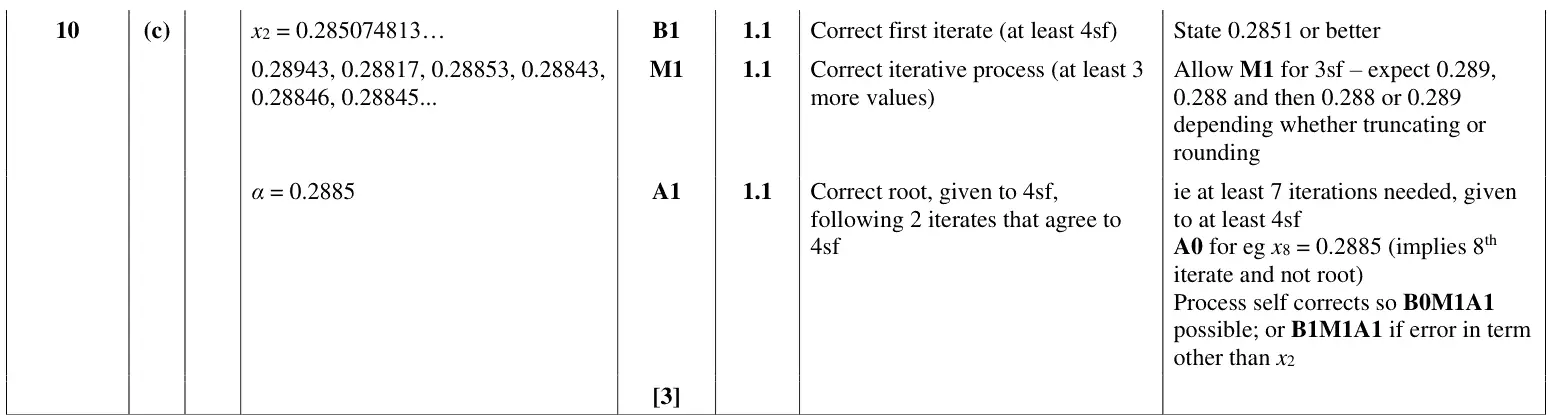
Most candidates gained full marks for being able to use the given iterative formula, showing sufficient detail in their working before drawing the correct final conclusion.
Key points and common errors
x₂ = 0.28507…
iterate to two values agreeing to 4 s.f.
α = 0.2885
June 2023 · Paper 1 · Q10(d)3 marksMedium
Show the start of this question
Mark scheme for this part
Examiner's comment
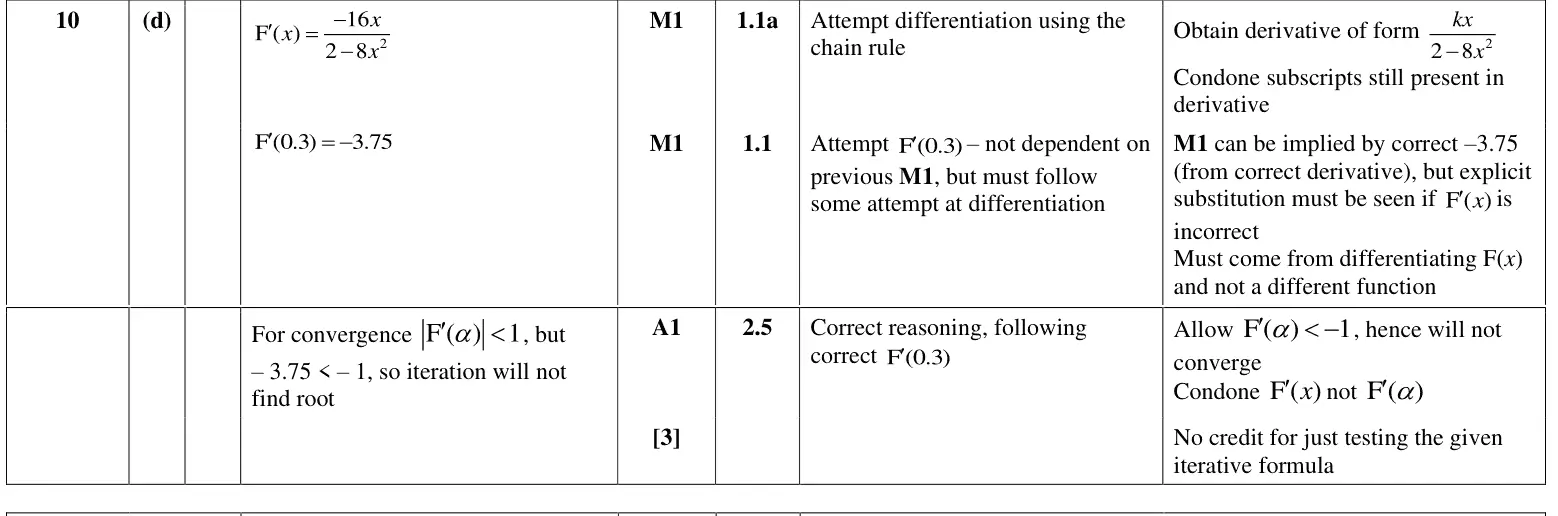
The required method was indicated in the question, and candidates were able to gain the first mark for a reasonable attempt to differentiate F(x). Most candidates did attempt to do this, but the derivatives were not always of the correct form. The second mark was for substituting x = 0.3. While a correct response can imply a correct method, that is not the case for an incorrect response; if the derivative was incorrect then candidates had to show explicit substitution for this mark to be credited. The final mark was for explaining why the value of F’(0.3) indicated divergence not convergence; some excellent explanations were seen but others thought that the fact that it was negative was the reason without also considering the magnitude. As the initial method was given in the question it was perhaps surprising that some candidates didn’t even attempt differentiation, with simply using the iterative formula being the most common error.
Key points and common errors
F′(x) = −16x/(2 − 8x²)
F′(0.3) = −3.75
modulus of F′ > 1 so the iteration diverges
June 2023 · Paper 3 · Q7(c)2 marksEasy
Show the start of this question
Mark scheme for this part
Examiner's comment
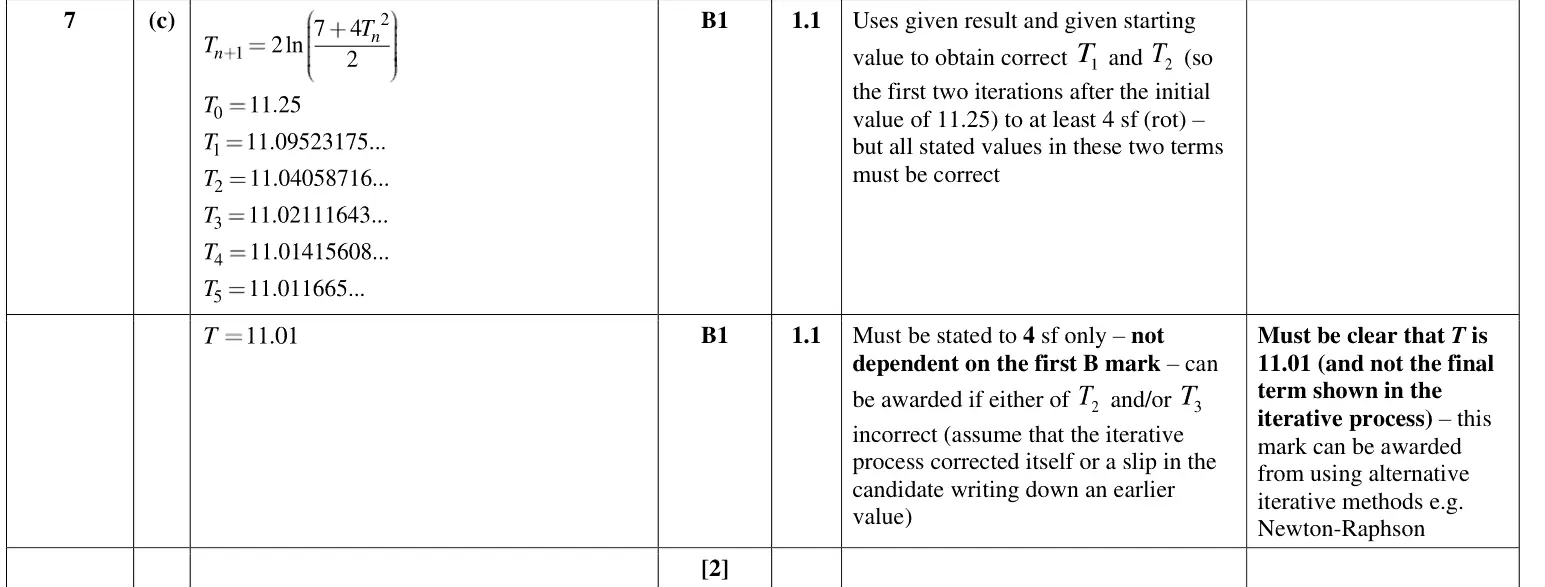
This part was answered extremely well with most candidates using the iterative equation 𝑇𝑇𝑛𝑛+1 = 2ln ቀ ቁ and showing sufficient iterations to obtain the correct value of 11.01 for 𝑇𝑇. Occasionally, some candidates attempted to apply Newton-Raphson or did not give the answer to the required 4 significant figures.
Key points and common errors
Tₙ₊₁ = 2ln((7 + 4Tₙ²)/2) from T₀ = 11.25
show each iterate
T = 11.01 to 4 s.f.
June 2023 · Paper 3 · Q7(d)1 markHard
Show the start of this question
Mark scheme for this part
Examiner's comment
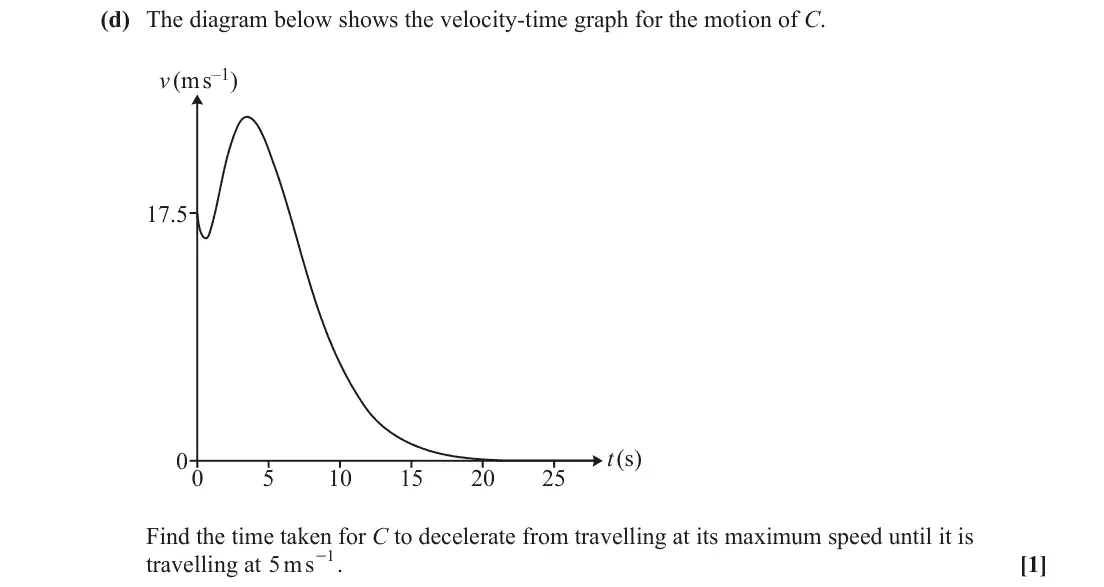
Very few candidates used the given velocity-time graph correctly, together with the answers from parts (a) and (c) to obtain the correct answer of 7.51 in this part.
Key points and common errors
maximum speed at t = 3.5 from (a)
speed 5 at T = 11.01 from (c)
11.01 − 3.5 = 7.51 s
June 2022 · Paper 1 · Q10(b)3 marksEasy
Show the start of this question
Mark scheme for this part
Examiner's comment
This part of the question was very well done, with many fully correct solutions seen. Examiners expected to see the root given to 3 significant figures, and a clear indication that this was a value for the root and not just their final iterate.
Key points and common errors
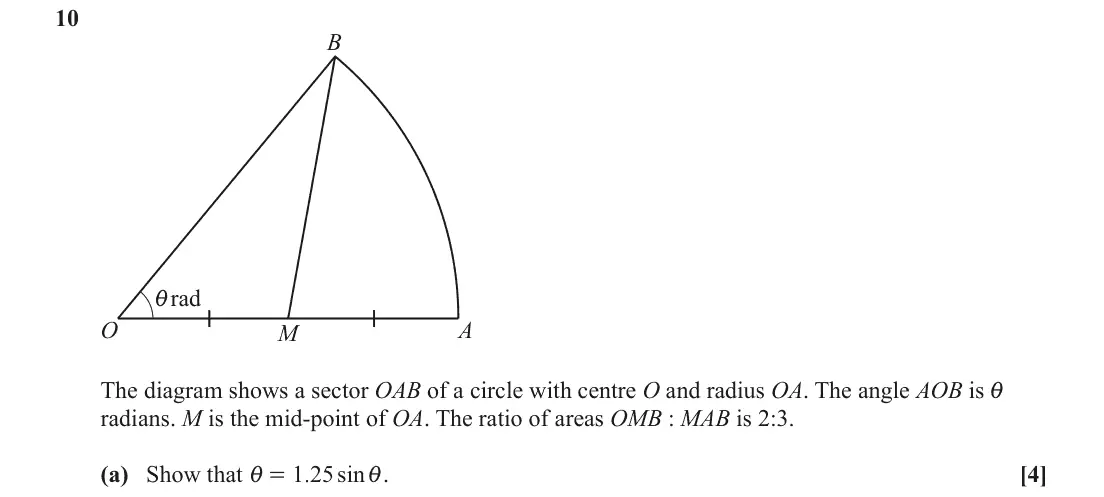
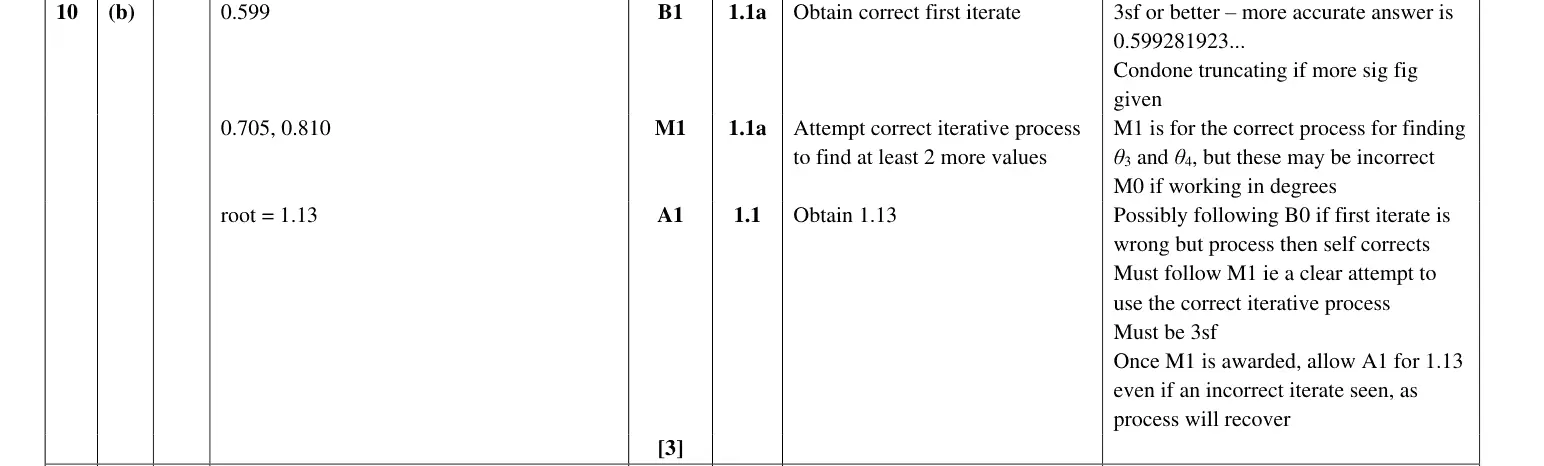
θ₂ = 0.599, θ₃ = 0.705, θ₄ = 0.810
root 1.13 to 3 s.f. stated as the root
radians
June 2022 · Paper 1 · Q10(c)3 marksHard
Show the start of this question
Mark scheme for this part
Examiner's comment
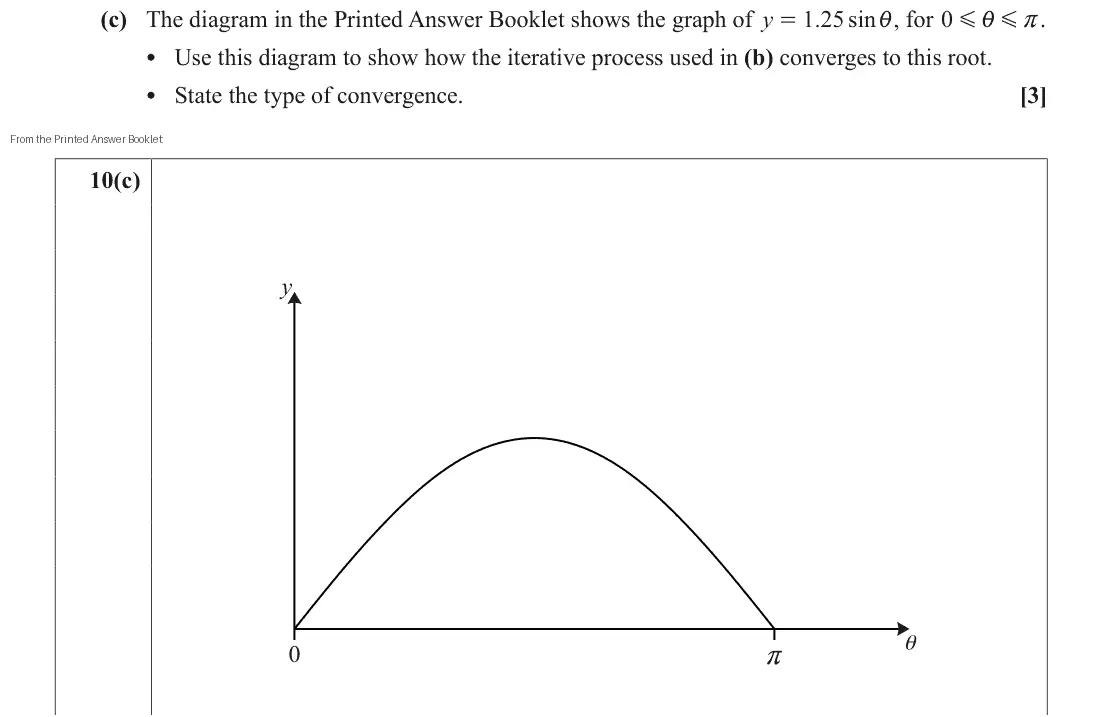
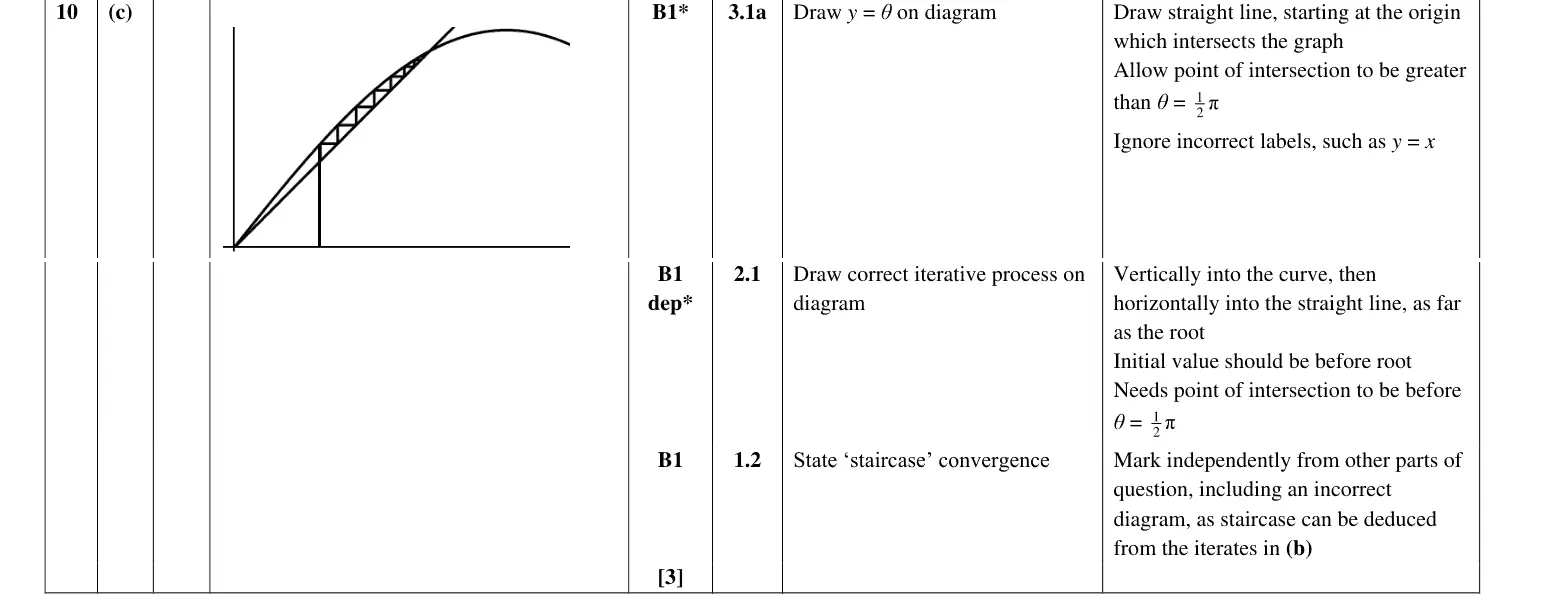
Many candidates did not seem familiar with how the iteration was converging to the root, neither being able to identify ‘staircase’ nor drawing an appropriate diagram. The mark for ‘staircase’ was independent of the other 2 marks, and candidates should have been able to deduce this from the pattern of iterates in the previous part of the question. When using the diagram, the first step was to draw the line y = θ, and then show clear detail of the pattern of convergence, whereas some diagrams had a staircase pattern but no straight line. A common error was to not give due consideration to approximately where the root would be on the diagram; a number of candidates assumed that it was at the stationary point on the curve, and others went beyond this.
Key points and common errors
draw y = θ and the staircase from θ₁ = 0.5 to the intersection
'staircase' convergence (deducible from the increasing iterates in (b))
June 2022 · Paper 1 · Q10(d)2 marksHard
Show the start of this question
Mark scheme for this part
Examiner's comment
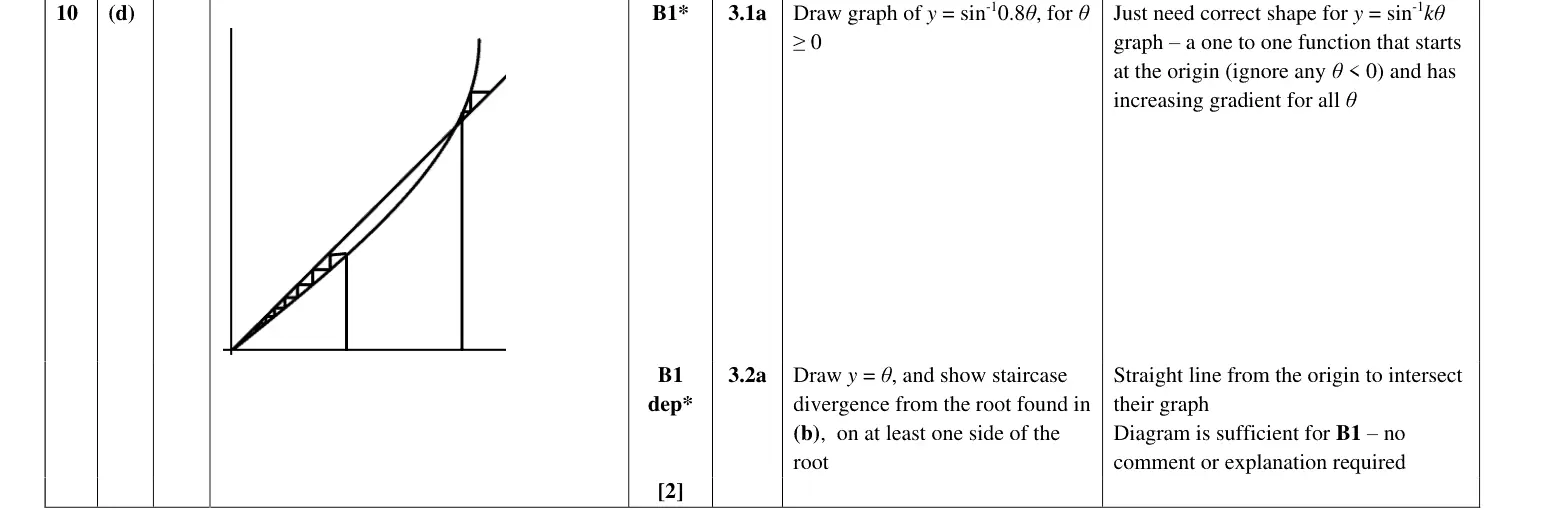
Some candidates could provide the correct shape for the arcsin graph, and less than half of those could then use it to show divergence from the root.
Key points and common errors
sketch y = sin⁻¹(0.8θ) (increasing gradient) and y = θ
staircase moves away from the root on at least one side
June 2022 · Paper 3 · Q5(b)2 marksEasy
Show the start of this question
Mark scheme for this part
Examiner's comment
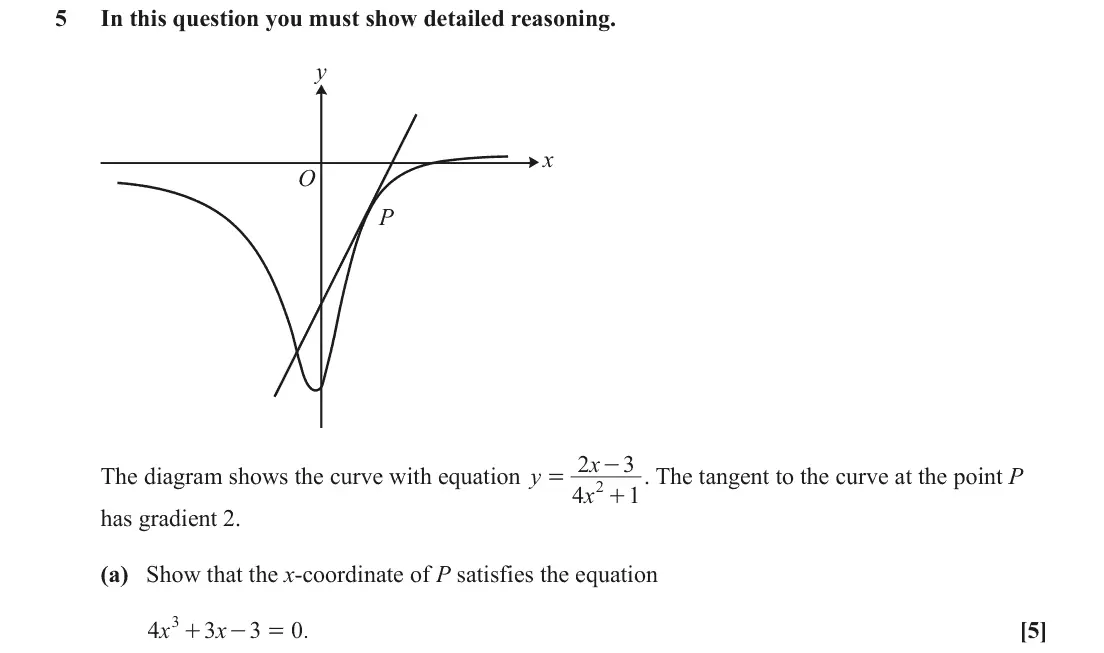
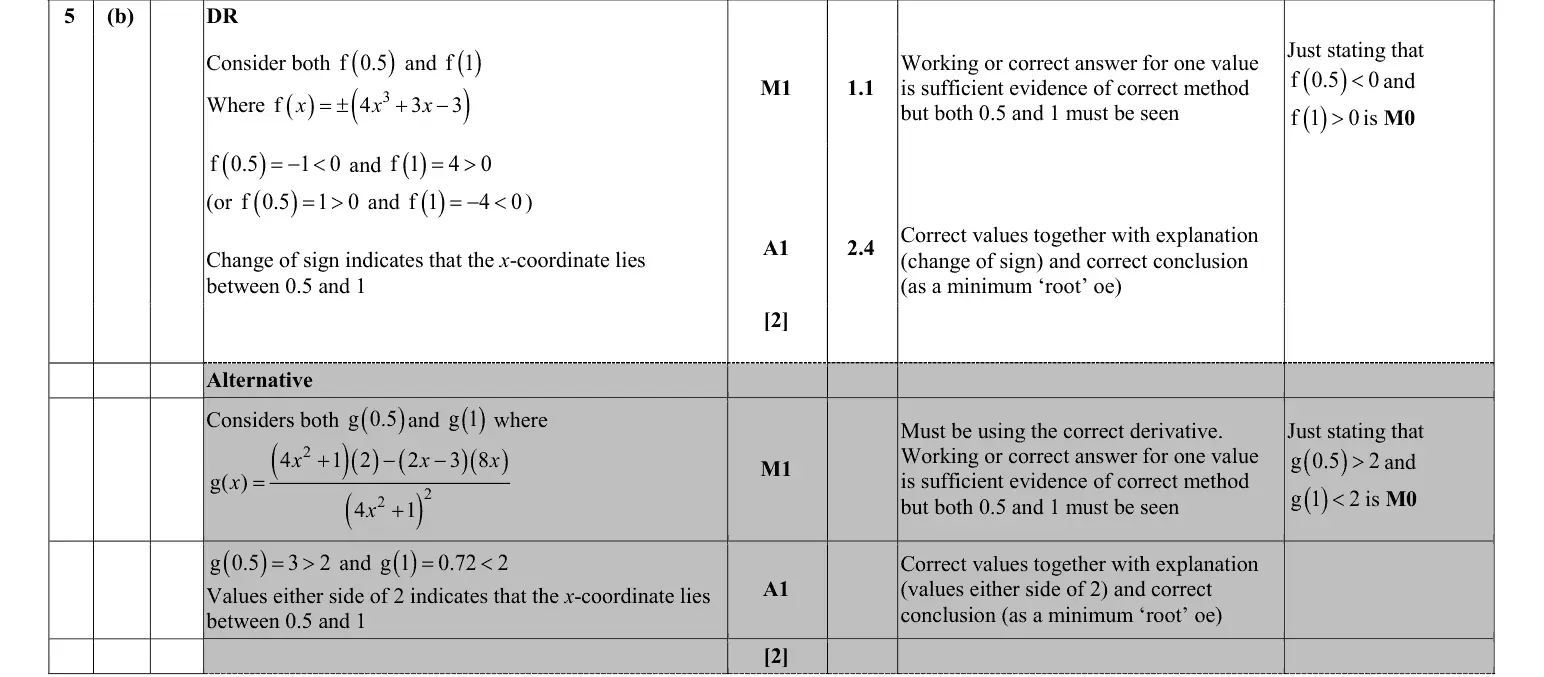
Although most candidates applied the sign change test to the equation from part (a) some used the original equation of the curve (which was an incorrect method which could not show that the x-coordinate of P was between 0.5 and 1). Of those that did use a correct expression (with the majority using although some did use ( ) ( ) 2 4 x + 1 − 8 x 2 x − 3 4 x + 3 x − 3 or a correct equivalent and compared with ( ) 4 x + 1 the value of 2) most: -stated the values of these expressions when x = 0.5 and x = 1, -proceeded to give a correct explanation (‘change of sign’ or ‘either side of 2’), -followed by a correct conclusion (‘hence the x-coordinate of P lies between 0.5 and 1’).
This was probably the least well answered question on the whole paper with most candidates scoring zero marks (with many just showing that the given iteration did not converge for a number of different starting values). Only the most able realised what was required in this part. Of those that did calculate ( ) ( ) F x x + = F x , where very few could correctly articulate that as the x-coordinate of P lies in the ( ) −for all values of where F 1 interval (0.5, 1) and (0.5,1), then this implies that the given iteration cannot converge to the x-coordinate of P whatever starting value is used.
Key points and common errors
h′(x) = −4x², so h′(α) < −1 for α in (0.5, 1)
hence cannot converge
trying starting values gains nothing
June 2022 · Paper 3 · Q5(d)5 marksHard
Show the start of this question
Mark scheme for this part
Examiner's comment
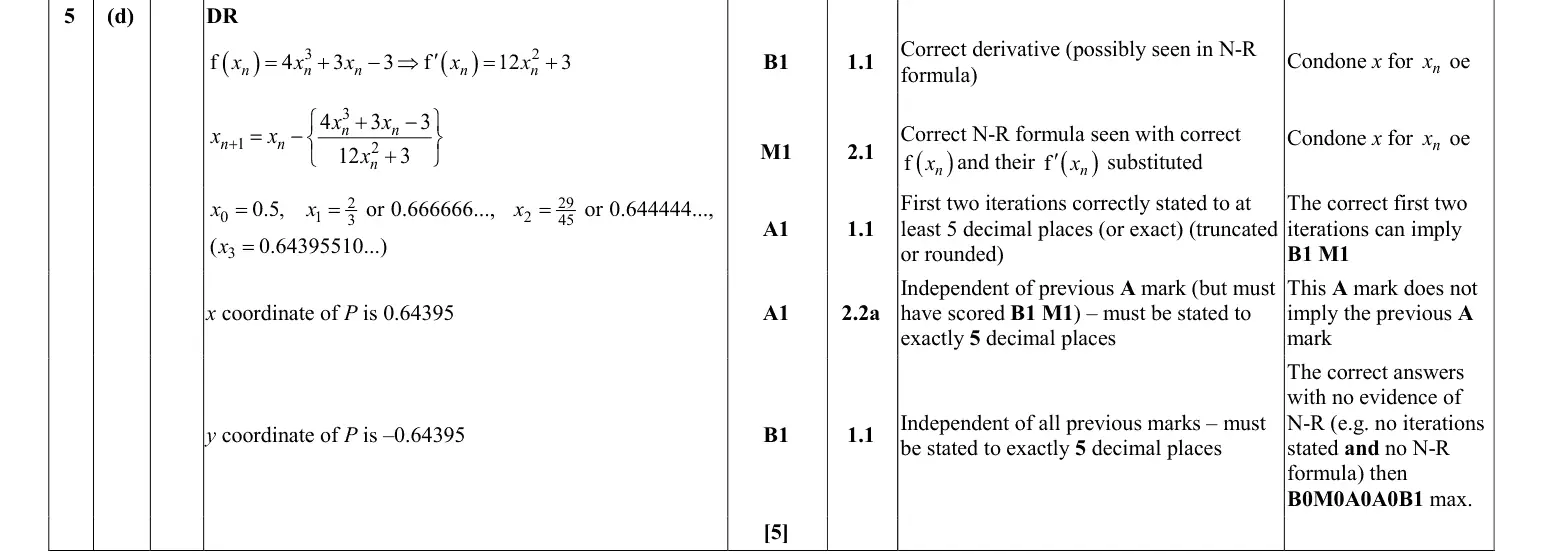
Many candidates struggled on this question with many unsure which expression they should be applying Newton-Raphson to. Of those that did realise that ( ) f x = 4 x + 3 x − 3 many did derive the x- coordinate of P but many then did not find the corresponding y coordinate.
Key points and common errors
x(n+1) = x − (4x³ + 3x − 3)/(12x² + 3)
x₁ = 2/3, x₂ = 29/45
P = (0.64395, −0.64395)
y-coordinate often omitted
Autumn 2021 · Paper 1 · Q7(b)4 marksMedium
Show the start of this question
Mark scheme for this part
Examiner's comment
(From the general report) The first part of Question 7 was a ‘show that’ question and candidates were expected to provide sufficient detail to be convincing, including expressing the derivative equated to 0 before dealing with the fractional term.
Key points and common errors
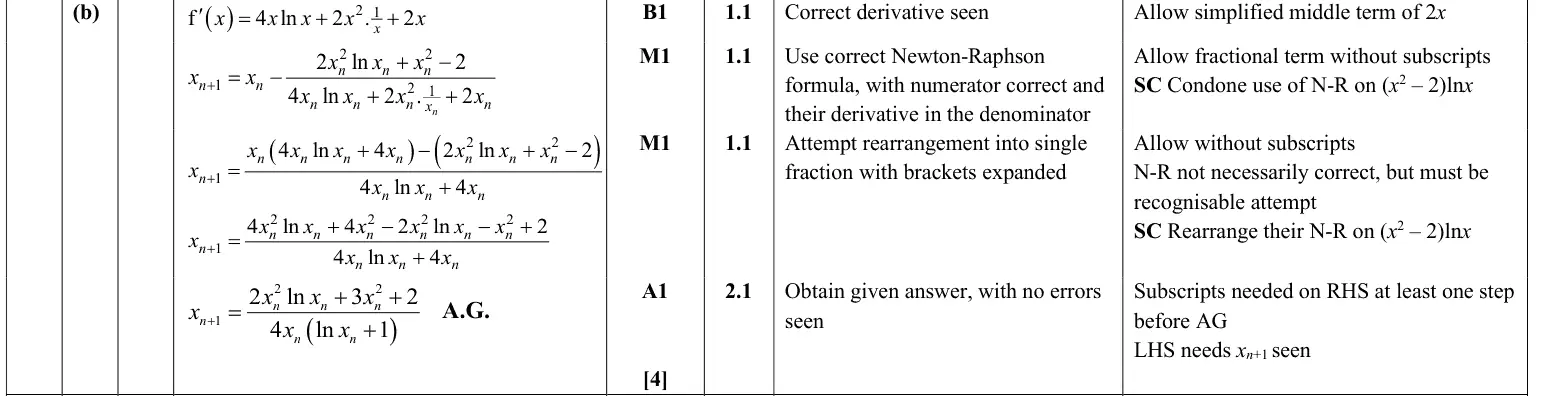
f′(x) = 4x ln x + 4x
substitute into Newton-Raphson and rearrange to a single fraction
subscripts needed
Autumn 2021 · Paper 1 · Q7(c)1 markMedium
Show the start of this question
Mark scheme for this part
Examiner's comment
(From the general report) The first part of Question 7 was a ‘show that’ question and candidates were expected to provide sufficient detail to be convincing, including expressing the derivative equated to 0 before dealing with the fractional term.
Key points and common errors
x₂ = 1.25, x₃ = 1.2075
Autumn 2021 · Paper 1 · Q7(d)2 marksMedium
Show the start of this question
Mark scheme for this part
Examiner's comment
(From the general report) The first part of Question 7 was a ‘show that’ question and candidates were expected to provide sufficient detail to be convincing, including expressing the derivative equated to 0 before dealing with the fractional term.
Key points and common errors
continue iterating to converge
(1.206, −0.102) to 3 d.p.
Autumn 2021 · Paper 2 · Q22 marksMedium
Mark scheme for this part
Examiner's comment
(From the general report) Common misconceptions Misconceptions Question 2: Many candidates considered the change of sign of the gradient, rather than the change of sign of f(x).
Key points and common errors
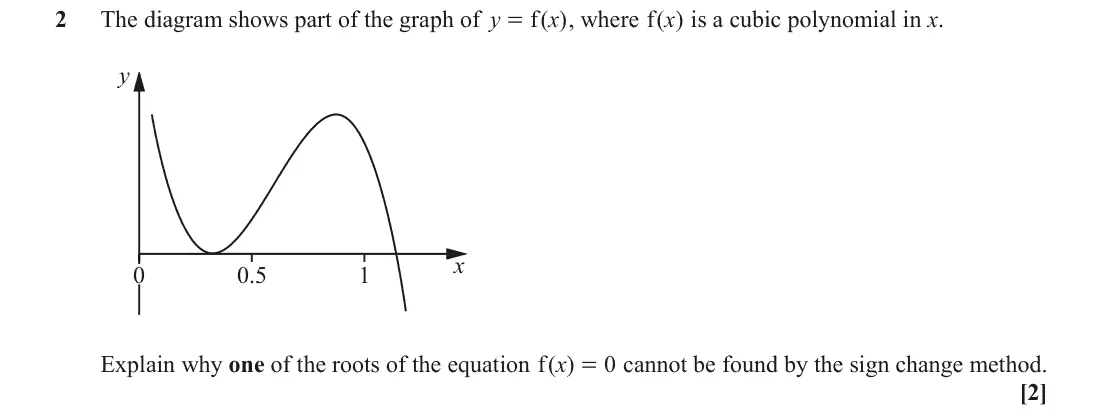
the curve touches the x-axis (repeated root) so f(x) is positive on both sides and there is no sign change
many considered the change of sign of the gradient instead
Autumn 2021 · Paper 3 · Q6(a)2 marksHard
Mark scheme for this part
Examiner's comment
(Comment on Question 06 as a whole) It was clear that many candidates struggled with this question even though it was relatively routine in nature. The notation, arcsin, clearly confused some candidates even though it is given in the specification.
Key points and common errors
f(0.5) = −0.25 < 0 and f(0.6) = 0.848 > 0
state change of sign and conclusion
radians
Autumn 2021 · Paper 3 · Q6(b)2 marksHard
Show the start of this question
Mark scheme for this part
Examiner's comment
(Comment on Question 06 as a whole) It was clear that many candidates struggled with this question even though it was relatively routine in nature. The notation, arcsin, clearly confused some candidates even though it is given in the specification.
Key points and common errors
arcsin(2x − 1) = x²/6 so 2x − 1 = sin(x²/6)
p = ½, q = ½, r = 1/6
arcsin notation confused many
Autumn 2021 · Paper 3 · Q6(c)2 marksHard
Show the start of this question
Mark scheme for this part
Examiner's comment
(Comment on Question 06 as a whole) It was clear that many candidates struggled with this question even though it was relatively routine in nature. The notation, arcsin, clearly confused some candidates even though it is given in the specification.
Key points and common errors
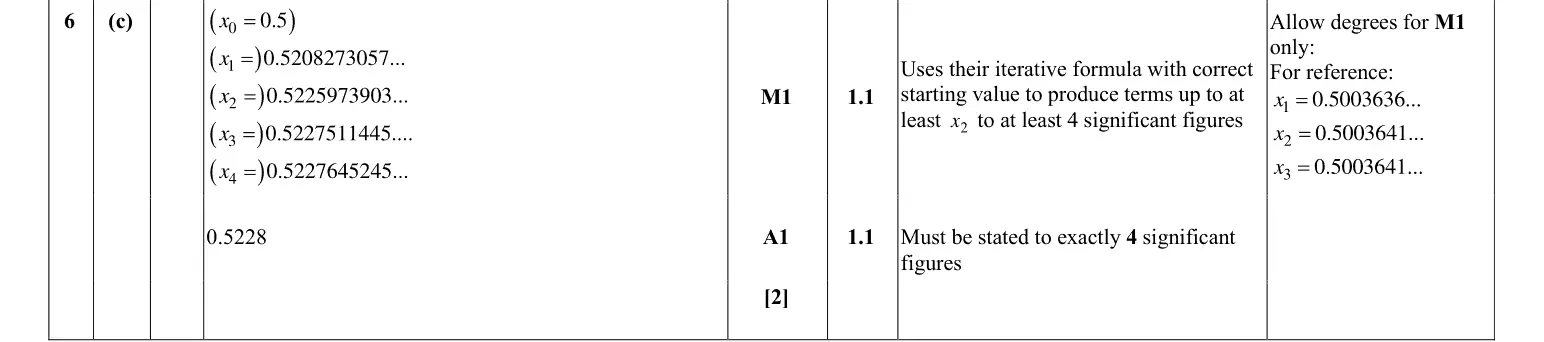
iterate from x₀ = 0.5: 0.5208, 0.5226, 0.5228 …
root 0.5228 to exactly 4 s.f.
Autumn 2020 · Paper 1 · Q7(c)3 marksMedium
Show the start of this question
Mark scheme for this part
Examiner's comment
(Comment on Question 07 as a whole) The final part of Question 7 was another example of where candidates were expected to give clearly explained and sensible answers. Many could identify that there will eventually not be enough hours in the day, but finding a reason on a different theme for their second answer proved more problematical.
Key points and common errors
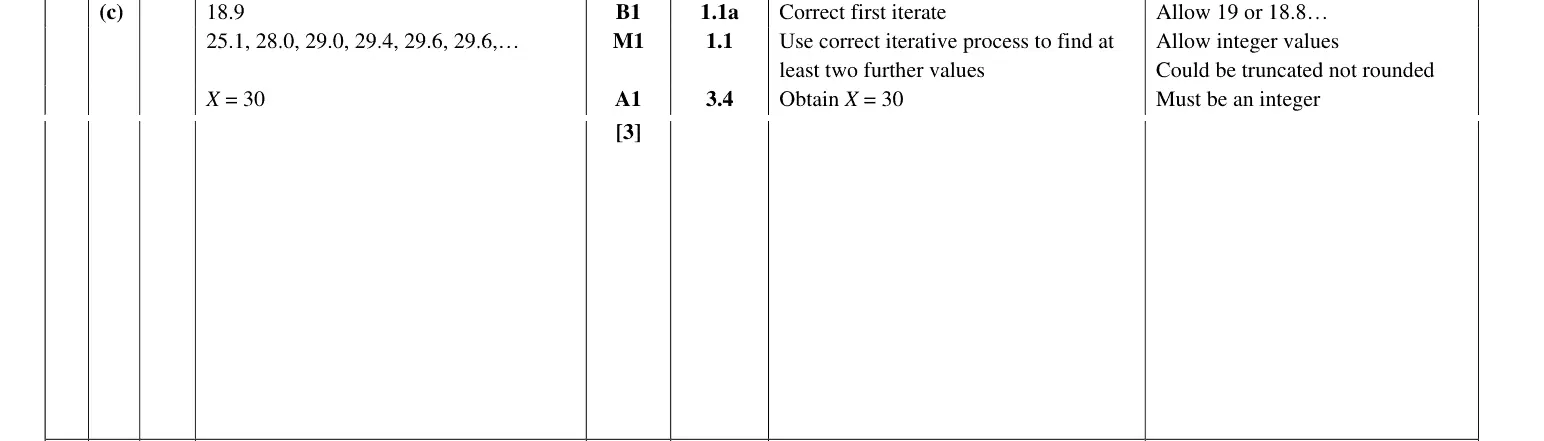
x₂ = 18.9, then 25.1, 28.0, 29.0, 29.4, 29.6 …
X = 30 (must be an integer)
Autumn 2020 · Paper 3 · Q4(b)2 marksMedium
Show the start of this question
Mark scheme for this part
Examiner's comment
(Comment on Question 04 as a whole) In part (a) it was seen that a significant number of candidates only showed that the curve had a turning d y d y point at x = using 1 x = 0 rather than that the curve had a point of inflection at x = using 1 = 0 . d d x d y Some candidates substituted the values of x = and 1 k = 6 to ‘verify’ that = 0 and did not provide d x sufficient evidence to ‘show that k = 6 ’. Where questions ask for candidates to solve a problem to ‘show that’ a given answer is correct then it is good practice that the working leads to that answer and does not make use of the answer as part of the working. In part (b) the examiners were looking for actual numerical values with an explanation that the change of sign indicates that the x-intercept is between those values. Some candidates simply provided a generic explanation of what a change in sign would represent, but no numerical confirmation in the context of this question, which was not sufficient for the request ‘Show by calculation …’. Part (c) was generally done well, although some candidates dropped marks when imprecise notation resulted in subsequent substitution errors. In order to demonstrate that the Newton – Raphson method has indeed been used, it is good practice to write out the iteration formulae, taking care with the x and x + notation. Candidates that gave their results to the iterations to an accuracy greater than the specified 6 dp were not penalised, but the final accuracy mark required the answer to be quoted to the specified 5 dp. Part (d) was generally answered well by those that had successfully completed part (c). Most verified their 5 dp answer by checking for the sign change 0 000005 ± . , although a few investigated smaller interval bounds. Those candidates that did not gain credit either investigated 0 00001 ± . or did not explain how their calculations verified the result.
Key points and common errors
f(0.5) = 1.758 > 0, f(1.5) = −1.439 < 0
change of sign so root between
numerical values must be given, not a generic explanation
Autumn 2020 · Paper 3 · Q4(c)3 marksEasy
Show the start of this question
Mark scheme for this part
Examiner's comment
(Comment on Question 04 as a whole) In part (a) it was seen that a significant number of candidates only showed that the curve had a turning d y d y point at x = using 1 x = 0 rather than that the curve had a point of inflection at x = using 1 = 0 . d d x d y Some candidates substituted the values of x = and 1 k = 6 to ‘verify’ that = 0 and did not provide d x sufficient evidence to ‘show that k = 6 ’. Where questions ask for candidates to solve a problem to ‘show that’ a given answer is correct then it is good practice that the working leads to that answer and does not make use of the answer as part of the working. In part (b) the examiners were looking for actual numerical values with an explanation that the change of sign indicates that the x-intercept is between those values. Some candidates simply provided a generic explanation of what a change in sign would represent, but no numerical confirmation in the context of this question, which was not sufficient for the request ‘Show by calculation …’. Part (c) was generally done well, although some candidates dropped marks when imprecise notation resulted in subsequent substitution errors. In order to demonstrate that the Newton – Raphson method has indeed been used, it is good practice to write out the iteration formulae, taking care with the x and x + notation. Candidates that gave their results to the iterations to an accuracy greater than the specified 6 dp were not penalised, but the final accuracy mark required the answer to be quoted to the specified 5 dp. Part (d) was generally answered well by those that had successfully completed part (c). Most verified their 5 dp answer by checking for the sign change 0 000005 ± . , although a few investigated smaller interval bounds. Those candidates that did not gain credit either investigated 0 00001 ± . or did not explain how their calculations verified the result.
Key points and common errors
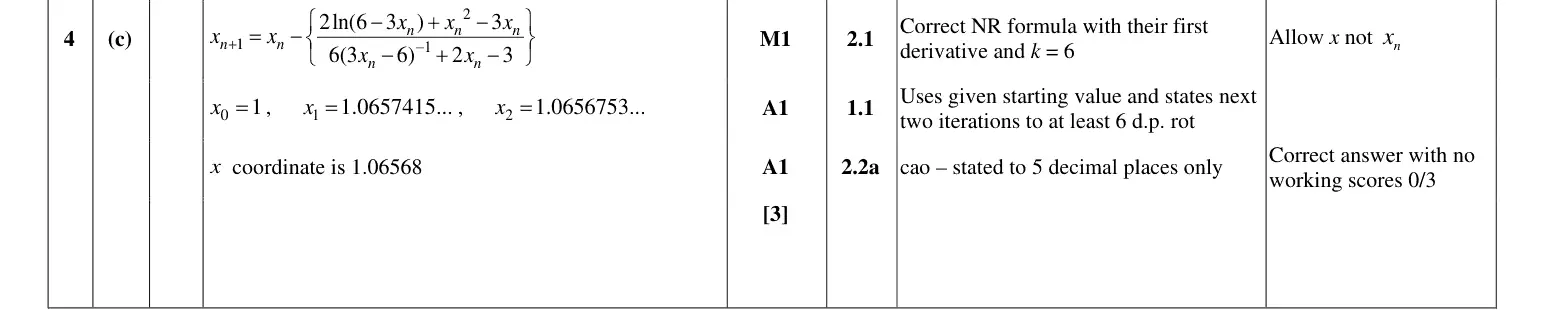
Newton-Raphson x₁ = 1.065742, x₂ = 1.065675
root 1.06568 to 5 d.p.
write out the iteration formula
Autumn 2020 · Paper 3 · Q4(d)1 markMedium
Show the start of this question
Mark scheme for this part
Examiner's comment
(Comment on Question 04 as a whole) In part (a) it was seen that a significant number of candidates only showed that the curve had a turning d y d y point at x = using 1 x = 0 rather than that the curve had a point of inflection at x = using 1 = 0 . d d x d y Some candidates substituted the values of x = and 1 k = 6 to ‘verify’ that = 0 and did not provide d x sufficient evidence to ‘show that k = 6 ’. Where questions ask for candidates to solve a problem to ‘show that’ a given answer is correct then it is good practice that the working leads to that answer and does not make use of the answer as part of the working. In part (b) the examiners were looking for actual numerical values with an explanation that the change of sign indicates that the x-intercept is between those values. Some candidates simply provided a generic explanation of what a change in sign would represent, but no numerical confirmation in the context of this question, which was not sufficient for the request ‘Show by calculation …’. Part (c) was generally done well, although some candidates dropped marks when imprecise notation resulted in subsequent substitution errors. In order to demonstrate that the Newton – Raphson method has indeed been used, it is good practice to write out the iteration formulae, taking care with the x and x + notation. Candidates that gave their results to the iterations to an accuracy greater than the specified 6 dp were not penalised, but the final accuracy mark required the answer to be quoted to the specified 5 dp. Part (d) was generally answered well by those that had successfully completed part (c). Most verified their 5 dp answer by checking for the sign change 0 000005 ± . , although a few investigated smaller interval bounds. Those candidates that did not gain credit either investigated 0 00001 ± . or did not explain how their calculations verified the result.
Key points and common errors
f(1.065675) > 0 and f(1.065685) < 0: sign change so correct to 5 d.p.
bounds ±0.000005 not ±0.00001
must explain
June 2019 · Paper 1 · Q10(b)2 marksHard
Show the start of this question
Mark scheme for this part
Examiner's comment
To gain the first mark, candidates simply had to find the value of F’(1.2), yet the majority did not follow this instruction. A further few found the derivative but did not substitute 1.2. Of those who did carry out the evaluation correctly, some did not understand the relevance of this value with references to tangents and Newton-Raphson being the most common error. Others clearly had an inkling that the gradient related to the convergence of the iterative formula but their explanation was insufficiently specific to gain the mark, most typically just stating that it was less than 1. The most able candidates were able to give a suitably detailed explanation, referring to the modulus of the gradient being less than 1, and some even illustrated this with a staircase diagram.
Key points and common errors
F′(1.2) = cos1.2 = 0.362 must be evaluated
condition is modulus of F′ less than 1 (−1 < F′ < 1)
confusion with tangents or Newton-Raphson
June 2019 · Paper 1 · Q10(c)3 marksEasy
Show the start of this question
Mark scheme for this part
Examiner's comment
By contrast, this part of the question was very well attempted with the vast majority of candidates gaining full credit. Some candidates did not heed the instruction to give the answer to 4 significant figures, thus losing the final mark, and others worked in degrees and not radians. A small minority decided to use the Newton-Raphson method rather than the given iterative formula.
Key points and common errors
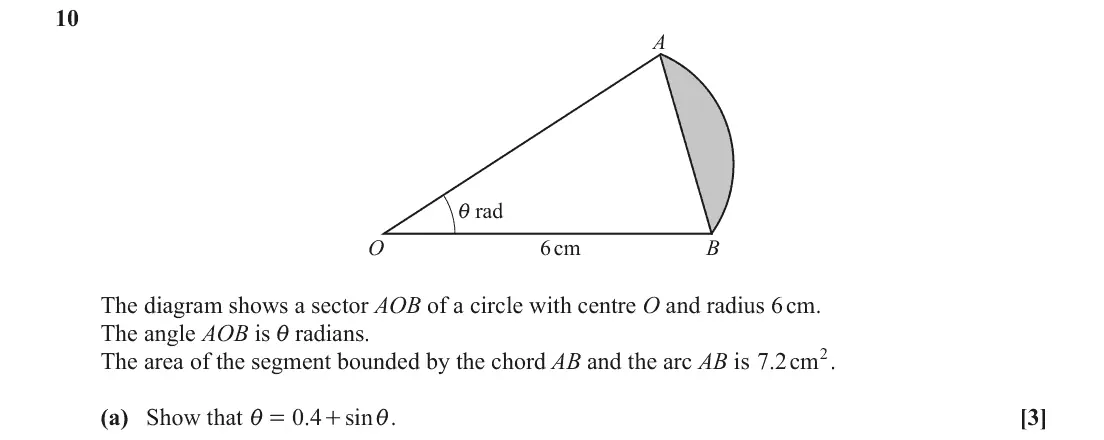
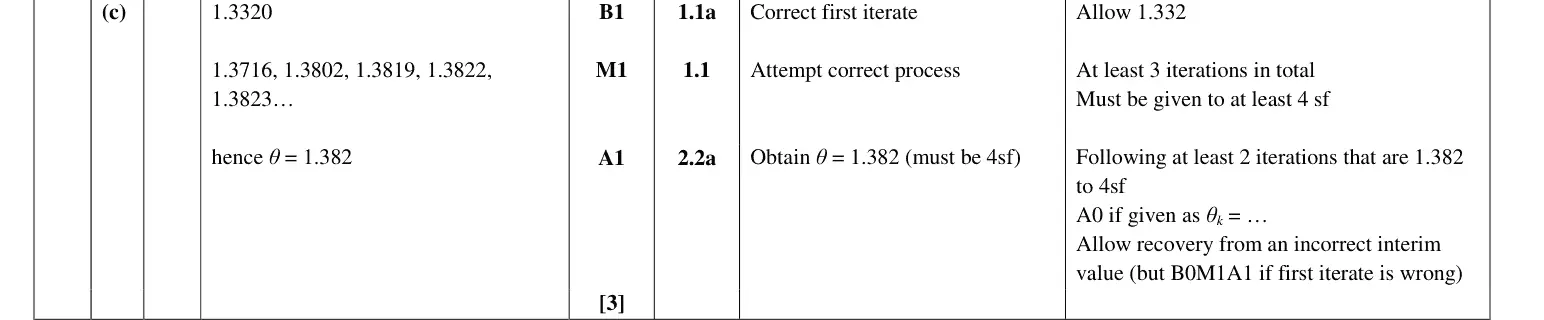
1.3320, 1.3716, 1.3802, … so θ = 1.382 to 4 s.f.
radians
show each iterate
June 2019 · Paper 1 · Q10(d)3 marksHard
Show the start of this question
Mark scheme for this part
Examiner's comment
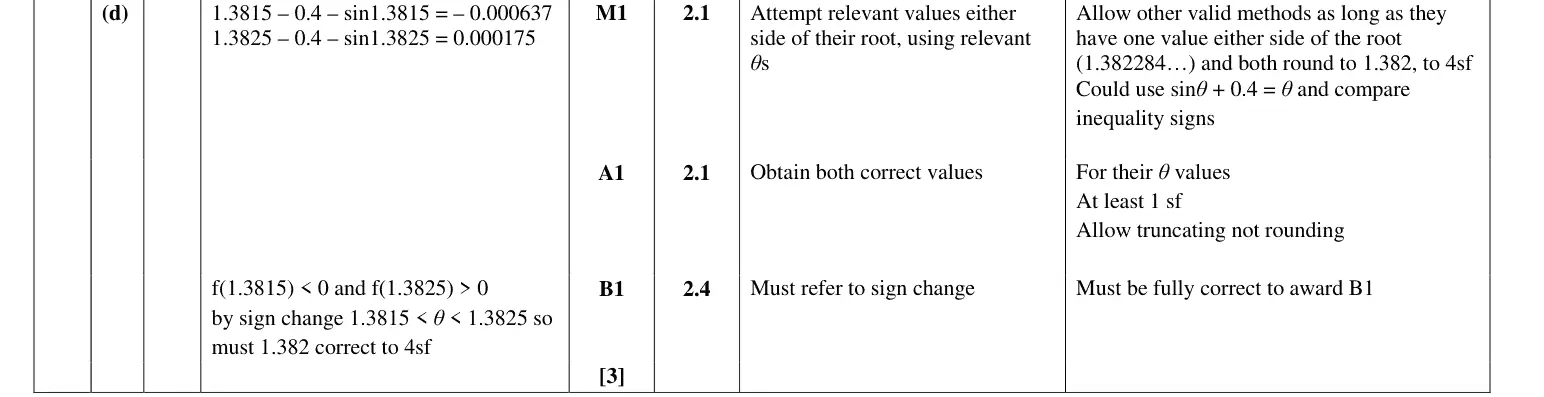
This topic is new to the specification, and many candidates seem unsure as to how to proceed. The most common error was to use 1.381 and 1.383 in their sign change attempt. Others did show the two relevant values, 1.3815 and 1.3825, but then just stated that there was a sign change with no empirical evidence for this. The most successful candidates first rearranged the equation to make it equal to 0, substituted in two correct values, noted the sign change and gave a final conclusion that explained why this justified the root to 4 significant figures. Other candidates substituted into the equation in its given format; this is an acceptable alternative method but candidates need to be aware that they need to substitute into both sides of the equation and look for a change in the direction of the inequality sign as most gave up when they did not obtain the sign change that they were expecting.
Key points and common errors
evaluate θ − 0.4 − sinθ at 1.3815 and 1.3825 (−0.000637 and 0.000175)
sign change and conclusion
1.381 and 1.383 are the wrong bounds
June 2019 · Paper 3 · Q4(b)4 marksHard
Show the start of this question
Mark scheme for this part
Examiner's comment
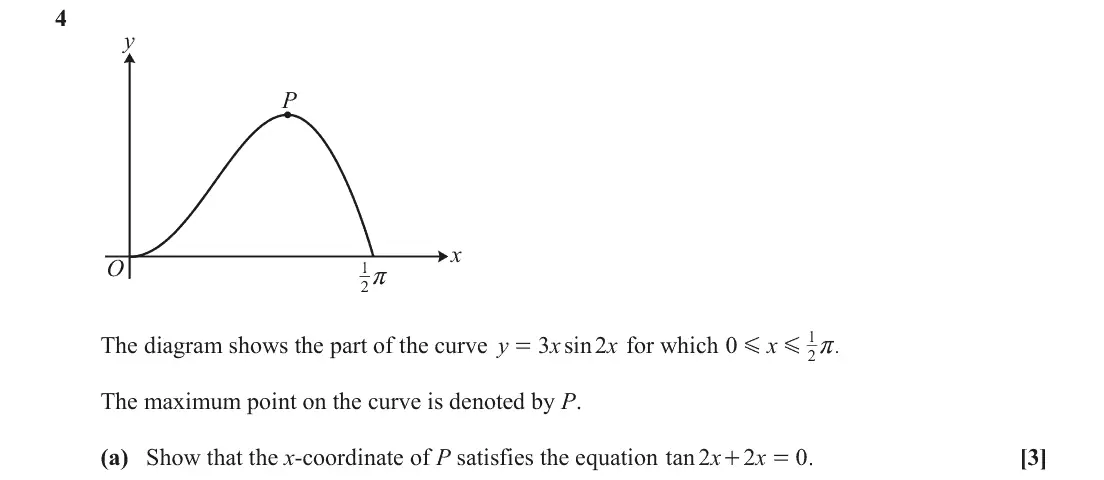
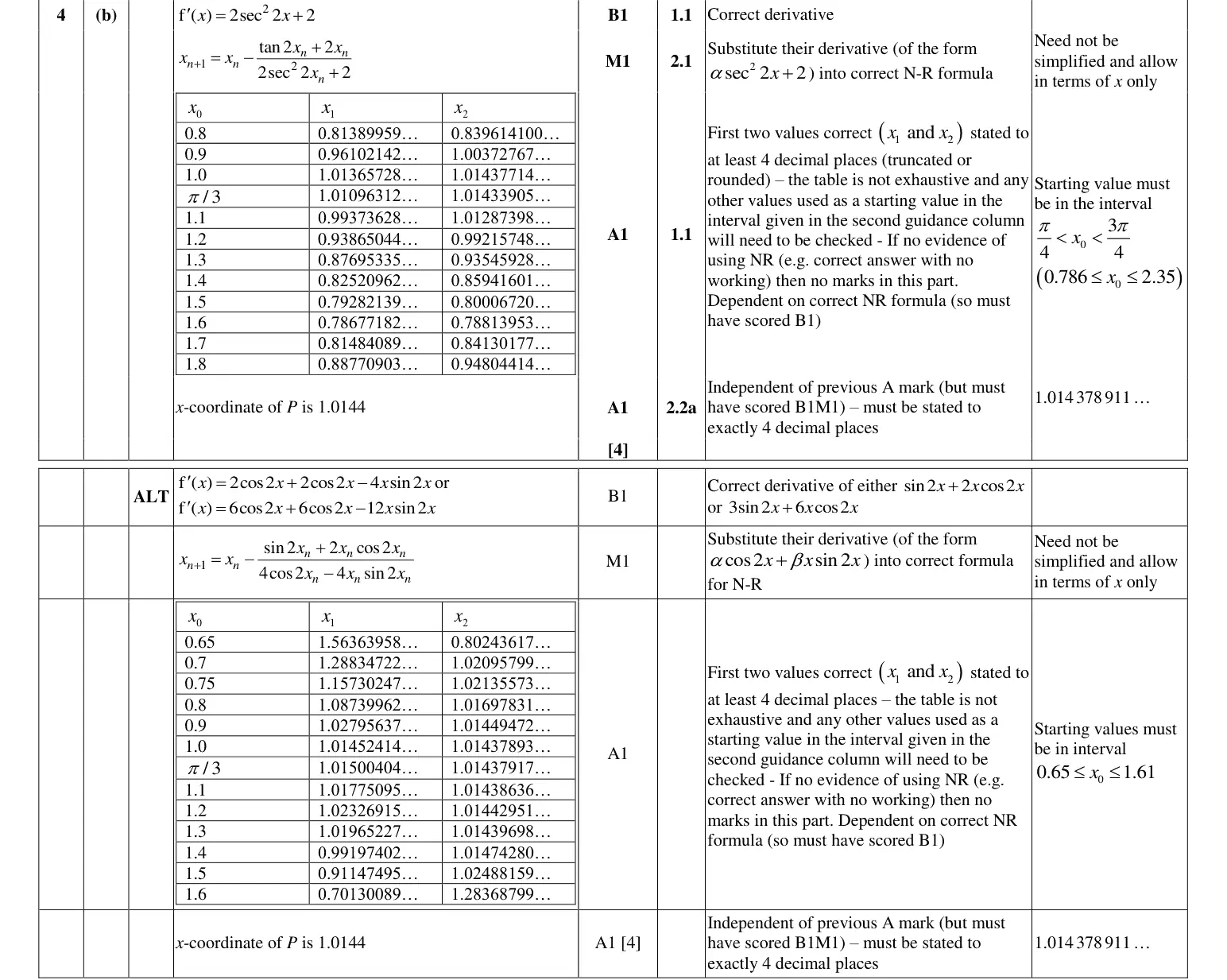
It was extremely disappointing that so many candidates did not realise that this part was asking candidates to apply the Newton-Raphson method to find a solution to the equation given in (a) with many thinking (by their choice of ( ) f x ) that instead it was asking them to solve 3 sin2 0 Of those x x = . / ( x ) candidates that correctly realised that ( ) f tan2 2 and hence f 2sec 2 2 most went on x = x + x = x + to correctly apply the Newton-Raphson formula with a suitable starting value and obtained the x-coordinate of P as 1.0144.
Key points and common errors
f(x) = tan2x + 2x, f′(x) = 2sec²2x + 2
suitable x₀ near 1
x = 1.0144
many wrongly used f(x) = 3x sin2x
Find an A-level maths tutor
Stuck on this? Book a trial session with an A-level maths tutor.