Autumn 2020: Paper 1: Pure Mathematics

100 marks · 32 question parts · Question paper, mark scheme and examiner's report on OCR's site

Question by question

QTopicMarksDifficulty
1(a) Small-angle approximations 3 Medium
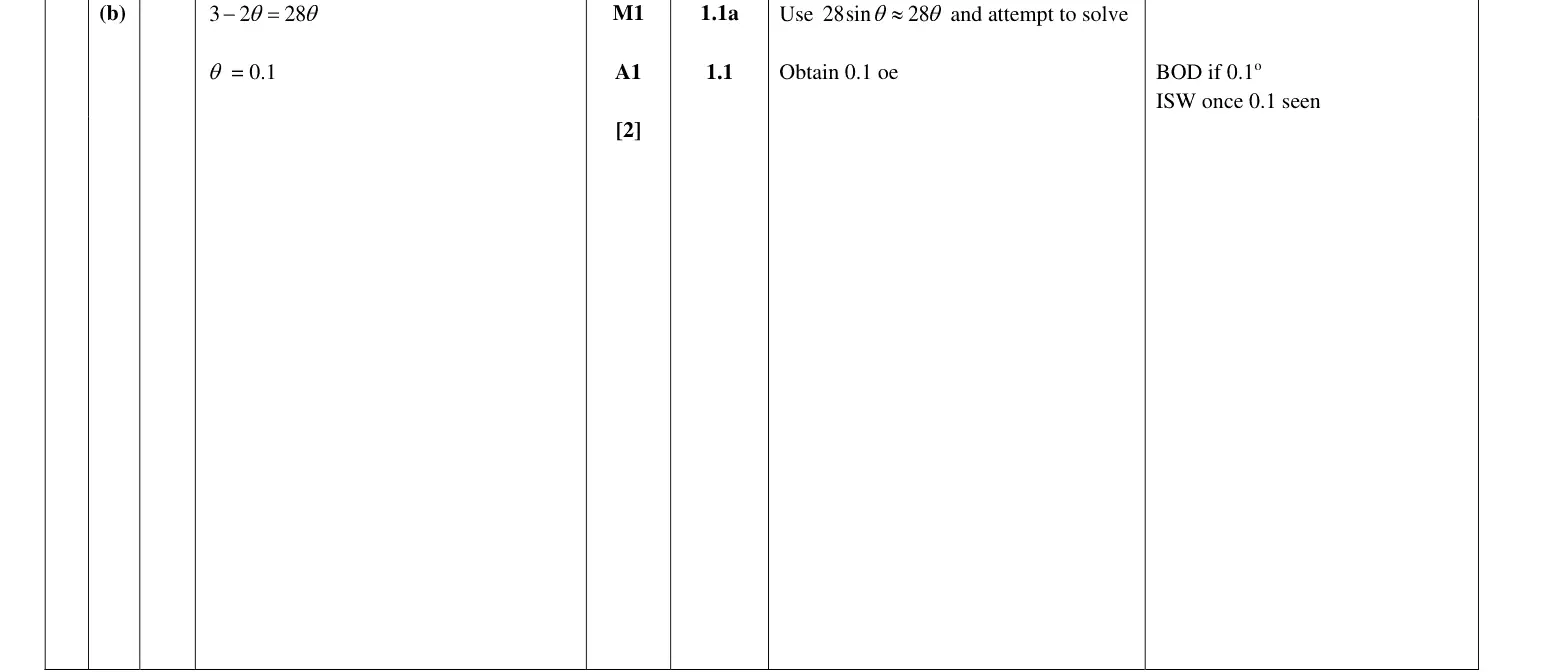
1(b) Small-angle approximations 2 Medium
2(a) Indices and surds 2 Medium
2(b) Indices and surds 2 Medium
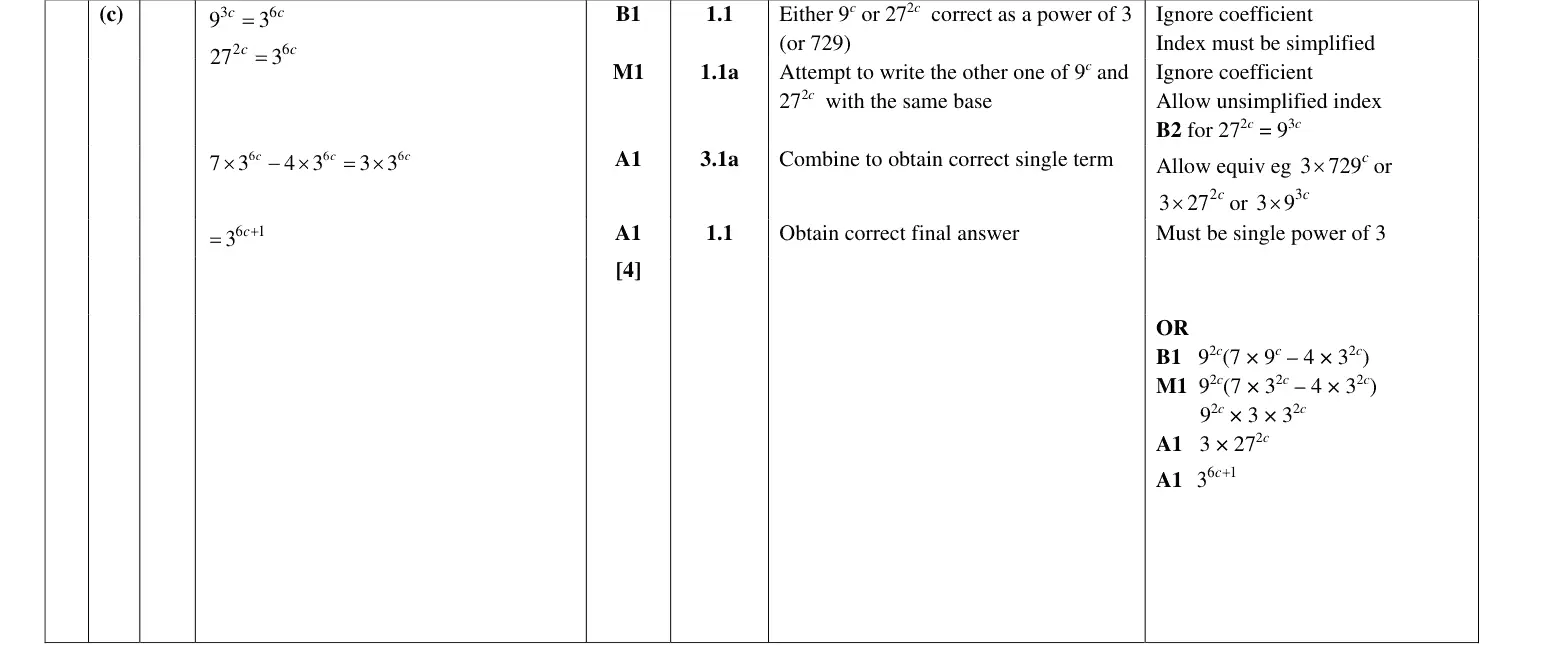
2(c) Indices and surds 4 Medium
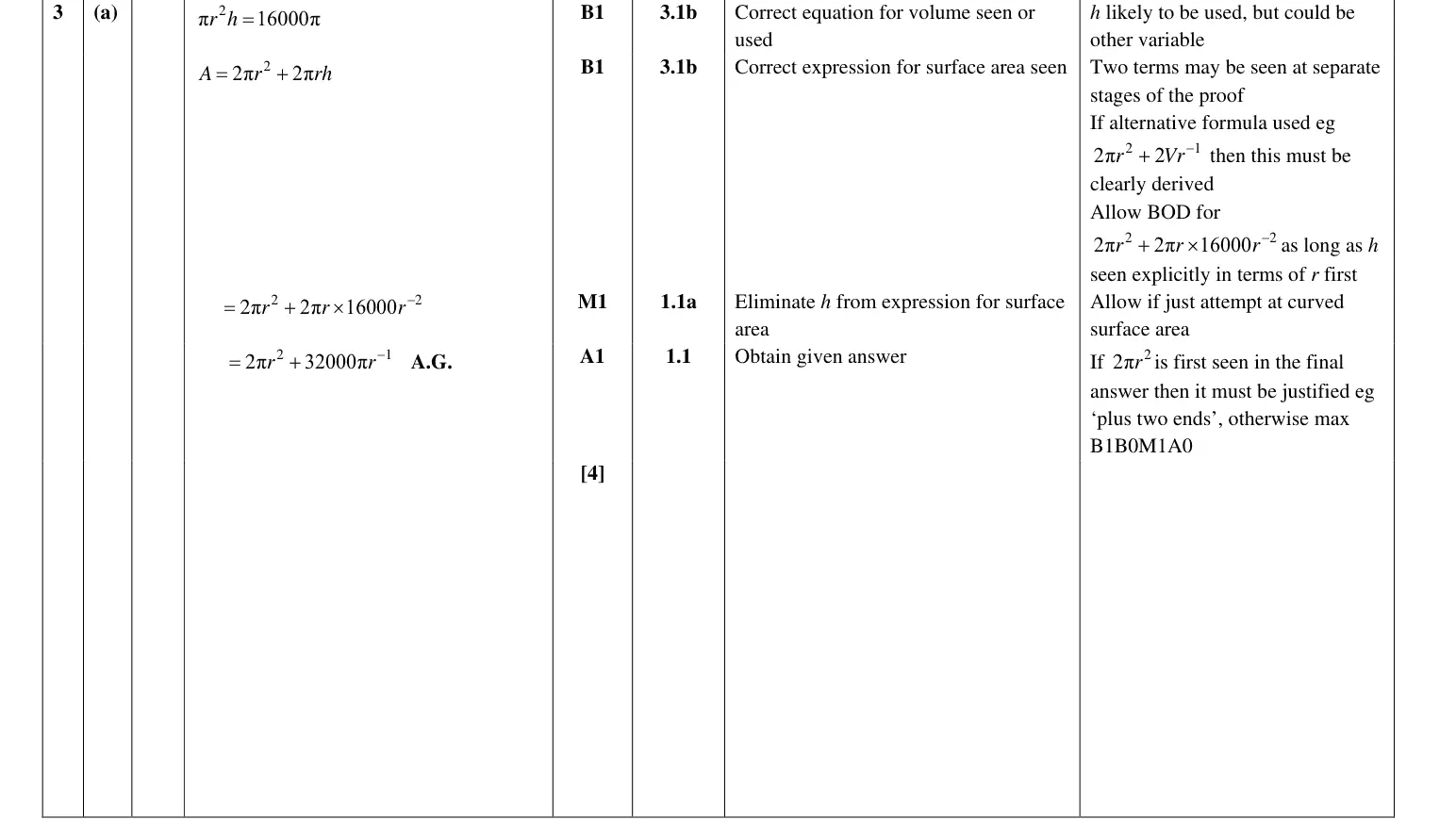
3(a) Functions, composite and inverse functions, modulus, Indices and surds 4 Medium
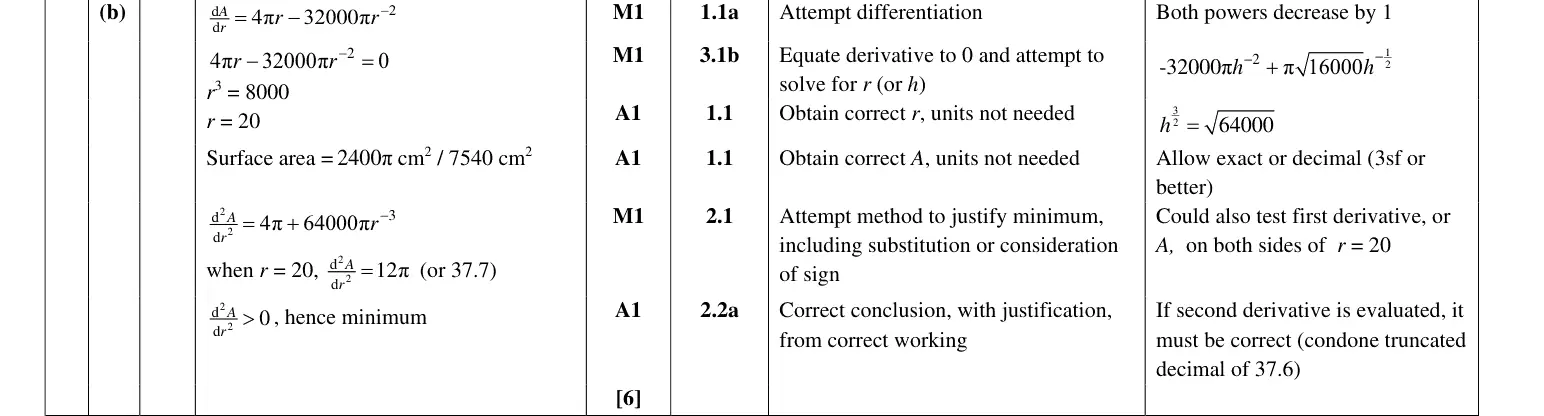
3(b) Differentiation: first principles, gradients, stationary points 6 Medium
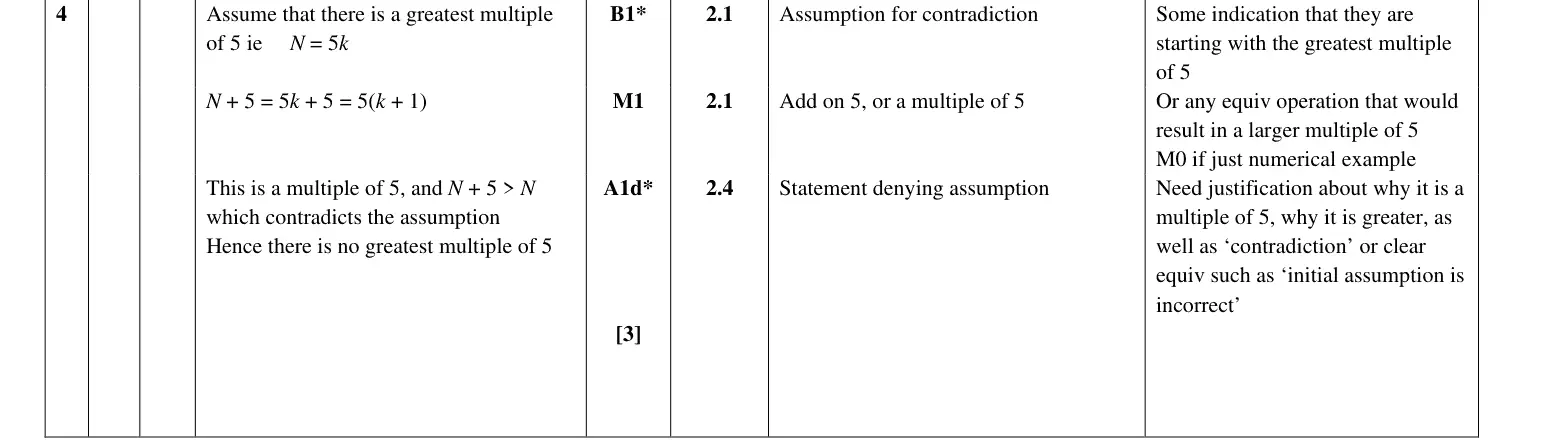
4 Proof, including contradiction 3 Medium
5(a) Vectors 2 Medium
5(b) Vectors 2 Medium
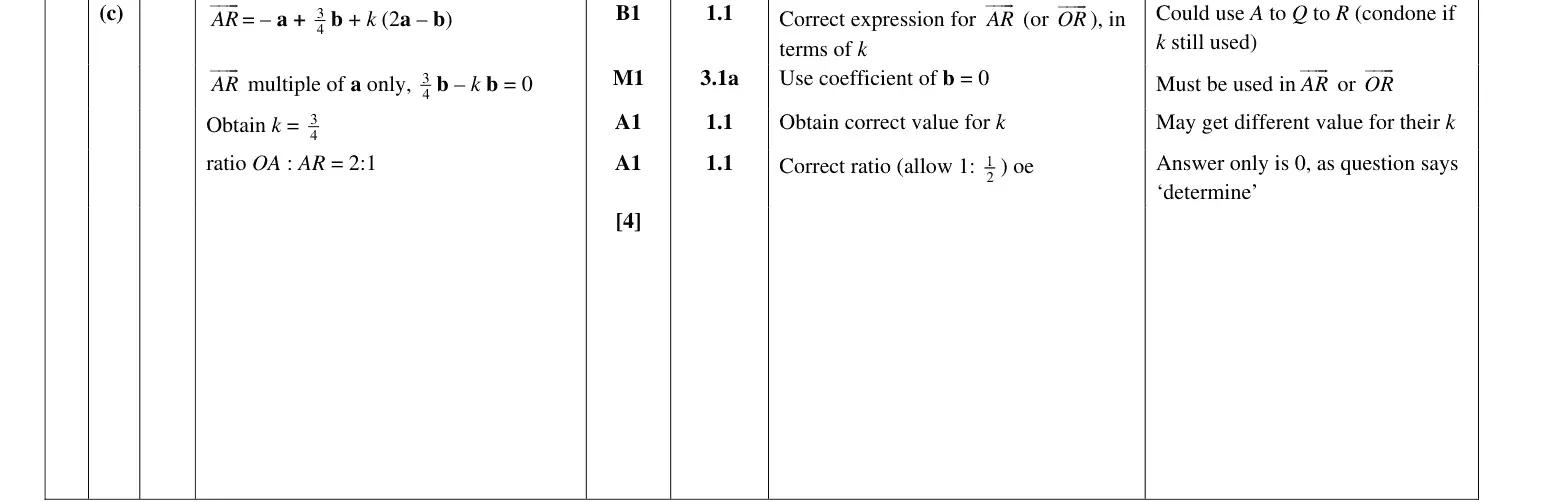
5(c) Vectors 4 Medium
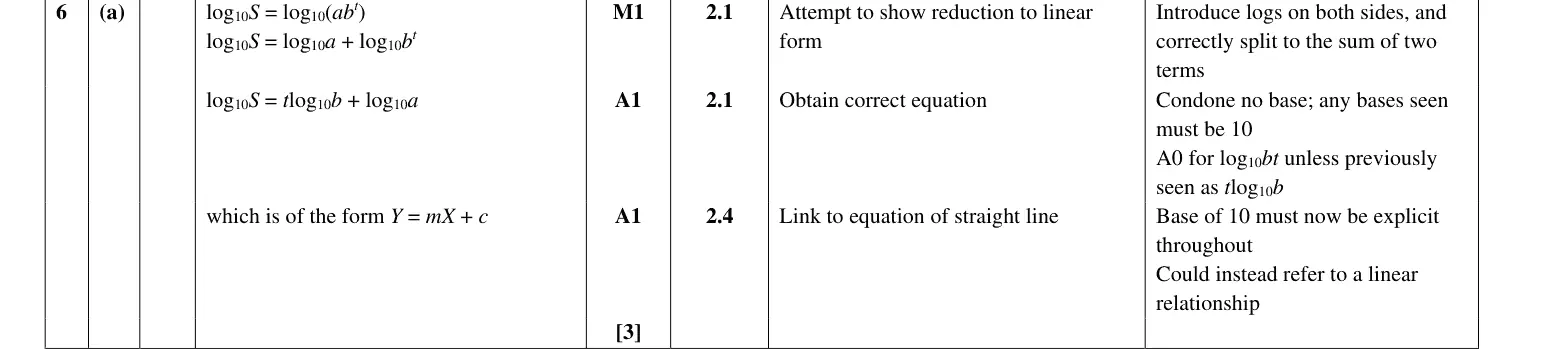
6(a) Exponentials and logarithms 3 Medium
6(b) Exponentials and logarithms 2 Medium
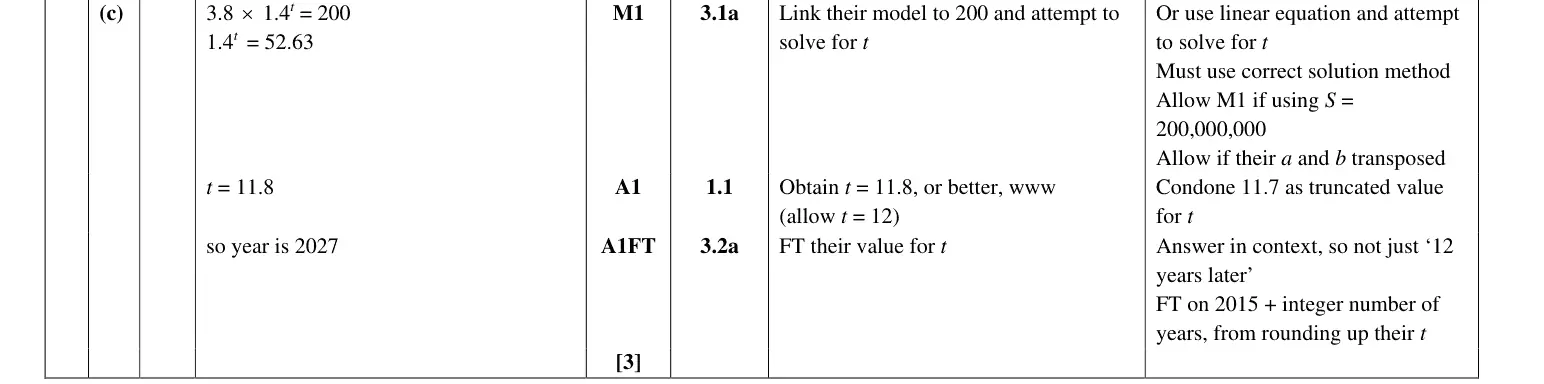
6(c) Exponential growth, decay and modelling, Exponentials and logarithms 3 Medium
6(d) Exponential growth, decay and modelling 1 Medium
7(a) Sequences and series 3 Medium
7(b) Sequences and series, Exponentials and logarithms 3 Medium
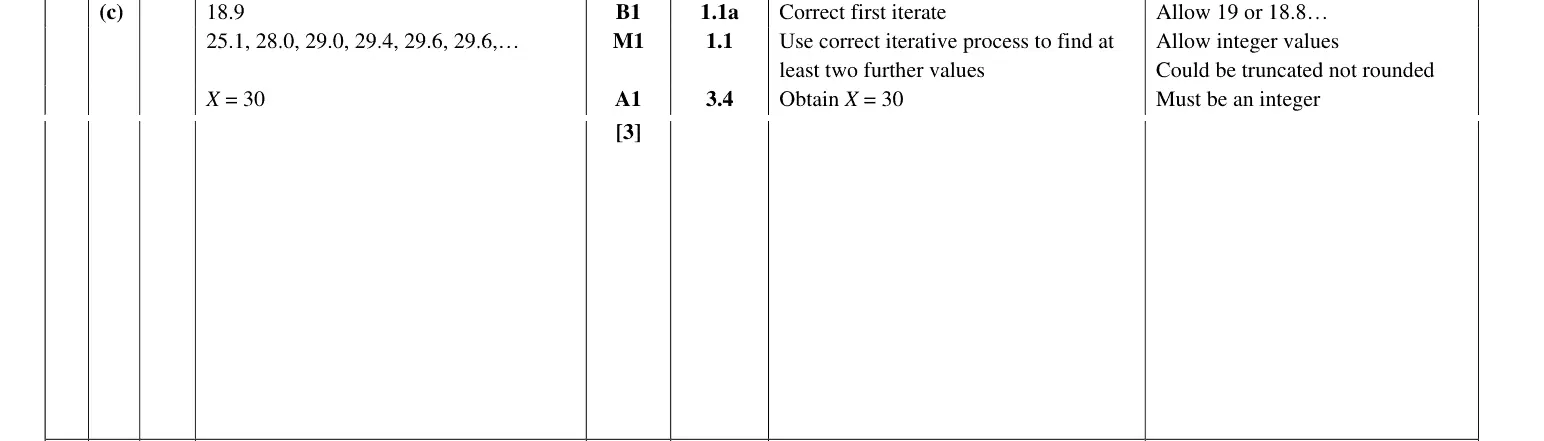
7(c) Numerical methods: roots, iteration and Newton–Raphson 3 Medium
7(d)(i) Sequences and series 1 Medium
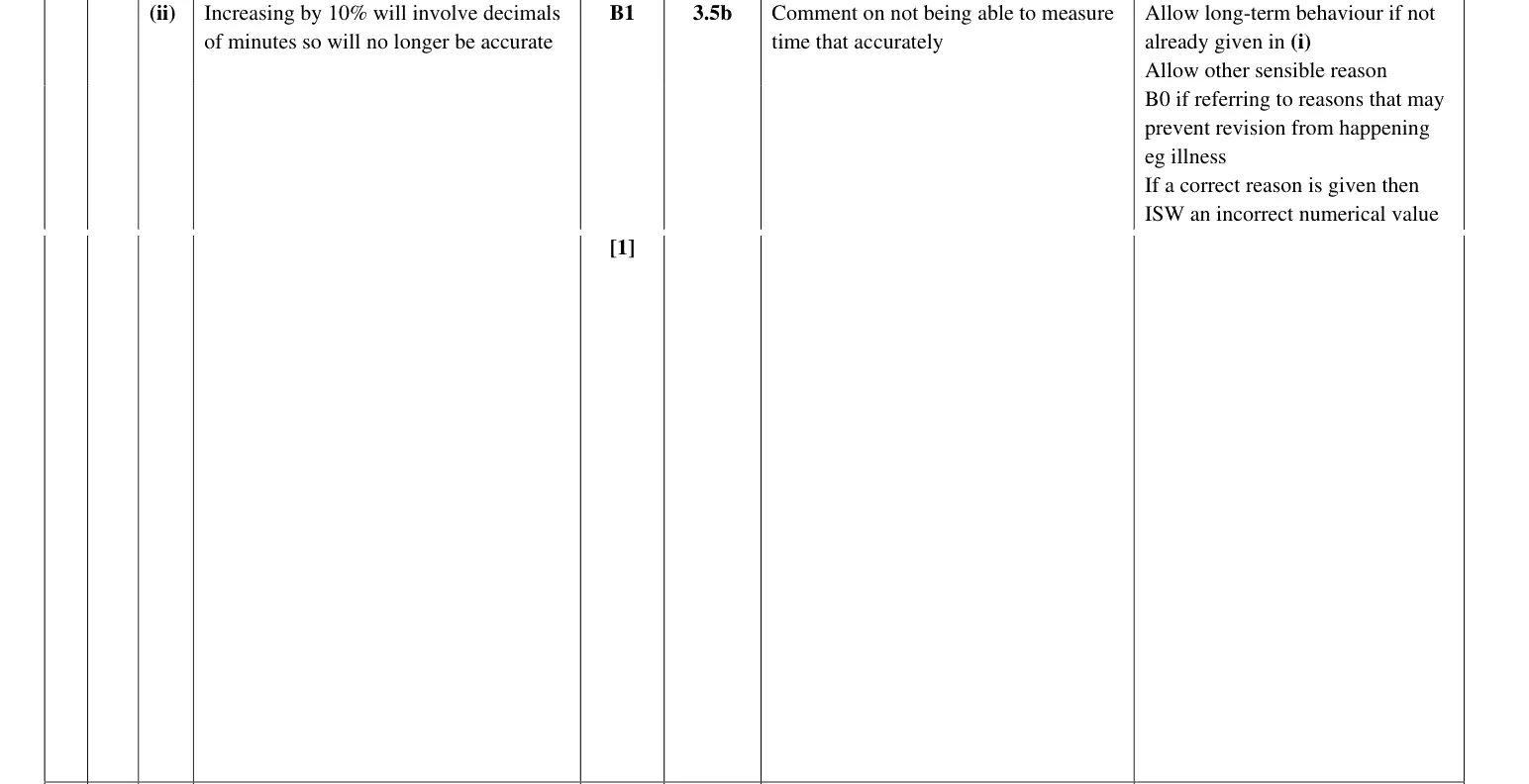
7(d)(ii) Sequences and series 1 Hard
8(a) Chain, product and quotient rules; connected rates of change, Differentiation: first principles, gradients, stationary points 3 Medium
8(b) Differentiation: first principles, gradients, stationary points, Quadratics and the discriminant 4 Hard
9(a) Functions, composite and inverse functions, modulus 2 Medium
9(b)(i) Functions, composite and inverse functions, modulus, Graphs and transformations, Inequalities 4 Medium
9(b)(ii) Functions, composite and inverse functions, modulus 3 Medium
10(a) Trapezium rule and numerical integration 4 Hard
10(b)(i) Integration by parts and by substitution 3 Medium
10(b)(ii) Integration by parts and by substitution, Integration: standard integrals, definite integrals and areas 4 Medium
11(a)(i) Circles, Simultaneous equations 2 Easy
11(a)(ii) Quadratics and the discriminant, Circles 4 Hard
11(b) Addition and double-angle formulae, harmonic form, Circles 4 Hard
12 Differential equations, Partial fractions, Algebraic methods: polynomials, factor theorem and rational expressions, Exponentials and logarithms 9 Easy

The questions

1(a)1(b)2(a)2(b)2(c)3(a)3(b)45(a)5(b)5(c)6(a)6(b)6(c)6(d)7(a)7(b)7(c)7(d)(i)7(d)(ii)8(a)8(b)9(a)9(b)(i)9(b)(ii)10(a)10(b)(i)10(b)(ii)11(a)(i)11(a)(ii)11(b)12
Autumn 2020 · Paper 1 · Q1(a) 3 marks Medium small angle approximations
2 . 1 (a) For a small angle i, where i is in radians, show that cos ( tan ) . [3] i + - i - i

Autumn 2020 · Paper 1 · Q1(b) 2 marks Medium small angle approximations
Show the start of this questionEarlier part of this question
(b) Hence determine an approximate solution to cos ( tan ) sin . [2] i + - i = i
Autumn 2020 · Paper 1 · Q2(a) 2 marks Medium indices and surds
2 Simplify fully. (a) a a [2] #
Autumn 2020 · Paper 1 · Q2(b) 2 marks Medium indices and surds
(b) ( b ) ( b ) - [2] #
Autumn 2020 · Paper 1 · Q2(c) 4 marks Medium indices and surds
c c (c) 7 [4] - # #
Autumn 2020 · Paper 1 · Q3(a) 4 marks Medium functionsindices and surds
A cylindrical metal tin of radius r cm is closed at both ends. It has a volume of 16000 cm3 3 . r - . (a) Show that its total surface area, Acm2, is given by A r 32000 r [4] = r + r
Autumn 2020 · Paper 1 · Q3(b) 6 marks Medium differentiation
Show the start of this questionEarlier part of this question
(b) Use calculus to determine the minimum total surface area of the tin. You should justify that it is a minimum. [6]
Autumn 2020 · Paper 1 · Q4 3 marks Medium proof
4 Prove by contradiction that there is no greatest multiple of 5. [3]
Autumn 2020 · Paper 1 · Q5(a) 2 marks Medium vectors
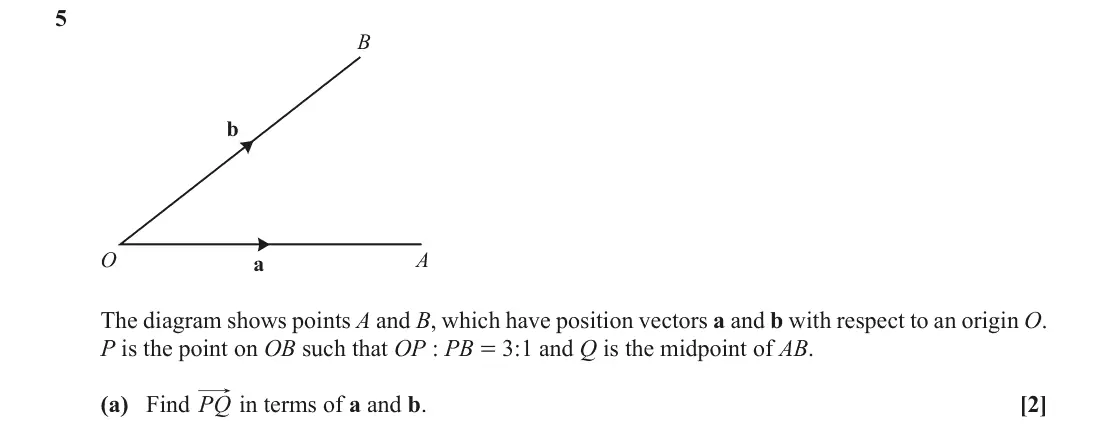
5 B b O A a The diagram shows points A and B, which have position vectors a and b with respect to an origin O. P is the point on OB such that OP : PB = 3:1 and Q is the midpoint of AB. (a) Find PQ in terms of a and b. [2]
Autumn 2020 · Paper 1 · Q5(b) 2 marks Medium vectors
Show the start of this questionEarlier part of this question
The line OA is extended to a point R, so that PQR is a straight line. (b) Explain why PR = k (2a - b), where k is a constant. [2]
Autumn 2020 · Paper 1 · Q5(c) 4 marks Medium vectors
Show the start of this questionEarlier part of this questionEarlier part of this question
(c) Hence determine the ratio OA : AR. [4]
Autumn 2020 · Paper 1 · Q6(a) 3 marks Medium exponentials and logs
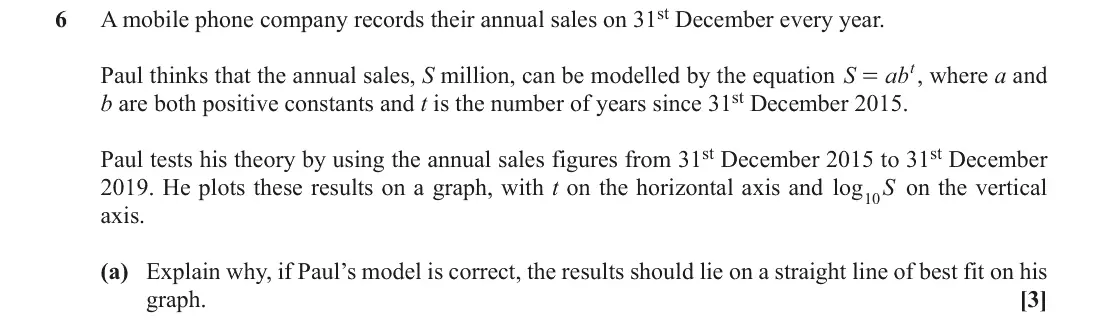
A mobile phone company records their annual sales on 31st December every year. 6 t Paul thinks that the annual sales, S million, can be modelled by the equation S ab , where a and = b are both positive constants and t is the number of years since 31st December 2015. Paul tests his theory by using the annual sales figures from 31st December 2015 to 31st December 2019. He plots these results on a graph, with t on the horizontal axis and log 10 on the vertical S axis. (a) Explain why, if Paul’s model is correct, the results should lie on a straight line of best fit on his graph. [3]
Autumn 2020 · Paper 1 · Q6(b) 2 marks Medium exponentials and logs
Show the start of this questionEarlier part of this question
The results lie on a straight line of best fit which has a gradient of 0.146 and an intercept on the vertical axis of 0.583. (b) Use these values to obtain estimates for a and b, correct to 2 significant figures. [2]
Autumn 2020 · Paper 1 · Q6(c) 3 marks Medium exponential modellingexponentials and logs
Show the start of this questionEarlier part of this questionEarlier part of this question
(c) Use this model to predict the year in which, on the 31st December, the annual sales would first be recorded as greater than 200 million. [3]
Autumn 2020 · Paper 1 · Q6(d) 1 mark Medium exponential modelling
Show the start of this questionEarlier part of this question
(d) Give a reason why this prediction may not be reliable. [1]
Autumn 2020 · Paper 1 · Q7(a) 3 marks Medium sequences and series
7 Two students, Anna and Ben, are starting a revision programme. They will both revise for 30 minutes on Day 1. Anna will increase her revision time by 15 minutes for every subsequent day. Ben will increase his revision time by 10% for every subsequent day. (a) Verify that on Day 10 Anna does 94 minutes more revision than Ben, correct to the nearest minute. [3]
Autumn 2020 · Paper 1 · Q7(b) 3 marks Medium sequences and seriesexponentials and logs
Show the start of this questionEarlier part of this question
Let Day X be the first day on which Ben does more revision than Anna. (b) Show that X satisfies the inequality X log ( 0 5 . X 0 5 . ) + . [3] + .1 1
Autumn 2020 · Paper 1 · Q7(c) 3 marks Medium numerical methods
Show the start of this questionEarlier part of this question
(c) Use the iterative formula x log ( . 0 5 x 0 5 . ) with x to find the value of X. = + + 1 = n 1 1 . n + You should show the result of each iteration. [3]
Autumn 2020 · Paper 1 · Q7(d)(i) 1 mark Medium sequences and series
Show the start of this questionEarlier part of this question
(d) (i) Give a reason why Anna’s revision programme may not be realistic. [1]
Autumn 2020 · Paper 1 · Q7(d)(ii) 1 mark Hard sequences and series
Show the start of this questionEarlier part of this question
(ii) Give a different reason why Ben’s revision programme may not be realistic. [1]
Autumn 2020 · Paper 1 · Q8(a) 3 marks Medium differentiation rulesdifferentiation
e x 8 (a) Differentiate ( x ) with respect to x. [3] +
Autumn 2020 · Paper 1 · Q8(b) 4 marks Hard differentiationquadratics
Show the start of this questionEarlier part of this question
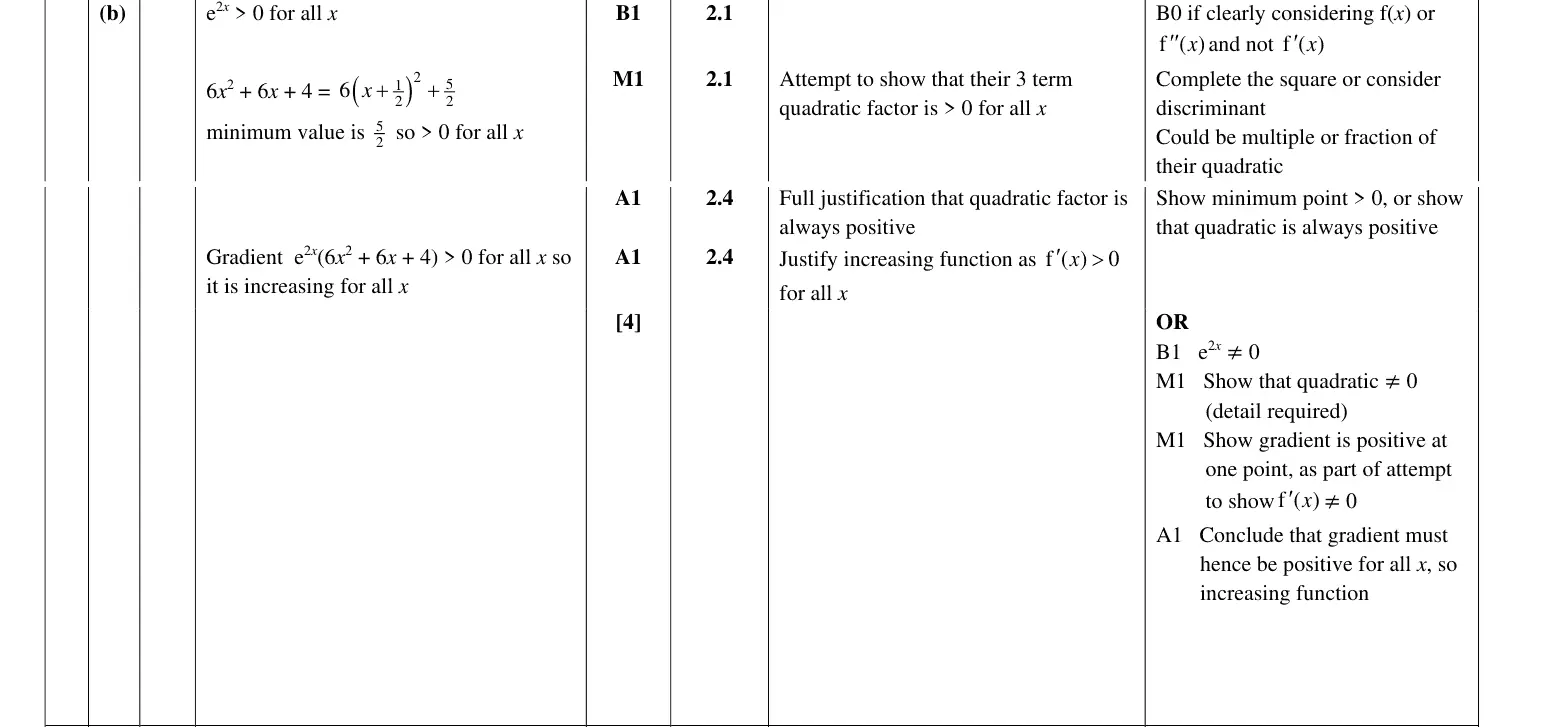
e x (b) Hence show that ( x ) is increasing for all values of x. [4] +
Autumn 2020 · Paper 1 · Q9(a) 2 marks Medium functions
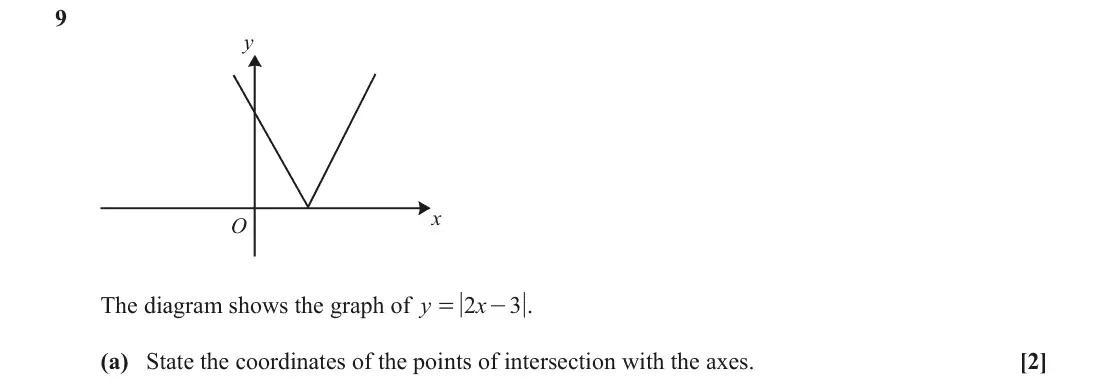
9 y x O The diagram shows the graph of y x . = - (a) State the coordinates of the points of intersection with the axes. [2]
Autumn 2020 · Paper 1 · Q9(b)(i) 4 marks Medium functionsgraphs and transformationsinequalities
Show the start of this questionEarlier part of this question
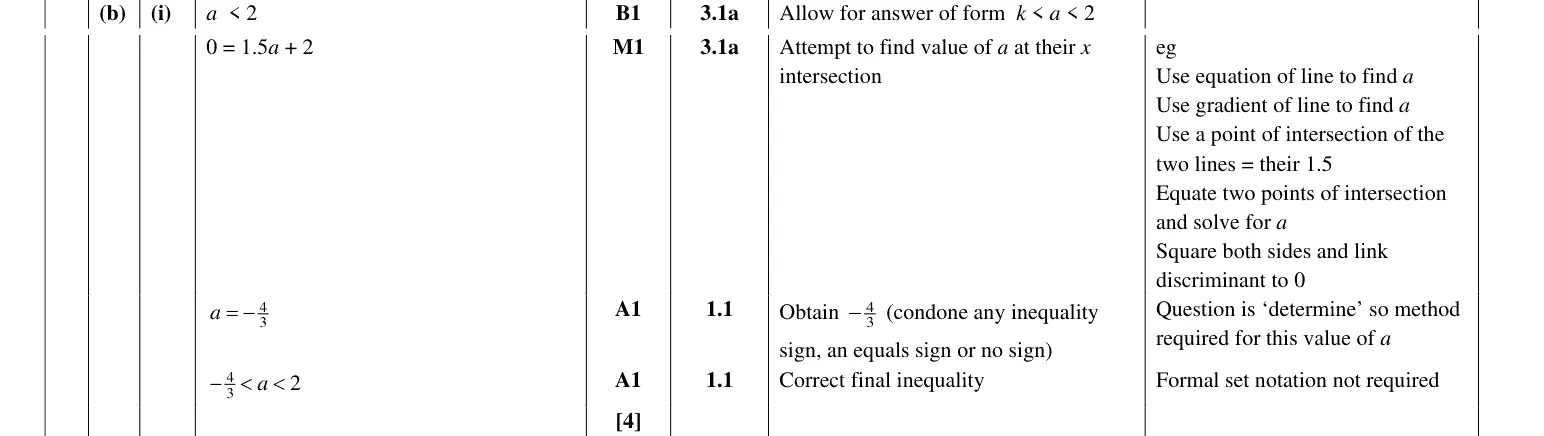
(b) Given that the graphs of y x and y ax + have two distinct points of intersection, = - = determine (i) the set of possible values of a, [4]
Autumn 2020 · Paper 1 · Q9(b)(ii) 3 marks Medium functions
Show the start of this questionEarlier part of this questionEarlier part of this question
(ii) the x-coordinates of the points of intersection of these graphs, giving your answers in terms of a. [3]
Autumn 2020 · Paper 1 · Q10(a) 4 marks Hard trapezium rule
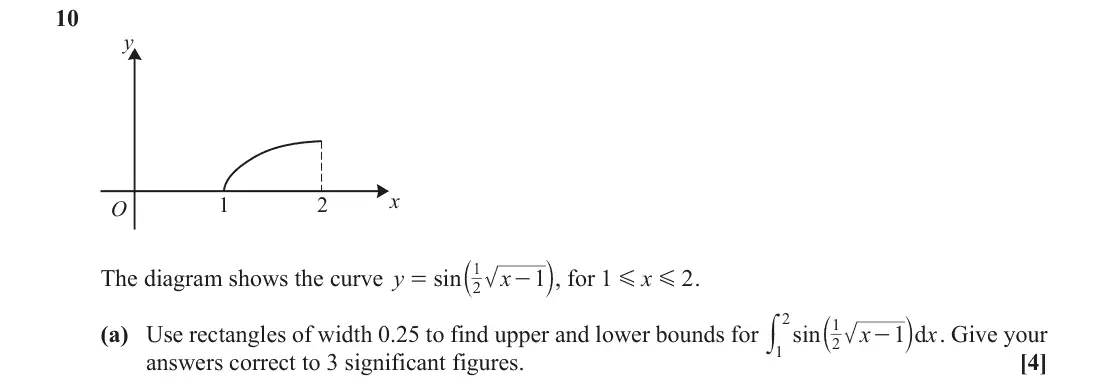
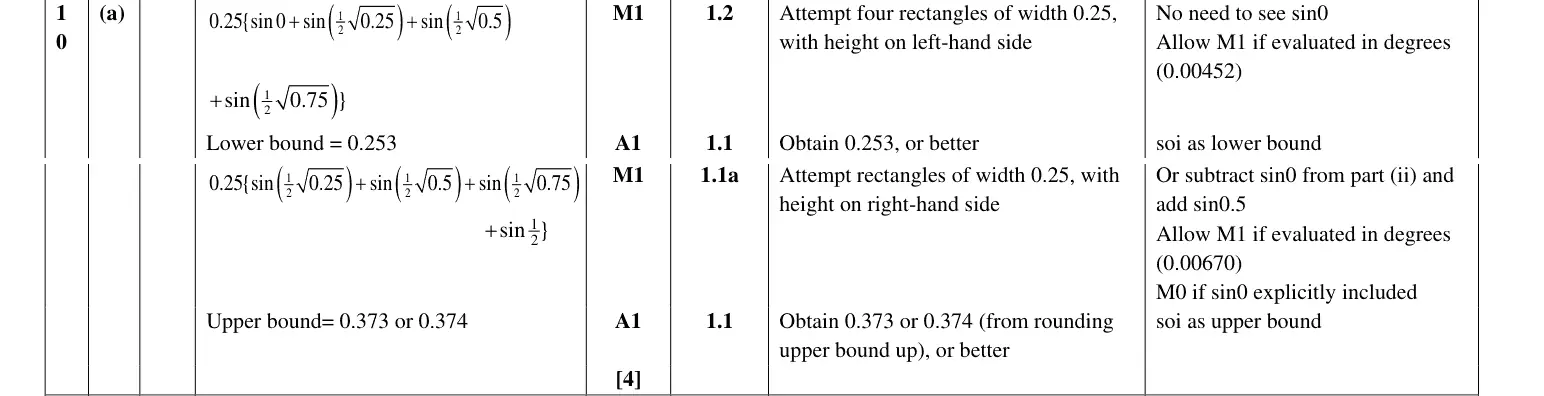
10 y x O a k, for The diagram shows the curve y sin x x . = - G G a k y (a) Use rectangles of width 0.25 to find upper and lower bounds for sin x 1 d x . Give your - [4] answers correct to 3 significant figures.
Autumn 2020 · Paper 1 · Q10(b)(i) 3 marks Medium integration by parts and substitution
Show the start of this questionEarlier part of this question
a k a k y y (b) (i) Use the substitution t [3] x - to show that sin x d x t sin t d t . = - =
Autumn 2020 · Paper 1 · Q10(b)(ii) 4 marks Medium integration by parts and substitutionintegration
Show the start of this questionEarlier part of this questionEarlier part of this question
a k y (ii) Hence show that [4] sin x d x sin cos . - = -
Autumn 2020 · Paper 1 · Q11(a)(i) 2 marks Easy circlessimultaneous equations
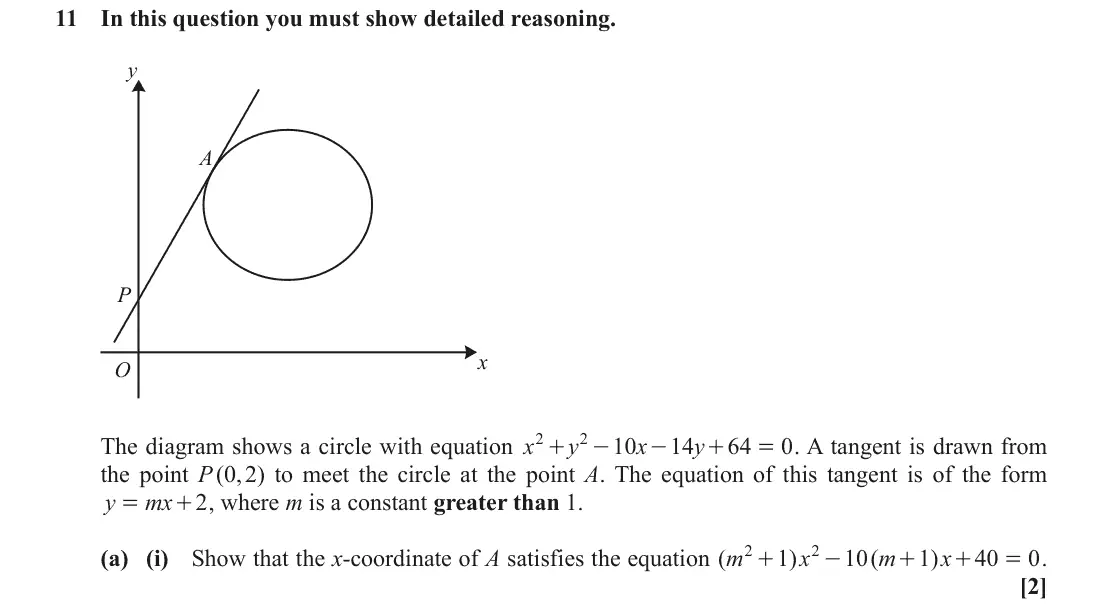
11 In this question you must show detailed reasoning. y A P x O The diagram shows a circle with equation x y x y . A tangent is drawn from + - - + = the point P (0, 2) to meet the circle at the point A. The equation of this tangent is of the form y mx + , where m is a constant greater than 1. = (a) (i) Show that the x-coordinate of A satisfies the equation ( m ) x ( m ) x . + - + + = [2]
Autumn 2020 · Paper 1 · Q11(a)(ii) 4 marks Hard quadraticscircles
Show the start of this questionEarlier part of this question
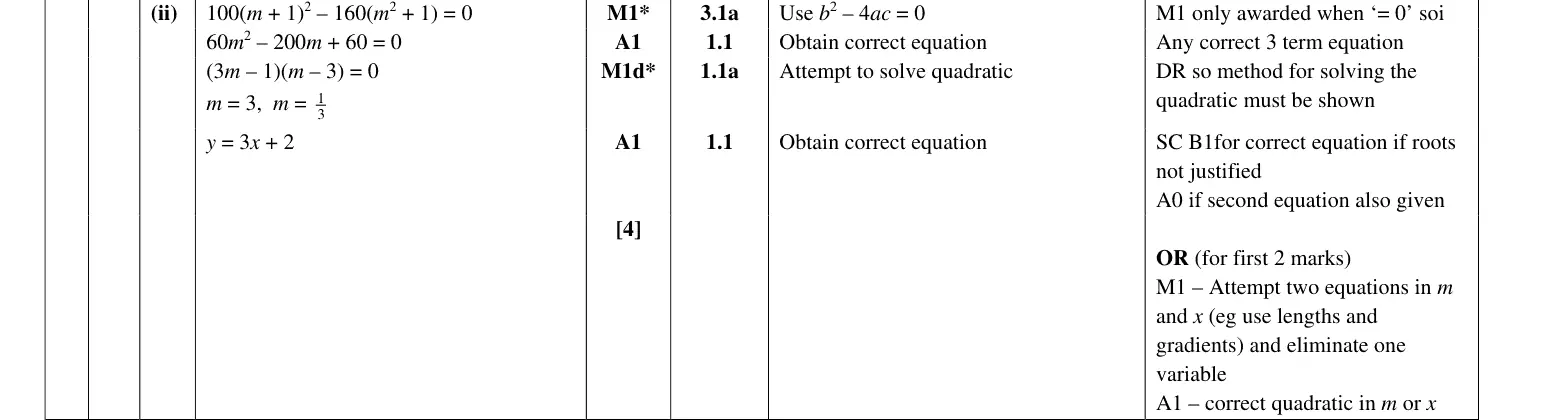
(ii) Hence determine the equation of the tangent to the circle at A which passes through P. [4]
Autumn 2020 · Paper 1 · Q11(b) 4 marks Hard double angle formulaecircles
Show the start of this questionEarlier part of this questionEarlier part of this question
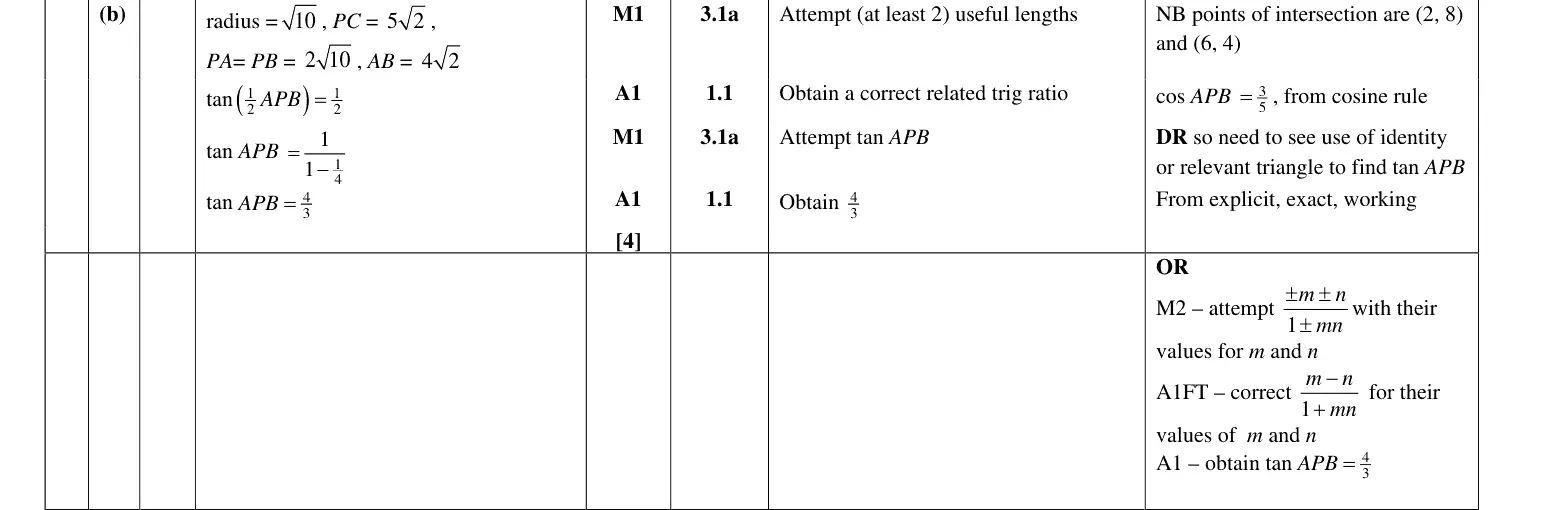
A second tangent is drawn from P to meet the circle at a second point B. The equation of this tangent is of the form y n x + , where n is a constant less than 1. = (b) Determine the exact value of tan APB. [4]
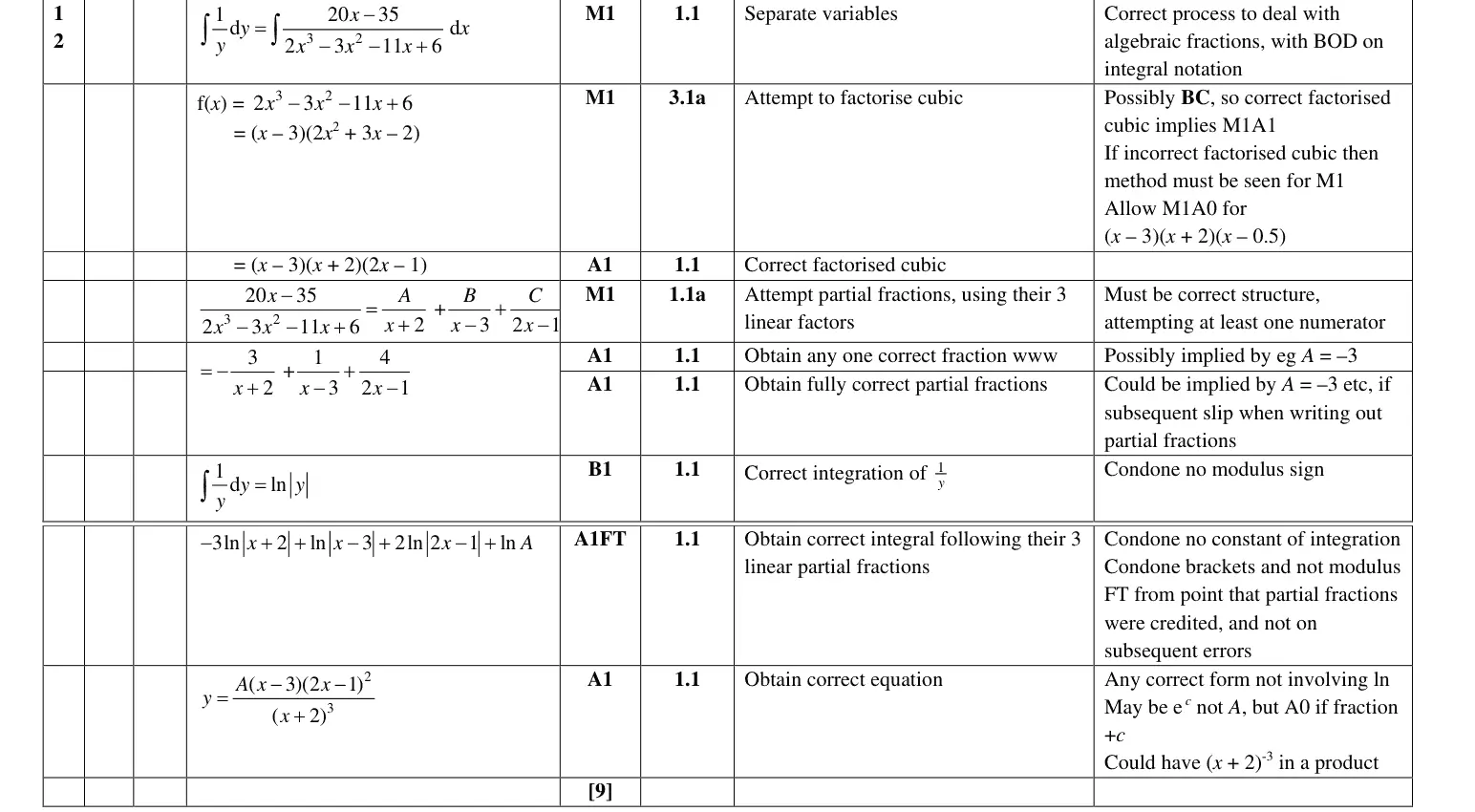
12 Find the general solution of the differential equation d y ( x x x ) y ( x ) . - - + = - d x Give your answer in the form y = f(x). [9]

Find an A-level maths tutor

Want this paper marked and gone through with you? Message us.

Prefer email? Send an enquiry

If you are under 18, please include a parent's contact details. Enquiries go to enquiries@mathsaleveltutor.com and are deleted once handled.