28 question parts, 102 marks, each rated Easy, Medium or Hard from the wording of the examiners' report
Notes, worked examples and practice for this topic are being written by our tutors. The past-paper questions below are ready now: work each one on paper, then open the mark scheme and the examiner's comment.
Tap a question to zoom it. Mark scheme and examiner's comment open under each question.
June 2025 · Paper 1 · Q12(b)7 marksHard
Show the start of this question
Mark scheme for this part
Examiner's comment
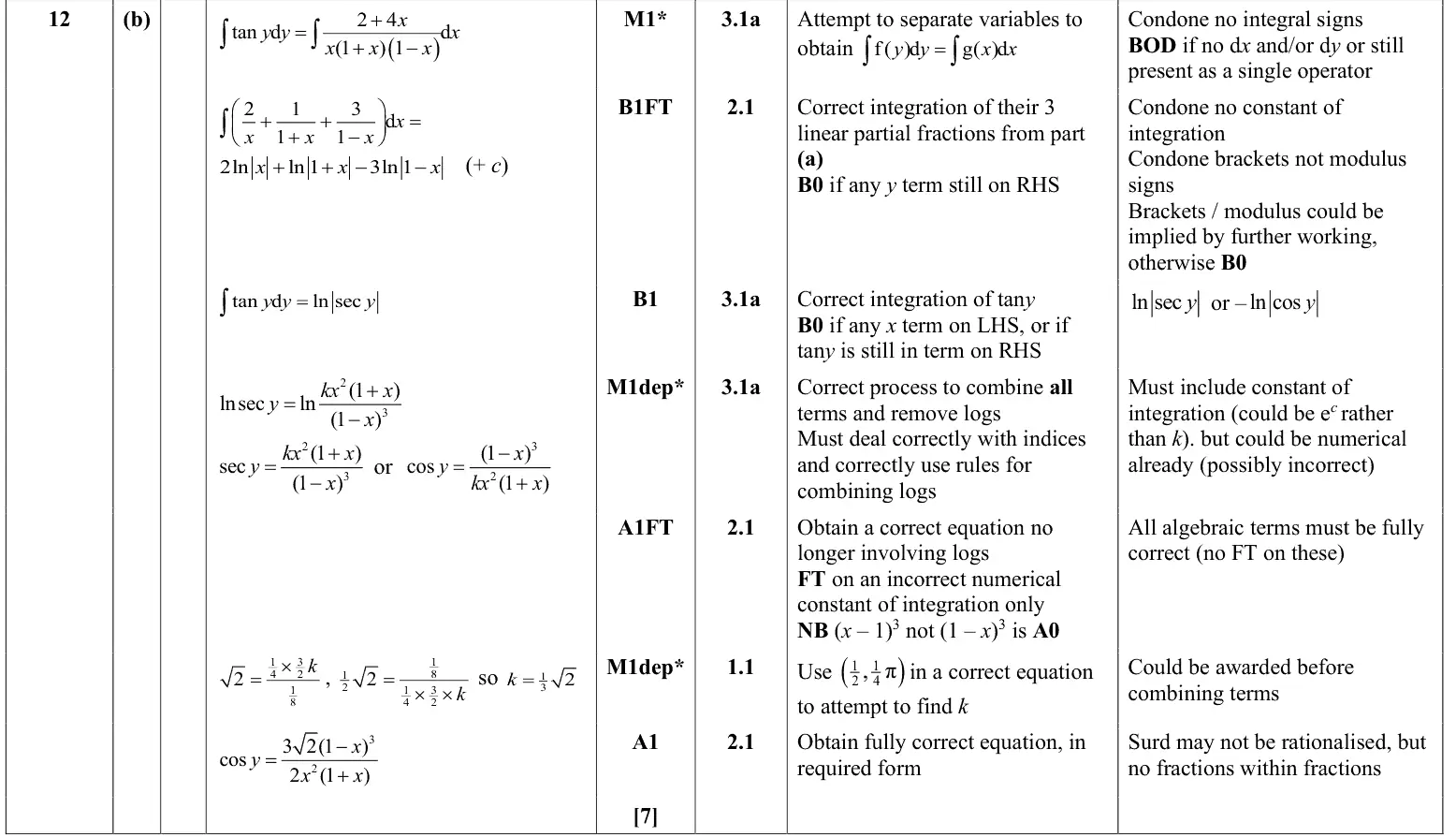
This question proved to be a suitably challenging final question, with only those candidates that had successfully completed the majority of the paper gaining full credit here. To gain the first mark candidates needed to identify that this was a differential equation with separable variables and attempt to do so; no credit was given for any integration attempts on an equation that still involved both x and y terms. Once variables had been separated, integrating tany is a standard specification statement (1.08h) yet this was not always done correctly; sign errors were common, as was finding the derivative and not the integral of tany. Candidates nearly always realised the need to use their partial fractions from the first part of the question, and could attempt integration of these, but there were often sign errors when integrating the fraction with the denominator of (1 – x). Further credit could still be gained for correctly combining all of their terms and removing logarithms; while many candidates could correctly combine the algebraic terms it was a common error to see the constant term still as +c even once logs had been removed. Of the candidates who had made reasonable progress with this question, most were able to attempt the required method but made slips in their working.
Key points and common errors
separate variables: ∫tan y dy = ln sec y
2ln x + ln(1 + x) − 3ln(1 − x) + c
combine logs
use (½, π/4) to find k
cos y = 3√2(1 − x)³ / (2x²(1 + x))
sign errors with tan y and with ln(1 − x)
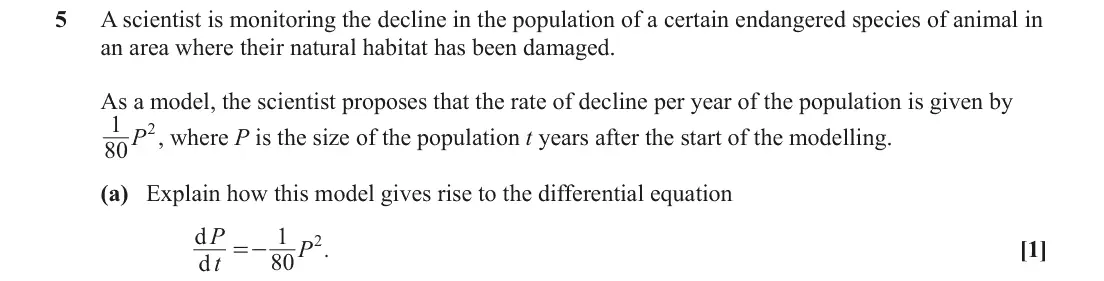
June 2024 · Paper 2 · Q5(a)1 markEasy
Mark scheme for this part
Examiner's comment
This part was generally well answered, with the majority of candidates providing a sufficiently clear explanation.
Key points and common errors
link 'decline' to the negative sign
June 2024 · Paper 2 · Q5(b)4 marksEasy
Show the start of this question
Mark scheme for this part
Examiner's comment
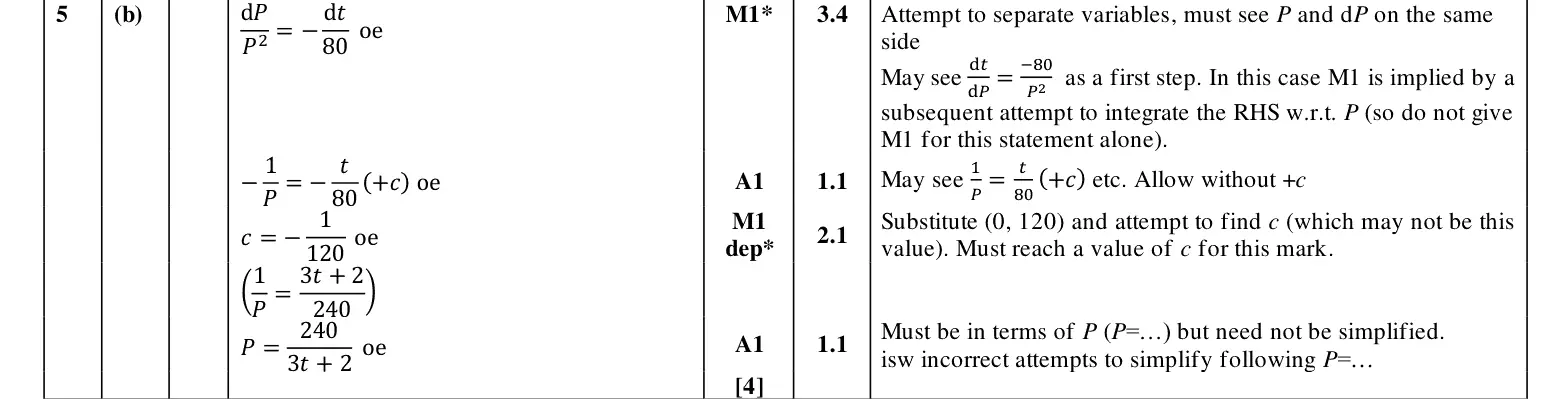
Most candidates were able to correctly (or acceptably for M1 only) separate variables and integrate (which was almost always done correctly). Of these, the majority went on to find a reasonable value for c (although some candidates simply assumed that c=120 without working, which was not normally corrected for their integrated form). However, many candidates either did not give their answer in terms of P (as required in the question) or made an error in doing so - for instance, assuming that the reciprocal of separate terms could be added together and losing the final A mark. Many candidates lost this mark through simple algebraic errors, often following near-perfect integration.
Key points and common errors
separate variables
c = −1/120 from P = 120 at t = 0
P = 240/(3t + 2)
June 2024 · Paper 2 · Q5(c)2 marksEasy
Show the start of this question
Mark scheme for this part
Examiner's comment
Almost all candidates substituted P=10, gaining M1. Those who had lost the final A mark in (b) for incorrectly rearranging (or not rearranging) often still went on to gain M1 here by substituting and rearranging for t.
Key points and common errors
substitute P = 10
t = 22/3 years
June 2024 · Paper 2 · Q5(d)1 markHard
Show the start of this question
Mark scheme for this part
Examiner's comment
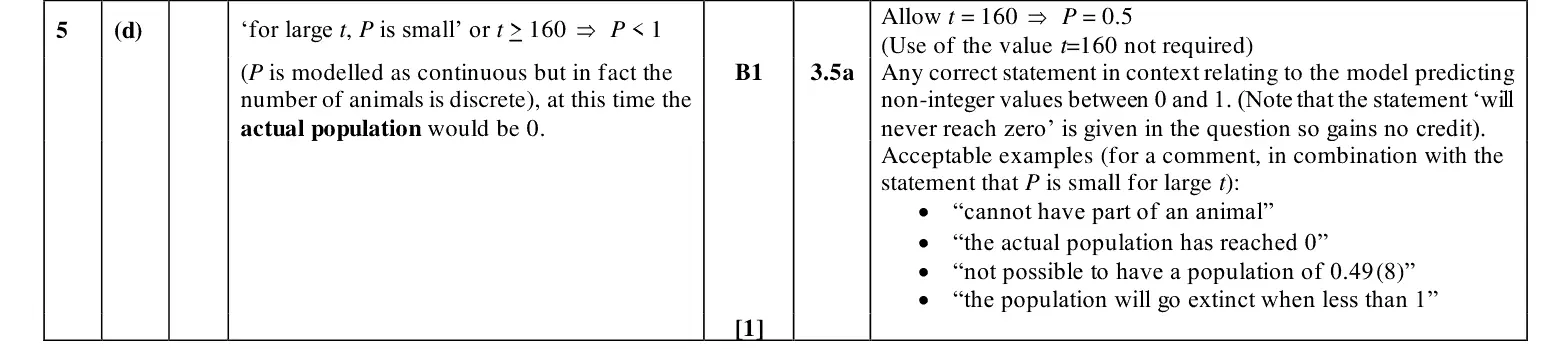
This part was much less well answered, with less than half of candidates providing a sufficiently detailed explanation in context. Most candidates correctly identified that with the given model ‘for large t, P is small’, but this was implied in the question so couldn’t be credited alone. Some candidates incorrectly went on to state that the model gave negative values for P. The key understanding this question was testing is that there is an implied discrepancy between the behaviour of the model and the actual population when t is large, which makes the model invalid. Candidates needed to explain this in context, for instance making reference to the fact that non-integer populations are not appropriate, or by stating that once the population has dropped below 1 that implies it is actually 0 (extinct). Some candidates gave irrelevant suggestions such as “humans will not allow an animal to go extinct” which could not be credited.
Key points and common errors
P is continuous but animals are discrete: P < 1 for t ≥ 160 so the actual population is 0
restating 'never reaches zero' gains nothing
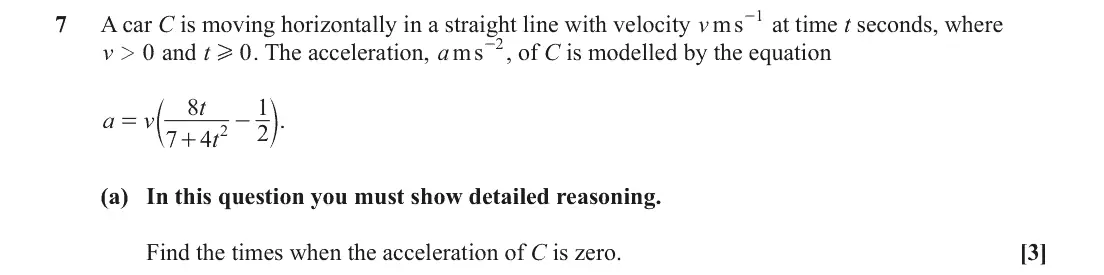
June 2023 · Paper 3 · Q7(b)6 marksMedium
Show the start of this question
Mark scheme for this part
Examiner's comment
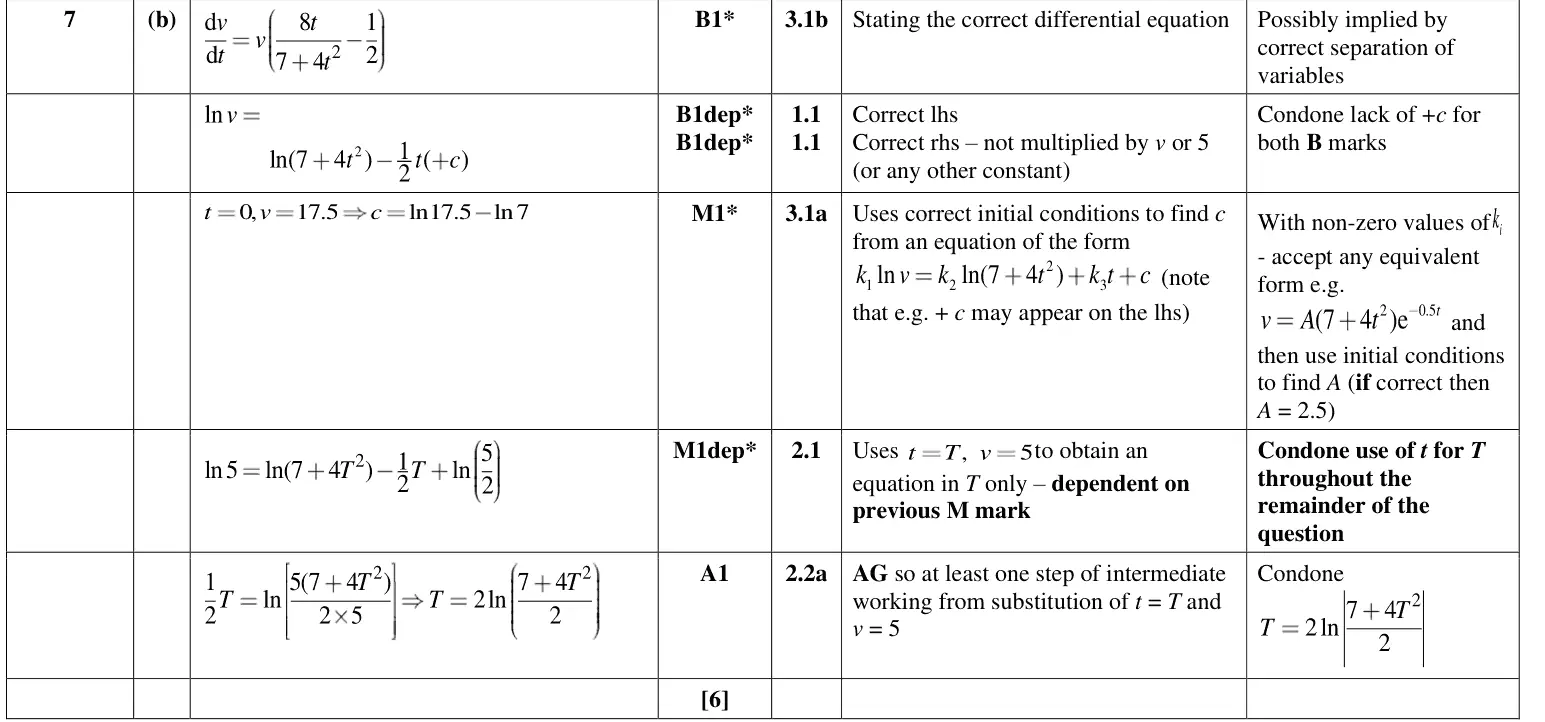
fact that 𝑎𝑎= d𝑡𝑡= 𝑣𝑣ቀ 7+4𝑡𝑡2 − 2ቁ usually separated the variables correctly and went It was surprising in this part how many candidates did not set up a correct differential equation using the d𝑡𝑡. Those that did write on to correctly derive the given result (using the results that 𝑣𝑣= 17.5 when 𝑡𝑡= 0 and 𝑣𝑣= 5 when 𝑡𝑡= 𝑇𝑇). f(𝑥𝑥) d𝑥𝑥= ln|f(𝑥𝑥)| is provided in the formulae at the attempt to integrate ∫ 7+4𝑡𝑡2 d𝑡𝑡 even though the result ∫ Some candidates, after correctly setting up the required differential equation were unsuccessful in their beginning of the assessment.
Key points and common errors
dv/dt = v(8t/(7 + 4t²) − ½)
separate: ln v = ln(7 + 4t²) − ½t + c
t = 0, v = 17.5 gives c
v = 5 at t = T gives the result
∫f′/f = ln f is in the formula book
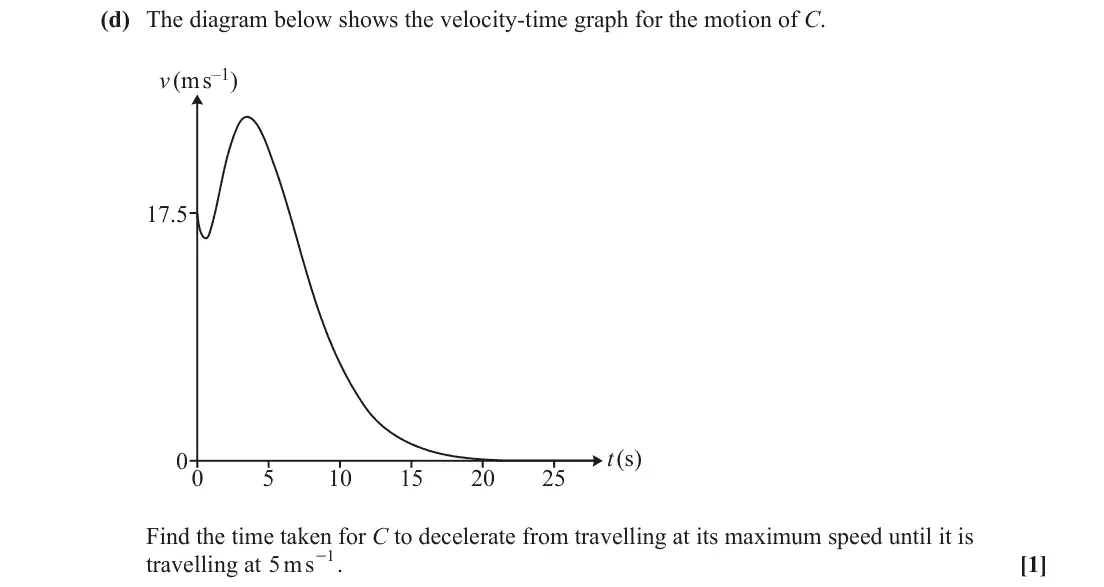
June 2023 · Paper 3 · Q7(d)1 markHard
Show the start of this question
Mark scheme for this part
Examiner's comment
Very few candidates used the given velocity-time graph correctly, together with the answers from parts (a) and (c) to obtain the correct answer of 7.51 in this part.
Key points and common errors
maximum speed at t = 3.5 from (a)
speed 5 at T = 11.01 from (c)
11.01 − 3.5 = 7.51 s
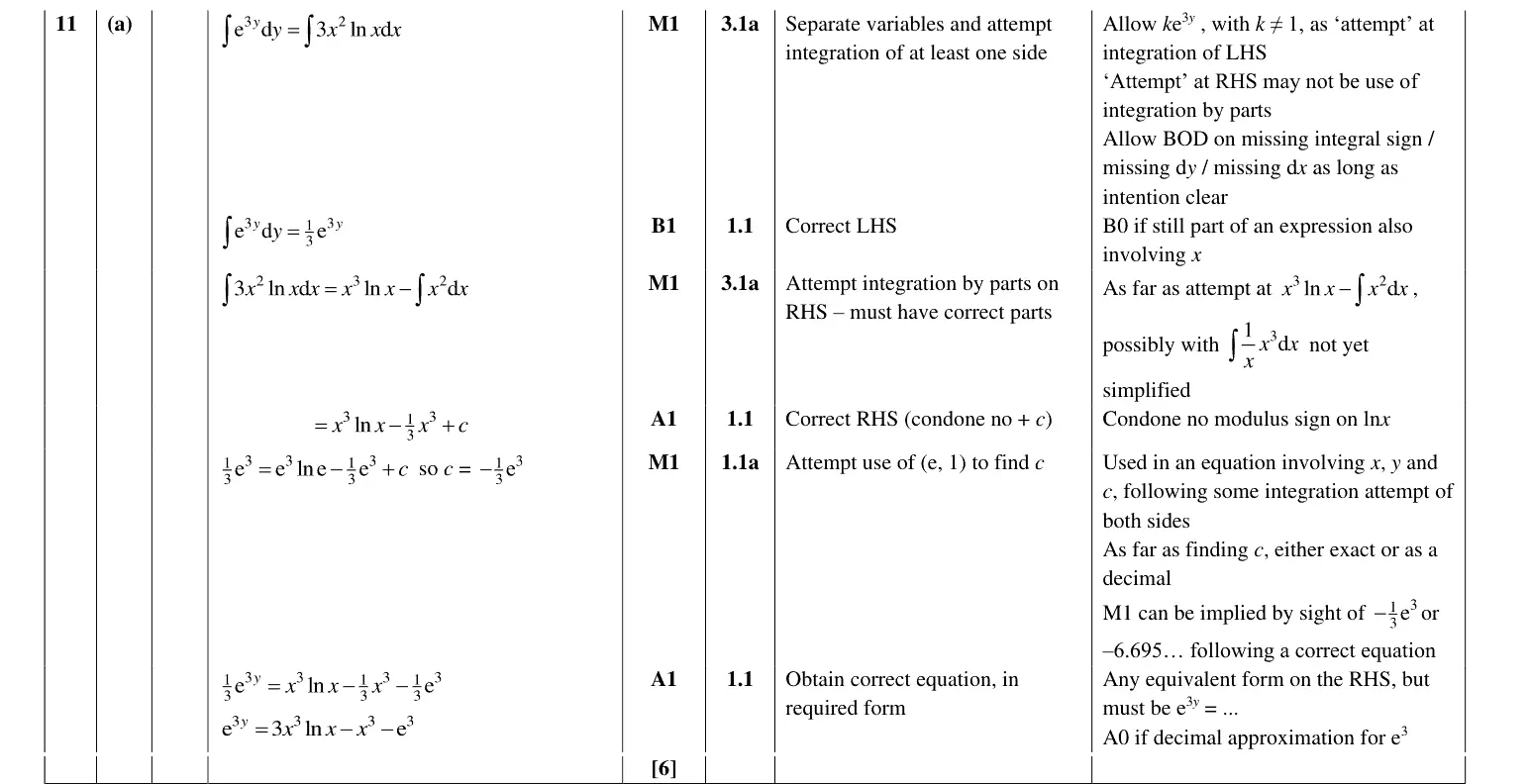
June 2022 · Paper 1 · Q11(a)6 marksMedium
Mark scheme for this part
Examiner's comment
Most candidates appreciated the need to separate the variables and could make a reasonable attempt to do so. The integration of the exponential term was usually correct. While integration by parts was often attempted on 3x2lnx, the parts and/or the formula were not always correct. The latter is surprising as it is given in the list of formulae at the start of the paper. As long as there had been some attempt to integrate both sides, there was a mark available for attempting to use the given point of (e, 1) and many candidates did indeed gain this mark.
Key points and common errors
separate: ∫e^(3y)dy = ∫3x² ln x dx
parts gives x³ln x − x³/3
(e, 1) gives c = −e³/3
e^(3y) = 3x³ln x − x³ − e³
parts formula often misapplied though given
June 2022 · Paper 2 · Q87 marksHard
Mark scheme for this part
Examiner's comment
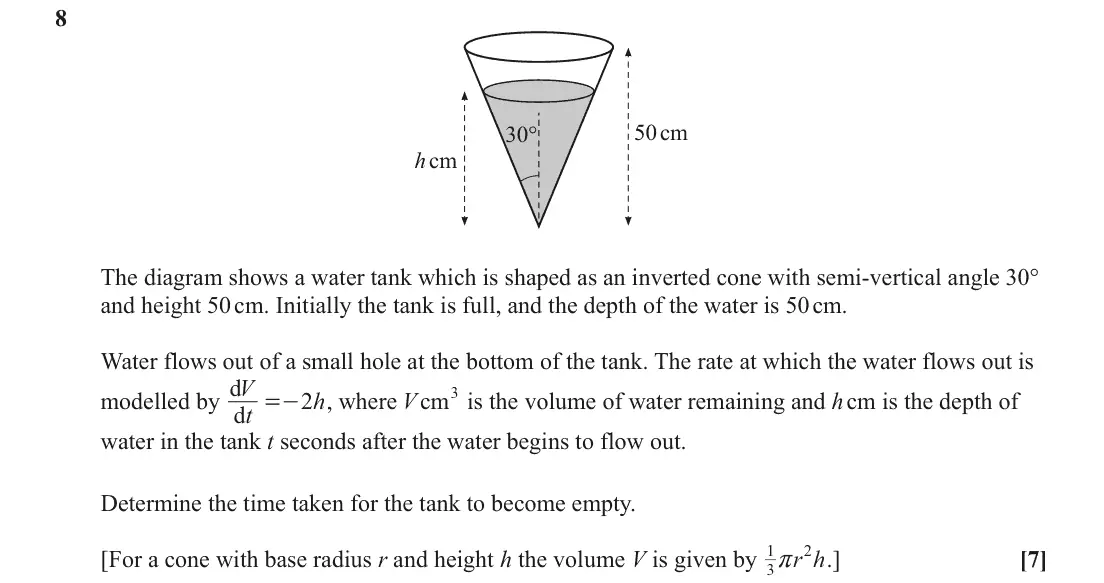
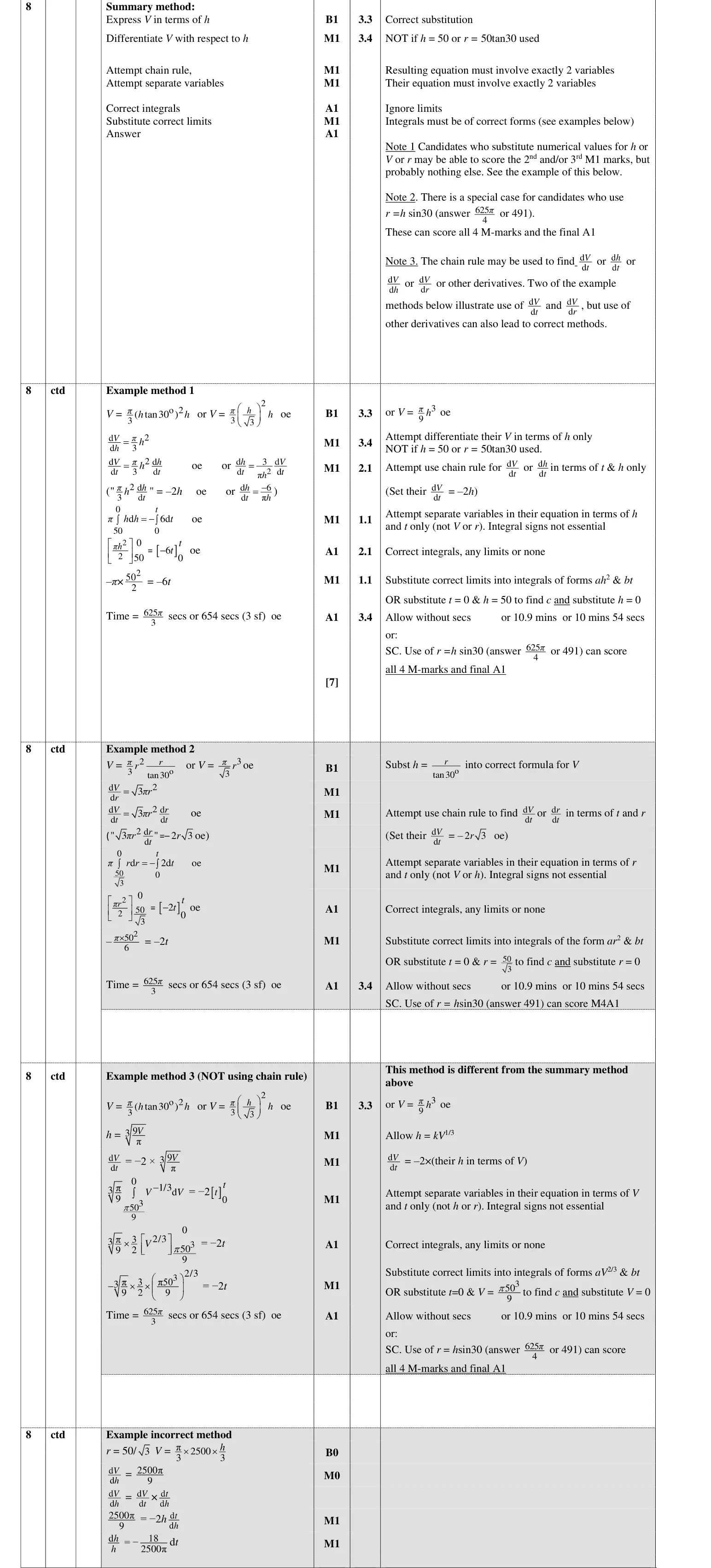
This differential equation question is of a fairly standard type, found in many text books. So one might reasonably expect candidates to be familiar with questions of this type. Despite this, responses were, on the whole, disappointing. In fact, about half the candidates scored 0 marks on this question. However, there were also a good number of excellent solutions. A few candidates thought that r = hsin 30°, but gave an otherwise completely correct solution. These candidates scored 5 marks out of 7. The main difficulty faced by candidates was that there were more than two variables involved (V, h, t and r). Most candidates obtained an equation in three variables, but then attempted to differentiate or integrate, treating one of the variables as a constant. For example: d V d V 1 2 1 3 πr2h ⇒ V = d r = 3 πrh (or d h = 3 πr2). d V h = −2t ⇒ dV = −2tdh ⇒ V = −2th. d Some candidates avoided this trap by using a numerical value for one of the variables, e.g. h = 50 or 50 3 3 r = , thus rendering their equation incorrect. Some candidates appreciated the need to use the chain rule but, while doing so, made one of the above d V d V d t d V d t 1 1 3 πr2 ⇒ h ⇒ d h = d t × d h , but d h = 3 πr2 = (−2t) × d errors. Thus a typical solution was as follows. 2 2 50 3 50 3 π d t 1 ∫ d h 2500 3 3 3 3 π = −2t d h ⇒ = −2tdt ⇒ 9 h = −2t + c. Then use h = 50 when t = 0 to find c and finally substitute h = 0 to find t. Finally, some candidates used a different, correct method that did not require the use of the chain rule. It did, however, involve some rather awkward substitution of a limit. This method can be found on the published mark scheme, Question 8, Example method 3.
Key points and common errors
r = h tan30° so V = πh³/9
dV/dt = (dV/dh)(dh/dt) = −2h
separate variables
t = 625π/3 s ≈ 654 s
r = h sin30° is a common error
about half scored 0
Autumn 2021 · Paper 1 · Q12(a)(i)1 markMedium
Mark scheme for this part
Key points and common errors
constant rate of decrease: dθ/dt = −k (or −3.5)
Autumn 2021 · Paper 1 · Q12(a)(ii)2 marksMedium
Show the start of this question
Mark scheme for this part
Key points and common errors
θ = −3.5t + c
θ = 160 − 3.5t using (0, 160) and (10, 125)
Autumn 2021 · Paper 1 · Q12(a)(iii)1 markMedium
Show the start of this question
Mark scheme for this part
Key points and common errors
model predicts temperature falls below room temperature and below freezing
cooling unlikely to be linear
Autumn 2021 · Paper 1 · Q12(b)(i)1 markMedium
Show the start of this question
Mark scheme for this part
Key points and common errors
dθ/dt = −k(θ − 20)
both sides needed
Autumn 2021 · Paper 1 · Q12(b)(ii)6 marksMedium
Show the start of this question
Mark scheme for this part
Key points and common errors
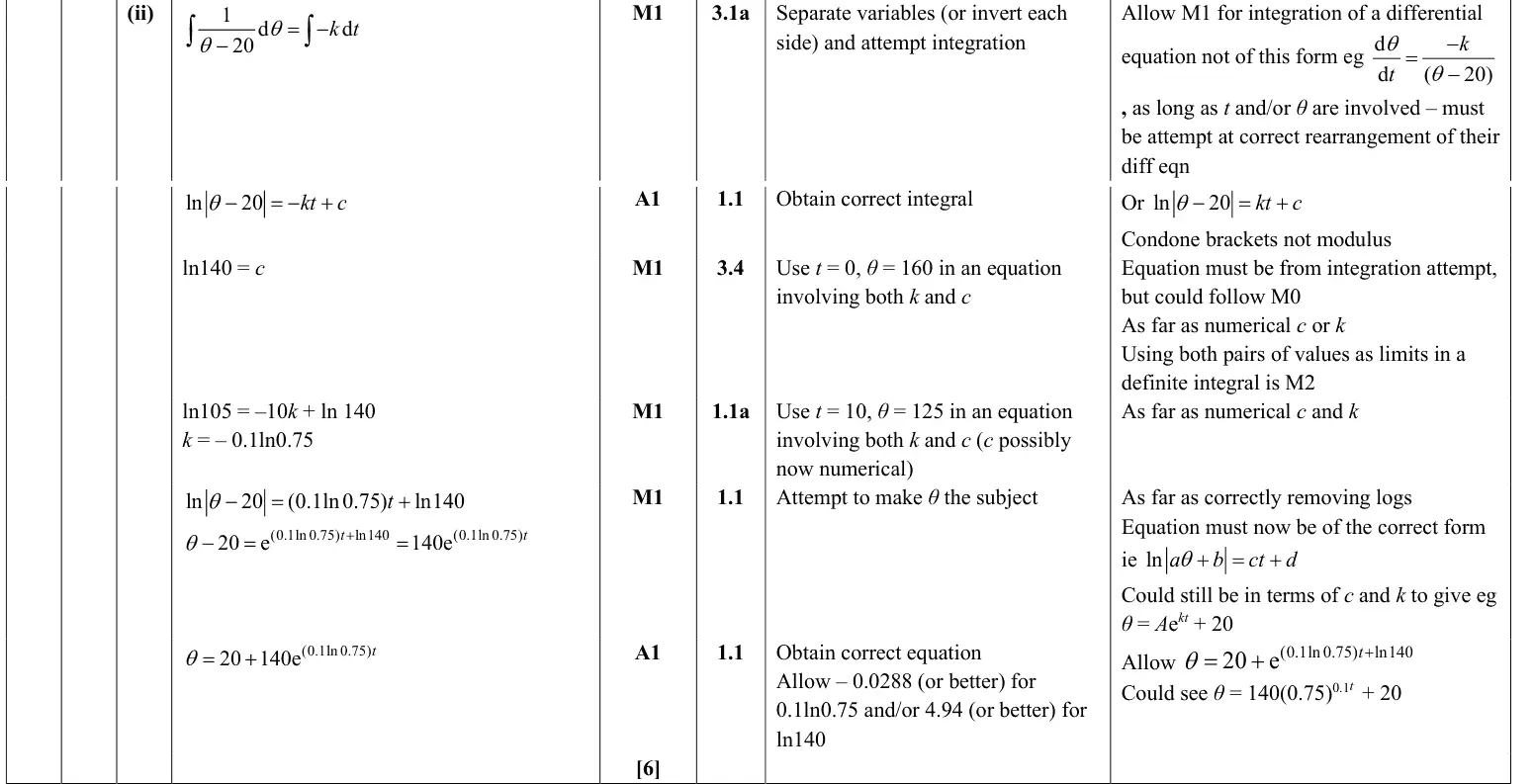
separate variables: ln abs(θ − 20) = −kt + c
c = ln 140
k = −0.1 ln 0.75
θ = 20 + 140e^(0.1 ln 0.75 t)
Autumn 2021 · Paper 1 · Q12(c)2 marksMedium
Show the start of this question
Mark scheme for this part
Key points and common errors
θ = 25 in both: 38.6 and 115.8 minutes
difference 77 minutes
Autumn 2021 · Paper 3 · Q7(a)2 marksMedium
Mark scheme for this part
Key points and common errors
dy/dx = 3(y − 2)/(x − 3)
Autumn 2021 · Paper 3 · Q7(b)4 marksMedium
Show the start of this question
Mark scheme for this part
Key points and common errors
separate: ln(y − 2) = 3ln(x − 3) + c
(4, 3) gives c = 0
y = (x − 3)³ + 2
Autumn 2020 · Paper 1 · Q129 marksEasy
Mark scheme for this part
Examiner's comment
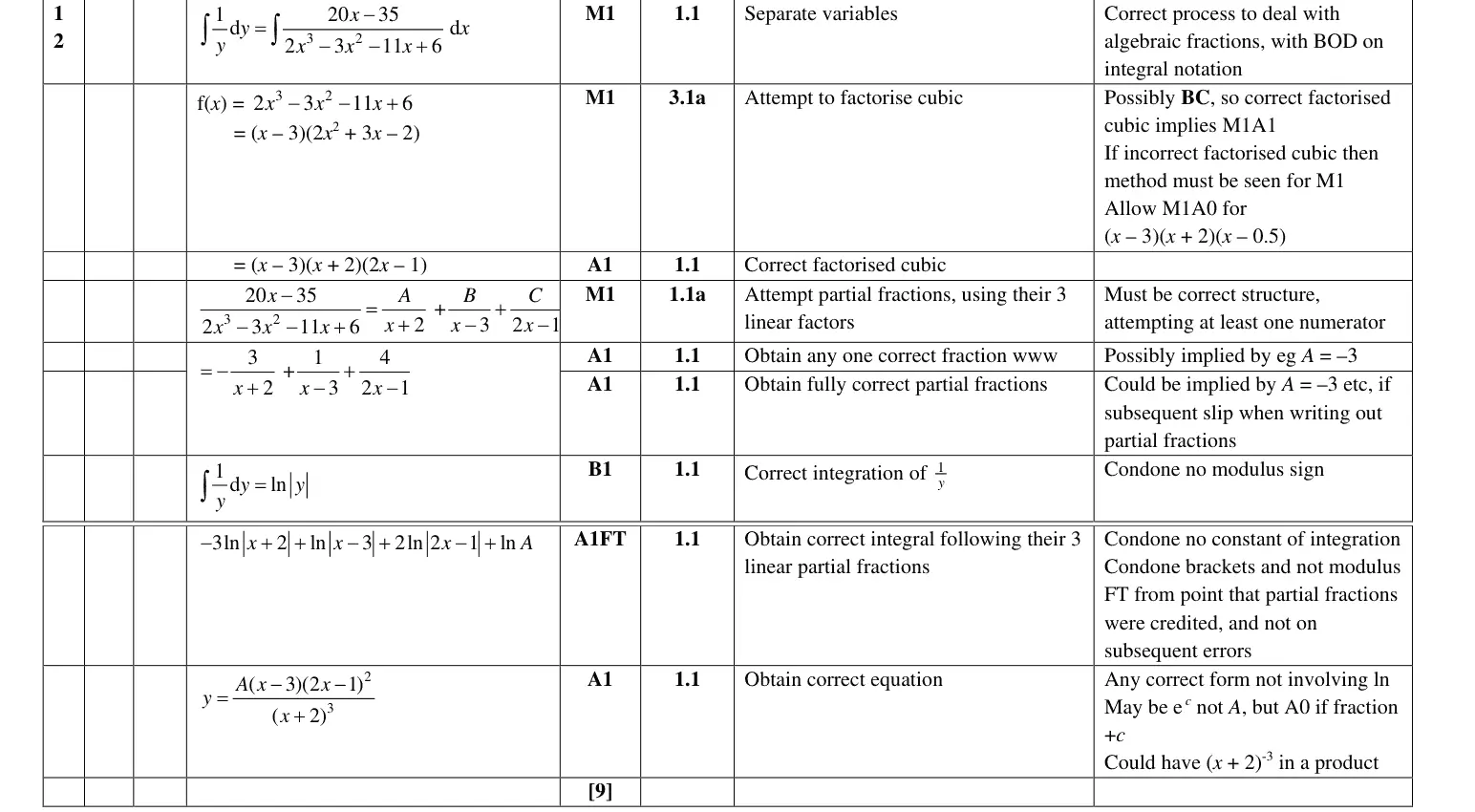
Question 12 was the final question on the paper and was generally well answered, with a number of candidates able to make good progress in this unstructured, multi-step question. As the question did not require ‘detailed reasoning’, calculator use to find the roots of the cubic denominator was acceptable. However, when then working backwards from the roots to the factors, it was fairly common to lose the lead coefficient of 2 with the expected factor of ( ) being given as ( ) 2 x − 1 x − 0 5. but with no compensation in the other factors. Candidates who took the longer method of identifying a factor, carrying out algebraic long division and then finding the other two linear factors were usually more successful. This demonstrates the need for candidates to know how to use the calculator functions effectively and accurately. The remainder of the question was generally well attempted, although only the most able candidates gained the final mark for correctly dealing with both the indices and the constant of integration when removing the logarithms to make y the subject. Common misconceptions One common misconception was commenting on the model in Question 7; a number of candidates commented on why the revision programme may be difficult for the student to implement (e.g. may get bored and not want to revise) as opposed to why it may not be realistic. Key teaching and learning points – comments on improving performance Candidates need to be aware of the command words that are used, and the implication for the detail in their solutions. ‘Determine’ was used in a number of questions and candidates should appreciate that this indicates that justification should be given; just stating the answer is unlikely to attract much, if any, credit. When commenting on the reliability of a model, or how realistic it may be, candidates are expected to give a sensible, specific reason; vague comments that refer just to ‘other factors’ are insufficient. It is essential that candidates are familiar with all areas of the specification; on this paper a number of candidates seemed less confident on topic areas that did not feature on the legacy 7890 specification, namely small angle approximations, proof by contradictions and upper and lower bounds. Guidance on using this paper as a mock When marking the mock examination, teachers should pay close attention to the additional guidance in the mark scheme to make sure that lack of sufficient detail in a solution is clearly identified and feedback given to the candidates as to what additional detail was required.
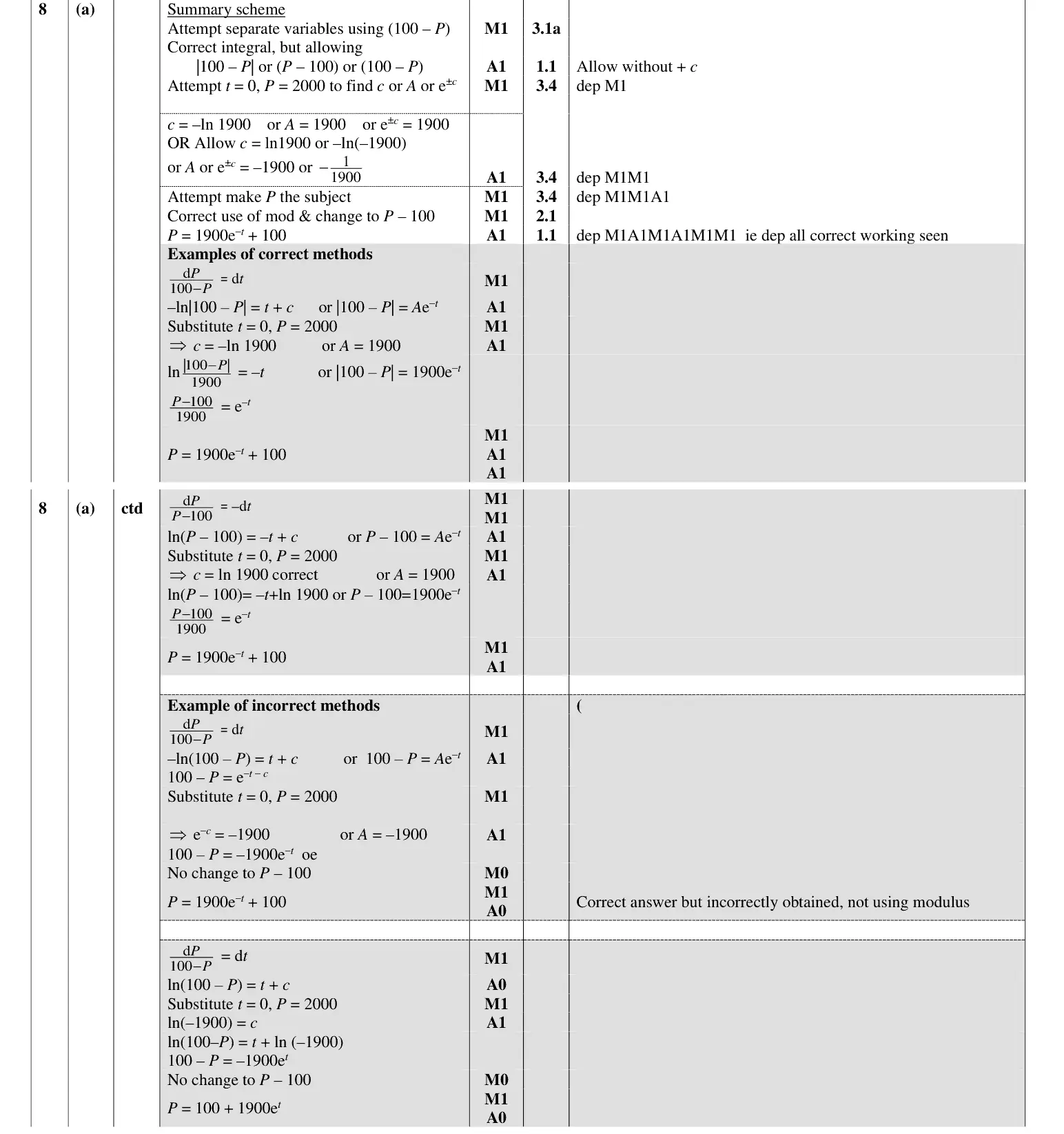
(Comment on Question 08 as a whole) This differential equation was difficult in that a correct solution depended on the correct use of the modulus sign when integrating . The majority of candidates either did not include the modulus sign or included it but then just ignored it. These candidates then obtained an impossible value for the ec = − constant of integration, such as ln ( 1900 ) or . Some noticed this and just dropped the c = − 1900 negative sign, while others ploughed on, seemly unaware of that this was a problem. Candidates who made errors such as these could, nevertheless, score 5 marks out of 7 if they made no other errors. A few candidates made no attempt to separate the variables and "integrated" to obtain equations such as . P = 100 t − Pt Section B: Statistics
Key points and common errors
separate variables: −ln(mod(100 − P)) = t + c
the modulus matters since P > 100: P = 1900e⁻ᵗ + 100
majority omitted or ignored the modulus giving impossible c = −ln 1900
Autumn 2020 · Paper 2 · Q8(b)2 marksMedium
Show the start of this question
Mark scheme for this part
Examiner's comment
(Comment on Question 08 as a whole) This differential equation was difficult in that a correct solution depended on the correct use of the modulus sign when integrating . The majority of candidates either did not include the modulus sign or included it but then just ignored it. These candidates then obtained an impossible value for the ec = − constant of integration, such as ln ( 1900 ) or . Some noticed this and just dropped the c = − 1900 negative sign, while others ploughed on, seemly unaware of that this was a problem. Candidates who made errors such as these could, nevertheless, score 5 marks out of 7 if they made no other errors. A few candidates made no attempt to separate the variables and "integrated" to obtain equations such as . P = 100 t − Pt Section B: Statistics
Key points and common errors
population decreases from 2000 and approaches 100
June 2019 · Paper 1 · Q8(a)2 marksMedium
Mark scheme for this part
Examiner's comment
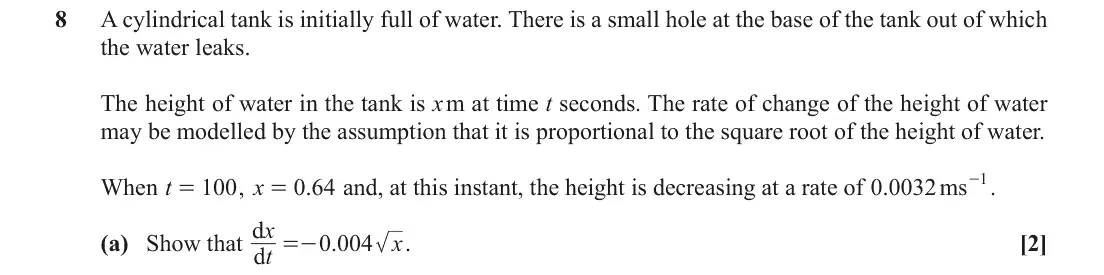
Most candidates were able to set up an appropriate model, with a fairly even split between those who used k and those who used –k, and then attempt to find a value for k. The more astute candidates appreciated that the height decreasing implied a rate of –0.0032, and could use this correctly to justify the given differential equation. The most common misconception was to omit the negative sign from 0.0032, with many not noticing that this resulted in value for k that was not consistent with the given answer.
Key points and common errors
dx/dt = k√x with rate −0.0032 at x = 0.64 so k = −0.004
omitting the negative sign
June 2019 · Paper 1 · Q8(b)4 marksMedium
Show the start of this question
Mark scheme for this part
Examiner's comment
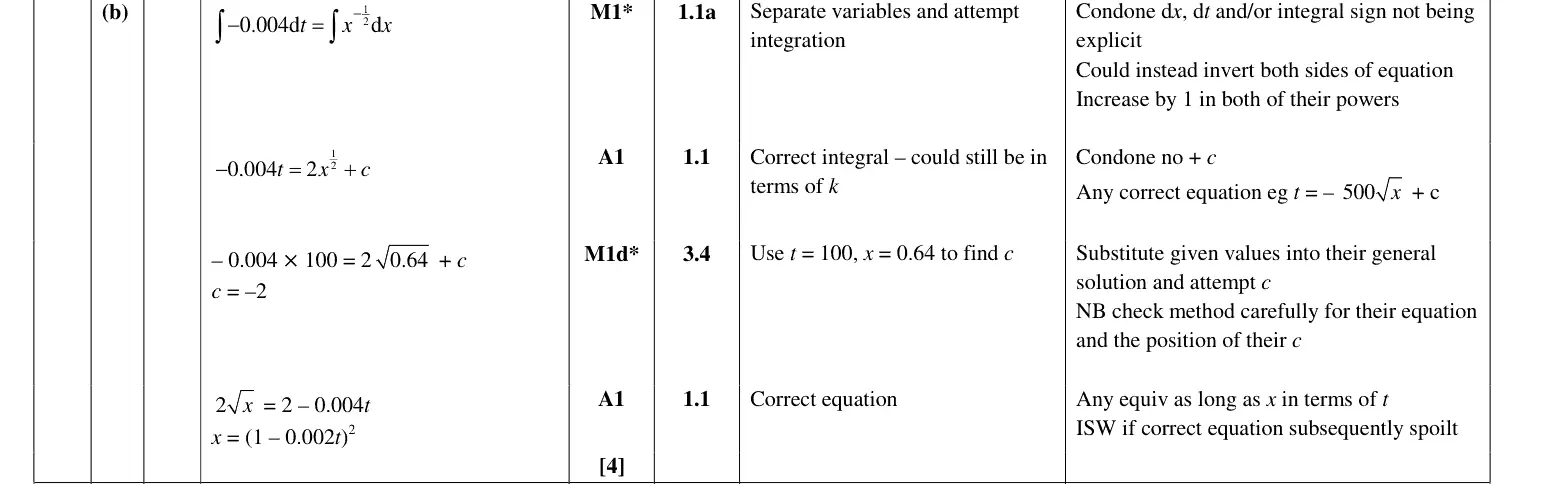
Most candidates could make an attempt to solve the given differential equation, usually by separating the variables but sometimes by inverting the equation and integrating. The integration was usually correct, and candidates could then use the given initial conditions to find a value for their constant of integration. Candidates were not always successful in finding an expression for x in terms of t; some omitted to attempt this and others either squared term by term or square rooted rather than squaring the function of t.
Key points and common errors
separate variables: 2√x = −0.004t + c
t = 100, x = 0.64 gives c = 2
x = (1 − 0.002t)²
errors squaring term by term
June 2019 · Paper 1 · Q8(c)2 marksMedium
Show the start of this question
Mark scheme for this part
Examiner's comment
Candidates appreciated that they had to find the value of t for which x = 0, and most could attempt to do so. The most efficient method was to use an equation from part (b) that required minimal manipulation as opposed to using the final answer. As this question was in context, units were required in the final answer which a number of candidates overlooked.
Key points and common errors
x = 0 gives t = 500 seconds
units required
June 2018 · Paper 1 · Q13(i)(a)1 markEasy
Mark scheme for this part
Examiner's comment
(Comment on Question 13(i) as a whole) The majority of candidates could state a correct differential equation, including a coefficient of proportionality. The most common error was to have the equation as a function of t not of N. Candidates who had stated a correct equation in part (a) were usually able to rearrange and integrate correctly. They were then able to use the given boundary conditions to find a particular solution to the differential equation. Having got this far, a few candidates did not gain the final mark due to making errors when rearranging the equation to the requested form, such as square rooting term by term.
Key points and common errors
dN/dt = k/N
common error writing it as a function of t
June 2018 · Paper 1 · Q13(i)(b)4 marksEasy
Show the start of this question
Mark scheme for this part
Examiner's comment
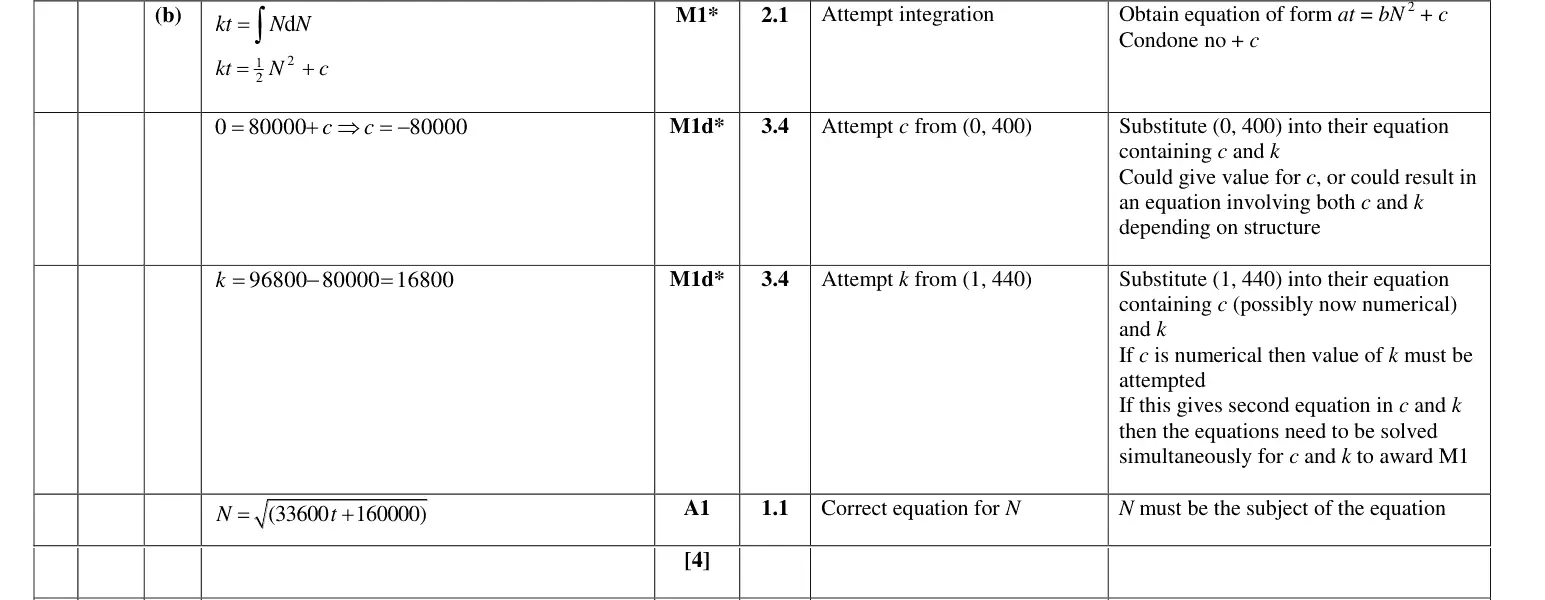
(Comment on Question 13(i) as a whole) The majority of candidates could state a correct differential equation, including a coefficient of proportionality. The most common error was to have the equation as a function of t not of N. Candidates who had stated a correct equation in part (a) were usually able to rearrange and integrate correctly. They were then able to use the given boundary conditions to find a particular solution to the differential equation. Having got this far, a few candidates did not gain the final mark due to making errors when rearranging the equation to the requested form, such as square rooting term by term.
Key points and common errors
∫N dN = ∫k dt
c from (0, 400), k from (1, 440)
N = √(33600t + 160000)
June 2018 · Paper 1 · Q13(ii)6 marksMedium
Mark scheme for this part
Examiner's comment
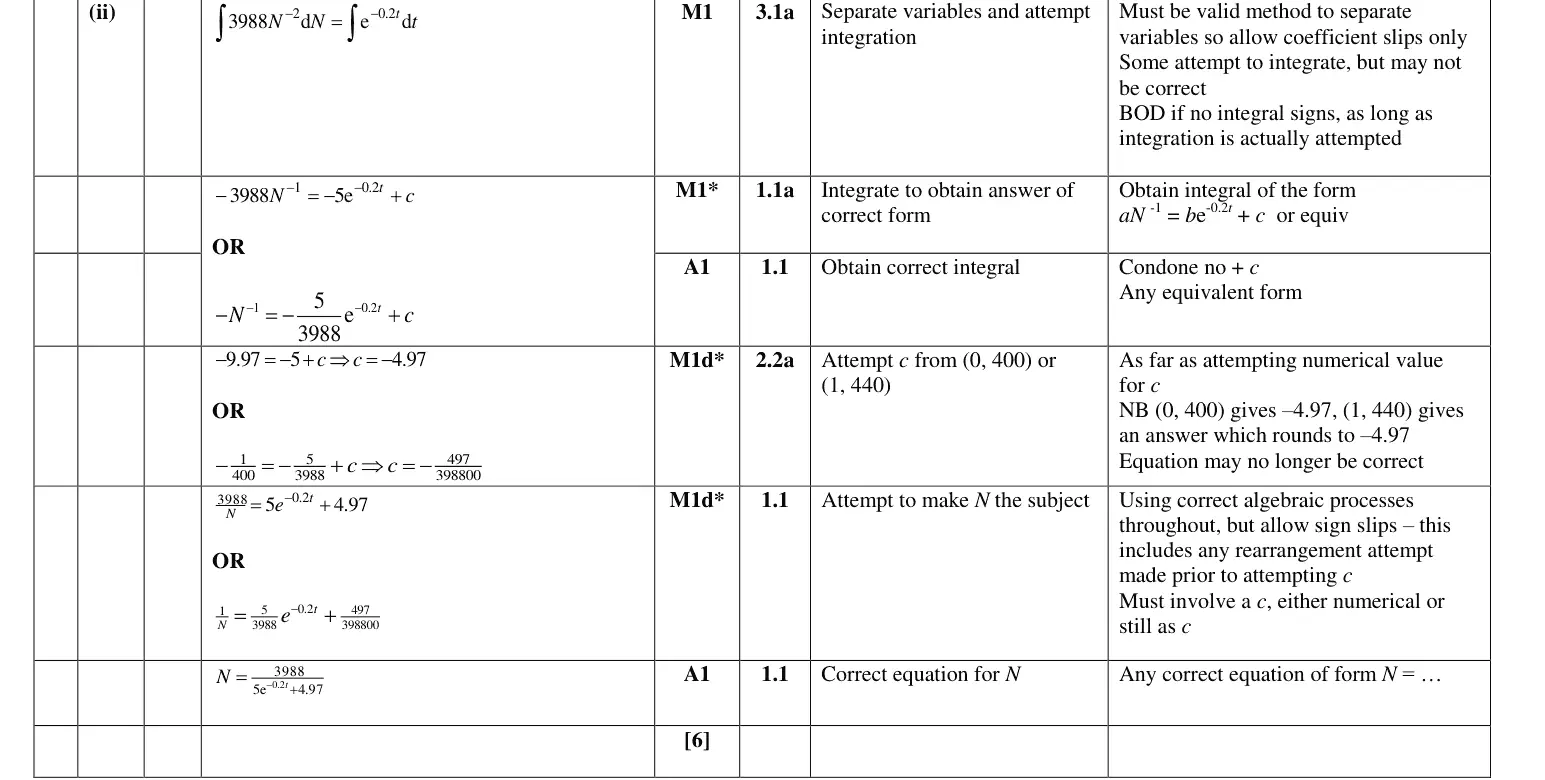
Candidates identified the need to separate the variables before integrating and many made a good attempt to do so. The majority of candidates chose to leave the 3988 where it was rather than incorporating it with the term in N. This caused problems for some when rewriting the right-hand side in a form that could be integrated, with 3988e-0.2t being the most common error. When finding a value for the constant of integration most candidates opted to use the first condition given. Once again, not all candidates were able to use the correct method to find N in terms of t; the most common error was to simply invert each of the three terms in their equation.
Key points and common errors
separate: ∫3988N⁻² dN = ∫e^(−0.2t) dt
−3988/N = −5e^(−0.2t) + c
c = −4.97
N = 3988/(5e^(−0.2t) + 4.97)
June 2018 · Paper 1 · Q13(iii)2 marksHard
Show the start of this question
Mark scheme for this part
Examiner's comment
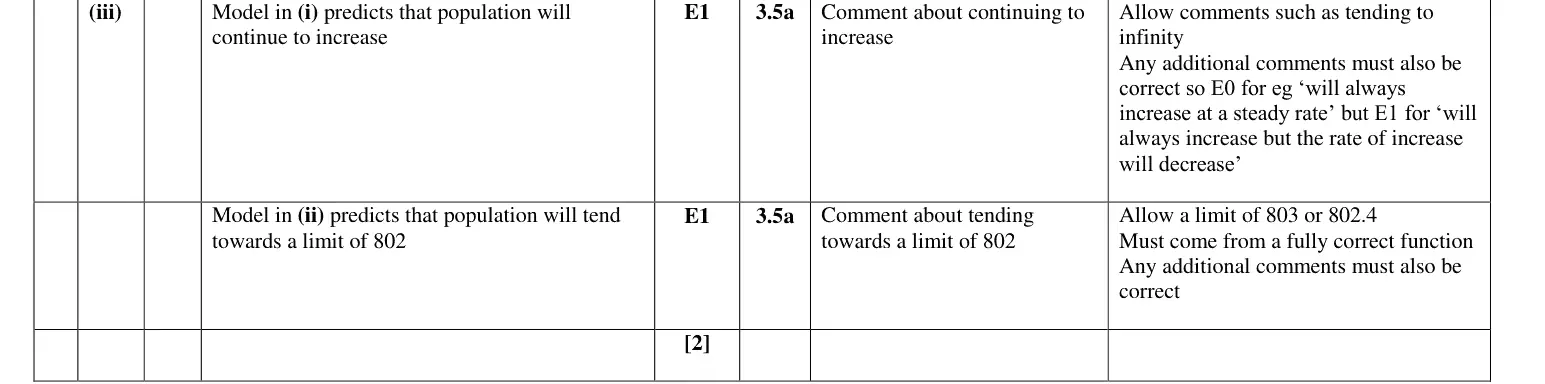
When considering the first model, candidates simply needed to identify that it predicted that the population would continue to increase and a number of candidates were able to do so. Some spoilt an otherwise correct statement by including additional, incorrect detail such as increasing at a faster rate. Only the most able candidates were able to both identify that the second model would predict that the population will tend towards a limit and also identify the value of the limit. There was no credit for commenting on how realistic each of the two models was, but some candidates did consider this.
Key points and common errors
first model increases indefinitely
second tends to a limit of about 802
extra incorrect detail loses the mark
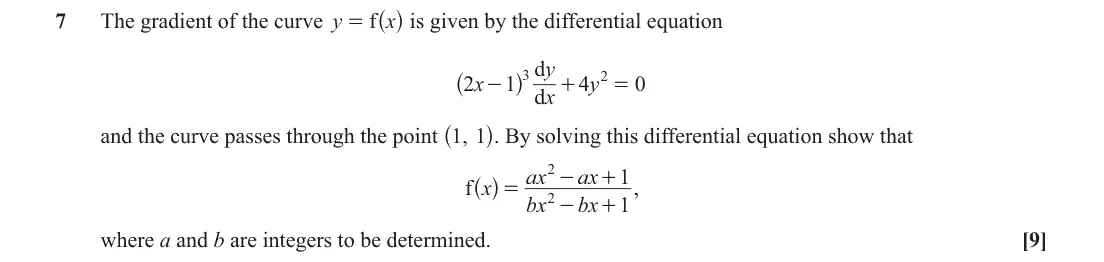
June 2018 · Paper 3 · Q79 marksMedium
Mark scheme for this part
Examiner's comment
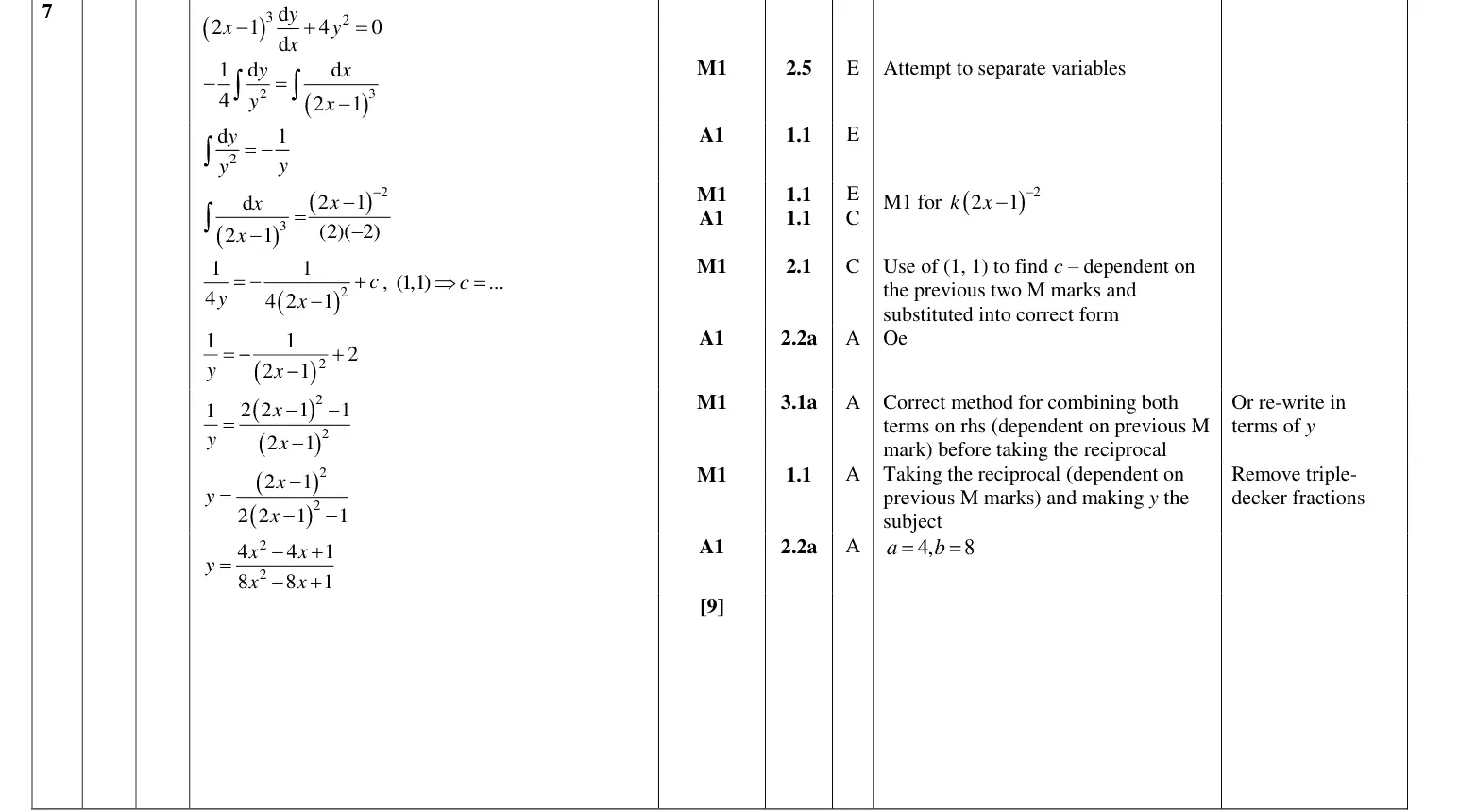
The responses to this final question in the pure section were mixed with examiners reporting a mixture of excellent responses followed by those that struggled with both the integration and the resulting algebraic manipulation required to obtain the answer in the required form. While most correctly separated the 1 d y d x variables and wrote − ∫ = ∫ many candidates had issues with the placement of the fraction 4 y ( ) 2 x − 1 on the left-hand side with examiners reporting that frequently this became a 4 rather than remaining as a quarter. While many candidates correctly integrated and remembered to include an arbitrary constant many decided to re-arrange their equation before attempting to find this constant; candidates are advised that in the majority of situations it is probably wisest to work out the +c immediately. Of those 1 1 that obtained a correct particular solution to this differential equation, for example, = − + 2 y ( 2 x − 1 ) many did not know the correct method for obtaining the result for f(x) in the required form. Many candidates took the reciprocal of each term separately rather than combining all relevant fractions first before taking the reciprocal and then expanding the brackets.
Key points and common errors
separate: −¼∫y⁻² dy = ∫(2x − 1)⁻³ dx
1/(4y) = −1/(4(2x − 1)²) + c
(1, 1) gives c
combine into a single fraction then take the reciprocal: a = 4, b = 8
Find an A-level maths tutor
Stuck on this? Book a trial session with an A-level maths tutor.