29 question parts, 59 marks, each rated Easy, Medium or Hard from the wording of the examiners' report
Notes, worked examples and practice for this topic are being written by our tutors. The past-paper questions below are ready now: work each one on paper, then open the mark scheme and the examiner's comment.
Tap a question to zoom it. Mark scheme and examiner's comment open under each question.
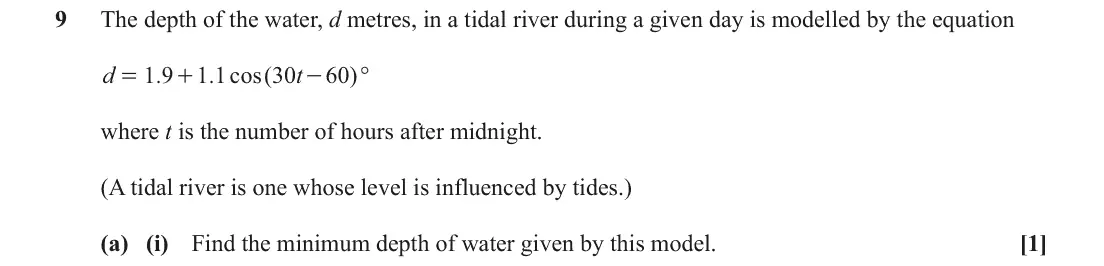
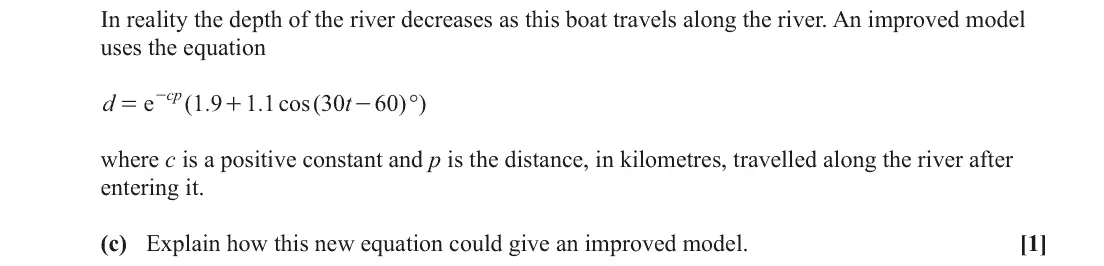
June 2024 · Paper 1 · Q9(c)1 markHard
Show the start of this question
Mark scheme for this part
Examiner's comment
While many candidates correctly identified that 𝑒−𝑐𝑝 would reduce the depth equation as the boat travelled along the river, very few correctly linked this to a reduction in the difference between maximum and minimum depths.
Key points and common errors
as p increases e^(−cp) decreases, so depths and the difference between max and min depths decrease (damping)
restating 'river gets shallower' gains nothing
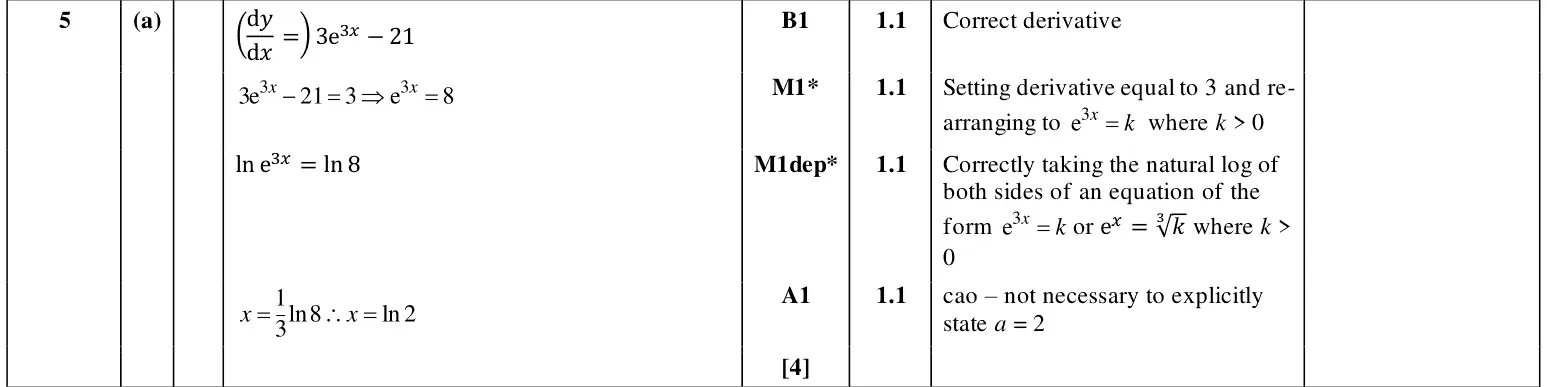
June 2024 · AS Paper 2 · Q5(a)4 marksMedium
Mark scheme for this part
Examiner's comment
A lot of good responses lost the final mark because the answer was left as 3ln8, ignoring the instruction to give the answer in the form lna. Those who differentiated e3x to 3xe3x, 3xe3x - 1, e2x or similar were 1 given no marks. A small number set their differential equal to − 3. Understanding of the log laws still needs strengthening. Some did not attempt differentiation, but started with things like lny = lne3x − ln21x − ln8.
Key points and common errors
dy/dx = 3e^(3x) − 21 = 3 gives e^(3x) = 8
x = ⅓ln 8 = ln 2 (must be in the form ln a)
June 2023 · AS Paper 1 · Q4(b)2 marksMedium
Show the start of this question
Mark scheme for this part
Examiner's comment
Most candidates recognised the need to differentiate and the majority of these got the correct derivative. Common errors included -3e2x, 3xe3x or getting y = e6 and then gradient = 6e5. Some candidates seemed unsure about the degree of accuracy required (with many giving their response to 2dp or similar); as per the rubric on the front cover, 3sf is the default unless otherwise stated.
Key points and common errors
dy/dx = 3e³ˣ
at x = 2 gradient 3e⁶ = 1210
errors 3xe³ˣ, −3e²ˣ
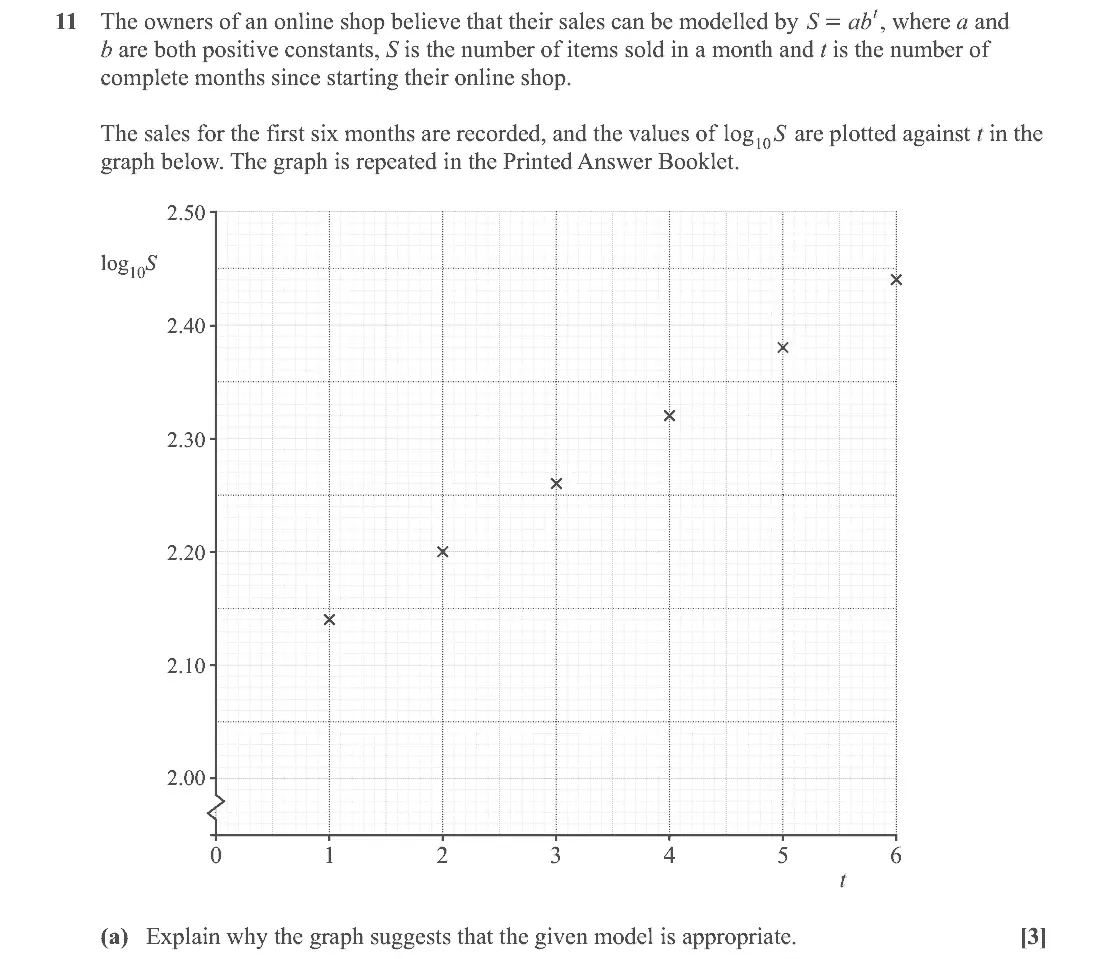
June 2023 · Paper 1 · Q11(c)2 marksEasy
Show the start of this question
Mark scheme for this part
Examiner's comment
The majority of candidates gained both marks for substituting t = 7 and then giving their final answer as an integer value. The most common errors were using t = 6 or attempting (t = 7) – (t = 6), despite the model being clearly defined in the first paragraph.
Key points and common errors
S = 120 × 1.15⁷ = 319 items, integer answer
errors t = 6 or subtracting months
June 2023 · Paper 1 · Q11(d)(ii)1 markHard
Show the start of this question
Mark scheme for this part
Examiner's comment
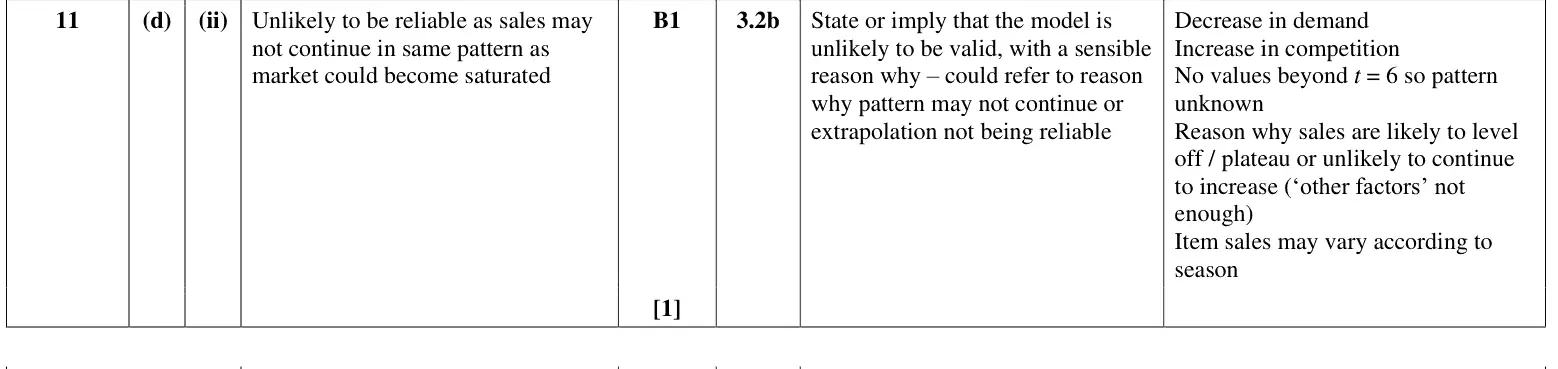
To gain this mark candidates had to both comment that the prediction was unlikely to be reliable, and also to give a reason why this may be the case. It had to be a specific comment, such as a competitor entering the market; no credit was given to generalities that simply said that sales may change but with no further detail. Vague comments did result in only a minority of candidates actually being given this mark.
Key points and common errors
unlikely to be reliable with a specific reason (saturation, competition, extrapolation beyond t = 6)
generic comments gain nothing
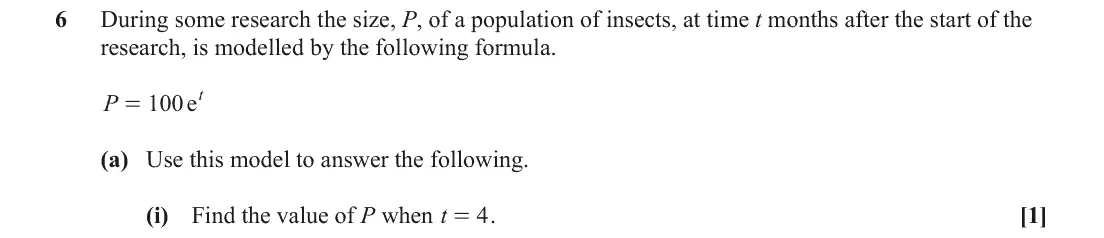
June 2022 · AS Paper 1 · Q6(a)(i)1 markEasy
Mark scheme for this part
Examiner's comment
This question was answered correctly by almost all candidates.
Key points and common errors
P = 100e⁴ = 5460
June 2022 · AS Paper 1 · Q6(a)(ii)2 marksEasy
Show the start of this question
Mark scheme for this part
Examiner's comment
This question was answered correctly by most candidates. Some started correctly with 100et = 9000 but went on to write et = 900.
Key points and common errors
100eᵗ = 9000 so t = ln 90 = 4.50
error eᵗ = 900
June 2022 · Paper 1 · Q8(a)2 marksHard
Mark scheme for this part
Examiner's comment
Only the most astute candidates seemed familiar with the definition of exponential growth and decay as using the same scale factor for a fixed time period, and were hence able to simply state the two missing values. The most common approach was to set up a model of the form M = Aekt. Candidates were then able to use their model to attempt the two required values, but there was quite often a loss of accuracy in their final answers due to premature approximation of the parameters found.
Key points and common errors
exponential: same factor 0.6 per 10 minutes so 450 at t = 20 and m = 97.2 at t = 50
premature rounding of model parameters
June 2022 · Paper 1 · Q8(b)(i)3 marksEasy
Show the start of this question
Mark scheme for this part
Examiner's comment
This question was very well answered, with the majority of candidates gaining full marks for setting their model equal to 80 and solving for t. A surprisingly common error was to start with the correct equation, but then miscopy it from one line to the next with the index invariably becoming – 0.55t. In all questions, candidates would be well advised to check their working for copying errors.
Key points and common errors
160e^(−0.055t) = 80 so t = ln2/0.055 = 12.6 minutes
miscopying the index as −0.55t
June 2022 · Paper 1 · Q8(b)(ii)3 marksMedium
Show the start of this question
Mark scheme for this part
Examiner's comment
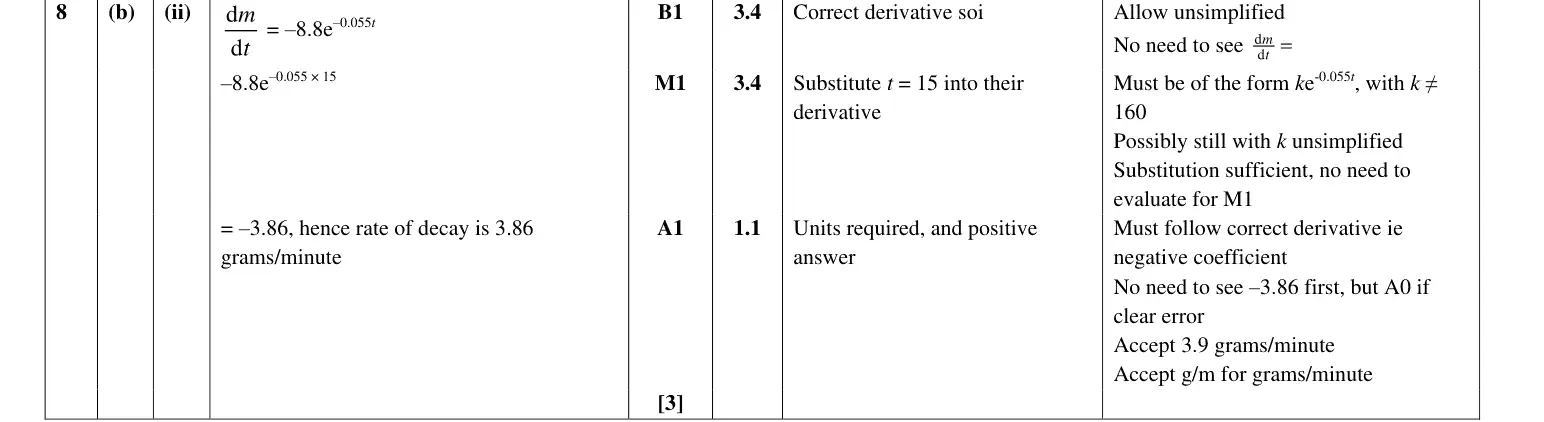
Most candidates appreciated that ‘rate’ indicated the need to differentiate, and were able to do so correctly and then substitute t = 15. The final mark proved to be more elusive, as both a positive value and units were required in the final answer.
Key points and common errors
dm/dt = −8.8e^(−0.055t) = −3.86 at t = 15
rate of decay 3.86 grams per minute, positive and with units
June 2022 · Paper 1 · Q8(c)1 markMedium
Show the start of this question
Mark scheme for this part
Examiner's comment
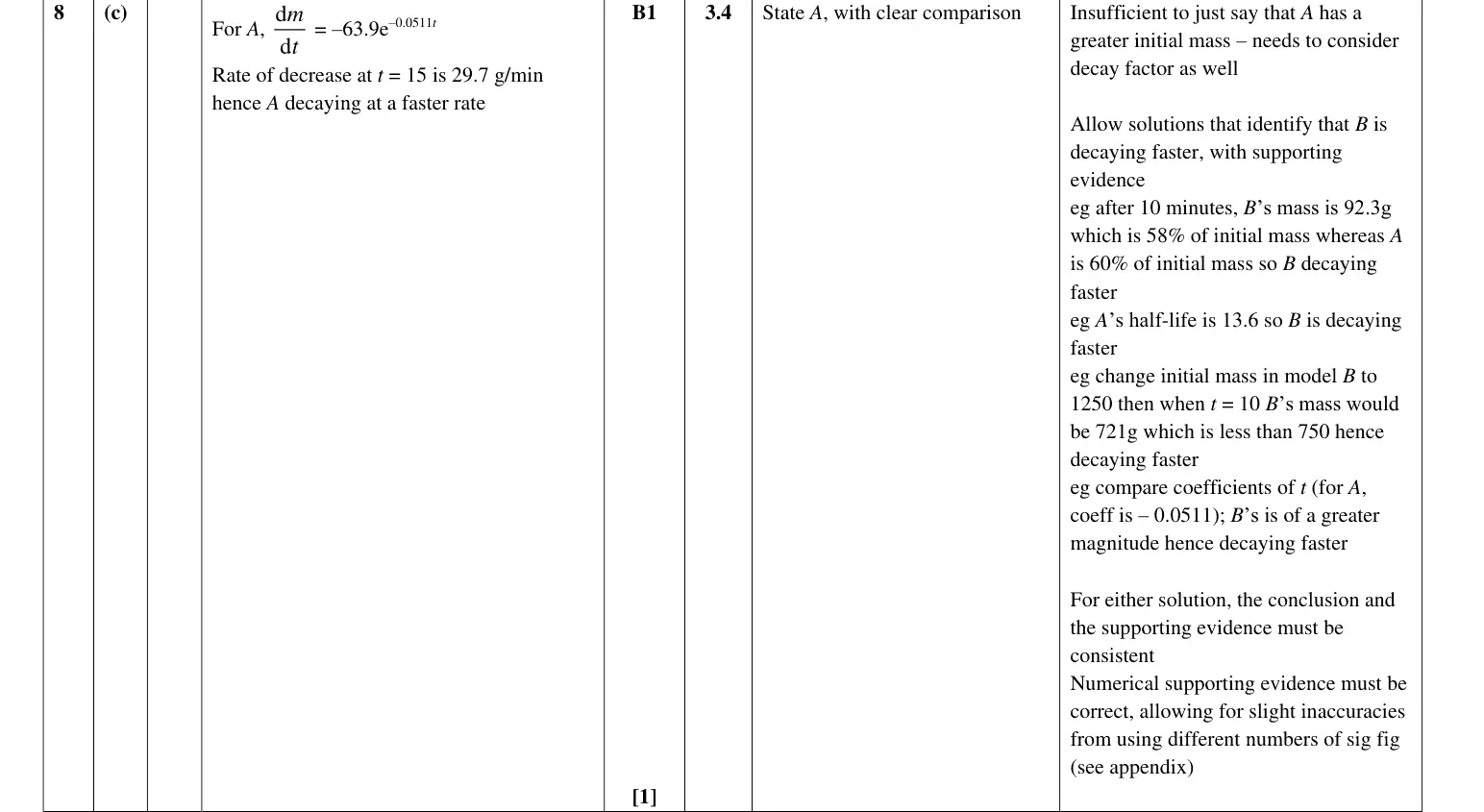
The more common approach was to attempt to compare the coefficients of t, but inequalities were not always correct due to them both being negative. Some explanations lack precision, simply referring to ‘the decay constant’ or even just ‘k’, without specifying what this was. Other candidates picked a value for t and compared either the percentage of the mass that had been lost or the percentage still remaining, or compared the half-life of each substance. The other approach was to compare the actual rates of decay at a given time, usually 15, which resulted in a different conclusion. Either approach could gain credit, as long as the conclusion was supported with empirical evidence and not just vague statements, as was too often the case. This is a good solution to Question 8 (c), in that it provides clear evidence to support the given conclusion.
Key points and common errors
either answer with consistent evidence: A's actual rate at t = 15 is greater (29.7 g/min), or B's decay constant is larger in magnitude
'A has more mass' alone is not enough
Autumn 2021 · Paper 2 · Q4(f)1 markMedium
Show the start of this question
Mark scheme for this part
Examiner's comment
(From the general report) Question 4(f): Some candidates appeared not to understand how to address some aspects of Assessment Objective AO3 (please see section ‘3b.
Key points and common errors
damp the oscillation: P = 5000 − 1000e^(−kt)cos(30t)° (k > 0) or divide the amplitude by t
AO3 refinement
Autumn 2020 · Paper 1 · Q6(c)3 marksMedium
Show the start of this question
Mark scheme for this part
Examiner's comment
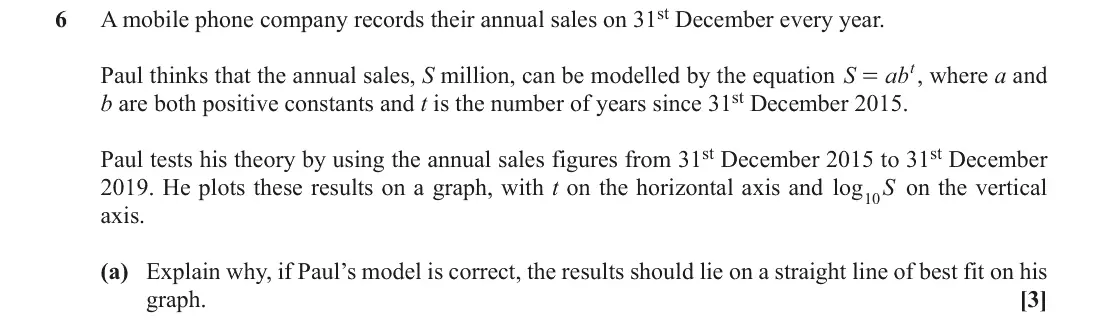
(Comment on Question 06 as a whole) In the first part of Question 6 a number of candidates attempted a worded explanation as opposed to reducing the equation to linear form which is then linked to the equation of a straight line. A lack of precision resulted in some candidates not gaining full credit, as they neglected to indicate that they were using logs to base 10. In part (b) the expectation was that candidates would use the relevant parameters from their linear equation; an alternative, and equally acceptable, strategy was to identify coordinates of points on the straight line and use them in the given exponential equation; this is a good example of candidates who could not answer part (a) finding a method that still allowed them to attempt this part of the question. In part (d) any sensible reason that identified why the sales may not continue at the same rate was allowed, but a number of solutions were too vague to gain credit. Candidates were also given credit if they identified that extrapolation was unreliable.
Key points and common errors
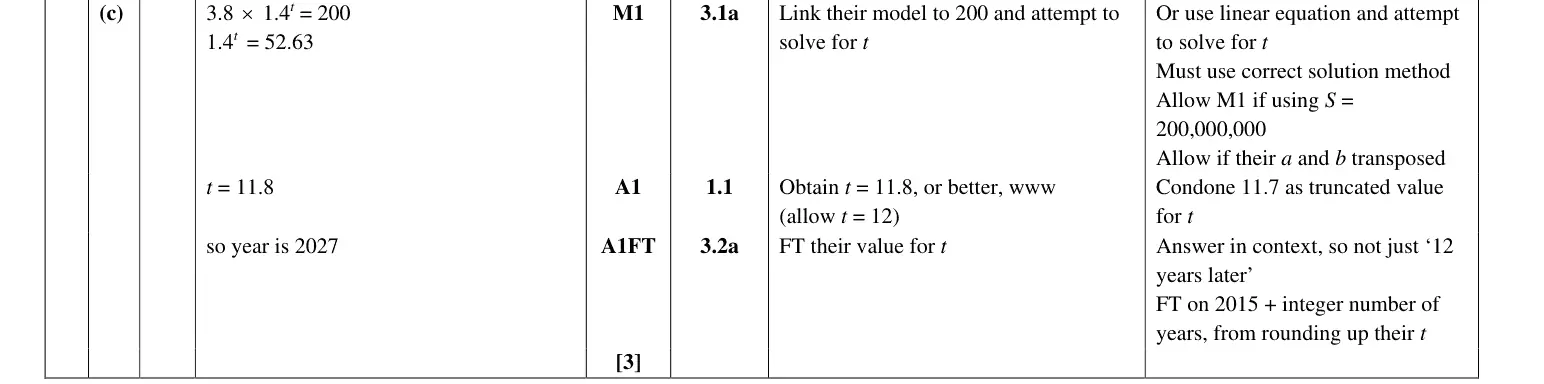
3.8 × 1.4ᵗ = 200 gives t = 11.8
year 2027 in context, not just '12 years'
Autumn 2020 · Paper 1 · Q6(d)1 markMedium
Show the start of this question
Mark scheme for this part
Examiner's comment
(Comment on Question 06 as a whole) In the first part of Question 6 a number of candidates attempted a worded explanation as opposed to reducing the equation to linear form which is then linked to the equation of a straight line. A lack of precision resulted in some candidates not gaining full credit, as they neglected to indicate that they were using logs to base 10. In part (b) the expectation was that candidates would use the relevant parameters from their linear equation; an alternative, and equally acceptable, strategy was to identify coordinates of points on the straight line and use them in the given exponential equation; this is a good example of candidates who could not answer part (a) finding a method that still allowed them to attempt this part of the question. In part (d) any sensible reason that identified why the sales may not continue at the same rate was allowed, but a number of solutions were too vague to gain credit. Candidates were also given credit if they identified that extrapolation was unreliable.
Key points and common errors
sales unlikely to continue growing at the same rate
finite market
extrapolation
Autumn 2020 · Paper 2 · Q8(b)2 marksMedium
Show the start of this question
Mark scheme for this part
Examiner's comment
(Comment on Question 08 as a whole) This differential equation was difficult in that a correct solution depended on the correct use of the modulus sign when integrating . The majority of candidates either did not include the modulus sign or included it but then just ignored it. These candidates then obtained an impossible value for the ec = − constant of integration, such as ln ( 1900 ) or . Some noticed this and just dropped the c = − 1900 negative sign, while others ploughed on, seemly unaware of that this was a problem. Candidates who made errors such as these could, nevertheless, score 5 marks out of 7 if they made no other errors. A few candidates made no attempt to separate the variables and "integrated" to obtain equations such as . P = 100 t − Pt Section B: Statistics
Key points and common errors
population decreases from 2000 and approaches 100
June 2019 · AS Paper 1 · Q7(a)1 markMedium
Mark scheme for this part
Examiner's comment
Many correct responses were seen. Some incorrect responses were kxekx, kxekx – 1, xekx, kxe and kx. A significant minority of candidates found ln y instead of d y x . Some candidates differentiated correctly but d then wrote y = kekx.
Key points and common errors
gradient ke^(kx)
errors kxe^(kx), ln y
June 2019 · AS Paper 1 · Q7(b)4 marksMedium
Show the start of this question
Mark scheme for this part
Examiner's comment
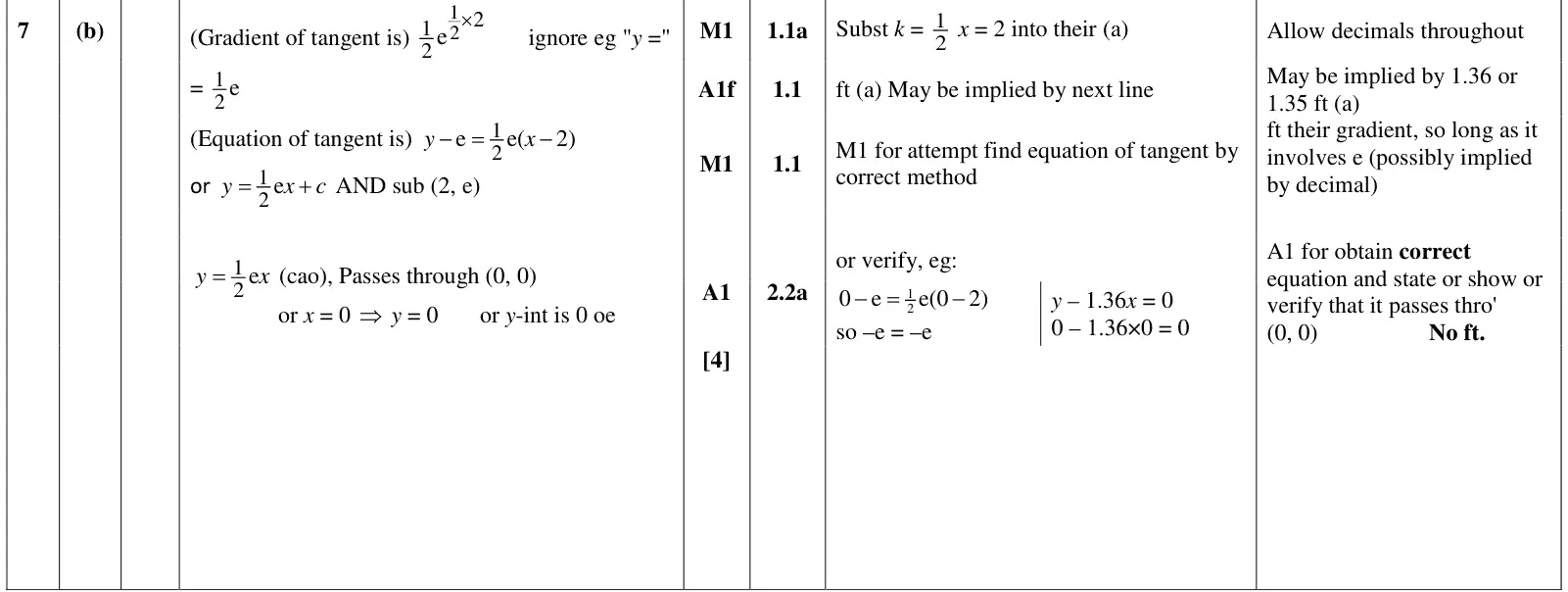
Many candidates correctly used their response to part (b) to find the gradient of the curve at x = 2. But then a large minority found the negative reciprocal and used this as the gradient of the tangent. Most candidates used one of the two usual methods for the equation a straight line. Some used the form y = mx + c, although a few found c = 0 without stating explicitly the equation of the tangent. This was not regarded as an adequate response to the instruction "Show that . . .” Others found the equation correctly and stated (rather than showed) that the line passed through O. These were allowed the final mark because the equation concerned was so simple. However, in similar questions in the future, the corresponding mark might be withheld if no explanation is given. 2 into their d y Some candidates, having differentiated correctly in part (a), substituted k = 1 x , but did not d substitute x = 2. In some cases, they went on to try to find the equation of the tangent, with their gradient 1 x 1 2 e 2 still given as a function of x; thus: y – e = (x – 2). Other candidates appeared not to recognise that their response to part (a) could be used in part (b), and they started from scratch. A common error was to find the gradient, not of the tangent, but of the line joining the origin to the point where x = e. The relevant marks were not gained despite the fact that these are, fortuitously, the same line.
Key points and common errors
gradient at x = 2 is e/2 (not the normal)
y − e = (e/2)(x − 2) gives y = ex/2, which passes through (0, 0)
June 2019 · Paper 2 · Q4(a)1 markHard
Mark scheme for this part
Examiner's comment
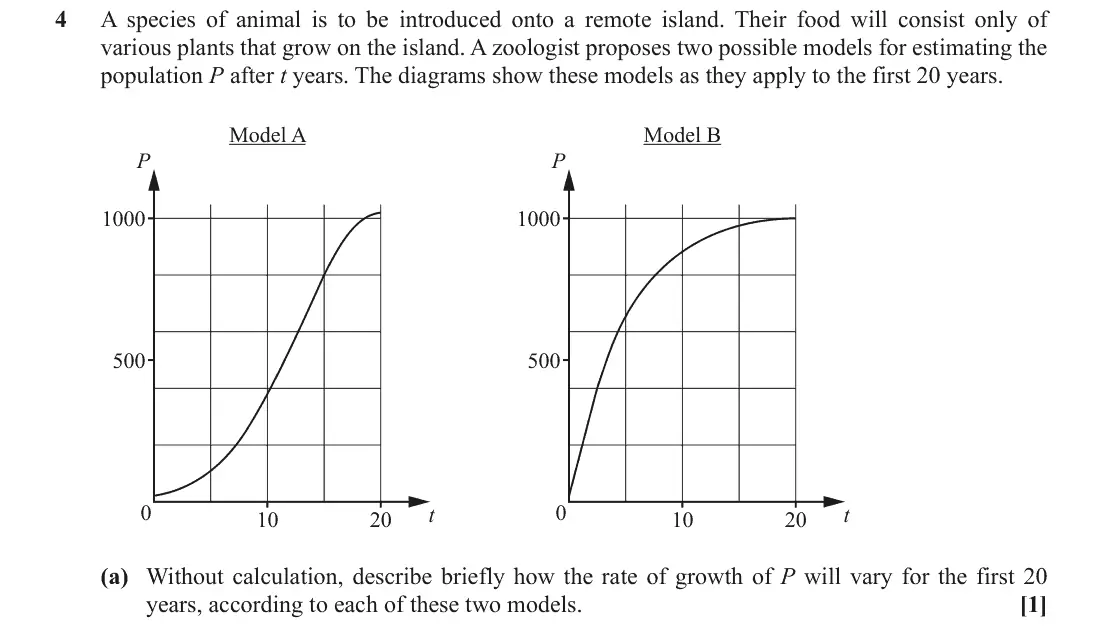
Some candidates were unable to distinguish between P and the rate of growth of P. A few gave an answer for Model A, but not Model B. Some gave an incomplete answer for Model A, such as "The rate of growth increases and then becomes constant." Others tried to give a single answer that covered both models, such as "Growth overall decreases to zero" or "The rate of growth is greater under Model B than Model A." A good succinct answer is as follows: A: The rate of growth starts at zero, then increases and then decreases to zero. B: The rate of growth is initially high and decreases to zero. An acceptable succinct answer is as follows: A: The rate of growth increases and then decreases. B: The rate of growth decreases.
Key points and common errors
distinguish P from rate of growth of P
A: rate increases then decreases
B: rate decreases throughout
both models needed
June 2019 · Paper 2 · Q4(b)(i)1 markHard
Show the start of this question
Mark scheme for this part
Examiner's comment
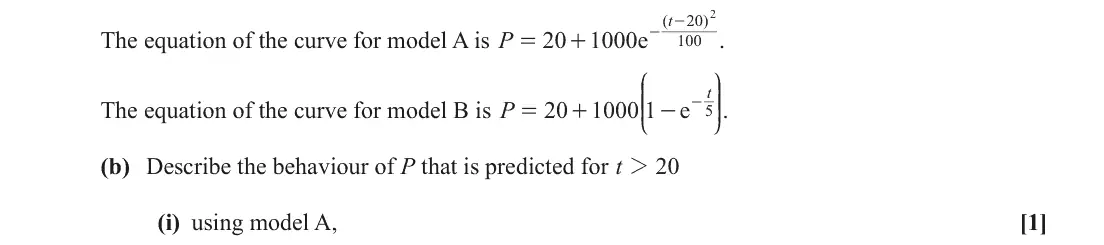
This part (and the next) depend on an ability to interpret the relevant equation involving an exponential function. Some candidates were able to interpret the equation correctly without quoting particular values of P. Others calculated values but were unable to give a proper interpretation. In some cases, candidates' answers to this part fitted the next part, and vice versa, suggesting a misunderstanding of the two equations. Some examples of inadequate or incorrect answers were as follows. P will decrease. P decreases exponentially after t = 20. P tends to zero. P will grow exponentially. The population will grow to about 1000 and then drop. P will tend to 1020. P will grow, but very slowly. The curve will be a reflection of the given curve. A good succinct answer is as follows: After t = 20 P will decrease, tending to 20.
Key points and common errors
P decreases and tends to 20
must mention 20
June 2019 · Paper 2 · Q4(b)(ii)1 markHard
Show the start of this question
Mark scheme for this part
Examiner's comment
Some of the comments on the previous part apply also to this part. Some examples of inadequate or incorrect answers were as follows. The growth of the population will slow until it stops. P will rise but increasingly slowly. P will increase. P will increase exponentially. P tends to 1000. The population is at a fixed number. P will decay exponentially. P will decrease and tend to 20. A good succinct answer is as follows: After t = 20 P will continue to increase, tending to 1020.
Key points and common errors
P tends to 1020 (not 1000)
must mention 1020
June 2019 · Paper 2 · Q4(c)(i)1 markHard
Show the start of this question
Mark scheme for this part
Examiner's comment
Candidates whose answers to (b)(i) were incorrect were unlikely to answer this part correctly. Some examples of inadequate or incorrect answers were as follows. Food will decrease. Food will not sustain a large population. It is limited. Food will cap growth at 1000, but after that the population will degrade as there is less food. Consistent long term food supply. There's enough in the long term. There will be less food available in the long term. It will not be enough. Two good succinct answers are as follows. The food will almost run out. There will only be enough food to support 20 animals.
Key points and common errors
food almost runs out, supports only 20 animals
'limited' alone not enough
June 2019 · Paper 2 · Q4(c)(ii)1 markMedium
Show the start of this question
Mark scheme for this part
Examiner's comment
Many candidates answered this part well, recognising that the population equation implies that, in the long term, the food supply will not run out, but will be limited. Some examples of inadequate or incorrect answers were as follows. Food will be enough. Food will not run out. Food will be limited. There will be plenty of food. Food will be enough to support 20 animals. It will last longer as the population decreases. There will always be enough food for the population to grow. Food will nearly run out. The food supply will start to decrease. There will be lots of food for 10 years, then it decreases. Two good succinct answers are as follows. The food supply will be just sufficient to support about 1020 animals. There will be enough food to sustain a stable population.
Key points and common errors
food will not run out but is limited, supports about 1020
need two aspects
June 2018 · Paper 1 · Q11(i)3 marksEasy
Mark scheme for this part
Examiner's comment
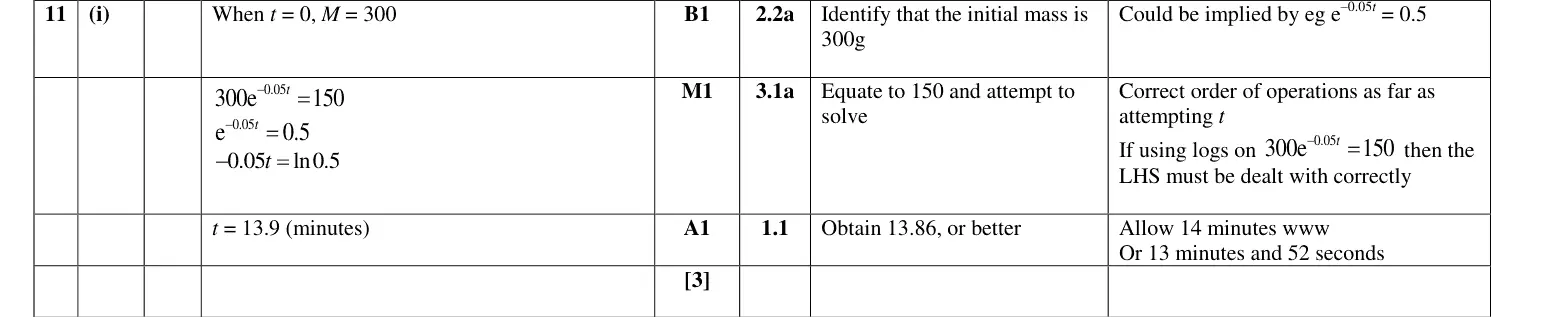
This question was very well answered with candidates identifying the initial mass, and then setting up and solving a relevant equation. Most candidates worked exactly throughout to provide a sufficiently accurate final answer.
Key points and common errors
initial mass 300
e^(−0.05t) = 0.5
t = 13.9 minutes
June 2018 · Paper 1 · Q11(ii)8 marksMedium
Show the start of this question
Mark scheme for this part
Examiner's comment
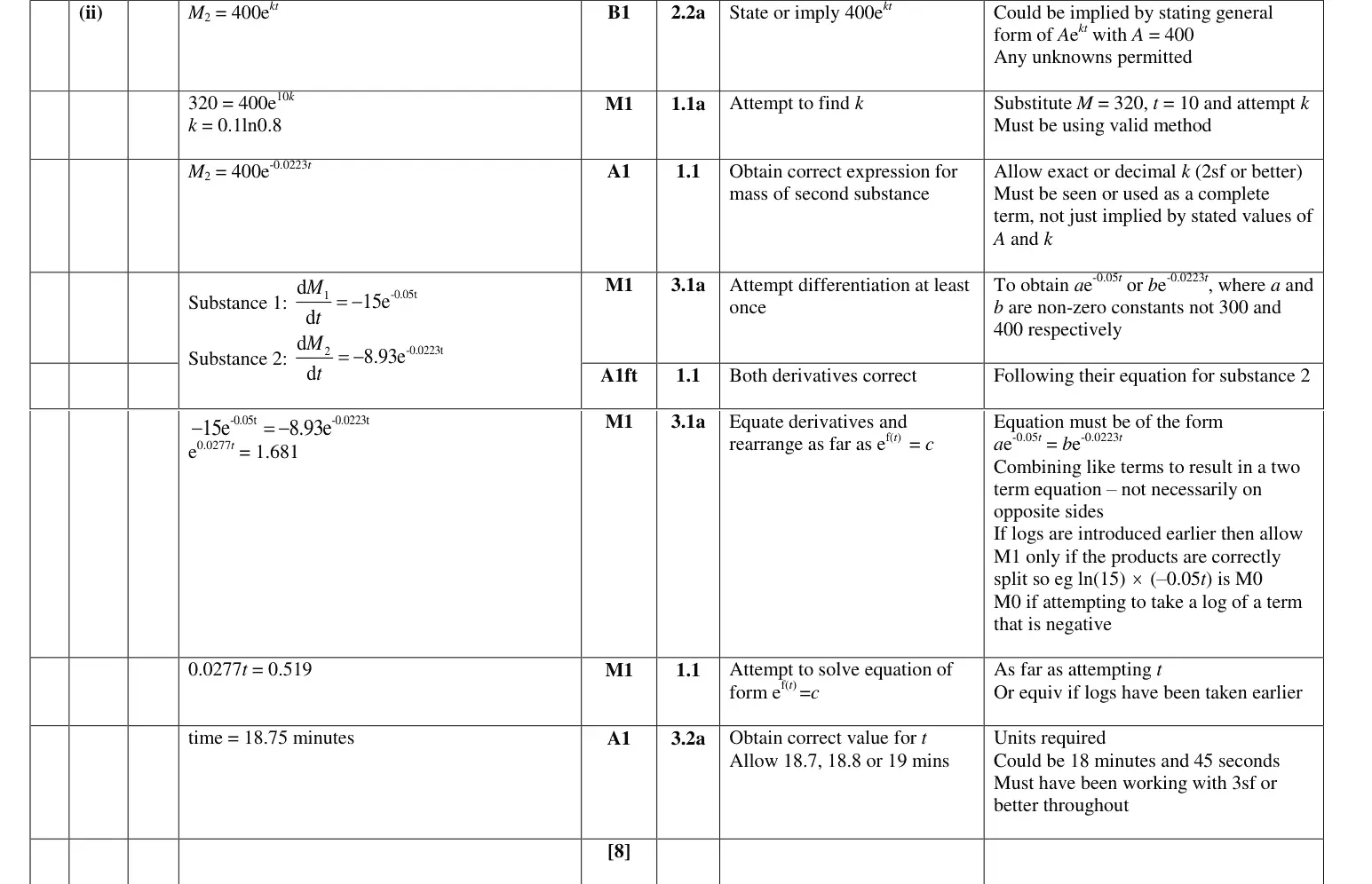
The vast majority of candidates were able to make some progress on this question, and a number of fully correct solutions were seen. Candidates appreciated the need to find an expression for the mass of the second substance, and were able to make a good attempt at finding the two parameters. As the substance was decaying, some candidates used an initial structure of M = Ae-kt, but sign errors were relatively common when substituting back for k. A few candidates simply equated the two expressions for the mass, but most realised that it was the derivatives that should be equated and made a reasonable attempt to do so. Solving the ensuing equation was found to be challenging. Some attempted to rearrange first whereas others introduced logarithms straightaway. Sign errors were common, especially in solutions where candidates were working exactly as the coefficient of 0.1ln0.8 is not obviously negative. Some candidates spoilt an otherwise correct solution by not working to a sufficient degree of accuracy throughout their solution resulting in an incorrect final answer.
Key points and common errors
M₂ = 400e^(kt) with k = 0.1 ln 0.8
differentiate both
equate rates (not masses)
t = 18.75 minutes
June 2018 · AS Paper 2 · Q6(i)1 markMedium
Mark scheme for this part
Examiner's comment
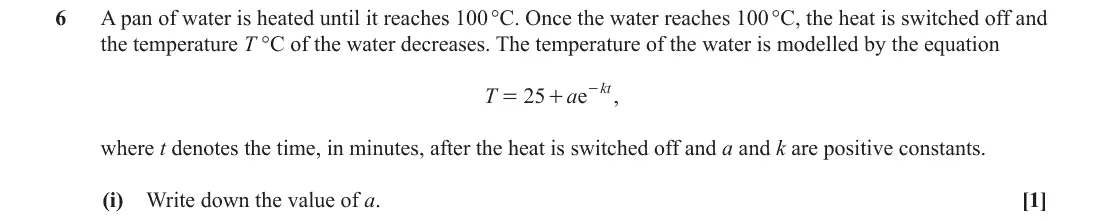
The correct value of a was frequent, but so too was a = 100.
Key points and common errors
T = 100 at t = 0 gives a = 75
a = 100 is a common error
June 2018 · AS Paper 2 · Q6(ii)1 markMedium
Show the start of this question
Mark scheme for this part
Examiner's comment
All the options on the mark scheme appeared. Some candidates did not realise that an explanation in the context of the model was needed and tried to give a geometrical interpretation.
Key points and common errors
T tends to 25 as t grows: room (ambient) temperature
answer must be in context
June 2018 · AS Paper 2 · Q6(iii)3 marksHard
Show the start of this question
Mark scheme for this part
Examiner's comment
This was not well understood, with very few candidates using the fact that the gradient of ekx.is equal to kekx. It was very common to see attempts to solve 85 = 25 + ae-kt, with the value of a from (i) and t = 1.
Key points and common errors
dT/dt = −ake^(−kt)
at t = 0, −75k = −15 so k = 1/5
many wrongly solved T = 85 at t = 1
June 2018 · AS Paper 2 · Q6(iv)3 marksHard
Show the start of this question
Mark scheme for this part
Examiner's comment
Inevitably those who did not obtain a value of a and/or k were unable to make progress in this part. Those who had incorrect values seemed to understand the method. A few set T = 55. Because of the difficulties encountered in (iii) very few correct answers were seen. Note that here units were expected to be mentioned (cf AO3.2a) and candidates need to be aware that these are important, particularly in modelling questions.
Key points and common errors
45 = 25 + 75e^(−t/5) so t = −5ln(4/15) = 6.6 minutes
units required
June 2018 · AS Paper 2 · Q6(v)1 markMedium
Show the start of this question
Mark scheme for this part
Examiner's comment
A fair number of candidates made no response to this part, but where suggestions were seen the idea was understood.
Key points and common errors
initial temperature lower so decrease the value of a
Find an A-level maths tutor
Stuck on this? Book a trial session with an A-level maths tutor.