Examiner's comment
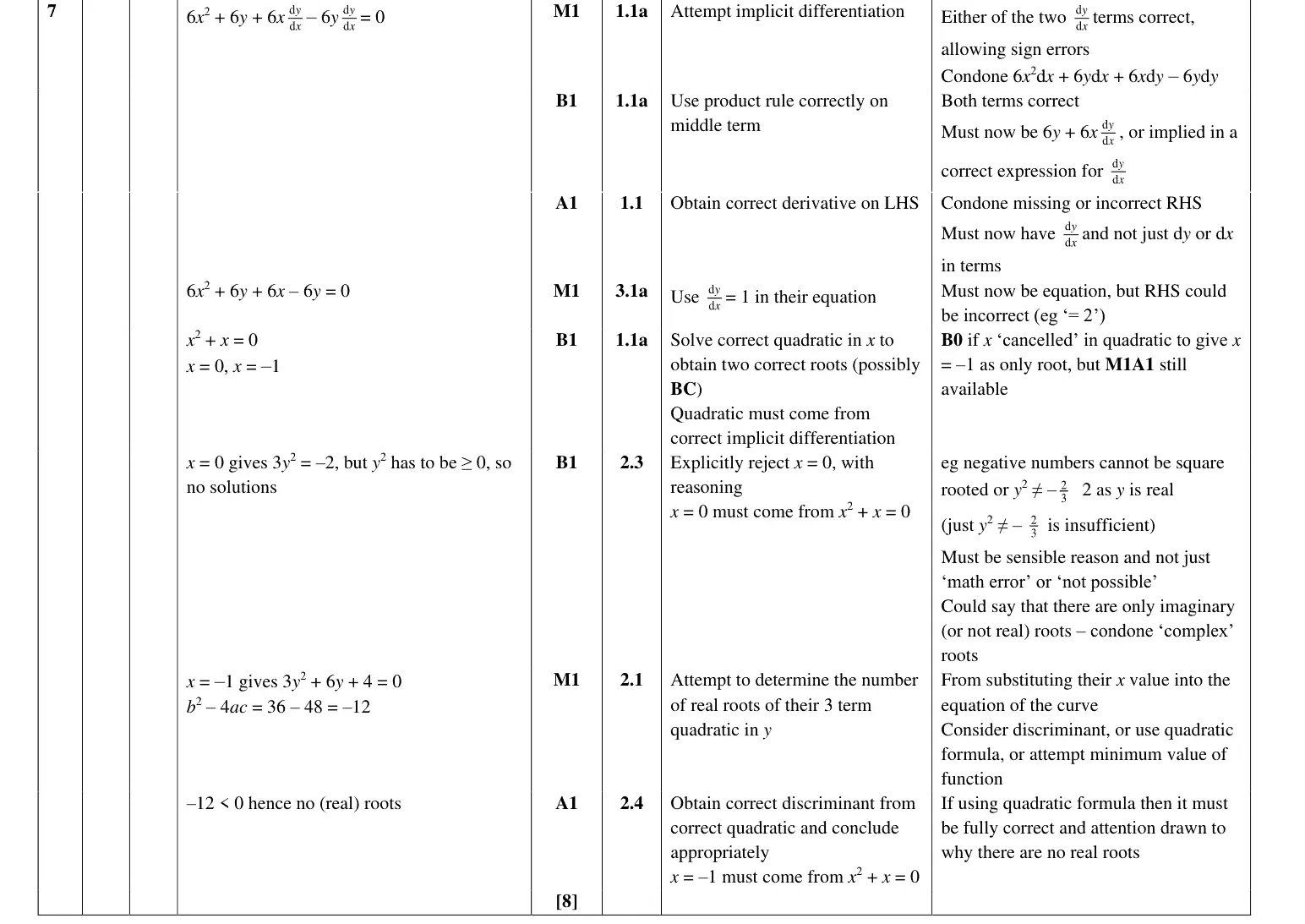
Most candidates could make progress on this question by recognising that it was an implicit equation and making a good attempt to differentiate it. The derivative was usually correct, but the modal mark on this question was 3 marks as many candidates were unsure as to how to then proceed. While a number did set the derivative equal to 1, a common error was to substitute y = x into their derivative. The correct quadratic of x2 + x = 0 was often seen, but there was often some uncertainty as to how to solve this and only the more able candidates were able to obtain both correct roots. Some candidates found just one of the roots by inspection and others, having obtained x2 = – x, observed that a square cannot be negative hence this equation has no roots at all. To gain full credit, examiners expected to see sufficient detail as to why neither root would yield solutions when substituted back into the original equation. While the substitution was seen, the explanations were often lacking in detail. Just stating that 3y2 = – 2 was impossible was not enough and, when considering x = – 1, it was not sufficient to just say that the ensuing quadratic had no roots; this needed to be demonstrated, most typically through considering the discriminant. compelling reasons whenever a solution is discarded. A good solution to Question 7, with clear reasons given as to why neither root will give a valid solution.