Oct 2021: Paper 2: Pure Mathematics 2

100 marks · 35 question parts · Question paper, mark scheme and examiner's report on Pearson's site

Question by question

QTopicMarksDifficulty
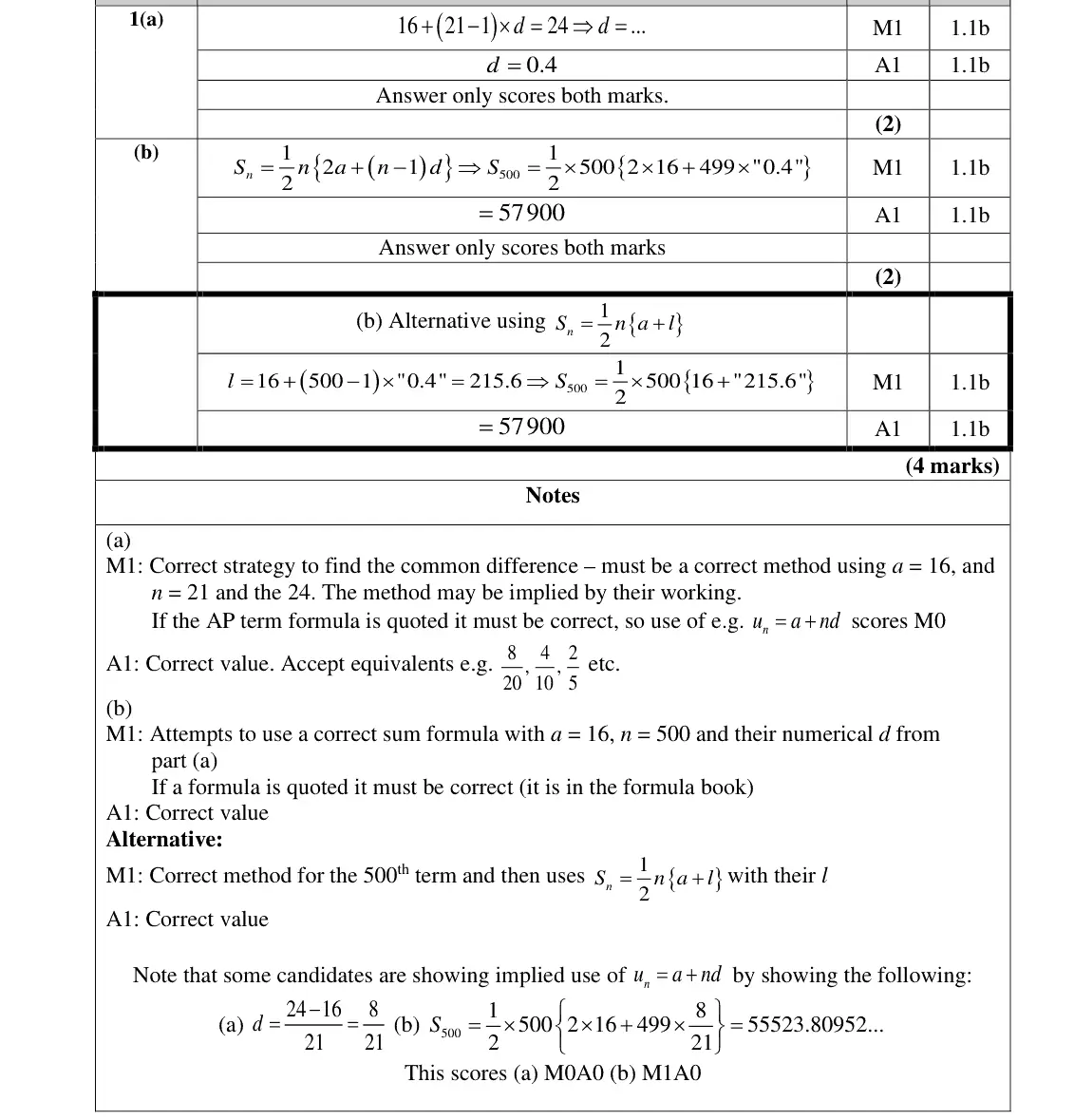
1(a) Sequences and series 2 —
1(b) Sequences and series 2 —
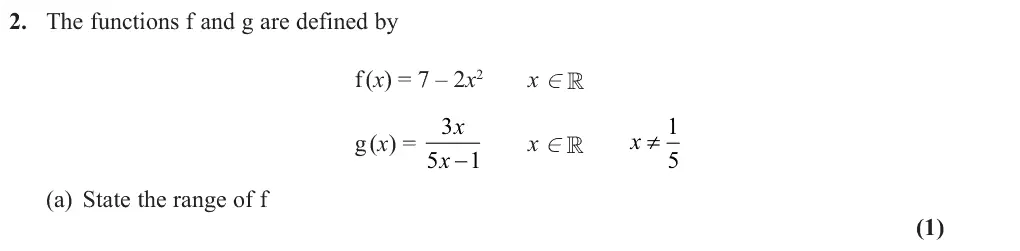
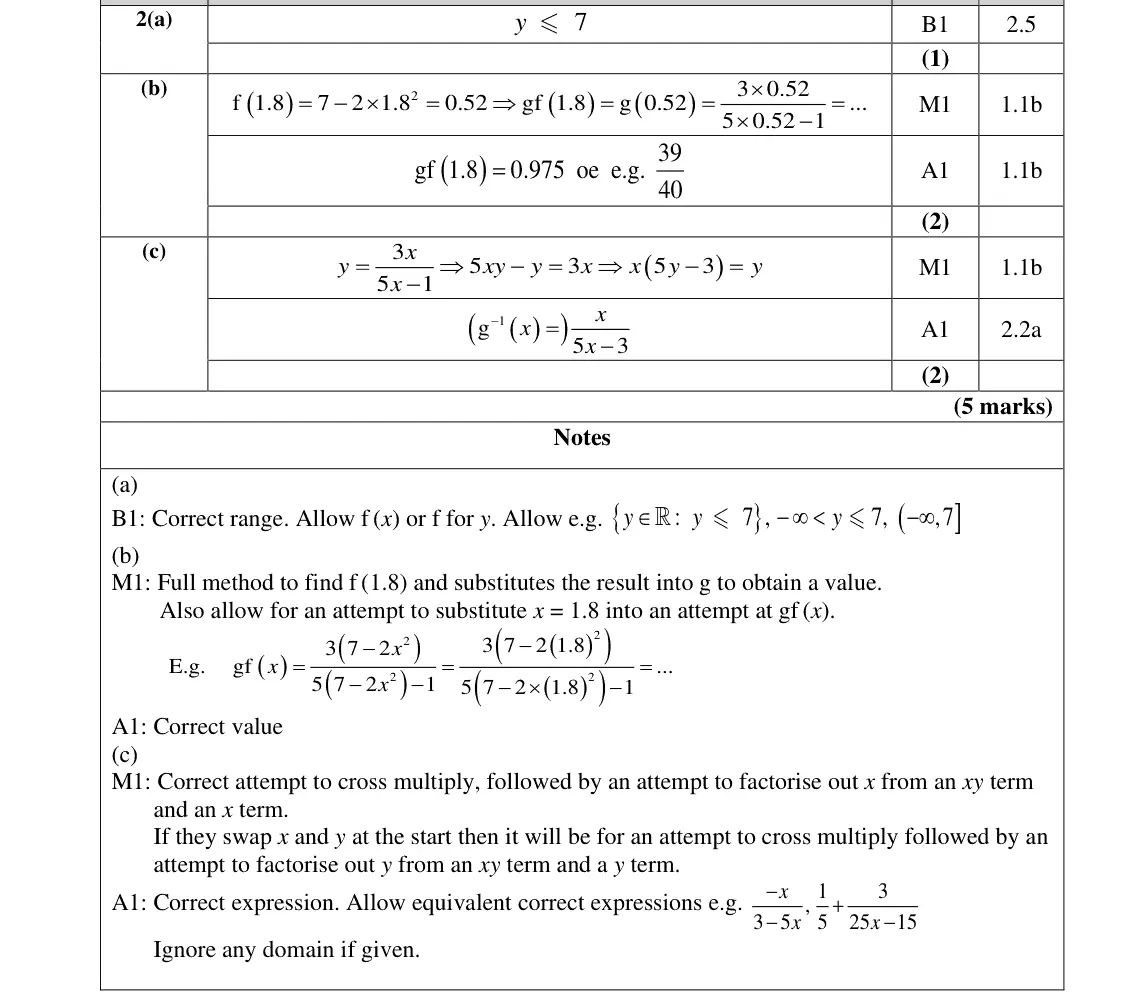
2(a) Functions, composite and inverse functions, modulus 1 —
2(b) Functions, composite and inverse functions, modulus 2 —
2(c) Functions, composite and inverse functions, modulus 2 —
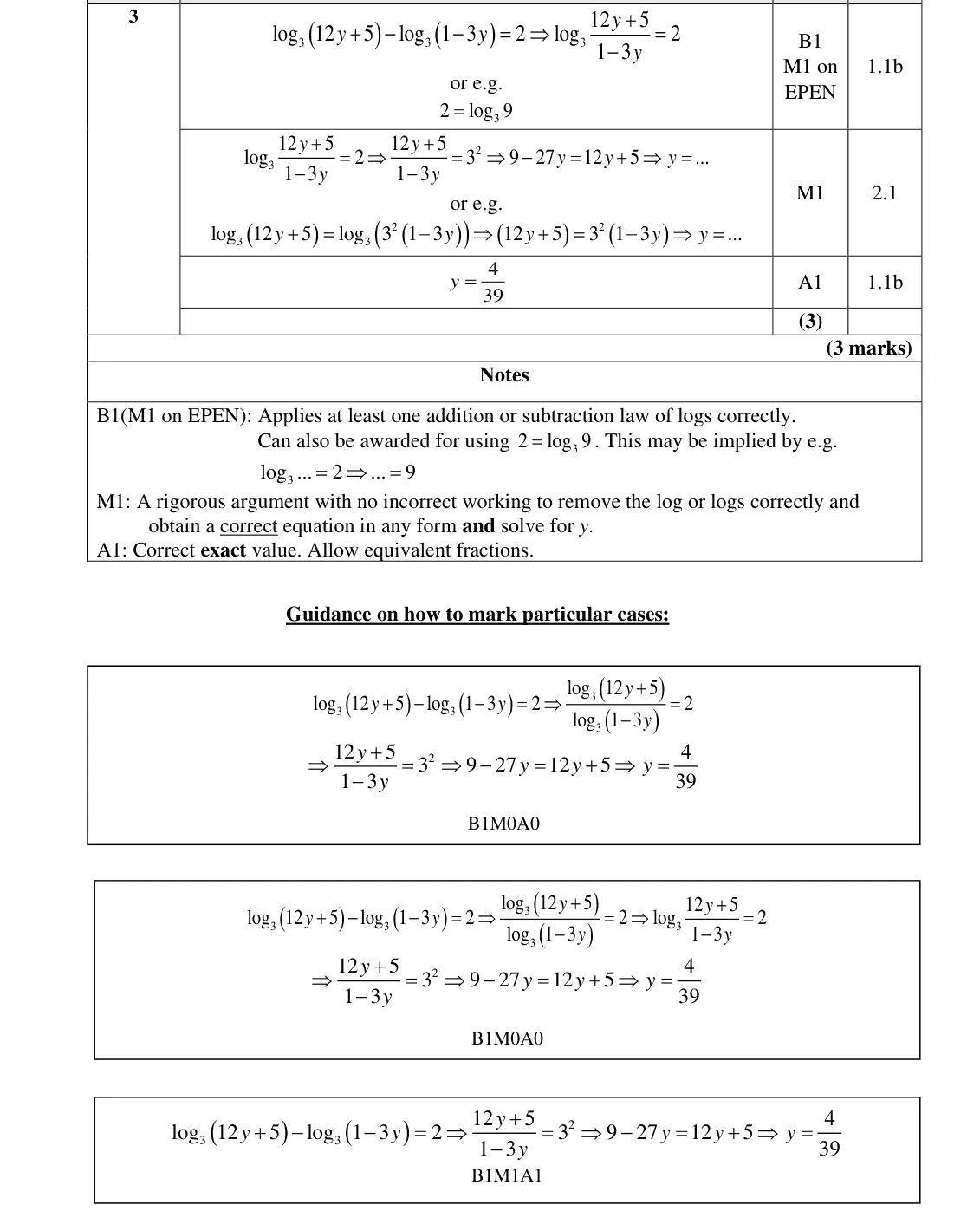
3 Exponentials and logarithms 3 —
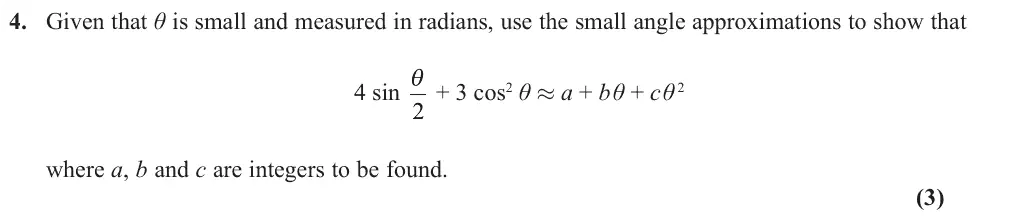
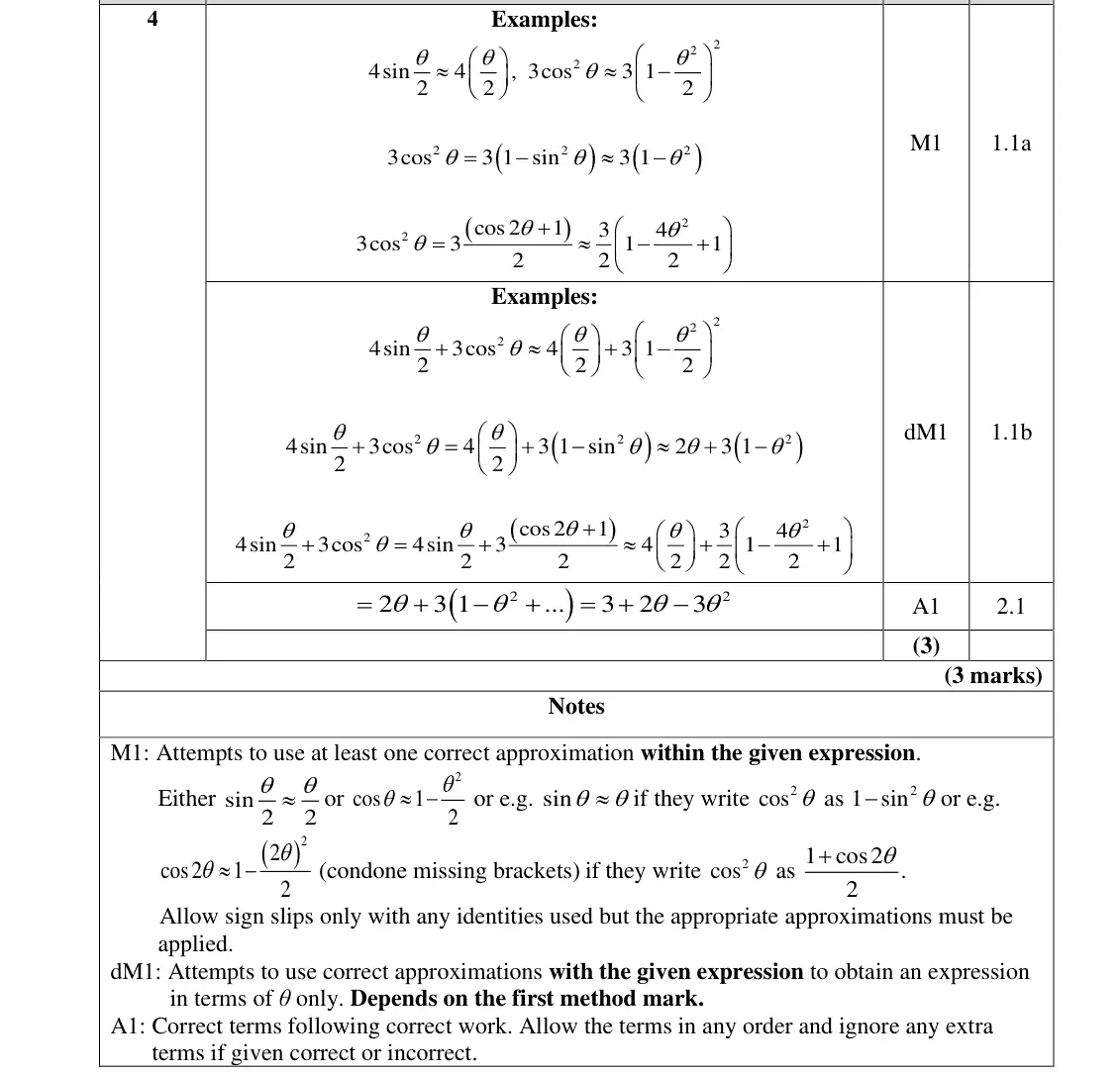
4 Small-angle approximations 3 —
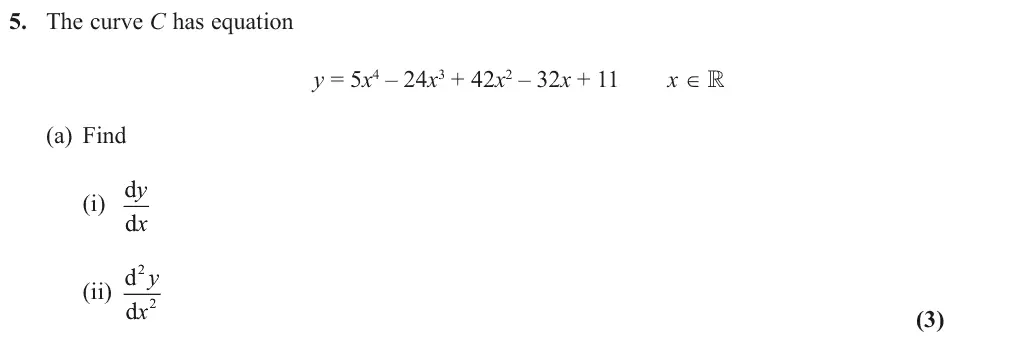
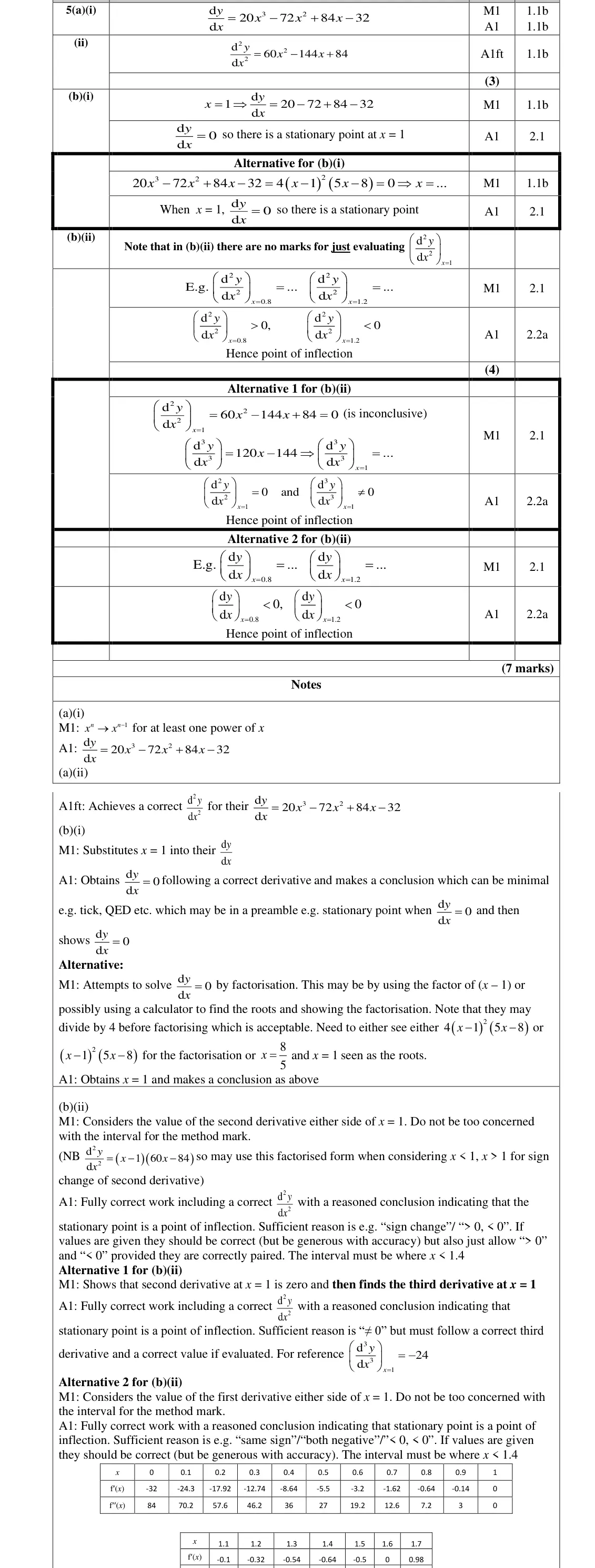
5(a) Differentiation: first principles, gradients, stationary points 3 —
5(b) Differentiation: first principles, gradients, stationary points 4 —
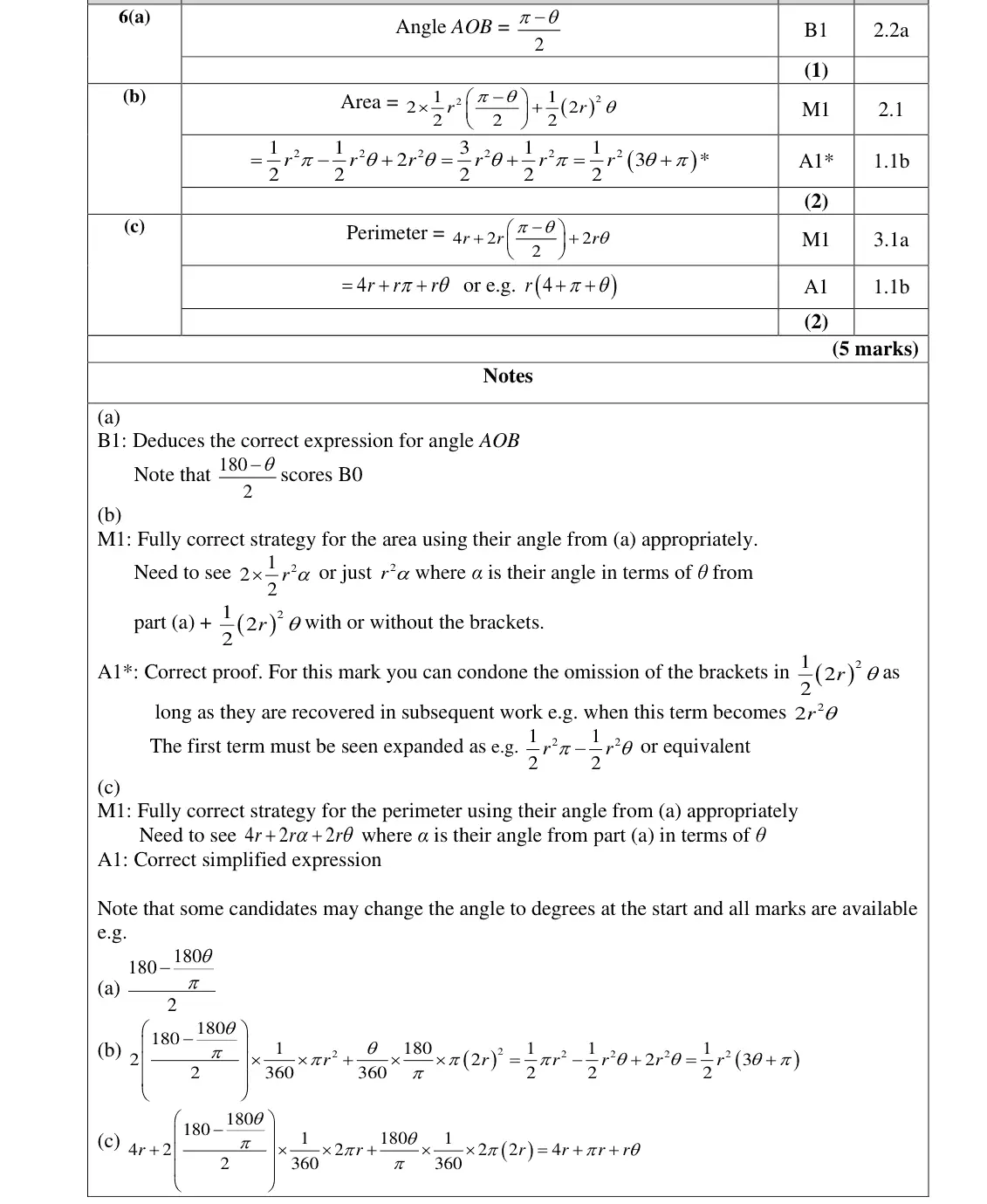
6(a) Trigonometric ratios, graphs, radians and the sine and cosine rules 1 Easy
6(b) Trigonometric ratios, graphs, radians and the sine and cosine rules 2 Medium
6(c) Trigonometric ratios, graphs, radians and the sine and cosine rules 2 Medium
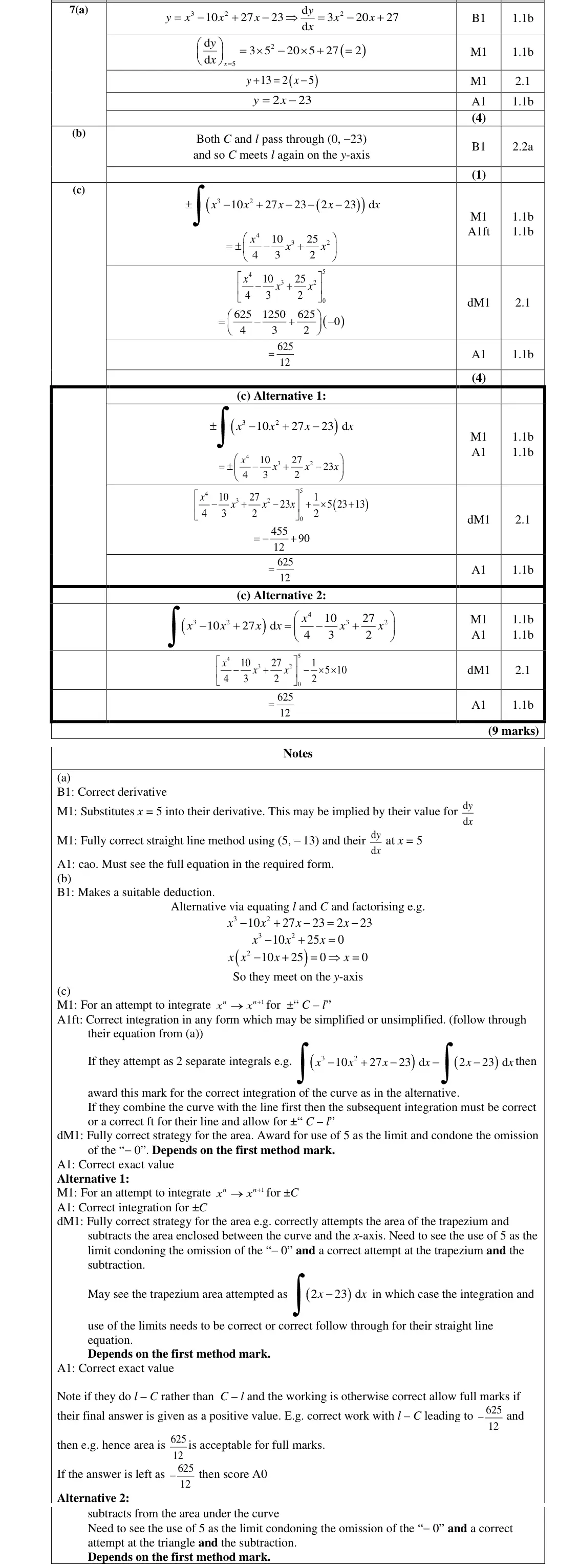
7(a) Differentiation: first principles, gradients, stationary points, Straight lines 4 —
7(b) Graphs and transformations, Straight lines 1 —
7(c) Integration: standard integrals, definite integrals and areas 4 —
8(a) Implicit and parametric differentiation, Chain, product and quotient rules; connected rates of change 4 —
8(b) Implicit and parametric differentiation, Simultaneous equations, Differentiation: first principles, gradients, stationary points 5 —
9 Sequences and series, Trigonometric ratios, graphs, radians and the sine and cosine rules 3 —
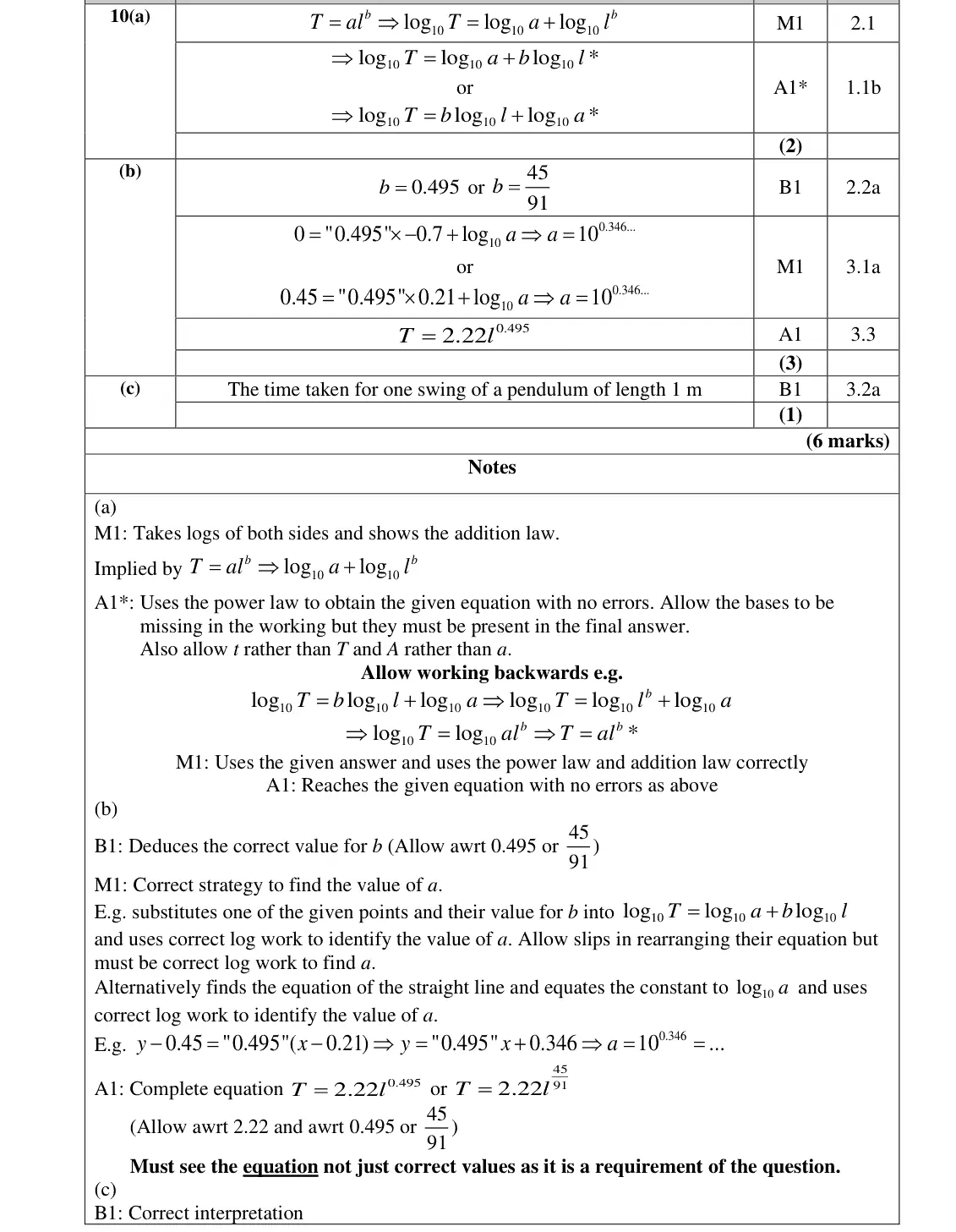
10(a) Exponentials and logarithms 2 —
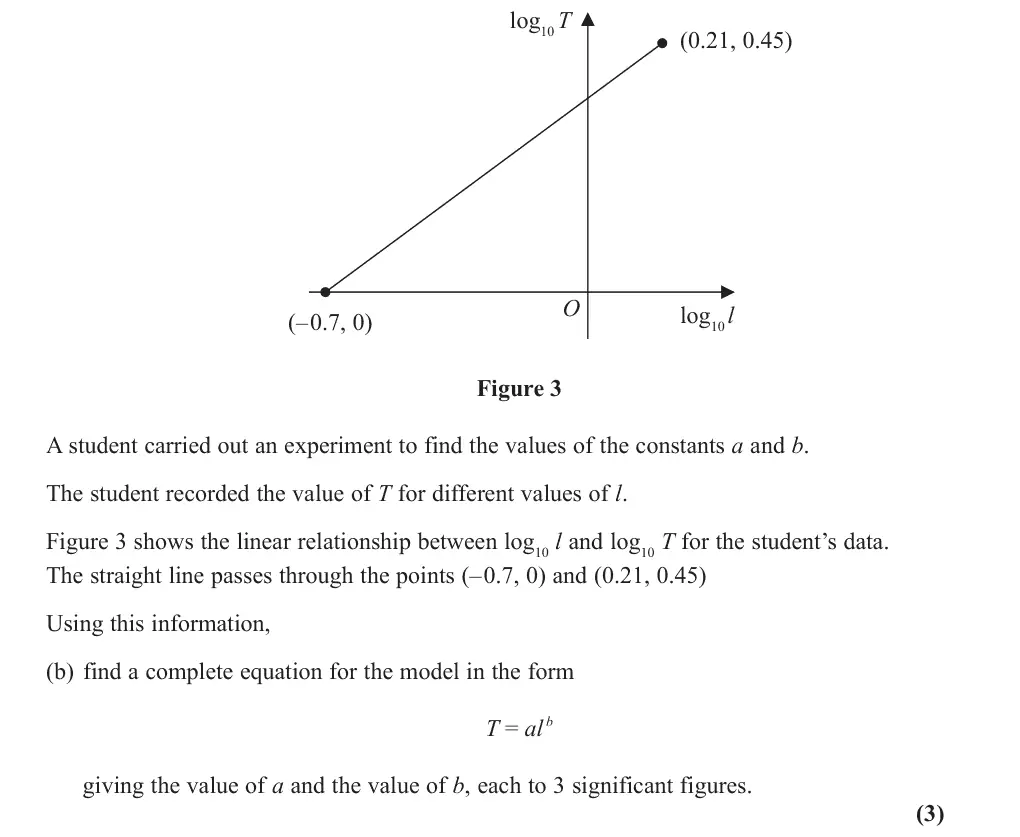
10(b) Exponentials and logarithms, Straight lines 3 —
10(c) Exponentials and logarithms 1 —
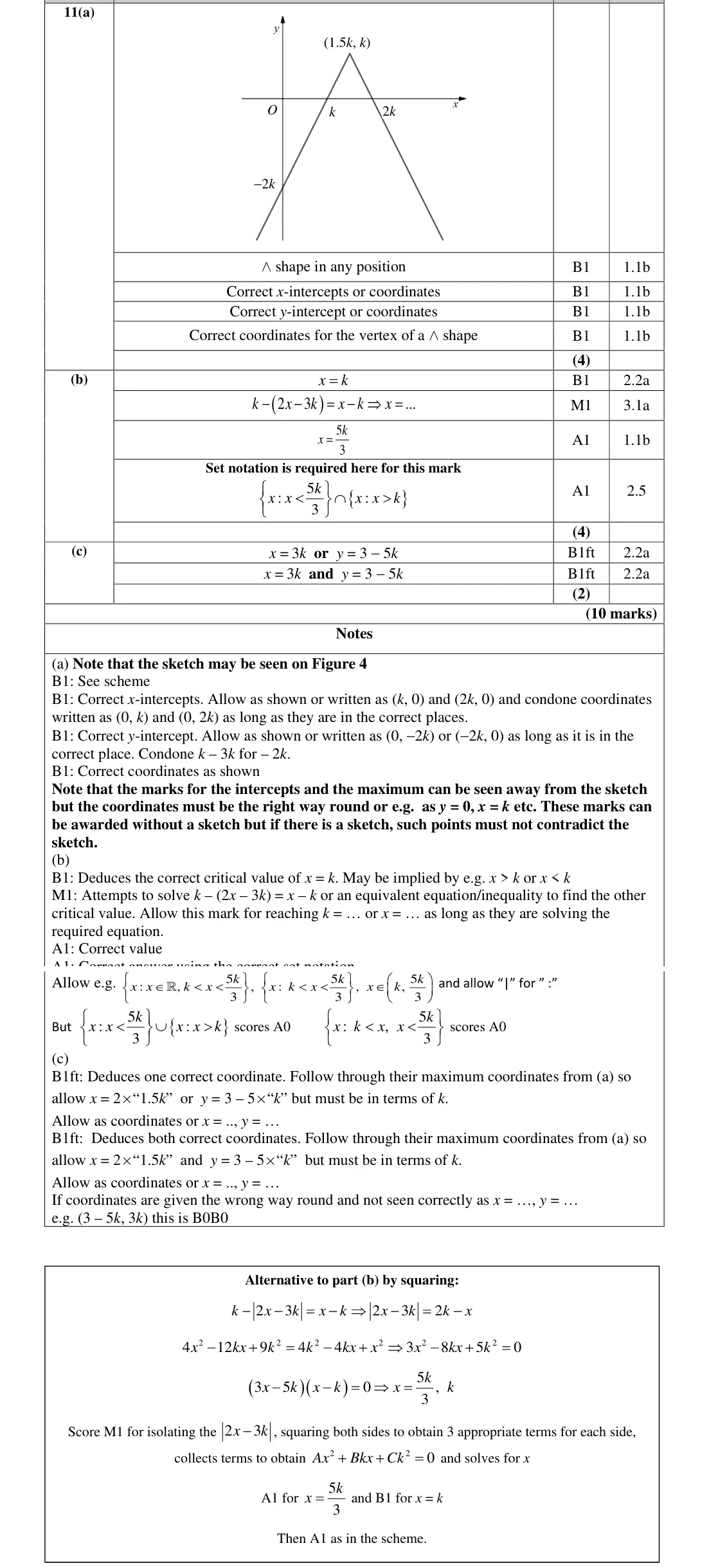
11(a) Graphs and transformations 4 —
11(b) Inequalities, Graphs and transformations 4 —
11(c) Graphs and transformations 2 —
12(a) Integration by parts and by substitution 3 —
12(b) Integration by parts and by substitution, Integration: standard integrals, definite integrals and areas, Algebraic methods: polynomials, factor theorem and division 4 —
13(a) Implicit and parametric differentiation, Chain, product and quotient rules; connected rates of change, Reciprocal and inverse trigonometric functions, Differentiation: first principles, gradients, stationary points 3 —
13(b) Implicit and parametric differentiation, Trigonometric ratios, graphs, radians and the sine and cosine rules, Reciprocal and inverse trigonometric functions 3 —
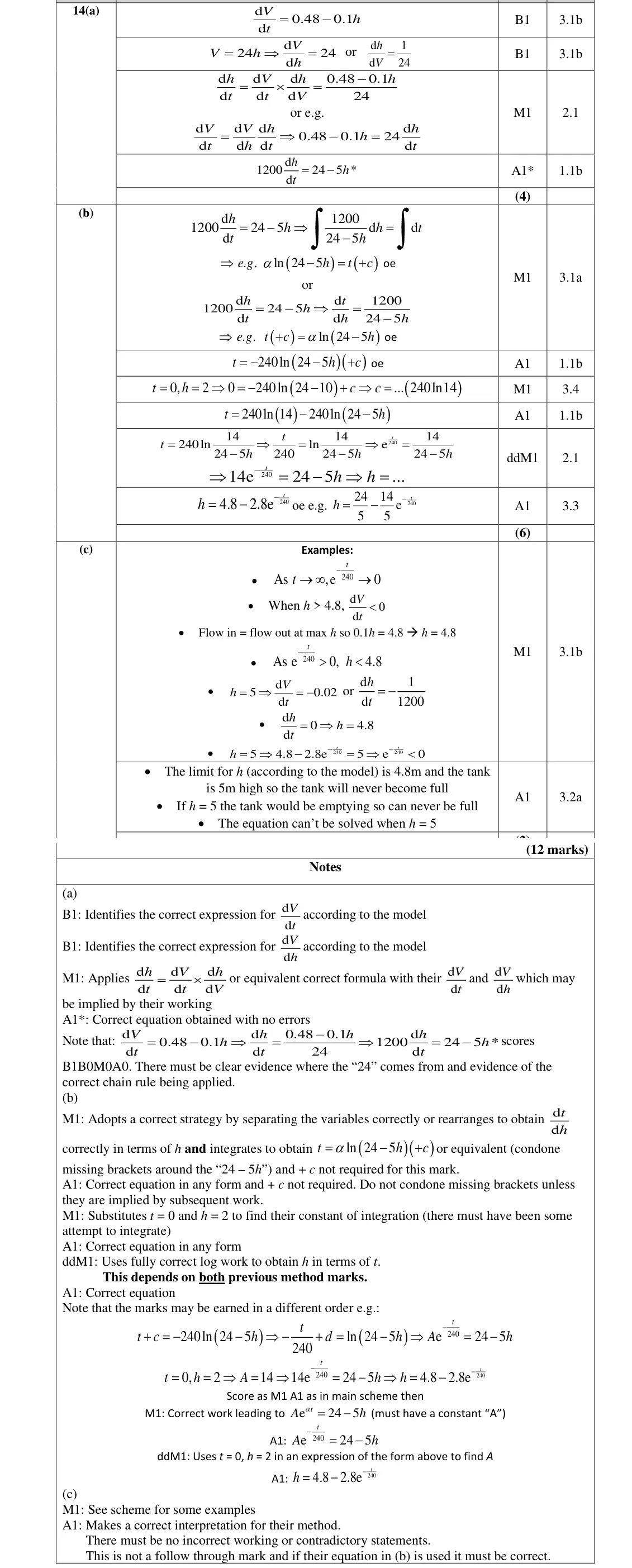
14(a) Differential equations, Chain, product and quotient rules; connected rates of change 4 —
14(b) Differential equations, Exponentials and logarithms, Partial fractions 6 —
14(c) Differential equations, Exponential growth, decay and modelling 2 —
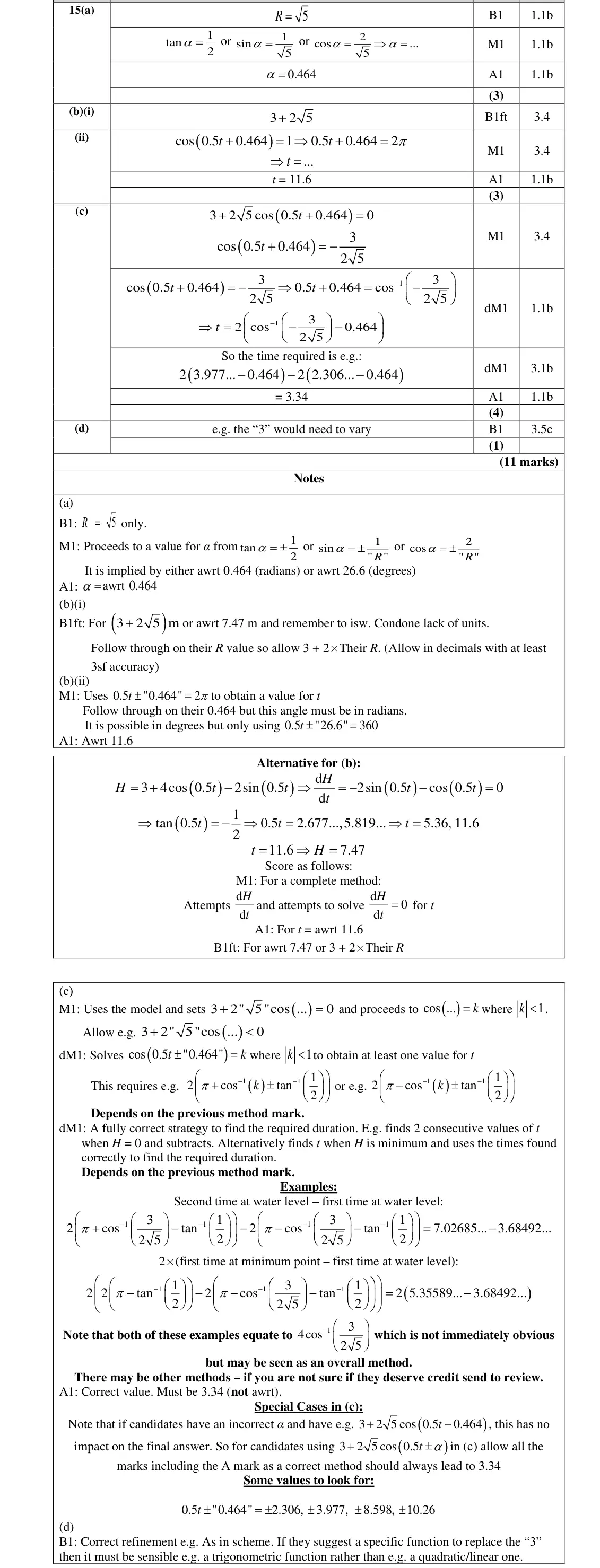
15(a) Addition and double-angle formulae, harmonic form 3 —
15(b) Trigonometric modelling, Addition and double-angle formulae, harmonic form, Trigonometric ratios, graphs, radians and the sine and cosine rules 3 —
15(c) Trigonometric modelling, Solving trigonometric equations, Addition and double-angle formulae, harmonic form 4 —
15(d) Trigonometric modelling, Functions, composite and inverse functions, modulus 1 —

The questions

1(a)1(b)2(a)2(b)2(c)345(a)5(b)6(a)6(b)6(c)7(a)7(b)7(c)8(a)8(b)910(a)10(b)10(c)11(a)11(b)11(c)12(a)12(b)13(a)13(b)14(a)14(b)14(c)15(a)15(b)15(c)15(d)
Oct 2021 · Paper 2 · Q1(a) 2 marks sequences and series
1. In an arithmetic series • the first term is 16 • the 21st term is 24 (a) Find the common difference of the series. (2)
Oct 2021 · Paper 2 · Q1(b) 2 marks sequences and series
(b) Hence find the sum of the first 500 terms of the series. (2)
Oct 2021 · Paper 2 · Q2(a) 1 mark functions
2. The functions f and g are defined by f (x) = 7 – 2x2 x Î x g (x) = 3 x - x Î x ≠1 (a) State the range of f (1)
Oct 2021 · Paper 2 · Q2(b) 2 marks functions
(b) Find gf (1.8) (2)
Oct 2021 · Paper 2 · Q2(c) 2 marks functions
(c) Find g–1(x) (2)
Oct 2021 · Paper 2 · Q3 3 marks exponentials and logs
3. Using the laws of logarithms, solve the equation log3 (12y + 5) – log3 (1 – 3y) = 2 (3)
Oct 2021 · Paper 2 · Q4 3 marks small angle approximations
4. Given that theta is small and measured in radians, use the small angle approximations to show that 4 sin theta 2 + 3 cos2 theta » a + b theta + c theta 2 where a, b and c are integers to be found. (3)
Oct 2021 · Paper 2 · Q5(a) 3 marks differentiation
5. The curve C has equation y = 5x4 – 24x3 + 42x2 – 32x + 11 x ∈ (a) Find (i) d y d x y (ii) d x d (3)
Oct 2021 · Paper 2 · Q5(b) 4 marks differentiation
(b) (i) Verify that C has a stationary point at x = 1 (ii) Show that this stationary point is a point of inflection, giving reasons for your answer. (4)
Oct 2021 · Paper 2 · Q6(a) 1 mark Easy trigonometric ratios
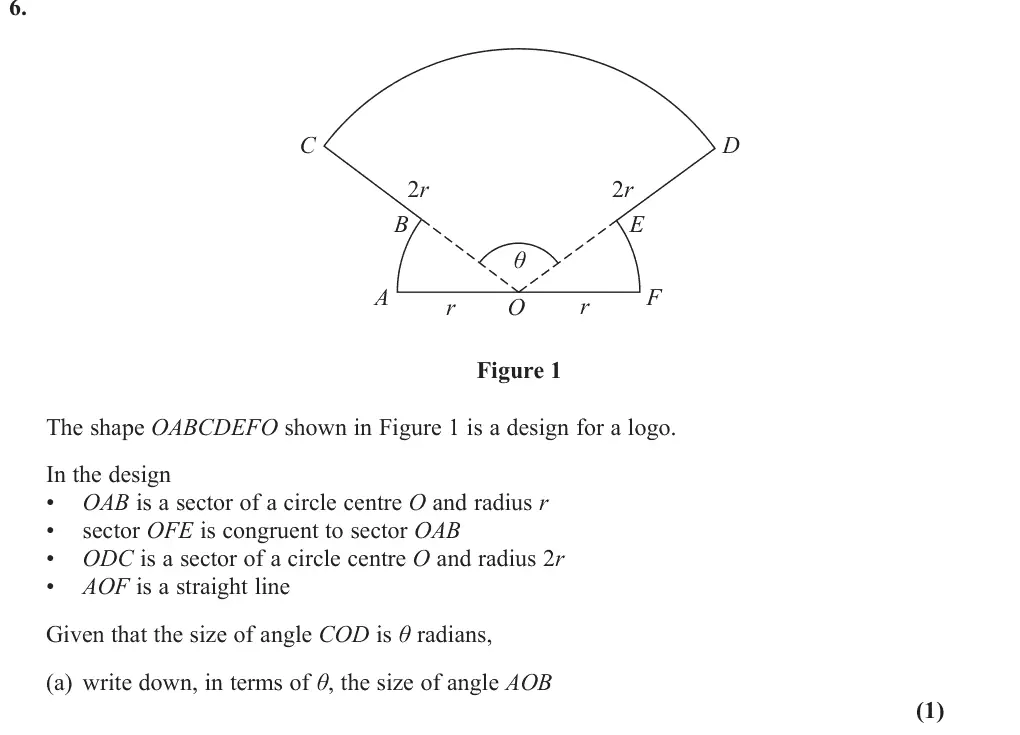
6. C 2r 2r B E theta A F r r Figure 1 The shape OABCDEFO shown in Figure 1 is a design for a logo. In the design • OAB is a sector of a circle centre O and radius r • sector OFE is congruent to sector OAB • ODC is a sector of a circle centre O and radius 2r • AOF is a straight line Given that the size of angle COD is theta radians, (a) write down, in terms of theta , the size of angle AOB (1)
Oct 2021 · Paper 2 · Q6(b) 2 marks Medium trigonometric ratios
(b) Show that the area of the logo is 2 r2 (3 theta + pi ) (2)
Oct 2021 · Paper 2 · Q6(c) 2 marks Medium trigonometric ratios
(c) Find the perimeter of the logo, giving your answer in simplest form in terms of r, theta and pi . (2)
Oct 2021 · Paper 2 · Q7(a) 4 marks differentiationstraight lines
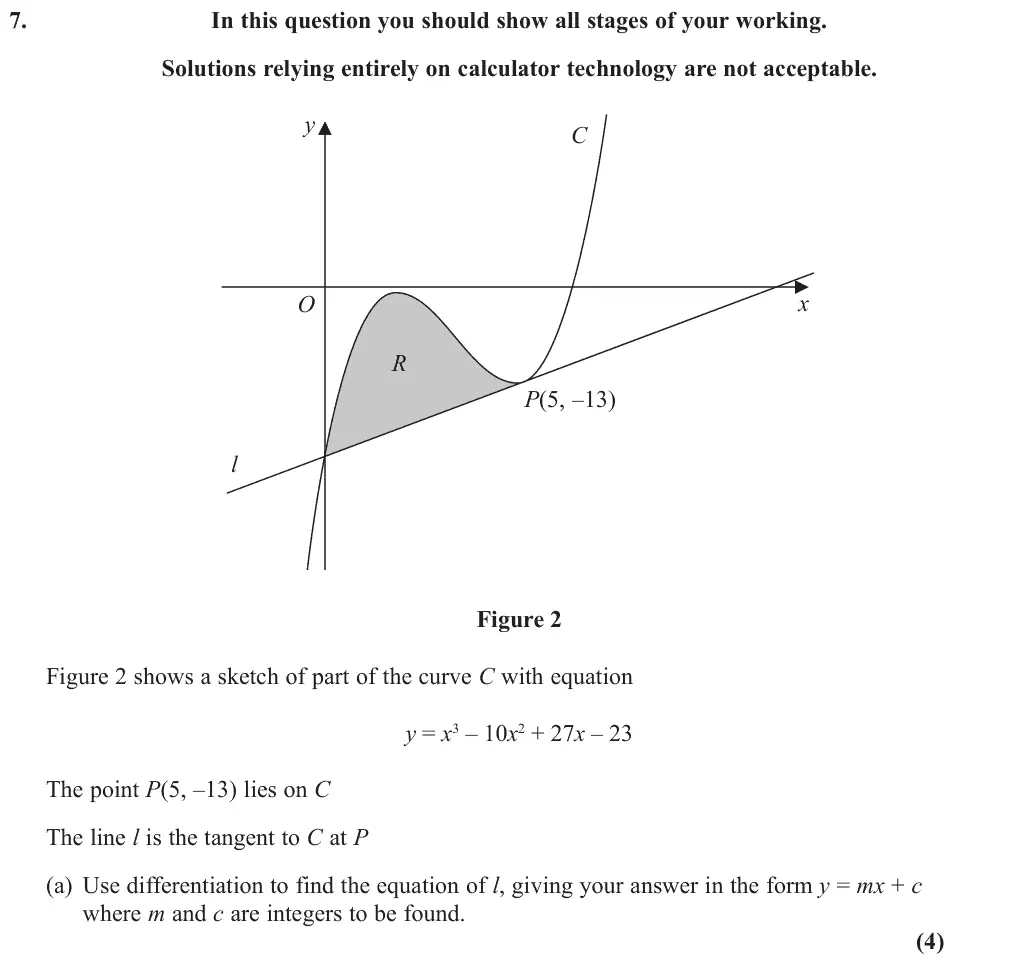
7. In this question you should show all stages of your working. Solutions relying entirely on calculator technology are not acceptable. y C x R P(5, –13) l Figure 2 Figure 2 shows a sketch of part of the curve C with equation y = x3 – 10x2 + 27x – 23 The point P(5, –13) lies on C The line l is the tangent to C at P (a) Use differentiation to find the equation of l, giving your answer in the form y = mx + c where m and c are integers to be found. (4)
Oct 2021 · Paper 2 · Q7(b) 1 mark graphs and transformationsstraight lines
(b) Hence verify that l meets C again on the y-axis. (1)
Oct 2021 · Paper 2 · Q7(c) 4 marks integration
The finite region R, shown shaded in Figure 2, is bounded by the curve C and the line l. (c) Use algebraic integration to find the exact area of R. (4)
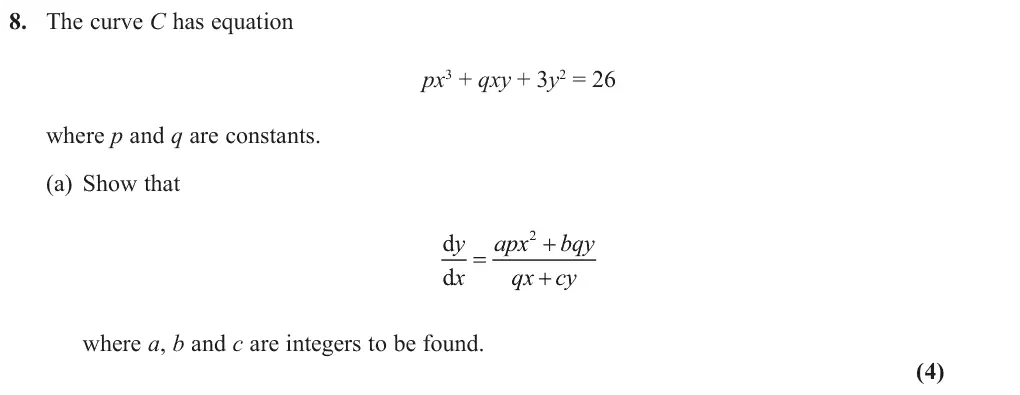
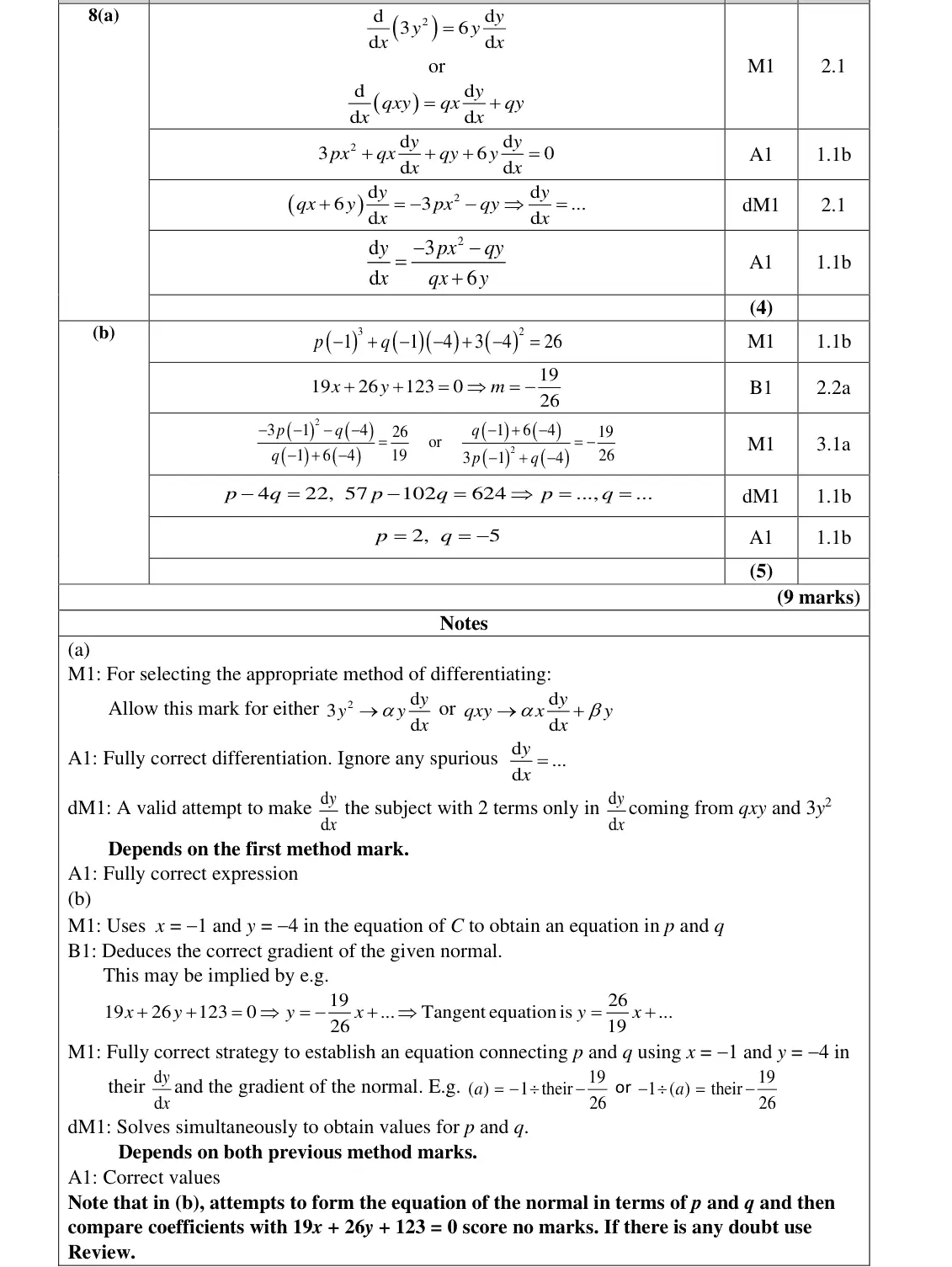
8. The curve C has equation px3 + qxy + 3y2 = 26 where p and q are constants. (a) Show that y apx bqy d x qx cy d where a, b and c are integers to be found. (4)
Given that • the point P (–1, – 4) lies on C • the normal to C at P has equation 19x + 26y + 123 = 0 (b) find the value of p and the value of q. (5)
Oct 2021 · Paper 2 · Q9 3 marks sequences and seriestrigonometric ratios
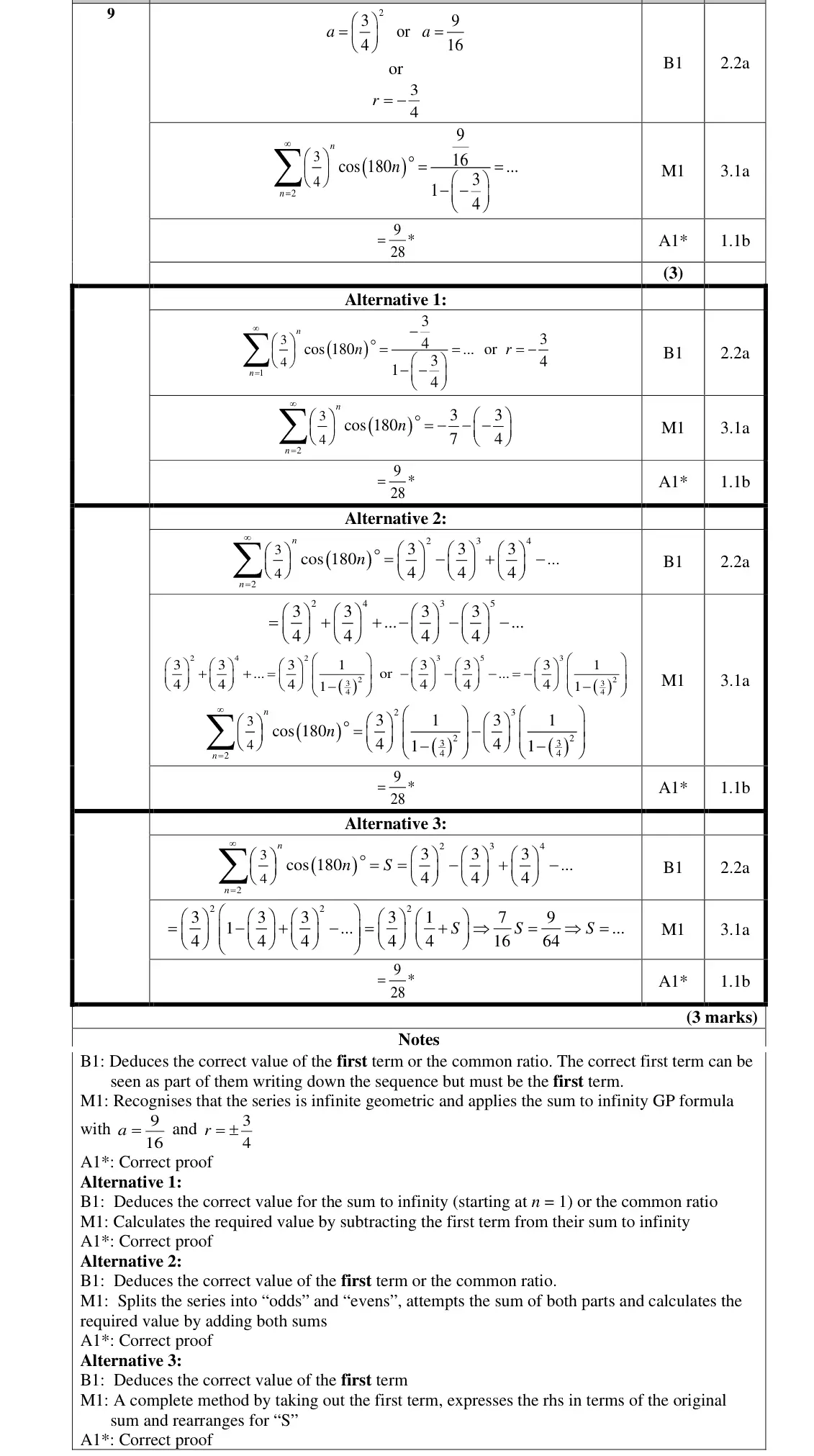
9. Show that ∞ ∑ n ( ) = n cos n = 2 (3)
Oct 2021 · Paper 2 · Q10(a) 2 marks exponentials and logs
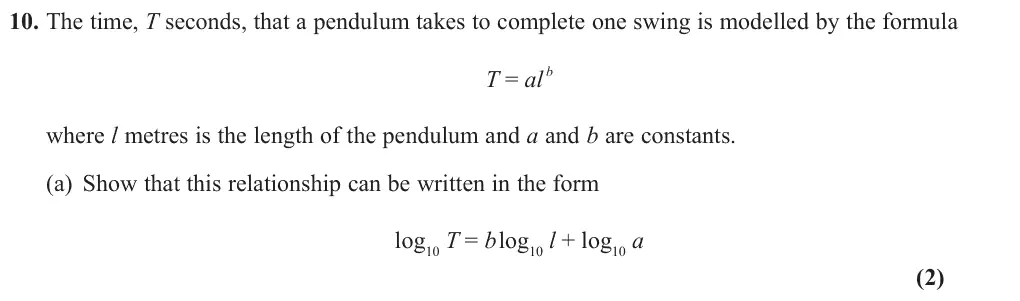
10. The time, T seconds, that a pendulum takes to complete one swing is modelled by the formula T = al b where l metres is the length of the pendulum and a and b are constants. (a) Show that this relationship can be written in the form log10 T = b log10 l + log10 a (2)
Oct 2021 · Paper 2 · Q10(b) 3 marks exponentials and logsstraight lines
log10 T (0.21, 0.45) log10 l (– 0.7, 0) Figure 3 A student carried out an experiment to find the values of the constants a and b. The student recorded the value of T for different values of l. Figure 3 shows the linear relationship between log10 l and log10 T for the student’s data. The straight line passes through the points (– 0.7, 0) and (0.21, 0.45) Using this information, (b) find a complete equation for the model in the form T = al b giving the value of a and the value of b, each to 3 significant figures. (3)
Oct 2021 · Paper 2 · Q10(c) 1 mark exponentials and logs
(c) With reference to the model, interpret the value of the constant a. (1)
Oct 2021 · Paper 2 · Q11(a) 4 marks graphs and transformations
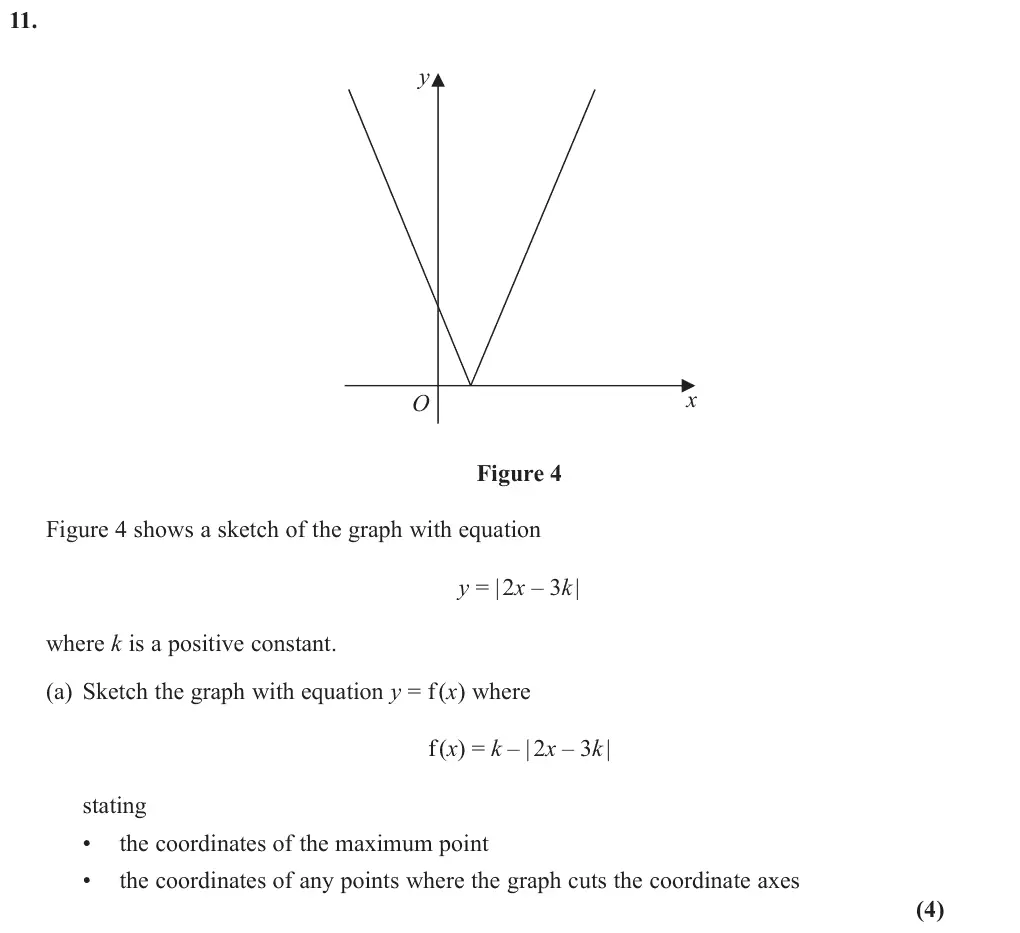
11. y x Figure 4 Figure 4 shows a sketch of the graph with equation y = | 2x – 3k | where k is a positive constant. (a) Sketch the graph with equation y = f (x) where f (x) = k – | 2x – 3k | stating • the coordinates of the maximum point • the coordinates of any points where the graph cuts the coordinate axes (4)
Oct 2021 · Paper 2 · Q11(b) 4 marks inequalitiesgraphs and transformations
(b) Find, in terms of k, the set of values of x for which k – | 2x – 3k | > x – k giving your answer in set notation. (4)
Oct 2021 · Paper 2 · Q11(c) 2 marks graphs and transformations
(c) Find, in terms of k, the coordinates of the minimum point of the graph with equation < y = 3 – 5f 1 2 x ;: (2)

Oct 2021 · Paper 2 · Q12(a) 3 marks integration by parts and substitution
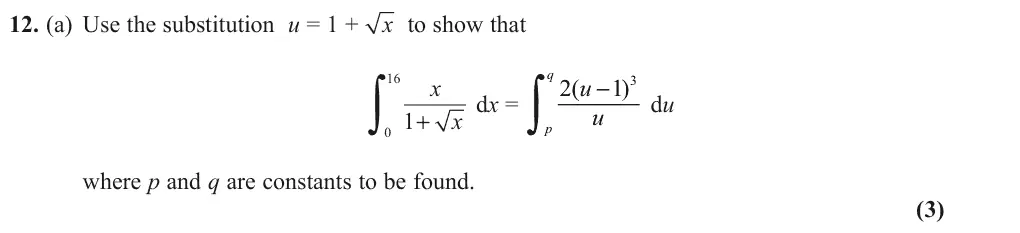
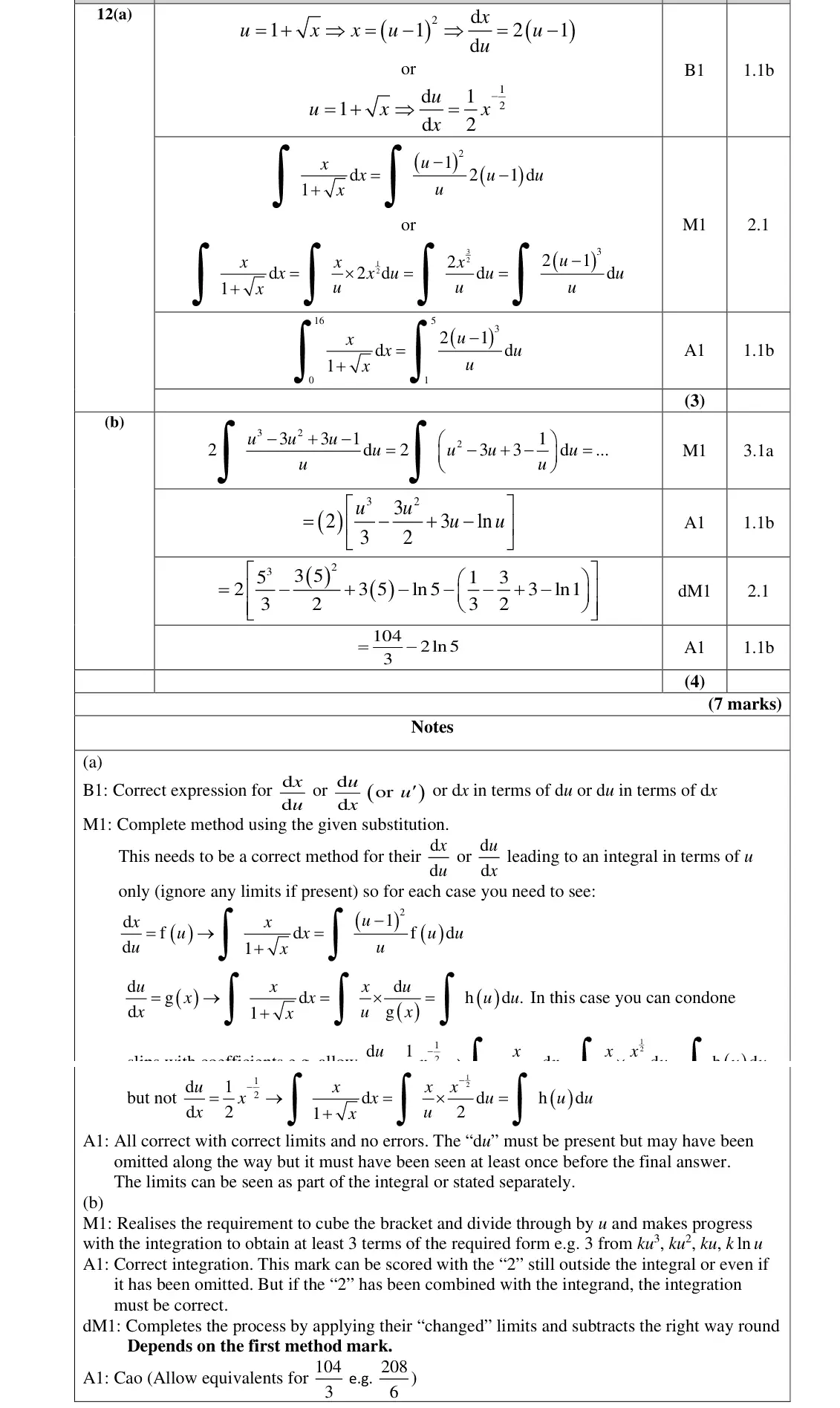
12. (a) Use the substitution u = 1 + x to show that q ∫ ∫ x u - 1 3 ( ) dx = du u + x p where p and q are constants to be found. (3)
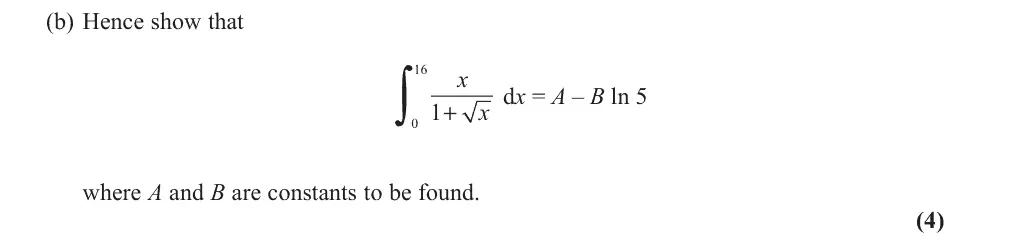
(b) Hence show that ∫ x dx = A – B ln 5 x + where A and B are constants to be found. (4)
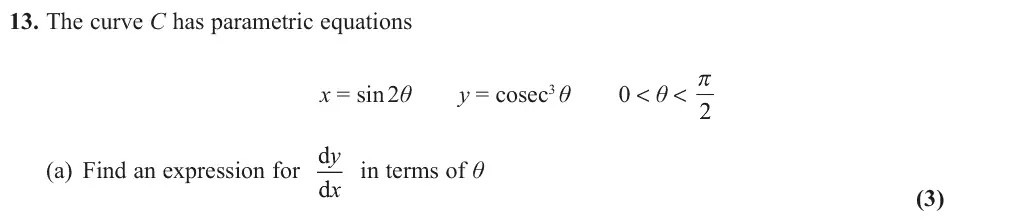
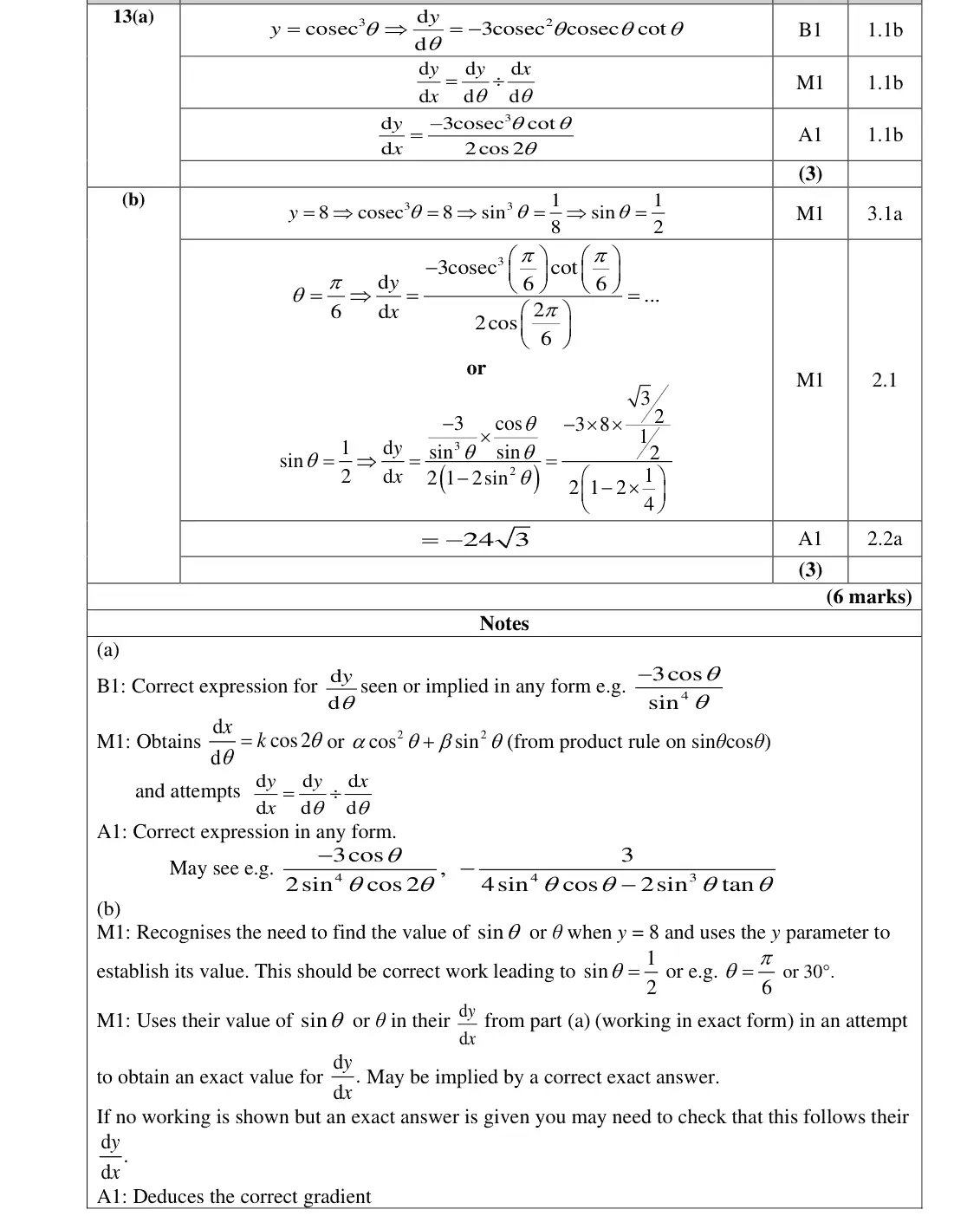
13. The curve C has parametric equations x = sin 2 theta y = cosec3 theta 0 < theta < pi (a) Find an expression for d y x in terms of theta d (3)
(b) Hence find the exact value of the gradient of the tangent to C at the point where y = 8 (3)
Oct 2021 · Paper 2 · Q14(a) 4 marks differential equationsdifferentiation rules
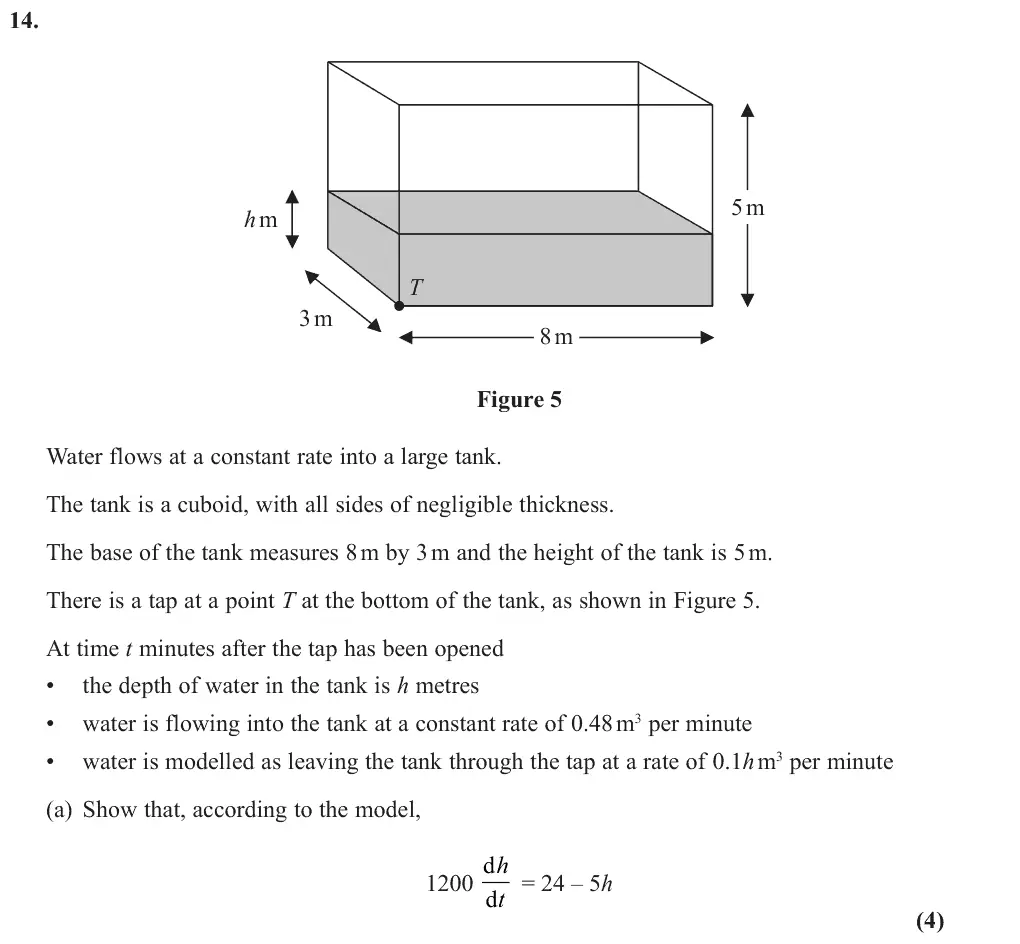
14. 5 m h m T 3 m 8 m Figure 5 Water flows at a constant rate into a large tank. The tank is a cuboid, with all sides of negligible thickness. The base of the tank measures 8 m by 3 m and the height of the tank is 5 m. There is a tap at a point T at the bottom of the tank, as shown in Figure 5. At time t minutes after the tap has been opened • the depth of water in the tank is h metres • water is flowing into the tank at a constant rate of 0.48 m3 per minute • water is modelled as leaving the tank through the tap at a rate of 0.1h m3 per minute (a) Show that, according to the model, 1200 d h t = 24 – 5h d (4)
Oct 2021 · Paper 2 · Q14(b) 6 marks differential equationsexponentials and logspartial fractions
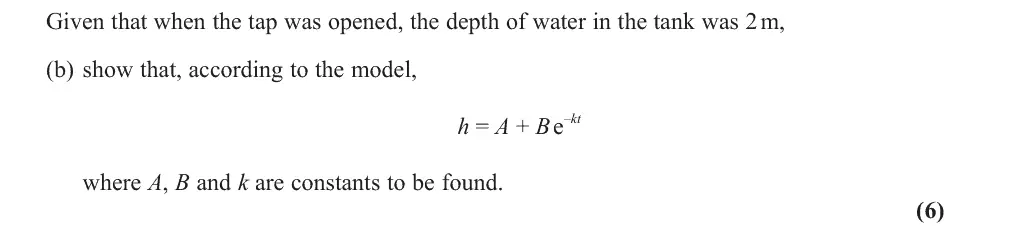
Given that when the tap was opened, the depth of water in the tank was 2 m, (b) show that, according to the model, h = A + B e–kt where A, B and k are constants to be found. (6)
Oct 2021 · Paper 2 · Q14(c) 2 marks differential equationsexponential modelling
Given that the tap remains open, (c) determine, according to the model, whether the tank will ever become full, giving a reason for your answer. (2)
Oct 2021 · Paper 2 · Q15(a) 3 marks double angle formulae
15. (a) Express 2cos theta – sin theta in the form R cos ( theta + alpha ), where R > 0 and 0 < alpha < pi Give the exact value of R and the value of alpha in radians to 3 decimal places. (3)
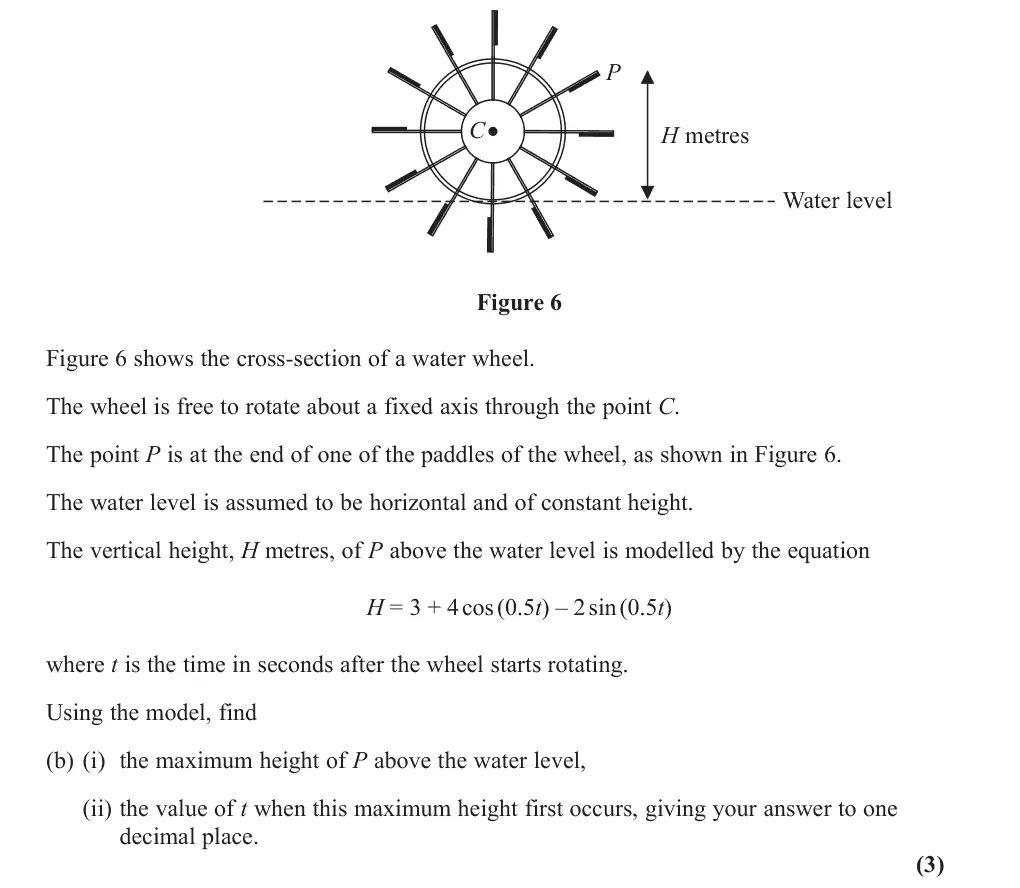
P C H metres Water level Figure 6 Figure 6 shows the cross-section of a water wheel. The wheel is free to rotate about a fixed axis through the point C. The point P is at the end of one of the paddles of the wheel, as shown in Figure 6. The water level is assumed to be horizontal and of constant height. The vertical height, H metres, of P above the water level is modelled by the equation H = 3 + 4 cos (0.5t) – 2 sin (0.5t) where t is the time in seconds after the wheel starts rotating. Using the model, find (b) (i) the maximum height of P above the water level, (ii) the value of t when this maximum height first occurs, giving your answer to one decimal place. (3)
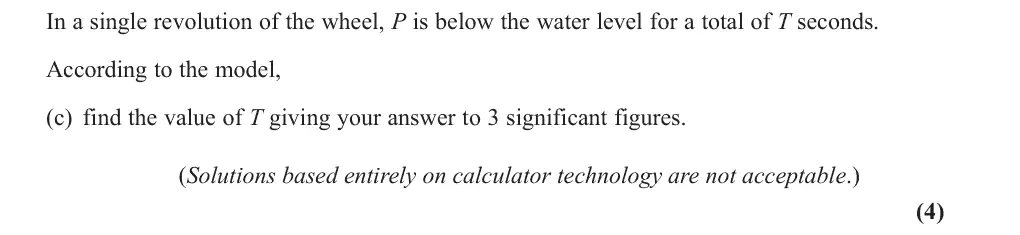
In a single revolution of the wheel, P is below the water level for a total of T seconds. According to the model, (c) find the value of T giving your answer to 3 significant figures. (Solutions based entirely on calculator technology are not acceptable.) (4)
Oct 2021 · Paper 2 · Q15(d) 1 mark trigonometric modellingfunctions
In reality, the water level may not be of constant height. (d) Explain how the equation of the model should be refined to take this into account. (1)

Find an Edexcel maths tutor

Want this paper marked and gone through with you? Message us.

Prefer email? Send an enquiry

If you are under 18, please include a parent's contact details. Enquiries go to enquiries@mathsaleveltutor.com and are deleted once handled.