June 2022: Paper 2: Pure Mathematics 2

100 marks · 34 question parts · Question paper, mark scheme and examiner's report on Pearson's site

Question by question

QTopicMarksDifficulty
1 Graphs and transformations 4 —
2(a) Exponentials and logarithms 2 —
2(b) Exponentials and logarithms 2 —
3(a) Sequences and series 2 —
3(b) Sequences and series 2 —
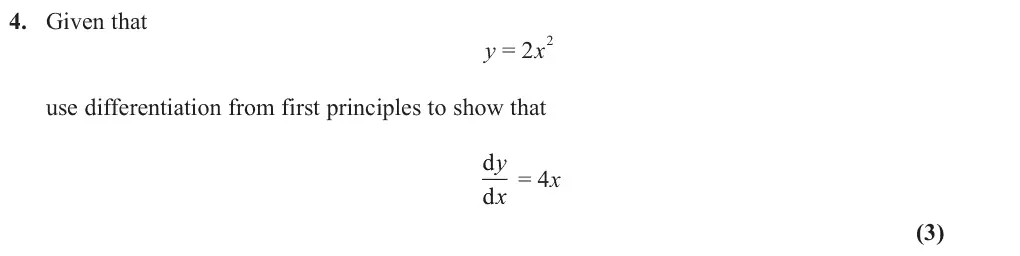
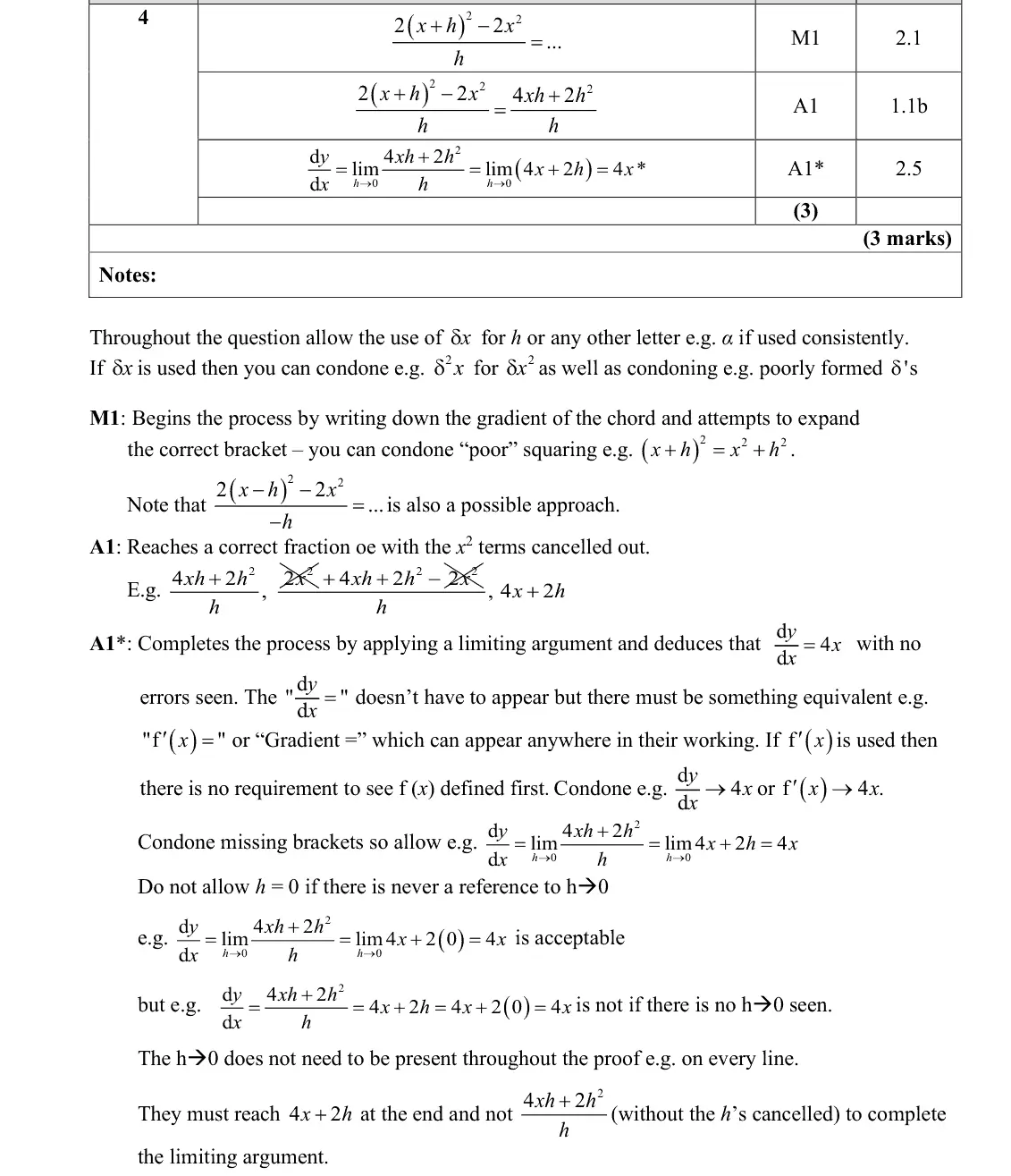
4 Differentiation: first principles, gradients, stationary points, Proof, including contradiction 3 —
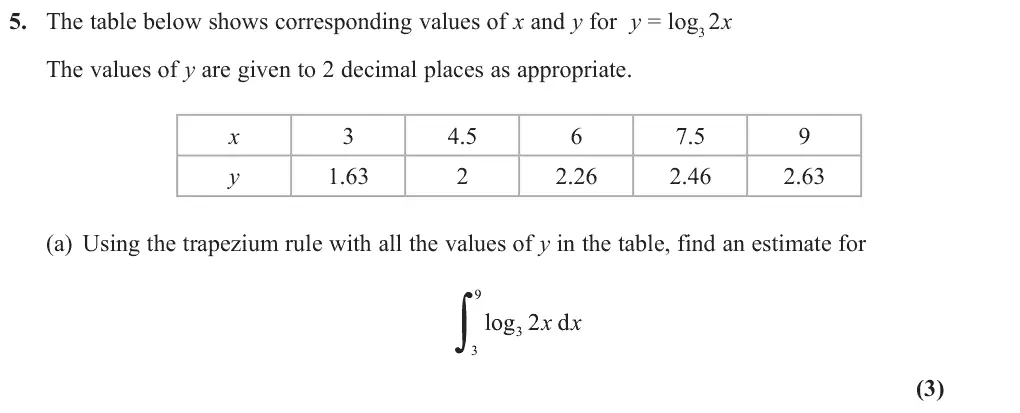
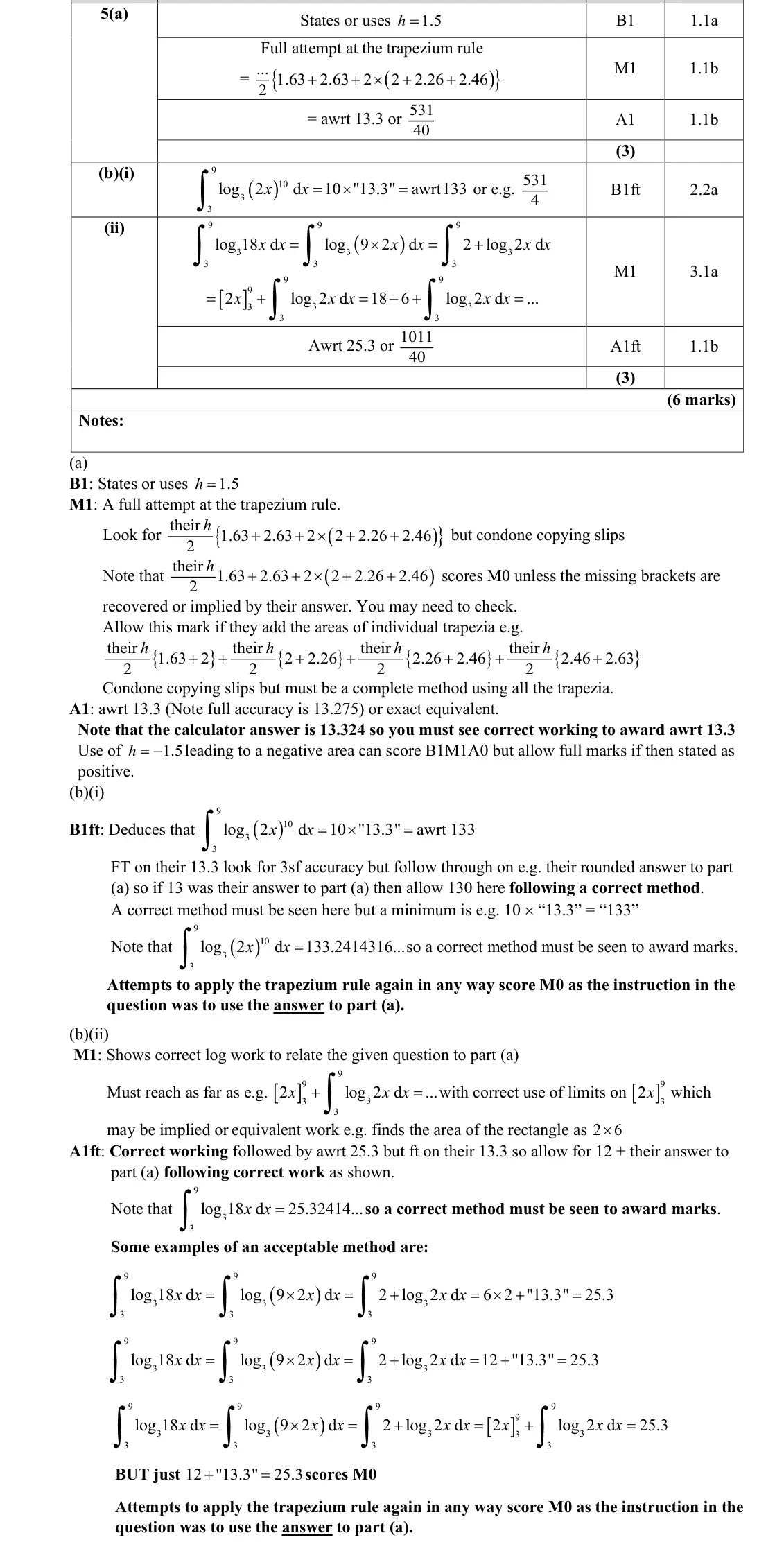
5(a) Trapezium rule 3 —
5(b) Trapezium rule, Exponentials and logarithms, Integration: standard integrals, definite integrals and areas 3 —
6(a) Differentiation: first principles, gradients, stationary points, Solving trigonometric equations, Trigonometric ratios, graphs, radians and the sine and cosine rules 4 —
6(b) Numerical methods: roots, iteration and Newton–Raphson 1 —
6(c) Numerical methods: roots, iteration and Newton–Raphson, Differentiation: first principles, gradients, stationary points 2 —
7(a) Binomial expansion 4 —
7(b) Binomial expansion 1 —
8 Integration: standard integrals, definite integrals and areas, Indices and surds 6 —
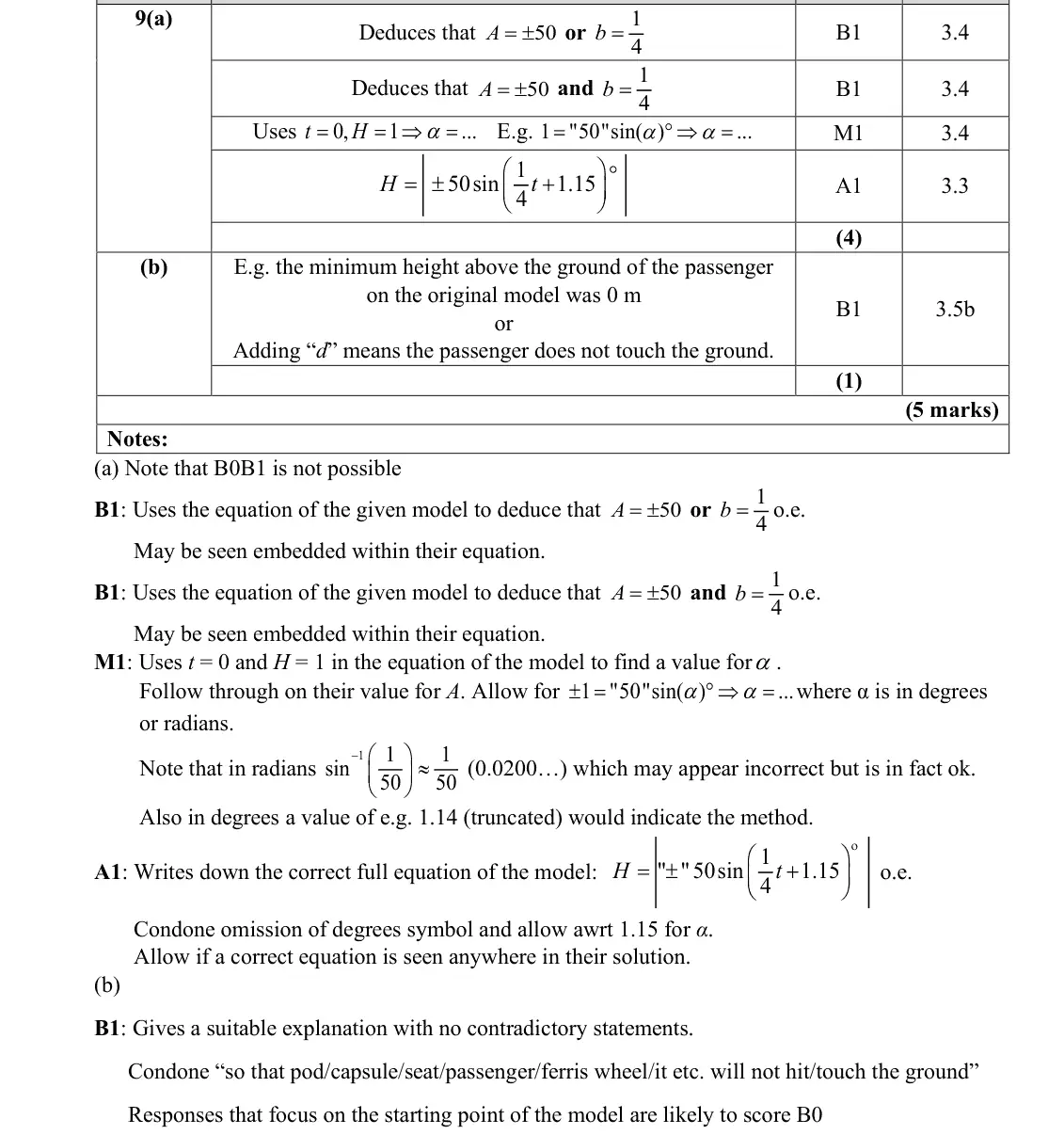
9(a) Trigonometric modelling, Functions, composite and inverse functions, modulus, Trigonometric ratios, graphs, radians and the sine and cosine rules 4 —
9(b) Functions, composite and inverse functions, modulus, Trigonometric modelling 1 —
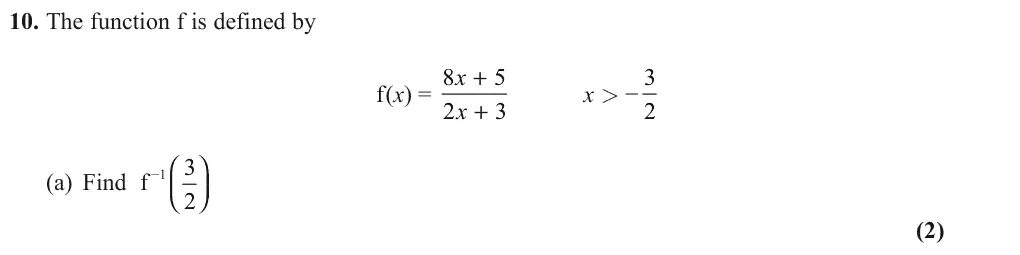
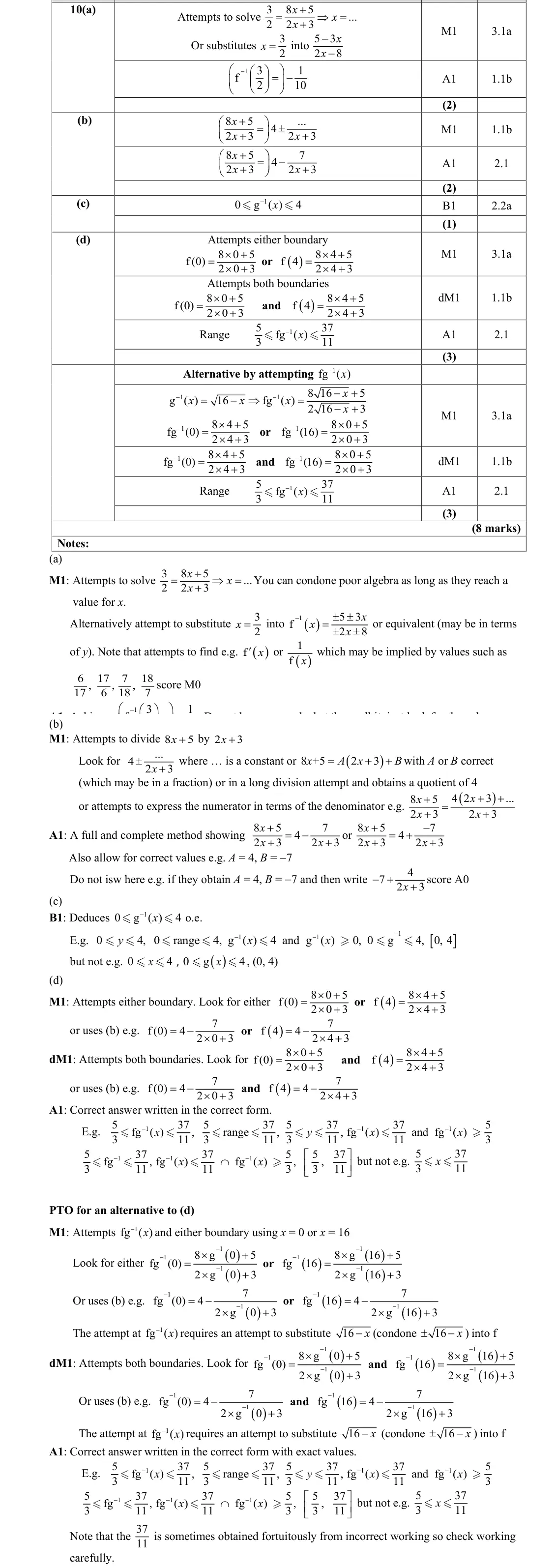
10(a) Functions, composite and inverse functions, modulus 2 —
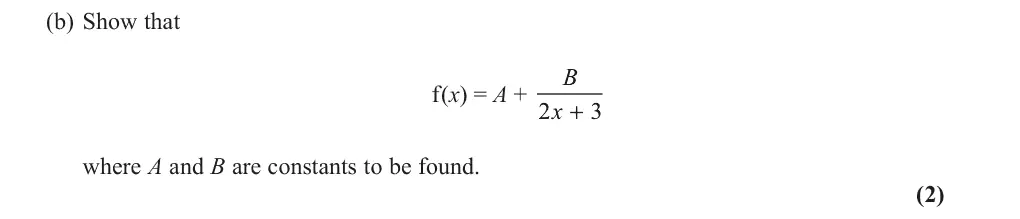
10(b) Algebraic methods: polynomials, factor theorem and division 2 —
10(c) Functions, composite and inverse functions, modulus 1 —
10(d) Functions, composite and inverse functions, modulus, Algebraic methods: polynomials, factor theorem and division 3 —
11 Proof, including contradiction, Algebraic methods: polynomials, factor theorem and division 4 —
12(a) Chain, product and quotient rules; connected rates of change, Differentiation: first principles, gradients, stationary points 3 —

12(b) Differentiation: first principles, gradients, stationary points, Quadratics and the discriminant, Inequalities 3 —
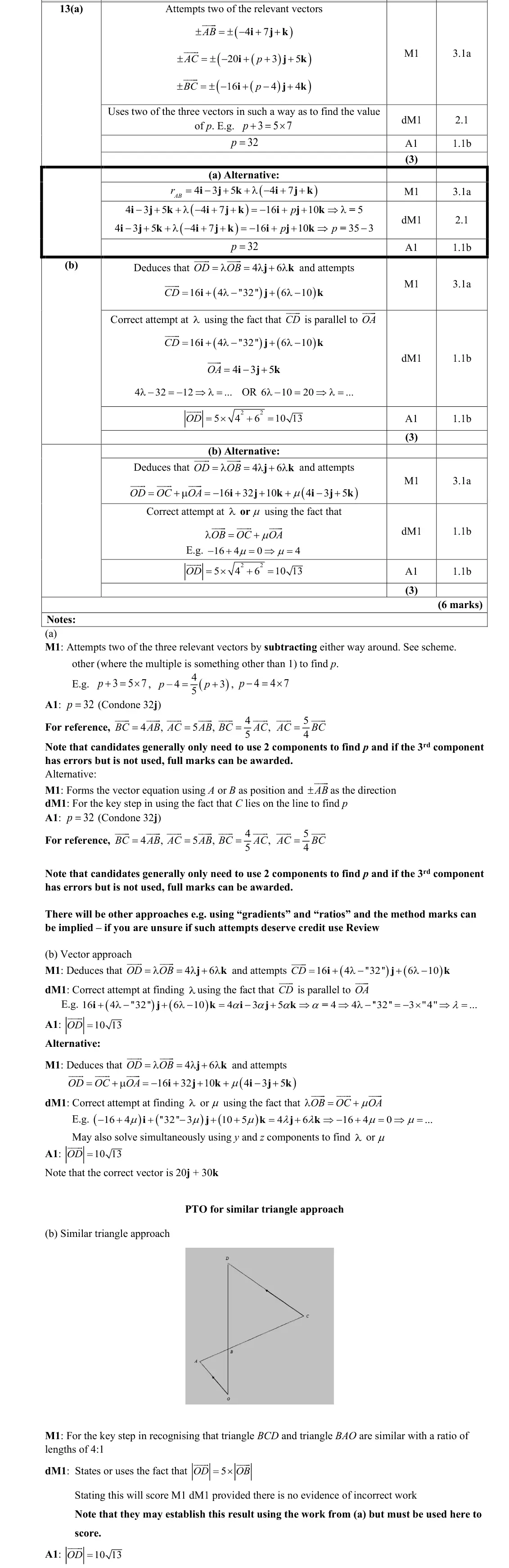
13(a) Vectors 3 —
13(b) Vectors, Indices and surds 3 —
14(a) Partial fractions 3 —
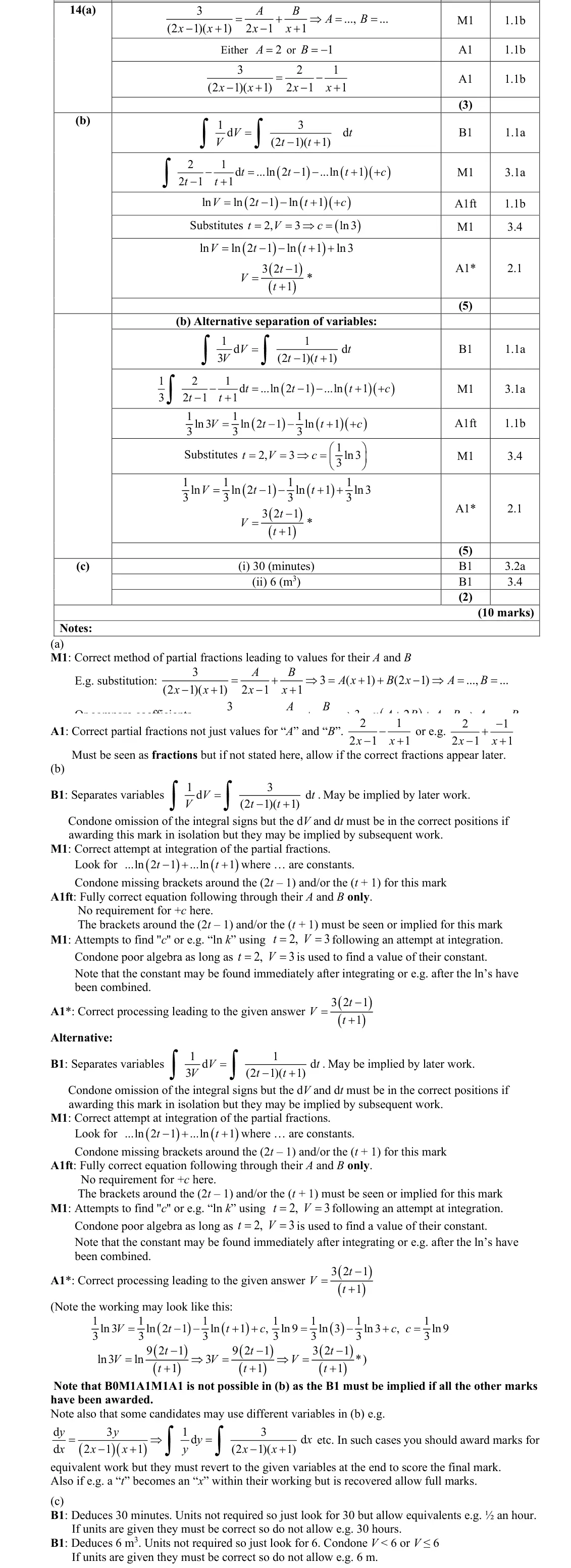
14(b) Differential equations, Partial fractions, Exponentials and logarithms 5 —
14(c) Differential equations, Functions, composite and inverse functions, modulus 2 —
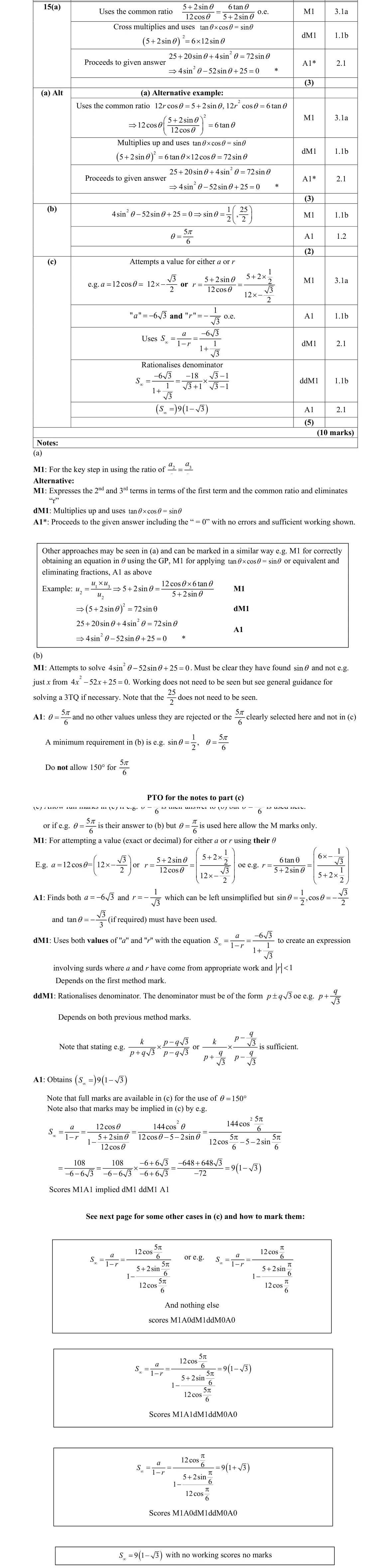
15(a) Sequences and series, Trigonometric identities and proofs 3 —
15(b) Solving trigonometric equations, Quadratics and the discriminant, Trigonometric ratios, graphs, radians and the sine and cosine rules 2 —
15(c) Sequences and series, Indices and surds, Trigonometric ratios, graphs, radians and the sine and cosine rules 5 —
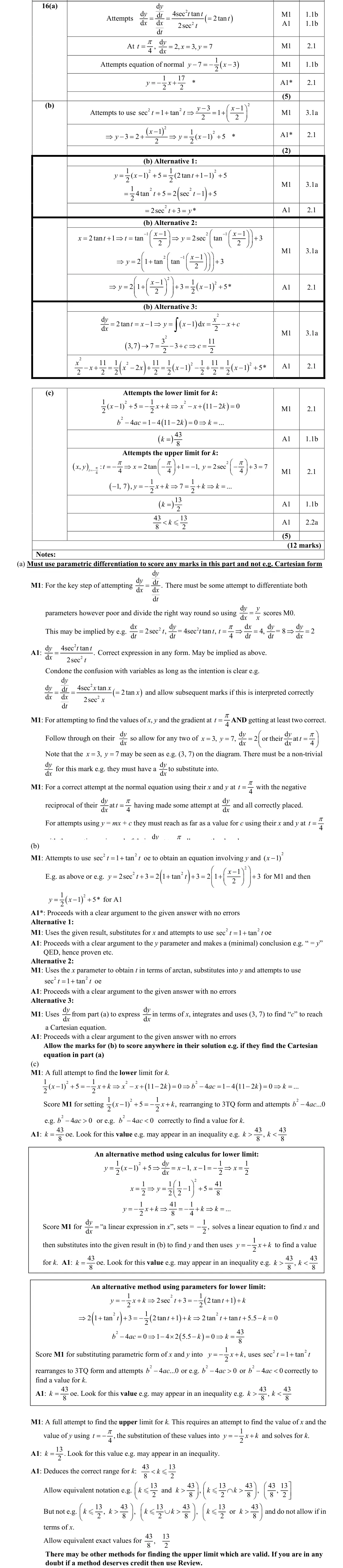
16(a) Implicit and parametric differentiation, Straight lines, Chain, product and quotient rules; connected rates of change 5 —
16(b) Parametric equations, Trigonometric identities and proofs 2 —
16(c) Quadratics and the discriminant, Inequalities, Parametric equations, Straight lines 5 —

The questions

12(a)2(b)3(a)3(b)45(a)5(b)6(a)6(b)6(c)7(a)7(b)89(a)9(b)10(a)10(b)10(c)10(d)1112(a)12(b)13(a)13(b)14(a)14(b)14(c)15(a)15(b)15(c)16(a)16(b)16(c)
June 2022 · Paper 2 · Q1 4 marks graphs and transformations
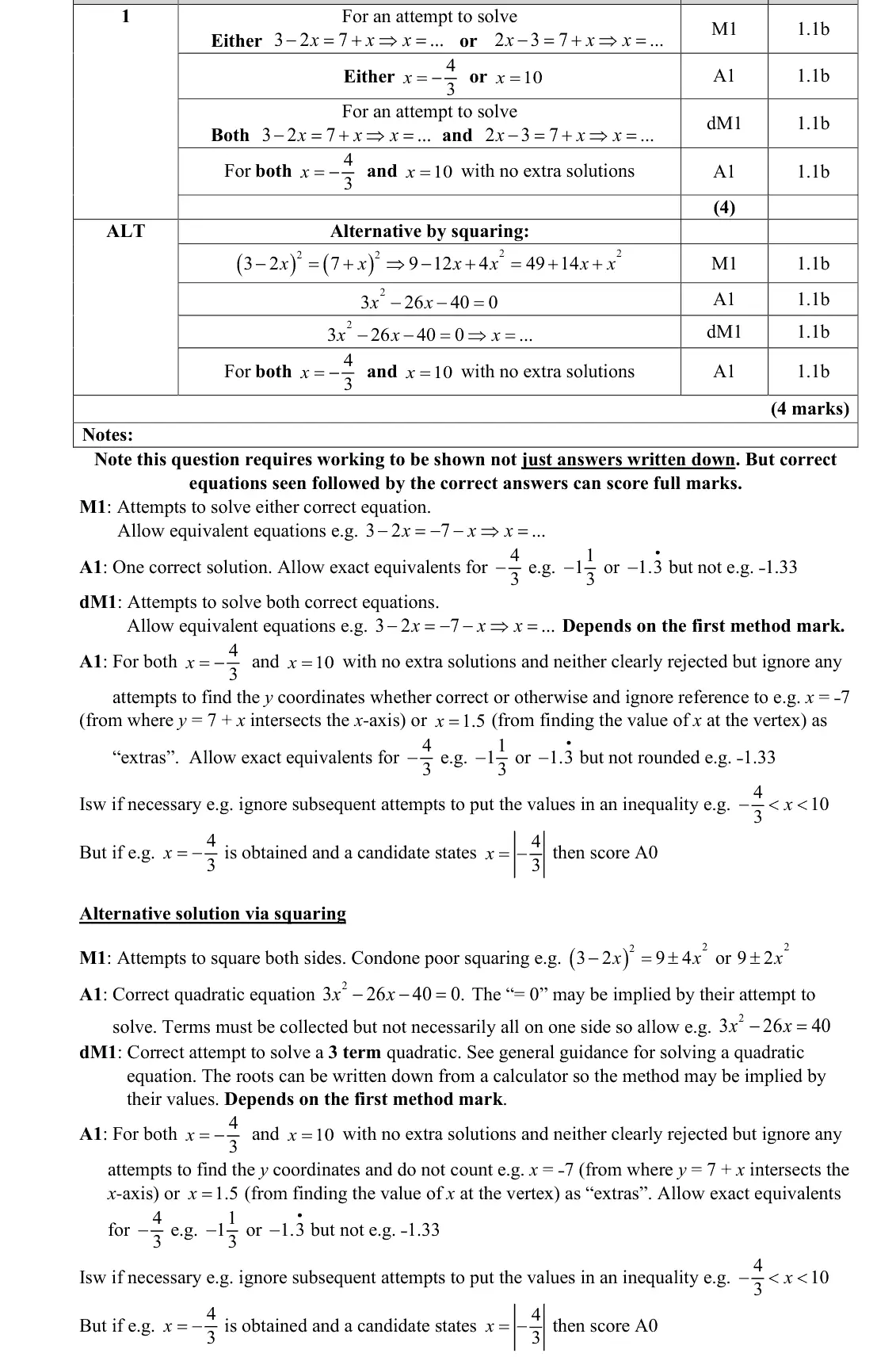
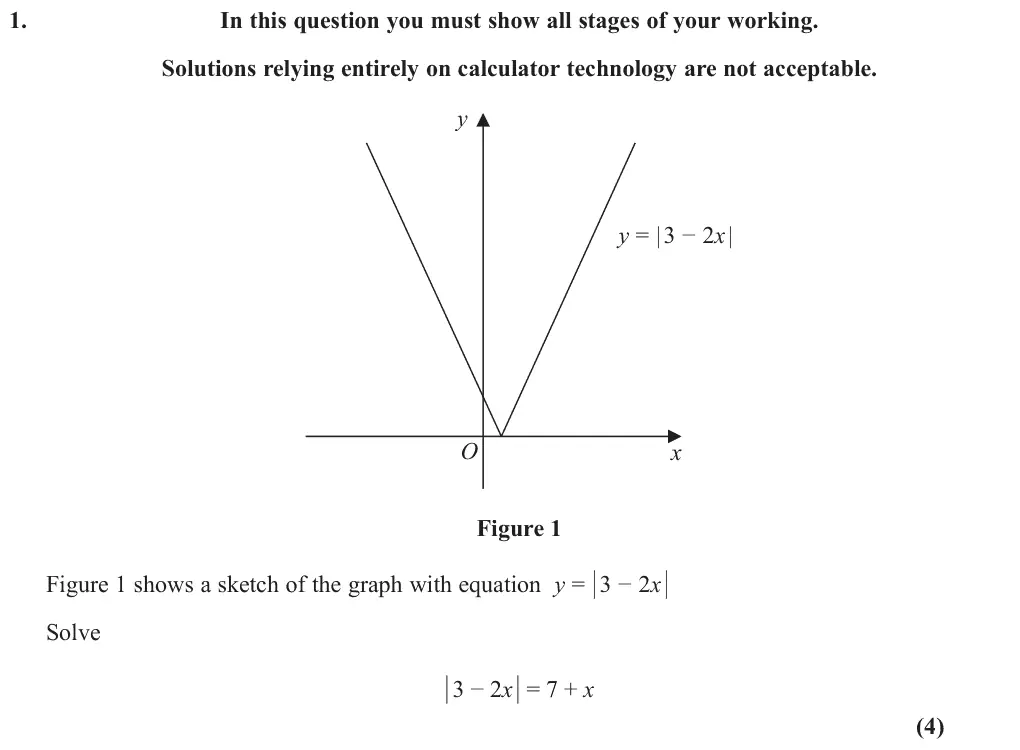
1. In this question you must show all stages of your working. Solutions relying entirely on calculator technology are not acceptable. y y = | 3 - 2x | x Figure 1 Figure 1 shows a sketch of the graph with equation y = | 3 - 2x | Solve | 3 - 2x | = 7 + x (4)
June 2022 · Paper 2 · Q2(a) 2 marks exponentials and logs
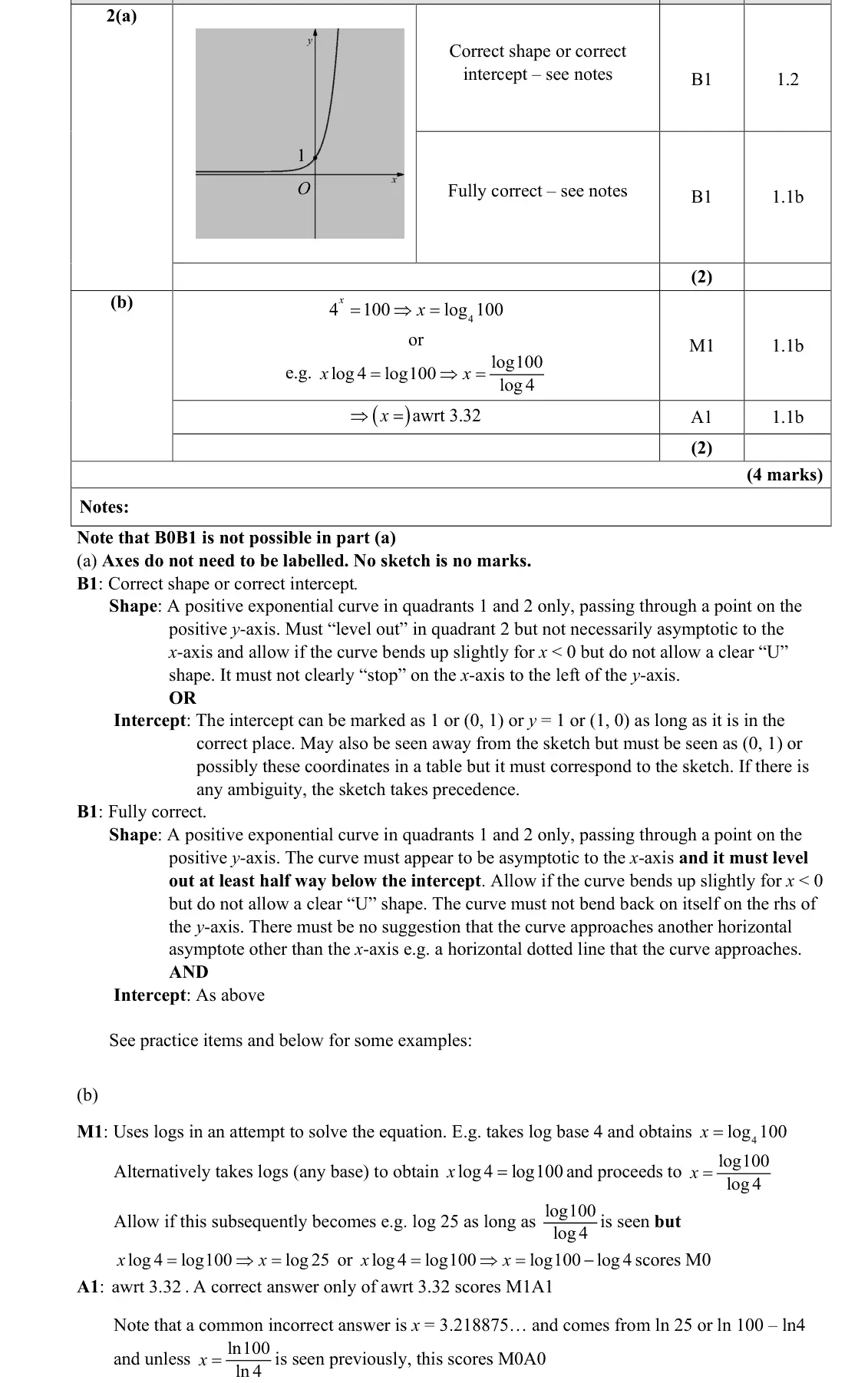
2. (a) Sketch the curve with equation x y = 4 stating any points of intersection with the coordinate axes. (2)
June 2022 · Paper 2 · Q2(b) 2 marks exponentials and logs
(b) Solve x = 100 giving your answer to 2 decimal places. (2)
June 2022 · Paper 2 · Q3(a) 2 marks sequences and series
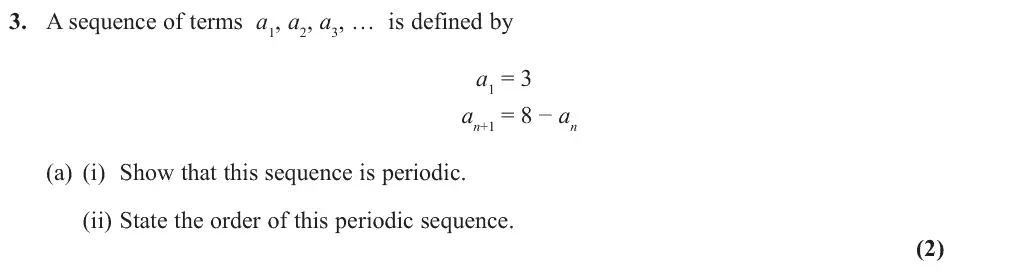
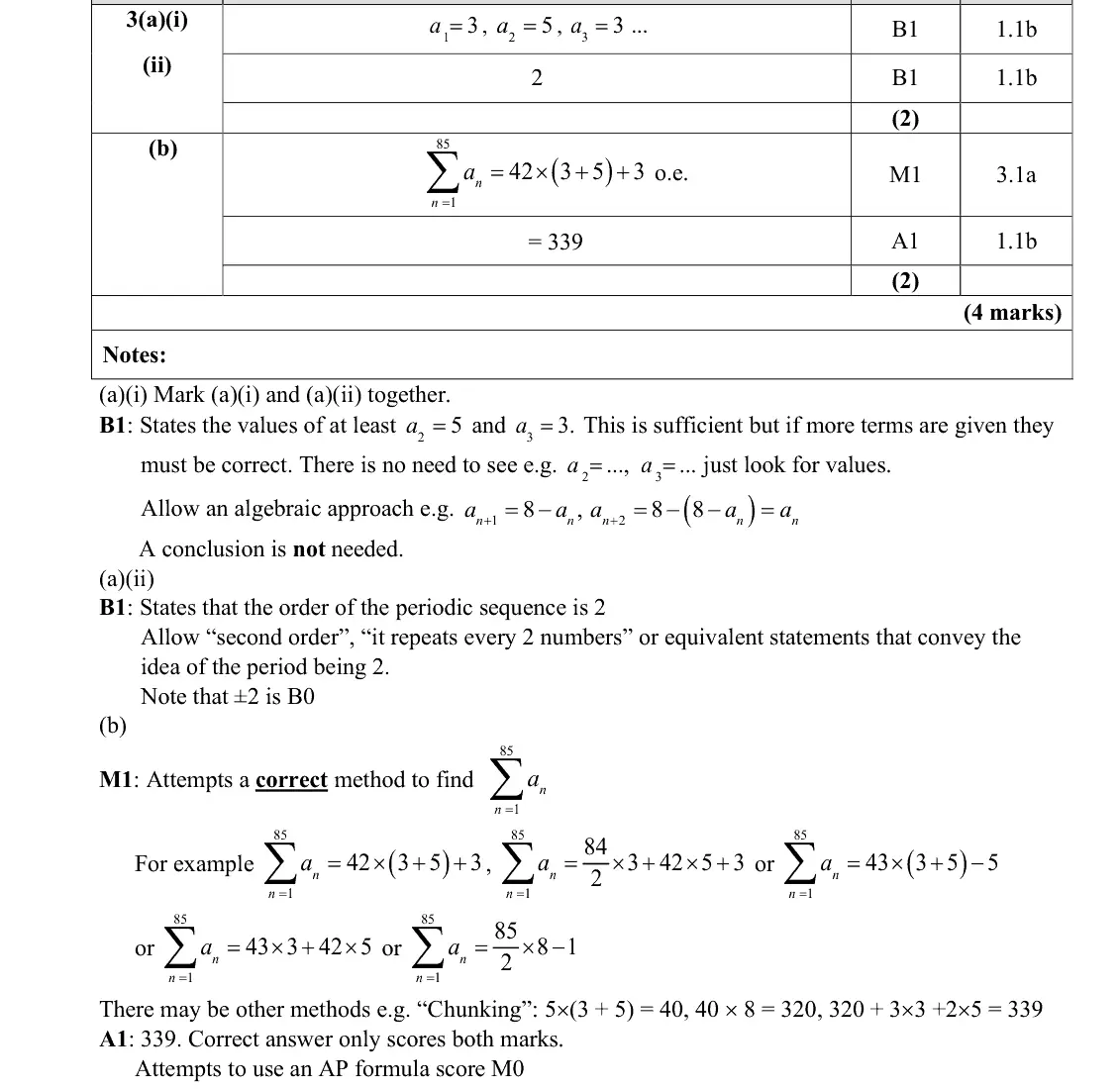
3. A sequence of terms a1, a2, a3, … is defined by a1 = 3 an+1 = 8 - an (a) (i) Show that this sequence is periodic. (ii) State the order of this periodic sequence. (2)
June 2022 · Paper 2 · Q3(b) 2 marks sequences and series
(b) Find the value of n=∑ an (2)
June 2022 · Paper 2 · Q4 3 marks differentiationproof
4. Given that y = 2x use differentiation from first principles to show that d y x = 4x d (3)
June 2022 · Paper 2 · Q5(a) 3 marks trapezium rule
5. The table below shows corresponding values of x and y for y = log3 2x The values of y are given to 2 decimal places as appropriate. x 4.5 7.5 y 1.63 2.26 2.46 2.63 (a) Using the trapezium rule with all the values of y in the table, find an estimate for ∫ 2x x log3 d (3)
June 2022 · Paper 2 · Q5(b) 3 marks trapezium ruleexponentials and logsintegration
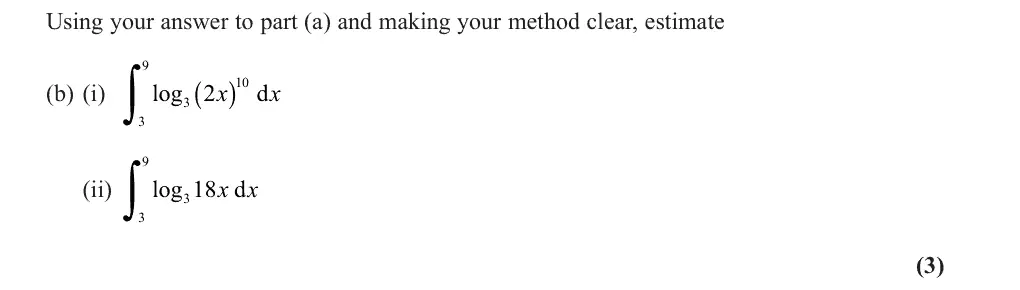
Using your answer to part (a) and making your method clear, estimate ∫ ( ) (b) (i) 2x x log3 d ∫ (ii) 18x x log3 d (3)
June 2022 · Paper 2 · Q6(a) 4 marks differentiationtrigonometric equationstrigonometric ratios
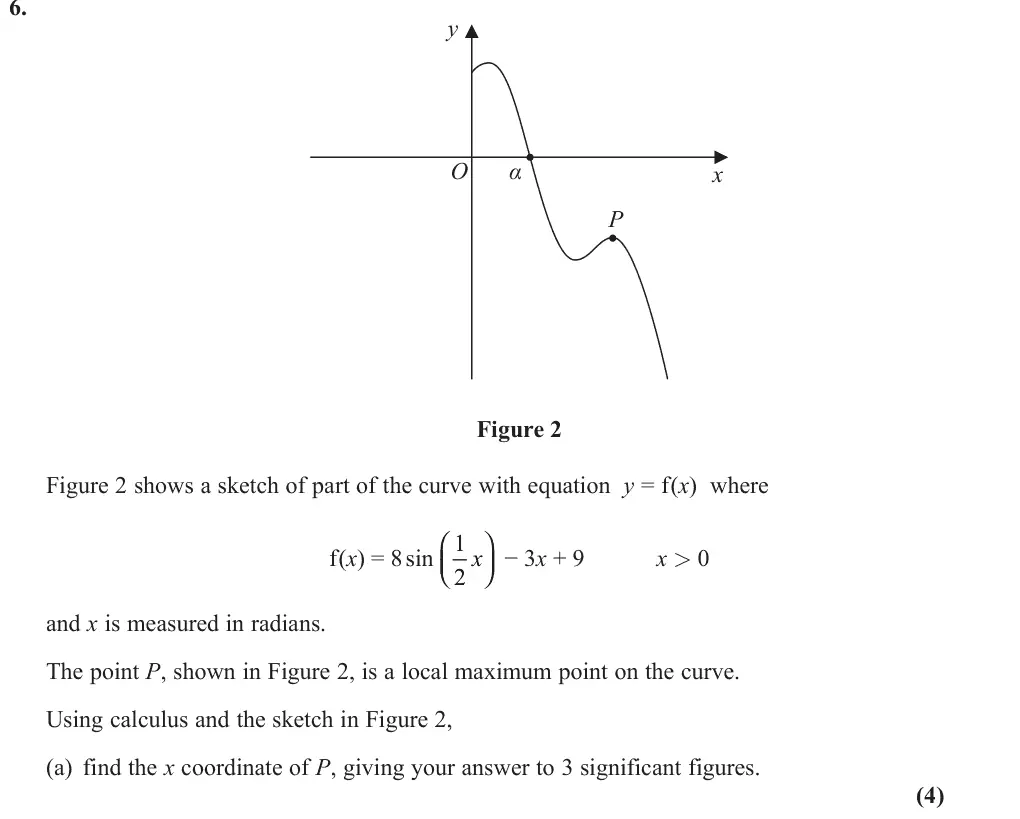
6. y alpha x P Figure 2 Figure 2 shows a sketch of part of the curve with equation y = f(x) where f(x) = 8 sin 1 2 x - 3x + 9 x > 0 and x is measured in radians. The point P, shown in Figure 2, is a local maximum point on the curve. Using calculus and the sketch in Figure 2, (a) find the x coordinate of P, giving your answer to 3 significant figures. (4)
June 2022 · Paper 2 · Q6(b) 1 mark numerical methods
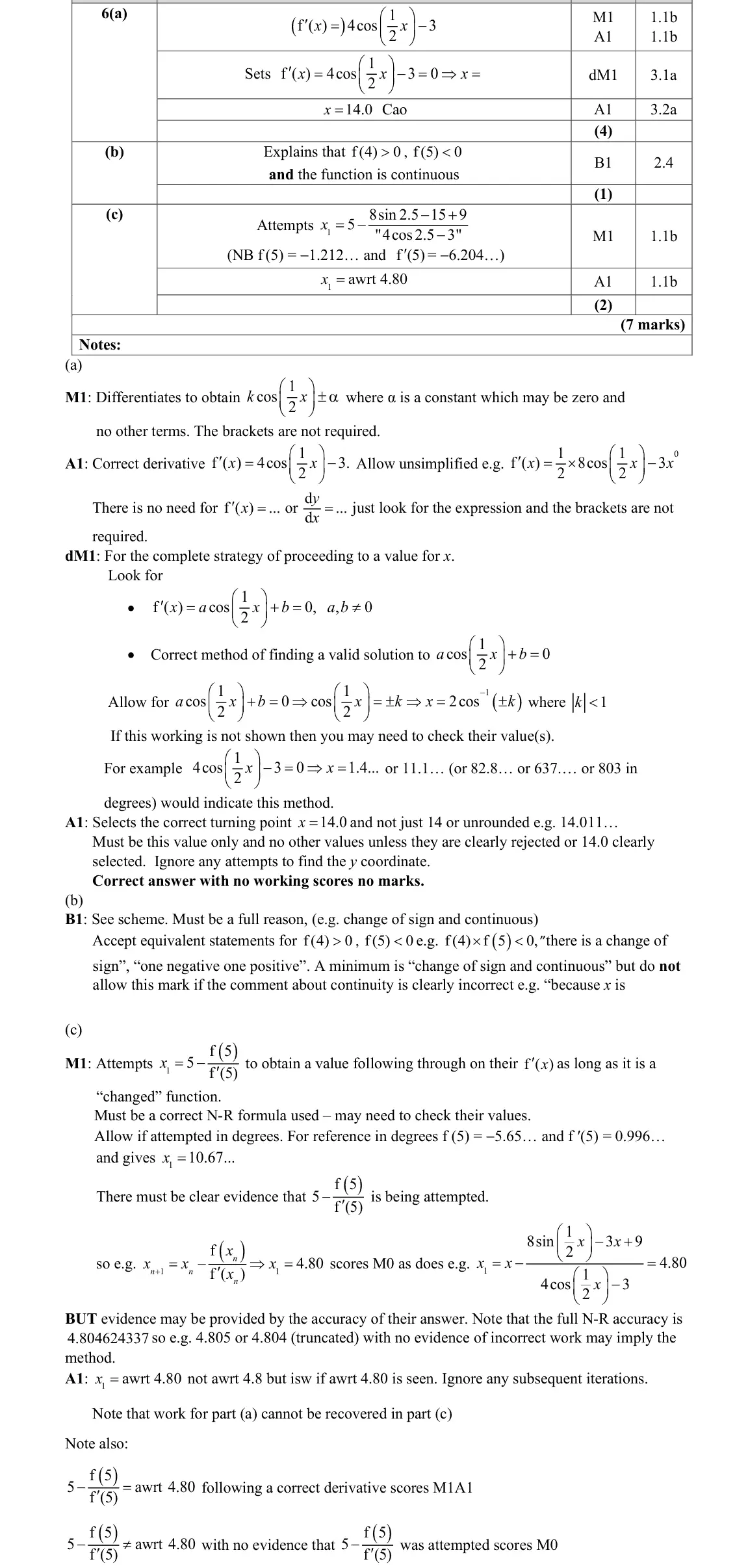
The curve crosses the x-axis at x = alpha , as shown in Figure 2. Given that, to 3 decimal places, f(4) = 4.274 and f(5) = -1.212 (b) explain why alpha must lie in the interval [4, 5] (1)
June 2022 · Paper 2 · Q6(c) 2 marks numerical methodsdifferentiation
(c) Taking x0 = 5 as a first approximation to alpha , apply the Newton-Raphson method once to f(x) to obtain a second approximation to alpha . Show your method and give your answer to 3 significant figures. (2)
June 2022 · Paper 2 · Q7(a) 4 marks binomial expansion
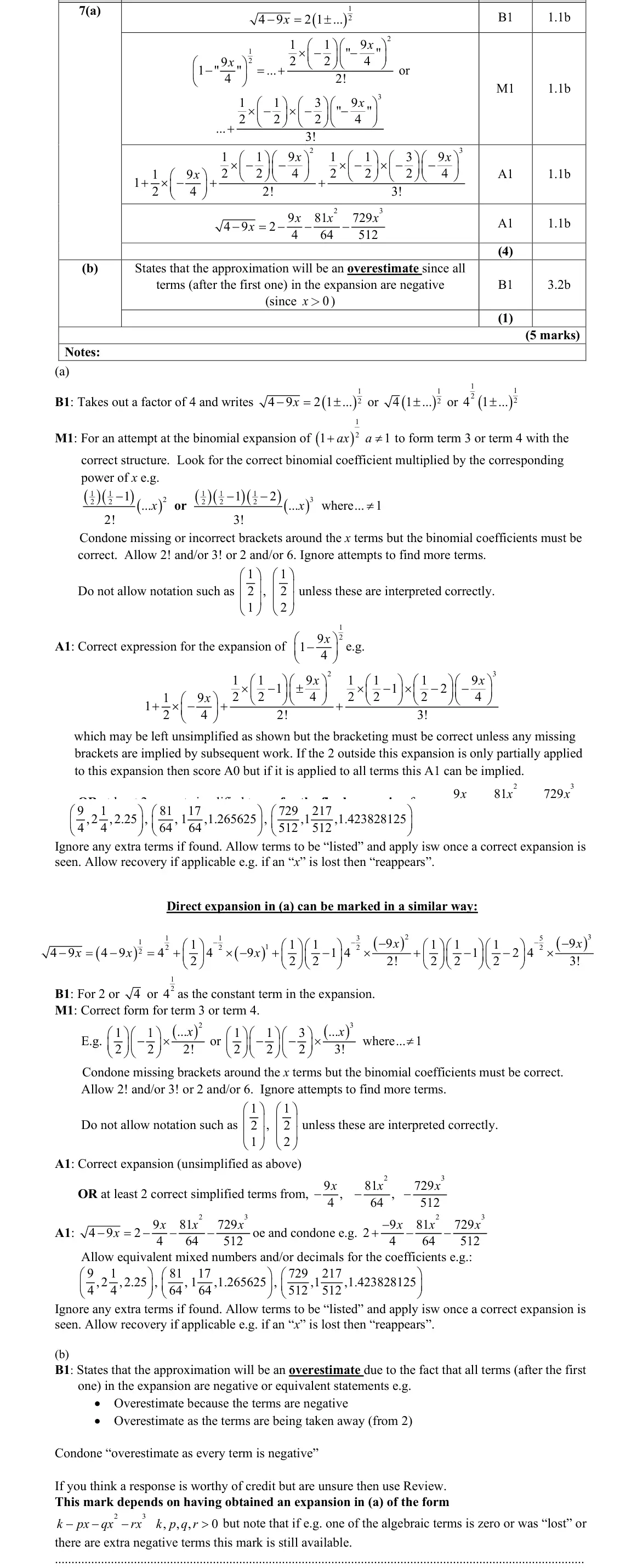
7. (a) Find the first four terms, in ascending powers of x, of the binomial expansion of - x writing each term in simplest form. (4)
June 2022 · Paper 2 · Q7(b) 1 mark binomial expansion
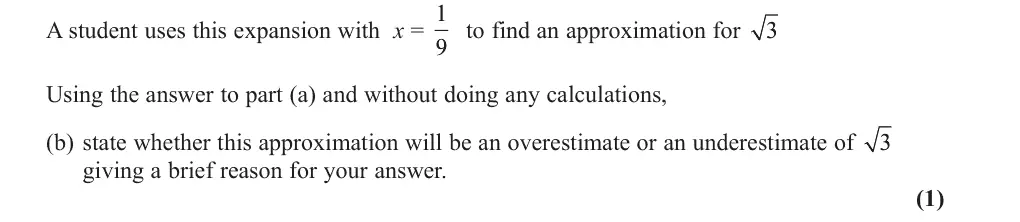
A student uses this expansion with x = 1 9 to find an approximation for Using the answer to part (a) and without doing any calculations, (b) state whether this approximation will be an overestimate or an underestimate of giving a brief reason for your answer. (1)
June 2022 · Paper 2 · Q8 6 marks integrationindices and surds
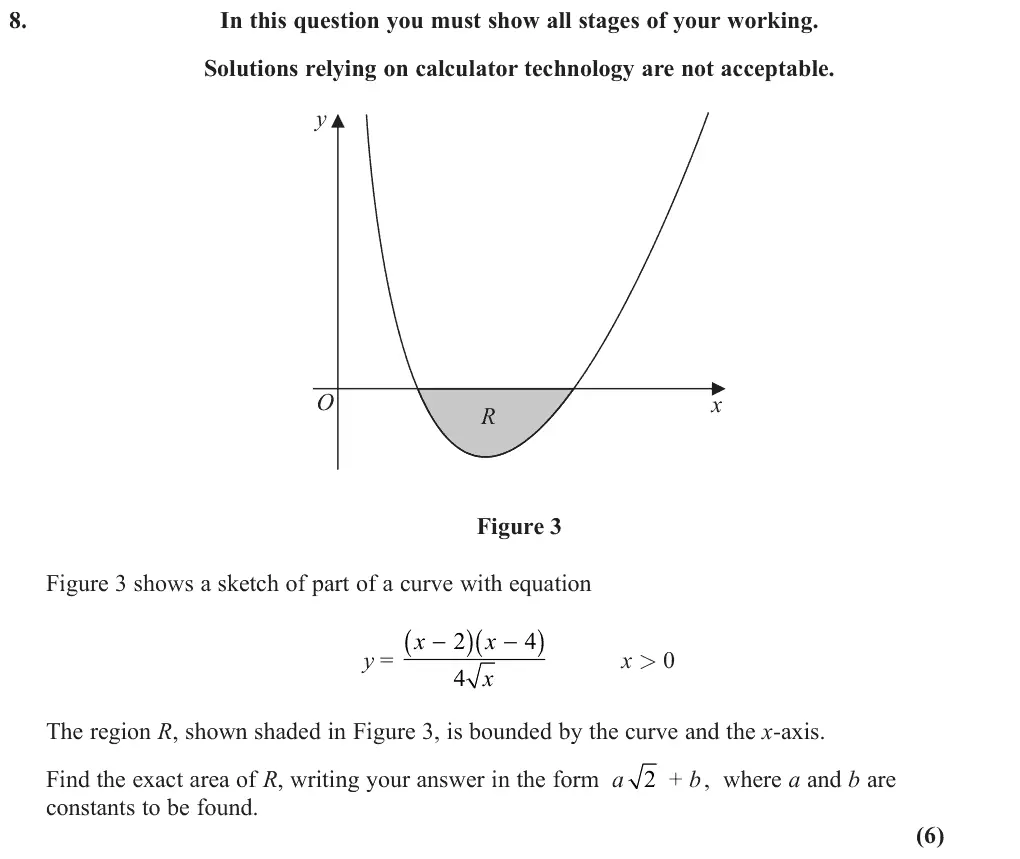
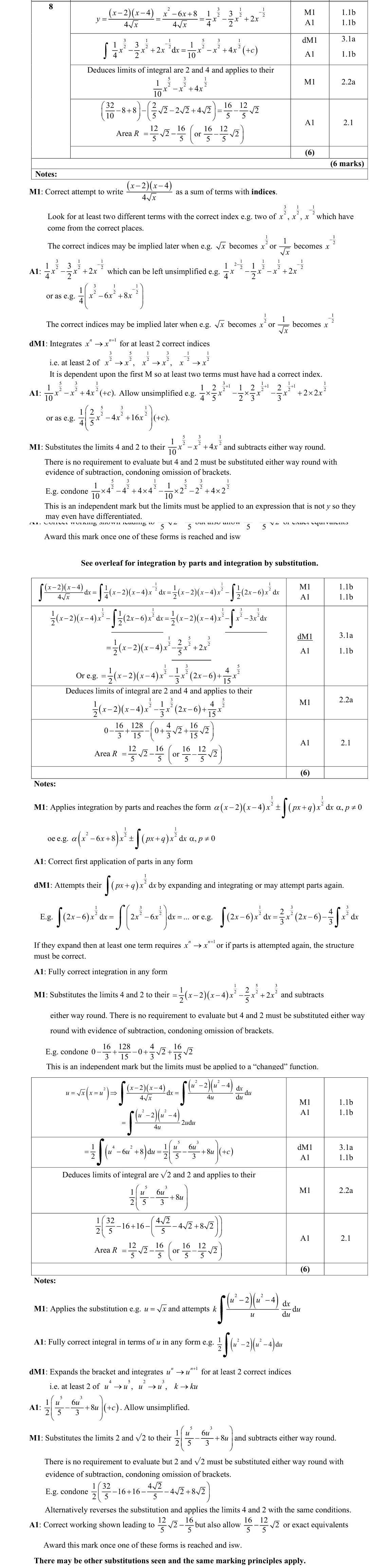
8. In this question you must show all stages of your working. Solutions relying on calculator technology are not acceptable. y x R Figure 3 Figure 3 shows a sketch of part of a curve with equation ( ) ( ) x - x - y = x > 0 x The region R, shown shaded in Figure 3, is bounded by the curve and the x-axis. Find the exact area of R, writing your answer in the form a 2 + b , where a and b are constants to be found. (6)
June 2022 · Paper 2 · Q9(a) 4 marks trigonometric modellingfunctionstrigonometric ratios
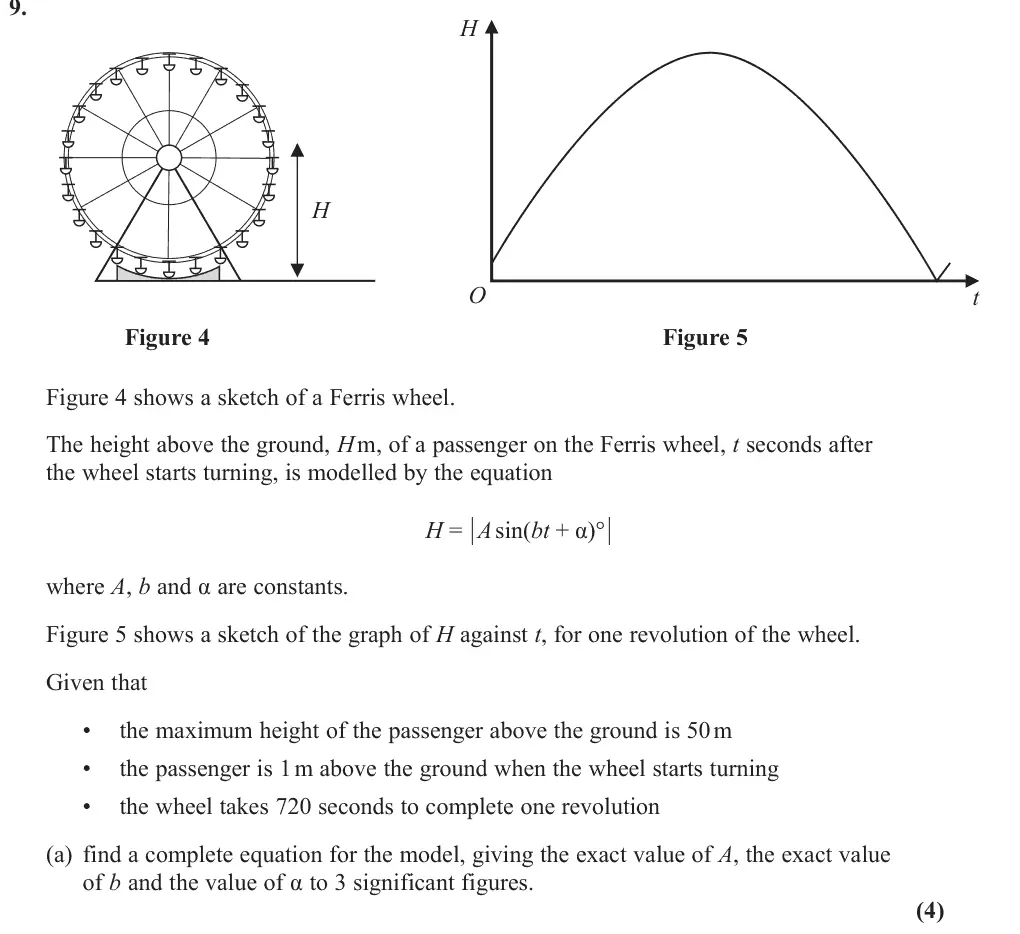
9. H H t Figure 4 Figure 5 Figure 4 shows a sketch of a Ferris wheel. The height above the ground, H m, of a passenger on the Ferris wheel, t seconds after the wheel starts turning, is modelled by the equation H = ½A sin(bt + alpha )°½ where A, b and alpha are constants. Figure 5 shows a sketch of the graph of H against t, for one revolution of the wheel. Given that • the maximum height of the passenger above the ground is 50 m • the passenger is 1 m above the ground when the wheel starts turning • the wheel takes 720 seconds to complete one revolution (a) find a complete equation for the model, giving the exact value of A, the exact value of b and the value of alpha to 3 significant figures. (4)
June 2022 · Paper 2 · Q9(b) 1 mark functionstrigonometric modelling
(b) Explain why an equation of the form H = ½A sin(bt + alpha )°½ + d where d is a positive constant, would be a more appropriate model. (1)
June 2022 · Paper 2 · Q10(a) 2 marks functions
10. The function f is defined by x + f(x) = 8 x > -3 x + -1 3 (a) Find f (2)
June 2022 · Paper 2 · Q10(b) 2 marks algebraic methods
(b) Show that B f(x) = A + x + where A and B are constants to be found. (2)
June 2022 · Paper 2 · Q10(c) 1 mark functions
The function g is defined by 2 0 x 4 g(x) = 16 - x -1 (c) State the range of g (1)
June 2022 · Paper 2 · Q10(d) 3 marks functionsalgebraic methods
-1 (d) Find the range of f g (3)
June 2022 · Paper 2 · Q11 4 marks proofalgebraic methods
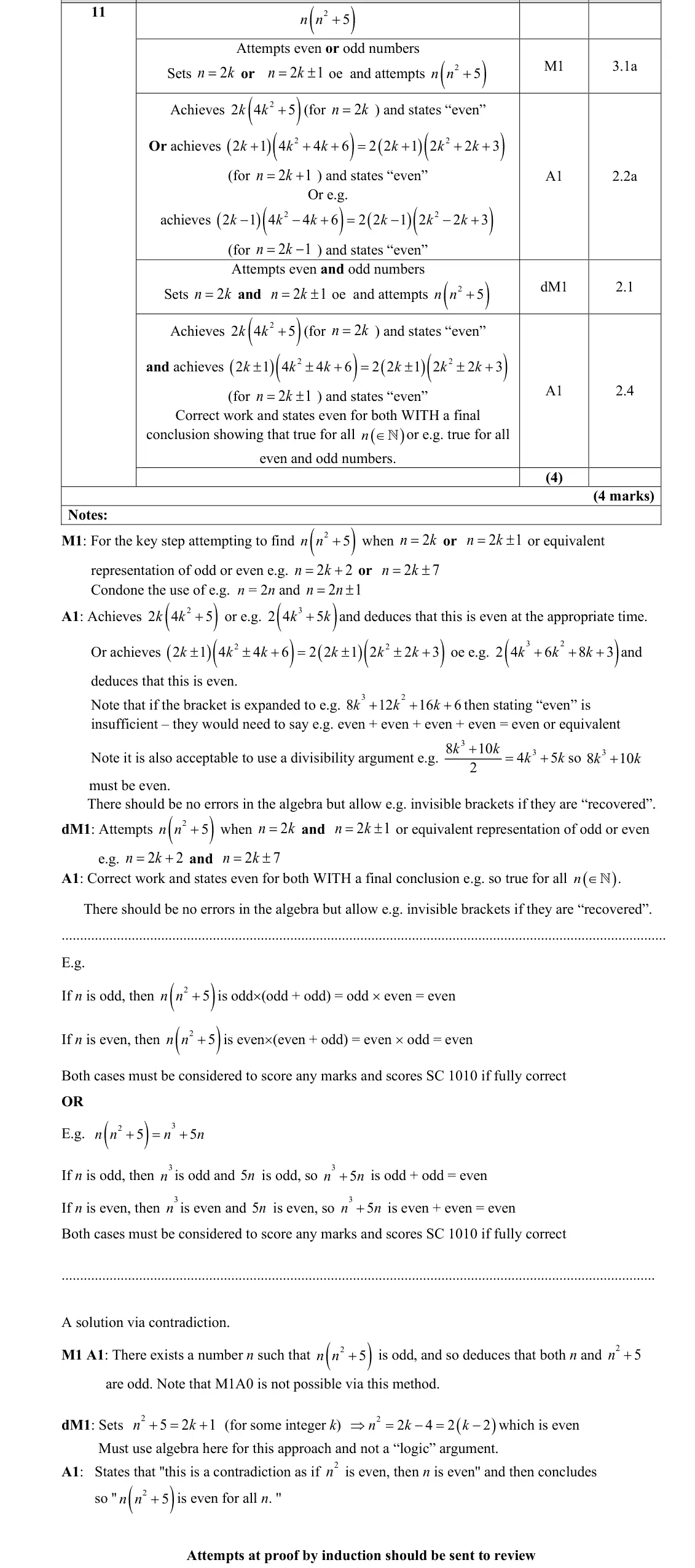
11. Prove, using algebra, that 2 + 5) n(n is even for all n . (4)
June 2022 · Paper 2 · Q12(a) 3 marks differentiation rulesdifferentiation
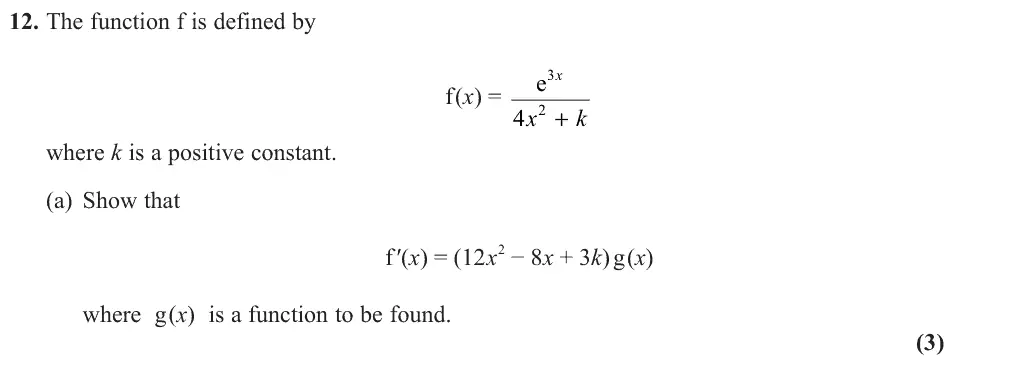
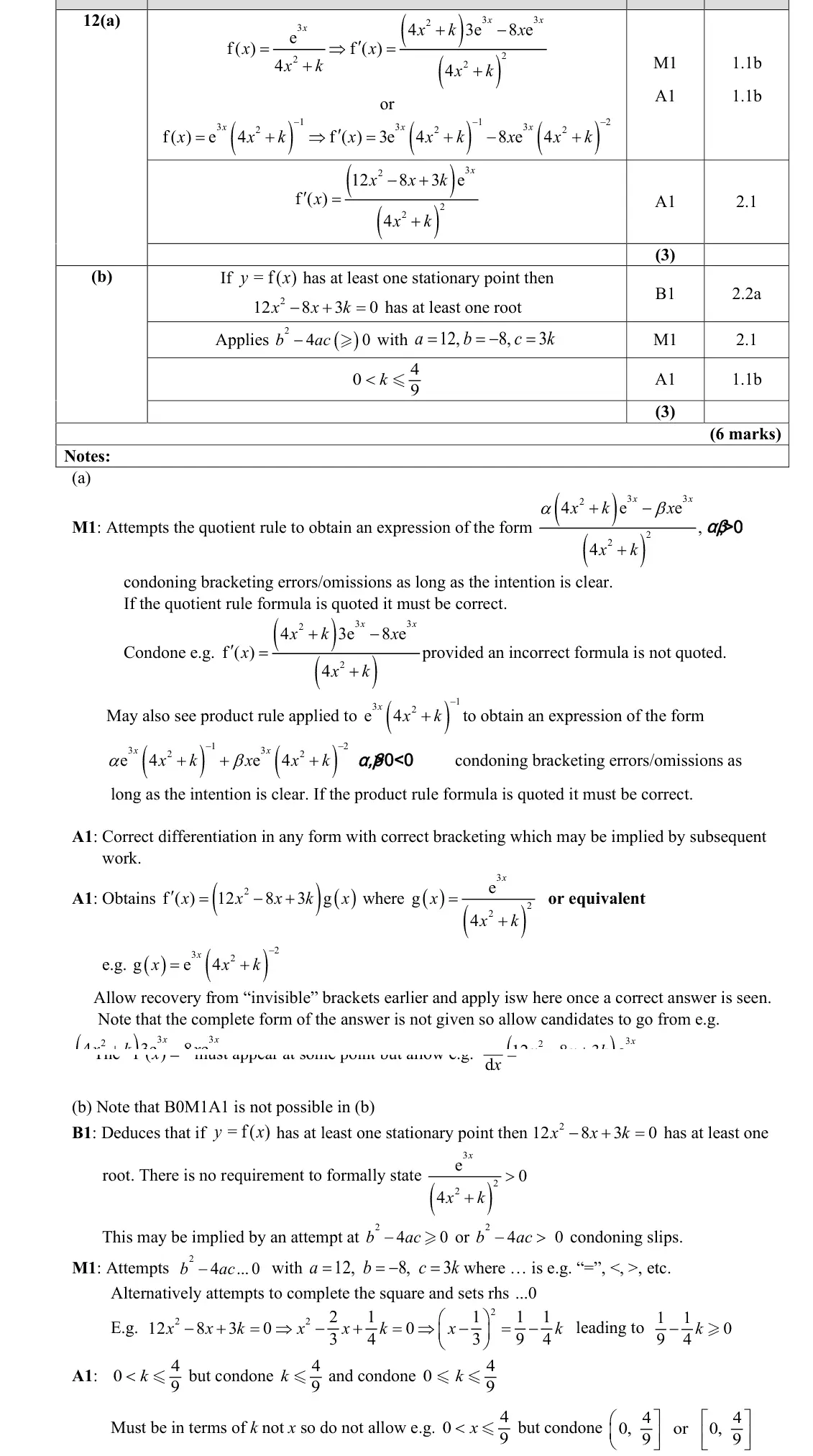
12. The function f is defined by x e3 f(x) = x + k where k is a positive constant. (a) Show that fʹ(x) = (12x 2 - 8x + 3k) g(x) where g(x) is a function to be found. (3)
June 2022 · Paper 2 · Q12(b) 3 marks differentiationquadraticsinequalities
Given that the curve with equation y = f(x) has at least one stationary point, (b) find the range of possible values of k. (3)
June 2022 · Paper 2 · Q13(a) 3 marks vectors
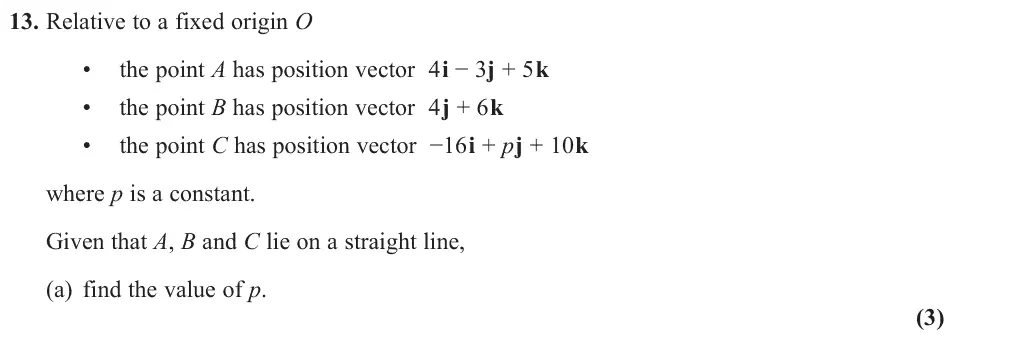
13. Relative to a fixed origin O • the point A has position vector 4i - 3j + 5k • the point B has position vector 4j + 6k • the point C has position vector -16i + pj + 10k where p is a constant. Given that A, B and C lie on a straight line, (a) find the value of p. (3)
June 2022 · Paper 2 · Q13(b) 3 marks vectorsindices and surds
→ is parallel to OA → The line segment OB is extended to a point D so that CD → | , writing your answer as a fully simplified surd. (b) Find | OD (3)
June 2022 · Paper 2 · Q14(a) 3 marks partial fractions
14. (a) Express in partial fractions. x - x + ( )( ) (3)
June 2022 · Paper 2 · Q14(b) 5 marks differential equationspartial fractionsexponentials and logs
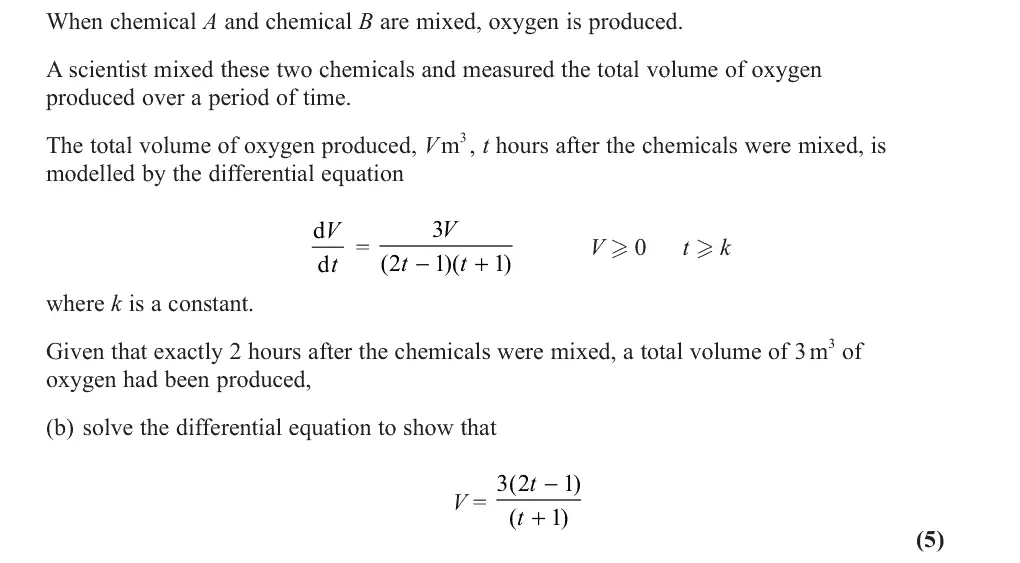
When chemical A and chemical B are mixed, oxygen is produced. A scientist mixed these two chemicals and measured the total volume of oxygen produced over a period of time. 3 , t hours after the chemicals were mixed, is The total volume of oxygen produced, V m modelled by the differential equation d V V t = V 0 t k d t - t + ( )( ) where k is a constant. 3 of Given that exactly 2 hours after the chemicals were mixed, a total volume of 3 m oxygen had been produced, (b) solve the differential equation to show that t - 3 2 ( ) V = t + ( ) (5)
June 2022 · Paper 2 · Q14(c) 2 marks differential equationsfunctions
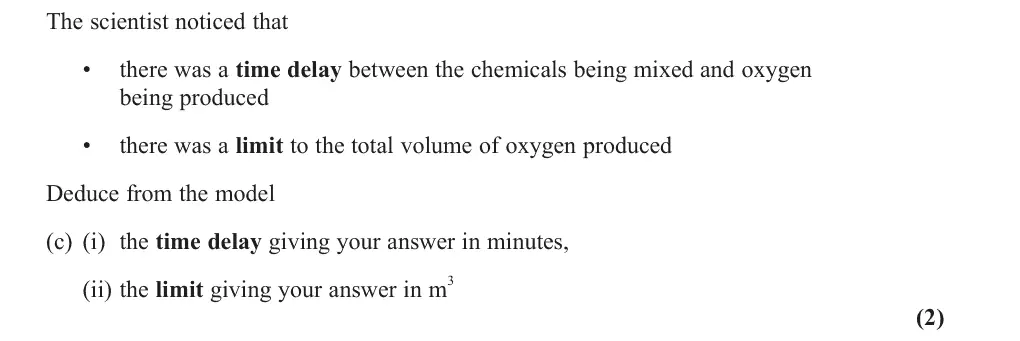
The scientist noticed that • there was a time delay between the chemicals being mixed and oxygen being produced • there was a limit to the total volume of oxygen produced Deduce from the model (c) (i) the time delay giving your answer in minutes, (ii) the limit giving your answer in m (2)
June 2022 · Paper 2 · Q15(a) 3 marks sequences and seriestrig identities
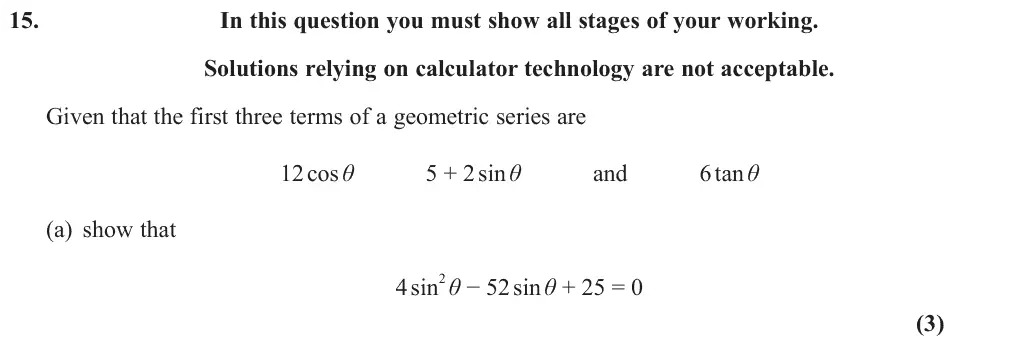
15. In this question you must show all stages of your working. Solutions relying on calculator technology are not acceptable. Given that the first three terms of a geometric series are 12 cos theta 5 + 2 sin theta and 6 tan theta (a) show that 4 sin 2 theta - 52 sin theta + 25 = 0 (3)
June 2022 · Paper 2 · Q15(b) 2 marks trigonometric equationsquadraticstrigonometric ratios
Given that theta is an obtuse angle measured in radians, (b) solve the equation in part (a) to find the exact value of theta (2)
June 2022 · Paper 2 · Q15(c) 5 marks sequences and seriesindices and surdstrigonometric ratios
(c) show that the sum to infinity of the series can be expressed in the form k (1 - 3 ) where k is a constant to be found. (5)
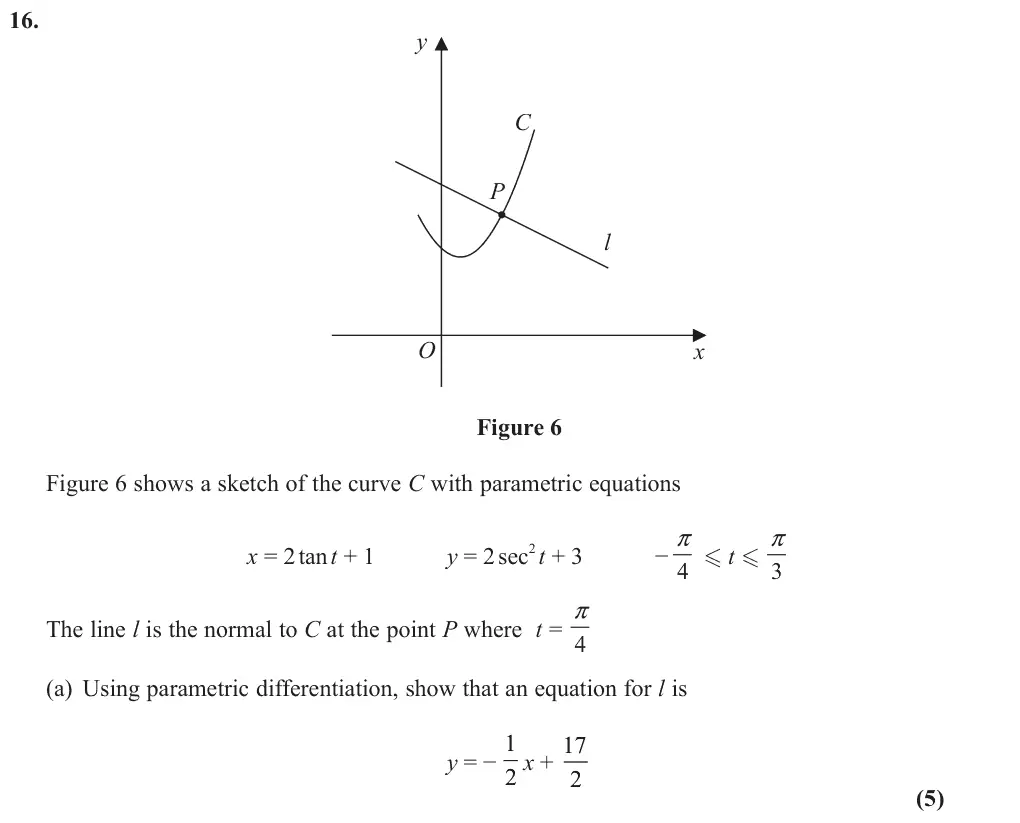
16. y C P l x Figure 6 Figure 6 shows a sketch of the curve C with parametric equations pi t 3 pi x = 2 tan t + 1 y = 2 sec 2 t + 3 - 4 pi The line l is the normal to C at the point P where t = 4 (a) Using parametric differentiation, show that an equation for l is y = - 1 2 x + 17 (5)
June 2022 · Paper 2 · Q16(b) 2 marks parametric equationstrig identities
(b) Show that all points on C satisfy the equation y = 1 2 + 5 2 (x - 1) (2)
June 2022 · Paper 2 · Q16(c) 5 marks quadraticsinequalitiesparametric equationsstraight lines
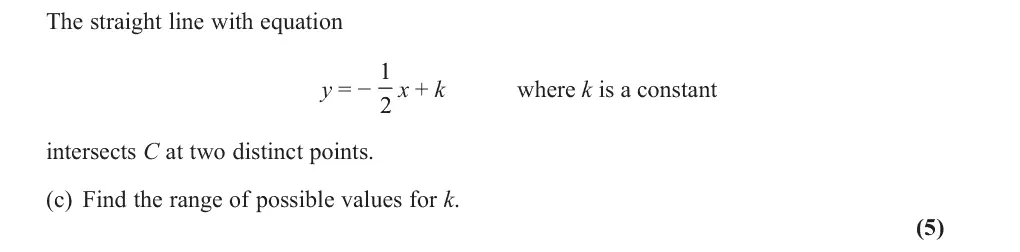
The straight line with equation y = - 1 2 x + k where k is a constant intersects C at two distinct points. (c) Find the range of possible values for k. (5)

Find an Edexcel maths tutor

Want this paper marked and gone through with you? Message us.

Prefer email? Send an enquiry

If you are under 18, please include a parent's contact details. Enquiries go to enquiries@mathsaleveltutor.com and are deleted once handled.