Numerical methods: roots, iteration and Newton–Raphson Pure
Papers
Paper 1, Paper 2
Level
A level only
Spec
P9.1, P9.2, P9.3, P9.5
Booklet
The Newton–Raphson formula is given.
Since 2018
21 question parts, 46 marks, 1 with a difficulty rating from the examiner's report
Notes, worked examples and practice for this topic are being written by our tutors. The past-paper questions below are ready now: work each one on paper, then open the mark scheme and the examiner's comment.
Tap a question to zoom it. Mark scheme and examiner's comment open under each question.
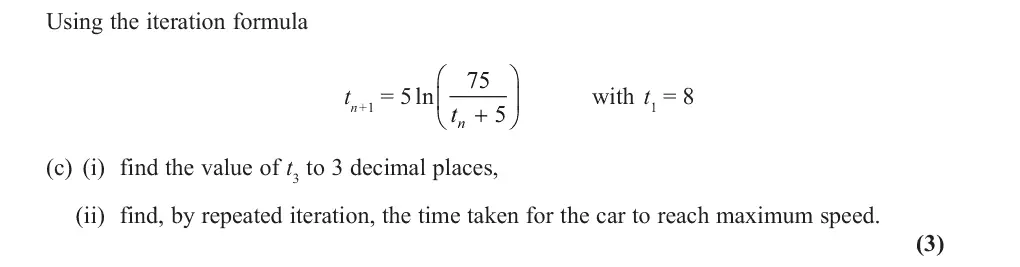
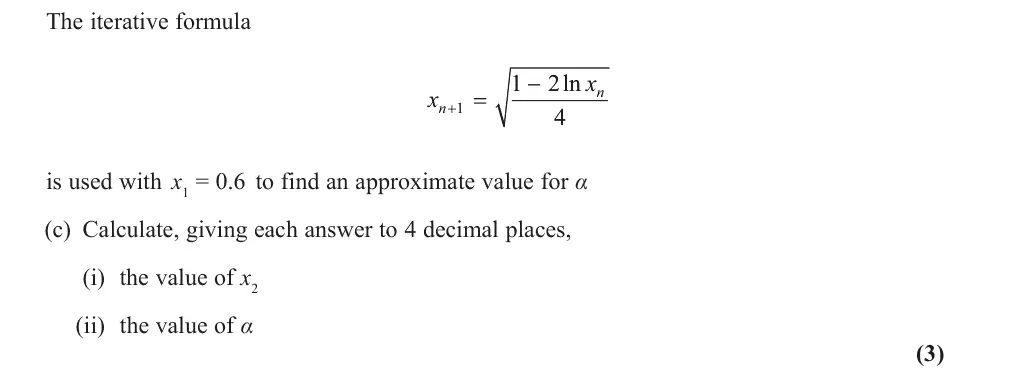
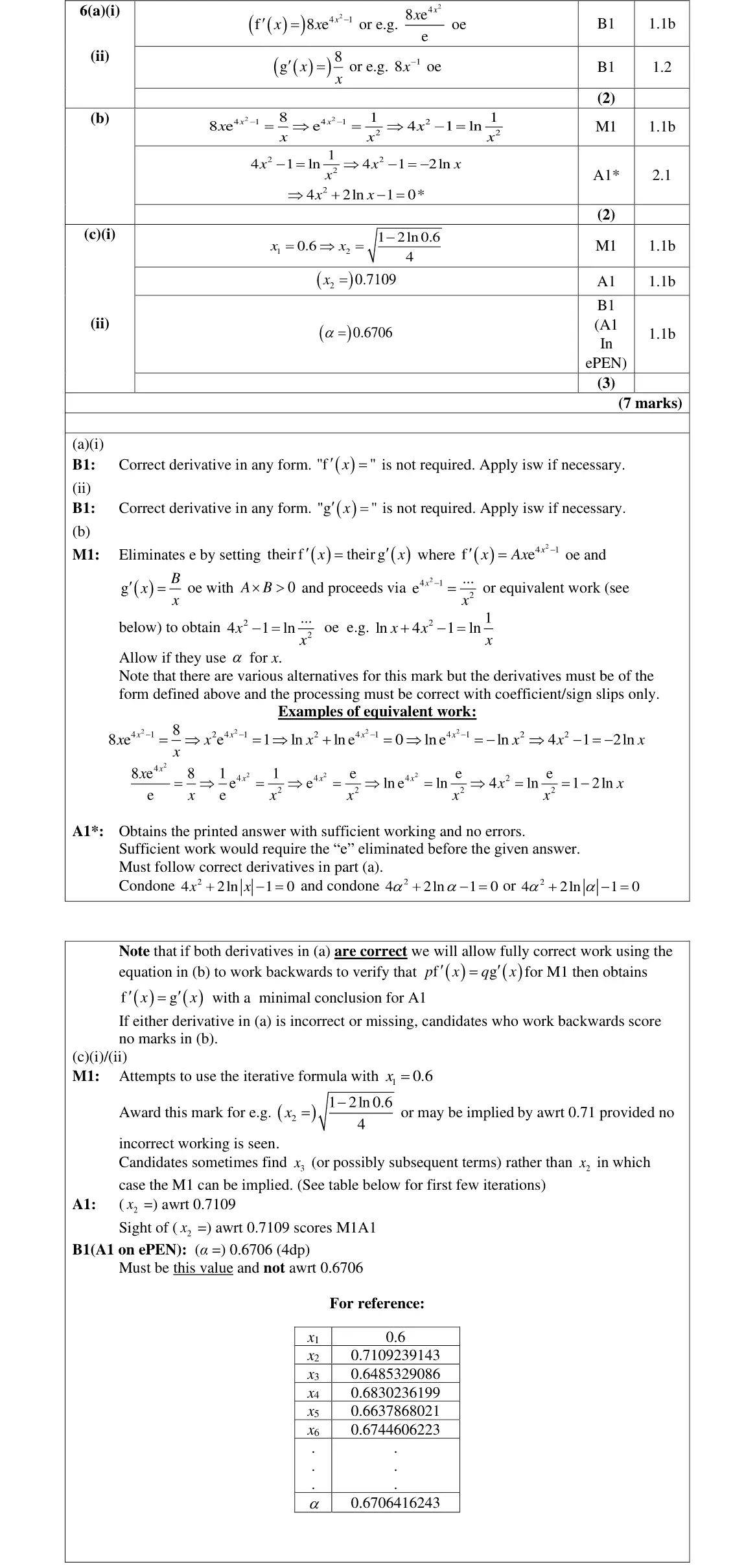
June 2025 · Paper 1 · Q9(c)3 marks
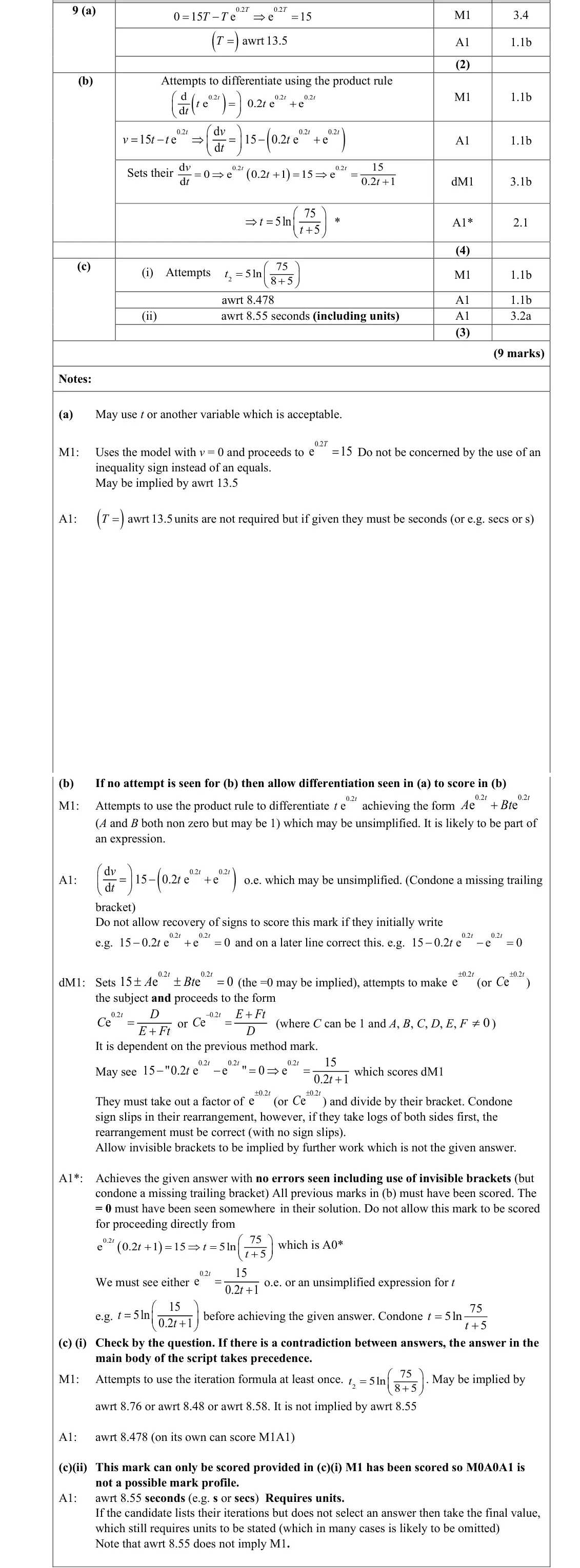
Mark scheme (whole question; this part is marked with the orange bar)
Examiner's comment
This question was generally well-answered, with most learners demonstrating a good grasp of the concepts. However, some common pitfalls were noted, particularly in differentiation and the inclusion of units. Part (c) involved using the given iterative formula and appeared accessible to almost all learners. In part (i), the vast majority gained the two marks in the first part with only occasional rounding inaccuracies such as giving the answer to 3 significant figures instead of 3 decimal places or only calculating the second iteration 2 t . In part (ii) many responses did not include units in their final answer or used incorrect units. A large number also spent time writing down a list of subsequent iterations, not realising that for a one-mark question the final answer is sufficient. 14
Mark scheme (whole question; this part is marked with the orange bar)
Examiner's comment
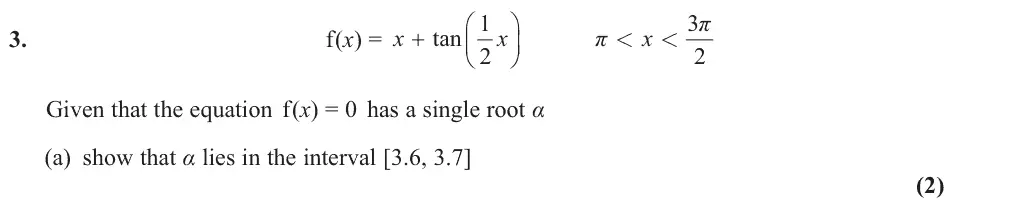
Many candidates were successful across all parts of this question demonstrating a good understanding of the Newton Raphson method, but this question did start to discriminate between the least confident and those who were more careful in their processing. Part (a) was attempted by almost all candidates, with the vast majority making good progress, able to find the values of f(3.6) and f(3.7) correctly and observe a sign change. A conclusion was required for the accuracy mark and had to include a reference to a sign change, continuity of the function and mention or indication of a root lying in the interval, as well as both values being correct to 1 significant figure. It appears that reference to continuity is included more frequently by candidates but there was still a good proportion of candidates who did not mention it or who made incorrect statements involving it. Common incorrect statements included “change in sign therefore continuous”, “the interval is continuous” and “ x is continuous”. Radians were required and most candidates recognised this, with very few candidates working in degrees.
Common mistakes
radians
f(3.6) = −0.686, f(3.7) = 0.211
need change of sign, f continuous and a conclusion ("change in sign therefore continuous" or "the interval is continuous" score A0)
June 2024 · Paper 1 · Q3(c)2 marks
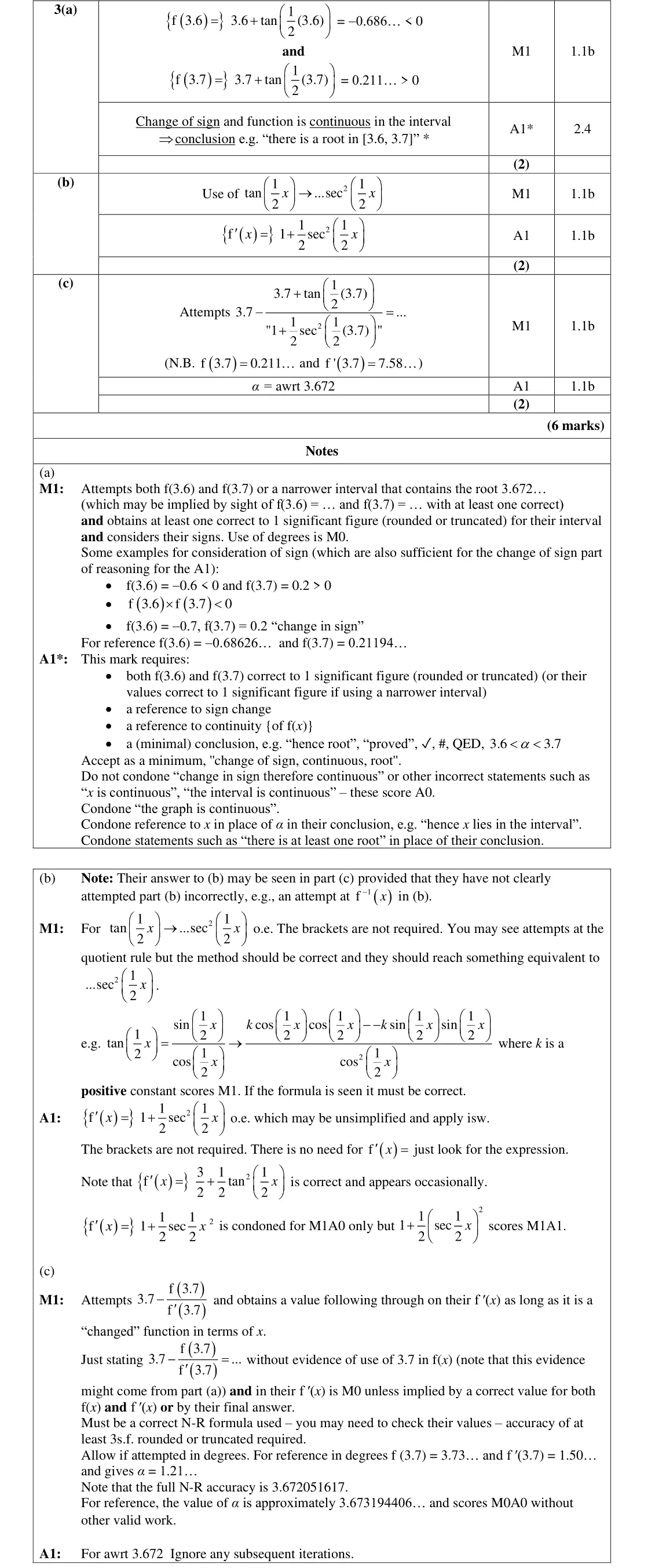
Mark scheme (whole question; this part is marked with the orange bar)
Examiner's comment
Many candidates were successful across all parts of this question demonstrating a good understanding of the Newton Raphson method, but this question did start to discriminate between the least confident and those who were more careful in their processing. Incorrect derivatives were occasionally seen, and candidates should be advised to refer to the derivative of tan(kx) provided in the formula booklet. A common error was forgetting to differentiate the x to 1 or losing it entirely. There were some attempts at integrating and unfortunately some misread (or misinterpreted) the notation and attempted to find the inverse of the function. These responses were unable to score any marks in part (b), even if they went on to differentiate in part (c). Candidates who converted 1 tan 2 x to 1 sin 2 1 cos 2 x x were generally not successful at applying the quotient rule correctly. Candidates had varying degrees of success in part (c). The Newton-Raphson formula was generally well quoted or used, however, difficulty evaluating 2 3.7 sec 2 led to the accuracy mark being lost. Evidence of substitution into the formula was inconsistent across the cohort, with some clearly showing the substitution and some leaving it to the examiner to try to establish what they had done. Those that did not explicitly show the substitution of 3.7 in f(x) and ( ) f ' x often made calculation errors and thus scored no marks in this part. Candidates are encouraged to show their substitution into the formula (not just stating ( ) ( ) f 3.7 3.7 f 3.7 - ) for this reason. Those candidates who did not obtain a correct derivative in part (b) were still able to achieve the method mark for using the Newton-Raphson formula correctly with their derivative. Those that did not differentiate in part (b) were able to go on and score both marks in part (c) if they restarted the differentiation at this stage.
Common mistakes
x₂ = 3.7 − f(3.7)/f′(3.7) in radians
evaluating sec²(1.85) is a common slip
awrt 3.672
June 2024 · Paper 2 · Q6(c)3 marks
Mark scheme (whole question; this part is marked with the orange bar)
Examiner's comment
In part (c) many candidates scored all three marks often with no working, just by writing down the two numerical answers required. Candidates should however be advised to show their method as they risk losing both marks. In contrast, some candidates wrote down all the iterations they thought necessary, including the working for each one. Amongst those that didn’t get the final mark, the common mistakes were, stopping at too early an iterate such as x2 or x3, stating an answer of 0.6707 instead of 0.6706 and not rounding to 4dp. There were a small number of candidates who didn’t seem to realise they needed to keep applying the iteration to find the value for alpha and instead tried to solve the equation given in part (b). Others thought 0.6 or 0.7109 should be substituted into the equation for part (b), not realising a sequence needed to be generated.
Common mistakes
x₂ = 0.7109
keep iterating until stable: α = 0.6706 (not 0.6707, not x₂ or x₃)
4 d.p.
generate the sequence, do not substitute into the equation in (b)
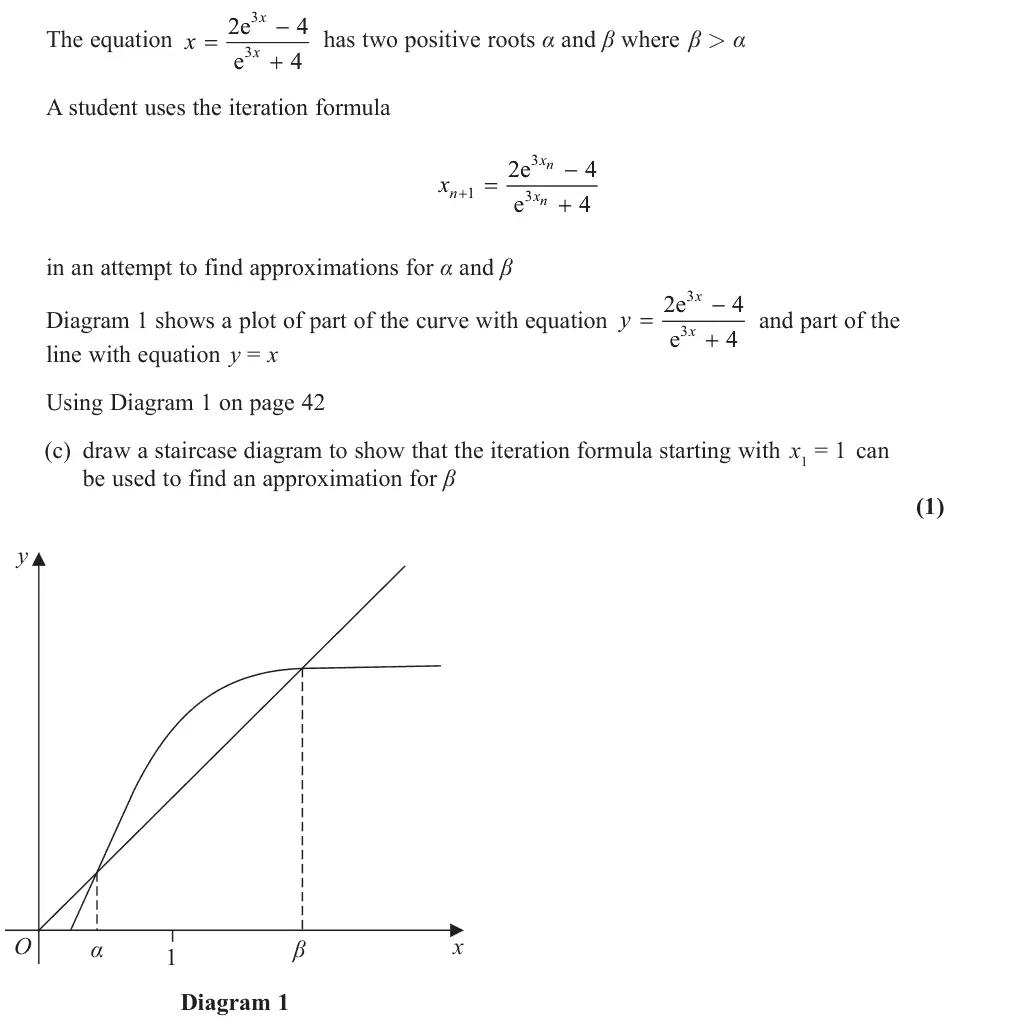
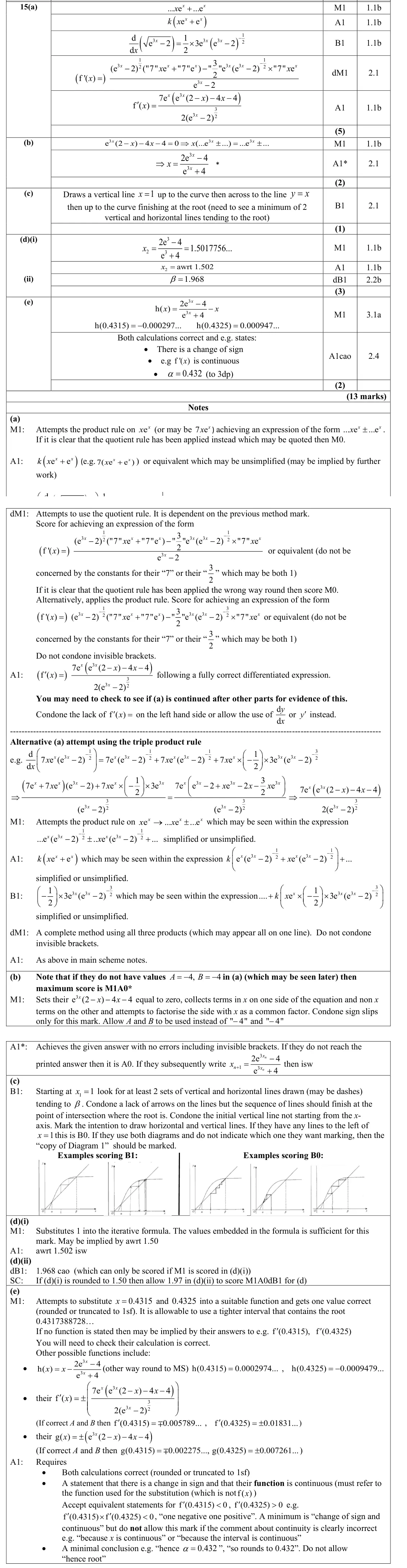
June 2023 · Paper 1 · Q15(c)1 mark
Mark scheme (whole question; this part is marked with the orange bar)
Examiner's comment
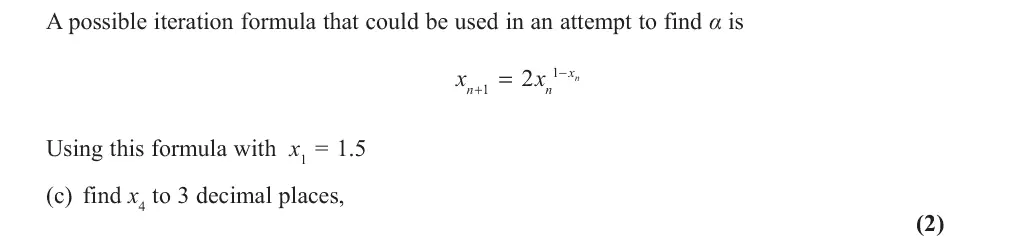
This question brought together a variety of topics and was appropriately placed at the end of the paper. This was very good at discriminating between candidates at the higher end, but it was also pleasing to see a good number of weaker candidates who were still able to attempt later parts such as part (c) and part (d) to a pleasing degree of success. In part (c), the majority of candidates scored the mark for a correct diagram, although some started their initial line higher up than the x-axis, which was condoned on this occasion. Several candidates used a cobweb diagram, and for others there were often lines drawn to the left of 1 x = . Only a handful of candidates put arrows on their lines, but their omission was, again, condoned.
Common mistakes
staircase from x = 1 converging to β (cobweb is wrong)
June 2023 · Paper 1 · Q15(d)3 marks
Mark scheme (whole question; this part is marked with the orange bar)
Examiner's comment
This question brought together a variety of topics and was appropriately placed at the end of the paper. This was very good at discriminating between candidates at the higher end, but it was also pleasing to see a good number of weaker candidates who were still able to attempt later parts such as part (c) and part (d) to a pleasing degree of success. Part (d), for many candidates who had not scored in or attempted earlier parts, was an opportunity to score full marks relatively easily. This was very well done. Occasionally, rounding 2 x to 1.50 rather than 1.502 was seen. However, those who wrote down an unrounded answer which rounded to 1.502 first were able to get the A mark. Candidates who showed the value embedded in the formula and then did not achieve 1.502 were able to get the M mark, too. A minority of candidates skipped 1.502 to go to the next term, 1.873 but this still was able to score the method mark as this was still evidence that the iterative formula had been used. The correct answer 1.968 = was widely achieved for part (b)(ii), although 1.967 was a common incorrect answer. The final mark was also lost for a small number of candidates who failed to round to 3 decimal places.
Common mistakes
x₂ = 1.502
β = 1.968 (3 d.p.)
June 2023 · Paper 1 · Q15(e)2 marks
Mark scheme (whole question; this part is marked with the orange bar)
Examiner's comment
This question brought together a variety of topics and was appropriately placed at the end of the paper. This was very good at discriminating between candidates at the higher end, but it was also pleasing to see a good number of weaker candidates who were still able to attempt later parts such as part (c) and part (d) to a pleasing degree of success. Part (e) was the final part on the paper and for many this resulted in no marks. Most of the candidates who attempted it found a suitable interval but substituted the values in the iterative formula instead of a valid equation set equal to zero. Many candidates wrote the required conclusion with no supporting evidence in an attempt to gain a mark. Some candidates, who used a valid function correctly, failed to score the final mark for not commenting that their function was continuous. A significant proportion of candidates attempted an iterative process with a different iterative formula, including attempting the Newton-Raphson method. The question required used of a suitable interval and so these methods scored no marks. Overall, whilst this question was demanding, there were some very impressive solutions demonstrating an excellent grasp of calculus, strong algebraic skills, and the ability to provide a rigorous argument to prove given answers and results.
Common mistakes
use h(x) = (2e³ˣ − 4)/(e³ˣ + 4) − x on [0.4315, 0.4325]
state change of sign and that h is continuous
conclude α = 0.432
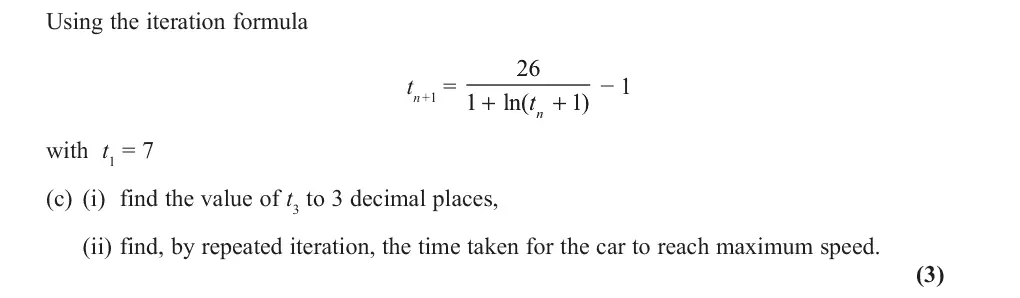
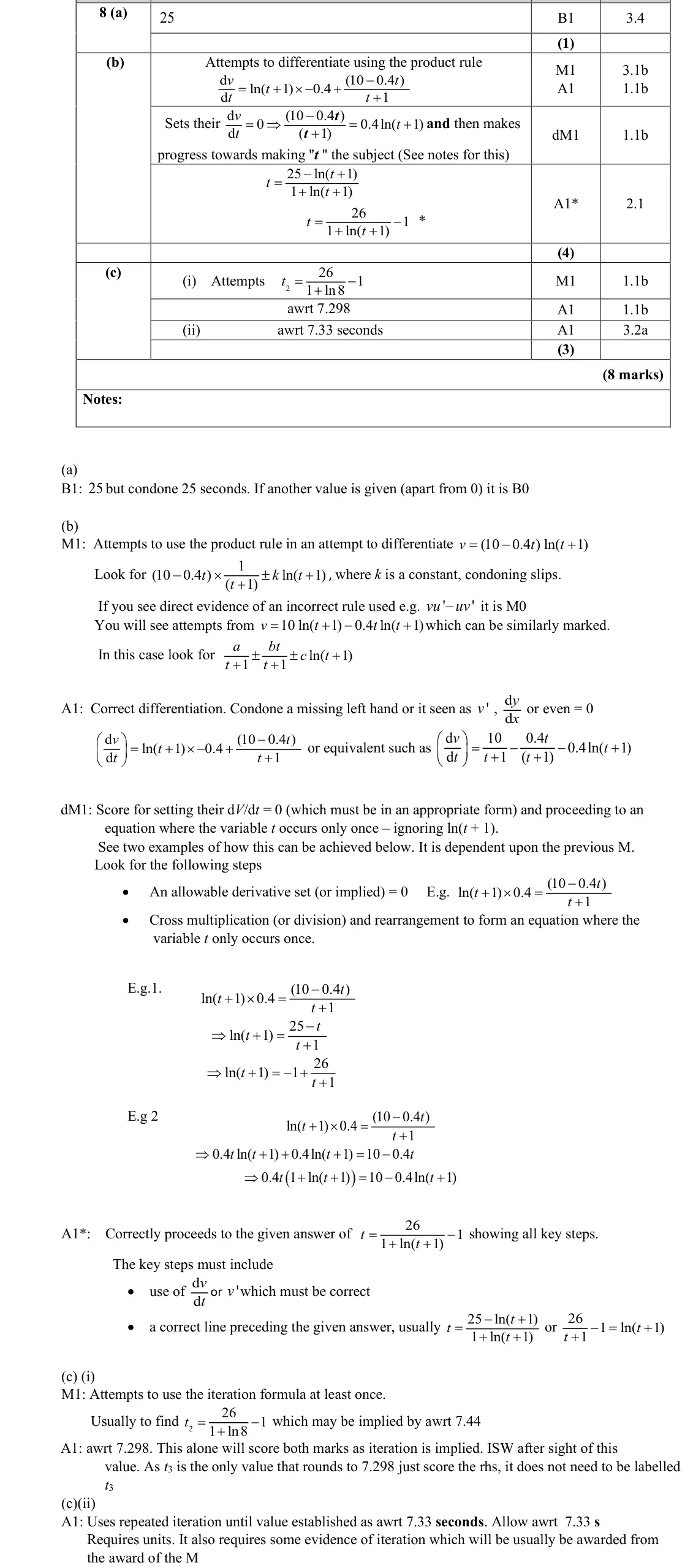
June 2022 · Paper 1 · Q8(c)3 marksMedium
Mark scheme (whole question; this part is marked with the orange bar)
Examiner's comment
This was the second modelling question on the paper. The given equation modelled the speed of and scored marks in the more accessible parts (a) and (c). Most candidates managed to reach the correct answer of 25 in part (a). A common incorrect answer was 10, Part (c) was the most successful part of the question and familiar to most candidates. Many were able to carry out the iteration process correctly, and write down 7.298 without any problems. In part (c) (ii), the omission of the units, “seconds”, was the most common slip.
Common mistakes
t₂ = 26/(1 + ln 8) − 1 = 7.44, t₃ = 7.298
repeated iteration to 7.33 seconds (units needed)
June 2022 · Paper 2 · Q6(b)1 mark
Mark scheme (whole question; this part is marked with the orange bar)
Examiner's comment
In part (b), most candidates only referred to the change of sign and didn’t mention continuity. Occasionally a candidate wanted to allude to continuity but was unable to articulate this correctly. For example incorrect wording including referring to the graph as “constant”. Some candidates who referred to continuity used incorrect statements such as “because x is continuous” or “because the interval (or data) is continuous”.
Common mistakes
f(4) > 0, f(5) < 0 (change of sign) AND f is continuous
"x is continuous" or "the interval is continuous" scores 0
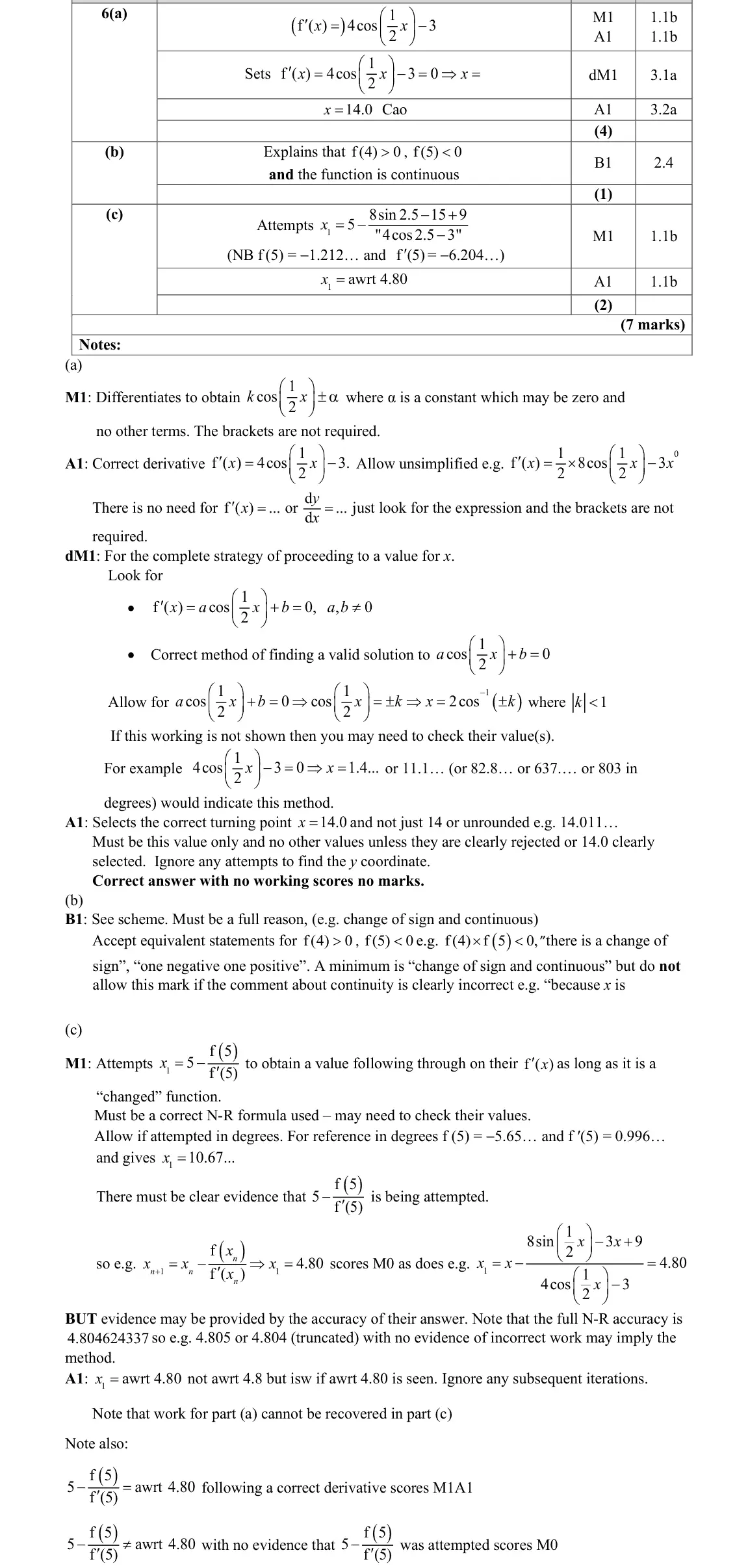
June 2022 · Paper 2 · Q6(c)2 marks
Mark scheme (whole question; this part is marked with the orange bar)
Examiner's comment
Part (c) was answered well with many candidates scoring full marks. Amongst those who didn’t score full marks, many did not heed the demand in the question to “Show your method” and just quoted their calculator’s solution without any explanation whilst others just wrote down a formula but did not show an application with values embedded. Others made rounding mistakes such as giving a final answer of 4.805 or 4.81. Premature rounding of f (5) and f′(5) also led to a final answer of 4.81. A significant number of candidates erroneously used degrees but could score the method mark if appropriate working was shown. Some candidates were able to “recover” minimal working due to the accuracy of their answer 4.804...., and gained the two marks. Some candidates also evaluated f (5) incorrectly even though it was given in the question. It was disappointing to see students misquoting The Newton-Raphson formula, typically with f(x) and f′(x) the wrong way round, even though the formula was given in the formula book.
Common mistakes
x₁ = 5 − f(5)/f′(5) with values shown
f(x) and f′(x) the right way round
radians
awrt 4.80 (not 4.8, 4.805 or 4.81 from premature rounding)
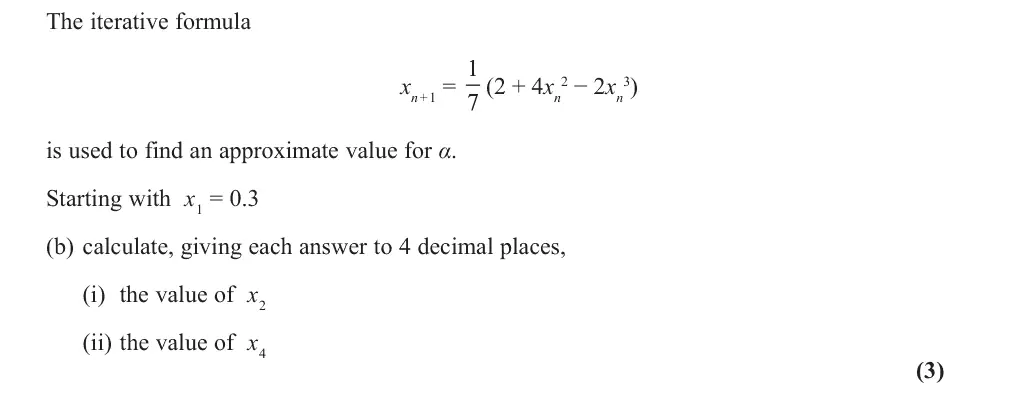
Oct 2021 · Paper 1 · Q4(b)3 marks
Mark scheme (whole question; this part is marked with the orange bar)
Examiner's comment
Aspects of this question proved to be more demanding than expected, but overall good marks were scored by candidates with most achieving over half marks in this question. Part (b) A significant majority of candidates obtained both required answers to this part. Occasionally only x2 and x3 were found. There were just a few occasions where a candidate had misread the 1/7 in the iterative formula as ½. If the working was shown for this situation, then a method mark could still have been awarded.
Common mistakes
x₂ = 0.3294, x₄ = 0.3398 to 4 d.p.
misreading 1/7 as 1/2
Oct 2021 · Paper 1 · Q4(c)2 marks
Mark scheme (whole question; this part is marked with the orange bar)
Examiner's comment
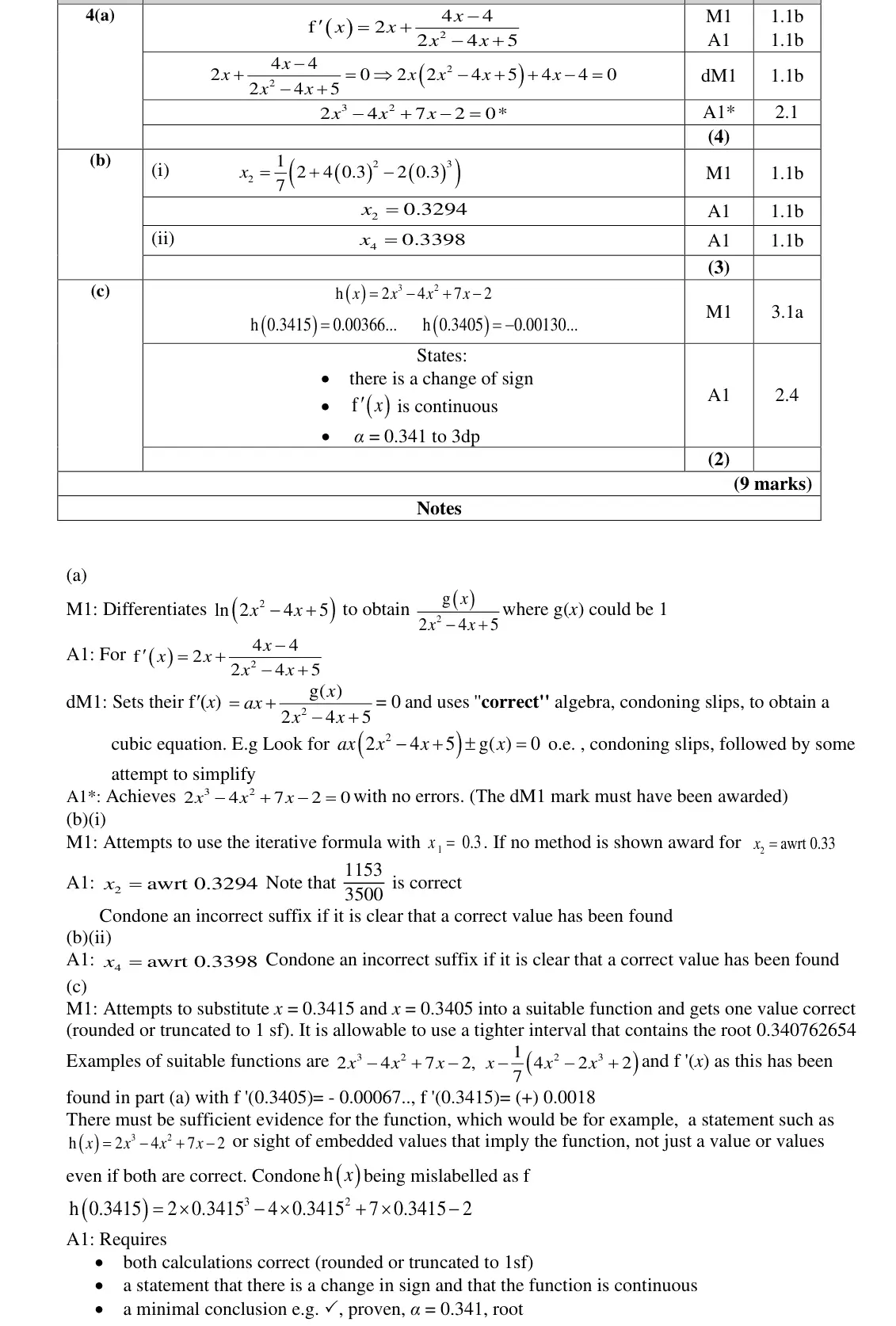
Aspects of this question proved to be more demanding than expected, but overall good marks were scored by candidates with most achieving over half marks in this question. Part (c) Whilst many candidates realised that a sign change of a function between 0.3405 and 0.3415 was required, it was also common to see an attempt at further iteration. This method was not acceptable as a proof of the location of the root. A few chose to substitute into an inappropriate function such as f (x), or the iterative formula, and some failed to specify a function at all. For those who did use (typically) the expression from (a), most selected correct values to substitute in and identify the change of sign, finishing with a clear conclusion. It was very common, however, for the final mark to be lost in this part because there was no mention that the chosen function was continuous.
Common mistakes
state the function, e.g. h(x) = 2x³ − 4x² + 7x − 2, and evaluate at 0.3405 and 0.3415
further iteration is not a proof
must say change of sign, function continuous, and conclude α = 0.341
continuity statement often missing
Oct 2020 · Paper 2 · Q7(c)3 marks
Mark scheme (whole question; this part is marked with the orange bar)
Examiner's comment
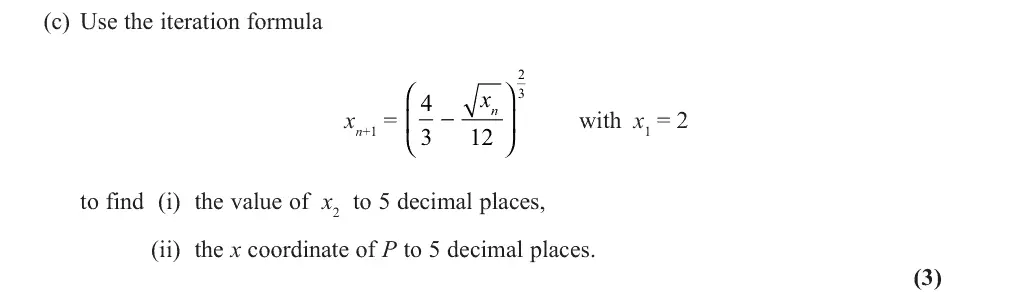
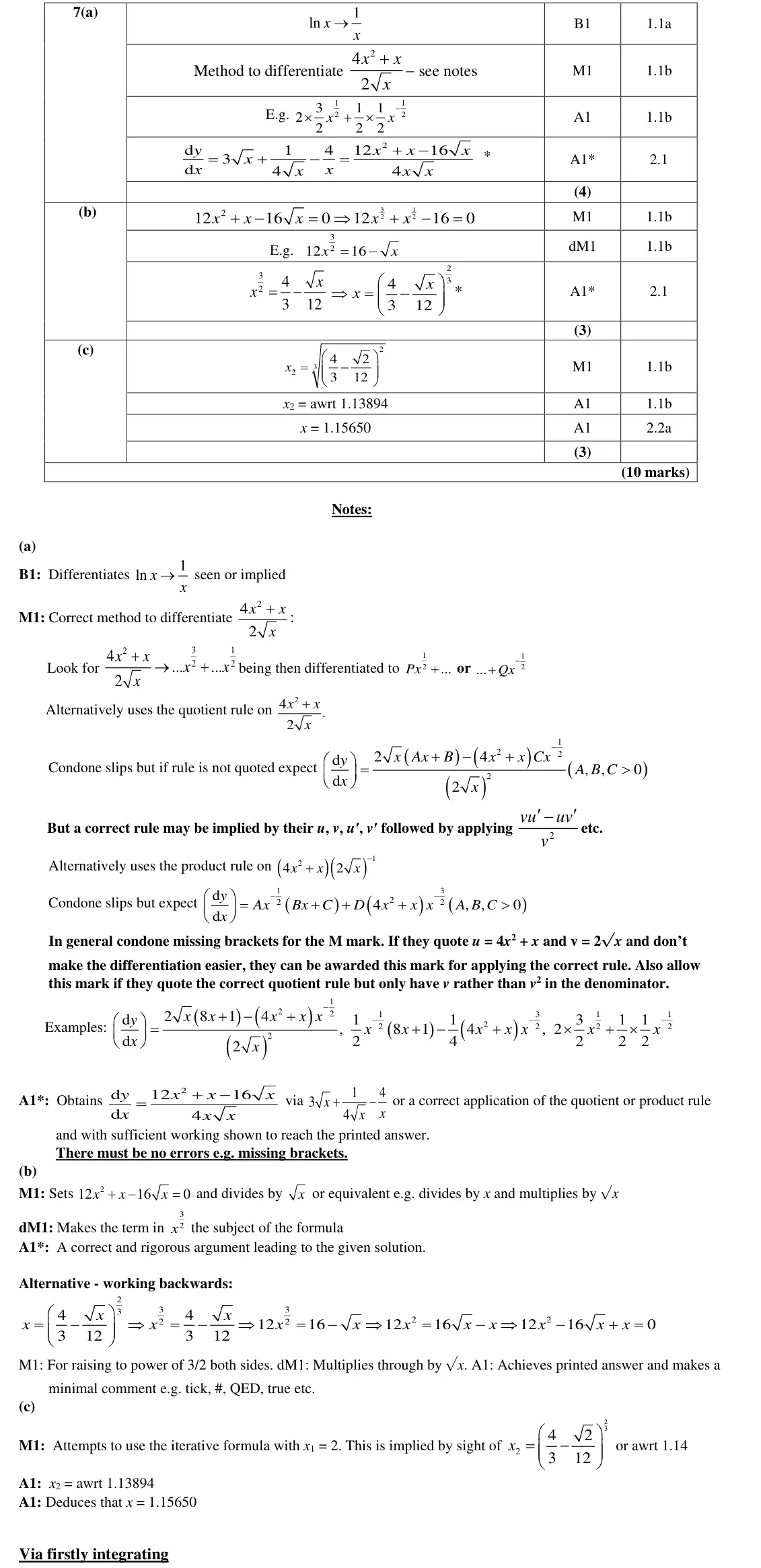
Part (c) was generally well done, with most candidates getting part (i) correct. Some candidates left out part (ii) and a few made an error with their accuracy here, 1.15651 and 1.1565 being seen a few times.
Common mistakes
x₂ = 1.13894
x coordinate of P = 1.15650 to 5 d.p. (not 1.15651 or 1.1565)
June 2019 · Paper 2 · Q11(b)2 marks
Mark scheme (whole question; this part is marked with the orange bar)
Examiner's comment
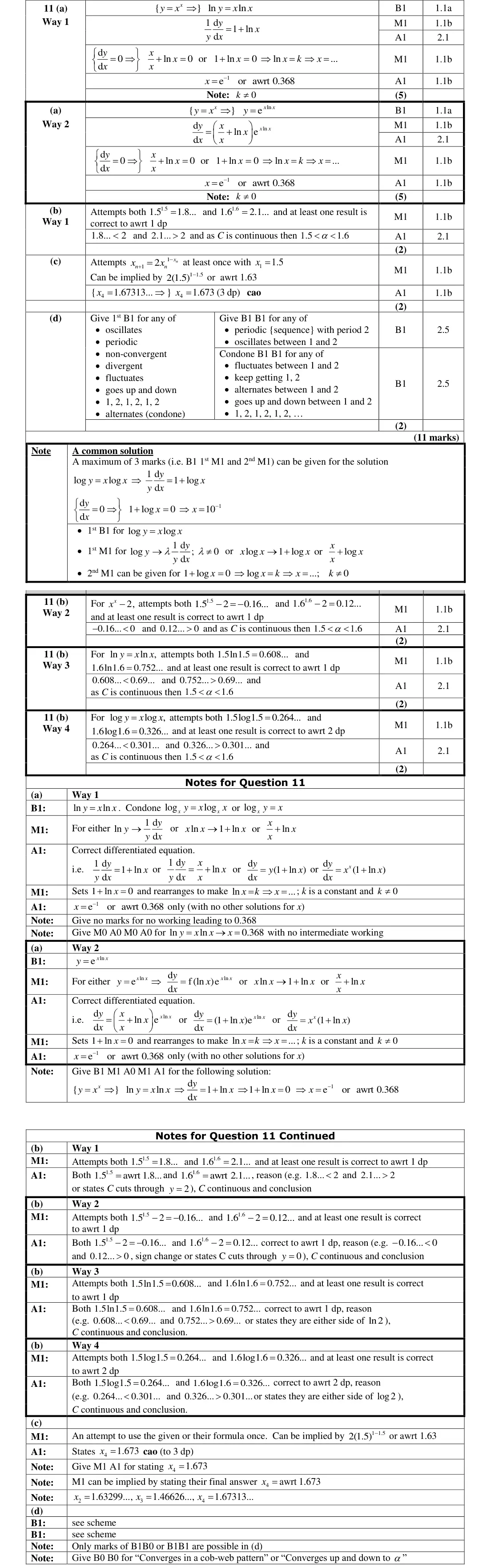
In general, Q11 discriminated well between candidates of all abilities. Q11(a) was demanding with most candidates scoring no more than one mark. Q11(b), Q11(c) and Q11(d) proved accessible to candidates of all abilities. In Q11(a), most candidates took logs, as advised by the question, and many obtained either ln ln y x x or log log . y x x At this point a significant number of candidates made no further creditable progress. Some candidates used a complete method of applying the product rule on x and implicit differentiation to obtain a correct ln x Most of these candidates then applied d y 1 d y x 1 y x e . x 0 to obtain Some 1 ln . x d d x log ’ method to obtain candidates, who received partial credit, used a ‘ after 0.1, 10 1 d y x finding A few candidates used logarithms without reference to a 1 log . x 10 d y x base. Those who proceeded to obtain received partial credit and those who 0.1 1 e x obtained were allowed full marks. There were some alternative methods employed by a few candidates in Q11(a). A few d y y x ln e x x x ln x x y x candidates rewrote as and applied to give a (1 ln )e 0 x d 1 e . x Others differentiated both sides of the equation ln ln y x x correct with 1 e . x respect to y and usually proceeded to find A very few candidates applied the ln y , x quotient rule to the equation but were rarely successful with this method. ln x xx x x xx or 2 1.6. In Q11(b), most candidates evaluated either at both and 1.5 Many candidates compared their values with either 2 or 0 (depending on whether they xx xx or 2 ). Although many of these concluded that 1.5 1.6, evaluated only a few made any reference to the curve being continuous in this interval. A few candidates, x who made no creditable progress, used values of x outside the given range, e.g. 1.4 x x 1.6. and Very few candidates used values within the range e.g. and 1.51 x 1.59, which meant that they were able to earn both marks. x 1.673, 4x In Q11(c), most candidates found a correct although a few did not state 4 , x x and 3x as part of their correct to 3 decimal places. Some wrote down the iterates 1 2 4x with no intermediate work. solution, while others stated In Q11(d), some candidates gave correct descriptions such as ‘sequence oscillates between 1 and 2’ or ‘the sequence is periodic with period 2’. Other descriptions such as ‘alternates between 1 and 2’, ‘keep getting 1 and 2’ or ‘fluctuates between 1 and 2’ were condoned. Some credit was given for partial explanations such as ‘sequence is non-convergent’, ‘sequence oscillates’ or ‘sequence is divergent’.
Common mistakes
1.5^1.5 = 1.84 < 2 and 1.6^1.6 = 2.12 > 2 (or xˣ − 2 change of sign)
must state C is continuous and conclude
June 2019 · Paper 2 · Q11(c)2 marks
Mark scheme (whole question; this part is marked with the orange bar)
Examiner's comment
In general, Q11 discriminated well between candidates of all abilities. Q11(a) was demanding with most candidates scoring no more than one mark. Q11(b), Q11(c) and Q11(d) proved accessible to candidates of all abilities. In Q11(a), most candidates took logs, as advised by the question, and many obtained either ln ln y x x or log log . y x x At this point a significant number of candidates made no further creditable progress. Some candidates used a complete method of applying the product rule on x and implicit differentiation to obtain a correct ln x Most of these candidates then applied d y 1 d y x 1 y x e . x 0 to obtain Some 1 ln . x d d x log ’ method to obtain candidates, who received partial credit, used a ‘ after 0.1, 10 1 d y x finding A few candidates used logarithms without reference to a 1 log . x 10 d y x base. Those who proceeded to obtain received partial credit and those who 0.1 1 e x obtained were allowed full marks. There were some alternative methods employed by a few candidates in Q11(a). A few d y y x ln e x x x ln x x y x candidates rewrote as and applied to give a (1 ln )e 0 x d 1 e . x Others differentiated both sides of the equation ln ln y x x correct with 1 e . x respect to y and usually proceeded to find A very few candidates applied the ln y , x quotient rule to the equation but were rarely successful with this method. ln x xx x x xx or 2 1.6. In Q11(b), most candidates evaluated either at both and 1.5 Many candidates compared their values with either 2 or 0 (depending on whether they xx xx or 2 ). Although many of these concluded that 1.5 1.6, evaluated only a few made any reference to the curve being continuous in this interval. A few candidates, x who made no creditable progress, used values of x outside the given range, e.g. 1.4 x x 1.6. and Very few candidates used values within the range e.g. and 1.51 x 1.59, which meant that they were able to earn both marks. x 1.673, 4x In Q11(c), most candidates found a correct although a few did not state 4 , x x and 3x as part of their correct to 3 decimal places. Some wrote down the iterates 1 2 4x with no intermediate work. solution, while others stated In Q11(d), some candidates gave correct descriptions such as ‘sequence oscillates between 1 and 2’ or ‘the sequence is periodic with period 2’. Other descriptions such as ‘alternates between 1 and 2’, ‘keep getting 1 and 2’ or ‘fluctuates between 1 and 2’ were condoned. Some credit was given for partial explanations such as ‘sequence is non-convergent’, ‘sequence oscillates’ or ‘sequence is divergent’.
Common mistakes
x₂ = 1.633, x₃ = 1.466, x₄ = 1.673 (3 d.p.)
June 2019 · Paper 2 · Q11(d)2 marks
Mark scheme (whole question; this part is marked with the orange bar)
Examiner's comment
In general, Q11 discriminated well between candidates of all abilities. Q11(a) was demanding with most candidates scoring no more than one mark. Q11(b), Q11(c) and Q11(d) proved accessible to candidates of all abilities. In Q11(a), most candidates took logs, as advised by the question, and many obtained either ln ln y x x or log log . y x x At this point a significant number of candidates made no further creditable progress. Some candidates used a complete method of applying the product rule on x and implicit differentiation to obtain a correct ln x Most of these candidates then applied d y 1 d y x 1 y x e . x 0 to obtain Some 1 ln . x d d x log ’ method to obtain candidates, who received partial credit, used a ‘ after 0.1, 10 1 d y x finding A few candidates used logarithms without reference to a 1 log . x 10 d y x base. Those who proceeded to obtain received partial credit and those who 0.1 1 e x obtained were allowed full marks. There were some alternative methods employed by a few candidates in Q11(a). A few d y y x ln e x x x ln x x y x candidates rewrote as and applied to give a (1 ln )e 0 x d 1 e . x Others differentiated both sides of the equation ln ln y x x correct with 1 e . x respect to y and usually proceeded to find A very few candidates applied the ln y , x quotient rule to the equation but were rarely successful with this method. ln x xx x x xx or 2 1.6. In Q11(b), most candidates evaluated either at both and 1.5 Many candidates compared their values with either 2 or 0 (depending on whether they xx xx or 2 ). Although many of these concluded that 1.5 1.6, evaluated only a few made any reference to the curve being continuous in this interval. A few candidates, x who made no creditable progress, used values of x outside the given range, e.g. 1.4 x x 1.6. and Very few candidates used values within the range e.g. and 1.51 x 1.59, which meant that they were able to earn both marks. x 1.673, 4x In Q11(c), most candidates found a correct although a few did not state 4 , x x and 3x as part of their correct to 3 decimal places. Some wrote down the iterates 1 2 4x with no intermediate work. solution, while others stated In Q11(d), some candidates gave correct descriptions such as ‘sequence oscillates between 1 and 2’ or ‘the sequence is periodic with period 2’. Other descriptions such as ‘alternates between 1 and 2’, ‘keep getting 1 and 2’ or ‘fluctuates between 1 and 2’ were condoned. Some credit was given for partial explanations such as ‘sequence is non-convergent’, ‘sequence oscillates’ or ‘sequence is divergent’.
Common mistakes
sequence is periodic with period 2 / oscillates between 1 and 2 (both marks)
"non-convergent", "oscillates" or "divergent" alone gets one mark
June 2018 · Paper 1 · Q4(a)2 marks
Mark scheme (whole question; this part is marked with the orange bar)
Examiner's comment
This was perhaps the most poorly attempted question on the whole of the paper. Part (a) should have been familiar to centres but one which required the students to set up their own function, usuallyf( ) before substituting in the x values of 3 and 4. This was 2ln(8 ) , x x x well done, but also quite commonly, the only mark gained in the question. To show that a student needed two correct calculations, give a valid reason, which required both 3 4, a change in sign and a mention of continuity, as well as giving a brief deduction. Explanations rarely mentioned the fact that the function needed to be continuous in this interval. Fully correct solutions to part (b) were very rare. Many students assumed that this
Common mistakes
set up f(x) = 2ln(8 − x) − x
f(3) = 0.22 and f(4) = −1.23
must state change of sign AND f continuous on [3, 4] and conclude – continuity rarely mentioned
June 2018 · Paper 1 · Q4(b)2 marks
Mark scheme (whole question; this part is marked with the orange bar)
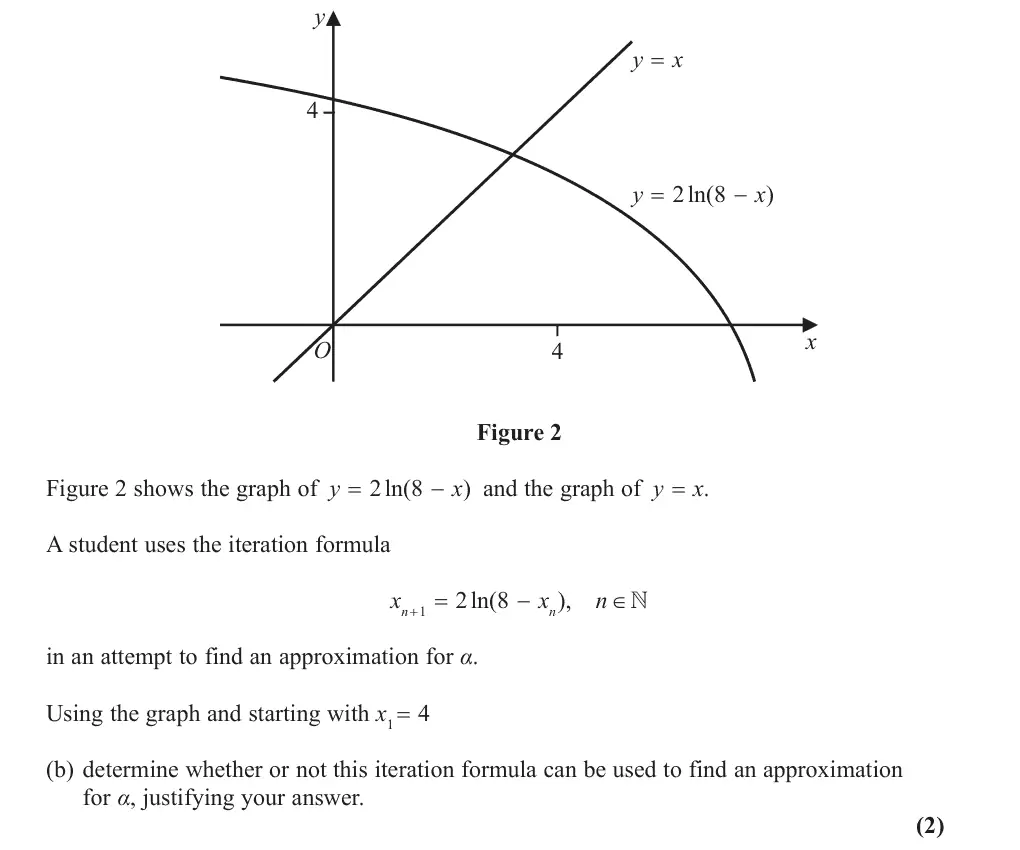
Examiner's comment
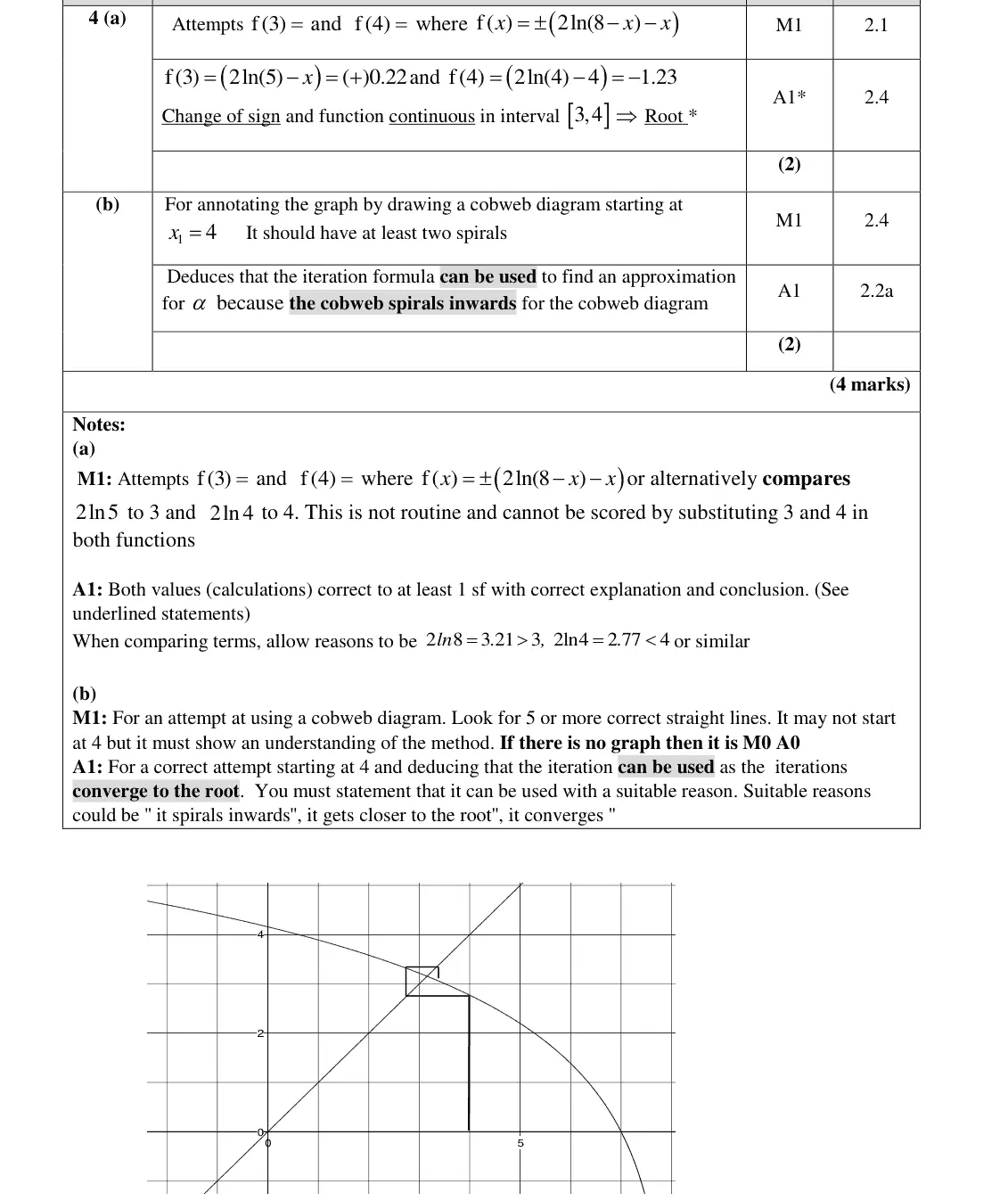
interval. Fully correct solutions to part (b) were very rare. Many students assumed that this was a question on continued iteration and gave all values of x from 1x to 8x without any consideration of the demand of the question. Students were required to ''use the graph'' to show whether or not the iteration formula could be used to find an approximation for . x Hence, to satisfy this demand, a cobweb diagram starting at was required followed by 4 1 an explanation that ''it can be used'' because ''the cobweb spirals inwards towards .
Common mistakes
draw a cobweb on Figure 2 starting at x₁ = 4 (listing iterates x₁ to x₈ scores nothing)
conclude it CAN be used because the cobweb spirals inwards/converges to α
June 2018 · Paper 2 · Q5(a)3 marks
Mark scheme (whole question; this part is marked with the orange bar)
Examiner's comment
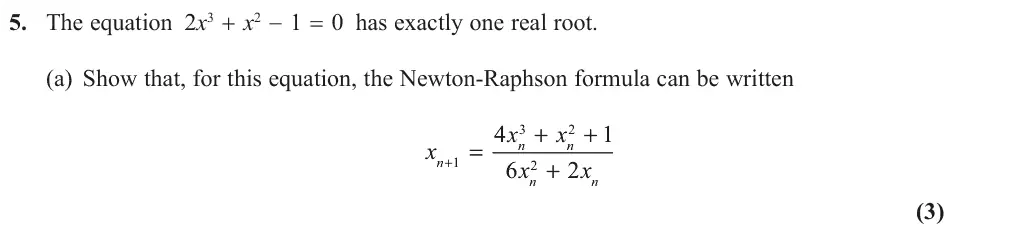
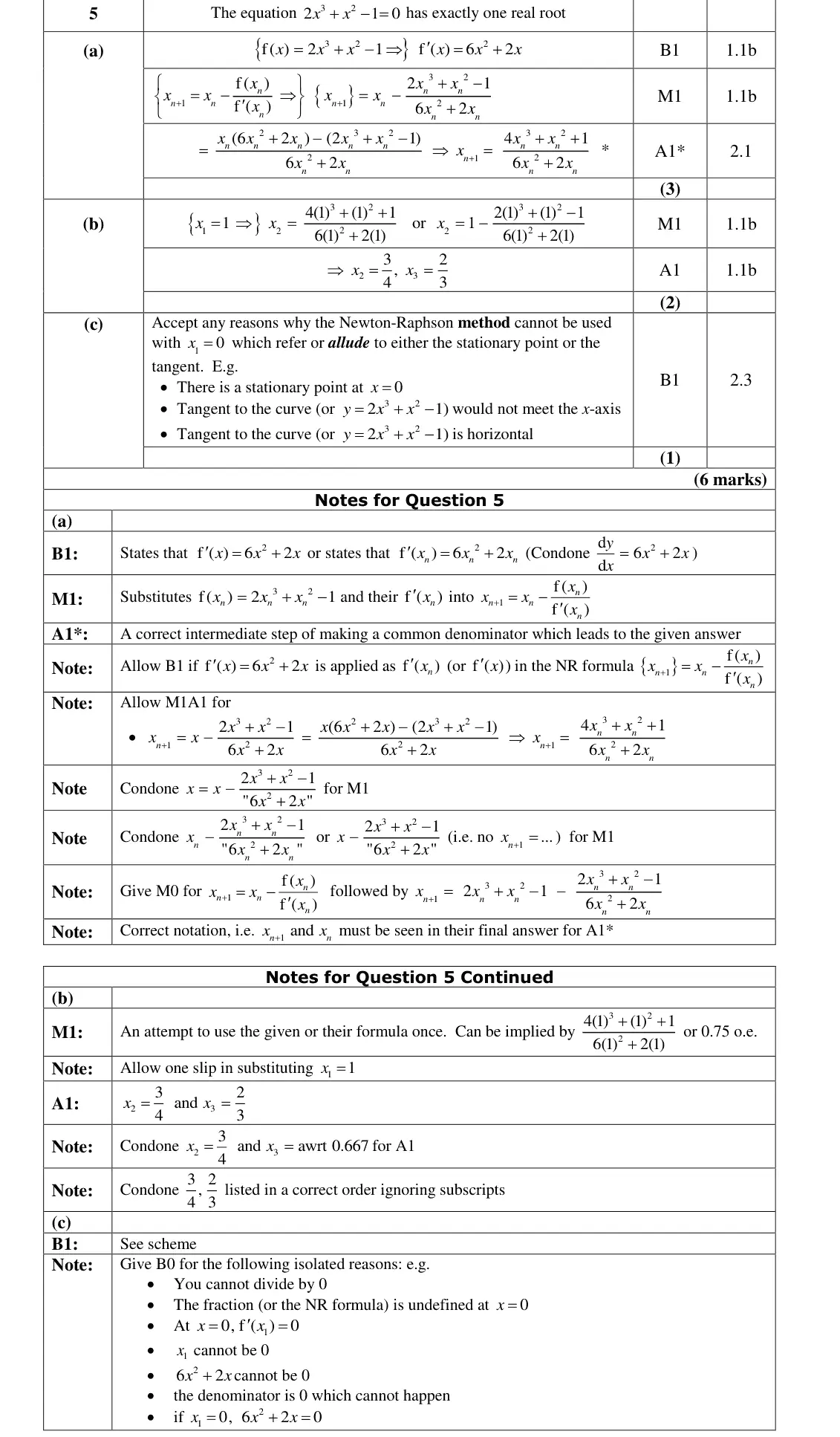
This was a well-answered question with part (a) and part (c) providing most of the discrimination. In part (a), most students substituted a defined 3 2 f( ) 2 1 n n n x x x and a correct 2 f ( ) 6 2 n n n x x x into the Newton-Raphson formula 1 f( ) . f ( ) n n n n x x x x Many students used correct algebra to arrive at the given result. Some students moved directly from 3 2 1 2 2 1 6 2 n n n n n n x x x x x x to 3 2 1 2 4 1 6 2 n n n n n x x x x x without showing the correct intermediate step of rationalising the denominator. There were bracketing errors, sign errors and the error of omitting ‘ 1 nx ’ to write only the right-hand side of the Newton-Raphson formula.
Common mistakes
f′(x) = 6x² + 2x
common-denominator intermediate step must be shown before the given answer
keep the x_n term
bracket/sign errors
June 2018 · Paper 2 · Q5(b)2 marks
Mark scheme (whole question; this part is marked with the orange bar)
Examiner's comment
In part (b), nearly all students wrote down a correct 2 3 3 2 , . 4 3 x x
Common mistakes
x₂ = 3/4, x₃ = 2/3
June 2018 · Paper 2 · Q5(c)1 mark
Mark scheme (whole question; this part is marked with the orange bar)
Examiner's comment
In part (c), only a few students gave an acceptable explanation that detailed why the Newton- Raphson method did not work for this question. Some of these students stated ‘because there is a stationary point at 0, x then the method could not work’ while others explained that a tangent to the curve at 0 x would never meet the x-axis. The explanation, ‘not being able to divide by zero in the formula’, by itself, was not sufficient to gain credit in part (c).
Common mistakes
stationary point at x = 0 so the tangent is horizontal and never meets the x-axis
"cannot divide by zero" or "f′(0) = 0" alone scores B0
Find an Edexcel maths tutor
Stuck on this? Book a trial session with an Edexcel specialist.