14 question parts, 47 marks, 1 with a difficulty rating from the examiner's report
Notes, worked examples and practice for this topic are being written by our tutors. The past-paper questions below are ready now: work each one on paper, then open the mark scheme and the examiner's comment.
Tap a question to zoom it. Mark scheme and examiner's comment open under each question.
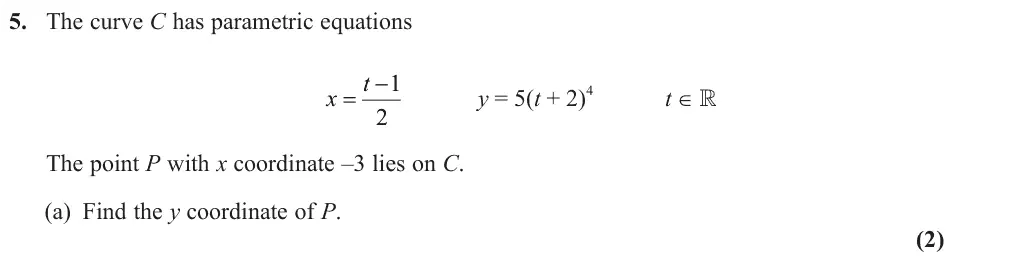
June 2025 · Paper 2 · Q5(a)2 marks
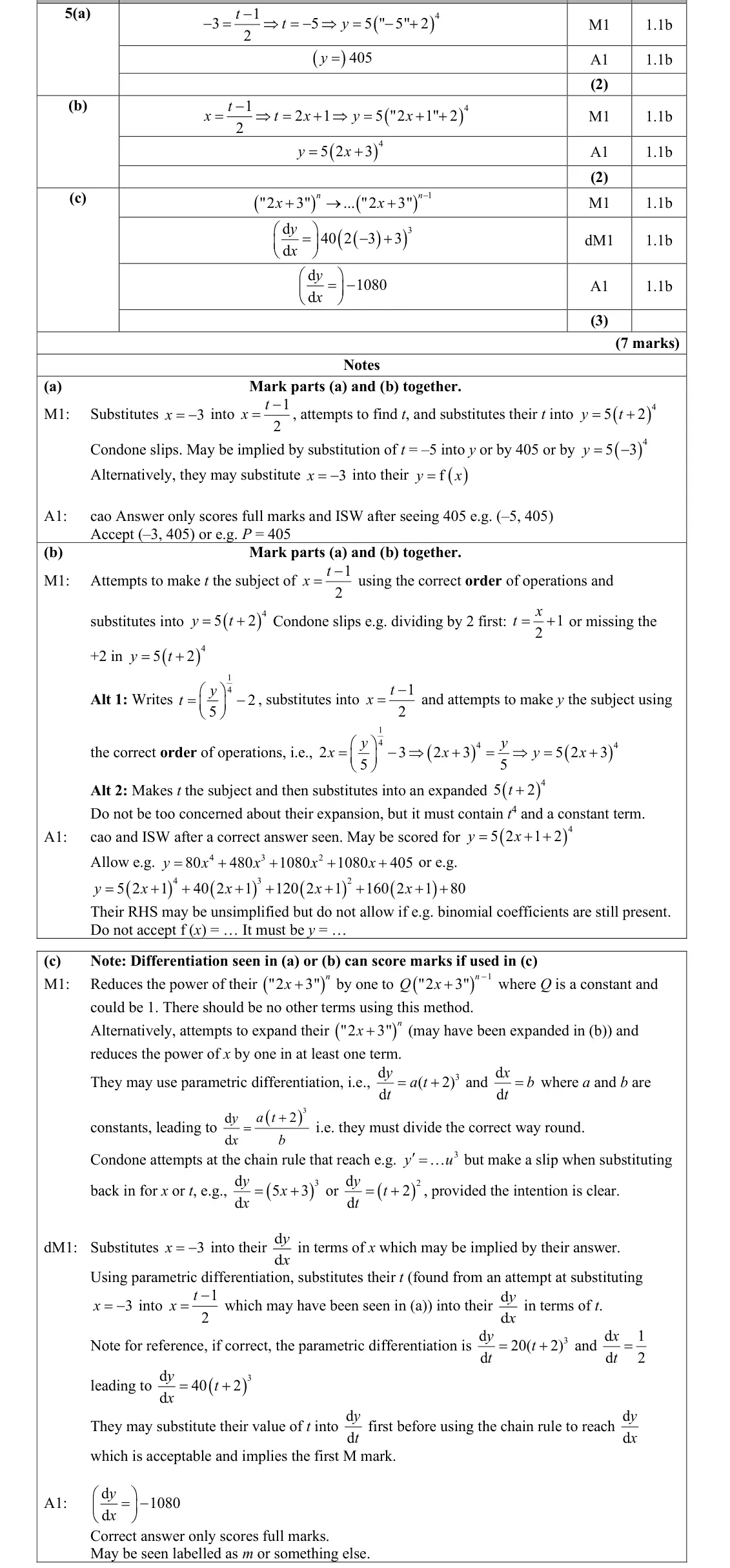
Mark scheme (whole question; this part is marked with the orange bar)
Examiner's comment
This question involved a simple parametric equation, and learners generally performed very well across all three parts. The structure of the question offered a steady progression through substitution, rearranging and then differentiating, with each part building on the previous one. This allowed learners to approach each part confidently, with the majority performing well in parts (a) and (b), even if they did encounter difficulties with part (c). In part (a), substituting t = –5 and 2 1 t x = + followed by x = –3 were both popular approaches. Errors were rare and typically due to simple computation mistakes, such as incorrectly evaluating the expression 5(-5 + 2)4.
Common mistakes
solve −3 = (t − 1)/2 to get t = −5, then y = 5(−3)⁴ = 405
June 2025 · Paper 2 · Q5(b)2 marks
Mark scheme (whole question; this part is marked with the orange bar)
Examiner's comment
This question involved a simple parametric equation, and learners generally performed very well across all three parts. The structure of the question offered a steady progression through substitution, rearranging and then differentiating, with each part building on the previous one. This allowed learners to approach each part confidently, with the majority performing well in parts (a) and (b), even if they did encounter difficulties with part (c). Part (b) was also generally answered well, with most responses successfully converting the parametric form into Cartesian form. Where there were errors, they were in writing t as a function of x, e.g. t = 2x – 1, while others made a mistake with 2x + 1 + 2 inside the bracket. A reasonable number found the correct expression for y, then expanded the brackets, even though many did not go on to use their expansion in part (c).
Common mistakes
t = 2x + 1 (not 2x − 1)
y = 5(2x + 3)⁴ in the form y = ..., not f(x) = ...
June 2024 · Paper 2 · Q10(b)1 mark
Mark scheme (whole question; this part is marked with the orange bar)
Examiner's comment
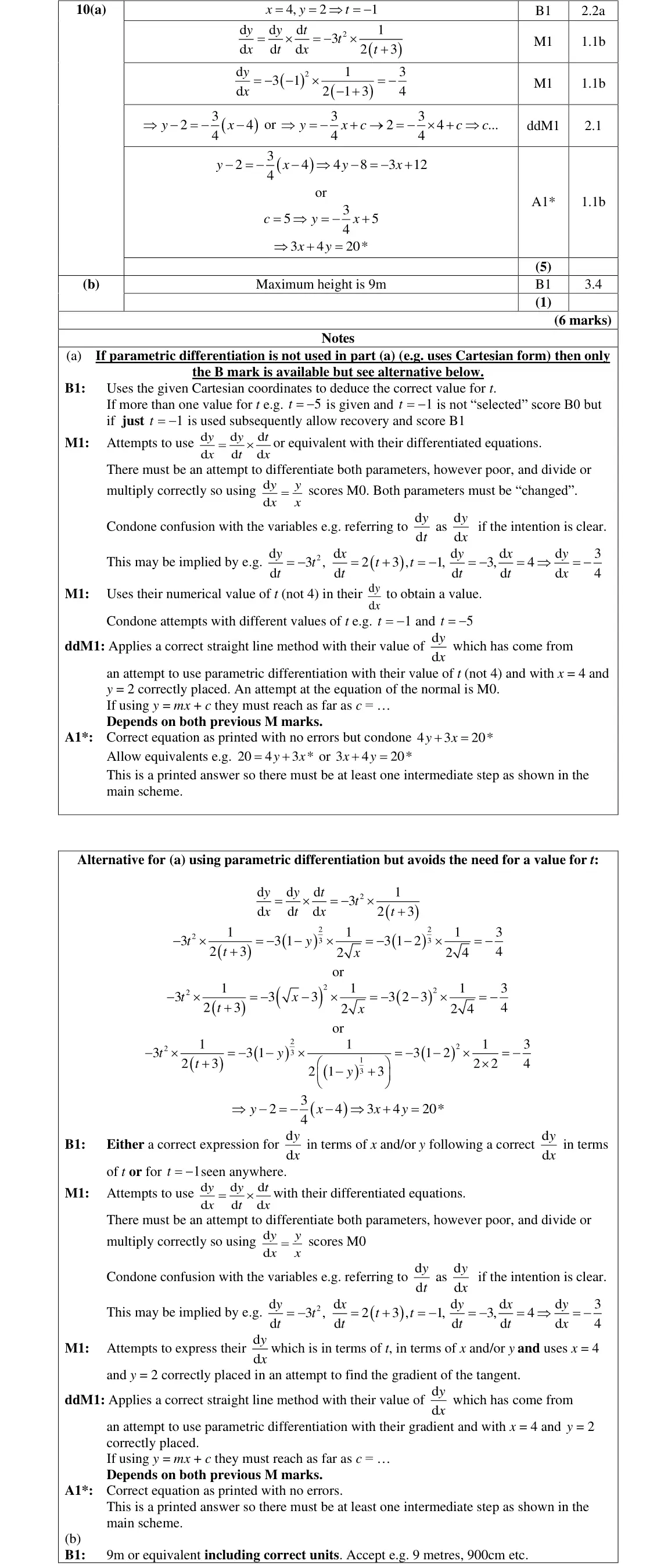
Most candidates were successful in this question, showing that parametric differentiation was overall well understood by candidates. It was noted by examiners that part (b) was not attempted by a significant number of candidates. When it was attempted, it was generally not done well, with very many candidates not scoring the mark. Many achieved the correct value only to lose the mark for not stating the units. A common wrong answer was to use x = 0 in the tangent equation to give 5m. Another was to use t = -3 and then substitute this into y = 1 - t3 to give 28m, ignoring the set of values for which t was valid. Others set d 0 d y x = thinking this would give a maximum and then substituted their t value into y. Some wrongly assumed that the largest value of t for the given domain would lead to the maximum height. There was little evidence that candidates had used the sketch to help them find the maximum height.
Common mistakes
greatest y is at t = −2: 9 m (units needed)
t = −3 is outside the domain (28 m wrong)
not x = 0 in the tangent (5 m)
dy/dx = 0 does not give the maximum
June 2023 · Paper 2 · Q9(a)3 marks
Mark scheme (whole question; this part is marked with the orange bar)
Examiner's comment
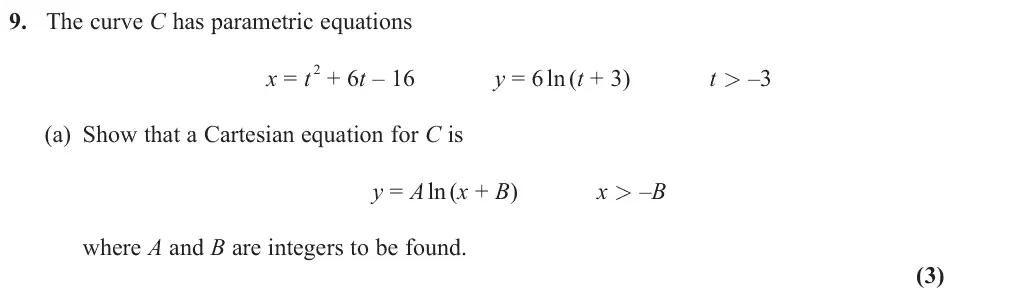
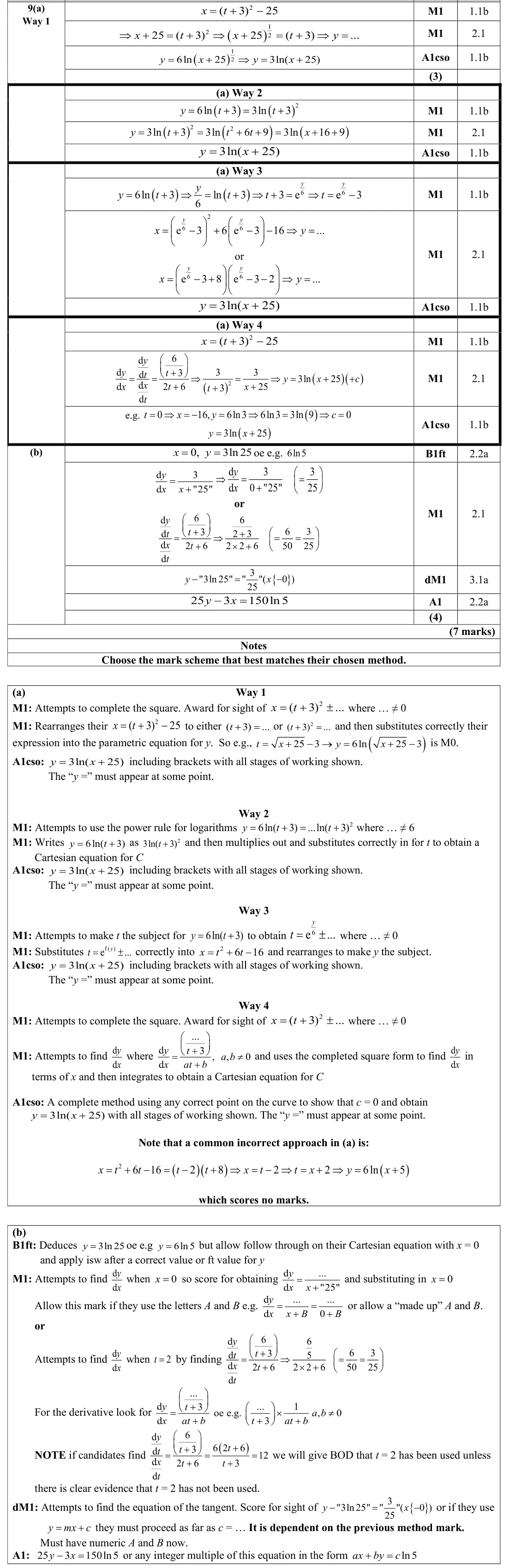
Most candidates found part (a) challenging but it was usually attempted. There were not many blank responses. Of the four methods listed on the mark scheme, one common successful method was to substitute t in terms of x into y = 6ln(t + 3) via “completing the square” (way 1). When substituting into y = 6ln(t + 3), if a correct t equation was created, then this usually led to full marks. Another common approach was to rearrange t in terms of y, usually successfully as 6 e 3 y t = - and substitute into x = t2 + 6t 16 (way 3). When using this method some candidates had difficulty squaring 6 e y meaning they were unable to earn full marks. Some candidates incorrectly set 25 5 x x + = + thus also losing the accuracy mark. A significant number of candidates factorised x = t2 + 6t 16 to give x = (t 2)(t + 8) and then wrongly thought x = t 2. This then often led to y = 6ln(x + 5) which scored no marks in this part.
Common mistakes
complete the square: x = (t + 3)² − 25 so t + 3 = √(x + 25), y = 6ln√(x + 25) = 3ln(x + 25), A = 3, B = 25
common error x = (t − 2)(t + 8) so "x = t − 2" giving 6ln(x + 5) scores 0
June 2022 · Paper 1 · Q16(a)5 marksHard
Mark scheme (whole question; this part is marked with the orange bar)
Examiner's comment
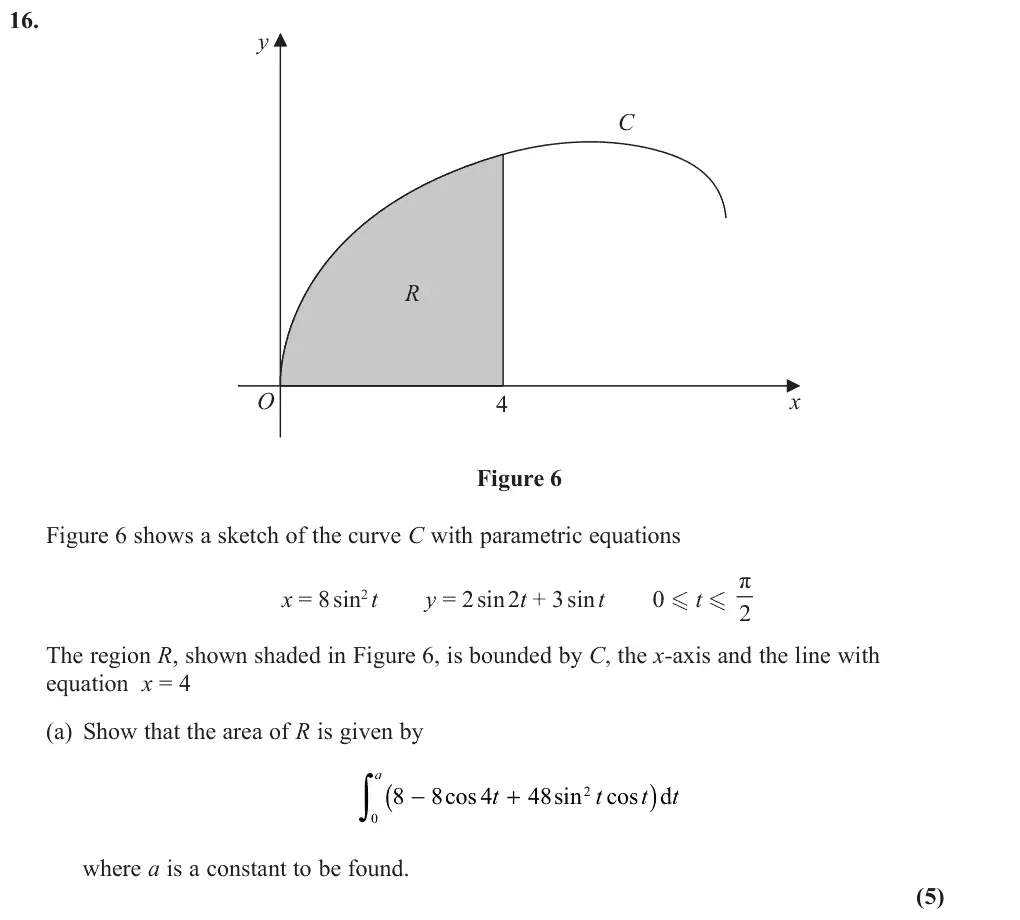
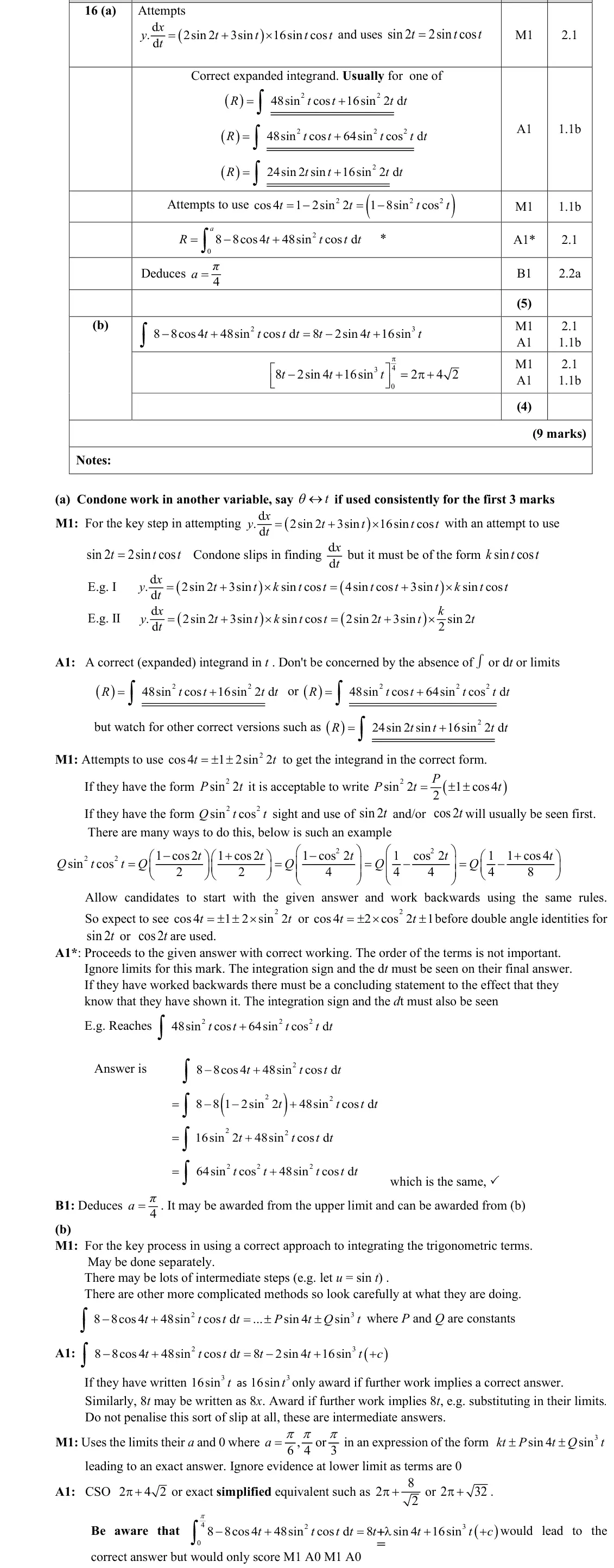
The final question on the paper proved to be a challenge for many candidates and there were several blank responses seen. It is possible that this was due to time management. Some candidates attempted unsuccessfully to change to a Cartesian equation, suggesting that possibly parametric integration had not been covered. In part (a), candidates who recognised the need to use parametric integration were usually able to differentiate correctly to find d d x t , multiply this by y and then use the double angle formulae to find an acceptable expression for d d x y t . It was common for candidates to score the first two marks. The next two marks were more elusive, and it was common to see candidates perform a lot of onerous manipulation without making any significant progress. Those who were most likely to be successful were the ones who had an expression in terms of 2 sin 2t and then spotting the need to use the double angle formula to form a term in cos 4t. For many candidates the mark for the upper limit was all that was achieved in part (a). However, some failed to achieve it as they left it as 4 (value for x not t) or 45 (degrees).
Common mistakes
area = integral of y dx/dt dt with dx/dt = 16 sin t cos t
sin 2t = 2 sin t cos t
cos 4t = 1 − 2sin²2t
x = 4 gives sin²t = ½ so a = π/4
changing to Cartesian fails
June 2022 · Paper 2 · Q16(b)2 marks
Mark scheme (whole question; this part is marked with the orange bar)
Examiner's comment
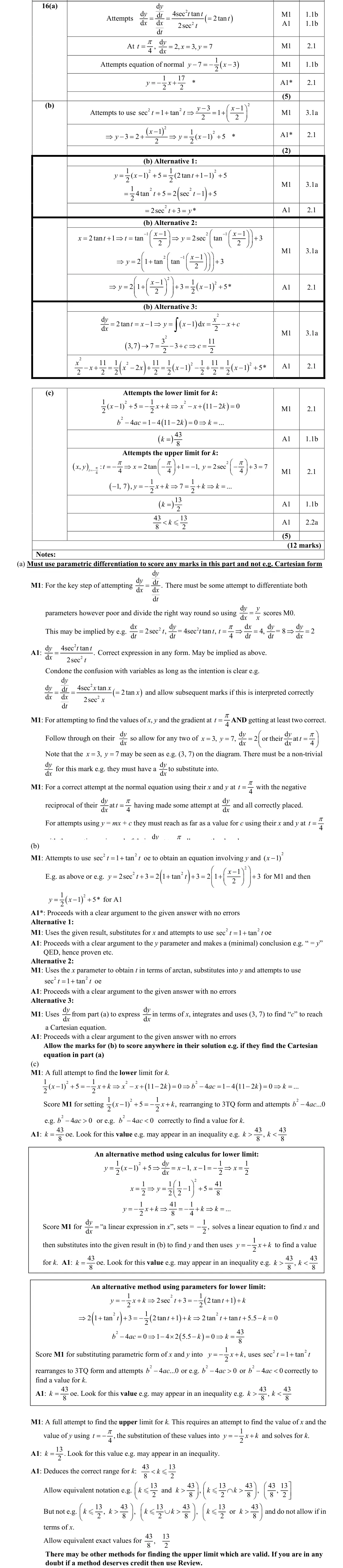
This question proved to be a good differentiator between candidates. It provided a challenge for many candidates but equally there were a number of accessible marks here. Most candidates attempted part (a), many attempted part (b) and at least partially attempted part (c), usually attempting to find the lower limit for k. There were, however, very few completely correct answers to this question and a substantial minority made no attempt at any part, perhaps having run out of time by the time they reached the last question on the paper. In part (b), there were a multitude of approaches seen and candidates were often at least partially successful. Most candidates recognised the need to begin with a trigonometric identity, usually sec2𝑡𝑡= 1 + tan2𝑡𝑡 and rearranged the expressions for x and y to obtain expression for sec2𝑡𝑡 and tan2𝑡𝑡 before substituting into the identity to obtain an equation in 𝑥𝑥 and 𝑦𝑦 which could in turn be rearranged to the required form. However, sometimes candidates took a far lengthier approach, beginning with e.g. sin2𝑡𝑡+ cos2𝑡𝑡= 1 and using 𝑥𝑥 and 𝑦𝑦 to find expressions for sin𝑡𝑡 and cos𝑡𝑡. An alternative and popular, though inelegant, method was to start from the target Cartesian equation and substitute in the trigonometric forms for 𝑥𝑥 and 𝑦𝑦 before rearranging to obtain an identity. Provided a conclusion was given, this approach was credited with both marks. Occasionally candidates used the equation for 𝑥𝑥 to obtain an expression for 𝑡𝑡 in terms of arctangent before substituting into the expression for 𝑦𝑦 which, if correctly done, was an acceptable approach. Several students just substituted the coordinates of points such as P into the given Cartesian equation, stating that they satisfied the equation. Such attempts did not constitute a proof and so gained no marks.
Common mistakes
use sec²t = 1 + tan²t with tan t = (x − 1)/2 and sec²t = (y − 3)/2
substituting a few points is not a proof
a conclusion is needed if working from the answer
June 2022 · Paper 2 · Q16(c)5 marks
Mark scheme (whole question; this part is marked with the orange bar)
Examiner's comment
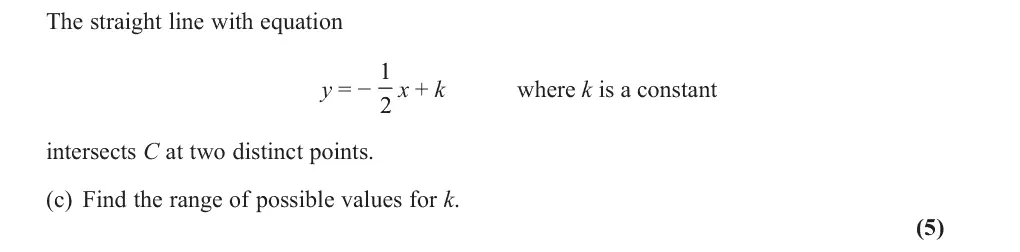
This question proved to be a good differentiator between candidates. It provided a challenge for many candidates but equally there were a number of accessible marks here. Most candidates attempted part (a), many attempted part (b) and at least partially attempted part (c), usually attempting to find the lower limit for k. There were, however, very few completely correct answers to this question and a substantial minority made no attempt at any part, perhaps having run out of time by the time they reached the last question on the paper. Part (c) provided a particular challenge and usually only the lower limit was attempted. Most candidates appeared to completely miss the need to find an upper limit. Of those who did manage to find both limits, only a small minority of candidates got to the final solution with correct inequality interpretation. It is worth noting that candidates achieving full marks for this part very often had clear construction lines on their graph that enabled them to see the correct approach. Most often though, candidates gained the method mark for the lower limit, 43 8 , for identifying that two intersections were required and set up a correct inequality for the discriminant for the quadratic equation obtained by equating the equations of the line and the curve. Common errors in manipulation, particularly of the coefficient of ½ from the quadratic meant that a number of candidates did not earn the accuracy mark for 43/8. Many candidates stopped after obtaining a lower limit for k, but others explored the parameter limits at 𝑡𝑡= - 𝜋𝜋 4 and 𝑡𝑡 = 𝜋𝜋 3 to identify 𝑘𝑘 values of 13 2 and 23 2 - sqrt 3 for the line passing through the associated points. Very few, however, recognised 13 2 as an upper limit and a number of candidates assumed incorrectly that 13 2 < 𝑘𝑘 < 23 2 - sqrt 3. A minority of candidates incorrectly thought that setting d𝑦𝑦 d𝑥𝑥 = 0 or d𝑦𝑦 d𝑥𝑥 =- 1 2 would provide limiting criterion for k values. In summary this was an interesting question which gave rise to a wide variety of responses in all three parts. There were instances of both succinct and ingenious approaches seen, particularly in part (c) and it was pleasing to see tenacity in some response where candidates had inadvertently opted for less efficient approaches but had persevered nonetheless to obtain the required results.
Common mistakes
lower limit: tangency, discriminant of x² − x + (11 − 2k) = 0 gives k = 43/8
upper limit from the end point t = −π/4, (−1, 7): k = 13/2
43/8 < k ≤ 13/2 (most missed the upper limit
draw lines on the sketch)
Oct 2021 · Paper 1 · Q133 marks
Mark scheme (whole question; this part is marked with the orange bar)
Examiner's comment
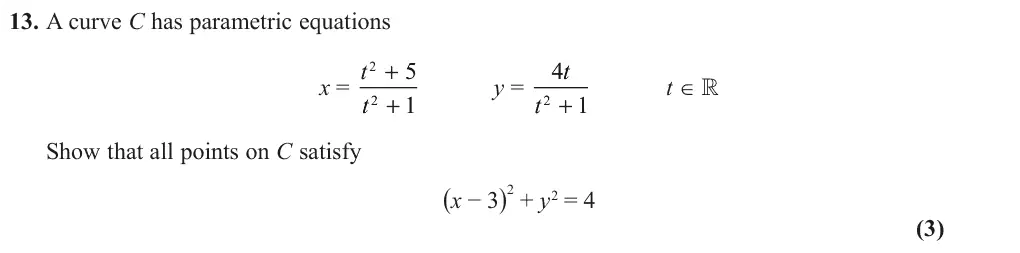
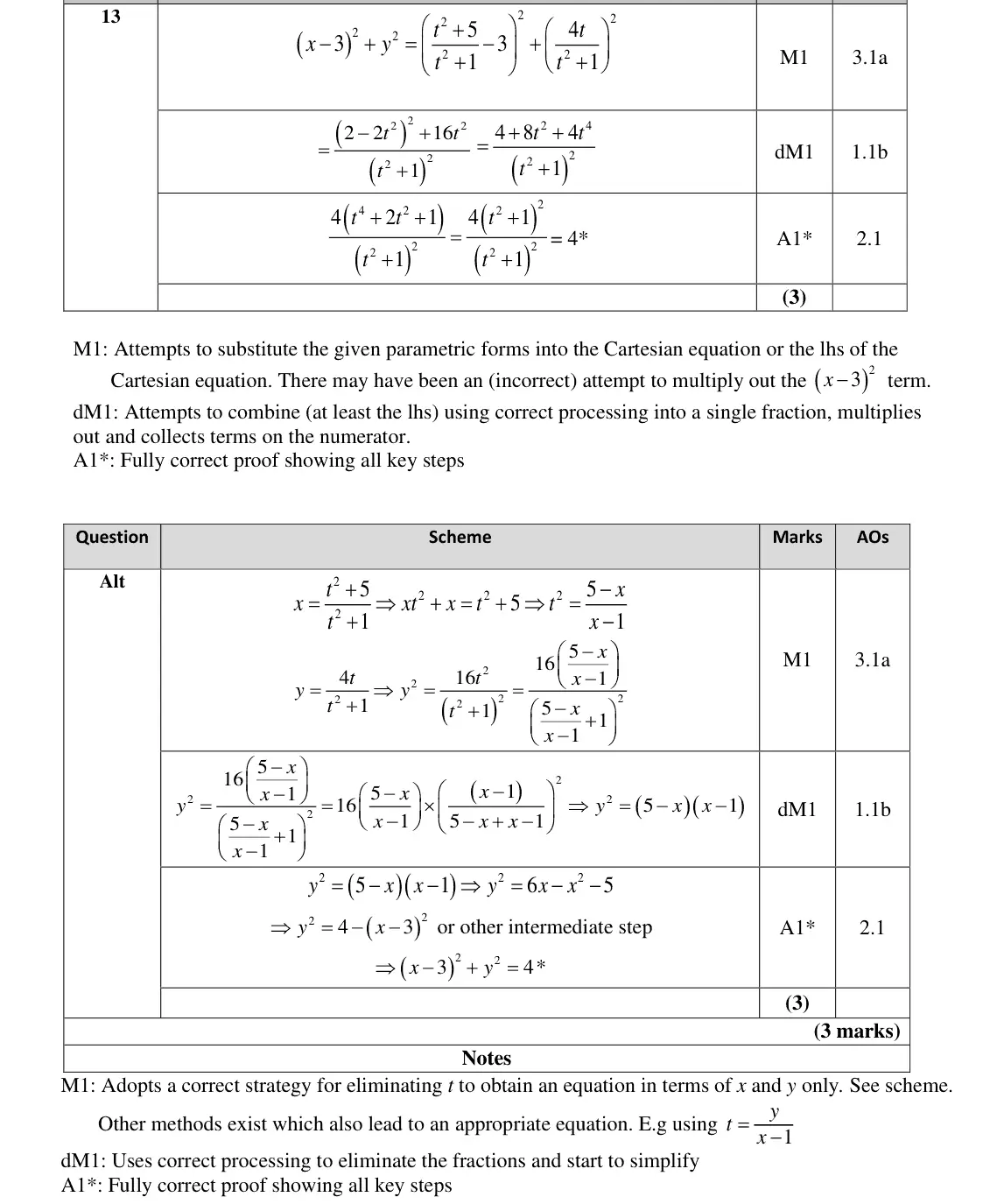
A solution gaining all three marks was relatively rare to see, and there were many very poor demonstrations of algebraic manipulation seen. Many candidates managed to score the first M mark but usually were unable to make further progress. The attempts were split between candidates who attempted to substitute into the LHS of the Cartesian equation to give an equation/expression in t and those who attempted to eliminate t, usually via t 2 = (5-x)/(x-1), to give an equation involving x and y only. The errors then ranged from incorrect squaring of a bracket to incorrect manipulation of fractions with very few unable to complete the proof
Common mistakes
substitute into (x − 3)² + y² and combine into one fraction: 4(t² + 1)²/(t² + 1)² = 4
or eliminate t via t² = (5 − x)/(x − 1)
errors squaring brackets and handling fractions
Oct 2020 · Paper 2 · Q12(a)(i)3 marks
Mark scheme (whole question; this part is marked with the orange bar)
Examiner's comment
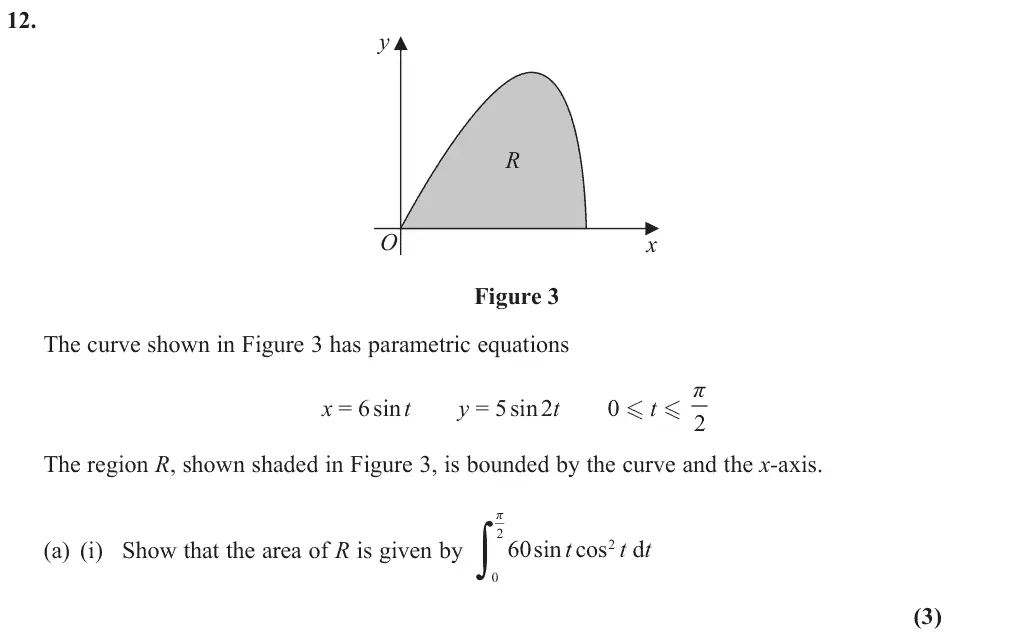
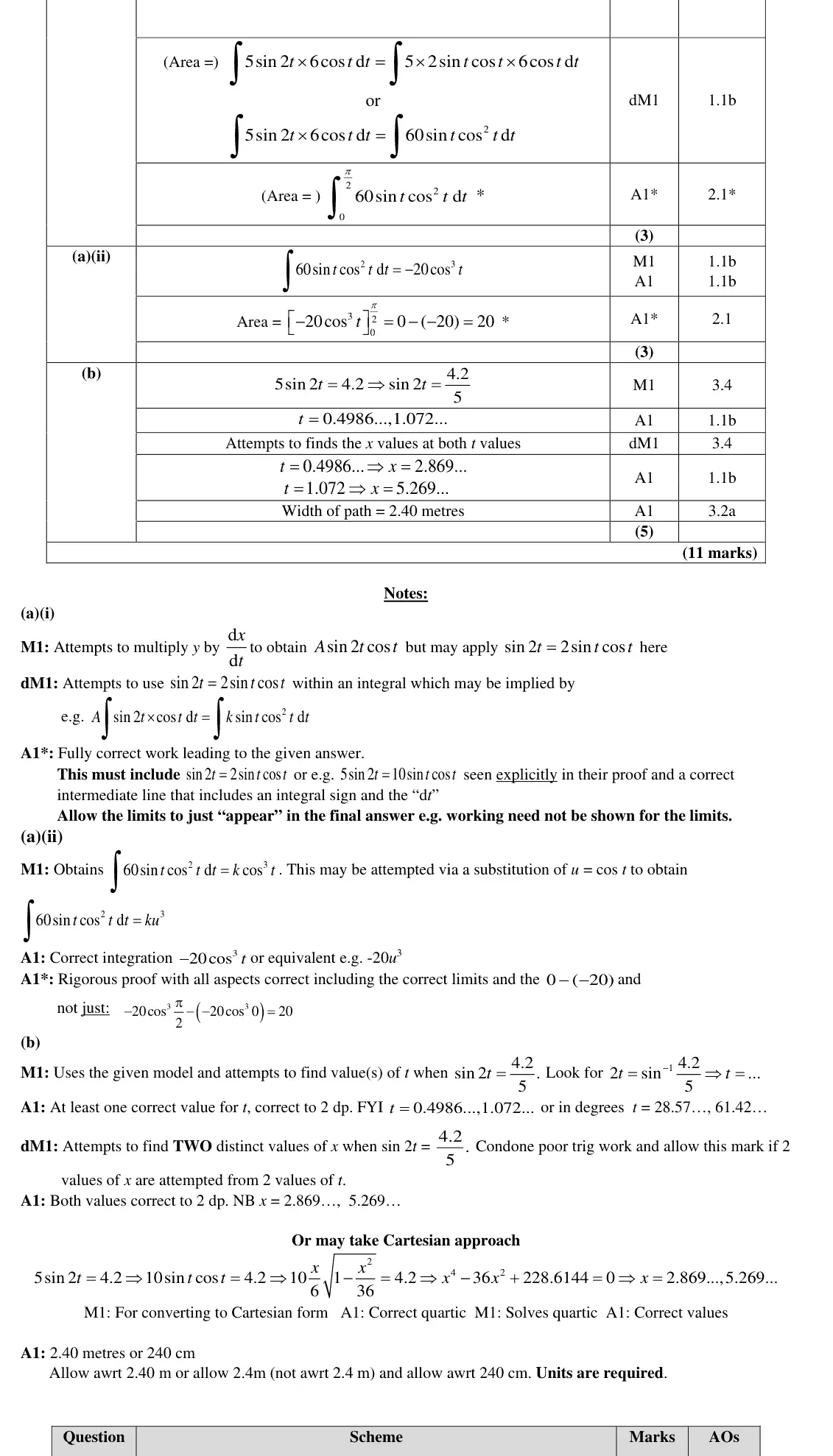
Many candidates left the entire question or parts of this question completely blank and clearly found it difficult to access the content being assessed here, perhaps due to a lack of familiarity with integration using parametric equations. Many tried to establish the Cartesian equation to answer various parts. That said, there were many candidates who provided clear and concise solutions to each part. In part (a)(i), most candidates recalled the formula for integrating parametric equations and knew to find 𝑑𝑑𝑑𝑑 𝑑𝑑𝑑𝑑. Awareness of the double angle formula for sin2t was good. The main problem caused for these candidates was a lack of “dt” throughout their work, and only included this in the final line, losing the final accuracy mark. There was a significant proportion of candidates who attempt ed some differentiation using the chain rule: 𝑑𝑑𝑑𝑑 𝑑𝑑𝑑𝑑= 𝑑𝑑𝑑𝑑 𝑑𝑑𝑑𝑑 x 𝑑𝑑𝑑𝑑 𝑑𝑑𝑑𝑑 , scoring no marks. In part (b) many candidates who had found part (a) difficult gave up and lost the opportunity of scoring some easier marks. Many candidates who scored no marks elsewhere were still able to access at least the first two marks in part (b) by setting sin2t = 4.2 5 and solving, frequently getting at least one correct angle; but too many of these found their second value of t by subtracting their first value from pi instead of calculating pi – 𝑠𝑠𝑠𝑠𝑠𝑠-1( 0.84) before dividing by 2. The following mark was for finding two values of x, but many simply substituted their first value in to find x, thinking that this gave them the width of the walkway. Too many marks were lost by approximating too soon and hence not having values with the required accuracy. A few lost the last mark because they omitted the units.
Common mistakes
area = integral of y (dx/dt) dt
sin 2t = 2sin t cos t must be seen explicitly
keep dt throughout
dy/dx by the chain rule is the wrong method
Oct 2020 · Paper 2 · Q12(b)5 marks
Mark scheme (whole question; this part is marked with the orange bar)
Examiner's comment
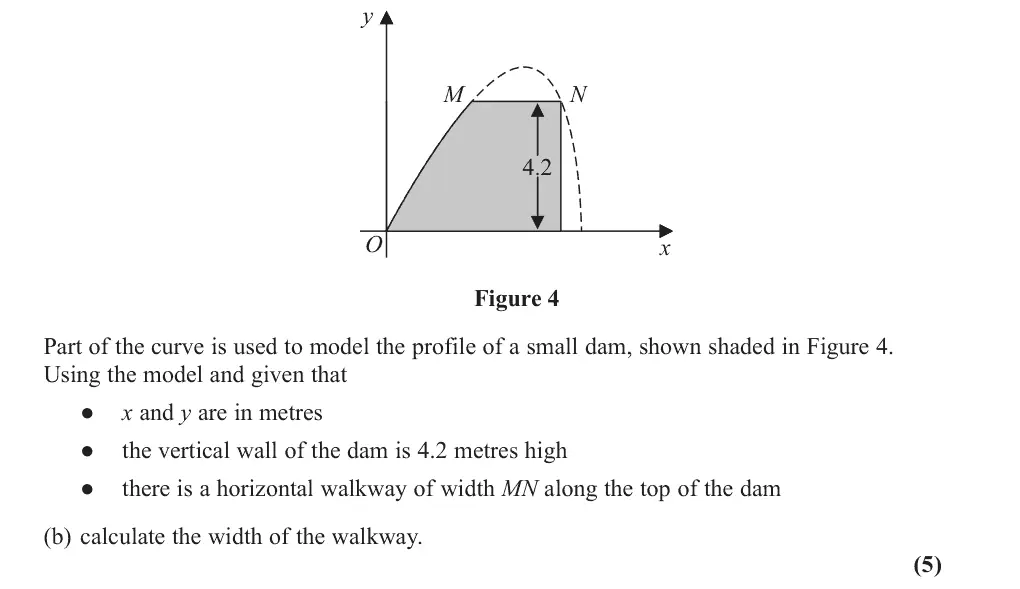
Many candidates left the entire question or parts of this question completely blank and clearly found it difficult to access the content being assessed here, perhaps due to a lack of familiarity with integration using parametric equations. Many tried to establish the Cartesian equation to answer various parts. That said, there were many candidates who provided clear and concise solutions to each part. In part (b) many candidates who had found part (a) difficult gave up and lost the opportunity of scoring some easier marks. Many candidates who scored no marks elsewhere were still able to access at least the first two marks in part (b) by setting sin2t = 4.2 5 and solving, frequently getting at least one correct angle; but too many of these found their second value of t by subtracting their first value from pi instead of calculating pi – 𝑠𝑠𝑠𝑠𝑠𝑠-1( 0.84) before dividing by 2. The following mark was for finding two values of x, but many simply substituted their first value in to find x, thinking that this gave them the width of the walkway. Too many marks were lost by approximating too soon and hence not having values with the required accuracy. A few lost the last mark because they omitted the units.
Common mistakes
5sin 2t = 4.2 gives two values of t: 2t = π − arcsin 0.84 for the second (not π − first t)
find x at both and subtract
width 2.40 m (units needed)
avoid early rounding
June 2019 · Paper 2 · Q46 marks
Mark scheme (whole question; this part is marked with the orange bar)
Examiner's comment
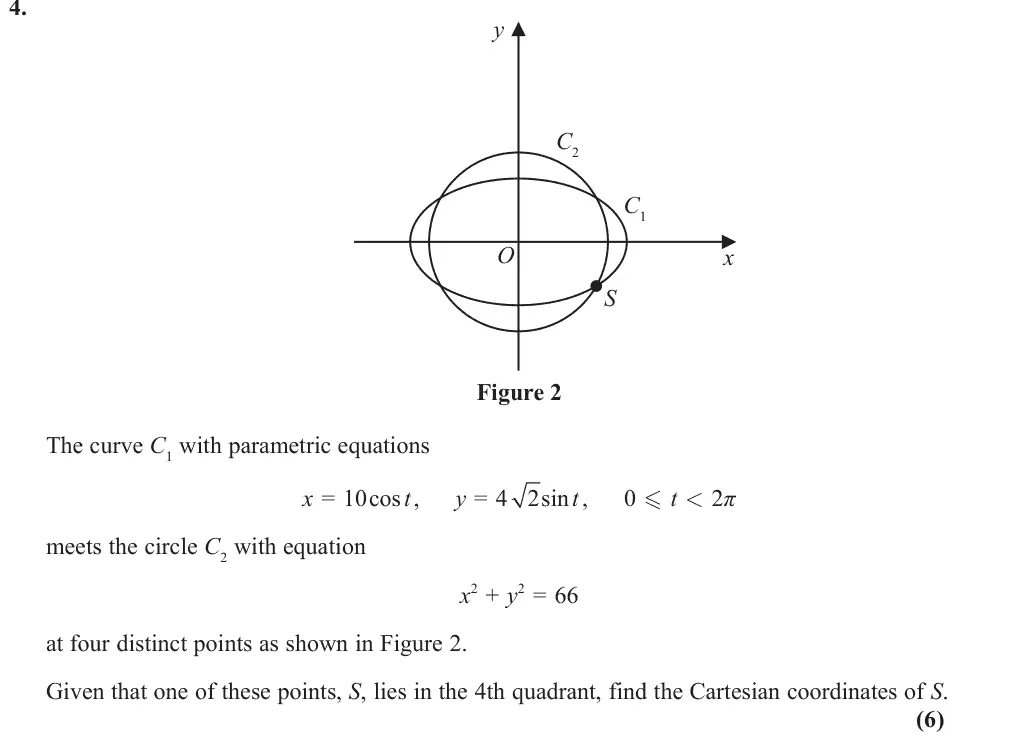
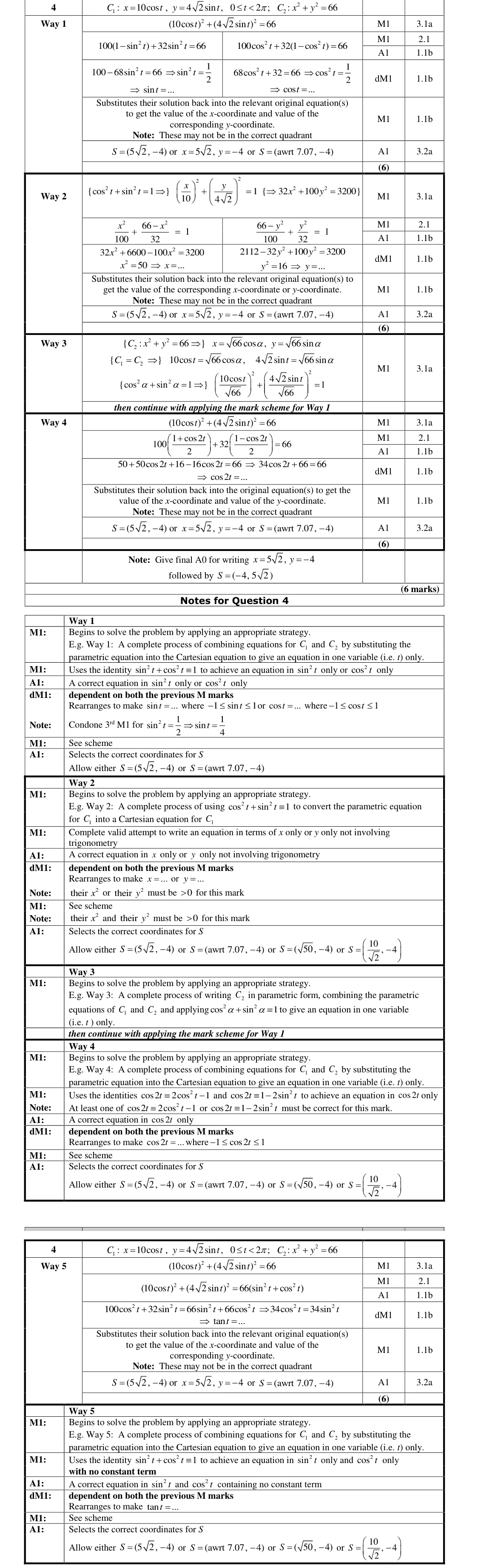
Q04 was well attempted by both medium ability and higher ability candidates. Lower ability candidates struggled to make progress, with most of them scoring no more than one mark. There were two common methods that were used by candidates. The first method, covered by Way 1 in the mark scheme, was the substitution of the parametric equations of 1 C into the Cartesian equation of 2 C to give an equation in t only; the trigonometric identity 2 2 sin cos 1 t t being used to obtain an equation in 2 sin t (or 2 cos t ) only, and a value for sint (or cos )t found. The second method, covered by Way 2 in the mark scheme, was the application of the trigonometric identity 2 2 sin cos 1 t t to the parametric equations of 1 C to give 2 2 1, 10 4 2 x y the Cartesian equation of 2 C being used to obtain an equation in 2x (or 2) y only, and a value for x (or y) found. A few candidates used a correct method of progressing from 2 2 (10cos ) (4 2 sin ) 66 t t to either 2 tan 1 t or cos2 0. t In all these methods, substituting back yielded their coordinates for S, with most candidates realising that 0 Sx and 0. Sy Some candidates incorrectly stated S as (5 2 , 4). In the first method, successful candidates used either 7 4 t or , 4 t and then applied symmetry to find the correct coordinates for S as either (5 2 , 4) or (7.07, 4). An area of concern centred around arithmetical slips or errors in elementary algebra. Examples of the former included 2 (4 2) becoming 8 or 64; 2 1 sin 2 t becoming 1 sin ; 4 t and 2 2 1 100 32 x y becoming 2 2 32 100 1 or 100 or 32. x y Examples of the latter included the invalid methods of 2 2 66 y x becoming 66 y x and 2 2 sin 1 100 x t becoming sin 1 . 10 x t Candidates who made no creditable progress included those who differentiated the parametric equations for 1 , C and those who obtained, e.g. 4 2 sin arccos 10 x y leading to 2 2 32sin arccos 66. 10 x x
Common mistakes
substitute the parametric equations into x² + y² = 66 and use sin²t + cos²t = 1 (or convert C₁ to x²/100 + y²/32 = 1)
(4√2)² = 32 not 8
S in the 4th quadrant is (5√2, −4), not (−4, 5√2)
June 2018 · Paper 1 · Q14(a)2 marks
Mark scheme (whole question; this part is marked with the orange bar)
Examiner's comment
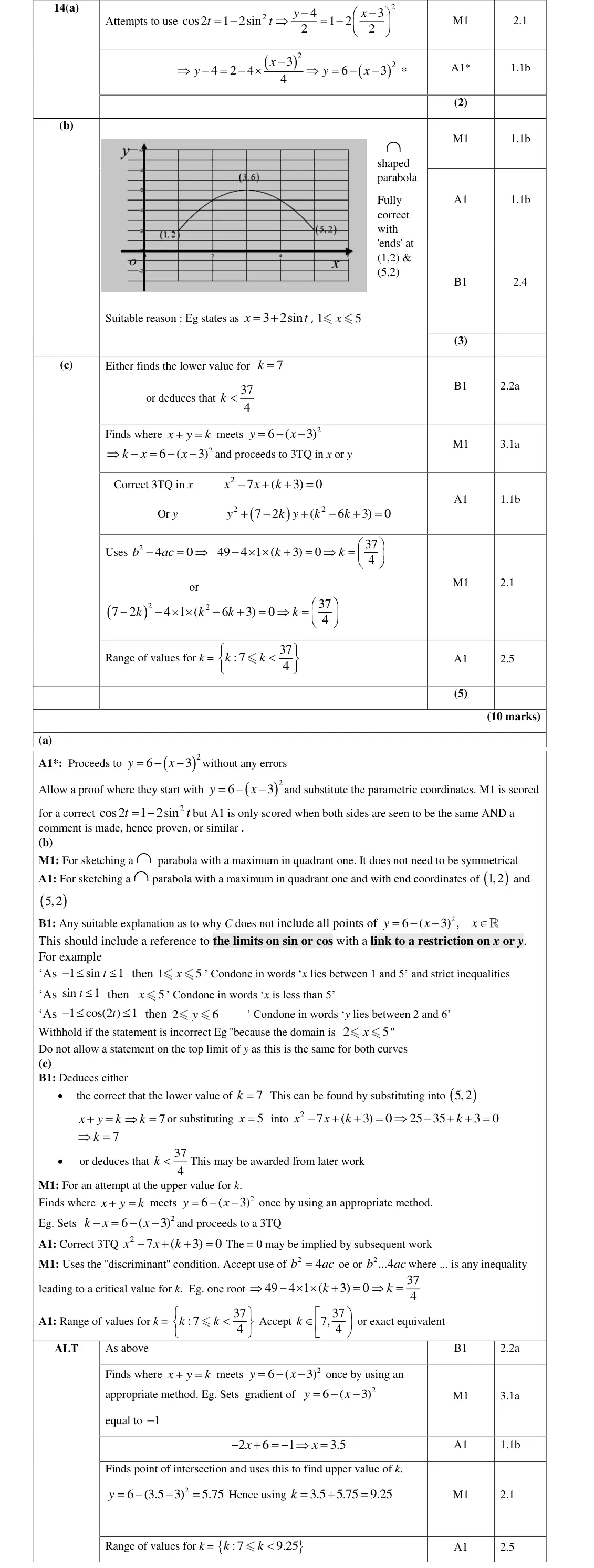
The final question on the paper was a challenge to all. Part (a) was straightforward with most 2 recognising the need to use the identity in some form to prove the required cos2 1 2sin t t result. This was one of the more successful ''show that'' parts of the paper. Only stronger students, however, were able to understand and explain why the curve C did 2 not include all points of the curve Many drew the whole of the parabola in 6 3 . y x
Common mistakes
use cos2t = 1 − 2sin²t with sin t = (x − 3)/2
June 2018 · Paper 1 · Q14(b)3 marks
Mark scheme (whole question; this part is marked with the orange bar)
Examiner's comment
part (b) scoring one out of the three marks. Those who managed to sketch the correct part of the parabola rarely were able to explain why the domain (and range) were restricted. Stating that ''because 0 2 t '' was not enough to explain why for instance 1 5 x . The best then 3 2sint students were able to explain that as 1 sin 1 t would have a maximum and a minimum value of 3 2 value of 3 2 5 1.
Common mistakes
sketch only the arc from (1, 2) to (5, 2) with maximum (3, 6), not the whole parabola
reason: −1 ≤ sin t ≤ 1 so 1 ≤ x ≤ 5 ("0 ≤ t < 2π" alone is not enough)
June 2018 · Paper 1 · Q14(c)5 marks
Mark scheme (whole question; this part is marked with the orange bar)
Examiner's comment
Part (c) was also demanding and better students annotated their graphs to help their understanding of the question (See Figure 1). Most however used the discriminant condition 2 for two roots and were able to proceed to two values. Arithmetic errors were 4 0 b ac quite common using this method. Most students who proceeded to the answer were well versed in writing their answer using set notation. Figure 1
Common mistakes
lower value k = 7 from the end point (5, 2)
x² − 7x + (k + 3) = 0 with b² − 4ac = 0 gives k = 37/4
answer {k : 7 ≤ k < 37/4} in set notation
annotate the sketch
Find an Edexcel maths tutor
Stuck on this? Book a trial session with an Edexcel specialist.