June 2018: Paper 1: Pure Mathematics 1

100 marks · 31 question parts · Question paper, mark scheme and examiner's report on Pearson's site

Question by question

QTopicMarksDifficulty
1 Small-angle approximations, Algebraic methods: polynomials, factor theorem and division 3 —
2(a) Differentiation: first principles, gradients, stationary points, Indices and surds 3 —
2(b) Differentiation: first principles, gradients, stationary points 2 —
2(c) Differentiation: first principles, gradients, stationary points 2 —
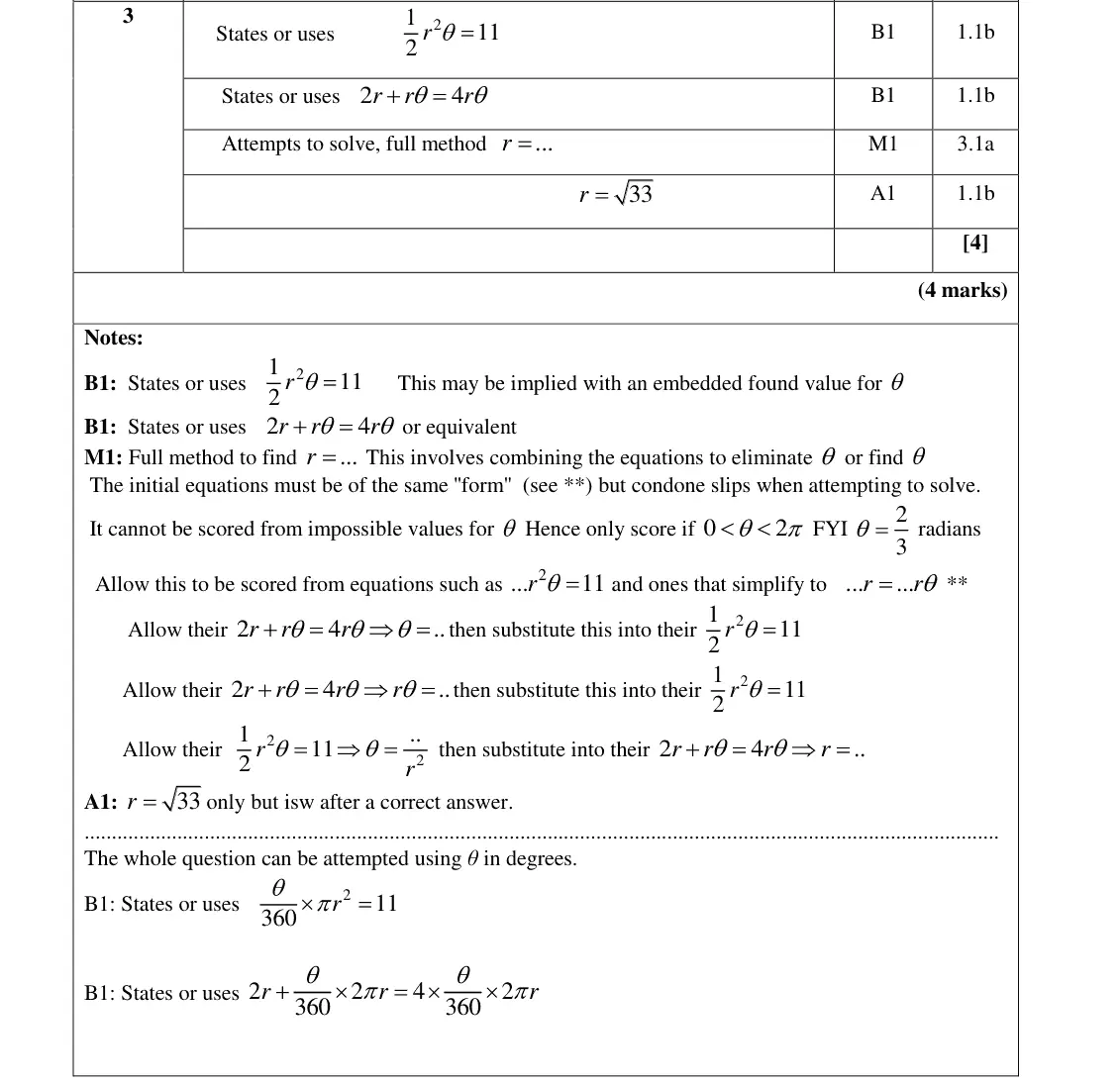
3 Trigonometric ratios, graphs, radians and the sine and cosine rules, Simultaneous equations 4 —
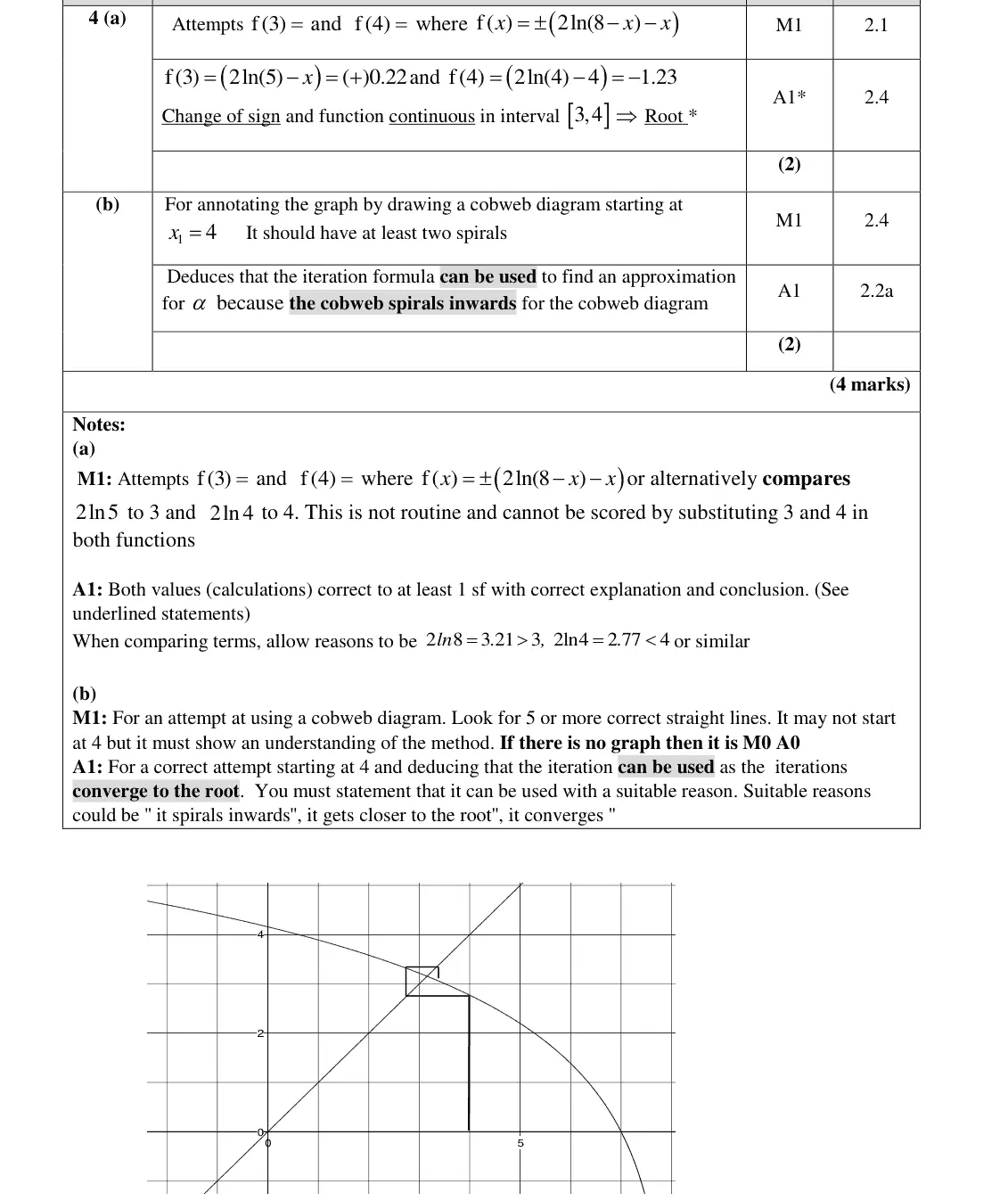
4(a) Numerical methods: roots, iteration and Newton–Raphson, Exponentials and logarithms 2 —
4(b) Numerical methods: roots, iteration and Newton–Raphson 2 —
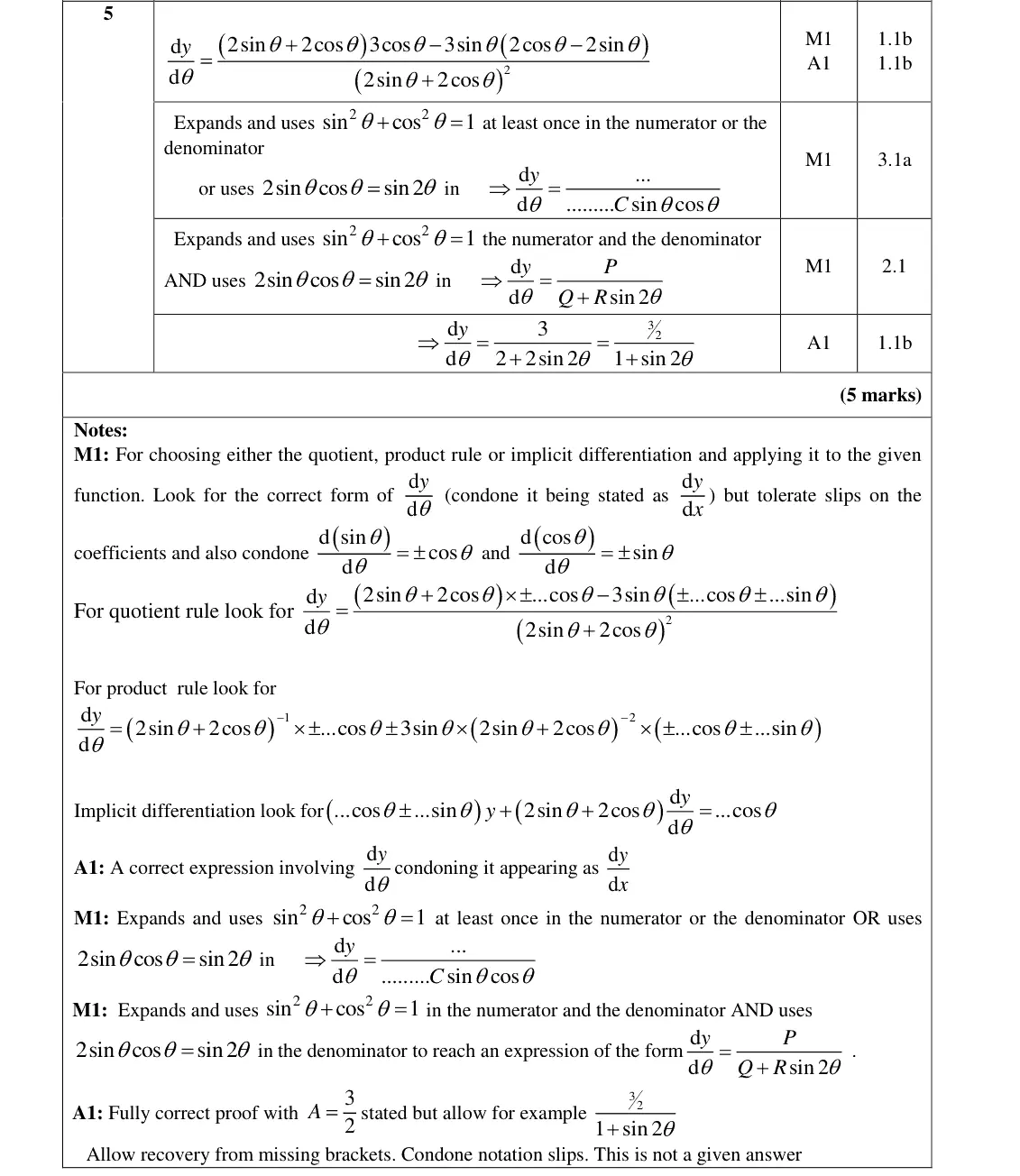
5 Chain, product and quotient rules; connected rates of change, Trigonometric identities and proofs, Addition and double-angle formulae, harmonic form 5 —
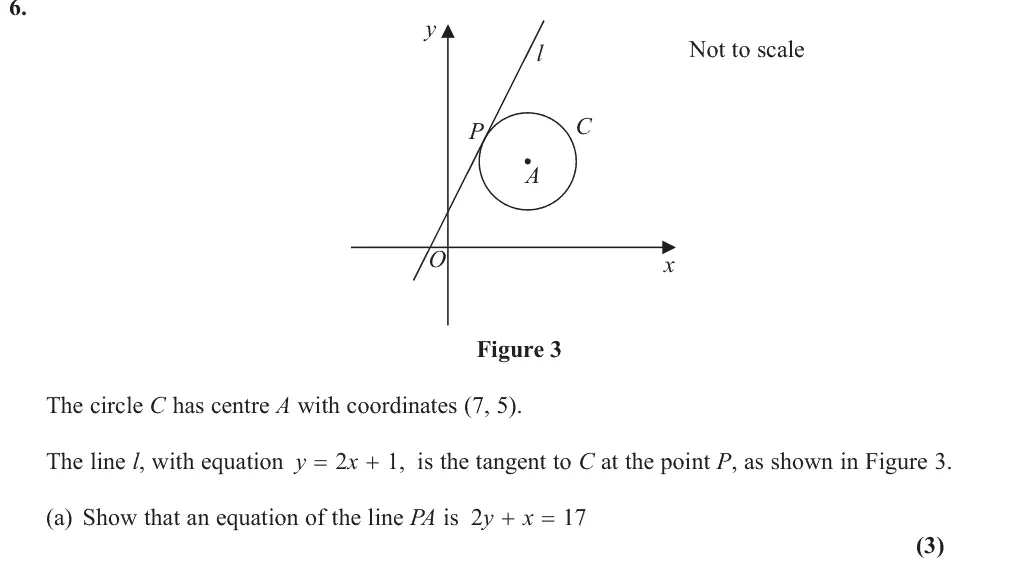
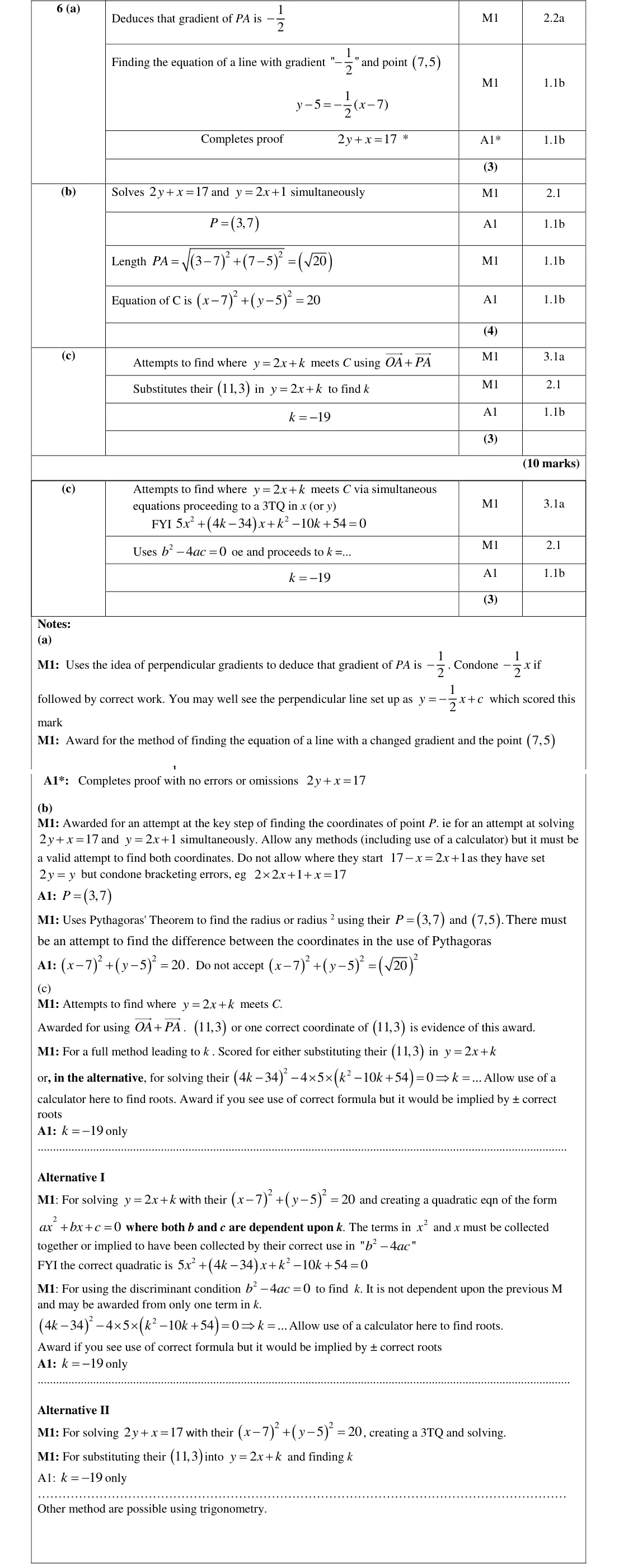
6(a) Straight lines, Circles 3 —
6(b) Circles, Simultaneous equations, Vectors, Straight lines 4 —
6(c) Circles, Vectors, Quadratics and the discriminant, Straight lines 3 —
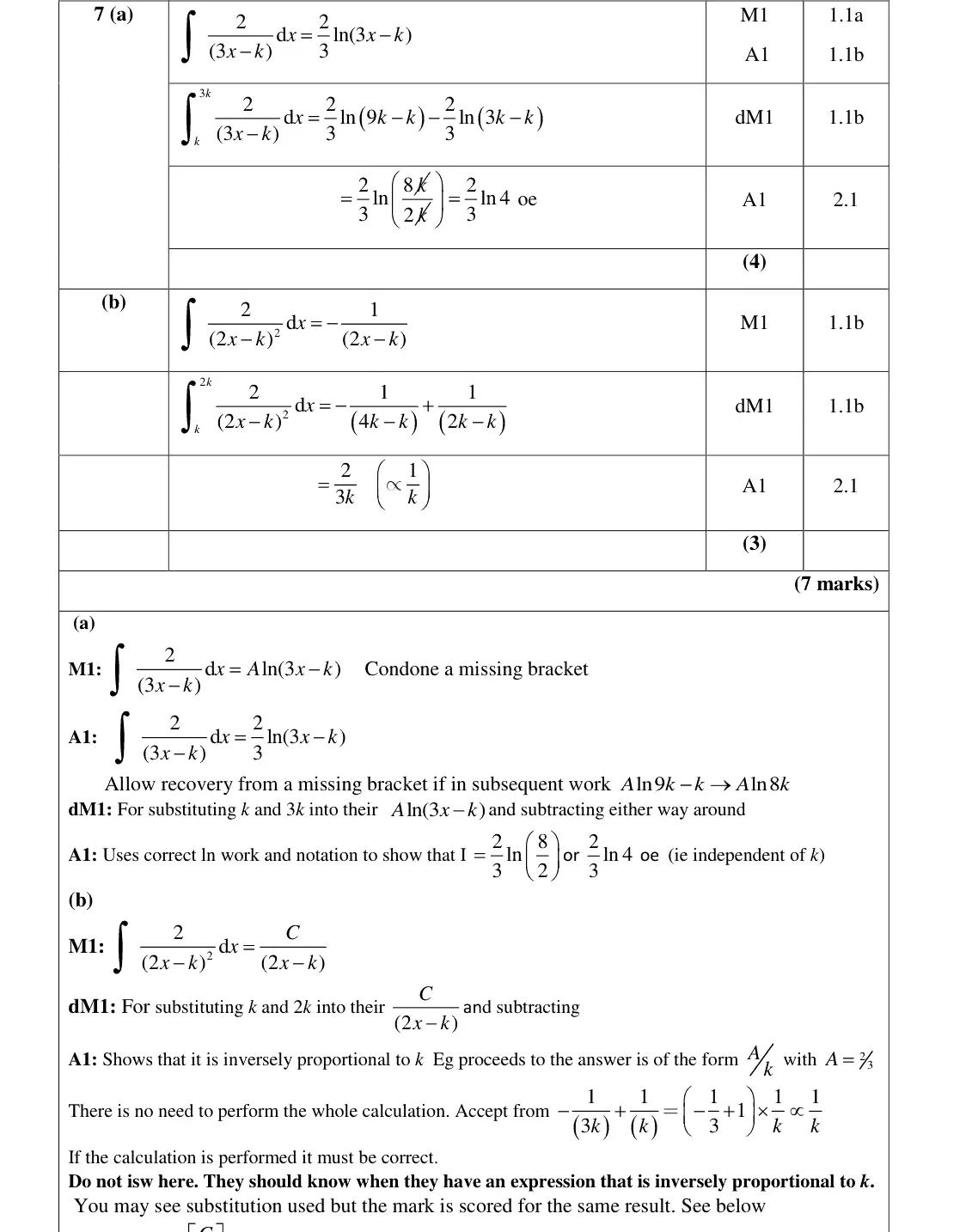
7(a) Integration by parts and by substitution, Exponentials and logarithms, Integration: standard integrals, definite integrals and areas 4 —
7(b) Integration by parts and by substitution, Integration: standard integrals, definite integrals and areas, Graphs and transformations 3 —
8(a) Trigonometric modelling, Functions, composite and inverse functions, modulus 1 —
8(b) Solving trigonometric equations, Trigonometric modelling, Functions, composite and inverse functions, modulus 4 —
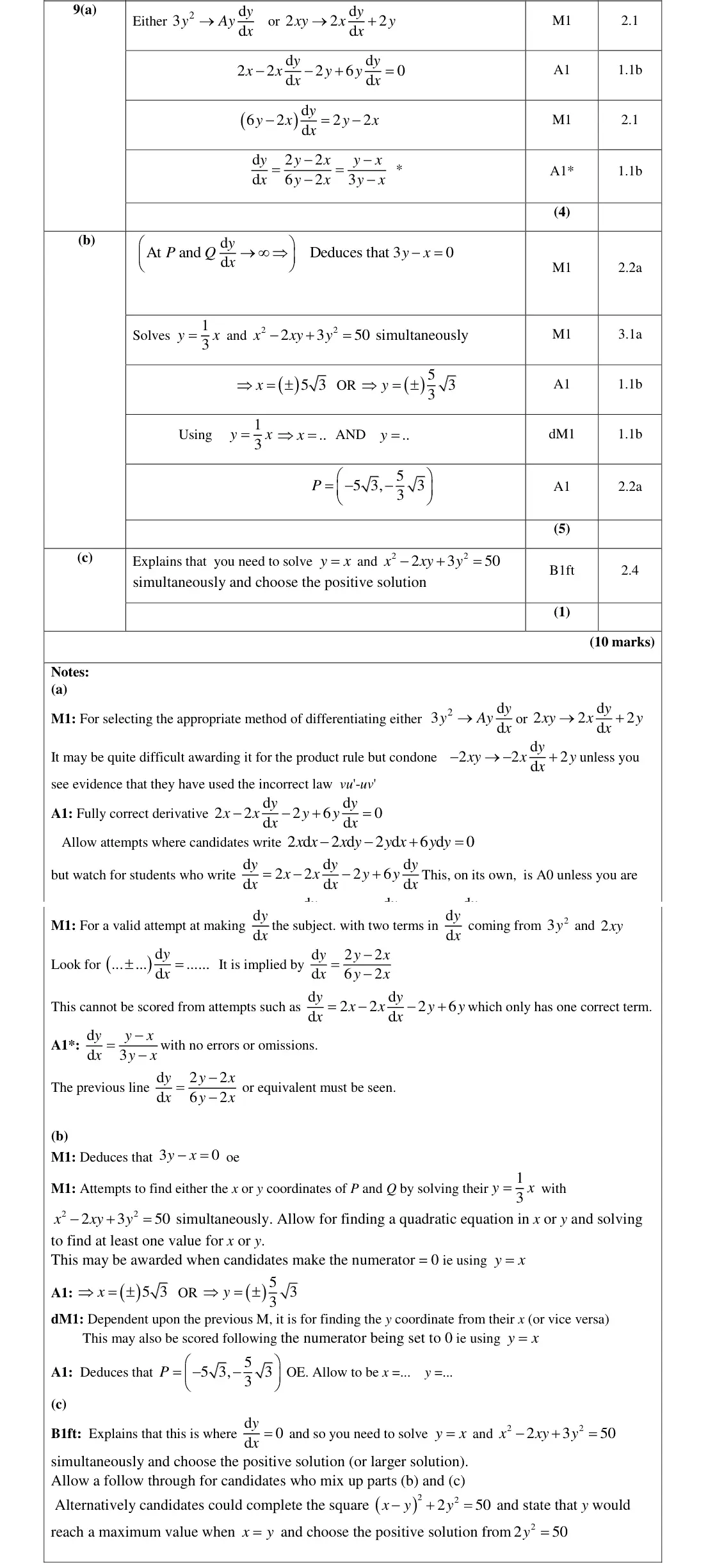
9(a) Implicit and parametric differentiation, Chain, product and quotient rules; connected rates of change 4 —
9(b) Implicit and parametric differentiation, Simultaneous equations, Indices and surds, Quadratics and the discriminant 5 —
9(c) Implicit and parametric differentiation, Differentiation: first principles, gradients, stationary points 1 —
10(a) Differential equations, Integration: standard integrals, definite integrals and areas, Exponentials and logarithms 5 —
10(b) Differential equations, Trigonometric ratios, graphs, radians and the sine and cosine rules 1 —
10(c) Differential equations, Solving trigonometric equations, Trigonometric ratios, graphs, radians and the sine and cosine rules 2 —
11(a) Binomial expansion, Indices and surds 6 —
11(b) Binomial expansion 1 —
11(c) Binomial expansion, Indices and surds 3 —
12(a) Exponential growth, decay and modelling, Exponentials and logarithms, Simultaneous equations 4 —
12(b) Exponential growth, decay and modelling 2 —
12(c) Exponential growth, decay and modelling, Exponentials and logarithms 4 —
13 Integration by parts and by substitution, Integration: standard integrals, definite integrals and areas, Indices and surds 7 —
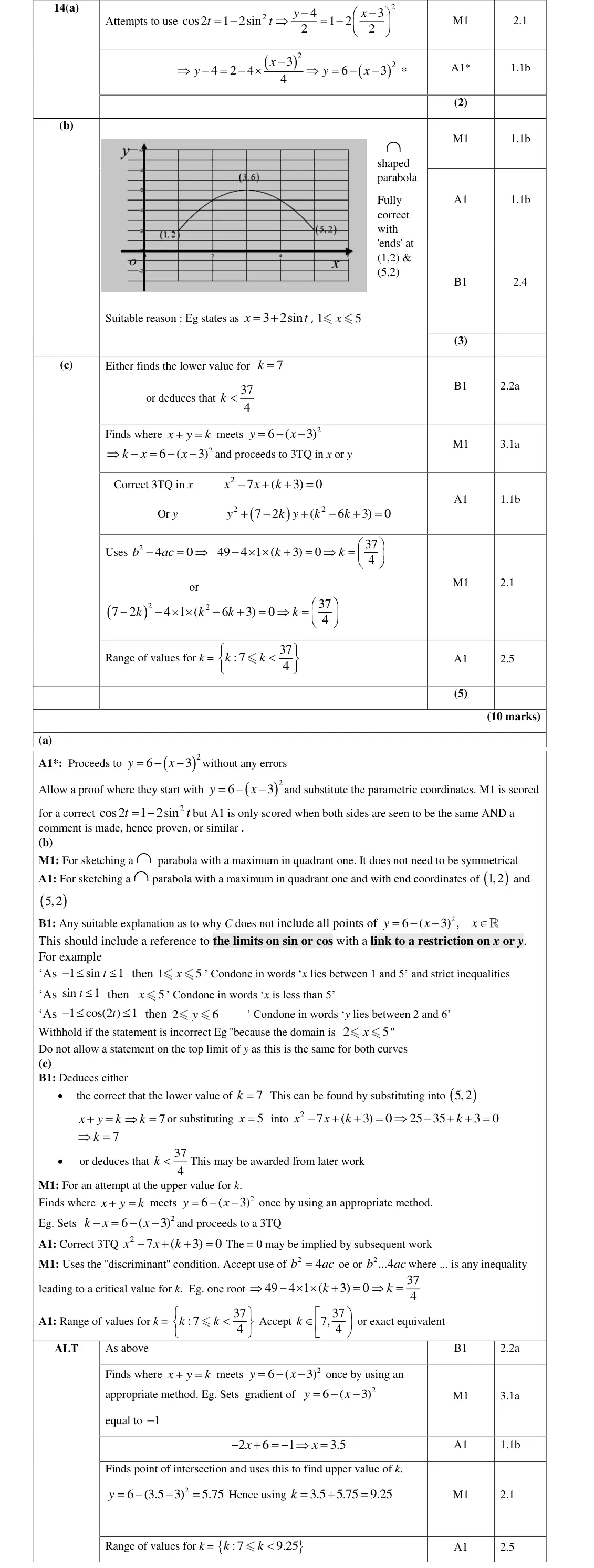
14(a) Parametric equations, Addition and double-angle formulae, harmonic form 2 —
14(b) Parametric equations, Graphs and transformations, Quadratics and the discriminant, Trigonometric ratios, graphs, radians and the sine and cosine rules 3 —
14(c) Quadratics and the discriminant, Inequalities, Parametric equations, Simultaneous equations, Graphs and transformations 5 —

The questions

12(a)2(b)2(c)34(a)4(b)56(a)6(b)6(c)7(a)7(b)8(a)8(b)9(a)9(b)9(c)10(a)10(b)10(c)11(a)11(b)11(c)12(a)12(b)12(c)1314(a)14(b)14(c)
June 2018 · Paper 1 · Q1 3 marks small angle approximationsalgebraic methods
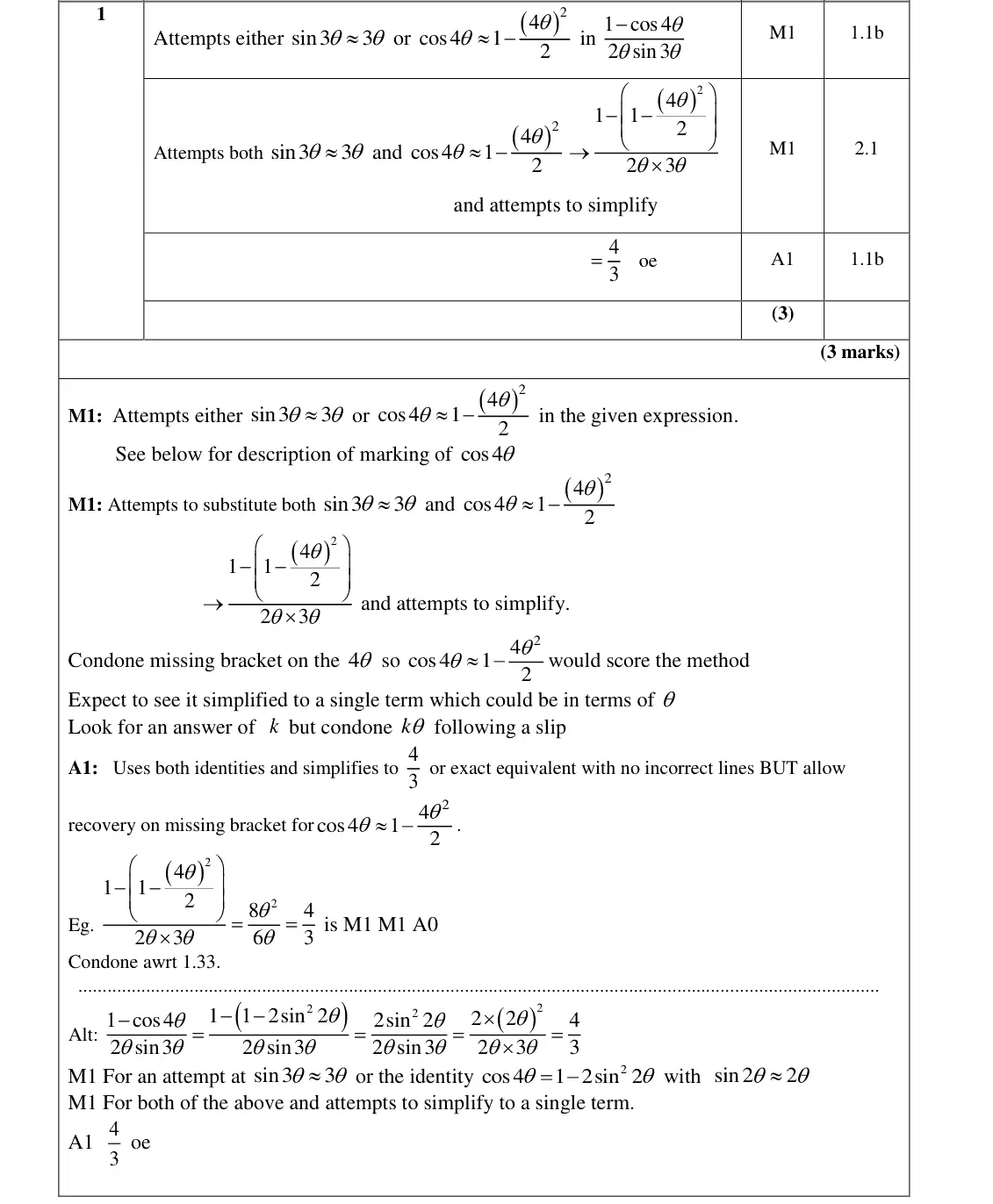
1. Given that theta is small and is measured in radians, use the small angle approximations to find an approximate value of theta - cos4 theta theta 2 sin3 (3)
June 2018 · Paper 1 · Q2(a) 3 marks differentiationindices and surds
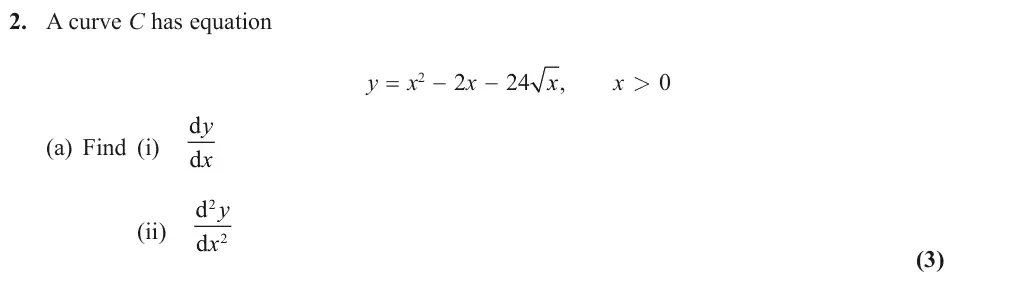
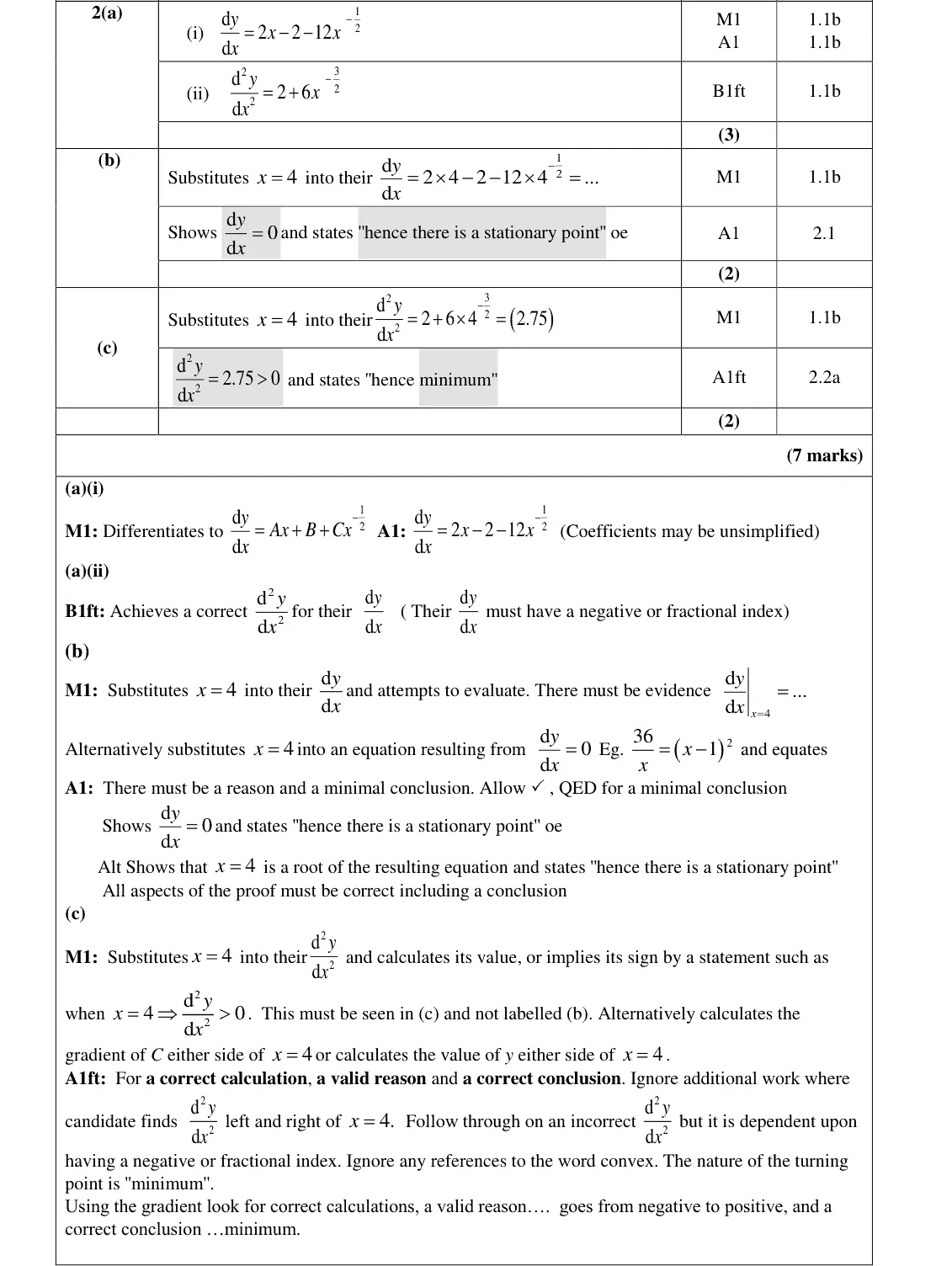
2. A curve C has equation y = x2 - 2x - 24 x, x > 0 d y (a) Find (i) d x d y (ii) d x (3)
June 2018 · Paper 1 · Q2(b) 2 marks differentiation
(b) Verify that C has a stationary point when x = 4 (2)
June 2018 · Paper 1 · Q2(c) 2 marks differentiation
(c) Determine the nature of this stationary point, giving a reason for your answer. (2)
June 2018 · Paper 1 · Q3 4 marks trigonometric ratiossimultaneous equations
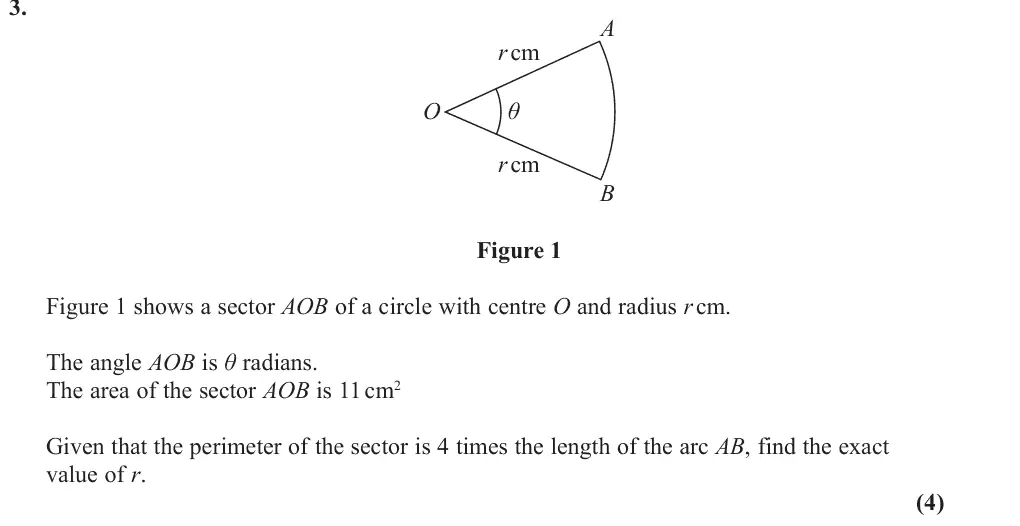
3. A r cm theta r cm B Figure 1 Figure 1 shows a sector AOB of a circle with centre O and radius r cm. The angle AOB is theta radians. The area of the sector AOB is 11 cm2 Given that the perimeter of the sector is 4 times the length of the arc AB, find the exact value of r. (4)
June 2018 · Paper 1 · Q4(a) 2 marks numerical methodsexponentials and logs
4. The curve with equation y = 2 ln(8 - x) meets the line y = x at a single point, x = alpha . (a) Show that 3 < alpha < 4 (2)
June 2018 · Paper 1 · Q4(b) 2 marks numerical methods
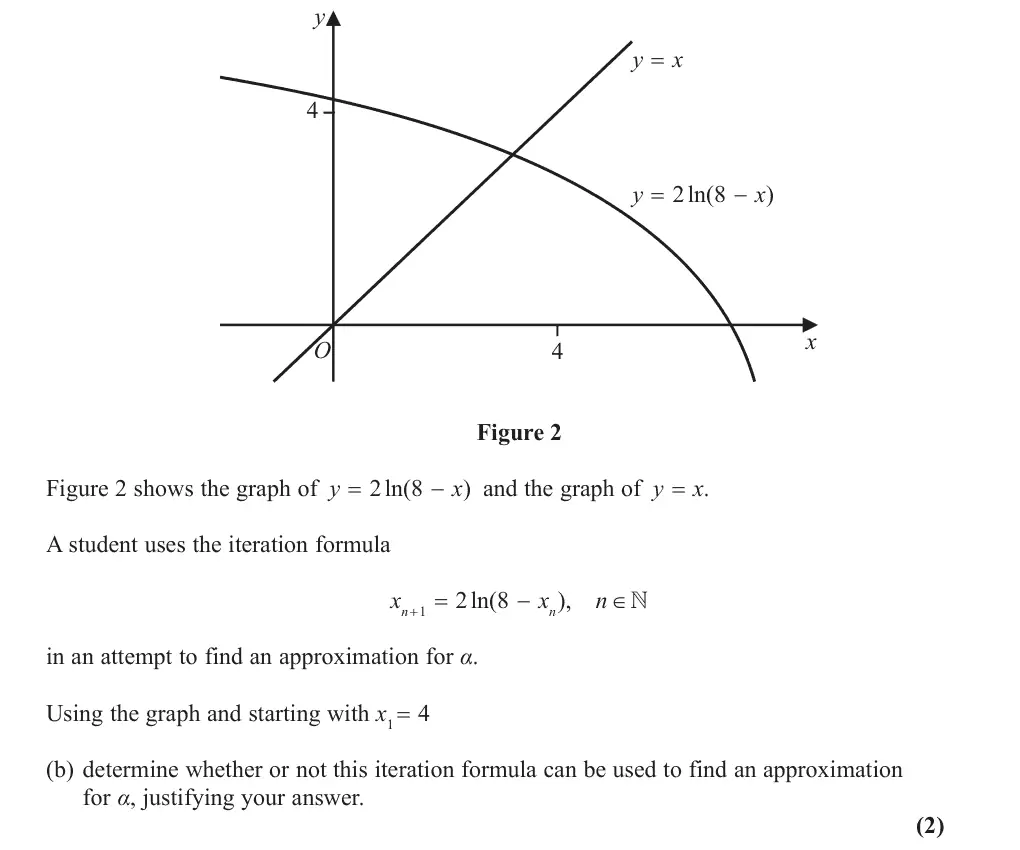
y y = x y = 2 ln(8 - x) x Figure 2 Figure 2 shows the graph of y = 2 ln(8 - x) and the graph of y = x. A student uses the iteration formula xn + 1 = 2 ln(8 - xn), n ∈ in an attempt to find an approximation for alpha . Using the graph and starting with x1 = 4 (b) determine whether or not this iteration formula can be used to find an approximation for alpha , justifying your answer. (2)
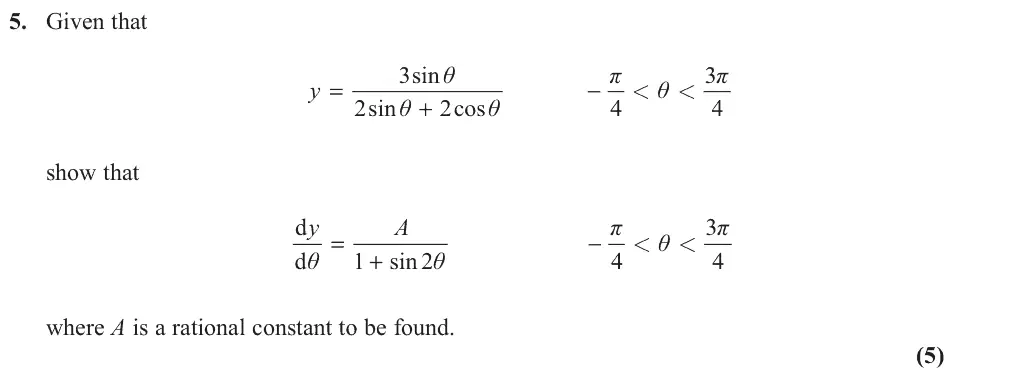
5. Given that theta pi pi 3sin y = - theta < < theta + theta 2sin 2cos show that y A pi pi d = - theta < < theta + theta d sin 2 where A is a rational constant to be found. (5)
June 2018 · Paper 1 · Q6(a) 3 marks straight linescircles
6. y Not to scale l C P A x Figure 3 The circle C has centre A with coordinates (7, 5). The line l, with equation y = 2x + 1, is the tangent to C at the point P, as shown in Figure 3. (a) Show that an equation of the line PA is 2y + x = 17 (3)
June 2018 · Paper 1 · Q6(b) 4 marks circlessimultaneous equationsvectorsstraight lines
(b) Find an equation for C. (4)
June 2018 · Paper 1 · Q6(c) 3 marks circlesvectorsquadraticsstraight lines
The line with equation y = 2x + k, k ≠ 1 is also a tangent to C. (c) Find the value of the constant k. (3)
7. Given that k + k ∫ (a) show that d is independent of k, x ( x - k ) (4) k
k ∫ (b) show that d is inversely proportional to k. x ( x - k ) (3) k
June 2018 · Paper 1 · Q8(a) 1 mark trigonometric modellingfunctions
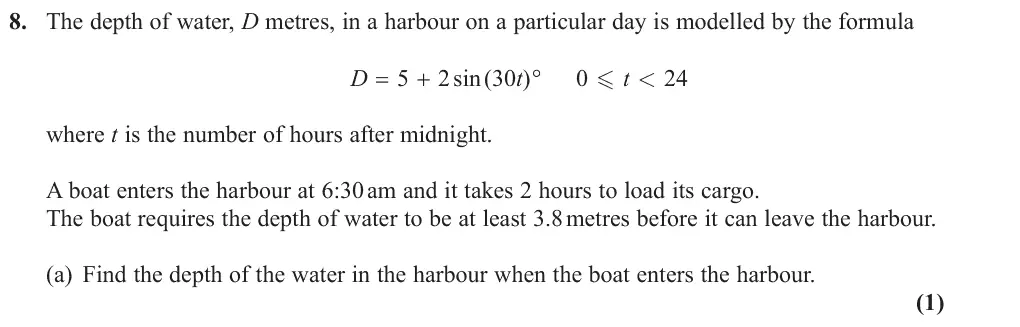
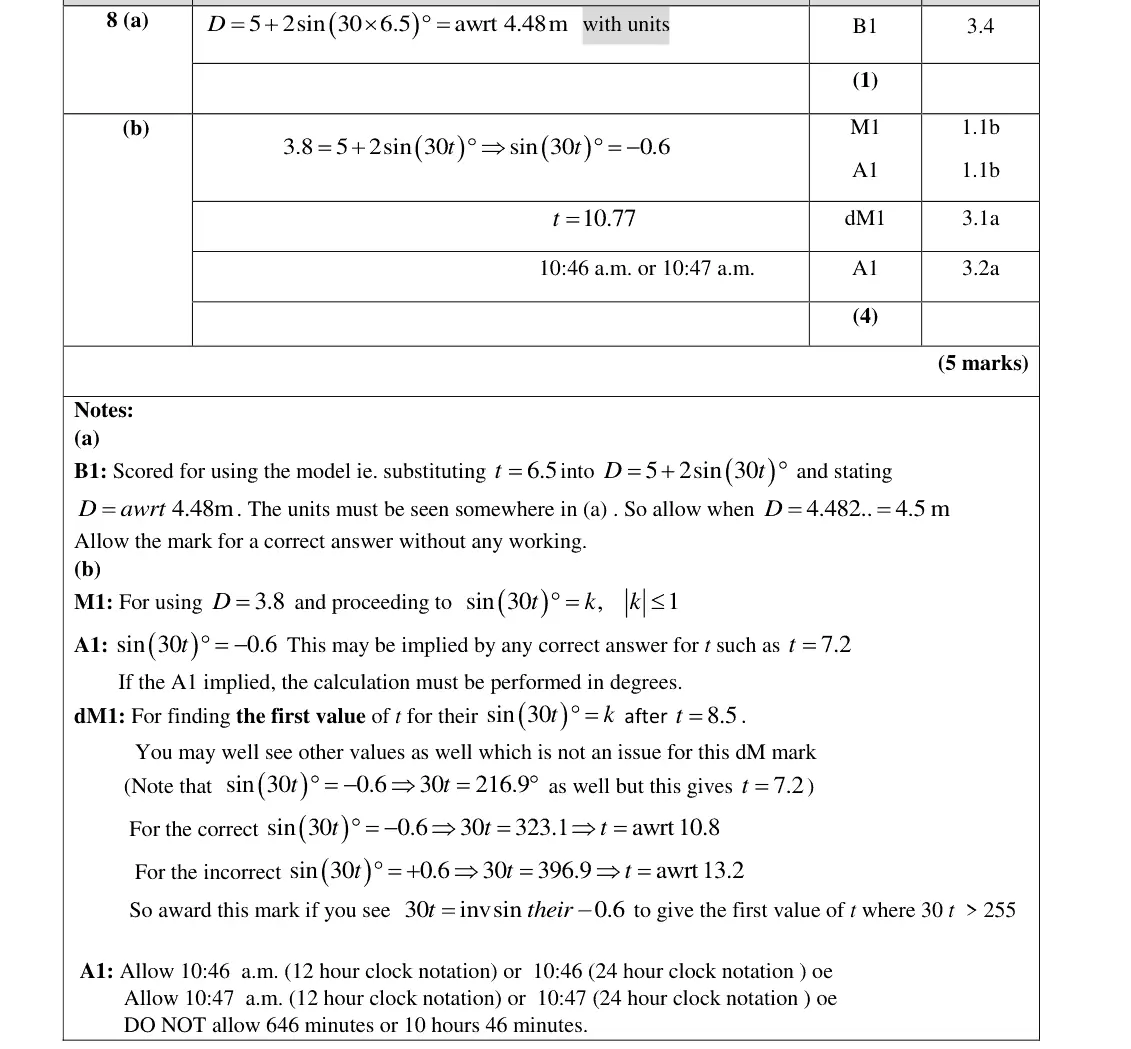
8. The depth of water, D metres, in a harbour on a particular day is modelled by the formula D = 5 + 2 sin (30t)° 0 t < 24 where t is the number of hours after midnight. A boat enters the harbour at 6:30 am and it takes 2 hours to load its cargo. The boat requires the depth of water to be at least 3.8 metres before it can leave the harbour. (a) Find the depth of the water in the harbour when the boat enters the harbour. (1)
June 2018 · Paper 1 · Q8(b) 4 marks trigonometric equationstrigonometric modellingfunctions
(b) Find, to the nearest minute, the earliest time the boat can leave the harbour. (Solutions based entirely on graphical or numerical methods are not acceptable.) (4)
June 2018 · Paper 1 · Q9(a) 4 marks implicit and parametric differentiationdifferentiation rules
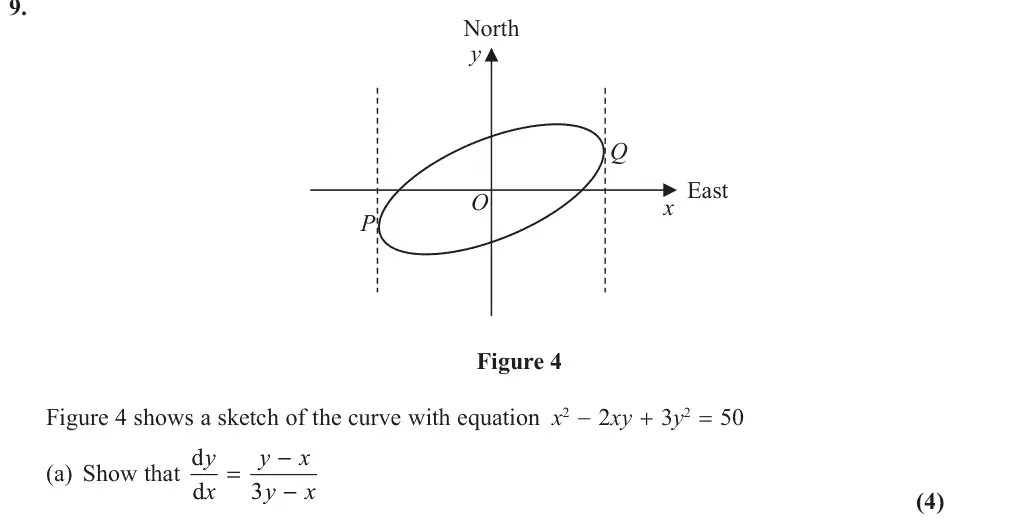
9. North y Q East x P Figure 4 Figure 4 shows a sketch of the curve with equation x2 - 2xy + 3y2 = 50 (a) Show that d y y x - = d x y x - (4)
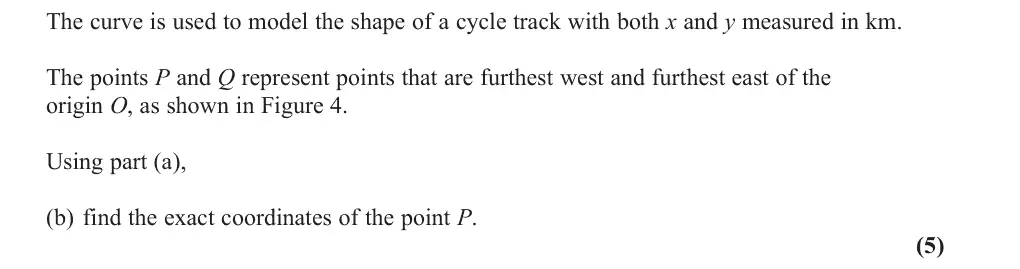
The curve is used to model the shape of a cycle track with both x and y measured in km. The points P and Q represent points that are furthest west and furthest east of the origin O, as shown in Figure 4. Using part (a), (b) find the exact coordinates of the point P. (5)
June 2018 · Paper 1 · Q9(c) 1 mark implicit and parametric differentiationdifferentiation
(c) Explain briefly how to find the coordinates of the point that is furthest north of the origin O. (You do not need to carry out this calculation). (1)
June 2018 · Paper 1 · Q10(a) 5 marks differential equationsintegrationexponentials and logs
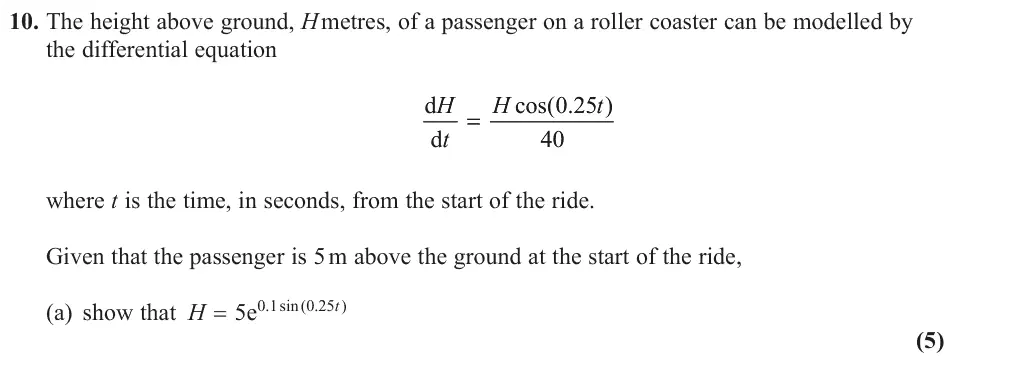
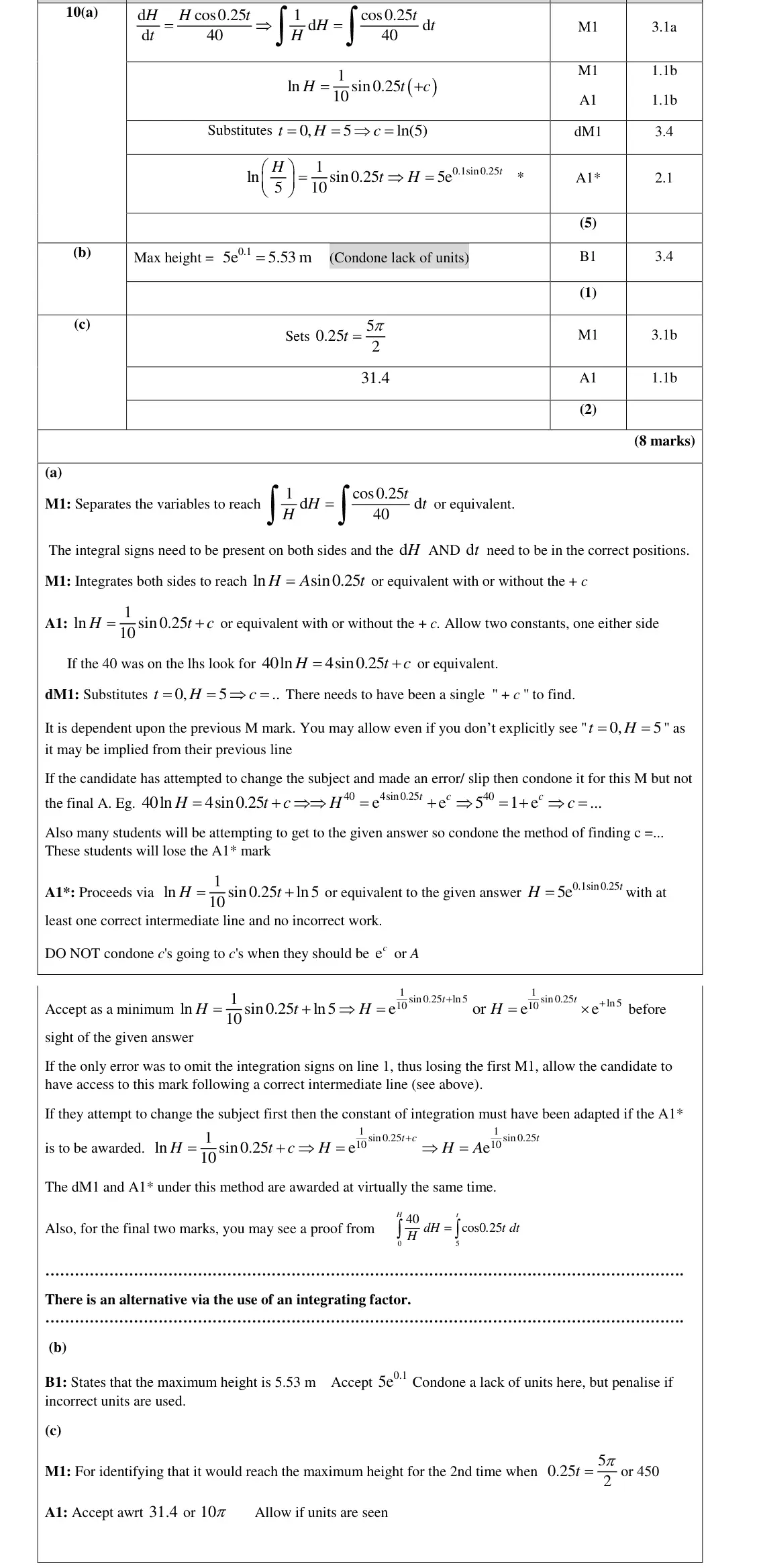
10. The height above ground, H metres, of a passenger on a roller coaster can be modelled by the differential equation d H H cos( . 0 25 t ) = d t where t is the time, in seconds, from the start of the ride. Given that the passenger is 5 m above the ground at the start of the ride, (a) show that H = 5e0.1 sin (0.25t) (5)
June 2018 · Paper 1 · Q10(b) 1 mark differential equationstrigonometric ratios
(b) State the maximum height of the passenger above the ground. (1)
The passenger reaches the maximum height, for the second time, T seconds after the start of the ride. (c) Find the value of T. (2)
June 2018 · Paper 1 · Q11(a) 6 marks binomial expansionindices and surds
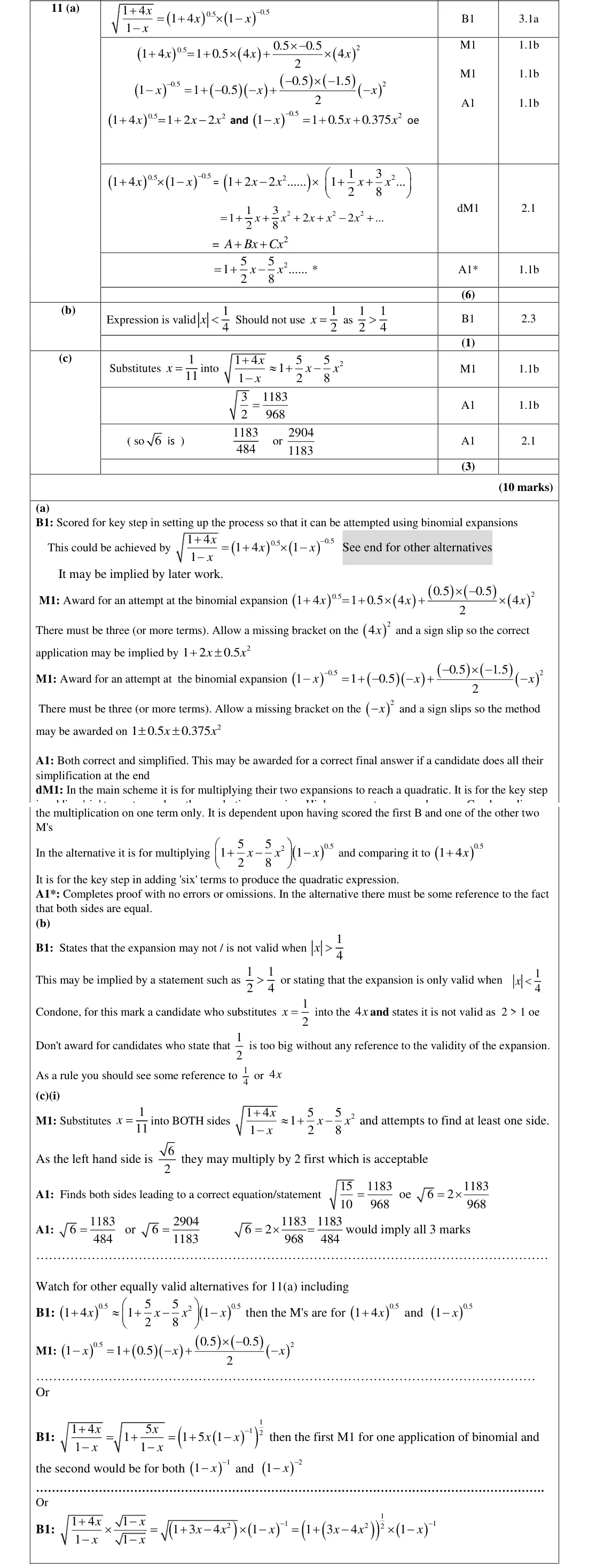
+ x 11. (a) Use binomial expansions to show that + x - x » - x (6)
June 2018 · Paper 1 · Q11(b) 1 mark binomial expansion
A student substitutes x = 1 2 into both sides of the approximation shown in part (a) in an attempt to find an approximation to (b) Give a reason why the student should not use x = 1 (1)
June 2018 · Paper 1 · Q11(c) 3 marks binomial expansionindices and surds
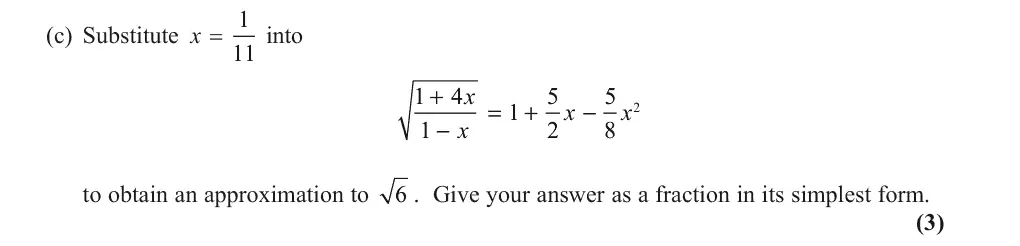
(c) Substitute x = 1 11 into + x x x = + - - x to obtain an approximation to 6 . Give your answer as a fraction in its simplest form. (3)
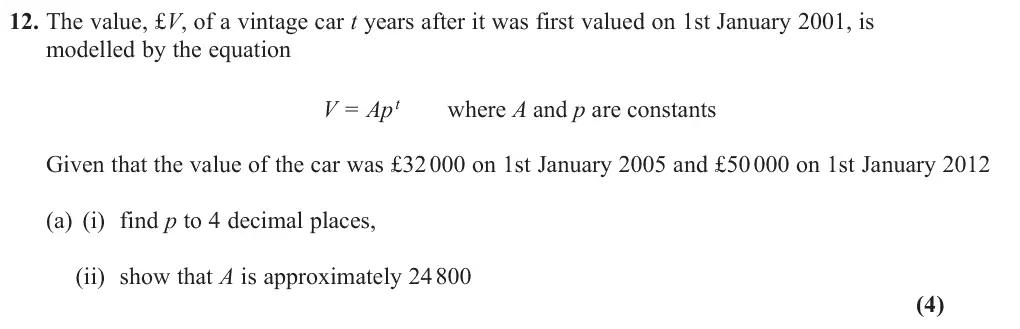
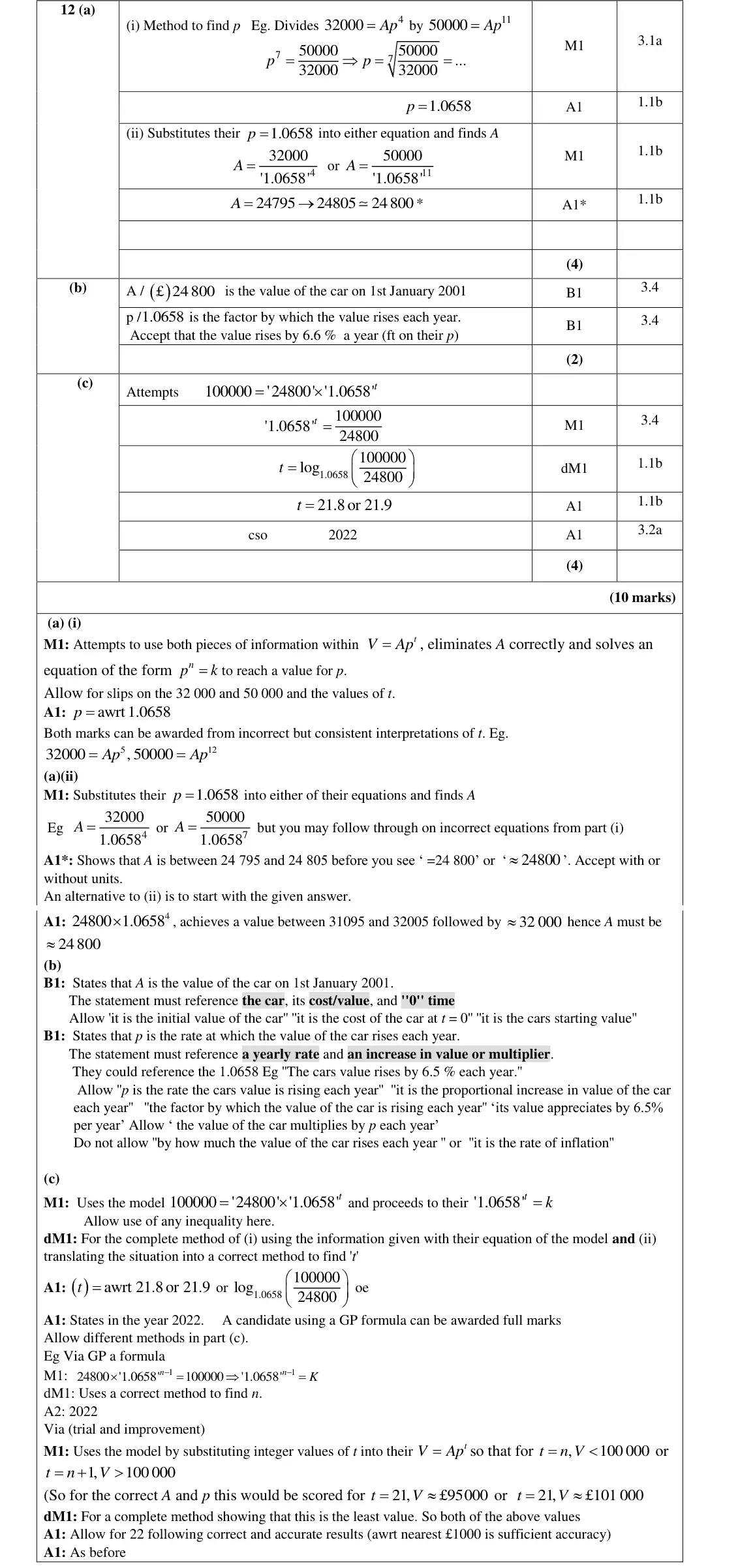
12. The value, £V, of a vintage car t years after it was first valued on 1st January 2001, is modelled by the equation V = Ap t where A and p are constants Given that the value of the car was £32 000 on 1st January 2005 and £50 000 on 1st January 2012 (a) (i) find p to 4 decimal places, (ii) show that A is approximately 24 800 (4)
June 2018 · Paper 1 · Q12(b) 2 marks exponential modelling
(b) With reference to the model, interpret (i) the value of the constant A, (ii) the value of the constant p. (2)
June 2018 · Paper 1 · Q12(c) 4 marks exponential modellingexponentials and logs
Using the model, (c) find the year during which the value of the car first exceeds £100 000 (4)
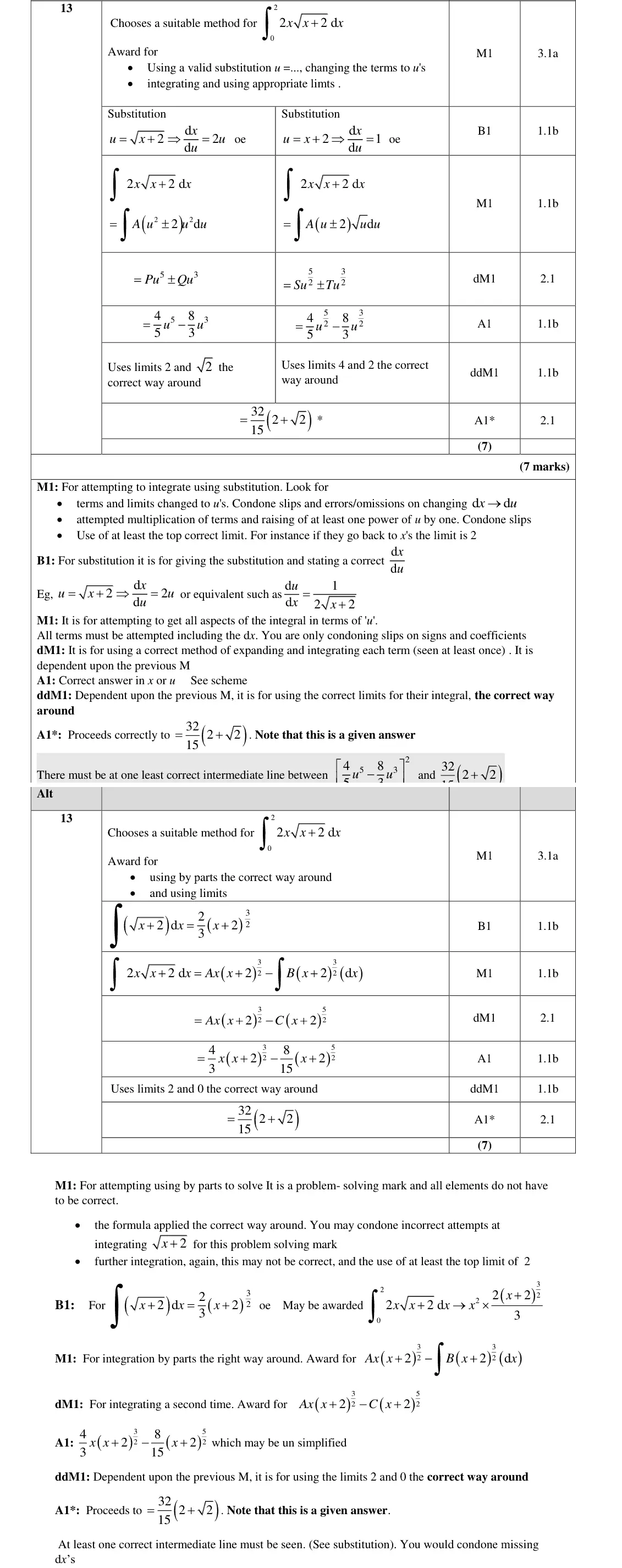
13. Show that ( ) ∫ x x + d x = 15 2 + (7)
June 2018 · Paper 1 · Q14(a) 2 marks parametric equationsdouble angle formulae
14. A curve C has parametric equations x = 3 + 2 sin t, y = 4 + 2 cos 2t, 0 t < 2 pi (a) Show that all points on C satisfy y = 6 - (x - 3)2 (2)
(b) (i) Sketch the curve C. (ii) Explain briefly why C does not include all points of y = 6 - (x - 3)2, x ∈ ℝ (3)
The line with equation x + y = k, where k is a constant, intersects C at two distinct points. (c) State the range of values of k, writing your answer in set notation. (5)

Find an Edexcel maths tutor

Want this paper marked and gone through with you? Message us.

Prefer email? Send an enquiry

If you are under 18, please include a parent's contact details. Enquiries go to enquiries@mathsaleveltutor.com and are deleted once handled.