Examiner's comment
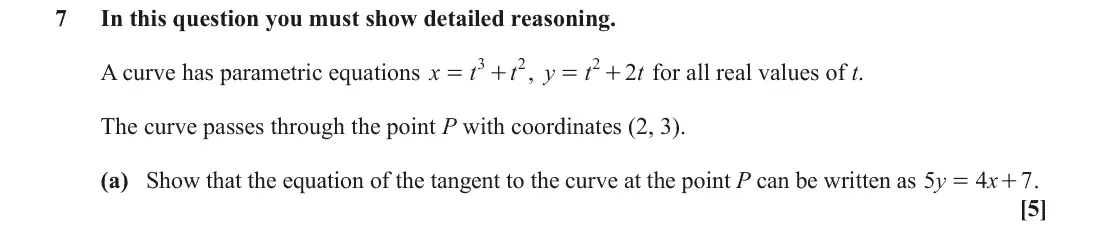
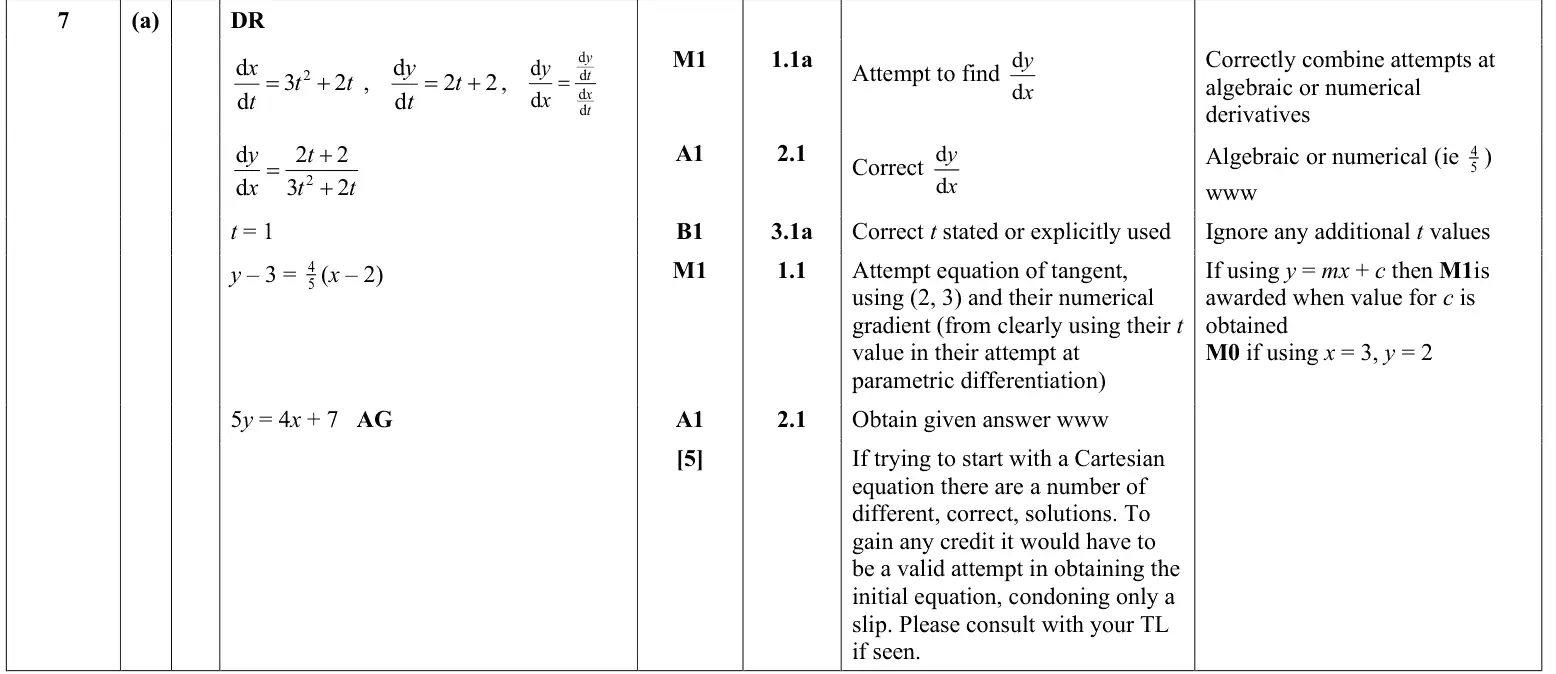
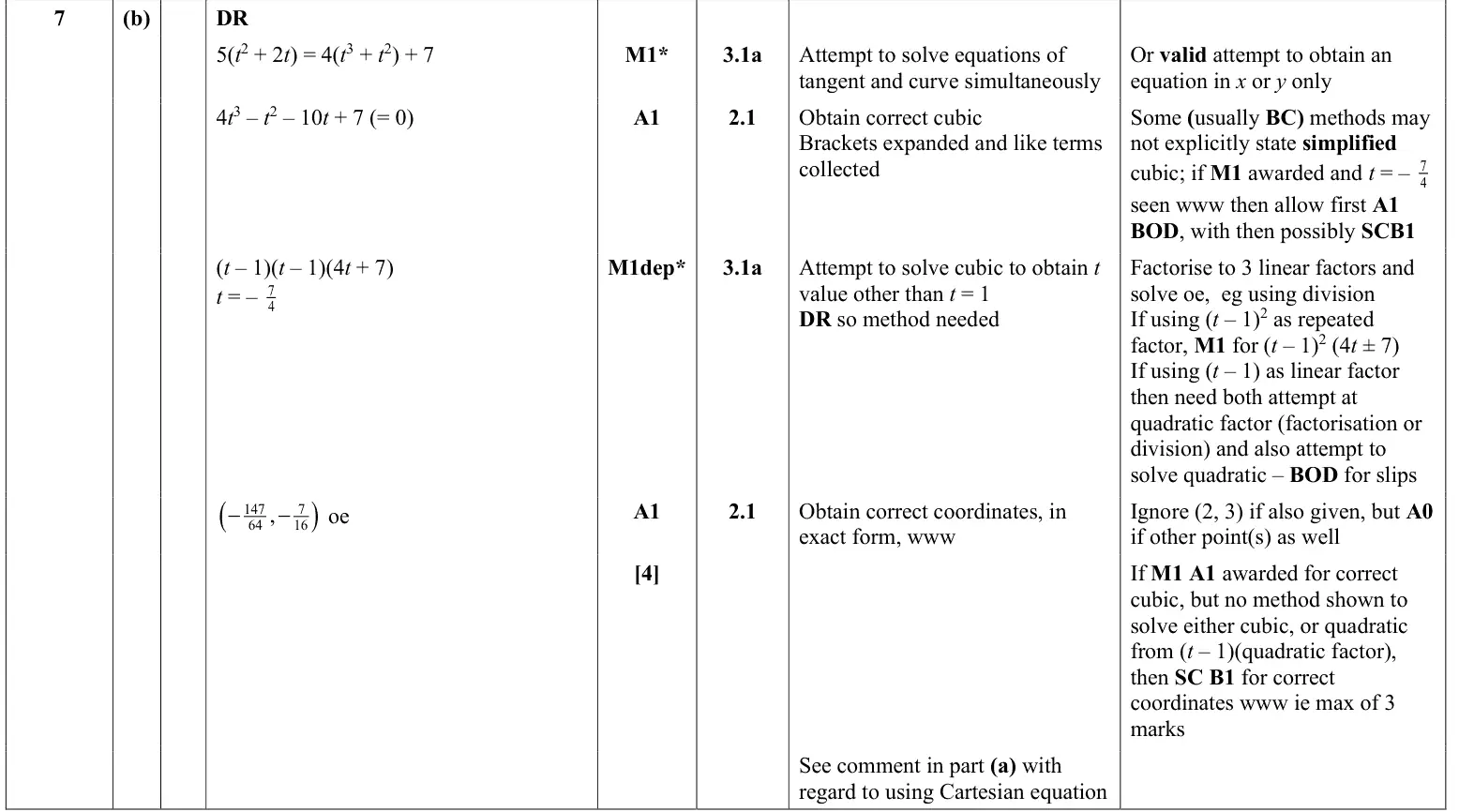
It was expected that candidates would attempt to solve the equations of the tangent and the curve simultaneously to obtain an equation in t only, and many were able to do so. It was then expected that candidates would recognise that the tangent should have a repeated root at t = 1, and use this to solve the cubic equation to find the other t-value. Candidates should appreciate that method needs to be shown, as the command word used was ‘determine’ along with a ‘detailed reasoning’ instruction for the entire question. Many candidates were indeed able to show a convincing method, through repeated division by (t – 1), inspection or an equivalent method, all of which tended to be effective. A number of candidates seemingly solved the cubic equation on their calculator instead. Some candidates simply stated the t-values whereas others did try to work backwards to produce the required factors but this was rarely successful due to the calculator not identifying a repeated root. Having found the other t-value, through whatever method used, candidates were then usually able to give the correct coordinates in an exact form although a few did instead give a rounded decimal value. A surprisingly common error was to equate the gradient of the curve, in terms of t, to the gradient of the tangent i.e. attempting to find other points on the curve that would have tangents parallel to the one already found. A minority of candidates attempted to first find a Cartesian equation for the curve, either in this part of the question or continuing with an equation attempted in part (a). This was rarely successful, and candidates should consider the most effective and efficient method when attempting a question. While some previous questions on parametric equations may have requested the Cartesian equation, this is usually the final part of the question as opposed to the starting point.