June 2018: Paper 3: Pure Mathematics and Mechanics

100 marks · 29 question parts · Question paper, mark scheme and examiner's report on OCR's site

Question by question

QTopicMarksDifficulty
1(i) Circles 2 Easy
1(ii) Circles 1 Easy
2 Functions, composite and inverse functions, modulus, Quadratics and the discriminant 3 Easy
3 Inequalities, Quadratics and the discriminant 6 Medium
4(i)(a) Functions, composite and inverse functions, modulus 1 Easy
4(i)(b) Functions, composite and inverse functions, modulus 1 Easy
4(ii) Quadratics and the discriminant, Binomial expansion, Functions, composite and inverse functions, modulus, Algebraic methods: polynomials, factor theorem and rational expressions 6 Medium
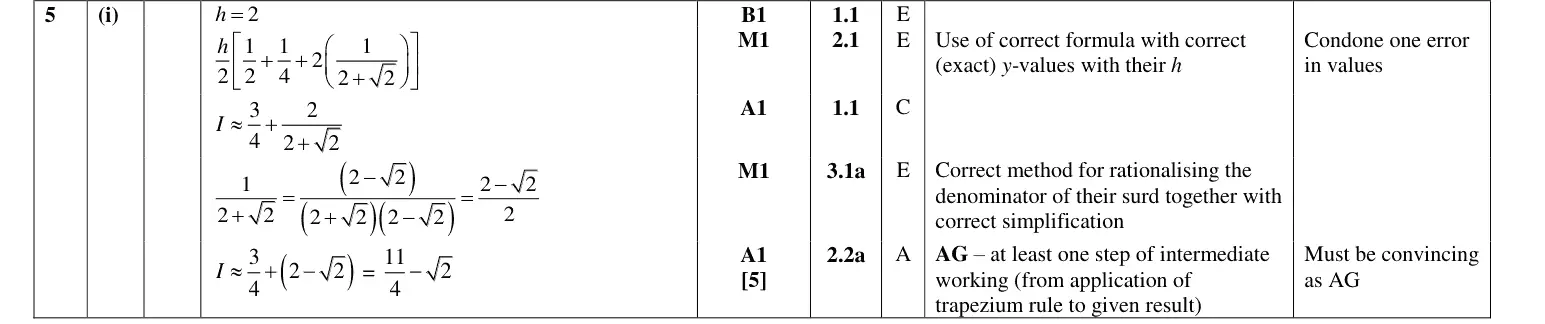
5(i) Trapezium rule and numerical integration, Indices and surds 5 Easy
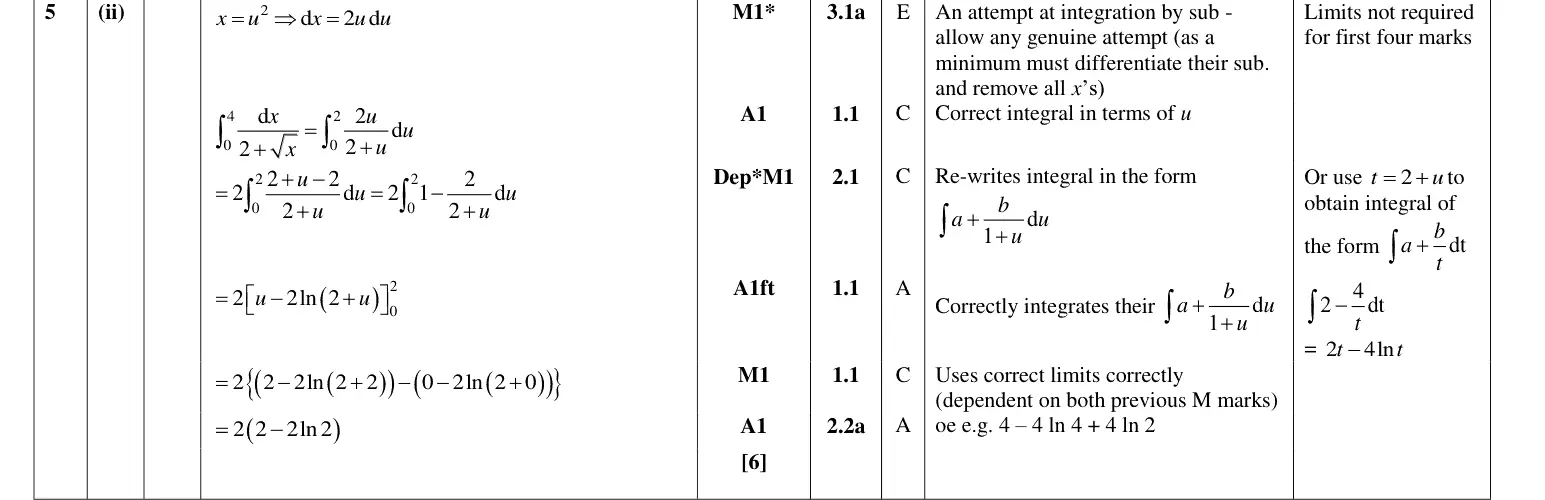
5(ii) Integration by parts and by substitution, Integration: standard integrals, definite integrals and areas, Exponentials and logarithms 6 Medium
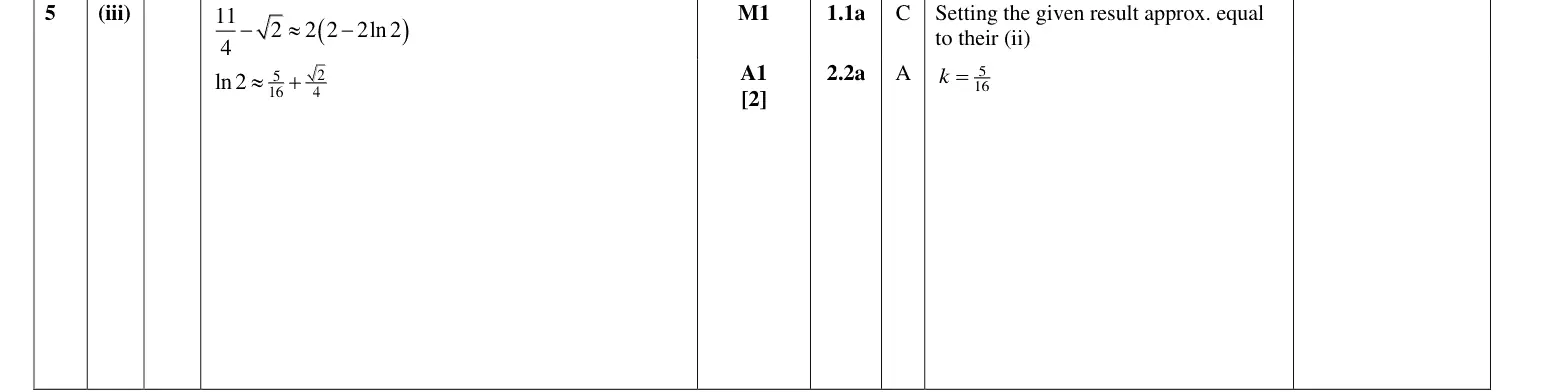
5(iii) Trapezium rule and numerical integration, Exponentials and logarithms 2 Easy
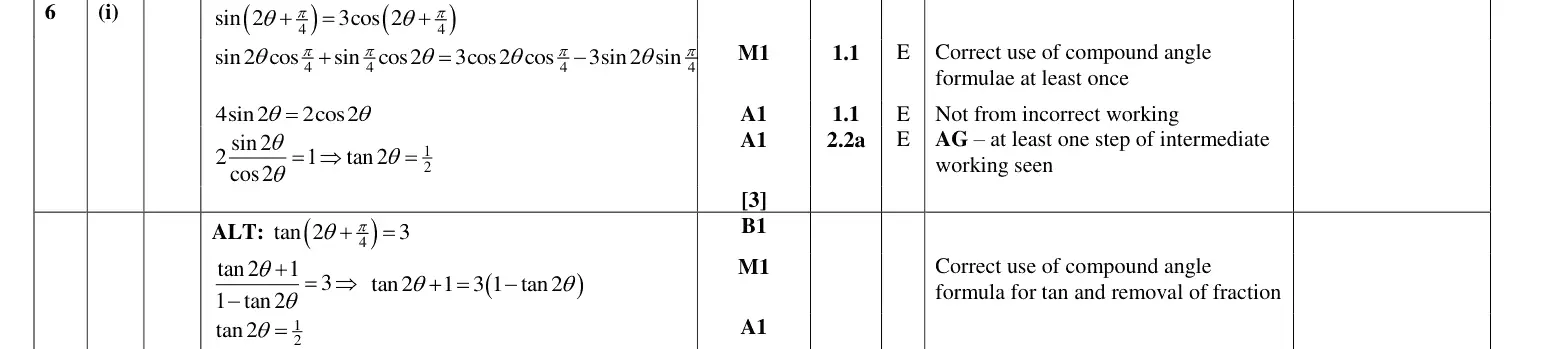
6(i) Addition and double-angle formulae, harmonic form, Trigonometric identities and proofs, Trigonometric ratios, graphs, radians and the sine and cosine rules 3 Medium
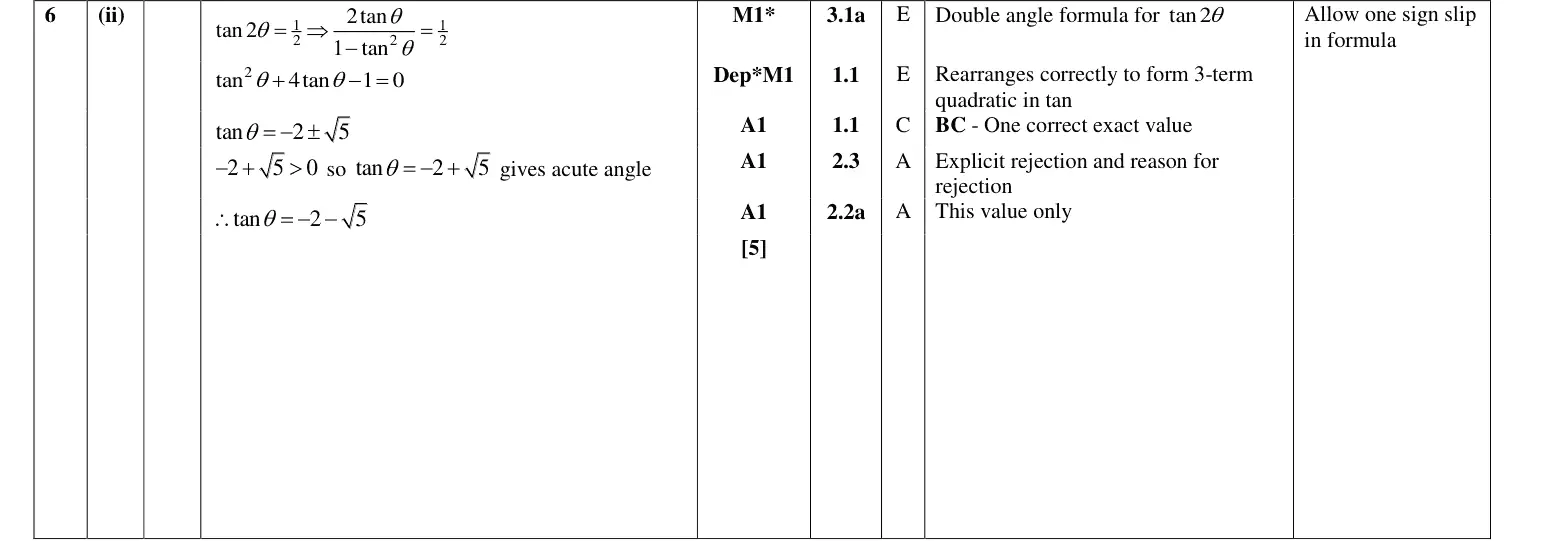
6(ii) Addition and double-angle formulae, harmonic form, Solving trigonometric equations, Quadratics and the discriminant, Indices and surds 5 Medium
7 Differential equations, Integration by parts and by substitution, Algebraic methods: polynomials, factor theorem and rational expressions, Integration: standard integrals, definite integrals and areas 9 Medium
8(i) Forces, Newton's laws and connected particles 3 Medium
8(ii) Constant acceleration (SUVAT) 3 Easy
9(i) Friction, resultant forces and motion in a plane, Moments 1 Easy
9(ii) Moments 3 Easy
9(iii) Moments 3 Hard
9(iv)(a) Moments 1 Easy
9(iv)(b) Moments 1 Medium
10(i) Friction, resultant forces and motion in a plane, Addition and double-angle formulae, harmonic form 4 Medium
10(ii) Friction, resultant forces and motion in a plane 2 Easy
10(iii)(a) Friction, resultant forces and motion in a plane, Trigonometric ratios, graphs, radians and the sine and cosine rules 3 Medium
10(iii)(b) Friction, resultant forces and motion in a plane, Trigonometric ratios, graphs, radians and the sine and cosine rules 2 Medium
11(i) Variable acceleration, Differentiation: first principles, gradients, stationary points 3 Easy
11(ii) Variable acceleration, Constant acceleration (SUVAT), Integration: standard integrals, definite integrals and areas 7 Easy
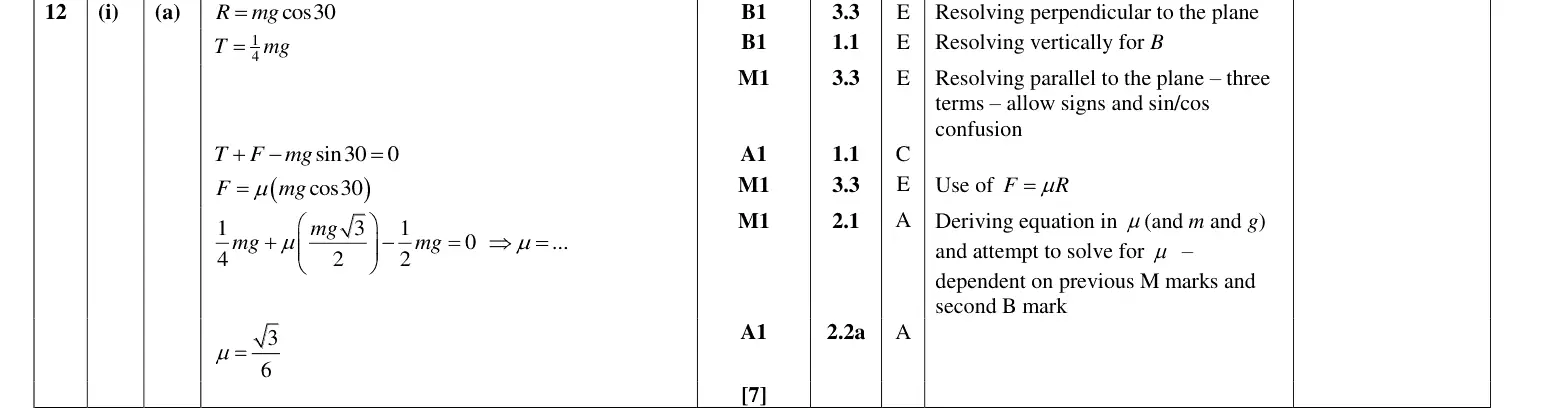
12(i)(a) Friction, resultant forces and motion in a plane, Forces, Newton's laws and connected particles 7 Easy
12(i)(b) Friction, resultant forces and motion in a plane, Forces, Newton's laws and connected particles 2 Medium
12(ii) Friction, resultant forces and motion in a plane, Forces, Newton's laws and connected particles 5 Hard

The questions

1(i)1(ii)234(i)(a)4(i)(b)4(ii)5(i)5(ii)5(iii)6(i)6(ii)78(i)8(ii)9(i)9(ii)9(iii)9(iv)(a)9(iv)(b)10(i)10(ii)10(iii)(a)10(iii)(b)11(i)11(ii)12(i)(a)12(i)(b)12(ii)
June 2018 · Paper 3 · Q1(i) 2 marks Easy circles
1 A circle with centre C has equation x y x y . + + - - = Find (i) the coordinates of C, [2]
June 2018 · Paper 3 · Q1(ii) 1 mark Easy circles
Show the start of this questionEarlier part of this question
(ii) the radius of the circle. [1]
June 2018 · Paper 3 · Q2 3 marks Easy functionsquadratics
2 Solve the equation x x . [3] - = +
June 2018 · Paper 3 · Q3 6 marks Medium inequalitiesquadratics
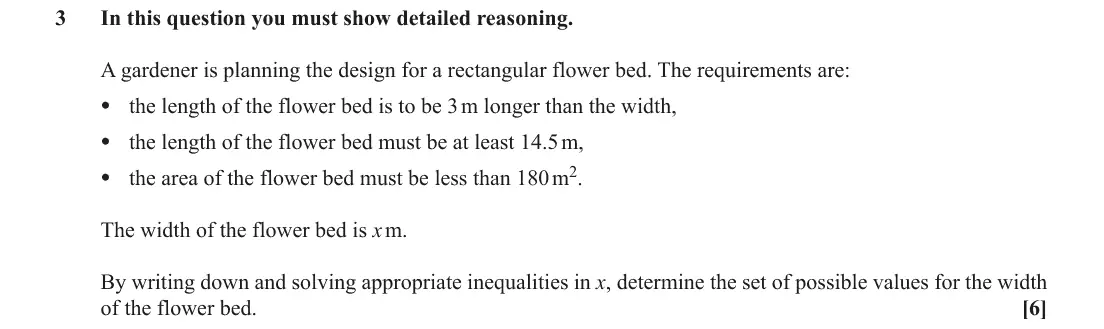
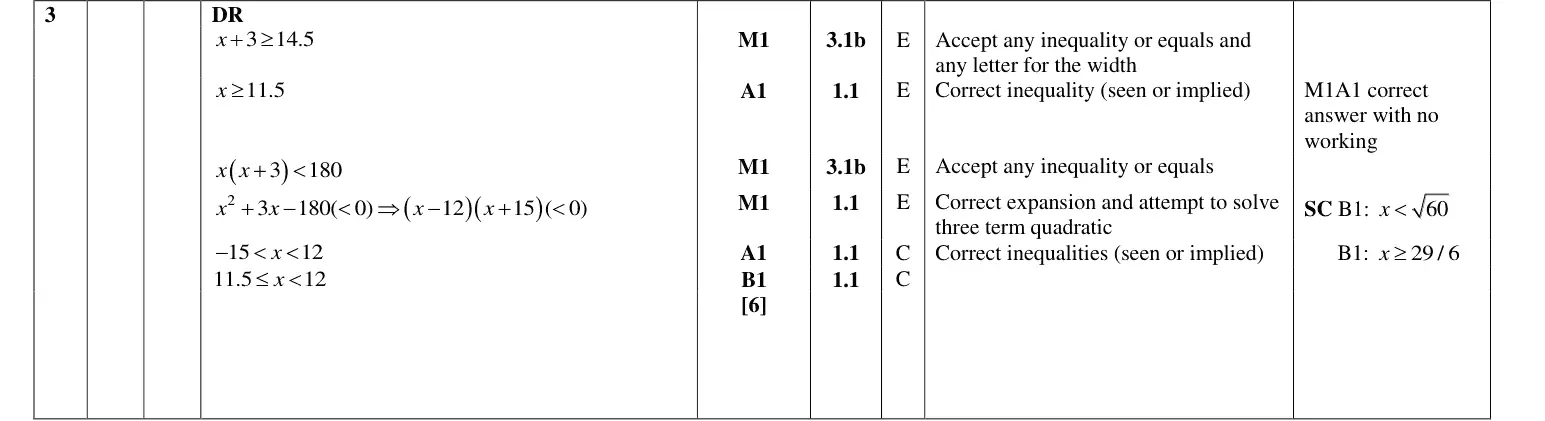
3 In this question you must show detailed reasoning. A gardener is planning the design for a rectangular flower bed. The requirements are: • the length of the flower bed is to be 3 m longer than the width, • the length of the flower bed must be at least 14.5 m, • the area of the flower bed must be less than 180 m2. The width of the flower bed is x m. By writing down and solving appropriate inequalities in x, determine the set of possible values for the width of the flower bed. [6]
June 2018 · Paper 3 · Q4(i)(a) 1 mark Easy functions
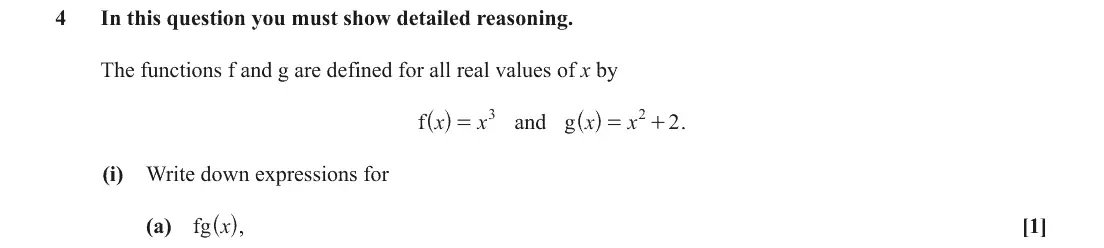
4 In this question you must show detailed reasoning. The functions f and g are defined for all real values of x by ^ h ^ h x3 f x and g x x . = = + (i) Write down expressions for (a) fg x^ h, [1]
June 2018 · Paper 3 · Q4(i)(b) 1 mark Easy functions
(b) gf x^ h. [1]
June 2018 · Paper 3 · Q4(ii) 6 marks Medium quadraticsbinomial expansionfunctionsalgebraic methods
Show the start of this questionEarlier part of this questionEarlier part of this question
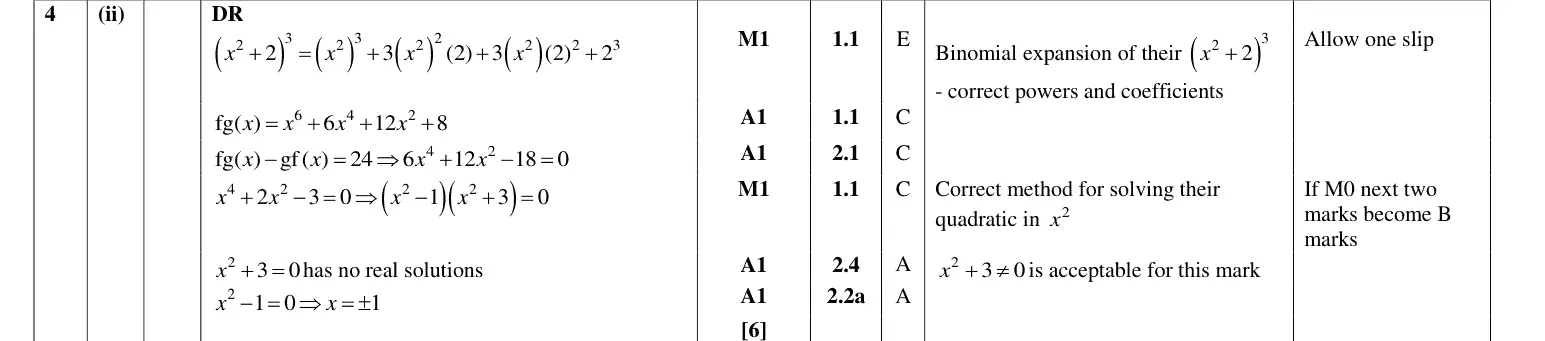
^ h ^ h (ii) Hence find the values of x for which fg x gf x . [6] - =
June 2018 · Paper 3 · Q5(i) 5 marks Easy trapezium ruleindices and surds
5 (i) Use the trapezium rule, with two strips of equal width, to show that = x x [5] d . . - +
June 2018 · Paper 3 · Q5(ii) 6 marks Medium integration by parts and substitutionintegrationexponentials and logs
Show the start of this questionEarlier part of this question
(ii) Use the substitution x = u2 to find the exact value of = x x [6] d . +
June 2018 · Paper 3 · Q5(iii) 2 marks Easy trapezium ruleexponentials and logs
Show the start of this questionEarlier part of this questionEarlier part of this question
(iii) Using your answers to parts (i) and (ii), show that k ln , . + where k is a rational number to be determined. [2]
June 2018 · Paper 3 · Q6(i) 3 marks Medium double angle formulaetrig identitiestrigonometric ratios
a k a k. 6 It is given that the angle i satisfies the equation sin cos i + r = i + r (i) Show that tan2 [3] . i =
June 2018 · Paper 3 · Q6(ii) 5 marks Medium double angle formulaetrigonometric equationsquadraticsindices and surds
Show the start of this questionEarlier part of this question
(ii) Hence find, in surd form, the exact value of tan i, given that i is an obtuse angle. [5]
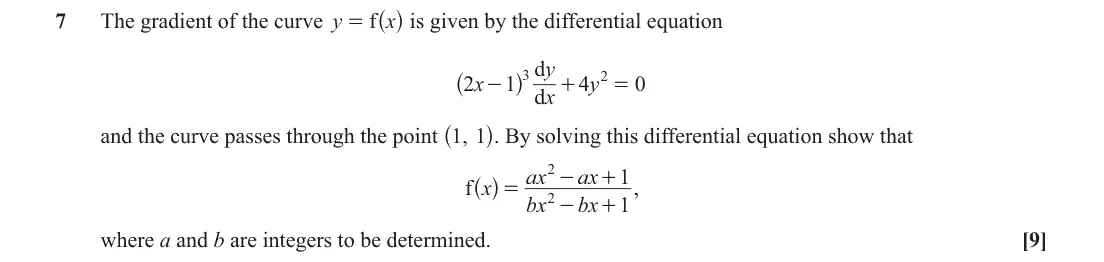
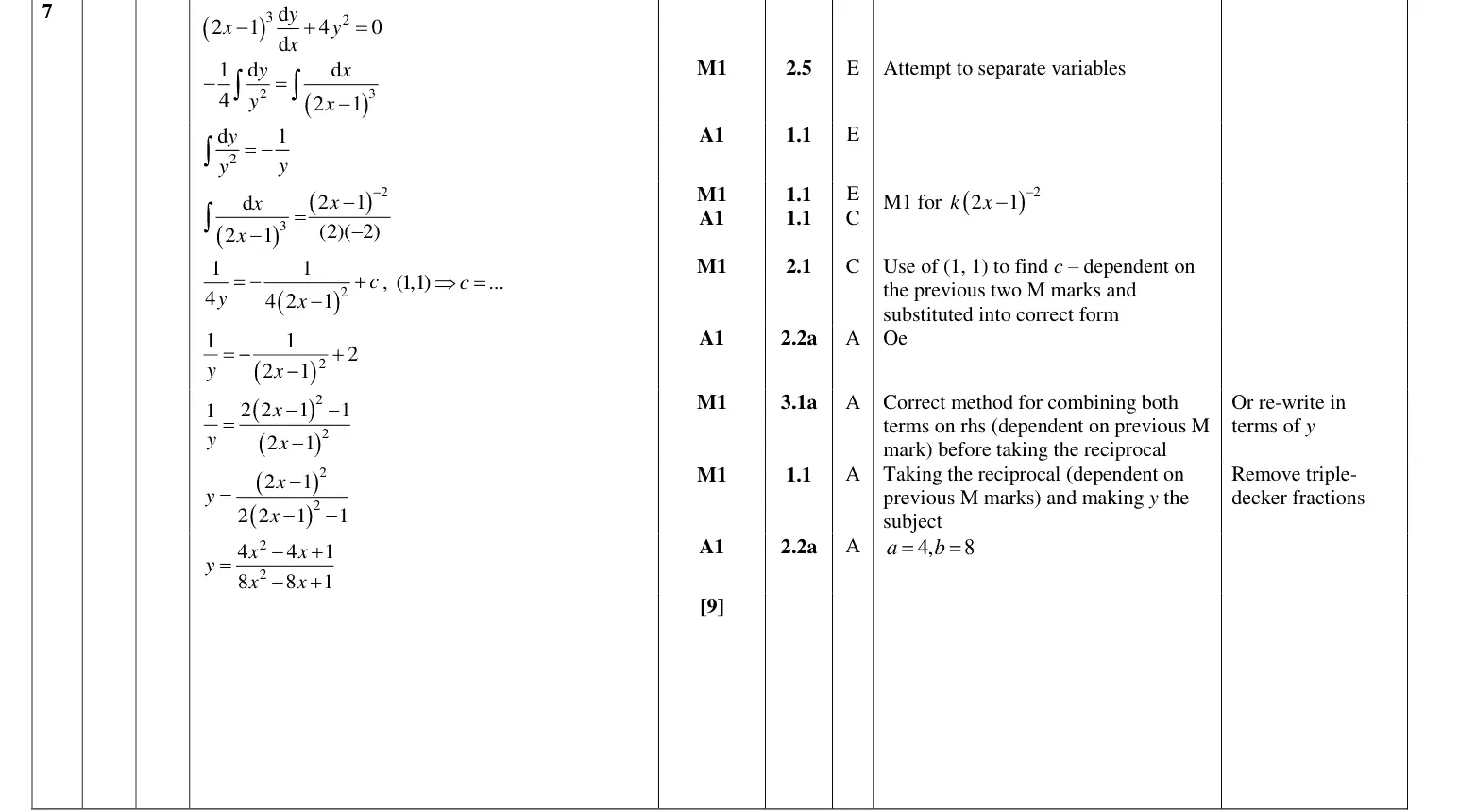
= ^ h is given by the differential equation 7 y x The gradient of the curve f ^ h d y x y - + = d x ^ h. By solving this differential equation show that and the curve passes through the point ,1 1 ^ h ax ax - + f x , = bx bx - + where a and b are integers to be determined. [9]
June 2018 · Paper 3 · Q8(i) 3 marks Medium forces and newtons laws
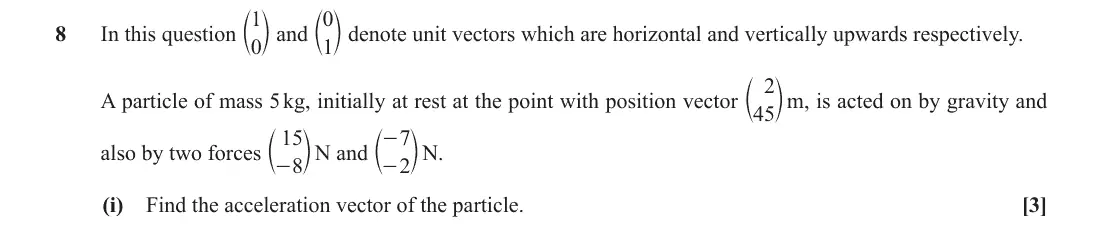
In this question 1 c m and 0 c m denote unit vectors which are horizontal and vertically upwards respectively. 8 c m m, is acted on by gravity and A particle of mass 5 kg, initially at rest at the point with position vector also by two forces 15 c m N and c m N. - - - (i) Find the acceleration vector of the particle. [3]
June 2018 · Paper 3 · Q8(ii) 3 marks Easy constant acceleration
Show the start of this questionEarlier part of this question
(ii) Find the position vector of the particle after 10 seconds. [3]
June 2018 · Paper 3 · Q9(i) 1 mark Easy friction and forces in a planemoments
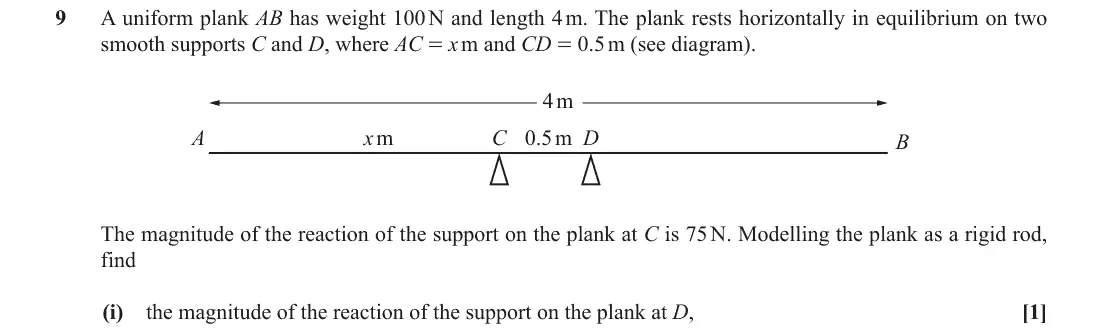
9 A uniform plank AB has weight 100 N and length 4 m. The plank rests horizontally in equilibrium on two smooth supports C and D, where AC = x m and CD = 0.5 m (see diagram). 4 m A x m C 0.5 m D B The magnitude of the reaction of the support on the plank at C is 75 N. Modelling the plank as a rigid rod, find (i) the magnitude of the reaction of the support on the plank at D, [1]
June 2018 · Paper 3 · Q9(ii) 3 marks Easy moments
Show the start of this questionEarlier part of this question
(ii) the value of x. [3]
June 2018 · Paper 3 · Q9(iii) 3 marks Hard moments
Show the start of this questionEarlier part of this question
A stone block, which is modelled as a particle, is now placed at the end of the plank at B and the plank is on the point of tilting about D. (iii) Find the weight of the stone block. [3]
June 2018 · Paper 3 · Q9(iv)(a) 1 mark Easy moments
Show the start of this questionEarlier part of this question
(iv) Explain the limitation of modelling (a) the stone block as a particle, [1]
June 2018 · Paper 3 · Q9(iv)(b) 1 mark Medium moments
Show the start of this questionEarlier part of this question
(b) the plank as a rigid rod. [1]
June 2018 · Paper 3 · Q10(i) 4 marks Medium friction and forces in a planedouble angle formulae
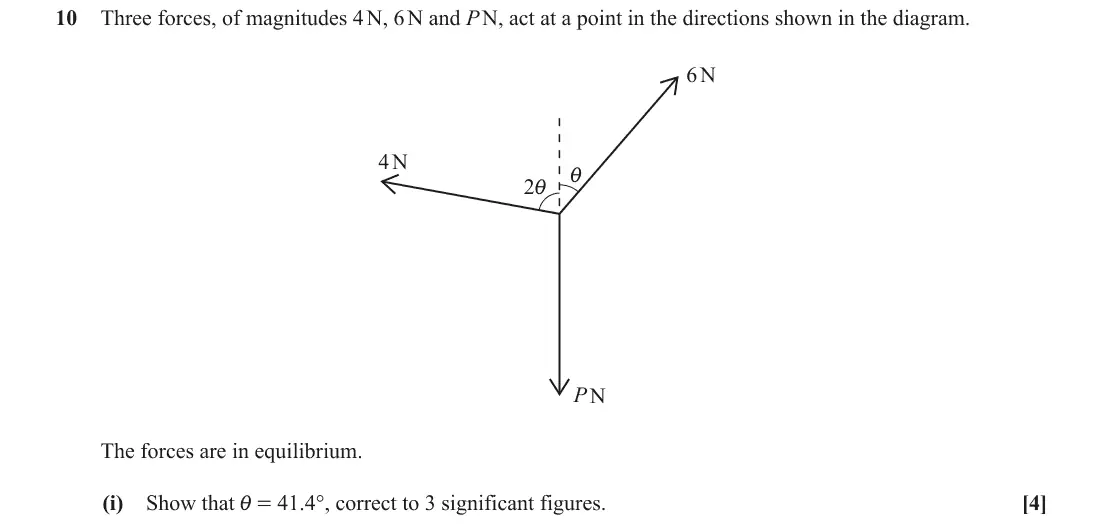
10 Three forces, of magnitudes 4 N, 6 N and P N, act at a point in the directions shown in the diagram. 6 N 4 N i 2i P N The forces are in equilibrium. (i) Show that i = 41.4°, correct to 3 significant figures. [4]
June 2018 · Paper 3 · Q10(ii) 2 marks Easy friction and forces in a plane
Show the start of this questionEarlier part of this question
(ii) Hence find the value of P. [2]
June 2018 · Paper 3 · Q10(iii)(a) 3 marks Medium friction and forces in a planetrigonometric ratios
Show the start of this questionEarlier part of this questionEarlier part of this question
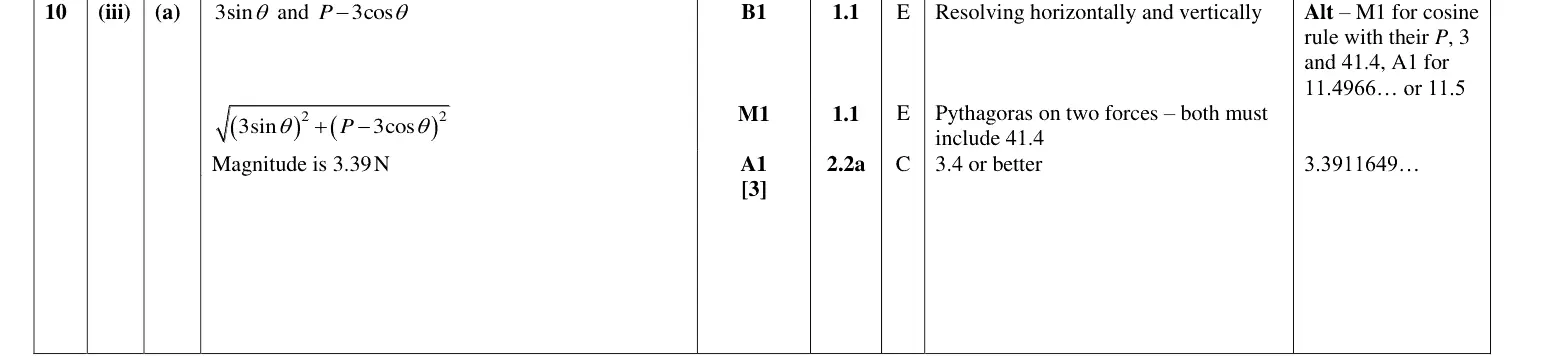
The force of magnitude 4 N is now removed and the force of magnitude 6 N is replaced by a force of magnitude 3 N acting in the same direction. (iii) Find (a) the magnitude of the resultant of the two remaining forces, [3]
June 2018 · Paper 3 · Q10(iii)(b) 2 marks Medium friction and forces in a planetrigonometric ratios
Show the start of this questionEarlier part of this question
(b) the direction of the resultant of the two remaining forces. [2]
June 2018 · Paper 3 · Q11(i) 3 marks Easy variable accelerationdifferentiation
The velocity v m s-1 of a car at time t s, during the first 20 s of its journey, is given by v = kt + 0.03t 2, where 11 k is a constant. When t = 20 the acceleration of the car is 1.3 m s-2. For t 2 20 the car continues its journey with constant acceleration 1.3 m s-2 until its speed reaches 25 m s-1. (i) Find the value of k. [3]
June 2018 · Paper 3 · Q11(ii) 7 marks Easy variable accelerationconstant accelerationintegration
Show the start of this questionEarlier part of this question
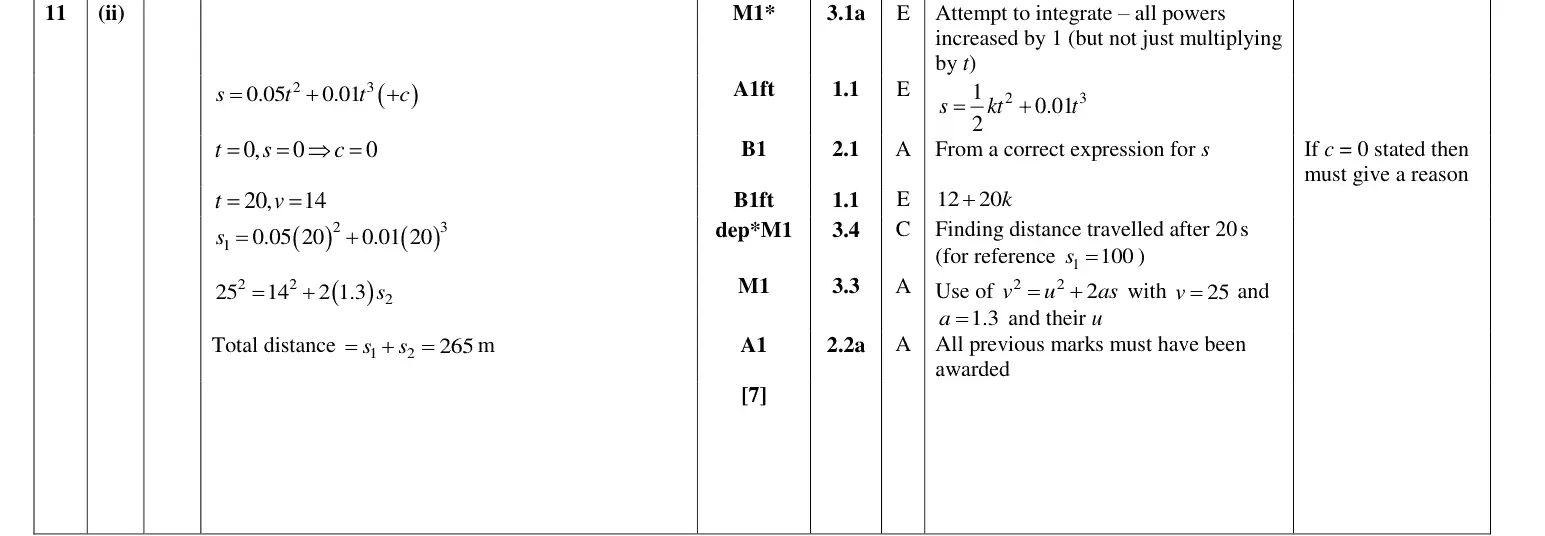
(ii) Find the total distance the car has travelled when its speed reaches 25 m s-1. [7]
June 2018 · Paper 3 · Q12(i)(a) 7 marks Easy friction and forces in a planeforces and newtons laws
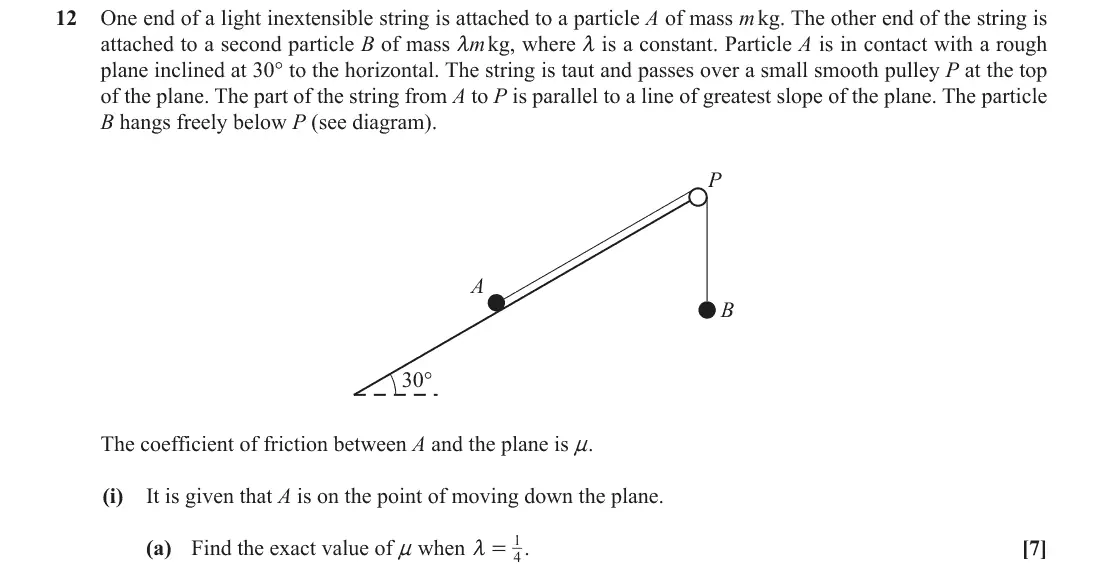
12 One end of a light inextensible string is attached to a particle A of mass m kg. The other end of the string is attached to a second particle B of mass mm kg, where m is a constant. Particle A is in contact with a rough plane inclined at 30° to the horizontal. The string is taut and passes over a small smooth pulley P at the top of the plane. The part of the string from A to P is parallel to a line of greatest slope of the plane. The particle B hangs freely below P (see diagram). P A B 30° The coefficient of friction between A and the plane is n. (i) It is given that A is on the point of moving down the plane. (a) Find the exact value of n when . [7] m =
June 2018 · Paper 3 · Q12(i)(b) 2 marks Medium friction and forces in a planeforces and newtons laws
Show the start of this questionEarlier part of this question
1 . (b) Show that the value of m must be less than 2 [2]
June 2018 · Paper 3 · Q12(ii) 5 marks Hard friction and forces in a planeforces and newtons laws
Show the start of this questionEarlier part of this question
1 g m s-2, find the exact value of n. (ii) Given instead that m = 2 and that the acceleration of A is 4 [5]

Find an A-level maths tutor

Want this paper marked and gone through with you? Message us.

Prefer email? Send an enquiry

If you are under 18, please include a parent's contact details. Enquiries go to enquiries@mathsaleveltutor.com and are deleted once handled.