Autumn 2021: Paper 1: Pure Mathematics

100 marks · 42 question parts · Question paper, mark scheme and examiner's report on OCR's site

Question by question

QTopicMarksDifficulty
1 Quadratics and the discriminant, Inequalities 4 Medium
2(a) Straight lines, Functions, composite and inverse functions, modulus 2 Medium
2(b) Simultaneous equations, Straight lines 2 Medium
3(a) Graphs and transformations 2 Medium
3(b) Graphs and transformations 2 Medium
4(a) Algebraic methods: polynomials, factor theorem and rational expressions 1 Medium
4(b) Algebraic methods: polynomials, factor theorem and rational expressions 3 Medium
4(c) Exponentials and logarithms, Algebraic methods: polynomials, factor theorem and rational expressions, Indices and surds 3 Medium
5(a)(i) Graphs and transformations 1 Medium
5(a)(ii) Graphs and transformations 2 Medium
5(a)(iii) Functions, composite and inverse functions, modulus 1 Medium
5(b)(i) Differentiation: first principles, gradients, stationary points 1 Medium
5(b)(ii) Differentiation: first principles, gradients, stationary points 1 Medium
5(b)(iii) Differentiation: first principles, gradients, stationary points 1 Medium
6(a) Binomial expansion, Indices and surds 4 Easy
6(b) Binomial expansion 1 Medium
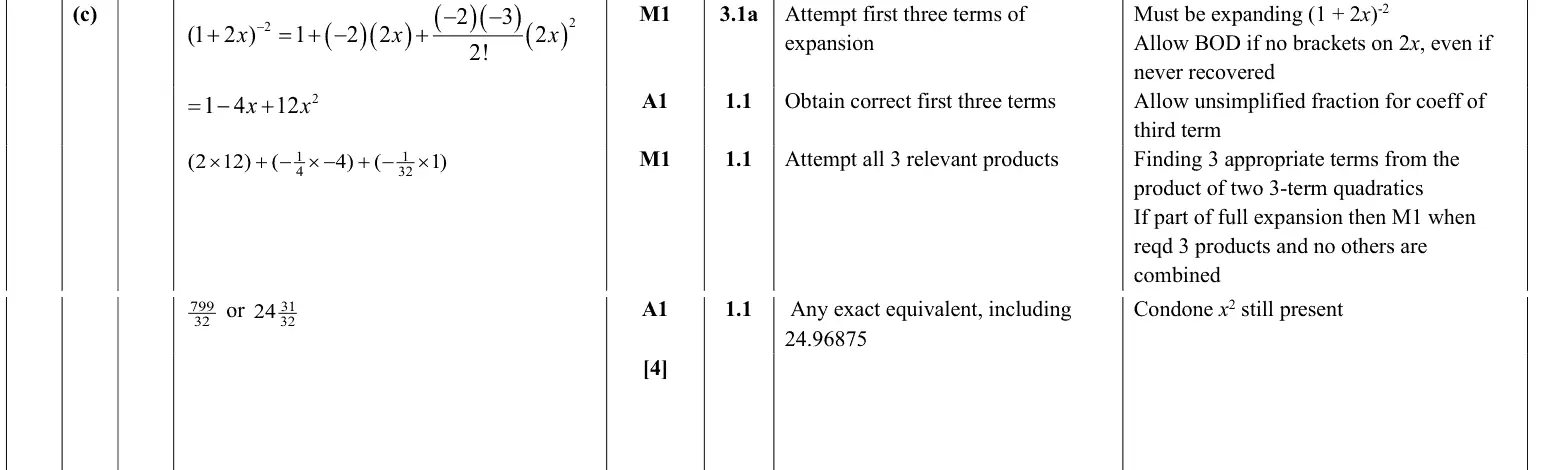
6(c) Binomial expansion 4 Medium
7(a) Chain, product and quotient rules; connected rates of change, Differentiation: first principles, gradients, stationary points 2 Medium
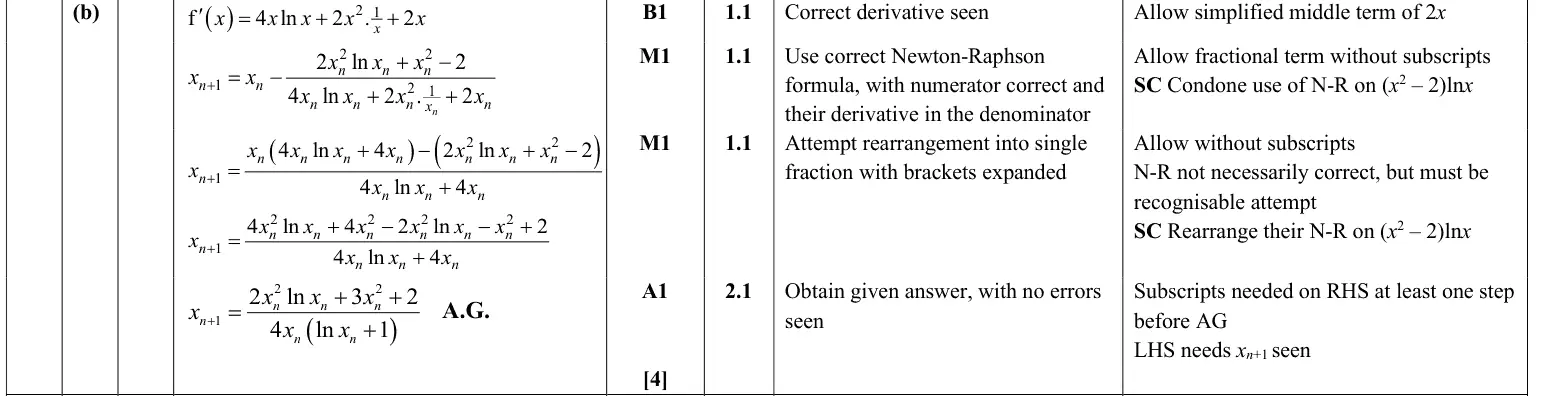
7(b) Numerical methods: roots, iteration and Newton–Raphson, Chain, product and quotient rules; connected rates of change, Differentiation: first principles, gradients, stationary points 4 Medium
7(c) Numerical methods: roots, iteration and Newton–Raphson 1 Medium
7(d) Numerical methods: roots, iteration and Newton–Raphson, Differentiation: first principles, gradients, stationary points 2 Medium
8(a)(i) Reciprocal and inverse trigonometric functions, Functions, composite and inverse functions, modulus 1 Medium
8(a)(ii) Reciprocal and inverse trigonometric functions, Functions, composite and inverse functions, modulus 1 Medium
8(b)(i) Functions, composite and inverse functions, modulus, Reciprocal and inverse trigonometric functions 2 Medium
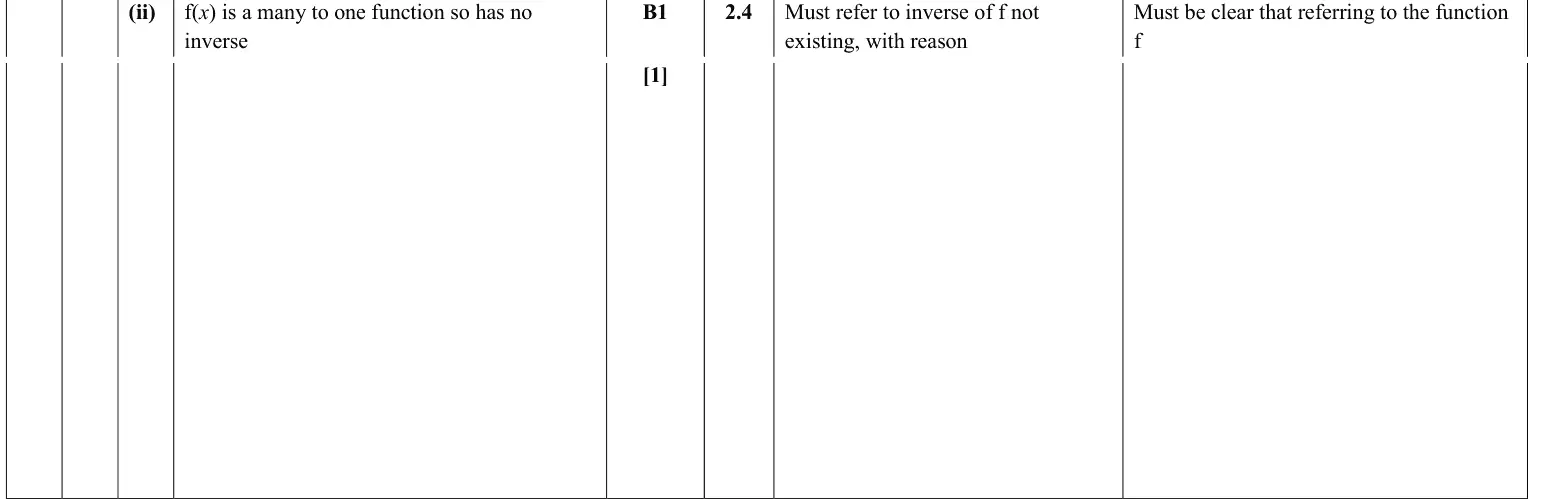
8(b)(ii) Functions, composite and inverse functions, modulus 1 Medium
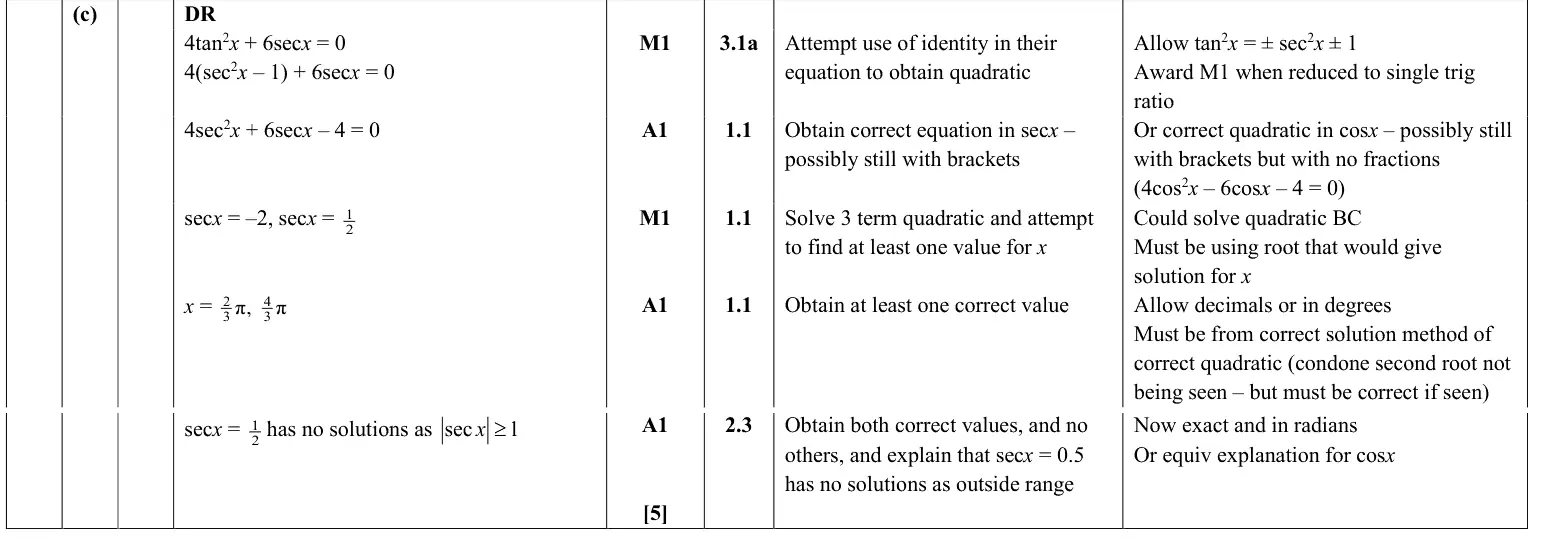
8(c) Reciprocal and inverse trigonometric functions, Solving trigonometric equations, Quadratics and the discriminant 5 Medium
9(a) Parametric equations, Exponentials and logarithms 1 Hard
9(b) Parametric equations, Quadratics and the discriminant, Exponentials and logarithms 2 Hard
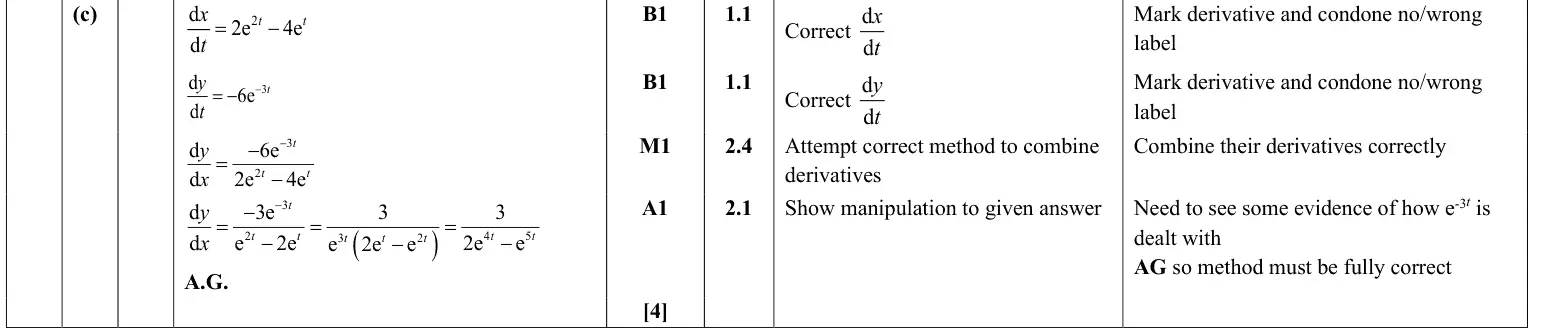
9(c) Implicit and parametric differentiation, Differentiation: first principles, gradients, stationary points 4 Hard
9(d) Implicit and parametric differentiation, Parametric equations 3 Hard
10(a)(i) Addition and double-angle formulae, harmonic form, Trigonometric ratios, graphs, radians and the sine and cosine rules 1 Medium
10(a)(ii) Trigonometric ratios, graphs, radians and the sine and cosine rules, Addition and double-angle formulae, harmonic form 1 Medium
10(a)(iii) Addition and double-angle formulae, harmonic form, Trigonometric ratios, graphs, radians and the sine and cosine rules 4 Medium
10(b) Addition and double-angle formulae, harmonic form, Trigonometric ratios, graphs, radians and the sine and cosine rules, Indices and surds 5 Medium
11(a) Integration by parts and by substitution, Indices and surds 5 Hard
11(b) Integration by parts and by substitution, Integration: standard integrals, definite integrals and areas, Chain, product and quotient rules; connected rates of change, Differentiation: first principles, gradients, stationary points, Straight lines 7 Medium
12(a)(i) Differential equations 1 Medium
12(a)(ii) Differential equations, Integration: standard integrals, definite integrals and areas 2 Medium
12(a)(iii) Differential equations 1 Medium
12(b)(i) Differential equations 1 Medium
12(b)(ii) Differential equations, Exponentials and logarithms 6 Medium
12(c) Differential equations, Exponentials and logarithms 2 Medium

The questions

12(a)2(b)3(a)3(b)4(a)4(b)4(c)5(a)(i)5(a)(ii)5(a)(iii)5(b)(i)5(b)(ii)5(b)(iii)6(a)6(b)6(c)7(a)7(b)7(c)7(d)8(a)(i)8(a)(ii)8(b)(i)8(b)(ii)8(c)9(a)9(b)9(c)9(d)10(a)(i)10(a)(ii)10(a)(iii)10(b)11(a)11(b)12(a)(i)12(a)(ii)12(a)(iii)12(b)(i)12(b)(ii)12(c)
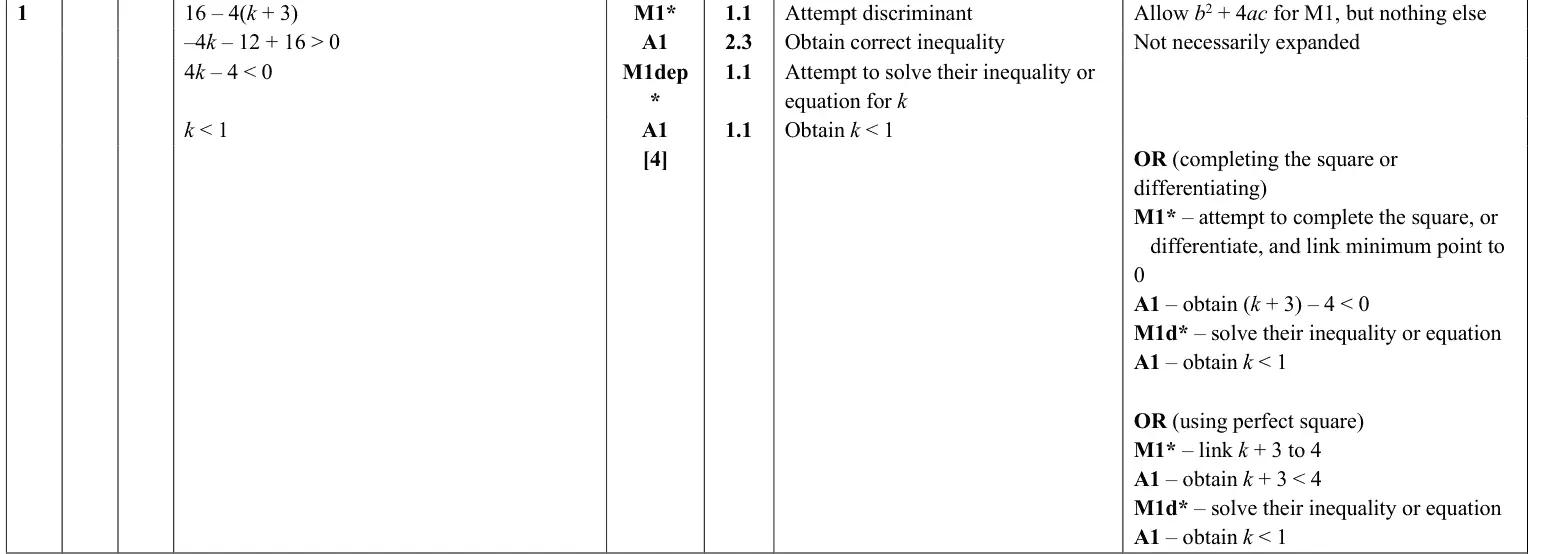
Autumn 2021 · Paper 1 · Q1 4 marks Medium quadraticsinequalities
2 + 1 Determine the set of values of k such that the equation x x ( k ) has two distinct real + + = roots. [4]
Autumn 2021 · Paper 1 · Q2(a) 2 marks Medium straight linesfunctions
2 Alex is comparing the cost of mobile phone contracts. Contract A has a set-up cost of £40 and then costs 4p per minute. Contract B has no set-up cost, does not charge for the first 100 minutes and then costs 6p per minute. (a) Find an expression for the cost of each of the contracts in terms of m, where m is the number of minutes for which the phone is used and m 100 . [2]
Autumn 2021 · Paper 1 · Q2(b) 2 marks Medium simultaneous equationsstraight lines
Show the start of this questionEarlier part of this question
(b) Hence find the value of m for which both contracts would cost the same. [2]
Autumn 2021 · Paper 1 · Q3(a) 2 marks Medium graphs and transformations
3 It is given that x is proportional to the product of the square of y and the positive square root of z. When y and z , x . = = = (a) Write an equation for x in terms of y and z. [2]
Autumn 2021 · Paper 1 · Q3(b) 2 marks Medium graphs and transformations
Show the start of this questionEarlier part of this question
(b) Find the value of x when y = and z . [2] =
Autumn 2021 · Paper 1 · Q4(a) 1 mark Medium algebraic methods
4 In this question you must show detailed reasoning. The cubic polynomial ( ) f x is defined by ( ) f x x x x + . = - - (a) Use the factor theorem to show that ( x ) is a factor of ( ) f x . [1] -
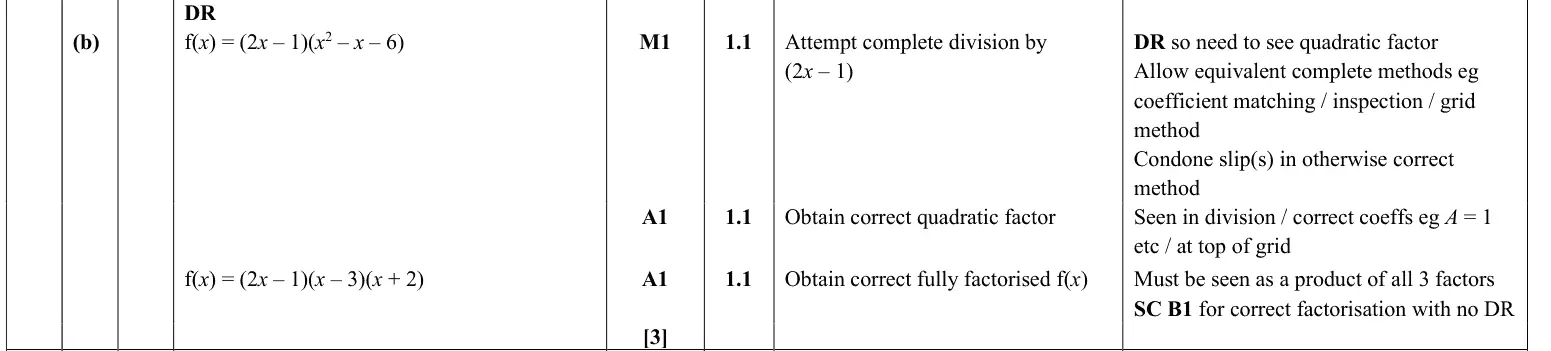
Autumn 2021 · Paper 1 · Q4(b) 3 marks Medium algebraic methods
Show the start of this questionEarlier part of this question
(b) Express ( ) f x in fully factorised form. [3]
Autumn 2021 · Paper 1 · Q4(c) 3 marks Medium exponentials and logsalgebraic methodsindices and surds
Show the start of this questionEarlier part of this questionEarlier part of this question
y y y (c) Hence solve the equation 2 . [3] - - + = # # #
Autumn 2021 · Paper 1 · Q5(a)(i) 1 mark Medium graphs and transformations
5 (a) The graph of the function y f ( ) x passes through the point P with coordinates (2, 6), and = is a one-one function. State the coordinates of the point corresponding to P on each of the following curves. (i) y f ( ) x + [1] =
Autumn 2021 · Paper 1 · Q5(a)(ii) 2 marks Medium graphs and transformations
Show the start of this questionEarlier part of this question
(ii) y 2f ( x ) [2] = -
Autumn 2021 · Paper 1 · Q5(a)(iii) 1 mark Medium functions
Show the start of this questionEarlier part of this question
(iii) y f - ( ) x [1] =
Autumn 2021 · Paper 1 · Q5(b)(i) 1 mark Medium differentiation
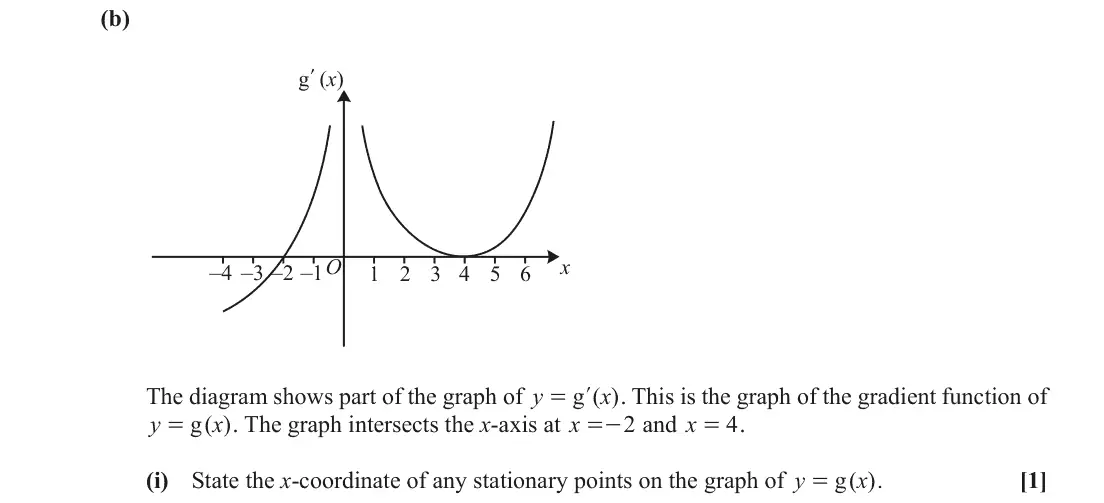
(b) g ( )x l O x –4 –3 –2 –1 The diagram shows part of the graph of y g ( ) x . This is the graph of the gradient function of = l y g ( ) x . The graph intersects the x-axis at x =- and x . = = (i) State the x-coordinate of any stationary points on the graph of y g ( ) x . [1] =
Autumn 2021 · Paper 1 · Q5(b)(ii) 1 mark Medium differentiation
Show the start of this questionEarlier part of this question
(ii) State the set of values of x for which y g ( ) x is a decreasing function. [1] =
Autumn 2021 · Paper 1 · Q5(b)(iii) 1 mark Medium differentiation
Show the start of this questionEarlier part of this question
(iii) State the x-coordinate of any points of inflection on the graph of y g ( ) x . [1] =
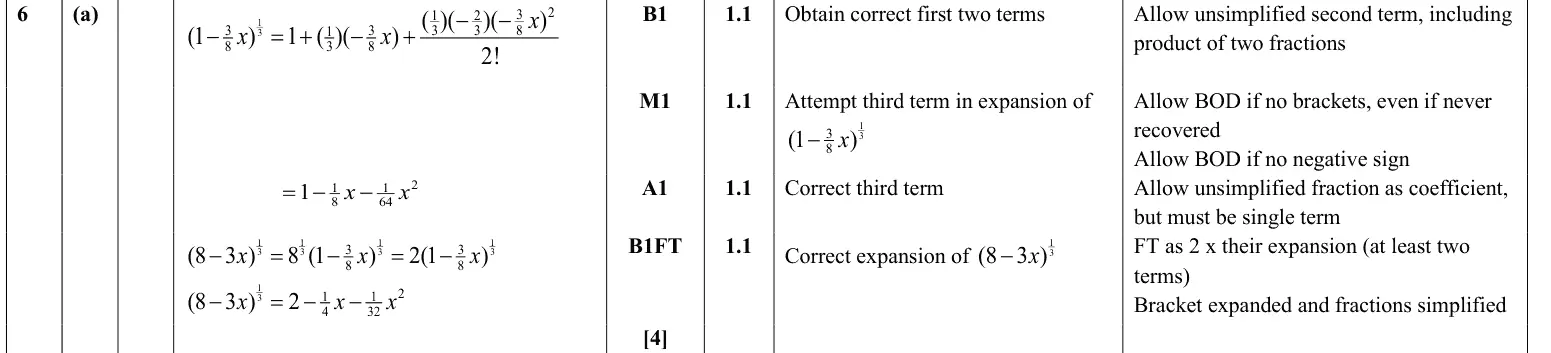
Autumn 2021 · Paper 1 · Q6(a) 4 marks Easy binomial expansionindices and surds
^ h in ascending powers of x. 6 (a) Find the first three terms in the expansion of x [4] -
Autumn 2021 · Paper 1 · Q6(b) 1 mark Medium binomial expansion
Show the start of this questionEarlier part of this question
(b) State the range of values of x for which the expansion in part (a) is valid. [1]
Autumn 2021 · Paper 1 · Q6(c) 4 marks Medium binomial expansion
Show the start of this questionEarlier part of this question
^ h . x - (c) Find the coefficient of x2 in the expansion of [4] ^ h x +
Autumn 2021 · Paper 1 · Q7(a) 2 marks Medium differentiation rulesdifferentiation
7 The curve y ( x )ln x has one stationary point which is close to x = . = - (a) Show that the x-coordinate of this stationary point satisfies the equation x ln x x . + - = [2]
Autumn 2021 · Paper 1 · Q7(b) 4 marks Medium numerical methodsdifferentiation rulesdifferentiation
Show the start of this questionEarlier part of this question
(b) Show that the Newton-Raphson iterative formula for finding the root of the equation in part (a) x ln x x + + n n n can be written in the form x . [4] = x x ( ln ) n + + n n
Autumn 2021 · Paper 1 · Q7(c) 1 mark Medium numerical methods
Show the start of this questionEarlier part of this question
(c) Apply the Newton-Raphson formula with initial value x 1 = to find x2 and x3. [1]
Autumn 2021 · Paper 1 · Q7(d) 2 marks Medium numerical methodsdifferentiation
Show the start of this questionEarlier part of this questionEarlier part of this question
(d) Find the coordinates of this stationary point, giving each coordinate correct to 3 decimal places. [2]
Autumn 2021 · Paper 1 · Q8(a)(i) 1 mark Medium reciprocal trig functionsfunctions
8 Functions f and g are defined for x by ( ) f x tan x and ( ) g x sec x . G G = = r (a) (i) State the range of f. [1]
Autumn 2021 · Paper 1 · Q8(a)(ii) 1 mark Medium reciprocal trig functionsfunctions
Show the start of this questionEarlier part of this question
(ii) State the range of g. [1]
Autumn 2021 · Paper 1 · Q8(b)(i) 2 marks Medium functionsreciprocal trig functions
Show the start of this questionEarlier part of this question
(b) (i) Show that fg 0 6 ( . ) 5 33 . , correct to 3 significant figures. [2] =
Autumn 2021 · Paper 1 · Q8(b)(ii) 1 mark Medium functions
Show the start of this questionEarlier part of this question
(ii) Explain why f - g 0 6 ( . ) is not defined. [1]
Autumn 2021 · Paper 1 · Q8(c) 5 marks Medium reciprocal trig functionstrigonometric equationsquadratics
Show the start of this questionEarlier part of this question
(c) In this question you must show detailed reasoning. ^ h 2 + Solve the equation ( ) f x 6g ( ) x . [5] =
Autumn 2021 · Paper 1 · Q9(a) 1 mark Hard parametric equationsexponentials and logs
9 A particle moves in the x-y plane so that at time t seconds, where t , its coordinates are given by H - . t t t x e e , y e = - + = (a) Explain why the path of the particle never crosses the x-axis. [1]
Autumn 2021 · Paper 1 · Q9(b) 2 marks Hard parametric equationsquadraticsexponentials and logs
Show the start of this questionEarlier part of this question
(b) Determine the exact values of t when the path of the particle intersects the y-axis. [2]
Autumn 2021 · Paper 1 · Q9(c) 4 marks Hard implicit and parametric differentiationdifferentiation
Show the start of this questionEarlier part of this question
y d (c) Show that x . [4] = d t t e e -
Autumn 2021 · Paper 1 · Q9(d) 3 marks Hard implicit and parametric differentiationparametric equations
Show the start of this questionEarlier part of this questionEarlier part of this question
(d) Hence find the coordinates of the particle when its path is parallel to the y-axis. [3]
Autumn 2021 · Paper 1 · Q10(a)(i) 1 mark Medium double angle formulaetrigonometric ratios
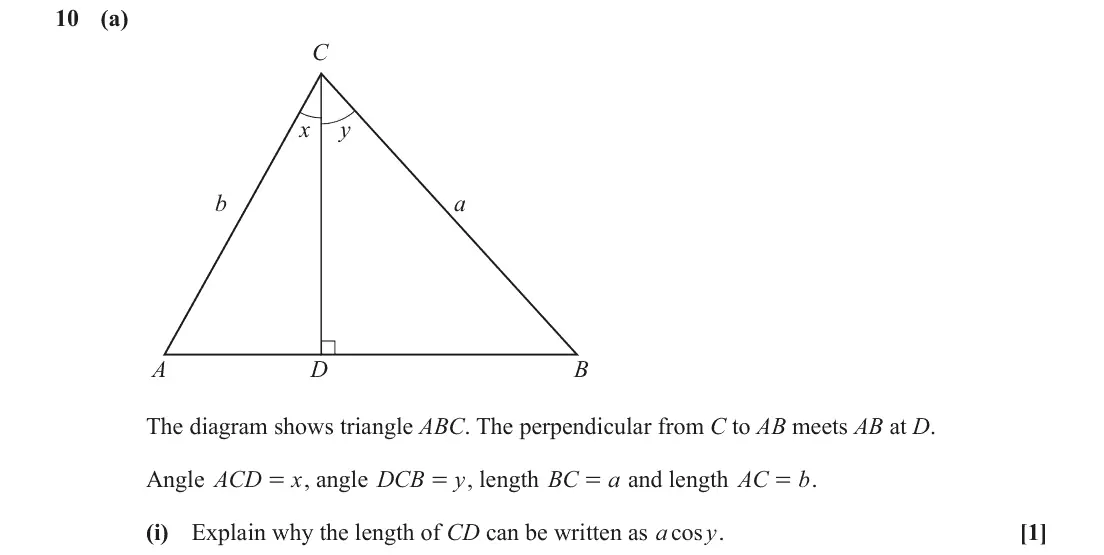
10 (a) C x y b a A D B The diagram shows triangle ABC. The perpendicular from C to AB meets AB at D. Angle ACD = , angle x D B = C y , length BC = a and length AC = b . (i) Explain why the length of CD can be written as cos a y. [1]
Autumn 2021 · Paper 1 · Q10(a)(ii) 1 mark Medium trigonometric ratiosdouble angle formulae
Show the start of this questionEarlier part of this question
(ii) Show that the area of the triangle ADC is given by ab sin cos x y . [1]
Autumn 2021 · Paper 1 · Q10(a)(iii) 4 marks Medium double angle formulaetrigonometric ratios
Show the start of this questionEarlier part of this questionEarlier part of this question
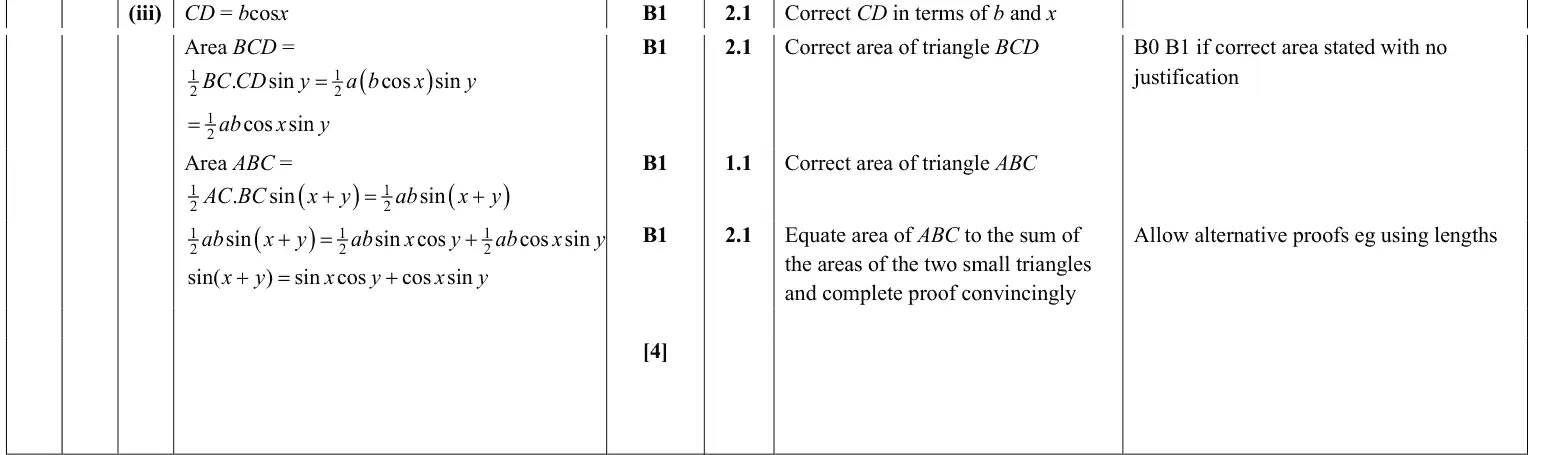
(iii) Hence, or otherwise, show that sin ( x y = ) sin cos x y cos sin x y . [4] + +
Autumn 2021 · Paper 1 · Q10(b) 5 marks Medium double angle formulaetrigonometric ratiosindices and surds
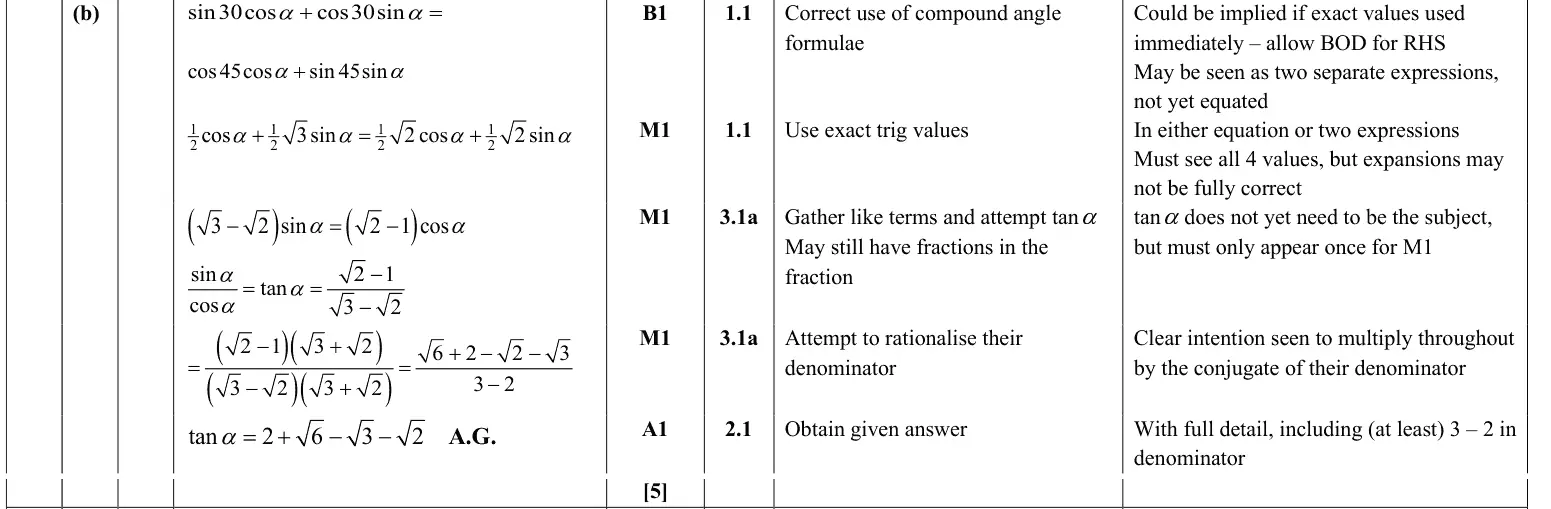
(b) Given that sin ( ° ) cos ( ° ) , show that tan . [5] + = - a = + - - a a
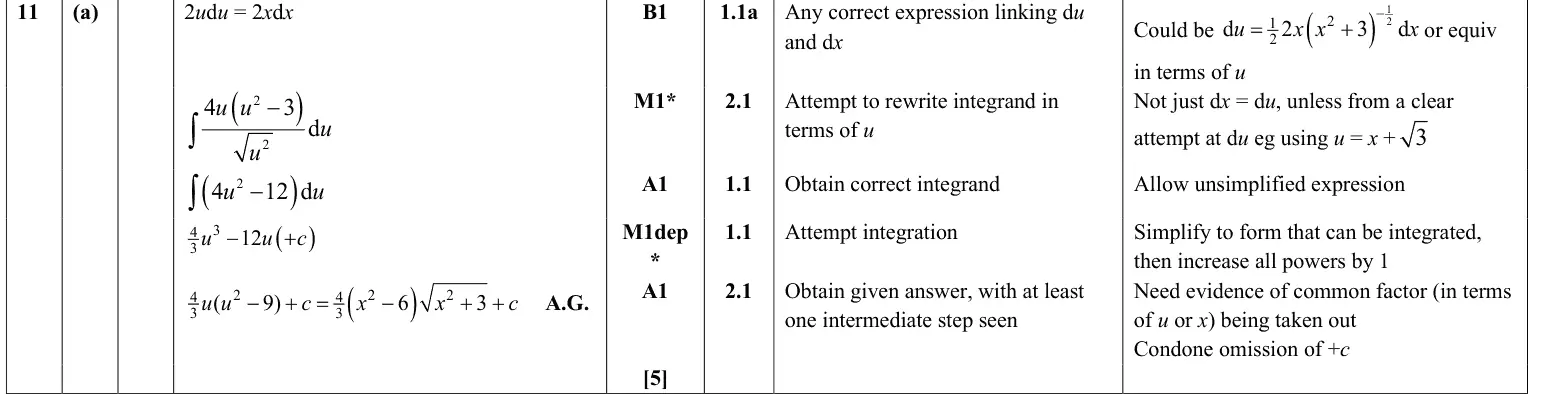
Autumn 2021 · Paper 1 · Q11(a) 5 marks Hard integration by parts and substitutionindices and surds
x y 11 (a) Use the substitution u x + to show that d x ( x ) x c . [5] = = - + + x +
Show the start of this questionEarlier part of this question
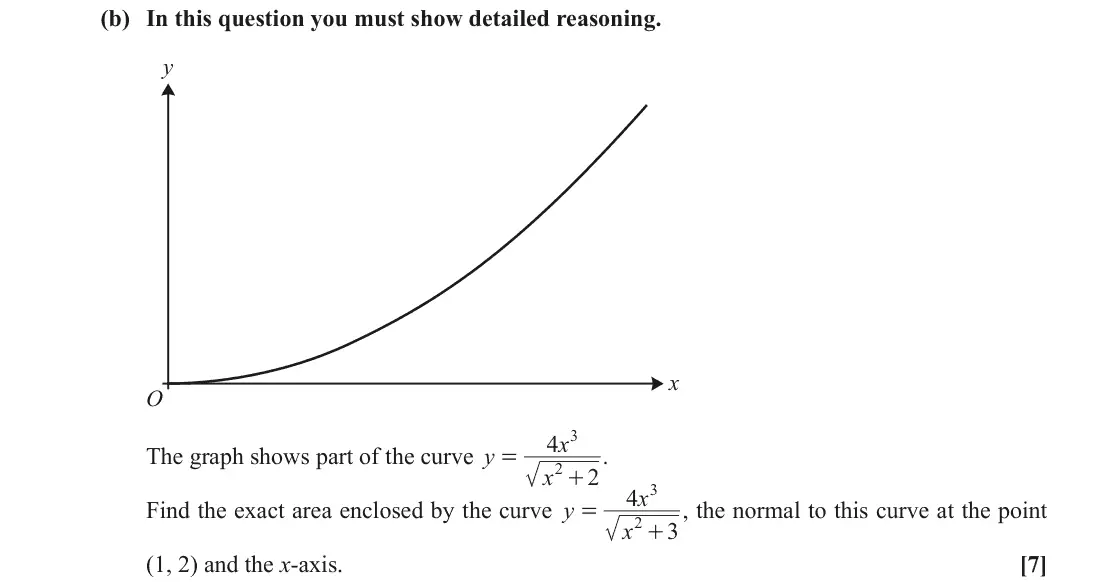
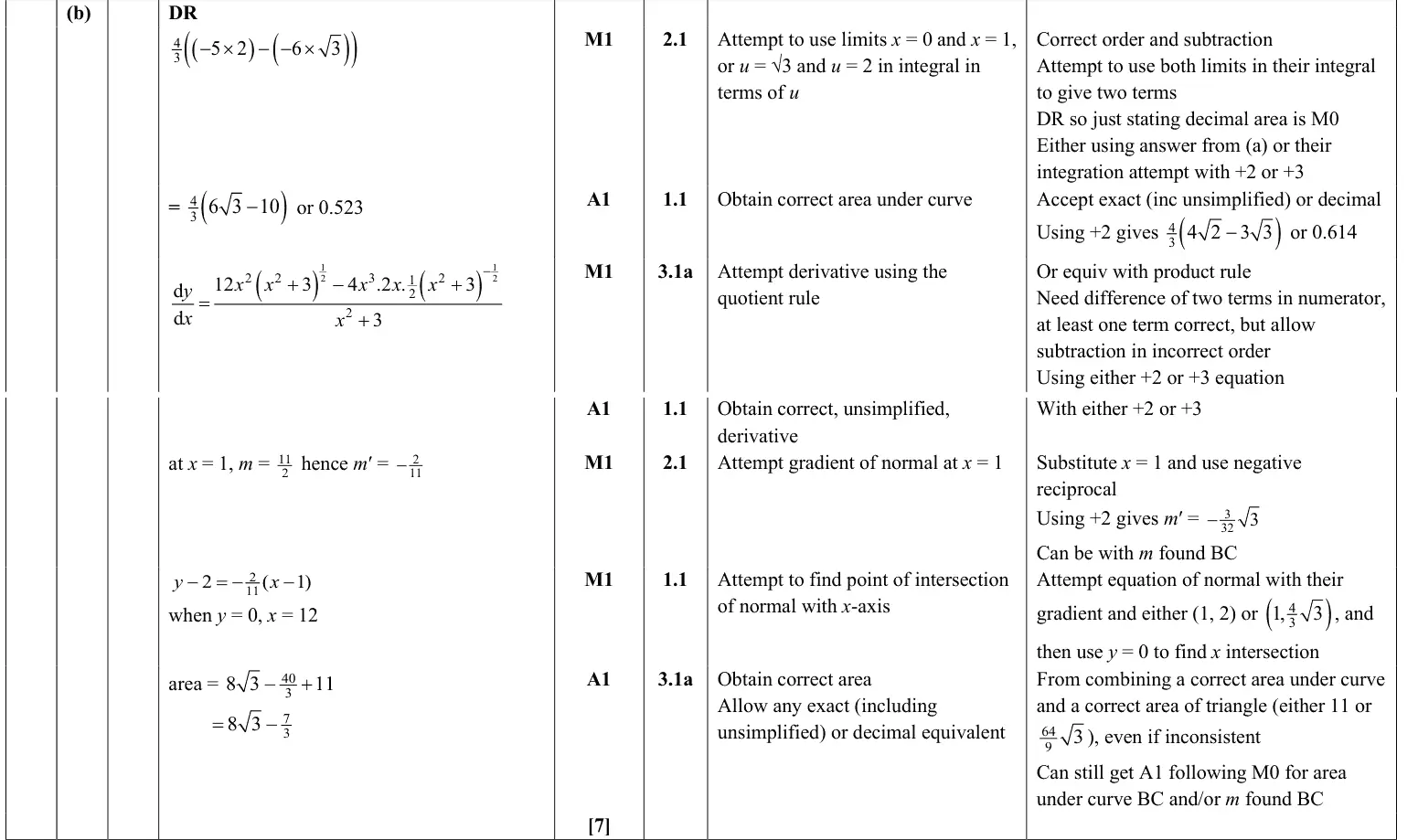
(b) In this question you must show detailed reasoning. y x O x The graph shows part of the curve y . = x + x Find the exact area enclosed by the curve y , the normal to this curve at the point = x + (1, 2) and the x-axis. [7]
Autumn 2021 · Paper 1 · Q12(a)(i) 1 mark Medium differential equations
12 A cake is cooling so that, t minutes after it is removed from an oven, its temperature is i °C. When the cake is removed from the oven, its temperature is 160 °C. After 10 minutes its temperature has fallen to 125 °C. (a) In a simple model, the rate of decrease of the temperature of the cake is assumed to be constant. (i) Write down a differential equation for this model. [1]
Autumn 2021 · Paper 1 · Q12(a)(ii) 2 marks Medium differential equationsintegration
Show the start of this questionEarlier part of this question
(ii) Solve this differential equation to find i in terms of t. [2]
Autumn 2021 · Paper 1 · Q12(a)(iii) 1 mark Medium differential equations
Show the start of this questionEarlier part of this question
(iii) State one limitation of this model. [1]
Autumn 2021 · Paper 1 · Q12(b)(i) 1 mark Medium differential equations
Show the start of this questionEarlier part of this question
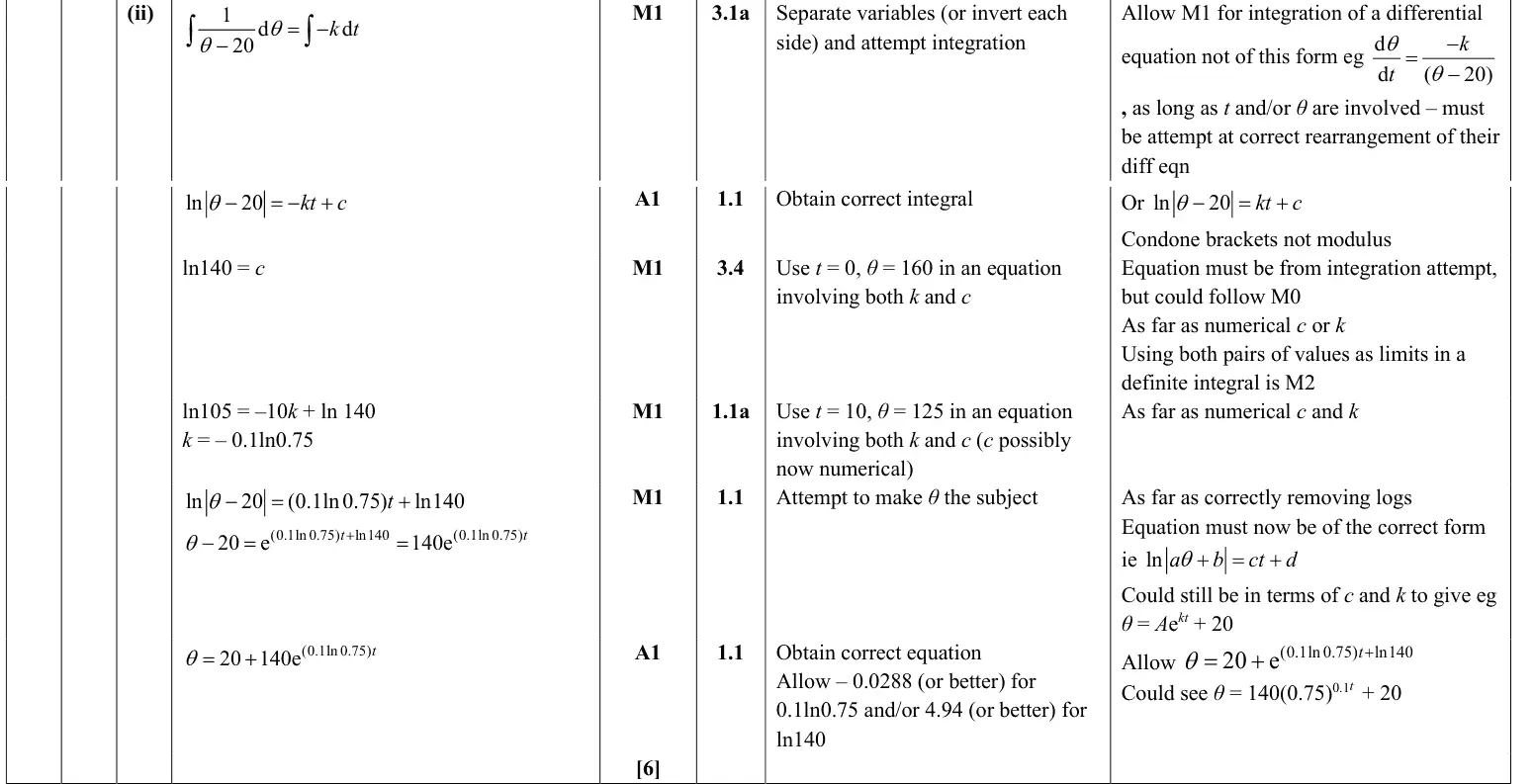
(b) In a revised model, the rate of decrease of the temperature of the cake is proportional to the difference between the temperature of the cake and the temperature of the room. The temperature of the room is a constant 20 °C. (i) Write down a differential equation for this revised model. [1]
Autumn 2021 · Paper 1 · Q12(b)(ii) 6 marks Medium differential equationsexponentials and logs
Show the start of this questionEarlier part of this questionEarlier part of this question
(ii) Solve this differential equation to find i in terms of t. [6]
Autumn 2021 · Paper 1 · Q12(c) 2 marks Medium differential equationsexponentials and logs
Show the start of this questionEarlier part of this questionEarlier part of this question
(c) The cake can be decorated when its temperature is 25 °C. Find the difference in time between when the two models would predict that the cake can be decorated, giving your answer correct to the nearest minute. [2]

Find an A-level maths tutor

Want this paper marked and gone through with you? Message us.

Prefer email? Send an enquiry

If you are under 18, please include a parent's contact details. Enquiries go to enquiries@mathsaleveltutor.com and are deleted once handled.