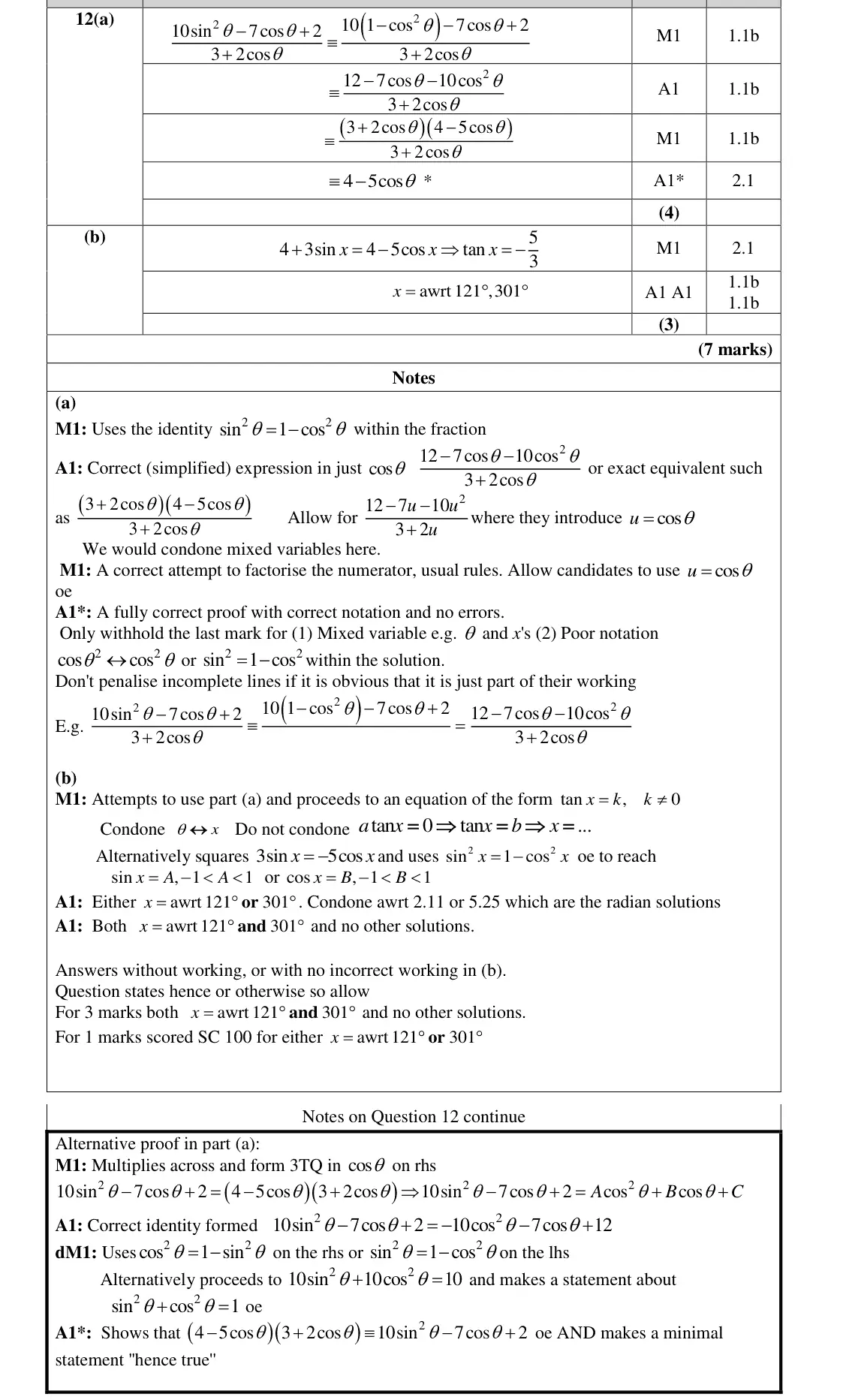
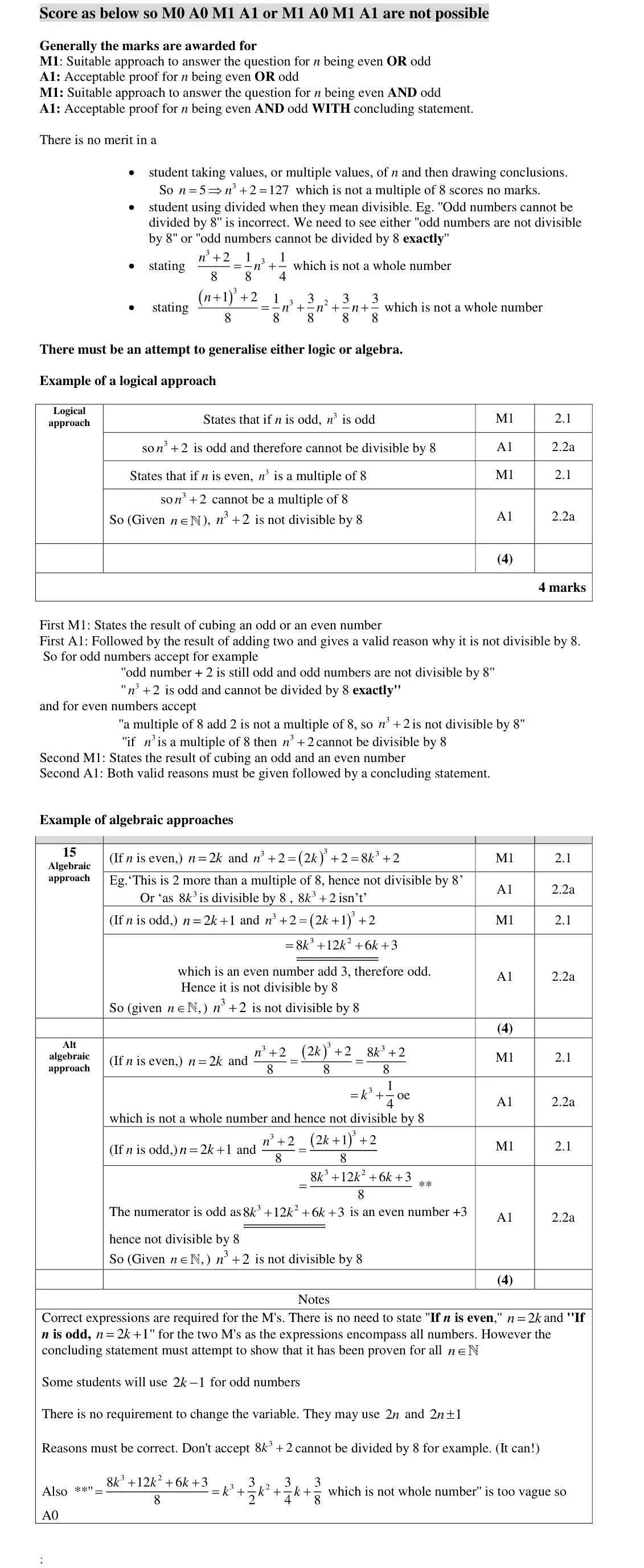
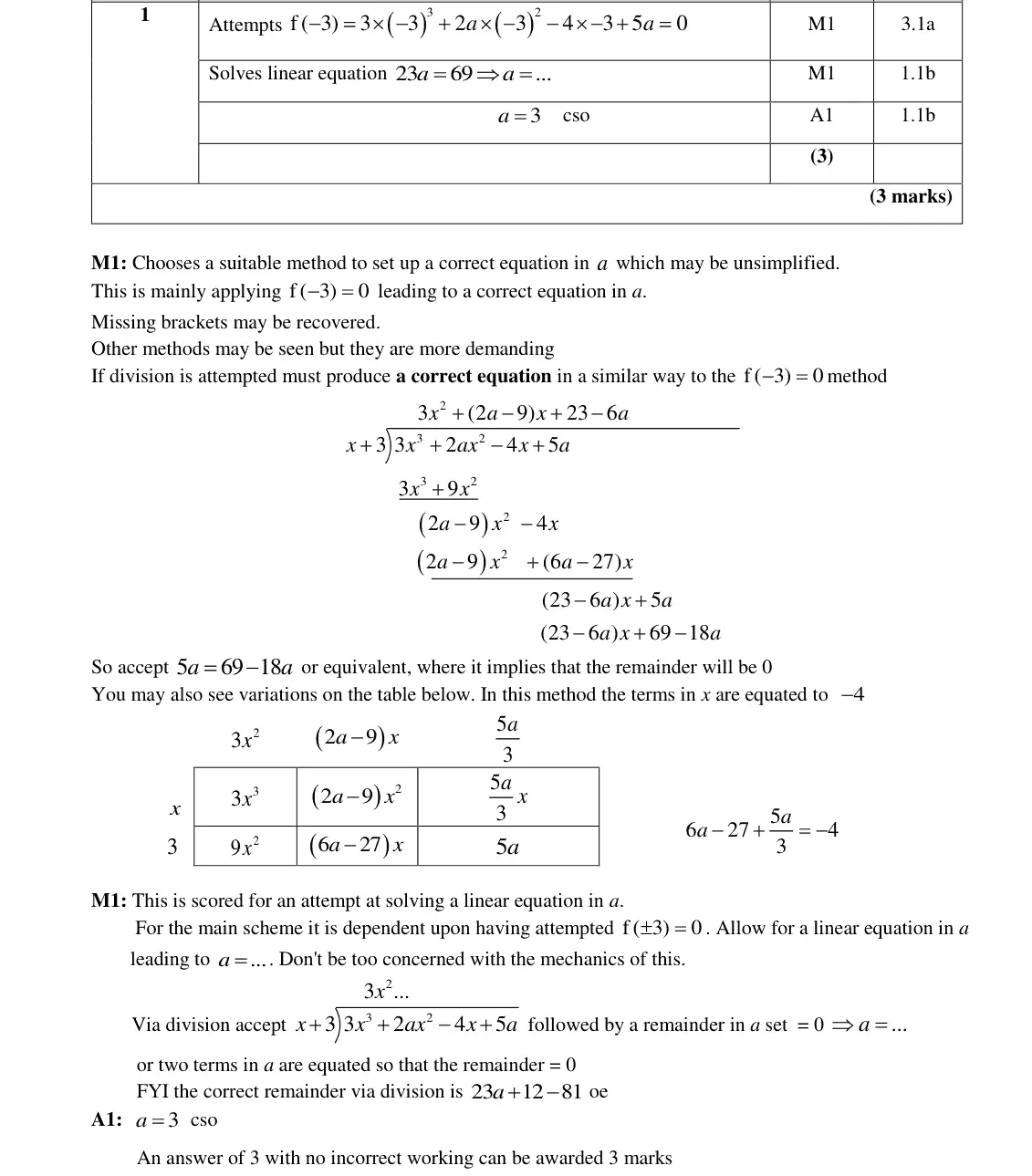
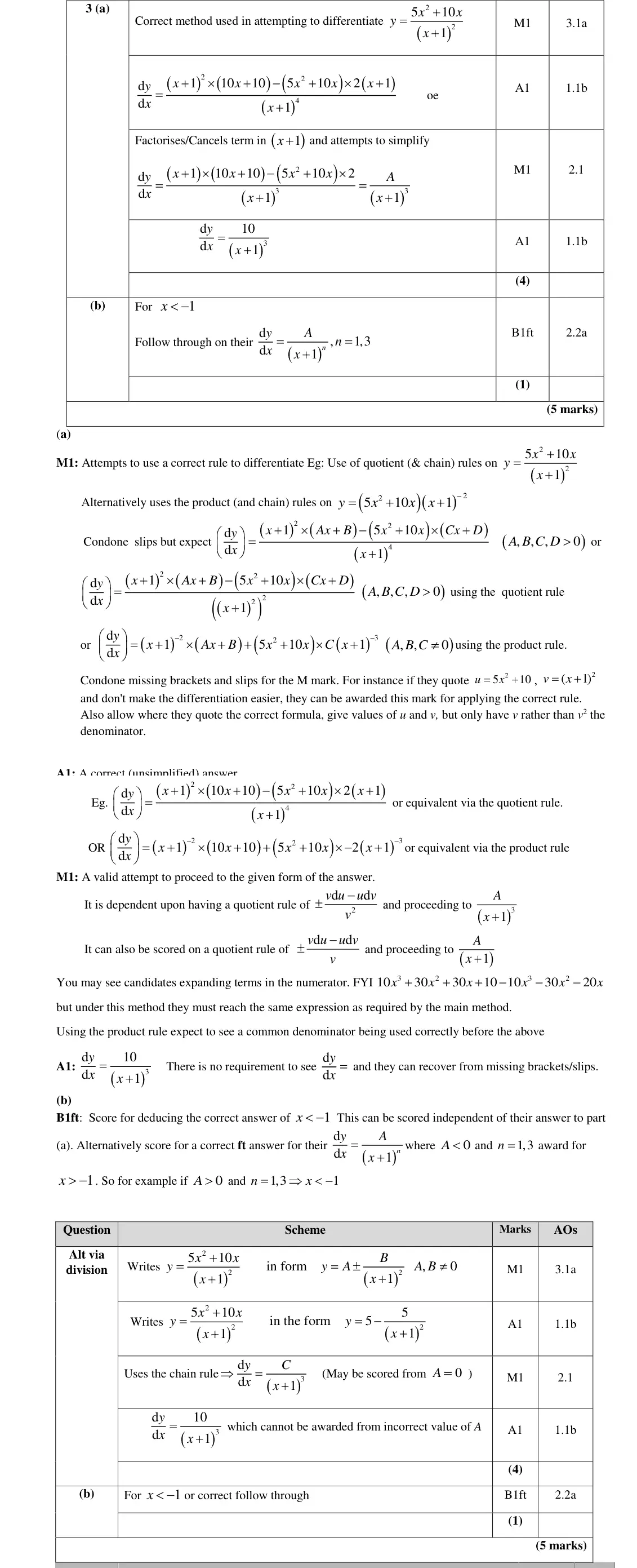
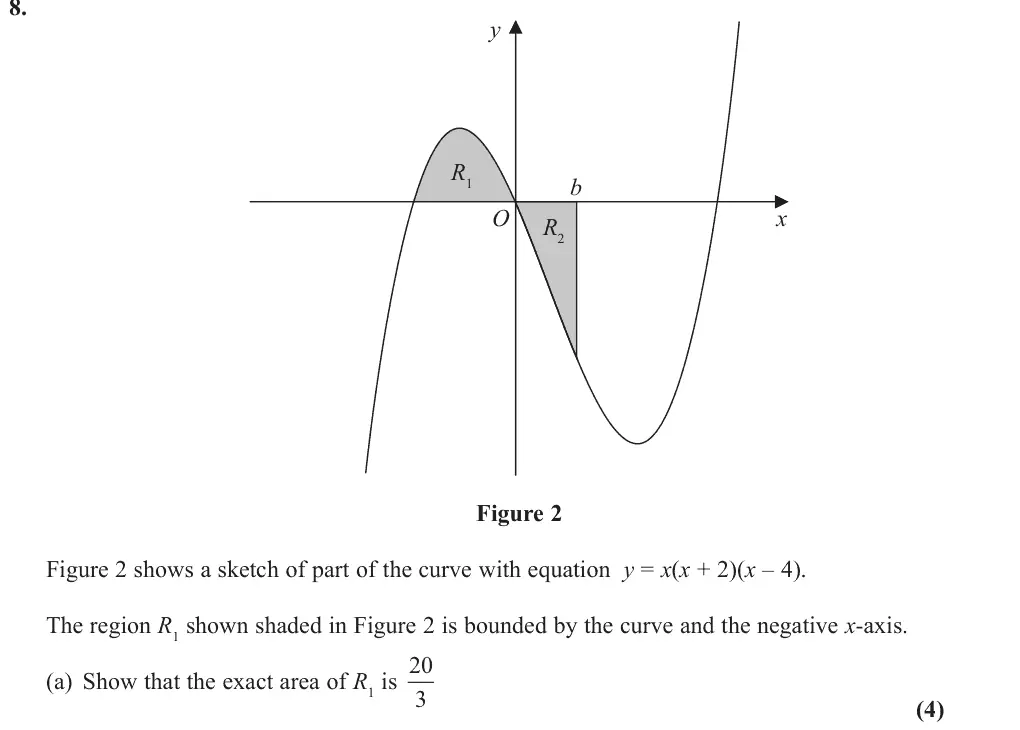
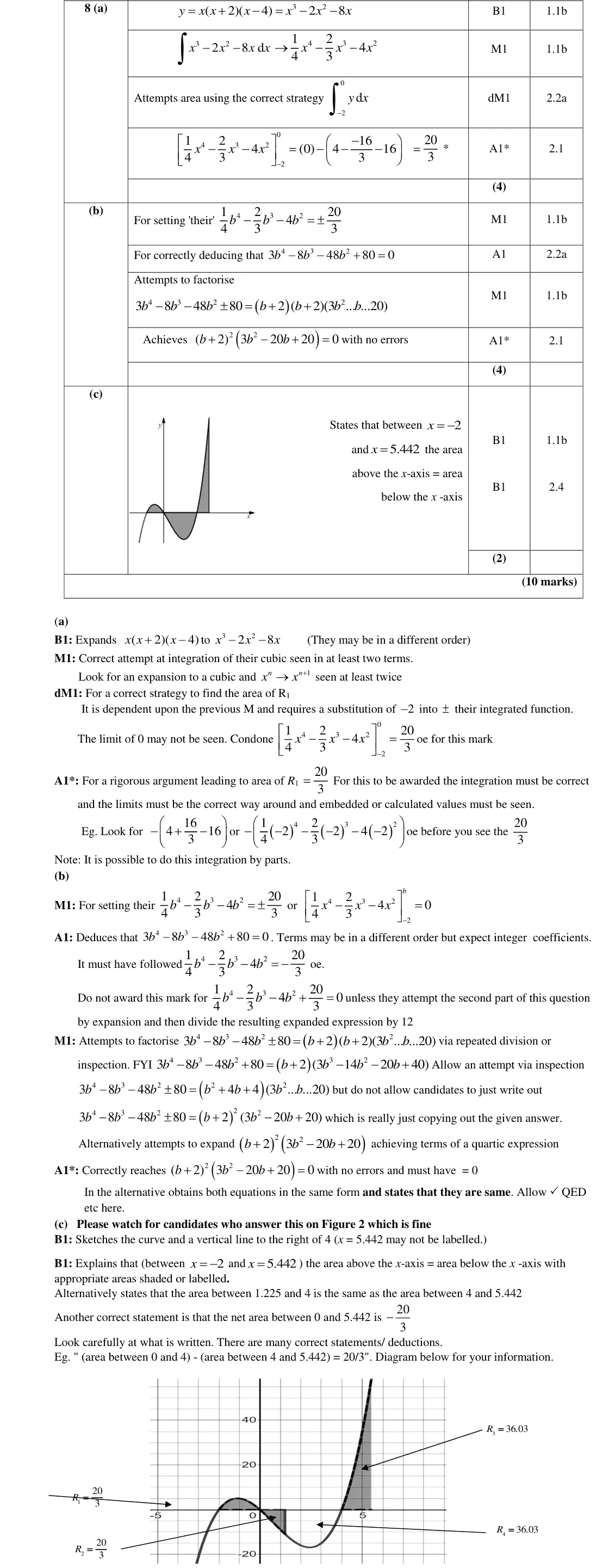
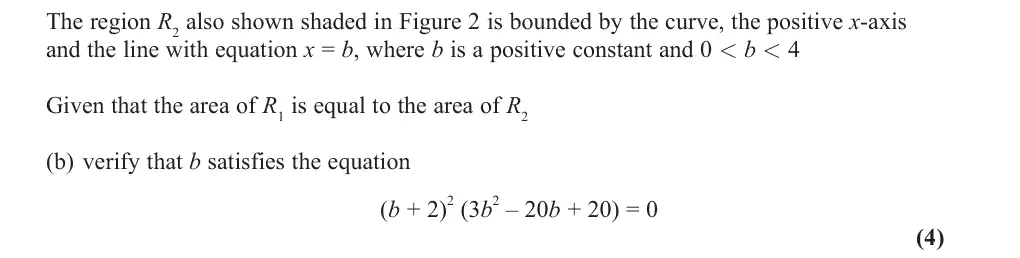
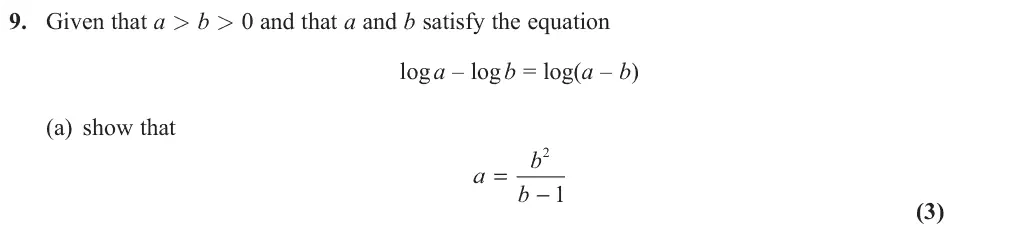
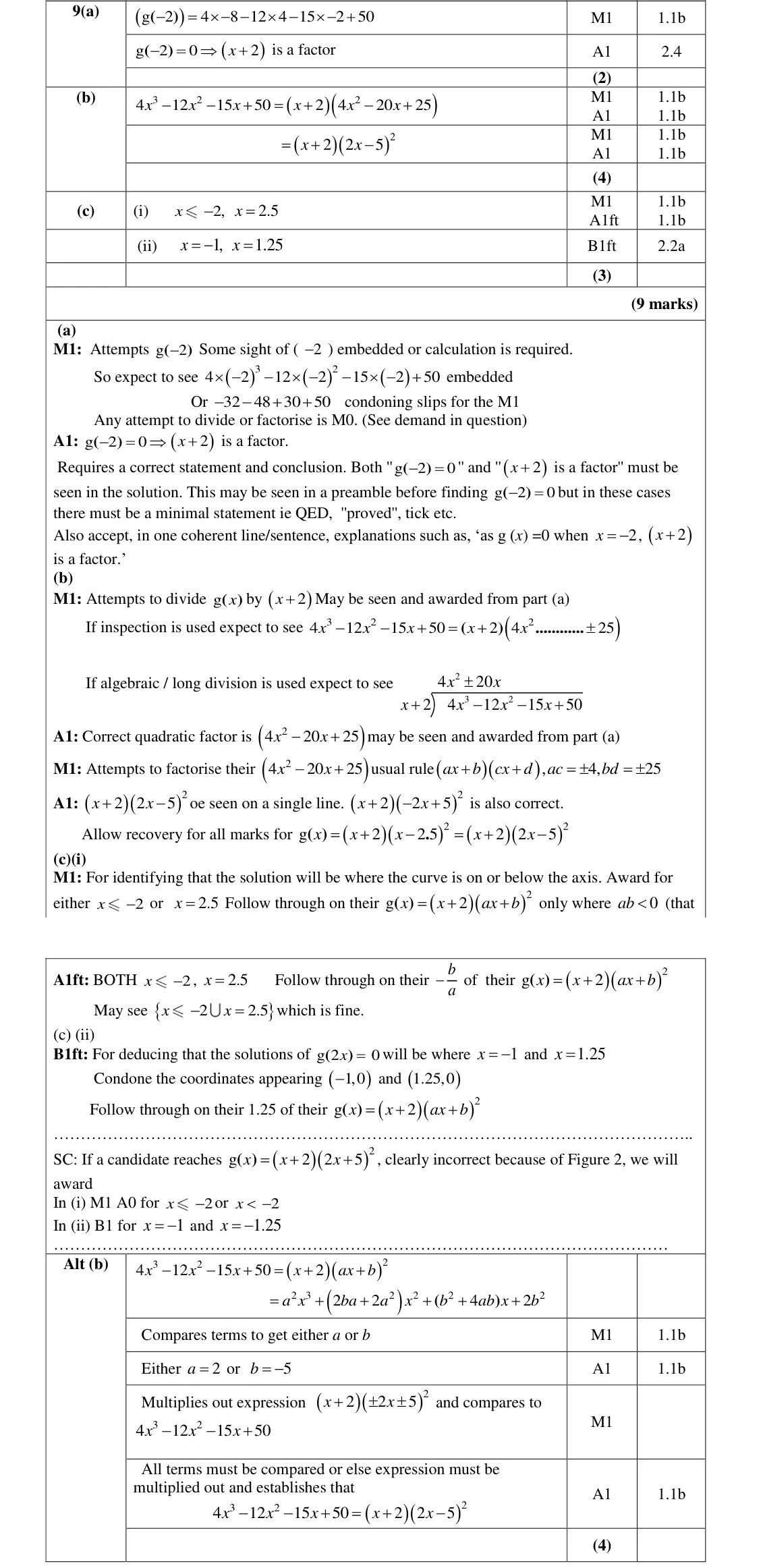
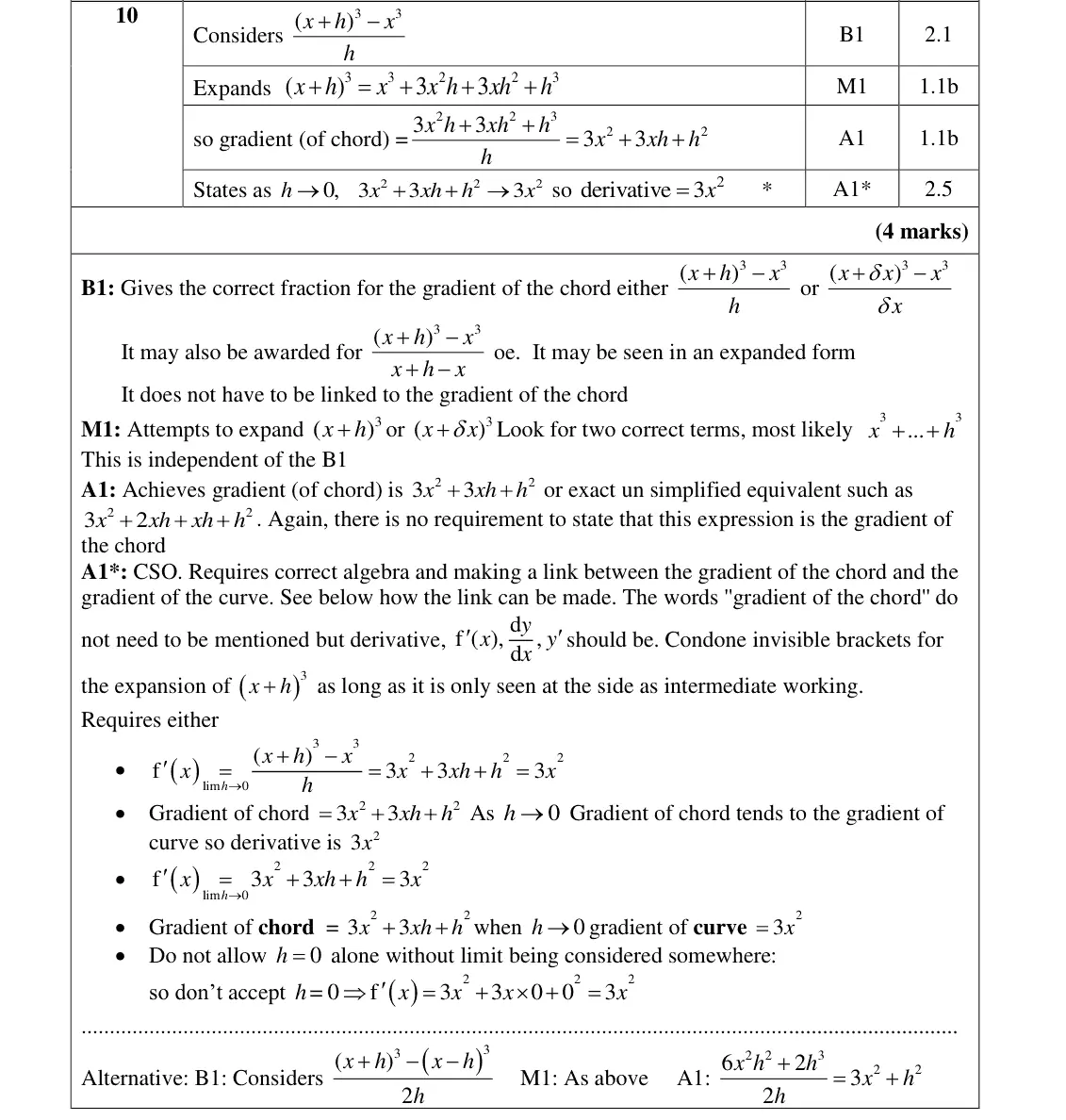
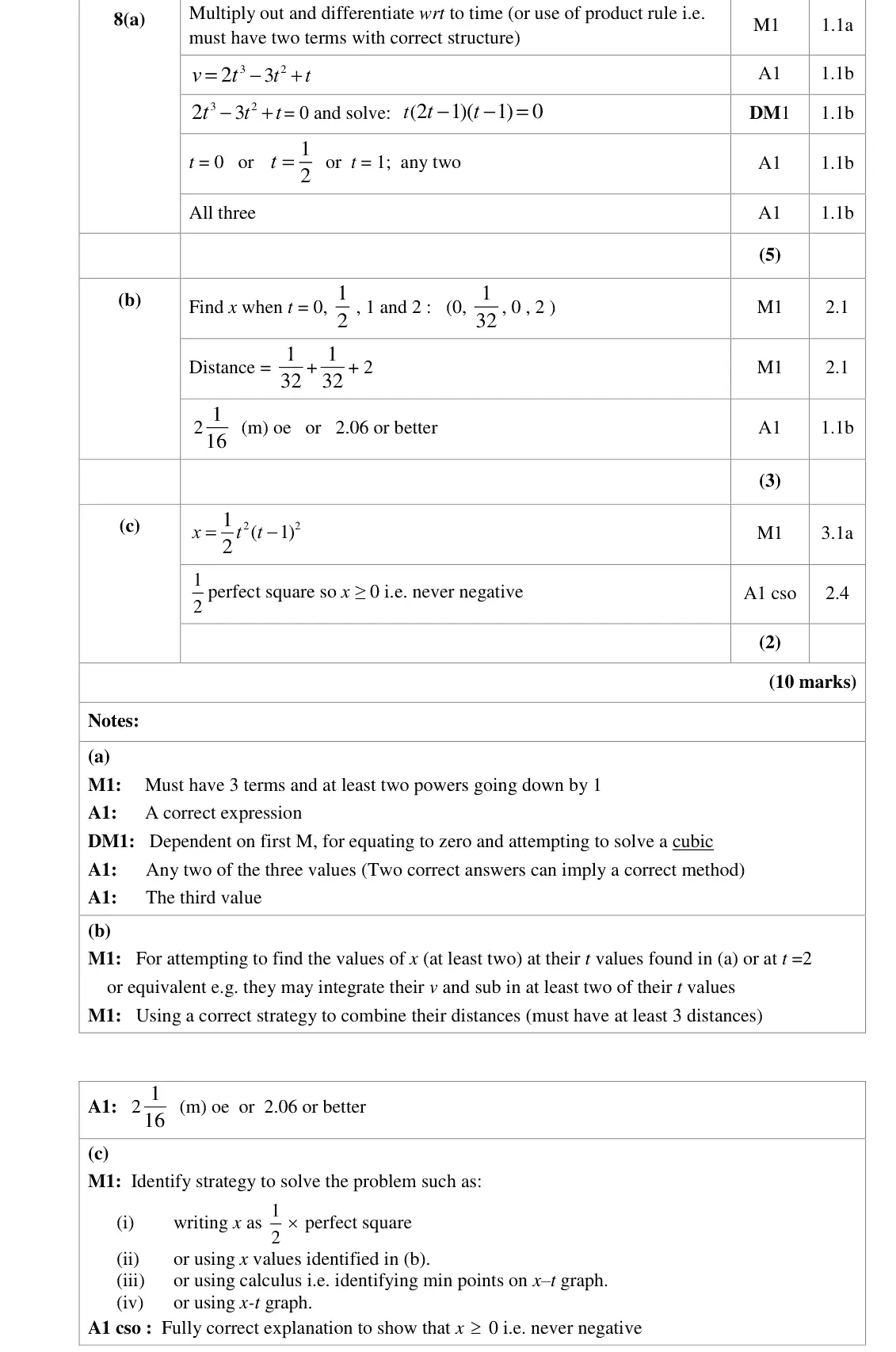
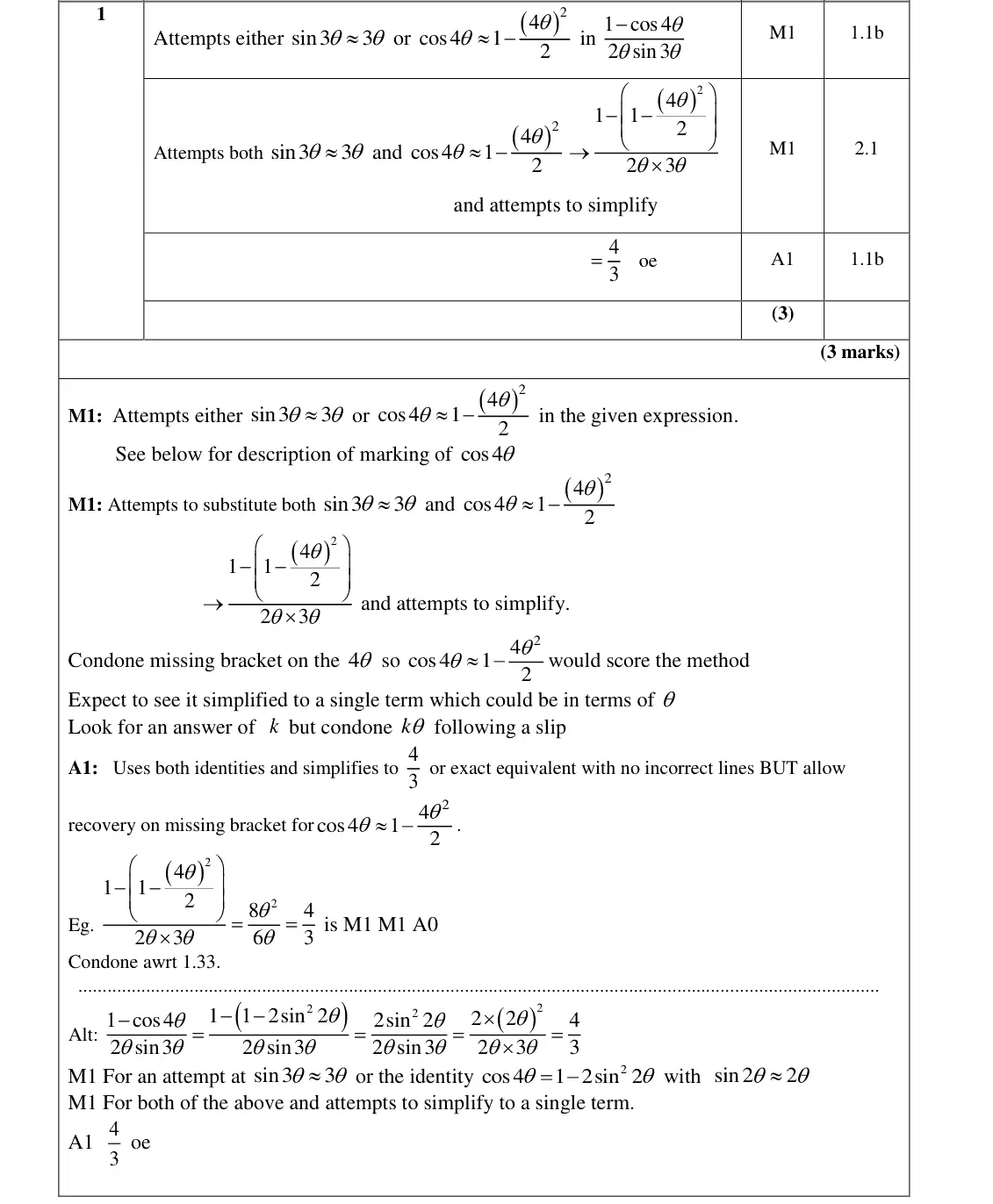
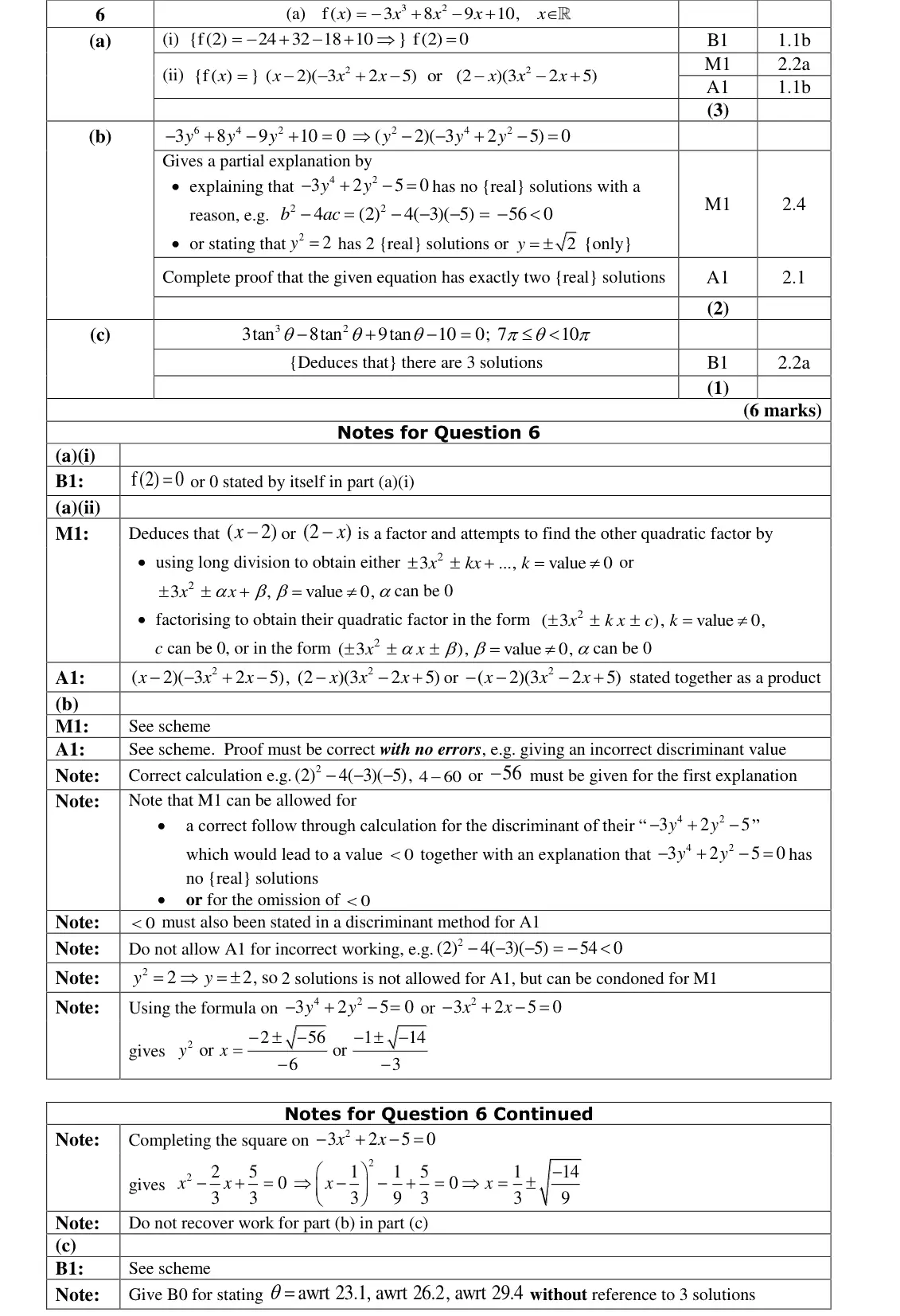
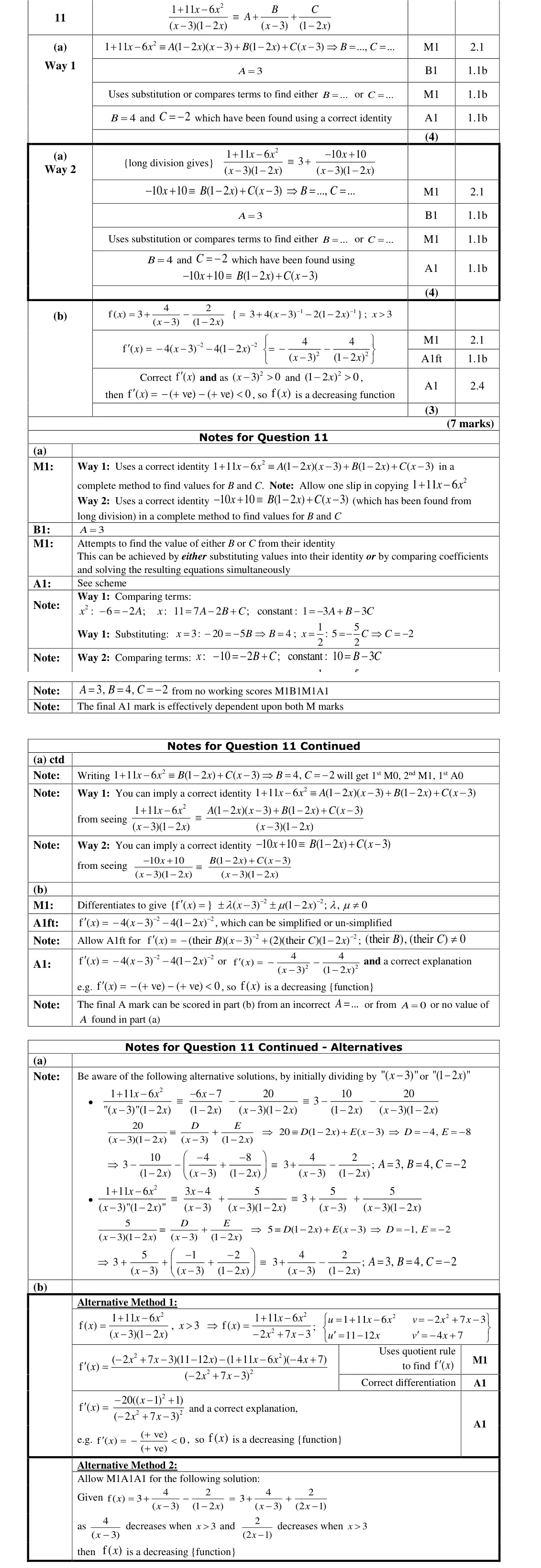
Manipulate polynomials algebraically, including expanding brackets and collecting like terms, factorisation and simple algebraic division; use of the factor theorem. Simplify rational expressions, including by factorising and cancelling, and algebraic division (by linear expressions only).
Guidance
Only division by (ax + b) or (ax − b) will be required. Students should know that if f(x) = 0 when x = b/a, then (ax − b) is a factor of f(x). Students may be required to factorise cubic expressions such as x³ + 3x² − 4 and 6x³ + 11x² − x − 6. Denominators of rational expressions will be linear or quadratic, e.g. 1/(ax + b), (ax + b)/(px² + qx + r), (x³ + a³)/(x² − a²).
A-level only
simplifying rational expressions (factorising and cancelling, algebraic division by linear expressions)
Mark scheme (whole question; this part is marked with the orange bar)
Examiner's comment
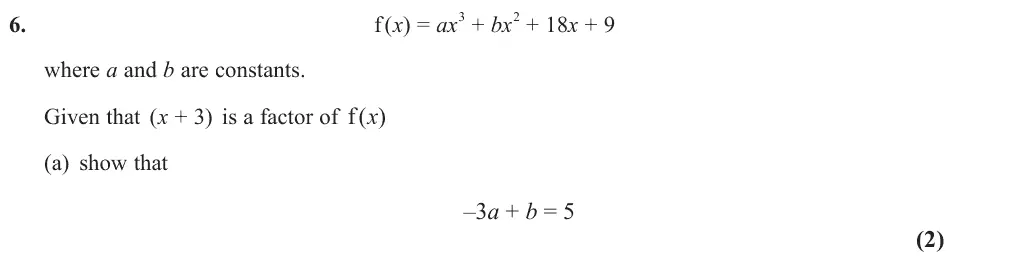
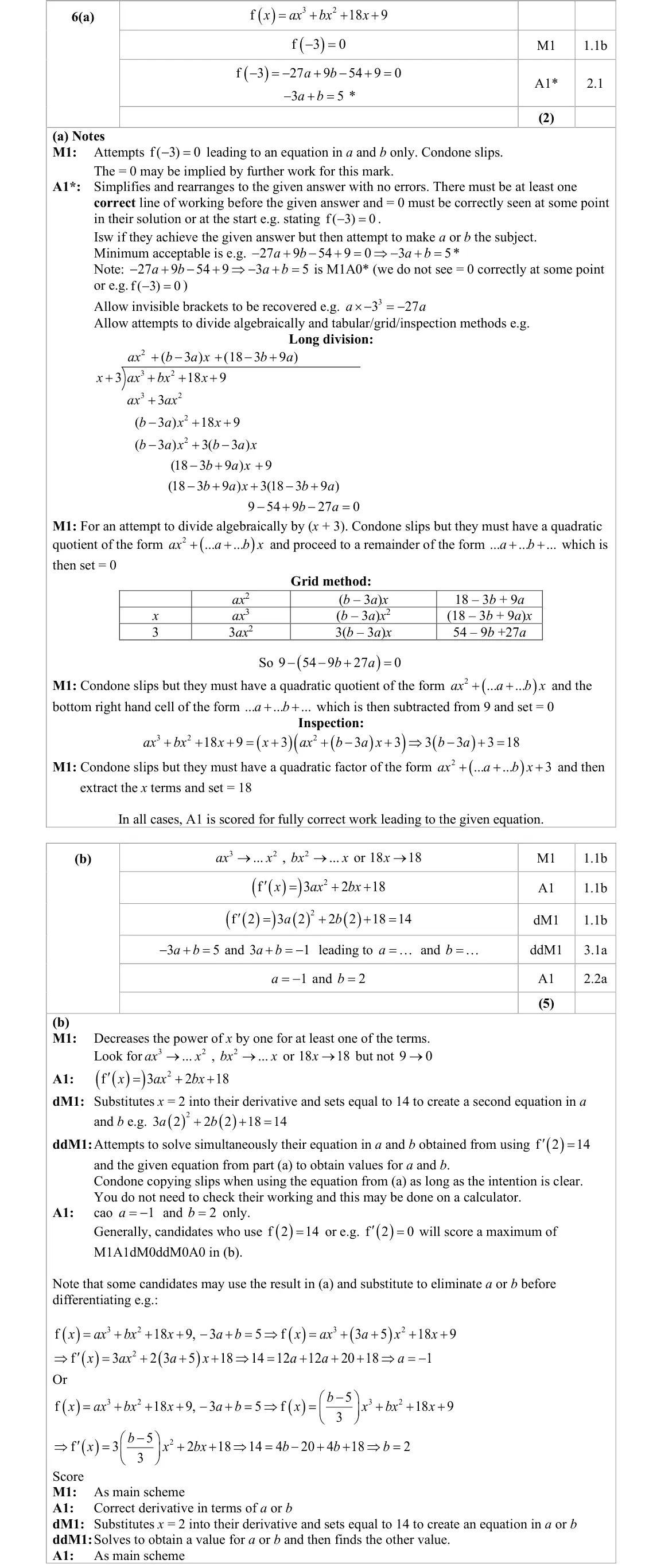
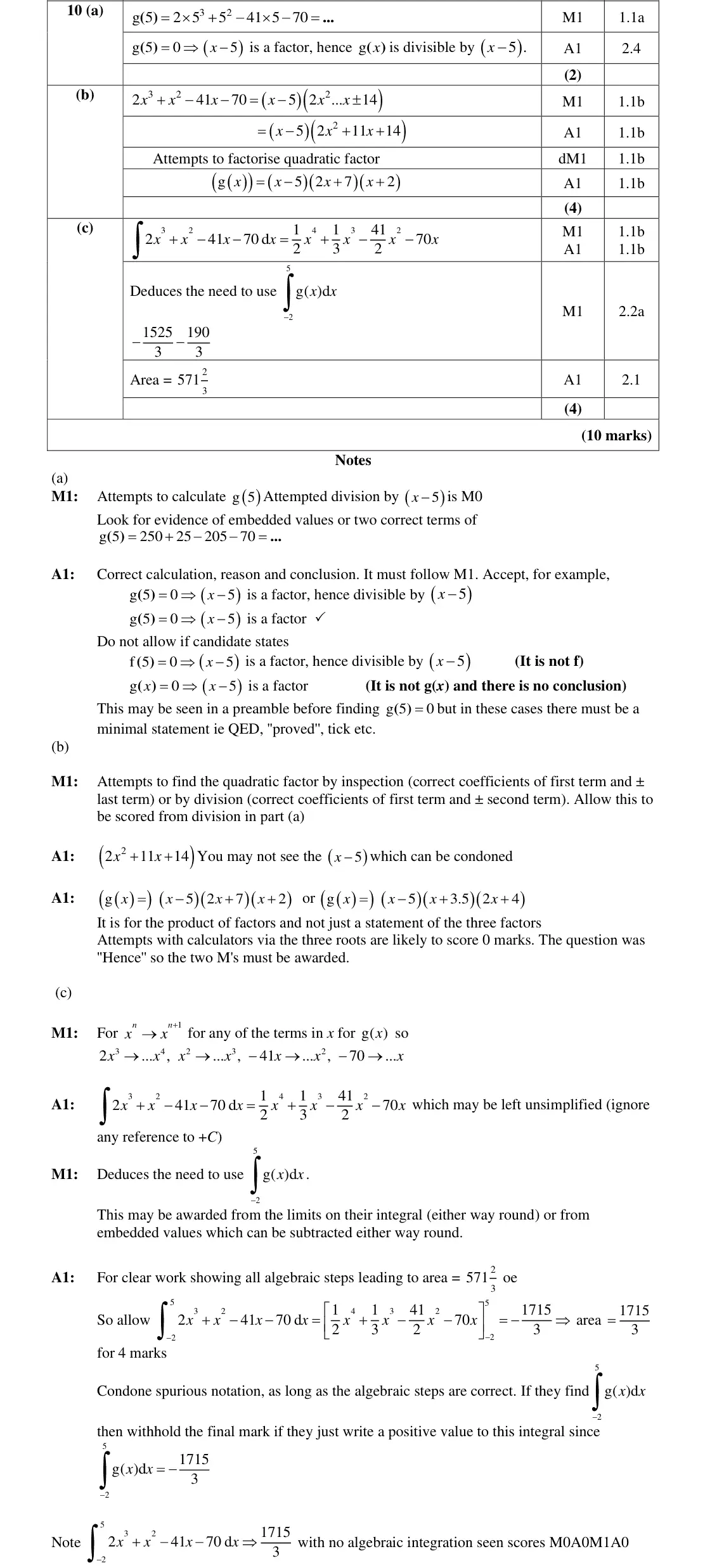
The large majority of candidates were able to access part (a). The most common and most successful approach was to use the factor theorem though there were some (often unsuccessful attempts) at algebraic division and inspection. It is still concerning that candidates are not evidencing they appreciate their substituted expression should = 0, as a result of this a number of candidates lost the A mark. Although the skills involved in part (b) were quite fundamental, the understanding of the
Common mistakes
f(−3) = 0 must be stated (= 0 seen) before −27a + 9b − 54 + 9 = 0 and the given answer
using f(3)
long division is longer and error-prone
June 2025 · AS Paper 1 · Q11(a)4 marks
Mark scheme (whole question; this part is marked with the orange bar)
Examiner's comment
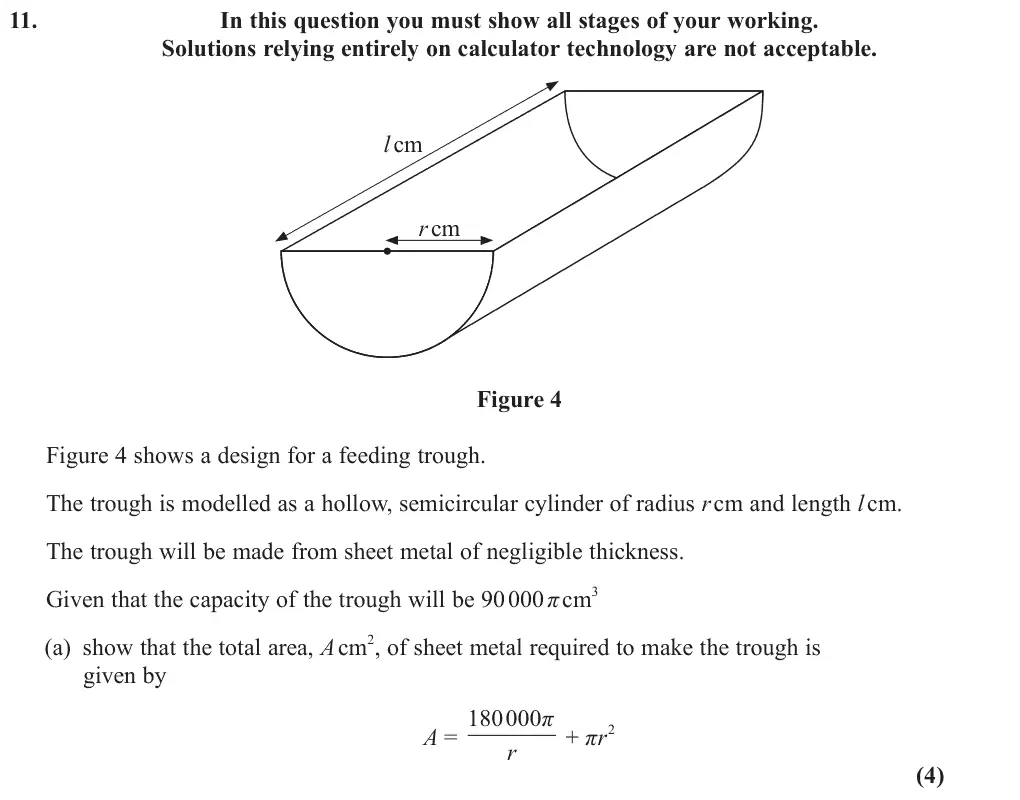
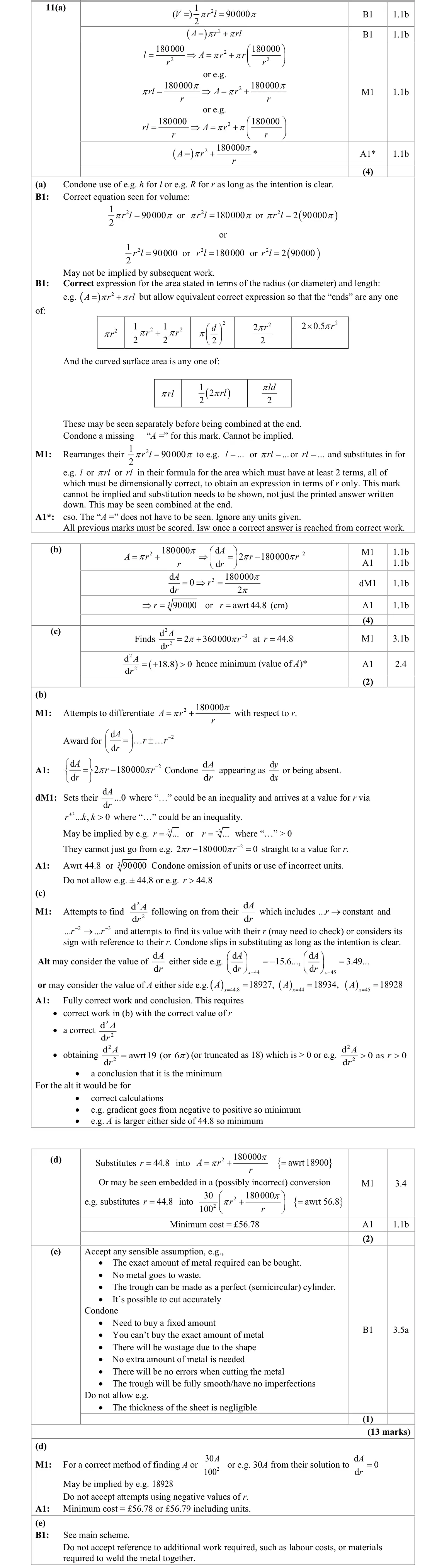
A small minority of candidates did not attempt this question at all. Some candidates attempted part (a) and then did not go on to attempt the remaining parts (generally when they were unable to complete part a)). In part (a), a common error in the first B mark was to miss out the pi for 90000 pi . Some candidates used an incorrect formula but most who wrote the correct formula, rearranged this into a different format to use later. For the second B mark, this was less well scored. Some candidates had the formula for a complete cylinder and some candidates did not write down this formula (it was often implied with later working but this resulted in the loss of both the second B mark and the A mark as this was a proof question). Where candidates had gained the first three marks, they often went on to simplify the formula and gain the final accuracy mark.
Common mistakes
V = ½πr²l = 90 000π (π often missed)
A = πr² (two semicircular ends) + πrl (curved surface), not a whole cylinder
formula for A must be written down
substitute l from V before reaching the given answer
June 2025 · AS Paper 1 · Q14(b)5 marks
Mark scheme (whole question; this part is marked with the orange bar)
Examiner's comment
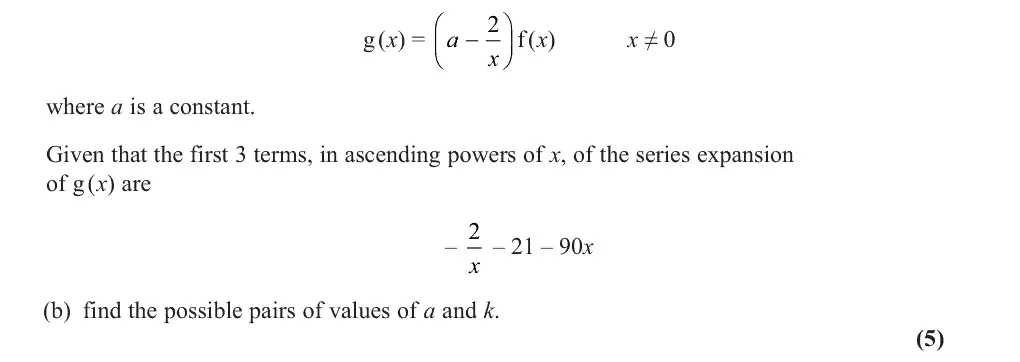
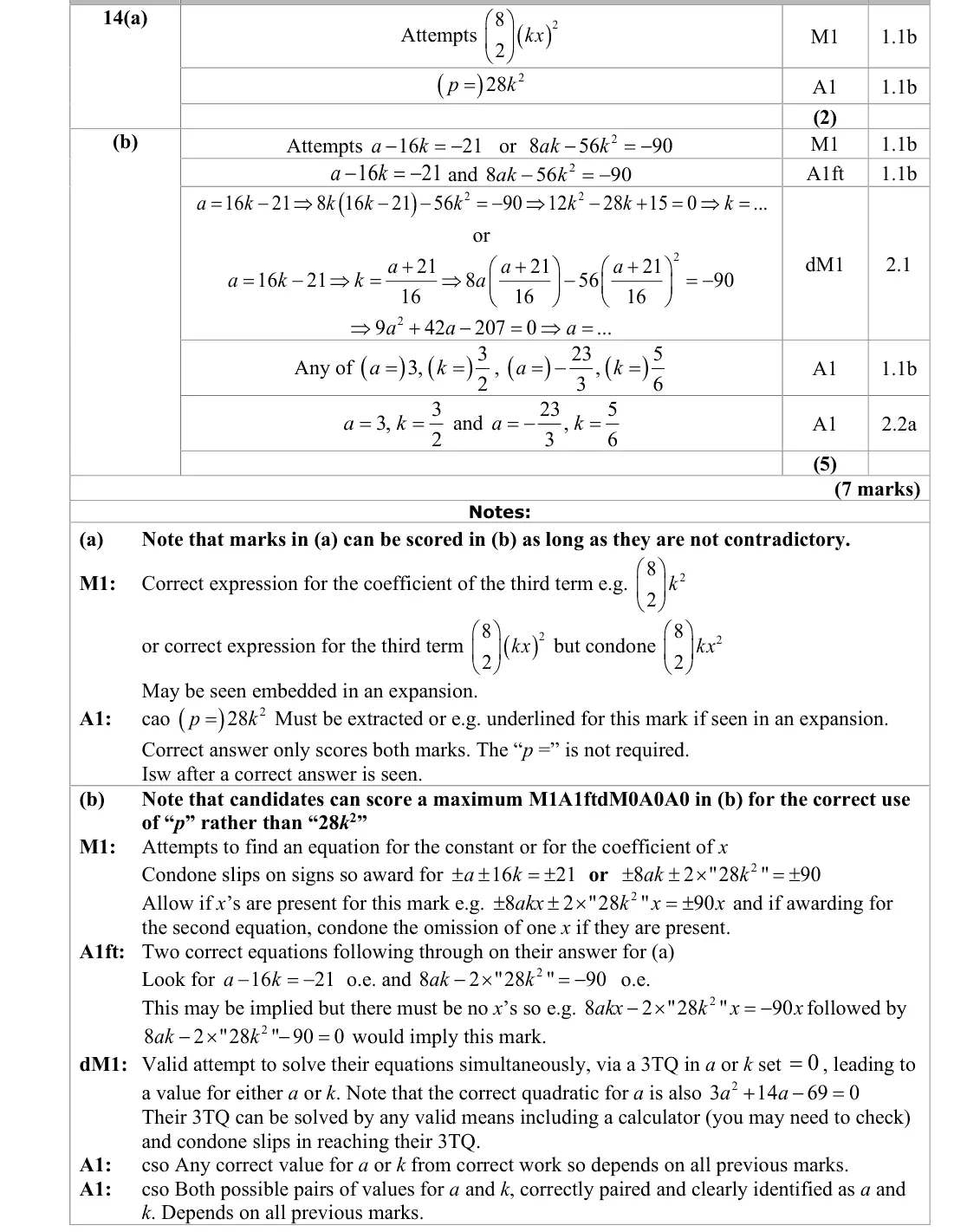
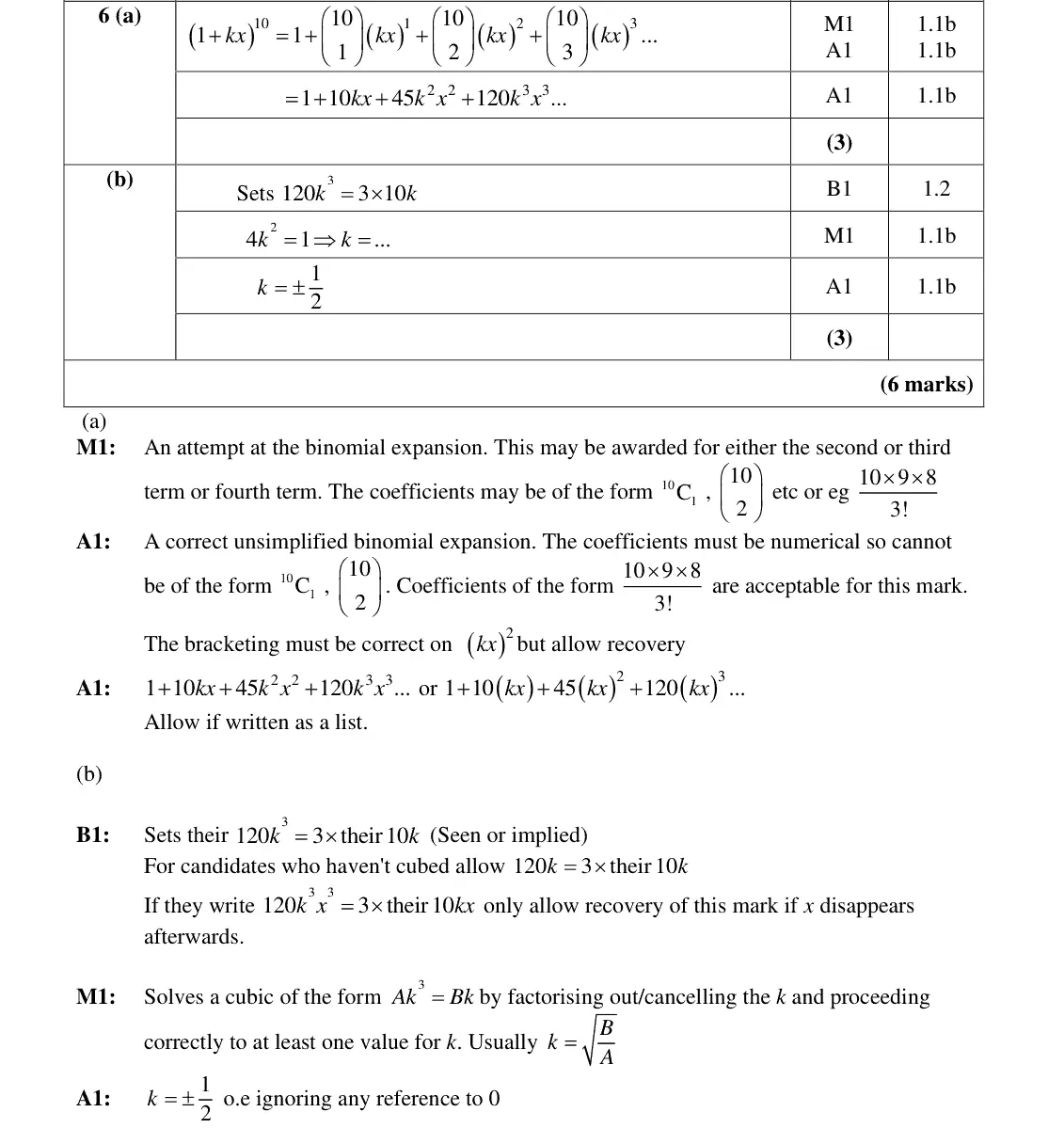
Part (b) was much more demanding with very few candidates achieving full marks and many blank responses seen. The majority of candidates failed to identify the necessary terms to set up the two required equations or made errors in expanding the brackets. The equation resulting from the constant term appeared the more accessible of the two and resulted in the first M1 at least. Where candidates were able to identify the two correct equations they generally went on to score full marks. For these more able candidates who were able to find a solution it was pleasing to see them pairing a and k correctly.
Common mistakes
multiply (a − 2/x)(1 + 8kx + 28k²x² + …): constant a − 16k = −21, x coefficient 8ak − 56k² = −90
substitute to a 3TQ 12k² − 28k + 15 = 0
pair correctly: a = 3, k = 3/2 and a = −23/3, k = 5/6
identifying the wrong terms
June 2025 · AS Paper 1 · Q15(a)2 marks
Mark scheme (whole question; this part is marked with the orange bar)
Examiner's comment
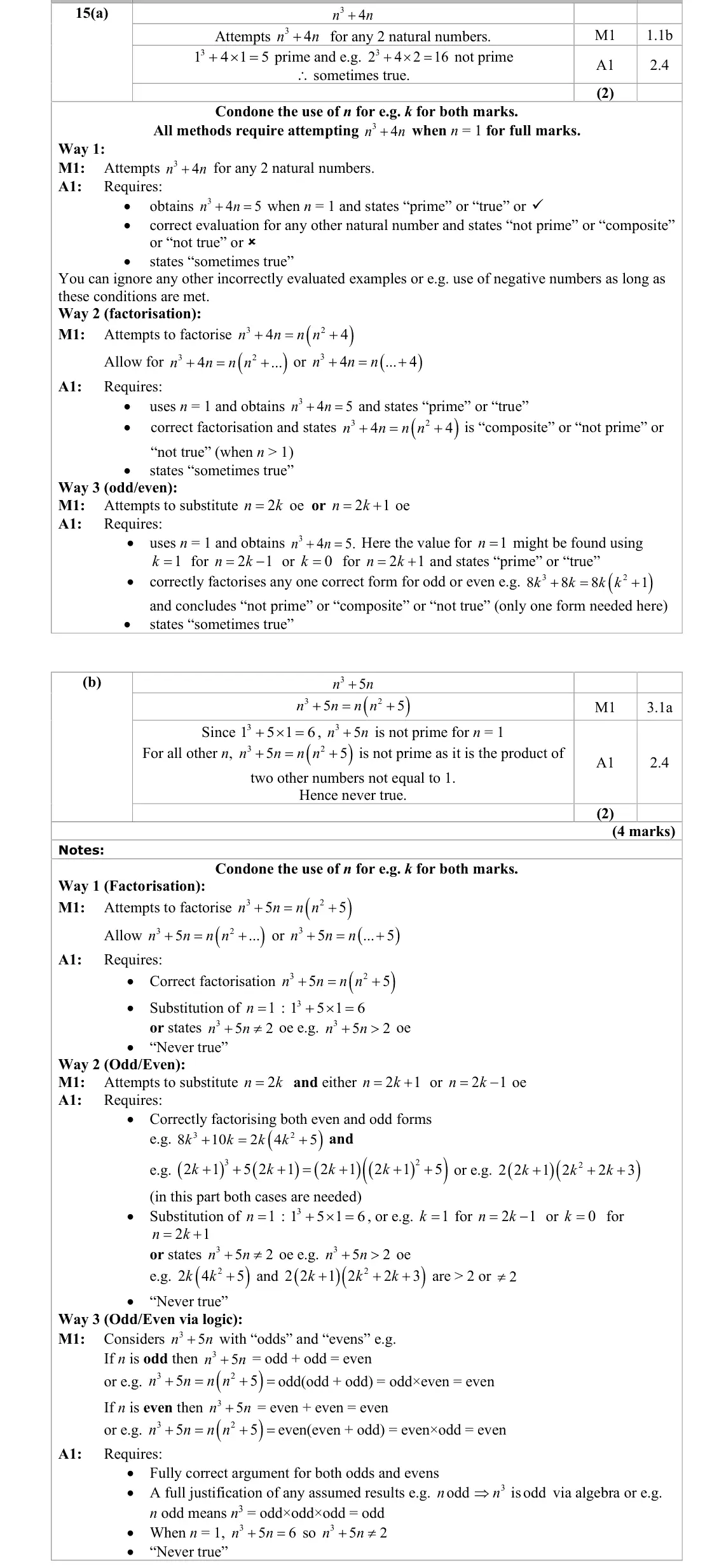
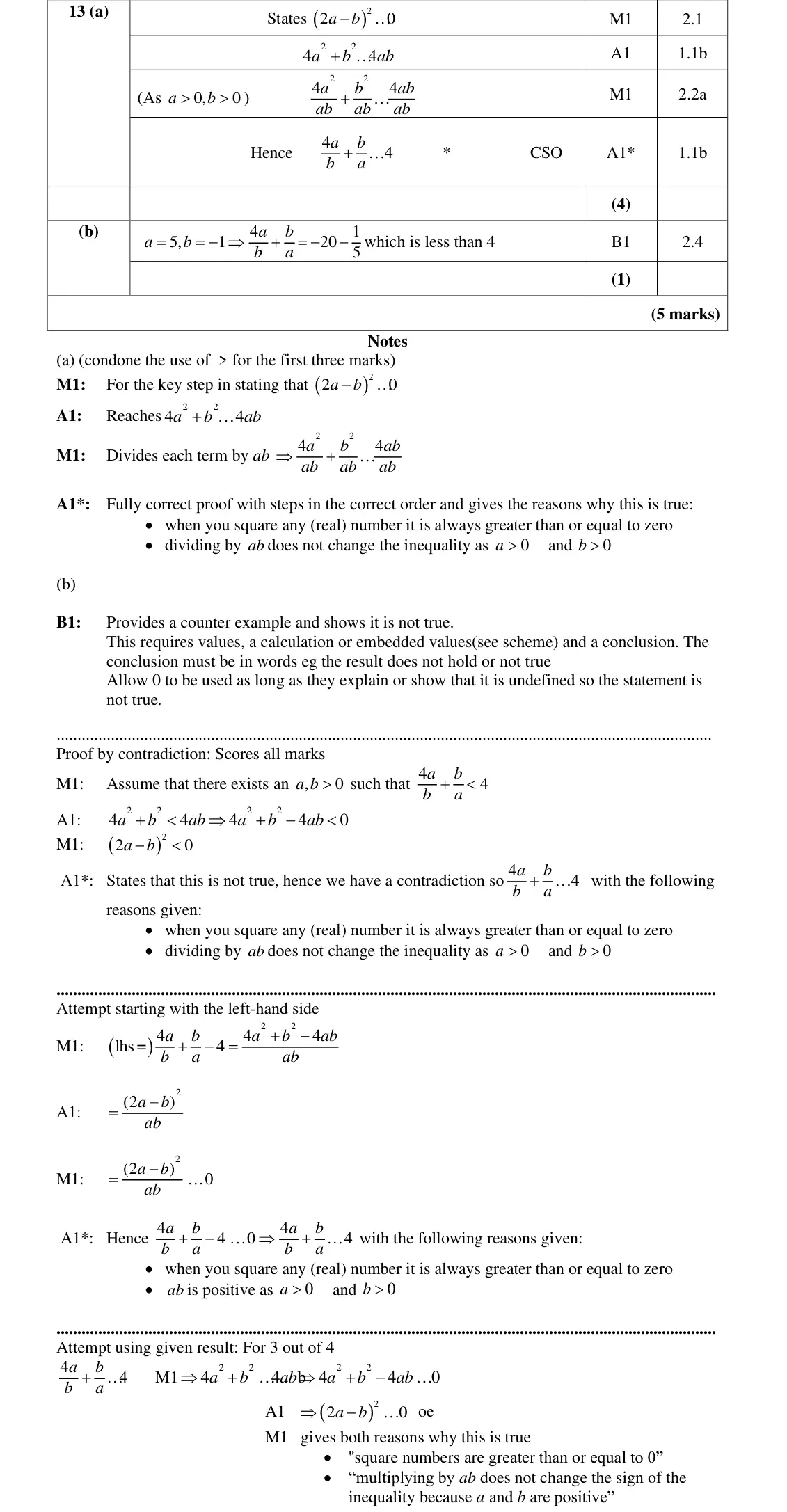
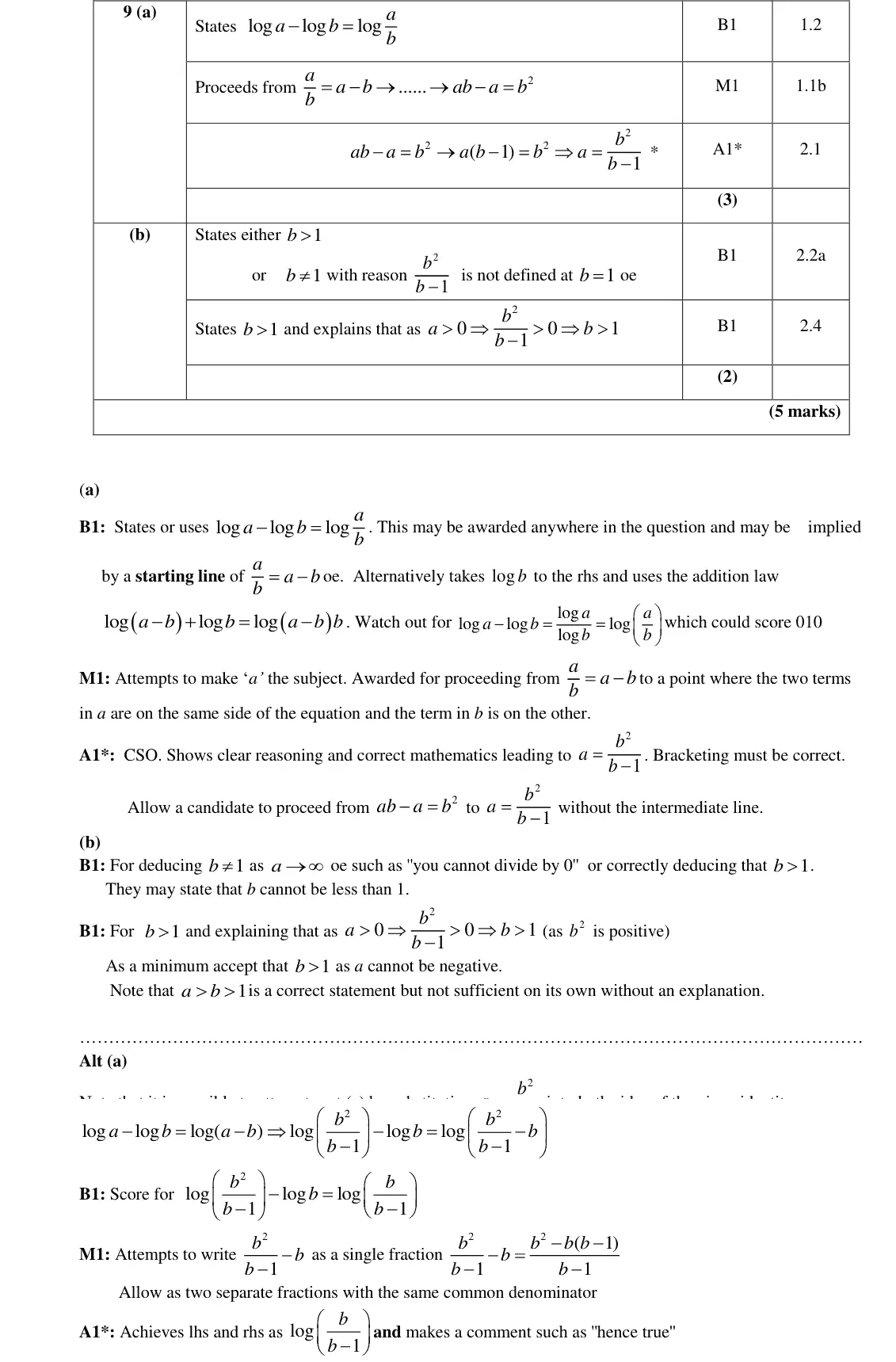
Many candidates made a start to this proof question in (a) and/or (b) but very few candidates were completely successful throughout. The second mark in part (a) was awarded relatively infrequently, whilst the final mark in (b) was rarely awarded. Candidates either did not know the correct way to approach the proofs required or were unable to include all of the rigorous steps and conclusions needed. In part (a) candidates approached the question in a number of ways. Most attempted to substitute values of n into n3 + 4n. Attempts using two natural numbers for n were required to obtain the first mark this way. Many candidates, however, used negative integers and made no progress. Candidates did often use n = 1 to obtain n3 + 4n = 5 alongside the substitution of another value of n to obtain a composite number, but failed to conclude which case gave a prime number and which case did not, losing the second mark. Other candidates attempted to factorise n3 + 4n, gaining the first mark, but then failed to test the n = 1 case or missed the necessary conclusions. A third strategy was to attempt an odds/evens approach by substituting n = 2k or n = 2k + 1 which scored the first mark. Candidates often then again failed to show that n = 1 gave a prime number or did not include the necessary conclusions, losing the second mark. Some candidates were, however, completely successful in (a) and correctly established that the statement was sometimes true.
Common mistakes
n = 1 gives 5 (prime) and e.g. n = 2 gives 16 (not prime), so sometimes true
must use natural numbers (not negatives) and state which case is prime
n = 1 is required
June 2025 · AS Paper 1 · Q15(b)2 marks
Mark scheme (whole question; this part is marked with the orange bar)
Examiner's comment
Many candidates made a start to this proof question in (a) and/or (b) but very few candidates were completely successful throughout. The second mark in part (a) was awarded relatively infrequently, whilst the final mark in (b) was rarely awarded. Candidates either did not know the correct way to approach the proofs required or were unable to include all of the rigorous steps and conclusions needed. In part (b) candidates’ attempts to show that the statement was never true, again employed varied methods. Many candidates attempted no form of algebraic proof and simply tested values of n, failing to appreciate that this approach would not prove the result in general, and this gained no credit. Other candidates attempted a ‘descriptive’ approach, again without algebra, considering the cases when n was odd and even (e.g. when n is even n3 + 5n = even + even = even etc.). When done accurately this approach could score the first mark in (b), but unless a full explanation was included of the results used, the second mark could not be scored. The most successful method was to factorise n3 + 5n to show it was composite (for n > 1) and then test the n = 1 case separately before drawing the correct conclusion. Some candidates attempted to consider the even and odd cases algebraically. Attempting both cases like this earned the first mark, but candidates then often failed to test the n = 1 case or made mistakes in their algebra or factorisation of the cases, losing the second mark. Few candidates earned full marks in (b) regardless of the way they approached it.
Common mistakes
n³ + 5n = n(n² + 5): for n = 1 it is 6
for n > 1 it is a product of two factors greater than 1, so never true
testing values does not prove it
odd/even arguments must be fully justified
June 2025 · AS Paper 2 (Mechanics) · Q4(b)3 marks
Mark scheme (whole question; this part is marked with the orange bar)
Examiner's comment
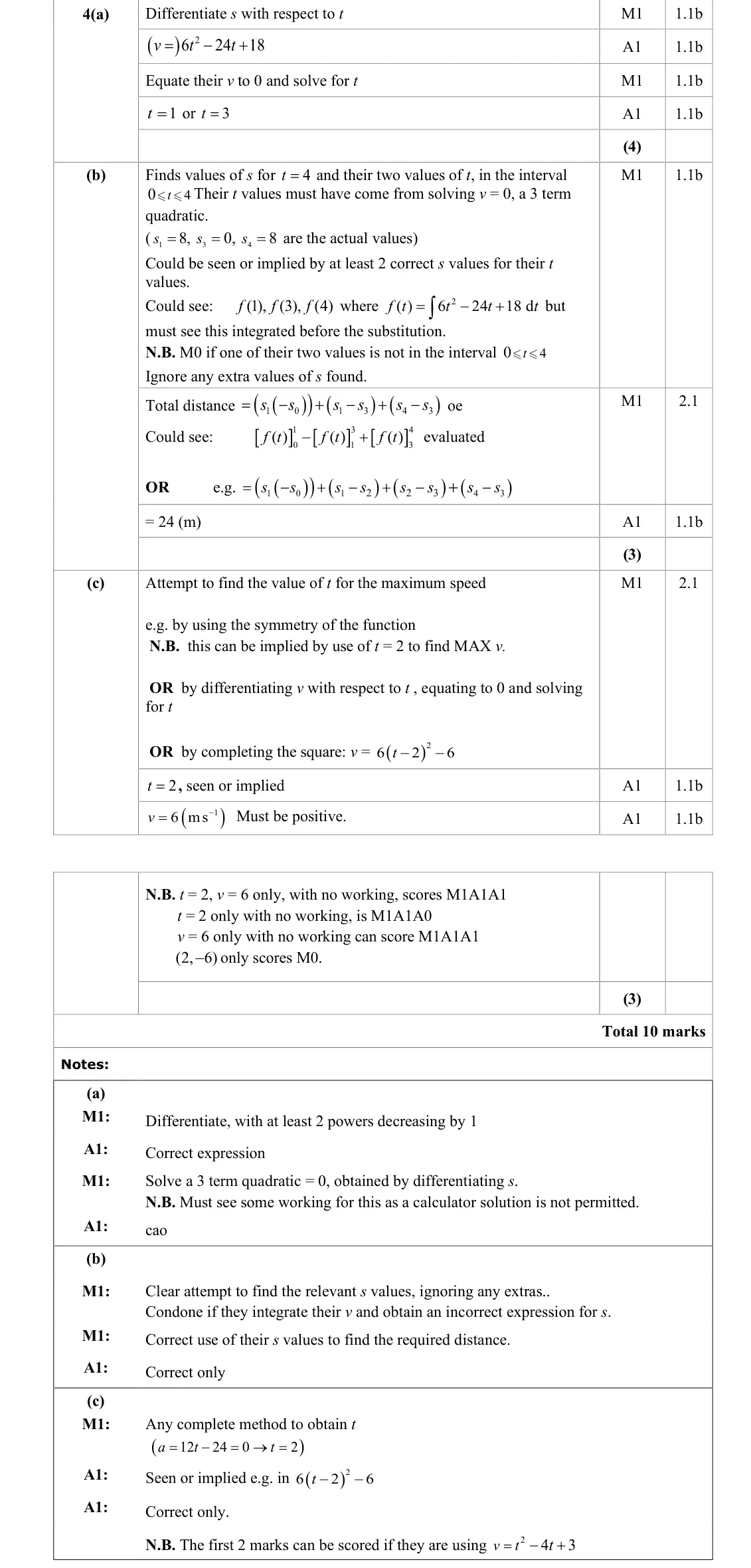
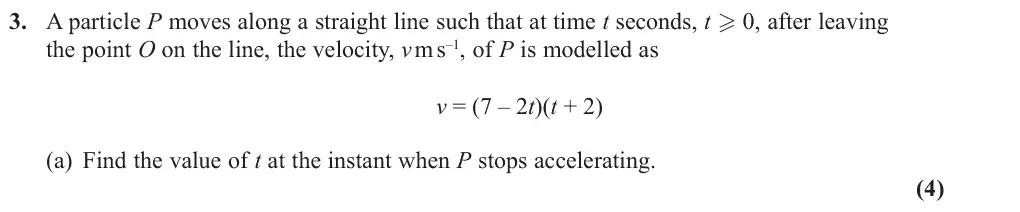
At the top of this question is a calculator warning which some candidates chose to ignore and lost marks as a result. There was the occasional candidate who incorrectly differentiated, missing out the “+18” term from their answers. This also impacted the marks that could be scored for part (b). Part (b) was challenging and candidates who sketched a graph of the function and considered areas were usually the most successful. The most common error was to just use 0s and 4s while a number integrated s. Some who had made progress used 8 - for the middle section, forgetting that the distance was required. A significant number made no attempt at this part.
Common mistakes
P changes direction at t = 1 and t = 3: s₁ = 8, s₃ = 0, s₄ = 8, so total distance = 8 + 8 + 8 = 24 m
most used only s₀ and s₄ (displacement)
integrating s
using −8 for the middle section
a sketch helps
June 2025 · Paper 1 · Q4(a)3 marks
Mark scheme (whole question; this part is marked with the orange bar)
Examiner's comment
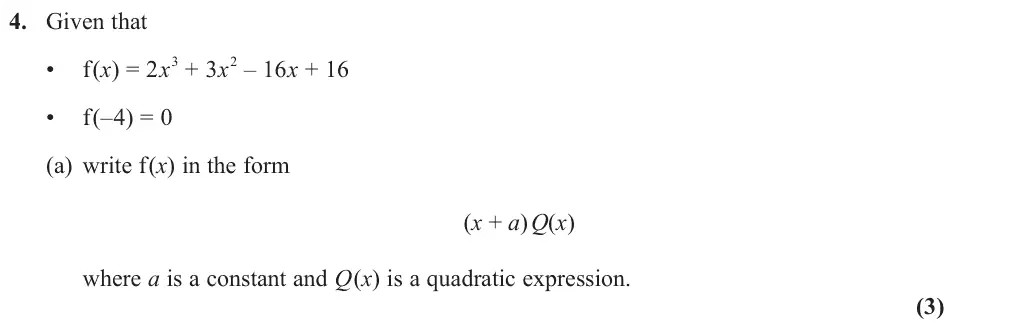
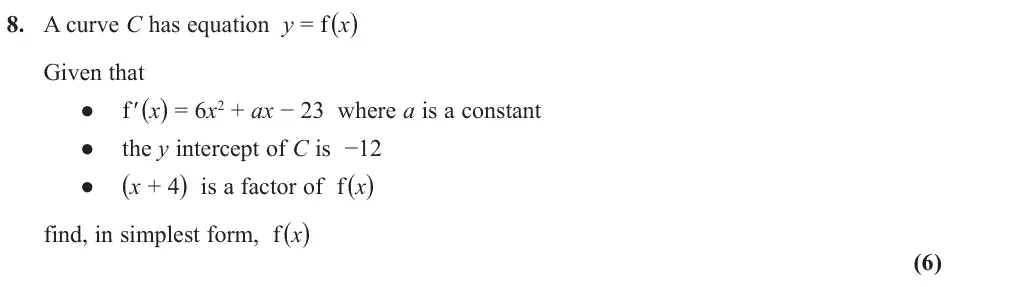
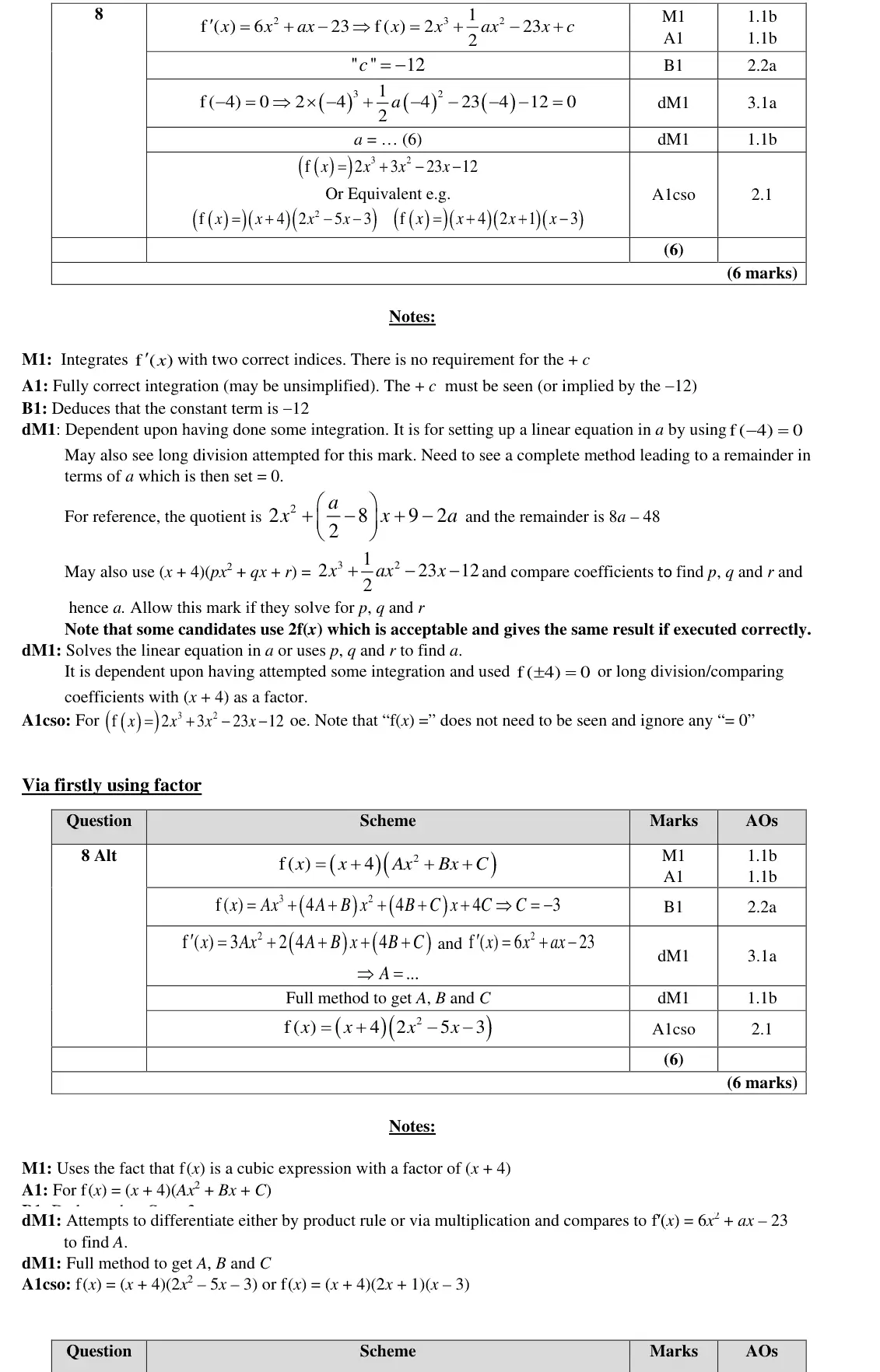
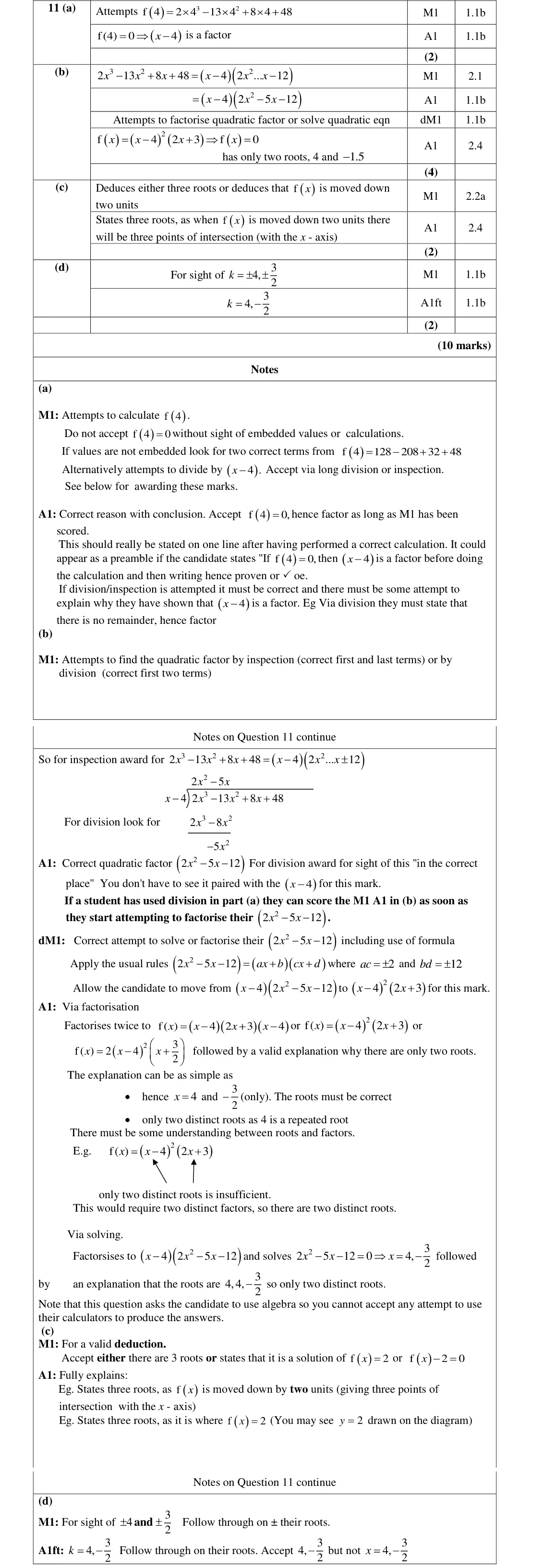
This question using the algebraic division and considering the properties of quadratic factors was very well understood and answered by the vast majority of learners. Almost every response recognised that as they had been told that f( 4) 0 then was a - = 4 x + factor of the cubic. Most responses proceeded by using long division, usually successfully with only a few minor errors. A minority of responses used the inspection method, and these were nearly always correct with the expression ( 4) ( ) x Q x obtained with little working. +
Common mistakes
f(−4) = 0 so (x + 4) is a factor
divide (long division or inspection) to get (x + 4)(2x² − 5x + 4)
June 2025 · Paper 1 · Q4(b)2 marks
Mark scheme (whole question; this part is marked with the orange bar)
Examiner's comment
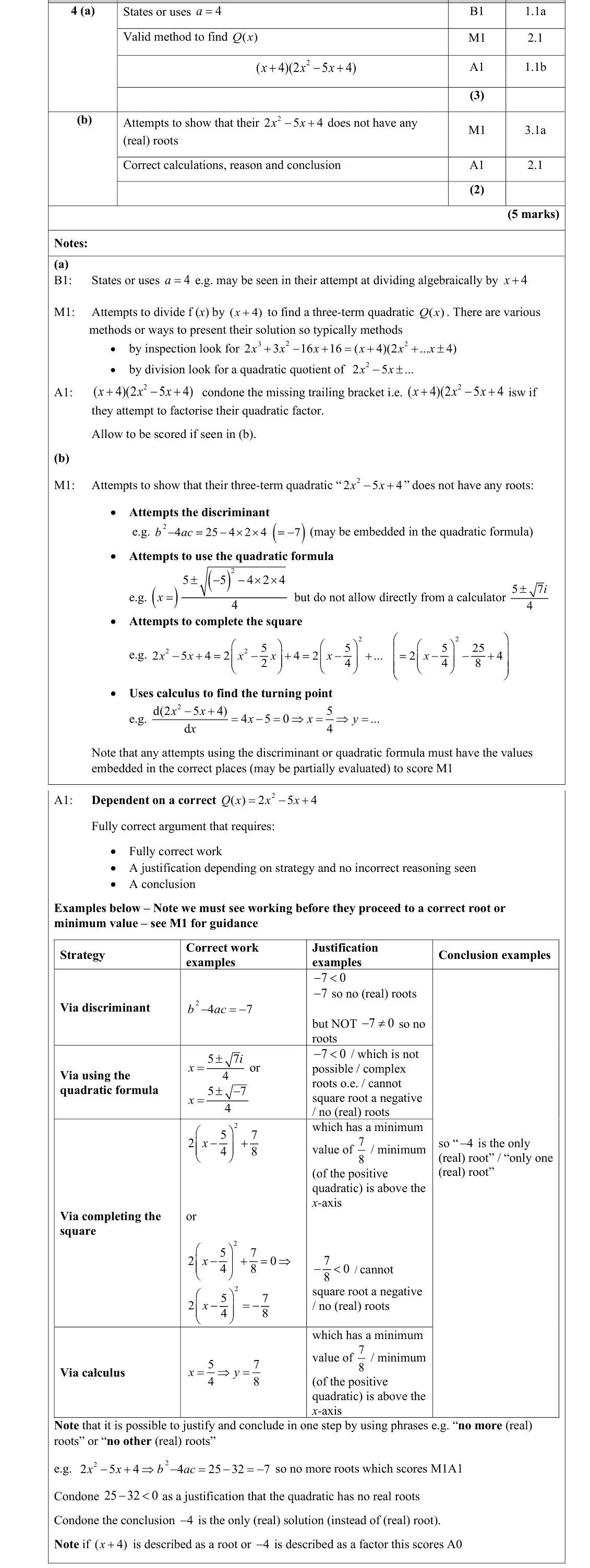
Part (b) proved to be a little more challenging with many responses not being clear enough in their explanations. By far the most popular method seen was to use the discriminant of Q(x) to show that Q(x) has no real roots. Almost every response calculated the discriminant as 7 - , then Q(x) had no real roots. A significant minority then did not go and state that as 7 0 -< on to say that “there was only one (real) root i.e. 4 -”. Learners should be reminded that in this type of question they should be referring to the question asked in their final line of working to ensure full marks are scored. The other possible methods outlined in the mark scheme were seen in a minority of cases; the quadratic formula method was well handled, however some did not complete correctly as above. A small number of learners used completing the square and usually did it correctly with some, again, not concluding correctly as above. There was only a very small number of learners who used calculus. 8
Common mistakes
discriminant of 2x² − 5x + 4 is 25 − 32 = −7 < 0 so no real roots from the quadratic
must conclude that −4 is the only real root (many stopped after −7 < 0)
"−7 ≠ 0" is not a justification
calling (x + 4) a root or −4 a factor loses the mark
June 2025 · Paper 1 · Q7(b)3 marks
Mark scheme (whole question; this part is marked with the orange bar)
Examiner's comment
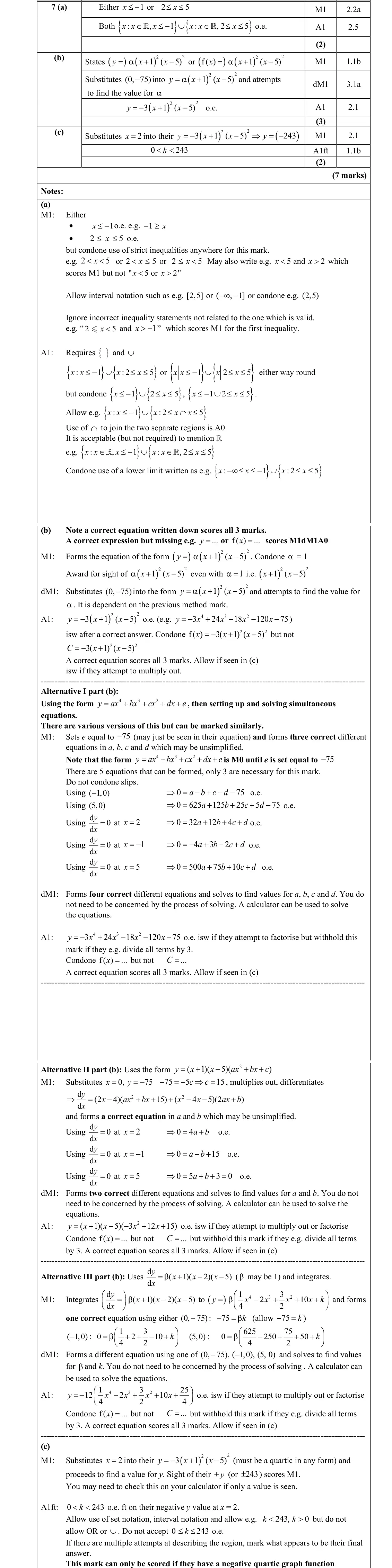
This was the first question on the paper where there was wide discrimination between the marks of responses, and many struggled with knowing how to handle a quartic function. Part (b) required using the given information and the figure to find the equation of the quartic. Many started with an appropriate form of a quartic however there were a few learners who considered quadratic or cubic functions. Finding the equation of the quartic curve could be done very efficiently or with a lot of algebra. The most efficient method was to consider the factorised form based on the repeated roots of curve. Those who recognised this form were the most successful. The coordinates of the y-intercept could then be used to establish the equation of the curve. This stage was generally correctly done to obtain a negative quartic, however sign errors did lead to some positive quartics being generated. A common error was to assume that there was an additive constant translating the curve rather than a multiplicative scaling constant. Those who took other approaches had a lot more to do to ascertain the coefficients of the terms within the quartic. With these methods algebraic mistakes were often seen. Common methods involved considering the general form of a quartic with the x-intercepts and the x coordinates of the stationary points, or recognising the factors from the single roots of the quartic combined with an unknown quadratic factor or considering the cubic form of the derivative and integrating or combining with the general form of the quartic. Many learners were able to arrive at some of the equations linking the coefficients with appropriate substitution of values, however, not all response found all the equations and accurately proceed to a correct equation for the curve. It was common to see algebraic errors in the formation and solution of the equations. 11 A common mistake with all of the methods was to present an expression rather than an equation of the curve. There was a wide variety of responses to this question, with some not attempting it and others having multiple attempts to find the equation of the curve generating solutions which was at times difficult to follow.
Common mistakes
double roots at −1 and 5: y = α(x + 1)²(x − 5)², and (0, −75) gives α = −3
must be an equation (y = ...), not an expression
adding a constant instead of scaling
long general-quartic methods led to algebraic errors
June 2025 · Paper 1 · Q8(b)4 marks
Mark scheme (whole question; this part is marked with the orange bar)
Examiner's comment
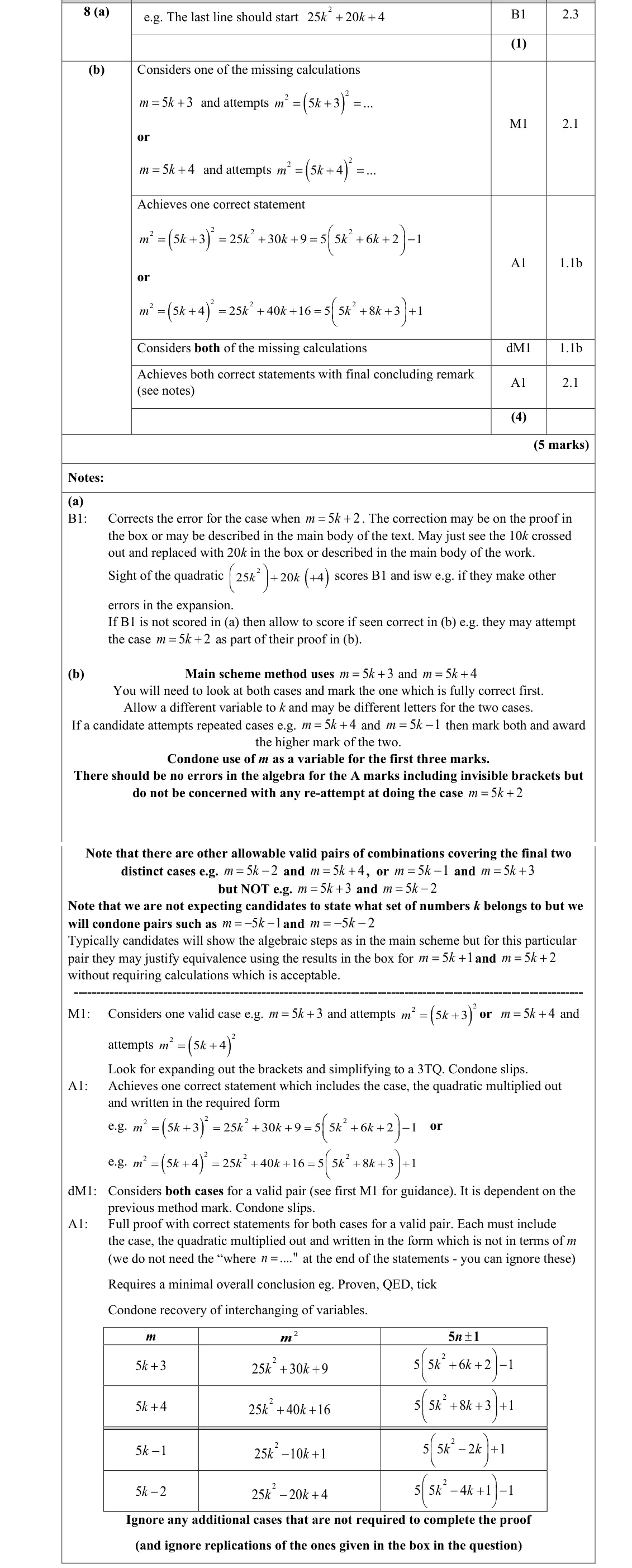
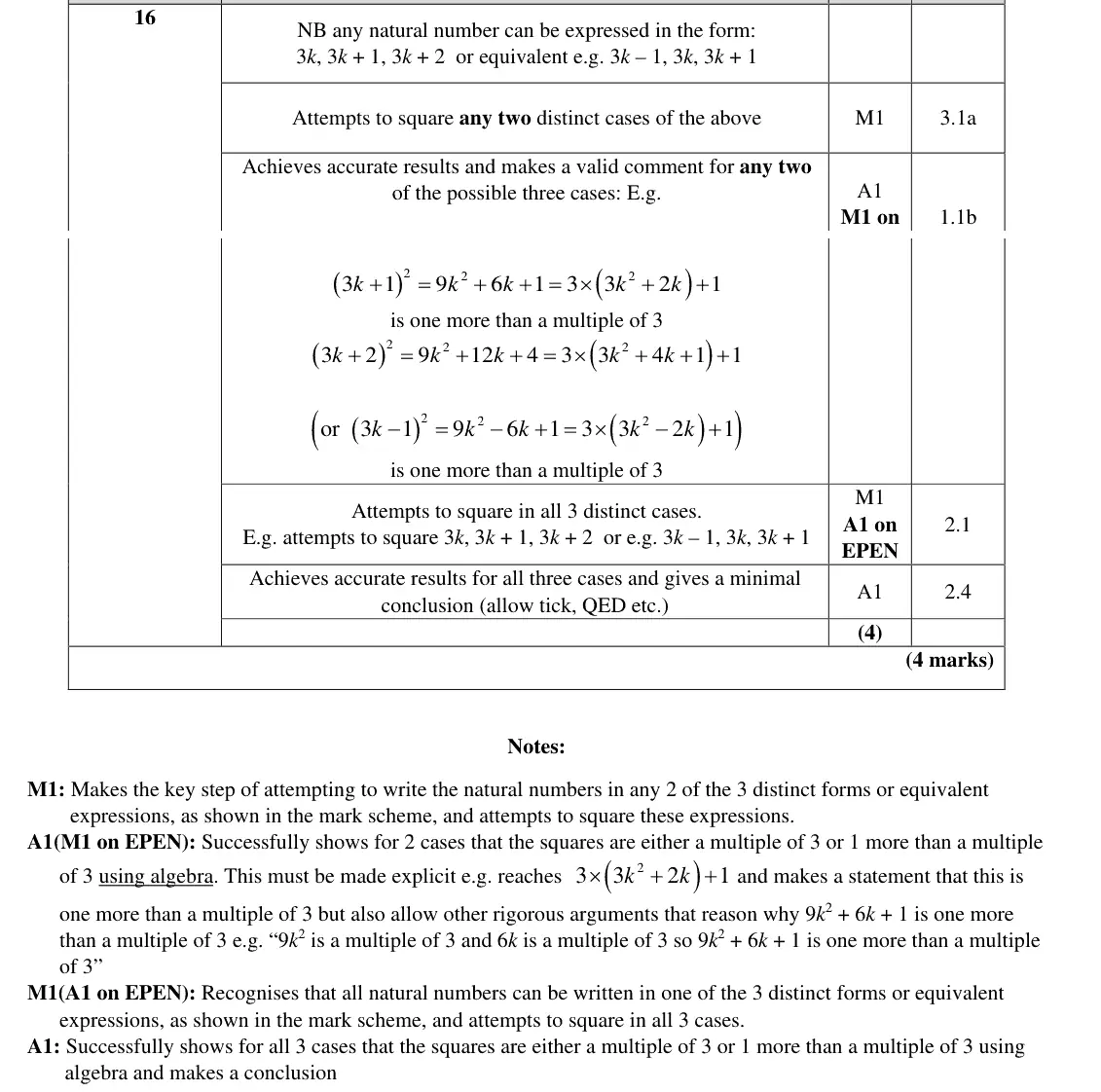
This question tested proof by exhaustion which many learners found challenging. Part (a) was usually more successfully answered, although many were able to make progress in part (b). In part (b), many responses never considered the remaining cases despite the partially provided proof. Several responses just reiterated what was already in the questions using 5 , m k = 5 1 m k = + and 5 2 m k = + again (but with the correction). Some assumed the work was pretty much complete and just wrote a concluding statement. A few responses looked at odd and even numbers and considered 2k and 2 1, k + or even 10k and 10 1. k + Many learners did not pay adequate attention to the mark allocation in part (b) with 4 marks indicating a much larger quantity of work required, and they simply copied the proof shown in the question but with the correction made from part (a). The majority of those who realised that the question was asking for something beyond correcting an error, managed to complete the question successfully, using either 5 3 k + and 5 4 k + or 5 1 k - and 5 2 k - . A few chose 5 1 m k = - - and 5 2. m k = - - Learners who chose correct cases would usually then successfully manage to give a general conclusion. Occasionally, the consideration of a case such as 5 5 k + or 5 3 k -was seen but gained no credit owing to the fact that it was a repetition of one of the cases printed in the question. Lack of accuracy with the k^2 and k terms resulted in accuracy marks not being awarded in this question with errors such as ‘ 2 2 (5 1) 25 20 1 k k k - = - + ’ In some cases, responses gave fully accurate working for two correct cases but did not gain the final mark owing to the lack of any kind of conclusion or acknowledgement that their proof was complete. 13
Common mistakes
proof by exhaustion needs the two remaining cases, e.g. m = 5k + 3 gives 5(5k² + 6k + 2) − 1 and m = 5k + 4 gives 5(5k² + 8k + 3) + 1 (or 5k − 1, 5k − 2)
many only repeated or corrected the given cases
expansion errors
a concluding statement is required
June 2025 · Paper 1 · Q9(a)2 marks
Mark scheme (whole question; this part is marked with the orange bar)
Examiner's comment
This question was generally well-answered, with most learners demonstrating a good grasp of the concepts. However, some common pitfalls were noted, particularly in differentiation and the inclusion of units. Part (a) required the learners to set the given model equal to zero and solve. Many made good progress in this part, by setting 0 v = , mostly dividing by t and attempting to rearrange to the form 0.2 e 15 t = or 0.2 e 15 T = . The majority reached a correct answer rounded to the required degree of accuracy or left in a simplified exact form. Errors were rare but often stemmed from a fundamental misunderstanding of logarithms or not dividing by t.
Common mistakes
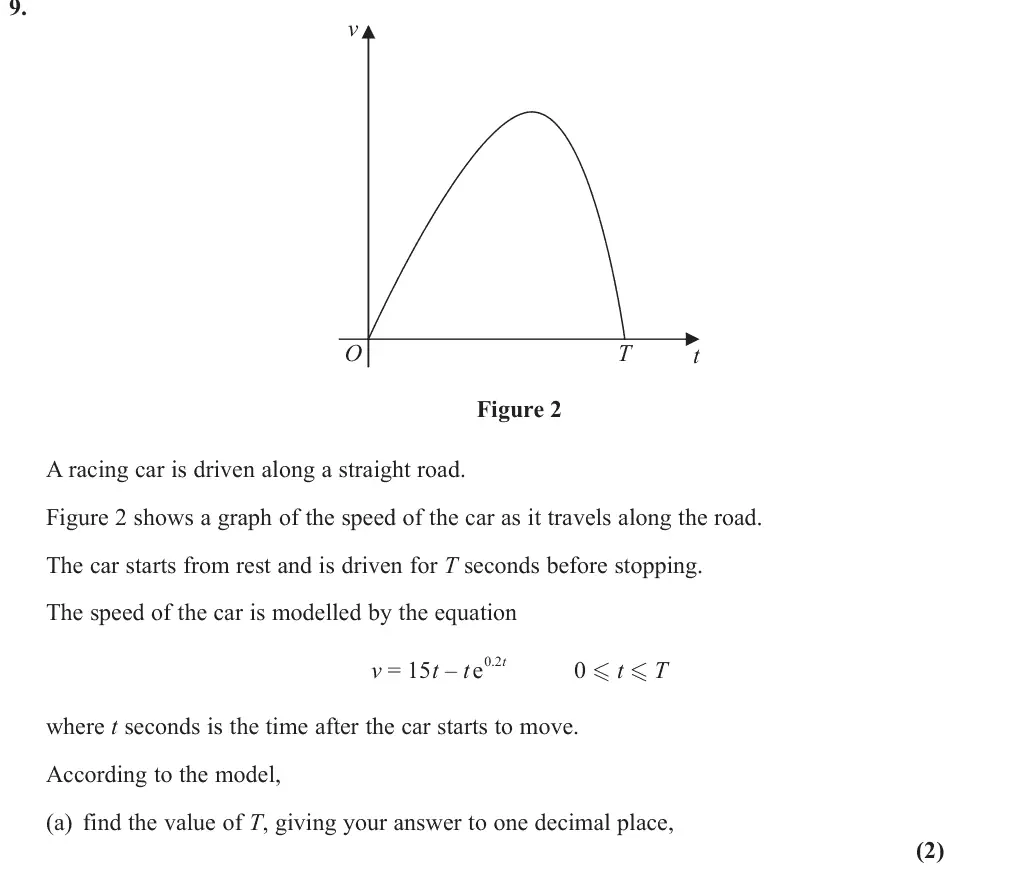
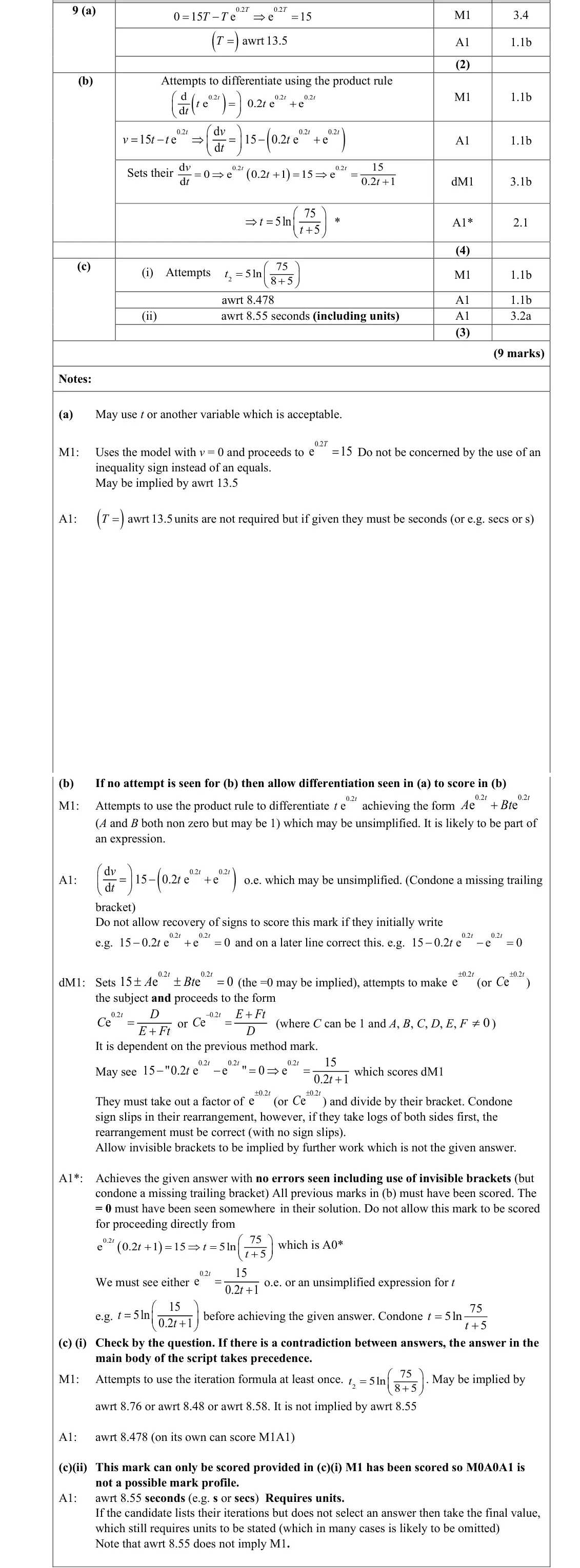
set v = 0 and divide by T (T ≠ 0): e^(0.2T) = 15, T = 5 ln 15 = 13.5 (1 d.p.)
log errors
June 2025 · Paper 1 · Q12(a)2 marks
Mark scheme (whole question; this part is marked with the orange bar)
Examiner's comment
This question tested knowledge of the intersection of lines and curves. The majority of learners found this question accessible, but some learners did not gain marks due to work particularly for part (b) appearing in part (a) and then no reference made that this should also be for part (b). For others it was for just generally not labelling the question parts and not being clear which part it belonged to, if not attempted in order. Learners should be reminded of the importance of clearly labelling and identifying each part of a question. Generally, part (a) was answered well. Many of the responses, in demonstrating the verification, substituted 6 x = into both equations to show that both y values were the same although a significant minority then forgot to write a conclusion or to say that the lines intersect where 6. x = A less popular approach was to cross multiply to achieve a cubic followed by substituting 6 x = to show the equation = 0, stating 6 x = is a root so they intersect. Similarly, the long division approach was less popular however, learners who used this approach were often successful. A significant number of responses did not include an appropriate conclusion. In show/verify/prove-type questions, learners should be advised to always finish with a statement which reiterates whatever they were being asked to show/verify/prove – usually, the wording can be lifted directly from the question. A few learners used their scientific calculators to find the three roots, one of which was ( 6 x = ), thereby gaining only the mark for the special case.
Common mistakes
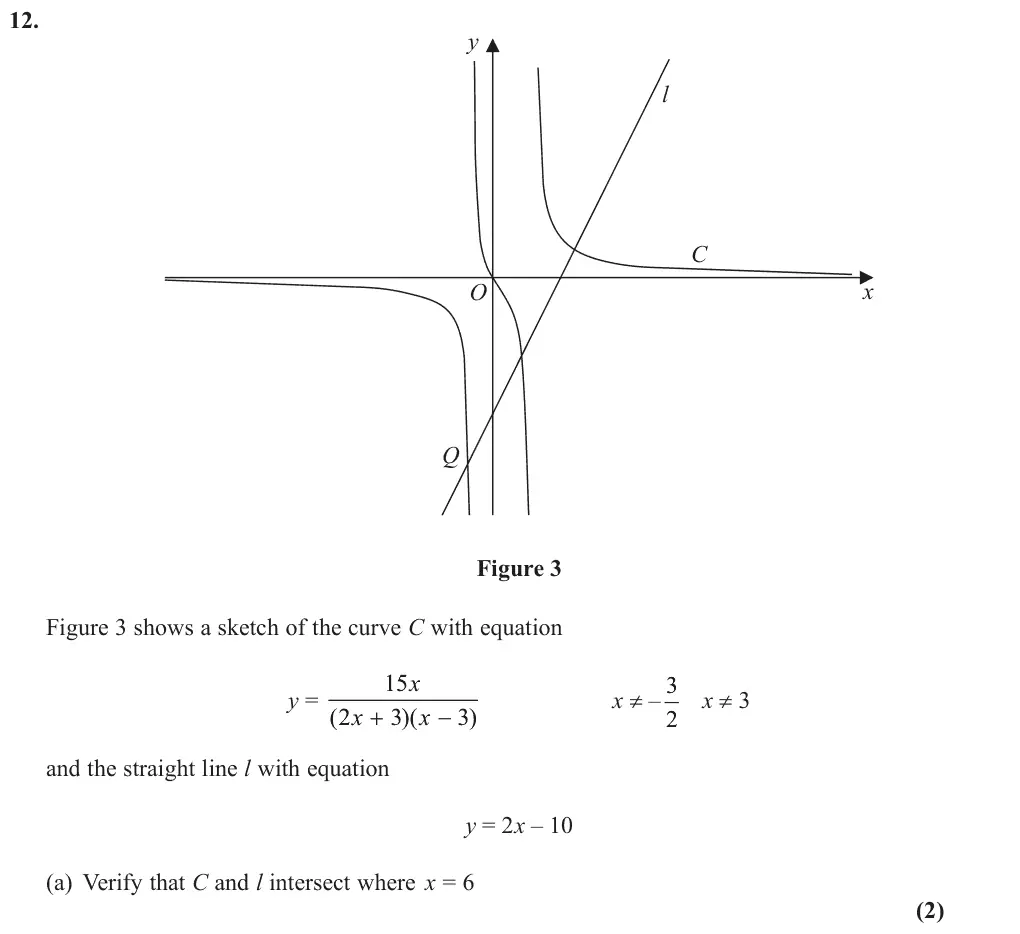
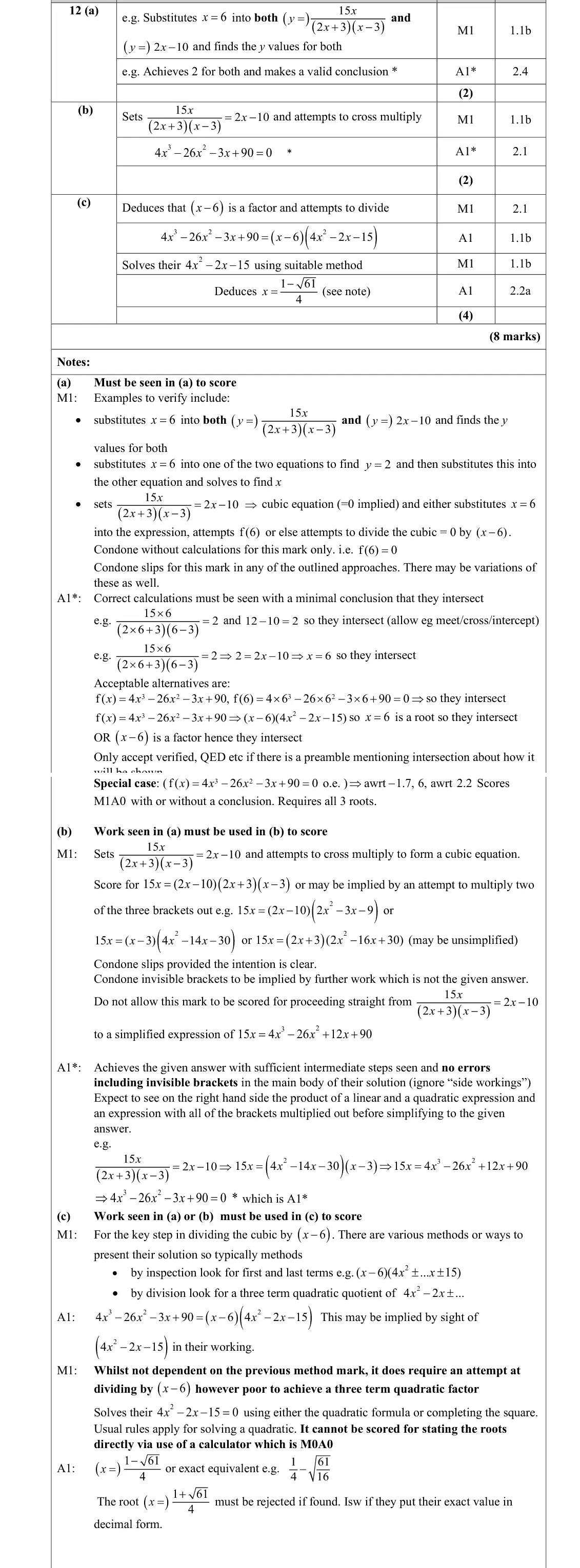
substitute x = 6 into both: y = 90/(15 × 3) = 2 and 2 × 6 − 10 = 2, then conclude they intersect
calculator roots of the cubic only score the special case
June 2025 · Paper 1 · Q12(b)2 marks
Mark scheme (whole question; this part is marked with the orange bar)
Examiner's comment
This question tested knowledge of the intersection of lines and curves. The majority of learners found this question accessible, but some learners did not gain marks due to work particularly for part (b) appearing in part (a) and then no reference made that this should also be for part (b). For others it was for just generally not labelling the question parts and not being clear which part it belonged to, if not attempted in order. Learners should be reminded of the importance of clearly labelling and identifying each part of a question. In part (b), the majority of responses equated the equations of C and L and then arranged to obtain a cubic equation. Missing or invisible brackets and a lack of working were the common errors seen here but, overall, there was a high level of accuracy shown in this part of the question. Learners should be advised to take extra care on questions such as this to ensure their working ‘flows’ from one line to the next, with every step shown and no errors in the algebra. Some responses did not gain the marks in (b) because they had expanded the brackets in (a) and did not use it in (b).
Mark scheme (whole question; this part is marked with the orange bar)
Examiner's comment
This question tested knowledge of the intersection of lines and curves. The majority of learners found this question accessible, but some learners did not gain marks due to work particularly for part (b) appearing in part (a) and then no reference made that this should also be for part (b). For others it was for just generally not labelling the question parts and not being clear which part it belonged to, if not attempted in order. Learners should be reminded of the importance of clearly labelling and identifying each part of a question. In part (c), many responses correctly identified 6 x - as a factor and attempted algebraic division or coefficient comparison to find the corresponding quadratic factor. However, several did not show full working and instead used their calculators to find the remaining roots, thereby not gaining method and accuracy marks since the question specifically required the solution to use algebra. Some assumed that quoting the quadratic formula was sufficient and then proceeded directly to calculator-based solutions without showing the substitution steps. Some preferred to complete the square and were successful, although this approach often led to errors. Most responses recognised that only the negative solution was valid since point Q was in the third quadrant; with only a few incorrectly including both solutions. 18 A significant number of responses did not recognise that 6 x - was a factor for part (c) and instead tried to solve the cubic by factorising out an “x”, or they did not attempt it. A handful went on to find the y coordinate, which was not required, and some seemingly did not fully understand the requirement of an “exact” answer, as they gave the x coordinate as a rounded decimal. 19
Common mistakes
(x − 6) is a factor: (x − 6)(4x² − 2x − 15)
solve with the formula shown (not calculator roots): x = (1 − √61)/4, rejecting the positive root because Q is in the third quadrant
exact answer
June 2025 · Paper 2 · Q13 marks
Mark scheme (whole question; this part is marked with the orange bar)
Examiner's comment
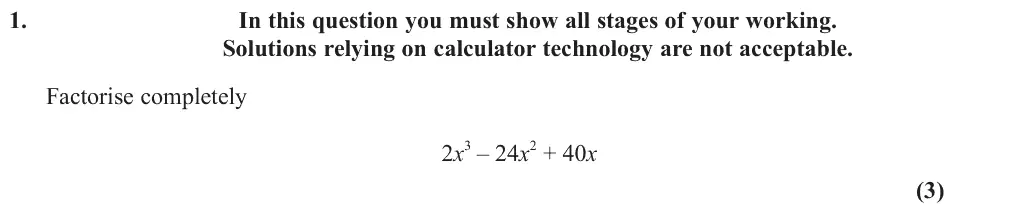
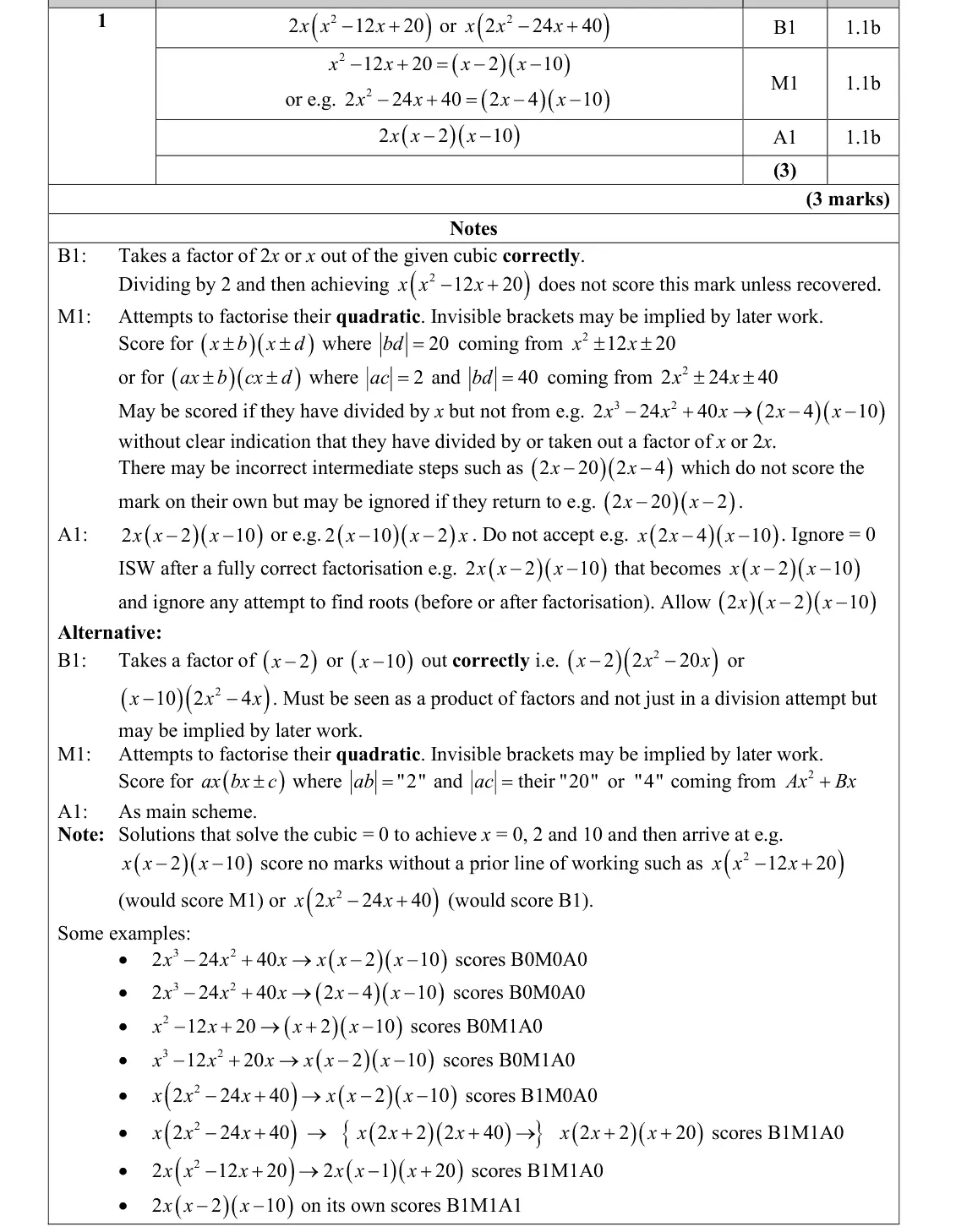
The first question on the paper required learners to factorise a routine cubic expression, of which x was a factor. Designed to be a friendly and straightforward opener, a large number did not factorise the 2x as the first step, hence did not gain the mark. In many cases, either the 2 or the x (or both) were divided out and forgotten about (leading to an incorrect answer) or left in the final answer as either (2x – 4) or (2x – 20) (leading to an incomplete answer). Some learners overcomplicated the question, attempting to use the factor theorem or use algebraic division to take (x – 2) or (x – 10) out as a factor. A significant number appeared unable to distinguish between factorising an expression and solving an equation, with many presenting “x = 0, 2, 10” or similar as their final answer. By itself this was not worthy of any credit. Many seemed to rely on calculators to obtain roots and jumped straight to the incorrect factorisation x(x – 2)(x – 10), which also scored no marks on its own. There were, however, many concise solutions to this question, with responses gaining all 3 marks in two lines of working.
Common mistakes
take out the common factor 2x first (dividing by 2 or x and losing it, or leaving (2x − 4) or (2x − 20), loses the A mark)
factorise, do not solve: x = 0, 2, 10 scores nothing
Mark scheme (whole question; this part is marked with the orange bar)
Examiner's comment
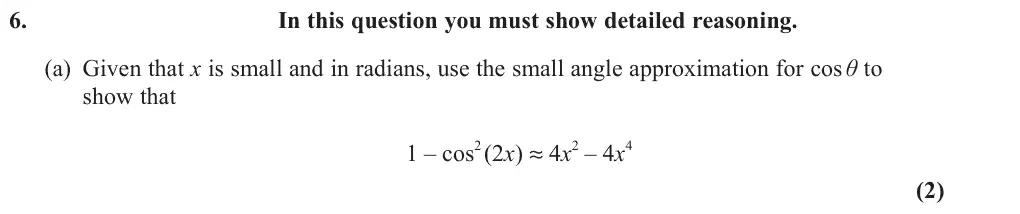
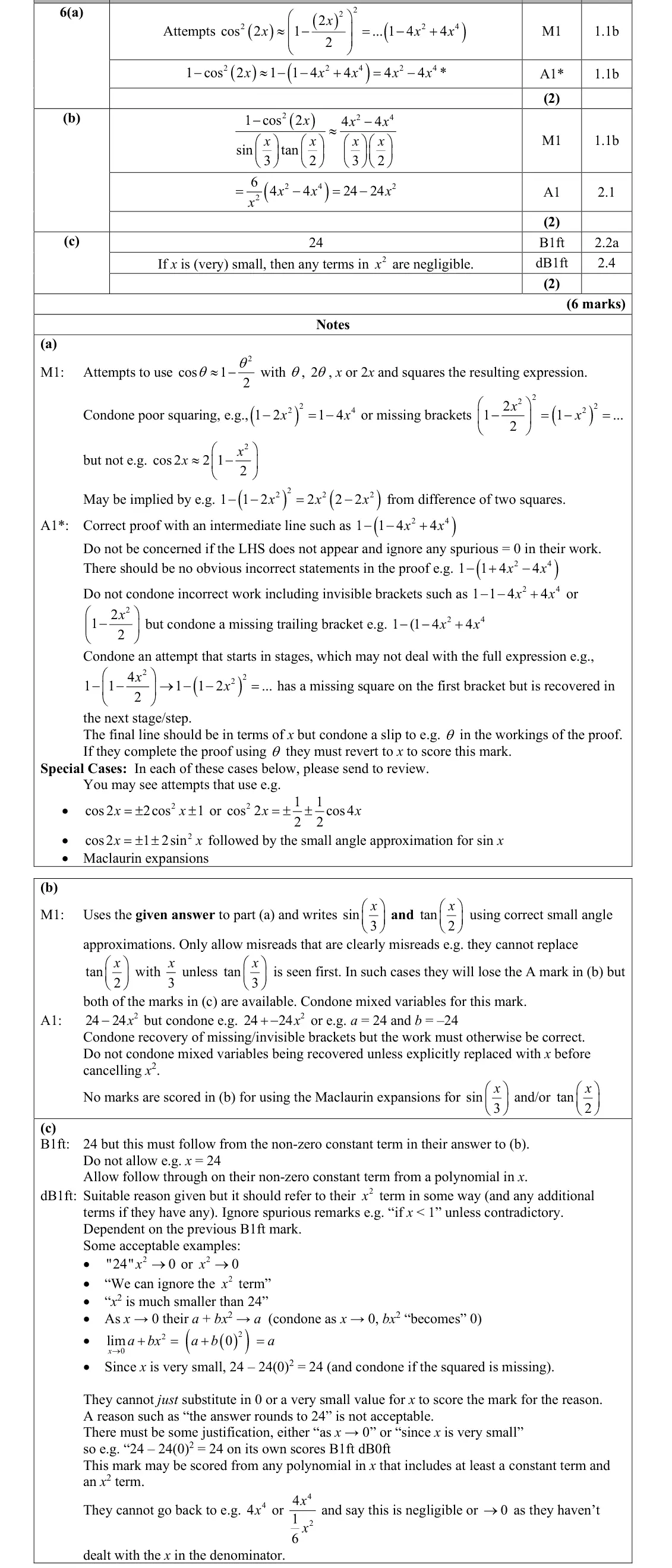
This question tested learners’ knowledge and understanding of small angle approximations, with learners finding the algebra in part (a) the most demanding aspect. Most attempts began with a substitution of the small angle approximation for cos2x, and stronger responses proceeded efficiently to the given answer with good algebra seen. A common error was not including brackets around the 2x. In some cases, these invisible ( ) 2 2 ; but in both cases a brackets were recovered; in other cases, the omission led to 1 1 x - - maximum score of M1A0* was available. Another common error was to expand the binomial correctly, but to omit the brackets when subtracting from 1, resulting in sign errors. In some cases, the squared sign on the outside of the bracket was omitted completely and this resulted in no marks being scored as they had materially simplified the algebra. Many responses tried to use identities prior to using small angle approximations, making the question significantly more complicated. In some cases, these approaches did not meet the demand of the question “use the small angle approximation for cos theta ”. More successful responses in part (b), made good use of the restart opportunity available here. Most used the small angle approximations and the given answer to part (a) correctly. After substitution into both the numerator and denominator, it was only a very small minority x and 2 x together, rather than who were not successful. Some, for example, tried to add 3 multiply, while others did not deal with the embedded fractions correctly, often dividing by 6 2 2 2 3 x and obtaining the incorrect . - 3
Common mistakes
cos 2x ≈ 1 − (2x)²/2 with brackets round 2x
square the whole bracket
brackets needed when subtracting from 1
intermediate line 1 − (1 − 4x² + 4x⁴) required
using identities first does not meet the demand
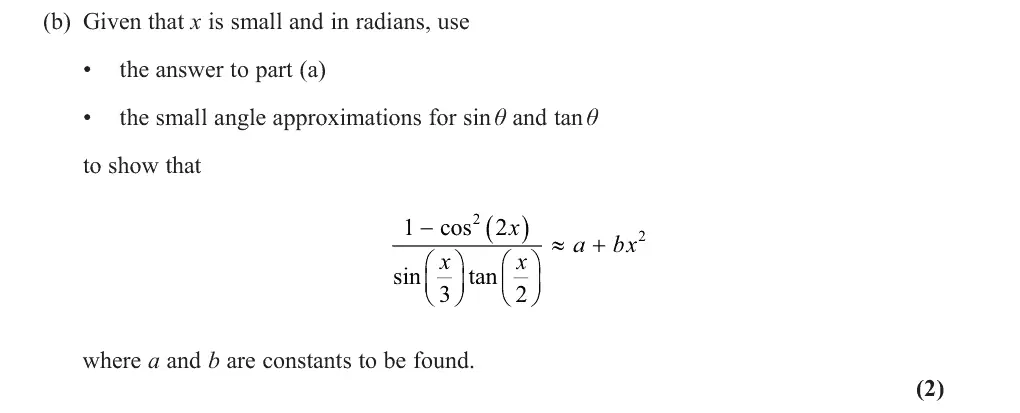
June 2025 · Paper 2 · Q6(b)2 marks
Mark scheme (whole question; this part is marked with the orange bar)
Examiner's comment
This question tested learners’ knowledge and understanding of small angle approximations, More successful responses in part (b), made good use of the restart opportunity available here. Most used the small angle approximations and the given answer to part (a) correctly. 2 24 24 0 x part (b) approached 0. This resulted in many learners setting and solving to - = x = ± . obtain 1 For both B marks follow-through was allowed on their answer to part (b). Most learners did succeed in deducing that the answer to part (c) was their constant term from part (b), and this was sufficient for the first B1 mark. However, a lot of responses did not adequately explain this, so the dB1 mark was frequently not awarded. 2 bx as x tended The most common form of correct answer was to discuss the behaviour of 2 24 24 24 2 x towards zero, for example “as so ”. 0, 24 0 - → x x → - → A significant minority missed the word “hence” and, as a result, some attempted to substitute ( ) 2 1 cos 2 x - 0 or a very small value into the expression , which scored no marks. x x sin tan 3 2
Common mistakes
use the given answer to (a) over (x/3)(x/2) = x²/6
multiply, do not add, x/3 and x/2
24 − 24x² (dividing by 6 instead of multiplying gives 2/3 − 2/3x²)
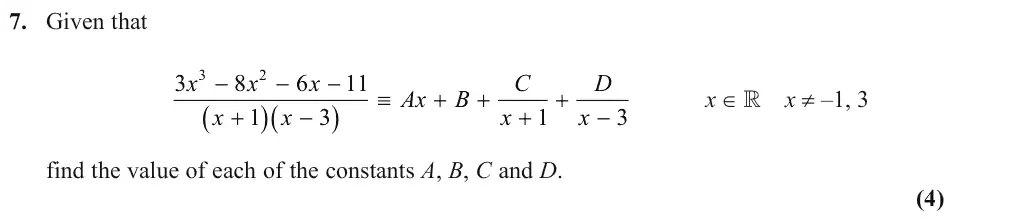
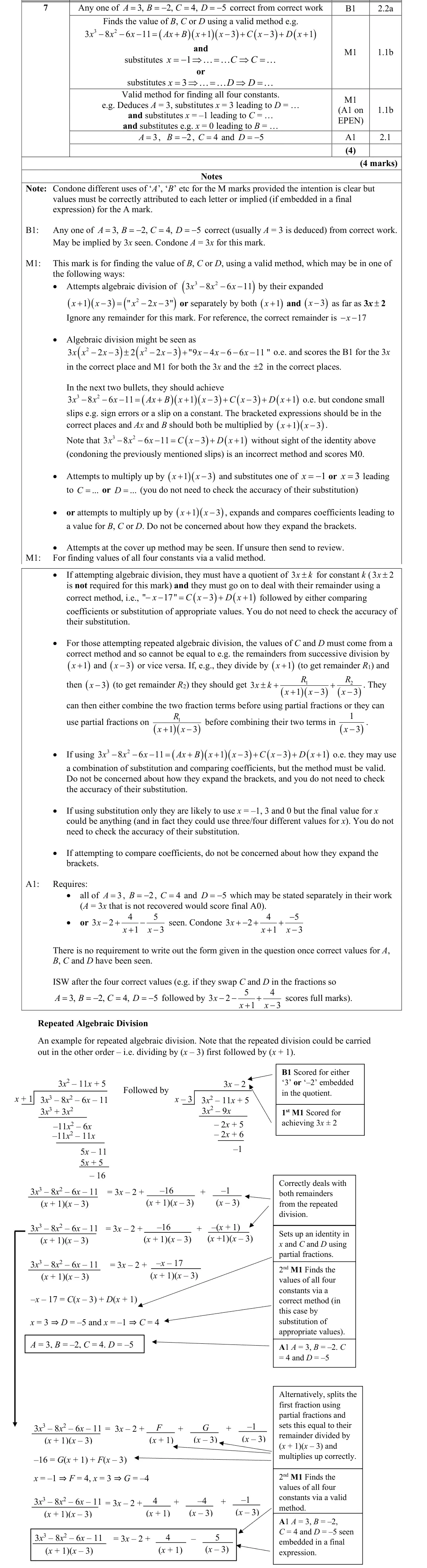
June 2025 · Paper 2 · Q74 marks
Mark scheme (whole question; this part is marked with the orange bar)
Examiner's comment
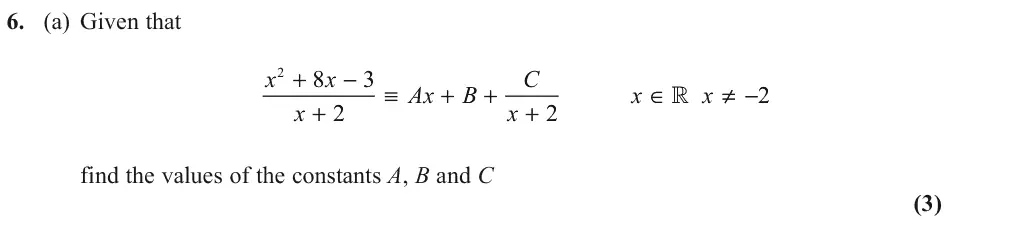
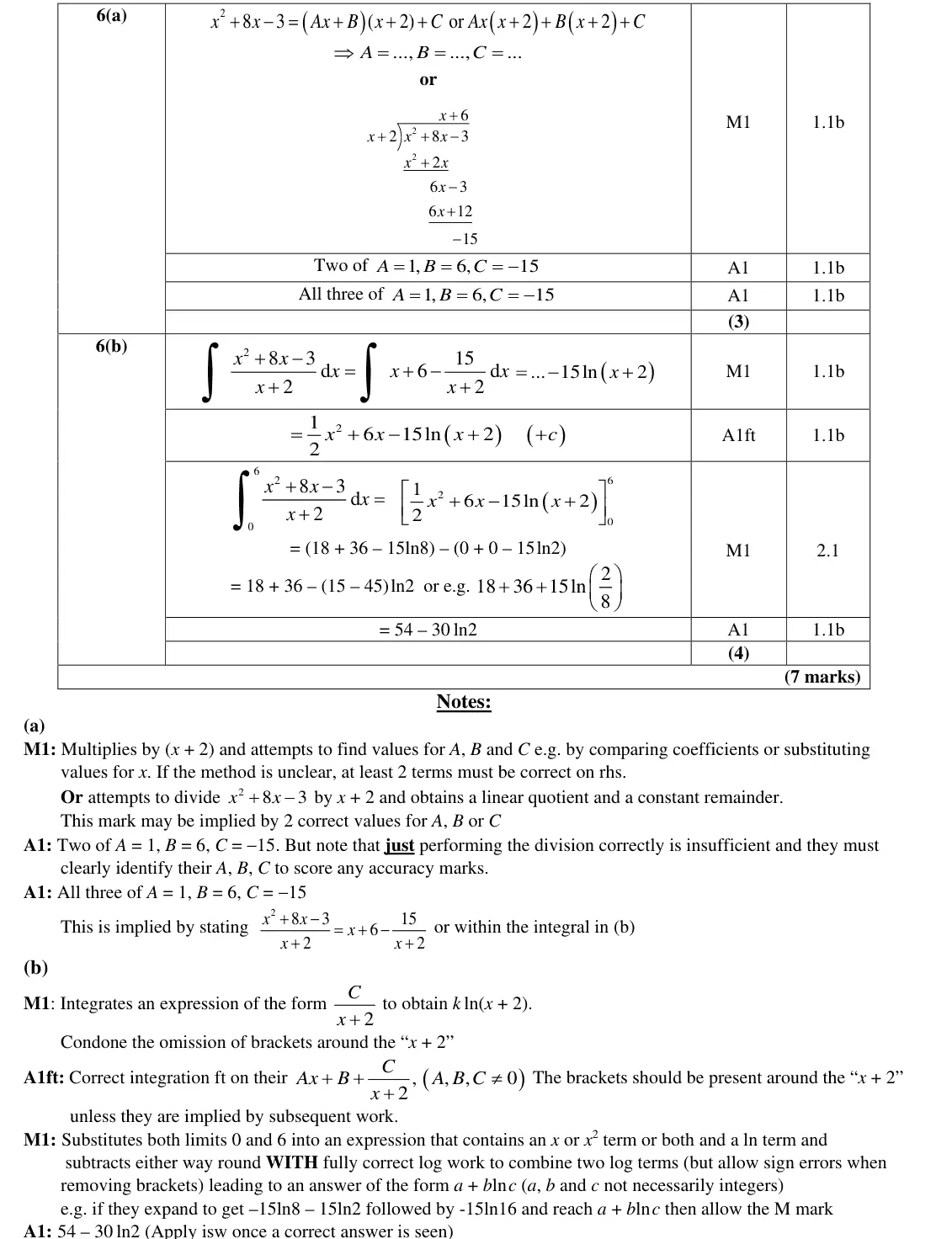
This question, which required learners to find the constants in a partial fraction identity, provided good differentiation between learners due to slightly more difficult nature of this question compared to similar problems from previous series. A large variety of methods were seen in this question. The most common approaches used one of two main methods: algebraic division or multiplying through to set up an identity without any fractions. The most successful method tended to be to multiply by the denominator to make a single identity then use substitution and/or comparing coefficients to find the missing values. Some responses did not multiply their Ax and B by the denominator this led to finding correct values for constants C and D through substitution (e.g., using x = -1 and x = 3), but, since the underlying method was flawed, marks could not be awarded. Slips in writing out the full identity were often seen but condoned provided the intention was clear. Whilst algebraic division was a successful method for some, errors were common in the division or dealing with the remainder, either calculating it incorrectly or not knowing how to use it to form an identity involving C and D. Some confused the quotient and the remainder when finding the final constants and others set their partial fractions equal to the original expression rather than their remainder. Those who did use the correct set up for partial fractions generally substituted correctly to score all 4 marks. Attempting algebraic division in two stages (dividing by each linear factor in turn) was much rarer, and often led to a maximum of two marks being scored, as responses used the remainders correctly to find C and D. Some responses expanded all their expressions after multiplying the identity by the denominator and then compared coefficients of powers of x and were successful overall. This method, while slightly longer, proved more accurate than algebraic division. Notably, few responses spotted that certain constants (like A) could be quickly deduced, suggesting an area for improvement in identifying shortcuts or patterns. There were responses that successfully managed to use elimination and comparing coefficients interchangeably and demonstrated very good fluency and understanding of working with partial fractions.
Common mistakes
improper fraction: multiply through by (x + 1)(x − 3) including the (Ax + B) term, then substitute x = −1, 3 and compare coefficients
A = 3 can be deduced directly
algebraic division errors with the remainder (−x − 17)
A = 3, B = −2, C = 4, D = −5
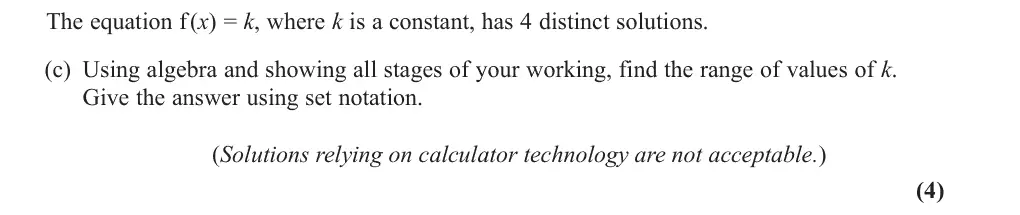
June 2025 · Paper 2 · Q8(c)4 marks
Mark scheme (whole question; this part is marked with the orange bar)
Examiner's comment
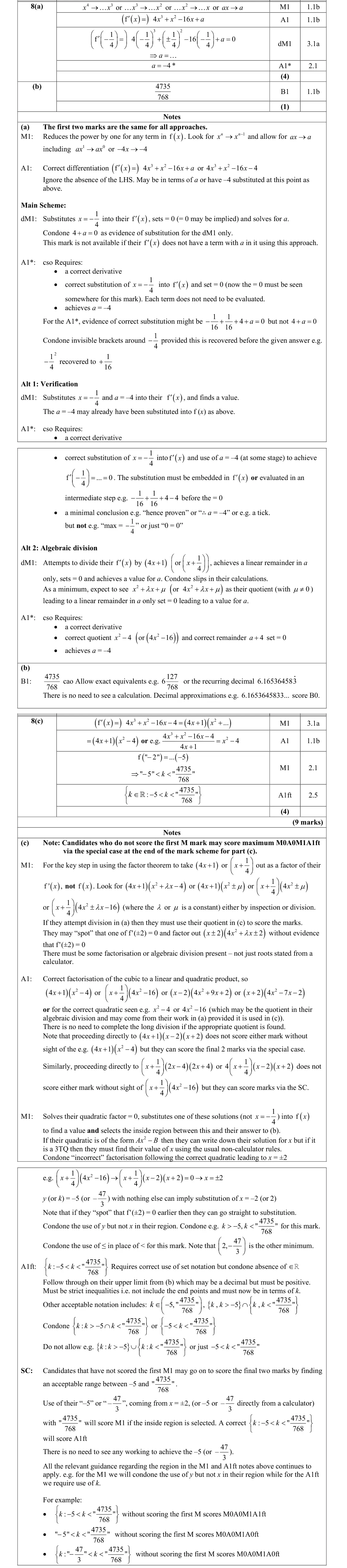
This question, involving the factor theorem and differentiation, was attempted by the vast majority of learners, with nearly all engaging with all three parts. Parts (a) and (b) were generally well-answered. Part (c), however, proved more challenging, with a significant proportion of learners relying on calculator-based methods despite the question clearly stating that these were not acceptable. Part (c) was the most challenging part of the question but was well supported by a clear diagram that helped to improve learners’ ability to solve the problem. A good range of marks were seen for this part of the question, and it differentiated well between the varying understanding of learners across the cohort. While many learners correctly identified that the number of real solutions to the equation f(x) = k depended on the location of k relative to the turning points of the curve, a substantial number relied on calculator methods to find the critical values of k, rather than using written methods as instructed. There were many responses where the required quadratic of x2 – 4 (or maybe 4x2 – 16) was never seen, the cubic was either followed directly by x = 1 4 - , 2, –2, or (4x + 1)(x – 2)(x + 2). These responses scored M0A0 and could only receive limited credit under the special case. Those who did attempt the algebra often reached the correct values but struggled with set notation. A common error when writing the final answer was using the union of two intervals instead of an intersection, while some used inclusive inequalities instead of strict inequalities and others made no attempt to use set notation. Despite this, many understood the underlying concept and were able to identify the correct range for k, even if it was not expressed with the required detail.
Common mistakes
use the factor theorem on f′(x): (4x + 1)(x² − 4) must be seen, not roots from a calculator
lower minimum f(−2) = −5
four solutions between the lower minimum and the local maximum: {k : −5 < k < 4735/768}
intersection not union
strict inequalities
must use set notation
June 2025 · Paper 2 · Q11(b)3 marks
Mark scheme (whole question; this part is marked with the orange bar)
Examiner's comment
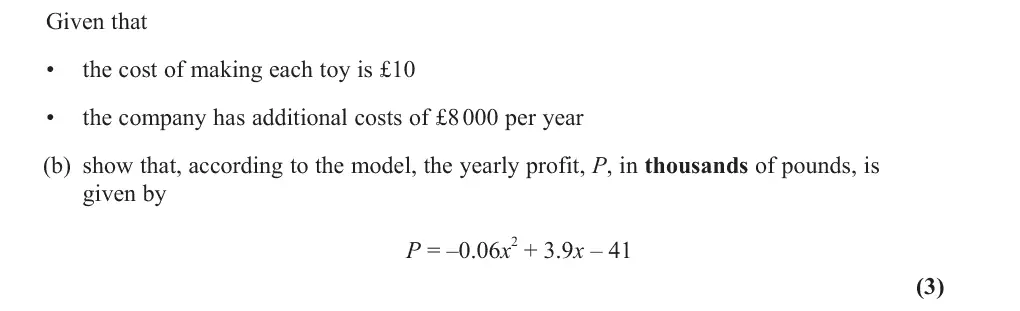
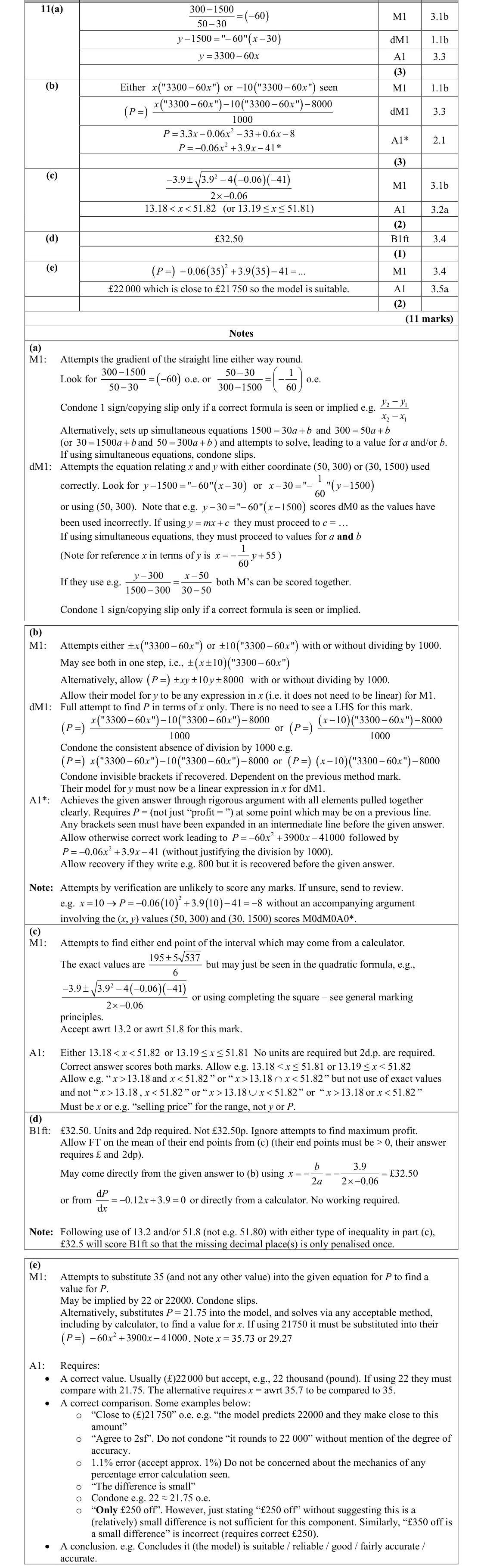
This modelling question required learners to construct and interpret a linear demand model, derive a profit function, solve a quadratic inequality, identify the optimal selling price, and assess the suitability of a model against real data. Overall, performance was mixed across the different parts of the question. Part (b) proved to be much more challenging. Learners who made an otherwise strong attempt sometimes omitted the -8000 term or made errors while expanding the brackets. Those who reached the correct expression connecting variable and fixed costs without initially dividing by 1000 generally recognised the need to do so, since the final answer was provided, and divided by 1000 at the end to match the printed equation. Common errors for those that attempted this part were missing the fixed cost, incorrect expressions for revenue or cost and failure to divide by 1000 accurately. A few responses tried to verify the formula for the given data but often fell short of a full method by only testing the given two values and not forming a conclusion.
Common mistakes
profit = xy − 10y − 8000 then divide by 1000
−8000 fixed cost often omitted
expand brackets before the given answer
verification with two values scores 0
June 2024 · AS Paper 1 · Q2(a)2 marks
Mark scheme (whole question; this part is marked with the orange bar)
Examiner's comment
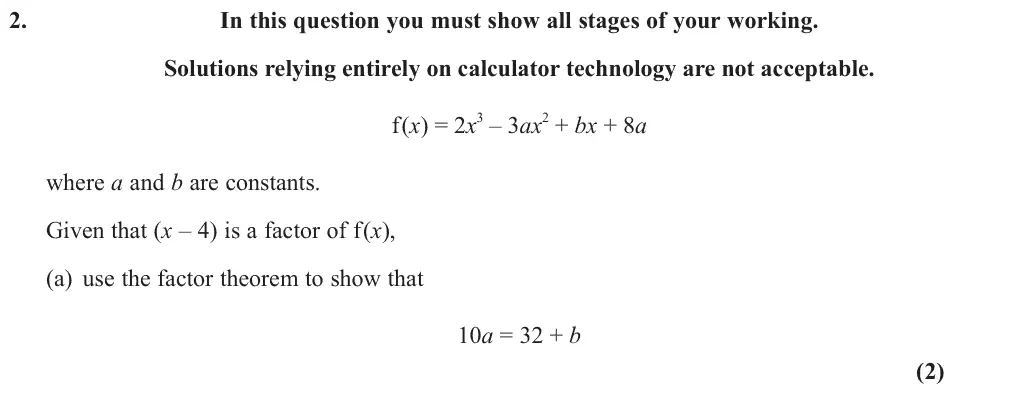
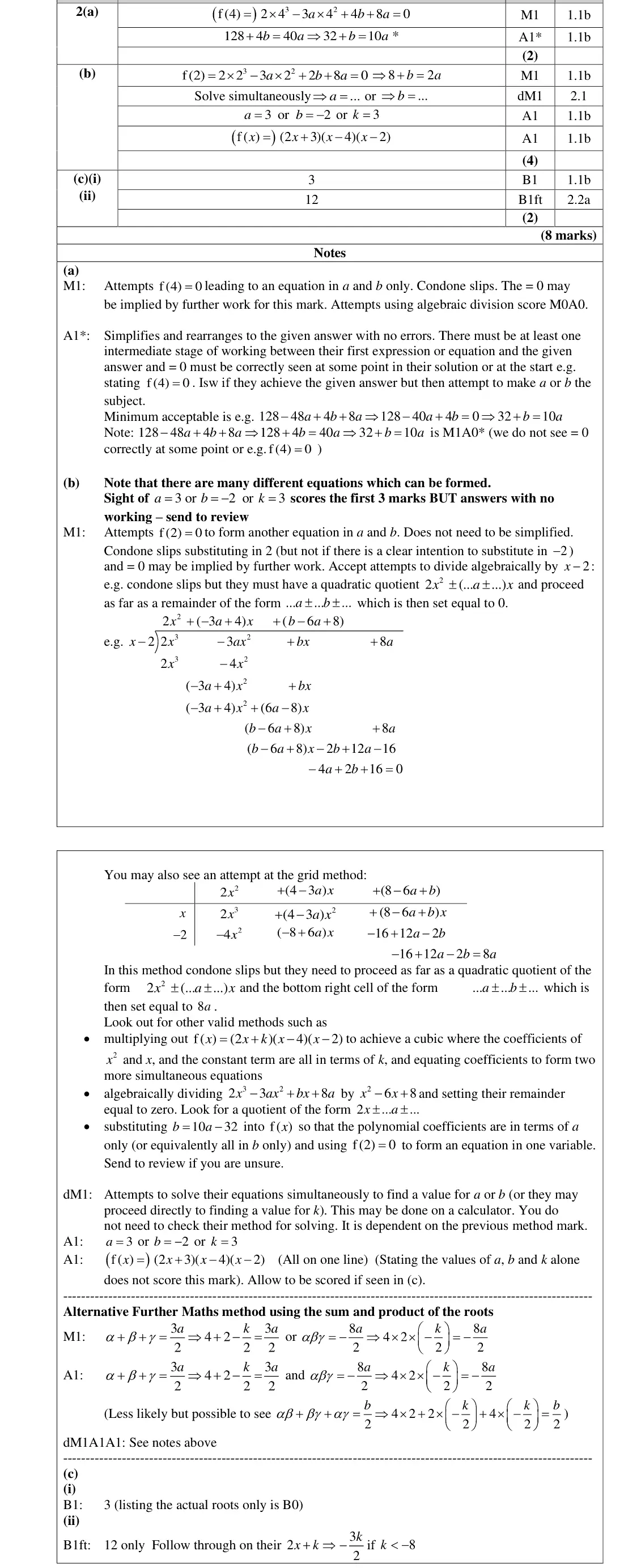
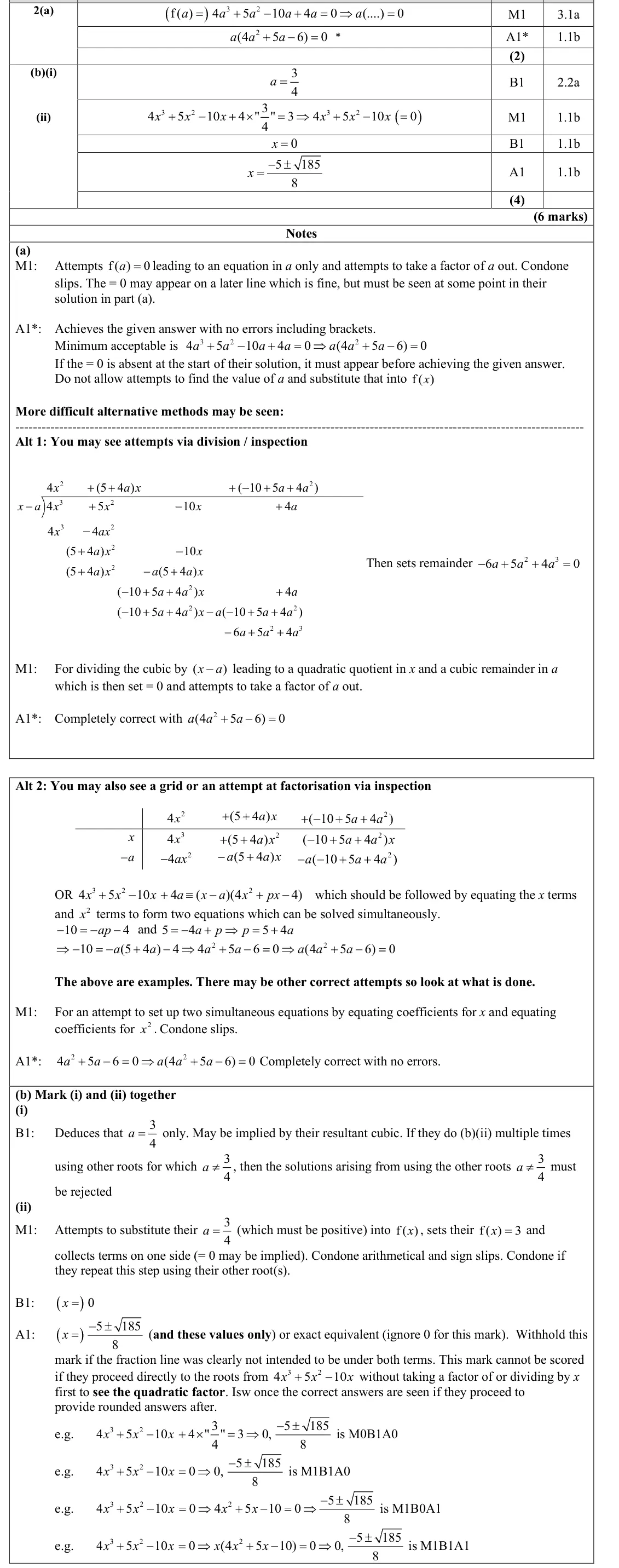
This question which required use of the factor theorem and solving simultaneous equations provided an opportunity to score a good number of marks. Some candidates found this question to be accessible and scored full marks or nearly full marks. Others however, encountered difficulties, particularly with part (b) and dropped marks accordingly. Some candidates lost marks because they did not pay heed to the instruction to show all stages of their working. In part (a), most candidates made progress and attempted to employ the factor theorem, as the question had instructed, and used f(4) 0 = to obtain the given answer. Some lost the second mark for not including ‘= 0’ anywhere in their proof or for algebraic slips. A few candidates attempted algebraic division and scored nothing in part (a).
Common mistakes
use f(4) = 0 (factor theorem, as instructed)
"= 0" must be seen
algebraic division scores nothing
at least one intermediate step before 10a = 32 + b
June 2024 · AS Paper 1 · Q2(b)4 marks
Mark scheme (whole question; this part is marked with the orange bar)
Examiner's comment
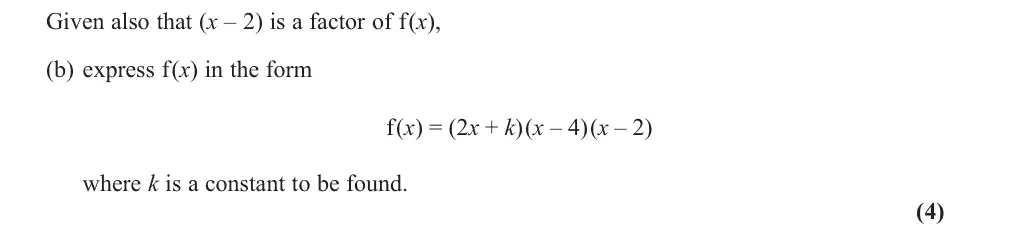
This question which required use of the factor theorem and solving simultaneous equations provided an opportunity to score a good number of marks. Some candidates found this question to be accessible and scored full marks or nearly full marks. Others however, encountered difficulties, particularly with part (b) and dropped marks accordingly. Some candidates lost marks because they did not pay heed to the instruction to show all stages of their working. For part (b), many candidates continued with the theme of the question and applied the factor theorem a second time using f(2) 0 = , obtaining a second equation in a and b. This was the easiest way to proceed. Surprisingly however, a significant number of candidates chose more difficult routes and progressed instead with entirely different methods. Many candidates had some success by expanding (2 )( 4)( 2) x k x x + - - and then comparing coefficients with the original function, obtaining further equations. Others attempted to divide the original function by ( 2) x - or sometimes by 2 6 8 x x - + , using long division. This approach was less successful because of the algebra involved and few reached a second equation. There were also a few attempts using the sum and product of the roots of a cubic equation. Some candidates attempted to use f(2) 0 = with f( ) (2 )( 4)( 2) x x k x x = + - - and made no progress in part (b). Generally, when candidates obtained further correct equations in part (b), they were then able to successfully solve them simultaneously to obtain values of a, b or k which were usually correct. This was often followed by the correct factorised expression for f(x), although a number of candidates failed to write this down and lost the final mark. A few correct answers were presented with no working, which gained no credit in part (b).
Common mistakes
f(2) = 0 gives 8 + b = 2a
solve with 10a = 32 + b: a = 3, b = −2, k = 3
final answer (2x + 3)(x − 4)(x − 2) on one line
expanding (2x + k)(x − 4)(x − 2) and comparing coefficients is longer
June 2024 · AS Paper 1 · Q2(c)2 marks
Mark scheme (whole question; this part is marked with the orange bar)
Examiner's comment
This question which required use of the factor theorem and solving simultaneous equations provided an opportunity to score a good number of marks. Some candidates found this question to be accessible and scored full marks or nearly full marks. Others however, encountered difficulties, particularly with part (b) and dropped marks accordingly. Some candidates lost marks because they did not pay heed to the instruction to show all stages of their working. Part (c) was answered quite well, even by those who had made little or no progress in part (a) or part (b). In part (i) many identified that there were three real roots, although stating that there were two real roots was a common incorrect answer. Some also lost the mark because they listed the roots without stating how many there were. In part (ii) many realised that the largest root was 12, although 4 3 was a common incorrect answer.
Common mistakes
(i) state "3", listing the roots alone scores 0
2 is a common wrong answer
(ii) f(x/3) = 0 is a stretch scale factor 3 so largest root 3 × 4 = 12 (4/3 is a common wrong answer)
June 2024 · AS Paper 1 · Q5(b)2 marks
Mark scheme (whole question; this part is marked with the orange bar)
Examiner's comment
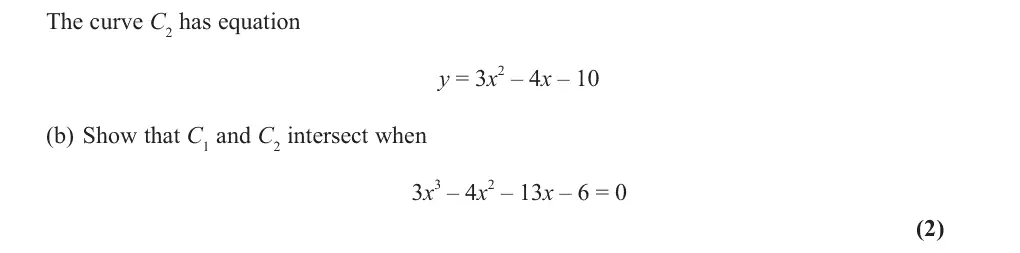
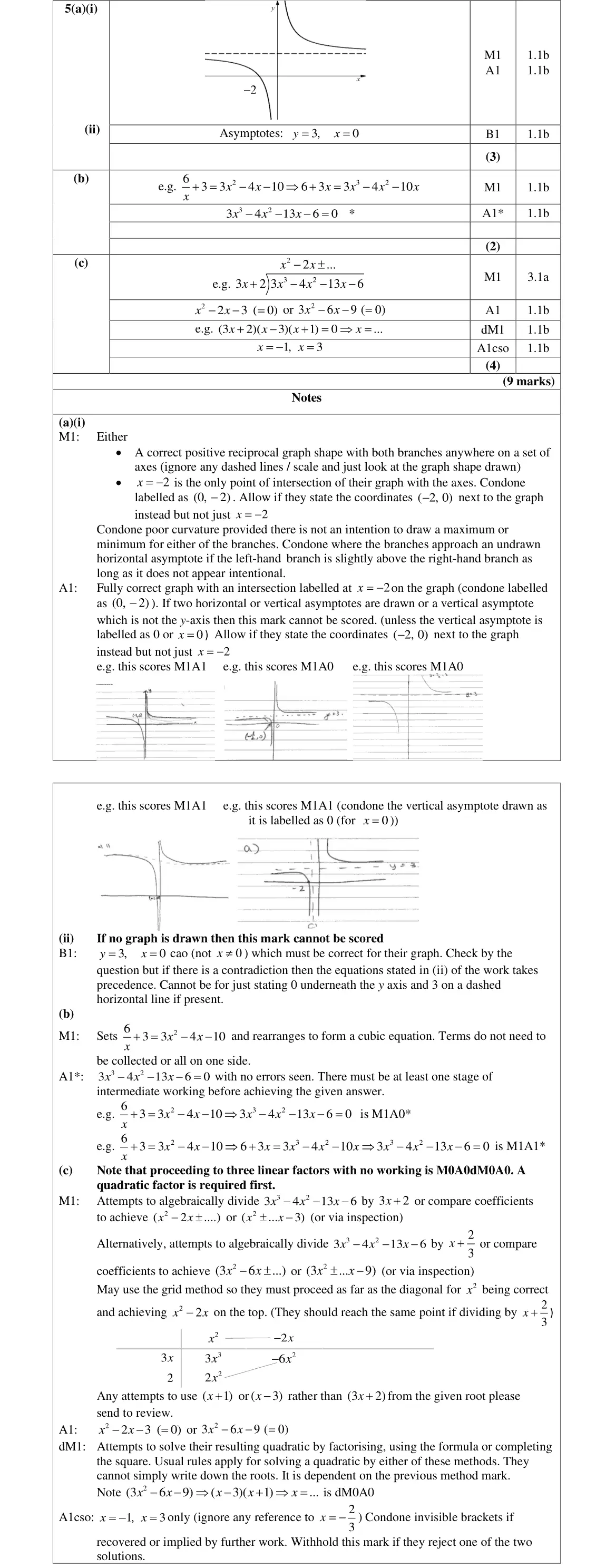
This question tested candidates’ ability to sketch graphs and to be able to divide polynomials. In part (b), candidates were required to equate both curves and rearrange to obtain a given answer. This was very well answered with the most common error being slips on the indices and not equating the final answer to zero. Those who were unsure what was being asked just proceeded to solve the cubic on their calculator.
Common mistakes
equate 6/x + 3 = 3x² − 4x − 10 and multiply through by x
at least one intermediate line
"= 0" needed
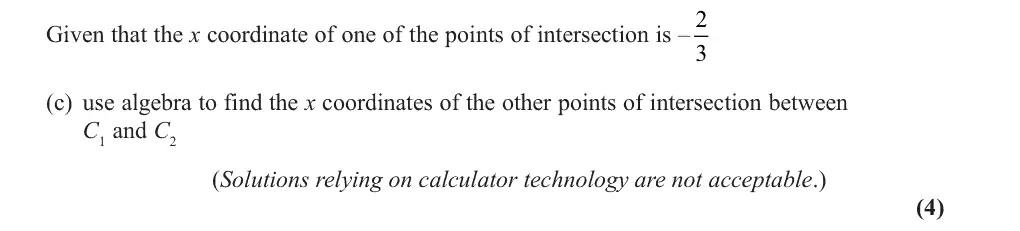
June 2024 · AS Paper 1 · Q5(c)4 marks
Mark scheme (whole question; this part is marked with the orange bar)
Examiner's comment
This question tested candidates’ ability to sketch graphs and to be able to divide polynomials. Many candidates did not heed the warning in part (c) that “solutions relying on calculator technology are not acceptable” and this cost them marks. Overall, this question had a wide spread of marks. Part (c) proved more difficult, and this is where the calculator warning was ignored. Many candidates simply stated the three roots with no working which scored no marks. Others tried to work backwards and failed to appreciate the requirement to use the given information. It is not acceptable to just use the calculator to solve to find the three roots, then above write the factorised version and then multiply out above this to achieve the cubic equation as there is not sufficient evidence that the given information had been used. If it was not factorised into ( ) x + or evidence that another factor had been found, 3 2 (quadratic) demonstrated by an algebraic technique such as algebraic division, or using the factor theorem then full marks could not be awarded. Just factorising by inspection using one of the other factors which have mysteriously appeared was not accepted and these approaches should be discouraged. Those that realised that algebraic division was 2 x + required scored well, a significant number of candidates choose to divide by rather 3 x + than the expected 3 . The resultant quadratic was then factorised to give the 2 additional points of intersection.
Common mistakes
use the given root −2/3: divide by (3x + 2) to get x² − 2x − 3, then factorise
x = −1 and x = 3
three linear factors written down from a calculator score 0
quadratic factor needed first
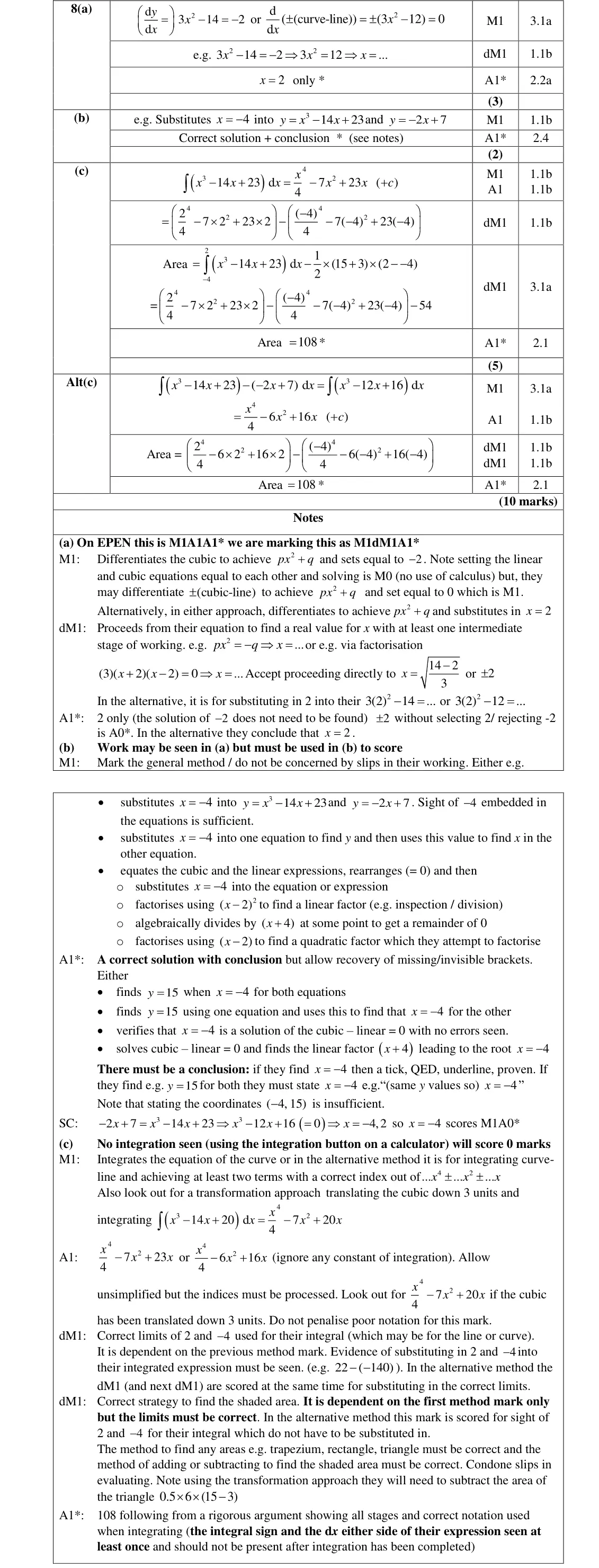
June 2024 · AS Paper 1 · Q8(b)2 marks
Mark scheme (whole question; this part is marked with the orange bar)
Examiner's comment
Marks awarded in this question were generally quite varied. Often candidates made progress in (c) only, by attempting some integration with little correct work seen in (a) or (b). Each part of this question presented a given answer, and candidates who failed to observe the warning in the question about showing all stages of their working, or relying entirely on calculator technology, often lost marks. Those who attempted part (b) employed many varied methods. The easiest approach was to simply to verify that both the line and the curve passed through the point ( 4, 15) - showing sufficient working. Many though, subtracted the equations of the line and the curve again to obtain 3 12 16 y x x = - + . Candidates then either verified that 4 x = - was a solution of 3 12 16 0 x x - + = , or attempted to solve this equation. Those who reached 4 x = - by factorising via 2 ( 4)( 2) 0 x x + - = were in a position to score both marks, but a number relied on their calculator equation solver, and could only be awarded the first mark in part (b). Candidates often lost the final mark for not writing a full conclusion. To score full marks, candidates needed to reach 4 x = - showing sufficient working using a valid method, and also indicate that they had completed the proof.
Common mistakes
substitute x = −4 into both equations to get y = 15 and conclude
or factorise x³ − 12x + 16 = (x − 2)²(x + 4)
stating (−4, 15) alone is insufficient
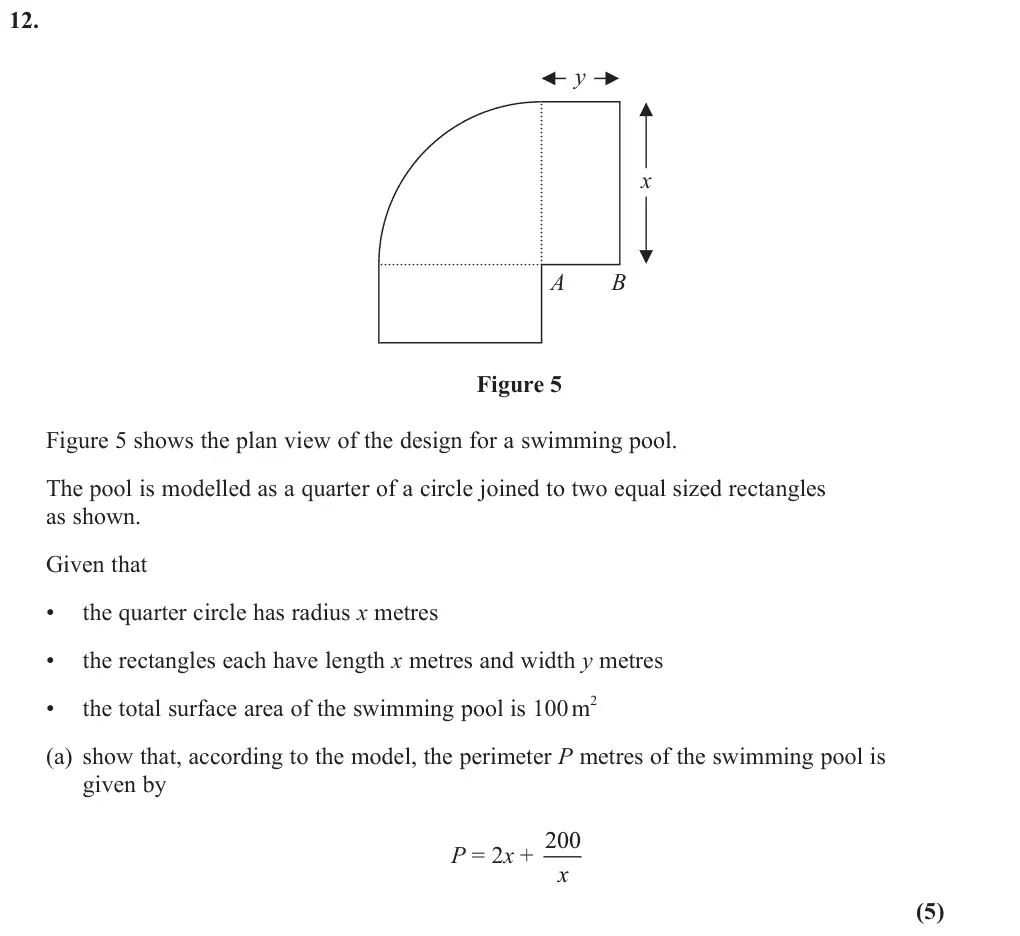
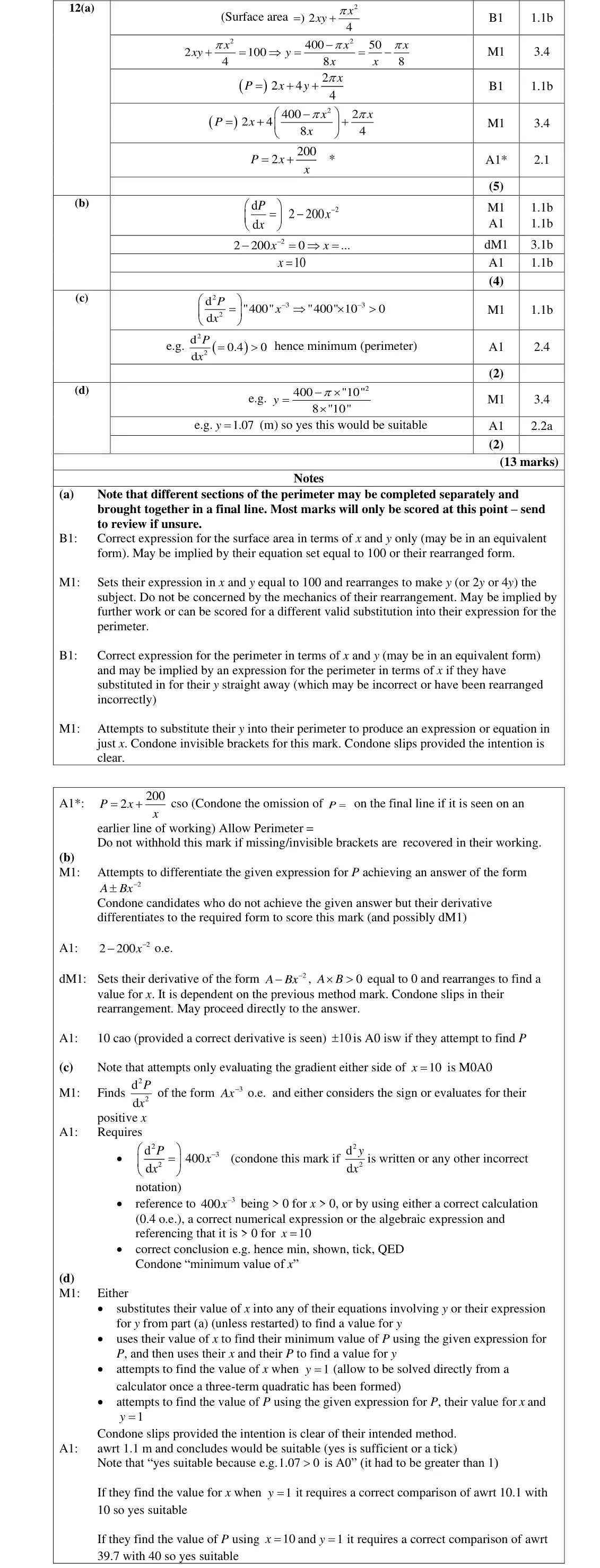
June 2024 · AS Paper 1 · Q12(a)5 marks
Mark scheme (whole question; this part is marked with the orange bar)
Examiner's comment
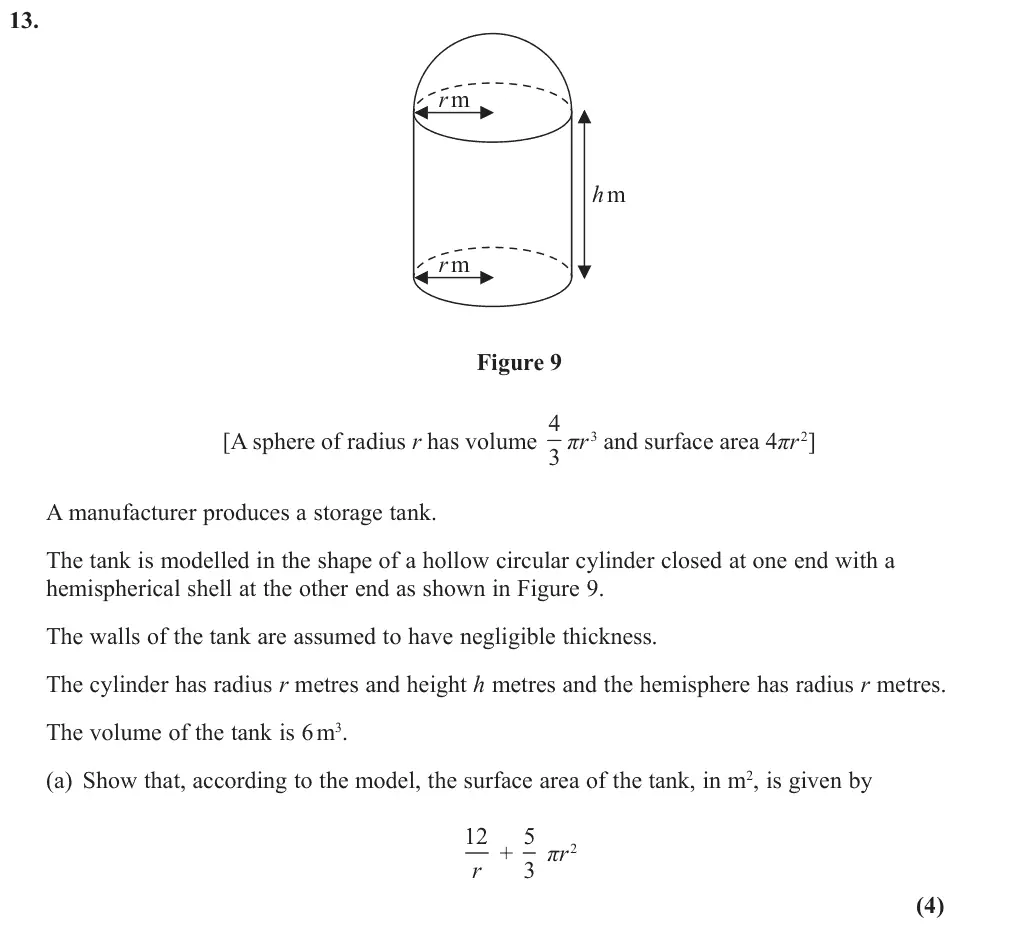
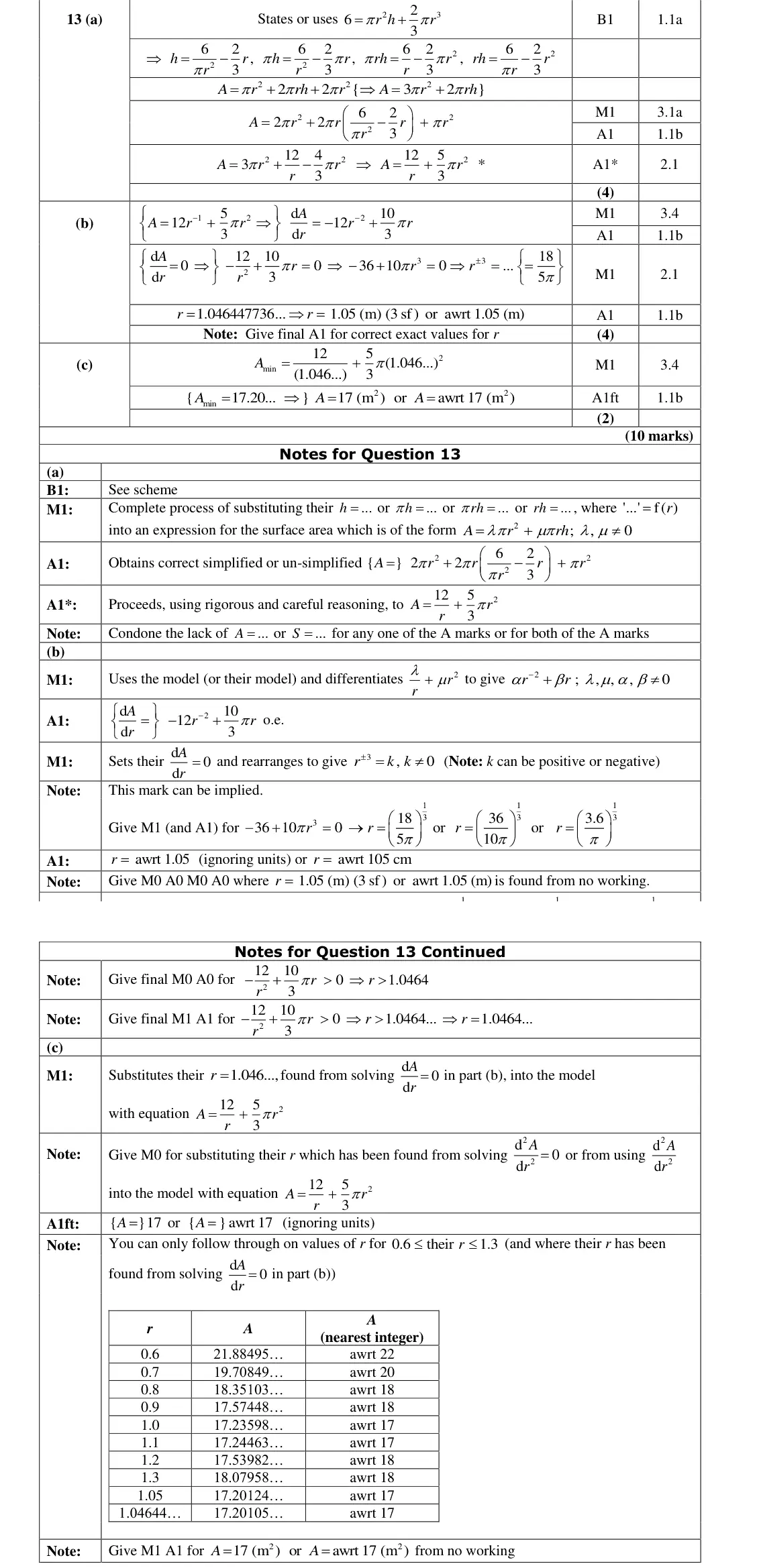
coming unstuck on part (a) without an attempt at later parts. This was a shame particularly as later parts of the question provided a good source of marks for many candidates. In part (a) attempts to find expressions for the surface area and perimeter of the given shape were often successful, although errors and slips were not uncommon. A correct expression for the perimeter was perhaps more often successfully achieved than a correct expression for the area. A relatively common error was in setting x as the diameter of the sector rather than the radius. A significant number of candidates found expressions in terms of r and could earn no marks until r was replaced by x. A minority of candidates equated the perimeter, rather than the area, to 100, but the vast majority made an attempt at the key step of rearranging their equation to find an expression for y in terms of x. Some candidates were more unusual in their choice of substitution: rather than finding an expression for y or 2y, they used effective and efficient substitutions for functions such as 100 x . Once the critical substitution was achieved, most candidates went on to successfully obtain the required result, although occasionally marks were lost due to arithmetical and/or sign errors, or for the omission of ‘P =.’ y using their value of x and the relationship derived in part (a), to determine whether y was greater than the required lower limit of 1. This approach was usually the most successful. Slightly more circuitous routes were also seen which involved employing the given expression for P to determine the minimum perimeter and then an additional y = and either x = 1 expression for P in terms of x and y, used with (to find P) or 10 P = (to find x). Often this approach fell slightly short of being complete as a final 40 comparison of x with the value 10, or a comparison of P with the value 40 was required to justify whether the swimming pool dimensions were suitable. Some candidates tried to draw conclusions but gave insufficient supporting statements such as ‘10.8 is close to 10, so suitable’, or ‘10.8 > 0, so suitable’ rather than the relevant ‘10.8 > 10, so suitable’. Other candidates were unable to gain marks here for irrelevant statements unsupported by calculation such as ‘suitable, although the pool might be a bit small.’ Others were x = confused about what value of x they should use and erroneously substituted (the 0.4 x = result value of the second derivative at ) into either their expression for y or their 10 expression for P.
Common mistakes
area 2xy + πx²/4 = 100 gives y = (400 − πx²)/8x
perimeter 2x + 4y + 2πx/4
substitute to reach P = 2x + 200/x
x is the radius, not the diameter
equating perimeter to 100
June 2024 · AS Paper 1 · Q144 marks
Mark scheme (whole question; this part is marked with the orange bar)
Examiner's comment
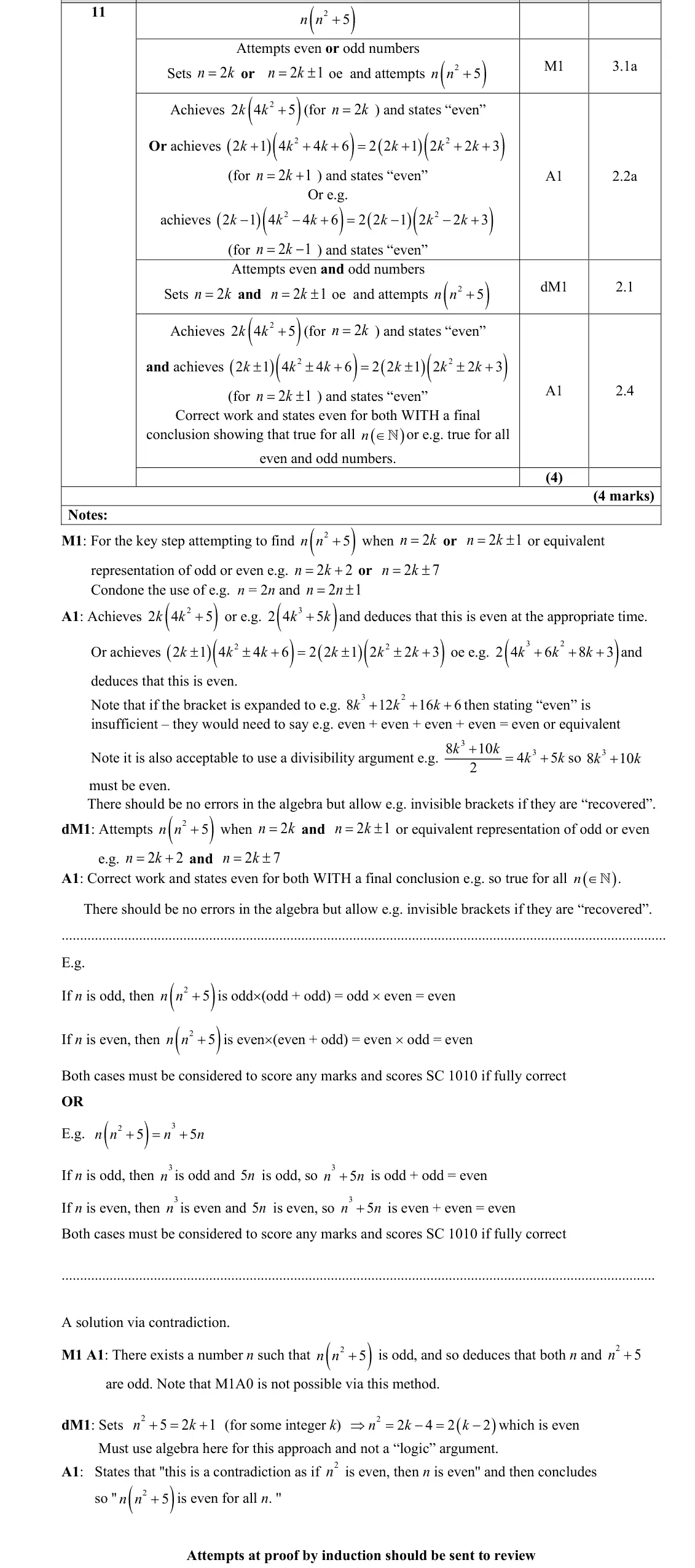
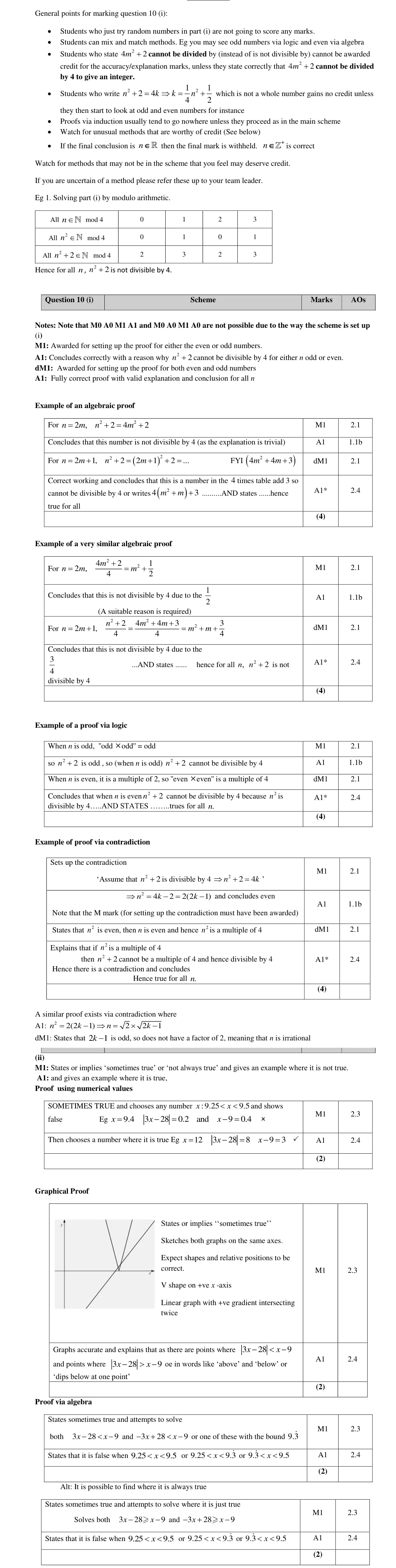
This question proved to be a challenge for the majority of candidates and full marks were not common. The instruction to ‘use algebra’ was lost on a number of candidates who employed logical approaches or attempted to test an array of integer values for n. Perhaps a casualty of being the last question on the paper, there were also a number of blank responses seen. For those employing a logical approach, some credit was given when algebra was used to factorise the quadratic followed by a consideration of the parity of the factors. This was often left incomplete however, and so rarely scored the two marks out of four for a complete attempt via this approach. The majority of candidates who attempted the question did grasp the need to consider the general form for odd and even integers and made a reasonable attempt. Although some candidates incorrectly used ‘ 1 k + ’ or considered even integers twice e.g. ‘ 2k ’ and ‘ 2 2 k + ’. Unfortunately, marks were very commonly, yet surprisingly, lost due to basic mistakes in simple algebraic manipulation. These errors occurred in both the expansion and the factorisation of brackets and included errors such as 5(2 1) 10 1 k k + = + or 2 2 4 10 2( 5 ) k k k k + = + . It was surprisingly common for candidates to use n in their general form i.e. ‘ 2 n n = ’ which led to the loss of the final mark, especially since this has been in previous mark schemes that this would not garner full marks. A large proportion of candidates failed to give an overall conclusion to their proof which was also penalised with the final mark. A small minority of candidates employed proof by induction and, when seen, this was usually confidently executed.
Common mistakes
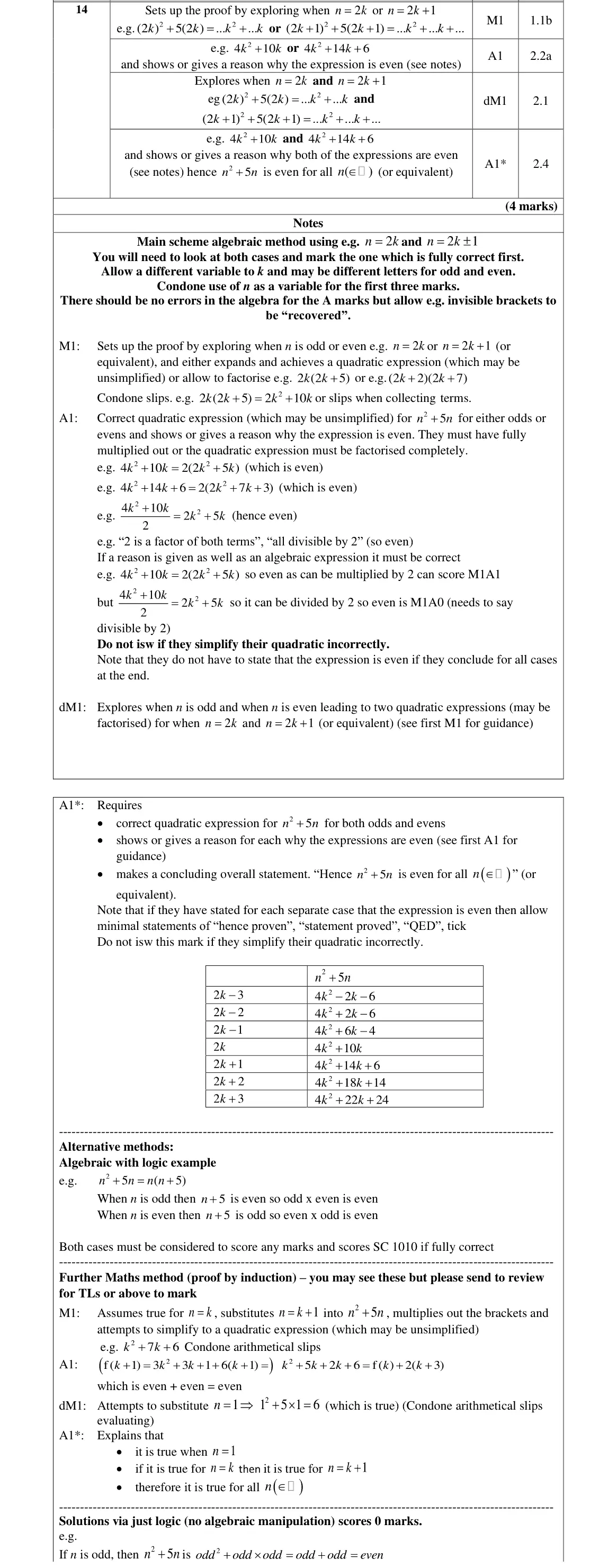
consider n = 2k and n = 2k + 1: 4k² + 10k = 2(2k² + 5k) and 4k² + 14k + 6 = 2(2k² + 7k + 3)
give a reason each is even and a final conclusion
testing values or pure logic (odd × even) without algebra scores little
June 2024 · Paper 1 · Q13 marks
Mark scheme (whole question; this part is marked with the orange bar)
Examiner's comment
This question was very accessible, familiar to candidates and of low demand, making it particularly suitable for the opening question of the paper. Candidates were required to determine the value of a constant, k, in a cubic expression, g(x), given that (x – 3) was a factor of this expression. The vast majority of candidates found this question straightforward and clearly understood that they should apply the factor theorem to the question, determining the value of k via a linear equation in k that followed from g(3) = 0. A small proportion of candidates made errors in setting up the linear equation, or in attempting to solve their linear equation, however method marks were available in these instances. Some candidates did not include an = 0 in their work, however they were able to recover and achieve the marks if the = 0 was implied by later work. Quite rarely, g(–3) = 0 was attempted but even in this case credit for attempting to solve a linear equation was available. A common alternative route was to attempt division of g(3) by (x – 3), which made this otherwise routine question significantly more challenging. A number of methods for setting out the division were seen but marks could not be awarded until their linear remainder, only in k, was set equal to zero. When algebraic division was applied it was rarely completed well enough to gain all the marks, although many made quite pleasing progress with this more complex algebra. Centres should ensure candidates consider which method is more appropriate for solving a given problem. A very small proportion of candidates attempted to factorise g(x) and then equated coefficients which only a handful of candidates completed successfully.
Common mistakes
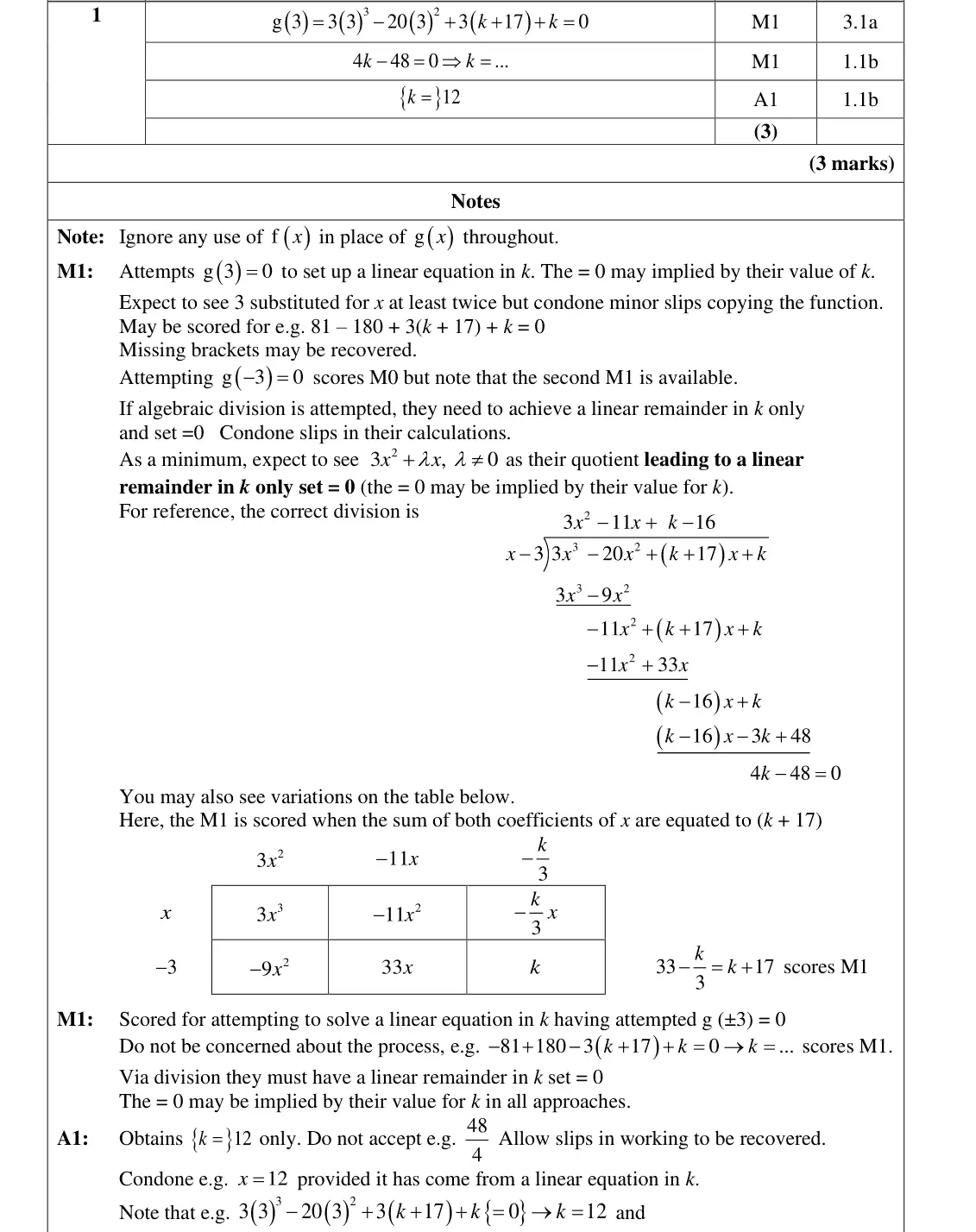
factor theorem: set g(3) = 0 (not g(−3)) to get the linear equation 4k − 48 = 0
the "= 0" must be seen or implied
algebraic division is a much harder route
June 2024 · Paper 2 · Q2(b)2 marks
Mark scheme (whole question; this part is marked with the orange bar)
Examiner's comment
Part (b) was usually answered well, and candidates were able to substitute the given values into the sum formula correctly, expand brackets and obtain the required quadratic equation in N. The fact that the common difference was negative caused some candidates algebraic difficulties. Some candidates did not realise they needed to set their expression equal to 8100 but soon realised this and added it in later in their working but a few persisted with e.g. = 0 rather than = 8100. A few had bracketing and/or arithmetic errors and some missed out the ‘= 0’ in the given answer therefore losing the final accuracy mark. A small number of candidates attempted to use the term formula in this part. Another rarer approach involved using a series summation approach. These attempts were mostly successful as it required further maths knowledge and were therefore performed by most proficient mathematicians.
Common mistakes
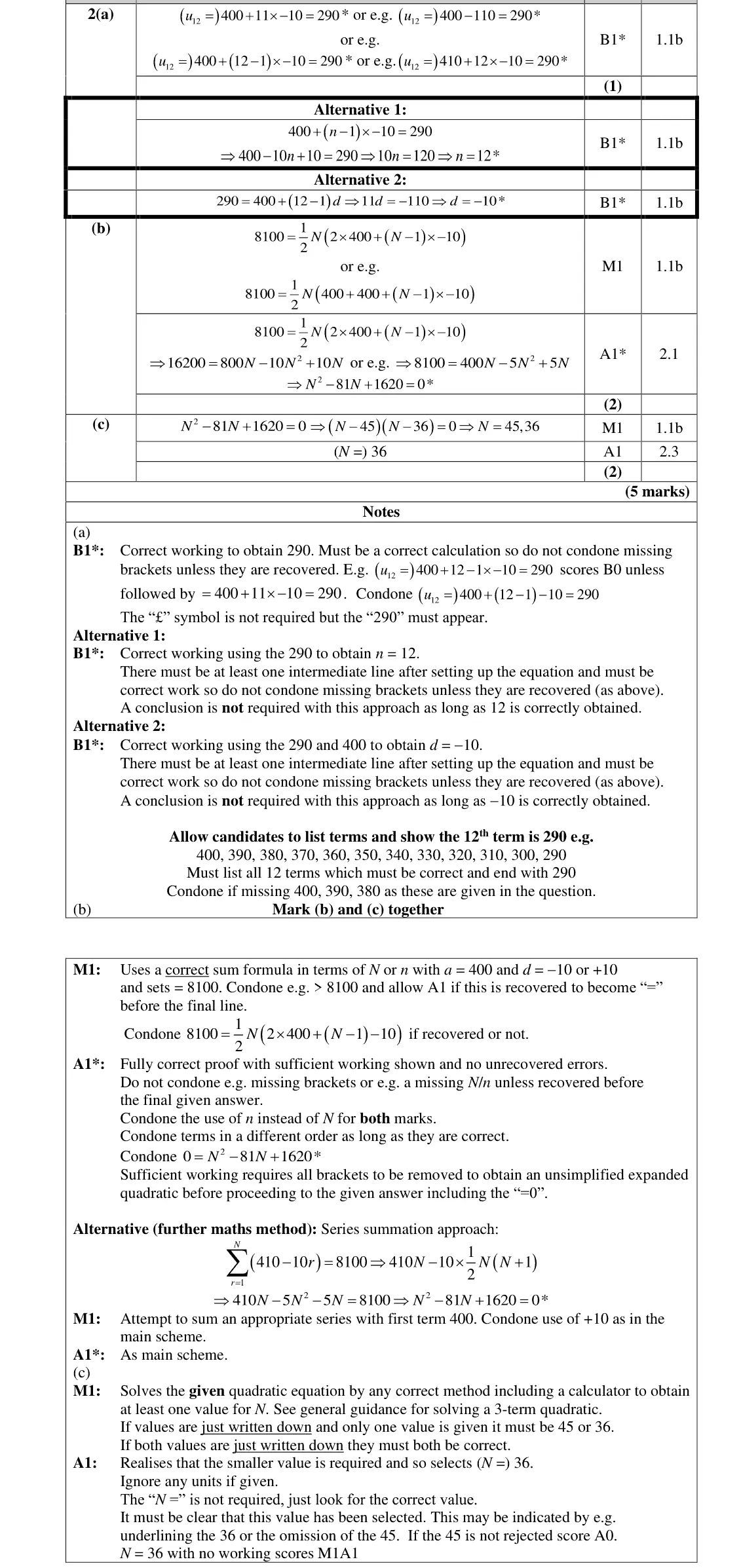
set S_N = ½N(800 + (N − 1)(−10)) equal to 8100 (not 0)
negative d causes sign slips
expand all brackets and include "= 0" in the given answer
June 2024 · Paper 2 · Q15(c)5 marks
Mark scheme (whole question; this part is marked with the orange bar)
Examiner's comment
This question provided a challenge to most candidates and was in general a good discriminator. Part (c) provided a challenge for many candidates and was a good discriminator. It is possible that some candidates were running out of time by this part of the paper, and this seemed to lead to simple algebraic and sign errors. However, many candidates were able to make at least some progress and most recognised the need to substitute the equation from part (b), which had been provided, into the equation from part (a). Most were able to expand to obtain a cubic in x albeit with frequent errors and slips, in particular a common error of cancelling the constant terms leading to a cubic with only three terms was often seen. The alternative elimination of x to lead to a cubic in y was rarely seen. Having obtained a cubic equation, many candidates made little creditworthy further progress and the majority seemed not to have made the link to earlier parts of the question and so did not attempt to take (x - 1) out as a factor of their cubic. This was perhaps understandable when the cubic was incorrect although it seemed that even candidates with the correct cubic did not consider using the fact that x = 1 was a root. Many candidates used their calculator to obtain the three roots of their cubic and others employed dubious techniques either attempting to find a ‘discriminant’ by ignoring the 3x term or attempting to take out a factor of x whilst ignoring the constant term. Those candidates who had a three-term cubic rather than a four-term cubic were unable to progress here. The final two marks of the paper were only accessible to those who were very secure in their algebraic accuracy and knowledge as these marks were contingent on both a correct cubic and a correct quadratic factor. Most candidates who met these criteria successfully used the discriminant to demonstrate that the quadratic had no roots although some used more elaborate reasoning involving the gradient of the cubic or the minimum point of the quadratic. Unfortunately, a significant proportion of candidates who got this far, did not manage to earn both marks because their justification or conclusion was insufficient, and it was sometimes disappointing to see otherwise well-answered solutions lose the final mark because they concluded with ‘no roots’ rather than also relating this back to the question to conclude that there could be ‘no further points of intersection’.
Common mistakes
substitute y = −2x + 2 into the curve: x³ − 3x² + 18x − 16 = 0 (constant term often lost)
use (x − 1) as a known factor: x² − 2x + 16
discriminant 4 − 64 < 0 so no other real roots
conclude "the normal does not meet C again"
calculator roots alone score no more
June 2023 · AS Paper 1 · Q15(b)5 marks
Mark scheme (whole question; this part is marked with the orange bar)
Examiner's comment
This question began with the familiar calculator warning which was unfortunately ignored by a significant proportion of candidates. As mentioned previously, candidates must be clear on what is allowed when these warnings are stated, or they risk losing a number or marks. In part (b), the vast majority of candidates achieved the cubic equation required by equating the two given equations and rearranging to set equal to 0, but a significant proportion ignored the guidance at the top of the question and proceeded to solve the question directly on their calculator, resulting in a maximum mark of 1 out of 5. For those that proceeded further, many used inspection to factorise the cubic using the given factor ( ) 1 x - , while others attempted algebraic division, generally very successfully, achieving the correct quadratic 2 4 6 x x - -. Occasionally, the rearrangements that candidates used resulted in a negative cubic, but despite making the division more challenging it was pleasing that candidates were still generally able to complete this part successfully. However, having arrived at a suitable quadratic, another significant proportion relied on their calculator to solve the resulting equation (set equal to 0) and forfeited the final two marks. For those that showed full working, many assumed that 0 k and chose the incorrect solution, despite often writing 0 k as their justification for rejecting (the correct) 2 10 - . As a result, there were very few candidates who achieved full marks for this question.
Common mistakes
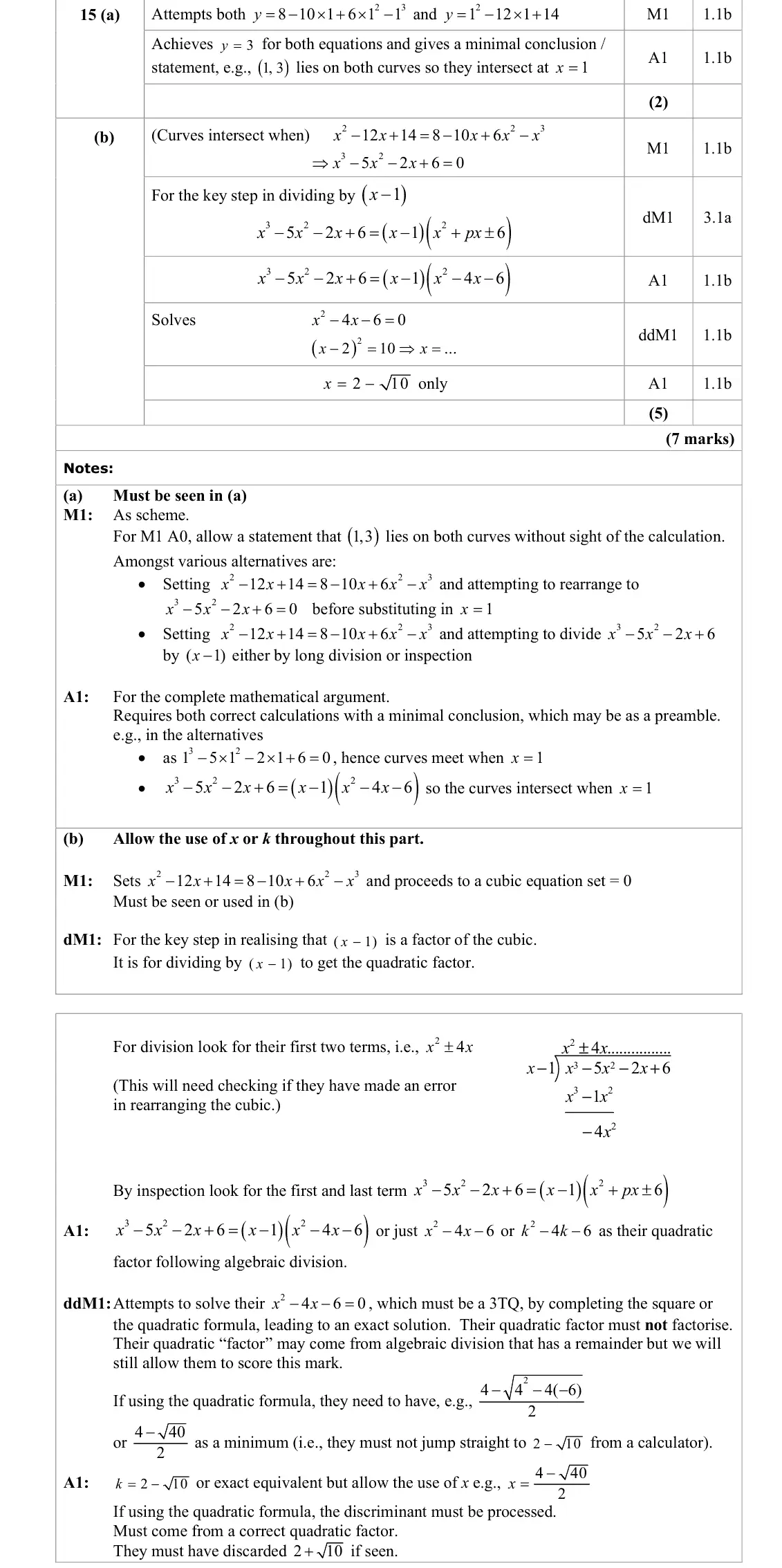
equate to get x³ − 5x² − 2x + 6 = 0
(x − 1) is a factor from (a): divide to get x² − 4x − 6
solve exactly by completing the square or formula, not calculator
k < 0 so k = 2 − √10 (2 + √10 is positive)
June 2023 · AS Paper 1 · Q17(b)4 marks
Mark scheme (whole question; this part is marked with the orange bar)
Examiner's comment
This was a relatively accessible proof question and gave candidates two opportunities to demonstrate their knowledge and understanding of proof. It was pleasing to see that the general standard of response to this proof question was good, and it is clear that candidates’ confidence in and experience of tackling proof questions has improved over recent sessions. Part (b) was more challenging and weaker candidates spent time here testing specific values for p and q, but in general it provided good access for the majority of candidates. Most candidates pursued general forms for p and q as consecutive even numbers and most of these chosen forms had merit (usually 2n and 2n + 2 but sometimes 2n + 2 and 2n + 4). Incorrect forms included n and n + 2 (without consideration of n as an even number), or sometimes n and m which were neither consecutive nor even. The issue of failing to recognise that q > p persisted into part (b) and a number of candidates lost marks for selecting p as the larger even number and subtracting the two terms the wrong way around. Expanding (2n + 2)3 also proved problematic for many candidates and so it was common for candidates to lose the accuracy marks. It was also common for poor subtraction to result in a cubic expression rather a quadratic which was even more costly in terms of marks. Unfortunately, many candidates failed to give even a minimal conclusion following impeccable algebra and so lost the final mark. Again, candidates should be reminded of the importance of a final statement in proof such as this.
Common mistakes
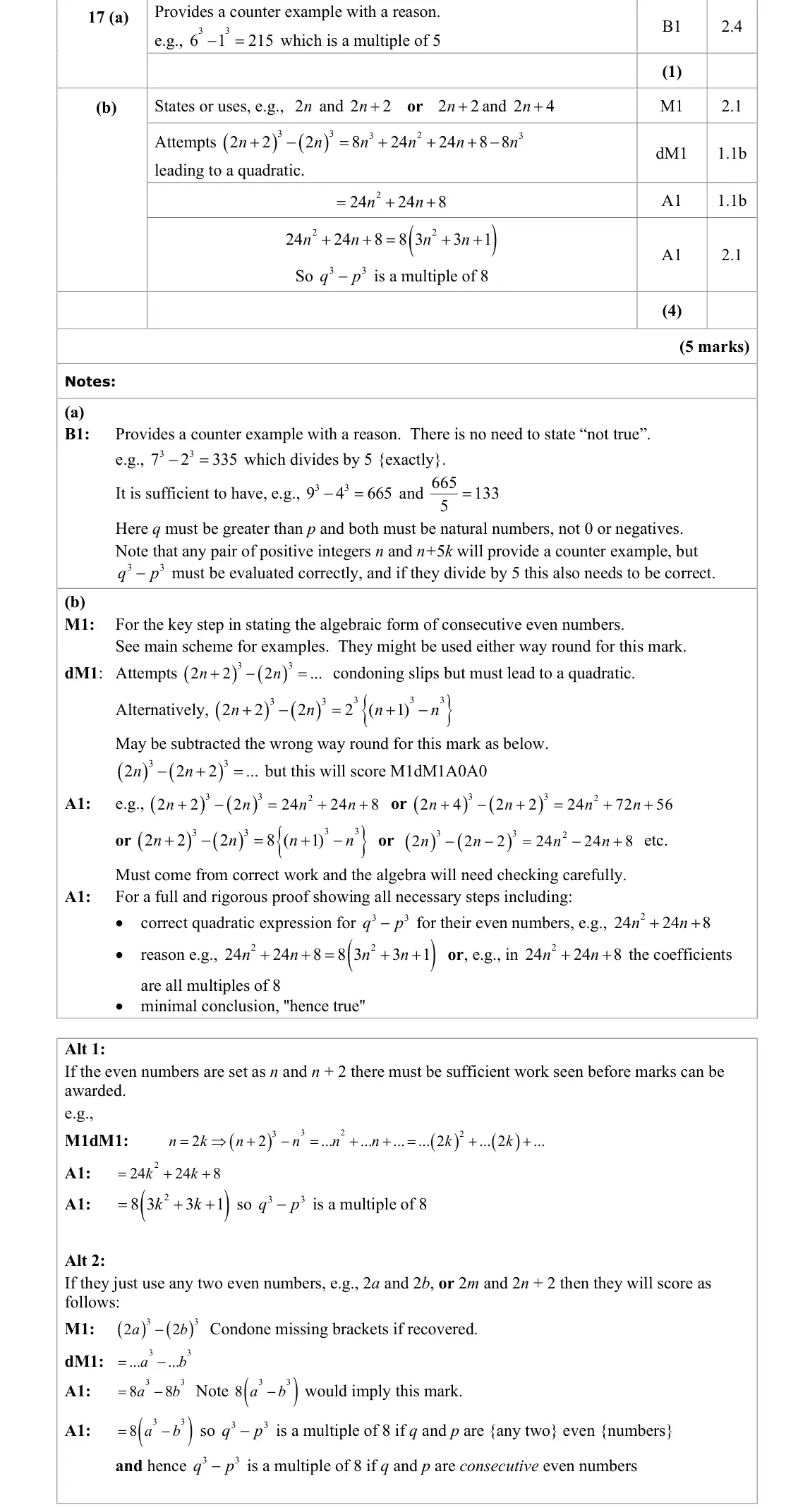
use 2n and 2n + 2 (n and n + 2 are not necessarily even)
q is the larger so (2n + 2)³ − (2n)³ = 24n² + 24n + 8 = 8(3n² + 3n + 1)
expansion errors
final conclusion statement needed
June 2023 · Paper 1 · Q14 marks
Mark scheme (whole question; this part is marked with the orange bar)
Examiner's comment
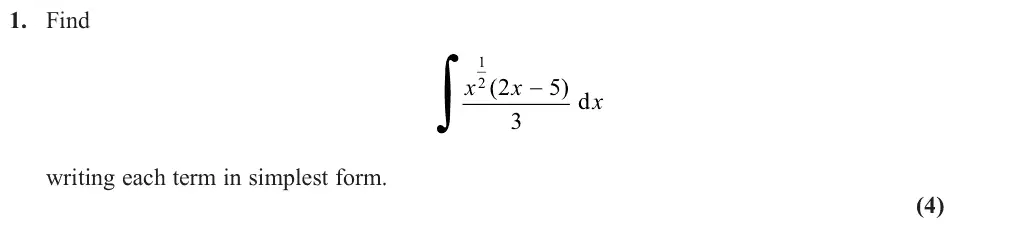
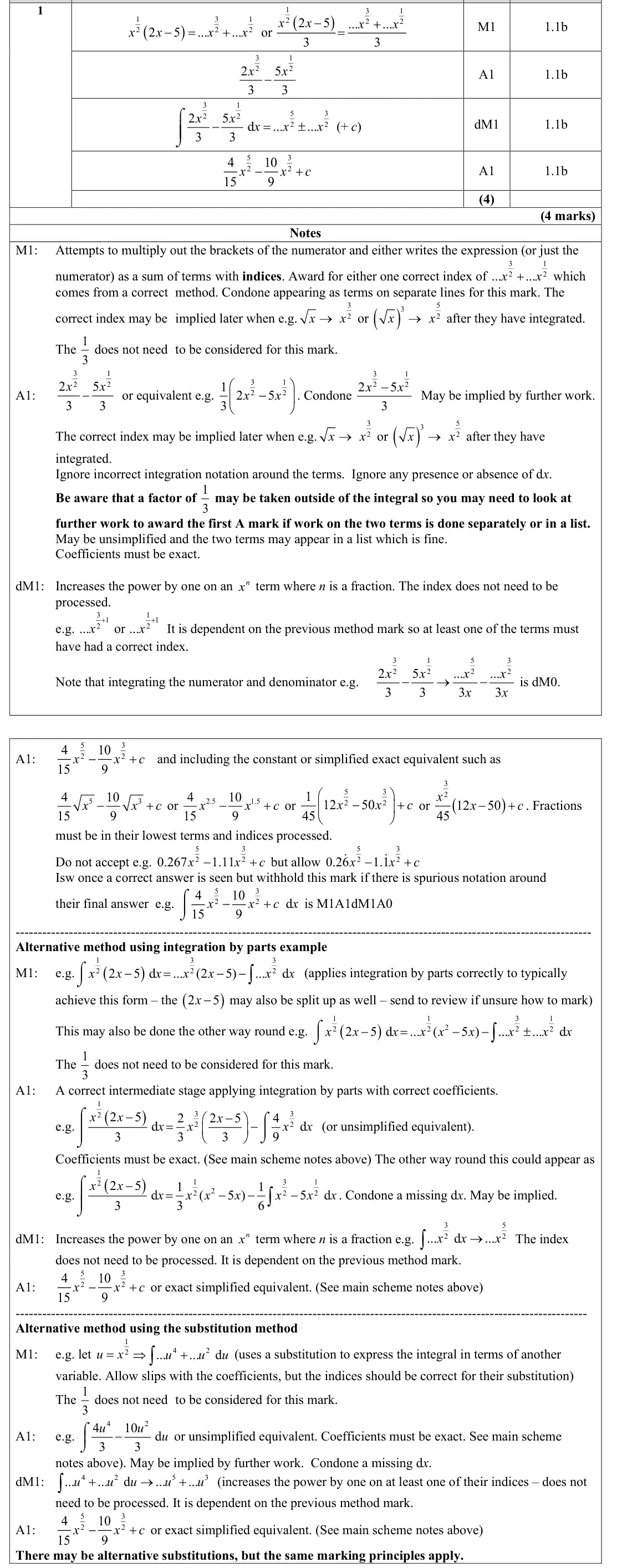
This was an accessible question for virtually all candidates. The fractional index had already been given to avoid any misconceptions. However, for the first question on the exam paper, this was frequently done poorly compared to previous years. Candidates may have anticipated a tougher start to the paper and wanted to demonstrate one of the more advanced integration techniques. Candidates who spotted that you needed to expand the brackets usually went on to score full marks. The most common reason for losing the final answer mark was forgetting the constant of integration. Many candidates failed to notice the simpler method in the main mark scheme and instead attempted to use integration by parts, with either part taken as u. If a candidate chose to set 2 5 u x = -, they did not always expand the brackets in their integration formula to achieve a form which was ready to integrate where the indices had been combined correctly. Candidates who set 1 2 u x = were more successful, as there was less working to do to allow access to the marks. Candidates who chose to do integration by parts did not always combine the terms in their answer, losing the final mark. Many candidates would divide both their u and 'v by 3, leading to final answers that were 1 3 as large as they should have been. Integration by substitution was occasionally seen, but rarely successfully completed. Most attempts involved setting 2 5 u x = -, and this resulted in a tougher integral that required further work; candidates rarely progressed to a point which would have been worthy of a mark. Across the various methods, a common error seen was initially to factorise out the 1 3 , work through the solution without it, but then to forget to reintroduce it. This error meant that neither of the two accuracy marks were available.
Common mistakes
multiply out first, then integrate term by term (by parts or substitution is much harder and rarely successful)
integrating numerator and denominator separately scores nothing
forgetting + c
taking out the 1/3 and not putting it back
June 2023 · Paper 1 · Q2(a)2 marks
Mark scheme (whole question; this part is marked with the orange bar)
Examiner's comment
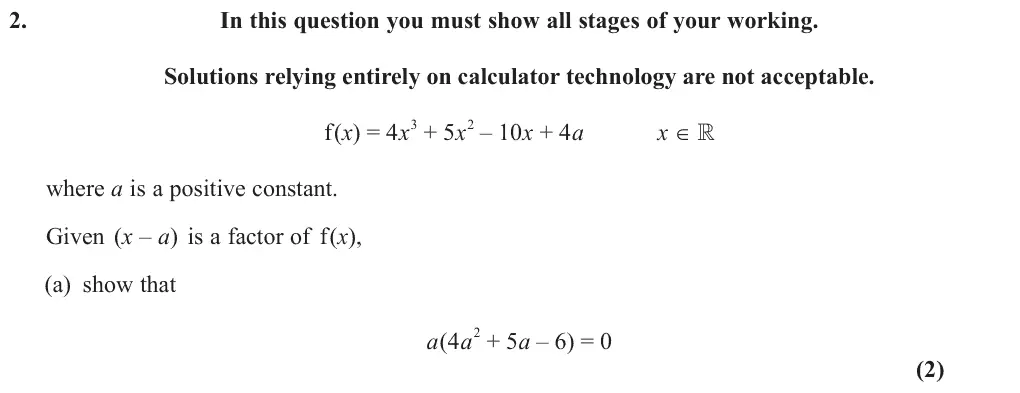
This question was accessible and generally well answered, with a large number of candidates gaining full marks with concise solutions. Some, however, did not pay heed to the instruction to show all stages of their working. The vast majority of candidates correctly identified that part (a) related to an application of the factor theorem, substituted in a and were able to reach the required result. However, many lost marks for not including " = 0" until the final line. In a small number of cases, " = 0" was omitted completely and, in these cases, candidates were awarded no marks. Amongst the unsuccessful candidates, the majority had attempted algebraic long division using ( ) x a - or carried out an attempt at factorisation via inspection, but had often abandoned their attempts, presumably unsure of how this would lead to the required result. Very few successfully attempted long division and set the remainder equal to 0. Factorisation using inspection then solving two simultaneous equations by equating like terms was rarely seen as a method.
Common mistakes
f(a) = 0 must be seen, with "= 0" written before the given answer
long division/inspection is harder
June 2023 · Paper 1 · Q2(b)4 marks
Mark scheme (whole question; this part is marked with the orange bar)
Examiner's comment
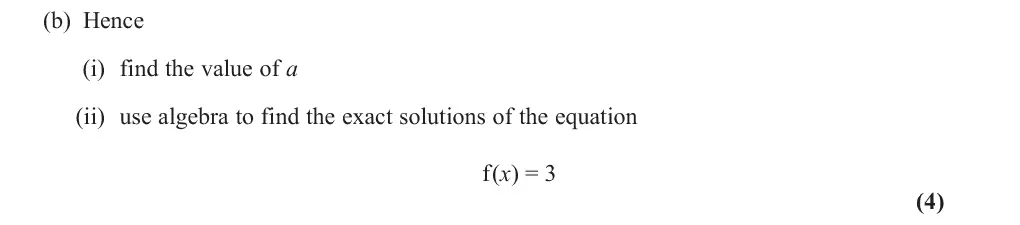
This question was accessible and generally well answered, with a large number of candidates gaining full marks with concise solutions. Some, however, did not pay heed to the instruction to show all stages of their working. In part (b)(i), most candidates had no problems solving the cubic, getting the values 0, 3 4 and 2 - for a. However, many did not take note of the fact that a was positive, and that the question asked for the value of a, so lost the mark for not rejecting 𝑎= 0 and 𝑎= -2. There was confusion as to the reasons for rejecting values. Some thought that a had to be an integer so rejected 3 4 . Some chose 2 - as their solution giving spurious reasons such as “a is a real number.” Of those who did not identify 3 4 a = as the only valid answer, many recovered by opting to use only 3 4 a = in part (b)(ii). Part (b)(ii) was well done by those who showed every step of their working, but some failed to reject the values of a that were not needed. Once the cubic was obtained by substituting 3 4 a = and setting f( ) 3 x = , those who solved the cubic without factorising to 2 (4 5 10) x x x + - lost the final A mark. Candidates were asked to show all stages of their working and not proceeding as far as the quadratic factor was penalised. Many gave the exact solutions followed by rounded decimal solutions, or even just the decimal solutions, so were not paying heed to the question asking for exact solutions. There were some who were unable to solve the cubic or the quadratic, having taken out a factor x outside the brackets. These were mainly cases where they tried to complete the square or their value for a meant that they could make no further progress. Some did not collect terms on one side with 0 on the other side, and having taken out a factor of x, solved their quadratic ignoring the constant on the other side. The solution 𝑥= 0 was omitted by many candidates due to division by x instead of using factorisation. Others rejected this particular solution, if it was found, possibly confusing the restriction that a was positive rather than x. Those who did reach the correct quadratic factor were usually successful in finding the two exact roots for the A1 mark. A common incorrect approach was to find f(3) rather than setting f( ) 3 x = . This approach gained no credit.
Common mistakes
must reject a = 0 and a = −2 (a is positive)
set f(x) = 3, not find f(3)
take out the factor x to see the quadratic factor (dividing by x loses x = 0)
exact roots, not decimals
June 2023 · Paper 1 · Q6(b)2 marks
Mark scheme (whole question; this part is marked with the orange bar)
Examiner's comment
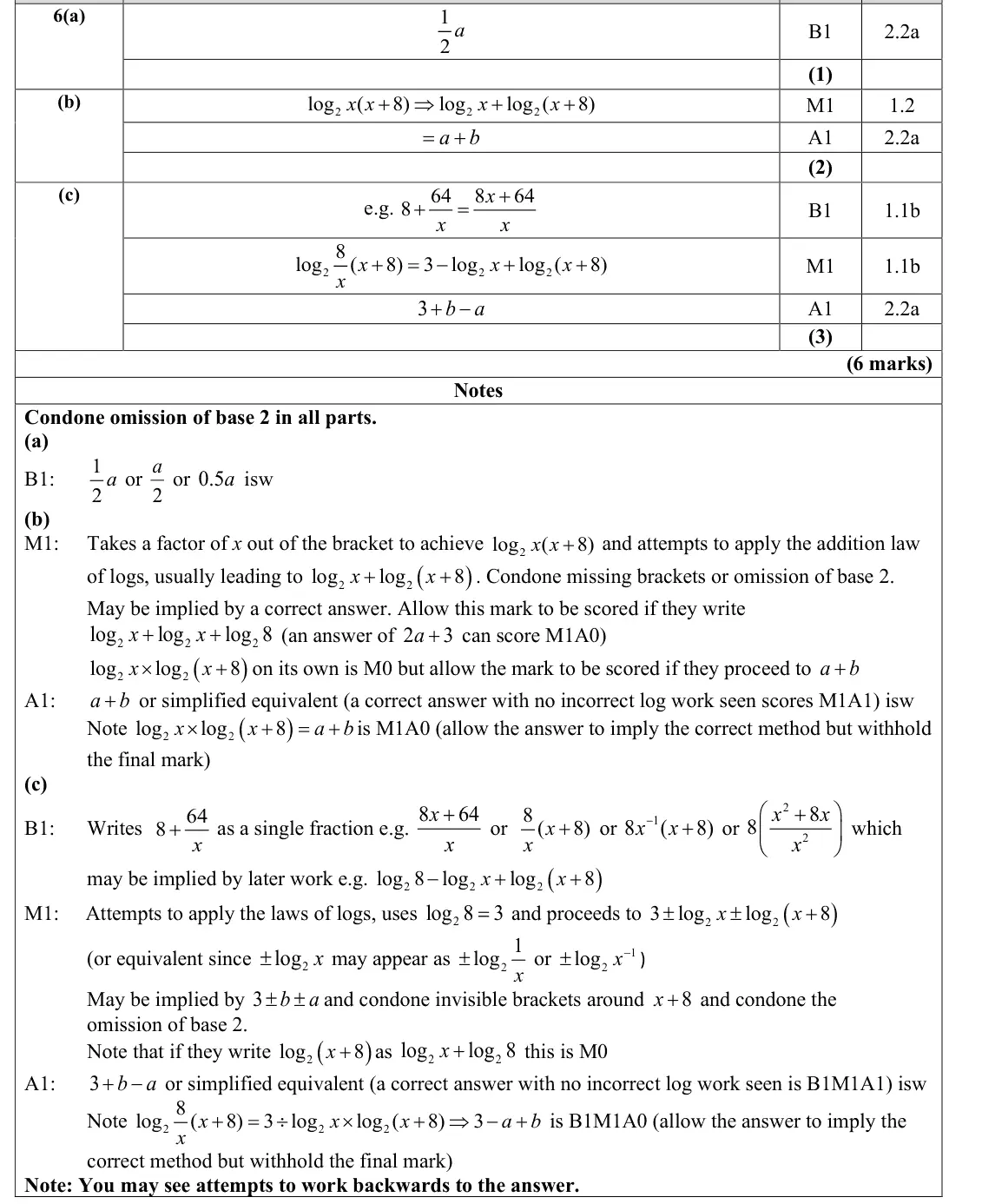
This was again another accessible question with a total of 6 marks split between 3 different sub-parts. However, this topic continues to be one which candidates struggle with and in all parts of this question. It was not uncommon to see candidates attempting to use rules of indices rather than logarithms, starting off with 2a x = , 2 8 b x = + and attempting (usually incorrectly) to substitute these into the expressions given. Where this was successful candidates generally failed to remove 2 log 2 resulting in them losing one mark per part. Part (b) surprisingly seemed to have more success. It was generally answered well with most candidates realising that factorising the argument of the logarithm was needed before applying the addition law of logarithms. There were several candidates who, having factorised correctly, applied the addition law incorrectly, resulting in an answer of a b and so lost both marks. Several candidates just wrote down the correct answer and gained both marks. If the correct answer followed the product of the relevant logs, ( ) ( ) log log 8 x x + rather than the sum, then the answer was allowed to imply the correct method, but the final mark was withheld for this incorrect working seen. The main misconception was the sight of 2 log log8 x x + which was awarded no marks, although writing log log log log8 x x + + + (possibly seen as 2 3 a + ) gained the method mark as evidence of correct addition law used at some point. Some candidates attempted to work backwards from the given log expressions for a and b with very limited success.
Common mistakes
factorise x² + 8x = x(x + 8) first
log₂x × log₂(x + 8) is not the addition law
June 2023 · Paper 1 · Q6(c)3 marks
Mark scheme (whole question; this part is marked with the orange bar)
Examiner's comment
This was again another accessible question with a total of 6 marks split between 3 different sub-parts. However, this topic continues to be one which candidates struggle with and in all parts of this question. It was not uncommon to see candidates attempting to use rules of indices rather than logarithms, starting off with 2a x = , 2 8 b x = + and attempting (usually incorrectly) to substitute these into the expressions given. Where this was successful candidates generally failed to remove 2 log 2 resulting in them losing one mark per part. Part (c) was the most challenging part of this question and clearly identified the stronger mathematicians of the cohort. Many responses to this part were blank, whilst the more able candidates provided very succinct solutions. For those who attempted with less success there were some rather dubious attempts at writing 64 8 x + as a single fraction. Of those who managed this correctly and progressed to applying the laws of logarithms, quite a few left in the 2 log 8 rather than simplifying to its value of 3, which meant that only the first mark was available: marks had already been awarded for the power law and addition law in previous parts of the question and here we required an understanding of reaching an answer in its simplest form. This further demonstrated the lack of logarithmic fluency for a number of candidates. Others factorised 8 from 64 8 x + but then struggled to apply the laws appropriately as they had not completed the process of writing the argument as a single fraction. Misconceptions were seen such as expressing 64 log 8 x + as 64 log8 log x + and sign errors often occurred.
Common mistakes
write 8 + 64/x as one fraction (8/x)(x + 8)
log₂8 = 3
log₂(x + 8) ≠ log₂x + log₂8
June 2023 · Paper 1 · Q9(a)2 marks
Mark scheme (whole question; this part is marked with the orange bar)
Examiner's comment
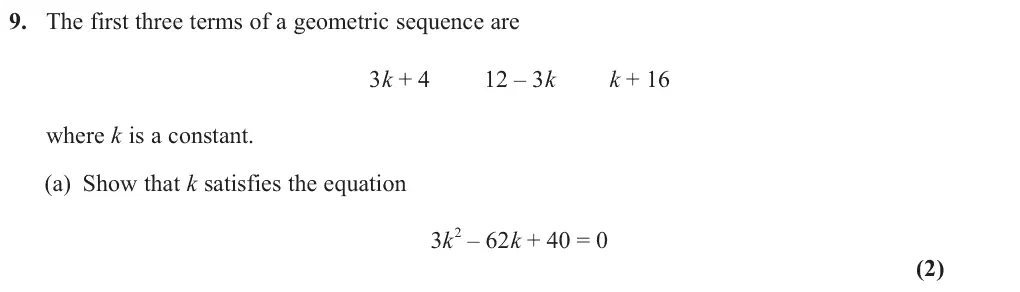
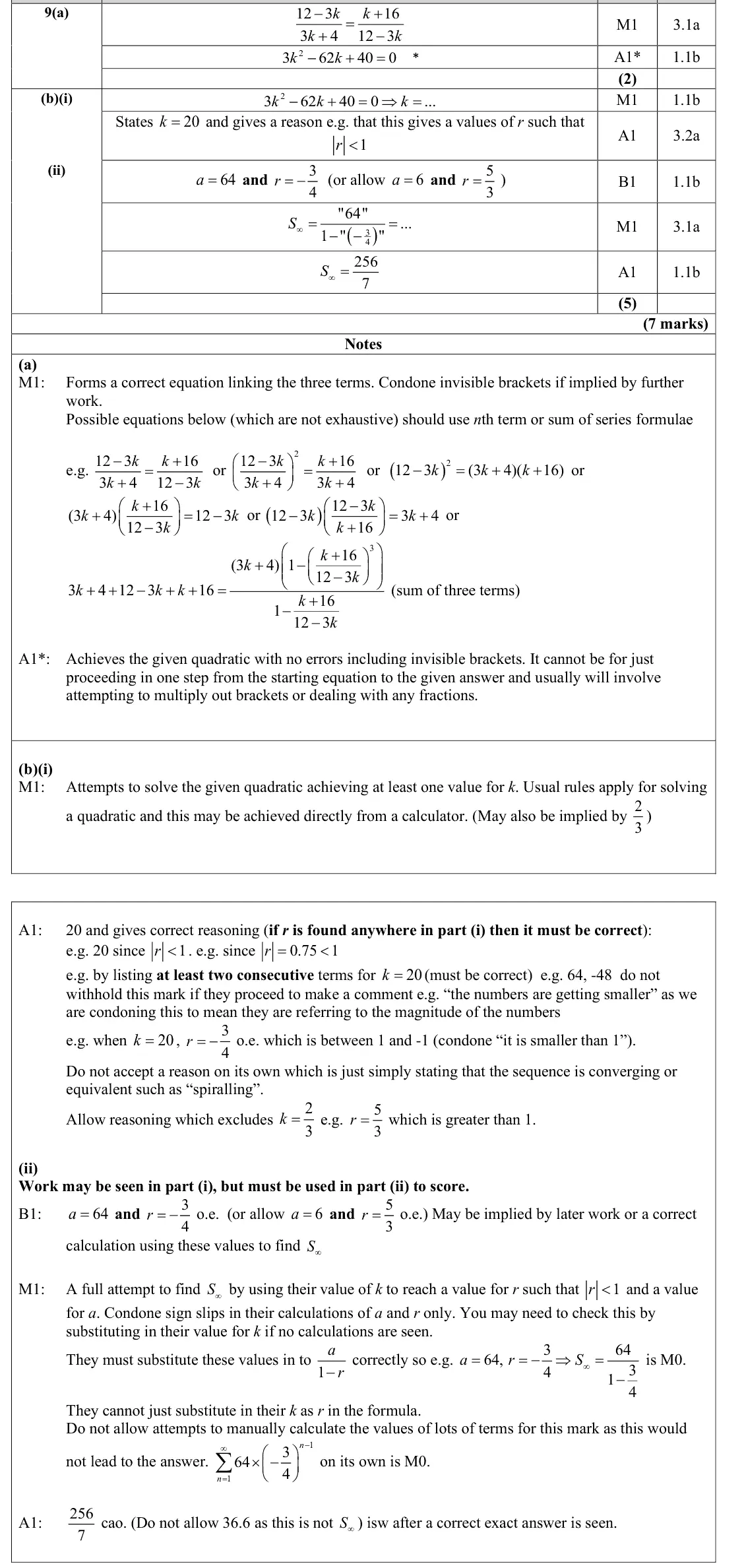
This was a more demanding than expected question on geometric sequences with a number of candidates getting confused with the value of k and the subsequent values of a and r required for the question. There was still access to later parts as the quadratic in k was given such that part (b) and part (c) could be attempted without part (a). Most candidates were able to score full marks in part (a) by correctly giving an equation in k, almost always 12 3 16 3 4 12 3 k k k k - + = + - and proceeding to the given quadratic with no errors seen. A noticeable number of candidates failed to gain the final mark as they gave a 40 - term in their quadratic. Given that this was a printed answer, it was disappointing that candidates did not identify their error and correct it. Some candidates wrote down a correct expression for r but failed to create an equation, whilst a few candidates formed an equation for the sum of three terms, but invariably failed to expand and simplify correctly. There were several valid but more complicated efforts such as expressing the third term as the first term multiplied by the square of the ratio. This was more likely to result in errors and there were a significant number who did not know where to start. The common mistake where they could not set up an equation in r was to look for a common difference as if it was an arithmetic sequence.
Common mistakes
equate the common ratios (or use u₂² = u₁u₃)
not a common difference
June 2023 · Paper 1 · Q144 marks
Mark scheme (whole question; this part is marked with the orange bar)
Examiner's comment
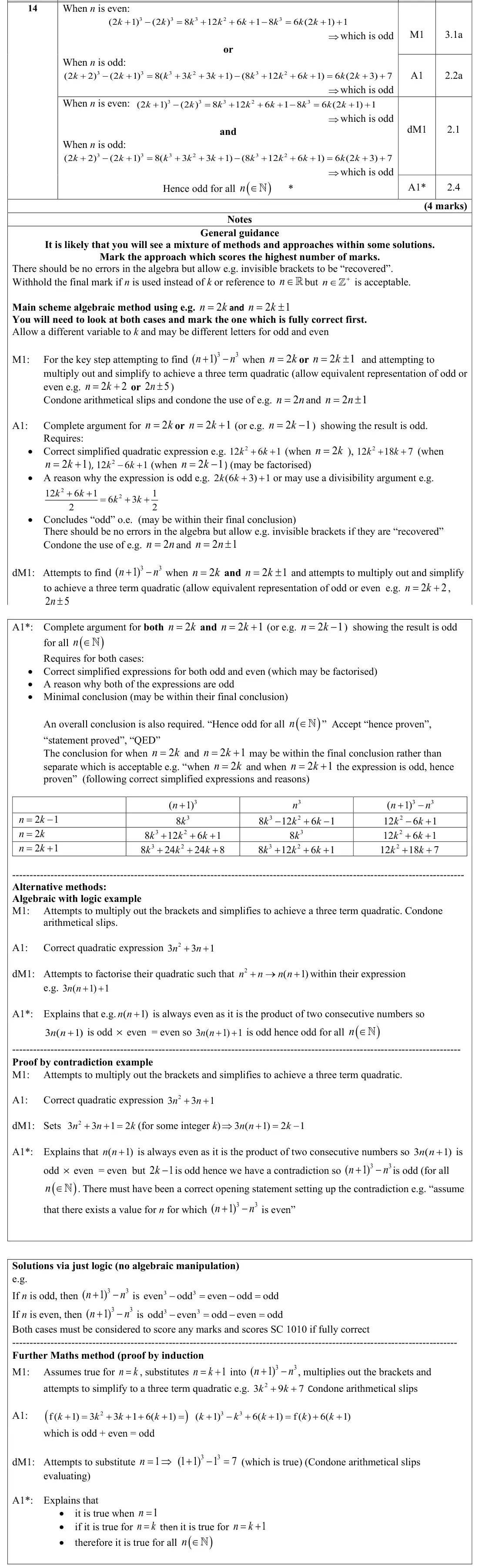
Candidates were required to prove the statement: 3 3 ( 1) n n + - is odd for all natural numbers, n. This was similar to some of the proof questions that have been on previous papers, so it was pleasing to see the majority of candidates were able to make more progress on this type of question this time. A large number of candidates tried to start correctly by substituting 2 n k = and 2 1 n k = + (or 2 1 n k = -) for even and odd numbers; this was the most likely method to achieve full marks. Candidates would often produced the correct expressions which were written in the form 2(......)+1 and then conclude appropriately. The final mark was often lost in many of the complete attempts as at least one element of the proof was either missing or had errors. Some candidates only proved one case (odd or even only) and some candidates did not include an overall conclusion, which was necessary for the final mark. Most common errors seen in expansions were from 3 3 (2 ) 2 k k = and this often led to candidates achieving a cubic expression rather than a quadratic. Some used 2n and 2 1 n + which was penalised by losing the final mark. Errors in expanding and simplifying the algebra were common: expanding triple brackets was the most common approach, although the binomial expansion was also seen, on occasion. The other common approach was from an attempt of algebra with logic. It was common to see candidates expand and simplify the expression to achieve a three-term quadratic but only a few went on to factorise their quadratic as required, and even fewer explained the logic for why ( 1) n n + was even correctly. A significant number of candidates tried to expand and simplify the given expression and usually achieved 2 3 3 1 n n + + scoring the first 2 marks, but very few got beyond this without making any logical arguments at all or did not factorise the expression. e.g. 3 ( 1) 1 n n + + which gained 3 marks. Success was also seen when the given expression was expanded and simplified to 2 3 3 1 n n + + and then candidates substituted 2 n k = and 2 1 n k = + to much the same result as the main method seen in the mark scheme. A number of candidates tried proof by contradiction, but these almost all fell into being marked either from the main scheme or by an expanding and factorising attempt. Whilst the question did require candidates to use algebra, credit was given for those candidates who did just try to apply logic with a maximum score of 2 marks. It was pleasing, however, to see that most candidates had appreciated the demand of the question and attempted some manipulation. A few candidates tried the Further Maths Method “proof by induction”, but most could not complete the proof correctly.
Common mistakes
consider n even (n = 2k) and n odd (n = 2k + 1) and conclude for all n, or show 3n(n + 1) + 1 with n(n + 1) even
June 2023 · Paper 2 · Q3(a)3 marks
Mark scheme (whole question; this part is marked with the orange bar)
Examiner's comment
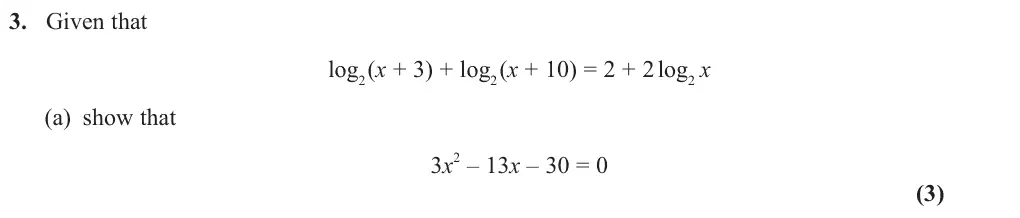
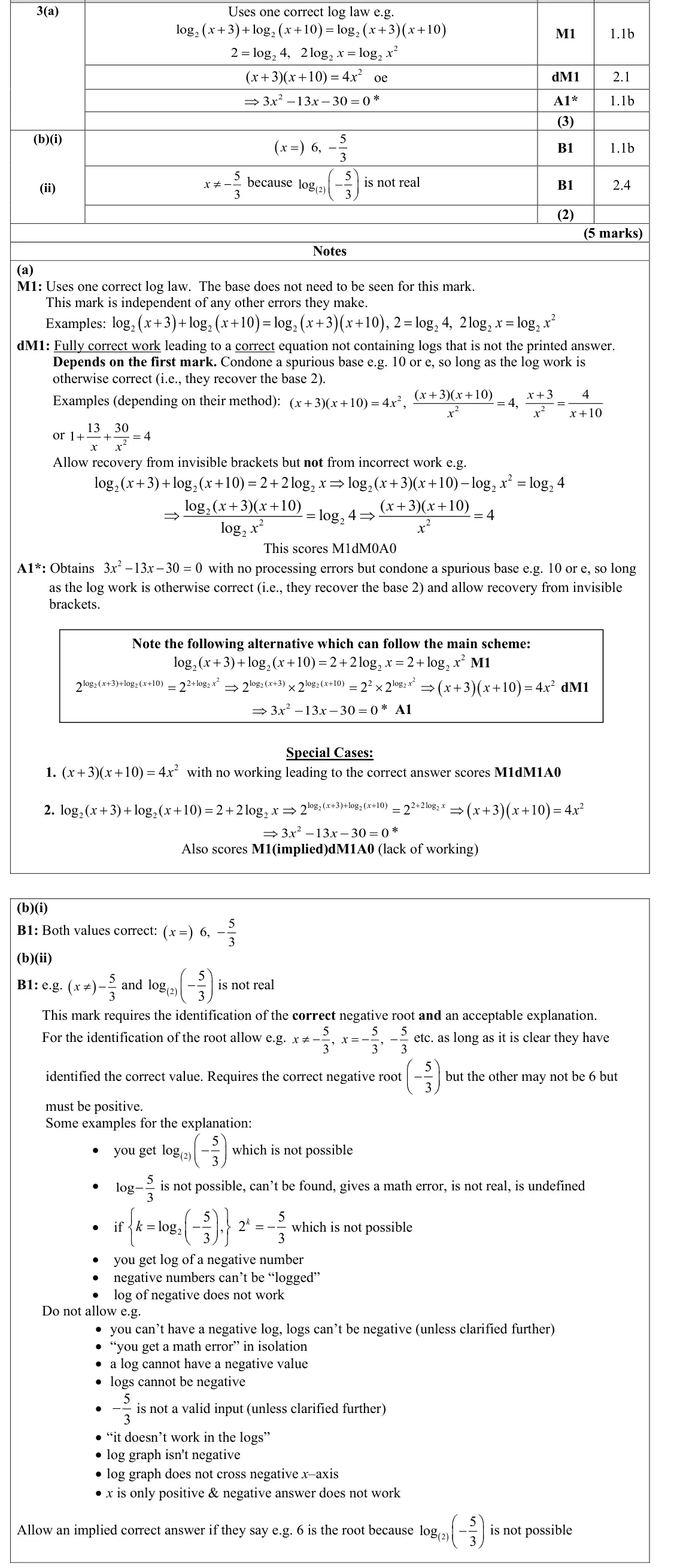
There were very few non-attempts or zero scores here and this question proved to be a good discriminator with a spread of marks achieved by candidates. Most students managed to score at least one mark out of three in part (a) by correctly applying a single log law, usually the product, division or power rules for logs. Dealing with the constant, 2, proved to be more challenging for many. Those who wrote 2 as log2(4) and then applied the product rule for logs on the right- hand-side had most success. Others grouped the three log terms and applied the exponential rule to eliminate the logs. Sometimes there was a lot of working which wasn’t always set out as clearly as it could have been. A significant proportion of candidates did succeed, but it was not uncommon to see correct use of a log law followed by incorrect log work in an attempt to fudge the printed result. Some poor responses involved an initial ‘cancelling’ of logs before any attempt to combine log terms or to raise both sides to the base 2 correctly. There was a minority of candidates who perhaps knew how to proceed but did not show sufficient working to gain full marks in a ‘show that’ question. Candidates should be reminded that all steps should be shown in this type of question. It was a shame when fully correct log work was followed by an incomplete ‘equation’ at the end of this part, as missing the ‘= 0’ meant the loss of the final mark here. A small number of candidates who were unsure how to start part (a) used the printed answer and tried to “work backwards” but often made errors leading to incorrect solutions.
Common mistakes
write 2 as log₂4 and 2log₂x as log₂x², combine to (x + 3)(x + 10) = 4x²
"cancelling" logs before combining
dividing logs (log A / log B) is wrong
show enough steps for a given answer
June 2022 · AS Paper 1 · Q2(a)2 marks
Mark scheme (whole question; this part is marked with the orange bar)
Examiner's comment
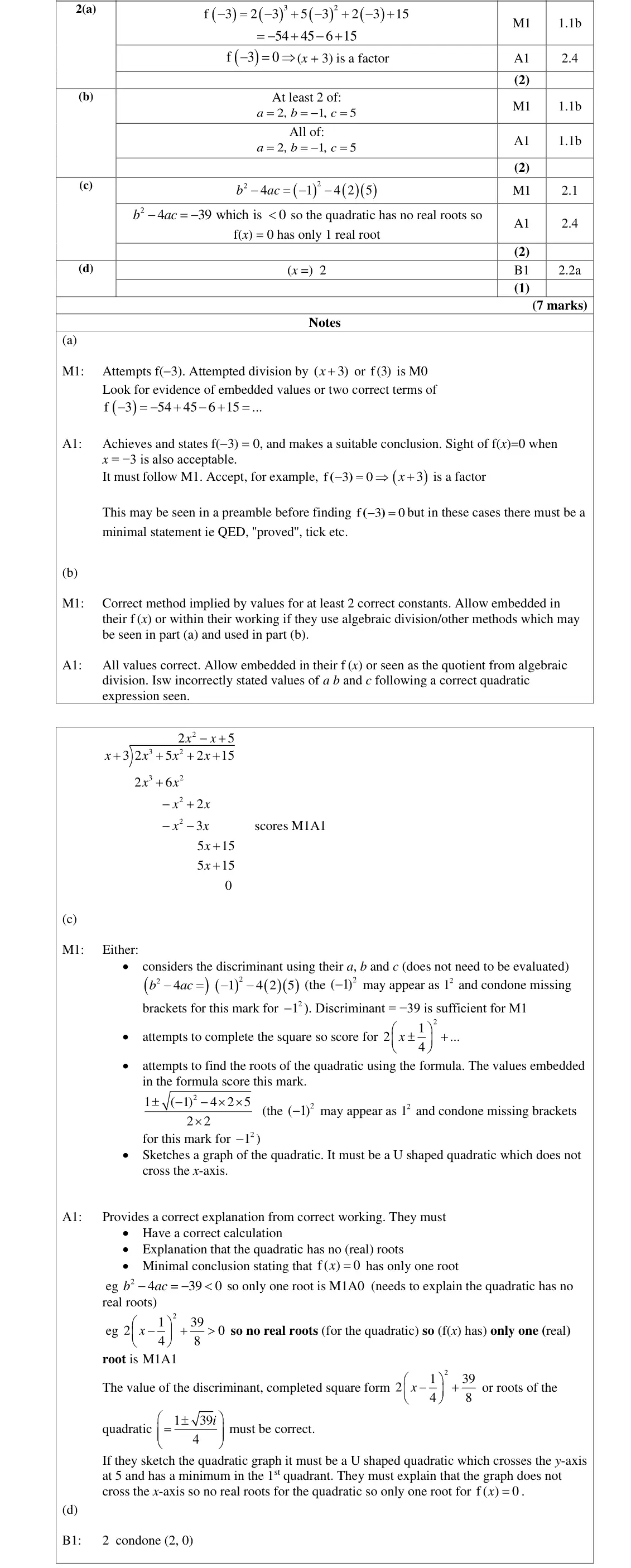
This question proved to be a successful question for many candidates with many being able to score most of the marks. In part (a) the most common error here was to omit f( 3) 0 - = in their response losing the A mark. A minority of candidates failed to use the Factor Theorem required and proceeded to do algebraic long division which did not score any marks. A number of candidates used incorrect language such as stating that (x+3) was a root of f(x).
Common mistakes
evaluate f(−3) and state f(−3) = 0 with a conclusion
f(3) or long division scores M0
(x + 3) is a factor, not a root
June 2022 · AS Paper 1 · Q2(b)2 marks
Mark scheme (whole question; this part is marked with the orange bar)
Examiner's comment
This question proved to be a successful question for many candidates with many being able to score most of the marks. In part (b) the vast majority scored full marks here using division very successfully. If candidates had done algebraic division in part (a), then as long as they used this result in part (b) then they were able to score still for this earlier work. 4
Common mistakes
a = 2, b = −1, c = 5 by division or comparing coefficients
June 2022 · AS Paper 1 · Q2(c)2 marks
Mark scheme (whole question; this part is marked with the orange bar)
Examiner's comment
This question proved to be a successful question for many candidates with many being able to score most of the marks. In part (c), the majority of candidates understood the idea of using the discriminant to prove the quadratic part had no solutions. Most were able to correctly evaluate the discriminant correctly although some achieved a value of 41 - instead. With many responses, they often lacked a convincing conclusion clearly stating that as the quadratic had no solutions then f( ) 0 x = has only one solution. Many just stated that the quadratic had no real roots or just showed the discriminant was negative and so only one root. Some incorrectly stated (x+3) as the real root. A few candidates chose to use the quadratic formula and show two imaginary roots and one real root. These candidates were often successful, but some just embedded the values into the quadratic formula and stated “math error” for example which was not sufficient explanation.
Common mistakes
discriminant (−1)² − 4(2)(5) = −39 < 0 so the quadratic factor has no real roots, so f(x) = 0 has only one real root
both statements needed (−39 < 0 alone is not enough)
−41 is a common slip
"math error" is not an explanation
June 2022 · AS Paper 1 · Q2(d)1 mark
Mark scheme (whole question; this part is marked with the orange bar)
Examiner's comment
This question proved to be a successful question for many candidates with many being able to score most of the marks. Part (d) was poorly answered if it was attempted at all. The most common wrong answers seen were 8, 5, 2 - and 400 whilst the correct answer was rarely seen showing poor understanding of the question.
Common mistakes
f(x − 5) is a translation 5 to the right, so the root −3 moves to 2
poorly answered (8, 5, −2 common wrong answers)
June 2022 · AS Paper 1 · Q7(a)2 marks
Mark scheme (whole question; this part is marked with the orange bar)
Examiner's comment
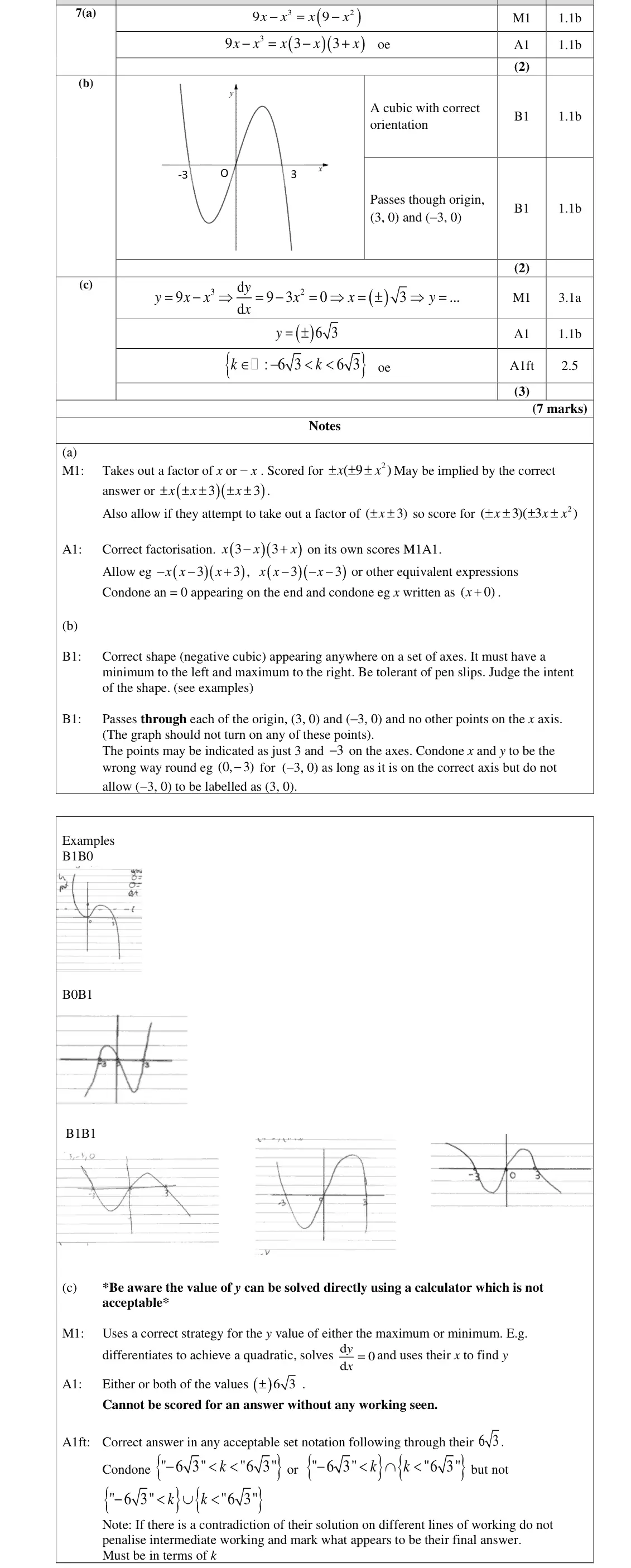
Generally, candidates scored well in the first two parts of this question, by factorising the cubic expression and drawing a graph. The final part, however, where the candidates were required to find a range, was very poorly answered, with few gaining any marks and very few reaching the correct final answer. In part (a) almost all candidates successfully identified the factor of x and were able to take this factor out of the expression correctly. Many candidates were confused by the negative 3x term and it was common to see sign errors in their final answer ( 3)( 3) x x x + - was a common incorrect answer, possibly made after using the equation solver on the calculator to find the roots 3 and 3 -. Time permitting, candidates should be reminded to check that their factorisation is correct by expanding the result. 7
Common mistakes
take out the factor x then use the difference of two squares: x(3 − x)(3 + x)
sign errors such as x(x + 3)(x − 3)
check by expanding
June 2022 · AS Paper 1 · Q12(a)4 marks
Mark scheme (whole question; this part is marked with the orange bar)
Examiner's comment
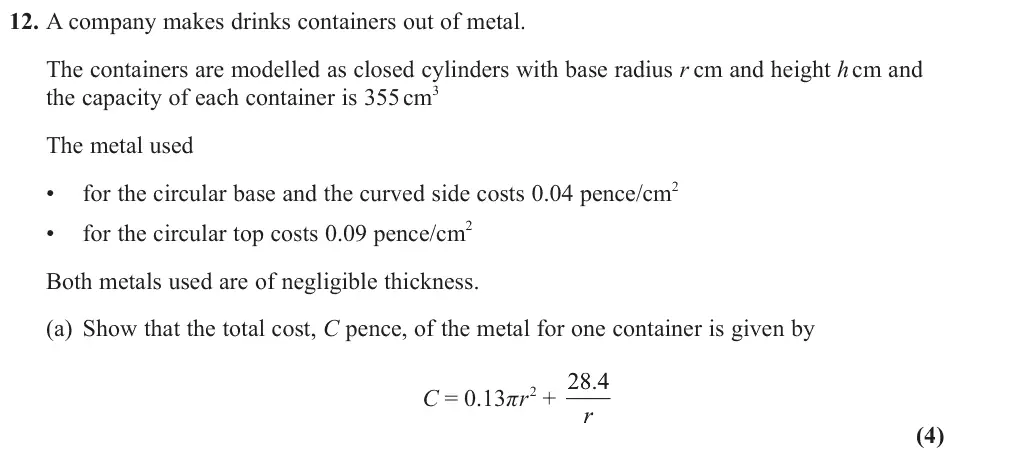
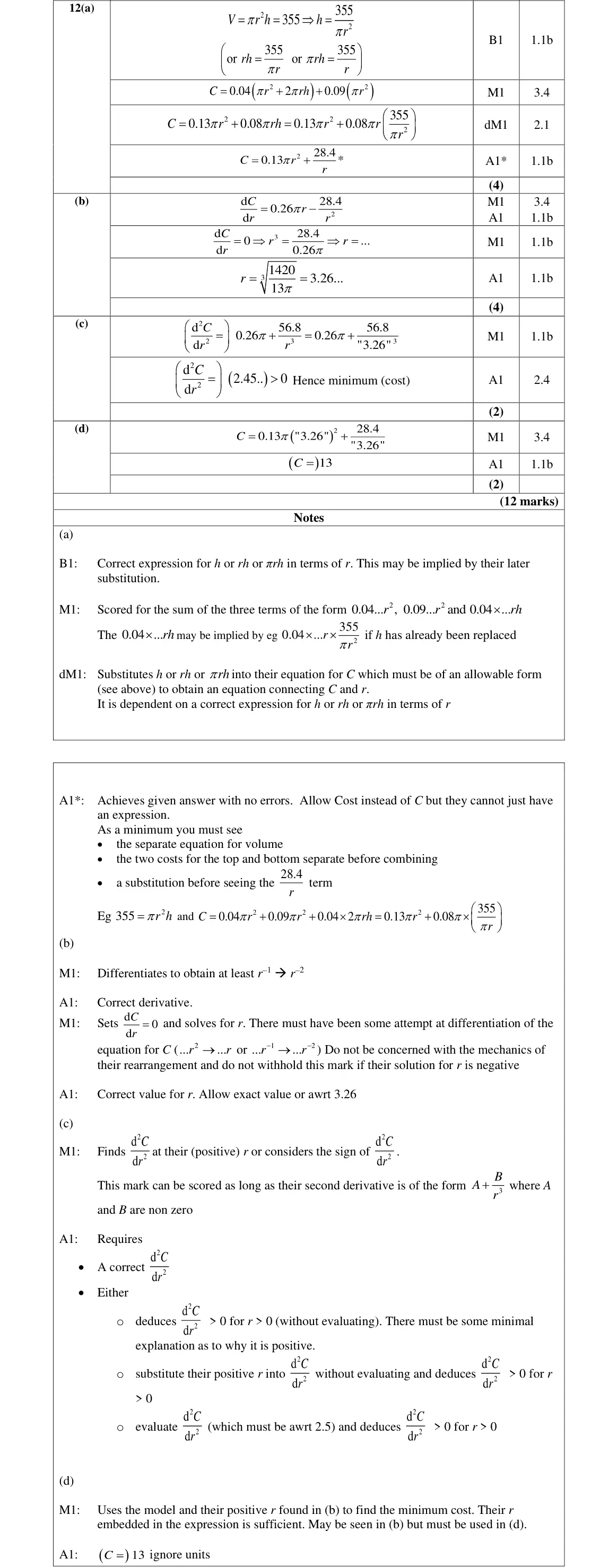
10 This was one of the most challenging questions on the paper for candidates, although it was a familiar structure to this type of problem and there was access to later parts as part (a) was a “show” question. Many candidates struggled with part (a). A few were able to gain the first B mark or make an attempt to sum the areas of the component parts, but many were unsure what to do with the 0.04 and 0.09. A significant number equated these to the expressions for area. Better candidates were able to clearly identify the two circular ends and the curved surface, attaching the correct costing to each and eliminating the h. The small minority of candidates then scored 3/4 as they omitted to use C = or Cost = . Although the answer was given for part (a) numerous candidates made no attempts in the later parts or failed to differentiate part (b) and so made no progress with part (c) or part (d).
Common mistakes
πr²h = 355 gives h
C = 0.04(πr² + 2πrh) + 0.09πr²
substitute for h and simplify
show the volume equation, the separate top and bottom costs and the substitution
write C =
June 2022 · AS Paper 1 · Q13(a)3 marks
Mark scheme (whole question; this part is marked with the orange bar)
Examiner's comment
There were a number of completely blank responses to both parts of this question. This was either due to timing on the paper or possibly due to this topic not having been covered in sufficient depth due to disruption to learning. In part (a), most of the attempts started with the LHS. Many scored no marks at all but quite a few combined terms with a common denominator to achieve the first mark, usually 1 sin cos + . However, very few progressed from this with many using "identities" such as 1 sin cos + and cos 1 sin - to get to the RHS. Candidates should avoid approaches to this type of problem involving an identity where it is treated as an equation where possible.
Common mistakes
common denominator (1 + sin θ)/cos θ, multiply by (1 − sin θ) and use cos²θ = 1 − sin²θ (difference of two squares)
do not treat the identity as an equation or invent identities
notation sin θ not "sin", sin²θ not sin θ²
June 2022 · AS Paper 1 · Q14(ii)3 marks
Mark scheme (whole question; this part is marked with the orange bar)
Examiner's comment
This question was poorly answered by the vast majority of candidates, although its position on the paper reflected that this topic is still a challenge to many. x = x = , taking no account In part (a), many candidates focussed inappropriately on and 9 3 of the > signs in the question. For those choosing to correctly look for counter examples, a - 2 lack of brackets (e.g. ) meant their work was inaccurate and they did not score the mark, 4 x or they did not give an acceptable conclusion. Several candidates only considered and 3 it was surprising how many candidates concluded the statement was true as a result. Finally, some candidates misinterpreted the syntax of the question, resulting in answers like "sometimes true", which gained no credit, even though they had recognised the values required to find a counter example. In part (b), the few candidates gaining any credit managed to factorise and then occasionally state that these were consecutive values, thus gaining 1 or occasionally 2 marks. A rare candidate went on to achieve the final accuracy mark using this approach with correct reasoning. The most common attempts generally included consideration of n being even and then n being odd with appropriate substitutions into the factorised expression and then an algebraic attempt which could not make any progress. Less common was an attempt to write 𝑛 as the k + etc. and complete similar algebraic work. This produced multiples of variations of 6k, 6 1 6 but almost all candidates failed to progress to show the result holds for all 6 cases. A few attempts at induction were seen. These normally started with a factorisation, the use of + = + n = and attempts at algebraic manipulation to the stage showing f( 1) f( ) g( ) k k k . 1 Here, candidates generally made errors in the getting the coefficients of g( ) k or failed to factorise to the point at which they could reasonably conclude that g( ) k was a multiple of 6, instead often incorrectly changing their expression so that a factor of 6 then appeared.
Common mistakes
factorise to n(n + 1)(n + 2), the product of three consecutive integers, so a multiple of 2 and of 3, hence of 6
even/odd case attempts rarely completed
June 2022 · Paper 1 · Q23 marksEasy
Mark scheme (whole question; this part is marked with the orange bar)
Examiner's comment
This was a familiar and accessible question with most candidates scoring 2 or 3 marks. The most common and successful approach was via the use of the factor theorem. Following on from setting f (-2) = 0, most candidates were able to set up and solve the linear equation in k. Errors seen resulting in the loss of marks were: • having (10k) not (10+k) in the linear equation • expanding -6(10+k) to ±60±k, or making a sign error on the final stage to get k=17 • setting f (2) = 0 • expanding the expression before substituting, often leading to sign errors or the loss of the 42 There was a small proportion of candidates who tried to use algebraic division to solve the problem, but most did not score many marks since the working needed here was much more complicated. Often the division was left incomplete, or there was not a linear remainder in k to set equal to zero. Even fewer candidates attempted factorisation by inspection; only a handful of candidates gained marks using this method.
Common mistakes
factor theorem: set f(−2) = 0, not f(2)
−6(k + 10) − 42 = 0 gives k = −17
keep the −42
(10k) for (10 + k) and sign slips
algebraic division is much harder
June 2022 · Paper 1 · Q6(c)3 marksMedium
Mark scheme (whole question; this part is marked with the orange bar)
Examiner's comment
There was a very mixed response to this question on a cubic function with only one in eight candidates scoring all 6 marks. Part (c) required the candidates to find the equation of the curve. A very common response, which 2 without any appreciation of gained only the first mark, was to give their answer as ( 6) y x x = - 2 ( 6) y ax x = - the stretch factor. Candidates who did appreciate that it could be could easily use the coordinate (2, 8) to find the value of a and hence the equation of the curve. A sizeable minority of otherwise good candidates lost the final mark by incorrectly writing down the 1 ( 2 equation of the curve as . There were many more time consuming and long winded 6) C x x = - 4 methods seen here. A significant number of candidates formed the equation of a cubic, i.e. 3 2 y ax bx cx d = + + + and then attempted to use the points on the curve to find the values of a, b, c and d. This approach was rarely fully correct with many failing to identify that d = 0 or being able to form only 2 equations. A small minority of candidates did attempt to use the turning points at x = 2 and x = 6 to form the equation d y without again, an appreciation of the ( 2)( 6) x x x = - - d need for a stretch factor. It was disappointing to see how many candidates got bogged down in pages of algebraic working without noticing that this part of the question was only worth 3 marks.
Common mistakes
repeated root at 6: y = ax(x − 6)²
substitute (2, 8) to get a = ¼
y = x(x − 6)² without a scores only M1
general cubic ax³ + bx² + cx + d is long
June 2022 · Paper 1 · Q11(b)5 marksMedium
Mark scheme (whole question; this part is marked with the orange bar)
Examiner's comment
This question was based around the intersection of a cubic and a quadratic equation. It proved to be very accessible with many candidates able to make progress in both parts. In fact 30% of all candidates scored full marks on this question. In part (b) most candidates made some progress with weaker students scoring only the first mark for setting up the cubic equation. The majority were then able to divide by either 1 2 x - or ( ) 2 1 x - to form a quadratic factor and then equation which could then be solved to find the positive root. Marks lost were usually as a result of • slips in establishing the cubic equation or else errors in the division • not giving the exact answer of 4 33 -+ but instead its decimal equivalent • using a calculator to solve the cubic equation 2 3 2 15 42 17 0 x x x + - + =
Common mistakes
2x³ + 15x² − 42x + 17 = 0
divide by (2x − 1) to get x² + 8x − 17
x = −4 + √33 only (x > 0, reject −4 − √33)
exact not decimal
calculator cubic solving scores little
June 2022 · Paper 2 · Q10(b)2 marks
Mark scheme (whole question; this part is marked with the orange bar)
Examiner's comment
Parts (a) and (b) were generally answered well by most candidates, however parts (c) and (d) proved to be good discriminators with many failing to score any marks.
Common mistakes
divide 8x + 5 by 2x + 3: 4 − 7/(2x + 3)
A = 4, B = −7 put in the right places (not −7 + 4/(2x + 3))
June 2022 · Paper 2 · Q10(d)3 marks
Mark scheme (whole question; this part is marked with the orange bar)
Examiner's comment
Part (d) proved to be demanding for most candidates. Some candidates realised they could simply evaluate f(0) and f(4) to find the boundary values but most started by trying to find an expression for fg-1(x). Many were able to find g-1(x) = sqrt (16 - x) and used this to obtain fg-1(x) = (8 sqrt (16 - x) + 5)/(2 sqrt (16 - x) + 3) or fg-1(x) = 4 - 7/(2 sqrt (16 - x) + 3) (using their answer to (b)). Some made no further progress from here and thus scored no marks. Of those that did carry on, common errors from this point included using 4 as the upper value rather than 16 or changing sqrt (16 - x) to an incorrect expression such as 4 - sqrt x. Since one of the boundary values was 0 some candidates found 37/11 from incorrect work and did not score the method mark. Some candidates, who did find the correct values, lost the final mark by using < instead of <= in their inequality. It was not uncommon to see part (d) left blank.
Common mistakes
range of g⁻¹ is [0, 4] so evaluate f(0) = 5/3 and f(4) = 37/11
5/3 ≤ fg⁻¹(x) ≤ 37/11 with ≤ not <
using 4 instead of 16 in fg⁻¹(x)
June 2022 · Paper 2 · Q114 marks
Mark scheme (whole question; this part is marked with the orange bar)
Examiner's comment
Most students made some attempt at this proof question, and there was a mixture of responses that achieved the full range of possible marks. It was striking that a number of students attempted to answer the question without doing any algebra, despite the clear instruction within the question. Most candidates who used algebra recognised that a strategy of considering odd and even numbers could be used to prove the statement with most using 𝑛𝑛= 2𝑘𝑘 and 𝑛𝑛= 2𝑘𝑘+ 1, although a minority only attempted one of these. Within the algebra, a common misconception was that (2𝑘𝑘)2 = 2𝑘𝑘2. Occasionally there were a few candidates that tried to consider the cases of 3k – 1, 3k, and 3k + 1 which caused those candidates difficulty in progressing the proof. Although students knew that they needed to show the expression was a multiple of 2 to conclude that it was even, few seemed to be looking for the earliest opportunity to do this, and therefore did more algebraic manipulation than was necessary. Some also presented expressions like 8𝑘𝑘3 + 12𝑘𝑘2 + 16𝑘𝑘+ 6 and declared them to be even without explaining why this is the case. A handful used 𝑛𝑛= 2𝑛𝑛+ 2 for the even case, again having to do more algebraic manipulation than was needed. Most candidates who attempted this approach gained the method marks but the accuracy marks were sometimes lost for algebraic slips or more commonly for failing to give a final statement that the result was even for both odd and even cases, or simply stating that the statement was a multiple of 2 without concluding that it was therefore even. It was surprising for the odd case how many candidates had a preference for fully expanding their expressions into a cubic before factorising, i.e. 8k3 + 12k2 + 16k + 6 = 2(4k3 + 6k2 + 8k + 3) rather than simply factoring (2k + 1)(4k2 + 4k + 6) into 2(2k + 1)(2k2 + 2k + 3) for example which is algebraically easier to achieve. Where algebra was not used, the most common approach was to use a logic argument involving the rules of combining odd and even numbers. Where the argument was convincing students were sometimes able to gain the method marks. A few candidates attempted a proof by contradiction or by induction, but usually produced an argument that was incomplete and made little progress.
Common mistakes
n = 2k gives 2k(4k² + 5)
n = 2k + 1 gives 2(2k + 1)(2k² + 2k + 3)
(2k)² ≠ 2k²
factor out 2 (stating an expanded cubic is "even" is not enough)
conclude for all n
a logic-only argument gets a special case 2/4
Oct 2021 · AS Paper 1 · Q5(b)3 marks
Mark scheme (whole question; this part is marked with the orange bar)
Examiner's comment
This question was generally well attempted, although it was rare for candidates to score full marks. Part (b) was completed to a high degree of success. Candidates are clearly more comfortable with the idea of finding the gradient of a chord in terms of h and most were able to proceed to the correct answer. Some made slips in their multiplying out of the brackets and there was the occasional response where the candidate had differentiated again and substituted in 2 h + which could not score.
Mark scheme (whole question; this part is marked with the orange bar)
Examiner's comment
This was a question which was completed to a high degree of accuracy by a pleasing number of candidates. There seemed to be more notice taken by many candidates regarding showing all stages of their working. In part (a) it was common for candidates to score full marks. Typically, candidates factorised out the x and then they proceeded to correctly factorise the resulting quadratic proceeding to the correct solutions. It was rare for a candidate to divide by x and hence lose the solution of 0.
Common mistakes
take out the factor x: x(3x + 1)(x − 6) = 0
dividing by x loses x = 0
x = 0, −1/3, 6 and no extras
Oct 2021 · AS Paper 1 · Q10(a)4 marks
Mark scheme (whole question; this part is marked with the orange bar)
Examiner's comment
This question tested both proof by deduction and proof by counter-example. It was pleasing to see improved attempts made on this type of question. In part (a) candidates were usually able to set up their proof using 2 1 k + or similar. Some continue to set 2 1 n n = + which was condoned on this occasion. Some candidates unfortunately set up their proof with 4 1 k + or 2 1 n + which could not score. Candidates were usually successful in substituting into the expression, multiplying out and simplifying. Some candidates did forget later to subtract 2 1 k + or similar as they had become to engrossed in the multiplying out of the cubic, although most then knew they needed to take a factor of 4 out of their expression. The final mark was typically lost for bracket errors, or the omission of them, in their proof at some point in their working so candidates should be encouraged to check their work carefully. Most candidates knew that they needed to conclude at the end.
Mark scheme (whole question; this part is marked with the orange bar)
Examiner's comment
The last question on the paper was attempted by most candidates, although there were a significant number of blank responses. Again, this was possibly either due to time, or more likely due to candidates just feeling overwhelmed as the question was the longest on the paper. Part (c) was completed to a much higher degree of success with the majority able to find the quadratic Q. Most opted to carry out algebraic division, although errors were seen with the subtraction lines in their method which demonstrated a lack of confidence with their method. They then proceeded to have a remainder value, but still stated the quadratic they had found. Where their value for b was incorrect this was condoned.
Mark scheme (whole question; this part is marked with the orange bar)
Examiner's comment
The last question on the paper was attempted by most candidates, although there were a significant number of blank responses. Again, this was possibly either due to time, or more likely due to candidates just feeling overwhelmed as the question was the longest on the paper. Most candidates did not attempt part (d), whilst some were able to find that 20 x = they failed to state the coordinates so hardly any candidates scored any marks on this part.
Common mistakes
Q(x) has no real roots so the only x-intercept of y = f(x) is (4, 0)
stretch scale factor 5 parallel to the x-axis gives (20, 0)
y-intercept unchanged (0, 44)
give coordinates, not just x = 20
Oct 2021 · Paper 1 · Q13 marks
Mark scheme (whole question; this part is marked with the orange bar)
Examiner's comment
This was a very familiar and accessible question, and hence proved to be a suitable first question. A significant majority of candidates gave a fully correct response to this question, with the most common and successful approach being via the use of the factor theorem. Very few candidates tried to evaluate f (-1). Following on from correct use of f (1)=0, there were occasional errors in solving the resulting simple linear equation. One (perhaps unexpected) error seen several times was to simplify a(1)3 as a3. Algebraic division was attempted by some candidates, but the working needed here was much more complicated and so often led to errors (mainly with signs). This does highlight the importance of choosing the best method to a problem, as well as carrying it out accurately.
Common mistakes
factor theorem: set f(1) = 0 (not f(−1)) to get 6 − 2a = 0, a = 3
method must be clear (answer alone scores 0)
a(1)³ wrongly written as a³
algebraic division is longer and error-prone
Oct 2021 · Paper 1 · Q3(a)3 marksEasy
Mark scheme (whole question; this part is marked with the orange bar)
Examiner's comment
This proved to be a little more demanding than the first two questions but over 40% of candidates still scored all 6 marks. Errors seen by candidates are summarised below. In part (a) several candidates did not simplify 𝑢𝑢2 sufficiently, giving 𝑢𝑢2 =𝑘𝑘-24/2 which then lead to a more complicated expression for 𝑢𝑢3 which they had difficulty simplifying. Some candidates did not use the given expression, but rather used 𝑢𝑢1+𝑢𝑢2+𝑢𝑢3 = 0.
Common mistakes
u₂ = k − 12 (simplify 24/2), u₃ = k − 24/(k − 12)
use the given u₁ + 2u₂ + u₃ = 0
show how the fractions are removed before the given answer
Oct 2021 · Paper 1 · Q4(a)4 marks
Mark scheme (whole question; this part is marked with the orange bar)
Examiner's comment
Aspects of this question proved to be more demanding than expected, but overall good marks were scored by candidates with most achieving over half marks in this question. Part(a) Almost all candidates identified the need to differentiate and set their expression equal to zero. Although the derivative was often accurately found – the chain rule aspect of the log expression was omitted by some so that the expression 4x-4 was not seen as the numerator of the required fraction. Some numerators seen included 2x-2, 2x- 4 or most often 1. Manipulating their equation into the desired form was also an issue for some, with sign errors causing problems, whilst others could not properly convert their equation involving fractions into one not involving fractions.
Common mistakes
chain rule on ln(2x² − 4x + 5) gives numerator 4x − 4 (not 1 or 2x − 2)
set f′(x) = 0 and multiply through by the quadratic
sign errors
Oct 2021 · Paper 1 · Q133 marks
Mark scheme (whole question; this part is marked with the orange bar)
Examiner's comment
A solution gaining all three marks was relatively rare to see, and there were many very poor demonstrations of algebraic manipulation seen. Many candidates managed to score the first M mark but usually were unable to make further progress. The attempts were split between candidates who attempted to substitute into the LHS of the Cartesian equation to give an equation/expression in t and those who attempted to eliminate t, usually via t 2 = (5-x)/(x-1), to give an equation involving x and y only. The errors then ranged from incorrect squaring of a bracket to incorrect manipulation of fractions with very few unable to complete the proof
Common mistakes
substitute into (x − 3)² + y² and combine into one fraction: 4(t² + 1)²/(t² + 1)² = 4
or eliminate t via t² = (5 − x)/(x − 1)
errors squaring brackets and handling fractions
Oct 2021 · Paper 1 · Q144 marks
Mark scheme (whole question; this part is marked with the orange bar)
Examiner's comment
This question proved equally challenging and very few fully correct solutions were seen. The modal mark achieved here was 2, scored by over 40% of the candidates, most often for a fully correct attempt at dy/dx. Most solutions seen used the quotient rule although incorrect application of the rule often meant that no marks could be awarded. The most common errors were subtracting the wrong way round on the numerator, or else adding the two expressions on the numerator. Differentiation of sqrt x suprisingly caused a few problems as well. Product rule expansions seldom got past the first expression. The ability to manipulate the ensuing algebraic expression was often lacking, with fractional terms within a fraction, the main cause for failure. Alternative methods which might have simplified the algebra were seen, but only rarely. Only a handful spotted that a difference of two squares method applied to the numerator would have made this a very simple problem.
Common mistakes
quotient rule numerator the right way round
multiply through by √x to simplify to 1/(2√x), A = 2
spotting x − 4 = (√x + 2)(√x − 2) gives y = √x − 2 directly
dy/dx must be seen
Oct 2021 · Paper 1 · Q15(ii)4 marks
Mark scheme (whole question; this part is marked with the orange bar)
Examiner's comment
Candidates have not been too successful in answering questions on the topic of ‘Proof’ within this new specification, and this question proved to be no different. Part (i) The meaning of “proof by exhaustion” was not fully understood by all. Many candidates failing to consider all four of the possible cases mentioned. A common response was to test just n =4 and n =5 and conclude that it was true for n = 4 but not n = 5 so it was proven for n <= 4. Some candidates who did consider all values of n = 1,2,3 and 4, left some expressions unevaluated. Occasionally the eight required values were found but there was no evidence that they were being compared. It was essential that a proper conclusion is made at the end of a proof, and despite having convincing working and reasons, some candidates lost the final accuracy mark here because they did not have a conclusion saying that the required result was indeed true. Part (ii) Very many candidates did score the first mark here for saying “Suppose that m is odd”. However, a common error was to state “let m3+5 be odd” instead leading to 0 marks. It was common to see 2p+1 or 2k+1 being used to represent an odd number and there were many occasions where (2p+1)3+5 was seen in a candidate’s working. In some cases there were algebraic errors in attempting to expand the cube of (2p+1), but most candidates did achieve the required four term cubic 8p3+12p2+6p+6. When this cubic was correct, those candidates very often went on to gain the next two accuracy marks by proving, by factorisation, that m3+5 was even, and then stating that there is a contradiction (to the assumption that m is odd) and so m must be even. .
Mark scheme (whole question; this part is marked with the orange bar)
Examiner's comment
This question discriminated well with weaker students generally able to pick up 2 marks and many able students were able to gain full marks. In part (b) it was good to see many students recognised that “hence” meant that the answer in part (a) must be used and proceeded with the correct method of expanding the cubic and dividing by u, proceeding correctly to the correct answer. If this was done correctly these students would usually go on to successfully apply the limits correctly and gain full marks. Unfortunately, a number of students attempted a method of integration by parts or some kind of product rule and therefore gained no marks here. Unfortunately a few did not take heed of the “hence” and proceeded to integrate the original expression scoring no marks in this part. Some weaker students split the integral into an incorrect sum of 2 fractions eg 2 𝑢𝑢+ (𝑢𝑢-1)3 𝑢𝑢 and then used integration by parts which they tended to give up on half way through. The method most successful was to take the 2 outside the integral, then integrate. Those that multiplied by 2 were more likely to make slips on the value of the coefficients for the 3rd and 4th term. Several students lost the final 2 marks as they used incorrect limits either 16 and 0 or 5 and 0.
Common mistakes
expand (u − 1)³ and divide by u before integrating
not by parts
apply limits 5 and 1
104/3 − 2 ln 5
Oct 2020 · AS Paper 1 · Q3(i)3 marks
Mark scheme (whole question; this part is marked with the orange bar)
Examiner's comment
This question really highlighted the dependence on calculators amongst candidates. Part (a) required simple rationalisation of a denominator and part (b) wanted candidates to work with indices/bases. In part (a) they perhaps did not fully appreciate the wording at the top of the question ‘Solutions relying on calculator technology are not acceptable’, whilst in part (b) they did not have the algebra skills to solve on their own. In part (a), when squaring both sides many candidates squared each individual term before 2x ; they seemed happier factorising the x out when the coefficients were combining the rational numbers. In a similar vein, many instead simplified the 18 and then factored out a common 2 , leaving multiple x terms in the equation. Some candidates opted to square both sides. Where a correct quadratic was built and solved, candidates gave both roots and lost the final mark. Where x was found with an irrational denominator, most candidates then went on to rationalise the denominator, but neglected to show the steps. In many cases it was clear they had typed into the calculator and read off the simplified display. When the question says ‘not relying on calculator technology’ candidates should be showing each step to secure the marks. The 18 must also be simplified when writing in simplest form. In part (b) log base 10 or natural logs were commonly used, and these could only be evaluated on the calculator. These scored no marks. Even where attempts were made to use 1 logs to base 4 or 2 there was an over reliance on calculators to find . The most log 4 2 2 common approach was to immediately take log base 4 and simplify the left-hand side. There 3 1 - log was then often little evidence of how they got from to . 4 4 2 2 Those who chose to rewrite as common bases more often led to full marks; base 2 was most common. Whilst the use of calculator technology is encouraged on the new specification, candidates should make sure that they are confident of working without one when required. 5
Common mistakes
factorise x(√2 − 1) = √18 (squaring every term is wrong)
rationalise the denominator with every step shown
simplify √18 = 3√2
x = 6 + 3√2
Oct 2020 · AS Paper 1 · Q6(b)3 marks
Mark scheme (whole question; this part is marked with the orange bar)
Examiner's comment
The binomial expansion seemed a welcome relief with many candidates achieving full marks in part (a). The usual problems with exponents crept in but fortunately there were no ‘negatives raised to powers’ to contend with. The simple equation in part (b) was not answered quite as well but coefficients were followed through from part (a) allowing some marks if they multiplied the correct expression by 3. In part (b), those who got an answer for part (a) would usually achieve at least the first mark in part (b). Some candidates were unable to form a correct equation for the coefficients and simply set them equal to each other without multiplying the linear term by 3. There was a small number of cases where the wrong side was multiplied by 3. It was disappointing that a large number are still uncomfortable with the term “coefficient” as there were a lot of scripts that kept the x and x3 in the equation and even tried to solve to find x. Others removed the x and x3 later on, but this should be discouraged as a general approach.
Common mistakes
120k³ = 3 × 10k (multiply the x coefficient by 3, not the x³ one)
coefficients do not include x
cancel k (k ≠ 0) to get k = ±½
Oct 2020 · AS Paper 1 · Q10(a)2 marks
Mark scheme (whole question; this part is marked with the orange bar)
Examiner's comment
This question was answered well by the majority of candidates. However, the question highlights the need for detail in proof and ‘show that’ questions which candidates are clearly still getting used to; it appeared to be even the more able candidates were neglecting to state facts that were needed. Candidates should be encouraged to make sure they provide sufficient reasoning when demonstrating a result or writing a proof. The final part requiring integration, whilst not penalised, brought out a lot of poor notation. Candidates were able to score most marks, however. Those who understood the nature of the curve and the importance of the factors and roots found earlier were able to choose the correct bounds and, usually, go on to achieve full marks. In part (a), there were 2 main errors on this question, with almost all candidates getting only 1 mark. The question asked candidates to use the factor theorem, however, there were a significant number who still chose to use polynomial division and could not score marks in this part. Those who found g(5) to equal 0 then stopped (or simply stated hence it is a factor) were also not actually answering the question. This was about divisibility which was a slight change to many of the questions on this topic in the past. Therefore, not only did candidates need to show that g(5) 0 = means that 5 x -is a factor, but also some acknowledgement and understanding that a factor divides perfectly and without this the answer was incomplete.
Common mistakes
must use the factor theorem (g(5) = 0), not division
conclude that (x − 5) is a factor so g(x) is divisible by (x − 5)
Oct 2020 · AS Paper 1 · Q10(b)4 marks
Mark scheme (whole question; this part is marked with the orange bar)
Examiner's comment
This question was answered well by the majority of candidates. However, the question highlights the need for detail in proof and ‘show that’ questions which candidates are clearly still getting used to; it appeared to be even the more able candidates were neglecting to state facts that were needed. Candidates should be encouraged to make sure they provide sufficient reasoning when demonstrating a result or writing a proof. The final part requiring integration, whilst not penalised, brought out a lot of poor notation. Candidates were able to score most marks, however. Those who understood the nature of the curve and the importance of the factors and roots found earlier were able to choose the correct bounds and, usually, go on to achieve full marks. In part (b), whether they used polynomial division or used their calculator to solve and work back, most candidates were able to find the 3 factors. The biggest problem was when candidates worked backwards from the roots given by their calculator and did not expand to check. They wrote ( 3.5) x + rather than (2 7) x + (or equivalent). The question clearly asked candidates to use algebra and they should make sure their working demonstrates that.
Common mistakes
find 2x² + 11x + 14 by division or inspection, then factorise
write the product (x − 5)(2x + 7)(x + 2), not (x + 3.5)
roots from a calculator score 0
Oct 2020 · AS Paper 1 · Q10(c)4 marks
Mark scheme (whole question; this part is marked with the orange bar)
Examiner's comment
This question was answered well by the majority of candidates. However, the question highlights the need for detail in proof and ‘show that’ questions which candidates are clearly still getting used to; it appeared to be even the more able candidates were neglecting to state facts that were needed. Candidates should be encouraged to make sure they provide sufficient reasoning when demonstrating a result or writing a proof. The final part requiring integration, whilst not penalised, brought out a lot of poor notation. Candidates were able to score most marks, however. Those who understood the nature of the curve and the importance of the factors and roots found earlier were able to choose the correct bounds and, usually, go on to achieve full marks. In part (c), those who attempted the question typically integrated correctly; however, it was very mixed when it came to evaluating. There were a number of poor graph sketches and some did not recognise which area they were actually finding and chose the wrong bounds for the integral. When evaluating the integral there were solutions lacking brackets which resulted in sign errors. Although the integral evaluates to be negative, the area is the magnitude of this. If the bounds were used in ascending order, then it was expected to see the negative answer before the positive solution. It was acceptable, following candidates carrying out algebraic integration visibly, that they used their calculator to substitute in their limits and could still score full marks. 10
Common mistakes
limits −2 and 5 from the factors (region below the axis)
brackets when substituting
integral is −1715/3 so area is 571⅔ (do not just write the positive value)
Oct 2020 · AS Paper 1 · Q13(a)4 marks
Mark scheme (whole question; this part is marked with the orange bar)
Examiner's comment
This proved to be a challenging question with only a few candidates scoring full marks in the first part, although more candidates were successful with the second part. In part (a), the expected approach was to begin with some known true statement, such as 2 (2 ) 0 a b - , and then to argue logically, step by step, until you arrived at the statement given in the question. Most candidates incorrectly began by using the given statement and then proceeding, which meant that they could not score full marks. The algebraic processing was generally well done, meaning most candidates scored 2 out of the available 4 marks, but most lost the final mark by not including full detail of their reasoning (squaring a real number will always give an answer greater than or equal to zero and, since both a and b are positive, multiplying the inequality through by ab will not change the inequality sign).
Common mistakes
start from (2a − b)² ≥ 0, not from the given result
give both reasons (a square is non-negative
dividing by ab > 0 keeps the inequality)
Oct 2020 · AS Paper 2 (Mechanics) · Q3(a)4 marks
Mark scheme (whole question; this part is marked with the orange bar)
Examiner's comment
In part (a), a significant minority misunderstood the question and solved v = 0 instead of a = 0. The majority, however, did multiply out and differentiate correctly to find a before then equating it to zero. A few errors in multiplying out the brackets were seen and a significant number had changed the sign of v which then had consequences in part (b).The majority, for part (b), realised that the particle the answer. A few, however, used the t value that had been found in part(a) and lost the method mark.
Common mistakes
multiply out v = 14 + 3t − 2t² and differentiate
stops accelerating means a = 0 (not v = 0), t = 3/4
Oct 2020 · Paper 1 · Q4(b)3 marks
Mark scheme (whole question; this part is marked with the orange bar)
Examiner's comment
This was a relatively straightforward test on function notation. In part (b) most candidates understood the notation and gained the first mark by forming an expression of the correct form. Many were then able to multiply both numerator and denominator by ( ) 2 to form a single fraction of the required form. This part is x - where most errors crept in; some having problems with the bracketing but most with the process of multiplying all terms on both numerator and denominator by the (x – 2) term.
Common mistakes
ff means f(f(x)): substitute (3x − 7)/(x − 2) for x, then multiply every term of numerator and denominator by (x − 2)
bracketing errors
(2x − 7)/(x − 3), a = 2, b = −7
Oct 2020 · Paper 1 · Q13(a)3 marks
Mark scheme (whole question; this part is marked with the orange bar)
Examiner's comment
This question on sequences proved very discriminating, with weaker candidates scoring only the first mark. As with many questions on this paper however, there were some excellent and well written responses. In part (a) applying the iterative formula to find a2 was achieved by almost every candidate. A significant number then attempted to find a3 and also a4 in many cases but failed to simplify expressions for 2 4 2 k a = and 3 (2 2) 2 k k a k + = . Setting 4 1 a a = was often seen but fully correct proofs were rare.
Common mistakes
a₂ = 2k, a₃ = k + 1, a₄ = k(k + 3)/(k + 1)
periodic of order 3 so set a₄ = a₁ = 2
simplify the terms
Oct 2020 · Paper 1 · Q164 marks
Mark scheme (whole question; this part is marked with the orange bar)
Examiner's comment
Marks on this question were only scored by above average candidates and many made little or no progress towards a proof. There were many blank responses. Candidates who attempted to factorise 2 2 4p q - were more successful than by other methods, although the large majority of these scored only the first mark, by stating the assumption and factorising to ( )( ) 2 2 p q p q + - , but making no further progress. Of those that did consider the factors of 25, many did set up and solve two relevant equations simultaneously, and so gained 3 marks, but very few considered both of the required pairs of equations and so did not all marks. There were many discussions of odd/even integers but this was commonly followed by working in the same variable for p and q, which gained no marks
Common mistakes
assume integers exist
factorise (2p + q)(2p − q) = 25
consider both 2p + q = 25, 2p − q = 1 and 2p + q = 5, 2p − q = 5 (non-integer or q = 0)
conclude
odd/even arguments using the same letter for p and q score nothing
Oct 2020 · Paper 2 · Q6(a)3 marks
Mark scheme (whole question; this part is marked with the orange bar)
Examiner's comment
As would be hoped, most candidates scored some marks on this question. Many found part (a) quite straightforward and there were a good proportion of candidates who gained full marks. Candidates used various approaches to find A, B and C, but the most common tended to be long division. There were a significant number of candidates who performed a completely correct division, but were unable to relate their answer to A, B and C and so lost
Common mistakes
divide by (x + 2) or multiply out and compare coefficients
A = 1, B = 6, C = −15
a correct division must still be related to A, B and C
Oct 2020 · Paper 2 · Q6(b)4 marks
Mark scheme (whole question; this part is marked with the orange bar)
Examiner's comment
As would be hoped, most candidates scored some marks on this question. Many found part the accuracy marks. There were many more errors seen when students attempted to values of 𝑥𝑥 to substitute in, any errors usually cost both accuracy marks. In comparison, multiply (Ax + B) by (x + 2) and compare the numerators, and when candidates selected (-3 - +12 = 9 being a common slip) and so secure the first accuracy mark. those who used long division were more likely to make an error only in the remainder In part (b), a pleasingly high number of candidates who had found values for A, B and C were able to successfully integrate to gain the first two marks, often aided by the follow through mark that was available. Candidates generally substituted the limits correctly and there was occasional sign errors. The most common being “-15ln 8 -(-15 ln 2) = -15ln 8 - also a relatively good use of the laws of logarithms to combine their terms, albeit with 15 ln 2”. It was not uncommon for a candidate to then incorrectly combine this to get " - 15ln 8 2”. Most success was seen where candidates changed the ln (8) into ln (23) and then 3 ln(2) before combining the two ln 2 terms.
Common mistakes
integral of 15/(x + 2) is 15ln(x + 2)
−15ln8 + 15ln2 = −30ln2 (write ln8 = 3ln2), not −15ln(8 − 2) or −15ln16
answer 54 − 30ln2
Oct 2020 · Paper 2 · Q86 marks
Mark scheme (whole question; this part is marked with the orange bar)
Examiner's comment
This question was very well answered, with many candidates gaining full marks. Candidates who used the factor theorem (solving f(-4) = 0 to find a = 6, as in the main scheme) were more successful than those who attempted long division, which invariably went wrong and in some cases resulted in a remainder containing ‘x’. Typical mistakes included: solving f(4) = 0 instead of f(-4) = 0 (usually forfeiting 2 marks), mistakes in integrating the ‘ax’ term and forgetting the constant of integration or adding it in at the end. It was noted that some candidates were able to score full marks in this question without explicitly finding a i.e. by considering (x + 4) (2x2 ….....-3) and deducing the x coefficient of the quadratic directly.
Common mistakes
integrate f′(x) with + c
c = −12 from the y intercept
f(−4) = 0, not f(4) = 0, gives a = 6
long division usually went wrong
f(x) = 2x³ + 3x² − 23x − 12
Oct 2020 · Paper 2 · Q10(b)4 marks
Mark scheme (whole question; this part is marked with the orange bar)
Examiner's comment
In part (b), it was common for candidates to achieve no marks for part (a) and then full marks for this part. Most of the students gained the first method mark and managed to produce an equation in cosx only. Mistakes were made with signs and brackets. In particular, candidates failed to write brackets around 4cos3x – 3cosx and hence would obtain an incorrect quadratic equation to solve. Several candidates ‘solved’ the cubic/quadratic equation using the polynomial equation function on their calculator and did not show any evidence of their working. Some incorrect equations led to complex solutions but most of these candidates still did not realise that they had made an error. A large number of candidates divided by cosx to simplify their expression but they failed to recognise this lost a solution and therefore were not awarded the final mark. A small number of candidates failed to gain any marks on this part as they replaced the right hand side with cosx but left the left hand side with cos3x and then proceeded to treat this as a cubic/quadratic. When candidates had identified the correct equation and solutions they were very good at finding all the solutions in the range. A large number who did get solutions did not include -90° or included 180° and therefore lost the final mark.
Common mistakes
brackets round 4cos³x − 3cos x
factor out cos x, do not divide by it (loses cos x = 0)
solutions −90°, 0°, 90°, 139°
include −90°, exclude 180°
Oct 2020 · Paper 2 · Q164 marks
Mark scheme (whole question; this part is marked with the orange bar)
Examiner's comment
This was a very poorly answered question, with the majority of candidates not writing anything at all. A fairly common attempt was to only split the natural numbers into odd/even cases and square 2n, 2n+1, which gained no marks. Many students who obtained any marks on this question seemed to stumble on these more by chance than by considering the problem. The problem mentioned that the square was to be a multiple of 3 or one more than a multiple of 3 and many students were able to write this as 3n and 3n + 1. Some went on to square these and show that the result was also a multiple of 3 or one more than a multiple of 3. Few students realised that they needed a third case (e.g. 3n - 1 or 3n + 2) to cover all integers, and as a result two marks was the most that could be achieved. It was very rare to see full marks scored in this question. Candidates who did gain full marks typically presented model solutions with thorough explanations and conclusions.
Common mistakes
consider all three cases 3k, 3k + 1, 3k + 2 (odd/even cases score nothing)
show each square as 3( ) or 3( ) + 1 explicitly
conclusion needed
June 2019 · AS Paper 1 · Q2(i)4 marksMedium
Mark scheme (whole question; this part is marked with the orange bar)
Examiner's comment
(i) Many candidates approached this question well and were able to manipulate the indices correctly to achieve a = 0.25. Several candidates who derived a fractional index of x on one side of the equation were unable to successfully ‘undo’ the index e.g. x3/2 = k often became x = sqrt (k3). Few managed to deduce a =0 due to cancelling a factor of a instead of factorising it out. Many candidates squared both sides of the given equation to have integer indices, though they frequently did not square the coefficients as well. Depending on how they processed their equation was key to whether they got both solutions. Those who factorised or used calculator methods to solve the quartic equation were more likely to get both solutions. A significant number of candidates displayed very poor algebra skills when attempting to isolate a in this part and for the most part the same candidates also tackled (ii) poorly. (ii) Many candidates were able to spot the quadratic equation in b2 which then led to correct factorising and the elimination of the imaginary solutions. Reasons for losing marks were: 2 2 giving only , instead of the full solution 3i including the imaginary solutions so losing the final mark. solving the equation using their calculator, a method forbidden by the question.
Common mistakes
a^(3/2) = 1/8 so a = (1/8)^(2/3) = ¼
a = 0 is lost by dividing by a or √a instead of factorising it out
squaring without squaring the coefficients
June 2019 · AS Paper 1 · Q7(b)2 marksMedium
Mark scheme (whole question; this part is marked with the orange bar)
Examiner's comment
In general, parts (a) and (b) were well done with part (c) causing some issues. (b) This part was answered well, and most candidates, realising that a proof was required, took care over their presentation and showed all their steps. A few lost the final mark for failing to show how they had multiplied by x, or for small algebraic errors.
Common mistakes
equate k²/x + 1 = −2x + 5 and show the multiplication by x before the given answer
June 2019 · AS Paper 1 · Q11(a)2 marksMedium
Mark scheme (whole question; this part is marked with the orange bar)
Examiner's comment
As a general point, it is worth noting that a good examination technique is to look at the mark (a) Almost every candidate gained the first mark by either substituting x = 4 into f(x) and finding that f (4) = 0, or by dividing f(x) by (x – 4) and achieving a remainder of 0. However, in a proof, a conclusion is always required. Therefore, candidates were required to state that (x – 4) is a factor because f(4) = 0. However, it was pleasing to note that many more did follow this protocol than in the preceding year. (b) As in part (a), a ‘show that’ question always needs a concluding statement. Most candidates were very adept in algebraic division and did so clearly and accurately gaining the first two marks. The majority went on to factorise the 3TQ successfully. What too many candidates failed to do at this stage was to refer back to f(x), write it out in its complete factorised form of , and then state that because there was a repeated factor, the equation had only two roots. Confusion between roots and factors cost some candidates the final as a root. Quite a few candidates found b2– 4ac for the mark as they incorrectly referred to quadratic expression, stated that as it was > 0 and therefore two roots, clearly thinking that they had answered the question. There was also clear evidence of use of calculators to find the roots followed by an attempt to work backwards to obtain the factors; this was unacceptable. given. Infact quite a few candidates, who had scored only a few marks in parts (a) (b) and (c) combined, achieved both marks here.
Common mistakes
f(4) = 0 and a conclusion "so (x − 4) is a factor" is required
June 2019 · AS Paper 1 · Q11(b)4 marksMedium
Mark scheme (whole question; this part is marked with the orange bar)
Examiner's comment
As a general point, it is worth noting that a good examination technique is to look at the mark allocation in a question. Some candidates submitted virtually no work in part (b) where there were 4 marks, yet produced half a page of work in (c) or (d) which had an allocation of just 2 marks. The (b) As in part (a), a ‘show that’ question always needs a concluding statement. Most candidates were very adept in algebraic division and did so clearly and accurately gaining the first two marks. The majority went on to factorise the 3TQ successfully. What too many candidates failed to do at this stage was to refer back to f(x), write it out in its complete factorised form of , and then state that because there was a repeated factor, the equation had only two roots. Confusion between roots and factors cost some candidates the final as a root. Quite a few candidates found b2– 4ac for the mark as they incorrectly referred to quadratic expression, stated that as it was > 0 and therefore two roots, clearly thinking that they had answered the question. There was also clear evidence of use of calculators to find the roots followed by an attempt to work backwards to obtain the factors; this was unacceptable. those merely explained what they had done in (b).
Common mistakes
quadratic factor 2x² − 5x − 12 = (2x + 3)(x − 4)
write f(x) = (x − 4)²(2x + 3) and explain 4 is a repeated root, so roots 4 and −3/2 only
b² − 4ac > 0 of the quadratic is not an answer
no calculator roots
June 2019 · AS Paper 1 · Q12(a)4 marksMedium
Mark scheme (whole question; this part is marked with the orange bar)
Examiner's comment
(a) This was a straightforward proof. Most candidates recognised the need to use 2 2 sin cos 1 but there were many instances where 2 10sin became 2 10 cos or the 7cos was adapted. There were many well written out proof however with few candidates being penalised marks for incorrect notation eg cos for cos or 2 sin for 2 sin .
Common mistakes
replace sin²θ by 1 − cos²θ (not 10sin²θ becoming 10cos²θ)
Mark scheme (whole question; this part is marked with the orange bar)
Examiner's comment
It was very rare to see a response worthy of full marks and many candidates made no attempt to answer this question. It was clear that this new aspect of the specification was not well known by candidates. It was expected that candidates would consider odd and even numbers separately using a logical or an algebraic approach as detailed in the mark scheme. Almost all the candidates who gained any marks used either approach, or even a mixture of both. Marks were commonly lost by: using n (even) and n +1 (odd) which brought no success at all failing to appreciate the difference between “cannot be divided by 8” and “is not divisible by 8” errors in the expansion and simplification of (2k + 1)3 + 2 a lack of rigour in the explanation that 8k3 + 12k2 + 6k + 3 is not divisible by 8 failing to write a concluding statement (for the final mark) There were also a few attempts at proof by contradiction, some of which were quite impressive, considering the more difficult nature of this approach. Many embarked on a completely numerical approach (in some cases claiming to have demonstrated proof by exhaustion) and did not, of course, score any marks.
Common mistakes
consider n even (2k) and n odd (2k + 1) and conclude for all n
numerical examples score nothing
n and n + 1 is not even/odd
"8k³ + 2 cannot be divided by 8" is wrong (not exactly divisible)
concluding statement needed
June 2019 · Paper 1 · Q13 marksEasy
Mark scheme (whole question; this part is marked with the orange bar)
Examiner's comment
This proved to be a very suitable start to the paper. Most candidates used the factor theorem and produced an equation in a by setting f (-3) = 0. Most could then solve their linear equation in a to find its value. Candidates who used this method generally went on to score full marks. Common mistakes tended to be arithmetic or sign errors, for example not cubing (-3) accurately in the first term. Other methods were seen but were generally less efficient and not as effective. Those candidates that started with (x+3)(ax2+bx +c) and equated coefficients were generally successful, however those candidates that tried to solve this problem using long division generally made errors and did not score highly. It was rare to see students scoring zero on this question.
Common mistakes
factor theorem: set f(−3) = 0 (not f(3))
cube −3 carefully
23a = 69 so a = 3
long division is error-prone
June 2019 · Paper 1 · Q3(a)4 marksMedium
Mark scheme (whole question; this part is marked with the orange bar)
Examiner's comment
This was an accessible question for most students, but the second half of part (a) did discriminate at all levels. In part (a) students generally recognised the need to use the quotient or product rule and were successful at differentiating for the first 2 marks. The most common mistake was forgetting to square the denominator, with incorrect order of terms in the numerator being less common. Students should also be reminded to quote a formula before attempting to use it, as they may still gain method marks for this, even if there are slips in its application. Omission of brackets in terms in the numerator was also common, but often recovered in working. However, it would benefit students to be careful in the use of brackets. Having achieved a derivative, attempting to simplify to the required form proved difficult for many students. Many did not realise that they could factorise the (x+1) out early and instead expanded fully, simplified then factorised again to cancel in the last step. This wasted valuable time and it was during this process that errors usually occurred. The alternative method of simplifying the fraction before differentiating was less common, with usually poor attempts at partial fractions being applied leading to error. Those who successfully simplified the fraction almost always went to achieve the correct answer. Nearly all students who were correct in part (a) achieved the mark for part (b), including many who had failed to cancel the (x+1). Indeed, there were many cases where a correct answer to part (b) was seen following incorrect work in (a), presumably due to the use of a calculator to plot and inspect the graph.
Common mistakes
quotient rule: forgetting to square the denominator
factorise and cancel (x + 1) early rather than expanding
A = 10, n = 3
June 2019 · Paper 1 · Q8(a)4 marksMedium
Mark scheme (whole question; this part is marked with the orange bar)
Examiner's comment
The first six marks in this question relating the definite integral with the area under the curve were straightforward. Only the best candidates were able to access the last four with many struggling to explain the significance of the root 5.442. Most students gained all 4 marks in part (a). Some unnecessarily complicated their proof by attempting integration by parts but in the main, all calculations were accurately performed.
Common mistakes
expand to x³ − 2x² − 8x before integrating (by parts is unnecessary)
limits −2 to 0
June 2019 · Paper 1 · Q8(b)4 marksMedium
Mark scheme (whole question; this part is marked with the orange bar)
Examiner's comment
The first six marks in this question relating the definite integral with the area under the curve were straightforward. Only the best candidates were able to access the last four with many struggling to explain the significance of the root 5.442. As with all proofs, part (b) proved to be very discriminating. Many candidates picked up the first mark for setting 4 3 2 1 2 20 4 4 3 3 b b b but there was much confusion as to the sign of 20 3 on the right hand side. Most students attempted to proceed by the method shown in the scheme. It should be noted that division by 2 4 4 b b was much easier and faster than dividing by ( 2) b twice. Fully correct solutions to (b) were rare with many picking up 2 out of the 4 marks.
Common mistakes
integral from 0 to b equals −20/3 (sign confusion common)
3b⁴ − 8b³ − 48b² + 80 = 0
dividing by b² + 4b + 4 is quicker than by (b + 2) twice
June 2019 · Paper 1 · Q9(a)3 marksMedium
Mark scheme (whole question; this part is marked with the orange bar)
Examiner's comment
There were many good attempts to this question, though complete answers to part (b) were achieved only by the very best. In part (a) most students gained the B mark by writing log log log a a b b , though a few did attempt to rearrange first and used other equivalents. Students who gained this mark generally were successful at 'undoing' the logs and making a the subject. Students who failed to recognise the logarithmic rule for subtraction or addition often made no progress with the question.
Common mistakes
log a − log b = log(a/b), then a/b = a − b and make a the subject
June 2019 · Paper 1 · Q10(i)4 marksHard
Mark scheme (whole question; this part is marked with the orange bar)
Examiner's comment
The idea of proof is another new one in this updated specification. It was not well known and a disproportionate number of blank or barely started solutions indicated a lack of expertise in this topic. Candidates who scored full marks for part (i) most often did so via algebraic proof, letting n=2m (for even numbers) and then n=2m+1 (for odd numbers), although several candidates missed out on the final accuracy mark as they failed to insert a conclusion for all n. Weaker candidates tried to use m + 1 instead of 2m + 1 to represent odd numbers. Also many candidates only considered either odd or even numbers, but not both. Candidates who set out to use proof via contradiction tended to score few marks as they did not show an understanding of how to use that method of proof. Proofs via logic were rare and tended to appear as part of a mix of different methods where the candidates seemed to be unclear of the best way to proceed. Some candidates seemed to think that using random numbers to show that the expression is not divisible by 4 amounted to proof (receiving 0 marks). Students need more practice on this style of proof. In part (ii) more candidates approached the problem algebraically than graphically. They were generally able to set up the two equations / inequalities required, but errors often occurred in their use of algebra when attempting to solve them. Some candidates only set up one of the two required inequalities. Many students attempted the question by just substituting numbers in to the expression, with most of these deducing that the statement was always true. Where candidates drew a graph, they often did not describe why their graph indicated that the statement is sometimes true. Many graphs showed a line and a V shape but some were incorrect in the relative positioning of these shapes.
Common mistakes
consider n = 2m and n = 2m + 1 (not m + 1), both cases
conclude for all n
trying numbers scores 0
June 2019 · Paper 2 · Q13(a)4 marks
Mark scheme (whole question; this part is marked with the orange bar)
Examiner's comment
Q13 discriminated well between the medium and higher ability candidates. Lower ability candidates, however, struggled to gain any creditable progress. It was obvious that some candidates had been well prepared for this ‘optimisation’ question and the quality of their responses reflected this. candidates who attempted this question generally found Q13(b) and Q13(c) accessible but some struggled to complete the proof in Q13(a). In a few cases, candidates who scored zero marks in Q13(a) went on to achieve full marks in the remainder of Q13 by using the given result for the surface area. There were, however, many instances where candidates who struggled with Q13(a) then gave up and did not attempt the remainder of the question. In Q13(a), successful candidates followed a correct strategy of forming an equation for the volume of the tank, rearranging their equation to give an expression for h in terms of r and substituting their expression for h into their formula for the surface area of the tank. Some candidates did not halve the given sphere formulae so that they could use these for the hemispherical shell. This led to errors in both their volume equation and surface area expression. Other candidates did not include the area of the circular base in their surface area expression. These errors led to an incorrect volume equation 4 2 3 2 and incorrect surface area expressions and 6 r h r 5 2 A r rh 3 2 In other cases, bracketing errors, manipulation errors, or using 2 2 . A r rh incorrect formulae for the curved surface area of a cylinder, prevented candidates from achieving the given result. In Q13(b), many candidates who attempted this part applied a complete method to find their value of r for which d A r r 0. Most successful candidates found metres, 1.05 d 3 18 r with a few giving an exact answer metres, which was condoned. Some 5 candidates differentiated A incorrectly to give d 10 A 12ln , r r while others used d 3 r 12 10 0. r incorrect algebra when solving the correct equation A few 2 3 r 2 d A 0. candidates used the incorrect method of finding a value of r for which 2 d r In Q13(c), most candidates who attempted this part correctly substituted their value of r, found from solving d A 12 5 r 2 0, , A r into the model with equation with d 3 r 2 17m . A few candidates, who many obtaining a correct minimum surface area of 2 d A 0, made no creditable progress, substituted their value for r, found from solving 2 d r into the model for A.
Common mistakes
6 = πr²h + ⅔πr³ (halve the sphere formulae)
A = πr² + 2πrh + 2πr² (include the circular base)
substitute h to reach the given A
June 2018 · AS Paper 1 · Q9(a)2 marks
Mark scheme (whole question; this part is marked with the orange bar)
Examiner's comment
This question on the factor theorem proved to be a good source of marks for many students. Clearly they had been well prepared for this kind of question. In part (a), most students correctly substituted 2 x into the function and obtained the answer 0. A few students incorrectly used 2 x . The accuracy mark was often not awarded as explanations were insufficient or indeed absent. Many failed to use the correct terminology g (-2) = …, just substituting 2 x into the “expression” rather than the function. Additionally, a significant minority of students did not state any conclusion. A small number of students incorrectly used long division rather than the factor theorem but these students were allowed to score the marks in (b) following this approach.
Common mistakes
evaluate g(−2) = 0 (not g(2))
write g(−2) = ... rather than substituting into the expression
a conclusion "so (x + 2) is a factor" is required
long division is not the factor theorem
June 2018 · AS Paper 1 · Q9(b)4 marks
Mark scheme (whole question; this part is marked with the orange bar)
Examiner's comment
This question on the factor theorem proved to be a good source of marks for many students. Clearly they had been well prepared for this kind of question. The majority attempted part (b) using long division or inspection with most obtaining the correct quadratic expression 2 4 20 25 x x . Most then correctly factorised this quadratic. A small number did not state a final, fully factorised solution. Common errors of (x – 2.5)2 and (4x – 10)2 probably came from students using their calculators to find the solutions then attempting to work backwards.
Common mistakes
divide by (x + 2) to get 4x² − 20x + 25, then factorise to (2x − 5)²: a = 2, b = −5
(x − 2.5)² or (4x − 10)² are wrong
June 2018 · AS Paper 1 · Q104 marks
Mark scheme (whole question; this part is marked with the orange bar)
Examiner's comment
This is a new topic on the specification. There were some very good solutions, showing full understanding of limits with all necessary steps shown. However, several students did not understand what was meant by ‘prove from first principles’ and simply stated and applied the general rule: if y=xn, dy/dx= nxn-1 or wrote comments such as ‘multiply by the power and subtract one from it’. Those who knew what was required usually gained the first two marks but poor algebra often cost the third (and hence the fourth) mark. The final mark was frequently lost by failing to link the gradient of the chord and the gradient of the curve in some way.
Common mistakes
consider ((x + h)³ − x³)/h
expand (x + h)³ correctly
gradient of chord 3x² + 3xh + h²
state h → 0 and link the gradient of the chord to the derivative
quoting dy/dx = nxⁿ⁻¹ scores 0
June 2018 · AS Paper 2 · Q8(a)5 marks
Mark scheme (whole question; this part is marked with the orange bar)
Examiner's comment
In part (a), many students realised they had to find the velocity to determine when the particle is at instantaneous rest and attempted to differentiate the given expression for x. Some failed to multiply out the brackets first and made no valid progress. Nevertheless, a fair number derived the relevant cubic and solved it successfully to find the 3 values for t. On occasions, t was cancelled out from the equation and the solution t = 0 was lost.
Common mistakes
multiply out first: x = ½(t⁴ − 2t³ + t²), v = 2t³ − 3t² + t
v = 0 gives t(2t − 1)(t − 1) = 0 so t = 0, ½, 1
cancelling t loses t = 0
June 2018 · Paper 1 · Q13 marks
Mark scheme (whole question; this part is marked with the orange bar)
Examiner's comment
This question was accessible to most students and many gave fully correct solutions. Almost all students were able to score a mark for sin3 3 but there were a number who simplified the denominator to 6 instead of 2 6 resulting in a final solution of 4 . 3 Replacing the cos 4𝜃 proved more problematic with common incorrect attempts on the numerator including 2 1 4 1 2 and more frequently 2 4 1 1 2 where the 4 was not squared leading to an incorrect answer of 1/3. Other common incorrect attempts involved simplifying 1 cos4 to 2 8 rather than 2 8 leading to the incorrect answer of - 4/3. Even in cases where both substitutions were performed correctly many careless errors were made when simplifying. There were a small number of students who tried to expand and simplify the expression using the double angle formula for cos4 , but in most cases this resulted in an incorrect expression which did not lead to the correct answer.
Common mistakes
sin3θ ≈ 3θ and cos4θ ≈ 1 − (4θ)²/2
square the 4θ (not squaring gives 1/3)
1 − cos4θ = +8θ² not −8θ² (gives −4/3)
denominator 2θ × 3θ = 6θ², not 6θ
June 2018 · Paper 2 · Q1(c)3 marks
Mark scheme (whole question; this part is marked with the orange bar)
Examiner's comment
This question proved accessible to all, but only the most able students scored full marks. In 3 5 x y In part (c), most students used a correct process to find with some finding 2 x 11 tried to either 1 3. y A few students, who misunderstood the notation g , 2 x differentiate g( )x or write down the reciprocal of g( ). x Some students lost the final mark by 3 5 x 1 g ( ) x stating neither nor its domain in correct notation. Some students made no 2 x 1 g . attempt to write down the domain of
domain 2 < x ≤ 15/2 comes from the range in (b) and must use x (not 2 < g ≤ 15/2)
g⁻¹ is not the reciprocal or the derivative
June 2018 · Paper 2 · Q5(a)3 marks
Mark scheme (whole question; this part is marked with the orange bar)
Examiner's comment
This was a well-answered question with part (a) and part (c) providing most of the discrimination. In part (a), most students substituted a defined 3 2 f( ) 2 1 n n n x x x and a correct 2 f ( ) 6 2 n n n x x x into the Newton-Raphson formula 1 f( ) . f ( ) n n n n x x x x Many students used correct algebra to arrive at the given result. Some students moved directly from 3 2 1 2 2 1 6 2 n n n n n n x x x x x x to 3 2 1 2 4 1 6 2 n n n n n x x x x x without showing the correct intermediate step of rationalising the denominator. There were bracketing errors, sign errors and the error of omitting ‘ 1 nx ’ to write only the right-hand side of the Newton-Raphson formula.
Common mistakes
f′(x) = 6x² + 2x
common-denominator intermediate step must be shown before the given answer
keep the x_n term
bracket/sign errors
June 2018 · Paper 2 · Q6(a)3 marks
Mark scheme (whole question; this part is marked with the orange bar)
Examiner's comment
In part (a), nearly all students found f (2) 0 and many used this result to deduce that ( 2) x was a factor of f( ). x The method of long division was the most popular and successful method to find the quadratic factor of f( ). x Those who used the more time-efficient method of comparing coefficients were slightly more prone to making sign or manipulation errors. Most students arrived at the correct answer 2 f( ) ( 2)( 3 2 5), x x x x with some writing the equivalent 2 f( ) (2 )(3 2 5). x x x x There were a few students who found both correct factors but did not express their final answer as a product of two algebraic factors. In part (b), many students used part (a) to write down 2 4 2 ( 2)( 3 2 5) 0 y y y and most deduced the two real solutions 2. y Surprisingly a few students solved 2 2 y to give 2. y A significant number of students stated, without proof, that 2 ( 3 2 5) x x or 4 2 ( 3 2 5) y y where 2, x y had no real solutions. Some students applied ‘ 2 2 4 (2) 4( 3)( 5) 56 0 b ac ’ with an appropriate conclusion to show that 4 2 ( 3 2 5) 0 y y had no real solutions. Common errors included just stating ‘ 2 4 0 b ac ’ with no reference to a discriminant calculation or the omission of ‘ 0 ’ after a correct discriminant calculation. Only a minority of students were able to bring the two strands of the proof together to show that the given equation had only two real solutions.
Common mistakes
f(2) = 0 so (x − 2) is a factor
answer must be written as a product (x − 2)(−3x² + 2x − 5)
sign slips when comparing coefficients
June 2018 · Paper 2 · Q6(b)2 marks
Mark scheme (whole question; this part is marked with the orange bar)
Examiner's comment
This was a well-answered question with part (b) and part (c) providing most of the discrimination. In part (b), many students used part (a) to write down 2 4 2 ( 2)( 3 2 5) 0 y y y and most deduced the two real solutions 2. y Surprisingly a few students solved 2 2 y to give 2. y A significant number of students stated, without proof, that 2 ( 3 2 5) x x or 4 2 ( 3 2 5) y y where 2, x y had no real solutions. Some students applied ‘ 2 2 4 (2) 4( 3)( 5) 56 0 b ac ’ with an appropriate conclusion to show that 4 2 ( 3 2 5) 0 y y had no real solutions. Common errors included just stating ‘ 2 4 0 b ac ’ with no reference to a discriminant calculation or the omission of ‘ 0 ’ after a correct discriminant calculation. Only a minority of students were able to bring the two strands of the proof together to show that the given equation had only two real solutions.
Common mistakes
replace x by y²: (y² − 2)(−3y⁴ + 2y² − 5) = 0
discriminant 4 − 60 = −56 < 0 must be calculated and compared with 0
y² = 2 gives exactly y = ±√2
bring both strands together
June 2018 · Paper 2 · Q6(c)1 mark
Mark scheme (whole question; this part is marked with the orange bar)
Examiner's comment
In part (c), some students correctly deduced that the given equation had 3 real solutions for 7 10 , with a few students incorrectly deducing that there were 6 real solutions. Most students misunderstood the requirement of the question by finding 23.1, 26.2, 29.4, with those students who did not go on to state that there were 3 real solutions losing the mark for this part.
Common mistakes
equation is −f(tan θ) = 0 so tan θ = 2 only
one solution per period π gives 3 solutions in 7π ≤ θ < 10π
listing 23.1, 26.2, 29.4 without stating 3 scores B0
6 is a common wrong answer
June 2018 · Paper 2 · Q11(a)4 marks
Mark scheme (whole question; this part is marked with the orange bar)
Examiner's comment
Part (a) was accessible to most students, whereas some students struggled to gain access to part (b). In part (a), most students used the given 2 1 11 6 ( 3)(1 2 ) ( 3) (1 2 ) x x B C A x x x x to write down a correct identity 2 1 11 6 (1 2 )( 3) (1 2 ) ( 3). x x A x x B x C x Some students used a method of long division to deduce that 3 A and formulated the correct identity 10 10 (1 2 ) ( 3). x B x C x Only a few students wrote down the incorrect identity 2 1 11 6 (1 2 ) ( 3). x x B x C x Most students used either a method of substituting values into their identity or a method of comparing coefficients with most finding the correct values for A, B and C.
Common mistakes
improper fraction so A = 3 (by division or comparing x² terms)