Notes, worked examples and practice for this topic are being written by our tutors. The past-paper questions below are ready now: work each one on paper, then open the mark scheme and the examiner's comment.
Tap a question to zoom it. Mark scheme and examiner's comment open under each question.
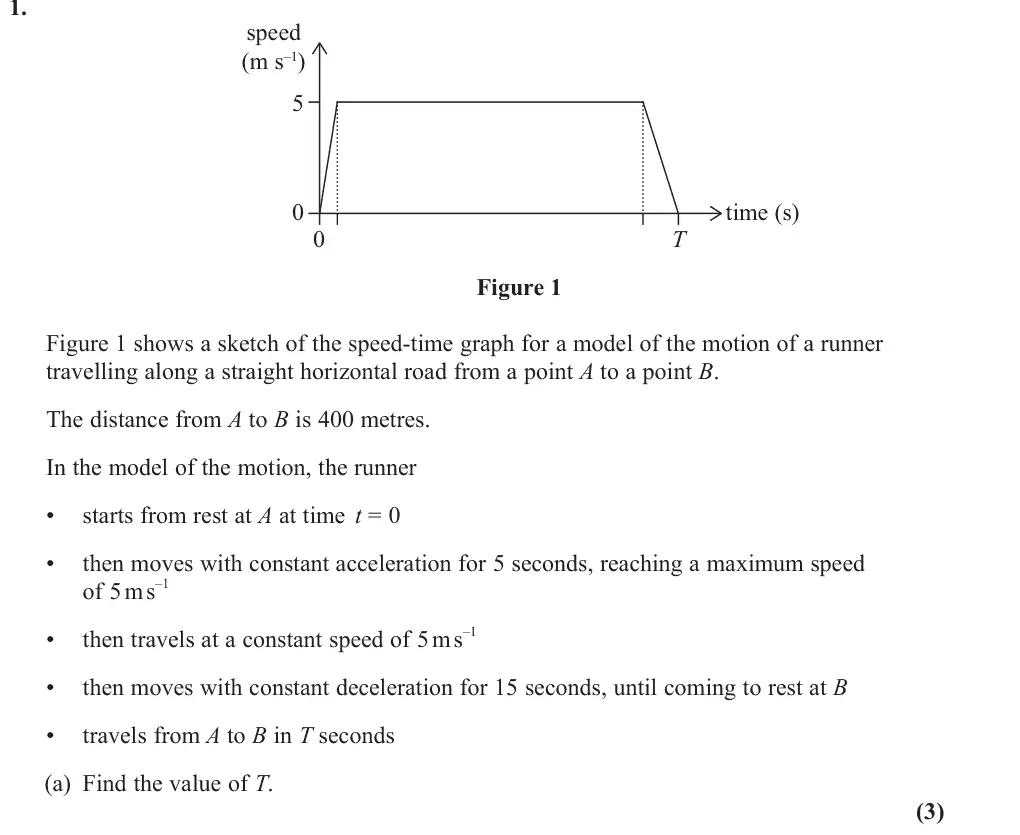
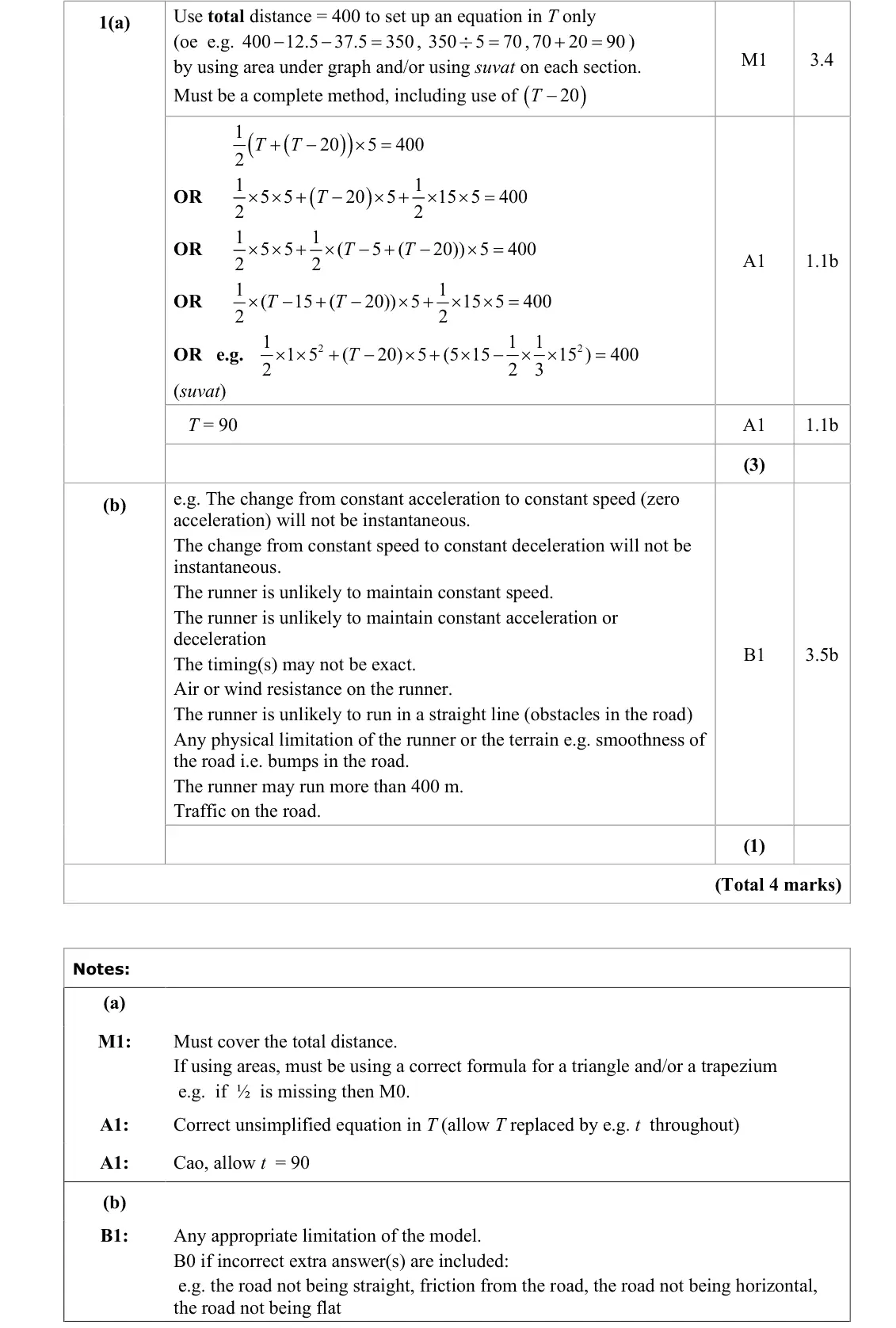
June 2025 · AS Paper 2 (Mechanics) · Q1(a)3 marks
Mark scheme (whole question; this part is marked with the orange bar)
Examiner's comment
In part (a), the majority of candidates made an attempt to equate the area under the graph to the distance covered. Some used the formula for the area of a trapezium to form an equation in T but the parallel sides were not always identified correctly as T and (T -20). However, the most common approach was to use the area of a triangle, rectangle and triangle respectively for each of the three stages of the motion. Many who used this approach found the time for the constant speed was 70 seconds and then added 5 and 15 to find T= 90 as required. Those who just left their final answer as 70 gained no credit as there was no complete method to find T. A few added the distances rather than the times to 70 showing confusion in their understanding. A small number of candidates used suvat equations for each of the three stages but those using this approach seemed more likely to make an error with one or more of the values. Occasionally attempts were seen using a single suvat equation with s = 400.
Common mistakes
total area under the speed-time graph = 400: ½(T + (T − 20)) × 5 = 400 or triangle + rectangle + triangle gives T = 90
the parallel sides of the trapezium are T and T − 20
leaving 70 (the constant-speed time) scores 0
adding distances to 70 instead of the times 5 and 15
the ½ is needed for the M mark
June 2025 · AS Paper 2 (Mechanics) · Q1(b)1 mark
Mark scheme (whole question; this part is marked with the orange bar)
Examiner's comment
In part (b), the reasons given for the actual time being different from T were many and varied but usually gained the mark by stating, for example, either a physical factor that could affect the runner or a limitation of the model such as the speed was unlikely to be exactly constant for a given period of time. The road was specified as being straight and horizontal in the question so comments relating to those factors were not relevant here.
Common mistakes
a limitation of the model: changes of acceleration not instantaneous, speed or acceleration not constant, wind resistance, runner may not run 400 m
the road is given as straight and horizontal so comments about it (not straight, not horizontal, friction) score 0
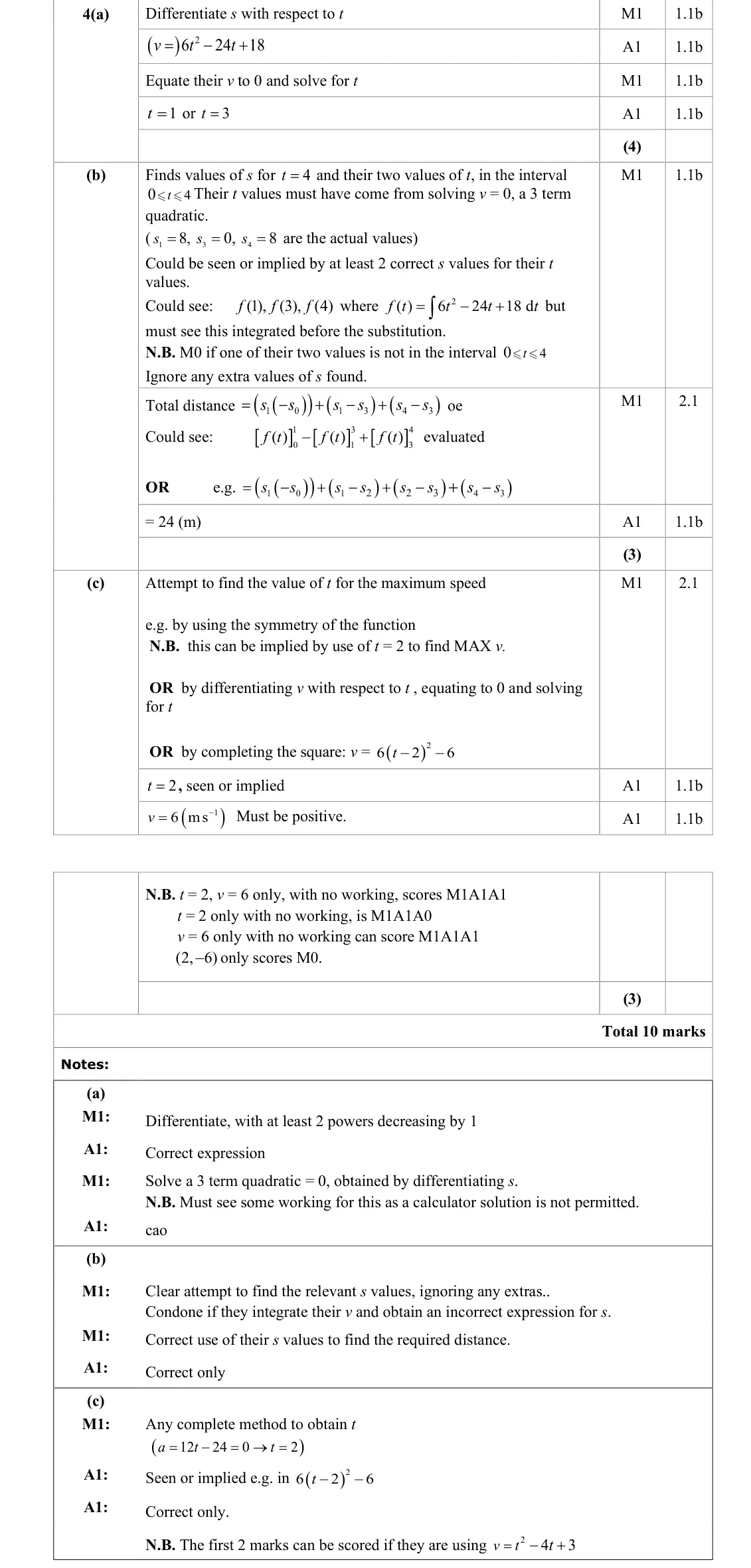
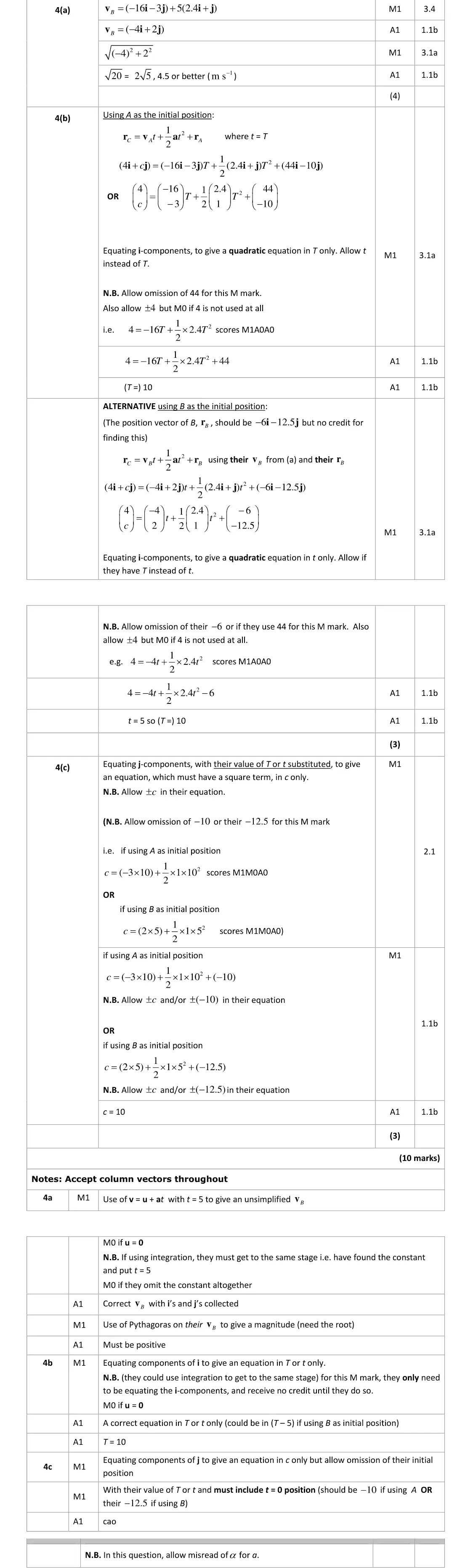
June 2025 · AS Paper 2 (Mechanics) · Q4(b)3 marks
Mark scheme (whole question; this part is marked with the orange bar)
Examiner's comment
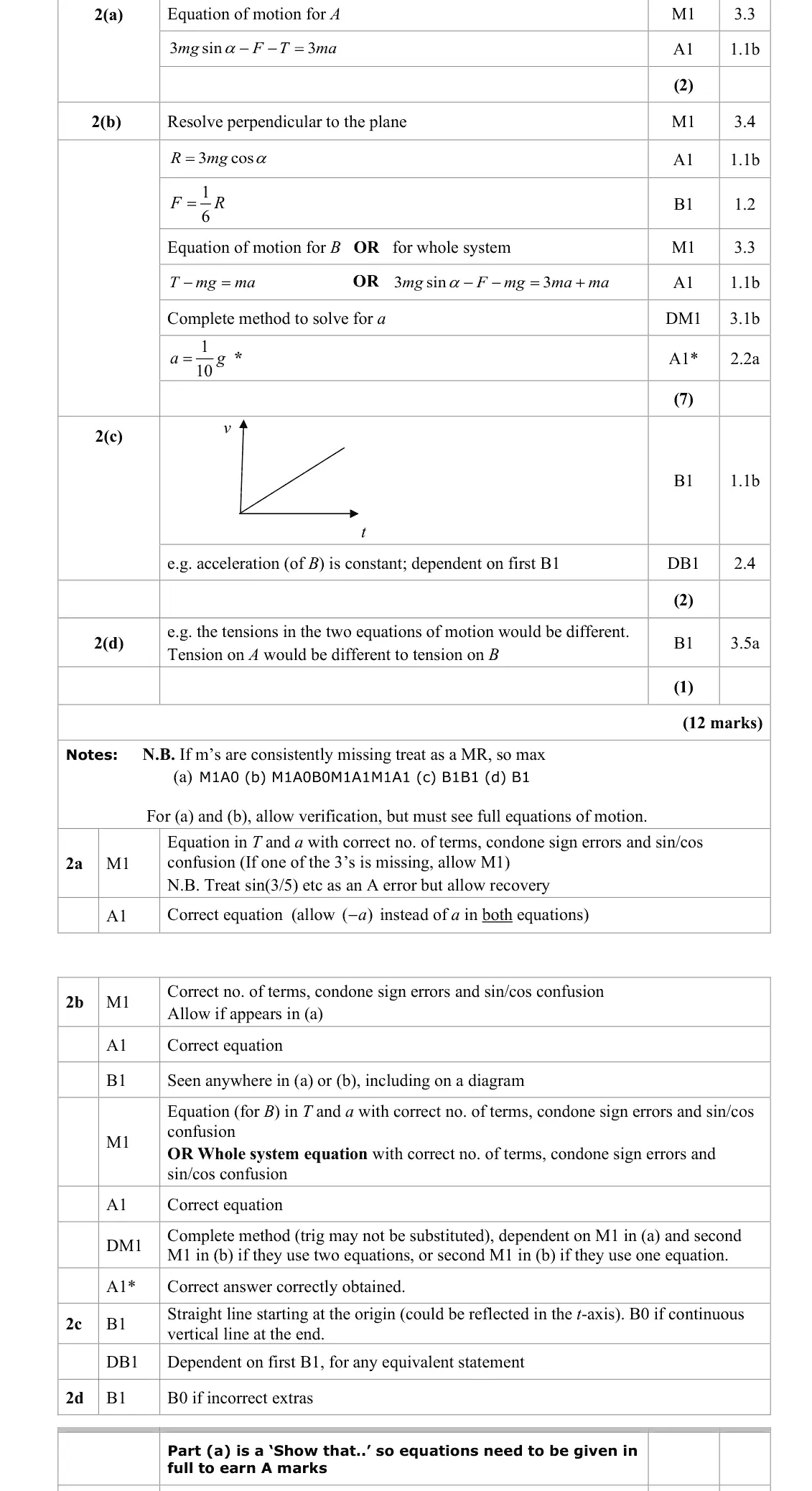
At the top of this question is a calculator warning which some candidates chose to ignore and lost marks as a result. There was the occasional candidate who incorrectly differentiated, missing out the “+18” term from their answers. This also impacted the marks that could be scored for part (b). Part (b) was challenging and candidates who sketched a graph of the function and considered areas were usually the most successful. The most common error was to just use 0s and 4s while a number integrated s. Some who had made progress used 8 - for the middle section, forgetting that the distance was required. A significant number made no attempt at this part.
Common mistakes
P changes direction at t = 1 and t = 3: s₁ = 8, s₃ = 0, s₄ = 8, so total distance = 8 + 8 + 8 = 24 m
most used only s₀ and s₄ (displacement)
integrating s
using −8 for the middle section
a sketch helps
June 2025 · AS Paper 2 (Mechanics) · Q4(c)3 marks
Mark scheme (whole question; this part is marked with the orange bar)
Examiner's comment
At the top of this question is a calculator warning which some candidates chose to ignore and lost marks as a result. In part (c), many found the acceleration but a number then failed to equate it to zero and so did not achieve any marks. Some did obtain t = 2 successfully but then did nothing with it. A few used the symmetry or completed the square and got to the required answer very quickly. The odd negative answer for speed was seen.
Common mistakes
maximum speed where a = dv/dt = 12t − 24 = 0 (or by symmetry or completing the square v = 6(t − 2)² − 6): t = 2, speed 6 m s⁻¹ (must be positive)
many found a but did not set it to 0, or stopped at t = 2
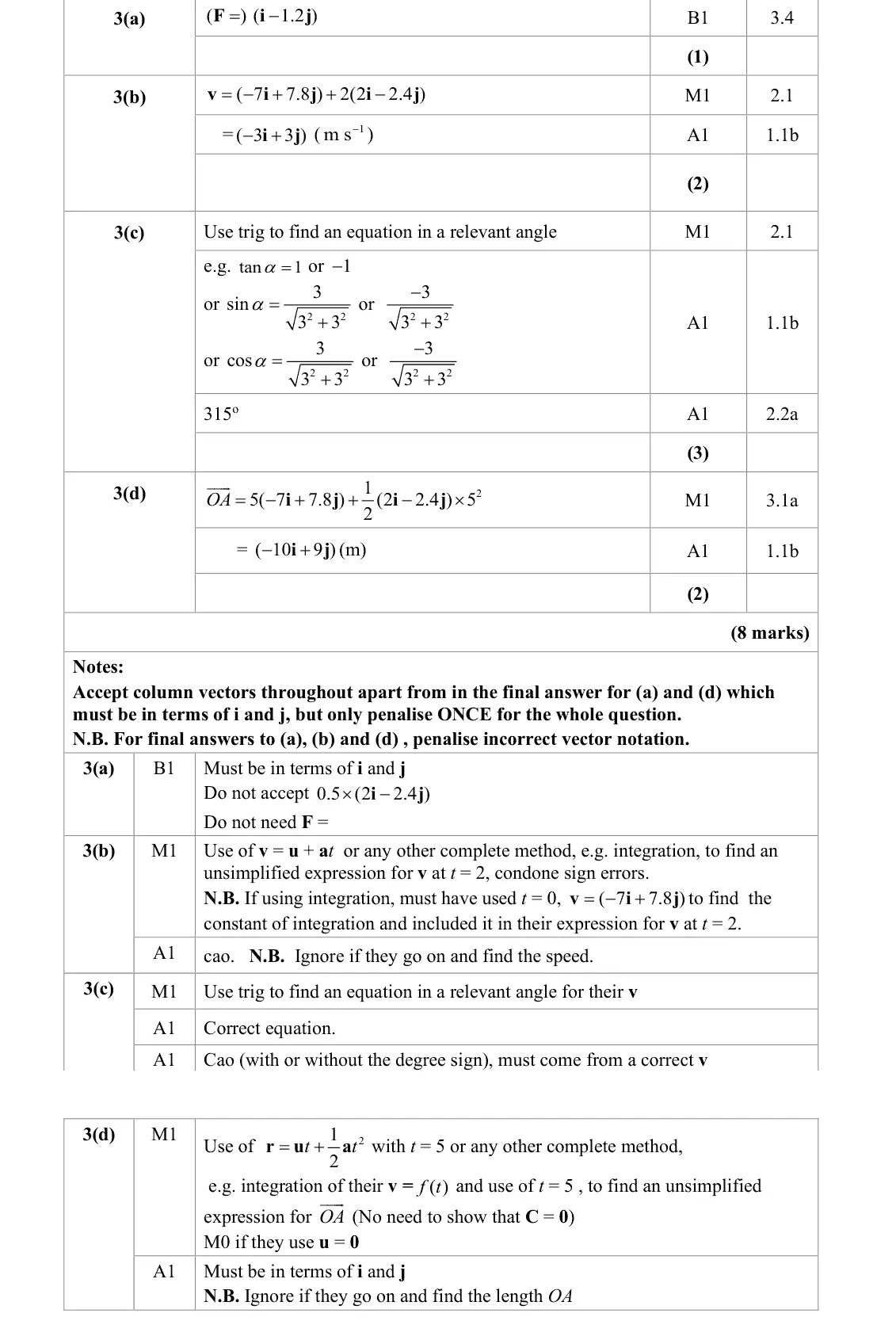
June 2025 · Paper 3 (Mechanics) · Q3(c)3 marks
Mark scheme (whole question; this part is marked with the orange bar)
Examiner's comment
Finding the bearing of the direction of motion in part (c) proved more challenging for many learners. A good number were able to find an acute angle relating to their velocity vector. Use of basic trigonometry or the properties of a right-angled isosceles triangle were seen in roughly equal measure, but gaining the final mark for a correct bearing was often not achieved. Unrepresentative diagrams and a misunderstanding of bearings appeared to be the cause of this. A significant number did not need to use trigonometry, realising that the components indicated a north west direction and writing down 315o directly. A few learners first worked out the displacement vector and attempted to find the bearing of the position of the particle. This was not what the question had asked for and gained no credit.
Common mistakes
v = −3i + 3j points north-west so bearing 315°
unrepresentative diagrams and misread bearings lose the final mark
using the displacement instead of the velocity scores nothing
June 2025 · Paper 3 (Mechanics) · Q4(a)1 mark
Mark scheme (whole question; this part is marked with the orange bar)
Examiner's comment
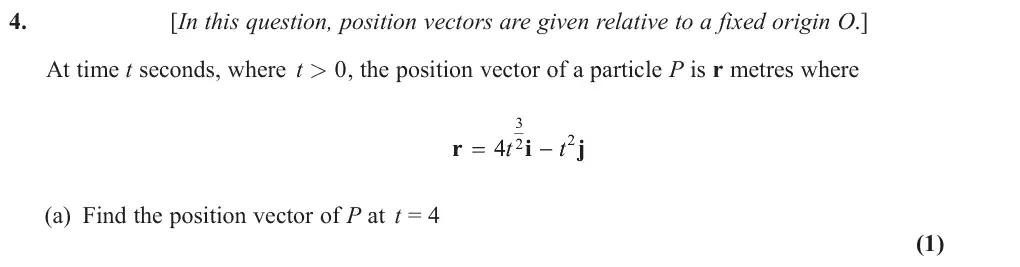
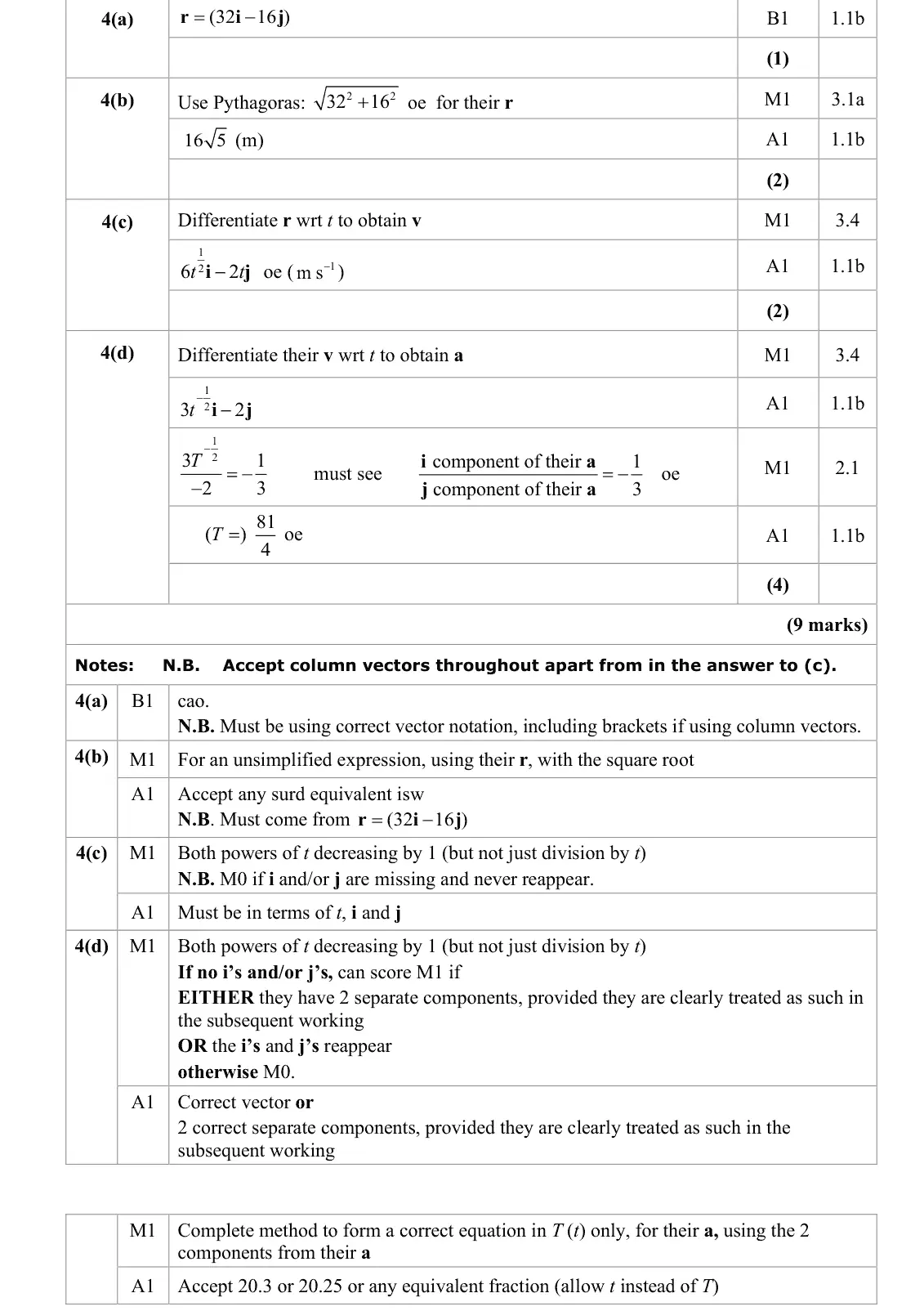
In part (a) almost all responses substituted t = 4 into the given position vector and obtained the correct answer. Occasionally there was a sign error in the j term or the answer was not stated in proper vector notation, for example including i and j in a column vector, but such instances were rare.
Common mistakes
4 × 4^(3/2) = 32
watch the sign of the j term
correct vector notation
June 2025 · Paper 3 (Mechanics) · Q4(b)2 marks
Mark scheme (whole question; this part is marked with the orange bar)
Examiner's comment
In part (b) Pythagoras’ Theorem was generally applied correctly to find the magnitude. An exact (surd) answer was required so those who only stated a decimal approximation did not sqrt 322 -162 thereby not gaining both marks. gain the accuracy mark. A few did not account properly for the negative sign and evaluated In the third part the majority of learners recognised the requirement to differentiate to find the
Common mistakes
exact answer 16√5 needed (decimal loses A1)
square the −16 correctly, not √(32² − 16²)
June 2024 · AS Paper 2 (Mechanics) · Q1(a)3 marks
Mark scheme (whole question; this part is marked with the orange bar)
Examiner's comment
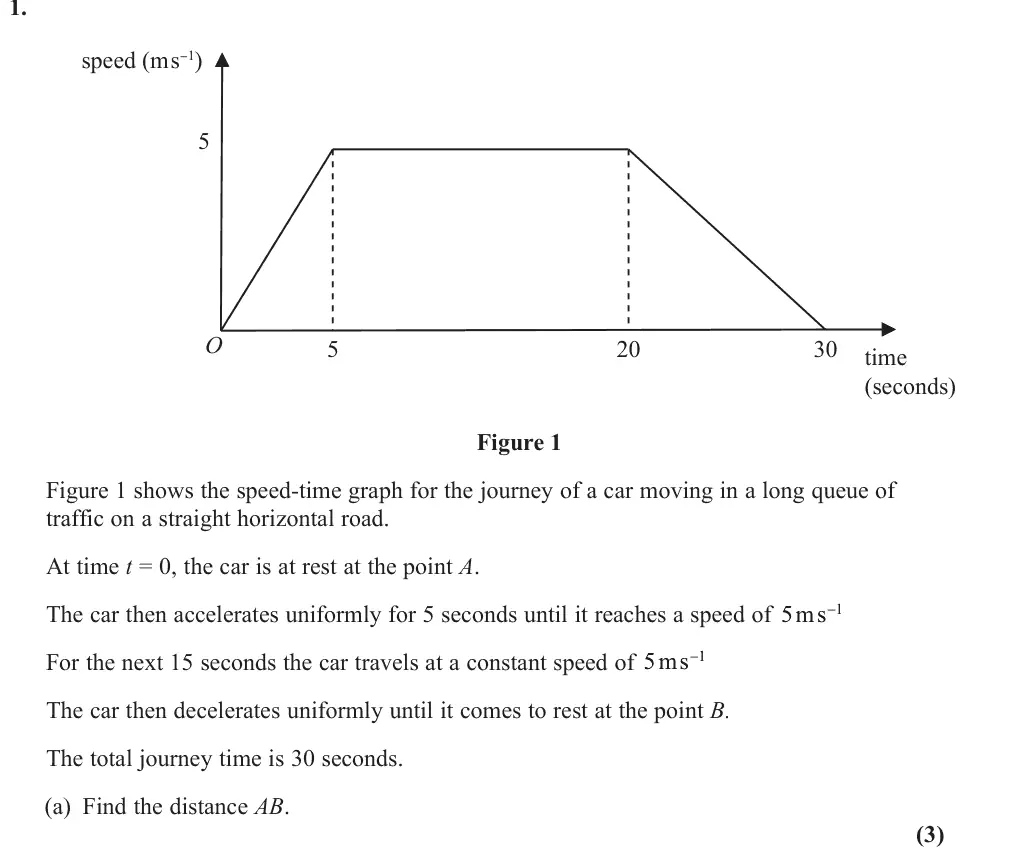
Part (a) proved to be a good starter question for almost all of the candidates. Successful candidates found the area under the graph by either separating into two triangles and a rectangle (the most popualar method) or by going directly to a trapezium. A few candidates applied suvat formulae to each part of the motion. Unsuccessful candidates used incorrect formulae or had a correct, unsimplified expression for the area but then made mistakes in the arithmetic. A few, oddly, found the length of the hypotenuse instead of the area of the triangles. The second part proved to be much more of a challenge, although the majority of candidates
Common mistakes
distance = area under the speed-time graph: triangle + rectangle + triangle or trapezium ½(30 + 15) × 5 = 112.5 m
arithmetic slips
finding the hypotenuse instead of an area
June 2024 · AS Paper 2 (Mechanics) · Q1(b)3 marks
Mark scheme (whole question; this part is marked with the orange bar)
Examiner's comment
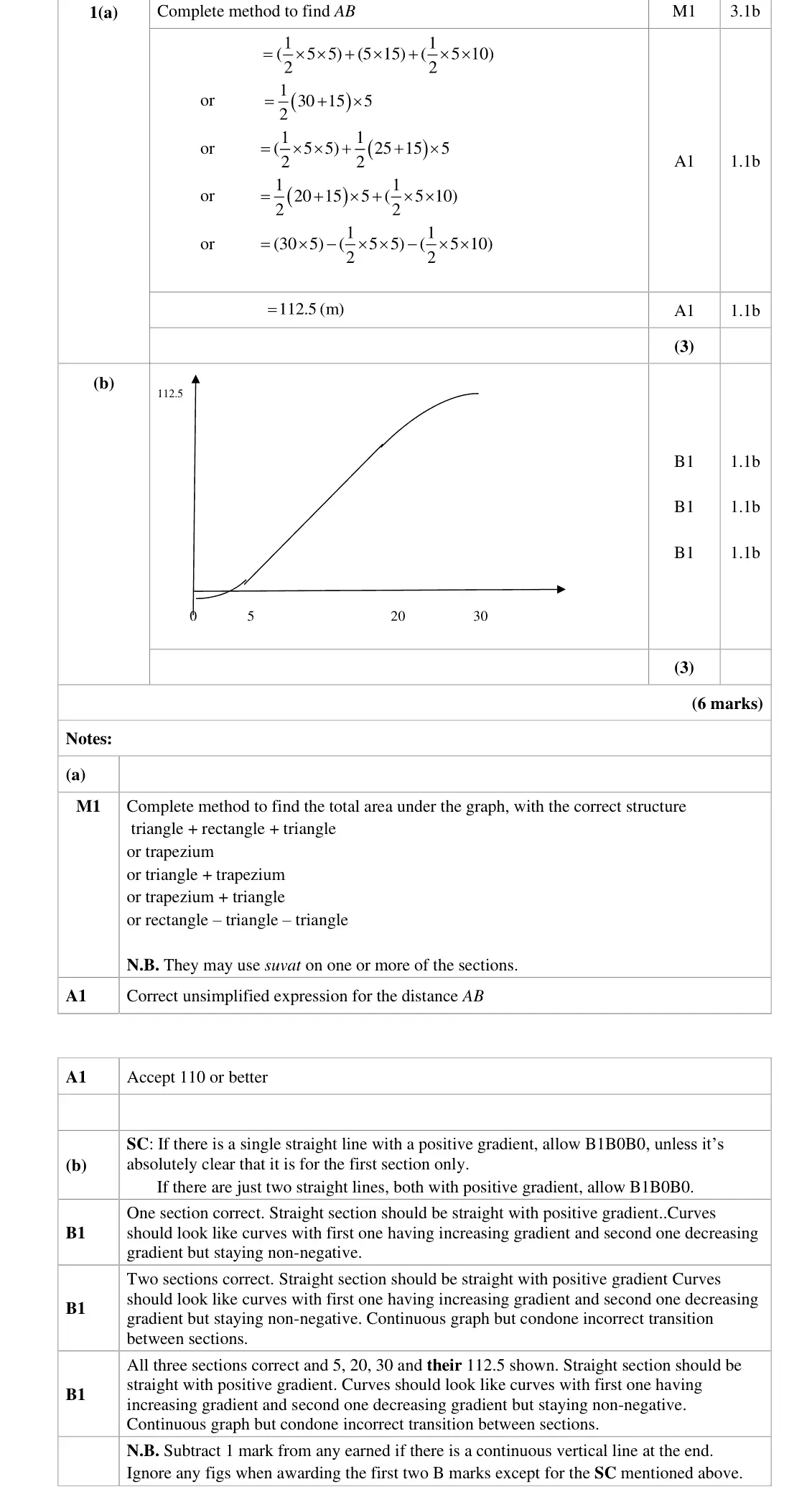
The second part proved to be much more of a challenge, although the majority of candidates did offer a graph with three sections. Most had three straight lines with different positive gradients or one continuous straight line but quite a few attempts included lines with negative gradients or horizontal lines for the first and/or last sections. Most candidates only gained one mark out of three in this part of the question. Successful candidates realised that the first and third sections of the graph needed to be quadratic, from suvat formula, whilst the middle section was a straight line with positive gradient. In addition, the numbers 5, 20, 30 and their total distance were not always clearly shown on the axes. Some candidates had graphs that were unclearly drawn, often without straight lines. Many candidates with the three sections correct struggled with the transition between the sections and failed to produce a smooth curve, often exaggerating the curves, but they were not penalised for this. A few candidates simply recreated the speed-time graph trapezium with different axis labels.
Common mistakes
distance-time graph: curve with increasing gradient for 0–5 s, straight line with positive gradient 5–20 s, curve with decreasing gradient levelling off at 112.5 at 30 s
label 5, 20, 30 and 112.5
negative gradients, horizontal sections or redrawing the trapezium are wrong
no vertical line at the end
June 2024 · AS Paper 2 (Mechanics) · Q2(b)4 marks
Mark scheme (whole question; this part is marked with the orange bar)
Examiner's comment
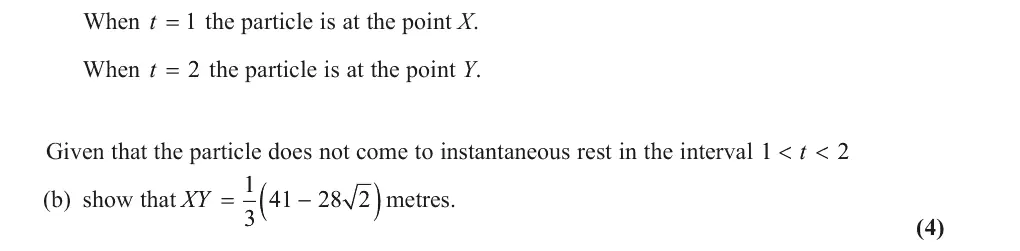
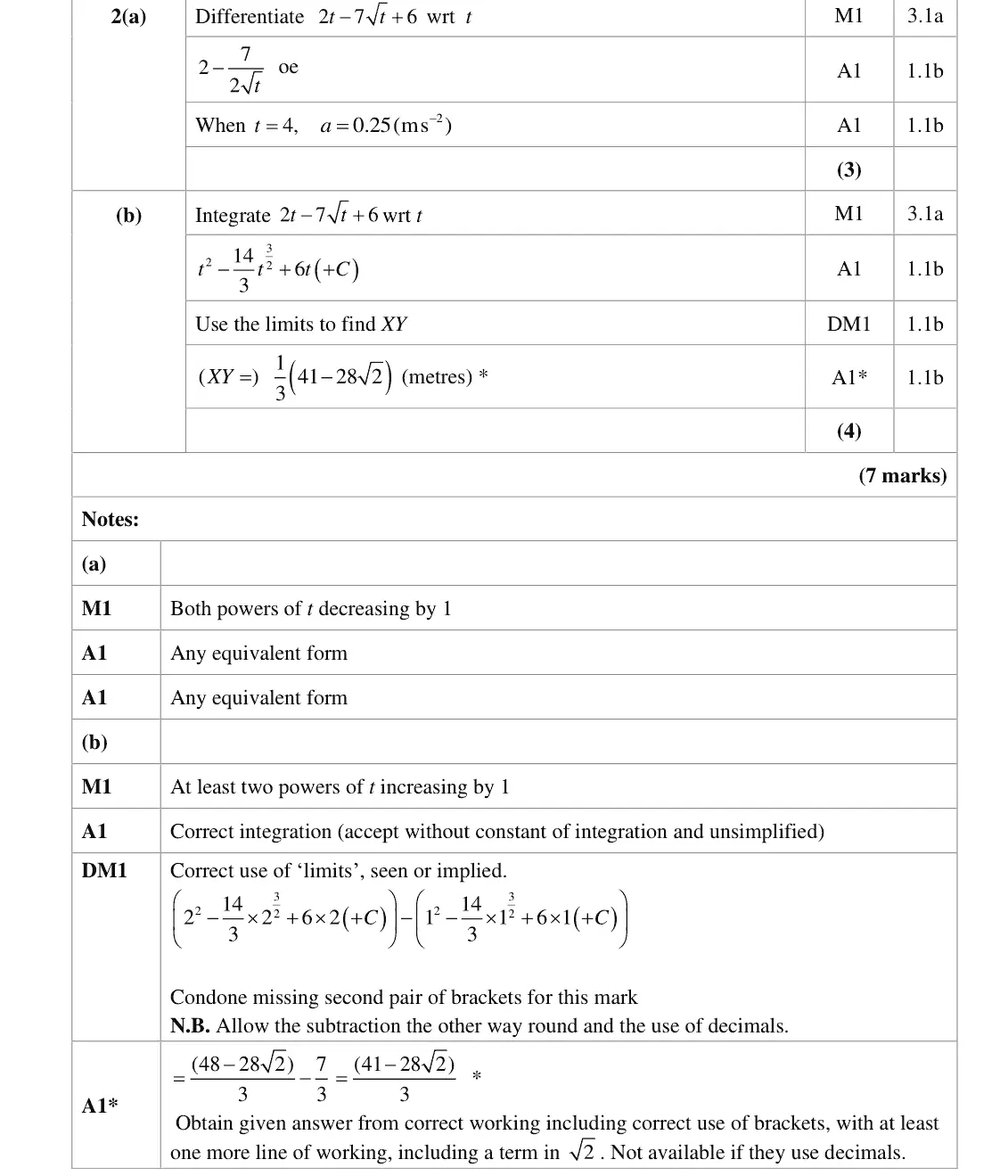
In part (b), successful candidates integrated the expression for v with respect to t and were usually able to obtain a correct, unsimplified expression for the displacement of the particle at time t. There were then occasional errors with the simplification often due to incorrect coefficients. There was no penalty for not including a constant of integration. Successful candidates then used the limits of t = 1 and t = 2 to calculate the distance XY. A surprising number of candidates thought that finding XY meant that they then had to multiply these two values. Since there was a printed answer, candidates needed to clearly show all stages of their working including the use of surds to get to the required form of the answer. Of those that tried to use surds, some struggled to reach the given answer whilst others did not show enough working to gain the final A mark. Ignoring the instructions at the top of the question, many candidates used calculators and decimals appeared in their solutions which resulted in the solutions being incomplete and losing the final mark. Very few candidates used differentiation in this part.
Common mistakes
integrate v: t² − (14/3)t^(3/2) + 6t
XY = s(2) − s(1) (no change of direction so displacement = distance)
keep surds: 2^(3/2) = 2√2 to reach (41 − 28√2)/3
decimals lose the final mark
multiplying the two values
June 2024 · Paper 3 (Mechanics) · Q2(a)2 marks
Mark scheme (whole question; this part is marked with the orange bar)
Examiner's comment
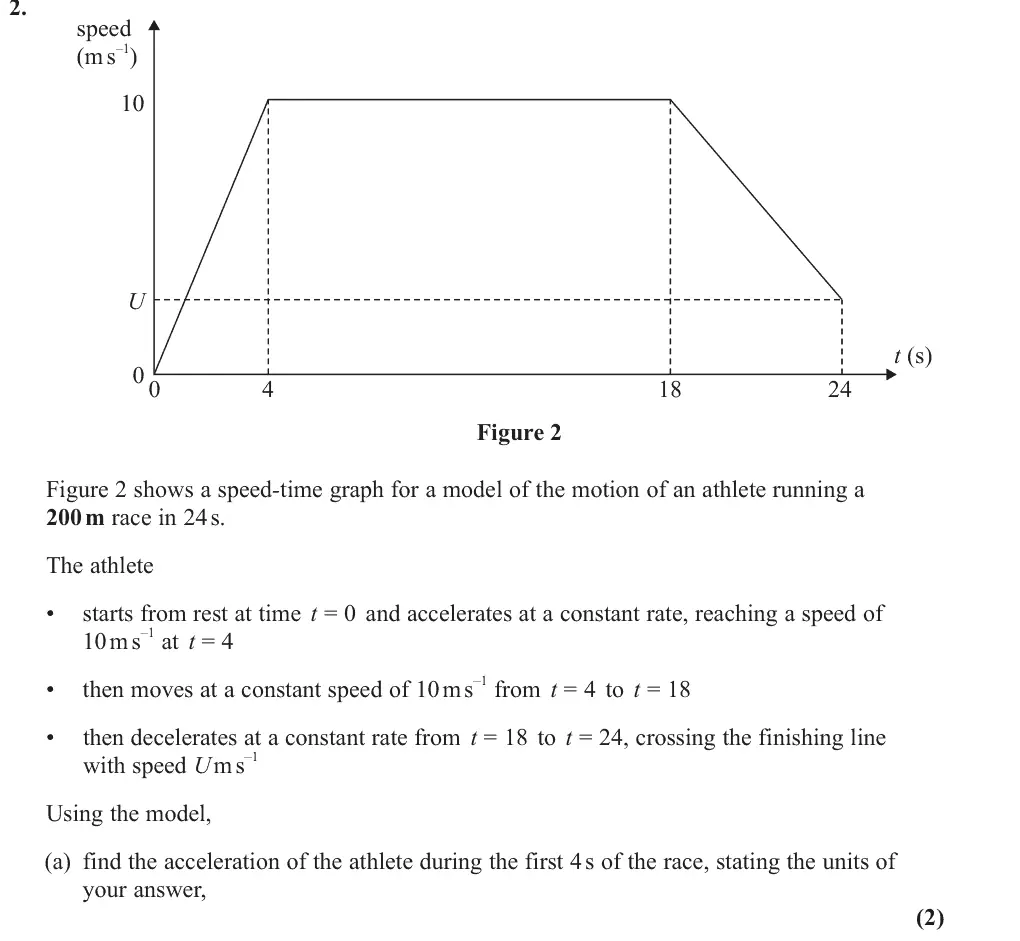
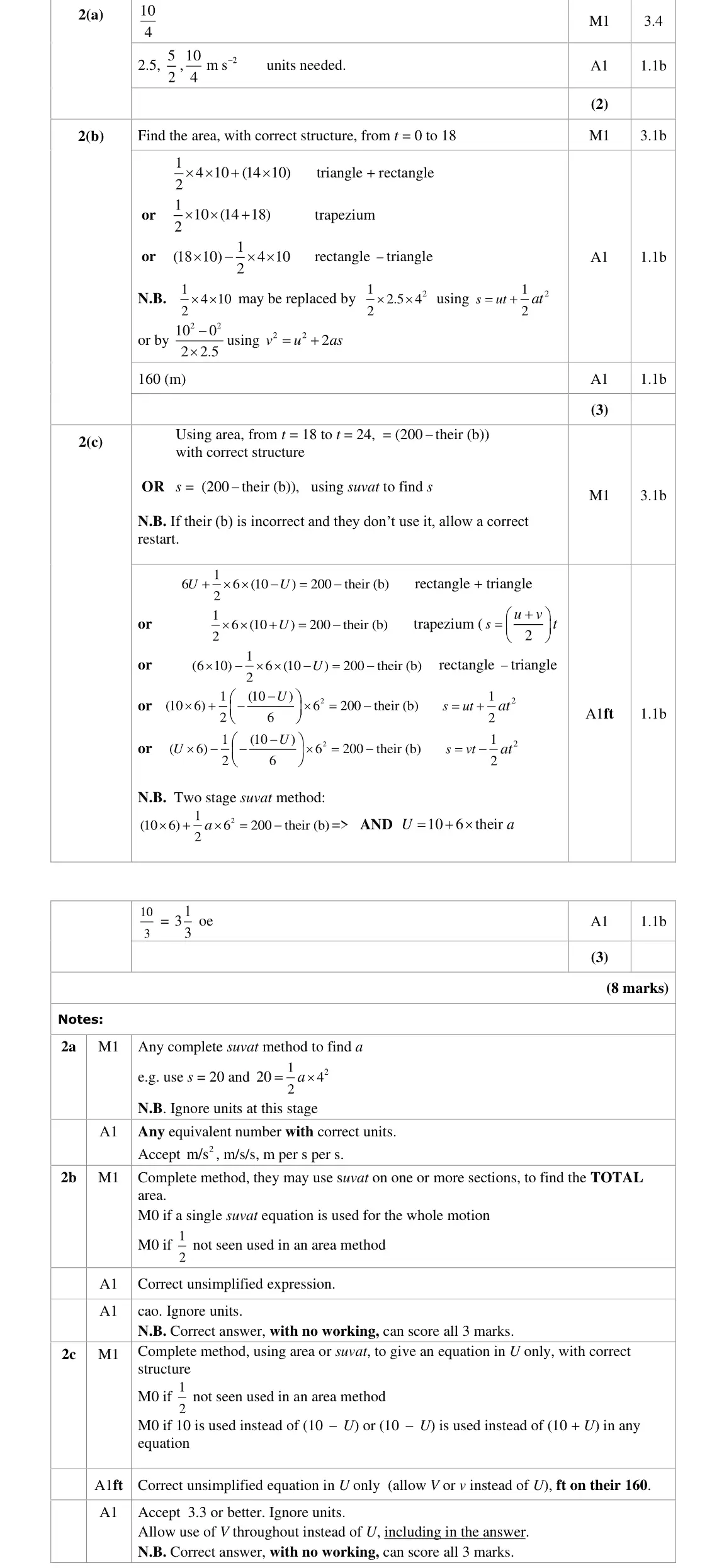
This question was accessible to all candidates, particularly parts (a) and (b). (a) This was generally answered very well either using a suvat equation or by finding the gradient of the first section of the graph. Some lost the second mark for writing incorrect m s- being the most common error 1 units or, occasionally, omitting the units altogether ( with the units). A few candidates confused acceleration with distance and found the area under the graph during the first six seconds.
Common mistakes
acceleration = gradient 10/4 = 2.5 m s⁻²
units needed (m s⁻¹ or none loses the A mark)
finding the area instead of the gradient
June 2024 · Paper 3 (Mechanics) · Q2(b)3 marks
Mark scheme (whole question; this part is marked with the orange bar)
Examiner's comment
This question was accessible to all candidates, particularly parts (a) and (b). (b) The vast majority scored all three marks here. The most popular approach was to sum the separate areas of the triangle and the rectangle or alternatively to find the area of the trapezium. Occasionally the ‘ 1 2 ’ was missing from either the area of the triangle or the trapezium. This error scored no marks for use of an incorrect formula. Those who used suvat methods tended to be less successful than those using an area approach.
Common mistakes
distance = area: triangle + rectangle or trapezium ½ × 10 × (14 + 18) = 160 m
missing the ½ scores nothing
a single suvat equation for the whole motion is M0
June 2024 · Paper 3 (Mechanics) · Q2(c)3 marks
Mark scheme (whole question; this part is marked with the orange bar)
Examiner's comment
(c) This part was more challenging. Most candidates recognised that they needed to subtract their answer to (b) from 200 to get the distance travelled from t = 18 to t = 24. 1 = + 2 ( ) s u v t Whilst some used , the most common successful approaches were to find an expression for the sum of the area of the triangle and rectangle or the area of the trapezium and equate that to 40. However, a significant number of candidates used the = ) 6 40 area of a triangle rather than a trapezium and wrote 1 - 2 (10 U leading to U = - 10 then ignored the sign and wrote it as a positive answer which coincidentally 3 was the correct answer but they scored no marks for an incorrect method. A small number of students attempted to find U by using suvat methods for the whole race, usually without success.
Common mistakes
distance from t = 18 to 24 is 200 − 160 = 40 m = trapezium ½ × 6 × (10 + U)
using a triangle ½ × 6 × (10 − U) gives −10/3 (no marks even if the sign is dropped)
U = 10/3
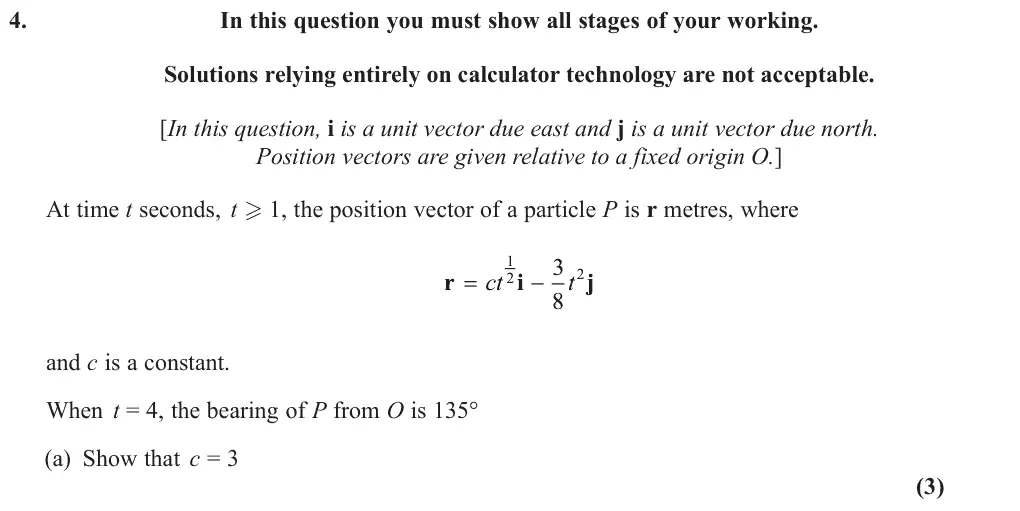
June 2024 · Paper 3 (Mechanics) · Q4(a)3 marks
Mark scheme (whole question; this part is marked with the orange bar)
Examiner's comment
(a) This part of the question was worth three marks and required candidates to produce a rigorous proof to show that c = 3, either by using trigonometry or an isosceles triangle or both. It seemed that many candidates were telling themselves that the answer was obvious but were uncertain as to how to go about justifying the fact. Most candidates struggled to produce a rigorous proof, instead just stating, without justification, that for a bearing of 135o, the distance travelled in the x-direction would have the same magnitude as the distance travelled in the negative y-direction or equivalent. They were able to score two of the three marks available if they then went on the show that c = 3. Those candidates who drew a diagram and labelled it with all the information from the question were generally more successful in scoring all three marks than those who either did not draw a diagram or whose diagram did not include some of the information given. Some - 6 = o tan135 candidates correctly used or the equivalent, without a diagram. Common 2c errors included not being able to correctly sketch a bearing of 135o, or omissions of angles or sides in the diagram. The negative sign caused issues in several instances and was sometimes glossed over. There was also some poor algebra. A few candidates incorrectly wrote 2c + 6 = 0 to obtain c = 3.
Common mistakes
at t = 4, r = 2ci − 6j
bearing 135° means a 45° angle below east so 2c = 6, justified by tan 45° or an isosceles right-angled triangle on a correct diagram
stating equal components without justification loses a mark
2c + 6 = 0 is wrong
June 2024 · Paper 3 (Mechanics) · Q4(b)4 marks
Mark scheme (whole question; this part is marked with the orange bar)
Examiner's comment
(b) The majority of candidates realised the need to differentiate the given expression for r, with c = 3 substituted, to obtain the velocity, and most of these differentiated correctly. They then substituted t = 4 and used Pythagoras to find the speed, giving their answer either as an exact value or an appropriate decimal equivalent. A minority correctly found the velocity but then stopped and lost two marks. A few candidates delayed substituting c = 3 until the end and a few delayed putting t = 4 which made the working a lot more demanding. About half worked with column vectors instead of using i - j form. Common errors included calculation slips when evaluating the speed or when substituting t = 4, misreading the expression such as losing the negative sign in the j-component and losing the i and j and not recovering to use components. A few candidates tried to use a suvat approach not realising that this was not a constant acceleration situation. (c) Many of those who differentiated in (b), successfully differentiated their velocity vector to obtain the acceleration vector. However, a significant number of candidates did not know how to proceed from there and the second stage of the process proved to be a discriminator. It was only the stronger candidates who realised that their acceleration vector had to be a multiple of the given vector. Those who did make this link generally were able to complete the question successfully. A number of unsuccessful candidates just set the i-component of the acceleration equal to -1 (or more rarely to -27). Most of k -- those who compared a to ( 27 ) i j were able to reach an equation in t only which they then tried to solve. Fewer candidates used a ratio approach but a significant minority of these used the reciprocal of the correct ratio but were still able to score the method mark. Having reached a correct equation in t or T only, some then struggled to obtain the correct answer. There were a few candidates who tried to use a suvat approach for this part not realising that this was not a constant acceleration situation and scored nothing.
Common mistakes
differentiate r (powers of t decrease by 1): v = (3/2)t^(−1/2)i − (3/4)tj
put t = 4 in both components then Pythagoras: speed = 3√17/4 ≈ 3.09 m s⁻¹
stopping at the velocity vector
suvat invalid (acceleration not constant)
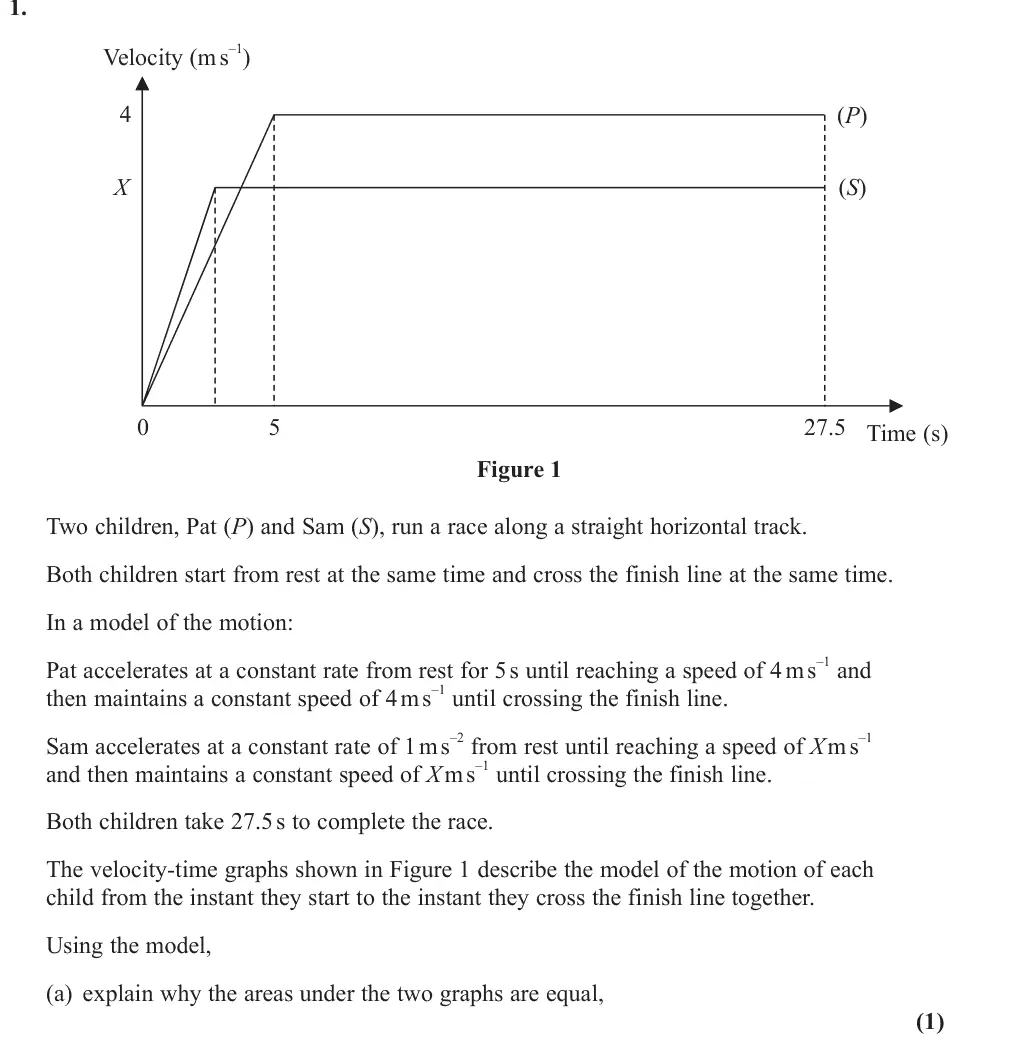
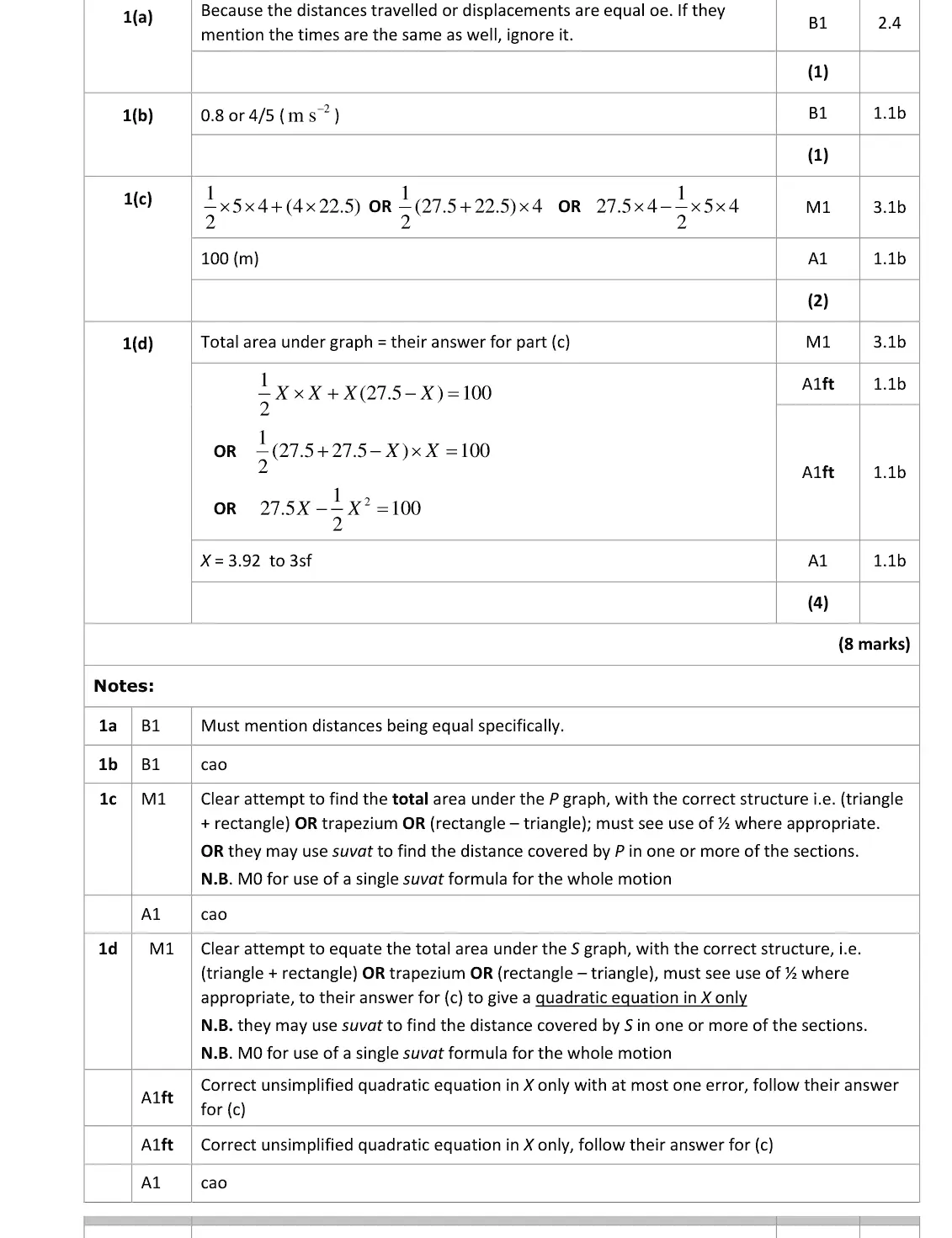
June 2023 · AS Paper 2 (Mechanics) · Q1(a)1 mark
Mark scheme (whole question; this part is marked with the orange bar)
Examiner's comment
In part (a), common incorrect answers were “took the same time” or explanations about one accelerating faster but running at a slower speed with no reference to distance. However, most seemed to know that the area represented distance and realised that since it was a race, the children had covered the same distance. In the second part, a few used Pythagoras or found the
Common mistakes
area under a v-t graph is distance: both children cover the same distance (the length of the race)
"they took the same time" alone scores 0
June 2023 · AS Paper 2 (Mechanics) · Q1(b)1 mark
Mark scheme (whole question; this part is marked with the orange bar)
Examiner's comment
children had covered the same distance. In the second part, a few used Pythagoras or found the area but most either used the gradient or a suvat approach. A number went from 5a = 4 to 5 a = 4. Most candidates, in part (c), found the area correctly using Pat’s graph. Some made
Common mistakes
gradient of the first section = 4/5 = 0.8 m s⁻²
slips such as 5a = 4 giving a = 5/4
June 2023 · AS Paper 2 (Mechanics) · Q1(c)2 marks
Mark scheme (whole question; this part is marked with the orange bar)
Examiner's comment
5 a = 4. Most candidates, in part (c), found the area correctly using Pat’s graph. Some made 1 errors with lengths of sides or omitted the 2. Very few used suvat for the whole motion and a few left out the triangle thus getting either 90 or 110. There were many poor responses for the final part. Since the shape of the graph used in part (d) was the same shape as the graph used in part (c), it was surprising to see so many candidates using a different approach for finding this area even though they realised that the areas were the same. Many candidates either didn’t even attempt it or gave up after writing one equation in two variables. Of those who realised that the acceleration meant that X = t, or whatever variable they had used, a number were not able to use that to obtain an equation in X only and so scored no marks. There were a few suvat attempts and a common error was to use 22.5 instead of 27.5. Those who were able to get to a correct quadratic equation almost always selected the correct root as their final answer and usually gave it to 3sf although there were a few 3.91’s seen.
Common mistakes
total area under P's graph = ½ × 5 × 4 + 4 × 22.5 = 100 m (triangle + rectangle or trapezium)
omitting the ½ or the triangle (90 or 110)
one suvat formula for the whole motion scores 0
June 2023 · AS Paper 2 (Mechanics) · Q1(d)4 marks
Mark scheme (whole question; this part is marked with the orange bar)
Examiner's comment
final part. Since the shape of the graph used in part (d) was the same shape as the graph used
Common mistakes
acceleration 1 m s⁻² means Sam reaches X after X seconds
area ½X² + X(27.5 − X) = 100 gives a quadratic in X only
X = 3.92 (3 s.f., choose the root less than 27.5)
common errors 22.5 instead of 27.5, one equation in two unknowns
June 2023 · AS Paper 2 (Mechanics) · Q2(b)3 marks
Mark scheme (whole question; this part is marked with the orange bar)
Examiner's comment
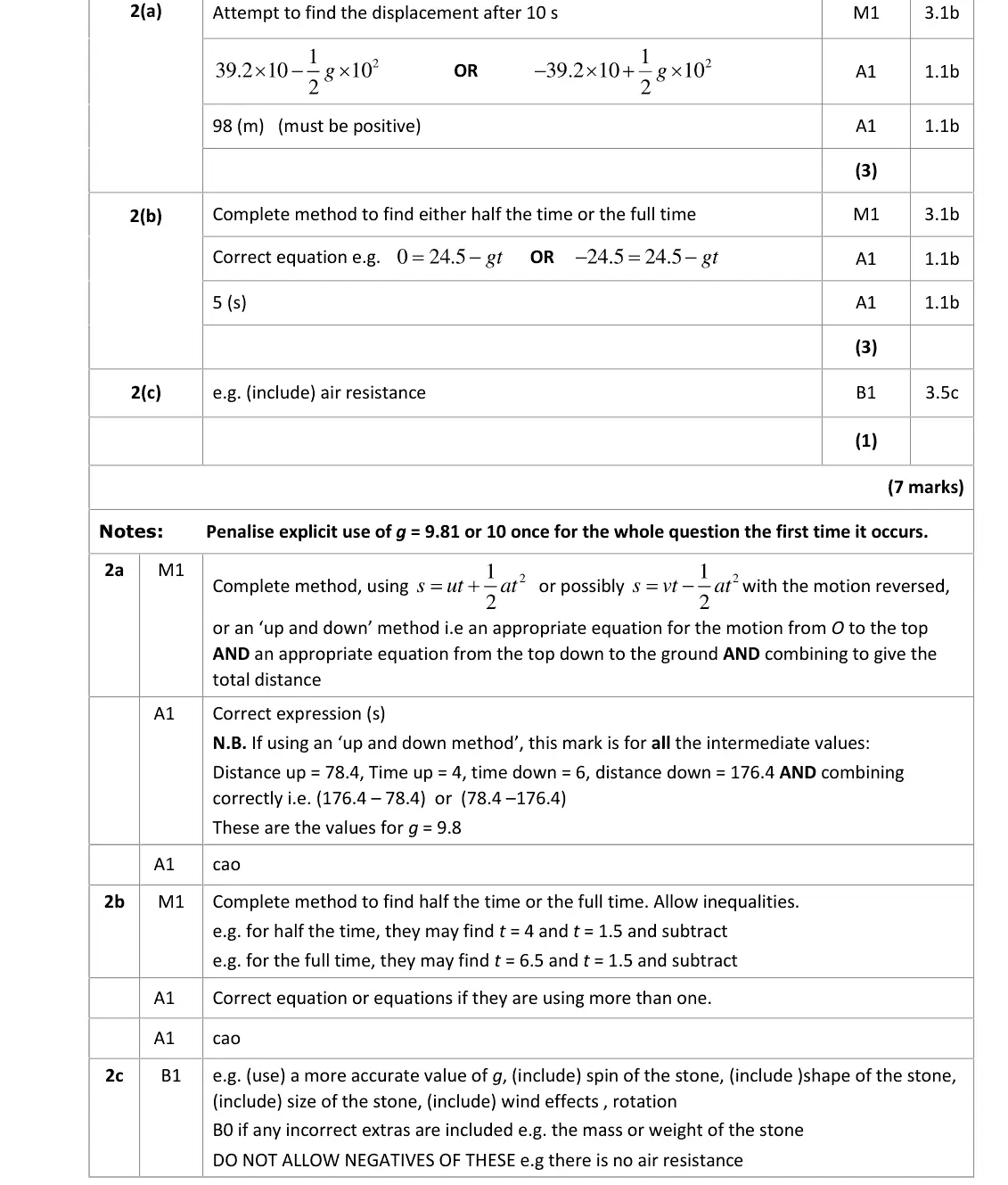
answer. Many candidates, in the second part, managed to stumble across 2.5 s for half the time but then failed to either find the other half or to double it. Some of the better candidates found t =1.5 s and t = 6.5 s and then subtracted which showed a clear understanding of the situation. Some successfully combined the various elements of times up and times down but the most successful approach was to find half the time and double it. A common error was to use the m s- or to treat this speed as a height. Some candidates 1 distance from part (a) along with 24.5
Common mistakes
speed ≤ 24.5 either side of the top: 0 = 24.5 − 9.8t gives 2.5 s, double to 5 s (or times 1.5 and 6.5 s and subtract)
forgetting to double
treating 24.5 as a height
June 2023 · AS Paper 2 (Mechanics) · Q3(c)4 marks
Mark scheme (whole question; this part is marked with the orange bar)
Examiner's comment
Pythagoras and so either sqrt (82 + 82) or even sqrt (82 + 32) was sometimes seen. In part (c), most integrated correctly and scored the first two marks. Very few got the differentiating and integrating the wrong way round this year. But after that, the majority just found the value of the integral at t = 4 (with or without subtracting the value at t = 0). Some realised that they had to split the integral into from 0 to 3 then 3 to 4 but several of these then added the two components instead of subtracting them. Those who drew a v-t graph were generally more successful when seeing the area below the axis seemed to help. There were relatively few correct answers to this part.
Common mistakes
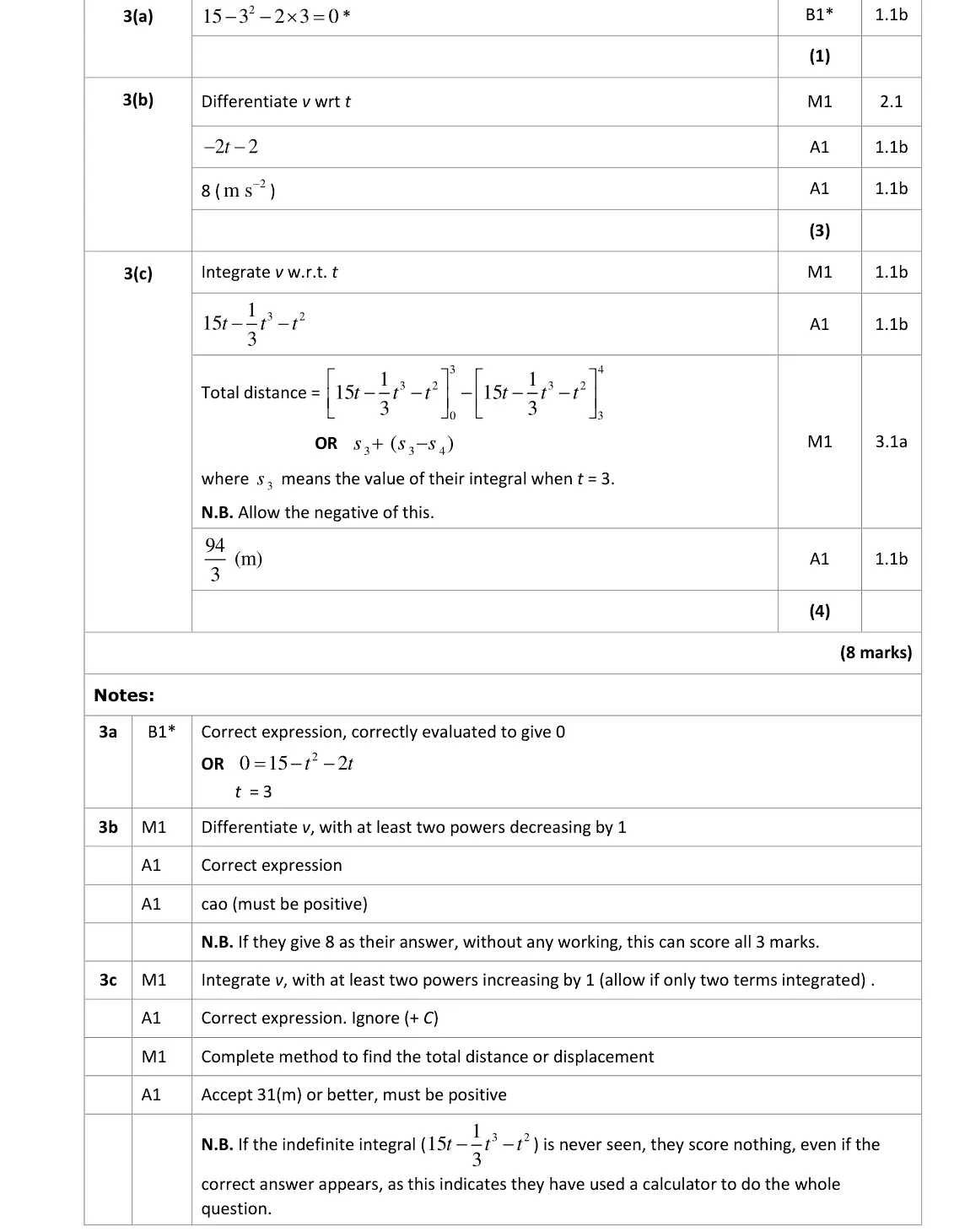
integrate to 15t − t³/3 − t² (must be seen: calculator-only answers score 0)
P turns at t = 3, so distance = s(3) + (s(3) − s(4)) = 94/3 m
most just evaluated at t = 4
adding the two parts instead of subtracting the negative one
a v-t sketch helps
June 2023 · Paper 3 (Mechanics) · Q3(a)3 marks
Mark scheme (whole question; this part is marked with the orange bar)
Examiner's comment
Part (a) was generally a well answered question. Some found the velocity vector at t = 0 and went no further, either forgetting, or not being aware that they needed to use Pythagoras’ Theorem to find the speed. A small number of candidates scored the M mark only, if they had an incorrect velocity vector but used Pythagoras’ Theorem correctly. The majority of candidates who attempted the second part used a correct method, setting
Common mistakes
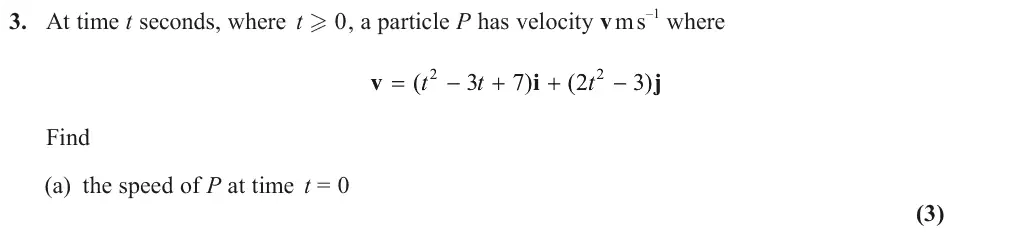
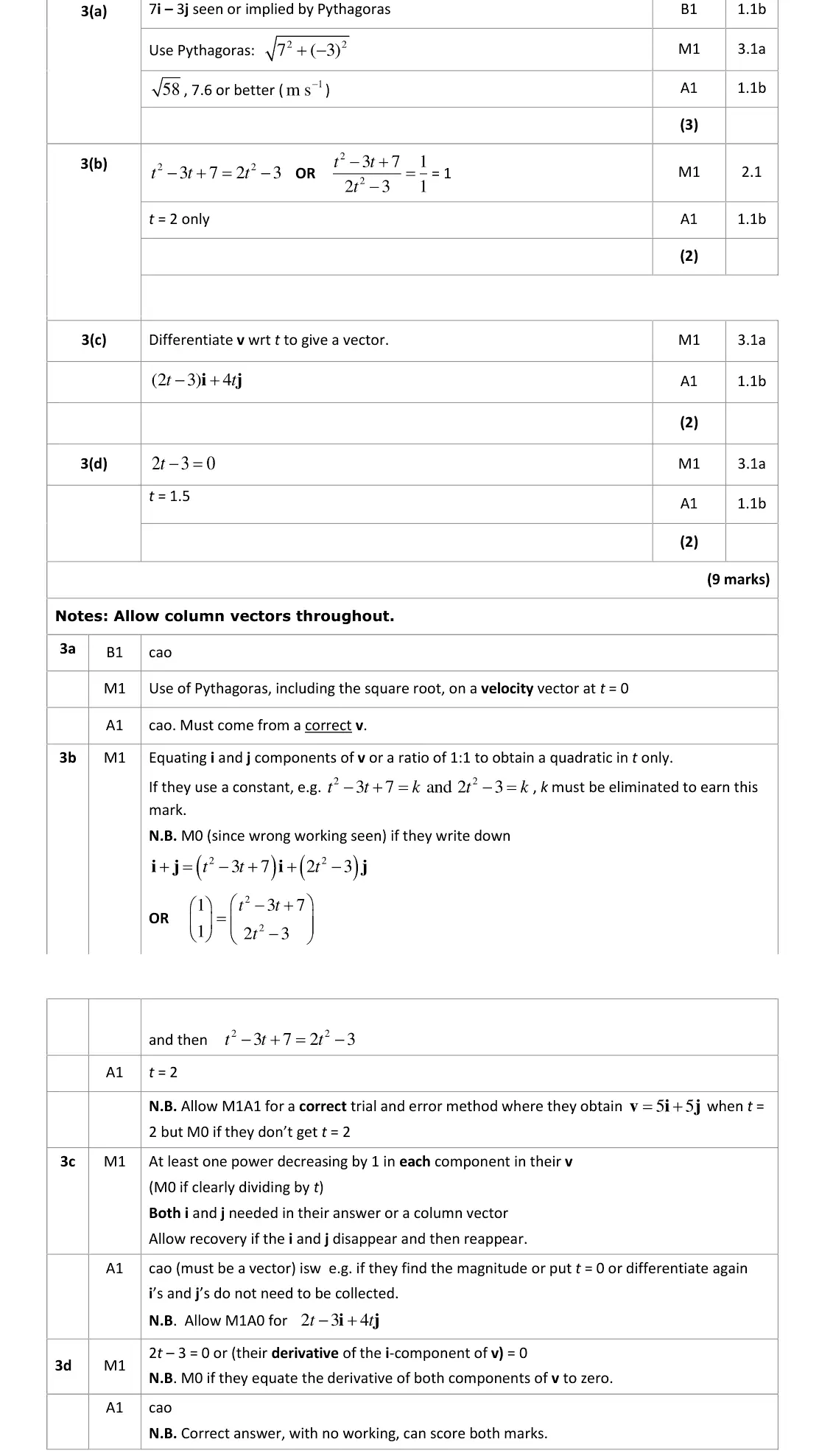
substitute t = 0 to get 7i − 3j, then speed is the magnitude √58 = 7.6
stopping at the velocity vector
June 2023 · Paper 3 (Mechanics) · Q3(b)2 marks
Mark scheme (whole question; this part is marked with the orange bar)
Examiner's comment
The majority of candidates who attempted the second part used a correct method, setting the i and j components of the velocity equal to each other or both equal to a constant which was then eliminated. A few also successfully used trial and error. However, a significant number set both i and j coefficients equal to 1, solved one or two separate equations and scored nothing.
Common mistakes
equate the i and j components (t² − 3t + 7 = 2t² − 3), t = 2 only
setting each component equal to 1 scores nothing
June 2023 · Paper 3 (Mechanics) · Q4(a)4 marks
Mark scheme (whole question; this part is marked with the orange bar)
Examiner's comment
The first part was usually well attempted with most candidates scoring all four marks. The vast majority used v = u + at to find the velocity but a few lost the second two marks by not going on to find the magnitude of their velocity vector. Parts (b) and (c), however,
Common mistakes
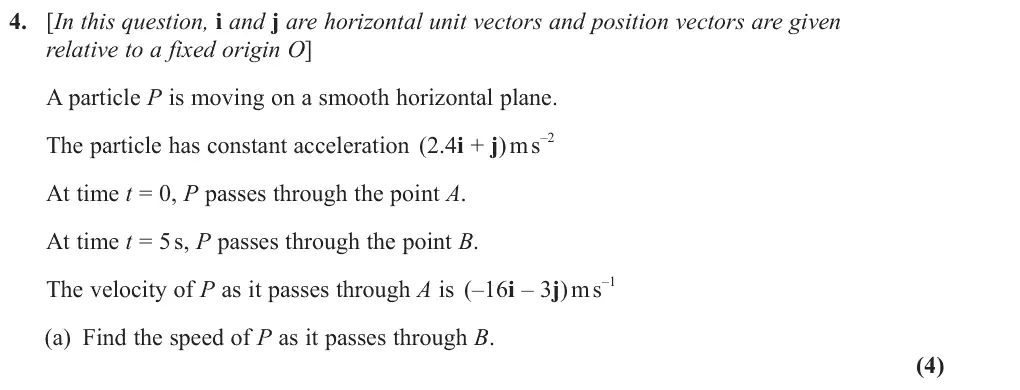
v = u + at with t = 5 gives −4i + 2j
then the magnitude √20 = 4.47
stopping at the velocity vector loses the last two marks
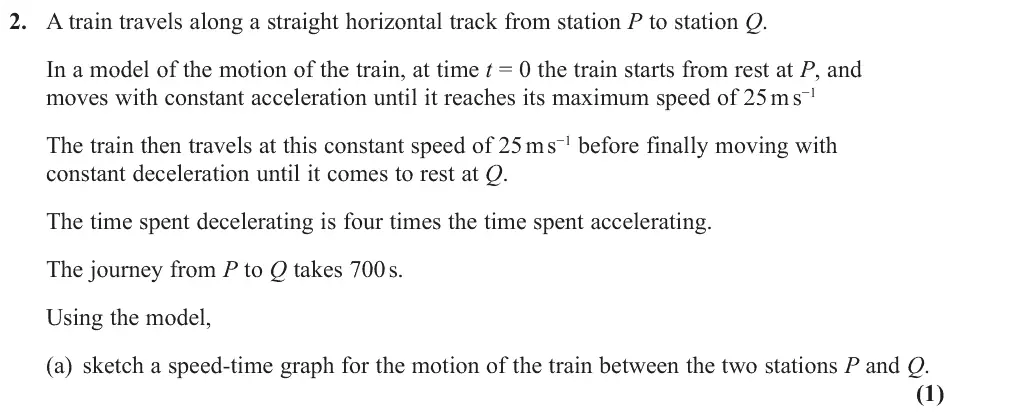
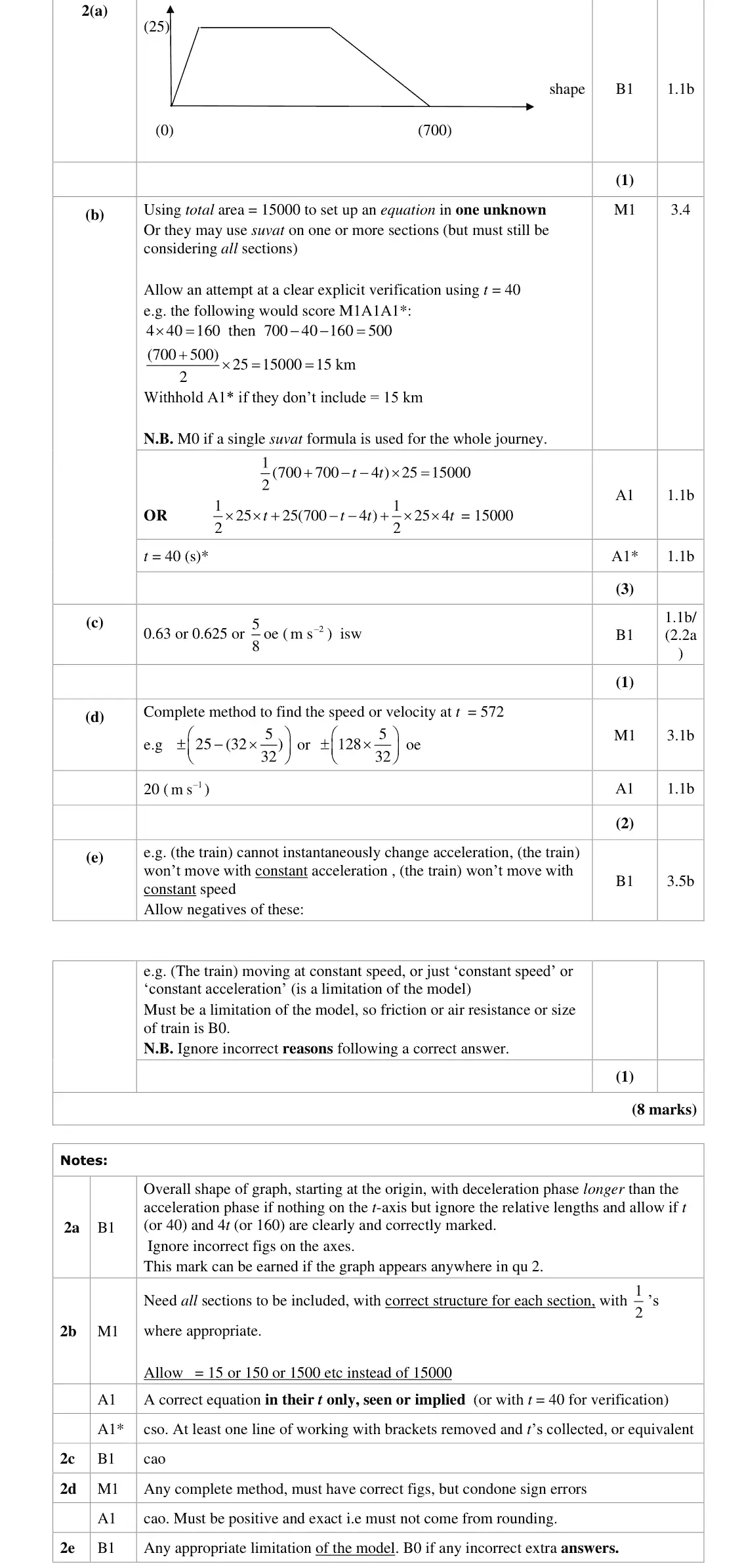
June 2022 · AS Paper 2 (Mechanics) · Q2(a)1 mark
Mark scheme (whole question; this part is marked with the orange bar)
Examiner's comment
In part (a), most diagrams were drawn with the correct shape. The most common error was to not have the deceleration phase clearly longer than the acceleration phase. Also a few candidates didn't account for the time travelling at constant speed and drew a triangle which generally meant that they were unable to score many marks in the remainder of the question. In the second part, most candidates connected the area under the graph to the distance of 15
Common mistakes
trapezium from the origin to (700, 0) with maximum 25
deceleration phase must be longer than acceleration phase (4 times)
a triangle (no constant-speed phase) loses most later marks
June 2022 · AS Paper 2 (Mechanics) · Q2(b)3 marks
Mark scheme (whole question; this part is marked with the orange bar)
Examiner's comment
In the second part, most candidates connected the area under the graph to the distance of 15 km travelled, although some forgot to change km into m or converted it wrongly. Some chose to use the formula for the area of a trapezium directly, others divided the area into two triangles and a rectangle and a small number used a rectangle with two triangles subtracted. A significant number of candidates chose to solve the problem by using an explicit verification method, using t = 40 and the information given about the acceleration and deceleration times and the total time to show that the distance travelled was 15000 m but lost the final mark if they did not say that this was equal to 15 km. The vast majority of candidates scored the mark in part
Common mistakes
total area under the graph = 15000 m (convert km to m)
½(700 + 700 − 5t) × 25 = 15000 gives t = 40
a single suvat for the whole journey scores 0
verification must conclude = 15 km
June 2022 · AS Paper 2 (Mechanics) · Q2(c)1 mark
Mark scheme (whole question; this part is marked with the orange bar)
Examiner's comment
(c) for the acceleration. Part (d) was the most challenging part, with only better candidates able to come up with a method and of those, having worked out that the change in velocity was 5 ms-1, forgot that it was decelerating at this stage and added it on to 25 ms-1 instead of subtracting it.
Common mistakes
a = 25/40 = 0.625 m/s² (gradient of the first section)
June 2022 · AS Paper 2 (Mechanics) · Q2(d)2 marks
Mark scheme (whole question; this part is marked with the orange bar)
Examiner's comment
(c) for the acceleration. Part (d) was the most challenging part, with only better candidates able to come up with a method and of those, having worked out that the change in velocity was 5 ms-1, forgot that it was decelerating at this stage and added it on to 25 ms-1 instead of subtracting it.
Common mistakes
deceleration 25/160 = 5/32
t = 572 is 128 s before the end (or 32 s into deceleration): v = 25 − 32 × 5/32 = 20
common error adding the 5 m/s change to 25
June 2022 · AS Paper 2 (Mechanics) · Q2(e)1 mark
Mark scheme (whole question; this part is marked with the orange bar)
Examiner's comment
In part (a), most diagrams were drawn with the correct shape. The most common error was to not have the deceleration phase clearly longer than the acceleration phase. Also a few candidates didn't account for the time travelling at constant speed and drew a triangle which generally meant that they were unable to score many marks in the remainder of the question. In the second part, most candidates connected the area under the graph to the distance of 15 km travelled, although some forgot to change km into m or converted it wrongly. Some chose to use the formula for the area of a trapezium directly, others divided the area into two triangles and a rectangle and a small number used a rectangle with two triangles subtracted. A significant number of candidates chose to solve the problem by using an explicit verification method, using t = 40 and the information given about the acceleration and deceleration times and the total time to show that the distance travelled was 15000 m but lost the final mark if they did not say that this was equal to 15 km. The vast majority of candidates scored the mark in part (c) for the acceleration. Part (d) was the most challenging part, with only better candidates able to come up with a method and of those, having worked out that the change in velocity was 5 ms-1, forgot that it was decelerating at this stage and added it on to 25 ms-1 instead of subtracting it.
Common mistakes
the train cannot change acceleration instantaneously or will not have constant acceleration/speed
friction, air resistance or size of train are not limitations of this model
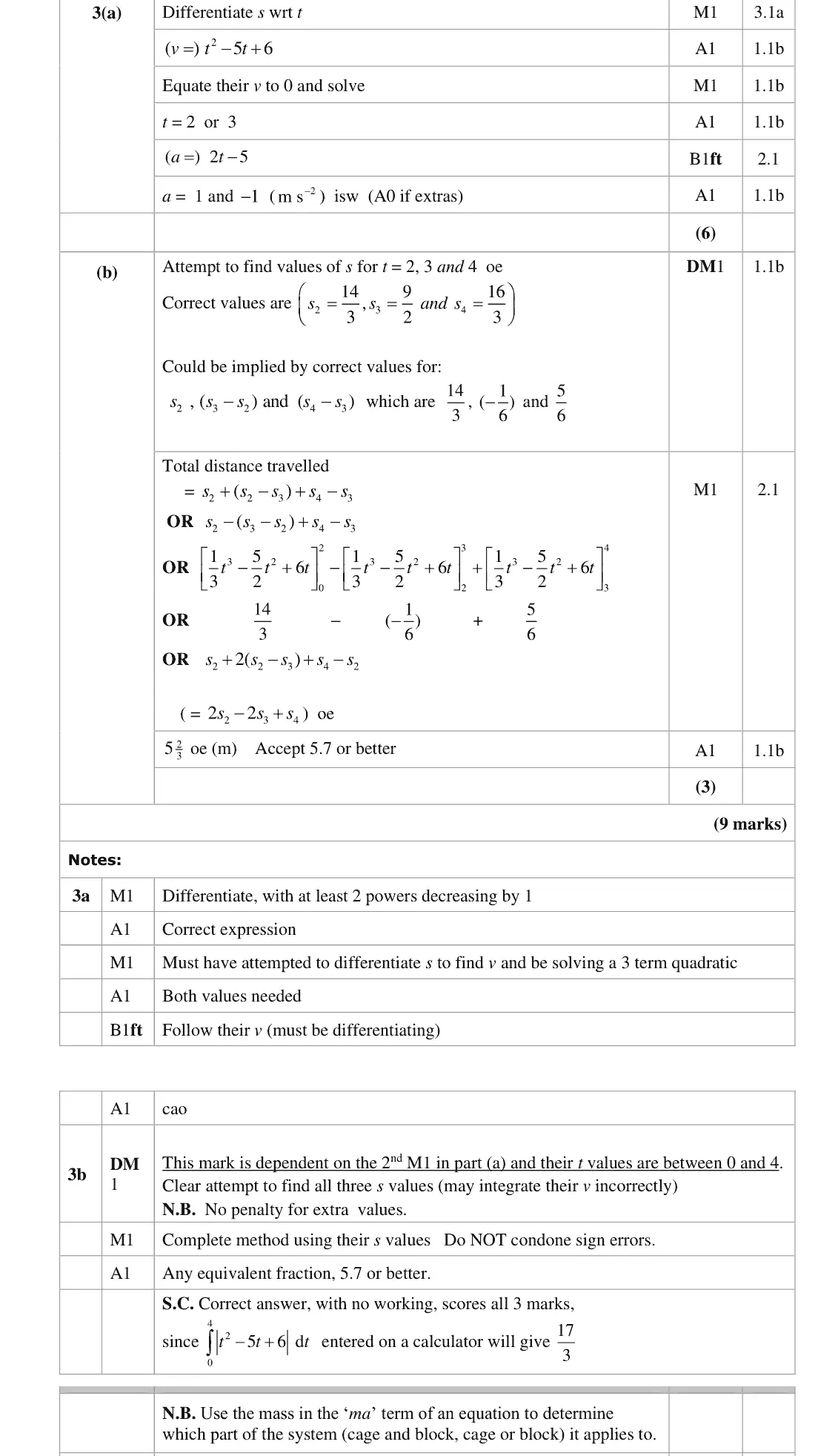
June 2022 · AS Paper 2 (Mechanics) · Q3(b)3 marks
Mark scheme (whole question; this part is marked with the orange bar)
Examiner's comment
attempted to use suvat formulae in this variable acceleration question. Part (b) was much more challenging and most candidates didn't see the connection with the work they'd done in part (a)
Common mistakes
P changes direction at t = 2 and t = 3 from (a)
distance = s₂ + (s₂ − s₃) + (s₄ − s₃) = 17/3 (5.7), not the displacement s₄ = 16/3
most did not see the link to (a)
June 2022 · Paper 3 (Mechanics) · Q1(a)2 marks
Mark scheme (whole question; this part is marked with the orange bar)
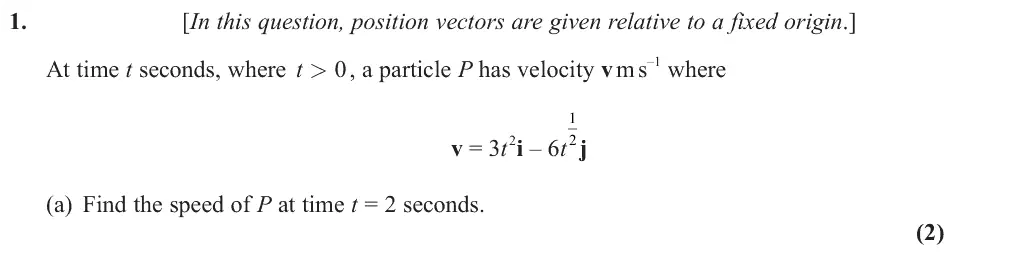
Examiner's comment
In part (a) most candidates correctly substituted t = 2 into the expression for the velocity and went on to use Pythagoras correctly to find an exact answer or an answer correct to the i and j and then finding 12-6 sqrt 2 rather than apply Pythagoras. A small number 2sf or better. Common mistakes were to stop once the velocity had been found, losing subtracted the squared values rather than adding in their Pythagoras. In the second part, most candidates identified that this was variable acceleration and differentiated correctly
Common mistakes
substitute t = 2 then use Pythagoras for speed (6√6, about 14.7)
stopping at the velocity vector
finding 12 − 6√2 instead of the magnitude
subtracting the squares
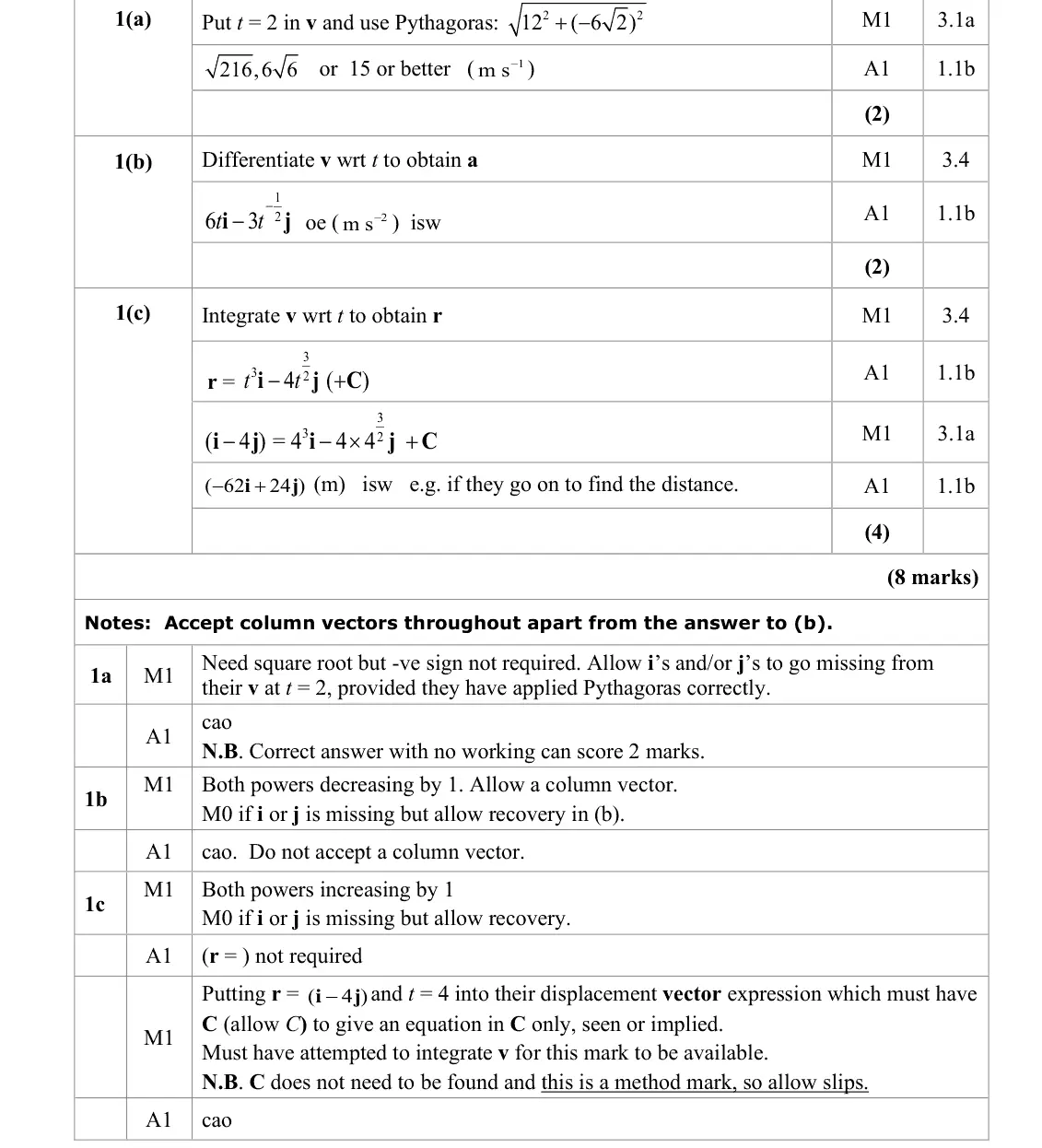
Oct 2021 · AS Paper 2 (Mechanics) · Q1(b)4 marks
Mark scheme (whole question; this part is marked with the orange bar)
Examiner's comment
(b) There were very few fully correct answers because most candidates did not realise that they had to consider the change in direction and just put t = 4 into a suvat equation. Some found the distance to the top and then used t = 2.5 to find the remaining distance but then did not round the answer to 2 or 3 sf following use of g = 9.8. A few used g = 9.81 or 10 despite the clear instruction on the front of the paper.
Common mistakes
distance, not displacement: the stone changes direction at t = 1.5, so add 11.025 up and 30.625 down = 41.7 m
substituting t = 4 into one suvat equation gives the displacement (19.6) only
2 or 3 s.f. after g = 9.8
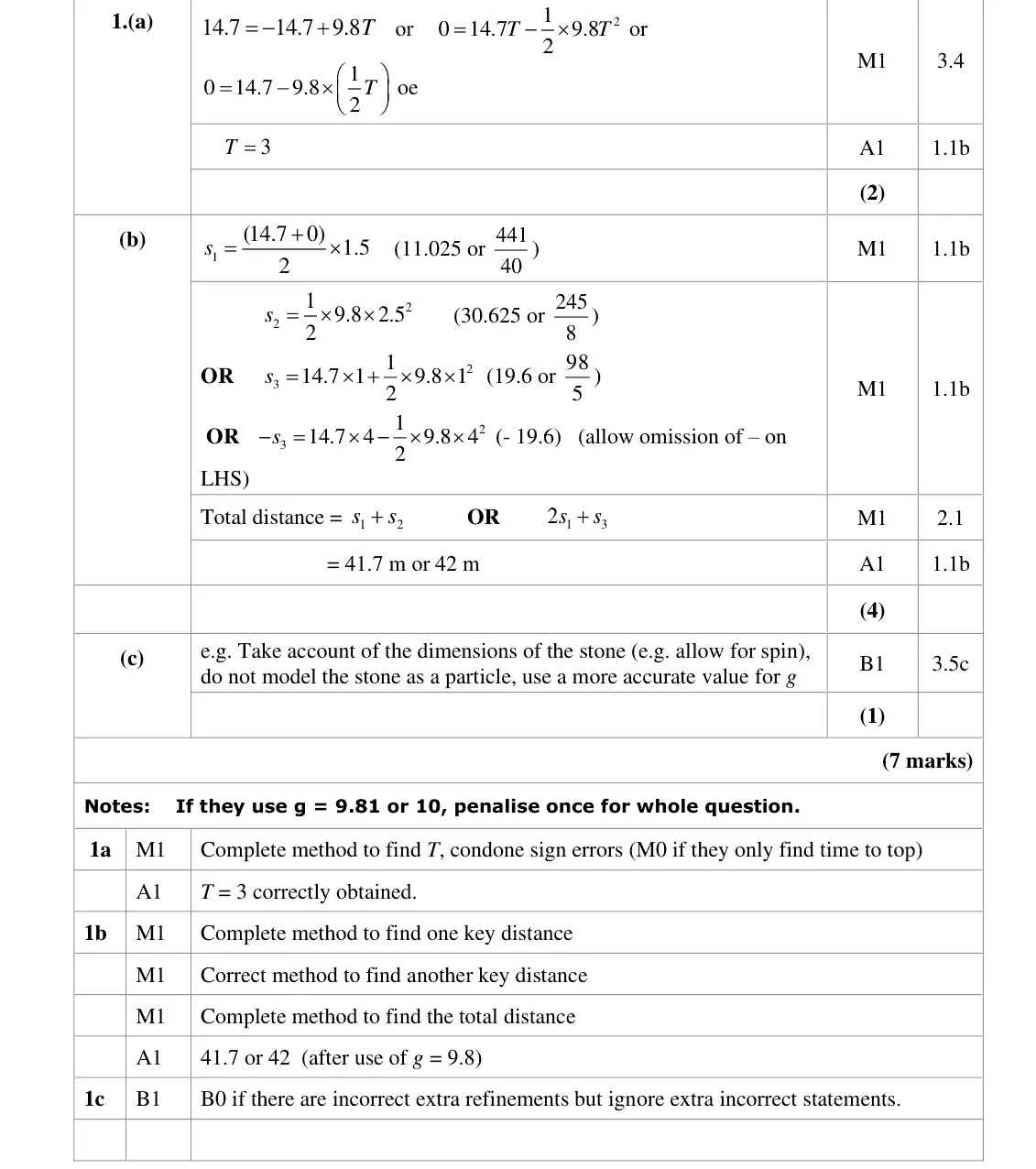
Oct 2021 · AS Paper 2 (Mechanics) · Q2(b)4 marks
Mark scheme (whole question; this part is marked with the orange bar)
Examiner's comment
Some went on to put a = 0, solving to get t = 5 which they went on to use in part (b) but this subsequent working was ignored in part (a). (b) The majority used v = 0 when t = 6, found a value of k and obtained a quadratic. Unfortunately, many made sign errors and their expression had +24 instead of -24. If they went on to solve their incorrect quadratic using a correct method, these candidates scored two of the four marks available. There were several completely correct answers.
Common mistakes
instantaneously at rest means v = 0
v = 0 at t = 6 gives k = 24
sign errors (+24 instead of −24)
solve the quadratic for t = 4
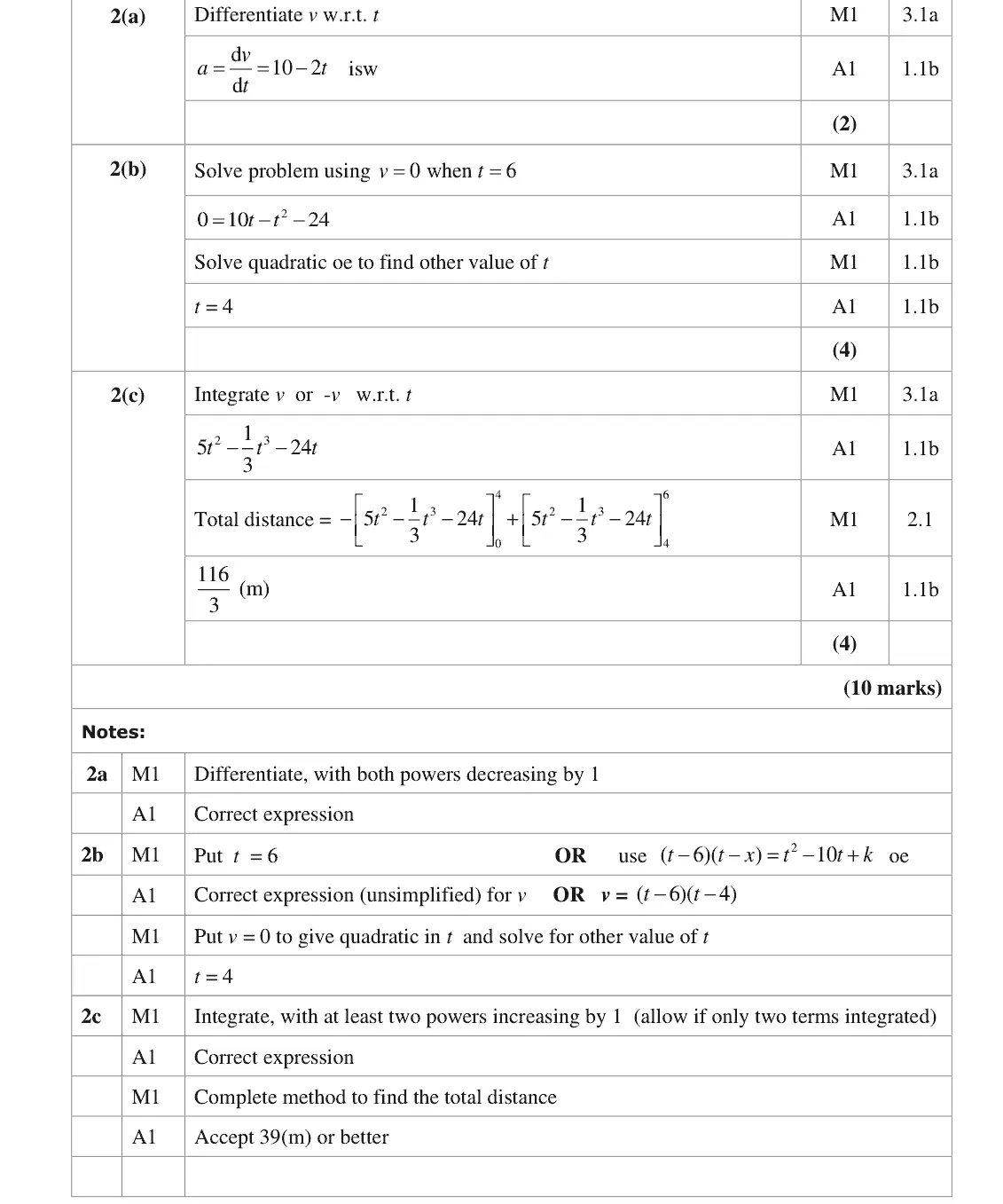
Oct 2021 · AS Paper 2 (Mechanics) · Q2(c)4 marks
Mark scheme (whole question; this part is marked with the orange bar)
Examiner's comment
(c) Some candidates knew that they needed to integrate v but a few tried to use suvat equations, losing all the marks and some did not substitute a numerical value for k. The last two marks were rarely scored as the change of direction was not appreciated.
Common mistakes
integrate v (suvat is invalid: acceleration not constant)
v changes sign at t = 4 so split the integral 0 to 4 and 4 to 6 and add magnitudes: 116/3 m
substitute k = 24 first
Oct 2021 · Paper 3 (Mechanics) · Q2(c)2 marks
Mark scheme (whole question; this part is marked with the orange bar)
Examiner's comment
Candidates need to make sure that they read and then answer questions carefully. In part successful. In part (c), most of the graphs given were correct but there are still candidates who add a solid vertical line at the end of the graph and this lost the mark. However, the second mark here was frequently lost. All that was required was a comment that the acceleration was constant. For the final part, candidates needed to answer the question
Common mistakes
straight line from the origin
no vertical line at the end (loses the mark)
the explanation (acceleration is constant) was often omitted
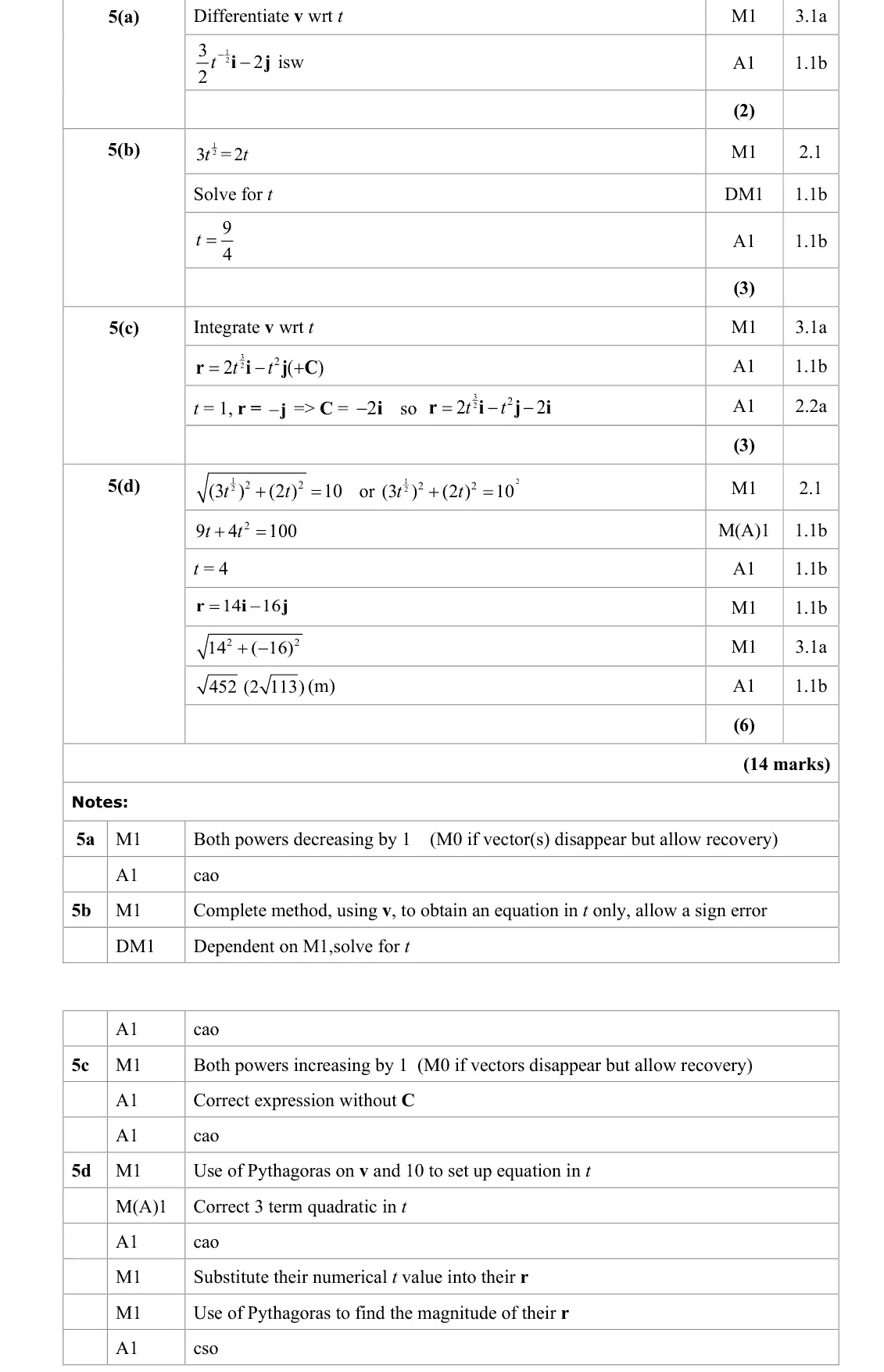
Oct 2021 · Paper 3 (Mechanics) · Q5(b)3 marks
Mark scheme (whole question; this part is marked with the orange bar)
Examiner's comment
achieved zero marks. Part (b) proved to be the least popular part of this question. 1 = 2t and then 3t Successful candidates employed a ratio method to obtain the equation 2 solved it. However, a significant minority of candidates incorrectly equated the i and j parts and then solved the two equations to obtain the correct answer. Candidates should note that this approach scored no marks. Other errors included using the acceleration vector or the displacement vector rather than the velocity vector when dealing with direction of travel. Part (c) tended to be well answered with a good number of candidates
Common mistakes
moving in direction i − j means the i and j components of v are equal and opposite: 3t^½ = 2t
equating v to i − j scores nothing
use v, not a or r
t = 9/4
Oct 2021 · Paper 3 (Mechanics) · Q5(d)6 marks
Mark scheme (whole question; this part is marked with the orange bar)
Examiner's comment
acceleration formulae. Part (d) allowed those who had made little progress on the first 3 parts, to score some marks as it only required the use of the given velocity vector to get started. For those who attempted it, the use of Pythagoras’ theorem on the velocity components was very accessible and a number of candidates solved the quadratic to obtain t = 4. Sign errors here were common, however, with many ending up with a wrong t value. Some candidates then scored a further two M marks for substituting their value of t into their position vector and then applying Pythagoras to find the distance. The question required an exact distance and so only surd answers earned the final mark.
Common mistakes
speed 10 means 9t + 4t² = 100, t = 4 (sign errors common)
substitute into r: 14i − 16j
distance is the magnitude of r
exact answer 2√113 (√452), decimals lose the final mark
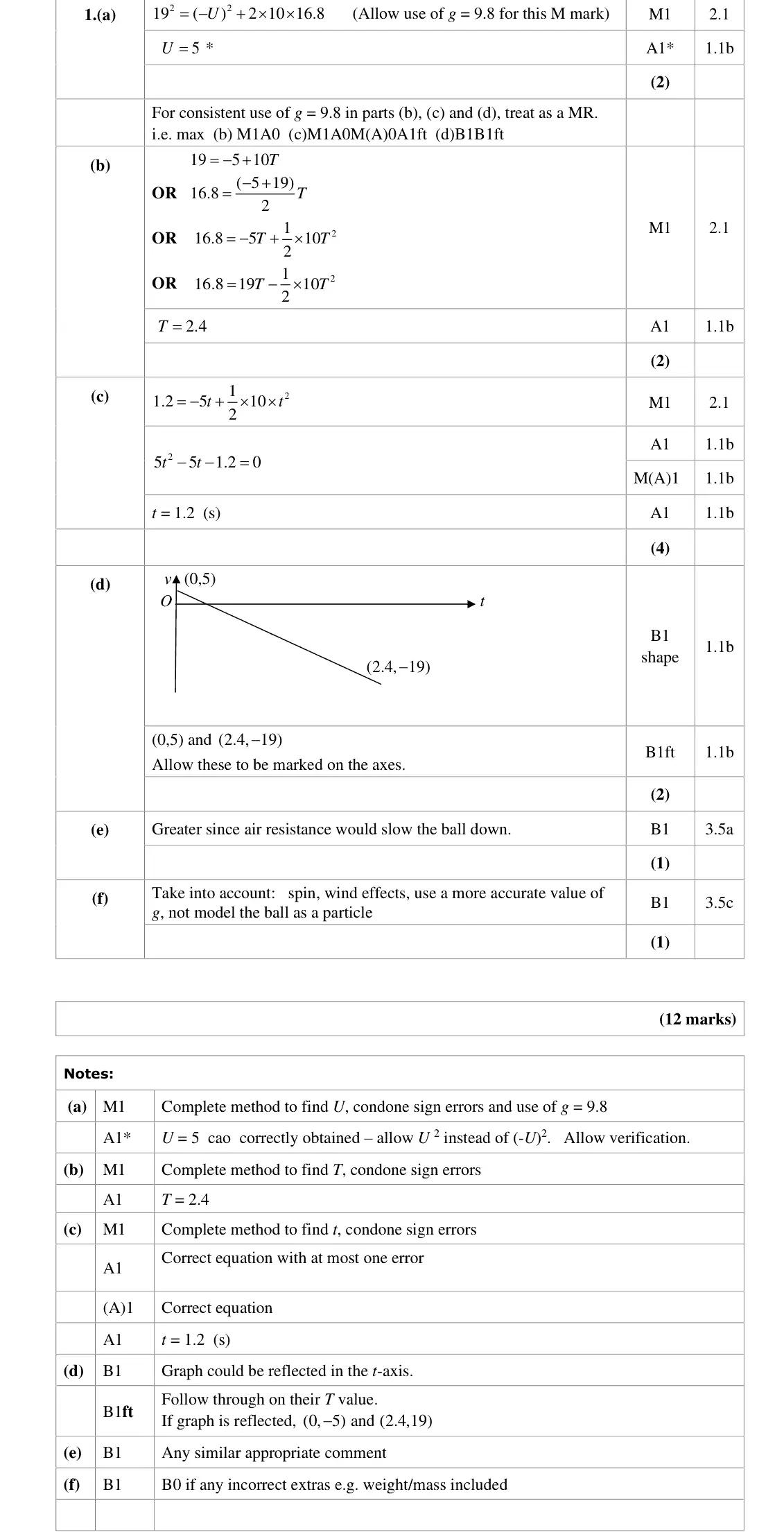
Oct 2020 · AS Paper 2 (Mechanics) · Q1(d)2 marks
Mark scheme (whole question; this part is marked with the orange bar)
Examiner's comment
the time down and then add. In part (d), very few correct graphs seen. Many started from the origin to produce an upside down V-shape or a trapezium. In
Common mistakes
straight line from (0, 5) to (2.4, −19) crossing the t-axis (or its reflection)
common errors starting at the origin, inverted V or trapezium
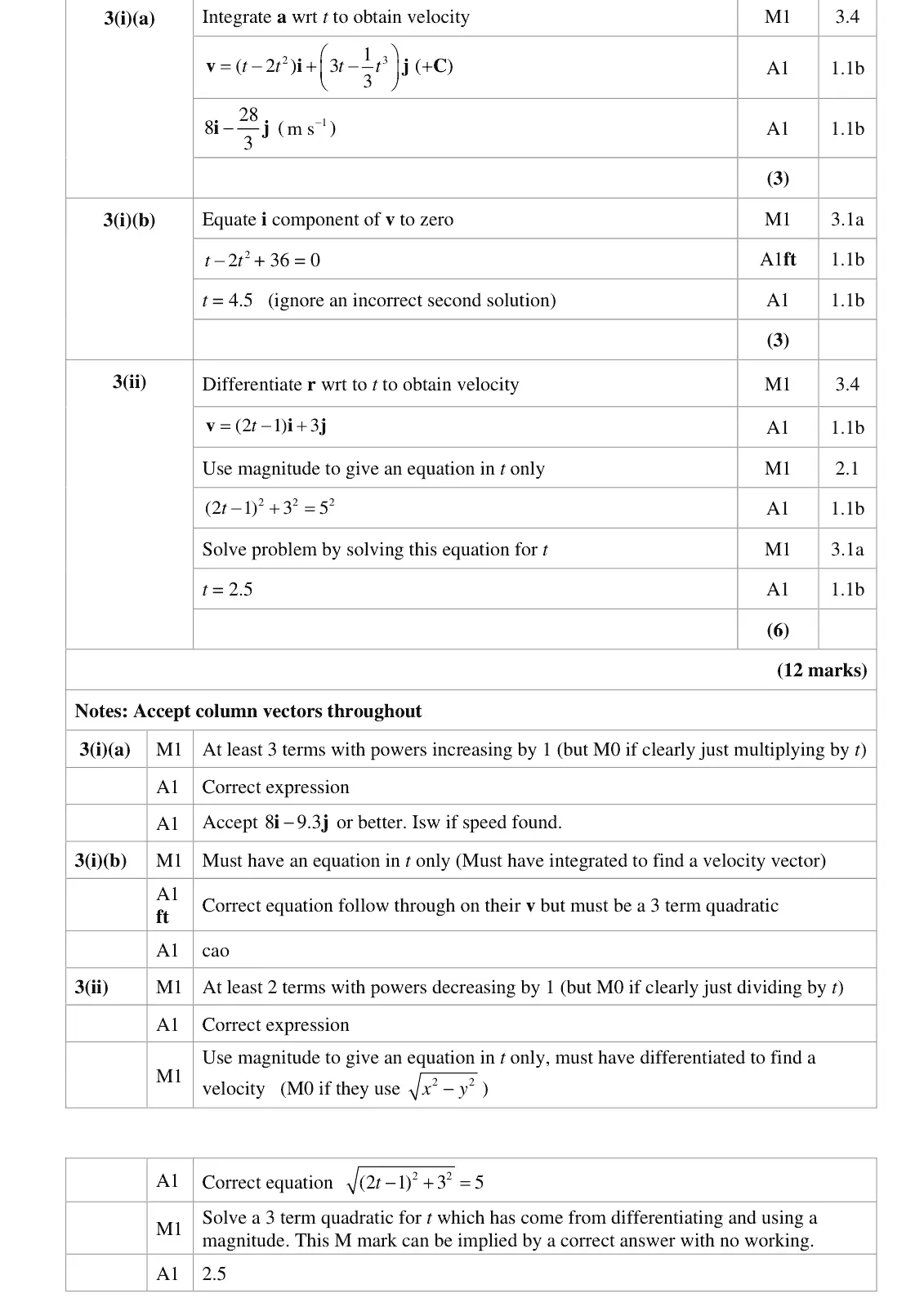
Oct 2020 · Paper 3 (Mechanics) · Q3(i)(b)3 marks
Mark scheme (whole question; this part is marked with the orange bar)
Examiner's comment
Part (i) involved variable acceleration but a significant minority of candidates tried to apply suvat equations and so achieved no credit. In part (i)(a), many did complete the required integration to find an expression for v and substitute t = 4; a fair number of correct answers were seen with the main errors either being numerical slips or neglecting to include the constant, 36i. In part (i)(b), candidates needed to realise that moving perpendicular to i implies the i component of v is zero; those who equated the j components to zero achieved no marks. Occasionally the i and j components were equated and some candidates did not know how to proceed at all. Some focussed on the displacement vector. Those who knew what to do generally obtained the correct answer. Part (ii) was generally found more accessible and many of the candidates who had used suvat in (i) now realised that they had to differentiate here to find the velocity. Most knew how to use the given speed to create an equation in t, although a few just tried to equate their vector to 5 and then either gave up or just dropped the i and j. A fair number achieved full marks for this part of the question.
Common mistakes
perpendicular to i means the i component of v is zero: t − 2t² + 36 = 0 gives t = 4.5
equating the j component to zero (or i to j) scores nothing
use velocity, not displacement
Oct 2020 · Paper 3 (Mechanics) · Q3(ii)6 marks
Mark scheme (whole question; this part is marked with the orange bar)
Examiner's comment
Part (i) involved variable acceleration but a significant minority of candidates tried to apply suvat equations and so achieved no credit. In part (i)(a), many did complete the required integration to find an expression for v and substitute t = 4; a fair number of correct answers were seen with the main errors either being numerical slips or neglecting to include the constant, 36i. In part (i)(b), candidates needed to realise that moving perpendicular to i implies the i component of v is zero; those who equated the j components to zero achieved no marks. Occasionally the i and j components were equated and some candidates did not know how to proceed at all. Some focussed on the displacement vector. Those who knew what to do generally obtained the correct answer. Part (ii) was generally found more accessible and many of the candidates who had used suvat in (i) now realised that they had to differentiate here to find the velocity. Most knew how to use the given speed to create an equation in t, although a few just tried to equate their vector to 5 and then either gave up or just dropped the i and j. A fair number achieved full marks for this part of the question.
Common mistakes
differentiate r to get v = (2t − 1)i + 3j
speed is the magnitude: (2t − 1)² + 3² = 5² gives t = 2.5
equating the vector to 5 or dropping i and j is wrong
not √(x² − y²)
June 2019 · AS Paper 2 (Mechanics) · Q1(b)2 marks
Mark scheme (whole question; this part is marked with the orange bar)
Examiner's comment
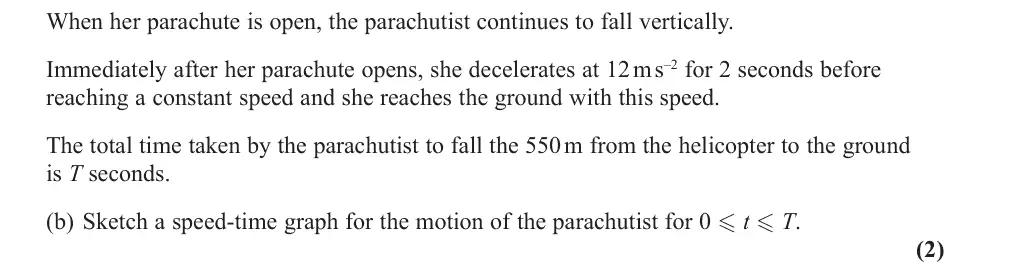
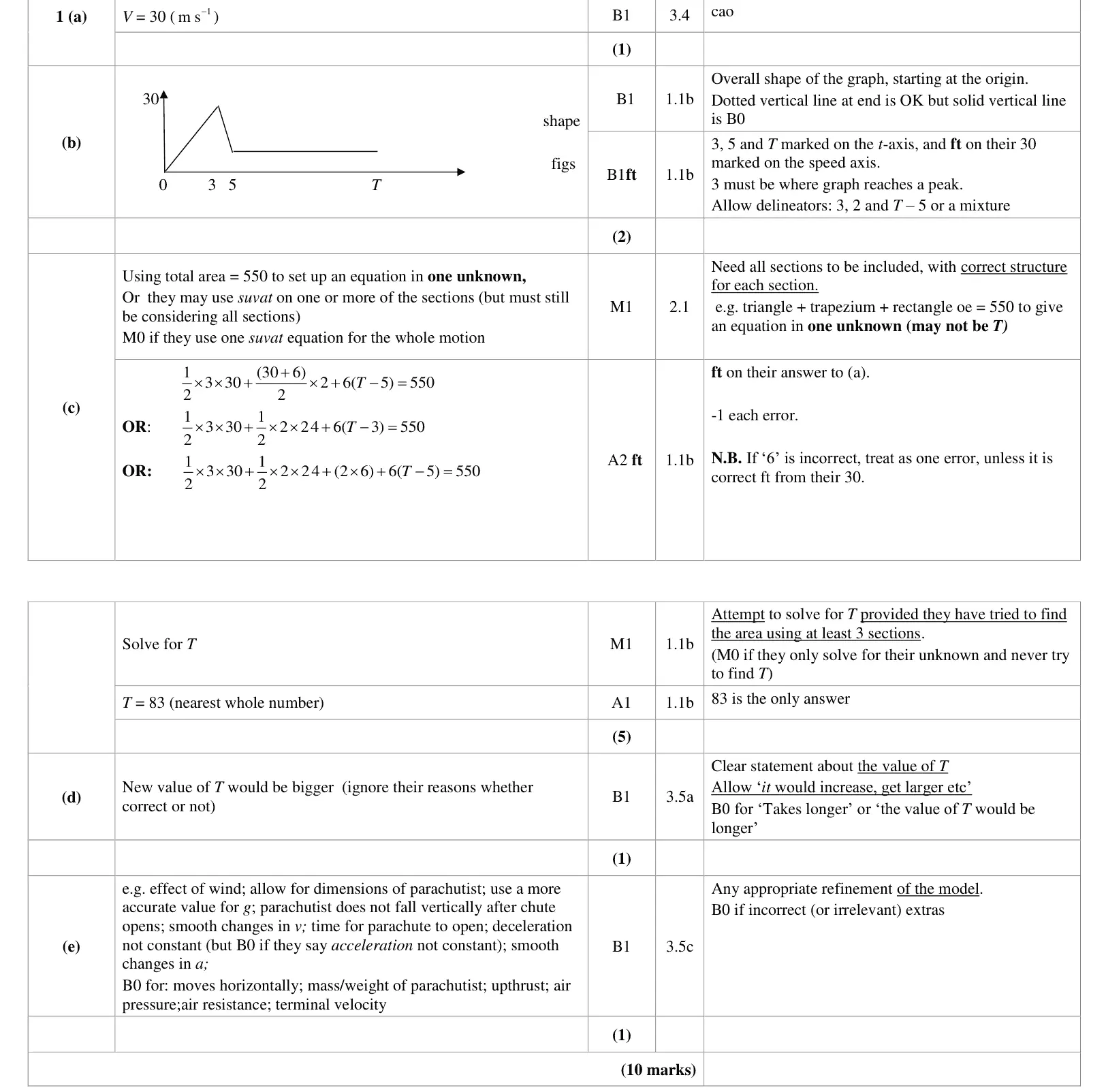
Part (b) involved drawing a speed-time graph for the motion of the parachutist. Many correct shapes were seen for the first mark but those who included a solid vertical line at t = T were penalised. Other less common errors included not starting the graph at the origin, not using a straight line for each section and having a sloping line for the final section (when the parachutist is moving with constant speed). The given figures (‘30’, 3, 5, T) were required to be correctly placed for the second mark; occasionally one or two were omitted but many did achieve this mark. In the third part the majority of the candidates
Common mistakes
start at the origin
straight line up to 30 at t = 3, straight line down to 6 at t = 5, then horizontal to T
mark 3, 5, T and 30
no solid vertical line at t = T
final section not sloping
June 2019 · AS Paper 2 (Mechanics) · Q1(c)5 marks
Mark scheme (whole question; this part is marked with the orange bar)
Examiner's comment
one or two were omitted but many did achieve this mark. In the third part the majority of the candidates realised that the area under the graph represented the distance travelled. However, not all used the correct structure, namely a triangle, rhombus and rectangle (or equivalent) and the relevant correct formulae for their areas. There was often confusion in the use of T (which was defined in the question) so that effectively the final stated answer was 5 less than the actual value. Some used suvat equations for each stage of the motion, often more or less successfully, although a fairly common error was to use a final velocity of zero in the third section. Attempts to use a single suvat equation to cover the entire distance were seen on occasion; these showed a lack of understanding of the situation and achieved no credit. Those with correct working did not always round the final answer to the nearest whole number as required.
Common mistakes
total area under the speed-time graph = 550: ½ × 3 × 30 + ½(30 + 6) × 2 + 6(T − 5) = 550
constant speed after t = 5 is 6 m s⁻¹
use T − 5 (not T) for the last section
one suvat equation for the whole motion scores nothing
T = 83 to the nearest whole number
June 2019 · AS Paper 2 (Mechanics) · Q1(d)1 mark
Mark scheme (whole question; this part is marked with the orange bar)
Examiner's comment
Part (d) required recognition of the fact that including the effect of air resistance would lead to an increased value of T. Although this was widely understood, some candidates commented that ‘it would take longer’ which did not answer the question as stated.
Common mistakes
air resistance reduces the speed before the parachute opens, so the new value of T is bigger
must refer to T ("takes longer" alone is B0)
June 2019 · AS Paper 2 (Mechanics) · Q3(a)5 marks
Mark scheme (whole question; this part is marked with the orange bar)
Examiner's comment
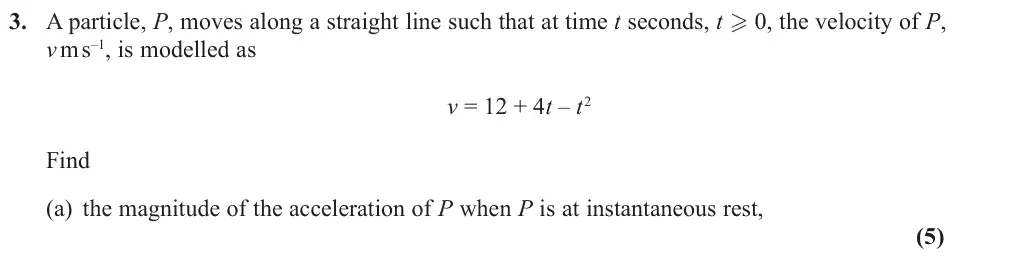
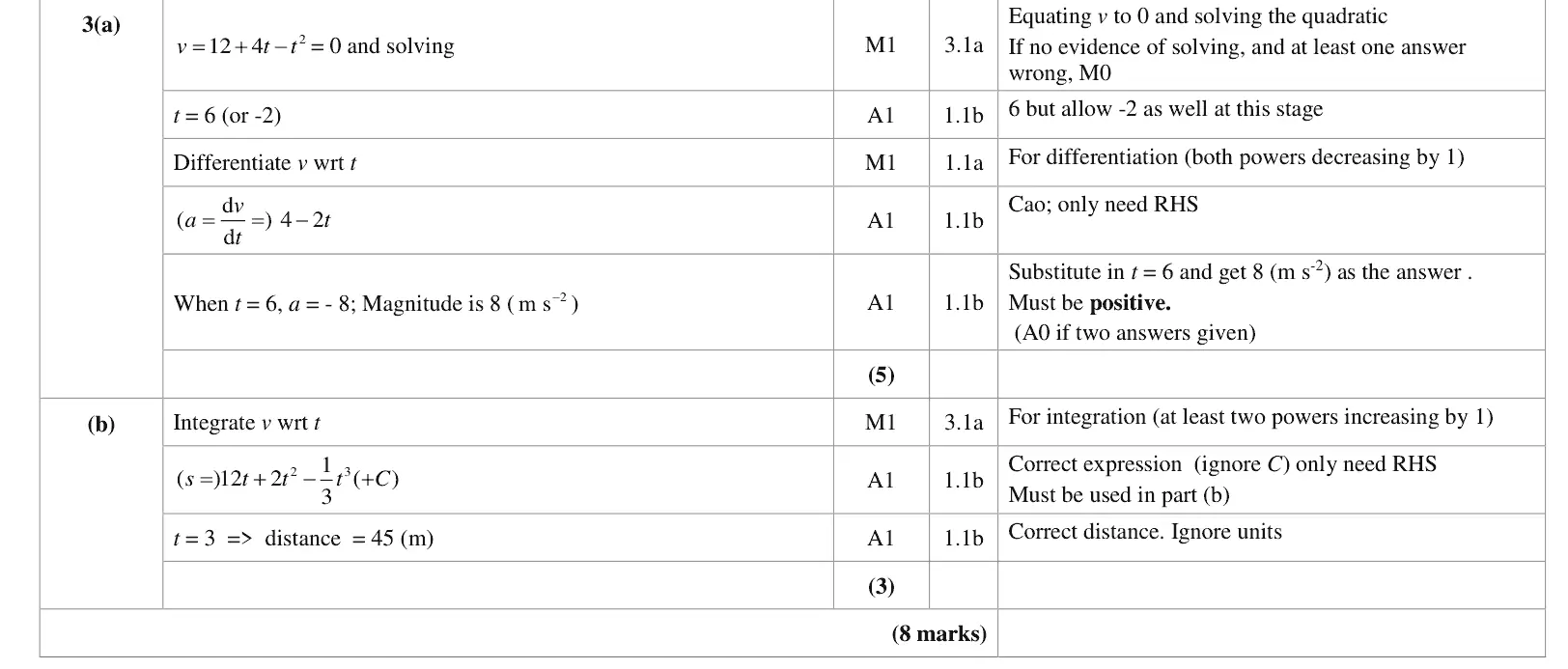
In the first part, the majority of candidates knew that finding acceleration involved differentiating the given expression for the velocity and, apart from the occasional slip, this was generally done well. However, a fair number then found either t when a = 0 or a when t = 0 without realising that, to find the relevant value of t, it was necessary to solve the quadratic equation obtained by setting v = 0 (when the particle is at instantaneous rest) . Many of those with the correct working lost the final mark for giving a negative answer for the ‘magnitude’ of the acceleration. Most candidates knew they had to integrate for part (b) which they did mostly successfully and many
Common mistakes
instantaneous rest means v = 0: solve 12 + 4t − t² = 0 to t = 6 (reject −2)
a = dv/dt = 4 − 2t = −8
magnitude 8 m s⁻² (positive)
not a when t = 0 or t when a = 0
June 2019 · AS Paper 2 (Mechanics) · Q3(b)3 marks
Mark scheme (whole question; this part is marked with the orange bar)
Examiner's comment
Most candidates knew they had to integrate for part (b) which they did mostly successfully and many went on to substitute t = 3 as required to find the distance travelled. There were a few numerical slips in carrying out the substitution but there were many correct solutions seen to this part of the question.
Common mistakes
integrate v: s = 12t + 2t² − t³/3
v > 0 for 0 ≤ t ≤ 3 so distance = s(3) = 45 m
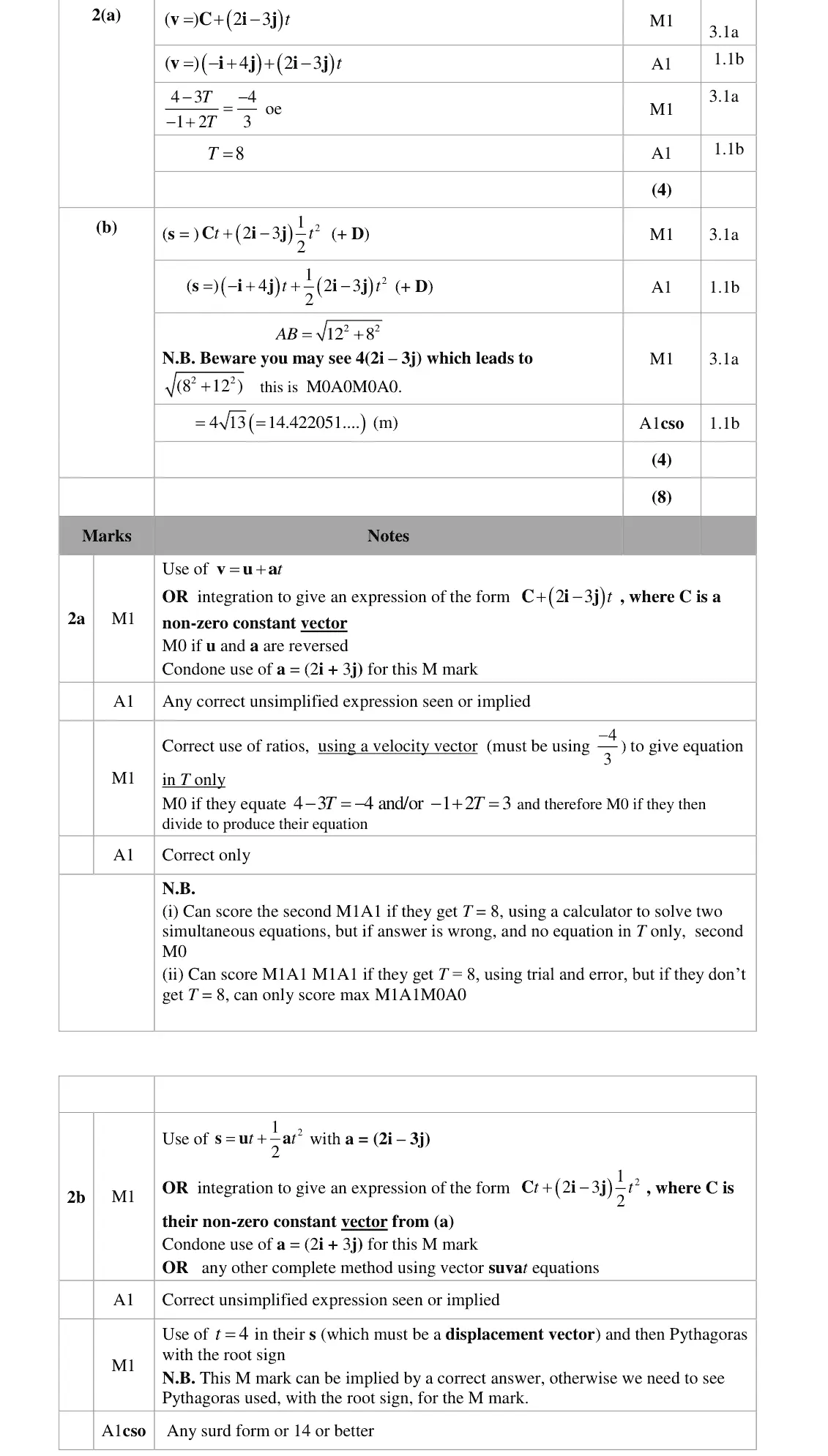
June 2019 · Paper 3 (Mechanics) · Q2(b)4 marks
Mark scheme (whole question; this part is marked with the orange bar)
Examiner's comment
displacement vector showing a lack of understanding of the situation. The second part was generally handled more successfully with many correct answers seen for the displacement vector (using s = ut 1 2 at2) although not all proceeded to find the distance by calculating its magnitude. Although most used + suvat formulae throughout the question, some successfully integrated the given constant acceleration to find the velocity and displacement. Use of magnitudes of vectors throughout and some invalid multiplication/division of vectors were seen on occasion.
Common mistakes
s = ut + ½at² with u = −i + 4j and t = 4 gives 12i − 8j
distance is its magnitude 4√13 ≈ 14.4 m
4(2i − 3j) is not the displacement
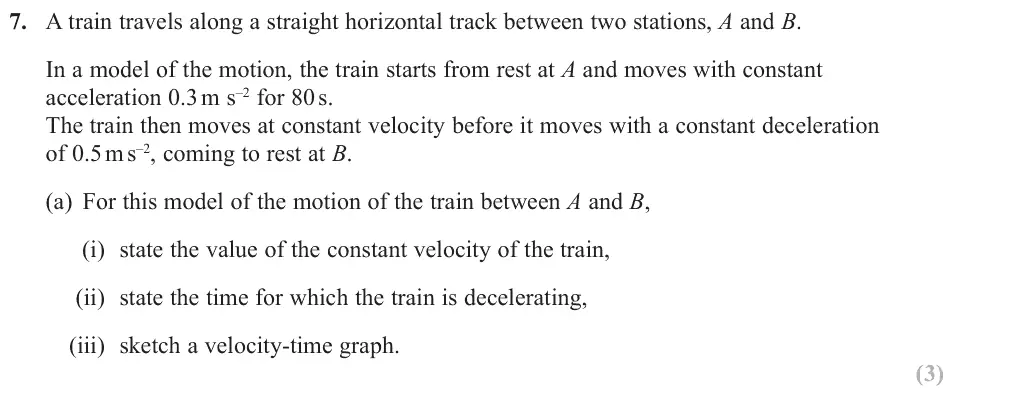
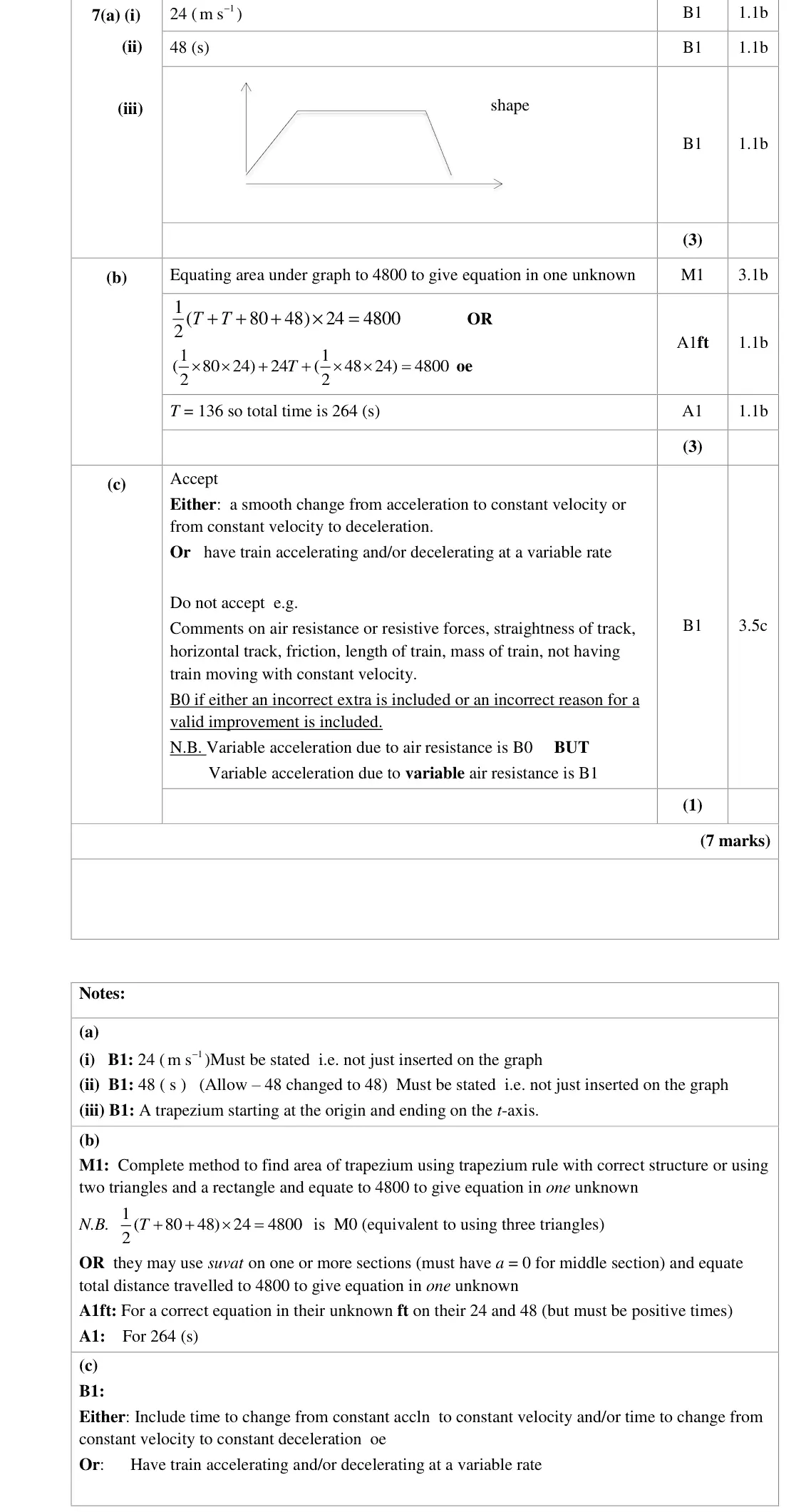
June 2018 · AS Paper 2 · Q7(a)3 marks
Mark scheme (whole question; this part is marked with the orange bar)
Examiner's comment
The majority of students identified a correct value for the required constant speed (24 m s-1) and then for the time of deceleration (48 s) although ‘24÷0.5=12’ was a surprisingly common error. Most, but not all, produced a velocity-time graph in the shape of a trapezium starting at the origin and finishing on the t axis.
Common mistakes
constant velocity 0.3 × 80 = 24 m/s
deceleration time 24 ÷ 0.5 = 48 s (24 × 0.5 = 12 is a common error)
values must be stated, not only marked on the graph
v–t graph a trapezium from the origin ending on the t-axis
June 2018 · AS Paper 2 · Q7(b)3 marks
Mark scheme (whole question; this part is marked with the orange bar)
Examiner's comment
In part (b), those who tried to equate the area under the graph to the distance travelled sometimes did so successfully, although an unknown ‘T’ value was often used inconsistently in the 3 sections of the motion. Some failed to use the correct structure (a trapezium or two triangles and a rectangle) or attempted a single suvat equation for the whole journey; such attempts gained no credit. Having found a correct relevant ‘T’ value, a number of students forgot that the question required the time for the complete journey.
Common mistakes
area under the v–t graph = 4800: ½(T + T + 128) × 24 = 4800 gives T = 136, so total time 264 s (not 136)
½(T + 128) × 24 is wrong
a single suvat for the whole journey scores 0
June 2018 · AS Paper 2 · Q7(c)1 mark
Mark scheme (whole question; this part is marked with the orange bar)
Examiner's comment
Part (c) required the identification of a possible improvement to the model. The model assumed periods of constant acceleration and instantaneous changes between constant acceleration and constant velocity. Therefore possible improvements to the model would be to allow variable acceleration and smooth changes between acceleration and constant velocity. However, valid responses were relatively rare; examples of the various comments seen included reference to the mass or length of the train, traffic lights, number of passengers and even the weather.
Common mistakes
allow a smooth change between acceleration and constant velocity, or variable acceleration/deceleration
air resistance, mass or length of the train, traffic lights or weather score 0
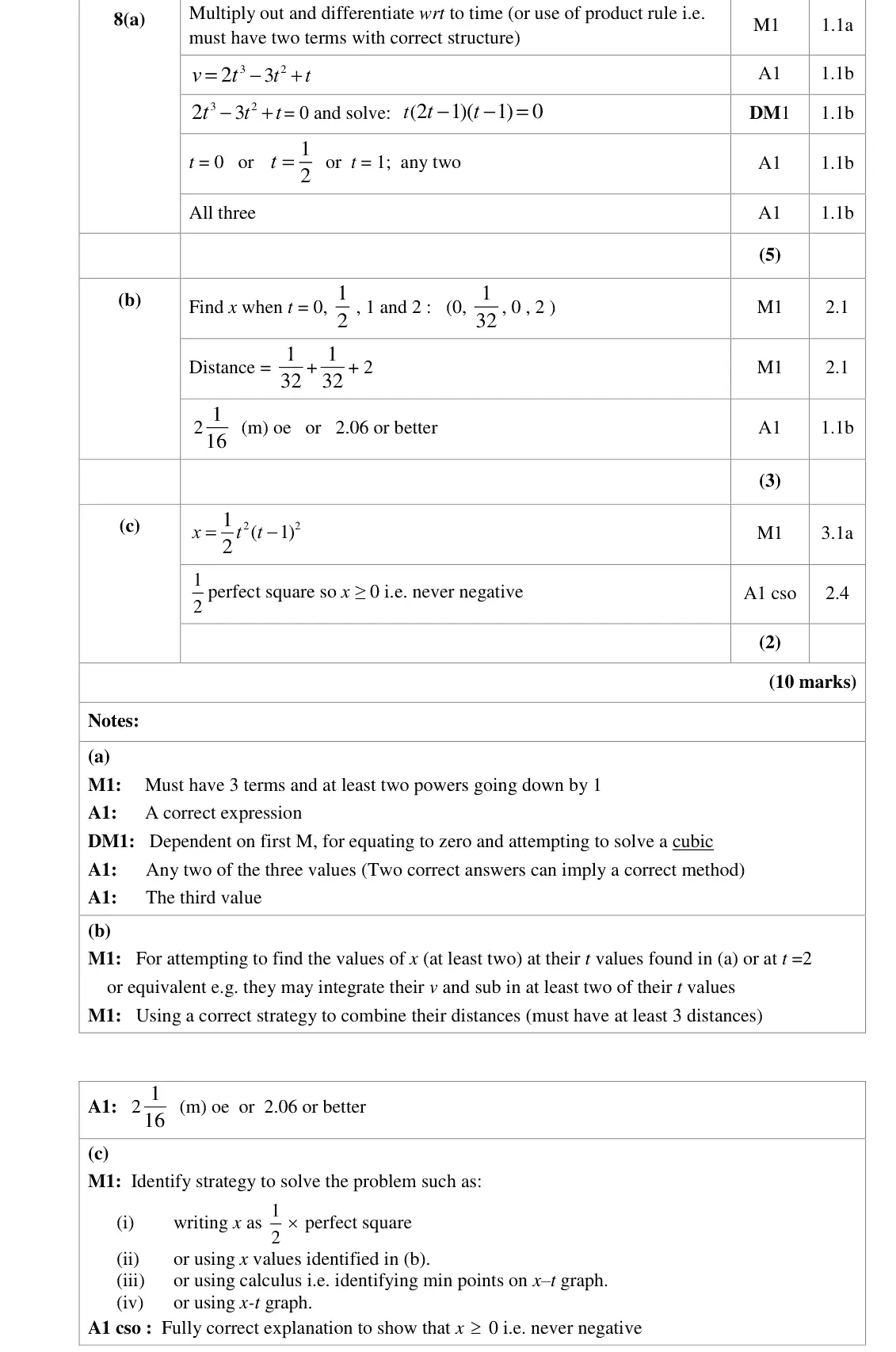
June 2018 · AS Paper 2 · Q8(b)3 marks
Mark scheme (whole question; this part is marked with the orange bar)
Examiner's comment
In part (b), a lack of understanding of the difference between distance and displacement became very apparent with the vast majority of students substituting only t = 2 (and sometimes t = 0) in an attempt to find the distance travelled in the first 2 seconds. Surprisingly, many integrated their expression for v rather than using the one for x that was given in the question (or even integrated the expression for x). Very few used their answers to (a) to indicate changes in direction and thereby calculate the whole distance. Part (c) also proved to be a challenge with few students scoring either of the two available
Common mistakes
distance, not displacement: x = 0, 1/32, 0, 2 at t = 0, ½, 1, 2, so distance = 1/32 + 1/32 + 2 = 2 1/16 m
substituting only t = 2 is the common error
use the given x rather than integrating v
June 2018 · AS Paper 2 · Q8(c)2 marks
Mark scheme (whole question; this part is marked with the orange bar)
Examiner's comment
distance. Part (c) also proved to be a challenge with few students scoring either of the two available marks. Those who did write the expression as a perfect square (achieving the first mark) often claimed that therefore it had to be positive ignoring the possibility of zero. Common incorrect responses included: ‘time cannot be negative’ and ‘t 2’ is positive and any number times by a positive number is always positive’. A handful of students used their values from (b) to describe the motion in detail and thereby deduce the fact that the particle never moved on the negative x-axis.
Common mistakes
x = ½t²(t − 1)², half a perfect square so x ≥ 0 (zero is possible, so not "always positive")
"time cannot be negative" is not a reason
Find an Edexcel maths tutor
Stuck on this? Book a trial session with an Edexcel specialist.