June 2025: Paper 1: Pure Mathematics 1

100 marks · 38 question parts · Question paper, mark scheme and examiner's report on Pearson's site

Question by question

QTopicMarksDifficulty
1(a) Graphs and transformations 1 —
1(b) Functions, composite and inverse functions, modulus, Graphs and transformations 1 —
1(c) Graphs and transformations 2 —
2(a) Circles, Indices and surds 3 —
2(b) Circles, Quadratics and the discriminant 2 —
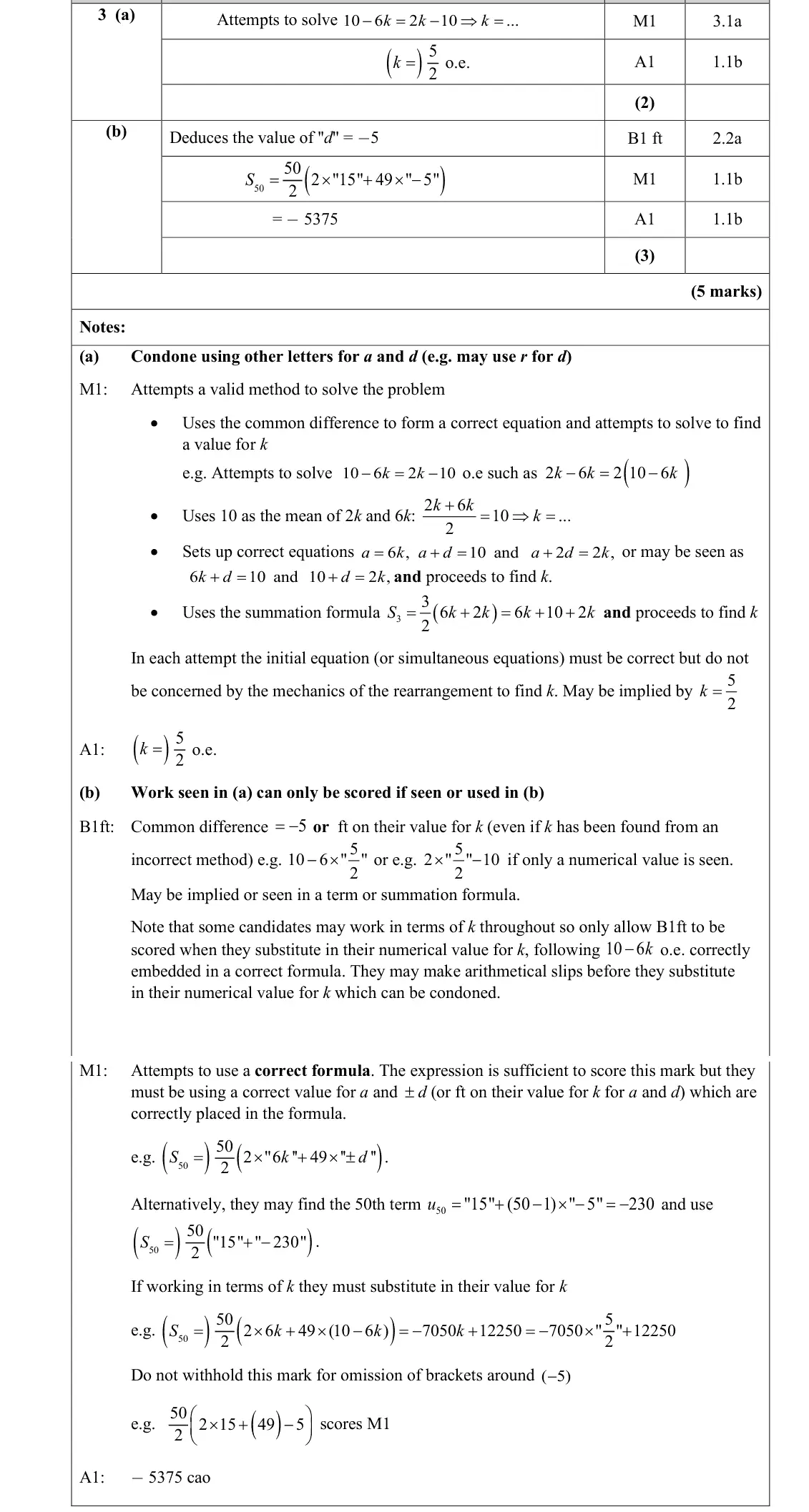
3(a) Sequences and series, Simultaneous equations 2 —
3(b) Sequences and series 3 —
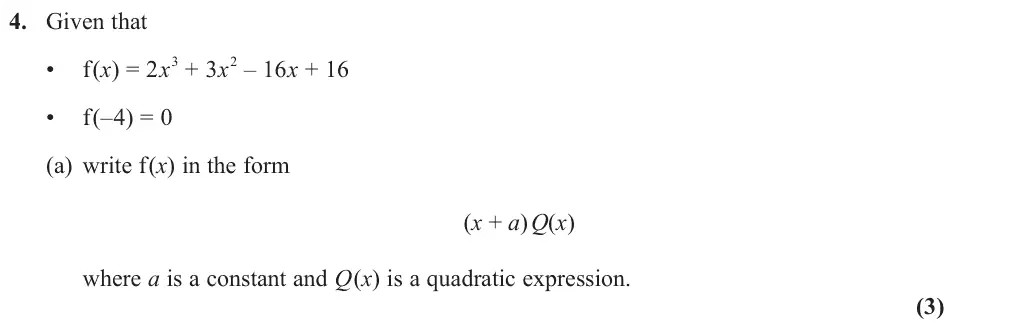
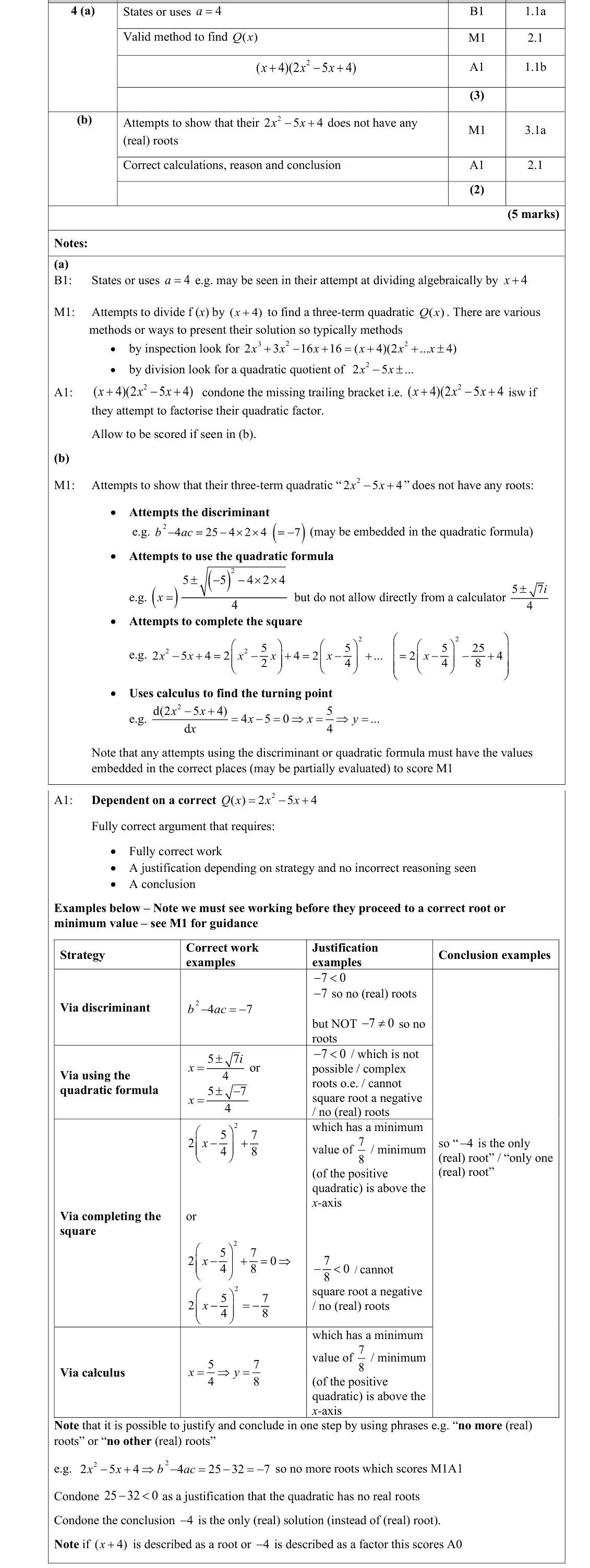
4(a) Algebraic methods: polynomials, factor theorem and division 3 —
4(b) Quadratics and the discriminant, Algebraic methods: polynomials, factor theorem and division, Proof, including contradiction 2 —
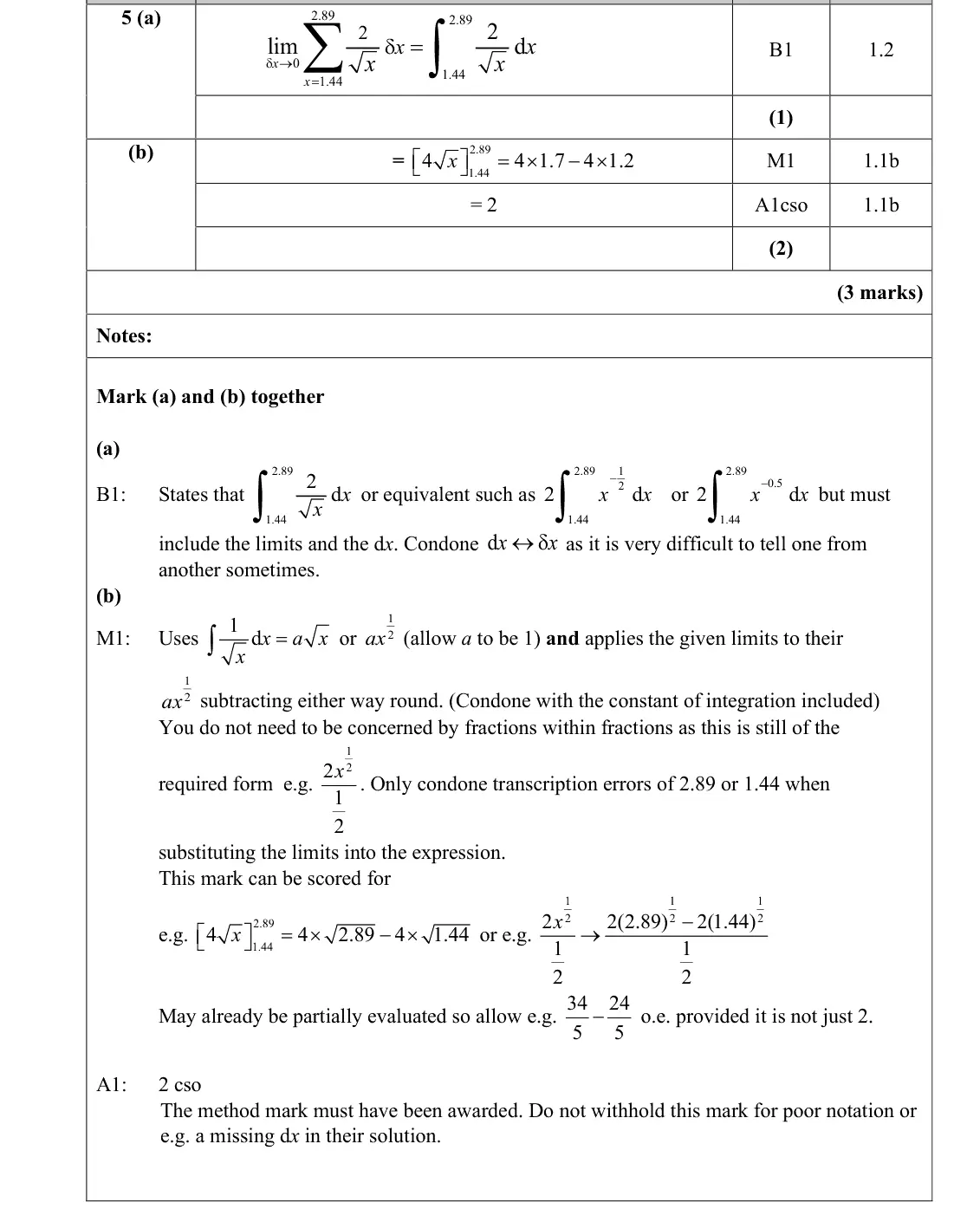
5(a) Integration: standard integrals, definite integrals and areas 1 —
5(b) Integration: standard integrals, definite integrals and areas, Indices and surds 2 —
6(a) Functions, composite and inverse functions, modulus, Indices and surds, Simultaneous equations 4 —
6(b) Functions, composite and inverse functions, modulus 1 —
6(c) Functions, composite and inverse functions, modulus, Indices and surds 2 —
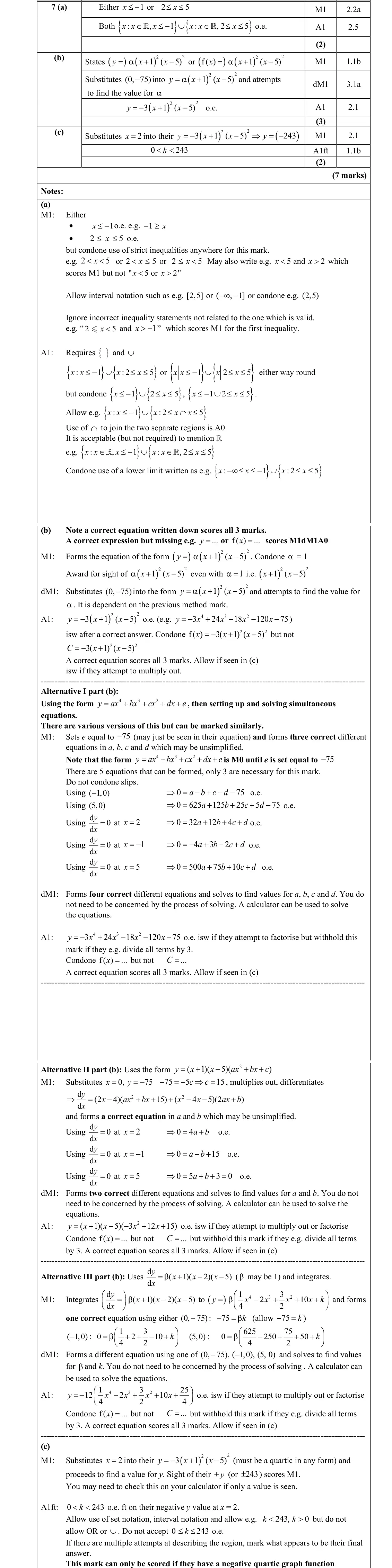
7(a) Differentiation: first principles, gradients, stationary points, Inequalities 2 —
7(b) Graphs and transformations, Algebraic methods: polynomials, factor theorem and division 3 —
7(c) Graphs and transformations, Differentiation: first principles, gradients, stationary points 2 —
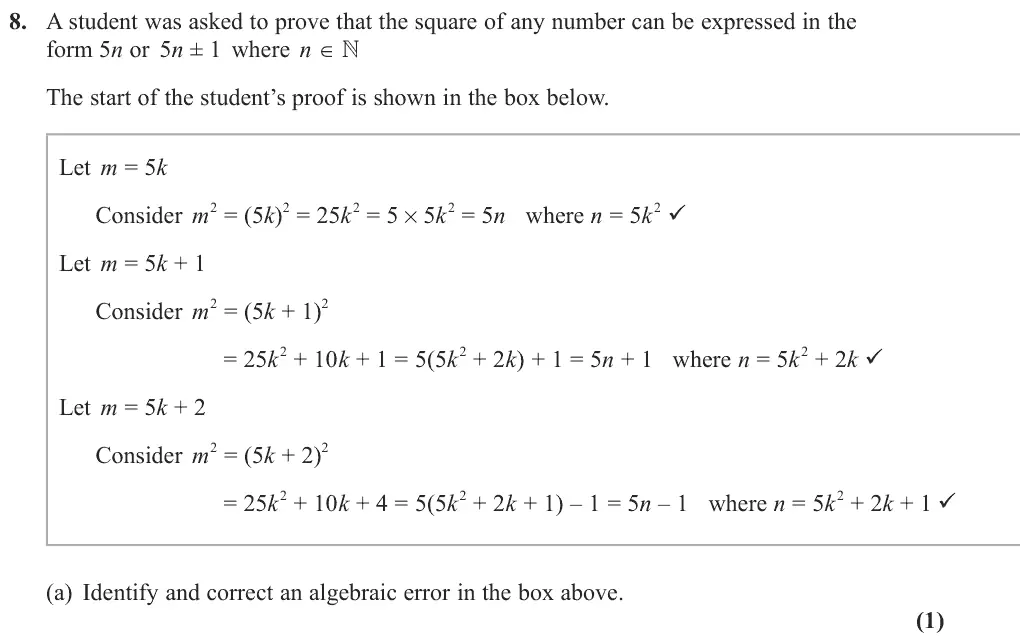
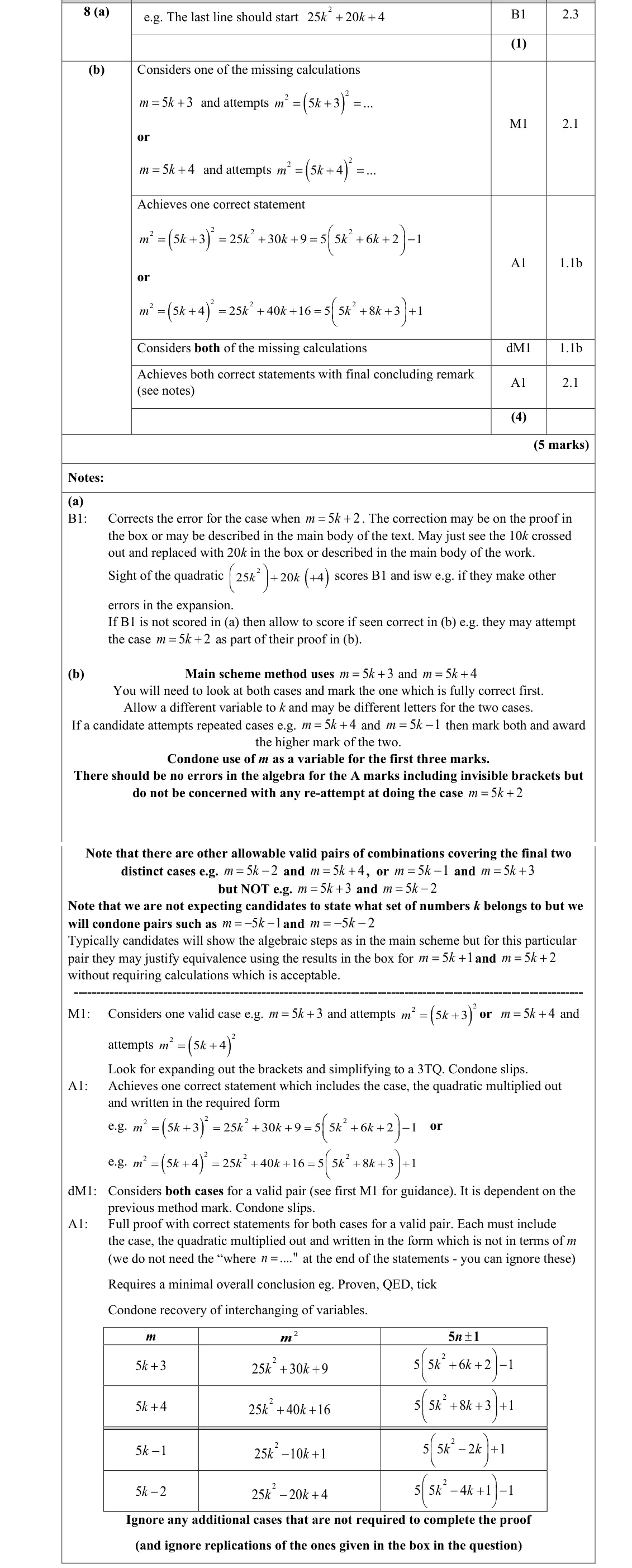
8(a) Proof, including contradiction 1 —
8(b) Proof, including contradiction, Algebraic methods: polynomials, factor theorem and division 4 —
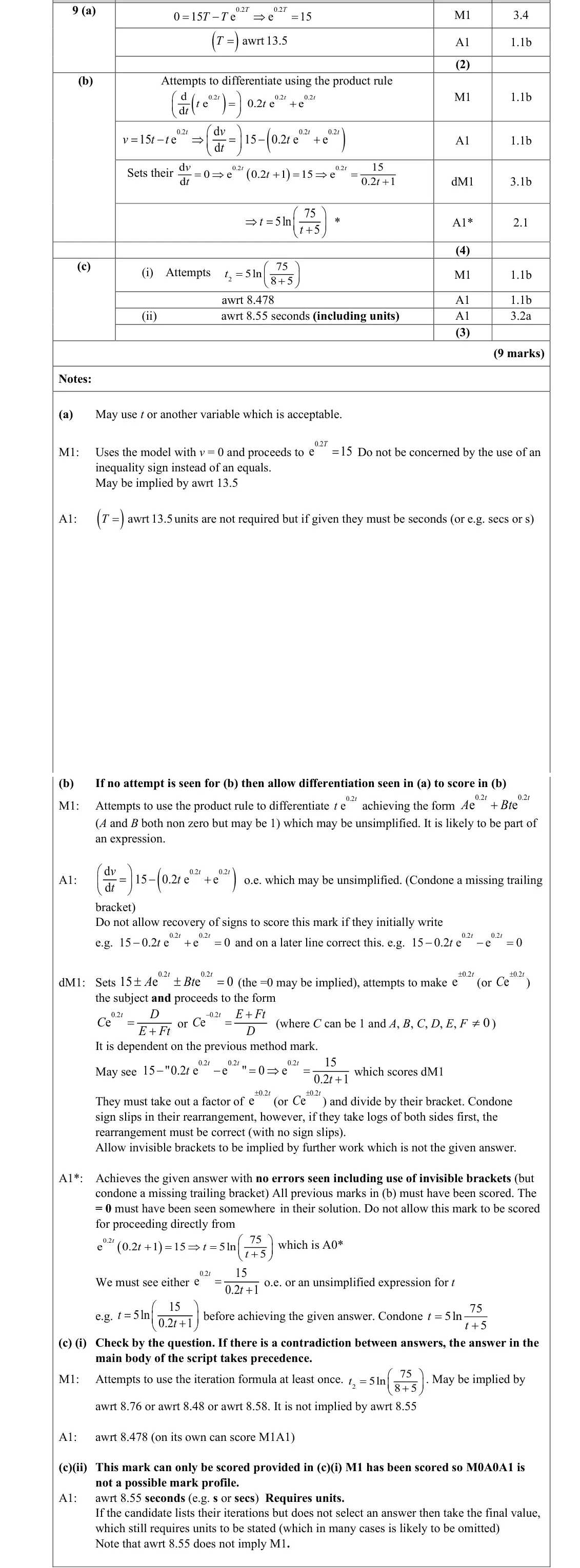
9(a) Exponentials and logarithms, Functions, composite and inverse functions, modulus, Algebraic methods: polynomials, factor theorem and division 2 —
9(b) Chain, product and quotient rules; connected rates of change, Differentiation: first principles, gradients, stationary points, Functions, composite and inverse functions, modulus, Exponentials and logarithms 4 —
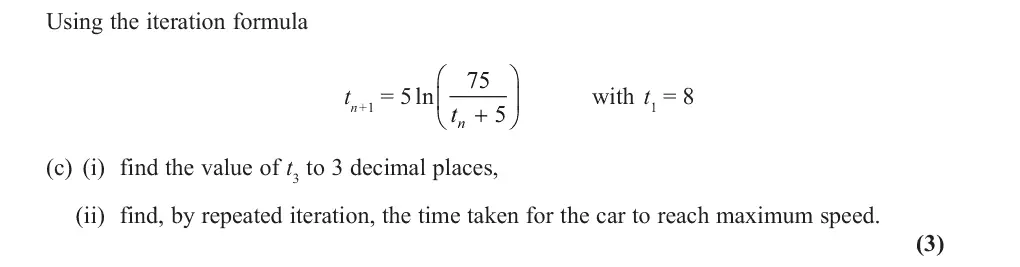
9(c) Numerical methods: roots, iteration and Newton–Raphson, Functions, composite and inverse functions, modulus 3 —
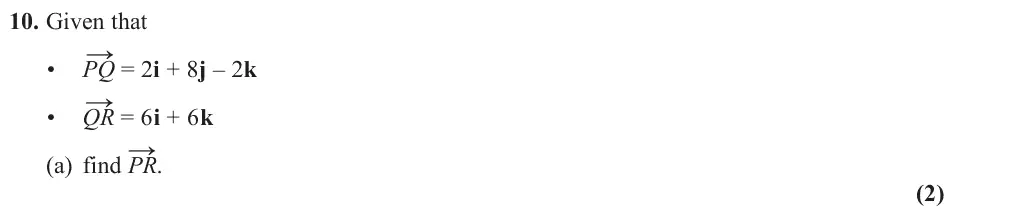
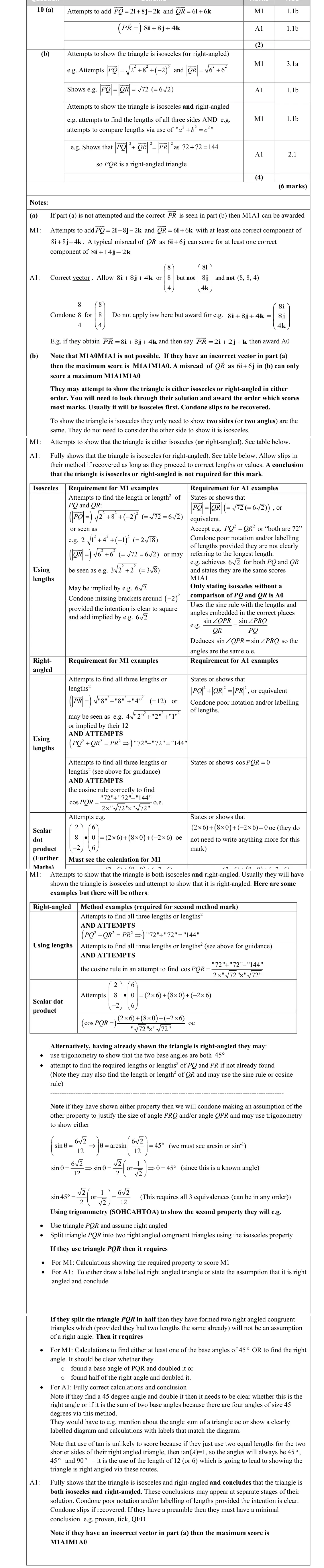
10(a) Vectors 2 —
10(b) Vectors 4 —
11(a) Exponential growth, decay and modelling, Exponentials and logarithms 4 —
11(b) Differentiation: first principles, gradients, stationary points, Exponentials and logarithms, Exponential growth, decay and modelling 3 —
11(c) Exponential growth, decay and modelling 1 —
12(a) Graphs and transformations, Algebraic methods: polynomials, factor theorem and division 2 —
12(b) Algebraic methods: polynomials, factor theorem and division, Graphs and transformations 2 —
12(c) Algebraic methods: polynomials, factor theorem and division, Quadratics and the discriminant 4 —
13 Integration by parts and by substitution, Integration: standard integrals, definite integrals and areas, Partial fractions 5 —
14(a) Addition and double-angle formulae, harmonic form, Trigonometric ratios, graphs, radians and the sine and cosine rules, Trigonometric identities and proofs 3 —
14(b) Addition and double-angle formulae, harmonic form, Solving trigonometric equations 4 —
15(a) Trigonometric ratios, graphs, radians and the sine and cosine rules, Indices and surds 4 —
15(b) Differentiation: first principles, gradients, stationary points, Indices and surds 3 —
15(c) Differentiation: first principles, gradients, stationary points 2 —
16(a) Integration by parts and by substitution, Integration: standard integrals, definite integrals and areas, Reciprocal and inverse trigonometric functions, Trigonometric identities and proofs 4 —
16(b) Integration: standard integrals, definite integrals and areas, Trigonometric ratios, graphs, radians and the sine and cosine rules, Reciprocal and inverse trigonometric functions 3 —

The questions

1(a)1(b)1(c)2(a)2(b)3(a)3(b)4(a)4(b)5(a)5(b)6(a)6(b)6(c)7(a)7(b)7(c)8(a)8(b)9(a)9(b)9(c)10(a)10(b)11(a)11(b)11(c)12(a)12(b)12(c)1314(a)14(b)15(a)15(b)15(c)16(a)16(b)
June 2025 · Paper 1 · Q1(a) 1 mark graphs and transformations
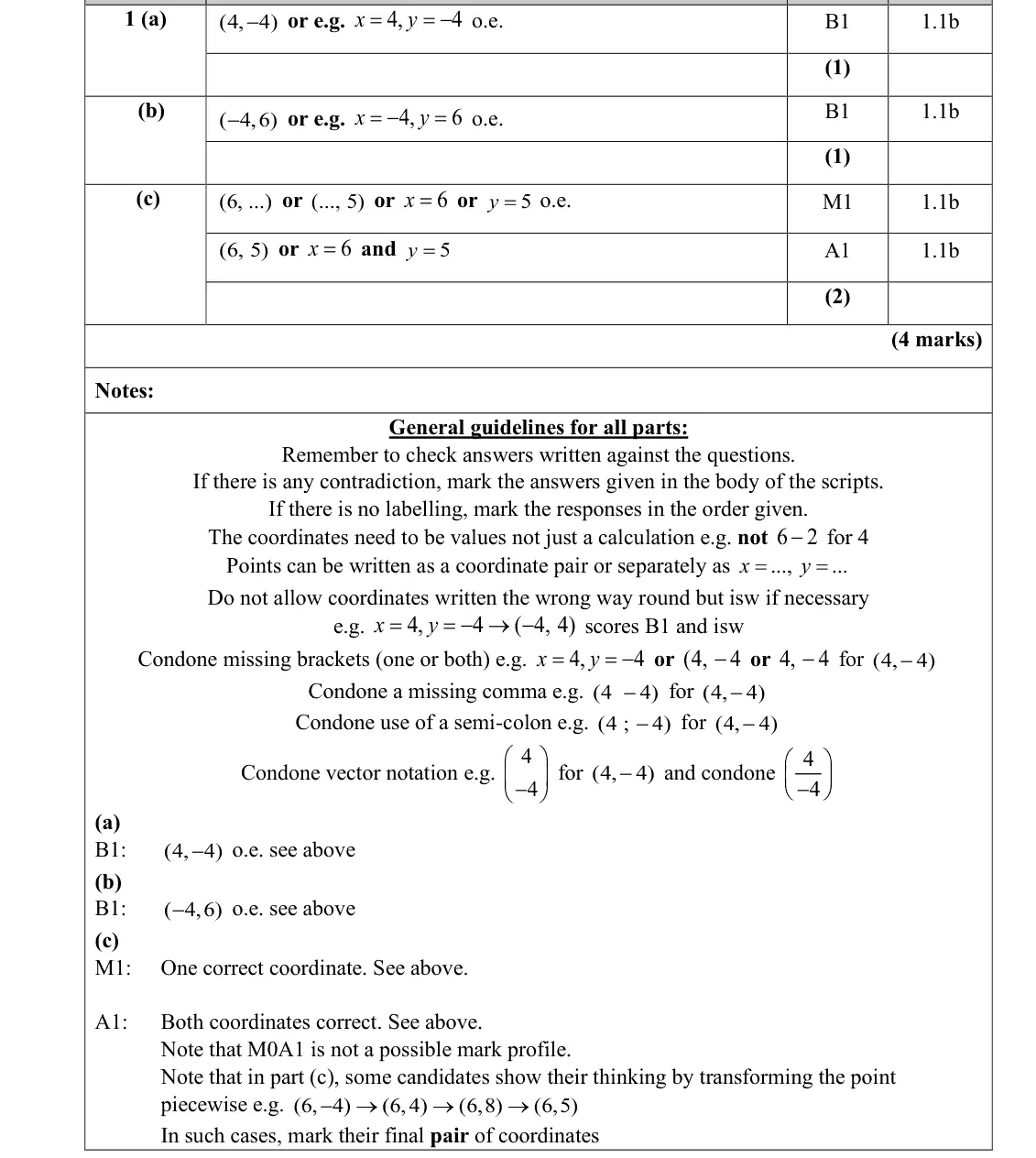
1. The point P(6, –4) lies on the curve with equation y = f(x), x ∈ ℝ Find the point to which P is mapped when the curve with equation y = f(x) is transformed to the curve with equation (a) y = f(x + 2) (1)
June 2025 · Paper 1 · Q1(b) 1 mark functionsgraphs and transformations
–1(x) (b) y = f (1)
June 2025 · Paper 1 · Q1(c) 2 marks graphs and transformations
(c) y = 2½f(x)½ – 3 (2)
June 2025 · Paper 1 · Q2(a) 3 marks circlesindices and surds
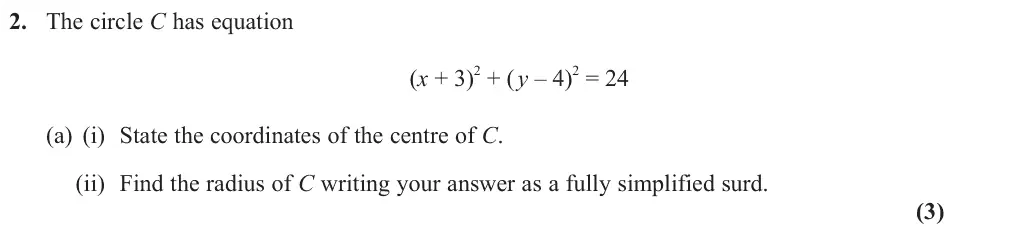
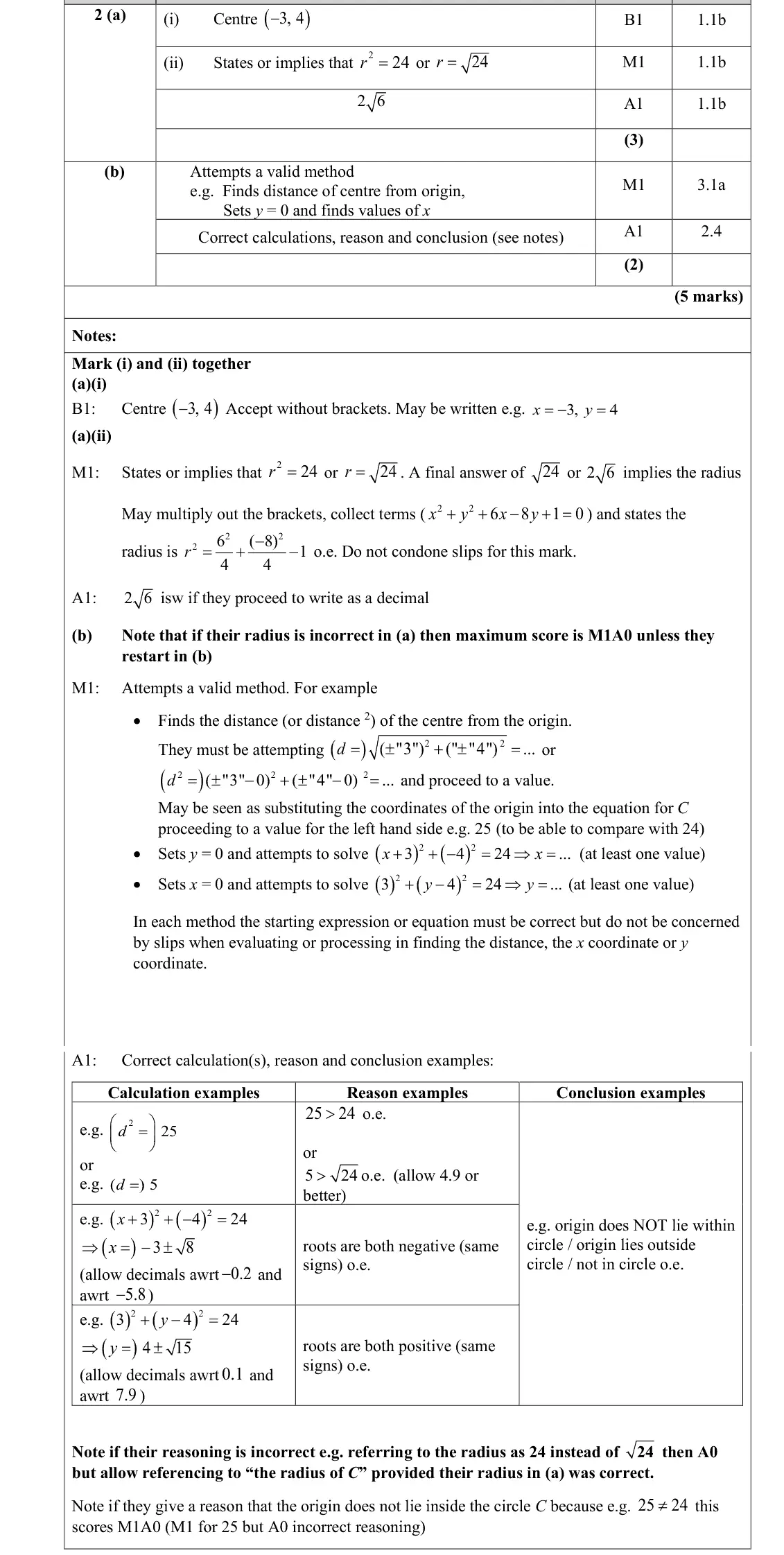
2. The circle C has equation 2 + (y – 4) 2 = 24 (x + 3) (a) (i) State the coordinates of the centre of C. (ii) Find the radius of C writing your answer as a fully simplified surd. (3)
June 2025 · Paper 1 · Q2(b) 2 marks circlesquadratics
(b) Determine, giving a reason, whether or not the origin lies inside the circle C. (2)
June 2025 · Paper 1 · Q3(a) 2 marks sequences and seriessimultaneous equations
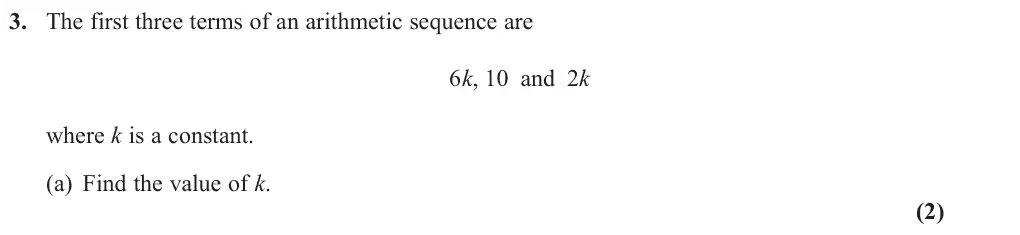
3. The first three terms of an arithmetic sequence are 6k, 10 and 2k where k is a constant. (a) Find the value of k. (2)
June 2025 · Paper 1 · Q3(b) 3 marks sequences and series
(b) Hence find the value of the sum of the first 50 terms of this sequence. (3)
June 2025 · Paper 1 · Q4(a) 3 marks algebraic methods
4. Given that • f(x) = 2x 3 + 3x 2 – 16x + 16 • f(–4) = 0 (a) write f(x) in the form (x + a) Q(x) where a is a constant and Q(x) is a quadratic expression. (3)
June 2025 · Paper 1 · Q4(b) 2 marks quadraticsalgebraic methodsproof
(b) Hence prove that –4 is the only real root of the equation f(x) = 0 (Solutions relying on calculator technology are not acceptable.) (2)
June 2025 · Paper 1 · Q5(a) 1 mark integration
2.89 O: 5. (a) Express lim δx as an integral. x δx < x 1.44 (1)
June 2025 · Paper 1 · Q5(b) 2 marks integrationindices and surds
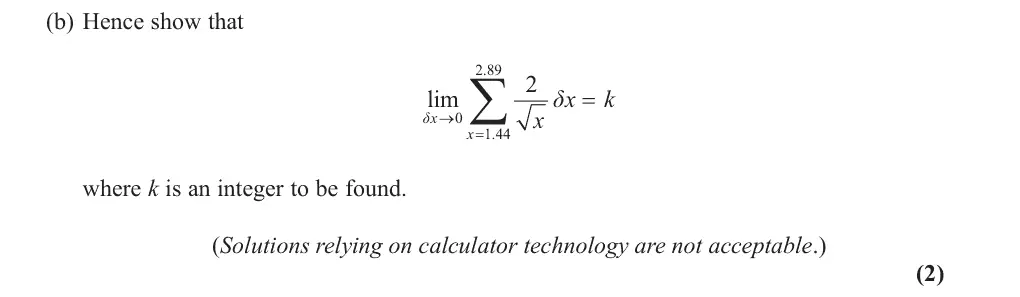
(b) Hence show that 2.89 : δx k lim x δx < x 1.44 where k is an integer to be found. (Solutions relying on calculator technology are not acceptable.) (2)
June 2025 · Paper 1 · Q6(a) 4 marks functionsindices and surdssimultaneous equations
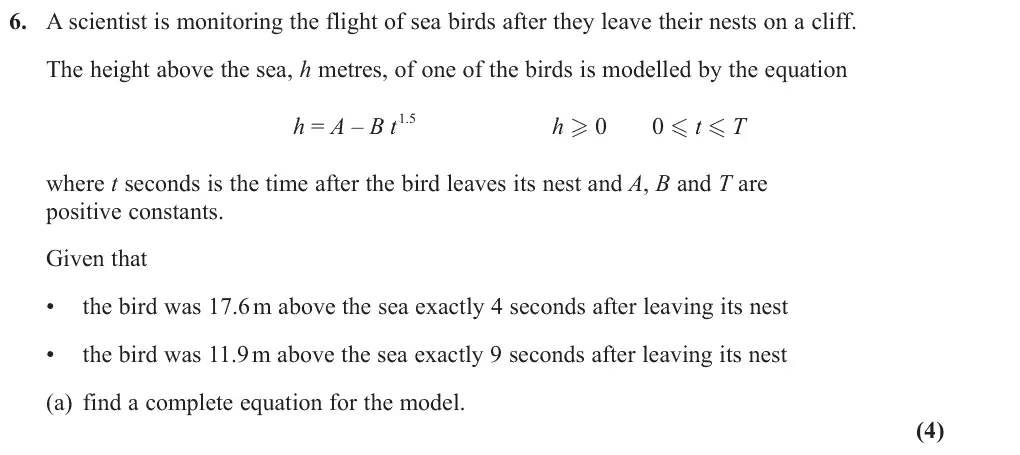
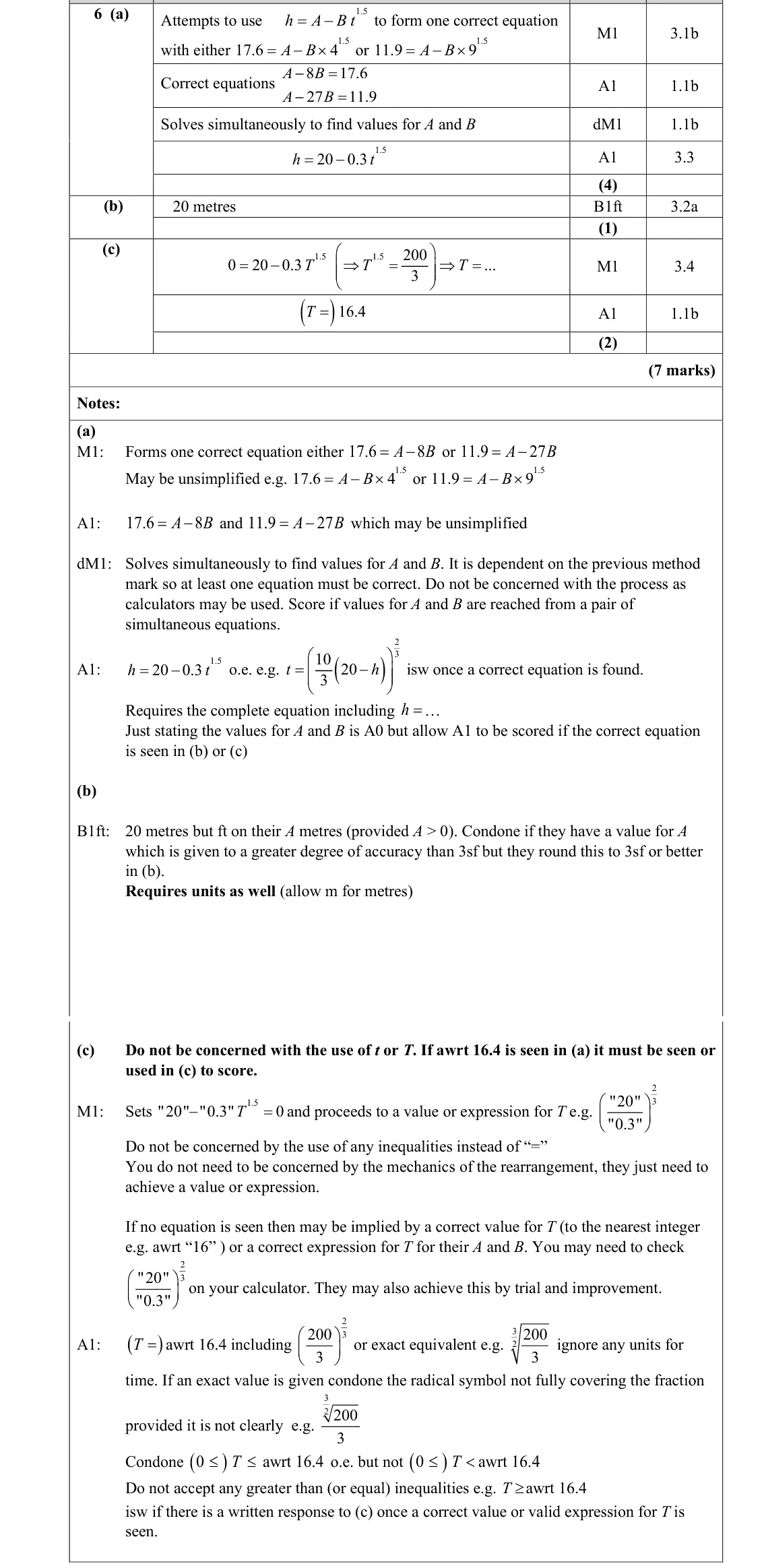
6. A scientist is monitoring the flight of sea birds after they leave their nests on a cliff. The height above the sea, h metres, of one of the birds is modelled by the equation 1.5 h 0 0 t T h = A – B t where t seconds is the time after the bird leaves its nest and A, B and T are positive constants. Given that • the bird was 17.6 m above the sea exactly 4 seconds after leaving its nest • the bird was 11.9 m above the sea exactly 9 seconds after leaving its nest (a) find a complete equation for the model. (4)
June 2025 · Paper 1 · Q6(b) 1 mark functions
Find, according to the model, (b) the height of the bird’s nest above the sea, (1)
June 2025 · Paper 1 · Q6(c) 2 marks functionsindices and surds
(c) the limitation on the value of T. (2)
June 2025 · Paper 1 · Q7(a) 2 marks differentiationinequalities
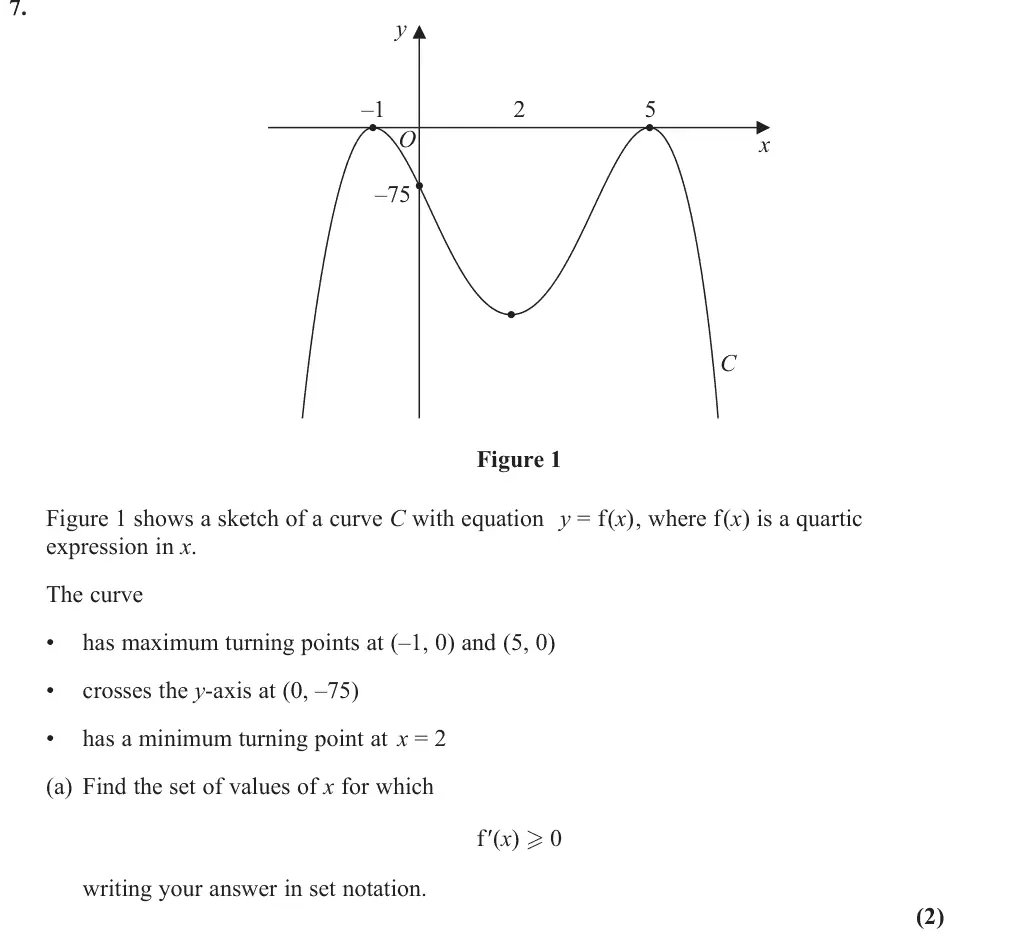
7. y –1 x –75 C Figure 1 Figure 1 shows a sketch of a curve C with equation y = f(x), where f(x) is a quartic expression in x. The curve • has maximum turning points at (–1, 0) and (5, 0) • crosses the y‑axis at (0, –75) • has a minimum turning point at x = 2 (a) Find the set of values of x for which f′(x) 0 writing your answer in set notation. (2)
June 2025 · Paper 1 · Q7(b) 3 marks graphs and transformationsalgebraic methods
(b) Find the equation of C. You may leave your answer in factorised form. (3)
June 2025 · Paper 1 · Q7(c) 2 marks graphs and transformationsdifferentiation
The curve C1 has equation y = f(x) + k, where k is a constant. Given that the graph of C1 intersects the x‑axis at exactly four places, (c) find the range of possible values for k. (2)
June 2025 · Paper 1 · Q8(a) 1 mark proof
8. A student was asked to prove that the square of any number can be expressed in the form 5n or 5n ± 1 where n ∈ The start of the student’s proof is shown in the box below. Let m = 5k Consider m 2 = (5k) 2 = 25k 2 = 5 x 5k 2 = 5n where n = 5k 2 Let m = 5k + 1 Consider m 2 = (5k + 1) = 25k 2 + 10k + 1 = 5(5k 2 + 2k) + 1 = 5n + 1 where n = 5k 2 + 2k Let m = 5k + 2 Consider m 2 = (5k + 2) = 25k 2 + 10k + 4 = 5(5k 2 + 2k + 1) – 1 = 5n – 1 where n = 5k 2 + 2k + 1 (a) Identify and correct an algebraic error in the box above. (1)
June 2025 · Paper 1 · Q8(b) 4 marks proofalgebraic methods
(b) Show the calculations and statements that are required to complete the proof. (4)
June 2025 · Paper 1 · Q9(a) 2 marks exponentials and logsfunctionsalgebraic methods
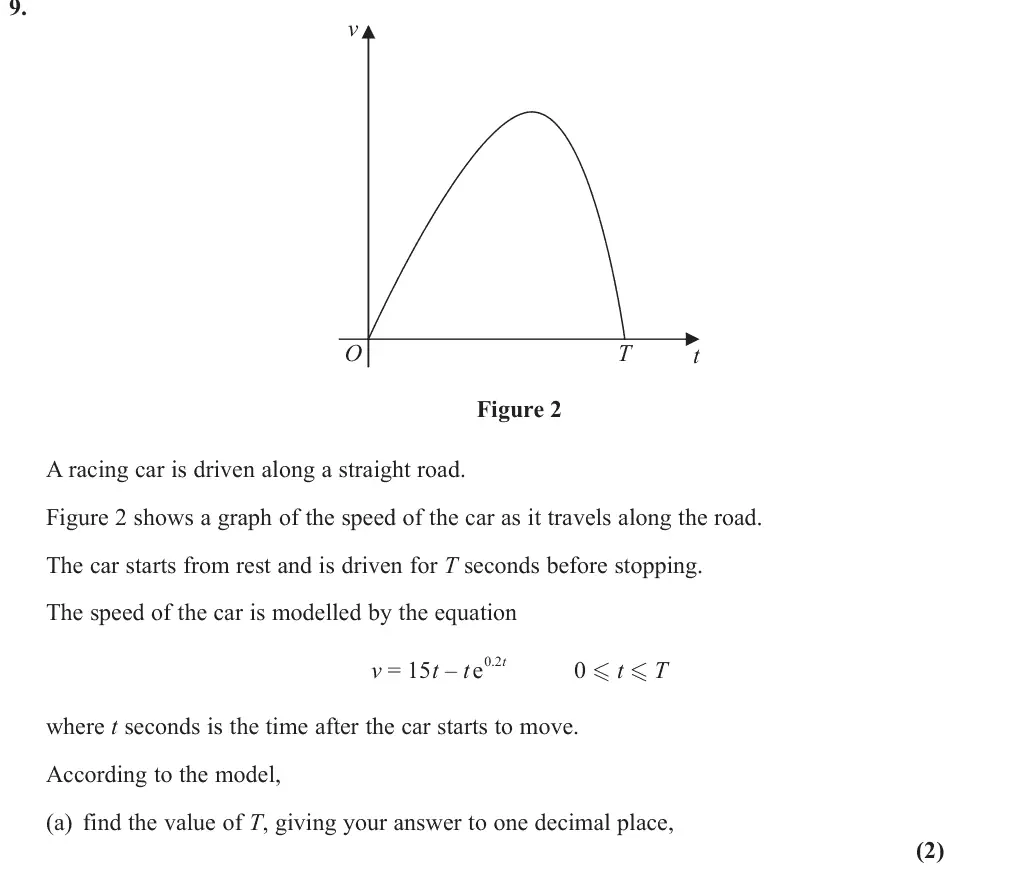
9. v T t Figure 2 A racing car is driven along a straight road. Figure 2 shows a graph of the speed of the car as it travels along the road. The car starts from rest and is driven for T seconds before stopping. The speed of the car is modelled by the equation v = 15t – t e 0.2t 0 t T where t seconds is the time after the car starts to move. According to the model, (a) find the value of T, giving your answer to one decimal place, (2)
(b) show that the maximum speed of the car occurs when ; t = 5 ln :9 t 1 (4)
June 2025 · Paper 1 · Q9(c) 3 marks numerical methodsfunctions
Using the iteration formula ; tn+1 = 5 ln with t1 = 8 tn 1 : (c) (i) find the value of t3 to 3 decimal places, (ii) find, by repeated iteration, the time taken for the car to reach maximum speed. (3)
June 2025 · Paper 1 · Q10(a) 2 marks vectors
10. Given that → = 2i + 8j – 2k • PQ → = 6i + 6k • QR →. (a) find PR (2)
June 2025 · Paper 1 · Q10(b) 4 marks vectors
(b) Hence show that triangle PQR is both right-angled and isosceles. (4)
June 2025 · Paper 1 · Q11(a) 4 marks exponential modellingexponentials and logs
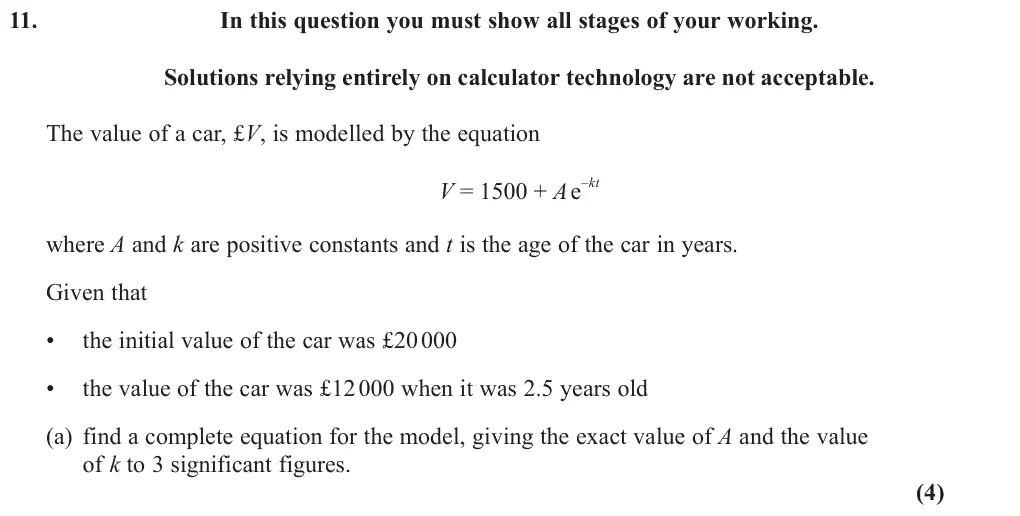
11. In this question you must show all stages of your working. Solutions relying entirely on calculator technology are not acceptable. The value of a car, £V, is modelled by the equation V = 1500 + A e –kt where A and k are positive constants and t is the age of the car in years. Given that • the initial value of the car was £20 000 • the value of the car was £12 000 when it was 2.5 years old (a) find a complete equation for the model, giving the exact value of A and the value of k to 3 significant figures. (4)
June 2025 · Paper 1 · Q11(b) 3 marks differentiationexponentials and logsexponential modelling
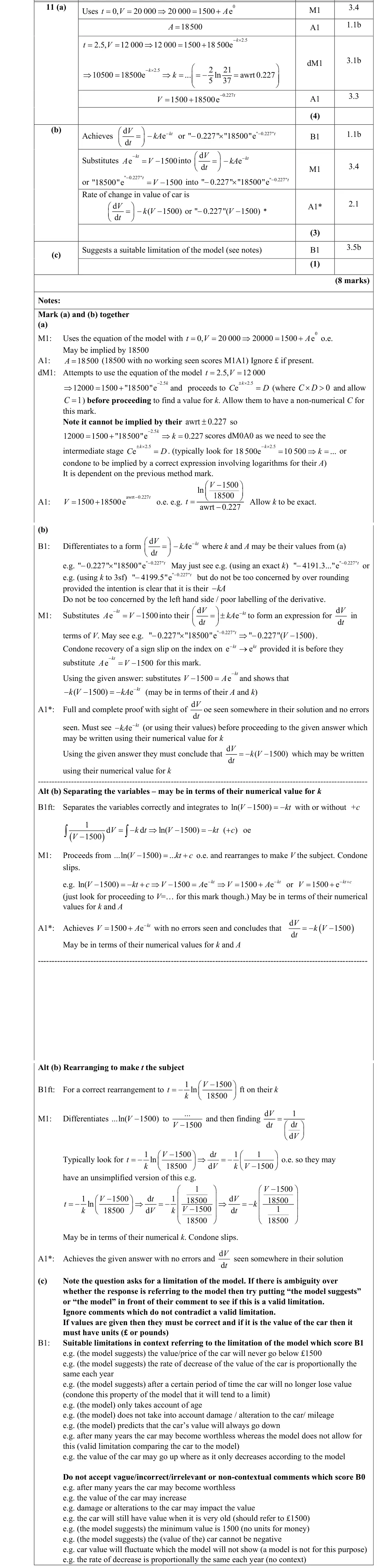
(b) Show that the rate of change in the value of the car can be expressed in the form –k(V – 1500) (3)
June 2025 · Paper 1 · Q11(c) 1 mark exponential modelling
(c) State a limitation of this model. (1)
June 2025 · Paper 1 · Q12(a) 2 marks graphs and transformationsalgebraic methods
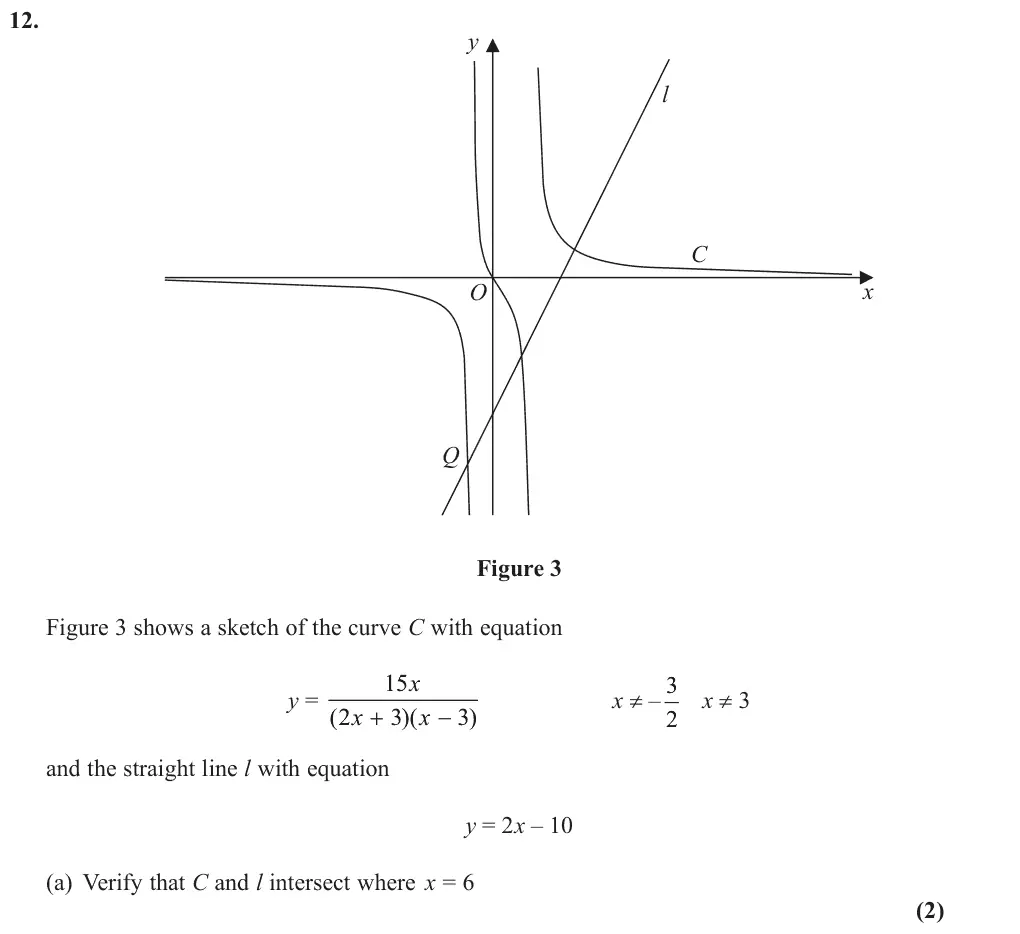
12. y l C x Q Figure 3 Figure 3 shows a sketch of the curve C with equation x x ≠ – 3 y = 2 x ≠ 3 x x ( )( ) and the straight line l with equation y = 2x – 10 (a) Verify that C and l intersect where x = 6 (2)
June 2025 · Paper 1 · Q12(b) 2 marks algebraic methodsgraphs and transformations
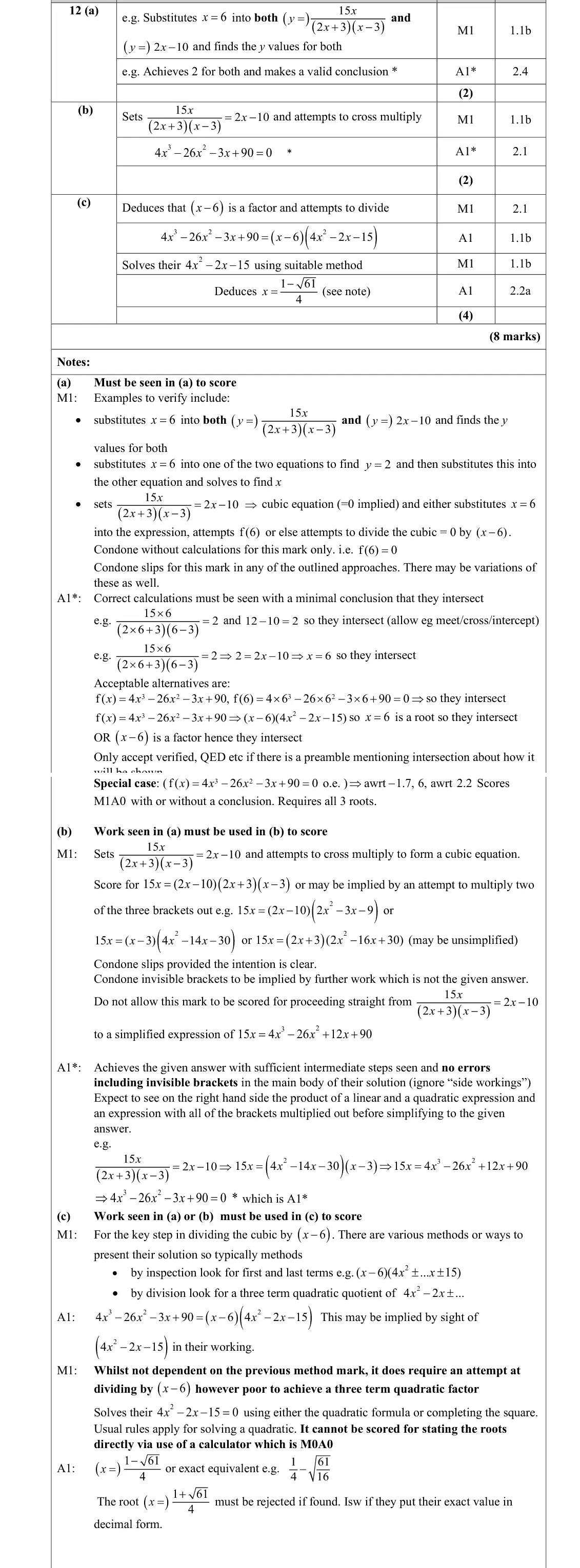
The curve and line also intersect at the point Q shown in Figure 3. (b) Show that the x coordinate of Q is a solution of 4x 3 – 26x 2 – 3x + 90 = 0 (2)
June 2025 · Paper 1 · Q12(c) 4 marks algebraic methodsquadratics
(c) Using algebra and showing all stages of working, find the exact x coordinate of Q. (4)
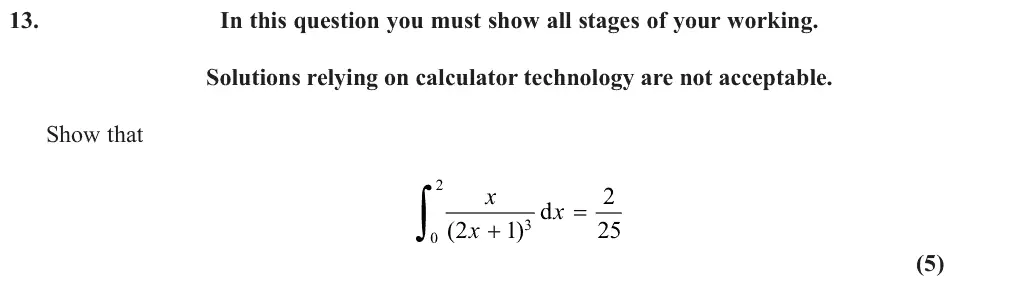
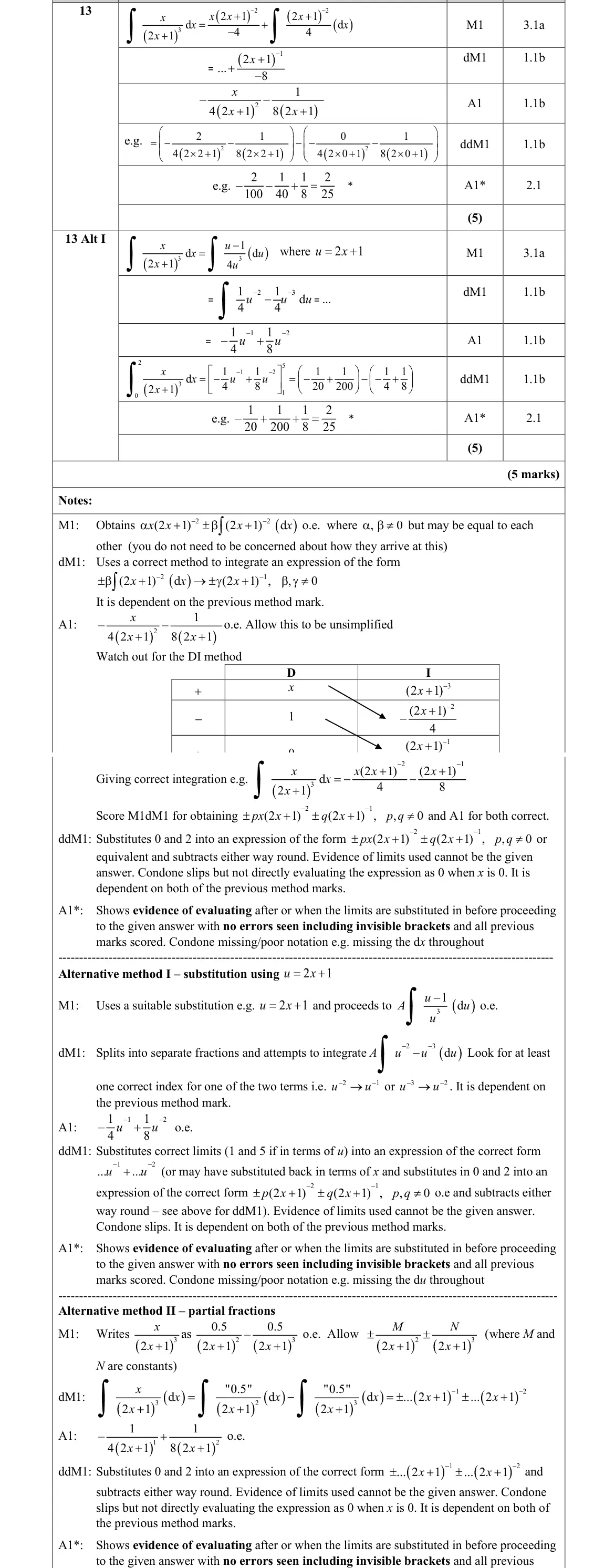
13. In this question you must show all stages of your working. Solutions relying on calculator technology are not acceptable. Show that : x x d x ( ) (5)
June 2025 · Paper 1 · Q14(a) 3 marks double angle formulaetrigonometric ratiostrig identities
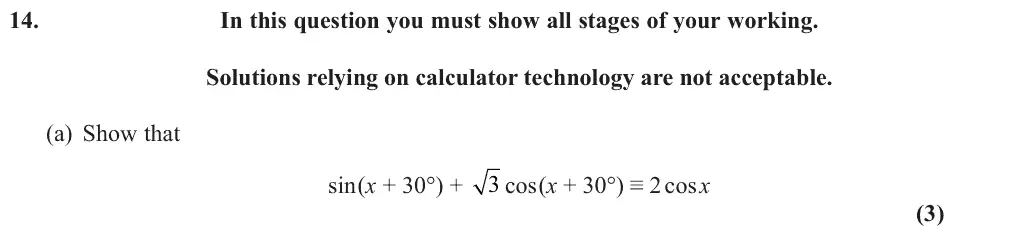
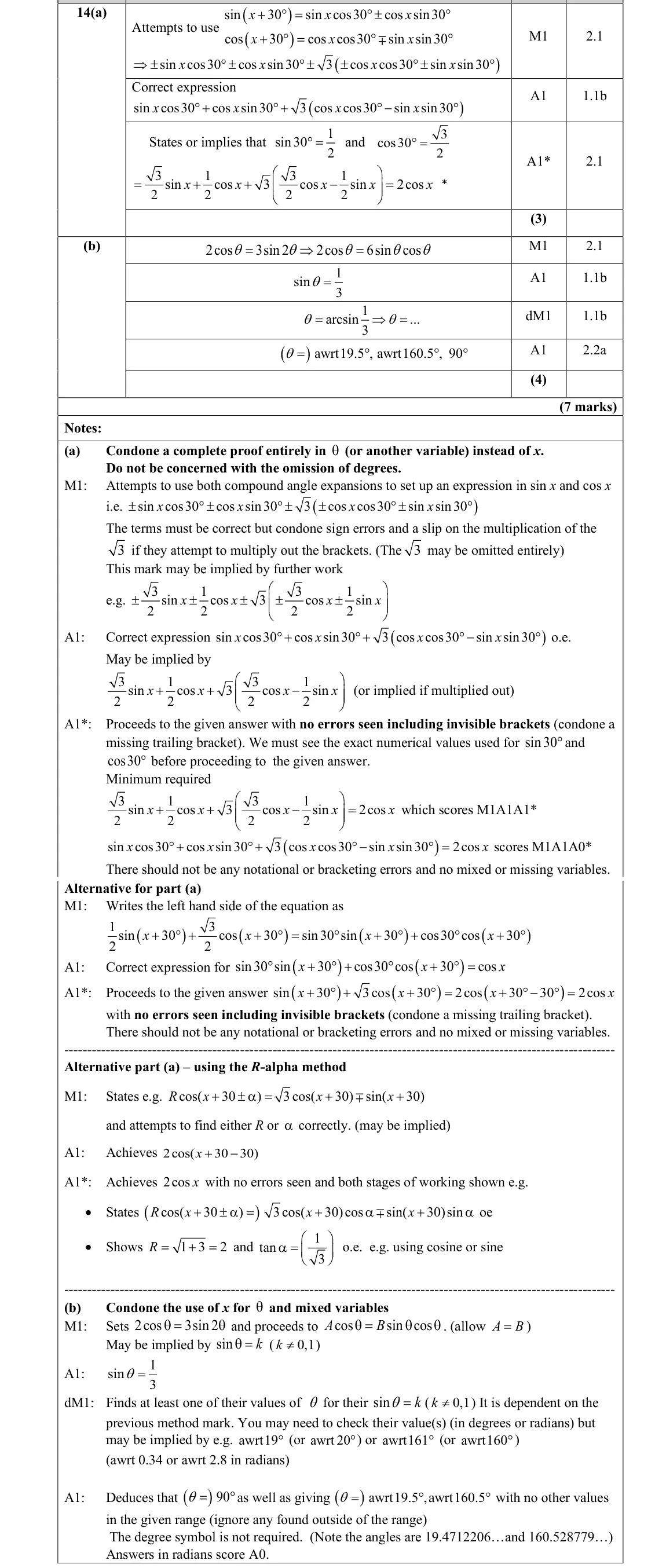
14. In this question you must show all stages of your working. Solutions relying on calculator technology are not acceptable. (a) Show that sin(x + 30°) + 3 cos(x + 30°) ≡ 2 cos x (3)
June 2025 · Paper 1 · Q14(b) 4 marks double angle formulaetrigonometric equations
(b) Hence solve, for 0 theta < 180° sin( theta + 30°) + 3 cos( theta + 30°) = 3 sin 2 theta giving your answers to one decimal place, where appropriate. (4)
June 2025 · Paper 1 · Q15(a) 4 marks trigonometric ratiosindices and surds
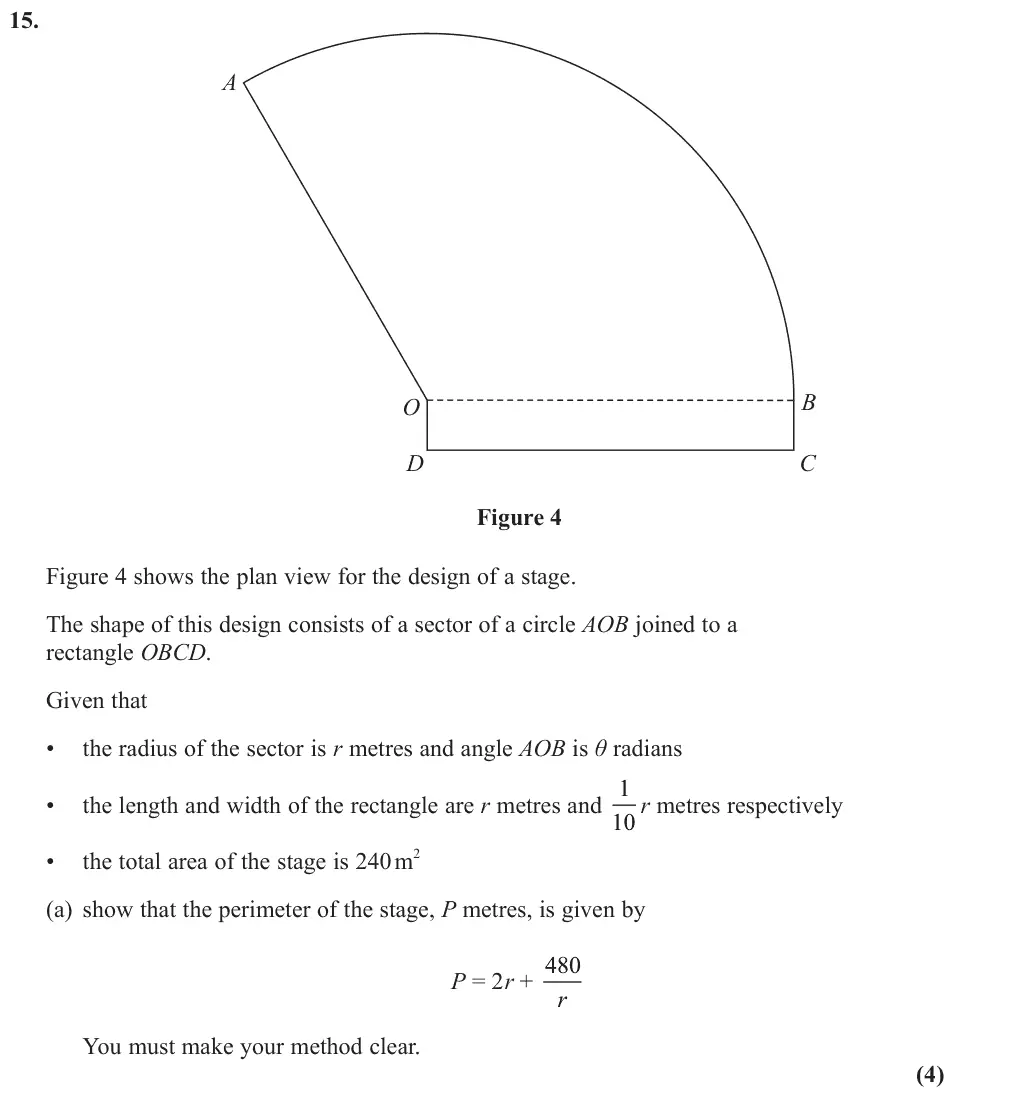
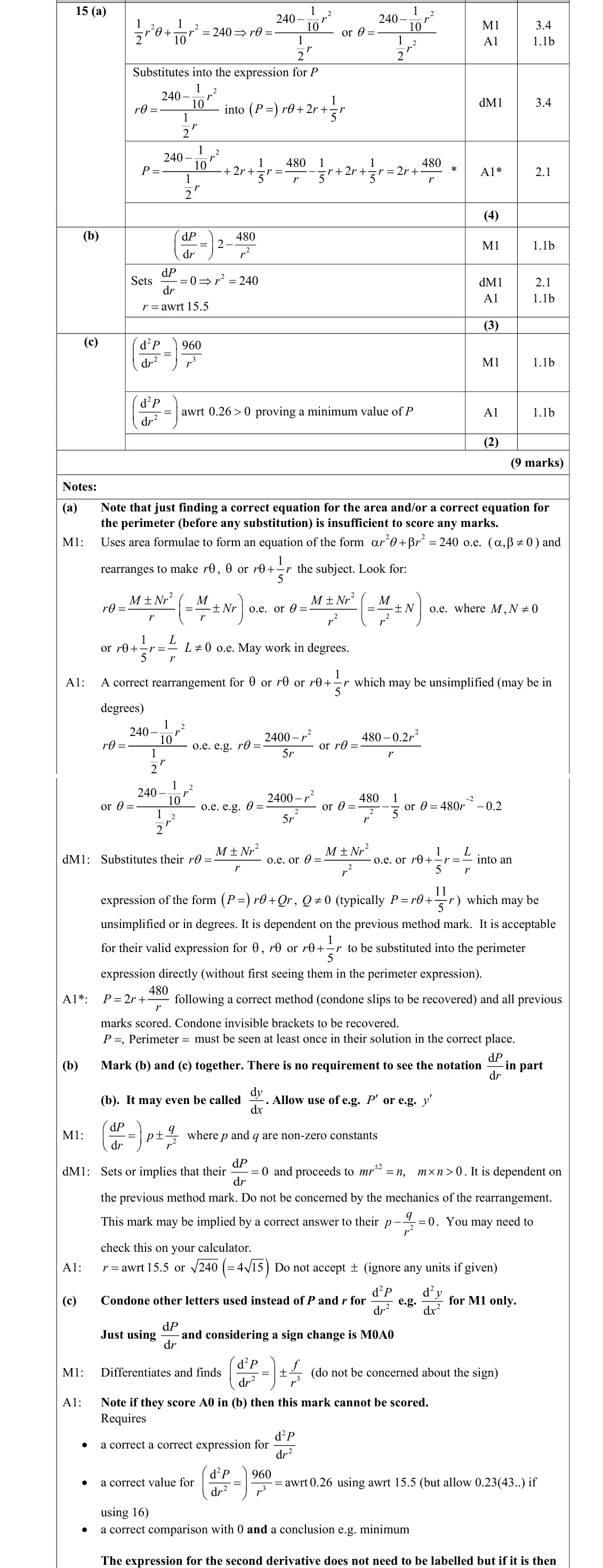
15. A B C Figure 4 Figure 4 shows the plan view for the design of a stage. The shape of this design consists of a sector of a circle AOB joined to a rectangle OBCD. Given that • the radius of the sector is r metres and angle AOB is theta radians the length and width of the rectangle are r metres and 1 • 10 r metres respectively • the total area of the stage is 240 m (a) show that the perimeter of the stage, P metres, is given by P = 2r + 480 r You must make your method clear. (4)
June 2025 · Paper 1 · Q15(b) 3 marks differentiationindices and surds
Using algebraic differentiation, (b) find the value of r for which P has a stationary value. (3)
June 2025 · Paper 1 · Q15(c) 2 marks differentiation
(c) Prove, by further differentiation, that this value of r gives the minimum perimeter of the stage. (2)
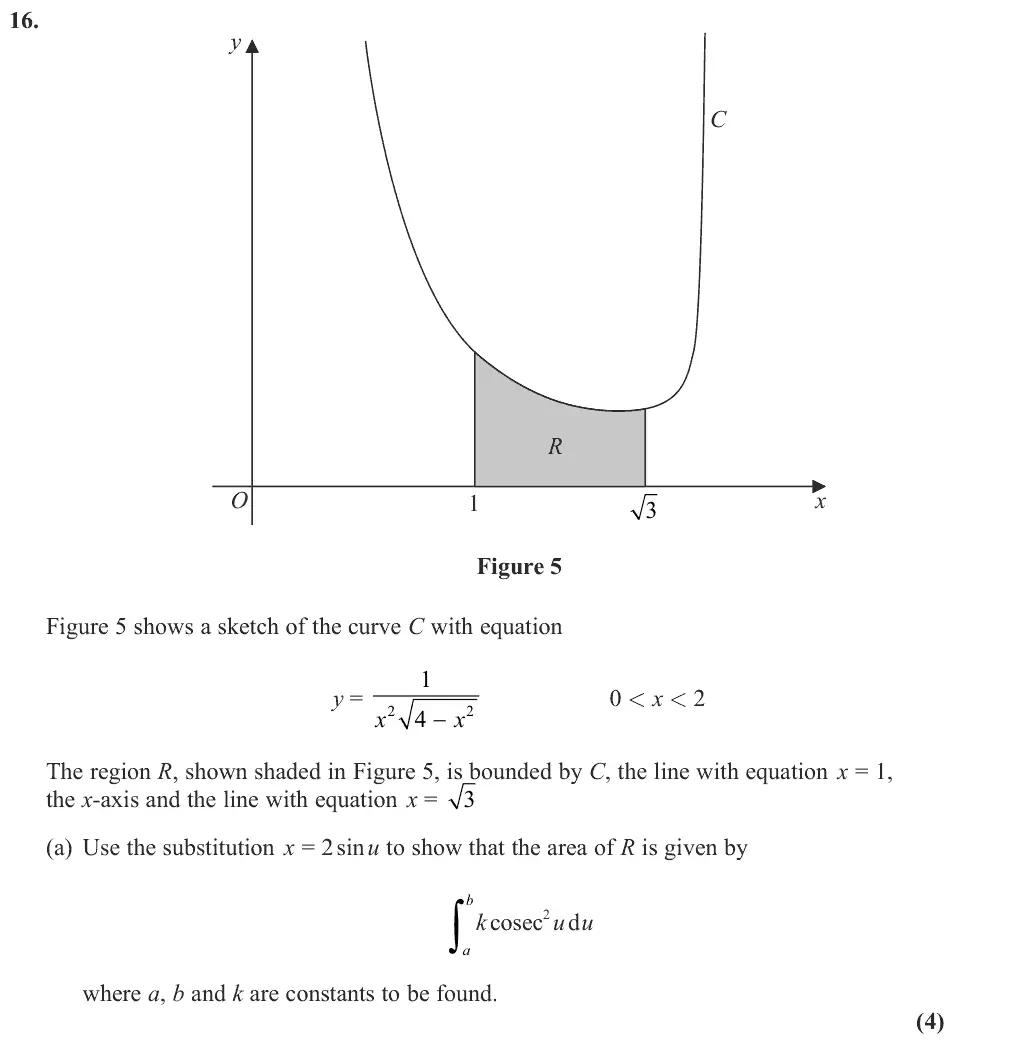
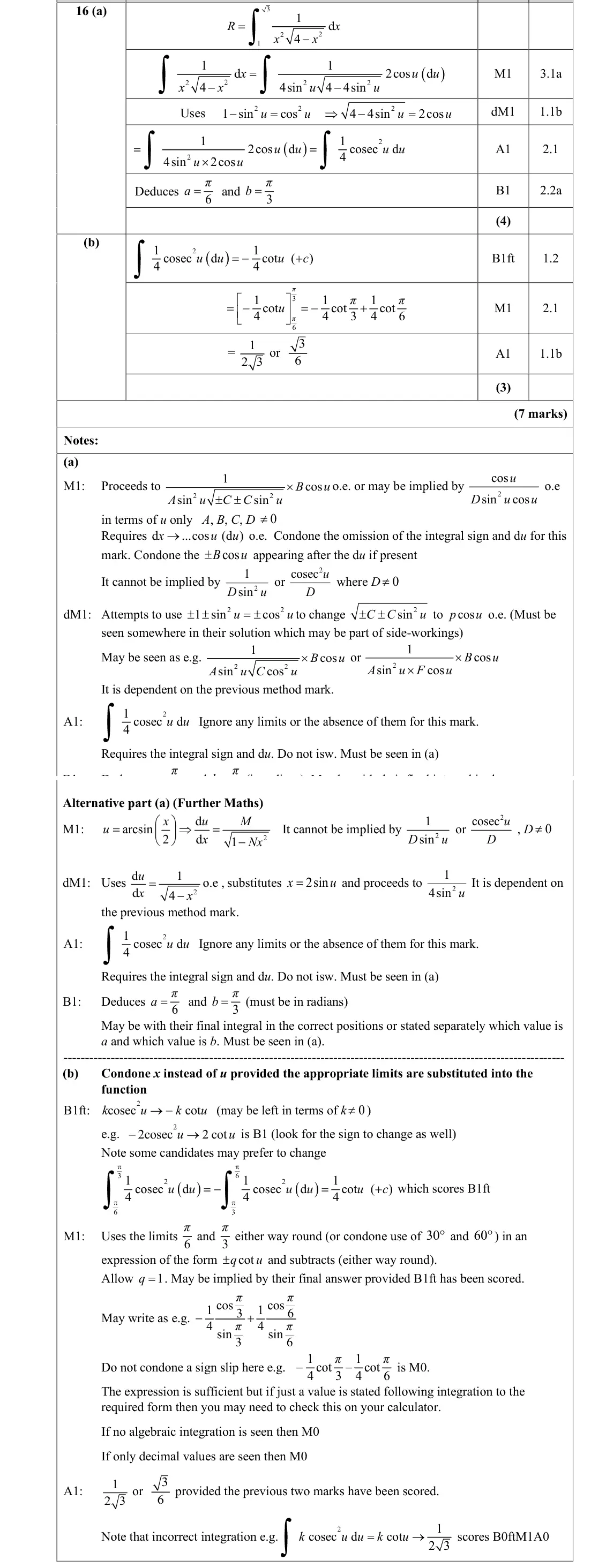
16. y C R x Figure 5 Figure 5 shows a sketch of the curve C with equation y = 0 < x < 2 x - x The region R, shown shaded in Figure 5, is bounded by C, the line with equation x = 1, the x‑axis and the line with equation x = (a) Use the substitution x = 2 sin u to show that the area of R is given by b∫k cosec 2 u du a where a, b and k are constants to be found. (4)
June 2025 · Paper 1 · Q16(b) 3 marks integrationtrigonometric ratiosreciprocal trig functions
(b) Hence, using algebraic integration, find the exact area of R. Give your answer in simplest form. (3)

Find an Edexcel maths tutor

Want this paper marked and gone through with you? Message us.

Prefer email? Send an enquiry

If you are under 18, please include a parent's contact details. Enquiries go to enquiries@mathsaleveltutor.com and are deleted once handled.